On this page
The armies form, and Arjuna comes into view
Karna saw the formation Dhrishtadyumna had drawn up for the Pandavas, a formation capable of resisting any hostile army. Roaring like a lion, he advanced with his chariot rattling loudly. The din of instruments shook the earth, and he seemed to tremble with anger. He arranged his troops to counter the enemy and began slaughtering the Pandava forces as Indra had slaughtered the asuras. After striking Yudhishthira with many arrows, he placed the eldest Pandava on his right. Dhritarashtra interrupted Sanjaya’s account. How had Karna arrayed his troops against those great archers, led by Dhrishtadyumna and protected by Bhima, whom even the gods could not defeat? Who stood on the wings and the outer wings of the Kaurava army? How were the warriors divided, and what formation had the Pandavas chosen to oppose them? How had the terrible battle begun? Above all, where was Arjuna when Karna attacked Yudhishthira? Who could reach the king with Arjuna present? Arjuna had defeated all the creatures at Khandava by himself. Who except Karna could hope to fight him and survive? Sanjaya offered to describe the formations, Arjuna’s arrival, and the fighting around the two kings. Kripa, the son of Sharadvat, held the right wing with the energetic Magadhas and Kritavarma of Krishna’s own Satwata clan. Farther to their right stood Shakuni and Uluka, supported by fearless Gandhara cavalry carrying bright lances. Many mountain warriors guarded that side as well, difficult to defeat, numerous as swarms of locusts, and grim as pishachas. On the left stood 34,000 chariots of the Samsaptakas, the fighters committed to battle without retreat. Dhritarashtra’s sons stood among them. All burned to kill Krishna and Arjuna. Farther left, under Karna’s orders, the Kambojas, Shakas, and Yavanas waited with chariots, cavalry, and infantry, challenging the two opponents they sought.
Karna occupied the forward center of the formation. His fine armor, armlets, and garlands shone as he repeatedly drew his bow, his angry sons supporting him. Behind the main body, Duhshasana approached slowly on the neck of an enormous elephant, surrounded by many troops. His eyes were tawny, his face handsome, and he shone like fire or the sun. Duryodhana followed, protected by his own brothers on fine horses, wearing splendid armor. The powerful Madras and Kekayas united around him, making the king appear like Indra, performer of 100 sacrifices, surrounded by the gods. Ashvatthama and other great chariot warriors followed that chariot force with many elephants, perpetually excited, their temples streaming like rain clouds. Brave mleccha riders, skilled at fighting from their backs, guided the huge animals. Victory standards and gleaming weapons decorated them until they resembled wooded hills. Thousands of courageous soldiers who would never retreat guarded their feet with swords and axes. Chariots, cavalry, and elephants gave the formation the splendor of an army of gods or asuras. Its commander, skilled in war, had shaped it according to Brihaspati’s principles. It seemed to dance as it advanced, striking fear into its enemies. Troops streamed from the wings and outer wings: infantry, horses, chariots, and elephants appearing as constantly as clouds during the rains. Yudhishthira saw Karna at its head and called Arjuna’s attention to the size and brilliance of the enemy force. They must take measures to prevent it from defeating them. With joined hands Arjuna promised to obey fully. He would destroy the enemy by killing its leading warriors. Yudhishthira assigned their opponents: Arjuna would face Karna; Bhima, Duryodhana; Nakula, Vrishasena; Sahadeva, Shakuni, Subala’s son; Shatanika, Duhshasana; Satyaki, Kritavarma, Hridika’s son; and Pandya, Ashvatthama. Yudhishthira himself would fight Kripa. Draupadi’s sons, with Shikhandi among them, would attack the remaining sons of Dhritarashtra. The rest of the army would engage the other enemies.
Arjuna agreed, issued the necessary orders, and moved to the front. Krishna and Arjuna rode the ancient chariot that had first emerged from Brahma and was known among the gods as his vehicle. Agni, whose radiance came from Brahma, had become its horses. In earlier times the chariot had carried Brahma, Shiva, Indra, and Varuna in succession. Seeing that extraordinary vehicle approach, Shalya spoke again to Karna. “There it comes, with white horses and Krishna driving. No army can resist it, any more than it can escape the consequences of its deeds. The son of Kunti is coming, killing enemies as he advances. There is the man you have been asking for. Hear that great uproar, deep as thunder. It must be Krishna and Arjuna. Dust rises over the sky like a canopy. Arjuna’s wheels cut so deeply into the earth that the whole ground seems to shake. Violent winds blow on both sides of your army. Flesh-eating creatures howl, and the animals make dreadful cries. Look at that terrifying, smoky Ketu covering the sun. See the great packs of animals, the powerful wolves and tigers, looking toward it. Thousands of kanka birds and vultures sit facing one another as if in conversation. The colored yak-tail ornaments on your chariot wave restlessly. Your standard trembles. Even your splendid horses, with their strong bodies and the speed of birds in flight, are shaking. These signs make it certain that hundreds and thousands of kings will lose their lives and lie on the ground in an endless sleep.” He called Karna’s attention to the sounds rising on every side: the conches that made the hair stand on end, the drums and cymbals, arrows whistling, chariots rattling, horses and men making their din. Above them sounded the loud twang of the great warriors’ bowstrings.
Shalya pointed out Arjuna’s banners, edged with rows of bells and decorated with golden moons and stars. Skilled craftsmen had made them from many-colored fabrics embroidered with gold. Shaken by the wind, they flashed over the chariot like lightning in a bank of clouds. Other banners snapped sharply in the air. The Panchala warriors, riding beneath their standards, looked like gods in heavenly chariots. Unconquered Arjuna advanced to destroy the enemy, the terrifying ape at the top of his standard drawing every eye and deepening the fear around him. Krishna’s discus, mace, Sharanga bow, Panchajanya conch, and Kaustubha jewel shone beautifully. He urged the white horses on at the speed of wind. Gandiva sounded as Arjuna drew it, and the sharpened arrows released by his powerful arms killed his enemies. Shalya described the destruction ahead. The heads of kings who had stood their ground lay across the earth, their faces like full moons, their broad eyes copper-colored. The arms of warriors who had delighted in battle fell with weapons still in their hands, perfumed limbs resembling spiked maces. Horses with eyes, tongues, and entrails torn out fell alongside their riders; others already lay dead. Great elephants, torn and pierced by Arjuna, toppled like mountain peaks. Chariots whose kings had been killed fell like heavenly vehicles when their riders’ merit ran out. The army surged in distress before Arjuna as herds of cattle scattered before a maned lion. Advancing Pandava warriors killed kings, elephants, horses, chariot fighters, and infantry among Karna’s embattled troops. Arjuna himself had vanished within the crush of friends and enemies, weapons and dust, as the sun vanished behind clouds. Only the top of his standard could be seen; the twang of his bow could still be heard. Shalya assured Karna that he would see the white-horsed warrior he had sought, with Krishna driving and enemies falling around him. He would see both red-eyed heroes on the same chariot. If he killed the man who carried Gandiva and had Krishna as his driver, Shalya said, Karna would be their king. The Samsaptakas had now challenged Arjuna. He was moving against them and slaughtering their warriors.
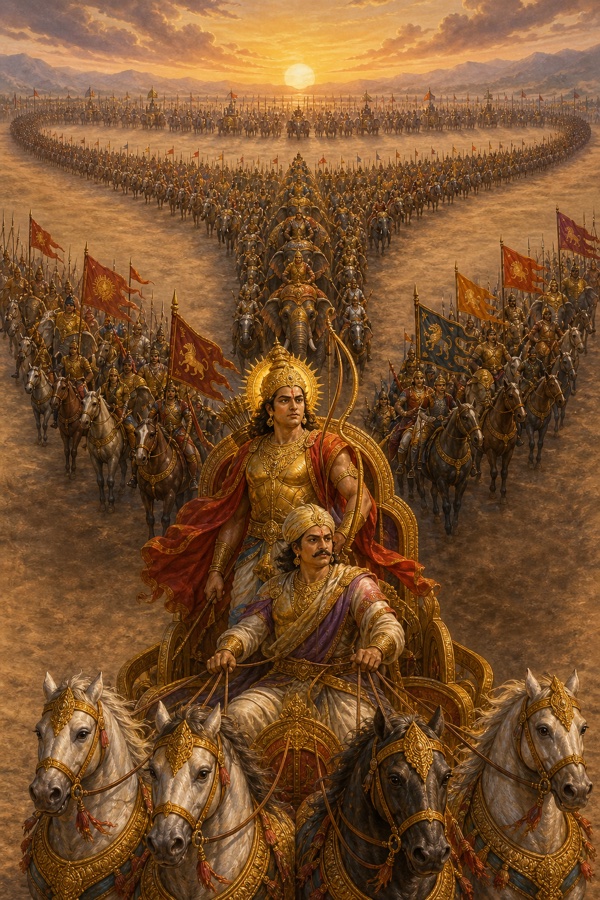
Karna angrily pointed out that the furious Samsaptakas had attacked Arjuna on every side. Like the sun behind clouds, Arjuna had disappeared. Submerged in that ocean of warriors, he would surely die. Shalya asked who could kill Varuna with water, extinguish fire with fuel, seize the wind, or drink the ocean dry. Trying to crush Arjuna was just such an undertaking. Even gods and asuras together, led by Indra, could never defeat him. Karna could enjoy his own claims and put his mind at ease, but he should turn to some other purpose. Only someone who could lift the earth in two arms, burn every creature in anger, or cast the gods out of heaven could conquer Arjuna. Shalya then pointed to Bhima, the other mighty son of Kunti, tireless in his exertions and standing like another Mount Meru. Bhima’s anger remained kindled. Remembering every injury, he waited for victory and revenge. Yudhishthira, foremost among virtuous men, stood where the enemy would find him difficult to resist. Nakula and Sahadeva, the invincible sons of Madri, stood together like their divine fathers, the twin Ashvins. Draupadi’s five sons had the features of Panchala princes, and all were ready for battle, Arjuna’s equals in war. Dhrishtadyumna and the other sons of Drupada held their positions, full of pride and energy. Satyaki, greatest among the Satwatas and irresistible as Indra, advanced toward them like the destroyer in anger. While Karna and Shalya were still speaking, the two armies merged in fierce combat, like the meeting currents of the Ganga and Yamuna.
The gist: Sanjaya describes the Kaurava formation and Yudhishthira’s assignments for the Pandava warriors. Shalya identifies the approaching chariot of Krishna and Arjuna through its banners, sounds, and devastating progress. Arjuna turns toward the Samsaptakas. Karna expects them to destroy him; Shalya insists he cannot be defeated. The armies meet.
Arjuna faces the Samsaptakas as Karna reaches Yudhishthira
Dhritarashtra wanted the fighting described in detail. Now that the formations had met, how had Arjuna attacked the Samsaptakas, and how had Karna struck the Pandavas? Sanjaya was skilled at telling such events, he said, and the accounts of heroic courage never satisfied his desire to hear more. Sanjaya described Arjuna studying the vast enemy force and arranging his own troops to meet it. Sanjaya laid responsibility for the conflict on Duryodhana’s destructive policy. The Pandava army spread out magnificently under Dhrishtadyumna, crowded with horses, elephants, infantry, and chariots. At its head, the commander held his bow behind horses as white as pigeons. He shone like the sun or moon and seemed to embody Death. Draupadi’s sons stood beside their mother’s brother, ready to fight. Fine armor covered them, excellent weapons lay at their command, and each possessed the courage of a tiger. The young warriors’ radiance surrounded their uncle as stars surrounded the moon.
Arjuna saw the Samsaptakas drawn up before him. Anger rose as he drew Gandiva and rushed toward them. They charged in turn, determined to kill him, committed to victory and ready to fight until death. Men, horses, chariots, and excited elephants pressed in rapidly, striking at the warrior beneath the diadem. The clash grew as furious as the battle Arjuna had once fought against the Nivatakavachas, Sanjaya said, recalling the account they had heard. Arjuna’s shafts cut down chariots, horses, standards, elephants, and fighting infantry by the thousands. They broke through arrows, bows, swords, discs, and battle-axes, severed raised arms still gripping weapons, and struck the heads from his enemies. The Samsaptakas roared as his chariot appeared to sink within the deep whirlpool of warriors. He killed the enemies directly in front of him, then those farther away, then those to his right and behind. In his destruction he resembled Rudra enraged against every living creature.
Elsewhere the Panchalas, Chedis, and Srinjayas fought Dhritarashtra’s army with equal ferocity. Kripa, Kritavarma, and Shakuni, Subala’s son, advanced in anger with troops whose spirits remained high. These formidable leaders could smash dense ranks of chariots. They faced the courageous warriors of Koshala, Kashi, Matsya, Karusha, Kaikaya, and Surasena. Sanjaya described the slaughter as destroying bodies, lives, and sins, bringing fame, heaven, and religious merit to the kshatriya, vaishya, and shudra heroes who fought there. Meanwhile Duryodhana and his brothers guarded Karna, supported by Kuru champions and many powerful Madra chariot warriors. Protected by them, Karna fought the Pandavas, Panchalas, Chedis, and Satyaki. His sharp arrows tore through the vast opposing division and crushed its leading chariot fighters until he succeeded in striking Yudhishthira. He cut the armor, weapons, and bodies of thousands of enemies. Thousands died, gaining heaven and great renown in Sanjaya’s account, while Karna’s friends rejoiced. The battle between the Kurus and Srinjayas destroyed men, horses, and chariots on a scale that recalled the ancient war between gods and asuras.
The gist: Arjuna fights through the Samsaptakas surrounding his chariot. Kripa, Kritavarma, and Shakuni battle the Pandavas’ allies on other fronts. With Duryodhana and his companions protecting him, Karna tears through the opposing division and brings Yudhishthira under attack.
Karna’s sons fight, and the way to Yudhishthira opens
Dhritarashtra asked how Karna had penetrated the Pandava army and brought Yudhishthira under attack. Which great warriors had tried to stop him? Whom had he crushed before reaching the king? Sanjaya described Karna rushing at the Panchalas as they stood ready under Dhrishtadyumna. They charged just as quickly toward him, eager for victory, like swans flying toward the sea. Thousands of conches sounded from both armies, their shrillness seeming to pierce the heart, while thousands of drums thundered. Other instruments joined the cries of elephants and horses, the noise of chariots, and the warriors’ lionlike roars. The whole earth seemed to shake with its mountains, trees, and oceans. The clouds tossed by the wind seemed to tremble, and the sky itself with the sun, moon, and stars. Every creature felt the sound and grew disturbed; the weakest died. Karna’s anger rose. Quickly invoking his weapons, he struck the Pandava army as Indra struck the asuras. He entered its ranks and killed 77 leading Prabhadraka warriors. With 25 sharp, finely feathered arrows, he killed 25 Panchalas. Cloth-yard shafts with golden feathers, capable of piercing any enemy, brought down Chedis by the hundreds and thousands. Large groups of Panchala chariots closed around him as he performed these extraordinary feats. He aimed 5 irresistible arrows and killed 5 of their warriors: Bhanudeva, Chitrasena, Senavindu, Tapana, and Surasena. Cries of anguish rose from the Panchala troops. Another 10 chariot fighters surrounded him; he killed them swiftly too.
Two of Karna’s sons, Sushena and Satyasena, guarded his wheels, fighting without concern for their own lives. His eldest son Vrishasena protected the rear. Dhrishtadyumna, Satyaki, Draupadi’s 5 sons, Bhima, Janamejaya, Shikhandi, leading Prabhadrakas, Chedis, Kaikayas, and Panchalas, the twins Nakula and Sahadeva, and the Matsyas all rushed at Karna in armor, determined to kill him. Weapons and dense showers of arrows struck him as rain clouds struck the face of a mountain. His sons and other Kaurava champions moved to stop the attackers and save him. Sushena cut Bhima’s bow with a broad-headed arrow, struck his chest with 7 cloth-yard shafts, and roared. Bhima quickly strung another strong bow and cut Sushena’s. Moving on his chariot as if dancing in anger, he sent 10 arrows into Sushena, then struck Karna with 70 sharp shafts in the blink of an eye. With 10 more, he brought down another of Karna’s sons, Bhanusena, along with his horses, driver, weapons, and standard, before the watching allies. A razor-headed arrow severed the young man’s handsome head. His moonlike face fell like a lotus cut from its stalk. After killing him, Bhima returned to tormenting the Kaurava troops. He cut the bows of Kripa and Kritavarma and attacked them, pierced Duhshasana with 3 iron arrows and Shakuni with 6, and deprived Uluka and his brother Patatri of their chariots. Then he turned to Sushena. “You are dead!” he declared, taking up an arrow. Karna cut the shaft and struck Bhima with 3 of his own. Bhima sent a second straight, powerful arrow at Sushena; Karna cut that one too. Seeking to save his son and kill the fierce Bhima, Karna struck him with 73 terrible arrows.
Sushena took up an excellent bow capable of bearing a heavy draw and sent 5 arrows into Nakula’s arms and chest. Nakula answered with 20 strong shafts and a roar that frightened Karna. Sushena hit him with 10 arrows and used a razor-headed shaft to cut his bow. Nearly beside himself with anger, Nakula seized another bow and checked Sushena with 9 arrows. He filled the surrounding space with his volleys, killed Sushena’s charioteer, struck Sushena with 3 more arrows, and used 3 broad-headed shafts to break his powerful bow into 3 pieces. Sushena’s own fury drove him to another bow. He pierced Nakula with 60 arrows and Sahadeva with 7. Their exchange raged like the fighting between gods and asuras. Nearby, Satyaki killed Vrishasena’s driver with 3 arrows, cut his bow with a broad-headed shaft, and struck his horses with 7. Another arrow shattered the standard. Then 3 struck Vrishasena in the chest. He lost consciousness on his chariot, but within a moment stood again. Deprived of his driver, horses, and standard, he took sword and shield and rushed at Satyaki, intent on killing him. Satyaki met the charge with 10 arrows whose heads were shaped like boars’ ears, striking the sword and shield. Duhshasana saw Vrishasena left without chariot or weapons. He quickly took him onto his own vehicle, carried him away from that spot, and provided another chariot.
Vrishasena resumed the fight from the replacement vehicle. He struck Draupadi’s 5 sons with 70 arrows, Satyaki with 5, Bhima with 64, Sahadeva with 5, Nakula with 30, Shatanika with 7, Shikhandi with 10, and Yudhishthira with 100. He continued afflicting these warriors and many other champions who sought victory, then returned to guarding Karna’s rear. Satyaki turned on Duhshasana. With 9 times 9 iron arrows, 81 in all, he deprived him of driver, horses, and chariot. He added 10 shafts in the forehead. Duhshasana mounted another chariot, fully equipped, and fought the Pandavas again from within Karna’s division. The attackers now concentrated their arrows on Karna himself. Dhrishtadyumna pierced him with 10, Draupadi’s sons with 73, Satyaki with 7, Bhima with 64, Sahadeva with 7, Nakula with 30, Shatanika with 7, Shikhandi with 10, and Yudhishthira with 100. These men and other leading warriors, all determined to win, pressed hard upon the great archer.
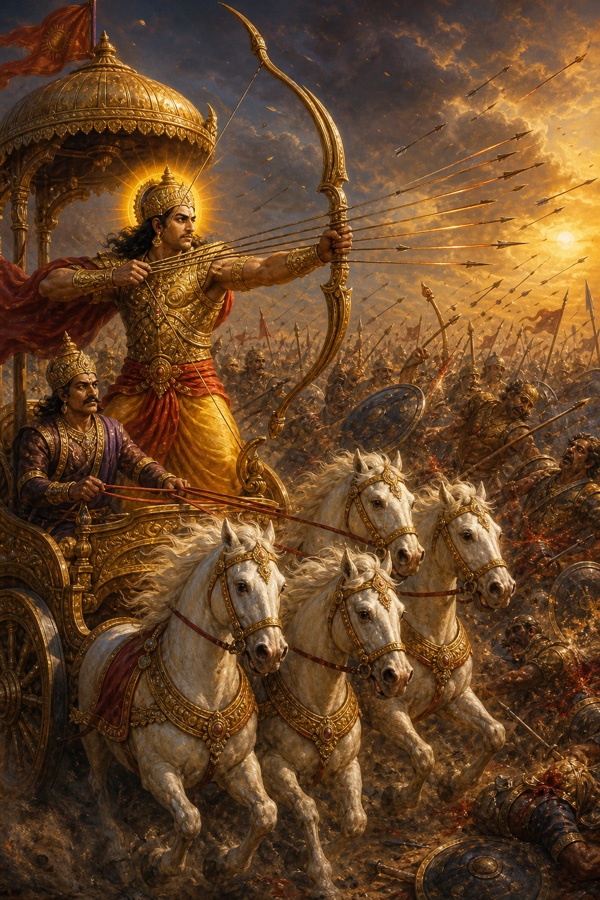
Karna maneuvered his chariot rapidly and struck every attacker with 10 arrows. Sanjaya said he and the others witnessed something astonishing in the speed of Karna’s hands and the power of his weapons. No one could distinguish the moment he took an arrow, aimed it, or released it. They saw only enemies dying quickly under his anger. Sharp shafts covered the sky, earth, and every direction. The heavens shone as though red clouds had spread across them. Karna seemed to dance on his chariot with his bow, striking each assailant with 3 times the number of arrows that man had sent into him. Once again he pierced each warrior, together with his horses, driver, chariot, and standard, with 10 arrows, then roared. The attackers gave way, opening a passage. Karna drove through. His volleys crushed the great bowmen, and he entered the division commanded by Yudhishthira without resistance. He destroyed 30 chariots of the Chedis who refused to retreat and struck the Pandava king with many sharp arrows. Shikhandi, Satyaki, and numerous Pandava fighters gathered around Yudhishthira to save him. On the other side, the brave archers of the Kaurava army resolutely protected Karna. Instruments sounded and the warriors’ roars split the sky. Once more the two sides faced one another fearlessly, the Kurus led by Karna and the Pandavas by Yudhishthira.
The gist: Karna cuts through the Panchala and Chedi ranks while his sons guard him. Bhima kills Bhanusena; Sushena and Vrishasena fight several Pandava champions. Duhshasana rescues Vrishasena after Satyaki disables his chariot. Karna breaks the surrounding attack and reaches Yudhishthira, drawing both armies around their leading warriors.
Karna defeats Yudhishthira and lets him go
Karna was coming for Yudhishthira. Thousands of chariots, elephants, horses, and infantry accompanied him as he forced his way through the Pandava army. The men before him sent weapons by the thousand; he cut them apart with hundreds of fierce arrows. His shafts severed heads, arms, and thighs. Men fell dead upon the earth. Others saw their divisions break and fled. Satyaki urged the Dravida, Andhaka, and Nishada infantry forward, and they rushed at Karna again to kill him. Their arms and headgear fell beneath his arrows. They dropped together like a whole forest of sal trees felled with axes. Hundreds, thousands, and tens of thousands left their bodies on the ground while their fame filled the sky. Karna advanced in anger, terrible as the destroyer. The Pandavas and Panchalas tried to stop him as people try to stop a disease with medicines and incantations. He crushed his assailants and came on toward Yudhishthira again, like an illness that defeats medicine, mantra, and every rite performed to ward it off. At last the Pandavas, Panchalas, and Kekayas held him. They were determined to save their king. Karna could go no farther, as Death could not overcome those who knew Brahman. He had been stopped a little distance from Yudhishthira, whose eyes were red with anger. “Karna! Listen to me, son of a suta, you whose judgment is so empty. You are always challenging Arjuna, always following Duryodhana’s counsel and opposing us. Gather all your strength now. Show me your power, your energy, and all the hatred you bear the sons of Pandu. Today, in this terrible encounter, I will cure you of your desire to fight.” He sent ten arrows into Karna, all made of iron and fitted with golden feathers. Karna took great care with his reply: ten shafts with heads shaped like calves’ teeth. The contempt in those blows fed Yudhishthira’s anger as butter feeds a fire. He bent his gold-decorated bow and placed a sharpened arrow upon the string, a shaft capable of piercing a mountain. Drawing the bow to its fullest stretch, he released it to kill Karna. The arrow was deadly as the destroyer’s rod. It sounded like thunder and struck Karna suddenly in his left side. The force of the wound weakened his limbs. His bow fell from his hand, and he collapsed unconscious upon the chariot. Cries of anguish came from Dhritarashtra’s army. The fighters’ faces lost their color. On the Pandava side, men roared and shouted over one another in joy at what their king had done.
Karna soon came to his senses. He resolved to destroy Yudhishthira, drew the formidable bow Vijaya with its gold decoration, and began resisting him with sharp shafts. Two razor-headed arrows killed Chandradeva and Dandadhara. Those Panchala princes had stood on either side of Yudhishthira’s chariot to guard its wheels, shining beside him like the twin stars of Punarvasu beside the moon. Yudhishthira struck Karna with another thirty arrows. He gave Sushena and Satyasena three each, then pierced every one of Karna’s other protectors with three straight shafts. Karna laughed and shook his bow. A broad-headed arrow cut into the king’s body. Sixty more arrows struck him, and Karna gave a loud shout. Pandava heroes rushed forward in anger to save Yudhishthira. Satyaki, Chekitana, Yuyutsu, Shikhandi, Draupadi’s sons, the Prabhadrakas, Nakula, Sahadeva, Bhima, and Shishupala came against Karna, together with the Karushas, Matsyas, Suras, Kaikayas, Kashis, and Koshalas. The Panchala prince Janamejaya drove many arrows into him. Chariots, elephants, and horses closed around him. The warriors carried weapons and arrows of many kinds, and their purpose was to kill him. With the foremost Pandava fighters attacking on every side, Karna invoked the Brahmastra. Arrows filled every direction. He moved through that army as fire moves through a forest, his shafts the flames that scorched the Pandava troops. Still laughing, he aimed powerful weapons and cut Yudhishthira’s bow. Then ninety straight arrows flew in an instant and cut the armor from the king’s body. As it fell, its gold and jewels shone like a cloud driven by the wind and pierced by sunlight. Its precious stones gave it the beauty of a night sky thick with stars.
The king stood covered with blood. In anger he hurled a dart made entirely of iron. It shone as it crossed the air, but Karna met it with seven arrows and cut it into pieces. The dart fell to the ground. Yudhishthira took four lances and struck Karna in both arms, the forehead, and the chest, shouting repeatedly as he attacked. Blood spurted from the wounds. Karna breathed like a snake in his fury. He cut down Yudhishthira’s standard, struck him with three broad-headed arrows, and shattered both his quivers and his chariot into small fragments. Yudhishthira mounted another chariot. It was drawn by his familiar horses, white as ivory, with black hair in their tails. His Parshni driver had been killed. The king could no longer stand before Karna. Deeply dejected, he turned away and began to retreat. Karna followed. He reached out with his fair hand and touched Yudhishthira’s shoulder, purifying himself by the contact. Seven auspicious signs marked his palm: the thunderbolt, umbrella, hook, fish, flag, tortoise, and conch. He wanted to seize the king by force. Then he remembered Kunti’s words. Before the war, their mother had come to him and revealed the bond of birth between him and the men he was fighting. He had promised to spare four of her sons, keeping his contest with Arjuna alone. Shalya spoke as well. “Do not seize the king, Karna. The moment you take hold of him, he will burn both you and me to ashes.” Karna laughed in mockery and addressed Yudhishthira. “You were born into a noble family and observe a warrior’s duties. How can you flee from battle in fear to save your life? I think you know very little of those duties. You have the power of sacred learning. You are devoted to studying the Vedas and performing sacrifices. Keep to those. Stop fighting. Stop coming near brave warriors, speaking harshly to heroes, and entering great battles. You may speak that way to others. You should never address men like me in such words. If you do, you will receive this treatment in battle, and worse. Go back to your quarters, Kunti’s son, or go to where Krishna and Arjuna are. Karna will never kill a man like you.” He let Yudhishthira go and resumed the slaughter of the Pandava troops, as Indra slaughtered the asuras. The king withdrew quickly. Chedis, Pandavas, Panchalas, Satyaki, Draupadi’s sons, the Suras, and the twin sons of Madri followed him. Karna saw Yudhishthira’s division in retreat. He and the Kurus rejoiced and pursued it. Drums, conches, cymbals, bowstrings, and the warriors’ roars sounded through Dhritarashtra’s ranks.
Yudhishthira quickly mounted Shrutakirti’s chariot and watched what Karna was doing. His soldiers were being cut down rapidly. Anger filled him again. “Kill these enemies!” he commanded. “Why are you standing idle?” Bhima led the Pandava chariot warriors in a charge against Dhritarashtra’s sons. Shouts rose from both armies, mingling with the noise of chariots, elephants, horses, infantry, and weapons striking weapons. “Press on! Strike! Face the enemy!” Men called to one another as they killed. Their showers of arrows spread a shadow over the field like clouds. Kings covered with shafts struck each other until their banners, standards, umbrellas, horses, drivers, and weapons were gone. Deprived of limbs and life, they fell to the earth. Great elephants, their uneven backs like mountain summits, toppled with their riders as mountains split beneath a thunderbolt. Thousands of horses died beside the men who rode them. Their armor, equipment, and ornaments were torn apart, broken, or displaced. Opposing chariot warriors cut down chariot warriors, whose weapons slipped from their hands as they lost their vehicles and their lives. Whole groups of infantry died by the thousand. The heads of men who had delighted in battle covered the ground, faces beautiful as lotuses or moons, with broad, copper-colored eyes. Above the slaughter came a sound as great as the uproar on earth. Bands of apsaras sang and played music from celestial vehicles. They welcomed the hundreds and thousands of heroes whom brave enemies had killed below, placed them on heavenly chariots, and carried them toward Indra’s realm. The men still fighting saw these wonders with their own eyes. Eager for heaven, their hearts filled with joy, they went on killing one another. Chariot warriors fought chariot warriors, infantry fought infantry, elephants met elephants, and horses met horses, each encounter displaying the combatants’ skill.
Dust from the troops spread across the field. Enemies killed enemies, and friends killed friends. Men seized one another by the hair and dragged each other about. They bit with their teeth, tore with their nails, struck with clenched fists, and fought with their bare arms in a battle that destroyed both life and sin. Blood from the bodies of men, horses, and elephants formed a river. Its current carried many of the dead away. Flesh made the stream a mire, and bodies floated upon its terrifying surface. Men still wanted victory. Some crossed the current to reach it; others remained on the far side. Some plunged into the depths. Some sank, and some rose to the surface as they swam. Their bodies, armor, weapons, and clothing were smeared with blood. Some bathed in it. Some drank the liquid. Some lost their strength. Chariots, horses, men, elephants, weapons, ornaments, garments, and armor all turned red. The dead and those about to die were red, and the color filled the earth, the sky, and every direction. The warriors could smell the blood, touch it, and taste it. They saw its intense redness and heard the rush of its current. Almost all lost heart. Then the Pandava heroes charged again, with Bhima and Satyaki leading them. The Kaurava army was already battered. This new rush was more than it could withstand. Dhritarashtra’s vast force turned away. Chariots, horses, elephants, and infantry broke out of formation and fled in every direction. Armor and coats of mail had slipped out of place; weapons and bows loosened in the men’s grasp. The enemy harried them as they ran, and the force fled like a herd of forest elephants driven by lions.
The gist: Yudhishthira first knocks Karna unconscious. Karna recovers, kills the king’s wheel guards, and destroys his armor and chariot. Remembering his promise to Kunti, he lets Yudhishthira retreat. The king orders a counterattack, and after a devastating struggle, the Pandava charge sends the Kauravas fleeing.
Bhima brings Karna down
Duryodhana shouted at the top of his voice. His troops were fleeing before the Pandava charge, and he tried to stop them on every side. They kept running. One wing of the army and the division beyond it turned against Bhima, together with Shakuni and the armed Kauravas. Karna saw the force in retreat, its kings fleeing with their men. “Drive toward Bhima’s chariot,” he told Shalya. The king of Madra urged the horses on. White as swans, they carried Karna toward Bhima and into the fighting around his vehicle. Bhima saw him coming and resolved in anger to kill him. He spoke to Satyaki and Dhrishtadyumna. “Go and protect Yudhishthira. He barely escaped from terrible danger, and I saw it happen. Before my eyes Karna cut away the king’s armor and tore his clothes, all to please Duryodhana. Today I will bring this grief to its end. I will kill Karna in battle, or he will kill me. I tell you the truth. I place the king in your hands as a sacred trust. Give yourselves gladly to protecting him.” Having entrusted his eldest brother to the two warriors, Bhima moved toward Karna. His roar filled every direction.
Shalya watched Bhima advancing rapidly. “Look at Pandu’s son, Karna. Look at the strength in those arms and the anger in him. He means to pour upon you the wrath he has held for years. I have never seen him like this, even when Abhimanyu was killed, even when Ghatotkacha died. He has the radiance of the fire that consumes everything at the end of a yuga. With such a form, he looks capable of holding back the three worlds together.” Bhima was still coming while Shalya spoke. He reached Karna, who laughed and answered his driver. “Everything you have said about him is true. Bhima is brave, a warrior filled with anger. He gives no thought to protecting his body, and no one surpasses the strength of his limbs. Remember his time in Virata’s city, when the Pandavas were living there in concealment. For Draupadi’s sake he killed Kichaka and all his relatives in secret, relying on his bare arms. Now he stands in armor at the front of battle, beyond all restraint in his fury. He would face the destroyer himself with that god’s mace raised against him. All my life I have kept one desire before me: to kill Arjuna, or to die by his hand. Fighting Bhima may bring that desire to fulfillment today. If I kill him, or deprive him of his chariot, Arjuna may come against me. That will serve my purpose. Decide quickly what you think this moment requires.”
Shalya answered, “Go against Bhima. Check his strength, and you may then have Arjuna before you. The purpose you have carried in your heart for so many years will be accomplished, Karna. I am telling you the truth.” Karna repeated his resolve. “I will kill Arjuna in battle, or Arjuna will kill me. Put your mind to the fighting and take me to Bhima.” Shalya drove swiftly toward the place where Bhima was routing the Kaurava army. Trumpets blared and drums sounded when the two warriors met. Still furious, Bhima was sending his sharp, polished arrows into troops renowned for their resistance, scattering them in every direction. Now Karna confronted him. The force of their encounter made a tremendous uproar. Karna struck Bhima in the center of his chest, then released another shower that covered him with arrows. Bhima sent feathered shafts back until Karna too was covered. He followed them with nine straight, keen arrows. Karna answered with enough shafts to split Bhima’s bow at its grip. With the bow cut, he sent another arrow into the middle of Bhima’s chest, a point so sharp that it could pass through any armor. Bhima took up another bow. He knew the body’s vulnerable places and drove many sharp arrows into Karna. Twenty-five came back at him. They tore into him as a hunter’s burning brands strike an enraged elephant in the forest.
Bhima’s limbs were mangled by the shafts. His eyes were red with anger, and he wanted revenge. He set an arrow on the bowstring, a powerful shaft capable of enduring a tremendous draw and piercing through a mountain. He meant it to kill Karna. The son of the wind god pulled the string back by force, drawing it all the way to his ear. He released the shaft. Its sound was as loud as thunder. It went through Karna as a thunderbolt goes through a mountain. The commander of the Kaurava army sank down upon the platform of his chariot, unconscious. Shalya saw that Karna had lost his senses. He carried him away in the chariot, taking the wounded warrior out of the fight. Bhima had defeated him. With Karna withdrawn, he turned again upon Dhritarashtra’s great force and sent it fleeing, as Indra sent the danavas fleeing before him.
The gist: Bhima entrusts Yudhishthira to Satyaki and Dhrishtadyumna, then advances on Karna. Karna hopes defeating Bhima will draw Arjuna into battle. After a fierce exchange, Bhima’s arrow leaves Karna unconscious. Shalya carries him away, and Bhima resumes routing the Kaurava army.
Bhima on foot
Dhritarashtra spoke of the extraordinary difficulty of Bhima’s feat. The great-armed Karna had been stretched out helpless on the floor of his own chariot. Duryodhana had so often assured his father that Karna alone would kill the Pandavas and the Srinjayas. What had his son done when he saw that same warrior beaten by Bhima? Sanjaya told him. As Radha’s son withdrew, Duryodhana called to his brothers and sent them to his rescue. “Go quickly, and may you prosper. Protect Karna. Fear of Bhimasena has plunged him into a fathomless sea of danger.” Eager to kill Bhima, the angry princes rushed toward him like insects flying into a blaze. Srutarvan, Durddhara, Kratha, Vivitsu, Vikata, Soma, Nishangin, Kavashin, Pasin, Nanda, Upanandaka, Duspradharsha, Suvahu, Vatavega, Suvarchasas, Dhanurgraha, Durmada, Jalasandha, Sala, and Saha surrounded him with a large chariot force. Arrows of many kinds poured upon him from every direction. Bhima answered swiftly, killing fifty leading chariot warriors and five hundred others in the force advancing with the princes. Then a broad-headed arrow took off Vivitsu’s head, still wearing its earrings and headgear, its face round and bright as the full moon. His body fell. His brothers charged from every side. Two more broadheads killed Vikata and Saha. Beautiful as divine youths, they fell like trees uprooted by a storm. A long, sharp arrow sent Kratha to Yama, lord of the dead. Cries of grief rose from the army as the princes, all formidable archers, were cut down. Amid the renewed confusion Bhima killed Nanda and Upananda. The surviving sons of Dhritarashtra fled in fear. To them, Bhima seemed the destroyer of the world at the close of an age.
Karna saw the princes lying dead. With a heavy heart he turned back toward the Pandava. Shalya urged the swan-white horses forward until their chariot reached Bhima’s and the two warriors were engaged again. Their collision was fierce and loud. Sanjaya watched closely, intent on seeing how this renewed contest would unfold. Before the Kaurava princes, Bhima proclaimed his strength and covered Karna with feathered shafts. Karna answered in anger with nine straight, broad-headed arrows made entirely of iron. Bhima drew his string to his ear and drove seven shafts into him. Karna breathed hard, like a poisonous snake, and sent a dense shower back. Bhima answered with another downpour and a shout that carried before the watching Kauravas. Ten stone-sharpened arrows, fletched with kanka feathers, struck him from Karna’s powerful bow. Another keen broadhead severed his bow. Bhima seized a terrible spiked iron club, wrapped in hemp cords and decorated with gold. It looked like Death’s own bludgeon. With a roar, he hurled it to kill Karna outright. It came thundering through the air. Karna’s arrows met it like venomous snakes and broke it into many pieces. Bhima took up a bow again and covered him with sharp shafts. For a time their battle grew as savage as a fight between two great lions bent on killing each other. Karna pulled his string to his ear and struck Bhima with three arrows. Deeply wounded, Bhima selected a shaft powerful enough to pass through his opponent’s body. It pierced Karna’s armor, went through him, and entered the earth like a snake entering an anthill. Pain shook Karna. He trembled on his chariot like a mountain in an earthquake. Furious to repay the wound, he hit Bhima with twenty-five arrows, then many more. One shaft cut down Bhima’s standard. A broadhead killed his driver. Another feathered arrow cut his bow, leaving him unable to fight from his chariot.
Bhima snatched up his mace and leaped down. Like his divine father, the wind, scattering autumn clouds, he drove into Dhritarashtra’s soldiers. Seven hundred fighting elephants, their tusks as thick as plow shafts, gave way before him. He knew their vulnerable places and struck at their temples, the rounded fronts of their heads, their eyes, and the flesh above their gums. They fled in terror. Their drivers forced them back, and the huge animals closed around him again like clouds covering the sun. Bhima brought down all seven hundred with his mace, riders, weapons, and standards falling with them, as mountains fell beneath Indra’s thunderbolt. He crushed another fifty-two powerful elephants belonging to Shakuni, Subala’s son, then destroyed a hundred leading chariots and several hundred infantrymen. Between the sun above and Bhima among them, the army shriveled like a hide held over a fire. Men tried to avoid him and ran in every direction. Five hundred chariot warriors in fine armor came shouting toward him, spraying arrows on all sides. Bhima’s mace destroyed the whole force, its brave fighters and drivers, chariots and weapons, banners and standards, as Vishnu destroyed the asuras. Shakuni next sent three thousand cavalrymen against him, soldiers respected for their courage, carrying darts, swords, and lances. Bhima rushed to meet them. Changing his path as he advanced, he killed the riders with his mace. The cries that rose around him sounded like those of an elephant herd battered with great rocks. The three thousand horses of Shakuni’s force were killed as well. Bhima mounted another chariot and drove furiously toward Karna.
During this fighting Karna had covered Yudhishthira with arrows and struck down his driver. When the king retreated, Karna pursued, sending straight shafts with kanka feathers after him. Bhima filled the sky with arrows and buried the pursuer in a thick shower. Karna turned away from Yudhishthira and quickly struck at Bhima from every side. Satyaki brought his chariot alongside Bhima’s and attacked Karna ahead of them. Those blows hurt Karna severely, but he continued toward Bhima. The two powerful archers drew close, shining as they sent their fine arrows at each other. Their flights of shafts lit the air with a brightness like the backs of cranes. Soon arrows filled the sky by the thousand. Sanjaya’s companions and the men on the other side alike lost sight of the sun’s rays and every direction. The dense volleys from Karna and Bhima hid even the blaze of the midday sun. Seeing Shakuni, Kritavarma, Ashvatthama, Karna, and Kripa fighting the Pandavas, the Kauravas rallied and came back. Their charge sounded like many oceans swollen by rain. Both armies plunged into the encounter with fierce joy, warriors catching sight of their opponents and seizing them in the press. The battle that began at noon surpassed anything Sanjaya and his companions had ever seen or heard of. One vast host poured against the other like a great body of water breaking toward the sea. Their answering roars were deep enough to suggest oceans colliding. The furious armies ran together like two rivers meeting in flood.
Kurus and Pandavas fought for renown, and the field became a confusion of shouting voices. Men called their opponents by name. Every fault that could furnish an insult was flung back at its owner: something in his father’s family, something in his mother’s, some deed or habit of his own. Sanjaya heard the heroes shouting their accusations and thought their allotted lives must have reached their end. The sight of those angry, powerful bodies filled him with fear of what would follow. Pandava and Kaurava chariot warriors drove their sharp arrows into one another and tore one another apart.
The gist: Bhima kills six of Duryodhana’s brothers before Karna returns and disables his chariot. Fighting on foot with his mace, Bhima destroys elephants, chariots, and cavalry. He then mounts another chariot and breaks off Karna’s pursuit of Yudhishthira. Satyaki joins him, and the armies converge in a furious battle at noon.
The field runs with blood
Each warrior wanted the man before him dead. Hatred drew the opposing fighters together until throngs of chariots, large bodies of cavalry, crowded ranks of infantry, and great numbers of elephants were mingled in one battle. Sanjaya saw maces and spiked clubs falling among them, with kunapas, lances, short arrows, and rockets thrown from side to side. Arrows passed through the air in showers as dense and terrible to see as flights of locusts. Elephants met elephants and drove each other back. Horsemen fought horsemen, chariot warriors fought chariot warriors, and men on foot struck at other infantrymen. The fighting ran across every division of the armies. Infantrymen attacked riders, confronted chariots, and fought elephants. Chariots came against elephants and cavalry. The swift elephants met all three other kinds of force and crushed their way among them. Blows fell while the men shouted at the full strength of their voices. The field became a place of slaughter as terrible as Rudra’s own, where Shiva in his fierce form destroyed living creatures. Blood covered the earth, and its beauty was like that of a broad plain covered with red insects in the rainy season. It seemed a beautiful young woman dressed in white cloth dyed a deep red. Across the ground, the mingled colors of flesh and blood gave the brilliance of a field decorated with gold. Heads lay severed from bodies. Arms and thighs lay among earrings and other ornaments torn from the warriors who had worn them. Collars, breastplates, coats of mail, banners, and the bodies of brave archers covered the earth.
The elephants tore into one another with their tusks. Struck by their enemies, the huge animals shone with blood, like moving hills marked with mineral colors and streams of liquid chalk running down their sides. Cavalrymen threw lances at them. Other opponents held their lances level to meet them. Many elephants caught those weapons, twisted them, and broke them. Arrows cut away the animals’ armor, leaving their bodies exposed like mountains cleared of cloud when winter begins. Other elephants were pierced by shafts with golden feathers; those bright arrows gave them the appearance of mountains with burning torches upon their summits. Some, as huge as hills, fell under the blows of other elephants. Their fall recalled the winged mountains dropping when their wings were cut away. Some had been pierced by arrows and were in terrible pain. As they fell, the rounded fronts of their heads struck the ground, or the parts between their tusks. Others roared like lions. Many ran in all directions, making dreadful sounds, while others cried out from their wounds. Horses still wearing golden trappings fell under the arrows, lost their strength, or fled across the field. Shafts and lances struck them; some were dragged down. On the ground they twisted and moved in agony. Men too fell with cries of pain. Others caught sight of their relatives, fathers, and grandfathers and called out. Others saw an enemy retreating and shouted the familiar name, the name of the family to which he belonged.
The severed arms still wore their golden ornaments. They twitched on the ground, moving in many ways after the blows that had cut them away. Thousands fell and sprang up again. Some seemed to dart forward like snakes, the five fingers spreading like five heads. The arms tapered like serpents’ bodies, and the sandal paste rubbed upon them was drenched in blood. They gleamed like small standards of gold. By then the fighting was everywhere. Men fought and killed without seeing clearly whom they struck. A cloud of dust spread across the field, and the weapons fell through it in thick showers. In that darkness the warriors lost the power to distinguish friends from enemies. The battle continued. Soon many great streams of blood were flowing. Severed heads lay in them like rocks in a river. The fallen warriors’ hair drifted as weeds and moss; their bones were the fish within the current. Bows, arrows, and maces formed the rafts by which those waters might be crossed. Flesh and blood made the mire. The streams swelled, deepening the terror of the timid and the delight of the brave. They led to Yama, the lord of the dead. Many men plunged into those currents, terrible enough to frighten warriors, and died in them. Flesh-eating creatures roared and cried on every side until the whole field seemed Yama’s domain. Countless headless bodies rose. Terrible beings danced as they ate flesh and drank fat and blood. Crows, vultures, and cranes fed upon fat and marrow, moving joyfully among the other animals that relished the flesh of the fallen.
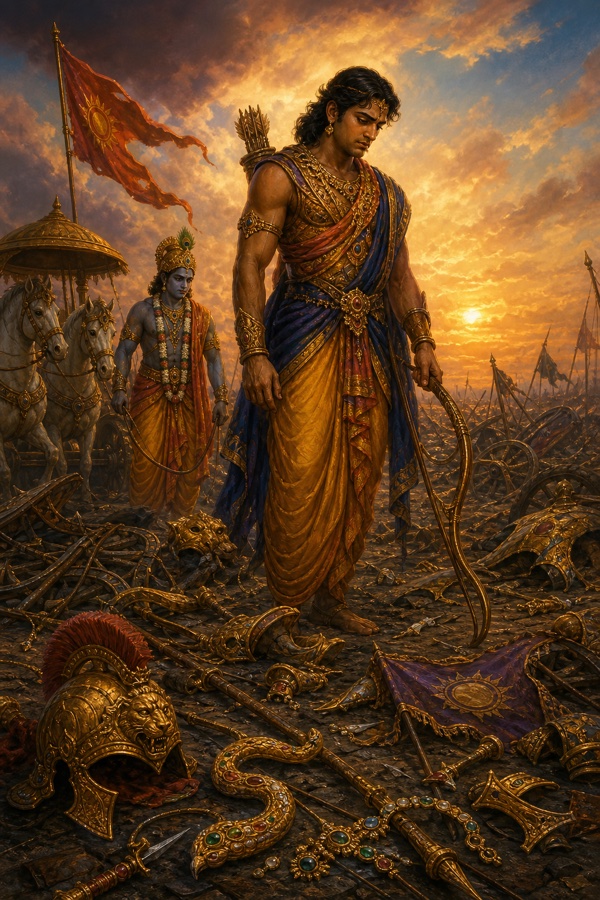
Through this field the heroes continued to fight. They cast off fear, though fear was so difficult to cast off, and held to the vow that bound them as warriors. Arrows and darts crossed the air beyond counting. Flesh-eating creatures crowded the ground around them. The brave men moved fearlessly among them, showing their strength and doing the duty they had undertaken. They addressed one another across the fighting and declared who they were. Names and families were called out. Many proclaimed their fathers’ names and the lineages from which they came as they struck their opponents with darts, lances, and battle-axes. During that fierce struggle, the Kaurava army lost its strength. It could bear no more. Like a vessel foundering in the open ocean, it could no longer keep itself up.
The gist: Chariots, cavalry, infantry, and elephants merge in a battle that dust and flying weapons soon obscure. Sanjaya describes a field of blood, bodies, and scavengers. The warriors continue to fight, while the Kaurava army begins to fail.
Hands on Arjuna’s chariot
The twang of Gandiva carried above the din. Arjuna was fighting the Samsaptakas, the Kosala warriors, and the Narayana troops while the other battles raged across the field. The Samsaptakas had bound themselves to keep fighting him; now, angry and intent on victory, they poured arrows toward his head. Arjuna stopped that shower and drove into their ranks. Leading chariot warriors fell as his whetted shafts, fitted with kanka feathers, opened a way through the division. He reached Susharma. The king had excellent weapons and used them to send another dense volley against him. The Samsaptakas added their arrows until Arjuna was covered from both attacks. Susharma struck him ten times, then sent three shafts into Krishna’s right arm. One more arrow, with a broad head, pierced Arjuna’s standard. Above the chariot stood the enormous ape fashioned by the divine craftsman. It began to roar. Its loud, fierce cries terrified Dhritarashtra’s soldiers. They stood still, their fighting stopped by fear. Motionless in their many colors, the army looked like the Chitraratha forest bearing its burden of blossoms. Then the men recovered their senses. They sent arrows upon Arjuna as clouds send rain upon a mountain and closed around his chariot again.
The attackers roared as they came, though Arjuna’s sharp shafts were striking them down. They attacked his horses. They struck the wheels, the chariot shaft, and every other part of the vehicle. Men reached Krishna and caught hold of his powerful arms. Others caught Arjuna himself as he stood in the chariot, delighted to have him in their grasp. Krishna shook his arms and threw every man holding them to the ground, as a fierce elephant shakes its riders from its back. Arjuna saw the men around his vehicle and the assault upon Krishna. Anger rose in him. He struck down many chariot warriors and infantrymen, then covered the fighters nearest him with arrows made for an encounter at such close quarters. “Look at them, Krishna,” he said. “Look at these countless Samsaptakas and the terrible task they are attempting. They are being killed by the thousand, and still they come. No one on earth except me could withstand an attack this close upon his chariot.” Arjuna sounded his conch. Krishna raised his own, and its call filled the sky. The Samsaptaka force heard it and began to waver, filled with great fear.
Arjuna invoked the Naga weapon again and again. The warriors’ legs ceased to move. Bound at the feet, the men stood as still as stone while he began to kill them, as Indra had killed the daityas in the battle with Taraka. Under his arrows they let go of the chariot and began throwing down their weapons. Their legs remained fixed. They could not take even one step. Straight arrows came from Arjuna’s bow into those helpless bodies. Around the lower limbs of every man he had targeted with the weapon, snakes were coiled. Susharma saw his army held fast and quickly invoked the Sauparna weapon. Birds came down in great numbers. They began devouring the snakes; other snakes fled as soon as they saw those enemies descending from the sky. The warriors’ feet were free. Released from the bindings, the whole force seemed to shine like the sun emerging from clouds to light every living creature. They began shooting again. They hurled weapons at Arjuna’s chariot, and many of those weapons struck him. Indra’s son answered with a downpour of arrows. It cut apart the shower sent at him, and he went on to kill the men who had launched it. Then Susharma shot a straight arrow into his chest. Three more followed. The wounds went deep, and the pain was great. Arjuna sank down upon the floor of the chariot. “Arjuna is dead!” the soldiers shouted. Conches blared at the cry. Drums and other instruments sounded, and the men roared in triumph.
Arjuna recovered consciousness. The white horses still drew his chariot, and Krishna still held the reins. He swiftly invoked the Aindra weapon, the weapon of his father Indra. Thousands of arrows issued from it and appeared on every side, striking down kings and elephants. Horses and chariots were destroyed in their hundreds and thousands. The Samsaptakas and the Gopalas saw the slaughter and grew afraid. There was no one among them who could fight him. In the sight of their leading warriors, Arjuna continued to destroy Dhritarashtra’s troops. Those heroes watched the killing without moving. None put forth his strength to stop it. Arjuna killed a full ten thousand combatants and shone amid the battle like a blazing fire clear of smoke. Then he killed fourteen thousand more warriors and three thousand elephants. The Samsaptakas closed around him once again. Victory or death was the purpose that brought them back to the chariot. Their battle with the crowned son of Pandu grew terrible.
The gist: The Samsaptakas close around Arjuna’s chariot and seize both him and Krishna. Arjuna binds their legs with the Naga weapon; Susharma frees them with the Sauparna weapon. Wounded by Susharma, Arjuna briefly loses consciousness, then returns to the battle with the Aindra weapon. Despite devastating losses, the Samsaptakas surround him again.
Suketu comes to Shikhandi’s aid
The Kaurava army could no longer hold together. Fear of Pandu’s son had broken its resistance, and it lay scattered like a vessel wrecked at sea. Its leaders hurried to rescue it: Kritavarma, Kripa, Ashvatthama, Karna, Uluka, Shakuni, and Duryodhana with the brothers born of his own mother. Their efforts brought on a short, fiercely contested renewal of the battle. The timid grew more afraid, and the brave found fresh joy in it. Kripa sent dense showers of arrows over the Srinjayas, shafts as thick in the air as a flight of locusts. Shikhandi saw the attack and drove swiftly against him. In anger he covered the brahmin warrior with arrows from every side. Kripa knew the highest weapons and how to stop them. He checked the whole downpour and shot ten arrows into Shikhandi. The Panchala prince answered with seven straight shafts, each fitted with kanka feathers, and drove them deep into Kripa’s body. Wounded by those arrows, Kripa deprived him of his horses, his driver, and his chariot. Shikhandi jumped down from the horseless vehicle with a sword and shield. He rushed at Kripa on foot. Straight arrows met him as Kripa shot rapidly at the approaching prince. Sanjaya and the other witnesses saw an extraordinary thing: beneath that attack, Shikhandi remained motionless. To Sanjaya, the sight was as astonishing as rocks taking flight.
Dhrishtadyumna saw his brother covered by Kripa’s shafts and hurried toward the chariot to help him. Kritavarma came at speed and met him on the way. Before Dhrishtadyumna could reach Kripa, he had this new opponent to face. Yudhishthira was also coming toward Kripa, bringing his son and his troops, but Ashvatthama checked his advance. Nakula and Sahadeva moved swiftly to intervene. Duryodhana met them with a shower of arrows and held them back. Karna opposed Bhima and the warriors of Karusha, Kaikaya, and the Srinjayas. While those encounters kept the rescuers occupied, Kripa continued his attack on Shikhandi. He shot so many arrows, with such speed, that he seemed bent on burning the prince alive. Shikhandi whirled his sword again and again. Wherever the gold-decorated shafts came from, he cut them with the blade. Kripa then turned his arrows upon the shield, the one decorated with a hundred moons, and cut it apart. The troops raised a great cry at the feat. Shikhandi had lost his shield and was now at Kripa’s mercy. Still holding the sword, he rushed toward the chariot again. He seemed a sick man hurrying into the jaws of death.
Suketu came to his aid. The young son of Chitraketu saw the danger Shikhandi was in and drove quickly toward Kripa’s chariot. Innumerable sharp shafts poured from his bow against the brahmin, who held firmly to his vows. With Kripa engaged against another warrior, Shikhandi hastily withdrew from the spot. Suketu shot nine arrows into Kripa. He followed them with seventy, then pierced him again with three. His next arrow cut Kripa’s bow while a shaft was still fitted to its string. Another struck the driver, hitting a vital part of his body with great force. Kripa took up a new bow, a strong one, and answered in anger. Thirty arrows entered Suketu’s vital parts. The young prince’s limbs weakened under the blows. He trembled on his fine chariot, shaking as a tree shakes in an earthquake. While he was still trembling, Kripa fitted a razor-headed arrow and shot it at him. It cut his head from his body. The head, with its ornaments, protective helmet, and two blazing earrings, fell to the earth like a piece of meat falling from the claws of a hawk. Then Suketu’s body fell from the chariot.
The gist: Kripa disables Shikhandi’s chariot and forces him to fight on foot, while other Kaurava commanders intercept those coming to help. Suketu draws Kripa into a new duel, allowing Shikhandi to retreat. Kripa kills the young prince.
Source: the Mahabharata of Krishna-Dwaipayana Vyasa, Karna Parva. This chapter follows K. M. Ganguli, the invocation and sections I-LIV, through verse 29 of LIV, ending at Suketu’s death; the Gita Press Hindi edition numbers these chapters differently. Names, order, and events were checked against Ganguli’s complete translation. Dialogue and commentary are adapted, not a verbatim translation. About the sources.
Based on: The Mahabharata, Vyasa (Gita Press, Gorakhpur)
The same story elsewhere
- The end of the Drona Parva
The preceding chapter, final part - The Karna Parva continues
The next chapter