On this page
Karna’s two days: from the grieving camp to the king in Hastinapura
Om. Reverence to Narayana, to Nara, foremost among men, and to the goddess Saraswati. With that invocation comes the word Jaya, victory. King Janamejaya listens as Vaishampayana, Vyasa’s disciple, takes up the story of Karna’s command. The war belongs to the king’s own family. Arjuna was his great-grandfather; the people in this account are the ancestors whose deeds he has asked to hear. Vaishampayana takes him back to the Kaurava camp after Drona’s death, where the loss of the commander has left the army without heart. Duryodhana and the rulers fighting beside him had gone to the dead commander’s son. They sat around Ashvatthama, whose mother was Sharadvata’s daughter. The commander they had lost was his father. Around the bereaved son, the kings grieved for Drona. Anxiety filled their minds; sorrow had drained their strength. Thoughts drawn from scripture gave them some comfort. When night came, they returned to their separate tents, where the immense slaughter continued to trouble them. Sleep would not come. Four men stayed together in Duryodhana’s tent: the prince himself, his brother Duhshasana, his maternal uncle Shakuni, and Karna, the friend on whom he depended. They thought about the suffering they had inflicted on the Pandavas. They remembered bringing Draupadi, wife of the five Pandava brothers, into the assembly while she was already in anguish over the game of dice. The sufferings they had imposed on her husbands returned to their minds along with that public humiliation. The memory filled them with regret and apprehension. That night of sorrow seemed to last a hundred years. At morning they performed the prescribed daily rites and recovered some composure. Orders went out to arrange the troops for battle. Karna received command of the army with auspicious threads tied around his wrists. The rulers gave leading Brahmins vessels of curds and clarified butter, unbroken grains, gold coins, cattle, jewels, precious stones, and costly garments, asking for prayers that would bring them victory. Heralds, musicians, and praise singers celebrated their hoped-for success. Across the field, the Pandavas completed their own morning rites and left their camp ready to fight. Both armies wanted the other defeated. For two days Karna would hold command, and throughout those two days the fighting between the Kuru and Pandava armies would be fierce enough to make the hair stand on end. After slaughtering immense numbers of his enemies, Karna would fall to Arjuna before the eyes of Dhritarashtra’s sons. Sanjaya would then travel to Hastinapura and tell the king everything that had happened in Kurujangala.
“Dhritarashtra, Ambika’s son, had already suffered terribly on hearing of the fall of Bhishma and that mighty chariot warrior Drona,” Janamejaya said. “How could he remain alive when he learned that Karna, Duryodhana’s devoted friend, had died? He had rested his hopes for his sons’ victory on Karna. How could he survive the loss of the man who carried that hope? If he lived even after hearing of Karna’s death, it must be terribly difficult for a person to give up life, however deep the grief. He had heard that Shantanu’s venerable son Bhishma was dead. Bahlika, Drona, Somadatta, and Bhurishravas had fallen. Other friends, his sons, and his grandsons had died. Still he lived. It seems to me that life is exceedingly hard to relinquish. Tell me everything in detail, exactly as it happened. I never tire of hearing the great deeds of my ancestors.” On the night after Karna fell, Sanjaya, Gavalgana’s son, set out for Nagapura on horses as swift as the wind. He reached Hastinapura with an anxious, desolate heart and entered Dhritarashtra’s residence. The palace was no longer crowded with relatives and friends. Within it waited the blind king, exhausted by grief. Before the war, Vyasa had offered him the sight to watch the fighting. Dhritarashtra had refused: he could not bear to see his own relatives killed. He had asked to hear the whole account instead. The gift of vision had therefore gone to Sanjaya, to whom the battle lay open by day and night, even in its hidden moments. Now that witness had returned, carrying the news into the depleted household. Sanjaya approached with his hands joined, bowed his head at the king’s feet, and cried out in sorrow.
“It is Sanjaya,” he said. “Are you well? Have you become bewildered by the distress your own faults have brought upon you? Vidura gave you advice for your good. So did Ganga’s son Bhishma and Krishna, whom we call Keshava. Does it hurt now to remember rejecting their counsel? Rama, Narada, Kanva, and others also spoke for your benefit in the assembly. Do you suffer when you remember refusing to listen? Bhishma, Drona, and the other friends who always worked for your welfare have been killed by the enemy. Does the thought of their deaths cause you pain?” Sanjaya remained before him with joined hands. The king drew a long, hot breath. “Sanjaya, the fall of Ganga’s heroic son, who knew every celestial weapon, and of Drona, foremost among archers, causes me terrible pain. Bhishma was born from the divine Vasus themselves. Every day he killed ten thousand armored chariot warriors. Rama of Bhrigu’s line had trained him in archery when he was young and had given him the highest weapons. Even that great warrior was killed by Yajnasena’s son Shikhandi, fighting under the protection of the Pandavas. My heart aches at the news. Through Drona’s teaching, Kunti’s sons and many other rulers became maharathas, formidable warriors in their chariots. The teacher’s own aim never failed him. To hear that Dhrishtadyumna killed that great archer causes me unbearable pain. No one in the world equaled those two men in their knowledge and use of the four kinds of weapons. The thought of Bhishma and Drona killed in battle wounds me deeply.”
“No one in the three worlds equaled Drona’s knowledge of weapons,” the king went on. “What did our people do when they learned he was dead? Arjuna, Pandu’s son Dhananjaya, had used his strength to send the powerful army of the samsaptakas to Yama’s realm. Those men had sworn themselves to fighting him, and he had destroyed their force. The Narayana weapon unleashed by Drona’s intelligent son had been defeated. Our divisions had begun to flee. What did the men on my side do then? I imagine my troops running after Drona’s death, sinking into an ocean of grief like shipwrecked sailors struggling in deep water. What happened to the faces of Duryodhana and Karna when the Kuru divisions fled the field? How did Kritavarma, chief of the Bhojas, and Shalya, the ruler of Madra, look then? What of my remaining sons and the other kings? Gavalgana’s son, tell me what truly happened in that battle. Describe the feats of the Pandavas and of the warriors fighting on my side.” Sanjaya answered, “What has happened to the Kauravas has come through your own fault. You should keep yourself from anguish as you hear it. A wise person does not sink into suffering over what destiny brings. Destiny cannot be conquered. Human purposes may succeed, or they may fail to reach their object. The wise maintain their composure when they gain what they desire and when it escapes them.” Dhritarashtra replied, “I am not in great pain, Sanjaya. I regard all of this as the work of destiny. Tell me everything you wish to say.”
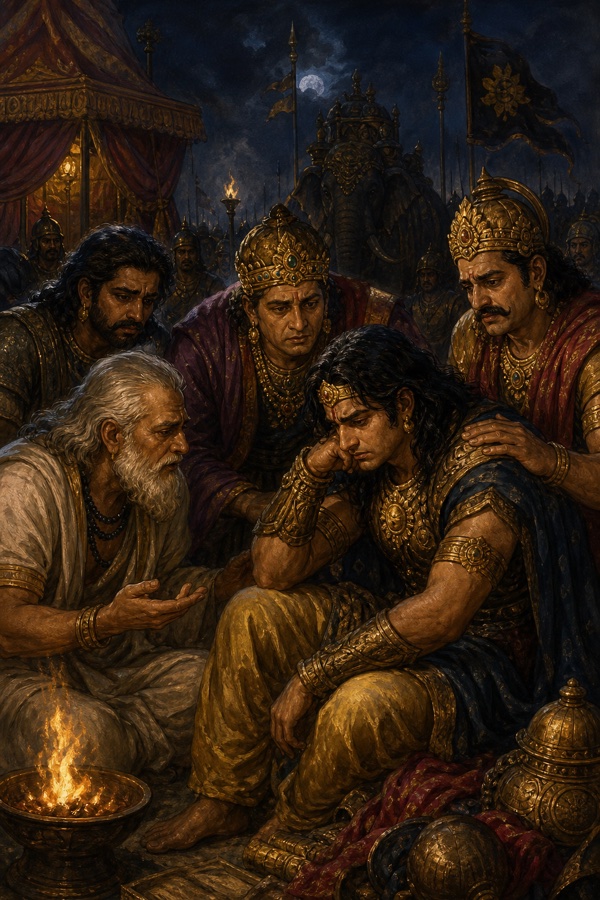
A key to reading this (the order of the telling): Vaishampayana tells Janamejaya at the outset that Karna commanded for two days and died fighting Arjuna. He then follows Sanjaya to Hastinapura on the night after that death. Within Sanjaya’s account, Dhritarashtra asks to hear what happened after Drona fell. The detailed story of Karna’s command will unfold from that earlier point.
The gist: The Kauravas grieve for Drona and place Karna in command. Vaishampayana announces the two days of battle and Karna’s death, then recounts Sanjaya’s arrival at the palace. Sanjaya reminds Dhritarashtra of the advice he rejected. The king recalls Bhishma’s and Drona’s extraordinary power and asks how his army responded to losing them.
The news of Karna’s death: Dhritarashtra collapses and the palace cries out
“When Drona fell, your sons, those mighty chariot warriors, turned pale and lost their senses,” Sanjaya said. “They stood with weapons in their hands and their heads lowered. Grief held them silent. They could not even look at one another. The soldiers saw the misery on their princes’ faces, and sorrow swept through them as well. They stared upward without seeing anything. Bloodstained weapons slipped from many of their hands. Countless other weapons remained loosely held, pointing downward like meteors falling through the sky. Duryodhana saw your army standing there, paralyzed, almost lifeless. He addressed them: ‘I relied on the strength of your army when I challenged the Pandavas and brought on this war. Drona’s death has made the prospect seem hopeless. Yet warriors who go into battle die in battle. Fighting can bring a warrior victory or death. What is so extraordinary about what has happened? Turn to face the enemy wherever he comes from, and fight. Look at Karna, the powerful son of the sun god Vikartana, that great archer moving through the battle with celestial weapons. In fear of him, that coward Arjuna, Kunti’s son Dhananjaya, always turns away like a small deer at the sight of a lion. Karna brought Bhima to that desperate condition through ordinary human methods of fighting, though Bhima has the strength of ten thousand elephants. Karna roared and killed Bhima’s brave son Ghatotkacha with his invincible dart. Ghatotkacha knew celestial weapons and could create a thousand illusions, and still Karna killed him. Today you will see the inexhaustible strength in those arms, the power of a warrior whose judgment and aim are sure. Let the sons of Pandu see Ashvatthama and Karna fight with the might of Vishnu and Indra. Each of you can kill the Pandavas and their troops by himself. Think what you can accomplish together. You have tremendous energy and skill with weapons. Today you will watch one another perform great deeds.’”
“After saying this, Duryodhana and his brothers made Karna commander of the army,” Sanjaya went on. “The fierce chariot warrior took command, roared, and fought. He slaughtered Srinjayas, Panchalas, Kekayas, and Videhas in great numbers. Arrows streamed from his bow in countless lines, each following close behind the feathers of the one ahead, like swarms of bees. He struck hard at the vigorous Panchala and Pandava fighters and killed thousands of warriors. Then Arjuna killed him.” The news brought Dhritarashtra to the extremity of grief. Karna was the man on whom his son had depended; with Karna dead, Duryodhana must already be dead as well. The king collapsed onto the ground like an elephant that has lost its senses. The women of the royal household cried out so loudly that their wailing seemed to fill the earth. Grief burned in their hearts. They wept aloud, overwhelmed by a sorrow as deep as the ocean. Gandhari came to her fallen husband with the other women of the household. She had bound her own eyes when she learned that the man she was to marry was blind, sharing his darkness from the beginning of their life together. Now she reached the place where he lay overwhelmed by the loss of Karna. They too lost consciousness and fell to the ground.
Sanjaya tried to comfort the women, whose faces were wet with tears and whose senses had given way under the shock. As they responded to his words, they kept trembling like a grove of plantain trees shaken by the wind. Vidura sprinkled water on his brother Dhritarashtra and tried to comfort him. The king had refused Vidura’s counsel before the war; now the same brother was there beside him, trying to bring him back from the shock of its consequences. For the blind king, knowledge had always served in place of sight. Slowly he recovered his senses and became aware that the women of his household were gathered there. For a while he remained completely silent, as though his reason had left him. Then he began to reflect. Long breaths came one after another. He condemned his own sons and praised the Pandavas. He condemned his own judgment and that of Shakuni, Subala’s son, the brother of his queen. He thought for a long time, and again his body trembled repeatedly. At last he controlled his mind enough to speak. Gathering his courage, he addressed Sanjaya, the charioteer who had brought him the news.
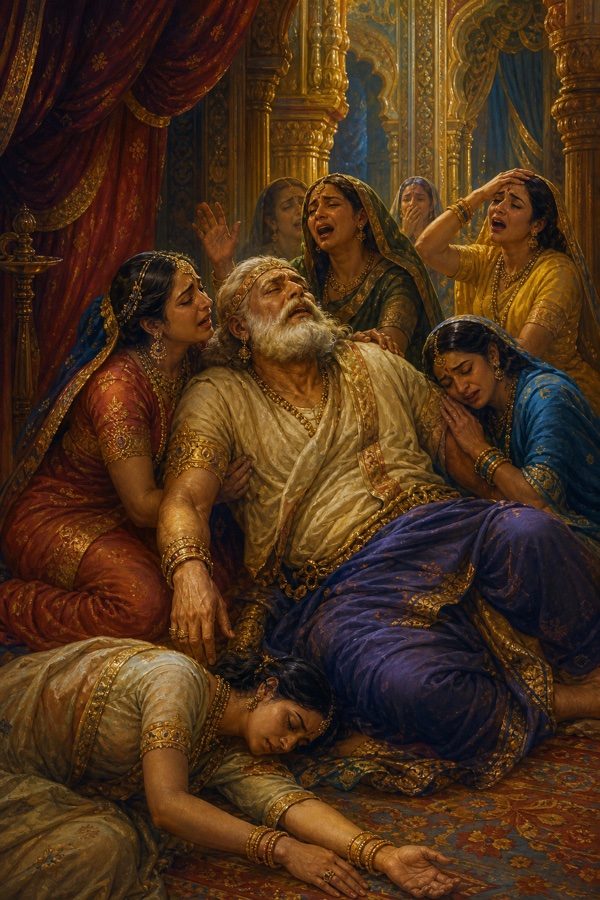
“Sanjaya, I have heard everything you said. My son Duryodhana always wanted victory. Has he given up hope of winning and gone to Yama’s realm? Tell me the truth about all of this, even if you must say it again.” Sanjaya answered, “The mighty chariot warrior Karna, also called Vaikartana, has been killed. His sons and brothers have been killed, together with other Suta warriors, all great archers ready to surrender their lives in battle. Duhshasana has also been killed by Pandu’s renowned son. In his rage, Bhima drank Duhshasana’s blood there on the battlefield.” In the assembly after the dice game, Duhshasana had tried to strip Draupadi before the watching kings. Bhima had sworn there that he would tear open Duhshasana’s chest in battle and drink his blood, staking his hope of reaching his ancestors’ realm on the fulfillment of that vow. The king had asked about Duryodhana; the answer named Duhshasana, another of his sons.
The gist: Duryodhana rallies the stunned army on Karna and Ashvatthama. Sanjaya reports Karna’s command, his slaughter, and his death at Arjuna’s hands. Dhritarashtra takes Duryodhana for dead and collapses; when he can speak again, he asks for the truth and hears that Karna, his sons and brothers, and Duhshasana are dead, and that Bhima drank Duhshasana’s blood.
The Kaurava dead: Sanjaya names the men the king has lost
Dhritarashtra heard the report with a heart shaken by grief. “My son’s shortsighted, destructive policy has brought about Karna’s death,” he told Sanjaya. “The news cuts into the center of my heart. I want to find a way across this ocean of sorrow. Clear away my uncertainty. Tell me who is alive and who is dead among the Kurus and the Pandavas.” Sanjaya answered. “Bhishma, Shantanu’s son, fought with overwhelming strength and killed great numbers of Srinjayas and Panchalas. After ten days, he fell. Drona, the invincible archer in the golden chariot, slaughtered the Panchala divisions and was killed. Of the men who survived the slaughter by Bhishma and Drona, Karna killed half before he too was killed. The powerful prince Vivimshati killed hundreds of Anarta warriors and then fell himself. Your son Vikarna lost his horses and weapons. Remembering the duties of a kshatriya, he remained facing the enemy. Bhima remembered the many degrading wrongs Duryodhana had done him and the vow he himself had made. He killed Vikarna. The two powerful princes of Avanti, Vinda and Anuvinda, accomplished extremely difficult feats and went to Yama’s realm. Jayadratha ruled ten kingdoms, with Sindhu foremost among them, and always obeyed you. Arjuna brought him down after defeating eleven akshauhinis with his sharp arrows. Those immense formations had gathered chariots, elephants, cavalry, and foot soldiers into army after army. He fought his way through their combined strength and killed the ruler of Sindhu. Duryodhana’s son, an energetic warrior who obeyed his father’s commands and was difficult to defeat, was killed by Subhadra’s son Abhimanyu. Duhshasana’s strong-armed son, fierce in battle, fell to a son of Draupadi fighting with great courage.”
“Bhagadatta ruled the Kiratas and other peoples of the lowlands along the coast. He followed the duties of a warrior and was a respected, dear friend of Indra himself. Arjuna exerted his full strength and killed him. Satyaki killed the renowned Bhurishravas, Somadatta’s brave son, a man bound by kinship to your own Kaurava family. The Ambashtha king Shrutayus, an outstanding kshatriya who fought fearlessly, was killed by Arjuna. Your son Duhshasana, always angry, skilled with weapons, and formidable in battle, was killed by Bhima. Sudakshina had many thousands of magnificent elephants. Arjuna killed him. The ruler of Kosala killed hundreds of enemies before Abhimanyu brought him down. Your son Chitrasena fought thousands of enemies and the great chariot warrior Bhima himself. Bhima killed him. Shalya’s younger brother, a handsome and courageous warrior who terrified his enemies, fought with sword and shield. Abhimanyu killed him. Karna’s son Vrishasena matched his father in battle. He was skilled in weapons, powerful, and steady in his courage. Arjuna remembered the killing of his own son Abhimanyu and the vow he had made. He killed Vrishasena in front of Karna. King Shrutayus had always shown deep hostility toward the Pandavas. Arjuna reminded him of that hostility before killing him. Shalya’s brave son Rukmaratha was killed by Sahadeva. Shalya was Sahadeva’s maternal uncle. In killing that uncle’s son, Sahadeva killed a man he counted as his own brother. The old king Bhagiratha and Brihatkshatra, ruler of the Kekayas, both men of enormous strength and energy, have been killed. Bhagadatta’s son was wise and powerful. Nakula, moving through battle as swiftly as a hawk, killed him. Your grandfather Bahlika was killed with all his followers by Bhima. Jayatsena, Jarasandha’s powerful son and prince of Magadha, was killed by Abhimanyu.”
“Your sons Durmukha and Duhsaha were both regarded as heroes. Bhima killed them with his mace. Durmarshana, Durvishaha, and the mighty chariot warrior Durjaya performed extremely difficult feats and lie on the field. The brothers Kalinga and Vrishaka, men who had seemed invincible, achieved great things before they too died. Your energetic counselor Vrishavarman, a man of the Suta community, was killed by Bhima. King Paurava had the strength of ten thousand elephants. Arjuna killed him and all his followers. The two thousand Vasatis were effective fighters, and all were killed. The courageous Surasenas have been killed. So have the Abhishahas, fierce men who fought effectively in armor, and the Shivi chariot warriors and the Kalingas. The Narayana Gopas grew up in Gokula. They fought furiously and never retreated from the field. Arjuna, the ambidextrous Savyasachi, killed them. Many thousands of Shreni fighters and samsaptakas went against him and reached the worlds of the slain. Your brothers-in-law, the brave princes Vrishaka and Achala, were killed by Arjuna while fighting for your sake. King Shalva’s skill and deeds sustained his reputation as a great archer. He was powerful and fierce, and Bhima killed him. Oghavat and Vrishanta fought together, exerting all their strength for their ally, and both are gone. Kshemadhurti, one of the finest chariot warriors, was killed by Bhima’s mace. The powerful archer King Jalasandha caused immense slaughter before Satyaki killed him. Alayudha, prince of the rakshasas, drove a chariot drawn by monstrous donkeys. Ghatotkacha fought him with great strength and sent him to Yama.”
“Then Karna himself. Radha’s son, of the Suta community, and his brothers, all great chariot warriors, have been killed by Arjuna. So have the Kekayas, Malavas, Madrakas, fiercely courageous Dravidas, Yaudheyas, Lalityas, Kshudrakas, Ushinaras, Tundikeras, and Savitriputras. Warriors from the east, north, west, and south have fallen to him. Great bodies of infantry, countless horses, many chariot warriors, and huge elephants have been destroyed. Men of noble birth and good conduct, men with endurance, have fallen to Arjuna, who never tires of exertion. They died with their standards and weapons, armor, clothing, and ornaments. Others of immeasurable strength, intent on killing their enemies, have met the same end. These kings and thousands of others have died in battle with their followers. I am answering what you asked. Such was the destruction when Arjuna and Karna fought. Indra, ruler of the gods, killed Vritra. Rama killed Ravana. Krishna killed Naraka and Mura. Rama of Bhrigu’s line fought the terrible battle celebrated throughout the three worlds and killed Kartavirya, that unconquerable hero, with his relatives and friends. Skanda killed Mahisha, and Rudra killed Andhaka. In the same way, Arjuna killed Karna in single combat, and Karna’s relatives perished with him. This was Karna, foremost among those who struck their enemies down, the seemingly invincible warrior on whom your sons had placed their hope of victory. He had been a major cause of their hostility toward the Pandavas. Arjuna has now accomplished what you once refused to believe he could do, although friends who wanted your welfare repeatedly warned you. That catastrophe, with its enormous destruction, has arrived. In wishing your greedy sons well, you have brought these evils down upon them. Their consequences are now appearing.”
A key to reading this (the casualty report): Sanjaya names the losses as he reports them to Dhritarashtra. Some names recur, and the report does not give every warrior’s killer or every prince’s personal name. The deaths reach across the whole war, through Karna’s final duel.
The gist: Sanjaya names the fallen commanders, royal sons, relatives, allied rulers, and bodies of troops on Dhritarashtra’s side. He identifies their killers wherever his report supplies them. He ends with Karna, the man who sustained the princes’ hope of victory, and reminds the king that friends had warned him Arjuna could accomplish exactly this destruction.
The Pandava dead: Abhimanyu, the allied kings, and the men who fought beside them
“You have named the men the Pandavas killed in my army, Sanjaya,” the king said. “Now tell me which of their warriors were killed by ours.” Sanjaya answered, “The Kuntis, men of great strength, courage, and energy, were killed by Bhishma with all their relatives and advisers. The Narayanas, the Valabhadras, and hundreds of other heroes devoted to the Pandavas also fell to Bhishma. Satyajit, whose strength and energy in battle matched those of the crowned Arjuna himself, was killed by Drona, the archer whose aim was sure. Many powerful Panchala archers, all skilled in battle, went against Drona and died there. Virata and Drupada, both elderly kings, fought with great courage for their ally. Their families had joined the Pandavas’ family through marriage: Virata’s daughter had married Abhimanyu, and Drupada’s daughter was Draupadi. Drona killed both kings, along with their sons. Abhimanyu himself, so young in years, fought with the strength of the greatest men in his family. He matched his father Arjuna, Krishna, his mother’s brother, or Balarama. That seemingly invincible warrior, so accomplished in warfare, killed enormous numbers of his enemies. Finally, six leading chariot warriors surrounded and killed him. They could not withstand Arjuna himself, so they killed Arjuna’s son in this way. His chariot was taken from him. Still Subhadra’s son remained in the battle. He held to the duty under which he had entered it, the warrior’s obligation to face his enemies. He continued there until Duhshasana’s son finally killed him on the field.”
“The handsome son of Ambashtha, who had killed the Patachcharas, fought for his allies with all his strength, surrounded by a large force. He caused great slaughter among the enemy. Duryodhana’s brave son Lakshmana confronted him and sent him to Yama. Brihanta, a mighty archer accomplished in weapons and formidable in battle, was killed by Duhshasana. The kings Manimat and Dandadhara had fought with tremendous courage for their allies and had seemed impossible to defeat. Drona killed them both. Anshumat, ruler of the Bhojas, led his own troops into the fighting. Drona fought with great power and killed that mighty chariot warrior. Chitrasena ruled a kingdom along the coast. Samudrasena killed him and his son. Nila, another ruler of a coastal country, and the energetic Vyaghradatta were both killed by Ashvatthama. Chitrayudha and Chitrayodhin slaughtered many men before Vikarna killed them, displaying his strength and his skill in maneuvering a chariot through battle. The Kekaya chief fought surrounded by Kekaya warriors, and he equaled Bhima in combat. Another Kekaya killed him. The men who fought on opposite sides were brothers; the brother struck down his brother. Janamejaya, ruler of a hill country, was a powerful man skilled in fighting with the mace. Your son Durmukha killed him. The two Rochamana brothers had shone like two brilliant planets. Drona’s shafts struck them down together, sending both to heaven. Many other courageous kings had fought for the Pandavas. They achieved the most difficult feats and fell.”
“Purujit and Kuntibhoja, Arjuna’s two maternal uncles, were struck by Drona’s arrows and reached the worlds attained by men who die in battle. Abhibhu, ruler of Kashi, fought at the head of many followers. Vasudana’s son forced him to give up his life. Yudhamanyu, a warrior of immeasurable courage, and the powerful Uttamauja killed hundreds of heroic fighters before our men killed them. The Panchala prince Mitravarman and Kshatradharman, both outstanding archers, were sent to Yama by Drona. Shikhandi’s son Kshatradeva, one of the foremost and bravest warriors, was killed by your grandson Lakshmana. Suchitra and Chitravarman were father and son, both powerful men who moved fearlessly through battle. Drona killed them. Vardhakshemi had been like the ocean at full tide. His weapons were exhausted in the fighting, and at last he found undisturbed peace. Senabindu, foremost among the Sutas, destroyed many enemies before Bahlika killed him. Dhrishtaketu, one of the leading chariot warriors of Chedi, accomplished the most difficult feats and lies among the dead. The courageous Satyadhriti likewise killed great numbers of men while fighting for the Pandavas and was himself killed.”
“King Suketu, Shishupala’s son, killed many enemies before Drona killed him in battle. Virata’s son Shankha and the powerful Uttara performed difficult feats and went to Yama’s realm as well. Satyadhriti of Matsya, the energetic Madirashva, and the courageous Suryadatta were all killed by Drona’s arrows. Shrenimat fought bravely, accomplished extremely difficult things, and died as well. The chief of Magadha, a slayer of enemy heroes who knew the highest weapons, lies on the battlefield, killed by Bhishma. Vasudana caused immense slaughter before Bharadvaja’s son Drona killed him. These men and many other mighty chariot warriors of the Pandava army were killed by Drona fighting with tremendous strength. I have now told you everything you asked.”
A key to reading this (shared names and the report): The hill-country warrior Janamejaya is a different man from the king listening to Vaishampayana. Suketu here is Shishupala’s son; the Suketu encountered later in this chapter is Chitraketu’s son, whose death has a separate account. Sanjaya’s statement that Yudhamanyu and Uttamauja have been killed stands as he reports it here.
The gist: Sanjaya names the losses among the Pandavas’ allies, including Virata, Drupada, Abhimanyu, Arjuna’s maternal uncles, and many rulers and fighting forces. He describes Abhimanyu surrounded by six leading warriors, continuing after he lost his chariot, and finally killed by Duhshasana’s son. The losses reach through the Pandavas’ family and the families of the rulers who came to fight for them.
The men still on the field: Ashvatthama, Shalya, and Duryodhana’s remaining allies
Dhritarashtra heard the names of the dead and feared the fate of everyone left. “Sanjaya, all my leading warriors have perished. I believe the rest of my army will perish too. Bhishma and Drona, those two great archers, the foremost heroes of the Kurus, have been killed. What use can life still have for me? I cannot bear the death of Radha’s son either. Karna gave splendor to the battlefield; his arms had the strength of ten thousand elephants. Tell me who remains alive in my army now that its greatest heroes have fallen. You have named the dead. It seems to me that almost everyone still living is already dead as well.” Sanjaya answered. “Ashvatthama is still on the field, ready to fight for you. Drona taught him many blazing celestial weapons, mighty weapons of all four kinds. He is a great chariot warrior, skillful and quick with his hands, firm in his grip. His weapons and arrows have tremendous force, and he can shoot over great distances. That son of Drona still wants to fight for your cause. Kritavarma is there too. Hridika’s son lives in Anarta; he is a great chariot warrior, foremost among the Satvatas and chief of the Bhojas. Accomplished in arms, he remains eager for battle.”
“Shalya, Artayana’s son, is still there, among the foremost warriors remaining on your side. He is fearless in battle. To keep his own word, he left the Pandavas, the sons of his sister. On his road to join them he had come upon lavish hospitality that Duryodhana had arranged, taken it for Yudhishthira’s, and offered the host whatever he wished; the host was your son, who asked for his service in command of the army, and Shalya agreed. He then went to Yudhishthira and told him of the promise, and Yudhishthira asked for one in turn: when Shalya drove Karna’s chariot against Arjuna, he was to use his words to bring down Karna’s confidence. Shalya gave that promise too. He is swift in action, unconquerable in battle, and as powerful as Indra. He remains on the field ready to fight for you. The king of Gandhara is there with his own force: Ajaneyas, Saindhavas, people from the mountains and river regions, Kambojas, and Vanayus. They remain ready to fight for your sake. Kripa, Sharadvata’s son of the Gautama line, is there too. He taught both your sons and the sons of Pandu to use their weapons. His own strong arms can employ many weapons in beautifully varied ways. He holds a large, fine bow capable of enduring great strain and stands ready for battle. The son of the Kekaya ruler, a mighty chariot warrior, remains on the field for your cause in a fine chariot equipped with a standard and excellent horses. Your son Purumitra, one of the leading heroes of the Kuru line, is there in a chariot bright as fire or the sun. He shines like the sun in a cloudless sky.”
“Duryodhana is there among his elephant troops, accompanied by many leading warriors. He stands in his gold-adorned chariot, ready to fight. Among the kings around him, your son has the radiance of a lotus. His splendid golden armor makes him shine like a fire with little smoke, or the sun emerging from the clouds. Your sons Sushena, armed with sword and shield, and the brave Satyasena stand with Chitrasena, their hearts joyful and eager for battle. The modest, powerful Bharata princes Chitrayudha, Shrutavarman, Jaya, Dala, Satyavrata, and Duhshala remain ready to fight. The ruler of the Kaitavyas takes pride in his courage. He can move fearlessly through battle and kill his enemies. He has infantry and cavalry, elephants and chariots, and he remains there to fight for you. Shrutayu, Shrutayudha, Chitrangada, and Chitravarman are also on the field, proud and courageous men who strike effectively and aim surely. Karna’s son Satyasandha remains eager for battle. So do two other sons of Karna. They know the highest weapons and use their hands with extraordinary speed. Both stand at the head of large forces that a warrior of limited power could never break through. They too are ready to fight for you. Surrounded by these heroes and many other great warriors of immeasurable strength, Duryodhana stands among his elephant troops like a second Indra, expecting victory.”
Dhritarashtra replied, “You have duly described those still living on our side and among our enemies. From this, I can see clearly which side will win. The facts themselves show it.” As he said it, his heart shook. The roll had shown him how little of his army remained once its greatest fighters were gone, and he fainted. When he recovered a little awareness, he spoke to Sanjaya. “Wait a moment. This terrible calamity has shaken my heart. My senses are becoming clouded, and my limbs are losing their strength.” Ambika’s son lost consciousness again and fell to the ground.
A key to reading this (the two reports): Sanjaya’s earlier announcement grouped Karna’s sons with the dead; here he lists Satyasandha and two other sons of Karna among the living, and other names recur across the two lists. Shalya stands in his own tangle: he fights for the Kauravas to honor one promise, and by a second promise, made to Yudhishthira, he will discourage Karna.
The gist: Sanjaya identifies the surviving commanders, princes, allied rulers, and forces around Duryodhana, who still expects victory. The report recalls both Shalya’s commitment to the Kaurava side and his promise to undermine Karna’s confidence. Dhritarashtra hears how few of his great warriors remain, says the outcome is clear, and collapses again.
Dhritarashtra mourns the man whose strength sustained Duryodhana
“When the king had been comforted a little, what did he say?” Janamejaya asked. “He had heard of Karna’s fall and the killing of his own sons. The calamity that struck his children must have caused him terrible pain. Tell me everything he said.” The news of Karna’s killing could numb the senses of every living being: it was Mount Meru falling, darkness clouding the understanding of the wise Shukra, Indra with all his terrible power defeated by his enemies, the brilliant sun dropping out of the sky onto the earth, the ocean with its inexhaustible waters drying up, the earth, the sky, the directions, and the waters all destroyed, acts of virtue and acts of evil alike ceasing to bear any consequence, and Dhritarashtra, after turning it over for some time, concluded that his army had been annihilated. If Karna could die, others considered equally impossible to kill would meet the same end. Grief burned through Ambika’s son. His limbs were nearly powerless. He breathed long, heavy breaths, sighing like a snake, exhausted and desolate. Cries of sorrow escaped him.
“Sanjaya, Adhiratha’s son had the strength and courage of a lion or an elephant. His neck was thick as a bull’s, and his eyes, his walk, and his voice were like a bull’s. His limbs were hard as the thunderbolt. Just as one bull refuses to retreat before another, that young man would never draw back from battle, even if Indra himself stood against him. At the sound of his bowstring and his striking palms, at the hiss of his showers of arrows, men, horses, chariots, and elephants fled the field. Duryodhana relied on those powerful arms when he provoked a war with the sons of Pandu. He trusted the man who slaughtered great bodies of enemies, the warrior whose glory never faded. How could Arjuna overpower and kill such a chariot fighter, a man whose attack no one could withstand? Karna trusted the strength of his own arms and dismissed Keshava, Arjuna, the Vrishnis, and every other enemy. Again and again he spoke to foolish, greedy Duryodhana, who longed for the kingdom and suffered in his discouragement. He told him, ‘I alone will throw those two invincible warriors from their chariots, even when they fight together: Krishna with the bow Sharnga and Arjuna with Gandiva.’”
“Think of the powerful peoples he subdued, men who had seemed impossible to defeat: the Gandharas, Madrakas, Matsyas, Trigartas, Tanganas, Khasas, Panchalas, Videhas, Kulindas, the people of Kashi and Kosala, the Suhmas, Angas, Nishadhas, Pundras, Kichakas, Vatsas, Kalingas, Taralas, Ashmakas, and Rishikas. With sharp, well-honed arrows fitted with kanka feathers, Radha’s son conquered all those brave peoples and made them pay us tribute. He did it to increase Duryodhana’s power. How could that protector of armies, that master of celestial weapons, Vikartana’s powerful son also known as Vrisha, be killed by the brave sons of Pandu? Indra is foremost among the gods, and Karna was foremost among men. I have heard of no third person in all the three worlds to equal them. Among horses, Uchchaishravas stands first. Among the yakshas, Vaishravana stands first. Among the gods, Indra stands first. Among those who strike down their enemies, Karna stood first. The bravest and strongest kings could not defeat him. For Duryodhana’s advancement he brought the whole earth under his power. The ruler of Magadha won his friendship through conciliation and honors. With Karna as his friend, that king challenged every kshatriya in the world to battle, except the Kauravas and the Yadavas.”
“Now I hear that Arjuna has killed him in single combat, and I am like a wrecked ship in the open sea. I hear that the greatest of men, the best of chariot warriors, has died in that duel, and I am sinking in grief like a man at sea without a raft. Sanjaya, if this sorrow cannot kill me, my heart must be impenetrable, made from something harder than the thunderbolt. Who else could hear of the defeat and humiliation of his relatives, companions, and allies and stay alive? Only someone as wretched as I am. I want poison, or fire, or a fall from a mountain’s summit. I cannot carry this weight of grief.” Sanjaya answered, “The world regards you as the equal of Yayati, Nahusha’s son, in beauty, birth, fame, austerity, and learning. In knowledge you are like a great rishi, thoroughly accomplished and crowned with success. Call on your courage. Keep yourself from surrendering to sorrow.”
A key to reading this (Karna’s names): The king calls Karna the son of Adhiratha and of Radha, the parents who raised him. He also uses Vikartana’s son and Vrisha, names used for Karna throughout this account. Arjuna is likewise called Dhananjaya and Savyasachi. Keeping those names together lets the king’s repeated questions remain focused on the same duel and the same lost hope.
The gist: Karna’s death strikes Dhritarashtra as a rupture in the order of the world. He remembers Karna’s physical power, his conquests, and the promises that encouraged Duryodhana to fight. Unable to understand how Arjuna killed him, the king describes his own grief as unbearable. Sanjaya appeals to his learning, dignity, and courage.
How could Karna have died? The king’s questions, memories, and fears
“Destiny must be supreme, and effort useless,” Dhritarashtra said, “if even Karna, who stood like a shala tree, has been killed in battle. He slaughtered Yudhishthira’s army and the great masses of Panchala chariot warriors. His showers of arrows scorched every direction. He overwhelmed the Pandavas as Indra overwhelms the asuras. How could the enemy kill that mighty chariot warrior and bring him down like a great tree uprooted by a storm? I see no end to my suffering, just as a drowning man sees no limit to the sea. My anxiety keeps growing. Hearing of Karna’s death and Arjuna’s victory, I have no wish to live. I find his death impossible to believe. This hard heart must be made of the hardest stone, since the news has failed to break it into a thousand pieces. Before I was born, the gods must have assigned me a very long life. I hear that Karna is dead, I suffer terribly, and still I live. What a wretched thing life is when a man’s friends are gone. My own foolishness has brought me here. Now I must live miserably, an object of everyone’s pity. The whole world once honored me. How will I live under my enemies’ power? Bhishma fell, then Drona, then Karna, and each loss has carried me into greater suffering. With Karna dead, I cannot imagine anyone in my army escaping alive. He was the great raft that kept my sons afloat. He shot countless arrows, and now he is dead. What use is life without him? Adhiratha’s son must have fallen from his chariot, pierced with arrows, like a mountain peak shattered by a thunderbolt. He must lie bathed in blood, giving splendor even to the earth where he lies, like an elephant killed by an enraged leader of elephants. Karna gave strength to my sons and fear to the sons of Pandu. He was the pride of archers. Arjuna has killed him. The hero who dispelled my sons’ fears lies dead like a mountain struck down by Indra. Duryodhana’s hopes now resemble a lame man’s wish to walk, a poor man’s longing for satisfaction, or scattered drops of water offered to the thirsty. We plan for one result and receive another. Destiny is all-powerful, and time cannot be overruled.”
“Sanjaya, was Duhshasana killed while fleeing the battlefield? Had he been brought low, his spirit broken, his courage gone? I hope he did nothing cowardly. Did he meet his death as the other kshatriyas did? Yudhishthira repeatedly advised against the war. His counsel was as beneficial as medicine, and foolish Duryodhana refused it. When Bhishma lay on his bed of arrows and asked for a drink, Arjuna pierced the earth. Bhishma saw the jet of water that Arjuna brought forth and told Duryodhana, ‘Make peace with the Pandavas. Once the hostility ends, you will have peace. Let this war between you and your cousins end with me. Share the earth with Pandu’s sons as brothers.’ My son ignored that advice and must be regretting it now. What farsighted Bhishma foretold has happened. I have lost my counselors and my sons. Gambling has reduced me to misery, like a bird with its wings cut off. Children playing together catch a bird, cut away its wings, and happily release it. The creature can no longer fly. That is what I have become. Weak, without resources, deprived of relatives and friends, dispirited and pressed down by enemies, where can I go? Karna defeated the Kambojas, Ambashthas, and Kekayas. He defeated the Gandharas and Videhas and subdued the earth to increase Duryodhana’s power. Now the strong-armed Pandavas have defeated him. Tell me who remained beside him when Arjuna killed that great archer. I hope his friends had not deserted him and left him alone. You have already told me how our other heroes fell. Shikhandi brought Bhishma down with powerful arrows while Bhishma did nothing to resist the attack. Drupada’s son Dhrishtadyumna raised his sword and killed Drona after arrows had pierced him, after he had laid his weapons aside and devoted himself to yoga. Both were killed at a disadvantage, especially through deception. That is what I heard of their deaths. In a fair fight, while they were resisting, even Indra could not have killed them. What I say is true.”
“How could death reach Karna, a hero equal to Indra, while he was firing his many celestial weapons? In exchange for his earrings, Indra had given him the divine dart, gold-adorned and bright as lightning, able to kill his enemies. Within his quiver, amid sandalwood dust, lay the celestial arrow with the serpent’s head, fitted with fine feathers and gold, capable of killing every foe. He disregarded even the great chariot warriors led by Bhishma and Drona and acquired the terrible Brahmastra from Jamadagni’s son Rama, of Bhrigu’s line. When Drona and the other warriors were wounded by arrows and driven back, Karna cut through Abhimanyu’s bow with his sharp shafts. He deprived Bhima of his chariot in an instant and laughed at him, though Bhima had the strength of ten thousand elephants and the speed of the wind. With straight-flying arrows he defeated Sahadeva and left him without a chariot, then spared his life out of compassion and regard for righteousness. Ghatotkacha, prince of the rakshasas, invoked a thousand illusions in his effort to win, and Karna killed him with Indra’s dart. Karna’s deeds frightened Arjuna so much that he avoided single combat with him for a long time. How could such a warrior be killed? His chariot must have been destroyed, his bow broken, or his weapons exhausted. How else could his enemies have killed him? Who could overcome that impetuous man, fierce as a tiger, while he wielded his dreadful bow and fired his terrible shafts and celestial weapons? Since you tell me he is dead, surely his bow broke, or his chariot sank into the earth, or his weapons ran out. I can see no other cause. He had made that terrible vow: ‘I will not wash my feet until I kill Arjuna.’ Fear of him kept righteous Yudhishthira from sleeping for thirteen continuous years in the wilderness. Relying on Karna’s courage, my son dragged the Pandavas’ wife into the assembly and called the princess of Panchala the wife of slaves, before the Kurus and her own husbands. Karna himself spoke to Draupadi there: ‘Krishna, all your husbands are like sesame seeds without kernels. They amount to nothing now. Choose another husband.’ In his anger he made her hear other words just as harsh and insulting. How could the enemy kill that man?”
“He told Duryodhana, ‘If Bhishma, who boasts of his prowess, and Drona, invincible in battle, show favoritism and refuse to kill Kunti’s sons, I will kill them all. Let your anxiety go.’ He also said, ‘What can Arjuna’s Gandiva and his two inexhaustible quivers do against that arrow of mine, coated with cool sandalwood paste, when it flies through the sky?’ How could Arjuna kill that warrior with shoulders broad as a bull’s? Karna dismissed the fierce wounds Gandiva’s arrows could inflict. He told Draupadi, ‘You have no husbands now,’ and glared at the Pandavas. He trusted his arms so completely that he never feared the Pandavas, their sons, or Krishna for even a moment. I cannot believe the gods themselves could kill him, even if they rushed at him in fury with Indra at their head. How could the Pandavas do it? When Adhiratha’s son put on his protective guards and touched his bowstring, no one seemed capable of standing before him. The earth could lose the light of the sun, moon, and fire; the death of that man, who never once retreated from battle, seemed impossible. My foolish, misguided son relied on Karna and his brother Duhshasana when he decided to reject Krishna’s proposals. Now that Karna and Duhshasana have been killed, he must be lamenting. What did Duryodhana say when he saw Karna killed by Arjuna in single combat and the Pandavas victorious? Durmarshana was dead, and Vrishasena was dead. Mighty chariot warriors were slaughtering his men and breaking his army. His kings were turning away to flee; his chariot fighters had already fled. My son must be grieving now. What did proud, foolish, uncontrollable Duryodhana say when he saw his army’s spirit fail? Every friend had tried to dissuade him, and he himself had provoked this savage hostility. What did he say after losing so many friends and followers? What did he say when Bhima killed his brother and drank his blood? My son had said with the ruler of the Gandharvas, ‘Karna will kill Arjuna in battle.’ What did he say when he saw Karna dead? What did Shakuni, Subala’s son, say? He had been so joyful after cheating Pandu’s son at dice. What did he say when Karna fell?”
“What did Hridika’s son Kritavarma say, that great Satvata chariot warrior and archer? What did Ashvatthama say? Drona’s intelligent son is young, handsome, pleasing to look upon, and known throughout the world. Brahmins, kshatriyas, and vaishyas who want to learn the science of weapons seek his protection and instruction. What did he say when he saw Karna dead? What did Kripa, Sharadvata’s son of the Gautama line, say, that master of the chariot and teacher of weapons? What did the powerful leader of the Madra warriors say, their king Shalya of the Sauvira clan, the great archer who gave distinction to assemblies? He had taken on the work of driving Karna’s chariot. What did he say when Karna was killed? What did all the other rulers say, those men so difficult to defeat, who had come to fight? After Drona’s death, who took charge of the different divisions, and in what order? Tell me how Shalya, king of Madra and one of the greatest chariot warriors, came to drive for Karna. Who guarded Karna’s right wheel while he fought? Who guarded the left, and who stood behind him? Which brave men stayed with him, and which contemptible men ran away? How was Karna killed with all of you gathered there? How did the brave Pandava chariot warriors advance against him, pouring arrows like clouds pouring rain? Tell me how that magnificent celestial arrow with its serpent-shaped head, the finest of its kind, failed. With its leaders crushed, I cannot imagine even a small remnant of my broken army surviving. Bhishma and Drona were always ready to give their lives for me. What use is life after hearing that those two mighty archers have been killed? Again and again I find Karna’s death unbearable, that man whose arms had the strength of ten thousand elephants, killed by the Pandavas. Tell me everything that happened between the Kaurava warriors and their enemies after Drona died. Tell me how Kunti’s sons fought Karna and how that destroyer of enemies met his end.”
A key to reading this (questions before the account): The broken bow, sunken chariot, and exhausted weapons are possibilities Dhritarashtra proposes while trying to understand Karna’s death. Sanjaya has yet to give him the account. The insults to Draupadi are Karna’s remembered words, quoted within the king’s speech.
The gist: Dhritarashtra recalls Bhishma’s plea for peace, Karna’s victories and promises, and the confidence that led Duryodhana to reject a settlement. He imagines possible causes of Karna’s death, asks how each leading survivor reacted, and requests the details of Shalya’s service, the chariot guards, and the failed serpent-headed arrow. He wants the entire course of the fighting after Drona’s death.
Ashvatthama’s proposal: Karna receives command of the army
“After the great archer fell, after Ashvatthama’s purpose was defeated and the huge Kaurava army fled,” Sanjaya said, “Arjuna arranged his troops and remained on the field with his brothers. Duryodhana saw him standing there while his own men ran. With great courage, your son rallied the army and brought its divisions to a stand. Trusting his own strength, he fought the Pandavas for a long time. They had accomplished their purpose and were joyful, though they too had been fighting for hours. When evening twilight approached, Duryodhana withdrew his troops. The Kauravas returned to camp and met to consider what would serve their cause. They sat like gods on costly couches with rich coverings, on excellent seats and luxurious beds. Duryodhana addressed the gathered archers with warm, courteous words suited to the moment. ‘You are all men of judgment. Tell me your opinions without delay. In our present circumstances, what must be done? What is most urgent?’ The kings answered with gestures that showed their desire to fight. They were ready to offer their lives into the fire of battle. Ashvatthama, Drona’s intelligent son and a man accomplished in speech, saw their willingness and saw the king’s face radiant as the morning sun.”
“‘The learned name enthusiasm, opportunity, skill, and policy as the means of achieving every purpose,’ Ashvatthama said. ‘These means depend on destiny. The leading men we had on our side were like gods, mighty chariot warriors with judgment, devotion, accomplishment, and loyalty. They have been killed. Even so, we should keep our hope of victory. Properly using these means can make destiny favorable. Let all of us install Karna as commander of the army. He is an outstanding man who possesses every accomplishment. With Karna commanding, we will crush our enemies. He has tremendous strength and courage. He knows weapons and cannot be defeated in battle. As irresistible as Yama, he has the power to overcome our foes.’ Your son heard the teacher’s son and placed great hope in Karna: Bhishma and Drona had fallen, and Karna could still defeat the Pandavas. Comforted by that prospect and delighted by Ashvatthama’s words, he steadied his mind, trusted his own strength, and spoke to Radha’s son with affection and regard, in words that were true and served his own good.”
“‘Karna, I know your courage and the depth of your friendship for me,’ Duryodhana said. ‘Still, I want to say something that concerns my welfare. Hear it, then do what you think right. You have great wisdom, and you are my highest refuge. My two commanders, Bhishma and Drona, both atirathas, have been killed. You are stronger than they were. Become my commander. Both great archers were old, and both favored Arjuna. Even so, I honored them because you asked me to. Bhishma considered his relationship to the Pandavas as their grandfather and spared them through ten successive days of terrible fighting. You had laid your own weapons aside. Arjuna brought Bhishma down with Shikhandi in front of him. After that great archer fell and took to his bed of arrows, I made Drona our leader at your request. I believe he too spared Kunti’s sons because they were his pupils. Dhrishtadyumna killed that old man even sooner. However much I consider it, I can see no other warrior your equal in battle. Even those two, the best we had, could never have measured the full extent of your courage. Today you alone can win victory for us. You have worked for our benefit at the beginning, in the middle, and afterward. Now take the burden yourself, as a leader should, and accept the command. Support this army of Dhritarashtra’s sons as Skanda, whose prowess never fades, supports the army of the gods. Destroy the masses of our enemies as Indra destroys the danavas. When the Pandavas and Panchalas see you standing in battle, they will flee as the danavas flee at the sight of Vishnu. Lead this vast force. Once you take your place on the field with determination, the malicious Pandavas, the Panchalas, and the Srinjayas will run with all their friends. The rising sun burns away thick darkness. Destroy our enemies in the same way.’”
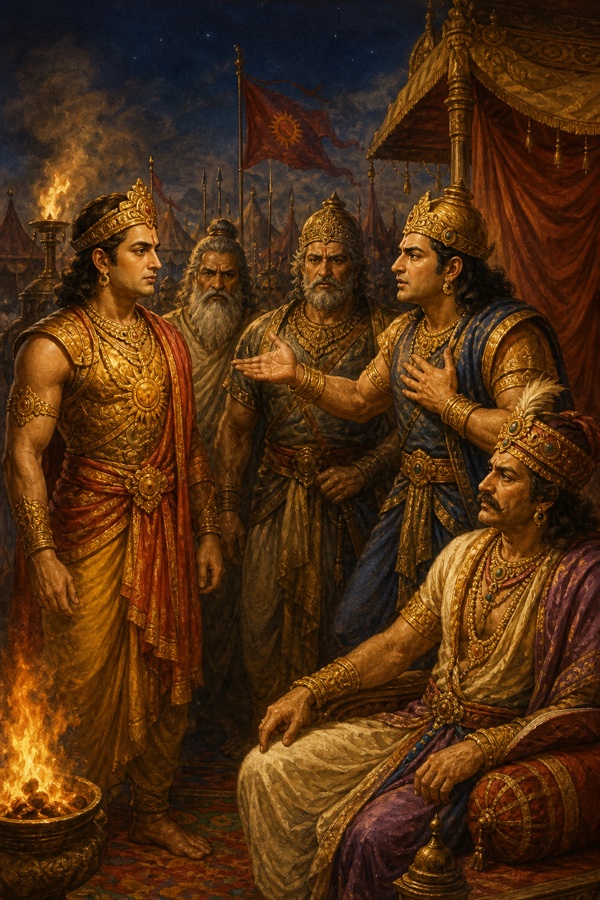
“The hope grew stronger in Duryodhana,” Sanjaya went on, “that where Bhishma and Drona had fallen, Karna would defeat the Pandavas. He told him, ‘Arjuna never wants to stand before you and fight.’ Karna replied, ‘Gandhari’s son, I have already said in your presence that I will defeat all the Pandavas, their sons, and Krishna. I will become your commander. You need have no doubt about that. Set your mind at rest. Consider the Pandavas defeated already.’ Duryodhana rose with all the kings, like Indra, the god of a hundred sacrifices, rising among the gods. Together they prepared to honor Karna with command, as the gods had honored Skanda. The kings, led by Duryodhana and wanting victory, installed him by the rites the ordinance prescribes. Karna sat at his ease on a seat of udumbara wood spread with silk. Around him stood golden and earthen jars filled to the brim with water sanctified by mantras, elephant tusks, the horns of rhinoceroses and powerful bulls, vessels set with jewels and gems, fragrant herbs and plants, and the other materials gathered in abundance. The sanctified water was poured over his head, and with that bathing on the seat the assembled kings invested him with command. Brahmins, kshatriyas, vaishyas, and respected shudras praised him. Now commander, Radha’s son gave nishkas, cattle, and other wealth to leading Brahmins and received their blessings. The praise singers and Brahmins told him, ‘Defeat the Pandavas with Govinda and all their followers. Kill the sons of Pandu and the Panchalas so that we may win, just as the risen sun destroys darkness with its fierce rays. The Pandavas and Krishna will be unable even to look at the arrows you shoot, like owls unable to gaze into the burning rays of the sun. With weapons in your hands, you will make it impossible for the Pandavas and Panchalas to stand before you, just as the danavas cannot stand before Indra in battle.’ Karna shone in beauty and brilliance like a second sun. Having installed him, your son, driven onward by Death, considered his purpose accomplished. At sunrise, Karna ordered the troops into formation. Surrounded by your sons, he resembled Skanda among the gods in the battle against the asura Taraka.”
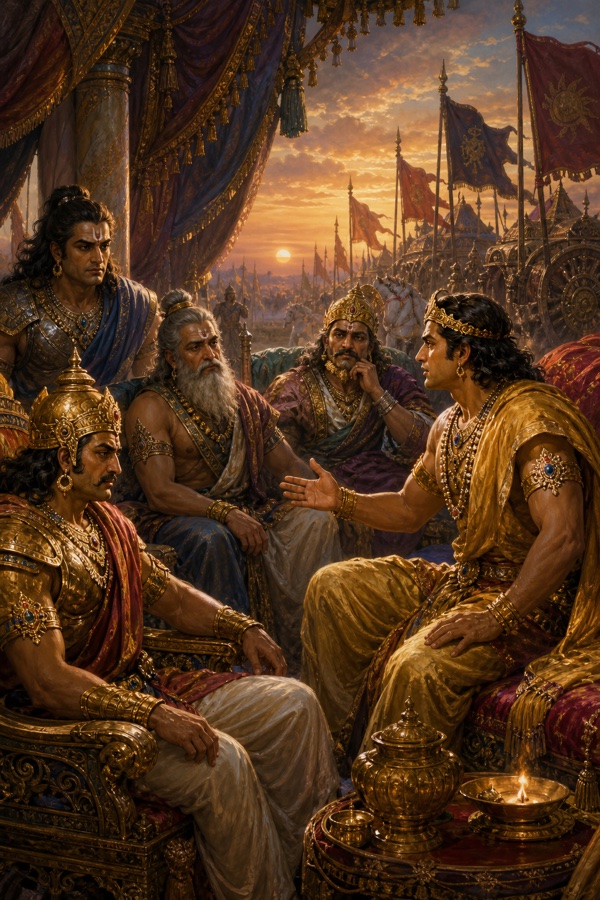
A key to reading this (the appointment): The account has returned to the evening after Drona’s death. Ashvatthama, the dead commander’s son, proposes Karna as the next leader. The rulers accept him through an abhisheka, a consecration with sacred water. Their hopes and blessings precede Karna’s order to arrange the army at sunrise for the fighting under his command.
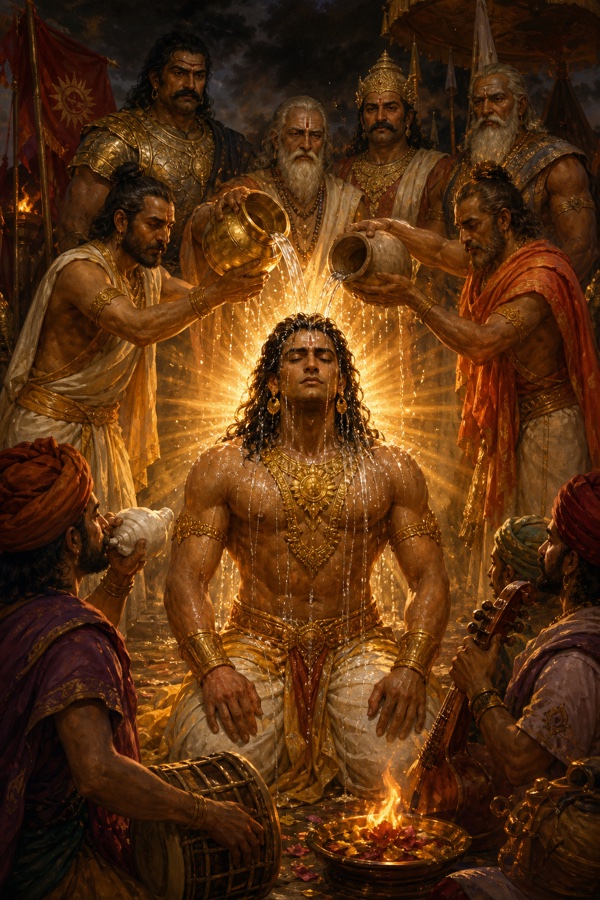
The gist: Duryodhana rallies his fleeing troops, fights until evening, and brings his allies together in camp. Ashvatthama argues that effort and sound judgment can still favor victory and proposes Karna as commander. Duryodhana appeals to Karna, who accepts and renews his promise to defeat the Pandavas. The rulers consecrate him, and at sunrise he orders the army into formation.
Karna’s makara and Arjuna’s half-moon: the armies take their places
“After Karna took the command, after Duryodhana had spoken to him in those warm, brotherly words and he had ordered the troops arrayed at sunrise, what did Vikartana’s son do?” Dhritarashtra asked. Sanjaya answered, “Your sons learned his wishes and gave the order to the sound of joyful music. Dawn was still a long way off when the cry suddenly rose through your troops: ‘Form up! Form up!’ The noise of preparation reached the sky. Great elephants and protected chariots were being equipped. Infantrymen put on armor, horses were fitted with their gear and harnessed, and warriors moved quickly about, calling to one another. Then Karna appeared with a gold-backed bow in his sun-bright chariot. Many banners flew from it, together with a white standard. Its horses were the color of cranes, and it carried the emblem of an elephant’s tether. A hundred quivers filled it. It had a mace, a wooden protective barrier, shataghnis, rows of bells, darts, lances, spears, and many bows. Karna sounded a conch covered with a network of gold and brandished his formidable bow, adorned with pure gold. Seated in that chariot, difficult to approach, he resembled the rising sun dispelling darkness. The Kauravas saw him and ceased for the moment to feel the loss of Bhishma, Drona, and the others. The blasts of his conch urged the warriors forward, and the vast army moved out under his direction.”
“Karna arranged the army in the shape of a makara, spreading its divisions into the limbs and body of that great water creature. With the formation complete, he advanced toward the Pandavas, intent on victory. He took the foremost point of the creature’s mouth himself. Shakuni, Duryodhana’s uncle, and Shakuni’s son Uluka occupied its two eyes. From those eyes, father and son looked out just behind the point of the beak where Karna stood. Ashvatthama held its head; Duryodhana’s brothers, born of the same mother, occupied its neck. Duryodhana stood in the middle with a large supporting force. Kritavarma held the left foot with the Narayana troops and the invincible gopala warriors. Kripa of the Gautama line, whose courage never failed, occupied the right foot, surrounded by the great archers of Trigarta and warriors from the south. Shalya held the left hind foot with a large force raised in Madra. At the right hind foot stood Sushena, faithful to his vows, with a thousand chariots and three hundred elephants around him. The two powerful royal brothers Chitra and Chitrasena occupied the tail, supported by a large force. Facing that array, Yudhishthira turned to his brother Arjuna.”
“‘Look at the way Karna has arranged the army of Dhritarashtra’s sons,’ Yudhishthira said, ‘protected by heroes and great chariot warriors. This vast force has lost its bravest men. Those who remain seem weak to me, like straw. One great archer still shines among them: Karna. The three worlds, with everything that moves and everything that stands still, with their gods, asuras, gandharvas, kinnaras, and great serpents, could never overcome that chariot warrior. If you kill him today, victory will be yours. The thorn planted in my heart for twelve years will finally be pulled out. Knowing that, arrange our army in whatever formation you choose.’ Arjuna, whose chariot was drawn by white horses, heard his brother and formed the Pandava army into a half-moon facing Karna’s formation. Bhima held the left, and the great archer Dhrishtadyumna held the right. Yudhishthira and Arjuna occupied the center. Nakula and Sahadeva stood behind Yudhishthira. The Panchala princes Yudhamanyu and Uttamauja took their places beside Arjuna as the guards of his chariot wheels. Protected by Arjuna in turn, they never left him for a moment. The other courageous kings stood in armor at their assigned places, each positioned according to his energy and determination. With the arrays formed, the Pandavas and the great archers of your army set their minds on battle.”
“Duryodhana and his brothers looked at the army Karna had arranged and regarded the Pandavas as already dead. Yudhishthira looked at his own army and regarded the Kauravas, Karna included, as already dead. Conches sounded on every side. Kettledrums, tabors, large drums, and cymbals rang out, along with dindimas and jharjharas, through both armies. Warriors roared like lions in their desire for victory. Horses neighed, elephants grunted, and chariot wheels clattered fiercely. With Karna standing armored at the head of the formation, no one in your army felt Drona’s absence then. Both forces were filled with joyful men, eager to fight and destroy one another without delay. Karna and Arjuna saw each other and grew angry. Both were resolute, standing or moving through their own divisions. As the armies advanced to meet, they seemed to dance with delight. Warriors came out from their wings and flanking divisions, ready for battle. Men, elephants, horses, and chariots began fighting to destroy one another.”
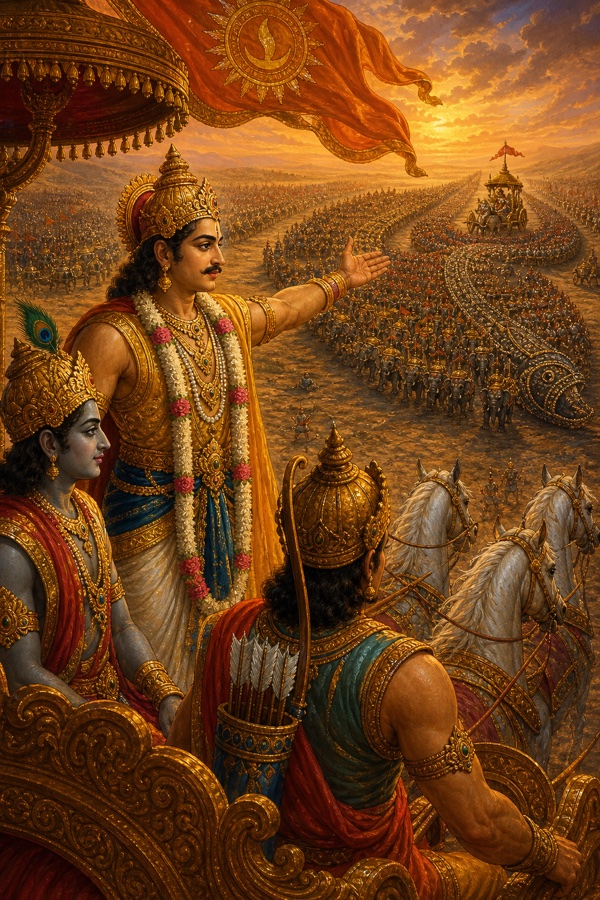
A key to reading this (the formations and the speakers): The makara formation assigns leaders to the creature’s mouth, eyes, head, neck, feet, and tail; Karna commands from its forward point. Arjuna answers with a half-moon, holding the center with Yudhishthira while Bhima and Dhrishtadyumna take the two ends. Yudhishthira speaks of a thorn troubling him for twelve years; Dhritarashtra’s lament spoke of thirteen years without sleep.
The gist: Karna brings out the Kaurava army and assigns its leaders their places in the makara formation. Yudhishthira identifies Karna as the great obstacle to victory, and Arjuna arranges the Pandavas in a half-moon. Both kings believe their enemies are already doomed. Music, battle cries, horses, elephants, and chariot wheels fill the field as the forces advance and the fighting begins.
Bhima and Kshemadhurti on elephants: from broken bows to the mace
The two vast armies met, their men joyful, their horses and elephants crowding the field, their splendor like that of the hosts of gods and asuras. They began striking one another. Men, chariots, horses, elephants, and fierce infantry delivered blows that destroyed bodies and purged sin as well. Men with the courage of lions scattered the heads of other lionlike men over the earth. Those heads shone like the full moon or the sun and were fragrant as lotuses. Crescent-shaped arrows, broad-headed shafts, razor-faced arrows, axes, and battle-axes severed them. Warriors with long, powerful arms cut away the equally powerful arms of their opponents. Weapons and bracelets remained on the limbs as they fell. Red palms moved on the ground. The writhing arms, each ending in five blood-red fingers, resembled fierce five-headed snakes killed by their winged enemy Garuda. Warriors struck by their enemies fell from elephants, chariots, and horses like inhabitants of heaven falling from their celestial vehicles when the merit sustaining them was exhausted. Hundreds more fell beneath heavy maces, spiked clubs, and short bludgeons. Chariots crushed chariots, maddened elephants fought maddened elephants, and horsemen killed horsemen. Then every arm turned on every other: chariots ran down men, elephants broke chariots, foot soldiers pulled down horsemen and were ridden down in turn, until the field was heaped with the dead of all four kinds, killed with hands and feet, with weapons, and with the vehicles themselves.
Into that struggle of mounted men and infantry came the Pandava force, led by Yudhishthira’s powerful brother Bhima. Dhrishtadyumna, Shikhandi, Draupadi’s five sons, the Prabhadrakas, Satyaki, and Chekitana came forward with the Dravida forces, the Pandyas, Cholas, and Keralas, all enclosed in a mighty formation. They had broad chests, long arms, tall bodies, and large eyes. The Andhra infantrymen under Satyaki were fierce in appearance and full of energy. They wore ornaments and clothes of many colors, scented powders on their bodies, and had red teeth. Their power resembled that of enraged elephants, and with their swords and nooses they could restrain great elephants. Companions in death, they never deserted one another. They carried quivers and bows, wore their hair in long locks, and spoke pleasantly. Other brave warriors rushed forward: Chedis, Panchalas, Kekayas, Karushas, Kosalas, Kanchis, and Magadhas. Their fine chariots, horses, and elephants and their fierce infantry seemed to dance and laugh, made joyful by the sounds of many instruments. In the middle of this vast force came Bhima, seated on an elephant’s neck and surrounded by leading elephant warriors. His fierce, splendidly equipped mount resembled a stone mansion on Mount Udaya with the rising sun above it. Its superb iron armor was set with precious gems and glittered like an autumn sky full of stars. Bhima held a lance in his outstretched arm. A beautiful diadem crowned his head. Bright as the midday sun in autumn, he began to scorch his enemies.
Kshemadhurti saw Bhima’s elephant from a distance. Riding his own elephant, he issued a challenge and rushed toward him, delighted by the encounter. Bhima was more delighted still. Their fierce elephants met like two great hills covered in trees, each animal fighting the other freely. The men riding them struck each other hard with lances bright as sunbeams and roared. Then they separated, maneuvered their elephants in circles, and took up bows. They began shooting at each other. The sound of their roars, their hands striking against their armpits, and their arrows whistling through the air gladdened those around them. They kept shouting like lions. Both were strong and skilled in weapons, and their elephants fought with trunks raised and banners flying in the wind. Each man cut through the other’s bow. They roared again and showered one another with darts and lances like two rain clouds emptying themselves in the wet season. Kshemadhurti drove a lance into the center of Bhima’s chest, followed it with six more, and shouted loudly. The lances remained embedded in Bhima. Blazing with anger, he resembled the sun behind clouds, its rays breaking through the gaps. With those lances still lodged in him, Bhima selected his own throw carefully. He sent a lance straight toward Kshemadhurti, its entire length made of iron and its brightness like a ray of the sun. Kshemadhurti, king of the Kulutas, drew his bow and cut the lance apart with ten arrows. He then pierced Bhima with sixty shafts.
Bhima took up a bow whose string sounded like thunder. He roared and drove arrows deep into his opponent’s elephant. The wounded animal refused to stay, despite the efforts to restrain it. It fled like a cloud driven by wind. Bhima’s fierce elephant pursued it, one storm-driven cloud chasing another. Kshemadhurti brought his mount under control and shot at the elephant following him. With a straight, well-aimed razor-headed arrow, he cut through Bhima’s bow. He continued striking Bhima’s elephant. Angry now, he pierced Bhima himself and drove many long arrows into every vital part of the animal beneath him. The great elephant could no longer stand. Before it fell, Bhima jumped from it and landed on the ground. He now faced his mounted opponent from below, with the mace in his hands. He struck Kshemadhurti’s elephant and crushed it. Kshemadhurti jumped from his own stricken mount and advanced with his weapon raised. Bhima struck him too. The king fell dead beside his elephant, his sword still in his hand, like a lion killed by a thunderbolt beside a mountain shattered by the same power. Seeing the renowned king of the Kulutas killed, the Kaurava troops fled in great distress.
A key to reading this (the last exchange): Bhima jumps clear before his elephant falls; both elephants go down before Kshemadhurti himself.
The gist: Amid the general slaughter, Bhima advances on an armored elephant and is challenged by Kshemadhurti. Their fight moves through lances, bows, broken weapons, a fleeing elephant, and renewed pursuit. Kshemadhurti brings Bhima’s mount down, but Bhima has jumped clear. His mace crushes Kshemadhurti’s elephant and kills the king, sending the Kaurava troops into flight.
Satyaki and the Kekaya brothers: arrows give way to swords
Karna began striking the Pandava army with straight-flying arrows. The Pandava chariot warriors, furious, struck at Duryodhana’s army before Karna’s eyes. Arrows a yard long, polished by craftsmen and bright as rays of sunlight, flew from Karna’s bow into the opposing force. Elephants hit by them cried out, lost their strength, grew faint, and wandered in every direction. Nakula rushed toward Karna as the commander continued destroying the army. Bhima advanced against Ashvatthama, who was accomplishing difficult feats. Satyaki checked the Kekaya princes Vinda and Anuvinda. King Chitrasena charged the advancing Shrutakarman, while Prativindhya went against Chitra, whose standard and bow were beautifully made. Duryodhana attacked Yudhishthira, the son of Dharma. Arjuna went against the angry masses of the samsaptakas, the warriors whose vow bound them to fight him. Dhrishtadyumna advanced on Kripa. Shikhandi closed with Kritavarma, Shrutakirti encountered Shalya, and Madri’s son Sahadeva met Duhshasana.
The Kekaya brothers covered Satyaki with a shower of blazing arrows, and he covered them in return. They drove shafts deep into his chest, like two elephants striking an enemy elephant with their tusks in the forest. Their own vital parts were already pierced by his answering shafts, and still both brothers kept sending arrows into the man they faced together. Shini’s grandson smiled as he sent arrows in every direction and held both brothers in check. They answered by rapidly covering his chariot with shafts. Satyaki cut through both of their fine bows. With the weapons in their hands broken, he held the brothers back under his sharp arrows. Each brother took up another bow and a fresh supply of powerful shafts. They resumed the attack, moving with speed and skill as they covered him again. Gold adorned their arrows, which were fitted with kanka and peacock feathers. The shafts lit the directions as they fell. Soon the arrows between the three warriors were so thick that they created darkness. They cut through one another’s bows again. Furious, Satyaki took up a fresh bow and strung it. With a sharp razor-headed arrow, he cut off Anuvinda’s head. The large head, still wearing its earrings, fell like Shambara’s head in the great battle of old. It reached the ground in an instant, plunging the Kekayas into grief.
Vinda saw his brother fall. He strung another bow, resisted Shini’s grandson from every side, and pierced him with sixty arrows, fitted with golden wings and sharpened on stone, then shouted, “Wait! Wait!” Thousands more shafts struck Satyaki’s arms and chest. Arrows wounded every part of him. Blood covered the wounds across his body, giving him the brilliant red of a kimshuka tree in full flower. Even under that assault, Satyaki easily pierced the Kekaya prince with twenty-five arrows. Each then cut through the other’s fine bow. Each quickly killed the other’s charioteer and horses. Both had lost the men who drove them and the teams that carried them through the battle. They left their disabled chariots and came forward on foot, each taking up a sword and shield. They were men of massive arms, each carrying an excellent sword and a shield decorated with a hundred moons. Standing in that broad field, they resembled mighty Jambha and Indra facing each other in the war between gods and asuras. They began moving in circles. Then they closed quickly, each coming in near the other, each straining to destroy him.
Satyaki’s sword split the Kekaya prince’s shield in two. Vinda’s answered and split Satyaki’s shield, the one covered with hundreds of stars. With the shields gone, Vinda circled again, sword raised, advancing a step and drawing back a step, and carried that fine blade through every turn across the broad arena. Satyaki, the quicker of the two, caught him in that circling and struck from the side. The stroke went through armor and body and cut the prince in two. The great Kekaya archer fell like a mountain split by a thunderbolt. Satyaki immediately climbed onto Yudhamanyu’s chariot. Later he mounted another chariot, fully equipped for battle, and began killing men throughout the large Kekaya force with his arrows. The army he was cutting down abandoned the fight against him and fled in every direction.
A key to reading this (the names and the changing fight): The Vinda and Anuvinda here are Kekaya princes. The two of the same names in the earlier casualty roll were princes of Avanti.
The gist: The leading warriors engage different opponents as Karna attacks the Pandava army. Satyaki fights the Kekaya brothers, kills Anuvinda with an arrow, and continues against Vinda. After each man kills the other’s horses and driver, they fight with swords. Satyaki kills Vinda, obtains a chariot, and drives the Kekaya troops from the field.
Shrutakarman and Prativindhya: the deaths of Chitrasena and Chitra
Shrutakarman, one of Draupadi’s sons, struck King Chitrasena with fifty arrows. The ruler of the Abhisars answered with nine straight arrows into Shrutakarman and five into his charioteer. Angry, Shrutakarman sent a sharp shaft into a vital part of the king, who stood at the head of his forces. The arrow entered deeply. Chitrasena suffered intense pain and lost consciousness. While he lay senseless, Shrutakarman covered him with ninety arrows. Chitrasena came to under that rain, sent a broad-headed arrow through Shrutakarman’s bow, and followed it with seven arrows into Shrutakarman himself. Shrutakarman picked up another powerful bow decorated with gold. Waves of arrows gave the young king before him a strange appearance. Chitrasena wore beautiful garlands, and the arrows now adorning him made him resemble a young man elaborately dressed for an assembly. He quickly shot an arrow into the center of Shrutakarman’s chest and called, “Wait! Wait!” Blood poured from the wound like streams of liquid red chalk flowing down a mountain. Bathed and stained in it, Shrutakarman shone like a kimshuka tree in flower.
Furious at the blow, Shrutakarman cut in two the bow that had held off Chitrasena’s enemies and followed with three hundred well-feathered arrows, covering the king completely. Then he sent another broad-headed shaft, keen at its point and sharp along its edges, through Chitrasena’s neck. The king’s head, still wearing its headgear, fell to the ground, bright as the moon descending from the sky. His troops saw him killed and rushed violently at Shrutakarman. The archer advanced against them in anger, firing as he went, like Yama moving against all creatures at the dissolution of the universe. “Your grandson drove them off with his arrows,” Sanjaya told Dhritarashtra. The troops scattered like elephants scorched by a forest fire. They had abandoned hope of defeating him. Shrutakarman pursued them with sharp arrows, brilliant on his chariot as they fled.
Yudhishthira’s son Prativindhya, facing Chitra, sent five arrows into the king, three into his driver, and one into his standard. Chitra answered with nine broad-headed arrows into Prativindhya’s arms and chest. The shafts had sharp points, golden wings, and kanka and peacock feathers. Prativindhya cut Chitra’s bow with his own arrows and struck him deeply with five more. Chitra threw a dreadful dart at him. Decorated with golden bells, it resembled a flame of fire and came through the air like a flashing meteor. Prativindhya easily cut it into three pieces. The broken weapon fell like the thunderbolt that terrifies living creatures at the end of a yuga. Seeing the dart defeated, Chitra picked up a huge mace covered in a network of gold and hurled it. The mace killed Prativindhya’s horses and driver, crushed his chariot, and struck the ground with great force. Prativindhya had meanwhile climbed down. He threw a finely decorated dart with a golden staff at Chitra. The king caught it as it came toward him and threw the same weapon back. It passed through Prativindhya’s right arm and fell to earth, lighting the region like a burst of lightning.
Wounded through the arm, without horses, driver, or chariot, Prativindhya was still on his feet and bent on killing Chitra. He hurled a gold-adorned lance at the king. The lance passed through the king’s armor and chest and entered the earth like a great snake entering its hole. Chitra fell, his large, thick arms flung outward like two iron clubs. The Kaurava warriors saw him dead and rushed at Prativindhya from every side. They fired different kinds of arrows and shataghnis decorated with rows of bells, soon covering him as masses of clouds cover the sun. Prativindhya consumed his attackers with showers of arrows and routed their army as Indra, wielding the thunderbolt, routes the asuras. The troops, slaughtered by the Pandavas, suddenly scattered in every direction like clouds dispersed by the wind. With the Kaurava army being killed on all sides and fleeing, Ashvatthama alone rushed rapidly toward Bhima. A fierce encounter began between them at once, like the old battle between Vritra and Indra in the war of gods and asuras.
A key to reading this (two distinct encounters): Chitrasena, who fights Shrutakarman, is the Abhisar king; Chitra, who fights Prativindhya, is a different man.
The gist: Shrutakarman kills Chitrasena and drives his troops away. Chitra destroys Prativindhya’s chariot and wounds his right arm with his own returned dart, but Prativindhya kills him with a lance and repels the warriors attacking from every side. As the Kaurava force disperses, Ashvatthama advances alone against Bhima.
Bhima and Ashvatthama: both fall unconscious, and their drivers carry them away
Ashvatthama’s hands moved with extraordinary speed. He struck Bhima with an arrow, then aimed at the vital points of the body, every one of which he knew. Another ninety shafts hit the Pandava. Pierced all over by sharp arrows, Bhima shone like the sun with its rays. He covered Drona’s son with 1,000 well-directed shafts and roared like a lion. Ashvatthama defeated the incoming arrows with his own, then, seeming to smile, sent an arrow a yard long into Bhima’s forehead. Bhima carried it there like a proud rhinoceros bearing its horn in the forest. He too seemed to smile as he answered. He shot three arrows, each a yard long, into Ashvatthama’s forehead. With the shafts projecting from it, the Brahmin warrior resembled a mountain with three peaks washed by the rains. Ashvatthama struck Bhima with hundreds of arrows and could not shake him, just as wind cannot shake a mountain. Bhima, delighted by the fight, answered with hundreds of sharp shafts. He could no more shake Ashvatthama than torrents of rain could move a mountain.
Each covered the other with terrible showers of arrows. They shone on their splendid chariots like two suns risen to destroy the world, scorching each other with rays made of shafts. Both fought carefully, countering each deed with a deed of his own, fearlessly matching the attacks that came at him. They moved like two tigers, terrible and almost impossible to overcome, with arrows for fangs and bows for mouths. Clouds of arrows hid them on every side as clouds hide the sun and moon. Then they appeared again, blazing like Mars and Mercury freed from cloud cover. During that terrible encounter, Ashvatthama maneuvered so that Bhima was on his right. He poured hundreds of fierce arrows onto him as rain clouds pour water onto a mountain. Bhima could not tolerate that sign of his opponent’s advantage. From the same position on Ashvatthama’s right, he began countering the attacks. Their chariots wheeled in different directions, advancing and withdrawing as the situation demanded. The battle grew more furious. They followed different paths, made circling maneuvers, and shot with their bows drawn to their fullest extent. Each made every effort to kill the other, or at the least to leave him without a chariot.
Ashvatthama invoked many powerful weapons. Bhima counteracted every one of them with weapons of his own. The collision became terrible, like the clash of planets at the dissolution of the universe. The arrows they released struck one another and illuminated all directions and the Kaurava troops around them. Flights of shafts filled the sky with a terrifying sight, like falling meteors at the world’s end. Their collisions generated fire, sparks, and blazing flames. The fire began consuming both armies. Siddhas moving above the field spoke in wonder. “This is the greatest of all battles. No earlier battle amounts to even a sixteenth of it. There will never be another like it. This Brahmin and this Kshatriya prince both possess knowledge. Both have courage, and both are fierce in their strength. Bhima’s power is dreadful; the other’s skill with weapons is extraordinary. What energy they have, and what astonishing mastery. They stand here like two Yamas destroying the universe at the end of a yuga. They seem born as two Rudras or two suns. These fierce men are like two lords of death in this battle.” Such words from the Siddhas were heard again and again. A roar like a lion’s rose among the assembled beings of heaven. Crowds of Siddhas and Charanas watched the warriors’ astonishing, almost inconceivable feats in amazement. Gods, Siddhas, and great rishis praised them both: “Excellent, mighty son of Drona! Excellent, Bhima!”
Both men were badly hurt now. They glared at each other with eyes that rolled and reddened in rage, their lips quivering, grinding their teeth and biting their lips, and again they covered each other with arrows, two masses of clouds whose rain was shafts and whose lightning was weapons. Each pierced the other’s standard and driver, each wounded the other’s horses, and neither stopped striking. Then, in that fury, each took up one arrow meant to kill and shot it fast. The two shafts came on blazing, with the force of thunderbolts and nothing to resist them, and found the two warriors where they stood at the head of their divisions. Both were struck deep, and each sank onto the platform of his own chariot. Ashvatthama’s driver saw that Drona’s son was senseless and bore him away from the battlefield in the sight of all the troops. Bhima’s driver likewise carried off the Pandava, who fell into a swoon again and again as his chariot bore him from the field.
A key to reading this (the end of the duel): Both survive this encounter: Ashvatthama unconscious, Bhima fainting again and again, each carried off by his own charioteer.
The gist: Bhima and Ashvatthama match each other’s archery, chariot maneuvers, and powerful weapons. Celestial witnesses praise their strength and skill as colliding arrows produce sparks and flames. Their final shots wound both men deeply. With each warrior unable to continue, their charioteers carry them from the battlefield.
Source: the Mahabharata of Krishna-Dwaipayana Vyasa, Karna Parva. This chapter follows K. M. Ganguli, the invocation and sections I to LIV, through verse 29 of LIV, ending at Suketu’s death; the Gita Press Hindi edition numbers these chapters differently. Names, order, and events were checked against Ganguli’s complete translation. Where the recensions differ, this English retelling follows Ganguli, and the Hindi edition follows Gita Press. Dialogue and commentary are adapted, not a verbatim translation. About the sources.
Based on: The Mahabharata, Vyasa (K. M. Ganguli’s English translation; Gita Press, Gorakhpur)