On this page
A guest asking for battle: Ashvatthama challenges Arjuna among the samsaptakas
Dhritarashtra asked to hear about Arjuna. How had he fought the samsaptakas, and how had the other kings fought the Pandavas? He also wanted the account of Arjuna’s encounter with Ashvatthama and of the rulers who had faced him. Sanjaya told him to listen to the battle in which bodies, sins, and lives were destroyed. Arjuna entered the samsaptaka army as a storm enters an ocean and threw that immense force into turmoil. The men who had bound themselves to fighting him now met his arrows within their own ranks. Their vow had been taken before sacred fires. Wearing armor and robes of kusha grass, their bodies bathed in clarified butter and their bowstrings tied about them as girdles, they had given gold, cattle, and clothing to brahmins. They had spoken affectionately to one another before declaring the fate they would accept if they came back without killing Arjuna or turned away from him in fear: the realms reserved for the gravest offenders. Victory would earn them the blessed regions they sought. The challenge had served Drona’s plan to draw Arjuna away and capture Yudhishthira. Arjuna, too, had a vow: once challenged, he would never turn back. Those commitments had brought the armies to this struggle. The men before him kept coming. Sharp-edged, broad-headed shafts cut off the heads of brave warriors. Their faces had the brightness of the full moon, their eyes, brows, and teeth beautifully formed. Soon the earth resembled a place strewn with lotuses cut from their stems. Razor-headed arrows severed great, rounded arms smeared with sandalwood paste and other perfumes. The hands still held weapons, and leather guards protected their fingers. Those severed arms resembled 5-headed snakes. Arjuna’s broad-headed arrows repeatedly cut down horses, riders, and drivers; cut flags, bows, and arrows; and severed arms adorned with gems. Thousands of shafts sent chariot warriors, elephants, horses, and horsemen to Yama’s realm. Leading fighters rushed at him in anger, roaring like bulls driven wild by a cow in season. They shouted and struck him with arrows while he killed them, like enraged bulls driving their horns into another bull. The encounter was terrifying, like the battle of the daityas against thunderbolt-bearing Indra when the 3 worlds were contested. Arjuna resisted the weapons coming at him from every direction with weapons of his own. He struck quickly and repeatedly, taking lives with innumerable shafts.
He had already broken the poles, wheels, and axles of many chariots and killed their warriors, horses, and drivers. Weapons and quivers had been knocked from their places. Standards were crushed; harness straps and reins were severed; the wooden barriers and chariot shafts had been broken. Now Arjuna, also called Jaya, cut those ruined vehicles into tiny fragments, dispersing great groups of them as wind disperses masses of clouds. The scale of his action amazed those who saw it. He accomplished what a thousand great chariot warriors fighting together might accomplish. Siddhas, celestial rishis, and Charanas praised him. Kettledrums sounded in heaven, and flowers fell on Krishna and Arjuna. A voice without a visible speaker declared, “These 2, Keshava and Arjuna, always have the beauty of the moon, the brilliance of fire, the strength of wind, and the radiance of the sun. Sharing one chariot, they are invincible as Brahma and Shiva, called Ishana. Foremost among living beings, they are the ancient seers Nara and Narayana, born in the world of men.” Ashvatthama saw and heard the wonders around them. With care and determination, he rushed toward Krishna and Arjuna.
Holding an arrow, Drona’s son hailed the Pandava while continuing to shoot shafts tipped to kill. He smiled. “If you consider me a worthy guest who has come before you, then offer me the hospitality of battle today, with your whole heart.” Arjuna received the challenge as a great honor. Ashvatthama was the son of the teacher who had made him a master of weapons, and he had come asking to be welcomed with all the strength that training had given him. The Samsaptakas were still before Arjuna. He had a duty to fight those men, and now his teacher’s son claimed a guest’s welcome. He turned to Krishna. “I must kill the samsaptakas, but Drona’s son is calling me to fight him. Madhava, which duty should I undertake first? If you think it proper, let us first offer our guest the service due to him.” Krishna drove him toward Ashvatthama, carrying the warrior who had received that formal challenge as the wind carries Indra to a sacrifice. Ashvatthama’s mind was fixed on the encounter. Krishna saluted him and said, “Stay composed, Ashvatthama. Lose no time in striking and receiving blows. The time has come for men who depend on others to repay their obligation to their masters. Disputes among brahmanas are subtle. The consequences of a kshatriya’s dispute are plain to see: victory or defeat. You have foolishly asked Arjuna for this excellent hospitality. Fight him now with a steady mind, and receive what you requested.” Ashvatthama answered, “So be it.”
He pierced Krishna with 60 shafts and Arjuna with 3. Angry, Arjuna used 3 arrows to cut through Ashvatthama’s bow. Drona’s son took up another, more formidable bow and strung it in the blink of an eye. He shot 300 arrows into Krishna and 1,000 into Arjuna. Then, fighting carefully and overwhelming Arjuna, he released thousands, tens of thousands, and millions of arrows. They issued from the brahmana warrior’s quivers, bow, and bowstring; from his fingers, arms, and hands; from his chest, face, nose, eyes, ears, head, limbs, and the pores of his body; from his armor, chariot, and standard. Having pierced Krishna and Arjuna beneath that dense barrage, Ashvatthama roared with joy like a vast mass of clouds. Arjuna heard him and spoke to Krishna. “Look at what the teacher’s son is doing to me, Madhava. He has covered us in arrows and believes us killed. I will defeat his purpose now with my training and strength.” Arjuna cut every arrow Ashvatthama had released into 3 fragments. He destroyed the whole shower as the sun destroys thick fog.
Then he struck the samsaptakas again. Fierce shafts pierced their horses, drivers, chariots, elephants, standards, and infantry. Everyone watching felt surrounded by his arrows. Whether a man stood on foot or rode a chariot, horse, or elephant, he seemed enclosed in the same shower. Winged arrows of many shapes flew from Gandiva and killed elephants, horses, and men immediately before Arjuna and as far as 2 miles away. Fluid streamed from the cheeks and limbs of the excited elephants. Broad-headed arrows cut their trunks, which fell like tall forest trees felled by an ax. A little later the huge animals themselves fell with their riders, like mountains struck down by Indra’s thunderbolt. Arjuna cut well-equipped chariots into small pieces. Those vehicles, drawn by fast, well-trained horses and carrying warriors considered invincible, broke apart like cloud palaces dissolving in the evening sky. He kept raining arrows on the enemy, killing finely equipped horsemen and infantry. Like the sun rising at the end of a yuga, he dried up the seemingly inexhaustible ocean of samsaptakas with rays made of sharp shafts. Without losing a moment, he struck Ashvatthama again. Arrows swift and bright as sunlight pierced Drona’s son, who stood like a great hill, as Indra pierces a mountain with the thunderbolt. Ashvatthama angrily advanced to strike Arjuna, his horses, and his driver with fast-moving shafts. Arjuna cut the incoming arrows at once. Then, in great anger, he offered this worthy guest quiver after quiver of arrows, as a generous man gives a guest everything in his house. Leaving the samsaptakas, he rushed toward Drona’s son. His movement resembled a giver turning from unworthy guests to attend to one worthy of his gifts.
The gist: Arjuna devastates the samsaptaka force and receives celestial praise. Ashvatthama approaches as a guest requesting the hospitality of battle. Arjuna consults Krishna, accepts the challenge, and destroys Ashvatthama’s immense shower of arrows. He attacks the samsaptakas again, then turns fully toward his challenging guest, offering arrows as the gifts of their encounter.
Ashvatthama is carried from the fight and returns to Karna’s army
Arjuna and Ashvatthama fought with the brilliance of Shukra and Brihaspati, the planets Venus and Jupiter, as though those 2 lights were contending to enter the same constellation. Their blazing shafts became rays with which they afflicted each other. They seemed like planets that had strayed from their courses, terrifying the world. Arjuna drove an arrow deep between Ashvatthama’s eyebrows. With the shaft rising from his forehead, Drona’s son shone like the sun casting a ray upward. Krishna and Arjuna, the two Krishnas whom the heavenly voice had hailed as Nara and Narayana, were themselves deeply wounded by hundreds of Ashvatthama’s arrows. They resembled 2 suns at the end of a yuga, brilliant with their own rays. When Krishna appeared stunned, Arjuna released a weapon that sent torrents of arrows in every direction. Innumerable shafts struck Ashvatthama, each like a thunderbolt, fire, or the staff of Death. Drona’s son answered with carefully aimed arrows driven by such force that even Death would have felt their wounds. They struck both Krishna and Arjuna. Arjuna checked the arrows coming from Ashvatthama and covered him with twice as many of his own, all fitted with fine feathers. The warrior, his horses, his driver, and his standard disappeared beneath the shower. With Ashvatthama covered, Arjuna turned his attack back onto the samsaptakas.
Those enemies held their ground. Arjuna’s well-aimed shafts cut their bows, quivers, and bowstrings; their hands and arms; and the weapons clutched tightly in their fists. Umbrellas and standards fell, horses were struck down, and chariot shafts broke. Clothes, flower garlands, ornaments, coats of armor, and handsome shields were cut apart, along with countless heads. Well-equipped chariots, horses, and elephants went down beneath hundreds of arrows, carrying with them warriors who had been fighting with the utmost care. Broad-headed, crescent-shaped, and razor-faced arrows sent heads falling continually to the earth. Those heads had the beauty of lotuses, the sun, or the full moon, and were adorned with diadems, necklaces, and crowns. Then elephant warriors from Kalinga, Vanga, and Nishada rushed at Arjuna, determined to kill him. Their mounts shone like the elephant ridden by Indra, the great enemy of the daityas. Arjuna, who had humbled the danavas, struck those charging animals in their vital parts. His arrows cut their trunks and brought down their riders, standards, and banners. The elephants fell like mountain peaks shattered by thunderbolts. Once that elephant force had broken, Arjuna returned to his teacher’s son. Arrows bright as the newly risen sun covered Ashvatthama, just as wind gathers thick clouds across the sun.
Ashvatthama stopped Arjuna’s shafts with his own and covered both men on the opposing chariot with arrows. He roared like a mass of clouds at the end of summer after it has covered the sun or moon. His arrows had wounded Arjuna deeply. Arjuna now aimed at Ashvatthama and the troops accompanying him. He quickly dispelled the darkness made by the incoming shafts and pierced them all with well-feathered arrows. No one could follow his hands. They could not see the moment when he picked up a shaft, the moment when he aimed, or the moment when he released it. They saw elephants, horses, infantry, and chariot warriors falling dead beneath the arrows. Ashvatthama lost no time. He aimed 10 of his finest arrows and sent them so quickly that they seemed to be a single shaft. Five struck Arjuna, and 5 struck Krishna. The 2 men, magnificent as Kubera and Indra, were bathed in blood. Everyone there thought Ashvatthama, who had mastered the science of weapons, had killed them. Then Krishna, wounded and bloodied, spoke. “Why are you making this mistake of sparing Ashvatthama? Kill him. If you neglect him, this warrior will cause enormous suffering, like a disease left without treatment.” Arjuna answered, “So be it.” His understanding was clear. He began carefully directing his shafts into Drona’s son.
Angry now, Arjuna drew Gandiva and released arrows whose heads were shaped like goats’ ears. They struck with great force, piercing Ashvatthama’s thick arms smeared with sandalwood paste, his chest, his head, and his powerful thighs. Arjuna then cut the harness straps of Ashvatthama’s horses and began piercing the horses themselves. The wounded team carried its warrior far from the field, running with the speed of the wind. Ashvatthama was deeply hurt by Arjuna’s arrows. Carried away from his opponent, he had time to reflect. He did not want to return and resume the encounter. He knew that victory remained with Krishna, chief of the Vrishnis, and with Arjuna. Hope had left him, and his arrows and other weapons were nearly exhausted. Drona’s energetic son, descended from Angiras, restrained his horses and recovered a little composure. He entered Karna’s army, among its massed chariots, horses, and men. His retreat left Krishna and Arjuna free of that opponent, as incantations, medicines, and other remedies free a body of disease. Krishna and Arjuna drove toward the samsaptakas again. Their chariot rattled like thunder, and its banner streamed in the wind.
The gist: Arjuna alternates between Ashvatthama and the samsaptakas, breaking an elephant attack along the way. Ashvatthama wounds Krishna and Arjuna so severely that observers think both are dead. Krishna tells Arjuna to stop sparing him. Arjuna wounds Ashvatthama and his horses; the team carries him away. With his hope and weapons nearly gone, Ashvatthama decides against renewing the duel and joins Karna’s army.
The brothers from Magadha: Arjuna brings down Dandadhara and Danda
Krishna and Arjuna had turned toward the samsaptakas when a tremendous uproar rose from the northern part of the Pandava army. Dandadhara was slaughtering the chariots, elephants, horses, and infantry there. Krishna changed the chariot’s course without stopping its horses, whose speed rivaled Garuda’s or the wind’s. He told Arjuna, “The chief of Magadha is performing unmatched feats on his elephant. In training and strength, he equals Bhagadatta himself. Kill him first, then kill the samsaptakas.” Arjuna had already killed Bhagadatta, but a divine weapon had nearly killed him in that encounter. Bhagadatta had turned his elephant hook into the Vaishnava weapon with mantras and hurled it toward Arjuna’s chest. Krishna had covered Arjuna and received it upon his own breast, where it became a victory garland. Arjuna had protested: Krishna had promised to drive, leaving the fighting to him. Krishna had explained that the weapon was his own, passed down from Naraka to Bhagadatta, and that even Indra and Shiva could be killed by it. He had broken his promise to save Arjuna. Only after the weapon was gone had Arjuna brought down the elephant and its rider. Now Krishna was directing him toward another elephant warrior he judged Bhagadatta’s equal in training and strength. As soon as he had spoken, he drove Arjuna before Dandadhara. The Magadha king was unequaled in his command of the elephant hook, as headless Ketu stood unequaled among the planets. He was destroying the enemy army like a fierce comet bringing ruin to the earth. His well-equipped elephant, a killer of enemies, resembled a danava with an elephant’s face and body. It roared like a great mass of clouds. Riding it, Dandadhara destroyed thousands of chariots, horses, elephants, and men with his arrows. The animal trod on chariots and pressed men into the ground together with their horses and drivers. Its front feet and trunk crushed and killed other elephants. It moved like the wheel of Death. Through the strength of this enormous beast, Dandadhara brought down men in steel armor, horses, and infantry, crushing them into the earth like thick reeds breaking with a crackle under pressure.
Arjuna drove quickly toward the elephant through the army crowded with thousands of chariots, horses, and elephants. Cymbals, drums, and conches sounded everywhere. Chariot wheels clattered, bowstrings rang, and palms struck loudly in the tumult. Dandadhara shot 12 fine arrows into Arjuna, 16 into Krishna, and 3 into each horse. He shouted and laughed repeatedly. Arjuna answered with broad-headed shafts. They cut Dandadhara’s bow together with its string and the arrow already set on it. They cut his decorated standard and struck down the elephant’s guides and the foot soldiers protecting it. The lord of Girivraja grew furious. He wanted his tusker to overwhelm Krishna. The elephant was as massive as a cloud and as swift as wind, its temples split with excitement. Dandadhara threw many lances into Arjuna. Arjuna released 3 razor-headed arrows almost at the same instant. They cut off the king’s 2 arms, each thick as an elephant’s trunk, and his head, bright as the full moon. Arjuna then pierced the elephant with hundreds of arrows. Gold-decorated shafts covered its golden armor until it resembled a mountain at night with its herbs and trees burning. The animal roared like thunder under the pain. Its strength failed. Crying out, wandering, and running with an unsteady gait, it finally fell with the guide seated on its neck, like a mountain peak shattered by a thunderbolt.
Dandadhara’s brother Danda saw him fall. He advanced on Krishna and Arjuna, intent on killing them, riding a tusker white as snow. Gold adorned the animal, making it resemble a Himalayan summit. Against Krishna, hailed as Indra’s younger brother, Danda hurled 3 sharpened lances bright as sunrays. He struck Arjuna with 5, then shouted loudly. Arjuna shouted in answer and cut off Danda’s arms with razor-headed arrows. They fell together from the elephant’s back, still holding their lances, still adorned with armlets and smeared with sandalwood paste. They looked like 2 great, beautiful snakes falling from a mountain summit. Arjuna followed with a crescent-shaped arrow that severed Danda’s head. It dropped from the elephant onto the ground and lay covered in blood, glowing like the sun fallen from Mount Asta toward the west. Then Arjuna turned his shafts onto Danda’s mount. Excellent arrows bright as sunlight pierced the animal, which resembled a mass of white clouds. It fell with a sound like a Himalayan peak broken by a thunderbolt.
Other huge elephants came under Arjuna’s attack, animals capable of winning battles and equal to the 2 he had already brought down. He destroyed them as he had destroyed the mounts of Dandadhara and Danda. The great enemy force broke. Elephants, chariots, horses, and men collided in dense crowds and fell to the ground. Reeling, they struck one another violently and died. Arjuna’s own soldiers surrounded him as the gods surround Indra. “That enemy terrified us as Death himself terrifies living creatures,” they said. “By good fortune, you have killed him. We were suffering terribly under those powerful enemies. If you had failed to protect us from that terror, our enemies would now be feeling the joy that their deaths have given us.” Friends and allies spoke these words and others like them. Arjuna heard them with a cheerful heart and honored each man according to what he deserved. Then he went toward the samsaptakas again.
The gist: Krishna redirects Arjuna toward Dandadhara, who is devastating the northern Pandava force from an elephant. Arjuna kills the king and brings down his mount. Danda attacks after his brother falls and is killed in turn, followed by his white elephant. The remaining elephant force collapses. The rescued soldiers thank Arjuna, who honors them and returns toward the samsaptakas.
Krishna shows Arjuna the battlefield; beyond it, Pandya is breaking the enemy
Arjuna wheeled around like Mercury following the curve of its orbit and again killed great numbers of samsaptakas. Men, horses, and elephants struck by his shafts wavered, grew bewildered, lost their color, fell, and died. Broad-headed arrows, razor-headed shafts, crescent-shaped arrows, and arrows tipped like a calf’s tooth cut down fine animals in their yokes and the drivers guiding them. They cut standards, bows, and arrows, hands with weapons still in their grasp, arms, and heads. Hundreds and thousands of brave warriors closed on Arjuna like bulls fighting another bull for a cow in season. Their encounter was as terrifying as the battle between the daityas and Indra for the 3 worlds. Ugrayudha’s son struck Arjuna with 3 shafts like venomous snakes. Arjuna cut his head from his body. Angry warriors surrounded him with many kinds of weapons, covering him as the storm gods, the Maruts, drive clouds over the Himalayas at summer’s end. Arjuna checked their weapons on every side and killed many of them with well-directed arrows. He destroyed the trivenu fittings of chariots, their horses, their drivers, and their auxiliary parshni drivers. He knocked weapons and quivers out of place, deprived vehicles of wheels and standards, broke their cords, harness straps, and axles, and destroyed their floors and yokes. Equipment fell from its fittings. The shattered chariots resembled the luxurious houses of rich men ruined by fire, wind, and rain. Elephants struck in vital places by arrows swift as thunderbolts fell like buildings on mountain summits destroyed by lightning. Horses and riders went down in large numbers, their tongues and entrails forced out, their strength gone, their bodies covered in blood. The sight was terrible. Men and animals pierced by Arjuna’s arrows staggered in bewilderment, fell, cried out in pain, and turned pale. Arrows sharpened on stone, deadly as thunderbolts or poison, killed them as Indra kills the danavas. Brave men in costly armor, adorned with ornaments and carrying many kinds of weapons, lay beside their chariots and standards. Men of noble birth, knowledge, and righteous deeds went to heaven through their glorious actions. Their bodies remained on the earth.
Rulers of many realms fighting for Dhritarashtra rushed angrily at Arjuna with their followers. Chariot warriors, horsemen, elephant riders, and infantry all wanted to kill him. They advanced, shooting their weapons rapidly. Their crowded force was like a mass of clouds; Arjuna’s sharp arrows swept away its dense rain of weapons like the wind. Those watching saw him crossing an ocean of horses, infantry, elephants, and chariots, with powerful weapons for waves and no raft to carry him. His own offensive and defensive weapons made the bridge on which he crossed. Krishna addressed him. “Why are you playing with them this way? Crush these samsaptakas and hurry toward Karna’s death.” Arjuna answered, “So be it.” He struck the remaining samsaptakas forcefully with his weapons and destroyed them like Indra destroying the daityas. Even the closest attention could not catch when he drew out an arrow, when he aimed, or when he swiftly released it. Krishna himself found it extraordinary. Arjuna’s white, quick-moving arrows entered the enemy army like swans diving into a lake. As the slaughter continued, Krishna looked over the field and spoke. “For Duryodhana alone, Arjuna, this enormous and dreadful destruction of the Bharatas and the other kings of the earth is taking place. Look at the gold-backed bows of these mighty archers, and the belts and quivers fallen loose from their bodies. Look at the straight arrows with golden wings, and the long arrows washed with oil, shining like snakes newly freed from their old skins. Fine lances decorated with gold lie scattered here, and gold-adorned armor has fallen from the warriors who wore it. See the gold-embellished spears and darts, the great maces wound with golden threads and hemp cords. See the swords and axes adorned with bright gold and the battle-axes with golden handles. There are spiked clubs, short arrows, bhusundis, kanapas, iron kuntas, and heavy mushalas. These energetic warriors, armed with so many weapons and longing for victory, seem alive even in death. Thousands lie with limbs crushed by maces, heads split by mushalas, or bodies smashed and trampled by elephants, horses, and chariots.”
Krishna continued. “The field is covered in the bodies of men, elephants, and horses. Arrows, darts, swords, lances, scimitars, axes, spears, nakharas, and bludgeons have horribly mangled them. Streams of blood bathe the dead. Arms lie scattered here, smeared with sandalwood paste, adorned with angadas and keyuras, bearing auspicious marks and still encased in leather guards. They give brilliance to the earth. Hands severed from arms lie with their finger guards and ornaments. The thighs of vigorous warriors lie cut away, as thick as elephants’ trunks, beside heads still wearing earrings and gem-set headgear. Look at the fine chariots with golden bells, broken in different ways. Look at the blood-covered horses, the chariot floors, the long quivers, the many standards and banners, the warriors’ great conches, and the perfectly white yak-tail whisks. Elephants lie like hills with their tongues hanging out, adorned with beautiful victory banners. Slain elephant warriors lie on the field. Here are the rich covers made from single blankets for the backs of those huge beasts, and the beautiful multicolored blankets torn apart. Bells have broken loose from the elephants and been smashed to pieces beneath the falling animals. Hooks with handles set in lapis lazuli have fallen to the ground. Look at the horses’ ornamental yokes and the diamond-set armor for their breasts. Look at the costly gold-adorned cloth tied to the ends of the standards carried by horsemen. Coverlets, housings, and skins of ranku deer lie fallen from the horses’ backs, set with brilliant gems and inlaid with gold. Here are the large diamonds from kings’ headgear, beautiful necklaces of gold, umbrellas displaced from their places, yak-tail whisks, and fans. Faces lie across the ground wearing earrings bright as the moon or stars. Their beards are carefully trimmed, and each face resembles the full moon. With these faces like lilies and lotuses, the earth looks like a lake crowded with those flowers. It has the radiance of the bright moon and the varied brilliance of countless stars, like the autumn sky full of stellar lights. Arjuna, what you have accomplished in this great battle today is worthy of you, or of the lord of the gods himself in heaven.”
Krishna showed Arjuna the field in this way. As Krishna and Arjuna returned from the battlefield toward their camp, a loud noise reached them from Duryodhana’s army. Conches blared; cymbals, drums, and patahas were beaten. Chariot wheels clattered, horses neighed, elephants grunted, and weapons clashed fiercely. Krishna drove into that force with horses swift as the wind and saw Pandya crushing it. The sight amazed him. The Pandya king, an outstanding warrior skilled in arrows and other weapons, was destroying crowds of enemies with shafts of different kinds, like Yama killing creatures whose allotted lives had ended. Sharp arrows pierced the bodies of elephants, horses, and men and brought them down lifeless. Leading enemy warriors threw their varied weapons at him. Pandya cut them apart with his own arrows and killed his enemies as Indra kills the danavas.
The gist: Arjuna destroys more of the samsaptakas. Krishna urges him to hasten toward Karna, then shows him the cost of the battle: dead warriors and animals among shattered vehicles, scattered weapons, armor, and ornaments. On their return toward camp, they hear fighting in Duryodhana’s army. Krishna drives toward it and finds the Pandya king devastating the enemy force.
Pandya breaks Ashvatthama’s crown
Dhritarashtra interrupted the account. Sanjaya had already named Pandya, a king whose fame had spread across the world, yet the blind ruler had heard little of what this man had actually done in battle. Now he wanted the full measure of him: his courage, his skill with weapons, his spirit and energy, the extent of his strength, and the pride he took in it. Sanjaya answered by naming the warriors Dhritarashtra considered supreme. There were Bhishma and Drona, the 2 commanders his army had already lost; Kripa and Drona’s son Ashvatthama; Karna, Arjuna, and Krishna. All were masters of weapons. Pandya believed his own energy exceeded theirs. He acknowledged no king as his equal. Even to be ranked alongside Karna or Bhishma fell short of his estimate of himself, and in his heart he conceded no inferiority to Krishna or Arjuna in any respect. This was the man now raging through Karna’s army like the Destroyer. Under his attack, the mass of chariots, horses, and chosen infantry spun about like a potter’s wheel. His arrows swept through the force as wind scatters clouds, destroying horses, drivers, standards, and chariots, bringing down weapons and elephants. He cut the banners, standards, and weapons carried on the elephants and killed the foot soldiers protecting them. Then he brought down the great animals with their riders, like Indra shattering mountains with his thunderbolt. Horses and mounted men fell with their darts, lances, and quivers. Pulindas, Khasas, Bahlikas, Nishadas, Andhakas, Tanganas, southerners, and Bhojas held their ground with stubborn courage. Pandya’s shafts tore through them, stripped away weapons and armor, and took their lives.
Ashvatthama saw all 4 arms of the army being destroyed and advanced fearlessly toward the king. Pandya moved so rapidly on his chariot that he seemed to dance. Smiling, Drona’s son called to him in a voice of striking courtesy. “King, with eyes like lotus petals, you come from a noble line and possess great learning. Your strength and courage are famous. You resemble Indra himself. When those powerful arms draw your great bow and you pour swift arrows over the enemy, you have the splendor of gathering clouds. I can see only myself as your match in this battle. You crush chariots, elephants, infantry, and horses alone, as a fearless lion crushes herds of deer in the forest. The thunder of your chariot wheels fills the earth and sky. You shine like a roaring autumn cloud that destroys the crops beneath it. Take those sharp arrows from your quiver, deadly as poisonous snakes, and fight me alone, as the asura Andhaka fought Shiva, the god with 3 eyes.” Pandya accepted. “Let it be so.” Ashvatthama called, “Strike!” and attacked with force. Pandya, also called Malayadhwaja, struck him with a barbed arrow. Still smiling, Ashvatthama replied with fierce shafts that seemed to burn like flames and could pierce the body’s vital organs. He released another flight of large, sharply pointed arrows, sending them through the air with 10 different kinds of motion. Pandya cut them all apart with 9 arrows of his own. He used another 4 against Ashvatthama’s 4 horses; the wounded animals quickly died. Pandya intercepted more of his opponent’s arrows and cut the taut string of Ashvatthama’s bow.
Drona’s son strung the bow again. His men had already brought up a fresh team and harnessed the new horses to the chariot. With his weapon and team restored, he released thousands of arrows, filling the sky and all 10 directions. Pandya knew the supply was inexhaustible. He carefully cut down every shaft coming at him, then killed the 2 warriors guarding Ashvatthama’s chariot wheels. Ashvatthama saw how fast his opponent’s hands were moving. He drew his bow until it curved into a circle and answered with the force of a downpour. In an eighth of a day, he shot as many arrows as 8 carts could carry, each cart drawn by 8 bullocks. Most of those who saw him nearly lost consciousness. He appeared to be the Destroyer in fury, possessed of power enough to destroy even the Destroyer. His arrows drenched the opposing force as clouds at the end of summer drench the earth, mountains and trees together. Pandya brought the Vayavya weapon against that storm. Its wind dispersed the unbearable shower, and the king roared in delight. Ashvatthama cut down his standard, fragrant with sandalwood paste and other scented ointments, bearing the image of Mount Malaya. He killed Pandya’s 4 horses and, with a single arrow, his charioteer. A crescent-headed shaft severed the bow whose twang had sounded like thunder. Then he broke the chariot into fragments. He checked Pandya’s weapons with his own and cut apart everything the king sent at him. The opportunity to kill Pandya lay open. Ashvatthama wanted to fight him longer, and allowed him to live. Elsewhere, Karna was charging into the Pandavas’ great elephant force, routing and destroying it. Countless straight shafts struck elephants, horses, and men; chariot warriors found their vehicles destroyed beneath them. Pandya, too, had lost his chariot. His opponent still wanted more of their duel.
A riderless elephant came toward the stranded king. Huge tusks projected from its head, and it carried the full equipment of a war elephant. It was powerful, fast, and quick to advance against an enemy. Ashvatthama’s arrows had struck it. Roaring at an elephant of the other army, it now approached Pandya at speed, resembling a broken mountain summit in its size and shape. Pandya knew how to fight from an elephant’s neck. He sprang onto the animal as a roaring lion springs onto the top of a mountain, drove it with the hook, and hurled a lance bright as sunlight at Ashvatthama. Anger had left intact the cool precision for which his forceful throws were known. He shouted joyfully, again and again, “You are dead! You are dead!” The lance smashed into Ashvatthama’s crown. Precious stones and flawless diamonds were set into its fine gold; beautiful cloth and strings of pearls adorned it. It had shone with the brightness of the sun, moon, planets, or fire. Now the blow split it into pieces. The fragments fell with a great noise, like a mountain peak broken by Indra’s thunderbolt. Ashvatthama’s rage flared like that of a great snake trodden underfoot. He took up 14 arrows, each capable of inflicting terrible pain, each like a rod wielded by the Destroyer. With 5, he cut off the elephant’s 4 feet and its trunk. With 3, he severed Pandya’s 2 arms and his head. The remaining 6 killed the 6 radiant chariot warriors following the king.
Pandya’s long, rounded arms fell to the ground. They were smeared with fine sandalwood paste and adorned with gold, pearls, gems, and diamonds. They writhed like a pair of snakes killed by Garuda. His head fell with its earrings still in place. The face was bright as the full moon, with a prominent nose and large eyes turned copper red by anger. Between the 2 shining earrings, it resembled the moon between 2 bright constellations. Ashvatthama’s 5 arrows had divided the elephant into 6 pieces; his 3 arrows had divided the king into 4. The 10 pieces lay like the 10 portions of sacrificial butter set aside for 10 deities. Pandya had cut apart horses, men, and elephants in great numbers, leaving their bodies as food for the rakshasas. Now Ashvatthama’s arrows had stilled him, as water stills the blaze of a cremation fire after a dead body has been offered to it. Duryodhana came to the victor with his brothers. Ashvatthama had completed the task he had undertaken, and the Kuru king paid him deep respect as a consummate master of weapons. The brothers honored him joyfully, as Indra had worshipped Vishnu after the asura Bali was subdued.
The gist: Pandya withstands Ashvatthama’s arrows, kills his horses and wheel guards, and disperses his enormous arrow shower with the Vayavya weapon. Ashvatthama destroys Pandya’s chariot and prolongs the duel. Pandya mounts a riderless elephant and shatters his opponent’s crown with a lance. Ashvatthama answers with 14 arrows that kill the elephant, the king, and his 6 accompanying chariot warriors. Duryodhana and his brothers honor the victor.
Krishna cannot see Yudhishthira
Pandya had been killed. Karna was routing the enemy and destroying its men. Dhritarashtra wanted to know what Arjuna had done while this was happening. “Pandu’s son is a hero of great strength,” he told Sanjaya. “He attends to his duties and knows the whole science of weapons. Shiva himself made him invincible among living creatures. My greatest fear comes from Arjuna. Tell me everything he accomplished there.” Sanjaya returned to the moment after Pandya’s fall. Krishna had spoken quickly to Arjuna, setting the danger before him. “I cannot see the king. The other Pandavas have withdrawn as well. If they had returned, this enormous enemy force would have broken. Karna is killing the Srinjayas, fulfilling the purpose Ashvatthama has in mind. He is slaughtering horses, chariot warriors, and elephants in great numbers.” The king Krishna could not see was Yudhishthira, Arjuna’s eldest brother. Arjuna heard the warning and saw the peril for himself. He immediately addressed Krishna. “Drive the horses on.” Krishna advanced in that formidable chariot. The Kurus and Pandavas closed with each other once more, and the renewed encounter was fierce. Bhima led the Pandava side; Karna led Dhritarashtra’s troops. Their battle sent more and more of the living into Yama’s kingdom.
Men rushed upon one another with the purpose of taking life. They carried bows and arrows, spiked clubs, swords, lances, axes, short clubs, bhusundis, darts, rapiers, battle-axes, maces, spears, polished kuntas, short shafts, and hooks. The arrows whistled. Bowstrings twanged, palms sounded, and chariot wheels rattled as one enemy charged another. The noise filled the earth and the sky, the great directions and the spaces between them. It delighted the heroes. They sought out other heroes to fight, intent on bringing the hostility to its end. Bows and strings rang together, with the sound of the guards on the archers’ hands. Elephants grunted. Foot soldiers shouted, and falling men cried out. Other troops heard the dreadful whistling of the arrows and the many cries of the warriors and grew afraid. Their faces turned pale, and they fell. Karna’s arrows crushed large numbers among those shouting men who were hurling their weapons. He killed twenty brave Panchala chariot warriors with his shafts, bringing down their horses, drivers, and standards with them.
The leading Pandava fighters quickly wheeled around and surrounded him. They were men of great energy, fast with their weapons, but Karna’s answer threw their whole force into turmoil. His showers of missiles churned it as the leader of an elephant herd churns a lotus-covered lake full of swans. He drove into the midst of his enemies and shook his fine bow. Sharp shafts cut their heads from their bodies and sent them to the ground. Shields cut away by his arrows fell beside broken coats of armor. Each man he struck needed only one arrow. His shafts could break the armor, pass through the flesh beneath it, and extinguish the life within. He struck the guards on his opponents’ hands even where their bowstrings alone made those targets discernible. His arrows reached them as a driver’s whip reaches his horses. Every Pandava, Srinjaya, or Panchala who came within range was exposed to him, as deer are exposed to the lion that crushes their herd. Dhrishtadyumna gathered with Draupadi’s sons, Nakula, Sahadeva, and Yuyudhana and advanced against Karna. The Panchala commander was coming with his sister’s sons, the Pandava twins, and the warrior also known as Satyaki. They moved together while the Kurus, Panchalas, and Pandavas continued their battle around them.
Elsewhere the fighters cared nothing for their own lives. Strong men in armor, coats of mail, and headgear rushed at their opponents with maces, short clubs, and spiked bludgeons raised above them like the destroyer’s rods. They jumped, challenged one another, and shouted. Blows struck answering blows. Men fell with blood rising from their limbs, their brains and eyes torn out, their weapons lost. Some lay covered with weapons, yet seemed still alive. Their faces were beautiful as pomegranates, and blood filled their mouths around their teeth. In that vast ocean of battle, angry warriors mangled, cut, pierced, threw down, severed limbs, and killed. Battle-axes, short arrows, hooks, spears, and lances did their work. Covered with blood and stripped of life, men fell like sandalwood trees cut by axes, spilling their cool, blood-red sap as they came down. Chariots destroyed chariots; elephants destroyed elephants; men killed men, and horses fell against horses. Thousands went down. Arrows with razor, broad, or crescent-shaped heads cut through standards and royal umbrellas, human heads and arms, and the trunks of elephants. The severed limbs and emblems fell together.
Men, elephants, and chariots with their horses still yoked to them were crushed in great numbers. Many brave fighters fell beneath cavalry attacks. Great tuskers whose trunks had been cut away collapsed like mountains, still carrying banners and standards upon their bodies. Foot soldiers attacked elephants and chariots; some were destroyed, others were still being broken apart as they fell on every side. Mounted men rushed swiftly at infantry and died by the infantrymen’s weapons. Elsewhere the horsemen killed whole groups of men on foot and left them lying on the field. The faces and limbs of those killed in the terrible battle resembled crushed lotuses and withered flower garlands. Elephants, horses, and human beings had possessed beautiful forms. Their bodies now looked as foul as cloth filled with dirt.
The gist: Krishna cannot see Yudhishthira and warns Arjuna that Karna is devastating their army. Arjuna tells him to advance. As the forces clash again, Karna kills 20 Panchala chariot warriors and many others who surround him. Dhrishtadyumna, Draupadi’s sons, Nakula, Sahadeva, and Satyaki move against him together, while chariots, elephants, cavalry, and infantry continue killing one another across the field.
Nakula and Sahadeva break the elephant ranks; Duhshasana challenges Sahadeva
Duryodhana sent the elephant warriors against Dhrishtadyumna. Angry and determined to kill the Panchala commander, they advanced on their mounts in force. Men skilled in fighting from elephants had come from the east and south, from Anga, Vanga, Pundra, Magadha, Tamralipta, Mekala, Koshala, Madra, Dasharna, and Nishada. Together with the Kalingas, they poured arrows and lances over the Panchalas like clouds releasing rain. The riders drove their enormous animals forward with their heels, toes, and hooks. Dhrishtadyumna covered the approaching beasts with arrows. He struck each hill-sized elephant with 10, 8, or 6 sharpened shafts. Yet the animals crowded around him until the prince was hidden as the sun is hidden by clouds. Warriors of the Pandava and Panchala forces saw their commander enclosed and advanced to rescue him, shouting loudly, their sharp weapons ready. They poured missiles over the elephants. To Sanjaya, their movements looked like a dance of heroes: bowstrings and striking palms supplied the music, and other warriors beat the time. Nakula and Sahadeva, the youngest Pandava brothers, came into the fight with Draupadi’s sons, the Prabhadrakas, Satyaki, Shikhandi, and the energetic Chekitana. Their weapons struck the elephants from every side, like rain falling on mountains. The animals fought back savagely. Urged forward by riders whom Sanjaya called mlecchas, they caught men, horses, and chariots in their trunks, dragged them down, and crushed them underfoot. They pierced some of their victims with their tusks. Others they lifted into the air and flung to the ground. Men caught high on those huge tusks fell in full view of the soldiers, spreading fear among those who watched. Satyaki faced the elephant carrying the king of Vanga. He drove a long arrow deep into a vital part of the beast with such force that it collapsed on the field. Until then, he had been unable to hit the rider. Now the king prepared to jump from the elephant’s back. Satyaki’s next long shaft caught him in the chest as he was about to leap. He fell to the earth.
Meanwhile, the elephant of Pundra advanced on Sahadeva like a mountain in motion. Sahadeva carefully aimed 3 arrows. Their strokes stripped the beast of its standard, driver, armor, and life. With that elephant down, he moved against the ruler of Anga. Nakula stopped his brother and took on the king himself. He sent 3 long shafts, each like Yama’s rod, into the ruler and struck the elephant carrying him with 100 arrows. The king of Anga answered with 800 lances, bright as rays of sunlight. Nakula cut every one of them into 3 pieces. He then released a crescent-headed arrow and severed his opponent’s head. The dead king fell with his mount. Sanjaya called him a mleccha ruler, a man highly skilled in the knowledge of elephants. His death brought the elephant warriors of Anga rushing against Nakula in anger. They wanted to crush him. Banners streamed above their animals, whose fine heads and golden housings gave them the splendor of blazing mountains. Mekalas, Utkalas, Kalingas, Nishadas, and Tamraliptakas joined the attack, pouring arrows and lances toward Nakula with the same intent to kill. He disappeared within their ranks like the sun behind clouds. The Pandava troops, Panchalas, and Somakas now raced forward in fury to rescue the warrior who had helped break the earlier encirclement. A fierce contest developed between the chariot fighters and the men on elephants. Arrows streamed from the chariots. Lances came back by the thousand. Shafts pierced and tore the rounded foreheads of the elephants, their other limbs, their tusks, and the ornaments decorating their bodies. Sahadeva shot 64 fast arrows and swiftly killed 8 of the huge beasts. Each fell with its rider. Nakula bent his fine bow with force and sent out straight shafts in great numbers, killing many more elephants. Dhrishtadyumna, Satyaki the grandson of Sini, Draupadi’s sons, the Prabhadrakas, and Shikhandi continued drenching the animals in arrows. The Pandava warriors were like clouds heavy with rain; the enemy elephants were the mountains beneath them. Under the pouring shafts those mountains fell, as real mountains fall under a thunderstorm. Having killed the elephants, the leading chariot warriors looked toward Dhritarashtra’s army. It was fleeing like a river whose banks had been washed away. They had already thrown that force into disorder. They struck it again and deepened the confusion, then rushed toward Karna.
Duhshasana moved against Sahadeva while the youngest Pandava was furiously destroying the Kuru ranks. The 2 men belonged to the same extended family: Dhritarashtra’s son and Pandu’s son now faced each other in battle. Watching them clash, the great chariot warriors roared and waved their garments. Duhshasana struck Sahadeva in the chest with 3 arrows. Sahadeva answered with a single shaft, followed it with 70 more against Duhshasana, and sent 3 into his driver. Duhshasana cut his cousin’s bow and drove 73 arrows into his arms and chest. With his bow destroyed, Sahadeva took up a sword. He swung it around and hurled it straight toward Duhshasana’s chariot. The great blade cut through the bow Duhshasana was holding, together with its string and the arrow already fitted to it. Then the sword fell to the ground like a snake dropping out of the sky.
Sahadeva armed himself with a second bow and released a deadly shaft, bright as the rod of Death. Duhshasana met the oncoming arrow with his own sharp sword and cut it in 2. He then whirled that blade and threw it at Sahadeva. While it was in flight, he took up another bow and an arrow. Sahadeva easily cut down the approaching sword with sharp shafts and brought it to the ground. Duhshasana sent 64 arrows toward his chariot. Sahadeva intercepted every one of them, using 5 arrows to cut apart each incoming shaft. With the whole volley checked, he shot a mass of arrows back. Duhshasana cut each of those with 3 shafts of his own and gave a shout that made the earth resound. He struck Sahadeva again, then wounded his charioteer with 9 arrows.
Anger drove Sahadeva to a more powerful stroke. He set a terrible arrow on the string, drew the bow with force, and released it at Duhshasana. The shaft pierced his opponent’s strong armor, passed through his body, and entered the earth like a snake slipping into an anthill. Duhshasana lost consciousness. His driver saw him collapse and immediately took the chariot away, even while sharp arrows continued to strike the driver himself. Duhshasana was carried out of the encounter alive. Having defeated him, Sahadeva turned his attention to Duryodhana’s division. He attacked its men on every side. Sanjaya likened the destruction to an angry man crushing a swarm of ants.
The gist: The Pandava allies rescue Dhrishtadyumna and then Nakula from the elephant ranks. Satyaki brings down the king of Vanga; Sahadeva kills the elephant of Pundra; Nakula kills the king of Anga. The elephant force breaks, and the allied chariot warriors move toward Karna. In the same fighting, Sahadeva and Duhshasana exchange arrows and thrown swords. Duhshasana faints after an arrow passes through his body. His wounded driver carries him away, and Sahadeva resumes his attack on Duryodhana’s army.
Karna lets Nakula live
Nakula was driving through the Kuru divisions, killing and routing their men, when Karna angrily blocked his advance. Nakula smiled at the sight of him. “After so long, the gods have finally brought us face to face,” he said. “You wicked man, you are the root of these disasters, this hatred, this quarrel. Through your fault the Kurus are destroying one another. When I kill you today, I will have achieved my purpose. The torment in my heart will end.” Karna answered in terms suited to a prince trained in archery. “Strike me, warrior. I want to see your courage. Accomplish something in battle, and then boast about it. Heroes fight to the full extent of their power without bragging. Use all your strength against me now. I will put down your pride.” He immediately struck Nakula with 73 arrows. Nakula returned 80, each like a venomous snake. Karna cut his opponent’s bow with stone-sharpened shafts winged with gold, then struck him with 30 arrows. They penetrated his armor and drank his blood, like poisonous nagas drinking water after boring through the earth. Nakula took up another formidable bow, its back decorated with gold. He wounded Karna with 20 arrows and Karna’s driver with 3. A sharply honed razor-headed shaft cut Karna’s bow. Smiling, Nakula drove 300 arrows into his disarmed opponent. Every chariot warrior watching, and the gods in the sky above, marveled at what Pandu’s son had done.
Karna took up a second bow and struck Nakula with 5 shafts in the shoulder joint. With the arrows projecting from him, Madri’s son shone like the sun spreading its rays over the earth. Nakula replied with 7 arrows and again damaged Karna’s bow, cutting off one of its tips. Karna chose a tougher weapon and filled the sky around Nakula with shafts. The Pandava cut apart the entire sudden shower with arrows of his own. The air seemed full of wandering fireflies. Hundreds of shafts spread across it like swarms of locusts; their gold-decorated lines resembled rows of cranes in flight. So completely did they cover the sky that the sun vanished from sight and no creature in the air could descend to the ground. With every direction enclosed by arrows, the 2 archers shone like 2 suns rising at the end of an age. The fighting was killing men beyond the duel. Karna’s shafts struck the Somakas, who died in great pain. Nakula’s arrows scattered Dhritarashtra’s soldiers like clouds blown apart by wind. Both armies withdrew beyond the reach of the celestial weapons and stood watching. Freed of the surrounding troops, Karna and Nakula continued striking at each other. Each wanted the other’s death. They displayed their celestial weapons and rapidly enclosed one another in arrows. Nakula’s shafts, feathered with kanka and peacock plumes, seemed to hang in the air around Karna. Karna’s arrows seemed equally suspended around Nakula. Within those chambers of shafts, the 2 men vanished like the sun and moon behind clouds. Karna’s anger gave him a terrifying appearance. He covered Nakula from every side, yet Nakula endured the covering as the sun endures clouds without pain. Smiling, Karna released hundreds and thousands of further arrows. Their continuous lines cast a broad shadow over the battlefield, as thick clouds cast shade over the earth.
Karna then cut Nakula’s bow and easily knocked his charioteer from the driver’s station. He killed all 4 horses with 4 sharp arrows. More shafts tore apart the fine chariot, its standard, and the warriors guarding its wheels. They destroyed Nakula’s mace, sword, shield decorated with 100 moons, and the rest of his battle equipment. Nakula had lost his horses, chariot, and armor. He jumped down and stood with a spiked bludgeon raised in his hands. Karna’s strong, sharp arrows cut that weapon apart as well. Seeing Nakula entirely without weapons, Karna struck him with straight shafts, taking care to avoid inflicting too much injury. Nakula fled in distress. Karna followed, laughing repeatedly, and slipped his strung bow around the retreating man’s neck. Within the circle of that large bow, Nakula resembled the moon enclosed in a halo, or a white cloud encircled by Indra’s rainbow. Karna addressed him. “Those words of yours were empty. Now that I have struck you so often, can you repeat them with the same pleasure? Do not fight the Kurus who are stronger than you. Fight men who are your equals. There is no need to feel ashamed of that. Go home, son of Madri, or go where Krishna and Arjuna are.” He released him. Nakula had been within reach of death, but Karna remembered Kunti’s words and spared him. Before the war, Kunti had come to Karna and acknowledged him as the son she had borne before her marriage to Pandu. The men on the other side were his younger brothers. She had asked him to join them, to stand beside Arjuna and recover Yudhishthira’s kingdom. Karna had refused to abandon Duryodhana, who had sustained and honored him and now depended on his strength. He had promised her something else: Yudhishthira, Bhima, Nakula, and Sahadeva would be safe from death at his hands. Arjuna alone would face him in a fight to the death. Kunti would still have 5 sons when their contest ended, with either Karna or Arjuna surviving. As she left him, she had asked him to remember that pledge when he raised his weapons in battle. Here, with Nakula defeated before him, Karna kept it. Deeply ashamed, Nakula went to Yudhishthira’s chariot and climbed aboard. Grief burned within him. He kept sighing like a snake confined inside a jar.
Karna immediately drove against the Panchalas. Beautiful pennants rose from his chariot, drawn by horses white as the moon. A great uproar spread among the Pandavas as the commander of the Kuru army approached the massed Panchala chariots. The sun had reached its highest point. At that hour, moving with the rapidity of a turning wheel, Karna carried out a great slaughter. Sanjaya saw Panchala warriors being taken away from the fighting on chariots that had lost their horses and drivers, their wheels and axles broken, their standards and pennants torn. Elephants wandered in every direction, burning with the pain of arrows as elephants in a great forest burn from a wildfire. Some had their foreheads split open; some were bathed in blood. Others had lost trunks, armor, or tails. Struck by Karna, they fell like scattered clouds. Elephants frightened by his arrows and lances advanced against Karna himself, like insects flying into a blazing fire. Huge animals collided with one another, blood flowing from their wounded limbs like streams running down mountain faces.
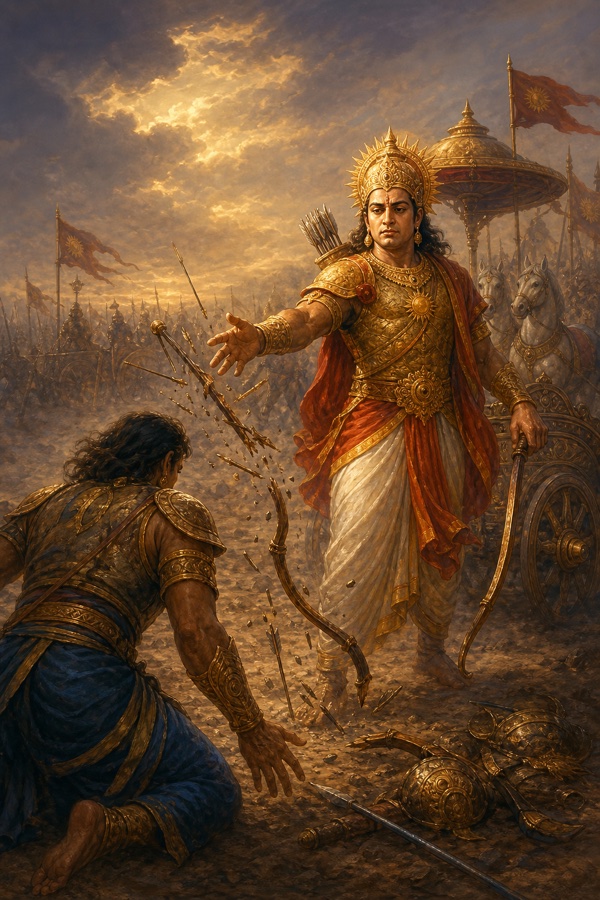
Fine horses wandered about the field with their breastplates gone. Silver, brass, and gold ornaments had been torn away, along with trappings, bridle bits, yak-tail decorations, and saddlecloths. Quivers had fallen from their backs. The brave riders who had given splendor to the battle were dead. Sanjaya saw armored horsemen in headgear pierced and cut by lances, scimitars, and swords. Some had been killed, some were dying, and some trembled with fear, their bodies deprived of limbs. Fast horses dragged gold-decorated chariots in every direction after the warriors riding them had been slain. Axles and poles were broken on some; wheels were broken on others. Some had lost their banners and standards, and some had no arrows left. Chariot warriors deprived of their vehicles wandered through the field in pain from Karna’s shafts. Large numbers of men lay dead, some without weapons, others still holding them. Elephants moved about wearing ornaments like clusters of stars, rows of beautiful bells, and banners of many colors. Heads, arms, chests, and other severed limbs lay where Karna’s arrows had thrown them. The Pandava troops were still fighting with sharpened arrows, but a terrible disaster had overtaken them. Karna’s missiles were tearing them apart. Srinjayas being slaughtered by him rushed blindly at their killer, like insects flying into fire. Other kshatriyas avoided him, seeing in him the blaze that consumes the world at the end of an age. The brave Panchala chariot warriors who survived fled from the field. Karna pursued them from behind, firing as they retreated. He kept following those broken fighters, stripped of armor and standards, scorching them with arrows as the midday sun scorches living creatures.
The gist: Nakula and Karna fight so fiercely that both armies withdraw to watch. Karna finally destroys Nakula’s chariot and every weapon he takes up, then pursues and humiliates him. Remembering his promise to Kunti, Karna lets him live. Nakula takes refuge on Yudhishthira’s chariot. At midday, Karna turns on the Panchalas, destroys their men and animals, and pursues the survivors as they retreat.
Uluka defeats Yuyutsu; Sutasoma fights Shakuni on foot
Yuyutsu was routing the great army of his own half brother Duryodhana. He was Dhritarashtra’s son, but he had chosen the Pandavas’ side. Now Uluka came quickly to stop him. “Wait! Wait!” he called. Yuyutsu sent a keen, feathered arrow into him with the force of Indra’s thunderbolt striking a mountain. Uluka grew furious. A razor-headed shaft cut Yuyutsu’s bow, and a barbed arrow struck Yuyutsu himself. He threw the broken weapon away. His eyes were red with anger as he took a stronger bow, capable of giving his arrows greater force. Sixty shafts struck Uluka. Yuyutsu pierced the driver next and then shot Uluka again. Shakuni’s son answered with twenty arrows decorated with gold. He followed them with a shot that cut down Yuyutsu’s golden standard. The tall, splendid emblem fell directly before the chariot. At that sight Yuyutsu lost all restraint. Five of his arrows entered the middle of Uluka’s chest. Uluka took a broad-headed shaft steeped in oil and sent it at the driver. It severed the man’s head. He killed Yuyutsu’s four horses, then wounded Yuyutsu with five more arrows. The wounded prince went to another chariot. Having defeated him, Uluka turned quickly against the Panchalas and Srinjayas and began killing them with sharp shafts.
Another of Dhritarashtra’s sons, Shrutakarman, confronted Shatanika, the son of Nakula and Draupadi. Within half the time it takes to blink, he deprived Shatanika of his horses, driver, and chariot. Shatanika remained on the horseless vehicle. In his anger he took a mace and hurled it at Shrutakarman. It smashed the Kuru prince’s chariot to fragments, destroying the horses and driver with it, then fell so swiftly that it pierced the earth. Both warriors had lost their vehicles. Both had fought to increase the honor of the Kuru family to which they belonged. Now they withdrew from the encounter, glaring at each other. Fear overcame Shrutakarman, and he climbed onto Vivimshati’s chariot. Shatanika quickly took his place on Prativindhya’s. Elsewhere Shakuni was shooting keen arrows into Sutasoma, the son of Bhima and Draupadi. The blows failed to shake him. He stood firm as a mountain under a torrent of water. Before him was one of his father’s great enemies. Sutasoma covered Shakuni with thousands of arrows. Shakuni knew every method of warfare, and his aim was sure. Eager to fight, he quickly cut down all those shafts with feathered arrows of his own. Having stopped the attack, he sent three arrows into Sutasoma. Then further shots broke apart the young warrior’s horses, standard, and driver. All those watching gave a great shout.
Sutasoma’s horses were gone. His standard was cut down, and his chariot could no longer carry him. He took a good bow in his hands, jumped to the ground, and stood there to continue the fight. Gold-feathered arrows, sharpened on stone, flew from his bow and covered Shakuni’s chariot. Subala’s son saw them coming as thick as a flight of locusts. He remained unshaken. His own arrows crushed the whole shower. The men who watched, and the Siddhas above them in the sky, delighted in what Sutasoma was doing. It seemed extraordinary, almost beyond belief: a warrior on foot was maintaining the contest against Shakuni in his chariot. Shakuni now sent a group of broad-headed shafts. Straight, sharp, and moving with great force, they cut Sutasoma’s bow and every one of his quivers. His chariot was gone, and now his bow and arrows were gone as well. He raised a curved sword with an ivory handle. The blade was blue as a lotus. Sutasoma shouted and began whirling it. Shakuni watched that sword, the color of the clear sky, and saw a threat as deadly as the destroyer’s rod.
Sutasoma moved in circles across the fighting ground. Strength and training carried him through the fourteen kinds of maneuver. He wheeled about and whirled the sword overhead. He thrust to the side, sprang forward, leaped high, ran upward, rushed straight ahead, and surged upward. Shakuni sent arrows at him as he moved. Sutasoma met them with the blade and cut them as they came. Shakuni was angry now. Another volley flew at the young warrior, the shafts as deadly as venomous snakes. Again Sutasoma’s sword met the attack. With great speed and skill he cut those arrows too, displaying strength like Garuda’s. He continued circling before Shakuni. Then a keen razor-headed arrow struck his bright sword and severed it. Half the blade suddenly fell to the earth. The other half remained in Sutasoma’s grasp.
Sutasoma saw that his sword was broken. He retreated six steps. Then he hurled the half still in his hand at Shakuni. The fragment was adorned with gold and gems. It cut through Shakuni’s bow, string and all, before falling to the ground. Sutasoma went to Shrutakirti’s great chariot. Shakuni took another bow, formidable and difficult to resist, and turned toward the Pandava army. He killed many enemies as he advanced. The Pandavas in that part of the field raised a loud uproar at the sight of Subala’s son moving fearlessly through the fighting. Great divisions that had stood proud and bristling with weapons now broke before him. He destroyed the Pandava force as Indra had destroyed the army of the daityas.
A key to reading this (the shared name): Sanjaya identifies the Shrutakarman who fights Shatanika here as Dhritarashtra’s son. He is a different warrior from Draupadi’s son Shrutakarman, encountered earlier on the Pandava side.
The gist: Uluka defeats Yuyutsu and turns against the Panchalas and Srinjayas. Shrutakarman and Shatanika destroy each other’s chariots, then join allies. Sutasoma continues fighting Shakuni on foot after losing his own vehicle. When his sword breaks, he throws the remaining half and cuts Shakuni’s bow. Sutasoma joins Shrutakirti; Shakuni takes another bow and attacks the Pandava ranks.
Dhrishtadyumna retreats from Kripa; Shikhandi falls unconscious
Kripa’s chariot stood directly before Dhrishtadyumna’s. The Panchala commander could not advance a single step. Kripa held him as the eight-legged sharabha of the forest holds a proud lion, a hunter confronting its prey. Fear spread among those who saw the two vehicles facing each other. They believed Dhrishtadyumna was about to die. Kripa, the son of Sharadvat in Gautama’s line, had taught the Kuru princes to use their weapons. His sister Kripi had married Drona. The man before him now was Drona’s killer. Chariot warriors and horsemen lost heart. “Surely he is furious over Drona’s death,” they said. “Sharadvat’s son has such energy and intelligence, and he knows the celestial weapons. Will Dhrishtadyumna escape him today? Will this whole army survive the danger? Will this brahmin kill us all together? Look at the form he has taken. He looks like the destroyer. He will fight as Drona fought. Kripa has always been quick with his hands, always victorious in battle. He knows the weapons, his energy is immense, and now he is filled with anger.” Sanjaya heard such words from warriors in both armies as the two men engaged. Kripa breathed deeply in his rage and sent arrows at Dhrishtadyumna’s vital parts. The Panchala prince stood inactive under them. Struck by Kripa, he was so bewildered that he could not decide what to do.
His driver spoke. “Something is wrong with you. I have never seen such a disaster overtake you in battle. It seems good fortune alone is keeping these shafts from striking the vital parts at which that great brahmin aims. They could pierce your very life. I will turn the chariot back, as a river’s current turns back when it meets the sea. This brahmin has destroyed your power to fight. I believe you cannot kill him.” Dhrishtadyumna answered slowly. “My mind is confused. Sweat covers my limbs. My body trembles, and my hair stands on end. Avoid that brahmin. Drive slowly toward Arjuna. If I can reach Arjuna or Bhima, I may be safe. I am certain of it.” The driver urged the horses forward and took him toward the place where Bhima was fighting Dhritarashtra’s troops. Kripa saw the chariot moving rapidly away. He followed, sending hundreds of arrows after Dhrishtadyumna and repeatedly sounding his conch. He drove the Panchala commander back as Indra had driven back the danava Namuchi.
Elsewhere Kritavarma was holding Shikhandi, the warrior who had helped bring about Bhishma’s death. Bhishma had refused to strike Shikhandi because the Panchala prince had been born a woman before becoming a man. Knowing that refusal, Arjuna had proposed putting Shikhandi at the front and using that opening to bring Bhishma down. The warrior whom Bhishma had declined to attack now faced Kritavarma. Hridika’s son smiled repeatedly as they fought. Shikhandi drove five sharp, broad-headed arrows into his shoulder joint. Kritavarma answered in anger with sixty feathered shafts. Then, laughing, he sent a single arrow through Shikhandi’s bow and cut it. The son of Drupada took up another bow, furious. “Wait! Wait!” he called. Ninety arrows flew from it at great speed, all feathered with gold. Every one struck Kritavarma’s armor and came back off it. The shafts lay scattered on the ground. Shikhandi saw them there and sent a keen razor-headed arrow at his opponent’s bow. It severed the weapon. Without his bow, Kritavarma resembled a bull that had lost its horns. Shikhandi struck the exposed fighter with eighty arrows, driving them into his arms and chest. Kritavarma’s limbs were cut and torn. Blood came from them as water comes from a full jar. His whole body was bathed in it. The Bhoja king had the beauty of a mountain after rain, when streams of dissolved red chalk run down its sides. He took another bow, with its string and arrow already in place, and shot Shikhandi in the shoulder joint. Shafts projected from the wounded shoulder like the branches and twigs of a great tree.
Both men were pierced by arrows. Both were soaked in blood, like two bulls that had gored each other with their horns. They continued their careful efforts to kill one another, taking their chariots through a thousand circles over the fighting ground. Kritavarma struck Shikhandi with seventy more shafts, sharpened on stone and fitted with golden feathers. Then the Bhoja king released a terrible arrow capable of killing him. It came swiftly and struck. Shikhandi began to lose his senses. He caught the pole of his standard and held himself up by it as consciousness failed him. His driver immediately carried him away from the battle. The wound from Kritavarma’s arrow burned him, and he drew breath after breath. With Shikhandi defeated, and with their men being killed on every side, the Pandava troops fled from the field.
The gist: Kripa overwhelms Dhrishtadyumna, whose driver takes him toward Bhima while Kripa pursues. In a separate duel, Shikhandi and Kritavarma wound each other repeatedly. Kritavarma’s final arrow leaves Shikhandi unconscious, and his driver carries him away. Both Panchala warriors survive, but their withdrawal is followed by the flight of the Pandava army.
A lance passes through Krishna’s arm
Arjuna drove behind his white horses, scattering Dhritarashtra’s force as wind scatters a heap of cotton. The Trigartas, Shivis, Kauravas, Shalvas, Samsaptakas, and Narayana troops rushed against him. Those Narayanas had been part of the choice offered to Arjuna before the war: Krishna’s army, or Krishna himself, pledged to carry no weapons. Arjuna had chosen Krishna. Duryodhana had received the soldiers, and now they were coming against the chariot Krishna drove. Satyasena, Chandradeva, Mitradeva, Shatrunjaya, Sushruta’s son, Chitrasena, and Mitravarman came as well. The king of Trigarta brought his brothers and his sons, all great archers trained in different weapons. Their arrows spread before them as they advanced suddenly, like a fierce current rushing toward the sea. They came in hundreds of thousands. Before Arjuna they seemed to melt away, as snakes do at the sight of Garuda. Even while he killed them, they remained around him, as insects remain about a blazing fire. Satyasena pierced him with three arrows. Mitradeva struck him with sixty-three, Chandradeva with seven, and Mitravarman with seventy-three. Sushruta’s son added seven, Shatrunjaya twenty, and Susharma nine. Arjuna answered every king. Seven shafts went into Sushruta’s son, three into Satyasena, twenty into Shatrunjaya, and eight into Chandradeva. He gave Mitradeva a hundred, Shrutasena three, Mitravarman nine, and Susharma eight. Then his stone-sharpened arrows killed Shatrunjaya. He cut the head from Sushruta’s son, severing it with its headgear still in place. Without delay he killed Chandradeva with another group of shafts. Each of the other chariot warriors still pressing him received five arrows to check his advance.
Satyasena was furious. With a roar he hurled a formidable lance at Krishna. Its head was iron, its shaft gold. It pierced Krishna’s left arm, passed through, and entered the earth. The goad and reins fell from Krishna’s hands. Arjuna saw the wound and gathered all his anger. “Take the chariot to Satyasena, Krishna. I will send him to Yama with my sharp arrows.” Krishna quickly picked up the goad and the reins. He guided the horses forward until the chariot stood before Satyasena’s vehicle. With the wounded Krishna driving him, Arjuna first checked the king with keen shafts. Then several sharp, broad-headed arrows cut off Satyasena’s large head, still adorned with earrings, at the head of the army. Arjuna killed Chitravarman next, using a number of keen arrows, then shot his driver with a shaft whose head was shaped like a calf’s tooth. He turned his anger against the Samsaptakas. Hundreds of arrows brought men down in hundreds and thousands. A razor-headed shaft fitted with silver wings severed Mitrasena’s head. Arjuna then struck Susharma in the shoulder joint.
The Samsaptakas closed around him on every side. They poured weapons toward the chariot and filled the directions with their shouts. Afflicted by that attack, Arjuna invoked the Aindra weapon of his father, Indra. Thousands of arrows began issuing from it, one continuous stream. A great din came from the chariots falling beneath the attack. Standards, quivers, and yokes came down with them. Axles and wheels broke, harness straps and cords fell away, and the floors of the chariots and the wooden guards around them struck the earth. Arrows and horses fell among spears, swords, maces, spiked clubs, darts, lances, and axes. Shataghnis equipped with wheels and arrows lay with the wreckage. Severed thighs were scattered among necklaces, the arm ornaments called angadas and keyuras, flower garlands, breastplates, and coats of mail. Umbrellas and fans lay beside heads still wearing their diadems. Those heads had beautiful eyes and earrings; each was as lovely as a full moon, and together they resembled stars spread across the sky. Many fallen warriors still wore excellent robes and fine flower garlands. Sandal paste adorned the bodies now lying on the ground. Terrible as it was, the field resembled a sky crowded with vaporous forms.
The dead blocked the way. Princes and powerful kshatriyas lay among fallen elephants and horses until the earth was as impassable as if hills had been scattered across it. Arjuna went on killing enemies and bringing down elephants and horses with broad-headed arrows. His own chariot could find no path through them. In that mire of blood, as he moved through the battle, its wheels seemed to stop in fear of the warrior they carried. The horses strained against them. Though their speed rivaled thought or wind, it took great effort and labor to drag those unwilling wheels onward. The army under Arjuna’s arrows fled almost entirely. No body of men remained behind to keep fighting him. Having vanquished such great numbers of Samsaptakas, he shone like a blazing fire without smoke.
The gist: Kings and samsaptakas attack Arjuna together. Satyasena’s lance passes through Krishna’s left arm, making him drop the goad and reins. Krishna recovers them and drives forward; Arjuna kills Satyasena and several other leaders. Surrounded again, Arjuna invokes the Aindra weapon. The slaughter leaves his chariot struggling through ground blocked by the dead, and the surviving enemy force flees.
Thirteen arrows leave Duryodhana stranded
Duryodhana himself met Yudhishthira’s advancing arrows. The 2 kings faced one another without fear. Yudhishthira struck the Kuru ruler as he charged toward him and called, “Wait! Wait!” Duryodhana answered with 9 sharp shafts and angrily wounded Yudhishthira’s driver with a broad-headed arrow. Yudhishthira then released 13 arrows, their heads sharpened on stone, their shafts winged with gold. Four killed Duryodhana’s 4 horses. The fifth severed the charioteer’s head. The sixth brought down the royal standard, the seventh cut the bow, and the eighth cut the curved sword. The last 5 wounded Duryodhana deeply. The king stepped down from the horseless vehicle and stood on the ground, exposed to immediate danger. Karna, Ashvatthama, Kripa, and others saw his peril and rushed to rescue him. Yudhishthira’s brothers gathered around him and entered the encounter as well. The fighting intensified. Thousands of trumpets sounded, and countless voices rose together in a confused roar.
Where the Panchalas met the Kauravas, the combatants initially faced their own kind: men against men, elephants against the foremost elephants, chariot fighters against chariot fighters, horses against horses. The paired contests of powerful men and animals made a beautiful spectacle. Warriors used their different weapons with speed and skill, each striving to kill the opponent before him. They observed the accepted practices of battle. No one fought from behind another man. That order lasted only a short time. Soon the fighting resembled the struggle of people who had lost their reason, with no regard left between opponents. A chariot warrior approached an elephant and pierced it with sharp, straight arrows until it died. Elephants pulled down horses and tore into them repeatedly with their tusks. Groups of horsemen surrounded fine horses, made loud sounds with their palms, and closed in. They attacked from behind and from the flanks, killing horses running across the field and huge elephants wandering through it. Enraged elephants routed groups of horses, killed them with tusks, or crushed them with their weight and strength. Some impaled horses together with their riders. Others seized them and hurled them violently to the ground.
Foot soldiers waited for openings and struck elephants when the opportunity came. Wounded animals screamed in pain and fled in every direction. Other infantrymen threw down their ornaments as they ran, only to be quickly surrounded. The elephant riders recognized signs of victory and wheeled their huge mounts. They made the beasts seize the beautiful abandoned ornaments and pierce them with their tusks. While they were occupied there, other swift and powerful foot soldiers surrounded the riders and began killing them. Some men were thrown into the air by elephants’ trunks; as they fell, the trained animals caught them on the points of their tusks. Others were suddenly seized and gored to death. Elephants carried men away from their own divisions into other formations, then mangled them by rolling them over and over on the ground. Some victims were whirled above the animals like fans and killed. Men caught directly in front of other elephants were pierced and torn apart. Spears, lances, and darts wounded the animals too, driving into their cheeks, the rounded parts of their foreheads, and the spaces between their tusks. Fierce chariot fighters and horsemen attacked from the sides, ripping open elephants until they fell. Mounted warriors drove lances into infantrymen, pinning them to the ground or crushing them by force. Elephants reached into chariots, lifted out armored warriors, and flung them violently to the earth. Some huge animals were killed by arrows a yard long. They collapsed like mountain peaks split by thunderbolts.
Men fought with their fists. They caught opponents by the hair, dragged them, threw them down, and mangled them. Some stretched out their arms, wrestled a man to the ground, planted a foot on his chest, and swiftly cut off his head. One fighter kicked an enemy already dead. Another cut the head from a man as he fell. Another drove a weapon into a living body. Fists, grasping hands, and bare arms carried on the struggle at close quarters. Warriors often killed men who were engaged with someone else and never saw the new attacker coming. As the general slaughter continued, hundreds and thousands of headless trunks rose on the field. Blood-drenched weapons and armor shone like cloth dyed a brilliant red. The crash of weapons and the uproar of the battle seemed to fill the whole universe, like the wild, roaring current of the Ganga.
Pierced by arrows and overwhelmed by the fury of the heroes attacking them, soldiers on both sides lost their reason. They could no longer tell friend from enemy. The kings kept fighting in pursuit of victory, convinced that the battle was theirs to fight. Men killed whoever they encountered, ally and opponent alike. Broken chariots, fallen elephants, dead horses, and human bodies crowded the earth. Blood and flesh made a mire beneath them, and streams of blood ran through ground that had become impossible to cross. Karna was killing the Panchalas. Arjuna was killing the Trigartas. Bhima was destroying the Kurus and their elephant divisions. The sun had passed its highest point. In that afternoon hour, Sanjaya told Dhritarashtra, both armies were being destroyed in their desire to win great fame.
The gist: Yudhishthira uses 13 arrows to kill Duryodhana’s horses and driver, destroy his standard and weapons, and wound him. Warriors from both sides rush into the encounter. The fighting briefly follows accepted rules, then becomes indiscriminate. Men attack from behind, lose the ability to recognize their own side, and kill allies along with enemies. By afternoon, the field is nearly impassable with the dead.
Bhima stops Yudhishthira from killing Duryodhana
“You have told me of unbearable grief, Sanjaya,” Dhritarashtra said. “You have told me of my sons’ losses again and again. From what you have said, and from the way this battle has been fought, I am certain the Kauravas are no more. Duryodhana was left without his chariot. How did Yudhishthira fight after that? How did Duryodhana answer him? Tell me the whole of the afternoon’s battle. You know how to tell these events.” Sanjaya returned to the armies fighting in their separate divisions. Duryodhana had mounted another chariot. Angry as a poisonous snake, he saw Yudhishthira and called urgently to his driver. “Go! Go quickly! Take me to Pandu’s royal son, there in his armor, shining beneath that umbrella.” The driver urged the fine chariot straight toward Yudhishthira. The eldest Pandava saw him and gave his own order, filled with anger, looking like an enraged elephant. “Go where Suyodhana is.” The two cousins approached. Both were powerful archers, full of energy and wrath, difficult to overcome. When they met, each began tearing the other’s body with arrows.
Duryodhana sent a broad-headed shaft, sharpened on stone, through Yudhishthira’s bow. The weapon split in two. Yudhishthira could not endure the insult. His eyes reddened with anger as he threw the broken bow aside and took another at the head of his troops. He cut Duryodhana’s standard and bow. Duryodhana took up a fresh weapon and pierced him in return. Arrows poured between them. They wanted to defeat each other as fiercely as two angry lions; they struck each other with the force of roaring bulls. Each maneuvered his chariot, watching for a lapse in the other’s defense. Each drew his bow to its fullest stretch. Wounded by the shafts, the two kings shone like kimshuka trees covered in red flowers. They roared again and again. The sound of their palms, the twang of their bows, and the force of their conches filled the encounter. Each caused the other great pain. Then Yudhishthira angrily shot three irresistible arrows into Duryodhana’s chest. They struck with the force of thunder. Duryodhana’s answer came quickly: five keen arrows, feathered with gold and sharpened on stone.
Duryodhana hurled a dart so sharp and powerful that it could kill anyone it struck. It came toward Yudhishthira like a great piece of burning wood. Yudhishthira met it with sharp arrows and cut it into three pieces before it could reach him. He followed with five arrows into Duryodhana. The defeated dart fell with its golden shaft, whistling loudly, still shining like wood wrapped in flame. Duryodhana saw his weapon fall and struck Yudhishthira with nine sharply pointed arrows. The wounds went deep. Yudhishthira quickly chose an arrow of his own, placed it on the string, and sent it at his opponent in anger. It struck Duryodhana and dazed him, then passed through his body and entered the earth. Duryodhana raised a powerful mace. Furious, he rushed toward Yudhishthira to end the hostility between the Kurus and Pandavas. With the mace lifted, he looked like Yama himself carrying the bludgeon of death. Yudhishthira saw him coming and hurled a great dart. Radiant, swift, and like another huge piece of blazing wood, it struck Duryodhana deep in the chest while he stood upon his chariot. Pain overwhelmed the Kuru prince. He fell and lost consciousness.
Bhima remembered his vow. In the gambling hall, after Duryodhana had exposed his thigh to Draupadi, Bhima had sworn before the assembled kings to break that thigh in battle. Now Yudhishthira had brought Duryodhana down. Bhima spoke to his elder brother. “You must not kill this man, king.” Yudhishthira held back the finishing blow. Kritavarma came quickly to Duryodhana, who lay in the gravest danger. Bhima took up his own mace, its surface adorned with gold and flaxen cords, and rushed at Kritavarma. Such was the battle that afternoon, Sanjaya told Dhritarashtra. On both sides, every man fought for victory.
The gist: Duryodhana returns on a fresh chariot and fights Yudhishthira again. They destroy bows, exchange arrows, and throw darts. Yudhishthira’s dart strikes Duryodhana in the chest and leaves him unconscious. Bhima, remembering his vow, stops his brother from killing him. Kritavarma comes to Duryodhana’s aid, and Bhima advances against him with a mace.
The armies withdraw at sunset
The Kuru warriors returned to the fight with Karna at their head. Their renewed struggle resembled the old battle between gods and asuras. Elephants, men, chariots, horses, and conches filled the field with noise. That uproar drove the fighters forward in anger: men on elephants, men in chariots, men on horseback, and men on foot. They struck their opponents with weapons of every kind. Sharp battle-axes and swords, axes and many forms of arrow, killed men and animals and destroyed the vehicles carrying them. The fighting beasts themselves became weapons in their riders’ hands. Severed human heads lay across the ground. Their teeth were white; their faces, eyes, and noses were beautiful; fine diadems and earrings still adorned them. Each head had the beauty of a lotus, the sun, or the moon, and the earth shone with them. Hundreds of spiked clubs, short bludgeons, darts, lances, hooks, bhusundis, and maces killed elephants, men, and horses by the thousand. Their blood made currents like rivers over the field. Chariot warriors, infantrymen, horses, and elephants lay with ghostly faces and gaping wounds. The scene resembled the domain of Yama, lord of the dead, at the dissolution of the universe. Dhritarashtra’s sons now moved against Satyaki. Those Kuru princes seemed children of the gods, and warriors of immense strength led their advance. Around them came the rest of the force, crowded with fine men, horses, chariots, and elephants. It roared like the sea and had the fierce splendor of an army of gods or asuras.
Karna, the son of Surya, struck Satyaki with arrows bright as the sun’s rays. His prowess resembled Indra’s, his appearance that of Vishnu, Indra’s younger brother. Satyaki answered at once. His arrows came in many forms, each deadly as snake venom, and covered Karna, his chariot, his horses, and his driver. The foremost Kuru fighters saw how deeply their commander was being wounded. Many Atirathas rushed to support him with elephants, chariots, and infantry. Their force was as vast as the ocean. The Pandava warriors, with Drupada’s sons at their head, attacked it with such speed that it fled from the field. Men, chariots, horses, and elephants were destroyed in great numbers. Then Krishna and Arjuna came against Dhritarashtra’s troops. They had completed their daily prayer and duly worshiped Bhava, Shiva, and now they were resolved to kill their enemies. The Kurus watched the approaching chariot with sinking hearts. Its white horses drew it on, its banners moved beautifully in the air, and its wheels sounded like thunderclouds. Arjuna bent Gandiva. As he shot, he seemed to dance upon the chariot. The sky and every direction filled with arrows, with no gap left between the showers. Fine chariots, adorned like celestial vehicles and equipped with weapons and standards, broke under his shafts. Their drivers died with them, as a storm destroys masses of cloud. His arrows sent elephants and their guiding riders to Yama, along with the victory banners and weapons they carried. Horsemen fell with their horses. Foot soldiers went down as well.
Duryodhana came against him alone. Arjuna was angry, irresistible, as terrible as Yama himself, and Duryodhana struck him with straight arrows. Arjuna answered with seven shafts. They cut Duryodhana’s bow, brought down his standard, and killed his horses and driver. One more arrow cut away his umbrella. An opening had appeared. Arjuna sent a fine shaft toward Duryodhana, a shaft capable of taking his life. Ashvatthama intercepted it. His arrows cut the deadly missile into seven fragments before it reached the king. Arjuna cut Ashvatthama’s bow in reply and killed all four of his horses. He cut Kripa’s formidable bow next. Then he cut the bow of Kritavarma, Hridika’s son, and brought down his standard and horses. Duhshasana lost his bow to Arjuna’s next attack. Arjuna then advanced against Karna. Karna immediately left Satyaki and turned upon him, driving three arrows into Arjuna and twenty into Krishna. He struck Arjuna again and again. As many arrows as he shot, as many enemies as he killed, he showed no fatigue. His fury resembled Indra’s. Satyaki came up and shot ninety-nine fierce arrows into Karna, then another hundred. The other leading Pandava warriors joined him. Yudhamanyu, Shikhandi, Draupadi’s sons, the Prabhadrakas, Uttamauja, Yuyutsu, Nakula, Sahadeva, and Dhrishtadyumna surrounded Karna. With them came the Chedi, Karusha, Matsya, and Kekaya divisions, the mighty Chekitana, and Yudhishthira, faithful to his vows. Chariots, horses, elephants, and fiercely courageous infantry accompanied them. They sent weapons against Karna from every direction, speaking harshly to him, determined to kill him.
Karna met the whole shower with his sharp arrows and cut it apart. The power of his weapons scattered the men attacking him as wind breaks the trees in its path. In his anger he destroyed chariot warriors, elephants with the men who rode them, horses with their riders, and large bands of infantry. His weapons took such a toll that almost the entire attacking Pandava force drew back. Men had lost their weapons; their limbs were cut and torn. Arjuna smiled as he opposed Karna’s weapons with his own. Then his arrows covered the sky, the earth, and every direction in another dense shower. The shafts fell like heavy clubs and spiked bludgeons. Some struck with the force of shataghnis; others were like fierce thunderbolts. The Kuru infantry, cavalry, chariot fighters, and elephant riders were struck down beneath them. Men shut their eyes and cried out in anguish. They wandered without sense of where they were going. Many horses, men, and elephants died. Many more, pierced by arrows and in great pain from their wounds, fled in fear.
The warriors were still fighting for victory when the sun approached the Mountain of Sunset and entered it. Darkness spread over the field. The dust obscured it even more. Sanjaya and those around him could no longer make out what was favorable or unfavorable in the battle before them. The great Kuru archers feared being caught in a fight at night. They withdrew with all their combatants. Once the Kurus had retired, the Pandavas returned to their own camp. They were pleased with the victory they had gained. Their instruments sounded in many different ways as they mocked the retreating enemy and praised Krishna and Arjuna. When the withdrawal was complete, all the troops and kings spoke blessings over the Pandavas. The brothers were glad. They went to their tents and rested for the night. Behind them, rakshasas, pishachas, and flesh-eating beasts arrived at the battlefield in great numbers. The terrible field resembled the playground of Rudra, Shiva in his fierce form.
The gist: The battle renews around Satyaki, Karna, and Arjuna. Ashvatthama saves Duryodhana by intercepting Arjuna’s lethal arrow. Karna drives back the Pandava attackers, then Arjuna devastates the Kuru ranks. At sunset, darkness and dust obscure the field. The Kurus withdraw, and the Pandavas return to camp celebrating their success. Creatures that feed on the dead gather on the abandoned battlefield.
Source: the Mahabharata of Krishna-Dwaipayana Vyasa, Karna Parva. This chapter follows K. M. Ganguli, the invocation and sections I-LIV, through verse 29 of LIV, ending at Suketu’s death; the Gita Press Hindi edition numbers these chapters differently. Names, order, and events were checked against Ganguli’s complete translation. Dialogue and commentary are adapted, not a verbatim translation. About the sources.
Based on: The Mahabharata, Vyasa (Gita Press, Gorakhpur)