On this page
Karna’s resolve beneath the omens
Shouts rose from every side of the Kaurava army as Karna took his position for battle. Cymbals clashed and drums sounded. Arrows whistled through the air, and the warriors roared as they advanced, ready to keep fighting until death stopped them. While the soldiers celebrated, the earth shook with a great noise. The seven great celestial bodies, including the sun, seemed to move against one another for battle. Meteors fell and the sky appeared to burn in every direction. Thunderbolts struck from a cloudless sky; fierce winds blew. Large numbers of animals and birds passed with the army on their right, foretelling disaster. After Karna set out, his horses fell to the ground. Bones rained horribly from the sky. The Kauravas’ weapons seemed to be on fire, their standards trembled, and their animals shed streams of tears. These and many other dreadful signs foretold the Kurus’ destruction. Sanjaya said that destiny had clouded their understanding. No one paid attention. Their kings cried out for Karna’s victory, and the Kauravas regarded the Pandavas as already defeated. On his chariot, Karna remembered the deaths of Bhishma and Drona. He shone like fire or the sun. He thought of Arjuna’s great achievements, his own pride burning within him. Angry, taking long and heavy breaths, he spoke to Shalya.
“Standing here with my bow, I would have no fear of Indra himself, furious and armed with his thunderbolt. Do not let the sight of Bhishma and the other great heroes lying on the battlefield trouble you. Bhishma and Drona were faultless men, equal to Indra and Vishnu. They crushed the finest chariots, horses, and elephants. They seemed impossible to kill. Even after the enemy has killed them, I feel no fear in this battle. Drona knew the great weapons and was foremost among brahmins. Why did our teacher fail to kill all our enemies as they destroyed our strongest kings with their drivers, elephants, and chariots?” Karna remembered their teacher in battle and called on the Kurus to listen. “I am telling you the truth. Among all of you, I alone can withstand Arjuna when he advances like Death in his fiercest form. Think of everything Drona possessed: the skill that comes from long practice, strength, courage, the highest weapons, and the wisdom to use them. Even he had to submit to death. When I look at the rest of our army, I see men whose strength has failed and whose lives are almost over. I have thought about it and can find nothing in this world that stands secure. Actions bind us to consequences we cannot escape. With our teacher dead, who can confidently say that he will live even until today’s sunrise? The enemy killed Drona in battle. Ordinary weapons and divine weapons, strength, courage, achievement, and wise policy could never guarantee his happiness. He had the energy of fire or the sun. His valor matched Vishnu’s and Indra’s; his judgment matched Brihaspati’s and Ushanas’s. He seemed impossible to resist, and still his weapons could not protect him.”
“Our women and children are weeping and wailing,” Karna continued. “The strength of Dhritarashtra’s sons has failed. I know that I am the one who must fight. Drive toward the enemy army. Who else can face troops that have Yudhishthira, steadfast in truth, and Bhima, Arjuna, Satyaki, and the twins among them? Take me quickly against the Panchalas, the Pandavas, and the Srinjayas. I will kill them, or I will follow Drona’s path into Yama’s presence. Do not think I will hesitate to enter the midst of those heroes. I cannot endure these conflicts within our own family. I will follow Drona. When their allotted time is over, the wise and the ignorant are alike before the destroyer. No one escapes. I will advance against the Pandavas; I cannot step beyond my destiny.” “Duryodhana, Vichitravirya’s grandson, has always worked for my good. To fulfill his purpose, I will give up the breath so precious to me and this body that is so hard to surrender. Look at the chariot Rama gave me, covered with tiger skins. Its axle makes no sound; its seat is gold, its trivenu silver. These are the finest horses yoked before us. Look, Shalya, at these beautiful bows, these standards and maces, these arrows with their fearsome shapes. Look at the shining sword, the powerful weapon, and the white conch with its fierce, piercing call. From this chariot, with its banners and excellent quivers, I will exert all my strength and kill Arjuna. Its wheels will rumble like thunder as the white horses carry me against him. Even if Death himself, who consumes us all, stands guard over Pandu’s son, I will meet him in battle. I will kill Arjuna, or follow Bhishma into Yama’s realm. Let Yama, Varuna, Kubera, and Indra come here with all their followers and unite to protect him. I will defeat Arjuna and all of them together.”
Shalya laughed aloud. Hearing Karna’s boasts and his eagerness for battle, the Madra king mocked him in an effort to check him. “Enough, Karna. Enough boasting. You are so excited that you say things you should never say. Arjuna stands foremost among men. Where do you stand, lowest of men? Who else could have carried away Krishna’s younger sister, throwing the Yadavas’ own home into turmoil by force? Krishna, Indra’s younger brother, guarded that home as Indra guards heaven. Who else could have challenged Shiva himself when a quarrel arose over the killing of an animal? Arjuna alone had the courage of the king of the gods to call the creator of the worlds into battle. To honor Agni, he defeated asuras, gods, great serpents, humans, birds, pishachas, yakshas, and rakshasas with his arrows and gave the fire god the food he desired. Do you remember when Arjuna’s splendid arrows, bright as sunlight, killed great numbers of enemies and freed Dhritarashtra’s son? Do you remember being the first to flee, before the Pandavas defeated the sky-ranging gandharvas under Chitraratha and released Dhritarashtra’s quarrelsome sons?” Shalya went on through the Kauravas’ earlier reverses. “And when we seized Virata’s cattle? We had a great force of men and animals, with Drona, his son Ashvatthama, and Bhishma among us. Arjuna defeated them all. Why did you fail to overcome him then, Karna? Another great battle has presented itself for your destruction. If fear of your enemy fails to make you run away, know that you will be killed as soon as you enter the fight.”
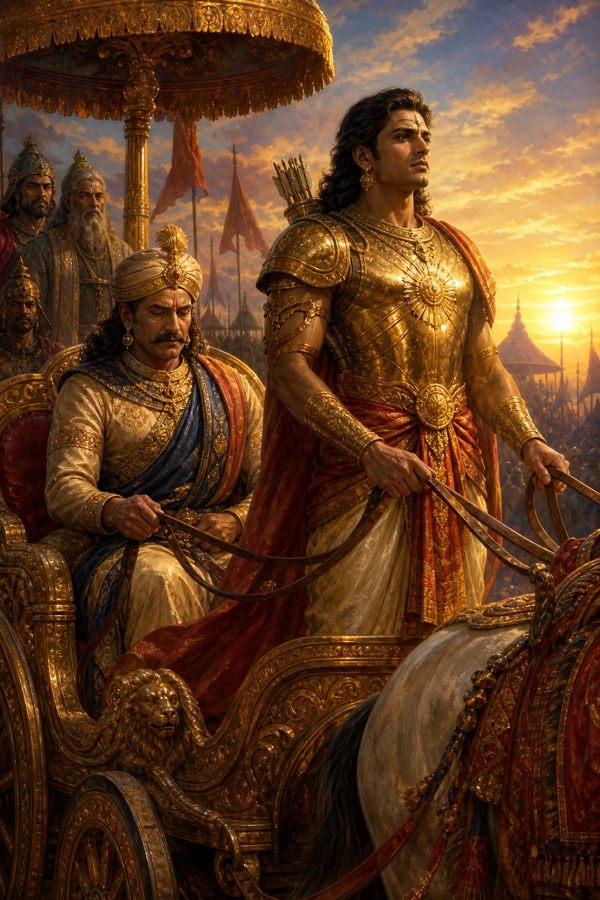
Shalya delivered these harsh words with relish, praising the enemy whom Karna was preparing to face. The commander of the Kaurava army grew furious. “Let it be so. Let it be so,” he answered. “Why do you keep praising Arjuna? He and I are about to fight. If he defeats me, your praise will have been justified.” Shalya agreed and offered no further answer. Eager for battle, Karna ordered him to proceed. With the Madra king holding the reins of his white horses, he advanced against the enemy. He killed many men along the way, sweeping through them as sunlight clears away darkness. His heart was cheerful as the chariot covered with tiger skins carried him forward. When the Pandava army came into view, he immediately began asking where Arjuna was.
The gist: The Kauravas cheer Karna and ignore the omens of disaster. Remembering Bhishma and Drona, he acknowledges the reach of death and pledges his life to Duryodhana’s cause. Shalya answers with Arjuna’s past victories and Karna’s reverses. Karna insists that their coming battle will settle the matter, then advances in search of Arjuna.
A reward for finding Arjuna
Karna set out, filling the Kaurava army with delight. To every Pandava soldier he encountered, he made the same demand: show him Arjuna, the warrior with the white horses. “Point him out to me today, and I will give you whatever wealth you desire. If you receive it and are still unsatisfied, I will add a cartload of jewels and gems. If the man who shows me Arjuna wants more, I will give him a hundred cows and a hundred brass vessels for their milk. I will give him a hundred excellent villages. Show me Arjuna, and I will give you women with long hair and dark eyes, and a chariot drawn by white mules. If that fails to satisfy you, I will give another chariot, a splendid one made of gold, drawn by six bulls as large as elephants. I will add a hundred fair-skinned women who know how to sing and dance, adorned with jewelry and golden necklaces. If the man who finds Arjuna still wants more, he shall have a hundred elephants, a hundred villages, a hundred chariots, and ten thousand horses of the finest breed. They will be well fed, obedient, trained to draw chariots, and possessed of every excellent quality. I will also give him four hundred cows, each with golden horns and her own calf. If that is not enough, I will make a more valuable gift: five hundred horses in golden trappings and jeweled ornaments. I will add eighteen more horses, all exceptionally obedient. I will give the man who shows me Arjuna a shining gold chariot, adorned with many ornaments and drawn by the finest horses of Kamboja. If he still wants more, I will give him six hundred elephants, bred on the western shores of the ocean and schooled by elephant trainers. Gold chains will hang at their necks, and gold coverings will lie upon their bodies. If the man is still unsatisfied, I will give fourteen vaishya villages, full of people and wealth, close to forests and rivers, free of danger and well supplied with everything they need, villages fit for kings to enjoy. I will add a hundred very young enslaved women from Magadha, each wearing a golden necklace. If even these gifts fail to satisfy him, let him ask for something greater. Whatever he requests, I will give. If he wants my sons, my wives, or anything I possess for my pleasure and enjoyment, he shall have them. Show me Krishna and Arjuna. When I have killed those two, I will give you all the wealth they leave behind.”
After these announcements, Karna blew his fine conch, born in the sea, with its sweet call. Duryodhana and his followers rejoiced at words so characteristic of Radha’s son. Cymbals and drums sounded through the Kaurava troops. The warriors roared, elephants grunted, and many other instruments joined the noise. The soldiers shouted in their joy. Karna was about to plunge into the ocean of battle when Shalya laughed at him in scorn. “Keep the golden chariot and those six bulls as large as elephants. You will see Arjuna today. You are giving wealth away as though you were Kubera, lord of all treasure. Finding Arjuna will cost you no trouble. You are making these gifts like a man who has lost his senses, blind to the fault of giving to people who do not deserve them. With all that wealth, you could perform many sacrifices. Perform them. The desire that has made you so foolish will come to nothing. Who has ever heard of a fox overthrowing two lions? You are seeking something you should never seek. You seem to have no friend to stop you as you hurry into a blazing fire. You cannot tell what you ought to do from what you ought to avoid. Your allotted time must be over. Who wants to remain alive and speaks such incoherent words, words unfit even to be heard? You might as well tie a heavy stone about your neck and try to swim across the ocean using only your arms. You might as well leap from a mountain peak. If you want what is good for you, fight Arjuna with your division formed around you and all your warriors helping you. I say this for Duryodhana’s good. I bear you no ill will. If you wish to preserve your life, accept what I am telling you.”
“I trust the strength of my own arms,” Karna answered. “That is why I seek Arjuna in battle. You are an enemy with a friend’s face, trying to frighten me. No one will turn me from my decision. Even Indra with his thunderbolt raised could not stop me. What could a mortal do?” Shalya meant to provoke him still further. “When the keen arrows come at you, feathered with kanka plumes and driven from Arjuna’s bowstring with the full strength of his arms, you will regret this encounter. When Savyasachi takes up his celestial bow, scorches the Kuru army, and torments you with his sharp shafts, then you will repent. A child lies on its mother’s lap and reaches for the moon. You reach for victory over the radiant Arjuna on his chariot with the same understanding. You want to fight him today, as though you wished to rub every limb against the sharp edges of a trident. Your challenge is the challenge of a foolish young deer, restless and small, calling an enormous, angry lion to fight. You are a fox in the forest, full of meat, challenging its maned king. Stop calling out that powerful prince. Stop before your encounter with Arjuna destroys you.”
“You challenge Kunti’s son as a hare challenges an elephant. Look at that elephant’s tusks, as large as plow shafts, and the fluid coming from its mouth and split temples. That is the creature the hare would fight. In seeking Arjuna, you are pushing a stick into the hole of a furious black cobra, a snake filled with deadly venom. You have so little understanding that you disregard this lion among men and yell at him, as a jackal yells at an angry, maned lion. You are a snake challenging Vinata’s son Garuda, the greatest of birds, swift and beautiful in his plumage. That challenge brings the snake its destruction. You want to cross the ocean without a raft, when the moon has risen and the waters are at their height. Its waves stand like mountains, and living creatures crowd its depths. You challenge Arjuna as a calf challenges a fighting bull, sharp-horned, with a neck as thick as a drum. A frog croaks at a mighty cloud pouring down rain. That is how you croak at Arjuna, who is Parjanya, the bringer of rain, among men. From the safety of its master’s yard, a dog barks at a tiger roaming the forest. That is how you bark at Dhananjaya.”
Shalya kept speaking. “A jackal that lives among hares thinks it is a lion until it sees one. You think yourself a lion because Arjuna is still out of sight. You will keep thinking so until you see the two Krishnas together on a single chariot, Arjuna and his driver shining like the sun and moon. As long as you cannot hear Gandiva in the battle, you can do whatever pleases you. Then Arjuna will come. His chariot and bow will fill all ten directions with their sound, and he will roar like a tiger. At that sight you will become a jackal. You are always a jackal, Karna, and Dhananjaya is always a lion. Your envy and hatred of heroes make you seem a jackal, fool. Everyone knows the strength of the two of you from your deeds. It is the strength of a mouse beside a cat, of a dog beside a tiger, of a fox beside a lion, of a hare beside an elephant. The distance between you is the distance between falsehood and truth, between poison and nectar.”
The gist: Karna offers increasingly extravagant rewards to anyone who can show him Arjuna, finally offering even his family and all his possessions. Shalya urges him to fight with the protection of his army. Karna calls him a disguised enemy. Shalya responds with a succession of taunts, portraying Karna as hopelessly overmatched.
Karna turns his anger on Shalya
Shalya’s words pierced Karna like darts, making him feel how well the Madra king bore his name. Furious, Karna answered that only people with merit could recognize merit in others. Shalya possessed none and therefore had no standing to judge anyone’s worth. Karna knew Arjuna’s great weapons, anger, energy, bow, arrows, and courage. He also knew Krishna’s greatness better than Shalya did. His challenge came from knowing both his own strength and Arjuna’s. He rejected Shalya’s image of an insect rushing into fire. “I have a sharp, blood-drinking arrow lying alone in its own quiver,” he said. “It is feathered, beautifully finished, and thoroughly soaked in oil. It rests in sandalwood dust. I have worshipped it for years. It has the form and nature of a snake, fierce and poisonous, capable of killing great numbers of men, horses, and elephants. Its terrible point can pierce armor and bone. In my anger I could drive it through the great heights of Meru. I will release it only against Arjuna or Devaki’s son Krishna. That is the truth. Fighting Vasudeva and Arjuna with this arrow will be a deed worthy of me.” Among all the Vrishni heroes, he said, prosperity remained with Krishna; among Pandu’s sons, victory remained with Arjuna. The two would advance together on one chariot against Karna alone. That day Shalya would see the nobility of his lineage. He meant to pierce both cousins with a single shaft: Arjuna, son of Krishna’s aunt Kunti, and Krishna, son of Arjuna’s maternal uncle Vasudeva. They would lie like 2 pearls threaded on one string. Arjuna’s Gandiva and ape standard, Krishna’s discus and Garuda standard, frightened the timid. Karna delighted in them.
He called Shalya a fool with an evil disposition, ignorant of great battles. Terror had made him babble, or perhaps he had some hidden reason for praising the two Krishnas. Karna threatened to kill them first, then kill Shalya and all his relatives. He called his driver wicked, mean, the lowest of kshatriyas, a man born in a sinful country. Why was a supposed friend trying to frighten him like an enemy? Either the two Krishnas would kill Karna that day or he would kill them. Knowing his own power, he feared neither. He could kill a thousand Vasudevas and hundreds of Arjunas single-handedly. He ordered Shalya to be silent and hear what people said about the wicked Madrakas. Young men, old men, women, and aimless travelers repeated these sayings as if they had learned them by heart, Karna claimed; brahmins had recited them in royal courts. Shalya could listen carefully and then forgive him or answer. Karna launched into accusations against the people of Madra. They hated their friends, he said; anyone who hated him was a Madraka. Their low speech held no friendship. They were wicked, deceitful, crooked, and the lowest of humanity, remaining evil until death. He alleged that fathers, sons, mothers, mothers-in-law, brothers, grandsons, other relatives, companions, strangers visiting their homes, and enslaved men and women all mingled freely. Madra women, he said, chose men they knew and men they did not know as they pleased. He accused them of living without righteousness, eating fried and ground grain and fish, drinking liquor and eating beef, then laughing and crying in their homes. They sang incoherent songs, spoke without restraint, and joined one another in lust. How could virtue exist among people so arrogant and notorious for evil? He advised everyone to avoid both friendship and hostility with a Madraka. There was no friendship in their country, he insisted, and he called its people the filth of humanity.
Karna continued the attack. Acts of friendship among Madrakas disappeared, he claimed, as purity disappeared among the Gandharas, or as offerings were wasted in a sacrifice whose king served as both patron and priest. He said that wise men treated a person suffering from a scorpion’s poison with these words: “As a brahmin falls by officiating at a shudra’s religious rites, and as a person falls by hating brahmins, a person falls by allying with Madrakas. Scorpion, your poison is as empty as friendship in a Madraka.” Karna said he had himself properly performed the exorcism with these Atharvan mantras. Shalya should remain silent or listen to more. He accused Madra women of stripping and dancing when drunk, taking partners without attachment to any one person, and observing no restrictions. How could Shalya, born to such a woman, claim to instruct others in duty? Karna likened the women’s way of life and bodily habits to those of camels and donkeys. He asked again how the child of someone so sinful and shameless could explain human obligations. He offered another insulting story: asked for a little vinegar, a Madra woman would scratch her hips and refuse, saying she would give away her son or husband before parting with the vinegar she loved. Karna claimed that the young women of Madra were shameless, hairy, gluttonous, and unclean. He and others could make many such accusations about everything they did, from head to foot. The Madrakas and Sindhu-Sauviras, he said, were born in sinful countries, followed mleccha practices, and disregarded all duties. How could they know what duty was?
Karna turned back to the duty he claimed for himself. The highest calling of a kshatriya, he had heard, was to lie dead on the battlefield with the praise of righteous people upon him. His foremost wish was to give his life in this clash of weapons and reach heaven through death. He was the beloved friend of Dhritarashtra’s intelligent son; his breath and all his wealth belonged to Duryodhana’s cause. Shalya’s behavior, hostile at every turn, convinced Karna that the Pandavas had won him over. Yet hundreds of men like Shalya could never turn him from battle, just as unbelievers could never divert a righteous man from his path. Shalya could weep or suffer thirst like a deer covered in sweat. Karna would hold to the duties of a warrior and remain beyond his power to frighten. He remembered what his teacher Rama had told him about the fate of heroic men who died in battle without turning back. He was ready to save the Kauravas and kill their enemies, determined to follow the noble conduct of Pururavas. Across the three worlds he saw no one capable of dissuading him. Shalya should stop speaking; why did fear make him rave this way? For the moment, Karna would spare Shalya the death that would leave his body to flesh-eating creatures. Three considerations kept Shalya alive: regard for a friend, Duryodhana’s interests, and Karna’s wish to avoid blame. If Shalya spoke such words again, he would crush his head with his mace, hard as a thunderbolt.
“Today people will see or hear that the two Krishnas have killed Karna, or that Karna has killed the two Krishnas,” he declared. Still fearless, Radha’s son addressed the Madra king again. “Proceed. Proceed.”
The gist: Karna boasts that a serpent-shaped arrow he has long preserved will kill Krishna and Arjuna together. He attacks Shalya with hostile claims about Madra’s people and women, then reaffirms his willingness to die for Duryodhana. He threatens his own charioteer if the criticism continues and orders him onward.
The crow and the swan
Shalya answered that his ancestors had performed great sacrifices, faced battle without retreating, and received the sacred bathing that consecrated kings. He too practiced virtue. Karna seemed drunk, he said, and friendship compelled him to try to correct that intoxicated judgment. He would tell him a story about a crow. After hearing it, Karna could do whatever he chose. Shalya could remember no fault of his own that justified Karna’s wish to kill him. As his charioteer, concerned for Duryodhana’s welfare, he was bound to speak about what would help or harm the warrior in his charge. A driver needed to know the level ground from the rough, his warrior’s strengths and weaknesses, and when either man or horses were tiring or close to collapse. He needed to know the available weapons, the meaning of animal and bird calls, and the loads that would burden the horses or strain them excessively. Extracting arrows and treating wounds belonged among his skills, along with knowing which weapon countered which, how battles were fought, and how to read omens and signs. With all those responsibilities attached to the reins, Shalya offered his example. Across the ocean lived a vaishya with great stores of wealth and grain. He performed sacrifices, gave generously, lived peacefully, and followed the duties of his community. His habits and thoughts were pure. He loved his many sons and treated all creatures kindly, living without fear under a righteous king. A crow fed on the scraps left in the dishes of those well-behaved children. They gave it meat, curds, milk, sweet rice cooked in milk, honey, and butter. Fed on their leftovers, the crow grew proud. It looked down on birds as good as itself and on those that surpassed it.
One day a company of cheerful swans arrived at that shore. They could go wherever they wished, matching Garuda in the distance and speed of their flight. Seeing them, the children told the crow it was better than every other winged creature. The foolish, proud bird believed their foolish praise. Confident on the strength of the meals they had left it, the crow landed among the swans and tried to discover their leader. It chose the swan it took to be in charge and challenged that tireless bird to a flying contest. The powerful swans laughed. They lived at Lake Manasa, they said, and traveled throughout the earth. Among birds, they were renowned for the distances they covered. How could a mere crow challenge a strong swan that flew wherever it liked and traveled so far? How did it propose to keep up? The crow kept finding fault with their words, then announced that it could demonstrate 101 different ways of flying. Every 100 yojanas it would change to another beautiful movement: rising, swooping, turning in circles, going straight, moving gently, advancing steadily, slanting upward and downward, floating motionless, wheeling, moving backward, soaring high, darting forward, rising still faster, gliding gently again, then rushing with great force. It would swoop again, wheel, advance steadily, climb in jerks, fly straight, fall, circle, and rush forward proudly, with many other movements besides. The swans would see its strength. They could choose which flight it should use to rise into the sky, decide among themselves how to proceed, and follow it through every movement in the open air. One swan answered that the crow would surely display all 101. He himself knew only the single flight familiar to other birds. The red-eyed crow was welcome to use whichever movements it liked. The assembled crows burst into laughter. How could one kind of flight defeat a hundred?
The swan and the crow rose together, challenging one another. The swan used his one movement; the crow displayed a hundred. Each marveled at the other’s skill and praised his own achievement. The watching crows cawed more loudly in delight at each new maneuver. The swans laughed too, mocking them with unwelcome remarks. They repeatedly rose and landed, moving between the treetops and the ground and making cries of victory. Out in the sky, the competing swan kept to his familiar, measured flight. For a moment he appeared to be losing. The crows jeered that the swans’ champion was clearly falling behind. Hearing them, he flew rapidly westward over the ocean where the makaras lived. Fear entered the crow’s heart. There were no islands or trees in sight, nowhere to perch when its wings grew tired. Almost senseless with alarm, it wondered where it could land over that vast expanse of water. Shalya described the ocean to Karna: home to countless creatures and hundreds of monsters, irresistible, deeper than anything else, vaster than the sky. People knew its waters to be as boundless as space. What could a crow amount to against that immensity? The swan had covered a great distance in moments. Looking back, he saw his opponent and refused to leave it behind, though he could easily have done so. He went ahead, then waited for the crow to catch up. At last it reached him, exhausted. Seeing it failing and close to sinking, the swan remembered the conduct of good people and wanted to save it. He asked about its present style of flight. It had named so many before. Had it kept this one secret because the swans would find it mysterious? What was this movement in which its wings and beak kept touching the water? Which of its many flights was it using now? “Come quickly, crow,” he called. “I am waiting for you.”
The crow’s wings and beak struck the water again. It could see no end to the ocean. Exhaustion dragged it down, and it appealed to the swan. “We are crows. We wander about crying, ‘Caw, caw.’ I seek your protection and place my life in your hands. Carry me to shore with your wings and beak.” Then its remaining strength failed and it fell into the sea. The swan addressed the miserable bird as it approached death. Did it remember its boasts? It had promised 101 kinds of flight. It possessed a hundred movements and claimed to be the better bird, so why had it tired and fallen into the ocean? Weakly the crow looked up and tried to win the swan’s favor. The scraps from other people’s plates had made it proud enough to imagine itself Garuda’s equal. It had despised every crow and many other birds. Now it placed its life in the swan’s keeping and asked to be taken to the shore of an island. If it returned safely to its own country, it would never look down on anyone again. It begged for rescue. Weeping, soaked, foul to look at, trembling with fear, and losing consciousness, the bird sank with cries of “Caw, caw.” Without a word, the swan lifted it in his feet and gently settled it on his back. Carrying the senseless crow, he flew quickly to the island from which their contest had begun. He put it down on dry land and comforted it, then flew away, swift as thought, toward the place he wished to go. Defeated by the swan, the crow that had fed on other people’s leftovers abandoned its pride in its own strength. It lived quietly and peacefully after that.
Shalya applied the story directly to Karna. Like the crow fed on the vaishya children’s scraps, Karna lived on what Dhritarashtra’s sons left him and despised his equals and betters. Why had he failed to kill Arjuna at Virata’s city, with Drona, Ashvatthama, Kripa, Bhishma, and the other Kauravas protecting him? Arjuna had slaughtered many of them and defeated them all, as a lion scattered a pack of jackals. Where had their strength gone then? When Arjuna killed Karna’s brother before the Kuru heroes, Karna had been the first to flee. At Lake Dvaita, attacked by the gandharvas, he had again fled first, abandoning all the Kurus. Arjuna had defeated the gandharvas led by Chitrasena with great slaughter and freed Duryodhana and his wife. Rama himself had spoken before the kings in the Kuru assembly about the prowess of Krishna and Arjuna. Karna had repeatedly heard Drona and Bhishma tell those assembled rulers that the two Krishnas could not be killed. Shalya had given only a few examples of Arjuna’s superiority, which he compared to a brahmin’s superiority over all created beings. Soon Karna would see Vasudeva’s son beside the son of Kunti and Pandu on their great chariot. He should act as wisely as the crow had finally acted and seek their protection. Once he faced them together, he would stop speaking this way. Arjuna’s hundreds of arrows would crush his pride and show him the difference between them. Krishna and Arjuna were famous among gods, asuras, and humans. Karna was a firefly judging two great lights, Shalya said. Their brilliance was celebrated like the sun’s and moon’s, while his own was that of a firefly among men. He urged Karna to stop despising those two greathearted warriors and end his boasting.
The gist: Shalya explains a charioteer’s responsibilities, then tells of a proud crow that challenges a swan and nearly drowns. The swan rescues it after it begs for protection. Shalya compares Karna to the crow, recalls his earlier defeats, and urges him to seek the protection of Krishna and Arjuna.
The two curses Karna carries into battle
Shalya’s story of the crow had failed to convince Karna. “I know what Krishna and Arjuna are,” he said. “I know Krishna’s skill with a chariot, and I know the strength and the great weapons of Pandu’s son. You have no proof of these things from your own eyes. I will fight both men without fear, though they are the foremost wielders of weapons. Rama’s curse is what pains me today. I lived with him once, dressed as a brahmin, because I wanted him to teach me the divine weapons. One day my teacher lay down with his head upon my thigh and fell asleep. Indra wanted to help Arjuna. The king of the gods took the terrible shape of a worm, came to my thigh, and began to bore through it. My teacher’s head was still resting there. The worm went on piercing the flesh, and thick blood flowed out of my body until it formed a pool. I kept my leg still. I was afraid of waking my teacher. When he awoke, he saw what had happened. My endurance told him something my disguise had concealed. ‘You cannot be a brahmin,’ he said. ‘Tell me the truth. Who are you?’ I told him the truth, Shalya. I said I was a suta. The great ascetic heard me, and his heart filled with anger. He pronounced this curse: ‘You obtained this weapon by deceiving me. When you need it, when the hour of your death comes, you will be unable to call it to mind. Brahma’s power cannot remain in someone who is not a brahmin.’ I have forgotten that great weapon in this fierce, terrible battle. Arjuna knows his art. His blows accomplish their purpose. He is a destroyer, a terrible crusher of enemies, and I believe he will burn through many of our foremost kshatriyas. Know this also: I will kill him. I will kill that fierce archer, that active and formidable warrior whose energy is unbearable and whose promises come true. Today I still have a weapon under my command with which I can destroy great numbers of enemies. Dhananjaya knows the weapons, he scorches his opponents, his strength is beyond measure, and he can hold back every enemy. I will kill him in battle.”
“The ocean rushes forward with enough force to overwhelm innumerable creatures,” Karna continued. “For all its immensity, the land holds it back. Today I will stand against Kunti’s son as the shore stands against that water. Watch him drawing his bow without pause. Watch those countless arrows, so finely feathered, each capable of entering any limb, each deadly to a hero. Every one finds its purpose. His far-reaching shafts are waves, and he advances with them to overwhelm kings. I will hold back that ocean. I will resist the mightiest of warriors and the greatest of weapons. Watch the battle I fight today against a man who, I believe, has no equal among those who draw a bow. He could defeat the gods and the asuras fighting together. In his pride and his eagerness to fight, he will come at me with his mighty weapons, weapons beyond human power. I will meet them with my own. I will stop each weapon and bring him down with my excellent shafts. He burns his enemies as the sun burns with its fiery rays. He blazes like that light which drives away darkness. Today my arrows will gather around him as clouds gather around the sun, covering him completely. Let him flame up like a fire powerful enough to consume the earth, its smoke and flames rising together. My arrows will fall like rain and extinguish him. He is a serpent with sharp fangs and deadly venom, difficult to seize, blazing in his anger and forever consuming his foes. I will still him with broad-headed arrows. Let Dhananjaya come in his anger, eager for revenge. I will bear his assault without moving, as the Himalaya bears the god of wind when he strikes with all his crushing force. I will resist the greatest archer in the world, the warrior who stands at the front of battle, who can face every opponent and knows every course a chariot can take. Today I will fight the man who conquered the earth. I believe he has no equal among human archers. Who else, while still hoping to live, would fight Savyasachi, who defeated all creatures, even the gods, at Khandava? His hands move swiftly. He knows horses. His weapons strike deep. He throws whole armies into confusion and ranks as an Atiratha. He is proud of all this. Today my sharp arrows will cut his head from his body. Death or victory, Shalya: I keep both before me as I prepare to fight Dhananjaya. I alone will face that Pandava on a single chariot, terrible though he is as the destroyer himself.”
“I would gladly stand before an assembly of kshatriyas and speak of Arjuna’s prowess myself. Why must you keep telling me about it? You are a fool, with a fool’s understanding. You make yourself disagreeable. You are cruel, mean, and unforgiving, and you use your words to tear down a man who forgives. I could kill a hundred men like you. I spare you because I am patient and because the needs of this hour require it. You have done wrong. For Pandu’s son’s sake you have rebuked me and said all these bitter things. You bring a crooked heart to a man whose heart is honest. A curse upon you for injuring a friend! Seven steps taken together are enough to establish friendship. Look at the hour we are living through. It is terrible. Duryodhana himself has come into battle. I want his purpose fulfilled. Your conduct shows how little friendship you feel for him. A friend gives affection. He brings happiness, makes himself welcome, protects and honors the other man, and rejoices when that man rejoices. All those qualities are in me, and the king knows it. An enemy destroys and punishes. He sharpens his weapons against us, injures us, makes us sigh, leaves us miserable, and wrongs us in every way he can. Those qualities are in you. You see them in me as well. For Duryodhana’s sake, for your own satisfaction, for victory, for myself, and for God, I will put forth all my strength against Arjuna and Krishna. Watch what I accomplish today. Watch my finest weapons, my Brahmastra, all my other divine weapons, and the weapons used by men. I will kill that fierce warrior as an enraged elephant kills another elephant as furious as itself. By thought alone I will send the Brahmastra against Arjuna. Its power is immeasurable, and I will send it to win my victory. Arjuna will never escape it, provided the wheels of my chariot do not sink into the earth in today’s battle.”
“Yama could come at me with his staff, Varuna with his noose, Kubera with his mace, or Indra with the thunderbolt in his hand. I would feel no fear. Let any enemy come to kill me: I would stand before him. I have no fear of Arjuna or Krishna. I will meet them both in the destruction of this day’s battle. Once, though, I was wandering through a lonely forest, practicing with the weapons on my bow Vijaya. I sent out many fierce arrows, arrows of terrible shapes. A calf was wandering there. It belonged to a brahmin’s cow, the cow that sustained his offerings into the sacred fire. One of my shafts struck the calf. I had been careless, and I killed it without intending to. The brahmin spoke to me: ‘You lost all sense and killed the offspring of my cow. During battle the wheel of your chariot will sink into the earth, and fear will enter your heart.’ Those words are the source of the great fear I feel now. The kings of the Lunar line, men with power over the happiness and suffering of others, offered him 1,000 cows and 600 bulls. Even that gift would not satisfy him. Then I offered 700 elephants, every one with great tusks, and hundreds of enslaved men and women. Still he would not be satisfied. I gathered a full 14,000 cows for him, each cow black, each with a white calf beside her. I could not win his favor. I offered a wealthy mansion filled with everything a person could want. Whatever wealth I possessed, I wanted to give him. I approached with all the reverence due to him. He refused the gift.”
Karna recalled how he had gone on begging the man he had wronged. The brahmin answered him with the certainty of a spoken curse that could never be withdrawn. “He said, ‘What I have spoken will happen. It cannot happen otherwise. A false word would destroy living creatures, and the sin would fall upon me. I do not dare speak falsely, because virtue must be preserved. Never again destroy a brahmin’s means of support. No one in the world can make my words untrue. Accept them. Their fulfillment will be your atonement for killing the calf.’” Karna turned his account back upon Shalya. “You have rebuked me, and still I have told you all this for friendship’s sake. I know the man who is speaking to me this way. Be silent now. Listen to what I am going to say.”
The gist: Karna reveals Rama’s curse that he will forget a divine weapon when he most needs it. He renews his vows to fight Arjuna, then describes a second curse: his chariot wheel will sink into the earth. It followed his accidental killing of a brahmin’s calf, an offense he could not repair with any offer of wealth.
Karna’s accusations against the northern peoples
After silencing Shalya, Karna answered his story once more. Words could never frighten him in battle. If all the gods came against him with Indra, he would remain unafraid; Arjuna and Krishna could inspire no greater fear. Shalya would have to find someone else to terrify with his speeches. He had spoken bitterly because bitterness was the strength of a low person, Karna said. Unable to praise his merits, his wicked-hearted driver had resorted to abuse. Karna had been born to display courage and earn glory. Fear in battle had no place in that life. Friendship, affection, and their alliance were the three reasons Shalya remained alive. The urgent work facing King Dhritarashtra depended on Karna, and that gave Shalya another moment of safety. There was also their agreement: Karna had promised to forgive unpleasant words and must keep the promise. He could defeat his enemies without the help of a thousand Shalyas. Harming a friend was sinful, and so he spared Shalya for now. The king replied that Karna was raving about the enemy. He himself could defeat their opponents without a thousand Karnas. Hearing this harsh answer from the stern-faced ruler of Madra, Karna responded with words twice as bitter.
He called on Shalya to listen closely to something he had heard in Dhritarashtra’s presence. Brahmins in the king’s household had recounted the histories of delightful regions and ancient rulers. One elderly, respected brahmin had condemned the Vahikas and Madrakas. He had said that people should always avoid the impure Vahikas, whom he placed outside the bounds of virtue, far from the Himalaya, the Ganga, Sarasvati, Yamuna, Kurukshetra, and the Sindhu with its five tributaries. From his youth he remembered cattle-slaughtering grounds and places for storing liquor at the entrances to the Vahika kings’ residences. He had lived among them on a secret mission and claimed to know their conduct well. He named the town of Sakala, the Apaga River, and a Vahika clan called the Jarttikas, describing their customs as reprehensible. They drank Gauda liquor with fried barley, ate beef with garlic, cakes of flour mixed with meat, and cooked rice purchased from other people. He accused them of having no righteous practices. Their women, he said, grew drunk, discarded their clothes, and laughed and danced outside the city houses, wearing neither garlands nor fragrant ointments. Their obscene drunken songs sounded like the calls of donkeys and camels. He alleged that they accepted no restraint in intercourse and followed their own wishes in everything else. Drunk, they called to one another with endearments, shouted to their husbands, and danced even on sacred days when restraint should have been observed.
Karna repeated the brahmin’s account of a Vahika man who had spent some days in Kurujangala and sorrowfully longed for home. The man imagined his large-bodied lover in her thin blankets, thinking of him as she went to bed. When, he wondered, would he cross the Sutlej and lovely Iravati and see the women of his country again? He recalled their broad foreheads marked with brilliant circles of red arsenic pigment, their eyes lined with black kohl, their beautiful bodies clothed in blankets and skins, and their piercing cries. He wanted to be happy among those drunken women, with drums, kettledrums, and conches sounding as sweetly as donkeys, camels, and mules. He wanted to eat flour-and-meat cakes and balls of ground barley mixed with skimmed milk among them, along the pleasant paths of forests filled with shami, pilu, and karira trees. He also wanted to gather with his countrymen on the highways, attack travelers, take their clothes, and beat them repeatedly. The brahmin had ended by asking who would willingly spend even a moment among people he considered so fallen, wicked, and corrupt. Karna made Shalya answer for them as a king: a sixth of their merit and wrongdoing, he said, belonged to him. Karna then returned to the same brahmin’s account. In populous Sakala, a rakshasa woman sang to a drum on the fourteenth day of every waning fortnight. She sang of returning to Vahika songs after gorging on beef and drinking Gauda liquor. She wanted to wear her ornaments among the young women and large-bodied ladies and feast on sheep, pork, beef, and the flesh of fowl, donkeys, and camels. In her song, people who ate no sheep lived in vain. Karna claimed that the young and old of Sakala sang and shouted in this drunken fashion. How could such a people possess virtue?
He cited another brahmin who had spoken in the Kuru court. This man had described the Aratta countries where pilu forests grew and the five rivers flowed: the Satadru, Vipasa, Iravati, Chandrabhaga, and Vitasta, with the Sindhu making a sixth. He placed those lands away from the Himalaya and pronounced them without virtue or religion, warning people against going there. Gods, ancestors, and brahmins, he said, refused gifts from fallen people, from the children of shudra men and women of other castes, and from the Vahikas, whom he accused of neglecting sacrifice and religion. The same speaker had claimed that the Vahikas ate without disgust from deep wooden bowls, earthen plates, and vessels licked by dogs, stained with ground barley and other grain. They drank milk from sheep, camels, and donkeys, and ate curds and other foods made from those milks. He called them degraded, said many among them were born outside marriage, and accused them of accepting every kind of food and milk without restriction. The ignorant Aratta-Vahikas, he concluded, should be avoided. Karna pressed Shalya to take these judgments to heart.
He had still another account from the Kuru court. A brahmin had asked how anyone could reach heaven after drinking milk in Yugandhara, living in Achyutasthala, and bathing at Bhutilaya. Where the five rivers had just emerged from the mountains, among the Aratta-Vahikas, a respectable person should never stay even two days, the man had said. He claimed that two pishachas named Vahi and Hika lived in the Vipasa and that the Vahikas descended from them, outside the creator’s own creation. How could people of such low origin understand scriptural duties? His warning extended to the Karashkaras, Mahishakas, Kalingas, Keralas, Karkotakas, Virakas, and other peoples he called irreligious. Karna said these were the words of a rakshasa woman with enormous hips, spoken to a brahmin who had visited that country to bathe in sacred water and stayed for a single night. The region was called Aratta, its inhabitants Vahikas. Karna added that the lowest brahmins had lived there since ancient times, without Vedic learning, knowledge, sacrifice, or the ability to officiate for others. He called them all fallen and claimed many were born to shudra fathers and women of other communities. The gods would never accept their gifts, he said. He finished by naming the Prasthalas, Madras, Gandharas, Arattas, Khasas, Vasatis, Sindhus, and Sauviras, accusing them of practices almost equally blameworthy.
The gist: Karna and Shalya each claim they could win without the other’s help. Karna then repeats hostile accounts he says he heard in the Kuru court, attacking the food, customs, ancestry, and religious practices of the Vahikas and neighboring peoples. He directs these accusations at Shalya.
Shalya answers, and Duryodhana intervenes
Karna asked Shalya to hear another account. A brahmin who had visited his home as a guest had been pleased with the household’s conduct. The man had lived alone for a long time on a Himalayan peak, then traveled through countries practicing many religions. He said he had never seen every person in a country act unrighteously. All the peoples he had met accepted as true the religion declared by those who knew the Vedas. Eventually he had reached the Vahikas. There, he reported, a person began as a brahmin, became a kshatriya, then a vaishya, a shudra, and a barber. After becoming a barber, the same person could become a brahmin again, then a slave. One member of a family became a brahmin while the rest abandoned virtue and acted as they pleased. The Gandharas, Madrakas, and Vahikas were like this, the guest had said. His journey around the world had brought him reports of these sinful irregularities among the Vahikas, practices he believed destroyed virtue. Karna followed that account with another ugly story someone had told him. Robbers from Aratta had abducted and raped a faithful married woman. Helpless under their assault, she cursed them. Because they had violated a woman who had a husband, the women of their families would become unchaste, and they would never escape the consequences of that dreadful sin. Karna claimed this explained why the Arattas passed their inheritance to their sisters’ sons, excluding their own sons.
He contrasted them with the Kauravas, Panchalas, Salwas, Matsyas, Naimishas, Koshalas, Kasapaundras, Kalingas, Magadhas, and Chedis, whom he called blessed peoples who understood eternal religion. Even the wicked among those communities knew what righteousness was, he said. The Vahikas lived without it. The pious among the Matsyas, Kurus, Panchalas, Naimishas, and other respected peoples understood the enduring truths of religion; Karna denied that understanding to the Madrakas and the crooked-hearted people of the five rivers. Shalya should hold his tongue on every matter of virtue. As their king and protector he shared a sixth of his people’s merits and sins. Perhaps he shared only their sins, Karna added, since he never protected them. A king earned a share in his subjects’ merit by protecting them, and Shalya had earned none. In ancient times, when every country honored eternal religion, Brahma himself had condemned the conduct of the five-river country. Even in the Krita age, Karna said, the creator had censured those fallen people, born from shudra fathers and other men’s wives. What could Shalya say to the world now? When everyone else observed the duties of their order, Brahma had still found fault with these people.
Karna next told of a rakshasa named Kalmashapada. Entering a pool, he had declared that living on alms stained a kshatriya, failure to keep vows stained a brahmin, the Vahikas stained the earth, and Madra women stained all womankind. A king had rescued the rakshasa as he sank in the water and questioned him. Karna repeated the answer: mlecchas were the filth of humanity, oilmen the filth of mlecchas, eunuchs the filth of oilmen, and people who used kshatriyas as sacrificial priests the filth of eunuchs. The formula ended by assigning the sins of people who employed those last-mentioned men as priests, together with the sins of the Madrakas, to the being addressed if it refused to release the speaker. The rakshasa had declared this a formula for treating someone possessed by a rakshasa or killed by poison. Karna then insisted on the truth of the judgments that followed. The Panchalas observed Vedic duties, the Kauravas truth, and the Matsyas and Surasenas performed sacrifices. Easterners followed shudra practices, Southerners were fallen, Vahikas were thieves, and Saurashtras were born outside marriage, he claimed. He listed ingratitude, theft, drunkenness, adultery with a teacher’s wife, harsh speech, cattle slaughter, leaving home at night in pursuit of lust, and wearing other people’s jewelry. What sin, he asked, could people with these habits have left uncommitted? He condemned the Arattas and the people of the five rivers again. The Panchalas, Kauravas, Naimishas, and Matsyas knew religion, he said. Elders among the Northerners, Angas, and Magadhas followed the conduct of the pious even when they lacked their own understanding of virtue.
Karna named the powers that guarded the regions. Agni and many other gods lived in the east. The ancestors lived in the south under righteous Yama. Varuna protected the west and watched over its other gods. Soma protected the north with the brahmins. Rakshasas and pishachas guarded the Himalaya, while Guhyakas guarded Gandhamadana. Vishnu, also called Janardana, protected all creatures. Even so, Karna claimed, the Vahikas had no special protector among the gods. He moved on to another series of judgments: the Magadhas understood signs, the Koshalas understood what they saw, the Kurus and Panchalas understood words half spoken, and the Salwas needed to hear the whole speech. Mountain peoples such as the Shivis were very stupid, he said. Yavanas knew everything and the Suras were especially knowledgeable. Mlecchas clung to their own imaginings, while other peoples failed to understand. Vahikas resented useful advice; Madrakas had no place among those he had named. Shalya belonged with them and should give no answer. Karna repeated that the Madrakas were the filth of every nation and Madra women the filth of womankind. He accused them of drinking, violating their teachers’ marriages, causing abortions to destroy embryos, and stealing others’ wealth. He again condemned the Arattas and the five-river country and ordered Shalya to stop opposing him. Otherwise, he threatened, he would kill his driver before killing Krishna and Arjuna.
Shalya answered by naming practices he attributed to Karna’s own kingdom of Anga: abandoning the afflicted and selling wives and children. Karna should remember the faults Bhishma had recited when assessing the warriors as Rathas and Atirathas and let his anger go. Brahmins could be found everywhere, Shalya said, and so could kshatriyas, Vaishyas, and shudras. Faithful women who kept excellent vows lived everywhere too. In every place, people enjoyed joking with others and hurting one another; lustful men existed in every country. Everyone could display skill in finding someone else’s faults. People failed to recognize their own, or felt ashamed when they did recognize them. Everywhere there were kings devoted to their faith and to punishing the wicked. Virtuous people could be found in every land. “It cannot be that every person in a country is sinful, Karna,” he said. “In many countries there are people whose conduct surpasses even that of the gods.” Duryodhana then stopped the quarrel. He spoke to Karna as a friend and appealed to Shalya with joined hands. Karna quieted and said no more. Shalya turned toward the enemy. Then Radha’s son smiled and again gave the command: “Proceed.”
The gist: Karna extends his accusations against Madra and the five-river peoples. Shalya replies that wrongdoing exists in Karna’s own kingdom too, while good people live in every country. Duryodhana intervenes, quiets both men, and brings their quarrel to an end.
Source: the Mahabharata of Krishna-Dwaipayana Vyasa, Karna Parva. This chapter follows K. M. Ganguli, the invocation and sections I-LIV, through verse 29 of LIV, ending at Suketu’s death; the Gita Press Hindi edition numbers these chapters differently. Names, order, and events were checked against Ganguli’s complete translation. Dialogue and commentary are adapted, not a verbatim translation. About the sources.
Based on: The Mahabharata, Vyasa (Gita Press, Gorakhpur)