On this page
Karna asks for Shalya at the reins
“It seems Arjuna killed you whenever he chose,” Dhritarashtra said. “If he took up weapons against the destroyer himself, even the destroyer could not escape him. Alone he carried off Bhadra. Alone he satisfied Agni. Alone he brought the whole earth under his power and made its kings pay tribute.” Bhadra was Subhadra, Krishna’s sister, whom Arjuna had carried away. Agni had wanted the Khandava forest for his food, and Arjuna had stood against the powers trying to save it. Its burning had satisfied the fire god’s hunger. Dhritarashtra went on with the deeds of his nephew. “Alone, with his celestial bow, he killed the Nivatakavachas. Alone he fought Shiva, who stood before him in the form of a hunter. Alone he protected the Bharatas; alone he pleased that god. He overcame all the kings of the earth, however fierce their power. The Kurus deserve praise for facing such a warrior. Tell me what they did next. What did Duryodhana do?” Sanjaya described the Kuru fighters entering their tents. Wounded, beaten, thrown from their vehicles, they had lost armor and weapons, and the animals that carried them had been killed. Their voices were full of grief as they took counsel again. They resembled snakes trodden upon after their fangs and venom had been taken away. Karna wrung his hands. Breathing hard like an angry snake, he looked at Duryodhana. “Arjuna is always alert. He is steady, skillful, and intelligent. When the moment calls for action, Krishna rouses him to do what is needed. Today that sudden shower of weapons deceived us. Tomorrow I will defeat every purpose he has.” Duryodhana answered, “So be it,” and gave the kings permission to leave. Each went to his tent. They passed the night happily and came out cheerfully to fight the next day. Before them stood the formation Yudhishthira had drawn up with such care, following the military principles of Brihaspati and Ushanas, the priests whose counsel had served the opposing sides in the ancient wars of gods and asuras. It appeared impossible to break. Duryodhana thought of Karna: his bull-like neck, his ability to check an enemy, his strength in battle equal to Indra’s, his might like that of the Maruts, his energy like Kartavirya’s. The king’s heart turned to him. Every soldier’s heart turned to him too, as a person in grave danger turns to a friend.
“What did Duryodhana do when all of you looked to Vikartana’s son?” Dhritarashtra asked. “Did my troops look toward Karna as people suffering from cold look toward the sun? When the battle began again after the withdrawal, how did he fight? How did the Pandavas face him? With his own two arms he could have killed the sons of Pandu and the Srinjayas. Those arms had the power of Indra’s or Vishnu’s. His weapons were fierce, and so was his courage. Duryodhana trusted him when he chose war. What did Karna do when he saw my son so badly hurt by Pandu’s son, when he saw the Pandavas displaying their strength? Foolish Duryodhana! By trusting Karna, he hoped to defeat the Pandavas, their sons, and Krishna together. What grief that Karna’s power could not overcome them in battle. Destiny must be supreme. The terrible end of that dice game has come upon us. Duryodhana’s deeds have left me with so many sorrows, each like a dreadful dart through my heart. Shakuni was considered a man who understood policy. Karna has always been devoted to my son. With such men beside him, why must I keep hearing of my sons being beaten and killed? No one can withstand the Pandavas. They enter my army as a man enters a gathering of helpless women. Destiny is supreme.” Sanjaya answered the king. “Think of your own wrongful acts, the dice game and the others. They have passed beyond men’s thoughts. Brooding upon what has gone by can itself destroy a person. The result you hoped for is now far from fulfillment. You possessed knowledge, yet you failed to weigh right and wrong when you acted. Again and again you were advised against fighting the Pandavas. Folly made you reject that counsel. You committed grave wrongs against Pandu’s sons, and those acts have brought this terrible slaughter of kings. They are past now. Set your grief aside and listen to the full account of the destruction.”
At daybreak, Sanjaya continued, Karna had gone to Duryodhana. “Today I will fight Pandu’s famous son. I will kill him, or he will kill me. We have both been occupied with different tasks, and until now our encounter has been prevented. Listen to what I have judged best. I will not come back without killing Arjuna. Our army has lost its foremost warriors. When I take my stand in battle, he will come against me, especially now that I no longer possess the dart Indra gave me.” Karna had kept that weapon for Arjuna for years. He had spent it on Ghatotkacha, Bhima’s son, and the weapon was gone. He continued, “Hear what will help us. The power of my celestial weapons equals the power of his. In checking the attacks of powerful enemies, in speed of hand, in the distance an arrow can travel, in skill, and in striking the mark, he cannot equal me. He cannot equal me in bodily strength, courage, knowledge of weapons, prowess, or aim. My bow is Vijaya, the finest of all bows. Vishvakarman, the divine craftsman, made it for Indra because he wanted to please him. Indra used it to conquer the daityas. When they heard its string, all ten directions seemed empty to them. That bow was honored by everyone. Indra gave it to Rama of Bhrigu’s line, and Rama gave it to me. With it I will fight Arjuna, the foremost of victorious warriors, as Indra fought the assembled daityas. The bow Parashurama gave me is superior to Gandiva. With this very bow he conquered the earth twenty-one times. Now I will use his gift against Pandu’s son. I will kill Arjuna today and give joy to you and your friends. The whole earth will be yours, with its mountains, forests, and islands. There will be no warrior to oppose you. You will rule it with your sons and grandsons. Nothing is beyond my power today, especially when I act for your good. An ascetic who restrains himself and gives himself entirely to virtue cannot fail to gain his purpose; I have the same confidence of success. Arjuna will be unable to withstand me, as a tree is unable to withstand the fire that reaches it.”
Then Karna named what he lacked. “I must tell you where Arjuna has the advantage. His bowstring is celestial. He carries two great quivers that never empty. Krishna drives his chariot, and I have no one like him. Arjuna has Gandiva, the foremost celestial bow, which cannot be broken in battle. I possess the excellent, divine, formidable Vijaya. In our bows, I am superior. Hear the other advantages he has. The man holding his reins is Krishna of the Dasharhas, adored by all the worlds. Agni gave him his celestial chariot, decorated with gold and impossible to pierce in any part. Its horses move with the speed of thought. His wonderful divine standard carries the blazing ape. Krishna, the creator of the universe, protects that chariot. These are advantages he has over me, and I still want to fight him. Shalya gives distinction to every assembly he enters. He is Krishna’s equal. If he holds my reins, victory will certainly be yours. Make him my driver. Let many carts bring my long arrows and my arrows feathered with vulture plumes. Let excellent chariots follow me constantly, each with a team of the finest horses. With those arrangements I will surpass Arjuna in the very qualities I have named. Shalya is superior to Krishna. I am superior to Arjuna. Krishna knows horses; Shalya knows them just as well. No one equals the king of Madra in strength of arm. As no one equals me in the knowledge of weapons, no one equals him in the knowledge of horses. Give me that support, and I will be superior to Arjuna.”
“Even the gods with Indra at their head will not dare come against my chariot. Once all this has been attended to, I will stand upon it with the qualities of a warrior superior to Arjuna’s. Then I will defeat him. These are the things I ask you to do. Fulfill my wishes. Let no time be lost. If they are carried out, I will have the most effective help in every respect in which I need it. You will see what I achieve in battle. Whenever Pandu’s sons approach me, I will defeat them by every means. The gods and the asuras themselves cannot face me in battle. How, then, could these sons of Pandu, born as human beings?” Duryodhana honored Karna and answered with a glad heart. “Accomplish what you intend. The chariots will follow you, equipped with good quivers and horses. As many carts as you wish will carry your long arrows and the arrows with vulture feathers. I will follow you myself. All the kings will follow you into battle.” After giving that assurance, Duryodhana went to Shalya, the king of Madra, and began his appeal.
The gist: After the night’s council, the Kurus enter a new day looking to Karna. He vows to fight Arjuna to the death, recounts the history of his bow Vijaya, and claims superiority in skill and strength. He also acknowledges Arjuna’s inexhaustible quivers, divine chariot, horses, standard, and Krishna’s support. He asks for Shalya as his driver, with additional arrows and chariots following him. Duryodhana promises the supplies and goes to ask Shalya.
Shalya demands the freedom to speak
Duryodhana approached Shalya humbly. The ruler of Madra was a powerful chariot warrior and a king in his own right, the brother of Madri and maternal uncle of Nakula and Sahadeva. Shalya had set out to help his nephews when Duryodhana’s lavish hospitality won a promise from him. Believing Yudhishthira responsible for the welcome, he had offered to reward his host, then learned that the host was Duryodhana. He had kept the promise and joined the Kuru side. He had also given Yudhishthira his word that, if he ever drove Karna against Arjuna, he would use his speech to break Karna’s confidence. Now, before the assembled rulers, Duryodhana bowed his head and asked him to take that very place. “You keep your promises and bring fear and suffering to enemy armies. You have heard what Karna asked me. Among all these great kings, I have come personally to seek your help for him. Accept the charioteer’s place out of affection, for Arjuna’s destruction and my good. With you driving, Karna will conquer my enemies. No one else can hold his reins as you can. You are Krishna’s equal in battle. Protect Karna in every way, as Brahma protected Shiva. Krishna guards Arjuna through every danger; guard Radha’s son today. Bhishma, Drona, Kripa, you, the brave Bhoja king Kritavarma, Shakuni, Ashvatthama, and I were the chief strength of our army. We divided the enemy among us, assigning a share to each. The forces assigned to Bhishma and Drona no longer remain. Both killed enemies beyond their allotted portions. They were old, and both were killed by deceit. Having accomplished the hardest tasks, they went to heaven. Many other great men of our army have also given their utmost, lost their lives to the enemy, and gone to heaven. The Pandavas began with fewer troops than we had. Now they have killed most of our force and reduced it to this condition. What can be done? Act now to keep Kunti’s powerful sons from destroying the army that remains.”
“They have killed our bravest men. Karna alone is devoted to our good, along with you, the foremost chariot warrior in the world. He wants to fight Arjuna today, and my hope of victory rests heavily on him. You are the best man alive to hold his reins. Take the place on Karna’s chariot that Krishna holds on Arjuna’s. You have seen what Arjuna accomplishes with Krishna accompanying and protecting him. He never killed his enemies this way before. Their partnership has increased his power. Day after day, Arjuna routs this vast army because Krishna is with him. Some of the enemy assigned to you and Karna still remains. Take that burden together and destroy it. Join with Karna to kill Arjuna, as Surya and his charioteer Aruna join to destroy darkness. Let the enemy’s great chariot warriors flee at the sight of you both, bright as the morning sun, like 2 suns above the horizon. Let the Pandavas, Panchalas, and Srinjayas perish when they see you, as darkness vanishes before Surya and Aruna. Karna is foremost among chariot fighters; you are foremost among drivers. In the clash of battle, you have no equal. Protect Vikartana’s son in every circumstance, as Krishna protects Arjuna. With you at the reins, Karna will be invincible even against the gods led by Indra. The Pandavas will have no chance. Trust what I say.”
Shalya’s brow contracted into 3 lines. He repeatedly waved his great arms; his large eyes rolled, red with anger. Proud of his ancestry, wealth, learning, and strength, he answered Duryodhana. “You insult me, son of Gandhari, or you doubt me. How else could you ask so readily for me to act as a driver? You praise Karna because you consider him superior to me. I do not consider him my equal in battle. Assign me a much greater share of the enemy. I will destroy it and return to my country. Or let me fight the whole enemy alone, if you wish. Watch my power today as I consume them. A man like me cannot undertake work while brooding over an insult. Have no doubts about me, and never humiliate me in battle. Look at these great arms, strong as thunderbolts. Look at my fine bow and these arrows, deadly as venomous snakes. Look at my chariot and its excellent horses, swift as wind, and at my mace decorated with gold and hemp cords. In anger, I could split the earth, scatter mountains, and dry the oceans with my power. Knowing what I can do to an enemy, why would you make me the driver of a low-born man like Adhiratha’s son? You should never assign me such a degrading task. I am his superior. I cannot bring myself to obey a sinful man. A person who places a superior man, one who came willingly and serves out of affection, under a sinful inferior incurs the wrong of mixing high and low.”
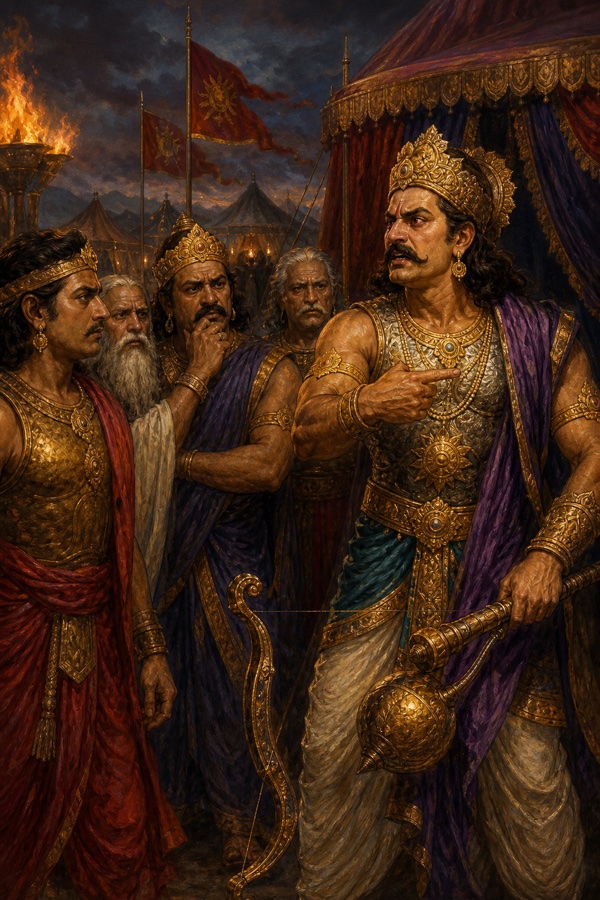
Shalya pressed his objection through an account of social rank. “Brahma created brahmins from his mouth, kshatriyas from his arms, vaishyas from his thighs, and shudras from his feet. The mingling of those 4 orders produced further groups: men of a higher order married women of a lower one, and men of a lower order married women of a higher one. Kshatriyas are the protectors of the others, acquiring wealth and giving it away. Brahmins were established on earth to benefit people through officiating at sacrifices, teaching, and accepting pure gifts. Agriculture, cattle tending, and giving are the occupations the scriptures assign to vaishyas. Shudras are appointed to serve brahmins, kshatriyas, and vaishyas. Sutas likewise serve kshatriyas. Kshatriyas owe no such service to sutas. Listen to me. The sacred water of royal consecration has washed the hair on my head. I was born in a line of royal sages. I am counted among the great chariot warriors. I deserve the honor and praises offered by bards and eulogists. In that position, I cannot become the driver of a suta’s son in battle. I will never fight under such humiliation. Give me leave to return home.” The angry king stood up abruptly and began to leave the gathering.
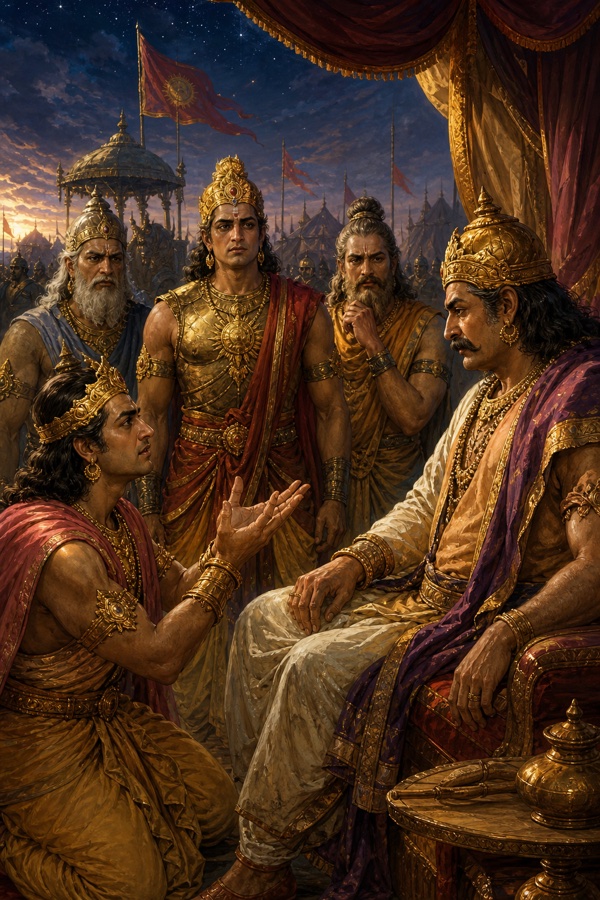
Duryodhana held him back with affection and respect, speaking gently to soothe him. “Shalya, what you have said is true. I have a particular purpose; hear it. Karna is not superior to you. I have no doubts about you. The king of Madra would never act falsely. Your ancestors always told the truth. That, I believe, is why you are called Artayani, descended from those whose refuge was truth. You pierce enemies like a barbed arrow, and so the world calls you Shalya. You give great gifts at sacrifices. Fulfill what you previously said you would do. Your courage exceeds both Karna’s and mine. Just as Karna surpasses Arjuna in many qualities, the world regards you as superior to Krishna. Karna is certainly better with weapons than Arjuna. Your strength and knowledge of horses exceed Krishna’s. Your knowledge of horses is twice his.” Shalya answered, “You have declared before all these troops that I am superior to Devaki’s son, and that pleases me. As you ask, I will drive for the famous son of Radha when he fights Arjuna. There must be this agreement between Karna and me: in his presence, I will say whatever I wish.” Duryodhana and Karna both accepted. “Let it be so.”
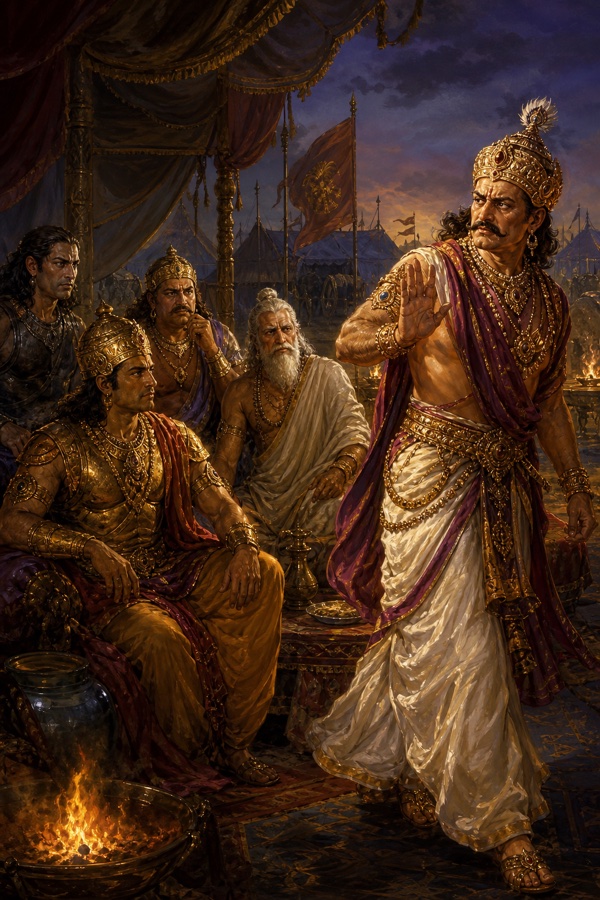
The gist: Duryodhana asks Shalya to protect the remaining army by driving Karna against Arjuna. Shalya considers the role an insult to his birth and rank and prepares to leave. Duryodhana wins him over by praising his strength and claiming that his knowledge of horses exceeds Krishna’s. Shalya agrees on one condition: he will be free to say whatever he wishes in Karna’s presence. Both Karna and Duryodhana consent.
Tripura, the three cities that could fall to a single arrow
Duryodhana asked Shalya to hear another account, a story of the ancient war between gods and asuras that the sage Markandeya had told his father. He promised to relate it in full and asked the Madra king to listen with trust. Taraka had been the cause of a great struggle in which the gods and asuras each sought to defeat the other. The gods won. After that defeat, Taraka’s 3 sons, Tarakaksha, Kamalaksha, and Vidyunmalin, undertook severe austerities and rigorous vows. Their bodies wasted away. Their restraint, meditation, vows, and tapas pleased Brahma, the Grandsire of the worlds, who offered them boons. Together, they asked for immunity from death at the hands of every creature for all time. Brahma refused that request. Such immunity did not exist; they must choose another boon. The brothers held long and repeated discussions before bowing to him with a new proposal. “Let us live in 3 cities and roam the earth under your protection. After 1,000 years we will come together, and our 3 cities will unite as one. Let the god who pierces those united cities with a single arrow be the cause of our destruction.” Brahma agreed and ascended to heaven. Delighted with the boon, the asuras planned the cities. They chose Maya as their builder, the tireless celestial craftsman honored by daityas and danavas alike.
Maya used the power of his own austerities to build a city of gold, a city of silver, and a city of black iron. The golden city stood in heaven, the silver city in the sky, and the iron city on earth, arranged to revolve in a circle. Each measured 100 yojanas in length and 100 in breadth. Houses and mansions filled them, with high walls, porches, and elaborate gateways. The great palaces stood close together, yet the streets were broad and spacious. Each city had its own king: Tarakaksha ruled the golden city, Kamalaksha the silver one, and Vidyunmalin the iron one. The 3 rulers soon attacked the worlds with their power. They remained in possession of their cities and asked contemptuously, “Who is this being called the Creator?” Millions upon millions of proud, flesh-eating danavas, previously defeated by the gods, arrived from every direction seeking prosperity. They settled in Tripura, the triple city. Maya supplied all their needs. Secure in his support, they lived without fear. Whatever any resident desired in his heart, Maya provided through his powers of illusion. Tarakaksha had a brave and powerful son named Hari. He too performed severe tapas until Brahma was pleased. Hari asked for a lake within their city into which those killed by weapons could be thrown, to emerge alive and with twice their strength. The boon was granted, and Hari made the lake. A daitya cast into it returned in the same form and appearance he had possessed when killed.
With their dead restored to them, the daityas afflicted the 3 worlds. Their victories in austerity had given them a power that kept their numbers from diminishing in battle. Greed and delusion overcame their judgment. Without shame, they began destroying cities and towns throughout the universe. Proud of the boons they had received, they drove the gods and their attendants from place after place. They roamed freely through celestial forests, other realms dear to the gods, and the beautiful, sacred retreats of sages. They ceased to respect anyone. Indra gathered the Maruts and attacked the triple city, hurling his thunderbolt from every side. It could not penetrate the defenses made invulnerable by Brahma’s grant. Fear drove Indra to withdraw. With the same gods beside him, he went to the Grandsire, reported the asuras’ oppression, bowed his head, and asked how the cities could be destroyed. Brahma answered, “Whoever wrongs you wrongs me as well. These asuras are wicked and always hate the gods. Those who cause you pain offend against me. I am impartial toward every creature; be certain of that. The unrighteous must be killed. That is my settled vow. The 3 forts must be pierced with one arrow. Their destruction can come through that means alone. Only Shiva, steadfast Sthanu, can accomplish it. Choose him as your warrior, Adityas. He is also called Ishana and Jishnu, and no work exhausts him. He will destroy the asuras.”
With Indra among them and Brahma leading, the gods sought the protection of Shiva, whose emblem was the bull. Sages devoted to the severest austerities accompanied them. Uttering the eternal words of the Vedas, they approached him with their whole hearts. Their Vedic praises honored the one who dispels fear wherever it arises, the universal Self and supreme Self whose own being pervades everything. Through their disciplines, these gods had learned to still the activities of the soul and withdraw it from matter. With themselves under control, they now saw Ishana, Uma’s husband, a mass of energy without equal in the universe, the source of all and the sinless Self. He was one, yet they had conceived of him in many forms. Each now saw in him the particular form held within that god’s own heart. Wonder filled them. Before the unborn lord of the universe, present as the embodiment of every creature, the gods and the brahmin sages touched their heads to the earth. Shiva welcomed them, raised them from their bows, and smiled. “Tell me why you have come.” At the command of the god with 3 eyes, their hearts grew easier.
They offered their salutations again and again. They honored him as the source of the gods, the bearer of the bow, the embodiment of wrath; as the destroyer of Daksha’s sacrifice, worshipped by all the lords of creation; as the one always praised and worthy of praise, Death itself, red and fierce, blue-throated and armed with the trident. They saluted his power that could never be defeated, his eyes beautiful as a gazelle’s, and his mastery of the foremost weapons. Again they saluted the one worthy of all praise, calling him pure, destruction itself and the destroyer, irresistible, Brahman, and the observer of brahmacharya. He was Ishana, immeasurable, the great controller, clothed in rags, always absorbed in austerities, tawny, faithful to vows, and dressed in animal skins. They hailed him as Kumara’s father. With his 3 eyes and his foremost weapons, he removed the distress of those seeking refuge and destroyed those who hated brahmins. They praised him as lord of trees, people, cattle, and sacrifices, always at the head of his hosts, three-eyed and fierce in energy. “In thought, speech, and action, we give ourselves to you. Be gracious to us.” Pleased by their praise, Shiva welcomed them once more. “Let your fear leave you. Tell me what I should do for you.”
The gist: Duryodhana tells Shalya how Taraka’s sons obtained 3 cities that could be destroyed only by a single arrow when they united after 1,000 years. Maya built the cities, and Hari’s lake restored dead daityas to life. Their growing oppression drove the gods to seek help. Indra’s thunderbolt failed against the forts. Brahma sent the gods to Shiva, who heard their praises, reassured them, and asked what they needed.
The universe becomes Shiva’s chariot
With the ancestors, gods, and sages freed from fear, Brahma addressed Shiva for the good of the universe. “Through your favor I became lord of all creatures. In that position, I granted the danavas their great boon. Only you can destroy these wicked beings who respect no one. These gods have come seeking your protection. Show them favor. Kill the danavas so that the universe may find happiness. Lord of past and future, we all seek refuge in you.” Shiva answered, “All your enemies must be killed. The task calls for your united strength. Take half my power and destroy them together. Union is great strength.” The gods had already seen the enemy’s force. They believed the danavas possessed twice their energy and might. Shiva repeated his offer: with half his strength, they should kill those who had wronged them. The gods replied, “We cannot bear half your energy, Maheshwara. Take half our combined strength and kill them yourself.” He agreed to do so, and they accepted. Shiva drew half the energy from each of them and became greater in might than any being in the universe. From that time, he was called Mahadeva, the great god. He promised to fight from a chariot with bow and arrow and destroy their enemies that very day. They must now prepare the chariot and weapons. The gods undertook to gather portions of every form in the 3 worlds and build a great vehicle, intelligently designed by Vishvakarman, the divine craftsman.
They made Vishnu, Soma, and Agni into the arrow. Agni became its shaft, Soma its head, and Vishnu its point. Earth herself became the chariot, carrying her great cities and towns, mountains, forests, islands, and all the creatures living upon her. Mount Mandara became its axle, the Ganga its jangha, and the principal and intermediate directions its ornaments. The constellations became the chariot pole, the Krita age its yoke, and the serpent Vasuki its kuvara. Himavat and Vindhya became the apaskara and adhishthana; the mountains of sunrise and sunset became its wheels. The ocean, home of the danavas, became another axle. The 7 sages guarded the wheels. The Ganga, Sarasvati, Sindhu, and sky formed the dhura, while all other rivers and waters became cords binding the parts together. Day, night, the smaller measures of time called kalas and kashthas, and the seasons formed its anukarsha. Bright planets and stars became the wooden railing. Dharma, artha, and kama, duty, prosperity, and pleasure, united to form its trivenu. Herbs and vines bearing flowers and fruit became bells. The sun and moon were made equal and became another pair of wheels. Day and night extended as auspicious wings to right and left. Ten mighty serpents, led by the serpent named Dhritarashtra, formed another pole. The sky became another yoke; the Samvartaka and Valahaka clouds became its leather straps. Both twilights joined Dhriti, the embodiment of courage; Medha, of intelligence; Sthiti, of gravity; and Sannati, of humility, to form the chariot’s coverings. The starry, planet-filled sky joined them as the hides covering the vehicle. The rulers of gods, waters, the dead, and treasure became its horses: Indra, Varuna, Yama, and Kubera. The serpents Kalaprishtha, Nahusha, Karkotaka, Dhananjaya, and others became the cords binding their manes. The directions became the reins. The Vedic cry Vashat became the goad, and Gayatri the cord attached to it. Four auspicious lunar days formed the traces: the new moon and full moon when part of the preceding lunar day extended into them, and the new moon and full moon standing by themselves. The ancestors presiding over those days became the hooks and pins. Action, truth, austerity, and prosperity became the chariot’s cords. Mind was the ground on which it stood; speech was the track along which it would travel. Banners of many colors waved above it. With lightning and Indra’s rainbow attached, the vehicle gave off fierce light.
The span of time established as a year at an earlier sacrifice of Shiva became the bow. The goddess Savitri became its resonant string. From the wheel of Time came celestial armor, radiant, impenetrable, and set with precious gems. Golden Mount Meru became the standard’s pole, and clouds flashing with lightning became the banners. The completed chariot blazed like a sacrificial fire surrounded by officiating priests. The gods marveled at the energies of the entire universe gathered in one place and told Shiva the vehicle was ready. He placed his own celestial weapons upon it. Making the sky a flagstaff, he set his bull upon it. The brahmin’s rod, Death’s rod, Rudra’s rod, and Fever guarded the sides, facing outward in all directions. Atharvan and Angiras protected the wheels. The Rigveda, Samaveda, and Puranas stood in front; the histories and Yajurveda guarded the rear. Sacred speech, every science, all hymns, and the Vedic Vashat surrounded it. The syllable Om stood at its head and gave it beauty. Shiva made the year with its 6 seasons into his bow and his own shadow into its unbreakable string. Rudra was Death itself; his shadow, Kalaratri, the night of death, became the indestructible bowstring. Vishnu, Agni, and Soma formed the arrow. The universe was said to consist of Agni and Soma, and likewise to consist of Vishnu. Vishnu was also the soul of Shiva, Bhava of immeasurable energy. That made even the touch of the bowstring unbearable to the asuras. Shiva placed his own irresistible fury upon the arrow, the intolerable fire born from the anger of Bhrigu and Angiras.
The terrible god dressed in skins, called Nila Rohita, Blue and Red, or Smoke, shone like 10,000 suns. Fire from his overflowing energy surrounded him. He was Hara, the victor who overcame the unconquerable, destroyed those who hated Brahma, rescued the righteous, and put down the unrighteous. Beings of dreadful appearance and enormous strength accompanied him, swift as thought and able to scatter and crush enemies. It was as though all 14 faculties of the soul stood awake around him. The entire world of moving and unmoving creatures found refuge in his limbs and presented an astonishing sight. Seeing the chariot fully equipped, Shiva put on the armor, armed himself with the bow, and took the arrow formed from Soma, Vishnu, and Agni. The gods asked the Wind to carry every fragrance behind him. He mounted with resolution, making the earth tremble and terrifying even the gods. As he prepared to climb aboard, great sages, gandharvas, assembled gods, and many groups of apsaras praised him. Brahmin sages honored him; eulogists sang his praise; the dancing apsaras praised him. Bearing his curved sword, arrow, and bow, the giver of boons shone beautifully. He smiled and asked, “Who will drive for me?” The gods replied that whoever he appointed would certainly accept. Shiva told them to choose for themselves, without delay, and appoint someone superior to him.
The gods went to Brahma and appealed for his favor. “We have done everything you asked us to do against the enemies of heaven. Shiva, whose emblem is the bull, is pleased with us. We have built a chariot equipped with extraordinary weapons. We still need to know who will drive it. Appoint one of the foremost gods. Fulfill the promise you made to help us. This irresistible chariot, capable of routing our enemies, is made from the gods themselves. The bearer of Pinaka will stand on it as the warrior. He is ready for battle and already strikes fear into the danavas. The 4 Vedas have become its 4 magnificent horses. Earth with her mountains is the chariot; the stars adorn it. Hara is the warrior, and we still see no driver. Someone greater than all these must take the reins. The chariot equals you in importance, and Shiva will fight from it. We have armor, weapons, and bow. We can see no one except you who is fit to drive. You possess every accomplishment and stand above all the gods. Mount quickly and hold the reins of these excellent horses, so that the gods may win and their enemies be destroyed.” Bowing their heads to the Grandsire, lord of the 3 worlds, they sought to persuade him to accept the driver’s place.
A key to reading this (the powers within the chariot): The chariot holds mountains, rivers, gods, sacred texts, time, and human qualities together. Some powers occupy several places. Savitri and then Kalaratri appear as the bowstring; the world guardians and later the 4 Vedas appear as horses. Dhritarashtra and Dhananjaya in the serpent groups are serpent names.
The gist: Shiva takes half the gods’ combined energy and prepares to destroy Tripura. The powers of the universe become his chariot, armor, bow, and arrow. He asks for a driver superior to himself. The gods approach Brahma, remind him of his promise to help them, and ask him to hold the reins.
One arrow against the three cities
Brahma accepted the gods’ request. Everything they had said was true, he told them, and he would hold Shiva’s reins during the battle. The creator of the worlds was appointed charioteer to the god they had armed with their combined strength. As Brahma prepared to climb onto the great chariot, its horses, swift as wind, lowered their heads to the earth. Shining with his own radiance, he took his place, gathered the reins and driving goad, and brought the horses upright. Then he invited Shiva to mount. Shiva took the arrow formed from Vishnu, Soma, and Agni and stepped aboard, his bow terrifying the enemy. The great sages, gandharva musicians, companies of gods, and the many groups of apsaras praised him. With his curved sword, arrow, and bow, the radiant giver of blessings stood on the chariot and lit the three worlds with his energy. He spoke again to the gods gathered around Indra. “Let no doubt about my power to destroy the asuras trouble you. Know that this arrow has already killed them.” They answered that it was true: the asuras were already dead. His word could never prove false, they believed, and their confidence filled them with joy. Surrounded by the gods, Shiva began his journey in the incomparable chariot. His constant attendants honored him, as did the flesh-eating beings who could never be defeated in battle. These followers danced, ran wildly in every direction, and shouted to one another. Virtuous sages, rich in the power gained through austerities, joined the gods in wishing him success. The whole universe rejoiced as the god who dispelled the fears of the three worlds set out. The sages offered many hymns, adding to his energy, and remained standing there. Millions upon millions of gandharvas played their instruments at his departure.
As Brahma drove toward the asuras, Shiva smiled. “Excellent! Excellent! Take me to the daityas. Guide the horses attentively. Today you will see the strength of my arms as I kill the enemy.” Brahma urged the team toward the triple city guarded by the daityas and danavas. Revered throughout the worlds, the horses moved as quickly as wind or thought. They seemed to swallow the sky as the creator sped onward for the gods’ victory. Shiva’s bull roared with a force that filled every direction. Many of Taraka’s descendants and followers died at the sound; others faced the approaching enemy and stood ready to fight. Wrath overwhelmed Shiva’s senses. Creatures everywhere were terrified, the three worlds shook, and dreadful omens appeared as he prepared to aim. Yet the chariot seemed to sink beneath its load. The arrow carried Soma, Agni, and Vishnu; Brahma and Shiva stood aboard with Shiva’s bow. Their combined weight pressed it down. Vishnu, also called Narayana, emerged from the arrow’s point, became a bull, and raised the great vehicle. While the chariot was sinking, the enemies had begun to roar. Shiva shouted furiously in answer. With his feet on the head of his bull and the backs of his horses, he watched the danavas’ city. In that posture he cut away the horses’ teats and split the bull’s hoofs. From that day, Duryodhana said, cattle had divided hoofs and horses were without teats, through Rudra’s extraordinary act.
Shiva strung his bow and joined his Pashupata weapon to the arrow. He aimed and waited, keeping the triple city in mind. The condition set by the asuras’ boon still governed the attack: their three separate cities had to come together before a single arrow could destroy them. As he stood with his bow ready, the cities lost their separate identities and united. Joy broke out among the gods. Gods, Siddhas, and great sages praised Maheshwara with cries of “Jaya!” They hailed his victory. The united city came directly before the god whose fierce form defied description and whose energy no enemy could endure. Intent on killing the asuras, he drew the divine bow and released the arrow that embodied the strength of the entire universe. Cries of anguish rose from the cities as they fell toward the earth. He burned the asuras and cast them into the western ocean. Thus Maheshwara, acting in wrath for the welfare of the three worlds, burned Tripura and destroyed the danavas. He then extinguished the fire his own anger had produced. “Do not burn the three worlds to ashes,” he commanded it. The gods, the sages, and the three worlds returned to their natural state. They addressed Shiva with words of deep praise. Their purpose had finally been achieved after all their efforts. With his permission, the gods departed for their homes, Brahma at their head. The creator and lord of gods and asuras had acted for the good of every world.
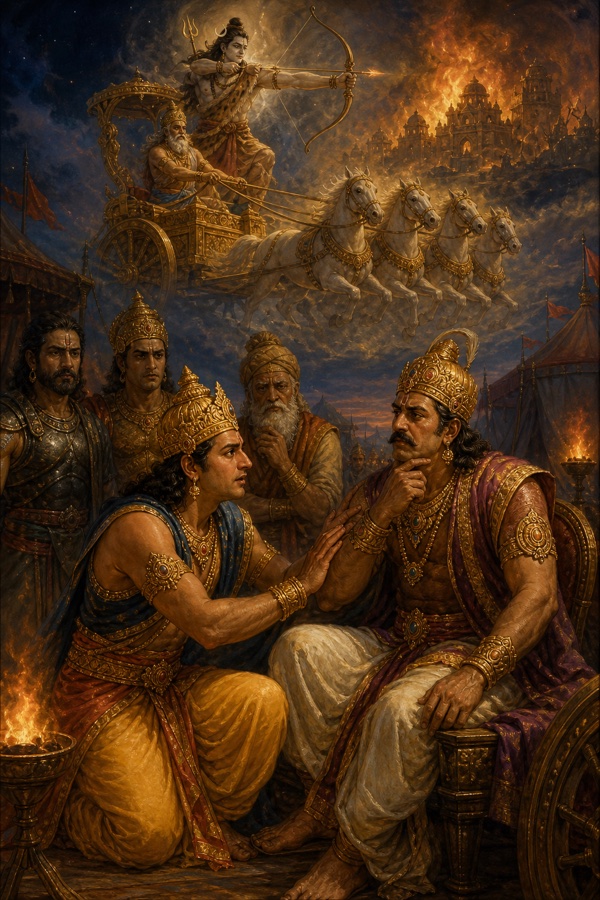
Duryodhana brought the story back to the chariot he wanted Shalya to drive. “The illustrious Brahma, creator of the worlds, the grandsire whose glory never fades, took the reins for Rudra. In the same way, take the reins for Radha’s greathearted son. There is no doubt that you are superior to Krishna, Karna, and Arjuna. Karna is like Rudra in battle; you are like Brahma in judgment and policy. Together you can defeat our enemies as those gods defeated the asuras. Act quickly today, Shalya. Let Karna crush the Pandava troops and kill Kunti’s son, who rides behind white horses with Krishna as his driver. Karna, all of us, our kingdom, and our victory depend on you. Take the reins of his splendid horses.” Duryodhana then offered another account in support of his request. “Listen once more. A virtuous brahmin told this story in my father’s presence. It explains the reasons for actions and the ends they serve. Hear these pleasing words, then do whatever you decide without misgivings.” The brahmin had told of Jamadagni, a severe ascetic of Bhrigu’s lineage, and his son Rama, a man of great energy and every virtue. This was the Rama who would teach Karna the use of weapons. Cheerful in spirit, disciplined in his senses, and faithful to his vows and observances, he undertook the harshest austerities to obtain weapons from Shiva. His devotion and calm heart pleased the god. Knowing the wish he cherished, Shiva appeared before him. “Rama, I am pleased with you. May you prosper. I know what you desire. Purify yourself, and everything you seek will be yours. When you are pure, I will give you all the weapons. These weapons burn anyone who lacks the ability or worthiness to bear them.” Jamadagni’s son bowed his head before the powerful god who held the trident. “I am always devoted to your service,” he answered. “Give me those weapons when you judge me fit to hold them.”
The gist: With Brahma driving, Shiva destroys the three united cities with one arrow, then restrains the fire of his anger. Duryodhana uses the story to urge Shalya to drive Karna’s chariot. He follows it with the story of Karna’s teacher, Rama, whose request for divine weapons first required him to become worthy of them.
Karna’s teacher and Shalya’s warning
Duryodhana continued the story of Rama, Jamadagni’s son. For many years Rama worshipped Shiva through austerities, control of his senses, vows, offerings, sacrifices, and the fire offerings performed with sacred mantras. At last Shiva was pleased with this greathearted descendant of Bhrigu. In the presence of his divine wife, he praised Rama’s many virtues. Rama, he said, held firmly to his vows and was always devoted to him. The god repeatedly spoke of these qualities before the gods and sages as well. Meanwhile, the daityas grew very powerful. Pride and folly blinded them, and they oppressed the inhabitants of heaven. The gods united and resolved to kill their enemies. Despite their determined efforts, they could not overcome them. They went to Shiva, the husband of Uma, and sought to win his favor through devotion. Their plea was simple: he must kill their foes. Shiva promised to destroy the enemies troubling them, then summoned Rama. “Descendant of Bhrigu, kill the assembled enemies of the gods,” he told him. “Do this for the welfare of every world and to please me.” Rama questioned how he could carry out the command. He still lacked the weapons he had sought through his long worship. “What strength do I have to kill them in battle?” he asked the three-eyed giver of blessings. “I have no weapons, while those danavas are skilled in their use and undefeated in war.” Shiva answered, “Go at my command. You will kill those enemies. Victory over all of them will bring you great merit.”
Rama heard and accepted everything Shiva said. He had rites performed to secure success and set out against the danavas. Facing those powerful enemies of the gods, full of pride and folly, he challenged them. “Daityas, fierce in battle, fight me. The god of gods has sent me to defeat you.” They took up the challenge. Rama, who brought honor and joy to Bhrigu’s family, struck them with blows like the touch of Indra’s thunderbolt. He killed the daityas and returned to Shiva. The battle had left many wounds on Jamadagni’s son, one of the foremost brahmins. Shiva touched him, and the wounds healed immediately. Pleased with his achievement, the god granted him many blessings. Holding his trident, he spoke with satisfaction. “The pain you endured when their weapons struck your body bears witness to your extraordinary deed. Take these divine weapons from me, as you wished.” Rama received the full array of heavenly weapons and the blessings he had desired. He bowed his head to Shiva, obtained the gods’ permission to leave, and departed. Duryodhana identified this as the ancient account the sage had recited in his father’s presence.
Duryodhana now applied that account to Rama’s pupil. “This descendant of Bhrigu gladly gave the entire science of weapons to the greathearted Karna,” he told Shalya. “If Karna had some fault, Rama would never have given him his heavenly weapons. I cannot believe that Karna was born into the suta order. I believe he is a god’s son, born into a kshatriya family. I think he was abandoned as an infant so that the family of his birth might be recognized through his features and his deeds. Shalya, Karna could never have been born a suta.” Shalya had refused to drive for a man of the suta order. Duryodhana pressed his belief that Karna’s birth had placed him among the warrior families. “He was born with earrings and armor,” he continued. “This mighty chariot warrior, with his long arms and the radiance of the sun, could never have been borne by an ordinary woman, any more than a doe can bear a tiger. Look at his massive arms, each like the trunk of a great elephant. Look at his broad chest, capable of resisting any foe. Karna, also called Vaikartana, cannot be an ordinary man. This pupil of Rama possesses great courage and greatness of spirit.” Duryodhana then returned to the example of Brahma and Shiva. The grandsire of all the worlds had driven while Rudra fought. A charioteer, he insisted, should be superior to the warrior aboard his chariot. The gods had carefully chosen Brahma as someone greater than Shiva; with the same care, the Kauravas had chosen Shalya as someone greater than Karna. He urged Shalya to take Karna’s reins at once, just as Brahma had held the reins for Rudra.
Shalya answered that he had often heard this excellent, divine history of the two great gods. He knew how Brahma had driven for Shiva and how a single arrow had destroyed the asuras. Krishna, too, had already known that ancient account. Krishna knew the past and future in every detail, Shalya said, and with that knowledge he had become Arjuna’s driver, following Brahma’s example. “If the suta’s son somehow succeeds in killing Kunti’s son, Keshava will see Arjuna dead and enter the battle himself. Krishna, who bears the conch, discus, and mace, will consume your army. When that illustrious man of the Vrishni family is roused to anger, there is no king here who will hold his place in the ranks before him.”
The gist: Duryodhana recounts how Karna’s teacher Rama earned divine weapons from Shiva. He argues that Karna’s training and extraordinary features establish his worth, then again asks Shalya to drive for him. Shalya warns that Arjuna’s death would bring Krishna into the fighting, with disastrous consequences for the Kaurava army.
Shalya takes the reins and keeps his freedom to speak
Sanjaya told Dhritarashtra that Duryodhana answered Shalya cheerfully. He urged him to stop disparaging Karna’s strength in battle. Karna, also called Vaikartana, was foremost among those who used weapons and understood the meaning of all their scriptures. The Pandava troops scattered at the dreadful sound of his bow and the clap of his palms. Shalya himself had seen Karna kill Ghatotkacha that night, even as the rakshasa sheltered behind his illusions and displayed hundreds of them. Duryodhana claimed that fear had kept Arjuna from standing against Karna throughout those days. He recalled how Karna had pushed the powerful Bhima about with the tip of his bow, calling him a fool and a glutton. Karna had defeated Madri’s brave sons, Nakula and Sahadeva, and had spared their lives for some purpose of his own. He had beaten Satyaki, the great Vrishni warrior and leader of the Satwatas, and deprived him of his chariot. He had repeatedly defeated Dhrishtadyumna and the Srinjayas. In his anger, Duryodhana insisted, Karna could kill even Indra armed with his thunderbolt. Duryodhana then praised Shalya’s command of every weapon and branch of learning. No one on earth equaled the strength of his arms. His irresistible valor pierced his enemies like a dart, a shalya, and this, Duryodhana said, explained his name. All the Satwatas together had been unable to overcome his strength. Could Krishna’s arms be stronger than his? If Arjuna died, Krishna would take up responsibility for the Pandava troops; if Karna died, Shalya would bear the burden of the great Kaurava army. If Krishna could resist the Kauravas, why should Shalya be unable to destroy the opposing army? For Shalya’s sake, Duryodhana declared, he would willingly follow his slain brothers and the other dead kings.
Shalya was pleased to hear Gandhari’s son call him superior to Devaki’s son Krishna before the assembled troops. He agreed to drive for the famous son of Radha in his battle with Arjuna, the foremost of Pandu’s sons. He attached a condition to that agreement: in Karna’s presence, he would say whatever he wished. Before all the kshatriyas, Duryodhana and Karna accepted. Assured that Shalya would take the reins, Duryodhana joyfully embraced Karna. The bards praised him as he urged his friend to kill all the Pandavas, as Indra had killed the danavas. Karna was happy that Shalya had agreed, yet he noticed something in the way the king spoke. “The ruler of Madra does not sound very cheerful,” he told Duryodhana. “Ask him once more, with gentle words.” Duryodhana addressed Shalya again. His deep voice, like a cloud’s rumble, filled the place. Karna wanted to fight Arjuna that day, he said. He wanted to kill the other warriors and then kill Arjuna. Duryodhana acknowledged that he was asking repeatedly: Shalya must hold Karna’s reins and protect him from every danger, just as Krishna, the finest of drivers, advised and protected Arjuna. Shalya embraced Duryodhana and answered gladly. If this was what Gandhari’s son wished, he would do everything that pleased him. He would apply himself wholeheartedly to every task for which he was fit and carry Duryodhana’s burden in those duties. Still, he repeated his condition. Both Duryodhana and Karna must forgive whatever he said to Karna, pleasant or unpleasant, when he spoke for Karna’s good.
Karna asked him to remain devoted to their welfare, as Brahma had been devoted to Shiva’s and Krishna was devoted to Arjuna’s. Shalya replied with a rule of conduct. Respectable people, he said, avoided four things: criticizing themselves, praising themselves, speaking ill of others, and flattering others. What he was about to say would involve self-praise, but he offered it to give Karna confidence and asked him to listen carefully. In vigilance, in handling horses, in recognizing an approaching danger, in knowing how to avoid it, and in actually steering clear of it, he was equal to Matali, Indra’s own charioteer. Those skills qualified him to drive even for the king of the gods. He would hold Karna’s reins during the battle with Arjuna, so Karna could put his anxiety aside. Duryodhana confirmed the assurance. The ruler of Madra, whom he again declared superior to Krishna, would serve as Karna’s driver. As Matali managed Indra’s horse-drawn chariot, Shalya would manage Karna’s. With Karna fighting aboard it and Shalya at the reins, that outstanding chariot would surely defeat the Pandavas. Sanjaya then described the morning. Duryodhana once more asked the energetic Madra king to take charge of Karna’s excellent horses in battle. With Shalya protecting him, Radha’s son would overcome Arjuna. Shalya agreed and mounted the chariot. As he approached it, the cheerful Karna asked his charioteer to make the vehicle ready quickly. Shalya prepared the splendid, victorious chariot, which resembled a palace formed from clouds in the sky, and presented it with a blessing: may Karna prosper and win.
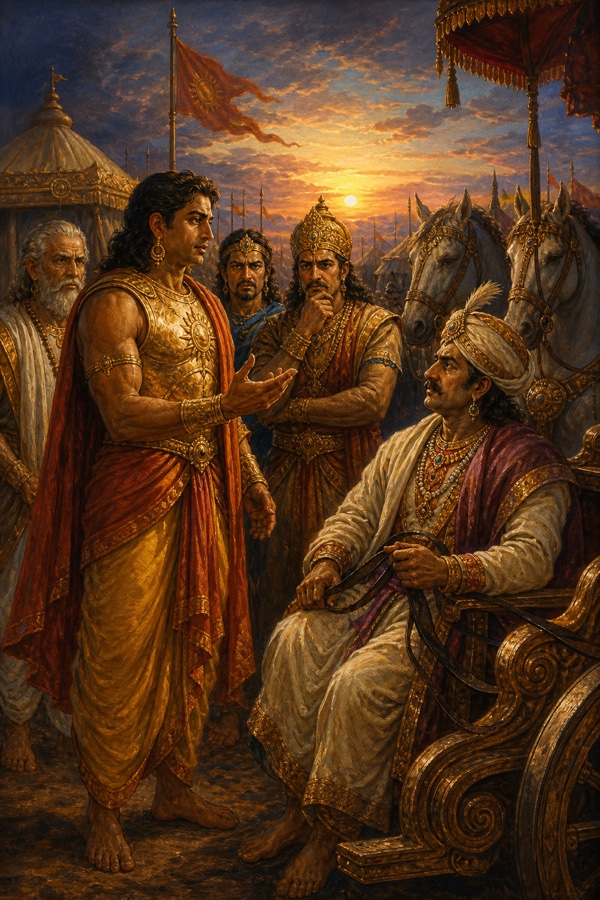
A priest learned in sacred knowledge had consecrated the chariot in earlier days. Karna now honored it with the proper worship, walked around it in reverence, and carefully worshipped the sun god Surya. He asked Shalya, who stood nearby, to climb aboard. The powerful king ascended the great, invincible chariot like a lion climbing a mountain peak. When Karna saw him in position, he mounted in turn, like the sun appearing over a bank of clouds filled with lightning. Together the two shone like Surya and Agni, the gods of sun and fire, seated on a cloud in the sky. Bards praised them. They resembled Indra and Agni receiving hymns from the officiating priests and members of a sacrificial assembly. With Shalya holding the reins, Karna stretched his formidable bow and seemed like the sun surrounded by a ring of light. His arrows formed its rays. Standing on the great chariot, he had the beauty of the sun above Mount Mandara. Duryodhana addressed him there, ready for battle. He called on Adhiratha’s son to accomplish, before all the assembled archers, the difficult deed that Bhishma and Drona had failed to achieve. He had always believed those two great warriors would kill Arjuna and Bhima. Now Karna must perform that heroic feat as a second Indra, the wielder of the thunderbolt. “Capture King Yudhishthira, or kill Arjuna, Bhima, and Madri’s twin sons,” he urged. “May you prosper and win. Go into battle and burn the whole army of Pandu’s son.”
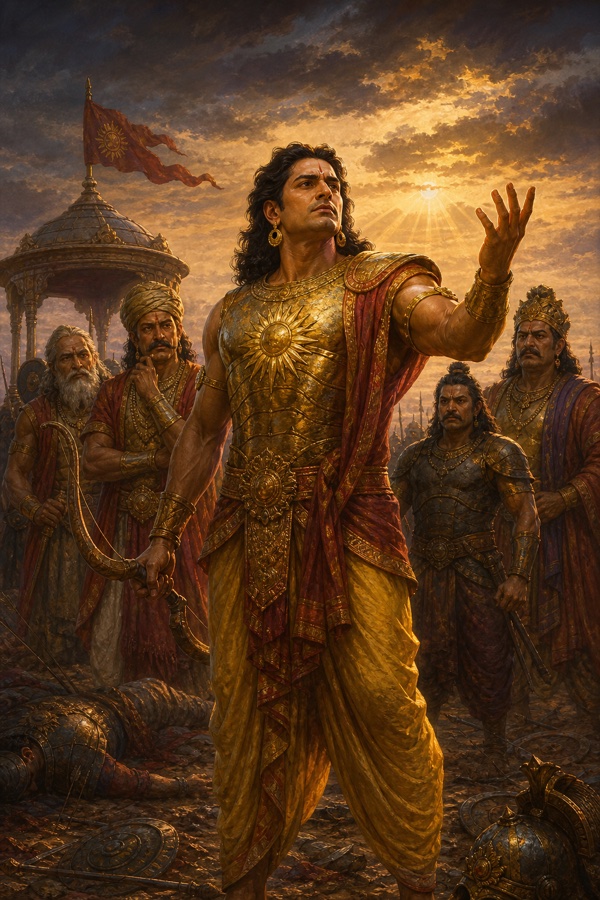
Thousands of trumpets and tens of thousands of drums sounded together, filling the air with a noise like thunder. Karna accepted Duryodhana’s charge and spoke to Shalya, his driver and an accomplished warrior in his own right. “Urge the horses forward, so that I may kill Arjuna, Bhima, the twins, and King Yudhishthira. Let Arjuna see the strength of my arms today as I shoot hundreds and thousands of arrows feathered with kanka plumes. I will send them out with all my force to destroy the Pandavas and bring Duryodhana victory.” Shalya challenged him at once. Why did he think so little of Pandu’s sons? All were powerful, all were great archers, and all knew every weapon. They held their ground, were favored by fortune, and could not be conquered. Their prowess never failed them; they could put fear into Indra’s heart. “When you hear Gandiva’s thunder in battle, you will stop speaking this way,” Shalya told him. Shalya also reminded him of the other men he proposed to kill. Yudhishthira, Dharma’s son, and the twins could spread their sharp arrows into a canopy as thick as clouds overhead. The other undefeated kings on their side were swift with their hands and could shower arrows on their opponents, wearing down their strength. Once Karna saw them in action, Shalya said, he would have no words like these. Karna disregarded the warning. He gave the Madra king a single instruction: “Proceed.”
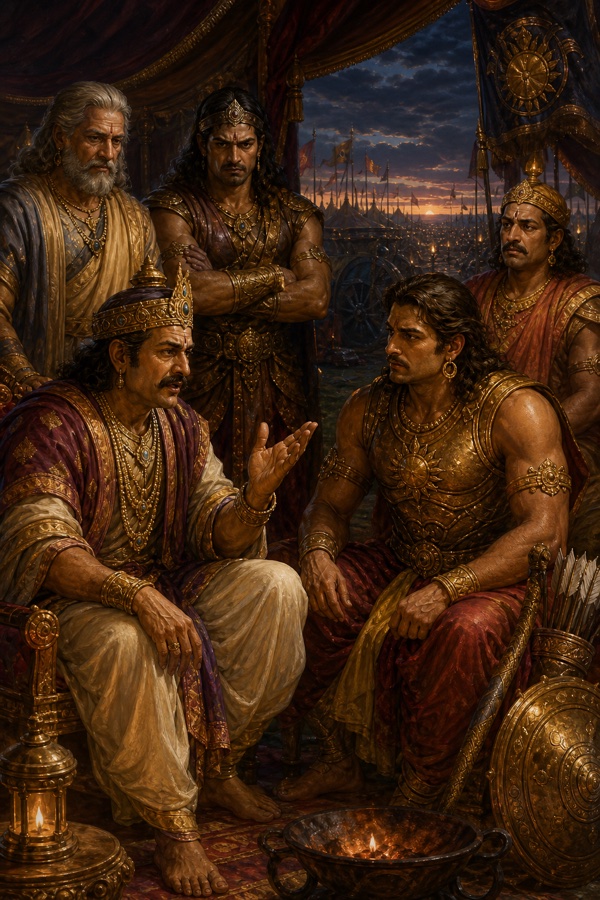
The gist: Shalya accepts the reins after repeated appeals, reserving the freedom to speak as he chooses. Karna and Duryodhana agree to that condition. After preparing and honoring the chariot, Karna sets out promising to kill the Pandavas. Shalya immediately challenges his confidence and reminds him of their strength.
Source: the Mahabharata of Krishna-Dwaipayana Vyasa, Karna Parva. This chapter follows K. M. Ganguli, the invocation and sections I-LIV, through verse 29 of LIV, ending at Suketu’s death; the Gita Press Hindi edition numbers these chapters differently. Names, order, and events were checked against Ganguli’s complete translation. Dialogue and commentary are adapted, not a verbatim translation. About the sources.
Based on: The Mahabharata, Vyasa (Gita Press, Gorakhpur)