The Path of Sadhana
Shlokas 43 to 50
The principle is now clear. What comes next is climbing down and walking the road. Rama tells his brother what a seeker who truly wants to know Brahman must actually do.
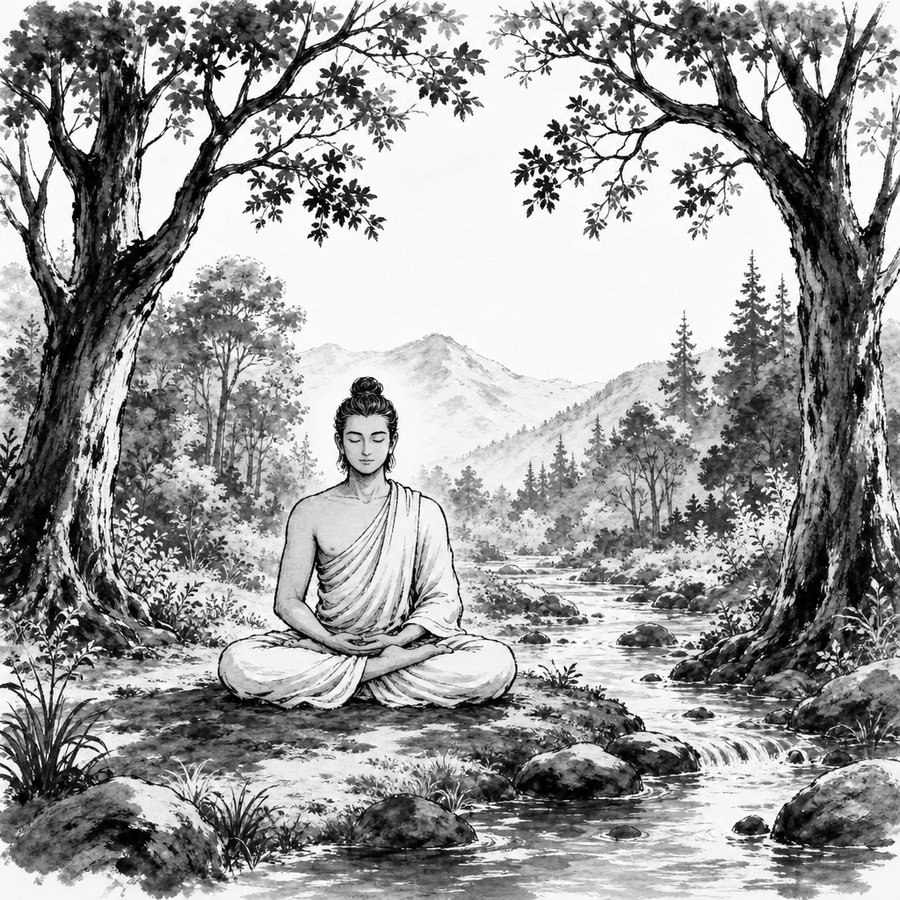
Shloka 43 · I, the nature of light
Here Rama sets on the seeker’s own lips that declaration of the self which holds the gist of every practice. I am the nature of light. No birth touches me. I have no second. I have shone forever, utterly pure. I am a solid mass of pure knowing, beyond disease and change, complete, made of bliss, untouched by every action. This is the ‘I’ whose recognition is the whole aim.
Shloka 44 · I, forever free
Then Rama opens further depths of that same self. I have always been free, and my power lies past all thought. I am knowing itself, beyond the reach of the senses, and no change stirs in me. I have neither far shore nor end. Night and day the wise contemplate me alone in their hearts, and those who know the marrow of the Veda recognize me alone.
Shloka 45 · The undoing of ignorance
Rama explains that when a seeker holds an unbroken current of thought and keeps knowing himself as the self alone, a pure contemplation wakes inside him. That contemplation soon destroys his ignorance. As a tonic taken by the proper method drives out disease, this inquiry into the self drives out every illusion.
Shloka 46 · Practice in solitude
Now Rama gives the outer method of that practice. Let the seeker sit apart in solitude, draw the senses back from their objects, conquer the mind completely, and cleanse the inner instrument. Then, with no other support, resting in his own nature by the eye of pure knowing alone, let him contemplate that one reality.
Shloka 47 · The dissolving of the universe
This is the point where everything dissolves into the one. All this visible universe is a sight of the supreme self and nothing else. Let the seeker merge this entire universe into that self, the cause of all. Then he comes to rest, complete, filled with the bliss of pure awareness. No outer thing remains for him, and nothing within.
Shloka 48 · The world as Om alone
Now Rama turns to the Pranava, to the Om that stands as the doorway of samadhi. Before samadhi, let the seeker treat this whole world of moving and unmoving things as nothing but Om, and hold it so in thought. All this universe is what is named, and the Pranava is the name. This world shows itself as many only through ignorance, and never once understanding has dawned.
Shloka 49 · A, U, M and the three states
Then Rama opens the inner make of the Pranava. The sound ‘A’ is the very person called Vishva, the one who presides over the waking state. The sound ‘U’ is Taijasa, presiding over dream, and it comes in order. The sound ‘M’ is what all people call Prajna, presiding over deep sleep. This whole division belongs to the seeing that comes before samadhi. Seen from the level of reality, no such division exists at all.
Shloka 50 · Step-by-step dissolution into the Pranava
And at the last Rama gives the yoga of dissolution toward which this whole part has been moving. Merge Vishva, in the form of the sound ‘A’, the person of the waking state, into the sound ‘U’, since it is the sound ‘U’ that dwells within in its many forms. Then merge Taijasa, in the form of the sound ‘U’, into the sound ‘M’, and so gather this second letter of the Pranava into its final letter.