The Play of Illusion
The Play of Illusion · Shlokas 35 to 42
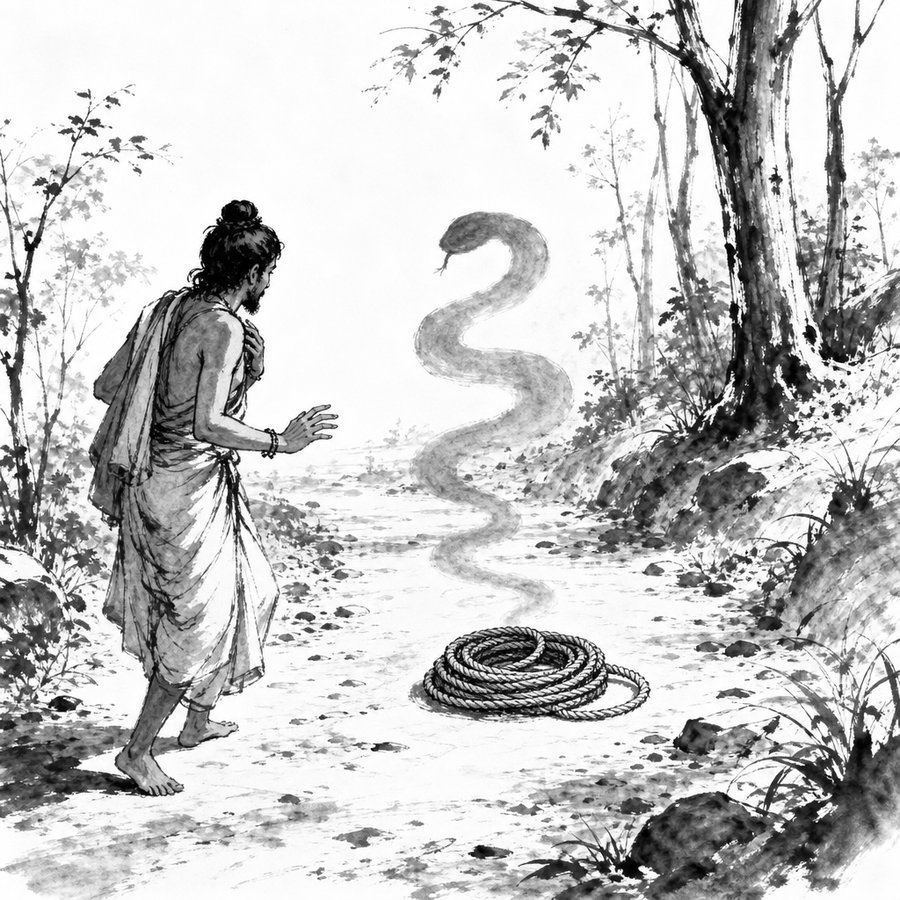
If all is one, why does it appear as many? This is where Vedanta asks its largest question, and Rama answers in a single word: adhyasa, superimposition. A snake laid over a rope, and in the very same way this entire world laid over God.
Shloka 35
Rama first introduces the atman on which this whole play rests. That atman never dies, is never born, never wanes, never grows; nothing in it falls short. Every excess lies past it. It is the very form of bliss, self-luminous, all-pervading, and without a second, with nothing else resembling it.
Shloka 36
Then Rama raises the question that rises in every seeker’s mind. In an atman made of knowledge and shaped as pure bliss, how does this sorrow-laden world come to appear at all? And he answers: through ignorance, under the sway of superimposition, it seems to be. Yet the instant knowledge dawns, in that same instant the world dissolves back into it, since the two are opposed and cannot stand together.
Shloka 37
Now Rama brings the image that has become the signature of Advaita Vedanta. When a thing appears through delusion where it does not exist, the wise call this very thing superimposition. Just as a snake appears on a rope where there is no snake at all, in exactly the same way this whole world appears upon God.
Shloka 38
Then Rama shows where this superimposition first takes hold. Upon the conscious atman, free of every alternative and of maya, upon that changeless awareness the first superimposition is imagined: this ego, the feeling that I am the doer. And this projection rests on the very atman that is the cause of all, flawless, absolute, and Brahman beyond everything.
Shloka 39
Now Rama opens the root of bondage. The movements of the intellect, carrying qualities like desire, attachment, and pleasure, are what become the cause of the world, and they lie past the atman. The proof of this shows up in deep sleep, where these movements fall away. That is why, in that state, we experience ourselves as pure bliss itself.
Shloka 40
Then Rama opens the secret of the jiva. The reflection of consciousness that falls into this intellect, an intellect sprung from beginningless ignorance, is what is called the light of the jiva. The real atman stands apart from this intellect, holding its place as the witness; it is unbounded by the intellect and beyond everything, and that alone is the atman.
Shloka 41
But why does this illusion run so deep? Rama explains that too. The reflection of consciousness, the witness-atman, and the intellect, these three settle in one and the same place, and so they seem to melt into one another. Like iron fired in a flame, where fire and iron come to look the same, in the same way, through this mutual superimposition, inertness and awareness appear blended together in the conscious atman and the mind.
Shloka 42
And then, at the last, Rama shows the path by which this blend comes apart. Whoever arrives at the direct experience of knowledge, through the nearness of the guru and through the words of the Veda, recognizes that atman seated within his own self, free of every limiting adjunct. Then he releases all that inert matter which shows itself as an object of the atman, since it is only what the atman beholds, an appearance and nothing more.