The Question and the Beginning
The Question · Shlokas 1 to 8
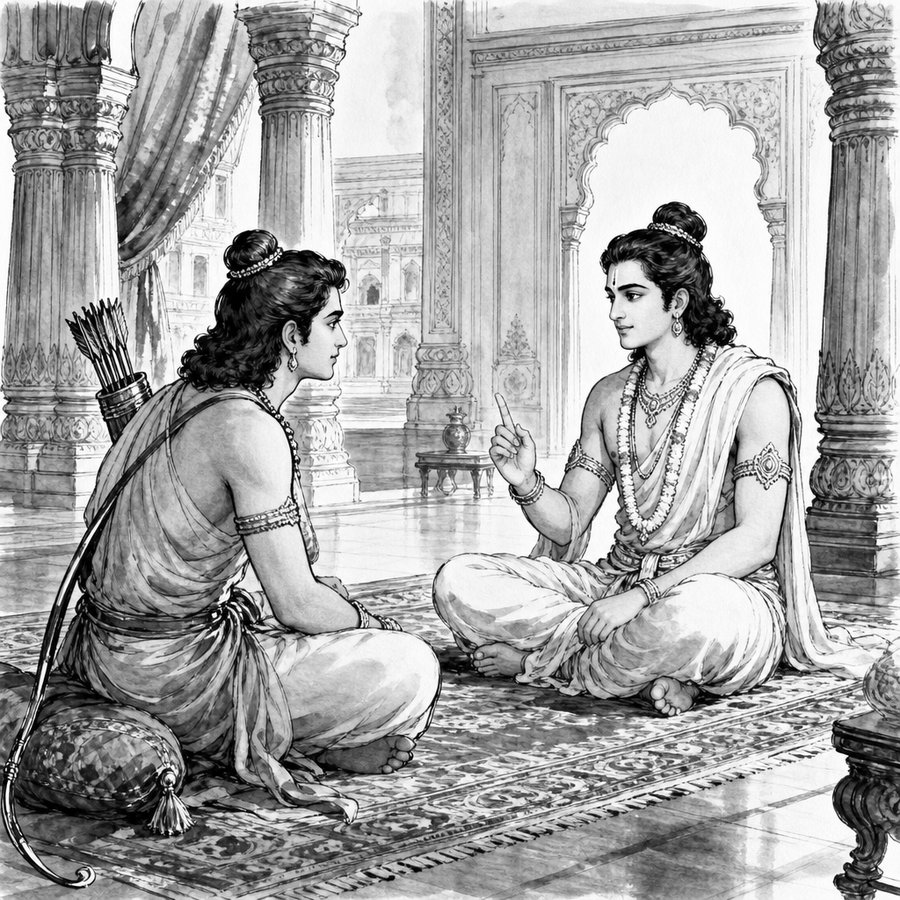
The coronation is over. Every battle is behind them, Sita has come home, and Ayodhya glows again with its old life. It is a quiet hour, and Rama sits alone at his ease. Then Lakshmana comes near and, hesitating, asks the question that has smoldered inside him for fourteen years.
Shloka 1 · The Story Begins
First Mahadeva tells this story to Parvati. He says that Rama, best of the Raghu line, took on the auspicious form of the world’s welfare, shaped the great renown of the Ramayana, and walked the ancient path exactly as the finest royal sages had walked it before him. The story about to open belongs to no ordinary hour; it is one link in that same sacred tradition.
Shloka 2 · The Ancient Stories
Then Mahadeva tells how, when the large-minded Saumitri, that is Lakshmana, asked him, Rama recounted many old and blessed stories. Among them came the story of the heedless king Nriga, who by a Brahmin’s curse fell into a tiryak birth, an animal life. These stories never arrive for nothing; behind each one lies some deeper understanding.
Shloka 3 · A Moment Alone
Now comes the moment everything has waited for. In some private hour, while Rama sat at his ease and Lakshmi herself tended his lotus feet, Saumitri, his heart grown pure, bowed with devotion and spoke with deep humility. This is the hour: no court, no one else, only two brothers and a question smoldering within.
Shloka 4 · Lakshmana’s Praise
And then Lakshmana opens his heart, though he begins with praise. You, he says, are the pure awareness within every embodied being, the atman itself, the sovereign of all, and formless. O great-minded one, you show yourself in this form only to those whose eye of wisdom has opened, those who become bees at your lotus feet and stay bound to holy company. This is more than ordinary curiosity; it is the first cry of a soul taking refuge.
Shloka 5 · Surrender
Now Lakshmana comes straight to the matter of refuge. Lord, he says, I take refuge at those lotus feet of yours, the feet that carry a soul across the world and that yogis meditate upon. Teach me in such a way that I cross this bottomless ocean of ignorance easily and in gladness. This is the axis of the whole Rama Gita, surrender and the prayer to be carried across. Here the main thing is to hand yourself over. Listening alone is not enough.
Shloka 6 · Rama Prepares to Answer
Having heard all of Lakshmana’s words, Rama, who removes the anguish of those who take refuge, his mind serene, prepares to speak. He is the ornament of the guardians of the earth, the crown jewel among kings, and the teaching he is about to give is sanctioned by the shruti. Its purpose is single: to awaken the vijnana that stills the darkness of ignorance, a realized understanding proven in experience.
Shloka 7 · The First Principle
Now Rama sets down the first thread of his teaching. First, he says, let a person perform the actions prescribed for their varna and their stage of life, for this makes the mind pure. Having completed that preparatory work in this way, and having gathered the wealth of practice, let them seek refuge in a true guru for the sake of self-realization. The teaching keeps action in place. Action scrubs the mind clean and delivers the seeker to a true guru.
Shloka 8 · The Wheel of the World
And on this note Rama closes the part, as though sowing here the seed of the whole Gita to come. Action performed with regard, he says, becomes the cause of the body’s birth. From it arise experiences pleasant and unpleasant, and attachment grows. Then come dharma and adharma, then from those this body, and from the body action again. So the world keeps turning like a wheel. The path to break this wheel will open further on.