Three bodies, five sheaths
The witness that remains · Shlokas 27 to 34
So far Rama has opened the heart of the great saying tat tvam asi, you are That. In this part he peels away the layers of the limiting adjuncts one at a time. The gross body, the subtle body, the causal body, these three bodies, and within them the five sheaths. The three states of the intellect. And at the end, when everything is let go through neti-neti, not this, not this, the pure witness that remains is the atman itself. A crystal seems to take the color of whatever lies beside it, and stays untouched all the while.
Shloka 27
Rama first points to the way in which tat tvam asi is understood. Take the full literal meaning of both words and a contradiction stands up between them; drop them altogether and nothing works either. So, when you say “that is this same man,” you release the difference of place and time, and only the man himself remains. In the same way, through partial indication, the one pure consciousness remains here, with no flaw in it. This is the right way to join the two words.
Shloka 28
Now Rama opens the first layer of the adjuncts, the gross body. The five elements meet and combine, compounded fivefold, and this gross body is formed. It is the seat where the fruits of action are enjoyed, pleasure and pain and the rest; it has a beginning and an end; it springs from primordial action; and it is only one maya-wrought adjunct of the atman.
Shloka 29
Within it lies the second layer, the subtle body. It is fitted with mind, intellect, and the ten senses, arrayed with the vital airs, and built from uncompounded elements. The wise call it the second body of the atman, the instrument through which the enjoyer tastes pleasure and the rest.
Shloka 30
And at the root of both lies the third layer, the causal body. It is beginningless, beyond the reach of words, and maya reigns in it; this is the supreme causal body. It is this difference of adjuncts that makes the one atman appear as many. So Rama says: sort through these layers in order, and hold your atman firmly in the atman itself.
Shloka 31
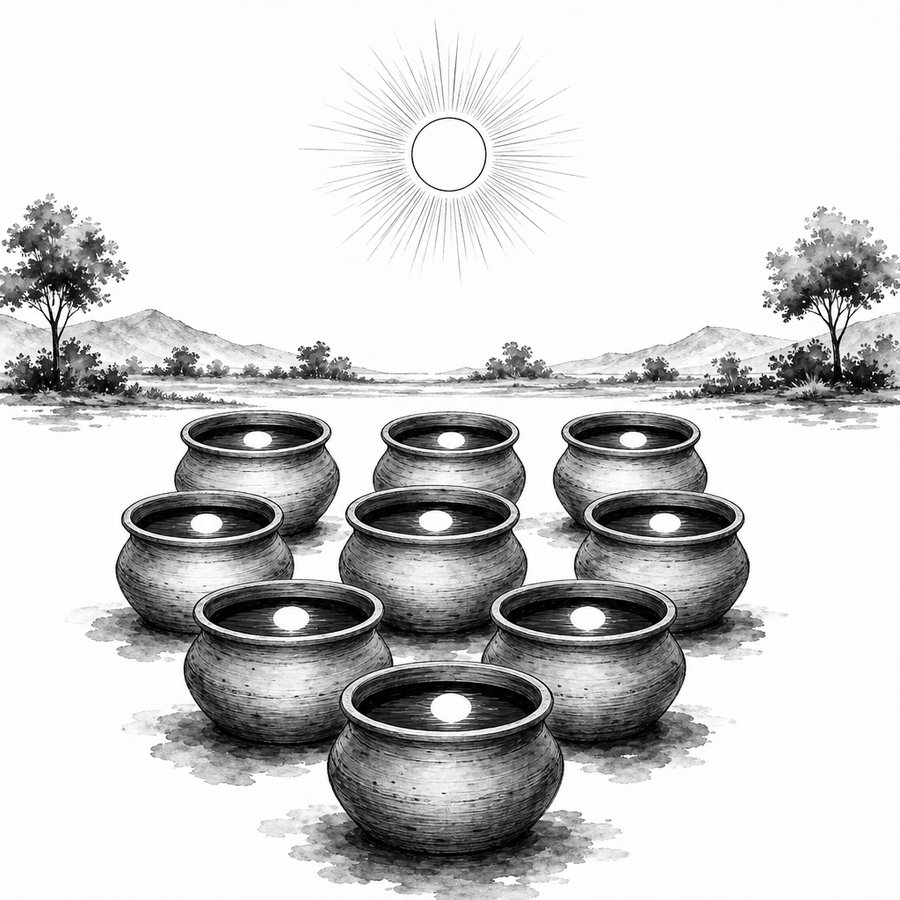
Now Rama sets down the image that is the summit of the whole Rama Gita. Seated inside those sheaths, this atman begins to shine wearing their very shape, exactly as a crystal placed beside a color seems to take on that color. It stays unattached all the while, unborn, without a second. When you examine this atman from every side, this is the truth that opens.
Shloka 32
Then Rama turns to the three states of the intellect. Because of the three gunas, the activity of the intellect shows itself here in three forms, divided into waking, dream, and deep sleep. These three cancel one another, so they are unreal. In that eternal, supreme, absolute, wholly benign Brahman they have no place.
Shloka 33
This activity of the intellect keeps turning without pause through its contact with the body, the senses, the vital airs, the mind, and the conscious atman. Its root is in tamas, so it is the mark of ignorance. As long as this activity lasts, this world of samsara keeps being born.
Shloka 34
And at the last, Rama’s final word. By the proof of neti-neti, sort everything away. Taste the nectar of dense consciousness gathered in the heart, and release the whole world. One who drinks water lets go, on his own, of the flavor dissolved in it; in the same way this entire world of samsara, whose very being the atman had only lent it, falls away by itself.