On this page
Nine days passed, and Yudhishthira’s courage broke
For nine days the field of Kurukshetra had burned under Bhishma’s arrows. On the ninth day too, when the sun set and the dreadful hour of twilight came, in which nothing of the battle can be seen, Yudhishthira saw that his own army, cut down by Bhishma, had thrown away its weapons, was fleeing in fear, and that the Somaka heroes stood beaten and hopeless. The king thought a few moments and ordered the army withdrawn. The Kauravas too gathered in their army, and the great warriors of both sides returned to their camps. Because Bhishma had beaten the Pandavas and Srinjayas that day, the sons of Dhritarashtra, praising him and rejoicing, saw him to his tent.
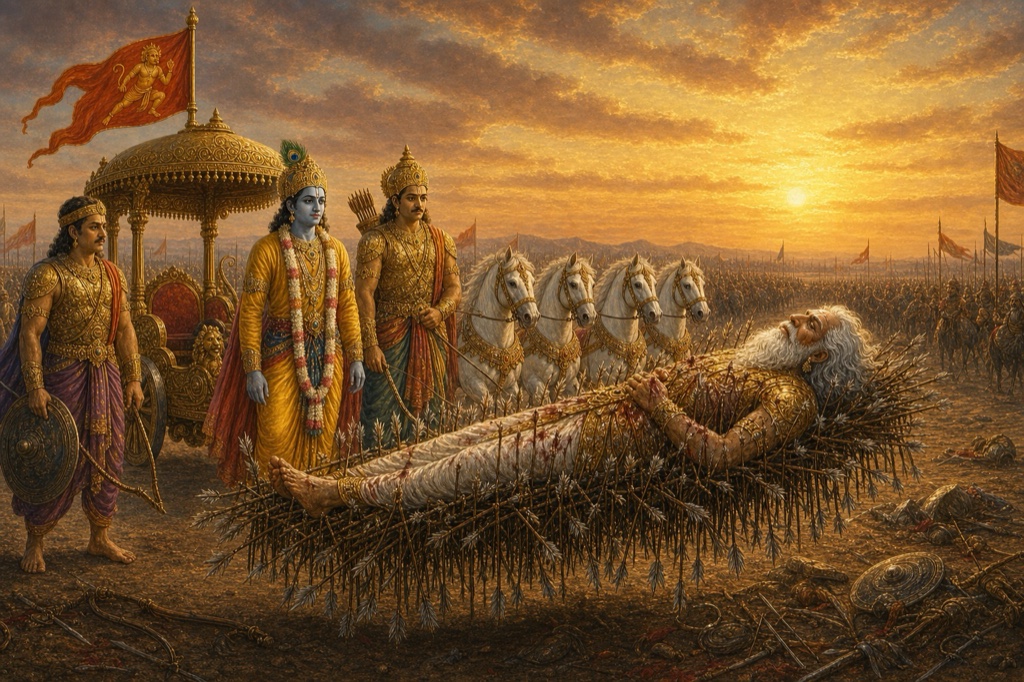
A key to reading this (lineage): Bhishma is the son of Santanu and Ganga, and so he is called Gangeya and Devavrata. To both the Pandavas and the Kauravas he is the grandsire, the eldest and most honored man on the father’s side of both these houses. The Srinjayas and the Somakas are the Panchala warrior clans on the Pandavas’ side.
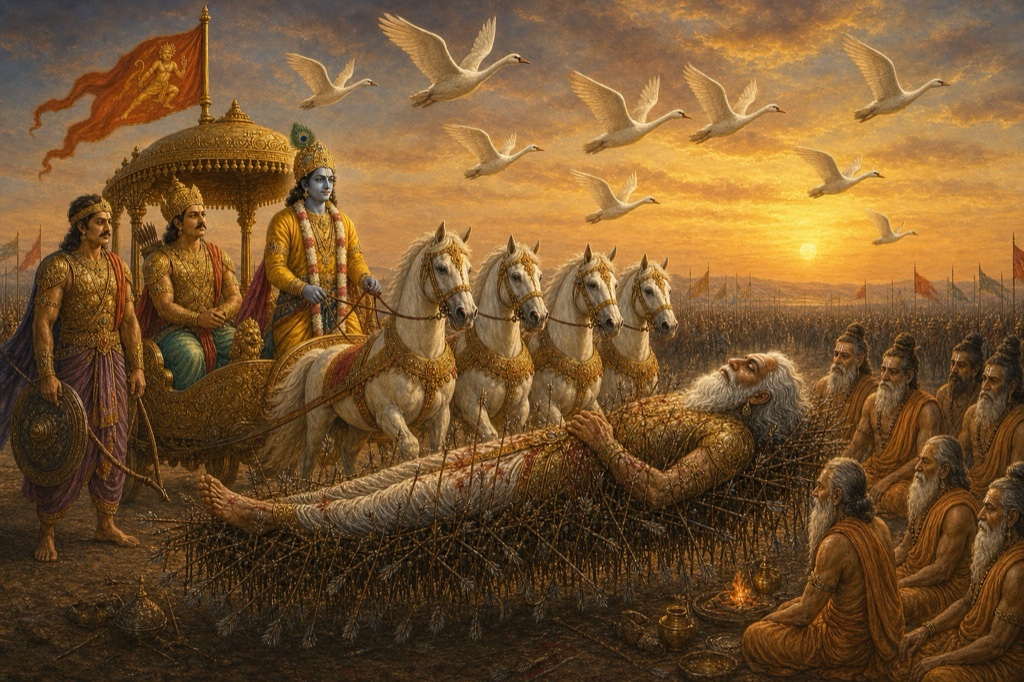
Night came down, the night that carries off the senses of all beings. In that dread hour the Pandavas, the Vrishnis, and the unconquered Srinjayas gathered for counsel. Then Yudhishthira, after long thought, cast his eyes on Vasudeva Krishna and said, “Krishna, look at this Bhishma of fierce might. As an elephant crushes a forest of reeds, he crushes my army. We cannot lift our eyes to that one. Like a raging wildfire he licks up my army. Bow in hand, filled with wrath, raining arrows, he grows as terrible as the serpent Takshaka. An angry Yama can be beaten, and Indra with the thunderbolt, and Varuna with his noose, and Kubera with his mace, but Bhishma in his fury is unconquerable in battle.”
Yudhishthira’s voice had broken from within. He said, “Through the weakness of my mind I am drowning in a sea of grief. I will go to the forest; that is better for me. I no longer wish for war. As a moth leaps into a burning fire and finds only death, so do I fall upon Bhishma. Showing my valor for the sake of the kingdom, I am, alas, being led to ruin. My brave brothers are terribly wounded by arrows. For love of me, their elder brother, they were stripped of their kingdom and had to go to the forest. Madhusudana, on my account Draupadi was plunged into this misery. If my brothers and I are worthy of your grace, then, Krishna, tell me the way of my good, without breaking your own dharma.”
Hearing these words and the whole state of things, Krishna answered in compassion, comforting Yudhishthira, “Firm in truth, do not grieve, you who have Arjuna and Bhima for slayers of foes. These two have the fire and the wind in their fierceness, and the two sons of Madri are heroes like Indra. For the bond of goodwill between us, set me too to this task. I myself will fight Bhishma. What is there, at your word, that I cannot do in this great war? If Arjuna does not wish to kill him, I alone, on a single chariot, will throw down that old grandsire before the sons of Dhritarashtra. But, king, if you see victory certain in Bhishma’s death, then this task is not heavy for Arjuna either. Earlier, at Upaplavya, Partha vowed before many that he would kill the son of Ganga. The words of Partha should be kept.”
Yudhishthira said, “It is as you say. Where you are on my side, I would conquer the gods with Indra, let alone Bhishma. But, Krishna, for the sake of your greatness I cannot make your word false. You have already vowed that you will not fight for me, only counsel. So, Madhava, help me without fighting. And there is one more thing that has come to my mind. Bhishma told me he would not fight for me, but would surely give me good counsel. So let us all go with you to Devavrata and ask him himself the means of his death. We were children, we were orphans, and he reared us. That grandsire, the father of our father, is the very one from whom, alas, I would today ask the way to his death. Shame on this Kshatriya calling.”
The gist: broken by nine days of slaughter, Yudhishthira went so far as to speak of going to the forest. Krishna offered to take up arms himself, but Yudhishthira reminded him of his vow not to fight. In the end they resolved to go to Bhishma and ask him the means of his own death. Here opens the hard moral knot of the Mahabharata, where the disciples go to their revered grandsire to ask him the secret of killing him.
The grandsire himself reveals the door of his death
Having resolved this, the Pandavas and Vasudeva took off their armor and weapons and went together into Bhishma’s tent. Inside, they bowed their heads to the grandsire and took refuge with him. Bhishma spoke words of affection. “Welcome, man of the Vrishni line. Welcome, Dhananjaya. Welcome to you, King Yudhishthira, and to you, Bhima, and to you, twin brothers. What may I now do to add to your joy? However hard it may be, I will do it with all my heart.”
To the son of Ganga, who spoke thus again and again with such affection, Yudhishthira said with a glad and loving heart, “How may we gain victory, how may we gain the kingdom, and how may this slaughter of creatures be stopped? Tell me all this, lord. Tell me the means of your own death. Hero, how can we bear you in battle? You give the enemy no gap. Seeing your bow always drawn to a circle, no one can tell when you take up an arrow, when you aim, and when you loose. Grandsire, tell us the means by which we may defeat you, gain the kingdom, and stop this ruin of my army.”
The son of Santanu said to the son of Pandu, “While I live, victory in battle cannot be yours; this I say truly. But when I am beaten in battle, then you may win. So if you wish for victory, throw me down without delay. Sons of Pritha, I give you leave; strike me as you please. With me killed, all the rest will be killed, so do as I say.”
Yudhishthira asked again, “In your wrath you become like Death with his mace. Indra with the thunderbolt, or Varuna, or Yama may be beaten, but you are unconquerable even to the gods with Indra and the Asuras. What then is the means?”
Bhishma said, “What you say is true. When I take up bow and arrow and fight with care, the gods with Indra and the Asuras cannot beat me. But if I lay aside my weapons, then these great warriors can kill me. With one who has thrown away his weapons, one who has fallen, one whose armor has slipped, one whose standard is down, one who is fleeing, one who is afraid, one who says ‘I am in your refuge,’ one who is a woman, one who bears a woman’s name, one unable to guard himself, one who has an only son, or one of low birth, I do not fight. And hear this too: I have a rule that I never fight when I see an ill omen.
Now Bhishma opened the door he knew. He said, “In your army is Drupada’s son called Shikhandi, wrathful in battle, brave, and ever victorious. He was a woman first and became a man later; this you all know well. Let Arjuna, in his armor, put Shikhandi before him and attack me with his keen arrows. When Shikhandi, who was a woman first, is before me, I will not wish to strike him, even armed with bow and arrow. On that chance let Dhananjaya the son of Pandu pierce me on every side with his arrows. Except for Krishna and Arjuna, I see no one in the three worlds able to kill me. So let Arjuna put Shikhandi or someone else before him and throw me down from my chariot. Then victory is certain.”
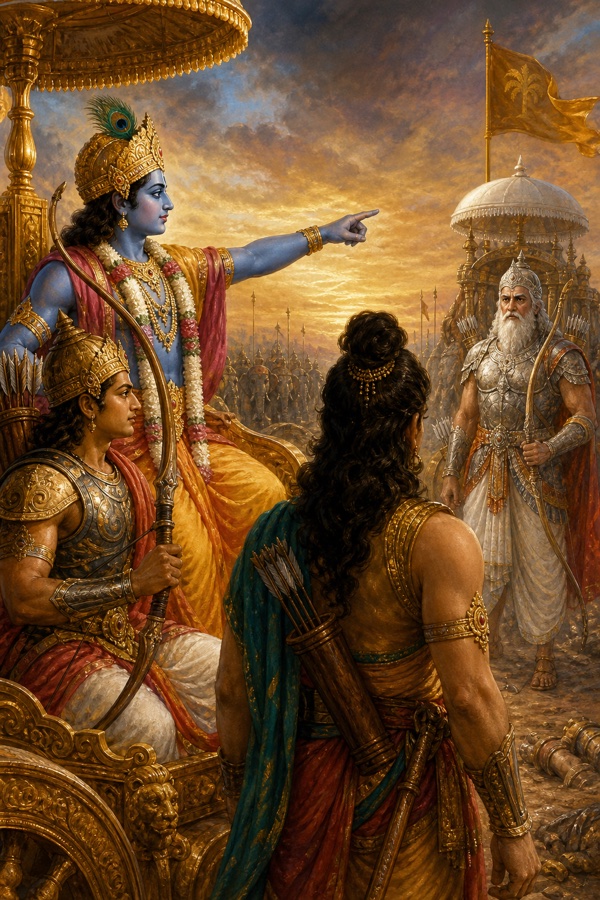
A key to reading this (the idea): Shikhandi was Drupada’s daughter, made a man by a boon, and bound to the Amba of Bhishma’s earlier life who had sworn enmity against him. Bhishma’s vow is that he raises no weapon against a woman, or against one born a woman, or against one who bears a woman’s name. That very vow becomes the door of his death. This is part of the moral weave of the Mahabharata, where dharma itself leaves a man unguarded.
Knowing all this, the Pandavas bowed to the grandsire and went back to their camps. But hearing the words of the son of Ganga, ready now to go to the other world, Arjuna burned with grief, and his face bent low in shame. He said, “Madhava, how am I to fight the grandsire, who is greater in years, full of wisdom and judgment, the oldest man of our line? As a child at play I would climb onto his lap with my dust-covered body and soil him. He is the father of my father Pandu. Once, as a child on his lap, I called him ‘Father.’ Then he said, ‘I am not your father, but your father’s father, O Bharata.’ The one who said that, how am I to kill him? Whether victory or death comes, I will not fight that one. Krishna, what do you say?”
Vasudeva said, “Jishnu, having first vowed the killing of Bhishma, how can you now draw back from it, against the Kshatriya’s dharma? Partha, throw down from his chariot that Kshatriya unconquerable in battle, for without killing the son of Ganga your victory will never come. The gods have settled it so, and what is set beforehand must happen. Brihaspati told Indra in old times that one who comes as a foe, even if old and full of every merit and worthy of reverence, must be killed. Dhananjaya, this is the eternal dharma of the Kshatriya, that he fight without malice, protect his subjects, and perform sacrifices.”
Arjuna said, “Krishna, Shikhandi will be the cause of Bhishma’s death, for at the sight of the Panchala prince Bhishma gives up striking. So, putting Shikhandi before us and at our head, we will bring down the son of Ganga. I will hold the other archers back with my arrows, and Shikhandi alone will fight Bhishma, for I have heard from the prince himself that he will not strike Shikhandi.” Having resolved this and taken Bhishma’s leave, the Pandavas returned with Krishna, glad at heart, and went to their rest.
The gist: Bhishma himself opened the door of his death, the placing of Shikhandi in front. Arjuna’s childhood love and Krishna’s hard Kshatriya dharma stand here face to face. Krishna pushed Arjuna toward duty by recalling his old vow. This is the moment where devotion, dharma, and grief clash together, and no one wins an easy victory.
Sunrise on the tenth day, Shikhandi before them all
Dhritarashtra asked, “Sanjaya, how did Shikhandi move toward the son of Ganga, and how did Bhishma move toward the Pandavas? Tell me all this.”
Sanjaya said, “At the hour of sunrise the Pandavas, with the sound of kettledrums, cymbals, and milk-white conches, went out for battle with Shikhandi at the front of their army. Shikhandi stood at the very head of the whole army. Bhima and Arjuna became the guards of his chariot wheels. Behind him were Draupadi’s sons and Abhimanyu. The great warriors Satyaki and Chekitana guarded the rearmost line. Behind them came Dhrishtadyumna ringed by the Panchalas, then King Yudhishthira with his twin brothers, then Virata, then Drupada. The five Kaikeya brothers and Dhrishtaketu guarded the rear of the Pandava army.”
Sanjaya said, “The Kauravas too set out with the great warrior Bhishma at the head of their whole army. Behind him were the great archer Drona and his son Ashvatthama, then Bhagadatta ringed by his elephant force, then Kripa and Kritavarma, then the Kamboja king Sudakshina, the Magadha king Jayatsena, Subala’s son Shakuni, and Brihadbala. Each day Bhishma formed his array, at times the Asura, at times the Paishacha, at times the Rakshasa. With Arjuna at the front and Shikhandi in the van, the Pandavas advanced toward Bhishma, scattering arrows of many kinds.”
A key to reading this (the idea): a vyuha is a special shaping or mold of the army, in which the soldiers stand in a set figure. The Asura, Paishacha, and Rakshasa arrays are the names of such shapes, whose form and fierceness their names suggest. Bhishma formed a different array each day, so the enemy could not guess his move in advance.
Pierced by Bhishma’s arrows, many blood-soaked Kaurava warriors passed to the other world. Nakula, Sahadeva, and Satyaki began to press the Kaurava army hard, and it could not stand before that vast Pandava host, but fled on every side. Then Dhritarashtra asked what the enraged Bhishma did, seeing his army hard-pressed. Sanjaya said, “That slaughter of his army Bhishma could not bear. The unconquered great archer set aside all care for his life and rained long, calf-toothed, and crescent-shaped arrows on the Pandavas, the Panchalas, and the Srinjayas. He held back the five great warriors of the Pandavas, killed countless elephants and horses, and, throwing chariot-warriors from their chariots, riders from their horses, and elephant-riders from the backs of their beasts, struck terror into the foe. His bow, like Indra’s, seemed always drawn to a circle.”
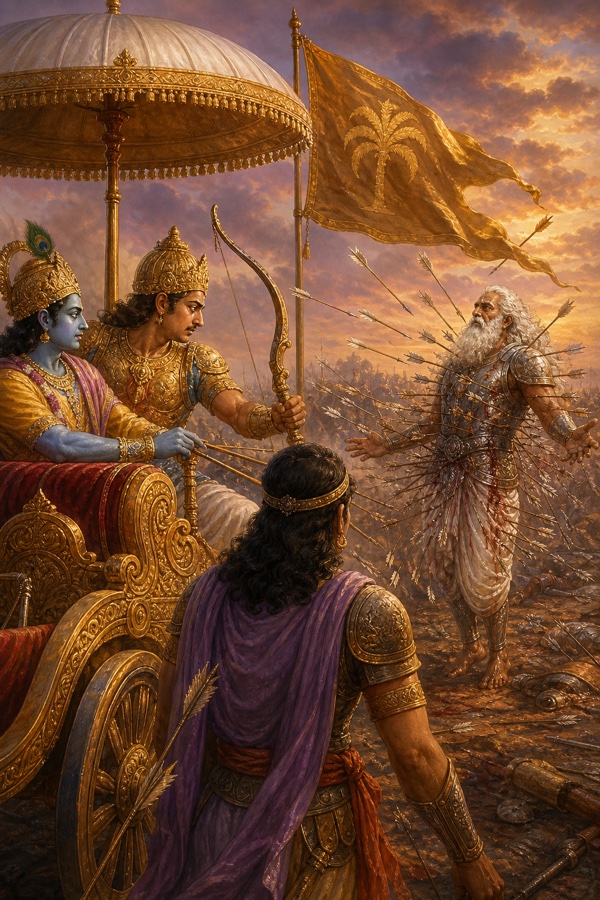
On that tenth day Bhishma burned Shikhandi’s division like a wildfire. Then Shikhandi, wrathful as a poison-filled snake, struck Bhishma in the middle of the chest with three arrows. Struck deep, Bhishma saw that it was Shikhandi. Angry, yet unwilling to fight him, Bhishma said with a laugh, “Whether you strike me or not, I will never fight you. You are that Shikhandi the Creator made you first.”
Hearing this, Shikhandi, licking his lips in rage, said, “I know the strength with which you can destroy a Kshatriya line. I have heard the tale of your battle with Parashurama, and of your more-than-human prowess. Still I will fight you today. To do what is dear to the Pandavas and to myself I will fight you today. I will surely kill you; I swear it by my truth. Ever-victorious Bhishma, look on this world for the last time.” Saying this, Shikhandi pierced Bhishma with five straight arrows.
A sub-tale: this enmity of Shikhandi toward Bhishma was no chance thing. Earlier in the Mahabharata, Amba, the daughter of the king of Kashi, was carried off by Bhishma from her own choosing, then cast aside, so that she could not marry. Amba took a vow of revenge against Bhishma, performed austerities, gave up her life, and was born in Drupada’s house as Shikhandi, who turned from woman to man. This is why Bhishma, counting him “Born in a woman’s form,” raises no weapon against him, and why this enmity of an earlier life becomes the instrument of his death.
Hearing his words, Arjuna, holding Shikhandi to be Bhishma’s destroyer, urged him on. “I will stay behind you and scatter the enemy with my arrows. Fall on Bhishma in your fury. If you return today without killing Bhishma, you and I both will be a laughingstock in the world. You stop the grandsire, and I will hold back Drona, Ashvatthama, Kripa, Duryodhana, Chitrasena, Vikarna, the Sindhu king Jayadratha, Vinda and Anuvinda of Avanti, the Kamboja king Sudakshina, Bhagadatta, the Magadha king, Somadatta’s son, and all the rest of the great warriors, as a shore holds back the surging sea. You kill the grandsire.”
The grandsire’s last resolve, and a fierce duel
Dhritarashtra asked whether Bhishma’s chariot or bow had broken. Sanjaya said, “No, in battle neither Bhishma’s bow broke nor was his chariot harmed. He was killing the enemy with straight arrows. On the tenth day he tore the enemy army into thousands. The Pandavas could not defeat that great archer. Then Dhananjaya, who could draw the bow even with his left hand, came there, roaring like a lion and raining arrows. Frightened at his roar, the Kaurava warriors fled like small animals at the lion’s sound.”
Seeing this, the fearful Duryodhana said to Bhishma, “The son of Pandu with his white horses and Krishna for his charioteer is burning my whole army like a wildfire. See, my soldiers are all fleeing. As a herdsman drives cattle in the forest, so my army is being driven. Bhima, Satyaki, Chekitana, the two sons of Madri, Abhimanyu, Dhrishtadyumna, and the Rakshasa Ghatotkacha are all breaking my army. Except for you I see no refuge for these hard-pressed soldiers.”
Then your father Devavrata thought a moment and, comforting Duryodhana, said, “Duryodhana, listen calmly. Before this I vowed to you that I would kill ten thousand fine Kshatriyas each day and only then return from battle. I have kept that vow. Today I will do a still greater deed. Today either I will sleep, being killed, or I will kill the Pandavas. From the debt of the food you have given me, I will free myself today by casting away my life at the head of your army.” Saying this, he fell on the Pandava army, raining arrows among the Kshatriyas.
On that tenth day Bhishma, showing his prowess, killed hundreds of thousands of warriors. He drained the fire of the bright kings among the Panchalas as the sun drains the water of the earth with its rays. Killing ten thousand swift elephants, ten thousand horses with their riders, and a full two hundred thousand foot soldiers, that man blazed like a fire without smoke. Like the burning sun at the northern turn, no Pandava could lift his eyes to him.
A key to reading this (the numbers, in modern terms): vast figures like “Ten thousand elephants” or “Two hundred thousand foot” are part of the Mahabharata’s poetic style, made to set in the mind the horror of one day’s slaughter. It is right to take them as heightened images, with no literal count of troops intended, showing the enormousness of that age’s imagining of war.
Then Arjuna said to Shikhandi, “Move toward the grandsire. Feel not the least fear of Bhishma today. I will throw him down from his fine chariot with my keen arrows.” Hearing this, Shikhandi fell on the son of Ganga. Dhrishtadyumna and Abhimanyu, glad, sprang at Bhishma too. Old Virata, Drupada, and Kuntibhoja, in their armor, advanced on Bhishma. Nakula, Sahadeva, Yudhishthira, and all the rest rushed toward Bhishma as well.
The Kaurava warriors held them back. Chitrasena checked Chekitana, Kritavarma checked Dhrishtadyumna, Somadatta’s son Bhurishravas checked Bhima, Vikarna checked Nakula, and Kripa checked Sahadeva. Duryodhana himself checked Satyaki, and the great archer Duhshasana checked Arjuna as he advanced with Shikhandi in front. Then a wonderful thing was seen: Arjuna, reaching Duhshasana’s chariot, could go no further, for like a shore holding back the sea, Duhshasana held him. A battle fierce as the old duel of Maya and Indra arose between the two. Arjuna pierced Duhshasana with a hundred arrows, and Duhshasana drove three keen arrows into Arjuna’s forehead, and pierced with them Arjuna shone like Meru with its crests. In the end, hard-pressed by Partha, Duhshasana fled toward Bhishma’s chariot, and to the drowning man Bhishma became the island.
Meanwhile the Rakshasa Alambusha checked Satyaki, Sudakshina checked Abhimanyu, Ashvatthama checked Virata and Drupada, and Drona checked Yudhishthira himself. Hearing the thunderclap roll of Drona’s chariot, the Prabhadrakas trembled, and Yudhishthira’s vast army, held by Drona, could not move a single step forward. Thus the Kaurava heroes held back the Pandava great warriors in place after place to guard Bhishma, yet your sons’ army began to shake on every side with the slaughter.
The gist: on the tenth day Bhishma gave up all care for life and did a slaughter without match, while inwardly inviting his own death. His resolve to repay the debt of food for Duryodhana, and on the other side the Pandava effort to reach Bhishma with Shikhandi in front, ran on together. Every guarding line bears witness to how hard it was to bring the grandsire down.
Bhishma became fire, and himself wished to give up his life
Dhritarashtra asked again how Bhishma fought on that tenth day. Sanjaya said, “That day, when Bhishma and Arjuna came face to face, there was a terrible slaughter. The son of Santanu, master of high and divine weapons, killed thousands of warriors again and again. Many heroes whose names and families were not even known, but who never turned from battle, were killed that day by Bhishma. Having burned the Pandava army for ten days, Bhishma gave up the will to guard his life. ‘I will kill no more of these warriors,’ he thought, and at the head of his own army he began to wish for his own death.”
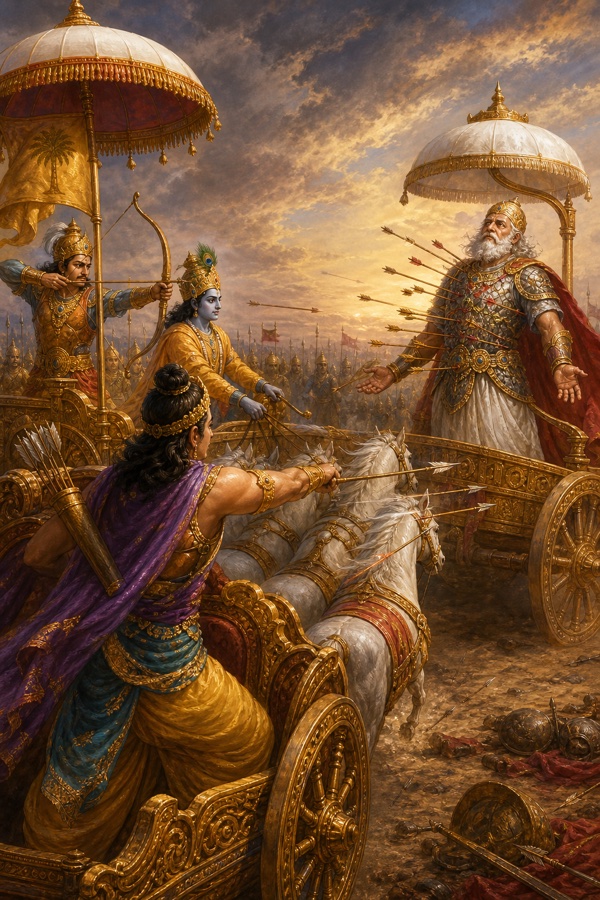
Seeing Yudhishthira near, Bhishma said, “Yudhishthira hear these righteous words that lead to heaven. Bharata, I no longer wish to guard this body. Long has the time passed in the slaughter of men in battle. If you would do what pleases me, put Partha with the Panchalas and Srinjayas at your front and strive to kill me.” Understanding his meaning, Yudhishthira advanced to battle with the support of the Srinjayas. Then Dhrishtadyumna and Yudhishthira urged their army on. “Advance, fight, conquer Bhishma. You all have the guard of Jishnu, Arjuna of unfailing aim. Srinjayas, fear not Bhishma today. Putting Shikhandi in front, we will surely conquer Bhishma today.”
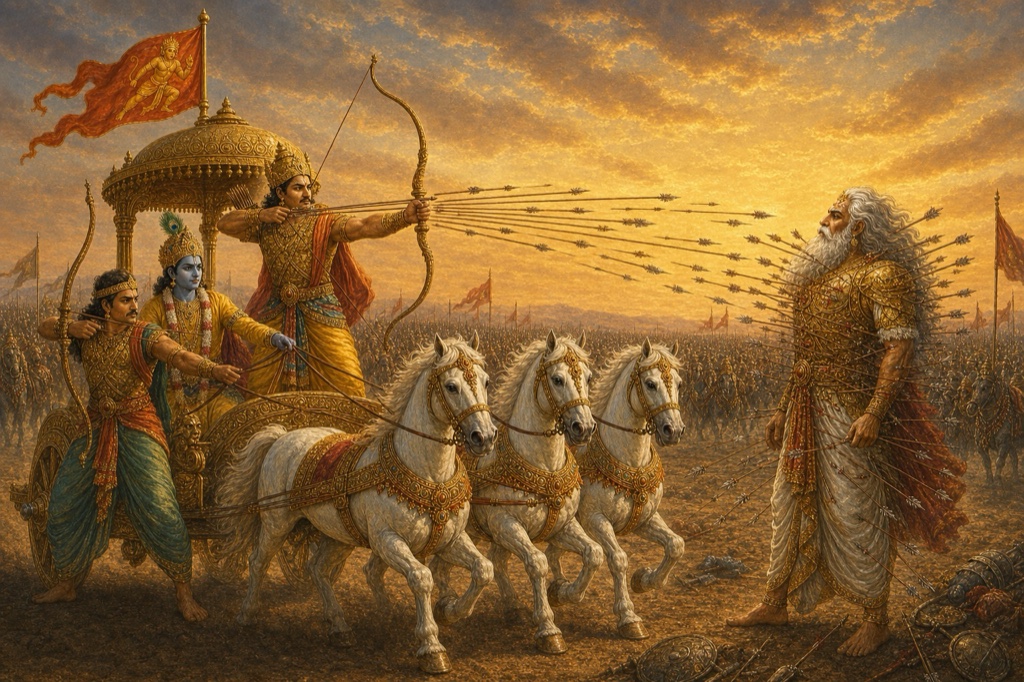
Then the Pandavas, with Shikhandi and Arjuna in front, fell on Bhishma, and the Kauravas, with Bhishma in front, fell on the Pandavas. The earth shook with the rush of the two armies. The blare of conches and the lion-roars made a fearful din, and the rising dust spread like a cloud, in which the flashing weapons glittered like lightning. In that battle, as though it were the fight of two hawks over a piece of flesh, Bhishma became the very stake on which the victory of the Kaurava army rested.
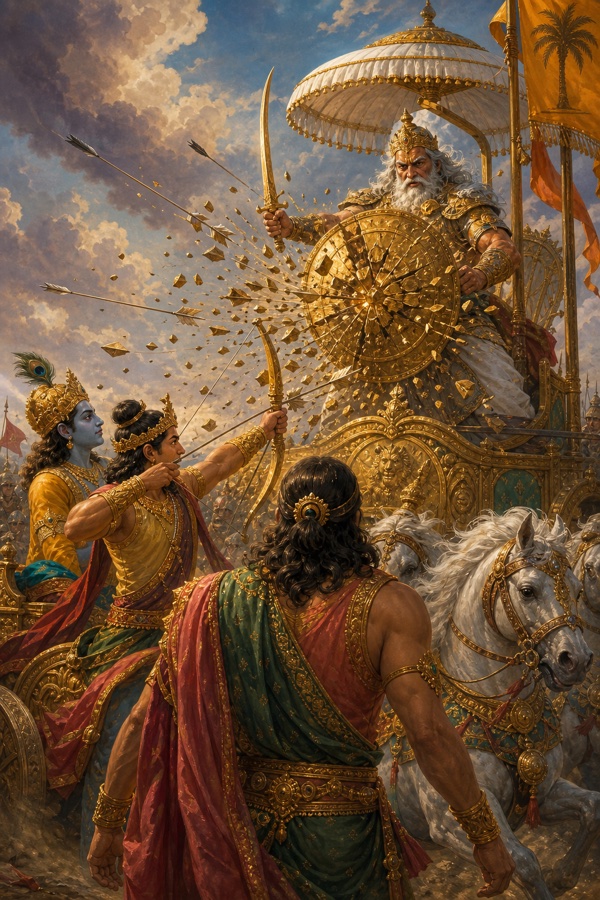
Abhimanyu fought Duryodhana for Bhishma’s sake, Paurava fought Dhrishtaketu, and Ashvatthama fought Satyaki. Paurava and the Chedi king Dhrishtaketu, their chariots broken, closed on foot with sword and shield, wounded each other on the head and shoulder, and both fell; Jayatsena bore Paurava, and Sahadeva bore Dhrishtaketu, from the field. Abhimanyu fought the Kosala king Brihadbala, and Bhima fought the elephant force. Mountain-like elephants, falling under Bhima’s hand, filled the earth with their shrieks.
Arjuna, reaching the son of Ganga, began to press him with many arrows, as one rutting elephant in the forest falls on another. Then Arjuna, the son of Kunti, called to Shikhandi, “Move, move, toward Bhishma, and kill him.” Then Arjuna, putting Shikhandi in front, rushed toward Bhishma. In that hour Bhishma’s chariot was his fire-altar, his bow the flame of that fire, and swords and darts and maces its fuel. The rain of arrows he loosed was the blazing sparks of that fire, with which he was reducing the Kshatriyas to ash.
Shikhandi struck Bhishma in the middle of the chest with ten broad arrows. The son of Ganga only looked at Shikhandi with anger, as though he would burn the Panchala prince with that look, but remembering his woman’s form he did not strike him, in the sight of all. Shikhandi could not understand it. Then Arjuna said, “Run quickly and kill the grandsire. Hero, what more shall I say? In Yudhishthira’s army I see none fit to fight Bhishma but you.” Shikhandi covered the grandsire with many weapons, but Devavrata passed over those arrows and held back only the enraged Arjuna, sending the Pandava army to the next world with his keen arrows.
A key to reading this (the idea): this state of Bhishma is the peak of the Mahabharata’s moral tension. He knows Shikhandi is the instrument of his death, yet by his vow he raises no weapon against him. Call this faithfulness to dharma and to his vow, a faithfulness that knowingly leaves his own life unguarded. Shikhandi’s arrows only make him the medium; the real arrows are Arjuna’s.
Then, under Bhishma’s arrows, Satyaki, Bhima, Arjuna, Drupada, Virata, Dhrishtadyumna, and the rest of the Pandava great warriors began to sink in a sea of grief, but Arjuna guarded them all. Duryodhana said to his warriors, “Fall on Arjuna from every side. Bhishma, who knows the duty of a commander, will guard you all.” Then warriors of many peoples, the Videhas, Kalingas, Daserakas, Nishadas, Sauviras, Bahlikas, Daradas, Malavas, Surasenas, Sivis, Salvas, Sakas, Trigartas, and Kaikeyas, fell on Arjuna like swarms of moths on a fire. Arjuna, calling up his divine weapons and weaving thousands of arrows, burned them all like moths in a flame. He felled Duhshasana’s horses and charioteer, and left Vivimshati, Kripa, Vikarna, and Shalya without chariots, and, having beaten these great warriors before noon, blazed like a wildfire without smoke. Forcing the Kaurava army to turn its back, Partha ran a river of blood across the field.
The knowledge given by Parashurama, and the tenth day’s slaughter
Sanjaya said, “When the warriors of both armies were arrayed on the field, they all fought with their minds set on the world of Brahma. In that general engagement, one kind of warrior did not fight one kind of warrior; chariot-warriors did not meet only chariot-warriors, foot only foot, horsemen only horsemen. Like madmen they all closed together. Elephants and men mingled so that the difference between them was lost.”
A key to reading this (the idea): “Fighting with the mind set on the world of Brahma” means the heroes fought embracing death, in the belief that a Kshatriya who wins a hero’s death in battle goes to the highest worlds. For those who died at Kurukshetra this passage was held to be still more open. This is the faith of that age’s Kshatriya dharma, which makes even war a kind of sacrifice.
Sanjaya said, “In old times Parashurama had taught Bhishma that knowledge of weapons which destroyed the ranks of the foe. On the strength of that knowledge the Kuru grandsire had each day killed ten thousand chariot-warriors. But on the tenth day Bhishma killed, single-handed, ten thousand elephants. Then he killed seven great warriors of the Matsyas and Panchalas, and by the skill of that learning felled five thousand foot soldiers, one thousand tuskers, and ten thousand horses. After this he killed Satanika, Virata’s brother, and then a full thousand Kshatriyas with his broad arrows. Whatever Pandava Kshatriyas followed Dhananjaya and came near Bhishma, all went to the realm of Yama.”
On the tenth day, standing between the two armies with bow in hand, Bhishma shone so that, like the noonday summer sun, no king could look at him. Seeing this, Krishna said gladly to Arjuna, “There stands Bhishma, the son of Santanu, between the two armies. Put forth your strength, kill him, and win the victory. Check him at the place where he is breaking our ranks. Lord, no one but you dares to bear Bhishma’s arrows.” Then Arjuna, in that moment, made Bhishma, with his chariot, horses, and standard, invisible with his arrows, but Bhishma too cut apart Arjuna’s arrows with his own arrow-rain.
Then the Panchala king, Dhrishtaketu, Bhima, Dhrishtadyumna, Nakula and Sahadeva, Chekitana, the five Kaikeya brothers, Satyaki, Abhimanyu, Ghatotkacha, the five sons of Draupadi, Shikhandi, Kuntibhoja, Susarman, and Virata, these and many other strong warriors, hard-pressed by Bhishma’s arrows, began to sink in a sea of grief, but Arjuna saved them all. Then Shikhandi, guarded by Arjuna, fell alone and swiftly on Bhishma. Arjuna first killed those who followed Bhishma, then sprang at him himself. Satyaki, Chekitana, Dhrishtadyumna, Virata, Drupada, the two sons of Madri, Abhimanyu, and the five sons of Draupadi, all in Arjuna’s guard, fell on Bhishma alone.
All those firm archers pierced the many limbs of Bhishma’s body with sure arrows. Passing over those countless arrows, the unshaken Bhishma drove into the Pandava ranks and made all the arrows fruitless, as though in sport. Again and again he looked at Shikhandi with a laugh, but remembering his woman’s form, he loosed not a single arrow at him. On the other side he killed seven great warriors of Drupada’s division. Then a cry of woe rose among the Matsyas, Panchalas, and Chedis who were falling on that lone hero. They covered that single warrior, Bhishma the son of Bhagirathi, with foot soldiers, horses, chariots, and arrow-rain, as clouds cover the sun. Then in that battle, like the old war of gods and Asuras, the diadem-crowned Arjuna, putting Shikhandi before him, pierced Bhishma again and again.
The gist: Bhishma asked Yudhishthira himself to strive for his death, and on the tenth day, on the strength of Parashurama’s teaching, wrought a boundless slaughter single-handed. But now all the Pandava great warriors, in Arjuna’s guard, fell on him together with Shikhandi in front. Shikhandi’s presence ties Bhishma’s hands, and Arjuna’s arrows keep falling. The grandsire’s end is near.
The fall from the chariot, and the bed of arrows
Sanjaya said, “Thus all the Pandavas, putting Shikhandi in front and ringing Bhishma on every side, pierced him again and again. All the Srinjayas together rained on him fearsome Sataghnis, spiked maces, axes, mallets, short clubs, darts, lances, kampanas, long arrows, calf-toothed arrows, and rockets. Pierced by so many warriors, Bhishma’s armor was cut through on every side. Yet, pierced in every vital spot, Bhishma felt no pain. To his enemies he seemed the fire of the world’s end that rises at the close of an age. His bow and arrows were the blazing flames of that fire, the flight of his weapons its wind, the rattle of his chariot wheels its heat, and the bodies of heroes its abundant fuel.”
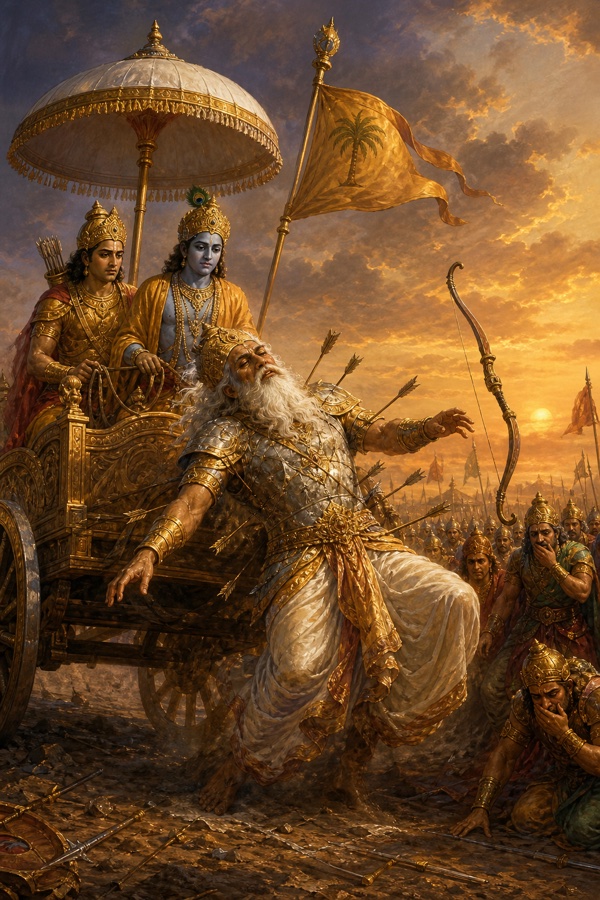
A key to reading this (the idea): the Sataghni is an old weapon whose very name means “The killer of a hundred”; it is taken to be a kind of spiked engine or projectile. The kampana too is a special thrown weapon. To liken Bhishma, near death, to the fire of the world’s end shows his unconquered spirit, that until the moment of his fall he stayed a warrior.
Bhishma moved through the crowds of the kings’ chariots, at times coming out of the press, then passing again through its midst. Passing over the Panchala king and Dhrishtaketu, he drove into the middle of the Pandava army, and pierced the six warriors Satyaki, Bhima, Arjuna, Drupada, Virata, and Dhrishtadyumna with very keen arrows that could split any armor. Those great warriors too, checking his arrows, struck Bhishma hard, each with ten arrows. Then the arrows Shikhandi loosed, whetted on stone and winged with gold, sank swiftly into Bhishma’s body.
Then the enraged, diadem-crowned Arjuna, putting Shikhandi in front, sprang at Bhishma and cut his bow. Seeing this, Drona, Kritavarma, the Sindhu king Jayadratha, Bhurishravas, Sala, Shalya, and Bhagadatta, seven great warriors, could not bear it, and in fury, calling up their divine weapons, fell on Arjuna with a rain of arrows. The din of their rush was like the roar of the swelling sea at the end of an age. “Kill, bring him, seize, pierce, cut him down,” this fearful uproar rose around Arjuna’s chariot. Hearing it, Satyaki, Bhima, Dhrishtadyumna, and the other Pandava great warriors came forward to guard Arjuna.
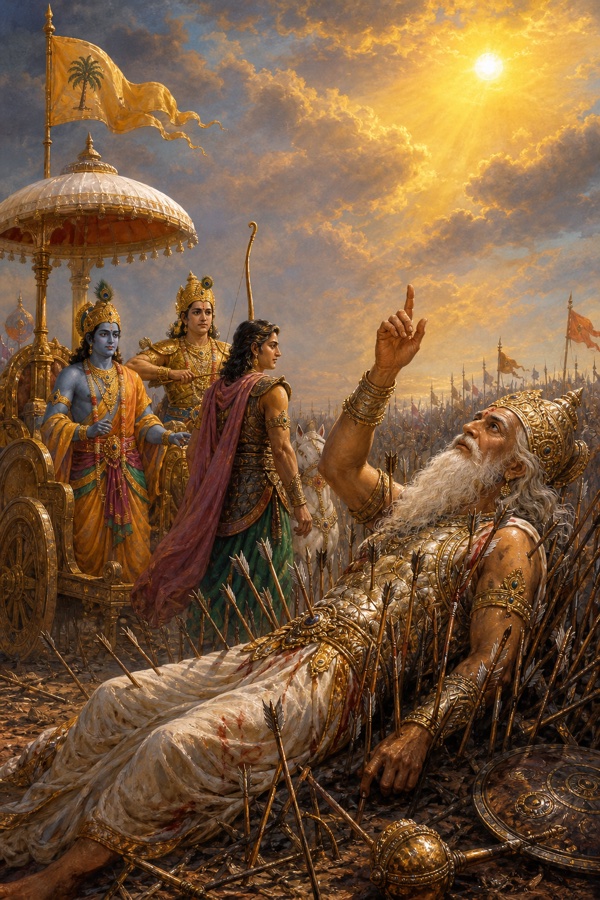
Pierced by the arrows of Arjuna and Shikhandi, Bhishma still pierced the Pandava army, but now Arjuna’s arrows sank ceaselessly into his vital spots, and Shikhandi’s presence kept his hands tied. His armor was shattered, and his whole body was riddled with arrows. A little before the sun’s turn toward the north, with the hour of twilight near, that grandsire of the Kurus, pierced with countless arrows, like the boundary tree of the Kuru line, bent from his chariot toward Arjuna and fell.
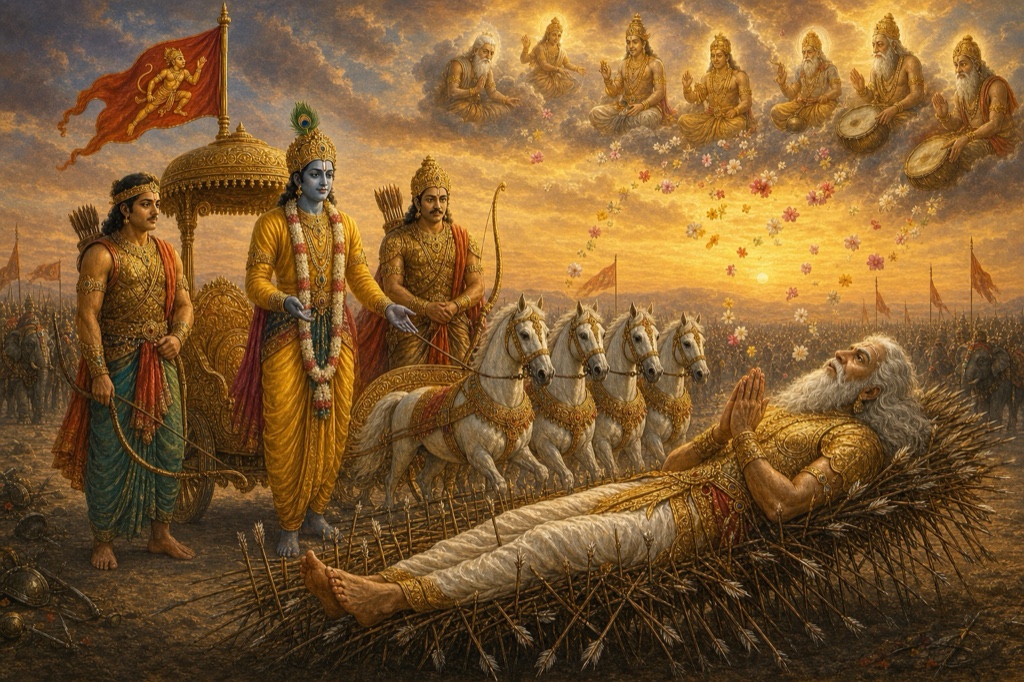
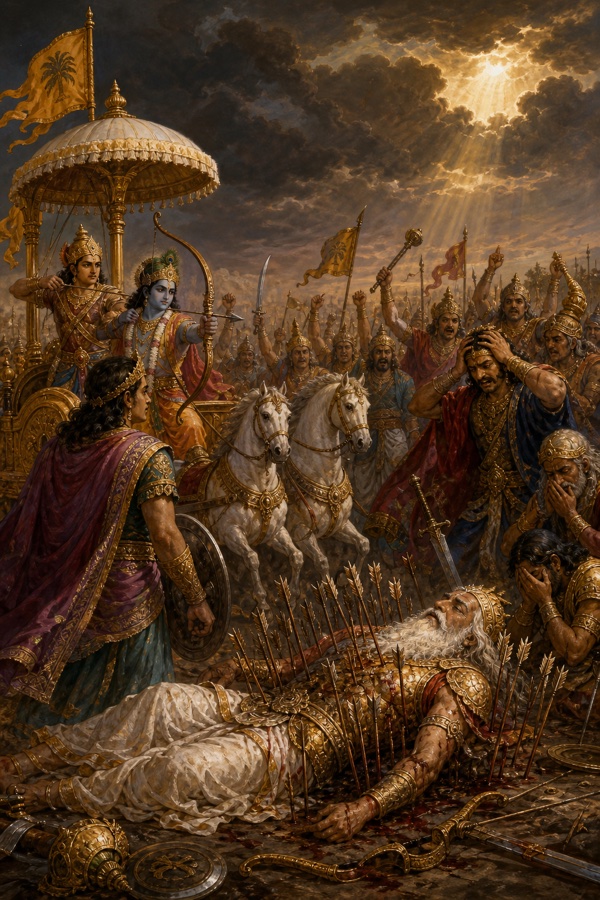
When the ever-victorious Bhishma fell from his chariot toward the surface of the earth, a cry of woe spread among all creatures. But his body did not touch the earth, for the countless arrows sunk in his limbs held him up, and he lay on that bed of arrows, above the ground, in the air. At that moment the sky was covered with darkness, the sun’s light grew dim, and the earth seemed to shriek aloud.
A key to reading this (the idea): the “Bed of arrows” is the scene for which Bhishma is most remembered in the Mahabharata. So many arrows were sunk in his body that they themselves became a couch, and Bhishma’s body, not touching the earth, rested on them in the air. This is a sign of his purity and of his boon of death at his own choosing, by which he could himself choose the time of leaving the body.
The moment Bhishma fell, fear filled the hearts of the Kshatriyas of both armies. Seeing the son of Santanu with his standard fallen and his armor cut open, both Kauravas and Pandavas were filled with gloom. The rishis, Siddhas, and Charanas said in the sky, “This is the scholar. This is the one who first, knowing his father Santanu afflicted by desire, took the vow to draw up the seed of his own line.” Thus that man was praised as he lay on the bed of arrows.
At Bhishma’s fall your sons were at a loss. Their faces filled with grief, and they stood with heads bent in shame. On the other side the Pandavas, having won, stood at the head of their ranks and blew their great gold-worked conches. In that hour we saw Bhima leaping in great joy. A great swoon came over the Kauravas, and Karna and Duryodhana drew long breaths again and again. Duhshasana rushed to Drona’s division and gave him the news of Bhishma’s fall. Hearing it, Drona dropped from his chariot, then, recovering, called the Kuru army off from battle. Seeing the Kurus halt, the Pandavas too sent messengers and had the fighting stopped.
The pillow, and the waiting for the northern course
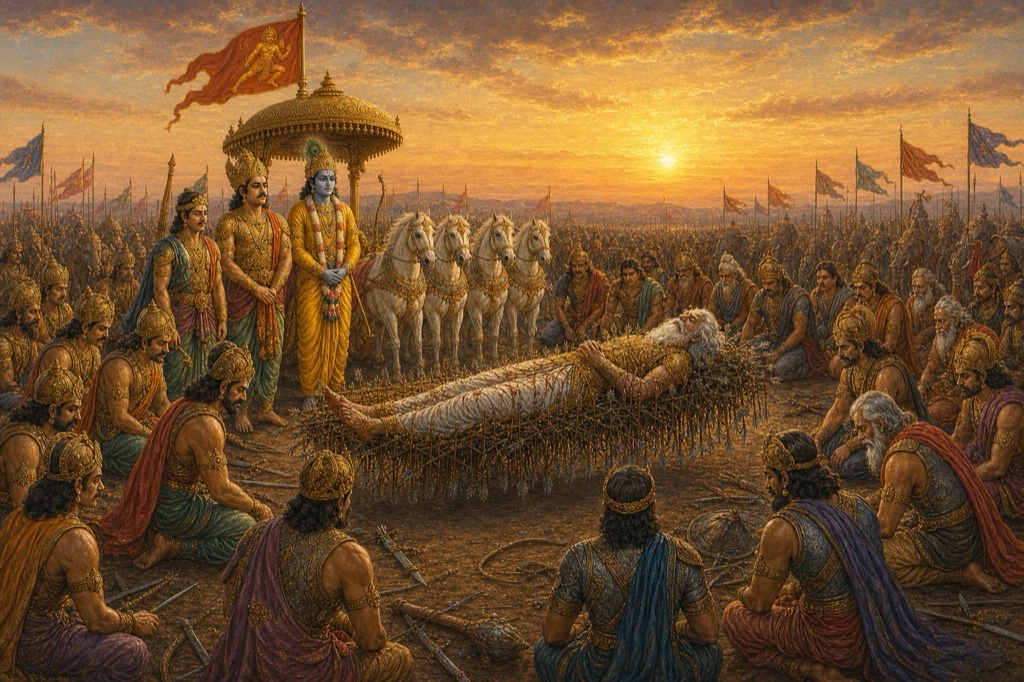
Stopping the war and taking off their armor, thousands of warriors of both sides came to Bhishma as gods come to Prajapati. Bowing to the grandsire on the bed of arrows, the Pandavas and Kauravas stood before him. Then Bhishma said to them, “Welcome to you all, you great and fortunate warriors. I am glad of the sight of you; you are the very likeness of the gods.” Then, with his head hanging low, he said, “My head is bending far down. Give me a pillow.”
The kings brought many fine, very soft, delicate cloth pillows and set them down, but the grandsire did not want them. That man said with a laugh, “Kings, these are not fit for a hero’s bed.” Then, looking to Arjuna, he said, “Dhananjaya my head is hanging down. Give me such a pillow as you think right.”
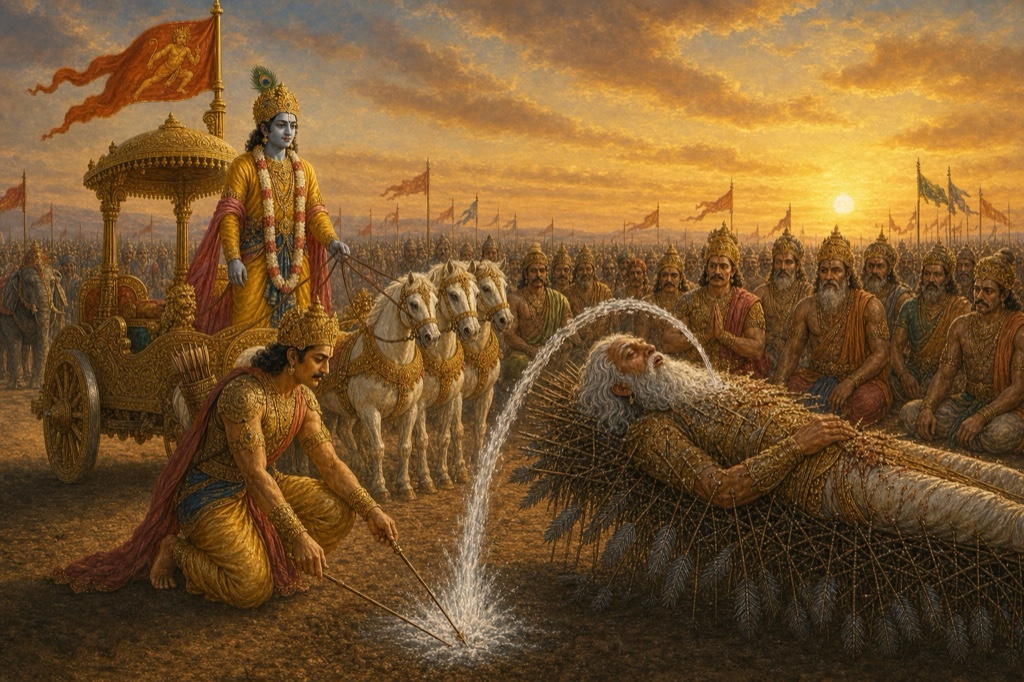
Then Arjuna, tears in his eyes, strung his bow, bowed to the grandsire, and said, “Command me, I am your servant. What shall I do, grandsire?” Bhishma said, “Partha, my head is hanging down. Without delay, give me a pillow fit for a hero’s bed. You are the warrior, the knower of the Kshatriya’s dharma.” Then Arjuna said, “As you command,” and taking the Gandiva and some straight arrows, charging them with mantras, and with the grandsire’s leave, propped up Bhishma’s head from below with three keen arrows.
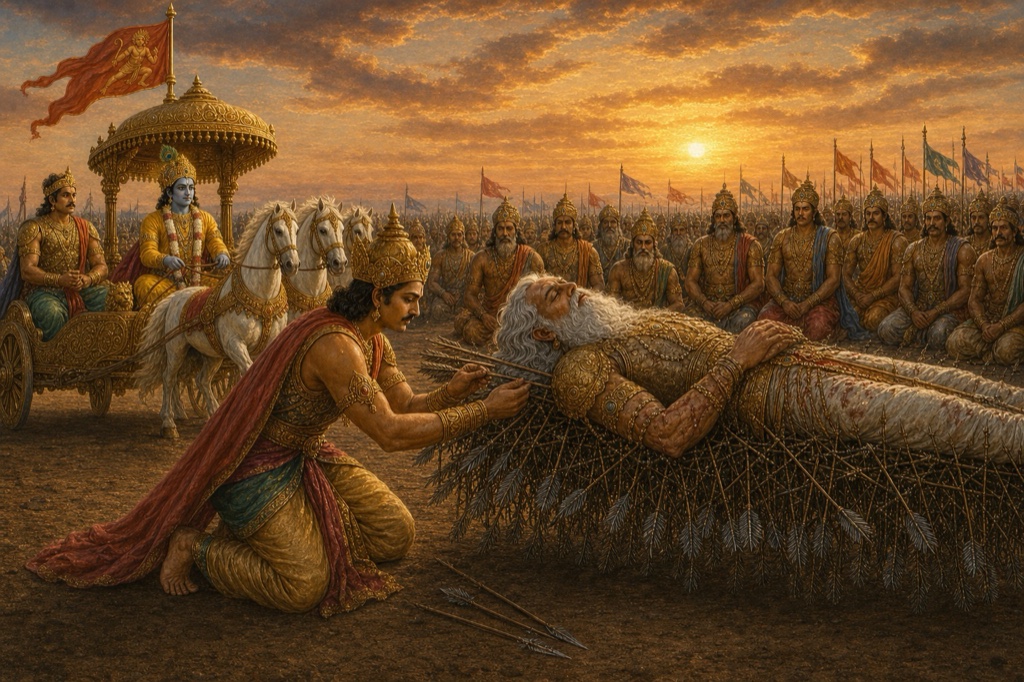
Seeing that Arjuna had read his mind and done this, Bhishma, who knew the heart of dharma, was greatly pleased. He praised Arjuna and, casting his eyes on all the Bharatas, said, “You have given me a pillow fit for my bed. Had you done otherwise, I would have cursed you in my anger. This is how a Kshatriya should sleep on his bed of arrows on the field of war.” Then he said to all the kings, “See what a pillow the son of Pandu has given me. I will sleep on this bed until the sun turns toward the north. When the sun moves on his seven-horsed chariot toward the quarter of Kubera, then I will give up my life like a friend seeing off a dear friend. Kings, dig a trench around me. Pierced with hundreds of arrows, I will worship the sun. And you, let go of enmity and cease from war.”
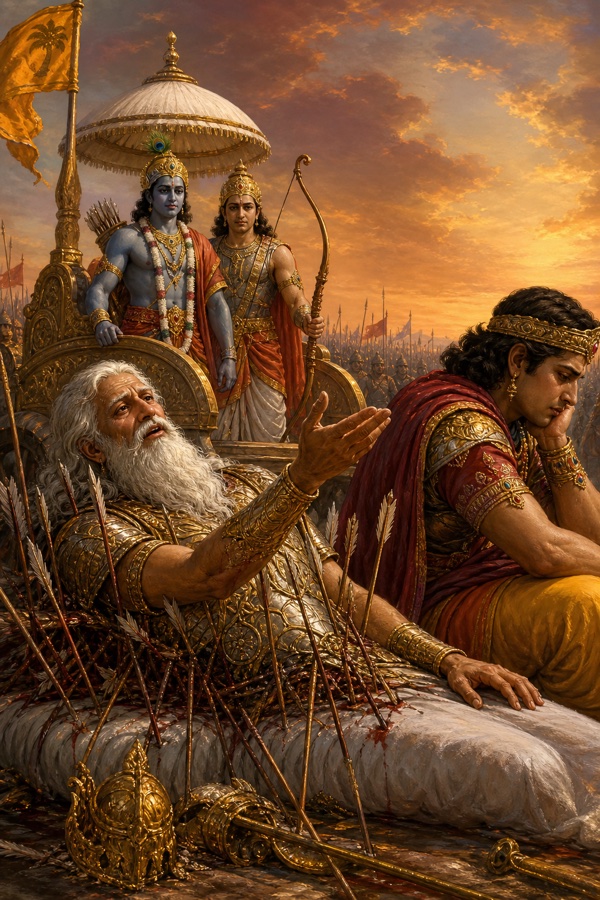
A key to reading this (the idea): the Uttarayana is the season when the sun turns from the south toward the north, roughly from the winter solstice. It is held auspicious and the day of the gods, and one who leaves the body in that season was believed to gain the highest passage. Bhishma had the boon of death at his own choosing, so he resolved to hold his life back and wait for the northern course. By “The quarter of Kubera” the northern direction is meant.
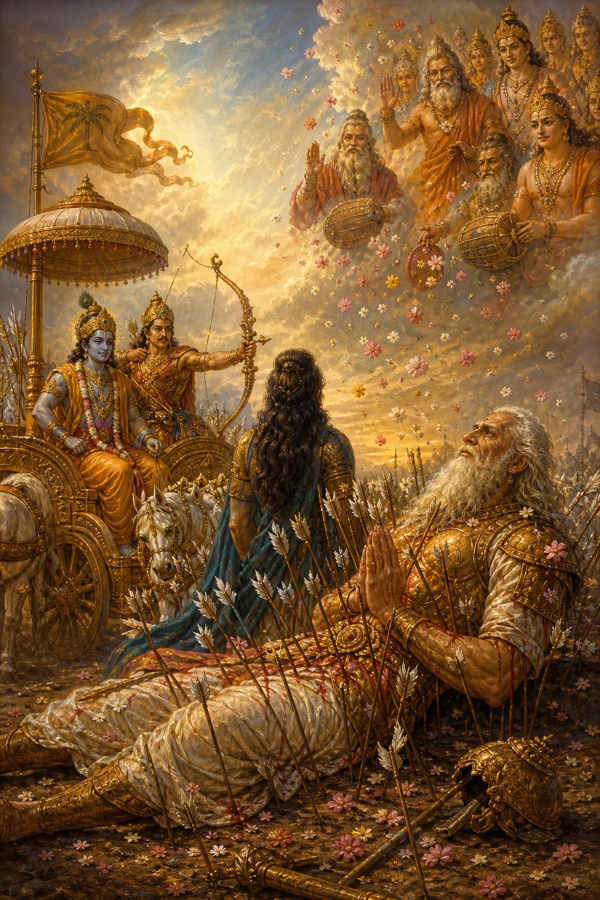
Then some surgeons skilled in weapon-wounds came with their tools to draw out the arrows. Seeing them, the son of Ganga said to Duryodhana, “Give these surgeons fitting honor and gifts of wealth and send them away. What need have I of surgeons in this state? I have won the highest and best state of the Kshatriya’s dharma. It is not fitting to treat one like me, lying on the bed of arrows. Let my last rites be done with these arrows in me.” Hearing this, Duryodhana sent the surgeons away with honor, and all the kings were struck with wonder at Bhishma’s devotion to dharma.
So, having given the grandsire his pillow, having bowed to him and circled him three times, and having set guards all around for his protection, those heroes, their bodies drenched in blood and their hearts heavy with grief, returned to their camps in the evening. Then at the fitting hour Krishna came to Yudhishthira and said, “Delighter of the Kurus, by good fortune the victory is yours. By good fortune that Bhishma, who was unkillable by men, has been brought down.” Yudhishthira answered, “By your grace is the victory, by your wrath the defeat. You are our refuge. It is no wonder that those you always guard should win.” Hearing this, Krishna smiled and said, “Such words come only from you.”
The gist: Bhishma refused soft cloth for a pillow, and Arjuna held up his head with three arrows, a pillow fit for a hero’s bed. The grandsire dismissed the surgeons and resolved to hold his life on the bed of arrows, worshiping the sun until the northern course. The commander of ten days of great war rose now above the battle and, awaiting death at his own choosing, became the shared grief of both houses.
Source: the Mahabharata of Krishna-Dwaipayana Vyasa, Bhishma Parva, Bhishma-vadha sub-book. This part belongs to K. M. Ganguli, sections XLIII to CXXII (43-122); the Gita Press Hindi edition numbers these chapters differently. Names, order, and events were checked against Ganguli’s complete translation. Dialogue and commentary are adapted, not a verbatim translation. About the sources.
Based on: The Mahabharata, Vyasa (Gita Press, Gorakhpur)