On this page
The evening of the tenth day was coming down when the thing both armies had been dreading, each with a trembling heart, at last took place on the wide field of Kurukshetra. Bhishma, who for nine days had scorched the Pandava army like the sun of the world’s ending, was pierced now by the countless arrows Arjuna sent from behind Shikhandi, the prince of Panchala who in an earlier life had been born in the body of a woman, and he went down from his chariot. His body never reached the ground. That close mesh of arrows became his bed. Sanjaya told it to the blind king Dhritarashtra in this order, opening with the fighting of the days between, when the great destruction was climbing toward its height.
Before the first blow, Yudhishthira laid aside his armor and walked unarmed to Bhishma, Drona, Kripa and Shalya to ask their leave, and Yuyutsu crossed over to the Pandavas; that hour is told in full in chapter 21.
Who struck first: the roar out of Bhima that emptied the bowels of the animals, and twelve of Dhritarashtra’s sons and allies closing on one man
Dhritarashtra had listened to the two arrays being described, the Kuru host and the Pandava host each drawn up and waiting, and the question he asked was a blind man’s question, the question of someone who needs the order of events exactly because he will never see the field for himself. Sanjaya saw it for him; Vyasa had given the charioteer a sight that reached every corner of the field, so that the king could have the war told to him as it happened. “When the divisions on both sides stood arrayed,” he said, “who struck first, the Kurus or the Pandavas?”
Sanjaya gave him the order, and gave it as a man who had stood in those ranks himself. Duhshasana had taken his elder brother’s command and moved out with his divisions, and Bhishma rode at the head of them. Across the field the Pandavas came forward in good heart, because Bhishma was the man they wanted, and Bhima rode at the head of them. Then the sound began, on both sides in the same instant: the roaring of men who roar like lions before they close, the clamor that has no shape, the rasp of the krakachas, cow-horns braying, drums and cymbals and tabors all going at once. “They came at us,” Sanjaya said, “and we went at them, shouting, and the two shouts met.” The meeting of them was loud enough to deafen. Under that uproar of conches and cymbals the two great hosts, the Pandavas and the sons of Dhritarashtra, shook the way a forest shakes when the wind gets into it, and as the two masses of kings and elephants and horses ran together in that hour of ruin, the noise they made was the noise of oceans worked up by a storm.
And then one voice went over all of it. Bhima began to roar like a bull. The roar climbed over the conches and the drums, over the grunting of the elephants and the lion-cries of the fighters, over the neighing of thousands of horses in two armies, and kept on climbing. It had the rolling of a bank of cloud in it and the crack of Indra’s thunderbolt, and the Kaurava warriors heard it and were afraid. The animals heard it too, and their bodies answered before any rider could: horses and elephants voided urine and dung where they stood, as beasts do when a lion opens its throat close by. He had carried two oaths out of the gaming hall thirteen years before, one about Duhshasana’s chest and one about Duryodhana’s thigh, and the men he had sworn them against were standing in front of him. Bhima let his form grow terrible, went on roaring like a deep mass of storm cloud, and came down on the sons of Dhritarashtra.
They closed on him together, which is its own measure of what one man was worth that morning. Duryodhana came, and Durmukha, and Dussaha, and Duhshasana, who was a great chariot warrior himself, and Durmarshana; Vivimshati came, and Chitrasena, and Vikarna, who was counted among the great chariot warriors of the age; and with them rode Purumitra and Jaya and Bhoja and the son of Somadatta. They shook their bright bows the way clouds shake out their lightning. They drew long arrows from their quivers, arrows like snakes that have just cast the old skin and are new and quick, and twelve of them ringed that one bowman as he came on and buried him under flights of shafts the way cloud buries the sun. The answer came from the next generation, the sons who had grown up in exile and in hiding while their fathers waited out thirteen years. The five sons of Draupadi came, and Abhimanyu, Arjuna’s son by Subhadra, and Nakula and Sahadeva, and Dhrishtadyumna of Panchala, who by that night would be named commander of the whole Pandava army, and they tore into the sons of Dhritarashtra with whetted arrows the way the thunderbolt, coming down fast out of the sky, tears the summits off mountains.
In that first exchange, with the bowstrings making their terrible noise and slapping the leather guards on the archers’ forearms, no fighter on either side gave a step. Not one. Sanjaya told the king what he had noticed in particular: the hands of Drona’s pupils, who were shooting arrows past counting and whose every arrow found the thing it had been sent for. Both armies were full of men who had learned the bow from Drona; he had taught the Kuru princes and the Pandavas together in the same yard at Hastinapura, and Arjuna had been the favorite of all his pupils, and now those pupils were shooting at each other and he was shooting at them. The twang of the strings did not stop for the length of a breath. Burning arrows crossed the air like meteors falling out of the sky. And around this the other kings stood for a while and only watched, spectators at a fight between kinsmen that was fascinating and horrible at once. Then the anger arrived. The great chariot warriors began to remember, each of them, what the man opposite had once done to him, and they called each other out by name and went to work.
Seen from a distance, the two armies with their elephants and horses and chariots were as beautiful as figures painted on a stretched cloth, and the beauty lasted about as long as it took to say so. The rest of the kings raised their bows. The dust the fighters threw up put out the sun. At Duryodhana’s command every division went forward behind its own leader, and the uproar of the elephants and horses of those charging kings mixed into the lion-cries and the conches and the drums until it was one ocean of noise, an ocean with arrows for its crocodiles and bows for its snakes and swords for its turtles, and the forward leaps of the warriors for the storm on top of it, and it sounded the way the real ocean sounds when something has stirred it to the floor. Kings in their thousands, at Yudhishthira’s order, fell on Duryodhana’s ranks. The fighting where the two hosts met was as fierce as fighting gets. And here was the thing Sanjaya could not get past, even in the telling: watching them strike, watching them break and fall back, watching them rally and come on again, there was no way to tell the king’s men from the enemy’s. Over all of it, higher than all of it, in that dreadful and astonishing battle, the king’s own father Bhishma stood shining above an army too large to count. Eleven full armies had marched for Duryodhana against the seven the Pandavas had gathered, and Bhishma commanded all eleven.
A key to reading this (names): Krakachas are war instruments, sounded along with the drums, cymbals, tabors and cow-horns. Of the twelve who close on Bhima, Duryodhana, Duhshasana, Durmukha, Dussaha, Durmarshana, Vivimshati, Chitrasena and Vikarna are sons of Dhritarashtra; Purumitra, Jaya and Bhoja ride with them, and the son of Somadatta is Bhurishravas, of the Bahlika branch of the house. Abhimanyu is Arjuna’s son by Subhadra, who is Krishna’s sister. Sanjaya speaks of Bhishma as the king’s father: by strict descent Bhishma is the elder half-brother of Dhritarashtra’s father Vichitravirya, and the word carries his standing as the eldest of the house and the man who raised the fathers of both armies.
The gist: The blind king asks who struck the first blow, and the answer is that both sides moved at once, Bhishma leading one and Bhima the other. The first weapon used at Kurukshetra is a voice: Bhima’s roar carries over conches, drums, elephants and thousands of horses, frightens the Kaurava ranks, and makes the animals void where they stand. Twelve of Dhritarashtra’s sons and allies surround him and bury him in arrows, and Draupadi’s five sons, Abhimanyu, Nakula, Sahadeva and Dhrishtadyumna come to cut him out. Nobody retreats. The dust puts out the sun, the two armies stop being distinguishable from each other, and one figure stays visible above the whole field.
The first forenoon: Bhishma and Arjuna face each other, the field divides into twenty-four duels, and a battlefield where a father did not recognize his son
The battle that would take so many kings apart began in the forenoon of that dreadful day. The Kurus and the Srinjayas both wanted the same thing and both roared for it, and the roar came back off the sky and off the ground. Under it ran a second layer of noise that no single man was making: the slap of leather arm-guards, the blare of conches, men calling challenges to other men by name, bowstrings hauled back by gloved hands, the heavy tread of infantry, horses screaming in their rage, sticks and iron hooks coming down on the skulls of elephants, weapons meeting weapons, the bells of elephants jangling as the beasts were driven into each other, and the clatter of chariot wheels, which sounds like thunder inside cloud. All of it together made one uproar that lifted the hair on a man’s arms. The Kuru warriors went forward with their standards up, cruel-minded, past caring whether they lived. And out of them came Bhishma himself, lifting a bow that looked like the rod of Death, riding straight at Arjuna. Arjuna raised Gandiva, the bow the whole world knows by name, and rode straight at him. Each of those two intended to kill the other that morning, the old man who as a young prince had given up the throne and the hope of sons so that his father could marry, who had held the house together for three generations since, and the great-nephew he had watched learn the bow. Bhishma pierced Arjuna and could not make him waver by so much as a step. And Arjuna, for his part, could not move Bhishma either.
After that the field broke into pairs, and every pair fought its own private war. Satyaki went for Kritavarma, two Yadavas of the same clan who had chosen different sides, Satyaki following Krishna and Kritavarma leading the Narayana army that Duryodhana had taken when Arjuna took Krishna unarmed, and what passed between them was fierce enough to frighten the men watching; they shouted at each other, they wounded each other, each wore the other down, and by the end they were so covered in arrows that they looked like two kinshuka trees in spring with every branch in flower. Abhimanyu took Brihadbala, king of Kosala and heir of the ancient line of Ikshvaku, and the king opened well: he cut down the boy’s standard and knocked his charioteer off the chariot. Abhimanyu, with no one at his reins, answered with nine shafts into Brihadbala, two sharp arrows that took the king’s standard, one that dropped a guard of his chariot wheel, and one more that dropped his driver, and after that the two of them simply wore each other thin with sharpened arrows. Bhima got Duryodhana, swollen with pride and the author of everything the Pandavas had suffered, and those two princes covered each other in arrows until every creature watching was amazed, because both of them knew every method of fighting there is and had learned them in the same yard. Duhshasana, the brother who had dragged Draupadi into the gaming hall by her hair, rushed Nakula and put many sharp arrows into him, the kind made to go through to the vitals; Nakula laughed, cut away his standard and his bow, and put twenty-five small-headed arrows into him, and Duhshasana, who is hard to beat, killed Nakula’s horses and cut his standard down. Durmukha came at Sahadeva in a shower of arrows and Sahadeva took his charioteer off the chariot with one very sharp arrow, after which neither man could be checked, and both went on trying to terrify the other with dreadful shafts. Yudhishthira himself met Shalya, king of the Madras, the twins’ maternal uncle, who had set out from his own country to fight for the Pandavas and had been feasted into Duryodhana’s camp on the road, and Shalya cut the king’s bow in two in front of his eyes; Yudhishthira threw the broken thing away, took up a heavier bow that threw harder, buried Shalya in straight arrows, and said through his anger, “Wait. Wait.”
Dhrishtadyumna went for Drona, and Drona in a fury cut apart the hard bow of the Panchala prince, a bow that had never failed to take lives, and in the same movement shot a single terrible arrow like a second rod of Death that went into the prince’s body. Dhrishtadyumna took up another bow and put fourteen arrows into Drona, and the two of them stayed there hating each other and shooting, the teacher and the pupil who had been born out of a sacrificial fire for the purpose of killing him. Shankha, who was fast, met Bhurishravas the son of Somadatta, who was just as fast, and called out “Wait, wait,” and pierced the man’s right arm, and Somadatta’s son hit Shankha across the shoulders, and the fight between those two proud men turned as terrible as a war between gods and Danavas. Dhrishtaketu, king of the Chedis, whose father Shishupala had died under Krishna’s discus and who had brought his army to Krishna’s side regardless, threw himself at Bahlika, Bhishma’s own uncle and a man of the generation above the grandsire’s, who was anger in human shape; Bahlika set up a lion’s roar and thinned him with arrows beyond counting, and the king of the Chedis, badly provoked, put nine arrows into Bahlika, and after that the two of them bellowed at each other over and over the way one rutting elephant bellows at another, and looked, to the men around them, like the planets Angaraka and Shukra come into the same house of the sky. Ghatotkacha, whose deeds were cruel, met the Rakshasa Alambusha, whose deeds were cruel and who would have his own reckoning with Arjuna’s son Iravan on the eighth day, the way Indra once met Vala; Ghatotkacha put ninety keen-edged shafts into that furious and powerful demon, and Alambusha put straight arrows into Bhima’s son by the Rakshasi Hidimba in many places, and the pair of them, mangled, shone the way Indra and Vala shone in the old war of gods and Asuras. Shikhandi charged Ashvatthama; Drona’s son drove one keen-edged shaft deep into him and made him shake where he stood, and Shikhandi struck back with a sharp, well-tempered shaft, and the two went on hitting each other with every kind of arrow they had.
Virata, who commanded a large division and had sheltered the Pandavas through their last year of hiding without knowing it, went at Bhagadatta hard, and poured arrows onto him the way cloud pours rain onto the breast of a mountain, and Bhagadatta covered Virata over just as fast, the way cloud covers a sun that has only just risen. Kripa, Drona’s brother-in-law and the man who had taught the princes of both houses before Drona came to Hastinapura, took Brihatkshatra of the Kaikeyas and wrapped him in arrows, and Brihatkshatra drowned him in an arrowy downpour of his own, and then, having killed each other’s horses and cut each other’s bows, both men found themselves on foot; they came at each other with swords, and the swordfight that followed had no equal anywhere on that field. Drupada in a rage rode at Jayadratha of the Sindhus, the Kauravas’ brother-in-law and the man who had once tried to carry Drupada’s daughter off from the forest, who was waiting for a fight and glad of it; Jayadratha put three shafts into Drupada and Drupada gave them back, and the combat between them was fierce and terrible and entirely satisfying to everyone watching, and it too looked like Shukra and Angaraka colliding. Vikarna, the one brother who had spoken up for Draupadi in the gaming hall, made a run on fast horses at the mighty Sutasoma, Bhima’s son by Draupadi; he pierced Sutasoma with many arrows and could not make him waver, and Sutasoma could not make him waver either, and that struck everyone as strange. Chekitana, a Vrishni chief and a tiger among men, threw himself at Susharma of the Trigartas, who had led the raid on Virata’s cattle in the year the Pandavas hid at that court, out of pure anger on the Pandavas’ behalf, and Susharma checked him with arrows in plenty, and Chekitana came back with a downpour of his own, cloud on mountain again. Shakuni, whose dice had begun all of this, went at Prativindhya the way a lion goes at an elephant in rut, and Yudhishthira’s son tore Shakuni with sharp arrows the way Indra tears a Danava, and Shakuni tore him back with straight ones. Shrutakarma met Sudakshina, ruler of the Kambojas; Sudakshina pierced Sahadeva’s son and could not move him, because the boy stood there like Mount Mainaka standing under the blows of Indra, and then Shrutakarma, badly provoked, wore the Kamboja down with arrows without number and opened wounds over his whole body. Iravan, careful and very angry, rode at the angry Shrutayus, and Arjuna’s son by the Naga princess Ulupi killed his enemy’s horses and roared, and every fighter who saw it praised him for it; then Shrutasena, just as angry, killed Iravan’s horses with a heavy mace, and the fight went on from there. Vinda and Anuvinda, the two princes of Avanti, met the heroic Kuntibhoja, the king who had adopted Kunti as a girl and was grandfather to the Pandavas by that adoption, at the head of his troops with his son beside him, and the coolness of those two young men against a whole body of soldiers was a wonderful thing to watch; Anuvinda threw a mace at Kuntibhoja and Kuntibhoja smothered it under arrows, and Kuntibhoja’s son pierced Vinda with many arrows and Vinda returned them. The Kekaya brothers, at the head of their troops, met the five Gandhara princes with theirs. Viravahu, another of Dhritarashtra’s sons, fought Uttara, Virata’s son and one of the best chariot fighters on the field, and put nine arrows into him, and Uttara put sharp-edged arrows into him. And the king of the Chedis rode at Uluka, Shakuni’s son, who had carried Duryodhana’s insults into the Pandava camp on the eve of the war, and pierced him with a shower of arrows, and Uluka pierced him with sharp arrows beautifully winged, and since neither could beat the other, the two of them only went on opening each other up.
So it went, thousands of single fights across that whole engagement, men on chariots, men on elephants, men on horses, men on their feet, Kuru and Pandava alike. For a short while it was a beautiful thing to look at. Then it turned, and after that nothing could be made out at all. Elephant went at elephant, chariot at chariot, horse at horse, foot-soldier at foot-soldier, and in the press of men running at each other the battle became confused and savage past describing. The celestial rishis who had come to watch, and the Siddhas and the Charanas with them, looked down at it and saw the old war of gods and Asuras happening again. Thousands of elephants, thousands of chariots, whole bodies of infantry seemed to lose their own nature and become something else. And the same ground was fought over again and again, chariots and elephants and horses and men returning to the identical patch of earth to kill each other on it.
Now the foot-soldiers, in their hundreds and their thousands, and what they did to one another with every consideration forgotten. There a son did not recognize his father, a father did not know the son of his own body, a brother did not know his brother, a sister’s son did not know his mother’s brother, an uncle did not know his nephew, a friend did not know his friend. The Pandavas and the Kurus fought like men with demons inside them. Tigers among men went down in pieces along with their chariots. Chariot shafts broke against chariot shafts and the spikes of yokes caught in the spikes of other yokes. Knots of men who had bound themselves together ran into other knots of men, every one of them wanting a life. Chariots jammed against chariots and could not move at all. Huge elephants with their temples split open fell on other huge elephants and tore them in a dozen places with their tusks. Some, meeting trained and furious animals of their own kind carrying towers and standards on their backs, were gored and screamed in agony. Elephants that were not in rut were driven with pikes and hooks straight into elephants that were, and some of the great beasts, meeting rivals in rut, ran in every direction crying like cranes. Many well-trained elephants with the fluid running from their split temples and their mouths, cut about with swords and lances and arrows and pierced in the vital places, screamed and went down and died, and others ran off howling. The foot-soldiers whose work was to guard the elephants, broad-chested men who could hit hard, ran everywhere in their anger with pikes and bows and bright battle-axes, with maces and clubs and short arrows and lances and shafts and heavy bludgeons studded with iron and well-gripped swords polished to the brightest finish, every one of them meaning to take somebody’s life. Blades that had gone into men came out steeped in blood and shone. The whistle of swords swung by strong arms and brought down onto the vital parts of enemies got very loud. And the wails of men in those crowded divisions, men crushed with maces and clubs, cut open with tempered swords, run through by tusks and ground under the feet of elephants, men calling out to one another, sounded like the wailing of people condemned to hell.
Horsemen came at each other on animals of tremendous speed whose outstretched tails looked like the plumes of swans, and the long-bearded darts they threw, gold-trimmed, polished, quick, sharp at the point, came down like snakes. Some of those horsemen leapt their mounts high and took the heads off men standing in chariots. Here and there a chariot fighter caught a body of cavalry inside his range and killed many of them with straight arrows. Elephants in gold trappings, looking like cloud that has only just risen, knocked horses over and crushed them under their own legs. Elephants struck on the frontal globes and in the flanks and torn open with lances screamed in agony. Many, lost in the confusion, crushed horses and the men riding them and threw them down; some tipped horse and rider over with the points of their tusks and then went on, breaking chariots and the standards on them; and some enormous males, their energy running high and the temporal fluid pouring, killed horses and riders together with their trunks and their feet. Arrows polished and sharp as snakes fell on the heads and temples and flanks and limbs of elephants. Polished javelins with a terrible look to them, flung by heroic arms and flashing like large meteors, fell everywhere, going through the bodies of men and horses and cutting through coats of mail. Many men pulled polished sabres out of sheaths made of leopard skin and tiger skin and killed whoever stood opposite them. Many who had themselves been attacked and had the flanks of their bodies laid open still went at their enemies in a rage with swords and shields and axes. Some elephants pulled chariots down by the trunk, horses and all, and wandered off wherever the shouting behind them told them to go.
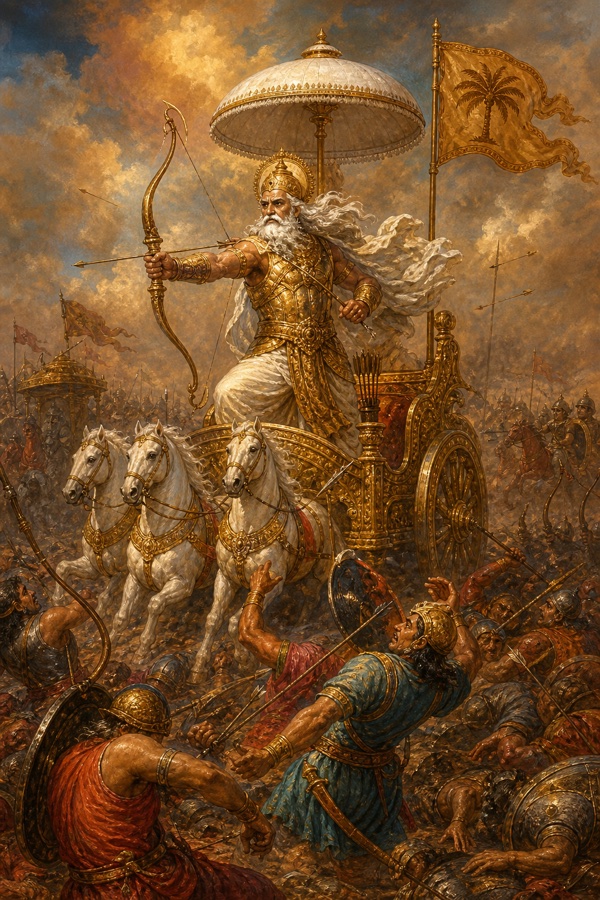
And everywhere on that ground men who had been run through by javelins, cut in two by battle-axes, crushed by elephants, trodden by horses, sliced by chariot wheels and by axes, were calling out loudly for their own people. Some called their sons. Some called their fathers. Some called brothers and kinsmen, some called their mother’s brothers, some their sisters’ sons, some called out to anyone at all. A very great number of them had lost their weapons or had their thighs broken; others, with their arms torn away or their sides pierced or opened, were heard wailing out of the plain wish to stay alive. Some, with very little strength left and tortured by thirst, lay on the bare earth and asked for water. Some, rolling in pools of their own blood and almost finished, cursed themselves and cursed the sons of Dhritarashtra who had gathered them all there for this. And there were brave Kshatriyas among them who had wounded one another and would neither drop their weapons nor make a sound of complaint; they lay where they had fallen and roared with cheerful hearts, biting their own lips in their anger, looking at one another with faces made savage by the pulling together of their brows. Others, strong and stubborn, in great pain from arrows and smarting wounds, stayed perfectly silent. Others again, chariot fighters who had lost their chariots and been thrown down and wounded by elephants, asked to be lifted onto somebody else’s chariot. And a great many of them looked beautiful in their wounds, like kinshuka trees in flower. In every division there were terrific cries, more than anyone could count. In that appalling battle, which ate heroes, the father killed the son and the son killed the father, the sister’s son killed the mother’s brother and the mother’s brother the sister’s son, friend killed friend and relative killed kinsman. That was the manner of the slaughter when the Kurus met the Pandavas. And in that frightful fight, in which no man made any allowance for any other man, the divisions of the Pandavas came up against Bhishma and began to waver. Above them, on his great chariot, under a silver standard bearing the palmyra with five stars, Bhishma was shining like the disc of the moon below the peak of Meru.
A key to reading this (the pairings and some names): The pairs made on this first forenoon are the map of the days that follow; nearly every warrior’s opponent is settled here. Sutasoma is Bhima’s son by Draupadi and Prativindhya is Yudhishthira’s; the text calls Shrutakarma the son of Sahadeva. Iravan is Arjuna’s son by the Naga princess Ulupi, and his own story arrives on the eighth day, in part 4 of this chapter. Satyaki and Kritavarma are both Yadavas, Krishna’s kinsmen, fighting on opposite sides. Brihadbala is the king of Kosala, Bahlika is Bhishma’s uncle, the younger brother of his father Shantanu, and Bhagadatta rules Pragjyotisha in the far east. Uluka is Shakuni’s son. Kinshuka is the palasha tree, whose red flowers give the epic its standing image for a man covered in his own blood; Angaraka is Mars and Shukra is Venus. Vala is the Asura Indra split open, and Mainaka is the mountain that stands unmoved in the sea.
The gist: The first forenoon opens with Bhishma and Arjuna riding straight at each other, and neither man can shift the other by a step. Then the field breaks into pairs: Satyaki against Kritavarma, Abhimanyu against Brihadbala, Bhima against Duryodhana, Nakula against Duhshasana, Yudhishthira against Shalya, Dhrishtadyumna against Drona, Ghatotkacha against Alambusha, Shikhandi against Ashvatthama, and a dozen more, down to Uttara and Uluka. By midday the pairs have dissolved into a crowd, and Sanjaya turns to the infantry, where a father does not recognize his own son and thirsty men lie on the bare ground asking for water. Above that crowd one standard stays steady, silver, with a palmyra and five stars on it, and the Pandava divisions that reach it start to give way.
Nine arrows bring down the grandsire’s palmyra, Shalya kills Uttara, and seven chariots close around Shveta
The greater part of that forenoon had worn itself out, and the killing had settled into the steady, unhurried rhythm that men who have fought before recognize and dread. Duryodhana had watched his grandsire ride alone into the Pandava ranks once too often, and he sent five of his best to stay at Bhishma’s wheels: Durmukha, Kritavarma, Kripa, Shalya of the Madras, and Vivimshati. Two of them were his own brothers, one was Drona’s brother-in-law, one was the uncle of the twins across the field, and one was the Yadava who led Krishna’s own soldiers for Duryodhana. Screened by those five, the old man drove straight into the enemy host, and after that the palmyra standard was never still. Sanjaya, who watched it, said that it seemed to glide, a silver tree sliding through the Chedis, the Kashis, the Karushas, the Panchalas, never checked, never turning back. Under it Bhishma worked with broad-headed shafts that flew perfectly straight and very fast, and they took heads off shoulders and took chariots apart at the yoke, standard and all. On the floor of his own moving chariot the grandsire looked like a man dancing. Elephants struck in their vital parts screamed somewhere behind him, and the screaming marked his road.
The first man to ride into that road was a boy. Abhimanyu came on a chariot yoked to tawny horses, his standard worked in pure gold in the shape of a karnikara tree, and he came in a rage that made no allowance for who was waiting. He put a keen-edged shaft into the palmyra banner by way of announcement, and then he took on all six of them at once, the five guards and the man they guarded, who was his own great-grandfather. Kritavarma he pierced with one arrow, Shalya with five, and Bhishma he weakened with nine. Drawing his bow to its fullest stretch he loosed a single arrow and cut down an enemy standard plated in pure gold. With one broad-headed shaft that went through every kind of cover he took the head off Durmukha’s charioteer. With another he cut Kripa’s gold-decked bow in two. Then he struck all of them together with sharp-pointed shafts, and while he did it he seemed to be dancing, exactly as the old man had been dancing, and the gods watching from above were pleased with what they saw. He had learned the bow from his father and from his mother’s brother Krishna, and the men watching could see both teachers in his hands. His aim was so sure that the chariot warriors around Bhishma began to say to one another that this was Arjuna’s own capacity in a smaller body. His bow, stretched and stretched again, gave off a twang like Gandiva’s, and it turned in his hands until it looked like a wheel of fire.
Bhishma came at him hard. Nine arrows went into Arjuna’s son; three broad-headed shafts cut down the boy’s standard; a fourth struck his charioteer. Kritavarma and Kripa and Shalya all pierced him, and not one of them could make him sway, and he stood in the middle of them the way Mainaka stands in the middle of the sea. Ringed by the best chariot warriors of Dhritarashtra’s army, Abhimanyu answered all five with downpours of arrows, breaking their great weapons apart in the air with his own, pouring shafts onto Bhishma, and shouting aloud while he did it. The strength in that boy’s arms, Sanjaya said, was a thing worth seeing. Bhishma shot at him and Abhimanyu cut the arrows out of the air. And then, with nine arrows that did not miss, Abhimanyu cut down the standard of Bhishma. The whole field shouted. Tall, set with jewels, made of silver, carrying the device of the palmyra, it came out of the sky and fell on the earth, and Bhima, watching it fall, roared to cheer his brother’s son.
The old man’s answer to that was to reach for the celestial weapons. He brought them up one after another and buried Abhimanyu under thousands of arrows, and ten of the best bowmen on the Pandava side drove at him together to get the boy out: Virata and Virata’s son, Dhrishtadyumna, Bhima, the five brothers of the Kekayas, and Satyaki. Bhishma met the rush without leaving his ground. He put three arrows into Dhrishtadyumna and ten into Satyaki, and then, drawing to the full, he sent one winged shaft whetted like a razor into Bhima’s standard, and the golden lion came off its staff and fell out of the chariot. Bhima answered with three arrows into Bhishma, one into Kripa, and eight into Kritavarma, which was the arithmetic of a man who knows he cannot win the exchange and means to make it expensive.
On another part of the field the day turned personal. Uttara, the son of Virata, came at Shalya on a tusker with its trunk raised, and Shalya stopped the animal’s charge dead. The elephant, enraged, set a foot on the yoke of Shalya’s chariot and killed all four of his excellent horses where they stood. Shalya, left on a chariot that could not move, took up an iron dart like a snake and threw it to kill the boy outright, and it cut through Uttara’s mail. The hook and the lance dropped out of his hands and he went off the elephant’s neck senseless. Then Shalya took his sword, jumped down from the dead chariot, and cut through the beast’s trunk. Pierced everywhere with arrows, its trunk gone, the elephant screamed once and fell and died, and the king of the Madras climbed onto Kritavarma’s chariot and went on with the battle. Not long before, in his father’s kingdom, that same Uttara had driven Arjuna’s chariot against the whole Kuru army on the day the Pandavas came out of hiding, and Bhishma and Drona and Kripa had all been on that field and had all gone home beaten. He was the first of Virata’s house to die for them.
Shveta was watching. He saw his brother dead on the ground and he saw Shalya standing on another man’s chariot, alive, and he went up like a fire that has been fed clarified butter. He was the commander in chief of the Pandava army, and he stretched a bow that was the size of Indra’s, and he drove for Shalya’s chariot with a whole division of chariots around him and an arrow storm going ahead of him, like an elephant in rut that has found the thing it wants to break. Seven warriors of Duryodhana’s side saw the king of the Madras standing already inside the jaws of Death and closed on Shveta from every direction to pull him out: Brihadbala king of the Kosalas, Jayatsena of Magadha, Rukmaratha who was Shalya’s own son, Vinda and Anuvinda of Avanti, Sudakshina king of the Kambojas, and Jayadratha of the Sindhus, the kinsman of Brihatkshatra. Their drawn bows, painted in many colors, flashed like lightning inside cloud, and the seven of them emptied arrows onto Shveta’s head the way clouds driven by the wind empty rain onto the breast of a mountain when the summer ends.
What Shveta did then is the reason the Pandavas had made him their commander. He took seven broad-headed arrows of great force, struck the seven bows, and began grinding them. The bows came apart. Within half the time it takes an eye to blink, the seven had other bows up and had put seven arrows in the air, and Shveta cut those bows apart as well with seven fleet shafts. Now the seven were roaring, swollen with rage, and they had darts in their hands, and they threw all seven at his chariot at once. The darts crossed the sky like large meteors, trailing a sound like thunder, and before any of them arrived Shveta cut every one of them out of the air with seven broad-headed arrows. Then he chose a single shaft made to pass through any part of a body and he put it into Rukmaratha. It went in faster than a thunderbolt. Shalya’s son sat down on the floor of his own chariot and dropped into a swoon so deep it looked like death, and his charioteer, showing no fear at all, carried him out of the field in front of everyone, and his father had to watch that too.
Six gold-decked arrows followed. They took the tops off the standards of the remaining six, and then Shveta pierced their horses and their charioteers, covered the men themselves in a rain he did not stop, and turned for Shalya’s chariot. A sound went through the Kaurava army that Sanjaya could only report as a wail. The commander of the Pandava forces was moving toward the king of the Madras and nothing in seven kings had slowed him. So Duryodhana came himself, with Bhishma at the head of the column and heroes and massed troops behind, and drove at Shveta’s chariot, and in that way Shalya was pulled back out of the mouth he had entered. What followed was the kind of battle that lifts the hair on a man’s arms, chariots and elephants mixed together past sorting, and over all of it the old grandsire of the Kurus poured arrows down on Abhimanyu, on Bhima, on Satyaki, on the ruler of the Kekayas, on Virata, on Dhrishtadyumna, and on the massed troops of the Chedis.
A key to reading this (who is who): Abhimanyu is Arjuna’s son by Subhadra, and Bhishma is his great-grandfather, which is why the text keeps naming the relation while they try to kill each other. The silver palmyra is Bhishma’s standard and the golden lion is Bhima’s; the karnikara tree worked in gold is Abhimanyu’s. Mainaka is the mountain that stands unmoved in the sea. Shveta and Uttara are both sons of Virata, king of the Matsyas, at whose court the Pandavas spent their thirteenth year in disguise, and Shveta is at this moment the commander in chief of the Pandava army. Rukmaratha is Shalya’s son, which is why he is among the seven who ride to save his father. A dart here is a javelin thrown by hand.
The gist: Five great warriors close around Bhishma as armor, and he goes through the Pandava host cutting it open. Abhimanyu rides out to stop him and does what nobody else manages that day: nine arrows, and the silver palmyra standard falls on the earth. Elsewhere Virata’s son Uttara takes an elephant against Shalya and dies for it, and his brother Shveta, the Pandava commander, goes for Shalya with a whole division behind him. Seven kings ring Shveta to save Shalya. He cuts their bows twice, cuts their seven javelins out of the sky, drops Shalya’s son senseless, and is closing on Shalya when Duryodhana brings Bhishma and the whole army down on him.
An army abandons its own grandsire, a bow cut four times, and a voice out of the sky: this is the hour
Dhritarashtra stopped the account there. “When that great bowman Shveta went for Shalya’s chariot,” he said, “what did the Kauravas do, and what did the Pandavas do, and what did Bhishma the son of Shantanu do? I am asking you. Tell me all of it.”
Sanjaya told him. Hundreds and thousands of Kshatriyas, every one of them brave and a great chariot warrior, put Shveta at the front of them and Shikhandi at their head, and drove at the gold-decked chariot of Bhishma meaning to kill him and be done with the war on its first day. Shikhandi was the Panchala prince who had been born a girl and become a man, and whom Bhishma had sworn never to fight, and both armies knew it. The battle that came of that charge was terrible. Bhishma emptied the floors of chariots one after another. He shot until the sky over him was arrows and the sun could not be seen through them, and he cleared the ground around his own wheels the way the rising sun clears darkness out of a valley. Sanjaya counted nothing, because there was nothing countable: arrows in hundreds and in thousands, each one heavy and fast and fatal, taking the lives of Kshatriyas nobody would ever name. Heads came off by the hundred. Elephants in their thorny mail went down like the summits of mountains taken off by a thunderbolt.
After that the field stopped being a field. Chariots ran into chariots and stayed where they struck, one chariot lying across another, one horse across another horse. Loose horses went up and down the lines carrying dead young riders who hung out of their saddles with their bows still shut in their hands. Men lay in hundreds with their swords and quivers still strapped to them and their armor loosened off their chests, asleep on the bed that is reserved for heroes. Men rushed at each other, went down, got up, rushed again, and fought with their hands when they had nothing else, and rolled on the ground where they had wounded one another. Furious elephants went through the lines in both directions. Chariot warriors fell by the hundred, some crushed with their chariots under them, some dropped onto the floor of their own chariot by an arrow, some tumbling from a height when the driver below them died first. Then the dust came up and took the last of the daylight with it, and after that a fighter knew where his enemy was standing only by the twang of the enemy’s bowstring, or by the pressure of a body pushing against his own. They shot at sounds. The hiss of the arrows could not be heard at all, because the drums were beating loud enough to tear the ears, and in that noise a man shouting his own name as he fought, which is what a Kshatriya does when he means to be remembered for the blow, could not be heard shouting it, and a father could not tell his own son. A wheel broke, or a yoke tore away, or one horse went down, and the fighter on that chariot was thrown with his driver under a flight of straight arrows, and many brave men who had lost their chariots that way were seen running. Whoever Bhishma shot at was killed or was hit in the vitals. There was no third kind of man in front of him.
And inside all of that, Shveta was killing Kurus. He took noble princes by the hundred and by the hundred again. His arrows took off the heads of chariot warriors in rows, and the arms with the armlets still on them, and the bows out of the hands around him. Chariot fighters, chariot wheels, the men riding beside them, the chariots themselves, standards cheap and costly, whole bodies of horse, whole crowds of chariots, whole crowds of men: Shveta destroyed them. And here Sanjaya told the blind king a thing that few messengers would say out loud. “We ran,” he said. “In fear of Shveta we left Bhishma, the best chariot warrior we had, standing where he stood, and went to the rear, and that is the only reason I am alive in front of you now.” Every Kuru on that field withdrew beyond the range of the arrows, abandoned Bhishma in the middle of the battle, and stood there in full armor, watching, as though the war were a performance put on for them. One man stayed. In the hour when no one else had any cheer left in him, Bhishma was cheerful, and he stood in the middle of the ruin like Mount Meru, taking lives the way the sun takes moisture at the end of winter, lit up by the golden fittings of his own chariot until he looked like the sun himself. He shot clouds of arrows and men went down under them like the Asuras of the old stories, and the Pandava divisions he was cutting broke their ranks and ran from him as from a fire that has just been fed. Alone against Shveta, Sanjaya said, he was the only man on the Kaurava side who was cheerful and whole. He fought for Duryodhana’s good; he had thrown away his hold on a life that is hard to let go of, and all fear with it, and he went on killing the Pandava army.
Then Bhishma went for the man who had emptied his army. Shveta covered him in a net of arrows and he covered Shveta in a flight of them, and the two of them bellowed like bulls and came together like two enormous elephants in rut, like two tigers past caring. Each broke the other’s weapons with his own. Each meant to kill. Sanjaya put the situation to Dhritarashtra without softening it: in a single day, angry as he was, Bhishma could have burned the entire Pandava army to ash with his arrows, and the one thing standing between that army and that fire was Shveta. The Pandavas saw their grandsire turned back and filled with joy; Duryodhana saw it and went cold. He gathered the kings around him and threw his whole force at the Pandava host, and Shveta left Bhishma standing, went through Duryodhana’s troops like a storm taking trees out by the root, and then, senseless with anger, came back to exactly the place where Bhishma was. The two of them blazed at each other like Vritra and Indra, and each wanted the other dead.
Shveta drew to the full and put seven arrows into Bhishma. Bhishma checked him the way one rutting elephant checks another. Shveta struck again and took ten arrows in return and stood through them like a hill. Then he put twenty-five straight arrows into Bhishma, and the field made a sound of astonishment, because that was not supposed to be possible. Smiling, touching the corners of his mouth with his tongue, Shveta cut Bhishma’s bow into ten pieces with ten arrows, and then sent up one feathered shaft made wholly of iron and shattered the palmyra sitting on top of the old man’s standard. Dhritarashtra’s sons saw the banner go and believed their grandsire dead. The Pandavas blew their conches all along the line. Duryodhana, watching the palmyra lie on the ground, screamed his army forward, and they came at last and began very carefully to protect a man who was in serious distress. To them, and to the ones still standing and staring from beyond arrow range, he said something that Sanjaya repeated word for word. “Either Shveta dies today, or Bhishma the son of Shantanu. I am telling you the truth.”
They came in the order a king’s word produces. Bahlika and Kritavarma, Kripa and Shalya, the son of Jarasandha, Vikarna, Chitrasena, Vivimshati, with all four arms of the force behind them, chariots and elephants and horse and foot, moving fast at the one moment when speed was everything, and they surrounded Shveta and rained arrows on him without pause. He checked the whole group of them with sharp arrows, showing the lightness of hand that had made his reputation, holding them the way a lion holds a herd of elephants, and while he held them he cut Bhishma’s bow apart a second time under a thick shower of arrows. Bhishma took up another and pierced him with shafts fledged from the kanka bird, and Shveta, in a fury now, answered by piercing Bhishma in front of everyone with shaft after shaft. Duryodhana was badly shaken, and the distress went through the whole army, because they were watching the first warrior of the world being held, marked, and bled by a man they had failed to stop all afternoon, and they all believed that Bhishma had at last met the one who would kill him.
What happened next happened because the old man finally lost his temper. Bhishma looked at his fallen standard and his checked army and put arrow after arrow into Shveta, and Shveta baffled all of them and cut his bow away a third time with a broad-headed shaft. Bhishma threw the ruined bow aside. Senseless with anger, he took up another, larger and stronger, and set seven great broad-headed arrows whetted on stone. Four of them killed Shveta’s four horses. Two cut down his standard. The seventh, shot by a man who had stopped being patient, took the head off his charioteer. Shveta jumped down from a chariot that could no longer carry him anywhere and stood on the ground in the grip of a rage that left him shaken, and Bhishma began working him over from every side with arrows. So Shveta left his bow lying on the abandoned chariot and picked up a dart plated in gold, a terrible thing like the rod of Death, made to kill Death itself. And he called to Bhishma across the field: “Wait a little, Bhishma, and watch me.”
Then he threw it, for the Pandavas and against Dhritarashtra’s house, and the sons of Dhritarashtra cried out when they saw it come, because it had the brightness of the rod of Death in it. It flew out of his arms like a snake that has just shed its skin and fell toward Bhishma like a meteor coming out of the sky. Bhishma did not move away from it. With eight sharp winged arrows he cut that blazing gold dart into nine pieces while it was still burning through the air, and the Kaurava army roared. And Shveta, watching his last good weapon come apart above him, went out of his mind with anger. Like a man whose hour has arrived and whose judgment has already left him, he could not decide what to do. Then, smiling, with his eyes gone red, he picked up a mace for the killing of Bhishma, and came at him like a swollen torrent arriving at a rock wall, a second Yama with a club in his hand.
Bhishma, who could read another man’s strength and knew that this charge could not be turned aside, stepped down off his own chariot onto the ground. Shveta whirled the heavy mace and threw it the way Maheshvara throws, and it hit the empty chariot, and the chariot was reduced to ashes: standard, charioteer, horses, pole and all. Now the first warrior of the world was standing in the dirt, and Shalya and others came running to get him out. He mounted a second chariot, drew his bow without any pleasure in it, and went slowly toward Shveta, looking at him. And while he was moving, a voice spoke in the sky above him, a celestial voice, and what it said was for his own good. “Bhishma, strive now and do not lose a moment. This is the hour the Creator of the universe has fixed for your success over this one.” Bhishma heard the messenger and his heart lifted, and he fixed his whole mind on the killing of Shveta.
The Pandava side saw their commander standing on foot and came for him together: Satyaki, Bhima, Dhrishtadyumna, the five Kekaya brothers, Dhrishtaketu, and Abhimanyu. Bhishma, with Drona and Shalya and Kripa beside him, stopped every one of them the way a mountain stops wind. And while they were held, Shveta took up a sword and cut Bhishma’s bow away a fourth time. The grandsire threw it aside without any hurry now, because he had heard what the voice said and had made up his mind. He lifted another bow bright as Indra’s and strung it in a single motion. Then, with Shveta ringed by the Pandava champions and Bhima at their head, he advanced steadily on Shveta alone. Bhima put sixty shafts into him as he came and Bhishma barely registered them: three straight arrows back into Bhima, a hundred into Satyaki, twenty into Dhrishtadyumna, five into the Kekaya brothers, and all of them held off with terrible shafts while he kept walking toward one man.
Then he drew out an arrow like Death itself, made to carry an enormous strain, made so that nothing could turn it, and laid it on the string, and charged it with the force of the Brahma weapon. The gods saw it. So did the Gandharvas, the Pishachas, the Uragas and the Rakshasas. It had the brightness of a fire on it when it went. It passed through Shveta’s mail, passed through his body, and buried itself in the earth on the far side with a flash like the bolt of heaven, and as the sun going quickly to his western chambers takes the daylight away with him, that shaft took Shveta’s life out with it as it left him. He came down the way the loosened crest of a mountain comes down. Every Kshatriya on the Pandava side began to wail, and Dhritarashtra’s sons and all the Kurus filled up with joy, and Duhshasana danced on the field to conches and drums, the brother Bhima had sworn to kill. With their commander gone, the great bowmen behind Shikhandi shook where they stood. Then Arjuna and Krishna slowly drew the troops back for the night, and both armies withdrew from each other roaring, and the chariot warriors of the Pandavas went into their quarters without speaking, thinking about how the first day had ended and what a single combat had cost them.
A key to reading this (names and things): Maheshvara, whose throw Shveta’s mace is compared to, is Shiva. Shveta is Virata’s son and the first commander in chief of the Pandava army, and the first day of the war ends with his body. Shikhandi, who leads the charge beside him, is the Panchala prince who was born a girl and became a man, and Bhishma has vowed never to raise his bow against him; the tenth day turns on that vow. Vritra and Indra are the demon and the god whose fight is the oldest battle the Vedas know. A dart is a javelin thrown by hand. The kanka is a bird whose feathers were used to fledge arrows. The Brahma weapon is the greatest of the celestial weapons, an invocation that charges an ordinary shaft, which is why Sanjaya says the gods and the other unseen watchers saw this particular arrow go. Note also that Sanjaya, who is telling this, was one of the men who ran, and he does not hide it from the king.
The gist: The first day ends with the Kaurava army abandoning its own grandsire, backing out of arrow range and standing there in armor to watch, while Bhishma holds the field alone like Meru. Shveta cuts his bow four times, brings down his palmyra standard, burns his chariot to ash with a thrown mace and leaves him standing on the ground, and Duryodhana announces that one of the two will die before dark. A voice out of the sky tells Bhishma that the hour has been fixed. He charges one arrow with the Brahma weapon and sends it through Shveta’s armor and body into the earth, and the commander of the Pandava army falls like a mountain crest. Duhshasana dances. The Pandavas go back to their tents without a word.
A blind king’s question and the answer he did not want, Shankha’s charge at Shalya, and the fire that burned alone until sunset
Dhritarashtra had a way of asking for news and delivering a confession in the same breath, and he did it again now. “When the commander Shveta was killed by the enemy,” he said, “what did those great bowmen do, the Panchalas and the Pandavas? When they heard that Shveta was dead, what passed between the men who fought for his sake and the enemies who had been giving ground in front of them?” And then, without a pause, the other thing. “Sanjaya, when I hear of our victory your words please my heart. And my heart feels no shame at all when I remember our transgression.” He went on in that vein. The old chief of the Kuru line, he said, had always been cheerful and devoted to them. Duryodhana had picked this quarrel with the clever son of his uncle, and there had been a time when that same Duryodhana, frightened and anxious because of Yudhishthira, had sought the protection of the sons of Pandu, had lost everything and lived in misery; checked on every side by the strength of those sons of Pandu, caught in a snare of his own laying, he had behaved honorably for a while, because nothing else was left to him. He had put himself under their protection once. “Why, then, Sanjaya, has Shveta been killed, Shveta who was devoted to Yudhishthira? This narrow-minded prince of mine has been thrown into the lower worlds, with every prospect he had, by a pack of wretches.”
The list that followed is one of the saddest things the old man ever says, because every name on it is the name of someone who could have stopped the war, and his own name is on it. “Bhishma did not want this war, and neither did the preceptor. Kripa did not want it, and Gandhari did not want it. Sanjaya, I do not want it, nor does Krishna of the Vrishnis, nor the just son of Pandu, nor Bhima, nor Arjuna, nor the twins. I forbade it. Gandhari forbade it, Vidura forbade it, Rama the son of Jamadagni forbade it, and the high-souled Vyasa forbade it, and still that wicked-minded and sinful Duryodhana, with Duhshasana beside him and the counsel of Karna and Shakuni in his ear, went on dealing with the Pandavas in malice. I think he has fallen into great distress.” Then the questions came back, and under them lay the fear that never left him. “After Shveta was killed and Bhishma had his victory, what did Arjuna do, raging, with Krishna beside him? It is from Arjuna that my fears come, Sanjaya, and nothing dispels them. Kunti’s son is brave and terribly quick, and I think he will cut the bodies of his enemies into fragments with his arrows. He is the son of Indra and in battle the equal of Upendra, Indra’s younger brother; his anger and his purposes never come to nothing; what happens in your minds when you see him coming? He knows the Vedas, he has the splendor of fire and of the sun, he holds the weapon of Indra, and when that warrior of immeasurable soul falls on an enemy he always wins. His weapons land with the force of the thunderbolt, and his arms are wonderfully quick at the string. And Drupada’s formidable son is wise as well. What did Dhrishtadyumna do when Shveta was killed? I think the old wrongs and this fresh death together have set the hearts of those high-souled men on fire, and thinking of that fire I am never at ease, by day or by night, because of Duryodhana. Tell me how the great battle went.”
Sanjaya had been carrying this man’s self-pity for a long time, and on this evening he set it down in front of him. “Listen quietly to an account of your own transgressions, and do not lay the fruit of them on Duryodhana. Your understanding is like an embankment built after the water has drained away. It is like a man who starts digging a well when the house is already burning.” Then he went back to the field. When the forenoon was over and the commander Shveta had been killed by Bhishma in that fierce fight, Virata’s son Shankha, who grinds enemy ranks and takes delight in battle, saw Shalya standing on his chariot with Kritavarma beside him, and flared the way fire flares when clarified butter goes into it. He drew a bow the size of Indra’s own and drove straight at the king of the Madras with a large division of chariots moving to cover him, and he came on in a downpour of arrows like an elephant in rut. He was the third of Virata’s sons to go for Shalya that day, and the other two were dead. Seven great chariot warriors of the Kuru side closed around him, because Shalya was already inside the jaws of Death again and had to be pulled out again. And then Bhishma came, roaring like a bank of clouds, with a bow six cubits long in his hand, and the whole Pandava army rocked at the sight of him the way a boat rocks in a gale. Arjuna moved fast and put himself between them, meaning to keep Shankha alive, and the duel of Bhishma and Arjuna began where a duel of Bhishma and Shankha should have been. Men were crying out across the field. One army seemed to dissolve into the other, and everyone who could still see was staring.
Shalya settled the smaller fight himself. He took a mace, stepped down from his big chariot, and killed all four of Shankha’s horses. Shankha jumped from the ruined chariot with a sword in his hand, ran to Arjuna’s chariot, climbed aboard, and was safe. And after that the evening belonged to one man. Arrows came off Bhishma’s chariot in numbers that covered the ground and the sky together, and with them he cut apart the Panchala host, the Matsya host, the Kekaya host and the Prabhadrakas. Then he left Arjuna, who can draw a bow with his left hand as easily as his right, and went for Drupada, king of the Panchalas, whose daughter Draupadi had married the five Pandavas, and buried that dear connection of his under arrows until Drupada’s troops burned like a forest at the end of winter. He stood in the middle of the field like a fire with no smoke in it, like the noon sun scorching everything within reach, and the Pandava warriors could not lift their eyes to look at him.
Their army looked around for someone to stand in front of it, found no one, and began to resemble a herd of cattle in a cold wind. Men were cut down, men fell back in despair, men were crushed where they stood, and the sound that went up from the Pandava ranks was the sound of an army losing. Bhishma kept his bow bent into a full circle and shot arrows that blazed and carried something like poison in them, laying unbroken lines of them in every direction, and he killed the Pandava chariot warriors one after another, calling out each man’s name before he killed him, so that the man would know whose arrow it was and so would everyone near him. By the time the army had been broken and ground across the whole width of the field, the sun was gone and nothing could be seen. The Pandavas looked at Bhishma standing there, proud and unhurried, and drew their forces back for the night.
A key to reading this (names and references): Shankha, Shveta and Uttara are all sons of Virata. Two of them have died in the afternoon, and the third throws himself at Shalya, the man Shveta was fighting when Bhishma stepped in. The preceptor is Drona; Rama the son of Jamadagni is Parashurama, who taught Bhishma the use of arms; Upendra is Vishnu in his birth as Indra’s younger brother. Drupada is called Bhishma’s dear connection because Draupadi’s marriage to the Pandavas ties the two houses together. The episode Dhritarashtra keeps circling, the time Duryodhana had to take shelter with the Pandavas, is the cattle expedition in the forest years, when Gandharvas captured him and Bhima and Arjuna cut him loose.
The gist: Told that the Pandava commander is dead, Dhritarashtra celebrates, confesses, and then recites the list of everyone who tried to prevent this war, himself included. Sanjaya answers him for once without deference: your understanding is an embankment built after the flood. Then the rest of the first day. Virata’s third son charges Shalya, Bhishma comes to stop him, Arjuna comes to stop Bhishma, and while those two are locked together Shalya kills the boy’s horses with a mace. After that Bhishma burns alone: the Panchalas, the Matsyas, the Kekayas, the Prabhadrakas, then Drupada’s own troops, and the Pandava chariot warriors killed one by one, each of them hearing his own name called first.
The first night in camp: “I am drowning in an ocean called Bhishma and I have no boat”, the naming of a commander, and the crane array at dawn
The armies came apart at dusk on the first day, and Duryodhana went back to his tents delighted, because he had watched Bhishma angry and had seen what that was worth. On the other side of the field Yudhishthira did not go to his own tent at all. He collected his brothers and every king who had come to fight for him and went quickly to where Krishna was, the one man in the camp who had promised to lift no weapon in this war and the one man everyone looked to anyway, and there, with the whole alliance standing around him listening, grieving over the day and over what he had seen Bhishma do, the eldest son of Pandu said out loud the thing a commander is never supposed to say. “Look at him, Krishna. Look at that archer and what he can do. He is burning my army the way fire burns dry grass. How are we even to look at a man who is lapping up my troops like a flame fed with butter? My soldiers see that tiger standing there with his bow and they run, and the arrows follow them. Yama in a rage can be beaten. Indra with the thunderbolt in his fist can be beaten. Varuna can be beaten with the noose in his hands, and Kubera with his mace. Bhishma cannot. I am sinking in an ocean that has no floor to it, and the ocean is called Bhishma, and there is no boat anywhere. My own poor judgment got me this enemy, Krishna, and I am going to the woods. Living there would be better than handing all these lords of the earth over to a Death that wears Bhishma’s face.”
He kept going, and what came out had the shape of a man taking inventory of his own ruin. “Bhishma knows the great weapons and he will finish my army. My men are going into him the way insects go into a fire, for their own destruction and nothing else. I put out my hand for a kingdom and I am being led to my destruction. My brothers are torn with arrows on my account; they lost a throne and they lost their comfort because they love their eldest brother. Life looks very valuable from where I stand tonight, too valuable to spend like this. I will spend what days I have left in the hardest austerities. I am not going to have these friends of mine killed. Bhishma is taking thousands of my best chariot warriors with that celestial weapon of his, and he does not stop. Tell me quickly, Krishna, what can be done that would do me any good.” And then, in front of everyone, he said the other unforgivable thing. “As for Arjuna, he seems to me to be watching this battle like a man at a show. Bhima alone remembers what a Kshatriya is for. Bhima alone is fighting with the whole strength of his arms, and with that hero-killing mace he is doing impossible things to infantry and horses and chariots and elephants. And Bhima could not destroy that army in a fair fight in a hundred years. This friend of yours is the one man among us who understands the great weapons, and he looks on while Bhishma and Drona consume us. Their celestial weapons never stop falling, and they are burning the Kshatriya order out of the world. Bhishma in his anger, with all those kings behind him, will finish us, and there is no doubt in me about that. Krishna, find me a bowman, a great chariot warrior, the man who will put Bhishma out the way rain clouds put out a forest fire. Then, by your grace, Govinda, the sons of Pandu will have their kingdom back and be happy among their own people.” When he had finished he stopped speaking, and his mind turned inward, and he sat for a long while without a word, and nobody in the tent broke the silence for him.
Krishna let the silence sit, and then he took it apart in front of the whole assembly, because the assembly had heard the despair and needed to hear the answer. “Do not grieve, Yudhishthira. It does not become you, with brothers like yours, every one of them a hero and a bowman the world knows by name. I am at work for you myself. So is Satyaki. So are Virata and Drupada, both old men and both here. So is Dhrishtadyumna. All of these kings with their troops are waiting on your word and are devoted to you. The man you have put in command of your army wants nothing except your welfare and does nothing except what pleases you. And then there is Shikhandi, who is certainly the one who kills Bhishma.” He said it as plainly as that, in a tent full of kings, and the name sat there in the air among them. Behind the name stood a story the whole camp knew: a child of Drupada’s house born a girl and raised as a boy, made a man by a Yaksha’s gift, and the grandsire’s own vow that he would never loose an arrow at one who had been a woman.
Yudhishthira heard it and turned, in that same assembly and within Krishna’s hearing, to Dhrishtadyumna. “Mark what I say to you, Dhrishtadyumna, and let no word of it be set aside. Krishna approves you, and you are the commander of our forces. As Kartikeya, the god of war, was commander of the host of the gods in the old days, so are you commander of the host of the Pandavas. Put out your strength and kill the Kauravas. I will follow you, and Bhima will, and Krishna, and the two sons of Madri together, and the sons of Draupadi in their armor, and every other king here.” Dhrishtadyumna answered him in a voice that made the tent feel better. “Shiva ordained it long ago, Yudhishthira: I am the one who kills Drona. I will fight Bhishma now, and Drona, and Kripa, and Shalya, and Jayadratha, and every proud king on that side of the field.” He said it like a challenge thrown across the field; a voice from the sky had said the same thing over the sacrificial fire on the day he was born. The Pandava warriors, who could not be beaten in battle and knew it even on a day like this one, shouted until the sound carried. Then Yudhishthira gave his new commander an order with a piece of old lore folded into it. “Build the array called Krauncharuma, which destroys every enemy, the one Brihaspati described to Indra in the days when the gods and the Asuras were at war. Nobody has seen it. Let these kings see it, and let the Kurus see it with them.”
So the king had spoken to him the way Indra once spoke to Vishnu, and when morning came Dhrishtadyumna put Arjuna at the head of the whole army. The standard over Arjuna’s chariot had been made by the architect of the gods at Indra’s command, and in the open sky it was a spectacle on its own: banners on it colored like the bow of Indra, the whole thing riding the air like a creature that lives up there, shaped like one of those cloud palaces that build and unbuild themselves overhead, and it seemed to dance along the track the chariot cut. Arjuna made that jeweled standard look well, and the standard did the same for him, the way the sun and Brahma set each other off. Drupada with a great mass of troops became the head of the crane. Kuntibhoja and Shaivya became its two eyes. The lord of the Dasharnas, the Prayagas with the Daserakas, the Anupakas and the Kiratas were set in the neck. Yudhishthira with the Patachcharas, the Hunas, the Pauravakas and the Nishadas made the two wings, and with them the Pishachas with the Kundavishas, and the Mandakas, the Ladakas, the Tanganas, the Uddras, the Saravas, the Tumbhumas, the Vatsas and the Nakulas. Nakula and Sahadeva took station on the left wing. Ten thousand chariots stood at the joints of the wings, a hundred thousand at the head, a hundred million and twenty thousand at the back, a hundred and seventy thousand at the neck. Elephants moved in masses at the joints of the wings, along the wings and out at their tips, and they looked like mountains on fire. Virata held the rear with the Kekayas, the ruler of Kashi and the king of the Chedis, and thirty thousand chariots behind him. The Pandavas stood in that array in their armor, waiting for the sun to come up, and their white umbrellas, spotless and costly and bright as the sun itself, rode above the elephants and the chariots.
A key to reading this (the array, the names, the numbers): The krauncha is a long-legged waterbird, a crane to some translators and a heron to others, and the array takes its shape, with a head, two eyes, a neck, two wings, a back and a tail. The text calls the array Krauncharuma here and simply Krauncha in the next passage. The architect of the gods is Vishvakarma; Kartikeya is the war god, Shiva’s son, who led the gods against the Asuras; Brihaspati is the preceptor of the gods, which is why an array he taught Indra carries his authority. The troop figures, especially the hundred million and twenty thousand chariots at the back, are the text’s own and belong to the epic’s habit of counting in impossible quantities; they are kept as given.
The gist: After one day of war Yudhishthira walks into Krishna’s quarters with his whole alliance behind him and proposes to give up: Bhishma cannot be beaten, the army is feeding itself into a fire, the forest would be better. In the same speech he accuses Arjuna of watching the battle like a spectator and says Bhima is the only one fighting. Krishna refuses the despair, names the men who are working for him, and says plainly that Shikhandi is the one who will kill Bhishma. Yudhishthira then formally charges Dhrishtadyumna as commander, Dhrishtadyumna answers with the prophecy about Drona, and at dawn the army is standing in the shape of a crane with Arjuna’s dancing standard at its head.
The array shaped like a crane, and a duel in which the gods could not tell the two men apart
On the morning of the second day the Pandavas drew up their host in the shape of the krauncha bird, and Duryodhana rode his own line and looked at it, a great and terrible thing with a head and eyes and wings, formed on Yudhishthira’s order. He went to his commanders one after another: to Drona, to Kripa, to Shalya, to the son of Somadatta, to Vikarna, to Ashvatthama, to his brothers with Duhshasana at their head, and to the other lords whose names his heralds had stopped trying to count. He spoke to gladden them, and the speech was the kind a man makes when he has spent the night doing arithmetic. “You are armed with every kind of weapon, and you know what the scriptures mean. Any one of you, alone, could kill the sons of Pandu and their troops in battle, and here you stand together. Our host is protected by Bhishma and cannot be measured. Their host is protected by Bhima and can.” Then he gave the order that mattered most to him. “Let the Samsthanas and the Surasenas, the Venikas, the Kukkuras and the Rechakas, the Trigartas, the Madrakas and the Yavanas, with the Shatrunjayas, with Duhshasana and that excellent hero Vikarna, with Nanda and Upanandaka, and Chitrasena with the Manibhadrakas, let all of them with their own troops guard Bhishma.” Ten peoples and five princes for one old man. He had watched his whole army leave that old man standing alone the afternoon before, and he meant it never to happen again.
So the Kuru array went up against the Pandava bird. Bhishma advanced at its head with a great body of troops around him, moving like the king of the gods himself, and behind him came Drona with the Kuntalas, the Dasharnas and the Magadhas, with the Vidarbhas, the Melakas, the Karnas and the Pravaranas. The Gandharas came, and the Sindhusauviras, the Shivis and the Vasatis with every man they had, all of them falling in behind the grandsire, and Shakuni brought his own force around to shield Drona. Duryodhana rode out cheerfully with all his brothers and with the Ashvalakas, the Vikarnas, the Vamanas, the Kosalas, the Daradas, the Vrikas, the Kshudrakas and the Malavas. Bhurishravas held the left flank with his brother Shala, with Shalya, Bhagadatta, and Vinda and Anuvinda of Avanti. Somadatta held the right with Susharma, with Sudakshina the ruler of the Kambojas, with Shatayus and Shrutayus. Ashvatthama, Kripa and Kritavarma of the Satvata line stood at the back of the army with a very large division, and behind even them stood the rulers of many provinces, Ketumat, Vasudana, and the powerful son of the king of Kashi. Then the whole of that army, waiting and glad to be waiting, blew its conches and roared. Bhishma heard the roar and answered it with a lion’s cry of his own and a blast of his conch, and at once the drums and the peshi and the cymbals came in under him until the noise was one noise.
Across the field two men on a chariot yoked to white horses lifted conches inlaid with gold and jewels, the same two conches that had answered Bhishma’s on the first morning, before the Gita was spoken. Krishna blew Panchajanya and Arjuna blew Devadatta, and Bhima blew the huge conch called Paundra. Yudhishthira blew Anantavijaya, Nakula blew Sughosha, Sahadeva blew Manipushpaka. The ruler of Kashi blew, and Shaivya, and Shikhandi, and Dhrishtadyumna, and Virata, and Satyaki, and Drupada, the great bowman who was king of the Panchalas, and the five sons of Draupadi, and their shouting went up into the sky and came back off the ground, and the two armies went at each other again, each burning to finish what the first day had started. When Dhritarashtra asked how the fighting actually began, Sanjaya told him that it began with a sentence. The divisions were arrayed and the fighters stood waiting in their mail with their beautiful standards up, and Duryodhana, inside a host that looked like a shoreless sea, said to the men around him: “You are in your armor. Begin.” They abandoned their own lives in the same breath, and went forward with their standards up, and the chariots and the elephants closed into each other so fast that arrows shot at men fell on animals instead. Into that Bhishma came with his bow raised, an old man in mail moving at the front of it, and he poured arrows on Abhimanyu, on Arjuna, on the ruler of the Kekayas and on Virata, on Dhrishtadyumna, on the Chedis and on the Matsyas, and the great array shaped like a bird shuddered under one man. Horsemen went down. Chariot warriors went down, and the best of the horses with them. The Pandava chariot divisions began to come apart and run.
Arjuna watched his own wing dissolving and turned, angry, to Krishna at his reins. “Take the chariot to where the grandsire is. It is plain that Bhishma in his anger will finish my host for Duryodhana’s benefit, and that Drona and Kripa and Shalya and Vikarna, with Dhritarashtra’s sons behind them and this one firm bowman covering them, will put an end to the Panchalas. For the sake of my troops I will stop Bhishma myself.” Krishna answered him in a sentence that was also a promise to keep him alive. “Be careful, Arjuna. I will take you to the grandsire’s chariot.” Then the most famous chariot in the world came around and stood in front of Bhishma’s, banners running, the white horses looking like a line of cranes in flight, the ape on the standard howling above them, the whole chariot burning like the sun and sounding like weather, and it cut down the Kaurava divisions and the Surasenas as it came. Bhishma met him at speed, with Jayadratha in front of him and the fighting men of the East and the Sauviras and the Kekayas packed around. Who else on that side could have met him? Bhishma, Drona and Karna were the only three men alive who could ride at Arjuna with Gandiva in his hand, and Karna had sworn to keep his weapons down while Bhishma commanded. So ten of them shot at one man. Bhishma put seventy-seven arrows into Arjuna, Drona twenty-five, Kripa fifty, Duryodhana sixty-four, Shalya nine, Ashvatthama sixty, Vikarna three, Jayadratha nine, Shakuni five, and Artayani put in three broad-headed arrows on top of that. Arjuna stood in the middle of it the way a mountain stands when arrows are shot into it, and then paid the ten of them back: twenty-five to Bhishma, nine to Kripa, sixty to Drona, three to Vikarna, three to Artayani, five to the king. Satyaki and Virata and Dhrishtadyumna, Draupadi’s sons and Abhimanyu came in around him, and Dhrishtadyumna went at Drona with the Somakas behind him, because Drona was busy keeping Bhishma safe. Bhishma answered with eighty sharp arrows into Arjuna, and the Kaurava side howled with pleasure, and Arjuna heard the howling, rode cheerfully into the middle of those lions, and picked them off one at a time as though the bow were an amusement.
That was when Duryodhana said the thing he had been holding. “Grandfather,” he said to Bhishma, “this son of Pandu with Krishna beside him is cutting our roots while you are alive and while Drona is alive. Karna, who wishes me well in everything, has laid down his weapons for your sake alone and refuses to fight the sons of Pandu. Do something, son of Ganga, by which Arjuna may be killed.” The reproach in it was aimed at Karna’s vow, the promise Karna had made before the war to stay out of the fighting as long as Bhishma held the command, and Duryodhana was laying the cost of that vow at the old man’s feet. Bhishma said, “Shame on the usage of Kshatriyas,” a curse on the duty that had set his bow against his own blood, and drove at Arjuna’s chariot. Every king on the field saw the two white-horsed chariots square up and roared and blew. Ashvatthama and Duryodhana and Vikarna closed around Bhishma; the Pandavas closed around Arjuna; and the two of them began. Nine arrows from Bhishma. Ten back, into the vitals. A thousand from Arjuna, shrouding Bhishma on every side, and Bhishma’s own net of arrows cut that net out of the air. Both were pleased. Both were enjoying themselves. Neither took anything from the other, and each was bent on undoing whatever the other had just done. The flights out of Bhishma’s bow were seen to scatter against Arjuna’s shafts, and the flights out of Gandiva came down in pieces on the grass. Twenty-five more from Arjuna, nine back, and then the two of them went to work on each other’s horses, each other’s wheels, each other’s arrows in the air, as if it were a game with rules. Bhishma put three arrows into Krishna between the breasts, and Krishna stood there wearing them and shining like a kinshuka tree in flower, and Arjuna, furious at the sight, put three into Bhishma’s charioteer.
After that neither man could get a clean shot, because the two drivers would not allow it. The chariots wheeled in circles, went forward, went back, changed position again and again as each driver hunted the opening his master wanted, and the conches went on blowing under the roaring, and both bows were twanged in the same voice. The noise of the wheels and the shells split the ground until it trembled and made sounds from underneath. No one found a fault in either man. Both had the strength, both had the courage, each was the other’s match, and the only way the Kauravas could find the grandsire in that storm was by his standard, and the only way the Pandavas could find Arjuna was by his. Twice the arrows closed over them and hid them completely, and twice they came back out. Every creature on that field stood and marveled, and none of them could name a difference between the two, the way no one can name a fault in a man who lives by dharma. The gods said so themselves. The Gandharvas and the Charanas and the great rishis heard them say it. “These two in their anger cannot be beaten by all the worlds together, with the gods and the Asuras and the Gandharvas. This battle will be a wonder in every world, and a battle like it will never happen again. Bhishma cannot be conquered by Arjuna, for all his intelligence and his showers of arrows, his bow and his chariot and his horses; and Arjuna, whom the gods themselves could not beat, cannot be conquered by Bhishma. As long as the world lasts, this fight will go on exactly even.” Sanjaya heard those words going about the field in praise of the two of them. And while the two held the center, everyone else went on killing with sharp-edged scimitars and polished axes and arrows without number and every other kind of weapon, and the brave men of both armies cut one another down for as long as that murderous day lasted, and away on the other side of the field Drona and the prince of the Panchalas had found each other, and that was a terrible thing too.
A key to reading this (names and numbers): The krauncha is the long-legged waterbird whose shape the Pandava array copies, a crane to some translators and a heron to others. Both sides name arrays after birds, animals and weapons, and the shape decides where each commander stands. Jayadratha, king of the Sindhu country, is married to Duhshala, Dhritarashtra’s only daughter, which makes him brother-in-law to the hundred. Karna’s vow is his promise to keep out of the fighting for as long as Bhishma commands, made after Bhishma rated him below the other great warriors on the eve of the war. Artayani, the son of Ritayana, is a name of Shalya. The kinshuka is the palasha tree, whose red flowers are the epic’s standing image for a body covered in blood.
The gist: The second morning opens with Duryodhana ordering ten nations to do one job, which is to keep Bhishma alive, and with the Kuru array going up against the Pandava bird: Bhishma in front, Drona behind him, Bhurishravas and Shalya and Bhagadatta on the left, Somadatta and Sudakshina on the right, Ashvatthama and Kripa and Kritavarma at the back. Bhishma’s opening volley bends the Pandava line, Arjuna has Krishna drive him straight at the grandsire, and ten Kaurava warriors shoot at him at once while he answers all of them. Duryodhana tells Bhishma to finish Arjuna and reminds him that Karna is sitting out the war on his account. Bhishma says shame on the usage of Kshatriyas and goes. The duel that follows ends with nothing decided, and the gods watching it say that as long as the world lasts these two will be exactly even.
Drona and Dhrishtadyumna: a bow cut twice, a mace broken in the air, and a prince left standing with a shield of a hundred moons
The blind king had been listening to the account of Bhishma and Arjuna with a question building in him, and when Sanjaya paused he let it out. “Tell me, Sanjaya, how the great bowman Drona and the Panchala prince came at each other, each of them striving his best.” And then the thought underneath the question. “I consider destiny to be greater than a man’s own effort, since even Bhishma could not get past the son of Pandu in battle. Bhishma in his anger could destroy everything that moves and everything that does not. Why then could his prowess not carry him past Arjuna?” It is the closest Dhritarashtra comes to admitting what he has already understood, which is that his side is going to lose and that he arranged it himself. Sanjaya gave him no comfort and no argument. “Listen quietly to this terrific battle. The son of Pandu cannot be conquered by the gods themselves with Indra at their head.” Then he went back to the field, to a corner of it where a teacher was fighting the student who had been born to kill him. Drona had taken the boy as a pupil anyway, years before, knowing exactly who he was and what he had been born for.
Drona opened by taking the prince apart piece by piece, which was his method with everyone. Arrows of several kinds into Dhrishtadyumna. The charioteer knocked out of his seat. Four excellent shafts into the four horses, so that the chariot itself began to fail. Dhrishtadyumna answered with nine sharp arrows and a shout of two words, “Wait, wait,” and Drona, whose soul was as immeasurable as his skill, covered him over with arrows and then picked up something else. It was a single dreadful shaft, and every man who saw it come off the quiver knew what it was for. Its force was the force of Indra’s bolt. It was a second rod of Death. A cry went up from every fighter who saw it aimed, on both sides of the line, because the man it was aimed at was the one Drupada had prayed into existence for this exact meeting. And then the field saw Dhrishtadyumna do the thing that made his name that day: he stood alone, unmoving as a mountain, and cut his own death out of the air as it reached him, and threw an arrow storm back at Drona on top of it. The Panchalas and the Pandavas together made a noise that traveled.
The prince wanted a kill and reached for a heavier tool. He hurled a dart at Drona, a thing of great impetus decked with gold and with stones of lapis lazuli, the kind of weapon a king’s son carries because his father can afford it. Drona smiled, and cut it into three pieces while it was still traveling. Dhrishtadyumna rained arrows on him. Drona broke the rain, waited for the opening, and cut Drupada’s son’s bow in half. The prince took up a mace, a mass with the strength of a mountain in it, and threw it, and for a moment the gold on it hung in the air on its way to killing the teacher. What the field saw next was Drona’s chariot simply moving, so lightly that the mace went by, and then a flight of well-tempered arrows with golden wings, whetted on stone, going through the prince’s mail and drinking his blood. Dhrishtadyumna picked up a second bow and put five shafts into him. The two of them stood there bleeding on each other, and Sanjaya, who had a gift for the wrong kind of beauty, told the blind king that they looked like two kinshuka trees blossoming in spring.
Then Drona lost his patience, moved to the head of his division, and took the prince apart a second time, faster. The second bow cut. The bowless man covered with straight arrows the way clouds cover a hill with rain. The charioteer knocked out of his seat. The four horses killed with four arrows and a lion’s roar over them. And then one more shaft, aimed with the exactness of a man making a point, that cut away the leather guard strapped to Dhrishtadyumna’s hand. Bow gone, chariot gone, horses gone, driver gone, the prince of Panchala came down off the chariot with a mace in his fist, and before his feet were on the ground Drona had broken the mace into fragments with arrows. Everyone watching thought it was the most wonderful thing they had seen. So Dhrishtadyumna took up a great shield decked with a hundred moons and a long scimitar of beautiful make and went at Drona on foot, the way a starving lion in the forest goes at an elephant in rut. And there the field saw the other half of Drona’s art, the lightness of his hands and the strength of his arms, because one man with a bow held a charging swordsman where he stood. The prince could not come forward. He stayed where he was, working his shield with his arms in great dexterity, catching a cloud of arrows on a hundred moons.
Bhima got there before the arithmetic finished. He came in fast because he wanted Dhrishtadyumna alive, put seven sharp-pointed arrows into Drona, and had the prince taken up onto another chariot. Duryodhana, watching his teacher pulled off his kill, sent the ruler of the Kalingas with a large division to protect Drona, and that terrible Kalinga force came around at Bhima on the king’s order. Drona let the Panchala prince go and turned to take on Virata and Drupada together, which is to say he turned to fight the father of the man he had just failed to kill, the king who had been his friend when they were boys together in the hermitage of Drona’s father Bharadvaja, who had humiliated him when he came as a poor Brahmin to claim that friendship, and who had been humiliated in return when Drona’s pupils took half his kingdom. Dhrishtadyumna, on his new chariot, went to stand beside Yudhishthira. And along the line where the Kalingas met Bhima a fight began that Sanjaya called destructive of the universe, terrific and awful, and the second day was only getting started.
A key to reading this (why this duel is different): Dhrishtadyumna is Drupada’s son. The Adi Parva tells how he was born out of the fire of a sacrifice that Drupada performed for one purpose, the killing of Drona, after Drona had taken half of Drupada’s kingdom to settle an old insult, and Drona knows it. That is the reason this encounter runs the way it does: the teacher cuts away the bow, the horses, the driver, the mace and even the leather guard on the prince’s hand, twice over, and does not take his life. The dart is a heavy throwing weapon, close to a spear. The leather guard is the archer’s protection for the hand and wrist against the bowstring, so cutting it away is the second serious wound after losing the bow itself. A shield of a hundred moons is a shield set with a hundred moon-shaped bosses.
The gist: Dhritarashtra asks whether destiny beats effort, since not even Bhishma could get past Arjuna, and Sanjaya answers by describing the day’s other duel: Drona against the Panchala prince who was born to kill him. Drona fells his driver, kills his horses, and looses an arrow like a second rod of Death, which Dhrishtadyumna cuts out of the air while standing still. Then the gold dart is cut into three, the bow is cut, the mace is made useless, the second bow is cut, the hand guard is cut, and the mace in his fist is broken before he can get off the chariot. He ends up on foot with a shield of a hundred moons and a scimitar, unable to advance a step, until Bhima arrives, puts seven arrows into Drona and has him lifted onto another chariot. Drona turns on Virata and Drupada, the Kalingas come at Bhima, and the second day rolls on.
Source: the Mahabharata of Krishna-Dwaipayana Vyasa, Bhishma Parva, Bhishma-vadha sub-book. This part belongs to K. M. Ganguli, sections XLIV to LIII (44 to 53); the Gita Press Hindi edition numbers these chapters differently. Names, order, and events were checked against Ganguli’s complete translation. Where the recensions differ, this English retelling follows Ganguli, and the Hindi edition follows Gita Press. Dialogue and commentary are adapted, not a verbatim translation. Gita Press (Bhishma 48.107 to 108) has Bhishma put the sixty arrows into Bhima and the three into Abhimanyu; Ganguli, followed here, has Bhima shoot the sixty and Bhishma send the three back into Bhima. About the sources.
Based on: The Mahabharata, Vyasa (K. M. Ganguli’s English translation; Gita Press, Gorakhpur)