On this page
Wait, wait: the call Bhishma would not hear, a lion in a herd of deer, and the evening when two camps praised each other and went to sleep
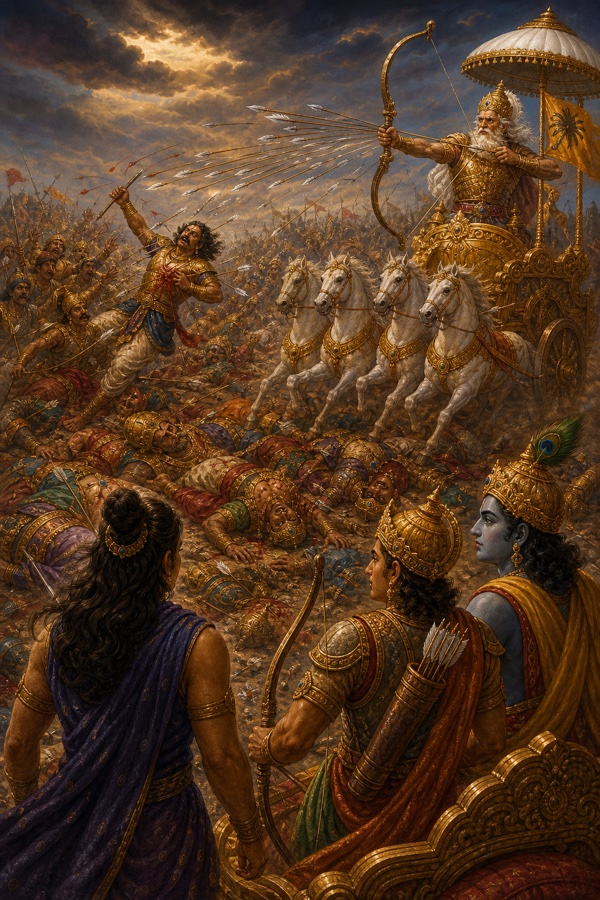
Vikarna came across to his brother, who was standing in the wreck of his chariot, and got him up onto his own chariot. And in the middle of that general engagement, which had turned as ugly as anything in the war so far, Bhishma went at Yudhishthira. The Srinjayas felt it happen. Their chariots and their elephants and their horses all shivered at once, and every one of them understood that the king was already inside the jaws of Death. Yudhishthira went toward him anyway with the twins on either side. He shot thousands of arrows and covered Bhishma the way cloud covers the sun, and the old man took them in sets, hundreds at a time and thousands at a time, sorting an ocean of arrows into portions as it arrived. What he sent back looked like swarms of insects crossing the air. Inside half the time it takes to blink, Bhishma had put so many shafts into the space around Yudhishthira that the king could no longer be seen. Yudhishthira, furious now, sent a long arrow at him that moved like a snake full of poison, and Bhishma cut it out of the air with a horseshoe-headed shaft before it could arrive. Then he killed the gold-harnessed horses under the king, and Yudhishthira had to abandon the chariot and climb up beside Nakula. Bhishma turned on the twins and covered them too.
Watching his younger brothers disappear under that shooting, Yudhishthira finally stopped and thought about the problem itself. Then he sent word around to his friends and his allied kings, and what he said was the plainest sentence of his life. Kill Bhishma, the son of Shantanu, all of you together. The kings heard it and closed on the grandsire with a great many chariots, and the old man, ringed on every side, began to play. That is the poem’s word for it. He sported with his bow, and while he sported he brought down great chariot fighters one after another, and the Pandavas watching him move through the middle of them saw a young lion walking in a forest full of deer. He roared. He put fear into brave men with nothing but arrows, and the Kshatriyas looking at him felt what smaller animals feel about a lion. His movement across that field reminded them of a grass fire with the wind behind it. He took the heads off chariot warriors the way a man with good aim knocks ripe palmyra fruit down out of a tree with stones, and the heads coming down on the ground made the sound of a shower of stones. Somewhere in there both armies lost their shape. The arrays broke, the formations dissolved into individual men, and after that the Kshatriyas found each other by calling out names.
Then Shikhandi saw him. He came at the grandsire of the Bharatas at full speed, shouting, “Wait. Wait.” And Bhishma remembered that this person had been born a woman, and declined to see him, and turned away toward the Srinjayas. It is one line in the poem and it decides the war. The Srinjayas, watching the greatest archer alive come at them, were delighted, and they set up shouts of every kind with their conches going under the noise, and the fighting that followed tangled chariots with elephants. By then the sun had crossed to the other side of noon. Dhrishtadyumna and Satyaki were working on your army with arrows and lances and cutting your men down in numbers, and your men held. They had made an honorable resolution about this engagement, and they kept striking according to whatever courage each of them had. Still, where the son of Prishata was working, there were sounds coming out of your ranks that men make when they are dying badly, and Vinda and Anuvinda of Avanti heard them and went for him. They killed his horses and covered him in arrows together, and the prince of the Panchalas jumped down and was up on Satyaki’s chariot without losing a moment. Yudhishthira brought a large force across against the two princes of Avanti, and your son brought everything he had to stand around Vinda and Anuvinda and hold them up. Arjuna was fighting bulls of the Kshatriya race in numbers, the way the wielder of the thunderbolt fights Asuras. Drona, who always does whatever will please your son, was going through the Panchalas the way fire goes through a heap of cotton. And the rest of your sons, with Duryodhana at their head, stayed around Bhishma and fought the Pandavas from there.
The sun went red. Duryodhana called out to your troops, “Lose no time,” and they were still at it, still doing things that are difficult to do, when the sun went behind the western hill and could not be seen any more. Toward dusk a river came up on that field with blood for its current and blood for its waves, and it was full of jackals. Spirits stood about. The jackals howled in a way that meant something and nothing good. Rakshasas and Pishachas and other eaters of men were visible on all sides, in hundreds and in thousands. Arjuna, having beaten the kings under Susharma along with everyone who followed them, in the middle of their own division, went to his tent. Yudhishthira went to his tent when the night came down, with his brothers and his troops behind him. Bhimasena, having beaten the warriors under Duryodhana, went to his. Duryodhana closed his men around Bhishma and took him to his. Drona and Drona’s son and Kripa and Shalya and Kritavarma of the Satwata race put a ring around the whole army and went to theirs, and Satyaki and Dhrishtadyumna did the same for their own and went to theirs. So the darkness ended it. Both sides went in and sat down and began praising each other, which is the detail in this passage that stays with you. They posted their guards by the rule and made arrangements for the safety of the brave, and then they pulled the arrows out of their bodies and bathed in various kinds of water. Brahmins performed the rites that turn danger aside. Bards sang their deeds back to them. For a while there was singing and there were instruments, and for a while that whole place looked like heaven, and for a while those men did not talk about the war at all. And when the two armies lay down to sleep with their tired men and their tired elephants and their tired horses, the poet says they were beautiful to look at.
A key to reading this (Shikhandi, and some names): Bhishma will not raise a weapon against Shikhandi because he holds that Shikhandi was born a woman. The reason is the story of Amba, princess of Kashi, told in full in the last part of chapter 20 of this sequence, and this refusal is the door through which Bhishma falls on the tenth day. The son of Prishata is Dhrishtadyumna; Prishata was Drupada’s father, so the original’s phrase means the grandson. Devavrata and the son of Ganga are Bhishma, the son of Pritha is Yudhishthira, and the prince of the Panchalas is Dhrishtadyumna. Srinjaya is another name for the Panchalas, so Bhishma turning toward them is Bhishma turning toward Shikhandi’s own people. Vinda and Anuvinda are brothers from Avanti fighting on the Kaurava side.
The gist: The last hours of the seventh day belong to Bhishma. He goes at Yudhishthira, makes him invisible under arrows inside half a blink, kills his horses, and when every allied king on the Pandava side closes in on him at once he walks among them like a young lion among deer, taking heads off the way a man knocks fruit out of a tree. In the middle of it Shikhandi reaches him and calls out to him to stand and fight, and Bhishma looks away and turns toward the Panchalas instead. That one refusal is the whole of the tenth day in miniature. Then the sun reddens, a river of blood runs through the dusk with jackals in it, and both armies walk back to their camps, pull the arrows out of themselves, bathe, listen to music, praise one another, and sleep.
The eighth morning and the array shaped like a horned nut, and the afternoon in which Bhima emptied eight rooms of Dhritarashtra’s house
They slept well, both camps, which is a strange thing to record of men who had spent the previous evening praising the people they intended to kill. In the morning the kings of the Kurus and the kings of the Pandavas went out to the field again, and when the two hosts began to move there was a sound over Kurukshetra like the sound the ocean makes. Duryodhana put the Kaurava array together himself, and he did it carefully, with Chitrasena beside him and Vivinshati, and with Bhishma and with the son of Bharadvaja. What they built was an ocean of an array, and its waves and its currents were horses and elephants. Bhishma went at the head of the whole of it, with the Malavas around him and the men of the southern countries and the Avantis. Behind Bhishma came Drona with the Pulindas, the Paradas and the Kshudraka-Malavas. Behind Drona came Bhagadatta, settled in his mind about the fighting, with the Magadhas and the Kalingas and the Pishachas. Behind Bhagadatta came Brihadbala of the Kosalas with the Melakas, the Tripuras and the Chichilas. Behind him came the lord of Prasthala, the Trigarta king, with a great number of Kambojas and with Yavanas in thousands. Behind the Trigarta came Drona’s son, roaring like a lion and filling the earth with the noise of it. Behind Ashvatthama came Duryodhana himself with the whole army and his brothers about him, and behind Duryodhana, last of all, came Kripa. Standards went up over that column, and white umbrellas, and the light came off the bracelets on their arms and off bows that had cost the revenue of provinces.
Yudhishthira looked at it and turned at once to the man he had made commander. Look at that, he said to Prishata’s grandson, look at the array they have already made, it is the ocean. Build the counter to it, and do not take time about it. So Dhrishtadyumna built the array called Shringataka, the one shaped like the horned water nut, which is made to break any array set against it. On the two horns he put Bhimasena and Satyaki, and thousands of chariots with them and horse and foot. Behind the horns he set the man with the white horses and Krishna at his reins. In the center he put the king himself and Madri’s two sons. The other royal bowmen who understood arrays filled in what was left of it with their troops, and in the rear he stationed Abhimanyu, and Virata, and the five sons of Draupadi, and the Rakshasa Ghatotkacha. Then the Pandavas stood and waited, wanting the fight and wanting the victory. Drums went, and conches, and the lion shouts, and the flat slapping of palms against armpits, and the noise filled every direction there is. The two lines came close enough to see each other and looked at each other without blinking. Then men called out their own names, which is how a challenge is made, and only then did they close.
What fell out of the sky after that was arrows, in showers, and the poet says they came down like snakes with their mouths open. Darts oiled and polished flashed like lightning coming out of cloud. Maces with gold on them, swinging on bright slings, dropped across the field like the crests of small hills. Sabers the color of a clear sky went down, and shields of bull hide with a hundred moons worked into them, and where they lay the ground looked better than it had any right to. Chariot fighters drove at each other so hard that the yokes of their chariots tangled and would not come apart. Elephants ground their tusks together and struck sparks with smoke in them. Men on elephant backs took lances and came off like stones loosened from a ridge. Foot soldiers fought with lances and with nothing at all, bare-armed, and Sanjaya found them beautiful. And then Bhishma came, filling the air with the noise of his chariot and taking the sense out of men with the sound of his bowstring, and Dhrishtadyumna took the Pandava chariots straight at him.
That day the Pandavas could not look at him. He stood in the middle of the field burning on every side of himself the way the sun burns, and Yudhishthira gave the order and the whole army went at him anyway. He cut down the best bowmen the Srinjayas and the Panchalas had. They came on, Panchalas and Somakas together, having put the fear of dying somewhere they could not reach it, and he took the arms off their chariot fighters and the heads off their chariot fighters, and he left them without chariots to stand in. Cavalry died with their heads dropping onto the necks of their own horses. Sanjaya saw elephants like hills standing riderless, stupefied by what had hit them, and then lying down all over the field. There was one man in the Pandava army who could go to him, and Bhima went. When those two closed, a noise went through the Kaurava army that was not a cheer, and the Pandavas shouted the way lions do. Duryodhana and his brothers put themselves around Bhishma to keep him. It made no difference to what Bhima did next. He killed Bhishma’s charioteer, and the horses, with no hand on them, ran off the field with the chariot behind them. Then he took an arrow with a head shaped like a horseshoe and cut off the head of Sunabha, and one of the hundred sons went down into the dirt.
Seven of the brothers could not stand it. Adityaketu came, and Bahvashin, and Kundadhara, and Mahodara, and Aparajita, and Panditaka, and Vishalaksha who was supposed to be impossible to beat, in painted armor with good mail and good weapons, and all seven went at one man. Mahodara put nine winged arrows into Bhima with the force of a thunderbolt behind them. Adityaketu put in seventy. Bahvashin put in five, Kundadhara ninety, Vishalaksha seven, Panditaka three, and Aparajita a number the poet does not trouble to count. Bhima took all of it and then answered it, gripping the bow in his left hand, and what followed was not a battle so much as a list being read. One straight shaft took the head off Aparajita, whose nose the poet pauses to call handsome, and the head fell. A broad-headed arrow sent Kundadhara to the house of death in front of the whole army. An arrow went through Panditaka and kept going into the earth, the way a snake sent by Death goes into the ground once its errand is finished. Three arrows took Vishalaksha’s head, and Bhima was remembering the hall and the dice while he loosed them. A long shaft went into the middle of Mahodara’s chest and put him on the ground. One arrow cut away Adityaketu’s umbrella and a second took his head. A straight shaft sent Bahvashin after the others. The sons of Dhritarashtra who were still alive turned and ran, because they had begun to believe the thing Bhima had promised in the assembly.
Duryodhana, sick with it, shouted to the whole army: there is Bhima, kill him. And his brothers, looking at their dead, remembered what Vidura had said to their father years ago, the words that were useful and meant peace, which a man deaf with greed and love of his sons had not been able to hear. Then Duryodhana went to Bhishma and stood in front of him and lost his composure entirely. My brothers have been killed by Bhimasena, he said. Our troops are fighting bravely and they are failing anyway. And you seem to take no notice of us. You stand there like a man watching something that is happening to strangers. What road have I taken. Look at my luck. Bhishma heard him out, and his eyes filled, and what he said was not comfort. I said this to you before, he said, and so did Drona, and so did Vidura, and so did Gandhari, who is worth listening to, and you did not understand any of us then. It is settled already, and I settled it: neither I nor Drona will come out of this battle alive. And I will tell you the truth about your brothers. Any man Bhima looks at in this war, Bhima will kill. So gather your patience, make up your mind to the fighting, take heaven for your destination, and go and fight the sons of Pritha. As for beating them, the gods could not do it with Indra at the front. Set your heart on the battle and fight.
A key to reading this (names, and one printing oddity): The Shringataka is the array shaped like the horned water nut, and the two points of it are the horns on which Bhima and Satyaki stand. Prishata was Drupada’s father, so Dhrishtadyumna is his grandson. Devavrata is Bhishma’s birth name. The old promise Bhima keeps remembering is the one he made in the gambling hall, to kill every one of Dhritarashtra’s sons. One oddity is worth stating plainly rather than smoothing over: where Ganguli’s text lists who wounded Bhima and with how many arrows, it prints the name Vishnu at the point where Bahvashin belongs. Bahvashin is the only one of the seven missing from that tally, and he is killed under his own name a few lines later, so the count is given here as his.
The gist: On the eighth morning the Kauravas build an ocean of an array with Bhishma in front and Kripa at the back, and Dhrishtadyumna answers it with the horned array, Bhima and Satyaki on its two points. Bhishma burns that day like the sun and the Pandavas cannot raise their eyes to him; only Bhima will go near him, and he kills Bhishma’s charioteer and takes the head off Sunabha. Seven brothers come at Bhima together to avenge him and he kills all seven, one after another, so that eight of Dhritarashtra’s sons die between the array and the afternoon. The rest run. Duryodhana goes to Bhishma and accuses him of standing there like a spectator, and Bhishma, with tears in his eyes, tells him that this was all said to him long ago, that Bhima will kill any man he looks at, and that neither he nor Drona will leave this battle alive.
Arjuna’s son out of the world of the Nagas, a man on foot with a sword against six horsemen, and the illusion in which Alambusha turned into Garuda and ate the snakes
The blind king interrupted the report. So many of my sons, he said, killed by one man, and Bhishma and Drona and Kripa were where, exactly, while that was happening? Day after day my sons are being killed. I think an evil destiny has hold of them, because they never win and they are always beaten. They stand in the middle of men who do not retreat, Drona and Bhishma and Kripa and Somadatta’s brave son and Bhagadatta and Ashvatthama, and they are killed there anyway, and what is there to call that except fate? Duryodhana would not understand what I said to him, nor what Bhishma said, nor Vidura. Gandhari forbade him too, always, and only ever for his own good, and he never woke out of his folly. Now the fruit of it is in front of us, and Bhimasena in his anger sends my senseless sons to Yama’s house every day of the week. Sanjaya let him finish. Those excellent words of Vidura, he said, spoken for your good and not understood by you, have arrived. Vidura said, keep your sons away from the dice. You behaved like a man whose hour has come and who refuses the medicine that would work. Now hear how the battle went, exactly as it went.
At midday it turned frightful. On the order of Dharma’s son the whole Pandava army, in a rage, went for Bhishma alone, meaning to finish him. Dhrishtadyumna went at him with his forces, and Shikhandi, and Satyaki. Virata and Drupada went at him with all the Somakas. The Kaikeyas went, and Dhrishtaketu, and Kuntibhoja, armored, with their troops behind them, every one of them aimed at one old man. Arjuna and the sons of Draupadi and Chekitana took the kings who stood under Duryodhana’s command. Abhimanyu and Hidimba’s son and Bhima, who was still angry, took whatever Kauravas were left. So the Pandava army broke itself into three bodies and began killing, and the Kauravas killed back. Drona went into the Somakas and the Srinjayas wanting to send them to Yama, and where he went there was wailing. Men he had struck lay convulsing like patients in the worst hour of a fever, and all over the field you could hear the sound that starving men make.
Bhima worked through the Kaurava troops like a second Yama. A river started on that field, and the current of it was blood, and the battle between the Kurus and the Pandavas went on adding to the population of the other world. He went at the elephants and sent a great many of them into death. Some fell where they stood when his arrows hit them, some were paralyzed, some screamed, some broke and ran in every direction at once. Elephants with their trunks cut off and their legs ruined came down crying like cranes. Nakula and Sahadeva went into the cavalry, and horses with gold garlands on their heads and gold at their necks and breasts died in hundreds and in thousands. The ground was covered with them. Some had lost their tongues, some were breathing hard, some were making a small sound, some were finished. The earth was beautiful with them, Sanjaya says, and terrible at the same time with all the kings Arjuna had killed, and by afternoon it was strewn with broken chariots and torn banners and bright umbrellas, with ripped chamaras and fans, with great weapons broken into pieces, with garlands and gold necklaces and bracelets, with heads still wearing their earrings, with headdresses shaken loose, with standards and the handsome rear panels of chariots and traces and reins, so that it looked the way the earth looks in spring when it is covered with flowers. The Pandava army suffered all of this while Bhishma and Drona and Ashvatthama and Kripa and Kritavarma were angry, and the Kaurava army suffered the same whenever the other side was.
Into that afternoon rode Shakuni, and Kritavarma of the Satvata line, and around the Pandava army came horses of the Kamboja breed, and horses bred in the river country, and Aratta horses and Mahi horses and Sindhu horses, and the white horses of Vanayu, and horses out of the hill country, and horses of the Tittri breed that run the way wind runs. And then came a young man with a cavalry of his own, mailed horses with gold on them, and his name was Iravan and he was Arjuna’s son. His mother was a daughter of the king of the Nagas. Garuda had killed her first husband, and she was left helpless and low in spirit and without a child, and Airavat gave her to Arjuna, and Arjuna took her for a wife when she came to him wanting it. His uncle, who hated Arjuna, threw the boy out, so he grew up in the world of the Nagas with his mother keeping him safe, and he grew up handsome and very strong and skilled in a good many things, and nothing he ever attempted came to nothing. When he heard that his father had gone up to Indra’s world he went straight there. He came in front of Arjuna, made the correct salutation, and stood with his hands joined. I am Iravan, he said, and may it go well with you, and I am your son. Then he reminded his father of everything that had happened when his father met his mother, and Arjuna remembered all of it exactly as it had been. In Indra’s house Arjuna put his arms around a boy who had turned out like himself and was happy, and gave him one instruction. When the battle comes, he said, you are to help. The boy said yes and went away. Now the battle had come and he was standing in it.
His horses were fast and many-colored and covered in gold ornaments and they went over the field like swans going over deep water. They hit the Kaurava horses chest to chest and nose to nose and both sides went down from the shock of their own speed, and the noise was like the noise Garuda makes when he stoops. Then the riders killed each other without mercy, and loose horses ran wild over the field, and men whose horses were dead went on cutting at each other with swords until they died of the work. When both cavalries had been reduced to a remnant, six brothers came out of the Kaurava array: Gaya, Gavaksha, Vrishabha, Charmavat, Arjava and Shuka, the younger brothers of Subala’s son, on horses that were like a gale for speed and violence, well trained, neither too old nor too young. They were armored and skilled and frightening to look at, they wanted heaven and they wanted to win, and they broke into the Pandava cavalry that nobody was supposed to be able to break, and they were enjoying it. Iravan watched them enjoying it and turned to his own men, who were dressed and armed to be looked at. Find the means, he said, by which these men of Dhritarashtra are destroyed along with their weapons and their animals. His men said yes, and began.
The sons of Subala could not take it coolly. They came at Iravan and surrounded him and told their followers to use lances, and there was a great confusion over that part of the field. Lances went into him and he bled from all of them, and the poet says he looked like an elephant with the hook in him. He was cut on the chest and on the back and along the flanks, one man against many, and he did not move from where his nature had put him. He took their senses away with sharp arrows first. Then he pulled the lances out of his own body and threw them back at the men who had put them there. Then he drew his sword and took up a shield and came at them on foot, meaning to finish them. They recovered and came again, and he moved among them with a speed that the poet calls lightness of hand, and they were mounted on fast horses and could not find one opening on a man standing on the ground. So they closed in to take him alive. He cut off their right arms and their left arms and ruined whatever else he could reach, and their arms with the gold still on them fell, and the weapons fell, and the men fell after them with their bodies in pieces. One of the six walked out of it. Vrishabha got away with his life and a great many wounds.
Duryodhana looked at the five lying there and went to the Rakshasa, the terrible-looking son of Rishyashringa, Alambusha, who was a great bowman and a master of illusion and who had wanted Bhima dead since Bhima killed Baka. Look what Phalguni’s son has done to me, he said. He knows illusion and he has destroyed my force. You can go anywhere you please and you are accomplished in every weapon of illusion, and you have your own reason to hate Partha. Kill him. Alambusha said yes and went toward the young man with a lion’s roar, with his own division behind him, good riders skilled in battle with bright lances, and what was left of the Kaurava cavalry with them. Iravan came forward to stop him. The Rakshasa began with illusion, as he would: he made horses out of nothing and put terrible Rakshasas on them with spears and axes, two thousand of them, all competent, all furious, and Iravan’s men sent the whole two thousand to Yama’s country. Then, with both their forces gone, the two of them met like Vritra and Indra. Iravan came in under the Rakshasa’s reach and cut off his bow with the sword, and cut every arrow he carried into five pieces.
Alambusha went up into the sky, throwing his illusion over Iravan to confuse him. But Iravan was hard to get at, he could take any shape he wanted, and he knew where the vital parts of a body are. He went up after him, put his own illusion over the Rakshasa, and began cutting pieces off him, and the pieces came off again and again. Each time, the Rakshasa was born again young, because illusion is what they are made of and their age and their shape are whatever they decide. Even the severed limbs, the poet says, were good to look at. Iravan kept cutting him with a sharp axe, the way a man cuts a tree, and the Rakshasa roared until the roaring hurt to hear, and the blood came out of him in streams. Then Alambusha saw that his enemy was burning with his own energy and lost his temper properly. He took an enormous and frightening shape and reached to take Arjuna’s son in his hands. And Iravan, with everyone on the field watching, answered illusion with illusion. A Naga of his mother’s line came to him, surrounded by Nagas, and swelled to a size the poet compares to Ananta, and buried the Rakshasa under snakes. Alambusha thought about it for a moment. Then he became Garuda and ate them. When the snake of his mother’s line went down that throat, something in Iravan’s mind came loose, and in that moment the Rakshasa killed him with a sword. The head came off wearing its earrings and its diadem, and it lay on the ground looking like a lotus, or like the moon.
The army of Dhritarashtra’s son and every king in it stopped grieving for a while. On both sides the killing went on being appalling. Horses and elephants and foot soldiers got tangled together and the tuskers killed them, and foot soldiers killed horses and tuskers, and the chariot fighters killed foot soldiers and chariots and horses by the thousand. And Arjuna, who did not know that the son of his own body was dead, went on killing the kings who were guarding Bhishma. Men of both armies poured their lives into that fire by the thousand. Chariot fighters with their hair undone and their swords and bows knocked out of their hands stood and fought with their arms. Bhishma killed great chariot fighters with arrows that went to the vitals and made the whole Pandava army shake, and the men of Yudhishthira’s host went down around him with their elephants and their cavalry and their horses, and Sanjaya thought what he was seeing was the strength of Indra. Bhimasena was not much behind him, nor was Prishata’s grandson, and the fighting Satyaki did that day was as fierce as either. But it was Drona who frightened them. Alone, they said to each other, Drona could kill us and our whole army, and what is there to say about him when he has the best warriors in the world standing around him. That was Partha’s own thought, and Drona had put it in him. In that battle neither side forgave anything. The great bowmen of both armies fought like men with Rakshasas and demons inside them, and in a battle that wasted lives at that rate, and that men were calling a battle of demons, Sanjaya could not see anybody who looked likely to come out alive.
A key to reading this (Iravan’s parentage, and some names): Iravan is one of Arjuna’s sons whom the story gives very little room. This passage does not name his mother. It says only that she was a daughter of the king of the Nagas, that Garuda had killed her first husband, and that Airavat gave her to Arjuna. Tradition identifies her with Ulupi, but this text does not, so the telling here does not either. The uncle who threw the boy out is that same Naga household, acting out of hatred for Arjuna. Alambusha is the son of the sage Rishyashringa, and his quarrel with Bhima goes back to Bhima killing the Rakshasa Baka. Prishata’s grandson is Dhrishtadyumna. Vritra was the demon Indra killed, which is the comparison the poet reaches for when two evenly matched enemies finally close. Ananta is the king of the Nagas on whom the earth is said to rest.
The gist: Dhritarashtra asks what Bhishma and Drona and Kripa were doing while one man emptied his house, and Sanjaya reminds him of Vidura’s advice about the dice, which he refused the way a dying man refuses medicine. At midday the Pandava army splits into three and one of the three goes at Bhishma alone, and by afternoon the field is covered with broken chariots and severed heads still wearing their earrings, laid out like a meadow in spring. Into that afternoon rides a young man Arjuna first met in Indra’s heaven and not on earth at all: Iravan, his son by a Naga princess, raised in the world of the snakes. Iravan kills five of Shakuni’s six brothers on foot with a sword, and Vrishabha alone escapes. Then Duryodhana sets the Rakshasa Alambusha on him, and the two fight in the air with illusion, Iravan cutting him to pieces and the Rakshasa being born young again each time. At the end a snake of his mother’s line comes to shield him, Alambusha becomes Garuda and eats the snakes, and in that one confused moment Iravan’s head comes off. Arjuna, a little way off, is still killing kings and still does not know.
Hidimba’s son presents the bill: Ghatotkacha against Duryodhana, an elephant that steps in front of a king, and twelve famous warriors taken apart by one bow
Dhritarashtra wanted to hear about Arjuna. Tell me what Partha did, he said, when the news came that Iravan had been killed. Sanjaya gave him a different son of Pandu’s house, because what the field heard first was not a bowstring at all. It was a voice. Bhima’s son Ghatotkacha looked at the place where Iravan had gone down and he began to roar, and the earth that wears the ocean for a robe shook with her mountains and her forests, and the sky shook, and the four quarters shook, and the spaces between the quarters shook with them. Men felt it in their thighs first. Sweat came out on them. All down the Kaurava line the hearts went out of the soldiers, and they stood where they were and did not move, the way an elephant stands when it has caught the smell of a lion. Then they saw him. He had taken a shape for the occasion, a terrible one, with a spear lifted in his hand that was burning as he held it, and a crowd of Rakshasa champions came on around him carrying every kind of weapon, and the whole advancing mass looked like the Destroyer arriving at the end of an age. Duryodhana saw his own army coming apart in front of that sight and did the one thing that could be said for him without qualification: he rode at it. Bow up, arrow on the string, roaring back like a lion, he went straight at the Rakshasa, and behind him came the king of the Vangas with ten thousand elephants, animals the size of hills with the rut running down their cheeks.
The Rakshasas went for the elephants. They came at that division with arrows and darts and swords, with long shafts and spears and mallets and battle-axes and short throwing arrows, and when the ordinary weapons were gone they picked up what the landscape offered, whole trees and lumps of mountain, and brought them down on the animals. Sanjaya reports what was left. Some elephants had the great domes of their foreheads smashed in. Some were washed in their own blood. Some had legs broken or cut through and stood on what remained. When that division had been thinned to the point of breaking, Duryodhana went into the Rakshasas himself, and Sanjaya is careful to say that he had stopped calculating his own survival by then. Clouds of sharp arrows went out from his chariot. He killed their best men one after another, and with four shafts he took four of their chiefs, Vegavat and Maharudra and Vidyujihva and Pramathin, and then he put down a shower over the whole Rakshasa host that was difficult to stand in. Ghatotkacha watched his father’s enemy do this and caught fire. He drew that enormous bow of his, the one the poet compares to a stroke of lightning, and came at Duryodhana like Death himself arriving on an errand, and Duryodhana, to give him what is his, did not flinch by so much as a hand’s breadth.
What the Rakshasa did then was stop and speak, and the speech is an account book. Today, he said, with his eyes red, I settle what I owe my fathers and what I owe my mother, for all the years your cruelty kept them in the woods. You won the sons of Pandu at dice. Drupada’s daughter was unwell and wearing one cloth, and she was dragged into that hall, and you found a dozen ways to torment her. Even in the forest your friend the ruler of the Sindhus went after her with your fathers’ backs turned. For those things and the others like them, you disgrace of your line, I collect today, unless you leave this field now. Then he drew the bow to its limit, biting his lower lip, licking the corners of his mouth, and buried Duryodhana under rain the way a monsoon cloud buries the chest of a mountain. It was a shower the Danavas would have had trouble standing in, and Duryodhana stood in it without a word, the way a full-grown elephant stands in weather. Then he breathed out like a snake, understood exactly how much danger he was in, and sent twenty-five arrows back. They went into the Rakshasa with weight behind them, like poisonous snakes striking the flank of Gandhamadana, and the blood began to come down Ghatotkacha’s body until he had the look of a bull elephant with its temples split open.
That was when he decided to kill the king of the Kurus and reached for the dart. It was a thing built to go through a mountain, and when he lifted it, it threw light like a falling star and flickered like lightning in his fist. The king of the Vangas saw it go up. He drove his own elephant, a hill of an animal, into the gap, and put himself across the front of Duryodhana’s chariot so that the whole chariot was hidden behind the beast. Ghatotkacha’s eyes went red at the sight of a road being closed, and he threw the dart he had raised for a man into the animal instead. It went in. The elephant came down in its own blood and died in great pain, and the king of the Vangas jumped clear and landed on his feet on the ground. With the best animal in his division dead and his troops giving way behind him, Duryodhana felt something go through him that the poet calls anguish. He stayed where he was anyway. Kshatriya duty accounts for part of that and his own pride accounts for the rest, and beaten as he was, he stood like a piece of geography. Then he took an arrow that burned like the fire at the end of a cycle and sent it at the Rakshasa, and Ghatotkacha, who was faster than a bolt from Indra, simply moved and let it pass, and laughed at the sky with a noise that went through the Kaurava army like weather.
Bhishma heard it. He found Drona and said what the noise meant. Those are Rakshasas, and Hidimba’s son is fighting the king; nothing alive can beat that creature in a straight fight; go, and the blessing of it be on you, and get Duryodhana out. Of everything we owe today, he said, this is the first thing. The preceptor went, and the field’s whole front rank went with him. Somadatta came, and Bahlika, and Jayadratha; Kripa came, and Bhurishravas, and Shalya; the two princes of Avanti came with Vrihadbala; Ashvatthama came, and Vikarna, and Chitrasena, and Vivinshati; and behind these, thousands of chariots. Ghatotkacha watched that wall of reputations come toward him and stood where he was like Mainaka, the mountain that did not move, his bow in his hand and his kinsmen around him with clubs and mallets and whatever else they had brought. Then the bows began, and the sound of them all at once was the sound of a stand of bamboo burning, and the sound of weapons landing on armor was hills splitting, and the lances that went up out of those famous arms crossed the sky like snakes that had learned to fly.
What followed is the reason this passage is remembered. One bow went down the line and took each of them in turn. A crescent-headed arrow cut the preceptor’s bow in half. A broad-headed one brought down Somadatta’s standard, and the Rakshasa yelled while it fell. Bahlika took three in the middle of the chest. Kripa took one and Chitrasena took three. Vikarna took a shaft in the shoulder joint, shot from a bow drawn to its full stretch, and sat down on the floor of his chariot covered in his own blood. Bhurishravas took fifteen, and the poet notes that they went through his armor and kept going into the ground. The chariots of Vivinshati and Ashvatthama were hit and both men went forward onto the front rails and lost the reins. Another crescent-headed shaft took down Jayadratha’s gold-worked standard with the boar on it, and the next one cut his bow. Four arrows killed the four horses of the king of Avanti. One more, sharp and well-tempered, went into Vrihadbala, who sat down on the floor of his chariot in too much pain to stand. And then, still seated, still shooting, the prince of the Rakshasas sent a flight of bright arrows like poisonous snakes across the last of that distance, and they found Shalya, who knew as much about battle as any man on the field.
A key to reading this (names, and one variant in the text): Ghatotkacha is Hidimba’s son, born to Bhima and the Rakshasi Hidimba; the wrongs he itemizes have all been told earlier in this sequence, the dice hall and Draupadi in her single cloth in chapter 11, and Jayadratha’s pursuit of her in the forest in the third part of chapter 14. The preceptor is Drona and the grandsire is Bhishma. Bahlika is Somadatta’s father, Vrihadbala is the king of Kosala, and the two princes of Avanti are Vinda and Anuvinda. One textual oddity is worth stating plainly: Ganguli’s text calls the man who brings the elephant forward the king of the Vangas at the start of the episode and again at the end, and names him Bhagadatta once in the middle, though Bhagadatta rules Pragjyotisha. Both readings are kept here as they stand rather than quietly resolved in favor of one.
The gist: Asked about Arjuna on the eighth day, Sanjaya answers with Ghatotkacha, whose roar over Iravan’s body stops the Kaurava army where it stands. Duryodhana rides at him with ten thousand elephants, kills four Rakshasa chiefs, and is then made to stand and listen while Bhima’s son reads out the family’s account: the exile, the dice hall, Draupadi in one cloth, Jayadratha in the forest. The Rakshasa’s dart kills the elephant that the king of the Vangas puts across Duryodhana’s chariot, and Duryodhana, beaten, refuses to move. Bhishma sends Drona and the whole Kaurava front rank to save him, and one bow takes them apart in order, bow by standard by horse by shoulder joint, ending with an arrow that finds Shalya.
A Rakshasa goes up into the sky like Garuda, a dust in which a father did not know his son, and an illusion that emptied the field before sunset
Having turned the faces of that entire front rank away from the field, Ghatotkacha went after the man he had come for. Duryodhana was the target and everyone understood it, and so the warriors of the Kaurava army who were hardest to beat in a fight came back at him all together, drawing bows a full six cubits long, roaring the way a pride of lions roars, and they closed a ring on one creature. They covered him with arrows the way autumn clouds cover the chest of a mountain with rain. It worked. He was hit deeply and often, and the poet says he looked like an elephant that has felt the hook. What he did about it was leave. He went straight up into the sky like Garuda going up, and from that height he began to roar again like the clouds of the rainy season breaking, and the sky and the four quarters and the spaces between them rang with it.
Yudhishthira heard that sound and read it correctly. He turned to Bhima. That noise is the Rakshasa, he said, and it means he is fighting the great chariot warriors of Dhritarashtra’s army, and it also means the weight has become heavier than even that bull among Rakshasas can carry. There is a second thing happening at the same moment. The grandsire has gone into a rage and is about to finish the Panchalas, and Phalguni is holding him off them. Both of these want attention this minute, so go, mighty-armed one, and get to Hidimba’s son, who is in very great danger. Vrikodara went, at speed, terrifying every king who heard him come, and Sanjaya compares the advance to the ocean rising at the turn of the moon. Others went with him: Satyadhriti, and Sauchiti who was hard to beat in battle, and Shrenimat, and Vasudana, and the strong son of the ruler of Kashi, and a body of chariots under Abhimanyu, and the sons of Draupadi, and Kshatradeva and Kshatradharman, and Nila, the lord of the low countries, riding at the head of his own troops. They put a large force of chariots around Ghatotkacha and came on with six thousand elephants, all of them in rut and all of them trained to kill. The noise of it, the lion-roars and the chariot-wheels and the hooves, moved the ground. The Kaurava soldiers, already uneasy because Bhimasena was in the field, went pale when they heard it, and they left the Rakshasa where he was and ran.
What began then in that quarter of the field was the kind of fighting in which formation stops meaning anything. Neither side would retreat. Chariot warriors chased each other and threw everything they had. Horses ended up fighting elephants and foot soldiers ended up fighting chariots, and men shouted challenges at whoever was in front of them and closed. The wheels and the feet lifted a dust the color of red smoke that shut the whole battle inside itself, and inside it nobody could tell his own people from the enemy. A father did not recognize his son in that press, and a son did not recognize his father, and no one showed consideration to anyone. The noise of the weapons and the men together is compared to the noise the dead make in the lower regions. A river started to run, and its water was the blood of elephants and horses and men, and the hair of the fallen drifted in it as weed and moss. Heads came off bodies and hit the ground with the sound of a shower of stones. The ground filled with headless trunks, with elephants cut open, with the hacked-off legs of horses. Horses driven onto horses went down dead together. Men with red eyes ran at men and knocked them over chest to chest. Elephants put their tusk points into other elephants at their drivers’ urging, and elephants tangled with elephants, bleeding, standards still upright on their backs, looking like storm clouds with the lightning in them. Some ran shrieking with their foreheads split open by lances. Some had lost their trunks and some had lost the use of their legs, and they came down like mountains that have had their wings cut off. Others bled from the flanks where a rival’s tusks had opened them, and the blood ran down the way liquid red chalk runs down a hillside after rain. Others had lost their riders and stood like mountains with the peaks taken off them. And some, blind with rut and past any hook, went through that field crushing chariots and horses and foot soldiers by the hundred. Horsemen came in on the animals with bearded darts and lances, and the horses turned on them as though they meant to shake the compass points loose. Chariot warriors of good family, men who had already accepted that they would die there, fought without caution on the strength of whatever they had left. Men wanting glory or wanting heaven struck at each other in that crush the way suitors compete at a bride’s own choosing, which is the poet’s comparison and worth keeping. And out of all that, Dhritarashtra’s troops came away mostly in the direction of their backs.
Duryodhana watched his own army being killed and went at Bhimasena. He took up a bow that threw light like Indra’s weapon and put a heavy shower over the son of Pandu, then cut Bhima’s bow through with one feathered crescent-headed shaft, then found his opening and sent in an arrow made to split hills, and it went into Bhima’s chest. Bhima, pierced deeply and in great pain, licking the corners of his mouth, took hold of the gold-worked staff of his own standard to keep himself upright. Ghatotkacha saw his father in that condition and lit up like a fire with nothing left to burn but everything. Pandava chariot warriors under Abhimanyu came at the king shouting. Bharadvaja’s son saw them coming in that state and gave his side its orders: go quickly, and the blessing be on you, and protect the king, because he is sinking in an ocean of distress and is in real danger; those great bowmen of the Pandava army have put Bhimasena in front and they are coming for Duryodhana, shooting and throwing everything they own, shouting, and frightening our kings. On those words Somadatta led the Kaurava counter-charge into the Pandava ranks. Kripa and Bhurishravas and Shalya, Drona’s son and Vivinshati, Chitrasena and Vikarna, the ruler of the Sindhus, Vrihadbala and the two great bowmen of Avanti closed around the Kuru king. Twenty steps was all the distance the two sides advanced before they began killing each other. Drona himself, having given the order, drew that long bow and put twenty-six arrows into Bhima, and then covered him with a shower like a monsoon cloud over a mountain. Bhima answered with ten shafts into his left side, and the preceptor, who was an old man carrying an old man’s body through all of this, sat down on the floor of his chariot and lost consciousness.
Duryodhana and Ashvatthama came at Bhima together when they saw that, each of them looking like Yama at the close of an age. Bhima’s response was to pick up a mace, step down off his chariot, and stand still. The poet gives him the shape of a hill at that moment, with the mace up like the club of Yama, and then, when the two of them came on, the shape of Kailasa with its peak. Then he ran at them. Kaurava chariot warriors poured toward him when they saw that face coming, and under Drona’s son they threw every kind of weapon at his chest and hurt him from all sides at once, and Pandava chariot warriors under Abhimanyu, who had also decided they were spending their lives that afternoon, came in to get him out. Nila came with them. He was the lord of the low country and Bhima’s close friend, a man who looked like a bank of blue cloud, and he had wanted a piece of Drona’s son for a long time. He drew and put many feathered arrows into Ashvatthama, and Sanjaya reaches back to the old wars for the comparison, to Shakra piercing Viprachitti, the Danava whose anger had frightened the three worlds. Ashvatthama, bleeding and in pain, drew a bow whose twang was Indra’s thunder and settled his whole mind on killing Nila. He took bright broad-headed shafts that the smiths had sharpened by hand. The first of them killed Nila’s four horses. Another brought down his standard. The seventh went into Nila’s chest, and Nila sat down on the floor of his chariot and stopped moving.
Ghatotkacha saw that man who looked like blue cloud go down in a faint, and came at Drona’s son with his kinsmen around him, and other Rakshasas who were not easy to beat came at Ashvatthama too. Bharadvaja’s grandson rode into them. He killed a great many of the Rakshasas in Ghatotkacha’s van, the angry ones out in front, and when Ghatotkacha saw them turned back by arrows out of that bow he reached for the last thing he had. He put up an illusion, a fierce and awful one, and Drona’s son was inside it before he understood what had changed, and after that the whole Kaurava army turned its back on the field. What each of them saw was himself and everyone near him cut down and lying on the earth, twitching, helpless, covered in blood. They saw Drona and Duryodhana and Shalya and Ashvatthama and every great bowman the Kauravas were proud of running away. They saw the chariots crushed, the kings dead, horses and horsemen cut down in thousands. So they ran for their tents. Sanjaya says that he and Devavrata shouted until their voices gave out, Fight, do not run, this is a Rakshasa illusion and Ghatotkacha is doing it, and the men did not stop, because their senses had been taken away from them. Two of the steadiest voices in that army told them the truth and they did not believe a word of it. The Pandavas, watching them go, counted the day as won. They put Ghatotkacha in the middle of them and roared like lions, and they filled the whole sky with shouting and conches and drums. That is how the entire army, beaten by that wicked Ghatotkacha, came apart toward the hour of sunset and ran off in every direction at once.
A key to reading this (two errands, and some names): The two tasks Yudhishthira weighs are happening at the same hour: Ghatotkacha has been surrounded, and elsewhere Bhishma has gone into the Panchalas with Arjuna holding him off them, which is why the king sends Bhima and leaves Arjuna where he is. Phalguni and Vrikodara are Arjuna and Bhima. Bharadvaja’s son is Drona and Drona’s son is Ashvatthama, the ruler of the Sindhus is Jayadratha, and Devavrata is Bhishma. Nila rules the low country toward Mahishmati and is an old friend of Bhima, so his going after Ashvatthama is a choice rather than an assignment. The comparison to a bride’s own choosing is the poet’s: as suitors display their strength there for a woman, these men display it for glory or for heaven. And Sanjaya’s remark that he was standing beside Bhishma shouting at the troops is one of the few places in the whole narration where he puts himself inside the scene he is reporting.
The gist: Surrounded, Ghatotkacha goes up into the sky like Garuda and roars from there. Yudhishthira hears it, weighs two emergencies at once, and sends Bhima, who arrives with Satyadhriti, Sauchiti, Shrenimat, Vasudana, the son of the king of Kashi, Abhimanyu, Draupadi’s sons, Kshatradeva, Kshatradharman, Nila and six thousand elephants; the Kauravas abandon the Rakshasa and run. Then comes the dust in which a father cannot recognize his son, and a river whose weeds are the hair of the dead. Duryodhana cuts Bhima’s bow and puts an arrow through his chest; Drona hits Bhima with twenty-six arrows, takes ten in his left side, and faints from age. Bhima steps down with a mace, Nila falls to Ashvatthama’s seventh shaft, and Ghatotkacha answers with an illusion in which the Kauravas watch themselves die and their own commanders flee. Bhishma and Sanjaya shout that it is only illusion, and nobody believes them, and the army is gone before the sun is down.
A beaten king goes to his grandsire, Bhagadatta comes down on Supratika, and a golden javelin is caught in the air and broken across a knee
Duryodhana came to Bhishma that evening in the manner of a man who has something to confess. He saluted the old man with a humility he did not often trouble to show, and then he told him the whole of it: how Ghatotkacha had taken the field apart, how the Rakshasa’s illusions had broken his divisions, and how he himself had been driven off. He kept sighing as he spoke, the way a man does when the words will not hold what is behind them. My lord, he said, I began this war against the Pandavas leaning on you exactly as the enemy leans on Vasudeva. These eleven akshauhinis are mine and they obey your command, and I obey it too. And with all that behind me I have been beaten today by Pandava warriors with Bhimasena at their head, and they did it by leaning on that Rakshasa. It is burning through my limbs the way fire goes through a dead tree. Give me your grace and let me kill Ghatotkacha myself. See that this one wish of mine is granted.
The answer he got was a lesson in what a king is for, delivered without heat. Listen, said Bhishma, and understand how a man in your position ought to conduct himself in a battle. The first thing a man protects in a war is himself. Your fighting is to be done against Yudhishthira the Just, or against Arjuna, or against the twins, or against Bhimasena. A king keeps the duty of a king in front of him, and a king strikes a king. As for that Rakshasa, he will be dealt with for your sake by me, and by Drona, and by Kripa, and by Drona’s son, and by Kritavarma of the Satwata race, and by Shalya, and by Somadatta’s son, and by that great chariot warrior Vikarna, and by your own brothers with Duhshasana at their head. And if your grief over that fierce prince of the Rakshasas runs deeper than that, then send this man here. Then the grandsire turned, in front of the king, and spoke to Bhagadatta, and what he said was not an order so much as a recognition. Go quickly against the invincible son of Hidimva. Hold him, carefully, in the sight of every bowman on the field, the way Indra once held Taraka. Your weapons are celestial and your prowess is great, and in the old days you fought the Asuras more than once. In a great battle you are that Rakshasa’s match. Take your own troops at your back and kill that bull among Rakshasas.
Bhagadatta went out with a roar that turned heads, and the Pandava side came at him in a body: Bhimasena, Abhimanyu, Ghatotkacha himself, the five sons of Draupadi, Satyadhriti, Kshatradeva, the rulers of the Chedis, Vasudana, and the king of the Dasharnas. The king of Pragjyotisha met all of them from the back of his elephant Supratika, and what followed was a battle whose only measurable product, Sanjaya said, was an increase in the population of Yama’s kingdom. Elephants with their temples split open and their trainers on their necks went at each other without flinching and drove their tusks into one another like men swinging clubs. Horses with fine tails came together at full speed under riders carrying lances. Foot soldiers went down by hundreds and by thousands under darts and spears. Chariot warriors killed from their platforms with barbed arrows and shouted like lions while they did it. Into the middle of that, Bhagadatta drove at Bhima, standing on the head of an elephant whose rut ran down its body in seven streams, so that the animal looked like a mountain with that many rills coming off its chest after rain, and he scattered arrows from up there the way Indra scatters them from Airavata. Bhima took the shower the way a mountain takes a cloudburst, and then he killed more than a hundred men who were guarding Bhagadatta’s flanks and rear.
That was when the elephant was sent in properly. It came at Bhima’s chariot like an arrow leaving a bowstring, and the Pandava warriors put Bhima at their head and went to meet it: the five Kekaya princes, Abhimanyu, the five sons of Draupadi, the ruler of the Dasharnas, Kshatradeva, the king of the Chedis, and Chitraketu. They ringed that single animal and emptied their celestial weapons into it, and Supratika, streaming blood from every wound, took on the look of a mountain streaked with red chalk after a shower. The king of the Dasharnas brought up his own elephant, a beast like a hill, and drove it into Supratika, and Supratika took the charge the way a coastline takes a swell, and the Pandava troops actually broke into applause. Bhagadatta answered the applause with fourteen lances. They went through the gold-worked armor on that other elephant and into the body beneath it like snakes going into anthills, and the animal, pierced deep and in terrible pain, lost its nerve entirely, swung around, and fled shrieking through the Pandava lines, flattening them as it went.
The Pandavas came on again anyway, shouting, with Bhima in front. Bhagadatta, who does not appear to have been frightened at any point in this story, worked his elephant with the hook and with his toe, and the animal became the fire that burns at the end of an age. It broke chariots, it broke other elephants, it broke horses with their riders still on them, and it trod foot soldiers into the ground by hundreds and thousands, turning as it went, and the Pandava army shrank in front of it the way a piece of leather shrinks near a flame. Ghatotkacha, watching the formation come apart, arrived with his face blazing and his eyes red, took up a bright dart that could split a hill, and threw it, and it went through the air trailing flame. Bhagadatta cut it in half with one crescent-headed arrow, and the two gold-worked halves fell to the ground like a thunderbolt spent in mid-flight. So he reached for a javelin with a golden shaft, a thing that looked like a running flame, and threw it at the Rakshasa with the word wait, wait. Ghatotkacha jumped, caught it out of the air, shouted once so that everyone would look, set it against his knee, and broke it, in front of all the kings. The gods and the Gandharvas and the Munis watching from above were astonished. The Pandavas filled the field with cheering.
Bhagadatta could not stand the cheering. He drew a bow whose brightness was the brightness of Indra’s bolt and put his answer into the air: one arrow into Bhima, nine into the Rakshasa, three into Abhimanyu, five into the Kekaya brothers, and one straight shaft, from a bow drawn to its full stretch, through Kshatradeva’s right arm, so that the bow dropped out of his hand with the arrow still nocked on the string. Five more went into the five sons of Draupadi. Then he killed Bhima’s horses, cut down the lion standard with three feathered arrows, and put three more into Vishoka, Bhima’s charioteer, who sat down on the floor of the chariot in too much pain to drive. Bhima came off that chariot with his mace in his hand, and the sight of him standing there like a hill with a crest on it put fear through the whole Kaurava army. And at that exact moment the son of Pandu who has Krishna for a charioteer came through the fighting, killing as he came, and arrived at the place where father and son, Bhimasena and Ghatotkacha, were both engaged with the king of Pragjyotisha. Arjuna began to shoot. Duryodhana pushed a division of chariots and elephants forward to hold him, and Arjuna went at it. Bhagadatta turned his elephant toward Yudhishthira and crushed his way in that direction, and the Panchalas and Srinjayas and Kekayas closed on him. And it was there, in the middle of all of it, that Bhimasena told Krishna and Arjuna in full what had happened to Iravan.
A key to reading this (names and references): The king of Pragjyotisha is Bhagadatta, an old ally of Dhritarashtra’s house who fights from the back of an elephant named Supratika. The son of Hidimva is Ghatotkacha, Bhima’s son by the Rakshasi Hidimva, which is why Bhishma names him that way. Purandara and Airavata are Indra and Indra’s elephant; Taraka is the Asura that Bhishma reaches for as a comparison. Vishoka is Bhimasena’s charioteer. The Samvarta fire is the fire that appears at the end of an age and burns everything. Iravan is Arjuna’s son by the Naga princess Ulupi, killed earlier on this same eighth day, and Arjuna has been fighting in another quarter of the field and has not yet heard of it. The eleven akshauhinis are the full measure of the Kaurava army, counted out in chapter 20.
The gist: Beaten by Ghatotkacha, Duryodhana goes to Bhishma and asks permission to kill the Rakshasa himself. Bhishma tells him that a king fights kings, promises that the others will handle Ghatotkacha, and sends Bhagadatta instead. Bhagadatta on Supratika tears the Pandava formation open, drives off the Dasharna king’s elephant with fourteen lances, and cuts Ghatotkacha’s flaming dart in half in mid-air. Ghatotkacha answers by catching Bhagadatta’s golden javelin out of the sky and breaking it over his knee in front of every king on the field. Bhagadatta then strips Bhima of horses, standard and charioteer, and Bhima comes down onto the ground with his mace. Arjuna arrives at that moment, and Bhima tells him the thing he has not yet heard: Iravan is dead.
He would not even give five villages: Arjuna grieving for his son, the dark that closes the eighth day, and the advice Karna gives that night about Bhishma’s weapons
Arjuna heard that his son was dead and began to breathe like a snake. What came out of him then, spoken to Krishna in the middle of a battle, is the closest thing in the whole war to a man reading the ledger aloud. Vidura saw this, he said. Vidura saw this destruction of the Kurus and the Pandavas with his mind’s eye long before it started, and that is why he tried to stop Dhritarashtra. Look at the field. The Kauravas have killed many of our heroes and we have killed many of theirs, and all of it is vile work done for the sake of property. A curse on wealth that has to be bought with the slaughter of one’s own kinsmen. For a man with nothing at all, death would be better than money got that way. What are we going to gain, Krishna, by killing our own relatives where they stand? Through Duryodhana’s fault, through Shakuni’s, through the evil counsel of Karna, the Kshatriya race is being wiped out. And I understand now that the king was being wise, not weak, when he asked Suyodhana for half the kingdom and then came down to five villages, and that man would not give even that. I look at all these brave Kshatriyas lying here and I curse the trade I was born into. I am fighting because the Kshatriyas would otherwise call me powerless in battle. That is the whole reason. This war against my own blood is hateful to me. Drive the horses at the Dhartarashtra army. I will cross this ocean with my two arms, and there is no time left to spend on anything but the crossing. Krishna put the white horses into a run, and a noise went up out of the Kaurava army like a spring tide under a storm wind.
The afternoon battle between Bhishma and the Pandavas sounded, Sanjaya said, like thunder in cloud. Duryodhana’s brothers formed around Drona the way the Vasus form around Indra and went at Bhimasena together. Bhishma and Kripa and Bhagadatta and Susharma all moved toward Arjuna. Kritavarma and Bahlika went for Satyaki. The king of the Ambashthas placed himself in front of Abhimanyu. Every other great chariot warrior found one of his own kind. And Bhima, with the sons of Dhritarashtra ringed around him shooting, blazed up the way fire does when ghee is poured into it, and licked the corners of his mouth, which is the detail the poet keeps for the moments when Bhima has stopped being a man. Then he began to work. A sharp horseshoe-headed arrow took Vyudoroska out of his life. A broad-headed shaft dropped Kundalin the way a lion drops something smaller than itself. Then, with the rest of them inside his range, he took up a handful of arrows, aimed with care, and shot them fast, and they carried Anadhriti, Kundabhedin, Virata, Dirghalochana, Dirghabahu, Subahu and Kanykadhyaja off their chariots one after another, and those men falling looked like mango trees in blossom coming down in spring. The brothers who were left ran, because Bhimasena had stopped looking like a warrior to them and started looking like Death. Drona covered him with arrows from every side and could not stop him. That is the thing Sanjaya says was wonderful to watch: held in check by Drona, Bhima went on killing the king’s sons anyway, taking that arrow storm on his shoulders the way a bull takes rain, and moving among those heroes like a tiger in a herd of deer, like a wolf inside that herd, scattering and terrifying them as he went.
Elsewhere on the field Bhishma and Bhagadatta and Gautama were trying to hold Arjuna, and Arjuna, baffling their weapons with his own, was sending the best men of that army to the house of Death. Abhimanyu stripped the king of the Ambashthas of his chariot, and the king, on foot and about to be killed by Subhadra’s son, threw his sword at him in shame and scrambled up onto Kritavarma’s chariot. Abhimanyu made the sword miss by sheer speed of movement, and the shout of well done, well done that went up came from both armies. Then the fighting lost its shape altogether. Men caught each other by the hair and finished it with nails and teeth, with fists and knees, with the palms of their hands, with swords, with their bare arms. Fathers killed sons and sons killed fathers. They fought with every limb they had.
What was left when the light went is one of the longest passages in this book, and the poet does something strange with it: he keeps calling the field beautiful. Bows with golden staves lay loose where dead hands had dropped them. Arrows fletched with gold and silver and washed with oil lay scattered like snakes that had shed their skins. Swords with ivory hilts, shields worked with gold, bearded darts, axes, javelins, fine coats of mail, heavy clubs, spiked maces, battle-axes, elephant housings, yak tails and fans lay everywhere. Great chariot warriors lay with their weapons still in their hands or set down beside them, looking alive, with the breath gone out of them. Men lay with their limbs broken by maces and their heads crushed by clubs or trampled by elephants and horses and chariots, and the earth with those bodies on it looked, Sanjaya says, as though it had been strewn with hills. Warriors lay in their own blood, some in the silence of death and some making small sounds. Arms smeared with sandal paste and wearing leather fences and bracelets lay apart from their owners; so did heads still wearing the gems of their turbans and the earrings of large-eyed men. The blood and the dyed mail and the gold ornaments together made the field look like a spread of fires burning low. Broken chariots hung with rows of bells, dead horses lying with their tongues out, quivers and standards and banners, and the milk-white conches of great men lay among trunkless elephants, and the poet says the earth looked like a woman wearing every ornament she owned. Wounded elephants moaned through their trunks and moved like hills that had learned to walk. And among the blankets and the housings, the hooks with lapis handles, the bells, the deerskins, the gold girths, the broken engines, the embroidered saddlecloths gone brown with dust, the cut-off arms of cavalrymen still wearing their bracelets, the lances and the bright swords, the scattered head-dresses, the crescent arrows, the costly stones out of kings’ diadems, the fallen umbrellas and fans, and the faces of heroes bright as lotuses or the moon, still wearing their earrings and their well-cut beards, the earth looked like the sky with all its planets and stars in it. Then the dark came down, pitch black, and the fighting could not be seen, and both armies pulled back to their tents and rested.
That night four men met privately: Duryodhana, Shakuni, Duhshasana and Karna. The question in front of them was how the sons of Pandu could be beaten at all. Duryodhana put it plainly to the other three. Drona, Bhishma, Kripa, Shalya, the son of Somadatta, none of them are resisting the Parthas, and I do not know why. The Pandavas are destroying my forces and none of those men are killing them. I am getting weaker, my weapons are running out, and I have been deceived by heroes the gods themselves cannot beat. I do not know how I am going to strike them down. Karna’s answer was the one that decided the rest of the war. Do not grieve, he said. Let Bhishma withdraw from the battle. Once the son of Ganga has left the field and laid his weapons aside, I will kill Partha and all the Somakas in Bhishma’s sight, and I pledge my truth on it. Bhishma shows the Pandavas mercy every single day. He cannot beat those great chariot warriors, and besides, he is proud of his prowess and he loves fighting. Why would he ever finish them, when finishing them ends the war? Go to his tent tonight and ask that old and reverend man to put down his arms. Once he has, count the Pandavas dead, with every friend and kinsman they have, at my hands alone. Duryodhana turned to his brother and told him to have everyone in his train dressed without delay, and then told Karna: I will get Bhishma’s consent and come straight back to you, and once he retires, you strike.
So the king went through his own camp at night to ask an old man to stop fighting, and the poet lingers on the procession the way one lingers on something that is about to be spoiled. Duhshasana set him on his horse. He wore his bracelets and his diadem, ornaments on his arms, clean clothes, sandal paste the color of the bhandi flower, and he was bright as burnished gold and walked his horse with the gait of a lion, and going down the street he looked like the sun. Famous bowmen walked behind him. His brothers came after him the way the gods come after Indra. Men on horses and elephants and chariots closed around him on every side, and well-wishers with weapons in their hands came out in crowds to guard him the way the gods crowd around Shakra in heaven. He kept raising that massive right arm of his, the one like an elephant’s trunk, to answer the salutes of people standing with their palms joined, and he heard the voices of men from every country in his army as he passed, and bards praised him and he returned their courtesies. High-souled men stood around him holding golden lamps fed with scented oil, so that he moved in a ring of light like the moon with the planets burning around it, while attendants in gold-worked head-dresses went in front with canes and jharjharas, easing the crowd gently out of his way.
At Bhishma’s tent he got down off the horse, went in, saluted the old man, and sat on a golden seat covered with a rich cloth. Then he joined his hands, and his eyes filled, and his voice went. Under your protection, he said, we took on this war believing we could beat the gods and the Asuras with Indra at their head, so what are the sons of Pandu to us, however heroic, with all their kinsmen and friends? Have mercy on me, son of Ganga. Kill the brave sons of Pandu as Mahendra killed the Danavas. You said to me: I will kill all the Somakas and the Panchalas and the Karushas along with the Kekayas. Let those words be true. Kill the Parthas where they stand, and those great bowmen the Somakas. Make your word good. And if out of kindness to the Pandavas, or out of hatred for my unfortunate self, you intend to spare them, then give Karna leave to fight. He will beat the Parthas with every friend and kinsman they have. Then he shut his mouth and said nothing more at all.
A key to reading this (names and references): Suyodhana is Duryodhana’s other name. Gautama here is Kripa, the son of Sharadvat Gautama. Vasava, Shakra and Mahendra are all Indra. The five villages Arjuna mentions are the last peace terms Krishna carried to Hastinapura, where Yudhishthira came down from half the kingdom to five villages and was refused; that embassy is told in chapter 20. A shataghni is a weapon said to kill a hundred at a stroke. Ranku is a deer whose skin was prized. The jharjhara is the staff or rattle an attendant used to clear a path through a crowd. Vyudoroska, Kundalin, Anadhriti, Kundabhedin, Virata, Dirghalochana, Dirghabahu, Subahu and Kanykadhyaja are sons of Dhritarashtra; the Virata in that list is not Virata the Matsya king.
The gist: Told that Iravan is dead, Arjuna breaks and says the hardest thing anyone says in this war: that Vidura foresaw it, that the whole slaughter is being done for property, that Yudhishthira was right to come down to five villages, and that he himself is fighting only so that Kshatriyas will not call him weak. Then he tells Krishna to drive. In the afternoon Bhima kills nine more of Dhritarashtra’s sons by name and keeps killing them while Drona covers him with arrows; Abhimanyu unhorses the Ambashtha king and dodges the sword thrown at him. The fighting degenerates into nails and teeth and fists, fathers killing sons, until the dark shuts the eighth day down. That night Duryodhana, Shakuni, Duhshasana and Karna meet, and Karna proposes the move that settles everything: get Bhishma to lay down his weapons, and I will do the rest. Duryodhana rides through a corridor of golden lamps to Bhishma’s tent and asks him, in tears, either to kill the Pandavas or to stand aside for Karna.
The old man takes the knife-words and answers with a list, names the one man he will not shoot, and draws up an array facing every direction at once
Duryodhana had spent the evening stabbing his own commander with words, and the words had gone in. Sanjaya was careful about that detail when he told it: Bhishma was cut through by them, and he answered with nothing. Not one disagreeable syllable came back across the tent. What the grandsire did instead was breathe, long and slow, the way a snake breathes, and sit with it for a long while, and think. Then he raised his eyes. There was enough in that look, Sanjaya said, to burn up the world with the gods and the Asuras and the Gandharvas still in it. And the words that followed the look were perfectly calm. Why do you keep stabbing me with these knife-words, Duryodhana? Everything I have strength for I have spent on your good, and I have delivered it. To give you pleasure I am ready to throw my life away in this battle. But the Pandavas cannot be beaten, and you should know it by now. When that brave son of Pandu satisfied Agni in the Khandava forest, he beat Shakra himself to do it, and that alone should be enough for you. When the Gandharvas were dragging you away as a prisoner, it was the same son of Pandu who came and got you out, and that alone should be enough; your own brothers by the same mother had run, and so had the Suta’s son, Radha’s son. In Virata’s city he came at all of us at once, by himself, and that should be enough. He beat Drona and he beat me, both of us in a rage, and took our clothes off the field as trophies, and that should be enough. At that same cattle raid he beat Drona’s son, who is no small archer, and Sharadvat’s son Kripa as well, and that should be enough. He beat Karna, who has never stopped advertising his own manhood, and gave Karna’s robes to the boy Uttara as a present, and that should be enough. And the Nivatakavachas, whom Vasava himself could not kill, Pritha’s son killed, and that should be enough for anybody.
Then he went past the record into the reason behind it. Who is going to overpower the son of Pandu by force, he asked, when the man who guards him is the guardian of the universe, the one who carries the conch and the discus and the mace? Vasudeva’s power has no end to it. He is the destroyer of the universe, the highest lord of everything, the god of gods, the supreme soul, and he does not begin or stop. Narada and the other great rishis have described him a dozen different ways, and you have heard them do it. But you are a fool, Suyodhana, and you do not know what ought to be said and what ought to be left alone. A man with death on him sees every tree in the world turn to gold. You are Gandhari’s son and you see everything upside down. You picked this fight with the Pandavas and the Srinjayas, so go and fight it yourself now, and let us all watch you be a man. As for me, I will kill the Somakas and the Panchalas, all of them together, with one exception. I will avoid Shikhandi. If they kill me I go to Yama’s house, and if I kill them you get your happiness. Shikhandi was born in Drupada’s palace as a girl. A boon turned her into a man afterward, but she is still Shikhandini. I will not shoot at that one even if it costs me my life. The Creator made her what she first was and that is what she is. Sleep well tonight, son of Gandhari. Tomorrow I am going to fight a battle men will still be talking about when this world has run out. Duryodhana bowed his head to his elder, walked back to his own tent, sent his attendants away, went inside and slept. At first light he was up and giving orders to every king in the camp. Draw up the forces, he said. Today Bhishma is angry, and today he kills the Somakas.
Bhishma had heard the lamenting go on and on in the night, and he took it, Sanjaya said, as an order. That is what it had been. He lay there grieving over it, hating the condition of a servant, and thinking for a long time about meeting Arjuna in the field. Duryodhana could read the signs of that, and it frightened him, because a Bhishma who wants Arjuna is a Bhishma who might be killed. He called Duhshasana. Get chariots assigned to protect Bhishma, and do it now. Push all twenty-two of our divisions forward. The thing we have been planning for years is standing in front of us, the destruction of the Pandavas with their whole army and the kingdom in our hands, and in that business I say protecting Bhishma comes first. If we protect him he protects us and kills the Parthas for us. But understand what he told me. He said, with a clean heart, that he will not kill Shikhandini, because she was a woman before and he must avoid her in battle. The world knows that I gave up a kingdom in full flower to please my father, he said, and so I will not kill any woman in battle, nor anyone who was a woman once. That is true and I am telling you it is true. This Shikhandi was born a girl, you have heard the story, I told it to you myself before the war began. She was born a daughter and became a man. She will certainly come at me and I will never loose an arrow at her. Every other Kshatriya who wants victory for the Pandavas, every one I can reach on that field, I will kill. Those were the words of Ganga’s son, who knows the scriptures, and that is why I say with my whole soul that protecting him is the first duty we have. A lion left unguarded in a big forest can be killed by a wolf. Let Ganga’s son not go down to Shikhandi the way a lion goes down to a wolf. Our uncle Shakuni, and Shalya, and Kripa, and Drona, and Vivingsati, let all of them guard him and pay attention while they do it. If he is safe, the victory is already ours. They heard him and they did it, closing a heavy division of chariots around the old man, and Dhritarashtra’s sons took their own positions around him and moved out. The ground shook under them and the sky shook over them and the Pandavas felt the fear of it. Then Duryodhana had one more thing to say to his brother. Yudhamanyu guards the left wheel of Arjuna’s chariot and Uttamaujas guards the right, and with that behind him Arjuna guards Shikhandi. Duhshasana, arrange things so that Shikhandi, with Partha covering him, never gets at a Bhishma we have left uncovered. So Duhshasana advanced with the troops and put Bhishma in front of them. Across the field, Arjuna saw the wall of chariots that had gone up around the grandsire, and he spoke to Dhrishtadyumna. Prince of Panchala, he said, put Shikhandi in front of Bhishma today. I will be his protection myself.
Then Bhishma went out with the army and arranged it in the great array called Sarvatobhadra, the one that faces every direction at once. Kripa, Kritavarma, the great chariot fighter Shaivya, Shakuni, the ruler of the Sindhus and Sudakshina the ruler of the Kambojas took the front rank with Bhishma and Dhritarashtra’s sons, at the head of the whole host. Drona, Bhurishravas, Shalya and Bhagadatta went into their armor and held the right wing. Ashvatthama, Somadatta and the two princes of Avanti, with a large force behind them, held the left. Duryodhana himself took the center, ringed on every side by the Trigartas, and there he waited for the Pandavas. Alambusha, who was a chariot fighter of the first order, and the great chariot fighter Shrutayush went into their armor and took the rear of the array, which was the rear of the entire army. Drawn up that way and clad in mail, Sanjaya said, your warriors looked like fires that had been set to burning. On the other side Yudhishthira, Bhimasena, and Madri’s twin sons Nakula and Sahadeva put on their armor and stood at the head of everything. Dhrishtadyumna, Virata and the great chariot fighter Satyaki, all three of them men who break ranks for a living, stood with a large force behind them. Shikhandi and Vijaya, the Rakshasa Ghatotkacha, the mighty-armed Chekitana and the brave Kuntibhoja stood ready with a force around them. And the great archer Abhimanyu, the powerful Drupada, and the five Kaikeya brothers stood in their armor, waiting. That was the array the Pandavas built, and it was huge and it could not be broken, and they stood in it with their courage up.
Then the kings on your side, said Sanjaya, put out every ounce of effort they had, put Bhishma at the head of them, and went at the Parthas. The Pandavas came the other way with Bhimasena in front, wanting the win, going for Bhishma. There were leonine roars and there was shouting with no sense in it, and the conches went, and the krakachas, and the cow-horns, and the drums and the cymbals, thousands of them at once. The Pandavas came on howling. We answered them with our own drums and cymbals and conches and small drums, with our own roaring, with every kind of shout we had, and we went at them with rage in us and did not hold back. All of that sound ran together into one enormous noise. The warriors of the two armies reached each other and started hitting, and the noise of that contact seemed to shake the ground. Birds went up screaming and stayed in the air. The sun, which had come up bright, went dull. Hard winds got up, which is never a good sign. Jackals, the ugly kind, wandered around yelling, and what they were announcing was the size of the slaughter coming. The horizon looked like it was on fire and dust came down out of a blue sky. There was a fall of bone fragments mixed with blood. The animals were weeping, actual tears out of their eyes, and they were so frightened that they emptied their bladders and their stomachs where they stood. The battle-shouting was drowned out by something louder, the crying of Rakshasas and eaters of men. Jackals and vultures and crows and dogs came down onto the field making all their different noises. Meteors came in burning, struck across the disc of the sun, and hit the earth at speed, which meant terror and nothing else. And the two hosts, the Pandavas’ and the Dhartarashtras’, shook under the uproar of the conches and the drums the way a forest shakes in a gale; and the sound those two armies made, full of kings and elephants and horses, coming together in an hour that was cursed, was the sound of oceans thrown about by a storm.
A key to reading this (names and one strategy): Shakra and Vasava are both names for Indra. The Suta’s son, Radha’s son, is Karna, raised by the charioteer Adhiratha and his wife Radha. Sharadvat’s son is Kripa. The ruler of the Sindhus is Jayadratha. Vijaya is one of Arjuna’s own names. Sarvatobhadra means an array built to be equally strong on every side, which is what a commander builds when he expects to be attacked from a direction he cannot predict. Bhishma’s refusal to shoot at Shikhandi comes out of the same vow by which he gave up his throne for his father Shantanu, and the full story of Shikhandi’s birth was told in part three of chapter 20, alongside the story of Amba.
The gist: Insulted in his own tent, Bhishma answers with a ledger of seven times Arjuna beat somebody who should have been unbeatable, and then states the one limit on his own killing: every Somaka and Panchala, but never Shikhandi, who was born a girl. Duryodhana hears that limit and turns it into his central anxiety, posting five great warriors to keep Shikhandi away from the old man; across the field Arjuna tells Dhrishtadyumna to put Shikhandi directly in front of him. The ninth morning opens with the Sarvatobhadra array facing outward in every direction, and with a sky full of omens that are not taking either side.
The field decides there are two Arjunas, Duryodhana sends a Rakshasa to fix it, and a boy tears a hole in manufactured darkness with the weapon of the sun
The horses were a tawny color and they went in fast, and behind them on the chariot was a boy who had decided that the size of the Kaurava army was somebody else’s problem. Abhimanyu came into Duryodhana’s host the way a monsoon cloud comes over a plain, emptying itself without pause, and Sanjaya told the blind king plainly that his warriors could not hold him. Arrows went out of that bow and Kshatriyas went to the country of the king of the dead. They were fierce, blazing things, and they looked like snakes carrying poison in them, or like the rods Yama keeps for the purpose. Chariot fighters went to pieces with their chariots still under them. Horsemen came apart with their horses. Men on elephants were cut up along with the animals they rode on. Kings watching from a distance began to applaud, which is a strange thing for kings to do about a boy on the other side, and they applauded the feats and then they applauded the one performing them. He tossed whole divisions around the sky the way a gale tosses a heap of cotton. The men he routed looked for somebody to stand behind and found nobody, like elephants that have gone down in a bog. When he had finished routing them he simply stood there, burning, a fire with no smoke curling off it, and Dhritarashtra’s warriors could no more face him than insects with fate on them can face a flame. His bow, with gold laid along the back of the staff, flickered from side to side like lightning working inside a cloud. The shafts came off the string in flights, the way bees come off flowering trees in a forest. On a chariot whose every limb was decked with gold he moved so quickly that nobody could find the opening to hit him in, and he confounded Kripa, and he confounded Drona, and he confounded Drona’s powerful son, and he confounded the ruler of the Sindhus, all of them, while burning through the army. Sanjaya said he watched that bow stay bent into a full circle without stopping, so that it looked like the ring of light you sometimes see standing around the sun. Brave men, watching this, arrived at the only conclusion available to them: the world now contained two Phalgunis. The great Bharata host reeled about under him like a woman who has been drinking.
The wail that went up out of the routed troops was the sound a sea makes at full tide with a wind on it, and Duryodhana heard it and understood that this required a specialist. He turned to the son of Rishyashringa. This Abhimanyu by himself, he said, is routing my army in his rage like a second Phalguni, the way Vritra routed the host of heaven. I do not see any other medicine for him on this field except you, best of Rakshasas, and you are skilled in every science there is. Go quickly and kill Subhadra’s son. Leave Partha to us; we will take him with Bhishma and Drona in front. Alambusha went, roaring as he went, and the roaring alone was enough to make the whole Pandava army tremble like an ocean with a wind through it, and some men on that side gave up their lives where they stood and dropped to the ground from the sound of it. He came on with an arrow already on the string, delighted with himself, appearing to dance on the terrace of his chariot. He got within reach of Arjuna’s son and then went to work on the ranks near him, grinding that army the way an elephant grinds lotus stalks, and thousands of arrows went into the Pandava force until it broke and ran. Then he turned toward the sons of Draupadi, and the five of them came at him together like five planets going at the sun. They hurt him. Between five brothers of that quality a Rakshasa is in the position of the moon with five planets on it in the hour the world dissolves. Prativindhya put shafts into him that were sharp as battle-axes and pointed to go through any armor, and with his mail opened up Alambusha looked like a bank of cloud with the sun coming through it, and wearing all those gold-winged arrows in his body he looked like a mountain with its crests on fire. That was the high point of the brothers’ afternoon. The Rakshasa swelled to twice his size in rage, cut their arrows and their standards and their bows, and then, with something like a smile on him, put five arrows into each of them. He killed their horses. He killed their drivers. He covered them again with hundreds and thousands of shafts of different colors, and then, having taken the chariots out from under five great archers, he came at them on foot to send them to Yama’s house. That was when Arjuna’s son arrived, and the fight that started between the boy and the eater of men was the fight between Vritra and Vasava, and both armies stopped what they were doing to watch it.
The blind king could not let that stand without asking. How did Alambusha hold Arjuna’s son, he said, when the boy was cutting down so many of our great chariot fighters? How did Subhadra’s son fight the son of Rishyashringa? Tell it exactly as it happened. And what did Bhima do with my troops, and the Rakshasa Ghatotkacha, and Nakula, and Sahadeva, and Satyaki, and Dhananjaya? Tell me all of it truly, Sanjaya, because you are good at telling. Sanjaya said he would, and he began with the two of them closing. Alambusha was shouting as he came, the same word twice, wait, wait, and Abhimanyu was roaring back at him like a lion and going at him with everything he had, because this was the implacable enemy of his father and the boy knew it. Man and Rakshasa met on their chariots like a god meeting a Danava. One of them had the whole science of illusion in him and the other had the celestial weapons, and for a while that came out even. Abhimanyu pierced him with three sharp shafts and then five more. Alambusha put nine into the boy’s chest, placing them the way a driver places hooks in an elephant, and then afflicted him with a thousand. Abhimanyu answered with nine straight shafts into that wide chest, and they went through the body and down into the vitals, and the Rakshasa with his limbs opened like that looked like a hill covered in flowering kinshukas, and wearing the gold-winged arrows he looked like a hill on fire. Then the son of Rishyashringa, who held a grudge and was now in a rage on top of it, covered the boy, who was the equal of Mahendra, with clouds of winged arrows. His shafts went through Abhimanyu and buried themselves in the earth. Abhimanyu’s gold-decked shafts went through him and buried themselves in the earth. And at the end of that exchange it was the Rakshasa who turned his back on the field, pushed off it by straight arrows, the way Shakra once pushed back Maya.
A creature that fights unfairly has a second move, and Alambusha made it. Beaten and struck repeatedly, he put out his great power of illusion and brought down a thick darkness over that part of the field. Every man there went under it. Nobody could see Abhimanyu. Nobody could tell a friend from an enemy, which in a battle is a particular kind of horror, since the men around you keep moving and you have no way of knowing whose they are. Abhimanyu looked into that gloom and called up the blazing weapon of the sun, and the universe came back. The darkness went off the field and the illusion of a wicked Rakshasa went with it. Then the boy, with his energy up, covered that foremost of Rakshasas in straight shafts, and when Alambusha conjured other illusions of other kinds, the son of Phalguni, who knew every weapon there was, took each of them apart as it came. With his illusions gone and arrows in him, the Rakshasa left his own chariot standing on the field and ran away in great fear. After that Arjuna’s son went back to grinding the Kaurava troops, a rut-blind wild elephant in a lake full of lotuses. Bhishma saw his own men going and covered Subhadra’s son with a thick shower of arrows, and a ring of Dhartarashtra chariot fighters formed around the single boy and began hitting him hard from every side. He was his father’s equal in prowess and Vasudeva’s equal in valor and strength, and in that ring he did things worthy of both the father and the maternal uncle. Then Dhananjaya came, angry, wanting his son out of there, cutting through the troops as he came, and Devavrata moved to meet Partha the way Rahu moves toward the sun. Dhritarashtra’s sons brought chariots and elephants and horses around Bhishma and covered him from every direction. The Pandavas put their armor on and closed around Dhananjaya, and the fighting there turned savage.
What happened next was a chain, one man reaching for another and a third reaching for him. Sharadvat’s son Kripa put twenty-five shafts into Arjuna while Arjuna was standing in front of Bhishma. Satyaki came at Kripa for that, a tiger going at an elephant, wanting to do the Pandavas some good, and put many whetted shafts into him. Kripa answered into Satyaki’s chest with nine arrows winged with the feathers of the kanka bird. Then Satyaki drew his bow all the way back and sent one arrow at him meant to end his life, and Drona’s son cut that arrow in half in the air while it was still traveling, and it had the brightness of Indra’s bolt on it when he did. So Satyaki left Kripa and went for Ashvatthama the way Rahu goes for the moon in the open sky. Ashvatthama cut his bow in two and started hitting him while he had no bow to answer with. Satyaki took up another one, a bow built to bear a heavy strain, and put six shafts into Ashvatthama’s chest and arms, and the pain of that took Ashvatthama’s senses away from him for a moment, so that he sat down on the terrace of his chariot and held on to his own flagstaff. He came back. He put one long shaft into the Vrishni hero, and it went through Sini’s grandson and into the ground like a young snake going into its hole in spring, and with a broad-headed arrow he cut down Satyaki’s excellent standard and roared like a lion about it. Then he buried his opponent under fierce arrows the way clouds bury the sun once summer is over. Satyaki broke that shower up, covered Drona’s son in showers of his own, came out of it like the sun coming out of cloud, and began to scorch Ashvatthama with his own heat, and then covered him with a thousand arrows and shouted. Bharadvaja’s son saw his boy being ground down like the moon under Rahu and came for Satyaki, and to get his son out he put one exceedingly sharp shaft into him. Satyaki dropped Ashvatthama and turned on Drona himself with twenty sharp arrows. And that brought Kunti’s son across the field in a rage, so that at the end of the chain the teacher and the student stood facing each other, Drona and Partha, meeting like the planets Budha and Shukra in the sky.
A key to reading this (names and one omen): Alambusha is the son of the sage Rishyashringa, which is why the text keeps calling him that. Satyaki carries three names here: Sini’s grandson, the Vrishni hero, and the man of Madhu’s race. Kripa is Sharadvat’s son and also Gautama. Ashvatthama is Drona’s son, and Drona himself is Bharadvaja’s son, so the last paragraph has a grandfather, a father and a son all present under patronymics. Devavrata is Bhishma. Phalguni and Dhananjaya and Partha are all Arjuna, which is what makes the crowd’s verdict about two Phalgunis land the way it does. Maya is the architect of the Asuras. The kinshuka tree flowers deep red, which is why a body full of arrows gets compared to a hill covered in them. Budha and Shukra standing opposite each other in the sky was read as a bad sign, and the poet uses it here for a teacher and a student about to fight.
The gist: On the ninth day Abhimanyu goes through the Kaurava army alone and does it so fast that the men watching conclude there are now two Arjunas in the world. Duryodhana decides the only answer is a Rakshasa and sends Alambusha, who first takes the chariots out from under all five sons of Draupadi and then meets the boy himself. Losing the straight fight, Alambusha covers the field in manufactured darkness until nobody can tell friend from enemy, and Abhimanyu burns it off with the weapon of the sun and sends him running on foot. Bhishma rings the boy, Arjuna comes for his son, and a chain of rescues runs from Kripa to Satyaki to Ashvatthama to Drona until the teacher and the student are standing face to face.
A wind weapon answered by a mountain weapon, Bhima on foot in a herd of elephants, and the river that fed Yama’s kingdom instead of the sea
Dhritarashtra wanted to understand something that had been bothering him, and he put it as a question about affection. How did they meet, he asked, Drona the great bowman and Dhananjaya the son of Pandu? The son of Pandu has always been dear to the wise son of Bharadvaja, and the preceptor has always been dear to Pritha’s son. Both of them love a fight and both of them are fierce as lions. So how did those two come at each other with care? Sanjaya gave him the answer a soldier gives. In battle, Drona does not recognize Partha as dear to him. Partha, with a Kshatriya’s duty in front of him, does not recognize his teacher. Kshatriyas do not avoid one another on a field. They pay no regard to the relation and they fight fathers and they fight brothers. Then he described what that looked like. Partha put three shafts into Drona. Drona did not so much as acknowledge them, which is its own kind of insult, so Partha covered him with a shower. That worked. The old teacher went up like a fire in a deep forest and covered Arjuna in return with straight shafts, and the two of them settled into it.
Duryodhana saw where this was going and sent Susharma to take up Drona’s wing, and the ruler of the Trigartas came in furious, hauling his bow back and pouring iron-headed arrows over Partha. The shafts of those two men going out together looked beautiful up there, like cranes strung across an autumn sky, which is the kind of observation Sanjaya made when he had a moment for it. Then they came down into Kunti’s son and went into his body the way birds vanish into a tree bent over with fruit. Arjuna roared and pierced the ruler of the Trigartas and his son as well. They had made up their minds to die and they would not turn away from him even while he stood over them like Death at the end of a Yuga, and they kept pouring shafts onto his chariot. He took the showers the way a mountain takes a cloudburst. What Sanjaya remembered from that stretch was the speed of Arjuna’s hands. One man baffled an unbearable shower shot by many, the way one wind scatters thousands of clouds piling onto clouds, and the gods and the Danavas who had come to watch were delighted with him for it. Then Arjuna shot the Vayavya weapon into the Trigarta division, and a wind came up out of it that shook the sky and threw down trees and knocked men flat. Drona saw that weapon working and answered it with a terrible one of his own, the Saila, and when the mountain weapon went out the wind died and all ten quarters went quiet. The Trigarta chariot fighters came out of the exchange with their courage and their hope gone, and they turned their backs and went.
So the Kauravas stopped trying to beat Arjuna with one man and started trying to bury him under many. Duryodhana came, and Kripa, and Ashvatthama, and Shalya, and Sudakshina the ruler of the Kambojas, and Vinda and Anuvinda of Avanti, and Bahlika with the Bahlikas behind him, all of them with a mass of chariots, and they closed around Partha from every side. Bhagadatta and the mighty Shrutayus took an elephant division and closed the same way around Bhima. Bhurishravas and Shala and Shakuni went to work on Madri’s twin sons with showers of bright arrows to keep them where they were. And Bhishma, with Dhritarashtra’s sons and their troops behind him, came up on Yudhishthira and surrounded him. Bhima watched the elephant division coming at him and began to lick the corners of his mouth the way a lion does in a forest. Then he picked up his mace, and instead of waiting on the chariot he jumped down off it, which put a fright through the Kaurava warriors that Sanjaya thought worth reporting. The elephant men saw him standing there on the ground with the mace and closed around him carefully. In the middle of all those animals the son of Pandu looked like the sun inside a great mass of cloud, and then he started in on them, and the mace took that elephant division apart the way a wind takes apart the clouds covering the sky. The tuskers died making a noise like clouds roaring. They opened him up with their tusks as they went, so that he stood there scratched all over and looking like a flowering kinshuka. He caught some of them by the tusks and took the tusks away from them, and with those tusks in his hands he hit others across their frontal globes and dropped them, the Destroyer with his rod. By the end of it the mace was bathed in gore and Bhima was covered in fat and marrow and smeared with blood and looked like Rudra. The few enormous animals still alive ran, and because they ran in every direction they went through their own side’s ranks on the way, and Duryodhana’s troops broke and fled again.
At midday the fighting concentrated, and what it concentrated on was Bhishma and the Somakas. Ganga’s son began to eat the Pandava ranks with keen shafts by the hundred and the thousand, and Sanjaya told his father’s story straight: Devavrata ground those troops the way a herd of bulls grinds a heap of paddy sheaves under their feet. Dhrishtadyumna and Shikhandi and Virata and Drupada came at him together and put a great many arrows into him. He pierced Dhrishtadyumna with three and Virata with three and sent a long shaft at Drupada, and the four of them filled with rage like snakes that have been stepped on. Then Shikhandi struck the grandsire of the Bharatas, and Bhishma, whose glory does not fade, looked at the person in front of him, saw a woman there, and did not shoot. That refusal is the hinge the whole war turns on, and it went by in a single sentence. Dhrishtadyumna, blazing, put three shafts into his arms and chest. Drupada put in twenty-five, Virata ten, Shikhandi twenty-five. Pierced that deeply the old man was covered in blood and looked handsome standing in it, a red ashoka tree variegated with its own flowers. He answered each of the four with three straight shafts, cut Drupada’s bow apart with a broad-headed arrow, and when Drupada picked up another bow and put five into him and three more into his charioteer, the thing became general. The five sons of Draupadi came, and the five Kaikeya brothers, and Satyaki of the Satvata race, with Yudhishthira at their head, all of them wanting to keep the Panchalas alive. Every warrior on the Kaurava side came out at the head of his own troops to keep Bhishma alive. The two intentions met in the middle.
What that produced was an hour with no shape to it, men and horses on both sides adding to the population of Yama’s kingdom. Chariot fighters sent chariot fighters there. Men on foot and riders of elephants and riders of horses each found their own kind and sent them on with straight shafts. Chariots with nobody left on them, no rider and no driver, were dragged across the field in every direction, crushing men and horses as they went, moving like wind and looking from a distance like those cloud palaces that build themselves in the sky. Men who had been children of the celestials an hour earlier, cased in mail, wearing earrings and head-gear and garlands and bracelets, equal to Shakra in prowess, richer than Vaishravana, cleverer than Brihaspati, rulers of wide territories, lost their chariots and were seen running around on foot like ordinary people. Huge tuskers with their skilled riders gone ran shrieking through friendly ranks and fell. Elephants like new-risen clouds, roaring like clouds, went in all directions with their armor stripped off, and behind them on the ground lay their yak-tail fans and their variegated standards and their umbrellas with golden staves and the bright lances of the men who had been riding them. Elephant riders with no elephants ran on foot through the press, on both sides. Horses from a dozen countries, wearing gold, ran by the hundred and the thousand with the speed of wind in them. Horsemen with no horses ran with swords in their hands, or were made to run by somebody behind them. Elephants meeting fleeing elephants crushed foot soldiers and horses on the way, and crushed chariots, and chariots coming over fallen horses crushed those, and horses in the press crushed foot soldiers under their hooves, and so they destroyed each other in every way available. And through the middle of all that ran a river. Heaps of bows blocked its straight course and the hair of dead men was its moss. Broken chariots were its lakes and arrows were its eddies. Horses were its fish and heads cut off at the neck were its stones. Elephants were the crocodiles in it. Armor and head-gear made its froth, the bows in the hands of living men gave its current speed, and swords were its turtles. Banners and standards in profusion were the trees along its banks, and the banks themselves were made of men, and the river ate them continually. Cannibals swam in it like swans. And that stream did not swell the ocean. It swelled the population of Yama’s kingdom. Brave Kshatriyas threw away their fear and tried to cross it using chariots and elephants and horses as rafts and boats, and the way the Vaitarani carries departed spirits toward the country of the king of the dead, that river of blood carried away every frightened man who had fainted in it. The Kshatriyas looked at what was being done and began saying it out loud. Through Duryodhana’s fault the Kshatriya order is being wiped out. Why did Dhritarashtra, with that sinful soul of his, blinded by greed, hate the sons of Pandu, who have every virtue anybody could name? Things of that kind were said back and forth across the field, praise of the Pandavas and censure of the king’s sons, and Duryodhana heard all of it. He turned to Bhishma and Drona and Kripa and Shalya. Fight without boastfulness, he said. Why are you delaying? So the battle started again between the Kurus and the Pandavas, the battle a game of dice had caused, the one whose mark is slaughter. And Sanjaya put the last of it to the blind king directly: you are looking now at the dreadful fruit of your own refusal, though many illustrious men warned you against it. The sons of Pandu care nothing for their lives out there, and their troops care nothing, and their followers care nothing, and neither do the Kauravas. That is why this destruction of kinsmen is happening, caused either by Destiny or by your own evil policy.
A key to reading this (two weapons and some names): The Vayavya is the weapon of Vayu, the wind, and it works by blowing an army off its feet; the Saila is the weapon of the mountain, and the point of using it here is that a mountain is what stops a wind. Devavrata is Bhishma, and Ganga’s son is also Bhishma. Vibhatsu, Partha, Phalguni and Dhananjaya are all Arjuna. Shakuni appears as Subala’s son. Vaishravana is Kubera, the god of wealth, and Brihaspati is the teacher of the gods, so the two comparisons together mean these were the richest and cleverest men alive. The Vaitarani is the river the dead cross to reach Yama’s country, which is why a river of blood on a battlefield gets compared to it. Bhishma’s refusal to shoot at Shikhandi comes out of the vow he took for his father Shantanu; the full story sits in part three of chapter 20, with the story of Amba.
The gist: The blind king asks how a teacher and a student who love each other can fight, and Sanjaya tells him that on a field neither man recognizes the other. Drona and Arjuna prove it, Susharma comes in on Drona’s wing, and Arjuna’s wind weapon is answered by Drona’s mountain weapon so exactly that the air goes still. Then the Kauravas stop dueling and start encircling: eight great warriors around Arjuna, an elephant division around Bhima, Bhishma around Yudhishthira. Bhima answers by getting down off his chariot with a mace and going in among the elephants on foot until he looks like Rudra. At midday Bhishma burns through the Somakas, takes sixty-three arrows from four men without flinching, and declines to shoot the one attacker he sees as a woman. What follows has no shape left in it, and the poet stops narrating and starts cataloguing, ending with the river of blood that swells Yama’s kingdom instead of the sea, and with soldiers on both sides saying out loud whose fault this is.
An army throws down its weapons and runs, a whole host turns around to save one king’s life, and Satyaki and the grandsire trade spears
The Kshatriyas who had followed Susharma onto the field went to the house of the king of the dead, and Arjuna sent them there with whetted shafts, one after another, until the men behind them were standing on their own dead. Susharma himself was still in it. He put his arrows into Partha, and then he turned on the man holding the reins and put seventy into Vasudeva, and then nine more into Arjuna. It bought him nothing. Arjuna caught those shafts in the middle of their flight with showers of his own, and while the ruler of the Trigartas was still shooting, the son of Indra took what was left of his troops and despatched them after the first lot.
What followed was the thing every commander dreads and no commander can stop once it starts. They were being cut down the way Death cuts at the end of a Yuga, and the panic went through them like water through sand. Men left their horses standing and ran. Men left their chariots where they were and ran. Men slid off their elephants and ran, and the animals wandered loose in the press. Others kept hold of what they had, horses and elephants and chariots together, and went at speed in whatever direction was open. The foot soldiers threw their weapons down on the ground, and after that they did not look at one another at all; they simply went, this way and that way, wherever the field let them through. Susharma of the Trigartas called them back. The other great kings called them back. Nobody stopped. A rout is not a decision that an army takes; it is a decision that stops being available to it, and the men who had sworn that morning to kill Arjuna or die were now only men in a field with their hands empty.
Duryodhana watched his own army coming apart and did the one thing that could still be done. He put himself at the head of everything he had, with Bhishma in front of him, and drove the whole weight of it straight at Dhananjaya, and he did it to keep the ruler of the Trigartas alive. That was the purpose: one king’s life. He stood there scattering arrows of every kind with all his brothers around him, while the rest of the men were still running. And on the other side the Pandavas did the mirror of it. They put their armor on and went for Arjuna’s sake to the place where Bhishma was, and they knew exactly what the wielder of Gandiva could do without their help, and they went anyway, shouting, and closed around the old man from every side. So the hero with the palmyra on his banner covered the whole Pandava army with straight shafts, and when the sun came to the top of the sky the two hosts were no longer two hosts at all, only one confused mass with Kurus and Pandavas inside it. Noon on the ninth day arrived with no line left to hold, no wing to turn, and no way for a man to tell from where he stood which army he was standing in.
Inside that mass the duels found each other. Satyaki put five arrows into Kritavarma and then held his ground, throwing out arrows by the thousand. Drupada found Drona and pierced him with many whetted shafts, then seventy more, then nine into his charioteer. Bhimasena reached his own great-grandsire, old king Bahlika, put arrows through him and roared like a tiger in a forest. Chitrasena pierced Arjuna’s son with a great many shafts, and Abhimanyu answered by burying three of his own deep in Chitrasena’s chest, and the two of them locked together out there looked like Venus and Saturn standing close in the night sky. Then the son of Subhadra killed his opponent’s horses and his charioteer with nine arrows and shouted, and Chitrasena had to jump down from a chariot that could no longer move and climb onto Durmukha’s chariot instead. Drona pierced that man’s charioteer too. And Drupada, hurt at the head of his own troops, pulled back on his fast horses, and what he was thinking about as he went was an old quarrel between himself and Drona that had been running for a very long time. Bhima meanwhile took one moment, in front of every soldier on the field, and stripped Bahlika of his horses, his chariot and his driver, and the old king went down off that ruined vehicle with fear in him and got up onto Lakshmana’s chariot.
Then Satyaki left Kritavarma checked behind him and went for the grandsire. He put sixty feathered shafts into Bhishma and shook his great bow while he did it, so that he seemed to be dancing on the floor of his own chariot. Bhishma answered with a spear: iron, plated with gold, very fast, and as beautiful, the poet says, as a daughter of the Nagas. Satyaki saw it coming at him with death’s own face on it and beat it by sheer speed of body, and the spear went past him and fell burning into the ground like a meteor. So Satyaki picked up his own spear, the gold one, took it in a steady hand and threw it at the grandsire’s chariot, and it went out of his arm the way the last night of a man’s life comes toward him, fast and without any possibility of being argued with. Bhishma cut it in half in the air with two horseshoe-headed arrows and it dropped. Then, still angry and smiling, he put nine arrows into Satyaki’s chest. The Pandava warriors came in around Bhishma with their chariots and elephants and horses to get the man of Madhu’s race out alive, and the battle began again, both sides wanting to win, and the kind of battle it was made the hair stand up on the arms of the men watching it.
A key to reading this (names and kinship): The palmyra tree on the banner is how the field knows Bhishma. Bahlika is Shantanu’s brother, which puts him a generation above the grandsire and makes him a great-grandsire to the Pandavas, and the Lakshmana whose chariot he has to climb onto is Duryodhana’s son. Satyaki is the man called here both the Vrishni and the man of Madhu’s race. The old quarrel Drupada remembers while retreating is the boyhood friendship with Drona that turned into a humiliation. One sentence in the source leaves a referent open: after Chitrasena climbs onto Durmukha’s chariot it says Drona pierced the charioteer of “the latter,” which by word order means Durmukha and by what happens next, Drupada pulling back hurt, reads as Drupada; the sentence is left here as open as the original leaves it.
The gist: Arjuna breaks the Trigartas and their infantry throws its weapons away and runs, past every order to stop. To keep one king alive, Duryodhana turns his entire army around with Bhishma at its head and drives it at Arjuna, and the Pandavas answer by surrounding Bhishma. At noon the two hosts become one mass: Satyaki against Kritavarma, Drupada against Drona, Bhima against old Bahlika, Abhimanyu against Chitrasena. It ends with Satyaki and the grandsire throwing spears at each other, Bhishma cutting Satyaki’s out of the air, and nine arrows going into Satyaki’s chest while the old man smiles.
Bhishma turns into fire: fourteen thousand chariots gone in an afternoon, Krishna off the chariot a second time with a whip in his hand, and Arjuna stopping him at the tenth step
By late afternoon on the ninth day the Pandavas had closed around Bhishma the way clouds close around the sun at the end of summer, and Duryodhana understood what he was looking at. He turned to Duhshasana. That great bowman, that slayer of heroes, our grandsire, has been surrounded on every side by the Pandavas, he said, and it falls to you to protect him. Protected by us, Bhishma will kill the Panchalas and the Pandavas together. I consider the protection of Bhishma our highest duty, because this man of vows is what protects us in return. Take the whole army, ring him, and guard the one who does the impossible thing in every battle. Duhshasana took a large force and set himself around the old man. On another part of the field Shakuni, son of Subala, came with thousands of horsemen carrying bright spears and swords and lances, well dressed and proud and under their standards, with trained infantry mixed among them, and began to press Yudhishthira and the two sons of Madri from all sides at once. Then Duryodhana sent ten thousand more horsemen against the Pandavas. They came on like Garudas, and the earth under their hooves shook and gave out a sound like a bamboo forest burning on a hillside. The dust they raised went up and shut out the sun. The Pandava army heaved the way a lake heaves when a flight of swans drops onto it, and for a while nothing could be heard over the neighing. Yudhishthira and the twins met that charge and held it, the way a coastline holds the sea at full tide in the rains. The three of them went down the line with straight shafts and bearded darts, taking the heads off the riders, and the riders fell the way big elephants fall into mountain caves when bigger ones kill them. Horses and men lay together all over the field. The surviving animals bolted in panic, small game running from a lion, and the Pandavas blew their conches and beat their drums over a piece of ground they had won.
Duryodhana watched his cavalry come apart and spoke to the ruler of the Madras. There, he said, the eldest son of Pandu is routing our troops with the twins beside him, in your own sight. Resist him the way the coast resists the ocean. Your strength is known to be irresistible. Shalya took a large body of chariots and drove to where Yudhishthira stood, and Yudhishthira met that wave head on. He put ten shafts into the center of Shalya’s chest. Nakula and Sahadeva put seven straight shafts into him each. Shalya struck all three of them with three arrows apiece, then came back at Yudhishthira with sixty sharp-pointed arrows, and in his anger gave each son of Madri two more. Bhima, seeing the king standing that close to Shalya’s chariot, which was to say inside the jaws of death, broke off what he was doing and went to his brother’s side. The sun had passed the meridian and begun to sink, and on that part of the field a terrible fight started.
Then Bhishma began to work. He put twelve shafts into Bhima and nine into Satyaki, three into Nakula and seven into Sahadeva, and twelve into Yudhishthira’s arms and chest, and he pierced Dhrishtadyumna and roared aloud. They answered him: twelve shafts from Nakula, three from Satyaki, seventy from Dhrishtadyumna, seven from Bhimasena, twelve from Yudhishthira. Drona pierced Satyaki and then Bhimasena, five sharp shafts into each, every one of them like the rod of death, and each of them put three straight shafts back into that bull among Brahmins. The Sauviras and the Kitavas, the men of the east and the west and the north, the Malavas, the Abhishahas, the Surasenas, the Shivis, the Vasatis, none of them turned away from Bhishma even while he cut them down, and kings out of every country with every kind of weapon came at the Pandavas the same way. The Pandavas ringed the grandsire on every side, and inside that ring, unbeaten by all those chariots, he became a fire in a forest. His chariot was the fire chamber. His bow was the flame. Swords and darts and maces were the fuel, his arrows were the sparks, and Bhishma himself was the fire eating the best of the Kshatriyas. With gold-winged shafts feathered from vultures, with barbed arrows, with nalikas and long shafts, he covered the enemy host. Elephants went down and chariot fighters with them, and he left that forest of chariots looking like a stand of palmyras with the crowns cut off. The twang of his bowstring and the clap of his palms came across the field like thunder and the whole army shook. His arrows did not stop at armor; they went through it. Chariots with no one alive in them were dragged over the ground by their own fast horses. Fourteen thousand chariot fighters of the Chedis, the Kashis and the Karushas, famous men of good family, standards decked with gold, men who had made up their minds not to retreat, met Bhishma, who stood there like the Destroyer with his mouth open, and went to the next world with their chariots and horses and elephants. The field filled with wreckage: chariots by the hundred and the thousand with axles snapped and floors stove in and wheels shattered, wooden fences, fallen warriors, arrows, good armor cut open, axes, maces, short arrows, chariot floors, quivers, broken wheels, bows and scimitars past counting, severed heads still wearing their earrings, leather guards and gloves, standards face down in the dirt. Elephants stood riderless and dead horsemen lay where they had come off.
The Pandavas tried everything and could not rally the chariot fighters running from those arrows. That great army, cut to pieces by a man with the energy of Indra, broke so thoroughly that no two men fled together. Chariots and elephants and horses went over, standards went down in heaps, and the army of the sons of Pandu lost its senses and began to wail. In that hour, driven by fate, fathers killed sons and sons killed fathers and friends struck down friends they loved. Men threw off their armor and ran in every direction with their hair loose, like bulls out of the yoke and terrified. Krishna saw the army coming apart, pulled on the reins, and spoke to Arjuna. The hour you have been waiting for has arrived, Partha, he said. Strike now, tiger among men, or you will lose your wits. In the assembly of kings at Virata’s city, with Sanjaya present, you said you would kill every warrior of Dhritarashtra’s son who came against you, Bhishma and Drona included, with all their followers. Son of Kunti, make those words of yours true. Remember what a Kshatriya owes, and fight without anxiety. Arjuna dropped his head and looked at him sideways, and what he said he said very unwillingly. A kingdom won by killing men who should not be killed, with hell at the end of it, or the misery of another exile in the woods, he said. Which of these am I to choose? Urge the horses, Hrishikesha. I will do what you say. I will bring down the Kuru grandsire, that warrior nobody can beat. Madhava drove the silver-colored horses straight toward the place where Bhishma stood, and no one could look at him any more than at the sun. Yudhishthira’s scattered host saw Partha going that way and came back together and returned to the fight.
Bhishma roared like a lion, again and again, and buried Dhananjaya’s chariot under arrows. Within a moment the chariot and the horses and the driver had disappeared inside that shower. Krishna drove on without fear, holding his patience, urging horses that were being torn as they ran. Then Partha raised the celestial bow whose twang sounds like storm clouds and cut Bhishma’s bow to pieces in his hands. Bhishma strung another large bow in the time it takes to blink. Arjuna, angry now, cut that one too. And the son of Shantanu, with his second bow falling in fragments, called out his approval of the speed of those hands: well done, mighty-armed one, well done, son of Kunti. Then he took up a third bow and sent arrow after arrow at Partha’s chariot, and Krishna answered with the wheeling turn, driving the horses in a circle so that the whole shower went wide. The two of them, cut about by Bhishma’s arrows, looked like a pair of angry bulls scored with each other’s horns. And then Krishna saw what was happening: that Arjuna was fighting gently, that Bhishma was pouring arrows without a pause, that the old man standing between the two armies was scorching everything like the sun, cutting down the best of Yudhishthira’s men, doing to that army what is done at the end of an age. He could not bear it. He let go of the silver horses, and in a fury the great lord of yoga jumped down off the chariot. Roaring like a lion, his eyes red as copper, with nothing in his hands but a whip and nothing for a weapon but his bare arms, Krishna ran at Bhishma as though his feet would split the world open. Men watching from both armies went numb. Bhishma is killed, Bhishma is killed, they were shouting, out of sheer terror of Vasudeva. In yellow silk, dark as lapis, Janardana going after the old man looked like a bank of clouds with lightning in it. He came on the way a lion comes at an elephant, the way the leader of a herd comes at a rival, and he was roaring as he came. Bhishma saw the lotus-eyed one running at him and drew his great bow without a tremor, and spoke to Govinda with a steady heart. Come, come, lotus-eyed one, he said. God of gods, I bow to you. Best of the Satvatas, throw me down today in this great battle. To be killed by you here, sinless one, is the best thing that can happen to me in this world, in every respect. In all the three worlds no one has been honored today as I have been honored. Strike me as you please. I am your servant. And while he was saying it, Arjuna came up behind Krishna at a run and caught him, wrapping both arms around him, and Krishna kept going with Arjuna hanging off him, until Arjuna got hold of his legs and brought him to a stop, with great difficulty, at the tenth step. Then Arjuna spoke to his friend, who was breathing like a snake with his eyes clouded in anger, and he spoke in sorrow and in affection. Stop, Keshava, he said. You gave your word that you would not fight, and it does not become you to make that word false. People will say that Madhava is a liar. This burden is mine. I will kill the grandsire. I swear by my weapons, by truth and by whatever good I have done, that I will do everything by which my enemies are destroyed. Watch me throw that invincible chariot-warrior down today as easily as the moon goes down at the end of an age. Krishna heard him out, said nothing at all, and climbed back onto the chariot still angry. And then Bhishma poured his arrows over the two of them again the way clouds pour rain over the breast of a mountain. Devavrata drew the lives out of his enemies the way the summer sun draws the moisture out of everything. The Pandavas had been breaking Kuru ranks all through this war; now he broke theirs. His arrows killed them in hundreds and in thousands, and the men who survived could not so much as raise their eyes to him, that figure like the noon sun burning with its own light. They looked at him sideways, frightened, watching a man do what men cannot do. The army running from him could find nobody to shelter behind, like cattle sinking into an anthill under the feet of someone strong. Loaded with arrows, scorching the kings of the Pandava side, giving off light like a sun, he stood where he was and could not be shaken, and not one of them could look at him.
A key to reading this (two promises): Before the war Krishna gave his word that he would carry no weapon and would only drive the chariot, which is the promise Arjuna holds him to here. This is the second time in this chapter that the promise nearly breaks: on the third day he went at Bhishma with the discus, and today with bare arms and a whip. The assembly at Virata’s city is the council held when the thirteenth year ended and the Pandavas and their allies decided on war. A nalika is a kind of arrow. Vibhatsu, Partha, Phalguni and Dhananjaya are all names of Arjuna, and Devavrata is Bhishma’s own.
The gist: The last hour of the ninth day. Duhshasana and Shakuni build a wall around the grandsire, ten thousand horsemen break themselves on Yudhishthira and the twins, and Shalya is sent against the king. Then Bhishma becomes a fire: fourteen thousand chariot fighters of the Chedis, Kashis and Karushas go together into the next world, and the Pandava army breaks so completely that no two men run away side by side. Krishna reminds Arjuna of the promise he made at Virata’s city, Arjuna agrees without wanting to, cuts Bhishma’s bow twice and is praised for it by the man he is trying to kill, and when his hand stays gentle Krishna jumps off the chariot with a whip. Bhishma folds his hands and welcomes his own death. Arjuna catches him by the legs and stops him at the tenth step.
Source: the Mahabharata of Krishna-Dwaipayana Vyasa, Bhishma Parva, Bhishma-vadha sub-book. This part belongs to K. M. Ganguli, sections XLIII to CXXII (43-122); the Gita Press Hindi edition numbers these chapters differently. Names, order, and events were checked against Ganguli’s complete translation. Dialogue and commentary are adapted, not a verbatim translation. About the sources.
Based on: The Mahabharata, Vyasa (Gita Press, Gorakhpur)