On this page
Bhima alone among the Kalingas: a mace for Shakradeva, a sword through Bhanumat on the elephant’s back, and a river of blood and flesh
The blind king wanted this one told in detail, and the question he put to Sanjaya had a kind of dread in it. How did the ruler of the Kalingas fight Bhimasena, he asked, that man who walks the field with a mace in his hand the way Death walks with a club? Sanjaya answered that Duryodhana had sent the Kalinga king Shrutayus against Bhima’s chariot with everything he had: thousands of chariots of his own, and beside him Ketumat, son of the king of the Nishadas, with ten thousand elephants and the Nishada troops behind them. Bhima went at that army with the Chedis at his back, and the Matsyas and the Karushas came with him, and many kings, and what began then was less a battle than a collapse of every distinction a battle depends on. The noise of it was the noise of a sea. Men cut one another until the ground was a crematorium floor of flesh and blood, and in the press, wanting only to kill, they stopped being able to tell a friend from an enemy, so that warriors who could not easily have been beaten went down under the weapons of their own side. The Chedis held as long as men can hold when they are few and the enemy is many. Then they gave it up and turned back, and Bhima, who had come in behind them, did not turn with them. He stayed where he was on the terrace of his chariot, alone in front of the whole Kalinga division, covering it with arrows.
Shrutayus and his son Shakradeva shot at him together, and Shakradeva, shooting without any count that Sanjaya could give, killed Bhima’s horses. Seeing him stranded on a chariot that could no longer move, the prince rushed in and poured arrows down on him the way clouds pour when the autumn has gone out of them. From that motionless chariot Bhima lifted a mace of the hardest iron and threw it, and Shakradeva came off his own chariot with his standard and his driver and hit the ground dead. His father answered by closing thousands of chariots around Bhima on every side, and Bhima, seeing the ring, put down the mace and took up a sword instead, and with it the golden crescents, because what he intended now needed an edge. The Kalinga king rubbed his bowstring and shot one arrow, a thing like snake venom made straight, and Bhima cut it in half in the air and laughed out a shout that frightened the troops around him. Fourteen bearded darts, ground sharp on stone, came next, all together. He took all fourteen apart in the sky before any of them reached him. And then, with the pieces still falling, he looked for Bhanumat.
Bhanumat was on an elephant, and he covered Bhima in arrows and roared, and the roar was the mistake. Bhima had a great voice of his own and he used it, and at the sound of it the Kalinga army stopped believing that the man in front of them was a man. He went up the elephant’s own tusks, using them as steps, and got onto its back, and cut Bhanumat through the middle with one stroke of a sword built to take that kind of strain. Then he brought the same sword down on the neck of the elephant. Its head came away, and the animal went down with a roar like a mountain going down when the sea has eaten out its base. Bhima jumped clear as it fell and landed on his feet on the ground, armored, the sword still in his hand, and went on exactly as he had been.
What followed, Sanjaya said, was a wheel of fire moving through the field. Bhima cut paths for himself through the elephants, and along those paths whole divisions of cavalry and chariots and infantry came apart. He moved with the speed of a hawk, taking bodies and heads, including the heads of men on elephants, and he did it on foot and alone, in the manner of Yama at the dissolution of the world, so that only men who had lost their judgment ran at him. He cut the poles and yokes of chariots and killed the warriors standing in them. Those who watched described his motions afterward as a list, because no single word covered them: he wheeled, he spun high, he struck sideways, he sprang forward, he ran up over things, he leapt. Men opened by that sword screamed, or dropped without a sound when the cut had found something vital. Elephants with their trunks gone, or the tips of their tusks, or their temple-domes split open, lost their riders and turned and trampled their own ranks, crying out. The ground took the inventory: broken lances, the heads of elephant drivers, the embroidered housings of elephants, gold-shot cords, collars, darts, mallets, quivers, machines of several kinds, good bows, short arrows with polished heads, the hooks and iron crows that steer an elephant, bells of every shape, hilts plated in gold, all of it coming down with the riders or lying where the riders had already fallen. Where the elephants lay with their fore parts and hind parts and trunks cut away, the field looked like a place where cliffs had fallen. Having finished with the elephants he started on the horses, and the best of the cavalry went down, and the ground took a second inventory: hilts and traces, girths worked with gold, the cloths from the backs of horses, bearded darts, expensive swords, coats of mail, shields, ornaments. He spread blood over the earth until it looked patterned with lilies. He jumped and pulled chariot fighters down by the sword and felled them with their standards still in their hands. Some he killed with his legs. Some he dragged down and pressed into the dirt. Some he cut. Some he frightened out of their lives with the noise he made. Some he simply knocked flat with the force of his thighs as he ran past, and some, seeing him coming, ran.
Then he saw Shrutayus at the head of what was left of the Kalingas and went for him, and the Kalinga king, who had immeasurable patience in him, put nine arrows into Bhima’s chest between the breasts. A man struck like that usually stops. Bhima caught fire instead, the way a fire does when fuel is thrown on it, and at that moment Ashoka, the best of his charioteers, arrived with a chariot plated in gold and Bhima climbed onto it and drove at the king calling out to him to wait, to wait. Shrutayus showed how quick his hands were and put nine more sharp arrows into him, and Bhima came around like a snake that has been hit with a stick. He drew the bow all the way and killed the ruler of the Kalingas with seven shafts of solid iron. Two more shafts took the two men guarding the king’s chariot wheels. He sent Satyadeva and Satya to the house of Yama, and with a long volley he sent Ketumat after them. The Kshatriyas of the Kalinga country came at him then in hundreds, thousands of men behind them, carrying darts and maces and scimitars and lances and swords and battle-axes, and he answered by making their arrow-shower useless, taking up his mace, and jumping down off the chariot to meet them on their own ground. Seven hundred died there. Then two thousand more Kalingas died, which even Sanjaya called a wonderful thing. Riderless elephants, full of arrows, wandered through their own ranks bellowing like storm clouds. And Bhima, with the sword back in his hand and pleasure all over his face, blew his conch, and the sound of it went through the Kalinga army like a sickness. Men and animals shook together. Something like a trance came over the field, and the whole force rocked the way a lake rocks when there is an alligator in it, and then broke and ran in every direction. When they were rallied again, Dhrishtadyumna, commanding the Pandava army, gave his divisions one word: fight. Shikhandi and other leaders came up to Bhima with chariot divisions trained in this work, and Yudhishthira came behind them all with an elephant force the color of rainclouds, and Dhrishtadyumna himself took station on one of Bhima’s flanks, because there was nobody alive whom the prince of the Panchalas held dearer than Bhima and Satyaki. He saw Bhima out there in the middle of the Kalingas and shouted, and blew his conch, and roared like a lion out of sheer delight. Bhima looked up, saw the red standard on the gold chariot with the pigeon-white horses in the traces, and was comforted. Satyaki came in from the far side and took the other flank of both of them, and began killing with the bow. The river Bhima had started ran between them with the flesh of Kalinga in it, and the troops watching said aloud that this was Death in Bhima’s shape, fighting the Kalingas.
That cry reached Bhishma. He came toward Bhima with his own guard around him, and the three of them, Satyaki and Bhima and Dhrishtadyumna, turned on the gold chariot at once and put three arrows each into the grandsire without pausing to think about it. Devavrata gave all three of them three straight arrows back, checked them with thousands more, and then killed Bhima’s horses in their golden armor. Bhima, standing on a dead chariot for the second time that day, threw a dart at Bhishma’s chariot with everything in his shoulders, and Bhishma cut it in two in the air and it fell in the dirt. So Bhima picked up a heavy mace of Saikya iron and jumped down to walk to him. Dhrishtadyumna, seeing exactly what that meant, drove in and lifted the greatest fighter of the Pandava army onto his own chariot and took him out of there in front of everyone. Satyaki, wanting to do Bhima a kindness, shot Bhishma’s driver off his seat, and the horses, with nobody holding them, carried the grandsire away from the field at the speed of wind. With him gone, Bhima burned like a fire in dry grass. He killed the Kalingas who were left, stood in the middle of the army, and no man on the Kaurava side would go near him. The Panchalas and the Matsyas made much of him. He embraced Dhrishtadyumna, then walked over to Satyaki, and Satyaki, the tiger of the Yadus, whose strength had never once been wasted, said in front of Dhrishtadyumna what the day deserved: by good fortune the king of the Kalingas is dead, and Ketumat the Kalinga prince, and Shakradeva of that country, and all the Kalingas with them. That whole enormous division, full of elephants and horses and chariots and good men and brave men, was crushed by the strength of your two arms and nothing else. Then he got up onto his chariot, embraced the son of Pandu, went back to his own chariot, and set about killing Kauravas to keep Bhima’s hands free.
A key to reading this (the Kalinga names): Shrutayus is the king of the Kalingas on this day; Shakradeva and Bhanumat are his sons, and Satyadeva and Satya fight on his side. Ketumat is introduced as the son of the king of the Nishadas and is called a prince of the Kalingas by Satyaki at the close; both descriptions are in the text and both are kept here. The golden crescents Bhima takes up with his sword are the crescent devices of a shield. Saikya iron is the hard iron named in the epic for maces. Dhrishtadyumna is called the son of Prishata in the original because Prishata was Drupada’s father.
The gist: Duryodhana throws the entire Kalinga division at Bhima on the second day, the Chedis supporting him break off, and he is left alone in front of it. His horses die, so he kills Shakradeva with a thrown mace; surrounded by thousands of chariots he takes a sword, halves a poisoned arrow and fourteen darts in mid-air, climbs an elephant by its tusks and cuts Bhanumat in two, then beheads the elephant and fights on foot like a wheel of fire. Shrutayus, his wheel-guards, Satyadeva, Satya and Ketumat all die, and seven hundred and then two thousand Kalingas after them. Dhrishtadyumna and Satyaki come in on either flank, and when Bhishma himself arrives the three of them ring him: he kills Bhima’s horses, Dhrishtadyumna lifts Bhima away bodily, and Satyaki shoots the grandsire’s driver so that the horses carry him off the field.
Two cousins and one destroyer: the second day goes down at sunset, and the third dawn brings the Garuda and the crescent
The forenoon of the second day was gone and the killing of chariots and elephants and horses and men had settled into something steady when the prince of the Panchalas took on three great chariot fighters at once: Drona’s son Ashvatthama, Shalya, and Kripa. Dhrishtadyumna went at the first of them with sharp shafts and killed the horses of Ashvatthama, animals whose names were known across the whole world, and Ashvatthama, left standing on a chariot with nothing to pull it, climbed across onto Shalya’s chariot and went on shooting at the Panchala heir from there. That was the moment Abhimanyu chose to arrive. He came in scattering arrows and put twenty-five into Shalya, nine into Kripa, and eight into Ashvatthama before any of the three could turn on him, and all three did turn: Drona’s son answered with a flight of winged arrows, Shalya with twelve, Kripa with three.
Then a fourth chariot came at Abhimanyu, and the man in it was his own cousin. Lakshmana, Duryodhana’s son, had seen Subhadra’s son fighting and had come for him in a rage, and the fight that began between them was the first time those two had faced each other. Lakshmana put sharp shafts into Abhimanyu, and Sanjaya, who had no reason to flatter the Kaurava side and every reason to notice it, called the feat a wonderful one. Abhimanyu, whose hands were faster than anyone’s on that field except his father’s, answered with five hundred arrows. Lakshmana cut his bow through at the middle, and the whole army around them shouted at the sight. Abhimanyu dropped the broken bow, picked up a better and tougher one, and the two of them went back to work on each other, each trying to undo whatever the other had just done. Duryodhana, watching his son take that punishment, started toward the place, and the moment the king moved, every king with him moved too, and Arjuna’s son was ringed in by crowds of chariots. He did not waver by so much as a breath. In prowess he was the equal of Krishna, his mother’s brother, and being surrounded by heroes did not appear to interest him.
It interested his father. Arjuna saw the ring closing on his son and came at it in a fury, and the kings of the Kaurava side, with Bhishma and Drona at their head, turned their chariots and elephants and horses and charged him all together. Dust went up from the feet of the infantry and the hooves and the wheels until it covered the sky. Thousands of elephants and hundreds of kings came inside the reach of Arjuna’s arrows and stopped there, unable to make another yard of ground. Every creature on that part of the field was crying out, and the horizons went dark, and it was in that hour that the crime of the Kurus began to show what it had been growing into all along. Nothing could be told apart in the arrow-light of the diadem-wearer: not the sky, not the four directions, not the earth underfoot, not the sun overhead. Elephants lost the standards off their backs. Chariot fighters lost their horses. Commanders of chariot divisions wandered on foot, having left their chariots behind, and other men wandered with weapons still in their hands and gold armlets still on their arms and no idea where they were going. Riders let go of their horses and elephant men slid off their elephants and ran from Arjuna in every direction at once, and kings came down off chariots and elephants and horses, some of them falling and some of them already fallen. Arjuna’s face by then had stopped being a face anyone wanted to look at. He cut the lifted arms off men, arms holding maces, arms holding swords, darts, quivers, arrows, bows, elephant hooks, standards. Spiked maces broken into fragments, mallets, bearded darts, short arrows, swords, battle-axes ground to an edge, lances, shields in pieces, coats of mail, banners, weapons of every kind that men had simply thrown away, umbrellas on gold staves, iron hooks, goads, whips, traces: all of it lay over that ground in heaps.
There was no man in the Kaurava army who could go forward against him. Whoever tried was sent out of the world with an arrow in him, and when the last of them broke and ran, Arjuna and Vasudeva blew their conches over the wreck. Bhishma watched his host come apart and turned to Drona with something close to a smile, which in him meant that he had stopped hoping and started calculating. This son of Pandu with Krishna beside him, he said, is handling our troops in the only way they can be handled, by one man. Nobody is going to beat him today by any means available to us; look at the shape he has taken, and tell me it is anything other than the Destroyer at the end of an age. And this army of ours cannot be rallied now. Our men are looking at each other’s faces and running. The sun that takes the sight of the whole world away with it is nearly down on the mountain called Asta, and I think the hour has come to draw the army off, because soldiers this tired and this frightened will not fight again tonight. Having said it to the best of preceptors, Bhishma had the Kaurava army withdrawn, and when the sun went down both armies came off the field together and the twilight closed over it.
The night passed. At dawn on the third day Bhishma gave the order to form up, and what he built for Duryodhana that morning was the array shaped like Garuda. He stood in the beak of it himself. Its two eyes were Drona and Kritavarma of the Satvata race. In its head stood Ashvatthama and Kripa, with the Trigartas, the Matsyas, the Kekayas and the Vatadhanas behind them. Along its neck were Bhurishravas, Shala, Shalya and Bhagadatta, with the Madrakas, the Sindhu-Sauviras and the people of the five rivers, and Jayadratha among them. On its back rode Duryodhana with his whole following. Vinda and Anuvinda of Avanti made the tail, with the Kambojas, the Shakas and the Surasenas. The Magadhas and the Kalingas and all the tribes of the Daserakas, armored, were the right wing, and the Karushas, the Vikunjas, the Mundas and the Kaundivrishas, with Brihadbala, were the left. Arjuna looked at that bird and drew up the answer to it with Dhrishtadyumna’s help, and the shape he chose was a half moon. Bhima held the right horn, surrounded by kings from many countries carrying every kind of weapon. Next along stood Virata and Drupada, and past them Nila with his poisoned weapons, and past Nila the great chariot fighter Dhrishtaketu with the Chedis, the Kashis, the Karushas and the Pauravas around him. In the center stood Dhrishtadyumna and Shikhandi with the Panchalas and the Prabhadrakas and other troops supporting them, and Yudhishthira was there too with his elephant division. Next came Satyaki and the five sons of Draupadi, and immediately after them Iravan, and after Iravan came Ghatotkacha with the Kekaya warriors. On the left horn stood the one man who had for his protector Janardana, the protector of the universe. That was the counter-array the Pandavas built for the destruction of Dhritarashtra’s sons and everyone who had taken their side, and when the two hosts struck, chariots and elephants went into each other in a single clash. Everywhere on that field, elephants in herds and chariots in crowds were driving at one another to kill. The rattle of countless chariots, some joining the fight and some running loose, went up mixed with the beating of drums, and the shouts of the brave men of both armies, killing each other, reached the sky.
A key to reading this (two cousins, and the names of the arrays): Lakshmana is Duryodhana’s son and Abhimanyu is the son of Arjuna and Subhadra, which makes them cousins meeting for the first time in this fight. The prince of the Panchalas and the son of Prishata are both Dhrishtadyumna. The diadem-wearer and Savyasachin are Arjuna, and Devavrata is Bhishma. Asta is the western mountain behind which the sun is said to set. One oddity is worth flagging: the original places the Matsyas in the head of the Kaurava Garuda even though Virata’s Matsyas fight for the Pandavas, and that reading is kept here as it stands.
The gist: The afternoon of the second day runs through three fights. Dhrishtadyumna takes on Ashvatthama, Shalya and Kripa alone and kills Ashvatthama’s famous horses. Abhimanyu arrives and meets his cousin Lakshmana, who cuts his bow in half, and answers with five hundred arrows. Then Arjuna comes for the men surrounding his son, and the sky, the horizons, the earth and the sun all disappear behind his arrows, until Bhishma tells Drona that no one is beating this man today and pulls the army off the field at sunset. At dawn on the third day Bhishma builds the Garuda array and stands in its beak, and Arjuna answers it with a crescent.
The dust of the third day: men who knew each other by color and by name, the arrow Bhima put through Duryodhana’s chest, and the vow Bhishma made at the end of it
Both arrays stood finished, and into that arrangement Arjuna went first. He took the leaders of the chariot divisions one after another, and where he passed, the chariot ranks came apart. Dhritarashtra’s warriors kept coming anyway. They wanted a glory that burns, and they had privately decided that nothing except death would be reason enough to stop, so they broke the Pandava lines in several places and were broken in several places themselves. Then both hosts broke together, shifted, and ran, and after that nothing on the field could be told apart. Dust came up off the trampled ground in such quantity that it covered the sun. No man could say which way was east. The fighting went on inside that blindness by signs alone: by the colors painted on armor and standards, by watchwords agreed on beforehand, by the calling out of names, and by the marks of clan and tribe that a man carried on his person. Drona held the Kaurava array together so well that no attack opened it. The Pandava array, guarded by Arjuna and steadied by Bhima, stayed shut in the same way.
What broke instead was every rule about who fights whom. Chariots and elephants came out of both arrays in packed ranks and struck each other head on, and behind them came everyone else. Horsemen cut down horsemen with polished swords and long lances. Chariot fighters took chariot fighters with arrows winged in gold. Riders on elephants brought down riders on elephants with broad-headed shafts and spears, elephants and all. Bodies of infantry went at each other in a temper with short arrows and battle-axes. After that the classes mixed. A chariot fighter killed an elephant rider, and an elephant rider killed a chariot fighter; a horseman drove his lance through a man on a chariot, and a man on a chariot shot the horseman out of his saddle; foot soldiers cut down chariot fighters, and chariot fighters cut down foot soldiers; elephant riders killed horsemen, and horsemen killed the men on the elephants’ backs. Foot soldiers went down under cavalry in hundreds and thousands, and cavalry went down under foot soldiers in the same numbers. Broken standards, bows, lances, elephant housings, costly blankets, bearded darts, maces, spiked clubs, kampanas, javelins, painted coats of mail, kunapas, iron hooks, polished scimitars and gold-winged arrows lay over the ground so thickly that the field took on the look of something strewn with flowers for a festival. The earth turned to a paste of flesh and blood, and the dead of three species, men and horses and elephants, made it hard to cross. Then the dust that had hidden the sun came down, soaked and weighted by human blood, and the four directions cleared again. Under that clear sky, headless trunks stood up all over the field and stayed standing, as though the world had been given notice of its own end.
It was into this that the Kaurava champions threw themselves: Bhishma and Drona, Jayadratha of the Sindhus, Purumitra, Vikarna, and Shakuni the son of Subala, none of them beatable in a straight fight, all of them with a lion’s temper, and the Pandava ranks came apart under them. On the other side Bhimasena, the Rakshasa Ghatotkacha, Satyaki, Chekitana and the five sons of Draupadi, with every allied king behind them, ground the Kaurava troops the way the gods once ground the Danavas. Men covered in blood from their own wounds and other men’s looked like kinshuka trees in flower, and the champions who had beaten whoever stood in front of them shone over that field the way planets shine. Duryodhana came into it with a thousand chariots behind him and went for the Pandavas and for the Rakshasa. Every Pandava in the field turned toward Bhishma and Drona. Arjuna, past patience, went for the kings. Abhimanyu and Satyaki went for the divisions of Subala’s son. And the kings, seeing Arjuna coming, ringed him with thousands of chariots and covered him with thousands of arrows, and after the arrows came the heavy things, sharp lances, maces, spiked clubs, bearded darts, battle-axes, mallets and bludgeons, all of it flung at one chariot at once. He stopped it. The whole flight of it came at him like locusts and he broke it apart in the air with his gold-decked arrows, and the lightness of his hands that afternoon was past anything human, so that the gods and the Danavas, the Gandharvas, the Pisachas, the Uragas and the Rakshasas all called out together the one word that watchers call out, Excellent, excellent.
The Gandharvas riding with Subala’s son closed on Satyaki and Abhimanyu with a large force and cut the Vrishni hero’s beautiful chariot into pieces around him. Satyaki stepped off the wreck and up onto Abhimanyu’s chariot without breaking rhythm, and the two of them, standing on one floor, went through Shakuni’s army with straight sharp arrows. Farther along the line Drona and Bhishma worked steadily into Yudhishthira’s division with shafts feathered from the kanka bird, and Yudhishthira and the two sons of Madri answered by grinding Drona’s division in front of both armies. Bhima and Ghatotkacha were doing damage that men stopped to watch, and Duryodhana rode across to check them both. Hidimba’s son fought that day past his own father’s measure. And then Bhimasena, smiling, put a single arrow through Duryodhana’s chest. The king sat down on the floor of his own chariot and went under, and his driver took one look at him and drove him off the field, and the troops who had been standing because he was standing came apart and ran. Bhima went after them with sharp-pointed shafts. Dhrishtadyumna and Yudhishthira killed into that fleeing army in full view of Drona and of Ganga’s son, and neither of those two could stop the flight. Behind them Abhimanyu and Satyaki, still on the one chariot, kept cutting up Shakuni’s force, and the pair of them looked like the sun and the moon standing together in the sky after the last night of the dark fortnight. Arjuna emptied arrows onto the Kaurava army the way a monsoon cloud empties water, and the army went, shaking, grieving, afraid.
Bhishma and Drona rode to head off the rout, angry and thinking of Duryodhana’s interest, and they could not do it. Duryodhana did it himself. He went among the running men and talked to them until they stopped, and where a chariot fighter saw the king standing, he stopped at that spot, and the common soldiers, seeing the great ones stop, stopped too, out of shame and out of the wish to be seen by each other as brave. The army that turned around came back with the weight of a sea rising at moonrise. And Duryodhana, having watched his own men re-form under his hands, rode straight to Bhishma and said what he had been holding in. “Hear me, grandsire. While you are alive, and Drona who has no equal in weapons, and Drona’s son with him, and all our other friends, and that great bowman Kripa also alive, I do not find it creditable that my army should run like this. I do not consider the Pandavas a match for you in battle, or for Drona, or for Drona’s son, or for Kripa. There is no doubt left in me: you are being kind to the sons of Pandu, and that is why you forgive them this slaughter of my army. You should have told me before this war began that you would not fight the Pandavas. Hearing that from you and from the preceptor, I would have sat down with Karna and worked out what course to take. If I do not deserve to be abandoned by the two of you in the middle of a battle, then fight, both of you, to the measure of your strength.” Bhishma laughed at that, and laughed again, and then his eyes came up in anger and he answered. “Many times, king, I have said things to you that were worth accepting and were meant for your good. The Pandavas cannot be beaten in battle by the gods themselves with Indra among them. Still, whatever this old body of mine can do, I will do to the last of my power. Watch it now, you and your kinsmen. Today, in front of everyone, I will hold back the sons of Pandu by myself, at the head of their own troops, with all their kinsfolk around them.” Duryodhana went from that conversation delighted, and had the conches blown and the drums beaten along his whole line; and the Pandavas, hearing that noise go up, blew their own conches and had their drums and cymbals answer it.
A key to reading this (names and things): Savyasachin, Phalguni, Vibhatsu, Kiritin and Partha are all Arjuna. Subala’s son is Shakuni; Hidimba’s son is Ghatotkacha; Prishata’s grandson is Dhrishtadyumna. The kinshuka is a tree whose flowers open a burning red, which is why blood-soaked men are compared to it. The kanka is a bird whose feathers were used to fletch arrows. Kampanas and kunapas are thrown weapons of that age whose exact shape is no longer known, and Ganguli leaves them untranslated for that reason. The identification of friend from enemy by color, watchword, name and tribal mark is the text’s own detail, and it is the clearest picture the epic gives of what the dust actually did to a battle.
The gist: On the third day the two arrays lock, the dust blots out the sun, and men fight by color and by watchword because they cannot see. Satyaki’s chariot is cut apart and he steps onto Abhimanyu’s, and the two of them work as one. Bhima, smiling, puts an arrow through Duryodhana’s chest; the king faints, his driver carries him off, and the Kaurava army runs so hard that Bhishma and Drona together cannot stop it. Duryodhana stops it himself, then accuses his grandsire of sparing the enemy. Bhishma laughs, and promises that tomorrow’s problem will be solved today: he will hold the Pandavas off alone.
After the sun turned: one bow that seemed to stand in every direction at once, and Krishna’s word to Arjuna that the hour had come
The blind king wanted the rest of it. “After that terrible vow had been made in battle by Bhishma, whom my son’s words had enraged,” Dhritarashtra said, “what did Bhishma do to the sons of Pandu, and what did the Panchalas do to the grandsire? Tell me all of it.” And Sanjaya told him. The forenoon of that day had gone. The sun had crossed a part of its westward road. Up to that hour the advantage had belonged to the Pandavas. Then Devavrata, who knew the seams and distinctions of every code of right conduct, came at the Pandava army behind the fastest horses in the Kuru camp, with a large force around him and every one of Dhritarashtra’s sons riding with him, and what began then was a battle that made the hair stand up. Bowstrings slapping against the leather guards on the archers’ hands made a noise like hills being split open. Seven phrases were audible over the whole field and no others. Stay. Here I stand. Know this one. Turn back. Stand. I am waiting for you. Strike. Gold armor came down, and crowns, and diadems, with the sound of stones dropped on stony ground. Heads and arms with the ornaments still on them fell by hundreds and by thousands and went on moving where they fell. Some men whose heads had been taken off stayed upright with their weapons still gripped or their bows still drawn. And a river of blood started across that ground, a fast one, thick with flesh, with the bodies of elephants lying in it like rocks under the surface. It ran out of men and horses and elephants, it pleased the vultures and the jackals, and it ran toward the ocean that is the next world.
Chariots could not get through, because of the bodies. The dead elephants lay so thick that the field looked strewn with the blue crests of hills, and the painted coats of mail and the turbans scattered over it gave it the look of an autumn sky. Some men who had been opened to the bone went forward again, cheerful and proud about it. Others lay where they were and called out, father, brother, friend, kinsman, companion, uncle, do not leave me here. And others called back across the same ground, come, come here, why are you frightened, where are you going, I am standing in the battle, do not be afraid. In the middle of all of it Shantanu’s son kept his bow bent into a full circle and never stopped. The arrows that came off it had burning points and behaved like snakes with a fresh load of poison. He shot in continuous lines, in every direction, and he named each Pandava chariot fighter aloud before he killed him. He moved along the track of his own chariot as though he were dancing on it, and the speed of his hands turned him into something that had no single position: a ring of fire standing everywhere at once. The Pandavas and the Srinjayas, looking at one man, saw a thousand. Everyone on that side believed he had multiplied himself by some illusion. They found him in the east, and in the next moment he was in the west. They found him in the north, and in the next moment he stood in the south. Ganga’s son fought that afternoon in that manner, and no man among the Pandavas could hold his eyes on him. What they could see were the arrows.
Brave men watched him do it and began to weep out loud. Kings came at him in thousands, and went into that fire the way insects with no sense go into a lamp, for nothing except their own finish. With that many bodies in front of him not one shaft of his was wasted; each went into a man or a horse or an elephant. With one straight arrow he dropped an elephant the way lightning splits a hill. Two and three armored riders standing together he pierced with a single sharp-pointed shaft. Whoever came near that tiger among men was visible for a moment and was next seen on the ground. Yudhishthira’s enormous army gave way in a thousand directions under him, and it shook while standing in the actual presence of Krishna and of Arjuna. The best leaders on that side worked hard and could not hold even their great chariot fighters in place. The strength that emptied that field was Indra’s own strength, and the rout was so complete that no two men could be seen standing together. Chariots and elephants and horses had been pierced through; standards and broken chariot-poles lay everywhere. The host of Pandu’s sons was crying aloud and had stopped knowing what it was doing. A father struck his son and a son struck his father; a man challenged his dearest friend to single combat as though fate were working his arms for him. Others were seen throwing away their armor and running with their hair loose. That whole army, with the best of its chariot fighters inside it, lowed and milled like a herd of cattle.
Krishna, who guided the reins, watched his own side come apart and stopped the chariot. “The hour you wanted is here, Partha,” he said. “Strike Bhishma, tiger among men, or you will lose your senses. In the assembly of kings you said this: I will kill every warrior of Dhritarashtra’s sons, headed by Bhishma and Drona, every man who fights me. Son of Kunti, make those words true. Look at your army going in every direction. Look at the kings in Yudhishthira’s host running from the sight of Bhishma in battle, who stands there like the Destroyer with his mouth open. They are afraid, and they are making themselves scarce the way the weaker animals do when the lion is out.” Arjuna answered him in one sentence. “Cut through this sea of theirs and drive the horses to where Bhishma is. I will bring that unbeatable warrior, our own revered grandsire, down off his chariot.” So Krishna drove the silver-white horses toward the one chariot on that field that no one could look at directly, and the whole of Yudhishthira’s army, seeing Arjuna going in, turned around and formed up to fight again.
Bhishma saw him coming and roared like a lion, again and again, and put an arrow-storm over Arjuna’s chariot until the chariot and the standard and the driver had all disappeared inside it. Krishna kept driving. The horses were being cut up under his hands and he gathered his patience and held them to their line. Then Arjuna raised the bow whose voice is thunder and cut Bhishma’s bow out of his hands. Bhishma took up another and had it strung between one blink and the next, and drew it with both arms so that it spoke like a cloud, and Arjuna cut that one too. And Shantanu’s son stopped to praise him for it. “Excellent, Partha, mighty-armed, excellent, son of Pandu. A feat like that is worthy of you, Dhananjaya. You have pleased me. Fight hard with me, son.” Then he took up a third great bow and shot at Partha’s chariot, and Krishna answered with the reins, wheeling the chariot in tight circles so that the shafts arrived where the chariot had been. Even so Bhishma pierced both of them, Krishna and Arjuna, all over their bodies, and the two of them stood there looking like a pair of bulls scored and bleeding from the horns. Then he covered both the Krishnas in arrows by the hundred and the thousand, and with those keen shafts he made the man of Vrishni’s line shiver; and he laughed out loud while he did it, and the laugh was what made Krishna wonder.
What Krishna was looking at, while he wondered, was this: Bhishma’s whole strength let out at last, Arjuna fighting with a softness in his hands, arrows coming off the old man’s bow without any interval, and the old man himself standing between the two armies burning like the sun that consumes everything at the end. He was killing the foremost men of Yudhishthira’s host and doing to that army what the hour of dissolution does. Keshava could not sit with it. He judged that Yudhishthira’s army would not live through the afternoon. In a single day Bhishma could kill all the Daityas and the Danavas together; with what ease then could he kill the sons of Pandu and every man who followed them. The army was going again. The Kauravas, seeing the Somakas run, were cheerful and rushing in and gladdening their grandsire. I will put on mail myself, Krishna thought, and kill Bhishma today for the sake of the Pandavas. I will take this weight off them with my own hands. As for Arjuna, he has been struck with sharp arrows and still does not know what he ought to do, because of what he feels for Bhishma. And while he was thinking it, the grandsire, in a fresh temper, sent another storm at Partha’s chariot, so many arrows that the quarters filled up and nothing could be seen, no sky, no directions, no earth, no sun with all its rays. The wind that blew through it seemed to have smoke in it, and the whole compass seemed unsteady. At the command of Shantanu’s royal son, Drona and Vikarna and Jayadratha, Bhurishravas, Kritavarma, Kripa, Shrutayush, the ruler of the Ambashthas, Vinda and Anuvinda, Sudakshina, the men of the west, and the various tribes of the Sauviras, the Vasatis, the Kshudrakas and the Malavas all moved at once on the man in the diadem. Satyaki saw Arjuna ringed by hundreds of horse and foot and chariots and huge elephants, saw both Krishna and Arjuna closed in on every side, and came across that field fast, arriving at Arjuna’s side the way Vishnu once arrived to help the slayer of Vritra. Then he turned on Yudhishthira’s own soldiers, the ones Bhishma had frightened, whose elephants and horses and chariots and countless standards had been broken to pieces and who were leaving the field, and he called out to them in a clear voice. “Kshatriyas, where are you going? The ancients never declared this to be the duty of the righteous. Best of heroes, do not break your pledges. Keep the duty you took on as men of courage.”
A key to reading this (who is speaking, and about whom): Sanjaya is telling all of this to the blind king in Hastinapura, so “your father” means Bhishma and “your sons” means Duryodhana and his brothers. Devavrata and Ganga’s son are Bhishma’s names. Keshava and Madhava are Krishna. Vibhatsu, Dhananjaya, Kiritin and Partha are Arjuna, and “the two Krishnas” is the epic’s own way of saying Krishna and Arjuna together, since Krishna is one of Arjuna’s names as well. The slayer of Vritra is Indra. Satyaki is Shini’s grandson. Krishna’s decision in this scene is given as thought, not as speech; the next scene is that thought carried out.
The gist: His vow made, Bhishma comes at the Pandava army once the sun has turned, and the afternoon produces the image the war is remembered by: one archer who seems to stand in the east and the west at the same moment, and an army that cannot look at him. The Pandava host comes apart, fathers striking sons, men running with their armor thrown away. Krishna stops the chariot and reminds Arjuna of the oath he swore in the assembly of kings, and Arjuna says, drive me to him. Twice Arjuna cuts the grandsire’s bow out of his hands, and twice the grandsire praises him for it, and still Arjuna fights softly. That softness is what Krishna cannot bear.
Down from the chariot with the discus: Bhishma welcomes it, Krishna is stopped at the tenth step, and Gandiva clears the field
Krishna had been watching foremost kings leave the field together. He had been watching the softness in Arjuna’s hands, and Bhishma spending himself without limit, and the Kurus coming in from all sides because they could smell the end of it. The younger brother of Indra, who keeps the Dasharhas, could not hold still under it any longer. He turned to Shini’s grandson, and there was approval in his voice for the man who had just shouted at an army to stand. “Hero of Shini’s line, those who are leaving are leaving. Those who are still here, Satvata, let them go as well. Watch me: I will have Bhishma off his chariot shortly, and Drona too, and every man who follows either of them. There is no one in the Kuru host who can get clear of me when I am angry. So I will take up my own fierce discus and kill Bhishma of the high vows, and when I have killed those two great chariot fighters in battle, Bhishma with his followers and Drona along with him, I will give Dhananjaya his gladness back, and the king his, and Bhima’s, and that of the two twin brothers who are like the Ashvins. And when I have killed all the sons of Dhritarashtra and every one of those foremost kings who chose their side, I will hand king Ajatashatru a kingdom today, and I will enjoy doing it.”
He said it, and then he let the reins fall out of his hands and came down off the chariot, and the discus was turning on his right arm as he came: a beautiful nave, an edge honed like a razor, a brightness equal to the sun, a weight behind it equal to a thousand of heaven’s thunderbolts. The ground shook where he walked. He went at Bhishma, who was standing in the middle of his own troops, the way a lion goes at a rutting elephant that has planted itself and is waiting to be come at. The end of his yellow garment lifted in the air behind him like a cloud with lightning in it. And that lotus of a discus, Sudarshana, with the beautiful arm of Krishna for its stalk, looked like the first lotus of all, the one bright as a morning sun that came out of Narayana’s navel. Krishna’s anger was the morning sun that opened it. Its petals had a razor’s edge. His body was the lake it stood in, and his right arm was the stalk that lifted out of the water, and the flower on top of the stalk was the wheel. Every creature watching set up a wail at the sight of Mahendra’s younger brother roaring and armed, because every creature understood in that moment that the Kurus were finished. Holding the discus, Vasudeva looked like the Samvarta fire that arrives at the end of an age to eat the world, and the teacher of the universe burned in front of both armies like a comet that has risen to consume whatever is living.
Bhishma watched that divine figure come on foot toward his chariot and did not move his bow, and what came out of him was a welcome. “Come, come, lord of the gods, you who have the universe for your dwelling place. I bow to you, bearer of the mace and the sword and the Sharnga. Lord of the universe, throw me down off this excellent chariot by force, you who are the refuge of every creature in this battle. Killed here by you, Krishna, I will have great good fortune in this world and in the next. You are paying me a great respect, lord of the Vrishnis and the Andhakas. My dignity will be sung in the three worlds after this.” Krishna came on and answered him without slowing. “You are the root of this great killing on the earth. You will see Duryodhana dead today. A wise minister who walks the path of right conduct should restrain a king who has given himself to the vice of gambling. And the wretch of his own house who breaks the law of his duty should be left behind, like a man whose understanding destiny has already turned the wrong way around.” And royal Bhishma, hearing that, replied to the chief of the Yadus. “Destiny is the strongest thing there is. The Yadus abandoned Kansa for their own good. I said as much to the king, and he gave it no room. A listener who has nothing to gain becomes, for his own ruin, a man of perverted understanding, and destiny does that to him.”
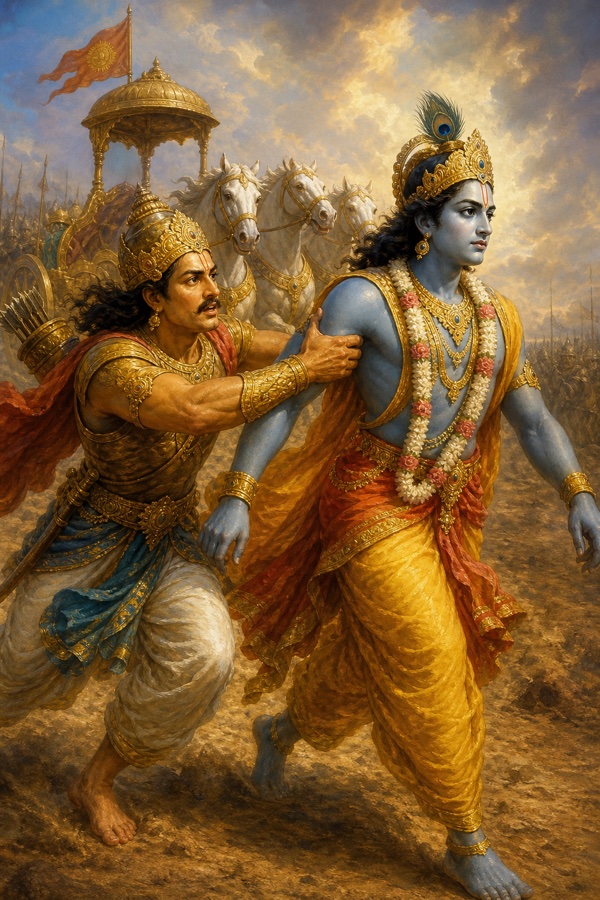
While the two of them were speaking, Arjuna came off his own chariot. He ran after Krishna on foot and caught him by both hands, and the catching made no difference at first, because the god was in a rage, and Vishnu dragged Jishnu along behind him the way a storm carries off one tree. Arjuna got his arms around the legs that were moving so fast toward Bhishma and held, and at the tenth step, with difficulty, he stopped him. Then Krishna stood still, and Arjuna, wearing a beautiful garland of gold, bowed to him with a glad face and said what he had come to say. “Put this anger down, Keshava. You are what the Pandavas have to fall back on. I swear to you by my sons and by my own brothers that I will not withdraw from the acts I have pledged myself to. Younger brother of Indra, at your command I will certainly finish the Kurus.” Janardana was satisfied with that oath. Always wanting to do what pleased Arjuna, he climbed back onto the chariot with the discus still on his arm, took up the reins he had thrown down, lifted the conch called Panchajanya, and filled the sky and every quarter of it with the blare. And when the Kuru heroes saw him take up that conch again, wearing his necklace and his armlets and his earrings, with his curved lashes powdered gray by dust and his teeth perfectly white, they raised a long cry. Cymbals and drums and kettledrums, the rattle of chariot-wheels, the smaller drums, and the lion-shouts coming out of every Kuru rank ran together into one fierce uproar. Over the top of it went the twang of Arjuna’s Gandiva, rolling like thunder into every corner of the sky, and after the twang came the arrows, bright and burning, going out in all directions.
Then the Kuru king came at him with a large force, with Bhishma beside him and Bhurishravas beside him, arrow in hand, looking like a comet that has risen to burn out a constellation. Bhurishravas threw seven javelins winged with gold. Duryodhana threw a lance with real speed on it. Shalya threw a mace, and Shantanu’s son threw a dart. Arjuna took the seven javelins out of the air with seven arrows, cut the lance out of Duryodhana’s throw with one keen-edged shaft, and cut down both the blazing dart that Bhishma had sent, bright as lightning, and the mace that had come from the arm of the ruler of the Madras, with two more. After that he took Gandiva in both hands, pulled it with the strength he had been saving, called up the Mahendra weapon with its proper mantras, and set it in the sky. It produced arrows in sheets, each one with the brightness of a fire in it, and with that weapon the man in the gold diadem and garland stopped the entire Kaurava army where it stood. The shafts cut off arms and bows and the tops of standards and whole chariots and went on into the bodies of kings and of the great elephants and horses. He filled the cardinal directions and the spaces between them with those arrows, and the twang of Gandiva by itself unsettled the hearts of his enemies. In that passage of arms the blowing of conches, the beating of drums and the deep noise of the chariots were all put down by the sound of that one bow. King Virata heard it and knew it, and so did the other leaders of men, and so did brave Drupada of the Panchalas, and they all moved toward that sound with their spirits up. Every man on the Kaurava side stopped exactly where he was standing when he heard it, and not one of them went looking for where it came from.
In that slaughter of kings the heroic went down along with their charioteers. Elephants in gold housings, carrying tall standards, took the broad-headed shafts and dropped where they stood with the life gone out of them and their bodies opened. The standards of countless kings, planted in front of their yantras and their indrajalas, were cut off by Arjuna’s winged arrows and his keen broad-headed shafts. Bands of infantry and chariot fighters and horses and elephants fell fast, their limbs gone slack or the life gone out of them altogether. Many men in that battle had their armor and their bodies cut clean through by the weapon that carries Indra’s name. And with those terrible shafts Arjuna started a river running across that field, whose water was the blood coming out of the opened bodies and whose froth was their fat. Its current was broad and it ran hard. The bodies of elephants and horses sent to the next world made its banks. Its mud was the entrails and marrow and flesh of human beings, and enormous Rakshasas stood along it in place of trees. Human heads, still covered with hair, floated on it like weed. Heaps of bodies made sandbanks that split the current a thousand ways. Coats of mail lay in it for pebbles, and jackals and wolves and cranes and vultures and crowds of Rakshasas and packs of hyenas worked along its edges. The men who were still alive looked at that river of fat and marrow and blood, which Arjuna’s arrows had opened, and thought of the Vaitarani.
Seeing the best warriors of the Kuru army cut down like that, the Chedis, the Panchalas, the Karushas, the Matsyas and every fighting man on the Pandava side lifted one shout together, high with victory, meant to frighten the Kauravas: they had just watched troops guarded by mighty division commanders scattered by one man in a diadem the way a lion scatters herds of smaller animals. Arjuna and Krishna roared along with them. And the Kurus, with Bhishma and Drona and Duryodhana and Bahlika badly cut about by Arjuna’s weapons, saw the sun pulling its rays back in and saw that Indra weapon still spread across the sky like the end of an age arriving, and they took their forces back for the night. Arjuna too, having done a great thing and earned a great name by breaking his enemies, saw the sun go red and the evening come down, finished his work, and went back to camp with his brothers. Then, as the dark was coming on, a great and frightened noise went up through the Kuru camp, and it said the same thing over and over. In today’s battle Arjuna has killed ten thousand chariot fighters and a full seven hundred elephants. All the men of the west, and the various tribes of the Sauviras, and the Kshudrakas and the Malavas, have been killed. What Dhananjaya did today no one else is able to do. Shrutayush the ruler of the Ambashthas, and Durmarshana, and Chitrasena, and Drona, and Kripa, and the ruler of the Sindhus, and Bahlika, and Bhurishravas, and Shalya, and Shala, and hundreds of other warriors standing together, with Bhishma himself among them, were all beaten today by the strength of one angry man’s arms, by Pritha’s son, the one great chariot fighter in the world. Talking in that way, the warriors of Dhritarashtra’s side came off the field and went into their tents, which were lit by thousands of torches and made beautiful by more lamps than anyone could count.
A key to reading this (names and figures): Krishna is called Indra’s younger brother and Mahendra’s younger brother because Vishnu took birth as Aditi’s youngest son in the dwarf form. Ajatashatru is Yudhishthira, and “the two twin brothers who are like the Ashvins” are Nakula and Sahadeva; Ganguli writes simply “the twin Ashvins.” Jishnu is Arjuna. The Samvarta fire is the fire that gathers the world in at the end of an age, and the Vaitarani is the river the dead have to cross, which is why a river of blood is measured against it. Yantras and indrajalas are battlefield contrivances whose exact nature is no longer recoverable, and Ganguli leaves them as they stand. The pledge Krishna gave before the war, to carry no weapon into it, is the thing that nearly ends here; Arjuna saves it by holding on to his legs. Krishna’s line that Duryodhana will be seen dead today belongs to that same minute of anger; Ganguli prints it as it stands, and Duryodhana in fact falls on the eighteenth day.
The gist: Arjuna’s gentleness with the grandsire, and an army coming apart behind him, are more than Krishna will carry. He drops the reins, steps off the chariot and goes at Bhishma on foot with the discus turning on his arm. Bhishma will not lift his bow against him; he bows instead and asks to be thrown down, since being killed by those hands is the best end available to him. They argue about who is the root of the war and about what destiny does to a man who will not listen. Then Arjuna comes off his own chariot, runs after Krishna, and stops him at the tenth step by holding his legs, swearing that he will not fail his own oath again. Krishna goes back to the reins, and Arjuna clears the field with the Mahendra weapon. By nightfall the Kuru camp can talk about nothing except ten thousand chariots and seven hundred elephants.
Five palmyras come looking for the ape banner, Abhimanyu holds off five great chariots alone, and a mace meets a man who walked at Dhrishtadyumna with a sword
The night went, and Bhishma came out at the head of the Bharata army in a temper, with a great force behind him, and went straight at the enemy. Drona rode with him, and Duryodhana, and Bahlika, and Durmarshana and Chitrasena and the mighty Jayadratha, each of them bringing his own large division and closing around the grandsire on every side until he stood in the middle of them the way the chief of the celestials stands in the middle of the gods. In front of those ranks the elephants carried standards on their backs, red and yellow and black and brown, and the wind took all of them at once. With the son of Shantanu inside it and its great chariot warriors and its elephants and its horses, that army looked like a bank of cloud with lightning in it, or like the sky in the rains when the weather is gathering and has not yet broken. Then the whole of it, protected by Shantanu’s son and wanting nothing but the fight, came down toward Arjuna like the current of the Ganga going to the sea. Arjuna, with the prince of apes on his banner, saw it coming from a long way off and it looked to him like a mass of cloud, elephants and horses and foot and chariots thick in its wings. He went out against the whole hostile army on his own chariot with the tall standard and the white horses, at the head of his own division, with a great force around him. And when the Kauravas and the sons of Dhritarashtra saw the ape-bannered warrior coming with that excellent standard and the handsome chariot shaft in its costly wrapping, and saw who was holding his reins, that bull of Yadu’s race, their spirits went out of them. What they were looking at was the best array on the field, guarded by the great chariot warrior of the world with his weapons up, and it had four thousand elephants standing at each of its corners. Yudhishthira the just had drawn up an array the day before that no human being had ever seen or heard of, and this was another of the same kind. Then a thousand drums were beaten at once, and out of every division came the blare of conches and the note of trumpets and men roaring like lions; and then the bows began, stretched by heroes with the shafts already on the strings, and the twang of them together with the conches put the drums and the cymbals out of hearing. The sky filled with the sound and then with dust, and the dust stood overhead like a vast canopy spread across the field, and the sight of it sent the brave men in faster.
What happened under that canopy is the ordinary arithmetic of a great battle. Chariot warriors struck by chariot warriors went over with their drivers, their horses, their chariots and their standards. Elephants struck by elephants came down. Foot soldiers were killed by foot soldiers. Horsemen riding hard were cut out of the saddle by horsemen riding hard, with lances and with swords, and fell with terrible faces, and all of it was a wonder to watch. Fine shields starred with gold, which had looked like so many small suns, were split by battle-axes and lances and swords and dropped onto the ground. Chariot fighters crushed by the tusks and the heavy trunks of elephants fell with their charioteers beside them. Bulls among chariot warriors, shot by other bulls among chariot warriors, went down into the dirt. And men who heard the noise that horsemen and foot soldiers make when they are opened by a tusk or rolled under the weight of animals running in close ranks fell on the field from hearing it.
It was while the cavalry and the infantry were going down fastest, and the elephants and horses and chariots were running, that Bhishma, in the middle of a crowd of great chariot warriors, caught sight of the prince of apes on its staff. The palmyra-bannered warrior, the son of Shantanu, whose standard carried five palmyra trees, turned and drove at the diadem-decked one, whose chariot had a strange energy in it from the speed of the excellent horses yoked to it and was blazing like lightning from the power of the weapons it carried. Others went with him, headed by Drona and Kripa and Shalya and Vivimshati and Duryodhana and the son of Somadatta. And out of the Pandava ranks came one boy in a handsome golden coat of mail, Arjuna’s son, who knew every weapon there was, and he took all of them on himself. The son of Krishna’s sister turned aside the great weapons of all those strong men at once, and doing it he looked like Agni himself on the sacrificial altar with his flames up, called down by high mantras. Bhishma, for his part, opened a river in that battle whose water was the blood of his enemies, and then he went around Subhadra’s son quickly, leaving him alone, and closed with Partha instead. Arjuna in his diadem and his garlands, with Gandiva of the strange look and the thunder-loud string, threw up shower after shower of arrows and broke the shower of great weapons coming at him, and then sent back at Bhishma, the best of all men who ever held a bow, his own rain of sharp-edged arrows and polished broad-headed shafts. Your troops watched that rain arrive and watched Bhishma take it apart in the air and scatter it, the way the maker of day scatters the dark. The Kurus and the Srinjayas and every other person on that field stood and watched the two of them, Bhishma and Dhananjaya, going at each other steadily, and the thing that marked the duel out from everything around it was the terrible sound the two bows made.
Then Drona’s son and Bhurishravas and Chitrasena and Samyamani’s son all came at Subhadra’s son together. Watching a boy fight five tigers among men by himself, people saw a young lion taking on five elephants, and not one of the five was his equal in sureness of aim, in courage, in strength, in quickness of hand or in knowledge of weapons. Partha, seeing his son standing in the middle of that and doing what he was doing, let out a lion’s roar. Your warriors saw the same thing from the other side, saw the boy cutting into your host, and closed on him from every direction. He went further in. Depending on nothing but his own strength, without letting his heart drop, he pushed into the Dhartarashtra army, and everyone on the field could see that his bow, which had the brightness of the sun on it, was never once allowed to rest. One shaft into Drona’s son. Five into Shalya. Eight to bring the standard of Samyamani’s son off its staff. Somadatta’s son threw a great dart with a golden shaft at him, a thing like a snake in the air, and the boy cut it in half with one sharp-edged arrow. Then, with Shalya watching, he made nothing of hundreds of Shalya’s terrible shafts and killed all four of his horses. That was enough. Bhurishravas and Shalya and Drona’s son and Samyamani and Shala, all of them afraid now of the strength in that boy’s arms, could not hold their ground in front of him. So Duryodhana sent twenty-five thousand men instead, Trigartas and Madras and Kekayas, all of them first-rate, all of them trained in arms, all of them men no enemy had beaten in battle, and they surrounded Arjuna and his son together with orders to kill them both.
The commander of the Pandava army saw it. The prince of the Panchalas, that conqueror of enemies, saw the chariots of the father and the son ringed in, and he came for them with thousands of elephants and chariots and hundreds of thousands of horse and foot, his bow already bent in anger, leading his own troops into the division of the Madras and the Kekayas; and that division of the Pandava army, chariots and elephants and cavalry with a famous and steady bowman in front of it, looked magnificent going in. On the way to Arjuna he put three arrows into the shoulder joint of Sharadvat’s son. He pierced the Madrakas with ten sharp shafts and killed the man who guarded Kritavarma’s rear, and then with one broad-headed arrow he killed Damana, the heir of the high-souled Paurava. Samyamani’s son answered with ten shafts into the Panchala prince and ten more into his driver. Cut about that badly, the great bowman licked the corners of his mouth, took his enemy’s bow off at the grip with a broad-headed arrow of extreme sharpness, put twenty-five arrows into him, killed his horses, and killed both the men guarding his wings. And Samyamani’s son, standing on a chariot that had nothing left to pull it, looked across at the son of the famous king of the Panchalas, picked up a terrible scimitar of the best steel, got down, and walked toward the chariot on foot. The Pandava soldiers saw him coming and so did Dhrishtadyumna of Prishata’s line, and he came on like a wave, like a snake that had fallen out of the sky, whirling the sword, bright as the sun to look at, treading like an elephant in rut. The prince of Panchala picked up a mace. He let the man cross the last of the shooting distance, and when he was close enough to the chariot he brought the mace down and broke his head to pieces. The blazing scimitar and the shield came out of the dead hands and hit the ground with the body. Killing that enemy with a mace won the Panchala king’s son an enormous name, and when the prince went down, a great chariot warrior and a great bowman, a cry of grief ran through your troops. Then Samyamani, having just watched his son killed, went at the prince of Panchala with everything he had, and every king in both armies stopped to watch two princes of that quality fight. Samyamani put three shafts into Prishata’s son the way a driver puts hooks into a big elephant. Shalya, that ornament of assemblies, came in angry as well and struck him in the chest. And another battle started there.
A key to reading this (names and one shifting list): Sharadvat’s son is Kripa, Somadatta’s son is Bhurishravas, and Drona’s son is Ashvatthama. The diadem-decked one and Kiritin are both Arjuna, from the crown Indra gave him, and the ape on the banner is the other way the field identifies his chariot. Bhishma’s own standard carries five palmyra trees, which is why the epic calls him the palmyra-bannered warrior. Prishata was Drupada’s father, so Dhrishtadyumna is strictly his grandson, though the poem keeps calling him Prishata’s son. Samyamani and his son are kings on the Kaurava side, and the text names the group fighting Abhimanyu twice with slightly different membership, first as Drona’s son, Bhurishravas, Chitrasena and Samyamani’s son, and then, when they give ground, as Bhurishravas, Shalya, Drona’s son, Samyamani and Shala; both lists are kept here as they are printed.
The gist: On the fourth morning Bhishma takes the front himself and the Kuru host comes down on Arjuna like a river in flood, and once the dust closes over the field the killing becomes general. Bhishma sights the ape banner, drives at it, and deliberately goes around Abhimanyu to get to Arjuna, which leaves the boy alone against five great chariot warriors; he kills Shalya’s four horses and brings down a standard and pushes all five back, so Duryodhana sends twenty-five thousand men to ring father and son instead. Dhrishtadyumna comes in with his own division to break the ring, kills Damana and the guard of Kritavarma’s rear, and when Samyamani’s son loses his chariot and walks at him on foot with a sword, kills him with one stroke of a mace. The dead man’s father is already coming.
The blind king says destiny is the stronger, Sanjaya tells him whose evil this was, ten men fight ten around one chariot, and Bhima gets down among ten thousand elephants
Dhritarashtra had heard enough. I hold destiny to be higher than any man’s effort, he told Sanjaya, since my son’s army is being cut down by the army of the Pandavas without a pause. You always speak of my troops as being slaughtered. You always speak of the Pandavas as unhurt and cheerful. You describe my men to me as unmanned, as fallen and falling and killed, and they are fighting with everything they have and working hard for a victory. You tell me the Pandavas are winning and that my side grows weaker and weaker. Child, I hear without stopping of countless reasons for a grief I cannot carry, and all of them come from what Duryodhana has done. And I cannot see, Sanjaya, by what means the Pandavas might be weakened and my sons might win this war. Sanjaya did not soften it for him. This great evil came out of you, king, he said. Now listen patiently to the slaughter of men and elephants and horses and chariot warriors.
Shalya put nine shafts into Dhrishtadyumna and Dhrishtadyumna sent back a crowd of steel shafts into the ruler of the Madras, and what everyone saw then was how extraordinary Prishata’s son was, because he stopped Shalya, that ornament of assemblies, on the spot. The fight between them was short. Nobody watching it saw either man rest for a moment. Then Shalya cut Dhrishtadyumna’s bow through with one broad-headed arrow of sharp edge and good temper and buried him under arrows the way loaded clouds bury a mountainside in the rains. Abhimanyu saw it and went at the chariot of the ruler of the Madras in a fury, got inside shooting distance of it, and put three sharp shafts into Artayani. That brought your warriors around, all of them wanting Arjuna’s son, and they packed themselves in front of Shalya’s chariot to keep it safe: Duryodhana, Vikarna, Duhshasana, Vivimshati, Durmarshana, Dussala, Chitrasena, Durmukha, Satyavrata and Purumitra, ten of them, planted there.
Ten came to meet them. Bhimasena in a temper, Dhrishtadyumna of Prishata’s line, the five sons of Draupadi, Abhimanyu, and the two sons of Madri and Pandu, and they came shooting every kind of weapon they had. They closed on each other wanting to kill each other, and the reason ten men of one family were doing that to ten men of the same family was your own bad policy. When those ten and those ten went at it, every other chariot warrior in both armies stopped fighting and stood and watched. They shot and roared and hit each other hard, and with the anger sitting in their chests and the wish to kill sitting on top of it they shouted and called each other out by name, cousins jealous of cousins, family closed on family with great weapons in their hands. Duryodhana, and this is a strange thing to have to record, put four sharp shafts into Dhrishtadyumna. Durmarshana put in twenty. Chitrasena five, Durmukha nine, Dussaha seven, Vivimshati five, Duhshasana three. Prishata’s son answered each one of them with twenty-five, and the speed of his hands was the whole story of it. Abhimanyu put ten each into Satyavrata and Purumitra. Then the sons of Madri, those two delights of their mother, covered their own uncle in sharp arrows, which was a wonderful thing to see, and Shalya covered his two nephews in return, wanting to undo what they were doing to him, and the sons of Madri did not waver.
Bhimasena looked across all of that, found Duryodhana in it, decided to end the argument, and picked up his mace. Your sons saw the mighty-armed man standing with the mace over his head like the crest of Kailasa and ran. Duryodhana, instead, sent the Magadha division at him, ten thousand elephants and very quick ones, and came on behind them with the ruler of the Magadhas in front. Vrikodara watched that division come at him, took the mace in his hand, jumped down off his chariot, and made a noise like a lion. Then he went into ten thousand elephants on foot with a weapon that weighed what it weighed and was as hard as the thunderbolt, and he went in like the Destroyer with his mouth open. He killed elephants with the mace and walked around the field doing it, like the slayer of Vritra walking through the host of the Danavas, and his shouting, which shook the mind and the heart of anyone who heard it, made the elephants crouch down together and lose the power to move at all. Then the sons of Draupadi, and that great chariot warrior the son of Subhadra, and Nakula and Sahadeva and Dhrishtadyumna of Prishata’s line came in behind him to hold his back, scattering arrows over everything that approached like clouds letting go on a mountainside. They took the heads off the men fighting from the elephants’ backs with well-tempered keen-edged shafts of every shape, and the heads came down, and the arms came down still wearing their ornaments and still holding their iron hooks, until it was like a rain of stones. The riders’ bodies stayed upright on the necks of their animals without heads on them, and looked like the headless trees you see on a mountain summit. We watched enormous elephants go over, killed by the high-souled son of Prishata. Then the ruler of the Magadhas pushed his own elephant, an animal like Airavata itself, straight at the chariot of Subhadra’s son, and the brave boy killed it with a single arrow and then took the king’s head off with a broad-headed shaft that had silver wings.
Bhimasena went on into the elephant division and worked through it, crushing the beasts around him like Indra crushing mountains, and we saw elephants killed in that battle with one stroke each, the way a hill is opened by a thunderbolt. Enormous animals lay there with their tusks broken off, or their temples broken in, or their bones, or their backs, or the great globes of their foreheads. Others were dead with foam at their mouths. Many with the frontal globes entirely smashed were throwing up quantities of blood. Some lay down out of fear and looked like small hills on the field. And Bhima, smeared with the fat and the blood of elephants and very nearly bathed in their marrow, walked about that place like the Destroyer himself with his club, and when he whirled that mace of his, wet through with elephant blood, he was terrible and dreadful to look at, like the bearer of Pinaka with Pinaka in his hands. The huge tuskers being broken up by his anger turned all at once and ran, and ran through your own ranks. And the great bowmen and chariot warriors with Subhadra’s son at their head kept guarding the man with the bloody mace the way the gods guard the wielder of the thunderbolt. Bhimasena at that hour looked like the end of things. Putting his strength out on every side with the mace in his arms, he looked to us like Shankara dancing when a Yuga closes; his mace, heavy and fierce and loud, was Yama’s staff and had the noise of Indra’s bolt in it; and smeared as it was with marrow and with hair it was also the Pinaka of the angry Rudra when he is destroying every creature there is. A herdsman drives cattle with a goad, and Bhima drove that elephant division with his mace in the same way, and with him hitting them and the arrows of the men behind him hitting them the elephants ran in every direction and wrecked your own chariots as they went. Then, having swept them off the field like a big wind sweeping cloud, he stood where he was, and he looked like the bearer of the trident standing in a burning ground.
A key to reading this (names, kinship and two textual oddities): Artayani is another name for Shalya, from his descent from Rtayana, and Vrikodara is Bhima. The sons of Madri are Nakula and Sahadeva, and Shalya is their mother’s brother, which is why nephews and uncle are shooting at each other here and why the poem stops to call it wonderful. Airavata is Indra’s elephant, the standard of size. Pinaka is Shiva’s bow, and the comparison of a blood-soaked mace to it is the poem’s own. Two oddities are kept as Ganguli prints them: the ten men guarding Shalya’s chariot include Dussala, but the tally of arrows a few lines later names Dussaha instead; and the ruler of the Magadhas who dies here is never given a personal name in the text, so none is supplied.
The gist: Dhritarashtra finally says out loud that destiny must be stronger than effort, and Sanjaya answers just as plainly that the evil started with him. Then Shalya cuts Dhrishtadyumna’s bow, Abhimanyu drives at Shalya’s chariot, and ten Kaurava warriors form up to protect it while ten Pandava warriors come to break it, cousins against cousins, with both armies standing still to watch. Bhima ends the standoff by picking up his mace, and Duryodhana answers by sending ten thousand Magadha elephants at him. Bhima gets down off his chariot and goes into them on foot; Abhimanyu kills the Magadha king’s elephant and then the king; and the surviving animals stampede back through the Kaurava lines.
One mace against an ocean: eight of Duryodhana’s brothers dead by name, and the elephants Ghatotkacha made out of nothing at the close of the fourth day
With the elephant division finished, your son gave the order that ended any pretense of a battle line, Sanjaya said. He sent the whole army at one man. Everything he had left went forward at Bhimasena, who stood shouting where they had left him: chariots past counting, horse, elephants, foot soldiers nobody had numbered, conches and drums going, the dust of the whole host climbing over them like weather. The gods would have found that host hard to hold. It came on the way the sea comes in on the day of the full moon or the day of the new, and it broke on Bhima the way the sea breaks on a bank. I watched it, king, and what the son of Pandu did there was past what a man should be able to do. With his mace alone he stopped kings who were riding at him in a fury, stopped them with their horses and their chariots and their elephants, and stood in the middle of that churning like Meru standing in the middle of the world. Nobody left him. His brother and his sons, Dhrishtadyumna of Prishata’s line, the sons of Draupadi, Abhimanyu, Shikhandi whom no one had beaten, all of them held their ground beside him out of something other than calculation. Then he lifted the heavy mace of Saika iron and went into your army like the Destroyer walking with his club. He pressed crowded chariots and crowded horsemen down into the dirt. He went across that field like the fire that comes at the end of an age, crushing chariot after chariot with the drive of his thighs. He ground your troops the way an elephant grinds a stand of reeds, dragging chariot fighters off their chariots, men off the backs of their elephants, foot soldiers off the ground where they stood, and killing every one of them with the mace, the way a gale takes down trees. Killing elephants and horses, that mace grew slick with fat and marrow and flesh and blood until it was a horrible thing to look at, and the ground around him, littered with dead men and dead cavalry, began to resemble the house of Yama. The mace itself, terrible as the rod of Death and bright as Indra’s bolt, looked like the Pinaka in the hand of an angry Rudra. Wherever he raised it and turned his eyes, Bharata, the troops in that direction seemed to melt from the look alone.
It was that sight, Vrikodara scattering an army over and over and swallowing a whole division like Death with his mouth open, that brought Bhishma across the field toward him, on a chariot bright as the sun, its wheels making the noise of thunderheads, his arrows going out ahead of him and spreading like a canopy of rain cloud. Bhima saw him coming in that shape and went for him in a rage, and at that exact moment Satyaki of Shini’s line, who never missed, cut in ahead of them both. He came at the grandsire with his bow working, killing everything between, and your son’s army shook as he passed through it. His horses were silver-colored, his arrows sharp and handsomely winged, and not one warrior on your side could slow him down. Only the Rakshasa Alambusha touched him, ten shafts in him, and Satyaki answered with four and drove on. He rolled through the middle of his enemies, checking the best of the Kuru warriors as he went, shouting again and again, and your men poured arrows on him the way massed clouds pour rain onto the breast of a hill, and none of it stopped a man who looked like the noonday sun in his glory. Every face on your side had gone slack except one. Somadatta’s son Bhurishravas, watching the chariot fighters of his own party driven off, picked up a bow of savage force and went at Satyaki because he wanted the fight. He put nine arrows into him the way a driver puts the hook into an elephant, and Satyaki, in front of the whole army, put nine back into him. Duryodhana came around Somadatta’s son with his full brothers to hold that ground, and the Pandavas came around Satyaki, and the two rings closed at once.
Bhima, still in his fury, went at all your sons with the mace up, Duryodhana at their head. Your son Nandaka, with thousands of chariots behind him and vindictiveness enough for all of them, put arrows into him that had been whetted on stone and feathered with kanka plumes. Then Duryodhana struck him in the chest with nine. Bhima climbed onto his own chariot then, and what he said to his driver Vishoka has the flatness of a man who has already decided: these brave strong sons of Dhritarashtra, he said, every one of them a great chariot fighter, are furious with me and want to kill me in this battle. I am going to kill all of them today while you watch. So drive my horses carefully. Then he put gold-decked arrows into your son and three between Nandaka’s breasts, and Duryodhana answered with six into Bhima and three into Vishoka, and with three more, smiling as he did it, cut Bhima’s shining bow off at the grip. It was the sight of Vishoka being hurt that Bhima could not take. He took up a second bow, fitted a horseshoe-headed arrow with fine wings to it, and cut the king’s bow in half. Duryodhana threw the broken thing aside in a fury that had gone past speech, took a tougher bow, sighted one shaft that burned like the rod of Death, and struck Bhima between the breasts with it. Bhima sat down on the floor of his chariot and fainted there. Abhimanyu and the other great chariot fighters of the Pandava army would not stand for that, and they put down a thick rain of arrows on your son’s head with a steadiness that suggested they had rehearsed it. Then Bhima came back to himself, pierced Duryodhana with the arrows that were to hand and then with five more, and put twenty-five gold-winged shafts into Shalya, who was carried off the field.
That was when fourteen of your sons came at him together: Senapati, Sushena, Jalasandha, Sulochana, Ugra, Bhimaratha, Bhima, Viravahu, Alolupa, Durmukha, Dushpradarsha, Vivitsu, Vikata and Sama. They rushed him as one, eyes red, shooting arrows past counting, and they pierced him deep. Bhima looked at the fourteen of them the way a wolf looks at smaller animals, licking the corners of his mouth, and came down on them with the speed of Garuda. He took Senapati’s head off with a horseshoe-headed shaft. He put three arrows into Jalasandha and sent him to the house of Yama, delighted, laughing while he did it. He struck Sushena and sent him straight to Death. With one broad-headed shaft he brought down Ugra’s head, which was handsome as the moon and still wearing its turban and its earrings, onto the ground. He spent seventy shafts on Viravahu and sent him to the next world with his horses, his standard and his driver together. Still smiling, king, he sent the two brothers Bhima and Bhimaratha after them. And in front of the whole army, with another horseshoe-headed arrow, he sent Sulochana to the same address. Your remaining sons, watching this and taking his blows, ran from the field in fear of him.
Then the son of Shantanu spoke to all his great chariot fighters. That terrible archer Bhima, he said, is killing the mighty sons of Dhritarashtra and other heroic chariot warriors in his rage, whatever their skill in weapons and whatever their courage, even when they fight him together. Seize the son of Pandu, all of you. At that the whole Dhritarashtra army came at Bhimasena in a rage, and Bhagadatta on his elephant, the temples split and running, came suddenly to the place where Bhima stood. He covered him with stone-whetted arrows until Bhima could not be seen at all, the way clouds cover the sun. The Pandava chariot fighters, who trusted the strength of their own arms, would not have it. They surrounded Bhagadatta on every side and poured arrows down on him and on the elephant, and that elephant of the ruler of the Pragjyotishas, with blood running down the length of him, became a beautiful thing to look at out there, like a bank of cloud with the sun’s light in it. The animal, urged on, ran at twice the speed he had shown before, with the ground shaking under him, and the great chariot fighters, seeing what was coming and deciding it could not be stopped, lost heart. Bhagadatta struck Bhima between the breasts with one straight shaft. Pierced deep, his limbs gone numb with the swoon, that great archer sat down on his chariot holding the staff of his own flag to stay upright, and Bhagadatta, seeing the champions frightened and Bhima senseless, threw back his head and roared.
Ghatotkacha saw his father like that. He went out of sight where he stood, and the rage in him came back a moment later wearing another shape, an illusion built to enlarge the fear of anyone already afraid. He was riding an Airavata he had made out of nothing, and behind him came the other elephants of the quarters, Anjana, Vamana, and Mahapadma of blazing glory, huge, ridden by Rakshasas, each with four tusks, the rut running down each of them in three streams. Ghatotkacha put his own elephant at Bhagadatta’s, meaning to kill the king’s animal with his own, and the three others came in from every side and drove their tusks into a beast already full of arrows, until the elephant of Pragjyotisha cried out in a voice like Indra’s thunder. Bhishma heard that cry and turned to Drona and Suyodhana and all the kings. The great archer Bhagadatta, he said, is fighting the wicked-souled son of Hidimva and has fallen into serious danger. That Rakshasa is enormous and the king is very angry, and two like that, once engaged, will certainly be the death of each other. You can hear the Pandavas shouting and you can hear that terrified elephant screaming. Blessings on you, let us all go there and save the king, because if he is left unprotected in this battle he will lose his life quickly. Do what I say now, warriors, and do not delay. The fight is deepening and turning into the kind that lifts the hair. That commander is high-born, he is brave, and he is loyal to us, and it is right that we should be the ones to pull him out. The kings of the Kuru army went at speed toward the ruler of the Pragjyotishas with Bharadvaja’s son leading them, and the Panchalas and the Pandavas came after them with Yudhishthira at their head. Seeing that division coming, the prince of the Rakshasas let out a roar as deep as thunder, and Bhishma heard it, and looked at the elephants fighting, and turned to Bharadvaja’s son a second time. I do not want to fight the wicked-souled son of Hidimva today, he said. He is strong, he has energy, and at this moment he is well supported. The wielder of the thunderbolt himself could not beat him just now. He aims true and he strikes hard. And our animals are tired today. The Panchalas and the Pandavas have cut us up badly. I do not want a fresh encounter with the Pandavas while they are winning. Have the withdrawal of our army proclaimed for today. We will fight the enemy tomorrow. The Kauravas, who were afraid of Ghatotkacha, took the coming of night as their excuse and did gladly what the grandsire had said. When they had gone the Pandavas roared like lions with their conches and their pipes going under the sound. That, Bharata, is how the battle went that day between the Kurus and the Pandavas, with Ghatotkacha in front. The Kauravas went back to their tents in the dark, beaten and ashamed. The sons of Pandu, cut about with arrows and full of the day, went to their own camp with Bhimasena and Ghatotkacha leading them, and honored those two with shouts of every kind mixed with trumpets, until the earth shook with it and the hearts of your sons felt ground down by the noise. And king Duryodhana, with his brothers dead, sat a long while in his grief and his tears. Then he made every arrangement for his camp by the rules of the science of war, and sat on alone, scorched by the loss of his brothers, thinking.
A key to reading this (names and counts): Vishoka is Bhima’s charioteer, and he will appear again later in the war being asked how many arrows are left in the quivers. Fourteen of Dhritarashtra’s sons attack together here and eight of them die in this passage: Senapati, Jalasandha, Sushena, Ugra, Viravahu, Bhima, Bhimaratha and Sulochana. The six who are named and survive run from the field. The Bhima killed in this list is Dhritarashtra’s son of that name, a different man from Bhimasena who kills him. The elephants of the quarters are the four that hold up the directions of the world; Airavata is Indra’s, and Anjana, Vamana and Mahapadma are the others. All four of Ghatotkacha’s elephants are illusions; the three that follow him are the ones the text describes, each with four tusks and rut running in three streams. Pragjyotisha is Bhagadatta’s kingdom in the far northeast.
The gist: The last hours of the fourth day belong to Bhima. Duryodhana throws his entire army at him and Bhima stops it alone with his mace, standing like a bank against the sea. In the duel that follows Duryodhana cuts his bow away and knocks him senseless, and Bhima wakes, drives Shalya off the field, and then kills eight of the fourteen brothers who have rushed him, one after another, by name. Bhishma orders the whole army to take him; Bhagadatta’s elephant knocks him senseless a second time; and Ghatotkacha answers by conjuring Airavata and three more elephants of the quarters out of the air and setting them on the king’s animal. Bhishma decides he will not fight a Rakshasa at full strength with tired horses, uses nightfall as the reason, and pulls the army back. Duryodhana is left sitting with his dead brothers.
Where righteousness is, there is victory: a blind king asks his question again, gets an answer with no comfort in it, and hears of the hymn Brahma sang on Gandhamadana to a chariot standing in the sky
Hearing of feats the gods themselves could not manage, Dhritarashtra said, my heart fills with fear and with wonder together. Hearing how my sons are humiliated at every turn, I am eaten by the thought of where this ends. What Vidura said to me will burn me from the inside; I have no doubt of that. All of it looks to me like the work of Destiny, Sanjaya. The fighters of the Pandava army are closing with the best warriors we have, men who have Bhishma at their head and who know every weapon there is, and they are cutting them down. What austerities have the high-souled sons of Pandu performed, my son? What boon did they get, or what science do they know, that they suffer no diminution at all, like the stars in the sky? I cannot bear that my army should be slaughtered over and over by these men. This severe divine punishment has come down on me alone. Tell me the whole truth, Sanjaya, about why the sons of Pandu cannot be killed and mine can. I cannot see the far shore of this distress. I am a man trying to cross the deep ocean with his two arms and nothing else. A great calamity has come on my sons; I am certain of it. Bhima will kill every one of them. I do not see the hero who can protect them in battle. Their death in this war is settled, Suta, so it falls to you, since I am asking, to tell me the true cause of all of it. When he saw his own troops running from the field, what did Duryodhana do? And what did old Bhishma do, and Drona, and Kripa, and the son of Suvala, and Jayadratha, and that great bowman the son of Drona, and Vikarna of great strength? When my sons turned their backs on the fight, you who are so wise, what did those high-souled warriors resolve?
Listen carefully, king, Sanjaya said, and when you have listened, let it go down into your heart. None of this is the work of a spell. None of it is illusion of any kind. The sons of Pandu have not invented some new terror. They are strong men, and they are fighting this war by fair means. They want a high name, and so they do everything they do, down to the keeping of their own lives, by the road of morality. They have every kind of prosperity and great strength, and they never step back from a battle, and they keep their eyes on righteousness. And where righteousness is, there is victory. That, king, is why the sons of Pritha cannot be killed in battle and always win. Your sons are wicked-souled and given over to sinfulness. They are cruel and they are wedded to mean acts. That is why they are being worn down. Your sons did many cruel and deceitful things to the sons of Pandu, like low men, elder brother of Pandu, and the sons of Pandu always covered those offenses up and said nothing. Your sons humiliated them on one occasion after another. Let them eat the fruit of that steady course of sin now, which is a fruit like poison. And you are to eat of it too, king, with your sons and your kinsmen, because you could not be woken even when your well-wishers were shouting at you. Vidura forbade you, Bhishma forbade you, the high-souled Drona forbade you, and so did I, and you did not take any of it in. You pushed away words that were meant for your good and were worth accepting, the way a sick man pushes away the medicine he has been prescribed. You took your sons’ view of the matter and counted the Pandavas as beaten before it began. Now hear again the thing you asked me, chief of the Bharatas, the true cause of the Pandavas’ victory. I will tell you what I heard, because Duryodhana put this very question to the grandsire. Seeing his brothers beaten, every one of them a great chariot fighter, with his mind in pieces from the grief of it, your son went humbly to the grandsire in the night and asked him. Hear all of it, monarch.
Drona, Duryodhana said, and you, and Shalya, and Kripa, and Drona’s son, and Kritavarma the son of Hridika, and Sudakshina the ruler of the Kambojas, and Bhurishravas, and Vikarna, and Bhagadatta of enormous prowess, are all reckoned great chariot fighters. Every one of them is high-born and ready to throw his life away in this battle. My own opinion is that they are a match for the three worlds put together, and that all the warriors of the Pandava army together cannot stand up to what you have. And yet a doubt has come into my mind, and I am asking you to clear it. Who is it that they lean on, that they are beating us again and again? Hear what I have to say, Bhishma answered him, son of Kuru’s race. I told you this same thing many times over and you never did what I said. Make peace with the Pandavas, best of the Bharatas. I consider that good for the world and good for you, my lord. Enjoy this earth with your brothers and be happy, satisfy the people who wish you well, give your kinsfolk some joy. I went hoarse saying it before now, and you would not listen, sire. You always disregarded the sons of Pandu, and everything that has followed from that has now arrived. Hear from me as well, my lord, the reason those Pandavas, whose achievements never tire them, cannot be killed. There is not, there never was, and there never will be a being in all the worlds able to defeat the sons of Pandu while the wielder of Sharnga protects them. You know what morality is, so listen truly to an old story that sages with their souls under control once told to me.
Long ago, Bhishma said, the celestials and the rishis went together and waited in reverence on the Grandsire upon the mountains of Gandhamadana. The Lord of all creatures was sitting at his ease in the middle of them when he saw a chariot standing in the sky, blazing with light. He worked out what it was by meditation, and then he joined his hands, steadied his heart, and with delight in him made his salutation to the highest Divine Being. The rishis and the celestials, seeing that form displayed in the air, stood up with their hands joined too, their eyes fixed on a wonder past other wonders. Having worshiped him in due form, Brahma, first of all who know Brahman, maker of the universe, who understands the highest morality, spoke these words to him. You are the glory of the universe by your very form. You are its lord. You whose protection reaches through the whole of it, you whose work the universe is, you whose soul is under your own control, you are the supreme master of the universe. You are Vasudeva. I take refuge in you, the soul of Yoga and the highest divinity. Victory to you, supreme god of the universe. Victory to you, who are always busy with the good of the worlds. Victory to you, lord of Yoga, who can do anything. Victory to you, who are before Yoga and after it. You with the lotus springing from your navel and the wide eyes, victory to you, lord of the lords of the universe. Lord of past and present and future, victory to you, who are gentleness embodied. Sun of suns. Holder of attributes past counting, victory to you, the refuge of everything there is. You are Narayana, you cannot be understood, victory to you who carry the bow called Sharnga. Great Snake, huge Boar, first Cause, you of the tawny locks, victory to you, the almighty. You in the yellow robes, lord of the cardinal points and the points between them, you whose dwelling is the universe itself, you who are infinite, you who do not decay, you who are manifest, you who are unmanifest, you who are immeasurable space, you who hold every sense in your own control, you who always accomplish good, you whom only you yourself can know, victory to you, who are deep. The goddess Earth is your two feet, the directions and the directions between them your arms, and the heavens your head. I am your form, the celestials are your limbs, and the sun and the moon are your two eyes. Austerity, and truth born of morality, and the rites, are your strength. Fire is your energy, wind is your breath, and the waters came out of your sweat. The two Ashvins are your ears and the goddess Saraswati is your tongue. The Vedas are your knowledge, and this universe rests on you. Lord of Yoga and of those who practice it, we do not know your extent, your measure, your energy, your prowess, your might, or where you began.
Filled with devotion to you and depending on you with our vows and our observances, Brahma said, we worship you always as the highest lord, the god of gods. The rishis, the gods, the Gandharvas, the Yakshas, the Rakshasas, the Pannagas, the Pisachas, human beings, beasts, birds and reptiles, all of them were created by me on the earth through your grace. You with the lotus at your navel and the wide eyes, Krishna, dispeller of every sorrow, you are the refuge of all creatures and you are their guide. The universe is your mouth. Through your grace, lord of the gods, the gods are happy, and through your grace the earth has always been kept free of terrors. So now, you of the great eyes, take birth in the race of Yadu. For the establishing of righteousness, for the killing of the sons of Diti, for the holding up of the universe, do what I am asking, lord. Vasudeva, what is your supreme mystery has been sung here by me, and only through your grace. Having made the divine Sankarshana out of your own self by yourself, Krishna, you then made yourself as Pradyumna, born of yourself. Out of Pradyumna you made Aniruddha, who is known as the eternal Vishnu. And it was Aniruddha who made me, Brahma, who holds the universe up. Made out of Vasudeva’s own essence, I was therefore made by you. Divide yourself into portions, lord, and be born among human beings. Slaughter the Asuras there for the happiness of all the worlds, establish righteousness, win renown, and you will come again truly into Yoga. The twice-born rishis on earth and the gods, you of infinite prowess, devoted to you, sing of your astonishing self under the names that are yours. You of the excellent arms, every class of creature rests on you, having taken refuge in you, giver of boons. The twice-born sing of you as the bridge of the world, with no beginning and no middle and no end, and with Yoga in you that has no limit.
A key to reading this (who is speaking to whom): The passage runs in three layers. On the outside the blind king asks Sanjaya. Inside that, Sanjaya reports that Duryodhana put the same question to Bhishma that night. Inside that again, Bhishma repeats an old story the sages once told him, the hymn Brahma sang on Gandhamadana. Sharnga is the name of Vishnu’s bow. Sankarshana, Pradyumna and Aniruddha are the emanations through which Vasudeva unfolds himself, and this telling puts Brahma at the end of that sequence, made by Aniruddha. The sons of Diti are the Daityas, the demons. The line about righteousness and victory returns many times across the epic, and here it arrives from the mouth of a charioteer, addressed to the one man who spent a lifetime refusing to hear it.
The gist: After the fourth day Dhritarashtra asks his usual question, which is why the Pandavas cannot be killed, and for once Sanjaya gives him no comfort at all. There is no spell and no illusion in it, he says; the Pandavas fight by fair means with their eyes on righteousness, and victory goes where righteousness is, while your sons are bound to cruelty and deceit and are being worn away by it, and you will eat that fruit yourself, because Vidura and Bhishma and Drona and I all warned you and you pushed us away like a sick man pushing away medicine. Then he reports the same question asked that night by Duryodhana, who listed his own champions first. Bhishma’s answer begins with the advice he has given all along, which is to make peace, and ends with the reason: nobody can beat men whom the bearer of Sharnga protects. To prove it he tells of the day the gods saw a blazing chariot standing in the sky over Gandhamadana, and of Brahma’s hymn to Vasudeva, which closes by asking him to be born in the race of Yadu.
What Brahma told the gods about the one he had just worshiped, and the account of Vasudeva’s origin that Duryodhana asked for
The Lord of the worlds answered Brahma in a voice that was soft and came from somewhere very deep, Bhishma said. Through Yoga, sire, everything you wish is already known to me, he said, and it will be as you wish. Then, in the middle of that assembly, with the words barely finished, he was gone. What he left behind him was a silence, and in the silence a crowd of gods and rishis and Gandharvas who had just watched the Grandsire of all the worlds bow to somebody. They came up to Brahma and asked the question they could not hold in. Who was that, lord? Who was it you worshiped with such humility, and praised in such words as those? We want to hear it.
And the Grandsire, in that sweet voice of his, told them. He who is called TAT, he said, he who is Supreme, he who exists now and will exist for all time, the highest Self, the Soul of all beings, the great Lord: it was with his ever-cheerful self that I was speaking just now, you bulls among gods. I asked the Lord of the Universe, for the good of the Universe, to take his birth among men in the family of Vasudeva. Be born in the world of men, I said to him, for the slaughter of the Asuras. Those Daityas and Rakshasas of fierce form and enormous strength who were killed in the old battles have already been born again among men, and the mighty Lord, taking birth in a human womb, will live on the Earth with Nara beside him. Nara and Narayana, those two ancient and best of rishis, cannot be defeated in battle by all the celestials put together. Their energy has no measure, and when the two of them are born together into the world of men, fools will look straight at them and not know what they are looking at.
Then Brahma said the thing that ought to have settled the matter for anyone listening. That Vasudeva, he said, is the one from whose Self I sprang, I, Brahman, the Lord of the whole Universe, and he is worthy of your adoration. He carries the conch and the discus and the mace, and his energy is very great, and he must never be slighted as a man, you best of the gods. He is the Supreme Mystery and the Supreme refuge; the Supreme Brahma; the Supreme glory. Nothing in him decays. He is unmanifest and eternal, sung of as Purusha by men who could never comprehend him, and the divine Artificer has sung of him as the Supreme Energy, the Supreme Felicity and the Supreme Truth. So let no Asura and no god with Indra at their head ever disregard Vasudeva of immeasurable prowess by calling him a man. The fool who speaks of Hrishikesha as only a man is called a wretch. The man who slights Vasudeva, that Yogin of illustrious soul, merely because he has entered a human form, is spoken of as one laboring under darkness. So is the man who fails to recognize the Divine person, the Soul of everything that moves and everything that does not, the bearer of the auspicious wheel, the one of dazzling brilliance from whose navel the first lotus grew. And whoever slights the wearer of the diadem and the Kaustubha gem, who lifts the fear off his friends, sinks into thick darkness. Knowing all of this properly, best of the gods, every one of you should worship Vasudeva, the Lord of the worlds.
Having said that to the gods and the rishis in the old days, the Grandsire dismissed them all and went back to his own abode, and the gods and the Gandharvas and the Munis and the Apsaras went up to heaven with that speech still working in them. And here the old man on the field of Kurukshetra put his own name to it. I heard this myself, sire, from rishis of cultured soul talking among themselves in their assembly. I heard it from Rama the son of Jamadagni, and from Markandeya of great wisdom, and from Vyasa, and from Narada. Having learned all of it, having heard Vasudeva called the Eternal Lord and the Supreme God of all the worlds and the great Master from whom Brahman himself sprang, why would a man not adore him? And then Bhishma turned the whole thing on the prince sitting in front of him, which was what he had been building toward from the beginning. You were forbidden before this, sire, by sages of cultured soul. Never go to war with that Vasudeva who carries a bow, they told you, and never with the Pandavas. Your folly would not let you take it in. That is why I consider you a wicked Rakshasa and a man wrapped around in darkness. That is why you hate Govinda and Dhananjaya the son of Pandu, since who else among men would hate the divine Nara and Narayana? So I tell you, king, that he is eternal and unfading, that he pervades the whole Universe, that he does not change, that he rules and creates and upholds everything, and that he is the one thing that truly exists. He holds up the three worlds. He is the Supreme Lord of all creatures that move and all that stay still, and the great Master; he is the warrior; he is Victory; he is the Victor; he is the Lord of all nature, full of goodness, with nothing in him of Darkness or of Passion. Where Krishna is, there righteousness is, and where righteousness is, there victory is. It is by the Yoga of his Supreme Excellence and the Yoga of his Self that the sons of Pandu are held up, and victory will therefore be theirs. He gives them an understanding filled with righteousness, and strength in battle, and he keeps them out of danger. He is the Eternal God who pervades all beings and is forever blessed, and the one you asked me about goes by the name of Vasudeva. Brahmins and Kshatriyas and Vaishyas and Shudras, each with their own distinguishing marks, serve and worship him with restrained hearts while performing their own duties. Toward the close of the Dwapara Yuga and the beginning of the Kali Yuga, believers sing of him with Sankarshana. Yuga after Yuga it is that Vasudeva who creates the worlds of the gods and the worlds of mortals, all the cities the sea goes around, and all the country that men live in.
Duryodhana had been quiet for a long time. When he spoke it was with the phrasing of a man asking for a genealogy rather than a creed. In all the worlds Vasudeva is spoken of as the Supreme Being, he said. Grandsire, I want to know his origin and his glory. And Bhishma gave it to him. Vasudeva is the Supreme Being, he said, the God of all gods, and no one superior to him of the eyes like lotus petals is anywhere to be seen, bull of Bharata’s race. Markandeya speaks of Govinda as the Most Wonderful and the Most High, as the All-being, the All-soul, the Highest soul, the Supreme male Being. Water, Air and Fire were created by him, those three. That Divine Master and Lord of all the worlds made this Earth. Then he laid himself down upon the waters, and being made of every kind of energy, he slept there in Yoga. Out of his mouth he created Fire, and out of his breath the Wind, and out of his mouth also Speech and the Vedas, and his glory never fades. That was how he first made the Worlds, and the gods with them, and the various orders of the rishis. He made decay and he made death, and he made birth and growth as well. He is Righteousness and he is of righteous soul; he gives boons and he gives everything men wish for; he is the Actor and he is the Action, and he is himself the Divine Master. He made the Past, the Present and the Future before anything else, being the Creator of the Universe, a Master of unfading glory. He created Sankarshana, the first-born of all creatures. He created the divine Shesha, the one known as Ananta, who holds up all creatures and holds up the Earth with her mountains. Men twice-born come to know him, whose energy is supreme, through the meditation of Yoga.
There was one more thing in that account, and it explained a name the prince had heard all his life. Out of the secretions of his ear, Bhishma said, sprang the great Asura called Madhu, fierce and fierce in his deeds and fierce in his intent, who set out to destroy Brahman, and that Supreme Being killed him. Because of Madhu’s killing, sire, the gods and the Danavas and human beings and the rishis call Janardana the slayer of Madhu. He is the great Boar; he is the great Lion; he is the Lord of the three steps, the Mother and the Father of every living creature, and there never was and never will be anyone above him of the eyes like lotus petals. From his mouth he created the Brahmins, and from his two arms the Kshatriyas, and from his thighs, king, the Vaishyas, and from his feet the Shudras. A man who waits on him dutifully, keeping his vows with ascetic austerities on the days of the full moon and the new moon, is certain to obtain the divine Keshava, the refuge of all embodied creatures, the essence of Brahma and of Yoga. Keshava is the higher Energy and the Grandsire of all the worlds, and the sages, king, call him Hrishikesha, the lord of the senses, and every man should know him as the Preceptor, the Father and the Master. Regions of blessedness that cannot be exhausted are won by the man Krishna is pleased with. The man who seeks the protection of Keshava in a place of fear, and the man who reads this description often, becomes happy and comes into every kind of prosperity. Men who reach Krishna are never beguiled, and Janardana always saves those who are sunk in great terrors. Knowing this truly, Bharata, Yudhishthira has sought the shelter of the highly blessed Keshava with his whole soul, the Lord of Yoga and the Lord of the Earth.
A key to reading this (names and pointers): TAT is the Upanishadic word used to point at the absolute without describing it. Nara and Narayana are the two ancient rishis whom this book identifies with Arjuna and Krishna. Sankarshana is Balarama. Shesha, also called Ananta, is the serpent the Earth is said to rest on. The great Boar, the great Lion and the Lord of the three steps are the three forms that later tradition names Varaha, Narasimha and Vamana; the text here says no more than this about them. Hrishikesha means lord of the senses, which is the meaning Bhishma stops to unpack. The divine Artificer is Ganguli’s phrase, and tradition attaches it to Vishvakarma. Rama the son of Jamadagni, whom Bhishma names among his sources, is Parashurama, who taught him weapons and later fought him.
The gist: It is the night after the fourth day, and the grandsire is telling his grandnephew a story he heard from Parashurama and Markandeya and Vyasa and Narada. Brahma once bowed to someone in front of the assembled gods, and when they asked who it was, he told them: the one called TAT, the one from whose Self Brahma himself came, who had just agreed to be born in the family of Vasudeva to kill the Asuras, and who would walk the Earth with Nara beside him while fools looked at the two of them and saw men. Bhishma turns the story straight onto Duryodhana. Where Krishna is, there is righteousness, and where righteousness is, there is victory. Then Duryodhana asks for the origin and glory of Vasudeva as if asking for a pedigree, and gets the whole cosmogony: the sleeper on the waters, fire out of the mouth and wind out of the breath, Sankarshana and Shesha, the killing of Madhu that gave a name, the four orders made out of a body, and at the end the one fact the prince least wants to hear, which is that Yudhishthira has taken shelter in exactly that.
Source: the Mahabharata of Krishna-Dwaipayana Vyasa, Bhishma Parva, Bhishma-vadha sub-book. This part belongs to K. M. Ganguli, sections XLIII to CXXII (43-122); the Gita Press Hindi edition numbers these chapters differently. Names, order, and events were checked against Ganguli’s complete translation. Dialogue and commentary are adapted, not a verbatim translation. About the sources.
Based on: The Mahabharata, Vyasa (Gita Press, Gorakhpur)