On this page
The roll of the snakes, from Shesha to Mahodara, and the eldest of them who turned his back on his brothers, went into the mountains to starve, and came out carrying the earth on his head
Shaunaka had been keeping count. He was the Kulapati of that hermitage in the Naimisha forest, the man whose twelve-year sacrifice had gathered every sage of rigid vows within walking distance, and it was at his fire that the son of the Suta, Ugrashrava, whom they called Sauti, had been sitting for days now, telling the ancestry of the snakes. Shaunaka knew exactly what was still owed. You have told us, he said, why the snakes were cursed by their mother and why Vinata was cursed by her son. You have told us of the boons their husband gave to Kadru and to Vinata, and you have named Vinata’s two sons. You have not yet named the snakes. We want to hear the names of the principal ones. Sauti answered him with the caution of a man who could see the length of that list before he opened his mouth. Out of fear of tedium, he said, I will leave most of them out and give you only the chief names. Listen. Shesha was born first, and then Vasuki. Then Airavata, Takshaka, Karkotaka, Dhananjaya, Kalakeya, the serpent Mani, Purana, Pinjaraka and Elapatra; then Vamana, Nila, Anila, Kalmasha, Shabala, Aryaka, Ugra, Kalashapotaka, Suramukha, Dadhimukha, Vimalapindaka, Apta, Karotaka, Shankha, Valishikha, Nishthanaka, Hemaguha, Nahusha, Pingala, Vahyakarna, Hastipada, Mudgarapindaka, Kambala, Ashvatara, Kaliyaka, Vritta, Samvartaka, Padma, Mahapadma, Shankhamukha, Kushmandaka, Kshemaka, Pindaraka, Karavira, Pushpadanshtraka, Bilvaka, Bilvapandara, Mushikada, Shankhashiras, Purnabhadra, Haridraka, Aparajita, Jyotika, Shrivaha, Kauravya, Dhritarashtra, Shankhapinda, Virajas, Subahu, Shalipinda, Prabhakara, Hastipinda, Pitharaka, Sumuksha, Kaunapashana, Kuthara, Kunjara, Kumuda, Kumudaksha, Tittiri, Halika, Kardama, Bahumulaka, Karkara, Akarkara, Kundodara and Mahodara. Those, he said, are the principal serpents. The rest I leave unnamed, for fear of wearying you. Their sons and their grandsons cannot be counted at all; I have thought about it, and I will spare you the attempt. The number of snakes in this world defeats arithmetic. There are thousands of them, and millions. Shaunaka let the roll settle over the assembly, all those names of creatures whose mother had sentenced them to fire, and then he asked about the one who had been born first.
You have named many serpents of great energy, hard to overcome, he said. When they heard that curse, what did they do? And Sauti began with the eldest. Shesha, the most renowned of them all, left his mother and went away to practice austerities so severe that the Grandsire himself would come down to ask him to stop. He lived on air. He kept his vows without a single lapse. He went from Gandhamadana to Badari, from Gokarna to the woods of Pushkara and on to the foot of Himavat, from one holy place to the next, some of them holy for their waters and some for their soil, and in each of them he sat down with a single aim and with his passions held in a grip that never loosened. A snake’s body is built for the cool dark of a hole; this one gave himself to mountain cold and river fords and the sun on open ground, season after season, and did not move. Years of that will strip any body. Brahma, the Grandsire of everything that lives, came and looked at what remained of this ascetic: hair matted into ropes, rags hanging on him, the flesh and skin and sinew dried down onto the bone by what he had done to himself. The Grandsire put the question to him. What is this that you are doing? Let the welfare of the creatures of the worlds also occupy your thoughts. With these penances of yours you are hurting every living thing. Tell me what desire it is that has taken root in your breast.
Shesha’s answer was the answer of a son who has looked hard at his whole family and wants no part of it. My brothers born of the same womb are all wicked at heart, he said. I have no wish to live among them. Give me your leave for that. They are jealous of one another like enemies, and that is why I am here doing this. I will not even look at them. They show no kindness to Vinata or to her son, and Vinata’s son, the one who ranges the sky, is our brother too. They envy him without pause. He is also far stronger than they are, because of the boon our father Kashyapa gave him. Behind those few sentences lay the whole history the assembly had already heard: a wager over the color of a horse’s tail, a mother who had made her sister a slave by cheating, a thousand sons who had refused to be the cheat and been cursed for it, and a half-brother with wings who had carried the nectar of the gods to buy his mother free. Shesha wanted none of it. For all these reasons I have gone into austerity, he said, and I mean to cast off this body, so that I may be spared their company even in another life. The Grandsire heard him out and then told him something the snake did not know. I am aware, he said, of how all your brothers behave, and of the great danger hanging over them because of what they did to their mother. A remedy for it was provided by me long before this. You have no need to grieve for your brothers. Ask me for a boon. I am well pleased with you and I will grant it today. It is your good fortune that your heart has fixed itself on virtue. Let it fix itself there more firmly still. Shesha asked for nothing that would have made his life among the snakes easier. This, he said, is the boon I want: that my heart may always delight in virtue and in blessed austerity.
Brahma granted it and then, in the same breath, laid on the snake a task that would define him for as long as the world stood. I am greatly pleased with your self-denial and your love of peace, he said, and at my command do this one thing for the good of my creatures. This Earth is unsteady, with her mountains and her forests, her seas and her towns and her hermitages all shifting on her. Bear her properly and well, so that she may become steady. Shesha did not hesitate, and he did not ask what such a burden would cost. He called Brahma lord of all creatures, giver of boons, lord of the Earth and of every created thing, lord of the universe, and he said: I will hold the Earth steady exactly as you say. Place her on my head. Go beneath her, Brahma told him. She will herself open a crevice for you to pass through. And by holding her you will do a thing that I prize very highly. So the elder brother of the king of the snakes entered a hole in the ground, and the Earth, as the Grandsire had promised, opened a way for him, and he passed through to the far side of her and took her up: the goddess with her belt of seas running all the way around her, with every mountain and forest and city on her back, resting now on a serpent’s head, and steady for the first time. Brahma looked at what he had made possible and named it. You are the god Dharma himself, he told the snake, because alone, with your huge body, you support the Earth and everything on her, as I myself could, or Indra, the killer of Vala. And so, Sauti told the Brahmins, the snake Shesha, the lord Ananta of great prowess, lives beneath the Earth to this day, holding the world up alone at the Grandsire’s command. And the illustrious Grandsire, best of the immortals, gave Ananta a helper for the work, and he chose the one brother Shesha had spoken up for: the bird of beautiful feathers, the son of Vinata.
A key to reading this (two names that will startle): The roll includes snakes named Kauravya and Dhritarashtra. They are serpents, with no connection to the blind king of Hastinapura, and both names will keep turning up among the Nagas later in the epic. Shesha is also called Ananta, the Endless. In this telling his holding of the Earth is a duty laid on him by Brahma in exchange for a boon, and Brahma’s gift of Garuda as his helper puts the two brothers who were kind to Vinata side by side; they will be seen together again in Vishnu’s company.
The gist: At Shaunaka’s request Sauti recites the names of the principal snakes, from Shesha and Vasuki down to Mahodara, and says the rest are past counting. Then the story of the eldest: after their mother’s curse Shesha turns away from his jealous brothers and wastes himself in austerities across the holy places, Brahma offers him a boon, he asks only that his heart stay fixed on virtue, and Brahma commands him to steady the trembling Earth. Shesha passes beneath her and takes her on his head, Brahma calls him Dharma itself, and gives him Garuda as his helper.
Vasuki calls the snakes to council: ten schemes for stopping a sacrifice that has not yet been planned, from dressing as Brahmins to killing the king, and a king of snakes who likes none of them
Vasuki, best of the snakes and their king, heard his mother’s curse and did what a ruler does with a sentence of death hanging over his whole people. He thought about how to make it come to nothing, and then he called his brothers together, Airavata and all the rest, to decide what would serve them best. The curse itself needed no repeating in that hall. Every snake there had heard Kadru speak it on the day they refused to become the black hairs on a horse’s tail for the sake of her wager: that Agni would consume them all at the snake sacrifice of King Janamejaya of the Pandava line. Vasuki put the thing before them plainly, without softening it, because a king who softens a death sentence to his own people leaves them unready for it. You know what this curse is aimed at, he said, and it is our duty to try to turn it aside. There are remedies for every curse, and no remedy has ever helped anyone cursed by his own mother. When I remember that this curse was spoken in the presence of the Immutable, the Infinite, the True One, my heart shakes. Surely our annihilation has arrived. Why else did the Immutable Lord fail to stop our mother while the words were still in her mouth? So let us take counsel today about how the snakes may be kept safe, and let us not waste time. Every one of you is wise and discerning. We will think together and find a way out, as the gods once did when they had to recover Agni, who had hidden himself in a cave. We must see to it that Janamejaya’s sacrifice for the destruction of the snakes never takes place, and that we do not perish.
So the whole brood of Kadru put their heads together, and the schemes came out one after another, each party certain of its own cleverness. One group said: let us take the form of eminent Brahmins, go to Janamejaya, and beg him, saying that this sacrifice of yours ought never to be held. A king can refuse almost anyone; a king who refuses a company of learned Brahmins asking a favor at his gate has a harder time of it, and every snake in the hall knew that much about courts. Another group, which considered itself wiser, said: let us all become his trusted counselors. He will then ask our advice on everything he undertakes, and we will advise him in such a way that the sacrifice is obstructed. He is the foremost of thoughtful kings; he will take us for men of sterling worth and consult us about his sacrifice, and we will tell him it must not be, and point to many grave evils in this world and the next, and make sure it never happens. Or, they went on, and here the counsel turned from words to fangs, let one of us go to the man who, out of goodwill to the king and skilled in the rites of the snake sacrifice, is appointed as its priest, and bite him so that he dies. With the priest dead, the rite cannot be completed. We will bite every one who knows those rites and is appointed a Ritvik, and so gain our end. A sacrifice of that size needs men who know its every syllable; kill the men and the rite has no mouth. At that, other snakes, more virtuous and kinder than these, spoke up in protest. This counsel of yours is evil, they said. Killing Brahmins is wrong. In danger, the proper remedy is the one the righteous would bless. Unrighteousness destroys the world in the end.
The ideas kept coming. We will become clouds bright with lightning, said some, and pour down rain and put out the blazing sacrificial fire ourselves. Some of the best of their kind proposed theft: let us go by night and steal away the vessel of Soma; without the Soma the rite is a fire with nothing to feed it, and that will spoil it. Or let snakes by the hundreds and thousands bite the people at the sacrifice and spread terror all around it. Or let serpents foul the pure food with their urine and dung, so that nothing on that ground is fit to offer. Others said: let us become the king’s Ritviks and block his sacrifice at the very start by demanding, give us the sacrificial fee. Once he is in our power he will do whatever we like. Others said: when the king goes to sport in the water, we will carry him off to our home and bind him, and then the sacrifice cannot happen. And a last party, who also thought themselves wise, said the thing everyone else had been circling. Let us go to the king and bite him. That will accomplish our object. With his death the root of all this evil is torn up. “This is the final resolve of us all, you who hear with your eyes,” they said. “Now do quickly what you think proper.” Having said it, they all turned and looked hard at Vasuki, and the hall went quiet, the way a hall does when the talking is over and only one voice is left that counts.
Vasuki took his time. He was the one whose name every snake in the hall would give if asked who among them was strongest, and he was being asked to choose which of ten roads to a king’s court his people should take: the beggar’s road, the counselor’s, the assassin’s. He thought, and then he refused them all. This final determination of yours, he told the snakes, does not seem to me worth adopting. The advice of every one of you fails to please me. What can I say that would be for your good? I think that only the grace of the illustrious Kashyapa, our father, can help us now. He meant the sage who had given Kadru her thousand sons and Vinata her two, the father whose boon had made Garuda stronger than any of them, and a father’s grace was a thing none of the ten schemes could seize by force. My heart does not know, he said, which of all your suggestions should be taken up for the welfare of my race and of myself.
Whatever I do must be for your good, he went on, and that is exactly what makes me so anxious, because the credit or the blame for the measure will fall on me alone. He had said the whole truth of his position in that one sentence. A king of snakes could not send a bite to a priest’s throat, or ten thousand fangs into a crowd, or a raiding party to a king’s bathing place, and afterward say that the hall had decided it. Whatever went to Janamejaya’s court from this council would go under his name and come back to it, and the thing that came back, if the counsel was wrong, would be the fire. So every plan stayed on the table and none of them was chosen, and while Vasuki sat with that arithmetic, a snake who had listened to all of it rose in the assembly.
A key to reading this (why this council matters): The snake sacrifice is still generations away; Janamejaya has not been born. The curse named him, and so the Nagas are plotting against an event that does not yet exist. Watch the order of the proposals: it runs from deception through sabotage to assassination, with one party in the middle insisting that killing Brahmins can never be a remedy for anything. “The one who hears with his eyes” is the epic’s own name for a snake, a creature that has no ears. Vasuki’s refusal to pick a scheme is the setup for the next scene, in which Elapatra reveals the one thing nobody in the hall knew.
The gist: Vasuki gathers the snakes to find a way around their mother’s curse. The proposals come in turn: pose as Brahmins and beg Janamejaya to stop the sacrifice, become his counselors and talk him out of it, bite the priest and the Ritviks, become storm clouds and drown the fire, steal the Soma vessel, foul the food, extort the fee, kidnap the king while he bathes, or simply bite the king himself. The virtuous snakes reject the killing of Brahmins. Vasuki likes none of it, says only Kashyapa’s grace can save them, and takes the burden of the decision on himself alone.
Elapatra’s testimony: what a frightened snake overheard from his mother’s lap, a rishi named Jaratkaru, a sister named Jaratkaru, and a son not yet conceived who will be called Astika
When every scheme had been laid out and Vasuki had rejected them all, a snake named Elapatra rose to speak, and what he had to say changed the shape of the whole council. He was one of the chief snakes in Sauti’s roll, named among the first, and he began with a truth no one else in the hall had been willing to say, the truth every scheme had been built to avoid. That sacrifice, he said, cannot be prevented. Nor is King Janamejaya of the Pandava line, from whom this fear comes, a man who can be hindered. The one whom fate afflicts has no refuge except fate. This fear of ours has fate at its root, and fate alone must be our refuge in it. So listen to me. When that curse was spoken, I was lying crouched in fear on our mother’s lap. He let them picture it: a small snake pressed flat against Kadru in the moment her fury broke over all of them, too frightened to move, and close enough, because of that, to hear what was said above his head. From there, he told Vasuki, I heard the words the grieving gods spoke to the Grandsire. The gods said to him, the god of gods: who but the cruel Kadru could get such dear children and then curse them like this, and in your very presence? And you yourself answered her words with “So be it.” We want to know why you did not stop her.
Brahma’s reply, as Elapatra had heard it from the lap where he hid, was the sentence the snakes had been dreading and the loophole they had been praying for, both at once. The snakes have multiplied, the Grandsire had said. They are cruel, terrible in form and highly poisonous. Out of desire for the good of my creatures I did not stop Kadru. Those poisonous serpents, and the others who are sinful and bite people who have done them no wrong, shall indeed be destroyed. The harmless and the virtuous shall live. That was the first thing no one in the council had known: the curse had a sorting in it, and the fire was for the wicked. Then the Grandsire had gone on, and this was the part Elapatra had carried in silence ever since. Hear also how, when the hour comes, the snakes may escape this dreadful calamity. There shall be born in the line of the Yayavaras a great rishi named Jaratkaru, intelligent, with his passions under complete control. That Jaratkaru shall have a son named Astika. He shall put a stop to that sacrifice, and those snakes who are virtuous shall escape it. The gods pressed him for the one detail that would let them find the man: on whom will Jaratkaru, that foremost of sages, gifted with great energy and austerity, beget that illustrious son? And Brahma answered them. That best of Brahmins, full of energy, shall beget a son full of energy on a wife who bears the same name as his own. Vasuki, the king of the snakes, has a sister named Jaratkaru. The son I speak of shall be born of her, and he shall set the snakes free.
Then the gods said “So be it” to the Grandsire, Elapatra went on, and the lord Brahma, having spoken, went back to heaven. He turned to his king. I see before me, he said, that sister of yours whose name is Jaratkaru. To deliver us from this fear, give her as alms to the rishi Jaratkaru of excellent vows, who will one day go begging for a bride. A man who owns nothing and wants nothing can still be given a gift he has asked for, the way a wandering Brahmin is given his food at a door, and a bride offered as alms is a gift of that kind; Elapatra had heard the Grandsire’s condition and understood what it would take to meet it. This means of release I heard with my own ears. The hall that had been arguing over poison and theft erupted. Well said, well said! the serpents cried, in great delight, and for the first time since their mother had spoken, the sound in that hall was joy. From that day Vasuki set himself to raising his sister Jaratkaru with the greatest care, and took a deep pleasure in it, because a whole race was now growing up inside one girl’s future.
Not long after this, the gods and the Asuras came together to churn the abode of Varuna, the ocean, and Vasuki, foremost of the strong, served as the churning cord, his body wound around the mountain and hauled back and forth by gods on one end and demons on the other until the sea gave up what it held. That is the kind of service that leaves a debt, and Vasuki knew whom to collect it from. The moment the work was done, the king of the snakes presented himself before the Grandsire, and the gods, who owed him now, came with him and spoke on his behalf. Vasuki is in great affliction from fear of his mother’s curse, they said. It is fitting that you root out the sorrow, born of that curse, that has pierced the heart of this snake who wants only the welfare of his race. The king of the snakes is always our friend and our benefactor. Be gracious to him and cool the fever of his mind. Brahma told the immortals that he had already considered what they said. Let the king of the snakes do what Elapatra told him before. The time has arrived. Only the wicked shall be destroyed, never the virtuous. Jaratkaru has been born, and that Brahmin is engaged in hard austerities. Let Vasuki, at the right moment, bestow his sister on him. What the snake Elapatra said for the welfare of the snakes is true and not otherwise. Vasuki had come to the Grandsire with a testimony overheard from a frightened child’s hiding place. He left with the Creator’s word that the man already existed, somewhere on the earth, and that the hour had come.
So Vasuki, with his mother’s curse still on him and, for the first time, a plan the Creator himself had confirmed, resolved to give his sister to the rishi Jaratkaru. He would not have to fight for it, or deceive a king, or kill a priest; he would have to wait, and waiting was the one thing no party in the council had proposed. That left him with a problem no king of snakes had ever faced: the man was out on the earth somewhere, wandering the way ascetics wander, and the whole of his race now depended on being there at the one moment in that man’s life when he opened his mouth to ask for a wife. Vasuki gave orders to a great many of his serpents, the ones who had never once neglected a duty, to find the rishi and keep watch on him wherever he went. When the lord Jaratkaru asks for a wife, he told them, come to me at once and tell me. The welfare of our race depends on it.
A key to reading this (two people, one name, and a churning in a single sentence): The rishi Jaratkaru of the Yayavara line and Vasuki’s sister Jaratkaru are two different people. Brahma’s condition is exactly that the wife share the husband’s name, so the coincidence is the hinge of the whole story. The churning of the ocean is mentioned here in one line, only to explain why Vasuki was standing before Brahma; its full telling came in the previous part of this chapter, before Kadru and Vinata made their wager over the horse. Elapatra calls Janamejaya a king “of the Pandava line” generations before any Pandava exists: he is repeating the words of the curse itself, which named the sacrifice of Janamejaya of the Pandava line, and in which the snakes’ whole future was already written.
The gist: With no scheme chosen, Elapatra tells the council what he overheard from his mother’s lap on the day of the curse: the gods questioned Brahma, and Brahma said the snakes had grown too many and too cruel, that only the wicked would burn, and that a rishi of the Yayavara line named Jaratkaru would father a son, Astika, on Vasuki’s sister of the same name, and that this son would stop the sacrifice. The snakes cheer, and Vasuki raises his sister with care. After serving as the cord at the churning of the ocean, Vasuki goes to Brahma, who confirms that the time has come and that Jaratkaru is already born; Vasuki orders his snakes to watch the rishi for the day he asks for a wife.
What the name Jaratkaru means, a rishi who never asks for a wife, and King Parikshit chasing a wounded deer into the forest and hanging a dead snake on a silent sage
Shaunaka wanted the name explained before the story went any further. I want to know, he said to the son of the Suta, why the illustrious rishi you have called Jaratkaru came to be called that on earth. Give us the etymology. Jara means waste, Sauti said, and karu means huge. This rishi’s body had been huge, and by severe austerities he wore it down little by little, until the name described what was left. For the same reason Vasuki’s sister was called Jaratkaru too. The virtuous Shaunaka smiled at that, the smile of a scholar who has just heard a thing he already suspected, and said to Ugrashrava, it is even so. Then he asked for the thing he had been waiting for through the whole roll of the snakes and all their schemes. I have heard everything you have recited. Now I want to know how Astika was born. And Sauti began to tell it as the scriptures have it written.
Vasuki had given his orders, and the snakes watched. But the days went by, and the sage of rigid vows, sunk deep in his austerities, never once went looking for a wife. Noble in spirit, devoted to study and to penance, his vital seed under absolute control, he wandered the whole earth without fear and without the smallest wish for a woman, and the snakes trailing him from one sacred ford to the next had nothing to report. So the story, which had been waiting on him, turned elsewhere. Sauti told the Brahmins that there was once a king of the Kaurava line named Parikshit. Like his great-grandfather Pandu before him he was mighty-armed, the first of all bowmen in battle, and devoted to the hunt. He roamed the wilds after deer and wild boar, after wolves and buffalo and every kind of game. One day he put a sharp arrow into a deer, slung his bow across his back, and went into the deep forest after it, searching here and there, the way the illustrious Rudra long ago pursued through the heavens, bow in hand, the deer that was Sacrifice itself, changed into that shape after being pierced. No deer Parikshit had ever wounded had gotten away alive in the woods. This one, though wounded like all the others, ran, and ran fast, because it was the means by which the king would come to heaven. It vanished from his sight and drew him deeper and deeper into the trees, and the king, who had chased it alone, followed it into a part of the forest he did not know.
Tired and thirsty, the king came at last upon a sage sitting in a cowpen, drinking his fill of the froth that dripped from the mouths of calves as they sucked at their mothers. That is a poor man’s drink, the leavings of the calves. Parikshit hurried up to him, hungry and worn out, lifted his bow and demanded of that sage of rigid vows: I am King Parikshit, the son of Abhimanyu. A deer I wounded has escaped me. Have you seen it? The sage was under a vow of silence at that moment, and a vow of that kind admits no exception for kings; he did not say one word. To a king, a man who will not answer when a king has named himself is either deaf or insolent. So the king, in anger, picked up a dead snake with the tip of his bow and laid it across the sage’s shoulder. The sage let him do it and made no protest. He said nothing, good or bad. And the king, looking at him sitting there like that with the dead thing draped on him, felt his anger drain away and was sorry for what he had done. He went back to his capital. The rishi stayed exactly as he was. Being a forgiving man, and knowing that this king was true to the duties of his order, he did not curse him for the insult, and a curse from a man like that would have been the easiest thing in the world. And the king, foremost of Bharata’s line, did not know that the man he had insulted was a rishi of great virtue. It was in that ignorance that he had done it.
That rishi had a son named Shringin, young in years, full of energy, deep in austerity, severe in his vows, quick to anger and very hard to appease. A boy like that is a drawn bow. From time to time he waited with great attention and respect upon his own teacher, a man who sat at ease on his seat and lived for the good of all creatures, and a student’s service of that kind ends only when the teacher says it ends. It was from that teacher’s side that he was coming home one day, sent on his way by the teacher’s own word. A companion of his was on the road, a rishi’s son named Krisha, and Krisha had news, and he delivered it laughing, in a playful mood, the way a boy will tease another boy about his father. Shringin, who was as wrathful as poison itself, heard what his friend was saying about his father and blazed up.
“Do not be proud, Shringin,” Krisha had said. “Ascetic you may be, and full of energy; your father is carrying a dead snake on his shoulders. From now on do not say a word to rishis’ sons like us, who know the truth, who are deep in penance, who have attained success. Where is that manliness of yours, those lofty words born of pride, when you have to look at your father bearing a dead snake?” Then, because he was a friend and the joke had gone somewhere he had not intended, he said the true thing under it. Your father did nothing to deserve this treatment, and that is what grieves me most, as if the punishment had fallen on me. Krisha meant it as sympathy. To the boy standing in front of him it was tinder.
A key to reading this (the jump in the story): Sauti leaves the rishi Jaratkaru wandering the earth without a wife and turns straight to King Parikshit. That is the Suta’s own method: show first the death from which the sacrifice will be born, then come back to the marriage by which it will be stopped. Parikshit is Abhimanyu’s son and Arjuna’s grandson, the generation after the great war. The comparison to Rudra hunting the deer points to the old story in which Sacrifice fled in a deer’s shape. The silent sage’s name is Shamika; it is given in the next scene, and here he is only “the sage.”
The gist: Jaratkaru means one who wore down a huge body by austerity; Vasuki’s sister carries the name for the same reason. The rishi Jaratkaru roams the earth and never asks for a wife. Meanwhile King Parikshit of the Kuru line, hunting, follows a wounded deer deep into the forest, finds a silent sage drinking calves’ froth in a cowpen, gets no answer when he asks about the deer, and in anger hangs a dead snake on the sage’s shoulder with his bow before going home in regret. The sage does not curse him. But his hot-tempered son Shringin hears from his friend Krisha, laughing, that his father is sitting there with a dead snake on his shoulders.
Shringin’s curse of seven nights, Shamika’s rebuke that a king is always to be forgiven, a messenger named Gaurmukha, a palace on a single pillar, and a physician named Kashyapa stopped on the road by an old Brahmin who is Takshaka
Shringin heard that his father was carrying a dead snake and burned. He turned to Krisha and asked, very softly, the softness of a boy holding his temper by the throat: why does my father carry a dead snake today? Krisha told him. While King Parikshit was out hunting, he laid the dead snake on your father’s shoulder. “What wrong had my father done that wicked king?” Shringin demanded. “Tell me, Krisha, and then watch what my austerity can do.” So Krisha told him the whole of it, from the beginning, and every detail he added was a coal on the fire. The king, Abhimanyu’s son, had wounded a swift stag with an arrow and chased it alone; he lost it in that great wilderness; he saw your father and spoke to him at once; your father was under a vow of silence; hungry, thirsty and exhausted, the prince asked him again and again about the missing deer while he sat without moving; bound by his vow, the sage gave no answer; and the king set the snake on his shoulder with the tip of his bow. Your father is sitting in that same posture still, absorbed in his devotions. And the king has gone back to the city named after the elephant.
At that, the rishi’s son, his eyes gone red, blazed up with rage. Possessed by it, the powerful young ascetic touched water, as a Brahmin does before he speaks a thing he means the gods to hear, and cursed the king. That sinful wretch of a king who has laid a dead snake on the shoulders of my lean and aged father, that insulter of Brahmins, that stain on the fame of the Kurus, shall within seven nights from now be carried to the realm of Yama by the snake Takshaka, mighty king of serpents, driven to it by the power of my words. Seven nights, the lord of the dead, and the name of the one serpent every king in the land had reason to fear: the boy had left nothing vague, and a curse spoken by an ascetic who has never lied is a debt the world has to pay. Then he went to his father and found the sage sitting in the cowpen with the dead snake still on him, exactly as Krisha had described, and the sight set him burning all over again. Weeping with grief, he said: when I was told of this disgrace you suffered at the hands of that wicked wretch Parikshit, I cursed him in my anger, and that worst of Kurus richly deserves my curse. Seven days from now Takshaka, lord of snakes, will take the sinful king to the terrible house of Death. He said it the way a son brings home a prize.
His father gave him no thanks. I am not pleased with you, he said. Ascetics do not act like this. We live in the dominion of that great king. He protects us righteously. Whatever the reigning king does, people like us should forgive it. If you destroy Dharma, Dharma will surely destroy you. If the king does not protect us properly we fare very badly; we cannot perform our rites as we wish. Protected by righteous sovereigns we gain immense merit, and they are entitled to a share of it. Therefore royalty is to be forgiven, always and by every means. Parikshit protects us as a king should protect his subjects, just as his great-grandfather did. That king, who is himself a man of austerity, was tired and pressed by hunger. He did this without knowing of my vow of silence. Then Shamika laid out for his son, as if to a child who had never had to think about it, what a king is for. A country without a king suffers every evil. The king punishes offenders, fear of punishment brings peace, and people do their duties and perform their rites undisturbed. The king establishes religion; he establishes the kingdom of heaven. The king protects sacrifices from disturbance, sacrifices please the gods, the gods send rain, and rain brings the grain and the herbs that are always of use to man. Every fire in this forest burns under his peace, he was saying; every rite we perform undisturbed is performed because he punishes whoever would disturb it. Manu says that a ruler of the destinies of men is equal in dignity to ten Veda-studying priests. Tired and hungry, that penance-practicing prince did this through ignorance of my vow. Why then have you rashly done this unrighteous thing out of childishness? In no way does the king deserve a curse from us. Shringin would not bend. Whether this was rash or improper, whether you like it or dislike it, the words I have spoken will never be in vain. A curse cannot be otherwise. I have never told a lie, even in jest.
Shamika, for that was the sage’s name, knew his son. I know, he said, that you are powerful and that you speak the truth. You have never spoken falsehood, so your curse will not be falsified. But a son, even when he comes of age, should still be counseled by his father, so that he may grow rich in good qualities and win great renown. And you are a child; how much more do you need counsel? You are always at your austerities, and the anger of even the illustrious ones who possess the six attributes grows very great. Seeing that you are my son and a minor, and seeing your rashness, I must advise you. Live inclined to peace, eating the fruits and roots of the forest. Kill this anger of yours and do not throw away the fruit of your penances like this. Wrath eats away the virtue that ascetics acquire with such pain, and for those stripped of virtue there is no blessed state. Peace always brings success to forgiving ascetics. So be forgiving in your temper, master your passions, and live that way always. By forgiveness you will win worlds beyond the reach of Brahma himself. I have chosen peace myself, and since I want to do what good I can, I must act. I must send word to that king that he has been cursed, in anger, by my son of tender years and undeveloped mind, who saw the disrespect shown to me. So the great ascetic, moved by kindness, sent his disciple Gaurmukha, a young man of good manners and a practitioner of austerities himself, with careful instructions: ask first after the king’s welfare, then deliver the real message. Gaurmukha reached the head of the Kuru line, sent word through the servant at the gate, was received and honored by the king as a Brahmin from the forest is received, rested a while, and then, before the ministers, repeated Shamika’s cruel message exactly as he had been told it. There lives in your dominions, he said to the king of kings, a rishi named Shamika, of virtuous soul, his passions under control, peaceful, given to hard austerities. On the shoulders of that rishi, who was under a vow of silence, you laid a dead snake with the tip of your bow. He himself forgave you the act. His son could not. And by the son, without the father’s knowledge, you have been cursed today: within seven nights the snake Takshaka will bring about your death. Shamika begged his son again and again to spare you, and there is no one who can falsify that curse. Because he could not pacify his son, he has sent me to you for your good. That was the whole of the message, and there was no plea in it, no ransom named, no rite that might undo the thing; only a date, and the name of a snake.
The king of the Kuru line, himself a man of ascetic habits, heard those hard words in front of his whole council, remembered his own act, and was struck with sorrow. When he learned that the rishi in the forest had been under a vow of silence, his grief doubled; the silence he had punished had been a vow, and the man he had draped with a dead snake had been keeping faith with it while a king shouted at him. He set Shamika’s kindness beside his own conduct toward him and was filled with remorse. The news of his own death grieved that godlike king; what he had done to the rishi grieved him more. He sent Gaurmukha away with the words, let the worshipful one be gracious to me. And the moment the messenger was gone, the king, in great anxiety and without losing a minute, consulted his ministers, and being wise in counsel himself, had a mansion built upon a single solitary pillar, raised on that one column above the ground. It was guarded day and night. Physicians and medicines were stationed there for its protection, and Brahmins skilled in mantras stood all around it. Protected on every side, the king went on discharging his royal duties from that place, surrounded by his virtuous ministers, and no one could approach him. Even the air could not get in; it too was kept out. Six days passed like that, with the kingdom governed from a locked room on a pillar. And when the seventh day came, a learned Brahmin named Kashyapa set out toward the king’s residence, meaning to treat him after the snakebite. He had heard everything, that Takshaka, first of snakes, would send the king to Yama, and he had reasoned the way a man with a skill and a family reasons: I will cure the king once that great snake has bitten him, and by that I will gain wealth and acquire merit too. But Takshaka, prince of snakes, in the form of an old Brahmin, saw Kashyapa hurrying along the road with his heart set on saving the king, and stopped him with a question. Where are you going with such speed? And what is the business you are so intent upon? Kashyapa answered him plainly, as one Brahmin to another on a road. Takshaka, by his poison, will today burn King Parikshit of the Kuru line, that oppressor of all his enemies. I am hurrying to cure that king of immeasurable prowess, the sole representative of the Pandava line, the moment he is bitten by that same Takshaka, who is like Agni himself in energy. I am that Takshaka, the stranger said, who shall burn that lord of the earth. Stop, for you cannot cure anyone bitten by me. And Kashyapa said: I am certain that, with the power of my learning, I shall go there and cure the king you have bitten.
A key to reading this (Shamika on kingship): The center of this scene is the father’s rebuke. An ascetic can practice undisturbed only under a king’s protection, so a king’s mistake is to be forgiven, and Manu rates a king at ten Veda-reciting priests. Bhishma will make the same argument at length in the Shanti Parva. “The city named after the elephant” is Hastinapura. The Kashyapa on the road is a Brahmin physician of snakebite, a different man from the prajapati Kashyapa who fathered Garuda. Takshaka arrives as an old Brahmin; his disguises will change again in the next scene.
The gist: Told the whole story by Krisha, Shringin touches water and curses Parikshit: within seven nights Takshaka will take him to Yama. Shamika rebukes his son sharply, on the ground that a protecting king’s unknowing fault must be forgiven and that anger destroys the fruit of austerity; Shringin answers that his word cannot be undone. Shamika sends his disciple Gaurmukha to warn the king, who grieves more for the insult to the rishi than for his own death and shuts himself in a guarded palace built on one pillar. On the seventh day the physician Kashyapa sets out hoping for wealth and merit, and is stopped on the road by an old Brahmin who announces that he is Takshaka.
The banyan burned to ash and grown back leaf by leaf, a physician who goes home with the snake’s gold, a copper-colored worm inside a fruit, a king who dies laughing as the sun goes down, and the boy Janamejaya crowned
Takshaka set the terms of the test, and he chose the largest living thing on that road to make his point. If you truly can cure any creature bitten by me, he said, then revive this tree after I have bitten it. I burn this banyan before your eyes. Do your utmost and show me that skill with mantras you spoke of. If that is your mind, Kashyapa said, bite the tree. I will bring it back, though you have bitten it. So the king of snakes sank his fangs into the banyan, and the tree, penetrated by the serpent’s poison, blazed up on every side, trunk and hanging roots and the whole wide crown of it going at once, a thing that had taken the earth a lifetime to grow gone in the time it takes to draw breath. When it had burned, the snake spoke again. Do your utmost now and revive this lord of the forest. The tree was ash, a heap of it, and nothing more. Kashyapa gathered the ash into his hands. Watch, he told the king of snakes, the power of my knowledge applied to this lord of the forest. Right under your nose I will bring it back. And the illustrious, learned Brahmin, by his vidya, restored what had been a heap of ashes to a living tree, and he did it in order, the way the tree itself had once done it over years: first the sprout, then two leaves on it, then the stem, then the branches, and then the tree grown full, with all its foliage, standing where the ash had been, green and whole, as if no snake had ever touched it.
Takshaka, watching the tree come back, changed his approach. It is no wonder in you, he said, that you should destroy my poison, or the poison of anyone like me. But tell me, you whose wealth is asceticism, what wealth are you going there to get? Whatever reward you hope for from that best of kings, I myself will give you, however hard it may be to obtain. You are a man of fame, and your success is doubtful with a king who lies under a Brahmin’s curse and whose span of life has already been cut short. If you fail, this blazing fame of yours, which has spread across the three worlds, will vanish like the sun stripped of its splendor in an eclipse. Kashyapa did not pretend to a higher motive than he had. I am going there for wealth, he said. Give it to me, snake, and I will take your gold and go back. Takshaka replied that he would give him even more than he expected from that king, and told him again: so do not go. Kashyapa, a man of great power and intelligence, sat down where he was on the road and went into yogic meditation on the king, looking with the inward eye at a man he had never met, in a palace he had never seen, to read how much life was left in him. And that foremost of sages, gifted with spiritual knowledge, saw that the span of life of that king of the Pandava line had truly run out. There was nothing on that pillar to cure. He took from Takshaka as much wealth as he wanted, and turned back.
The moment the illustrious Kashyapa’s back was turned, Takshaka moved fast and entered Hastinapura at the right hour. On the way he heard how the king was living: very cautiously, walled in by poison-neutralizing mantras and medicines. The snake considered. This king must be deceived by the power of illusion. By what means, though? A guarded door will open for a holy man when it opens for no one else, and Takshaka knew it; a king who has shut out the air will still not shut out a blessing. He sent some of his snakes to the king in the guise of ascetics, carrying fruits, kusha grass and water as presents, the gifts a forest sage brings to a court, with instructions: go to the king as if on pressing business, show no impatience, and behave as though your only wish is that the king accept the fruits and flowers and water you bring. The snakes did exactly that. They carried kusha grass, water and fruit to the king, and that king of great prowess accepted the offerings from the hands of men he took for ascetics. When their business was done he told them, you may withdraw. And after the false ascetics had gone, the king turned to his ministers and friends. Eat these excellent fruits with me, he said, the ones the ascetics brought. Driven by Fate and by the rishi’s words, the king and his ministers felt a desire for the fruit. The particular fruit that Takshaka had entered was the one the king took up for himself, out of all the fruit they had brought. And as he was eating it, Sauti told Shaunaka, an ugly insect came out of it, so small its shape could barely be made out, black-eyed and the color of copper.
The king picked up the insect and spoke to his councilors, and what he said was almost a joke. The sun is setting. Today I have nothing more to fear from poison. So let this insect become Takshaka and bite me, so that my sinful act may be expiated and the ascetic’s words come true. Seven nights the rishi’s son had given him, and the seventh sun was on the western rim; a man who has counted every hour of a week can be forgiven for thinking the count has ended. The councilors, moved by the same Fate, approved. Then the king smiled, his senses leaving him, for his hour had come, and he quickly set the insect on his neck. And while he was still smiling, Takshaka, who had come out of the fruit in the form of that insect, coiled himself around the king’s throat. Coiling fast around the neck and letting out a tremendous roar, the lord of snakes bit the protector of the earth. The councilors, seeing their king in Takshaka’s coils, went pale and wept in terrible grief, and at the sound of the roar every one of them ran. As they fled they saw him, Takshaka, king of snakes, that wonderful serpent, streaking across the blue sky like a line the color of a lotus, very much like the vermilion line of the parting on a woman’s crown dividing the dark masses of her hair. The mansion in which the king had lived blazed up with Takshaka’s poison, the ministers scattered in every direction, and the king himself fell as if struck by lightning, with the last of the day’s light still on the walls.
When the king had been brought down by the poison, his councilors and the royal priest, a holy Brahmin, performed all his last rites. The citizens gathered and made the dead king’s young son their king, and they called their new ruler, that slayer of enemies and hero of the Kuru line, Janamejaya. Though a child, that best of kings was mature in mind. With his councilors and his priest, the eldest son of Parikshit ruled the kingdom as his heroic great-grandfather had ruled it, a child on a throne with grown men’s counsel around him and a grown man’s judgment inside him. When the young monarch’s ministers saw that he could now keep his enemies in check, they judged him ready for a queen and went to Suvarnavarman, the king of Kashi, and asked for his daughter Vapushtama as a bride for him. The king of Kashi made his inquiries, as a father does before he sends a daughter to another court, and then, with the ordained rites, gave her to the mighty hero of the Kuru line. Janamejaya received his bride with great joy and never afterward gave his heart to any other woman. Full of energy and cheerful of heart, he went about in pursuit of pleasure on stretches of water and in woods and flowering fields, and the king passed his time as Pururavas of old had done after receiving the celestial Urvashi. And Vapushtama, fairest of the fair, devoted to her lord and famous for her beauty, having won the husband she wanted, pleased him with the abundance of her love through all that time he spent in pleasure. The boy crowned after his father’s last rites had, for now, a kingdom in order and a queen he loved, and no question yet on his lips about how his father had died.
A key to reading this (what is absent here): This is Parikshit’s death as the Mahabharata tells it: a setting sun, a worm, a smile, and death set on the neck by the king’s own hand. The Bhagavata Purana’s famous version, in which Parikshit spends his seven days listening to Shuka recite the Bhagavata, is that Purana’s own story and is unknown to the epic at this point. The story passes no judgment on Kashyapa for going home with the snake’s gold; he had seen in meditation that the king’s life was over. Janamejaya is called Parikshit’s eldest son here, and his marriage to Vapushtama of Kashi is completed within this same scene.
The gist: Takshaka bites a banyan to ash and Kashyapa grows it back from sprout to full tree; Takshaka then offers more gold than the king would have paid, and Kashyapa, seeing in meditation that the king’s life has run out, takes the wealth and goes home. Takshaka sends snakes disguised as ascetics with fruit; the king finds a copper-colored worm in the one he eats, and as the sun sets he laughs, invites the worm to be Takshaka, and sets it on his neck. It becomes Takshaka and bites him; the palace burns, the king falls. The citizens crown the boy Janamejaya, who rules as his great-grandfather did and marries Vapushtama, daughter of the king of Kashi.
The ancestors hanging head-down in a pit: a rope of virana grass worn to a single fiber, the rat gnawing at it, and Jaratkaru’s vow to marry only a girl who bears his own name
While Kadru’s sons were searching for a way to survive the fire, the one man on whom all their hope rested was walking the earth with no idea that anyone was waiting for him. The ascetic Jaratkaru made his home for the night wherever the evening happened to fall on him, under one tree tonight and another tomorrow, and he never went back. He kept vows too hard for anyone whose mind was not fully ripened, and he bathed in every sacred water he passed. Air was his only food. He wanted nothing the world had to offer, and the world, in return, took the flesh off his bones day by day, until there was very little of him left, the huge body of his name long since worn away. And one day, on one of these wanderings, he looked down into a hole in the ground and saw his own family.
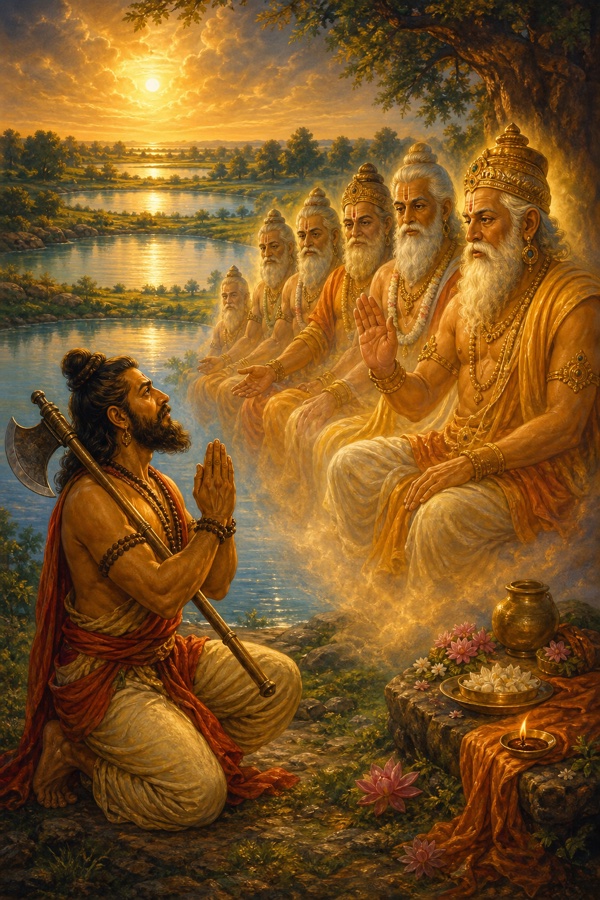
There was a pit, and in the pit hung the spirits of his forefathers, heads downward. They were suspended by a rope woven from the roots of virana grass, and only one strand of that rope was still whole. Even that strand was being slowly eaten by a large rat that lived in the hole. The Pitris were without food, wasted, pitiable, and desperate to be freed. Whatever they had once been, they were now a cluster of starving spirits at the end of a fraying cord, and the cord was the only thing between them and the dark below. Jaratkaru came close, himself a picture of poverty, a man with nothing on him and nothing behind him, and asked them who they were, hanging there by a cord of virana roots. The rat in this hole, he said, has already eaten through the rope and is now working on the single weak strand that remains, and with its sharp teeth it will soon cut what little is left. When that happens you will all fall face-first into the pit; that much is obvious. Seeing you hanging upside down in such distress has moved me to pity. What good can I do you? He offered them the only wealth he had, and he offered it in the way a man offers his last coin, by fractions first and then all at once. Tell me quickly whether this calamity can be turned aside by a fourth of my asceticism, or a third, or half. Or take the whole of it and free yourselves. I agree to all of it. Do as you please.
The Pitris answered him, and their answer turned everything he had built his life on upside down, the way they themselves were hanging. You want to relieve us, they said, and you cannot; no austerity of yours can lift this affliction from us. We too have the fruits of our own asceticism stored up. We are falling into this unholy hell because our line is running out of children. The Grandsire himself has said that a son is a great merit. A man’s forefathers live on the offerings his sons pour for them; a line with no sons has no one left to feed the dead, and the dead go down. We are about to be thrown into this hole and our minds are no longer clear, so we do not know you, though your manhood is famous on the earth. You are venerable and fortunate, you who grieve out of kindness for people as pitiable and afflicted as we are. Listen to who we are. We are rishis of the Yayavara line, keepers of rigid vows, and for want of children we have fallen from a sacred region. Our austerities are not destroyed; we still have a thread. But we have only one thread now, and it hardly matters whether it holds or not. Unfortunate as we are, our one thread is a man named Jaratkaru. The ascetic standing over the pit had just heard his own name spoken by the dead.
That unlucky one, they went on, has gone through the Vedas and their branches and is practicing asceticism alone. His soul is fully under his control, his aims are high, he keeps his vows, he is sunk in penance, and he does not even covet the merit of it. Because of him we have come to this. He has no wife, no son, no kin. That is why we hang in this hole, our consciousness gone, like men with no one to look after them. If you meet him, tell him, out of kindness to us: your Pitris are hanging head-down in a pit, in sorrow. Take a wife and beget children. You, rich in austerity, are the only thread left in your ancestors’ line. Then they read him the picture he was looking at, piece by piece. The cord of virana roots you see us hanging by is the cord of our multiplied race; the strands you see eaten away are ourselves, whom Time has devoured. This half-eaten root we still hang from is the one who has taken up asceticism alone. The rat you are looking at is Time of infinite strength. It is slowly weakening that wretch Jaratkaru, who is busy with penances and tempted by their merit and lacks prudence and lacks heart. His austerity cannot save us. Look at us, torn from our roots, thrown down from the high regions, stripped of consciousness by Time, sinking like sinners. And when we go down into this hole with all our kin, eaten by Time, he will sink into hell with us. Whether it is austerity or sacrifice or any other holy act, all of it is inferior; none of it counts against a son. Having seen all this, go and speak to that Jaratkaru. Tell him in detail what you have seen. Out of kindness to us, tell him everything that might induce him to take a wife and beget children. And then, because their minds were too clouded to know the face above them, they asked the question that would end the conversation. Who are you, that grieve for all of us like a friend? One of his friends, or one of our own race? We want to hear who it is that stands here.
Jaratkaru heard this and was crushed. He had given his whole life to penance, and he had just been told, by the people he owed most, that penance was the thing sinking them. Through tears he said: you are my own fathers and grandfathers gone before me. Tell me, then, what I must do for your welfare. I am that sinful son of yours. I am Jaratkaru. Punish me for what I have done, wretch that I am. The Pitris said, by good luck you have wandered to this spot. Why have you not taken a wife? And Jaratkaru told them the truth about himself, standing over the pit with his ancestors’ faces turned up toward him. It had always been his desire to carry this body to the other world with his seed drawn up, unspent, the whole store of a lifetime’s continence carried across intact. His mind had been fixed on never marrying. But now, having seen his grandsires hanging like birds, he had turned his mind away from the life of a brahmacharin. He would do what they wished. He would certainly marry, if he ever met a maiden who bore his own name. He would accept a girl who gave herself to him of her own accord, as alms, and whom he would not have to maintain. If he found such a girl he would marry; otherwise he would not. Three conditions, each one harder than the last, and he set them as a man sets terms he does not expect the world to meet. That was the truth, he told his grandsires; and the child born of such a marriage would be their salvation, and they would live forever in blessedness, without fear.
He said this and went back to wandering the earth, and the wandering was different now, because he was looking for something. But he was old, Sauti told Shaunaka, and he found no wife, and he grieved that he had failed. What father gives a daughter to a man who owns nothing and has promised to keep nothing for her, and who wants her only if she carries a name almost no woman carries? Still, under his ancestors’ orders, he kept searching. He went into a forest and wept aloud in his grief. And there in the forest, moved by the wish to do his ancestors good, he said, three times, distinctly, I will ask for a bride. Then he called out to whatever creatures were present, moving or unmoving, and to whoever might be there unseen: his ancestors, in their affliction, had commanded him, a man engaged in the severest penance, to marry for the sake of a son. At their command he was roaming the wide world in poverty and sorrow to obtain a maiden as alms. Let whoever among those he addressed had a daughter give her to a man who had wandered so far. A bride of the same name as himself, given to him as alms, whom he would not have to maintain: let such a bride be given to him. It was the strangest proposal ever shouted at a forest, and there were listeners in that forest who had waited years to hear it.
The snakes who had been set to track Jaratkaru heard this and understood which way his mind had turned, and they carried the news to Vasuki. The long watch was over in an afternoon. The king of the snakes took the maiden, dressed in her ornaments, and went into the forest to the rishi himself, in his own person, with the whole future of his race walking beside him in a girl’s ornaments. There Vasuki offered her to that noble man as alms. The rishi did not take her at once. He did not think she bore his name, and the question of her maintenance was still unsettled, so he stood for a few moments and reflected, and hesitated, while the king of the snakes waited on an ascetic’s answer. Then he asked Vasuki the girl’s name, and he said one more thing: I will not maintain her.
A key to reading this (the Yayavaras, and a bride taken as alms): The Yayavaras are a line of rishis who live on the move and never settle; Jaratkaru is the last man of that line. His three conditions, that the girl bear his name, that she be given freely, and that he never have to support her, tie every knot in the story that follows. The picture in the pit is meant to be read piece by piece: the rope is the lineage, the gnawed strands are the ancestors Time has already eaten, the one remaining fiber is Jaratkaru himself, and the rat is Time.
The gist: Jaratkaru, an ascetic living on air, finds his ancestors hanging head-down in a pit by the last fiber of a virana-grass rope, with Time in the shape of a rat gnawing at it. They tell him that no austerity can save them, only a son, and that the one thread holding them up is Jaratkaru himself. He vows to marry only a girl who bears his name, is given to him freely, and costs him nothing to keep. His cry in the forest reaches Vasuki, who brings his sister to offer her as alms, and the rishi asks the first question that matters: what is her name.
Vasuki’s sister Jaratkaru is married: a decorated chamber in the city of the snakes, a Rishi asleep in his wife’s lap, a sun going down, and the one sentence he left on
Vasuki had the answer ready. This maiden bears your name, he said. She is my sister and she has ascetic merit of her own. I will maintain your wife; accept her. I will protect her with everything I have. I have raised her for you. The rishi laid down his terms in return, and they were the terms of a man who intended to owe nothing to anyone: it is agreed between us that I will not maintain her, and she will do nothing I dislike; if she does, I leave her. When the snake had given his word that he would maintain his own sister, Jaratkaru went to his house. There that master of mantras among Brahmins, a veteran ascetic of rigid vows, took the hand that was offered him according to the rites of the shastras, a man who had eaten air for years now standing as a bridegroom in the house of the king of the snakes, and the great rishi, honored by his host, led his bride into the beautiful chamber the king of the snakes had set apart for him. In that chamber stood a bed spread with coverings of great value, a bed prepared by a king for a man who had slept for years wherever evening found him. Jaratkaru lived there with his wife.
But he lived there under a contract, and he stated it to her plainly. Nothing must ever be done or said by you that goes against my liking. If you do any such thing, I will leave you and I will not stay in your house. Keep these words in mind. The sister of the king of the snakes, in great anxiety and deep grief, said only, so be it. She knew what she had been raised for, and she knew now the width of the ledge she would have to walk: one displeasing word and the man would be gone, and with him the son the whole race was waiting on. And that girl of spotless reputation, driven by the wish to do good to her own people, began to attend on her husband with the wakefulness of a dog, the timidity of a deer, and the crow’s gift for reading signs. One day, after her monthly season, having purified herself by bathing according to custom, Vasuki’s sister went to her husband the great Muni, and she conceived. The embryo was like a tongue of fire, full of energy, radiant as fire itself, and it grew like the moon in the bright fortnight, a little more each day, as though the child already knew what it had been promised for.
Not long afterward there came an evening the snakes would remember. Jaratkaru of great fame laid his head in his wife’s lap and fell asleep, like a man worn out. He went on sleeping, and the sun entered its chamber in the western mountain and began to set. As the day faded, Vasuki’s excellent sister grew thoughtful, because she feared for her husband’s virtue: the twilight prayer is owed at the moment the sun goes, and a Brahmin who sleeps through it has let a duty pass. She sat very still under the weight of his head and watched the light go. What should I do now, she asked herself. Wake him or not? He is exacting and scrupulous in his religious duties. How can I act so as not to offend him? On one side is his anger; on the other, the loss of virtue for a virtuous man. The loss of virtue, I think, is the greater of the two evils. But if I wake him he will be angry. And if the twilight passes without his prayers, he will certainly suffer a loss of virtue. Her brother’s word and her husband’s word had put her exactly here, between a sleeping man’s temper and a sleeping man’s soul, with the sun almost gone.
She decided at last. She had served this man with the wakefulness of a dog, the timidity of a deer, and the crow’s knowledge of signs, and every sign in that chamber now said the same thing: the light on the costly coverlets had gone red, and the sun was going into the western mountain. The sweet-voiced Jaratkaru, Vasuki’s sister, bent over the Rishi where he lay across her knees like a flame laid on its side, still radiant with his years of penance, and spoke as softly as she could. “Wake, my lord. The sun is setting. Purify yourself with water, say the name of Vishnu, and offer the evening prayer. The hour of the evening rite has come, and the dusk is already spreading over the western sky.” He woke, and the first thing that moved in his face was anger. His upper lip trembled with it. “You have insulted me,” said the illustrious Jaratkaru, rich in ascetic merit. “I will stay with you no longer. I will go back where I came from. I believe in my heart that the sun has no power to set at its appointed hour while I am asleep. A man who has been insulted should never go on living in the place where the insult was given, and a man of virtue less than anyone.” Vasuki’s sister began to shake with terror. Everything her brother had staked on this marriage stood behind her in that chamber, every snake under the curse, and she answered him with the plain truth, which was all she had. “I did not wake you to insult you. I woke you so that your virtue would take no harm.”
Anger had him now, and with it the wish to be gone, and the wish had been waiting since the day he agreed to the marriage on a condition. “I have never spoken a falsehood in my life,” he said, “and so I will go. This was settled between us from the first day. I have passed my time with you happily. When I am gone, tell your brother that I have left you, and once I have gone, do not grieve for me. It would not be fitting.” Jaratkaru, Vasuki’s sister, whose face had no fault in it, gathered whatever courage and patience she could find while her heart went on shaking. Her words came out broken by tears. Her face had gone pale with fear. She pressed her palms together, her eyes were drowned, and she spoke to him as a wife pleading for an entire people, because that was what she was. “It is not right to leave me when I have done nothing wrong. You walk the path of virtue. I have walked the same path, with my heart set on the good of my kin. The purpose for which I was given to you has not been accomplished yet. Unlucky as I am, what will Vasuki say to me? My relatives are afflicted by a mother’s curse, and the child they long for has not appeared. The welfare of my whole race depends on offspring from you. It is so that my union with you will not be fruitless, and out of desire for the good of my people, that I beg you. You are high-souled. Why then would you leave a wife who is faultless? This is the part I cannot understand.” She had been given to him for a child, and she was asking a man who had never wanted a wife to stay long enough for the child to be certain.
The Muni of great ascetic merit gave his wife the answer that fitted the occasion, and it was very short. “The being you have conceived,” he said, “is a Rishi of the highest virtue, like Agni himself, and a master of the Vedas and their branches.” That was all the comfort he had for her, and it was more than she yet understood. Having said it, the great and virtuous Rishi Jaratkaru walked out of the chamber the king of the snakes had decorated for him, out of the house of the snakes, and back toward the severest penances he could find, with his heart already fixed on them and the marriage already behind him.
A key to reading this (two Jaratkarus, and a single word): Husband and wife share the name Jaratkaru. The marriage was made on that very condition, so the text calls both of them by it, and the reader has to keep track of who is speaking from what each one says. The Rishi’s parting sentence turns on a single word: the child in the womb “is,” in Sanskrit asti, and the next scene will make a name out of that word. The wife’s dilemma is given whole, exactly as the source gives it. Waking him risks his anger; letting him sleep costs him the evening rite and with it his virtue; she weighs the two harms, chooses the one she judges smaller, and pays for the choice alone.
The gist: Vasuki tells the Rishi that the girl bears his own name and that he himself will maintain her; Jaratkaru accepts her on the one condition that he will leave the moment anything displeases him. They are married in a decorated chamber in the city of the snakes, she serves him with the wakefulness of a dog and the timidity of a deer, and she conceives a child that glows like fire. One evening the Rishi falls asleep in her lap as the sun goes down. Afraid for his virtue, she wakes him; he calls the waking an insult and leaves, unmoved by her tearful plea for her people, saying only that the child in her womb is a Rishi like Agni and a master of the Vedas.
Astika, the son of the father who left saying “he is,” and Janamejaya’s question in the hall at Hastinapura: how did my father die, and the dead snake laid on a silent Muni’s shoulders
Soon after her husband walked out, Jaratkaru went to her brother and told him everything. The prince of snakes heard the calamitous news and answered his miserable sister more miserably still. He had sat in council over this curse with every snake of standing, heard scheme after scheme for stopping a sacrifice that had not yet been planned and liked none of them, and in the end had staked the whole race on the words a frightened snake had once overheard while crouching in his mother’s lap, the day the curse was spoken. “You know why you were given away,” he said, “and what the purpose was. If a son is born of that union, for the welfare of the snakes, then he, full of energy, will save us all from the snake sacrifice. The Grandsire said so long ago, in the midst of the gods. Have you conceived by that best of Rishis? It is my heart’s wish that my giving of you to that wise man should not be fruitless. Truly it is not proper for me to ask you this. But the stakes are grave, and so I ask. I know how obstinate your husband is, forever at his penances, and I will not go after him. He might curse me. Tell me in detail everything he did, and draw out this terrible dart that has been lodged in my heart for so long.” It had been lodged there since the day he first heard his mother’s curse, and the whole of the Grandsire’s promise rested on this one marriage.
Jaratkaru consoled the king of the snakes at length, and she had one word to console him with. “When I asked him about offspring,” she said, “that high-souled and mighty ascetic said, ‘There is,’ and then he went away. I do not remember him ever speaking a falsehood, even in jest. Why would he speak one on so serious an occasion? He said to me, ‘Do not grieve over the result of our union. A son will be born to you as resplendent as the blazing sun.’ Having said that to me, brother, my husband of ascetic wealth went away. So let the deep sorrow you have been nursing in your heart disappear.” Vasuki took his sister’s words and held on to them, and in great joy he said, “So be it.” Then the chief of the snakes honored his sister with his highest regard, with gifts of wealth, and with praise that fitted what she had endured for her people. And the embryo of great splendor, Sauti told Shaunaka, began to grow the way the moon grows in the bright fortnight of the sky, a little more light every night.
In due time the sister of the snakes gave birth to a son with the radiance of a celestial child, the one who would take away the fear of his father’s ancestors and of his mother’s kin alike. The child grew up there, in the house of the king of the snakes, among a whole race that was waiting on him for its life. He studied the Vedas and their branches with the ascetic Chyavana, Bhrigu’s son, an elder of the very line to which the listening Shaunaka belonged. Though only a boy, his vows were rigid. He was gifted with great intelligence and with the several marks of virtue: knowledge, freedom from the world’s indulgences, saintliness. The name by which the world came to know him was Astika, “he who is,” because his father had gone off to the woods saying “there is” while he was still in the womb. Boy though he was, he had great gravity and intelligence. The snakes raised him with great care in their palace, and he looked like the illustrious lord of the celestials, Mahadeva of the golden form, the wielder of the trident, and he grew day by day, the delight of all the snakes, who did not need to be told what he had been born for.
Here Shaunaka stopped the storyteller. “Tell me again, in detail,” he said, “everything that King Janamejaya asked his ministers about his father’s ascent to heaven.” Sauti agreed: hear then all that the king asked his ministers and all they told him about the death of Parikshit. Janamejaya had put it to them in the hall at Hastinapura, and the way he put it showed a king deciding whether to act at all. “All of you know what befell my father. How did that famous king meet his death, when his time came? When I have heard from you the incidents of my father’s life in detail, I will ordain something, if it is for the good of the world. Otherwise I will do nothing.” The minister answered him, and he began the way a man begins when he must tell a son how his father died, with the father’s life, so that the death, when it came, would be measured against it. “Hear what you have asked, an account of your illustrious father’s life, and how that king of kings left this world. Your father was virtuous and high-souled, and he always protected his people. Hear how he conducted himself on earth. Like virtue and justice given a body, that monarch, who knew what virtue was, protected the four orders, each engaged in its own duties. Of incomparable prowess and blessed with fortune, he protected the goddess Earth. No one hated him, and he hated no one. Like Prajapati he was equally disposed toward all creatures. Brahmins, Kshatriyas, Vaishyas and Shudras, all contentedly practicing their own duties, were protected by that king without partiality. Widows and orphans, the maimed and the poor, he maintained. Handsome of feature, he was like a second Soma to all creatures. He cherished his subjects and kept them content; he was fortunate, truthful, of immense prowess, and in the science of arms he was the disciple of Sharadvat. Your father was dear to Govinda. Of great fame, he was loved by all men. He was born from the womb of Uttara when the Kuru race was nearly extinct, and that is why the mighty son of Abhimanyu came to be called Parikshit, born in a line that had died out. Well versed in the treatises on the duties of kings, he was gifted with every virtue. With his passions under complete control, intelligent, of retentive memory, practicing every virtue, conqueror of the six passions, powerful of mind, surpassing all, fully acquainted with the science of morality and of statecraft, your father ruled these subjects for sixty years. Then he died, mourned by all his people. After him you acquired this hereditary kingdom of the Kurus, which has stood for the last thousand years. You were installed while still a child, and you have been protecting every creature since.”
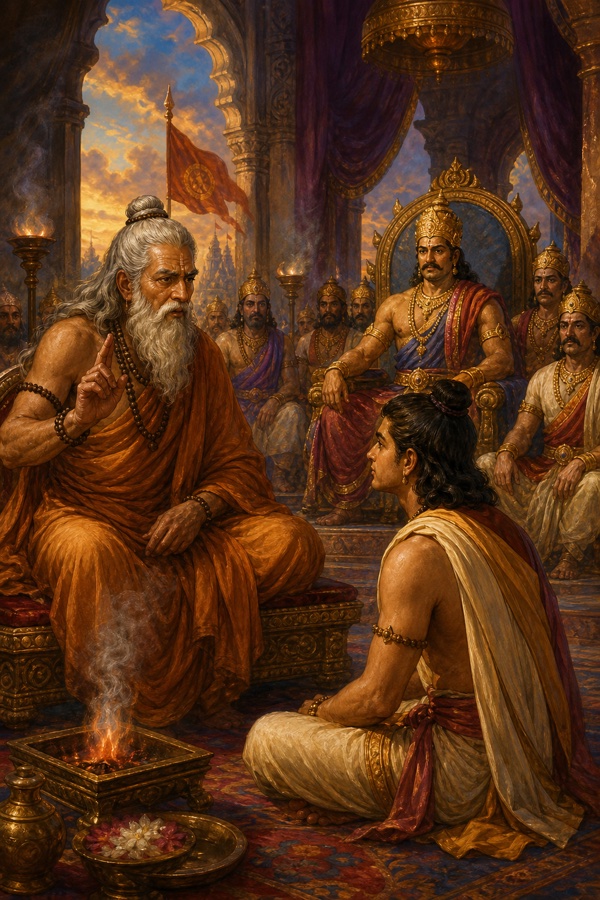
Janamejaya said: “There has never been born in our line a king who did not seek the good of his subjects or was not loved by them. Look especially at the conduct of my grandsires, forever engaged in great deeds. How then did my father, blessed with so many virtues, meet his death? Describe everything to me as it happened. I want to hear it from you.” So directed by the monarch, those counselors, always mindful of their king’s good, told him exactly what had occurred, and they began with the one weakness they had watched him carry. “That father of yours,” they said, “protector of the whole earth, foremost of all who obey the scriptures, became addicted to the sports of the field, just as Pandu of the mighty arms had, that foremost of bowmen in battle. He handed over to us all the business of the state, from the smallest matter to the greatest. One day he went into the forest and pierced a deer with an arrow. Having pierced it, he followed it quickly on foot into the deep woods, armed with sword and quiver, with no one from his hunt beside him. He could not find the lost deer. Sixty years old and worn, he was soon exhausted and hungry. Then, in the deep woods, he saw a high-souled Rishi. The Rishi was keeping a vow of silence at the time. The king asked him about the deer, and though asked, the Rishi made no reply. At last the king, already spent with exertion and hunger, suddenly grew angry with that Rishi who sat motionless as a block of wood in his vow of silence. The truth is that the king did not know he was a Muni under a vow of silence. Swayed by anger, your father insulted him. He lifted a dead snake from the ground with the tip of his bow and laid it across the shoulders of that Muni of pure soul. And the Muni said not one word, good or bad, and felt no anger. He stayed exactly as he was, in the same posture, bearing the dead snake.” A tired old man’s moment of temper, and a silent one’s refusal to answer it: the ministers knew what had grown from those two things, and so did the son listening.
A key to reading this (the name Parikshit, and a story that turns back on itself): The source explains the name itself: Parikshit is the child born into a dying line, Abhimanyu’s son by Uttara, delivered when the war had all but wiped out the Kurus. Notice the turn in the telling here. Having brought Astika to his boyhood, Shaunaka asks Sauti to go back and tell the episode that lies at the root of the snake sacrifice, so the ministers are now recounting Parikshit’s death to his son, and the boy in the snake city and the king in the hall are moving toward the same fire from opposite sides. The silent Muni is not named in this stretch of the text; the earlier telling of the same events in this chapter calls him Shamika.
The gist: Jaratkaru tells Vasuki that the Rishi left saying “there is” and promised a son as radiant as the sun; the boy is born in the city of the snakes, studies the Vedas under Chyavana, and is named Astika after that one word. At Shaunaka’s request Sauti then goes back to the day Janamejaya asked his ministers how his father died. They recount Parikshit’s virtues, the meaning of his name, and his sixty-year reign, and then the hunt on which the tired, hungry king laid a dead snake with the tip of his bow on the shoulders of a Muni under a vow of silence, who said nothing at all.
Shringin’s curse: Takshaka within seven nights, Gauramukha’s warning, a banyan burned to ash and made green again, Kashyapa turning back with the snake’s gold, and Parikshit dead inside his own guarded palace
The ministers went on with the story their king had asked for. That king of kings, spent with hunger and exertion, left the snake on the Muni’s shoulders and came back to his capital, and the day might have ended there. The Muni had a son, born of a cow, whose name was Shringin. He was widely known, a boy of great prowess and energy, and very wrathful. He went every day to his preceptor to worship him, and he was on his way home from the teacher, with the teacher’s leave, when he heard from a friend how your father had insulted his father. He heard that his father, who had committed no fault, was sitting motionless as a statue with a dead snake laid on his shoulders. And understand who it was your father insulted: a Rishi severe in penance, foremost of Munis, master of his passions, pure, forever engaged in wonderful acts. His soul was lit by austerity. His senses and their functions were wholly under his control. His practice and his speech were both refined. He was contented and without greed. There was no meanness of any kind in him, and no envy. He was old, and he kept a vow of silence. And he was the refuge to which every creature in distress might come. A man like that was sitting under a dead snake without a word of complaint, and his son, who had inherited none of that patience, was on the road home.
Such was the Rishi your father insulted. His son, however, cursed your father in his anger. Young in years, that powerful boy was old in ascetic splendor. He touched water at once and spoke, blazing as it seemed with spiritual energy and rage, and the words were aimed at your father. “See the power of my asceticism. Directed by my words, the snake Takshaka, of powerful energy and virulent poison, will within seven nights from now burn with his venom the wretch who laid a dead snake on my unoffending father.” Having said this, he went to where his father was, and when he saw him he told him of the curse. That tiger among Rishis then sent to your father a disciple of his named Gauramukha, a man of amiable manners and every virtue. He rested a while after reaching the court, and then he told the king everything, in his master’s words: you have been cursed by my son. Takshaka will burn you with his poison. Be careful. Your father heard those words, and when he learned that the Rishi in the forest had been under a vow of silence, his grief doubled; what he had done to that Rishi weighed on him more than the news of his own death, and he sent Gauramukha back with a prayer that the worshipful one would be gracious to him. Then he took every precaution against the powerful snake, and the count of the seven nights began.
When the seventh day came, a Brahmin Rishi named Kashyapa set out to reach the monarch. He had heard what everyone had heard, that Takshaka would send the king to Yama that day, and he had reasoned that if he cured the king after the bite he would gain wealth and virtue at once. But the snake Takshaka saw Kashyapa on the road, and the prince of snakes wasted no time. “Where are you going so fast,” he asked, “and on what business?” Kashyapa answered him openly, since all he saw was an old Brahmin on the road. “I am going to King Parikshit, best of the Kurus. He is to be burned today by the poison of the snake Takshaka. I am hurrying there to cure him, so that, protected by me, the snake cannot bite him to death at all.” Takshaka said, “Why do you want to revive a king I am going to bite? I am that Takshaka. Watch the wonderful power of my poison. You cannot revive that monarch once I have bitten him.” And then and there Takshaka bit a lord of the forest, a banyan tree, and the banyan, the moment his fangs went in, turned to ash. Kashyapa brought it back to life. Takshaka had seen enough of the healer’s power, and he changed his approach. “Tell me what you want,” he said. Kashyapa answered him plainly: “I am going there for wealth.” So Takshaka said to that high-souled man, in soft words, “Take from me more wealth than you expect from that monarch, and go back.” Kashyapa, foremost of men, took from the snake as much wealth as he desired, and turned around, and went home, and the wealth he had set out for that morning was his without a single mantra spoken. The king’s one chance walked away down the road with a snake’s gold in its hands.
Picture the palace as the ministers themselves had arranged it for that seventh day. The king had done everything a warned man can do. On his ministers’ counsel he had raised a mansion on a single column and gone up into it, and it was guarded day and night; physicians and their medicines were placed around it, and Brahmins skilled in mantras stood on every side; no one could approach him there, and it was said afterward that even the air could not get in. From that height he went on discharging the duties of a king with his virtuous ministers around him, and the seventh day wore on toward its evening. What no guard could stop was a visitor who did not look like a snake at all.
With Kashyapa gone, Takshaka approached in disguise and blasted your virtuous father, first of kings, with the fire of his poison, though he was inside his mansion on its single column, behind every precaution that guards and physicians and mantras could provide. After that you were installed on the throne, a child on the seat of a man who had ruled for sixty years. We have now told you everything we saw and heard, cruel as the account is. You have heard how your royal father was brought down, and you have heard of the insult to the Rishi Uttanka. Decide what should follow.
A key to reading this (two Kashyapas, and why Uttanka is mentioned): The source calls this Kashyapa only a Brahmin Rishi, a healer whose learning can undo a snake’s venom and who is traveling to the king for a fee; nothing in it ties him to Kashyapa the Prajapati, the father of Garuda and of the snakes, and the two should be kept apart. The insult to Uttanka in the ministers’ last sentence points back to the Paushya story earlier in this chapter: Takshaka snatched the queen’s earrings from Uttanka, and Uttanka came to this same court, told the king he was spending his time like a child, and urged him to burn the snake in a snake sacrifice. The king is therefore being handed two grievances at once, his father’s death and the wrong done to a Brahmin’s guru-fee.
The gist: Shringin, the silent Muni’s cow-born son, hears of his father’s humiliation from a friend and curses the king to die of Takshaka’s venom within seven nights; his father sends the disciple Gauramukha to warn Parikshit, who guards himself against everything. On the seventh day the healer Kashyapa is stopped on the road by Takshaka, who burns a banyan to ash to prove his power, watches Kashyapa restore it, and then buys him off with more wealth than the king would have paid. Takshaka enters the palace in disguise and kills Parikshit, and the ministers, having laid both the death and the insult to Uttanka before Janamejaya, ask him to decide what comes next.
The woodcutter in the banyan who saw it all, Janamejaya’s tears and his resolve, a priest who knows of a rite called the snake sacrifice, the measuring of the altar, and the Suta builder’s prophecy that a Brahmin will stop it
Janamejaya, chastiser of enemies, listened to his ministers and then asked the question a careful man asks before he acts on a story. “When did you learn what happened at that banyan, the one Takshaka reduced to ash and Kashyapa, wonderful as it sounds, brought back to life? Surely my father need never have died, since Kashyapa could have neutralized the poison with his mantras. That worst of snakes, that sinful soul, must have thought to himself that if Kashyapa revived the king he had bitten, he, Takshaka, would become a laughingstock in the world for having his poison undone. Having thought so, he bought the Brahmin off. I have already devised a way of punishing him. But I want to know how you came by what passed in the deep solitude of the forest, the words of Takshaka and the speeches of Kashyapa. Once I know that, I will devise the means of exterminating the race of snakes.” The whole race, he said, for the act of one snake, and he said it before he had heard the answer.
The ministers told him. Hear who told us of the meeting between that foremost Brahmin and that prince of snakes in the woods. A certain man had climbed that tree to break off its dry branches for sacrificial fuel. Neither the snake nor the Brahmin noticed him up among the leaves. That man was reduced to ash along with the tree itself, and the Brahmin’s power revived him along with the tree. He served in a Brahmin’s household, a man of no account who had gone up a banyan for dry sticks and come down with the only account of that day that anyone would ever have, and he came to us and told us fully everything that had passed between Takshaka and Kashyapa. So we have told you all that we saw and heard. Having heard it, ordain what should follow.
King Janamejaya heard them out and grief took him. He wept. He wrung his hands. The lotus-eyed king drew long, hot breaths, shed tears, and cried aloud. Possessed by grief and sorrow, weeping freely, he touched water according to the rite, the same gesture with which Shringin had begun his curse, and only then did he speak. He reflected for a moment, as if settling something inside himself, and then the angry king addressed all his ministers. “I have heard your account of my father’s ascent to heaven. Now know my fixed resolve. I think no time must be lost in avenging this injury on the wretch Takshaka who killed my father. He burned my father and made Shringin only a secondary cause. Out of pure malice he turned Kashyapa back. If that Brahmin had arrived, my father would certainly have lived. What would Takshaka have lost if the king had been revived by Kashyapa’s grace and his ministers’ precautions? Not knowing what my anger would do, he stopped Kashyapa, that excellent Brahmin whom he could not defeat, from coming to my father to revive him. The aggression of that wretch Takshaka is great: he gave wealth to a Brahmin so that the king would not be revived. Now I will avenge myself on my father’s enemy, to satisfy myself, and the Rishi Uttanka, and all of you.” The grief had lasted as long as the tears; what came after it had a shape, and a name.
The ministers gave their approval, and the king declared his determination to perform a snake sacrifice. That lord of the earth, that tiger of the Bharata line, Parikshit’s son, summoned his priest and his ritwiks, the men who would have to carry out whatever he asked of the fire, and being accomplished in speech he put the great task to them plainly. “I must avenge myself on the wretch Takshaka who killed my father. Tell me what I must do. Do you know of any rite by which I can cast the snake Takshaka into the blazing fire along with his relatives? I want to burn that wretch just as he once burned my father with the fire of his poison.” The chief priest had an answer, and it was older than the king’s grief. “There is a great sacrifice devised for you by the gods themselves. It is known as the snake sacrifice, and it is read of in the Puranas. You alone can accomplish it, and no one else. Those versed in the Puranas have told us that such a sacrifice exists.” A rite devised by the gods, waiting in the Puranas for this one king: the priest offered it as if it had been kept for him.
At those words the king already saw Takshaka burned and thrown into the blazing mouth of Agni, eater of the sacrificial butter; the rite was not yet begun, and in his mind it was finished. He told the mantra-knowing Brahmins, “I will make the preparations for that sacrifice. Tell me what is needed.” The king’s ritwiks, versed in the Vedas and acquainted with the rites of that sacrifice, measured out the ground for the sacrificial platform according to the scriptures. The platform was adorned with valuable things and with Brahmins; it was full of precious objects and of paddy; the ritwiks seated themselves on it at ease. When the platform had been built according to rule and as desired, they installed the king in the snake sacrifice for the accomplishment of its purpose. But before the sacrifice began, there occurred a very significant incident, an omen of obstruction. While the platform was being laid out, a professional builder of great intelligence, well versed in the science of laying foundations, a Suta by caste and well acquainted with the Puranas, looked at the ground under his feet and the hour over his head and said, “The soil on which, and the moment at which, the measurement for this platform has been made indicate that this sacrifice will not be completed, and that a Brahmin will be the reason.” Hearing this, the king, even before his installation, ordered his gatekeepers to admit no one without his knowledge. The builder had named the danger; the king answered it with a gate.
A key to reading this (the builder’s prophecy and the guarded gate): The Suta who lays the altar’s foundation reads both the site and the hour, and what he says sets the course of everything that follows: a Brahmin will stop this sacrifice. Janamejaya’s answer is to post guards and admit no stranger, as if a prophecy could be kept out at a gate. The reader already knows that the boy studying the Vedas under Chyavana in the palace of the snakes is a Brahmin, and that his arrival at this gate is still to come.
The gist: Janamejaya asks how anyone could know what passed in the empty forest; the answer is a woodcutter gathering fuel in the banyan, burned to ash with the tree and revived with it, who told the whole story. The king weeps, then resolves to avenge his father on Takshaka, who bribed Kashyapa to turn back. The chief priest names a rite from the Puranas, the snake sacrifice, that only this king can perform; the ritwiks measure the altar and install him; and the Suta builder laying the foundation declares that the sacrifice will not be finished, because of a Brahmin. The king orders his gatekeepers to let no one in unannounced.
Priests in black with eyes reddened by smoke, snakes falling into the fire as their names are spoken, the roll of the officiants from Chandabhargava to Vyasa himself, Takshaka hiding in Indra’s house, and Vasuki’s appeal to his sister
The snake sacrifice began according to due form, on the platform the Suta had measured and warned against. The sacrificial priests, each competent in his own duty under the ordinance, dressed in black garments for a rite whose whole purpose was killing, their eyes red from the smoke they had been standing in since the fire was lit, poured clarified butter into the blazing fire while uttering the appropriate mantras. Then they poured the butter into the mouth of Agni while uttering the names of the snakes, one name to each stream of butter, and every snake’s heart shook with fear, wherever it lay. The snakes began to fall into the blazing fire, benumbed, calling piteously to one another as they came. Swollen, breathing hard, twined around each other by heads and tails so that they came down in knots, they arrived in great numbers and dropped into the flames. White ones, black ones, blue ones, the old and the young, all fell alike into the fire with every kind of cry. Snakes a krosha long, snakes a yojana long, snakes of a gokarna’s measure, fell continuously and with great violence into that first of all fires. Hundreds and thousands and tens of thousands of snakes, with no control left over their limbs, perished. Among the dead were some like horses, others like the trunks of elephants, others of huge body and strength like maddened elephants. Of many colors and virulent poison, terrible, looking like iron-spiked maces, immensely strong, forever ready to bite, the snakes fell into the fire, afflicted by their mother’s curse, and the priests in black went on reading names into the smoke.
Shaunaka wanted the names. “Which great Rishis,” he asked, “became the ritwiks at the snake sacrifice of the wise King Janamejaya of the Pandava line? And who were the sadasyas at that terrible sacrifice, so frightful to the snakes and the cause of such sorrow to them? Describe them all in detail, so that we know who was acquainted with the rituals of the snake sacrifice.” Sauti recited them, as a man recites a roll he has carried in his head for years. The Brahmin Chandabhargava became the hotri at that sacrifice, the one whose voice would send each offering into the fire: a man of great reputation, born in the line of Chyavana, foremost of those who knew the Vedas. The learned old Brahmin Kautsa became the udgatri, the chanter of the Vedic hymns. Jaimini became the brahman, and Sharngarava and Pingala the adhvaryus. Vyasa with his son and his disciples, and Uddalaka, Pramataka, Shvetaketu, Pingala, Asita, Devala, Narada, Parvata, Atreya, Kundajathara, the Brahmin Kalaghata, Vatsya, old Shrutashravas forever engaged in japa and the study of the Vedas, Kohala Devasharman, Maudgalya, Samasaurava, and many other Brahmins who had mastered the Vedas became the sadasyas at that sacrifice of Parikshit’s son. It was an assembly few ages could have gathered, and it had been gathered to burn snakes.
When the ritwiks began pouring the clarified butter into the fire, terrible snakes, striking fear into every creature, began to fall into it, and the men on the platform, seated at their ease among the paddy and the precious things, watched them come. The fat and the marrow of the falling snakes ran in rivers along the ground of the enclosure. The air filled with an insufferable stench from the unceasing burning, and unceasing too were the cries of the snakes already in the fire and of those in the air above it, about to fall. Meanwhile Takshaka, prince of snakes, the one snake whose name the whole rite had been built around, went to the palace of Purandara, of Indra himself, the moment he heard that King Janamejaya was engaged in the sacrifice. That best of snakes told him everything that had happened, confessed his fault, the bite in the guarded mansion that had started all of this, and in terror sought Indra’s protection. Indra was gratified, and he said, “Takshaka, here you have nothing to fear from that snake sacrifice. I pacified the Grandsire for your sake long ago. So you have no fear. Let the fear in your heart be stilled.” Encouraged by him, that best of snakes began to live in Indra’s house in joy and ease, while far below him his kin were burning by the ten thousand for what he had done.
The scene shifts from the fire pit to the places the snakes had come from, wherever a name could find them. The mantras did the work no hand could have done. A name spoken beside the altar reached the snake who owned it wherever he lay, drew him up into the air, and carried him toward the flames, and the ones whose names had not yet been spoken could only watch the sky above them empty of their kin, one by one, and wait to hear their own.
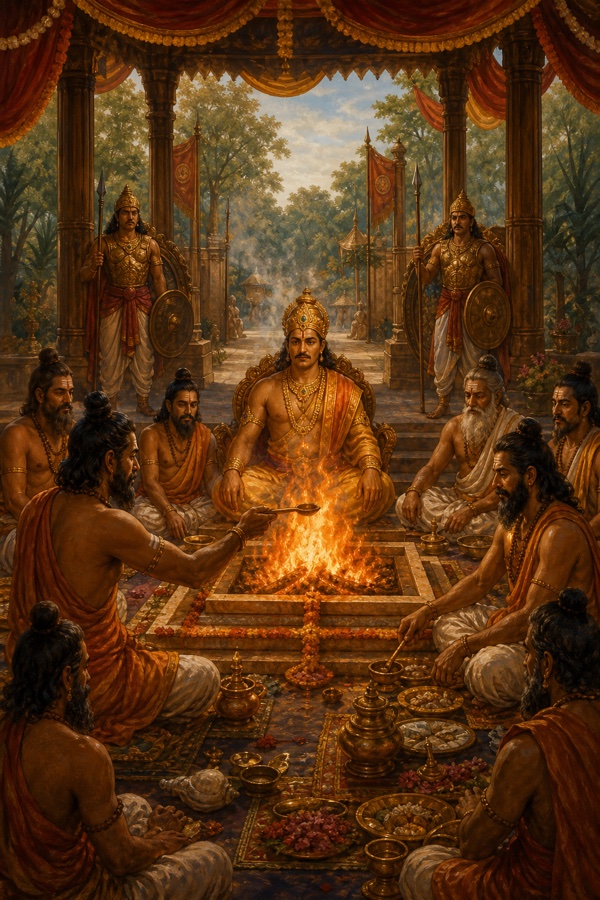
But Vasuki watched the snakes falling into the fire without pause and saw his family reduced to a handful, and sorrow overwhelmed him. The king of the snakes, who had once been the rope with which gods and demons churned the ocean, who had held the council and heard every scheme and chosen to wait for a child, was afflicted with a grief that was breaking his heart. The names were still being called. He summoned his sister and said to her, “My limbs are burning and I can no longer see the points of the heavens. I am about to fall down from loss of consciousness. My mind is turning, my sight is failing, my heart is breaking. Benumbed, I may fall today into that blazing fire. This sacrifice of Parikshit’s son is meant to exterminate our race. It is plain that I too shall have to go to the abode of the king of the dead. The time has come, sister, for which I gave you to Jaratkaru: to protect us and our kin. Astika will put an end to the sacrifice that is under way. The Grandsire told me this long ago. So go, child, to your dear son, who is fully versed in the Vedas and is honored even by the old, and ask him for the protection of me and of all who depend on me.” He had given his sister away for this hour, and the hour had come with the fire already lit.
A key to reading this (the four offices of a sacrifice, and Vyasa in the audience): The hotri speaks the mantras of the offering, the udgatri sings the Sama chants, the adhvaryu performs the physical acts of the rite, and the brahman oversees the whole; the sadasyas are the learned men who sit as witnesses and advisers. Vyasa sits among them with his son and disciples, which means the author of the Mahabharata is present at the very sacrifice at which, in the opening section of this chapter, he will direct his disciple Vaishampayana to recite the whole story between the ceremonies. Krosha, yojana and gokarna are measures of length, kept as the source gives them.
The gist: The sacrifice begins: black-robed priests call the snakes by name as they pour the butter, and white, black and blue snakes, some a krosha and some a yojana long, drop benumbed into the fire in heaps while their fat runs in rivers. Sauti gives Shaunaka the full roll of the officiants and sitting scholars, from Chandabhargava the hotri to Vyasa and Narada. Takshaka flees to Indra and is promised safety, and Vasuki, watching his race dwindle to a handful, tells his sister that this is the hour for which she was given to Jaratkaru, and sends her to ask their son Astika to save them.
Jaratkaru tells her son what he was born for, Vasuki’s head swims, and a boy Brahmin at the gate of the sacrifice begins to sing the king’s praise
Sauti went on. The message from Vasuki reached his sister, and the snake woman Jaratkaru called her son to her and told him what the king of the snakes had directed her to say. “The time has come,” she said, “for the thing I was given to your father for. My brother gave me away for one purpose, and the purpose is now. Do what has to be done.” Astika looked at her. He was a boy still. He knew he had been born of a strange marriage, a Rishi’s son raised in a palace of snakes, taught the Vedas by Chyavana in a palace of snakes, and now his uncle’s kin were vanishing into the sky, and he asked the question a boy asks before he will move, the question no one in that house had ever answered for him in full. “Why were you given to my father by my uncle? Tell me all of it, truly, so that when I have heard it I can do what is right.” Jaratkaru, the sister of the snake king, had watched the whole race of her kin sink into dread, and she was the one person in that household who was not shaking. She wanted her relatives to live. So she told him the story from its root, and the root was older than either of them.
“The mother of all snakes,” she said, “is Kadru. Hear why she cursed her own sons in anger. She had wagered with her co-wife Vinata over the color of the prince of horses, Uchchaihshravas, and the loser was to be the winner’s slave. She had told the snakes to make the horse look false by clinging to his tail and turning it black, so that her wager would be won and Vinata would become her slave. The snakes refused to lend themselves to the lie, and it was their honesty that damned them. And Kadru said to them, ‘Because you have refused, the god whose charioteer is the wind will burn every one of you in the sacrifice of Janamejaya, and perishing there you will go to the region of those spirits who are never redeemed.’ The Grandsire of all the worlds was present when she spoke it, and he said, ‘So be it,’ and with those two words a mother’s anger had the approval of the maker of the worlds. Vasuki heard the curse and heard the Grandsire approve it, and he carried that knowledge with him. Then came the day the ocean was churned for the amrita, and Vasuki, who had been the churning rope in the hands of the gods and the Asuras, went to the gods for shelter. The gods had what they wanted by then. The amrita was in their hands. With Vasuki walking in front of them they went to the lotus-born Grandsire and tried to make him gracious, so that the curse might be undone.”
“The gods said, ‘Vasuki the king of the snakes grieves for his kin. How can his mother’s curse be made to come to nothing?’ And Brahma answered them in a single sentence. ‘A sage named Jaratkaru will take a wife named Jaratkaru. The Brahmin born of her will set the snakes free.’ Vasuki heard it, my child, and so, some time before this sacrifice was to begin, my brother gave me to your high-souled father. Out of that marriage you were born to me. The time has arrived. It falls to you to protect us from this danger. It falls to you to keep my brother and me out of the fire, so that the end for which I was given to your wise father, which is our deliverance, does not go unfulfilled. What do you think, my son?” She had laid the whole weight of a race on a boy, the weight her brother had laid on her when he gave her to a stranger with her own name, and she waited to see whether he would take it up.
Astika did not deliberate. His mother had finished, and the boy who had asked for the whole story before he would move had heard it. “Yes,” he said to his mother. “I will do it.” Then he turned to Vasuki, who sat there stricken, the king of a race that was being read into a fire one name at a time, and he spoke to him the way a physician speaks to a man he intends to keep alive. “Vasuki, I say this truly: I will free you from that curse. Be easy. There is no fear any longer. I will work at this with everything in me so that good comes of it. No one has ever said that a word of mine, even a word spoken in jest, turned out false, and on an occasion as grave as this one I have no need to add anything to that. Uncle, I am going there today, and with speech mixed with blessings I will gratify King Janamejaya where he sits installed at his sacrifice, so that the sacrifice stops. Believe everything I am telling you. My resolve has never once failed to come true.” Vasuki’s answer was the answer of a man past reasoning. “My head swims, Astika. My heart is breaking. I cannot tell one direction of the earth from another. My mother’s curse is on me.” Astika would not let the despair stand. “You have no cause to grieve any longer,” he said. “This fear of the blazing fire, I will take it off you. This punishment that can burn like the fire at the end of an age, I will put it out. Stop feeding your fear.” It was a boy telling the king of the snakes what to do, and the king of the snakes let him.
Sauti said: so the best of Brahmins quieted the terror in Vasuki’s heart, and in quieting it he took it onto himself, and he set out at speed for the sacrifice of Janamejaya, which was rich in every merit, to deliver the king of the snakes. He came to the sacrificial compound and saw it: a great enclosure full of Sadasyas, the seated assessors of the rite, whose splendor was like the sun’s or like fire’s, and over all of it the smoke, and in the smoke the stench his mother’s kin were making. The doorkeepers stopped him, as their king had ordered them to stop anyone they did not know, and what they saw was a boy, alone, asking to enter the compound of a king’s sacrifice. Astika, who was already a great ascetic for all his youth, spoke to the doorkeepers until they were satisfied, because he meant to go in, and he went in. And then that foremost of the virtuous, standing inside the excellent enclosure where the prophecy said a Brahmin would one day stand, began to praise the king of measureless achievements, and the Ritviks, the officiating priests, and the Sadasyas, and the sacred fire itself.
What he sang was this, and every verse of it was a comparison, and every comparison ended the same way. “Soma and Varuna and Prajapati performed sacrifices of old at Prayaga, and this sacrifice of yours is inferior to none of those. Let those who are dear to us be blessed! Shakra performed a hundred sacrifices, and this one sacrifice of yours equals ten thousand of Shakra’s. Let those who are dear to us be blessed! Like the sacrifice of Yama, of Harimedha, of King Rantideva, is this sacrifice of yours. Let those who are dear to us be blessed! Like the sacrifice of Maya, of King Shashabindu, of King Vaishravana, is this sacrifice of yours. Like the sacrifice of Nriga, of Ajamidha, of the son of Dasharatha, is this sacrifice of yours. Let those who are dear to us be blessed! Like the sacrifice of King Yudhishthira, son of a god, of the line of Ajamidha, whose fame was heard even in the heavens, is this sacrifice of yours. Like the sacrifice of Krishna Dvaipayana, the son of Satyavati, at which he himself was the chief priest, is this sacrifice of yours. Let those who are dear to us be blessed! These Ritviks and Sadasyas who are conducting your rite, which is like the rite of the slayer of Vritra, have splendor equal to the sun. Nothing remains for them to learn, and a gift made to them becomes inexhaustible in merit. It is my conviction that in all the worlds there is no Ritvik equal to your Ritvik, Dvaipayana. His disciples, themselves become Ritviks and competent in their duties, travel the whole earth. The high-souled bearer of libations, Agni, called also Vibhavasu and Chitrabhanu, whose seed is gold, whose path is marked by black smoke, whose flames lean to the right as they blaze, is carrying these offerings of clarified butter of yours to the gods.” He had come in to stop this rite, and he opened by setting it beside the rites of heaven and naming its priests the first in all the worlds.
Then he turned the praise from the rite to the man, and the names he reached for were the names a king of the Kurus had grown up hearing. “In this world of men there is no monarch your equal in the protection of subjects. I am ever well pleased with your restraint. Truly you are either Varuna or Yama, the god of justice. Like Shakra himself with the thunderbolt in his hand, you are the protector of every creature in this world. On this earth there is no man as great as you and no king who equals you in sacrifice. You are like Khatvanga, Nabhaga and Dilipa. In prowess you are like Yayati and Mandhata. In splendor equal to the sun and excellent in your vows, you are like Bhishma. Like Valmiki your energy is concealed. Like Vasishtha you have mastered your anger. Your lordship is like Indra’s. Your splendor shines like Narayana’s. Like Yama you are versed in the dispensation of justice. You are like Krishna, adorned with every virtue. You are the home of the good fortune that belongs to the Vasus, and you are the refuge of sacrifices. In strength you equal Dambhodbhava. Like Rama the son of Jamadagni you know both the scriptures and arms. In energy you equal Aurva and Trita. Like Bhagiratha you strike terror by your looks alone.” A boy nobody had sent for was standing inside the king’s rite, setting the king in one row with Yayati, with Bhishma, with Krishna, and the king was listening.
Sauti said: with this adoration Astika gratified them all, the king, the Sadasyas, the Ritviks and the sacrificial fire. And King Janamejaya, seeing the signs and indications that were showing themselves on every side of the enclosure, turned from the fire toward his priests, with the boy still standing where he had sung and the smoke still rising behind him, and spoke.
A key to reading this (two people with one name, and the shape of the hymn): Jaratkaru is the name of two people here. The sage Jaratkaru is Astika’s father; the snake woman Jaratkaru, Vasuki’s sister, is his mother. Brahma’s word was that a sage named Jaratkaru would take a wife named Jaratkaru and that the Brahmin born of her would free the snakes, which is why Vasuki gave his sister to the sage who bore that name. Astika’s hymn returns after each comparison to the same line, Let those who are dear to us be blessed! It is the refrain of a benediction, and it is that refrain, from a boy standing in the middle of the rite, that wins the king over in what follows. Among the sacrificers the boy names for comparison are Yudhishthira and Vyasa: Yudhishthira is of Janamejaya’s own house, and Vyasa is sitting in this very enclosure as one of the Sadasyas, so the hymn sets a family elder and a living witness in the same row as Soma and Varuna.
The gist: The snake woman Jaratkaru tells her son Astika the whole history: Kadru’s curse on the snakes, Brahma’s approval of it, and his promise that a Brahmin born of a Jaratkaru married to a Jaratkaru would undo it, which is why Vasuki gave her to the sage. The time is now. Astika promises the broken Vasuki that he will stop the sacrifice, goes to Janamejaya’s compound, talks his way past the doorkeepers, and praises the king, the priests, the assessors and the fire in a hymn that ranks this sacrifice with those of Soma, Varuna, Shakra, Yama, Rantideva, Yudhishthira and Vyasa, and the king with every great ruler from Khatvanga to Bhagiratha.
“This is no boy, this is a wise old man”: a boon the Hotri holds back, Takshaka hidden in Indra’s upper garment, a snake king falling out of the sky, and the one request for which Astika refuses gold, silver and cows
Janamejaya had been listening to the hymn with the attention a king gives to something he did not order and cannot account for. His gatekeepers had been told to admit no one without his knowledge, and here was a stranger inside the enclosure, a boy, singing his sacrifice into the company of Soma’s and Varuna’s. When it ended he spoke to the assembly. “This one is only a boy,” he said, “and yet he speaks like a wise old man. I take him for someone wise and old in spite of his years, and I want to give him a boon. Give me your permission.” The Sadasyas, the assessors seated to watch over the rite, answered with the caution their office demanded. “A Brahmin deserves the respect of kings even when he is a boy, and a learned one more so. This boy deserves to have every wish of his fulfilled by you. But let Takshaka come first, and come quickly.” The king was already leaning toward the boy, and the caution went past him. “Ask for a boon,” he said. The Hotri, the priest whose hands were on the ladle and whose mantras were doing the killing, was displeased, and he said flatly, “Takshaka has not yet come into this sacrifice.”
The king’s anger, which had built this whole enclosure, surfaced at once. “Exert yourselves to the utmost,” he told his priests, “so that this sacrifice of mine reaches its completion and Takshaka comes here soon. He is my enemy.” The Ritviks gave him the report of their science. “As the scriptures declare to us, and as the fire itself says, Takshaka is at this moment in the abode of Indra, afflicted with fear.” There was a Suta present named Lohitaksha, a famous man who knew the Puranas, the same builder who had read the ground and the hour at the laying of the platform and said that a Brahmin would stop this rite, and he had said this too before anyone asked. Questioned again now by the king, he repeated it. “It is as the Brahmins say. Knowing the Puranas, I tell you that Indra has granted him this boon: Stay with me in hiding, and Agni will not burn you.” So the one enemy the whole rite had been built to burn was sitting under the protection of the king of the gods.
Sauti said: the king installed in the sacrifice became very sorry at that. He had built an altar and gathered the first Brahmins of the age to burn one snake, and the one snake was in heaven. He urged the Hotri to do his duty. And as the Hotri, reciting the mantras, began to pour clarified butter into the fire, Indra himself appeared. The illustrious god came in his chariot with all the gods standing about him, followed by banks of cloud, by celestial singers, by the several companies of the dancing girls of heaven, the whole court of the sky arriving over a pit where snakes were burning. And Takshaka, sick with fear, had hidden himself in Indra’s upper garment, and could not be seen, so that the god who had promised him safety had carried him to the very fire that was calling his name. The king in his wrath, set on the destruction of Takshaka, spoke again to his Brahmins who knew the mantras, and what he said would have been unthinkable in any other hour. “If the snake Takshaka is in Indra’s abode, throw him into the fire, and Indra with him.”
Urged this way by Janamejaya, the Hotri poured the libations and named the snake where he was hiding, in the folds of a god’s garment, in the sky above the smoke. And even as the libations fell, Takshaka, together with Purandara himself, anxious and afflicted, became visible in a moment in the sky. Purandara looked down at that sacrifice and was badly alarmed, and he cast Takshaka off him quickly and went back to his own abode, leaving the snake he had sheltered to the mantras. Once Indra had gone, the prince of snakes, senseless with fear, was drawn by the power of the mantras so near the flames of the sacrificial fire that he hung just above them. The Ritviks turned to the king. “Your sacrifice is being performed in due form. It is fitting that you grant the boon now to this first of Brahmins.” And Janamejaya said to Astika, “Your worth is beyond measure, and you have the handsome features of a child. I wish to grant you a boon that is worthy of you. Ask for what is in your heart. I promise you I will give it, even if it is a thing that cannot be given.” The Ritviks were watching the sky. “Look, Takshaka is coming into your power at last! His terrible cries and his loud roaring can be heard. Surely the wielder of the thunderbolt has abandoned the snake. His body has been disabled by your mantras and he is falling from heaven. Even now, rolling through the sky, unconscious, breathing hard, the prince of snakes is coming down.” Everything the king had wanted was a few moments from the fire, and he had just given his word to a boy.
Sauti said: in those few moments, while Takshaka the prince of snakes was about to drop into the sacrificial fire, with the Ritviks pointing at the sky and the king’s promise still in the air, Astika spoke. “Janamejaya, if you would grant me a boon, let this sacrifice of yours come to an end, and let no more snakes fall into the fire.” The son of Parikshit heard the request and was struck with grief. “Gold, silver, cows, whatever other possession you desire, I will give you,” he said. “But do not let my sacrifice come to an end.” Astika answered him, “Gold, silver or cows I do not ask of you. Let your sacrifice be ended, so that the kin on my mother’s side may be delivered.” The son of Parikshit said it again, and again, to that foremost of speakers: “Ask some other boon. Blessings on you!” But the boy, Sauti told the descendant of Bhrigu, did not ask for any other boon. He stood there with a king’s word in his hand and the snake king hanging over the flames, and he wanted one thing, the thing his mother had been given to a stranger to obtain. Then all the Sadasyas who knew the Vedas said to the king with one voice, “Let the Brahmin receive his boon!”
A key to reading this (Hotri, Sadasyas, Ritviks, and Indra’s promise): Three kinds of men speak for the sacrifice in this scene. The Ritviks are the officiating priests who carry out the rite; the Hotri is the one among them who recites the mantras and pours the offerings into the fire; the Sadasyas are the learned assessors seated to oversee the procedure, who can give the king leave or withhold it. That is why the king, already inclined to grant the boon, is first checked by the Hotri and finally released by the Sadasyas speaking as one. Indra’s promise to Takshaka, that Agni would not burn him while he stayed hidden with the god, breaks against the mantras: the snake in the upper garment is dragged into the sky along with Indra, and Indra drops him and flees. The story here shows what a sacrifice performed in due form can compel, even from the king of the gods.
The gist: Janamejaya wants to grant the boy Astika a boon, and the Hotri holds him back because Takshaka has not yet come; the snake is hiding in Indra’s abode under Indra’s promise. At the king’s order the Hotri names Takshaka in the libation, and Indra himself appears with the gods, Takshaka hidden in his upper garment, and the king orders both cast into the fire. Indra panics, throws Takshaka off and leaves. With the senseless snake hanging just above the flames, Astika asks his boon: let the sacrifice end here and no more snakes fall. The king offers gold, silver, cows, anything else, and Astika asks for nothing else, and the Sadasyas declare with one voice that the Brahmin must have his boon.
The roll of the snakes that burned, Takshaka hanging in mid air on three words, the end of the sacrifice and the reward of Lohitaksha, and the promise of the snakes to anyone who reads this story morning or evening
Shaunaka wanted the names. He had asked for the priests, and been given them; now he asked for the burned. “I want to hear the names of all the snakes that fell into the fire of this snake sacrifice,” he said. Sauti told him plainly what could and could not be done, because the honest answer began with a confession. “Many thousands fell into the fire, and tens of thousands, and billions. The number is so great that I cannot count them all. But as far as I remember them, hear the names I can give of the principal snakes that were cast in. Hear first the chief ones of Vasuki’s line alone, blue and red and white in color, terrible in form, huge of body, deadly in venom. Helpless and miserable, afflicted by their mother’s curse, they fell into the sacrificial fire like libations of butter. Kotisha, Manasa, Purna, Chala, Pala, Halmaka, Pichchhala, Kaunapa, Chakra, Kalavega, Prakalana, Hiranyabahu, Charana, Kakshaka, Kaladantaka: these snakes born of Vasuki fell into the fire. And many other snakes of good birth, terrible in form and great in strength, burned in the blaze. Now I will name those born in the line of Takshaka. Puchchhandaka, Mandalaka, Pindasekta, Ravenaka, Uchchhikha, Charava, Bhanga, Bilvatejas, Virohana, Shili, Shalakara, Muka, Sukumara, Pravepana, Mudgara, Shishuroman, Suroman and Mahahanu. These snakes born of Takshaka fell into the fire. And Paravata, Parijata, Pandara, Harina, Krisha, Vihanga, Sharabha, Meda, Pramoda, Sauhatapana: these born in the line of Airavata fell into the fire. Now hear the names of those born in the line of Kauravya: Eraka, Kundala, Veni, Venishkandha, Kumaraka, Bahuka, Shringavera, Dhurtaka, Pratara and Ashtaka. Those born in the line of Kauravya fell into the fire. Now hear, in order, the names of those snakes gifted with the speed of the wind and with virulent poison, born in the line of Dhritarashtra: Shankukarna, Pitharaka, Kuthara, Sukhana and Shechaka; Purnangada, Purnamukha, Prahasa, Shakuni, Dari, Amahatha, Kumathaka, Sushena, Vyaya, Bhairava, Mundavedanga, Pishanga, Udraparaka, Rishabha, Vegavat, Pindaraka; Raktanga, Sarvasaranga, Samriddha, Patha and Vasaka; Varahaka, Viranaka, Suchitra, Chitravegika, Parashara, Tarunaka, Manishkandha and Aruni.” Five lines, and a name for each one who could be remembered, spoken the way the priests had spoken them, and to the opposite end.
“So I have recited the names of the principal snakes widely known for their deeds. I have not been able to name them all; the number is beyond counting. The sons of these snakes, and the sons of those sons, who fell into the fire and burned, I cannot begin to mention. There are so many. Some had three heads, some seven, some ten, with venom like the fire at the end of an age and terrible in form, and they burned by the thousand. And many others, huge in body, swift, tall as the summits of mountains, a yama in length, a yojana, two yojanas, able to take any shape at will and to summon any degree of strength at will, with poison like blazing fire, afflicted by a mother’s curse, were burned in that great sacrifice.” The roll ended there, with the ones who had left no names behind to be remembered by, and Shaunaka, who had asked for all of them, had to be content with the few a storyteller could carry.
Then Sauti turned back to the boy, because one thing in the scene at the fire had not yet been explained. “Listen now to another very wonderful thing about Astika. When King Janamejaya was on the point of gratifying Astika with the boon, the snake Takshaka, flung from Indra’s hands, stayed in the middle of the air and did not actually fall. The king was curious at it, because Takshaka, sick with fear, did not drop at once into the fire although libations were being poured into the blazing Agni in due form and in his name.” Shaunaka put the obvious question. “Was it that the mantras of those wise Brahmins lacked power, since Takshaka did not fall?” Sauti answered: “To the unconscious Takshaka, best of snakes, after he had been thrown off by Indra, Astika had said three times, ‘Stay. Stay. Stay.’ And Takshaka succeeded in staying in the sky, with a stricken heart, like a man somehow held between the heavens and the earth.” Three words from a boy had held a snake king in the air against the whole engine of the rite, while the king looked up and wondered why his fire was not being fed.
The king, pressed again and again by his Sadasyas, with his own promise on one side and his father’s killer hanging over the fire on the other, gave the order. “Let it be done as Astika has said. Let the sacrifice be ended. Let the snakes be safe. Let this Astika be gratified, and let the Suta’s words also come true.” When the boon was granted to Astika, shouts of joy rang through the air of an enclosure that had heard nothing for days except mantras and the cries of the burning. So the sacrifice of the son of Parikshit, that king of the Pandava line, came to its end. King Janamejaya of the Bharata race was himself pleased, and on the Ritviks and the Sadasyas and on everyone who had come there he bestowed money by the hundreds and the thousands. And to the Suta Lohitaksha, who knew the rules of building and foundations, and who had said at the very start that a Brahmin would be the cause of the interruption of the snake sacrifice, the king gave a great deal of wealth. A king of uncommon kindness, he gave him many other things as well, with food and clothing, according to his wish, and was much pleased in the giving. Then he concluded his sacrifice according to the prescribed rites, and having treated the wise Astika with every honor, the king in his joy sent him home, deeply gratified, for the boy had attained his object. And the king said to him, “You must come again, to sit as a Sadasya at my great horse sacrifice.” Astika said yes. Then he went home in great joy, having achieved his great end and gratified the monarch, and coming to his uncle and his mother, the two people who had given him to this task before he was born, he touched their feet and told them everything exactly as it had happened.
The snakes who had gathered there, the ones whose names had never been called, heard the whole of it and were delighted, and their fear left them. They were well pleased with Astika, and they asked him to name a boon, which is the thing the saved offer the one who saved them. “What good can we do for you? We are greatly gratified, every one of us saved by you. What shall we accomplish for you, child?” Astika answered them, and what he asked for was for strangers he would never meet, people in houses and on roads who would one day be afraid of a snake in the dark. “Let those Brahmins and other men who, in the morning or in the evening, cheerfully and with attention read the sacred account of this act of mine, have no fear from any of you.” And the snakes said joyfully, “Nephew, as to the nature of your boon, let it be exactly as you say. What you ask we will all do gladly, nephew! And those also who call to mind Astika, Artiman and Sunitha, by day or by night, shall have no fear of snakes. He shall have no fear of snakes who says: ‘I call to mind the famous Astika born of Jaratkaru, that Astika who saved the snakes from the snake sacrifice. Therefore, snakes, it is not fitting that you bite me. Go away, and blessings on you; or go, snake of virulent poison, and remember the words of Astika after the snake sacrifice of Janamejaya.’ And the snake who does not stop biting after hearing Astika named in this way shall have his hood split a hundredfold like the fruit of the shinshapa tree.”
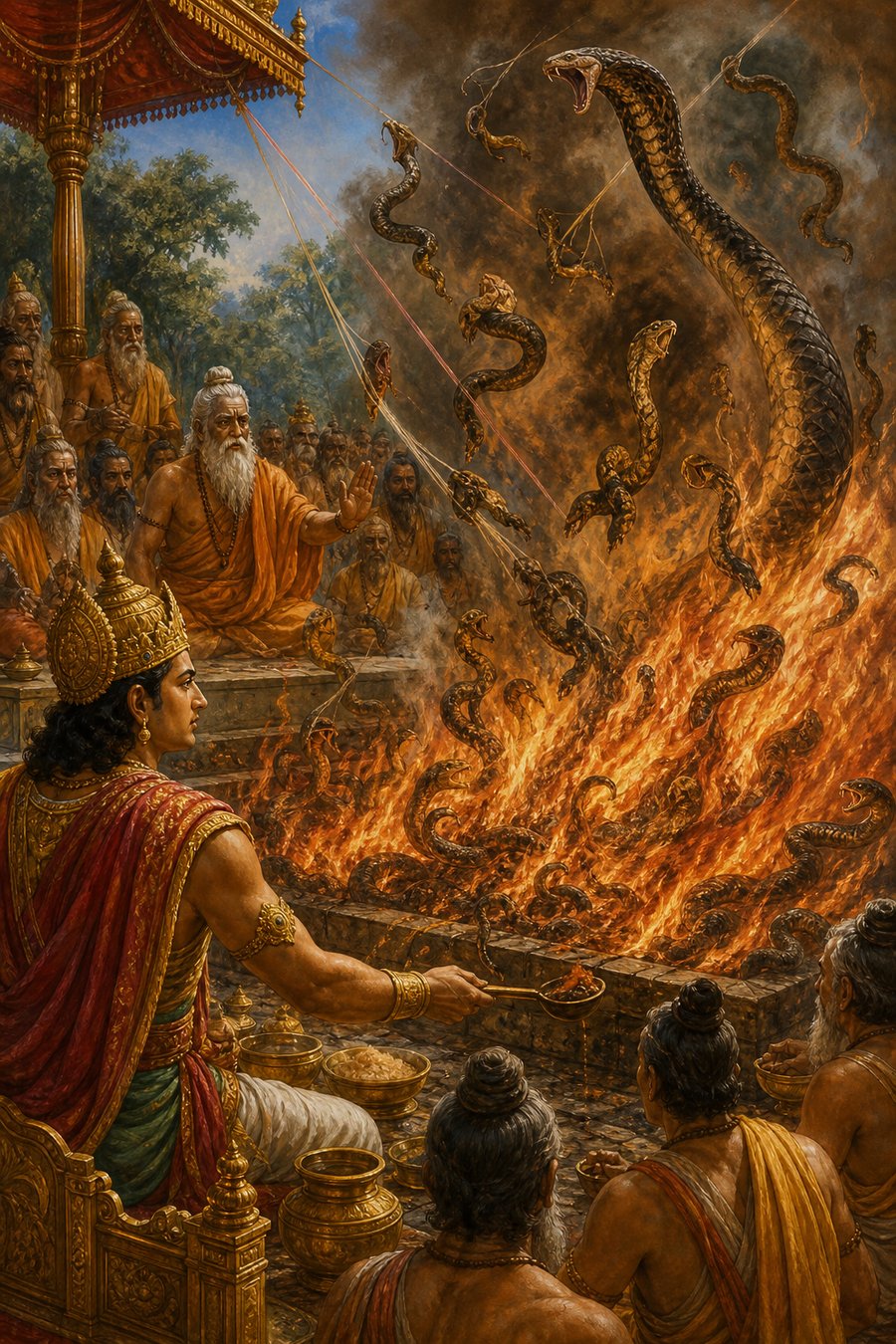
Sauti said: addressed in this way by the foremost of the chief snakes gathered together, that first of Brahmins was much gratified, and the high-souled boy, who had done the thing he was born to do while he was still a boy, set his heart on going away. And that best of Brahmins, having saved the snakes from the snake sacrifice, ascended to heaven when his time came, leaving sons and grandsons behind him. So I have recited to you, Sauti said, this history of Astika exactly as it happened, and truly the recitation of this history dispels all fear of snakes. As your ancestor Pramati once cheerfully narrated it to his son Ruru when Ruru asked him, and as I heard it, so I have told this blessed history of the learned Astika from its beginning. You asked me for it after hearing the story of the Dundubha; it is holy, and it increases virtue; and now that you have heard the whole of it, let your ardent curiosity be satisfied.
A key to reading this (five lines of names, and a story that states the reward for its own reading): The roll of the burned snakes is arranged by five lines of descent, Vasuki’s, Takshaka’s, Airavata’s, Kauravya’s and Dhritarashtra’s. Kauravya and Dhritarashtra are the names of snake clans here and have nothing to do with the blind king of Hastinapura. Sauti says himself that his list is partial and makes no claim to complete it. A yama is a measure of length. At the end the story states the fruit of its own recitation: whoever reads this account or names Astika will have no fear of snakes. That is the Mahabharata’s own habit, and the warning about the hood splitting like a shinshapa fruit belongs to the same promise. With this the Astika Parva closes, and the telling turns to the larger matter Shaunaka has been waiting for, the Bharata of Vyasa.
The gist: At Shaunaka’s request Sauti names the principal snakes of five lines that burned, and admits the full count is impossible. Then the marvel: Astika had said Stay three times to the falling Takshaka, which is why he hung in the sky. Pressed by the Sadasyas the king grants the boon, the sacrifice ends, the priests and Lohitaksha are rewarded, Astika is invited back for the horse sacrifice, and he returns to his mother and uncle. The surviving snakes promise that no snake will bite anyone who reads this story morning or evening or names Astika. Sauti closes the history of Astika where Shaunaka had asked for it, after the tale of the Dundubha.
Source: the Mahabharata of Krishna-Dwaipayana Vyasa, Adi Parva (Anukramanika, Parvasangraha, Paushya, Pauloma and Astika sub-books). This chapter follows K. M. Ganguli, sections 1 to 58; the Gita Press Hindi edition numbers these chapters differently. Names, order, and events were checked against Ganguli’s complete translation. Dialogue and commentary are adapted. About the sources.
Based on: The Mahabharata, Vyasa (Gita Press, Gorakhpur)
The same story elsewhere
- The origin of the Kuru line: Vyasa’s birth, Shakuntala, Yayati
The next chapter: Vaishampayana’s telling begins here - Shantanu, Ganga and Bhishma
To Bhishma’s vow - The churning of the ocean (Bhagavatam)
The same churning, as the Bhagavata Purana sees it