On this page
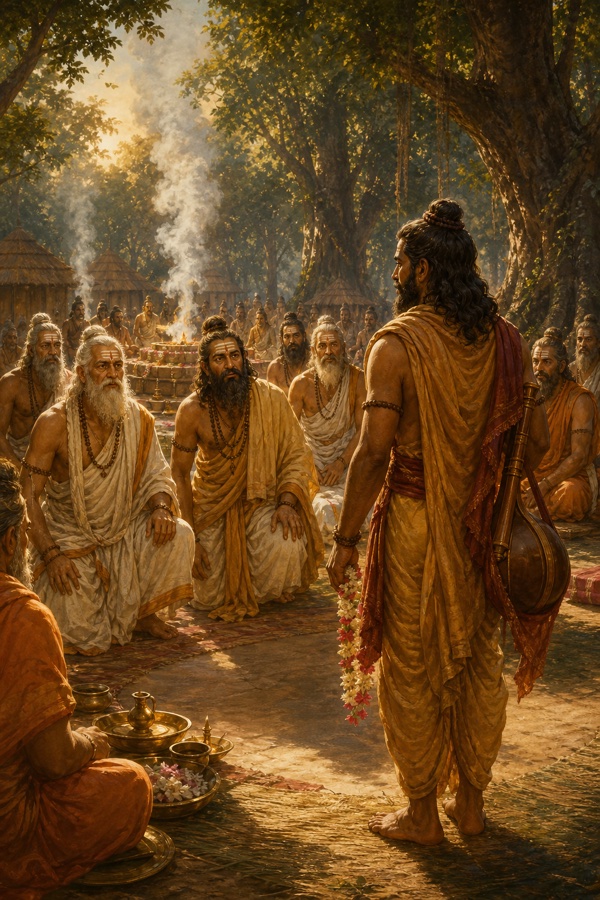
A storyteller walks out of the trees into a clearing where a sacrifice has been burning for years, and the sages seated around the fire ask him where he has come from. That is the first scene of the Mahabharata, and his answer is the book. Sauti says he has come from Janamejaya’s snake sacrifice, where he heard Vaishampayana recite the story that Vyasa composed and Ganesha wrote down on the condition that his pen never stop. Before the sages will let him reach that story they want other things first: the line of Bhrigu, the snakes cursed by their own mother, Garuda, who flew to heaven for the nectar and came back without tasting it, and King Parikshit, who hung a dead snake on a silent sage’s shoulder and seven days later was killed by a death that arrived as an insect inside a fruit. Then the sacrifice itself, in which snakes were pulled out of the sky into the fire, and which a boy stopped with his praise. The moment that sacrifice stops, Janamejaya turns to Vyasa and asks to hear the story of his ancestors, and the Mahabharata begins. Before any of that, this first part holds the frame itself: the clearing at Naimisha and the sages’ request, the egg out of which the world was hatched, Vyasa with a finished poem and no scribe, a blind king counting the moments at which he knew the war was lost, his charioteer’s answer to him, the field of five lakes, the size of an army, and the whole work laid out book by book, so that a listener would know the shape of the road before setting foot on it.
A tired storyteller walks into the forest of Naimisha: Ugrashrava Sauti at Shaunaka’s twelve-year sacrifice, what the sages ask for, and the egg from which everything came
Every telling of this story opens with the same three bows, and so does this one: to Narayana, to Nara, the highest of men, and to Sarasvati, who is speech itself. Only when those three have been named may the word Jaya, victory, be spoken aloud. The forest was called Naimisha. Deep inside it a sacrifice had been burning for a long time already and would burn for twelve years in all, and twelve years of sacrifice meant fires that could never be allowed to die, priests who slept and rose in shifts, firewood and clarified butter carried in along the forest paths every day, and a whole settlement of thatch and bark grown up around the altar. The master of all of it was Shaunaka, whom the others called Kulapati, the head of that household of sages. The men who sat around his fires were ascetics of hard vows, and they were resting between one round of rites and the next, sitting at their ease with the smoke drifting over them, when a traveler came up the path on foot, bowing as he walked. His name was Ugrashrava. He was the son of Lomaharshana, people called him Sauti, the Suta’s son, after his father’s calling, which was to keep the old stories and to say them, and there was almost nothing in the Puranas, the old books of the gods and the kings, that he had not committed to memory. He carried no book; the stories lived in his breath and went where he went. The forest dwellers had been hoping for a long time to hear the stories he carried, and they began calling out to him before he had properly reached the clearing. They received him with every courtesy owed to a guest, and he returned every one. He went around the circle with his palms joined, greeted each sage in turn, asked after the progress of their austerities, and when they had all sat down again he took the seat that had been kept for him. They let him breathe. Hospitality came first and questions after; that was the order of things in a hermitage, and even sages who had waited years for a storyteller kept to it. A man who has walked a long way through forest arrives with the road still in his legs, and the sages knew it, so they waited, and when they saw that he was settled and that the tiredness had gone out of his face, one of the rishis opened the conversation. “Where have you come from, lotus-eyed Sauti, and where have you spent all this time? I am the one asking. Tell me everything, in detail.”
Sauti was a master of speech, and he shaped his answer to the lives of the men in front of him, contemplatives who had given up everything except the fire and the word. “I have been listening,” he said, “to the sacred and wonderful stories that Krishna Dvaipayana composed in his Mahabharata, the ones that Vaishampayana recited in full at the snake sacrifice of the royal sage Janamejaya, with the king himself, Parikshit’s son, seated there to hear them. After that I wandered.” He named the places as a pilgrim names them, in the order he had reached them, the holy waters first and the shrines after, and the last place he named was a battlefield. “I bathed at many holy waters and visited many shrines, and at the end of it I came to the country the twice-born hold sacred, the one they call Samantapanchaka, where the sons of Kuru and the sons of Pandu once fought their war with every chief of the land ranged on one side or the other. From there I came here, because I wanted to see you. Each one of you is Brahma to me. You shine in this place of sacrifice with the brightness of the sun’s own fire. You have finished your silent meditations, you have fed the holy fire, and now you are sitting at your ease. So tell me what I should recite. The sacred stories gathered in the Puranas, with their teaching on duty and on worldly gain? Or the deeds of the great saints and of the kings who have ruled mankind?” He had named, without seeming to, two things the sages would come back for before the night was out: a sacrifice built to burn snakes, and a field where the whole Kshatriya order had gone to die.
The rishi who answered him knew exactly what he wanted, and he described it the way a man describes a thing he has heard once and has never been able to put down. “There is a Purana,” he said, “that the great rishi Dvaipayana first gave to the world. The gods heard it and the brahmarshis heard it, the sages who are Brahmins by birth and seers by attainment, and they held it in the highest esteem. It is the finest narrative that exists. Its language changes as it goes and so do its divisions, its subtle meanings are joined together by reasoning, and it was gathered out of the Vedas. Its diction is elegant, it holds within itself the subjects of every other book, the other shastras throw light on it, and it carries the sense of all four Vedas. That is the history we want to hear, the one called Bharata, the holy composition of the wonderful Vyasa that drives away the fear of evil, exactly as the rishi Vaishampayana recited it, gladly, at Raja Janamejaya’s snake sacrifice under Dvaipayana’s own direction.” The last clause was the point. There were other reciters abroad in the world, as Sauti himself would say in a moment, some teaching the history now and some still to come, and the sages wanted the one recitation that Vyasa himself had stood over and approved, given at the king’s fire with the author listening. Sauti had been at that fire. That was why they had been waiting for him.
Sauti did not begin at once. Before he would speak the sage’s thoughts he named the one to whom every thought belongs, and the bow itself was a long one, spoken slowly, with the smoke of the offering going up behind him. A sacrifice addresses the gods by name, one at a time, and the men around that fire had spent years doing it; what Sauti did now was the same act, turned toward the one that all the names belong to. He bowed to Ishana, the primordial being, to whom the multitudes bring their offerings and whom the multitudes adore: the true and incorruptible one, Brahma, who can be perceived and who cannot, eternal, who is non-being and who is being and non-being at once, who is the universe and who stands apart from the universe of being and non-being, the maker of the high and the low, ancient, exalted, inexhaustible; who is Vishnu, the beneficent one and beneficence itself, to be chosen before everything else, pure, without stain; who is Hari, the ruler of the senses and the guide of everything that moves and everything that stands still. “Having bowed to him,” Sauti said, “I will declare the sacred thoughts of the sage Vyasa, whose deeds are marvels and whom every one of you worships. Some bards have already given this history to the world. Some are teaching it now. Others will carry it over the earth after us. It is a great source of knowledge, established through all three regions of the world. The twice-born keep it in a full form and in a short one, and the learned delight in it, because it is adorned with elegant expressions, with conversations between men and between gods, and with poetic measures of every kind.”
And then, because a telling has to begin somewhere, he began with the beginning of everything, and the sages, who had spent their lives at the fire, sat and listened to how the world they sat in had come to be. He gave it in one unbroken breath from the dark to the day, and he gave it in Vyasa’s words, since the thoughts he had promised to declare were Vyasa’s. “In this world,” he said, “when it had no brightness and no light and was wrapped all around in total darkness, there came into being, as the first cause of creation, a mighty egg, the one inexhaustible seed of every created being, and its name is Mahadivya. That egg was formed at the beginning of the Yuga, and in it, we are told, was the true light, Brahma, the eternal one, wonderful and inconceivable, present alike in every place, the invisible and subtle cause whose nature partakes of being and of non-being.” Out of that egg, he told them, came the lord Pitamaha Brahma, the grandfather of all that lives, the one and only Prajapati, and with him Suraguru and Sthanu. Then the twenty-one Prajapatis appeared, the fathers of creatures: Manu, Vasishtha and Parameshthi, the ten Prachetas, Daksha, and the seven sons of Daksha, three and ten and one and seven, twenty-one in all. Then appeared the being of inconceivable nature whom all the rishis know, and after him the Vishvedevas, the Adityas, the Vasus and the twin Ashvins, the Yakshas, the Sadhyas, the Pishachas, the Guhyakas and the Pitris, the fathers who are gone. After these the wise and most holy brahmarshis were produced, and the many rajarshis, the royal sages, distinguished by every noble quality. Then water, the heavens, the earth, the air, the sky, the points of the compass, the years, the seasons, the months, the fortnights called pakshas, and day and night in their proper succession. That, Sauti said, is how everything known to mankind was produced. And whatever is seen in the universe, animate or inanimate, will be dissolved again at the end of the world when the Yuga has run out, and at the start of the next Yuga everything will be made new, the way the fruits of the earth follow one another in the order of their seasons. So this wheel that carries all things to their destruction turns on in the world, perpetually, without a beginning and without an end. Then he counted the gods.
“The generations of the Devas, in brief, numbered thirty-three thousand, thirty-three hundred and thirty-three.” He gave the sons of Div by name, Brihadbhanu, Chakshus, Atma Vibhavasu, Savita, Richika, Arka, Bhanu, Asavaha and Ravi, and then followed one thread down out of that company. Of those Vivasvans of old, Mahya was the youngest, and his son was Devavrata. Devavrata’s son was Suvrata, and Suvrata had three sons, Dashajyoti, Shatajyoti and Sahasrajyoti, every one of whom fathered a multitude. Dashajyoti had ten thousand children, Shatajyoti ten times that number, and Sahasrajyoti ten times the number of Shatajyoti’s. From these came the family of the Kurus, of the Yadus and of Bharata, the family of Yayati and of Ikshvaku, and all the rajarshis. The generations were numerous, the creatures were abundant, and so were the places they lived in. The threefold mystery, which is the Vedas, Yoga and Vijnana, and Dharma, Artha and Kama; the various books on Dharma, Artha and Kama; the rules for the conduct of mankind; the histories and the discourses with their many shrutis: all of this the rishi Vyasa saw, and all of it, Sauti said, is set down here in order, as a sample of the book. Vyasa gave this mass of knowledge to the world in a full form and in a short one, and the learned of the world want to possess both. Some read the Bharata beginning with the invocation, some with the story of Astika, some with Uparichara, and some Brahmins study the whole. Men of learning show what they know of the institutes by commenting on it, and some are skilled at explaining it, others at remembering what it holds. The Kurus and the Yadus had now been given a line that ran back to the egg, two of the families that would fill the field at Samantapanchaka, and Sauti let the names stand a moment before he came to the man who had made the book.
A key to reading this (the three layers of the telling): the Mahabharata reaches its listener through three voices nested inside one another. Outermost is Sauti, speaking to Shaunaka’s sages in the forest. Inside him is Vaishampayana, who recited the story at Janamejaya’s snake sacrifice. Inside him is Vyasa, who composed it. Whenever the telling says that Sauti said, or that Vaishampayana said, one of these layers has taken over the voice. For one long stretch of this part there is a fourth layer inside the third: Dhritarashtra and Sanjaya speaking to each other after the war, quoted by Sauti. The numbers Sauti recites here, the thirty-three thousand, thirty-three hundred and thirty-three gods, the ten thousand sons of Dashajyoti, are the text’s own count. Sauti’s name means the Suta’s son, and Sanjaya, the man the blind king speaks to in the lament that comes later in this part, is a suta too.
The gist: Ugrashrava Sauti arrives at Shaunaka’s twelve-year sacrifice in the Naimisha forest, and the sages ask him for Vyasa’s Bharata exactly as Vaishampayana told it at Janamejaya’s snake sacrifice. Sauti bows to Ishana and begins at the beginning: the Mahadivya egg in the darkness, Brahma and the twenty-one Prajapatis, the gods, the rishis, the elements and the turning wheel of the ages, the lines of Kuru, Yadu, Bharata, Yayati and Ikshvaku descending from the sons of Div, and Vyasa’s work in its long form and its short one. Then the story of how that work came to be written down.
Brahma comes to Vyasa in person: a finished poem with no one on earth to write it down, Ganesha’s one condition and Vyasa’s counter-condition, and the eight thousand eight hundred knotted verses
The son of Satyavati had taken the eternal Veda apart by penance and meditation, and afterward he composed this holy history. But when Dvaipayana Vyasa, the learned brahmarshi of strict vows, Parashara’s son, had finished the greatest of all narrations, a practical worry settled on him, the kind of worry that comes only when a thing is finished. He had the work, all of it, held in his own mind and nowhere else. He had disciples. He could not yet see how to carry the one into the other, how a poem of that size was to pass from one memory into many without a line of it going astray. Brahma, who possesses the six attributes and who is the teacher of the world, knew of the rishi’s anxiety without being told, and he came in person to the place where Vyasa was, to please the saint and to do good to mankind. Vyasa, sitting among every tribe of munis, looked up and saw him, and astonishment went through the whole hermitage. He rose with his palms joined, bowed, and ordered a seat brought. When the one who is called Hiranyagarbha, the golden womb from which the worlds were born, had taken that distinguished seat, Vyasa walked around him the way a man walks around a shrine, keeping him on his right hand, and then stood near, and only when Brahma Parameshthi commanded it did he sit down beside the seat, full of affection, smiling with joy. The creator had come to the poet; the poet waited to be told to sit.
Then Vyasa made his report, and it was the catalogue of a lifetime, delivered to the one being in the universe who could check every line of it. “Divine Brahma,” he said, “I have composed a poem, and it is held in great respect.” And he told Brahma what was in it, and the list went on for a long time. The mystery of the Veda, and other subjects beyond it. The various rituals of the Upanishads together with the Angas, the limbs of Vedic learning. The compilation he had made of the Puranas and of history, named after the three divisions of time, past, present and future. The settled nature of decay, of fear, of disease, of existence and of non-existence. A description of creeds and of the different ways a life may be lived. The rules for the four castes and the meaning of all the Puranas. An account of asceticism and of the duties of a student under vows. The dimensions of the sun and the moon, the planets, the constellations and the stars, together with the length of the four ages. The Rik, the Sama and the Yajur Vedas, and the Adhyatma, the knowledge of the self within. The science of reasoning called Nyaya, the science of right pronunciation, and the treatment of diseases. Charity, and the Pashupata dharma. Births in heaven and births among men, each undertaken for a purpose. A description of the places of pilgrimage and of the other holy places of rivers, mountains, forests and the ocean, of the heavenly cities and of the kalpas, the great ages of the world. The art of war. The different kinds of nations and languages, and the nature of the manners of peoples. And the all-pervading spirit. All of these, Vyasa said, were in the poem. The sages at Naimisha, hearing the list recited back to them by Sauti, were hearing the table of contents of the book they were about to be told, and it ran from the size of the sun to the manners of foreign peoples. “And yet, after all of it, no one who could write this work is to be found on earth.”
Brahma’s answer settled two things at once, the rank of the work and the hand that would write it. “I esteem you for your knowledge of divine mysteries,” he said, “here before the whole body of celebrated munis distinguished for the holiness of their lives. I know that you have revealed the divine word, from its first utterance onward, in the language of truth. You have called your present work a poem, and so a poem it shall be. There shall be no poets whose works can equal the descriptions in this poem, just as the three other modes of life, the student’s, the forest dweller’s and the renouncer’s, can never equal the householder’s in merit. Let Ganesha be thought of for the purpose of writing it down.” A poem, then, by the word of the creator, and a scribe named by him. What Brahma had not said was how the scribe was to be persuaded, or what he would ask in return.
Sauti said: having spoken to Vyasa in this way, Brahma withdrew to his own abode, and the rishi was left with the assembled munis, a finished poem, and a name to think of. Then Vyasa began to call Ganesha to mind, and Ganesha, the remover of obstacles, always ready to fulfill the wishes of those who pray to him, had no sooner been thought of than he stood at the place where Vyasa sat. The munis who had just watched Brahma come and go now watched a second god arrive in the same clearing, summoned by nothing louder than a thought. The rishi saluted him and gave him a seat, and put the request to him plainly, as one puts a request to a god who has already agreed to come. “Guide of the Ganas, be the writer of the Bharata that I have formed in my imagination and am about to recite.” Ganesha heard him out and set his terms. “I will become the writer of your work,” he said, “provided my pen does not stop writing for a single moment.” It was a hard condition. A poet who composes as he speaks needs the pauses, and Ganesha had just taken them away. Vyasa answered the god with terms of his own. “Wherever there is anything you do not understand, stop writing.” Ganesha signified his assent by repeating the word Om, and proceeded to write, and Vyasa began. What began then was the dictation of the whole Bharata, the poet speaking and the god writing, and neither of them allowed to stop unless the other failed. And by way of diversion Vyasa tied the knots of his composition very tight, verses that folded their meaning in on itself so that even a god’s pen had to hover over them, and by doing that he kept his side of the bargain while he dictated the whole of the work.
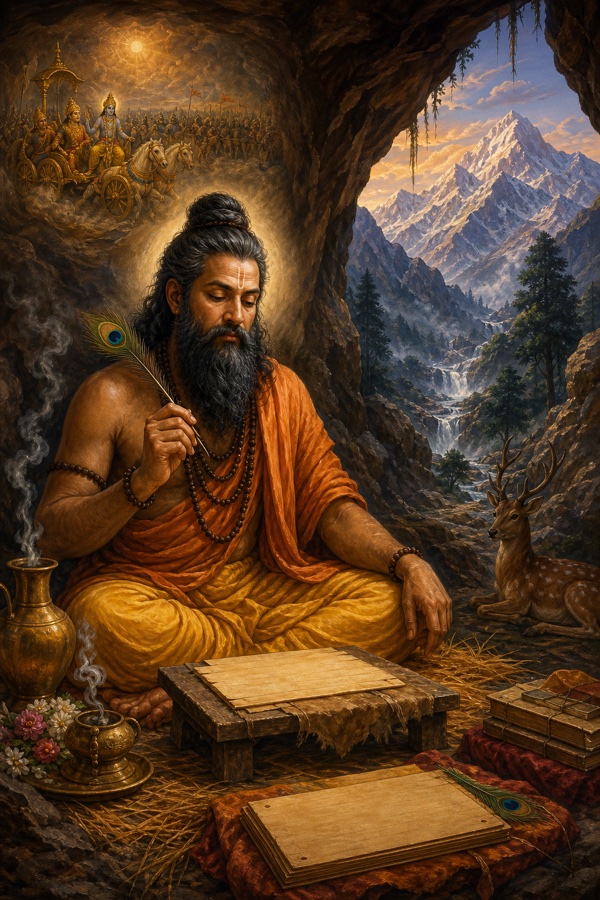
“I know eight thousand eight hundred verses of that kind,” Sauti went on, “and so does Shuka, and perhaps Sanjaya. Their meanings are so deeply hidden that no one to this day has been able to penetrate those closely knit and difficult shlokas. Even the all-knowing Ganesha took a moment to consider them, and in that moment Vyasa went on composing other verses in great abundance.” Then he told the sages what the work had done for the world, and he told it in pictures. The wisdom of this work, he said, is like the stick that lays kohl along the eye: it has opened the eyes of a curious world that the darkness of ignorance had blinded. As the sun drives off the dark, so the Bharata, by what it says on religion, on gain, on pleasure and on final release, drives off the ignorance of men. As the full moon with its mild light opens the buds of the water lily, so this Purana, by uncovering the light of the Shruti, has opened the human mind. By the lamp of history, which destroys the darkness of ignorance, the whole mansion of nature stands properly and completely lit. Then he gave the sages a picture of the whole.
A key to reading this (the two conditions): Ganesha’s condition is that his pen must never stop. Vyasa’s counter-condition is that it must stop wherever the writer fails to understand. Between the two promises Vyasa buys himself time: now and then he dictates a verse whose knot of meaning takes even the all-knowing Ganesha a moment to untie, and in that moment he composes the verses that come next. Sauti counts eight thousand eight hundred such verses, and says that he knows them himself, that Shuka, Vyasa’s own son, knows them, and that Sanjaya perhaps does. The text is explaining its own hard passages here, in its own voice.
The gist: Vyasa has finished his composition and has no one to write it down. Brahma comes in person, Vyasa recites the full table of what the work contains, and Brahma names it a poem and tells him to think of Ganesha. Ganesha’s condition, an unstopping pen, and Vyasa’s counter-condition, a pen that stops where the scribe does not understand, give birth to the eight thousand eight hundred knotted verses. Then the praise of the Bharata: a kohl stick for blinded eyes, a sun, a full moon, and the lamp of history. The tree of the whole work comes next.
The tree called Bharata: where every book sits from seed to fruit, six hundred thousand verses divided among the worlds, and the whole story told in one breath, from Pandu’s curse to the war
Sauti had a picture for the work, and he drew it for the sages branch by branch, the way a man draws in the dust with a stick. This work is a tree, he told them. The chapter of contents is its seed. The divisions called Pauloma and Astika are its root, and the part called Sambhava, the book of births, is the trunk. The books called Sabha and Aranya, the assembly and the forest, are the perches where the birds roost, and the book called Arani is the knots in the wood. Virata and Udyoga, the year in hiding and the mustering for war, are the pith. The book named Bhishma is the main branch. The book called Drona is the leaves, the book called Karna is the fair flowers, and the book named Shalya is their sweet smell. The books called Stri and Aishika, the women’s lament and the weapon loosed at an unborn child, are the cool shade. The book called Shanti, the peace, is the great fruit; the book called Ashvamedha, the horse sacrifice, is the immortal sap; the one called Ashramavasika, the dwelling in the hermitage, is the ground the tree stands in; and the book called Mausala, the clubs, is the Vedas in little, held in great respect by virtuous Brahmins. The tree of the Bharata, Sauti said, inexhaustible to mankind as the clouds are, shall feed every distinguished poet who comes after. Then he told them what the tree had borne.
“Now I will speak of the undying, flowering and fruitful produce of this tree,” Sauti continued, “which is pure and pleasant to the taste and which even the immortals cannot destroy.” And the first fruit he named was a family. Long ago, he said, the spirited and virtuous Krishna Dvaipayana, at the bidding of Bhishma, the wise son of Ganga, and of his own mother, fathered three boys by the two wives of Vichitravirya, three boys who were like the three sacrificial fires. Having raised up Dhritarashtra, Pandu and Vidura in this way, he went back to his hermitage and his austerities. Three sons by the two wives of a king, at the bidding of the family’s elders: both sides of the war that follows descend from that one act. Only after those three had been born, had grown to manhood, and had departed on the supreme journey did the great rishi Vyasa give the Bharata to this world of men. Solicited by Janamejaya and by thousands of Brahmins, he instructed his disciple Vaishampayana, who was seated near him, and Vaishampayana, sitting with the sadasyas, the priests who sit through a sacrifice as its witnesses, recited the Bharata in the intervals between the ceremonies, urged again and again to go on. Vyasa, Sauti said, has fully shown the greatness of the house of Kuru, the virtuous principles of Gandhari, the wisdom of Vidura and the constancy of Kunti. The noble rishi has also described the divinity of Vasudeva, the uprightness of the sons of Pandu, and the evil practices of the sons of Dhritarashtra and their partisans. So the man who composed the story had also fathered the three men at the head of it, and had waited until all three were dead before he let it be heard; the sages took that in, and Sauti moved on to the count.
Then came the arithmetic of the work, and Sauti gave it as carefully as a treasurer gives an account. Vyasa, he said, put the Bharata together, leaving out the episodes, in twenty-four thousand verses, and that much alone is what the learned call the Bharata. Afterward he composed a summary in one hundred and fifty verses, the introduction with the chapter of contents, and this he taught first to his son Shuka, and afterward gave to others of his disciples who had the same qualifications. After that he made another compilation, of six hundred thousand verses. Of those, thirty hundred thousand are known in the world of the Devas, fifteen hundred thousand in the world of the Pitris, fourteen hundred thousand among the Gandharvas, and one hundred thousand in the regions of mankind. Narada recited them to the Devas, Devala to the Pitris, and Shuka gave them to the Gandharvas, the Yakshas and the Rakshasas. In this world they were recited by Vaishampayana, one of Vyasa’s disciples, a man of just principles and the first among all who know the Vedas. “Know that I, Sauti, have also repeated one hundred thousand verses.” That was the human share, then, one hundred thousand verses out of six hundred thousand, the smallest of the four portions, and the man in front of them carried the whole of it in his head. And then he gave them a second tree, smaller than the first, and this one was made of men. Yudhishthira, he said, is a vast tree formed of religion and virtue. Arjuna is its trunk, Bhimasena its branches, the two sons of Madri its full-grown fruit and flowers, and its roots are Krishna, Brahma and the Brahmins.
What followed was the entire story in the space of a few breaths, the map that the text lays down before it sets out, and Sauti told it without once raising his voice. Pandu, he said, having brought many countries under him by his wisdom and his strength, went to live among the munis in a certain forest as a hunter, and there he brought a very severe misfortune on himself by killing a stag as it coupled with its mate, a misfortune that served as a warning to the princes of his house for as long as they lived. So that the ordinances of the law might be fulfilled, their mothers admitted as substitutes to their embraces the gods Dharma, Vayu and Shakra, who is Indra, and the divine twin Ashvins, and so the five sons of Pandu were fathered by gods. When the children had grown up under the care of their two mothers, among ascetics, in sacred groves and the holy retreats of religious men, rishis brought them into the presence of Dhritarashtra and his sons. They came walking behind their teachers like students, in the dress of brahmacharis, their uncut hair tied in knots on their heads, five boys out of the forest with nothing to show who they were except the men who had brought them. “These pupils of ours,” the rishis said, “are your sons, your brothers and your friends. They are Pandavas.” And having said it, the munis disappeared. No one could ask them to stay and prove it; there was no one left to ask. When the Kauravas saw the boys introduced as the sons of Pandu, the better sort of citizens shouted for joy. Some said they could not be Pandu’s sons. Some said they were. A few asked how they could be his offspring when he had been dead so long. Pandu had left the city for the forest years before and had died there, far from anyone in Hastinapura who could have witnessed it, and here were five boys of the right ages wearing his name. Still, on every side, voices cried out that they were welcome on every count, that by divine providence the family of Pandu stood before them again, that their welcome should be proclaimed. And when those cries died down, the applause of invisible spirits set every point of the heavens resounding. Sweet-scented flowers came down in showers, conches and kettledrums sounded, and the joyful noise of the citizens rose and swelled until it reached heaven itself.
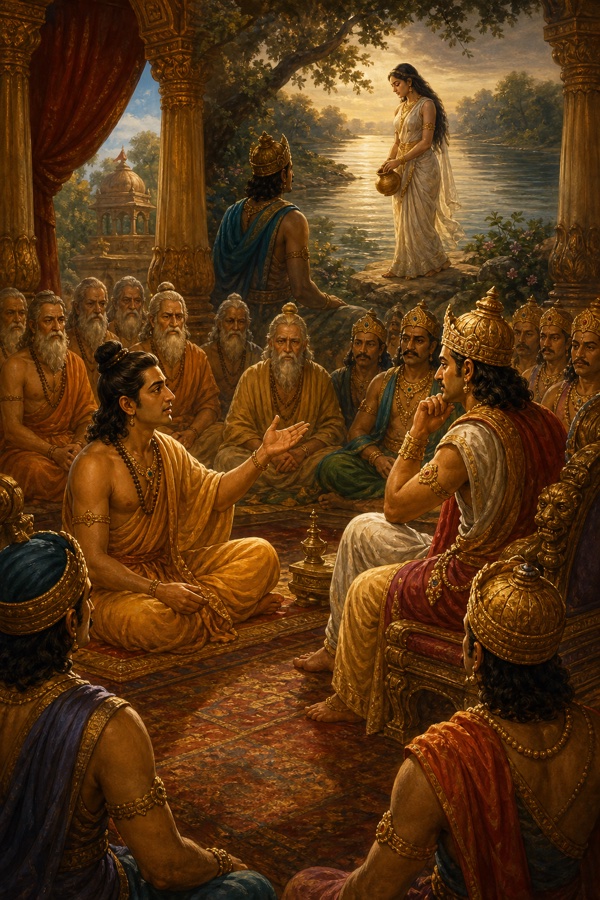
The Pandavas studied the whole of the Vedas and the other shastras besides, and they lived there, respected by everyone and afraid of no one. The leading men were pleased with the purity of Yudhishthira, the courage of Arjuna, the attentive humility Kunti showed her elders, and the modesty of the twins, Nakula and Sahadeva, and all the people took pleasure in their heroic virtues. After a while Arjuna won the maiden Krishnaa, Drupada’s daughter, whom the world knows as Draupadi, at her svayamvara, the assembly at which a princess takes her husband from among the kings who have come for her, in the midst of a crowd of kings, by performing a very difficult feat of archery, and from that day he was greatly respected among all the bowmen of this world, and on fields of battle he was like the sun, hard for an enemy to look at. Having beaten all the neighboring princes and every considerable tribe, he accomplished everything his eldest brother needed in order to perform the great sacrifice called Rajasuya, the rite by which a king is made a king of kings. Yudhishthira, by the wise counsel of Vasudeva and the valor of Bhimasena and Arjuna, killed Jarasandha the king of Magadha and the proud Chaidya, and so acquired the right to perform that grand sacrifice, rich in provisions and offerings and heavy with merit. Duryodhana came to it, as every prince in the land came, a kinsman and a guest. He saw the vast wealth of the Pandavas scattered all around, the offerings, the precious stones, the gold and jewels, the wealth in cows, elephants and horses, the rare weaves, garments and mantles, the precious shawls and furs and the carpets made from the skin of the ranku deer, and envy filled him, and his displeasure was very great. When he saw the hall of assembly that Maya the Asura architect had built after the fashion of a celestial court, rage took hold of him. He stumbled in confusion at certain tricks of the building’s design, and Bhimasena mocked him for it in the presence of Vasudeva, as one mocks a man of low birth. It was a small thing, a stumble and a laugh, and the king’s son could not put it down. He went home sick with what he had seen. It was reported to Dhritarashtra that his son, in the midst of every enjoyment and every precious thing, was growing thin, wan and pale, and some time later Dhritarashtra, out of affection for his son, gave his consent to a game of dice with the Pandavas. Vasudeva came to know of it and his anger was very great. Dissatisfied as he was, he did nothing to prevent the quarrels. He overlooked the gaming and the many horrid and unjustifiable dealings that grew out of it, and in spite of Vidura, Bhishma, Drona and Kripa the son of Sharadvan, he made the Kshatriyas kill one another in the terrific war that followed. That was the whole of it, told in the time it takes a fire to burn down one log, and the sages had heard a blind king’s consent to a game of dice go by in half a sentence; Sauti now let them hear it from the king.
A key to reading this (why the story is summarized here): this passage is the text’s own map of itself, the whole Mahabharata compressed by Sauti into a single run before the telling proper begins. Pandu’s curse, the arrival at Hastinapura, Draupadi’s svayamvara, the Rajasuya, Duryodhana’s envy, the dice and the war all appear in a few sentences each, and every one of them returns at full length in the chapters ahead. The sentence about Vasudeva, angry and yet leaving the dice unprevented and making the Kshatriyas kill one another, is the text’s own; Vasudeva is Krishna’s own name in the text, and both names are used for him in the passages that follow. The tricks of Maya’s hall that made Duryodhana stumble are told in full in the Sabha Parva.
The gist: Sauti calls the Bharata a tree and gives every book its place: the contents as seed, Pauloma and Astika as root, Sambhava as trunk, Bhishma as main branch, Karna as flowers, Shanti as fruit, Mausala as the essence of the Vedas. Then the count of verses: a core Bharata of twenty-four thousand, a summary of one hundred and fifty, a compilation of six hundred thousand shared among gods, ancestors, Gandharvas and men. Finally the whole story in one breath: Pandu’s stag, five sons fathered by gods, their welcome at Hastinapura, Draupadi, the Rajasuya, Duryodhana’s envy, the dice, and a war that no one stopped. The blind king now goes over it link by link.
Dhritarashtra’s lament, first part: “I never wanted this war, Sanjaya,” and the long count, from Draupadi’s svayamvara to Krishna’s embassy, at every link of which the hope of victory died again
Sauti said: when Dhritarashtra heard the bitter news of the Pandavas’ success, and remembered the resolutions that Duryodhana, Karna and Shakuni had taken, he sat for a while in his own darkness and thought. It was the kind of news that leaves nothing to hope for. Of the eighteen akshauhinis that had marched out, three men were left on his side, and the sons who had despised him for his age were among the dead, every one of them. He had been blind from birth, and the war had reached him the way everything reached him, as sound, as report, as the voice of Sanjaya, a suta by birth, the charioteer and counselor who had carried his embassy to the Pandavas before the fighting began and had then told him the war, day by day, as it was fought, and who was beside him now. The palace around them had become a palace of women and old men. When he spoke, it was to Sanjaya. “Attend to everything I am about to say, Sanjaya, and do not hold me in contempt for saying it. You are well versed in the shastras, intelligent, endowed with wisdom. My inclination was never toward war, and I took no delight in the destruction of my race. I made no distinction between my own children and the children of Pandu. My own sons were willful, and they despised me because I am old. Blind as I am, because of my miserable condition and through a father’s affection, I bore it all. I was a fool trailing after the thoughtless Duryodhana, whose folly grew and grew. He had stood and looked at the riches of the sons of Pandu, and then he was derided for his awkwardness as he climbed into the hall that Maya had built for them. He could not bear that. He could not beat the sons of Pandu in the field either. Soldier though he was, he was unwilling to earn his good fortune by his own exertion, and so, with the help of Shakuni, the king of Gandhara, he arranged an unfair game of dice.” The king said this with the whole war already lost, and the confession did nothing to lighten what came next.
Then the king began the count, and every link of it was a thing he had been told at the time and had let pass. Sanjaya did not interrupt him; he had been asked to attend, and he attended. “Hear, Sanjaya, everything that happened after that and came to my knowledge, and when you have heard all of it, and matched each thing to the way it fell out, you will know me for a man who saw what was coming. When I heard that Arjuna had drawn the bow at Draupadi’s svayamvara, struck the strange target and brought it down to the ground, and carried off the maiden Krishnaa in triumph while the assembled princes watched, then, Sanjaya, I had no hope of victory. When I heard that Subhadra of the race of Madhu had been seized by force and married by Arjuna in the city of Dwarka, and that the two heroes of the Vrishni line, her brothers Krishna and Balarama, had taken no offense and had come into Indraprastha as friends, then, Sanjaya, I had no hope of victory. When I heard that Arjuna, holding off with his celestial arrows the rain that Indra the king of the gods poured down to put the fire out, had made Agni a gift of the forest of Khandava and satisfied him with it, then, Sanjaya, I had no hope of victory. When I heard that the five Pandavas and their mother Kunti had escaped from the house of lac, the house that had been built to burn with them inside it, and that Vidura was working to accomplish their designs, then, Sanjaya, I had no hope of victory.” Two fires in two links, one that his nephew had lit for a god and one that had been lit for his nephews; he did not pause between them. “When I heard that Arjuna had pierced the mark in the arena and won Draupadi, and that the brave Panchalas, her father’s people, had joined the Pandavas, then, Sanjaya, I had no hope of victory. When I heard that Jarasandha, the first of the royal line of Magadha, blazing in the midst of the Kshatriyas, had been killed by Bhima with his bare arms alone, then, Sanjaya, I had no hope of victory. When I heard that the sons of Pandu had subdued the chiefs of the land in their campaign across the four quarters and performed the grand sacrifice of the Rajasuya, then, Sanjaya, I had no hope of victory.”
The count had reached the hall of dice, and the king did not slow down for it. He had given his consent to that game out of affection for his son; Sauti had said so a moment before, and the king did not say it now. “When I heard that Draupadi, her voice choked with tears and her heart full of agony, in the days of her monthly seclusion and with a single garment on her, had been dragged into the court, and that though she had protectors she had been treated as if she had none, then, Sanjaya, I had no hope of victory. When I heard that the wicked Duhshasana, straining to strip her of that one garment, had drawn from her body a great heap of cloth without ever coming to the end of it, then, Sanjaya, I had no hope of victory.” He said nothing of where that court was, or of who sat at the head of it, or of the fact, which the book of the assembly tells, that it was he himself who in the end gave Draupadi her deliverance that day. Sanjaya let it pass. “When I heard that Yudhishthira, beaten at dice by Shakuni, Subala’s son, and stripped of his kingdom as the price of it, was still attended by his brothers, whose prowess no one could match, then, Sanjaya, I had no hope of victory. When I heard that the virtuous Pandavas had followed their elder brother into the wilderness weeping in their grief, and had exerted themselves in every way to lighten his hardships, then, Sanjaya, I had no hope of victory. When I heard that snatakas and noble-minded Brahmins who live on alms had followed Yudhishthira into that wilderness, then, Sanjaya, I had no hope of victory.” The years of the forest went by in the links that followed, the years the forest book tells at full length, and the king took them at the same pace. “When I heard that Arjuna had fought the god of gods, Mahadeva, three-eyed Tryambaka, who had come to him disguised as a hunter, and had pleased him in the fight and received from him the great weapon Pashupata, then, Sanjaya, I had no hope of victory. When I heard that the just and renowned Arjuna had gone up to the celestial regions and received celestial weapons there from Indra himself, then, Sanjaya, I had no hope of victory. When I heard that afterward Arjuna had overcome the Kalakeyas and the Paulomas, who were proud of the boon they had won, a boon that had made them safe even from the celestials, then, Sanjaya, I had no hope of victory. When I heard that Arjuna had gone to the regions of Indra to destroy the Asuras and had come back successful, then, Sanjaya, I had no hope of victory. When I heard that Bhima and the other sons of Kunti had reached, in the company of Vaishravana, who is Kubera, that country which no man can enter, then, Sanjaya, I had no hope of victory.”
The king had not paused, and the links kept coming, and the man he was speaking to had been present at some of them. “When I heard that my sons, guided by Karna’s counsels, had gone out on their ghoshayatra, their expedition to the cattle stations, and had been taken prisoner there by the Gandharvas and set free by Arjuna, then, Sanjaya, I had no hope of victory. When I heard that Dharma, the god of justice, had come in the form of a Yaksha and put his questions to Yudhishthira, then, Sanjaya, I had no hope of victory. When I heard that my sons had failed to discover the Pandavas under their disguise while they lived with Draupadi in the dominions of Virata, the king of the Matsyas, then, Sanjaya, I had no hope of victory. When I heard that the principal men of my side had all been beaten by the noble Arjuna with a single chariot while he lived in Virata’s dominions, then, Sanjaya, I had no hope of victory. When I heard that Vasudeva of the race of Madhu, who once covered this whole earth with one foot, was wholeheartedly on the side of the Pandavas, then, Sanjaya, I had no hope of victory. When I heard that the king of the Matsyas had offered his virtuous daughter Uttara to Arjuna, and that Arjuna had accepted her for his son Abhimanyu, then, Sanjaya, I had no hope of victory. When I heard that Yudhishthira, beaten at dice, stripped of wealth, exiled and cut off from his connections, had even so assembled an army of seven akshauhinis, then, Sanjaya, I had no hope of victory. When I heard Narada declare that Krishna and Arjuna were Nara and Narayana, the two this very telling had bowed to at its opening, and that he had seen the two of them together in the regions of Brahma, then, Sanjaya, I had no hope of victory. When I heard that Krishna, anxious to bring about peace for the welfare of mankind, had come to the Kurus and gone away without achieving it, then, Sanjaya, I had no hope of victory.” Sanjaya had gone to the Pandavas as the king’s own envoy before Krishna ever came to Hastinapura, and had come back with nothing, and had stood in the court the next morning and told them who Vasudeva and Arjuna were; the king was counting things his listener had done. “When I heard that Karna and Duryodhana had resolved on imprisoning Krishna, and that he had shown the whole universe within his own body, then, Sanjaya, I had no hope of victory. And when I heard that at the time of his departure Kunti had stood beside his chariot full of sorrow and had been consoled by him, then, Sanjaya, I had no hope of victory. When I heard that Vasudeva and Bhishma the son of Shantanu were the counselors of the Pandavas, and that Drona the son of Bharadvaja had pronounced blessings on them, then, Sanjaya, I had no hope of victory. When Karna said to Bhishma, ‘I will not fight while you are fighting,’ and quit the army and went away, then, Sanjaya, I had no hope of victory. When I heard that Vasudeva and Arjuna and the bow Gandiva, those three of dreadful power, had come together in one chariot, then, Sanjaya, I had no hope of victory.”
A key to reading this (when this count is being made): Dhritarashtra is speaking after the war, once the news of the Pandavas’ victory has reached him. His count therefore runs back through everything that could have told him, at the time, that the war was already lost, and the same sentence returns at every link, sixty-six times across the two parts, and the repetition is the text’s own: the king is beating the same drum at every station of a road he did not turn back on. This part carries the links from the svayamvara to Krishna’s embassy and Karna’s withdrawal from the army; the links from the days of the battle itself follow in the next passage. The whole list doubles as a second table of contents for the chapters ahead: in this sequence the links of this part fall across chapters 1 to 20, and those of the next passage across chapters 21 to 32.
The gist: With the news of the war in his ears, Dhritarashtra tells Sanjaya that he never wanted it, that blindness and a father’s love made him a fool trailing after Duryodhana, and then he begins the count of the moments at which his hope of victory died: Arjuna’s shot and Draupadi, the taking of Subhadra, the burning of Khandava, the escape from the house of lac, the death of Jarasandha, the Rajasuya, Draupadi dragged into the court, the exile, the Pashupata and Indra’s weapons, the Kalakeyas, the ghoshayatra, the Yaksha’s questions, the year in disguise, Uttara, seven akshauhinis, Narada calling Krishna and Arjuna Nara and Narayana, Krishna’s failed embassy and his universal form, and Karna’s refusal to fight while Bhishma fought. The links of the battle days follow.
Dhritarashtra’s lament, second part: the links of the eighteen days, from Bhishma’s fall to Ashvatthama’s curse, ten men left alive out of eighteen akshauhinis, and the blind king’s swoon
The king had reached the war itself, and his voice did not change; the links from here on were the eighteen days, and every one of them had come to him through the man now sitting beside him, on the day it happened. “When I heard that Arjuna, overcome by pity on his chariot and ready to sink down under it, had been shown all the worlds within Krishna’s body, then, Sanjaya, I had no hope of victory. When I heard that Bhishma was killing ten thousand chariot warriors every day in the field and had still not killed a single one of the Pandavas, then, Sanjaya, I had no hope of victory. When I heard that Bhishma, the righteous son of Ganga, had himself pointed out the means of his own defeat in battle, and that the Pandavas had carried it out with joy, then, Sanjaya, I had no hope of victory. When I heard that Arjuna, with Shikhandi placed in front of him on his chariot, had wounded Bhishma, whose courage had no limit and who had never been beaten in battle, then, Sanjaya, I had no hope of victory. When I heard that the aged hero Bhishma, having cut the race of the Somakas down to a few, lay on a bed of arrows covered in wounds, then, Sanjaya, I had no hope of victory. When I heard that Bhishma, lying on the ground and thirsting for water, had asked Arjuna for it, and that Arjuna had pierced the ground and quenched his thirst, then, Sanjaya, I had no hope of victory.” The first ten days of the eighteen were in those six links, and the king had crossed them in six sentences; it was the old man on the arrows he could not get past, and the count went on from him. “When Vayu together with Indra and Surya united as allies for the success of the sons of Kunti, and the beasts of prey, by their ill-omened presence around our camp, were putting us in fear, then, Sanjaya, I had no hope of victory. When the wonderful warrior Drona, displaying every mode of fighting in the field, did not kill any of the leading Pandavas, then, Sanjaya, I had no hope of victory. When I heard that the maharatha Samsaptakas of our army, the men sworn to the overthrow of Arjuna, had all been killed by Arjuna himself, then, Sanjaya, I had no hope of victory.”
The next links were the ones that had broken him, and he gave them in the same voice as the rest. “When I heard that our array, which no one else could pierce and which the well-armed Drona, the son of Bharadvaja, himself defended, had been forced and entered single-handed by the brave son of Subhadra, then, Sanjaya, I had no hope of victory. When I heard that our maharathas, unable to overcome Arjuna, had surrounded the boy Abhimanyu together and killed him, and stood there afterward with jubilant faces, then, Sanjaya, I had no hope of victory.” Abhimanyu was the son of Arjuna and Subhadra, the child whose conception the king had already counted among the things that had taken his hope away, and the men with the jubilant faces were the great chariot warriors of his own side; he gave the link the same weight as every other and went on. “When I heard that the blind Kauravas were shouting for joy at having killed Abhimanyu, and that Arjuna in his anger had made his famous speech about Jayadratha the Saindhava, then, Sanjaya, I had no hope of victory. When I heard that Arjuna had vowed the death of Jayadratha and had fulfilled the vow in the presence of his enemies, then, Sanjaya, I had no hope of victory. When I heard that Arjuna’s horses had been spent, and that Vasudeva had unyoked them in the middle of the battle, made them drink, brought them back, harnessed them again and driven on as before, then, Sanjaya, I had no hope of victory. When I heard that while those horses rested Arjuna had stayed in his chariot and held off every assailant, then, Sanjaya, I had no hope of victory. When I heard that Yuyudhana of the Vrishni race, the one the armies call Satyaki, had thrown Drona’s army, unbearable in its strength because of its elephants, into confusion, and had come through to where Krishna and Arjuna were, then, Sanjaya, I had no hope of victory. When I heard that Karna, with Bhima in his power, had let him go after nothing worse than contemptuous words and a dragging with the end of his bow, then, Sanjaya, I had no hope of victory. When I heard that Drona, Kritavarma, Kripa, Karna, Drona’s son and Shalya, the valiant king of Madra, had allowed Jayadratha to be killed, then, Sanjaya, I had no hope of victory. When I heard that the celestial shakti Indra had given to Karna, the lance Karna had taken in exchange for his earrings, which could kill only one man before it was spent, had, through Krishna’s scheming, been hurled at the Rakshasa Ghatotkacha of the terrible face, then, Sanjaya, I had no hope of victory. When I heard that in the fight between Karna and Ghatotkacha it was that shakti Karna had thrown at Ghatotkacha, the very shakti that was certain to have killed Arjuna in battle, then, Sanjaya, I had no hope of victory.”
There was more, and it was worse, because the links from here on ran closer to home: his son’s allies falling one after another, and then his son alone in a lake. He went on. “When I heard that Dhrishtadyumna, breaking the laws of battle, had killed Drona while he sat alone in his chariot resolved on death, then, Sanjaya, I had no hope of victory. When I heard that Nakula the son of Madri, in the presence of the whole army, had engaged Drona’s son in single combat, shown himself his equal, and driven his chariot in circles around him, then, Sanjaya, I had no hope of victory. When, after Drona’s death, his son misused the weapon called Narayana and still failed to destroy the Pandavas, then, Sanjaya, I had no hope of victory. When I heard that Bhimasena had drunk the blood of Duhshasana, his own kinsman, on the field of battle and that no one had been able to prevent him, then, Sanjaya, I had no hope of victory. When I heard that Karna, whose bravery had no limit and whom no one had beaten in battle, had been killed by Arjuna in that war of brothers, a thing mysterious even to the gods, then, Sanjaya, I had no hope of victory.” Karna had refused to fight while Bhishma fought, and had fought two days when his turn came, and the king gave his death one link like all the others. “When I heard that Yudhishthira the just had overcome the heroic son of Drona, and Duhshasana, and the fierce Kritavarma, then, Sanjaya, I had no hope of victory. When I heard that the brave king of Madra, who dared Krishna himself in battle, had been killed by Yudhishthira, then, Sanjaya, I had no hope of victory. When I heard that the wicked son of Subala, master of magic, the root of the gaming and of the feud, had been killed in battle by Sahadeva the son of Pandu, then, Sanjaya, I had no hope of victory. When I heard that Duryodhana, spent with fatigue, had gone to a lake and made a refuge for himself within its waters, and was lying there alone, his strength gone, without a chariot, then, Sanjaya, I had no hope of victory. When I heard that the Pandavas with Vasudeva had gone to that lake and stood on its bank and spoken with contempt to my son, who could never bear an affront, then, Sanjaya, I had no hope of victory. When I heard that while he was displaying, in circles, a variety of curious modes of attack and defense in the encounter with maces, he had been unfairly killed according to the counsels of Krishna, then, Sanjaya, I had no hope of victory.” He had called Duryodhana thoughtless when he began, and had called himself a fool for trailing after him; he called him my son now, and his voice stayed level. “When I heard that Drona’s son and the others had killed the Panchalas and the sons of Draupadi in their sleep and done a horrible and infamous deed, then, Sanjaya, I had no hope of victory. When I heard that Ashvatthama, pursued by Bhimasena, had discharged the first of weapons, the one called Aishika, and that the child in Uttara’s womb had been wounded by it, then, Sanjaya, I had no hope of victory. When I heard that the weapon Brahmashira discharged by Ashvatthama had been repelled by Arjuna with another weapon over which he had pronounced the word Svasti, and that Ashvatthama had been made to give up the jewel that grew on his head, then, Sanjaya, I had no hope of victory. When I heard that Dvaipayana and Krishna had pronounced curses on Ashvatthama for wounding the child in the womb of Virata’s daughter with his mighty weapon, then, Sanjaya, I had no hope of victory.”
The count was finished, and what was left was the arithmetic. “Gandhari, left without children, grandchildren, parents, brothers and kindred, is to be pitied. The Pandavas have done a hard thing. They have recovered a kingdom that no one now disputes. I have heard that the war has left only ten alive, three on our side and seven of the Pandavas, and that in that dreadful conflict eighteen akshauhinis of Kshatriyas have been killed. All around me is utter darkness. A fit of fainting comes over me. Consciousness is leaving me, Sanjaya, and my mind is distracted.” Sauti said: bewailing his fate in these words, Dhritarashtra was overcome by extreme anguish, and for a time he was deprived of his senses. Sanjaya stayed where he was, as he had stayed through eighteen days of reporting, and when the king revived it was to Sanjaya that he spoke again. “After what has come to pass, Sanjaya, I wish to put an end to my life without delay. I do not find the least advantage in holding on to it any longer.”
A key to reading this (the ten who lived): the count of ten survivors is the text’s own, three on Dhritarashtra’s side and seven on the Pandavas’. The names come later in Sauti’s own summary of the books: Kritavarma, Kripa and Ashvatthama are the three who come to the field at evening in the Sauptika, and the five Pandavas and Satyaki are the men the night slaughter spares, with Krishna, who lives on into the Mausala, making the seventh. Sanjaya, who answers the king here, is the same man who reports every day of the war to him in the books of battle, and the swoon at the end of this passage is the first of several. The eighteen akshauhinis are the whole force that took the field on both sides, and the way an akshauhini is counted comes in the passage after next, together with Samantapanchaka.
The gist: Dhritarashtra’s count descends into the days of the war: Krishna showing Arjuna all the worlds, Bhishma naming the means of his own death and the bed of arrows, Drona and the Samsaptakas, Abhimanyu breaking the array and dying inside it, the vow against Jayadratha, Krishna watering the spent horses, Satyaki, Karna letting Bhima go, the shakti spent on Ghatotkacha, the death of Drona, the Narayana weapon, Duhshasana’s blood, the death of Karna, Shalya and Shakuni, Duryodhana in the lake, the mace duel, the night massacre, the Aishika and the Brahmashira, and the curse of Vyasa and Krishna over Uttara’s womb. Then Gandhari’s bereavement, ten men left out of eighteen akshauhinis, the blind king’s swoon, and his wish to die. Sanjaya’s answer follows.
Sanjaya’s consolation: the twenty-four kings Narada once named to Shaibya, the hundred kings before them, the teaching on Time that stays awake while everything sleeps, and the Bharata weighed against the four Vedas
Sauti said: then Sanjaya, the son of Gavalgana, spoke to the king, who sat in his distress talking and lamenting, sighing like a serpent and fainting again and again, and what Sanjaya said to him carried deep import. He had been told to attend, and he had attended, through sixty-six links and a swoon; now, for the first time since the king began, he spoke. He had watched every one of the eighteen days and reported every death in it to this man, and he knew that one more word about the sons would finish him, so he began with a roll of other dead, older and greater, the kind of company a grieving king could bear to be reminded of. “You have heard,” he said, “from Vyasa and from the wise Narada, of the men of enormous strength and effort who were born into the great royal houses, men bright with every worthy quality, masters of the science of celestial weapons, in their glory the very emblems of Indra, who conquered the world by justice, performed sacrifices with fit offerings to the Brahmins, won renown in this world, and at the last went down under the sway of Time.” And he named them, as a man names the dead at a water offering, one after another. Shaibya, the valiant maharatha. Srinjaya, great among conquerors. Suhotra. Rantideva and Kakshivanta, great in glory. Bahlika, Damana, Sharyati, at whose sacrifice Chyavana made the twin Ashvins drink the Soma, Ajita and Nala. Vishvamitra, who broke his enemies. Ambarisha, great in strength. Marutta, whose sacrifice the book of the horse sacrifice tells together with Samvarta’s story. Manu, Ikshvaku, Gaya, and Bharata, whose name this whole history carries. Rama, the son of Dasharatha, who killed Ravana in battle. Shashabindu and Bhagiratha. Kritavirya, the greatly fortunate, and Janamejaya too. And Yayati of good deeds, who performed sacrifices with the celestials themselves assisting him, and whose altars and sacrificial stakes have left their marks on this earth from one end to the other, through her inhabited regions and her empty ones. “These twenty-four kings,” Sanjaya said, “were once named by the celestial rishi Narada to Shaibya, when Shaibya was grieving past bearing for the loss of his children.” A king had been consoled by this list once before, and the blind king knew the story; Sanjaya let that sink in, and then he reached further back.
“Besides these, other kings had gone before them, more powerful still, great chariot warriors noble in mind and bright with every worthy quality.” And this list was longer. Puru, Kuru, Yadu, Shura and Vishvashrava of great glory. Anuha, Yuvanashva, Kakutstha, Vikrami and Raghu. Vijaya, Vitihotra, Anga, Bhava, Shveta and Brihadguru. Ushinara, Shataratha, Kanka, Duliduha and Druma. Dambhodbhava, Para, Vena, Sagara, Sankriti and Nimi. Ajeya, Parashu, Pundra, Shambhu and holy Devavridha. Devahuya, Supratika and Brihadratha. Mahotsaha, Vinitatma, Sukratu, and Nala the king of the Nishadas, whose story the book of the forest tells with Damayanti’s patience in it. Satyavrata, Shantabhaya, Sumitra, and the chief Subala. Janujangha, Anaranya, Arka, Priyabhritya, Shuchivrata, Balabandhu, Nirmarda, Ketushringa and Brihadbala. Dhrishtaketu, Brihatketu, Driptaketu and Niramaya. Avikshit, Chapala, Dhurta, Kritabandhu and Dridheshudhi. Mahapurana-sambhavya, Pratyanga, Paraha and Shruti. The king’s own house was in that list, Kuru, with Yadu beside it, two of the names at the head of the lines that Sauti had traced back to the egg an hour earlier. “These and other kings,” Sanjaya said, “we hear counted by hundreds and by thousands, and still others by millions, princes of great power and wisdom, who walked away from the richest enjoyments and met death, as your sons have met it. Their heavenly deeds, their valor and generosity, their greatness of spirit, their faith, truth, purity, simplicity and mercy are published to the world in the records of former times by sacred bards of great learning. Endowed with every noble virtue, they still gave up their lives. Your sons were malevolent, inflamed with passion, greedy, and of a very evil disposition. You are versed in the shastras, intelligent and wise, and those whose understanding is guided by the shastras never sink under misfortune. You know how fate can be gentle and how it can be severe. This anxiety for the safety of your children does not become you. And it does not befit you to grieve for what must happen, for who can avert the decrees of fate by his wisdom? No one can step off the road that Providence has marked out for him.”
“Consider, then, what all of them went down under.” And Sanjaya told the king about Time, and he told it as a man tells a thing he has seen for himself from a chariot seat on eighteen mornings. “Existence and non-existence, pleasure and pain, all have Time for their root. Time creates all things and Time destroys all creatures. It is Time that burns creatures and Time that puts out the fire. All states, the good and the evil, in the three worlds, are caused by Time. Time cuts short all things and makes them again. Time alone is awake when everything else is asleep. Time cannot be overcome. Time passes over all things and nothing slows it. Knowing as you do that everything past and everything to come, and everything that exists at this moment, is the offspring of Time, it does not befit you to throw away your reason.” It was the thing Sanjaya had watched at work for eighteen days from the edge of the field, and he named it the way a man names the one opponent he has seen win every fight. Sauti said: having given comfort in this way to the royal Dhritarashtra, overwhelmed with grief for his sons, the son of Gavalgana brought the king’s mind back to peace. Taking these facts for his subject, Dvaipayana composed a holy Upanishad, which learned and sacred bards have given to the world in the Puranas they composed. So the blind king’s lament and his charioteer’s answer became a teaching in their own right, and Sauti, having given it, turned to what the hearing of it is worth.
“The study of the Bharata is an act of piety,” Sauti went on, and the sages, who had asked for the story as a story, heard it now named as a discipline. “Whoever reads even one foot of it with belief has his sins entirely washed away. In it the Devas, the Devarshis and the spotless Brahmarshis of good deeds have been spoken of, and likewise the Yakshas and the great Uragas, the serpents. In it the eternal Vasudeva, who possesses the six attributes, has been described: the true and the just, the pure and the holy, the eternal Brahma, the supreme soul, the true and constant light, whose divine deeds the wise and learned recount, from whom the universe has come, the one that does not exist and the one that exists and does not exist, with its principles of generation and growth, and birth, death and rebirth. The Bharata also treats of what is called Adhyatma, the spirit that presides over nature and shares in the attributes of the five elements. It also describes the Purusha who stands above such names as the unmanifest, and that which the greatest of the yatis, the men who have put the common fate behind them and who are endowed with the power of meditation and tapas, see dwelling in their own hearts like an image reflected in a mirror.”
“The man of faith, devoted to piety and constant in the exercise of virtue, is freed from sin on reading this section. The believer who hears this section of the Bharata, called the Introduction, recited from the beginning, and hears it constantly, does not fall into difficulties. The man who repeats any part of the Introduction in the two twilights, at dawn and at dusk, is freed, for the length of that act, from the sins contracted during the day or the night. This section, the body of the Bharata, is truth and nectar. As butter is in curd, as the Brahmin stands among two-footed creatures, as the Aranyaka stands among the Vedas and nectar among medicines, as the sea is first among the holders of water and the cow among four-footed creatures, so is the Bharata said to stand among histories. Whoever causes even a single foot of it to be recited to Brahmins during a shraddha, the rite in which food and drink are offered to the dead, makes those offerings to his ancestors inexhaustible. By the aid of history and the Puranas the Veda may be expounded, but the Veda is afraid of the man of little learning, lest he distort it. The learned man who recites this Veda of Vyasa to others reaps the advantage of it. It may without doubt destroy even the sin of killing the embryo and the like. Whoever reads this holy chapter of the moon reads, I believe, the whole of the Bharata. The man who listens with reverence to this sacred work every day gains long life and renown and goes up to heaven.”
“In former days the celestials assembled for the purpose placed the four Vedas on one side of the balance and the Bharata on the other and weighed them. And because the Bharata weighed heavier than the four Vedas with their mysteries, from that time it has been called in the world Mahabharata, the great Bharata. Esteemed above them both in substance and in gravity of import, it is called Mahabharata on account of that substance and that gravity. Whoever knows its meaning is saved from all his sins.” And then one more thing, almost an aside, before the sages could speak. “Tapas is innocent. Study is harmless. The ordinance of the Vedas prescribed for all the tribes is harmless, and so is the acquisition of wealth by exertion. Only when they are abused in practice do they become sources of evil.”
A key to reading this (the story of the name): the text explains its own title here. The gods weighed the four Vedas against the Bharata, the Bharata proved heavier, and so it became the great Bharata. In the same passage the work calls its first chapter the chapter of the moon and claims that whoever reads it has, in a sense, read the whole. The Introduction the passage praises is the section just finished, and the chapter of the moon is the text’s own name for it. Sanjaya’s two rolls of kings, the twenty-four and the hundred or so before them, carry names that return in later books, among them Dambhodbhava, Yayati, Sagara and Nala the king of the Nishadas.
The gist: Sanjaya names for Dhritarashtra the twenty-four kings Narada once named to the grieving Shaibya, from Shaibya to Yayati, and the hundred and more before them, from Puru and Kuru to Shruti, who died with every virtue intact, as the king’s wicked sons have died. Then the teaching on Time: Time creates, Time destroys, Time alone stays awake while everything sleeps. The king’s mind is quieted. The passage closes with the glory of the Bharata: one foot of it washes away sin, it is butter in curd, recited at a shraddha it makes the ancestors’ food inexhaustible, the gods weighed it heavier than the four Vedas and that is why it is called Mahabharata; and austerity, study, the Vedic ordinances and honest gain turn to evil only when they are abused. Then the sages ask about Samantapanchaka.
The five lakes of blood at Samantapanchaka, and the arithmetic of an akshauhini: from one chariot and one elephant to twenty-one thousand eight hundred and seventy
The sages had caught a word and would not let it go. “Sauti,” they said, “you named a place a moment ago and called it Samantapanchaka. We want its full account, every circumstance of it.” Sauti settled into the answer the way a man settles into a story he has told before and still loves, and the sages, who lived beside a fire that had burned for years, were about to hear of a ground that had been soaked in blood twice, one age apart. “Listen, then, to a holy account, for you of all men deserve to hear about that ground. In the interval between the Treta and the Dvapara ages, Rama the son of Jamadagni, the greatest of all who have ever borne arms, was driven past endurance by the wrongs done to him, wrongs that the book of the forest tells at full length together with the deaths of Kartavirya and the Haihayas, and he struck the noble race of the Kshatriyas down again and again. When that blazing meteor of a man had, by his own valor, wiped the whole Kshatriya order from the earth, he made five lakes of blood at Samantapanchaka. The telling goes that his reason was so overpowered by anger that he waded into the middle of those red waters and offered the blood in his cupped hands to the spirits of his ancestors, in the place where a son offers water to his dead. It was there that his forefathers came to him, Richika first among them, the ancestor at the head of that whole line, and spoke. ‘Rama,’ they said, ‘blessed Rama, child of Bhrigu, the reverence you have shown your ancestors has pleased us, and so has your valor. Blessings upon you. Ask for whatever boon you desire.’”
“Rama had his answer ready. ‘Fathers,’ he said, ‘if you are well disposed toward me, this is the boon I ask: that I be released from the sins born of destroying the Kshatriyas in anger, and that the lakes I have made become famous in the world as holy shrines.’ ‘So shall it be,’ the Pitris answered. ‘But be pacified now.’ And Rama was pacified. The lakes stayed, and the country around them took its name from them. From that time the country lying beside those lakes of gory water has been celebrated as holy Samantapanchaka. The wise have said that every country ought to carry a name that tells the thing that made it famous, and this one does. Then, one whole age later, in the interval between the Dvapara and the Kali ages, the same Samantapanchaka became the ground on which the armies of the Kauravas and the Pandavas met. Into that holy region, level and without ruggedness of any kind, marched eighteen akshauhinis of soldiers hungry for battle. And having come there, they were all killed on the spot. That is how the region got its name, and that is the country I have described to you, sacred and delightful. All that concerns it I have now told, for it is celebrated through the three worlds.” The sages did not thank him. They had heard a number, and they wanted it opened.
“You used the term akshauhini, Sauti. We want to know what it means. Tell us in full how many horse and foot, how many chariots and elephants, make up one akshauhini, for you know these things exactly.” It was a fair question. The word had come up more than once already that evening, for the seven divisions Yudhishthira raised out of exile and for the eighteen that died, and no one had yet said what one of them held. Sauti gave them the ladder rung by rung, and the sages, who counted the days of a twelve-year rite, followed him without trouble. “One chariot, one elephant, five foot soldiers and three horses make one patti. Three pattis make one senamukha. Three senamukhas are called a gulma. Three gulmas make a gana, three ganas a vahini, three vahinis together a pritana, three pritanas a chamu, three chamus one anikini, and an anikini taken ten times is what those who know call an akshauhini.” Every rung from the patti up kept the same four kinds in the same proportion, one chariot to one elephant to three horses to five men. Then he gave them the totals the arithmeticians had worked out. “The chariots in one akshauhini number twenty-one thousand eight hundred and seventy. The elephants must be fixed at the same figure. The foot soldiers number one hundred and nine thousand three hundred and fifty, and the horses sixty-five thousand six hundred and ten. Those are the numbers of an akshauhini as the masters of number give them, and I have explained them in full. By that reckoning were the eighteen akshauhinis of the Kaurava and Pandava armies composed. Time, whose works are wonderful, gathered them on that one field, made the Kauravas the cause, and destroyed them all.” Eighteen times those numbers, and the sages could do that multiplication themselves; Sauti left it to them and went on to the days.
“Bhishma, who knew every choice of weapon, fought for ten days. Drona protected the Kaurava vahinis for five. Karna, who laid armies waste, fought for two days, and Shalya for half a day. After that, for another half day, came the encounter with clubs between Duryodhana and Bhima. And at the close of that same day, in the night, Ashvatthama and Kripa destroyed the army of Yudhishthira as it slept, suspecting nothing.” Ten and five and two and two halves make eighteen, and the night that followed the last of them was counted as no day at all. Eighteen days, and Sauti had crossed them in six sentences, the way a man who knows a long road can name its milestones without walking it; the sages would walk every one of those milestones later, at full length, and Sauti knew it. Then he turned to his host, the Kulapati whose sacrifice had drawn all of them into that clearing. “Shaunaka, this best of narrations, called the Bharata, which has begun to be recited at your sacrifice, was recited before at the sacrifice of Janamejaya by an intelligent disciple of Vyasa. It is divided into many sections. At its beginning stand the Paushya, the Pauloma and the Astika parvas, which describe in full the valor and renown of kings. It is a work whose descriptions, diction and sense are varied and wonderful, and it holds the account of many customs and rites. The wise accept it as men who long for release accept the state called vairagya, the turning away from the world. As the Self is first among things to be known, as life is first among things that are dear, so is this history first among all the shastras, for it furnishes the means of reaching the knowledge of Brahma. There is no story current in this world that does not depend on this history, as the body depends on the food it takes. As servants who hope for advancement attend upon masters of good lineage, so do all poets cherish the Bharata. As the words of every branch of worldly and Vedic learning display only vowels and consonants, so this excellent history displays only the highest wisdom.” And then he made the offer that shaped the rest of the night. “Listen, all of you, to the outlines of the several divisions of this history called the Bharata, filled with great wisdom, wonderful and various in its sections and its feet, subtle in meaning, logical in its connections, adorned with the substance of the Vedas.”
A key to reading this (the multiplication behind the akshauhini): a patti holds one chariot, one elephant, three horses and five foot soldiers. Each unit from senamukha to anikini is three times the last, seven triplings in all, which is three to the seventh power, or two thousand one hundred and eighty-seven pattis in an anikini. Ten anikinis give twenty-one thousand eight hundred and seventy pattis, and that is why an akshauhini has exactly that many chariots and that many elephants, three times as many horses, and five times as many foot soldiers. Eighteen such formations stood at Kurukshetra, and the division of the eighteen days, ten to Bhishma, five to Drona, two to Karna, half to Shalya and half to the mace duel, is the text’s own. Samantapanchaka is the ground the rest of the epic calls Kurukshetra, and Parashurama’s slaughter of the Kshatriyas appears here only as the root of the name; its full story comes later, in the Vana Parva.
The gist: Sauti explains that Samantapanchaka is named for the five lakes of blood Parashurama made when he destroyed the Kshatriyas, standing in which he offered blood to his ancestors and won from them absolution and the fame of those lakes as shrines. Between the Dvapara and Kali ages, eighteen akshauhinis gathered on that same ground and all of them died there. He then gives the ladder of an akshauhini from patti to anikini, each rung three times the last and the top rung ten times, arriving at twenty-one thousand eight hundred and seventy chariots, the same number of elephants, sixty-five thousand six hundred and ten horses and one hundred and nine thousand three hundred and fifty foot soldiers. Bhishma fought ten days, Drona five, Karna two, Shalya half a day, the mace duel half a day, and that night the sleeping army was slaughtered. Sauti praises the Bharata and offers to lay out the map of its parvas.
A map of the hundred parvas: from the Anukramanika to the Bhavishya, the list Sauti recited in a single breath at Naimisha
What Sauti did next is the thing a good guide does at the mouth of a great cave: he named every chamber before he led anyone in, and there were a hundred of them. The first parva, he said, is called the Anukramanika, the table of contents. The second is the Sangraha, the summary. Then come the Paushya and the Pauloma, then the Astika, then the Adivansavatarana, the descent of the first lineages. After that the Sambhava, the parva of births, full of wonderful and thrilling incidents. Then the Jatugrihadaha, the burning of the house of lac, and the Hidimbabadha, the killing of Hidimba. Then the Bakabadha, the slaughter of Baka, and the Chitraratha. Next the Svayamvara, in which Arjuna, by the exercise of a Kshatriya’s virtues, won Draupadi for his wife, and then the Vaivahika, the wedding. Then the Viduragamana, Vidura’s coming, the Rajyalabha, the gaining of the kingdom, the Arjuna-vanavasa, Arjuna’s exile, and the Subhadra-harana, the carrying away of Subhadra. After these the Harana-harika, the Khandava-daha, the burning of the Khandava forest, and the Maya-darshana, the meeting with Maya the Asura architect. Then the Sabha, the Mantra, the Jarasandha and the Digvijaya, the campaign across the four quarters. After the Digvijaya come the Rajasuyaka, the Arghyabhiharana, the quarrel over the guest offering, and the Shishupala-vadha. Then the Dyuta, the dice, the Anudyuta, the second game of dice, the Aranyaka and the Kirmira-vadha. Then the Arjuna-abhigamana, Arjuna’s journey, and the Kairata, which tells of the fight between Arjuna and Mahadeva disguised as a hunter. Then the Indraloka-abhigamana, the journey to Indra’s world, and after it that mine of religion and virtue, the deeply moving Nalopakhyana, the story of Nala. Then the Tirtha-yatra, the pilgrimage of the wise prince of the Kurus, the death of Jatasura, and the battle with the Yakshas. Then the battle with the Nivatakavachas, the Ajagara, and the Markandeya-samasya, the meeting with Markandeya. Then the meeting of Draupadi and Satyabhama, the Ghoshayatra, the cattle expedition, and the Mriga-svapna, the dream of the deer. Then the story of the Brihadaranyaka and the Aindradyumna. Then the Draupadi-harana and the Jayadratha-vimokshana, the release of Jayadratha. Then the story of Savitri, which shows the great merit of a wife’s fidelity, and after it the story of Rama. The parva that follows is the Kundala-harana, the theft of the earrings, and after it comes the Araneya.
He did not slow down, and the sages did not ask him to. Then the Vairata, he said, then the entry of the Pandavas into Virata’s city and the keeping of their promise to live one year unknown. Then the destruction of the Kichakas, then the attempt on Virata’s cattle. Then the marriage of Abhimanyu to Virata’s daughter. Next, you must know, comes the most wonderful parva of all, the Udyoga. Then the Sanjaya-yana, Sanjaya’s coming as envoy. Then the Prajagara, Dhritarashtra’s sleeplessness out of anxiety. Then the Sanatsujata, which holds the mysteries of spiritual philosophy. Then the Yanasandhi, and then the coming of Krishna. Then the story of Matali, and then of Galava. Then the stories of Savitri, Vamadeva and Vainya. Then the story of Jamadagnya and the Shodasharajika, the sixteen kings. Then Krishna’s arrival at the court, and then the Vidulaputrashasana, Vidula’s instruction of her son. Then the mustering of the troops and the story of Shveta. Then, know it, the quarrel of Karna. Then the march of the troops of both sides to the field. The next is called the counting of the Rathis and the Atirathas, the chariot warriors ranked by their worth. Then the arrival of the envoy Uluka, which kindled the wrath of the Pandavas. The next, you must know, is the story of Amba. Then the thrilling story of Bhishma’s installation as commander. Then the making of the island region called Jambu, then the Bhumi, then the account of the forming of the islands. Then comes the Bhagavad Gita, and then the death of Bhishma. He had reached the war, and he kept on.
Then the installation of Drona, then the destruction of the Samsaptakas. Then the death of Abhimanyu, and then Arjuna’s vow to kill Jayadratha. Then the death of Jayadratha, and then of Ghatotkacha. Then, you must know, the story of the death of Drona, of surprising interest. The next is the discharge of the weapon called Narayana. Then, you know, comes Karna, and then Shalya. Then the immersion in the lake, and then the encounter with clubs between Bhima and Duryodhana. Then the Sarasvata, then the descriptions of holy shrines, then the genealogies. Then the Sauptika, which tells of deeds disgraceful to the honor of the Kurus. Then the Aishika, of harrowing incidents. Then the Jalapradana, the offering of water to the dead, and then the wailing of the women. The next must be known as the Shraddha, which tells of the funeral rites performed for the slain Kauravas. Then the destruction of the Rakshasa Charvaka, who had put on a Brahmin’s disguise to deceive Yudhishthira. Then the coronation of the wise Yudhishthira. The next is called the Grihapravibhaga, the division of the houses. Then the Shanti, then the Rajadharmanushasana, the instruction on the duties of kings, then the Apaddharma, the duties in distress, then the Mokshadharma, the duties that lead to release. Those that follow are called the Shuka-prashna-abhigamana, the Brahma-prashnanushasana, the origin of Durvasa, and the disputations with Maya. The next is to be known as the Anushasanika. Then the ascension of Bhishma to heaven. Then the horse sacrifice, which purges away every sin of the one who reads it. The next must be known as the Anugita, in which are words of spiritual philosophy. Then the Ashramavasa, the Putradarshana, the meeting with the spirits of the dead sons, and the arrival of Narada. Then the Mausala, which abounds in terrible and cruel incidents. Then the Mahaprasthanika and the ascension to heaven. Then comes the Purana that is called the Khilavansha. In this last are contained the Vishnuparva, the frolics and feats of Vishnu as a child, the destruction of Kamsa, and lastly the very wonderful Bhavishyaparva, in which there are prophecies about the future.
Vyasa composed these hundred parvas, Sauti said, and what the sages had just heard was only their abridgement, a hundred doors named and none of them opened. Having distributed them into eighteen, the son of the Suta recited those eighteen one after another in the forest of Naimisha, each with what it holds, and he began with the book he was standing inside.
A key to reading this (a hundred and eighteen): Vyasa’s work is divided two ways at once: into a hundred small parvas, which is the list above, and into eighteen great books that gather those hundred. The next four scenes carry the eighteen books with their contents. Several names in this list come back at full length later in this sequence: the Kairata in chapter 12, the story of Nala in chapter 13, Matali and Galava in chapter 19, the Anugita in chapter 37. Savitri’s story is named twice in the list, once among the forest tales and once among the tales of the Udyoga Parva; that is the text’s own ordering. At the end the Harivansha is called the Khila, the appendix.
The gist: Sauti recites the hundred parvas of the Mahabharata in order, beginning with the Anukramanika and the Sangraha and running through the Paushya, Pauloma, Astika, Sambhava, the house of lac, Hidimba, Baka, the svayamvara, Khandava, the Sabha, the Rajasuya, the dice, the forest tales, the Kairata, Nala, the pilgrimage, Savitri, Rama, Virata, the tales of the Udyoga, Amba, Bhishma’s installation, the Gita, the deaths of Bhishma, Drona, Karna and Shalya, the mace duel, the night slaughter, the women’s lament, the Shanti and Anushasana teachings, the horse sacrifice, the Anugita, the forest retreat, the Mausala, the great journey and the ascent to heaven, ending with the Vishnuparva and Bhavishyaparva of the Khilavansha. He then says that Vyasa gathered these hundred into eighteen books and begins to recite those.
The full contents of the Adi Parva: from the Paushya to the burning of Khandava and Mandapala, two hundred and twenty-seven chapters and eight thousand eight hundred and eighty-four shlokas
Now Sauti went book by book, and the first book was the one he was standing inside, the one whose opening the sages were hearing at that moment. The Adi Parva, he said, holds the Paushya, the Pauloma, the Astika, the Adivansavatarana and the Sambhava; in it the house of lac burns, Hidimba is killed, the Asura Baka is destroyed, and the Chitraratha is told; Draupadi holds her svayamvara and is married after her rivals are overthrown in battle; Vidura arrives, the kingdom is restored, Arjuna goes into exile, Subhadra is carried off, the marriage dower is given and received, the Khandava forest burns, and Maya the Asura architect is met. The Paushya treats of the greatness of Uttanka, and the Pauloma of the sons of Bhrigu. The Astika tells how Garuda and the Nagas were born, how the ocean was churned, how the celestial horse Uchchaihshravas came into being, and at last the dynasty of Bharata, as it was recited at the snake sacrifice of King Janamejaya. The Sambhava, the book of births, gives the births of many kings and heroes and of the sage Krishna Dvaipayana himself, the partial incarnations of the gods, and the generation of the mighty Danavas and Yakshas, of serpents, Gandharvas, birds and every creature, and last the life of King Bharata, ancestor of the line that carries his name, the son born of Shakuntala in the hermitage of the ascetic Kanva. The same parva tells the greatness of the Bhagirathi, the births of the Vasus in the house of Shantanu and their return to heaven, and in it Bhishma is born, uniting in himself portions of the energies of the other Vasus; he renounces the throne, takes up the life of a brahmachari and holds to his vows; he protects Chitrangada, and after Chitrangada’s death his younger brother Vichitravirya, whom he places on the throne. Through the curse of Animandavya, Dharma is born among men. Dhritarashtra and Pandu are born by the potency of Vyasa’s blessing, and the Pandavas after them. Duryodhana plots to send the sons of Pandu to Varanavata, and the sons of Dhritarashtra lay their other dark plans against them; Vidura, the Pandavas’ well-wisher, gives Yudhishthira his warning on the road in the mlechchha tongue; the tunnel is dug, and Purochana burns in the house of lac together with the sleeping woman of the fowler caste and her five sons. In the dreadful forest the Pandavas meet Hidimba, and Bhima kills her brother; Ghatotkacha is born. The Pandavas meet Vyasa and, on his advice, live in disguise in a Brahmin’s house in the city of Ekachakra; the Asura Baka is destroyed and the townsfolk marvel at the sight. Krishnaa and Dhrishtadyumna are born in their extraordinary way. The Pandavas set out for Panchala at Vyasa’s command, moved equally by the wish to win Draupadi once a Brahmin has told them of the svayamvara; on the banks of the Bhagirathi Arjuna defeats the Gandharva Angaraparna, makes a friend of his adversary, and hears from him the history of Tapati, of Vasishtha and of Aurva.
He kept going, and there was still no pause in him. The same parva, he said, carries the Pandavas on toward Panchala, where Arjuna pierces the mark and wins Draupadi in the midst of all the kings, and in the fight that follows Bhima and Arjuna defeat Shalya, Karna and every other crowned head; Balarama and Krishna, seeing those matchless feats, know the heroes for the Pandavas and come to the potter’s house where the brothers are staying; Drupada is downcast to learn that Draupadi is to wed five husbands, and the wonderful story of the five Indras is told to answer him; Draupadi’s wedding, extraordinary and ordained by heaven, takes place; the sons of Dhritarashtra send Vidura as envoy to the Pandavas, Vidura arrives and sees Krishna; the Pandavas settle at Khandavaprastha and rule over half the kingdom; at Narada’s injunction the sons of Pandu fix turns for their life with Krishnaa, and here too the history of Sunda and Upasunda is told. Then Arjuna leaves for the forest under his vow, because he has entered the chamber to take out weapons and recover a Brahmin’s cattle and has seen Draupadi and Yudhishthira seated together. On the way he meets Ulupi, the daughter of a Naga; he visits sacred places; Babhruvahana is born; he frees the five celestial maidens whom a Brahmin’s curse had turned into crocodiles; Krishna and Arjuna meet at the holy place called Prabhasa; Arjuna carries off Subhadra, urged to it by her brother Krishna, in the wonderful chariot that moves over land and water and through the air at the rider’s wish; he departs for Indraprastha with the dower; Abhimanyu, that prodigy of prowess, is conceived in Subhadra’s womb, and Yajnaseni gives birth to her children; Krishna and Arjuna go on their pleasure trip to the banks of the Yamuna and come away with the discus and the celebrated bow Gandiva; the Khandava forest burns, Arjuna rescues Maya and the serpent escapes, and the Rishi Mandapala begets a son in the womb of the bird Sharngi. Vyasa divided this parva into two hundred and twenty-seven chapters, and those chapters hold eight thousand eight hundred and eighty-four shlokas. And with that the first book was laid down, and Sauti reached for the second.
The gist: Sauti gives the contents of the first of the eighteen books, the Adi Parva: the Paushya, Pauloma, Astika, Adivansavatarana and Sambhava; the birth of Garuda and the Nagas, the churning of the ocean, the beginning of the Bharata line, Bharata the son of Shakuntala, the birth of the Vasus, Bhishma’s vow, the curse of Animandavya, the births of Dhritarashtra, Pandu and the Pandavas, the house of lac, Hidimba and Baka, Draupadi’s svayamvara and wedding, the tale of the five Indras, Vidura’s coming, half the kingdom, Arjuna’s exile and Ulupi, the carrying away of Subhadra, the conception of Abhimanyu, Gandiva and the discus, the burning of Khandava and the rescue of Maya. Vyasa composed this parva in two hundred and twenty-seven chapters and eight thousand eight hundred and eighty-four shlokas. The Sabha comes next.
From the Sabha to the Udyoga: the seventy-eight sections of the dice, the two hundred and sixty-nine of thirteen years in the forest, the sixty-seven of the shami tree, and the one hundred and eighty-six of the peace talks
The second, Sauti said, is the extensive parva called Sabha, the Assembly, and it is full of matter; a single hall is raised in it, and a game of dice is played in it twice, and the rest of the story follows from those. In it the Pandavas raise their grand hall and review their retainers; Narada, who knew the celestial regions, describes the Lokapalas, the guardians of the quarters; the Rajasuya sacrifice is prepared; Jarasandha is destroyed, and Vasudeva frees the princes he had kept imprisoned in the mountain pass; the Pandavas go out on their campaign of universal conquest, and the princes of the land come to the Rajasuya with tribute; Shishupala is destroyed at the sacrifice over the offering of the arghya, the water of honor; Bhimasena ridicules Duryodhana in the assembly; Duryodhana grieves and burns with envy at the magnificence of what he has seen, and out of that indignation the game of dice is prepared; Yudhishthira is beaten at play by the wily Shakuni; Dhritarashtra delivers his daughter-in-law Draupadi, plunged by the gambling into distress as deep as the ocean, like a boat tossed on stormy waves; Duryodhana works to draw Yudhishthira into the game a second time; and Yudhishthira, defeated, goes into exile with his brothers. This is what the great Vyasa called the Sabha Parva. He divided it into seventy-eight sections, and its shlokas come to two thousand five hundred and seven.
Then comes the third parva, the Aranyaka, the book of the forest, and Sauti gave the sages the whole of its long road, thirteen years of it. In it the Pandavas go to the forest and the citizens follow wise Yudhishthira; on Dhaumya’s instruction Yudhishthira worships the sun so that he may feed the Brahmins who depend on him, and food is created through the grace of the Sun; Dhritarashtra drives out Vidura, who always spoke for his master’s good, and Vidura comes to the Pandavas and returns at Dhritarashtra’s plea; the wicked Duryodhana, egged on by Karna, plots to destroy the Pandavas in the forest, and Vyasa appears and dissuades him from going there; the history of Surabhi is told; Maitreya arrives, lays down to Dhritarashtra the course he should take, and curses Duryodhana; Bhima kills Kirmira in battle; the Panchalas and the Vrishni princes come to Yudhishthira on hearing of his defeat by Shakuni’s crooked dice; Arjuna calms Krishna’s anger, and Draupadi weeps before Krishna and is comforted by him; the fall of Saubha is told; Krishna takes Subhadra and her son to Dwarka, and Dhrishtadyumna takes Draupadi’s sons to Panchala; the Pandavas enter the lovely Dvaita wood, and Bhima, Yudhishthira and Draupadi talk together; Vyasa comes and gives Yudhishthira the power called Pratismriti, and after Vyasa leaves the Pandavas move to the forest of Kamyaka; Arjuna wanders in search of weapons, fights Mahadeva in the guise of a hunter, meets the Lokapalas and receives weapons from them, and travels to Indra’s realm for more, while Dhritarashtra frets over it; Yudhishthira weeps at his meeting with the great sage Brihadashva, and here comes the holy and deeply moving story of Nala, which shows Damayanti’s patience and Nala’s character; Yudhishthira learns the mysteries of dice from that same sage; the Rishi Lomasha comes down from heaven with news of Arjuna dwelling there; the Pandavas go on pilgrimage to the sacred places as Arjuna’s message directs and gain great merit by it; the pilgrimage of Narada to the shrine of Pulastya is told, and the pilgrimage of the Pandavas; here Karna loses his earrings to Indra; the sacrificial magnificence of Gaya is recited; Agastya eats up the Asura Vatapi and takes Lopamudra as his wife from the desire for offspring; Rishyashringa, a brahmachari from boyhood, has his story told; so does Rama the son of Jamadagni, with the death of Kartavirya and the Haihayas; the Pandavas and the Vrishnis meet at Prabhasa; in the story of Sukanya, Chyavana the son of Bhrigu makes the twin Ashvins drink the Soma at King Sharyati’s sacrifice, from which the other gods had shut them out, and wins perpetual youth from the grateful Ashvins; the histories of King Mandhata and of prince Jantu are told, and how King Somaka, by offering his only son in sacrifice, obtained a hundred others; the excellent history of the hawk and the pigeon follows, and the testing of King Shibi by Indra, Agni and Dharma; in the story of Ashtavakra the Rishi disputes at Janaka’s sacrifice with Vandi, son of Varuna and first of logicians, defeats him, and releases his father from the depths of the ocean; Yavakrita’s story is told, and the great Raibhya’s; the Pandavas leave for Gandhamadana and stay at the hermitage called Narayana; Bhimasena goes up Gandhamadana at Draupadi’s request in search of the sweet-scented flower, meets Hanuman, the son of the Wind, in a grove of bananas on the way, bathes in the pool and tears up its flowers to get the one he wants, and fights the mighty Rakshasas and Yakshas, Hanuman among them; Bhima destroys the Asura Jata; the Pandavas meet the royal sage Vrishaparva, go on to the hermitage of Arshtishena and stay there, and Draupadi urges Bhima on; Bhimasena climbs Kailasa and fights his terrific battle with the mighty Yakshas led by Hanuman; the Pandavas meet Vaishravana, and then Arjuna, back with the many celestial weapons he has won for Yudhishthira’s sake; Arjuna’s terrible encounter with the Nivatakavachas of Hiranyaparva, and with the Paulomas and the Kalakeyas, ends in their destruction at his hands; Arjuna begins to display the celestial weapons before Yudhishthira and Narada stops him; the Pandavas come down from Gandhamadana; a serpent huge as a mountain seizes Bhima in the forest and releases him from its coils when Yudhishthira answers its questions; the Pandavas return to the Kamyaka woods. Here Vasudeva comes again to see the sons of Pandu; Markandeya arrives with his many recitals, the history of Prithu the son of Vena, the stories of Sarasvati and of the Rishi Tarkshya, the story of Matsya and other old stories, the stories of Indradyumna and Dhundhumara, the history of the chaste wife, the history of Angiras; Draupadi and Satyabhama meet and talk; the Pandavas return to the Dvaita forest; the procession goes out to see the calves, Duryodhana is taken captive, and as he is being carried off Arjuna rescues him; Yudhishthira dreams of the deer; the Pandavas re-enter the Kamyaka forest, and here is the long story of Vrihidraunika and the story of Durvasa; Jayadratha abducts Draupadi from the hermitage, Bhima pursues him, swift as the air, and shaves his head with his own hand; the long history of Rama is told, in which Rama by his prowess kills Ravana in battle; Savitri’s story follows; Karna loses his earrings to Indra, and Indra gives him in return the Shakti that could kill only one person against whom it was hurled; and in the story called Araneya, Dharma gives counsel to his son, and the Pandavas, having obtained a boon, go toward the west. All these are in the third parva, the Aranyaka, in two hundred and sixty-nine sections. Its shlokas come to eleven thousand six hundred and sixty-four, and with that the thirteen years were told.
The extensive parva that comes next is the Virata, the year in which five princes and a queen had to live unknown in another king’s city, and Sauti gave it in a few strokes. The Pandavas, arriving in Virata’s dominions, see in a cemetery on the outskirts of the city a large shami tree, and on it they hang their weapons. They enter the city and live there in disguise. Bhima kills the wicked Kichaka, who, senseless with lust, has sought Draupadi. Prince Duryodhana appoints clever spies and sends them out in every direction to trace the Pandavas, and they fail to find the sons of Pandu. The Trigartas seize Virata’s cattle, and in the terrific battle that follows Virata is captured by the enemy and rescued by Bhimasena, who recovers the cattle too. The Kurus seize the cattle a second time, and Arjuna, alone, defeats all the Kurus and frees the king’s herds. Virata offers his daughter Uttara to Arjuna for his son by Subhadra, Abhimanyu, who broke his enemies. These are the contents of the extensive fourth parva, the Virata. The great Rishi Vyasa composed it in sixty-seven sections, and its shlokas number two thousand and fifty.
Listen then, Sauti said, to the fifth parva, which must be known as the Udyoga. It is the book in which the war could still have been stopped, and he gave the sages every attempt that was made to stop it. While the Pandavas, longing for victory, were living at Upaplavya, Duryodhana and Arjuna both went at the same moment to Vasudeva, and each said the same thing: “You should help us in this war.” Krishna answered them together. “A counselor in myself who will not fight, and one akshauhini of troops: which of these shall I give to which of you?” Blind to his own interest, foolish Duryodhana asked for the troops, while Arjuna asked for Krishna as an unfighting counselor. Then, Sauti said, the king of Madra set out to help the Pandavas, and Duryodhana met him on the road with gifts and hospitality, deceived him into granting a boon, and then asked for his help in the war; and Shalya, having given Duryodhana his word, went on to the Pandavas anyway and consoled them by reciting the history of Indra’s victory over Vritra. The Pandavas sent their priest to the Kauravas. King Dhritarashtra, having heard the words of the Pandavas’ priest and the story of Indra’s victory, decided to send his own priest, and at last sent Sanjaya to the Pandavas as his envoy, from a desire for peace. Here Dhritarashtra lies sleepless with anxiety after hearing everything about the Pandavas and their friends, Vasudeva and the rest, and on that night Vidura gives the wise king many counsels full of wisdom, and Sanatsujata recites to the anxious, sorrowing monarch the excellent truths of spiritual philosophy. The next morning Sanjaya speaks in the king’s court of the identity of Vasudeva and Arjuna. Then Krishna, moved by kindness and the wish for peace, goes himself to Hastinapura, the Kaurava capital, to bring peace about, and prince Duryodhana rejects the embassy that has come to seek peace for the good of both sides. Here are recited the story of Dambhodbhava, the story of Matali’s search for a husband for his daughter, the history of the great sage Galava, and the story of the training and discipline of Vidula’s son. Then Krishna, learning the evil counsels of Duryodhana and Karna, displays his yoga powers before the assembled kings; he takes Karna into his chariot and offers him advice, and Karna, out of pride, refuses it. Krishna returns from Hastinapura to Upaplavya and tells the Pandavas all that has happened, and the Pandavas, having heard everything and taken counsel together, make every preparation for war. Foot soldiers, horses, chariot warriors and elephants march out from Hastinapura for battle; the troops on both sides are counted; prince Duryodhana sends Uluka to the Pandavas as envoy on the day before the battle; the chariot warriors of the different classes are tallied; and the story of Amba is told. All these are in the fifth parva of the Bharata, the Udyoga, which abounds in matters of war and peace, and which the great Vyasa composed in one hundred and eighty-six sections and six thousand six hundred and ninety-eight shlokas. So the talking ended, and Sauti came to the war.
A key to reading this (this list is also a map of this site): the Adi Parva of Sauti’s summary runs across chapters 1 to 8 here; the Sabha Parva across chapters 9 to 11; the Aranyaka across chapters 11a to 15; the Virata Parva is chapters 16 and 17; and the Udyoga Parva chapters 18 to 20. Every incident named in this scene, from the shami tree in the cemetery to the story of Amba, is told in full in those chapters. The chapter and shloka counts are the text’s own.
The gist: Sauti gives the contents of the second through fifth books. The Sabha Parva, seventy-eight sections and two thousand five hundred and seven shlokas, from the great hall to the Rajasuya, Jarasandha, the death of Shishupala, the dice and the exile. The Aranyaka, two hundred and sixty-nine sections and eleven thousand six hundred and sixty-four shlokas, every tale of the thirteen forest years: Kirmira, the hunter, Nala, the pilgrimage, Agastya, Sukanya, Ashtavakra, Hanuman, the Nivatakavachas, the python, Markandeya, the cattle expedition, Jayadratha, Rama, Savitri, the earrings and the Araneya. The Virata, sixty-seven sections and two thousand and fifty shlokas, from the shami tree through the death of Kichaka and the cattle raids to Uttara’s marriage. The Udyoga, one hundred and eighty-six sections and six thousand six hundred and ninety-eight shlokas, from the appeals to Krishna through Shalya’s deception, Sanjaya’s embassy, the sleepless night, Sanatsujata, Krishna’s embassy and its tales, Karna’s refusal, the march of the armies, Uluka, the count of the chariot warriors and the story of Amba. Then the books of the war.
From Bhishma to Shalya: the one hundred and seventeen sections of ten days and the Gita, the one hundred and seventy of Drona, the sixty-nine of Karna, and the fifty-nine of the lake and the mace duel
Then comes the Bhishma Parva, Sauti said, and its incidents are wonderful. The sages had heard the war twice now, once as the blind king counted it and once as a tally of days; now they heard it as books. In this parva Sanjaya describes the making of the region known as Jambu. Here the great despondency of Yudhishthira’s army is told, and a fierce fight that runs ten days without a break. In it Vasudeva, with reasons drawn from the philosophy of final release, drives away the pity that has seized Arjuna on account of the kinsmen he is about to kill. In it Krishna, mindful of Yudhishthira’s welfare and seeing the losses the Pandava army has taken, leaps down from his chariot himself and runs, with a fearless breast and the driving whip still in his hand, to bring about the death of Bhishma. In it Krishna also strikes Arjuna, the bearer of Gandiva and the first among all wielders of weapons, with piercing words. In it Arjuna, placing Shikhandi before him and piercing Bhishma with his sharpest arrows, brings him down from his chariot, and Bhishma lies stretched on his bed of arrows. This extensive parva is known as the sixth in the Bharata. Vyasa, versed in the Vedas, set it in one hundred and seventeen sections, and the shlokas in it come to five thousand eight hundred and eighty-four.
Then comes the wonderful Drona Parva, full of incidents, and the sages heard again the name of the man who had blessed the Pandavas before the war and now led the army against them. First Drona, the great instructor in arms, is installed in command of the army; then that master of weapons vows to seize wise Yudhishthira in battle to please Duryodhana; then Arjuna is drawn away from the field by the Samsaptakas; then Arjuna overthrows Bhagadatta, like a second Indra on the field, together with his elephant Supratika; then the hero Abhimanyu dies in his teens, alone and unsupported, at the hands of many maharathas, Jayadratha among them; then, after Abhimanyu’s death, Arjuna destroys seven akshauhinis of troops in battle and then Jayadratha; then Bhima and Satyaki, at Yudhishthira’s command, go in search of Arjuna through the Kaurava ranks that even the gods could not pierce, and the remnant of the Samsaptakas is destroyed. The Drona Parva holds the deaths of Alambusha, of Shrutayus, of Jalasandha, of Somadatta, of Virata, of the great chariot warrior Drupada, of Ghatotkacha and of others; in it Ashvatthama, beside himself at his father’s fall in battle, discharges the terrible weapon called Narayana. Then the glory of Rudra is told, in connection with the burning of the three cities. Then Vyasa arrives and recites the glory of Krishna and Arjuna. This is the great seventh parva of the Bharata, in which all the heroic chiefs and princes named were sent to their account. Its sections number one hundred and seventy, and the Rishi Vyasa, the son of Parashara, who had true knowledge and had meditated long, composed in it eight thousand nine hundred and nine shlokas.
Then comes the most wonderful parva called Karna, the book of Karna’s two days. In it Shalya, the wise king of Madra, is appointed Karna’s charioteer; the history of the fall of the Asura Tripura is told; Karna and Shalya throw harsh words at each other as they set out for the field, and the story of the swan and the crow is told in insulting allusion; Pandya dies at the hands of Ashvatthama, and Dandasena and Darda after him; Yudhishthira stands in mortal danger in single combat with Karna before all the warriors; Yudhishthira and Arjuna turn their anger on each other, and Krishna calms Arjuna. In this parva Bhima, fulfilling his vow, rips open Duhshasana’s breast in battle and drinks the blood of his heart. Then Arjuna kills the great Karna in single combat. Readers of the Bharata call this the eighth parva. Its sections number sixty-nine and its shlokas four thousand nine hundred and sixty-four. Then is recited the wonderful Shalya Parva, the book of the last day. After all the great warriors have been killed, the king of Madra becomes the leader of the Kaurava army, and the chariot warriors meet one after another. Then Shalya falls at the hands of Yudhishthira the just, and here too Shakuni dies in battle at the hands of Sahadeva. When only a small remnant of the troops is left alive after the immense slaughter, Duryodhana goes to the lake, makes himself room within its waters, and lies stretched there for some time. Bhima learns of it from the fowlers; Duryodhana, who could never bear an affront, is stung out of the water by the insulting speeches of Yudhishthira; the encounter with clubs between Duryodhana and Bhima begins; Balarama arrives in the middle of it; the sacredness of the Sarasvati is described; the encounter goes on; and Bhima breaks Duryodhana’s thighs in battle with a terrific hurl of his mace. All these are told in the wonderful ninth parva, in fifty-nine sections. The great Vyasa, who spread the fame of the Kauravas, gave it three thousand two hundred and twenty shlokas, and with those the fighting by day was over.
The gist: Sauti gives the contents of the sixth through ninth books. The Bhishma Parva, one hundred and seventeen sections and five thousand eight hundred and eighty-four shlokas: the region of Jambu, ten days of battle, Krishna’s teaching that drove away Arjuna’s compunction, Krishna running at Bhishma whip in hand, Bhishma felled behind Shikhandi and laid on his bed of arrows. The Drona Parva, one hundred and seventy sections and eight thousand nine hundred and nine shlokas: Drona’s installation, the Samsaptakas, Bhagadatta and Supratika, Abhimanyu, Jayadratha, Bhima and Satyaki breaking the array, the deaths from Alambusha to Ghatotkacha, the Narayana weapon, Rudra and the three cities, and Vyasa’s coming. The Karna Parva, sixty-nine sections and four thousand nine hundred and sixty-four shlokas: Shalya as charioteer, Tripura, the swan and the crow, Pandya, Yudhishthira’s danger, Duhshasana’s blood and the death of Karna. The Shalya Parva, fifty-nine sections and three thousand two hundred and twenty shlokas: the deaths of Shalya and Shakuni, Duryodhana in the lake, Balarama’s arrival, the sacredness of the Sarasvati and the thighs broken by Bhima’s mace. Then the night of the Sauptika.
From the night of the Sauptika to the ascent to heaven: the last nine books, the twelve thousand shlokas of the Harivansha in the appendix, and Sauti’s promise that whoever hears the Bharata needs no bath at Pushkara
Then I shall describe the parva called Sauptika, Sauti said, and its incidents are frightful, because everything in it happens to men who are asleep. When the Pandavas had gone away, the great chariot warriors Kritavarma, Kripa and the son of Drona came to the battlefield in the evening and found King Duryodhana lying on the ground, his thighs broken, covered in blood. Then the son of Drona, in terrible wrath, made a vow: “Without killing all the Panchalas with Dhrishtadyumna, and the Pandavas also with all their allies, I will not take off my armor.” Having said this, the three warriors left Duryodhana’s side and went into the great forest just as the sun was setting. As they sat under a large banyan in the night, they saw an owl killing crows one after another where they roosted. At the sight, Ashvatthama, his heart full of rage at the thought of his father’s fate, resolved to kill the sleeping Panchalas. Going to the gate of the camp he saw a Rakshasa of frightful visage, his head reaching to the very heavens, guarding the entrance. Seeing that Rakshasa turn aside every weapon he had, the son of Drona quickly won three-eyed Rudra over with worship. And then, with Kritavarma and Kripa, he killed all the sons of Draupadi, all the Panchalas with Dhrishtadyumna and the rest, together with their kinsmen, as they slept unsuspecting in the night. All perished on that fatal night except the five Pandavas and Satyaki, who escaped by Krishna’s counsel. Then Dhrishtadyumna’s charioteer brought the Pandavas news of the slaughter of the sleeping Panchalas by the son of Drona. Then Draupadi, distressed at the death of her sons, her brothers and her father, sat before her lords resolved to die by fasting. Then Bhima, moved by Draupadi’s words and resolved to please her, took up his mace and went after the son of his teacher in wrath. The son of Drona, from fear of Bhimasena, driven by fate and moved by anger too, discharged a celestial weapon, saying, “This is for the destruction of all the Pandavas.” Then Krishna said, “This shall not be,” and made Ashvatthama’s words of no effect. Then Arjuna neutralized the weapon with one of his own. Seeing the wicked Ashvatthama’s destructive intent, Dvaipayana and Krishna pronounced curses on him, which he returned. Then the Pandavas took from Ashvatthama the jewel on his head and, overjoyed and boastful of their success, made a present of it to the sorrowing Draupadi. Thus is recited the tenth parva, the Sauptika, which Vyasa composed in eighteen sections and eight hundred and seventy shlokas. In this parva the great Rishi has put together the two parvas called Sauptika and Aishika.
After this comes the deeply moving parva called Stri, the book of the women, who walk out onto the field in it to find their dead. Dhritarashtra, grieving for the death of his children and moved by hatred of Bhima, breaks into pieces a statue of hard iron that Krishna has deftly placed before him in Bhima’s stead. Then Vidura consoles the wise monarch, loosening his attachment to worldly things with reasons that point toward final release. Then the distressed Dhritarashtra goes with the ladies of his house to the battlefield of the Kauravas, and here follow the pathetic wailings of the wives of the slain heroes. Gandhari and Dhritarashtra give way to wrath and lose consciousness. The Kshatriya ladies see those heroes, their sons, brothers and fathers who will never return, lying dead on the field. Krishna quiets the wrath of Gandhari, distressed at the death of her sons and grandsons. Yudhishthira cremates the bodies of the dead kings with due rites. Then, when the offering of water to the spirits of the dead princes has begun, Kunti acknowledges Karna as the son she bore in secret. All these the great Rishi Vyasa has described in the deeply moving eleventh parva. Reading it moves every feeling heart with sorrow and draws tears from the eyes. It has twenty-seven sections and seven hundred and seventy-five shlokas. Twelfth comes the Shanti Parva, which increases the understanding and in which is told the despondency of Yudhishthira at having killed his fathers, brothers, sons, maternal uncles and kinsmen by marriage. In this parva Bhishma, from his bed of arrows, expounds the various systems of duty that kings who desire knowledge ought to study; it expounds the duties of emergencies, with full indication of time and reason, and by understanding these a person attains consummate knowledge. The mysteries of final emancipation have also been opened out at length. This is the twelfth parva, the favorite of the wise, in three hundred and thirty-nine sections, and it contains fourteen thousand seven hundred and thirty-two shlokas. Next in order is the excellent Anushasana Parva. In it Yudhishthira, king of the Kurus, is reconciled to himself on hearing Bhishma, the son of the Bhagirathi, expound the duties. This parva treats in detail of rules, of Dharma and Artha; then of the rules of charity and its merits, of the qualifications of those who receive gifts, and of the supreme rule regarding gifts. It also describes the ceremonials of individual duty, the rules of conduct and the matchless merit of truth. It shows the great merit of Brahmins and cows and unravels the mysteries of duty in relation to time and place. These are embodied in the excellent Anushasana Parva of varied incidents. In it Bhishma ascends to heaven, and it stands as the thirteenth parva, which has laid down accurately the various duties of men. Its sections come to one hundred and forty-six, and its shlokas to eight thousand, and there Bhishma’s long teaching from the bed of arrows was closed.
Then comes the fourteenth parva, the Ashvamedhika, the book of the horse sacrifice, the rite in which a king lets a horse loose and follows it with an army. In it is the excellent story of Samvarta and Marutta. Then the Pandavas discover golden treasuries, and then Parikshit is born, and Krishna revives him after Ashvatthama’s celestial weapon has burned him. Then Arjuna, son of Pandu, following the sacrificial horse let loose, fights the various princes who seize it in anger. Then Arjuna stands in great danger in his encounter with Babhruvahana, his son by Chitrangada, the appointed daughter of the chief of Manipura. Then the story of the mongoose is told, during the horse sacrifice. This is the most wonderful parva called Ashvamedhika, in one hundred and three sections, and the shlokas that Vyasa of true knowledge composed in it come to three thousand three hundred and twenty. Then comes the fifteenth parva, the Ashramavasika, the book of the dwelling in the hermitage. In it Dhritarashtra, giving up the kingdom, goes to the woods with Gandhari and Vidura. Seeing this, Kunti, ever devoted to the service of her elders, leaves the court of her sons and follows the old couple. In it, through the kindness of Vyasa, the king has his wonderful meeting with the spirits of his slain children, grandchildren and other princes, returned from the other world. Then the monarch, putting his sorrows aside, attains with his wife the highest fruit of his meritorious acts. In this parva Vidura, having leaned on virtue all his life, attains the most meritorious state. Sanjaya, the son of Gavalgana, master of his passions and the first of ministers, also attains the blessed state in this parva. In it Yudhishthira the just meets Narada and hears from him of the extinction of the race of the Vrishnis. This is the very wonderful parva called Ashramavasika. Vyasa, knower of truth, gave it forty-two sections, and the verses he set in them run to one thousand five hundred and six.
After this, Sauti said, comes the Mausala, and its incidents are painful, because the people who die in it are Krishna’s own. In it those lion-hearted heroes of the Vrishni race, bearing the scars of many a field, oppressed by a Brahmin’s curse, deprived of reason by drink and driven by fate, kill one another on the shore of the salt sea with the eraka grass, which in their hands takes on the fatal power of the thunderbolt. In it both Balarama and Krishna, having brought about the extermination of their race, their hour having come, do not themselves rise above the sway of all-destroying Time. In it Arjuna goes to Dwarka, sees the city emptied of the Vrishnis, and is overcome with sorrow. Then, after the funeral of his maternal uncle Vasudeva, he sees the heroes of the Yadu race lying dead where they had been drinking, and he has the bodies of Krishna and Balarama and of the principal members of the Vrishni race cremated. Then, as he journeys from Dwarka with the women and children, the old and the feeble, the remnants of the Yadu race, a heavy calamity meets him on the way. He witnesses too the disgrace of his bow Gandiva and the failure of his celestial weapons. Seeing all this, Arjuna loses heart and, following Vyasa’s advice, goes to Yudhishthira and asks leave to adopt the life of a sannyasi. This is the sixteenth parva, the Mausala, in eight sections; Vyasa, knower of truth, set three hundred and twenty shlokas in it. The next is the Mahaprasthanika, the seventeenth parva, the book of the great departure. In it the Pandavas, giving up their kingdom, go with Draupadi on the great journey called Mahaprasthana. In it they come upon Agni when they reach the shore of the sea of red waters. In it, asked by Agni himself, Arjuna worships him duly and gives back to him the excellent celestial bow Gandiva. In it Yudhishthira, leaving his brothers, who drop one after another, and Draupadi too, goes on without once looking back at them. This seventeenth parva is called the Mahaprasthanika, and it has three sections; its shlokas, composed by Vyasa, knower of truth, are three hundred and twenty. The parva that comes after this, you must know, is the extraordinary one called Svarga, of celestial incidents. In it Yudhishthira, seeing the celestial chariot come to take him, is moved by kindness toward the dog that has followed him and refuses to ascend without his companion. Observing Yudhishthira’s steady adherence to virtue, Dharma puts off his canine form and shows himself to the king. Then Yudhishthira, ascending to heaven, feels great pain. The celestial messenger shows him hell by an act of deception. Then Yudhishthira, the soul of justice, hears the heart-rending lamentations of his brothers dwelling in that region under Yama’s discipline. Then Dharma and Indra show Yudhishthira the region appointed for sinners. Then Yudhishthira, leaving his human body by a plunge in the celestial Ganga, attains the region his acts have earned and begins to live in joy, honored by Indra and all the other gods. This is the eighteenth parva as Vyasa told it, and the great Rishi composed two hundred and nine shlokas in it. Those are the contents of the eighteen parvas. In the appendix, the Khila, are the Harivansha and the Bhavishya, and the shlokas of the Harivansha alone number twelve thousand.
These are the contents of the section called the Parvasangraha. And Sauti went on, past the map and into the reason for it. “Eighteen akshauhinis of troops came together for battle. The encounter that followed was terrible and lasted eighteen days. He who knows the four Vedas with all the Angas and Upanishads, but does not know this history, cannot be regarded as wise. Vyasa has spoken of the Mahabharata as a treatise on Artha, on Dharma and on Kama. Those who have listened to his history can never bear to listen to others, as those who have heard the sweet voice of the male kokila can never bear the crow’s cawing. As the making of the three worlds proceeds from the five elements, so the inspiration of all poets proceeds from this excellent composition. As the four kinds of creatures, born of the womb, of the egg, of moisture and of the soil, depend on space for their existence, so do the Puranas depend on this history. As all the senses depend for their working on the various modifications of the mind, so do all acts and moral qualities depend on this treatise. There is no story current in the world that does not depend on this history, as the body depends on the food it takes. All poets cherish the Bharata as servants who hope for advancement attend upon masters of good lineage. As the blessed householder’s ashrama can never be surpassed by the other three, so no poet can surpass this poem. Shake off all inaction. Fix your hearts on virtue, for virtue is the one friend of him who has gone to the other world. Even the most intelligent, by cherishing wealth and wives, can never make these their own, and those possessions do not last. The Bharata uttered by the lips of Dvaipayana is without a parallel; it is virtue itself, and sacred. It destroys sin and produces good. He who listens to it as it is recited has no need of a bath in the sacred waters of Pushkara. Whatever sins a Brahmin commits during the day through his senses, he is freed from them all by reading the Bharata in the evening. Whatever sins he commits in the night by deed, word or thought, he is freed from them all by reading the Bharata at the first twilight. He who gives a hundred cows with gold-mounted horns to a Brahmin versed in the Vedas and all branches of learning, and he who daily listens to the sacred narrations of the Bharata, acquire equal merit. As the wide ocean is easily crossed by men who have ships, so is this extensive history of great excellence and deep import crossed with the help of this chapter called the Parvasangraha.” So ends the section called the Parvasangraha of the Adi Parva of the blessed Mahabharata. The stories themselves came next, and the first of them opened at another sacrifice, on the plains of Kurukshetra, where a king’s brothers beat a dog.
A key to reading this (where the map meets this site): the Bhishma Parva is chapters 21 to 23 here, the Drona Parva 24 to 27, the Karna Parva 28 and 29, the Shalya Parva 30 and 31, the Sauptika 32, the Stri 33, the Shanti 34 and 35, the Anushasana 36, the Ashvamedhika 37, the Ashramavasika 38, the Mausala 39, the Mahaprasthanika 40 and the Svarga 41. In this summary Sauti names Sanjaya’s description of Jambudvipa as the first matter of the Bhishma Parva, and has Ashvatthama’s jewel presented to Draupadi; both appear the same way in the full telling. The comparisons at the close, the bath at Pushkara and the gift of a hundred cows, are the text’s own.
The gist: Sauti gives the contents of the tenth through eighteenth books: the night of the Sauptika, the owl and the crows, Rudra at the gate, the slaughter of the sleeping Panchalas, Draupadi’s fast and Ashvatthama’s jewel, eighteen sections; the iron statue, the laments, Gandhari’s wrath and Kunti’s confession of the Stri Parva, twenty-seven; the three hundred and thirty-nine sections of the Shanti and the one hundred and forty-six of the Anushasana, Bhishma’s teaching and his ascent; Samvarta and Marutta, the revival of Parikshit, Babhruvahana and the mongoose of the Ashvamedhika, one hundred and three; the forty-two of the Ashramavasika, Dhritarashtra’s retreat and the meeting with the dead; the eight of the Mausala, the end of the Vrishnis and Arjuna’s despair; the three of the Mahaprasthanika, Gandiva returned and Yudhishthira walking on without looking back; the two hundred and nine shlokas of the Svarga, the dog, the deceptive hell and the plunge in the Ganga; and in the appendix the Harivansha of twelve thousand shlokas. Then the praise of the Bharata: whoever does not know it is unwise though he know the Vedas, whoever hears it needs no bath at Pushkara, daily listening equals the gift of a hundred cows, and this Parvasangraha is the ship for crossing that ocean.
Source: the Mahabharata of Krishna-Dwaipayana Vyasa, Adi Parva (Anukramanika, Parvasangraha, Paushya, Pauloma and Astika sub-books). This chapter follows K. M. Ganguli, sections I to LVIII (1 to 58); the Gita Press Hindi edition numbers these chapters differently. Names, order, and events were checked against Ganguli’s complete translation. Where the recensions differ, this English retelling follows Ganguli, and the Hindi edition follows Gita Press. Dialogue and commentary are adapted, and the prose is a retelling of the translation. About the sources.
Based on: The Mahabharata, Vyasa (K. M. Ganguli’s English translation; Gita Press, Gorakhpur)