On this page
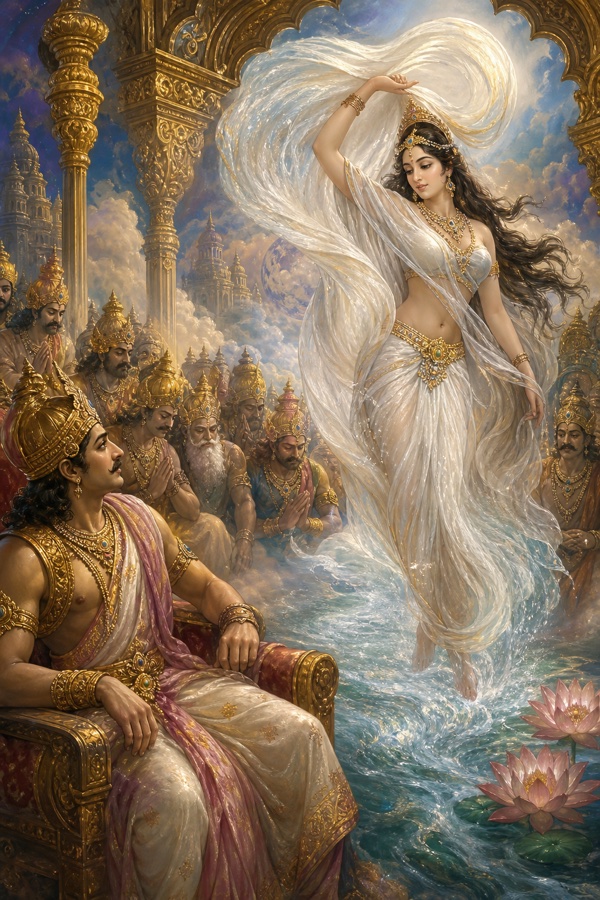
Every house tells a story about where it came from, and the house of Hastinapura begins its own with a man who bought heaven with a lifetime of labor and then lost it in the space of one glance. To follow how that loss ripens, generations later, into a vow that makes a single man deathless, you have to start further back than any palace on earth, in a court where the courtiers are gods. In the race of Ikshvaku, the old line whose kings counted their descent from the sun itself, there was a monarch named Mahabhisha, lord of all the earth, a man whose word matched his deed and whose strength matched his word. A thousand times he had loosed the sacrificial horse to wander wherever it chose for a year, his army walking behind it, so that every king across whose border it strayed had to yield or fight; a thousand times the horse came home unchallenged and the fire received it. A hundred times he lit the rajasuya, the rite no king attempts until the other kings of the earth have already agreed to carry their tribute into his hall. Indra, chief of the celestials, was pleased with all of it, and in the end Mahabhisha won the thing those enormous labors are meant to buy: a place in heaven. Then, in heaven, in the length of one breath, he forgot himself, and the forgetting threw him back down into a mortal body. Out of that single lapse came the line that arrives, in time, at Bhishma.
Brahma’s Court and the Curse on Mahabhisha
One day the gods came together to worship Brahma, the creator, the Grandsire who made the makers of things. When he holds court, the beings who attend are the beings who run the worlds. Royal sages sat among them, men who had earned their seats by lifetimes of austerity, and King Mahabhisha sat with those. Into that same assembly came Ganga, the queen of rivers, to make her adorations before the Grandsire. Then the wind moved. It lifted her garment, white as the light of the moon, and for the length of a moment her body stood bare in front of the gathered gods. Every god in that hall dropped his eyes to the floor. It was the smallest of courtesies, it cost nothing, and every being present paid it except one. The royal sage Mahabhisha went on looking. He looked openly, and he could not make himself stop.
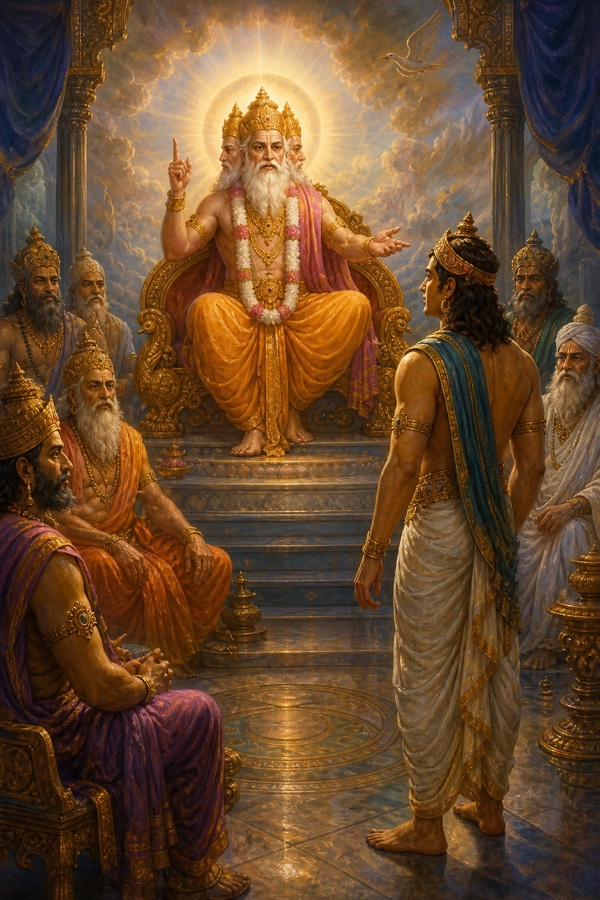
For this Brahma cursed him, and a curse from that mouth is simply a description of what will happen next. “You forgot yourself at the sight of Ganga,” he said, “and so you will be born again on earth. Yet again and again you will return to these regions. She too will be born into the world of men, and she will do you injury. But when your anger is finally roused, you will be free of my curse.” Every clause of it landed. The fall was ordered, the return was promised, the woman was named, and in the last line the key to the whole lock was handed over, though a man dropping out of heaven is in no condition to notice that he has just been told the way back.
A man cursed to be born on earth is at least allowed to choose his door. King Mahabhisha ran through in his mind every monarch and every ascetic then living, weighing houses the way a king weighs alliances, and he chose to be born as the son of Pratipa, a king of great prowess whose line was the line of Kuru. Ganga, for her part, had watched the whole thing happen: a royal sage undone in public by the sight of her, standing his ground against the disapproval of an entire heaven and never once looking away. She went on her way with her thoughts fixed on him.
A key to reading this (lineage): King Mahabhisha of the Ikshvaku line is the one who will be born again as Shantanu, the son of King Pratipa, and Ganga in human form will be his wife. Neither of them will remember any of this. That is how the Mahabharata keeps the stories of heaven and earth knotted into each other: what happens on the ground is the far end of a rope that was tied somewhere else.
The Vasus on the Road and Ganga’s Promise
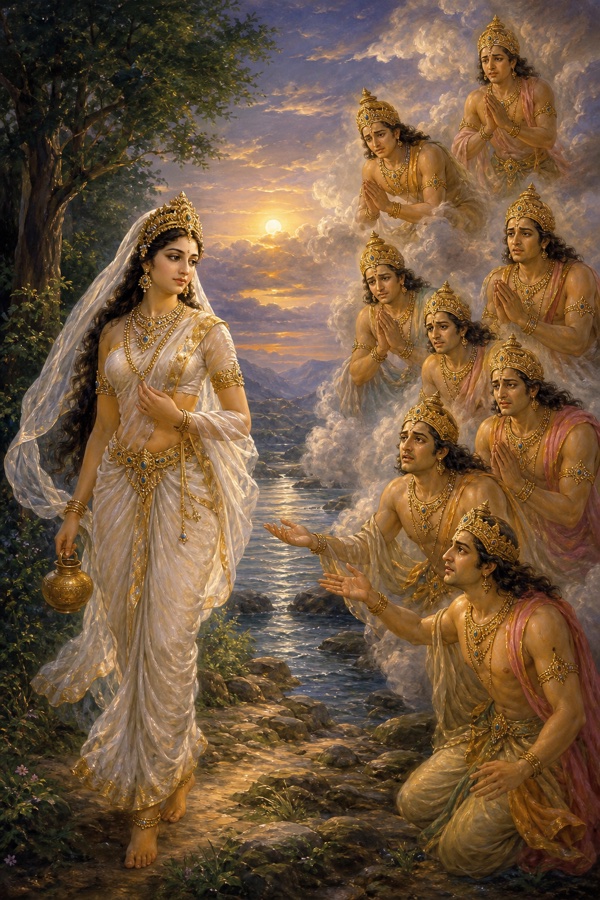
As she traveled that road, Ganga saw ahead of her the Vasus, dwellers in heaven, the band of eight bright gods among whom are counted the earth and the wind, the fire, the moon, and the first light of morning. Something was wrong with the sight of them. Gods do not trudge. The queen of rivers came up with them and asked, “Why do you look so downcast? Dwellers in heaven, is all well with you?”
The Vasus answered, “For one small fault we have been cursed, in anger, by Vasishtha. He was seated at his twilight prayers, and we did not see him, and we crossed over him without meaning to. For this he cursed us in his wrath: Be born among men. What has been spoken by one whose word carries the force of Brahma is not in our power to undo. So we ask you, river, take the form of a mortal woman and let us, the Vasus, be your children. We have no wish to enter the womb of any human woman.”
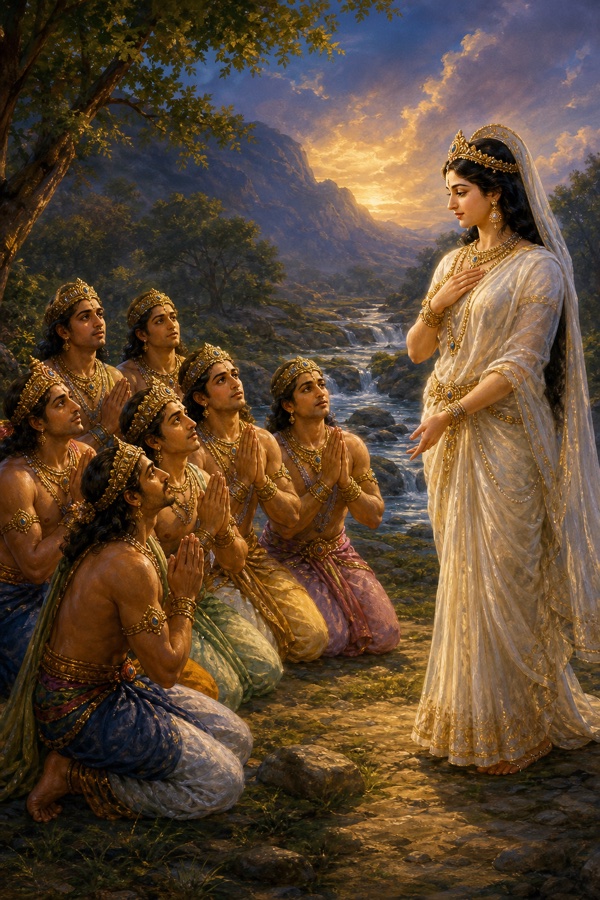
Ganga said, “Let it be so,” and asked, “On earth, who is the man whom you will take for your father?” The Vasus answered, “On earth a son named Santanu will be born to Pratipa, a king whose fame will reach across the world.” Ganga said, “Then what you have chosen is exactly my own wish. I will surely do good to that Santanu.”
The Vasus said, “As soon as we are born, throw us into the water, so that you, who flow by three courses (through the sky, the earth, and the region below), may set us free quickly, and we need not stay long on the earth.” They were asking their own mother to drown them, and they were asking it as a mercy, because a god knows exactly how heavy a human life is and how little of it he wants. Ganga answered, “I will do as you wish. But so that my union with this king is not left entirely without fruit, let at least one son live.” The Vasus replied, “We will each give an eighth part of our own energy. From that combined portion you and the king will have one son, as the two of you desire. But this son will father no children on earth. Endowed with great energy, your son will remain childless.” So the one boy who is allowed to stay is assembled out of a piece of each of them, eight gods folded into a single body, and the price of the arrangement is written into him before he is conceived. Having settled all of it with Ganga, the Vasus went on, without pausing, to the place they wished to reach.
The gist: Brahma’s curse will bring King Mahabhisha back to earth as Shantanu; Vasishtha’s curse will make the eight Vasus mortal. Both currents run into Ganga, who will be Shantanu’s wife and the Vasus’ mother at once, and the eighth son, the only one allowed to live, becomes by design the center of everything that follows. He is childless before he is born. Everyone in heaven knows it. On earth, nobody will.
King Pratipa and the Maiden on His Thigh
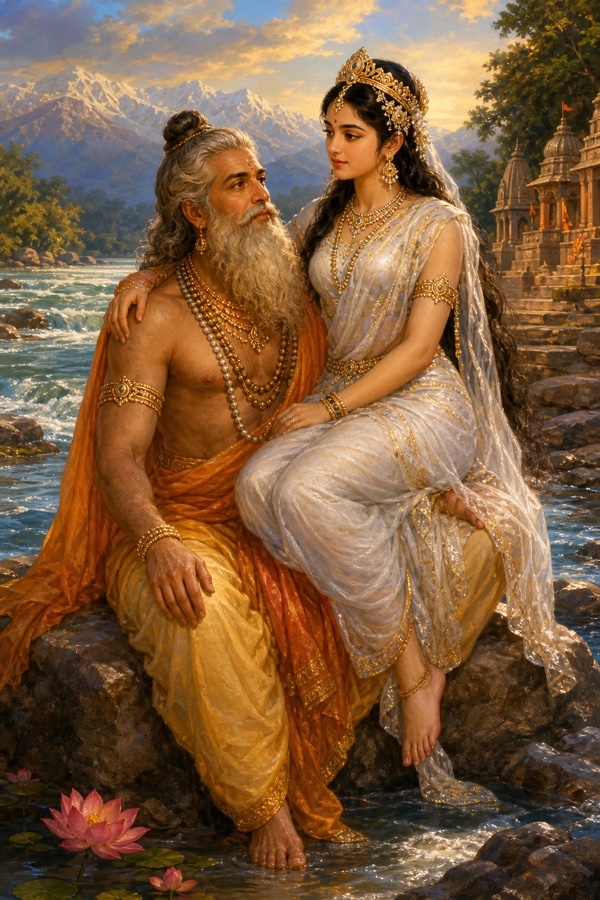
There was a king named Pratipa, gentle to every living creature. For many years he practiced austerities at the source of the Ganga, where the river is young and cold and comes out of the rock, and a man who sits there long enough stops being counted among the people of the plains. One day that same lovely Ganga rose out of the water in the shape of a beautiful woman and came to him. The celestial maiden, radiant with a beauty that could stop a heart, walked up to the royal sage where he sat deep in his penances, and she settled herself on his right thigh, firm as a sala tree in its manly strength.
The king said, “What is it you want? What shall I do for you?” The maiden answered, “I want you, king, for my husband. Be mine. The wise have never praised a man who turns away a woman who comes to him of her own will.” Pratipa replied, “I do not go, out of desire, to the wives of others or to women outside my own order. This is my vow, and it is my dharma.”
The maiden pressed him. “I am not unlucky, and I am not ugly. I am worthy in every way. I am a celestial maiden of rare beauty, and I want you for my husband. Do not refuse me, king.” Pratipa said, “The path you are urging me toward is one I have turned away from. If I break my vow, sin will close over me and kill me.” Then his eye went to where she was sitting, and he found in it the answer that lets everyone keep their honor. “You have embraced me and taken your seat on my right thigh. But know this, gentle woman: the right thigh is the place for daughters and daughters-in-law. The left lap is the wife’s, and that you did not take. So I cannot take you as an object of my desire. Become instead my daughter-in-law. I accept you for my son.”
The maiden said, “Let it be as you say, virtuous king. I will be joined to your son. Out of my respect for you I will become a bride of the famed line of Bharata. I could not count the virtues of your race in a hundred years. Let one thing be settled now: when I am your daughter-in-law, your son must never sit in judgment over the rightness of anything I do. Living with him that way, I will do him good and add to his happiness, and through the sons I bear him, and through his own virtue and good conduct, he will in the end reach heaven.” The old king heard a bride asking for a courtesy and agreed to it. She had just bought, from a man who did not know what he was selling, the right to drown his grandsons in front of his son without being asked a single question. Having said this, the celestial maiden vanished on the spot, and the king settled down to wait for the birth of a son, so that he could keep the word he had given.
The Birth of Shantanu and His Father’s Command
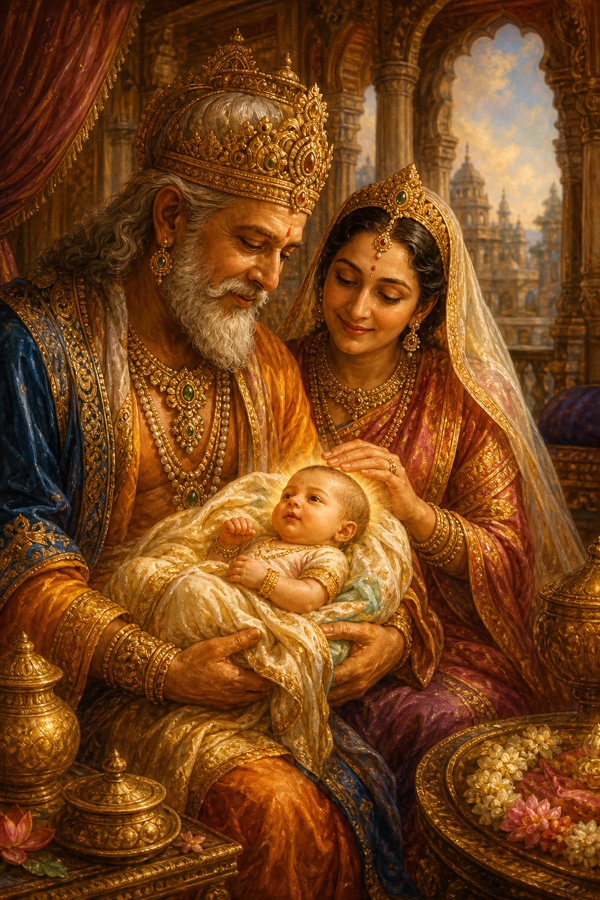
In that same time Pratipa, that light of the Kuru race, that warrior, stayed with his wife in austerities, longing for a child. When they had grown old, a son was at last born to them. This was Mahabhisha come again. Because his father had subdued his senses through his penances when the child was conceived, the boy was named Shantanu. And Shantanu understanding that the world of unfading bliss is won by one’s own deeds alone, gave himself to virtue.
When Shantanu had grown into a young man, Pratipa said to him, “Some time ago, Shantanu, a celestial maiden came to me for your sake. If you should meet that fair woman in a private place, and if she asks you for children, take her as your wife. And, my sinless son, do not judge whether what she does is proper or improper, and do not ask who she is, or whose, or where she comes from. At my command, take her as your wife.” It is a strange thing to hand a son: a wife he has never seen, and a standing order to ask her nothing, ever. Shantanu took it as sons of that house took their fathers’ words. Having given this charge and set the young man on the throne, Pratipa withdrew into the forest.
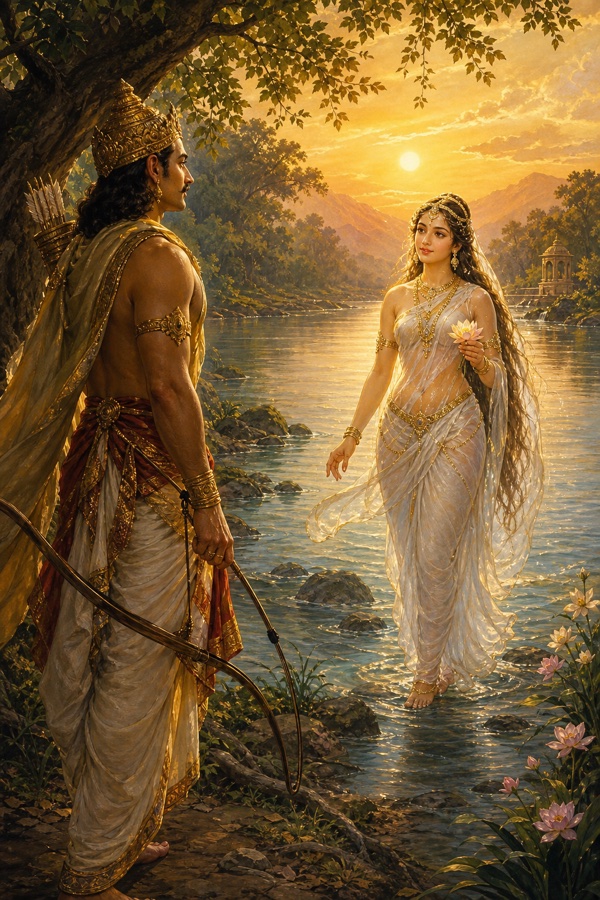
King Shantanu, gifted with great intelligence and a splendor to match Indra’s own, grew fond of the hunt and spent much of his time in the woods, bringing down deer and buffalo. One day, wandering along the bank of the Ganga, he came to a stretch of country where the Siddhas and the Charanas move, ground where the air itself feels attended. There he saw a maiden of blazing beauty, like a second Sri, the goddess of fortune herself; her teeth were flawless as pearls, she wore celestial ornaments, and her fine robes shone like the filaments of a lotus. At the sight of her the king stood amazed and the hair rose on his body. He gazed and went on gazing, as though drinking her beauty down, and no amount of drinking could reach the bottom of his thirst. The maiden too, watching this king of blazing splendor move about in his agitation, softened; an affection for him rose in her, and she looked at him and wanted only to keep looking. He did not know that all of this had been arranged years ago, by his own father, on a riverbank, with this same woman sitting on his knee. She knew.
The king spoke to her in gentle words. “Whether you are a goddess or the daughter of a Danava, whether you come from the line of the Gandharvas or are an Apsara, whether you belong to the Yakshas or the Nagas, or are of human birth, maiden of celestial beauty, I ask you to become my wife.” He had run through every order of being he could name and had asked nothing that mattered, which is exactly what his father had told him to do.
A key to reading this (the idea): Pratipa’s command is the pin on which the rest of the story turns. Shantanu has been told never to question anything this maiden does. That instruction is what will let Ganga carry eight sons into the river while their father stands on the bank and says nothing, and the moment Shantanu breaks it, Ganga leaves him.
Ganga’s Condition and the Drowning of Eight Sons
The maiden heard those soft and sweet words of the smiling king, and she remembered her promise to the Vasus. She answered him, and every word she spoke sent a thrill through him, so that he heard the terms as tenderness. “King, I will be your wife and obey you. But whatever I do, king, whether it pleases you or not, you must never interfere with me, and you must never speak a harsh word to me. As long as you are kind to me, I will stay with you. But the moment you cross me, or say something unkind, I will leave you, and I will not turn back.” The king said, “Let it be so.” He had been trained for this sentence since boyhood and did not have to think about it.
The maiden was overjoyed to have won so fine a king for her husband, and Shantanu, having won her for his wife, gave himself wholly to the pleasure of her company. True to his word, he asked her nothing. So the goddess Ganga, who flows by three courses, wearing a human form of surpassing beauty, lived happily as Shantanu’s wife. She pleased him with her charm, her tenderness, her play of expression, her music and her dance, and she was happy herself. The king was so lost in his beautiful wife that months, seasons, and years went by without his ever marking their passage. This was the arrangement working exactly as designed, and it lasted right up to the first birth.
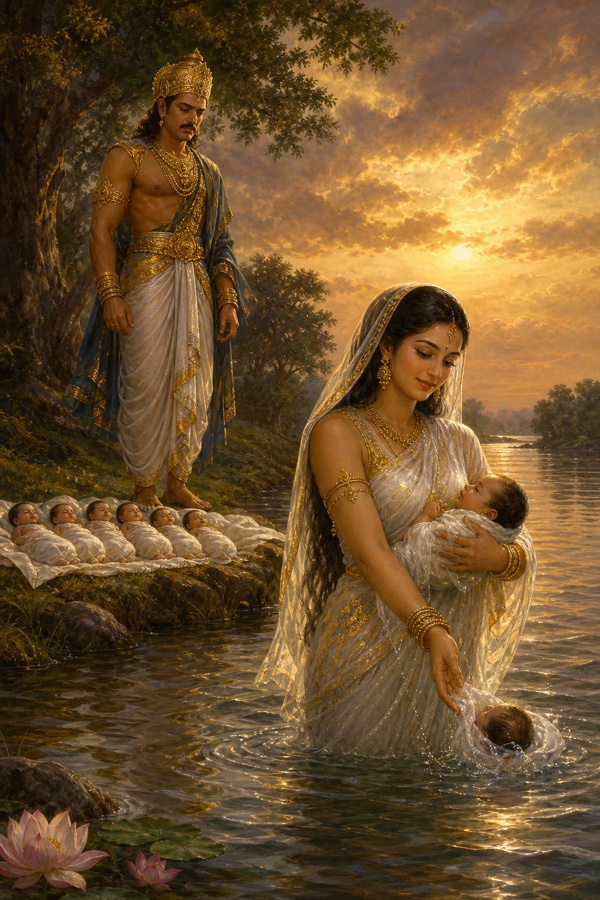
Living in that happiness, the king had eight sons born to him, each as lovely as one of the gods. And one after another, Bharata, as soon as each was born, Ganga carried it down to the river and let it slip into the current, saying, “This is for your good.” Each child sank and never rose again. Seven times a son was born in that house, and seven times the king walked to the water behind his wife and watched, and the king could take no pleasure in any of it. He said not one word about it. He had given his promise, and he was afraid of what asking would cost him.
But when the eighth child was born, and his wife was about to carry it smiling to the water as she had carried the others, something in Shantanu finally gave way. His face full of grief, desperate to keep this one boy out of the river, he spoke. “Do not kill it! Who are you, and whose? Why do you murder your own sons? Killer of your children, the weight of your sin is enormous!” Three questions and an accusation, all of them years overdue, all of them forbidden.
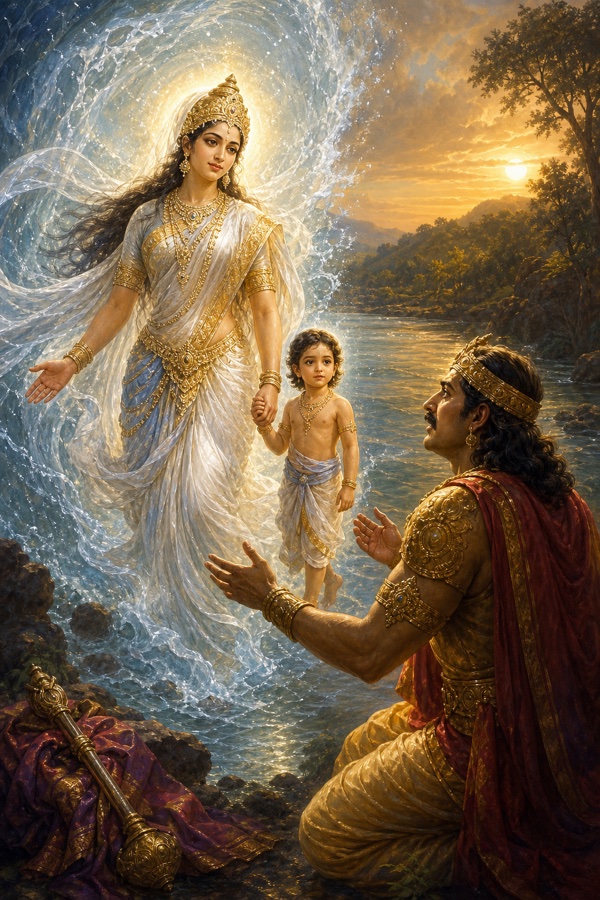
Answered in this way, his wife said, “You who longed for offspring, you are already first among men who have children. I will not destroy this son of yours. But by our agreement, my time of living with you is now over.” And then, standing in front of a man who had lived beside her for years, she told him who he had married. “I am Ganga, the daughter of Jahnu. The great sages worship me forever. I stayed with you all this while to accomplish the purposes of the gods. The eight Vasus, filled with great energy, had to take human form because of Vasishtha’s curse. On earth there was no man but you fit to be their father, and no woman but one like me, a celestial in human shape, fit to be their mother. I took a human body to bring them forth. And you, by becoming the father of the eight Vasus, have won for yourself many regions of unending bliss. It was settled between me and the Vasus that I would free them from their human forms the moment they were born. So I have freed them from the curse of the Rishi Apava. Blessings on you; I leave you now, king. But raise this child of stern vows. Staying with you this long was the promise I made to the Vasus. Let this boy be called Gangadatta, the gift of Ganga.” Every drowning he had watched had been a rescue. Nobody had thought to tell him.
A key to reading this (the count): eight sons, meaning the eight Vasus. Seven were carried into the water and released; the eighth, because the king finally interfered, remained on earth. This eighth son will be called Gangadatta, then Devavrata, and at last Bhishma. The one child a father saved is the one child the gods had already sentenced.
The Vasus’ Crime: Nandini and the Curse of Apava
Shantanu had lost a wife and gained a son in a single sentence, and what he asked for was the story. “What was the fault of the Vasus, and who was this Apava, whose curse forced them to be born among men? And what has this child of yours, Gangadatta, done, that he must live among men? Tell me all of it.”
Ganga answered, “The one who was obtained as a son by Varuna was called Vasishtha, the sage who later came to be known as Apava. His hermitage stood on the breast of Meru, the king of mountains. The place was holy and thick with birds and beasts, and flowers of every season bloomed there together, all year, because seasons do not queue up where a man of that stature keeps his fire. It was there that Vasishtha, the son of Varuna, practiced his penances, in woods rich with sweet roots and water.
“Daksha had a daughter named Surabhi, who, for the good of the world, brought forth by her union with Kasyapa a daughter in the form of a cow, and this was Nandini. Nandini was the cow of plenty. Ask her for a thing and the thing was there; that is what she was for. Vasishtha kept her for his fire-rites, since a rite of that kind runs on milk and butter and cannot pause for the shortcomings of an ordinary herd, and the cow, living in that hermitage that the sages revered, wandered without fear through those sacred and lovely woods. Nothing in them had ever frightened her. Nothing in them had ever been allowed to.
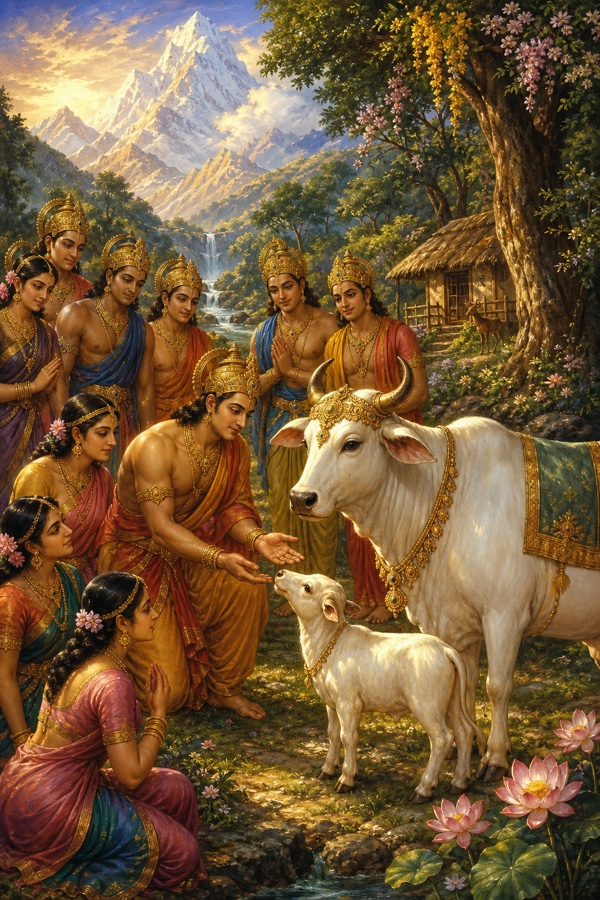
“One day the Vasus came into those god-haunted woods, with Prithu at their head. Roaming there with their wives, they took their pleasure among the delightful woods and hills, the way the powerful take their pleasure in a place they do not have to think about. And as she wandered, the wife of one of the Vasus saw Nandini, the cow of plenty. This was a cow with every good mark: large eyes, full udders, a fine tail, shapely hooves, and milk beyond counting. She stood there in the open like a thing left out. The wife pointed the animal out to her husband Dyu.
“When Dyu was shown the cow, he began to praise her many qualities, and he said to his wife, ‘girl of fair thighs, this splendid cow belongs to the Rishi whose lovely hermitage this is. The mortal who drinks this cow’s sweet milk stays young and unchanged for ten thousand years.’ He had meant it as admiration. His wife heard it as an inventory. Hearing this, the beautiful goddess of flawless features said to her radiant husband, ‘On earth I have a friend, Jitavati, rich in beauty and youth. She is the daughter of that god among men, the royal sage Usinara, a man of intelligence devoted to truth. I want this cow, with her calf, for that friend of mine. Bring the cow so that my friend, drinking her milk, may become the one person on earth free of disease and old age. Grant me this. Nothing would please me more.’
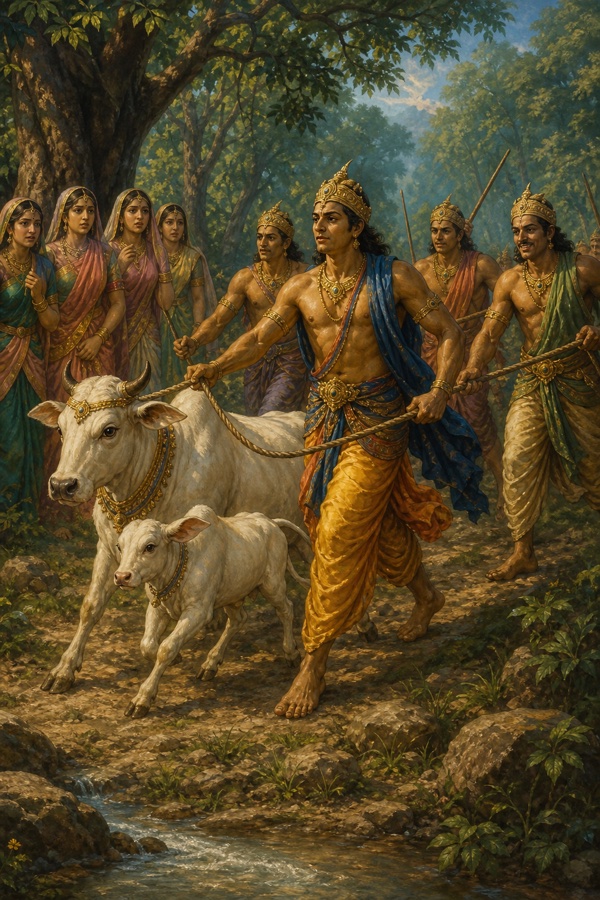
“To please his wife, Dyu stole the cow, with the help of his brothers, Prithu and the rest. Commanded by his wife, he did as she asked, and in the doing of it he forgot the one fact that mattered, which was the ascetic power of the Rishi who owned her. That is what a whole lifetime in heaven does to the sense of consequence. He did not stop to think that by the sin of stealing her he was setting himself up for a fall that would take him further down than the theft was worth.
“When the son of Varuna came back to his hermitage in the evening, carrying the fruit he had gathered, the cow and her calf were not there. He searched the woods, calling, and when his search turned up nothing he stopped and looked with the other sight, the one his years of penance had bought him, and saw the Vasus walking away with his cow. His anger flared at once, and he cursed them. ‘Because the Vasus have stolen my cow of sweet milk and handsome tail, they will most certainly be born on earth!’
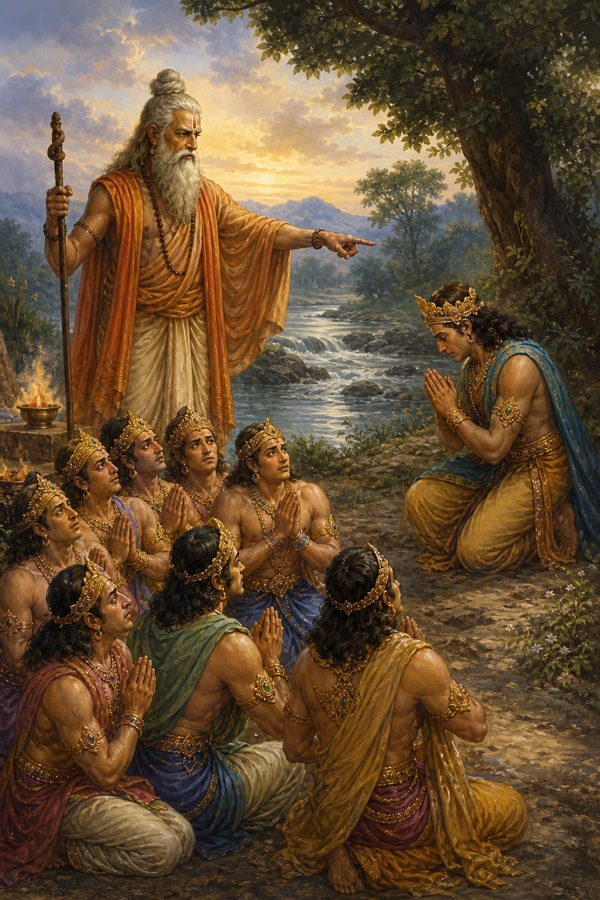
“So the Rishi Apava cursed the Vasus in his anger, and then, the matter being closed, he turned his mind back to his meditations. When the Vasus learned what had been said about them, they hurried to his hermitage and tried everything to soften him. They could win no mercy from Apava, who knew every rule of virtue and had broken none of them. But Apava did say this: ‘Vasus, you and Dhava and the others have been cursed by me. But within a year of your birth among men you will be free of my curse. Only he for whose deed you were all cursed, Dyu himself, will have to remain on earth a long time for his sin. I will not let the words I spoke in anger come to nothing. Dyu, though he lives on earth, will father no children. Even so, he will be virtuous and learned in the scriptures. He will be an obedient son to his father, but he will have to give up the pleasure of a woman’s company.’ That was the whole sentence, and every clause of it would be carried out to the letter by a man who chose it freely, believing it to be his own idea.
“Having said this to the Vasus, the great Rishi went his way. The Vasus came together to me and begged the boon that, as soon as they were born, I would throw them into the water. And to free them from their earthly lives, king, I did exactly that. Only this one, Dyu himself, is to remain on earth a while, by the Rishi’s curse.” Having said all this, the goddess vanished on the spot, and taking the child with her, she went off to the region she had chosen. That son of Shantanu was given both names, Gangeya and Devavrata, and he grew up somewhere his father could not follow, and he grew to surpass his father in every accomplishment.
A sub-tale: the eighth Vasu, Dyu, is the one who became Devavrata. Apava (that is Vasishtha) had cursed him to dwell on earth for a long time, to be virtuous, and yet to remain childless and to keep away from the pleasure of a woman’s company. Notice that this curse is what ripens, later, into Bhishma’s vow of lifelong celibacy, spoken in a fisherman’s courtyard by a young man who thinks he is doing his father a kindness. In the Mahabharata a curse and a vow are often the two ends of a single fate, and the man in the middle feels only that he is choosing.
Shantanu’s Reign and the Recognition of Devavrata
After his wife vanished, Shantanu returned to his capital with a heavy heart. He was a king known through all the worlds for his wisdom, his virtues, and his truthfulness. Self-control, generosity, forgiveness, intelligence, modesty, patience, and a superior energy lived always in that man. His neck bore three lines, like the marks on a conch shell; his shoulders were broad, and in sheer force he was like an elephant in rut. Seeing him so devoted to virtue, the kings of the earth gave him the title King of kings. In his reign the kings of the earth slept without grief, without fear, without anxiety of any kind, and rose each morning from happy dreams. Shantanu was free of anger and malice, as pleasing to look on as the moon; in radiance he was like the sun, in speed like the wind, in wrath like Yama, and in patience like the earth. In his kingdom no deer, no boar, no bird, no creature at all was killed to no purpose. The great dharma of kindness to every living thing ran through his realm. After thirty-six years of contented family life, Shantanu withdrew into the forest.
Shantanu’s son, the Vasu born of Ganga, whose name was Devavrata, matched Shantanu himself in beauty, in habits, in conduct, and in learning. In every branch of knowledge, worldly and spiritual, his skill was very great. His strength and his energy were extraordinary, which is what happens when eight gods each put an eighth of themselves into one body. He became a mighty warrior on his chariot. He was, in truth, a great king.
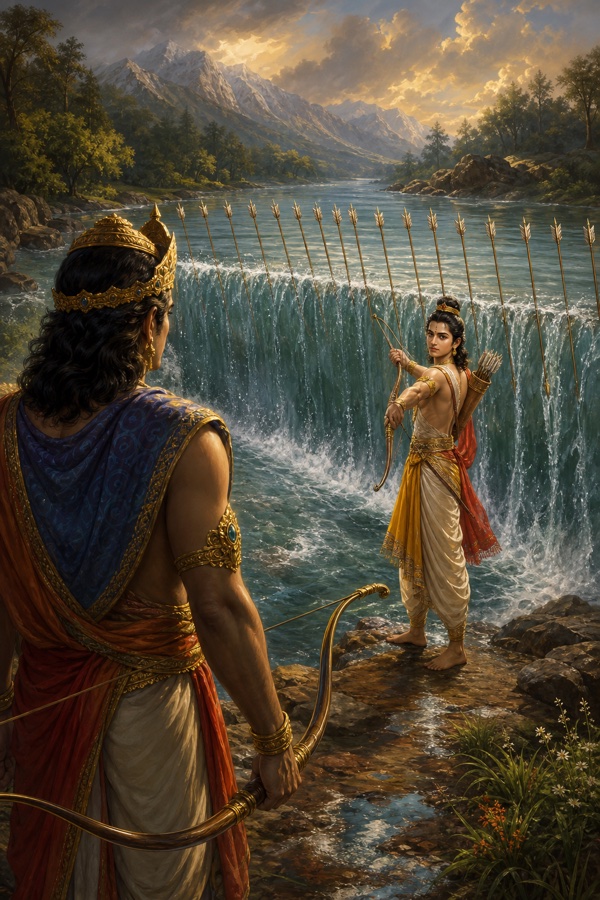
One day, chasing along the bank of the Ganga a deer he had struck with an arrow, King Shantanu noticed that the river had gone shallow. The strange sight set him wondering why the Ganga no longer ran as full as before. Searching for the cause, the king saw that a youth of great beauty, well made and pleasing to look at, like Indra himself, had checked the whole flow of the river with a keen celestial weapon. To see the Ganga held back like that beside the young man amazed the king. The youth was none other than Shantanu’s own son. But Shantanu had seen his son only once, for a few moments after his birth, and he had no clear memory to tie that infant to the youth before him now. The youth, on the other hand, knew his father the instant he saw him, and yet he kept his name to himself; he clouded the king’s sight with his celestial power of illusion and vanished before his eyes.
Amazed at what he had seen, and half sure the youth was his own son, Shantanu called out to Ganga across the water. “Show me that child.” Ganga took on a lovely form and, holding the boy, decked in ornaments, in her right arm, showed him to Shantanu. And Shantanu, looking at that beautiful woman adorned with ornaments and dressed in fine white robes, did not know her. He had loved her for years and lost her in a single sentence, and he stood on the bank and could not place her face.
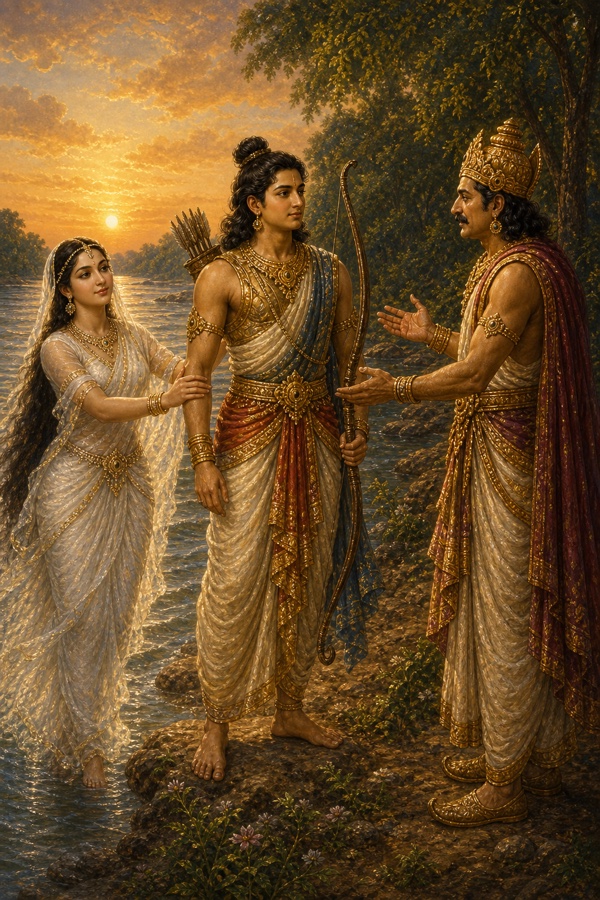
Ganga said, “This is the eighth son you begot on me some time ago. Know that this fine boy is skilled in every weapon. Take him now, king. I have reared him with care. Take him home with you.” And then she set out what those years away from his father had bought the boy, item by item, the way a mother hands over an account. “This boy of high intelligence has studied the whole of the Vedas and their branches with Vasishtha. Skilled in every weapon and a great archer, he is like Indra in battle. Both the gods and the Asuras, Bharata, look on him with favor. Everything that Usanas knows, he knows completely, and he is master of all the sciences known to Brihaspati, the son of Angiras. And every weapon known to Rama, the son of Jamadagni (Parashurama), is known to this son of yours. Take your own heroic child, king of high courage, whom I now give to you.” The sage whose curse had begun all this had spent those years teaching the boy the Vedas, line by line.
So commanded by Ganga, Shantanu took his son, radiant as the sun, and returned to his capital. Reaching his city, which was like the city of the gods, that king of Puru’s line counted himself the most fortunate man alive. He gathered all the Pauravas together and, for the safety of his kingdom, named his son heir-apparent, which settled the succession of the house of Kuru in one afternoon, in front of witnesses, with nothing left to argue about. By his conduct the prince soon won over his father, the rest of the Paurava house, and every subject of the realm. And the king, whose prowess had no equal, lived happily with that son of his, and for four years nothing at all went wrong.
A key to reading this (lineage): Devavrata carries two names, Gangeya (son of Ganga) and Devavrata. He is a pupil of Vasishtha and a master of the weapons of Parashurama. Named heir-apparent, he is the rightful successor to the throne by dharma, and every king on earth has been told so. This is the very right he will stake, in public, in a fisherman’s courtyard, for a woman he has never met.
The Fragrance on the Yamuna’s Bank and Satyavati
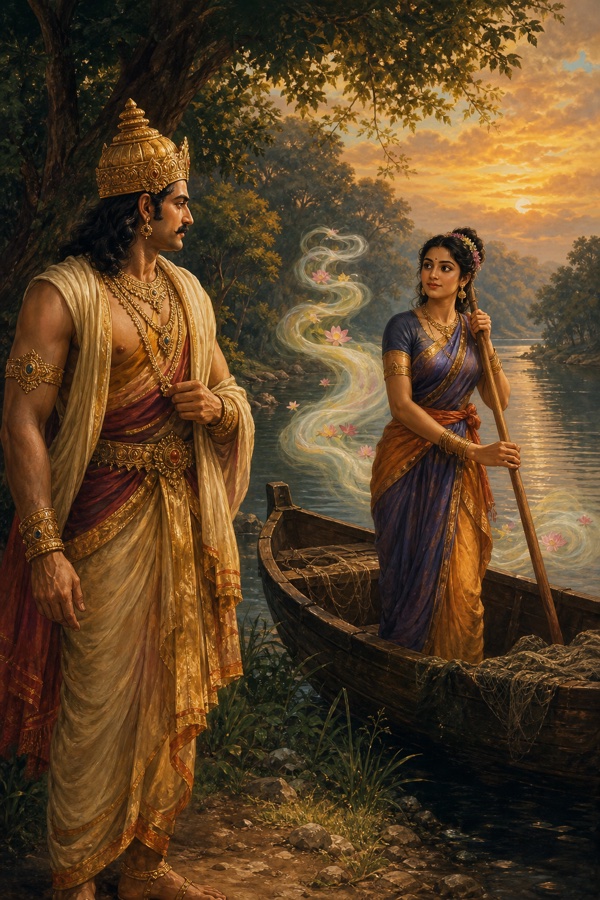
Four years passed like that, and then one day the king went into the woods on the bank of the Yamuna. Wandering there, he caught a sweet scent on the air that came from no direction he could name, a fragrance with nothing behind it, no flower, no tree, no smoke. Wanting to find its source, he roamed here and there, and in the course of his walk he came upon a maiden of celestial beauty, the daughter of a fisherman, standing in a boat. The scent was coming off her. The king said, “Who are you, and whose daughter? What are you doing here?” She answered, “Blessings on you. I am the daughter of the chief of the fishermen. At his command, and for the merit of it, I row travelers across this river in my boat.”
Looking at that maiden of celestial form, with her beauty, her sweetness, and that fragrance around her, Shantanu wanted her for his wife. It had happened to him once before, on the bank of another river, and it had cost him seven children and the woman herself, and it made no difference at all. He went to her father and asked his consent to the match, which is how a king asks: a king of the Kuru line, standing in a fishing village, asking. But the chief of the fishermen said to him, “King, when my daughter of fine complexion was born, it was of course understood that she would be given to some husband. But hear the wish I have carried in my heart all this while. You are truthful; if you want this girl as a gift from me, give me a pledge. On that pledge I will give you my daughter, for I will never find a husband to equal you.”
Shantanu said, “When I have heard the pledge you ask, I will tell you whether I can grant it. If it can be granted, I will surely grant it; if not, how can I?” The fisherman said, “King, this is what I ask of you: the son born of this girl, and no one else, you will set upon your throne as your successor.” It was said quietly, by a man in his own doorway, and it asked the king to unmake the one act of his reign that everyone had applauded.
Hearing this, Shantanu had no wish to grant such a boon, though the fire of desire was burning him from the inside out. He could not say yes without robbing Devavrata, and he could not say no and stop wanting her. His heart wrung by longing, the king rode back to Hastinapura the whole way with the fisherman’s daughter on his mind. Home again, in the city that had watched him install his son as heir, he passed his days in sorrowful thought and told nobody why.
A key to reading this (the idea): the fisherman’s condition drops Shantanu straight into a trap. To make Satyavati’s son king is to strip Devavrata of the place his father gave him in front of the whole realm. The king’s dharma and the father’s love both keep him silent, and silence is the one thing his son cannot leave alone. This moral knot is the ground on which the vow is built.
The Father’s Grief and Devavrata’s Inquiry
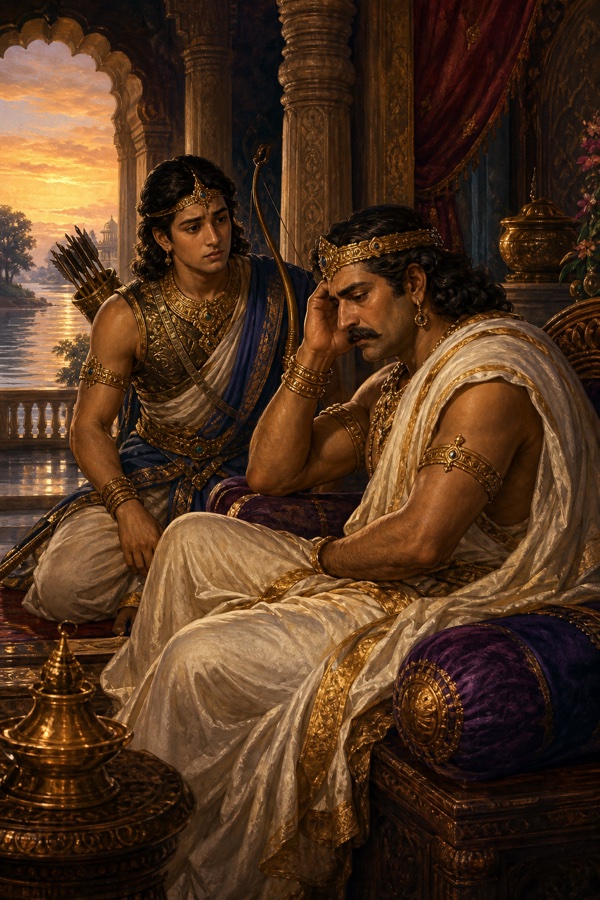
One day Devavrata came to his troubled father and said, “Everything prospers for you, every chief obeys you; why then are you sunk in grief like this? Lost in your own thoughts, you will not say a word to me in reply. You no longer ride out on horseback; you look pale and thin, all your spirit gone. I want to know the sickness you suffer from, so that I can try to cure it.” He asked it the way a son asks about a fever, expecting an answer he could act on.
To his son’s question Shantanu answered, “You are right, son, that I have grown melancholy. And I will tell you why. You, of Bharata’s line, are the one shoot of this great house of ours. You are forever at your weapons and your feats of prowess. But I, son, am always thinking of how unstable a human life is. If some danger were to take you, child of Ganga, the result would be that we are left with no son at all. In truth, you alone are worth a hundred sons to me. That is why I have no wish to marry again. I only wish and pray that you may always be well, so that our line goes on. The wise say that a man with a single son has, in a sense, no son. I have no shadow of doubt that a man reaches heaven by fathering sons. You are a hero of hot temper, forever at the exercise of arms. It is very possible that you will be killed on the field of battle. If that should happen, what will become of the house of Bharata? It is this thought that has made me so heavy. Now I have told you fully the reasons for my sorrow.”
Devavrata, who had great intelligence, took all this in and stood there thinking quietly for a while. A father who cannot name his own grief has one somewhere else. Then he went to the old minister who had spent his life devoted to his father’s welfare and asked him, plainly, the cause of the king’s sorrow. The minister told the prince about the boon the chief of the fishermen had demanded in the matter of his daughter Gandhavati.
The Fisherman’s Court and the Second Doubt
Then Devavrata, taking with him a number of aged and honorable Kshatriya chiefs, went himself to the chief of the fishermen and asked, on the king’s behalf, for his daughter. The chief received him with all due honors, and when the prince had taken his seat in the court, the man said to him, “You are the warrior, and Shantanu’s only son. Your power is great. But I have something to say to you. If the bride’s father were Indra himself, he would still have cause to regret refusing so honorable and desirable a match. The great man from whose seed this celebrated girl, Satyavati, was born is in fact your equal in virtue. He has spoken to me many times of your father’s qualities, and told me that the king alone is worthy of Satyavati. Let me add that I have even turned away the celestial sage Asita who also asked more than once for Satyavati’s hand.
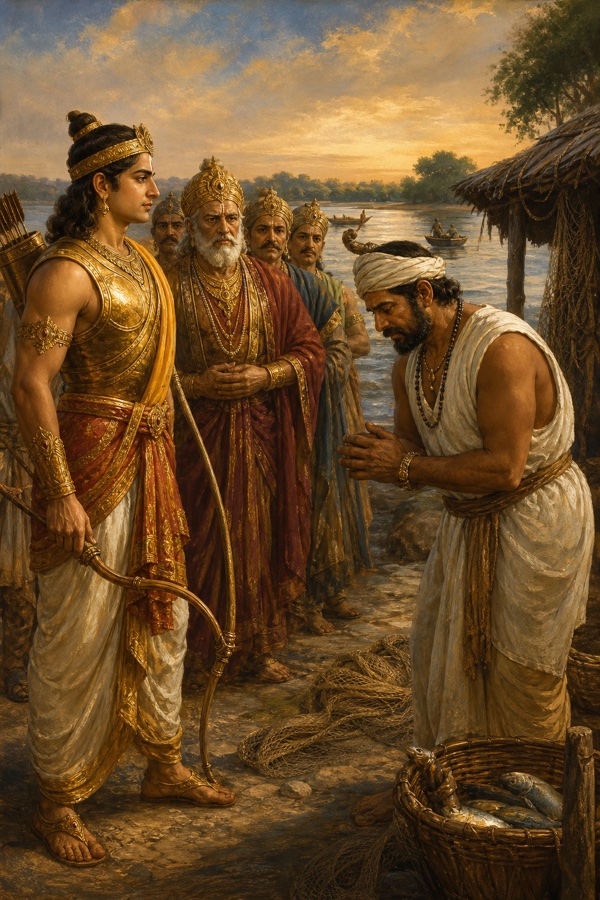
“For the girl’s sake I have only one thing to say. In this proposed marriage there is one great objection, and it rests on this: a co-wife’s son who becomes a rival. To a man who has a rival like you, there is no safety, be he Asura or Gandharva. That is the one objection to the match, and there is no other. Blessings on you. That is all I have to say about giving Satyavati or withholding her.” He had not asked for anything. He had simply described the young man standing in front of him and left the description lying there.
Devavrata’s Terrible Vow
Hearing these words, and moved by the wish to do his father good, Devavrata answered in front of the assembled chiefs. He did not ask for time. “Best of truthful men, listen to the vow I make! The man has never been born, and never will be, who has the courage to take such a vow! I will do everything you ask. The son born of this girl shall be our king.” With one sentence, in a courtyard by the water, the heir of the Kuru throne handed his crown to a child who did not yet exist.
At this the chief of the fishermen, driven by his longing for sovereignty for his daughter’s son, and reaching now for the almost impossible, said, “You have come here as full agent for your father Shantanu, whose glory is beyond measure; be then the sole manager on my behalf too, in the matter of giving away my daughter. But there is something more to be said, amiable one, something more for you to weigh. Men who have daughters are bound by the very nature of their duty to say what I am saying. The pledge you have given for Satyavati’s sake, before these chiefs, was truly worthy of you. I have not the least doubt that you will ever break it.” Then he named the gap that the first vow had left wide open. “But about the children you may father, I have my doubts.”
Devavrata, devoted to truth, understood the fisherman’s misgiving. A son of his would grow up in that palace with a claim of his own and arms to press it, and no promise made by a father can bind a boy not yet born. Moved again by the wish to do his father good, he said, “Chief of the fishermen, hear what I say before these assembled kings. Kings, I have already given up my right to the throne. Now I will settle the matter of my children as well.” And then he closed the last door in his own life, standing up, in front of witnesses, at an age when other men are being married. “Fisherman, from this day I take the vow of Brahmacharya, a life of study and meditation without desire. If I die without a son, I will still reach the regions of unending bliss in heaven!”
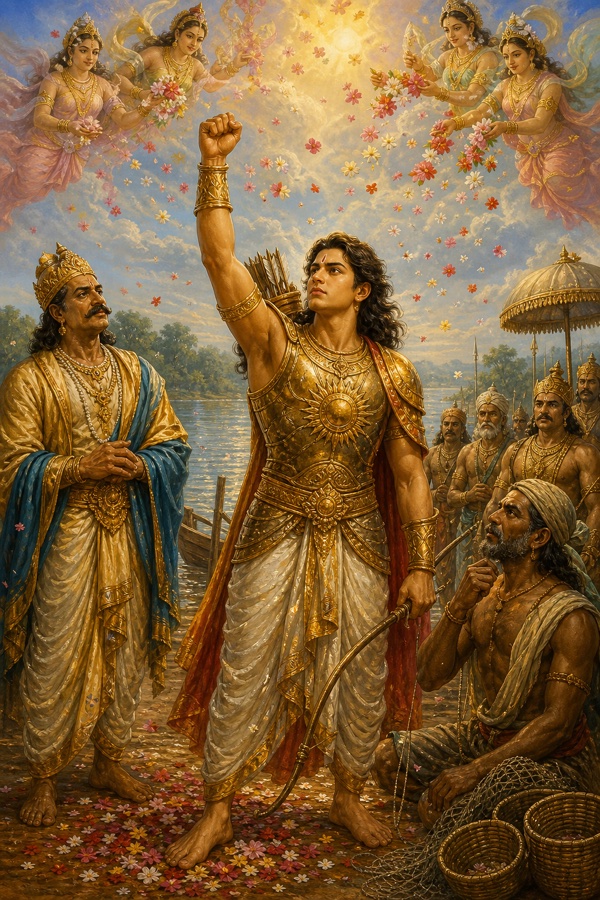
At these words of Ganga’s son, the hair on the fisherman’s body stood up with joy, and he answered, “I give you my daughter!” And in that same moment the sky answered too. The Apsaras and the gods, with the many bands of Rishis, began to rain flowers down onto Devavrata’s head, and out of the air came a single word, the name the heavens had for what he had just done: “This one is Bhishma, the man of the terrible vow.” The gods, who had arranged all of it, were the first to applaud. Then Bhishma, to serve his father, said to the radiant girl, “Mother, climb into this chariot, and let us go to our home.” He called her mother, and meant it, and the word held for the rest of his very long life.
So saying, Bhishma helped the beautiful girl up into his chariot and drove her home to the man who had wanted her. Reaching Hastinapura, he told Shantanu everything just as it had happened. The assembled kings, together and one by one, praised his extraordinary deed and said, “He is truly Bhishma, the terrible.” And Shantanu too, hearing what his son had spent to buy him a wife, was overjoyed and undone at once, and out of that he granted the noble prince the one thing a father in his position had left to give: the boon of death at will. “Death will never come to you,” he said, “as long as you wish to live. Truly death will come to you only when it has first obtained your leave.”
The gist: Devavrata made two vows. The first, that Satyavati’s son alone would be king, which surrendered his own place as heir-apparent; the second, to settle the fisherman’s other doubt, that he would take up lifelong celibacy, so that no child of his could ever claim the throne. It was this terrible vow that earned Devavrata the name Bhishma. Notice that the same vow, without his ever intending it, carries out the curse Apava laid on the Vasu Dyu, to be childless and to keep away from a woman’s company. Heaven wrote the sentence; the young man walked into a courtyard and passed it on himself, freely, thinking of nobody but his father. And the boon of death at will, given to him out of a father’s love, will stay with Bhishma all the way to Kurukshetra, where it becomes the reason a war cannot end.
Source: the Mahabharata of Krishna-Dwaipayana Vyasa, Adi Parva, Sambhava sub-parva, Sections 95 to 100. The Sanskrit e-text, the Gita Press Hindi edition, and Kisari Mohan Ganguli’s complete English translation were used to verify names, sequence, and principal events. Where the recensions differ, this English retelling follows Ganguli, and the Hindi edition follows Gita Press.
Based on: The Mahabharata, Vedavyasa (K. M. Ganguli’s English translation; Gita Press, Gorakhpur)