On this page
Bring the scene of that story-assembly on Kailasa before your eyes. The account of the eleven Rudras had only just closed, Sanatkumara sat with a fresh question rising in him, and Nandishvara, Shiva’s beloved attendant, took up a new thread. Great sage, he said, now hear with love another deed of Shambhu, one in which Shankara stepped forth as Durvasa, and he did it to hold virtue upright in the world. And after that one, the tale in which Maheshvara took a vanara’s body and, out of nothing but love, worked the supreme good of Lord Sri Rama.
Three boons in Atri’s hermitage
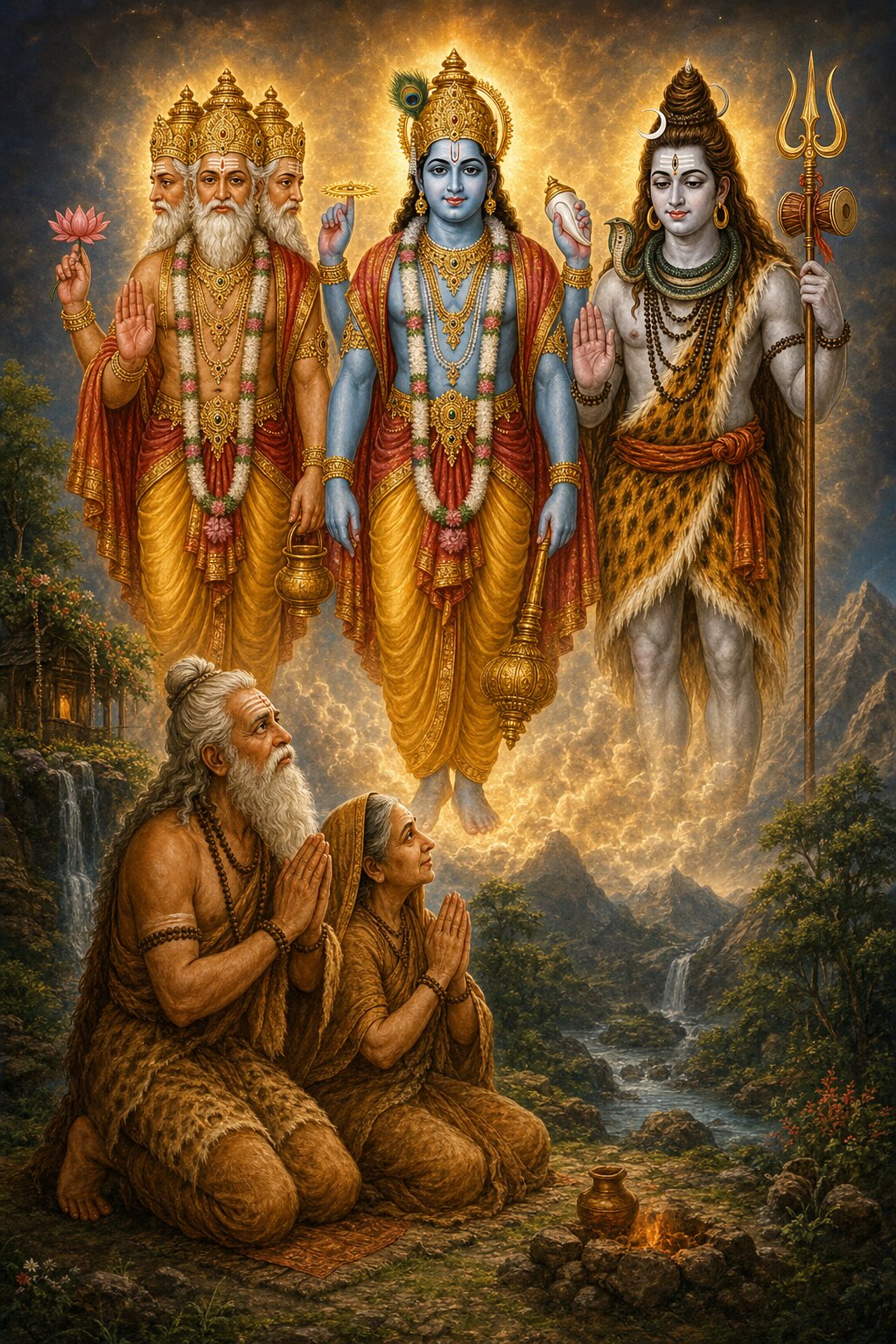
This belongs to an earlier age. Atri, the ascetic who knew Brahman and husband of Anasuya, went at Brahma’s direction with his wife to Mount Rikshakula, and on the banks of the Nirvindhya, longing for a son, gave himself to fierce tapas for a hundred years. Out of the man a holy flame came, and it grew until the worlds were nearly burned and the gods could not bear it. They ran to Brahma, Brahma to Vishnu, Vishnu to Rudra, and the three lords consulted over the welfare of the worlds and came to Atri’s hermitage themselves. The sage bowed and praised them, then asked the obvious thing: I meditated on one lord alone, whoever he might be; how is it that three of you have come? They spoke. What has occurred is exactly what you conceived. We three are the lords of the world, equal among the givers of boons. From our own portions three sons will be born to you, sons renowned across the three worlds who will raise the fame of their parents. So saying, the three gods departed.
In its own time the boon bore fruit, and the three lords of sport took birth as the sons of Atri’s wife. From Brahma’s portion came Chandrama, the Moon, the very Moon whom the gods hurled into the ocean and who alone came back out of it. From Vishnu’s portion was born Datta, who set flowing the excellent path of sannyasa. And from Rudra’s portion the great sage Durvasa took birth, and he carried virtue outward into the world. This is Shiva’s Durvasa avatar.
The trials of Durvasa
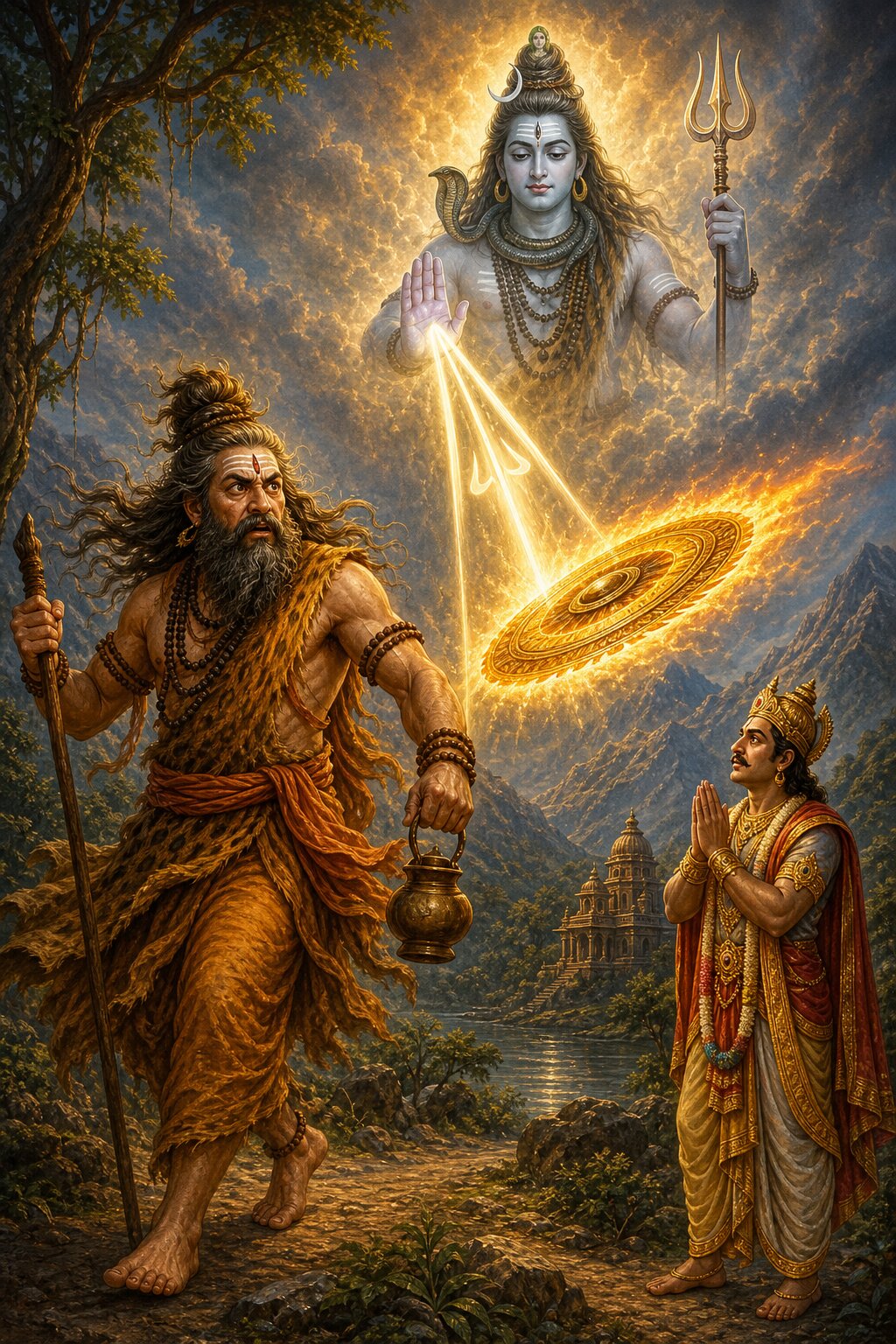
Now look at the deeds of this great sage. He put King Ambarisha to the test. The king kept the Ekadashi fast with a restraint that never slipped and meant to break it on the Dvadashi day. Durvasa arrived with his disciples just as the day was running out, accepted the invitation to eat, went off for his ablutions, and stayed away on purpose. To keep the injunction unbroken, the king took a small sip of water and waited. The sage came back furious, and when the Sudarshana chakra came blazing after him to protect the king, deluded by Shiva’s own maya into hunting a portion of Shiva, it was by Shiva’s command, at Ambarisha’s own prayer, that the discus grew calm.
He tested Lord Sri Rama as well. It fell out like this. Kala, taking the guise of a sage, had set a condition with Sri Rama: while the two of them spoke, no one was to come near Sri Rama; whoever came would be sent into exile. At that very hour Durvasa arrived and, pressing his will, sent Lakshmana within. Sri Rama, true to his word, gave up Lakshmana in that instant. Seeing that promise hold and not bend, the sage was delighted, and granted Rama the boons he wanted.
He tested Lord Sri Krishna too. Krishna, born of Vasudeva to ease the burden of the earth, fed Brahmins every day, in numbers, with the best of everything, and the fame of it had traveled everywhere. Durvasa came to see it for himself. He yoked Krishna to a chariot, with Rukmini beside him, climbed in, and sat there; and Krishna pulled the chariot and was glad to. When the sage stepped down, delighted at what he had found, the boon he left behind was a body nothing could cut. In this manner the sage Durvasa performed many strange and startling deeds. Consider it: behind the hard trials through which the greatest of the righteous passed, stood the very portion of Rudra.
The Mohini form and the seed of Rama’s work
Nandishvara said, sage, now hear after this the story of Hanuman. In the form of Hanuman, Shiva performed the finest of lilas, and in this very form Maheshvara, out of love and nothing else, rendered great help to Lord Sri Rama. That whole account bestows every kind of happiness, so hear it with love.
There was a time when Lord Shambhu, worker of wondrous lilas and rich in every virtue, beheld Vishnu’s Mohini form, glittering with every quality it had, and he grew as troubled as a man pierced by Kamadeva’s arrows. In that moment his seed was dislodged from its seat and fell, and it fell for the fulfillment of Rama’s work. Again and again the Purana repeats it here: all of this came about for Rama’s work; even within the lila there was a purpose.
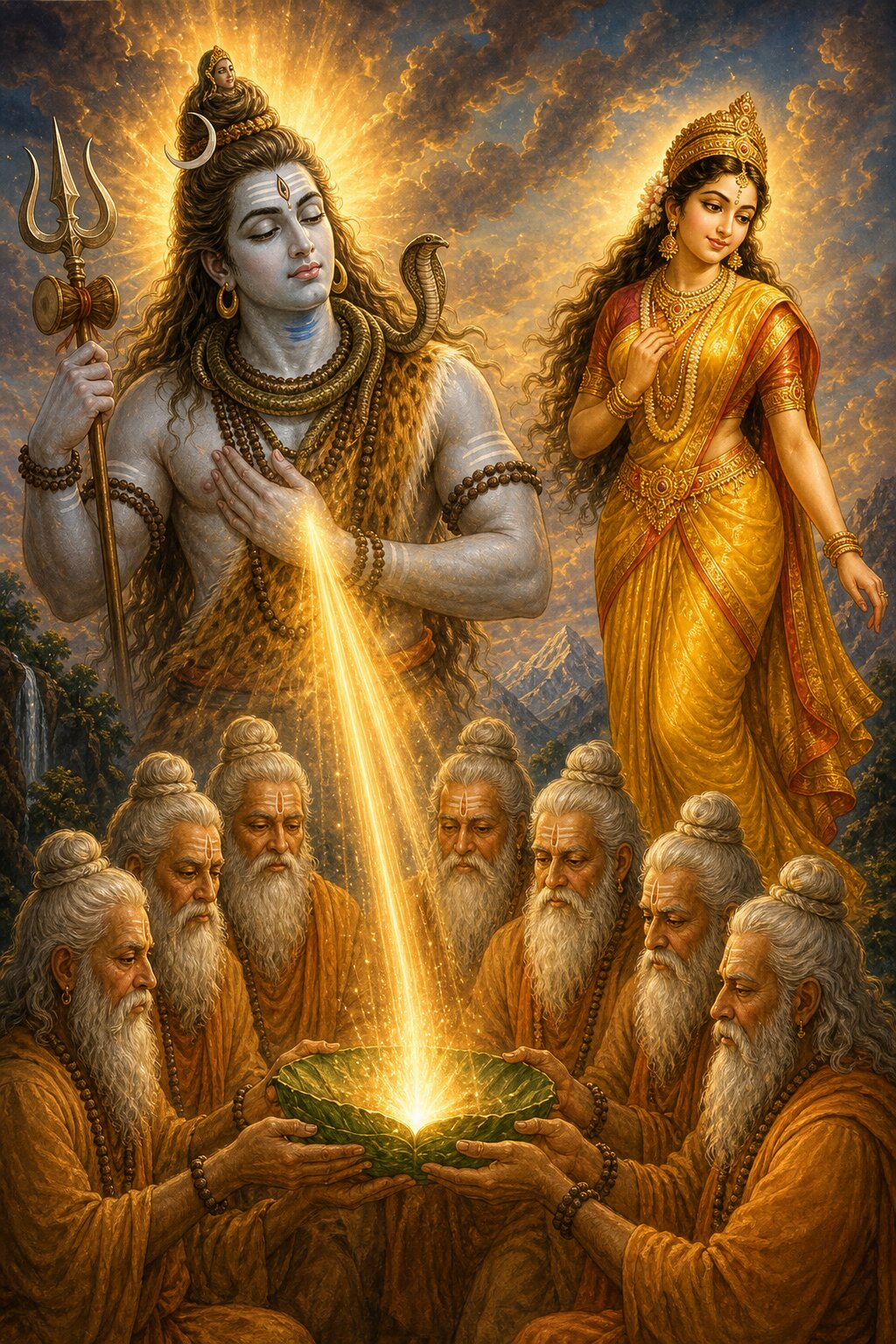
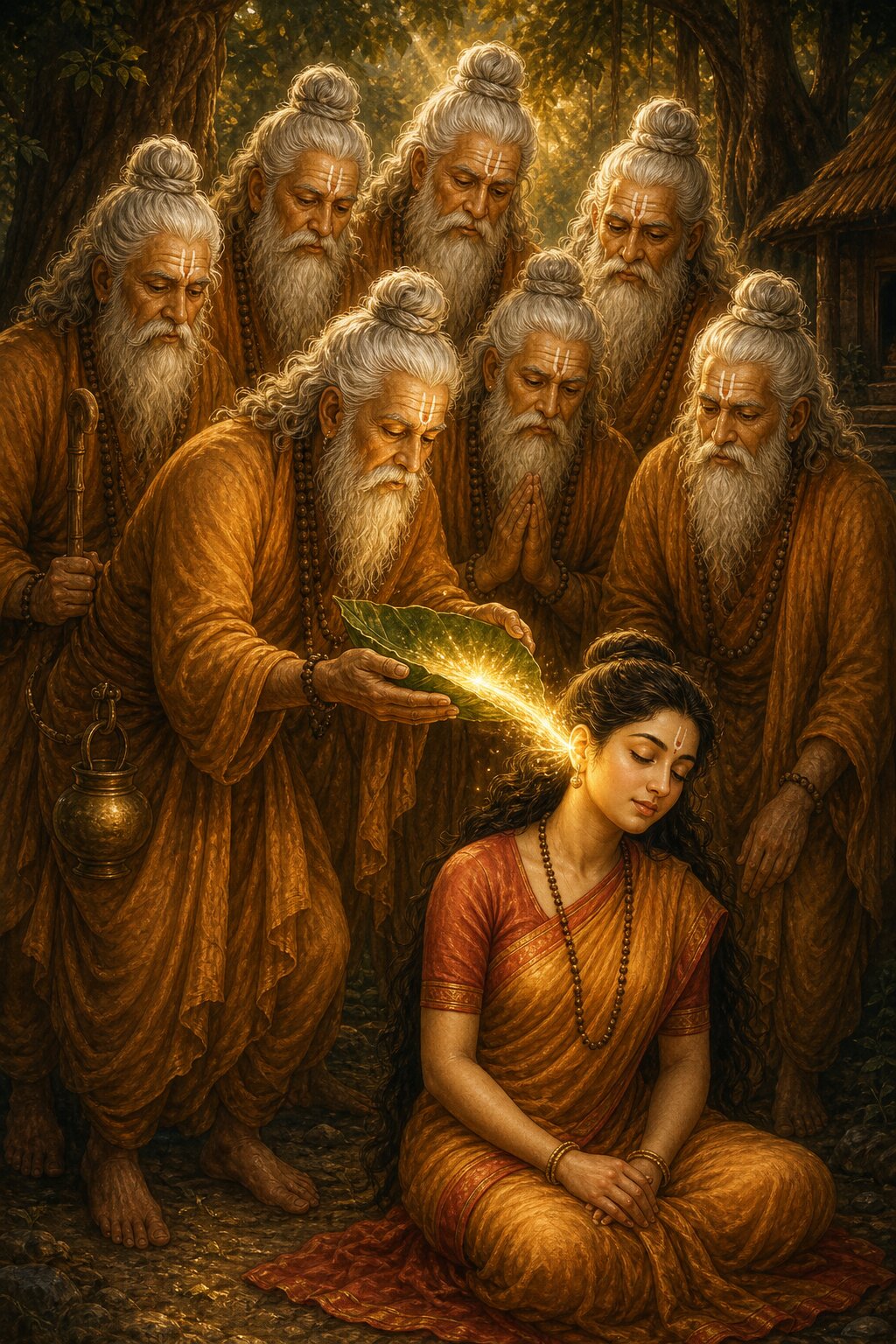
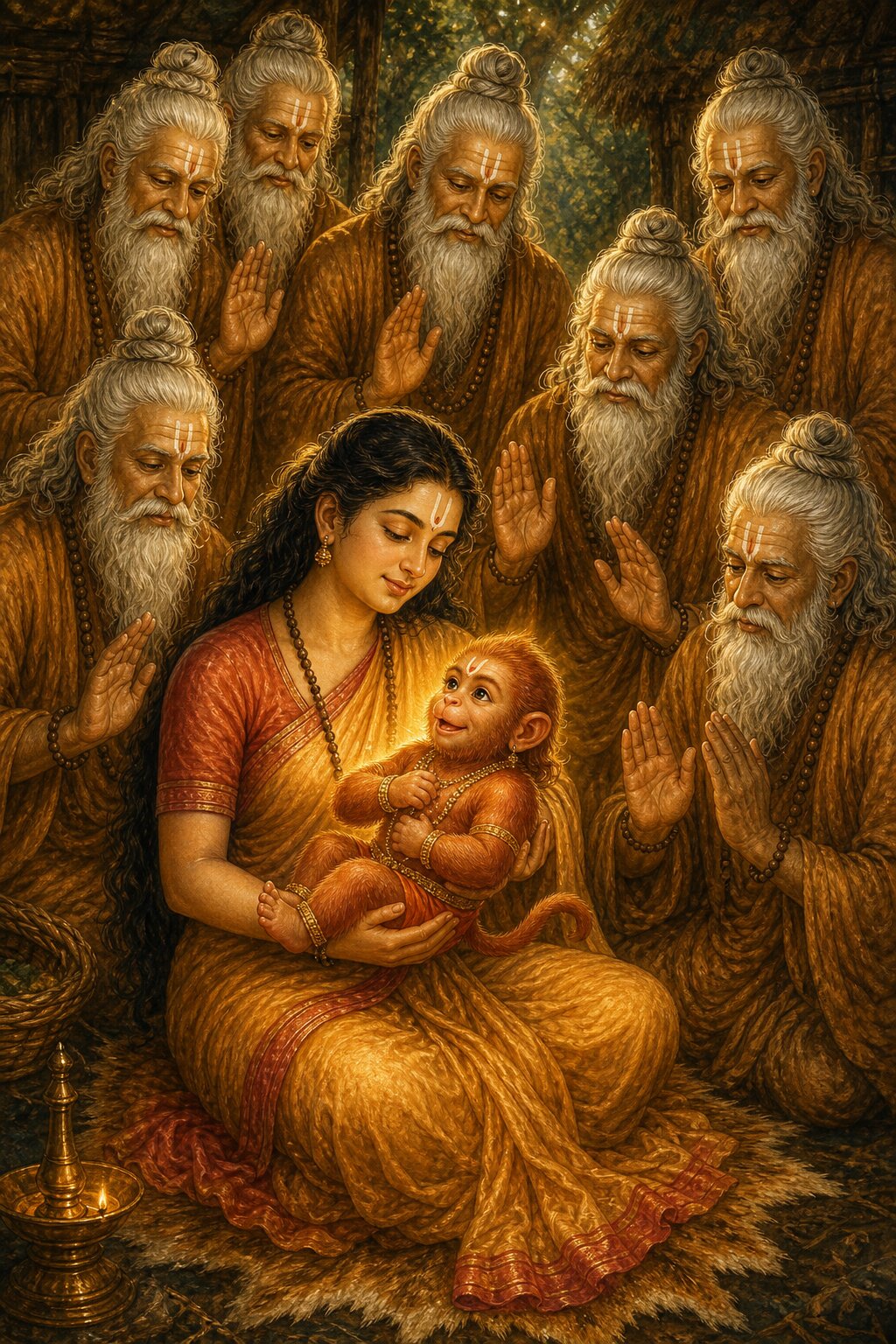
The seven celestial sages gathered that radiant seed into a cup of leaves and kept it safe, for Shiva himself had reverently stirred the thought within them for Rama’s sake. Then those great sages poured that radiance into Anjani, the daughter of Gautama, entering by the passage of her ear, and this too for the fulfillment of Rama’s work alone.
When the time came, Shambhu himself emerged from that womb, clothed in a vanara body and endowed with vast strength and a valor to match it. He was given the name Hanuman. Other currents of his birth run through the world’s telling, yet this is the Shiva Purana’s account; here Hanuman is directly a portion of Rudra, an avatar of Shiva.
The child who took the sun for a fruit
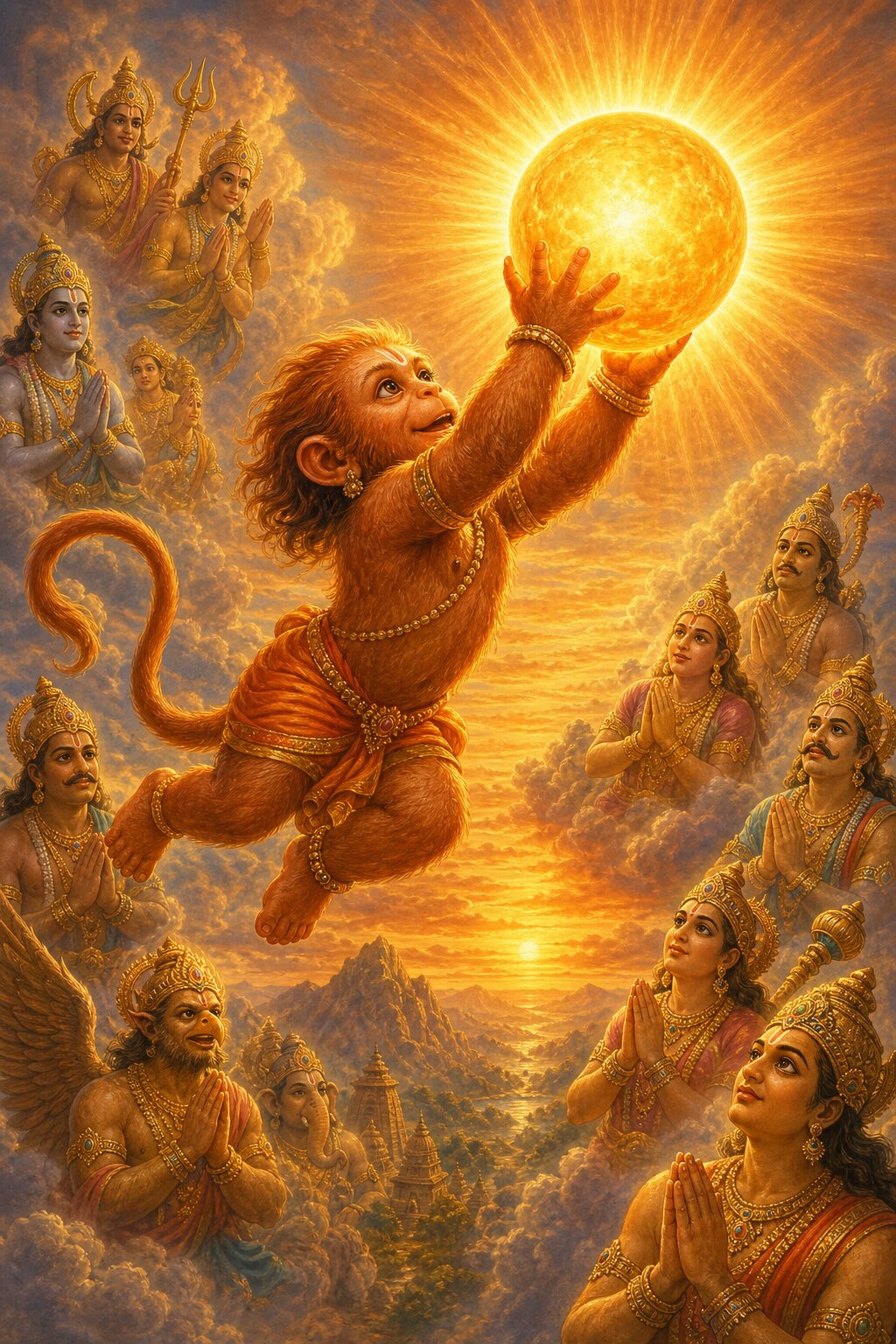
Now hear the child’s first feat. The mighty lord of monkeys, Hanuman, was still an infant, and early one morning his eyes fell on the rising disc of the sun. He took it for a small fruit and went up after it to eat it. The gods came and begged him, and he let it go. Knowing him then for an incarnation of Shiva, and knowing what power that meant, the gods and the divine sages bestowed on him many boons.
Overjoyed with the boons, Hanuman went to his mother and told her the whole account with reverence and in every detail. Then, at her word, he drew near the Sun, and went again, and went every day, and learned every science there is from him without the least strain. The Sun he had once reached for as a fruit he now made his guru, and this too is a grace of the tale. After that, Hanuman, best of monkeys and portion of Rudra, went at the Sun’s command to Sugriva, who was born of the Sun’s own portion. For this journey as well he had already won his mother’s consent.
Rama’s messenger
Then Nandishvara told the whole story of Lord Sri Rama in brief: how Hanuman became Sugriva’s minister in his exile; how he brought Rama and Sugriva into alliance; how, sent to find Sita, he crossed an ocean no one had ever crossed, carried his lord’s token to her in Lanka and hers back, and, bound in oil-soaked cloths and set alight, took the fire he had been given and burned the city with it; how he gave Lakshmana back the life Meghanada’s javelin had taken; how he killed Mahiravana and carried both brothers home. Sage, he said, in this way Hanuman, best of monkeys, carried out Sri Rama’s work in every fashion. He performed lilas of many kinds, ground down the pride of the asuras, planted devotion to Rama upon the earth, and, standing foremost among devotees himself, brought joy to Sita and Rama.
That Hanuman, the Rudra-avatar crowned with majesty, is the one who lifts up devotees and gave Lakshmana his life back, and he broke the arrogance of every daitya alive. The great hero Hanuman stays forever ready in Rama’s work, known through the world by the name Ramaduta, slayer of the daityas, and tender toward those who love him.
At the last, Nandishvara declared the fruit of this narrative. Dear one, this noble story swells one’s wealth, fame, and length of days, and grants every wished-for reward. The person who hears it with devotion, or with a pure and steady mind recites it to others, enjoys every pleasure this world has and, at the end, attains the supreme moksha.
So look: one Rudra, two forms. As Durvasa he held dharma to the touchstone, and he was merciful in the holding; as Hanuman he set his own shoulder beneath that same dharma and carried it. The testing was Shiva’s, and the carrying across was Shiva’s as well.
Source: Shiva Purana (Gita Press, Sankshipta Shivapurananka), Shatarudra Samhita
The same story, elsewhere
- Hanuman
Character profile: the complete story of Hanuman - Chapter 19 · Crossing the ocean (Mainaka, Surasa, Simhika)
Valmiki Ramayana: crossing the ocean - Chapter 22 · The burning of Lanka and the return
Valmiki Ramayana: the burning of Lanka - Hanuman Chalisa
Tulsidas’s Hanuman Chalisa - Hanuman Chalisa · a deep dive
A deep reading of the Hanuman Chalisa (Tulsidas)