On this page
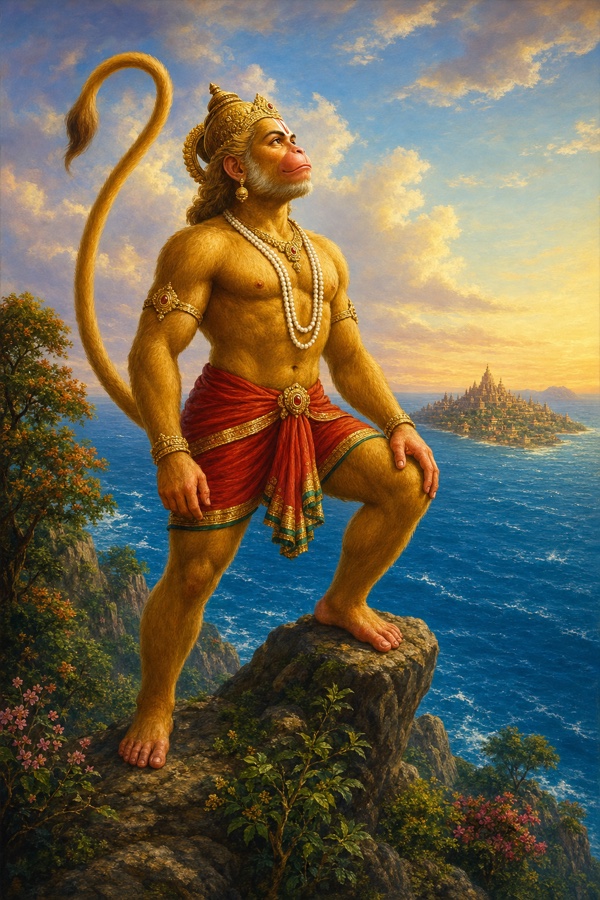
Across the sea, across a hundred yojanas of fathomless blue, Sita was held prisoner in Lanka. The resolve to find her was bound into the heart of Hanuman, and now he made ready to fly along the road of the Charanas, the celestial bards, which is the path of the open sky. An hour ago he had been sitting apart from the council, silent, believing he had nothing to offer any of them. Standing now on the summit of Mount Mahendra, he raised his head and lengthened his neck, and he looked like a well-built bull risen to its full frame. The feat that was too hard for anyone else to attempt, he stood ready to accomplish alone, without any support at all.
Gathering his strength on Mount Mahendra
Scaring the birds into flight, crushing the trees against his chest, trampling many deer and other wild animals under his feet, the strong and clear-minded Hanuman ranged over that ground the way a full-grown lion paces its own forest. The turf beneath him was blue-green as a cat’s-eye gem and lay level and smooth, like a sheet of still water spread over the slope.
The mountain was crowded with lordly elephants and adorned with spotless natural minerals in shades of purple and rose, ruby-red, and black and white. It was a place the Yakshas came and went constantly with their families, and the Kinnaras, the Gandharvas, and the Nagas too, half-divine beings who could take any shape they pleased. Standing at the foot of Mainaka, Hanuman looked like a great elephant standing in a pool.
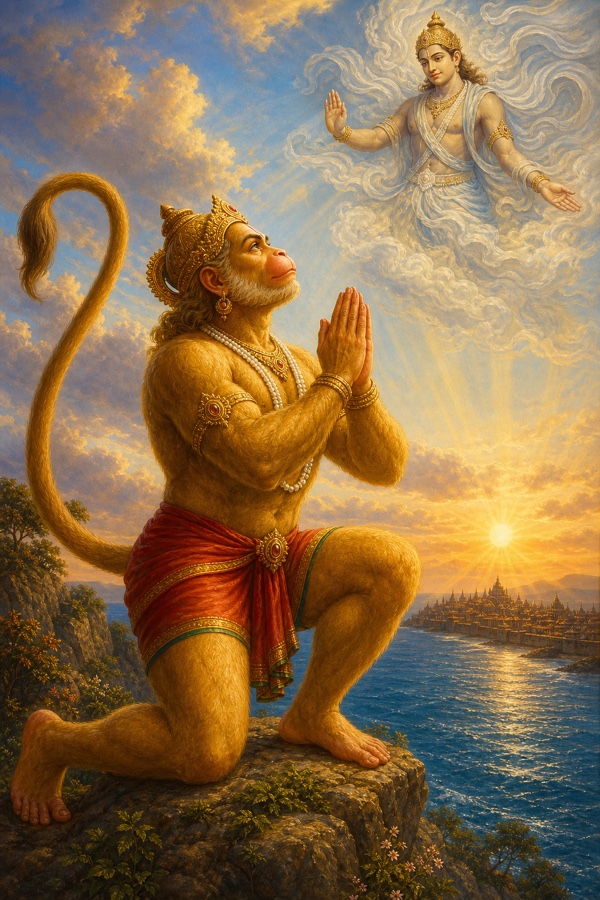
Then the son of the wind turned to the east, joined his palms in salutation to the wind-god who had fathered him, and began to enlarge his body for the journey south. He bowed with folded hands to the sun, to Indra, to his father Vayu, to Brahma the self-born, and to the genii who attend Lord Shiva, and he set his mind on departure. He was saluting, without a flicker of grievance, the sun he had once flown at as a baby and the god who had broken his jaw with a thunderbolt for doing it.
The monkey leader watched him with wonder and love. Having resolved on the leap, Hanuman swelled larger still for the sake of Rama, the way the sea itself swells on the day of the full moon. Wishing to cross the water in one bound, he grew his body past all measure and pressed down on the mountain with both arms and both feet.
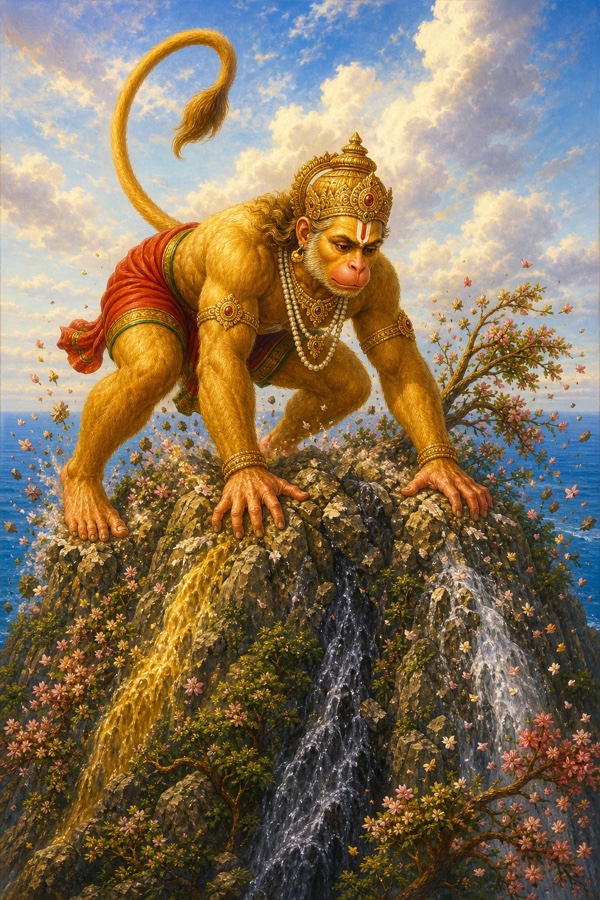
Under his weight even that unmoving mountain shuddered for a moment, and every flower on the blossom-laden ends of its branches came shaking loose. Covered on all sides by that fragrant fall of petals, the peak looked as if it were made of flowers alone. And as Hanuman bore down with his surpassing might, the mountain streamed water the way a rutting elephant runs with ichor from its temples.
Pressed by that mighty monkey, Mount Mahendra let loose streams the color of gold, of antimony, and of silver, for the waters ran through beds of those very ores. Like a fire smoldering with a low flame, the mountain also loosed from its flanks huge boulders veined with realgar. The creatures living on it fled into the caverns and shrieked in unnatural voices, and that great clamor filled the earth, the four quarters, and the groves.
Snakes with broad hoods marked by the swastika sign vomited a terrible fire and bit the rocks with their fangs. Bitten by those venomous, angry serpents, the great slabs burst into flame as if set alight and split into thousands of pieces. Even the healing herbs that grew on the mountain, the kind that counteract poison, could not draw the serpents’ venom off. A mountain that could cure any poison on earth had no cure for what was happening to it now.
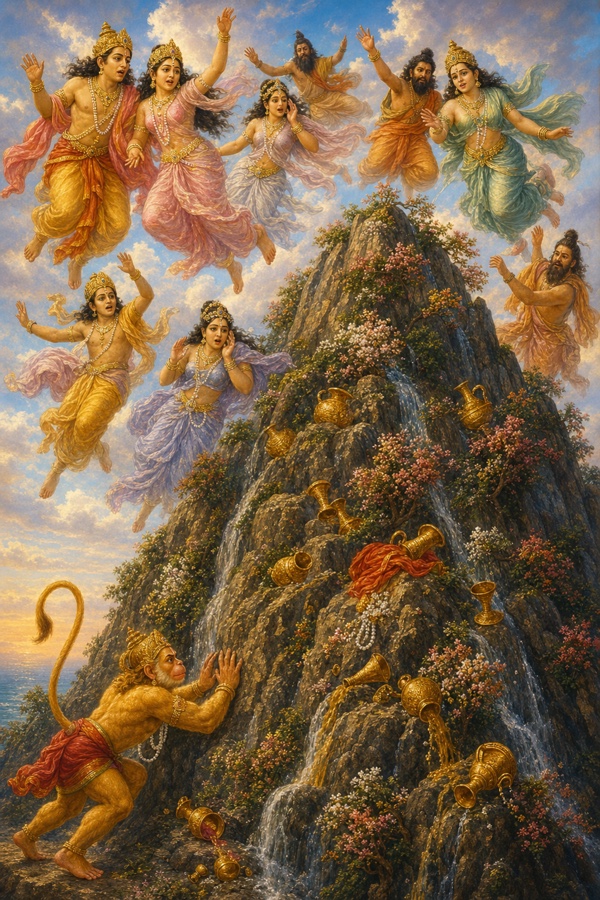
Certain the mountain was being torn apart by some host of spirits, the ascetics who practiced their austerities there, and the Vidyadharas taking their pleasure with their wives, rose into the air in fright. They abandoned the golden wine jars set out in their drinking hall, the costly vessels and the golden pitchers for water, the many sauces made to be licked and the soft foods made to be swallowed, the fruit pulps of every kind, the shields of oxhide and the gold-hilted swords, and up they went, those tipsy Vidyadharas with reddish lotus eyes, garlands around their necks, red flowers on them and red sandal paste. Their women, wearing pearl necklaces, anklets, armlets, and bangles, stood beside their husbands in the airspace, astonished and smiling. And those Vidyadharas who looked like great sages showed off the mystic skill by which they held their place in the sky, standing there together and looking down on the mountain.
Poised like that in the cloudless air, the sages, the Charanas, and the Siddhas spoke, and Hanuman heard them: “Vast as a mountain and full of tremendous force, this son of the wind wishes to leap over the sea, the home of Varuna. For the good of Rama and the monkeys he is eager to do this hardest of deeds, and he means to reach the far shore that others cannot reach.” They were the first beings in the world to say aloud what he was, and he had needed to be told twice in one day.
Hearing the ascetics say this, the Vidyadharas fixed their eyes on that immeasurable chief of the monkeys standing on the peak. Like a flame, Hanuman shook the hair on his body, made himself quiver, and roared a great roar like a huge cloud. As he rose he flung out his long tail, thick with hair and coiled around and around, the way Garuda, king of the birds, jolts a snake. Curled at his back, that tail looked like a great serpent being carried off by Garuda.
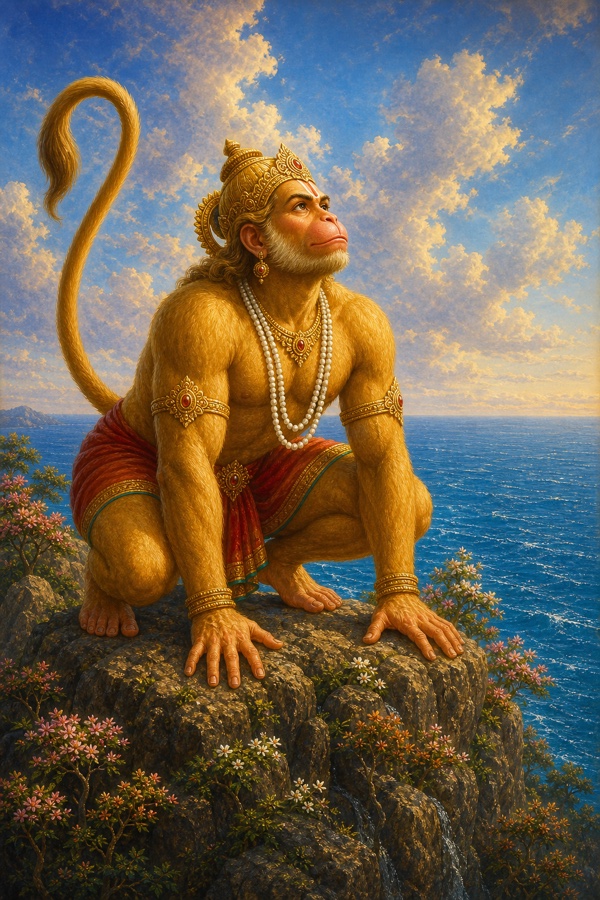
Hanuman planted both arms, each like a great iron bar, upon the mountain. He bent low at the waist and drew in his feet. Pulling in his arms and his neck, that glorious hero gathered up all his energy, his courage, and his strength. To measure the distance he had to cross he cast his eyes upward, held his breath in his heart while he looked into the sky, set both feet firmly, drew back his ears, and made ready to spring. Then he spoke to the monkeys: “As an arrow loosed from Rama’s bow flies with the speed of the wind, so will I go to Ravana’s Lanka. If I do not see Janaka’s daughter Sita there, I will fly on with the same speed to the world of the gods. And if even after all my labor I do not find Sita in heaven, I will bring back the ogre-king Ravana himself in chains. One way or another I will return with Sita, or I will tear up the whole of Lanka, Ravana and all, and carry it back.” He had left himself no way of coming back empty.
Hanuman’s flight along the sky-road
With that, Hanuman shot up into the sky with such force that he took no thought of the effort and reckoned himself a match for Garuda. As he sprang, the trees on the mountain drew all their boughs together and flew up with him on every side. Bearing aloft those flowering trees, with lapwings still perched among their blossoms, Hanuman coursed through the clear air. The birds had not had time to understand that their tree had left the ground.
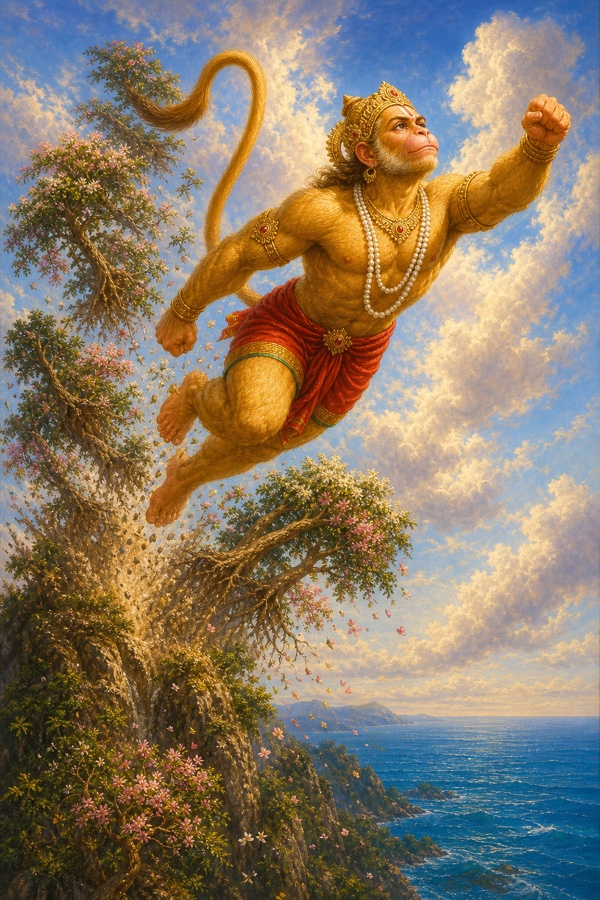
Torn up by the force of his thighs, the trees followed him a while, the way kinsmen walk a little way after a loved one who has set out on a long journey. Sal trees and other fine timber trailed him as an army trails its king. Ringed by all those blossoming trees, Hanuman, huge as a mountain, made a strange and wonderful sight. Then the trees with the hardest heartwood dropped away into the salt water, like the ancient winged mountains that once sank into the sea. Strewn with flowers, buds, and shoots of every kind, Hanuman looked like a cloud, or like a mountain lit with fireflies. Shedding their blossoms as his rush left them behind, the trees fell into the water the way friends turn back after seeing a traveler down to the water’s edge.
The wind of his passage scattered the trees’ many-colored flowers across the sea, and the great water shone like a sky studded with stars. Covered in fragrant blossoms of every tint, Hanuman looked like a rising cloud streaked with lightning, and the sea beneath him, carpeted with the flowers his speed had flung down, looked like a firmament newly spread with lovely stars.
His two arms, stretched out across the sky, looked like a pair of five-hooded serpents risen from a mountaintop. Looking down, he seemed to be drinking up the sea with all its waves; looking up, he seemed keen to swallow the sky. As he followed the path of the wind his eyes blazed like two fires burning on a mountain, flashing like lightning. The great round eyes of that tawny chief of monkeys shed their light like the moon and the sun shining together, and the gleam of his coppery nose turned his face red, like the disk of the sun embraced by dusk.
The coiled tail of the wind-god’s son, darting across the sky, looked like a tall banner raised in honor of Indra. With that curled tail and his white teeth, the keen-witted Hanuman shone like the sun ringed by a misty halo. With his deep-red rump he looked like a mountain split open to show a great vein of red chalk. And the wind rushing through the armpits of that monkey leader, as he bounded over the sea, thundered like a cloud.
He looked like a meteor falling with its trailing tail out of the northern sky, this elephant of a monkey. Swarmed by flying insects, his tail wrapped about his waist, he looked like a well-fed elephant with a girth strapped round its belly. With his body above and his shadow below on the water, Hanuman seemed at that moment like a boat driven by the wind up top and sailing the sea beneath. Whatever stretch of sea he passed over turned wild, as if maddened by the force of his body.
Breaking with his chest the ranks of waves that rose as high as mountains, the great monkey drove on. The strong wind his rush raised, together with the wind of the clouds, shook the sea violently, and it roared with a terrible sound. Dragging along vast ranks of salt waves, that monkey leader sped on as if shaking earth and heaven both. On he went at tremendous speed, seeming to count the rising billows, each one huge as Mount Meru and Mount Mandara.
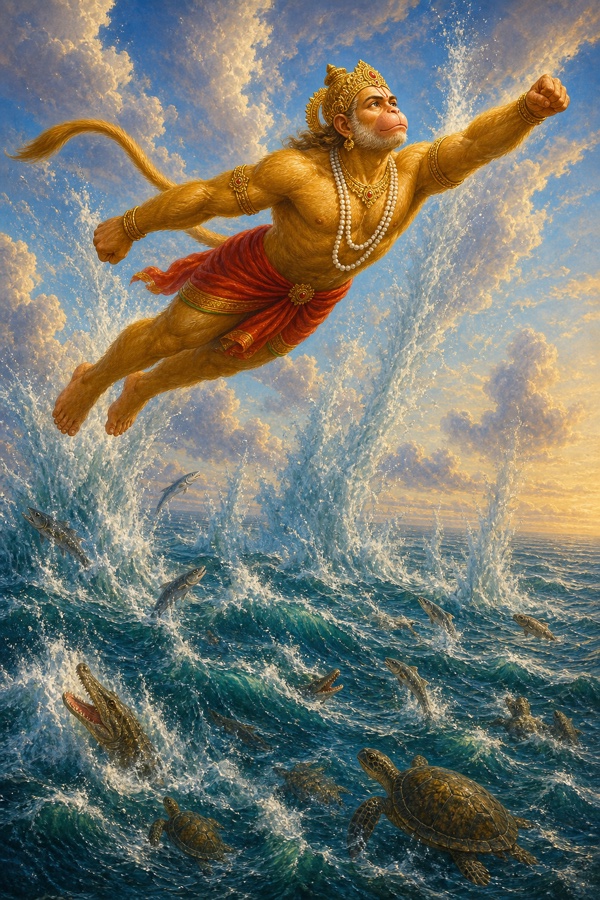
The water thrown up by his rush hung in the air with the clouds and shone like a spread of autumn clouds. As his speed lifted the sea, the whales, the crocodiles, the great fish and the turtles were laid bare, the way a man’s limbs are uncovered when the cloth is drawn off. And the serpents living in the sea, seeing that tiger of a monkey moving through the air, took him for Garuda himself, on his beautiful wings; and every one of them went down into the deep water to hide.
The shadow of that monkey leader, ten yojanas wide and thirty long, looked all the lovelier for the swiftness of his flight. Like a row of clouds sailing across a white sky, following the wind-god’s son, it fell across the salt water and shone. Hanuman of the great splendor and the vast body looked lovely on that unsupported road of the wind, like a mountain fitted with wings. Wherever the strong, elephant-like monkey rushed on his way, the sea seemed to fall suddenly into a deep trough beneath him.
Coursing the path of birds like Garuda, king of the winged creatures, Hanuman looked like the wind itself dragging the clouds along by force. The big clouds he pulled after him, white and red and blue and madder-colored, shone as they trailed him. Diving again and again into the clouds and out of them, he looked like the moon that hides and shows itself by turns. And seeing him fly so swiftly, the gods, the Gandharvas, and the Danavas rained flowers down on him.
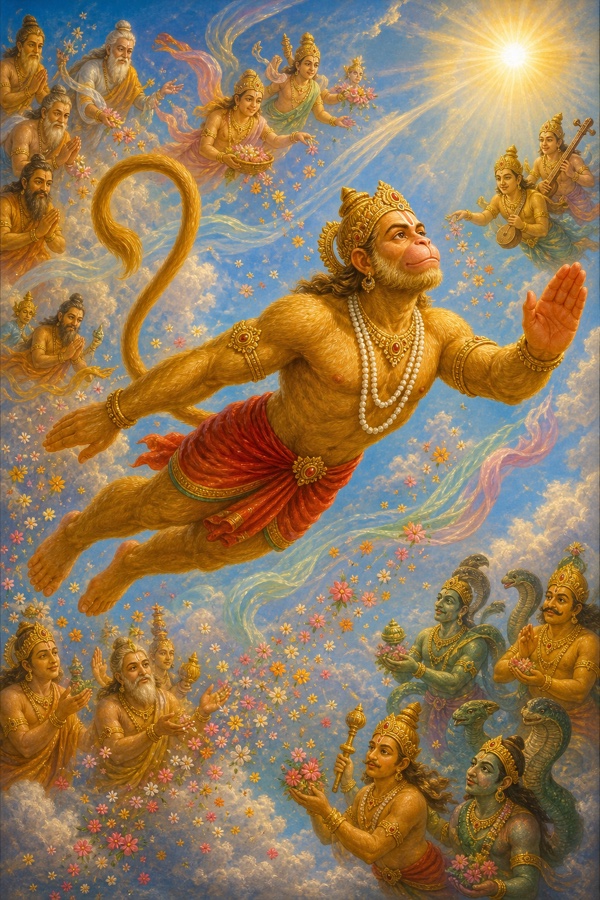
The sun did not scorch that lord of monkeys as he flew, and to freshen him for the accomplishing of Rama’s work the wind stroked him with a kindly breeze. The sun that had once blazed a baby out of the sky now held its heat back for him, and his father, who could have carried him the whole way and did not, gave him what a father gives a son doing his own work: a cool hand and room to do it. The sages praised Hanuman coursing through the air, and the gods and Gandharvas sang his glory to sustain him through that hard passage. The Nagas, the Yakshas, and the many kinds of ogres too, seeing that monkey leader tireless and faintly smiling, praised him.
Mainaka’s invitation to rest
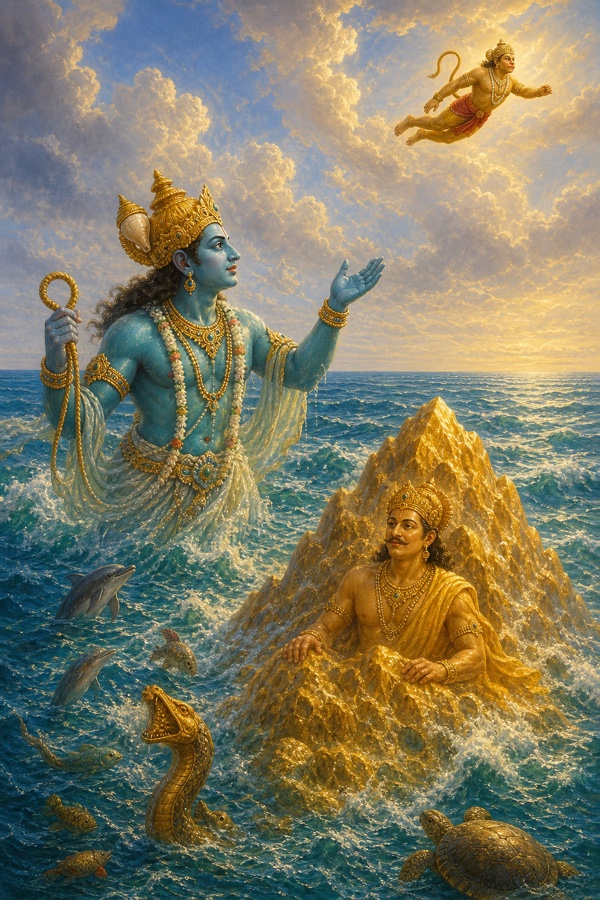
As Hanuman was making his way through the sky, the sea-god, who honored the line of Ikshvaku, reasoned like this: “If I do not lend a hand to Hanuman, the lord of monkeys, every creature that can speak will hold me to blame. I was widened long ago by King Sagara of the Ikshvaku line, and here is Hanuman helping Rama of that same line. He must not come to grief on this journey. I should arrange it so that Hanuman can rest a while. Rested on me, he will cross the rest of the sea with ease.” The sea itself owed this family a debt, and had been carrying it, unpaid, since before Ayodhya had a king anyone could name.
Having made this righteous resolve, the sea-god spoke to Mainaka, made mostly of gold and sunk beneath the water: “O mountain, Indra the king of gods set you here as a bar against the hordes of demons who live in Patala, the deepest of the underworlds. You stand blocking the gateway of that measureless region against those demons, whose valor is well known and who long to rise again to the surface of the earth. You have the power to grow every way, to the sides and upward and downward. So I urge you to rise and swell higher.
“This Hanuman, a monkey leader and a doer of terrible deeds, has sprung into the sky to accomplish Rama’s work, and he is passing over you. This Hanuman serves the House of Ikshvaku, and I must help him. The line of Ikshvaku is worthy of my reverence, and of yours far more. So render us your help, and do not let our purpose fail through any lapse. A duty that must be done, if it is not done with care, kindles the anger of the good.
“Rise up from the water, and let this chief of monkeys rest on you. Hanuman is our guest, and worthy of honor too. O mountain with peaks of gold, served by gods and Gandharvas, resting on you he will cover the rest of his road. When you consider the tenderness of Rama, a prince born in Kakutstha’s line, and the plight of Sita, a princess of Mithila living against her will in a foreign land, and the toil of Hanuman, the leader of monkeys, you ought to rise.”
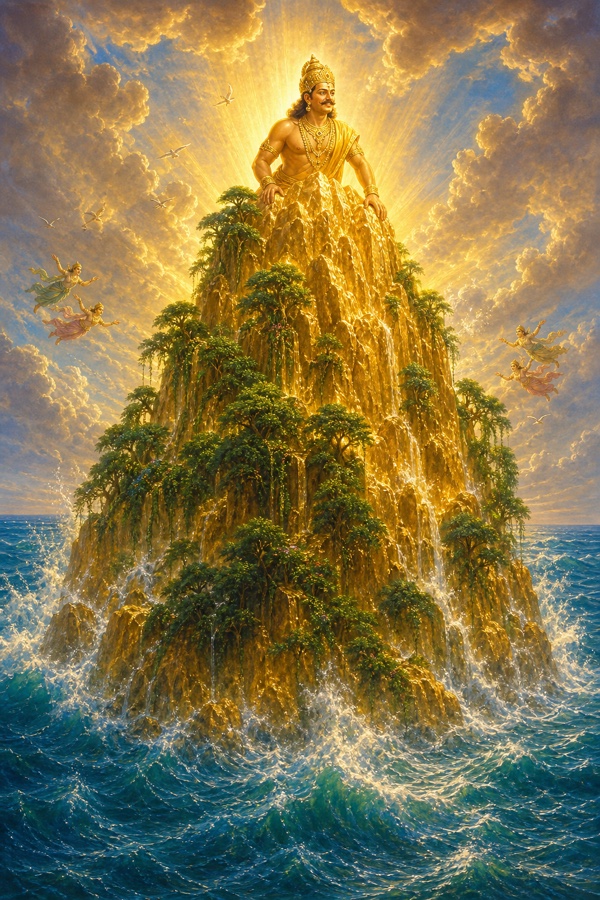
Hearing these words of Varuna, lord of the salt water, Mainaka, which held deposits of gold in its bowels and was clothed in great trees and creepers, rose at once from under the water. Splitting the sea, it climbed very high, like the sun with its brilliant rays breaking through the veil of a cloud.
At the ocean’s command that vast mountain revealed its peaks in an instant. Golden peaks inhabited by Kinnaras and great serpents, shimmering like the sun at dawn, scraping at the very sky. Because of those towering golden peaks, the blue sky, which shone like a sword, now took on the luster of gold. With its shining golden crests casting a dazzling splendor, Mainaka blazed like a hundred suns.
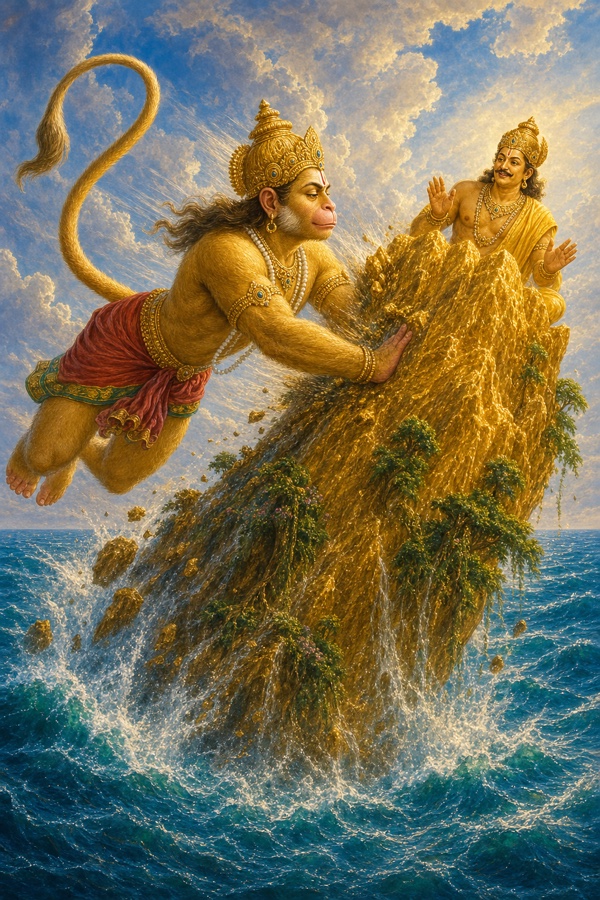
Seeing that mountain suddenly standing very high in his path, in the middle of the salt sea, Hanuman took it for an obstacle in his way. Full of great force, he struck the exceedingly lofty peak down with his chest, the way the wind knocks down a cloud. A mountain of gold had risen out of the ocean to offer him a bed, and he flattened it without breaking his stride, because a thing standing between him and Lanka could only be one kind of thing. Beaten in this manner by Hanuman, and knowing his force for what it was, Mainaka rejoiced and roared as well.
Taking the form of a man and standing on his own summit, Mainaka rose high in the sky again, and, glad at heart, spoke lovingly to Hanuman, who still hung in the air: “You have taken up a task that is hard to accomplish. Alight on my peaks, rest comfortably a while, and then go on with renewed strength. This sea was widened by the sons of Sagara, who were born in Rama’s line.
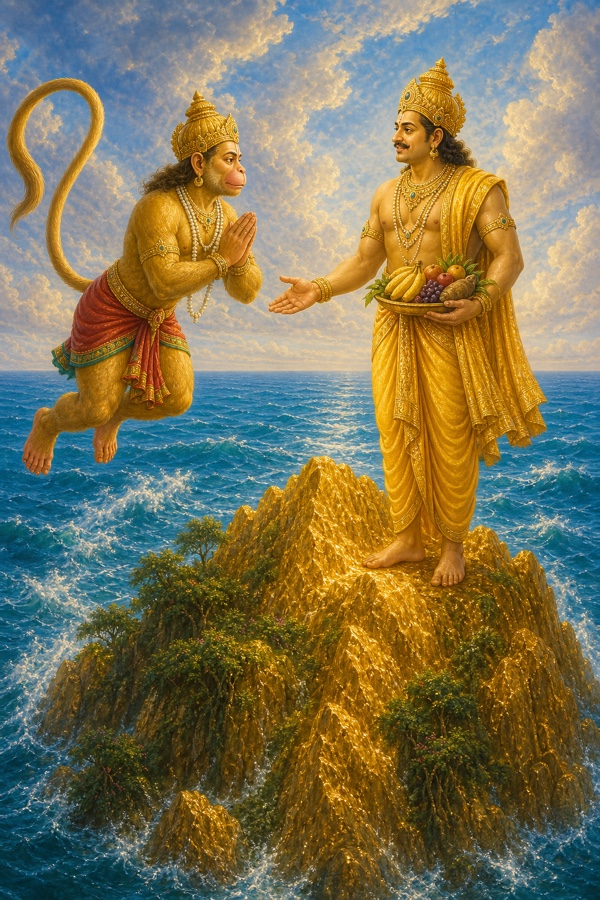
“The sea-god, who is bent on serving Rama, wishes to honor you, and to return a service for a service is the eternal law. Seeking to repay his debt to his benefactors, the sons of Sagara, this Ocean deserves the courtesy of your accepting his welcome. On your account he has very politely charged me thus: ‘Hanuman has sprung into the sky to cover a hundred yojanas. Let him rest on your peaks and then go on.’ So tarry rest on me a while and then travel on. Here are bulbs, roots, and fruits in plenty, all fragrant and sweet. Taste them and rest a little, and then go on your way. In truth we too have a bond with you, one famous through all three worlds. O storehouse of great virtues, of all the swift, leaping monkeys I count you the very first.
“To a discerning man who wishes to know his duty, even an ordinary newcomer is worthy of honor, and how much more one such as you. O elephant among monkeys, you are the son of Vayu and his equal alone in speed. When you are honored Vayu himself is honored. That is why you are worthy of my reverence. And hear one more reason for my reverence of the wind-god through you.
“In the ancient Satyayuga mountains had wings. Full of speed, they ranged all four quarters like so many Garudas. When they flew swiftly to and fro, the hosts of gods, the sages, and other beings grew afraid, dreading that the mountains might fall. Provoked by their fear, Indra, the thousand-eyed lord of a hundred sacrifices, cut off the wings of the mountains by the hundred thousand with his thunderbolt. That is why the mountains of this world stand still, and why they stood still while you flew over them this morning. Indra came at me too, his thunderbolt raised in anger, and at that very moment the great-souled Vayu tossed me up into the sky and dropped me into this salt water. So my wings were saved, and your father saved the whole of me.
Mainaka said, “For that reason you are worthy of my esteem, and I honor you. This bond of mine with you, that you are the son of my benefactor, is full of great promise. O Hanuman, this long-awaited chance to repay my debt to your father has come to me by good fortune, so with a glad heart you ought to oblige both the sea-god and myself. Ease your fatigue, take my welcome, and accept the affection of one who honors you. I am happy to see you.”
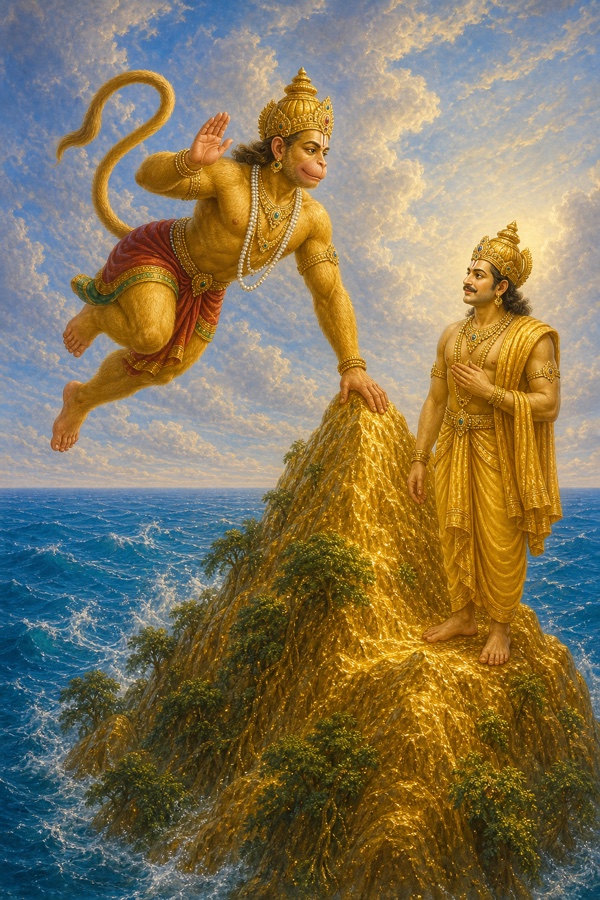
Spoken to in this way, Hanuman replied to Mainaka: “I am pleased. With your kind words you have already given me your welcome. Let the regret that I did not accept your hospitality go out of your mind. The hour of my duty, to find Sita and to cross the sea, is hurrying me on. The day too is slipping away. And I have given my word to my fellow monkeys that I will not stop anywhere along the road.” He turned down rest, food, and the affection of a friend of his father’s, and he did it so gently that the mountain was left with nothing to be sorry for.
With that, Hanuman touched the mountain with his hand as a sign of respect and friendship, and, almost laughing, rose into the sky. It was the whole courtesy compressed into one touch of a palm, given at speed, by a creature who could not stop. On that occasion both the mountain-god and the sea-god looked on him with great esteem, did him honor, and cheered him with fitting blessings. Then, rising higher and leaving both mountain and sea below, Hanuman found the road of his father the wind and coursed on through the clear sky. Rising higher still and looking down on the mountain below, the son of the wind, that elephant among monkeys, moved on unsupported in the air.
Seeing this second hard deed of Hanuman, this refusal of the rest that Mainaka had offered him, all the gods, the Siddhas, and the greatest sages praised him. The first hard deed had been the leap. The second was declining a comfortable place to put his feet, and the gods knew which of the two was rarer. The gods present there and Indra of the thousand eyes were pleased with what Mainaka had done. It gladdened them to see that golden mountain with the lovely slopes give Hanuman its welcome and its foothold. Well pleased, the sagacious Indra spoke of his own accord in a voice thick with feeling to Mainaka: “I am greatly pleased with you. I grant you safety, and you need never again fear the cutting of your wings by me. Live wherever you please, in comfort.
“You have given valuable help to Hanuman, who leaps out fearlessly to cover a hundred yojanas even though there is every risk of his tiring and falling along the way, and who has now had the comfort of a rest. This monkey travels only for the good of Rama and by the kindness you have shown Hanuman according to your power, you have satisfied me deeply.”
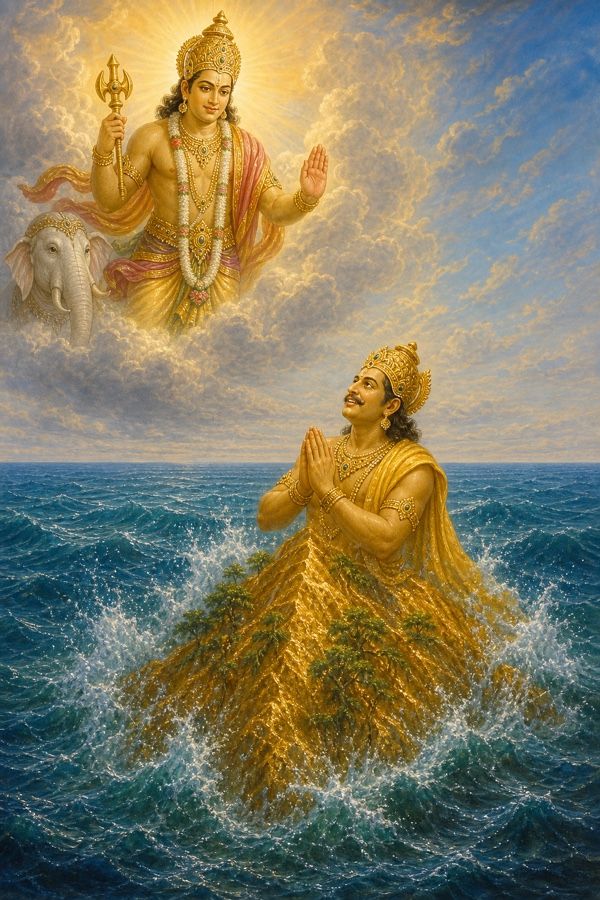
Seeing Indra so pleased, Mainaka felt a deep and abundant joy. Having received from Indra this boon of safety, the mountain settled again beneath the sea-water as before, and Hanuman quickly went on across the sea. The god who had cut the wings off the mountains of the world had just given one mountain its wings back, for an act of kindness done to a monkey who had refused it.
The test of Surasa
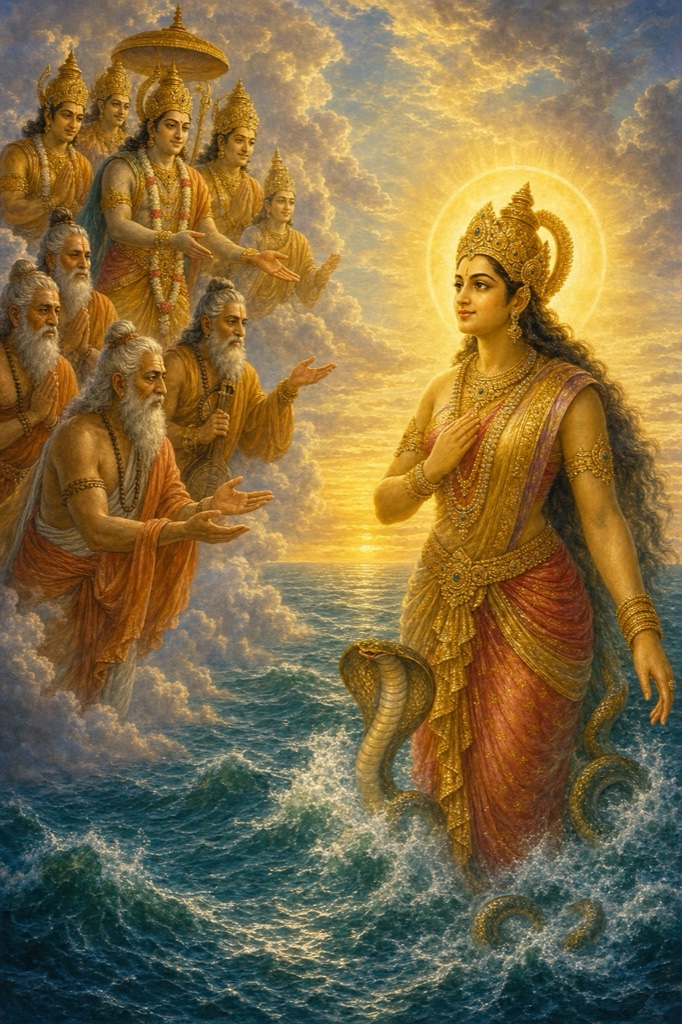
Then the gods with the Gandharvas, the Siddhas, and the greatest sages went to Surasa who shone bright as the sun, and said, “Hanuman is flying over the sea. Be his obstacle for a moment. Take the form of an ogress, vast as a mountain and altogether terrible, with a mouth made cruel by tusks and lit by tawny eyes, a mouth that reaches to the sky, and hold him back a while. We wish to know his strength and his prowess, whether he will beat you by some clever means or fall into despair.” The whole of heaven wanted to know one thing about this monkey, and it was not whether he was strong. They had seen the strength. They wanted to see him think.
At this request, honored by the gods, the goddess Surasa took in mid-sea a deformed and hideous ogress shape, a thing to frighten anyone, and, encircling the flying Hanuman, she said, “The lords of the universe have appointed you my food. I will eat you, so enter this mouth of mine. Long ago the creator Brahma gave me a boon, that whoever comes before me I may catch and devour.” And with these words she tore open her enormous mouth and stood at once before the son of the wind.
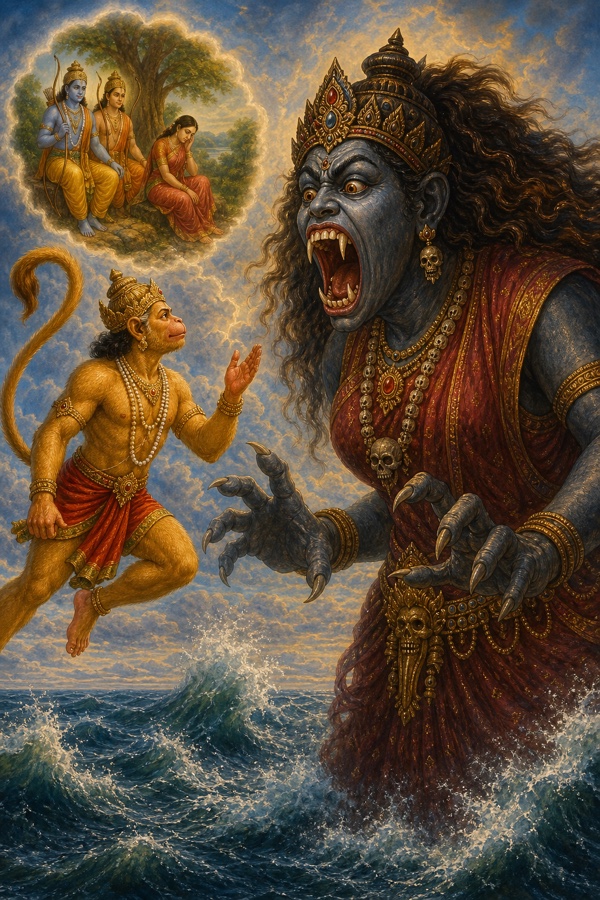
To this Hanuman, his face lit with joy, answered, “A prince named Rama came into the Dandaka forest with his younger brother Lakshmana and his wife Sita. The ogres bore him a deep enmity, and while Rama was busy at another task, the chase of Marica, Ravana carried off his wife Sita. By Rama’s command I am going as his envoy to seek her out. O ogress living in Rama’s own domain, you ought to help Rama. Or, if you insist on eating me, I promise you in good faith that once I have seen Sita, the princess of Mithila, and reported to Rama, who is tireless in action, I will come back and enter your mouth.” He was standing in the sky in front of a mouth the size of the horizon, and he was negotiating terms, cheerfully, with his face lit up.
To this Surasa said, “No one can pass me by. Such is my boon.” Yet seeing Hanuman go on ahead, and wishing to know his strength, the mother of the Nagas said, “Today you shall go only after entering my mouth, for such was the boon Brahma gave me long ago.” And saying this she tore open her enormous mouth and stood before the son of the wind.
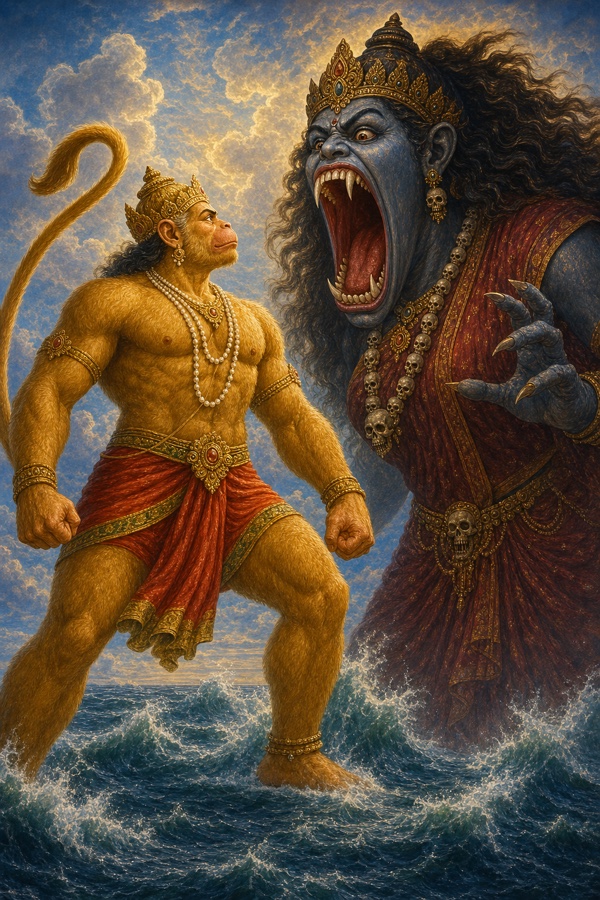
Angered at this, Hanuman said, “Then make your mouth big enough to hold me.” Saying so, the angry Hanuman made himself ten yojanas tall before her mouth, which was ten yojanas wide. Seeing him ten yojanas high and looking like a cloud, Surasa widened her mouth to twenty yojanas.
At this Hanuman grew to thirty yojanas, and Surasa made her mouth forty. Then the hero Hanuman became fifty yojanas high, and Surasa widened her mouth to sixty. That same moment the hero rose to seventy yojanas, and Surasa opened her mouth eighty yojanas wide. Blazing like fire, Hanuman became ninety yojanas tall, and Surasa stretched her mouth to a full hundred yojanas. He had been trying to win by being bigger, and she could match him all day, and somewhere in that climb he understood it.
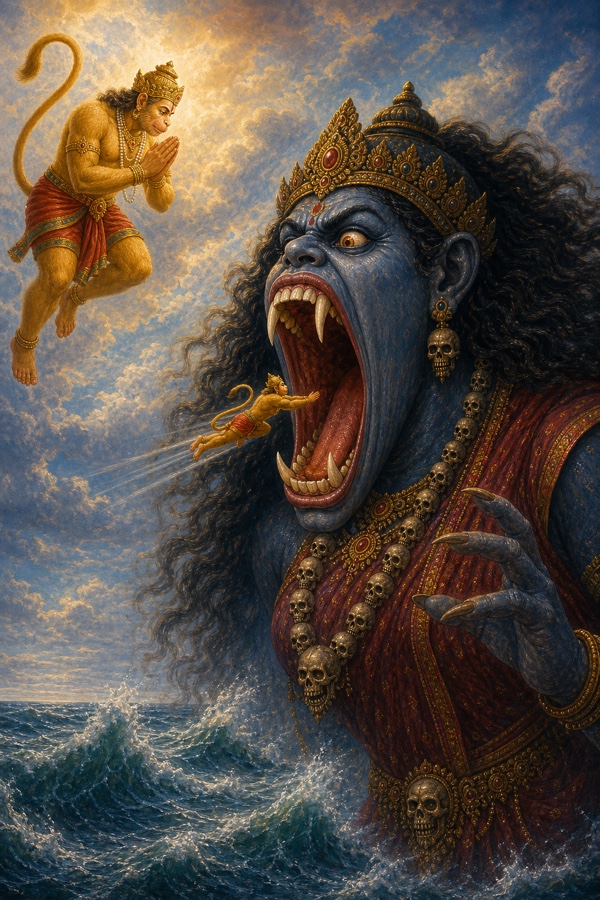
Seeing that mouth Surasa had torn open, with its long tongue, terrible to look at and a very image of hell, the shrewd son of the wind drew his body in at once, like a cloud shrinking, and that same instant became no bigger than a thumb. Hanuman slipped into her mouth, came straight out again, and, holding his place in the air, said, “I have entered your mouth, and your boon has come true. My salutation to you. Now I go to where Sita of Videha is.” He had kept her boon to the letter and lost nothing at all, and he saluted her on the way out.
Seeing him slip free of her mouth like the moon released from the mouth of Rahu, and taking on her true form, the goddess Surasa said to the monkey, “Go happily, gentle chief of monkeys, and accomplish your purpose. Unite Sita of Videha with Rama.”
Seeing this third hard deed of Hanuman, his escape alive from the mouth of Surasa, the beings watching there praised the monkey, crying, “Well done, well done.” Heaven had asked its question and had its answer.
The slaying of shadow-seizing Simhika
Drawing near the invincible sea, the home of Varuna, Hanuman went on through the sky with the speed of Garuda. It was a road that Brahma had made: served by Tumburu and the other Gandharvas, used by Airavata, adorned with spotless swift-moving aerial chariots drawn by lions, elephants, tigers, birds, and serpents, presided over by those who had done meritorious deeds in earlier lives, tended by the god of fire, decked with the planets, the lunar mansions, the moon, the sun, and the hosts of stars, and forever thronged with sages, Gandharvas, Nagas, and Yakshas. It was the high road of the heavens, and a monkey was using it. Along it Hanuman, like the wind, dragged with him masses of clouds the color of black aloe, and red and yellow and white clouds too.
The great clouds drawn after him shone as they came. Diving into the banks of cloud and out again and again, he looked like the moon coming and going among the clouds of the rainy season. Watched from every side by all, the son of the wind sped through the supportless sky like Sumeru fitted with wings.
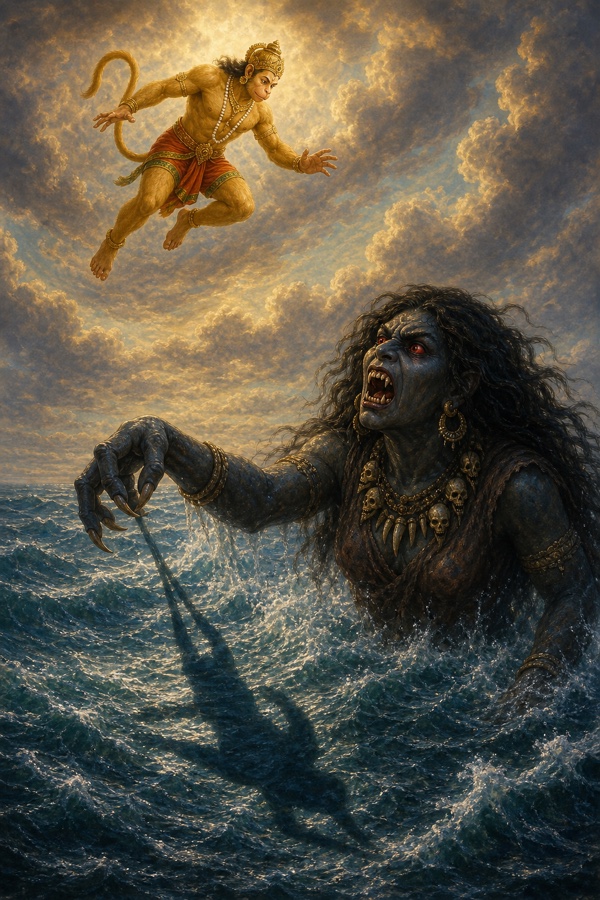
Seeing him fly by, an ogress named Simhika, who could change her form at will and had grown to an enormous size, thought within herself, “After all this long while I will be satisfied today. After a long wait this huge creature has fallen into my power.” Thinking so, she seized hold of Hanuman’s shadow. She never touched him. She took hold of the dark shape he was throwing on the water, and that was enough.
His shadow caught, Hanuman thought, “As a big ship is checked in the sea by a contrary wind, so have I been seized all at once by someone and brought to a dead stop.” Looking sideways, then up, then down, he saw a huge creature risen from the salt water below. Seeing that shape with its ugly face, the son of the wind reasoned, “This is the very creature of strange looks, of great might, that catches its prey by its shadow, the one Sugriva described exactly as it is. There is no doubt of it.” A king had once run for his life across the whole world, and had described the horrors of it to his court, and one of those descriptions was now saving the life of the monkey who had listened.
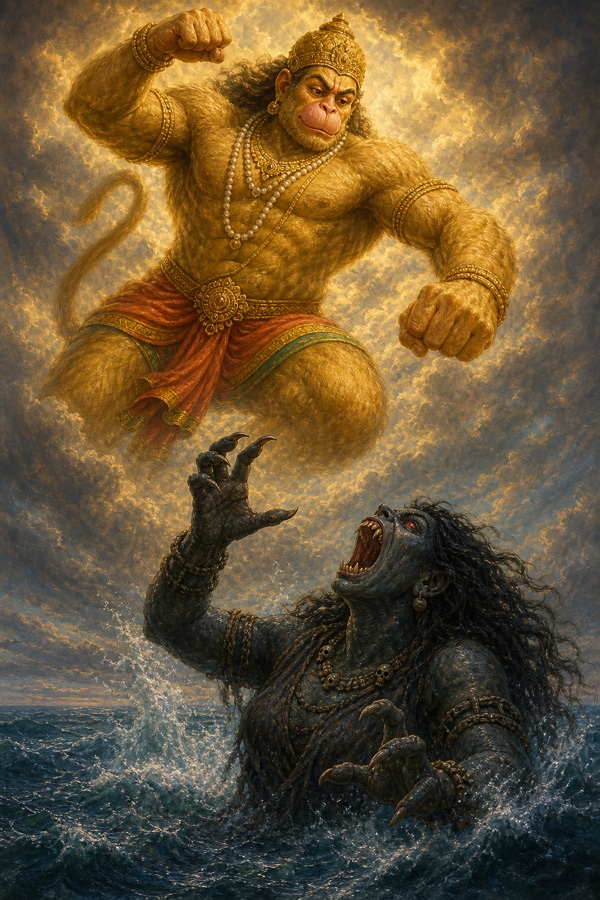
Knowing her truly for Simhika, the shrewd Hanuman swelled to a giant size like a cloud in the rains. Seeing his body grow, she stretched her mouth wide as the whole space between Patala and the sky, and, thundering like a bank of clouds, she rushed at him. Then Hanuman saw her deformed, enormous mouth, as large as his own body, and marked her vulnerable spots. He had grown large on purpose, to make her open wide enough.
Hard as a diamond, Hanuman drew himself in again and again and slipped into her hideous mouth, and the Siddhas and Charanas watched him vanish into it as they would watch Rahu swallow the full moon on a night of the full moon. Then, tearing her vital parts open with his sharp nails, the monkey shot out again with the speed of thought. He had used the same trick twice within the hour and made it a different trick both times: with Surasa he went in small and came out having harmed nothing; with Simhika he went in small and came out through her heart. Bringing her down by the strength of fortune, of firmness, and of skill, Hanuman sped on. Her heart, the very seat of her life, was ripped apart by Hanuman, and she fell dead into the water. Brahma himself, the self-born, had made Hanuman the instrument of her death.
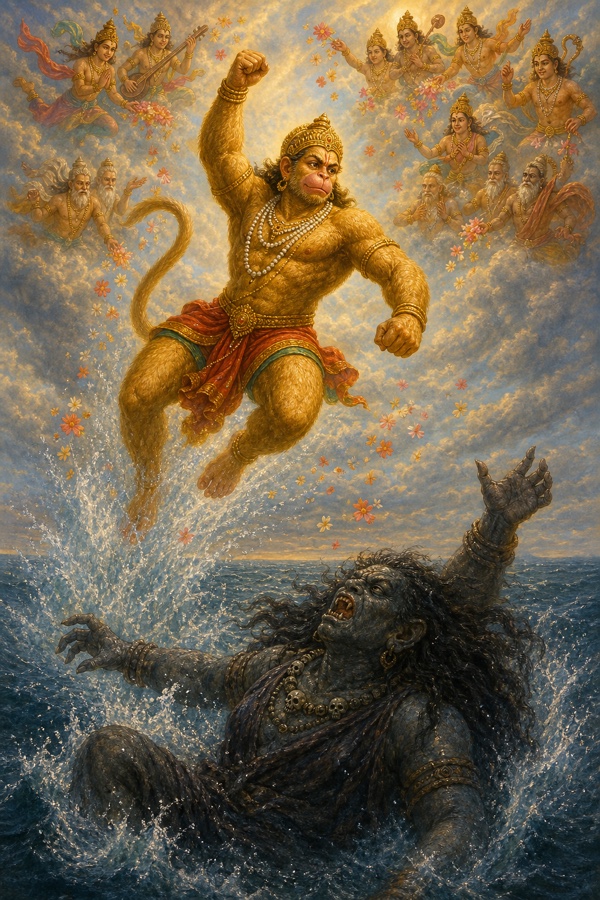
Seeing Simhika killed so quickly by Hanuman and fallen, the beings that range the sky said to that monkey leader, “Today you have done a fearsome thing; you have killed a mighty creature. Now accomplish the purpose you desire without hindrance. Whoever has in him these four virtues as you do, firmness, vision, understanding, and skill, never fails in his undertakings.”
Then, looking at his own body, huge as a great cloud and seeming to block the sky, the self-possessed and clear-minded Hanuman fell to thinking. He grew certain that the ogres would puzzle over him if they saw the strange growth of his body and his tremendous speed. Everything that had carried him across the water was about to become the thing most likely to get him caught.
So, drawing in that mountain-like, spreading body, he returned to his natural form, the way a man who has mastered himself and is free of delusion settles back into his own true nature.
Contracting that wondrous form by a great deal, Hanuman came back to his natural shape, just as Lord Vishnu, who had taken the form of the Dwarf and crossed the worlds in three strides to break the power of the demon king Bali, returned afterward to his earlier, dwarfish shape.
Honored by those beings who sought the success of his mission, Hanuman rose into the sky like Garuda, the eater of serpents. Near the end of the hundred yojanas, well-nigh at the far shore, he looked all around and saw a line of forest trees. Still in the air, Hanuman saw an island adorned with trees of many kinds and the groves on the Malaya mountain. He saw the sea, the watery lands along its shore, the trees growing there, and the mouths of the rivers, the ocean’s wives.
Able to take any form, Hanuman looked at his own body, huge as a great cloud and seeming to hold up the sky, and decided to draw it in. He contracted that mountain-like body and took his natural form again.
Having reached the far shore of that sea, which no one else could cross, Hanuman looked at his body, considered his purpose of finding Sita, and regained his natural shape. On one summit of the Lamba mountain, thick with Ketaka, Uddalaka, and coconut trees, rich in fruit and flower, with wonderful lower peaks, that Hanuman, huge as a mighty cloud, came down. Setting aside his colossal form, he set foot there, and the beasts and birds of the mountain were troubled by his great monkey shape.
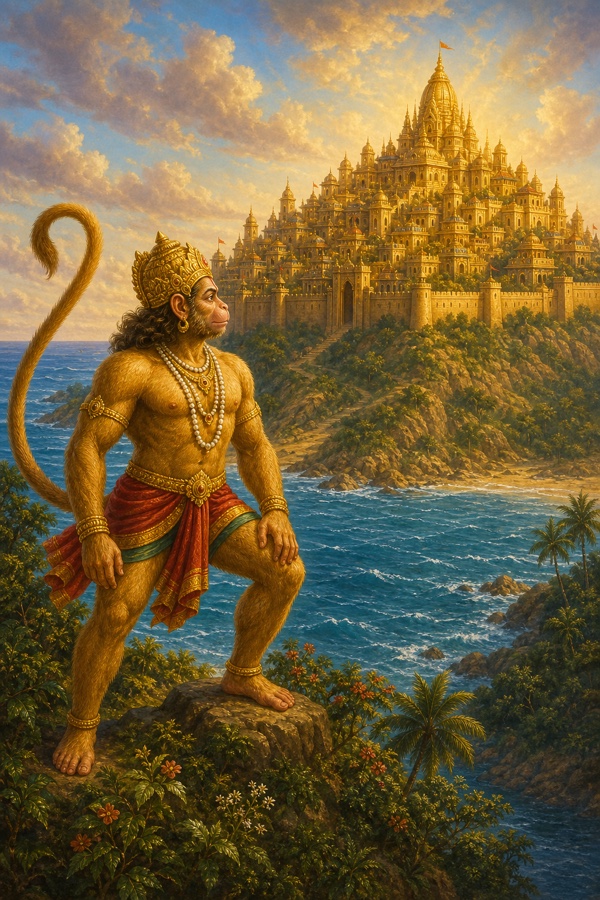
Having leapt by his own strength across the sea, crowded with demons and serpents and heaving with ranks of high waves, and having come down on the shore of that vast ocean, Hanuman then saw Lanka standing like Amaravati, the city of Indra.
Seeing Lanka, and the question of how to enter
Having crossed the invincible sea, Hanuman, at ease in himself, stood on a slope of the Trikuta mountain and gazed at Lanka, so the tradition goes. Drenched all over by the rain of blossoms the trees had shed, Hanuman looked as if he were made of flowers. Even after covering a hundred yojanas, that hero of the first rank did not gasp for breath, nor did he feel any weariness. He had crossed the sea that had stopped an army of heroes, and he arrived on the far shore wearing flowers, breathing easily.
He said to himself, “I could travel many hundreds of yojanas, so what great thing is it to have reached the far side of a sea reckoned at a hundred?” So Hanuman crossed the great sea and came to Lanka.
Standing on that mountain, he passed on through green, fragrant meadows and woods rich with trees and honey. Hanuman made his way among tree-covered mountains and rows of woodland heavy with flowers. From that mountain the son of the wind looked upon the forests and gardens and upon Lanka set on the summit above.
He saw saralas, a kind of pine, and karnikaras, and date-palms in full flower, priyalas and muchulindas, a kind of orange, kutajas, ketakas, and fragrant priyangus, nipas of the kadamba kind, saptaparnas, asanas, kovidaras, and flowering karaviras. He saw trees bowed under their weight of blossom and trees loaded only with buds, trees full of birds with their crests shaken by the wind, step-wells thick with swans and karandava ducks and carpeted with lotus and water lily, lovely pleasure-grounds of every kind, and many reservoirs bordered by trees that fruit and flower in every season, and delightful gardens too.
Coming up to Lanka, protected by Ravana and rich as Lakshmi herself, he found it ringed with moats full of lotus and water lily, kept safe ever since Sita’s abduction by Ravana and by ogres armed with fierce bows, enclosed by a golden rampart, crowded with mansions tall as mountains and white as autumn clouds, laid out with high, white-plastered avenues, filled with hundreds of buildings, bright with flags and pennons, and set with wonderful golden archways graced by rows of creepers, and Hanuman looked upon Lanka as a god might look upon the city of the gods. Every one of those guards had been posted because of one woman, which told him, before he had seen her, that she was alive and inside.
He saw Lanka perched on its mountain, its white and lovely mansions making it look like a city moving through the air. Built by Vishvakarma and protected by Ravana that city seemed to Hanuman to float in the sky. He imagined it as a woman shaped by the mind: its rampart-turrets for her hips and loins, its wide ponds and woods for her robe, its shataghni spikes for her hair, its mansions for her earrings. Reaching the northern gate, which looked like the gateway of Alaka, the capital of Kubera on Mount Kailasa, whose tall mansions seemed to scrape the sky and hold up the heavens on their roofs, Hanuman fell to thinking.
Watching that city, as crowded with fierce ogres as Bhogavati, the capital of Patala, is crowded with serpents, a city beyond imagining and finely built, plainly laid out before him, once the seat of Kubera and now guarded by many gallant and terrible ogres with tusks, carrying spikes and pattishas, like a cavern guarded by venomous snakes, and watching its mighty defenses, the sea that hemmed it in, and the dreadful foe Ravana, Hanuman fell to reasoning.
“Of all the swift monkeys only four can reach this place: Angada the son of Vali, Nila, the wise king Sugriva, and myself. Or else Sugriva son of the sun, the great monkey Sushena, Mainda and Dvivida, the monkey Kushaparva, and Jambavan and I as well, could come to this land.” Yet, considering the prowess of Rama and the valor of Lakshmana, Hanuman felt content.
And that great monkey looked at the ogre-king’s city, its darkness driven off by lamps and by the great planets full of radiance, and saw it like a young woman decked in ornaments, with her jeweled rampart for a robe, the cow-pens and houses for her earrings, and the armories for her breasts.
Hanuman thought, “Looking at this city, which even gods and demons hold to be unassailable, I sigh again and again, and I wonder what Rama will do even if he reaches it, for this Lanka, protected by Ravana, is so rugged and so hard of access that not even the gods can win it in war.
“With these ogres neither conciliation nor gift nor sowing of discord nor open war seems possible. They are ogres of great fire, of great might, and of great strength. In searching for Sita I will have to slip past them all. To carry through this great task, it is right that I enter Lanka by night, in a form that cannot be directly seen but whose presence might be guessed by its deeds.
“First let me learn whether Sita of Videha is alive or not. Only after I have seen Janaka’s daughter will I turn my mind to anything else.” Standing on that mountain peak, Hanuman thought for a while about the means of finding Sita, in which lay the welfare of Rama. The strongest creature in the three worlds had arrived at the enemy’s wall and the first thing he did was sit down and think.
He thought, “In this form I cannot enter the city of the ogres. Guarded by cruel and mighty ogres, it is no place for me to enter as I am. In searching for Sita I will have to throw dust in the eyes of these fierce ogres. To carry through this great task, it is right to enter the city by night, in a form that cannot be directly seen.
“I must think how the work may not be spoiled, how there may be no blunder, and how my labor of crossing the sea may not go to waste. If the ogres see me, then Rama, who knows himself and seeks the ruin of Ravana, will have his purpose lost. Here it is not possible to stay unknown even in an ogre’s shape, let alone any other. My belief is that even the wind cannot blow here unnoticed. Nothing at all is hidden from these ogres of terrible deeds.” The wind was his father, and he was granting that even his father could not get into this city without being seen.
“If I stay here in this form of mine, I will be destroyed and my master’s work ruined. So, for the accomplishing of Rama’s purpose, I will shrink my own form and enter Lanka by night. Slipping by night into Ravana’s most guarded city, going house by house, I will search for the daughter of Janaka.”
Having resolved on this, Hanuman, eager to see Sita of Videha, waited for the sun to set. When the sun had gone down, in the night, the son of the wind drew his body in and took on a wondrous form the size of a cat.
At dusk Hanuman sprang up at once and entered that lovely city, its avenues well aligned, its rows of mansions many, its golden pillars and golden lattice windows making it look like a city of the Gandharvas. He saw a great city of buildings seven and eight stories high, their floors inlaid with crystal and gold, painted with cat’s-eye gems and hung with strings of pearls. The ogres’ wonderful golden archways lit up Lanka, decorated on every side.
Seeing that city, beyond conception and wondrous in shape, the great monkey felt a little cast down, and a little glad too at the hope of finding Sita. Just then, as if to help him, the thousand-rayed moon rose on the horizon with the hosts of stars in its midst, covering the worlds with a canopy of light. White as milk or a lotus fiber, bright as a conch, that rising moon looked to Hanuman like a swan swimming in a lake. He had come to do his work in the dark, and the sky had just lit the whole city for him, which was a kindness and a danger at once.
The meeting with the guardian goddess of Lanka
Standing on the towering, cloud-high peak of the Lamba mountain, which is another name for Trikuta, and relying on his own strength, Hanuman entered Ravana’s Lanka by night. The city was rich with lovely woods and waters, graced with mansions white as autumn clouds; it roared like the sea and was fanned by the sea wind. Strong with well-fed forces, it had lovely archways and white gates, and it was guarded like the fair Bhogavati, the serpent city of Patala. Wreathed in clouds lit with lightning, tended by the hosts of stars and planets, loud with the roar of violent winds, like Amaravati, ringed by a great golden rampart and hung with banners jingling their little bells, that city rose before Hanuman, and, delighted, he leapt up onto its wall.
Surveying the city on every side, his heart filled with wonder. Gates of gold, platforms of cat’s-eye gems, floors inlaid with diamond and crystal and pearl, turrets of refined gold, stairways of cat’s-eye white as silver, inner walls of crystal, fine assembly halls, and gateways that seemed to have risen to the sky for their height, ringing with the cries of herons and peacocks, frequented by royal swans, resounding on all sides with the sound of clarions and the tinkle of ornaments. Like Vasvokasara, another name for Kubera’s Alaka, and seeming to rise into the sky on its lofty mansions, the city delighted Hanuman.
Looking upon that fair and matchless, opulent city of the ogre-king, Hanuman reflected, “Guarded by Ravana’s forces with weapons raised in their hands, this city cannot be taken by force by anyone. This ground is within reach only of Kumuda and Angada, of the great monkey Sushena, of Mainda and Dvivida, or of Sugriva son of the sun, of Kushaparva, of Jambavan and of me.” Yet, considering the prowess of Rama and the valor of Lakshmana, Hanuman felt content. That great monkey saw the ogre-king’s city, its darkness driven off by lamps and by the radiant planets, like a young woman decked in ornaments, with her jeweled rampart for a robe, the cow-pens and houses for her earrings, and the armories for her breasts.
Just then, appearing in her own form, the goddess who presides over the city, Lanka, saw Hanuman as he entered. He had come a hundred yojanas over open water, past a mountain, a goddess, and a shadow-seizer, and been seen by none of them until he chose it; he had been inside the wall for the length of a breath before the city itself opened its eyes and looked at him. Protected by Ravana, Lanka rose up of her own accord on that spot, showing her ugly face. She stood before Hanuman, and, letting out a great cry, she said, “O forest-dweller, who are you, and on what errand have you come here? Tell me the truth, while the breath is still in you. O monkey, this Lanka is guarded by the forces of Ravana and kept safe on every side, and you can never enter it.”
Then Hanuman said to the ogress standing before him, “I will tell you the truth you have asked. But who are you, standing at the city gate with those hideous eyes? And why do you threaten me in anger?” He had answered a question with a question, which bought him the only thing he needed, a moment.
Hearing his counter-question, Lanka, who could take any form she pleased, spoke harshly in her anger, “I am the fierce and unconquerable goddess who waits on the command of the great ogre-king Ravana, and I guard this city. It cannot be entered in defiance of me. Today, robbed of your life-breath and struck down by me, you will sleep the long sleep. O monkey, I myself am the city of Lanka, and I guard it on every side. That is why I have spoken these harsh words to you.”
Hearing Lanka’s words, Hanuman stood ready like a second mountain rising on Trikuta, prepared to answer her hard if she should attack. Seeing that misshapen thing in the form of a woman, the wise and courageous Hanuman said to her, “I will see the city of Lanka with its ramparts, its walls, and its archways. For this very purpose I have come, for great is my curiosity. In truth, I came to see the woods, the gardens, the groves, and all the chief mansions of Lanka.” Every word of it was true, and not one word of it was the truth.
Hearing this, Lanka, who could take any form at will, spoke again in harsh words, “O basest of monkeys, without conquering me you cannot see this city of the ogre-lord today.”
Then that monkey leader said to the night-ranger, “Good lady, once I have seen this city, I will go back the way I came.” At this Lanka gave a great and frightful roar and struck Hanuman hard with the palm of her hand. Struck so heavily by Lanka, Hanuman roared in a very high voice.
Then Hanuman closed the fingers of his left hand into a fist and, all but blind with anger, dealt her a blow. But taking her for a woman, he did not put out his full anger. He had killed Simhika that same day by going in through her mouth and out through her heart. Here he used his left hand, closed, and held everything else back. Her limbs loosened by that blow, the night-ranger fell suddenly to the ground, showing her ugly face.
Seeing her fallen, the glorious hero Hanuman took pity on her, thinking of her as a woman. Then, greatly shaken, Lanka spoke to the monkey in a faltering voice, in words shorn of pride, “Be gracious. Spare me. The strong and the honor the rule that a woman is not to be killed.
Lanka said, “O hero, I am the city of Lanka in person, and you have conquered me by your prowess. Hear now the truth I speak. Brahma himself once granted me this boon: ‘When some monkey subdues you by his prowess, then you should know that the ogres’ hour of fear has come.’ From the sight of you I understand that the time has now arrived.” She had been standing that watch since the beginning of the world with one instruction in her keeping, and she had just recognized, in a monkey the size of a cat, the end of everything she guarded. “Brahma’s decree is true, and there is no overturning it. Because of the abduction of Sita, the hour of destruction for the wicked king Ravana and for all the ogres has come.
“Therefore enter this city protected by Ravana and accomplish whatever you seek. Enter this fair city, ruled by Ravana chief of ogres and already doomed by a curse, and, moving freely and at ease wherever you wish, search with care for Sita, the daughter of Janaka.”
The gist: Entering in a tiny form by night, Hanuman leaps over the rampart of Lanka, and at once the goddess who guards the city, Lankini, stops him and strikes him with her palm. Hanuman answers with a light blow of his left fist, holding back his full strength because she is a woman. She falls, and remembers Brahma’s prophecy, that once a monkey overpowers her the hour of the ogres’ destruction has come. She gives Hanuman leave to search for Sita.
Source: Srimad Valmiki Ramayana, Sundarakanda, Cantos 1 to 3. The Gita Press Hindi edition is the controlling witness. The Sanskrit e-text and an independent complete translation were used to verify names, sequence, and principal events. Where recensions differ, this retelling follows Gita Press.
Source: Valmiki Ramayana (Gita Press, Gorakhpur)
The same story, elsewhere
- Hanuman
Character profile: the whole life of Hanuman - Chapter 22 · The Burning of Lanka and the Return
Valmiki Ramayana: the burning of Lanka - Hanuman: an incarnation of Shiva
Shiva Purana: Hanuman as an incarnation of Shiva - Hanuman Chalisa
Tulsidas’s Hanuman Chalisa - Hanuman Chalisa · A Deep Dive
A deep reading of the Hanuman Chalisa (Tulsidas)
Optional
After the reading, a little play
Explore related passages through a short round. Each answer includes an explanation and a passage link.
Recognize a story