On this page
The Hanuman Chalisa · A Deeper Dive
Hidden words, the secret of the son of the wind, and a few sweet puzzles worth lingering over
This deep dive is optional. The main Hanuman Chalisa is complete in itself. This one is for readers who love to open up the layers, the kind who like to stop in a place or two, sit back, and say, “oh, now this is interesting.”
A small honesty before you begin
In a few places ahead, modern science will walk into the conversation: quantum physics, neuroscience, astronomy. Before it does, let one thing be clear. The old accounts stand on their own ground, as scripture and song, and they keep that ground through every word that follows. Science comes in as a guest. It sits beside the verses for a moment, listens, and leaves the house exactly as it found it.
The game ahead is a lighter thing, and a playful one: two very different languages set face to face, and watched. One is the language of the rishis, of metaphor and bhakti poetry, shaped to be sung and carried in the memory for a thousand years. The other is the language of modern science, of equations, shaped to be tested and dropped the moment it fails. Now and then the two seem to point toward the same thing. Take it as a resonance, a gentle rhyme, and move on with a smile.
Each word comes under three lenses: the literal meaning (what the word says), the spiritual meaning (seen through yoga philosophy), and a light resonance (a match from the modern world, offered in the manner of an analogy and nothing beyond it). Thirteen words, and then an essay. Let us begin.
1 · Ashta siddhi (the eight siddhis)
What the word says: “Ashta” means eight, and “siddhi” means a power that comes through sadhana, arriving at the far end of long work. Patanjali’s Yoga Sutras (3.46) name anima and the rest, and Vyasa’s commentary on that sutra counts all eight: anima (becoming as subtle as an atom), mahima (boundless vastness), garima (immense heaviness), laghima (lighter than air), prapti (reach to anything at all), prakamya (making a wish come true), ishitva (mastery over the elements), and vashitva (bringing every living being under one’s sway).
Seen through yoga philosophy: In yoga these are states of consciousness, with no conjurer’s hand behind them. When the seeker’s mind grows completely still and one-pointed, these capacities rise on their own, unasked. But pause a moment, because Patanjali himself hangs a warning on them (Yoga Sutra 3.38): these siddhis are hurdles on the way to samadhi. A seeker can spend a whole life collecting them and never arrive. The destination lies beyond them. And this is the real message of Hanuman ji. He attained every one of these powers and never once turned a single one of them to his own use. He poured them all into the service of Rama. That is the true siddhi: power wielded without any clinging.
A light resonance: Look at anima and mahima side by side for a moment. In quantum physics one and the same thing can look like a tiny particle at one moment and a spread-out wave at another. A single entity, at once the most minute and the most vast. Take it as a poetic rhyme, and nothing more.
2 · Nava nidhi (the nine treasures)
What the word says: “Nava” means nine, and “nidhi” means treasure. In the Puranas these nine treasures are counted as the wealth of Kubera: Padma, Mahapadma, Shankha, Makara, Kachchhapa, Mukunda, Nanda (or Kunda), Nila, and Kharva. Each one has a nature of its own. Some are tied to generosity, some to power, and some, like Kachchhapa, to hoarding and miserliness, which is worth a second look: even on a list of treasures, one of them names a way of gripping.
Seen through yoga philosophy: Tulsidas says that Hanuman ji is the “bestower” of them all and keeps not one of them for his own enjoyment. Mother Sita granted this boon for a reason worth sitting with: Hanuman had served without ever once asking for a thing. The power to give was handed to the one who had made no case for it. And hidden in that is an old law of Lakshmi: wealth stays with the one who shares it.
A light resonance: A delightful fact about the act of giving: the same part of the brain that lights up with pleasure when you receive a reward lights up when you give something away (Harbaugh et al., Science, 2007). Sharing is good in the moral sense, and it feels good from the inside as well, which is a thing the old law seems to have worked out first.
3 · Ahiravana, the serpent-king of Patala
What the word says: This name does not appear directly in the Chalisa, yet the line “bhim rup dhari asur sanhare” (taking a terrible form, he killed the demons) and the hints of the netherworld of Patala turn toward this very story. “Ahi” means serpent, and “Ravana” means the one who roars with a terrible cry. Neither Valmiki nor the Manas tells this story; it comes from later regional Ramayanas and folk telling, where Ahiravana is the king of Patala. He came up wearing the form of Vibhishana, the one face in that camp nobody would think to question, and carried Rama and Lakshmana away. Hanuman ji descended into Patala after them, and the first to stand in his path was his own son, Makaradhvaja. Then, taking the five-faced Panchamukhi form, snuffing out five lamps at once, he killed Ahiravana.
Seen through yoga philosophy: There is a beautiful metaphor here. Patala is the unconscious mind, where our deepest fears and samskaras lie hidden and go on working in the dark. The five lamps are the five senses. And the five-faced form means victory over all five senses at once, in a single motion, because the lamps had to go out together: put four of them out and leave the fifth burning, and the work stands undone. The greatest demon of all sits in the dark corner within.
A light resonance: The psychologist Carl Jung’s idea of the “shadow” says exactly this: within the unconscious mind there lives a hidden “shadow self.” Ahiravana is that self, and it comes at you wearing a face you trust. And regular meditation, according to studies, calms the fear center of the brain and strengthens the region of discernment, a slow victory of understanding over fear.
4 · Shat bar (a hundred recitations)
What the word says: “Shat” means a hundred. Chaupai 38 says that whoever recites it a hundred times will be freed from bondage and will find a deep joy, and the chaupai that comes next puts Shiva himself in the room as the witness to the promise.
Seen through yoga philosophy: “Bandi” means bondage, and it reaches well past a prison cell. It is also the mind’s own bonds: fear, anger, greed, and attachment, the ones a man carries out through an unlocked door. And “mahasukha” is what the Upanishads call “anando brahma,” bliss itself is Brahman. Making Shiva the witness makes this promise as firm as a founding law of creation.
A light resonance: A plain fact from science about repetition: “neurons that fire together wire together” (Hebb, 1949). Anything done again and again deepens the pathways of the brain. And a hundred recitations take roughly 8 to 10 hours; sit inside a session that long and that single-toned, and the state of the mind truly shifts, whatever a person believed about it when he sat down. Repetition is the oldest method of change, and one of the most reliable.
5 · “Jug sahasra jojan par bhanu” (the sun, thousands of yojanas away)
What the word says: Chaupai 18 says the sun sits at a distance of “jug sahasra jojan,” a yuga-thousand yojanas, and the child Hanuman, taking it for a sweet fruit, swallowed it whole. A mathematical puzzle is thought to be hidden in that number, and people have spent real effort on it. Let one thing stay clear before you join them: scholars themselves disagree on the length of a yojana, so any calculation that falls out at the end is only ever as firm as the value someone chose for that yojana at the start. Take it as a delightful coincidence, and leave it there.
Seen through yoga philosophy: The real point waits inside the picture itself. A child mistaking the sun for a fruit is the very gist of Advaita Vedanta: when the ego becomes as pure as a child’s, the ultimate truth no longer stays far off and comes within reach of the hand, the way a fruit on a branch comes within reach of a child who has not yet been told how high the branch is.
A light resonance: Science made its first real estimate of the sun’s distance in 1672 (Cassini, by the method of parallax). The question of how far away the sun hangs called out to human beings for centuries before anyone had a way to answer it. This line of the Chalisa is a glimpse of that same ancient curiosity, carried inside a story about a hungry child.
6 · “Ram rasayan tumhare pasa” (the elixir of Rama is in your keeping)
What the word says: “Rasayana” means the nectar made from rasa, the essence. Chaupai 32 says that the rasayana of Rama’s name rests with Hanuman ji: in his keeping, and his to pour.
Seen through yoga philosophy: This single word touches three traditions at once. In Ayurveda, rasayana means the science of rejuvenation. In the Nath order, rasayana means inner alchemy, the transformation of gross consciousness into the subtle. And in bhakti, “Ram rasayan” means that the name of Rama is itself the thing that changes consciousness. It is a sound-energy that works within, and it calls for no outer medicine at all.
A light resonance: Modern research shows that the state of the mind affects the body’s immune system. Meditation has been seen to raise the activity of an enzyme tied to the aging of cells (Jacobs et al., 2011). The state of consciousness reaches all the way down to the body’s biological clock. In a sense, this is the modern “rasayana,” and it is taken by sitting still.
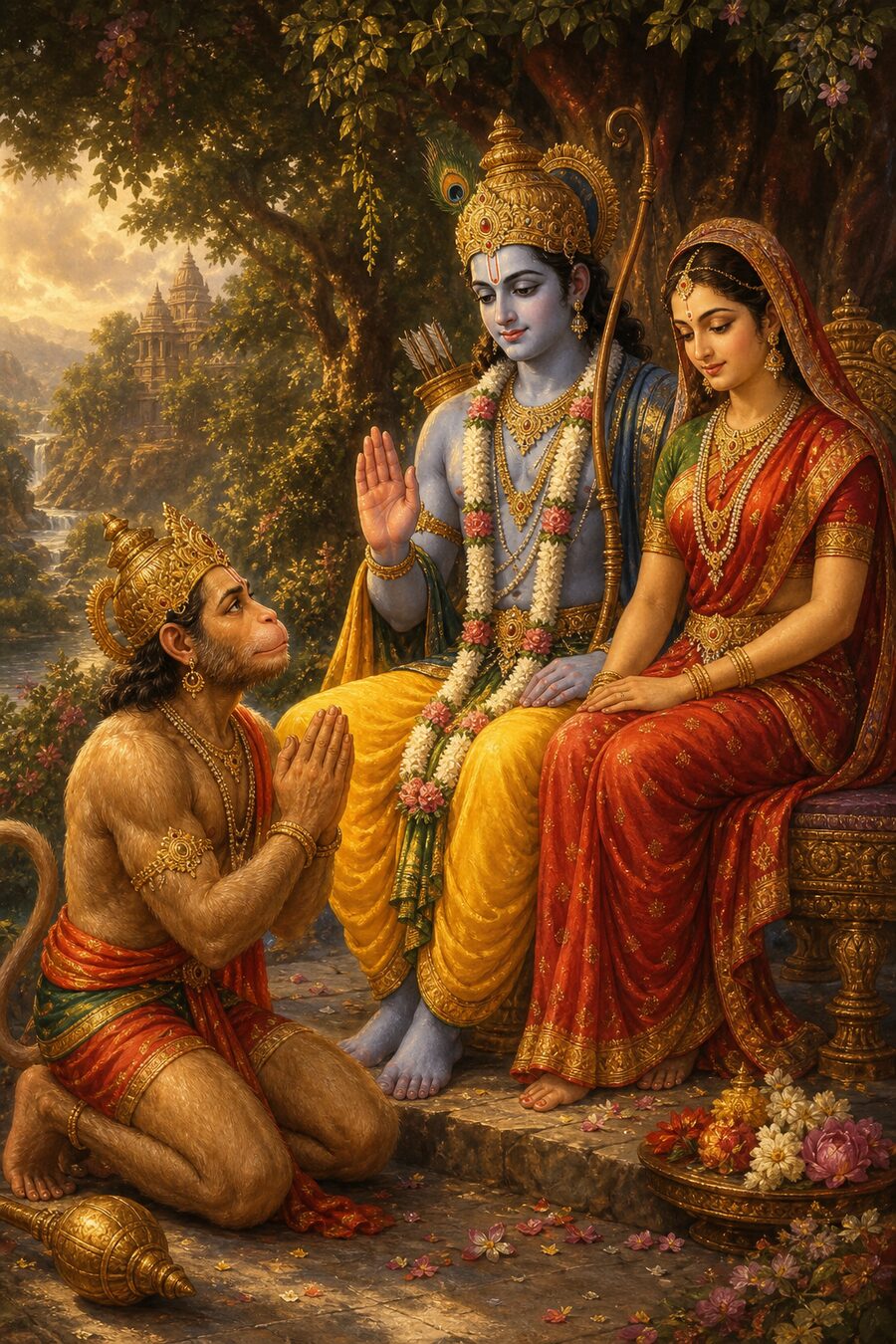
7 · “Sukshma rup / vikat rup” (the subtle form, the fearsome form)
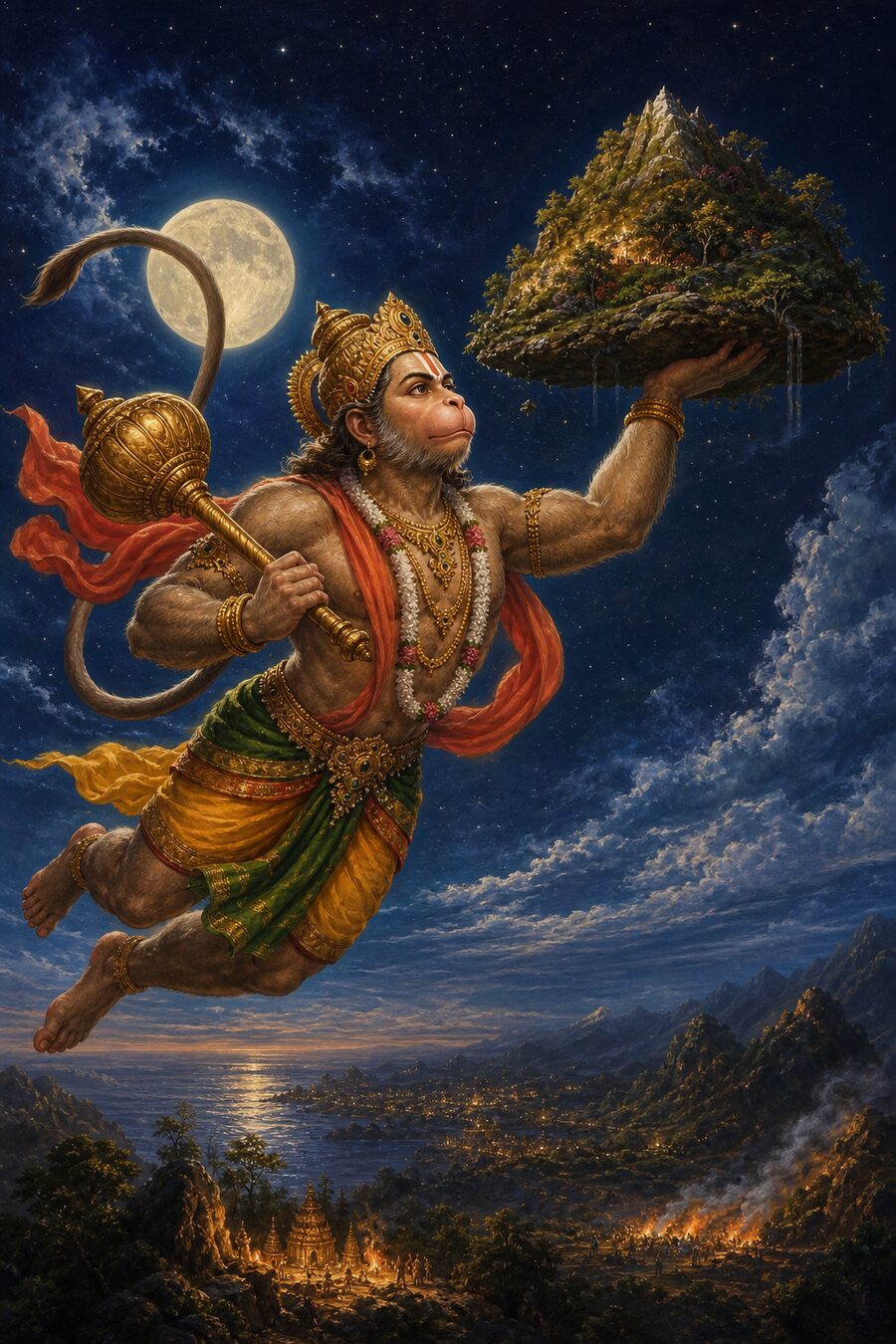
What the word says: Chaupai 9. Taking a subtle, very small form, Hanuman ji met Sita, and taking a fearsome, giant form, he burned Lanka. One line, and the entire range of him is inside it.
Seen through yoga philosophy: There is a hint here of yoga’s three bodies. The subtle form is work in the subtle body, the fine-grained exchange between two souls in the Ashoka grove, with the demons who guarded her standing close enough to hear. The fearsome form is the utmost expansion of the gross body, a display of power in the physical world. The lesson for the seeker is plain: in inner work, be subtle and calm; in outer work, come down in your full expanse.
A light resonance: In physics the same electron sometimes behaves like a point (a particle) and sometimes like a spread-out wave (de Broglie, 1924). Hanuman ji’s shifting of form and this are two different styles of one and the same thing: a single entity, drawn in tight at one moment and spread wide at another, as the need of the hour requires.
8 · “Charon jug paratap tumhara” (your glory runs through all four ages)
What the word says: Chaupai 29. Hanuman ji’s glory is present across all four yugas (Satya, Treta, Dvapara, and Kali).
Seen through yoga philosophy: Hanuman ji is held to be “chiranjivi,” the deathless one, beyond time. To be present across the “charon jug,” the four ages, means that his consciousness stays untouched while the cycle of ages rises and falls around it, forever steady and forever the same.
A light resonance: The earth’s axis turns in a slow circle called precession, one full turn in roughly 25,772 years. This is a verified astronomical event, and no human being has ever lived long enough to watch a single turn of it complete. A great, slow wheel of time, and this line of the Chalisa says there is something that does not waver even as that wheel turns.
9 · “Bhut pishach nikat nahin avai” (no ghost or spirit comes near)
What the word says: Chaupai 24. At the mere sound of Hanuman’s name, ghosts and demons do not come near.
Seen through yoga philosophy: A deeper reading is possible here, and it is worth the descent. In Sanskrit, “bhuta” also means “that which has already been,” the past, the samskaras of what is gone. And “pishacha” (pishita-asha) means a fierce craving for material pleasures. So the remembrance of Hanuman keeps both of them off the doorstep: the old samskaras of the past behind, and the longing that reaches toward the future ahead. This is Patanjali’s “yoga is the stilling of the waves of the mind” (Yoga Sutra 1.2), carried over into the language of bhakti.
A light resonance: Dwelling again and again on the past (rumination) and fierce longing (craving): modern psychology holds these two to be the root of anxiety and addiction. And the remedy it suggests is returning to the present, catching hold of an anchor and staying there. The remembrance of Hanuman is exactly such an anchor.
10 · “Prabhu mudrika meli mukh mahin” (the Lord’s ring held in his mouth)
What the word says: Chaupai 19. Holding Rama’s ring in his mouth, Hanuman ji crossed the ocean.
Seen through yoga philosophy: “Mudrika” means a ring, a circle, with neither beginning nor end, a symbol of the infinite. “Mukha” means the power of speech. To settle the symbol of the infinite into speech is mantra-siddhi, the state in which the divine name no longer stays apart from the breath that carries it. “Jaladhi” means the ocean of worldly existence, and “langhana” means to cross over. In kriya yoga this is exactly what happens when pranayama becomes so effortless that every breath turns into a japa of its own.
A light resonance: Research shows that a mantra repeated again and again calms the network of the brain that keeps running the constant chatter of “who am I, what do I want”. When that chatter finally stills, the ocean of the ego is crossed in a single moment, and the crossing turns out to have been shorter than the noise made it look.
11 · “Bal budhi bidya dehu mohin” (grant me strength, discernment, and knowledge)
What the word says: The prayer of the second doha: grant me bala, buddhi, and vidya, strength, discernment, and knowledge.
Seen through yoga philosophy: These three are three distinct powers, and the Chalisa keeps them distinct: bala (firmness, the strength to act), buddhi (discernment, the capacity to weigh right from wrong), and vidya (the deep knowledge that gives direction). Tulsidas asks for all three together, in one breath, at the very start of the Chalisa, before he has sung a single line of praise.
A light resonance: A well-known book on success (Angela Duckworth, “Grit,” 2016) puts perseverance toward a long goal ahead of talent, which is bala; the Chalisa asks for buddhi and vidya beside it. And a sharp point: talent by itself falls short. Without perseverance, talent scatters; without vidya, strength and discernment stay directionless, moving fast and arriving nowhere. You need all three together, exactly as Tulsidas asks.
12 · “Jai jai jai Hanuman gosain” (victory, victory, victory to Hanuman, master of the senses)
What the word says: Chaupai 37. Victory to Hanuman the “gosain,” a call for grace like that of a beloved guru.
Seen through yoga philosophy: “Gosain” = go (the senses) + swami = the master of the senses. In the Nath tradition this is the perfected purusha who has mastered all his senses. So Tulsidas is calling out to Hanuman ji in both forms at once, as a deity and as a complete yogi, and asking the yogi for what only a yogi can hand over. The Gita’s 2.61 says exactly this: bring all the senses under control and abide there.
A light resonance: In psychology there is a capacity, the ability to check an impulse, to defer an immediate pleasure and hold out for a larger goal (executive function). To be a “gosain” is the utmost state of this very capacity. And the famous “marshmallow test” (Mischel, 1972) showed that the children who could wait often turned out better later in life. To be the master of the senses is a matter of great practical use even today, in a world built to make the waiting hard.
13 · “Hoy siddhi sakhi Gaurisa” (success comes, with Shiva as witness)
What the word says: Chaupai 39. Whoever reads this Chalisa will attain siddhi, and the witness to it is Gaurisa (Shiva).
Seen through yoga philosophy: A sutra of Advaita is hidden here, and it is a beautiful one. Gaurisa means Shiva. And Hanuman ji is held to be a portion of Shiva himself (a Rudra-avatara). So the one who gives the promise, the one who will fulfill it, and the one who stands witness to it are all three a single consciousness, wearing three names for the length of one line. Shankaracharya’s famous sutra, “Brahman is real, the world is illusory, and the individual self is not separate from Brahman,” sits complete inside one small chaupai of devotion.
A light resonance: In physics there is a point of the same shape: the one who measures, the process of measuring, and the thing being measured cannot be fully pulled apart from one another. The physicist John Wheeler called this a “participatory universe,” one in which the observer takes part. This is “sakhi Gaurisa,” Shiva as witness, translated into another language: the seer, the seen, and the act of seeing, all one.
The Son of the Wind · What does “pavan” really mean?
“Pavanaputra Hanuman,” this sense arrives in the very second chaupai of the Chalisa, as “pavanasut,” so early that most reciters go past it without a glance. The common understanding is that Hanuman ji is the son of the wind god, of the gale and the breeze. But pause a moment on it. In Vedic and Upanishadic literature the word “pavan” or “vayu” is no small thing.
The three layers of pavan:
One, physical pavan. The air we draw into the breath, the air that stirs the trees and makes the weather, the one layer of the word everybody already has.
Two, pavan the deity. One of the chief gods of the Rig Veda, invoked first of all in the yajna, before the other names are spoken.
Three, pavan as the sutratman. And here lies the real point, the one worth the whole descent. The Upanishads call pavan the invisible element that threads the whole of creation onto a single string. The Brihadaranyaka Upanishad (3.7.2) calls vayu directly the “sutratman,” the thread, the string that is present in all, that joins all, and yet is never once itself seen.
So pavan is also the name of a cosmic element, the one that binds everything together and stays hidden from the eyes the whole time it is doing the work.
A light resonance. In 1865 James Clerk Maxwell gave the theory of electromagnetic waves. And here is the delightful part: some properties of these waves sit close to the Upanishadic definition of pavan. They are invisible (most of their range goes unseen by the eye). They carry energy and information (light, radio, wifi, mobile signals, all of it runs on them). And like an invisible thread they hold the world together while nobody watches. This makes an interesting match with the role of the sutratman; again, a resonance and only that.
So what is the deeper sense of being “Pavanaputra”? At this level Hanuman ji reaches well past the “son of the wind.” He becomes the embodied form of that prana-energy which holds the whole of creation together, and which appears in him as bhakti, strength, and knowledge. In this deeper sense he is the son of prana, and prana is the very thread that binds the cosmos.
A small distillation
The eight siddhis say there is no fathoming the reach of human consciousness, and no bottom to sound for.
The nine treasures say real wealth lives in the giving away, and grows in the hand that opens.
Ahiravana teaches that the greatest enemy hides in the darkness within, and knows your own faces well enough to borrow one.
The hundred recitations tell us that repetition is the oldest and most reliable method of change.
And “Pavanaputra” shows that Hanuman ji’s very identity is tied to that cosmic thread which binds all together.
The Hanuman Chalisa is truly a many-layered work, and every layer of it is complete. On one layer it is a children’s story: a monkey ate the sun, leaped the ocean, killed demons. On another layer it is the gist of the yoga shastra: mastery of the senses, pranayama, mantra. And on a third layer, a glimpse of a whole cosmos, threaded on one string.
This was the true genius of Tulsidas: he wove all these layers into a single work in such a way that an unlettered villager and a learned Vedantin could each find a depth of their own in it, recite the same forty lines, and each go home satisfied. Stop at whichever layer is calling you today. The other layers are going nowhere.
Come back
This deep dive comes to its close right here. Return to the main Hanuman Chalisa, and now, knowing these layers, a few of the chaupais will read a little differently.
Keep one question in your pocket: which one of these thirteen words felt closest to you today? Just stay with that single one for a few days, and let the other twelve wait. Depth does not open to haste.
The same story, elsewhere
- Hanuman
Character profile: the complete life of Hanuman - Chapter 19 · The Crossing of the Ocean (Mainaka, Surasa, Simhika)
Valmiki Ramayana: the crossing of the ocean - Chapter 22 · The Burning of Lanka and the Return
Valmiki Ramayana: the burning of Lanka - Hanuman: An Avatar of Shiva
Shiva Purana: Hanuman as an avatar of Shiva - Hanuman Chalisa
Tulsidas’s Hanuman Chalisa