On this page
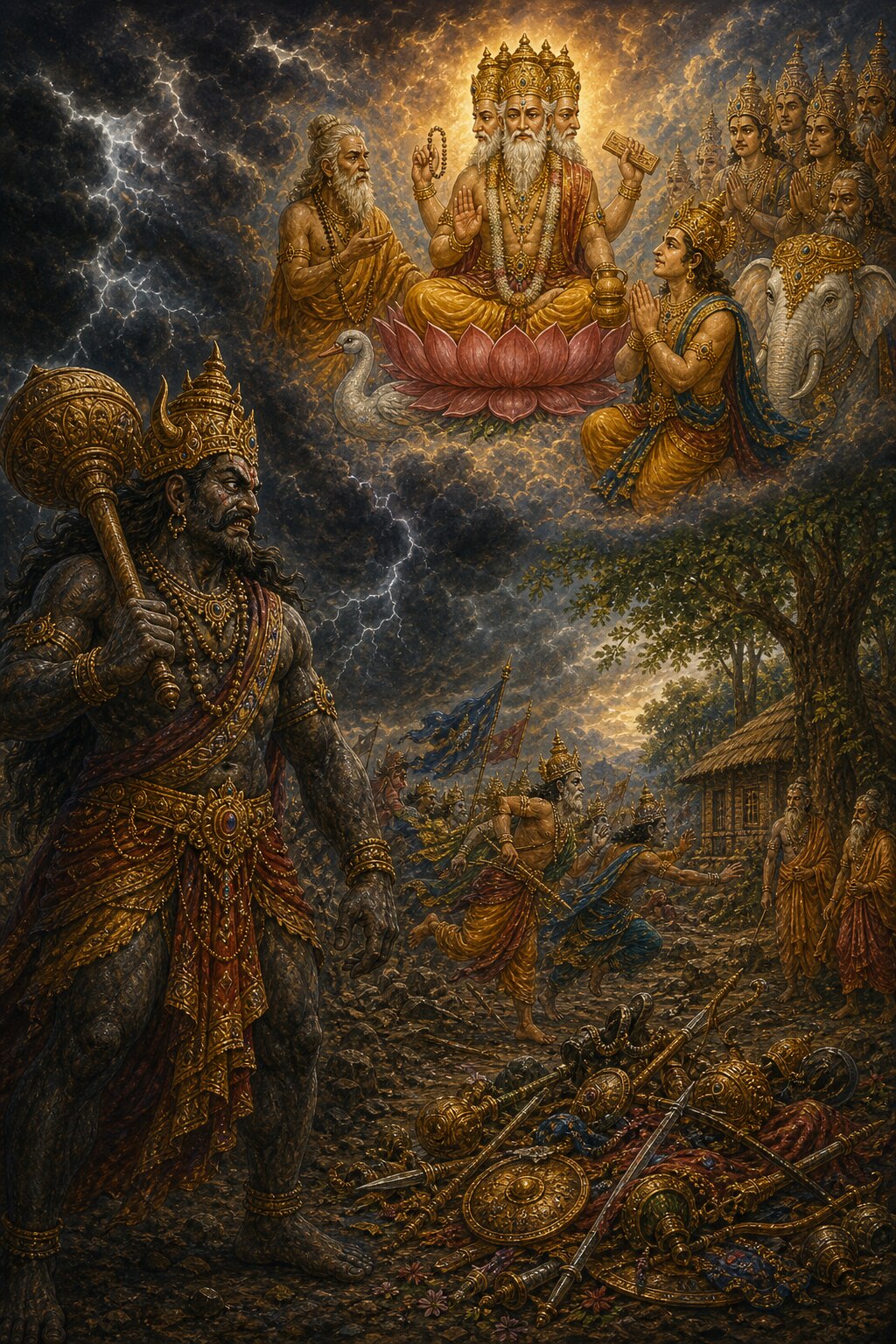
Listen: this story rises from the hour when the throne of heaven was trembling. Nandishvara had told Sanatkumara to receive, with a glad heart, the account of Maheshvara’s most exalted incarnation, the one named Pippalada, a story that swells the roots of devotion. It began this way. There was a time when the daityas, drawing on the strength of Vritrasura, defeated Indra and the whole company of the gods in open battle. And here is the thing that decided it before it began. Long before that day, every one of the gods had left his weapons for safekeeping at the ashram of the sage Dadhichi, where nothing profane could touch them and no enemy would think to look. So when the daityas came, the lords of heaven went out to meet Vritrasura with nothing in their hands, and they were beaten immediately. Those who only yesterday were called lords of the three worlds were, that day, running to save their lives. Then, still reeling from the blows, Indra and all the gods and the divine seers went straight to Brahmaloka, and there, before Brahma, the grandfather of the worlds, they poured out the whole of their sorrow.
When Brahma had heard them out, he laid the whole secret bare, exactly as it stood. This, he said, is all the work of Tvashta. It was Tvashta who, through his tapas, brought Vritrasura into being for the one purpose of destroying you. The demon is filled with tremendous inner strength and burns with his own brilliance, and he has now installed himself as overlord of every daitya. So you must contrive some means by which he can be killed. Listen, and for the sake of virtue I will tell you the means myself.
The Remedy Brahma Prescribed
Then Brahma turned his gaze to the king of the gods and spoke. Wise Indra, out of duty I will set one remedy before you in this matter, so listen closely. There is a great sage named Dadhichi, born of Chyavana in the line of Bhrigu, a man of deep austerity who has mastered his senses and stands as a great devotee of Shiva. Long ago, by propitiating Shiva, he won this boon: that his bones should become hard as the vajra. Your weapons are already lying in his ashram. Go there once more, and this time beg him for those bones. He will surely give them; there is no doubt in it. Then have a thunderbolt staff forged from them, and with it kill Vritrasura without hesitating.
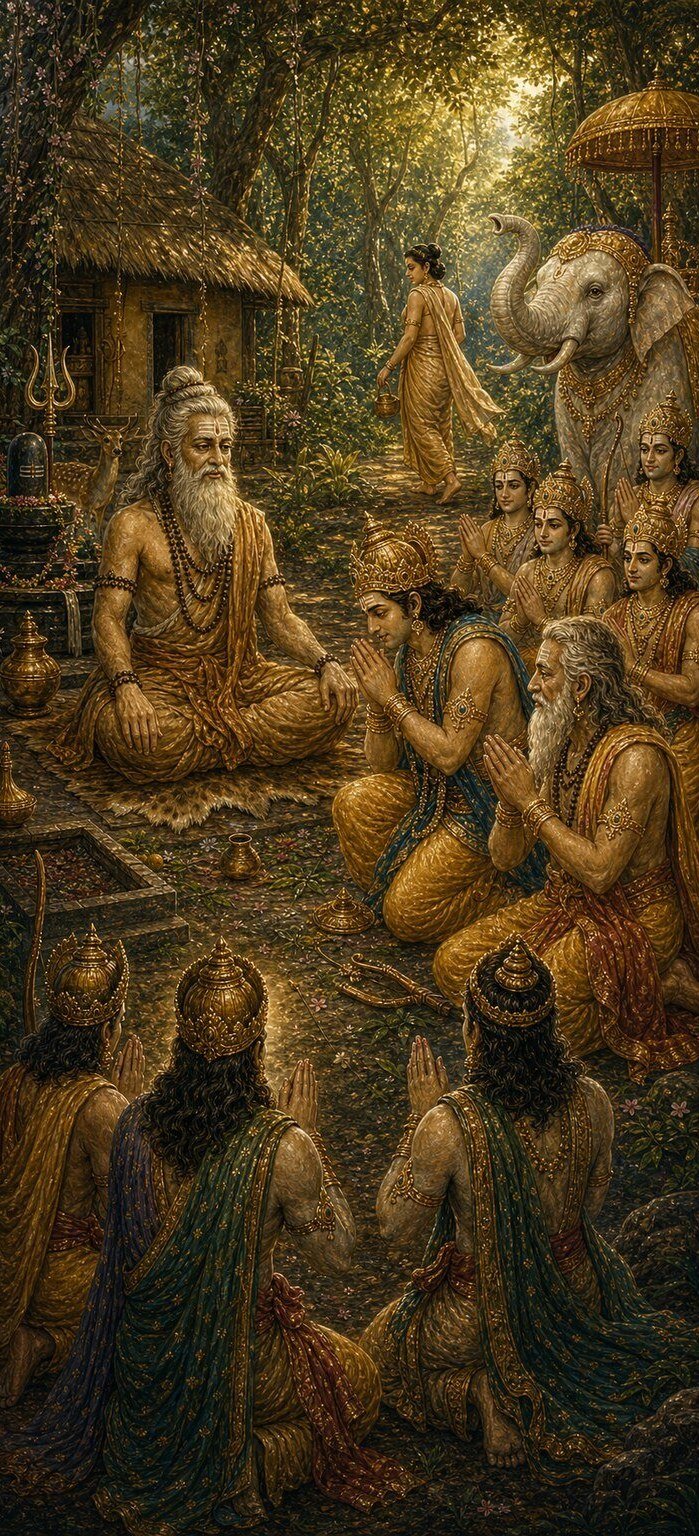
On hearing Brahma’s words, Indra took the preceptor of the gods, Brihaspati, along with the other gods, and came at once to the fine ashram of the sage Dadhichi. There he beheld the sage seated beside his wife, Suvarcha, and folded his hands in respectful greeting. Brihaspati and the rest of the gods bowed their heads as well. Now Dadhichi stood first among the learned, and the moment his visitors arrived he read their intent, though not one of them had said a word of it yet. He knew what they had come to ask, and he knew what it would cost, and the first thing he did was think of his wife. Quietly he sent Suvarcha away from the ashram to the inner apartments and gave her work to keep her there. Then Indra, who was skilled at securing his own ends and wholly bent upon this one, leaned on the science of statecraft and addressed the sage. Sage, he said, we are all of us oppressed by Tvashta, the gods and the divine seers together, and we come to take refuge with you, who are worthy of refuge, a great devotee of Shiva, a giver, a protector of those who come for shelter. Best of sages, grant us your thunderbolt bones, for from your bones we will have a vajra forged, and with it we will kill that betrayer of the gods.
The Gift of the Bones
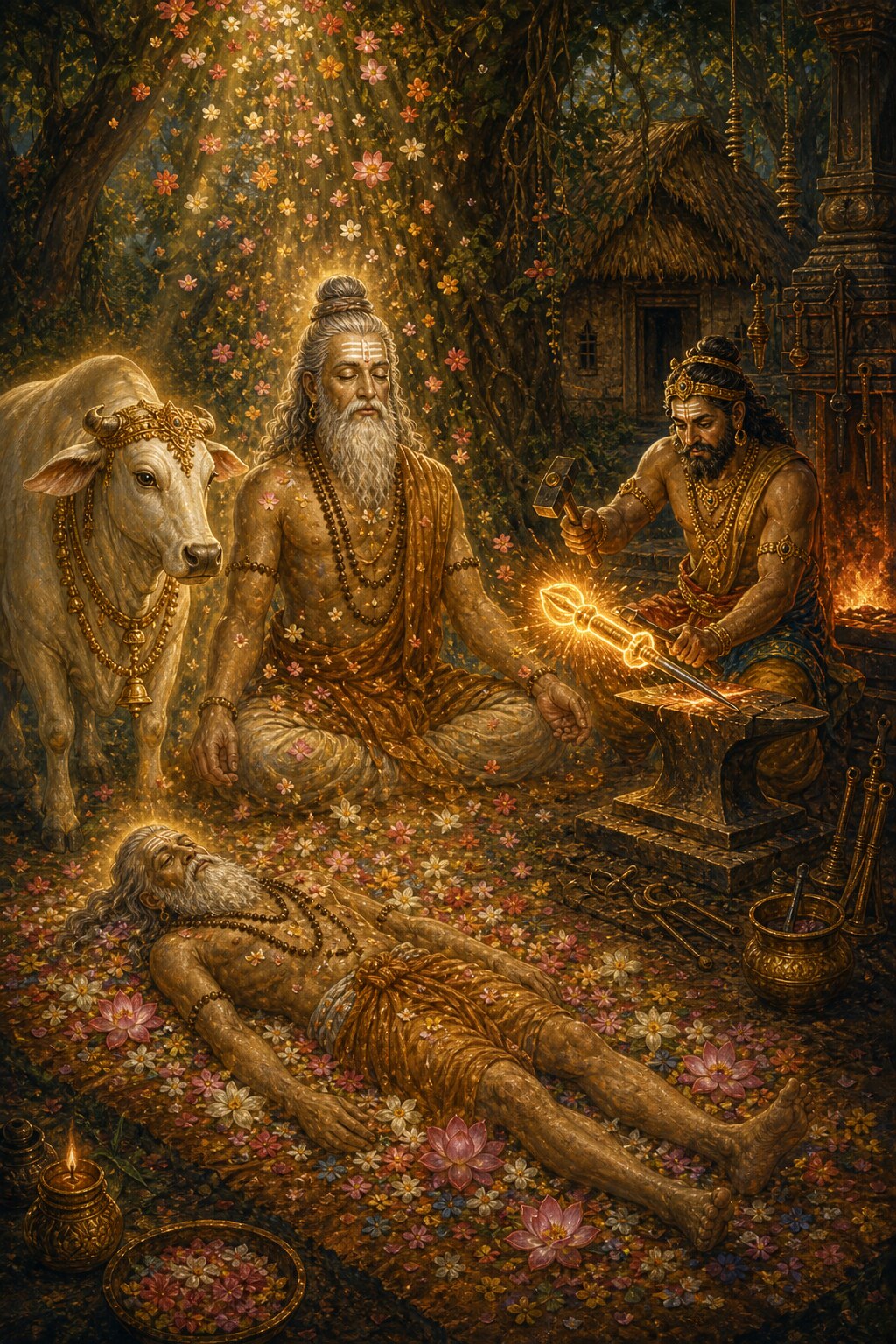
Now witness a form of giving before which the grandest of yajnas grows pale. The instant Indra finished speaking, Dadhichi, whose whole nature bent toward the good of others, fixed his mind on his lord Shiva and let go of his body. He did not argue the price. He did not ask for a day to think it over, or for a promise in return, or for the gods to find some other way. He heard the request and he was already gone. Every tie of action that binds a soul had been quashed in him long ago, so he passed at once to Brahmaloka. In that moment flowers rained down there, and everyone standing in that ashram was agreeably astonished. Indra then summoned the celestial cow Surabhi and had her lick the body clean, and he directed Vishvakarma to make the weapons from the bones. At the command, Vishvakarma, working with bones made firm and adamantine by Shiva’s own radiance, fashioned a full arsenal. From the backbone he made the vajra and the arrow called Brahmashira, and from the remaining bones he forged many more weapons besides.
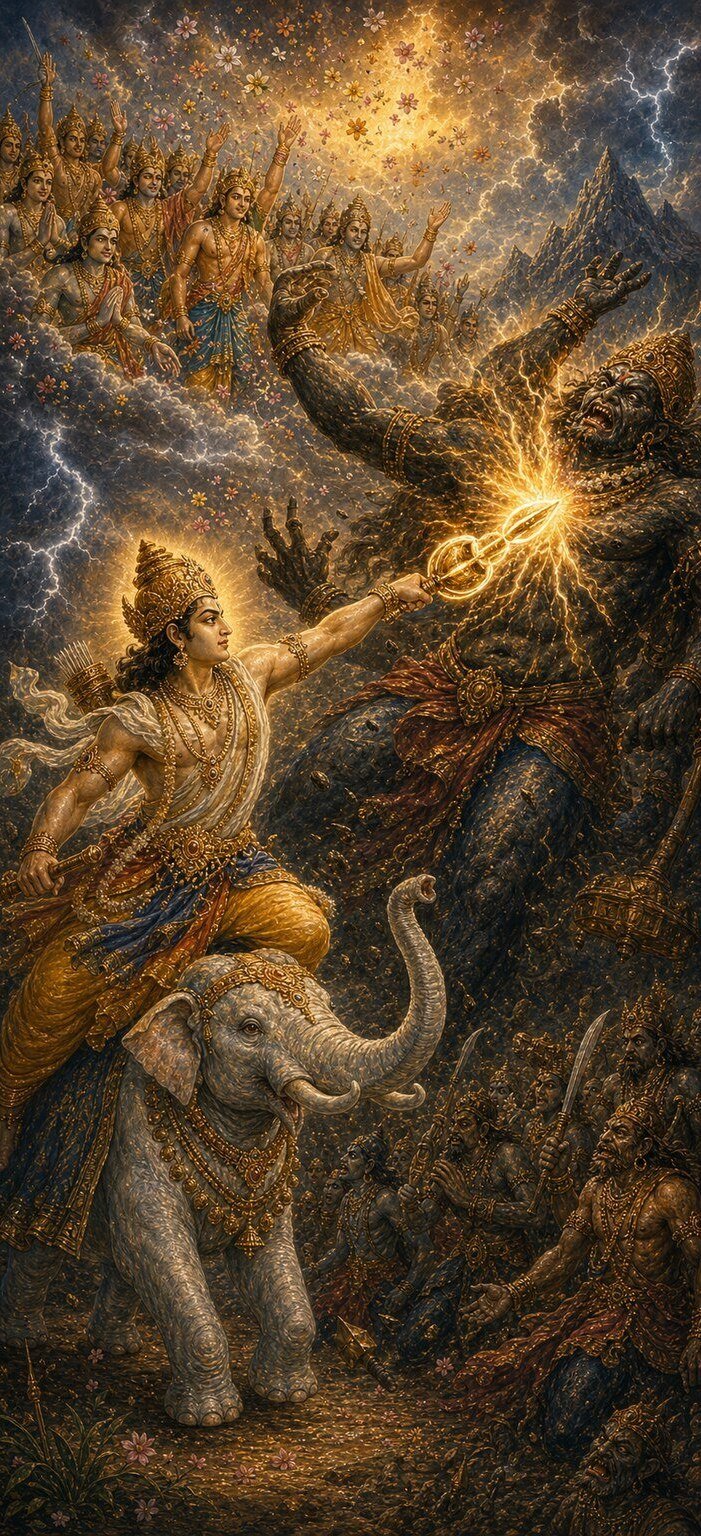
Then Indra, flourishing with the radiance of Shiva, took up that vajra and hurled himself at Vritrasura in fury, the way Rudra had once fallen upon Yama, the lord of death. There was no long duel in it. Armored and guarded and well prepared, Indra loosed his full might in an instant, and with the vajra he sheared away Vritrasura’s head, which rose like a mountain peak. The demon Tvashta had grown out of his own austerity to end the gods fell to a bone. In that hour the dwellers of heaven held a great festival of victory, flowers showered down from the sky, and all the gods rose in praise of Indra.
Suvarcha’s Curse and the Voice from the Sky
But turn back now, for a moment, toward the ashram. Suvarcha, wife of the great and inwardly powerful sage Dadhichi, had gone to the inner apartments at her husband’s bidding. She finished the work of the household as he had asked her to, and came back out, and her lord was not there. She looked at what was there instead, the most inauspicious thing she could have found, and she understood in a breath that this was the doing of the gods, and she turned on them. A curse rose to her lips. Ah, she said, these gods are wicked through and through. They are covetous and stupid, and clever, so very clever, at getting their own work done. Let every one of them, Indra included, be turned to beasts from this day by my curse. In this way the ascetic wife of the sage cursed Indra and the whole company of the gods. After that she resolved to follow her husband to his world, and with her own hands she gathered the sacred twigs and built the pyre. At that very moment, prompted by Shankara, a gentle voice spoke from the sky to reassure the sage’s wife. Wise one, it said, do not attempt this calamitous thing; hear my weighty words. Lady, the radiance of the sage lives in your womb; bring it forth with care. Afterward do as you please, for it is Brahma’s own command that a pregnant woman must never burn her own body.
With that, the voice fell silent. The sage’s wife sat amazed for a moment, yet her heart was set on reaching her husband’s world, and nothing said from the sky could move it. So she sat down and tore open her own womb with a stone. Out of it came the child of the sage Dadhichi. Its body was utterly divine and luminous, lighting all ten directions with its own splendor. Born of Dadhichi’s supreme radiance, the boy was able to work his own play, an incarnation of Rudra himself, and so he had shown himself. The instant Suvarcha, beloved of the sage, looked upon her son in his divine form, she understood in her heart that here was Rudra come down to earth. The great and virtuous woman sank into perfect bliss; she bowed low, offered praise, and held that form within her heart. Then the mother, whose longing was for her husband’s world, smiled and spoke to her son with the deepest love. Dear Parameshana, she said, take your seat near this undying tree and remain here for ages. Parameshana, be the giver of joy to all living beings, and now, lovingly, grant me leave to go to my husband’s world. Dwelling there at his side, I will keep my mind on you, on the form of Rudra.
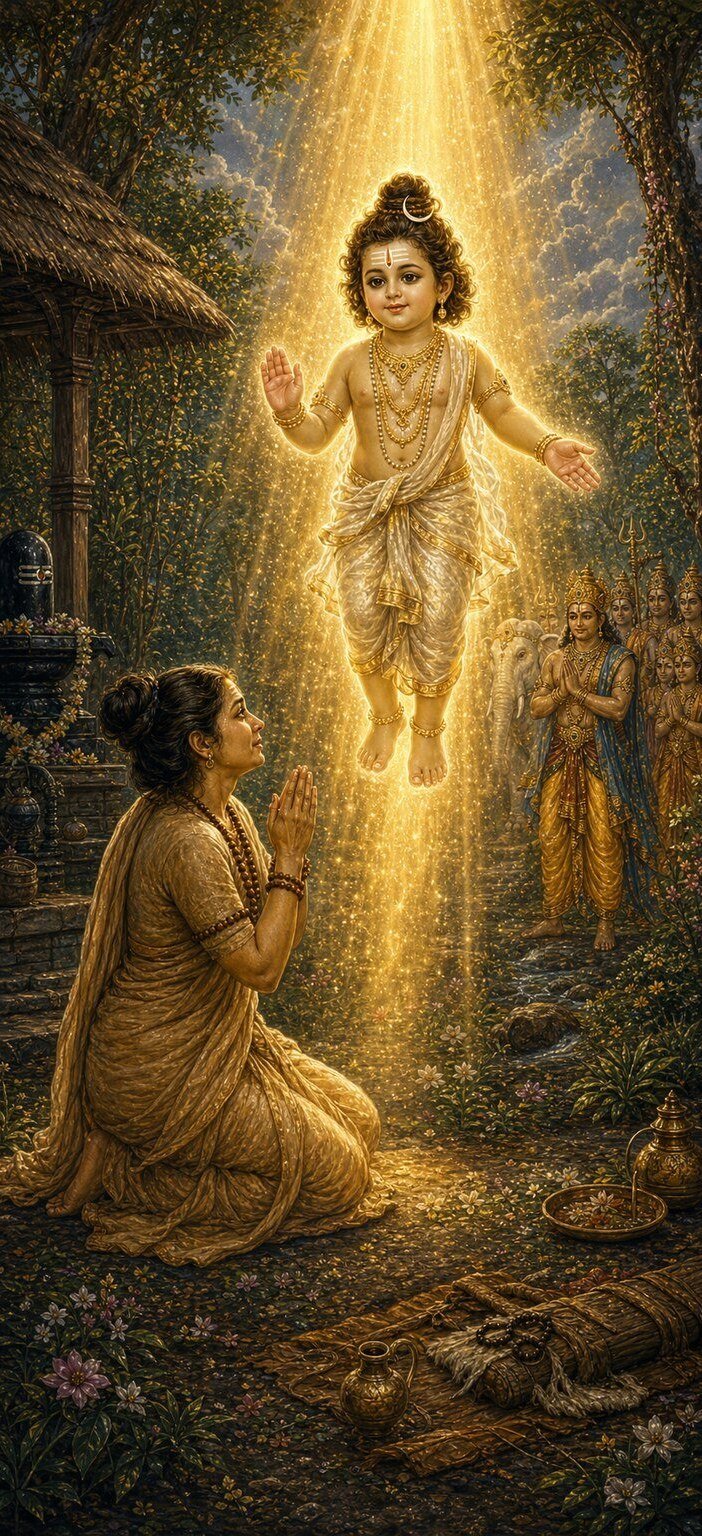
Having spoken so to her son, the virtuous Suvarcha followed her husband by entering a final, absolute samadhi, going out of the world the way he had gone, by an act of her own will and in a moment. In this way Dadhichi’s wife, Suvarcha, reached Shivaloka, was reunited with her husband, and took up the joyful service of Shankara at his side.
Pippalada Beneath the Ashvattha
Just then Indra and the whole company of the gods, full of joy, arrived there with the sages as though they had come on invitation, and Vishnu and Brahma came with their attendants to see Shiva, who had taken incarnation in the world through Suvarcha and Dadhichi. They bowed to him with folded hands. The kettledrums sounded, dancing girls danced, the sons of the gandharvas sang, kinnaras played, and the gods showered flowers. They consecrated the refulgent child and the tree that had become the father of Rudra, and Brahma, whose intellect ran fathomless, gave the child the name Pippalada. Then all the gods, having held their festival, returned each to his own realm. After that the mighty and majestic Pippalada, this incarnation of Rudra, settled beneath that same ashvattha and took up a long course of austerity for the welfare of the world. Following the ways of ordinary people, Pippalada spent a great span of time in this tapas.
Once, going down to the river Pushpabhadra for his ablution, the sage saw a beautiful young woman named Padma, who was a portion of Shiva herself, and he wanted her. He went to the house of her father, King Anaranya, who bowed to him, worshiped him devotedly with the offering of madhuparka, and gave her to him bedecked in her ornaments. Pippalada took her joyfully to his hermitage, and she served him in mind, word, and deed the way Lakshmi serves Vishnu. And then the sage, a part of Shiva, by his own divine play became a young man and sported with that young lady. The sage had ten sons, and every one of them became fierce in austerity like their father, each a credit to the line of their mother, Padma. In this way the sage Pippalada, the play-born incarnation of the great lord Shankara, performed his many kinds of divine play with great splendor.
Now hear the episode that keeps Pippalada’s name on the tongues of the suffering to this day. That merciful sage looked at the world and saw the affliction Shani lays upon it, harassing everyone, and saw that it is of a kind no one has the power to lift and that no remedy anywhere reaches it. So, with a glad heart, he granted people this boon: that human beings from birth up to the age of sixteen years, and the devotees of Shiva, can never be touched by Shani’s affliction, and this word of mine is true through and through. Should Shani ever disregard my instruction and afflict such people, he will without question be burned to ashes. It is out of this fear alone that Shani, greatest of the planets, never harms such people at any time, however restless the impulse in him and however far into aberration he has gone.
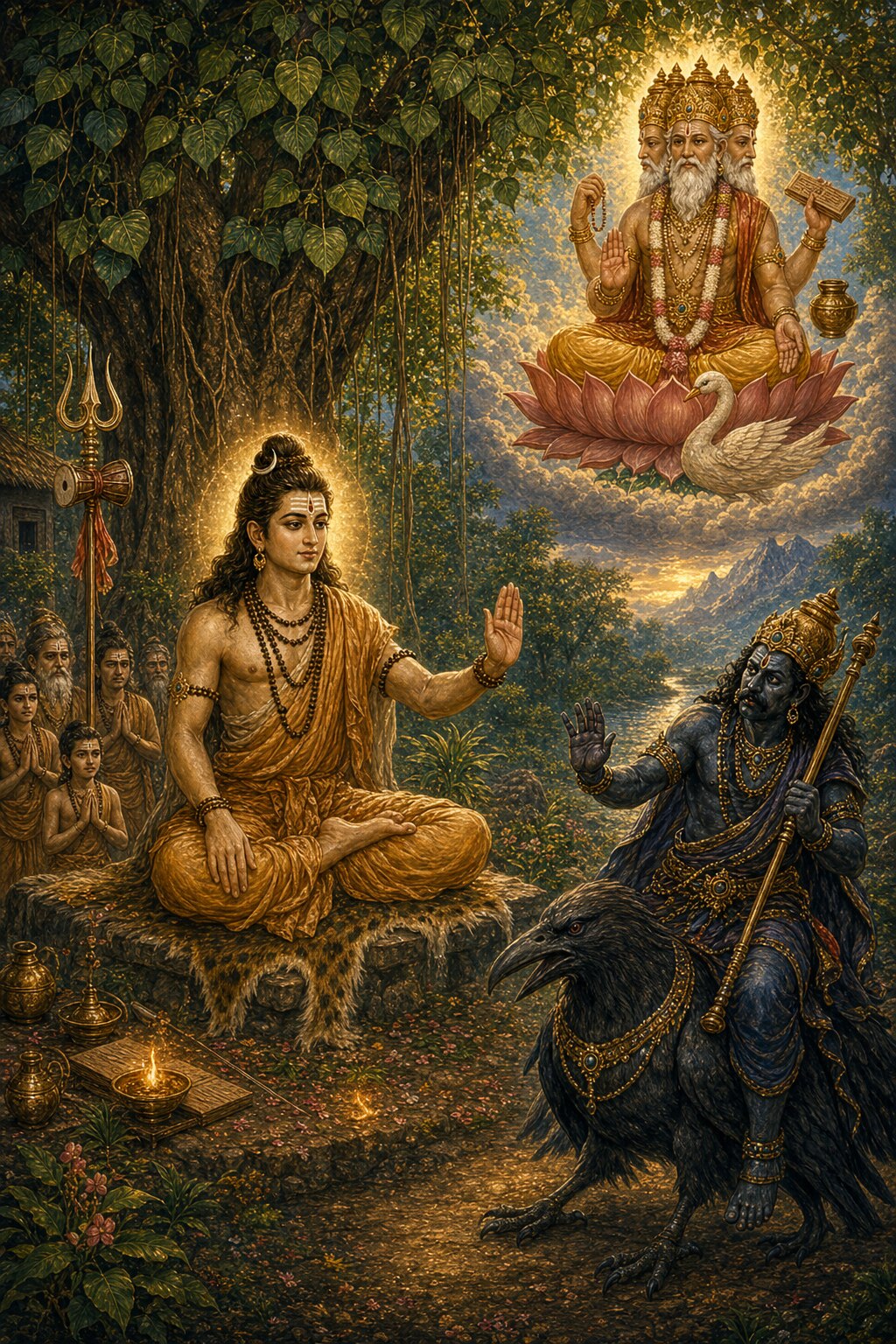
In the popular tellings this episode usually ends once the vajra is forged and Vritra is slain, yet this current of the Shiva Purana flows on past that point. Follow it far enough and the whole thing loops back on itself: the very hardness of the bones, hard as the thunderbolt, was itself a gift of the boon Dadhichi won by worshiping Shiva, so the weapon that saved the gods was Shiva’s grace all along, and so was the child who came after.
Nandishvara says that the mere remembrance of these three, Gadhi, Kaushika, and the great sage Pippalada, destroys the suffering that Shani brings, and that the man who reads the story of Pippalada and Padma, or listens to it devoutly, attains everything he wants in this world. Blessed is the sage Dadhichi, supreme in wisdom, a favorite of good men and a great devotee of Shiva, in whose house Maheshvara himself was born as a son by the name of Pippalada. This story is without flaw, a giver of heaven, a destroyer of the ills that spring from cruel planets, a fulfiller of every heart’s desire, and a special nourisher of devotion to Shiva.
Source: Shiva Purana (Gita Press, Sankshipta Shivapurananka), Shatarudra Samhita