On this page
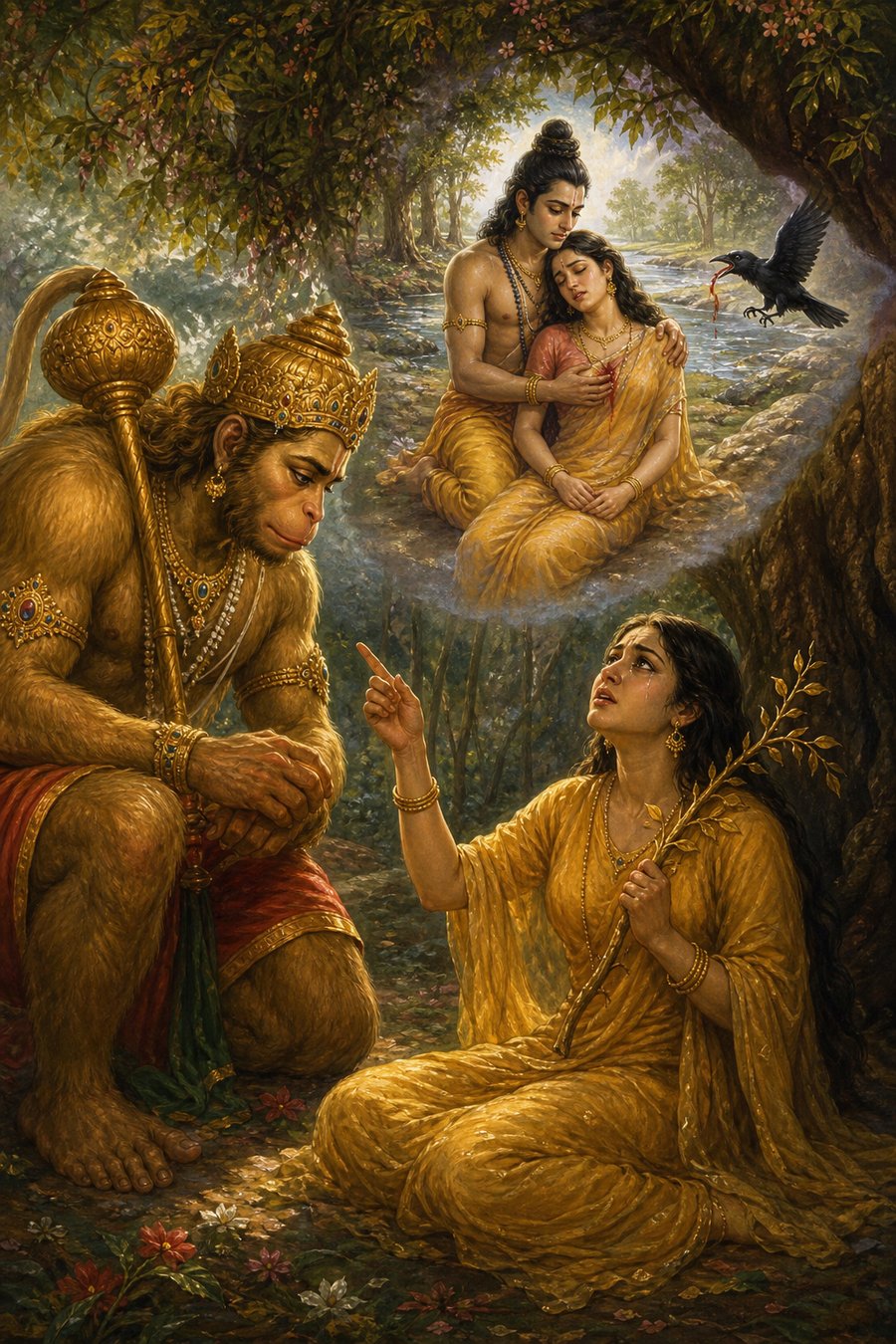
Freed by Sita‘s gracious words of leave, Hanuman drew back from that place and turned a thought over in his mind. The chief purpose, the sight of the queen, was accomplished; yet one small task remained, and it was the kind of task that only a soldier would think of. No mission was complete until he had measured the enemy’s strength, and he ran the four means of statecraft through his head and watched three of them fail him one after another. Conciliation does not tame a demon. A gift is wasted on people already rich beyond counting. And you cannot sow division among men drunk on their own might. Only the fourth remained, force, a plain show of prowess. If he broke Ravana’s lovely pleasure grove here and now, and in doing so drew out the enemy’s army, its ministers, its ranks of chariots and elephants and horse, and learned which side would prove the heavier in war, then and only then would he be truly obeying his master Sugriva. The demons would turn meek only once their foremost heroes had fallen; and the one who carries off many lesser tasks after the chief one is done, without marring what he has already won, is the one who truly accomplishes his purpose, for no task in the world has only a single road to it. This grove, rival of Indra’s Nandana, he would consume as fire consumes a dry wood. Then Ravana in his anger would lead out his host of horses, great chariots and elephants armed with iron tridents and spears, a fierce struggle would follow, and once he had crushed that army he would go back to Sugriva content. A garden was the one thing in Lanka whose destruction would cost the king something personal and cost Sita nothing. So the son of the Wind resolved to lay waste the beautiful pleasure garden that adjoined Ravana’s inner apartments.
The wrecking of the Ashoka grove and the slaughter of the Kinkaras
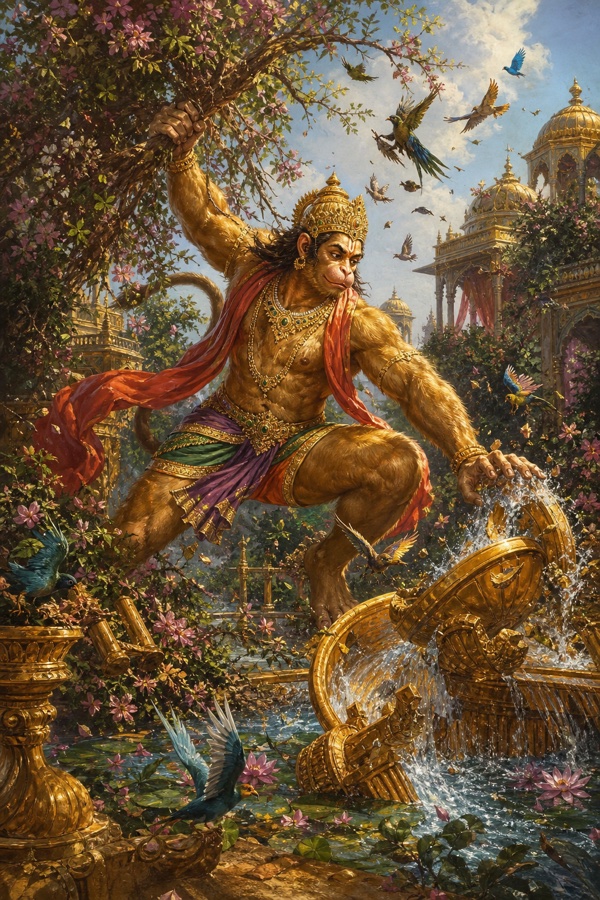
Swift as the wind and terrible in his strength, the son of Maruta began to break the trees with the great thrust of his thighs. He trampled that pleasure garden, thick with all manner of trees and vines, until it looked like Nandana, Indra’s heavenly grove, laid in ruin. Trees came up by the roots; ponds were churned and clouded with mud; the crests of its little hills were ground to rubble. The soft copper-red shoots withered, and the creepers lay scattered like women whose garments have been pulled loose. Arbors of vine, pavilions painted with pictures, houses of polished stone, all were smashed; the tame beasts of prey, the deer, and the birds cried out in their distress. Every gold tree and jeweled step-well he had marveled at on the night he arrived, he now took apart with his hands. The whole shape and glory of that great garden was undone. Having done this thing that would cut Ravana to the heart, and hungry now to face many mighty warriors alone, Hanuman went and stood upon the arch of the garden’s main gate, blazing like the noonday sun, in plain view, waiting.
The screaming of the birds and the crash of falling trees threw all of Lanka into fear; cruel omens began to show themselves before the demons. Startled from sleep, demonesses with fearsome faces looked out on the wrecked grove and on that huge monkey. To frighten them Hanuman swelled to a vast size. The demonesses rounded on Janaka’s daughter and demanded who he was, whose envoy, from where and on what errand he had come, and what he had said to her. Sita answered that she knew nothing of these demons who could take any shape they wished; only a snake knows the ways of a snake’s feet. She herself was afraid, she said, and understood no more than that this must be some shape-shifting demon. Hearing this, some of the demonesses stayed where they were, and some ran to carry the news to Ravana.
The demonesses told Ravana that in the middle of the Ashoka grove a monkey of dreadful form and boundless daring had spoken with Sita and now stood there; that Sita had hidden his identity; that he might be a messenger of Indra, or of Kubera, or one sent by Rama in search of her. He had wrecked the whole lovely garden, they said, sparing only the shimshapa tree under which Sita sat. They begged him to punish this fierce creature harshly. Who would dare to speak with Sita, they said, the woman his own heart had claimed, unless he had already given up all hope of living? At this the demon king flared up like a funeral pyre; from the fury in his eyes fell tears like drops of burning oil from a lamp. He ordered demon heroes called Kinkaras, warriors as mighty as himself, to seize Hanuman.
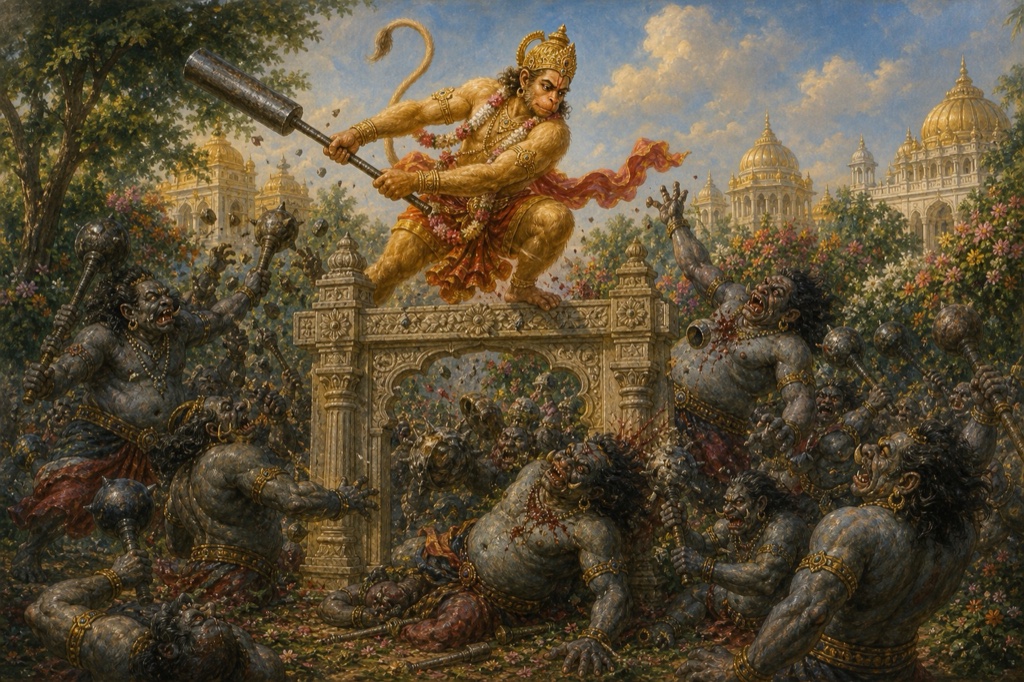
From that palace poured eighty thousand swift Kinkaras, gripping iron maces and clubs; all of them huge-bellied, great-tusked, dreadful of form and immense in strength, eager to take Hanuman. They fell upon the monkey standing on the arch as moths fall upon a flame, and they ringed him round with maces, iron bludgeons capped with gold, arrows bright as the sun, spears, lances and javelins. Hanuman slapped his tail on the ground with a roar that filled Lanka with sound, and swelled to a vast body, and at the noise birds dropped out of the sky. In a loud voice he proclaimed: victory to Rama, to Lakshmana, and to King Sugriva who has taken refuge with Raghava; he was Hanuman, servant of Rama, lord of Kosala, and had come to destroy the enemy army. A thousand Ravanas, he cried, could not stand against him in battle; he would grind Lanka down, salute Sita, and go home fulfilled before the eyes of every demon. The Kinkaras shook at his roar and looked up to see him towering in the sky like an evening cloud; then, his naming of his master having told them who he was, they rushed on him from every side with their dreadful weapons. Hemmed in, Hanuman seized a terrible iron crossbar lying on the arch and struck the night-rangers as Garuda strikes a writhing serpent; gripping it, he ranged through the air and set about the slaughter as thousand-eyed Indra destroys the demons with his thunderbolt. All eighty thousand Kinkaras were killed, and the hero planted himself once more at the gate, thirsting for battle. The few who survived carried word to Ravana that the Kinkaras were slain; and Ravana sent Jambumali, the son of Prahasta, unconquerable in war.
The slaying of Jambumali and the burning of the chaitya-palace
His slaughter of the Kinkaras done, Hanuman thought carefully; even in the middle of a massacre he was still keeping a ledger. The grove was wrecked, but the chaitya-palace, the temple-hall of the demons’ guardian deity, still stood, and it was the proudest thing in the city. So he climbed that temple, tall as the peak of Mount Meru, and shone there like the risen sun. From its height he roared again and filled Lanka with the sound. At the dreadful noise of his tail striking the stone, the birds and the temple’s guards fell down in a faint. Again he raised the same war cry: victory to Rama and Lakshmana, victory to King Sugriva whom Raghava shields; I am Hanuman, servant of Rama. A hundred guards of the temple came out with all manner of weapons, javelins, swords, and battle-axes, and ringed him about like a great whirlpool in the waters of the Ganga. Then Hanuman, enraged, tore loose one of the temple’s pillars, a pillar plated with gold and cut with a hundred edges, and whirled it; the friction kindled a fire, and the temple began to burn. Like Indra with his thunderbolt, he killed all hundred guards with that same pillar. The demons’ own holy house had given him both his weapon and his fire.
Standing in the air, Hanuman proclaimed that Sugriva commanded thousands of monkey chieftains as mighty as himself, ranging over the whole earth; some with the strength of ten elephants, some ten times that, some the equal of a thousand elephants. Soon Sugriva would come ringed by such monkeys in hundreds, in thousands, in hundreds of thousands, in tens of millions; and then there would be no Lanka left, no demons, and no Ravana, who had made an enemy of Rama. He was one monkey standing on a burning temple, and he was describing the arithmetic of what was coming.
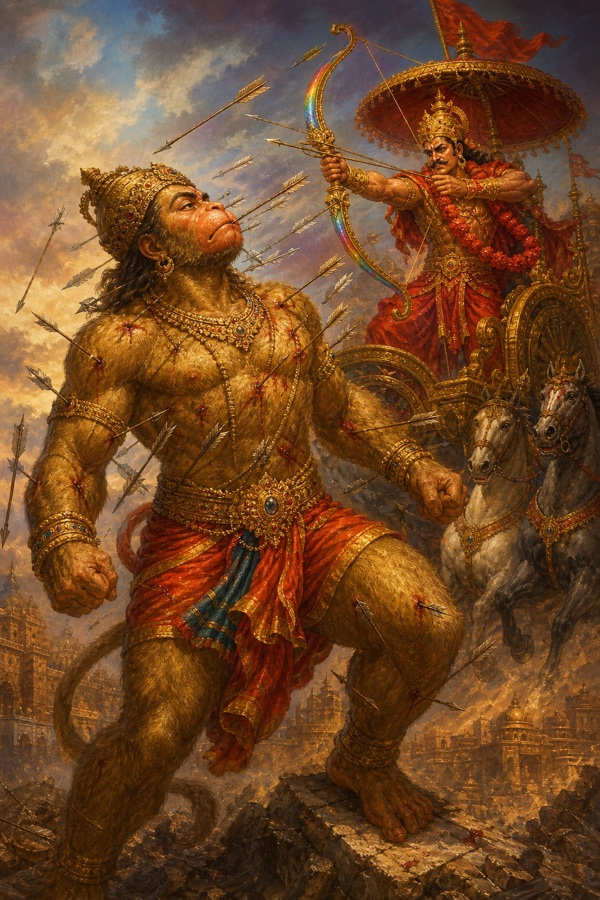
At Ravana’s command the strong son of Prahasta, Jambumali, a great-tusked archer, came out bearing a great bow like a rainbow. He wore a red garland and red robes, fine earrings, and had rolling eyes; he was unconquerable in battle, and the twang of his bowstring rang like thunder and lightning. Seeing Jambumali come in a chariot yoked to donkeys, Hanuman rejoiced and roared, because here at last was a real archer, and a spy learns nothing from easy work. Jambumali pierced Hanuman where he stood on the arch with sharp arrows: a crescent-headed shaft in the face, a barbed one in the head, and ten iron arrows in the arms. Pierced by the arrows, his copper-red face shone like a red lotus opened wide and lit by the rays of the autumn sun.
Enraged, Hanuman tore up a great rock nearby and hurled it, but Jambumali shattered it with ten arrows. Then Hanuman uprooted a huge sal tree and whirled it, but Jambumali cut the tree apart with four arrows, and struck the arms with five, the breast with one, and pierced the chest with ten more. Twice now the archer had answered him, and Hanuman had learned what he came to learn. His body filled with arrows, in a great fury he raised that first iron crossbar, whirled it with tremendous force, and brought it down on Jambumali’s broad chest. Under that blow no head could be seen, no arms, no knees, no bow, no chariot, no donkeys, no arrows; the great charioteer fell lifeless to the ground, his body ground to powder, like a felled tree. Hearing that Jambumali and the Kinkaras were dead, Ravana’s eyes went red with rage, and he gave the order to the mighty sons of his chief minister.
The slaughter of the ministers’ sons and the five commanders
At Ravana’s command the seven sons of his chief minister came out, blazing like fire, mighty, of boundless valor and skilled in the science of weapons, with a great army. Their chariots were sheathed in golden armor, dressed with flags and pennants, and thundered like storm clouds; splendid as clouds charged with lightning, they made their bowstrings sing. Hearing of the Kinkaras’ death, their mothers, with their kinsmen and friends, were seized with grief and dread, for the whole city now knew what waited on that archway. Vying each to outrun the other, the seven fell upon Hanuman where he stood unmoving and poured arrows on him as the monsoon clouds pour rain. Buried under the arrow-storm, Hanuman was lost from sight like the king of mountains hidden in cloud; but the swift monkey, ranging through the clear sky, dodged their arrows and the rush of their chariots as easily as the Wind-god sports among the clouds.
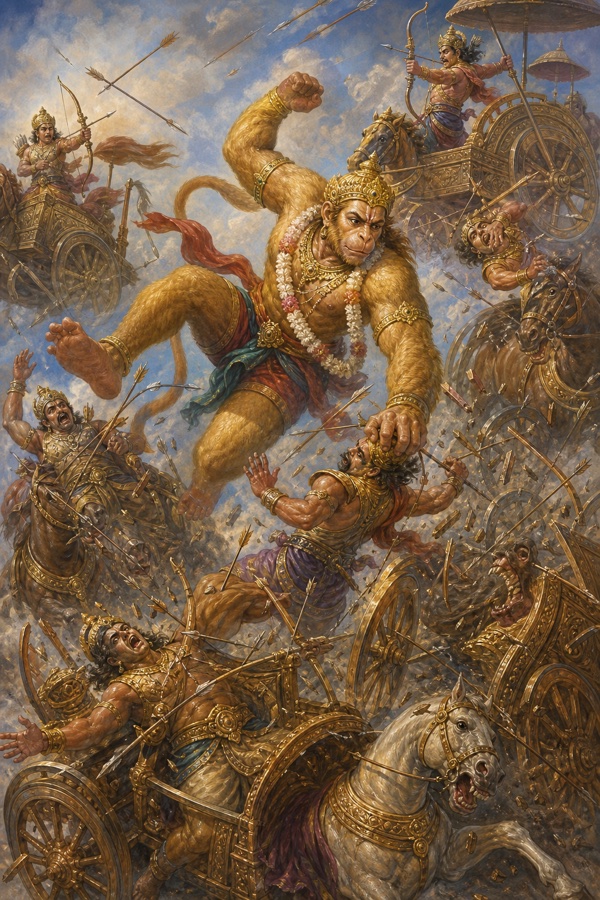
With a fearful cry Hanuman swooped on the demons. Some he killed with an open-handed blow, some with a kick, some with his fist, some he tore with his nails; some he crushed against his chest, some between his thighs, and some fell dead at the mere sound of his roar. He had no weapon at all now, and he did not need one. When all seven of the minister’s sons were dead, what remained of the army fled to the ten directions; the elephants trumpeted in broken voices, the horses fell, and the ground filled with wrecked chariots. Rivers of blood began to flow, and Lanka seemed to scream in a warped voice with all its many cries. Having destroyed those arrogant demons, the hero Hanuman went and stood once more upon that same arch.
When word of the death of his ministers’ sons reached him, Ravana masked his face and formed a hidden resolve; a king who has begun to be afraid in front of his court must first arrange his face. He sent five of his best commanders, Virupaksha, Yupaksha, Durdhara, Praghasa, and Bhasakarna, swift as the wind and skilled in strategy, to take Hanuman prisoner. He said that from what he had seen he no longer held this to be an ordinary monkey; surely it was some creature of vast power, perhaps fashioned by Indra through the strength of his austerities to destroy them. He had seen monkeys before, Vali and Sugriva, Jambavan, Nila, and Dvivida, yet the speed, the fire, the cunning, and the strength of this creature in monkey shape were a marvel. Gods, demons, sages, nagas, yakshas and gandharvas had all been beaten by these very warriors under his command, and one of those beaten powers must have sent this creature to do the demons harm; so they were to march with a great host of horses, chariots and elephants, take him by force, and never think him a small thing. Not even the three worlds with Indra could stand before them in battle. Even so, Ravana bade his commanders take care, act as time and place required, and guard their own lives, for victory in battle is never certain.
Taking their lord’s command upon their heads, the commanders, blazing like fire, went out on rutting elephants, on horses of tremendous speed, and on chariots. They saw Hanuman on the arch, radiant as the risen sun. Durdhara buried five sharp arrows in his head; pierced, Hanuman leapt into the air and made the ten directions ring. Durdhara loosed arrows by the hundred, but Hanuman checked them with his roar alone, then suddenly dropped like a thunderbolt onto Durdhara’s chariot; the eight horses were crushed, axle and yoke snapped, and Durdhara fell dead to the earth.
Seeing Durdhara down, Virupaksha and Yupaksha sprang into the air in fury and beat Hanuman’s chest with their maces. Checking their rush, Hanuman came down to the ground like Garuda, tore up a sal tree, and struck the two heroes dead. Seeing three of them slain, Praghasa with his pike and the enraged Bhasakarna closed on his flanks; Praghasa struck at Hanuman with a sharp battle-spear and Bhasakarna with a lance. Bright as the rising sun and burning with anger, Hanuman uprooted a mountain crag, with beasts and serpents and trees still on it, and crushed both demons to dust. When all five commanders were dead, Hanuman destroyed the remnant of their army, dashing horse against horse, elephant against elephant, warrior against warrior, chariot against chariot, like thousand-eyed Indra destroying the demons. Then, terrible as the fire of doom and waiting for his moment, Hanuman went and stood again upon the arch.
The slaying of prince Aksha
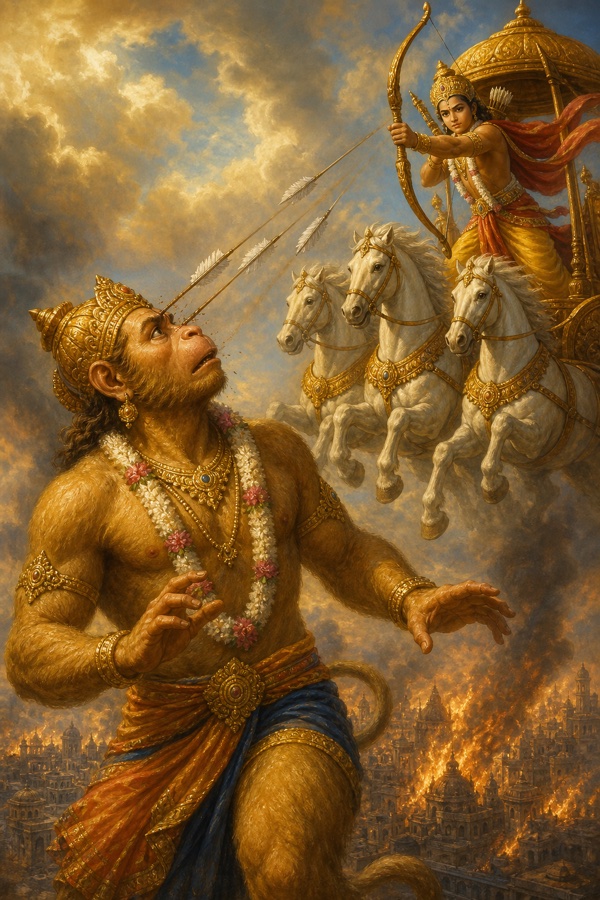
Hearing that his five commanders were dead, Ravana turned a considering look toward his war-eager son, prince Aksha. He did not give an order. He only let his eyes rest on the boy, and that was enough. Stirred by his father’s glance alone, the brilliant young prince, armed with a bow figured in gold, sprang up in the assembly like fire leaping when the brahmana pour clarified butter into it. Bright as the young sun, he mounted a chariot plated with a mesh of burning gold, yoked to eight fine horses swift as thought, a chariot unconquerable even for gods and demons, that moved through the sky without support, furnished with quivers, eight swords, spears, and javelins; and so Aksha advanced on the great monkey Hanuman. Filling sky and earth with the din of horse and elephant and chariot, he came with his army.
Hanuman, poised like the fire of doom to destroy demons, was surprised that so slight a boy had come to fight. With lion’s eyes Aksha looked on him with a proud gaze. Fierce with pride in his own valor, Aksha pierced Hanuman with three sharp arrows and challenged him. Pierced by those three gold-feathered shafts and streaming blood, Hanuman, radiant as the risen sun, shone as if wreathed in rays. Seeing Aksha ready as an offering to the fire, Hanuman swelled with joy and roared. Between the two there was a battle so strange that gods and demons alike marveled; the earth screamed, the sun grew dim, the wind stood still, Mount Trikuta trembled, and the sea grew troubled.
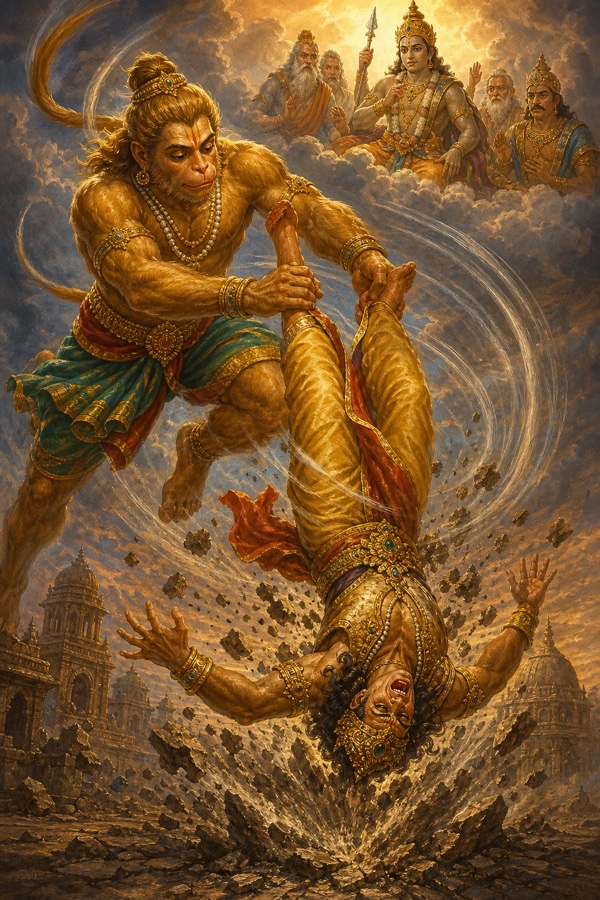
Seeing Hanuman’s valor rise, Aksha’s fire and strength and the speed of his arrows rose too, like the sun at the hour of doom. He filled the sky with an arrow-storm, and when Hanuman sprang up into the air the prince drove after him in his chariot, covering him with shafts as a cloud covers a mountain with hail, while Hanuman darted like the wind between the arrows. Hanuman thought within himself: “This is no mere boy; he does deeds beyond a boy, and my heart is unwilling to kill him. He is brave, steady, honored even by gods and yakshas and sages. Yet if I let him be, he will only grow stronger; it is not wise to ignore a rising fire. So now it is right that he die.” Resolved on it, the son of the Wind quickened his speed. First he killed all eight of Aksha’s fine horses with open-handed blows; with the axle broken and the horses dead, that great chariot fell out of the sky to the earth. Then Aksha sprang into the air with bow and sword, like a sage who has cast off his body through yoga and rises to the world of the gods. Hanuman chased him through the sky, seized both his feet firmly, and, as Garuda seizes a great serpent, whirled him a thousand times and dashed him with force to the ground. The demon’s arms, thighs, waist, and chest were shattered, his bones and eyes crushed, his joints pulled apart. When Aksha was slain, the gods, Indra, the sages, the yakshas, and the serpents marveled, and Hanuman filled Ravana’s heart with a great fear. Having slain that prince, who had been the rival of Jayanta, Indra’s son, Hanuman went and stood once more upon the arch, watching for his next moment.
Indrajit arrives and the Brahmastra binding
Even with Aksha slain, Ravana steadied himself and summoned his eldest son, the god-like Indrajit. “In all the three worlds,” he said, “there is no tireless warrior to match you; you are guarded by the strength of your arms and by austerity, a knower of time and place, and supreme in judgment. You are the first among masters of celestial weapons; by your worship of Brahma you have won divine arms. Before the power of your weapons the gods with Indra and the Maruts cannot stand. All the Kinkaras, Jambumali, my seven ministers’ sons, my five commanders, and your own dear brother Aksha are dead; now my only trust is in you.” He was reading out the night’s losses to the one son he had left, and the list took a while. “Call the divine bow to mind, weigh your own strength against the enemy’s, and set yourself to the task of subduing him and taking him unhurt.” He told him not to take an army, for an army before a strong enemy either flees in a body or perishes to the last man, and to carry no weapon like the thunderbolt, for Hanuman was like fire and could not be killed by any weapon. Then his voice changed. “It is no wise thought, my clear-minded son, that I should willingly send you into this danger. But you know this decision accords with the duties of a king and is approved by the warrior order. A king must master the sciences and the arts of war, and must seek victory in battle.”
Taking his father’s command upon his head, Indrajit walked around his lord in reverence and set out in a chariot yoked to four sharp-fanged tigers, flying the standard of Indra that he had seized as the token of his victory over the king of the gods. As he came forth the horizons went dark, jackals and other savage beasts howled, and covering the sky the serpents, yakshas, sages, and siddhas gathered to watch the fight. This was the warrior who had beaten Indra and taken his name from him, and the three worlds knew to come and look when he took the field. Hearing the rumble of the chariot and the twang of the bow, Hanuman rejoiced greatly, swelled to a vast form, and roared. The two heroes, each an enemy to match Indra and Bali, swift and unafraid, closed with each other. Indrajit loosed long, sharp, gold-feathered arrows swift as the thunderbolt, but Hanuman slipped between the arrows like the wind and ranged through the sky. Indrajit found no opening to strike Hanuman, and Hanuman found none to seize him; the two, god-like in valor, became unbearable each to the other.
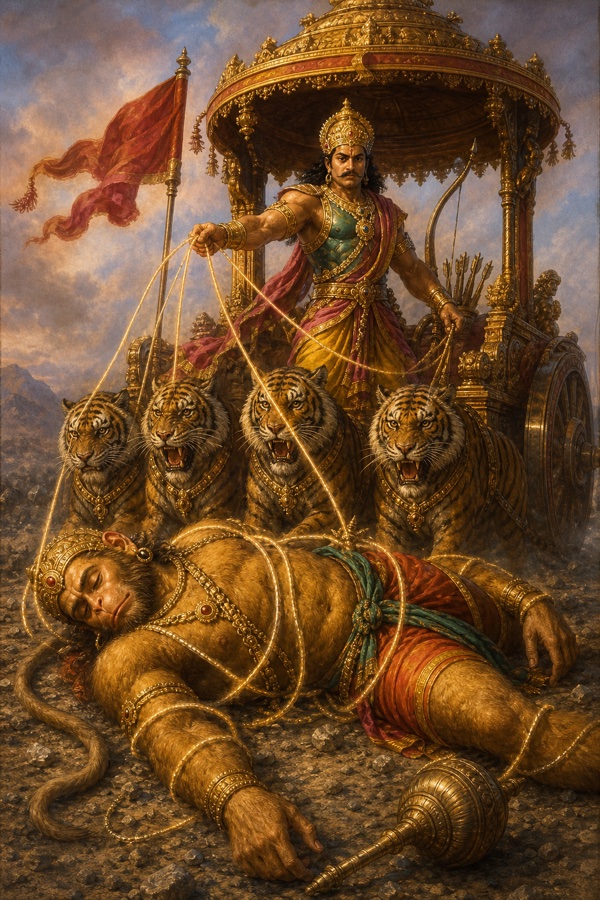
Seeing that even his unfailing arrows left Hanuman unhurt, Indrajit fell into deep thought. He understood then that this monkey could not be killed, and formed the plan of taking him captive. He loosed upon Hanuman the missile presided over by Brahma, charged with the mantras of the Self-born. Bound by that weapon, Hanuman fell motionless to the ground. Yet he knew that this was Brahma’s weapon, and that he himself had received a boon from the Grandsire; so out of reverence for Brahma, and out of a wish to meet Ravana, he accepted the weapon’s bond, though he was able to break it. He reasoned that, guarded as he was by Brahma, by Indra, and by his father the Wind, he had nothing to fear, and that being taken by the demons would give him his chance to speak with Ravana. He had wrecked a garden and killed an army to buy an interview with a king, and here it was, offered to him by the king’s own son, wrapped in the highest weapon in the worlds.
Then the demons who had come near reviled him and bound him with ropes of hemp and tree-bark. The instant they bound him with bark-rope, the bond of the Brahmastra let go, for one binding does not hold beside another. But Indrajit, understanding this, was troubled to think that these demons, ignorant of the ways of the weapon and its mantra, had wasted his great feat by binding him with rope, so that the weapon would not work again. He had won the only victory anyone would win that night, and his own soldiers had thrown it away with a length of rope, and he could say nothing about it in front of them. Freed of the weapon though he was, Hanuman gave no sign of it; he held every limb still and groaned as though in pain; and the cruel demons, beating him with their fists, dragged him toward Ravana.
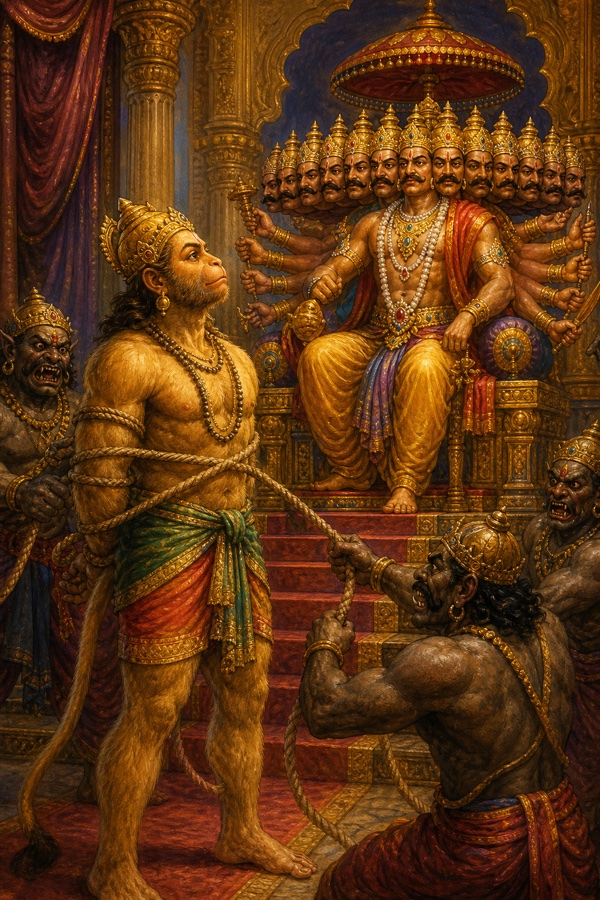
Indrajit brought that monkey leader, now held only by bark-rope, before Ravana in the royal court. The demons presented the captive, bound like a rutting elephant, to their king. Hanuman looked on the highborn, well-mannered old attendants seated there and on the jewel-studded hall; the demons were dragging him this way and that, and he was using every step of it to count doors and pillars and faces. He saw Ravana too, blazing with fire and strength, like the burning sun. “Who is this, whose is he, from where has he come, what is his errand, whose creature is he?” the demon warriors murmured; some in anger cried, “Kill him, roast him, eat him!” His eyes red with rage, Ravana ordered his highborn chief ministers to question him. Questioned in turn, Hanuman said at the outset: “I have come as the envoy of Sugriva, king of the monkeys.”
Hanuman’s wonder at Ravana’s splendor
Amazed at Indrajit’s feat, and his eyes red with anger at the sin of Sita’s abduction, the dreadfully valorous Hanuman looked at Ravana; and having crossed an ocean and burned through an army to reach this one face, he looked at it properly. He was ringed with strings of pearls and crowned with a golden diadem set with diamonds and priceless gems; he wore costly silks, was smeared with red sandal paste, and adorned with strange paintings. His twenty eyes were terrible and faintly red, his great teeth bright and sharp, his lips hanging; with his ten heads he blazed like Mount Mandara, its peaks alive with serpents. A pearl necklace on his chest, dark as a heap of black collyrium, his full-moon faces made him look like a cloud lit by the young sun. His twenty arms, decked with armlets and bracelets, smeared with fine sandal, were like five-hooded serpents. He sat on a splendid throne of strange crystal set with jewels, on a fine couch, fanned with whisks by well-dressed young women. Beside him sat four ministers who knew the essence of counsel, Prahasta, Mahaparshva, and Nikumbha among them; and he shone like the earth ringed by its four seas, like Indra ringed by the gods.
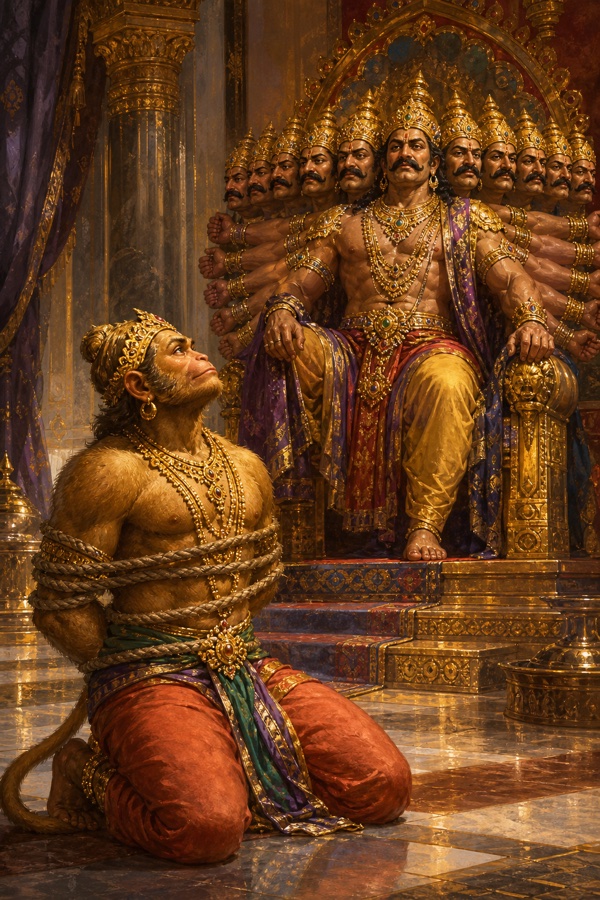
Tormented though he was by those fearsome demons, Hanuman gazed at Ravana in utter wonder and thought within himself: “What form, what steadiness, what strength, what splendor! Every mark of greatness is present in the demon king. Had he not leaned toward unrighteousness, he could have been the guardian of the world of the gods, Indra and all. Yet because of his cruel and pitiless deeds, deeds the world condemns, every creature, gods and demons alike, goes in dread of him. Roused to anger, he could turn the whole world into a single sea.” Seeing the might of the demon king of boundless fire, Hanuman fell into many such thoughts.
Prahasta’s question in Ravana’s court and Hanuman’s answer
Looking at the tawny-eyed Hanuman standing before him, Ravana, who made the world weep, filled with great anger. Troubled by suspicion, he thought: “Could this be Nandi himself, who cursed me on Kailasa when I mocked him? Or could it be Bana in monkey shape?” Old debts were surfacing in him; a man who has insulted enough of the powerful begins, late in life, to see them everywhere. His eyes red with fury, Ravana spoke fitting, meaningful words to his chief minister Prahasta, that the wretch be questioned: from where has he come, what is his purpose, why has he wrecked the grove and killed the demons, why has he entered my unconquerable city?
At Ravana’s command Prahasta said to Hanuman: “Do not be afraid; be well. If Indra has sent you to Ravana, tell the truth and you go free. If you are the envoy of Kubera, Yama, or Varuna, or one sent by Vishnu who seeks victory, speak the truth. Your fire is not that of a monkey; only your shape is a monkey’s. Tell the truth and you are freed; lie, and your life is in danger.” Every name in that list was a great power, and not one of them was Rama; the court could not imagine that a man in bark cloth had done this to them. Hearing this, Hanuman said to the demon king: “I am no envoy of Indra, nor of Yama, nor of Varuna; I have no friendship with Kubera, and Vishnu has not sent me. By my very birth I am a monkey, and I came here only to see the demon king. That sight was hard to win, and so, to win it, I wrecked the grove. Then mighty demons eager for battle fell upon me, and to save my body I had to fight them in the field. Neither gods nor demons can bind me with weapon or noose; this is the boon I hold from the Grandsire Brahma. It was only from a wish to see the king that I honored the weapon. Freed of it though I was, the demons reported me as bound and brought me to you. I have come to you on an errand of Rama’s; know me for Raghava’s envoy and hear my words for your good, lord.”
The tale of Rama, and Hanuman’s counsel to Ravana
Looking at Ravana, the resolute Hanuman spoke fearless and weighty words. He was bound, alone, deep inside the enemy’s capital, and he began the way an ambassador begins, with courtesies. “I have come to you with a message from Sugriva. Your brotherly equal, the monkey king Sugriva, asks after your welfare and sends you counsel joined with righteousness and gain, good for this world and the next. Hear it. There was a king named Dasharatha, master of chariots, elephants, and horses, a father to his people and their kinsman, brilliant as Indra. His dear eldest son Rama, at his father’s word, came to the Dandaka forest with his wife Sita and his brother Lakshmana. In Janasthana his wife Sita, daughter of Janaka, was lost. Searching for Sita, the prince Rama reached Mount Rishyamuka with Lakshmana and met Sugriva. Rama promised to win back Sugriva’s lost monkey kingdom, and Sugriva promised to search for Sita. Rama killed Vali in battle with a single arrow and made Sugriva lord of monkeys and bears; Vali you already know of old.”
“Bent on finding Sita, the true-worded Sugriva sent monkeys in their hundreds of thousands to every quarter, swift as Garuda and the wind. I am Hanuman; for Sita’s sake I leapt across a sea a hundred yojanas wide and came, wishing to see you, and in my search I found Janaka’s daughter in your garden. Therefore you who know the truth of righteousness and gain, you who have won lordship by austerity, you must not hold another man’s wife by force. Wise men do not entangle themselves in deeds that go against righteousness and destroy their own root. Before the arrows of Lakshmana, loosed at Rama’s anger, not even gods and demons can stand. In all three worlds there is no one who can wrong Raghava and remain happy.”
“So heed my words, good for all three times and in keeping with righteousness and gain: give Janaki back to Rama. The queen has been seen; the hard part is done, and what remains Raghava himself can finish. This Sita, whom you do not recognize as the five-hooded serpent she is, sitting in your own house, I have found sunk in a grief beyond telling. Like food laced with poison, this queen cannot be digested even by gods and demons. It is not fitting to destroy the merit and long life you won by austerity. Rama is no god, no yaksha, no demon; he is a man; Sugriva is king of the monkeys. How, King, will you save your life from these? A man who has reached the far edge of unrighteousness reaps no fruit of righteousness; the fruit of your former merit is spent, and the fruit of this sin, the theft of Sita, will come to you soon. Remember the slaughter at Janasthana, the killing of Vali, and the friendship of Rama and Sugriva, and think of your own good.”
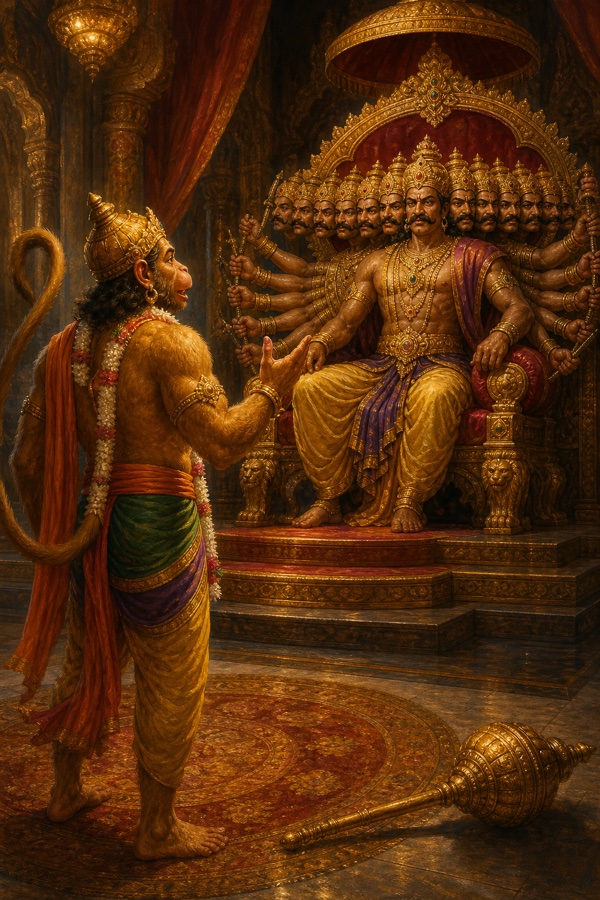
“I alone could destroy Lanka with its horses and chariots and elephants, but this is not Rama’s resolve. Rama has vowed before the monkeys and bears that he will destroy the enemies who carried off Sita. Wrong Rama, and not even Indra himself can stay happy, let alone an ordinary being like you. Know her whom you call Sita for the Night of Doom, come to destroy the whole of Lanka. Throw off this noose of death that you have hung about your own neck in Sita’s form, and look to your own safety. Look at this city, already consumed by Sita’s moral power and soon to burn with its palaces and streets in the fire of Rama’s wrath. Do not lead your allies, counselors, brothers, sons, friends and wives, your pleasures and Lanka itself to annihilation. Hear the truth, king of the demons, from Rama’s servant, his envoy, and a monkey. Gods, demons, gandharvas, vidyadharas, nagas, yakshas, the lords of all the worlds, cannot stand against Rama in battle. Brahma, Rudra, who destroyed the three cities, and Indra himself cannot hold their ground before Raghava in the field.” Hearing this plain but unwelcome answer, Ravana, his eyes rolling with fury, gave the order to kill the great monkey.
Vibhishana intervenes: an envoy must not be killed
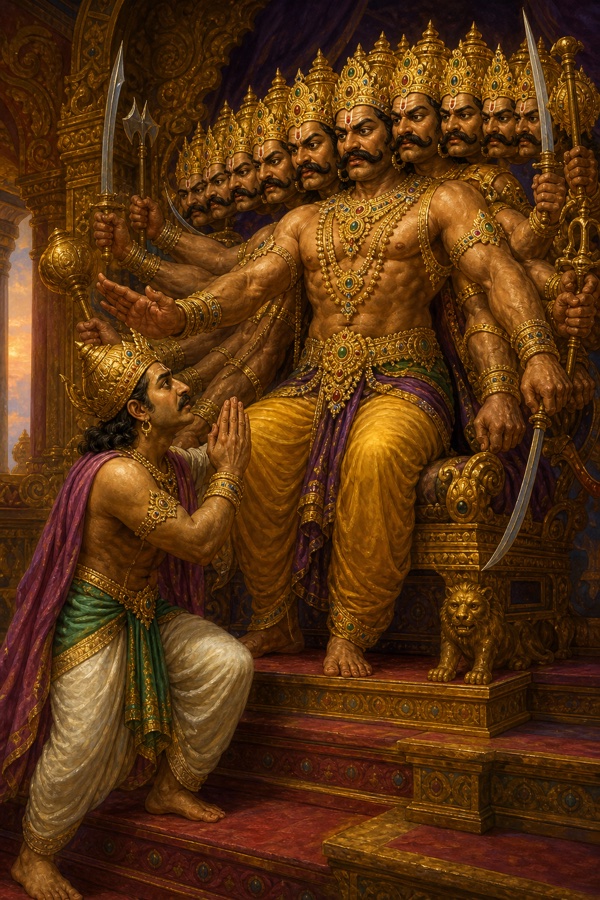
When Ravana, senseless with rage, ordered Hanuman killed, Vibhishana did not approve the killing of an envoy. He was the king’s own brother, and he was about to argue for the life of the creature that had just destroyed his family’s army. With folded hands he said: “Forgive me, set anger aside, and hear me. Good kings who know statecraft do not kill an envoy. To kill this monkey, hero, is against righteousness, condemned by the world, and unworthy of you. You know righteousness, you are grateful, you are skilled in the duty of kings, and you know the true good of creatures. If even a discerning man like you falls under the sway of anger, then knowledge of the scriptures is only wasted labor. Let an envoy be punished only after right and wrong have been weighed.”
Hearing Vibhishana’s words, Ravana answered: “There is no sin in killing the wicked; so I shall kill this wicked monkey.” Then, hearing that speech rooted in unrighteousness and full of fault, Vibhishana spoke words joined with the highest truth: “Be pleased, and hear the essence of righteousness and gain. The good say that an envoy, at no time and in no place, deserves death. This enemy is strong and has done immense harm, yet the wise still do not permit the killing of an envoy; the scriptures name many other punishments for an envoy: maiming a limb, flogging, shaving the head, or branding the body; but the killing of an envoy we have nowhere heard of.” A messenger carries another man’s words in another man’s mouth, and every kingdom in the world had agreed to hold him harmless for them, because the day that rule breaks is the day no king can ever be spoken to again.
“How can one so skilled in righteousness and gain as you, one who weighs right and wrong, fall under the sway of anger? Men of true worth do not give way to anger. In discussion of righteousness, in worldly conduct, and in grasp of the scriptures there is none like you; you are the first among all gods and demons. So do not attempt his death; I see no gain in killing this monkey. Let that sentence of death fall rather on those who sent him. This monkey, be he good or bad, has been sent by others; a messenger, who is not his own master and speaks the purpose of others, does not deserve death. And if he is killed, who else will come across the great sea from that far shore? Better to turn your effort against the gods and Indra. Once he is dead, there will be no one left to goad those two proud princes to war. Rather, to show the enemy your power, send some heroes with a part of your army to seize those two princes, who are stricken with grief at the loss of Sita.” He had wrapped the mercy inside a plan for war, because that was the only shape in which his brother would take it. Ravana, mighty as he was, took his younger brother Vibhishana’s fine and welcome counsel to heart.
Fire on the tail, and Sita’s prayer
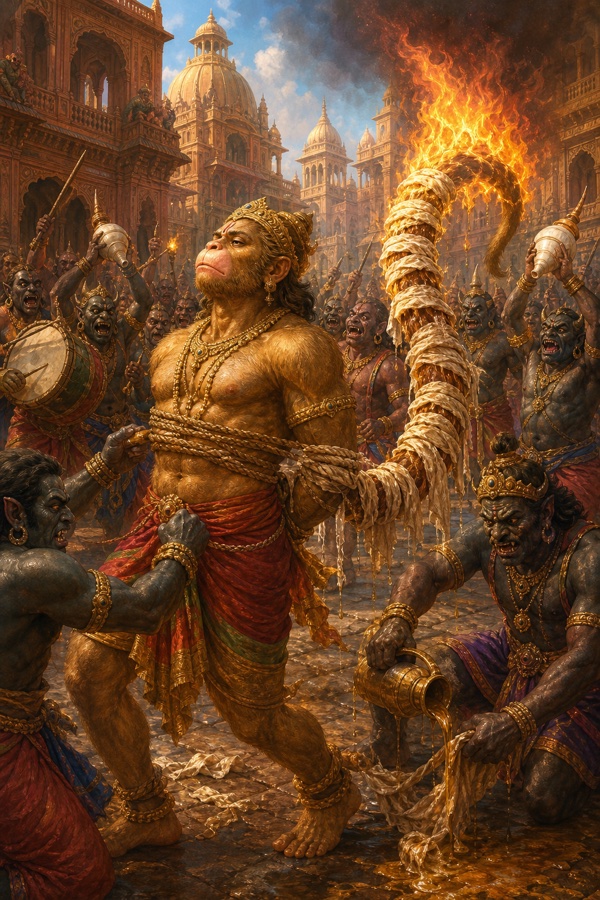
Hearing his brother’s counsel, fitted to time, place, and good sense, Ravana said: “You are right that killing an envoy is condemned. Even so, he must have some punishment. A monkey’s tail is its dearest ornament; so let his tail be set alight at once, and let him go back with it burned, so that his friends, his kin, and his own people may see him marred and wretched.” He had chosen the punishment of humiliation, which is what a proud man reaches for when he has been told he may not kill. The demon king ordered that he be led with his flaming tail through the whole city and its crossroads. The demons, cruel with rage, began to wrap Hanuman’s tail in old cotton rags; and as it was wrapped, the great monkey swelled like a forest fire that has found dry fuel. The demons sprinkled oil and set the tail alight, and Hanuman, his face bright as the young sun, filled with fury and outrage, began to strike the demons with that very burning tail. Then the cruel demons bound him tighter still.
Women, children, and old folk, all the night-rangers, were delighted. Bound as he was, the hero Hanuman thought, as the moment required: “Bound though I am, the demons are no match for me; if I snap these cords and spring up, I could kill them all again. Yet it is while acting for my master’s good that these wretches have bound me, and I have not taken my revenge. Alone I am enough for all the demons in battle, yet for love of Rama I will bear all this. Besides, it will let me survey Lanka once more, for in the night I could not see the layout of its fortress well. Before the night is out I shall certainly study Lanka; and though they bind me again and burn my tail and torment me, my heart feels no weariness.” They were about to parade him through every street of their fortress to shame him, and he had just decided to let them, because he wanted the map. Then the delighted demons, blowing conch and drum and proclaiming him a spy, led him through the city. Hanuman took in the city’s marvelous seven-storied mansions, its well-divided squares, its house-thronged lanes, its crossroads and highways. Women, children, and old folk crowded out in curiosity to see the burning tail.
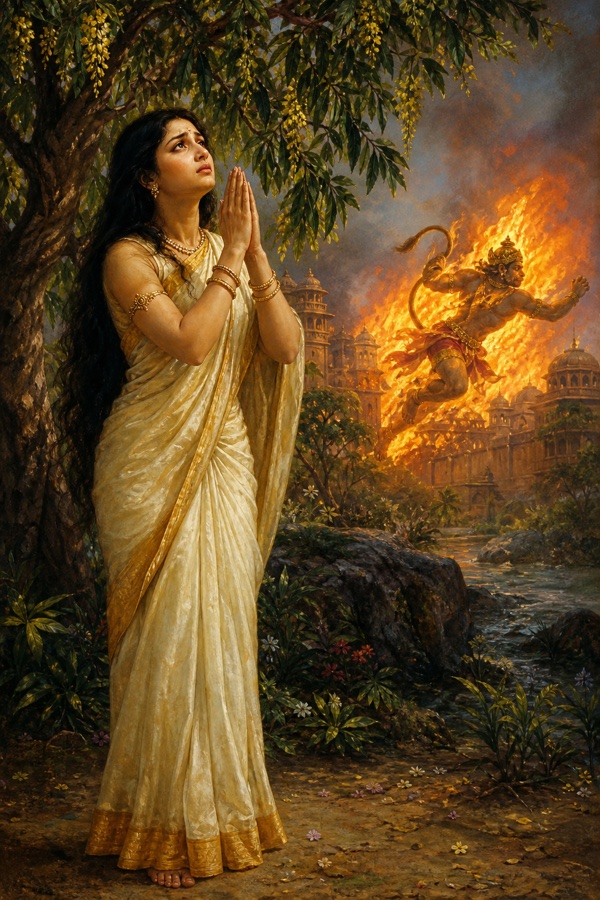
While the tip of Hanuman’s tail was burning, the demonesses with their savage eyes carried the cruel news to Sita: “Sita, that copper-faced monkey you spoke with is being led through the lanes with his tail on fire.” Hearing this cruel thing, so like her own abduction, the grieving daughter of Videha worshiped Agni the fire-god in her heart and wished the great monkey well. She had nothing to give and no power to intervene, and so she spent the only currency she had, which was the whole of her life’s truth, on a monkey she had met once. The queen, having purified herself, prayed to the bearer of oblations: “If I have served my husband, if I have practiced austerity, if my devotion to one husband is true, then, fire-god, be cool for Hanuman. If Rama’s heart holds any tenderness for me, if any of my good fortune remains, then be cool for Hanuman. If Rama knows me to be chaste and longing for our reunion, then be cool for Hanuman. If the true-worded Sugriva can carry me across this ocean of sorrow, then be cool for Hanuman.”
Then the fire, which had leapt up in sharp tongues, began to burn mildly, its flames rising to Hanuman’s right, a sign of good fortune, as if to tell Sita of the great monkey’s safety. Even with the fire touching his tail, Hanuman’s father the Wind began to blow cool as snow, and the queen took comfort. Seeing his tail burning, Hanuman thought: “Why does this blazing fire not burn me all round? A great flame is there to see, yet it gives no more pain than a heap of snow laid on the tip of my tail. Surely this is by that same power of Rama’s by which, on my crossing, I saw the marvel of Mount Mainaka in the sea. By Sita’s mercy, by the fire of Raghava, and by my father’s friendship with fire, the flame does not burn me.” He was being carried in triumph through a jeering city with a torch tied to him, and it felt like snow, and he understood at once who had done it.
Then the great monkey thought a moment longer: “How is it that one like me is bound by these base demons? While there is prowess in me, it is right to answer this.” Thinking so, Hanuman snapped his cords, sprang roaring into the air, and reached the city gate, high as a mountain peak and empty of demons. In an instant he took a very small form and shook off his bonds, then swelled again to a body vast as a mountain. Looking about, he saw an iron crossbar lying at the gate; the son of the Wind took it up and killed all the guards of the gate anew. Having killed them, wreathed in the flame-garland of his burning tail, Hanuman shone like the sun ringed with rays, and gazed again on Lanka. They had put fire in his hands and walked him past every roof in the city, and now he stood above it and looked at what they had shown him.
The burning of Lanka
Gazing at Lanka, his wish fulfilled and his spirit high, Hanuman considered what work remained: “What task is left that will give these demons still more torment? The grove is wrecked, the chief demons are dead, a part of the army is destroyed; only the ruin of the fortress remains. When the fortress is ruined, my labor of crossing the sea and wrecking the grove will bear sweet fruit, and with a little more effort the labor of finding Sita will be crowned. It is only just to feed this fire that burns on my tail with these fine mansions.” Ravana had lit it himself, and had gone to some trouble to make sure it would not go out.
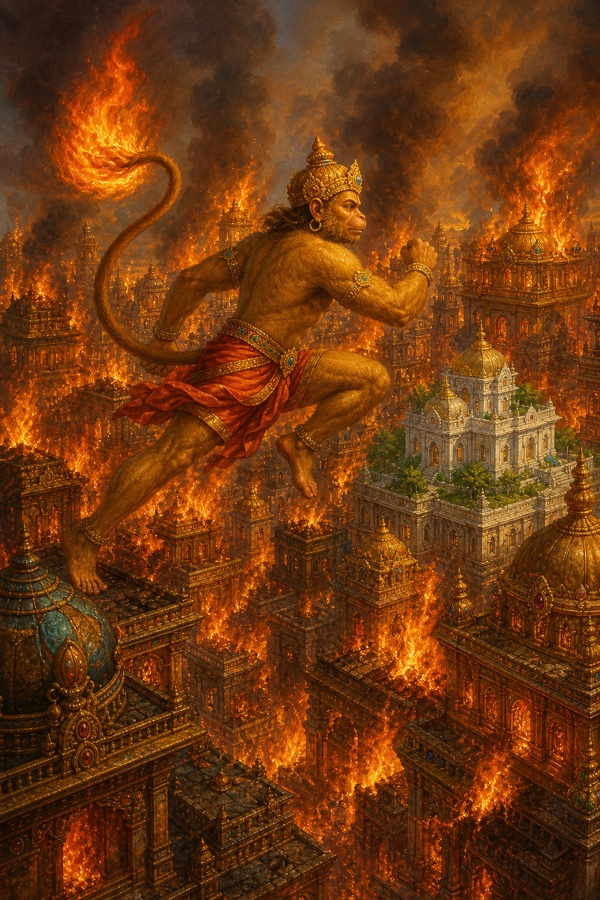
Then Hanuman, his tail aflame, ranged over the roof-peaks of Lanka like a cloud charged with lightning. Fearless, he moved from mansion to mansion, past gardens and palaces. With tremendous speed he leapt onto Prahasta’s mansion and set it alight, then in turn the houses of Mahaparshva, Vajradamshtra, Shuka, Sarana, Indrajit, Jambumali, Sumali, Rashmiketu, Suryashatru, Hrasvakarna, Damshtra, Romasha, Yuddhonmatta, Matta, Dhvajagriva, Vidyujjihva, Ghora, Hastimukha, Karala, Vishala, Shonitaksha, Kumbhakarna, Makaraksha, Narantaka, Kumbha, Nikumbha, Yajnashatru, and Brahmashatru; he set them all ablaze one after another, sparing only the house of Vibhishana. Entering the costly mansions, Hanuman burned up the wealth of the rich, and at last, crossing over all their houses, he reached Ravana’s palace.
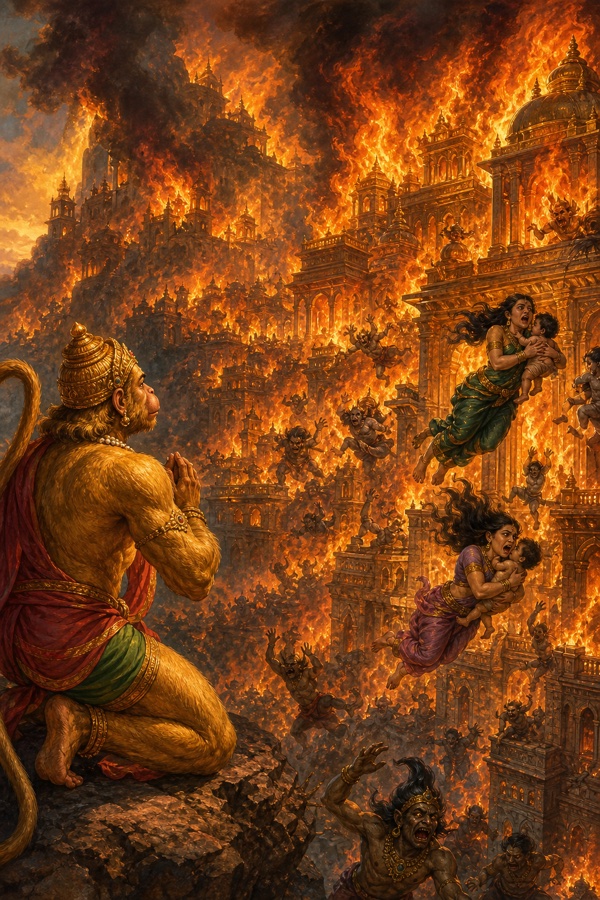
Into Ravana’s chief mansion, tall as Meru and Mandara, decked with many jewels and many auspicious things, Hanuman flung the fire of his burning tail and roared like a cloud at the hour of doom. Fanned by the wind, the mighty fire flared up like the fire of doom and grew; his father was helping. The wind spread the burning flame through the mansions; vast houses set with golden mesh and pearls and gems cracked and, story after story, broke and fell to earth like the sky-chariots of siddhas falling from heaven when their merit is spent. The demons ran to save their homes and cried out: “Alas, the fire-god himself has come in monkey shape!” Women caught in the fire fell with their children; some, wrapped in flame, their hair loosened, looked like lightning falling from the sky. From the mansions ran strange molten metals, diamond and coral and lapis and pearl and silver run together. As fire is never sated with wood and grass, so Hanuman was not sated with the slaughter of the demon lords, nor did the earth tire of receiving the demons who fell.
Hanuman burned the city of Lanka as Rudra once burned the three cities of Tripura. That terrible fire, risen on the peak of Trikuta, spread its wreath of flame and touched the sky; fed by the demons’ bodies as if by clarified butter, smokeless, it blazed bright as a crore of suns, as if the fire of doom were splitting the universe open. The gathered demons said: “Is this Indra with his thunderbolt, or Yama, or Varuna, or the Wind, or the third-eye fire of Rudra, or the Sun, or Kubera, or the Moon? This is no monkey; this is Death himself. Or is it the wrath of the four-faced Brahma, the world’s maker, come in monkey shape, or the supreme fire of the unthinkable, unmanifest Vishnu, wearing a monkey’s shape by his maya to destroy the demons?” They were running through the list of everything in creation that could do this to them, and the answer was a servant carrying a message. Seeing her city suddenly ablaze with its people, its houses, and its trees, the guardian goddess of Lanka wept aloud in a wild voice; and the demons wailed, “Alas my father, alas my son, alas my beloved, alas my friend, alas the lord of my life, our merit is spent.”
Ringed with flame, its foremost heroes dead and its warriors scattered, Lanka lay as if under a curse, and Hanuman looked on it as on an earth laid waste by the wrath of Rudra. Having wrecked the Ashoka grove, killed great demons in battle, and burned the city set with its household jewels, the son of the Wind stood in the pose of one at rest. Then, having killed so many demons, broken the grove, and set the demons’ houses on fire, Hanuman called Rama to mind. And all the gods, the sages, the gandharvas, vidyadharas, and nagas, all the great beings, praised Hanuman, swift as the wind, again and again, and were filled with supreme and matchless joy. Seated on the strange peak of a mansion’s roof, wreathed in the flame-garland of his burning tail, Hanuman shone like the sun ringed with rays. Having given all Lanka great pain, at the last Hanuman quenched the fire of his tail in the sea. Seeing Lanka burned, the gods with the gandharvas, siddhas, and supreme sages fell into utter wonder; and every being, taking the great monkey Hanuman for the fire of doom, was afraid.
Hanuman’s self-reproach at the sight of burning Lanka
Seeing all Lanka burning fiercely, and the crowd of demons, with demonesses and children and old folk, fleeing in terror, the monkey Hanuman suddenly fell into thought. A deep misgiving rose in his mind, and a loathing of himself woke in him. He thought: “Alas, in burning Lanka to the ground like this, what a shameful thing I have done!”
Hanuman began to curse himself: “What sin does an angry man not commit? A man in anger will kill even his elders, and abuse even saints with harsh words. A man filled with anger loses all sense of what should and should not be said; for the angry there is no deed too vile, no word too wrong. Blessed are the people of noble character who check rising anger with their reason, as men put out a blazing fire with water. That man alone is truly a man who, by the strength of forgiveness, sheds the anger risen in his heart as a snake sheds its worn-out skin.”
He went on: “Shame on me, ill-witted, shameless, utterly sinful, who without a thought set fire to the very place where Sita is, and so worked harm to my master Rama. If the whole city has burned, then surely Janaki has burned too; so I have unknowingly ruined my own master’s work. The very rescue of Sita for which this crossing of the sea and this burning of Lanka were undertaken, that root purpose, is destroyed by the fault of my anger, for in burning Lanka I did not protect Sita. Burning Lanka was a small deed, no doubt; but overcome by anger, I have cut through its very root. No corner of Lanka is left unburned; the whole city lies in ashes, and Janaka’s daughter has surely perished with it.” He had thought of everything that night except the one thing that mattered, and he knew it.
Hanuman’s grief deepened, and it ran on down the line of consequence the way a man’s grief does at three in the morning: “If, through the wrongheadedness of my mind, this task of winning Sita is spoiled, then it seems best to me to give up my life here and now. Shall I leap into the fire, or into the mare-mouthed fire of the sea, or give my body to the creatures of the ocean? How, alive, could I face Sugriva, king of the monkeys, or those two tigers among men, Rama and Lakshmana, with the whole purpose ruined? In my anger I have shown the very monkey nature the three worlds know for its fickleness. A curse on this passion-driven way of mine, which yields nothing sure: because of anger I failed to guard Sita, though guarding her lay in my power. If Janaki is destroyed, then those two, Rama and Lakshmana, will also perish; and with them gone, Sugriva too will give up his life with his kin. How will the brother-loving Bharata, with his younger brother Shatrughna, go on living? And with the righteous house of Ikshvaku destroyed, all the people will be stricken with grief. I have squandered my store of merit and of worldly good; luckless, my mind ruled by anger, I stand guilty of the ruin of the world.”
Then, as Hanuman worried in this way, favorable omens showed themselves, omens whose good fruit he had known before by direct experience; and he began to think again, and the reasoning came back to him piece by piece. He reasoned: “Or perhaps that lovely lady is guarded by her own inner fire; she will not have perished, for fire does not burn fire. To the wife of Rama, guarded on every side by her own pure conduct, the fire would not dare even to draw near. Surely by Rama’s power and Videha’s daughter’s merit, this all-consuming fire did not burn even me. How could she perish, she whom Bharata and Rama’s other brothers revere, she who is the beloved of Rama’s heart?”
Hanuman recalled in wonder: “The fire, whose very nature is to burn, which is everywhere able and undying, if even that could not burn my tail, how will it burn the noble lady? And I remember the marvel of Mount Hiranyanabha, that is Mainaka, rising up in the middle of the sea.” The proof had been tied to his own body for an hour and he had walked through a city with it. He said: “By the strength of her austerity, her true speech, and her unwavering devotion to her husband, the queen could herself burn fire to ash; the fire cannot burn her.”
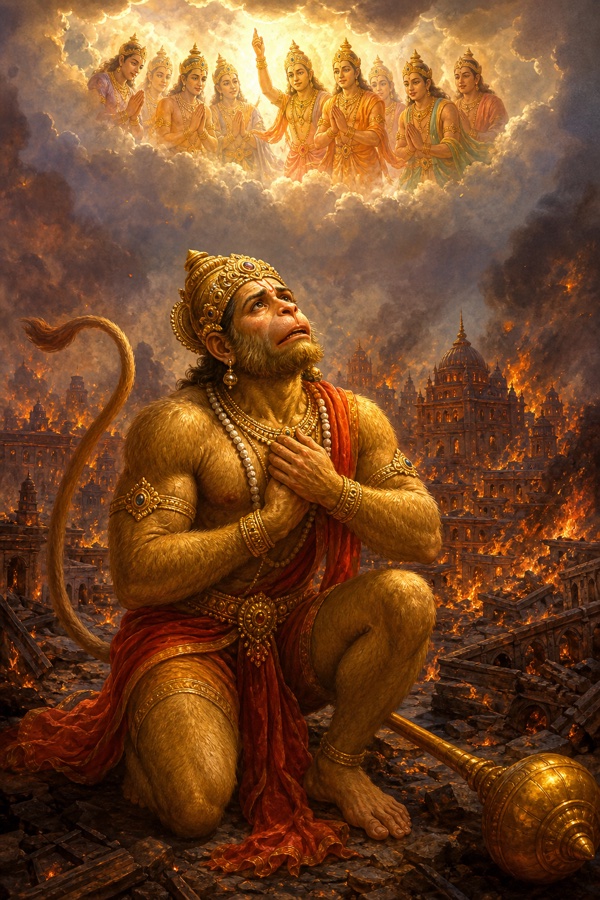
Meditating so on the queen’s power of chastity, Hanuman heard there the voices of the charanas, the singers who travel the sky: “Ah, Hanuman has done a wondrous and hard deed, setting this sharp and dreadful fire in the houses of the demons! The demons, their women, their children and old folk, fled in terror; loud with the noise of its people, with its towers and ramparts and archways, Lanka seemed to cry out, and burned; yet the fire has not so much as touched Janaka’s daughter Janaki. This is to us a supreme and wondrous marvel.”
Hearing these words, sweet as nectar, the joy that rose in Hanuman’s heart at that moment filled his mind. Then, knowing the princess safe, and swift again as the speed of thought, he resolved to see her once more with his own eyes and then return to Rama. He would take nothing on trust, not even from the sky.
Farewell to Sita and the crossing of the sea
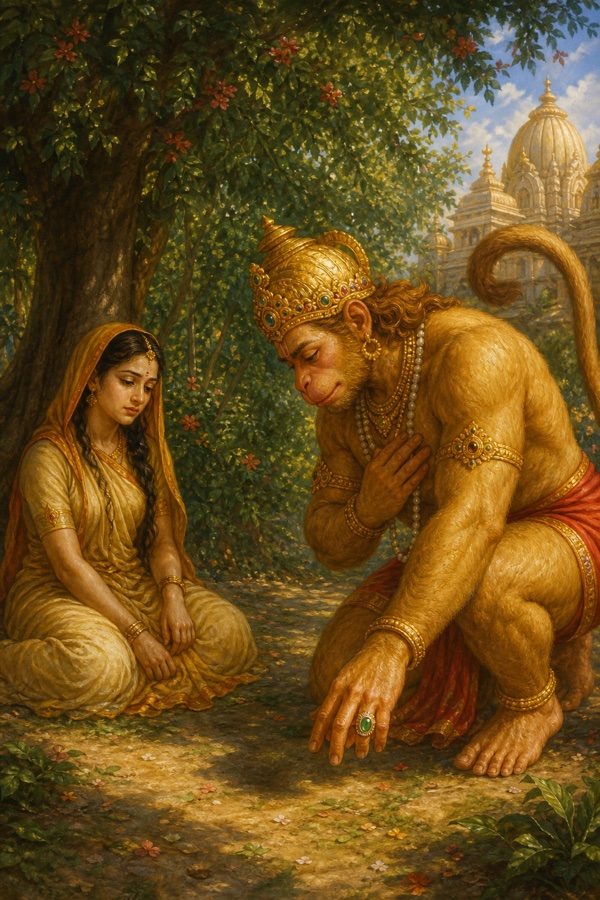
Reaching Janaki where she sat at the root of the shimshapa tree, with the city burning behind him and her tree still green, Hanuman saluted her and said: “It is my good fortune that I see you safe at this hour.” Then Sita, full of love for her husband, looking again and again at Hanuman as he made ready to go, said: “Dear child, if you think it right, stay here one day; rest in some well-hidden place and go tomorrow. Monkey, your nearness would, for a few moments at least, lessen this measureless grief of my poor luckless self.”
Sita opened her heart’s doubt, and it was the doubt of someone who has learned what hope costs when it fails: “Once you have gone back, whether you will come again is in doubt, and whether my own life will hold is in doubt too. Not to see you, hero, will torment me the more, sunk as I am from sorrow into deeper sorrow, and wasted with grief. And this great doubt stands before me, hero: how will your mighty helpers, the monkeys and bears, or those two men, cross this ocean that is so hard to cross? Only three have the power to leap this sea: Garuda; the Wind-god; and you.” She had watched him arrive out of the sky, and she had done the arithmetic, and the arithmetic said that no army follows a monkey across a hundred yojanas of water.
Sita praised Hanuman’s power: “Though you are able by yourself to carry me free, still the glory of that success would be yours, and not Rama’s. If Rama, who destroys the strength of his foes, besieges Lanka with his army and takes me home, that would be worthy of him. So arrange things such that those war-brave brothers may show the prowess that befits them.”
Hearing these words, full of meaning, humble and reasoned, the hero Hanuman answered: “Lady, Sugriva, lord of the armies of monkeys and bears, monkey leader and full of courage, is firmly resolved for your sake. Ringed by tens of millions of monkeys, Videha’s daughter, he will soon reach here. And those two, Rama and Lakshmana, will come together and destroy the demons with their arrows and lay Lanka low. Fair lady, Raghava will kill Ravana with his host, and soon take you and return to his city Ayodhya.”
Hanuman reassured her: “Be wholly at peace in mind; may all be well with you; wait for the time. Soon you will see Ravana killed in battle by Rama’s hand. With his sons, ministers, and kinsmen, the demon king slain, you will meet Rama as Rohini meets the Moon. Raghava, joined with the best chieftains of the monkeys and bears, who will conquer the enemy in battle and take away your grief, will appear soon.” He did not know how the sea would be crossed either. He knew only that it would be, because Rama had said so.
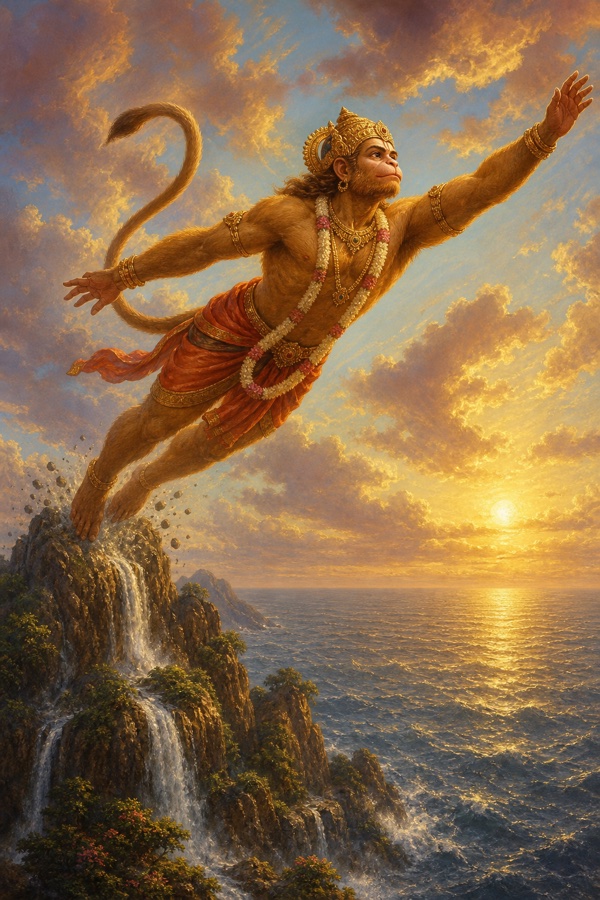
Having reassured Videha’s daughter thus, and resolved to go, Hanuman saluted her. Having killed the foremost demons, made his name known, thrown the city into turmoil, outwitted Ravana, shown his dreadful strength, and greeted Videha’s daughter, he made up his mind to return across the sea. Then, eager to see his master, that monkey leader climbed the noble Mount Arishta, dark with black forests, adorned with tall padmaka trees, and wearing, as it were, an upper cloak of the clouds that hung among its peaks.
That mountain seemed to be lovingly wakened by the hands that were the sun’s bright rays; it seemed to open its many eyes in the minerals scattered here and there; it seemed to chant the Veda in the deep sound of its running streams; it seemed to sing aloud in the voices of its many waterfalls; it seemed to stand with arms upraised in its tall deodar trees. In the roar of its cataracts it seemed to cry out on every side; in its swaying black reeds it seemed to tremble; in its hollow bamboos shaken by the wind it seemed to play the flute; and in its dreadful, deadly serpents it seemed to hiss with rage. In its caves veiled in mist it seemed lost in meditation, and with its branches like rising clouds it seemed ready to walk off in every direction.
That mountain, ten yojanas wide and thirty yojanas high, served by sages, yakshas, gandharvas, kinnaras, and nagas, hard to climb for its vines and trees, and full of lions and tigers and the like, Hanuman climbed, driven by great joy and by his longing to see Rama. Under the pressure of his feet the rocks of its lovely peaks cracked with a loud sound. Wishing to leap from the southern shore toward the northern, the great monkey pressed on.
Pressed and pained by Hanuman, Mount Arishta cried out with all its many creatures, and with peaks trembling and trees falling began to sink into the earth. Under the force of his thighs, trees laden with flowers fell to the ground as if struck by Indra’s thunderbolt. The dreadful roar of the mighty lions in its caves seemed to split the sky. Their garments loose and their ornaments dropping in fear, vidyadhara women suddenly flew up from the mountain. Great serpents of deadly venom, tongues aflame, lay coiled with heads and necks pressed down. Kinnaras, nagas, gandharvas, yakshas, and vidyadharas left that sorely troubled king of mountains and stood in the sky, and, fierce with its trees and peaks, the mountain sank into the netherworld; so that mountain ten yojanas broad was leveled with the earth. That is what it cost the earth to give one monkey something to push off from.
Then, wishing to leap in sport across that dreadful salt sea whose shores the waves were pounding, the monkey Hanuman sprang into the sky.
Hanuman crosses the sky-sea and roars upon Mount Mahendra
Leaping up with great speed, looking like a winged mountain and never tiring, Hanuman began to cross that sea of sky, which seemed a lovely ocean. The star Svati was as it were its swan; the nagas, yakshas, and gandharvas its open lotuses and water-lilies; the moon a white lily; the sun a water-bird; the stars Pushya and Shravana its swans; the clouds its moss and shore-grass; Punarvasu its great fish; Mars the great crocodile; Airavata its great island; the winds its waves; and the moon’s rays its cool water.
As if swallowing the sky, as if peeling the moon, as if carrying off the heavens with their stars and the disc of the sun, as if drawing along the masses of cloud, Hanuman crossed that boundless sea without tiring. In the sky appeared great clouds white, red, blue, madder-colored, green, and dark. Passing in and out of the cloud-masses again and again, Hanuman looked like the moon now hidden, now seen. Dressed in white, the hero, tearing through the ranks of cloud, shone like Garuda.
Roaring like a cloud, Hanuman came again to the middle of the sea, touched the lord of mountains Sunabha, that is Mainaka, and shot on with the speed of an arrow loosed from the string. He had refused that mountain’s hospitality on the way out and he had no time for it now, and he touched it in passing the way a man touches an old friend’s shoulder without breaking stride. Drawing a little nearer and seeing the great cloud-like Mount Mahendra, the great monkey roared like a storm-cloud and filled the ten directions with the sound. Eager to see his friends, Hanuman gave a great cry and lashed his tail. As he roared again and again along Garuda’s path, the sky with its disc of the sun seemed to split. On the northern shore of the sea, the mighty heroic monkeys already standing there and eager to see the son of the Wind began to hear the great cloud-like sound raised by the rush of his thighs and driven by the wind.
Downcast with worry, all those forest-dwellers, hearing Hanuman’s thunder-like roar, grew eager on every side and longed to see their comrade. Then Jambavan, his heart thrilled with love, addressed all the monkeys: “This Hanuman has succeeded in every way, no doubt of it; for had he failed, he would not roar like this.” The old bear had read the whole outcome off the sound of a voice, before he could see the face that made it. Hearing the noise and roar of Hanuman’s arms and thighs, the delighted monkeys leapt here and there. In their joy, eager to see Hanuman, they sprang from tree-top to tree-top, from peak to peak. Holding the branches of the trees, the monkeys waved their bright garments in delight.
Seeing Hanuman, roaring like the wind pent in a cave, come on like a mass of cloud, all the monkeys stood with folded hands. Then the hero, swift as a mountain, came down on the tree-covered peak of Mahendra. Full of joy, they came down at the bank of a lovely mountain stream, as a winged mountain might fall from the sky. Then the great monkey chieftains, their hearts full of love, ringed Hanuman about, came to him with faces bright with the highest joy, and honored that monkey leader with offerings of roots and fruits. Some roared with joy, some shrilled, some brought tree-branches for him to sit on.
Then the great monkey Hanuman saluted his elders, Jambavan and the rest, and prince Angada. Honored by Jambavan and Angada and revered by the other monkeys, Hanuman announced in brief that the queen had been seen. He had crossed an ocean twice, emptied an army, and burned a capital, and he reported it in one sentence. Then, taking Vali’s son Angada by the hand, he sat down in a lovely part of the forest on Mount Mahendra.
When asked, Hanuman told those monkey leaders that Janaka’s daughter Sita was in the Ashoka grove; that the blameless young woman was guarded by fearsome demonesses, wearing a single braid as the sign of her separation, longing for the sight of Rama, wasted with fasting, soiled, matted-haired, and thin. Hearing this news of the sight of Sita, sweet as nectar, all the monkeys rejoiced: some roared like lions, some bellowed like bulls, some shrilled, some roared in answer; some elephant-like monkeys waved their thick long tails in joy; some leapt from peaks to embrace Hanuman.
Then, among all the monkey heroes, Angada gave Hanuman this fine praise: “Hanuman, in courage and valor no monkey is your equal, for you have leapt this vast sea and returned. You alone are the giver of our lives. By your grace we shall meet Raghava, and our task is done. Ah, your devotion to your master! Ah, your valor! Ah, your steadiness! By good fortune you have seen the glorious queen, Rama’s wife, and by good fortune Rama will let go the grief of Sita’s loss.” Not long ago these same monkeys had sat down on the shore to fast to the death, unwilling to go home empty-handed, and the prince who now praised him had been the one who proposed it.
Then the joyful monkeys, ringing Angada, Hanuman, and Jambavan, sat down on great rocks. Eager to hear the tale of the sea-crossing, the sight of Lanka, and of Sita and Ravana, those monkey leaders sat with folded hands, their faces turned to Hanuman’s face. Ringed by many monkeys, Angada shone there like Indra served by the gods in heaven. Seated on that high great peak, Hanuman and Angada, wearing his armlet on his arm, blazed with a splendor bright with joy.
Hanuman’s full account: Mainaka, Surasa, and Simhika
On the peak of Mahendra the mighty monkeys gathered around Hanuman came to the highest joy. Seated at ease among the monkeys, the delighted Jambavan asked the great monkey Hanuman for the tale of the deed: “How was the queen seen by you, and in what state is she there? How does the cruel-handed Ravana of the ten heads treat her? Tell us all this exactly and in full. How was the queen found, and what did she answer? Knowing the truth, we shall decide our next step. Tell us what we should say and what we should keep back when we go to Rama.” It was the question of an old counselor: what happened, and also what a grieving man should be told of it.
Urged by Jambavan, bowing his head to the queen Sita, the thrilled Hanuman answered: “Before you all, from the peak of Mahendra, with a fixed mind and a wish to reach the southern shore of the sea, I leapt into the sky. As I went along my way, a dreadful obstacle seemed to rise: a divine and most lovely golden peak stood barring my path. I resolved in my mind that I must break it. At the blow of my tail the sun-like peak of that great mountain scattered in a thousand pieces. Knowing my deed, the great mountain said in a sweet voice, as if gladdening my heart: ‘Child, know me for a friend of the Wind-god, and so your uncle; I dwell in the sea, and am famed by the name of Mainaka.’”
“‘In ancient times, child, the great mountains had wings; they flew over the earth at will and troubled everything on every side. Hearing of this conduct of the mountains, the lord Indra, the chastiser, cut off the wings of a thousand mountains with his thunderbolt. But your father the Wind saved me from that peril; he set me down in the sea, the dwelling of Varuna. Now I must help Rama, who is righteous and mighty as Indra.’”
“Hearing these words of Mainaka, I told him my purpose, and my mind grew eager to press on. With the leave of Mainaka I went; and that great mountain, vanishing in his lovely human form, sank into the sea with his mountain body. Gathering fine speed, I went on along the rest of my way, and for a long time I pressed on at a swift pace.”
“Then in the middle of the sea I saw the goddess Surasa, mother of the serpents. The goddess said: ‘The immortals have appointed you my food; so I shall eat you, for the gods have ordained you for me.’ So spoken to, I stood with folded hands, humble of face and gone pale, and said: ‘Rama came to the Dandaka forest with his wife Sita and his brother Lakshmana; there Ravana carried off his wife Sita; and at Rama’s command I go as an envoy to Sita. You dwell in Rama’s realm, so it is right for you to help him. Or else, when I have seen Maithili and told the untiring Rama, I will come into your mouth; this I promise in truth.’”
“Then Surasa, who could take any shape at will, said: ‘No one can slip past me; that is my boon.’ So spoken to, I who was ten yojanas broad grew larger by half in a moment; and she opened her mouth wider than my body. Seeing her mouth open, I at once shrank to the size of a thumb, darted into her mouth, and came out again on the instant. She had a boon that no one passes her mouth, and I went through it, and so her boon stood and I went on, and neither of us lost anything. Then the goddess Surasa took her own form and said: ‘Gentle monkey leader, go now in happiness for the success of your task, and bring Videha’s daughter together with Raghava. Be happy; I am pleased with you.’ Then all beings praised me, crying, ‘Well done! Well done!’”
“Then I sprang up into the vast sky like Garuda. At that moment my shadow was caught, though I could see nothing. My speed was checked; I looked to the ten directions, but I could not see the thing that had stopped my flight. Then the thought came to me: ‘What is this obstacle risen in my path, whose form does not show itself here?’ Grieving so, my gaze fell downward, and there I saw a dreadful demoness lying in the water.”
“Seeing me hang still, the dreadful creature laughed aloud and said an evil thing to me: ‘Where will you go, huge one? Hungry, I have found you for the food I longed for; satisfy my body, so long without a meal.’ ‘Very well,’ I said, and agreed; and I made my body larger than her mouth. To swallow me her vast, dreadful mouth grew wider too; but she did not know me, nor mark the tiny form I set before her. Then in an instant I gathered up my huge shape, tore out her heart, and sprang into the sky. Her heart cut out, the mountain-like demoness, her arms falling slack, dropped into the salt water. At that moment I heard the gentle voices of the people of noble character who travel the sky: ‘The dreadful demoness Simhika has been quickly killed by Hanuman.’”
Hanuman’s account: entering Lanka and finding Sita
“Having killed her, remembering my urgent task, I went on again, and after a long way saw the southern shore of the sea adorned with mountains, where the city of Lanka lay. After the sun had set, unseen by the fearsome and mighty demons, I slipped deep into that city, the dwelling of the demons. As I entered, a woman with the color of a cloud at the hour of doom stood laughing before me, her hair like blazing fire; she meant to kill me. With a blow of my left fist I overcame that most dreadful woman, and made my entry at the twilight hour. Afraid, she said: ‘Hero, I am the city of Lanka; I am conquered by your prowess. By the very cause that conquered me, you will wholly conquer all the demons.’ The city herself told me, on the night I arrived, how the whole war would end.”
“There I roamed the whole night searching for Janaka’s daughter; even entering Ravana’s harem I did not find the fair-waisted one. I walked among sleeping women by the thousand, and looked at every face, and none of them was hers. Not finding Sita in Ravana’s palace, I sank in an ocean of grief and could see no far shore of it; I had crossed the real ocean and been stopped by that one. Grieving, I saw a fine garden-house ringed by a high wall, built of drawn gold. Crossing that wall, I saw a grove thick with trees; and in the middle of that Ashoka grove stood a great shimshapa tree.”
“Climbing it, I saw a golden grove of plantains; and a little way from the shimshapa tree I saw the lovely lady. Dark of hue, with eyes like lotus-petals, her face wasted with fasting, wrapped in the single garment she had on when Ravana bore her away over Kishkindha, her hair gray with dust, her limbs wretched with grief and anguish, Sita sat fixed on her husband’s good. Misshapen, cruel demonesses who fed on flesh and blood ringed her like tigresses about a doe. That queen, threatened again and again among the demonesses, wearing a single braid, wretched, lost in thought of her husband, lay on the ground, pale as a lotus-plant withered by the coming of winter, cut off from all she loved by Ravana, and resolved to die. Somehow I found her out quickly.”
“Seeing Rama’s glorious wife in the state the ten-necked one had described, I stayed sitting on that shimshapa tree and watched her, and I could do nothing else, and that was the hardest hour of the crossing. Then from Ravana’s palace I heard a deep tumult, a hala-hala mingled with the jingling of girdles and anklets. Deeply troubled, I gathered in my form, and hid like a bird among the thick leaves of the shimshapa.”
“Then Ravana’s queens and Ravana came to the place where Sita sat. Seeing that lord of demons, the fair lady Sita drew in her thighs and covered her breasts with her arms and sat. Trembling, in deepest sorrow, looking about for protection and finding no protector, the ascetic queen sat; and Ravana, his head bowed, fell at her feet and said: ‘Sita, honor me. If out of pride you will not show me favor, then in two months I shall drink your blood.’ The lord of the three worlds lay on the ground at the feet of a grief-wasted woman in a soiled garment and threatened her, and she did not move.”
“Hearing these words of Ravana, Sita in great anger gave this fine answer: ‘Basest of demons! Speaking such unspeakable words to the wife of the boundlessly brilliant Rama and the daughter-in-law of Dasharatha, how did your tongue not fall out? What a prowess is yours, who in my husband’s absence, slipping away from that great man, stole me and fled! Sinner, you are not Rama’s equal in any part; you are not fit even to be his servant. Raghava is unconquerable, true-worded, brave, and praised in war.’”
“At these harsh words of Janaki, the ten-headed one suddenly blazed with anger like a funeral fire. Rolling his cruel eyes, raising his right fist, he made ready to strike Maithili. Then a cry of grief broke out among the women. Mandodari, the chief wife of that one, rose from among the women and ran and stopped him. To the desire-maddened Ravana she said in a sweet voice: ‘Lord, what have you, mighty as Indra, to do with Sita? Take your pleasure with me today; Janaki is no better than I. Lord, take your pleasure with the daughters of gods and gandharvas and yakshas; what have you to do with Sita?’ It was his own wife who caught his arm, and she saved Sita’s life by pretending to be jealous.”
“All those women lifted up the mighty night-ranger and led him at once to his palace. When the ten-necked one had gone, the misshapen demonesses began to threaten Sita with cruel and most harsh words. But Janaki counted their speech as no more than a blade of grass; their roaring, falling on Sita, came to nothing, the way rain comes to nothing on stone. Their roaring vain and themselves grown weary, those flesh-eating demonesses made ready to go and tell Ravana of Sita’s great resolve to die. Then, worn out, listless, and downcast, they all fell asleep together. She had outlasted them without saying a word.”
“When they had gone to sleep, Sita, bent on her husband’s good, wept a piteous lament and grieved in deepest sorrow. Then, from among them, Trijata rose and said: ‘Demonesses! Eat your own selves, quickly, and leave Sita alone. Today I have seen a dreadful, hair-raising dream that foretells the ruin of the demons and the victory of her husband. She alone can save us, all the demonesses, from the wrath of Raghava. So let us beg the grace of Videha’s daughter; that is what pleases me. If such a dream shows itself plainly to one so sorrowful, she wins release from her many sorrows and the highest joy. By a mere salutation Janaka’s daughter Maithili will be pleased.’”
“Hearing the dream Trijata told, Sita, the shy girl, glowing with joy at her husband’s victory, said: ‘If this be true, I will give you all my shelter.’ Seeing Sita in that dreadful state, though I had rested a little, my mind found no peace; and I thought of a way to speak with Janaki. I began to praise the line of Ikshvaku, with words full of the praises of the royal sage Dasharatha. Hearing this speech of mine, the queen, her eyes full of tears, asked me: ‘Who are you? Whose messenger, and how did you come here? What is your friendship with Rama? Tell me this.’”
“Hearing her words, I said: ‘Lady, your husband Rama has a helper named Sugriva, lord of the monkeys. Know me for his servant Hanuman, come here; the untiring Rama has sent me to you. And see, Rama has himself given me this ring as a token for you.’ Now, lady, I ask your command, what I should do; if you bid me, I will carry you to Rama and Lakshmana; what is your answer?”
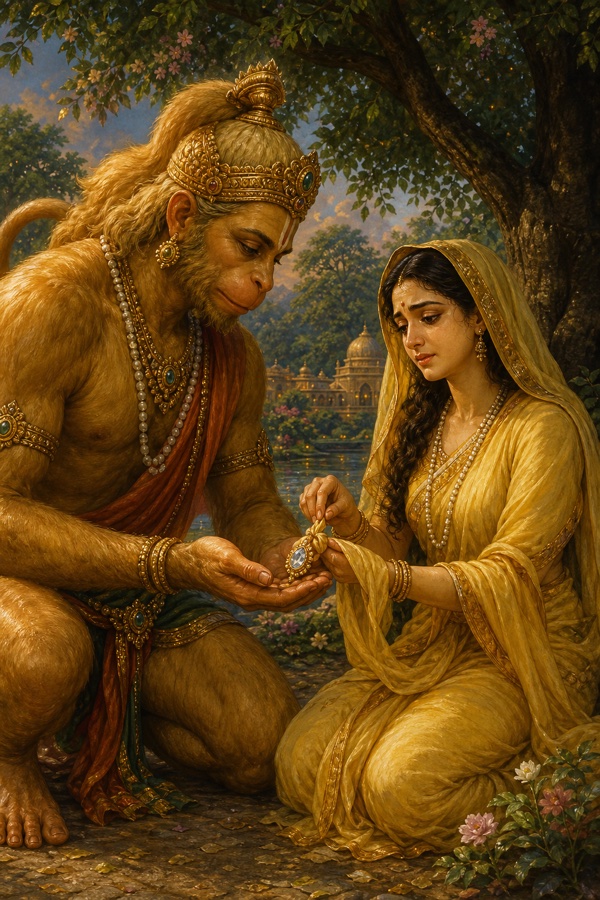
“Hearing this and knowing it true, Janaka’s daughter Sita said: ‘Let Raghava come and take me himself, after he has uprooted Ravana.’ Then I bowed my head to the blameless noble queen, and asked for some token to gladden Raghava’s heart. Sita said: ‘Take this fine jewel, by which Rama will greatly honor you.’ So saying, the deeply troubled fair lady gave me the crest-jewel, the jewel of her head, and spoke in words one or two matters that only Rama knows.”
“Then, saluting that princess and minded to return, I walked around her in reverence. Fixing her resolve, she spoke again: ‘Hanuman, tell Raghava my tale; and see to it that, the moment they hear, the two heroes Rama and Lakshmana come quickly with Sugriva. If this does not happen, my life is but two months long; and if Rama does not come within that time, I shall die helpless, and Rama will not see me again.’”
“Hearing that piteous speech, anger came on me, and at once I saw what work remained to do. I had come to find her, and I had found her, and I had been given a date by which she would be dead. Then my body swelled mountain-tall, and with a wish for battle I began to wreck Ravana’s garden.”
Hanuman’s account: the slaughter of the demons, the binding, and Ravana’s court
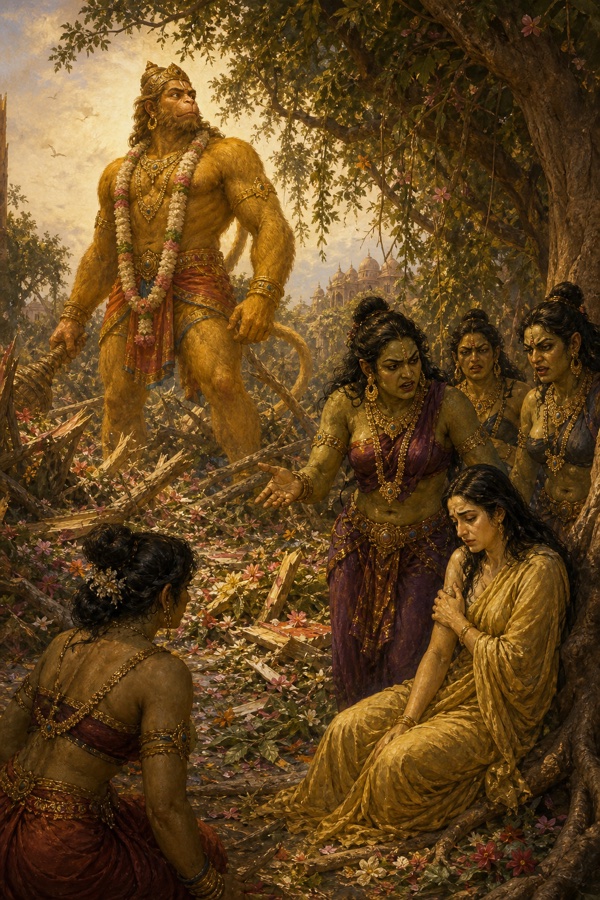
“Waking from sleep, the misshapen demonesses saw the wrecked grove and its terrified, bewildered beasts and birds. Seeing me in the grove, they gathered from every side and quickly told Ravana: ‘King! Some wicked monkey who does not know your strength has broken this grove of yours that none may enter. Surely this is his folly; order his death at once, before he escapes.’”
“Hearing this, the demon king sent the demons named Kinkaras, hard to conquer and obedient to Ravana’s mind. Eighty thousand of them, gripping pikes and maces, I killed in that grove with an iron crossbar; they came at me in a body, and I had one bar of iron off his own gate. The few who survived fled and told Ravana of the destruction of his force. Then it came to me to break the chaitya-palace, the temple of the demons’ family deity; killing the hundred demons standing there, I brought down that temple, the very ornament of Lanka, in fury, with one of its own pillars.”
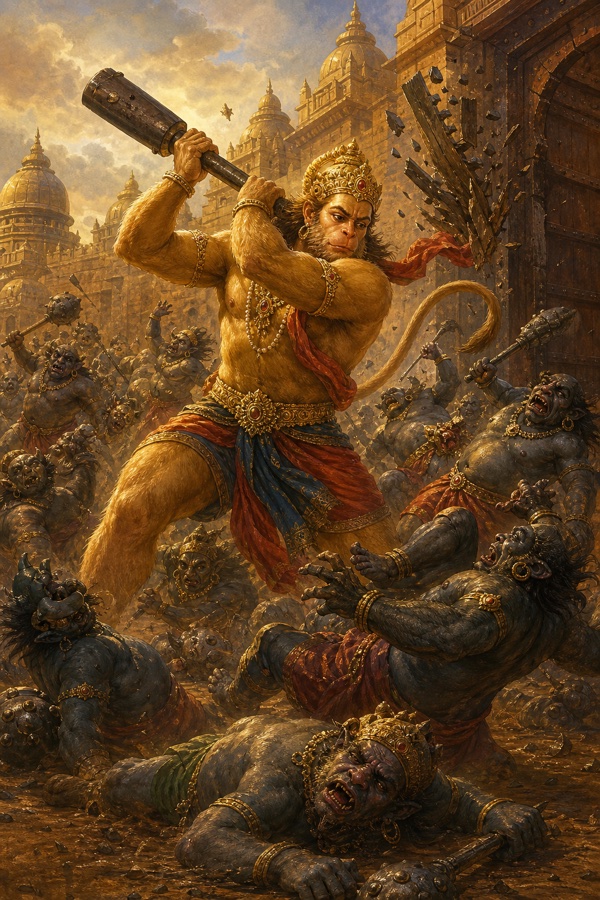
“Then Ravana sent Prahasta’s son Jambumali with many fearsome demons. That mighty demon, skilled in war, I killed with his followers by the terrible crossbar. Hearing this, Ravana sent his mighty ministers’ sons with a force of foot; all of them too I sent to the world of Yama with the crossbar. Hearing of the death of the ministers’ sons, who showed their prowess so swiftly in battle, Ravana sent five brave commanders; them too I struck down with their army.”
“Then the ten-necked one sent his mighty son Aksha with many demons into battle. Seeing that prince, Mandodari’s son, skilled in war, spring suddenly into the sky, I caught him by both feet, whirled him a hundred times, and dashed him down so that he was ground to pieces. Hearing of Aksha’s death, the enraged Ravana sent his other mighty son Indrajit with a great army. Taking the fire of that demon prince’s whole army in battle, I felt the highest joy. That one, sent with heroes drunk on pride, knowing me unconquerable, bound me with the Brahmastra and handed me over to the demons. The very swift demons bound me there with ropes as well, and by doing it they set me free, though they never knew it.”
“Taking me, they led me to Ravana. Ravana, seeing me, spoke with me, and asked the reason for my coming to Lanka and the killing of the demons. I said: ‘All this was done in battle for Sita’s sake. Lord, it was from a wish to see her that I came even to your palace; know me for the monkey Hanuman, born son of the Wind-god. Know me for Rama’s envoy and Sugriva’s counselor monkey; I come to you on Rama’s mission. Now hear my message; Sugriva has spoken to you a word of warning.’”
“In the assembly Hanuman delivered Sugriva’s message: ‘Sugriva asks after your welfare and speaks this good and wholesome word, joined with righteousness, gain, and desire. Dwelling on Mount Rishyamuka, I, Sugriva, formed a friendship with Raghava. King, he told me his wife had been carried off by a demon, and made me pledge my help. To me, Sugriva, whose kingdom Vali had seized, the lord Raghava with Lakshmana gave his friendship with fire as witness. With a single arrow he killed Vali and made me great king of the monkeys.’”
“Sugriva’s message went on: ‘So all of us must help Rama with our whole selves; for that I have righteously sent this envoy to you. Before the brave monkeys destroy your army, quickly bring Sita and give her back to Raghava. To whom is this glory of the monkeys not already known, who come even to the gods only when the gods call them for help? King, this is what Sugriva has said to you.’”
“Then, enraged, Ravana looked at me as if to burn me with his eyes. That demon of fierce deeds, not knowing my power, ordered my death. Then his wise brother Vibhishana, who was there, began to plead with the demon king for me: ‘Do not resolve on this; you are taking a road against the science of kings. In the codes of kingship the killing of an envoy is not allowed; an envoy has only to say what he was told to say. Even for an envoy’s great offense, brother of matchless valor, the scriptures prescribe the maiming of a limb, and not death.’ Remember that name when I have finished; of all that court, one demon spoke for the law, and it was the king’s own brother, and he spoke it for an enemy.”
“At Vibhishana’s words Ravana ordered the demons: ‘Burn only his tail, here and now.’ Hearing his command, my tail was wrapped all round with hemp bark and silk and cotton rags. Then the fierce, mighty demons, striking me with wood and fists, set my tail alight. Bound though I was with many ropes and rags, it gave me no pain, for I was eager to see the city by day.”
“Then those brave demons, leading me bound and ringed with fire to the city gate, showed me off along the highways to all; and every highway they showed me, I remembered.”
Hanuman’s account: the burning of Lanka and the return
“Then I gathered in my huge form, snapped my bonds, and stood again in my natural shape. Taking up an iron crossbar, I killed those demons and sprang with speed to the city gate. Then with my burning tail I burned that city, with its towers and gate-houses, without a tremor, as the fire at the end of an age burns all creatures. They had tied that fire to me themselves, in front of a cheering crowd, and walked me down every street I would need.”
“Then grief came on me again: surely Janaki has perished, for no part of Lanka shows unburned; the whole city is ash. In burning Lanka I have surely burned Sita too; and so I have made vain the great work of Rama. There was no enemy left alive in that city to defeat me, and I had defeated myself. Filled with this grief, I fell into worry. Then I heard the auspicious words of the charanas, who told the wondrous news that Janaki had not burned. Hearing that wondrous speech, the thought came to me: Janaki has surely been saved from the fire; and good omens tell it too. First of all, though my tail burned, the fire did not burn me; my heart too is full of joy, and the winds are laden with fragrance.”
“By those good omens, by such strong causes as Rama’s power and Sita’s chastity, and by the words of the all-seeing charanas, my mind grew glad. Then I saw Videha’s daughter once more, and took my leave of her. Reaching Mount Arishta there in Lanka, longing to see you all, I began the return leap. Crossing the path served by the Wind, the moon, the sun, the siddhas, and the gandharvas, I found you all here. By Rama’s grace, by the fire of you all, and for Sugriva’s task, I accomplished everything. All this I did there as it should be done; whatever is left there, that you must now complete.”
The account of Sita’s plight and the call to war
Having told all this, Hanuman spoke on: “Raghava’s effort and Sugriva’s labor have borne fruit; seeing Sita’s virtue, my own heart was satisfied too. Sita’s conduct is worthy of that noble lady; by her austerity she could hold up all the worlds, and if angered could burn them to ash. That demon lord Ravana too is rich in austerity in every way, for even after touching Sita’s body his own body was not destroyed by her austerity. A flame of fire touched by the hand cannot do the harm that Janaka’s daughter could do, were she stained with anger. Now that the finding of Sita has been reported to you all, it is right that we fall on Ravana’s grove, wrest Sita from his grip by force, and, with the leave of Jambavan and the other elders, go before the two princes with her at our side. Alone I could destroy Lanka with its demon host and kill the mighty Ravana; how much more with heroes like you, disciplined, skilled in arms and hungry for victory. In battle I will slay Ravana with his army, his sons and his brothers, and turn back Indrajit’s weapons of Brahma, Rudra, the Wind and Varuna. With your leave, my ceaseless storm of rocks could destroy the gods themselves, let alone these night-rangers; until you give it, I hold my force in check. The sea may overrun its shores and Mandara leave its seat, yet no army will shake Jambavan in battle. Angada alone is enough for every demon host; the rush of Nila’s thighs would shatter Mandara; and show me the god, demon, yaksha, gandharva, serpent or bird who could meet Mainda or Dvivida as an equal.”
Hanuman recalled Sita’s plight: “It was I alone who laid low Lanka, the goddess who guards the city, I who set the city on fire and burned it to ash, and who proclaimed on all the highways: victory to Rama and Lakshmana, victory to King Sugriva whom Raghava shields. I am Hanuman, servant of the lord of Kosala; so I proclaimed my name everywhere. In the middle of Ravana’s Ashoka grove, at the root of the shimshapa, Sita sits in a piteous state; ringed by demonesses, wasted with grief, dimmed like the streak of the moon hidden by a line of cloud.”
Hanuman said: “Not troubling herself over the strength-proud Ravana, the chaste Janaki holds fast to her vow. Videha’s daughter is devoted with her whole self to Rama; as Shachi is fixed on Indra, she has set her heart on Rama and on none other. Wrapped in a single garment, gray with dust, threatened again and again among the demonesses, seen among the misshapen demonesses in the garden, wearing a single braid, wretched, lost in thought of her husband, lying on the ground, pale as a lotus-plant in the coming of winter, cut off by Ravana from all she loves, and resolved to die. Somehow winning Sita’s trust, and then speaking with her, I told her everything. Hearing of the friendship of Rama and Sugriva, she was filled with love; her conduct is steadfast, and her devotion to her husband is of the finest.”
Hanuman said a subtle thing: “Since Sita does not strike the ten-necked one dead with a curse, it is plain that he is mighty by virtue of his own austerity. Yet the great sin of carrying her off has filled his cup of sin to the brim, and Rama will be no more than the instrument of his death. Slender by nature, Sita has grown thinner still from separation from her husband, as the learning of a student wanes who keeps at his books even on the first day of the fortnight, the day of rest from study. So Sita is sunk in grief; now consider all that is fit to be done here.”
Hearing all this, Vali’s son Angada spoke, and began to urge Jambavan and the other great monkeys to war. But first he boasted of his own and the other heroes’ strength, the way a young prince does when he has just heard a story he wishes he had been in: “Mainda and Dvivida, sons of the Ashvins, are unkillable by all through Brahma’s boon; they churned the army of the gods and drank of the very nectar. Angered, these two alone can destroy Lanka with its horses, chariots, and elephants, let alone the monkeys. I alone am able by force to kill Lanka with its demons and Ravana, let alone with the help of you heroes. And we have just heard that Lanka was burned by Hanuman’s strength alone.”
Then Angada gave his view: “To have seen the queen and not brought her, and to say so in Kishkindha, does not seem to me worthy of you. In all the worlds, with their gods and demons, none is your equal in leaping or in valor. Let us conquer Lanka with its demons, kill Ravana in battle, take Sita, and return, our purpose achieved and glad. With the demon heroes slain by Hanuman’s hands, what is left to do? Let us take Janaki and go. Let us set Janaka’s daughter between Rama and Lakshmana. Why burden the monkey heroes gathered in Kishkindha with the toil of leaping the sea for nothing? Let us go there ourselves, kill the demon lords, and see Rama, Sugriva, and Lakshmana.”
To Angada, who had resolved so, Jambavan, monkey leader and a knower of what is right, said with great pleasure, and the pleasure was real, because a commander likes to see fire in a young man even when he has to put it out: “Monkey, what you say is not wisdom. We were commanded only to search the southern quarter, not to bring Sita; neither the monkey king Sugriva nor Rama said any such thing. Raghava, taking his family name to heart, would not wish that Sita be won in any way by us; before all the monkey chiefs the king himself vowed that he would keep the winning of Sita for his own hand. How shall we make that vow of his false? Doing so would make even Hanuman’s deed fruitless, would leave him no satisfaction, and would waste the valor shown in winning sight of Sita. So let us all go where Rama is with Lakshmana and the brilliant Sugriva, and lay this matter before them. Your plan is not one we cannot carry out; but think of a way to accomplish the task in keeping with Rama’s own resolve.”
The raid on the Madhuvana and Dadhimukha’s plea to Sugriva
Taking Jambavan’s word to heart, the heroic monkeys led by Angada, and the great monkey Hanuman, glad of heart, set Hanuman in front and leapt from the peak of Mahendra. Huge as Meru and Mandara, like rutting great elephants, those mighty giants, seeming to cover the sky and to hold Hanuman as it were with their eyes, sprang joyfully toward Kishkindha. Resolved to accomplish Raghava’s work and win him the highest glory, uplifted by their success, eager to bring the good news, hailing the coming war, they were high-spirited and set on helping Rama.
Leaping through the sky, the forest-dwellers came down into a wood full of hundreds of trees, like Nandana. That wood, called the Madhuvana, was Sugriva’s, guarded on every side and not to be entered by any creature; the great hero Dadhimukha, uncle of Sugriva, always kept it. Seeing that vast Madhuvana, the monkeys, red-brown for love of honey, joyfully begged prince Angada’s leave to drink the honey. It was the king’s private wood and the king’s private honey, and they had just found the queen of the world, and the two facts arranged themselves in the monkey mind without difficulty. Then Angada, taking the counsel of Jambavan and the other old monkeys, gave them leave to drink.
With the leave of Angada, Vali’s son, the monkeys came to the trees full of bees. Eating fragrant roots and fruits, they all came to great joy and grew drunk with honey. Then, given leave, all the forest-dwellers joyfully began to dance about here and there: some sang, some laughed, some danced, some bowed; some fell, some ran, some leapt, some babbled. Some leaned on one another, some argued with one another, some ran from tree to tree, some jumped from peaks to the ground. One sang, and another came near laughing; one laughed, and another came weeping. In that host there was none unsteady with drink and none not proud with it. They had spent a month walking toward their own deaths in the south, and now they were drunk in a garden, and the whole difference was one monkey and one leap.
Seeing the wood ruined and the trees stripped of leaf and flower, the forest-keeper Dadhimukha in anger tried to stop the monkeys. Rebuked by those insolent monkeys, the fierce old hero cast about for a way to protect the wood. To some he spoke harsh words, some he slapped, some he grappled with, some he tried to soothe. The monkeys, unstoppable in their drunken rush, thinking nothing of the offense of raising a hand against a royal servant, fearlessly dragged Dadhimukha, clawed him with their nails, bit him with their teeth, and beat the very life half out of him with slaps and kicks, and stripped that vast wood of all its fruit and honey and roots on every side. He was the king’s uncle, and they were eating the king’s honey, and not one of them stopped to count the cost, because the cost had stopped mattering to them somewhere over the sea.
Hanuman had said to the monkeys: “Drink the honey with easy hearts; whoever stops you, I will drive away.” Hearing this, Angada said with pleasure: “Let the monkeys drink the honey; even were Hanuman’s word one I ought not to carry out, I should carry it out, for he has done his task; how much more a word so fit to be done.” Hearing this, the monkey leaders, crying “Well done! Well done!” were pleased, and praising Angada, ran to the Madhuvana like the rush of a river. Overcoming the guards by force, they entered the Madhuvana; feeling themselves mightier by Angada’s leave and by Hanuman’s sight of Sita, they all drank the honey and ate the juicy fruits.
Then, beating off the guards, they gathered fruit in the Madhuvana by the hundred. Holding in their arms honeycombs full of a drona of honey, some monkeys drank the honey together in bands; some broke the combs, some ate, some drank and threw the rest away. Some struck one another with balls of wax, some stood at the roots of trees holding branches. Utterly slack with drink, the leaping folk lay down on spread leaves. They shoved and stumbled against one another; some roared like lions, some cooed like birds.
Dadhimukha’s servants, the guards, when they tried to check those dreadful monkeys, were dragged along by the knees, caught by the feet, and flung into the sky; they fled to the four quarters and, deeply troubled, went and told Dadhimukha: “The monkeys, given their boon by Hanuman, have wrecked the Madhuvana by force, and dragged us too by the knees and flung us into the sky.” Hearing of the wrecking of the Madhuvana, the enraged forest-keeper Dadhimukha soothed them: “Come, let us go; let us go to those over-proud monkeys; I will stop them by force.”
Hearing this, the brave guards went again to the Madhuvana with Dadhimukha. Tearing up a great tree and holding it fast, Dadhimukha stood among them. The monkeys came in anger with rocks and trees and stones to where the elephant-like monkeys were. Stopping them by force, chewing their lips, threatening again and again, the guards came near. Then, seeing the angry Dadhimukha, the chief monkeys led by Hanuman fell on them with speed. The angry Angada seized Dadhimukha, who came at speed holding a tree, in both his arms. Blind with drink, Angada, without a thought that “This is my elder,” showed no mercy, threw him down suddenly, and rubbed him hard against the ground. Smeared with blood, his arms and thighs and face broken, the great hero, the elephant-like monkey, fainted for a moment.
When the monkeys somehow let him go, that monkey leader went aside and said to the servants who came to him: “Come, let us go where our master Sugriva is with Rama. We will tell the king all Angada’s offense; the wrathful Sugriva, hearing our complaint, will have the monkeys killed. This Madhuvana is dear to Sugriva; it is a divine wood, ancestral and hard to enter even for the gods. These honey-greedy monkeys, their lives now short, will be killed by Sugriva’s punishment with their friends; for those who break a king’s command are wicked and deserve death.” He set off to Kishkindha certain that he was carrying a death warrant, and he was carrying the best news the kingdom had ever had.
Saying this, Dadhimukha with the forest-guards suddenly sprang up and set off. In moments the forest-dweller reached the place where Sugriva, born of the Sun, sat with the monkeys. Seeing Rama, Lakshmana, and Sugriva, he came down from the sky to the level ground. Ringed by all his guards, downcast of face, his hands folded on his head, that great hero, lord of the forest-keepers, quickly pressed Sugriva’s feet with his head.
Sugriva’s inference and the return of Angada’s band
Seeing that monkey fallen head first, the troubled Sugriva said: “Rise, rise! Why have you fallen at my feet? I give you my protection; speak the truth. For fear of whom have you come? Tell me all that touches our good; you may say whatever you wish. I hope all is well in the Madhuvana; monkey, I would hear everything from you.” It was his own uncle at his feet with a broken face, and he could not think of a single enemy who would dare it.
Reassured by Sugriva, Dadhimukha rose and said: “King, the Madhuvana that never took harm from Riksharajas your father, nor from you, nor from Vali, that wood the monkeys have wrecked. With these forest-guards I tried to stop them all, but they ignored me and kept eating and drinking in their joy; when stopped, they knit their brows at us. And when stopped, these chief monkeys beat us guards, struck us with hands and knees, and flung us into the sky at will. Lord, in your own kingdom those brave ones beat us, and ate and drank the whole Madhuvana at their pleasure.”
Hearing this, Lakshmana asked Sugriva: “King, why has this forest-keeper monkey come to you? On what errand does he lay his sorrow before you?” Skilled in speech, Sugriva answered Lakshmana, and he was already smiling: “Lakshmana, the brave monkey Dadhimukha says that the heroic monkeys led by Angada have drunk the honey of the Madhuvana. Such a transgression by those who have done their task is possible only when they have accomplished my work; for they have begun to wreck the wood, and so surely the task is done.”
Sugriva went on: “The queen Sita has been seen, no doubt of it, and by none other than Hanuman. There is no cause but Hanuman for the accomplishing of this work; in Hanuman alone are fixed success, judgment, resolve, valor, and learning. Where Jambavan and Angada are the leaders and Hanuman the master, there the course never goes awry. Angada and the heroes, having searched the southern quarter and returned, have on their way from Lanka wrecked the Madhuvana that none may enter.”
Hearing this happy word of Dadhimukha, Rama and Lakshmana were greatly pleased; the complaint had come into that clearing as a complaint and turned, in the space of one sentence, into the thing Rama had been waiting all these months to hear. Delighted, Sugriva said again to the forest-keeper: “I am pleased that the monkeys, their task done, have feasted on the wood. This transgression and daring of theirs, their task accomplished, is to be borne. Go back at once to the Madhuvana and guard it yourself; and quickly send Hanuman and all the monkeys here. I wish that those lion-proud monkeys led by Hanuman, who would not have wrecked the divine wood without seeing Videha’s daughter, should meet me soon with Rama and Lakshmana, so that I may hear of their effort to find Sita.”
Hearing Sugriva’s words, sweet to the ears, Lakshmana and Rama were greatly delighted. Seeing Rama and Lakshmana glad with joy, and feeling the success of the task as it were close to his own arms in his own thrilled limbs, the monkey king Sugriva came to the highest happiness.
So addressed by Sugriva, the glad Dadhimukha saluted Rama, Lakshmana, and Sugriva, and with the brave monkeys sprang up again into the sky toward the Madhuvana. Returning as swiftly as he had come, he came down from the sky and went deep into the wood. There he saw the monkey chieftains, their honey and juice now digested, sober and calm. With folded hands, glad, the hero came to Angada and said fine words, and it must be said for the old keeper that he did not once mention his broken face: “The guards, in their ignorance, in anger stopped you; do not be angry at that. You have come from afar and are weary; eat your own honey; you are the crown prince and the lord of this wood.”
Dadhimukha went on: “Forgive me the anger I showed before in my folly. As your father Vali was once lord of the monkey host, so now are you and Sugriva. I went and told your uncle of the coming of you all; he was greatly gladdened by your coming, and hearing of the wrecking of the wood he took it gladly and said, ‘Send them all here quickly.’”
Hearing these fine words of Dadhimukha, Angada said to the monkeys: “I judge that Rama has heard the news of our coming, since Dadhimukha reports it with such joy. So now, our task done, it is not fitting for us to linger here. Forest-dwellers, you have drunk the honey to your heart’s content; what remains now is to go where the monkey king Sugriva is. As you all together shall say, so I will do; crown prince though I am, I have no right to command you, and it is not right to lord it by force over you who have done the work.”
Hearing this fine word of Angada, the glad monkeys said: “King, who that is a master speaks so? Every man, drunk on lordship, thinks himself great. This word befits you alone, and none other; this humility foretells your future worthiness. We too are eager to go where Sugriva is, the undying lord of the monkey heroes. Without your command we monkeys will not go one step forward; this we say in truth.”
At their words Angada said, “Very well, let us go,” and all the vanaras sprang into the sky. Behind the leaping Angada all the monkey chiefs sprang up like stones loosed from an engine and filled the sky. Setting Angada and the monkey Hanuman in front, the swift leapers sprang suddenly into the sky, roaring greatly like clouds driven by the wind.
As Angada drew near, Sugriva said to the grief-stricken Rama: “Be reassured, and may all be well with you; the queen has been seen, no doubt of it. Had they failed, they could not have returned here, for my set term is long past; and I know it too from Angada’s joy. Had the work been broken, the crown prince Angada would not come to me at all. Even if the failed could act so, they would be downcast, bewildered, and troubled of mind, which these are not. No one would dare wreck my Madhuvana without having seen Janaka’s daughter, the wood my grandfather Brahma bequeathed to my father Riksharajas and my forebears guarded on every side.”
Sugriva reassured Rama: “True-vowed Rama, in you Kausalya has a fine son; be at peace. The queen has been seen, no doubt of it, and by none other than Hanuman. There is no cause but Hanuman for this success; best of minds, in Hanuman alone are fixed success, judgment, resolve, courage, and learning. Where Jambavan and the monkey lord Angada are the leaders and Hanuman the master, the course does not go awry. Boundless in valor, worry no more now; the monkeys have come in pride, and the failed do not act so. From the wrecking of the wood and the drinking of the honey alone I know of their success.”
Just then Sugriva heard in the near sky the chattering cry, like a herald of success, of the monkeys coming toward Kishkindha, proud with Hanuman’s deed. Hearing the roar of those monkeys, Sugriva rejoiced and drew in and stretched out his tail for joy. Eager to see Rama, the monkeys too came on with Angada and the monkey Hanuman in front, and the glad heroes led by Angada came down near the monkey king Sugriva and Raghava.
Then Hanuman, bowing his head in salute, reported to Raghava that the queen was fixed in devotion to Rama and safe in body. Hearing from Hanuman’s mouth the words, sweet as nectar, “The queen has been seen,” Rama with Lakshmana came to joy. Somewhere across the world a woman was sitting under a tree counting down the days she had left, and here a man learned that she was alive, and for a moment nobody in that clearing said anything at all. The loving Lakshmana looked with great regard on the glad Sugriva, who was now sure of Hanuman’s success in seeing Sita. And Raghava, full of the deepest love, looked on Hanuman too with great regard.
Hanuman’s full report to Rama, and the crest-jewel
Then the monkeys went to Mount Prasravana with its picturesque woods, bowed their heads to Rama and Lakshmana, saluted Sugriva, and set prince Angada in front, and began to tell the news of Sita: how she was held in Ravana’s pleasance, how the demonesses threatened her, how her devotion to Rama never wavered, and how Ravana had fixed a term of two fortnights for her life. Having told this much, they fell silent. Knowing Videha’s daughter alive, Rama asked the only two questions he had: “Where is the queen Sita, and how does she feel toward me? Monkeys, tell me all this of Sita.”
Hearing Rama’s command, the monkeys urged Hanuman, who knew Sita’s tale, to answer, for he sat nearest Rama. At their word Hanuman bowed his head to the southern quarter and so to the queen Sita, and began to tell the tale of the sight of Sita. Giving Rama that divine golden jewel, bright with its own light, Hanuman said with folded hands: “Leaping across a sea a hundred yojanas wide, I went on searching for Sita, wishing to see her. There, on the southern shore of the southern sea, lies the city of Lanka of Ravana; and there, in Ravana’s pleasance, I saw Sita.”
Hanuman told Sita’s state: “Rama, alive with her mind fixed on you, I saw Sita among the demonesses, threatened again and again, guarded by misshapen demonesses in the garden. Hero, that queen, fit for comfort, is held in Ravana’s pleasance, guarded by demonesses, sunk in sorrow; wearing a single braid, wretched, lost in thought of you, lying on the ground, pale as a lotus-plant in the coming of winter, cut off by Ravana from all she loves, resolved to die. Kakutstha, with her mind fixed on you, somehow I found that queen out.”
Hanuman went on: “Softly singing the fame of the house of Ikshvaku, I won her trust, then spoke with her and told her all; hearing of the friendship of Rama and Sugriva, she rejoiced. Her conduct is steadfast and her devotion to you unshaken. Joined thus with fierce austerity and devotion to you, Janaka’s daughter met me. She gave me a token, the matter of the crow at Chitrakuta that once befell you. And Janaki said to me: ‘All that you have seen here, tell it in full to Rama.’”
Hanuman gave Sita’s words: “This carefully guarded jewel is to be given to Rama, in Sugriva’s hearing, with these words: This glorious crest-jewel I have kept with care; remember that sacred mark you once painted on my forehead with manahshila. This glorious jewel, born of water, I send to you; in my misfortune, looking on it, I would be as glad as if I looked on you. I shall live but a month; after that, held in the demons’ power, I shall not live.”
Hanuman said to Rama: “Held in Ravana’s inner apartments, her eyes wide as a doe’s, her body wasted, Sita said this to me. Raghava, all this I have told you as it was; now let a way be found by every means to cross the waters of the sea.” Knowing that the two princes Rama and Lakshmana were reassured, and giving that token to Rama, Hanuman told over in order all the words the queen had spoken.
Rama’s lament and his plea for Sita’s message
At these words of Hanuman, Rama pressed the jewel to his heart and wept with Lakshmana. He had held together through the loss of a kingdom, a father, and a wife, and a small ornament undid him in front of everyone. Looking at that best of jewels, Raghava, wasted with grief, his eyes full of tears, said to Sugriva: “As a fond cow, seeing her calf, lets down her milk in love, so at the sight of this best of jewels my heart melts. This jewel-gem was given to Videha’s daughter by my father-in-law Janaka; bound on her brow as a bride, it shone most fair. This jewel, born of water, was honored by the great gods, and Indra, greatly pleased, gave it to Janaka at a sacrifice.”
Rama said: “Looking on this best of jewels, today it is as if I had seen my father, and Janaka lord of Videha, and Sita too. This jewel shone most fair on my beloved’s brow; seeing it today, I feel as if I had her herself. Tell me again and again what Sita said to you; it is as if you sprinkle water on me who am fainting, with the water of your words. What deeper sorrow is there than this, that I see this jewel born of water, and yet not Videha’s daughter?”
Turning to Hanuman, Rama said: “If Videha’s daughter will live even a month, she is long-lived; but hero, without Sita I shall not live a moment. Take me to the country where you saw my beloved; having the news, I cannot stay a moment. How does my Sita, so timid and fair-limbed, live among the dreadful demons? Her face, once like the spotless autumn moon, now hidden by cloud, no longer shines so. Tell me truly, Hanuman, what Sita said to you; on the strength of her words I shall live, as a sick man lives by his medicine. What did my sweet-spoken, fair lady, parted from me, say to you? Sunk from sorrow into deeper sorrow, how does Janaki live?” He asked for her words the way a thirsty man asks for water, and he would ask again before the day was out.
The crow at Chitrakuta, and Sita’s token
At these words of Raghava, Hanuman told Rama all that Sita had said. He said: “The queen Janaki told, as her token, a past event that happened at Chitrakuta, just as it was. Once, sleeping happily beside you, Janaki woke first, and a crow suddenly swooped and tore at her breast with its beak. You were then sleeping in the queen’s lap; the bird then pained the queen. Coming again, it clawed her harshly; and you woke, smeared with her blood.”
Hanuman went on: “The queen woke you as you slept happily, tormented by that crow. Seeing her breast torn, you, angry as a venomous serpent, asked: ‘Timid one, who has clawed your breast with his nails? Who plays with an angry five-hooded snake?’ Looking about, you suddenly saw the crow with its sharp, blood-stained claws sitting before Sita.” Rama was hearing his own words given back to him across the years by a monkey he had met three seasons ago, and he had never told them to anyone.
Hanuman told the tale: “That crow was no other than Jayanta, son of Indra, the foremost of birds; swift as the wind, he dwelt in the netherworld. Then, rolling your eyes in anger, you formed a cruel intent against that crow. You took a blade of grass from your bed of kusha and set on it the Brahmastra; that blade, blazing like the fire of doom, turned toward the bird and flared up. You loosed that burning blade at the crow, and the blazing blade chased the crow. In fear of you all the gods forsook the crow; roaming the three worlds, it could find no protector. Even Indra would not shelter his own son from that grass.”
Hanuman said: “At last it came and fell before you again at Chitrakuta. Kakutstha, you spared even that crow, fit to be killed, fallen to the ground and come for refuge; but the weapon could not be made vain, so you put out only the crow’s right eye. Rama, the crow saluted you and King Dasharatha, and, released by you, went back to its own place. That is the man Ravana has decided to keep a wife from.”
Hanuman told Sita’s piteous lament, that Sita had said to him: “Being thus the warrior, brave and of good conduct, why do you not loose your weapons against the demons? Raghava, neither danavas nor gandharvas nor asuras nor Maruts can stand before you in battle. Rama, if you have any regard for me, kill Ravana quickly in battle with your sharp arrows. Or why does Lakshmana who knows his brother’s command, not free me? Those two warriors, brilliant as the wind and fire, hard for the gods themselves to bear, why do they neglect me? Surely some great sin of mine keeps those two scorchers of foes, able and near, from protecting me.”
Hanuman said: “Hearing Sita’s piteous, well-spoken words, I said to the noble lady: ‘Queen, I swear by the truth that Rama has turned wholly away from all else in the grief of your loss; and when Rama is overcome with sorrow, Lakshmana too suffers. You have somehow been found, so now is no time to grieve. Fair lady, this very hour you will see the end of your sorrows.’”
Hanuman told the reassurance he gave: “‘Those two warriors, the princes, roused to see you, will burn Lanka; killing the fierce Ravana with his kinsmen in battle, fair lady, Raghava will surely take you to his city. Give some token that Rama will know at once and that will give him joy.’ Then, looking to the four quarters, she loosed this fine crest-jewel from the end of her garment and gave it to me. Taking the jewel in my hand to give to you, I bowed my head to her and made ready to return.”
Hanuman went on: “Seeing me ready to go and swelling my body, Janaka’s daughter Sita, her face full of tears, in a voice choked with weeping, troubled at the thought of my leap and struck by the rush of grief, said: ‘You are fortunate, who will see Rama and my glorious brother-in-law, Lakshmana.’ She envied me the sight of you; that was the whole of her jealousy. At her words I said to Maithili: ‘Queen, climb quickly onto my back; this very day I will show you your husband Raghava with Sugriva and Lakshmana.’”
“Then the queen said to me: ‘That I should climb your back while I am still my own mistress, this is not righteousness. Hero, before, when the demon carried me off from Janasthana, he touched my limbs; then, pressed by fate, I was helpless, what could I do? Go where those two princes are.’ So saying, Sita gave her message again: ‘Hanuman, ask after the welfare of those two lion-like ones, Rama and Lakshmana, and of Sugriva with his chiefs, and of all, on my behalf. And bring it about that Raghava may take me across this binding flood of sorrow. Go to Rama, best of monkey heroes, and tell him how fiercely I grieve and how these demonesses threaten me. May your journey be happy.’”
Hanuman said: “King, this is the message that noble, self-restrained lady gave me for you in her sorrow. Weigh my words truly, and believe Sita, the foremost of all devoted wives, to be safe.” Safe was the word he chose, standing in front of a man who had just heard everything else, and he meant it as far as one month could carry it.
Sita’s doubt, the sea-crossing, and Hanuman’s last reassurance
Hanuman said to Rama: “Then the queen, in her distress, said one more thing to me; honoring me for your love and goodwill, she spoke this further word: ‘Beg Rama in every way that he kill Ravana quickly in battle and win me back. Or, hero, if you think it right, rest one day in some hidden place and go tomorrow. Monkey, your nearness would, for a few moments, free my poor luckless self from this ripening of sorrow.’” She had asked him to stay one day. He had not stayed, and he was telling her husband that he had not stayed.
Hanuman told Sita’s doubt again: “‘Once you have gone back, my very life is in doubt, no question of it. The grief of not seeing you will torment me the more, fallen as I am from one sorrow into another, wretched and heir to sorrow. And, hero, this great doubt stands before me: how will your helpers, the monkeys and bears, or those two men, cross this ocean so hard to cross? Only three have the power to leap this sea: Garuda son of Vinata, the Wind, or you.’”
Sita said on: “‘Hero, if the accomplishing of this task is so hard to pass, what remedy do you see? Tell me, best of those who know their work. Though you alone are able to accomplish it, this show of your strength will only increase your own glory. If victorious Rama, killing Ravana with his whole army, takes me to his city, that would bring him glory. As that brave demon carried me off from Janasthana by trickery, in Rama’s absence and for fear of him, so let Raghava not take me. If, throwing Lanka into turmoil by force, Kakutstha takes me to Ayodhya, that will be worthy of him. So arrange things such that Rama’s prowess may show itself.’”
Hanuman said to Rama: “Hearing this word of Sita, full of meaning, humble, and reasoned, I gave this last answer: ‘Queen, Sugriva, lord of the armies of monkeys and bears, monkey leader and full of courage, is firmly resolved for your sake. Under his command stand monkeys mighty in valor, full of courage, swifter than the resolve of the mind, of boundless fire, whose course is checked nowhere above or below or across, and who do not fail in the hardest of hard tasks. Those mighty, greatly blessed monkeys, following the path of the wind, have circled the earth many times.’”
Hanuman told the word he had spoken to Sita: “‘In Kishkindha there are monkeys better than I and my equals; there is none in Sugriva’s following lower than I. If I could leap the sea and arrive here, how much more will those mighty monkeys do. The great are never sent as messengers; only the lesser are sent. So, queen, let your anguish cease now; let your grief depart. In a single leap the monkey chiefs will reach Lanka. Mounted on my back, those two warriors, like the sun and moon risen in the sky, will come to you.’”
Hanuman gave the last of his reassurance: “‘You will soon see Raghava and the archer Lakshmana come to the gate of Lanka. You will see gathered monkeys armed with nail and tooth, mighty as lions and tigers, huge as lordly elephants. Soon you will hear on the peaks of Trikuta the roar of those monkey chiefs, like mountains and clouds. And with the exile over, you will soon see Raghava crowned with you in Ayodhya.’ Then with words of good omen I gladdened the undaunted Sita; and though sorely pained by great grief for you, Maithili found peace with me.” He had given her back a picture of a coronation, which is a thing she had lost once already, and it was the last thing he left her holding.
The gist: Sita opens her deep doubt, how will the monkeys and Rama and Lakshmana leap so vast a sea, and wishes that her rescue come by Rama’s own prowess. Hanuman describes the wondrous strength of the monkey army and assures her that they will reach Lanka in a single leap and that Rama and Lakshmana will soon appear at Lanka’s gate; and Sita is comforted.
Source: Srimad Valmiki Ramayana, Sundarakanda, Cantos 41 to 68. The Gita Press Hindi edition is the controlling witness. The Sanskrit e-text and an independent complete translation were used to verify names, sequence, and principal events. Where recensions differ, this retelling follows Gita Press.
Based on: Valmiki Ramayana (Gita Press, Gorakhpur)
Further reading: more of Hanuman
- Hanuman
Character profile: the whole life of Hanuman - Chapter 19 · The crossing of the sea (Mainaka, Surasa, Simhika)
Valmiki Ramayana: the crossing of the sea - Hanuman: an incarnation of Shiva
A separate story from the Shiva Purana, in which Hanuman is an incarnation of Shiva - Hanuman Chalisa
Tulsidas’s Hanuman Chalisa, a hymn to Hanuman - Hanuman Chalisa · a deep dive
A deep reading of the Hanuman Chalisa (Tulsidas)