On this page
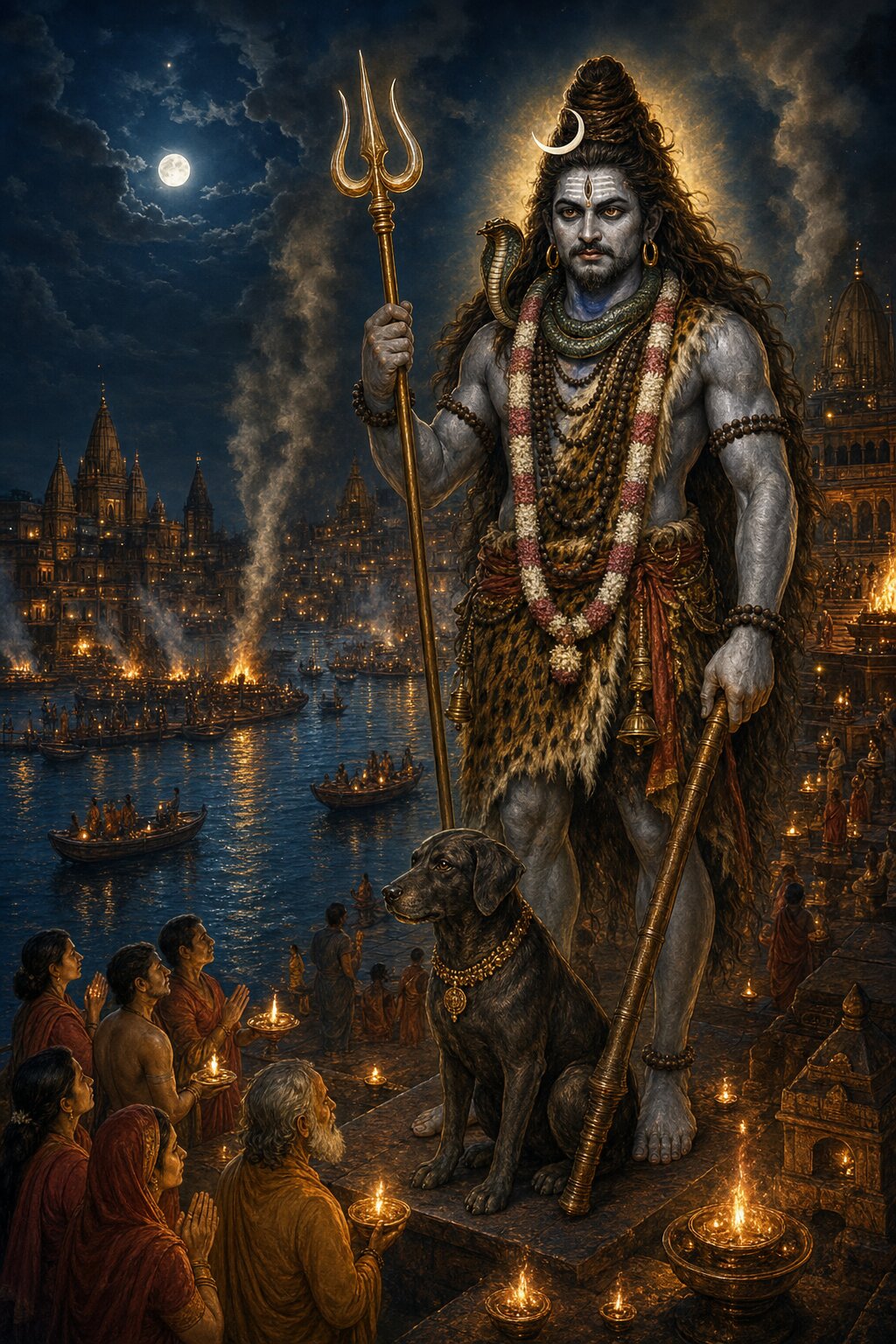
Over the ghats of Kashi the smoke of funeral pyres climbed toward the sky, and in some corner of that same city the devotees of Kaal Bhairav stayed awake through the whole night, their minds fixed on him. He stands facing the holy center of Kapalamochana, devouring the sins of those who come to him. Nandishvara first described to Sanatkumara the Bhairava incarnation of Lord Shankara, and then he began to speak.
The glory of Kaal Bhairav
On the eighth day of the dark fortnight of the month of Margashirsha, Lord Shankara, who loves the good and plays at auspicious things, took on the form of Bhairava. For that reason, the person who fasts near Kaal Bhairav on that lunar day and keeps vigil through the night is released from every sin, and whoever performs the same rite with devotion anywhere else at all, and keeps the same vigil, is freed from even the gravest sins and reaches the goal of the good. The sins committed across countless millions of lifetimes are torn out by the root at the mere sight of Kaal Bhairav. But whoever brings harm to a devotee of Kaal Bhairav is deluded, suffers in this very life, and then falls into the wretched fate of the wicked.
In Kashi this worship carries a special power. Devotees of Shiva who show no devotion to Kaal Bhairav come to great sorrow, and nowhere more sharply than here. The one who lives in Varanasi and still neglects the worship of Bhairav watches his sins swell like the moon in its waxing fortnight, and the one who does not worship this lord of time on every Tuesday, on the eighth day of the dark fortnight, sees his merit dwindle like the moon in its waning fortnight. Even a man shut in a prison, even a man in the middle of disaster, is freed from his distress by hearing this story. This telling sets aside the famous account of how Kaal Bhairav severed Brahma’s head and carried the skull-vow. Here the episode is told for his glory, and for the fruit his worship bears in Kashi.
A longing on the banks of the Narmada
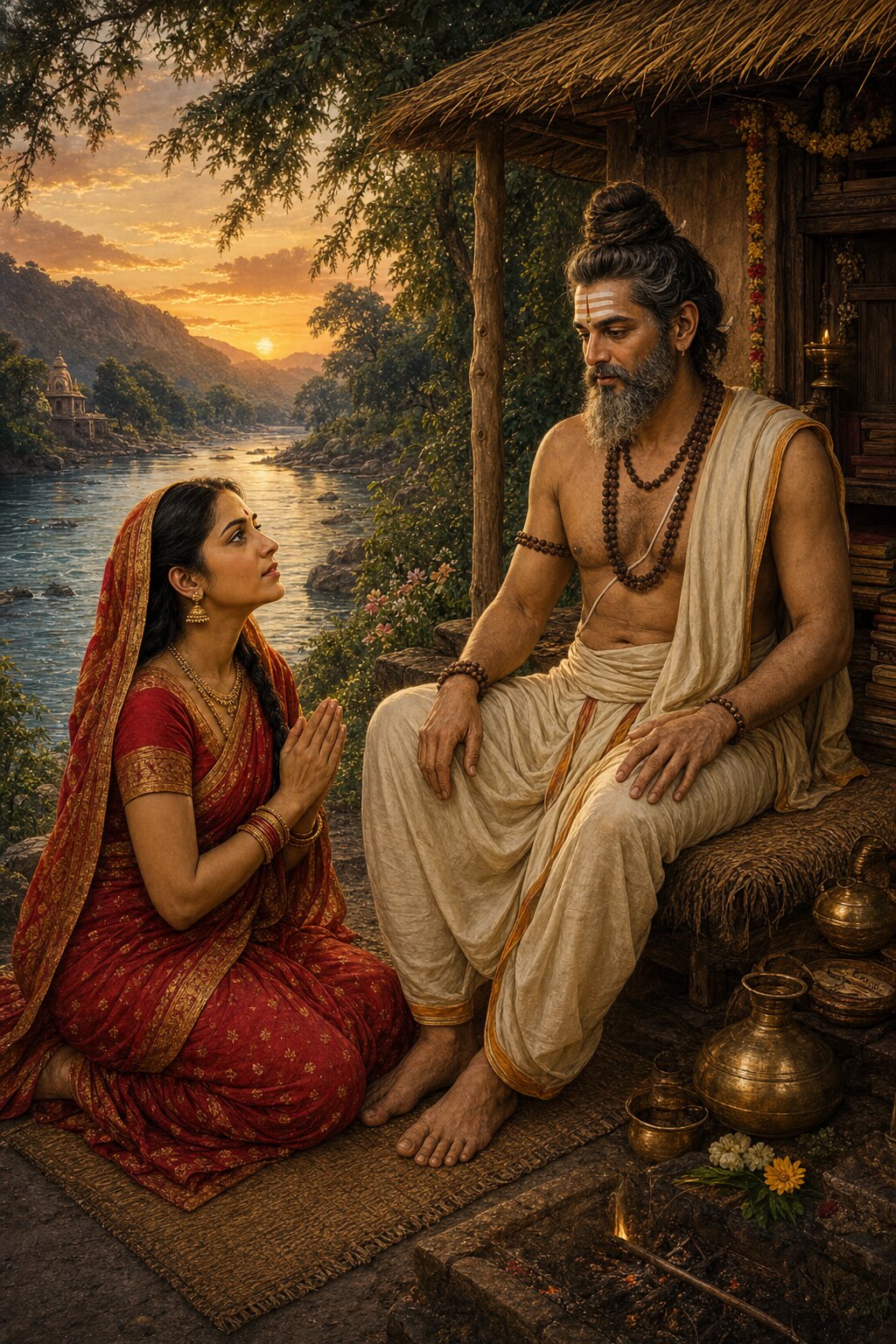
This is an old story. On the lovely bank of the Narmada there stood a city called Dharmapura. In it lived a sage named Vishvanara. Born into the lineage of Shandilya, he was supremely pure, a storehouse of brahminical splendor, a devotee of Shiva, and a master of his senses, and even in his student years he remained absorbed in the brahmayajna. He understood what the sacred word actually meant, and he knew the ethics of Shiva better than anyone around him. Having weighed carefully what makes a good wife, he married the daughter of Kala, a virtuous young woman named Shuchishmati who was truly worthy of him. He kept the sacrificial fires, performed the five daily offerings and the six rites of his order, and lived a life dear to the gods, the ancestors, and every guest who came to his door.
After a great deal of time had passed, one day Shuchishmati, who kept a noble vow, spoke to her husband. “My lord,” she said, “every joy that a woman is fit to know, I have known by your grace, here at your side. Yet one longing has settled in my heart for many days now, and it is a fitting longing for one who keeps a household. Master, if I am worthy of a boon and you are willing to grant it, give me a son like Maheshwara. Beyond this I wish for nothing.” He had already told her that nothing was out of his reach here or hereafter by the favor of Lord Shiva, and that whatever she asked he would grant without delay. She had heard it, and she thought of her husband as a deity, and she folded her palms and asked anyway.
Hearing his wife’s words, Vishvanara fell silent and entered a mystic trance for a moment. He turned it over in his mind: what a rare boon this slender woman had asked for, one that lay far beyond even his own hopes and beyond the reach of wishing at all. Let it be, he thought; only He accomplishes anything. Then a certainty came to him. It was Shiva himself who had settled upon her lips in the form of speech and spoken through her; nothing else was possible, for who else could have prompted such a boon?
The child in the Viresha linga
Having reassured his wife, the sage, faithful to his one marriage, set out for the city of Varanasi where Shiva himself is stationed. He reached it and saw Manikarnika, and the distress gathered over hundreds of births fell away from him at the sight. He worshiped Kalaraja Bhairava who devours sins, bowed to all the Vinayakas, and offered the balls of rice at every holy center. Then he began asking himself which linga yields its fruit quickest, where a penance made out of longing for a son could finally come to rest, and he settled on Viresha, from which uncountable thousands of siddhas have had their desire fulfilled. He bathed in the well Chandrakupa and took the vow, and what he took upon himself was a year measured out in months, each month its own severity. One month he ate a single meal a day. The next, only the night-meal. The next, only what came to him without begging. The next, nothing at all. Then a month of milk, a month of fruits and roots, a month on a handful of gingelly seeds, a month on panchagavya, a month drinking water from the tip of a kusha blade, and a month with air alone for food. Through all of it he honored that linga three times each day. When the thirteenth month arrived, one morning he bathed in the Ganga, she of the three paths, and the moment he came to Viresha he saw a boy of eight years standing in the middle of the linga, his body smeared with sacred ash. The little child’s eyes reached back toward his ears, a deep red glowed on his lips, beautiful tawny matted locks graced his head, and laughter played across his face. Wearing everything that belongs to childhood and the ash of the funeral pyre, he laughed in his own play and recited the hymns of the shruti.
The instant he saw the boy, Vishvanara felt his life fulfilled. His body thrilled with joy, and as he said again and again, “I bow to you, I bow to you,” his heart brimmed over. Then, folding his hands, he began to praise Shambhu in that child’s form with eight verses that carried his whole longing in them. “Bhagavan, you alone are the one Brahman without a second. It is true; there is no multitude of different things here. This entire world is your form, and there is nothing else. No being exists apart from Rudra, and so we take refuge in you alone. You are one, yet you pervade many forms, and still you stand beyond all form. The coolness in water, the heat in fire, the gladness in the moon, the fragrance in a flower, all of it is your form. You are the lord of Gauri’s life, clothed in the directions, supremely serene, and you are the child, the youth, and the old man, all of these at once. What thing is there in which you are not present? We bow our head at your feet.”
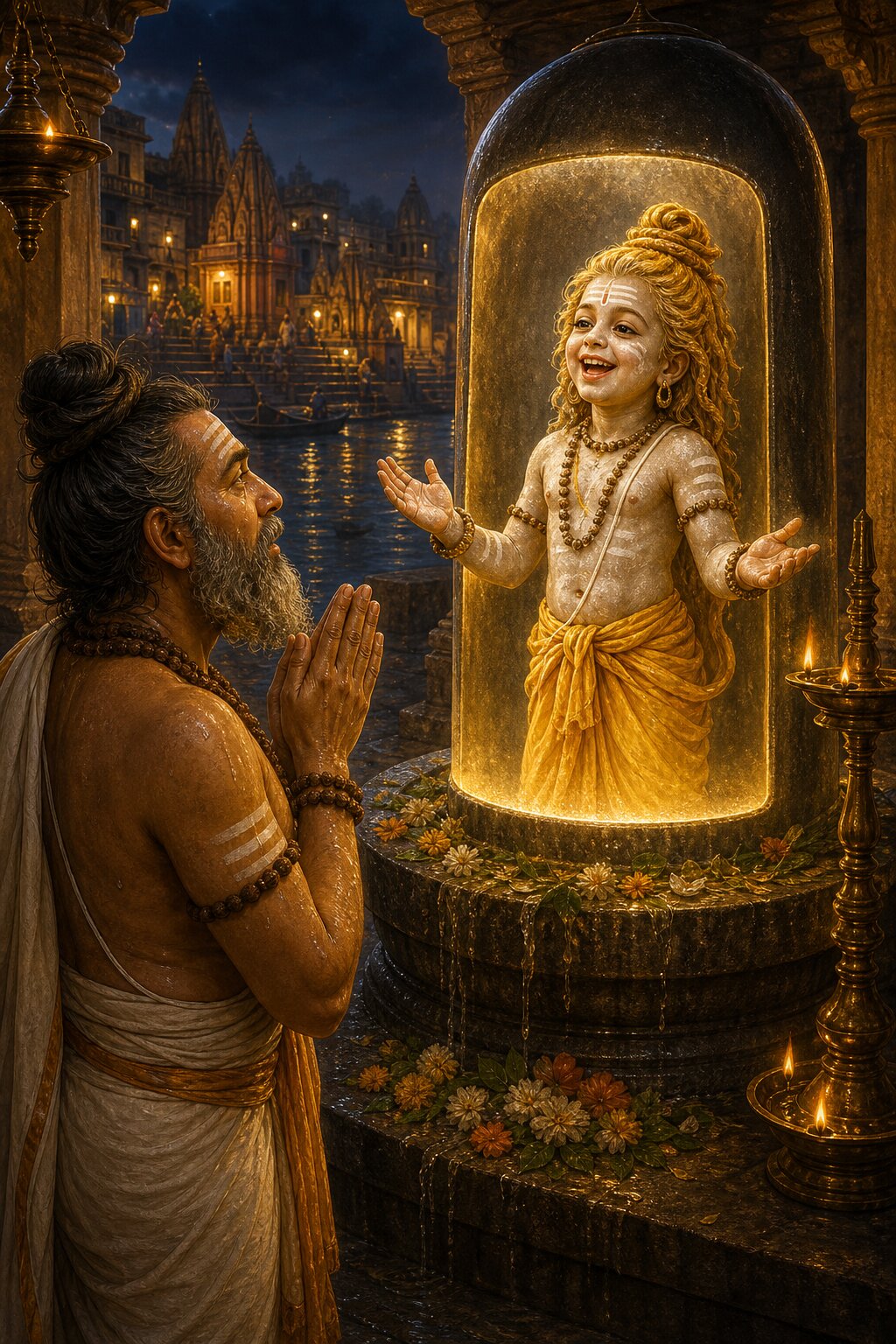
Having praised him with those eight verses, Vishvanara was about to fall to the ground when Shiva, in that child’s form, older than the oldest, grew deeply pleased and spoke. “Best of sages, today you have satisfied us. Ask for some excellent boon.” Vishvanara joined his hands and said that nothing is hidden from one who knows all, and asked why he should be pressed into the pitiable work of begging, and let him grant instead whatever he himself thought right. Then Mahadeva, in the form of the child, said, “The longing you carry in your heart for your wife Shuchishmati will be fulfilled within a few days. We ourselves will appear as your son, born from Shuchishmati’s womb, and our name will be Grihapati, pure and beloved of all the gods. And the hymn you have just spoken, the Abhilashashtaka, the eight verses of desire, recited three times a day for a year in the presence of a linga, will yield every desire. It grants sons, grandsons, and wealth, and it destroys every calamity. Do not teach it to common people; keep it carefully, as a secret mantra.” With these words the boy vanished, and Vishvanara returned home with a joyful heart.
Grihapati’s birth and Narada’s warning
Home again, Vishvanara recounted the whole episode to his wife, and Shuchishmati praised her own good fortune. In time she conceived; the sage performed the rite of impregnation duly, and before the child stirred in the womb he performed the Punsavana as the Grihyasutras prescribe, and when the eighth month came he had the simanta rite performed for her according to the proper form. Then, in an auspicious hour, Lord Shankara appeared as a son from Shuchishmati’s womb. In that moment the directions grew clear, the clouds rained down flowers, the drums of the gods sounded, and the water of the rivers ran pure. Rishis, sages, gods, yakshas, kinnaras, and vidyadharas came bearing auspicious gifts. Brahma came with Brihaspati, Vishnu riding Garuda, the bull-bannered lord with Gauri and Nandin; the nagas came up out of the nether regions, the oceans and rivers came carrying gems, and moonlight flooded the place out of season. Brahma himself bowed to the infant, performed his birth rite, and, weighing his form and his beauty against the Vedic mantras, on the eleventh day he gave him the name Grihapati. What beauty, the visitors said to one another, what splendor; how fortunate Shuchishmati is; Shiva himself is born here. Then all the gods blessed him and returned, each to his own world.
Vishvanara carried out all the boy’s rites in their season: the crossing of the threshold in the fourth month, the first feeding at six, the tonsure at a year, the ear-piercing under the constellation Shravana, and in his fifth year the vow that raises a Brahmin’s splendor. Then he taught him the Veda, and within a year the boy held the Vedas with all their branches, though he grasped the whole of it almost by himself and used his teacher as little more than a medium. In his ninth year, while Grihapati was serving his mother and father, Narada arrived. The boy, along with his parents, bowed to him. Narada seated him on his lap, asked for his right hand, studied the lines of his palm, his tongue, his palate, and the other marks, and said, “Sage Vishvanara, your son is greatly blessed; every limb of his is filled with auspicious signs. Yet fate itself will have to guard this boy, for when fate turns adverse even good qualities take on the shape of defects. In his twelfth year a grave danger of lightning or fire will fall upon him.” Having said this, Narada departed for the world of the gods.
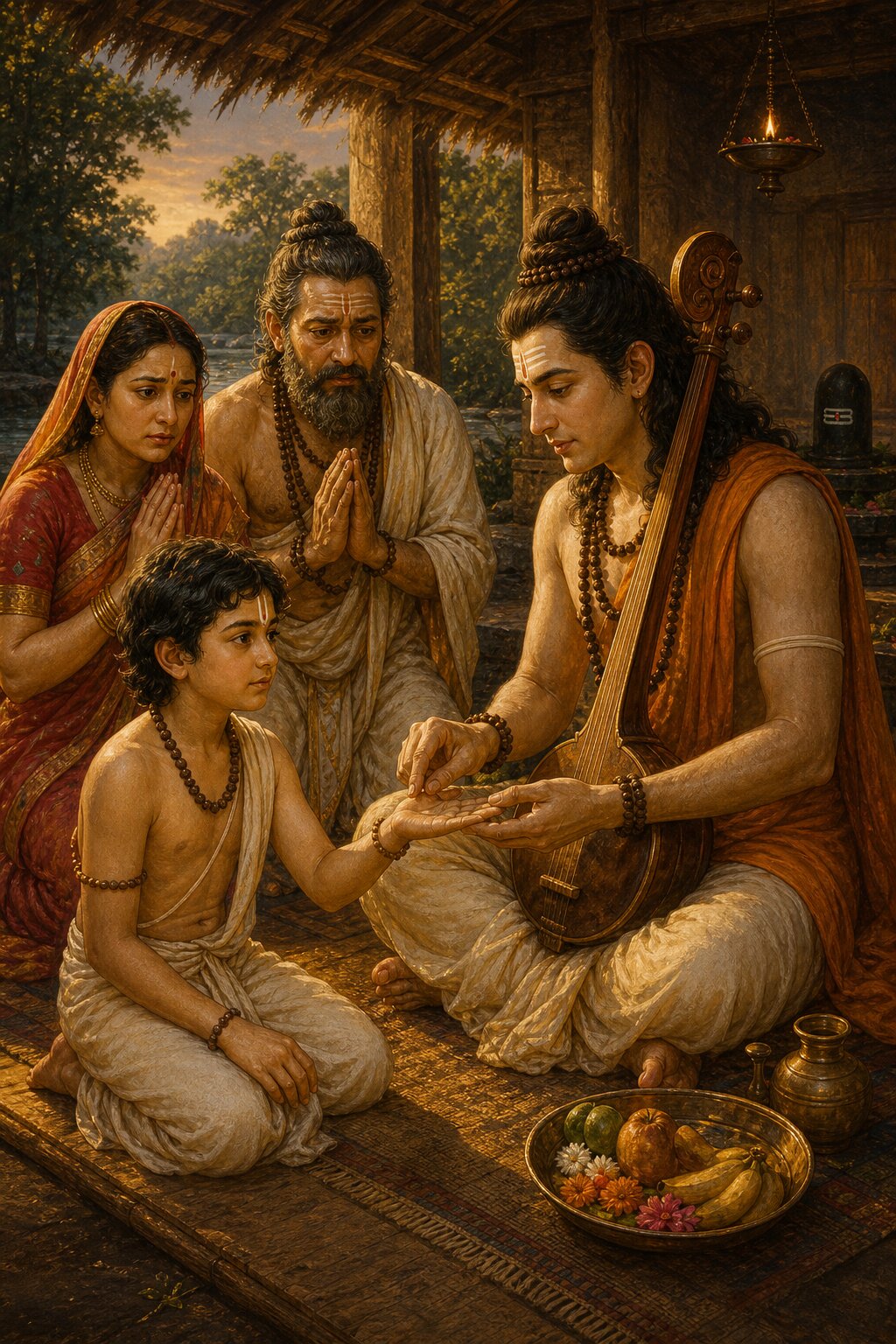
The moment he heard this, Vishvanara beat his chest and fainted with grief for his son. Shuchishmati too broke into loud weeping. Seeing his mother and father sunk in such sorrow, the boy born of a portion of Shankara smiled and said, “Mother, Father, why do you weep? If we touch the dust of your feet to our body and guard it, then even Time can lay no power upon us, so what is this trifling death? Hear our vow. If we are truly your son, we will make such an effort that Death itself takes fright; we will worship Mrityunjaya and conquer even Mahakala.” The boy’s words fell like a rain of nectar out of season, and hearing them the grief of both husband and wife departed. Then they told him what Shiva had already done for others. When Shilada’s son stood threatened by death at eight years old, Shiva saved him and made him Nandin, the delight of the whole universe. When the poison rose out of the churned ocean, terrible as the fire at the hour of dissolution, he drank it off and protected the three worlds. He killed the haughty Jalandhara with a wheel drawn by the line of his own toe. He burned the Tripuras to ash with the fire off a single falling arrow. He reduced Kama to ashes with one glance while Brahma and the rest looked on. They said, “Son, go to the shelter of that Shiva who is the maker of Brahma and the rest, the guardian jewel of the universe.”
Indra’s deception and the boon of Agnishvara
Receiving his parents’ leave, Grihapati bowed to them, walked around them in reverence, offered them his reassurance, and set out for that city of Varanasi which even gods like Brahma and Narayana find hard to reach, which Vishvanatha keeps under his protection, which wears the Ganga round its neck like a necklace. Arriving there, he went first to Manikarnika, bathed according to the rite, and took the darshan of Vishvanatha with folded hands. Sinking into pure bliss he thought: there is no one more blessed than I in the three worlds today, and it was only to enlarge my good fortune that Narada told me what he told me. Then, on an auspicious day, he installed a shivalinga and took upon himself vows so severe that ordinary people would have found them impossible. Every day he bathed Shiva with one hundred and eight pots filled with Ganga water strained through a cloth, hung a garland of blue lotus about him, and wreathed him with a thousand and eight flowers. He ate fruits and roots once a fortnight, or once a month. Six months he lived on withered leaves and the other six on drops of water, or on breath alone. A year passed like this, spent in austerity with his mind fixed on Shiva.
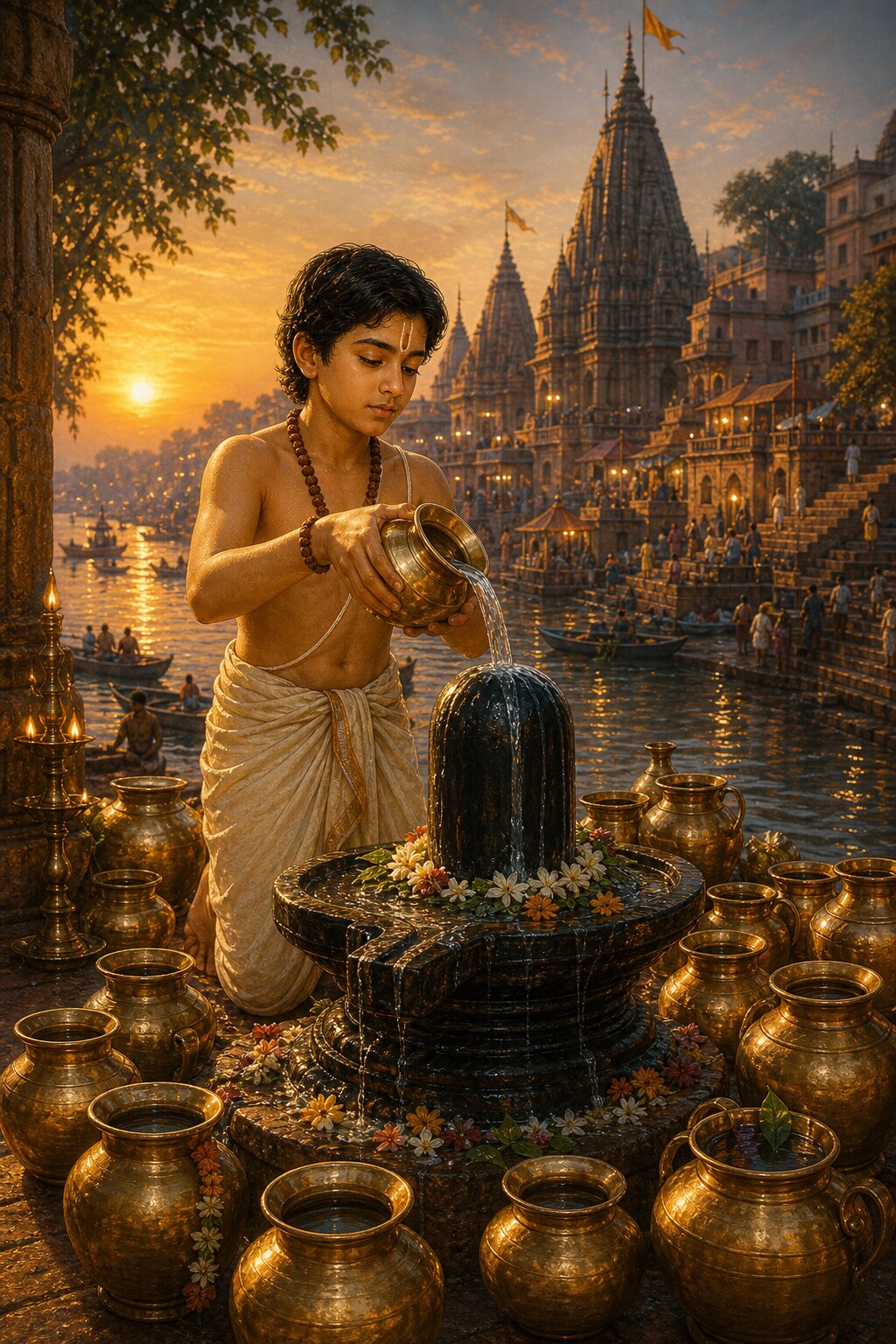
When the twelfth year of his life arrived, making Narada’s word come true, Indra the bearer of the thunderbolt came to Grihapati and said, “Best of the twice-born, we are Indra, and we have come pleased with your holy rites. Ask for a boon, and we will grant whatever desire lies in your mind.” Grihapati answered, “Maghavan, we know that you are Indra who wields the thunderbolt, but we do not wish to ask a boon of you. Our boon-giver will be Shankara alone.” Indra replied that Shankara was no different from himself, that he was the king of the gods, and that Grihapati should set aside his folly and ask, and ask quickly. Then Grihapati answered without wavering, “Pakashasana, are you not the very one who destroyed Ahalya’s chastity and made himself the enemy of the mountains? We will beg before no god other than Pashupati.”
At this, Indra’s eyes turned red with anger. He raised his terrible thunderbolt and began to threaten and frighten the boy. Seeing that thunderbolt wreathed in flashes of lightning, Grihapati remembered Narada’s words and fainted with fear. At that very moment Shambhu, the lord of Gauri and the protector of the helpless, appeared before him, and, stroking him gently back to life, said, “Child, rise, rise; may all be well with you.” Like a lotus that had closed for the night, Grihapati’s eyes opened, and he saw standing before him Shambhu, more radiant than hundreds of suns. A third eye upon his brow, a blue mark at his throat, Girija at his left side, the moon on his head, great matted locks, a trident and the Ajagava bow in his hands, a body fair as camphor, and the hide of an elephant for a garment. When, by the marks the scriptures give and by the words of his guru, he recognized that this was Mahadeva himself, tears of joy spilled from his eyes, his throat closed, and he stood as still as a mountain, forgetting himself the way a man does who has suddenly come into wealth. When he could manage neither praise nor a bow nor a single plea, Shiva smiled and spoke.
“Grihapati, it seems you took fright at Indra the thunderbolt-bearer. Child, do not be afraid. Upon our devotee neither Indra nor his thunderbolt has any hold, and Yama himself can lay none either. This was only a test we set for you; it was we who took the form of Indra and frightened you. Now we grant you a boon. From this day you will hold the office of fire, and you will be the giver of boons to whatever god you think fit. You will move within every living being as the fire of the belly, and as a guardian of the directions you will hold the quarter that lies between Dharmaraja and Indra. This shivalinga you have installed will be renowned under your name as Agnishvara, and it will enlarge every splendor. Its devotee will know no fear of lightning or of fire, no sickness of feeble digestion, and no untimely death, and whoever worships Agnishvara in Kashi, wherever fate may bring his death, will in the end be established in the world of fire.”
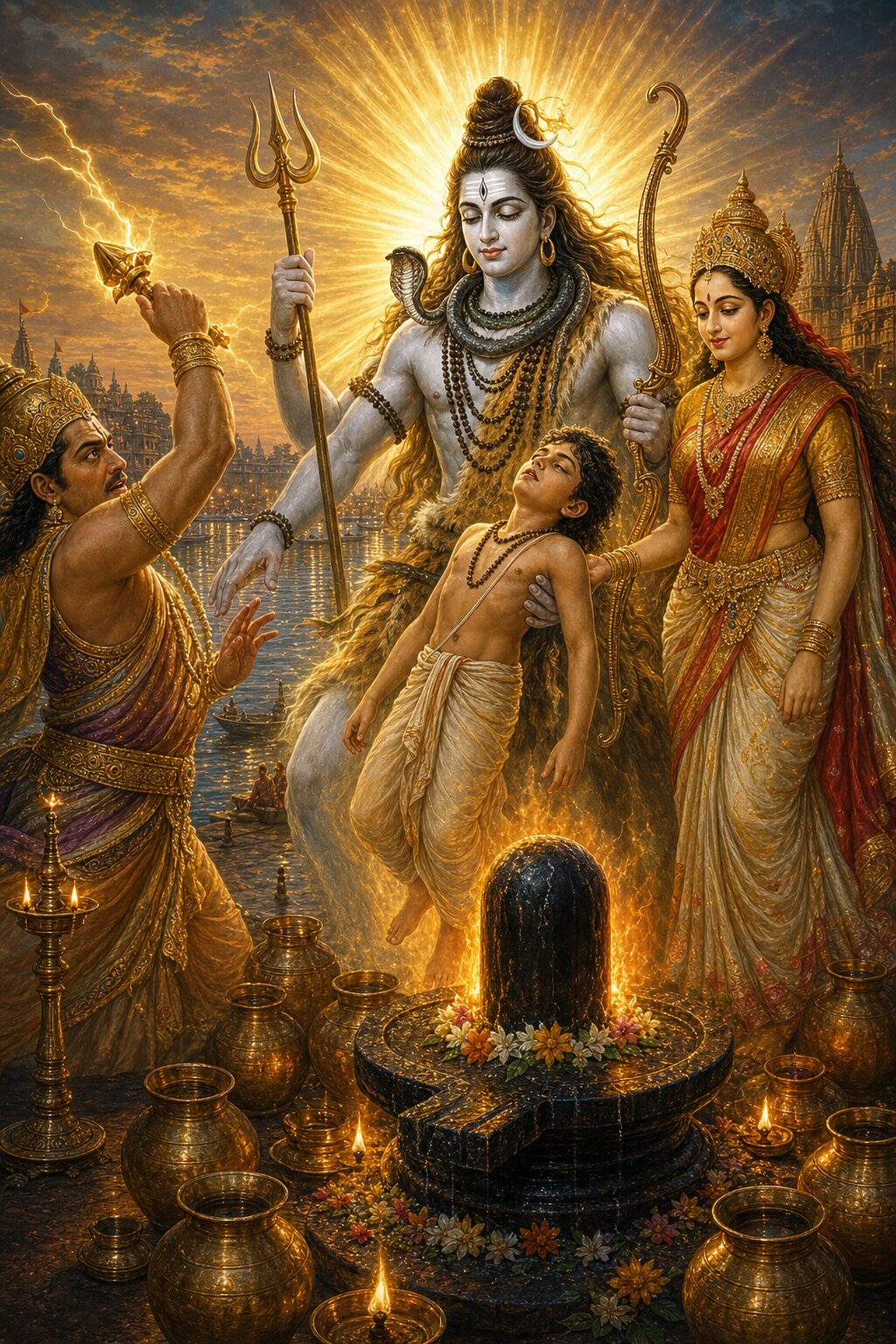
Having said this, Shiva summoned Grihapati’s kinsmen and, in the presence of his mother and father, anointed him to the station of a guardian of the directions, and then, while they watched, he himself entered that linga and merged into it. This fire is the visible, radiant image of Shambhu, which creates, sustains, and dissolves the world. Through it the incense, the lamp, and the food offering are received, and the gods enjoy them in heaven. In the beautiful, lustrous city of Chitrahotra the devotees of fire dwell, and those of steady quality who enter fire grow as lustrous as fire itself; so do Brahmins who keep the Agnihotra at its hour, and students who tend the sacrificial fires. Whatever is impure becomes pure the instant fire touches it, and for this reason fire is called Pavaka, the purifier.
Source: Shiva Purana (Gita Press, abridged Shivapurana edition), Shatarudra Samhita