On this page
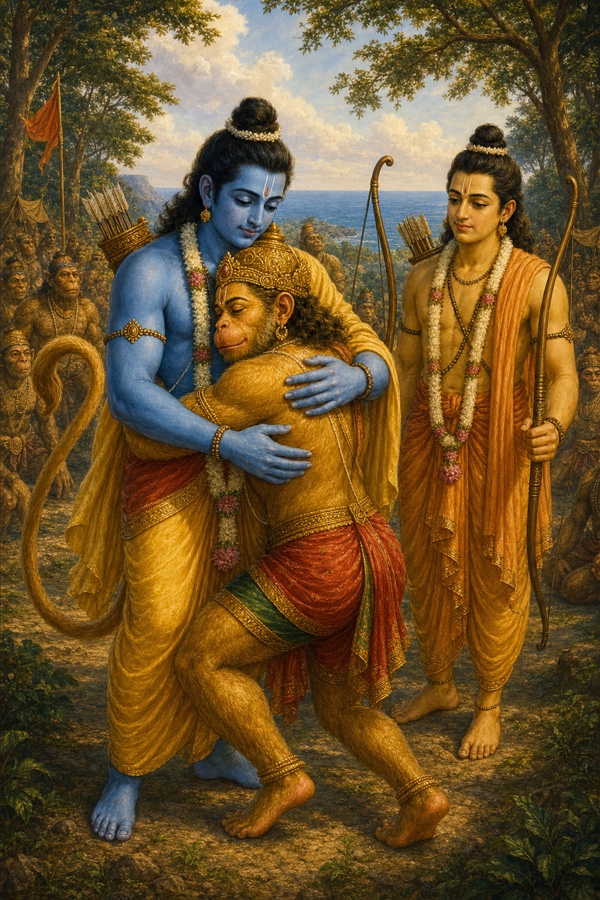
When Hanuman came back from Lanka and set out the whole account of Sita exactly as it had happened, Rama‘s heart filled with love. He praised a service that no one else could have rendered, that no one else could have imagined even in the privacy of his own mind. “Hanuman has done upon the earth a great and difficult thing,” he said, “a thing no other could accomplish even in thought. To vault the ocean, that deepest gathering of waters, I can think of none but Garuda, king of birds and the mount of Vishnu, and the wind that fathered him. Gods, danavas, yakshas, gandharvas, nagas, and rakshasas cannot break Lanka by force, and Ravana guards it close; who but a hero so rich in virility and strength could enter that city and walk out of it alive?”
Hanuman honored, and the worry of the sea
Rama set out the three kinds of servant, and he was doing it in front of the whole army, so that every one of them would know what had been done for them. “When a master assigns a hard task,” he said, “and the servant, out of the same devotion, does even more than was asked, the wise regard such a man as exemplary. The servant who is able but does not add to the charge some further kindness his master would welcome is a middling man. And the one who, fit and able, will not carry out his master’s work with a single-minded heart is the man of the worst conduct. Hanuman did more than the search for Sita required, and still he brought no smallness upon himself, and he left Sugriva content as well.”
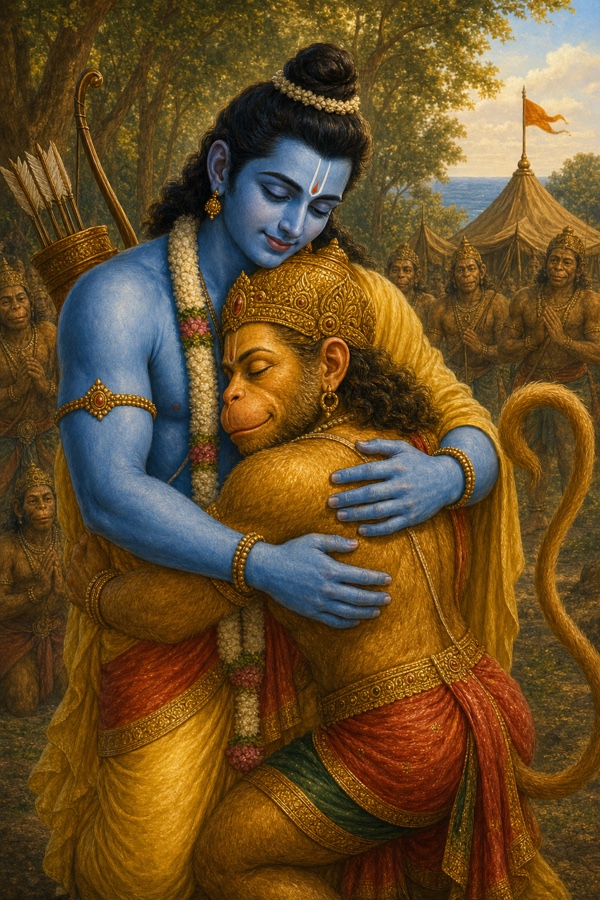
Then, his voice softening, Rama spoke like a man who has nothing, which is what he was: a prince with no kingdom, no father, no wife, and no roof, standing on a beach in bark cloth. “I am wretched, and I have nothing worthy to give the one who has carried me this precious news. The one thing that is truly my own at this moment I offer to Hanuman: this embrace.” And saying it, his body thrilling with love, he drew the returned and triumphant Hanuman against his chest.
He was quiet for a while. Then, so that Sugriva could hear him, the prince born in Raghu’s line spoke again. “The search for Sita has gone well in every way. Yet the moment I reach this ocean my heart sinks. How will these vanaras, gathered together, cross this vast and all but uncrossable sheet of water and reach its southern shore? Sita herself named this impossibility.” She had asked it from the far side, of a monkey who could fly; he was asking it from this side, with an army that could not. “What is the means for an army to pass to the far side?” Having said this, Rama, worn down by grief, sank into thought.
Sugriva lifts his spirits
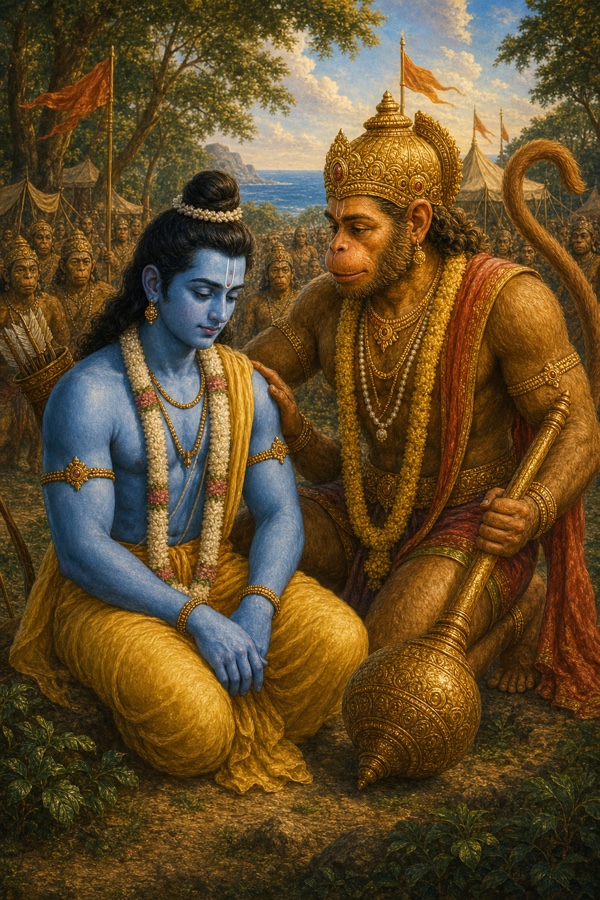
Sugriva spoke words meant to ease Rama’s grief, and he spoke them bluntly, because a friend who has been lifted out of his own ruin by this man has that right. “Raghunandana, you are wise, learned in the shastras, deeply intelligent, a scholar. Like a man who has mastered his own mind, set aside this ordinary mood, which will only wreck the very thing you want. Why, hero, do you grieve like some common man? Cast off this anguish the way an ingrate casts off goodwill.”
“I see no cause for your anguish. Sita has been found, and the enemy’s dwelling is known. We will leap this sea thick with crocodiles and monsters, climb the fortress of Lanka, and put an end to your enemy Ravana. Every affair of a man who is dispirited, low, and puzzled by grief comes to nothing, and he falls into disaster. These leaders of the vanara troops are brave and wholly capable, ready to walk into fire for you. I read this in their joy when the march on Lanka was proposed, and my reasoning is firm.”
“Give up this cowardly turn of mind, king, that destroys every purpose; grief robs a man of his courage. In this hour take hold of your strength along with your fire. Master of every argument of the shastras, with ministers like me at your side you are entirely able to conquer the enemy. In all three worlds I see no one who could stand before you in battle once you have taken up your bow.”
“Set grief aside and take up anger, lord of the earth. Kshatriyas who do nothing are dull men, and everyone fears the fierce. With your subtle mind, consider with us the means to cross this dreadful sea. Once the army is over, know the victory to be certain. These vanaras, who take any shape they wish, will scatter the enemy with a rain of rocks and trees. I see good omens, and my heart is full of gladness; you will be victorious in every way.”
Hanuman’s account of Lanka
Hearing Sugriva’s reasoned and purposeful words, Rama of the Kakutstha line accepted them and turned to Hanuman, and became a commander again in the space of a breath. “By the strength of my austerity, or by building a bridge, or by drying the sea with my weapons, I am able in every way to cross it. But how many fortifications does hard-to-reach Lanka have? Tell me truly all that you saw: how the gates are built and defended, how great the strength, how the secret guard is arranged, and where the rakshasas dwell. You are skilled in every way.” It was the reason Hanuman had let himself be bound and burned and paraded: so that this question would have an answer.
Hanuman, best of those who know how to speak, the son of the wind, answered, and he answered like a man reading from a page he had memorized with his own body. “Listen; I will tell it all in order. Lanka is a city gay and exulting, crowded with elephants in rut and with chariots, thronged by hosts of rakshasas. It has four broad and towering gates, their doors fastened with strong bars and heavy beams. On the gates are powerful engines to hurl darts and stones and hold back an attacking army, and shataghnis by the hundred, four cubits long, studded with iron spikes, each able to kill hundreds at once.”
“All around it runs a great wall of gold, not to be broken by force, inlaid with gems, coral, cat’s-eye, and pearl. Around that lie terrible moats, fathomless, filled with cold water, alive with water-beasts and fish. Before the gates stand four broad drawbridges fitted with engines and rows of buildings; when a hostile army comes, these bridges are held by their engines and the enemy is spilled into the moat. The chief bridge before the northern gate is unshakable, mighty, and utterly firm, adorned with pillars and platforms of gold.”
“Ravana himself, eager for war, keeps watch and reviews his forces. Lanka is a god-built stronghold that offers no foothold for assault, and its guard is fourfold: the river that circles it, the mountain Trikuta on whose peak it stands, the belt of forest around it, and the man-made defense of wall and moat. It sits across the far sea where not even a boat can pass; raised on a mountain crest, it rivals a city of the gods, packed with horses and elephants, all but impossible to conquer.”
Hanuman gave the count of each gate’s guard, and the numbers rose as he went, and nobody interrupted him. “At the eastern gate stand ten thousand rakshasas, spears in hand, hard to assail, fighters with the sword’s edge. At the southern gate a hundred thousand, with a full four-limbed army, warriors unsurpassed. At the western gate a million, bearing shields and swords, masters of every weapon. At the northern gate a hundred million, chariot-warriors and horsemen, sons of noble houses honored for their skill. And at the central station more than twelve and a half million yatudhanas, hard to assail.”
“I broke those bridges, filled the moats with rubble, burned Lanka, threw down stretches of wall, and destroyed a good part of the strength of those mighty rakshasas. By whatever road we cross the sea, the dwelling of Varuna, count Lanka as good as ruined by the vanaras. Angada, Dvivida, Mainda, Jambavan, Panasa, Nala, and the commander Nila could storm Lanka on their own and bring Sita back. What need to carry the rest of the army over? Give the order to gather the host, and set your heart on marching at a fitting hour.” He had just recited the strongest fortress in the world, gate by gate and man by man, and then told them it was already half beaten, and he was the reason.
The hour of departure, and the good omens
Having heard Hanuman’s account in order, Rama, true in valor and blazing with power, spoke. “This city of Lanka, home of the fearsome rakshasa Ravana, of which you speak, I will destroy without delay; this I promise you as truth. Set your heart on marching in this very hour, Sugriva. The sun stands at midday, and this is the hour called Abhijit, which gives victory to those who set out.” He would not wait for morning, or for a better day, or for the priests; the best hour in the whole calendar was standing directly overhead, and it would be gone in a matter of minutes. “Let that rakshasa go home with the woman he stole; he will not stay alive. When Sita hears of my coming she will find hope of life again, the way a dying man revives at the touch of the herb of deathlessness.”
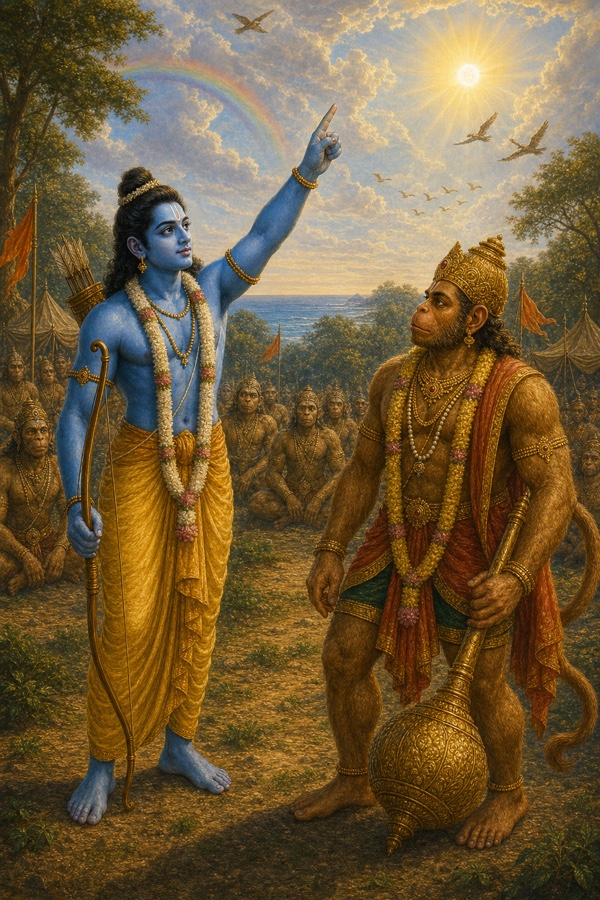
“Today the moon stands in Uttaraphalguni; tomorrow it will join the star Hasta. March this very day with all the forces, Sugriva. From the omens rising on my own body I know that I will kill Ravana and bring back Sita. This right eye of mine throbs at its upper lid, as though it were announcing a victory already drawing near.” The same sign had come to Sita in her grove, on the left, where a woman reads it, and neither of them would ever know that their bodies had agreed. Honored by the vanara king and by Lakshmana, Rama, righteous and skilled in policy, spoke on.
He laid out the order of march. “Let Nila go ahead with a hundred thousand swift vanaras to scout the way. Commander Nila, lead the army by a road of fruit and root, of honey, of cool woods and clean water. Wicked rakshasas may poison the roots and fruits and water along the way; stay ever ready and guard the host from them. Let vanaras leap out on every side and search the ravines, thickets, and rough forest tracts for an enemy in ambush. Any who are weak should stay here in Kishkindha; this is grim work, and only the strong will be of use.”
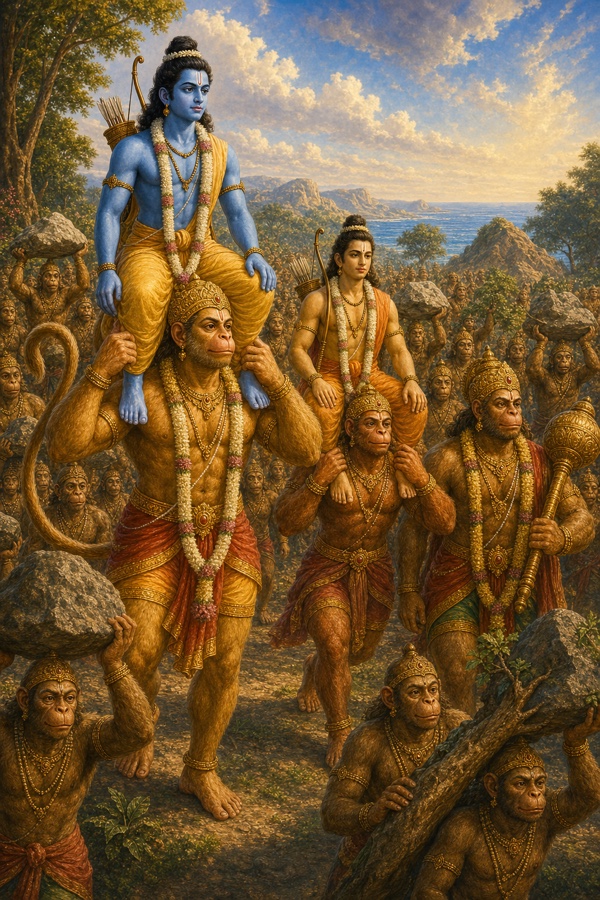
“Let the mighty monkey leaders lead the vanguard, in their hundreds and thousands, like the tide of the sea. Let Gaja, huge as a hill, and Gavaya and Gavaksha go in front like rutting bulls at the head of the herd. Let Rishabha guard the right flank and Gandhamadana the left. I will ride on Hanuman’s shoulders, as Indra rides Airavata, and march in the center of the army. Let Lakshmana ride on Angada, as Kubera rides his elephant Sarvabhauma. Let Jambavan and Sushena and swift-eyed Vegadarshi, these three, guard the rear.” Hearing Raghunandana’s word, Sugriva gave the vanaras their orders.
Then all the powerful vanara hordes sprang up at once from their caves and peaks. Honored by the vanara king and by Lakshmana, Rama set out with his army toward the south. Rishabha, Nila, and the hero Kumuda went ahead with other vanaras, clearing the road. In the center were king Sugriva, Rama, and Lakshmana. The hero Shatabali guarded the whole army single-handed with a hundred million vanaras. Some leaping, some roaring with the cry of lions and the bellow of bulls, eating honey and fruit, lifting great trees heavy with blossom, they pressed on southward. “May Ravana and all the rakshasas fall to us,” they roared, close by Rama, as they went.
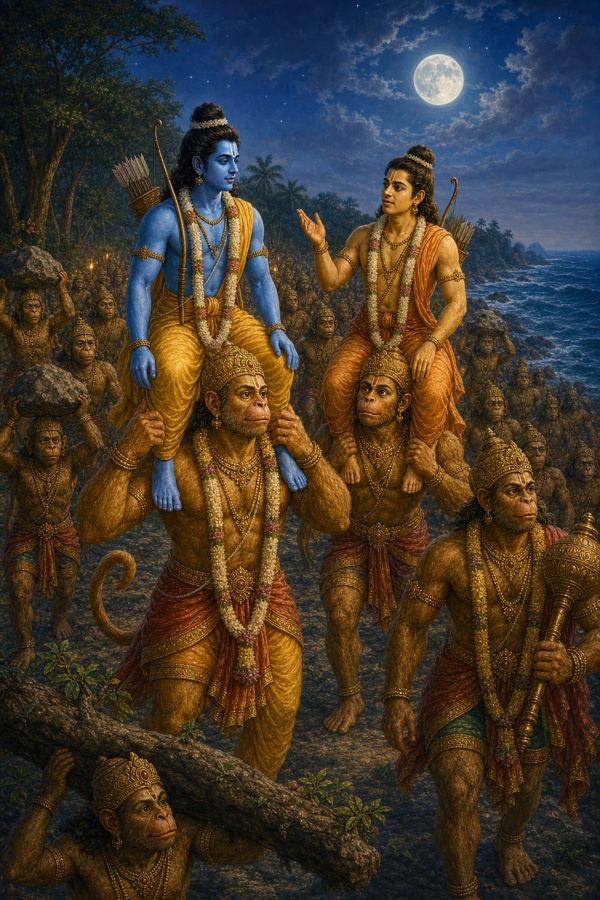
Riding on Angada, Lakshmana spoke sweet words to Rama, whose every purpose stood fulfilled. “You will kill Ravana, recover the stolen princess of Videha, and soon return to Ayodhya with your work complete. In the sky and on the earth I see great and favorable omens of your success. In the very direction the army moves, a gentle, cool, fragrant, kindly wind is blowing. Beasts and birds call in sweet full voices, the quarters are serene, and the sun shines clear.”
“Vishakha, the great star of the Ikshvaku line, gleams free of trouble, and the royal sage Trishanku, grandsire of the Ikshvakus, shines clear before us with his priest Vasishtha. But Mula, the rakshasas’ star, whose deity is Nirriti, is sorely afflicted: a comet with its tail raised touches it and scorches it, and all of it points to the ruin of the rakshasas.”
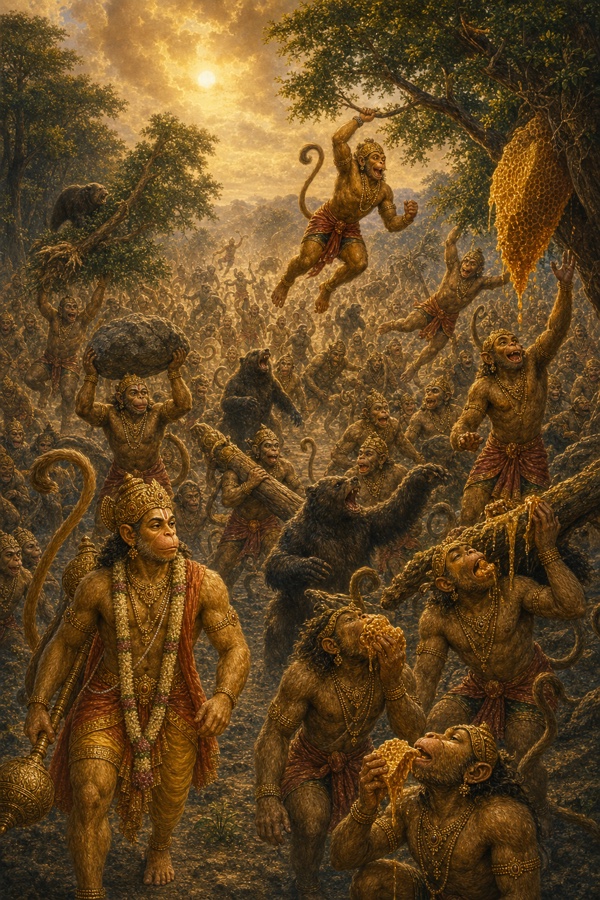
Reassured in this way, the son of Sumitra took heart. The vanara army moved on as though covering the whole earth. Dust flung up by the hands and feet of the clawed and fanged bears and apes blotted out the sunlight and covered the ground; like a wall of cloud, the host swept the southern quarter, mountains and forests and sky alike. The currents of the rivers ran backward. With glad faces the vanaras went at the speed of the wind, showing one another their joy and might and strength, roaring in the pride of youth, some running, some springing, screeching, lashing their tails, stamping their feet. Some broke trees and rocks, roared, crushed nets of creepers, stretched and sported with stones and trees. So the great vanara host moved on day and night.
Climbing the Sahya mountain, then gazing at the strange forests of Sahya and Malaya, at rivers and cascades, Rama pressed on. The vanaras broke champak, tilaka, mango, ashoka, sinduvara, tinisha, oleander, ankola, karanja, plaksha, banyan, jamun, myrobalan, nipa, and more. Through honey-scented woods, amid the hum of bees, a sandal-cool, pleasant breeze blew. The lord of mountains, adorned with its ores, shone the brighter, and its mineral dust covered the army. Ketaki, sinduvara, vasanti creeper, madhavi, kunda, chirbilva, madhuka, vanjula, bakula, ranjaka, naga, and other trees stood in flower. There were wells, pools, and lakes where chakravaka, karandava, and krauncha birds moved and boars and deer dwelt; bears, hyenas, lions, tigers, and dreadful elephants roamed there. It was the loveliest country in the world, and the army marching through it was going to a war it might not come back from.
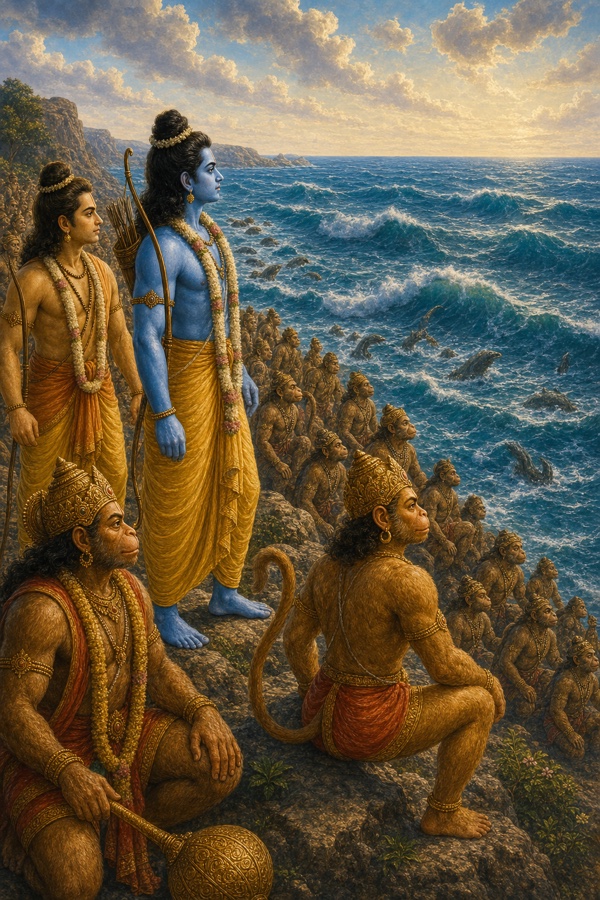
The vanaras bathed and drank and played in the water, ducking one another, drinking honey scented like nectar from hanging combs each the size of a large jar, and, drunk with it, broke trees and creepers and flung down mountain peaks as they went. Then Rama climbed the Mahendra mountain and looked out on the sea, thick with turtles and fish. Having crossed Sahya and the great Malaya, and at last Mahendra, they came to the terribly roaring sea. It had taken an army what it took one monkey a single leap.
The army’s camp on the shore
Coming down from Mahendra, Rama, best of those who delight the heart, reached with Sugriva and Lakshmana a fine wood near the sea. Standing on the broad shore, its rock washed by the waves, he spoke, and what he said was the plain truth and nobody wanted to hear it. “Sugriva, we have come at last to the dwelling of Varuna. The same problem faces us that faced us before. This shoreless sea cannot be crossed without a plan. Let the camp be here, and here let the council be held, so that the vanara army may reach the far side.” So Rama, worn thin by Sita’s loss, ordered the army to make camp.
Hearing his word, Sugriva with Lakshmana had the army settled on the tree-lined shore. Near the sea that host shone like a second sea with waters pale as honey. Reaching the shore wood, the vanaras halted there, longing for the far side. As they pitched camp the great noise of the army arming drowned even the roar of the sea. The host settled in three divisions: bears, long-tailed golangula apes, and vanaras.
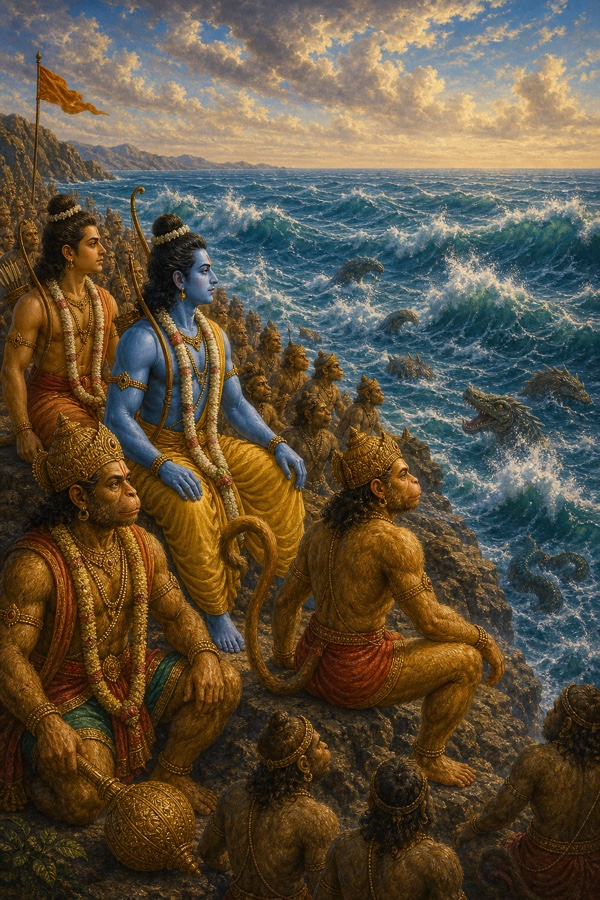
Coming to the great sea, the vanara army rejoiced. Gazing on the far-shored, boundless dwelling of Varuna, haunt of the rakshasa hordes, the troop-leaders sat down. That sea was terrible with fierce crocodiles and sea-beasts, rising high with the tide at dusk and the coming of night, filled at moonrise with reflected moons, laughing as it were with masses of foam, dancing as it were with its waves, thick with timi and timingila fish, coiled with bright-hooded serpents like Patala itself, packed with great creatures and drowned mountains, a fastness deep and hard to breach, an abode of demons. Whipped by the wind, its waters rose and fell as if for joy.
Scattered like fiery powder, bright with its water-serpents, that dread refuge of the enemies of the gods looked like the sky, and the sky looked like the sea; crowded, the one with stars and the other with jewels, there was no telling them apart. The waves of the sea struck one another and rang out like great war-drums beaten in the sky. Gathered as if to one place by the wind, roaring with its hoard of jewels, thronged with sea-creatures, the sea seemed to rise as though in anger. The wondering vanaras watched that ocean seem to dance on wind-flung waves, roaring with its swirling nets of surf. They had come a thousand miles to look at the one thing none of them could cross.
Rama’s memory of Sita, and his grief
Nila set the army in good order and made a fine camp on the northern shore of the sea. Mainda and Dvivida, two vanaras, patrolled on all sides to guard the host. When the camp was made, and the fires were lit, and there was nothing left to organize, Rama looked at Lakshmana standing beside him and said. “They say grief lessens as time passes; but mine grows day by day for want of the sight of my beloved. Above the loss, above the long miles between us, one fear consumes me: that the span of her life is running out.” He had a month. Hanuman had brought him the number along with the jewel.
“Wind, go where my love is; touch her, and then touch me; through you that touch of her body will be to me as the meeting of the eye with the moon. As she was carried off she cried, ‘Ah, my lord!’ and that cry burns my limbs like poison. With the fuel of parting from her and the clear flame of thought of her, the fire of love scorches my body night and day.” He was speaking to the wind on a beach at night, and the wind was the father of the one creature who had actually done what he was asking.
“Even if I went down into the sea and slept there without you, this blazing love would not spare me as I lay in the water. My one comfort is that she of the lovely limbs and I are both upon the same earth; on that alone I stay alive. As a dry plot of ground lives on through contact with a watered plot beside it, so I live on by hearing that she lives.”
“When will I conquer my enemies and see Sita, her eyes wide as lotus petals, like Fortune herself grown full? When will I lift her lotus face a little and drink it like an elixir, her lovely teeth and lips? When will her full breasts press me as she takes me in her arms? How does the daughter of King Janaka, my beloved, the daughter-in-law of Dasharatha, live among rakshasa women?”
“That faithful woman, who holds me alone for her lord, finds no protector among the rakshasas, like a woman with no guardian. Will she, unshaken as the autumn moon, break through the rakshasas and shine forth like the moon parting the clouds? Slender by nature, Sita must have grown thinner still from grief and fasting and the cruelty of place and time. When will I bury my arrows in the breast of the lord of rakshasas, cast off my own sorrow of mind, and take away Sita’s grief? When will my saintly Sita, like a daughter of the gods, cling to my neck in longing and shed tears of joy? When will I fling off all at once this terrible grief born of parting from the princess of Mithila, the way one flings off a soiled garment?”
While Rama lamented, the sun, its brilliance dimmed by the failing day, sank behind the western hill. Comforted by Lakshmana, remembering Sita, the grieving Rama performed his evening devotions. The same prayers, at the same hour, as the woman across the water, and the sea between them lay there and did not move.
Ravana’s council in Lanka
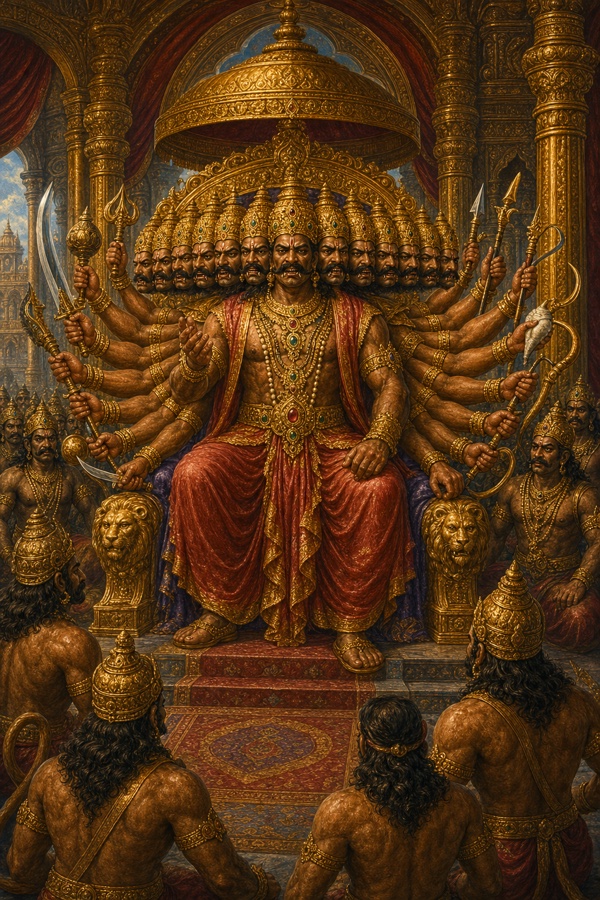
In Lanka meanwhile, seeing the grim and terrible work Hanuman had done, Ravana, his face lowered a little in shame, spoke to all the rakshasas. It was the first time in his life he had gathered his court to explain something. “Hanuman, a mere monkey, forced his way into unassailable Lanka and looked upon Sita. The sanctuary was breached, the foremost rakshasas killed, all Lanka churned by Hanuman. May it go well with you; what shall I do now? Tell me what is fitting, what befits us and would be well done.”
“The wise call victory rooted in counsel; so, in the matter of Rama, I want your counsel.” Then he set out the three kinds of counselor. “He who takes counsel with able ministers, with friends of common interest, with kinsmen too, then begins his work depending on Providence, is an exemplary man. He who deliberates alone, decides alone, and acts alone is a middling man. And he who begins without weighing merits and faults, casting off all reliance on Providence, saying only ‘I will do it,’ and so neglects his duty, is the man of the worst conduct.” Every man in that hall could have named which of the three had carried a woman out of Janasthana without telling anyone.
“As men are best, worst, and middling, so is counsel. That counsel in which the ministers, agreeing on a point of scripture, work as one is the best; that in which they differ and come at last to agreement is middling; and that in which they wrangle and, even if they agree, win no benefit, is the worst. So, best in judgment as you are, settle a well-counseled, well-determined course; that is what I hold we must do.”
“Rama, ringed by thousands of steady vanaras, is coming toward Lanka to besiege us. By the prowess that befits him he will cross the sea in comfort with his brother, his army, and his followers. Or he will dry the sea by his strength, or find some other means. The attack on Lanka and the war with the vanaras have already begun; advise me on all that is good for the city and the army.”
The rakshasas’ boastful reassurance
Knowing nothing of the true strength of the other side, without policy or sense, those mighty rakshasas folded their hands and spoke to Ravana. Their king had asked them a real question, perhaps the only one he had ever asked, and they answered it with a list of his own past victories. “King, we have a vast army bristling with iron bars, lances, double-edged swords, darts, spears, and pikes; why then do you grieve? You went to Bhogavati and conquered the nagas in battle. You subdued Kubera the wealth-giver, who dwells on the peak of Kailasa among his many yakshas, though he was a world-guardian proud of his friendship with Shiva.”
“You killed and captured the hosts of yakshas and brought this flying chariot, the Pushpaka, from the crest of Kailasa. Maya, lord of the danavas, seeking your friendship out of fear, gave you his daughter Mandodari to wife. You subdued in battle the danava lord Madhu, husband of your beloved sister Kumbhinasi, though he was proud of his valor and hard to approach. Descending to Rasatala, you conquered the nagas Vasuki, Takshaka, Shankha, and Jati.”
“Lord, you fought the Kalakeya danavas, who had boons and were beyond killing, mighty and brave, for a whole year, and subdued them, and learned many magic arts there. You conquered the strong, heroic sons of Varuna with their four-limbed force. You plunged into the ocean that is Yama’s realm, where Death’s rod was a great crocodile, the silk-cotton tree stood thorned, the noose of Time was the great wave, the serpents were Yama’s servants, and the fever-spirit raged; there you won a mighty victory and turned Death itself back, and all were well pleased.”
“Once the earth was crowded with kshatriya heroes, mighty as Indra, thick as great trees. Rama does not equal them in battle for prowess, virtue, or spirit; yet you cut down even those unconquerable ones at a stroke. Even if you sit still here, what of it? What need have you to trouble yourself? This one Indrajit will finish off the vanaras alone.” Not one of them had thought to ask how a single monkey had walked out of their city with the whole of it on fire behind him.
They went on, “Indrajit performed a sacrifice to Maheshvara and won a boon as rare as any in the world. The army of the gods was a sea, with spears and clubs for its fish, the Rudras and Adityas for its great crocodiles, the Maruts and Vasus for its serpents, and chariots, horses, and elephants for its water; he plunged into that sea, seized Indra, and cast him into Lanka a prisoner, and only at the command of Brahma, the grandsire, was Indra set free to go back to heaven.”
The rakshasas said, “Send that same Indrajit, and he will destroy Rama and the whole vanara army. King, this trouble has come from common creatures, men and monkeys; do not give it a place in your heart; you will surely kill Rama.”
The boasts of Prahasta and others
Then the commander Prahasta, a brave rakshasa dark as a raincloud, folded his hands and spoke; he had lost seven sons to that one monkey, and he had come to explain that it had been an accident. “Gods, danavas, gandharvas, fiends, birds, and serpents can all be easily overpowered in battle, so what are two men? We were careless and unsuspecting, and that is how Hanuman tricked us; otherwise the forest-ranger would not have gone out alive while I lived. At your order I will sweep the whole earth to the ocean’s edge, with its mountains and woods and forests, clear of every vanara. I will guard you from the vanaras, and no grief born of your own act will reach you.”
The enraged rakshasa Durmukha spoke. “This affront is not to be borne by any of us. One monkey’s assault is an outrage on Lanka, on the royal harem, on Ravana. This very hour I will go alone and drive the vanaras back, though they hide in the sea, the sky, or Rasatala.”
Then Vajradamshtra, enraged and raising his terrible iron bludgeon smeared with flesh and blood, spoke. “What is the wretched, poor Hanuman to us? While there stand the hard-to-assail Rama, and Sugriva with Lakshmana, I will go alone and with my bludgeon kill Rama, Sugriva, and Lakshmana, throw the vanara army into panic, and return this very day. And hear one thing more, king: only the resourceful and unwearied conquer the enemy. Let some huge, dreadful rakshasas take human form, go to Rama, and say without flinching, ‘Your younger brother Bharata has sent us, and Rama too is raising his army and coming soon.’ Then let us reach that place at once, armed with spear, lance, mace, bow, arrow, and sword, stand in the sky in our bands, and with a great hail of stone and steel send the vanara army to Yama’s realm. If Rama and Lakshmana fall into this trap, they will lose their lives by their own error.” They had learned exactly one lesson from Hanuman, and it was the wrong one: that a war could be won by wearing another shape.
Then Nikumbha, valiant son of Kumbhakarna, in high rage spoke. “Stay here all of you with the great king; alone I will kill Rama, Lakshmana, Sugriva, Hanuman, and all the vanaras.” Then the mountain-like rakshasa Vajrahanu, licking his lips with his tongue in rage, spoke. “Be free of care, all of you; play as you please, drink the wine of Varuna; alone I will devour that whole vanara army, and kill Sugriva, Lakshmana, Angada, Hanuman, and all the rest this very moment.”
Vibhishana’s first counsel
Then Nikumbha, Rabhasa, Suryashatru, Suptaghna, Yajnakopa, Mahaparshva, Mahodara, Agniketu, Rashmiketu, Indrajit, Prahasta, Virupaksha, Vajradamshtra, Dhumraksha, Atikaya, and Durmukha, all in a fury, seized iron clubs, pikes, spears, darts, lances, axes, bows and arrows, and swords, and, blazing as if with fire, sprang up and cried to Ravana, “Today we will kill Rama, Sugriva, Lakshmana, and that wretched Hanuman who ravaged Lanka.” The council Ravana had called for counsel had become a room full of standing men with weapons out, and he had not yet been told one true thing.
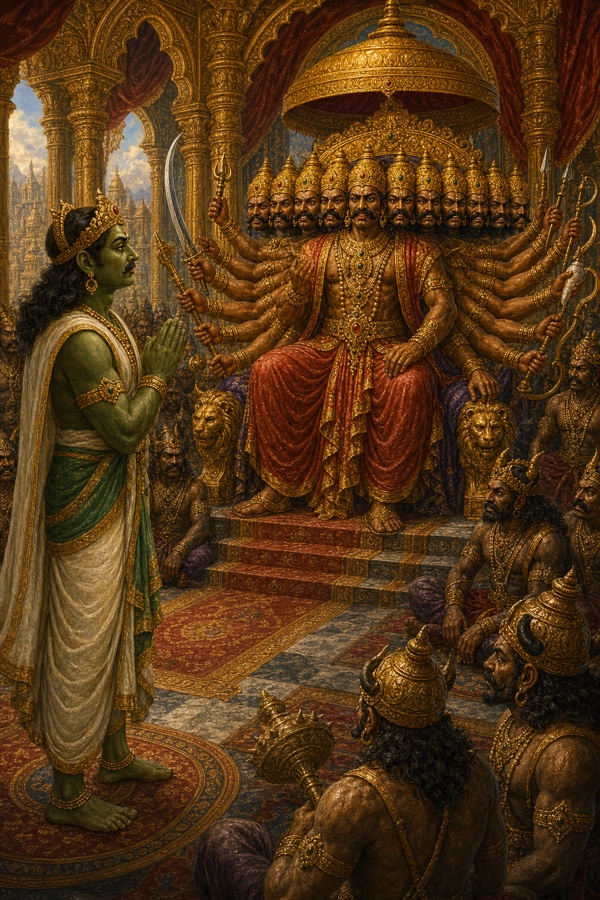
Checking them all as they held their weapons, seating them again, Vibhishana, Ravana’s younger brother, folded his hands and spoke. “Father, the time for force is said to be only when an aim cannot be gained by the three means of conciliation, gift, and division. The wise say force succeeds only against those who are heedless, or already struck by another enemy, or doomed by fate. But this Rama is watchful, bent on victory, firm in strength, master of his anger, hard to assail; how do you think to overpower him?”
“Who in the world can measure or even imagine the speed of Hanuman, who leapt the terrible sea? Rakshasas, Rama’s strength and valor have no measure; enemies must never be despised out of hand. And what wrong had Rama first done the rakshasa king, that the wife of that glorious man was carried off from Janasthana? If it is said that Khara broke the bounds of right and Rama killed him in battle, then every creature must guard its own life as best it can.” It was the question no one else in Lanka had asked out loud in ten months: what did that man ever do to us first?
“If Sita was taken out of that same spite, she will become our great danger; she was brought for a needless quarrel, and it is right to give her back. Empty enmity with that hero who walks the path of dharma is not good; let the princess of Mithila be given to him. Before Rama looses his firm, unfailing arrows, bright as the autumn sun’s rays, new-headed and new-shafted, for your destruction, let the princess of Mithila be returned to the son of Dasharatha.”
“Before he splits Lanka with his arrows, elephants and horses and all; before the great, unstoppable vanara army storms Lanka, let Sita be given up. If Rama’s beloved wife is not returned willingly, Lanka and all its brave rakshasas will surely perish. As a kinsman I seek to please you; heed my word, for I speak what is good and true: let the princess of Mithila be given to the son of Dasharatha. Cast off at once the anger that destroys happiness and dharma; take up the dharma that increases love and fame; be gracious, so that we may live on, with our sons and kinsmen.”
Hearing Vibhishana’s word, Ravana dismissed them all and went into his palace. He had asked for counsel, and the only counsel worth the name had been given, and he ended the meeting without answering it.
Vibhishana’s renewed plea at dawn, and the ill omens
At dawn, his mind fixed on dharma and gain, Vibhishana of dread deeds went to the palace of his elder brother, the lord of rakshasas. It rose like a mass of crags, tall as a mountain crest, with great, well-divided halls, thronged with learned men, overseen by wise and devoted ministers, guarded on all sides by trusted rakshasas, its air stirred by the breath of rutting elephants, loud as the blast of conches, sounding with trumpets, filled with young women, its gateways of refined gold, splendid as the home of gandharvas or a mansion of gods, rich as a naga hall with heaps of jewels. There he heard the holy chants of Veda-knowing Brahmins praying for his brother’s victory. He walked in through the sound of those prayers knowing that they would not be answered, and knowing why.
Honored by the rakshasas, Vibhishana saluted Ravana, who sat on his throne blazing with his own splendor, and, well-versed in courtesy, went through the customary forms and took a golden seat. Then, in private before the ministers, having soothed and pleased his elder brother, he spoke words fitted to place, time, and purpose, well-reasoned and deeply beneficial. He had waited for a morning, an empty room, and a settled man, and he had gotten all three, and he was going to say the same thing again.
“Ever since the princess of Videha came here, we have seen evil omens. The sacred fire, though fed with mantras, emits sparks and smoke and will not rise clean. Reptiles are seen in the kitchens, the fire-halls, and the places of Vedic study, and ants in the oblations. The milk of the cows has dried, the ichor of the best elephants has stopped; horses, though given fresh fodder, neigh mournfully. Donkeys, camels, and mules weep, their hair on end and running with sweat, and no medicine restores them. Cruel crows caw in flocks on every side and gather on the crests of the seven-storied houses.” He was reading the household to his brother, room by room: the fire, the kitchen, the byre, the stable. The city had known for months, in the only language a city has.
“Vultures wheel in flocks over the city; morning and evening the she-jackals cry their evil cries. At the city gates rise the loud calls and thunderous voices of flesh-eating beasts. So now, hero, when hostile powers have begun in this way, the fitting atonement is that the princess of Videha be given to Rama, and this is what I choose. And if I speak this out of delusion or greed still do not lay a fault on me.”
“This fault is plain to everyone here, to rakshasa men and women, to the city and the harem. Out of fear of your anger all the ministers held back from saying it; but what I have seen and heard I had to say. Weigh it justly and act.” There it was, and he had said it in front of the ministers who had not: your whole court knows, and your whole court is afraid of you, and that is why you have never once heard the truth in this room. So, among his own ministers, brother Vibhishana gave Ravana this wholesome counsel.
Hearing those weighty, gentle, well-reasoned words, good for past, present, and future, Ravana, gripped by the fever of anger and clinging to Sita, spoke. “I see fear from no quarter. Rama will never win Sita. Even with the help of Indra and the gods, how will Rama, the elder brother of Lakshmana, stand before me?” So saying, the fierce, ten-headed Ravana dismissed his truth-speaking brother Vibhishana.
Ravana enters the assembly
Deluded by desire for the princess of Mithila, worn thin by the disrespect of his own friends, the sinful king Ravana came to be seen with a sinner’s eye for his sinful deed. With time slipping by and war drawing near, Ravana, sunk in desire, thinking always of the princess of Videha, judged it the hour to consult his ministers and friends. He had dismissed two councils without hearing the answer, and now he would summon a third.
He mounted a great chariot overlaid with a net of gold, set with gems and coral, drawn by trained horses. Sounding like a great thundercloud, the ten-necked lord of rakshasas drove toward the assembly. Ahead marched warrior rakshasas with swords and shields, armed with every weapon; rakshasas in strange garb and many ornaments walked at his sides and behind. Great chariot-warriors followed on chariots, on rutting elephants, and on sportively pacing horses. Some carried maces and iron bars, some lances and clubs, some axes, some spears. Then rose the great blare of a thousand trumpets.
As Ravana drove to the assembly the sound of conches rose too. Making the royal road echo with the rattle of his chariot’s rims, the great chariot-warrior went with a spotless white canopy over his head like the full moon, and whisks with pure crystal handles and cores of golden threads to his left and right. All the rakshasas standing on the ground bowed to him with folded hands and lowered heads. Hailed with shouts of victory and blessings, Ravana reached the assembly hall built by Vishvakarma. He was riding through a city with scorch marks on it, under a canopy, being told he had won.
Entering that ever-radiant hall, well-wrought, paved with gold and silver, its interior of pure crystal, its floor spread with silk woven with gold thread, guarded by six hundred fiends, Ravana took his high seat of cat’s-eye, spread with the skin of the priyaka deer, furnished with cushions. He commanded his swift messengers like a lord. “Bring all these rakshasas here at once; I know there is a great work to be done in the matter of the enemy.”
Hearing the command, the rakshasas ranged through Lanka, house by house, into the halls of pleasure, the bedchambers, and the gardens, urging the fearless rakshasas to come to the assembly. Some came on chariots, some on elephants, some on horses, some on foot. Filled with chariots, elephants, and horses, the city shone like a sky filled with rows of birds.
Leaving their mounts outside, they entered the assembly on foot like lions entering a mountain cave. Touching the king’s feet and honored by him in turn, some sat on golden stools, some on seats of kusha grass, some on the ground. Gathered at the king’s command, the rakshasas stood near Ravana as befitted each. Chief ministers skilled in decision, gifted, all-knowing counselors, and hundreds of golden-hued heroes came together in that hall for the accomplishing of every affair.
Then Vibhishana too came to his elder brother’s assembly on an excellent chariot with golden fittings, drawn by fine horses. Being the younger, out of courtesy he named himself, saluted his elder, and did homage at his feet; he had been dismissed twice, and he came in and touched his brother’s feet, and sat down to try again. Shuka and Prahasta did the same. Ravana gave them fitting separate seats. The fragrance of aloe and sandal from the rakshasas, adorned with gold and gems and fine robes, spread on every side. Those in the assembly made no clamor, spoke no loud words, told no lie; all firm of purpose and fierce in valor, they watched their lord’s face. In that hall of armed and mighty men, the spirited Ravana shone with his splendor like thunderbolt-handed Indra among the Vasus.
Kumbhakarna wakes, and Ravana confesses his desire
Ravana, victor in assemblies, surveyed the whole gathering and ordered his commander Prahasta. “Commander, give the order that the trained warriors of the four-limbed army be set to guard the city.” Ready to obey, Prahasta posted the whole army within and without the palace, then sat before the king and reported. “Mighty king, your army is set within and without; be at ease now and do at once whatever you wish.”
Hearing Prahasta’s word, Ravana, who longed for ease, spoke among his friends. “In matters pleasant and unpleasant, of joy and sorrow, gain and loss, good and harm, in the straits of dharma, desire, and gain, you can advise me. Nothing begun by your counsel has ever failed. As Indra is ringed by the Maruts, so ringed by you all I wish to enjoy the fullness of royal fortune. I did not raise this matter before because of Kumbhakarna’s sleep; now he has woken after six months.”
“I carried off Sita, Rama’s beloved queen, from Dandaka, a region under the rakshasas. Yet that slow-paced woman will not come to my bed; and in all three worlds I see no woman like Sita.” He had summoned the whole military command of his kingdom, on the eve of a siege, to talk about this. “Her face like the autumn moon, gentle and golden, she seems like an illusion conjured by Maya the deceiver. Seeing her feet, soft, well-set, with deep-red soles and coppery nails, desire kindles in my heart.”
“Seeing her, like the flame of an offered fire, like the light of the sun, with her high nose and clear, lovely face and charming eyes, I am no longer my own master; I have become the slave of desire. This desire, the same in anger and in joy, that withers the face, ever present in grief and torment, unmans me. That woman, waiting for her husband Rama, asked me for a term of one year, and I granted it. Ever wearied by desire, like a horse that has traveled far, I am spent. Rama comes with his army of vanaras and bears; but how will those vanaras, or those two sons of Dasharatha, cross the unshakable sea, thick with sea-beasts?”
“And yet one vanara, Hanuman, wrought us great ruin. The roads to success are hard to know; let each speak as his mind holds. We have no fear of men, yet let us consider. That day in the war of gods and demons I was victorious with you; you are the same, still with me today. Learning of Sita from Hanuman, putting Sugriva and the vanaras ahead, the two princes have crossed the sea and come to the far shore. Give me such counsel, such good policy, that Sita need not be given up and the sons of Dasharatha, Rama and Lakshmana, be killed. In all the world I see the strength to cross the sea with the vanaras in none but Rama; yet even if he does it, the victory will surely be mine.” He had told them what answer he wanted before he asked the question, and then he called it counsel.
Hearing the wailing of the desire-ridden Ravana, Kumbhakarna flew into a rage and spoke. He had been asleep for six months and had woken into a war, and he was the first person in Lanka to tell his brother the truth to his face. “When Sita was brought here by force, that very moment, as the Yamuna fills the hollow at its source, your mind should have sought counsel with us, while Rama and Lakshmana were in the hermitage and Sita alone. All this doing of yours is unworthy of you. We should have been consulted at the very start of the act.”
“A king who does his royal work with justice, who settles his aims with his ministers, does not repent afterward, ten-headed one. Deeds done by wrong means, contrary and against dharma, bring fault like an impure oblation. He who would do the later work first and the earlier work last does not know policy from folly. Watching the rash man’s deeds, seeing his greater strength, enemies seek his weak point, as swans seek the cleft in the Krauncha mountain. You began this great work without thought; by good luck Rama did not kill you, as poisoned food kills the one who eats it.”
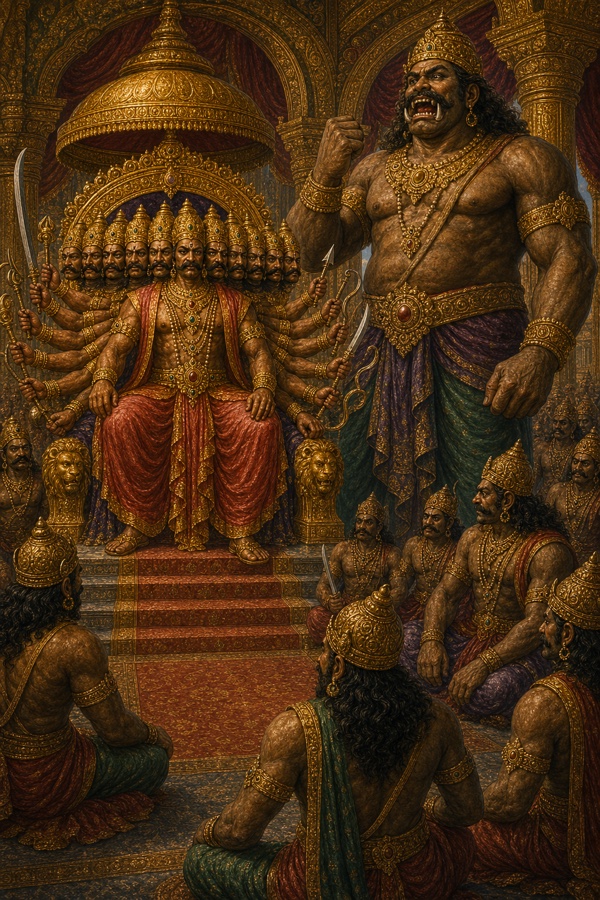
“So this matchless thing you began against your enemies I will set right by killing them, sinless brother.” Having told him he was wrong, in front of everyone, Kumbhakarna went to war for him in the same breath, because that is what a brother in that house did. “I will root out your enemies, be they Indra and the sun, fire and wind, or Kubera and Varuna. With a body like a mountain, fighting with a great bludgeon, sharp-fanged, roaring, I would make even Indra afraid. Before Rama strikes once, with my second arrow I will drink his blood; so be at ease. Killing Rama and Lakshmana, I will devour all the vanara chiefs. Enjoy yourself as you please, drink the best wine, be free of fever and do what is good; once Rama is sent to Yama’s realm, Sita will be yours for long.”
Mahaparshva’s counsel of force, and Ravana’s secret
Seeing Ravana enraged, Mahaparshva thought a moment, folded his hands, and spoke, and what he proposed would have destroyed his king in a single night. “The man who reaches a forest full of beasts and serpents, finds honey, and does not drink it is a fool. You are the lord; who is lord over you? Set your foot on the heads of your enemies and take your pleasure with the princess of Videha. Go at her in the manner of a cock, by force, and possess her again and again. Once your desire is fulfilled, what fear afterward? Whatever risk comes, present or to come, we will meet it.”
“With us, Kumbhakarna and Indrajit could hold back even thunderbolt-armed Indra. Setting aside gift, conciliation, and division, I would gain our end by force alone. All your enemies who have come here we will bring under your power by the might of our weapons; of this there is no doubt.”
At Mahaparshva’s words king Ravana, praising them, spoke, and then said the thing that explains every strange hour Sita has spent in that grove. “Mahaparshva, hear a secret of mine, a thing long past that once befell me. Once I saw the nymph Punjikasthala, flashing like a flame, fleeing through the sky for fear of me toward the abode of Brahma. I took her by force and stripped her; she reached Brahma’s world like a lotus plant mauled by an elephant. Brahma came to know it exactly as it had happened. In high rage he said to me, ‘From today, if you take any other woman by force, your head will split into a hundred pieces; there is no doubt of it.’”
“For fear of that curse I do not force the princess of Videha onto my fair bed.” There is the whole of it. Every soft word he ever spoke to her under the ashoka trees, every promise that he would not touch her until she desired him, every month of that twelve-month term: not one of them was mercy. He was waiting for her consent because consent was the only road left to him, and she had understood it and refused him for ten months, and neither of them had ever said so out loud. “My fury is like the sea, my speed like the wind; Rama does not know this, and so he attacks me. Who would wake a lion asleep in a mountain cave, or Death sitting in wrath? Rama has not yet seen in battle the arrows that come from my bow like two-tongued serpents; that is why he marches on me.”
“With arrows like the thunderbolt loosed from my bow I will bind Rama in a hundred pieces; I will burn him as one torments an elephant with firebrands. Ringed by my great army, I will crush his host as the rising sun steals the light of the stars. Neither thousand-eyed Indra nor Varuna can conquer me in battle; and this city of Lanka, once held by Vaishravana I won by the strength of my arms.”
The dispute between Vibhishana and Prahasta
Hearing Ravana’s proud words and Kumbhakarna’s roar, Vibhishana spoke to the rakshasa king with words of good sense and meaning, for the third time, in the same room, to the same man. “King, who has tied to your neck this great serpent that is Sita, its coils her bosom, its poison her brooding thought, its sharp fangs her sweet smile, its five hoods her five fingers? Before the vanaras, tall as mountain peaks, their fangs and claws their weapons, storm Lanka, let the princess of Mithila be given back to the son of Dasharatha.”
“Before Rama’s arrows, like the thunderbolt, swift as the wind, take the heads of the best rakshasas, let the princess of Mithila be given. Neither Kumbhakarna nor Indrajit, neither Mahaparshva nor Mahodara, neither Nikumbha nor Kumbha nor Atikaya can stand before Rama in battle.” He named them one by one, and they were all sitting there listening to him bury them. “Guarded by the sun or the Maruts, seated in the lap of Indra or of Death, hidden in the sky or in Patala, you will not escape Rama’s arrows.”
Hearing Vibhishana’s word, Prahasta spoke. “We fear no gods, no danavas ever; no yakshas, gandharvas, or great serpents, no birds or snakes frighten us in battle. How then should we fear in battle one man, the son of a king of men?”
Hearing Prahasta’s harmful and proud words, Vibhishana, who wished the king well, his mind fixed on dharma, gain, and desire, spoke with great meaning. “Prahasta, to kill Rama is no more possible for me, or for you, or for all the rakshasas, than to cross the great sea without a boat. Before Rama, foremost in dharma, a great chariot-warrior of the Ikshvaku line, able to accomplish his aims, even the gods are dumbfounded.”
“Rama’s sharp, vulture-feathered, hard-to-approach arrows have not yet pierced your body and gone in, and that is why you boast, Prahasta. His killing arrows, swift as the thunderbolt, have not yet entered your frame, and that is why you speak so big. Neither Ravana, nor Trishira, nor Kumbhakarna’s son Nikumbha, nor Indrajit, nor you can bear the onrush of Rama, who is Indra’s equal. Neither Devantaka nor Narantaka, nor Atikaya, nor Akampana, firm as a mountain, can stand before Rama in battle.”
“This king is overcome by his vices, sharp by nature and rash; and friends like you, no better than enemies, serve him toward the ruin of the rakshasas. Lift this king, bound by the thousand-hooded great serpent of violence, and set him free. As kinsmen save even by seizing the hair one who is gripped by dreadful spirits, so all his friends should together, even by force, protect this king. Ravana is ready to drown in the sea that is Rama’s good conduct and to fall into the Patala-mouth that is Rama; it is right that we save him together.” He had stopped arguing about the war and begun begging the room to save his brother from himself, and the room said nothing.
“This counsel, my opinion, is for the great good of this city, the rakshasas, the king, and his friends: let the king give the princess of Mithila back to Rama. He is a true minister who, knowing the strength of enemy and self, the standing, decline, and rise of each, and weighing his own side too with judgment, says what is fit for his master’s good.”
Indrajit’s objection, and Vibhishana’s reply
Listening carefully to Vibhishana’s word, Indrajit, leader of the rakshasa hordes, spoke; the youngest voice in the hall, and the only one who had ever beaten a god. “Youngest uncle, why do you speak these useless and frightened words? One not even born in the line of Pulastya would not say or do such a thing. This Vibhishana, youngest of my father-like uncles, is the one man in this whole line without courage, virility, prowess, fortitude, heroism, or fire.”
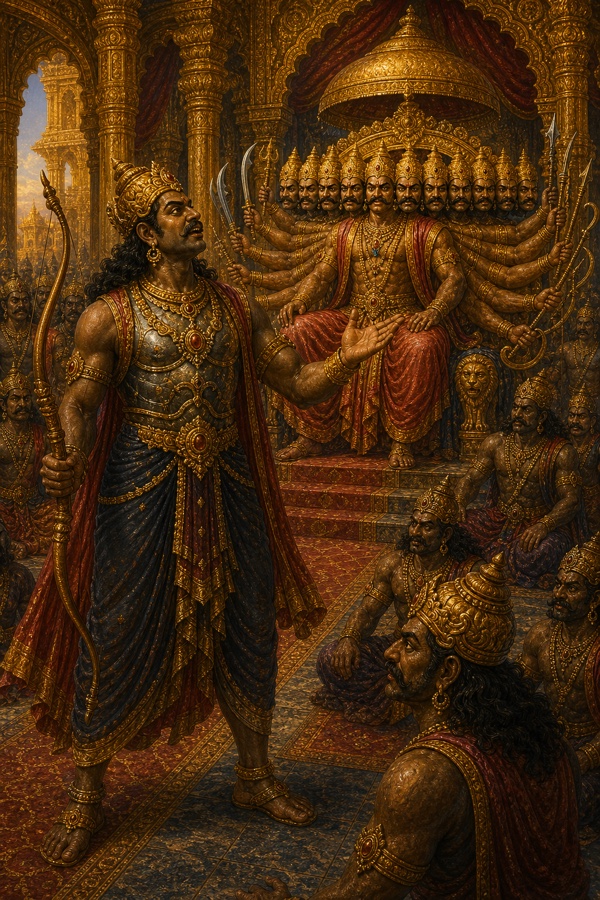
“What are those two sons of a king of men? They can be killed by the meanest rakshasa among us; why do you frighten us, coward? I threw Indra, lord of the three worlds, to the ground, and all the gods fled in terror to the quarters. I tore out the tusks of the trumpeting Airavata and dashed it to the ground and struck fear into all the gods. I who broke the pride of the gods and grieved the demon, rich in valor, why should I not conquer two common princes of men?”
Hearing the words of Indrajit, a rival of Indra, hard to assail and full of power, Vibhishana, best of armed men, gave a weighty answer. “Child, you are a boy, your judgment still unripe; and so you have babbled this pointless, self-destroying talk. Indrajit, you are a son in name, an enemy with a friend’s face; even hearing from me of Ravana’s ruin at Rama’s hands, in your delusion you say ‘well said, well said’ to your father.”
“You yourself deserve death, and are grossly ill-minded; and he too deserves death who brought you here, a reckless boy, into the presence of the counselors. You are indiscriminate, unformed, ill-mannered, dull, deeply wrong-headed, and you talk like a child, Indrajit. Who can bear the arrows Rama looses in battle before the enemy, blazing like the rod of Brahma, wearing the look of Death, like the rod of Yama? King, give Rama riches, gems, fine ornaments, heavenly garments, wondrous jewels, and the goddess-like Sita, and let us all live here free of grief.” He had come down to bargaining, and he was offering to buy his family’s life with everything they owned.
Ravana’s rebuke, and Vibhishana’s departure
To Vibhishana, chief among counselors, a healer speaking wholesome, righteous, well-set words, Ravana, driven by fate, spoke harshly. “Kinsmen dishonor and slight their own chief, though he be righteous and brave. Better to live with an enraged, venomous serpent, or with an enemy, than with one who serves the enemy under the name of friend. I know the nature of kinsmen in all three worlds; they always rejoice in the misfortune of their own kind.”
“Kinsmen are ever jealous of one another, secret of heart, treacherous in a crisis, cruel and dreadful. Hear this: once elephants in a lotus wood, seeing men with nooses in hand, sang a verse: ‘Not fire, not other weapons, not the noose frighten us; but our own cruel kin, driven by self-interest, frighten us, for it is they who point out the way to catch us; of all fears, the fear of kin runs deepest.’ There is fullness in the cow, fear from kin, fickleness in woman, austerity in the Brahmin.”
“It does not please you that I am honored by the world, rich and high-born, my foot on the heads of my enemies. As water-drops fallen on a lotus leaf do not cling, so no love holds in the unworthy. As the earth is not soaked by the thundering, raining clouds of autumn, so goodwill does not sink into the unworthy. As the bee, though it finds nectar, does not stay on the flower, so love does not stay in the unworthy. As the elephant, after bathing, takes up dust in its trunk and soils itself, so is goodwill in the unworthy. Ranger of the night, anyone but you who said such a thing would not live out this moment; a curse on you, stain of our line!” Four images, each one prettier than the last, all of them saying the same thing: get out of my house.
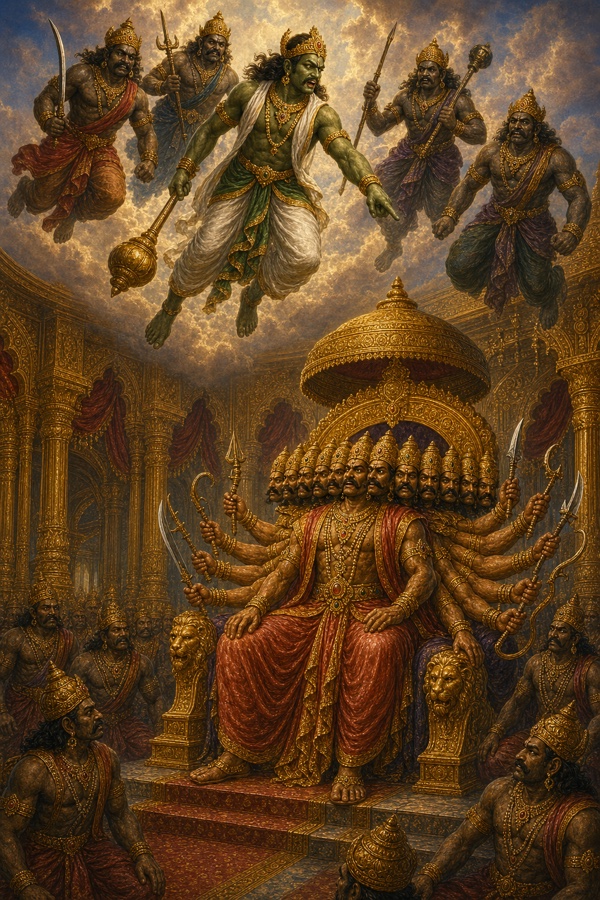
Hearing those harsh words, the just Vibhishana rose into the sky, mace in hand, with his four rakshasa ministers. In anger, standing in the air, Vibhishana said to the lord of rakshasas. “King, you are deluded about me; say what you will. Being the elder, you are worthy of honor like a father, but you do not stand on the path of dharma; so I cannot bear this abuse of yours, elder though you are.”
“Those who have not mastered themselves and are in the grip of fate do not take a friend’s good counsel, ten-headed one. Those who ever speak sweetly are easily found; the speaker and the hearer of unpleasant but wholesome words are rare. Seeing you bound in the noose of fate, perishing like a house in flames, I could not turn away, and so I said all this. I did not wish you to be killed by Rama’s gold-fitted, fire-sharp arrows. Even brave, mighty, weapon-skilled men, when fate seizes them, fall in battle like dams of sand.”
“As the elder, forgive what a well-wisher has said. Now guard yourself in every way, and this city and the rakshasas. May it go well with you; I am leaving. Be happy without me.” He was giving up his city, his house, his wife, his sons, and his brother, all in one sentence, and he still stopped to bless him. “Ranger of the night, I checked you as a well-wisher, but my word did not please you. At the end of their time, men whose life has run its course do not take the good counsel of their friends.”
Vibhishana’s surrender, and Rama’s council
Having spoken those harsh words, Ravana’s younger brother Vibhishana reached in less than an hour the place where Rama was with Lakshmana. He had crossed, in an hour, going the other way, the water that had stopped an army for days. Like a peak of Meru, bright as lightning, standing in the sky, he was seen by the vanara chiefs on the ground below. His four attendants too were of dread prowess, armored and armed and decked with fine ornaments. Like a cloud, like a mountain, splendid as thunderbolt-armed Indra, bearing fine weapons, Vibhishana was adorned with heavenly jewels.
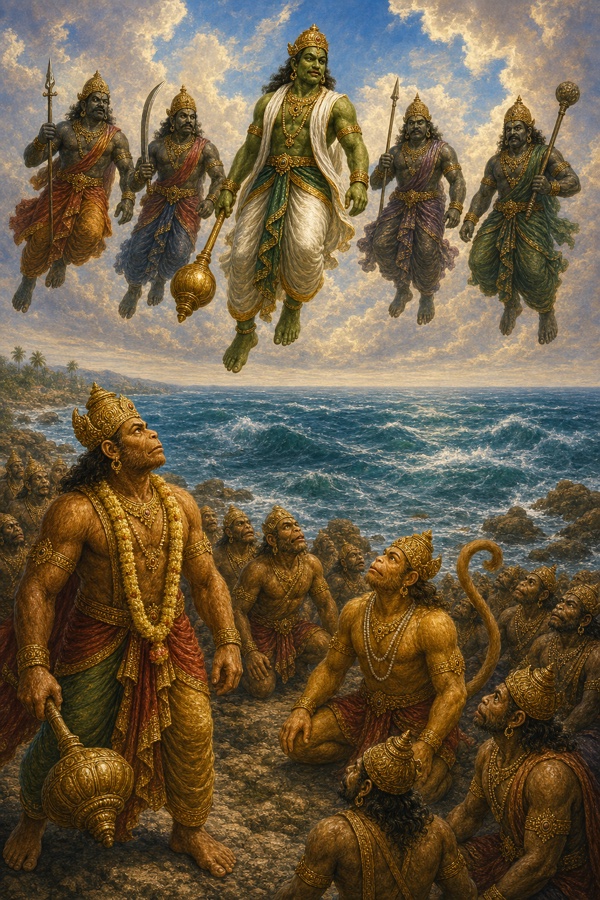
Seeing him a fifth with his four, the wise and hard-to-assail Sugriva grew anxious with the vanaras. Thinking a moment, he spoke fine words to Hanuman and the others. “This rakshasa, armed with every weapon, comes with four rakshasas surely to kill us; look.” Hearing Sugriva’s word, the vanaras took up sala trees and rocks and said, “King, order us at once to kill these wicked ones, that they, feeble of wit, be struck down to the ground.” Five armed rakshasas hanging in the air over an army that had never seen a rakshasa who was not trying to kill them.
While they talked among themselves, Vibhishana reached the northern shore and halted, still in the air, where every archer below could see him and he could reach no one. Seeing Sugriva and the vanaras, Vibhishana called out in a loud voice. “There is a rakshasa of evil conduct, Ravana by name; I am his younger brother, known as Vibhishana. He killed Jatayu and carried Sita off from Janasthana; she is a captive, wretched and helpless, guarded by rakshasa women. Again and again, with many arguments, I told him, ‘Give Sita back to Rama,’ but Ravana, driven by fate, would not take that good counsel, as a dying man will not take medicine.”
“He insulted me, treating me like a slave, and spoke harsh words; so I have left my sons and wife and come to Raghava for refuge. Tell Raghava, refuge of all the worlds, at once that Vibhishana is here.” He had said the whole of it in the open air, over the heads of an army holding rocks, and the last word he used was the only one that mattered.
Hearing this, Sugriva spoke to Rama, before Lakshmana, in agitation. “An enemy, one of the enemy’s host, has come suddenly; finding his chance, he could kill us, as an owl kills crows. In the matter of vanaras and enemies you must be watchful in counsel, in array, in policy, and in spies. These rakshasas can vanish, take any shape, are brave and cunning; never trust them.”
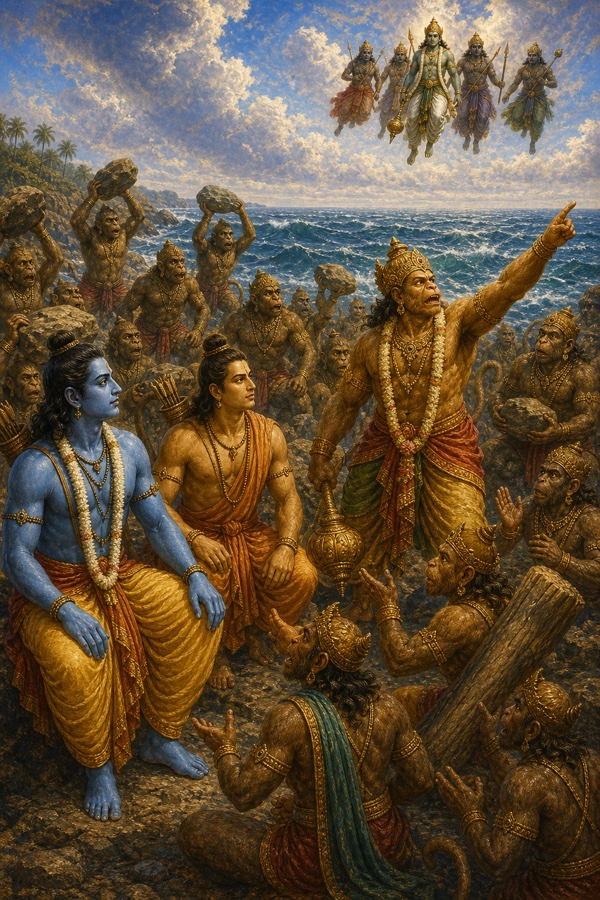
“This may be a spy of Ravana; getting among us, he will surely sow division. Or this shrewd one may find our weak point, win our trust, and strike some day. A force from allies, from foresters, from the hereditary, and from the hired, all these are to be taken, but not an enemy’s force. He is by nature a rakshasa and brother of the enemy; the enemy himself has come, so how can we trust him? Ravana’s brother Vibhishana deserves harsh punishment with his ministers.” Sugriva had been driven out by his own brother and hunted for years; he knew what a brother was worth, and he had made up his mind before the man finished speaking. So saying, the eloquent commander fell silent.
Hearing Sugriva’s word, Rama said to Hanuman and the vanaras beside him. “You have heard the very reasonable word that the vanara king Sugriva has spoken about Ravana’s brother Vibhishana. For one who is wise and discerning and wishes the lasting good of his friends, it is right to give his true opinion on the hard questions of duty.” A man was hanging in the sky waiting to learn whether he would be killed, and Rama opened the floor. Asked in this way, the unwearied vanaras gave their opinions, each in courtesy, wishing to please Rama.
They said, “Raghava, nothing in the three worlds is unknown to you; yet by your goodwill you ask us, and so you honor us who are your very selves. Rama, you are true to your vows, brave, righteous, firm in valor, one who acts after testing, mindful, and devoted to your friends. So let your wise ministers reason it out, each in turn, again and again.”
Then Angada gave a means of testing Vibhishana. “One come from the enemy’s side is wholly to be suspected; Vibhishana should not be trusted at once. Settle the gain and the harm, then decide; take him for his merits and reject him for his faults. If the fault is great, reject him without hesitation; if you find many merits, receive him, king.”
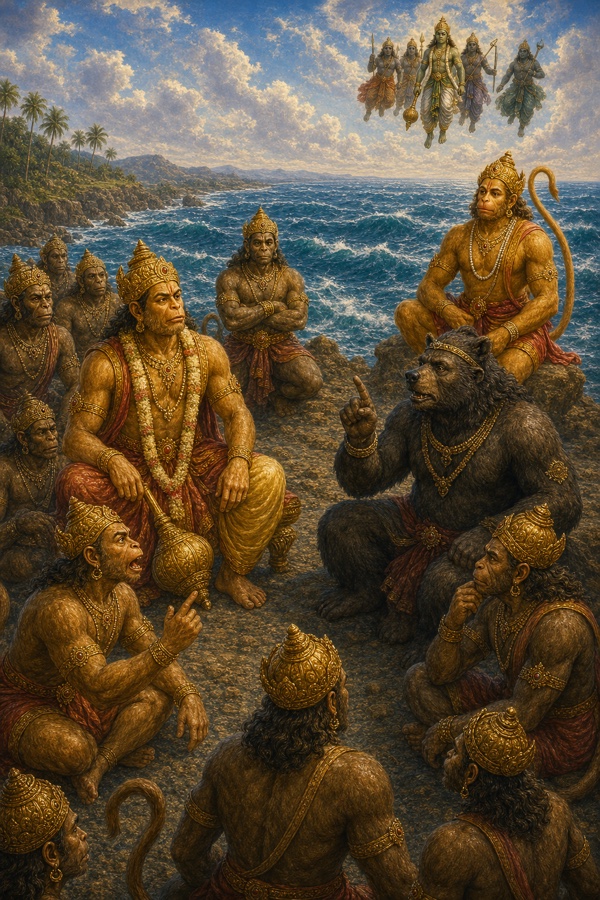
Sharabha said, “Set a spy on him at once. Send a subtle-minded spy, test him, and then receive him as is just.” Jambavan, keen with knowledge of the shastras, said, “Coming without regard to place and time from the deeply hostile and sinful rakshasa king, Vibhishana is wholly to be suspected.”
Mainda, skilled in what is policy and what is not, gave a reasoned answer. “This is Ravana’s younger brother Vibhishana; let him be questioned gently with sweet words. Learn his true intent, and then decide with judgment whether he is wicked or not.”
Then the cultured Hanuman spoke smooth, meaningful, sweet, and brief words. He was the only creature on that beach who had stood in Ravana’s court and watched this man argue for the life of an enemy when it cost him everything to do it. “Best of minds, even Brihaspati could not outdo you in speech. King, not for argument, nor for strife, nor to outdo, nor from any wish, but only for the weight of the matter, I will say what is true. In the settling of gain and harm that your counselors have proposed I see a fault, because the act of testing is not possible here.”
“Without charging him with some duty, his capacity cannot be known; and to charge him suddenly with a duty seems to me faulty too. Sending a spy will serve no purpose either. As for ‘come without regard to place and time,’ my answer is that this is the very place and time fit for his coming. A man’s faults and merits change with the man he meets. Seeing Ravana’s evil and your prowess, his coming is right and in keeping with reason, for he holds you above Ravana, seeing merit in you and fault in Ravana.”
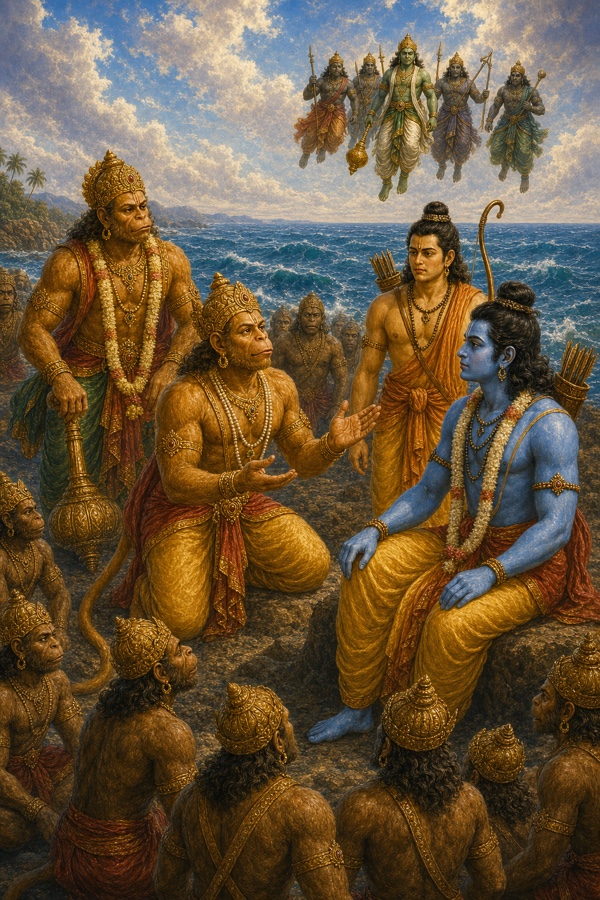
“To the proposal that unknown men question him, my considered thought is this. A wise man, questioned, grows suspicious of the question; a friend who has come in ease is angered by a false questioning. King, one cannot suddenly know another’s mind, unless a skilled eye reads the shifts in his tones. As he speaks, no wicked intent shows; his face too is glad, and so I have no doubt of him.”
“A sound man of unsuspecting mind does not walk like a cheat; his speech has no fault, and so I have no doubt. Even when the form is hidden, it is not wholly hidden; a man’s inner feeling breaks out on his face despite him. Best of those who know how to act, his coming fits place and time. Hearing of your effort, of Ravana’s false ways, of Vali killed by a single arrow, and of Sugriva’s crowning, he has come here with judgment, in hope of a kingdom. On that alone he deserves to be honored and received. I have said, as best I could, the case for the rakshasa’s sincerity; what is fit beyond this, you must decide.”
The law of the suppliant, Rama’s decision
Hearing from Hanuman’s mouth his own mind, the glad-hearted, learned, hard-to-assail Rama spoke. “I too have something to say about Vibhishana; hear it, you who stand for my good. One who comes to me in friendship I will not forsake by any means; even if there is some fault in him, in the eyes of good men this is not blameworthy.”
Weighing Rama’s word, Sugriva said, “Wicked or not, he is a ranger of the night still. One who has left his own brother in such a plight, whom would he not leave?” It was the sharpest thing said on that beach all day, and it came from a man whose brother had taken his wife and driven him up a mountain. Hearing the vanara king’s word, looking round at all, smiling a little toward the auspicious-marked Lakshmana, Rama of the Kakutstha line spoke.
“Without study of the shastras and service of elders, one could not speak as Sugriva has spoken.” He praised the argument first, and then took it apart. “Yet a subtler thing appears to me, plain and worldly-known in all kings. Enemies, kinsmen of one line, and neighboring rulers are named foes who strike in a time of trouble; that is why he has come here. But blameless kinsmen honor the good of their own. For kings, even a virtuous kinsman is often to be suspected.”
“To the fault named in taking an enemy’s strength, hear the answer according to the shastras. We are not of his line, and the rakshasa longs for a kingdom; rakshasas are sometimes learned too, so Vibhishana is to be taken. Joining us, he and his will be untroubled and glad; their loud cry for refuge shows that fear of one another has entered the rakshasas, and so they will fall to division; therefore Vibhishana is to be taken. Not all brothers are like Bharata, nor all sons like me, nor all friends like you.” He had answered Sugriva’s whole objection with one sentence about his own family, and everyone standing there knew what Bharata had done with the kingdom he could have kept.
At Rama’s words Sugriva rose with Lakshmana and said in courtesy, “Know this ranger of the night to be sent by Ravana; his seizing seems to me right. This rakshasa has come with a crooked mind, given a message, to strike you when you trust him, or me, or Lakshmana; so he deserves death with his ministers, being Ravana’s brother.” So saying, the eloquent commander Sugriva fell silent.
Hearing Sugriva’s word and weighing it, Rama spoke a word finer still, and he did not raise his voice. “Wicked or not, can this ranger of the night do me even the subtlest harm? Lord of the vanara hosts, if I wished, I could kill with the tip of my finger the fiends, danavas, yakshas, and all the rakshasas of the earth.” The whole argument had been about danger, and he had just removed danger from the table, which left only the question of what a man ought to do. “I have heard that a dove once honored a suppliant enemy according to what is right, and welcomed him with its own flesh. That dove received even the one who had come to carry off its mate; then why should a man like me not do so?” A bird had fed the hunter who came for its wife. Rama let that sit where every one of them could see it beside his own situation.
“Hear the verses of dharma that the great sage Kandu, the ever-truthful son of Kanva, sang long ago: ‘For the sake of humanity, one should not strike even an enemy who comes for refuge with folded hands, wretched and pleading. An enemy who comes for refuge from his foes, whether distressed or proud, the self-controlled man should protect even at the cost of his own life. If from fear, delusion, or desire one does not protect a suppliant as best he can, that sin is despised in the world. If a suppliant perishes unprotected before the protector’s eyes, he carries off all the protector’s merit.’
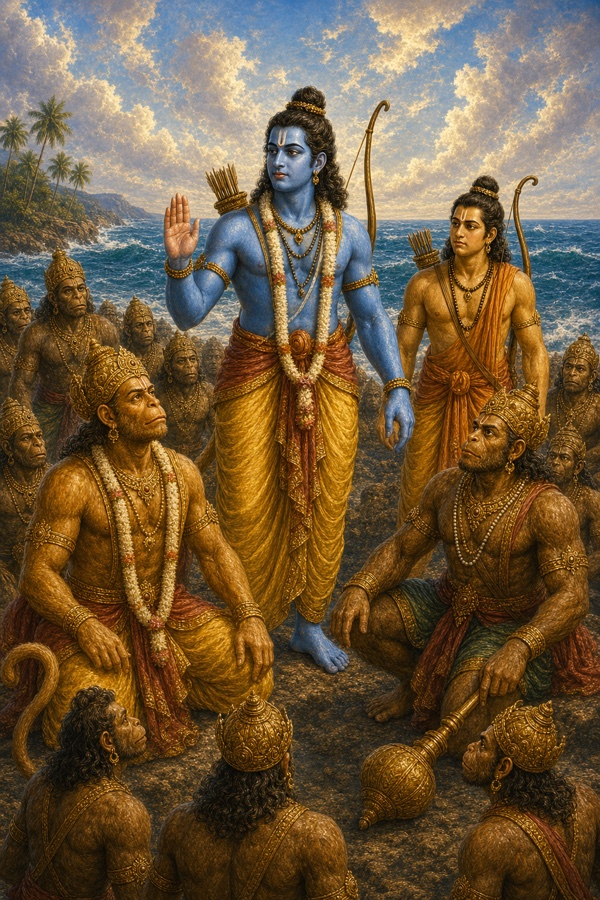
“There is great fault in failing to protect suppliants; it shuts out heaven, brings infamy, and destroys strength and valor. I will follow this excellent word of Kandu, righteous and famed and giving heaven as its fruit. To one who comes to me even once for refuge, saying ‘I am yours,’ I give safety from all beings; this is my vow.” It is the sentence the whole of Rama is built on, and he chose to say it on a beach, in front of an army, about the brother of the man who had stolen his wife. “Bring him; I have given him safety, be he Vibhishana or Ravana himself, Sugriva.” Ravana himself. He said the name, and let it stand.
Filled with warmth at Rama’s words, Sugriva said, “What wonder is it that you, full of goodness and set on the path of the virtuous, speak this noble word? My own inmost heart holds Vibhishana pure, and Hanuman by reasoning and by his manner has tested him in every way. So let Vibhishana soon be one with us, Raghava, and win our friendship.”
Hearing Sugriva’s word, Rama arranged a swift meeting with Vibhishana, as Indra once arranged a meeting with Garuda.
Vibhishana crowned king, and the counsel to seek the sea’s refuge
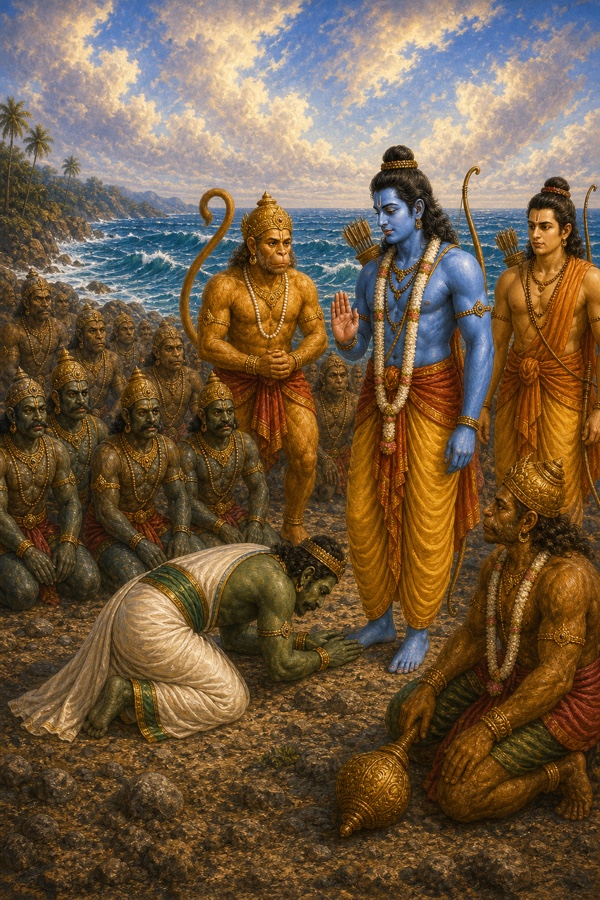
Having received safety from Raghava, Vibhishana bowed his head, looked to the earth, and came down joyfully from the sky with his devoted attendants. Vibhishana, with his four rakshasas, fell at Rama’s feet and spoke words full of dharma, fitting, timely, and glad. “I am Ravana’s younger brother, and, insulted by him, I have come for refuge to you, the shelter of all beings. I have given up Lanka, my friends, and my wealth; my kingdom, my life, and my happiness are now centered in you.” He had come to the only man in the world who would fight his brother, and he had come with nothing, and it was the wealthiest he had ever been.
Hearing his words, soothing him with speech, drinking him in with his eyes, Rama said, “Tell me truly the strength and weakness of the rakshasas.” At this the unwearied Rama’s word, Vibhishana began to tell all of Ravana’s strength. “By the boon of Brahma, the ten-necked one cannot be killed by any being, gandharva, serpent, or bird.” He had left out man and monkey, because Ravana had thought them too small to ask for, and the whole war turns on that omission. “Younger than Ravana, my great and fiery elder brother Kumbhakarna is a match in battle for Indra alone.”
“Rama, his commander is Prahasta, who defeated Manibhadra in battle on Kailasa; perhaps you have heard of him. Ravana’s eldest son Indrajit, wearing iguana-skin gloves and armor that cannot be pierced, takes his bow in battle and vanishes; having fed the fire, he goes unseen in the great array and kills the enemy. Mahodara, Mahaparshva, and the rakshasa Akampana are his commanders in battle, equal to the world-guardians. A hundred thousand million rakshasas, able to take any shape, feeding on flesh and blood, live in the city of Lanka.” An hour ago he had been one of them, and he was giving away every name he had grown up with.
“With all of them king Ravana fought the world-guardians; with the gods they were beaten by that Ravana.” Hearing Vibhishana’s word, weighing it all in his mind, the prince born in Raghu’s line, Rama, spoke. “Vibhishana, the deeds and prowess of Ravana that you have truly told, I know them. Hear this: I will kill the ten-necked one with Prahasta and his sons, and make you king of Lanka; take it as truth. Let Ravana enter Rasatala or Patala, or go to the grandsire Brahma, he will not escape me alive. I swear by my three brothers, without killing Ravana with his sons, people, and kinsmen in battle, I will not return to Ayodhya.”
Hearing Rama’s vow, Vibhishana bowed his head, did homage, and said, “I will help you as best I can in the killing of the rakshasas and the storming of Lanka, and I will break into the rakshasa army.” As Vibhishana spoke, the glad Rama embraced him and said to Lakshmana, “Bring water from the sea and consecrate this Vibhishana as king of the rakshasas; I am pleased with him now, bestower of honor.”
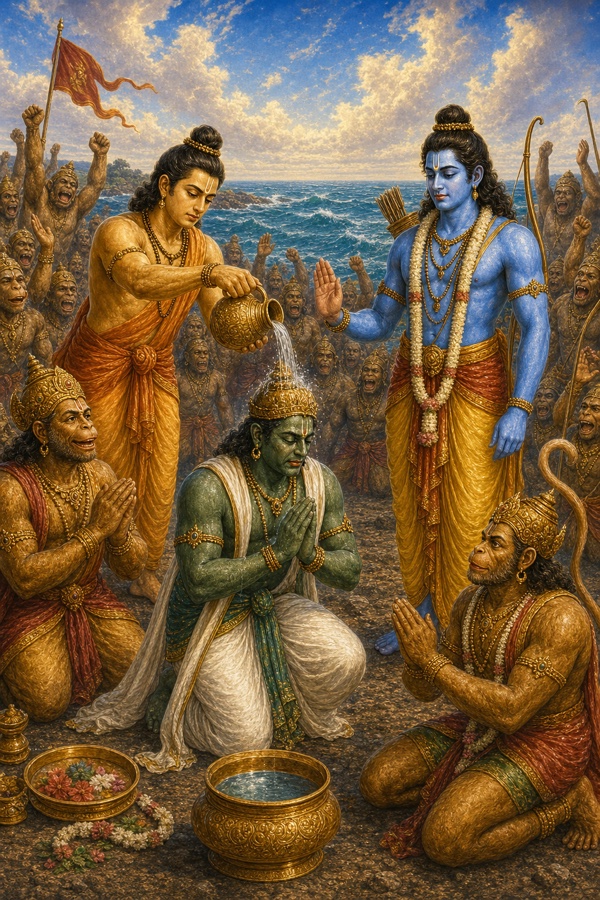
At the king’s command, Lakshmana consecrated Vibhishana king of the rakshasas in the midst of the vanara chiefs. Rama had no kingdom of his own to stand on, no water but the sea that was blocking him, and no city to give; and he crowned a homeless man king of a country he had not yet reached, with the enemy’s own ocean, before a single arrow had been loosed. Seeing this immediate grace of Rama, the vanaras raised a cry of joy and praised Rama with “Well done! Well done!”
Then Hanuman and Sugriva said to Vibhishana, “Ringed by the mighty vanara army, how shall we all cross the unshakable sea, the dwelling of Varuna? By what means may we reach the lord of rivers and streams, so that we may swiftly cross the sea with our host?” Vibhishana answered, and his first act as their ally was to solve the thing that had stopped them cold. “Let king Raghava seek the refuge of the sea. This immeasurable ocean was dug out by King Sagara; it is fitting for the sea to accomplish the work of Rama, one of its own line.” The water in front of them was not a stranger. Rama’s own ancestor had hollowed out that basin, and the sea had carried the family name ever since.
Urged in this way by the learned rakshasa Vibhishana, Sugriva came to where Rama was with Lakshmana, and the broad-necked Sugriva gave Rama the good counsel to importune the sea. To Rama too, righteous by nature and the shelter of all, this pleased. To do honor to Sugriva, Rama smiled and said to Sugriva and Lakshmana, “This counsel of Vibhishana pleases me as well, Lakshmana. Sugriva is ever wise, and you too are skilled in counsel. Consider the matter together and tell me what you both approve.”
At Rama’s word the two heroes Sugriva and Lakshmana spoke with courtesy. “Raghava, why would this happy counsel of Vibhishana not please us now? Without a bridge over the dread sea, the dwelling of Varuna, not even Indra and the gods and demons can reach Lanka. Follow the true word of Vibhishana; do not waste the hour; importune this sea, so that we may reach the city Ravana holds with our army.”
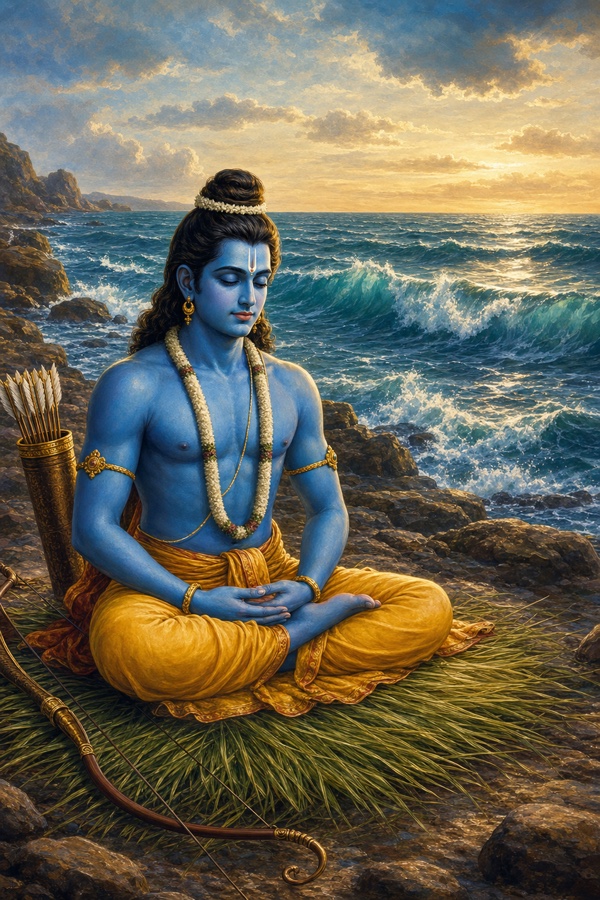
So urged, Rama sat down on the kusha-strewn shore of the sea, like fire on an altar. The man who had promised to cross that water by force, or by drying it, or by a bridge, spread grass on the sand and sat down in front of it to ask.
The gist: Rama gives Vibhishana safety and consecrates him king of Lanka; Vibhishana recounts the strength and secrets of Ravana. Then, accepting the counsel to seek the refuge of the sea, Rama spreads a seat of kusha grass on the shore and sits.
Source: Srimad Valmiki Ramayana, Yuddhakanda, Cantos 1 to 19. The Gita Press Hindi edition is the controlling witness. The Sanskrit e-text and an independent complete translation were used to verify names, sequence, and principal events. Where recensions differ, this retelling follows Gita Press.
Based on: Valmiki Ramayana (Gita Press, Gorakhpur)
The same story elsewhere
- The Vibhishana Gita
Tulsidas Ramcharitmanas (Lankakanda): Rama’s teaching of the chariot of dharma to Vibhishana