On this page
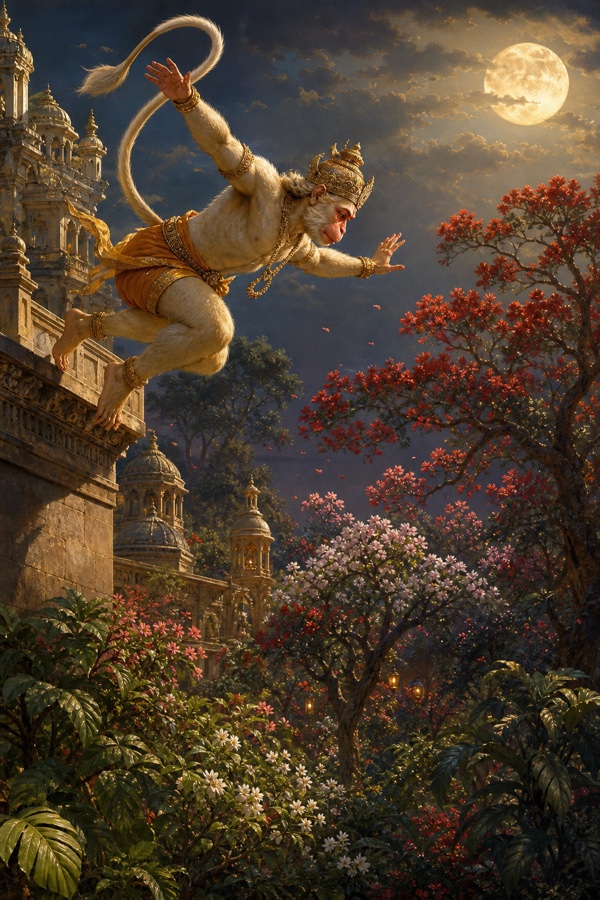
He came down over the wall and landed inside the Ashoka grove. He had already gone through the rest of Lanka and found nothing: the mansions street by street, the inner apartments of Ravana himself, even the aerial chariot Pushpaka, and no Sita in any of them. He had come so near to despair that he had begun to weigh fasting himself to death; he could not carry that emptiness back across the sea. Then, from the height, he had caught sight of a grove he could not remember passing, and hope had gone through him like a struck bell. For a single moment the son of the wind, blazing with strength, weighed the matter in his mind, and then, fixing his whole will on reaching Sita, he sprang from the defense wall of Ravana’s palace into the enclosure of the grove. Standing on the wall he had seen sal, ashoka, champak, and uddalaka trees in the first flush of spring; he had seen nagakesara; and he had seen mango trees whose young flower clusters were as red as the muzzle of a monkey, wound about with hundreds of climbing vines. Like an arrow loosed from Rama‘s bowstring, he dropped into that pleasure garden.
The Ashoka grove, and the simsapa tree
Once inside, Hanuman took in the wonder of the place. Birds called on every side, trees of gold and silver stood among the green, herds of deer moved through the shade, and the grove, thick with red blossoms, glowed red as the rising sun. Cuckoos drunk on the season lived there always, and bees; peacocks maddened with joy cried out.
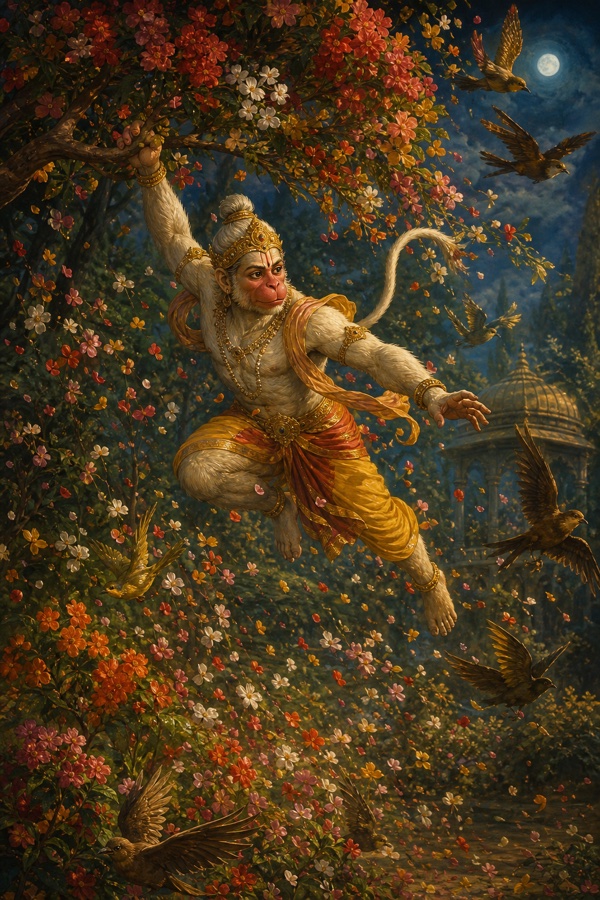
Leaping and bounding, the monkey leader ran this way and that. The trees shook at his speed and shed flowers of every kind. Covered over with leaves and blossoms, Hanuman shone in the middle of the Ashoka grove like a mountain of flowers. Every living thing there, watching him dart through the thickets, thought the same thought: this is spring itself, come in the flesh.
He saw grounds paved with gems and plated with silver and gold. He saw step-wells brimming with clear water, their stairs of costly jewels, their beds of crystal, gold trees planted along their banks. Lotuses and lilies bloomed in them, red geese lent them beauty, and the cries of swans and cranes rang across the water. On one side he saw a mountain high as a cloud, its peaks lifted up and ringed on every side by lesser summits. From that mountain a river came down, as though it had leapt in a sulk from the lap of its lover; and then he watched the current turn back, as though the same river had made its peace and returned to the one it loved. Every quarrel in that garden ended in reunion. Only the woman he had crossed an ocean to find was being kept from hers.
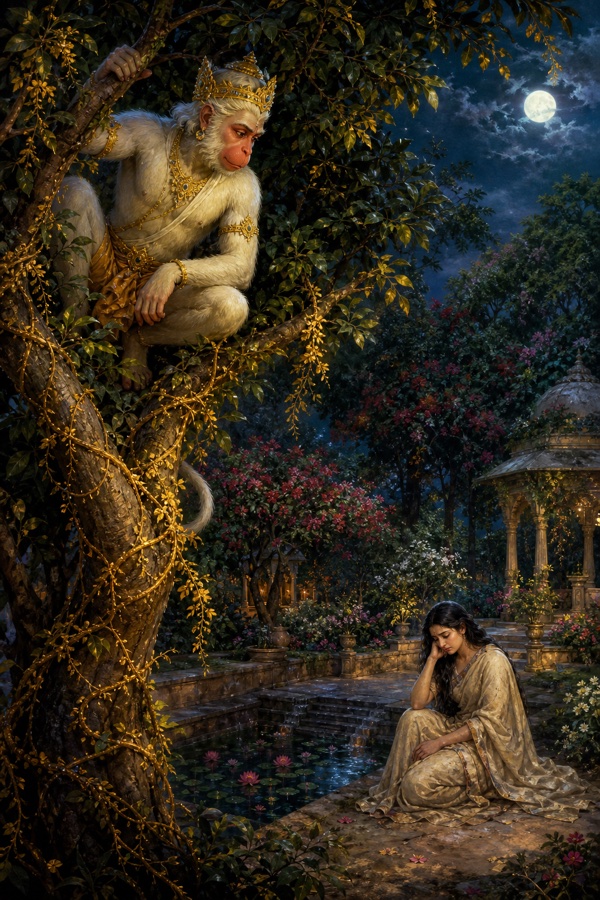
Then the great monkey caught sight of a golden simsapa, a tree of the ashoka family, wrapped in countless vines, dense with leaves, hedged all around by daises of gold. Climbing that leaf-covered simsapa, swift and full of force, Hanuman said within himself, “From here I will look for Vaidehi, the princess of Videha, who must be aching for the sight of Rama and, wild with grief, wandering here and there.” Then he reasoned it out the way a hunter reasons out a waterhole. A stream ran cool beside the tree. Whatever else had been taken from her, no daughter of Janaka would let go of the prayers that are said at the joining of the day and the night; she would have to come to water at dawn and again at dusk. So, hidden in the thick leaves and flowers of the simsapa, he set his eye over the whole grove and did the hardest thing a messenger ever does, which is nothing at all.
The first sight of Sita
Seated in the simsapa, hunting for Sita, Hanuman swept his gaze across the whole ground. A little way off he saw a grand shrine-hall, a building tall as a temple, resting on a thousand pillars at its center, white and spotless as Mount Kailasa, fitted with stairs of coral and platforms of refined gold. He looked at the gold and the coral and past them, the way a searcher does, for the one thing in a garden that would not have been put there for beauty.
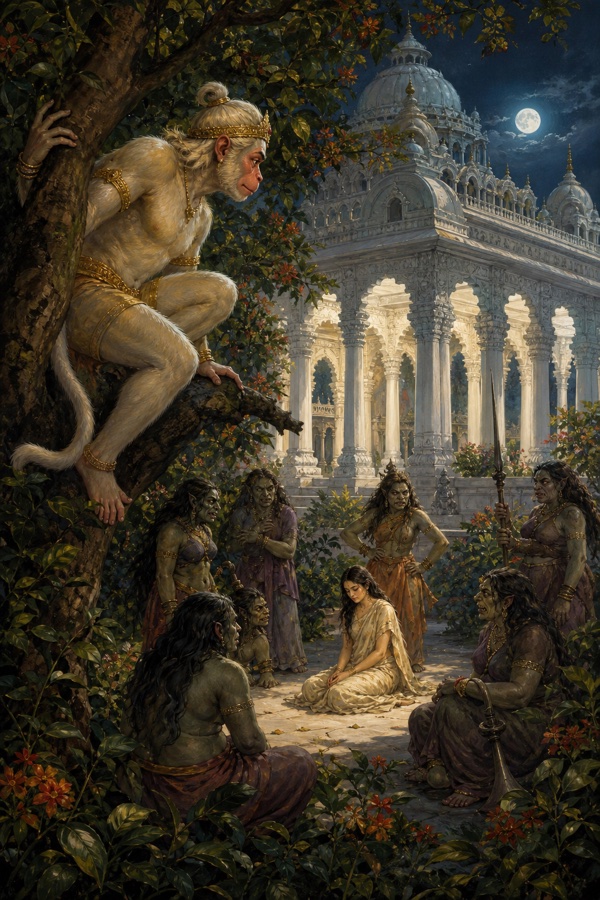
Near it he saw a woman ringed by ogresses, thin from fasting, wretched to look upon, sighing again and again, clear as the thread of the moon on the first night of the bright fortnight, when what shows is only a hint of what is there. She wore a single soiled yellow sari, she was caked with dust, she was stripped of every ornament, and she looked like a lotus pond gone to mud with its lotuses lost; like Rohini afflicted by the planet Mars, the moon’s own beloved star held down by a cruel one; like a doe cut off from her herd and closed in by dogs, her face wet with tears. Her hair hung down her back in one long black braid to her thigh, unoiled, unparted, unbound, the way a woman wears it when her husband is not with her and she has set her hands from the business of being looked at, like the earth after the rains, when the clouds have drawn back and a line of green trees veils the ground.
Seeing that woman, so grimy and so gaunt, Hanuman worked it out by degrees, the way a man tests his own good luck before he trusts it: “This is Sita.” He thought, “The very figure of the goddess we saw that day from the top of Rishyamuka, being carried off by Ravana, is the figure of this lady.” Nor did it take him long to know her jewelry. Before the monkeys had scattered from Kishkindha, Rama had described his wife’s ornaments piece by piece, in the exact and patient way of a man who has nothing left of someone but their description. Those were the ornaments Hanuman now saw; though dulled from long months without cleaning, their shape was unchanged.
Hanuman said in his heart, “The upper cloth she let fall then had exactly this ring to it. This is the golden-limbed, faithful, beloved wife of Rama, who, though lost to his sight, has never been lost to his mind. It is for her that Rama burns with four kinds of pain: pity at the loss of a helpless woman he was bound to protect, tenderness toward one who depended on him, grief at the disappearance of his wife, and love for the woman he loves.” Seeing Sita in this way, the son of the wind was glad; in his mind he reached all the way back across the sea to Rama, and he praised his lord.
Hanuman’s lament, and the memory of Rama’s valor
Having praised them both, Sita who deserved all praise and Rama who was lovely in his virtues, Hanuman sank back into worry. The joy of finding her lasted only as long as it took him to look at her properly. With tear-filled eyes he lamented, “If even Sita, the honored and beloved wife of Rama, Lakshmana’s elder brother, is so broken by suffering, then surely the current of time is beyond all crossing. A woman who knows the might of Rama and Lakshmana should be no more shaken by this than the Ganga is shaken by the coming of the rains.”
Looking at the goddess, her radiance like fresh gold, dear as Lakshmi to all the worlds, Hanuman thought, “It was for Sita that Vali was killed; that Kabandha, valiant as Ravana, was felled; that the fearsome Viradha died in battle; that in Janasthana fourteen thousand ogres were destroyed by arrows like tongues of fire; that Khara was cut down, Trishira brought down, and the blazing Dushana too killed by Rama’s hand. It was for her sake that Sugriva won back the rare monkey kingdom, kept safe from Vali; and for Sita that I leapt the sea and combed this city of Lanka. If Rama, for her, were to overturn the whole earth to the edge of the ocean, or the entire world, it would still be just.”
“This is Janaka’s daughter, unshaken in her vow to her husband. She rose out of the broken ground when the field was being furrowed with the plow’s point, and was lifted up dusted with the pollen-fine soil of that field; the earth gave her, and a king raised her. She is the eldest daughter-in-law of Dasharatha. Letting go of every comfort, careless of hardship, on the strength of love for her husband she walked into an empty forest, when no one had asked it of her and every voice had argued against it. Content with roots and fruit, absorbed in serving her husband, this golden-limbed goddess, who found even the forest as sweet as a palace, now endures this torment here.”
“A husband is a woman’s highest ornament, greater than any jewel. Robbed of that one thing, she cannot deck herself even where she is fit to be decked, and everything Ravana has heaped at her feet lies unopened. She has gone dull as a lotus plant touched by frost, wretched as a parted goose. The boughs of the ashoka trees, bent under their weight of flowers, only deepen her grief; and now that winter has passed and spring has come, even the cool-rayed moon strikes her like the thousand-rayed, blazing sun. The whole season is against her; a garden in bloom is a cruel place to be alone in.” Turning over every reason in this way, and settling it firmly that this was indeed Sita, Hanuman held his place on the tree.
Moonrise, the rakshasis, and a salute to Rama and Lakshmana
Just then, at the close of day, a spotless moon rose like a cluster of white lilies, as though a swan swimming in blue water were climbing into the sky. With its cool rays, as if it had come the whole way to serve one monkey in one tree, it showed Sita to him clearly. And he saw her, her face like the full moon, pressed down under the weight of grief like a boat sinking under too heavy a load.
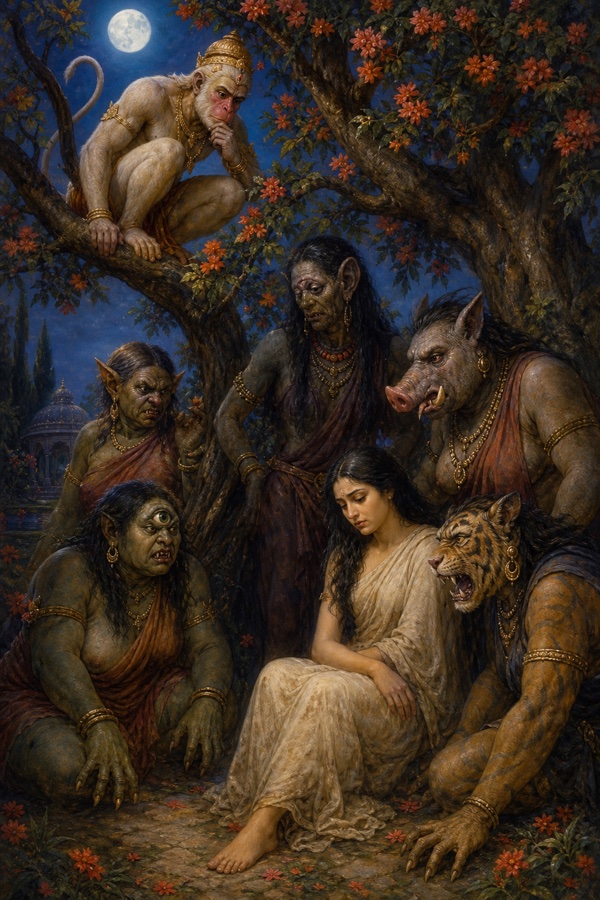
Straining to see Sita, Hanuman made out the ogresses seated near her, horrible to look at. One had a single eye, one a single ear, one wore an ear draped over her whole body, one had no ear at all, one had the ears of a cow, an elephant, a horse; one had a nose like an elephant’s trunk, one a nose set on her forehead; one had feet like an elephant or a horse, one had a single arm and a single leg, one had no feet; one had a head and neck grossly swollen, one had grossly swollen breasts and belly; one had a long tongue, one a face like a goat, an elephant, a cow, a pig, one a face like a horse, a camel, an ass. These smoke-colored, misshapen ogresses drank liquor without stop, fed on flesh and blood, and smeared flesh and blood over their own bodies. They were not guards so much as a punishment posted in a ring, chosen so that a queen of Ayodhya would have to look at them every hour she was awake. In their midst, beneath that lovely-trunked tree, Hanuman saw the faultless princess, the goddess herself.
Hanuman looked on Sita drained of luster like a star fallen to earth; scorched with grief; her hair matted with grime; and yet lifted high by the greatness of her faithfulness to her husband. Bare of fine ornaments, she was still adorned by her husband’s love. Held back by the king of ogres, kept from her own people, she was like a cow-elephant severed from the herd and bound, or the line of the moon covered over by the clouds of autumn. Even with her limbs coated in dirt, veiled as she was in her own natural radiance, she was like a lotus fiber caked in mud: she had beauty, and she had none. Seeing Maithili, the son of the wind felt joy beyond measure. Weeping for gladness, he bowed to Rama across all that water, then saluted Rama and Lakshmana in his mind and drew back behind the screen of leaves.
Ravana arrives
Hanuman was still watching the grove this way when the night began to wear thin. In the last stretch of dark he heard the sound of Vedic chanting from the houses of the brahma-rakshasas, masters of the Vedas and their branches; in this city even the demons rose before dawn and recited the sacred texts flawlessly, and it was the most unsettling thing he had heard yet. Just then, with auspicious music and hymns sweet to the ear, the mighty ten-necked Ravana was woken. Roused with his garland and clothes in disarray, the proud lord of ogres at once thought of Vaidehi. Drunk with his own strength, wholly at the mercy of desire, the ogre could not keep that desire hidden in his heart. He did not even wait to set his garland straight.
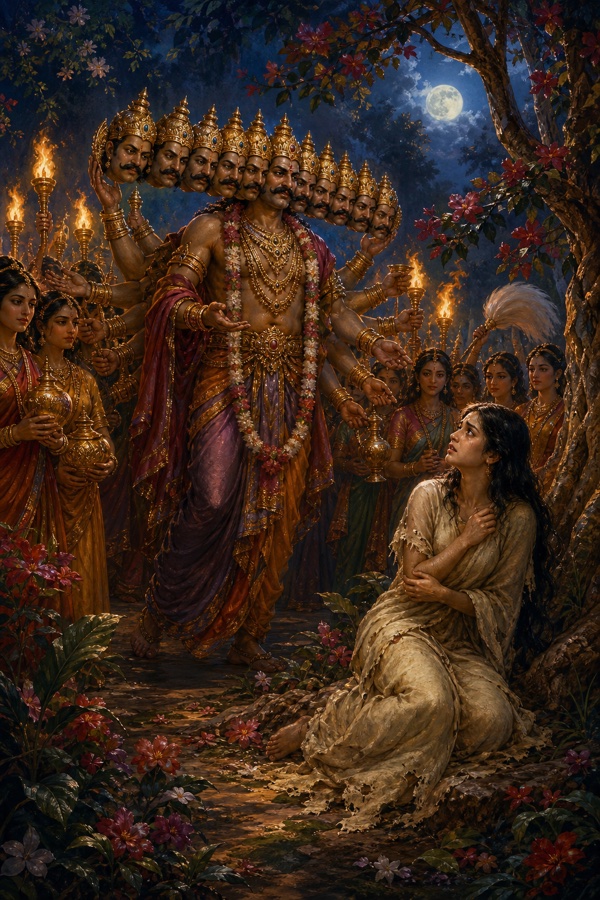
Decked in all his ornaments, wearing a splendor without equal, Ravana entered the grove, taking in its walkways as he came. Moving with a slow, easy step, his mind fastened on Sita, the vile ten-necked one made a fine show. Behind him walked exactly one hundred women, the way the wives of gods and gandharvas walk behind Indra. One carried lamps on golden stems, one a fly-whisk, one a fan of palm leaf; one walked ahead with water in a golden pitcher, another came behind with cushions. Their eyes drooped with sleep and drink, their garlands had slipped, their sandal paste had worn away, and their faces were damp with sweat. They had been woken to walk behind him to another woman, and they walked.
Hanuman watched Ravana coming toward the gate of the grove, the one whose deeds had no equal and whose strength and manhood passed all reckoning; swollen with desire, pride, and drink, red-eyed and long-eyed, like the god of love without his bow; steadying his white upper cloth. Hidden behind the leaves, Hanuman studied him to be sure. Looking all around, the elephant among monkeys also saw Ravana’s chief queens, rich in beauty and youth. Wild with drink, wearing strange ornaments, sharp-eared, this son of Vishrava, this lord of ogres, was like the moon among the stars, ringed by his women. Certain now that this was the very Ravana who had slept the night in his fine hall at the heart of the city, the blazing Hanuman climbed down from the bough and, weighed down by Ravana’s own brilliance, hid himself in the thickest screen of leaves. Eager to see Sita, Ravana advanced toward her.
Sita trembles, and Ravana draws near
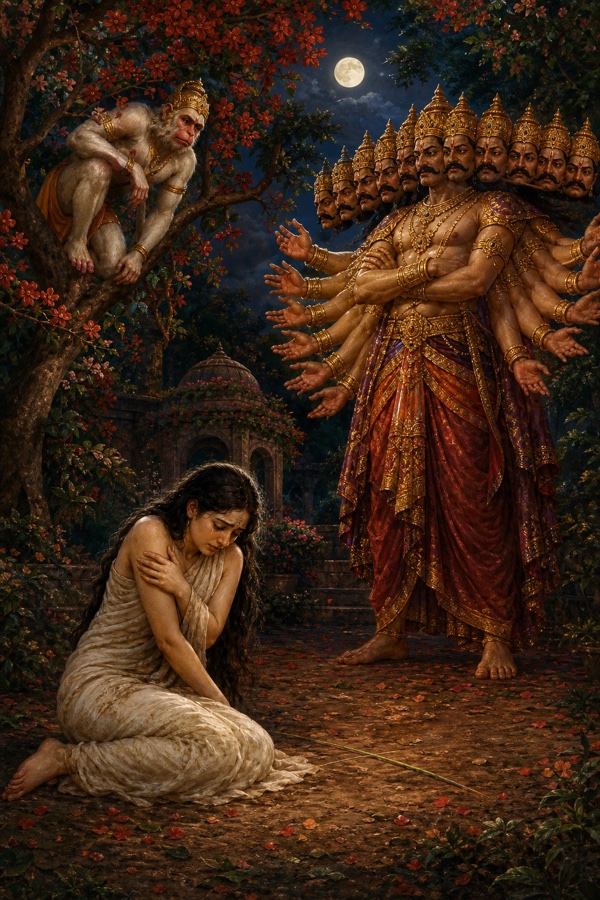
The instant she saw the lord of ogres, rich in youth and beauty, decked in his finest ornaments, the faultless princess Vaidehi shook like a plantain tree in the wind. Covering her belly with her thighs and her breast with her arms, Sita sat down and wept. She had learned what his arrival meant, and she made herself as small as a body can be made.
The ten-necked one looked at Vaidehi, guarded by the ogresses, wretched, worn by sorrow, like a boat foundering in the sea. Seated on the bare ground, firm in her vow, Sita was like a branch cut from a tree and fallen to earth. Wearing her grime for an ornament, unadorned though fit for adorning, she was like a lotus fiber caked in mud: she had beauty, and she had none. Riding the chariot of her longing, yoked to the horses of her resolve, she seemed to be traveling toward Rama, the king who knows himself; her body sat in that garden and no part of the rest of her was in it. Alone, weeping, lost in thought and sorrow, seeing no end to her pain, she was still Rama’s, following after him. She writhed like the wife of a serpent-king struck by a charm; she was afflicted like Rohini pained by a comet; and though born into an upright family and married into a righteous one, she looked as dulled as if she had come from some low line.
Wishing for Rama’s triumph and Ravana’s ruin, her hands joined as though praying to a god, weeping, wholly given over to Rama, Maithili was one whom Ravana now began to court, for his own destruction.
Ravana’s enticement
To that wretched, joyless, austere Sita, Ravana began to speak in soft and pleading words, and the softness was the worst thing about them, because he had a hundred thousand ogres at his call and had chosen to beg: “Woman with thighs like an elephant’s trunk, by hiding your breast and belly you seem to want to make yourself vanish from me out of fear. I desire you; grant me your regard. Sita, let your fear of me pass off; here there is no man or ogre free to change his shape at will.”
“Timid one, to approach another man’s wife, or to take her by force, is the very way of ogres, there is no doubt of it. And yet, Maithili, until you desire me, I will not touch you. Trust me; do not give yourself over to grief. To keep a single braid, to sleep on the ground, to be forever sunk in brooding, to wear soiled clothes, to fast out of season, none of this becomes you.” He was reading her like a page, and he had read her correctly. Every practice he had just listed was a vow of separation, worn by a wife whose husband is not beside her, and the braid above all: unoiled, unparted, bound once and left so, the sign a woman carries until the man she is waiting for comes back to unbind it. He was asking her to put down the last language she had left. “Maithili, take me, and enjoy garlands of every kind, sandal and aloewood, heavenly clothes and jewels, costly drinks, couches and seats, song and dance and music. You are a woman; do not stay in this dirt.”
“This lovely youth of yours is passing; what passes never returns, like the current of a river. When the world’s maker had shaped you he seemed to lay down his craft, for there is no other woman formed like you. Vaidehi, having you, even Brahma the grandfather himself could not keep his composure. Give up this fixed idea of faithfulness and become my chief queen. Every jewel taken by force from many kingdoms, and my kingdom too, I lay before you. I will conquer the whole earth and hand it to your father Janaka for your sake. In all three worlds there is none as strong as I; even gods and demons have been beaten by me in battle, over and over.”
“Rama is not my equal in penance, strength, valor, wealth, splendor, or fame. Rama roams the forest in bark cloth; who even knows whether he is alive. As herons cannot see the moon behind the clouds, so Rama will not so much as set eyes on you again. As Vishnu in three strides wrested from the demons their blazing fortune, so Rama will not wrest you out of my hands. Come, drink, wander, take your pleasure; share out wealth and land among your kin. In the seaside groves thick with flowering trees and loud with bees, decked in strings of gold, wander with me.”
Sita answers from behind a blade of grass
Hearing the words of that savage ogre, the suffering Sita answered low and wretchedly. Worn by sorrow, weeping, trembling, faithful to her husband, thinking only of him, she reached down and took up a single blade of grass and laid it on the ground between herself and Ravana. It was the whole of what she had. A wife of her house did not speak face to face with a strange man, and having nothing else to put between them, she put down a stalk of grass and addressed that, and it held. “Turn your mind away from me,” she said, “and let it rest among your own women.”
“As a sinner cannot beg for spiritual success, so you are not fit to win me. No deed forbidden to a faithful wife can be done by me; I was born into a high family and married into a pure one.” Saying this, and turning her back on Ravana, Vaidehi went on, “I am the devoted wife of another; I cannot become your wedded woman. Ogre, look well upon dharma and hold to the vow of good men. As your women are to be protected, so are the women of others. Make yourself the standard, and take your pleasure among your own wives. It is the man unsatisfied with his own wife, loose in his senses, base in his mind, whom another’s wife leads down to ruin.”
“Either there are no good men here, or you do not follow them, for your mind is set against the grain and empty of discipline. When a kingdom rich in fields and cities falls to a king given over to unrighteousness, who cannot master his own mind, that kingdom is destroyed. In the same way, when you fell to it, Lanka too, heaped with jewels, will soon be destroyed for the crime of one man.” She was speaking to the ruler of Lanka about the ruin of Lanka, seated on his own ground, ringed by his own guards, and she did not lower her voice.
“I cannot be lured by power or by wealth; as light cannot be split from the sun, so I cannot be split from Raghava. Having taken the honored arm of that lord of the world for my shelter, how should I take shelter under any other arm? As learning is fit only for the Brahmin who knows himself and is bathed in his vows, so I am the fit wife of that lord of the earth alone. Ravana, do the right thing and give me, unhappy as I am, back to Rama, the way a maddened cow-elephant is led back to the elephant king in the forest.”
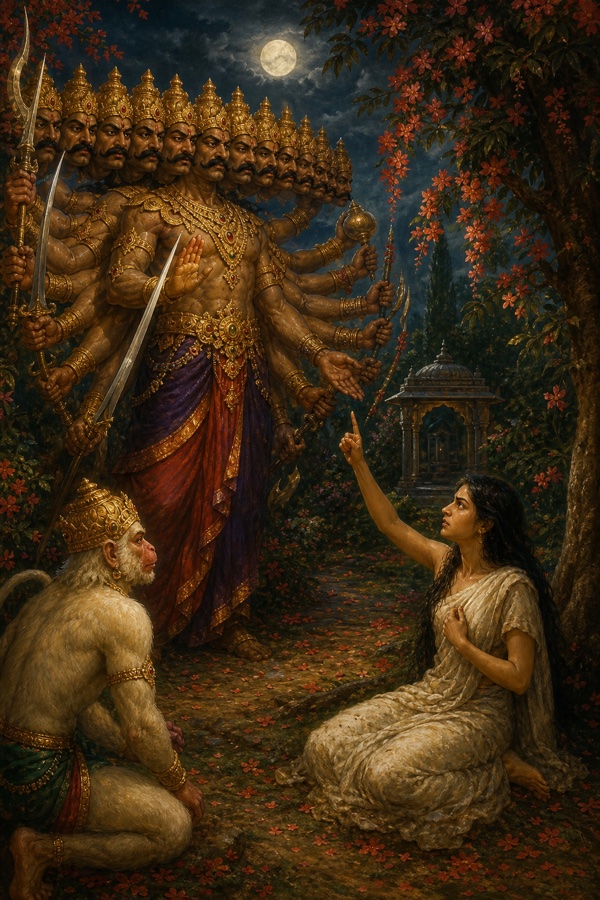
“If you would save your Lanka and spare yourself a fearful bondage, make peace with Rama, the warrior. He knows all dharma and is tender toward those who take refuge in him; if you wish to live, win his favor. Hold yourself in check and give me back to him; in this alone lies your good. Otherwise you will meet with the worst of ruin. The thunderbolt, once loosed, may spare an offender, and Yama himself may spare him for a long while, but the angered Raghava, lord of the world, will not spare one like you. Soon you will hear the great roar of Rama’s bow, like the crash of the thunderbolt. Arrows marked with the names of Rama and Lakshmana, like serpents with blazing mouths, will rain upon this city and leave no spot uncovered. As Garuda tears up serpents, so Rama, a Garuda, will tear up the serpents that are the lord of ogres and his kind.”
“Only because you could not avenge the slaughter of the ogre army in Janasthana, and the loss of your foothold there, did you do this base thing, ogre. When those two lion-men, the brothers, had gone off to hunt, you crept into their empty hermitage, wretch, and carried me away. That is the whole of your valor: you waited until the house was empty. A dog cannot stand before tigers, and so, even catching the scent of Rama and Lakshmana, you will not be able to stand before them. Soon my lord Rama, with Lakshmana will drink up your life with his arrows the way the sun drinks up shallow water. Flee to Kubera’s house on Kailasa or go to the court of Varuna, and still, like a tree struck down by fate, you will be made lifeless by the arrows of Rama.”
Ravana’s threat, and the two-month deadline
Hearing Sita’s harsh words, the lord of ogres gave an ugly reply: “The gentler a man is with women, the kinder they are to him; but with you, the sweeter the words I speak, the more I am insulted. It is the love that has risen in me for you that holds back my anger, the way a skilled charioteer holds back horses bolting down a wrong road. For that reason alone, though you deserve death, I do not have you killed.”
Swelling with rage, Ravana went on: “Of the twelve-month term I set, two months remain for me to wait; after that, lovely-hued one, you will come to my bed. And if even after two months you will not have me for your husband, my cooks will hack you into pieces for my morning meal.”
Seeing Janaki threatened by the lord of ogres, the daughters of gods and gandharvas who had themselves been carried off by force grew downcast, their eyes troubled. Every one of them had once stood where Sita was standing, and had not done what Sita was doing. Some with a movement of their lips, some with their eyes and faces, they reassured her, saying nothing their master could hear. Steadied by them, Sita spoke to Ravana words full of her own good, of her chastity, and of pride in her husband’s valor: “Surely there is no one in this city who wishes you well, none to hold you back from this shameful act. Who in all three worlds, save you, would even in his mind desire me, the wife of Rama, as one might desire Indra’s Shachi? Basest of ogres, having spoken such sinful words to the wife of Rama of measureless splendor, you will not, wherever you flee, escape the fruit of it. Rama is an elephant, and you, low one, are called a hare. You feel no shame reviling the lord of the Ikshvakus here, only because you never come within reach of his sight. I marvel that these cruel eyes of yours did not drop to the ground as you cast them on me. Why did your tongue not fall out as you said such things to Rama’s wife?”
“Only because I have no leave from Rama, and to guard my own austerity, do I not burn you to ash, ten-necked one, though my power is enough to burn you. Being the wife of Rama, I could not truly have been carried off by you; what you brought into Lanka was a body, and not one hair of what makes me his; this abduction of mine is Providence’s own decree for your destruction. Proud of being a hero and the brother of the giver of wealth, well furnished with an army, why did you steal me by stealth, luring Rama far from the hermitage? In all that long day, was there no single hour in which you could have faced him?”
Hearing Sita’s words, Ravana turned his cruel eyes on Janaki in fury. Dark as a blue-black cloud, with vast arms and neck, with the gait and courage of a lion, his tongue aflame and his eyes fierce; towering, his shaking crown lifted high; adorned with a fine garland and sandal paste; wearing a red garland and red clothes, fitted with burnished armlets, a great dark-blue girdle bound at his waist, Ravana looked like Mount Mandara wrapped by Vasuki at the churning of the ocean, the mountain the gods once used to turn the sea, with the great serpent coiled about it and straining.
His eyes red with rage, hissing like a snake, Ravana said: “Wretched woman, in love with a beggar! Today I will destroy you the way the sun wipes out the dusk with its own splendor.” So saying, Ravana, who made his enemies weep, again and again commanded all the hideous ogresses standing there, those with a single eye and a single ear, with the ears of a cow or an elephant, with the feet of an elephant or a horse, with grossly swollen heads and necks and breasts and bellies, with long tongues and nails, with no nose, with the faces of a lion, a cow, a pig: “By kind treatment or by cruel, by conciliation and gifts and division, and by showing her the rod, apart or together, work it so that Janaki is soon brought under my will.” They were the four means by which a king brings a rebel province to heel, and he turned all four of them on one unarmed woman under a tree.
To hold back Ravana as he roared again and again at Janaki, filled with desire and rage, Mandodari and his younger queen Dhanyamalini came close, embraced him, and said: “Take your pleasure with us; what use to you is this pale, wretched mortal woman? He who wants a woman that does not want him only wins torment for his body; but he who wants a willing woman finds the highest delight.” At these words, and drawn along by Mandodari, that Ravana, cloud-like, turned back laughing. Making the earth seem to shake, the ten-necked one went to his palace like the blazing sun. The daughters of gods and gandharvas and nagas closed around Ravana and entered that fine palace with him. Having threatened the righteous, trembling, and yet unshaken Maithili with his terrible words, the desire-maddened Ravana left her alone and returned to his hall.
The rakshasis coax her
Having spoken so to Maithili and left his orders with the ogresses, Ravana, who made his enemies weep, went out of the grove, so the tradition holds. The moment the lord of ogres had gone back into his inner rooms, the fearsome ogresses ran at Sita and spoke to her in the roughest words. They had their orders, and they had all night.
An ogress named Ekajata, her eyes red with anger, said: “Pulastya, the mind-born son of Brahma, fourth among the six Prajapatis, is famous everywhere. His mind-born son was the sage Vishrava, who is called the equal of a Prajapati. His son is Ravana, who makes his enemies weep. You are fit to become the wife of that lord of ogres.” This was the argument of blood, and it was not a small one: the ogre-king came down from Brahma himself in three steps, and by any reckoning of lineage he outranked the house Sita had married into. Then Harijata, tearing open her cat-like eyes, said in anger: “He who conquered the twelve Adityas, the eleven Rudras, the eight Vasus, the two Ashvins, these thirty-three chief gods, and even Indra the king of gods, that Ravana, who never turns his back in battle, why will you not become his wife?”
Vikata said: “He before whose terrible might nagas, gandharvas, and danavas have been beaten again and again in battle has come to you. Base woman, why will you not be the wife of the great and wholly prosperous lord of ogres, Ravana?” Durmukhi said: “He for fear of whom the sun does not scorch, the wind stands still, the trees rain down flowers, and mountains and clouds release their water at his pleasure, why do you not think of becoming the wife of that king of kings, the lord of the southwest, Ravana? Take this true counsel with a glad heart, or else you will not stay alive.” So it went, one after another: lineage, then conquest, then the fear of the elements themselves, and at the end of every argument the same small knife.
Sita’s firm answer, and the rakshasis’ menace
Then the misshapen ogresses spoke to Sita with a new cruelty, words she did not deserve: “Sita, why will you not agree to live with Ravana in the inner palace, with its costly beds, that steals the heart of every creature? You make so much of being the wife of a mortal man; turn your mind from Rama, or else you will never stay alive. You want Rama, thrown out of his kingdom, thwarted, forever in distress, only because you yourself are a mortal.”
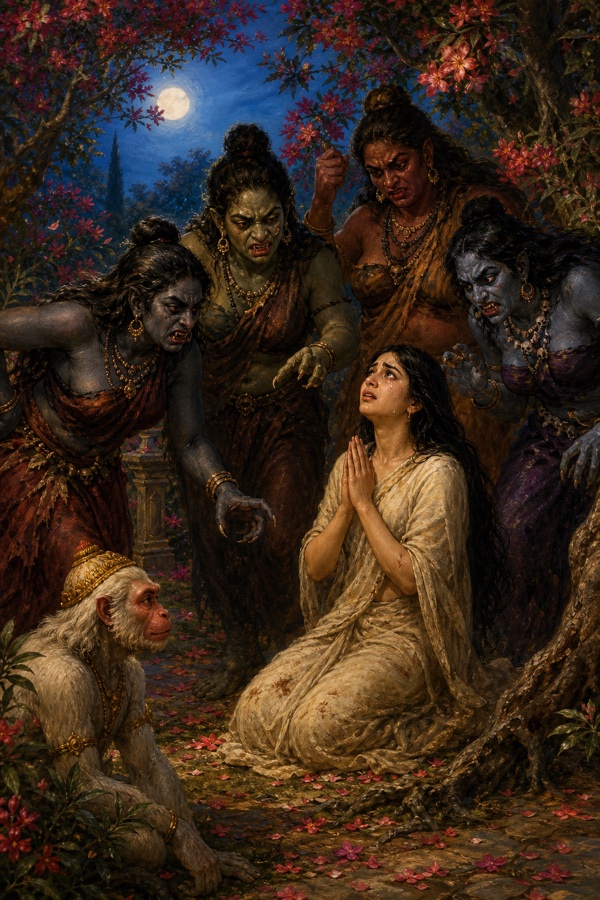
Hearing the ogresses, Sita answered with eyes full of tears: “This vile, sinful thing you all say together does not hold in my mind for even a moment. A mortal woman is not fit to be the wife of an ogre. Devour me all together if you will, but your words I will never obey. Poor or stripped of his kingdom, whoever is my husband is my guru; as Suvarchala is ever devoted to the sun, so am I to him.” Then she began to name them, and the naming was itself her answer, because she was telling these creatures that she stood in a line they could not touch. “As Shachi to Indra, Arundhati to Vasishtha, Rohini to the moon, Lopamudra to Agastya, Sukanya to Chyavana, Savitri to Satyavan, who followed her husband to the door of death and argued him back out of it, Srimati to Kapila, Madayanti to Saudasa, Keshini to Sagara, and Damayanti to Nala, king of the Nishadhas, who lost his kingdom at dice and left her sleeping in a forest and was loved through all of it, so am I faithful to Rama.”
Hearing Sita’s answer, the ogresses, filled with the rage Ravana had ordered, began to frighten her with harsh words. Hidden in the simsapa without a sound, Hanuman listened to those ogresses threatening Sita, and did not move, though he could have emptied that garden in a breath. Falling on the fear-struck Sita from every side, licking their burning, hanging lips in fury, they lifted their axes and cried, “This one is not fit to have the lord of ogres, Ravana, for a husband.” Terrified by the fearsome ogresses, the lovely lady came and stood by the simsapa, wiping her tears, sunk in grief; she had backed up against the one tree in that grove that had a friend in it, and she did not know it.
Then an ogress named Vinata, fearful, with an angry face and a sunken belly, spoke: “Sita, you have shown love enough for your husband; but every thing carried too far brings on ruin. Maithili, take my kind advice and make Ravana valiant as Indra, your husband. Leave the mortal and wretched Rama and take refuge with Ravana, who is capable, generous, and speaks pleasing words to all. Vaidehi, decked in heavenly perfumes and jewels, become from this day the mistress of the three worlds, like Swaha of the fire-god or Shachi of Indra. If you will not do as I say, we will all devour you this very moment.”
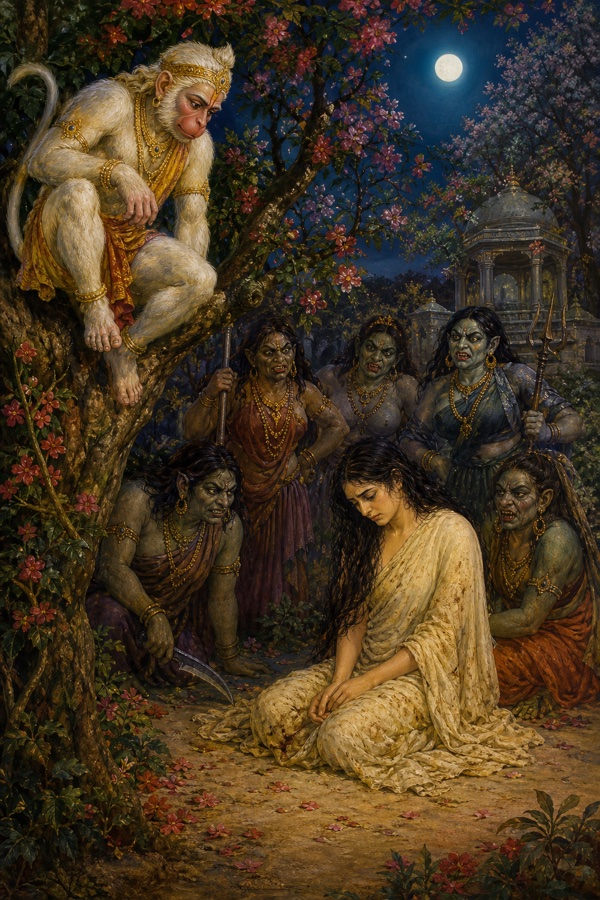
Then Vikata, with hanging breasts, raised her fist and said: “Maithili! Out of pity and softness we have borne your many unfit words about Ravana. Timid one, the youth of women does not last; take your pleasure with Ravana as you please, roam the lovely groves and hills; thousands of women will wait on you. Make Ravana your husband, or else, Maithili, I will tear out your heart and eat it.” Then Chandodari, of cruel aspect, brandishing a great pike, said: “Seeing this doe-eyed woman brought here by Ravana, her breasts shaking with fear, a great craving has risen in me to eat her liver and spleen, her swollen heart, and all her limbs and her head.” Then Praghasa said: “Let us squeeze her throat, why wait? Then let the king be told that the mortal woman is dead.” Ajamukhi said: “Let us cut her up and make equal portions of the whole and divide it; I have no taste for a quarrel.” Surpanakha said: “Bring liquor quickly, and garlands of every kind; Ajamukhi’s plan pleases me too. Let the wine that dispels all grief be brought at once; having eaten human flesh, we will dance before Bhadrakali at Nikumbhila.” They had stopped arguing with her and begun dividing her, out loud, within her hearing, down to the portions. Menaced this way by the deformed ogresses, Sita, like a daughter of the gods, lost her courage and began to weep.
Sita’s lament
Among those grim ogresses speaking their many harsh and savage words, Sita broke down. In terror, her voice choked with tears, Vaidehi said: “A mortal woman is not fit to be an ogre’s wife; devour me all together if you will, but your words I will not obey.” As if crushed by grief at Ravana’s abuse, ringed by the ogresses, Sita could find no peace. Like a doe cut off from the herd and set upon by wolves, she shrank in fear and trembled the more.
Clasping a great blooming bough of the ashoka, her mind broken with grief, Sita began to think of her husband. Wetting her breast with the water of her eyes, finding no end to her sorrow, she sighed and lamented, “Ah Rama! Ah Lakshmana! Ah Kausalya, my mother-in-law! Ah Sumitra!” She was calling the roll of a house that lay a thousand miles behind her, and not one of those names could hear her. She said: “The saying of the wise is true, that for man or woman death does not come out of season; that is why, tormented by these cruel ogresses and cut off from Rama, wretched as I am, I still cling to life a while longer. Poor in merit and pitiable, I will be wrecked like a laden boat caught in a gale in the middle of the sea, like one with no protector. Unable to see my husband, fallen into the power of ogresses, I waste away with sorrow like a bank eaten by the water.”
“Blessed are they who look upon my lord Rama, with eyes like lotus petals, the gait of a lion, grateful, sweet in speech. Parted from Rama, who knows himself, my life is as hard to bear as the taste of sharp poison. What terrible sin did I commit in some past life that I now suffer this fierce, this most cruel great grief! Wrapped in this vast sorrow I wish to give up my life, but under the ogresses’ watch I cannot reach Rama. Shame on this human birth, shame on being at another’s mercy, that even to give up one’s life by one’s own will is not possible!”
Sita’s deep grief, and the wait for Rama
Saying just this, her face wet with tears, her head bowed, the young daughter of Janaka rolled on the ground and lamented, half-crazed, distracted, her mind astray, like a foal thrashing to shake off its weariness: “Ravana, who changes his shape at will, carried me off by force, screaming, from the care of Raghava, whom Maricha’s trick had drawn away. Fallen into the power of ogresses, threatened in the most fearful way, worn by dread and grief, I no longer wish to live.”
“Without the great warrior Rama, living here among ogresses, I have no use for life, for wealth, or for jewels. This heart of mine must be hard as iron, or else unaging and deathless, that it does not burst even under such pain. Shame on me, unworthy, that I go on living a moment without him. I would not touch this night-ranger even with my left foot; how then should I want this Ravana? He does not understand my refusal; he knows neither himself nor his line; by his cruel nature he burns to have me. Cut me, tear me, throw me into the fire, and I will never go to Ravana.”
“What is the reason that Rama, grateful, merciful, upright, does not come to take me? Can it be that with the loss of my good fortune he has grown pitiless? He who alone killed fourteen thousand ogres in Janasthana, why does he not come for me? A weak Ravana has kept me shut away, though my lord is able to kill Ravana in battle. Rama, who killed Viradha in the Dandaka forest, why does he not reach me? Let this Lanka be unconquerable in the middle of the sea; still the flight of Rama’s arrows will not be stopped here.”
“It seems to me that Rama, Lakshmana’s elder brother, does not even know I am here; had he known, how could that splendid man bear this insult? The vulture-king Jatayu, who could have carried the news to Rama, was himself killed in battle with Ravana. Old as he was, Jatayu did a great thing, giving himself to fight Ravana to save me; he was my father-in-law’s friend, and he had nothing left but his wings, and he used them. If Raghava learns I am here, this very day, in fury, he will clear the world of ogres with his arrows, burn Lanka, dry up the sea, and wipe out the fame and name of Ravana. Then, like me, ogresses whose husbands have been killed will weep in house after house.”
“Rama and Lakshmana will comb Lanka and destroy the ogres; whoever they set eyes on will not live a moment. When Rama, his eyes red at the corners, learns that I am in Ravana’s house, then, burnt by Rama’s arrows, its chief ogres killed, its splendor put out, Lanka will fill with grief. Its roads darkened with the smoke of pyres and thick with circling vultures, this city will soon be like a cremation ground. For the wrong done to me a great calamity will come; but these flesh-eating ogres do not understand dharma.”
“Surely, when Ravana is killed, this unconquerable Lanka will wither like a young widow. It is my feeling that some swift monkey, an envoy of Rama’s, will burn this Lanka, though Ravana guard it. The ogres will surely hack me for their morning meal; without the sight of my Rama, what shall I do? Unable to see Rama, whose eyes are red at the corners, wretched beyond all bearing, without my husband I will soon look upon Yama.”
“Rama and Lakshmana do not know that I am alive; if they knew, they would comb the whole earth. Or can it be that the brave elder brother of Lakshmana has given up his body from grief for me and gone to the world of the gods? Blessed are the gods, gandharvas, siddhas, and great sages who look upon my brave, Rama. Or perhaps that royal sage Rama, longing for dharma, made one with the Supreme, has no further use for me his wife. Love comes with a face before the eyes, and with the eyes turned away, no warmth remains; but only the thankless let love die, and Rama never will.”
“Is there some fault in me, or is it the loss of my fortune, that I am cut off from Rama, who is worthy of the best? Parted from the brave, foe-destroying Rama, death is better for me than life. Or perhaps those men, the brothers, have laid down their weapons and taken vows of harmlessness, living on roots and fruit in the forest; or Ravana has had those brave brothers killed by treachery.” She had begun to build reasons for the silence, and every reason she built was worse than the last. Still she said: “At such a time I wish by every means to die, but even in this deepest grief my death is not in the ordering of things. Blessed are the great sages, masters of their senses, at one with truth, for whom there is no pleasant and no unpleasant, no grief at the loss of the pleasant, no pain at the coming of the unpleasant; salutation to those people of noble character. Wretched me, my beloved Rama, who knows himself, has cast off, and fallen into the power of Ravana I will give up my life.”
Trijata’s dream, and the auspicious omens
Hearing Sita speak of her dreadful resolve, some of the ogresses, distracted with anger, went off to carry word to Ravana. Then the fearsome ogresses came up to Sita and spoke once more the same harsh, empty words that spelled ruin to themselves alone: “Sita, of sinful resolve! This very moment the ogresses will feast at their pleasure on this flesh of yours.”
Seeing Sita menaced by those hideous women, an aged ogress named Trijata, just woken from sleep, spoke. She was one of them, born of their kind, posted to the same watch, and what she had seen behind her eyes that night had changed which side she was on. “Devour yourselves, wretches, if you will; you will not be able to feast on Sita! She is the beloved daughter of Janaka and the daughter-in-law of Dasharatha. This very night I have seen a terrible, hair-raising dream that points to the destruction of the ogres and the rise of her husband.” At Trijata’s words all the ogresses, a moment before lost in anger, grew afraid and said, “Tell us, what kind of dream did you see in the night?” In a house of flesh-eaters, a dream at the end of the night was a thing no one laughed at.
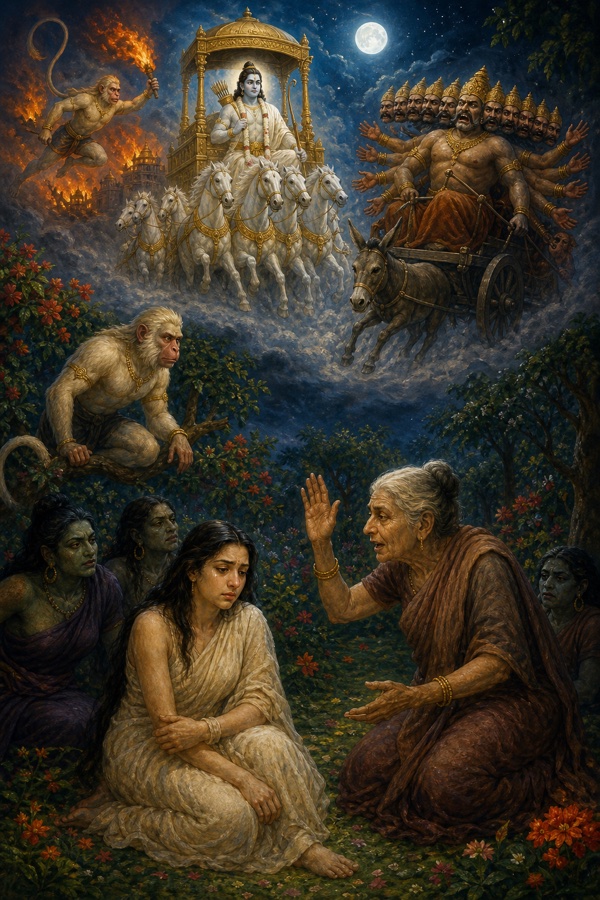
Hearing the words that had escaped their lips, Trijata described the dream of her early morning hours: “I saw a heavenly ivory palanquin, yoked to a thousand horses, moving through the sky; mounted on it himself, wearing a white garland and white robes, Rama came here with Lakshmana. Sita too, clad in white, I saw seated on a white mountain ringed by the sea. Like light with the sun, Sita was joined with Rama. Then Rama, with Lakshmana, appeared mounted on a great elephant with four tusks, a mountain of a beast; the two brothers, in white garlands and robes, blazing with their own splendor like the sun, came and stood by Janaki. On that elephant standing in the air, beside her husband, Janaki sat upon its shoulder; then, springing up from her husband’s lap, Sita touched the moon and the sun with her hands. And that elephant, bearing the two princes and Sita, took its stand above Lanka.
“In another dream Rama came here, wearing a white garland and white robes, on a chariot drawn by eight white bullocks, with his wife Sita and with Lakshmana. Then Rama of unfailing valor appeared mounting the heavenly aerial chariot Pushpaka, shining like the sun, and setting out toward the north with his brother Lakshmana and his wife Sita. Mark that chariot well: it is Ravana’s own, taken from Kubera and flown home in triumph, and in my dream it was carrying Rama, and it was flying north. So did Rama, who rivals Vishnu in valor, appear to me in the dream with Lakshmana and Sita. Rama can be conquered by no one, not gods, not demons, not ogres, just as heaven cannot be won by sinful men.
“Ravana I saw today with a shaven head, bathed in oil, dressed in red, drunk and still drinking, adorned with garlands of oleander, fallen to the ground from the aerial chariot Pushpaka. Then, his head shaven, robed in black, smeared with red garland and paste, he was dragged by a woman on a chariot drawn by donkeys. Quaffing oil, laughing, dancing, his mind confused and his senses obscured, he sped southward on the back of a donkey. Then, bewildered by fear, Ravana was seen falling headlong from the donkey to the ground. Springing up suddenly, terror-stricken, overpowered with drink, like a madman, sky-clad, he was seen raving many foul words. Then, entering a fearful gloom like hell itself, foul-smelling and unbearable, full of filth and mire, he sank into it. Having set out southward, he entered a dry lake without even mud; tying the ten-necked one round his neck, a dark woman clad in red, her limbs smeared with mud, dragged him away to the south. In that same dream I saw Kumbhakarna too. All Ravana’s sons appeared with shaven heads, bathed in oil. The ten-necked one on a boar, his eldest son Meghanada on a dolphin, and Kumbhakarna on a camel, went southward. There Vibhishana alone appeared, shaded by a white canopy, in white robes and garland and white sandal-paste, honored with conch and kettledrum and dance and song, standing in the air on a four-tusked elephant like a hill, with four ministers.
“A great assembly had also gathered, loud with song and instruments, of ogres in red garlands and robes, drinking oil. This lovely city of Lanka, with its horses, chariots, and elephants, I saw fallen into the sea, its gateways and arches shattered. Though guarded by Ravana, Lanka was seen burnt by a swift monkey envoy of Rama’s. In Lanka, now arid with ash, all the ogresses, drunk on oil, laughed with great noise. And Kumbhakarna and the other chief ogres, dressed in inferior red, went and sank into a pool of cowdung.
“So get away from this place; watch how Raghava recovers Sita, and how, in his boundless anger, he has you all killed along with the ogres. Rama would never bear to have his beloved and honored wife, who followed him into exile, reproached or threatened. So have done with cruel words; let only sweet words be spoken now. Let us beg Vaidehi’s pardon; that alone appeals to me. The wretched woman about whom such a dream is seen is freed of her many woes and attains what she holds most dear. Beg her forgiveness even though you have menaced her; what is gained by more argument? A terrible danger from Raghava threatens the ogres. Maithili will be pleased by a mere bow, and she is able to shield you all from a great danger.”
“And I notice in the limbs of this lady no inauspicious mark, however minute. To my mind, this is only a want of luster from missing bath and toilet, not misfortune. I see the accomplishment of Vaidehi’s purpose, the destruction of the lord of ogres, and the victory of Raghava drawing near. The good sign of it is this: her left eye, large as a lotus petal, is throbbing, a mark of hearing most pleasing news. Without any cause the amiable Vaidehi’s left arm, slightly thrilled, is palpitating too. And her fine left thigh, like an elephant’s trunk, trembling, announces, as it were, that Raghava stands before her. A bird, entering its nest on a branch, calls out excellent sweet notes again and again, marking an auspicious hour, and, delighted, seems to urge Sita again and again to rejoice.” The bird she meant was calling from the simsapa, and there was rather more in that tree than a bird.
Then, gladdened by the hope of her husband’s victory, that shy young woman said, “If this comes out to be true, I will surely become your protector.”
A mind moving toward death, and the coming of omens
When Ravana’s threat began to ring again and again in Sita’s ears, she shook like the calf of an elephant caught in a lion’s claws in the wild. Ringed by the ogresses, frightened over and over, she lamented like a young girl abandoned in some empty and terrible forest. Trijata’s dream had lifted her for an hour, and now the hour was over.
There was a deep grief in her words. “The saints of the world speak the truth,” she said to herself, “When they say that death out of season does not come. That is why I, poor in merit, though reviled like this, am alive a moment longer. If I give up my life now, no blame falls on me; for by the hand of this hateful ogre I have already been marked for death. I can no more pour my love on him than a twice-born, entitled to the Veda, can give a mantra to one not so entitled.”
She feared that before Rama could come, this Ravana would cut her limbs apart with his sharp weapons, the way a physician cuts and draws out a lifeless child from the womb. Weeping, she said, “Ah Rama! Ah Lakshmana! Ah Sumitra! Ah Kausalya, Rama’s mother, and my own mothers! Poor in fortune, I am going under like a boat caught in a whirlpool. My faithfulness has gone for nothing, my austerity has borne no fruit, like service rendered to one who is ungrateful.”
“Those two splendid princes, Rama and Lakshmana, must have been killed on my account by that ogre in the shape of an illusory deer. Having done your father’s bidding, kept your fourteen-year vow, when you return free of fear and fulfilled, you will take your pleasure with many women; and I, who have fixed my whole mind on you alone, having done penance and vows in vain, will curse this wretched life of mine and let it go.”
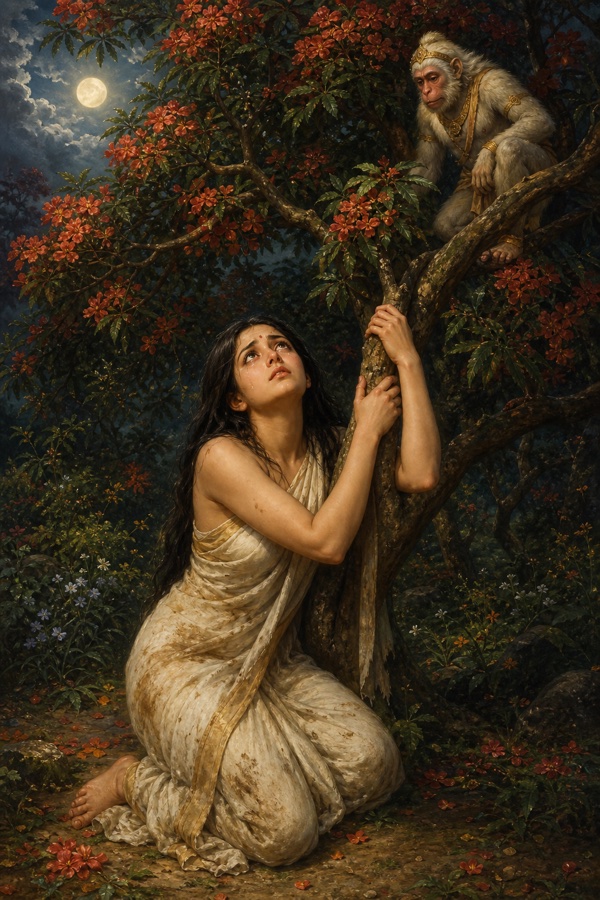
“With poison or with a sharp weapon I would soon let go my life, but in this ogre’s house there is no one to give me poison, no one to give me a blade.” They had left her nothing to die with, which was itself a kind of cruelty, and so she looked down at what was still her own. Thinking so, Sita, scorched with grief, took up her braid. “With the cord of this very braid I will bind my throat and go quickly to Yama.” She caught hold of a branch of the ashoka tree and stood up. But the moment she stood there, thinking of Rama, of Lakshmana, and of her royal house, many auspicious signs began to appear on her body, the very signs that the world holds to be grief-dispellers, and that had shown themselves to her before as tokens of success.
The throb of the omens, and Sita’s joy
As servants come of their own accord to a man of fortune, so the auspicious signs crowded onto the body of that troubled, joyless, dispirited Sita.
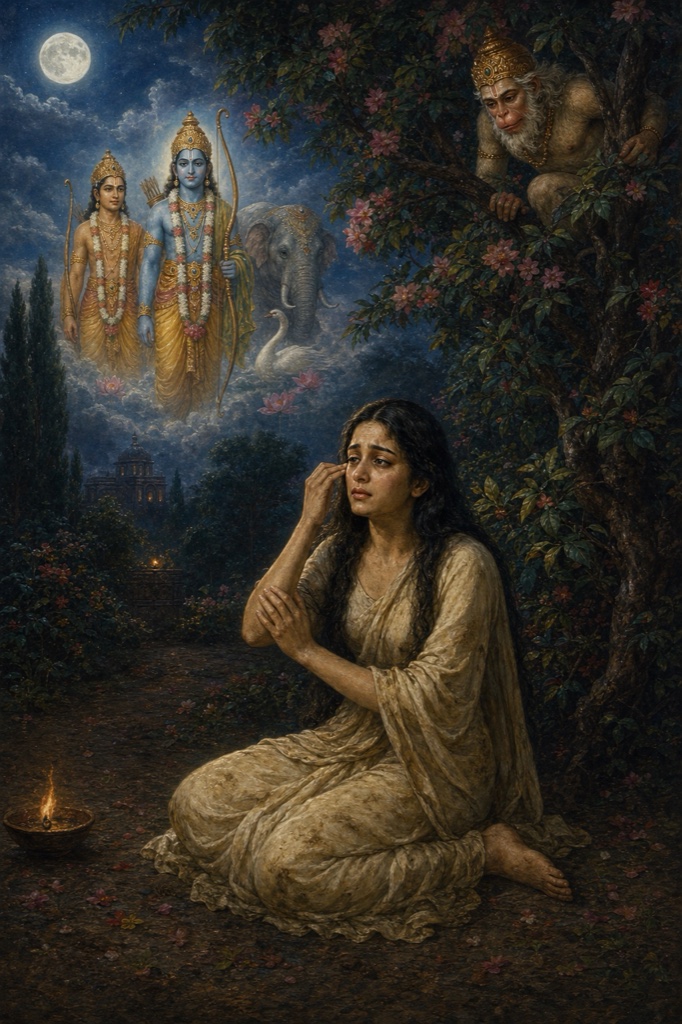
Her left eye, veiled by rows of curling lashes, black in the center, white around it, coppery at the corners, throbbed again and again like a lotus trembling at the touch of a fish. Her left arm, fit for the finest sandal and aloewood paste, the arm that her beloved Rama had long made his pillow, suddenly quivered. Her lovely, full left thigh, like the trunk of an elephant king, trembled as though it were announcing that Rama himself stood before her. As she stood, her gold-colored garment, faintly dulled with dust, slipped a little from her body; this too was a sign of good. Her body had begun to tell her something her mind had given up on.
By these and other such signs, which had come true before, Sita thrilled the way a seed shriveled by wind and sun revives when the rain finds it. Her face, with its bimba-red lips, its lovely eyes, its curling lashes, its bright teeth, shone like the full moon released from the mouth of Rahu. Freed of grief, her weariness gone, her fever eased, her mind lit with joy, Sita grew radiant as a night in the bright fortnight when the moon has risen. The noose was still in her hand, and she had stopped thinking about it.
Hanuman’s inner debate, to speak or not
Hanuman, seated in the tree, had heard all of it clearly: Sita’s lament, Trijata’s dream, and the threats of the ogresses. He had watched a woman decide to die and then decide, on the evidence of her own trembling arm, to wait a little longer. Watching that goddess, like some goddess of the gods’ own pleasure-garden, without once looking away, he fell into many kinds of thought.
He said within himself, “Sita, whom thousands upon thousands of monkeys have hunted in every direction, I have found here. Set to the task as a spy, watching in secret and measuring the enemy’s strength, I have seen it all: the ogres’ power, this city of Lanka, and Ravana’s might. Now it is right that I should comfort the wife of that boundless, all-compassionate Rama, who so longs to see her husband. To leave without reassuring this faithful woman, whose mind is dimmed by grief, would make my going a fault. Once I am gone, seeing no way to rescue, Janaki may give up her life.”
Yet he had his doubts too, and he turned each one over with the care of a man who knows that one wrong word here undoes a year of work. “It is not right to speak before the ogresses. If in what remains of this night I do not reassure her, she will surely give up her life. And if Rama should ask what message Sita sent, what will I answer without having spoken with her? If I return with no message, he will burn me with his anger. Then again, I am very small in body, and a monkey besides; if I speak in Sanskrit she will take me for Ravana and be frightened; I must speak to her in the human tongue used around Ayodhya. But seeing both my monkey form and human speech, already afraid, she will grow more afraid still; if she cries out, the armed ogresses will fall on me, the ogres will gather, and I will be surrounded. I could kill them, but then, worn out, I might not be able to cross the sea; or they will seize me, and Sita will be left without knowing my purpose.”
“Battles are always uncertain; what wise man leaps into a doubtful task without thought? If I speak openly with Sita, grave harm; if I do not, her death. Work almost accomplished is undone, when done against time and place, like darkness at sunrise. Messengers who think themselves clever and are not ruin even the plans their king and ministers have settled.” At last he resolved, “Singing the praises of my honored lord Rama, in sweet words, I will speak a message so beautiful and so full of dharma that Sita will believe it and not be afraid.” He would not announce himself at all. He would simply begin telling her husband’s story, out of the leaves, and let the story do the work of an introduction. Thinking so, Hanuman of great power, seated among the branches of the tree, began to speak sweet and true words.
The tale of the Raghu line, and Sita’s eyes find Hanuman
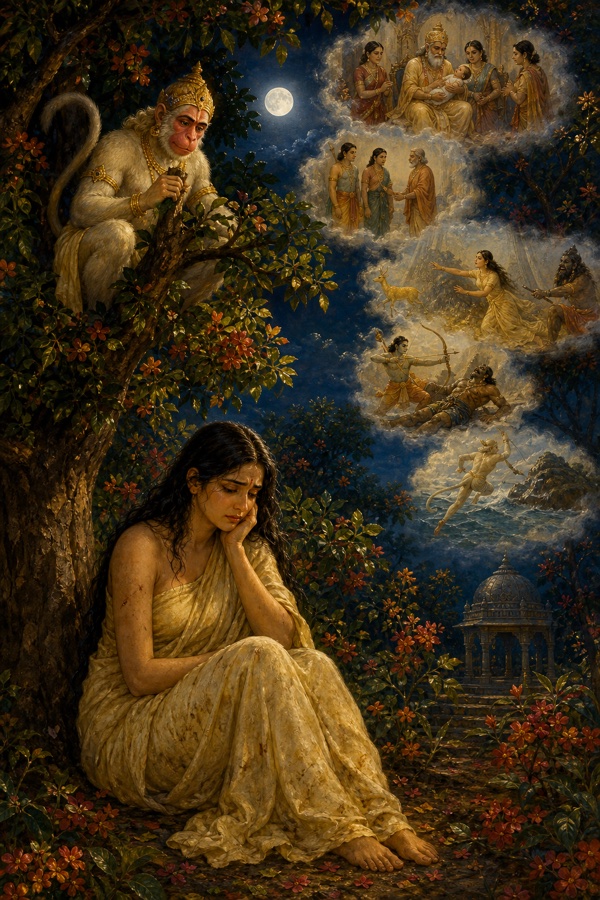
Having thought it through, Hanuman said, in a sweet voice and within Sita’s hearing, and to no one at all, as though a man were telling over a story to himself in the dark, “In the line of Ikshvaku there was a king of the highest renown named Dasharatha, of pure conduct and great fame. Foremost in virtue among royal sages, the equal of the sages in penance, of Indra in strength; devoted to harmlessness, compassionate, true in his valor; famed over the earth to its four seas, happy himself and a giver of happiness to others.”
“His beloved eldest son became famous by the name of Rama. He was the guardian of his own conduct, of his people, of the whole world of creatures, and of dharma. At the word of his truthful, aged father he went to the forest with his wife and his brother Lakshmana. Hunting in that great forest, he killed many brave ogres who could change their shape at will. Hearing of the destruction of Janasthana and the killing of Khara and Dushana, Ravana used the trick of an ogre in deer-shape to lure Rama away and stole Janaki.”
“Searching for the goddess Sita, Rama found in the forest a monkey friend named Sugriva. Killing Vali, the city-conqueror Rama gave Sugriva the monkey kingdom. At Sugriva’s command, monkeys who could change shape at will went out by the thousands in every direction to search for the goddess. On the word of Sampati, elder brother of Jatayu, for the sake of that goddess, I leapt with all my force across a sea a hundred yojanas wide, eight hundred miles across. The one I have found here, matching in form, color, and mark what I heard from Rama’s own mouth, is Sita.” So saying, the monkey leader fell silent, and waited to see what a story would do to a woman who had heard nothing but threats for ten months.
Hearing this, Janaki was struck with wonder. Lifting her face, veiled in her disordered hair, the timid one looked up toward the simsapa where Hanuman sat. Hearing the monkey’s words, gazing in every direction and quarter, remembering Rama with her whole being, she was filled with the deepest joy. Looking sideways, up, and down, she saw Sugriva’s minister, the son of the wind, Hanuman of unfathomable mind, like the sun risen in the east.
Dream, or truth? Sita’s doubt
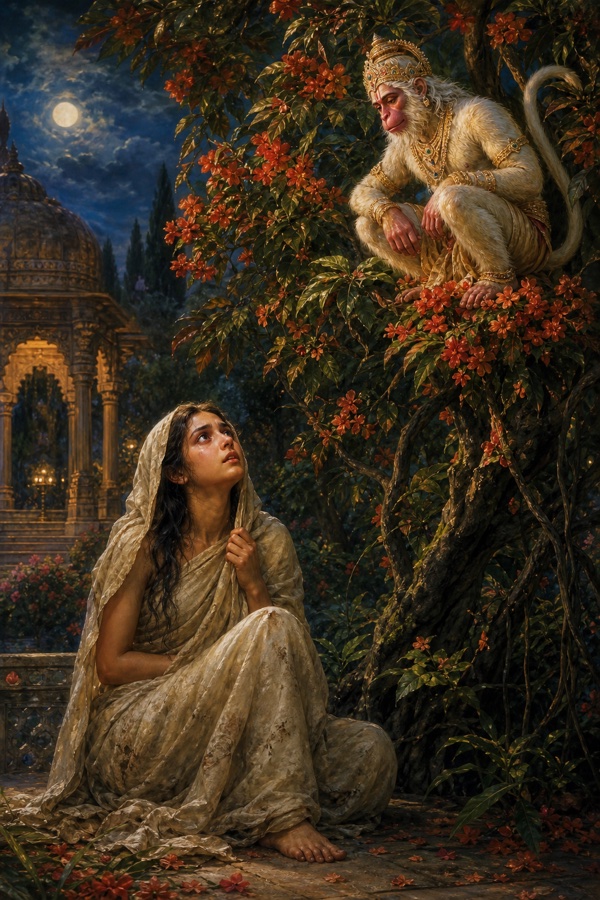
Seeing Hanuman hidden among the branches, tawny as a mass of lightning and dressed in white, Sita’s mind wavered. Looking at that modest, sweet-spoken monkey, glowing like a cluster of open ashoka flowers, his eyes like burnished gold, she suddenly began to sob softly, and wonder took hold of her. Then, thinking, “This is the fearful, dangerous form of a monkey,” and holding it hard to look upon, she nearly fainted, and in her terror she wailed piteously, “Rama! Rama! Lakshmana!”
Seeing Hanuman come in so humble a manner, Maithili thought, “Can this be a dream?” Looking at the son of the wind she nearly swooned again, and coming to herself after a while, she reasoned: “Today I have seen an ill-omened dream; in the scriptures the sight of a monkey is called inauspicious. May it be well with Rama and Lakshmana and with my father Janaka! But this cannot be a dream; worn as I am by grief and pain, sleep never comes to me. Parted from my beloved, where is there any happiness for me? The one whose name I always speak, ‘Rama, Rama,’ is the very one whose story I am hearing, and whom I am seeing too.”
“Is this only a wish of the mind? But the mind’s image has no form, and this monkey has a clear form and is speaking to me.” It was the reasoning of a woman who had been given nothing to trust for ten months and had learned to test every gift before opening it. At last she prayed with reverence, “Salutation to Indra with Brihaspati; to Brahma; and to the fire-god! Let what this forest-dweller has said before me be true, and nothing else.”
Hanuman’s question, and Sita’s own story
Climbing down from the simsapa, coral-mouthed, humbly dressed, pained at the sight of Sita’s state, Hanuman set his joined palms to his head and asked in a sweet voice, “Wearing a soiled silk garment, holding to a branch of the tree, who are you? Why do tears of grief fall from your eyes? Of gods, asuras, nagas, gandharvas, ogres, yakshas, or kinnaras, which are you? Are you a goddess of the eleven Rudras, the Maruts, or the eight Vasus? Or Rohini, fallen from heaven, cut off from the moon? Or Arundhati, fallen after angering Vasishtha in anger and folly? What son, father, brother, or husband of yours has gone from this world to the next, that you grieve?”
“But by your weeping, your deep sighs, your touching of the earth, and your naming of a king, I do not take you for a goddess. By the marks on your body it appears you are the queen of some ruler and the daughter of some king. If you are that Sita whom Ravana carried off by force from Janasthana, then tell me, and may it be well with you! By your wretched state, your more-than-human beauty, and your austere dress, you are surely the queen of Rama.”
Gladdened at Rama’s name, Vaidehi answered, and once she began she could not stop, because no one had asked her to tell it and there had been no one in Lanka to tell it to. “I am the daughter-in-law of Dasharatha, chief among the lion-kings of the earth. I am the daughter of the king of Videha, Janaka, and the wife of Rama, famed by the name of Sita. Twelve years I lived in Raghava’s house, enjoying such comforts as befit a mortal. In the thirteenth year the king, with his teacher Vasishtha, wished to consecrate Rama as heir-apparent. But as the consecration was being made ready, Kaikeyi said to her husband, ‘Until Rama’s consecration is stopped, I will take neither food nor water; if the boon you gave me is not to be false, let Rama go to the forest.’”
“Remembering the boon, the truthful king, hearing Kaikeyi’s cruel word, fainted. Coming to himself, the aged king wept and asked his eldest son to take the kingdom. But holding his father’s word dearer than the consecration, Rama accepted it. Rama, who gave gifts but never took them, who spoke truth and never falsehood, whose valor was pledged to truth with his very life, cast off his costly upper garments, cast the kingdom out of his mind, and handed me over to his mother. But I set out for the forest ahead of him; without him even heaven does not please me. And Lakshmana, in kusha grass and bark cloth, made ready to follow his elder brother.”
“The three of us, firm in our vow, entered a forest never seen before, deep and dark. While we lived in Dandaka, I, the wife of Rama, was carried off by Ravana. He has given me two months to live; when those two months are past, I will give up my life.” She said it the way a person says a date they have already made their peace with.
The messenger names himself, and the same doubt returns
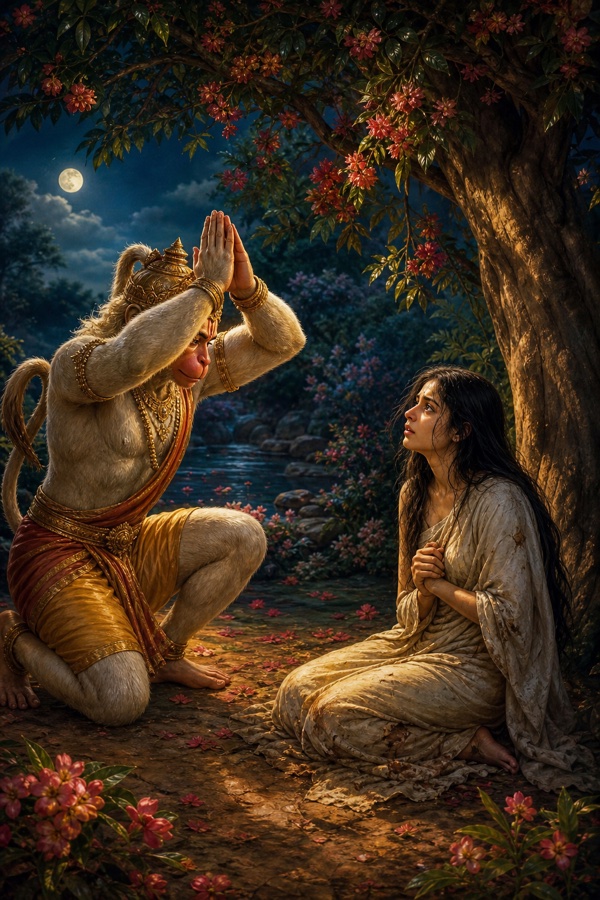
Hearing Sita’s words, weighed down by grief upon grief, Hanuman comforted her: “Goddess, I have come to you as Rama’s messenger, sent with his message. Rama is well, and he has sent you word of his welfare. Rama, best among knowers of the Veda, has asked after your welfare. And Lakshmana, the dear follower of your lord, worn with grief, bows his head to you.”
Hearing the welfare of those two lion-men, Sita’s whole body thrilled. Alive. Both of them alive, and asking after her. “That worldly saying seems a blessing,” she said, “That even after a hundred years joy comes to a living man!” In that meeting a wonderful affection sprang up between them, and, trusting one another, they began to speak.
But the closer Hanuman edged, the more Sita began to take him for Ravana. “Alas, shame on me, that I have said all this to him! Can this be Ravana come again in another shape!” Thinking so, worn thin with grief, Sita let go the ashoka branch and sat down on the ground. Hanuman bowed to the daughter of Janaka, but Sita, seized with fear, would not lift her eyes to him. Hope had been used against her before, and she had learned to distrust it exactly when it arrived.
Drawing a long breath, she said in a sweet voice, “If you are the shape-shifting Ravana, and are tormenting me again in a false form, this is not right. You are the same Ravana who came to Janasthana disguised as a wandering monk, and I gave you food and water with my own hands, because that is what is done for a guest. It does not become you to torment me again, thin and wretched with fasting, shape-changing night-ranger! Or perhaps this fear of mine is not true, for at the sight of you affection has arisen in my mind. If you have truly come as Rama’s messenger, may it be well with you; I will ask you of Rama, for his story is dear to me. Tell me the virtues of my beloved Rama; you are carrying off my mind the way a river’s current carries off its bank.”
“Ah, the sweetness of this dream, that carried off so long, I see with my own eyes a monkey sent by Rama! But seeing a monkey in a dream brings no good fortune, and I have found gladness of mind; so this is no dream. Is this a delusion of the mind, or a disorder of the winds, or a mirage? But no, I know both myself and this monkey; so it is no madness either.” Because ogres can change their shape, and because she doubted that a monkey could leap the sea, Sita took Hanuman for Ravana and fell silent.
Reading her resolve, Hanuman gladdened her with words that were sweet to the ear; he spoke of Rama’s form, his splendor, his true and gentle speech, his valor like Vishnu’s, his guardianship of the four orders, all of it, and then named himself: “Goddess, know me for Sugriva’s minister, Hanuman, the son of the wind. Leaping the sea, setting my foot as it were on the head of Ravana, I have entered Lanka. I am not what you take me to be; give up this fear and put faith in my words.”
The marks of Rama and Lakshmana, and Hanuman’s full story
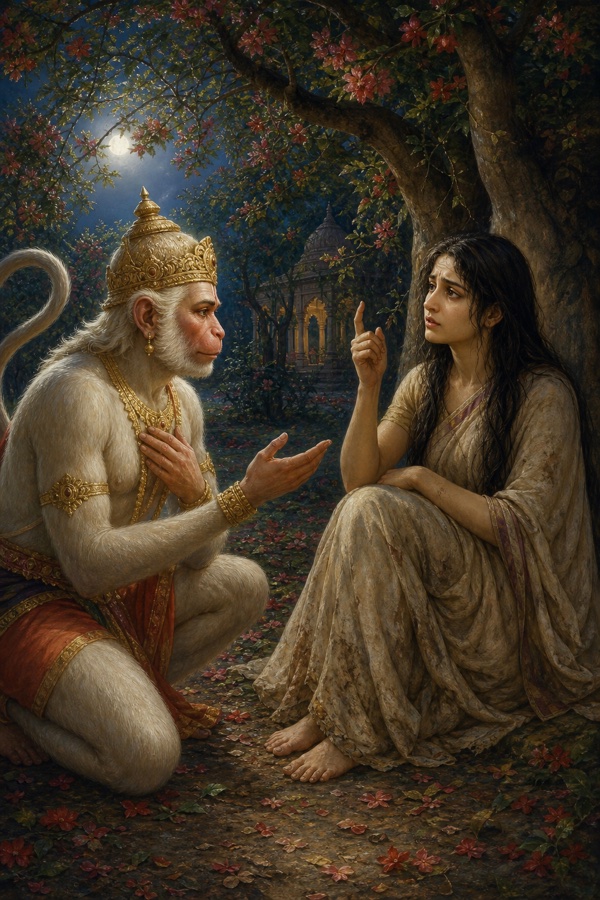
Hearing Rama’s story, Vaidehi said in a sweet voice, “Where did you meet Rama? How do you know Lakshmana? How did the meeting of monkeys and men come about? So that grief may not close over me again, tell me once more, in full, the marks of Rama and Lakshmana. What is their build and their form, their thighs and their arms?” She was asking him to describe her husband, which is a test no impostor passes and a hunger no wife hides.
Hanuman began an exact description: “Rama is full-gifted from birth with beauty and courtesy. In splendor he is like the sun, in patience like the earth, in wisdom like Brihaspati, in fame like Indra. Guardian of the world of creatures and of his own people, guardian of his conduct and of dharma. Guardian of the four orders, maker and enforcer of the bounds of right. Firm in the vow of continence, knowing the good done by the good, versed in the Yajurveda, the science of arms, and the Vedas and their branches. With a conch-shell neck, an auspicious face, coppery eyes; a voice deep as a kettledrum, smooth skin, a dark complexion, well-proportioned limbs.”
“He bears many auspicious marks: three parts firm, three parts long, three parts even, three parts high, three parts coppery, three parts smooth, three parts deep; three folds on the belly, four parts each even, fourteen other paired parts even, four sharp eyeteeth, four gaits like a lion, a tiger, an elephant, and a bull, fine lips and chin and nose, five smooth parts, eight long parts; ten lotus-like parts, ten broad parts, pervaded by three, tejas, fame, and glory, two white parts, high in six, fine in nine; one who in the three times pursues dharma, wealth, and pleasure. Devoted to truth and dharma, glorious, a knower of the division of place and time, beloved of all the world.”
“His half-brother, Lakshmana is his image in love, in beauty, and in virtues; Rama is dark and Lakshmana is golden.” Then Hanuman told the story of their meeting: “Searching for you, those two warriors found us near Mount Rishyamuka, where Sugriva sat, afraid of Vali. At Sugriva’s command, with joined palms, I went to them, set them on my shoulders, and carried them to Sugriva. From their talk together deep affection grew between them. Vali had seized Sugriva’s wife Ruma and driven him out; hearing this, Rama consoled Sugriva, and Lakshmana told Sugriva of the grief of your separation. Each of them was a man whose wife was being held by someone stronger than the friend beside him; that was the whole of the treaty between them, and it needed no writing.”
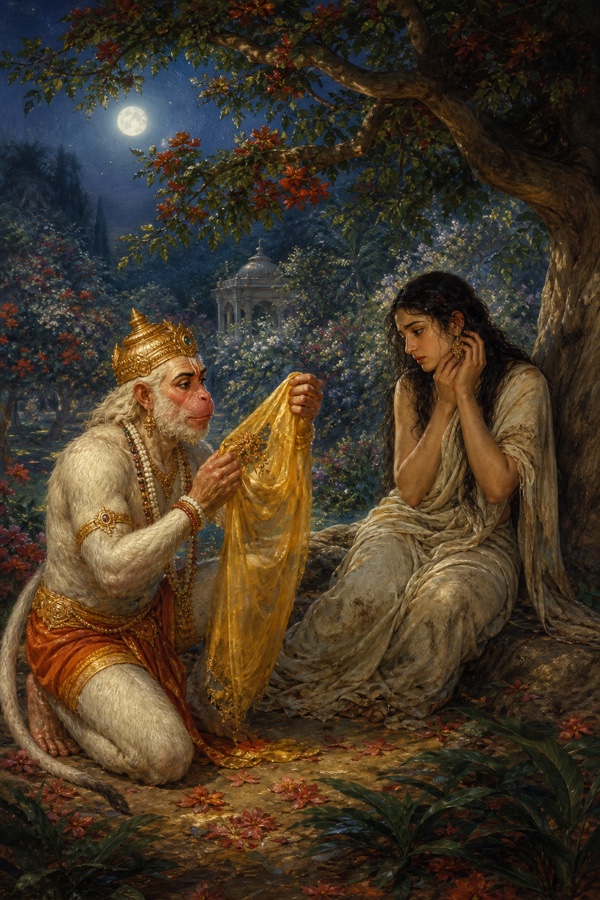
“The ornaments that fell to the earth when Ravana carried you off, the monkey chiefs showed with joy to Rama; but they did not know your whereabouts. Those ornaments I was the first to take up. Pressing them to his chest, the godlike Rama wept long, breaking down again and again in his grief; his lament fed the fire of our own sorrow. Rama, keeping his vow, killed Vali on the field of battle and made Sugriva king of all the bears and monkeys.”
“Having won his kingdom, Sugriva called the great monkeys and sent them out in all ten directions. We were lost in the Vindhya mountains, sunk in grief, and, despairing of the task and fearing Sugriva, we sat down to fast to death. Then, hearing in Angada’s lament of your loss, of Vali’s death, and of Jatayu’s death, there came Sampati, Jatayu’s elder brother. Grieved to hear of his brother’s death, Sampati told us that you dwell in Ravana’s house. Heartened by that, we reached the seashore under Angada’s lead. So it was a dying bird’s grief for his brother that told us where you were; nothing in this search has come to us any other way.”
“Seeing the sea, the monkey army lost heart; then I put aside my fierce fear, leapt the hundred yojanas, and entered Lanka by night, thick with ogres. I have seen both Ravana and you. Maithili, at the urging of the divine sages, my father Kesari killed an asura named Shambasadana at the holy place of Gokarna; from Kesari’s wife, by the wind-god, I was born, and by my own deeds I am known in the world by the name Hanuman. For your trust I have told the virtues of my lord; soon Rama will take you away from here.”
Reassured by fitting proofs and marks of recognition, Sita came to a joy beyond measure and, from eyes with curling lashes, shed tears of gladness. Her face shone like the moon released from Rahu. Now she took Hanuman clearly for a monkey, and nothing else.
Rama’s signet ring, and Sita’s questions after his welfare
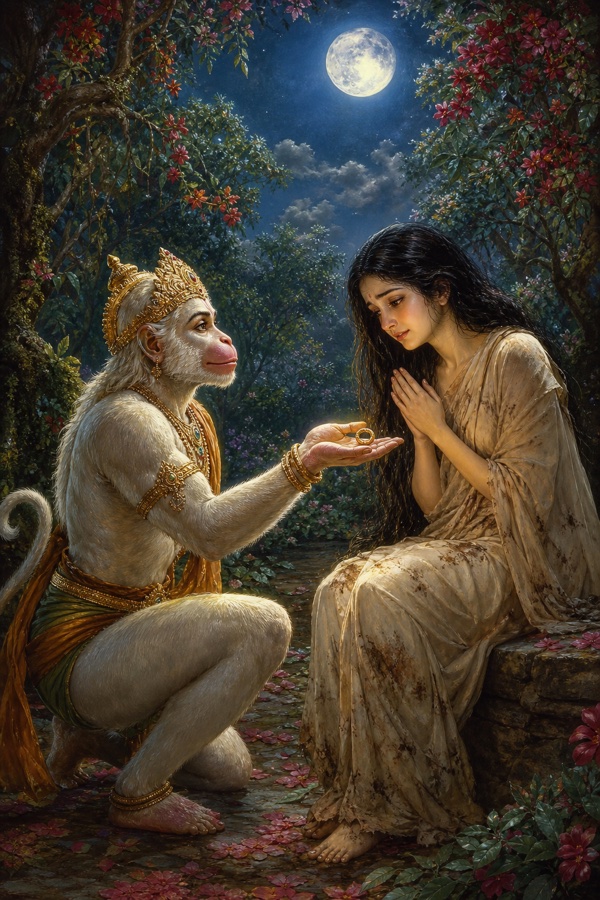
To make Sita’s trust firmer still, Hanuman spoke again in humble words, “I am a monkey and the messenger of Rama. Look, here is this heavenly ring marked with the name of Rama, which Rama gave me as a token of trust, and which I have brought. Be reassured, and may it be well with you; the fruit of your sorrows has now come to an end.”
Taking the ring that had so long adorned her lord’s hand, Janaki grew glad, as though her husband himself had come. It was small, and it was warm from the leap across the sea, and it was the first thing she had touched in ten months that had come from him. The modest lady, delighted and wholly satisfied by her lord’s message, began to praise the great monkey: “You are bold, capable, and wise, that alone you have trampled through this city of ogres. This sea a hundred yojanas wide, the home of crocodiles, you have crossed as though it were the print of a cow’s hoof. I do not take you for an ordinary monkey, for you have neither fear nor awe even of Ravana. You are fit to be spoken with by me, if the self-knowing Rama has sent you; and the unassailable Rama would not send anyone to me without testing him, without knowing his strength.”
Then, distressed, she asked many questions: “By great fortune the righteous, true-vowed Rama and Lakshmana are well. But if Rama is well, why does he not burn this sea-girdled earth in his anger like the fire at the end of an age? The two of them could master even the gods; and yet the end of my sorrows has not come; it seems the end of my sorrow alone will not come.”
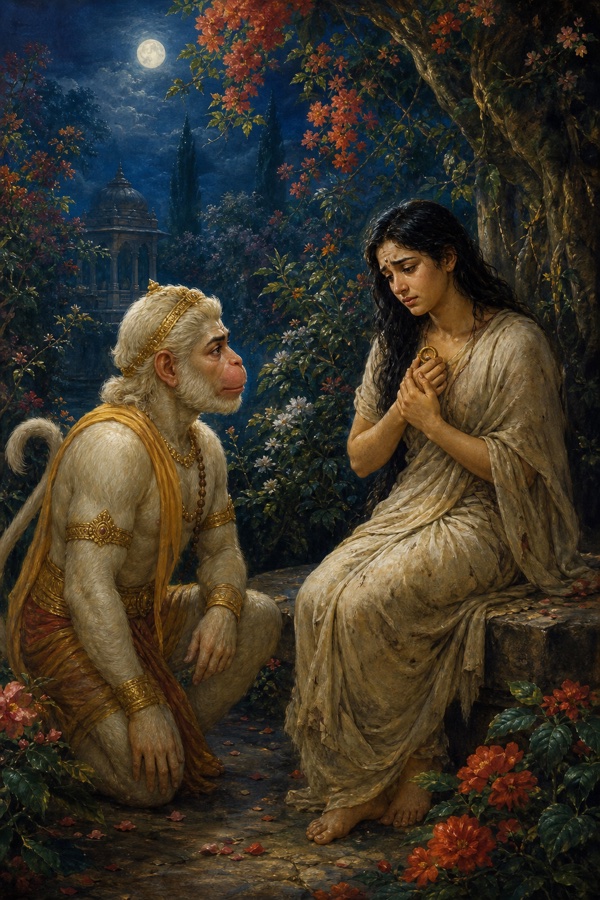
“Is Rama not troubled, not scorched with grief? Does that man set about the duty before him? Is he not wretched and dismayed? Does he practice conciliation and gifts toward friends, and gifts, punishment, and division toward enemies? Does he seek the favor of the gods and rely on both his own effort and destiny? Has his love for me not slipped away in this long absence? Will he lift me from this danger? Has the ease-loving Rama not lost heart in the great calamity of our separation? Does the welfare of Kausalya, Sumitra, and Bharata reach his ears? Has his gold-lotus face, fragrant as a lotus, not wilted from grief for me, like a lotus in the sun when its pool dries?”
“He who felt neither fear nor grief when he gave up the kingdom for dharma and led me on foot to the forest, does that Rama still hold firmness in his heart? Neither his mother nor his father nor anyone else has been dearer to him than I, nor even as dear. I too wish to live only so long as I keep hearing news of my beloved.” Having said these great and sweet-meaning words, Sita fell silent to hear more of Hanuman’s Rama-filled speech, the way a starving person goes quiet at the smell of food.
Then Hanuman, setting his joined palms to his head, said, “Rama does not know that you are here; that is why he has not quickly taken you away, as Indra took his Shachi. The moment he hears my word, Raghava will come at once with a great army of monkeys and bears. Bridging the unassailable sea with his arrows, he will empty Lanka of ogres. If death, a god, or a great demon should stand in his way, he will kill them too.”
“Filled with grief at your separation, Rama finds no peace, like an elephant wounded by a lion. I swear by the mountains Mandara, Malaya, Vindhya, Sumeru, and Dardura, and by roots and fruit, that you will soon see Rama’s face like the risen full moon. You will see him on Mount Prasravana, seated like Indra on the back of Airavata. Rama takes neither meat nor honey; in the fifth watch, at dusk, he eats only wild fruit and well-prepared offering food. His mind fixed on you, he does not so much as brush a gnat, a mosquito, an insect, or a crawling thing from his body. Ever given to meditation, ever sunk in grief, even in sleep he starts up crying ‘Sita.’ Seeing a fruit, a flower, or any lovely thing, he sighs, ‘Ah, beloved!’ That prince strives for nothing but your rescue.”
Vaidehi, whose grief the praise of Rama had eased but who was made as sorrowful by the news of Rama’s grief, became like a night at the beginning of autumn, half bright, half darkened by a moon veiled in cloud. She had wanted to be missed, and now she had to hear what being missed had done to him.
The offer to carry her home, and Sita’s refusal
Hearing Hanuman’s words, Sita gave an answer in keeping with dharma and good sense: “Monkey, what you say, that Rama is sunk in grief with his mind fixed on me, is nectar mixed with poison. Whether a man is in the widest fortune or in the harshest disaster, time drags him along, bound with its rope. The ordinance of creatures is fixed; see, Lakshmana, Rama, and I, all of us are wrung by disaster. How will Rama cross this sea of grief, like a man worn out from swimming when his boat has gone down? When will my husband, having killed the ogres, destroyed Ravana, and razed Lanka, look upon me at last?”
“Tell him to make haste; my life lasts only through this one year. The tenth month is passing; of the term Ravana set, only two months remain. Vibhishana pressed his brother Ravana hard for my return, but he would not listen; fate has already closed on him in battle. Vibhishana’s eldest daughter Kala, sent by her mother, told me that an old, wise, learned ogre named Avindhya, honored by Ravana, had warned him that not returning me would bring the ogres to ruin at Rama’s hands; but he did not heed that wholesome word. Mark those names and carry them back: there are ogres in this city who have told their king the truth and been ignored, and a child who crossed the palace to bring word of it to me.”
“I have hope that my husband will soon reach me; my inmost self is pure, and he has many virtues. Zeal, manhood, strength, freedom from cruelty, gratitude, valor, and power, all are in Rama. Who among his foes would not tremble before the one who, without his brother’s help, killed fourteen thousand ogres in Janasthana? That man is not to be weighed against calamities; I know his power as Shachi knows Indra’s. That sun that is Rama, with his rays of arrows, will drink up the water that is the enemy ogres.”
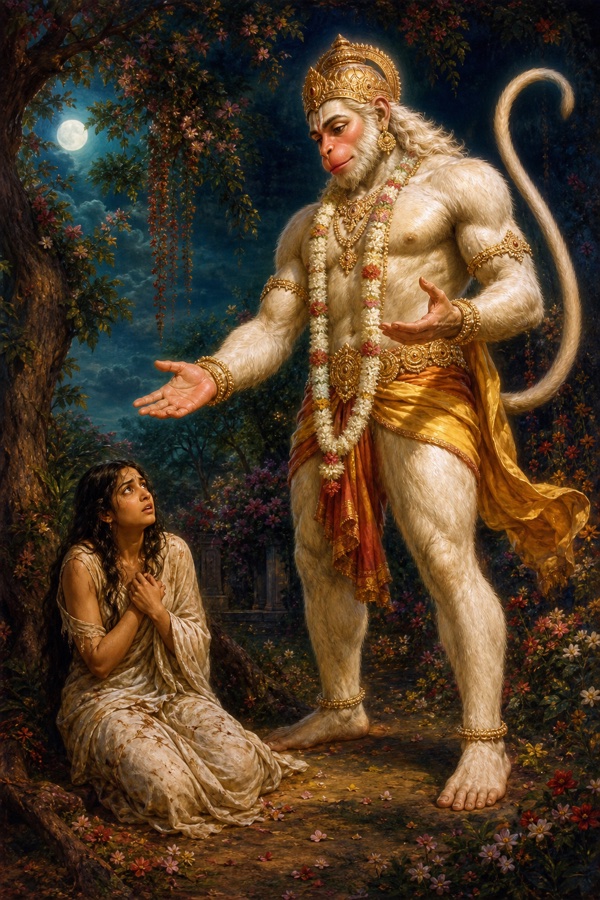
To Sita, speaking so with a face wet with tears, worn thin with grief, Hanuman said, “The moment Rama hears my word, he will descend on Lanka with a great army of monkeys and bears. Or this very day I will free you from this suffering; climb onto my back. I can carry Lanka and Ravana and all on my back; what hardship then to carry you across the sea? This very day I will bring you to Rama on Mount Prasravana, the way fire carries the offering to Indra. Climb on my back, goddess; do not hesitate; long for the meeting with Rama as Rohini longs for the moon.”
Hearing this, Maithili, thrilled with joy, said, “Hanuman, how will you carry me so far? This is only your monkey nature, chief of the host! Small of body as you are, how will you carry me to my royal husband?” This question Hanuman took as his first slight. “Sita does not know my strength and power; then let Vaidehi see the form I can take at will,” he thought, and the foe-crushing Hanuman showed his true shape. Leaping from the tree to build Sita’s trust, he grew, and stood before her like Sumeru or Mandara, glowing like blazing fire. The little creature she had been pitying a moment ago now stood over the garden with the moon behind his shoulder. Mountainous, coppery-faced, with teeth and nails like thunderbolts, Hanuman said, “I have the strength to carry off this whole Lanka, with its hills and woods, its towers, walls, and arches, and its lord Ravana too. So steady your mind, give up hesitation, and free Rama and Lakshmana from grief.”
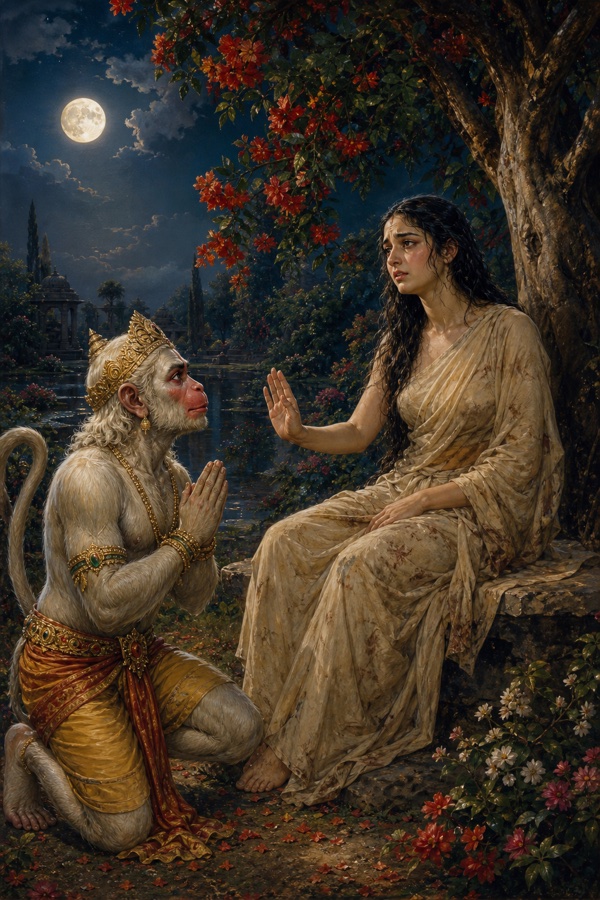
Seeing Hanuman’s mountainous form, Sita said, “I know your courage and strength; your speed is like the wind’s and your splendor like fire’s, both wonderful. How else could any ordinary monkey come across the sea to this land? I grant your power of flight and your power to carry me; but the success of my task must be thought through with care.” Then she began to take his plan apart, piece by piece, the way a minister takes apart a proposal in council. “In the rush of your wind-speed I might faint, or slip from your back over the sea; falling, I would become food for the water-creatures in a sea full of crocodiles and sharks. And seeing you carry a woman on your back, the ogres will grow suspicious and give chase; ringed by armed ogres, how will you, unarmed, both guard me and fight them? In fear I might fall from your back; or they might seize me, or kill me; and in battle victory and defeat are uncertain.”
“Those sinful ogres might hide me in some secret place where neither monkeys nor Rama could find me, and then all your effort would go for nothing. Even if you killed all the ogres, Rama’s fame would be lessened. And keeping my devotion to my husband before me, I do not wish of my own will to touch the body of any man but Rama. In Ravana’s touching of my limbs I was helpless, without protection, at another’s mercy, and could do nothing. There is a difference between what is done to a woman and what she chooses, and it is the only thing I still own. But if Rama himself comes, kills Ravana with his ogres, and takes me from here, that alone will be worthy of him. I have heard and seen his valor; gods, gandharvas, nagas, and ogres together cannot match him in battle. So, brave monkey, quickly bring my beloved Rama here, with Lakshmana and the monkey chiefs, and gladden me who have been worn thin with grief so long.”
The crow as a token, and the gift of the crest-jewel
Pleased by Sita’s words, Hanuman, skilled in speech, said, “Goddess of blessed aspect, what you have said is right, in keeping with the modesty of the virtuous and the nature of women. Being a woman, you could not cross a sea a hundred yojanas wide on my back. And your second reason, that you desire the touch of no one but Rama, is worthy of Rama’s wife; what other woman would speak such a word? To enter Lanka was hard, to cross the sea was hard, and this strength was in me; so, out of the wish to do what pleases Rama and out of affection for you, I made that offer, for no other reason. If you cannot come with me, then give me some token by which Rama will know that I truly met you.”
In a voice choked with tears, Sita told him that best of tokens, and she chose it with care, because what she needed was a thing no spy could have learned and no ogre could have counterfeited. On the northeastern slope of Mount Chitrakuta, not far from the Mandakini, in a region peopled by siddhas, in groves fragrant with many flowers, Sita, wet from playing in the water, had sat down in Rama’s lap. Just then a crow, greedy for flesh, began to peck at her; she took up a clod of earth to drive it off, but it swooped again and again. As she tightened the cord of her garment and her clothing slipped, Rama looked at her and laughed; she was ashamed and angry. Tired, she sat in Rama’s lap, and Rama gladly comforted her; wiping her tears, he understood she had been troubled by the crow.
Weary, Sita lay in Rama’s lap and Rama in Sita’s, turn and turn about. Then that same crow came again and, while Sita was awake, tore her breast with its claws. At the drops of blood Rama started up and, hissing like a snake, said, “Who has wounded your breast? Who plays with an angry five-hooded serpent?” Looking, he saw the same crow, its sharp claws stained with blood, facing Sita. That crow was a son of Indra, come down from heaven with the speed of the wind.
Then Rama, turning his eyes in anger, charged a blade of kusha grass with the Brahma weapon and loosed it at the bird; it blazed up like the fire at the end of time. He had put the highest weapon in the three worlds onto a stalk of grass, for a bird, because it had drawn three drops of his wife’s blood. Through the sky the blade pursued the crow; seeking shelter, it circled all three worlds, cast off by its father Indra and by all the great sages, and at last returned to the refuge of Rama himself. Though the crow deserved death, Rama, a giver of refuge, spared it out of pity for one fallen at his feet in surrender; but the Brahma weapon could not be spent in vain, and so he bade it take a target. The crow gave up its right eye and saved its life; bowing to Rama and to King Dasharatha, it returned to its own place.
“For a mere crow you loosed the Brahma weapon,” Sita said, as though speaking before Rama himself, “So how do you now endure the one who carried me off? Mercy without cause is the highest dharma; this I heard from you yourself. I know you to be of great might, deep as the sea, the equal of Indra. And yet those two scorchers of foes, able as they are, take no thought for me; this must be some great evil of my own doing. Rama, why do you not loose your weapons on the ogres? Neither naga nor gandharva nor god nor the host of the Maruts can check Rama’s rush in battle; why then does he not tear down the ogres with his sharp arrows? And why does Lakshmana, with his elder brother’s leave, not come to set me free?”
Hearing these piteous, tear-filled words, Hanuman said, “Rama has turned his face from everything for grief of you; I swear it by truth; and Lakshmana too is scorched by Rama’s grief. You have somehow been found; this is no time for grief. From this very hour, see the end of your sorrows drawing near. Those two mighty warriors, the princes, eager for the sight of you, will burn all the worlds; killing Ravana with his kin, Rama will take you to his own city. Now tell me, what message shall I carry to Rama, to Lakshmana, to Sugriva, or to the monkeys gathered at Kishkindha?”
Then Sita sent her questions after the welfare of Rama and Lakshmana and her salutations; and when she came to Lakshmana she did not stop quickly, for she had wronged him once with her tongue on the worst day of her life, and he had gone anyway. She recalled his many virtues; he who left garlands, jewels, women, kingdom, and comfort to follow Rama to the forest, by whom Sumitra is called the mother of a good son, who behaves toward Rama as toward a father and toward me as toward a mother, who did not even know of the abduction when it happened, who is sparing in speech and dearest to Rama, at whose sight Rama forgets even his departed father. “Ask after such a Lakshmana in a way that will wear down my sorrows. In carrying out this task you are the surety; only by your effort will Rama exert himself for me.”
“Say again and again to my brave lord Rama, ‘I will live one month more; beyond a month I will not live; I speak the truth. Ravana has made me a captive and had me tormented by ogresses; as Vishnu in the boar-form raised the earth from the depths, so lift me from this.’” Then she loosed from a knot in her garment a heavenly crest-jewel and gave it to Hanuman, “Give this to Rama.” Taking that peerless jewel, Hanuman put it on his finger, for his arm, once he had returned to his own small form, was too thick for it. With the jewel in hand, Hanuman circled Sita in reverence, bowed, and stood aside; in the joy of having seen her, his mind ran ahead to Rama and to the fair-marked Lakshmana. Having won that costly jewel, which the daughter of Janaka had kept by the power of her austerity, hidden from the eyes of the ogresses through every search of every day, Hanuman was content and made ready to return.
What the jewel means, and the promise of the monkey host
Giving the jewel, in a voice broken with tears Sita said, “This token Rama will know for what it truly is. Seeing it, he will remember three: my mother, King Dasharatha, and me; for my mother gave it to me as a dowry in the presence of my father-in-law. Now think with all your zeal what is to be done next in this task. In carrying it out you are the surety; consider whatever effort will wear down my sorrow. Hanuman, take pains and put an end to my grief.”
Saying “So be it,” bowing his head to Vaidehi, Hanuman made ready to go. Knowing him about to set off, the goddess said again in a tearful voice, and could not help saying it again, because he was the only door out of that garden and it was about to close, “Hanuman, give my welfare to Rama and Lakshmana both; give lawful greetings to Sugriva, to his ministers, and to all the elder monkeys. And do such work that Rama lifts me across this sea of sorrow. Put my case so that Rama finds me while I am still alive; win by your word the merit of helping me. The ever-zealous son of Dasharatha, hearing my words, will raise his manhood higher still for my rescue; the moment he hears my message he will resolve on valor as is fitting.”
Hearing Sita’s words, Hanuman set his joined palms to his head and said, “Rama will come soon with the monkey leader and bears, conquer his foes in battle, and take away your grief. Among men, asuras, or gods I see no one who can stand before the rain of his arrows; for your sake he will bear in battle even the sun, Indra, and Yama. Rama’s victory for your sake is certain.”
Hearing these fitting, true, and well-spoken words, Janaki honored him greatly, and, seeing Hanuman about to go, said to him in affectionate words, “If you think it right, rest for a day in some safe place, foe-crusher, and set out tomorrow. Your nearness will free unfortunate me from this great grief for a while.” It was the one selfish thing she asked in the whole of that night, and she asked it for a day. “And when you have gone, this grief of separation will burn me the more; and then, if even your return should fall into doubt, my very life will be in doubt. This great fear stands before me, how your helping monkeys and bears, or the two princes, will cross this fearsome, impassable sea. In this world only three beings have the power to leap the sea: Garuda, the wind, and you. So what solution do you see for this task that is so hard to cross?”
“True, if you alone should carry me back, you would be able; but the fame of it would fall to you, not to Rama. If Rama, with his whole army, conquers Ravana in battle, overruns Lanka with his forces, and takes me back, that alone will be worthy of him. So act in such a way that those brave and ones show valor to match themselves.”
Hearing these meaningful, humble, and reasoned words, Hanuman gave his final answer, “Goddess! The lord of the monkeys and bears, the truthful Sugriva, has already resolved on your rescue. Ringed by crores of monkeys, he will come soon. Under his command stand such monkeys, valiant, full of courage, greatly strong, swift as the wish of the mind, whose flight is checked nowhere, above, below, or across, who do not lose heart even in great tasks. They have circled the earth more than once, with its seas and mountains. Among them there are monkeys greater than I and equal to me; in Sugriva’s service there is none lesser than I. When I myself have come here, how easily will Rama and Lakshmana come! The best are not sent as messengers; only the lesser are sent.”
“So give up your torment, goddess; may your grief end. Those chiefs of the host will reach Lanka in a single leap. Those two, Rama and Lakshmana, like the rising sun and moon, will come to you on my back with a great force, and blow Lanka apart with their arrows. Killing the ogre-king with his sons, ministers, and kin, Raghava will take you back to his own city. Until then hold firm, wait for the time; soon you will see Rama like a blazing fire. When Ravana is killed, you will meet Rama as Rohini meets the moon. Maithili, you will soon see the far shore of your grief, and see Ravana killed by force at Rama’s hands.”
The tilaka and the crow, two more remembered signs, and the farewell
Hearing the words of the son of the wind, Sita, like a daughter of the gods, spoke for her own good: “Monkey, seeing a sweet-spoken one like you, I am gladdened the way the earth, its crop half ripe, is gladdened by rain. Do such a thing that with these limbs worn thin by grief I may embrace Rama; show me this much mercy.”
“And give Rama one more token from me; remind him of the blade of grass that in anger destroyed the eye of the crow that was Indra’s son. Say, ‘When my earlier tilaka had been rubbed away, you painted a tilaka on my cheek with manahshila; you must surely remember it.’” It was the smallest thing she could have chosen and the most exact: a morning on Chitrakuta, a mark smudged off her cheek, and a man who broke a piece of red stone off the mountain they were living on and painted it back with his own thumb. No one else living knew it had happened. “‘You who are the equal of Indra and Varuna, how, strong as you are, do you endure that Sita, carried off and living among ogres, is not yet freed? This heavenly crest-jewel I have kept safe; seeing it I have been as glad, even in disaster, as if I were seeing you. This jewel, born of the sea-water, I send to you. Sunk in grief, I cannot live more than a month; foe-slayer, I will hold my life one month more, and beyond that I will not live without you. This ogre-king is terrible; even his glance on me brings no ease; and if I hear of your delay, I could not live even a moment.’”
Hearing this piteous, tear-filled message, Hanuman said, “I swear by truth, goddess; Rama has turned his face from everything for grief of you, and Lakshmana too is scorched by Rama’s grief. You have somehow been found; this is no time for grief. From this very hour, see the end of your sorrows drawing near. Those two faultless warriors, the princes, eager for the sight of you, will burn Lanka to ash; killing Ravana with his kin in battle, Raghava will take you to his own city. Now give me some further token that Rama alone will know, and that will bring him joy.”
Sita said, “The jewel, the best of tokens, I have already given. Looking closely at it, Hanuman, your word will become trustworthy to Rama. Reaching Rama, tell him of this fierce flood of my grief and of the threats of these ogresses; may your road be blessed!”
Taking that fine jewel, bowing his head to the goddess, Hanuman made ready to go. Watching that chief of the host, swift as a great wind, gathering himself eagerly for the leap and rising, the daughter of Janaka said, with a tear-wet face, wretched, in a voice choked with feeling, “Hanuman, give my welfare to the two lion-brothers Rama and Lakshmana, and to Sugriva with his chiefs, and do such a thing that Rama lifts me across this sea of grief.” She had said it before, twice, and she said it once more to the shape already going up into the dark. Knowing the princess’s purpose, joyful beyond measure that his task of seeing Sita was accomplished, seeing only a little of his work yet left, the monkey turned in his mind toward the northern quarter and set off.
The gist: Sita gives two more remembered signs, the crow episode and the manahshila tilaka on her cheek, urges that her state be carried to Rama, and takes her leave; Hanuman, his purpose fulfilled, turns toward the north.
Source: Srimad Valmiki Ramayana, Sundarakanda, Cantos 14 to 40. The Gita Press Hindi edition is the controlling witness. The Sanskrit e-text and an independent complete translation were used to verify names, sequence, and principal events. Where recensions differ, this retelling follows Gita Press.
Basis: Valmiki Ramayana (Gita Press, Gorakhpur)
Optional
After the reading, a little play
Explore related passages through a short round. Each answer includes an explanation and a passage link.
Recognize a story