On this page
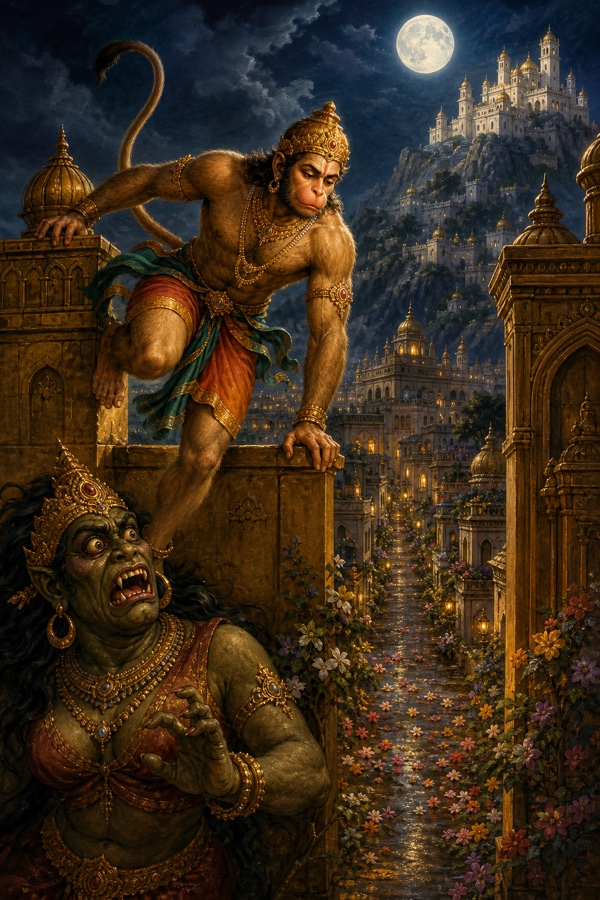
The night was deep, and Lanka slept. Hanuman had already broken the strength of the ogress Lanka, the tutelary goddess of the city, who could take any shape she pleased, and now the monkey leader, filled with rare energy and enormous power, went over the great defensive wall itself and set his foot within, leaving the gate untried. Vast as an elephant and heavy with courage, that elephant among the vanaras crossed into Lanka in the dark. The instant he entered, it was as though he had set his left foot on the very heads of his foes.
First Sight of Lovely Lanka
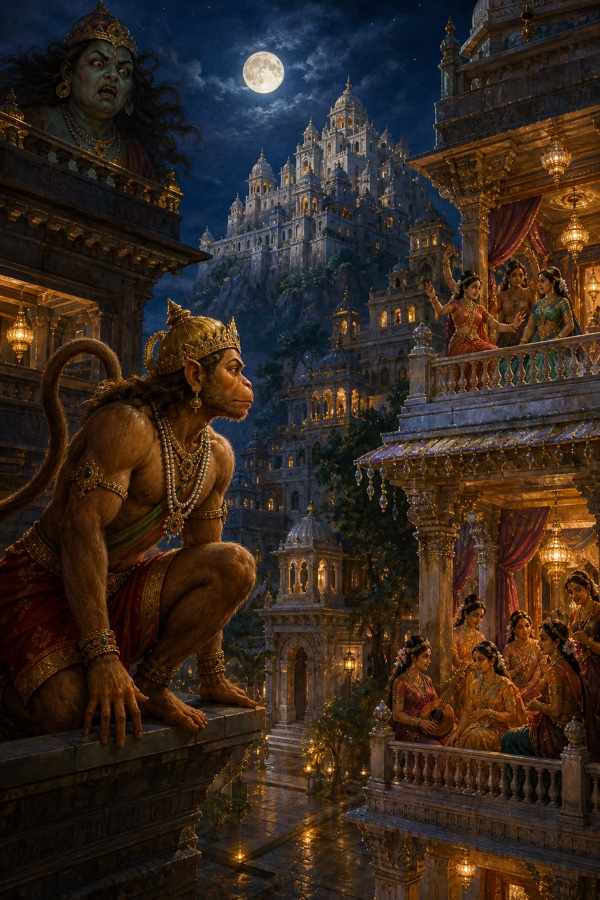
The son of the wind, full of courage, now took the great highway, and it lay bright before him with flowers scattered along its length. Hanuman, ever intent on Sugriva’s cause, moved toward the lovely city. Lanka wore her excellent houses the way the sky wears its clouds. From those mansions came the ring of high, exquisite laughter and the pulse of instruments; their walls bore the figures of thunderbolts and goads, and their windows were set with lattices of diamond. He had come expecting a fortress full of monsters and had walked into a city having a good evening.
Lanka was ablaze at that hour with the wonderful mansions of the ogre hosts, white as pale clouds, raised in the patterns called Padma and Swastika and Vardhamana and handsomely finished on every side. Ranging through the city for the sake of Rama, Hanuman looked on that place hung with strange wreaths and ornaments, and it gladdened him. Going from one house to the next, he saw buildings of every shape, and he heard sweet songs carried on the three pitches of voice, the high, the middle, and the low, that rise from the head, the throat, and the heart.
He heard the ring of the jeweled girdles worn at the waist by women stung with love, women who rivaled the nymphs of heaven, and the chime of the anklets at their feet. He heard the footfalls of people climbing and descending the stairs in the houses of those great ogres. And here and there he heard the slap of arms struck as a challenge before or during a wrestling bout, and the roar of heroes locked in single combat.
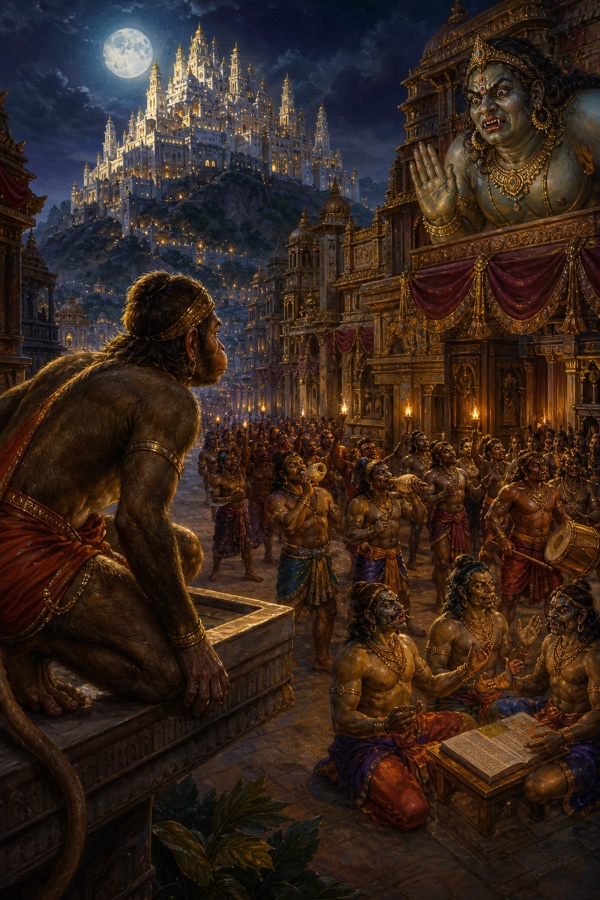
In the ogres’ houses he heard voices murmuring sacred formulas, and he saw yatudhanas, a breed of ogre, bent over the study of the Vedas. He saw ogres who stood glorifying Ravana and roaring aloud, and a great crowd of them blocking the highway on every side. The demons whose city he had come to bring down were sitting up late over the Veda, and Hanuman, who knew the essence of all the scriptures, heard them get the accents right.
Ravana’s Spies and Sentinels
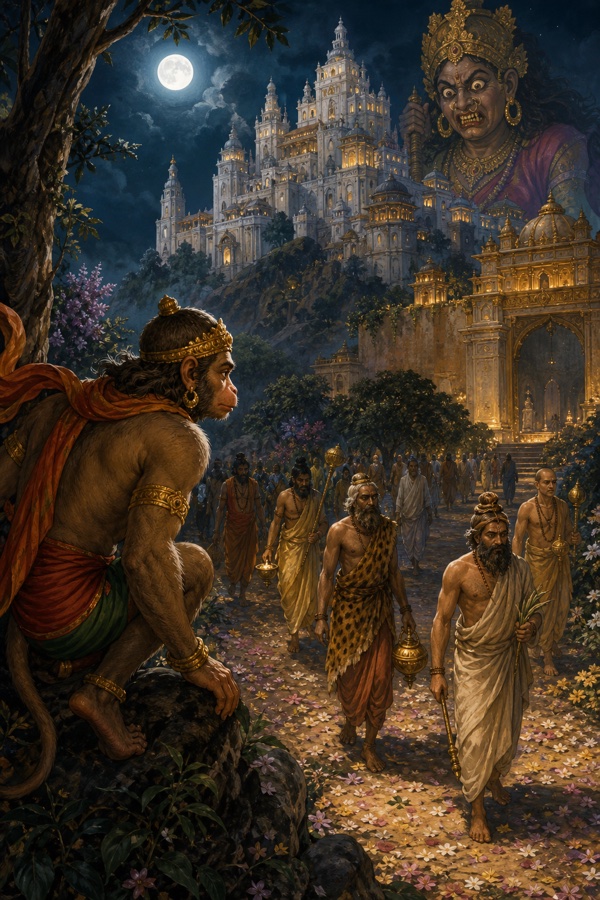
At the central post in the middle of the city, Hanuman saw many of Ravana’s spies. One went in the guise of a householder initiated into the disciplines, another as a matted-haired ascetic, another as a shaven-headed penitent, and still another as a hermit clothed in cowhide or deerskin, or naked with only the open sky for a garment. They carried, as their weapons, a fistful of kusha grass, a fire-vessel for offerings, a mallet, a club, and a staff. Ravana had learned the trick of the holy disguise from his own best night’s work, and he had taught it to his whole intelligence service.
Some of them he saw with a single eye, with skins of many colors, with long bellies and pendulous chests, gripping sharp pikes and thunderbolts, huge in strength; others were fearsome, with twisted mouths, hideous and dwarfish. Others again were neither too stout nor too lean, neither too tall nor too short, neither too fair nor too dark, neither humpbacked nor stunted. Those last were the ones worth being afraid of, the ones a man’s eye would pass over without catching.
Some held bows, swords, the shataghni that kills a hundred at a stroke, and pestles; some carried in their hands the fine parigha, an iron-spiked mace, and gleamed in strange armor. Some were misshapen, some able to take many forms, some comely and bright with splendor; some bore banners and pennons and every kind of weapon. The great monkey saw them holding the shakti spear, whole trees, the sharp-edged pattisa, the thunderbolt, the sling, and the noose. Many wore garlands, were smeared with sandal, decked in excellent jewels, and roamed at will in every kind of dress.
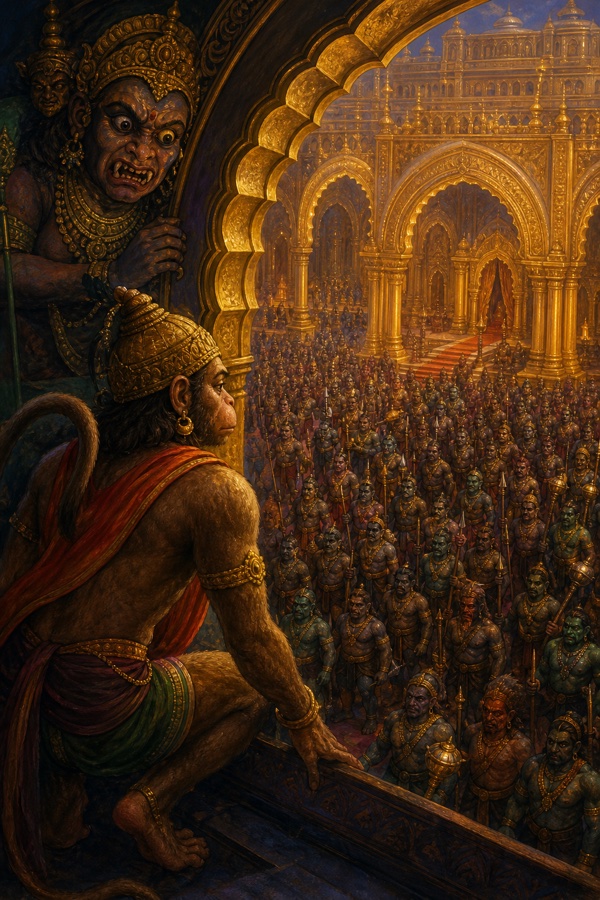
At the Gate of the Inner Palace
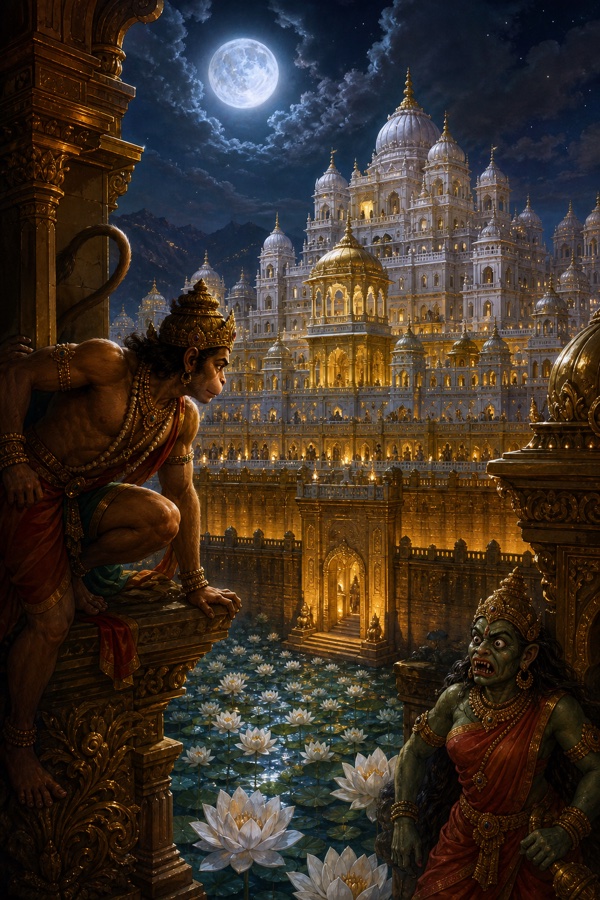
Beyond that untroubled garrison of a hundred thousand, lodged by Ravana’s order in a huge building before the inner palace, Hanuman looked past its great golden archways and saw the famed palace of Ravana, lord of the ogres, raised on the summit of Mount Trikuta and ringed by moats bright with white lotuses. A hundred thousand soldiers stood between the street and that door, and a monkey the size of a cat walked through the middle of them.
He saw the inner palace, girded by walls of tremendous height, heavenly as paradise itself and loud with heavenly sounds. It rang with the neighing of horses and the chime of ornaments. Its lovely gates were graced with chariots and palanquins and other conveyances, with aerial chariots like the Pushpaka, with fine horses and elephants, with four-tusked elephants like masses of white cloud set with jewels, and with animals and birds in rut. Thousands of yatudhanas of enormous power kept its watch.
At last the celebrated Hanuman passed into that inner palace of Ravana, walled with refined gold and with the pure gold called Jambunada, the gold found in the old days in the bed of the Jambu river, which is today’s Jammu. Its inner face was set with pearls and gems of great price, and every day it was sprinkled with water tempered with the finest agallocum and sandal.
The Rising Moon and Lanka’s Night
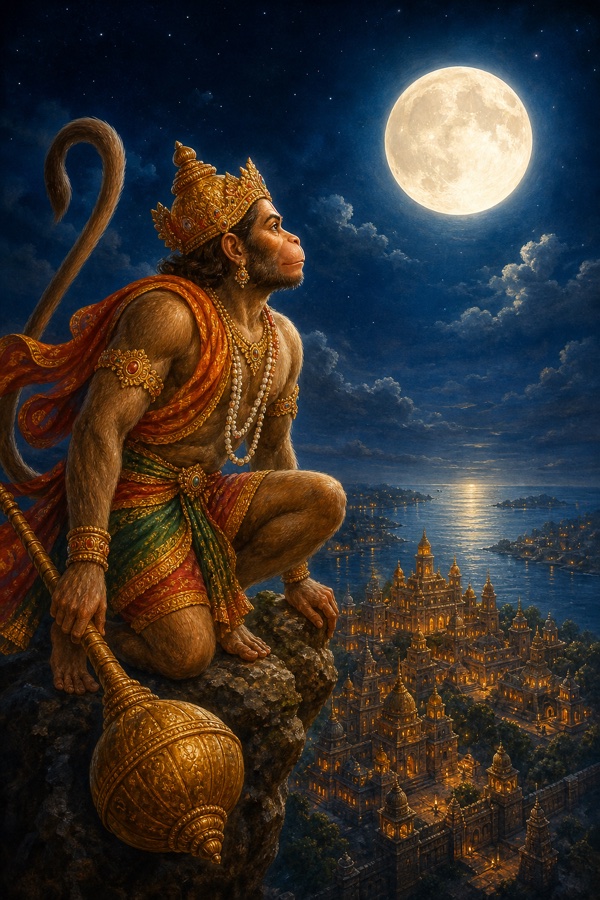
Then Hanuman saw the moon arrived at the meridian, spreading and spreading again its canopy of light, pouring brightness over the earth the way the sun does, roaming the sky like a bull in rut ranging a cattle-pen. He watched the cool-rayed one come on, scattering light on every side as though it wiped away the sins and sorrows of the world, drawing up the tides in the great ocean, lighting all living things as it climbed the heavens. Somewhere under that same moon, in this same city, was the woman he had crossed the sea for, and the light falling on his hands was falling on her too.
The same beauty that graces Mount Mandara on earth, that plays on the sea at evening, and that rests upon the lotus in the waters, blazed in that lovely moon. Like a swan in a silver cage, like a lion in a Mandara cavern, like a hero mounted on a proud elephant, the moon shone in the sky. With its horn-like mark full grown, it was splendid as a sharp-horned bull, as the white heights of Himalaya, as an elephant with gold-plated tusks. A city at the far edge of the world, and the same moon over it that had risen over Ayodhya and over a hut in Panchavati.
The strains of the lute began, sweet to the ear. Women of good conduct lay asleep beside their husbands, and the night-rangers too, strange and violent in their ways, set out to enjoy themselves. Hanuman saw there the houses of ogres flushed with drink and pride, crowded with chariots and horses and seats of gold and heavy with the wealth heroes love.
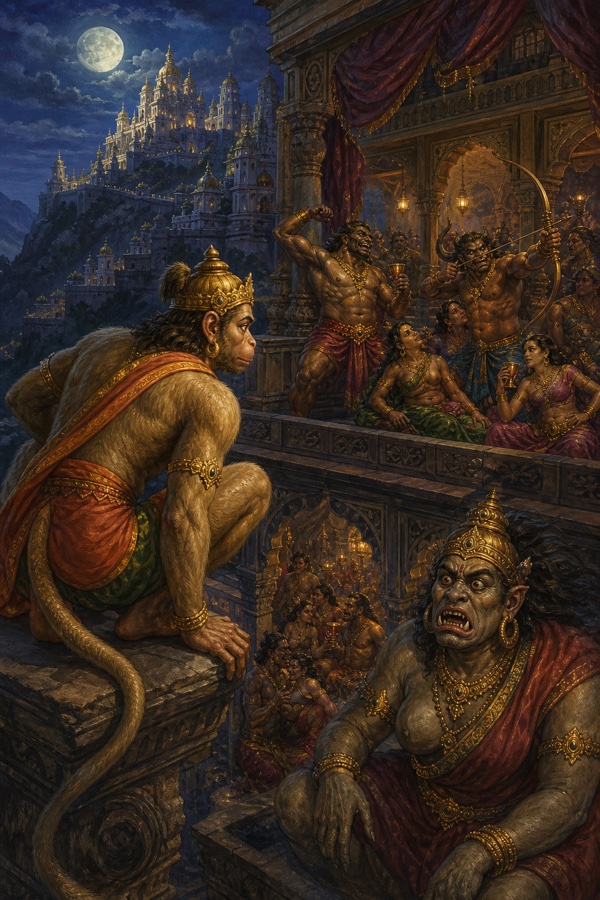
The drunken ogres bellowed at one another and boasted, flung their thick arms about, raved in their cups, and hurled insults back and forth. One struck his own chest for exercise, one laid a hand on the limbs of his beloved, one put on this dress and that to please his wife, and one drew a stiff bow for practice. Hanuman saw women rubbing sandal on their bodies, women asleep in their rooms, women of lovely face laughing, and some, cross with their lovers, hissing like angry serpents. Nobody in any of those houses knew that the last night of the old world was going by.
With the trumpeting of elephants in rut, with the reverence paid to people of noble character like Vibhishana, and with its hissing heroes, Lanka was as splendid as a lake full of hissing snakes. In that city Hanuman saw yatudhanas keen of mind, sweet in speech, devout, foremost in the world, dressed in every kind of garb and bearing lovely names. It gladdened him to look on those ogres, comely and rich in virtues; and some, misshapen though they were, still shone with their own fire. He had been sent to find an enemy, and he kept finding people.
Sleeping Women, but Sita Nowhere
Then he saw ogre women who deserved the finest robes and ornaments, exceedingly pure of heart and full of dignity, whose minds were given to their beloveds and to their wine, and who shone like stars. Some were bright with their beauty and their modesty, women whom their husbands had embraced during the night as birds embrace their mates. Others, honored in their husbands’ eyes, faithful in their duty and lawfully wed, sat at ease on the rooftops of their houses and in the laps of their loves.
Some had a sheen like a streak of gold, some like burnished gold, some fair as the moon, and some, pale from parting with their husbands, still lovely in the color of their limbs. Hanuman saw in their homes women who had come to their beloveds, women who pleased the mind, happy and altogether charming. He saw ranks of faces like the moon, rows of shapely slanting eyes with beautiful lashes, and garlands of ornaments that flashed like lightning. Every one of those faces belonged to someone. He looked at each of them long enough to know it was the wrong one, and moved on.
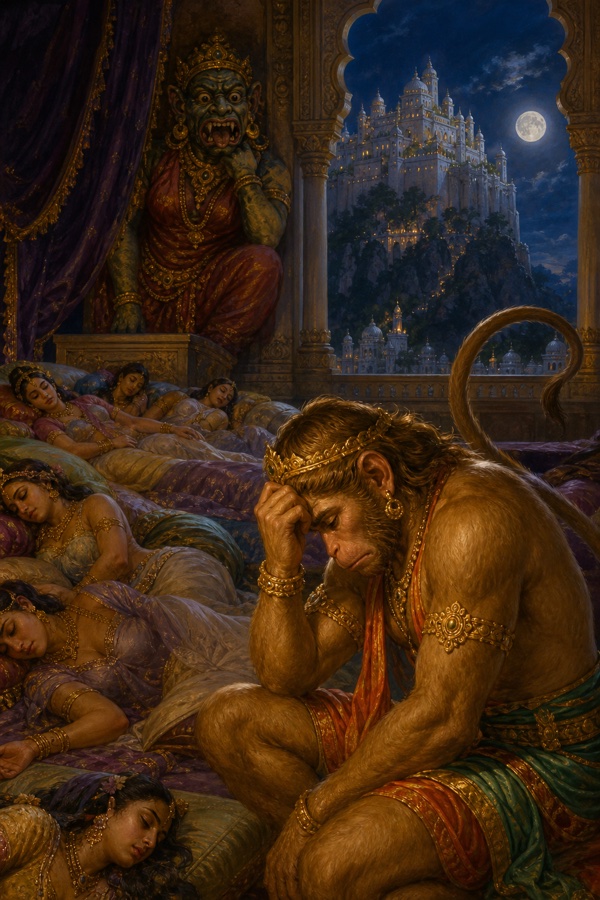
Yet nowhere among them did he see Sita, most nobly born, sprung from the royal line of Nimi, steady on the path of virtue, slender and lovely as a flowering vine. He had never once laid eyes on her. He was hunting through a city of a hundred thousand faces for a woman he would have to recognize from other men’s grief. Sita, worn with the pain of separation from her lord, her throat choked with tears, dim as a streak of cloud, dim as a line of gold veiled by cloud or dust: her Hanuman did not find, and though he searched a long while, grief left him slack and heavy.
The Splendor of Ravana’s Palace
Roaming at will among the seven-storeyed mansions, Hanuman, who could take any shape he chose, light on his feet and rich in the wealth of strength and valor, came at last to the palace of Ravana. It was ringed by a wall that dazzled like the sun and guarded by terrible ogres the way a vast forest is guarded by lions.
Bright with the hope of finding Sita, Hanuman studied that palace closely. It was set with figures drawn in molten silver, with archways decked in ornaments of gold, with beautiful concentric enclosures and charming gateways. There were elephant-drivers mounted on their beasts, tireless heroes, and horses that could not be killed, that drew the chariots. Wonderful chariots ranged there without end, armored with the hides of lions and tigers, bearing figures of ivory, gold, and silver, and chiming with the little bells fastened round them. The place was heaped with precious stones and set with excellent seats; it had sheds for its great chariots and broad quarters for its mighty charioteers. It swarmed on every side with beasts and birds of every kind, thousands of them, well worth the seeing, kept safe by disciplined border-guards and other ogres, and thronged everywhere with the loveliest of women. He counted it the way a soldier counts, and none of it frightened him; he was looking for one woman in it.
The great monkey looked on that vast palace of Ravana, full of happy women, where the ring of the finest jewels sounded like the roar of the sea. It was rich with royal appointments, fragrant with the best sandal, thronged with eminent men as a great forest is thronged with lions. It rang with the beat of kettledrums and clay tomtoms and the blowing of conches. There, at every turning of the moon, on the eighth and fourteenth days of each fortnight and at the full and the new moon, the Soma juice was pressed in sacrifice. Deep and unfathomable as the sea, and loud as the sea, brimming with jewels of great price, made more splendid still by the person of Ravana, it stood crowded with elephants and horses and chariots.
The great monkey judged that palace to be the very ornament of Lanka, and he ranged about near Ravana’s own quarters. From house to house of the ogres, through their gardens and their halls, he passed undaunted and looked on everything. Swift and full of vigor, Hanuman leapt into the mansion of Prahasta, and from there into the mansion of Mahaparshva; then into the cloud-colored house of Kumbhakarna, and into the house of Vibhishana; then into the houses of Mahodara, Virupaksha, Vidyujjihva, and Vidyunmali.
Then he sprang into the houses of Vajradamshtra, of Shuka, and of Sarana; into the house of Indrajit; into the houses of Jambumali and Sumali; into the houses of Rashmiketu, Suryashatru, and Vajrakaya. Then the son of the wind bounded, one after another, into the mansions of Dhumraksha, Sampati, Vidyudrupa, Bhima, Ghana, Vighana, Sukanabha, Cakra, Satha, Kapata, Hrasvakarna, Damstra, the ogre Lomasha, Yuddhonmatta, Matta, Dhwajagriva, Sadi, a second Vidyujjihva, Dwijihva, Hastimukha, Karala, Pishacha, and Sonitaksa, and marked the affluence of those wealthy ogres. Every one of those names would be back, on a battlefield, with a weapon, and Hanuman was walking through their bedrooms counting the furniture.
Having passed clean beyond the houses of all these chief ogres on every side, Hanuman, rich in the wealth of strength, came once more to Ravana’s own palace. Ranging there, that monkey leader saw ogresses with fearful eyes keeping watch over Ravana’s bedchamber. He saw in the ogre-lord’s palace various troops with the shakti spear, the tomara lance, the shula, and the club in their hands; he saw huge-bodied ogres with weapons raised, and red and white swift-footed horses tethered in the stables.
He saw in that palace elephants of noble breed, conquerors of the enemy’s elephants, skilled in the arts of war, a match in battle for Airavata himself. They streamed rut from their temples like raining clouds and mountains loosing their rills, they thundered like storm-clouds, and they were beyond the reach of any foe. And in Ravana’s palace he saw a thousand guard-companies decked in ornaments of pure gold and armored in gold, bright as the morning sun. Rama would have to come through all of this, over the water, with monkeys.
He saw palanquins of every shape, wonderful bowers, halls with picture galleries, pleasure-houses, mountains built of wood, a lovely house for the joys of love, and a house for daytime rest. He saw that excellent mansion rise like Mount Mandara, alive with peacock-pens and thick with flagstaffs, rich on every side with endless heaps of jewels and stores of treasure. Fearless, steadfast priests performed the sacrifices there for the keeping of those treasures, so that the palace looked like the very house of Kubera. It looked like Kubera’s house for a reason that no one in Lanka said out loud: most of what was in it had been Kubera’s.
With the rays of its jewels and the fire of Ravana, that palace blazed like the sun ringed by its own beams. Hanuman saw there couches and seats and shining vessels all of gold. He went deep into that vast and beautiful and spacious hall, its floors wet with wine and liquor, crowded with vessels of gems, like the mansion of Kubera. It rang with the chime of anklets and the ring of girdles, with the slap of hands and the crash of tomtoms and other deep drums. It was built of ranks of lofty mansions, filled with hundreds of the finest women and enclosed by many broad walls.
The Wondrous Sight of the Pushpaka Chariot
Hanuman looked on the whole string of Ravana’s mansions, fitted with lattices of gold inlaid with cat’s-eye, alive with flocks of birds, looking like a great bank of monsoon cloud shot through with lightning. He saw the several armories of those houses, stocked with fine conches and bows and other weapons, and, on the peaks of those mountain-like buildings, the attics that captured the mind.
He saw mansions rich with wealth of every kind, honored even by gods and demons, free of every flaw, mansions that Ravana had taken from Kubera by the force of his own arm. He saw the houses of the lord of Lanka, raised with the greatest care, as though Maya, the wizard-architect of the demons, had built them with his own hands, houses that surpassed all things of excellence on the face of the earth. Nothing in that city had been made by the people living in it; all of it had been taken from someone.
Then he saw that best and most bewitching palace of Ravana, of a loveliness beyond compare, tall as a towering cloud, gold in its sheen, and worthy of his great might. It was heaven come down to earth, blazing with splendor, filled with jewels, strewn with the flowers of many trees like a mountain peak covered in pollen. It was lit by women like jewels the way a cloud is lit by flashes of lightning, and it shone like a lovely aerial chariot drawn through the sky by excellent swans. Ravana had built himself a heaven and had gone across the sea to steal the one thing that would not live in it.
Hanuman saw in that palace an aerial chariot set with countless jewels, charming as a beautiful cloud that the sun’s rays paint in many hues, like a mountain peak picturesque with minerals, like the firmament lit by the planets and the moon. On the ground where those who would board it once stood, there were artificial hills of gems and gold; on the hills, clumps of trees; on the trees, clusters of flowers; and in the flowers, filaments and petals of saffron.
Within it were fashioned white mansions with lovely blossoms, beautiful pools, and lotuses with saffron hearts, and charming groves and lakes were laid out there. The chariot named Pushpaka blazed with the fire of jewels. Among the aerial chariots that served as homes of the gods, it was unsurpassed. In it were birds of cat’s-eye, birds of silver and coral, serpents of many jewels, and horses of noble breed with beautiful limbs.
In it were mountains heaped with ranges of gem and gold, hills draped in canopies of trees, and trees full of canopies of flowers. There were birds of lovely beak and lovely wing, bearing on their wings flowers of coral and pure gold, birds that had folded their slanting wings in play as though they were friends of the god of love. In one of the lotus-pools of that Pushpaka, elephants with graceful trunks, holding lotus petals, were fashioned as though in worship of the goddess Lakshmi, and an image of Lakshmi herself was carved there, holding a lotus in one of her four lovely hands. Ravana had set the goddess of good fortune in the middle of his stolen chariot, in gold, where he could look at her whenever he pleased.
Coming to that beautiful place, Hanuman was filled with wonder, as though before a mountain with lovely caverns, or a tree with lovely hollows most fragrant at the close of winter, when spring comes on. Then, in that honored city guarded by Ravana’s arms, near even to that revered chariot, he did not see the daughter of Janaka, most worshipful and most wretched, overcome by the force of her lord’s virtues, and grief pressed hard upon him. The mind of Hanuman, who dwelt in many ways on the Supreme, who held himself in check and kept to the good road and kept his eyes open, was sore troubled at finding no Sita.
Aboard the Pushpaka: The Sleeping Women
In the center of that best of all buildings Hanuman saw Ravana’s spotless, spacious mansion, foremost of all houses, half a yojana wide and a full yojana long, and packed with many halls. Looking everywhere for Sita Hanuman ranged over the whole of it. Gazing on that excellent ogre-dwelling, Hanuman came up close to Ravana’s mansion.
That broad mansion was ringed by elephants with four tusks, with two, and with three, and it was guarded by ogres with weapons raised. It was full of Ravana’s ogress wives and of the princesses he had carried off by force. In the middle of that great house the son of the wind saw yet another lovely building, thick with elephants in rut. It looked like a sea full of crocodiles and alligators, crowded with whales and other great fish, heaving in the force of the wind, teeming with serpents.
The fortune that dwells in Kubera, in the moon, and in Indra dwelt always in Ravana’s house and never left it. Whatever wealth stood in the homes of Kubera, Yama, and Varuna, that same wealth, and more, filled these ogre mansions of Lanka. There too stood the divine chariot named Pushpaka, made in heaven for Brahma by Vishwakarma and decked with every jewel, which Kubera had won from Brahma by the fiercest austerity, and which Ravana had wrested from Kubera by the might of his arm.
The great monkey climbed aboard that heavenly Pushpaka, borne up on shapely pillars of gold and silver worked with figures of wolves, blazing, as it were, with splendor. It was graced on every side with secret cells and pleasure-houses that rose like Meru and Mandara, bright as fire and sun and seeming to scrape the sky. It had stairways of gold, and lovely platforms radiant with sapphire and emerald, and lattice-windows of gold and of crystal. Its floor was inlaid with coral, with jewels of great price, and with matchless pearls; it was painted with red sandal, bright as heated gold, sweet in fragrance, glowing like the rising sun. A chariot built for the creator of the worlds, and a monkey the size of a cat was walking up its golden stairs.
Standing there, Hanuman drew in a red heavenly fragrance spreading on every side, the smell of drinks and of foods, of cooked rice among them, that struck him like solid air. That fragrance seemed to call this great-hearted one toward the place where Ravana lay, the way a kinsman calls a dear kinsman, saying, “Come this way.” Moving on, he came to that famed, vast, and pleasant hall, dear to Ravana as a beloved woman: with stairways of gems and lattices of gold, its crystal floor inlaid with figures of ivory, pearl, diamond, coral, silver, and gold; borne on tall pillars of gems like wings, as though it had set out in flight for heaven; its floor spread with a great carpet figured with mountains, trees, and rivers; hung with the wall-paintings of many lands, loud with birds in rut, scented with heavenly fragrance, smoky with the incense of agallocum yet white as a swan.
That hall satisfied all five of Hanuman’s senses with five excellent objects, the way a mother satisfies. It seemed to Hanuman that this was heaven, or the world of the gods, or the city of Indra, or the realm of Brahma, which on the plane of matter is the highest attainment of all. He noted the beauty of it and kept moving, because none of it was her.
Then he saw the golden lamps set on golden posts, burning low, as it were, before the fire of Ravana, like gamblers standing lost in thought after being beaten at play. With the light of the lamps, the fire of Ravana, and the glow of the ornaments, the hall seemed to burn. And then he saw a thousand fine women asleep on the carpet, dressed in garments and garlands of many colors and in many styles, who, when half the night had passed, had fallen senseless with wine and sleep after their sport.
That sleeping company of women, the chime of their girdles and anklets now stilled, shone like a great lotus-pond where the swans and the bees sit hushed and silent. Hanuman saw the faces of those beauties, their teeth hidden in their lips, their eyes shut, giving off a fragrance like the lotus. It seemed to him that drunken bees must beg again and again at these lotus-faces, as they do at open lotuses.
Adorned with these women, the hall shone like the clear, star-strewn sky of autumn, and Ravana ringed by them, shone like the glorious moon among the stars. Hanuman thought that meteors fallen from the sky, wrapped in the last of their merit, had gathered here once more. Some women had turned in their sleep, their garlands loosened and their jewels slipping; drinking and dancing had left them senseless. One had her forehead-mark smudged away, one had her anklet slid down, one had her necklace fallen at her side.
Some lay tangled in broken necklaces, some with their garments loose, some with the cords of their girdles snapped, sprawled like young mares worn out and asleep. Some had lost their earrings, some had their garlands crushed, and they looked like flowering vines trampled by an elephant in a great forest. On one, the pearl-strand between her breasts lay like swans asleep in the moon’s light; another’s cat’s-eye chain looked like Kadamba birds, another’s gold chain like Cakravaka birds.
With their thighs for banks, they looked like rivers graced with swans and ducks and Cakravakas. With the tiny bells of their girdles for buds, their gold ornaments for great lotuses, the stirrings of love in their dreams for alligators, and their own glow for the banks, the sleeping women looked like so many streams. On the tender limbs and the breasts of some, the marks left by their ornaments shone like ornaments themselves. He went along that whole shining river of women slowly, looking at each face, and every one of them was the wrong face.
The breath of their mouths, fragrant as sugar-wine, seemed at that hour to comfort Ravana. Some of his wives, lost in the daze of wine and sleep, kept smelling the faces of their fellow wives, taking them for Ravana’s. Deep in their love for Ravana, those excellent women, helpless with it, comforted their rivals with the caresses of love. Over the faces of some, the drawn ends of their garments trembled again and again with their breath; some slept with their arms for pillows, some with their lovely garments.
One lay with her head on the bosom of another, a second on that one’s arm, a third on someone’s lap, and a fourth with her head on someone’s breasts. In the daze of wine and affection they slept with their limbs laid on one another’s thighs, waists, sides, and backs. Delighted with each other’s touch, their arms twined together, all those women lay asleep there. Strung together on one another’s arms into a single string, adorned with hair and breasts like bees, that garland of women shone lovely as a wreath of flowers threaded on a cord.
Like a mass of vines blossomed in the month of Vaishakha at the touch of the southern wind, twined into one another, their shoulders for boughs interlaced, thick with the bees of their hair, that garden of women in Ravana’s inner palace seemed to stir with their breathing. Clearly though the ornaments lay in their proper places, in those intertwined women it was not possible, at that moment, to tell ornament from limb, garment from garland. A thousand women lay in that room, and the search had to go past every one of them.
Now that Ravana slept at ease, the deities of the lamps burning on their golden posts seemed to gaze unblinking at those women of varied glow, whom they had not dared look upon while Ravana was awake. Daughters of royal sages, of Brahmins, of demons, of gandharvas, and of ogres, all overcome by love, had become his wives. Every rank of being in the three worlds had a daughter asleep in that room.
Some of them Ravana had carried off because he loved war, judging that their kinsmen would resist; others, drunk with passion, had come to him of their own accord in the daze of love. Of all the women in that hall, one alone had been taken by force, and she was the daughter of Janaka, worthy of worship even by the worthiest; the rest he had won by valor, by strength, and by beauty of form. Not one among them longed for another man or had belonged to another before. No wife of Ravana was low-born, or plain, or clumsy, or unadorned, or feeble, or unloved by her lord.
A thought rose in Hanuman’s mind: that if Rama’s lawful wife, Sita, were as happy with her husband as these wives of Ravana were with theirs, Ravana’s birth would indeed be blessed. Then a second thought came to him: that Sita was surely far above them all in her virtues, and that this shape-shifting lord of Lanka had done a cruel and ignoble thing to her. A man who could be loved like this by a thousand women had gone across the sea and taken the one woman who would never love him.
The Sight of Ravana and Mandodari
Looking round, Hanuman saw in that hall a high dais of crystal, set with jewels, heavenly to look on, and on it a couch. It was furnished with excellent seats of cat’s-eye gems worked with parts of ivory and gold, spread with precious beds. In one quarter of it he saw a white canopy hung with heavenly garlands, pale as the moon. And he saw a most excellent bed plated with gold, bright as fire, draped in wreaths of ashoka flowers, fanned on every side by women bearing chowries, sweet with many scents and the finest incense, spread with fine bedding, covered with sheepskin, and decked with garlands of choice flowers.
On that bed Hanuman saw Ravana cloud-dark in color, his bright earrings ablaze, his eyes red, his arms huge, clad in robes of gold, smeared with red sandal, flushed like the evening sky, like a lightning-charged cloud, decked in heavenly ornaments, able to take any shape at will, deep in sleep like Mount Mandara clothed in thickets of trees. After the night’s play, adorned in his best jewels, the darling of the ogre-maids and the joy of the ogres, that hero lay drunk and asleep on his magnificent couch. Here he was. The whole war, the reason for the sea and the leap and the search, was lying on his back with his mouth open, an arm’s length away, asleep.
Coming up on Ravana, who snorted like an elephant, that monkey leader shrank back, deeply uneasy and half afraid. Nothing in the sea or the sky had frightened him; a sleeping man did. Then, standing on a landing of the stairway, he studied that demon, sodden with drink. The fair couch of the sleeping ogre-king was splendid as a great mountain, Prashravana, with a scent-elephant lying upon it, an elephant so fine that its very smell drives rival elephants away.
Hanuman looked on Ravana’s two arms, dressed in gold armlets and raised like the banners of Indra, marked with the scars of Airavata’s tusks, of Indra’s thunderbolt, and of Vishnu’s discus, fleshy, even at the shoulder, powerful, with shapely nails and thumbs and well-formed fingers, round as iron clubs and tapering like an elephant’s trunk. Those scars were his history written on him: he had taken the thunderbolt of the king of the gods on his own arms and kept the arms. Stretched on the white bed, they looked like two five-hooded serpents; anointed with the cool, fragrant sandal of a hare’s-blood red, well adorned, kneaded by lovely women, they were arms that had made Yakshas, Nagas, Gandharvas, gods, and demons cry out in terror when they dared oppose him. Hanuman saw those two arms of his as two great angry serpents asleep in a Mandara cavern.
With those two full arms, that mountain of an ogre shone like two-peaked Mandara. Fragrant with mango and punnaga and the finest bakula flowers, carrying the taste of excellent dishes and running ahead of it the smell of wine, his breath, even in sleep, poured from his huge mouth and seemed to fill the whole house.
Hanuman looked on that scent-elephant of a man, his broad chest wide and deep, his face lit by earrings and by a gold crown set with pearls and gems that had slipped a little from its place, smeared with red sandal, wearing a fine necklace, covered below with a white silk cloth that had slid aside and with a costly yellow upper garment, like a heap of black gram, hissing like a serpent, like an elephant asleep in the great current of the Ganga, lit on all four sides by four golden lamps like a cloud lit by lightning; and near his feet he saw the wives of that lover of women, asleep.
He saw them with faces bright as the moon, adorned with fine earrings and with heavenly garlands that never fade. Skilled in dance and music, given a place in the arms and lap of the ogre-king, those women lay there wearing excellent jewels. On the lobes of their ears were gold earrings set with diamond and cat’s-eye, and on their arms were armlets. With their moon-bright faces and their lovely earrings, the chariot-shaped hall shone like a sky full of stars. Worn out with wine and play, Ravana’s wives had fallen asleep in the spaces between one another. They had gone to sleep where they fell, in a room where the king was king, and not one of them had been taken against her will.
One woman of excellent color, even deep in sleep, seemed to hold a dancing pose in the soft motion of her limbs. One lay hugging a lute, like a lotus-plant clinging to a boat swept down a great river. Another lay with a small drum pressed under her arm and a child in her lap, like a fond mother. One with lovely breasts lay with a tabor at her side, as though embracing a lover met after long parting. One woman lay with a six-stringed lute pressed to her breast, as though clasping her beloved husband in longing.
Another woman, self-possessed and skilled in dance, lay asleep holding a seven-stringed lute, as though she lay with her beloved. One with wine-bright eyes pressed a wooden drum with her golden, soft, ravishing limbs. One faultless beauty with a slender waist lay with a tabor tucked under her arm, worn out with wine. One woman lay with a dindima drum in her grasp and another dindima bound to her back, as though she embraced both a young husband and a child. One woman, dazed with drink, lay with an adambara held in her arms. They had fallen asleep still holding the instruments they had been playing, which is what it looks like when the music stops all at once.
One woman, having in her sleep tipped over a water-jug, lay like a wreath of mixed spring flowers sprinkled with water. One lay pressing with both hands her breasts like two golden pitchers, mastered by sleep. One woman with a face like the full moon, faint with wine, lay embracing another woman of lovely hips. Some excellent women lay with strange instruments held and pressed to their breasts, as loving women embrace their lovers.
Then, on a grand bed set apart from those of the other women, Hanuman saw asleep a fair-skinned lady of golden luster and lovely form, Mandodari, beloved of Ravana and chief of the women of the inner palace. Rich in beauty and in the wealth of youth, decked with ornaments of pearl and gem, she seemed to light that excellent hall with her own radiance. Seeing her lie there adorned and full of beauty, the son of the wind took her for Sita; and filled with great joy, that leader of monkey-hordes was carried away. He had never seen Sita. He had been told she was the most beautiful woman alive, and here, in the innermost room of the ogre-king, a woman of unearthly beauty slept apart from all the rest on a bed of her own.
Showing his monkey nature, he clapped his arms, kissed his tail, rejoiced, romped, sang, paced about, climbed the pillars, and dropped back to the ground. The greatest spy in the three worlds, standing in the enemy king’s bedchamber with the enemy king asleep six feet away, sang.
The Search in the Banquet Hall, and Purity of Mind
Then the great monkey put that thought aside and steadied himself, and began to reflect again about Sita. “Parted from Rama, that lady could not sleep, nor eat, nor adorn herself, still less enjoy drink. She would not go to any other man, were he the very lord of the gods, for there is none the equal of Rama even among the gods.” He had never laid eyes on Sita, and he found her anyway, by working out what she could not possibly be doing. No woman sleeping soundly in jewels in this house was the woman he had come for.
Sure now that this was some other woman, and eager for the sight of Sita, that monkey leader began to move once more through the banquet hall. Some women there were worn out with gambling, some with singing, some with dancing, and some lay senseless with drink. Some had sunk against tabors, tomtoms, and celikas, and some had lain down on excellent beds.
Hanuman saw the banquet hall full of a thousand beauties in fine jewels, women who talked of one another’s charms and the meaning of the songs, who knew time and place, who spoke fitting words, and who were deep in the pleasures of love. In another place too he saw a thousand young women asleep, deep in such talk of one another’s beauty. In their midst Ravana shone like a bull lying among choice cows, or a great elephant ringed by she-elephants in a forest.
The great monkey looked again at the banquet-floor of that lordly Ravana, stocked with all a man could desire. There he saw the meat of deer, of buffalo, and of boar, laid out apart; in great golden vessels, the meat of peacock and fowl, untasted. He saw the meat of boar, rhinoceros, porcupine, deer, and peacock dressed in curds and Sochal salt; the flesh of Krikala birds, of goats of every kind, of hares, of half-eaten buffaloes, of the Ekashalya fish, and of rams; chutneys and drinks of many kinds; and the many ragas and khandavas seasoned with sour and salt sauces. Somewhere in this city a woman was refusing to eat, and he walked the length of a feast that had been left to go cold.
Hanuman saw there an excellent drinking-floor, laid out with garlands set in many ways, girt with golden pitchers, crystal vessels, and two-mouthed pots of silver and gold. Strewn with flowers, littered with cast-off anklets and armlets, with scattered cups and many fruits, that floor seemed to blaze even without fire. He saw meats of many kinds, dressed with fine skill and set apart; pure heavenly liquors and manufactured liquors; wines of sugar, of madhvika, of flowers, and of fruits; and drinks seasoned with many fragrant powders, each kept separate.
He saw excellent drinks in pitchers of silver and gold, and wine poured into many vessels of gem and gold. Here the jars stood half-full, there fully drained, there brimming, there quite untouched. Ranging on, he saw here foods of many kinds, there drinks kept apart, and elsewhere drinks half drunk. Here the women’s beds lay empty, and there some beauties slept in one another’s arms. One had pulled another’s coverlet over herself and, mastered by sleep, lay clinging to her. Their breath stirred their garments and garlands gently, as in a mild breeze. He was reading a whole household by its leavings, the way a tracker reads a riverbank.
Out over the Pushpaka spread the fragrance of cool sandal and sweet wine, of many garlands and flowers, of the sandal used for bathing and of burning incense. In that ogre’s dwelling some women were dusky-fair, some dark, some golden. Faded partly with sleep and partly with love, their beauty was like a lotus closed. So Hanuman searched the whole of Ravana’s inner palace, leaving nothing out, and did not find Janaki.
Looking on those women, the great monkey fell into deep unease over his conduct, afraid that he had let his dharma slip. He said to himself, “It is not good to look on a crowd of other men’s wives asleep in this disordered state; surely it will undo my virtue. Yet my gaze has never before fallen on the wives of others. Here I have looked on Ravana, who keeps the wives of others, and that in itself is a sin.” He had killed a demon that day and swallowed the fear of an ocean, and the thing that shook him was where he had been resting his eyes.
Then another thought rose in the mind of the resolute Hanuman, whose heart was fixed on a single aim, a thought that showed him the way of his duty. “It is true that I have seen all of Ravana’s wives at their ease, and still no wrong feeling has risen in me. The mind is the cause that turns all the senses to good deeds and evil, and my mind is well set in dharma. I could not have sought Sita anywhere else; in a thorough search, women are always looked for among women. A creature is sought among its own kind, and a lost woman cannot be sought among the does. So with a pure mind I have searched this whole inner palace of Ravana, and still Janaki is not to be seen.” He had put himself on trial in the middle of an enemy palace, heard the case out, and acquitted himself, and only then went on with the work.
Gazing even on the daughters of the gods, of the gandharvas, and of the nagas, Hanuman did not find Janaki. Not finding her, and looking on other excellent women, the hero Hanuman made ready to slip away from that place and go elsewhere. Then Hanuman, leaving the drinking-hall, set himself with care to search for Sita on every side.
Despair, and Then Resolve
Standing in the middle of that mansion, eager for the sight of Sita, the great monkey combed the arbors, the picture-halls, and the sleeping-chambers, but he did not see that lady of lovely form. Not finding that beloved of Raghu’s son, he began to think, “Surely Sita is no longer alive, for though I search without a pause, the princess of Mithila does not come before my eyes. Sita, steady on the path of noble women and set on guarding her honor, has surely been killed by this evil-doing lord of ogres.
“Or else, seeing Ravana’s serving-women, fearful in shape, with monstrous faces and huge ugly eyes, deformed and lightless, the daughter of the lord of the Janakas gave up her life in terror. And if I go back to the city of the monkey-king without seeing Janaki, what will become of me there? That king is mighty, and his punishment is harsh.
“I have seen the whole inner palace, I have seen Ravana’s wives, and Sita is nowhere; my labor has gone for nothing. When I reach Kishkindha, what will the gathered monkeys say to me? They will ask, ‘What did you accomplish there, hero? Tell us.’ Not having found Sita in Ravana’s house, what shall I say, having failed to see the daughter of Janaka? Once Sugriva’s set time has run out, I will surely give up my life by fasting. What will old Jambavan, and Angada, and all the monkeys who crossed the sea, say to me?” They were standing on one foot on a beach eight hundred miles behind him, waiting.
“But refusing to lose heart is the root of prosperity, and refusing to lose heart is the highest happiness. So I will search again in the places where the search has not yet been made. Refusing to lose heart is what keeps a creature always at his work and crowns his deeds with success. So I will make one more effort, an effort that keeps despair away, and search the untouched quarters that Ravana guards.
“The drinking-halls, the flower-houses, the picture-galleries, the pleasure-houses: these I have combed. But the alleys of the gardens, and all the aerial chariots: these are still left.” Thinking so, he began to search again. Springing up and down, tarrying here, moving on there, opening doors and shutting them, going in and coming out, climbing down and climbing up, the great monkey ranged until not four fingers’ width was left in Ravana’s inner palace that Hanuman had not covered. The lanes within the ramparts, the tree-platforms at the crossroads, the pits, and the lotus-ponds: all of it he searched.
Ogresses of many shapes, ugly and deformed, Hanuman saw there, but not the daughter of Janaka. Vidyadhara women, matchless in the world for beauty, he saw, but not Sita, the delight of Raghava. Naga maidens with faces like the full moon and lovely limbs he saw, but not the daughter of Janaka. Naga maidens carried off by the ogre-king through force and cruelty he saw, but not the daughter of Janaka. Not finding her, and looking on other excellent women, the son of the wind sank into sorrow. Daughters of gods and serpents, stolen from every world there was, and not the one he had crossed the sea for.
Coming down from the aerial chariot, his mind clouded by grief, Hanuman fell to brooding. Seeing the whole effort of the monkey chiefs, and his own leap across the sea, come to nothing, the son of the wind fell again into anxious thought.
The Depth of Grief, and the Resolve for the Ashoka Grove
Passing from the aerial chariot onto the rampart, the swift leader of the monkey-hordes flashed like lightning across a cloud. Having ranged watchfully through Ravana’s mansions and found Janaki nowhere, he said to himself, “In my wish to do Rama a service I have combed Lanka many times over, and still Sita, fair in every limb, does not come before my eyes.
“Pools, tanks, lakes, streams, rivers, the water-logged forest tracts, the trackless mountains: the whole land of Lanka I have scoured, and Janaki is not to be seen. Sampati told us that Sita was here in Ravana’s dwelling; yet she is not to be seen, and I cannot tell why.” An old bird’s word, spoken from a rock on the far side of the world, was the whole foundation of everything he had done tonight, and it was beginning to look wrong.
“Could the daughter of Janaka, born of Mithila and the line of Videha, carried off by force, be brought at last, helpless, to Ravana? I think that as the ogre flew off in haste with Sita in his arms, fearing Rama’s arrows, she slipped from his grasp and fell midway. Or, as she was borne along the path of the Siddhas, the very heart of that noble lady broke at the sight of the sea. Or, under Ravana’s great speed and the crush of his arms, that lady gave up her life.
“Or, struggling as he crossed the sea, the daughter of Janaka fell into the water. Or, guarding her honor, that lonely, austere Sita was devoured by this Ravana himself. Or the wicked-hearted wives of the ogre-king devoured that innocent. Wretched and forlorn, dwelling on Rama’s full-moon face and his lotus eyes, she met her death. ‘O Rama! O Lakshmana! O Ayodhya!’ Wailing long like this, the daughter of Mithila’s king gave up her body.” He was inventing her death six ways, alone, on a wall, in the dark, and every one of them was worse than the last.
“Or, kept in Ravana’s house, that girl cries out again and again like a mina in its cage. How could the wife of Rama, born in the line of Janaka, ever fall under Ravana’s power? Whether Sita is alive somewhere unseen, or has fallen into the sea and perished, or has died of separation from her lord, this news is not fit to be carried to Rama, who loves his wife.
“To tell it will be a fault, for Rama’s life will go; not to tell it will be a fault too, a betrayal of Rama. What am I to do? Both roads look hard.” Caught in this knot, Hanuman fell to serious thought about what would be right and good at this hour.
“If I go back from here to the city of the monkey-king without seeing Sita, what worth is left in my manhood? This leap across the sea, this entry into Lanka, this survey of the ogres, all of it will come to nothing. When I reach Kishkindha, what will Sugriva say, or the gathered monkeys, or the sons of Dasharatha? If I go and tell the son of Kakutstha the harsh words, ‘I did not find Sita,’ he will give up his life on the spot. Hearing that raw, dreadful, sharp, cruel, heart-searing word about Sita, he will not live.
“Seeing Rama in that state, Lakshmana too, so devoted and so wise, will not survive. Hearing that both brothers have perished, Bharata too will die, and seeing Bharata dead, Shatrughna too will not live. Seeing their sons dead, Kausalya, Sumitra, and Kaikeyi, all three mothers, will surely not survive. Seeing Rama in that state, the grateful and true-pledged Sugriva will give up his life at once. He was standing on a rampart in Lanka counting out the funerals of everyone he knew.
“Racked with grief for her lord, wretched and joyless, the austere Ruma too will let her life go. Tara, worn with grief and stricken already by Vali’s death, will not survive. At the ruin of his parents and the fall of Sugriva, young Angada too will give up his life. The forest monkeys, crushed by their master’s grief, will beat their heads with their palms and fists. Those monkeys whom the famed king Sugriva raised with kindness, gifts, and honor, they too will give up their lives. He had gone through two kingdoms and reached the boy Angada, and he could not make the arithmetic stop.
“Then the great monkeys, gathered together, will taste no more joy in the woods, on the hills, or in the caves. Stricken by their master’s ruin, with their sons and wives and ministers, they will hurl themselves from mountain peaks onto level ground and rough. The monkeys will swallow poison, hang themselves, leap into fire, fast to death, or die by their own weapons. On my return a terrible cry will go up, and the house of Ikshvaku will be destroyed, and the forest-dwellers with it.” He had followed one sentence, four words long, all the way out to the end of two nations, and he had not yet said it to anyone.
“So I will never go from here to Kishkindha; without Sita, the princess of Mithila’s king, I could not so much as look on Sugriva. If I do not go back and stay here instead, then the righteous, great warriors Rama and Lakshmana, and the shining monkeys, will keep their lives in the hope of my return. Failing to find the daughter of Janaka, I will become a forest hermit, living on whatever comes to my hand or my mouth, holding myself in check, dwelling at the foot of a tree.” He would stay lost, forever, in the enemy’s country, so that everyone he loved could go on hoping.
“Or I will build a pyre on the watery land beside the sea, rich in roots and fruit and water, and enter a fire kindled by the rubbing of firesticks, so that the waves of the sea may carry off my ashes. Or, seated in a fast to death and given to freeing the soul from the subtle body, my flesh will be eaten by crows and wild beasts. This way of departure too has been seen and approved by the seers; if I do not find Janaki, I will duly enter the waters.
“Since I have not found Sita even after a long search, the garland of my glory, which had so fair a beginning, is snapped. Or I will become a self-restrained ascetic dwelling at the foot of a tree; but I will not go back from here without seeing that lady. If I return without finding Sita, Angada and all the monkeys will cease to be. Self-destruction holds many evils; the one who stays alive finds good fortune. So I will hold on to my life, for while there is life, reunion is sure.” That last sentence turned him around. He had talked himself to the edge of every kind of death there was, and one line about staying alive brought him back.
Holding grief of so many kinds in his mind, Hanuman could not at that hour reach the far shore of his sorrow. Then, calling his prowess to mind, the steadfast elephant among monkeys said, “Or I will simply kill the ten-headed Ravana of enormous might; let Sita have been carried off, this will avenge it. Or I will lift him up and bear him across the sea and hand him over to Rama, as a beast is offered to the Lord of beasts.” The man was asleep and drunk twenty steps away, and Hanuman was entirely capable of it, and only the mission stopped him.
Caught in this thought, not finding Sita, his mind ringed with brooding and grief, Hanuman reflected again, “Until I see Sita I will search this city of Lanka again and again. And if, on Sampati’s word, I fetch Rama here and Raghava does not see his wife, he will burn all the monkeys with the fire of his wrath. So I will stay right here on a measured diet, my senses in check; let not all these men and monkeys be destroyed on my account.
“Here too is a large grove of ashoka trees, full of great trees; this I will search, for I have not yet combed it. I will bow to the Vasus, the Rudras, the Adityas, the two Ashwins, and the hosts of the Maruts, and go and deepen the ogres’ grief. Conquering the ogres, I will hand the goddess-like Sita to Rama, as a goddess grants success to one who does penance.” One garden was left in the whole of Lanka. He had searched every room a king would put a queen in, and the woman he wanted had never been in a room at all.
His senses slack with anxiety, the son of the wind meditated a moment, then rose and said, “Salutations to Rama with Lakshmana, and to that goddess-like daughter of Janaka! Salutations to Rudra, to Indra, to Yama, and to the wind-god; salutations to the moon-god, the fire-god, and the hosts of the Maruts!” He named Rama and Sita first, before any god, and only then the gods.
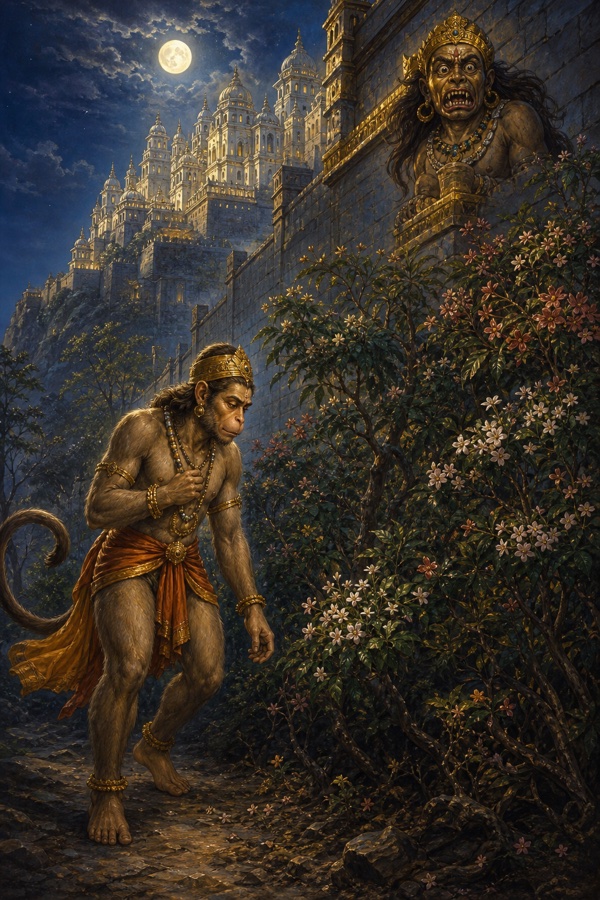
Having saluted them and his own master Sugriva, and having looked over every quarter, the son of the wind set out in his mind toward the ashoka grove. Reaching that blessed grove first in his thought, he turned over what lay ahead: “Surely this grove will be guarded by many ogres, ringed with woods, holy and dressed with every care. Its posted keepers must guard these trees, and that is why even the all-pervading wind-god does not blow here with his full force. For Rama’s sake, and to keep clear of Ravana’s eye, I have drawn my body small; in this work let all the gods and the seers grant me success.
“May the self-born lord Brahma, and the other gods, and the ascetics, and fire, and wind, and the thunderbolt-bearing Indra grant me success. May noose-handed Varuna, the moon and the sun, the two great Ashwins, all the Maruts, all created beings, and Vishnu, the lord of all beings, and the other gods that fall on my way, seen or unseen, grant me success. When shall I look on the unmarked face of that noble lady, her nose lifted fine, her teeth white, her smile clean, her eyes like lotus-petals, bright with the light of a cloudless moon? How will that helpless, austere lady, overpowered by that base, low, Ravana who wears a handsome shape, come today within my sight?”
The gist: Finding Sita nowhere, Hanuman took her for dead and, deep in grief, turned over many ways of ending his own life. Then, holding that reunion is certain for one who stays alive, he steadied himself. At last he resolved to search the ashoka grove, which he had not yet combed, saluted the gods and the seers, prayed for success, and set out toward it.
Source: Srimad Valmiki Ramayana, Sundarakanda, Cantos 4 to 13. The Gita Press Hindi edition is the controlling witness. The Sanskrit e-text and an independent complete translation were used to verify names, sequence, and principal events. Where recensions differ, this retelling follows Gita Press.
Basis: Valmiki Ramayana (Gita Press, Gorakhpur)