On this page
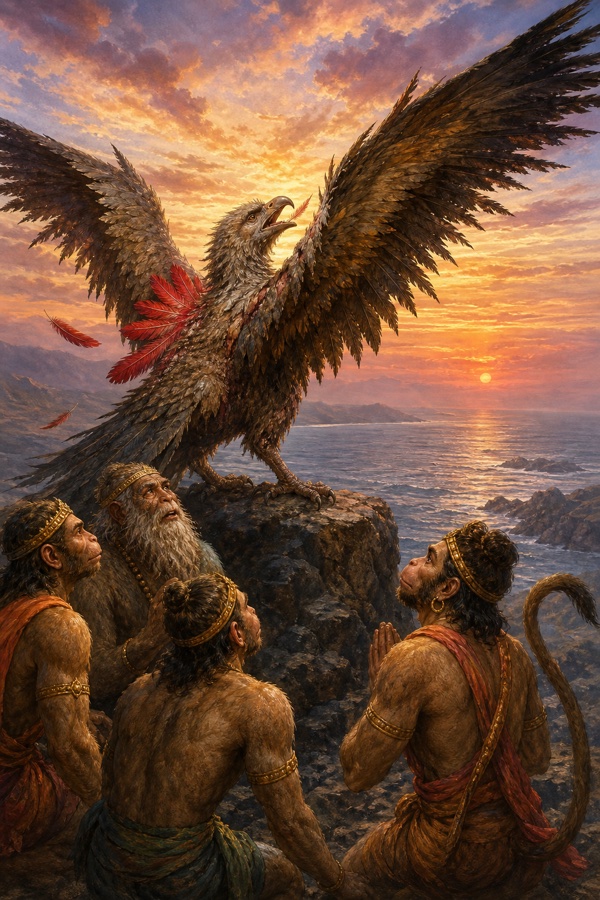
Sampati, the vulture king, had barely finished speaking when a pair of splendid wings broke from his two sides. There, in full view of the vanaras, before their very eyes, the old scorched body turned fit for flight once more. He had lost those wings in the sky above the world, holding them open over a younger brother to keep the sun off him, and he had sat on a rock for eight thousand years with the stumps of them, waiting for the one hour in which what he had seen would matter to somebody. The lord of birds who had poured fresh life into these worn and beaten monkeys, telling them where Ravana kept his prisoner and in which quarter Sita lay, now had his own wings back. It was the moment their despair gave way to courage, and it was also the moment the fathomless water opened before them on the shore of the southern sea, a crossing that looked as hard to clear as the open sky.
Sampati’s wings return, and the vanaras set out south
Sampati was telling the monkeys how the sage Nishakara, the ascetic in whose shelter he had spent years with his burnt wings, had comforted him with generous words, taken his leave, and gone back to his hermitage. He said that more than eight thousand years had passed since that day (reading the “Hundred years” of the text as a figure for the countless, and squaring it with Sampati’s own earlier account, the commentators worked the number out to eight thousand). “Holding the sage’s words in my heart,” he said, “I waited for the place and the time he had foretold.”
Sampati went on, “When the sage Nishakara reached the end of his years and passed to heaven, doubts crowded in on me and grief began to settle. The one man alive who knew why I was waiting was gone, and the waiting went on without him. The thought of ending my own life would rise in me now and then, and I would turn it away by recalling the sage’s words. The resolve he had planted in me to guard my life took my sorrow from me the way a burning flame takes darkness. Knowing the strength of Ravana, I even rebuked my son Suparshva, asking why he had not freed Sita. Though he heard Sita’s piteous cries, and knew that the two princes, Rama and Lakshmana, had been robbed of her, my son did not do the thing that would have pleased me, an all-out effort to free her, even though he was able, and even though my love for the late Emperor Dasharatha should have moved him to it.”
Even as Sampati spoke this way with the forest-dwelling monkeys, two new wings appeared on his sides, right there in front of them. Seeing his body covered with fresh feathers of a reddish hue, he felt a joy beyond compare, and he said to the monkeys, “By the grace of the royal sage Nishakara, whose spiritual power was boundless, the wings that the sun’s rays had wholly burned away have grown again from the root. Today I find in myself the same prowess, the same strength and vigor, that I had in my youth. Spare no effort to find Sita; you will surely find her.”
“This return of my wings is the proof of your success,” he said, and Sampati rose from the mountain peak into the sky, to see for himself once again how a bird takes flight. Hearing his words, the monkey leaders were filled with gladness, and they grew hopeful of the success that rested on their own valor.
Swift as the wind, their lost strength restored, the leaders of the monkey bands, eager now to find Sita the daughter of Janaka, pressed toward the south, toward that quarter where the constellation Abhijit, which the astrologers tie to victory, is the first to rise.
The vanaras’ gloom before the sea, and Angada’s call
With Sita’s whereabouts learned from the vulture king, the monkeys, each with the might of a lion, sprang up together to their full height and roared like lions out of sheer joy. Gladdened by Sampati’s words and longing for the sight of Sita, they moved toward the sea that formed the road to Ravana’s home. They had a direction, a city, and a name. They had not yet seen the water.
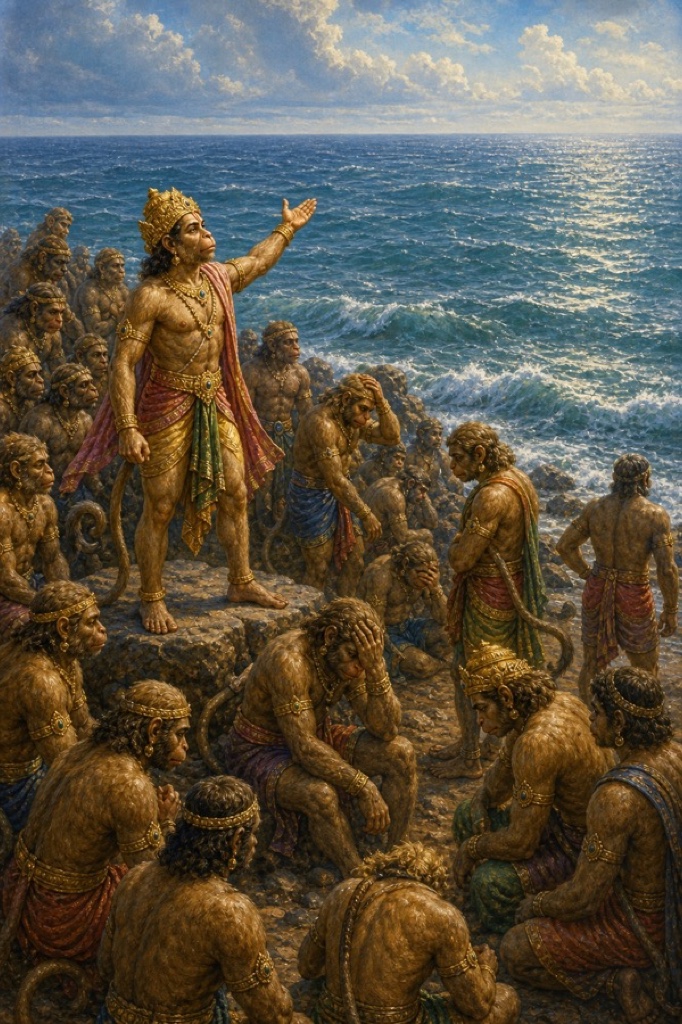
Reaching that region, the shore of the sea, the monkeys of terrible strength looked on the ocean, which held within it the whole reflection of the vast field of stars. Coming duly to the northern edge of the southern sea, the body of water that stretches south of the land, the uncommonly strong monkey heroes halted there. In one place the sea seemed to lie in deep sleep, in another to be at play, and in another it was heaped with waters as high as mountains. It teemed with the danava lords who dwell in Patala, the seventh and lowest of the nether worlds, and the sight of it raised the hair on the body; looking on it, the elephantine monkeys sank into gloom. Sampati had given them a number and the number had meant nothing on a beach in the Vindhya. Here it lay in front of them, moving.
Looking on that ocean, as hard to cross as the sky, all the monkeys grew downcast at once and said with one voice, “How will our task be done now?” Seeing his whole army struck with dejection and fear at the sight of the sea, Angada steadied them with these words.
“Do not let the mind fall under the sway of gloom; gloom does the greatest harm. It destroys a man the way an angry serpent kills a child. When the moment for valor stands before him and a man yields to gloom, his strength drains away and his effort bears no fruit.” He was a boy speaking to an army of veterans, and they listened, because he had learned this lesson the hard way on this same shore, sitting on kusha grass waiting to die. When that night had passed, Angada took counsel once more with the monkeys and the elder chiefs of the hari clan. The monkey host ringed around Angada shone like the army of the Maruts, the wind-gods, ringed around Indra. Apart from Vali’s son Angada and from Hanuman, who else could have held that army together and in check?
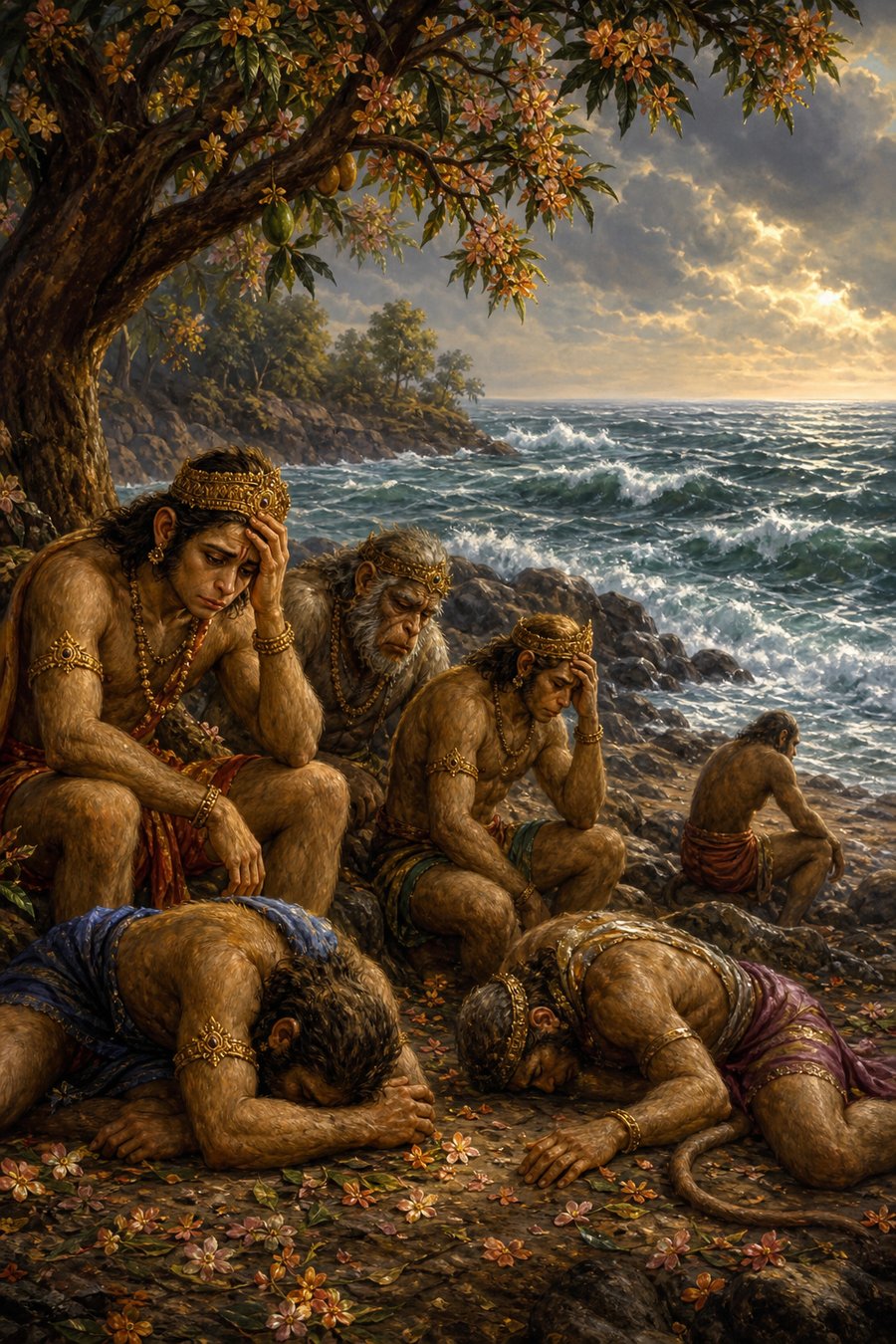
Honoring those elder monkeys and the whole army, Angada spoke these weighty words: “Which great and fiery monkey among us will leap the sea now? Who will make Sugriva, true to his word, good on his vow? Which hero can clear a hundred yojanas, or eight hundred miles? And who will free all these band-leaders from this great fear, the fear of Sugriva’s anger? By whose favor will we finish our work and, returning happy from this place, see our wife, our sons, and our home? By whose favor will we meet Rama and Lakshmana, and the monkey king Sugriva, and find them pleased with us? If there is any monkey among you able to leap the sea, let him rid us of our fear here and now, giving us a vow like a sacred boon.”
No one answered a word to Angada’s speech. That whole monkey host stood there as if stunned, without a stir. A month before, on the mountain at Kishkindha, these same monkeys had shouted before their king that they would leap a hundred yojanas and pull Sita out of the underworld with their hands. Now the hundred yojanas lay in front of them with waves on it, and not one of them opened his mouth. Angada spoke to them again: “You are all unbending in your prowess. You were born in a stock without a stain, and you have been honored again and again in the royal court for your valor. Nothing has ever stood in the way of any of you. So tell me who can leap how far?”
Each vanara names the measure of his leap, and Jambavan’s quandary
At Angada’s words, the leading monkeys named, each in turn, the reach of his own leap on that spot. These were the chiefs: Gaja, Gavaksha, Gavaya, Sharabha, Gandhamadana, Mainda, and likewise Dvivida, Sushena, and Jambavan. One by one they told their range. Every one of them told the truth, and every truth fell short of the water.
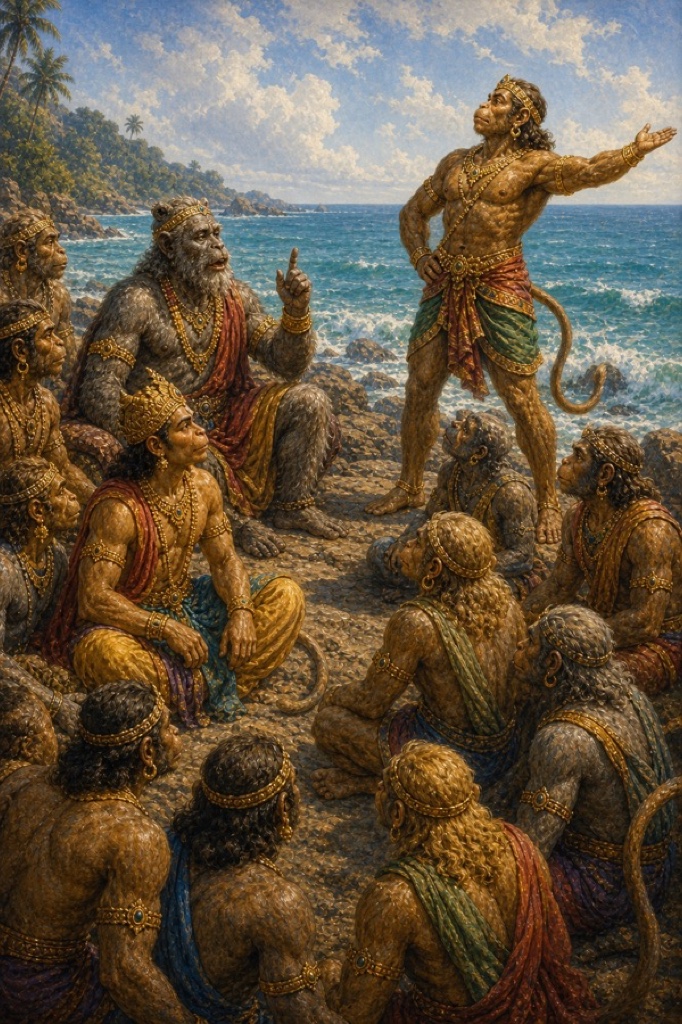
Gaja said, “I can leap ten yojanas, eighty miles.” Gavaksha said, “I can cross twenty yojanas, one hundred and sixty miles.” The monkey Sharabha said to them, “Monkeys, I will go thirty yojanas, two hundred and forty miles, in a single leap.” The monkey Rishabha said there, “I will go forty yojanas, three hundred and twenty miles, in one leap; there is no doubt of it.” Gandhamadana said, “I for my part will clear fifty yojanas, four hundred miles, in a leap; there is no doubt of it.”
The monkey Mainda said, “I can leap sixty yojanas, four hundred and eighty miles, at the most.” Then the fiery Dvivida said, on that occasion, “I will cross seventy yojanas, five hundred and sixty miles; there is no doubt of it.” The fiery, stouthearted Sushena said, “I firmly declare that I can clear eighty yojanas, six hundred and forty miles.” The count was climbing by tens toward a wall, and everyone on that beach could do the arithmetic.
Hearing them all speak, and honoring every one of them, Jambavan, the eldest of them all in years, then made his own submission: “In the old days I too had some speed and reach. Now I have come to the last edge of my age. Even so, this task cannot be set aside, this task on which the monkey king Sugriva and Rama have both set their hearts. Hear the reach that is mine now: I will surely cross ninety yojanas, seven hundred and twenty miles, in one leap; there is no doubt of it.”
Jambavan went on to those monkey leaders, “Surely my speed once carried more than this. At that famous sacrifice of King Bali, the son of Virochana, when the all-pervading, everlasting Lord Trivikrama, who spanned the whole universe in three strides, was setting down His steps over it, I circled Him in reverence.” He was offering, as a measure of what he had lost, the fact that he had walked around God while God was in the act of taking the universe back. “That same one is now old, and slow in the leap; in my youth my strength had no equal and no bound. Today, by my own power, only this much is possible, and this much strength will not carry the task through.”
Honoring Jambavan, the wise and mighty monkey Angada then gave an answer of generous meaning: “I can surely clear these full hundred yojanas, eight hundred miles, but whether I would have the strength to return is not certain.” Jambavan said to Angada, “We know the reach of your speed. You might well leap a hundred yojanas, or a thousand, and come back, but that would surely go against the rule. Angada, the master who sends others on a mission, or directs them, must never himself be the one sent or directed. It is we who are yours to send.”
Jambavan continued, “Because you stand in the place of our master, you are ours to protect like the bride of the house; the lord of an army is to be guarded like the mistress of the household, and that is the rule. Beyond that, you yourself are the very root of this task, the search for Sita. So you are always to be kept safe like the bride of the house. The root of a work must be guarded with care; this is the wisdom of those who know their business. Only while the root stands do all the virtues bear their fruit. You yourself are the means of this work and its key, for you are rich in judgment and in strength. You are both our guru and our guru’s son; only by taking refuge in you can we bring this end about.”
To this Angada answered: “If I do not go, and no other of the great monkeys goes either, then surely we will have to sit down again and fast until death. Even if we reach Kishkindha without carrying out the charge of the wise monkey king, I see no way left to guard our lives. That lord of monkeys, Sugriva, has it fully in him to show grace and to loose his fiercest anger; to cross his command is to be destroyed. So it falls to you, who know the truth of every matter, to find the means by which this task does not come to nothing.” The whole expedition had come down to a boy asking an old bear to think of something.
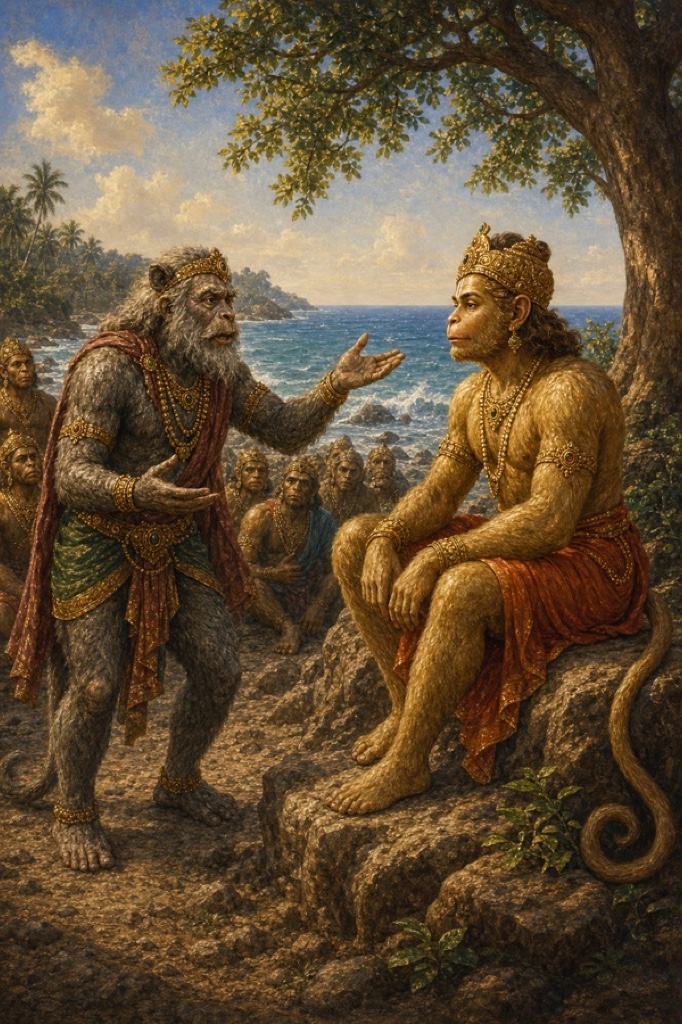
In answer to Angada’s words, Jambavan gave this reply: “Brave prince, not a fraction of your task will be let go. I will now rouse the very one who will see this work done.” Then Jambavan roused Hanuman, who was sitting a little apart, resting at his ease. He had sat through the whole council without a word: through the silence after Angada’s challenge, through the ladder of tens climbing toward a wall, through an old bear grieving over his lost strength and a boy volunteering to die. Long ago the sages of Bhrigu’s line and Angira’s, wearied by a boy who could not be told anything, had laid on him a curse of a strange and gentle kind: that he would stay unaware of his own power until the hour someone reminded him of it. He was the strongest creature on that shore, and he had been sitting there all afternoon believing he had nothing to offer.
Jambavan reminds Hanuman of his birth and his boons
Looking at that host of many hundreds of thousands of monkeys sunk in gloom, Jambavan spoke to Hanuman, and he began, as the curse required, by telling him who he was. “Hero of the monkey kingdom, jewel among those who know all the shastras, why do you sit quietly apart, Hanuman, and say nothing? Hanuman, you are the equal of the monkey king Sugriva, and in fire and in strength the equal even of Rama and Lakshmana. Your strength, your judgment, your fire, and your inner force set you above all living beings.
“You are as famous as Garuda, son of Arishtanemi, that is, of Kashyapa, born of Vinata, first among all the birds. Many a time I have watched that Garuda lift great serpents out of the sea. The strength in his wings and the strength and prowess of your arms are equal; your own power and speed fall no way short of his. Why, then, do you not ready yourself for this bold work?” He got no answer, so he went further back, to the beginning.
Jambavan told the story of Hanuman’s birth: “There was an apsara named Punjikasthala. By a rishi’s curse she was born as the daughter of a monkey chief, Kunjara, and became known as Anjana. She became the wife of the monkey Kesari, famous through the three worlds and matchless on earth for her beauty. Though she lived in a monkey’s form, she could take any shape she pleased. Once, having taken a human form, radiant with beauty and youth, decked in wonderful ornaments of flowers and clad in silk, Anjana was wandering on a mountain peak like a cloud of the rainy season.
“As she stood on that peak, the wind-god gently lifted aside her auspicious yellow, red-bordered garment. He saw her rounded, well-formed thighs, her full breasts, and her lovely face. At the sight of that glorious woman, broad of hip, slender of waist, beautiful in every limb, the wind-god was overcome with love in spite of himself. His whole being taken by desire, forgetful of himself, he gathered that faultless beauty into his long arms.” A god who goes everywhere and touches everything and is held by nothing had been stopped, on a mountain, by one woman.
Jambavan went on, “At that very moment, startled, Anjana said, ‘Who is it who would break this vow of mine, to be true to one husband alone?’ Hearing her words, the wind-god answered, ‘I do you no wrong; let there be no fear in your heart. Having embraced you, I have entered into you in mind alone, and from this you will have a son who is strong and full of wisdom. Rich in great courage, great fire, and great strength and prowess, he will be my equal in springing and in leaping.’”
“Content with these words, your mother gave birth to you in a cave. A newborn in a wide forest, you saw the rising sun and, taking it for a fruit and wanting it, you sprang up into the sky.” A hungry baby had looked at the sun the way a baby looks at anything red and out of reach, and had gone up after it. “You flew higher than three thousand yojanas, and though the sun’s blaze turned you back, you did not fall into gloom.
“Seeing you rise so swiftly into the sky, Indra, filled with anger, hurled his thunderbolt at you and dashed you against a mountain peak, so that your left jaw, your hanu, was broken. From that time your name became famous as Hanuman, the one with the broken jaw.” The name every creature on that beach had been calling him all his life was the name of the day the king of the gods threw the thunderbolt at a baby and did not kill him. “Seeing you struck down, the wind-god, the bearer of all scent, himself grew furious, and the driving wind ceased to move through the three worlds. With the wind gone, the three worlds were thrown into distress, and all the gods took fright; Brahma, lord of the worlds, and the others set to appeasing the angry wind-god.
“When the wind-god was pleased again, dear child of true valor, Brahma granted you the boon that no weapon would kill you in battle. And seeing you free of pain even after the stroke of the thunderbolt and the fall against the mountain peak, the thousand-eyed Indra, glad at heart, granted you this fine boon as well: that death would come to you, lord, only when you yourself wished to die.” The whole assembly of the gods had once stopped everything to make one child safe, and the child had grown up and forgotten every word of it. “So on one side you are Kesari’s son by his field, his kshetraja son, and terrible in prowess; on the other, being the wind-god’s own begotten son, his aurasa son, you are his equal in fire, and his equal in the leap.
“Our life-strength is now all but spent; at this hour it is you alone among us who is filled with skill and prowess, a second monkey king Sugriva, as it were. At the descent of the Trivikrama avatar I circled the whole earth, its mountains, its forests and its woodlands, twenty-one times over. And then, at the gods’ command, I alone gathered the herbs by which the Ocean of Milk was churned for the nectar, for in those days I held uncommon strength. Now I have grown old and my prowess is gone; at this hour it is you who holds every virtue.
“So put forth your boundless strength, for you are the monkey leader; the whole monkey host is eager to see your prowess. Rise, Hanuman and leap this great sea, for among all living beings, Hanuman, your speed is the highest. All the monkeys are sunk in gloom, Hanuman; why do you pass them by? You of great speed, put forth your prowess as Lord Vishnu, in the Trivikrama avatar, set down three strides to span the cosmos.”
Roused in this way by Jambavan and sure of his own power and prowess, Hanuman, the wind-god’s son and monkey leader, grew his body larger in that instant, and filled that army of monkey heroes with the greatest joy.
Hanuman’s giant form, and the climb up Mount Mahendra
Seeing Hanuman grow his body to leap a hundred yojanas and fill with speed, the monkeys threw off their sorrow, filled with joy, roared like lions, and sang the praises of Hanuman. In wonder and delight they gazed at him from every side, as all creatures gaze on Lord Narayana, that is Vishnu, making the resolve of Trivikrama. They had marched beside this monkey for a season and had never once seen him.
As he was praised, the body of Hanuman grew and grew, and whirling his tail in joy, he called his native strength to mind. Praised by the elder monkeys and filling with fire, his form turned matchless. As a lion stretches its limbs in a wide mountain cave, so did the wind-god’s son now stretch and swell his form. As he yawned, the mouth of Hanuman shone like a blazing furnace or a fire without smoke.
Rising from the midst of the monkeys, his hair standing on end with joy, Hanuman bowed to the elder monkeys and said, “The wind-god, friend of fire, breaker of mountain peaks, ranger of the sky, is strong and beyond all measure. I am the begotten son of that swift and swift-moving wind-god, and his equal in the leap. Without a pause I can circle a thousand times the far-stretched Mount Meru, which stands as if scratching the sky. Pushing the sea aside with the force of my arms, I can drown the whole world with its mountains, its rivers, and its lakes. Stirred by the force of my thighs and my calves, the sea, the home of Varuna, will heave up and pour over, lifting its great crocodiles to the surface.
“Garuda the eater of serpents, waited on by the birds, I can circle a thousand times as he flies through the sky. The sun that rises blazing over the eastern mountain, ringed with its rays, I can overtake before it sets in the west.” He had chased that sun once before, as an infant, and lost. He was telling them now, in the ordinary voice of a man stating a fact, that he would catch it. “Then, without touching the earth, with that same great and terrible speed I can come back before the sun goes down. I can leave behind in the race all the star-hosts that move through the sky, I can dry up the seas and split the earth open. Leaping, I can grind the mountains to powder; springing with speed, I can reach the far end of the great ocean.
“The flowers of every vine and tree will trail behind me today as I leap through the sky. My path through the sky will be like the Milky Way, the path of Svati. Every creature will see me spring into the fearful sky, sail through it, and come down again; you will see me, monkeys, like a great Meru covering the sky and, as it were, swallowing it. Leaping with a mind held steady, I will scatter the clouds, shake the mountains, and dry up the sea. Such power is in Garuda, or in the wind-god my father, or in me. Apart from Garuda the lord of birds and the mighty wind-god, I see no creature that could follow my leap.
“In an instant, like lightning loosed from a cloud, I will cover the unsupported sky in a rush. As I cross the sea, my form will be as the form of Lord Vishnu setting down His three strides in the Trivikrama avatar. By my reason I can see it, and my mind and my effort point the same way: that I will see Vaidehi Sita. So take joy, monkeys. Equal to the wind-god in speed and to Garuda in swiftness, I hold that I can go ten thousand yojanas, eighty thousand miles, in a single leap. Showing my prowess, I could carry off the nectar by force even from the hands of Indra the thunderbolt-bearer or of Brahma. And I hold that I could uproot Lanka itself and carry it away.”
The gathered monkeys watched in joy and wonder as that monkey chief of measureless light thundered out these words. An hour ago the best of them had been counting out eighty yojanas in a careful voice; the one who had said nothing at all was now offering ten thousand. Hearing them, words that drove off the grief of his kinsmen, the joyous Jambavan, leader of monkeys and bears, said, “You have driven off the deep grief of your kinsmen. The chief monkeys gathered here, who wish you well, will with steady minds say prayers for your success. By the grace of the rishis, by the counsel of the elder monkeys, and by the favor of your elders, cross the great sea with ease. Until you return we will stand on one foot, for the lives of all the forest monkeys rest on you alone.”
Then Hanuman said to them, “No one in the world will be able to hold the force I will put into the leap. These peaks of Mount Mahendra, bright with their masses of rock, are firm and vast. Strewn with all kinds of trees, adorned with veins of ore, these great peaks of Mahendra on which I will set my force will surely hold it when I leap a hundred yojanas, eight hundred miles, from here.” He was looking for ground strong enough to be pushed against. Nothing smaller than a mountain would serve. Then Hanuman climbed Mount Mahendra, carpeted with flowers shed by its trees, thick with creepers and the flowers open on them, covered with trees always laden with flower and fruit, home to lions and tigers, frequented by elephants in rut, loud with the cries of maddened flocks of birds, full of waterfalls, and graced by deer roaming its green meadows.
On that Mount Mahendra, raised high on its great peaks, Hanuman valiant as Mahendra himself, ranged to and fro. Pressed under Hanuman’s feet, the huge mountain cried out, through the creatures upon it, like a great elephant in rut struck by a lion. Its heaps of rock broke and scattered, and it loosed new streams of water; the deer and elephants on it took fright, and its great trees shook with the violence of it. Its huge peaks began to empty of the gandharva couples deep in their drinking and their love, of the birds in flight, and of the bands of vidyadharas, the sky-going artists; the great serpents that dwelt there hid in their holes, and rocks came tumbling from the summits.
With those serpents half out of their holes and hissing, the mountain looked at that moment as though it were hung with flags. Left behind by the rishis, who had fled in fear, that mass of rock looked as forlorn as a traveler cut off from his caravan in a vast forest. Then Hanuman, his whole mind fixed on speed, gathered his thoughts to a point and set out for Lanka. Everything the Kishkindhakanda had been building toward, the rains, the delay, the four roads, the cave, the fast, the vulture, came to rest on one mountain and one monkey who had just been told his own name. What he did next fills a book of its own.
The gist: Hanuman took on a giant form and thundered out his boundless power: circling Meru, overtaking the sun, drinking the sea dry, leaping ten thousand yojanas, and his firm faith that he would see Sita. With Jambavan’s blessing and prayers for his success, he climbed Mount Mahendra, made the whole mountain tremble, and in his mind resolved to set out for Lanka.
Source: Srimad Valmiki Ramayana, Kishkindhakanda, Cantos 63 to 67. The Gita Press Hindi edition is the controlling witness. The Sanskrit e-text and an independent complete translation were used to verify names, sequence, and principal events. Where recensions differ, this retelling follows Gita Press.
Basis: Valmiki Ramayana (Gita Press, Gorakhpur)