On this page
The army enters Chitrakuta
The forest heard the army before it saw it. Under that vast moving host with its banners, the great bull elephants of the hills, in rut and used to owning every path they walked, broke and fled this way and that with their herds. Bears lumbered off into the thickets. Spotted deer and the plain brown ruru deer were seen running everywhere at once, along the forest tracks, up the hill slopes, and down the riverbanks, as the noise of chariot wheels, neighing horses, and trumpeting elephants rolled in behind them. In the middle of that noise, ringed by his army of four limbs, chariots and horsemen and elephants and men on foot, Bharata pressed on with a glad heart, because every step of it was a step nearer to Rama. His army, like the flood tide of the sea, covered the earth as the clouds cover the sky in the rains, and for a long while the ground itself could not be seen under the throngs of horses and mighty elephants.
They had come a long road, and when the animals were spent Bharata turned to Vasishtha, the foremost of his counselors, and said, “From the lie of this land as we see it, and from what I was told of it, it is clear we have reached the very region the sage Bharadvaja described to us. This is the mountain Chitrakuta, and this the river Mandakini, and there, far off, the forest shows dark as a blue cloud. My elephants, each the size of a hill, are treading the lovely peaks of Chitrakuta at this moment. See how the trees they shake let fall their flowers on the hilltops, the way dark clouds let fall their rain at the end of summer. Shatrughna, look at the high ground of the mountain, where until now only the kinnaras walked: it is overrun on every side with horses, as the sea is overrun with sea monsters. And these herds of deer, driven ahead of the troops at full speed, look like banks of cloud scattered by the wind in autumn. The soldiers themselves, with their shields dark as rain clouds and fragrant flowers bound in their hair, look like men of the south. This forest, which stood silent and fearsome until this hour, is crowded now with people and seems to me almost like Ayodhya. The dust the hooves raise hangs over the sky, and then the wind blows it clear again, as if doing me a kindness, and shows me the country I have come so far to see.
“Look, Shatrughna, at these chariots with their teams of horses and their fine drivers, racing through the woods; every man in them is eager for the sight of Rama. Look at those peacocks, so lovely to watch and so frightened by the army, hurrying toward the mountain where the birds have their home. This country seems to me enchanting beyond measure; a home of ascetics like this is plainly a road to heaven. The spotted deer with their does, so many of them and so beautiful, look as though someone had painted them with flowers. Now let the troops go forward quietly and in good order and search the forest, so that those two tigers among men, Rama and Lakshmana, may be found.”
At Bharata’s word the bravest of the men, weapons in hand, went into the forest, and presently they saw, some distance off, a column of smoke standing up above the trees. They came back to Bharata and told him what it meant. “There is no fire in a place where no human beings live. Plainly Rama and Lakshmana, the two scions of Raghu, are living on that very spot. And if it is not those two princes, the tigers among men who scorch their enemies, then surely there are other ascetics like Rama there.” Bharata heard the report, which even the wisest men there approved, and he spoke to all the troops. “Stay here and stay watchful. Go no farther than this. I will go myself to meet Rama, and with me only Sumantra and Dhriti, two trusted ministers of my father the king.” So ordered, the soldiers stood where they were on every side, while Bharata fixed his eyes on the place where the smoke rose. And the army, held back within sight of the ground where its beloved prince was thought to be, rejoiced even so, because every man in it could tell that the meeting with Rama was near.
A note on the distance: Bharadvaja had given the distance from Prayaga to Chitrakuta as two and a half yojanas, ten kos, which the Gita Press translators render as about twenty miles. The commentator of the Ramayana Shiromani reads the figure as a compound that should be trebled, thirty kos or sixty miles, and once the older standards of measurement are allowed for, that comes out close to the distance measured today, about eighty miles. However it is reckoned, it was a long march for an army of that size. Chitrakuta remains a place of pilgrimage, on the border of Uttar Pradesh and Madhya Pradesh.
The gist: Bharata’s ocean-like army came into the forest of Chitrakuta, and Bharata knew the place at once by the marks Bharadvaja had given him. When the scouts saw smoke in the distance they guessed it was Rama’s hermitage, and Bharata halted the army and resolved to go ahead with only Sumantra and Dhriti.
Rama describes Chitrakuta
On the mountain itself, that same morning, no one yet knew that an army was coming. Rama had lived on Chitrakuta for a long time now, about three months, and he had always loved a fine mountain. To please Sita, and to keep his own mind from straying back to Ayodhya, he had taken to showing her the wonders of Chitrakuta, a mountain that deserved its name, the many-peaked and many-colored, the way Indra, breaker of strongholds, might show his queen Shachi the beauties of the Nandana grove. He shone as he did it, bright as a god. “Sita,” he said, “when I look at this delightful hill, neither the loss of the kingdom nor the parting from the people I love can trouble my mind. Look at it, full of flocks of birds of every kind, its peaks rich in minerals and lifted so high they seem to pierce the sky. Parts of this king of mountains glitter with ore: some shine like silver, some are red as blood, some yellow, some the red of madder, some sparkle like the finest gems, some have the luster of topaz and crystal, some the hue of the ketaka flower, and some flash like stars and quicksilver.
“Look at the herds of deer of every kind, and the tigers and leopards and bears that have never learned to fear or to harm, and the crowds of birds; how lovely it makes the mountain. And the trees, laden with flower and fruit and throwing cool shade: mango and rose apple and asana, lodhra and priyala, jackfruit and dhava, ankola, bhavya, and tinisha, bael and tendu and bamboo, kashmari and neem and varuna, mahua and tilaka, jujube and myrobalan, kadamba and cane, dhanvana and the pomegranate that is called bijaka because it is so full of seed. With trees like these the mountain heightens its own beauty. Look at the kinnaras, the half-human singers of the hills, playing in pairs on the level tops of the peaks with no thought for anyone but each other. See their swords hanging on the branches, and the fine garments of the vidyadhara women left there, and the lovely places where they come to play. With its waterfalls and its springs breaking out here and there, the mountain looks like a great elephant with the rut streaming down its temples. And the wind that comes out of the caves, carrying the scent of a hundred flowers: what man could breathe it and not be glad?
“If I were to live here for many autumns with you and Lakshmana, no grief could get the better of me. I am truly in love with this mountain of abundant flowers and fruit, with its birds of every feather and its strange, beautiful peaks. My exile has brought me a double gain. I have paid my debt to my father, who held the truth to be the whole of his religion, and I have given Bharata what he was promised. Tell me, Sita, are you happy here on Chitrakuta with me, looking at all these things that please the mind and the tongue and the body? My forefathers, Manu and the royal sages who came after him, always said that a disciplined life in the forest is like nectar, and that it frees a man from being born again after he dies.
“Look at the great rocks, hundreds of them on every side of the mountain, in every color, blue and yellow and white and red. At night thousands of herbs glow with their own light on the summit, like tongues of flame. Here the mountain looks like a row of houses, here like a garden, and here it is one huge single block of stone. Chitrakuta looks as though it had split the earth and risen straight out of it, and this peak of it is lovely on every side. See the soft beds where the lovers of pleasure have lain, spread with the leaves of lilies, with sthagara and punnaga and birch leaf for a coverlet. See the garlands of lotus they crushed and threw down, and the fruits of many kinds they tasted and left. With all its roots and fruit and water, this Chitrakuta outdoes Alaka, the city of Kubera, and Amaravati, the city of Indra, and the country of the Uttarakurus itself. Sita, if I can spend these fourteen years of exile here as if they were a holiday, with you and with Lakshmana, walking the road the good have walked and keeping the hard discipline I have laid on myself, then I will have found a joy that adds to the honor of my house.”
The gist: Living on Chitrakuta these three months, Rama, to gladden Sita and to keep his own mind steady, described the mountain’s beauty at length: its many-colored ores, its fruit trees, its kinnaras and vidyadharas, its glowing herbs; and he told her that with Sita and Lakshmana beside him the exile itself felt sweet as nectar.
The description of the Mandakini
Then he turned her away from the mountain and toward the water. Rama, who was to have been the ruler of Kosala, showed the princess of Mithila the lovely Mandakini, the river that carries holy water down past Chitrakuta. He looked at her, at her fine limbs and her face lovely as the moon, and he said, “Look at the Mandakini with her beautiful sandbanks, the river the swans and cranes have made their home, the river full of flowers. See the trees of every kind that crowd her banks, heavy with blossom and fruit; she shines on every side like the Saugandhika lake of Kubera, the lord of the yakshas. Her fords are muddied just now, because the herds of deer have come down and drunk their fill, and even so those lovely fords give me joy.
“Beloved, this is the hour when the sages bathe in her, the men who wear matted hair and deerskin about their waists and tree bark for an upper cloth. And there, my wide-eyed one, are other ascetics of severe vows, standing with their arms raised to the sun, as the scriptures teach them to pray. The trees on both banks, their tops shaken by the wind, let fall their flowers and leaves into the current, so that the whole mountain looks as if it had begun to dance. Look at the Mandakini: here her water is clear as pearl, here she is lovely with sand, and here she is crowded with the siddhas, the perfected ones, who were born with their powers. See the heaps of flowers the wind has shaken down and spread along both banks, and the other heaps floating away on the stream. And listen, my slender one, to the chakravaka birds with their sweet voices, climbing the banks and calling to each other.
“The sight of Chitrakuta and the Mandakini is worth more to me than living in the capital, and above everything because I have you to look at while I see them. Come and bathe with me in this river, whose water the siddhas stir every day, men purified by austerity and self-command, with every sin shaken off them. Bathe in the Mandakini as one friend plays in the water with another, my proud one; push the red lotuses and the white ones under as you go. Think of the forest people as the citizens of Ayodhya, think of this mountain as Ayodhya itself, and of this river as the Sarayu that flows past our city walls. Lakshmana keeps to his righteous mind and does whatever I ask of him, and you, Sita, are kind to me in everything, and between the two of you there is nothing left for me to want. Bathing three times a day, at morning and midday and evening, living on honey and roots and fruit with you beside me, I have no longing for Ayodhya and none for the kingdom. Elephants come down in herds and churn this lovely river; elephants and lions and monkeys drink from her without end; her banks are hemmed with flowering trees, so that she wears a load of blossom the whole year round. Is there anyone who could bathe in her and not come out refreshed, with his weariness gone?” Saying many such things about the river, and every one of them true, Rama, the glory of Raghu’s line, wandered with his beloved Sita over the lovely mountain of Chitrakuta, which shone dark and bright together, like a heap of collyrium.
The gist: To keep Sita glad, Rama described the beauty of the Mandakini, her sandbanks, her swans and cranes, the bathing sages, and the flowers drifting along her current, and he told her that living on Chitrakuta with her was dearer to him than Ayodhya and the kingdom together.
The dust-cloud over Chitrakuta, and Lakshmana’s suspicion
After he had shown Sita the Mandakini, the mountain river that runs down past Chitrakuta, Rama sat with her on a single flat rock. He had a handful of forest fruits, and he was passing the time by telling her which was which, the way a man does when he wants the woman beside him to feel at home in a hard place. “This one is fit to be offered into the sacred fire,” he said, “and this one is sweet, and this bulb has roasted well in the coals.” That was how the righteous Rama was spending the day with Sita when the sky changed. The dust raised by Bharata’s army, which was coming closer with every step, rose to the heavens, and with it the tramp of the marching host.
Frightened by that enormous noise, the bull elephants of the forest, in rut and easily angered, broke from their herds and ran in every direction. Rama heard the sound the army made and watched the great elephants scattering, cut off from their herds, and he turned to Lakshmana, the son of Sumitra, whose glory burned in him like a flame. “Lakshmana, Sumitra is blessed to have a son like you in this world. Listen to that: a confused roar, deep as a crash of thunder. Why should herds of elephants or wild buffalo in the great forest, or deer, suddenly bolt in all directions as if lions were after them? Is some king or prince hunting in the woods, or has some other beast of prey come into the country? You are the one to find this out. This mountain is hard to reach even for birds from other parts, so whoever is coming has come with a purpose. Go and learn exactly what this is.”
Lakshmana was up a flowering sal tree in moments. From the top he swept the whole horizon, fixed his gaze first on the east, and then, turning to look north, he saw it: a huge army, dense with elephants, horses, and chariots, and screened by foot soldiers who were plainly on their guard. He called down to Rama that an army was coming, full of horses and chariots and bright with the ensigns their chariots carried, and then he said, “Where that great tree stands out so clearly, the one heavy with flowers and fruit, there is a chariot, and on the chariot a banner with a white staff, and on the banner the device of the kovidara tree.”
One look at that banner and Lakshmana had decided what it meant. He had reached his conclusion long before he would reach the ground. He spoke with his eyes on the army, blazing with anger, as if he meant to burn it to ash with a look. “Put out the fire, my noble brother, or the smoke will bring them straight here. Let Sita go into a cave. Get your bow strung, and your arrows, and your armor. It is Bharata, the son of Kaikeyi. He has had himself consecrated and now he wants the kingdom without a rival, so he has come in force to kill us both. Those horsemen are riding this way on fast horses. Those men on the elephants look glad enough. Let us take our bows and get up on the summit of the mountain, or else put on our mail and stand our ground right here with our weapons raised. Raghava, that kovidara banner is going to come under our hand in battle, and I will finally have Bharata in front of me, face to face, the man on whose account you and Sita and I have suffered so much, and for whose sake you were driven out of a kingdom that was always yours.
“Bharata has come against us as an enemy, and an enemy who comes like that deserves to be killed. I see no wrong in killing him. A man who kills someone who has wronged him first takes no sin on himself, and Bharata wronged you first; the sin would be in leaving him alive. When he is dead, rule the whole earth. Kaikeyi, who wanted a kingdom so badly, will see her son killed in battle by my hand and be broken with grief, like a tree torn up by an elephant. Then I will kill Kaikeyi too, and everyone who stands with her, and every one of her relations. Let the earth be cleansed today of the sin that walks about in the shape of Kaikeyi. I have held my anger and my contempt back long enough; today I will let them loose on the enemy’s ranks in the form of arrows, like a man throwing fire onto dry brush. I will tear their bodies open with sharpened shafts and soak the forest of Chitrakuta in blood before the sun goes down. Let the beasts of prey drag away the elephants and horses whose hearts my arrows have pierced, and the men I have killed. When I have killed Bharata and his army in this great forest, I will have paid the debt I owe my bow and my arrows for all the years they have gone unused.”
A note on the kovidara banner: the kovidara is the mountain ebony, and its device flew on the royal chariots of Ayodhya. Lakshmana, who had grown up under that banner, knew the army for his own house’s the moment he saw it. What he could not see from the top of a sal tree was Bharata’s heart, and into that gap his suspicion rushed.
The gist: Seeing the dust and hearing the clamor rise over Chitrakuta, Lakshmana climbed a sal tree, recognized the kovidara banner of Ayodhya in the approaching army, and leaped to the conclusion that Bharata had come as an enemy. In his fury he vowed to kill Bharata with his whole army, and Kaikeyi too.
Rama calms Lakshmana; the army makes camp
Rama let him finish, and then he set about calming him, this brother who was beside himself with rage and already at war with Bharata in his mind. “When Bharata himself has come all this way, mighty as he is and full of longing to see me, what use is a bow at this moment, or a sword and shield? I gave my father my word that his pledge would be kept. If I now killed Bharata in battle, what would I do with a kingdom so stained with infamy, a kingdom won by breaking my word and robbing Bharata of what our father gave him? I will no more accept a fortune that comes to me over the bodies of my kinsmen and friends than I would eat a dish that had been mixed with poison.
“Lakshmana, whatever I want of dharma and wealth and pleasure, and of the earth itself, I want for the sake of you, my brothers, and for nothing of my own. I give you my word on it. If I want sovereignty at all, it is to protect my brothers and to make them happy; I swear it on my bow. This whole sea-girt earth would be easy for me to take. Even so, I would refuse the throne of Indra himself if wrongdoing were the price of it. Gentle brother, if any happiness ever came to me without Bharata, without you, without Shatrughna, let fire burn it to ash.
“Here is what I believe. Bharata loves his brothers, and he is dearer to me than my own life. When he came home to Ayodhya and heard that I had been sent into exile with Sita and you, that I had gone off to the forest with matted hair and bark on my back, his heart would have been overwhelmed with love and his mind wrecked with grief. He remembers the custom of our house, that when a king dies the eldest son is set on the throne. He has come to see me, and for no other reason. I think he has quarreled with mother Kaikeyi and said hard things to her, and won our father’s consent, and come to give the kingdom to me. It is right that Bharata should see us; he deserves to. He would not do us harm even in his thoughts. Tell me, when did Bharata ever wrong you in the past, and what did he ever say to you that was so frightening, that you should suspect him today? Bharata is never to be spoken to harshly. Never say an unkind word to him. If anyone offends Bharata, it is I who have been offended. How could a son take his father’s life, in any trouble whatever, or a brother kill his own brother, who is his very life? And if it is the kingdom that makes you talk like this, then when I see Bharata I will tell him to hand the kingdom to Lakshmana, and Bharata will simply say, ‘Very well,’ and do it.”
Lakshmana heard his righteous elder brother out, and shame went through him so completely that he seemed to draw back inside his own body. He found something else to say. “I think it must be our father, King Dasharatha himself, who has come to see you.” Rama saw how abashed he was and answered him kindly. “Yes, I too think it is our mighty-armed father who has come here to see us. Or perhaps he has decided that we were made for comfort and has been thinking about the hardships of the forest, and has come to take us home. My glorious father, the scion of Raghu, will take even this Sita, who has known nothing but ease all her life, back out of the forest.
“Look, there are two fine horses of noble breed, splendid, swift as the wind, and plain to see. And that is Shatrunjaya, the old elephant with the enormous body, my wise father’s own mount, swaying at the head of the army. But I do not see my father’s white parasol, the divine one that the whole world knows, and that troubles me, Lakshmana. I am not sure of anything now. Do as I say and come down from the tree.” Lakshmana, who had never lost a fight in his life, came down from the top of the sal tree and stood at Rama’s side with his hands folded.
Bharata had given one order to his army before anything else: there was to be no crowding of Rama’s hermitage, no disturbance of any kind. So the army of the house of Ikshvaku, packed with elephants and horses and men, camped in a ring around the mountain, a ring a yojana and a half across, and it kept its distance. It was a strange sight, an army brought into the wilderness with no war to fight, only to make one man glad; and because Bharata had put dharma first and thrown his pride away, the whole of that host shone in the country below Chitrakuta.
A note on the missing white parasol: the white parasol was carried over the head of a living emperor and over no one else. Rama read the horses and the old elephant Shatrunjaya as signs that his father had come, and then looked for the parasol above them and did not find it. His doubt is the first shadow the news of Dasharatha’s death casts on Chitrakuta, before anyone has spoken it aloud.
The gist: Trusting in Bharata’s love, Rama calmed Lakshmana’s anger and shamed him gently out of his suspicion. Seeing the royal horses and his father’s elephant, and missing his father’s white parasol, Rama felt a doubt he could not name. On Bharata’s orders the army made camp around Chitrakuta without disturbing the hermitage.
Bharata sets out on foot to find the hermitage
With the army settled beside Chitrakuta, Bharata, the strongest walker among men who walk, made up his mind to go the rest of the way on foot, to the brother who was living out their father’s word. The camp had barely been laid out in good order when he turned to his younger brother Shatrughna. “Take these companies of men, and the Nishadas who follow Guha, and search this forest quickly on every side. Let Guha go with a thousand of his kinsmen, every one of them carrying bow and arrows and sword, and look for Rama and Lakshmana himself. And I will go through the whole forest on foot, with the ministers and the citizens, the elders and the Brahmins around me.
“There will be no peace for me until I have seen Rama, or Lakshmana in his great strength, or the blessed Sita of Videha. There will be no peace for me until I have looked at my brother’s face, that shines like the full moon with its eyes wide as lotus petals. Lakshmana has everything a man could want, because he looks every day at the radiant face of Rama, with its lotus eyes, bright as a clear moon. There will be no peace for me until I have taken my brother’s feet on my head, feet that bear the marks of a king, the thunderbolt and the flag, the lotus and the parasol. There will be no peace for me until Rama, who deserves the kingship, sits on the throne of our fathers, consecrated, still wet from the water of the coronation bath.
“How fortunate Sita is, the daughter of Janaka, who has done what a wife is for by following her husband, the protector of the earth to the edge of the sea. And how blessed this mountain is, this Chitrakuta that ranks with the Himalaya, because Rama lives on it, the way Kubera lives in the garden of Chaitraratha that gives him such delight. This forest too has done what it was made for, hard to enter and full of beasts of prey as it is, because the great king Rama, first among men who bear arms, has made it his home.” With that the mighty-armed Bharata, a jewel among men, went on foot into the great forest, and that master of the spoken word pushed on through the stands of trees that grew along the mountain tops, their crowns thick with blossom.
He climbed a sal tree on the slope of Chitrakuta, quickly, the way a man climbs when he cannot wait, and from its branches he saw a tall column of smoke rising from the fire in Rama’s hermitage. He knew at once what it was. “Rama is here.” And Bharata, with his kinsman Shatrughna beside him, felt the joy of a swimmer who has crossed a great water and touched the far shore. From the mountain he could see the hermitage itself, the place where holy men came and went, and he sent the searchers he had dispatched back to their camps, and with Guha at his side he went on toward Rama at a quick pace.
The gist: Bharata set the army to search for the hermitage and sent Guha and Shatrughna out with their men, and then, unable to be at peace until he had seen Rama, and praising the good fortune of Sita and Lakshmana who were with him, he went ahead on foot. Seeing the pillar of smoke from a sal tree, he knew the hermitage and hurried on with Guha.
The leaf hut, and the meeting of the brothers
Once the army had camped, Bharata could hold himself back no longer. Eager for the sight of his elder brother, he went ahead, pointing out to Shatrughna as they walked the small signs that a hermitage was near. To the sage Vasishtha he said only, “Please bring my mothers, and quickly,” and then he pressed on, this prince who loved his elder brother more than his own standing. Sumantra, the old charioteer who had driven Rama to the edge of the forest and come home without him, followed close behind Shatrughna, because the longing to see Rama had taken hold of his heart exactly as it had taken hold of Bharata’s.
As he went, Bharata, radiant now with the nearness of what he had come for, saw his elder brother’s hut, a hut of leafy branches built in the style of the hermits, and beside it a second cottage with a wooden fence around it and doors of its own, made for Sita. In front of the hut lay pieces of wood that had been split for the fire, and flowers that had been gathered for worship. On the trees here and there he saw the marks that Lakshmana and Rama had tied up with blades of kusha grass and strips of cloth, to find the way back from the river after a bath or with a pot of water. Near the cottage he saw large heaps of the dried dung of deer and wild buffalo, gathered and stacked against the cold.
His heart lifted at every sign, and as he went, the mighty-armed Bharata, glorious in that hour, spoke to Shatrughna and to all the ministers who had come with him. “I think we have reached the country the sage Bharadvaja told us of. The Mandakini cannot be far from here. Those strips of cloth tied high on the trees: that must be the path Lakshmana marked so that he could go down to the river at odd hours for a bath or for water. And on this side, along the flank of the mountain, the great tusked elephants go trumpeting at one another. There is the thick, dark smoke of the sacred fire, which the ascetics of the forest keep alive at all times so that they can make their offerings morning and evening. Here I am going to see my noble brother, that tiger among men who honors his elders, and see him happy, like a great sage in his own hermitage.”
Then, after a short walk, Bharata came to that part of Chitrakuta which lies along the bank of the Mandakini, and he said to the men with him, “Rama, a tiger among men, the ruler of a whole people, has come to an empty place and sits on the bare ground in the posture of a warrior, one foot drawn up over the other knee. Shame on my birth, and shame on my life. Because of me the lord of the world, in all his splendor, has fallen into this misery: he has given up every comfort he ever had and lives in a forest. The world curses my name, and it is right. Today I will fall at the feet of Rama and Sita and Lakshmana and beg them to forgive me.” Lamenting in this way, Bharata saw before him in the forest a large and holy hut of leafy branches, lovely to look at, thatched thick with the leaves of the sal, the palmyra, and the ashvakarna tree, and broad and soft with kusha grass, so that from a distance it looked like the wide altar of a sacrifice.
The hut was hung with weapons, and the weapons told him whose hut it was. There were great bows, plated with gold along the back and shining like rainbows, bows that had done great work and could bring pain to an enemy. There were fearsome arrows in their quivers, gleaming like sunbeams, so that the place shone the way Bhogavati, the underworld city of the serpents, shines with the hoods of its snakes. There were two swords in sheaths of gold, and two shields worked with flowers of gold, and on the walls hung gauntlets of iguana skin trimmed with fine gold. No band of enemies could have taken that hut, any more than deer could take the den of a lion. And in that dwelling of Rama’s, Bharata saw a broad and holy altar, sloping toward the southeast, with the fire burning on it.
He looked for a while without moving. Then he saw his elder brother, seated inside the hut, wearing his hair in a great mass of matted locks. Rama wore the skin of a black antelope and a strip of bark, and even so he looked like fire itself. He sat with Sita and Lakshmana on a leveled, squared patch of ground strewn with sacred kusha grass, this man with the shoulders of a lion and the eyes of a pair of lotuses, the protector of the earth to the edge of the sea, given wholly to dharma, and he sat there like the eternal Brahma who made the world. Bharata, the son of Kaikeyi, righteous in his very bones, saw him and was drowned in grief and confusion, and he ran.
The sight undid him. He began to cry out in a voice thick with tears, unable to hold his anguish in check or to make his words come whole. “Here is my elder brother, sitting among the wild deer, he who should be sitting in the royal assembly with the ministers waiting on him. He who wore robes worth many thousands in the city of Ayodhya wears two pieces of deerskin in this forest today, one about his waist and one over his shoulder, to keep his father’s word. He who always wore fresh flowers of every kind in his hair, how does that scion of Raghu bear this burden of matted locks? He who should have been gathering merit through the great sacrifices the scriptures prescribe is gathering it instead by wearing out his body. His limbs, which used to be anointed with the costliest sandal paste, are covered with dust today. Rama, who deserved every comfort, has come to this on my account. Shame on my life, cruel as I am, and cursed by the whole world.”
Wailing like this, wretched, the sweat standing on his lotus face, Bharata fell to the ground weeping before he could lay hold of Rama’s feet. Scorched with grief, the mighty prince got out one word, “Brother,” in a broken voice, and could say nothing more; his throat had closed with tears. Shatrughna too, in tears, bowed down at Rama’s feet, and Rama took them both into his arms and wept with them.
Then, there in the forest, the two princes embraced Sumantra and Guha as well, as the sun and the moon in the sky come together with Venus and Jupiter. And all the people of the forest who saw those princes meet in that great wilderness, princes who should have been riding on the backs of lordly elephants, gave up the joy of the sight and shed tears instead.
The gist: Bharata found Rama in the leaf hut on the bank of the Mandakini, in matted locks and bark, seated with Sita and Lakshmana beside the altar and its fire. Holding himself the cause of it all, he lamented and fell at Rama’s feet before he could touch them. Rama embraced both brothers, and Sumantra and Guha, and everyone who saw it wept.
Rama’s lesson in statecraft, and his questions of welfare
Rama looked down at Bharata, fallen on the ground with his hands folded, his hair matted and his body wrapped in bark, and the sight was as hard to bear as the sun at the end of a world age, when everything burns. It took him a moment to be sure it was Bharata at all, so pale was the face and so wasted the limbs. Then he lifted his younger brother with his own hands, smelled his head as a father does with a child, held him close, and set him in his lap, and began to ask him questions with great tenderness. “My child, where is your father, that you have come to the forest? While he lives you had no business coming here at all. After so long I see Bharata again, come from a far country, and I can barely recognize him. Why have you come into this dreadful forest, my child?
“Is the king alive, that you have come here? He was so unhappy when I left; I hope he has not gone suddenly to the other world. Gentle brother, young as you are, has the throne that has come down to us from the beginning of time slipped out of your hands? Are you serving our father, whose courage never failed? Is King Dasharatha well, who keeps every promise he makes, who has performed the Rajasuya and the Ashvamedha, who never wavers in dharma? Do you give Vasishtha the honor he is owed, the teacher of the Ikshvakus, who has known Brahman, whose learning takes in every branch of knowledge, who is fixed in virtue and blazes with splendor? Are Kausalya and Sumitra, who is blessed in her sons, well and happy? And is the noble queen Kaikeyi rejoicing?”
Behind the questions about home stood other questions, and Rama, with his brother in his lap, put them one after another, as though he were handing over the kingdom clause by clause. “Do you honor your family priest, who is humble and well-born and deeply read, free of spite and skilled in every rite? Does the priest you have set over the sacred fires, a wise, honest man who knows the ritual, always tell you in time when an offering has been made and when one is due? Do you honor the gods and the ancestors, your dependents and your elders, the men of your father’s years, the aged, the physicians, and the Brahmins? Do you respect Sudhanva, your teacher of archery, who knows the arrows that are loosed with mantras and the missiles that are loosed without, and who is deeply versed in the science of wealth? Have you chosen for ministers only men as brave as yourself, learned, masters of their own senses, of good family, and quick to read a sign?
“Counsel well kept is the root of a king’s victory, Raghava. Are your secrets guarded by ministers who are the best of counselors and know the science of statecraft? I hope you are not a slave to sleep, and that you wake in good time; and in the small hours of the night, do you think about how the treasury may be filled? Do you take counsel neither alone nor with too many? Do your decisions stay within the council until they are carried out, so that no plan of yours runs loose through the realm before its time? When you have settled on a course that costs little and promises much, do you begin it at once and never put it off? Do your vassal kings learn of your undertakings only when they are finished, or all but finished, and never while they are still in the planning? Do your deliberations stay hidden from others, beyond the reach of guesswork and reasoning, while you and your ministers see through theirs? Do you value one wise man above a thousand fools? For in a crisis of wealth it is one wise man who does the great good; a king may keep a thousand fools, or ten thousand, and get no help from any of them in his need, while a single minister, able and brave and learned in policy, can bring great fortune to a king or a prince.
“Do you set your best servants over the highest tasks, the middling ones over lesser matters, and the lowest over menial work? Are the hereditary ministers of the crown, honest men who have passed every test of loyalty, the ones you trust with the greatest duties? Are your people quiet under your rule, or has harsh punishment so alarmed them that they hold your ministers in contempt? Do the priests who sacrifice on behalf of others shun you, the way they would shun a fallen man, or the way good women scorn a husband who has taken a lowborn wife and dotes on her? A king who does not rid himself of a physician who knows how to make an illness worse, of a servant who lives to bring disgrace on his master, and of a bold warrior who wants his throne, will be killed by them. Have you made a man your general who is cheerful and resolute, brave and clever, of clean character and good birth, devoted to you and able? Do you honor your foremost fighting men, the strong ones skilled in war whose deeds you have seen, and receive them with courtesy? Does the army get its rations and its pay on the day they are due, without delay? For when food and wages come late, even the most loyal servants turn on their master, and that is a great harm done to the state. Are the leading men of your own class, the warriors, devoted to you, and ready to lay down their lives for you gladly? Have you made your envoy a man of your own country, learned, clever, quick of tongue, able to deliver a message exactly and to tell right from wrong? Do you keep watch on the eighteen high officers of the enemy’s side and the fifteen of your own, each through three spies who do not know each other? And are you always mindful of enemies you once drove out who have since come back, though they look weak?
“Do you guard on every side the rich city of Ayodhya, the unassailable, which our heroic forefathers held, with its strong gates and its crowds of elephants and horses and chariots, its thousands of noble Brahmins and warriors and merchants, every one of them devoted to his own calling, its palaces of every design, its learned men and its contented people? And the countryside: with its hundreds of altars where sacrifices are offered, its settled families, its temples and its water sheds for travelers and its tanks, its happy men and women and its festivals, its well-plowed fields and its herds, its freedom from violence, its fields that do not wait on the rains alone, its lovely country purged of beasts of prey, its mines, its freedom from sinful men, the land our forefathers guarded so well, does it prosper? Are the farmers and cattle breeders, who live by the trades of a vaishya, dear to you, and do they thrive? Do you protect all the people of the land by giving them what they need and warding off what would harm them, for a king owes that protection to everyone who lives under him? Do you keep your women content and well guarded, without trusting them too far or telling them your secrets? Do you preserve the forests where the elephants breed? Do you have milch cows in plenty, and do you never rest content with the number of cow elephants, horses, and bull elephants you have? Every day, do you rise and show yourself, well dressed, to the people in the hall of audience in the forenoon? Do your workmen come before you neither too freely nor too rarely, since the middle course pays best? Are all your forts stocked with wealth and grain, weapons and water, engines of war, craftsmen, and archers? Is your income large and your spending small? Does none of your treasure go to the unworthy? Is it spent instead on the gods and the ancestors, on Brahmins and on guests who arrive unlooked for, on soldiers and on friends? Is a good man, pure in heart and innocent of wrongdoing, never convicted out of greed on a charge that men learned in the law found baseless? And is a thief who was caught in the act and questioned and found guilty never released for a bribe? In a dispute between a rich man and a poor one, do your ministers judge the case without leaning toward either? For the tears of men wrongly condemned destroy the sons and the cattle of a king who rules for his own pleasure and cares nothing for justice.
“Do you win over the elders, the children, and the leading physicians with gifts, with an affectionate mind, and with courteous words? Do you greet your teachers and the aged, the ascetics and the gods, unexpected guests, the sacred trees at the crossroads, and the Brahmins whose learning and conduct have brought them to their goal? Do you give dharma, wealth, and pleasure each its own hours of the day, so that none of the three crowds out another? Do the Brahmins who have grasped the whole meaning of the scriptures pray for your welfare, together with the people of the city and the countryside? Do you keep clear of the fourteen faults of a king: disbelief in the next world; lying; anger; neglect of duty; putting things off; shunning the wise; sloth; slavery to the five senses; brooding on affairs of state alone, without counsel; taking counsel with fools; failing to begin what has been decided; failing to guard a secret; failing to open every undertaking with words of good omen; and rising from your seat for every man who happens to approach, as if all comers were equal? And do you rightly understand the ten evils that grow from desire, the five kinds of fort, the four expedients, the seven limbs of a state, the eight measures, the three aims of life, the three kinds of power and the three branches of learning, the conquest of the senses, the six methods of foreign policy, the calamities that come from the gods and from men, the twenty kinds of king with whom no treaty should be made, the whole body of your subjects, the march against an enemy, the drawing up of an army, and the two roots of policy, peace and war?
“Do you take counsel in the way the scriptures prescribe, with three or four chosen ministers, together and one by one? Has your study of the Vedas borne fruit in your conduct? Have your undertakings borne fruit, and your marriage, and your learning? Is your judgment in all this the same as mine, which brings long life and fame, and holds dharma, wealth, and pleasure together? Do you walk the road our father walks and our forefathers walked, the road of the good, which is righteousness itself? And I hope you never eat a well-cooked meal by yourself. I hope you share it with the friends who ask for it. A king who has received the whole earth as his portion and ruled it rightly, with the rod of justice in his hand and every judgment given in accordance with dharma, is a wise man among the warriors, and when he leaves his body he goes to heaven.”
A sub-tale (the meaning of putra): a little later in this chapter Rama tells Bharata of the royal sage Gaya. He who saves his father from the hell called Put is called a putra, a son, because he delivers his ancestor from it. That is why men wish for many worthy sons: so that at least one of them may go to Gaya, perform the rites for the dead, and lift the father out of that place.
The gist: Setting Bharata in his lap, Rama, under cover of asking after his father and after everyone at home, gave a long lesson in kingship: on counsel and secrecy, ministers and spies, the army and its pay, the treasury, the forts, the courts, the care of the people, the fourteen faults of a king, and the balance of dharma, wealth, and pleasure.
Bharata returns the kingdom; Rama holds the father’s command above all
Bharata’s dress had already told Rama one thing: a prince who comes to the forest in bark and matted hair has come out of love. So Rama, with Lakshmana at his side, began to question him in earnest. “I want to hear from you why you have come all the way to this country wearing bark and deerskin, with your hair matted like mine. Why have you given up the kingdom and entered this place dressed in the skin of a black antelope? Tell me everything, and tell it plainly.” Bharata, the son of Kaikeyi, held fast in the embrace of the great-souled prince of Kakutstha’s line, folded his hands once more and answered.
“Noble brother, our mighty-armed father did a thing that was almost impossible to do. At the urging of his favorite wife, who is my mother, Kaikeyi, he disinherited his eldest son and sent him into exile. Then, crushed by grief at being parted from that son, he abandoned all of us and went to heaven. That is what she did, my mother, tormentor of enemies: a great sin, and one that has stripped her of her own good name. She will not even have the kingdom to show for it. Widowed, wasted with grief, she will go down into the most terrible of hells.
“I am your slave, and a disgraced one. Be gracious to me. Have yourself consecrated for the kingship of Ayodhya this very day, like Indra taking the throne of the gods. All these people, and my widowed mothers, have come here to win you back; be gracious to them too. You are the eldest, and by the law of our house and by your own worth the kingdom is yours. Take it, as dharma requires, and let your family and your friends see what they have longed to see, you on the throne of Ayodhya. Let this whole earth cease to be a widow, with you for her husband, as the autumn night ceases to be dark when the clear moon rises in her. With these ministers beside me I beg you, my head at your feet: be gracious to your younger brother, your pupil, your servant. And do not set aside the plea of this whole body of your father’s ministers, men known to everyone, men whose families have served ours for generations, men you yourself have always honored.” Then Bharata, the mighty-armed, his face wet with tears, took hold of Rama’s feet a second time and pressed his head against them.
Rama drew his brother into his arms, this Bharata who was sighing again and again like an elephant in rut, and he answered him. “How could a man like me, born of a noble house, rich in the goodness that is called sattva, radiant, keeping every vow he ever made, do a sinful thing for the sake of a kingdom? I do not see even the smallest fault in you, destroyer of enemies. And you must not, out of ignorance, blame your mother. The scriptures have always allowed the elders of a house to do as they see fit with a good wife and with their sons. Understand this, gentle brother: in the eyes of holy men we stand toward the late emperor exactly as a householder’s wife and children and pupils stand toward him. They are under his hand, and so were we.
“Whether the great king lodged me in the forest wrapped in bark and antelope skin, or set me on the throne of Ayodhya, he was fully within his rights. And the honor we owe our father, whom the whole world honored, we owe in the same measure to our mother, Kaikeyi; you who know dharma should know that too. Both my parents, righteous as they are, told me, ‘Go to the forest.’ How can I do anything else? The kingdom of Ayodhya, which the world respects, is for you to enjoy, and the forest of Dandaka, and the bark cloth, are for me. In the presence of the people the emperor Dasharatha gave two different orders for the two of us, and then he went to heaven. That righteous king, whom the people revered, is your authority in this matter. Enjoy the share our great-souled father allotted to you. I will enjoy the share he allotted to me, in the Dandaka forest, for fourteen years. What my father commanded, that great soul honored by all mankind, the equal of Indra, I hold to be my highest good, higher than the imperishable state of Brahma, the lord of all the worlds.”
A note on the father’s two commands: Rama treats his father’s word as a single command in two parts. The first part, the exile of the eldest son, binds him; the second, the kingdom to Bharata, binds Bharata. Only when each brother keeps his own part is the father’s truth made whole, and that is why Rama can refuse the throne and press it on Bharata in the same breath.
The gist: Bharata returned the kingdom and begged Rama to be consecrated, cursing Kaikeyi as he did it. Rama forbade the blame of Kaikeyi, set parents above everything, and, dividing their father’s command into two parts, declared both his own exile and Bharata’s kingship to be binding.
Bharata delivers the news of the father’s death
Bharata heard him out, and then he said the thing he had carried all the way from Ayodhya. “What use is the law of kings to me, who stand outside it? I am the younger son. Among us of the solar line this has been the law since the beginning, jewel among men: so long as the eldest son lives, a younger one is never king. So come back with me to rich Ayodhya, Raghava, and have yourself consecrated, for the sake of this house of ours. A king whom the common people call a man, and whose conduct, joined with dharma and wealth, they call more than human, seems to me a thing close to a god.
“While I was away in the land of Kekaya, and you had gone to the forest, the wise king, who loved the sacrifices and whom the good held in honor, went to heaven. You had barely left Ayodhya with Sita and Lakshmana when he was overwhelmed with sorrow, and he died. Rise, tiger among men. Offer the water to our father. Shatrughna, standing here, and I have already offered it. The knowers of the truth say that whatever a beloved son offers becomes inexhaustible in the world of the ancestors, and you were the one he loved. Without you, grieving for you, unable to turn his mind from you, longing for one more sight of you, our father left this world with your name in his thoughts.”
The gist: Bharata restated the law of the house, that while the eldest lives the younger is never king, and begged again for the kingdom; and then he delivered the news that King Dasharatha had died of grief for Rama, and asked Rama to offer him the water.
Rama’s swoon, and the offering to the father
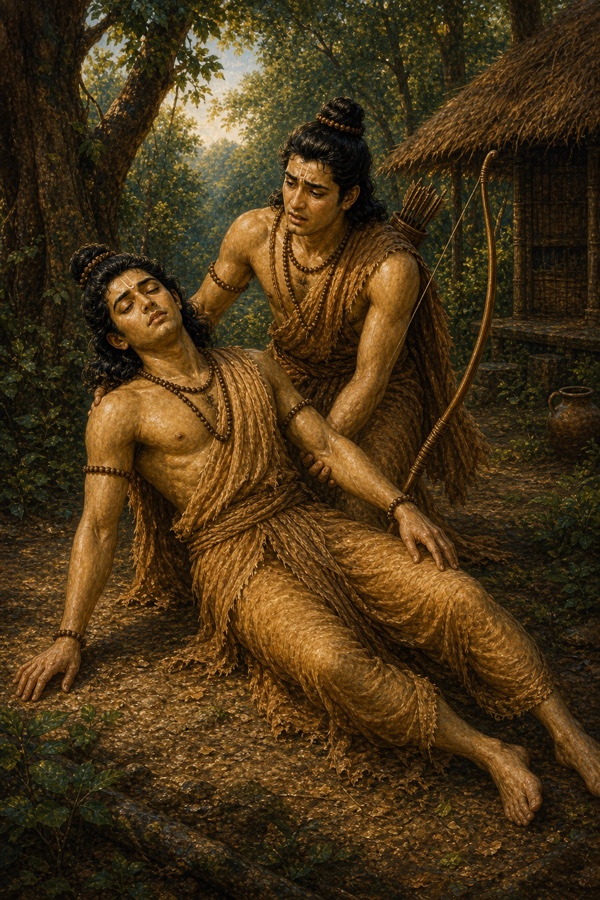
The words reached Rama, and Rama fell. Hearing from Bharata’s mouth the pitiful news that his father the king was dead, the scion of Raghu lost consciousness where he stood. The sentence struck him like the thunderbolt Indra hurls at demons on a battlefield, a thunderbolt made of words, and Rama, scorcher of his enemies, threw up his arms and went down like a flowering tree felled by an axe in the forest. He lay on the ground, that ruler of the earth and master of the great bow, blasted by grief, like an elephant that has worn itself out goring the bank of a river and fallen asleep from exhaustion. His brothers, Bharata and Lakshmana and Shatrughna, wept over him with Sita, and they sprinkled water on him until he stirred.
In a little while he came back to himself, and then the tears came, and the lamenting. He spoke to Bharata, and even in his grief the words kept to dharma. “Father has gone the way that was appointed for him. What am I to do in Ayodhya now? Who will look after that city, bereft of Dasharatha, the best of kings? What use was I to that great soul, his unlucky child? He died of grief for me, and I did not even perform his last rites. Bharata, sinless one, you and Shatrughna have done everything a son should do; you have paid our father every honor of the funeral rites, and that is a thing accomplished.
“Even when my term of exile is over, I will have no heart to go back to an Ayodhya that has lost its king, a city with no head, in disorder. Father has gone to the other world. When I come home at the end of the exile, who will tell me my duty then? He used to look at me and see that I had behaved well, and say kind things to me, words that were sweet to hear. From whose mouth will I hear them now?” Then, turning to his wife, whose face was like the full moon, and to Lakshmana, Rama said, burning with grief, “Sita, your father-in-law is dead. Lakshmana, you have no father now. Bharata brings us the sorrowful news that the emperor has gone to heaven.” At that the tears rose in the eyes of all those glorious princes at once. And Sita, hearing that the great king her father-in-law had gone to heaven, could not lift her tear-filled eyes to look at her husband.
Rama comforted the weeping daughter of Janaka as best he could, and then, grieving himself, he spoke to the grieving Lakshmana. “Bring the crushed pulp of the ingudi fruit, and a piece of bark for my waist, and another for my shoulders. I am going down to the river to make the water offering for our great-souled father. Let Sita walk in front, and you close behind her, and I will come last of all; that is the order for mourning, and it is the most painful order there is.” Sumantra had never left them in his heart; he was their hereditary servant, a man who had realized the Self, wise and gentle and self-possessed, and devoted to Rama past all shaking. He comforted Rama and the other princes, took Rama by the hand, and helped him down the bank to the blessed Mandakini.
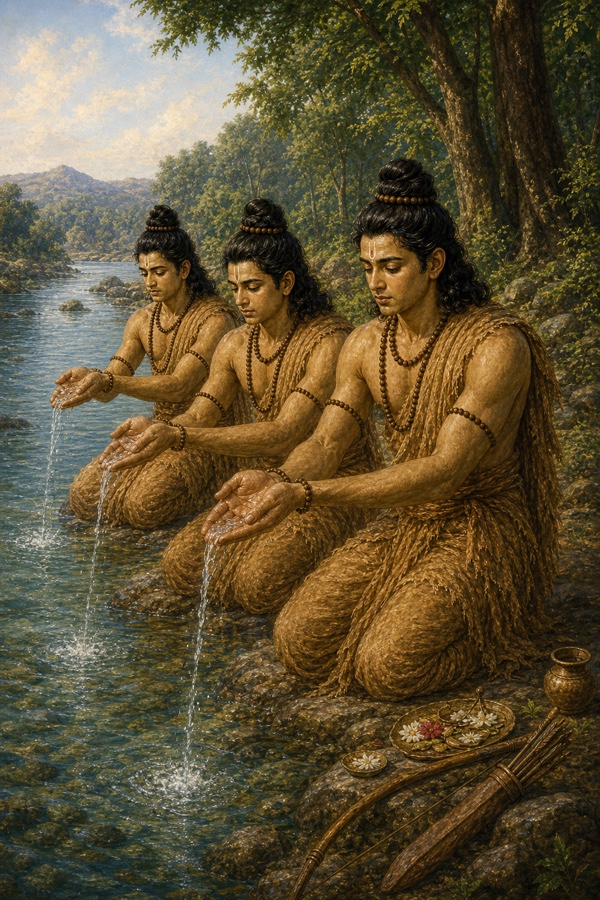
Their grief made every step hard, and it was with difficulty that those glorious princes reached the lovely, swift-running Mandakini, whose banks were forest in flower all year round, and came to a good ford with an easy descent and no mud. There Rama and the others offered water to the departed king, saying, “Father, let this water reach you.” Rama filled his cupped palms with water and stood facing the south, the quarter that Yama, the god of death, rules, and he wept as he spoke. “Tiger among kings, this clear water that I offer you today, now that you have gone to the world of the ancestors, let it be yours without end.” Then he climbed back up the bank of the Mandakini and, with his three brothers beside him, made his father the offering of pinda, the balls of food that the dead are owed. On a mat of kusha grass he laid the crushed pulp of the ingudi mixed with the pulp of jujubes, and, torn with grief, he said through his tears, “Great king, take this gladly. It is what we eat. For the gods a man worships eat the same food he lives on.”
Then Rama went back up from the riverbank by the path he had come down, and climbed the mountain of Chitrakuta to its lovely summit. At the door of his leaf hut, the lord of the earth took Bharata by one hand and Lakshmana by the other and wept aloud, and Sita wept with them, and the cry of those brothers, like the roar of lions, came echoing back from the mountain.
Bharata’s soldiers heard that great cry, the sound of four mighty brothers weeping as they made the water offering for their father, and it frightened them. They said to one another, “Bharata has found Rama, there is no doubt of it. That is the sound of the four brothers mourning their dead father.” They left their horses and carts and ran, all of them together and all of one mind, toward the place the sound came from. Some rode horses, some rode elephants, some drove out in handsome chariots, and those who were too soft-footed for the rough ground went on foot; every one of them wanted to see Rama, and though he had left home only a short while before, they ran to him as though he had been gone for years. Eager to see the four brothers together, they came on hoofed animals and wheeled carts of every kind, and the ground of Chitrakuta, pounded by hooves and wheel rims, gave off a roar like the sky when the storm clouds meet. The wild elephants took fright at the noise and moved off with their cows to another forest, and the scent of their rut hung over the quarters behind them. Boars and wolves and lions, buffalo and srimara and gokarna deer, tigers and gavayas and spotted deer were all thrown into terror; chakravakas and swans and waterfowl, herons and karandava ducks, cuckoos and cranes lost their wits and scattered across the sky. That day the air was full of frightened birds and the ground was full of people, and both, in their way, were a sight worth seeing.
Then, all at once, the people saw Rama, the sinless and illustrious, that tiger among men, seated on the altar. They had been cursing Kaikeyi, and Manthara with her, the whole way. Now they came up to Rama and found their faces wet. Rama, who knew what was right, looked at those desperate people with their streaming eyes and embraced them as a father and a mother embrace a child. Some he clasped to his chest; others greeted him and passed on; and to each of his friends and kinsmen the prince gave the welcome his rank deserved. And the crying of those great-hearted people went on and on, filling the earth and the sky and the caves of the mountain and all the quarters, until it sounded from far off like the beating of a clay drum.
The gist: Hearing that his father was dead, Rama fainted. When he came to himself he lamented, broke the news to Sita and Lakshmana, and went down to the Mandakini to offer the water and the pinda of ingudi pulp to his father. The army, hearing the brothers weeping, ran to the hermitage, and Rama honored every man of it as befitted.
The mothers arrive, and Sita meets Kausalya
Vasishtha came last, and he came with the widows of King Dasharatha walking ahead of him, because he too was thirsty for the sight of Rama. The queens went slowly toward the Mandakini, and on the way they came to the place where Rama and Lakshmana went down to the river to bathe. Kausalya, Rama’s own mother, looked at it with a face that was wet with tears and dry with grief at once, and she said to the stricken Sumitra and the other queens, “Here it is. This is the ford those fatherless children chose, the first one they found in the forest, when they had been driven out of their kingdom and had to live so hard, though no work has ever tired them.
“Sumitra, it is along this path that your elder son Lakshmana carries water himself, every day and without ever tiring, for the sake of my son. No one blames your son for doing a servant’s work. Whatever service a man does for his elder brother, who stands to him in a father’s place, is honorable; it is neglect of that brother that good men condemn. But now that his elder brother is soon to come home to Ayodhya, let your son too put down this hard and lowly labor; he was never meant to bear it.” Then the large-eyed Kausalya saw, on the ground, on blades of kusha grass laid with their tips pointing south, the pulp of the ingudi fruit that Rama had set out for his dead father.
She looked at what her grieving son had laid on the earth for his father, and she said to all the wives of Dasharatha, “Look at this. This is the offering Rama has made in due form to his great-souled father, the lord of the Ikshvakus. I cannot think this food fit for that godlike king, who enjoyed every luxury there is. How is the emperor, who was another Indra on earth and ruled the world to its four oceans, to eat the pulp of an ingudi fruit? Nothing in the world seems to me more painful than this, that Rama, who was rich in everything, should be reduced to offering his father ingudi pulp. Why does my heart not split into a thousand pieces at the sight of it? And yet the old saying of the world proves true, it seems: the gods of a man eat the food that the man himself eats.”
Her fellow queens comforted her, and they all went on together, and they found Rama seated in his hermitage like an immortal who has fallen from heaven. The mothers looked at him, stripped of every comfort, and wept aloud, all of them worn thin with grief. Rama rose from his seat and took hold of the lotus feet of every one of his mothers, this tiger among men who kept every promise he made. And those large-eyed women, with their lovely hands whose touch was gentle and whose fingers were soft to the root, wiped the dust off Rama’s back. Lakshmana, distressed at the sight of all his mothers, greeted them with love right after Rama; and the queens treated the son of Sumitra, marked with every auspicious sign, exactly as they had treated Rama.
Sita, too, in her grief, took hold of the feet of all her mothers-in-law and stood before them with her eyes full of tears. Kausalya folded her in her arms, as a mother does a daughter, and said to the wretched girl, worn thin by life in the forest, “How has the daughter of the king of Videha, the daughter-in-law of Dasharatha, the wife of Rama, come to suffer like this in a lonely forest? Sita, when I look at your face, like a lotus scorched by the sun, like a lily that has been trodden on, like gold dulled with dust, like the moon with a cloud across it, the grief that calamity has kindled in my mind burns me the way fire burns the very wood that feeds it.”
While his stricken mother was still speaking, Rama went to Vasishtha and took hold of his feet. He clasped the feet of the family priest, who blazed with power like the god of fire, the way Indra, king of the gods, clasps the feet of Brihaspati, his teacher; and then he sat down beside him. Behind his elder brother sat Bharata, the most righteous of men, with his friends and ministers, the chief citizens, the soldiers, and the men who best knew what was right. He looked at Rama, who blazed with glory even in the dress of an ascetic, and he folded his hands, the way the mighty Indra folds his hands before Brahma, the lord of created things.
A great eagerness went through all the worthy people gathered there, an eagerness to hear what Bharata would say now, when he had bowed to Rama and honored him. And Rama, who never let go of the truth, and the noble Lakshmana, and the pious Bharata, sat ringed by their loved ones and shone like the three sacred fires on the ground of a sacrifice, the fire of the household, the fire of the offering, and the southern fire, each with its own attendant priests around it.
The gist: Vasishtha brought the widowed queens to the hermitage. On the way Kausalya wept to see the ingudi offering Rama had set out for his father. At the hermitage Rama and Lakshmana bowed to their mothers, Sita fell at her mothers-in-law’s feet, and Rama sat down beside Vasishtha with Bharata behind him, while everyone waited to hear what Bharata would say.
Bharata’s renewed plea, and Rama’s teaching on the impermanence of the world
The night went by in sorrow for those lions among men and the loved ones around them. When it had brightened into dawn, the brothers made their offerings into the fire on the bank of the Mandakini, said their morning prayers, and came with their companions to Rama. They all sat down, and nobody spoke; the silence was complete. It was Bharata who broke it, there among the people who loved him. “You have comforted my mother, and you have given me this kingdom. I give it back to you. It is yours. Rule it without a thorn in it.
“When the rains come and a great rush of water breaks a dam, no one can easily mend it; and no one but you can easily hold this vast kingdom of Ayodhya together. Lord of the earth, I have no more power to match your way of ruling than a donkey has to match the pace of a horse, or a common bird the flight of Garuda, who carries Vishnu on his back. Rama, the man other people depend on lives a blessed life every day of it; the man who depends on others drags his life along in hardship.
“Think of a tree that a man plants and nurses, until it grows into a mighty tree with a thick trunk that no dwarf could climb. It flowers, and then it bears no fruit, and the man never tastes the joy he planted it for. That is only a figure, mighty-armed brother, and you will understand what it means: you are our master and our bull, and at the very hour when it falls to you to protect us, you will not rule us, your servants. Great king, let the guilds of traders and their leaders see you seated on the throne, blazing like the sun, subduer of enemies. Let the elephants in rut trumpet on the road as you ride home to Ayodhya, and let the women of the inner palace, with their minds at rest again, rejoice to see you back.” And the citizens of every class who had gathered at Chitrakuta cried out, “Well said!”
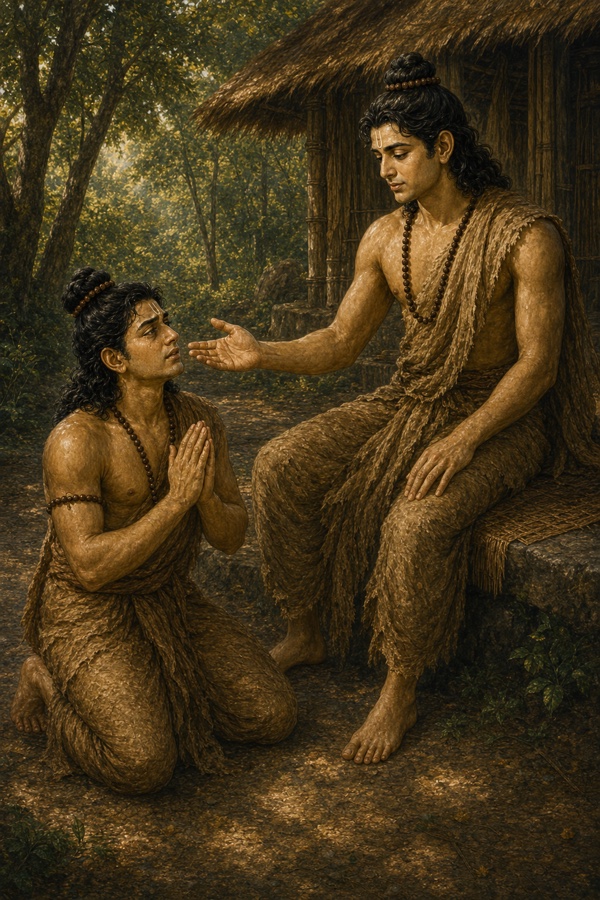
Rama looked at his illustrious brother, wretched and lamenting like this, and, master of himself as he always was, he set about comforting him. “A man is not his own master, Bharata. The embodied soul has no freedom of action; it is fate that drags it this way and that. Everything that is gathered ends by being spent. Everything that rises ends by falling. Every meeting ends in parting, and every life ends in death. A ripe fruit has nothing to fear except its fall, and a man who has been born has nothing to fear except his death. A house with stout pillars still grows old and collapses in the end, and men fall in the same way once age and death have hold of them.
“The night that has passed does not come back. The Yamuna flows to the great ocean, full of water as it is, and it does not turn around. Days and nights go by, and they use up the lives of every creature in this world as quickly as the sun’s rays dry up water in summer. Grieve for yourself; why grieve for someone else? The life of every one of us grows shorter with every moment, whether we stay at home or go abroad. Death walks with us when we walk and sits with us when we sit; we travel a long road, and death travels it too, and comes home with us at the end. Wrinkles have come on a man’s limbs and his hair has turned white: what device is there by which a man worn out with age can master them?
“People rejoice when the sun rises and rejoice when the day is over, and never notice their own life ebbing away. They are glad to see a new season come in, as if it had never come before, and never notice that with every turn of the seasons the life of every living thing is being spent. Two pieces of driftwood meet on the surface of the ocean at one moment and drift apart at another; that is how wives and sons and kinsmen and wealth come together and separate, and their separation is certain. No creature on earth can step aside from the way things are, from birth and death when the time for them comes; and so a man who mourns and mourns for the dead gains no power at all over his own end.
“A man standing at the roadside sees a company of travelers go by and calls out, ‘I am coming after you,’ and then he does follow them. Our father and our grandfather and all who came before them have gone by that same road, the road no one escapes. How can a man who has set foot on it himself grieve for those ahead of him? The life that is flowing away like a stream does not turn back; seeing that, a man should put his mind to what will bless it, for every living thing is said to seek happiness. Our father, the king and lord of the earth, was a righteous man. He performed the most auspicious sacrifices, every one of them, and paid the priests their generous fees, and every sin was washed from him, and he went to heaven. He supported his servants, protected his people, and took his taxes as the scriptures prescribe, and for that he went to heaven. He propitiated the Lord of the sacrifice with rites of every kind; he enjoyed the pleasures of the world in full measure and lived to a great age in virtue, and he has gone to heaven. My child, our father lived long and had every good thing, and now he is in the heaven the good long for and honor; there is no call to grieve for him. He has put off the worn human frame and gained a celestial body in its place, a body in which he can wander even in the world of Brahma.
“No man as wise and learned and clear-headed as you or I ought to mourn for such an emperor. All these griefs, all this lamenting and weeping, a steady and thoughtful man gives up, whatever happens to him. So be at peace. Do not let grief overpower you. Go home and live in Ayodhya; that is what our father, who was master of his own will, commanded you to do, and you are the finest speaker of us all. And I too will carry out the order of our noble father, in the very place where that king of holy deeds ordered me to stay. It would be wrong of me to flout his command, tamer of enemies, and you too owe him honor in everything: he was our friend, and he was our father. I will keep his word by living in the forest, Raghava, the word the righteous approve. A pious man who hopes to win the next world, tiger among men, must be kind, and must obey his father and his elders. Keep your own good nature before you, and remember the pure conduct of our father Dasharatha, and set your mind on the welfare of your soul in the world to come.” Having pressed this weighty advice on his younger brother for the better part of an hour, urging him to do their father’s bidding, the great-souled Rama, lord of all, fell silent.
The gist: Bharata begged again for the kingdom with his figures of the broken dam and the tree that bears no fruit, and the citizens cheered him. Rama, teaching the power of fate, the parting of everything that meets, and the certainty of death, told him that their father was in heaven and beyond grief, and bade him go home and rule Ayodhya as he had been commanded.
Bharata’s vow, and the mothers’ entreaty
When Rama had said his say and fallen silent, Bharata, on the bank of the Mandakini, spoke to this brother who loved his people so well, and what he said was righteous and strange and fine. “Who in this world is like you, tamer of enemies? Sorrow cannot shake you, and joy cannot carry you away. The elders hold you in the highest regard, and still you bring your doubts to them and ask. A man whose mind has come to this, that while he lives he is as one already dead, and that the real and the unreal are all the same to him, what could possibly make him grieve? A man who knows the Self and what is not the Self, as you do, ruler of men, does not sink under misfortune when it comes.
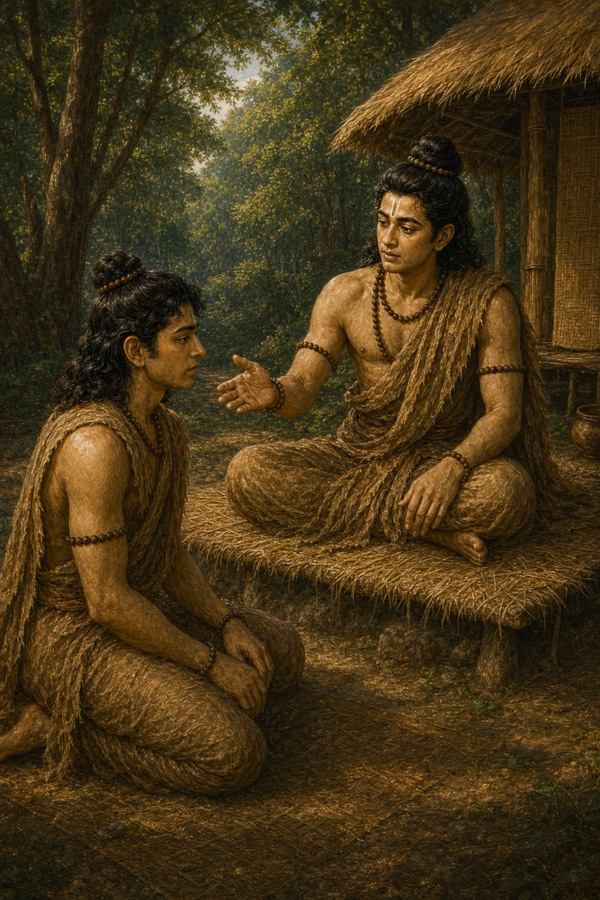
“You have the courage of the gods and a great soul; you keep your word; you know everything and see everything, and you are wise, Raghava. A man of such virtues, who understands where living beings come from and where they go, should never be touched by a grief that we cannot bear. While I was away, my mother, that petty woman, committed a sin for my sake, and I hated it. Be gracious to me. I am bound by the fetters of dharma, which forbid a warrior to lift his hand against a woman; that is the only reason I do not put my mother to death here and now for her crime, harsh as her punishment ought to be. Born of Dasharatha, whose birth and deeds were noble, knowing right from wrong as I do, how could I do a thing as loathsome as killing my own mother?
“I will not denounce my father in the open assembly. He performed the great sacrifices; he was old and deserved respect; he is gone now; and he was my father and my god. But there is an old saying that living beings lose their wits at the hour of death, and by acting as he did, the king proved it before the whole world. Keep a noble purpose in view, and undo the wrong our father did out of fear of Kaikeyi’s anger, out of infatuation and haste. The son who repairs his father’s worst mistake is counted a true son by the world; the son who does otherwise is the opposite of a son. Be a true son, then. Do not let our father’s misdeed stand by carrying out his word; the world’s wise men condemn what he did, because it broke every rule of right. Grant all this, to save Kaikeyi, and me, and our father, and our friends and kinsmen, and all the people of the city and the countryside.
“What has the forest to do with the duty of a warrior, or matted hair with the protection of a people? You must not do a thing so contradictory, a thing that stands in the way of a warrior’s first duty. The first dharma of a warrior is to be consecrated as king, because only a king can protect the people. What warrior, honored by his own line, would throw away a duty whose fruit is plain to see for a virtue whose result is doubtful, which promises no happiness, which pays out only in some future life, and which no one can define? If it is hardship you want to earn your merit by, then earn it by protecting the four orders of society according to dharma; that is hardship enough. The knowers of dharma say that of the four stages of life the householder’s is the noblest and best, because all the others depend on it. How can you, who know dharma, want to abandon it? I am your junior in learning, in rank, and in years. How am I to rule the earth while you are alive? I am a child; my understanding and my virtues are poor; my station is below yours. I cannot even live without you, let alone govern a people. Rule this whole ancestral kingdom, the foremost on earth and free of any thorn, with your kinsmen around you, by the dharma that is yours. Let the ministers and the priests, with Vasishtha at their head, men who know the sacred formulas, consecrate you together, here, on this very spot. Consecrated by us as Indra was consecrated by the Maruts, conquer the worlds by your strength and march home to rule Ayodhya. Pay the three debts, to the gods and the sages and the ancestors, by offerings, by study of the Veda, and by begetting sons; burn your enemies to nothing; satisfy your friends with everything they want; and instruct me, at Ayodhya. Let your friends rejoice at your consecration today, noble brother, and let those who wish you harm run in fear to the ten directions. Wipe away the reproach that lies on me and on my mother, jewel among men, and save our revered father from his sin.
“I beg you with my head bowed. Take pity on me, and on all your kinsmen, as Shiva the great lord takes pity on every creature that lives. And if you set my prayer aside and go on from here into the forest alone, then I will go with you.” Bharata was sinking as he pleaded, his head at Rama’s feet, and Rama, ruler of the earth, gracious and strong-willed, holding fast to the word his father had given, felt no inclination at all to go to Ayodhya. The people of Ayodhya watched that astonishing steadiness and were glad and grieved at the same moment: grieved that he would not come home, and glad at the firmness of his resolve. The priests, the citizens, the leaders of the guilds, and the mothers, half senseless and with tears in their eyes, praised Bharata for what he had said, and bowed low to Rama, and joined their prayer to his.
The gist: Praising Rama’s evenness of mind, and arguing the duty of a true son and the duty of a warrior, Bharata begged Rama to be consecrated at Chitrakuta, and swore that if Rama would not come he would follow him into the forest himself. Rama did not move, and the mothers, the priests, and the citizens joined Bharata in his plea.
The boons given to Kaikeyi, and the father’s truth
Bharata was still pressing him when Rama, the glorious eldest brother of Lakshmana, honored above everyone in that gathering of his kin, answered him. “What you have just said, you, a son born to Dasharatha, the best of kings, by Kaikeyi, is reasonable. But hear the rest of it. Long ago, when our father married your mother, he made a promise to your grandfather: the kingdom of Ayodhya would go to her son, and that was the best of bride-prices. Later, in a war between the gods and the demons, your mother stood by our father in the fighting, and the king, who ruled the whole world, was so pleased with her that he granted her a boon. Then your illustrious mother, that lovely woman, bound him by a solemn oath and asked for two things: the kingship for you, tiger among men, and exile for me. And the king, bound as he was, gave her both.
“That is why our father ordered me to live fourteen years in the forest, as the payment of a boon. I have no rival in this world, and I stand by my father’s truth, and that is why I have come with Lakshmana and Sita to this lonely place. And you, king of kings, must uphold our father’s truth in the same way, by having yourself consecrated at once. Free that powerful king of his debt to Kaikeyi, for my sake, Bharata. Save our father by redeeming his promise, you who know dharma, and give your mother joy.
“There is a saying that is held as sacred as scripture, spoken to the ancestors by the wise and illustrious king Gaya, who founded the city of Gaya, while he sacrificed in that country: ‘A son is called putra because he saves his father from the hell that is called Put; and a son is a son because he protects his father in every way.’ That is why a man should wish for many sons, endowed with virtue and learned in the scriptures, so that at least one of them may go to Gaya and perform the rites for the dead. All the royal sages have believed it, delight of Raghu’s line. So save your father from hell, jewel among men. Go back to Ayodhya, brave Bharata, with Shatrughna and all the Brahmins, and please the people. And I, with these two, Sita of Videha and Lakshmana, will enter the Dandaka forest without lingering here any longer. Be the king of men yourself, Bharata; I will be the emperor of the wild beasts. Go to Ayodhya today, the finest of cities, with a glad heart, and with just as glad a heart I will go into the Dandaka forest. Let the royal parasol keep the sun’s rays off you, Bharata, and spread its cool shade over your head; I will make my way slowly into the deep shade of these forest trees. Let Shatrughna, whose wisdom has no equal, be your helper, and let Lakshmana, the son of Sumitra, be my chief friend. Let the four of us, his worthy sons, keep the king true to his word. Do not be cast down.”
A note on the bride-price and the war-boon: Rama shows Bharata that Kaikeyi’s demand had two roots, and both of them were debts their father had taken on freely: the promise made to Kaikeyi’s father at the marriage, and the boon earned on the battlefield of the gods and demons. To pay those debts is to keep the father’s word true, which is why Rama calls the exile a payment and asks Bharata to make the other payment by ruling.
The gist: Rama told the history of the bride-price and the war-boon to prove that keeping their father in truth was the dharma of both brothers, and bade Bharata become king of Ayodhya and free the father of his debt, while he himself went on into the Dandaka forest.
Jabali’s atheist argument, and Rama’s refutation
While Rama was still comforting Bharata, another voice entered the argument. Jabali was a Brahmin of the first rank, one of the counselors who had come from Ayodhya, and what he now said to Rama, the knower of dharma, ran flat against the religion of the Veda. “You have spoken well, Raghava. But a resolution as empty as this one belongs to an ordinary man, and you are a man of noble understanding given to austerity; it should never have come from you. Who is kin to whom? What does anyone gain from anyone else? A creature is born alone and it perishes alone. A man who clings to someone because ‘this is my mother’ or ‘this is my father’ should be reckoned a madman, Rama, since nobody is related to anybody. A traveler on his way to some distant village stops for the night at a lodging along the road, and the next morning he leaves it behind and goes on. That is all a father and a mother and a house and wealth are to a man, Kakutstha: a night’s lodging. The wise do not cling to them.
“You must not throw away the kingdom your father left you, jewel among men, and set out on a wrong road that is painful and rough and full of thorns. Have yourself consecrated in prosperous Ayodhya; the city is waiting for you, wearing her hair in the single braid of a woman whose husband is away. Take your pleasure in the royal delights of Ayodhya, prince, the costly ones, as Indra takes his in heaven. Dasharatha was nothing to you, and you were nothing to him. He was one king and you are another. So do what is being urged on you. A father is only the occasion of a creature’s birth; what actually makes a human being is the seed and the blood, held together by the mother in the nights when conception is possible. The king has gone where he was always going to go, back into the elements he came from. That is the way of all created things, and you are tormenting yourself over nothing.
“I grieve only for the people who devote themselves to wealth and to merit in the next life; the others I do not pity. Those people suffer in this life for the sake of wealth and merit, and after they die they are simply gone. Look at the way people here have taken up the shraddha and the ashtaka, the rites for the dead: what a waste of food, since what can a dead man eat? If food eaten by one man here could reach the body of another man in some other world, then people would offer shraddha for their relatives who are away on a journey, and travelers would never need to carry provisions. Those books that tell you to sacrifice, to give, to be consecrated, to practice austerity, to renounce, were written by clever men to talk you into charity. Make up your mind, great-souled prince, that there is nothing beyond this world that we can see. Rely on what meets the eye. Put whatever lies out of the reach of your senses behind you. Take the judgment of the wise, who hold that only what can be seen is real, for your authority; let Bharata’s pleading win you over; and take the kingdom.”
Rama heard Jabali out, and then he answered him out of the fine sayings of the Veda, with a mind that stood squarely against everything the sage had said, and with the strength that never failed him. “What you have advised me, to make the pleasures of the senses mine, looks like the right course and is the wrong one; it looks like wholesome food and it is poison. A man who has thrown off restraint, who lives sinfully and holds a moral creed at odds with the settled teaching, gets no honor among the good. It is conduct alone that shows whether a man is well-born or lowborn, a hero or a man who only fancies himself one, clean or unclean.
“A man who took the road you point to would be ignoble under a noble appearance, unclean under a show of cleanness, ill-omened under a fair mark, and ill-mannered under a mask of good manners. If I took up unrighteousness dressed as dharma, and brought confusion on the whole order of the world, I would be abandoning holy works and taking up forbidden ones. What thinking man, able to tell what should be done from what should not, would think anything of me, once he knew me for a corrupter of my people and a man of vile conduct? If I abandoned my vow of fourteen years in the forest and lived the way you recommend, whose conduct would I be following, and how would I reach heaven, since you tell me my father was nothing to me? Following your advice, I would live according to my own whim, and the whole world would follow me into license, because a people always lives the way its kings live.
“Truth without cruelty is the eternal rule of kings. Truth is the soul of a kingdom, and the world itself is founded on truth. The seers of the Vedic hymns and the gods themselves have honored truth alone, and a truthful man in this world reaches the highest realm, the one that never decays. Men shrink from a liar as they shrink from a snake. Dharma comes to its perfection in truth; truth is said to be the root of everything. Truth is God in this world. Dharma rests on truth forever. Everything has its root in truth, and there is no higher goal than truth. Gifts and sacrifices and offerings into the fire, austerities practiced and Vedas studied, all of them stand on truth. So a man should be devoted to truth. By the virtue and the sin of his past lives one man rules the world and another barely supports his family; one sinks into hell and another is honored in heaven.
“Knowing all this, why should I not carry out my father’s command, which rested on truth and was sealed by an oath sworn on truth? I gave my word. Neither greed for a kingdom, nor infatuation, nor ignorance, nor any darkness of mind will make me break the bridge of truth that my father built with his promise to Kaikeyi; I gave my word. We have heard that neither the gods nor the ancestors accept the offerings of a man who is false to his promise, a man whose mind will not hold still. I see this dharma of truthfulness as the one that binds every embodied being, and I honor it, because the good have always borne its burden; and the burden of matted hair, which good men have prized, I welcome for the same reason. I will refuse the warrior’s dharma you offer me, which in this case is unrighteousness with a grain of virtue in it, the kind of thing that petty, cruel, and greedy men of sinful deeds take up. A man first resolves on a sin in his mind, then speaks it with his tongue, then does it with his body; a sinful act is done three times over. Land and fame and glory and fortune come courting the man who is devoted to truth; the wise pursue truth, and so should everyone. What you have recommended to me in all those reasoned words, ‘this kingdom is good for you, take it and do not hesitate,’ can only be wrong for me. I gave my father my word that I would live fourteen years in the forest, and I am keeping it. How could I do what Bharata asks and throw away my father’s command? I took a firm vow in my father’s presence, and Queen Kaikeyi rejoiced to hear it. How can I go back on it now and give her pain? I will stay in the forest, keeping my body pure and my diet spare, satisfying the gods and the ancestors with holy roots and flowers and fruit, my five senses content, free of deceit, faithful, knowing what should be done and what should not; that is how I will meet my obligations to this world, by carrying out my father’s word. A man who has reached this earth, the field of action, must do what is good; the fire god and the wind god and the moon god enjoy in their own realms the fruit of what they did. Indra became king of heaven only after a hundred sacrifices, and the great seers rose to the realms above heaven only by the hardest austerities.”
The heresy in Jabali’s speech, the denial of any life after this one, was more than Rama could let pass, and he turned on him with his formidable spirit fully roused. “I condemn the thing my father did when he took you for a counselor, a confirmed unbeliever, a man who has strayed from the path of dharma and set his mind on a road that runs against the Veda, and who walks about the world holding the creed you have just set out, the creed of those who believe in nothing but what the senses show them. A man like that deserves the punishment of a thief, because he robs people of their faith; and a wise man should never so much as stand face to face with an unbeliever, let alone hear him out. The men who lived before you, and the Brahmins, did countless holy deeds as the Veda commanded, with no hope of reward in this world or the next; and so the Brahmins, following the Veda, practice harmlessness and truth, austerity and giving and kindness, and pour their offerings into the fire. The sages say that truth and dharma and courage, compassion for every creature, gentle speech, and the worship of Brahmins, gods, and guests are the road to heaven; and the Brahmins, having understood that teaching rightly and agreed on it, practice dharma in all its parts without a lapse, and hope to reach the worlds they have chosen. The foremost sages, who are devoted to dharma and keep company with the good, who blaze with spiritual power and whose first virtue is generosity, who harm nothing and are free of every stain, those are the men the world reveres.”
Rama was angry, and he had not been shaken for an instant, and Jabali, the Brahmin, now answered him with words that were wholesome and true and full of respect, and that showed his faith in the Veda and in the world to come. “I do not repeat the words of unbelievers as a rule. I am no unbeliever at heart, and it is not true that nothing exists beyond what we can see. I judged the moment, and seeing you set on keeping your promise to your father, I have become a believer again; and when the moment demands it I may pose as an unbeliever once more. That moment had come, Rama, and that is why I slowly worked my way into that heretical speech: to turn you back from the forest, and to let you show the world what a believer you are by opposing me. And now that I have seen you angry, I have said this to make my peace with you.”
The gist: Jabali, with an unbeliever’s arguments, urged Rama to take the kingdom. Rama refuted him point by point, holding truth to be the root of dharma and of the world and his father’s command to be sacred, and rebuked his father for keeping such a counselor. Jabali then admitted that he had raised the whole argument only to bring Rama home.
Vasishtha’s account of the Ikshvaku line, and the law of the eldest’s consecration
Vasishtha saw that Rama was angry, and he spoke up for Jabali. “Jabali also knows that the soul leaves this world and comes back to it. He spoke as he did only because he wanted to turn you homeward. Now hear from me, protector of the world, how the worlds came to be. In the beginning there was nothing but water, and in the water the earth was made. Then the self-born Brahma appeared, together with the gods. Taking the form of the divine Boar, Brahma, who is one with Vishnu the preserver, lifted the earth out of the water into which it had sunk, and with his sons, Marichi and the others, who had mastered their own minds, he brought forth the whole universe.
Then Vasishtha traced the line, generation by generation, so that Rama could hear where he stood in it. From the ether, which is Brahman itself, came the eternal and imperishable Brahma. From Brahma came Marichi; Kashyapa was the son of Marichi; from Kashyapa came Vivasvan, the sun; Manu was the son of Vivasvan, and Manu was once a lord of created things; and Ikshvaku was the son of Manu, the very first king of Ayodhya, to whom Manu himself entrusted this prosperous earth. Ikshvaku’s glorious son was known simply as Kukshi, and from Kukshi sprang the gallant Vikukshi. Vikukshi’s son was the mighty Bana, and Bana’s son was the mighty-armed Anaranya, a man of great austerity, and while Anaranya reigned there was neither drought nor famine in Ayodhya, and never a thief. From Anaranya came King Prithu, and from Prithu came Trishanku, who by the unfailing vow of Vishvamitra went up to heaven in his living body. Trishanku’s son was the illustrious Dhundhumara; from Dhundhumara came the glorious Yuvanashva, and the glorious Mandhata was Yuvanashva’s son. From Mandhata came Susandhi, and Susandhi had two sons, Dhruvasandhi and Prasenajit.
The son of Dhruvasandhi was Bharata, the destroyer of enemies, and from that mighty-armed Bharata was born Asita. Against Asita rose the Haihayas and the Talajanghas and the gallant king of the Shashabindus, and though he drew up his army against them all, he was beaten and driven out, and he went gladly to live as an ascetic on a lovely mountain. His two queens were with child at the time, so the tradition runs. One of them, a fortunate woman with eyes like lotus petals, wanting a fine son, went to the sage Chyavana of Bhrigu’s line, who was living then in the Himalaya, bright as a god, and bowed to him. The other gave her rival poison to destroy the child in her womb. The queen who had gone to the sage was Kalindi, and Chyavana, pleased by her homage, gave her the boon she asked for: “You will have a son, great-souled, famous throughout the world, righteous and terrible, a founder of a dynasty and a destroyer of his enemies.” She walked around the sage to honor him, took her leave, went home, and bore a son with eyes like lotus petals who shone like the lotus-born Brahma. He was born together with the very poison that had been given to his mother to kill him, and so he was called Sagara, the one born with poison. That was the King Sagara who, consecrated for a sacrifice on the day of the full moon or the new moon, had his sons dig out the ocean, and the speed of their digging terrified the world. Sagara’s eldest son was Asamanja, a man of evil deeds, whom his father cast off while he was still alive; and Asamanja’s son was the valiant Anshuman, whose son was Dilipa, whose son was Bhagiratha.
From Bhagiratha came Kakutstha, after whom his descendants are called the Kakutsthas; and Kakutstha’s son was Raghu, after whom they are called the Raghavas. Raghu’s glorious son came to be known on earth by four names, Pravriddha, Purushadaka the man-eater, Kalmashapada, and Saudasa. Kalmashapada’s son, so it has been heard, was Shankhana, who won great renown in battle and then perished in a fight with his whole army. Shankhana’s heroic son was the glorious Sudarshana; Agnivarna was the son of Sudarshana, and Shighraga the son of Agnivarna. Maru was the son of Shighraga, and Prashushruva the son of Maru, and the wise Ambarisha was the son of Prashushruva. Ambarisha’s son was Nahusha, whose prowess never failed, and Nahusha’s son was the supremely pious Nabhaga. Nabhaga had two sons, Aja and Suvrata, and the righteous King Dasharatha was the son of Aja.
Then Vasishtha came to the end of the line and to Rama himself. “You are his eldest son, and his heir, known to all the world by the name of Rama. Take up the kingdom that is yours, then, and watch over the world, protector of men. Among all the Ikshvakus it is the eldest son who becomes king. While an elder son lives, no younger son is ever consecrated; the eldest alone is anointed. You belong to the Raghavas. Do not break, today, the ancient usage of your own house. Rule this earth with all its jewels and all its kingdoms, as your father did, illustrious as you are.”
A note on the law of the eldest: the whole of Vasishtha’s long history of the line, from the waters of the beginning down to Dasharatha, arrives at one sentence: among the Ikshvakus the eldest son alone becomes king. By now the argument has moved past affection and past policy. Vasishtha is telling Rama that the custom of his own house, kept for generations, requires him to take the throne.
The gist: Vasishtha, defending Jabali, told the line of the Ikshvakus from Brahma and Manu down to Dasharatha, with the stories of Trishanku, Sagara, and Kalmashapada along the way, to show that in this house the eldest son alone becomes king, and he bade Rama, as the eldest, take up the kingdom and rule the earth.
Parents above the teacher, and Bharata’s fast unto death
Having said that much, Vasishtha, the family priest of the kings, spoke to Rama once more, and once more what he said kept to dharma. “Three people are always to be honored by a man from the day he is born, Kakutstha: his teacher, his father, and his mother. The father begets a man and the mother brings him into the world, jewel among men; the teacher gives him wisdom, and that is why he is called guru, the weighty one, weightier even than they. I was your father’s teacher, and I am yours, tamer of enemies. If you do my bidding, you will not be stepping off the road of the good. Here are your subjects, your kinsmen, and the tributary kings. If you do your duty by them, you will not be stepping off the road of the good. You must not fail your aged mother, who is given to piety; do what she asks, and you will not be stepping off the road of the good. And if you grant the prayer of Bharata, who is begging you, Raghava, you who are wedded to truth and dharma and courage, you will not be overstepping any bound at all.”
Rama, jewel among men, heard his teacher’s sweet words and answered Vasishtha, who sat at ease beside him. “What a mother and a father do for their son, giving him whatever they have, putting him to bed and rubbing his body with oil, speaking kindly to him at every moment, feeding him and raising him, is a debt no one can easily repay. King Dasharatha was my father; he brought me into being; and what he commanded me to do will not be made a lie.” When Rama had said that, Bharata, the broad-chested, felt his heart sink, and he gave an order to Sumantra, the charioteer, who stood nearest to him. “Charioteer, spread kusha grass on this level ground, and quickly. I am going to sit at my noble brother’s door until he relents and grants my prayer. Like a Brahmin who has been stripped of his fortune by a debtor who will not pay what he owes, I will lie down in front of Rama’s hut, without food or water, with my face covered so that I see no light, until he goes back to Ayodhya for my sake.”
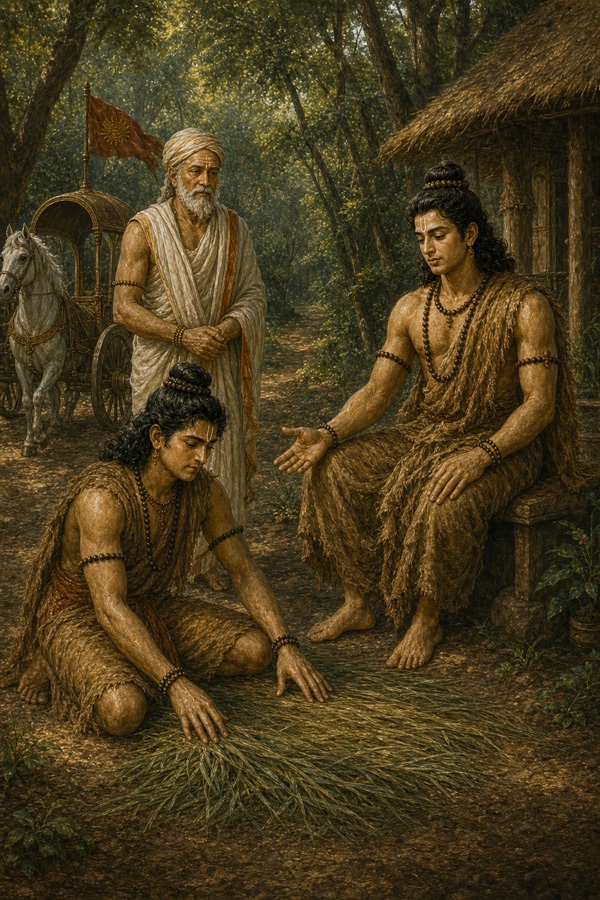
Sumantra looked at Rama and waited for his word. Seeing that, Bharata spread the mat of kusha grass on the ground with his own hands and sat down on it, sick at heart. Rama, first among royal sages, looked at him. “Bharata, my child, what wrong have I done you, that you sit at my door to force my hand? It is a Brahmin who is allowed to lie down at another man’s door and block his way when he has been wronged. For warriors, for men who have had the water of consecration sprinkled on their heads, there is no such custom. Get up, tiger among men. Give up this terrible vow, and go home at once to Ayodhya, the finest of cities.” Bharata stayed where he sat, looked around at the citizens and the country people on every side, and said, “Why do you not plead with my noble brother?”
The people of the city and of the countryside answered the great-souled prince. “We know that what you say to Rama is right. But this blessed prince too stands firm on his father’s word, and that is exactly why we cannot easily move him.” Rama heard them and spoke to Bharata again. “Listen to what these friends of ours are saying, Bharata, men who keep their eyes on dharma. Hear both of us, them and me, and weigh it well. Get up, mighty-armed brother. Touch me, and touch water, as a sign that you set this vow aside.” Bharata rose at once and touched water, and then he said, “Let all the members of this assembly hear me, and the king’s counselors too. I never asked my father for the kingdom, and I never told my mother to ask for it, and I never approved of this exile of Raghava’s, who knows better than anyone what is right. But if our father’s word must be kept, and someone must live in the forest, then I will do it. I will live in the forest for fourteen years myself.”
Rama, whose mind was set on righteousness, was astonished at the sincerity of his brother’s vow. He looked around at the people of the city and the countryside and said, “What our father sold or pledged or bought while he was alive cannot be undone, either by me or by Bharata. I cannot send a substitute to the forest in my place; that would be a thing to be ashamed of. A substitute is allowed only when the man himself is unable. What Kaikeyi asked was reasonable, because of the promise our father made when he married her, and because of the debt he owed her from the battlefield; and in granting her boons our father did a good deed. I know Bharata to be a forgiving man and one who honors his elders; with a great soul as true to his word as this one, everything will come out well. When I come back from the forest I will be the foremost lord of the earth, with this righteous brother beside me. The king was asked for a boon by Kaikeyi, and I have carried out his word by living in the forest. Now free our father, the lord of the earth, from the charge of falsehood: rule Ayodhya, and discharge your part.”
A note on the fast and the proxy: Bharata took up the Brahmin’s custom of lying at a debtor’s door without food until the debt is paid, and Rama told him plainly that it belongs to Brahmins, and that a consecrated warrior may not use it. Rama also refused Bharata’s offer to serve the exile in his stead. A substitute is sent only when the man himself is unable, and Rama was able.
The gist: Vasishtha argued the teacher’s authority, and Rama set the parents higher still. Bharata sat down to fast at Rama’s door, and when Rama forbade it as no custom of a warrior’s, offered to serve the fourteen years in the forest himself. Rama refused the notion of a stand-in and bade Bharata free their father of untruth by ruling.
Canto 112: The gift of the sandals, and Bharata’s vow
The great sages who had gathered there had watched the two brothers, whose glory had no equal, meet and argue at close quarters, and it had thrilled them and left them astonished. Hosts of sages who stood unseen in the air, and the greatest of the seers who were present in the flesh, praised the two blessed brothers of Kakutstha’s line. “These two princes have always been noble. They know dharma, and they walk in it. Having heard the two of them speak to each other, we long to hear it again and again.”
Then the companies of seers, who had their own reason for wanting Rama in the forest, since they longed for the death of Ravana, spoke to Bharata with one voice and without delay. “Prince of high birth, of rare intelligence, of noble conduct and great renown, if you have any regard for your father at all, you must accept what Rama says. We want Rama free of every debt to his father, forever. It was because Rama went willingly into exile that the king got square with Kaikeyi, and it was as a man who owed her nothing that Dasharatha went to heaven.”
Having said that much, the gandharvas and the great seers and the royal sages went each his own way. Their words had gladdened Rama; his handsome face grew brighter still, and he thrilled with joy and honored those seers with every mark of respect.
Bharata’s limbs were trembling. With his hands folded and his voice catching, he tried once more. “Rama, consider this dharma of consecration and of protecting the people, which is bound up with the usage of our house. You ought to fulfill it, Kakutstha, and grant my prayer, and your mother Kausalya’s. I cannot protect this vast kingdom alone. I cannot keep the citizens and the country people content, devoted as they are to you. Our kinsmen, our warriors, our friends and relations are all waiting for you, and for you alone, as farmers wait for the rain cloud. Take the kingdom, brother of rare wisdom, and set it on a firm footing. A man like you can protect the whole people on every side, Kakutstha.” With that Bharata fell at his elder brother’s feet again and begged him, in the most loving words he had, to accept the throne.
Rama took his brother onto his lap, dark Bharata with his eyes like the petals of a lotus, and answered him in his own voice, which was like the call of a swan in the season of rut. “This modesty that has come to you, this natural sense of your own smallness that is born of humility, is the very thing by which you can protect the whole earth, my child, to say nothing of Ayodhya. Take counsel calmly with your ministers, your friends, and your wise advisers, and carry even the greatest matters through.
“The moon may lose its light; the Himalaya may shed its snow; the ocean may pass its shore; I will never break the pledge my father gave. Whether your mother did this for your sake out of love, my child, or out of greed for the throne, do not take it to heart. Treat her as your mother.”
A note on the sandals: the paduka are wooden sandals, and Rama’s pair was worked with gold. In the old statecraft a token could carry a king’s authority in his absence, and that is what Bharata asks for and what Rama gives: the sandals hold Rama’s office, and Bharata governs as their deputy. Everything Bharata does at Nandigrama in the fourteen years that follow flows from this exchange.
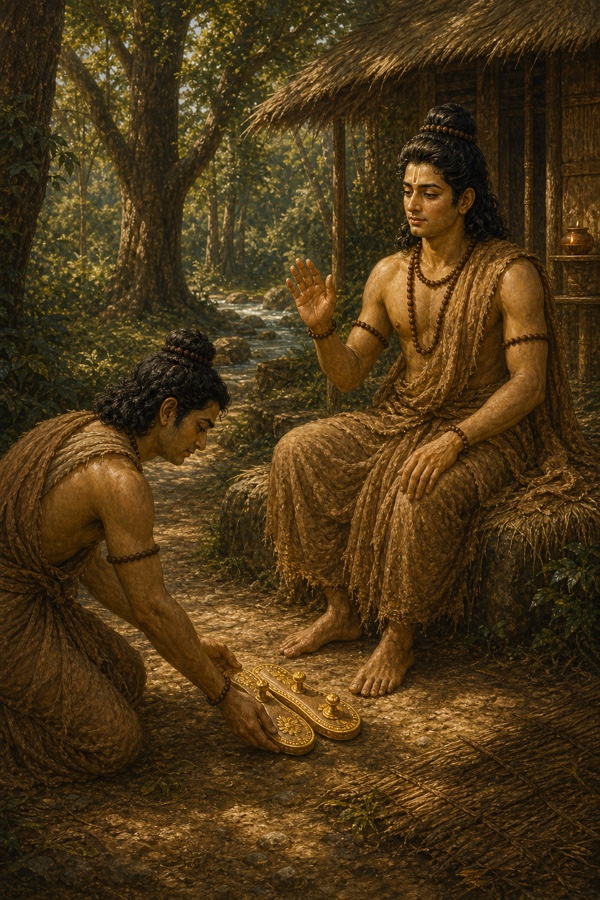
Rama was speaking, bright as the sun and lovely as the moon on the first night of its waxing, when Bharata set a pair of wooden sandals worked with gold on the ground in front of him and said, “Noble brother, stand on these sandals with your feet. These will provide for the needs of the whole world and keep it safe.” Rama, tiger among men, whose glory outshone everyone’s, stood on the sandals, stepped off them at once, and gave them to the great-souled Bharata. Bharata bowed low to them and said, “For fourteen years, delight of the Raghus, I will wear matted hair and bark, I will live on fruit and roots, and I will live outside the city, waiting for you to come home, scorcher of enemies. I will hand the whole business of the kingdom over to your sandals. And if, when the fourteenth year is complete, I do not see you home on the very next day, jewel among the Raghus, I will walk into the fire.”
“So be it,” Rama said. He embraced Bharata with love, and Shatrughna with him, and said, “Take care of mother Kaikeyi. Do not be angry with her. Sita and I both put you on your oath to do it.” His eyes were full of tears as he said it, and with those words he let his brother go.
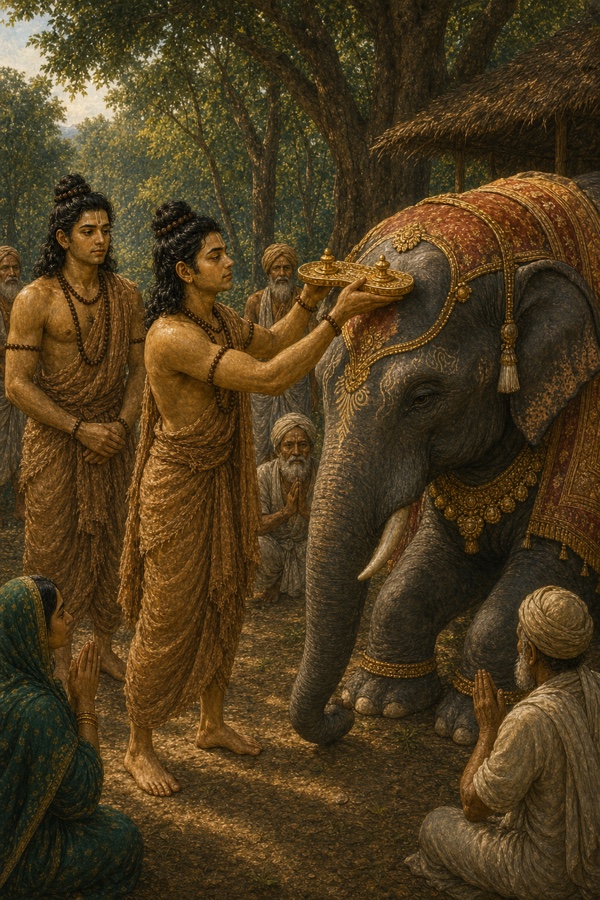
Bharata, who knew what was right, received the shining, richly ornamented sandals with reverence, walked around Rama with his right side toward him, and set the sandals on the head of a fine elephant. Then Rama, the glory of the house of Raghu, standing on his own dharma like the Himalaya standing on the earth, paid his respects in due order to everyone who had come: to his teachers, his ministers, his subjects, and his two younger brothers, Bharata and Shatrughna, who were now bound for Ayodhya, and sent them on their way. His mothers’ throats were so choked with grief that they could not manage a single word of farewell. Rama bowed to all of them, and then he too, weeping, went back into his hut.
The gist: After the seers’ plea and Bharata’s last entreaty, Rama held to his vow. Bharata asked for Rama’s sandals in place of the kingdom, and vowed to enter the fire if Rama was not home the day after the fourteen years were complete. Rama stood on the sandals, gave them to Bharata, charged him to care for Kaikeyi, took leave of everyone, and went back into his hut in tears.
Canto 113: Bharata’s return to Ayodhya, and the meeting with Bharadvaja
Then Bharata lifted the sandals onto his head and, glad now in a way he had not been since Ayodhya, climbed into his chariot with Shatrughna. The counselors, Vasishtha and Vamadeva and Jabali of the steadfast vows, men honored for their advice, went in front. They kept the lovely Mandakini and the great mountain of Chitrakuta on their right hand as they set out, their faces turned to the east, and Bharata, with the army around him, went along the northern flank of the mountain, looking as he went at the thousands of veins of ore that streaked its slopes with color.
Not far from Chitrakuta Bharata saw a hermitage, and it was the sage Bharadvaja who had made his home there. He got down from his chariot, went in, and bowed at the sage’s feet, and Bharadvaja, delighted, asked him at once, “Did you meet Rama, my child? Has your purpose been accomplished?”
Bharata, who loved dharma, answered the wise sage. “My teacher and I both begged Raghava to come home, and he was very glad to see us, that prince whose strength never falters, and even so he said to Vasishtha, ‘I will keep to the letter the promise my father gave my mother Kaikeyi, that I would live fourteen years in the forest.’ At that Vasishtha, who knows how to speak, said something weighty to Raghava, who is himself a master of words: ‘Then give these gold-worked sandals to Bharata, and give them gladly. Living in Ayodhya in the form of these sandals, provide for the people and keep them safe, wise prince.’
“Raghava heard him, and he stood on the sandals facing east, and he gave those gold-worked sandals to me to carry on the rule in his name. And so, with his leave, I turned back. I am returning to Ayodhya with these blessed sandals.”
A sub-tale: the translators of the Gita Press point out that in those days Bharadvaja had a second hermitage on the southern bank of the Yamuna, not far from Chitrakuta, and that this is the one Bharata visits here. It is a different place from the hermitage between the Ganga and the Yamuna where Rama’s party halted and where Bharata’s army was so lavishly entertained, since Bharata goes on from here to cross the Yamuna. The sage, they suggest, had most likely moved to this nearer place to keep in touch with what was happening at Chitrakuta.
Bharadvaja heard the great-souled prince’s good news and answered with words that were sweeter still. “It is no wonder, tiger among men, best of those who know how to behave and how to conduct themselves, that noble conduct should find its home in you, the way water poured from above finds its way into a hollow. Your mighty-armed father Dasharatha is free of every debt, now that he has a son as righteous and as devoted to dharma as you.”
Bharata folded his hands before the wise sage who had spoken to him so, took hold of his feet, and began to take his leave. He walked around Bharadvaja again and again to honor him, and then the glorious prince set out for Ayodhya with his ministers. That great army turned and followed him along the road it had come by, on chariots and bullock carts, on horseback and on elephants. They crossed the divine Yamuna, garlanded with waves, and came in sight once more of the Ganga and her holy water, and Bharata crossed that river, brimming with its lovely water, with his kinsmen and his soldiers, and came into the pleasant town of Shringaverapura.
From Shringaverapura, going on, Bharata came in sight of Ayodhya. He looked at the city with his father dead and his elder brother gone from it, and the grief burned in him, and he said to Sumantra, his charioteer, “Look at Ayodhya, charioteer. She lies in ruins. Her grace is gone. She is joyless and wretched; her voice is stilled; she has no light in her any more.”
The gist: With the sandals on his head, Bharata set out for Ayodhya, and at Bharadvaja’s hermitage he told the sage the whole story of Chitrakuta and of the sandals, and the sage praised him and pronounced Dasharatha free of debt. Crossing the Yamuna and the Ganga and passing through Shringaverapura, Bharata saw Ayodhya from afar, and without Rama she looked to him like a ruin.
Canto 114: The portrait of a desolate Ayodhya, and entering the father’s palace
The chariot gave out a deep, pleasant rumble as it rolled, and in it the mighty and illustrious Bharata entered Ayodhya in no time at all. It looked, to Bharata, like a place he had never seen. Here Valmiki stops to paint that emptied city in figure after figure, as though no single image could hold it. Cats and owls had the run of it. Darkness lay on it, and no lamps burned, and the doors of its houses were shut, so that the whole city looked like a night with no moon. It was as wretched as Rohini, the beloved wife of the moon, who shines by her own glory and is tormented whenever the demon Rahu, the moon’s enemy, rises and swallows her husband.
It was as thin as a mountain stream in the hot months, whose little water the sun has warmed and troubled, whose birds are scorched, and whose fish and crocodiles, great and small, have gone down into the mud. It was like a tall tongue of fire, smokeless and bright as gold, that someone has put out with a sprinkling of milk. It looked like an army that has met disaster in a great battle, its armor smashed, the banners torn from its elephants and horses and chariots, its best fighters dead.
It was as silent as a wave of the sea that a gale has driven up with foam and a roar, and that has then gone quiet in a gentle breeze. It was as hushed as an altar when the time for the offerings has passed and the priests have cleared away the vessels and gone, and no sound is left. It was like a cow that a bull might covet, standing forlorn in her pen because her bull is gone, refusing the fresh grass. It was as dull as a new string of pearls stripped of its dazzling rubies and its other fine gems, and as dim as a star that has fallen out of its place in heaven when its merit ran out and lost all its width of light on the way down.
It drooped like a forest creeper covered with blossom at the end of spring, alive with drunken bees, and then scorched by a running wildfire. Its streets were empty of traffic and its markets barely doing business, so that the whole city was like a sky in which clouds have hidden the moon and the stars. Its lanes were unswept and littered, like a tavern after its drinkers have been killed, strewn with broken cups and empty of good wine. It was like a water shed for travelers that has collapsed, its platform sunk, its vessels broken, its water used up. It was like a long bowstring with a noose at either end, cut by the arrows of heroes and fallen to the ground, and like a mare that a horseman skilled in war has spurred into the enemy’s line and that the enemy has killed.
Seated in his chariot, Bharata said to Sumantra, who was driving the finest of the king’s chariots, “Why is it that the deep, ringing sound of singing and of instruments is no longer heard in Ayodhya as it used to be? The heady scent of wine, the fragrance of flowers, the perfume of sandalwood and aloe, which once drifted through every part of the city: why has it stopped? Since Rama went into exile there is no rumble of the great chariots in this city, no lovely neighing of horses, no trumpeting of elephants in rut, no roar of wheels. The young men here grieve so for Rama that they have stopped anointing themselves with sandal and aloe paste; they no longer wear costly garlands of forest flowers, and they no longer go out for their walks with wreaths in their hair.
“There are no festivals in the capital any more; grief for Rama has stopped them. The splendor of this city has plainly gone away with my elder brother. Ayodhya without Rama has no more charm than a moonlit night in the bright half of the month when the rain comes down without stopping. When will my brother come home to Ayodhya, like a great festival, and bring joy to this city, as a rain cloud brings it in the heat of summer? The highways of Ayodhya no longer shine with young men in handsome clothes, walking tall, pouring into the city from outside.”
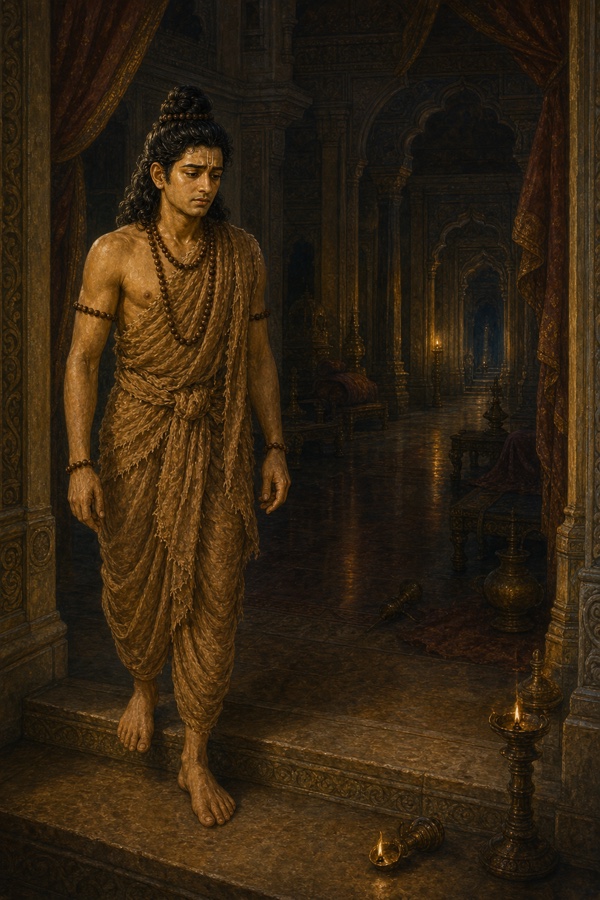
Talking like this with his charioteer, and stricken with grief, Bharata drove into the heart of Ayodhya and came to his father’s palace, which without its king was as desolate as a cave without its lion. He looked at the inner apartments, which had lost all their light, so that the palace was like a day without a sun, one of the days the gods themselves mourned, and saw them untidy and neglected everywhere; and Bharata, who had command of himself in most things, wept.
A sub-tale: the commentators trace the figure of a day without a sun to a story in the Puranas. In a great war between the gods and the demons the gods were losing, and Rahu struck the sun-god down. With that, the division of day and night in the world was undone. The gods went to Brahma, who appointed the sage Atri to stand in for the sun for a week. One of those days of chaos is the day the verse means, the day without the sun for which the gods grieved.
The gist: Valmiki paints the gloom of an Ayodhya without Rama in a long run of figures: a quenched flame, a beaten army, a drying stream, a cow without her bull, a fallen star. Bharata, speaking to Sumantra of everything the city has lost, drives to his father’s palace, empty as a lion’s cave, and weeps.
Canto 115: The consecration of the sandals at Nandigrama
When he had brought his mothers home to Ayodhya, Bharata, who never wavered once he had taken a vow, spoke to his elders, Vasishtha and Vamadeva and the rest, with his grief still burning in him. “I take my leave of all of you here. I am going to Nandigrama, and there, without Raghava, I will bear the whole of this sorrow. The king has gone to heaven, and my elder brother has gone to live in the forest. I will wait for Rama to take up the kingdom, because he, the illustrious one, is the king of Ayodhya.”
The ministers heard that blessed resolve of the great-souled prince, and they and Vasishtha, the family priest, answered him together. “What you have said, Bharata, out of love for your brother, deserves the highest praise, and it is worthy of you and of no one else. You have always wanted the good of your kinsmen; you are steadfast in your love for your brothers; you have taken the noble road, the road of dharma. What man could refuse to approve of it?”
It was the answer he had hoped for, and it pleased him. He turned to Sumantra. “Have my chariot made ready.” Then, with a face that was almost cheerful, he spoke kindly to all his mothers and climbed into the chariot with Shatrughna, and the two brothers, ringed by the ministers and the family priests, set off at once, glad at heart. All the teachers, with Vasishtha at their head, and the other Brahmins went in front, their faces turned east along the road that leads to Nandigrama. And when Bharata had gone, the army followed him without being summoned, elephants and horses and chariots, and so did all the people of the city.
A note on the place, Nandigrama: Nandigrama was a village outside the capital, and Bharata’s choice of it is the whole point. He leaves the throne inside Ayodhya empty and lives outside the city, in the dress of an ascetic, with the sandals on the seat of state, so that the kingdom stays Rama’s by right and he himself remains its guardian and deputy for as long as the exile lasts.
Riding in his chariot with the sandals on his head, the righteous Bharata, who loved his elder brother so, drove fast to Nandigrama. As soon as he had entered the village he got down from the chariot and said to his teachers, “This kingdom my elder brother has handed to me as a sacred trust, and with it these gold-worked sandals, which will supply everything we need and keep us safe.” Then Bharata bowed his head and gave that trust over to the sandals, and, burning with grief, he said to the whole council of his ministers,
“Hold the royal parasol over these sandals at once. I hold them to be the very feet of my noble brother. In these sandals of my elder brother, dharma will stand firm in the kingdom. It is out of love alone that my brother has laid this trust on me, and I will keep it until Raghava comes home. The moment he returns I will set these sandals on his feet myself, and look at my brother’s feet with his sandals on them again. When I have given the kingdom back to my elder brother and laid down this burden, then, reunited with Raghava, I will take up the life of his servant.
“When I have given back to Raghava this kingdom that I hold in trust, and Ayodhya, and these fine sandals, I will have washed off the stain of having been the cause of my brother’s exile. And when Kakutstha has been consecrated and the people are rejoicing, my joy and my fame will be four times what they could ever have been from a throne of my own.” Lamenting in this way, the illustrious Bharata, low in spirit, went about the government of the kingdom from Nandigrama with his ministers, and did it sadly.
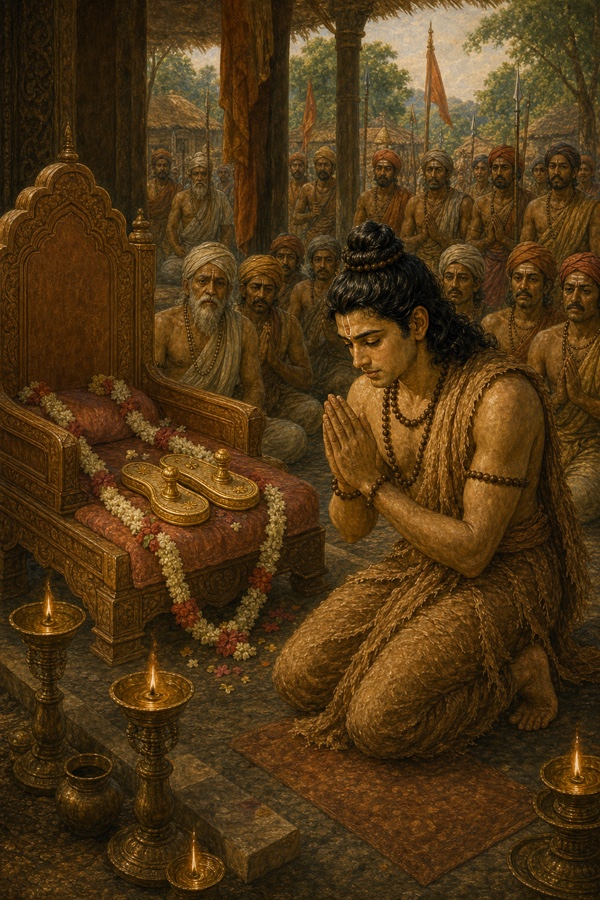
He wore bark on his body and matted hair on his head, the dress of a sage, and in that dress the powerful and steady Bharata lived at Nandigrama with the army around him. Obedient to his elder brother, true to his vow, loving to his brothers, longing for Rama’s return, he consecrated the sandals on the throne and made his home there. He held the royal parasol and the yak-tail whisk over the sandals himself, as a servant holds them over a king, and he laid the whole administration at their feet. From the day he consecrated his brother’s sandals, Bharata governed as their subordinate in everything: whatever business of state came before him, and whatever costly present was offered to the throne, he laid it first before the sandals, and only then dealt with it in the proper way.
The gist: With the leave of the elders and the people, Bharata went straight to Nandigrama. There he consecrated Rama’s sandals as king, took up the bark and matted hair of an ascetic, held the parasol over the sandals with his own hands, and, as their deputy, laid every matter of the realm before them for the fourteen years until Rama’s return.
Canto 116: The ascetics depart from Chitrakuta
Bharata had gone back to Ayodhya, and Rama went on living in the forest, and it was in those days that he began to notice something wrong with the ascetics around him. The sages who lived in that hermitage in front of Chitrakuta, and who had been so content to live there under Rama’s protection, were anxious now, and unsettled. They glanced at Rama, and their eyebrows went up, and they drew one another aside and murmured, full of misgiving. Rama saw their uneasiness and began to be afraid that the cause of it was himself. He went to the sage who presided over the hermitage, folded his hands, and asked him.
“Venerable one, is there something in me that was never there before, some change for the worse, that the ascetics should be so disturbed? Has the conduct of my forefathers slipped from me somehow? Have the sages seen some careless fault in my younger brother Lakshmana, something unworthy of a great soul? And Sita, who serves you and gives herself wholly to serving me, has she fallen short in the respect a young woman owes you?”
The sage was old in years and old in austerity, and he seemed to tremble as he answered Rama, who held compassion for every living thing to be the highest dharma. “How could there be any fault, my child, in the daughter of Videha, whose nature is goodness and who delights in doing good, least of all toward ascetics? No. This danger has come upon the ascetics because of you, though you are kind to them; it comes from the rakshasas, and that is what they are whispering about among themselves.
“There is a rakshasa called Khara, a younger brother of Ravana, who has driven every ascetic out of Janasthana, the part of the Dandaka forest that lies south of here. He is insolent, used to winning, brutal, arrogant, and wicked, an eater of men, and he cannot bear you, my child. From the day you came to live in this hermitage the rakshasas have been tormenting the ascetics. They show themselves in shapes that are loathsome, savage, hideous, and deformed, shapes whose mere sight brings sorrow. They defile the ascetics by forcing foul and forbidden things on them, and those who stand in front of them the ignoble creatures kill outright.
“They hide unseen about the hermitages, and they kill the ascetics, who are simple men and never see them coming, and then they go about the place rejoicing. When the hour of the offering comes and the ladle is in a man’s hand, they snatch the sacrificial vessels and fling them away, they pour water on the fires, and they smash the water pots. The sages want to leave these hermitages for good, now that such evil creatures have fouled them, and today they are urging me to move to another region. So, Rama, we are going to leave this hermitage before those wicked ones lay hands on the ascetics themselves.
“Not far from here there is a fine forest full of roots and fruit. I will go there with my company, to the hermitage of the sage Ashva, and settle again. If your mind inclines that way, Rama, come away from here with us, before Khara turns on you as well. Raghava, you are watchful always, and strong enough to put him down; even so, to stay here with your wife has become a thing of danger and grief.”
The sage was set on going, and Rama could find no argument that would hold him. The head of the hermitage praised Rama, took a proper leave of him, comforted him, and went away with the companies of sages, and the hermitage was empty. Rama walked with them a little way to see them off, bowed to the sage who led them, listened to what they told him of his duty, and, with their leave and their goodwill, came back to his holy dwelling to rest. And though the sages had gone, Rama did not leave that hermitage even for a moment; while the ascetics, whose minds were fixed on him, since he lived the way the seers live, went on following Rama in their thoughts wherever they went.
The gist: After Bharata’s return, Rama saw the ascetics of Chitrakuta troubled and feared the fault was his. The head of the hermitage told him that Ravana’s brother Khara and his rakshasas were tormenting the ascetics, and that the danger had grown with Rama’s presence. The sages left for the hermitage of the sage Ashva; Rama saw them off with honor and returned to his dwelling alone.
Canto 117: Leaving Chitrakuta, and Anasuya’s counsel to Sita at Atri’s hermitage
When all the ascetics had gone, Rama turned it over and over in his mind, and for more than one reason he found that he no longer wanted to stay. “It was here that I saw Bharata,” he thought, “and my mothers, and the people of Ayodhya. The memory follows me about, and I grieve for them every day. And the ground here has been badly fouled by the camp of Bharata’s great army, by the dung of its horses and elephants. We will go somewhere else.” So the scion of Raghu set out from Chitrakuta with Sita of Videha and with Lakshmana.
He came to the hermitage of the sage Atri, and that illustrious prince bowed to him, and the blessed Atri received him as he would have received a son. He saw to the hospitality himself, with every honor, and he comforted the blessed Lakshmana and Sita as well. Then he called his wife to him, an old woman, honored by everyone, given to austerity and to the practice of dharma, the highly fortunate Anasuya, and the best of sages said to her, “Receive the princess of Videha.”
And to Rama he spoke of that righteous ascetic woman. “Sinless prince, this is Anasuya, and she is a mother to you. Her austerities are severe and her vows are holy. Once, when the world had been burned by ten years of drought without a break, it was she who, by the power of her austerities, made roots and fruit grow again, and made the Jahnavi, the Ganga, foster daughter of King Jahnu, flow close by this hermitage. She practiced great austerities for ten thousand years. She cleared away the obstacles that beset the seers. And once, for the sake of the gods, in a great hurry, she turned ten nights into a single night. Let the princess of Videha go humbly to this aged ascetic, who deserves the homage of every living thing, and who is never angry.”
A sub-tale: for the turning of ten nights into one the commentators tell a story from the Puranas. The sage Mandavya laid a curse on a hermit woman named Shandili, a friend of Anasuya, that she would be widowed one morning within the next ten days. Shandili cursed him back: from now on there would be no dawn at all. The gods, alarmed, went to Anasuya, who by the power of her austerity made the ten nights one night, and so put off the death of Shandili’s husband and did the gods’ work as well.
“So be it,” Rama said to the sage, and he looked at Sita, who knew what was right, and said, “Princess, you have heard what the sage has said. For your own good, go quickly to this ascetic woman and pay her your respects. She is known all over the world by her deeds as Anasuya, the one who envies no one; she deserves your reverence, so go to her at once.”
Sita heard Rama, and the illustrious princess of Mithila went to meet Atri’s wife, who knew what was right, and who was old: her body slack, her skin wrinkled, her hair gone white with age, and her frame trembling without pause, the way a plantain tree trembles in a high wind. Sita bowed calmly to the faithful Anasuya and spoke her own name by way of greeting. Then, having saluted the ascetic woman, who was master of herself in everything, Sita asked after her health with folded hands, and she was glad.
The old woman looked at the blessed Sita, so given to the practice of dharma, and spoke to her gently. “It is a happy thing that you keep your eyes on dharma. Proud Sita, how fortunate it is that you left your kinsmen and your rank and your honors behind and followed Rama into the forest, when he was banished. For women who love their husbands, whether he lives in a city or in a forest, whether he is good to them or cruel, great worlds are waiting. To a woman of noble nature the husband is the highest god, though he be ill-tempered or licentious or without a coin to his name.
“I have thought about it deeply, princess of Videha, and I can find no friend for a woman greater than her husband, none more able to give her what she wants, wherever she is, like the imperishable fruit of austerity. Wicked women, whose hearts are ruled by desire, who order their husbands about and go where they please, and who know nothing of virtue and vice, do not follow him as you have done. Women of that kind, princess of Mithila, are in the grip of a desire they should have cast off, and they fall from dharma and win disgrace besides. But women like you, adorned with virtues, who have seen what is good in the world and what is bad, will walk in heaven exactly as the doers of holy deeds do.
“So stay devoted to this prince’s service. Hold your husband to be the first object of your worship. Attend him at the proper times, and practice dharma at his side, and you will win fame and merit both, and win them easily.”
The gist: Because of his memories and the fouled ground, Rama left Chitrakuta and came to the hermitage of Atri. Atri received him as a son, told him of the austerities and the miracles of his wife Anasuya, and sent Sita to her. The old ascetic praised Sita for following Rama into the forest and gave her her counsel on the dharma of a devoted wife.
Canto 118: Sita’s reply, the divine gifts, and the story of her wedding
Sita of Videha, who envied no one, praised the old woman’s words, and then, slowly, she began to answer them. “It is no wonder that the noble lady should teach me this. I too know that a woman’s husband is her guru. Even if my husband were ignoble and had no way of earning his bread, I would still owe him exactly this conduct, without hesitation and without scruple. That would be my duty. How much more, then, when he is praised for his virtues and full of compassion, when he has mastered his senses and his mind, when his love is constant and his heart is set on dharma, and when he is as dear to me as a mother and a father together.
“The way Rama, in all his strength, behaved toward Kausalya, his own mother, is the way he behaved toward the king’s other wives, his stepmothers. And the women the king had looked upon with love even once, that brave prince, who loved his father and knew what was right, treated as he would treat his own mother, and put every thought of his own standing aside. What my mother-in-law taught me when I was setting out for this lonely and terrible forest is fixed in my heart. And I have kept, too, the lesson my mother gave me long ago in the presence of the sacred fire, on the day she put my hand into his.
“All that teaching has come alive in me again through your words, lady given to dharma. No austerity is laid on a woman except the service of her husband. Savitri served her husband all her life, and now she is honored in heaven, and you, who have lived as she lived, have as good as gone to heaven already by serving yours. And Rohini, the best of all women, who is now a goddess in the sky, is never seen without the moon, even for a moment. Other excellent women too, steadfast in their vows of fidelity, are honored in the world of the gods for their holy deeds.”
Anasuya was overjoyed by Sita’s answer. She smelled her head in blessing and said, to gladden the princess of Mithila, “I have a great store of spiritual power, Sita, earned by religious observances of many kinds. Relying on that, I ask you, Sita of the pure vows, to ask a boon of me. What you have said, princess of Mithila, is right and fitting, and it has pleased me. Tell me, Sita, what would please you? What can I do for you?” Sita was astonished at the offer, and she smiled a little as she answered the ascetic, rich as she was in the power of austerity, “By your grace, everything is done already.”
Sita’s reply pleased the old woman, who knew what was right, even more. “Then let me make this joy of yours bear fruit, Sita; I will give you gifts of love. Here is a celestial garland, and a garment, and ornaments, and cosmetics, and a precious unguent, princess of Videha. Let these gifts of mine beautify your limbs. They will be worthy of you, and however long you wear them they will stay as they are, forever. With your limbs anointed with this heavenly unguent, daughter of Janaka, you will adorn your husband as Lakshmi adorns the imperishable Vishnu.”
The princess of Mithila took the garment and the unguent, the ornaments and the garlands, as the finest gift of love that could be given. Having taken them, the illustrious and steady Sita sat on with her hands folded beside that woman whose only wealth was her austerity. And Anasuya of the steadfast vows, wanting to draw a pleasing story out of the girl sitting so quietly beside her, began to ask. “Sita, the story has reached my ears that this illustrious scion of Raghu won you at a contest of the bow. I want to hear that story in full, princess of Mithila; tell me the whole of it, just as it happened.”
“Listen, then,” Sita said, and she told her story to the ascetic who lived by dharma. “The gallant king of Mithila is called Janaka. He knows what is right, he is devoted to the duties of a warrior, and he rules the earth with justice. One day he was plowing a plot of ground to make it fit for a sacrifice, with the plow in his own hands, and I rose out of the furrow, so they tell me, breaking through the earth, and from that moment I was the king’s daughter. He was scattering handfuls of seed, and when he saw me, with every limb of me covered in dust, King Janaka was struck with wonder. He had no child then, and out of love he lifted me into his arms himself and said, ‘This shall be my daughter,’ and from that day he poured his love out on me. And they say a voice that was more than human spoke out of the sky: ‘So be it, protector of men. By dharma she is your daughter.’
“Then my father, the righteous king of Mithila, was overjoyed, and in gaining me he gained great good fortune. He gave me, like a child long prayed for, to his eldest queen, a woman of meritorious deeds, and that tender lady brought me up with a mother’s love. But when my father saw me come to the age at which a girl is ready for a husband, he fell into anxiety, and was as wretched as a rich man who has lost his whole fortune. The father of an unmarried girl, even if he is the equal of Indra on earth, is exposed to insult in the world at the hands of suitors, whether they are his equals or beneath him; and my father saw that humiliation coming toward him and sank into an ocean of worry, with no boat to carry him across it. He knew that I had not been born of any mother’s womb, and though he thought and thought, he could not find a husband for me who would be my match.
“At last, thinking on it without pause, the idea came to him: ‘By the law of the warriors I will hold a svayamvara, and let my daughter choose a husband from an assembly of suitors.’ Now, long before, at a great sacrifice, the high-souled Varuna had given my ancestor Devarata, out of affection, a splendid bow and two quivers whose arrows never ran out. That bow was so heavy that no man could shift it with all his effort; kings could not bend it even in their dreams. My father, who never spoke a false word, had that bow brought before an assembly of monarchs he had first invited to his court, and he announced to them, ‘The man who lifts this bow and strings it, my daughter shall be his wife. Of that there is no doubt.’
“The kings looked at that jewel of a bow, which was almost a mountain for weight, and they bowed to it and went away, because they could not even lift it in their hands. Then, after a long time, this scion of Raghu, in all his splendor, came to see the contest of the bow, with the sage Vishvamitra. Rama came with his younger brother Lakshmana, and my father received Vishvamitra, whose heart is set on dharma, with the greatest honor.
“Vishvamitra said to my father, ‘These are the two sons of Dasharatha, Rama and Lakshmana of Raghu’s line, and they are eager to see the bow. Show Prince Rama the bow of the gods.’ At the Brahmin’s word my father had the bow brought and showed the divine weapon to the prince. In the space of a blink the mighty prince bent it a little, fitted the string, and drew it to its full length, and as he drew it with all his strength the bow snapped in two at the middle, with a sound as terrible as a thunderbolt striking the earth.
“Then my father, true to his word, took up a fine vessel of water, ready to wash the bridegroom’s feet and hands as a mark of honor and give me to Rama then and there. But Raghava, the lord of Ayodhya, did not know his father’s wishes in the matter, and so he would not take me while I was being offered. So my father sent for my father-in-law, the aged King Dasharatha, and gave me in marriage to Rama, who has realized the Self. And my younger sister, the chaste and lovely Urmila, my father gave of his own accord to Lakshmana, to be his wife. That is how I was given to Rama at the svayamvara, and since that day I have been devoted, in dharma, to my husband, the foremost of the valiant.”
The gist: Sita accepted the dharma of the devoted wife, tying it to the teaching of her mother-in-law and her mother, and to Rama’s own conduct toward his father’s wives. The glad Anasuya gave her a celestial garment, ornaments, garland, and unguent, and then, at her request, Sita told the story of her birth from the furrow as Janaka plowed, of the bow of Varuna, of Rama’s breaking it, and of her wedding.
Canto 119: The coming of evening, and entering the Dandaka forest
Anasuya, who knew what was right, heard that long story to its end, smelled the head of the princess of Mithila in blessing, folded her in her arms, and said, “What you have told me, in such clear words and clear syllables, is wonderful, and it was sweet to hear. I have heard the whole of how your svayamvara came about. I would gladly go on listening to your story, sweet-voiced girl, but the glorious sun has gone down and brought in the blessed night.
“The birds that scattered all day in search of food have come home to roost at dusk, and you can hear them settling to sleep. These sages too, wet from their bath, their bark cloths soaked, are coming back together with their water pots raised. The sage Atri has made his evening offering into the fire as the rite prescribes, and there is the smoke of it, dark as a pigeon’s neck, drifting up on the wind. Far off, even the trees that have few leaves look dense with foliage, and the quarters of the sky no longer show clearly. The creatures that roam by night are on the move on every side, and the deer of this grove of austerity are lying down beside the holy altars.
“Night has fully come, Sita, and she is dressed in stars; the moon, wrapped in his own light, has risen in the sky. Go now; I give you leave. Go and wait on Rama as his attendant. You have spoken so sweetly to me that I am content. But first, princess of Mithila, put on the garment and the ornaments I gave you, here, where I can see you. Dressed in those heavenly jewels, my child, give me that pleasure.”
So Sita, who looked like a daughter of the gods, adorned herself, bowed her head at Anasuya’s feet, and went out to find Rama. Raghava, the finest of speakers, looked at Sita in her new adornment and rejoiced at the ascetic woman’s gift of love; and the princess of Mithila told Rama the whole story of how the hermit woman had given her the garment and the ornaments and the garland, out of love. Rama, and Lakshmana the great chariot warrior with him, were overjoyed at the honor shown to Sita, an honor very rarely paid to any human being.
Then Rama, delight of the Raghus, glad at heart and honored by all the ascetics, spent that holy night among them, with Sita beside him, her face shining like the moon and blessed by the holy woman’s gift. When the night had passed and they had bathed, Rama and Lakshmana, those tigers among men, took their leave of the forest ascetics, who had just made their morning offerings into the fire. And those ascetics, forest dwellers who lived by dharma, told the two princes what lay ahead of them on the road through that forest, which the rakshasas had overrun.
“Raghava, rakshasas who feed on human flesh live in this great forest, and they take whatever shape they please; and there are beasts of prey here that drink blood. Any ascetic or celibate student who is careless in this forest, or who has not rinsed his mouth after eating or drinking, they devour. Keep them off, Raghava. This is the path the great seers use when they go into the forest to gather fruit; by this path, and no other, you can safely enter the forest, hard as it is to enter.”
So the ascetics spoke, with their hands folded in prayer for him, and the Brahmins gave Rama flowers and wished him well and blessed him. Then Raghava, scorcher of his enemies, with his wife and with Lakshmana, went into the heart of the forest, the way the sun goes into a bank of cloud.
A note on what comes next, the Aranyakanda: Rama’s entry into the Dandaka forest is the threshold of the third book, the Aranyakanda, where Shurpanakha, Khara and Dushana, and at last the carrying off of Sita lie waiting. The politics of Ayodhya are behind him now. From here the story belongs to the forest, and to a Rama who wanders from wood to wood with a bow in his hand.
The gist: After the story, Anasuya described the coming of evening to Sita, adorned her in the heavenly ornaments, and sent her back to Rama, who rejoiced with Lakshmana at the honor she had been shown. After a night among the ascetics, and warned by them of the rakshasas and shown the seers’ path, Rama entered the Dandaka forest with Sita and Lakshmana, carrying their blessings.
Source: Srimad Valmiki Ramayana, Ayodhyakanda, Cantos 65 to 119; this part follows Cantos 93 to 119. The Gita Press Hindi edition is the controlling witness. The Sanskrit e-text and an independent complete translation were used to verify names, sequence, and principal events. Where recensions differ, this retelling follows Gita Press.
Basis: Valmiki Ramayana (Gita Press, Gorakhpur)