On this page
Ayodhya woke that morning the way it had woken every morning of a long and fortunate reign, and every sound it made rang hollow from within. Outside the chamber of the great king Dasharatha the bards who sang the royal lays, the heralds who could trace the lineage back to the sun, and the singers who knew one note of the vina from another gathered as they gathered every dawn, carrying praise and auspicious song. The vina sounded, hands clapped out the old exploits of the kings of Ayodhya, and the birds in their cages and on the branches woke at the noise and added their own. Only the one for whom all this clamor was raised did not wake. Here begins that part of the Ayodhyakanda in which a father falls silent, a whole city turns its reproach on one mother, and a son turns his back on a throne that has been handed to him and takes a vow to bring his eldest brother home from the forest. This first part carries you from Canto 65 through Canto 92: the king’s death and the vat of oil, the messengers riding for Kekaya, Bharata’s dream and his seven nights on the road, the cremation and the gathering of the bones, the road built to the Ganga, the crossing with Guha’s five hundred boats, and the night in Bharadvaja’s hermitage when a sage brought heaven down to feed an army. It ends as that army enters the great forest of Chitrakuta, with Rama somewhere ahead of it.
The king does not wake
The night had passed. In the first gray of the morning, in the great king’s palace, the men whose work it was to wake him assembled at the door of his chamber: the most cultured of the bards, the heralds whose learning ran back through every generation of the house, and the singers who could tell one note of the vina from another and sing in each of the different styles. They began. The sound of their praise, the benedictions pronounced in loud voices, filled the halls and came back off the walls as an echo. Then the minstrels who sing to the clapping of hands took up the marvelous feats of the rulers of Ayodhya, and at that clapping the birds woke, the ones on the boughs of the garden trees and the ones in the cages of the royal apartments, and joined in with their own notes. The holy words of the Brahmins, the chatter of parrots trained to say them too, the ring of the vina, and the sung blessings of the lays composed in the king’s honor made the whole building resound. It was, to the ear, a perfectly ordinary morning.
Then the attendants of unimpeachable conduct, skilled in service, most of them women and the eunuchs of the inner apartments, took their places as they always had. Servants trained in the bathing of emperors brought, at the proper hour and in the prescribed manner, water scented with sandal paste in pitchers of gold. Virtuous women, most of them young girls whose very sight is held to bring luck, carried in the things a king should touch and see on waking: cows whose touch is auspicious, the water of the Ganga and water that had washed the feet of a deity for the first sip of the day, and the garments and articles of the toilet. Everything that ought to be set before the king when he opened his eyes, everything endowed with the marks of good fortune, everything praiseworthy and of the finest quality, was arranged according to the scriptural rule. And right up to sunrise the whole royal household stood in the corridors, eager to see the king and increasingly uneasy, wondering what could possibly be keeping him inside the women’s quarters so long past his hour.
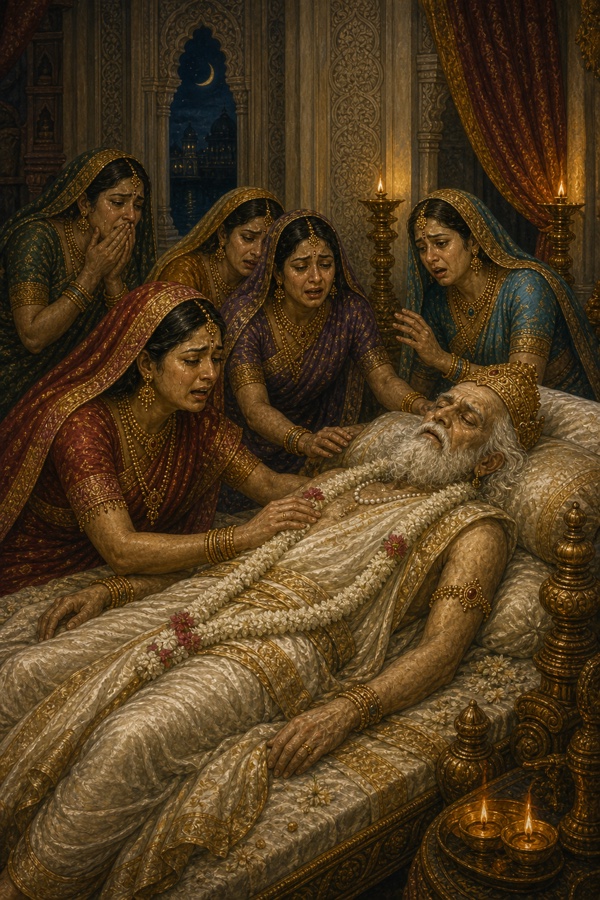
At last the women nearest the couch of the lord of Kosala, the ones whose place was beside the bed and who were neither Kausalya nor the other principal queens, went in to rouse him. They called to him in gentle and polite words. They touched him. And when they laid their hands on the bed with all the reverence and skill their office required, they found no sign of life in the king at all: no throbbing in the chest, no pulse, no stir in any limb. These were women who knew the look of a body in sleep and what it does and does not do, and they began to shake like the tips of reeds standing against a current. The fear they had been carrying all morning, unspoken, now settled into certainty.
Kausalya and Sumitra were still asleep. Grief for their sons had laid them out flat, and they slept as if death itself had come for them too. Kausalya, shorn of her luster and her natural color, bowed down by sorrow even in sleep, did not shine as she used to, any more than a star does when the darkness swallows it. She lay near the king, who was pale now, and her face had lost its light beside his, and so had Sumitra’s, lying next to her, her face still wet from weeping. The attendants looked at the two queens asleep and at the king who would never wake, and they understood: Dasharatha had breathed his last in his sleep. They broke into loud cries, wretched, like the she-elephants of a forest whose herd leader has strayed away and left them. The wailing tore Kausalya and Sumitra out of their sleep. They looked at the king. They touched him. Then, crying “Alas, my lord!” both of them dropped to the ground. Kausalya, daughter of the ruler of Kosala, rolled on the floor and was covered in dust, and she had no more beauty in that moment than a star that has fallen out of the sky; the women watching her thought of the dead wife of a Naga. Then Kaikeyi and all the other wives of the king, scorched with grief, fell senseless too, and their cries joined the cries already filling the palace and swelled them, until the women’s quarters of the king who had met his appointed end were one tumult of alarmed and grieving people, the joy gone out of it in an instant, his consorts clasping his arms and wailing like women with no one left to protect them.
Kausalya’s lament, and the vat of oil
Kausalya looked at the king whose spirit was now in heaven, and what she saw was a fire that had burned all the way out, an ocean with the water gone from it, a sun with no light left. She gathered his head into her lap. Grief had worn her thin in a dozen ways, and her eyes were brimming, and it was to Kaikeyi that she spoke. “Your wish has come true, Kaikeyi. Be satisfied. You are done with the king now, cruel woman, woman of evil conduct, so go and enjoy your kingdom; there is no one left in it to oppose you. Rama has left me and gone to the forest, and my husband has gone to heaven. I cannot go on living, any more than a woman can who has been left without her companions on a dangerous road. What woman, other than Kaikeyi, who has thrown away every piety she ever had, would want to survive the husband who was her god?
“A greedy man never sees his own faults. He is like the man who eats the kimpaka fruit and tastes nothing wrong. The whole line of the Raghus has been destroyed by Kaikeyi at the prompting of that hunchback Manthara. When Janaka hears that the king, driven by Kaikeyi to an act unworthy of him, has sent Rama into exile with Sita, he will burn as I am burning. Rama, my pious son with eyes like lotus petals, has vanished from this place while still alive, and he does not know that today his mother has been made a widow with no one to protect her. Janaka’s daughter, whose only austerity is the service of her exiled husband, who was never made for suffering, will suffer in that forest. When she hears in the night the howling of wild beasts and the birds that scream in the dark, she will cling to Rama in terror. And old Janaka, who has few children, will think and think of Sita until the thinking kills him. As for me, I am my husband’s wife, and I will meet my end this very day. I will take this body of his in my arms and go into the fire with it.”
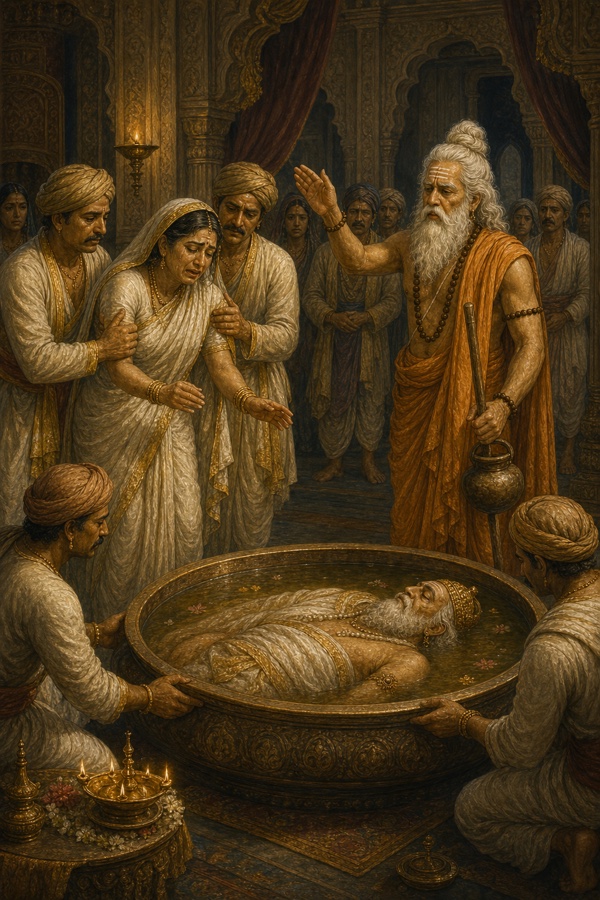
The ministers, the officers charged with the disposal of a king’s remains, came and gently, reverently, drew Kausalya away from the dead man she was holding in her arms. Then, on the command of Vasishtha and the other family priests, they laid the emperor in a trough filled with oil and carried out every rite that the preserving of a body requires. They knew everything there was to know about a king’s funeral, and they knew that it could not be performed without a son present to light the fire; so they did the only thing that could be done, and kept the body safe. When the women of the palace learned that the king had been laid in the vat of oil, they wailed aloud, “Alas, the king is dead!” They threw up their arms; their faces ran with tears like the faces of cliffs run with water. “Why do you abandon us, great king? We had already lost Rama, whose word never fails and who never spoke to anyone except kindly. Forsaken by Rama and now robbed of our husband, how are we to live under the same roof as our co-wife Kaikeyi, whose heart is wicked? That glorious Rama, master of himself, was our protector and our lord, and yours; he let the royal fortune go and went to the forest. Stunned by disaster and treated with contempt by Kaikeyi, how shall we live without you and without that hero? She has thrown away the king, and Rama, and Sita, and the mighty Lakshmana. Whom will she not throw away?”
Bathed in tears and gripped by a grief too large to hold, the lovely wives of the house of Raghu writhed on the ground with every trace of joy gone from them. Ayodhya without the great-hearted king who had ruled it so long had no more shine to it than a night without stars or a woman bereft of her husband. Its men wept openly; its high-born women raised the cry of distress; its crossroads and the doorways of its houses stood empty, and the city that had been beautiful the day before was beautiful no longer. The king had gone to heaven grieving for his son, the queens lay on the floor, and while they lay there the sun ceased to spread its rays and went down all at once, and the darkness came on and it was night. The friends and kinsmen who had gathered would not hear of a cremation with no son in the house, and so, gazing at a king who had taken on a look beyond anything they could comprehend, they left him lying in the trough as if it were his bed. Robbed of Dasharatha, a city whose streets and squares were full of people with their throats choked by tears looked like a sky that has lost the sun, like a night whose whole host of stars has gone out. And in every quarter of it men and women gathered in knots and spoke bitterly of Bharata’s mother, and could find no rest.
“Without a king the realm turns to wilderness” (the sages’ plea)
That night, full of lamentation and empty of joy, crowded with people in tears, seemed to those who lived through it a hundred years long. It ended, as nights do. At sunrise the Brahmins whose office it is to carry on the duties of a king in the interval between kings came together at the court: Markandeya, Maudgalya, Vamadeva, Kashyapa, Katyayana, Gautama, and Jabali, whose fame was very great. They took their seats with the ministers, all of them facing one man, Vasishtha, the arch-priest of the royal house, and one after another they made their speeches. The substance of what they said was this.
“The king has met his end in grief for his sons, and the night that followed weighed on us like a hundred years; it has barely passed. The emperor is in heaven. Rama has made his home in the forest. Lakshmana, for all his strength, has gone with the same Rama. Bharata and Shatrughna, both of them men who can punish an enemy, are far away in the land of Kekaya, in the lovely palace of their maternal grandfather in his capital, Rajagriha. This very day someone of the sons of Dasharatha, some prince of the line of Ikshvaku, must be made king. Without a ruler this kingdom of Kosala may come to ruin.”
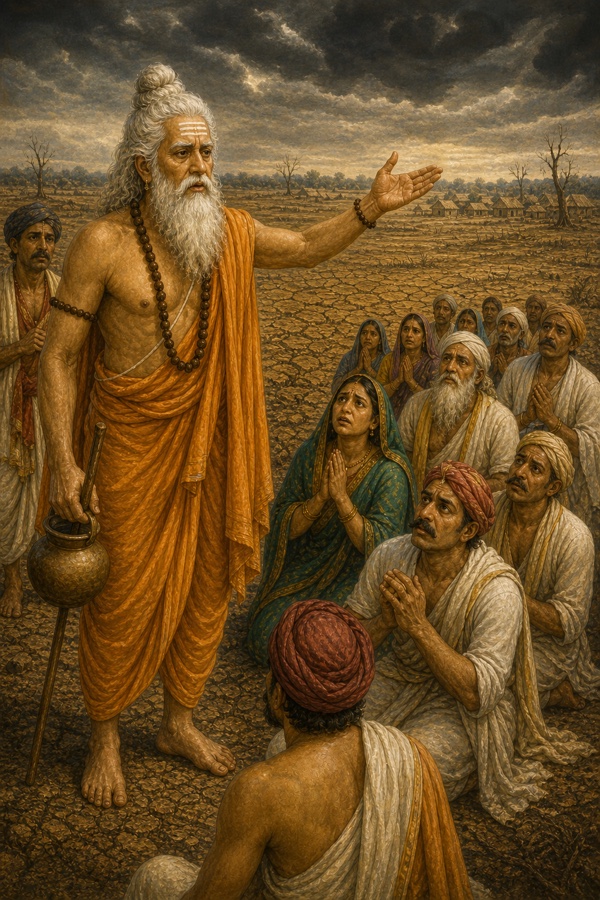
Then they drew, one after another, their many pictures of a land without a king, and there was hardly a corner of the country’s life that the pictures did not touch. In a kingless land the thundering cloud wreathed in lightning does not drench the earth with rain. No one scatters seed by the handful, because no one can be sure of the harvest. A son is no longer under his father’s rule, nor a wife under her husband’s, because there is no authority to enforce right conduct. There is no personal property, since there is no protector, and no faithful wife, since there is no law to check adultery; and where those two things fail, what other kind of truthfulness can survive? Men do not build assembly halls for public gatherings, or plant lovely gardens, or raise sacred houses and rest-houses for travelers, because the enemies of peace and order would only destroy them. The twice-born who live by sacrifice, and the self-controlled Brahmins of austere vows, undertake no sacrifices; and even rich Brahmins do not pay handsome fees to the priests who officiate at great rites, for fear of being marked as rich men and robbed. Festivals in honor of the gods, where actors and dancers show their art in ecstasy, and the convivial gatherings that strengthen a state, do not gather strength. Lawsuits go unsettled, and the lovers of stories lose their storytellers. Girls decked in gold do not go out together to the gardens at dusk to play, for fear of the men who would carry them off. Wealthy farmers and cowherds do not sleep with their doors open. Men in love do not drive out with their women in swift carriages to the pleasure-groves. Sixty-year-old tuskers with bells at their girths do not walk the main roads, for fear of being robbed of their tusks and their bells. The sound of the bowstring plucked by the hand, the sound of Kshatriyas at their practice loosing arrow after arrow, is not heard. Merchants do not travel far in safety with their goods. The ascetic who wanders alone, contemplating the Self and sleeping wherever evening finds him, can no longer wander, because no householder is left to shelter him. Nothing is acquired and nothing is secure; the army cannot beat its enemies in battle. People do not ride out in their ornaments behind spirited horses. Men versed in the scriptures do not meet freely in the groves for their disputations. Flowers, sweetmeats, and fees are not gathered by disciplined men for the worship of the gods. Princes smeared with sandal and aloe paste do not stand out among men the way flowering trees stand out in spring. A state without a ruler is no better than a river without water, a woodland without grass, a herd of cows without a keeper. A standard is what marks a chariot; smoke is what tells you there is fire; and King Dasharatha, who marked us out and made us prominent by the honor he gave us, has passed from the state of men to the state of gods. In a kingless land nothing belongs to anyone, and men eat one another like fish. The unbelievers who broke every boundary the Vedas set, and whom the king’s rod once held down, now lord it over their neighbors, their fear of punishment gone. As the eye guides the body and shows it the path, so the king, the fountain of truth and righteousness, guides the state. The king is truth and the king is dharma; the king is the nobility of a noble house; the king is mother and father and benefactor. Even Yama and Kubera, even Indra and the mighty Varuna, are outstripped by a king of excellent conduct, because he holds in himself the virtues of all four. If there is no king in the world to mark off good from evil, the world becomes a darkness in which nothing can be seen. “Even while the emperor lived,” they said, “we never once overstepped your command, sage Vasishtha, any more than the oceans overstep the shoreline. So look at our conduct, which has always served the king and the good of this state, and look at a state that is turning into a wilderness for want of a king, and consecrate on this throne some prince of the line of Ikshvaku, or anyone else you choose, you whom every Brahmin in this court looks to.”
The messengers set out to summon Bharata
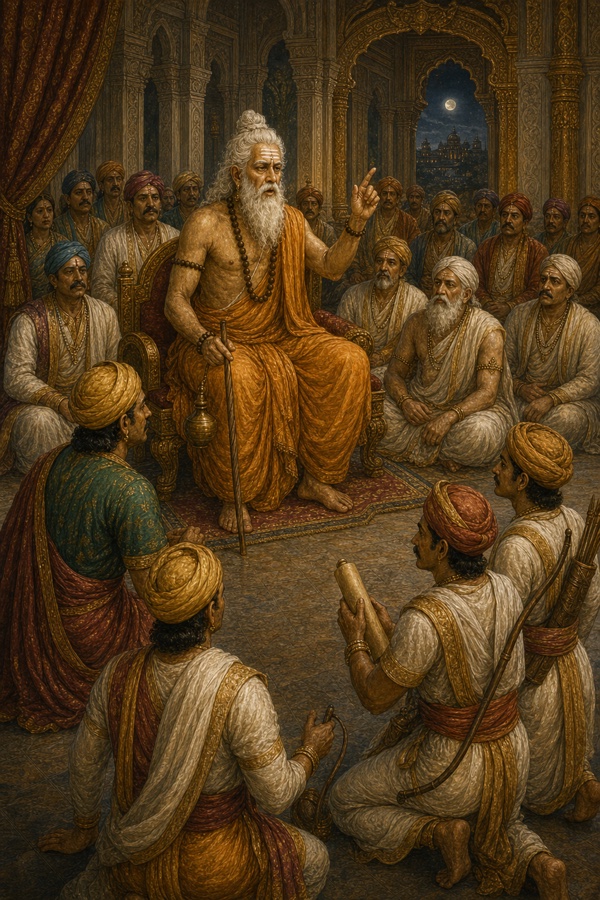
Vasishtha heard them out, and then he addressed the king’s friends, the ministers, and all the Brahmins gathered there. “Bharata, on whom the emperor bestowed the kingship at Kaikeyi’s urging, is living a most happy and carefree life at his maternal uncle’s house with his younger brother Shatrughna. Let swift messengers ride out on fast horses and bring the two brave young princes home without a day lost. What else is there for us to consider?” Every voice in the court answered him: “Let the messengers go.” Then Vasishtha called for five men by name, Siddhartha, Vijaya, Jayanta, Ashoka, and Nandana, and when they stood before him he gave them their orders.
“Hear what you have to do; I speak to you all. Reach the city of Rajagriha quickly, on horses that gallop, and shake off your grief before you get there. Speak to Bharata under my orders, and say this: ‘The family priest and all the counselors send word that all is well. Set out at once; there is a matter that will bear no delay.’ When you are there you are to tell him nothing of Rama’s going to the forest, nothing of his father’s death, nothing of the ruin that has come upon the house of Raghu. Take with you silken robes and fine ornaments for the king of Kekaya and for Bharata, presents from the king of Ayodhya, and go now.” The messengers were furnished with the means to buy provisions on the road and given horses prized for their speed. They went first to their own houses to take leave of their families, and then, with every preparation finished and Vasishtha’s permission given, they rode out of Ayodhya in haste.
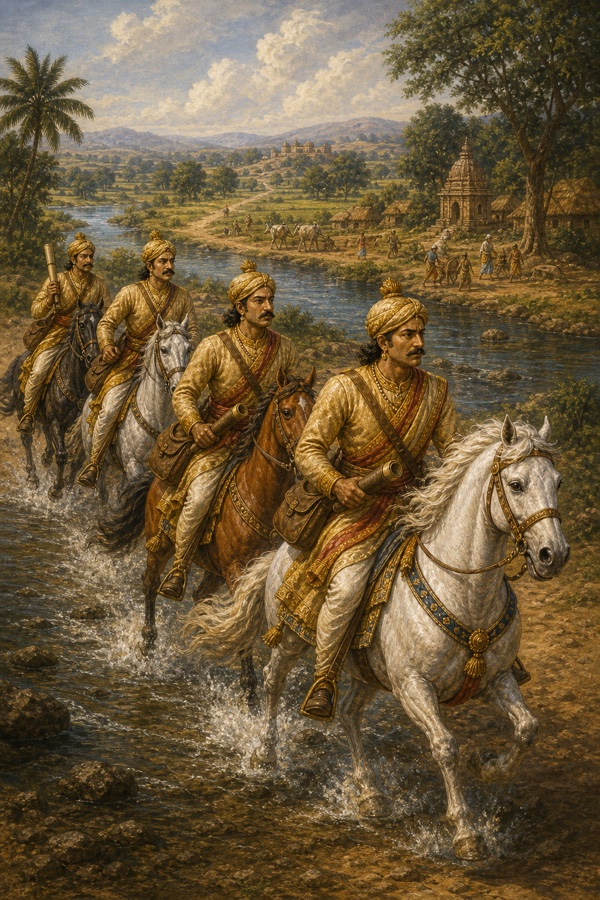
They took the road that touches the river Malini, which flows between the southern end of the Aparatala range and the northern end of Pralamba. At Hastinapura they crossed the Ganga and turned west, and by way of the middle of Kurujangala they came into the country of Panchala, riding hard because of the urgency of their errand, taking in as they passed the lakes bright with open lotuses and the rivers running clear. They reached the bank of the Sharadanda, a lovely river, full of translucent water and loud with birds of many kinds, and crossed it at speed. On its western bank stood a holy tree, the home of some divinity, called Satyopayachana because a prayer addressed to it never went unanswered; they went around it clockwise, as one does to anything worthy of respect, and entered the city of Kulinga. Coming out of the village of Tejobhibhavana they reached the village of Abhikala and crossed the holy Ikshumati, a river bound up with the memory of the dead emperor’s father and grandfather. They passed Brahmins who had mastered the Vedas and lived on nothing more than the water they could hold in their cupped hands, and came through the middle of the Bahlika country to the mountain Sudama. On its summit they saw the place that bears the footprint of Vishnu; they saw the rivers Vipasha, which the country now calls the Beas, and Shalmali and others, great wells with stairs cut down to the water, ponds and pools and lakes, and lions and tigers and deer and elephants of many kinds; and they kept to a broad highway, driven by the wish to carry out their master’s command. Their horses were spent, yet by that long and peaceful road they came in good time to Girivraja, the chief city of the Kekayas and the seat of their king, the capital the court of Ayodhya knew as Rajagriha. For the pleasure of their master Vasishtha, for the protection of the people, and to keep the honor of their king’s house whole, the messengers rode respectfully and swiftly into the city that same night.
Bharata’s ominous dream
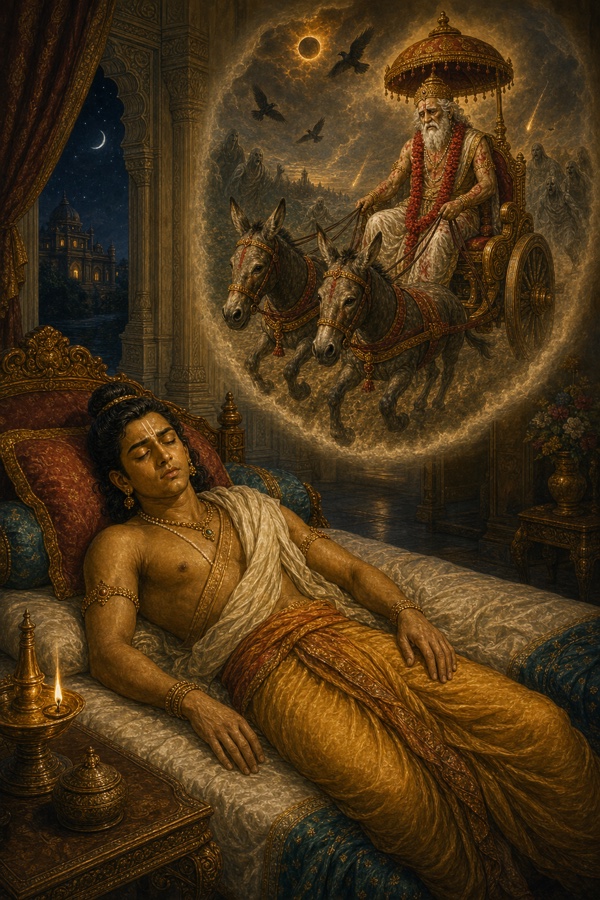
On the very night the messengers rode into Girivraja, Bharata, far from everything that had happened in Ayodhya and knowing none of it, dreamed, and the dream was an evil one. It came in the last hour before dawn, when the night was nearly spent. The son of the king of kings woke from it deeply shaken and could not shake it off. His friends, who never spoke to him except kindly, saw how low he was and set about lifting him. They gathered around him in the assembly and chattered in a knot to draw him out of it; some played on instruments, some danced gently to voice and string, some read out to him plays whose whole point was laughter. Bharata of the house of Raghu, whose soul was large, sat among those fond companions and their assembly jokes and took no pleasure in any of it.
One of his dearest friends, sitting close, finally asked him. “Friend, why do you not share our happiness, here in the middle of your friends?” Bharata answered him. “Hear the reason this heaviness has come over me. In a dream I saw my father dejected, his hair loose about him, falling from the peak of a mountain into a filthy pool full of cow dung. I saw him floating in that pool, drinking oil out of his cupped hands, and laughing, it seemed, again and again. Then he ate rice cooked with sesame, and with every limb smeared in sesame oil he plunged headfirst into the oil, again and again. In the same dream I saw the sea dried up and the moon fallen to the earth. I saw the whole world overrun by demons and wrapped in a darkness that lay on it like a cloth. I saw a tusk of the king’s own elephant broken to pieces, and blazing fires that went out all at once. The earth split open, the trees withered where they stood, and the mountains, giving off smoke, came down. Women dark and reddish brown, dressed in black, struck at the king as he sat on an iron seat. A young demoness with a hideous face, dressed in crimson, mocked the king and dragged him along the ground.
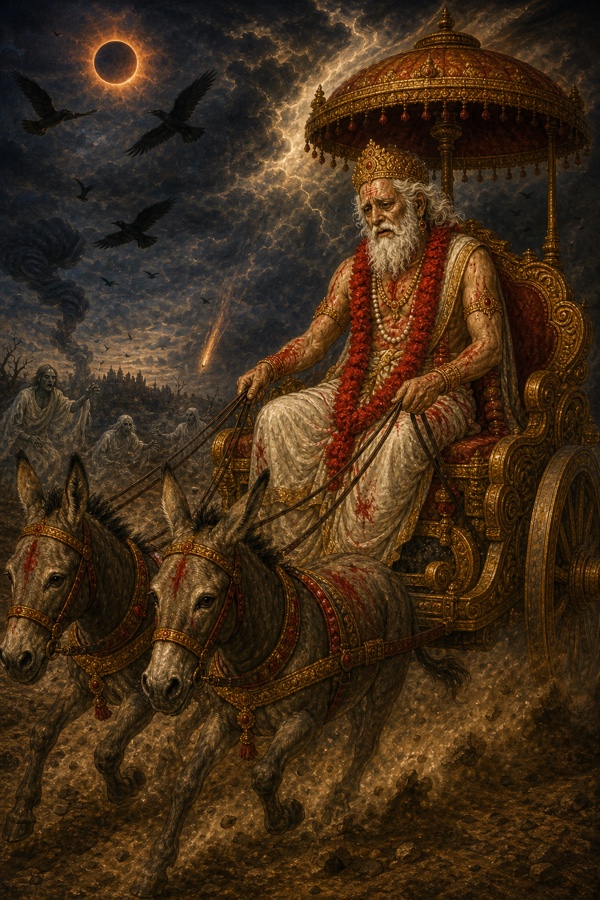
“Then the righteous king, wearing a garland of red flowers and smeared with red sandal paste, sped away toward the south on a chariot drawn by donkeys. That is what I saw in the night that has just passed, and it frightened me. I take it to mean that one of us is going to die: I, or Rama, or the king, or Lakshmana. A man who rides in a dream on a chariot drawn by donkeys is a man on whose funeral pyre a column of smoke will soon be seen. This is why I am cast down, and why I cannot honor what you say to me. My throat feels parched. My mind is not at ease. I see no ground for fear anywhere, and still I am afraid. My voice has gone hoarse, the light has gone out of my skin, and I have begun to loathe myself without being able to say why. When I think over the course of that dream, which took so many shapes, none of which I had ever imagined before, and when I think of the king, whom I now find I cannot picture ever seeing again, this great fear takes hold of my heart and will not go.”
The messengers’ message, and Bharata’s farewell
Bharata was still telling his friends the dream when the messengers came in, men under orders to say nothing of what they knew. Their horses were spent; they had ridden into the lovely city of Rajagriha, ringed by a moat no enemy could cross, at the end of a long road. They were received by the king of Kekaya and by the crown prince and treated with honor, and then, as men do who are greeting the prince who will one day be their king, they touched Bharata’s feet and spoke. “The priest Vasishtha and all the counselors send word that all is well. Set out at once; there is a matter with you that will bear no delay. And accept from us these costly robes and jewels, large-eyed prince, and have them presented to your grandfather and your uncle. Of what we have brought, goods worth twenty crores are for the king, your grandfather, and a full ten crores’ worth for your uncle.”
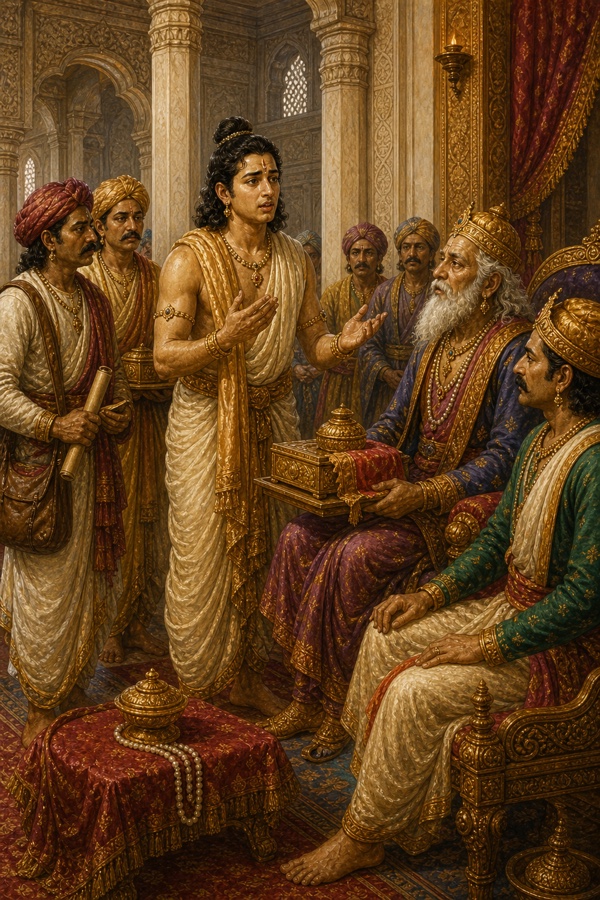
Bharata, who loved his own people, accepted all of it and had it given, on his father’s behalf, to his grandfather and his uncle. He saw to it that the messengers were fed and given the food and drink they most wanted after such a road, and then he asked them the questions that had been waiting in him since the dream. “Is my father, King Dasharatha, well? Are Rama and Lakshmana, that noble heart, in health? Is the noble Kausalya, the mother of the wise Rama, who is devoted to dharma, who knows what is right and speaks it, free of illness? And my middle mother, Sumitra, who knows what is right, the mother of Lakshmana and of brave Shatrughna, who rides here at my side, is she also well? And my own mother, Kaikeyi, who always goes after her own ends, who is violent and quick to anger and accounts herself wise, is she in good health too, and what message has she sent for me?”
The messengers answered him with the greatest respect. “All those whose welfare you ask after are well, prince; you may set your heart at rest. The goddess of fortune herself, the lotus in her hand, looks on you with favor. So let your chariot be made ready.” Bharata said to them, “I will ask leave of the king my grandfather, and I will tell him it is you who are hurrying me.” Then he went to his grandfather. “Urged on by the messengers, Your Majesty, I am going to my father’s presence. Whenever you remember me, I will come again.” The old king drew Bharata’s head to him and smelled it, the way a man of that house shows love to a child of it, and gave him his blessing. “Go, my son. I give you leave. Kaikeyi is blessed to have such a son. Carry our greetings to your mother and to your father on my behalf, and to the priest Vasishtha and whatever other Brahmins of note sit in your father’s council, and to those two great archers, your brothers Rama and Lakshmana.”
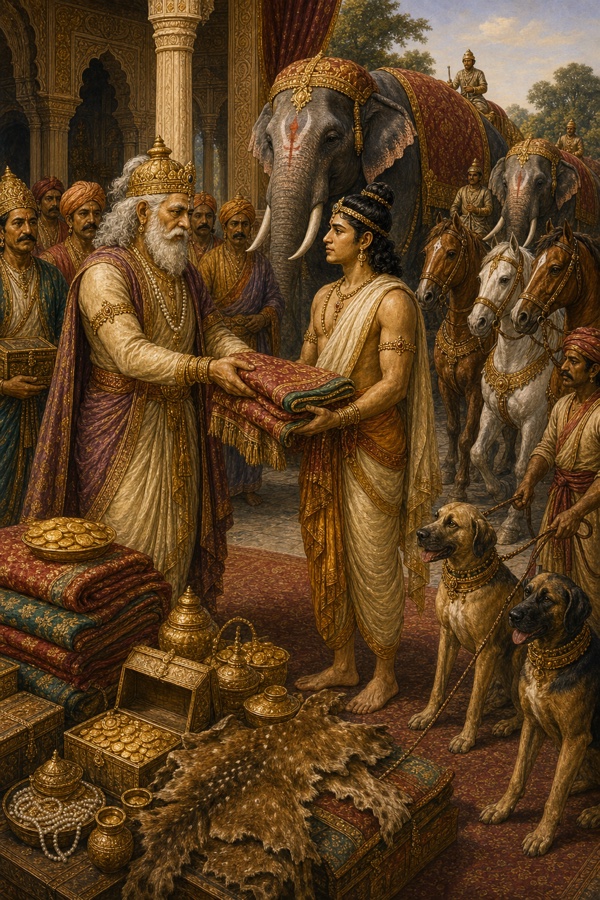
Then the king of Kekaya honored his grandson with gifts: the finest of elephants, blankets of many colors, deerskins, and riches in vessels of gold. He gave him dogs, huge dogs with great teeth, raised with care in the women’s quarters of the palace, that could match a tiger for strength and daring. Receiving him kindly, the king of the Kekayas gave the son of Kaikeyi two thousand gold coins and sixteen hundred horses, and sent with him, as an escort, ministers of his own whom he valued and trusted. His uncle Yudhajit gave him elephants of the Airavata breed and elephants born in the country of Indrashira, splendid to look at, and swift, well-trained donkeys. Bharata, in his hurry to be gone, had no pleasure in any of that wealth. A great anxiety had lodged in his heart, and it had two roots: the haste of the messengers, and the dream. He went back to his own quarters and came out again onto the main road, which was thronged with men and elephants and horses, and passed on through the unrivaled women’s apartments with no one to challenge him. He took leave of his grandfather and his grandmother, of his uncle Yudhajit and his aunt, and mounted his chariot with Shatrughna beside him. Behind them the servants of Ashvapati followed with more than a hundred wheeled chariots drawn by camels, oxen, horses, and donkeys. Guarded by a detachment his grandfather had sent, with ministers who had no equals except one another, taking Shatrughna with him, Bharata, whom no enemy troubled and whose steadiness was great, left the house of Kekaya as a perfected being leaves the realm of Indra.
Entering an empty Ayodhya
He went out of Rajagriha facing east. He surveyed and crossed the well-known river Sudama and then the broad Hradini, and after them the Shatadru, which the country now calls the Sutlej, whose stream runs to the west. At the village of Ailadhana he crossed another river, came into the territory of Aparaparvata, and crossed a river that turned to stone whatever was thrown into it, and so reached the tract to the southeast that is called Shalyakarshana, after the thorn-drawing herb that grows there. He looked out over the Shilavaha, the river that carries rocks along in its current, bathed in it and was made clean, and then, true to his promise, crossed the Mahashaila hills toward the forest of Chaitraratha. He came to the place where the Sarasvati, flowing west, meets a branch of the Ganga, passed through the northern part of the Viramatsya country, and entered the forest of Bharunda. He crossed the Kulinga, a swift and thundering river hemmed in by mountains, and when he reached the Yamuna he let the detachment rest at last. The horses were bathed to cool their limbs and fed and rested in the shade; he bathed himself, drank, took water for the road ahead, and moved on. Before he ever left Kekaya the rites for a safe journey had been performed over him, and now that fine prince in his fine chariot swept through the great untraveled forest that lay across his way as the wind sweeps through the sky.
At the village of Anshudhana he found the Bhagirathi, the great Ganga that Bhagiratha had brought down to earth, too hard to cross, and so he went on quickly to the well-known town of Pragvata, where it could be crossed with ease, and took his men over there. Beyond it he crossed the Kutikoshtika river with the detachment and came to the village of Dharmavardhana; he passed through the southern half of Torana to Jambuprastha and on to the lovely village of Varutha, and spent the night in a pleasant grove beside it. From there he drove east to the garden of Ujjihana, where the kadamba trees grow in a cluster, and there, since he was now inside his own country, he had swifter horses yoked to the chariot, gave the army leave to follow at its own pace, and pushed on fast. He halted for the night at Sarvatirtha; in the morning he forded the Uttanika and other streams on the backs of mountain ponies, and, reaching the village of Hastiprishthaka, crossed the Kutika, and at the village of Lohitya the Kapivati. At Ekasala he crossed the Sthanumati and at Vinata the Gomati, and came to a grove of sal trees at Kalinganagara. He drove on through that grove in the dark, his horses at the end of their strength, and at dawn, with seven nights spent on the road, Bharata saw before him the city of Ayodhya, the city Vaivasvata Manu founded at the head of his line, the city in which Bharata himself had been born. The messengers had come to him by a shorter and rougher road through the forests; Bharata, with an army behind him, had taken the broader and longer one, and it had cost him a full week.
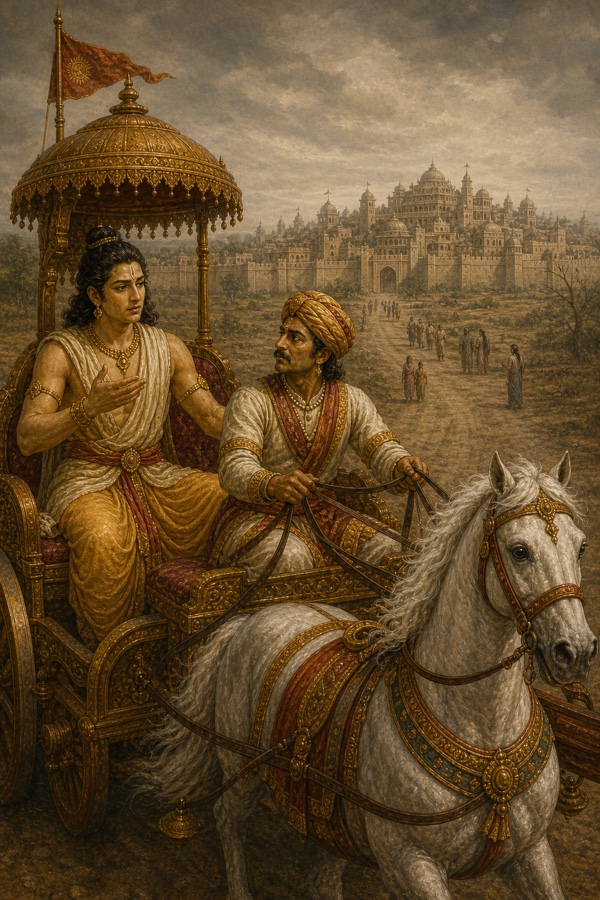
He looked at Ayodhya ahead of him, and he spoke to his charioteer. “This glorious city with its holy gardens does not look to me the way it should. Charioteer, Ayodhya from here looks pale, the color of dry white clay. This is the city that was full of Brahmins given to sacrifice, learned in the Vedas and rich in every virtue, and full of wealthy men, and guarded by a king who was a sage among kings; from a distance it looks like a heap of white earth. There used to be a great confused noise of men and women rising from it on every side, and today I cannot hear it. The gardens used to be bright with people running in and out of them, people who went in at dusk and played all night and came out in the morning; today they look otherwise, as if their lovers had abandoned them, and they seem to weep. The city looks to me like a piece of woodland. I see no men of rank going out or coming in, in carriages, on elephants, on horseback, as they always did. Those gardens were once full of joy and delight and made for lovers’ meetings; today I see them stripped of joy, their trees dropping leaves along the paths like tears, crying out. Not even now, at sunrise, do I hear the cries of the deer and the birds in their season, that sweet, impassioned, tangled sound. Why does the pure and lovely breeze, laden with sandal and aloe and thick with the smoke of incense, not blow today as it always did? Why has the sound of kettledrum and clay drum and vina, struck with stick and palm and finger, which never stopped, stopped? I see unwelcome and ugly omens of every kind, and my mind is sinking under them. Charioteer, the welfare of my kinsmen is hard to hope for. Even where there is no cause I can name, my heart is going down.”
Dejected, weary at heart, frightened, his senses in disorder, Bharata drove quickly into the city that the line of Ikshvaku had guarded for so long. His horses were exhausted, and so he entered by the western gate, the one called Vaijayanta. The gatekeepers rose and ushered him in with shouts of victory, and he sent them back to their posts with honor. Then, troubled to the core, he spoke to the tired charioteer, the man of King Ashvapati’s household who had driven him all this way. “Why was I brought here in such haste, with no reason given, sinless man? My heart forebodes some evil and my composure is going from me. I have heard men speak of the signs that foretell the death of kings, and I see every one of them here today. I see the houses of the householders unswept, gray with dirt, stripped of every grace, their doors standing open. No offerings have been set out in them for the creatures; there is no scent of incense from them; the families inside have not eaten for days and the faces are pale. The temples have no garlands hanging on their gates, their courtyards have not been swept in days, and no one is in them; the images of the gods and the halls of sacrifice stand abandoned. The flower shops have no bright wares in the front of them. The merchants are afraid, and their trade has stopped, and they have none of their old cheer. Even the birds and the animals in the temples and the holy places look forlorn. And the people, men and women, I see in soiled clothes, wretched, worried, thin, longing for something, with tears standing in their eyes.” Having said all this to the charioteer, Bharata, with a heavy heart, drove on toward the royal palace. He looked at the city that had once shone like Amaravati, Indra’s capital in heaven, and saw its crossroads and houses and lanes deserted and its doors and their bolts gray with dust, and sorrow filled him to the brim. Seeing things that hurt him to look at, things that had never before happened in his city, the prince, whose large heart had never yet been asked to carry anything like this, went cheerless and heavy-hearted, with his head hanging, into his father’s house.
Kaikeyi’s terrible news
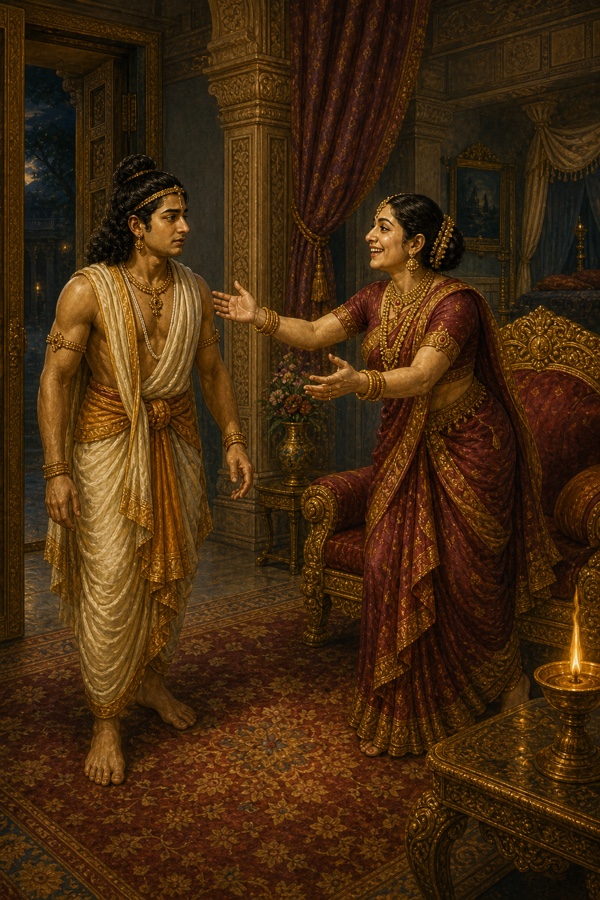
His father was not in his apartments, and the silence there told him nothing. Bharata went on to his mother’s palace to find her. Kaikeyi saw her son come in after so long away, and in her delight she sprang up from her seat of gold. Bharata, whose mind was set on what is right, looked at that house of his mother’s, stripped now of every grace, and sat down and clasped her feet, which to him were blessed. She drew his head to her and smelled it, embraced him, set him on her lap, and began, quite calmly, to question him. “How many nights is it since you left your grandfather’s house? You came fast by chariot; did the road not tire you? Are your grandfather and your uncle Yudhajit in good health? Has everything gone well with you since you left home? Tell me everything, my son.”
Bharata, the lotus-eyed prince, told his mother all his news. “This is the seventh night since I left my grandfather’s house. My grandfather and my uncle Yudhajit are both well. The animals carrying the wealth and jewels that King Ashvapati gave me grew tired on the road, and so I came on ahead of them. The messengers who brought the king’s word pressed me to hurry, and I came straight on. Now, mother, be good enough to tell me what I want to know. This couch of yours, inlaid with gold, that the king used to grace whenever he chose, is empty. These servants of the house of Ikshvaku do not look happy to me either. The king was mostly to be found here, in your rooms. I came here longing to see him, and I do not see him. I want to clasp my father’s feet; tell me where he is, since I ask you. Is he in the palace of Kausalya, the eldest of my mothers?”
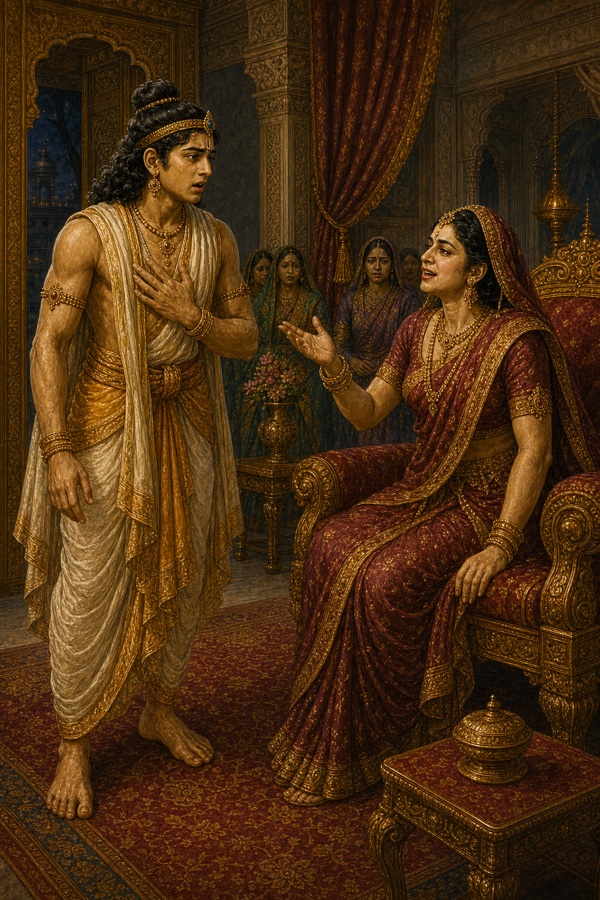
Kaikeyi knew every detail of what had happened. Bharata knew nothing. And Kaikeyi, blinded by her hunger for the throne, told her unknowing son the whole terrible, unwelcome thing in the voice of a woman with good news to share. “Your father, that great-hearted and glorious king, who was given to sacrifice and was the refuge of the good, has gone the way that is the destined end of every creature that lives.” The guileless Bharata, who came of a house that lived by dharma, heard it and dropped to the floor as though struck, crushed by grief for his father. He cried out in a piteous voice, “Alas, I am destroyed!” and beat his long arms on the ground and lay there prostrate. Then, wrapped in grief, his mind confused and driven to and fro, that prince of great splendor began to lament. “This couch of my father’s used to look so lovely, like a clear autumn night sky with the moon in it. With that wise king gone from it, it has no beauty now; it is a sky without a moon, a sea whose water has been dried up by the fire that ends the world.” The tears came with a sound of anguish from his throat, and he covered his lovely face with his robe, and the young prince, a conqueror born, went on weeping.
His mother looked at her son lying on the ground in that wretched state, a son who shone like a god, who was like the young of an elephant, who could stand comparison with the sun and the moon at once, fallen like a bough of sal cut from its tree by an axe in the forest, and she lifted him up and spoke. “Get up, king! Rise, my glorious son! Why are you lying here on the ground? Good men like you, honored in every assembly, do not grieve this way. Your mind, my clever son, is given to charity and sacrifice and to right conduct; it follows the Vedas and inclines to austerity, and it is as steady as the light that lives in the orb of the sun.” Bharata wept for a long time and rolled on the floor, and at last, out of griefs too many to number, he answered her. “I came to the conclusion that the king was going to install Rama as regent, or perform a sacrifice, and it was in that gladness that I made the journey. It has all turned out otherwise, and my mind is torn in two, because I do not see my father, who was always intent on what was kind and good for me. Mother, of what illness did the king die, while I was away and had not yet come home? Blessed are Rama and the rest of them, who cremated our father with their own hands. Surely the glorious king did not know that I had arrived. He would have bent me down and smelled my head in a moment if he had known. Where is that hand of my father’s, so pleasant to the touch, the hand of a man who did great things without effort, that used to wipe me clean again and again whenever he found me covered in dust? Send word of me at once to Rama, who never tires in action, who is my elder brother and, now that the king is gone, my father, and my friend, all in one, whose devoted servant I am. To a worthy man who knows what is right, an elder brother is a father. I will clasp his feet; he is my refuge now. What did the king my father, of firm resolve and unfailing courage, who knew dharma and lived by it and was so greatly fortunate, say to my elder brother at the very last? I want to hear his last kind message for me.”
Kaikeyi told him, and in this at least she kept strictly to the facts. “That great-hearted king, the wisest of men, went to the other world crying out, ‘Alas Rama, alas Sita, alas Lakshmana!’ Bound by the law of Time, as a great elephant is bound with ropes, your father spoke these parting words: ‘Only those men will have their wish who live to see Rama come back with Sita, and Lakshmana, strong of arm, come home to Ayodhya.’” The prince heard this second piece of bitter news and sank lower still. With a face gone dark, he asked his mother, “Where is Rama now, whose mind is given to dharma, who is the joy of Kausalya, with his brother Lakshmana and with Sita?” And she told him that unwelcome thing too, along with the news of his father’s death, in the same tone of announcing something good. “Dressed in the bark of trees, my son, and followed by Lakshmana, that prince has gone with Sita, the princess of Videha, to the great forest of Dandaka.”
A doubt came into Bharata then, a fear about his brother’s conduct, because he could think of no other reason for such a sentence; and he remembered the greatness of his house, and he began to question her. “I hope Rama did not seize the property of some Brahmin. I am sure he did not kill any innocent man, rich or poor. Surely the prince did not desire another man’s wife. If none of that is so, then why was my brother sent into exile in the Dandaka forest?” His mother, prompted by that frivolous streak in her nature which was too well known, set out to tell him her own doing exactly as it was; and she told it, this woman who thought herself so wise, with real cheerfulness. “Rama seized no property of any Brahmin or anyone else. He killed no innocent man, rich or poor. He never so much as looked at another man’s wife, even with an innocent eye. My son, the moment I heard that Rama was to be installed as regent, I asked your father for the sovereignty of Ayodhya for you, and for the banishment of Rama. Your father, faithful to his own truthful nature, did exactly as I asked. Rama was sent into exile with Sita and with Lakshmana. Missing his beloved son, worn down by grief at the parting, the glorious king met his end. Now accept the throne, you who know what is right. All of this I arranged for your sake. Do not give way to grief or remorse, my dear son; be firm. This city and this kingdom, free of every thorn, depend on you. So go quickly, with Vasishtha and the other chief Brahmins who know the rites, and perform your father’s funeral with all due ceremony, and then, with your spirits undimmed, have yourself consecrated as ruler of the whole earth.”
Bharata’s first rebuke, and his vow
So Bharata learned in one sitting that his father was dead and his two brothers exiled, and the pain of it scorched him, and out of that pain he spoke. “What is a kingdom to me now, a wretched man robbed of his father and of a brother who was as good as a father, and grieving for both? You have turned the king into a departed spirit and Rama into an ascetic, and heaped calamity on calamity; you have rubbed salt into my wound. You came into my father’s house like the Night of Dissolution itself, to wipe out my whole line. My father clasped a live coal to his chest and never knew what it was. You killed him, you who see evil where there is none, you disgrace to your family; through your delusion the joy has gone out of this house. My glorious father, true to his word, had you for a wife, and he died of the agony of being parted from his eldest son. Why was the emperor, my father, who loved his duty so, robbed of his life by you? For what exact reason was Rama sent away, and why did he go to the forest? Kausalya and Sumitra, who had you for a co-wife, are eaten up with grief for their sons; it will be a hard thing if they live. And my elder brother, whose mind is given to dharma, who knows how to serve his elders, served you as he served his own mother! My eldest mother Kausalya, who sees far, treated you as her own sister, as right conduct required.
“You dressed her son, that great soul, in rags and bark and sent him into exile in a forest, and you feel no grief, you sinful woman? You sent that glorious hero away in bark, a man who never saw sin in anyone and had mastered himself; what did you think you would gain by it? You are so full of greed for power that you have never known who I really am, or how devoted I am to Rama. That is why you played out this whole tragedy for the sake of a throne. If I cannot see Rama and Lakshmana, the two men on whose strength this house has always stood, by what strength am I supposed to protect this kingdom? Even the emperor, whose mind was given to dharma, leaned always on the might of the powerful Rama, as Mount Meru leans for its protection on the forest that grows over it. How, and with what strength, shall I, whose only strength is Rama, carry the burden of kingship, when a calf cannot stand under a load that a great bull carries with ease? And even if some contrivance or some cleverness could bring such strength out in me, I will never let you have what you want, you who covet the throne for your son. I would feel no reluctance at all in casting you off, woman of sinful resolve, if Rama did not always look on you as a mother. How did this idea, of stripping the eldest of his right and giving the kingdom to a younger brother, an idea that plans evil for others and that our forefathers condemned in the harshest terms, ever enter your mind, you who have fallen from all good conduct? In this house the eldest of all the brothers is consecrated king. The other brothers obey him with devotion. I do not believe you have any respect for the moral code of kings, cruel woman, or any knowledge of the eternal way that kings live by. Among the sons of a king the eldest alone is crowned, always. That is the rule for all kings, and among the Ikshvakus above all. The pride of character that those kings held to, guarded by their righteousness alone and made beautiful by a way of life that fitted their race, has vanished today because of you. How did this perversity of reason, so contemptible in you, ever appear in a lady so greatly blessed, born of a line of kings? I will not do what you want, woman of sinful resolve; the calamity you have set in motion may yet prove fatal to me. And to spite you, I will go now and bring my sinless elder brother, whom his people love, home from the forest. And when I have brought Rama back, I will settle down with a quiet mind and be the servant of that prince whose glory blazes.” Having said all this to his mother, driving each piercing word into her, Bharata, great of heart and torn by grief, roared once more like a lion in a cave of Mount Mandara.
The tale of Surabhi, and Bharata’s swoon
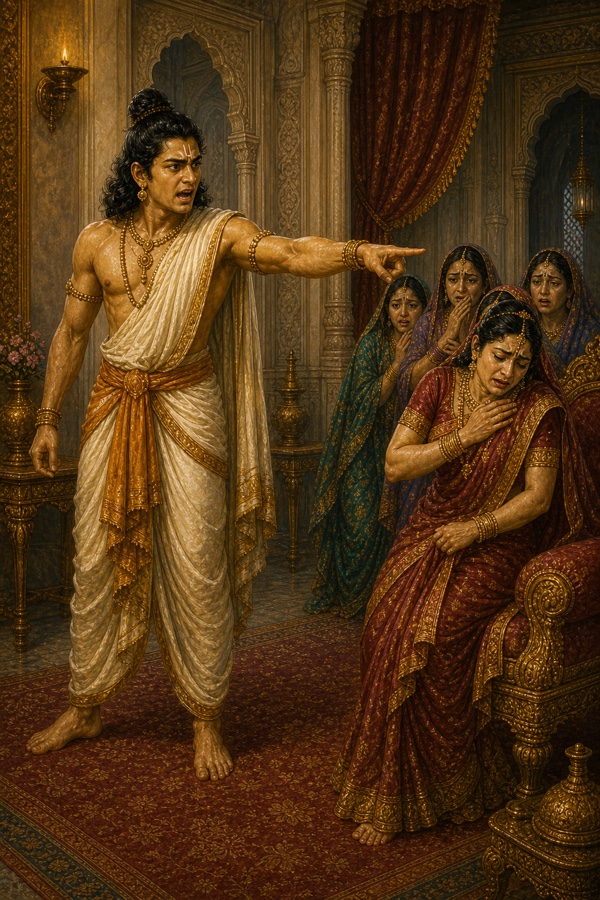
He had rebuked her, and the rage in him was still rising, and he was not finished. “Fall from your kingdom, Kaikeyi, cruel woman of vicious conduct! Dharma has cast you off; go on wailing for the rest of your life, and count me among the dead. What did Rama ever do to you, or the king, who was piety itself, that his death and Rama’s banishment should both come at one stroke, because of you? By destroying this house you have taken on the guilt of killing a Brahmin at his Vedic study. Go to hell for it, Kaikeyi, and not to the heaven where my father is. You have committed a monstrous sin by a monstrous act: you have taken the life of a pious husband and driven a loving, righteous son into exile, and by banishing the man the whole world loves you have brought the danger of being disowned by him down on me as well. Because of you my father is dead. Because of you Rama is in the forest. Because of you I have become a disgrace in the world of the living. I ought not even to be speaking to you, cruel woman of evil conduct, greedy for a throne, who have killed your own husband and are my enemy in the shape of a mother. Kausalya and Sumitra and my other mothers got you for a co-wife, you stain on your family, and it has filled them with agony. You are no daughter of the wise and righteous King Ashvapati. You are a demoness sprung from his loins to bring my father’s house to ruin.
“You sent the righteous hero Rama, who is given to truth, into the forest, and my father went to heaven because of you; and the sin that is chiefly yours has fallen on me, who am left without a father, abandoned by both my brothers, and hated by the whole world. You have made Kausalya, who is wedded to dharma, desolate; what world will you reach after death except hell, woman of sinful resolve? Did you not know, cruel woman, that Rama, born of Kausalya’s own womb, is my eldest brother, and therefore as good as my father, a man in full command of himself, the refuge of all his kin? A son is born of every limb of his father and out of the very heart of his mother, and that is why a son is dearer to a mother than anyone alive, and her other relations are merely dear.” And then Bharata told his mother an old story. “Once, long ago, so the tradition runs, Surabhi, the cow of plenty, who knows what is right and whom the gods themselves honor, saw two bullocks, her own sons, fallen senseless on the ground while they were pulling the plow. She looked down at her two sons lying on the earth, worn out with toiling through half the day, and she wept for them, her eyes blinded with tears. Her teardrops, which smelled sweet, fell on the body of Indra himself, king of the gods, who happened to be passing below. Indra looked up and saw Surabhi standing in the sky, wretched, weeping, in a misery beyond bearing. It troubled him to see that glorious cow, mother of the cattle of the world, in such agony, and the god who carries the thunderbolt joined his palms and asked her, ‘I hope no great danger threatens us from any quarter. Tell me, well-wisher of all the world, what is the cause of your grief?’ And Surabhi, who is wise and knows how to speak, answered him, ‘Heaven forbid. No danger threatens you from anywhere, ruler of the immortals. I am grieving for two of my own children, a pair of bullocks fallen into misery, thin and wretched, scorched by the sun, and on top of it all being beaten by an evil-minded farmer. They came out of my own body, and I see them in pain, crushed under a load, and it tears at me. There is nothing so dear to a mother as a son.’
“When Indra saw Surabhi weeping, Surabhi whose countless offspring fill the whole creation, he understood that nothing is dearer to a mother than a son; and feeling those sweet-scented tears fall on his own body, the powerful god knew her for the greatest being in this world. If even the cow of plenty, whose kindness to the world has no equal, who sustains all creatures and grants the wish of everyone who comes to her, who is first in truthfulness and has offspring beyond counting, grieves like that for two of them out of the plain love of a mother, then how is Kausalya to go on living without Rama, who has only the one son? You have taken that one son from a saintly woman who had no other. For that you will suffer, without end, in this world and after it. As for me, I will pay the whole of my debt to my elder brother by bringing him home from the forest and giving him back what is his, and the whole of my debt to my father by performing every one of his funeral rites, and I will raise the fame of both of them; of that there is no doubt. When I have brought the long-armed and mighty lord of Kosala back to Ayodhya, I will go myself, in his place, to the forest where the hermits live, and so save him from the sin of a broken vow. With the townspeople looking on, their throats full of tears, I cannot carry the weight of what you have done, wicked woman of sinful resolve, sending the eldest into exile to get the kingdom for a younger son. You did this with your eyes open. Now go into the fire, or go yourself to the Dandaka forest, or tie a rope around your neck; there is no other road left to you. And I will be clean of this stain and have done what I was born to do only when Rama, whose valor never fails, has come home to his own land.” He finished, hissing like a serpent in his fury, and then he went down, senseless, to the ground, like a wild elephant in the forest that has been struck with a javelin and driven with a goad. His eyes were deep red, his garment had come loose, every jewel on him was flung about, and the prince, before whom enemies had always given way, lay on the earth like the banner raised in Indra’s honor and pulled down when the festival is over.
The oaths before Kausalya
It was a long time before he came back to himself. When he did, the brave prince got to his feet, and he looked once at his mother, who stood there wretched at the turn everything had taken, her eyes full of tears, and then he turned to the ministers who had gathered when they heard he was home, and in front of all of them he reproached her again. “I never wanted the kingdom. I never took counsel with my mother about it. I did not even know of the consecration the king had planned for Rama; I was in a far country with Shatrughna. I knew nothing of Rama’s living in the forest, nothing of how Lakshmana and Sita came to be banished.”
His voice carried. In another part of the palace Kausalya recognized it and said to Sumitra, “Bharata has come, the son of Kaikeyi of the cruel deeds. I want to see him; he is a man who sees far.” Pale, thin, her mind wandering, trembling as she walked, she set off toward the place where Bharata was. Bharata, with Shatrughna, had already started for Kausalya’s apartments by the other road. They found her on the way, fallen senseless with grief, and the two brothers, who were grieving themselves, put their arms around her. She held them in return, both of them weeping, and then that noble, high-minded woman, in the worst of her distress, spoke to Bharata. “You wanted the kingdom, and here it is, a kingdom with no enemies left in it. Kaikeyi got it for you quickly enough, by one cruel act. What good did that cruel-eyed woman think she would get by dressing my son in bark and sending him to the forest as an ascetic? Let Kaikeyi send me away too, and soon, to wherever my glorious son with the golden navel is living. Or I will go myself, with the sacred fire carried before me and Sumitra beside me, gladly, along the road Rama took into the forest. Or take me there yourself, now, to the place where my son, the noblest man I have ever known, is doing his austerities. This wide kingdom, overflowing with wealth and grain, full of elephants and horses and chariots, has been handed to you by her, your mother.”
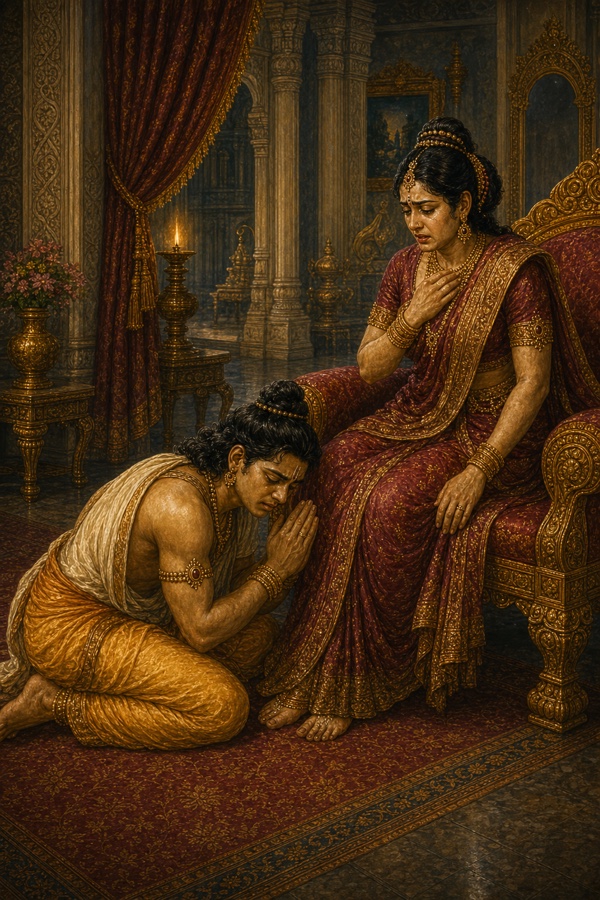
The cruel words went into Bharata, who had done no wrong at all, like a needle into an open wound, and his mind gave way under them; he fell at her feet, and lay there half-conscious, and lamented in many ways before he came back to himself. Then, with his palms joined, he answered Kausalya, who was still weeping under griefs of every kind. “Noble lady, why do you reproach me, who knew nothing and have done nothing? You know how great my love for Rama is. Let the man with whose consent my elder brother, who keeps his word and is the best of good men, went into the forest, let that man’s judgment never again follow the scriptures his teacher taught him.” And then he began to swear, oath after oath, the whole terrible chain of them, every one loaded onto the same man, the man by whose consent Rama had gone into the forest. Let him serve the lowest of men, relieve himself facing the sun, and kick sleeping cattle. Let him bear the guilt of a master who cheats his servant of his wages once the great work is done, of a man who plots against a king who guards his people like his own children, of a king who takes his sixth of the harvest and does not protect the people who paid it, of a man who promises a fee to the ascetics at his sacrifice and withholds it. Let him break the warrior’s code on a field thick with elephants, horses, chariots, and weapons, and forget the subtle scripture his teacher taught him with such pains. Let him never live to see Rama of the broad shoulders and muscled arms, bright as the sun and the moon, seated on the throne. Let him eat sweetened rice-milk, sesame rice, and goat’s milk without offering them first, fail to rise for his elders, touch cows with his foot, revile his teachers, nurse a grudge against a friend, and betray a fault confessed to him in trust. Let him be a man who cannot return a kindness, ungrateful and shameless, shunned by the good and hated by all, who eats a savory dish alone in his own house with his sons and servants standing around him. Let him die without issue, never finding a wife worthy of him, never performing the rites that only a married couple can perform, never seeing a son’s face, and die in agony before his hundred years. Let him bear the sin of killing a king, a woman, a child, or an old man, and of abandoning a dependent; let him feed his household by selling lacquer, honey, flesh, iron, and poison; let him be cut down running away when a terrible battle has begun. Let him wander the earth like a madman in rags with a begging bowl, given over to wine and women and dice, mastered by lust and anger, his mind taking no pleasure in dharma, his wealth poured on the undeserving and the rest of it carried off by robbers. Let him bear the sin of the man who sleeps through both twilights, of the arsonist, of the man who defiles his teacher’s bed, of the man who betrays a friend. Let him never get the chance to serve the gods, or the ancestors, or his living parents; let him lose this very day his place in the world of the good and his good name; let him take the evil road and give up serving his mother. Let him be a pauper with many mouths to feed, racked with fever, cheating the hopes of the poor who come to him with praise on their lips and their eyes lifted to his face; a liar, a backbiter, unclean, afraid of the king all his life. Let him turn away his chaste wife when she comes to him in the season for conceiving, and bear the guilt of a Brahmin whose children have died for want of food. Let him break in on the worship being offered to a Brahmin, milk a cow whose calf is not ten days old, and leave his lawful wife for another man’s. Let him bear the sin of the man who fouls a well or a tank, of the poisoner, of the man who tells a thirsty stranger there is no water while there is water in his hand, and of the man who stands in the road watching a quarrel and takes a side. All of these, he swore, on the man by whose consent Rama had gone to the forest. He was still swearing them, still trying to reassure Kausalya, who had lost her husband and her son, when he fell to the ground again, overcome. Kausalya spoke to the son of the house who lay there, unconscious, having pleaded his innocence with oaths so hard to take. “With every oath you swear, my son, you choke the breath in me, and my suffering grows worse. By good fortune your soul, with all its excellences, has not swerved from dharma. You are true to your word, my child, and you will reach the worlds of the good.” Then she drew Bharata into her lap, the strong young prince who loved his brother so, and held him, and wept aloud in her distress. Bharata’s mind reeled between confusion and the violence of his grief; he lay there senseless, his judgment gone, sighing long sighs over and over, and that is how the night passed for him.
Dasaratha’s cremation
Vasishtha, the best of speakers, came to the grief-scorched Bharata, the son of Kaikeyi, and spoke to him with the greatest gentleness. “Enough grief, glorious prince, and may all be well with you. The funeral of the king is overdue. Perform it now, in the proper way and in the proper time.” Bharata, who knew what was right, heard him and fell prostrate at the words, and then he rose and gave the order for all his father’s funeral rites to be taken in hand. They lifted the king out of the vessel of oil in which he had lain all these days, ever since the morning he did not wake, and laid him first on the ground. His face was pale, and yet he looked like a man in deep sleep. They placed him on an exquisite bier set with jewels of every kind, and his son, in the depths of his misery, spoke to him. “King, what did you decide, while I was away and had not yet come home, you who knew what is right, when you sent away Rama and the mighty Lakshmana? Where are you going, great king, leaving behind this grieving servant of yours, who has already lost Rama, the lionhearted, who does great deeds without effort? Now that you have gone to heaven, dear father, and Rama has gone to the woods, who is going to see quietly to the needs of the people of this city and keep them and what is theirs safe? Without you this earth is a widow, and she has lost her beauty. The city looks to me like a night without its moon.”
The great sage Vasishtha spoke to him again as he lamented with a heavy heart. “Whatever funeral rites are owed to the king, my prince, go through them calmly, without hesitating, without stopping to think.” “So be it,” said Bharata, and he hurried everyone: the priests engaged for the sacrificial work, the family priests, and the teachers. The sacred fires that the king had kept all his life, which had been carried out of the fire-sanctuary on the day he died, were now being worshiped by the priests in the manner the scriptures prescribe. The servants placed the king, whose consciousness had left him days before, on a bier and lifted him onto their shoulders, and, with their throats choked and their minds in disarray, carried him toward the burning ground. People walked ahead of the king scattering flowers of silver and gold along the road, and pieces of cloth of every description. Others brought sandalwood and aloe, bdellium, the wood of the sarala pine and the padmaka tree, and logs of deodar, and built the pile. Then, heaping fragrances of many kinds onto it, the priests who officiate at the last rites laid the emperor in the middle of the pyre. They poured the oblations into the fire and recited the texts that belong to the funeral, and the singers of the Sama chanted their hymns according to the rules.
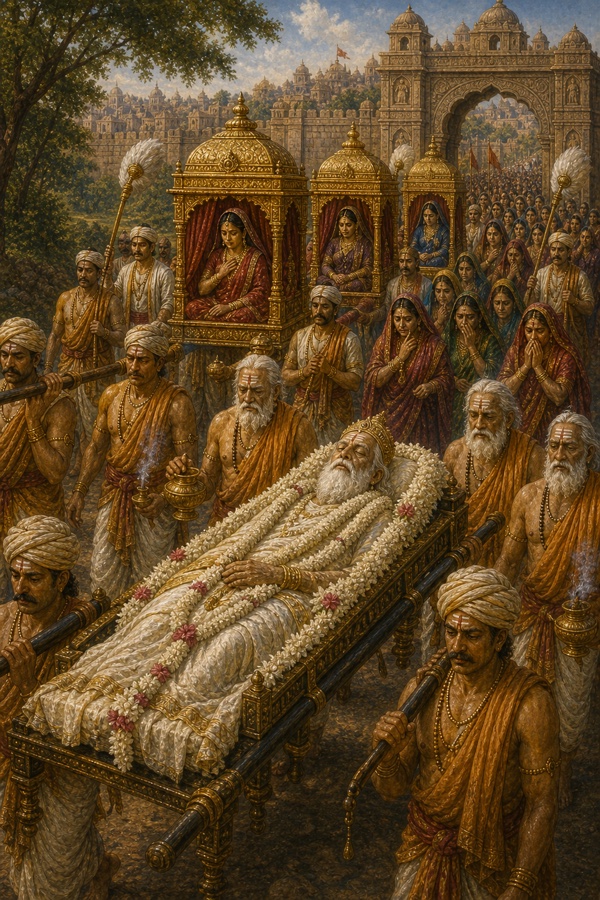
The king’s wives came out of the city in palanquins and carriages, each as her rank required, with old guards around them. The priests walked clockwise around the king now given to the fire, and Kausalya and the other women, scorched with grief, walked clockwise around the king who had performed the sacrifices that culminate in the sacrifice of the horse. There, in that hour, the sound of women in their thousands could be heard wailing in their pain, like the cry of female cranes. Then the queens, helpless, weeping, lamenting again and again, came down from their chariots at the bank of the Sarayu, the river that runs past Ayodhya and had run past every king of that house before him. With Bharata they offered the water to the departed spirit. Then the queens, the ministers, and the family priest went back into the city with their eyes full of tears, and for the ten days of impurity that follow a death in the house they lay on the bare ground and grieved.
Gathering the bones, and the grief of Bharata and Shatrughna
When the ten days had passed and the rites of the eleventh day had made him clean again, the prince performed the rites of the twelfth day as it came. He gave the Brahmins wealth in abundance: gold, jewelry, grain, costly garments, gems of many kinds, a great herd of white goats, silver, and cows past counting. And for his father’s welfare in the world beyond he gave away to the Brahmins men and women servants, chariots, and great houses.
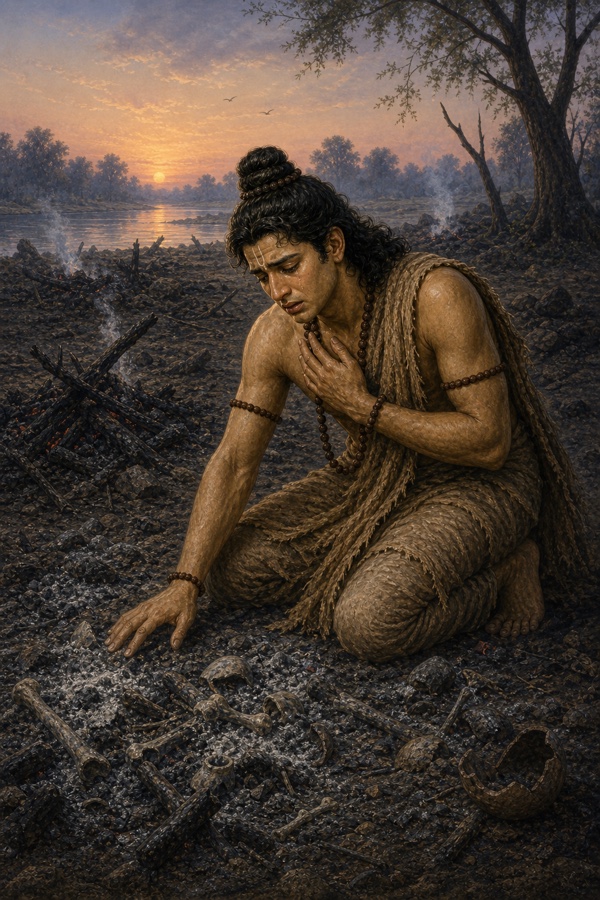
Then, on the thirteenth day, at daybreak, Bharata broke down, for all the strength in those arms. He had come to the foot of the pyre to gather his father’s bones for their immersion in the holy Sarayu, and grief closed his throat, and he spoke to his father through it. “Father, the brother into whose keeping you gave me, Rama of the line of Raghu, has gone to the forest, and I have been left by you in this emptiness, thrown away. King, protector of men, where have you gone, leaving my mother Kausalya, whose son, the one support of that helpless woman, has been sent into exile?” He looked at the circle of ground where his father’s body had been given to the fire, red from the blaze, covered in ash, strewn with charred bones, and the sight undid him. He fell weeping to the ground like a tall banner raised in Indra’s honor by its machine and let go. All his ministers ran to that prince of holy resolve, the way the royal sages, Ashtaka and the others, once ran to King Yayati when his merit was spent and he fell out of heaven. Shatrughna saw Bharata drowning in grief, and the thought of his father, which had never left him, took him down too; he dropped senseless beside his brother. When he came to, his father’s gestures came back to him, one after another, each loving thing the king had done in its own time, and he lamented like a man out of his mind. “The violent ocean of grief that Manthara let loose, made of the boons my father gave Kaikeyi, its waters full of crocodiles that are Kaikeyi’s words, has swallowed us all. Father, where have you gone, leaving Bharata weeping, who is still a boy, tender in body, whom you fondled every day? You used to let all four of us choose whatever we liked from a whole array of foods and drinks and clothes and ornaments; now that you have gone from among us, who will do that? How strange that this earth, robbed of you, its great-hearted king who knew what was right, does not split open, when this is the hour for splitting. My father has gone to heaven and Rama to the forest; what strength have I left to go on living with? I will enter the fire. Without my brother and without my father, I will never go back to Ayodhya, ruled so long by the sons of Ikshvaku and empty now. I will go instead to the forest of the ascetics.”
The attendants heard the two brothers lamenting, saw the agony they were in, and were more stricken than before. Bharata and Shatrughna, worn out and wretched, rolled on the ground like two bulls whose horns have been broken. Then Vasishtha, the family priest of their father and of all of them, a man of the kindest disposition and of knowledge that reached everywhere, lifted Bharata up and spoke to him. “Today is the thirteenth day since your father was cremated, my lord. Why do you delay now over what remains of the ceremony, the gathering of the bones, the washing of the ground, the giving of the ashes to the river? Three pairs run through every living creature without distinction: life and death, joy and sorrow, gain and loss. They cannot be escaped, and it does not become you to behave like this in the face of them.” Sumantra, who knew the truth of things, lifted Shatrughna in the same way, calmed him, and told him how birth and death come to every created being and cannot be turned aside. The two princes, glorious even in that state, stood up, soiled by rain and sun, and they shone like two banners raised in Indra’s honor and set up side by side. They wiped their eyes; their eyes were red; their voices, when they spoke, were forlorn; and the ministers pressed them to get on with the rest of the rites of the day, the lifting of the ashes and their immersion in the river.
Manthara’s punishment
Bharata, still scorched with grief, was already thinking of the journey to find Rama when Shatrughna, Lakshmana’s younger brother, spoke to him. “How strange it is. Rama, who is the refuge of every creature in trouble, and above all of his own people, Rama with his enormous strength, was sent to the forest by a woman. And Lakshmana, for all his might and courage, did not free Rama from it, even if he had to go as far as restraining our father to do it. A king who had taken the wrong road and fallen into a woman’s power should have been checked at the very start, once right and wrong had been weighed.”
He was still speaking when Manthara appeared at the eastern door, dressed, on that of all mornings, as if for a festival. Kaikeyi’s hunchbacked maid had put on every ornament she owned. She was smeared with the finest sandal paste and dressed in royal robes, and she was decked out in jewels of every description on every limb. With the lovely girdles and the other fine ornaments strung around her waist she looked like a she-monkey tied up in a great many strings. The gatekeeper on duty looked at that hunchback, the one who had brought about the whole sinful business that had become a curse on every soul in Ayodhya, and he seized her without the least pity and handed her over to Shatrughna. “Here is the cruel wretch because of whom Rama is in the forest and your father has cast off his body. Do with her whatever you please.” Shatrughna considered what the man had said, and made up his mind, and, in great distress, spoke to everyone in the women’s quarters within hearing. “She caused my brothers and my father agony beyond bearing. Now let her taste the fruit of her own cruel deed.”
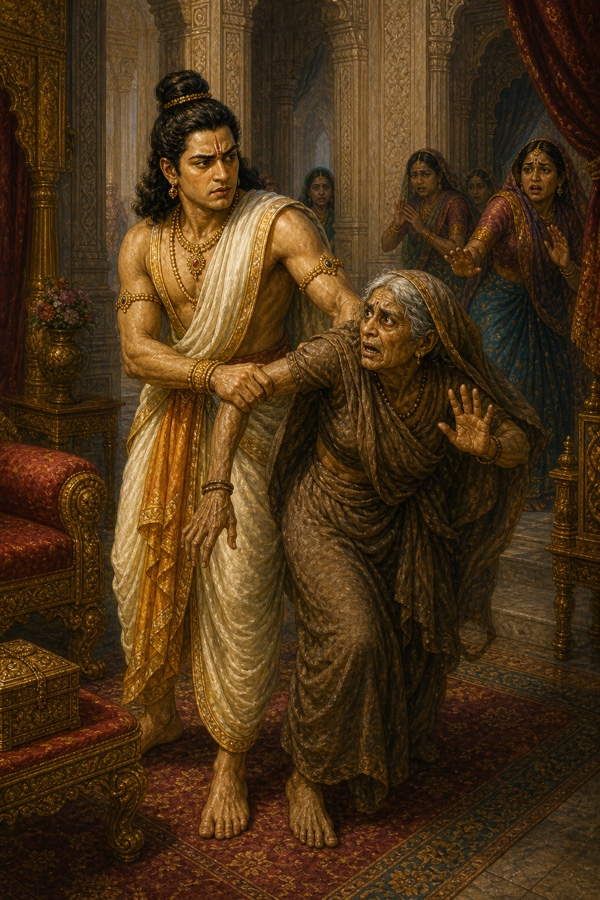
With those words he seized the hunchback by force from the middle of her circle of companions, and her shrieks filled the whole chamber. Her companions saw the fury in Shatrughna and were terrified, and every one of them ran, in every direction at once; and as they ran, the maids and the whole household staff said to one another, “From the way he has started with us, he is going to finish every one of us. Let us take refuge with Kausalya, who is merciful and gentle of speech, who is glorious and knows what is right; she is our one sure protection.” Shatrughna, whose grief had found its target at last, in a fury, dragged the screaming hunchback across the floor. As Manthara was hauled this way and that, her fine ornaments of every pattern smashed to pieces on the ground, and strewn with those broken ornaments the splendid royal palace shone all the brighter, like the clear autumn sky sown with stars. Still gripping Manthara in his rage, that powerful prince turned on Kaikeyi, who had come to save her maid, and gave her a harsh rebuke in harsh words. Those words wounded Kaikeyi deeply, and she was terrified of Shatrughna, and she fled for protection to her own son. Bharata looked at his brother in his fury and said, “Women are not to be killed by any man alive. Forgive her. I would have killed this sinful Kaikeyi of vicious conduct myself, if it were not that the righteous Rama would surely be angry with me for killing my own mother. And if Rama, whose mind is given to dharma, learned that we had killed even this hunchback, he would never speak to you or to me again.” At Bharata’s word Shatrughna drew back from the crime and let Manthara go, half-conscious. She fell at Kaikeyi’s feet, sighing deep, audible sighs of misery, and gave herself up to piteous lamentation. Bharata’s mother looked at her hunchback, stunned by the dragging, wretched, staring up at her mistress like a crane just let out of a snare, and slowly, slowly calmed her down.
Bharata refuses the throne
On the fourteenth day, at daybreak, the men who ran the realm came together and put the matter to Bharata plainly. “Alas, Dasharatha, our most venerable sovereign, has gone to heaven, having sent into exile his eldest son Rama and the mighty Lakshmana. This kingdom has no ruler. Be our ruler now, glorious prince. There is every justification for it: your elder brother was banished by your father’s own command and you were named in his place, so no blame attaches to you for taking the throne over your brother’s claim. Your own people, the counselors and the ministers and the citizens, are waiting on your pleasure with all the requisites of consecration ready to hand. Accept the kingdom of your father and your grandfather, Bharata. Be consecrated, and protect us, our prince.” Bharata, who had taken his vow, walked clockwise around all the materials of consecration laid out before him, as one honors a thing one will not touch, and then he answered them all. “In our house the kingship has always gone to the eldest; that is the rule we hold to, and men as wise as you should not be asking such a thing of me. Rama is our eldest brother, and Rama will be lord of the earth. I will live in the forest in his place for nine years and five. Let a great fourfold army be made ready, elephants and chariots and horse and foot, to go with me. I am going to bring my eldest brother Rama home from the forest in state.
“With all these materials of consecration carried before me, I will go into the forest to find Rama. I will consecrate Rama there, in the forest itself, and then I will bring him back to Ayodhya with honor, the way a man carries the sacred fire home to his own house from a great fire-sanctuary. I will not let this woman who passes for my mother have what she wants. I will live in a forest that is hard to cross, and Rama will be king. Let the masons cut a road where there is none; let the rough ground be leveled; and let guards who know the hard and narrow places come along with us.” To the prince who spoke this way for Rama’s sake, every man in the room gave back the same glad and generous answer. “You who wish to give the sovereignty of the earth to the eldest prince, may the goddess of fortune, Padma, who has her home in a bed of lotuses, be with you forever.” That fine benediction went into Bharata’s ears, and joy spread over his face, and tears born of delight and of gratitude toward the men who spoke it ran from his eyes. Hearing his plan to consecrate Rama in the forest and bring him home, the ministers and the counselors and everyone invited to the assembly felt their grief lift entirely, and they told him, “At your command, prince, engineers and guards devoted to you and to Rama have already been told off to prepare the way.”
The divine road to the Ganga
So the road-makers went ahead of the army, and they were a whole city of trades in themselves: the men who could tell where water lay under a piece of ground, the men who designed buildings and pavilions, the brave men whose duty was to guard the roadways; the workmen who sank wells and dug tunnels, the mechanics who devised the means of crossing a stream or holding back its water; the paid laborers, the architects, the men who built catapults and other engines; the carpenters, the men who cleared the way and the men who guarded it, the fellers of trees and the cooks; the plasterers and whitewashers, the men who made mats and winnowing fans out of bamboo and saddles and the like out of leather; and guides who knew the country.
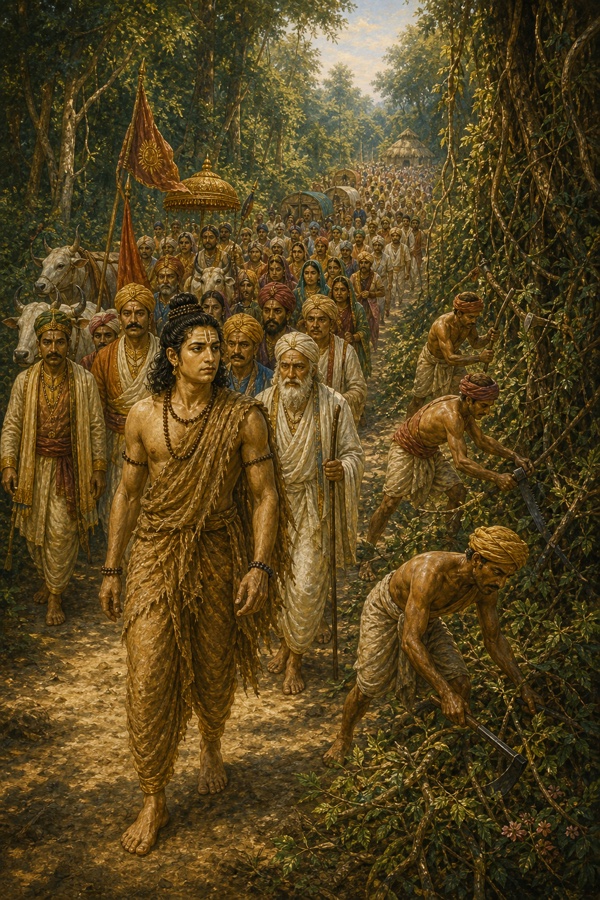
That vast throng, marching joyfully toward the place where Rama was, looked like the sea heaving up under a full moon. The men who knew road-building sought out their own kind and went ahead, company by company, carrying implements of every sort. They cut away the boughs of trees, the creepers and vines and shrubs, the stumps and the rocks, and felled every tree that stood in the way, and so they hewed out a path. In treeless stretches some of them planted trees for shade, while others took down the trees that were already there, here and there, with axe and hatchet and sickle. Others, the strongest of them, tore up by the roots with their bare hands the clumps of virana grass that had dug themselves into the ground, and leveled the uneven places. Others filled the dry wells hidden under grass and the long pits with earth, and leveled the low ground all around. Where a stream could be bridged they bridged it; what could be crushed they crushed; whatever blocked the passage of water and could be broken, they broke. In a short time, by throwing up dams, they turned the rivulets into ponds of many sizes and shapes, full of water, small seas. And in waterless tracts they had fine wells sunk, every one of them fitted with a platform for people to sit on.
The highway cut for the army was paved with a mortar mixed with lime and lined with trees in full blossom, and on the branches the birds, wild with the season, called shrilly, and the road was hung with buntings. It was sprinkled with water scented with sandal and strewn with flowers of every kind, and it looked like a road that the gods walk. On the officers’ orders, exactly as Bharata had enjoined, the men charged with the tents pitched them in the loveliest tracts, where the fruit was sweetest, and they decorated the tent that Bharata favored until, like a jewel set in a jewel, it was an ornament in itself. Those who knew the science of building set up Bharata’s camps at auspicious hours, on days when the stars were kind. Around each camp they threw up high banks of earth and dug a moat, and inside the moats stood the tents, with figures of sapphire in them, and fine lanes running between. Flanked by rows of temples, bounded by walls washed white with lime, hung with buntings, cut through by well-laid roads, the camps stood beside seven-storied mansions whose tops were crowned with dovecotes and seemed to be flying in the air, and they shone like so many cities of Indra. That delightful royal road, built stage by stage by able engineers, ran all the way to the bank of the holy Ganga, Jahnu’s foster-daughter, where the forest is thick with trees of every kind and the water is cool and clear and alive with great fish; and it shone, at night, like a cloudless sky adorned with the moon and all the stars.
The music stopped, and Vasishtha’s assembly
The night before the Nandimukha, the offering to the ancestors that opens any great and festive rite, was nearly over. Vasishtha had set that rite and the others for the morning, in preparation for Bharata’s coronation. As the last of the darkness thinned, the bards and the panegyrists who know how kings and princes are praised on the great occasions began, as their custom was, to extol Bharata with benedictions and songs of blessing. A drum struck with a rod of gold, the drum that is beaten at the set hours to mark the end of each quarter of the day, sounded loudly; the servants blew conches and struck up hundreds of instruments in every pitch. That enormous blare of music seemed to fill all the space of the sky, and to Bharata, already tormented with grief, it brought only more grief, and crushed him under it.
The noise woke him. He had it stopped, all of it, at once. “I am not the king,” he said, and then he said to Shatrughna, “Look, Shatrughna, at the great wrong Kaikeyi has done the world. King Dasharatha has gone, and left every one of these sorrows to me for my share. The royal fortune of that great-hearted king, who was piety itself, a fortune rooted in righteousness, is drifting on the water now like a boat with no one at the helm. And Rama, who was our great protector and our lord, has been sent into the forest by this mother of mine, who threw dharma to the winds to do it.” The women of the inner apartments saw Bharata lamenting like that, half out of his mind, and they wailed aloud, all of them, at the top of their voices, in pity for him.
While Bharata was still lamenting, Vasishtha, the royal priest whose word the court had never once overstepped, who knew the law of kings, entered the court of the lord of the Ikshvakus. With his host of pupils around him, the sage whose mind was given to dharma went into that delightful council hall, which was built mostly of gold and studded everywhere with pearls and precious stones, and looked like Sudharma, the court of Indra in heaven. He took a seat of gold covered with a cloth worked with the svastika, the mark of good fortune, and, master of all the Vedas that he was, he gave the messengers their orders. “We have business that cannot wait. Bring here, quickly and quietly, the Brahmins, the Kshatriyas, the warriors, the ministers, the commanders of the troops; Shatrughna and Bharata himself with the other princes; Yudhajit, one of the chief counselors, whom the court called Vijaya; Sumantra; and every man who wishes Bharata well.” Then a great noise broke out of men arriving in chariots and on horseback and on elephants. And as Bharata came into the hall the ministers and the counselors and the people cheered him as they used to cheer Dasharatha, as the gods cheer Indra. That court, its floor a still pool worked with figures of great fish and sea-elephants, gleaming with gems and conches and gold dust like the bed of the sea, graced now by the presence of the son of Dasharatha, looked as it had looked in the old days when Dasharatha himself sat in it.
Vasishtha’s urging, Bharata’s resolve
Bharata looked out over that assembly, full of worthy men and attended by great souls like Vasishtha, and it was like looking at a night lit by a full moon with the great planets shining around it. That distinguished company was lit up by the splendor of the robes and the painted pigments on the persons of the worthies, each in the seat his standing had earned him, and the whole brilliant conclave had the beauty of a cloudless autumn night under a full moon. Vasishtha, the family priest of the kings of Ayodhya, who knew what was right, read the faces of all the king’s ministers and of the people, read their minds, and spoke gently to Bharata. “My child, King Dasharatha has gone to heaven practicing virtue to the last, and he has left you the sovereignty of this prosperous earth, full of gold and grain. Rama, whose conduct is as truthful as his father’s, kept in mind the duty of good men, which is to obey their parents, and he no more disregarded his father’s command than the risen moon disregards its own light. Your father and your elder brother have both given you this kingdom, with every thorn pulled out of it. So enjoy it, with ministers who are glad of you, and be consecrated at once. Let the rulers of the north and the west and the south and the east, and the kings without thrones along the western borders by the Sahya mountains, and the merchants who trade by sea, bring you jewels beyond counting.”
The words of his family priest sank Bharata in grief. He knew the right road, which was to give the kingdom back to his elder brother, and he went to Rama in his mind and drew from him the strength to hold to it: to wait on his elder brother as a servant, and never to sit in his place. Then, in a voice choked with tears, in tones like the cackling of a swan, the young prince lamented before the open assembly and rebuked his family priest for advice so unjust. “Rama studied the Vedas in his teacher’s house under the vow of celibacy, finished his learning and bathed as the rule commands, and now gives himself to the practice of dharma by redeeming his father’s word. Which man of sense, which man who knew anything, would seize that man’s kingdom? How can I, born of Dasharatha, who gave up his life when he heard that Rama had gone to the forest and would not return, become the robber of my elder brother’s throne, when the throne belongs to Rama, and so do I? Here, in this council, you ought to say what is right.
“Rama, of the line of Kakutstha, is the eldest of us all and the best of us. His mind is set on dharma. In eminence he stands with Dilipa and Nahusha, the great kings of the sun’s line and the moon’s, and he deserves this kingdom exactly as Dasharatha deserved it. If I committed this sin of taking my elder brother’s place, a sin that only unworthy men commit and that leads nowhere near heaven, I would be a stain on the line of Ikshvaku in the eyes of the world. I do not even approve of the sin my mother has committed, let alone consent to it. And so, though I am here, I bow with folded hands to Rama, who lives in a forest that is hard to reach. I will follow Rama, and no one else. He stands above every other man I know, and he alone is the ruler of this kingdom. Rama deserves the sovereignty of all three worlds.”
That answer was in full accord with dharma, and every man in the assembly, his mind fixed on Rama, wept for joy to hear it. Bharata went on. “If I do not succeed in bringing my elder brother back from the forest, then I will stay there in the forest myself, as the noble Lakshmana is doing now. In the presence of all these honorable men, who are impartial and live by virtue, I will try every means there is to bring him back by force. I have already sent ahead all the expert road-makers, the paid and the unpaid, and so the journey to the forest is the only thing that pleases me.” Then the pious-minded prince, who loved his brother so, spoke to Sumantra, accomplished in counsel, who sat near him. “Get up at once, Sumantra. Under my command, give the order to everyone to march to wherever Rama is, and bring out the army quickly.”
Sumantra was overjoyed at the command, and he passed it to everyone exactly as Bharata had given it, and as good news. The citizens in the assembly and the generals were delighted to hear that the army was to go into the forest to bring Rama home. In every house in the city the wives of the soldiers, when they learned of the expedition, hurried their husbands out of the door, so eager were they to see Rama and the others back in Ayodhya. The generals urged the whole army forward, with its womenfolk, on horseback and in bullock carts and in chariots quick as thought. Bharata saw the army ready, and in the presence of his preceptor Vasishtha he said to Sumantra at his side, “Have my chariot made ready at once.” Sumantra bowed to the order and brought a chariot yoked with the finest horses, glad at heart at the prospect of seeing Rama and of everyone coming home. And Bharata, that glorious son of Raghu’s house, whose firmness never failed and whose word never failed, resolved to persuade his elder brother, whose glory was greater still, out of the wilds of the Dandaka by argument, gave the order again. “Get up, Sumantra, go to the commanders of the army and have them equip the forces for the march. I mean to win Rama over in the forest and bring him home, for the good of the world.” Sumantra took the command as the fulfillment of his own dearest wish and issued the orders in turn to all the leading citizens and the chiefs of the army and to Bharata’s friends and kinsmen. And in every house in Ayodhya people sprang to their feet in their eagerness, Kshatriyas and Vaishyas, Shudras and Brahmins, and made ready for the road their camels and chariots, their donkeys and elephants, and horses of the best breeds.
The journey to the bank of the Ganga
He rose at daybreak, mounted a fine chariot, and set out, with the whole of his longing fixed on the sight of Rama, and behind him, by the end of that morning, came very nearly the whole of Ayodhya. All the counselors and the family priests drove ahead of him, in chariots drawn by horses and bright as the chariot of the sun. Nine thousand elephants, properly caparisoned, followed Bharata, the pride of Ikshvaku’s house, as he went. Sixty thousand chariots, carrying bowmen armed with weapons of every kind, followed the glorious prince. A hundred thousand horses with their riders followed the young heir of Raghu’s line on his way.
Kaikeyi and Sumitra and Kausalya, the eldest queen, all three of them gladdened by the thought of bringing Rama home, drove out each in a splendid chariot of her own. Companies of the twice-born set out too, in high spirits, to see Rama with Lakshmana and Sita, and they talked of him and no one else as they went. “When shall we see Rama, strong of arm, dark as a rain cloud, steady of mind, firm in his vows, the one who wipes away the grief of the world? As the sun scatters the darkness of the whole world the moment it clears the horizon, so Rama, the moment we set eyes on him, will scatter our grief.” Saying good things like these to one another and embracing one another, overjoyed at what lay ahead, the citizens went out to meet Rama. The merchants the city most honored, and the ones it did not, and every other good citizen, went out gladly to meet him.
And the trades went with them: every lapidary in the city, the skilled potters, the men who knew the working of thread, the men who lived by making weapons, the makers of fans from peacock feathers, the men who lived by the saw, the borers of gems and pearls and the polishers of gems and ornaments and utensils, the workers in ivory, the men who burned limestone for lime, the men who lived by perfume, the famous goldsmiths, the weavers of blankets and woolens, the bath attendants and the masseurs, the physicians, the burners of incense, the distillers and the vintners, the washermen and the tailors, the headmen of the villages and the hamlets, the dancers with their womenfolk, and the boatmen. Brahmins absorbed in meditation, learned in the Vedas and honored for their conduct, followed Bharata in their thousands on bullock carts. Decently dressed, in clean clothes, their bodies smeared with sandal paste mixed with red saffron, they all followed slowly behind Bharata in vehicles of every kind. And the army, thrilled and glad at heart, followed the brother-loving Bharata on his brother’s errand.
Having covered a long road in chariots and palanquins and on horses and elephants, they came to the bank of the Ganga in the country of Shringaverapura, where Guha, chief of the Nishadas, a brave man and Rama’s friend, lived among the hosts of his kinsmen and ruled that region with a watchful eye. The army following Bharata came down to the bank of the Ganga, where the chakravaka birds adorn the water, and halted. Bharata, who knew how to say a thing, looked at his army standing idle and at the Ganga with its holy water, and he spoke to all his ministers. “Let my army camp at will, on every side. We will rest today and cross this sea-going river tomorrow. In the meantime I want to go down into the river and offer the water to the spirit of the emperor my father, who has gone to heaven, for his happiness in the life beyond.” The ministers said “So be it,” and, attentive to him, settled the troops in their separate camps, each unit where it liked. When that army, handsome with all its tents and gear, had been settled in good order along the bank of the great river, Bharata halted too, and all the while his mind turned on one thing: how to bring Rama home.
Guha’s suspicion, Guha’s welcome
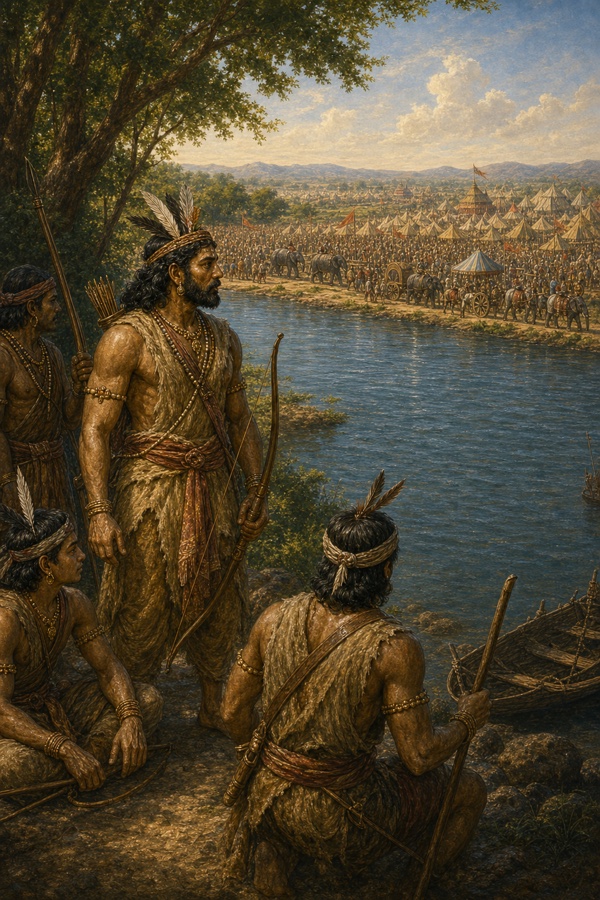
The last prince of Ayodhya to come down to this bank had come dressed in bark, with one brother and his wife, and Guha had offered him every comfort he had and kept watch beside Lakshmana while he slept under the ingudi tree. The moment Guha saw this army camped along the bank of the Ganga, he spoke to the kinsmen sitting around him. “Even from here this army looks like the sea. However hard I think about it, I cannot see its end even in my mind. Bharata has come himself; there is that towering banner with the kovidara tree on it, on the chariot. If his heart is evil he will bind us in chains or kill us, because we are devoted to Rama, the eldest son of Dasharatha, whom his father drove out of the kingdom. Bharata, the son of Kaikeyi, has set his heart on the whole fortune of that king, which is the hardest thing in the world to come by, and he is coming to kill Rama for it. Rama, the son of Dasharatha, is my lord and my friend both. So, for his sake, all of you stand here on this bank of the Ganga in your armor. Let all my boatmen, with the troops, hold the river; let them guard the crossing and live on the meat and the roots and fruit stored in the boats. Let a hundred young fishermen in armor take their places on each of the five hundred boats.” So he gave his orders. “And if Bharata turns out to be well disposed toward Rama, then this army crosses the Ganga safely today.” With that he took up an offering, candied sugar, the pulp of fruits, and honey, and went to meet Bharata.
Sumantra saw him coming, and Sumantra always knew what a moment called for. He spoke to Bharata like a humble servant. “Here comes Guha, the lord of the Nishadas, with a thousand of his kinsmen around him. He is an old friend of your elder brother Rama, and he knows the Dandaka forest well. Let him see you, prince of Kakutstha’s line. Beyond any doubt he knows where Rama and Lakshmana are.” That was welcome news, and Bharata answered without a pause: “Let Guha see me.” Guha was overjoyed at the permission. He came up with his kinsmen around him and made his submission meekly. “This country is only a pleasure-garden attached to your palace, and we have been caught unready; we did not know you were coming, and so we lost the chance to receive you as we should. We offer you everything we have. Stay in the house of your own boatman; it is yours. Here are roots and fruits, fresh and dried, gathered by the Nishadas with their own hands, and the pulp of fruits and wild grains of many kinds. It is my hope that the army will eat well here and pass the night, and that you too, when you have been entertained with everything we can give, will go on with your army only tomorrow.”
Guha’s doubt is dispelled
Bharata, who was wise beyond his years, gave Guha, the lord of the Nishadas, an answer that was reasonable and went to the point. “Friend of my elder brother, your great wish to give me a royal welcome is granted already, in that you are willing to feed an army of this size.” Then the prince, splendid in his grief, asked him the question that mattered. “By which of these two roads shall I go to the hermitage of Bharadvaja? This country along the Ganga is thick with trees and hard to get through.” Guha, who lived by roaming those woods, joined his palms and answered. “Boatmen who know the country and will pay close attention will go with you, and I will go with you myself, mighty prince. Only, I hope you are not going against Rama, who does great deeds without effort, with some evil in mind? This huge army of yours puts a doubt in me, I confess it.”
Bharata, whose heart was as free of stain as the sky, answered him in a gentle voice. “May that hour never come when such wickedness is found in me. You have no cause to doubt me. That prince of Raghu’s house is my elder brother, and I hold him as I would my father. I am going to bring Rama, of the line of Kakutstha, back from the forest where he is living. I am telling you the bare truth, Guha; do not look for any other motive in me.” At those words Guha’s face lit up with joy, and he spoke to Bharata again, glad now. “You are blessed. I see no one on the face of this earth to equal you, a man who wants to give up a kingdom that came to him without his lifting a hand. Your fame will run through all the worlds and last, because you want to bring back Rama, who has fallen on hard times.”
While Guha was still talking with Bharata the sun lost its light and went down, and it was night. Bharata settled the army in its camps, and, comforted by Guha, went with Shatrughna to his bed. And there a grief unlike any other, born of his anxiety for Rama, came down on Bharata, whose heart was large and whose eyes were fixed on dharma and who had done nothing to deserve such torment. As a fire hidden in the hollow of a tree burns from inside a tree already scorched by a forest fire, so the fire of his anxiety for Rama began to eat Bharata from within, when the fire of grief for his father had already scorched him. Sweat ran from every limb of him, born of the fire of that grief, the way the Himalaya, when the sun beats on it, lets its snow melt and run. He lay under a whole mountain of pain: its rock was his loving brooding on Rama, its veins of ore his sighs, its clustered trees the way his senses drew back from everything, its high peak his exhaustion, its countless beasts his swoons, its herbs and its bamboo the burning of every organ within him and without. Like a bull that has strayed from its herd, Bharata, strong as he was, fallen into the worst adversity of his life, disconsolate, his mind confused, sighing, with anguish in his heart, could find no peace anywhere in his bed. And when the noble-minded prince, composed on the outside and wretched within, was together with his men and with Guha again, Guha reassured him once more about his elder brother.
Guha’s account: Lakshmana’s vigil
What Guha, that wanderer of the forests, told Bharata, whose greatness had no measure, was the story of Lakshmana’s fine spirit toward his eldest brother. “He was keeping watch, with a splendid bow and arrows in his hands, to guard his eldest brother and his brother’s wife, and I went to him and said, ‘Dear brother, here is a soft bed that has been made ready for you. Set your mind at rest about Rama and Sita and lie down on it in comfort, son of Raghu’s house. All of us, your servants, are used to hardship; you were made for ease. We will stay awake for his safety, pious prince. There is no one on this earth dearer to me than Rama. Be anxious no longer about your eldest brother and your sister-in-law; I am telling you the truth to your face. By his grace I hope to win great fame in this world, and abundant merit, and wealth and pleasure without a stain on them. So I will take up my bow, and with all my kinsmen I will guard my beloved friend Rama where he lies with Sita. There is nothing in this forest I do not know; I roam it every day. We could hold off a fourfold army in here, on a field of battle.’
“Lakshmana, whose whole care was dharma, answered us all, and answered politely. ‘How can I sleep, or care about my life, or take any comfort, when Rama, the son of Dasharatha, is lying on the ground with Sita? Look at him, Guha, stretched on blades of grass with Sita, a man whom all the gods and all the demons together could not withstand in battle. This peerless son of Dasharatha, who carries every mark his father carried, was won by great austerities and by the labor of sacrifice after sacrifice, and he is lying on the earth. Now that he has been exiled the king will not live long, and the earth will very soon be a widow. The women must have cried out loud at the emperor’s death, which must have happened by now, and cried themselves silent from exhaustion; the great noise in the palace must have died away already. I do not expect my mother Kausalya, or the king, or my own mother Sumitra, to live through this night. My mother may hold on in the hope of seeing Shatrughna again. But Kausalya, in her misery, who gave birth to a hero like Rama, will surely die.
“‘My father, who could not set Rama on the throne, his long-cherished wish undone, will die crying, “Everything is lost.” Fortunate are the men who will be there, when the time comes, to perform all the last rites for my father. And happy are the men who, if my father lives, will walk about in my father’s capital, with its crossroads laid out in lovely places and its broad highways so clearly marked, rich in mansions and temples and palaces, adorned with every precious thing, crowded with elephants and horses and chariots, loud with trumpets, full of every blessing, thronged with happy, well-fed men and women, rich in gardens and pleasure-grounds, and bright with one festival after another. And when this term of exile is really over, shall we, Sita and I, come home happy to Ayodhya with Rama, his word kept?’ He sat like that, lamenting, and never lay down, and the night slipped away from under him. In the morning, when a cloudless sun came up, the two brothers twisted their hair into the matted mass that ascetics wear, and here, on this very bank of the Bhagirathi, I ferried them safely across with Sita. With their matted locks and their garments of bark, each with a fine quiver and bow, looking all around them at the beauty of the country, those two princes of enormous strength, like a pair of lordly elephants that no enemy cares to meet, went on their way with Sita.”
Bharata faints at the news of the matted locks
Of everything Guha had said, it was the matted locks that Bharata could not bear. He went inward, to Rama and nothing else, and the fear took shape in him that Rama, now that he had twisted his hair into an ascetic’s knot, might never come back to Ayodhya at all. For a little while the strong prince held himself together. He was tender of body and enormously strong at once, with the shoulders of a lion and eyes as wide as a lotus, young and lovely to look at; and then, all at once, he sank to the ground in the depths of misery, like an elephant driven with goads. Guha watched him fall, and the color left his face, and he shook where he stood like a tree in an earthquake. Shatrughna, standing beside his brother, put his arms around the senseless Bharata, and grief undid him too, and he cried out loud.
Then all Bharata’s mothers came running, thin from fasting, wretched, worn to the bone by the loss of their husband. Weeping, they made a ring around Bharata where he lay. Kausalya came through them, sad at heart, and gathered him up. She pressed him to her breast as a cow presses her own calf, that thoughtful woman wholly given over to grief, and questioned him, with the tears running all the while. “My son, I hope no illness is troubling your body. The life of this whole royal house rests on you now. Rama has gone to the forest with his brother, and King Dasharatha your father has died, and it is only by looking at you that I am still alive; today you are the only protector we have. Tell me, my son, have you heard some bad news of Lakshmana, or of my son Rama, my only one, who has gone to the forest with his wife?”
Within the hour Bharata had come back to himself. He steadied Kausalya first, and assured her that he had heard nothing ill of Lakshmana or of Rama, and then, still weeping, he turned to Guha. “Where did my elder brother stay that night? Where did Sita sleep, and where Lakshmana? What bed did he lie on, and what did he eat before he rested? Tell me, Guha.” Guha, lord of the Nishadas, was glad to tell it, glad to describe how he had arranged the food and the rest of that kind and beloved guest. “For Rama’s meal I brought boiled rice of many kinds, foods to chew, and fruits of every description, in plenty. Rama, whose courage never fails, accepted all of it for my sake, and then he gave it all back to me. He was thinking of the duty of a Kshatriya, and he would not eat a mouthful. ‘My friend,’ he said, ‘we are never to accept a gift; we are the ones who give.’ With those words that prince of great heart won every one of us over.
“The only thing he took was water, the water that Lakshmana brought him; and with Sita, Rama kept a fast that whole day. Then Lakshmana too quenched his thirst with what water was left. The three of them, Rama, Lakshmana, and Sumantra, sat together in silence and worshiped the deity of the evening twilight. After that Lakshmana went and fetched kusha grass himself, and quickly made a sacred bed of it for Rama. Rama sat down on it with Sita. Lakshmana washed his brother’s feet with his own hands and gave Sita water to wash hers, and then he withdrew a little way off. This is the foot of that same ingudi tree, and this is that same kusha grass, on which Rama and Sita both lay that night. Lakshmana fastened two quivers packed with arrows at his back, one on either side, drew on his gloves, took up his great strung bow, and walked around Rama all night long, alone. And I too, with my best bow and arrows, took my stand where Lakshmana was walking, and with my kinsmen, wide awake and with bows in their hands, I guarded Rama, who is the equal of Indra, through the whole of that night.”
Bharata’s lament before the bed of kusha grass
Bharata listened to every word with care, and then he went with the ministers to the foot of the ingudi tree and looked at Rama’s bed. He spoke to all his mothers. “Here is where that great-hearted prince passed the night, lying on the ground. These are the blades of kusha his body pressed flat as he lay on them. Rama, the son of the wise and greatly blessed Dasharatha, born in a line of great kings, was never meant to sleep on the earth, without a roof over him and without a bed. All his life he slept on a pile of the finest rugs with a superb deerskin fit for a king spread over the top of them; how does a man born to that sleep on the ground? He slept always on the topmost floor of palaces built like the chariots of the gods, in their turrets, in the best apartments of splendid seven-storied buildings, with floors paved in gold and silver and laid with the finest carpets, bright with heaps of flowers, fragrant with sandalwood and aloe, shining like white clouds, full of the chatter of parrots, cool, sweet with camphor, tall as Meru, with walls inlaid with gold; and every day he was woken by song and by the music of instruments, by the tinkling of fine jewels and the beat of the best clay drums, and hailed on waking by bards and panegyrists and minstrels with the verses and the songs of praise that belonged to him. And that same Rama lies today on the ground.
“This is not to be believed in this world, and it does not seem true to me. My mind is confused; I keep thinking it must be a dream. Surely there is no god more powerful than Time, by whose force Rama, the son of Dasharatha, lies on the earth like this, and Sita, the lovely daughter of the king of Videha, the beloved daughter-in-law of Dasharatha, has to lie on the earth beside him. This is my brother’s bed, and here are the blessed marks of his turning from side to side, in all this kusha crushed by his limbs against the hard ground. It looks as though Sita lay down on this bed still wearing her ornaments, because here and there grains of gold are stuck to the grass. And her upper garment must have caught in these blades, because threads of silk are caught in them too. I can only think that a husband’s bed, hard or soft, is a comfortable bed to a devoted wife; for Sita, the princess of Mithila, young and tender as she is, feels no pain even lying on a bed so hard and rough, so virtuous is she, and so given to austerity.
“Alas, I am destroyed. I am a cruel man, that on my account Rama and his wife should have had to lie down on a bed like this, like people with no one to care for them. He was born in a line of emperors; he brings happiness to the whole world and does good to everyone; he is blue as a lotus, with reddish eyes, lovely to look at, made for happiness and unworthy of any suffering; how did he give up the rulership he loved, which had no equal anywhere, and lie down on the ground? Blessed and fortunate beyond measure is Lakshmana, with his auspicious marks, who follows his eldest brother through this terrible time. And Sita, the princess of Videha, who went with her husband into the forest, has all that she came for. We are the ones in doubt, all of us, bereft of that prince, wondering whether we will ever get to serve him again. With Dasharatha gone to heaven and Rama gone to the forest, this earth looks to me as empty as a boat with no one at the helm. And yet no one, even in his mind, lays claim to this earth, because it is guarded on every side by the might of Rama’s arms, though Rama himself lives in a forest.
“Our capital lies with its walls unmanned, its horses and elephants wandering loose, its gates never shut, its troops without heart, unprotected, unguarded, empty, brought low; and still no enemy wants Ayodhya, any more than a man wants food that has been laced with poison. From this day on I will sleep on the bare ground or on grass, live on fruit and roots alone, and wear matted hair on my head and bark on my body. I will live out the rest of the term of my brother’s exile in the forest in his place, and in that way the famous vow of my noble brother will not be made false. Shatrughna will stay with me while I live in the forest for my brother’s sake, and Rama, with Lakshmana, will guard Ayodhya. The Brahmins will consecrate Rama, of the line of Kakutstha, in Ayodhya; may the gods grant me this true wish. And if he will not agree to come home, though I bow my head to him and plead with him in every way I know, then I will stay with Rama for as long as he wanders in the forest, however long that is. He cannot disregard me; I do not think he can.”
Crossing the Ganga, and toward Bharadvaja’s hermitage
Bharata spent the night on the bank of the Ganga, in the very place where Rama had rested before he crossed into the forest, and at daybreak he was up and speaking to Shatrughna. “How can you still be asleep? Get up, Shatrughna, and may all be well with you. Go and fetch Guha, the lord of the Nishadas, quickly; he is going to take the army across.” Shatrughna answered, “I am awake, as you are, thinking of Rama. I am not asleep.” While the two brothers were talking like this, Guha arrived, at just the right moment, and put his question to Bharata with his palms joined. “I hope you passed the night comfortably on the riverbank, prince of Kakutstha’s line. And I hope you and your whole army are free of every ailment.”
Bharata, who had made Rama the master of his will, heard the affection in that question and answered it. “It was a good night for us, wise friend, and you have entertained us well. Now let your fishermen take us over the Ganga in a good many boats.” Guha heard the command and went back to his town at speed, and there he spoke to his kinsmen. “Wake up and rise, and may good fortune always attend you. Haul the boats down to the bank; I am going to take the army across.” They sprang to their feet at their chief’s word and brought together from every side five hundred boats, and other fine boats besides, the ones called svastikas for the mark they carry, handsome vessels flying flags and manned with rowers, strongly built, with great bells tied to their sails. Then Guha himself brought up a lovely boat, also of the svastika kind, its deck spread with white rugs fit for kings, and festive music playing aboard it.
Onto that boat climbed Bharata and the mighty Shatrughna, and Kausalya and Sumitra and the other royal ladies. Vasishtha, the family priest, and the elderly Brahmins who were present had taken their seats even before Bharata and the queens; the other women of the royal house followed close behind, and the bullock carts and the provisions were loaded onto other boats. The din of it all went up to the sky: the men setting fire to the huts they had built for the halt, the way an army does when it strikes a camp, so as to leave no trace of itself for an enemy; the crowds going down the bank to board; the gathering up of the pots and vessels for loading. The swift boats with their flags, in the hands of the fishermen, seemed to move of their own accord with the people seated in them. Some were full of women, some of horses; some carried costly chariots and the draft animals. Reaching the far bank and setting their passengers down, the boats came back, and Guha’s kinsmen at the oars drove them across the water like toys. The elephants swam over at their mahouts’ urging with the flags still on their backs, and they looked like mountains that had grown wings. Some men crossed in the boats, some on rafts, some clinging to earthen jars great and small, and the rest with nothing more than their arms.
Ferried over by the fishermen, that holy army, hallowed by the company of men like Bharata and Vasishtha, by its bathing in the Ganga and the other sacred streams, and by the holy errand it was on, moved off in the hour called Maitra toward the fine forest that surrounds Prayaga. On the far bank Bharata cheered the troops and settled them comfortably in camp in that forest, each unit as it liked, and then, with the priests and the counselors, set out to see Bharadvaja, a rishi whom the other rishis of that country looked up to. Coming near the hermitage of that sage of great soul, who was a knower of Brahman and the first of Vedic scholars, and who is called the family priest of the gods, Bharata saw the wide and delightful grove around it, clusters of trees with lovely huts of leafy twigs set among them.
The meeting with Bharadvaja
He was bringing an army to the door of a hermitage, and a sage might well ask him why. A couple of miles short of Bharadvaja’s hermitage Bharata halted all his people, so that the hermits who lived there in peace would not be disturbed, and went on with the counselors. He laid aside his weapons and his ornaments, dressed in nothing more than two garments of silk, put the priest Vasishtha in front of him, and walked. When Bharadvaja came into sight he told the counselors to wait too, and went the last of the way at Vasishtha’s heels, on foot, as a man who knows what is right approaches a sage. At the very sight of Vasishtha, Bharadvaja, that great ascetic, rose quickly from his seat and called to his pupils to bring water for the honored guest’s hands. He embraced Vasishtha, and when Bharata greeted him the sage of great splendor understood who this was: a son of Dasharatha.
He gave the two guests, in order of seniority, the water for their hands and their feet and then fruit, and then, as a man who knows what is right does, Bharadvaja asked after the welfare of the family of each of them, and of Ayodhya, and of the army, the treasury, the king’s allies, and the ministers. He knew that Dasharatha was dead, and he asked nothing about the king. Vasishtha and Bharata asked in their turn whether all was well with his body, his sacred fires, his pupils, his trees, his deer, and his birds. All was well, he said; and then, drawn by the love he bore Rama, Bharadvaja spoke to Bharata. “What has brought you all this way, when you must be busy ruling the kingdom of Ayodhya? Tell me everything, because my mind will not clear itself of doubt. Rama, whom Kausalya bore, who destroys his enemies and gladdens his own people, was told by his father at a woman’s instance, ‘Live in the forest for fourteen years,’ and went into the forest for that long term with his younger brother and his wife. Is it possible that you wish to do some harm, here in this forest, to that glorious prince and to his younger brother Lakshmana, so that you may enjoy a kingdom that is rightfully Rama’s with no thorn left in it?”
Bharata answered him with the tears running from his eyes, in a voice that broke with the pain of it. “If even Your Holiness, who knows everything, thinks this of me, then I am destroyed. I cannot so much as imagine harm coming to Rama from me; do not say such harsh things to me. What my mother said while I was away is not to my liking, and I am not pleased with what she did, and I have never accepted her word that I should enjoy the throne. I have come to win Rama over, the noblest of men, and take him back to Ayodhya, and to bow at his feet. Believe that this is why I have come, and be gracious to me, and tell me, venerable sir, where the emperor Rama is now.”
The priests, with Vasishtha at their head, added their entreaty to his, and the venerable Bharadvaja answered Bharata graciously. “Service to your elders, command of yourself, and walking in the footsteps of the good: this is worthy of you, born as you are in the line of Raghu. By my yogic power I already knew what was in your mind. All the same I questioned you as if I knew nothing, to make your resolve firmer and to spread your fame beyond all measure. I know where Rama, who knows what is right, is living with Sita and Lakshmana. Your brother is on the great mountain Chitrakuta. You will go there tomorrow. Today, stay here with your counselors. Grant me this wish, wise prince, you who know how to fulfill the wishes of those who love you.” Bharata, who took the long view, and whose true self, a devotee of Rama’s, was now known for what it was, said “So be it,” and resolved to spend the night in the hermitage.
Bharadvaja’s unearthly hospitality
Now that Bharata had decided to stay, the sage invited him to accept his hospitality. Bharata joined his palms. “You have already shown us all the hospitality a forest can offer, just now: water for the feet and hands, fruit and roots.” Bharadvaja answered with something very like a laugh. “I know you love me, and I know you would be content with anything I gave you. But it is this army of yours that I want to feed, and you ought to do the thing that pleases me, prince. Why did you come here and leave your army so far off? Why not bring them all with you?” Bharata answered him with his palms still joined. “I did not come with the army for fear of displeasing you, venerable sage. A king, or a king’s son, must always keep his distance from ascetics in their own country, so as not to disturb them. The finest horses, and men, and great elephants in rut are following me, and they cover a great deal of ground. I came alone from where the troops are camped, with Vasishtha, so that they should not damage the trees, or foul the water and the earth, or spoil the huts of the hermitage.” The great sage gave one command: “Let the army be brought here.” And Bharata had the whole army brought to the hermitage.
Bharadvaja went into the fire-sanctuary to bring heaven down to a forest clearing for one night. He sipped water, wiped his lips, and began to invoke the gods, for the sake of the hospitality he meant to give. He called on Vishvakarma, the architect of the gods, who is also Tvashta, the divine carpenter: “I wish to give hospitality; let everything be made ready for it.” He called on the three guardians of the worlds, Yama, Varuna, and Kubera, with Indra at their head, with the same words. He called on all the rivers that flow east and all that flow west, on the earth and in the sky, to meet that day in that one stretch of ground: some to run with maireya, some with the finest sura, wines both of them, and some with water as cool and sweet as the juice of the sugarcane. He invited the celestial gandharvas Vishvavasu, Haha, and Huhu, and all the celestial nymphs with the other gandharvas. He called the apsaras by name, Ghritachi and Vishvachi, Mishrakeshi, Alambusha, Nagadatta and Hema, and Soma, who lives on the mountain Mahendra, and all the nymphs who wait on Indra and the dancers who wait on Brahma, with their teacher Tumburu and every instrument they play. He called the divine grove Chaitraratha of the Uttara Kurus, which belongs to Kubera, whose trees wear heavenly raiment and jewels for leaves and bear heavenly women for fruit, to appear on that very spot. He called on the glorious moon, lord of the plants, to furnish him with abundant food of every kind: food to chew, to swallow, to suck, and to lick; garlands dropped straight from the trees; wine and other drinks; meats of many kinds. So the sage of noble vows, rich in concentration and matchless in glory, spoke his invocation, every syllable pitched and accented as the rules require, and, sitting with his face to the east and his palms joined, he summoned those gods with his mind, and one by one they came.
That divine sound of summoning rang through heaven and earth and in the ears of every living thing. The gods came, one after another. A cool breeze, delicious to the skin, that wiped away sweat by its mere touch, blew gently in from the Malaya and Dardura mountains and their forests of sandalwood. Thick showers of heavenly flowers came down; the kettledrums of the gods were heard in every quarter; the best of breezes blew and blew; bands of apsaras danced, the gandharvas sang, and the vinas gave out their melodies. That music, rising and falling, soft, moderate, in perfect time, reached heaven and earth and the ears of all who lived. And while it played, the army of Bharata saw the handiwork of Vishvakarma. For forty miles around, the ground turned level and was carpeted with fresh grass the color of blue cat’s-eye. Bel and wood-apple, jackfruit and citron, myrobalan and mango sprang up laden with fruit. From the land of the Uttara Kurus came the grove itself, with everything in it that heavenly beings enjoy, and a lovely river bordered with trees. White mansions of four rooms stood up, and stables for elephants and horses, and lovely gateways with mansions and palaces beside them, and a royal palace like a white cloud, with a graceful arched doorway, hung with white garlands and sprinkled with exquisite scents: square, spacious, furnished with couches and seats and palanquins, stocked with every delicious drink and the finest food and clothing, with victuals of every kind laid ready in spotless vessels, seats set in their proper places, and superb beds covered with counterpanes. With the great sage’s leave Bharata, the son of Kaikeyi, entered that palace full of precious stones, and all the counselors and priests came in behind him, delighted at what they saw. Then, with the counselors, Bharata walked clockwise around the royal throne that stood there, and the yak-tail whisk, and the royal umbrella, as if around a king. He bowed low to Rama as if Rama sat on it, paid his homage to the throne itself, took up the whisk, and sat down in the seat that belongs to the chief minister. All the counselors and the family priests took their seats in order, and after them the general, and after him the officer in charge of the camp.
In a little while, at Bharadvaja’s command, rivers ran past Bharata whose mud was milk thickened with rice, and on both their banks rose lovely houses plastered with lime, called into being by the grace of the Brahmin sage. In that same hour twenty thousand women in exquisite jewels arrived, sent by Brahma. Twenty thousand more, decked in gold and gems and pearls and coral, came from Kubera. And from the Nandana grove of paradise came twenty thousand apsaras, whose embrace left a man looking like someone seized by madness. Narada, Tumburu, and Gopa, kings of the gandharvas, bright as the sun, sang before Bharata. Alambusha, Mishrakeshi, Pundarika, and Vamana danced before him at Bharadvaja’s order. Flowers that grow only among the gods and in Chaitraratha were seen at Prayaga that night by the spiritual power of Bharadvaja. The bel trees took up the clay drums, the vibhitaka trees the cymbals, and the pipal trees became the dancers. Deodar, palmyra, tilaka, and tamala came in high delight as hunchbacks and dwarfs to wait on Bharata. Shimshapa and amalaki and jambu, malati, mallika, jati, and every other tree and creeper of the forest that bears a woman’s name took the shape of young women and set about serving him.
Those women went among the soldiers and said, “Drink wine, you who drink wine; eat rice cooked in milk, you who are hungry; let meats fit for sacrifice be eaten as you please. Whoever wants a thing shall have that thing.” A batch of seven or eight young women took each single man, rubbed him with a fragrant paste of oil-seeds, scrubbed the dirt from him, and bathed him on the lovely riverbanks. Big-eyed women came and kneaded the men’s feet; the lovely creatures dried them and, in private, gave them delicious things to drink. The keepers fed the horses, elephants, donkeys, camels, and oxen with fodder fit for each, and the mightiest of them coaxed the mounts of the Ikshvaku warriors with sugarcane and parched grain soaked in honey. Before long the groom could not tell his own horse, nor the mahout his own elephant. The whole army was drunk, maddened, enraptured. Sated with every pleasure, smeared with red sandal, with hosts of apsaras around them, the soldiers said out loud, “We are not going back to Ayodhya, and we are not going on to the Dandaka. Let all be well with Bharata, and let Rama be happy too.” So spoke the foot soldiers and the riders and the elephant men and their keepers, who in their drunkenness felt they had no master any more. Thousands of Bharata’s followers, seeing the wealth and power of the sage, roared out, “This is heaven itself!” and, hung with garlands, ran in every direction in their thousands, dancing and laughing and singing. They had eaten food like the food of the immortals, and the moment they saw those dishes again they wanted to eat again. Servants and maidservants and the soldiers’ wives and the soldiers themselves were all delighted, and every one of them was given a new set of clothes. The elephants and donkeys and camels, the oxen and horses, and even the deer and the birds of that country were so well fed that they wanted nothing more.
No one in that place was in soiled clothes, or hungry, or untidy; not one man was seen with dust in his hair. People stared in wonder at gold vessels set out in their thousands, decked with flags of flowers, full of seasoned dishes made from varahi bulbs, flavored with ajowan and cooked in the juice of fruits, and at fragrant boiled pulses and white boiled rice. The wells around the hermitage ran with rice cooked in milk and sugar instead of mud; the cows of that country became cows of plenty; the trees dripped honey. The great wells with their stairs filled with maireya, and along their banks was heaped the dainty meat of deer and peacock and fowl, cooked in earthen pots heated to glowing. There were gold vessels of rice in their thousands, gold cauldrons of seasoned food in their hundreds of thousands, gold plates in their millions. There were pans and pots and wide-mouthed jars of curds spiced with dry ginger, tanks of fragrant buttermilk tinged yellow with saffron and freshly made, buttermilk flavored with cumin, and others of white curds and of milk, and heaps of sugar. At the bathing-stairs people found crushed myrobalan and powdered scents, oils, hot water, everything a bath needs, set out in great pans. Everywhere they looked they saw bundles of fresh white twigs crushed at one end for cleaning the teeth, white sandal paste in round covered boxes of wood, polished mirrors, piles of cloth, thousands of pairs of wooden sandals and leather shoes, small caskets of collyrium, combs, brushes for beard and moustache, umbrellas, bows, armor, beds and seats of every kind, tanks of drinking water, fodder for the donkeys and camels and elephants and horses, pools with easy steps down into them, full of lilies and lotuses, the color of the sky, clear and pleasant to bathe in, and heaps of tender grass the color of blue cat’s-eye for the animals to eat. The men were amazed at that entertainment, wonderful as a dream, which the great sage had laid on for Bharata and kept up so long. Enjoying themselves like gods in the Nandana grove, in that lovely hermitage of Bharadvaja, they passed the night. At dawn the rivers and the gandharvas and all the lovely nymphs took leave of Bharadvaja and went back as they had come. And the people were still flushed and drunk with wine, still smeared with the divine paste of aloe and sandalwood, exactly as before, and the celestial garlands of every kind lay scattered here and there, crushed by a night of use and as fresh as when they came.
The mothers presented, and the march toward Chitrakuta
Bharata had passed the night in the hermitage with his family and received the sage’s hospitality, and in the morning he came to Bharadvaja to take his leave for Chitrakuta. The sage had just made his offering into the fire. He saw the prince approaching with his palms joined, and he asked him, “Tell me, sinless prince, did your night pass happily in this hermitage of ours? Were all your people content with what was given them?” Bharata folded his hands and bowed low to the sage of surpassing splendor, who had come out of the hermitage to meet him. “I passed the night in comfort, with my whole army and all my animals, and you satisfied me and my army completely, venerable sir. Down to the servants, every one of us spent the night as happily as could be, freed of our weariness and our discomfort, richly supplied with food and drink, and lodged in fine houses. Now I ask your leave, venerable sir, and I beg it of you: as I go to my elder brother, look on me with a kind eye, holy one. Tell me where the hermitage of that righteous prince is, you who know what is right; tell me which road leads to it, and how far it is.”
Bharadvaja, glorious and great in austerity, answered the prince who so longed for the sight of his brother. “Two and a half yojanas from here, in a forest where no one lives except ascetics, stands the famous mountain called Chitrakuta, full of lovely caves and groves. Along its northern side runs the river Mandakini, shaded by trees in blossom and bordered with lovely flowering woods. Between that river and the hill of Chitrakuta you will find the leaf hut of the two brothers; that is where they are living, without any doubt. Take the southern road, commander, and lead your army with all its elephants and horses along the by-path that turns off to the left and runs south; that way, most fortunate of princes, you will see Rama.” The talk of the march reached the wives of the dead emperor, and Kausalya and the others, who by their sex and their age and their rank might have kept their seats, left their chariots and came and stood in a ring around the Brahmin.
Kausalya, trembling with age and with feeling, worn thin by the loss of her husband and the loss of Rama, together with Queen Sumitra, took the sage’s feet in both her hands. Kaikeyi too, whom the whole world condemned because her ambition to see her son made regent had come to nothing, took his feet, with shame in her for the banishment of Rama that she had brought about. She walked around that venerable sage clockwise and then stood near Bharata himself, sad at heart for her ruined plans and her disgrace. Then the great sage Bharadvaja asked, “Son of Raghu’s house, I want to know more about your mothers.” Bharata, who knew how to say a thing, joined his palms and told him. “This godlike lady, venerable sir, whom you see thin and wretched with grief and fasting, is Kausalya, the chief queen of my father. She bore Rama, the prince without an equal, who walks with the stride of a lion, as Aditi bore Upendra. And this, holding to her left arm, standing there heartsick like a branch of the karnikara in the depths of a wood with all its flowers fallen, is Sumitra, the king’s middle queen, in her agony. Those two heroic princes of godlike looks and unfailing prowess, Lakshmana and Shatrughna, are the sons of this good lady.
“And this one, angry, unthinking, proud, sure of her own beauty, greedy for power, noble in her looks and base underneath, is Kaikeyi, my mother. Know her for a cruel woman set on sin. It is by her scheming that Rama and Lakshmana, those two brothers, have come to the end of their lives here, to an exile beset with danger, and that King Dasharatha, robbed of his two sons, has gone to heaven; and I see in her the root of the great calamity that has fallen on me.” He said it in a voice choked with tears, his eyes red with anger and grief together, and drew deep, audible breaths like a cobra hissing in its rage. Bharadvaja, who was greatly wise and knew everything, answered him. “Bharata, you must not hold Kaikeyi guilty. This banishment of Rama is going to turn to the happiness of all. From Rama’s exile nothing will come except good: good for the gods, good for the demons, good for the sages whose minds rest on the Supreme Self.”
Bharata saluted the sage and walked around him clockwise, and took his leave with his purpose achieved: he knew where Rama was, and he had the sage’s blessing. Then he gave the army its order: “Make ready for the march.” The horses were yoked to their many fine chariots trimmed with gold, and people of every kind climbed up for the journey. The she-elephants and the bull elephants, with girths of gold and banners on them, moved off in a body to the sound of their bells, like the thunderclouds at the end of summer. People rode in precious carriages, large and small, and those who walked, walked. The queens, with Kausalya at their head, longing for the sight of Rama, went gladly in fine chariots. Bharata himself, with everything he needed for the road, rode in a lovely palanquin borne by four men, bright as the midday sun and the full moon. That vast army, full of elephants and horses, set out toward the south like a great cloud that has just risen and filled the southern sky. It passed through woods full of deer and birds, and over the mountains and rivers beyond the western bank of the Ganga where the river runs south, terrifying the herds and the flocks as it went, and entered the great forest of Chitrakuta with its glad elephants and horses, a splendid sight.
The gist: Asked by Bharadvaja, Bharata presented his three mothers, Kausalya, Sumitra, and Kaikeyi, naming Kaikeyi in the harshest words as the root of his sorrow, and the sage told him that Rama’s exile would turn to the good of all. Then the army marched south for Chitrakuta, two and a half yojanas away.
Source: Srimad Valmiki Ramayana, Ayodhyakanda, Cantos 65 to 119; this first part follows Cantos 65 to 92. The Gita Press Hindi edition is the controlling witness. The Sanskrit e-text and an independent complete translation were used to verify names, sequence, and principal events. Where recensions differ, this retelling follows Gita Press.
Basis: Valmiki Ramayana (Gita Press, Gorakhpur)