On this page
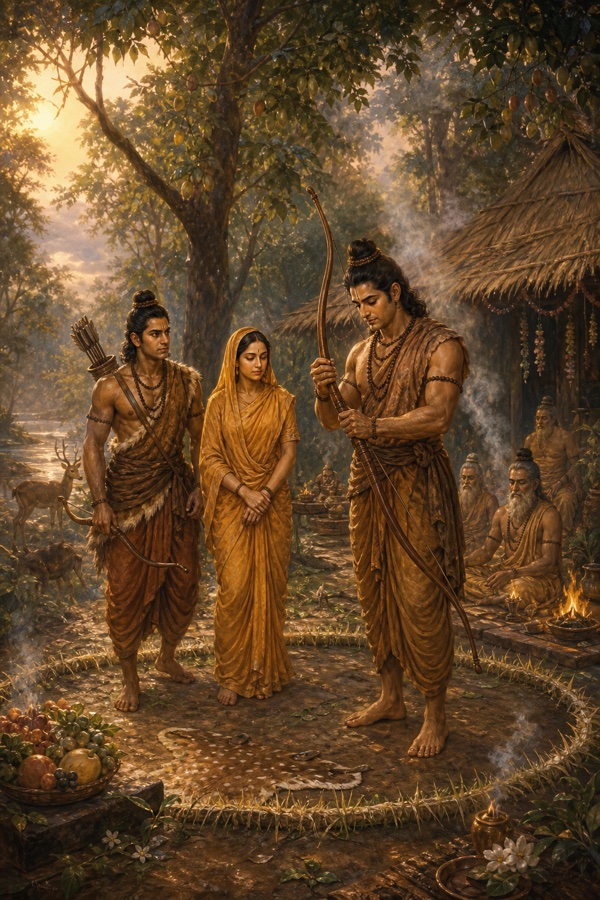
The Dandaka forest announced itself before Rama had taken ten steps into it. Even the shade under the trees seemed to hold heat, the dry, banked heat of long austerity, as if the ground itself had been fasting for centuries. Rama went in with his breath steady and his mind held close, as he had held it through every day since Ayodhya, and from a long way off, through the trunks, he made out a ring of hermitages. Sacred kusha grass, the stiff, pale grass that no rite begins without, lay heaped around them, and strips of bark cloth hung drying wherever there was a branch to hang them on. The whole circle was wrapped in a glow he could feel on his skin, the radiance that gathers around people who have spent their lives on the knowledge of Brahman, and it was hard to look at directly, the way the disk of the sun is hard to look at in a clear sky. Every creature knew this place as a refuge. Its courtyards were swept clean each morning; deer wandered through them without lifting their heads, and birds settled in flocks on the roofs and the fences and were never driven off. Nymphs of the sky came down to honor it with their dancing, and came again the next day. Great halls stood open for the sacred fire, and in them lay the tools of the rite, the long ladles and the short spoons, the deerskins to sit on, the kusha, the split kindling stacked and ready, jars of water, and baskets of fruit and root. Tall forest trees hedged the whole circle, holy trees heavy with sweet fruit, and beneath them the air was loud with the chanting of the Vedas and sweet with offerings and oblations, and the lotus ponds shone, and flowers lay scattered everywhere on the ground. Old sages lived here, men who ate only what the forest dropped for them, who wore bark and the hide of the black antelope, who had mastered their senses so completely that they shone like the sun and like fire. Graced by such sages, sparing in every meal, the place looked to Rama like the house of Brahma himself, the creator sitting at the center of his own quiet.
Welcome in the hermitages, and a plea to the king for protection
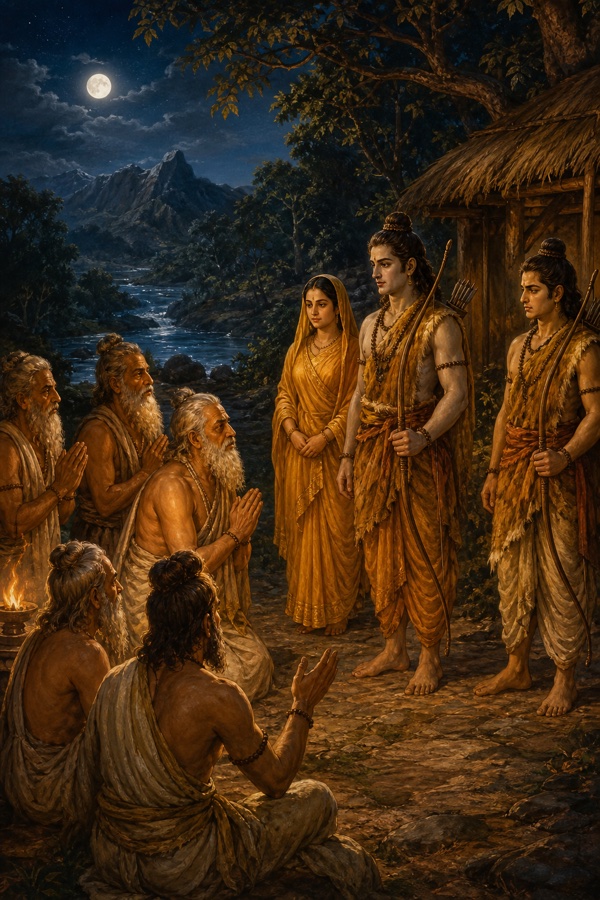
Rama looked at that ring of hermitages, at the blessed Brahmins who moved among them and who knew Brahman as other men know their own courtyards, and he did the one thing a warrior does when he means no harm. He slipped the string from his great bow and let it hang slack. Only then did he walk in among the huts. The sages had the sight that penance gives, and they knew who was coming before he reached them; they came forward gladly, to him and to Sita, and the gladness was in their faces. They saw a young man as lovely as the moon just rising, settled in the practice of virtue as though he had never known any other way to live, and beside him a princess of renown and a younger brother who watched everything, and being men of unbreakable vows they received the three of them with rites of blessing, water and words and the small gestures that turn a stranger into a guest. The forest-dwellers stared. They took in the build of Rama’s body, the grandeur in him and the tenderness in him at once, and the ascetic’s bark he wore over all of it, the dress of their own order on a prince. Every one of them looked, and went on looking, at Sita, at Lakshmana, at Rama, with eyes that forgot to blink, as if some marvel had been set down in their courtyard and might vanish if they turned away.
Those great-hearted sages lived only for the good of every creature, and they lodged Rama, the young heir of Raghu’s line who had walked out of a palace into their forest, as their guest in a hut of leaves. Then, glowing like fire, the righteous seers honored him in the proper way, and the first honor was water, poured for his hands and his feet after the road. Full of gladness, performing the rites of good omen as they went, they brought him roots and flowers and fruit, and then they offered him the whole hermitage, every hut and every fire in it, and stood before him with joined palms. “The king is the guardian of righteousness for all this people,” they said. “He is their refuge, glorious, worthy of worship and of honor, the bearer of the rod of justice, and their teacher. He carries a fourth part of Indra himself, and holding the rod of rule he protects his subjects. That is why the king, saluted by all, enjoys the finest and most delightful pleasures of the earth. We live in your realm, and so we are yours to protect. Whether you live in the city or in the forest, you are our king. We have laid down all punishment; we have conquered anger; we have subdued our senses. We are ascetics, and our only wealth is our penance, and you should guard us always, the way a mother guards the child in her womb.”
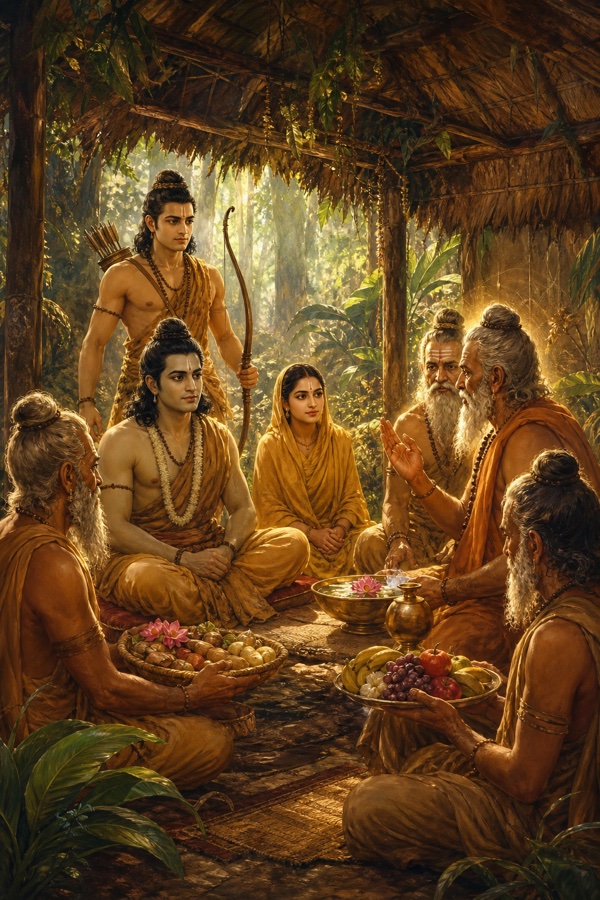
So saying, they satisfied Rama and Lakshmana with fruit and root and flower and every kind of wild fare the forest gave, laid out with the care of men who had very little and gave all of it. And in the same way the other accomplished ascetics of that circle, each of them bright as fire, honored Rama according to their just and settled custom, one hut after another, so that the welcome went on around the ring like a lamp passed from hand to hand.
Viradha’s attack and the seizing of Sita
Rama stayed the night and took his leave of all the sages at sunrise, and then he plunged into the deep of the forest. With Lakshmana at his back he came into the middle of the wood, and the wood changed around them. Herds of deer of many kinds moved through it, and bears and tigers had left their marks on the trunks. The trees and creepers and thickets stood broken down, as if something large had been passing through for years. There was no pool anywhere, though the ground looked as if pools should be there. The birds did not sing. Only the crickets kept up their shrill din, swarm answering swarm, and under that noise the silence of everything else was easy to hear.
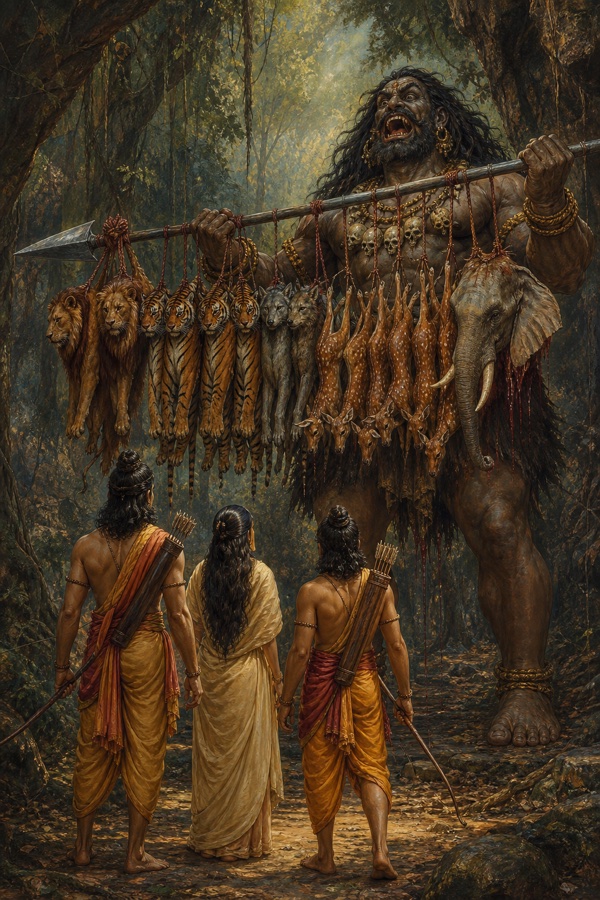
In that dread wood full of beasts, Rama, with Sita beside him, saw a man-eating rakshasa as huge as a mountain peak, roaring in a voice that came from somewhere very deep. His eyes were sunk far into his head, his mouth was enormous, his belly was monstrous; he was foul and misshapen and tall, warped in every limb, terrible to look at from any side. He wore a tiger’s skin still wet with fat and smeared with blood. He stood in the path the way Death stands with his jaws flung open, and every living thing for a mile around had learned to be afraid of him. Onto a single iron spike he had strung three lions, four tigers, two wolves, ten spotted deer, and the great tusked head of an elephant, all of it dripping with fat, and he held this raised above his head like a standard as he bellowed.
When he saw Rama, Lakshmana, and Sita of Mithila, he came at them in a fury, the way Death falls on the world of the living. His roar seemed to shake the earth. He swept Sita up into his arms and drew back out of reach, and then he spoke. “You two wear matted hair and bark. You drag a woman along with you. Your lives are almost over, and still you have marched into the Dandaka forest with arrows and bow and sword in your hands. You call yourselves ascetics, so how is it you keep a woman among you? Who are you, sinners who work unrighteousness and bring a stain on the sages? I am the rakshasa named Viradha. I walk this trackless wood armed, forever, and I eat the flesh of seers. This lovely woman will be my wife, and on the field of battle I will drink the blood of you two sinners.”
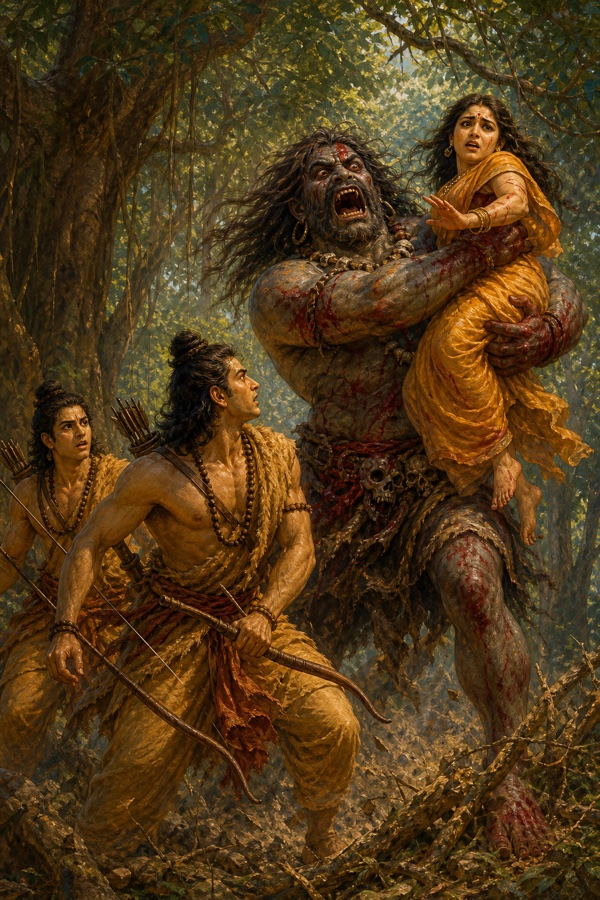
Sita heard the proud, evil words of that Viradha, and she shook with terror the way a plantain tree shakes in a gale, the whole slender length of her trembling. Rama saw her caught in the rakshasa’s grip, and his mouth went dry. He turned to Lakshmana. “Look, gentle brother. Look at her. The daughter of King Janaka, a princess of renown, raised in the softest comfort a kingdom could give, my wife of pure conduct, and she has fallen into the lap of Viradha. Everything the far-seeing Kaikeyi wished on us has come to pass. She was not content with the kingdom she won for her son; she sent me into the forest, me, whom every living thing loved; and today, this very moment, both her boons have borne their fruit. Know it, Lakshmana. My mother Kaikeyi has this day had her desire. Nothing wounds me more than the touch of another upon Sita. It cuts deeper than the loss of my father, deeper than the loss of my kingdom.”
While Rama spoke like this, drowned in grief and tears, Lakshmana broke out, hissing like a cobra that has been penned in and sees an opening. “You are the lord of all beings, the equal of Indra, and you have a servant like me at your side, and still you grieve like an orphan? Why? Today the earth will drink the lifeless blood of this rakshasa Viradha, struck down by my angry arrow. The rage I once carried against Bharata, when I thought he coveted the throne, I will loose upon Viradha now, the way Indra, the thunderbolt in his fist, hurls it against a mountain. Let this great arrow, driven by the strength of my arms, fall on his broad chest, tear the life from his body, and send him spinning to the ground.”
Words with Viradha and the first strike
Then Viradha spoke again, and his voice filled the forest to its edges. “I am asking you, so tell me. Who are you two, and where are you bound?” Rama answered the rakshasa with the flaming mouth by naming his house, the house of Ikshvaku, kings of Ayodhya since before anyone counted, and he gave the rakshasa nothing more than that. “Know us for warriors of good character, come into the forest. And we wish to know you in turn. Who are you, who roam the Dandaka woods?”
Viradha answered Rama, whose valor had never once failed him. “Very well, king. Hear me. I am the son of Java, and my mother is Satahrada. All the rakshasas on earth call me Viradha. By my penance I won a boon from Brahma: no weapon in the world can kill me, and nothing can cut me or pierce me through. So let go of this woman, both of you, and run back the way you came while you can still run. Ask nothing more of me and I will leave you your lives.”
Rama’s eyes went red. “You petty creature. Shame on you and on your foul purpose. You are hunting for your own death, and you will find it. Stand where you are and you will meet it on the field, because I am not going to let you walk away alive.” He strung the bow in one motion and fitted the sharpest of his arrows, and from the strung bow he loosed seven shafts feathered with gold, as swift as Garuda, as swift as the wind. Their fletching was peacock feather. They drove clean through Viradha’s body and came out the other side and fell to the earth drenched in his blood, glowing there in the leaf litter like coals.
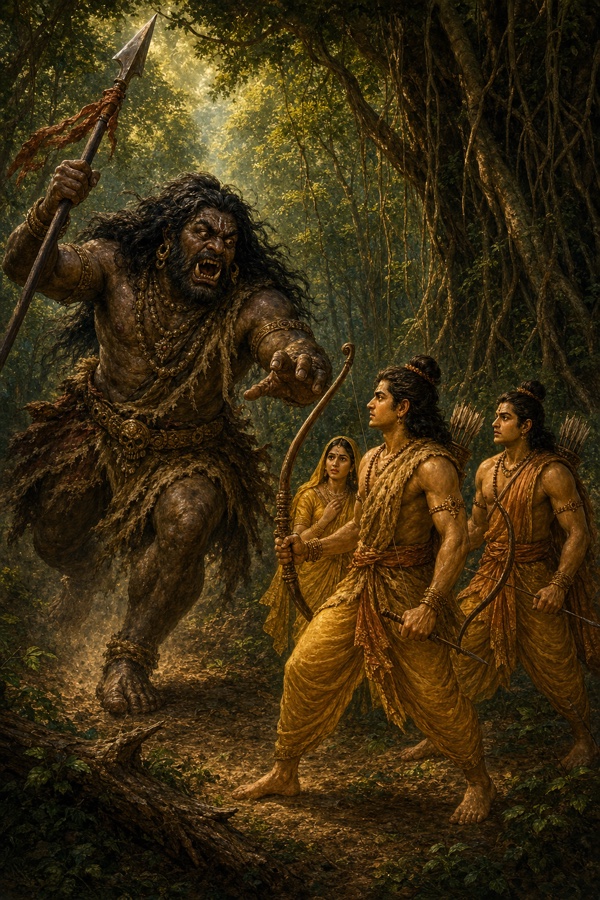
Wounded, the rakshasa set Sita down. He snatched up his spike and came at Rama and Lakshmana in a rage, roaring, the spike held high like the banner of Indra, his mouth open on the world the way Death’s mouth opens. The two brothers answered with a shining rain of arrows, and it fell on a thing that stood there like the Time-Spirit, like Death, like Yama himself, and the terrible rakshasa laughed. He stopped where he was. He stretched, and yawned, and as the yawn moved through him the arrows dropped away from his body one after another and lay on the ground. By the power of his boon he held his life locked inside him. He lifted the spike again, with its dead beasts still strung on it, and charged the two brothers. Rama cut that spike in two while it was still in the air, that spike bright as the thunderbolt and blazing like fire, with a single pair of arrows, and the severed length of it crashed to the ground like a slab of Mount Meru sheared off by a lightning bolt.
Then the two brothers drew their swords, quick as two black cobras rearing to strike, and fell on him and cut at him with all their force. It was not enough. The fearsome rakshasa, savagely wounded, wrapped his arms around both those unshakable warriors and made to carry them off, and Rama read what was in his mind. “Let this rakshasa carry us along this very path, gladly, however he likes,” he said to Lakshmana. “The road the night-wanderer is taking is the very road we are meant to walk.” Drunk on his own strength, Viradha lifted the two of them like a pair of small children, set them on his shoulders, and strode off toward the deep forest, roaring as he went. He plunged into a wood that loomed like a bank of dark cloud, thick with tall trees of many kinds, alive with birds, with jackals slipping between the trunks, with beasts that hunt.
The killing of Viradha, and his deliverance
Sita watched the two princes, the mightiest men their house had ever bred, strong-armed as they were, being carried off like baggage, and she cried out after them in a voice that carried. “This is Rama, truthful, gentle, and pure, and he is being dragged away with Lakshmana by a rakshasa of dreadful shape. Lord of the rakshasas, I bow to you. Take me away instead. Let bears and tigers and leopards eat me; only set these two princes free.”
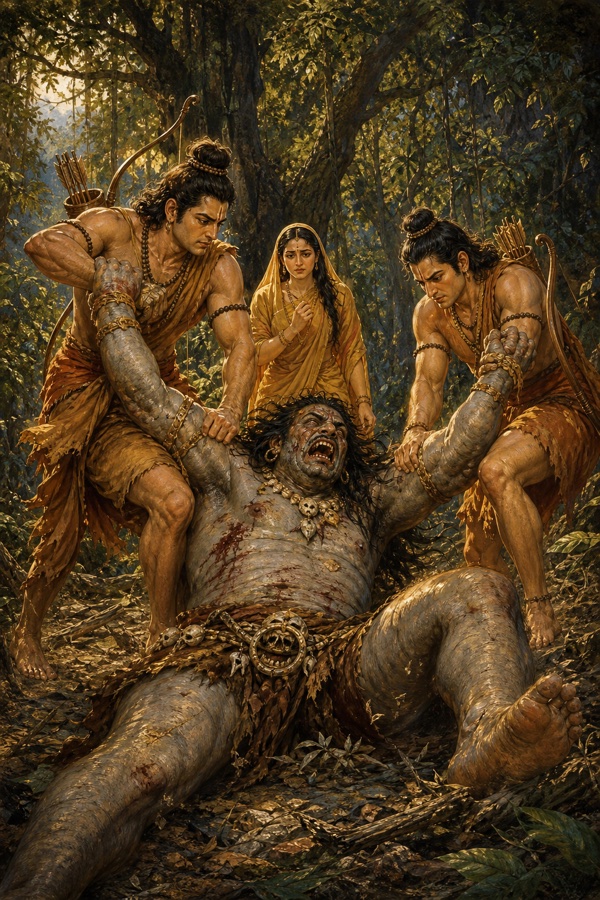
Her cry reached the brothers on the rakshasa’s shoulders and it ended their patience. Lakshmana took the rakshasa’s left arm and broke it, and Rama, in the same breath, broke the right. His arms hanging shattered, gripped now by a terror he had never felt in his life, Viradha dropped in a faint to the ground like a cloud split by lightning, like a mountain split by lightning. Then the two of them beat him with their fists, their forearms, their heels, and lifted him bodily and dashed him down on the earth again and again until the ground shook with it. It made no difference. Pierced by many arrows, cut by two swords, flung to the ground over and over, the rakshasa would not die.
Rama looked at him lying there, past all killing, immovable as a hill, and Rama, who gives safety to the frightened, said to Lakshmana: “By the power of his penance this rakshasa cannot be beaten in battle with any weapon. So we will bury him in a pit. Dig a great pit here in the forest, Lakshmana, for this rakshasa of fierce and terrible strength, this thing the size of an elephant.” And having said it, Rama set his foot on Viradha’s neck and stood there with his weight on it.
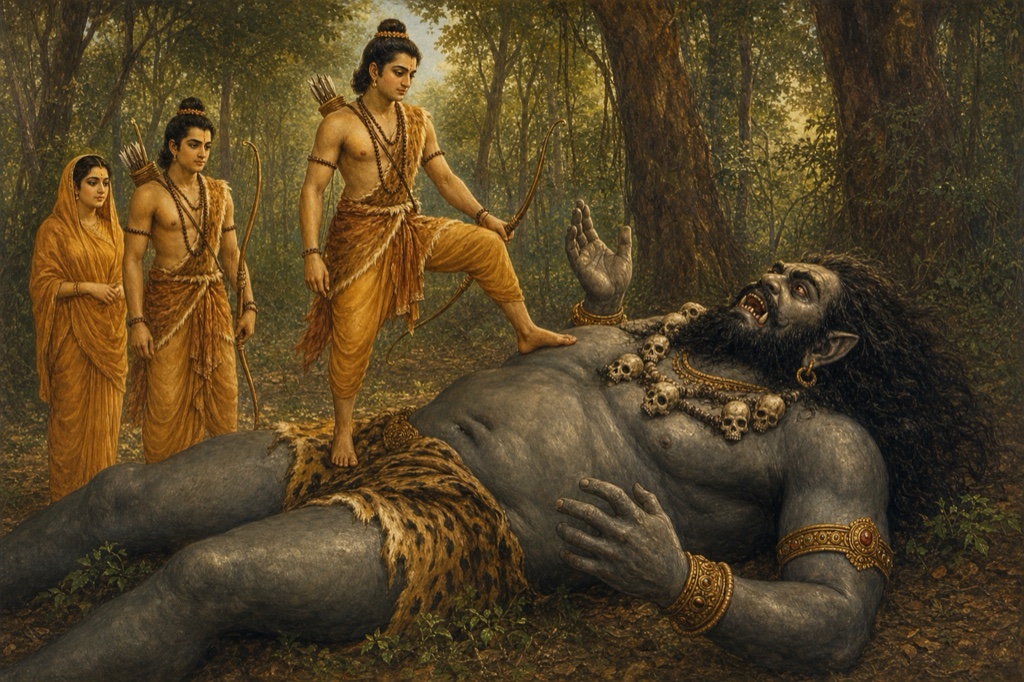
Hearing Rama give that order, Viradha spoke, and all the boast had gone out of his voice. “You have killed me, prince, you whose strength is Indra’s own. Before, in my confusion, I did not know you. I know you now. You are Rama, and Kausalya is blessed in her son. I know Sita, and I know Lakshmana of great fame. In truth I am a gandharva named Tumburu, a musician of the heavens, and Kubera, lord of the northern quarter and the treasure of the gods, laid a curse on me. Through that curse I took on this hideous rakshasa’s body. When I begged him for grace, Kubera, whose fame is great, said to me: ‘When Rama, the son of Dasharatha, kills you in battle, you will regain your own form and go to heaven.’ He said it in his anger, because I had failed to attend on him. That was Kubera’s word to me, who had lost myself in the nymph Rambha. Through your grace, Rama, I am freed of that most cruel curse. I will go to my own realm. May all be well with you, you before whom every enemy goes down.
“A yojana and a half from here lives the righteous, sun-bright sage Sharabhanga, mighty in his penance. Go to him quickly; he will give you good counsel. Cast me into a pit, Rama, and go your way in peace. For rakshasas who have given up their lives this is the ancient law: everlasting worlds wait for those who are laid in a pit.” So saying, Viradha, worn through by the arrows, let go of his body, and went to heaven.
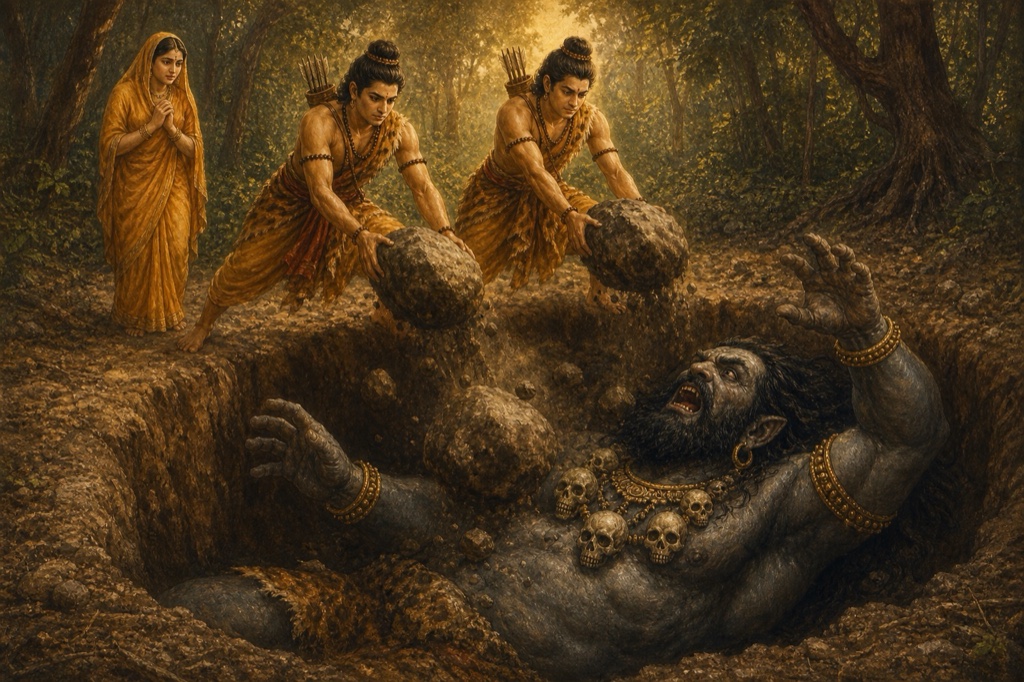
Rama gave the order again: “Dig the pit.” He kept his foot on the rakshasa’s neck while Lakshmana found a spade and dug a fine deep pit beside the huge body. Then they lifted Viradha, with his ears like iron spikes and his booming voice, and as the last of him cried out in a fearful voice they cast him down into the pit. Their fear had gone out of them. Glad at heart, Rama and Lakshmana threw Viradha into the pit in the earth and rejoiced in that vast forest, and they heaped rocks over the rakshasa until the pit was a cairn.
In truth Viradha had himself asked Rama for a death by force at his hands; that was why the forest-dweller had said, “My death cannot come by any weapon.” It was on hearing this that Rama resolved to bury him in the pit, and as the mighty rakshasa went down he made the forest ring with his cry. Having killed the rakshasa and recovered Sita, the two princes, carrying their lovely golden bows, roamed the great forest in delight, like the moon and the sun set together in one sky.
The sage Sharabhanga, and his passage to Brahma’s world
With the fearsomely strong Viradha dead in the forest, Rama went to Sita and held her, and stayed holding her until the shaking stopped. Then he said to Lakshmana, whose face still shone with the fight: “This trackless forest is hard going, and we are not used to living in the wild. Let us go quickly to the ascetic Sharabhanga.” So the brothers turned toward Sharabhanga’s hermitage, a yojana and a half away, along the line the dying rakshasa had given them.
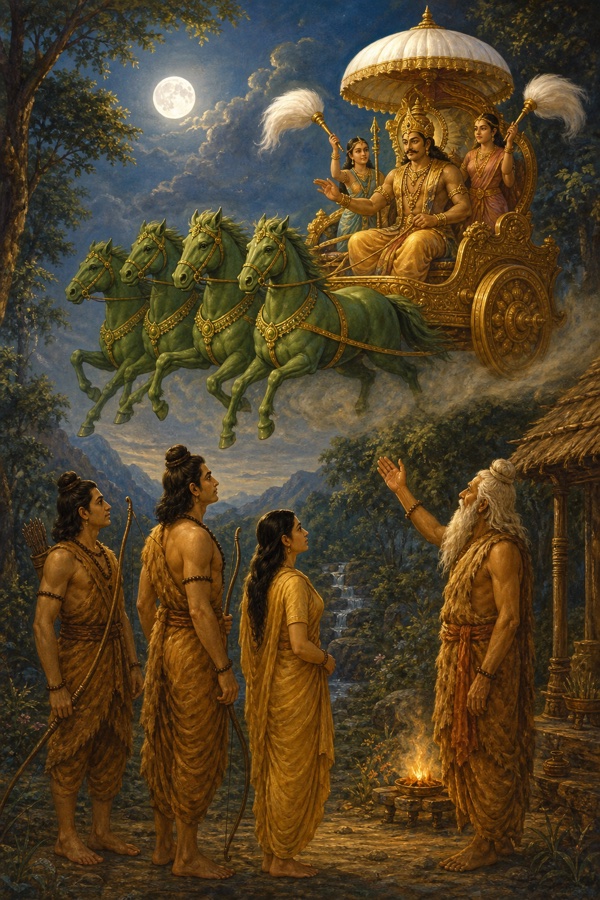
Sharabhanga’s penance had scoured him clean inside and filled him with a power that was not of this earth, and as Rama drew near his hermitage he saw a great marvel. He saw Indra, king of the gods, his body blazing like the sun and like fire, seated in a splendid chariot that hung in the sky and did not touch the ground, attended by gods, dressed in bright ornaments and spotless robes, revered by many exalted beings of his own kind. Not far from him Rama saw the chariot itself more clearly, drawn by green horses and gleaming like the noonday sun, and over it a spotless canopy like a white cloud, bright as the disk of the moon, hung with rich garlands. Two beautiful women stood in it holding whisks on handles of gold, waving them slowly over Indra’s head. Gandharvas, gods, siddhas, and many great seers were praising him in the sky with exquisite hymns, and all this while Indra was speaking with Sharabhanga, the way a king speaks with one man he has come a long way to see.
Rama pointed to the chariot and showed the wonder to his brother. “Look at that chariot in the sky, Lakshmana, bright as the sun, clothed in splendor. Those are surely the divine horses of Indra we heard so much about as boys. And those young men standing in their hundreds on every side, wearing earrings, holding swords, with broad chests and arms like iron clubs and red garments, every one of them looks as hard to take as a tiger. On every breast hangs a garland bright as fire, and each of them looks to be twenty-five years old. That, they say, is the age of the gods, the age that never changes. Stay here a moment with Sita, Lakshmana, until I find out clearly who this radiant being in the chariot is.”
Leaving Lakshmana there with Sita, Rama walked on alone toward Sharabhanga’s hermitage, toward the chariot that hung over it. Indra saw him coming. He took his leave of Sharabhanga and said to the gods: “Here comes Rama. Let us go before he speaks to me; let him not see me now. When he has conquered Ravana and finished his task, then I will see him, and quickly, for he has a great work to do that is too hard for anyone else.” So Indra, the thunderbolt at his side, honored the ascetic and rose into heaven in his horse-drawn chariot, and the sky above the hermitage was empty again.
When the thousand-eyed god had gone, Rama came with his family to Sharabhanga, who was tending the sacred fire. Rama, Sita, and Lakshmana touched his feet and, at his word, sat down; the sage took them as his guests and gave them a place to stay. Rama asked what had brought Indra to him, and Sharabhanga told him everything. “That giver of boons, Rama, wished to carry me to the world of Brahma, which I have won by fierce penance and which the unrestrained can never reach. But I knew you were near, and I would not go to Brahma’s world without seeing you, my beloved guest. Now that I have met you, a prince of righteous nature, I will go first to the lower heaven and then to the highest. Take from me the imperishable, blessed worlds I have won, the heavenly ones and those of Brahma. They are yours.”
Rama, who knew every scripture, answered him: “I will myself bring all the worlds to you, great sage. What I ask of you is only this: point me to a place in this forest where I may live.” Sharabhanga, who was very wise, spoke again. “Rama, here in the forest lives a righteous, self-restrained sage named Sutikshna, of great radiance; he will do you good. Go to him in that holy region, and he will arrange for you to dwell in a lovely part of the wood. Follow this river Mandakini upstream, Rama, against its current, this river that carries little boats of flowers on its water, and you will reach him. That is your road. Now watch me a moment, while I cast off these worn-out limbs the way a serpent leaves its old skin behind in the grass.”
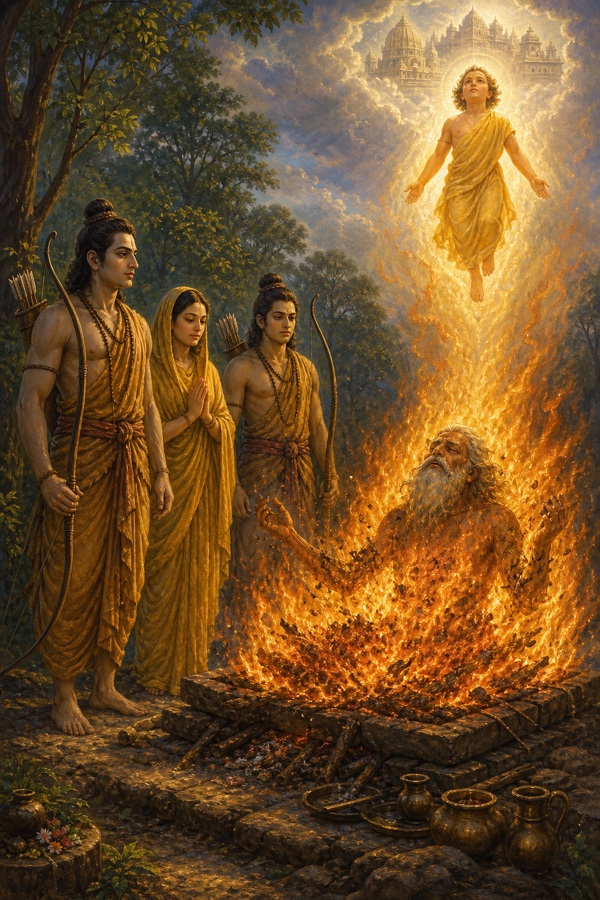
Then Sharabhanga built up the fire, poured oblations of clarified butter into it with the proper chants, and stepped into the flame. The fire took the hair of his body and his head, his thin old skin, his bones, his flesh and blood, everything he had worn for so long. And he rose out of that heap of fire as a youth glowing like fire, and stood there shining. Radiant with a light that was his own now, Sharabhanga crossed the worlds of those who keep the sacred fire, the worlds of the great seers, and the worlds of the gods, and entered the world of Brahma. There that meritorious sage, a Brahmin, saw the grandfather Brahma with his attendants about him, and Brahma too, seeing that Brahmin, was pleased and said: “You are truly welcome.”
The sages’ cry, and Rama’s pledge of protection
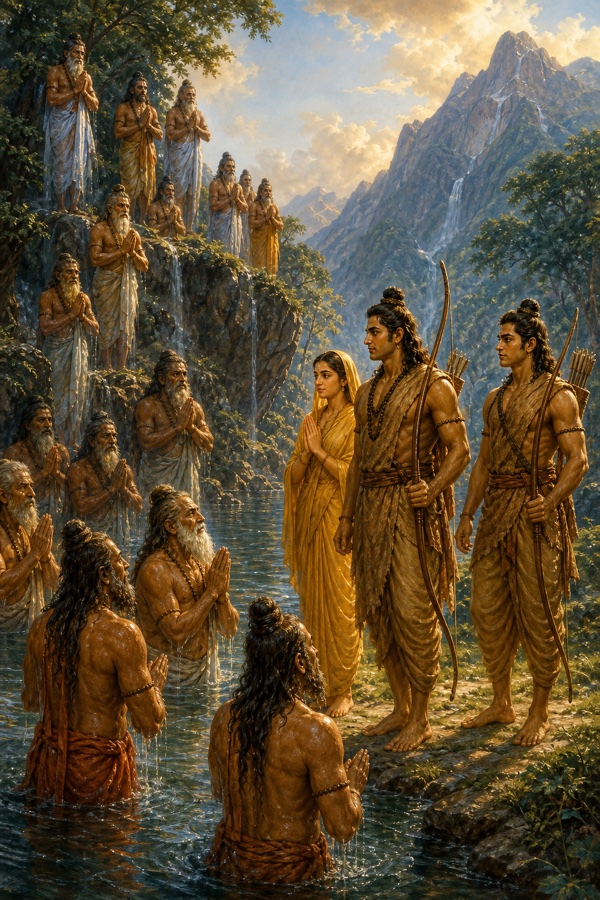
Sharabhanga was gone to heaven, and the hosts of sages who had gathered at his hermitage came to Rama, whose radiance burned like a flame among them, and they came to him with a request. They were every kind of ascetic the forest held. There were Vaikhanasas, born of Brahma’s nails, and Valakhilyas, born of his hair; sages who washed their bowls after eating and kept nothing back for the next meal; some who lived on the rays of the sun or the moon alone; some who ground their grain between stones, some who ate leaves and nothing else, some who used their own teeth for mortar and pestle; some who did their penance standing neck-deep in water; some who made their own limbs their only bed, and some who had no bed at all; some who never rested from their observances; some who lived on water alone, some on air alone; some who had the open sky for their only roof, and some who slept on the altar itself; some who dwelt on the high places; some who had mastered their senses; some who wore wet cloth against the skin; some sunk in the murmur of prayer, some given wholly to penance; and some who sat inside a ring of four fires with the sun burning overhead as the fifth. All of them shone with the light of Brahman, all of them were steady in yoga, and these ascetics came to Rama in Sharabhanga’s hermitage.
Those knowers of righteousness, gathered together, said to Rama, the best of all who uphold the right: “You are the great chariot-warrior and the chief and lord of this house of Ikshvaku and of the whole earth, as Indra is lord of the gods. You are famous in the three worlds for your glory and your valor; in you live devotion to your father, truth, and abundant righteousness. Having found you, a knower of the right and a lover of righteousness, we come to you like petitioners, and we beg you to forgive our boldness, lord. A great wrong falls on the king who takes his sixth share in taxes and does not guard his people as his own children. The king who protects all who live in his realm as he protects his own life, as he protects his own dear sons, wins fame that lasts for many years and is honored even in the world of Brahma. Of whatever high righteousness a sage who lives on root and fruit performs, a fourth share goes to the king who protects the people by righteousness.
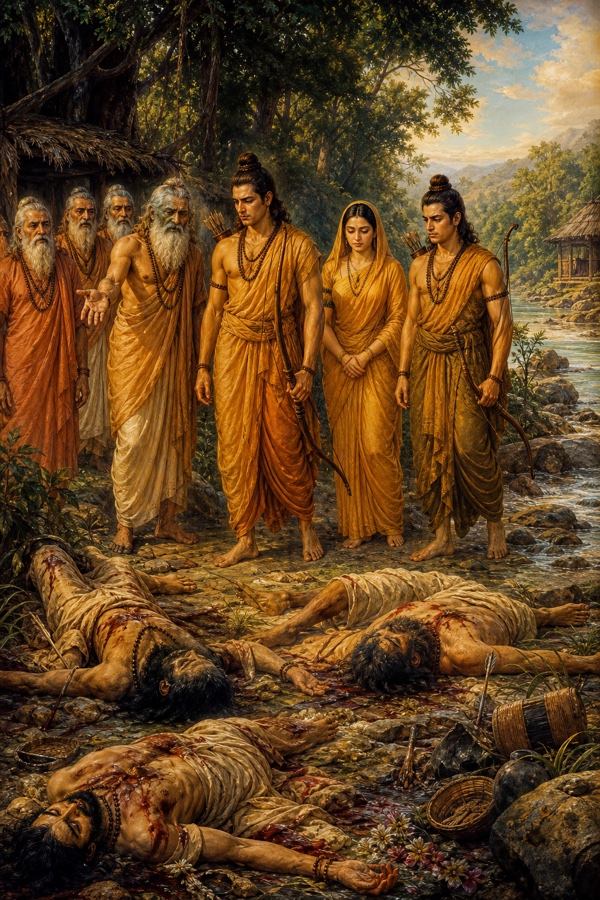
“This great company of forest-dwellers, Rama, most of them Brahmins, whose master you are, is being slaughtered by the rakshasas like the helpless and the forlorn. Come and see.” And they showed him. They showed him the bodies of sages killed in many ways by the rakshasas in the wood, men who had held their vows through decades and been torn apart for it. “A great massacre is being worked on the sages who live along the Pampa river, and along the Mandakini, and in the hermitages of Chitrakuta. We cannot bear this savage persecution of ascetics by rakshasas of dreadful deeds. So we have come to you, our fit refuge, for refuge. Protect us, Rama, from the night-wanderers who are killing us. Nowhere on earth is there any help better than you, hero. Guard us all from the rakshasas.”
Rama heard the ascetic sages out, and then he answered all of them. “You should not speak to me like this. I am at the command of the ascetics. I did not come into this forest for my own sake alone. I came, in keeping with my father’s command, to lift this violence of the rakshasas from you. By good chance I have come here to serve your purpose, and so this exile of mine will bear great fruit. I mean to kill on the field of battle these rakshasas who prey on ascetics. Let the sages see the valor of me and of my brother.” Having given the ascetics his pledge of safety, the righteous hero Rama, giver of noble gifts, went on toward Sutikshna with Lakshmana and with Sita, and all the ascetics went with him.
Dwelling at Sutikshna’s hermitage
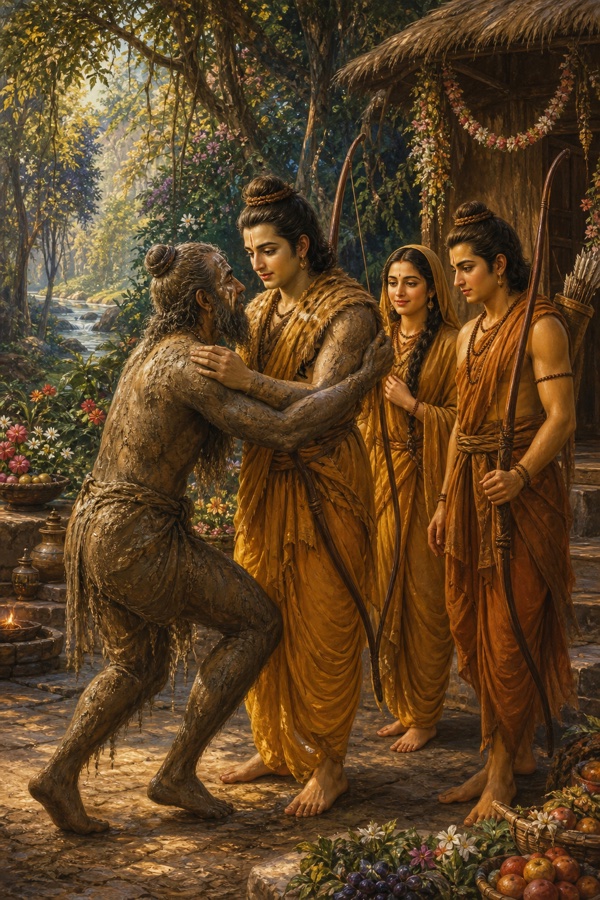
Rama, who had just promised to be the terror of the sages’ enemies, went with his brother Lakshmana, with Sita, and with those Brahmins toward the site of Sutikshna’s hermitage. It was a long march. They forded rivers running deep and cold, and at last they saw a bright mountain standing up out of the forest as high as the great Meru itself. The two brothers entered with Sita a forest thick with trees of many kinds, and passing into that fearsome wood, where every branch bent under its flower and fruit, they saw in a corner of it a hermitage hung with garlands of bark. There sat Sutikshna. He was an ascetic whose whole wealth was his penance, seated in the lotus posture, his body caked with dirt and dried mud that he wore as other men wear clean linen, for the purifying of himself, and Rama went up to him and spoke with fitting courtesy: “I am Rama, come to see you. Speak to me, great sage who knows what is right, whose spiritual might is truth itself.”
Rama, steady as ever, spoke to that fierce ascetic of true vows the way Indra speaks to Brahma. The steadfast sage looked at him, then rose and folded him in his arms, and said: “Welcome, Rama. With your coming this hermitage has found its master. I have been waiting only for you, hero, before I give up this body on the earth and go to the world of the gods. Indra came to me here, Rama. I had heard that you had left your kingdom and come to Chitrakuta. The great god told me that by my meritorious deeds I had won all the higher worlds, and I say to you: take your joy in those worlds I have won, the worlds the divine sages frequent, with your wife and with Lakshmana.”
The self-possessed Rama answered him as Indra answers Brahma: “I will myself bring all the worlds within your reach. For now, what I ask is this: point me to a place in this forest where I can live. You are skilled in all things and devoted to the good of every creature, and Sharabhanga of the Gautama line told me that you know every scripture.”
At these words Sutikshna filled with joy, and his answer was sweet. “This very hermitage has its virtues, Rama; live here happily. Sages come to it in crowds, it is always rich with root and fruit, and it is a pleasant place; be comfortable here. Great herds of deer come into this hermitage and wander everywhere through it. They charm everyone who sees them with their beauty and then go away again, having harmed no one. There is no trouble here except these frolicking deer.”
Rama had his bow in his hand when he heard this, and an arrow with it, and he looked down at both. “If I ever kill these gathered herds of deer with a sharp-edged arrow, bent at the joint, you will be dishonored, and what could grieve me more than that? So I think it wrong to make a long stay in this hermitage.” And with that Rama fell silent and went off to the evening prayer, the rite that closes every day of a forest life whether or not there is anything else to do that day. When the prayer was done he settled to pass that one night in Sutikshna’s lovely hermitage with Sita and Lakshmana, and as the prayer ended and night came on, Sutikshna himself received those men with every honor and gave them pure food fit for ascetics.
Farewell to Sutikshna, and on toward the hermitages of Dandaka
Honored by Sutikshna, Rama passed the night there with Lakshmana and woke at dawn. Rising at the proper hour, Rama and Sita bathed in water so cold it made them gasp, and fragrant with the scent of the lotuses that grew in it. Then Sita, Rama, and Lakshmana worshiped the fire and the gods in due form in that grove of ascetics, watched the sun come up, and came to Sutikshna and spoke to him gently: “Honored by one so worthy of honor as you, we have lived in comfort. Now we ask your leave and would set out; the sages are urging us on. We long to see the whole ring of hermitages of the holy sages who dwell in the Dandaka forest, sages of meritorious deeds. We wish your leave to go with these sages, steadfast in righteousness, mastered by penance, glowing like a fire that gives no smoke. We would go before the sun climbs to its cruel, unbearable heat, the way a man from a low family, come into wealth by unfair means, becomes unbearable.” And with that Rama, with Lakshmana and Sita, bowed at the sage’s feet.
The great sage raised the two princes as they touched his feet, folded them in a close embrace, and said with affection: “Go on a safe road, Rama, with Lakshmana and with this Sita, who follows you like your shadow. See, hero, the lovely sites of these ascetics of the Dandaka forest, their inner beings purified by penance. See their groves rich with root and fruit, in flower, with fine herds of deer and gentle flocks of birds; the ponds and lakes with their beds of open lotuses and their clear water, thronged with waterbirds; the mountain springs, a delight to the eye; and the pleasant forests loud with the cries of peacocks. Go, dear Rama. You too, son of Sumitra, go. See all this, and then come back again to this hermitage.”
Saying “So be it,” Rama walked with Lakshmana around the sage, keeping him on the right hand as reverence requires, and set about departing. Then Sita brought the two brothers their fine quivers, their bows, and their polished swords, and put them into their hands herself. The brothers fastened on the handsome quivers, took up their bows with a twang of the string, and left the hermitage to begin the journey. Given leave by the great sage, the two handsome princes of Raghu’s house, bearing bow and sword, set out with Sita, deeper into the forest they had sworn to make safe.
Sita’s counsel on nonviolence
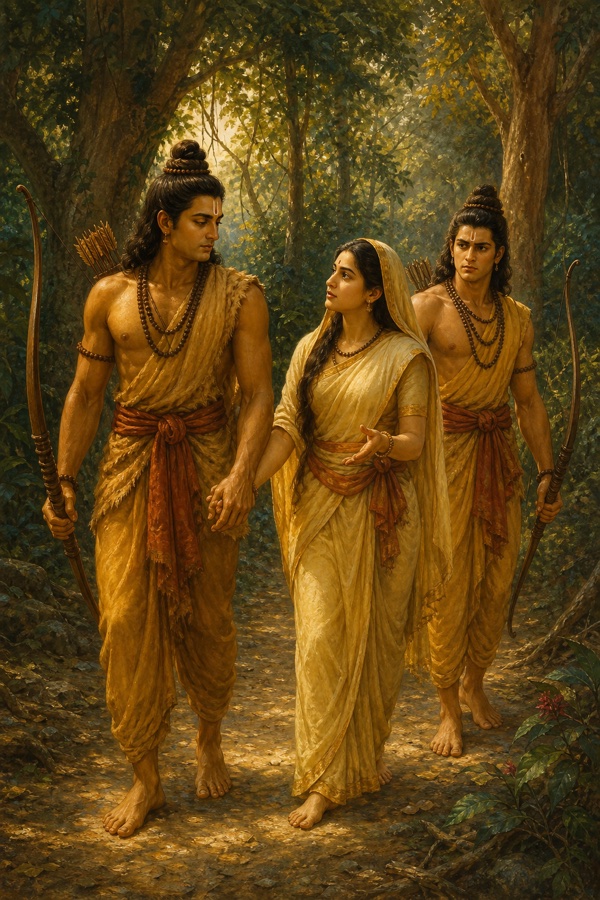
As Rama set out with Sutikshna’s leave, his bow in his hand and his promise to the sages still fresh, Sita spoke to her husband, and her voice was tender and it reached his heart. “In the subtlest of ways, Rama, a great man is drawn into a great wrong. He can turn from it by turning from the cravings that grow out of desire. Such cravings are only three. False speech is the worst of them; and two are heavier still, the seeking of another man’s wife, and cruelty where there is no enmity. False speech you have never spoken, Rama, and you never will. As for longing after other women, which destroys righteousness, how could it be in you? It is not in you, it was never in you, it does not so much as touch your mind. You have always kept to your own wife alone, prince. Righteousness and truth stand firm in you; you are wholly given to what is right, true to your word, obedient to your father. Only those who have conquered their senses can hold all this, and I know your mastery of your senses.
“But the third grave fault, the taking of life where there is no enmity, out of heedlessness, this is the one that now stands in front of you. You have vowed, hero, to kill the rakshasas on the field of battle for the protection of the sages of the Dandaka forest, and for this you and your brother have set out toward that famous wood with bow and arrows in your hands. Seeing you go like that, my mind is uneasy; I think of what you are about to do and of your truest good in this world and the next. I do not like this going to Dandaka, and I will tell you the reason; please listen while I speak it. When you go into the forest with bow and arrows, your brother beside you, and see all the creatures of the wild, you may perhaps loose a shaft somewhere for no cause. A bow near a warrior is like fuel near a fire: each greatly swells the strength of what is nearest to it.
“Long ago, in some holy forest where beasts and birds lived in joy, there dwelt a truthful, pure ascetic. To break his penance, Indra came to his hermitage in the guise of a soldier with a sword in his hand. He set that fine sword down in the hermitage and gave it to the sage, deep in his holy austerities, as a thing left in trust. Charged with keeping the trust, the sage carried the sword with him even as he wandered the wood. When he went out to gather roots and fruit, mindful of his charge, he would not go without it. Carrying the weapon always, he let his resolve for penance slip in time, and his mind slowly turned cruel. Then, given to cruelty, careless, dragged along by unrighteousness, that sage went down to hell, through nothing more than the company of a weapon. That is what came of keeping a sword close, long ago, and the company of a weapon is said to work on a man the way the company of fire does.
“Out of love and deep regard I remind you of this and teach you: even holding the bow, never once set your mind on killing the rakshasas of Dandaka where there is no enmity. The world does not praise killing where there is no fault, hero. For warriors who are brave and master themselves, in the forest, this alone is the work of the bow: the protection of those in distress. What has a weapon to do with a forest? What has the duty of a warrior to do with the life of penance? They pull against each other; so let us honor the law of the place we are in. From the handling of weapons the mind grows stained with wrong, as it does in unworthy men. Once you return to Ayodhya you will follow a warrior’s duty again. And if you should give up the kingdom and become a devoted sage, it would bring endless joy to my mother-in-law and my father-in-law. From righteousness comes wealth, from righteousness comes happiness, from righteousness one gains everything; this world has righteousness for its very core. The wise wear themselves thin with strict rules and win righteousness by effort; it does not come from ease. So keep your mind pure, gentle Rama, and follow righteousness in this grove of penance. You know the whole truth of the three worlds; who am I to teach you your duty? I have said all this only out of a woman’s lightness of nature. Weigh it with reason, you and your brother, and do whatever pleases you; let there be no delay.”
Rama’s firm answer
Rama heard these words that Sita spoke out of devotion to her husband, and standing firm in righteousness he answered Janaka’s daughter. “Queen, knower of righteousness, out of love you have spoken words that are wholesome, fitting, and worthy of the duty of my house. What am I to say, when it was you yourself who said that a warrior bears the bow so that no cry of the suffering may rise? Sita, in the Dandaka forest those suffering sages, keepers of austere vows, came to me of their own accord and took refuge in me, knowing me able to protect them. They dwell in the forest always, eating root and fruit, and they find no peace, because of rakshasas of cruel deeds. They are being eaten by those terrible rakshasas who live on human flesh, and being eaten, the sages of the Dandaka forest, the best among Brahmins, asked me to show them favor. I heard the words that came from their mouths, and I showed them that I wished to hear more, and I said: ‘Be gracious to me. It is a great shame to me that Brahmins such as you, who ought to be approached, have come to approach me.’ Then I asked those Brahmins what I should do. They came together, all of them, and made me this submission: ‘Rama, rakshasas past number, who change their shape at will, torment us cruelly in the Dandaka forest; protect us from them. When the hour comes to pour the oblation into the sacred fire, and on the holy days, these flesh-eating, invincible rakshasas fall on us. To us poor ascetics, harried by the rakshasas and looking for a way out, you are the highest refuge. By the power of our penance we could kill the night-wanderers ourselves, but we do not wish to spend the merit we have gathered over so long a time, for penance is hard and beset with hindrances. That is why, though the rakshasas devour us, we will not speak a curse. Protect us, you and your brother; in the forest you alone are our lord.’
“Hearing this, I promised the sages of the Dandaka forest my full protection, daughter of Janaka. Having made that promise, while I live I cannot make my word to those sages false, because truth is always dear to me. I could give up my life for you, and Lakshmana with it, before I would give up a promise, above all a promise given to Brahmins. Even unasked, Sita, it would be my duty to protect the sages; how much more so now that I have taken a vow. You have spoken these words to me out of love and goodwill, and I am well pleased, for no one advises a person who is not dear to them. This counsel is worthy of you, beautiful lady, and of your house alike. You are my companion in righteousness, and dearer to me than life itself.” Having said this to his beloved wife, Sita of Mithila, the great-hearted Rama, bow in hand, went on with Lakshmana toward the lovely groves where the ascetics lived.
The tale of Mandakarni and the Panchapsara lake
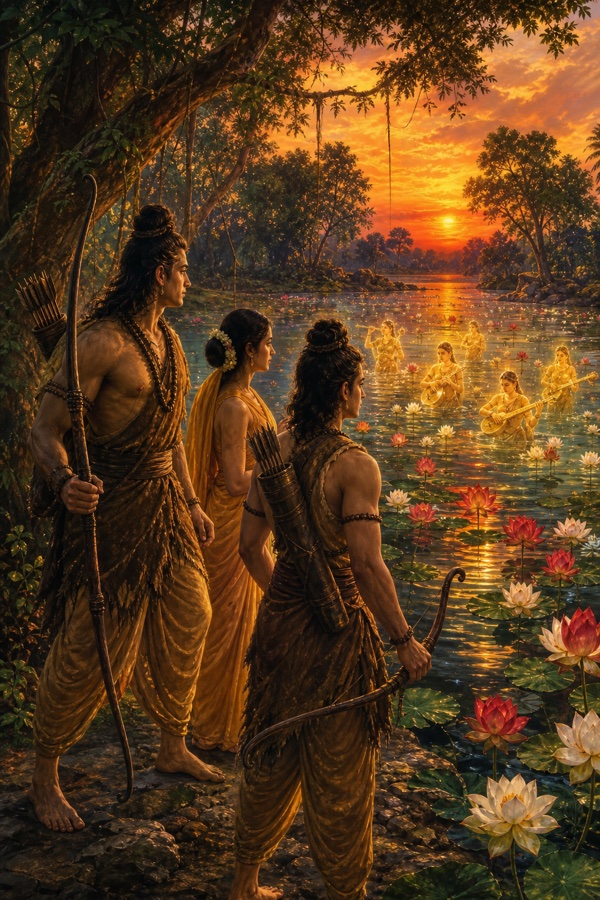
They walked in the order that would hold for the whole of the forest years: Rama in front, Sita in the middle where both bows could cover her, and behind them Lakshmana with his bow in his hand and his eyes on the trees. The three of them passed peak after mountain peak, forest after forest, and rivers so lovely that they slowed to look. They saw cranes and ruddy geese walking the riverbanks, lakes crowded with lotuses and waterbirds, spotted deer grazing in herds, horned buffaloes in rut, boars, and elephants tearing down trees for the pleasure of it. After a long march, as the sun was going down, they came all together on a lovely lake spread over a full square yojana, thick with red and white lotuses, graced with herds of elephants, crowded with cranes, geese, ruddy waterfowl, and other creatures of the water. And from that beautiful lake of clear water, as the light went, rose the sound of singing and of instruments being played, and there was no one to be seen anywhere on it.
Curiosity got the better of Rama and of Lakshmana, that great chariot-warrior, and they turned to the sage who was walking with them, whose name was Dharmabhrit. “We are all seized with wonder to hear this most marvelous sound. What is it? Tell us in full.” The righteous sage began at once to speak of the greatness of the lake. “This is the lake named Panchapsara, Rama, ever full of water, and the sage Mandakarni made it through the power of his penance. That great sage Mandakarni performed a fierce penance in this lake, standing in the water and living on air alone for ten thousand years. At this the gods grew troubled, with the god of fire at their head, and they gathered and said to one another, ‘This sage is reaching for the place of one of us.’ And every dweller in heaven felt his heart shift with worry.
“Then, to break his penance, all the gods appointed five chief nymphs whose bodies flashed like lightning. That sage knew what is good and what is ill, in this world and the next, and still he was brought under the sway of love by those nymphs, so that the work of the gods was done. And those same five nymphs became the sage’s wives; a hidden house was built for them beneath the lake. There the five of them live as they please and delight the sage, who has regained his youth by the power of the same penance the gods came to break. The lovely song mixed with the tinkling of their ornaments, sung while they play, is the sound you hear.” Rama of great renown took in the pure-minded sage’s account with his brother as a piece of wonder, and the music went on behind them as they walked away from the water.
As he spoke on, the sage saw ahead of them a ring of hermitages ringed with kusha grass and bark cloth, wrapped in the grandeur of Brahman. Rama entered that beautiful ring of hermitages with Sita and Lakshmana, and staying there in comfort, honored by the great sages, Rama, master of great weapons, visited one after another the hermitages of the sages he had stayed with before. He stayed happily here for ten months, there for a year, elsewhere for four months, in another place for five or six or more, in another for still more months, in yet another for a month and a half, and in others for eight months and for three. And while he was living like this in the hermitages of the sages, passing the time in ease, ten years went by, ten of the fourteen years of the sentence Kaikeyi had won, spent among people who wanted nothing from him except that he stay a little longer. Having wandered so far, Rama, who knew what is right, came again with Sita to the site of Sutikshna’s hermitage, where the long circle of the ten years had begun. Honored by the sages there, Rama, whom no enemy had yet withstood, stayed a while at that hermitage too. Then, sitting one day close by the great sage, Rama said to Sutikshna: “I have heard from people talking among themselves that Agastya, the greatest of all the sages, lives always in this forest. But the forest is so vast that I do not know where. Where is the lovely site of that wise and celebrated sage’s hermitage? A great longing turns over and over in my heart, that with my brother and with Sita I might bow before Agastya, win his grace, and do some service to that sage with my own hands.” Sutikshna was pleased, and he answered the son of Dasharatha: “I too meant to tell you and Lakshmana this very thing, that you should go to Agastya with Sita, Rama. By good fortune you speak of it to me yourself.
“I will tell you, Rama, where the great sage Agastya lives. Go south four yojanas from this hermitage, dear son, and there, in a nearly level tract of forest, stands the great and splendid hermitage of Agastya’s brother, graced with a grove of long-pepper trees, rich with flowers and fruit, lovely, ringing with the calls of many birds. There are many lotus ponds and lakes of clear water there, crowded with swans and diving birds and graced with ruddy geese. Pass one night there, Rama, and in the morning go on southward along the edge of the grove. Eight miles on, one more yojana, you will reach the site of Agastya’s own hermitage, in a delightful part of the forest adorned with many trees. There Sita and Lakshmana will live happily with you, for that stretch of forest is full of trees and lovely. If you have made up your mind, most intelligent prince, to see the great sage Agastya, then resolve to set out this very day.”
Hearing the sage’s words, Rama saluted him with his brother and set out with Sita and Lakshmana toward Agastya.
Agastya’s brother’s hermitage and the tale of Vatapi
Seeing wondrous forests, mountains like banked cloud, and lakes and rivers along the way, Rama went on comfortably by the road Sutikshna had described, and when the forest began to change he was greatly pleased and said to Lakshmana: “This must be the hermitage of Agastya’s brother, just as Sutikshna told it. Surely this is the site of the hermitage of that meritorious brother of Agastya. As Sutikshna said, the thousands of trees of this forest are bent over the path under their weight of fruit and flower. This scent of ripe long-pepper, carried out of the wood on the breeze, comes with a sudden sharp taste on the tongue. Here and there are gathered heaps of firewood, and blades of darbha grass with the sheen of the cat’s-eye gem lie cut and ready for the rites. In the middle of the forest a column of smoke rises from the hermitage fire, like the crest of a dark cloud. On the lonely holy fords the Brahmins have bathed and are offering the gods flowers they gathered with their own hands. So by Sutikshna’s account, gentle Lakshmana, this must surely be the hermitage of Agastya’s brother, that Agastya who, by his own spiritual might, held back the death that was Vatapi and Ilvala and, wishing the good of the world, made this whole southern quarter fit to live in.
“They say that once two cruel brothers lived here together, great demons and killers of Brahmins, Vatapi and Ilvala. Ilvala would take the form of a Brahmin, and speaking faultless Sanskrit he would invite Brahmins to a shraddha, the rite at which Brahmins are fed in the name of the dead. Then he would cook his own brother, who had taken the form of a ram, and feed him to those Brahmins with every observance the rite lays down. When the Brahmins had eaten, Ilvala would call out in a loud voice: ‘Vatapi, come out!’ And hearing his brother’s voice, Vatapi would come bursting out, tearing the bodies of the Brahmins open, bleating like a ram. So, always working together, these flesh-eating demons who changed shape at will destroyed thousands of Brahmins.
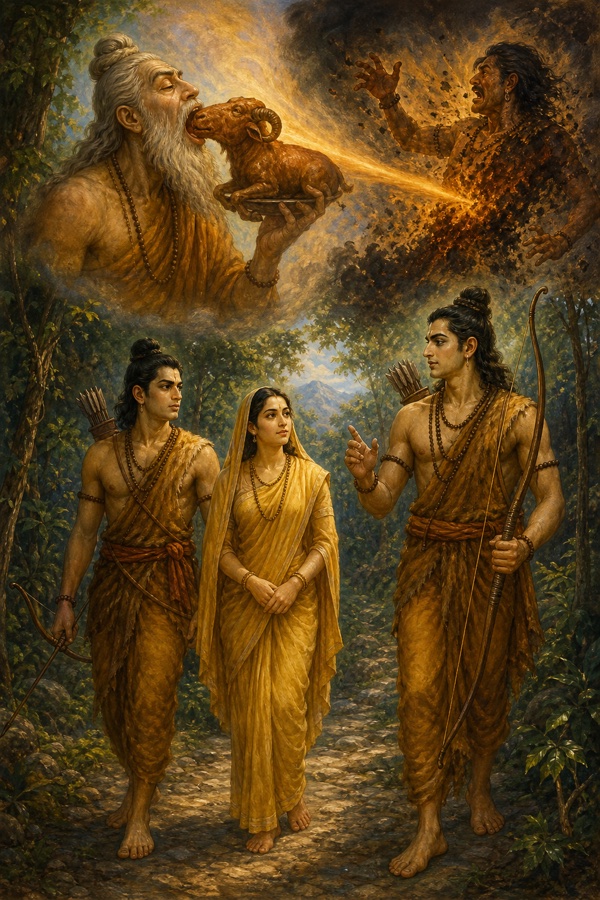
“Then, at the prayer of the gods, the great sage Agastya sat down at such a rite and ate that great demon with relish. When the meal was over, Ilvala offered water for the washing of hands, said, ‘It is finished,’ and called to his brother: ‘Come out!’ And as that killer of Brahmins stood calling to his brother, Agastya, wisest of the sages, with the whole of that ram already inside him, said with a laugh: ‘Where is the power to come out left in that ram-shaped brother of yours? I have digested him, and he has gone to the abode of Yama.’ Hearing his brother’s death declared, the night-wanderer flew at the sage in a rage. He attacked that Indra among Brahmins, and the sage of blazing radiance burned him with a single fire-like glance, and he died. This is the hermitage, graced with its lake and grove, of the brother of that Agastya who out of pity for the Brahmins did this hard thing.”
As Rama spoke like this with Lakshmana, the sun set and the hour of evening worship came on. Having performed the evening devotions in due form with his brother, Rama entered the hermitage and saluted the sage who kept it. Warmly received by that sage, Rama stayed there that one night on roots and fruit alone. When the night had passed, at sunrise, Rama took his leave of Agastya’s brother: “I bow to you, sir; the night passed happily. I take my leave now. I am going to see your revered elder brother.” Told “Go,” Rama set off by the road pointed out to him, taking in the forest as he went.
He saw there forest trees by the hundred, nivara and jackfruit and sal and vanjula, tinisha, chiribilva, madhuka, bilva, and tinduka too, all in flower and made lovelier by the blossoming creepers that climbed them, scarred where elephants had rubbed their trunks along the bark, graced with monkeys, and loud with the cries of flocks of birds in their season of heat. Then the lotus-eyed Rama said to Lakshmana, who followed close behind him and added to his glory: “The leaves of the trees are glossy here, and the beasts and birds are gentle, so the hermitage of the great, pure-souled sage cannot be far. This is the hermitage of that Agastya whose deed made his name known in the world: the forest is filled with the smoke of his oblations, the place is hung with garlands of bark, its herds of deer are utterly at peace, it rings with the calls of many birds, and it lifts the weariness of the tired. This is the hermitage of the one who, by his might, held back the death that was Vatapi and Ilvala and, wishing the good of the world, made this southern quarter a holy place fit for refuge, so that through his power this quarter became a thing of dread to the cruel-handed rakshasas, and no place of pleasure for them.
“From the day this sage of holy deeds set foot on this quarter, the night-wanderers grew quiet and free of enmity. By the name of the revered Agastya this southern quarter became known as safe, unassailable to the cruel-handed, famous in the three worlds. Obeying his command, the Vindhya, that great mountain, no longer grows to block the path of the sun. This is the lovely hermitage of that long-lived Agastya of famous deeds, the refuge of tame and gentle creatures. He is a saint the world adores, ever devoted to the good of the virtuous, and he will bless suppliants like us who have come to him. Here, gentle and powerful brother, I will worship the great sage Agastya and pass the rest of my exile. Here gods and gandharvas, siddhas and the greatest sages wait on Agastya forever, restrained in their diet. No liar can live here, no cruel or crafty or wicked or sinful man; the sage is such that they cannot. Here gods and yakshas and nagas and birds live on a restricted diet, longing to keep the right. Here exalted and realized souls and the greatest sages have cast off their worn-out bodies, taken new ones, and gone up to heaven in chariots of the sky bright as the sun. Here the gods, revered by good beings, grant their worshipers the state of a yaksha, immortality, and kingdoms of every kind. We have reached the site of the hermitage, Lakshmana. Go ahead and tell the sage that I have come here with Sita.”
Agastya’s welcome, and the divine weapons
Lakshmana, the younger brother of Rama, entered the site of the hermitage and, coming to a disciple of Agastya, said: “There was a king named Dasharatha. His mighty eldest son, Rama, has come with his wife Sita to see the sage. I am his younger brother, Lakshmana, his servant, devoted to him, if my name has ever reached your ears. By our father’s command we have entered this most terrible forest, and all of us wish to see the revered Agastya. Let this be reported to him.”
Hearing Lakshmana’s words, the ascetic disciple said “Very well,” and went into the fire-hall to make his report. He came before Agastya, whom no power could assail through the strength of his penance, joined his palms, and reported Rama’s arrival exactly as Lakshmana had given it: “The two sons of Dasharatha, Rama and Lakshmana, have entered the site of the hermitage with Sita, Rama’s wife. Those two, who have never yet given ground to an enemy, have come to see you, to be of some service to you. Command what is fitting.” Agastya heard from his disciple that Rama and Sita of great fortune had come with Lakshmana, and he said: “By good fortune Rama has come today, after so long, to see me. I too had longed in my heart for his coming. Go and bring Rama in with honor, with his wife and Lakshmana, into my presence. Why has he not already been shown in?” Told this by the great sage who knew what is right, the disciple bowed to him, said “So be it” with joined palms, and hurried out to Lakshmana: “Where is Rama? Let him come into the hermitage himself and see the sage. Let him enter the fire-hall.”
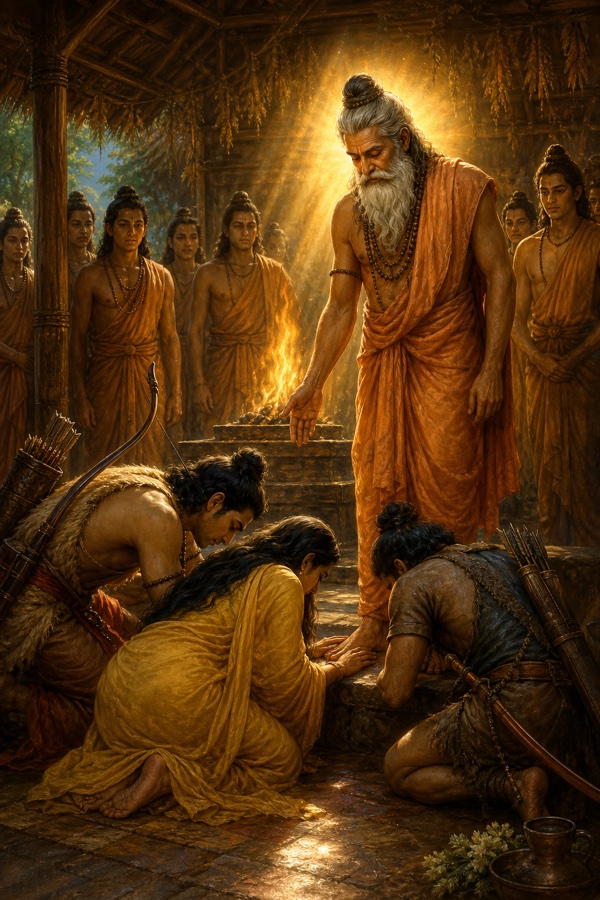
Then Lakshmana went with the disciple to the entrance of the hermitage and showed him Rama and Sita, the daughter of Janaka. Repeating Agastya’s words, the disciple respectfully ushered Rama in, worthy of honor as he was, with all the ceremony that was his due. Then Rama entered the fire-hall with Sita and Lakshmana, taking in a hermitage crowded with deer that did not startle at the sight of them. He saw there the place set apart for Brahma, the place of Shiva, the place of Vishnu, the place of the great Indra, the place of Vivasvan the sun, the place of Soma the moon, the place of Bhaga, the place of Kubera who keeps the northern quarter, the place of Dhata and Vidhata, the place of Vayu, the place of the great Varuna with the noose in his hand, the place of Gayatri, the place of the Vasus, the place of Vasuki, king of the nagas, the place of Garuda, king of birds, the place of Kartikeya, and the place of Dharma. Every power that holds the world up had its seat here, and each seat was kept. Then the sage himself, surrounded by his disciples, came out.
Seeing Agastya come out at the head of sages whose radiance was bright, Rama said to Lakshmana, who added to his glory: “Lakshmana, the holy sage Agastya is coming out. By his greatness of spirit I know this for a treasure-house of penance.” So saying, Rama, strong of arm and humble of heart, went to meet Agastya, who shone like the sun, and touched his feet as he came, and then stood with joined palms beside Sita and Lakshmana. The sage welcomed the prince of Kakutstha’s line, gave him a seat and water for his hands and feet, asked after his welfare, and bade him sit. He poured oblations into the fire, offered water to his guests, honored them by the law laid down for forest hermits, and gave them food.
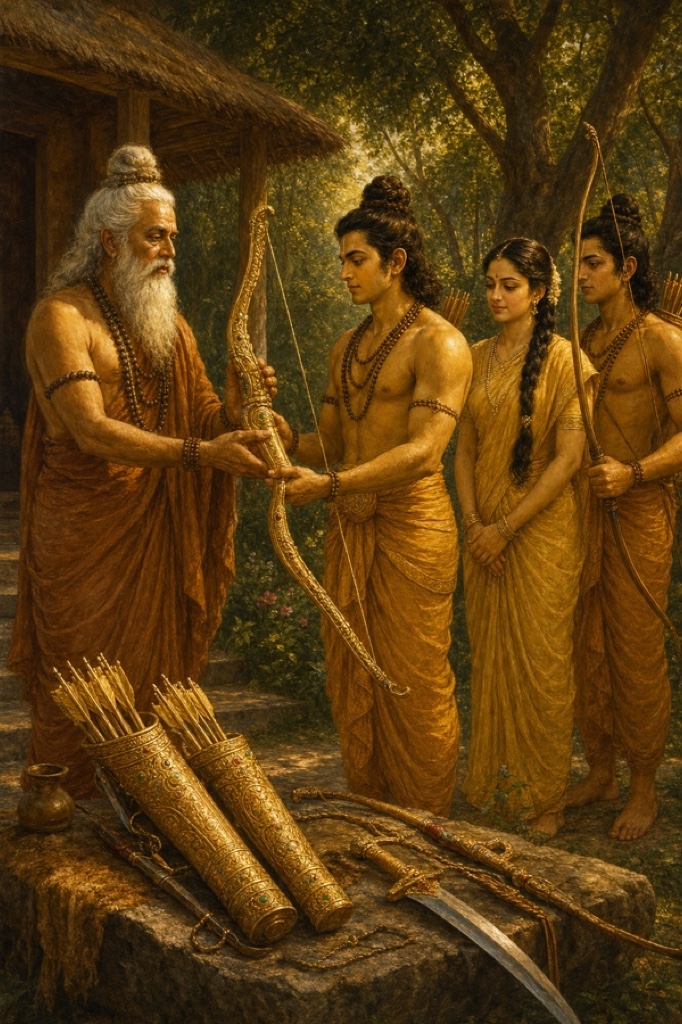
The sage sat down first, as a host does, and said to Rama, who sat with joined palms, well-versed in right conduct: “An ascetic must pour oblations into the fire and honor his guest with an offering of water. If he does otherwise, Rama, he eats his own flesh in the next world, like a false witness. You have come here as king of all the world, a follower of righteousness, a great chariot-warrior, worthy of worship and of honor, a dear guest.” So saying, and honoring Rama to his heart’s content with fruit, root, and flower, Agastya said to him: “Here is the great divine bow of Vishnu, adorned with gold and diamond, made by Vishvakarma, the craftsman of the gods. This best of arrows, unfailing, bright as the sun, was given by Brahma. Indra gave me two inexhaustible quivers full of sharp arrows that blaze like fire. And here is a sword adorned with gold and kept in a sheath of gold. With this bow, Rama, Vishnu of old killed great demons in battle and gave back to the gods of heaven their bright splendor. Bestower of honor, accept for your victory this bow, these two quivers, this arrow, and this sword, as Indra once accepted the thunderbolt.” So saying, Agastya of great radiance gave Rama that whole array of finest weapons, and spoke again,
Agastya’s counsel to go to Panchavati
“Rama, I am pleased with you; may all be well with you. Lakshmana, I am glad that you two came with Sita to greet me. The weariness of the road and the strain of much sweating trouble you both, and it is plain that the princess of Mithila longs for rest. She is tender, and fatigue has never worn her before; only out of love for her husband has she come into a forest full of dangers. Do such things, Rama, as will keep Sita happy here; she has done a hard thing in coming with you to the wood. From the very dawn of creation it has been the nature of women to love a man while he prospers and to give him up in adversity; women take on the fickleness of lightning, the sharpness of weapons, the speed of the eagle and the wind. But this wife of yours is wholly free of those faults, praiseworthy and famous, and she belongs among the divine ladies with Arundhati. Wherever you dwell with Lakshmana and Sita, that place stands graced from this day.”
At the sage’s words Rama, with folded hands, spoke humbly to the seer, who looked like a blazing fire: “Blessed and favored am I, whose virtues, and those of my brother and wife, have pleased you, the greatest of sages and the one we came all this way to venerate. But show me a region with water and many forests, where I may build a hermitage and live in comfort.”
Hearing this, the righteous Agastya, who had already seen into the young man’s heart by the power of his penance, meditated a while and spoke these good words: “Two yojanas from here, dear one, is a splendid region rich in root and fruit and water, with many deer, and known all around by the name of Panchavati. Go there with Lakshmana, build a hermitage, and live happily, keeping your father’s command to the letter. All this story of yours, and of Dasharatha, is known to me through the power of my penance and my love for you all. And though you agreed to stay in this grove with me, I have known through my penance the wish that was in your heart when you asked me for a dwelling place. That is why I say to you: go to Panchavati. That stretch of forest is charming, and the princess of Mithila will be happy there. That region is praiseworthy, Raghava, and not far from here; it lies near the Godavari, and the princess of Mithila will delight in it. Rich in root and fruit and many flocks of birds, it is secluded, holy, and lovely. You are of good conduct and able to protect the weak; dwelling there, Rama, you will guard the ascetics. Here is seen the great forest of madhuka trees; from there you go by the northern road toward a banyan tree. Then, climbing a plateau, not far from a mountain, you will reach the region called Panchavati, its woods always in flower.”
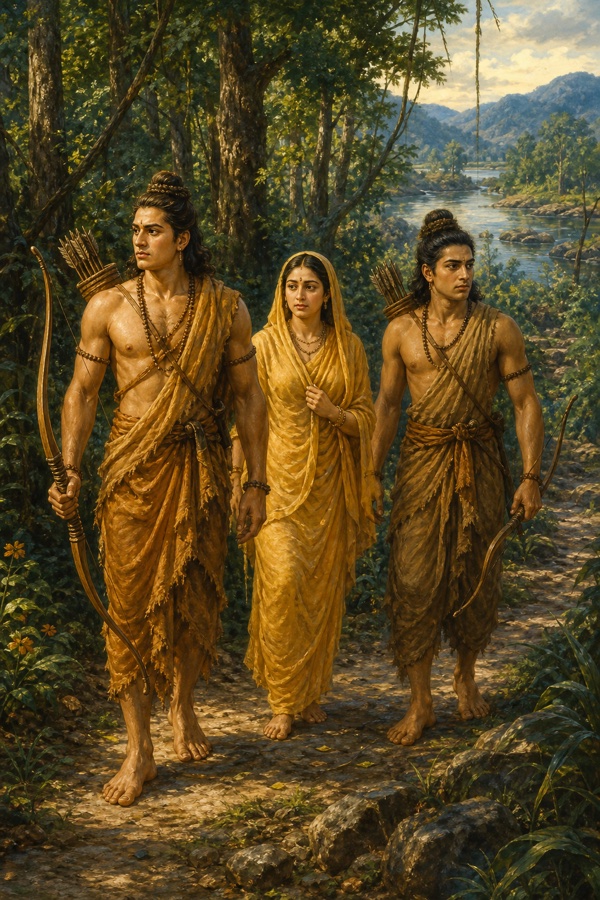
At Agastya’s words Rama, with Lakshmana, honored the sage who always spoke the truth and asked his leave. Given it, and bowing at his feet in reverence, the two brothers set off with Sita toward the hermitage at Panchavati. Their quivers fastened at their backs, bearing their bows, fearless in battle, the two princes went with a steady mind by the road the great sage had shown them, toward Panchavati.
The meeting with Jatayu
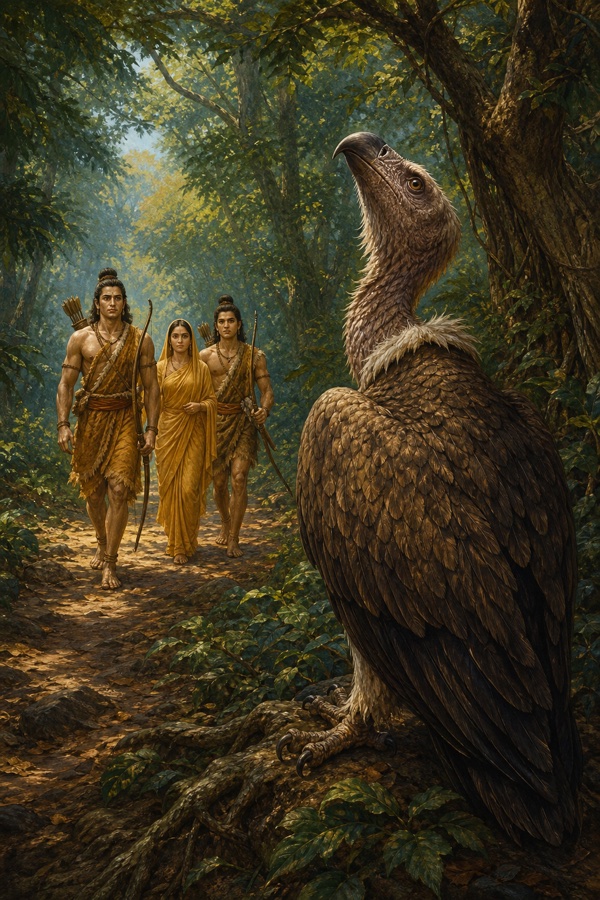
On the way to Panchavati Rama met a vulture of huge body and terrible strength, a bird so large that the shade of him lay across the path. Seeing him in the forest, the two blessed princes, Rama and Lakshmana, took the bird for a rakshasa, as anyone would who had met Viradha in that forest, and said to him, “Who are you?” Then, in a gentle and sweet voice, as if he wished to please them, he said: “Know me, dear son, for a friend of your father.” Taking him for his father’s friend, Rama honored him and gently asked his race and name. Hearing Rama’s words, the bird told him of himself and of his descent, and to do that he told him the origin of all beings.
“Listen, Rama, while I name from the beginning all the lords of creation who were of old. Kardama was the first of them, and after him Vikrita, Shesha, Samshraya, and the powerful Bahuputra, then Sthanu, Marichi, Atri, the mighty Kratu, Pulastya, Angira, Pracheta, and Pulaha. Then came Daksha, Vivasvan, Arishtanemi, and the last of them, Kashyapa of great radiance. Prajapati Daksha had sixty daughters, Rama, and every one of them was famous. Of these Kashyapa married eight beautiful girls: Aditi and Diti, Danu and Kalaka, Tamra and Krodhavasha, Manu and Anala. Pleased with them, Kashyapa said to those girls: ‘You will bear sons like me, masters of the three worlds.’ Aditi, Diti, Danu, and Kalaka took his words to heart; the rest were indifferent.
“Of Aditi were born thirty-three gods: the twelve Adityas, the eight Vasus, the eleven Rudras, and the two Ashvins. Diti bore the famous Daityas; long ago this whole earth with its forests and its seas was theirs. Danu bore a son, Ashvagriva. Kalaka bore Naraka and Kalaka. Tamra bore five daughters famous in the world: Kraunchi, Bhasi, Shyeni, Dhritarashtri, and Shuki. Kraunchi bore the owls; Bhasi bore the bhasas, the birds of prey; Shyeni bore the hawks and the bright-feathered vultures; and Dhritarashtri bore swans and geese of every kind, and the ruddy geese too. Shuki bore a daughter named Nata, and of Nata was born Vinata.
“Krodhavasha too, Rama, bore ten daughters: Mrigi, Mrigamanda, Hari, Bhadramada, Matangi, Sharduli, Shveta, Surabhi, Surasa, and Kadru. Of Mrigi came all the deer; of Mrigamanda the bears and the antelopes called srimara and chamara. Of Bhadramada was born a daughter, Iravati, whose son is the great elephant Airavata, whom the whole world covets. Of Hari came the lions, the monkeys, and the baboons; Sharduli bore the tigers. Of Matangi came the elephants, and of Shveta the elephant that guards the quarters of the sky. Surabhi bore two daughters, Rohini and the famous Gandharvi, may all be well with you; of Rohini came the cattle, and of Gandharvi the horses. Of Surasa came the nagas, and of Kadru the serpents. Manu, wife of the great Kashyapa, gave birth to men: Brahmins, warriors, merchants, and servants. The sacred word says the Brahmins came from the mouth, the warriors from the breast, the merchants from the thighs, and the servants from the feet. Anala bore all the trees of holy fruit. Vinata was the granddaughter of Shuki, and Kadru was the sister of Surasa. Kadru bore a thousand nagas who bear up the earth, and Vinata bore two sons, Garuda and Aruna.
“From that Aruna I was born, and my elder brother Sampati with me. Know me as Jatayu, the son of Shyeni. If you wish it, I will be a help to you at your dwelling, for this trackless forest is full of beasts and rakshasas, and when you go out with Lakshmana, dear one, I will guard Sita.” Rama honored Jatayu, embraced him with joy, and bowed low to him, for the self-possessed Rama had heard from Jatayu himself, again and again as he spoke, of this vulture’s friendship with his father Dasharatha, and a friend of his father’s was a piece of Ayodhya standing in the road. Leaving Sita in Jatayu’s keeping, Rama went on with that mighty bird and with Lakshmana toward famous Panchavati, eager to burn away his enemies the way fire is eager for moths.
The leaf hut at Panchavati, and a happy dwelling
Coming to Panchavati, two yojanas on from Agastya’s hermitage just as the sage had said, a country thick with beasts of prey and with deer, Rama said to his brother Lakshmana of shining radiance: “This is the region of Panchavati, gentle brother, its woods in flower. We have come, just as we planned, to the region the sage spoke of. You have an eye for the wild; look on every side of this forest and see where a hermitage would best stand for us. Find such a place as Sita, you, and I may delight in, with a pool nearby, where the forest is lovely and the water is lovely, and firewood, flowers, kusha grass, and water are close at hand.”
At Rama’s words Lakshmana folded his palms and said to his brother, in Sita’s presence: “Kakutstha, though you stood before me a hundred years I would still be your dependent, and nothing more. Choose some pleasing place yourself and tell me of your own accord, ‘Build here.’” Greatly pleased at this answer, Rama of surpassing radiance thought a while and settled on a spot blessed with every good quality. He went to that lovely place, and taking Lakshmana’s hand in his own he said to him: “This ground is level and splendid, ringed with trees in flower; here you should build us a fair hermitage, built as it ought to be. Nearby is a lovely lotus pool, graced with fragrant lotuses bright as the sun and made lovelier by blue lotuses. As the pure-minded sage Agastya said, here is the beautiful Godavari, hedged with trees in flower, crowded with swans and diving birds, graced with ruddy geese, stirred by herds of deer coming down to drink, neither too far from us nor too near.
“Here are high and lovely mountains loud with the cries of peacocks, full of caves, covered with trees in flower, gentle Lakshmana. Speckled here and there with the bright metals of gold and silver and copper, they shine like elephants painted with colored latticework for a festival. They are graced with sal, palmyra, tamala, date, jackfruit, nivara, tinisha, and punnaga, and covered with mango, ashoka, tilaka, ketaka, champaka, syandana, sandalwood, nipa, parnasa, lakucha, dhava, ashvakarna, khadira, shami, kimshuka, and patala trees, all heavy with blossom and ringed about with shrubs and creepers. This place is holy, Lakshmana, and lovely, rich in deer and birds; here we will dwell with this bird Jatayu.”
At Rama’s words Lakshmana, who had cut down warriors in his time and whose strength was past the ordinary, built a hermitage for his brother without delay. He raised a great leaf hut for Rama’s dwelling, with walls of packed clay set on good pillars, roofed with long bamboo poles, very beautiful to look at, thatched with boughs of the shami tree, bound with strong cords, well covered with kusha grass and the flowers of the kasha and with reeds, its floor leveled and made smooth. Having built that fine and altogether delightful cottage, the glorious Lakshmana went straight to the river Godavari, bathed in it, and came back with lotuses and fruit. Then, making a flower-offering and performing the rite of peace in due form, so that no new house is entered unblessed, he showed Rama the hermitage he had made.
Seeing the delightful hermitage built for him, Rama with Sita found the greatest joy in that leaf hut. Overjoyed, Rama folded Lakshmana in his arms, clasping him tightly, and spoke to him with deep affection: “I am pleased with you. You have done this great work, powerful brother, and for it I have given you an embrace you earned. Lakshmana, while my father has a son like you, knowing of my feelings, grateful, a knower of what is right, my righteous father has not died.” Having said this, the happy Rama, who added to others’ glory, lived in that region of abundant fruit. Served by Sita and Lakshmana, that righteous prince stayed there for some while like a god in heaven.
The early winter, and the bath in the Godavari
While Rama, great-hearted as ever, was living happily there, with a roof of his brother’s making over him at last, autumn ran out and the longed-for winter set in. One day at first light Rama went to the beautiful river Godavari for his bath, and his brave brother Lakshmana walked behind him with Sita, carrying the water vessel in his hand, and as they walked he spoke. “Now has come that season dear to you, gentle brother, by which the blessed year seems to put on its ornaments. People feel dry with the cold, the earth is rich with crops, the water is no longer good to be in, and the fire is welcome. Having honored the ancestors and the gods with offerings of the first fruits of the harvest and eaten of them themselves, good people are cleansed of sin at this time. The people of the countryside have their longing for grain fully met and their store of milk grown richer, and the kings ride out on their campaigns, hungry for conquest.
“With the sun holding firmly to the quarter where the god of Death lives, in the south, the northern quarter shines no more than a woman without the mark on her brow. Rich by nature in its hoard of snow and now heaped with snow, the sun being far away, the Himalaya more plainly lives up to its name of the seat of snow. The noons are pleasant for walking, delightful to the touch of the sun’s rays; the sun is welcome, and shade and water are unwelcome. Now the sun is mild, the fogs thick and beautiful, the cold sharp, the wind keen; the days look still and quiet, the woodlands empty and blighted by frost. Now the nights forbid sleep in the open, marked by the star Pushya, dusty with frost, colder and longer. Having given her charm over to the sun, her disk reddened by snow, the moon shines no brighter than a mirror clouded by breath. Even at the full, the moonlight is dimmed by frost and loses its beauty, as Sita, a little darkened by the sun, no longer looks as she looked before.
“Cool to the touch by its very nature and now heavy with snow, the west wind blows at dawn twice as cold. The woodlands, shrouded in mist and rich with barley and wheat, shine at sunrise with the noise of herons and cranes. The paddy crops, wearing a golden sheen and bent a little with their weight of grain, their ears full and like date-flowers to look at, are lovely to see. With its climbing rays wrapped in frost and fog, the risen sun, though high, looks like the moon. Faint of strength in the forenoon and gentle to the touch at noon, the sunshine, a little red and a little pale, spreads its charm over the earth. The land of the woods, its grass a little drenched with dew and steeped in the morning sun, looks fair. Though it touches the wide, cold water for its comfort, the wild elephant, parched with thirst, draws back its trunk at the chill. The waterbirds standing close beside it do not go down into the water, as cowards keep near the field of battle and do not plunge in. Wrapped in the dark of dew and the gloom of fog by night, the rows of forest trees, stripped of their blossom, seem to sleep. The rivers, their water shrouded in mist, their cranes known only by their cries, are known now only by their banks and the sand wet with frost. From the fall of frost and the mildness of the sun, even the water on the mountaintops turns sweet to drink. Their lotuses worn out with decay, their filaments and pods withered, the lotus-beds, blasted by snow, are reduced to bare stalks and no longer look fair.
“At this hard season, brother, Bharata, full of longing for you, is doing penance in the city out of devotion to you. Giving up sovereignty and honor and every kind of pleasure, that ascetic sleeps on the cold ground and lives on a restricted diet. He too, at this very hour, surely rises for his bath and, ringed by his ministers, walks daily down to the river Sarayu. Raised in the highest comfort, tender as he is, how does he take his dip in the Sarayu, tormented by cold, in the last watch of the night? With eyes like lotus petals, dark of complexion, majestic, slim-waisted, a great knower of the right, truthful, modest, master of his senses, gentle of speech, amiable, long-armed, a man no enemy can stand against, Bharata has given up every kind of comfort and given himself wholly to you, his elder brother. Even living in the forest you have won heaven for him, for he follows you in your ascetic life. The well-known saying that men take after their mother and not after their father, Bharata has proved false. How is it that mother Kaikeyi, whose husband was Dasharatha and whose son is the virtuous Bharata, wears so cruel a face?”
As the devout Lakshmana spoke like this out of affection, Rama found he could not bear to hear his mother blamed, and he said: “Never speak ill of our second mother Kaikeyi, dear brother. Speak only of Bharata, lord of the Ikshvakus. My mind is firmly set on my vow of forest life, and it does not waver; yet, burned by love for Bharata, it grows soft again and again like a child’s. I remember well his dear, sweet, affectionate words, sweet as nectar, gladdening the heart. When shall I be joined again with the great-hearted Bharata, with the heroic Shatrughna, and with you, son of Raghu?”
Talking so of Bharata as he went, Rama reached the river Godavari and bathed with his brother and Sita in water that took the breath away. The three of them, who had done no wrong to anyone, offered that water to the ancestors and the gods, cupped in their hands and let fall, and praised the rising sun and the other gods. His bath done, Rama shone with Sita and Lakshmana as Lord Shiva shines with Nandi and Parvati when he has bathed in the Ganga.
The gist: Lakshmana paints the early winter at length and remembers Bharata doing penance in the city, and he falls to blaming Kaikeyi. Rama stops the blame of his second mother and praises Bharata’s love; then the three bathe and make offerings in the Godavari, shining like Shiva with Nandi and Parvati.
Source: Srimad Valmiki Ramayana, Aranyakanda, Cantos 1 to 16. The Gita Press Hindi edition is the controlling witness. The Sanskrit e-text and an independent complete translation were used to verify names, sequence, and principal events. Where recensions differ, this retelling follows Gita Press.
Basis: Valmiki Ramayana (Gita Press, Gorakhpur)