On this page
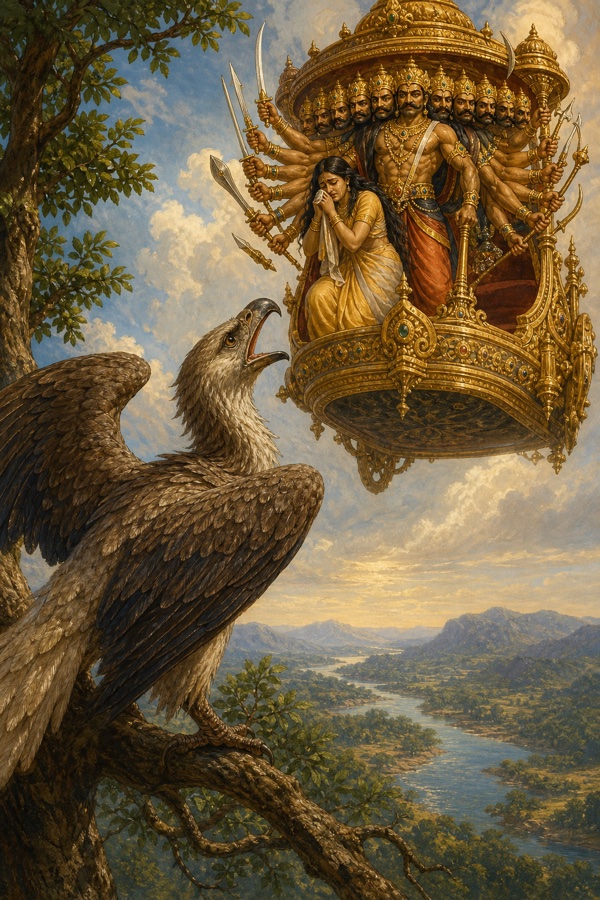
He was asleep on the branch of his tree when the cry came into his sleep and pulled him out of it. Jatayu opened his eyes, king of vultures, lord of all the birds, and looked up; and there in the sky above him was Ravana, and in Ravana’s lap the princess of Videha. He was old, and vast as a mountain peak, and his beak had never needed sharpening; and he kept his place on the branch and began, first of all, to speak fair words. Here the episode opens in which one aged bird takes his stand alone against the ten-headed king, and behind it runs the long, breaking, scattered saga of Rama‘s search for Sita.
Jatayu’s plea and his challenge
He tried reason before he tried anything else. “O Dashagriva, lord of ten heads,” he said, “I stand on the ancient and eternal road of dharma, and I am bound to truth, and it is out of that that I speak. Brother, do not set yourself in this hour, in front of my eyes, to a deed the world will curse for as long as it remembers your name. I am Jatayu of great might, sovereign of all birds. And the woman you are carrying is Sita, the lawful wife of Rama. Rama is master of the whole world, the equal of Indra and Varuna, devoted to the good of every living thing. You come of sages; how does a king who stands firm on virtue put his hand on another man’s wife? The consorts of kings, mighty rakshasa, call for that guarding above all others. Turn back now from the ruin that follows a hand laid on another man’s wife.”
He pressed it further. “A wise man does not knowingly do the thing for which the world will revile him afterward. The wives of others are to be guarded from a stranger’s touch exactly as a man guards his own. You are sinful by nature and unsteady of mind, and lordship came to you anyway, the way an aerial chariot built for the virtuous might somehow drift down and settle on a man of wicked deeds. A man licentious by nature cannot shed that nature, and greatness does not stay long in the house of the evil-minded. The cultured pursue wealth and pleasure and virtue by the example their king sets, delight of Pulastya’s race. A king embodies dharma. A king embodies desire. A king is the highest treasury of all riches. Good and evil both have their root in the king, and both flow out of him into everything he rules. Rama has done no wrong in your kingdom or your city. Why then do you wrong him?”
“Khara overstepped his bounds on the pretext of wiping away Shurpanakha’s tears, and Rama of unwearied action killed him in Janasthana for it. What was Rama’s fault in that, for which you are carrying off his wife? Release the princess of Videha now, this moment, before Rama turns on you that dreadful eye which becomes fire, and burns you as Indra’s thunderbolt burned the demon Vritra. You have tied a poisonous snake into the fold of your garment and you walk on without knowing it. The noose of Death is already around your neck, and you cannot see it there. Gentle one, who would knowingly take up a deed that brings neither merit, nor glory, nor lasting fame, and leaves nothing behind it but the weariness of the body?”
Then the old vulture laid down in front of him both his lineage and his vow. “O Ravana, sixty thousand years have passed over me since I was born, and through the whole of that time I have held this throne of the birds, which came down to me from my fathers and their fathers before them. I am old. You are young, armed with bow and arrows, sheathed in mail, standing in a chariot. And you shall not carry the princess of Videha away in safety while I am watching. You can no more bear her off by force before my eyes than a man can bend an unalterable Vedic text with clever argument. Prowler of the night, so long as there is breath in me you shall by no means bear off Sita, the queen who is dear to Rama. What is dear to Rama, and what was dear to the late king Dasharatha, I am bound to do, and I will do it if it costs me my life. Halt, halt, Dashagriva. If you are a hero, then fight, and struck down by me you will lie on the ground as Khara lay before you. Rama, clad in bark, who has slain Daityas and Danavas on the field more than once, will make short work of you. The two princes have gone far off, I grant; yet if I set out to call them, you would run at once in terror of them, of that I have no doubt. This very day I will knock you out of that chariot as a fruit is broken off its stalk. Prowler of the night, I will give you the hospitality of battle, to the full measure of what is left of my strength.”
The fierce battle of vulture and rakshasa
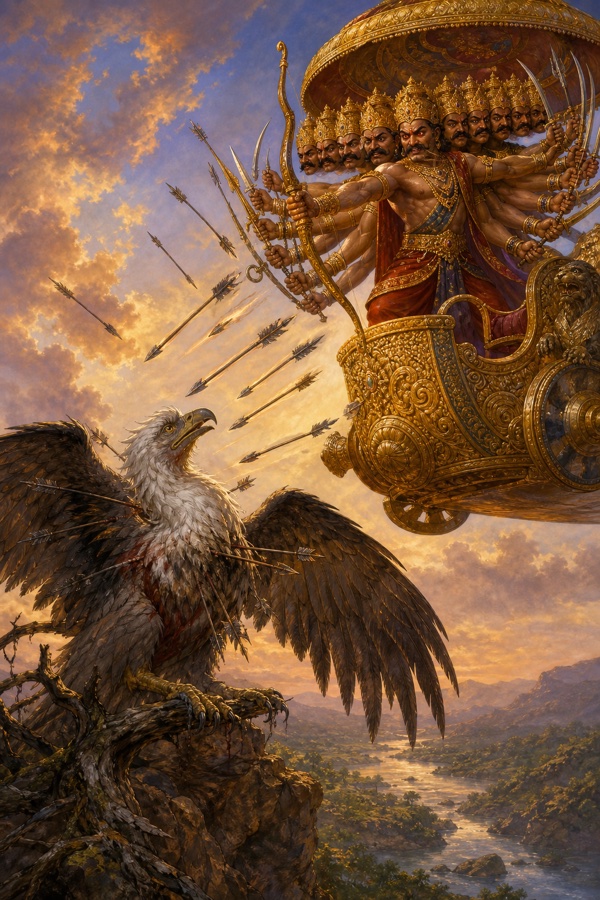
The words went into him and the patience went out of him. Ravana had been offered, in one speech, the whole of his own case against himself: his line, his sin, his death, and an old bird’s contempt. Eyes red with fury, earrings of refined gold swinging at his ten faces, the rakshasa king turned and rushed on Jatayu, sovereign of the winged. What followed was one long unbroken exchange with no pause anywhere in it, tumultuous, like two storm-driven clouds colliding in an open sky. It was a marvel to see, as though two great mountains had grown wings and gone at each other in the air.
Ravana rained on Jatayu a storm of Nalikas, of Narachas, of sharp-pointed Vikarnis, three kinds of arrow and no space between them. Jatayu took the whole net of them on his body and came on anyway, and with his feet and the talons at the ends of them he tore wound after wound out of Ravana. Then the ten-headed monster took up ten dreadful arrows, each one like the rod of Death itself, and loosed all ten with his full strength, and riddled the bird from beak to tail. Wrapped in that hail of shafts, Jatayu looked like a bird huddled down in its own nest. Then his eye fell on the daughter of Janaka weeping in the rakshasa’s chariot, and, caring nothing for the arrows, he flew straight at the rakshasa.
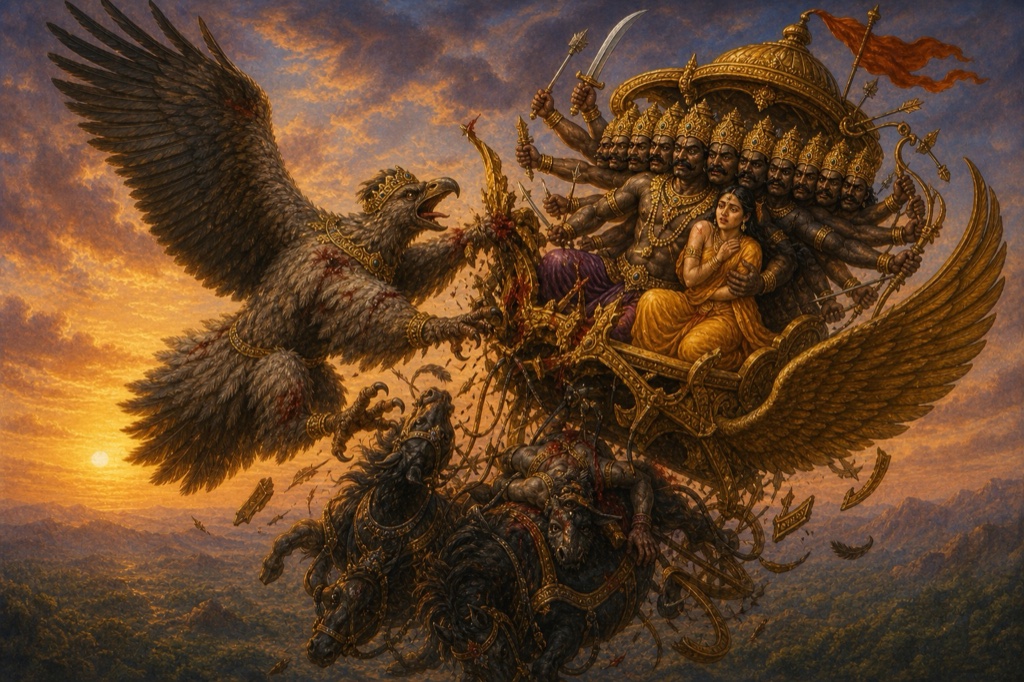
And then the blazing lord of birds shook the whole net of arrows off with his wings, and broke Ravana’s great bow with his feet. Ravana took up a second bow and poured out arrows by the hundred and by the thousand. Jatayu went through them. He shattered the mail that shone like fire. He struck down the swift donkeys, fiend-faced, their heads sheathed in golden armor. He smashed to splinters that great war-chariot with its triple-bamboo yoke, a chariot that went wherever its rider wished it, its frame patterned with steps of gems. He brought down the canopy bright as the full moon, whisks and all, and the rakshasas who were holding them came down with it. And then he put his beak into the charioteer and tore the great head clean off him.
Bow broken, chariot broken, horses dead, driver dead, Ravana dropped out of the sky and hit the ground with the princess of Videha crushed against him. And every living thing that saw it cried out, well done, well done, and hailed the king of vultures. Then Ravana got his hands on Maithili again. He looked at the lord of birds and saw what age had done to him, saw him laboring, and rose back into the sky delighted.
The king of vultures came up under him one more time and put himself across his road. “O Ravana of little sense,” he said, “you are carrying off the wife of Rama, whose arrows fall like the thunderbolt, and what you are really carrying is the ruin of every rakshasa alive. With your friends and your kinsmen, your ministers, your army, and your household, you are drinking this poisoned draught down the way a thirsty man drinks water, and never tasting it. You are bound in the noose of Death; where will you go to get free of it, a fish that has swallowed the hook and the bait together? Rama and Lakshmana, the two sons of Raghu born of Kakutstha’s line, whom no one overcomes, will never bear this violation of their hermitage. A deed the world condemns, of the kind you have done today, is the path of thieves; heroes do not walk it. Ravana, if you are a hero, halt and fight. Struck down by these hands you will lie on this earth as your brother Khara lies on it. What man on earth, were he Brahma the self-born, lord of all the worlds, would take up a deed whose only fruit is sin?” And having said it, Jatayu came down on the ten-headed monster’s back.
With his sharp talons he tore him open on every side, the way a rider on an elephant works the goad into it. He drove his beak into the demon’s back and tore the hair out of it in handfuls. Wounded and wounded again, the rakshasa began to shake with rage, and his lips would not stay still. He pressed Sita hard against his left side and struck at Jatayu with the flat of his hand. Jatayu slipped the blow, and with his beak he cut away all ten of Ravana’s left arms, one after another. And where the severed arms had been, fresh arms came up at once, the way serpents rise out of an anthill.
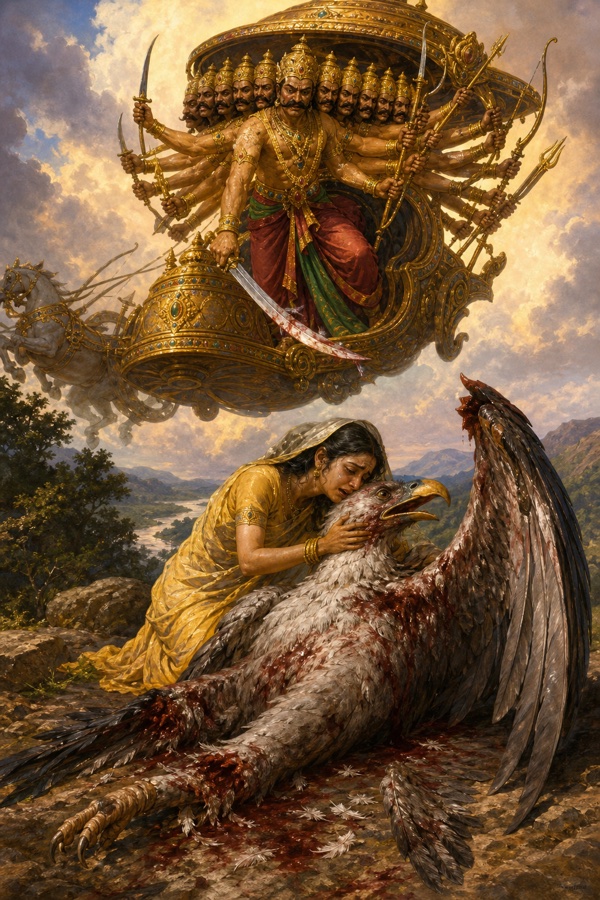
Then Ravana let go of Sita and beat the king of vultures down with his fists and feet. For an hour the two warriors of matchless prowess fought their terrible fight. In the end Ravana drew his sword and lopped off the wings, the feet, and the flanks of Jatayu, who was struggling in Rama’s cause. With his wings shorn away, the great vulture, whose life was now short, fell to the earth, soaked in his own blood. Seeing him fallen there, blood-stained, Sita ran to him as she would run to one of her own kin. The lord of Lanka looked down at Jatayu lying on the ground like a forest fire burned out, his body dark as a blue cloud, his breast white. And Sita, her face bright as the moon, took that dying bird in her arms and wept once more.
Ravana carries Sita off by the sky-road
Seeing the king of vultures wounded, Sita, stricken with grief, cried out and lamented, calling on Rama. “O Rama, dreams and the calls of birds are always the sign of what is coming to a man, in joy and in sorrow both. O Kakutstha, surely you do not know this great danger that has fallen on you, this carrying-off of mine, though the deer and the birds are crying it out as they turn toward the unlucky quarter. Here, by my ill fortune, lies that bird Jatayu, who came out of pity to save me, wounded on the ground, and there is nobody left between me and this thing that holds me. Deliver me today, Rama of Kakutstha’s line, and you, Lakshmana!” She cried it so loud that anyone near at hand might hear. The lord of the rakshasas sprang at her as she wailed like a woman with no lord to guard her, her garland and her ornaments crushed, and she clung to the great trees as a creeper clings, crying again and again, “Save me, trees, save me!” So weeping, crying “Rama, Rama, Lakshmana,” Sita was seized by the hair and lifted into the sky.
When the princess of Videha was taken by force, the whole world, moving and unmoving, lost its measure and sank into a deep darkness. The wind did not blow. The sun lost its light. And Brahma, seeing Sita in Ravana’s hand with his divine sight, said the strangest sentence spoken that day: “Our purpose is accomplished.” The great seers who lived in the Dandaka forest were pained to see her seized, and gladdened at the same moment, because they knew what they were watching: Ravana’s ruin had begun, and it had begun by his own hand.
Crying “Rama, Rama” and “Lakshmana,” Sita was borne higher and higher by the lord of the rakshasas. In her ornaments of refined gold and her robe of yellow silk she shone against him like a streak of lightning. Her yellow garment streamed out in the wind and made Ravana glow the way a mountain glows when fire is climbing it. And yet her clear face, without Rama anywhere in the world below her, did not shine at all, no more than a lotus torn off its stalk shines, or the moon shines when it has risen by day.
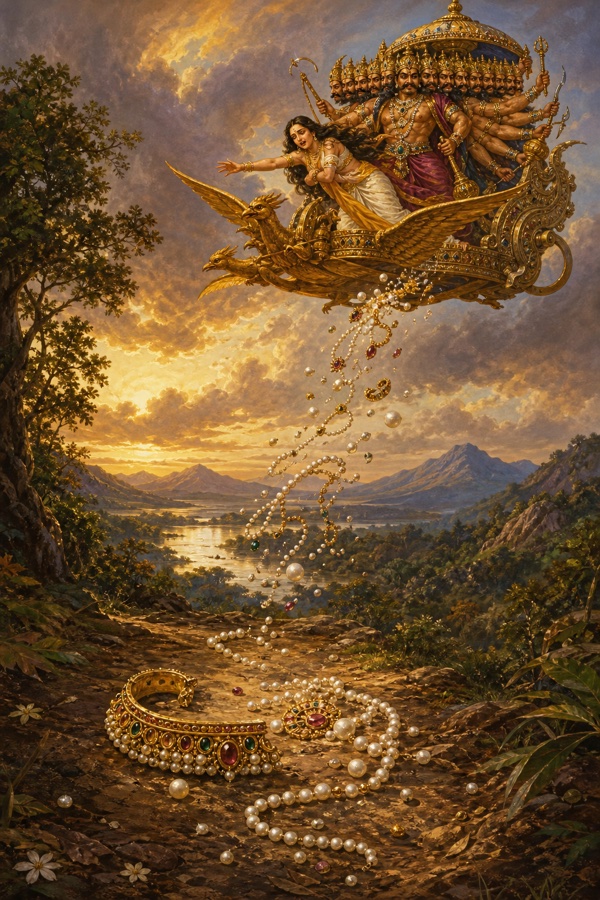
From her blessed face a fragrance fell over Ravana like coppery, sweet-scented lotus petals. In the lap of the dark-bodied Ravana the gold-hued princess of Mithila shone like a golden saddle-cloth cinched onto a blue elephant. As she was carried away a rain of flowers came loose from her hair and fell on every side toward the earth, and the speed of Ravana’s flight caught the same flowers up again and laid them back on him. A jeweled anklet slipped off her foot and went down flashing like a ring of lightning. Her fire-colored ornaments dropped away one by one, ringing as they fell, like stars going out. A string of pearls came loose from her breast and fell, and it looked like the Ganga coming down out of the sky. The trees, shaken by the gust of her flight, seemed to say to her with their upper branches, “Do not be afraid.” Lakes with wilted lotuses and frightened fish seemed to mourn for a disheartened friend. Lions, tigers, deer, and birds ran in anger after the shadow of Sita. Mountains, their waterfalls like streaming tears and their peaks like lifted arms, seemed to cry out. Seeing the princess of Videha borne away, the glorious sun itself grew wretched, its splendor eclipsed and its orb gone pale.
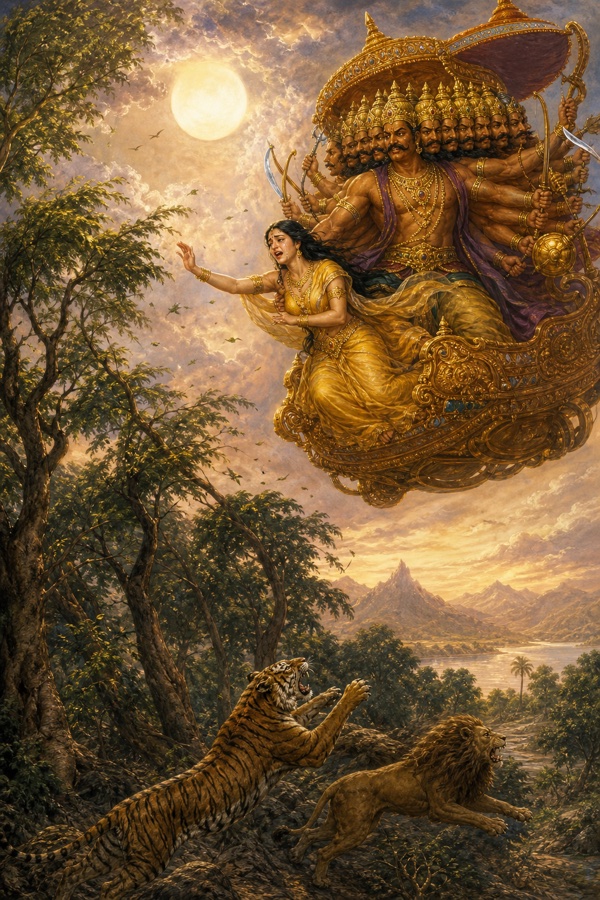
“Dharma is undone, so where will truth stand now? Simplicity is gone with it, and pity too, when Ravana can carry off Sita, the wife of Rama.” So all beings wailed, in their crowds, in every quarter. Even the fawns wept, with the misery plain on their faces. The limbs of the forest deities shook where they stood. And for his own ruin Ravana bore away that steadfast woman, her hair loosened, the mark on her forehead rubbed away, calling in a sweet voice “Lakshmana, Rama” and looking down again and again at an earth that kept getting farther off. Cut off from her own people, seeing neither Rama nor Lakshmana anywhere in all that air, Maithili of the lovely teeth and the clear smile was pressed down under the weight of her fear, and her face went pale.
Sita’s rebuke of Ravana
Seeing the fearful-eyed Ravana flying through the sky, the daughter of Janaka, in her great peril, her eyes red with anger and with weeping, spoke to him through her bitter tears. “Ravana, are you not ashamed of this shameful deed, to find me alone and steal me and run like a coward? It was you who by the deceit of that phantom deer drew my husband far away, and you did it so that you could carry me off from an empty hut. And the old king of vultures, my father-in-law’s friend, who rose up to save me and had nothing to save me with, him too you struck down.”
“Lowest of the rakshasas, your great valor showed itself in exactly one thing, that you won me by hiding, and never once by announcing your name and fighting for me. Are you not ashamed to carry off a woman, and another man’s wife at that, out of a lonely place where there was nobody to protect her? Through all the worlds people will name this deed of yours shameful, most cruel and most unrighteous. Shame on the courage you boasted of. Shame on a deed that lays a stain across your line forever. You fly so fast now; what will the speed be worth to you? Halt for one hour and you do not return alive. The moment you come within sight of those two princes you cannot live an hour longer, and your army will not outlive you. So weigh your own good and let me go. Enraged by my abduction, my lord and his brother Lakshmana will bend themselves to your destruction. The vile purpose for which you carry me off by force will come to nothing, for if I fall into an enemy’s hands and do not see my husband, the equal of the gods, I shall not keep my life for long. You look neither to your good of today nor to your good hereafter; like a man whose hour of death has come, you crave the very things that will harm you.”
“Clearly you are seeing trees of gold, and men see those only when their death has come for them. Soon you will be looking at the dreadful Vaitarani river running with blood, and the Asipatravana with its leaves like sword-blades, and the Shalmali tree with its flowers of refined gold and its thorns of iron. Having wronged Rama, you will not live long, though you drink poison itself to keep your life in you. You are bound in the unfailing noose of Death, Ravana. Where will you find any refuge from the wrath of my husband? Rama killed fourteen thousand rakshasas, skilled in every weapon, and strong; why would he not put his keen arrows through you?”
Speaking these and other hard words, filled with fear and with grief, the princess of Videha wept piteously in Ravana’s lap. And a tremor did go through the sinner’s body when he heard them. He went on carrying off the young woman anyway, while she struggled, and tried again and again to break out of his hands.
Ornaments dropped among the monkeys, and the entry into Lanka
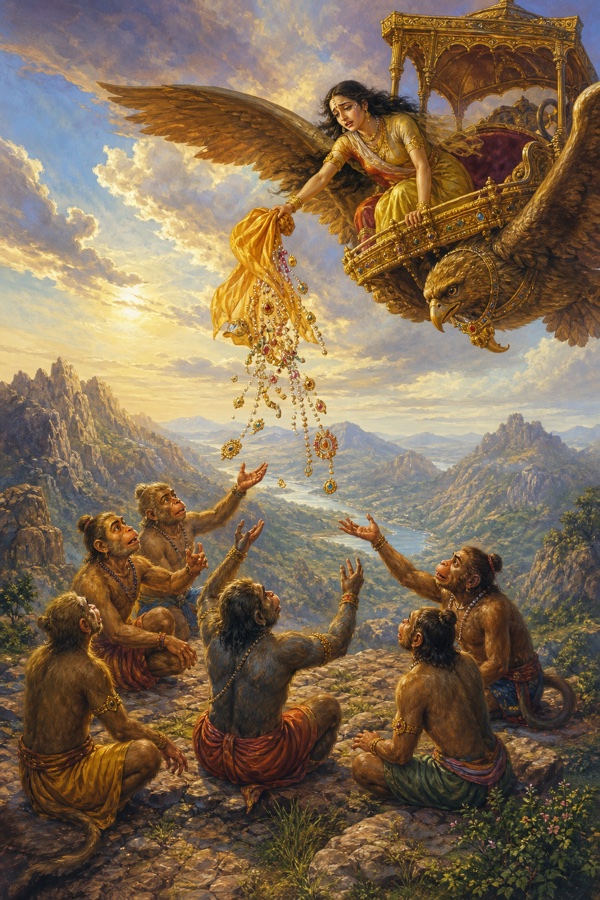
Carried through the air and finding no rescuer anywhere in it, Sita looked down and saw five great monkeys sitting together on a mountain peak. She had one thing left that she could do, and she did it fast. Into the middle of those hale, noble monkeys Sita let fall her shining silk upper garment, gold-bright, and her fine ornaments with it, on the chance that these monkeys might one day meet Rama and be able to tell him what they had seen. She wrapped the jewels in the cloth first, so that they would fall together and stay together and be found together, and dropped the bundle among them. It was the one act of a mind still working while everything around it had come apart. And Ravana, taken up with his own triumph, never noticed her hands move. The tawny-eyed lords of the monkeys watched with unblinking eyes, in wonder and in pity, the weeping woman go over their heads and away; and they kept what she had dropped.
Crossing over Pampa, Ravana bore the weeping Maithili on toward the city of Lanka. He was delighted, and what he was holding in his lap was his own death, a sharp-fanged serpent that had not decided yet when to use its fangs. Like an arrow loosed from a bow he left behind him forest, river, mountain, and lake. He passed over the boundless ocean, the home of crocodiles and sea-monsters. And the sea knew. Seeing the daughter of Videha carried across it, the waves went still, and the fish and the great serpents froze in the water. And in the sky above him the Charanas and the Siddhas said it out loud where anyone might have heard: “This carrying-off of Sita is the end of Ravana, the ten-headed.”
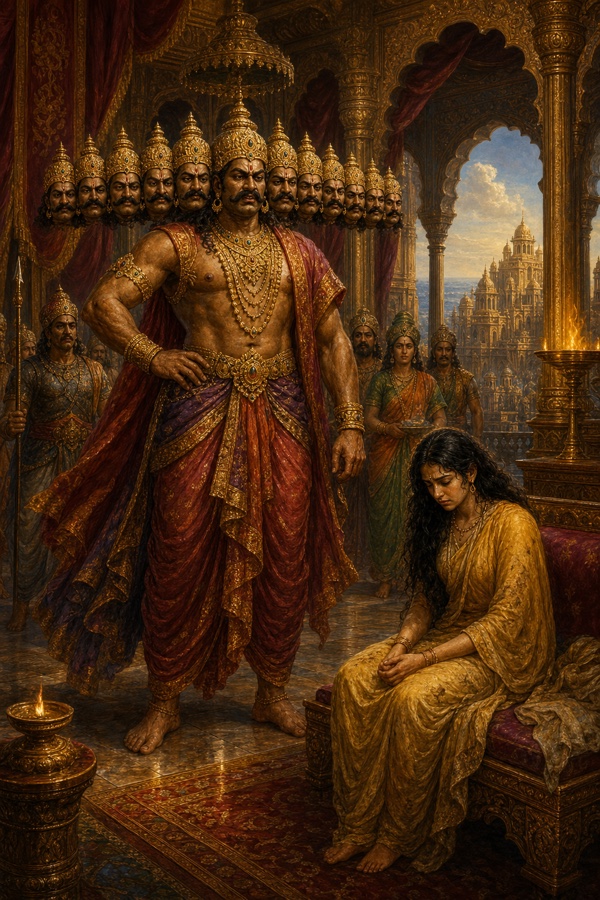
Entering Lanka, Ravana came through the city with its well-laid broad roads and its crowded gates, and into his own inner apartments, and there he set Sita down, drowned in grief and confusion, the way the demon Maya lays aside a sorcery he has finished using. Then he gave his order to a company of dreadful demonesses. “See that no man and no woman sets eyes on Sita without my leave. Whatever she wishes for, pearls, gems, gold, robes, ornaments, let it be in her hands the moment she has named it; that is my command. And any rakshasi who speaks an unkind word to her, knowing what she does or not knowing, will not find her own life dear to her much longer.”
Having given this order, and thinking over what must be done next, Ravana came out of the inner apartments and summoned eight mighty flesh-eating rakshasas. Deluded by the boon of Brahma, and praising their strength and valor, he said to them, “Arm yourselves with every kind of weapon and go at once to that Janasthana which was once the home of Khara, and whose houses Rama has now laid waste. Settle there in that empty Janasthana, trusting to your own manhood and strength, throwing all fear far from you. My Khara and Dushana, with their army, were killed there by Rama’s arrows, and from this a rare wrath and a bitter enmity toward Rama have risen in me. I mean to pay off that enmity against my great foe. Until I have killed Rama, who killed Khara and Dushana, sleep will not come to me, as it will not come to a poor man until he wins wealth. While you stay in Janasthana, keep sending me true reports of what Rama is doing. Let all the night-rangers go carefully and always seek the means of Rama’s death. I have often seen your strength on the field of battle, and that is why I appoint you there.”
Taking those dear and weighty words, bowing to Ravana, the eight rakshasas left Lanka and set out for Janasthana with their bodies made invisible. And Ravana, having won Sita, having walled her inside his inner apartments, having set a bitter enmity toward Rama running in his own chest, began in his ignorance to feel that he was a happy man.
Ravana’s temptation and Sita’s refusal
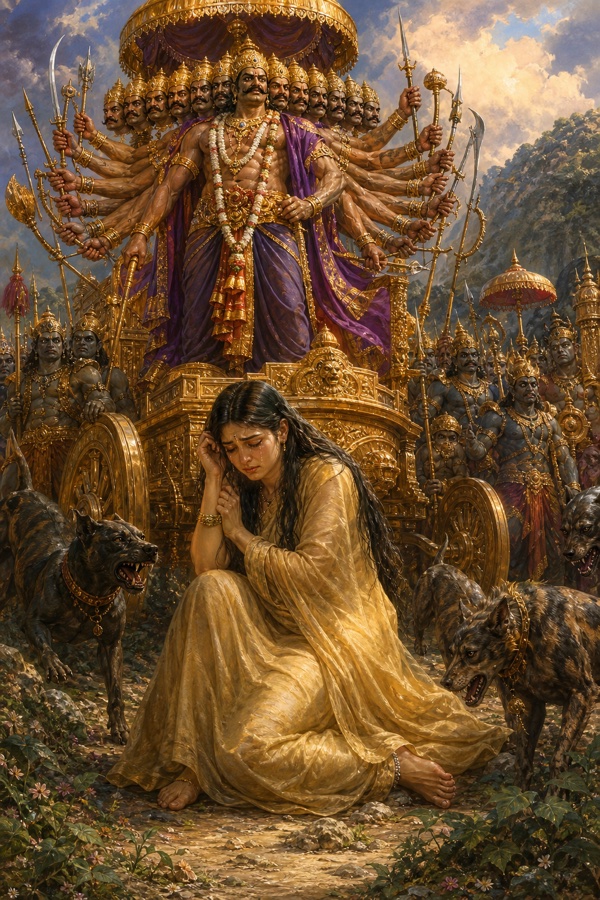
Having sent the eight strong rakshasas off, Ravana in his confusion of mind thought the work was already done. Pierced by the arrows of desire, restless to look at her again, he went into his beautiful inner apartments. And there, among the rakshasis, he saw Sita: her face wet with tears, bent under the weight of her grief, like a boat going down in the waves, like a doe cut out of her herd and ringed by hounds. Her face was lowered. She was helpless and pitiable in her sorrow. And he began to walk her, by force, through his palace, which was splendid as the mansion of a god, as if a woman in that state could be bought with rooms.
The palace rang with the sound of divine drums and was decked with gold. It stood on pillars of ivory, of gold, of crystal, and of silver, inlaid with diamond and with lapis. Thousands of women lived in it. Birds of every kind were kept in it. Jewels of every kind were set into it. Up a stairway painted in gold Ravana led her, and showed the grief-drowned Sita floors patterned in coral and gem, stepped wells and tanks, and pools ringed with flowers of many kinds; and she looked at all of it and saw none of it.
When he had shown her the whole of it, the sinner, wishing to win her, said, “Sita, leaving out the aged and the infant night-rangers, there are thirty-two crore rakshasas in my kingdom. Of all these demons of terrible deeds I am the lord, and a thousand of them stand ready at my command alone. All this realm of mine, and my very life with it, rest in you. You are dearer to me than my own breath. Be the mistress of my many excellent wives. Be my beloved queen. Take my good counsel, for what will you gain by thinking otherwise than I have told you? Have mercy on me, who am tormented by desire.”
“This Lanka of a hundred yojanas, girdled by the ocean, is a place that not even the gods with Indra at their head could take by force, nor the demons either. Among gods, yakshas, gandharvas, or seers I do not see one who is my equal in prowess. What will you do with Rama, a man robbed of his kingdom, wretched, an ascetic who goes about on foot, a man of little strength? Accept me, Sita. I am the husband worthy of you. Youth is a thing that goes, timid one. Take your delight here while you have it. Do not so much as let the thought of seeing Rama again into your mind. What power has he even to reach this place, even in a thought?”
“The wind that streams through the sky cannot be tied up with ropes, and the clear flames of a blazing fire cannot be caught in the hand. In all three worlds there is nobody who could tear you by force out of the guard of my arms. Rule over this vast realm of Lanka. Agree to what I ask, and rakshasas like me, and the gods, and the whole moving and unmoving creation will wait on your word. Bathe, shake off your weariness, and be my delight. Whatever ill deed of a former birth was yours has been spent already in your exile in the forest; the account is closed. Now enjoy here the fruit of your merit. Share with me all these divine perfumes, garlands, and choice ornaments. The chariot called Pushpaka that belonged to my brother Kubera, bright as the sun and swift as thought, I won in battle, and it is mine; and in it you will roam with me for as long as it pleases you. That flawless face of yours, lovely as a lotus, does not shine while grief presses on it.”
While Ravana said all this, Sita covered her moon-like face with the end of her garment and shed slow tears, and did not answer him. Her luster dimmed by care, her mind on Rama, her distress plain on her, she was addressed by the hero Ravana again. “Videha’s daughter, let go of the shame that is holding you, the fear of breaking a bond, of accepting another man when you have a husband. Lady, the love-tie you would form with me is one the seers themselves have sanctioned; it has a name, the marriage of the rakshasas. Look, I press these soft feet of yours against my heads. Have mercy on me, and have it soon. I am your slave and I am in your power. And know this: Ravana bows his head in salutation to no woman.” So saying, the ten-headed one settled it in his own mind, now she is mine, though he had already fallen under the power of Death and did not know that either.
Sita’s unshakable answer, and the Ashoka grove
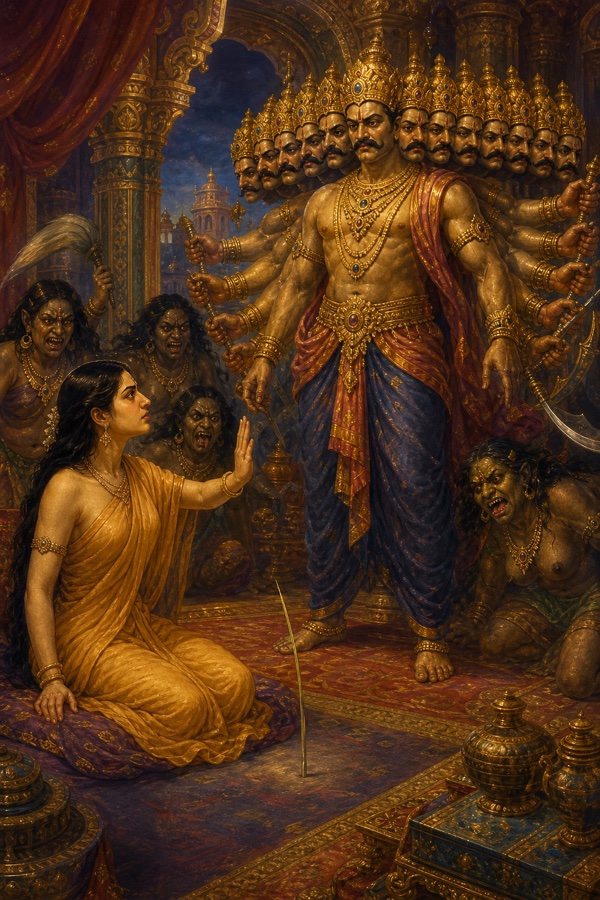
Addressed in that way, the princess of Videha, worn thin by grief, did one small thing that said everything: she set a single blade of grass on the ground between herself and Ravana, so that he was speaking to her across it and would never again speak to her directly. Then she answered him without fear. “There was a king, Dasharatha, firm as a bridge across the flood of dharma, true to his word, famed through the whole world. His son Rama, a man of dharma, known in all three worlds, is my husband and the deity I worship. Born in the line of Ikshvaku, lion-shouldered, of great splendor, Rama with his brother Lakshmana will take your life.”
“If you had used force on me in front of them, you would be lying dead in battle now, like Khara of Janasthana. Those dreadful, mighty rakshasas you have sent will be as weak in front of Rama as venomless serpents in front of Garuda. The golden arrows loosed off his bow will cut through your body the way the waves of the Ganga cut through a bank. Though Brahma’s boon may keep you beyond the reach of demons and of gods, Ravana, you have set a bitter enmity against my husband, and you will not escape him alive. That mighty son of Raghu will end what is left of your life; it is now as hard to save as the life of a beast tied to the sacrificial post. A sacrificial altar, made holy by the mantras of Brahmins, cannot be trampled by an outcaste; the ground itself refuses him. In the same way I, the steadfast, ever-dharmic wife of Rama, cannot be touched by you, lowest of sinful rakshasas.”
“A royal swan-hen who plays among the lotus-beds with her royal swan: how could she so much as turn her head to look at a water-crow standing in the reeds? This body has no feeling left in it. Bind it or have it killed, rakshasa. Neither this body nor this life is worth guarding to me. What I will not have is a stain laid on me in the eyes of the world.” And having said these very hard things in her anger, Janaki fell silent, which was harder. Hearing words that made the hair stand up on him, Ravana answered with the only thing he had left. “Maithili, hear me. I give you twelve months. If inside that term you do not accept me of your own will, my cooks will cut you into pieces for my morning meal.”
Having said it, Ravana, who made his enemies weep, turned in his anger on the rakshasis who guarded her. “Hideous, dreadful demonesses, eaters of flesh and blood, humble her pride, and do it now.” At the command those terrible demonesses folded their hands and closed in a ring around Maithili. Then Ravana, tearing at the earth with his feet as he spoke, said to those grim-faced rakshasis, “Take Maithili into the middle of the Ashoka grove. Ring her there and guard her in secret. With harsh threats first and then with sweet words, all of you together, bring her under control the way a wild she-elephant is broken.”
At his command the rakshasis led Maithili into the Ashoka grove, filled with wishing-trees of every kind, with flowers and fruits of every kind, and birds in it that never stopped their mating-joy for a moment. It was the loveliest place in Lanka and it was a cage. The daughter of Janaka went into it with grief working in every limb, and became a doe fallen in among tigresses. Every tree in it would have given her whatever she asked for, and the only thing she wanted was a leaf-hut with two men in it, back across the whole width of the sea. Under the endless threatening of the ugly-eyed rakshasis she found no rest anywhere in it. Remembering her husband, and her husband’s brother Lakshmana, wracked with fear and grief, she fainted, like a doe caught in a snare.
Rama’s return, and his reproach to Lakshmana
Meanwhile Rama, having killed the shape-shifting Maricha in his deer-form, was turning back along the path to the hermitage as fast as the ground would let him. Restless to see Maithili, hurrying, he heard behind him a jackal howl in a voice that stopped him where he stood. The hair rose on him, and he began to reason with himself out loud. “The way this jackal is crying, it seems to mean some evil. Is Sita well? Have the rakshasas not eaten her? If Maricha cried out in a mimicry of my voice, and Lakshmana heard it, then Sita would have sent him to me that very moment. And then she is alone. And because of Janasthana my enmity with the rakshasas already runs deep.”
The day had begun handing him omens, and it did not stop. Thinking these thoughts, the jackal’s cry still in his ears, the self-possessed Rama turned toward the hermitage. As he came back into Janasthana, remembering with dread how easily he had been drawn off by that deer-shape, the deer and the birds around him kept him on their left, which is the wrong side, and cried out in dreadful voices with their faces wretched. Rama read every one of them. He went toward his hermitage faster.
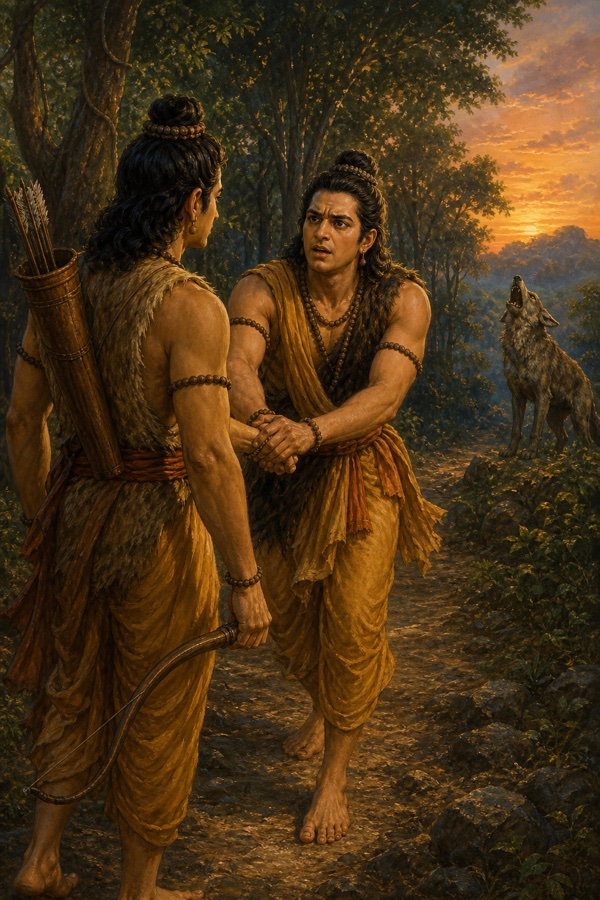
Then he saw Lakshmana coming toward him with the brightness gone out of him. A little way off the weary, stricken brother met the weary, sorrowing brother, and neither of them had to ask what the other had come to say. Seeing Lakshmana walking away from a lonely forest thick with rakshasas, and Sita nowhere behind him, Rama began to rebuke him before he had reached him. He took his brother’s left hand and spoke words that were pitiful and hard, and were in the end for his good. “Lakshmana, you have done a blameworthy thing, coming away here and leaving Sita, who was the one thing to be guarded, alone. Will she be well? Hero, I fear the forest-roving rakshasas have hidden the daughter of Janaka somewhere, or devoured her, for only ill omens crowd in front of me.”
“Shall we find Sita alive? The way the herds of deer and the jackals and the birds are crying out, with their faces turned toward the sun-lit quarter, I doubt that the princess is safe. This rakshasa Maricha, who lured me far away in the shape of a deer, showed his true rakshasa form only when my arrow was in him and he was dying, and what he cried out then was, ‘Ah, Lakshmana, I am killed.’ My mind is grieved and joyless. My left eye is throbbing. Beyond doubt, Lakshmana, Sita is not in the hermitage. She has been carried off, or she has been killed, or she is somewhere out on the road between.”
Thinking all of it, and looking at Lakshmana while he thought it, Rama went on toward Janasthana with him. Worn out with hunger and thirst and walking, his mouth dry, his head down, he reached the hermitage; and the hermitage was empty, and the emptiness of it took him further down than the fear had. He went inside. He walked the places where she used to play. He said, out loud, to nobody, “Here is the very spot.” And the hair stood up on his body, and the grief took hold of him there.
Rama and Lakshmana speak, and the secret of the deer-form Maricha
Seeing Lakshmana returning from the hermitage, Rama, meeting him midway on the road, asked in sorrow, “Why have you come away and left Maithili in the forest, when she was entrusted to my trust and to yours? Lakshmana, the moment I saw you walking toward me without Maithili, my mind was troubled with the fear of some great evil. When I saw you from a long way off on that road, and there was no Sita anywhere near you, my left eye began to throb, and my arm, and my heart with them.”
Sunk deeper by the question than he had been by the walk, Lakshmana answered his sorrowing brother. “I did not come away of my own will. I was driven to your side by her own harsh words. A sharp cry of ‘Ah Lakshmana, save me,’ and it seemed to be in your voice, fell on Maithili’s ears. Hearing that anguished cry, weeping, afraid out of her love for you, she said to me again and again, ‘Go, go quickly.’ I reassured her. I said, ‘I see no rakshasa alive who could put Rama in fear. Be easy. That voice belongs to somebody else who has put his on. Would Rama, who protects even the gods, ever cry out a low and shameful “Help me”? Somebody has taken his voice by trickery and used it to call “Lakshmana, save me.” It was the rakshasa himself who cried out for help, good lady, out of his own fear. Panic of that kind is for wicked women to harbor, and you should give it no room. Do not be troubled; be at peace. In all three worlds there is no man, none born and none yet to be born, who could defeat Rama in battle, not Indra, not the gods behind him.’”
“But the princess of Videha, her mind clouded, shed tears and said this cruel thing to me: ‘You have set on me an utterly sinful hope, that with your brother dead you will have me; and you shall never have me. By some secret pact with Bharata you walk behind Rama, and that is exactly why, when he cries out where you can hear him, you do not run. You are a hidden enemy, walking beside me and waiting for your chance at Rama.’ Stung by that, my eyes red, my lips shaking, I came straight away from the hermitage.”
Confounded by his own anguish, Rama said, “Coming away and leaving her was a wrong, and it was yours. You knew perfectly well that I am able to drive off rakshasas, and you came away anyway, on the strength of Maithili’s angry words. It was not pleasing to me that you should abandon Maithili because an angry woman said hard things. Driven by Sita, you gave way to your own anger and did not keep my command, and that was wrong in every way it can be. That rakshasa, the one who lured me from the hermitage in the shape of a deer, is lying back there with my arrow in him. When I drew the bow full and put a deadly shaft into him, he threw off the deer-shape and stood up a rakshasa decked in ornaments, and in an anguished voice, mimicking mine, he cried that piteous cry that carried so far. And that is the cry for which you came away, and left Maithili.”
Rama questions the trees and the beasts about Sita
As Rama came back into the hermitage his lower left eyelid began to throb again and again, and his own feet stumbled under him, and a tremor went through his body. One ill omen after another, and he asked the question in spite of himself, out loud: “Will Sita be well?” And then he saw the hut. Downcast, he found the leaf-hut without Sita in it and stripped of every grace it had ever had, like a lotus-pond that winter has withered.
The forest deities had gone out of it. The flowers in it were wilted. The deer and the birds around it would not settle. The deerskins and the kusha-grass were scattered, the seats were overturned, and he lamented over all of it again and again. “The timid Sita has been carried off, or devoured, or lost on the road, or she is hidden somewhere in play, or she has gone into the forest. She has gone to gather flowers and fruit, or to the lotus-tank, or down to the river for water.” He was building her a way back with his own mouth. Though he sought her hard, he did not find his beloved, and Rama, his eyes red with grief, began to look like a madman.
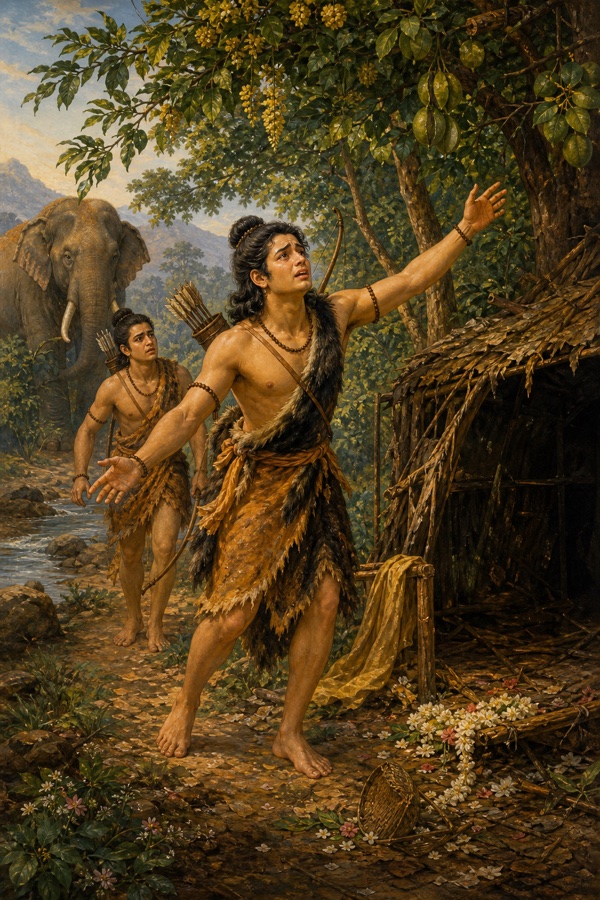
Drowned in the sea and the mire of his grief, Rama went from tree to tree, from mountain to river and stream, and lamented. He spoke to the trees, and he spoke to them as though they had been standing there watching, because they had. “Kadamba, my beloved loved the kadamba flower. Have you seen her? Bilva, if you have seen the soft Sita of the bilva-shaped breasts, robed in yellow silk, then tell me. Arjuna, tell me whether Sita, who loved the arjuna flower, is alive or not. This kakubha tree, rich with creepers, shoots and blossom, surely knows Maithili, whose thighs are smooth as its own boughs. Tilaka, you must know her, who loved the tilaka flower that the bees sing over. Ashoka, remover of sorrow, show me my beloved and make your name true quickly, for I am struck down with grief.”
“Tala, if you have seen Sita of the breasts like ripe tala-fruit, give me word of that fair-limbed one. Jambu, if you have seen my beloved of the gold-bright luster, then speak and do not be afraid. Karnikara, you are in full bloom today and shining in great beauty; if you have seen the good woman who loved the karnikara, then tell me.” Going from one to the next, to the mango, the nipa, the sal, the jackfruit, the kurava, the dhava, the pomegranate, the bakula, the punnaga, the sandal, and the ketaka, asking every one of them the same question and waiting for an answer from each, Rama wandered the forest like a madman.
He questioned the beasts as well. “Deer, do you know Maithili of the fawn-like eyes? She would be with the does, my beloved who looked like a doe. Great elephant, if you have seen Sita of the thighs smooth as an elephant’s trunk, then tell me. Tiger, if you have seen Maithili, my beloved, tell me without fear, for you have nothing to fear from me.” Then, as if he saw Sita before him, he said, “Why do you run? You have been seen. Why do you hide behind the trees and not answer me? Stay. Have you no pity for me? You are not so fond of jest as this. Why then this scorn? You are known by your yellow silk. Even as you fled you were seen. If any love is left in you, then stop.”
Then the delusion lifted and what was under it was worse. “Either that one is not here at all, or she has been killed, for she would not scorn me like this while I am in such distress. It is clear that flesh-eating rakshasas have cut my girl, parted from me, limb from limb, and devoured her. That face like the full moon, with its lovely teeth and lips and its fair earrings, has been swallowed. That soft, champak-hued neck, made for a necklace, has been eaten. Those arms soft as young leaves, with their bangles and their armlets, trembling with fear, have been eaten. She had kinsmen enough to fill a city, and she was devoured by rakshasas like a woman left behind by her companions on a road.” “Ah, Lakshmana, do you see my beloved anywhere? Ah Sita, where have you gone? Ah Sita,” so lamenting over and over, Rama went through forest after forest, now leaping up in a rush, now whirling in one place like a dust-storm. And even after searching the whole vast forest he would not let go of hope; he gave himself to the search for his beloved again, and harder.
Rama’s lament, and Lakshmana’s consolation
Seeing the empty hermitage-ground, the deserted leaf-hut, the scattered seats, casting his eyes all around one more time and still not finding her, Rama lifted his fine arms and cried out to Lakshmana. “Lakshmana, where is the princess of Videha? In what direction has she gone from here? Who has carried her off, or devoured her? Sita, if you wish to jest behind a tree, then let the jest be enough now; come out to me in my sorrow. Sita, the fearless fawns you used to play with are sitting there lost in thought, their eyes full of tears, without you.”
“Without Sita I will not live, Lakshmana. In the other world my father will look at me and say, ‘You took a vow and were sent to the forest, and you have come back before the term was out. Shame on you, slave to your desire, ignoble, false of word.’ Where are you going, leaving me helpless, worn with grief, wretched, my hopes broken, the way glory leaves a crooked man? Do not leave me. Without you I will give up my life.” So lamenting, restless for the sight of her, not finding the daughter of Janaka anywhere in that forest, Rama went down like an elephant that has walked into a swamp and found no bottom to it.
Then Lakshmana, who wanted only his good, said, “Do not despair. Make the effort, and make it with me. Hero, this great mountain is graced with many caverns. Maithili loved to roam the forest, and she would grow wild with the delight of it. It may be she has gone into the woods, or to some blossoming lotus-pond, or to a river with its fish and its reeds, or she is hiding somewhere to frighten us. The daughter of Videha may be crouching somewhere at this moment to test our skill in the search and her own. Come, let us look for her, and quickly. Kakutstha, if you think it fit, do not sink your mind in grief.”
Steadied by a word spoken in love, Rama joined his brother in the search. The two sons of Dasharatha combed forest, mountain, river, and lake; they searched the slopes and the rocks and the peaks of the Prasravana mountain in full, and they did not find Sita. When he had searched the mountain on every side, Rama said, “I cannot see Sita anywhere on this mountain.” Then Lakshmana, tormented with sorrow himself, said to his brilliant brother, “You will surely find Maithili, the daughter of Janaka, as the mighty-armed Vishnu, in the form of the Dwarf, bound Bali and won this earth back for his elder brother Indra.”
Even at that word Rama, his mind darkened, said in a wretched voice, “I have searched the whole forest, the blossoming lotus-ponds, this mountain with all its caverns and streams, and I cannot see the princess of Videha, who is dearer to me than my own breath.” So lamenting, worn thin by her loss, distraught, Rama for a while lost every hold he had on himself. His limbs slackened. His mind went. All but senseless, wretched, stricken, he stood motionless and drew long, hot breaths. Sighing, and sighing again, Rama, choked with tears, cried “Ah beloved” over and over. And the grief-stricken Lakshmana stood in front of him with folded hands and comforted his dear brother in every way he could think of, and Rama took no notice of any word that fell from his lips, and did not see his Sita, and lamented on.
Rama’s deep lament, and Lakshmana’s words of patience
Not seeing Sita, and seeing her as if she stood in front of him, the dharmic Rama, tormented by love, began to lament again, and the sobbing made his words come out hard. “Beloved, you who so love flowers, you are hiding your body among the ashoka branches, and all you are doing is deepening my grief. Lady, even behind the plantain tree your thighs, soft as its stem, still show; you cannot conceal them. You sit laughing in the karnikara grove; let the laughter be enough now, it hurts me. Such a jest does not become a hermitage, though your nature was always fond of jest. Come back. Your hut is empty.”
Then the delusion lifted and he turned to Lakshmana. “It is clear that Sita has been eaten by the rakshasas, or carried off, for she does not come to me while I lament like this. Lakshmana, these herds of deer with their tear-filled eyes seem to be telling me that the lady has been devoured by rakshasas. Ah Sita, where have you gone? Ah good woman of the lovely color. Ah Kaikeyi, today your wish is fulfilled and you can rest. I set out with Sita and I come back without her. How shall I now walk into my own empty inner apartments? People will call me weak, and heartless. My cowardice too will be laid bare by the loss of Sita. And when the exile is over and I stand in front of King Janaka and ask him after his welfare, how shall I meet his eyes? Struck down by the death of his daughter, the king of Videha will lose his senses at the sight of me without her. Or I shall never go back at all to Ayodhya under Bharata’s rule.”
“Even heaven is empty to me without her. Lakshmana, leave me in the forest and go back to lovely Ayodhya. Without her I cannot live at all. Embrace Bharata close and say to him in my name, ‘Rule the earth by Rama’s command.’ salute my mothers Kaikeyi, Sumitra, and Kausalya fittingly in my name, and guard them with care. Tell my mother Kausalya in full of this ruin of Sita, and of my own, which is soon to come.” So the wretched Rama lamented on, and Lakshmana too, his face dry with fear, grew utterly distressed.
Robbed of his beloved, stricken with grief and confusion, the prince, having cast his brother into despair too, sank into a fiercer one himself. Drawing hot breaths, drowned in grief, he said to the sorrowing Lakshmana words that were fit to be sorrowed over. “There is no man on this earth so ill-fated as I, over whom grief comes on the heels of grief, unbroken, tearing my heart and my mind between them. Surely in a former birth I did evil deeds, and did them again and again, and the whole ripening of them has burst on me at once, so that I pass out of one grief straight into the next. The loss of my kingdom, the parting from my kin, the death of my father, the parting from my mother Kausalya: every one of them, when I dwell on it, only raises the flood of this grief higher, Lakshmana.”
“When I reached this forest, all the pain of the body’s hardship was quieted by Sita’s nearness, and now, with Sita gone, it has flared up again, the way a fire flares when wood is thrown into it. Sita, carried off by force through the sky, surely cried out again and again in shrill, broken tones of fear, she who spoke so sweetly that the sweetness was the first thing anyone noticed about her. Her round breasts, worthy of the finest red sandal, would be smeared with mire and with blood; and my body still does not fall to pieces, and I go on standing here in a forest saying words. Like the moon in the mouth of Rahu, my beloved’s face, framed in its curling hair, sweet of speech, fallen into the power of the rakshasas, shines no more. Her lovely neck, made for a necklace, they must have cut in some lonely place, and drunk her blood out of it.”
“Cut off from me, dragged through a lonely forest and ringed by rakshasas, she must have cried out like a poor osprey. Lakshmana, sitting beside me on this rock, Sita, smiling that sweet smile, used to talk with you of many things. This Godavari was always her favorite haunt. Perhaps she went there; and she never goes alone. Lotus-faced, she may have gone to gather lotuses; and that too is wrong, for she never goes near the lotuses without me. Perhaps she went to the woods with their blossoming trees; and when she is alone she is very much afraid.”
Then he called on the sun and on the wind, because there was nobody else left to ask. “Sun, you who know everything the world does and everything it leaves undone, witness of true deeds and false ones, tell me, struck down as I am by grief, where my beloved has gone, or where she has been carried. Wind, in all three worlds there is nothing hidden from you. Tell me whether Sita, the guardian of my line, is dead, or carried off, or out on the road somewhere.”
As Rama lamented so, helpless, all but out of his senses, Lakshmana said the words that the hour needed. “Let go of grief now and take up patience. Bring back your zeal for the search. A man of zeal does not lose heart even in the hardest tasks.” And even at that word of the fierce-valored Lakshmana, Rama, stricken by the separation, took no notice, lost his patience, and sank once more into a great sorrow.
Godavari kept silent, and the deer pointed south
Rama told Lakshmana to go quickly to the river Godavari and see whether Sita had gone there to gather lotuses. At his word Lakshmana went down to that lovely river and walked its many fair landings, and came back with nothing. At no landing was she to be seen, he said; and though he had called her by name, over and over, at every one of them, she had not heard the call. “Rama, I do not know to what state she has come, she who by her mere presence would drive away all sorrow.”
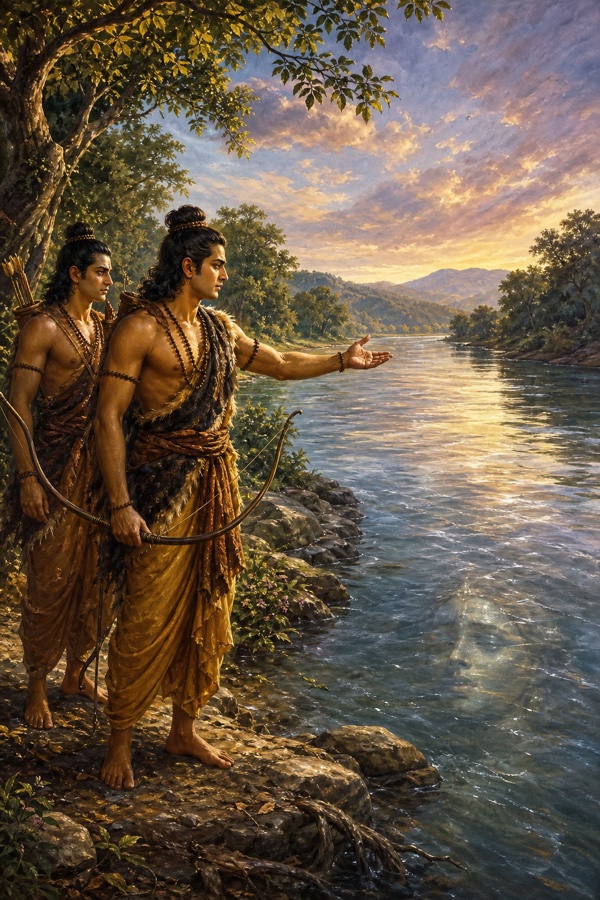
Hearing that, Rama, distracted with grief, went to the Godavari himself and said, “Where is Sita?” And the creatures he had questioned before did not tell him that Ravana, who deserved death, had carried Sita off; and the Godavari too kept silent on the matter. Then the elements themselves begged the river to give him word of his beloved, and even so, even with the grieving Rama standing on her bank asking, the Godavari said nothing about Sita. She was remembering the form and the deeds of Ravana, and out of fear of him she said nothing at all. So the tradition tells it.
Losing hope of any word from the river, Rama, worn thin by her loss, said to Lakshmana, “This Godavari too gives no answer. Lakshmana, when I meet Janaka, and the mother of Videha’s daughter, how am I to tell them, without her standing beside me, this unwelcome news? Robbed of my kingdom, living in a forest on its fruits and its roots, I had no sorrow, because she took it away. Where has the daughter of Videha gone? Cut off from my kin, and now seeing the daughter of Videha no more, my nights, lying awake in them, will grow very long. If only Sita could be found, I would live as a servant, and gladly, on the Mandakini, in Janasthana, and on this Prasravana mountain, and never ask for anything else.”
Just then Rama noticed that the great deer were looking at him, and looking again, as if there were something they were trying to say. He read the signs on them, and in a voice choked with tears he asked them too: “Where is Sita?” And he watched their eyes for the answer. At the question the deer all rose up at once, lifted their eyes toward the sky, and turned their heads to the south. That was the answer, and it was exact: she had been carried off toward the southern quarter, and she had gone by the sky-road. Then, looking along the very path by which Ravana had borne Maithili away, they went on bellowing, and would not stop. Lakshmana understood every sign they made, and they were as clear as speech.
Flower-signs and the wreckage of battle: the fire of Rama’s wrath
Lakshmana said to his elder brother that since the deer, at his question, had risen up all together and pointed toward the vault of the sky and then toward the southern quarter, the two of them should take this south-westerly way, the quarter over which the rakshasas hold sway under their guardian Nirriti. Some trace of Sita might be found that way, he said, or the noble lady herself might come into view. Rama said only, “Very well,” and, with his eyes fixed on the ground so that it could not hide anything from him, set off toward the south with Lakshmana following him.
Talking as they went, the two brothers saw a track of flowers scattered on the ground. Seeing that fall of blossoms lying there on the earth, Rama said to the grieving Lakshmana, “I know these flowers. These are the very flowers I gave to Sita in this forest, and she bound them into her hair with her own hands. And they have not wilted. I believe the sun, and the wind, and the glorious mother Earth kept these flowers fresh, and they did it to do me a kindness.”
Then the dharmic Rama spoke to that mountain full of springs. “Have you seen in some lovely corner of this forest a young woman, fair in every limb, parted from me?” He got no answer, and the anger came up in him, and he challenged the mountain the way a lion challenges some small deer that has wandered into its ground. “Show me Sita of the golden color and the golden limbs, or I will grind every peak you have to dust.” At the threat the mountain seemed to make some hint of Sita, and it did not show her to him. Then Rama said to that mass of rock again, “Burned by the fire of my arrows you will be reduced to ashes, stripped on every side of grass and tree and leaf, and made a place nothing can live in.” And turning, he said to Lakshmana, “If the Godavari does not tell me today where Sita is, I will dry up this river too.” And in his fury Rama looked at the river as though he would burn her out of her bed with his eyes.
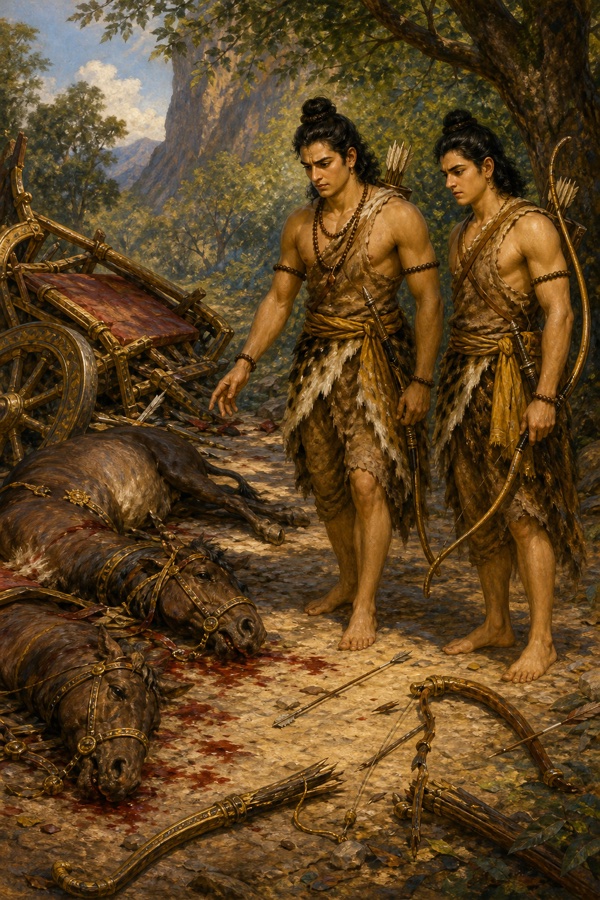
Just then he saw it, marked on the earth: the huge footprint of a rakshasa. And with it the footprints of Sita, running this way and that way, frightened, doubling as the rakshasa came after her, every one of them turned toward the direction Rama had gone. And then a broken bow. A quiver. A chariot smashed into pieces. His heart turning over in him, Rama said to Lakshmana, “Look, here are the golden fragments of Sita’s ornaments, and flowers of every kind scattered around them. The whole surface of the earth is shining as if grains of gold had been sown across it, and it is covered with drops of blood, more here, less there. I believe, Lakshmana, that shape-shifting rakshasas cut the daughter of Videha to pieces, divided her among themselves, and devoured her. And on this very spot two rakshasas fought a savage battle over Sita.”
Rama went on, and the questions came faster than any answer could have. “Whose is this fine great bow, set with pearls and gems? Whose is this golden mail, blazing like the morning sun, inlaid with lapis, lying broken on the ground? Whose is this hundred-ribbed parasol, hung with divine garlands, fallen with its staff snapped? Whose are these fiend-faced donkeys of dreadful form and huge body, sheathed in golden armor, slain in the fight? Whose is this splendid chariot, bright as blazing fire, with its war-banner, lying overturned and broken? Whose are these dreadful arrows, thick and long as a chariot-axle, with their heads sheared off? And see, Lakshmana, two quivers full of arrows lie smashed here. And here is the charioteer, dead, with the whip and the reins still in his hands. And these are plainly the footprints of a male rakshasa.”
Then Rama said, “My enmity with these cruel-hearted, shape-shifting rakshasas has grown a hundredfold in this one hour, and it will end only when their lives do. The daughter of Videha has been killed, or has died, or been devoured, and dharma itself could not guard Sita, carried off in that great forest. Lakshmana, when the daughter of Videha herself has been devoured or carried away, what creature in this world is able to do me any good at all? People take even the supreme Rudra, maker and protector and destroyer of the worlds, for a weakling, if out of compassion he stands back and will not step into the affairs of the world. In the same way the rulers of the gods take me, who am gentle, devoted to the world’s good, restrained, and full of pity, for a man without power. See, Lakshmana: these very virtues of mine have turned into faults in me. This very day, for the ruin of all beings and all rakshasas, my splendor will blaze out and thrust every one of those virtues into the background, the way the sun risen at the world’s dissolution blots the moonlight out of the sky. Now neither yaksha, nor gandharva, nor pishacha, nor rakshasa, nor kinnara, nor man shall know one hour’s ease.”
Rama said, “See, Lakshmana, the sky will fill now with my weapons and my arrows. Today I will halt with my arrows the movement of everything that ranges the three worlds. I will bind the three worlds fast to the work of Time, so that the planets stop where they stand, the moon is covered over, fire and wind are undone, the sun’s brightness dims, the mountain peaks are ground into dust, the pools dry up, tree and creeper and shrub are torn out by their roots, and the oceans run dry in their beds. The gods let my wife be carried off by rakshasas through their own negligence; if they do not give Sita back to me exactly as she was, they will see my might this very day. From my bowstring the net of arrows will thicken the sky until no bird can find a gap to fly through. Today the gods will learn what these barbless arrows can do, that go so far, driven by my rage and my resentment. When my wrath has finished with the three worlds, there will be no gods left, and no demons, and no pishachas, and no rakshasas. If the gods with authority will not return Sita, whether she has been killed or has died, and hand my beloved daughter of Videha back to me in that very state, then I will destroy the whole of the three worlds, with everything that moves in them and everything that stands still, and I will go on burning them all with my arrows until I see her.”
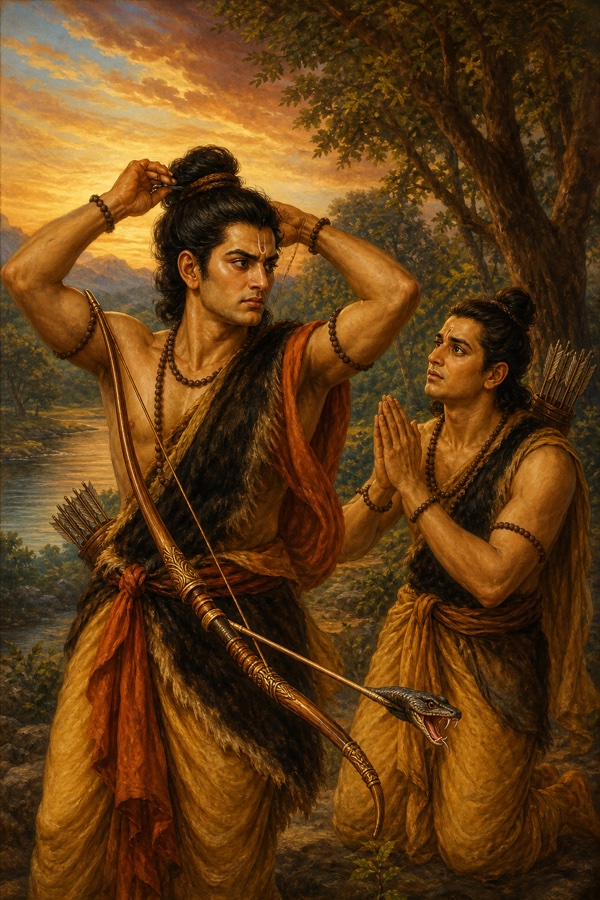
Saying it, his eyes coppery with rage, his lips shaking, Rama tightened his bark garment and his deerskin and bound up the mass of his matted hair, and every movement of it was the movement of a man dressing for work. In that hour Rama, angry, had exactly the look that Rudra had of old when he destroyed Tripura. Then he took the bow from Lakshmana, closed his fist on it, drew from the quiver a dreadful blazing arrow like a venomous serpent, and, wrathful as the fire at the world’s dissolution, set it to the string and said, “As old age, death, Time, and Fate are inescapable for every being that lives, so I too, filled with wrath, am beyond doubt inescapable. If the gods do not return to me today Maithili Sita of the lovely teeth, faultless, exactly as she was before, then I will overturn the whole world, with its gods, its gandharvas, its men, its nagas, and its mountains too.”
Lakshmana’s consoling words: do not slay all the worlds for one man’s crime
Seeing Rama, worn thin by Sita’s loss, standing ready like the fire at the world’s dissolution to destroy the worlds, looking again and again at his own drawn bowstring, drawing deep breaths, eager to burn creation down to the ground, in a rage of a kind nobody had ever seen in him before, Lakshmana folded his hands, and with his mouth gone dry, spoke.
Lakshmana said, “Until now you have been gentle, restrained, and devoted to the good of all beings. You should not, under the sway of anger, cast off your own nature. As beauty dwells in the moon, brightness in the sun, motion in the wind, and forbearance in the earth, so supreme glory dwells forever and surely in you. It is not fitting for you to destroy all the worlds for the crime of one man. I will surely find out whose war-chariot this is, and who broke it, and why, with its yoke, parasol, whisks, and all its gear. This ground, cut by hooves and wheels and wet with drops of blood, looks most terrible, from which I judge that a battle took place here. Yet it seems the struggle of a single charioteer, not of two.”
Lakshmana said that he saw here no footprints of a large army. “For the sake of one man you should not destroy the worlds, for lords of the earth are kings who punish justly, who are gentle and calm, and you have always been the protector and the highest refuge of all beings. Raghava, who would count it right to destroy or lose your wife? The rivers, oceans, mountains, gods, gandharvas, and demons are as unable to do you wrong as a righteous priest is unable to wrong the man consecrated for a sacrifice. King, it is the one who carried off Sita whom you should seek out. Taking me with you, bow in hand, and making the great seers your helpers, we will search, with a steady mind, the oceans, the mountains, the forests, the many dreadful caves, the many lotus-lakes, and the worlds of gods and gandharvas, until we find the one who carried off your wife. If the rulers of the gods do not return your wife by peaceful means, lord of Kosala, then you may take up the measure the hour calls for, which is force.”
Lakshmana said at the last, “If by good conduct, by conciliation, by humility, and by right policy you cannot win Sita back, then with a storm of golden-winged arrows like the thunderbolt of Indra, uproot the worlds.”
Lakshmana’s words of patience: to whom does adversity not come
Having comforted for a while a brother scorched by grief, lamenting like a man with nobody to protect him, filled with a deep confusion, heavy of heart, Lakshmana knelt and pressed his brother’s feet, and reasoned with him in these words.
“By great austerity, by vows and fasts, and by the great rite of the son-seeking sacrifice, King Dasharatha obtained you, the way the gods obtained nectar,” said Lakshmana. “Bound to this world by your virtues alone, and by nothing else, the king, at his parting from you, attained godhood; we had it from Bharata’s own lips. If you cannot endure this sorrow that has come, what other man, of common sort and little strength, will bear his? Take patience. To what living being do adversities not come? They touch a man like fire, and in a moment they have passed on. If in your grief you burn all the worlds with your splendor, where will your suffering people go to find peace?”
Lakshmana gave his examples. “This touch of sorrow is natural to human beings. Yayati reached by his own meritorious deeds the very heaven of Indra, and even there the ruin of a fall from heaven, brought on by nothing but his own indiscretion, came and found him. The hundred sons of the great seer Vasishtha, our father’s family priest, were born in a single day, and in a single day Vishvamitra killed them all. Even this Earth, the mother of the world, whom every people salutes, is seen to tremble. Even the mighty sun and moon, the two eyes of the world, on whom everything rests, who are the two forms of dharma, come to eclipse. The greatest beings and the very gods stand under the sway of fate. How much more, then, creatures wearing bodies? Even among Indra and the gods, righteousness and unrighteousness are known to bear their fruit as joy and as sorrow. And so you should not grieve.”
“Whether Sita is dead, or has been carried off by someone, Raghava, you should not grieve like an ordinary man,” said Lakshmana. “Men like you, who see all things, are never, even in the greatest crises, handed over to grief; their vision stays where it was. Weigh with your reason what is right and what is not, for the wise know good and evil well. There are acts whose merits and faults are not known without the scriptures, which, being impermanent, are not accomplished without action, and whose fruit, welcome or unwelcome, once they are done, must certainly be borne.”
Then Lakshmana said it humbly. “Hero, it is you yourself who taught me all of this, many times over. What could Brihaspati himself teach you? Your understanding is hard for the gods to fathom. All I am doing is waking the wisdom in you that grief has put to sleep. Remember your divine prowess and your human prowess both, and make the effort to destroy your enemies. What purpose of yours is served by the ruin of everything? Weigh it well with your reason, and find out that one sinful enemy, and uproot him alone.”
Meeting the wounded Jatayu: Rama’s lament
Rama was the elder, and he was still able to take the essence of a thing when it was put to him, and he took Lakshmana’s reasoning and accepted the beautifully worded, precious counsel in it. He curbed the anger that had risen in him and leaned his weight on that wonderful bow. “Child,” he said, “what shall we do, and where shall we go? By what means may we see Sita in this forest? Consider it.”
To the anguished Rama, Lakshmana said, “You should search this very Janasthana, which is full of rakshasas and set with trees and creepers of every kind. Here are mountain-fastnesses, ravines, and caverns; many dreadful caves with herds of beasts of many kinds inside them; dwellings of kinnaras and mansions of gandharvas. Search all of it with me, diligently. Men of understanding and of greatness like yours are not shaken by adversity, any more than the mountains are shaken when the wind blows on them.” At Lakshmana’s word Rama, angry still, set to his bow a dreadful arrow named Kshura, and with Lakshmana beside him began to range that whole forest.
Then they saw him: fallen on the earth, drenched in blood, looking like a mountain peak somebody had laid down. Seeing that shape, Rama said to Lakshmana, “Beyond doubt this bird has devoured Sita, the daughter of Videha. Clearly this is some rakshasa in the shape of a vulture, ranging the forest. He has eaten Sita and he is lying here at his ease over it. I will kill him with my blazing, straight-flying, dreadful arrows.” And saying it, setting the Kshura arrow to his bow, Rama rushed at the bird as though he would shake the earth loose from its ocean-bounds.
Then the bird, vomiting blood with foam in it, said in a most piteous voice to Rama, “The goddess whom you are hunting through this great forest as a man hunts for a life-giving herb: both her and my life, Ravana has taken. Raghava, that goddess, parted from you and from Lakshmana, was carried off in front of my eyes by Ravana. Lord, I came to Sita’s rescue, and in the battle that followed Ravana’s chariot and his parasol were smashed and came down to the ground. This is his broken bow. These are his shattered arrows. And this, Rama, is his war-chariot, which I broke in that fight. Here is his charioteer, killed by the blows of my wings. When I was weary at last, Ravana with his sword cut off both my wings, and took Sita, and went up into the sky. I am already killed, and it was the rakshasa who killed me. You should not kill me too.”
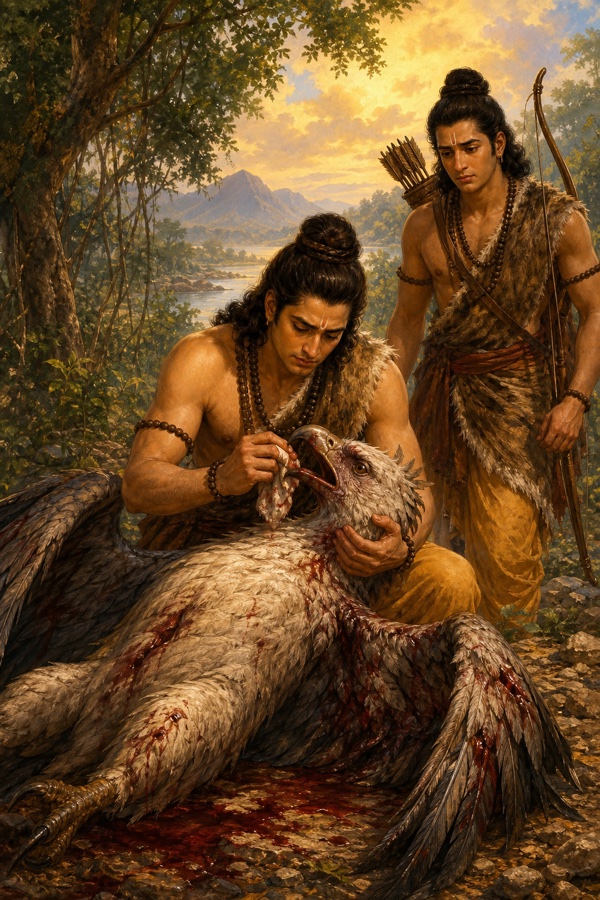
Learning this dear news of Sita, Rama let his great bow fall, embraced the king of vultures, and, with Lakshmana, lost all hold on himself, sank to the ground, and wept. Though he was of the firmest mind, tormented now by a double grief, he lamented with Lakshmana. Seeing the vulture lying alone on that narrow track, drawing long breaths again and again, the sorrowing Rama said to Lakshmana, “My kingdom is lost, I have dwelt in the forest, Sita is gone, and now this bird too is dying. Such is my ill fortune, that it could burn even the fire that burns all things. If today, to comfort myself, I were to set out to cross even the brimming ocean, that lord of rivers too would dry up before my ill fortune. In this whole world of moving and unmoving things there is none so unlucky as I, before whom this great net of calamity has fallen. This friend of my father, Jatayu, lies struck down on the ground by my reversal of fortune.”
Saying it again, and again, and showing him the love a man shows a father, Rama with Lakshmana stroked Jatayu over and over, as if the hands could put back what the sword had taken. Then, embracing that king of vultures with his wings shorn away and the blood soaking him, and saying, “Where has Maithili gone?” Rama sank down onto the earth beside him.
Jatayu’s last words, and his cremation
Seeing the vulture struck down to the earth by the rakshasa Ravana, Rama said to Lakshmana, who carried a friendly spirit toward every living thing, “Striving in my interest, killed in the fight by the rakshasa, this bird is giving up his life for my sake and for nothing else. Lakshmana, the life in Jatayu’s body is very faint, and he is going speechless slowly, while he lies there looking at us in his weakness.” Then he turned to the bird. “Jatayu, if you can speak once more, then tell me of Sita, and of your own killing. May all be well with you. Why did Ravana carry off Sita? What wrong of mine did he see, that he bore away my beloved? How did that moon-lovely face look, and what did Sita say at that time? Dear uncle, how mighty is the rakshasa, of what form, what are his deeds, and where is his dwelling? Tell me, who am asking you.”
Looking fondly on Rama, who was lamenting like a man with nobody to protect him, the dharmic Jatayu said in a faltering voice, “By the aid of a vast sorcery that raised a storm, and cloudy weather, and wind, the rakshasa king Ravana carried off Sita. Cutting away my wings when I was weary, the night-ranger went off toward the south, taking Sita with him. Raghava, my senses are going dull and my sight is turning. I see trees of gold with their tops covered in usira grass. But hear this, because it is the one thing worth the breath. In the hour in which Ravana carried Sita away, the owner of a lost thing swiftly wins it back again. That hour is called Vinda, and Ravana did not know it. Having carried off your beloved Sita, the daughter of Janaka, the rakshasa king Ravana will soon perish, like a fish that has swallowed a hook. You should not grieve over the daughter of Janaka. Killing him on the field of battle, you will soon be happy with the daughter of Videha.”
Undeluded to the end, and answering Rama even while he died, the vulture began to bleed from the mouth, and there were flecks of flesh in the blood. He had one fact left to give and he gave it. “That Ravana is the son of the sage Vishrava and the half-brother of Kubera,” he said; and having said it the king of birds gave up his life, which is the hardest thing there is to let go of. Rama went on saying, “Speak, speak,” with his palms joined out of reverence for his father’s friend, and the vulture’s life left his body and went up into the sky. Setting his head on the ground, stretching his feet out, throwing his body back, Jatayu sank down upon the earth.
Seeing that coppery-eyed vulture, lifeless, huge as a mountain, Rama, with more sorrows on him than one man should carry, said to Lakshmana, “For many years this bird lived at his ease in the Dandaka forest, which is the home of the rakshasas, and here is where he has laid his body down. A bird who lived many years and flourished for a long age lies killed today. Truly Time is hard to overcome. See, Lakshmana, this vulture who did me a kindness has been killed for my sake, killed at the hands of Ravana while coming to Sita’s rescue. He forsook the ancestral kingdom of the vultures, and he gave up his life for me. Lakshmana, dharma-abiding, valiant, refuge-worthy good souls are found everywhere, even among creatures born in the sub-human forms; do not ever forget that you saw it. The loss of Sita does not gnaw at me the way the ruin of this vulture for my sake gnaws at me. This king of birds is worthy of my worship and my honor exactly as my father was, King Dasharatha. Lakshmana, bring wood. I will make fire by attrition, for I wish to cremate this king of vultures, who died for my sake. I will lay the lord of the bird-world on the pyre and cremate this bird who was killed at the hands of the rakshasa.”
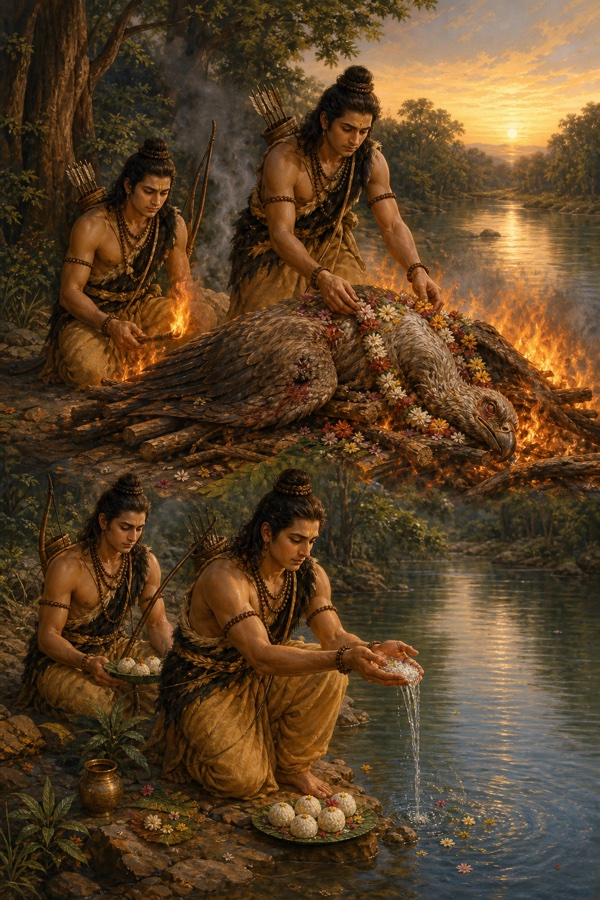
Then he turned to the vulture and spoke to him as a man speaks to a kinsman he is sending off. “King of vultures, by my leave, go to the highest worlds. By my rite attain the destiny of those given to sacrifice, of those who keep the sacred fire all their lives, of those who never retreat from the field of battle, and of those who make gifts of land.” So saying, laying the king of birds on the pyre that Lakshmana had built and kindled, the dharmic Rama, sorrowing though he was, cremated him as he would have cremated one of his own family. Then, going deep into the forest with Lakshmana and digging out the bulky roots called Maharohi, Rama spread the ground with holy kusha-grass. Tearing out the pulp of the Maharohi roots and kneading it into balls, Rama offered those balls to the soul of the dead bird on the lovely ground overspread with green kusha. Then, going down to the bank of the river Godavari, the two brothers bathed and offered water to the king of vultures according to the ordinance of the scriptures. And Rama recited too, in a low voice, those holy texts sacred to the manes that the Brahmins prescribe for the ascent of a dead mortal’s spirit to heaven.
So, having done the exceedingly difficult and glorious deed of trying to save Sita out of Ravana’s hands, killed in battle, and given the last rites by Rama, who was as good as a great seer, the king of vultures attained the holy destiny that is for the soul’s blessedness. Having offered water to the vulture and set their minds at rest about Jatayu, and fixing their thought now on the recovery of Sita, the two princes went on into the forest, like Vishnu and Indra walking out together.
The punishment of Ayomukhi, and the grip of Kabandha
Having offered water to Jatayu, searching the forest for Sita as they went, the two Raghavas moved on toward the south-west. Bearing bow and sword and arrows, the two sons of Ikshvaku went that way and came to an untrodden track, blocked with shrubs and trees and creepers, covered over on every side, hard to pass, dense, and dreadful to look at. They passed it quickly, and left that vast and most fearful forest behind them, and went on toward the south.
Going three kroshas beyond Janasthana, the two mighty Raghavas entered the dense Krauncha forest, which looked from a distance like a mass of clouds and seemed joyous on every side, filled with lovely flowers of many colors, with herds of beasts, and with birds. Searching for Sita, weary, halting here and halting there, they roamed it. Then, going three kroshas eastward, crossing the Krauncha forest, and seeing on the way the hermitage of the sage Matanga, the two brothers saw the dreadful forest beside it, full of fearful beasts and birds and thick with dense trees. And there, near a cave in the mountain that went down deep as Patala and was wrapped in darkness that never lifted, they saw a fierce-faced rakshasi. She was a source of terror to the weak, loathsome and dreadful to look on, with a long belly and sharp teeth, grim, hard of skin, fearful, tall, her hair loose, and she was eating the fearful beasts as they came.
That rakshasi came up to Lakshmana, who was walking ahead of his elder brother, and said, “Come, let us make love,” and took him by the arm. Embracing the son of Sumitra, she said, “I am Ayomukhi by name. You have come to me, and you please me. Valiant lord, through this long life you will sport with me on the mountain-fastnesses and the river-banks.” At that Lakshmana’s anger came up, and he drew his sword and cut off her ears, her nose, and her breasts. Her ears and her nose gone, the grim rakshasi screamed in a harsh voice and fled the way she had come.
When she had gone, the two brothers forced their way on through the dense forest and reached a wood there was no getting through. Then the pure, virtuous, courageous Lakshmana of great energy folded his hands and said to his brilliant brother, “My arm is throbbing hard, my mind is troubled, and I see, mostly, signs of ill. Therefore be on your guard, and heed what I say. These signs are telling my mind at once of a danger close at hand. And this most dreadful bird, called Vanjulaka, is crying out as if to proclaim our victory in the fight that is coming.”
While the two brothers were searching that whole forest hard, a great sound went up, as if the forest were being torn open, as if a storm had got into it, and the sound seemed to fill the whole wood at once. Looking for what had made it, sword in hand, Rama with his younger brother saw a rakshasa of vast body and broad chest. The two princes went closer to the thing standing in front of them. That huge rakshasa was a trunk and nothing else, with no head and no neck, and his mouth was in his belly. He was covered with sharp bristling hair. He was tall as a great mountain, dark blue in color, dreadful, with a voice like thunder. And in the middle of his chest, in a forehead that was there, was a single eye, huge, long, tawny, terrible, blazing like a flame of fire, fringed with great lashes; and he kept licking, again and again, his own huge mouth set with its great teeth.
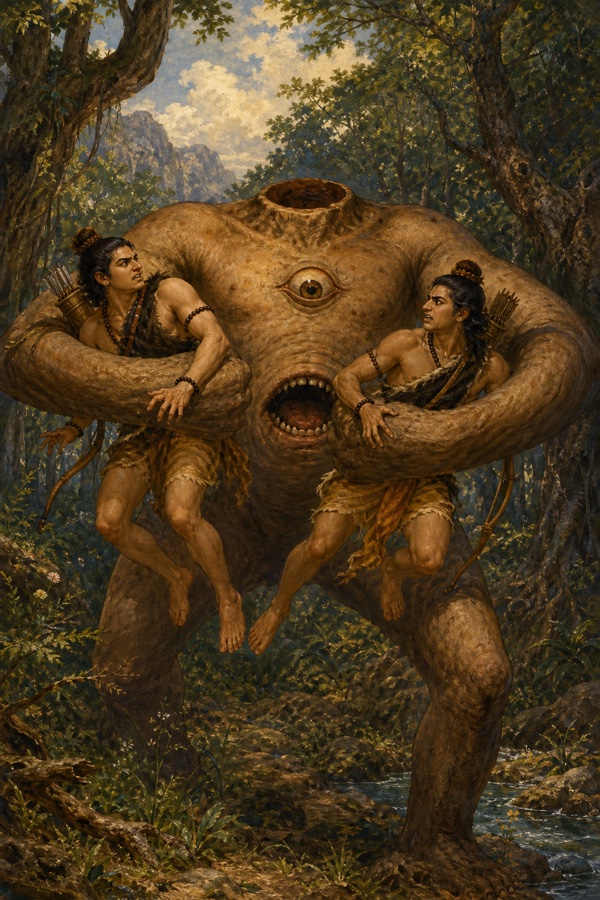
He was devouring dreadful bears, lions, and other beasts and birds. Spreading out his two fearful arms, each one a full yojana in reach, seizing with his hands bears and deer and birds of every kind, dragging and flinging away the leaders of whole herds, he stood blocking the path of the two brothers. They fell back the distance of a kos and looked at that great, cruel, dreadful Kabandha, ringed by his own arms, most terrible to look at by the very shape of him. Then Kabandha stretched his vast arms out to their full length, caught both Raghavas together by force, and squeezed. They carried sword and stout bow, they were of keen splendor and great strength, and when the rakshasa dragged them in they were made helpless. A bow is a weapon for distance, and there was no distance left; the arms had closed and taken it away.
There, by his firmness, Rama was not troubled at all; and by his boyish nature and the feeling of helplessness Lakshmana was distressed. Despondent, he said to Rama, “Hero, see me fallen helpless into the rakshasa’s power. Offer me alone to this demon as a sacrifice of a living being, Raghava, and escape at your convenience. This is my belief, that you will soon find the daughter of Videha; and, winning the kingdom of your fathers and sitting on the throne of it, Rama, you should remember me there sometimes.” And Rama said to Lakshmana, “Hero, do not fear in vain. Men like you never despair.”
Meanwhile Kabandha spoke to the two of them. “Who are you, with shoulders like a bull’s, carrying great swords and bows? Having reached this dreadful region, by the will of fate, you have fallen inside my sight. Tell me what your business here is and for what you have come. You have come into this region while I stood here racked with hunger. Armed with bows and swords and arrows, you have run straight at me like a pair of bulls with sharpened horns, and your lives will not easily be won back from me now.”
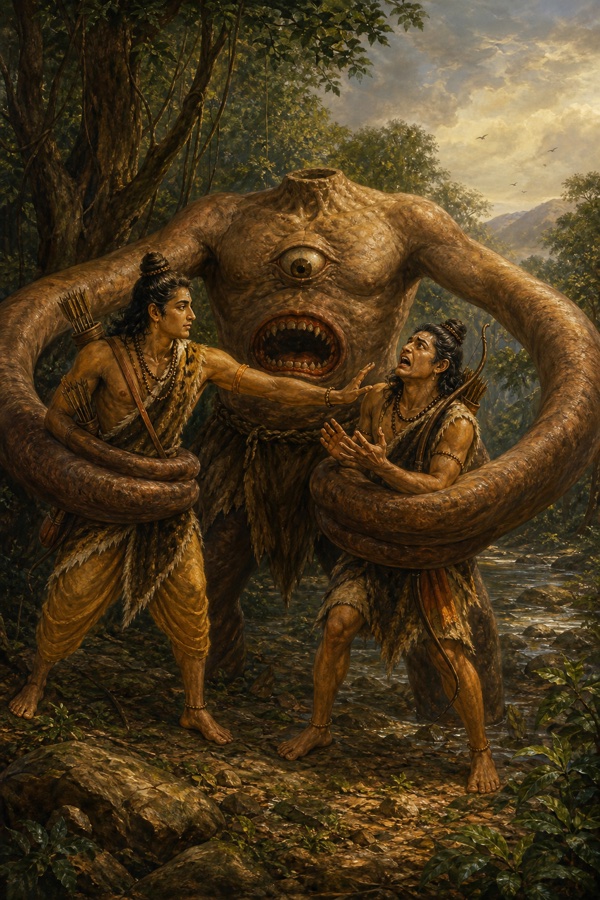
Hearing his words, Rama said to Lakshmana, whose mouth was going dry, “A calamity harder than the hardest, threatening to end our lives, has fallen on us without our having recovered our beloved, O Lakshmana. We suffered the crisis of separation from Sita, more painful than the loss of the kingdom and the exile, and now this disaster that would end our very lives. Lakshmana, the power of Time over all beings is supreme. Look at yourself and at me, clouded by adversity. The control of fate over all beings is no burden to it. Caught in the grip of Time, even the brave and the strong, even men who have mastered the bow on the field of battle, scatter like dams of sand.” So saying, Rama, seeing Lakshmana look so wretched, steadied his own mind.
Kabandha’s arms are cut off, and his welcome
Seeing the two of them standing caught in the noose of his arms, Kabandha said, “Why do you stand still even while you watch me racked with hunger? By the will of fate you have been set apart for my food, and your wits have gone.” Hearing that, filled with indignation and set now on a deed of valor, Lakshmana gave Rama the counsel the moment needed. “This vile rakshasa seized us at once and without cause, so let us cut off his great arms quickly with our swords. This huge rakshasa, whose whole prowess lies in his arms, is dreadful. Having conquered men, he now means to eat us. King, the slaughter of unarmed and defenseless people, like sacrificial beasts led up to the altar, is a shameful thing for a lord of the earth, Raghava.”
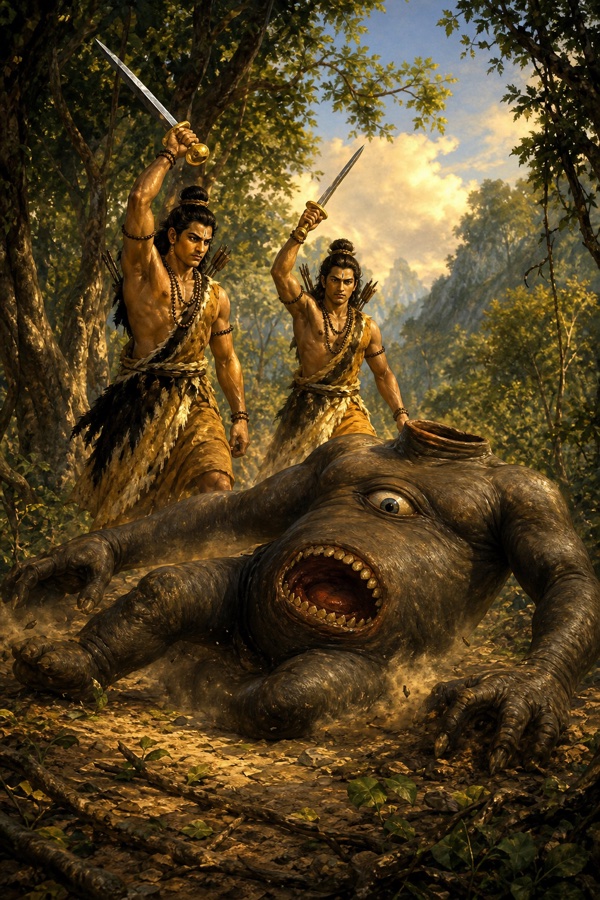
Hearing what the two of them said, the angry rakshasa opened his dreadful mouth and made ready to eat them. And then the two Raghavas, who knew time and place and had been waiting for both, in great joy set themselves to cut his arms off at the shoulders with their swords. Rama stood on the right and cut the right arm without any check. Lakshmana stood on the left and cut the left. His arms gone, the rakshasa fell, roaring like a cloud, making sky and earth and all the quarters ring at once. Bathed in a flood of his own blood, seeing the arms gone, humbled now, the demon asked those two heroes, “Who are you?”
Then Lakshmana gave him the introduction. “This is the son of Dasharatha, of the line of Ikshvaku, known to men by the name of Rama; and know me for his younger brother Lakshmana. When his stepmother Kaikeyi stopped his consecration on the royal throne of Ayodhya, Rama, sent to the forest, roamed the great Dandaka wood with his wife and with me. And as this prince of godlike power was living in a lonely forest, a rakshasa carried off his wife, and it is that rakshasa we came here looking for. And who are you, and why do you roll about a forest without a head, a trunk and nothing more, with broken thighs and a blazing mouth set in your chest?”
And at that, Kabandha, delighted, remembering the assurance Indra had once given him, said, “You are welcome. By good fortune I look on you. By good fortune you have cut away these arms of mine, which were a noose around my neck all this while. Now hear how this deformed shape came to me through my own lack of restraint. I will tell it to you truly.”
Kabandha’s tale: the curse, Indra’s thunderbolt, and the promise of help
“Rama, in a former age my form was beyond anything you could think up, famed through all three worlds, endowed with great strength and prowess, like the body of the sun and the moon and Indra together,” said Kabandha. “And I took on this vast, world-terrifying rakshasa shape, Rama, and used to roam about in it here and there, frightening the seers who lived in the forest, because I could. At that time I angered a great seer named Sthulashira. He was gathering the produce of the forest, of many kinds, and I came at him wearing this very shape and terrified him. Seeing me, that seer laid a dreadful curse on me. ‘Let this cruel and reprehensible shape be yours forever,’ he said. And when I begged him, since the offense was my own and the curse had been called down by me, that it might one day come to an end, he said, ‘When Rama cuts off both your arms and cremates you in a lonely forest, then you will get back your own vast, blessed shape, adorned with its splendor.’ Know me, Lakshmana, to be by origin a son of Danu.”
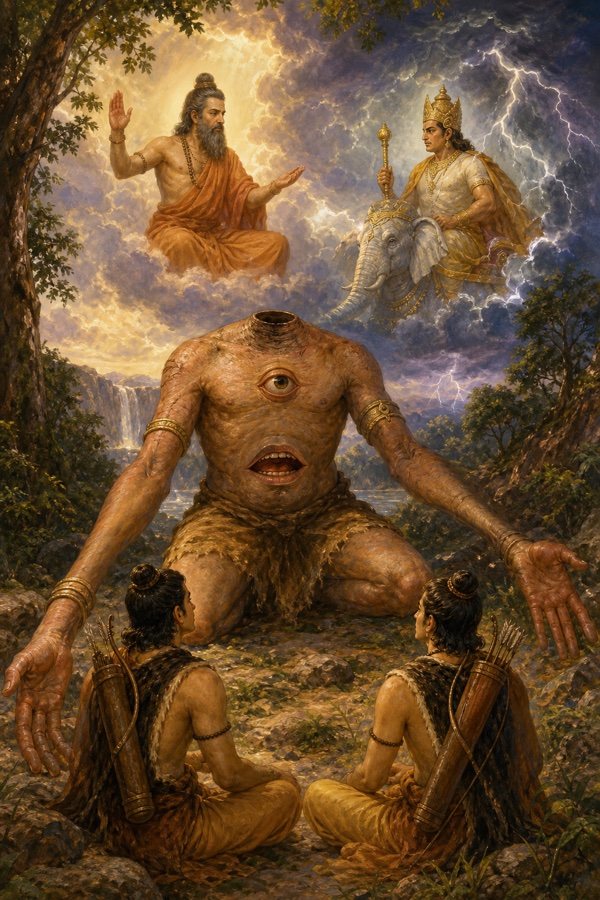
“And this rakshasa shape came to me on a battlefield, through the wrath of Indra, and it came in this way,” said Kabandha. “I propitiated Brahma with fierce austerity, and he granted me a long life; and then pride got into me. I thought: I have a long life in my hand, what will Indra do to me? And trusting that thought I challenged Indra in battle. By the hundred-edged thunderbolt hurled out of his hand, my thighs and my head were driven down into my own body. I begged him to finish it, and he would not send me to the abode of Yama; ‘Let Brahma’s boon of long life hold true,’ he said. So I asked him the practical question. With my thighs and my head and my mouth driven into my body by the thunderbolt, how shall I live out so long a time without food? Then Indra made my arms a yojana long each and set a mouth in my belly with sharp teeth in it. And with these long arms I gather in the lions, the leopards, the deer, and the tigers of this forest from every side, and eat them. And Indra told me the rest of it: ‘When Rama and Lakshmana cut off your arms in battle, then you will go to heaven.’”
“With that in my mind, in this body, I have been seizing whatever I could reach in this forest, on the chance that it might be Rama, thinking, Rama will surely come inside my grip one day,” said Kabandha. “Raghava, may good attend you, you are that very Rama, and I can be killed by nobody else alive, as the great seer Sthulashira truly said. Cremated by the fire of you both, I will do you good by my counsel, and I will point out a friend to you as well.”
At that the dharmic Rama said, with Lakshmana looking on, “When I had gone out of Janasthana with my brother, Ravana carried off my wife Sita at his leisure. I know the rakshasa’s name and nothing else: not his form, not his dwelling, not his power. Stricken with grief, wandering here and there like men with nobody to protect them, we deserve your compassion, for you are one who does good. We will bring dry wood, broken down by elephants, hero, and throw you into a great pit and cremate you; and at the time of your cremation, tell us about Sita, who carried her off and where he has kept her.”
At this the eloquent son of Danu gave Rama an excellent answer. “I have no divine knowledge, and I do not know Maithili. But when I have got my native form back, after the cremation, I will point out to you the one who can give you the true whereabouts of Sita. Without the cremation, lord, so long as I am in this shape, I have not got the power to know that mighty rakshasa who carried off your Sita. By the fault of the curse my great supersensuous knowledge was lost, and by my own deed I came into this world-condemned body. Therefore, Rama, before the sun’s weary horses go down, throw me into a pit and cremate me with the due rite. When I have been cremated, great hero, I will point out to you the one who knows the whereabouts of that rakshasa. Raghava, you should make friendship with that person of just conduct, and he will help you. Nothing in all three worlds is unknown to him, for by some cause he has traveled in the past through all the worlds there are.”
The release of Kabandha: counsel of friendship with Sugriva
At his words the two valiant princes carried Kabandha into a mountain cavern, laid him on the wood, and set the fire. Lakshmana kindled the pyre on every side with great blazing torches, and it took fast all around him. The fire went slowly through that vast, fat-filled body, which as it burned looked like a great ball of clarified butter set alight. And then, shaking the pyre off him, Kabandha rose up out of it, swift as a smokeless flame, clad in spotless raiment and a divine garland. Radiant, in clean clothes, in the highest delight, wearing ornaments on every limb he now had, he flew up in a rush from the fire that had freed him.
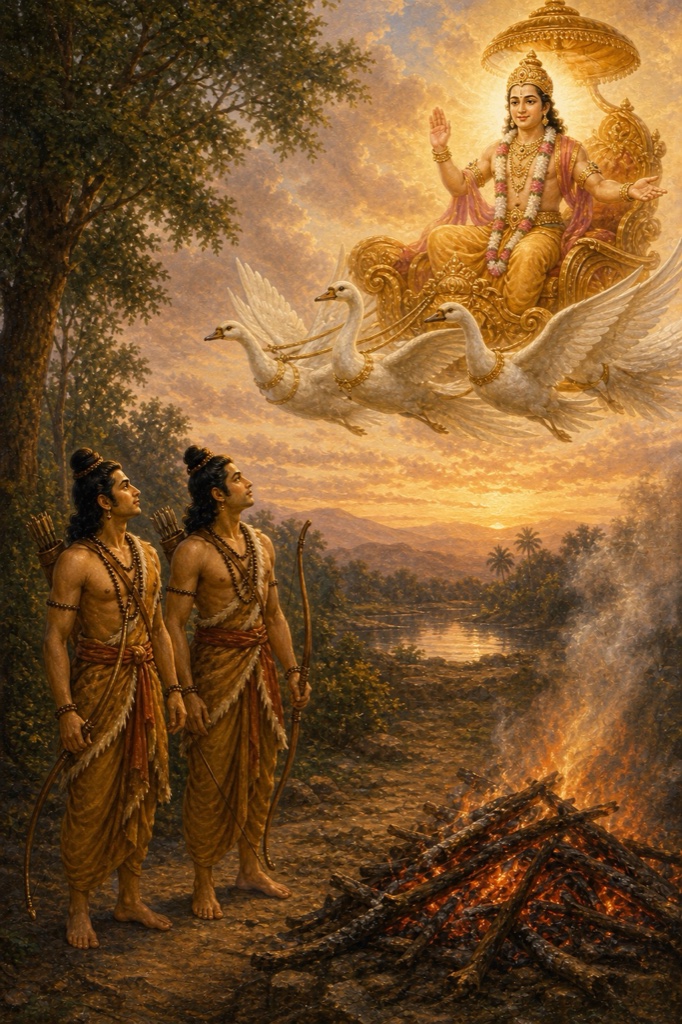
Seated in a shining chariot yoked with swans, a chariot that grants glory, lighting all ten quarters with the radiance coming off him, Kabandha of great splendor stood in the sky and said, “Raghava, listen, and I will tell you how you will truly find Sita. Rama, there are in this world six means of policy, by which kings, taking thought first, accomplish everything they accomplish. And here is the one that governs you: he who has reached the extremity of adversity is served by one who stands in the same state. Rama, you and Lakshmana, robbed of your kingdom and its comforts, are at the extremity of adversity, and by this same adverse fortune the crisis of your wife’s abduction has come on you.”
Kabandha said, “Best of friends, you should therefore make just such a friend as is in an adverse state like your own, for even after much thought I see no accomplishment for you without a friend. Listen, and I will tell you of such a one. There is a monkey named Sugriva, driven out by his angry brother Vali, the son of Indra. That self-possessed hero dwells on the excellent Rishyamuka mountain, graced by the shore of the Pampa lake, with four other monkeys. That lord of monkeys is of great prowess, splendid, of boundless luster, true to his word, humble, patient, wise, great, skilled, bold, brilliant, and of great strength and valor, exiled by his own brother for the sake of the kingdom. Rama, he will be your helper and friend in the search for Sita, so do not sink your mind in grief. What is to be will be, and here it cannot be made otherwise. Time is hard to overcome.”
“Hero, go quickly from here to Sugriva, and go to him this very day, and make him your friend swiftly,” said Kabandha. “Make the friendship before the witness of fire, so that the two of you may be forever without enmity; and never hold the monkey-lord Sugriva in contempt. He is grateful, able to change his form at will, and strong; and he wants a helper, and you two are able to accomplish what he wants. Whether his own purpose is served or not, he will do your work. He is the son of Riksharajas and the true-born son of the sun-god, and out of his enmity with Vali he roams the shore of Pampa in fear of attack. Raghava, laying your weapons aside as a sign of friendship, make that monkey leader, who dwells on Rishyamuka, your friend with an oath on truth. That elephant among monkeys, by his own cleverness, knows every haunt of the flesh-eating rakshasas in the world, and there is nothing in the world unknown to him.”
Kabandha said, “As far as the light of the thousand-rayed sun reaches, so far will he, with the monkeys, search the rivers, the great mountains, the mountain-fastnesses, and the caverns, and find out where your wife is. He will send monkeys of vast body into the quarters and seek out Maithili Sita, grieving in her separation from you, in the house of Ravana. Whether your beloved Maithili is on the peak of Mount Meru or in the depths of Patala, that monkey leader will enter the house of Ravana, destroy the rakshasas, and give her back to you.”
Kabandha shows the way: Pampa, the Matanga forest, and Shabari’s ashram
Having told him the means of the search, the shrewd Kabandha spoke again, and this time he gave him the road. “Rama, this is the auspicious way, keeping to the western quarter, where these blossoming, mind-charming trees begin. These are jambu, priyala, jackfruit, banyan, plaksha, tinduka, peepul, karnikara, mango, and others, dhava, nagakesara, tilaka, naktamala, blue ashokas, kadambas, blossoming karaviras, agnimukhya, ashoka, red sandalwood, and mandara. Climb them, or bend their branches down to the ground with your hands, and eat their nectar-like fruit, and go on. Kakutstha, crossing that blossoming, fruiting forest, you will come to another forest, like the Nandana grove of heaven, where, as in the land of Uttarakuru, the trees carry fruit in every season and drip honey.”
“There all the seasons live together, as they do in the Chaitraratha grove,” said Kabandha. “Those trees, bowed under the weight of their own fruit, carrying great boughs, look like clouds and like mountains, and they spread their grace on every side. Climbing them, or bending their branches to the ground, Lakshmana will give you their nectar-like fruit with his own hands. Roving over the finest mountains, wandering from hill to hill and from wood to wood, heroes, you will reach the lotus-pond called Pampa, which has no gravel in it, and level banks, and no duck-weed.”
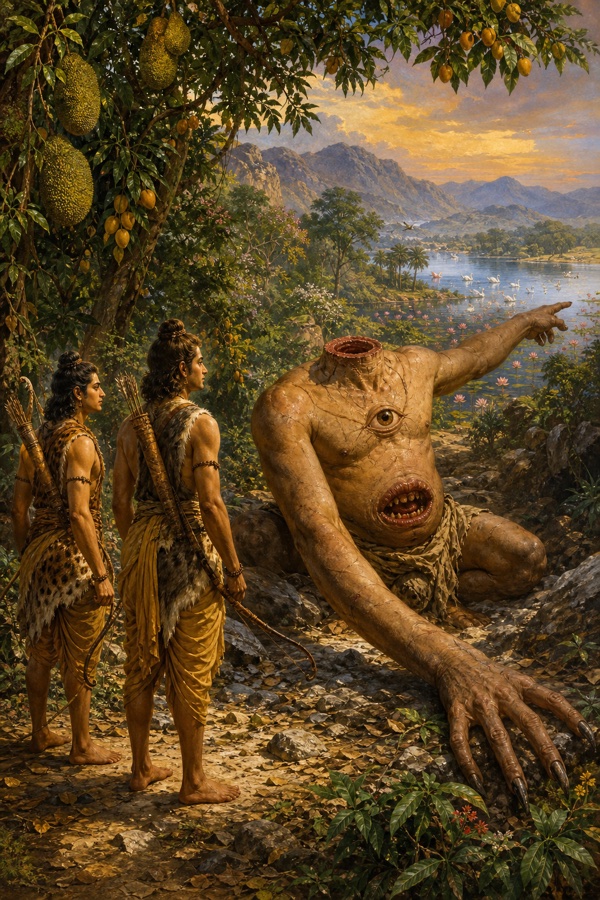
“Rama, its rocky bed makes its own sand, and it is graced always with lotuses and water-lilies,” said Kabandha. “Swans, ducks, krauncas, and ospreys swim on that water and call in sweet tones, Raghava; and knowing nothing of slaughter, they do not fear men when they see them. On the shore of that Pampa you two will eat those birds, plump as balls of butter, and the lovely fish called Rohita, Vakratunda, and Nalamina, which Lakshmana, out of his devotion to you, will roast on the heads of his arrows, strip of skin and thorn, and lovingly hand you. Then Lakshmana will take up in a lotus-leaf the water of the Pampa, fragrant with lotuses, pleasantly cool, clear, sparkling like silver and crystal, and give it to you to drink. Roving at dusk, Lakshmana will show you the stout forest monkeys who sleep in the caves, who come down to the shore of Pampa in their longing for water and bellow there like bulls. Seeing the blossoming trees and the pleasant water of Pampa, Rama, you will put your grief down. In that forest the tilaka and the naktamala are full of flowers, and the lotuses and water-lilies of the lake are in bloom. This lake is beyond the reach of men, and so no man plucks those flowers and wears them.”
“The flowers of that region neither fade nor fall, Raghava,” said Kabandha. “Formerly there lived there the great seers, the pupils of the sage Matanga, who were well composed. As those seers carried the fruit and the roots of the forest for their teacher, and grew weary under the load, the drops of sweat that fell off their bodies to the ground turned, in that very moment, by the power of their austerity, into flowers. Sprung out of those drops of sweat, these flowers never die, Raghava. And even after the seers themselves have departed, their female attendant, an ascetic woman named Shabari, is seen there to this day, long-lived, O Kakutstha.”
“Godlike Rama, ever firm in dharma, saluted by all the world, only after seeing you will that woman ascend to heaven, Rama,” said Kabandha. “After that, Kakutstha, on the western shore of Pampa you will see the former hermitage-site of Matanga, where Shabari lives now, incomparable and hidden, and no man can get into it. By the power of that sage Matanga elephants cannot enter there, and that forest is famed by the name of Matangavana. In that forest, like the Nandana grove, like a wood out of heaven, full of birds of many kinds, you will roam happily, Rama.”
“To the east of Pampa is the noble Rishyamuka mountain, its trees never out of blossom, most steep of ascent, guarded by young elephants, which Brahma of old made specially,” Kabandha went on. “A man who sleeps on the peak of that mountain and lays his hands on a treasure in a dream wins it when he wakes, Rama. But a man who climbs that mountain with crooked conduct and sinful deeds behind him, the rakshasas take him in his very sleep and kill him there. The great trumpeting of the young elephants sporting in Pampa, who belong to the hermitage of Matanga, is heard even on that mountain, Rama. Wet with streams of ruddy ichor, cloud-colored, ardor-filled great elephants roam there in a herd, apart from all other herds.”
Kabandha said, “Drinking the clear, pleasant, lovely water of the lake, fragrant with every kind of scent, the wild elephants, sated, go back into the forests. Seeing the bears with their blue, soft, shining coats, the leopards, and the ruru deer, unconquered by man, come fearlessly near, you will cast off grief. On that mountain, Kakutstha, a great cave shines, hard to enter because its mouth is blocked with a rock. At the eastern door of that cave there is a great, lovely, deep pool of cool water, rich in roots and fruits and ringed by trees of many kinds. In that very cave the dharmic Sugriva dwells with the other monkeys, and sometimes he stays on the peak of that mountain too.” Having instructed the two princes in this way, Kabandha, wearing a garland and shining with a splendor like the sun’s, blazed in the sky. To the highly blessed Kabandha, who stayed a while in the sky to take his leave, the two princes, ready for their journey, standing near him, said, “Now go.” And he too said to them, “Go, for the accomplishment of your purpose.” Having regained his native form, showing the way to Rishyamuka, his eyes fixed on Rama, girded with glory, radiant in every limb, Kabandha, standing in the sky, said to Rama, “Make friendship with Sugriva,” and then, in great delight, taking leave of the two, went at once away.
Shabari’s hospitality, and her divine departure
Taking the path that Kabandha had shown them, keeping to the western quarter, the two sons of the king went on toward the forest of Pampa. They passed the trees that grew in clusters on the mountain rocks, dripping honey, loaded with fruit and flower, and looked at all of it as they went, and went on toward their meeting with Sugriva. Passing a night on a mountain-plateau, the two Raghavas reached the western shore of Pampa; and there they saw the lovely hermitage of Shabari. Reaching that most delightful hermitage, ringed about with many trees, looking all around them, the two brothers went up to Shabari.
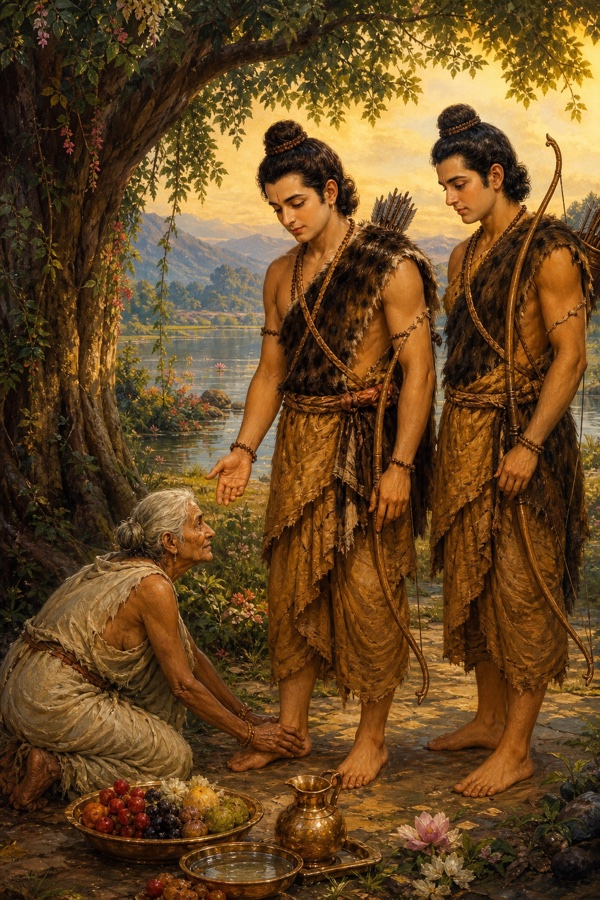
Seeing the two of them, Shabari, who had attained perfection, rose and put her hands together and clasped the feet of Rama and of Lakshmana. She offered, according to the ordinance, water for their feet, water to rinse their mouths, and every other form of hospitality that is owed to a guest. Then Rama said to that ascetic woman, firm in dharma, the questions one ascetic asks another. “Have the impediments to your austerity been conquered? Is your asceticism growing, lady whose wealth is austerity? Have you won control of your anger and of your diet? Have your vows been fulfilled? Has your mind found peace? And, sweet of speech, has your service of your teachers borne its fruit?”
At Rama’s question the aged, perfected ascetic Shabari, honored among the perfected, stood in front of him and told him what she had been waiting for. “Today, by the sight of you, the fruition of my austerities has come to me. Today my birth is fulfilled, and my elders are well honored. Today my austerity has borne its fruit, and heaven too will be mine, for you have been worshiped by me. By your gentle eyes I am made pure, and by your grace I will go to the imperishable worlds. When you reached Chitrakuta, the seers whom I served, the pupils of the sage Matanga, ascended from this place to the divine world in chariots of matchless splendor. And those righteous, highly blessed great seers said to me before they went, ‘Rama will come to this most holy hermitage of yours. Receive him with Lakshmana as your guests, and seeing him you will go to the imperishable worlds.’”
“At the word of those highly blessed ones I gathered for you the produce of every kind that grows on the shore of Pampa,” said Shabari. At that the dharmic Rama said to her, who had long been admitted to divine wisdom, “If you think it fit, I wish to see with my own eyes the power of your teachers, of which I heard from Kabandha.” Hearing it, Shabari took the two brothers round that vast forest and said, “See, this forest, dark as a rainy cloud, full of beasts and birds, is famed by the name of Matangavana. Here lived my teachers, of purified soul, great in splendor, who poured oblations with the mantras into a fire-altar hallowed by mantras, and who offered up their own bodies at the last, consecrated by the Gayatri.”
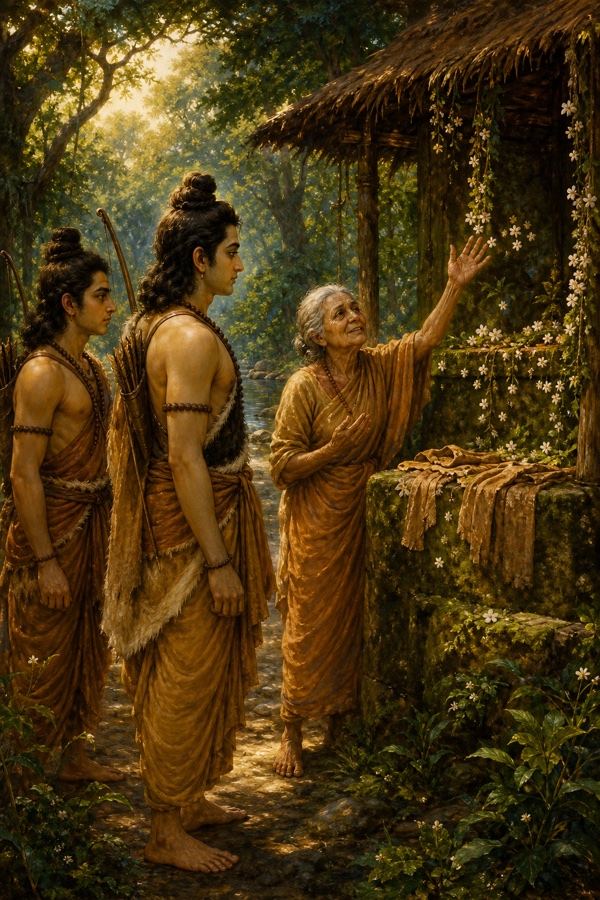
“This is the western altar, Pratyaksthali, where my honored seers, their hands shaking with old age and with the toil of their austerity, offered worship with flowers to the gods,” said Shabari. “By the power of that austerity this altar still shines with a matchless luster, and lights all the quarters from where it stands. And when they were worn too feeble by the toil of their fasts to make the journey to the seven oceans any longer, then by their mere thought the seven oceans came here and gathered; look at them. The bark garments they spread out have not dried to this day. And the garlands they made with flowers, blue water-lilies among them, in their service of the gods, have not faded to this day either.”
“The whole forest has been seen, and what was worth hearing you have heard, and so, with your leave, I wish to give up this body,” said Shabari. “I wish to go to those seers of purified soul, to whom this hermitage belongs, and whose servant I have been.” Hearing that most pious word, Rama with Lakshmana felt a joy with nothing to match it, and said, “Wonderful.” Then Rama said to Shabari of the austere vows, “I have been well honored by you. Now go happily, as you wish.”
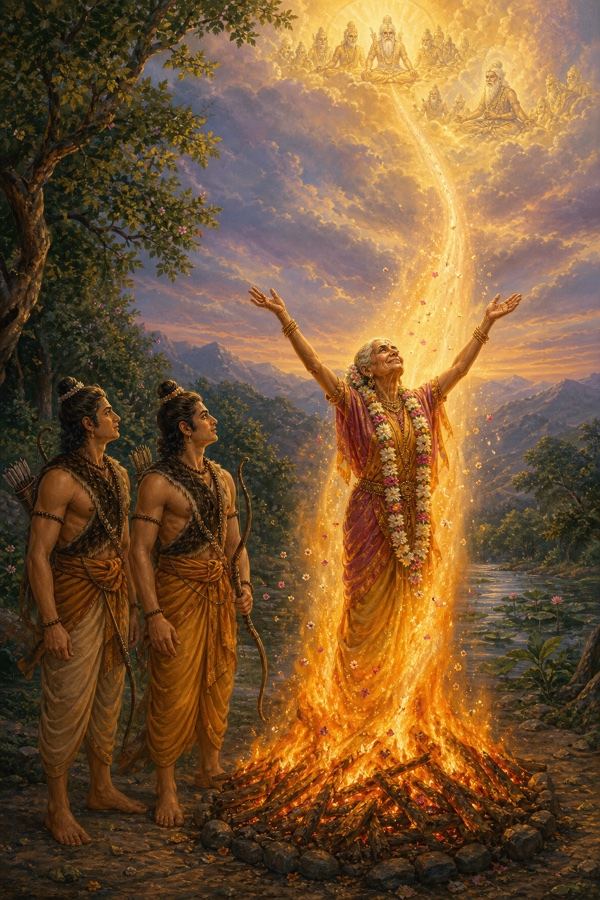
At that word, wearing her matted locks, clad in bark and black deerskin, with Rama’s leave, Shabari offered herself into the fire; and like a blazing flame she rose to heaven itself. Adorned with celestial ornaments, wearing a celestial garland and unguent, clad in celestial raiment, she became fair to look on there, and lit that whole region the way lightning lights a cloud. Where those virtuous great seers took their delight, that holy place Shabari attained, by her own deep concentration of soul.
Toward Pampa: Rama’s lament and the search for Sugriva
When Shabari had gone to heaven in her own splendor, Rama, with his brother Lakshmana, reflected on the power of those seers. Pondering that power, the dharmic Rama said to the ever-helpful, single-minded Lakshmana, “I have seen the hermitage of those seers of perfected soul, full of many wonders, where deer and tigers live without fear and birds of many kinds dwell. Lakshmana, we have bathed with due rite in the holy waters of the seven oceans that gird the earth, brought here by them in a miniature form, and we have offered water to the manes. Whatever ill we carried has been undone, and good fortune is within reach, the meeting with Sugriva and with it the hope of finding Sita, and so, Lakshmana, my mind is now very glad. There will be some good sign in my heart, and so come, let us go to the lovely Pampa.”
“Not very far from here is that Rishyamuka mountain,” said Rama, “where the dharmic Sugriva, ever afraid of Vali, lives with four monkeys. I am eager to see Sugriva, for the whole work of the search for Sita rests on him now.” At these words of Rama, Lakshmana said, “Come, let us go there quickly, for my mind too is eager to reach it.” Then that lord, the king, coming out of the hermitage, looking at a forest full of flowers and great trees on every side, came with Lakshmana to Pampa. Seeing trees and pools of every kind as he went, burning with longing for Sita, Rama reached that excellent lake, which drew its waters from far away, and bathed in a pool of it called Matangasara. The two Raghavas came there calm and composed; and yet the moment Rama went down into that lotus-pond, so lovely to look on, the grief of his parting from Sita closed over him.
That vast forest rang with lapwings, peacocks, woodpeckers, parrots, and many other birds. Reaching the shore of the lake, Rama saw Pampa adorned with tilaka, bijapura, banyan, and shukla trees, with blossoming karavira and full-flowered punnaga, with thickets of malati and kunda, with bhandira and nicula trees, and with ashoka, saptaparna, kataka, atimukta, and many others: a lake dressed like a young woman decked for her own beauty. And Rama, seeing that Pampa with Lakshmana beside him, began to lament.
“On its shore is that very Rishyamuka mountain,” said Rama, “adorned with minerals and with trees of wondrous flowers, where the son of Riksharajas, Sugriva, lives. Go to Sugriva.” And then Rama said to Lakshmana the other thing, which was the only thing in him. “Without Sita, Lakshmana, how is it possible for me to live?” So saying, sorely tormented by love, his mind fixed on Sita and on nothing else, Rama, giving voice to that supreme grief, entered helplessly the lovely lotus-lake Pampa.
Going on, gazing at the forest, Rama saw Pampa, with its lovely woodland, full of birds of many kinds, and went into it with Lakshmana. The water of that lake was full of lotuses, and its banks were narrowed by lovely groves. Its crystal-clear water was covered over with lotuses and its bed was spread with soft sand. Full of crocodiles and turtles, adorned with the trees on its banks, ringed with creepers, it seemed like a woman with her friends standing around her. Frequented by kinnaras, nagas, gandharvas, yakshas, and rakshasas, spread over with trees and creepers of many kinds, it was a lovely store of cool water. Coppery with its rose-pink lotuses, white with its clusters of water-lilies, blue with its blue lotuses, it looked like a carpet somebody had woven in many colors. Full of blue lotuses and water-lilies, of saugandhika flowers, ringed by blossoming mango-groves, ringing with the cries of peacocks, that Pampa was most lovely; and there was nobody beside him to see it with.
The gist: Feeling the sign of good fortune after bathing and offering in the shrine-water of Shabari’s teachers, Rama and Lakshmana move on toward the Pampa lake. The loveliness of Pampa deepens Rama’s grief at his separation from Sita, and yet he is eager to meet Sugriva on Rishyamuka, for the search for Sita now depends on him. Here Valmiki’s Aranyakanda is complete.
Source: Srimad Valmiki Ramayana, Aranyakanda, Cantos 50 to 75. The Gita Press Hindi edition is the controlling witness. The Sanskrit e-text and an independent complete translation were used to verify names, sequence, and principal events. Where recensions differ, this retelling follows Gita Press.
Basis: Valmiki Ramayana (Gita Press, Gorakhpur)