On this page
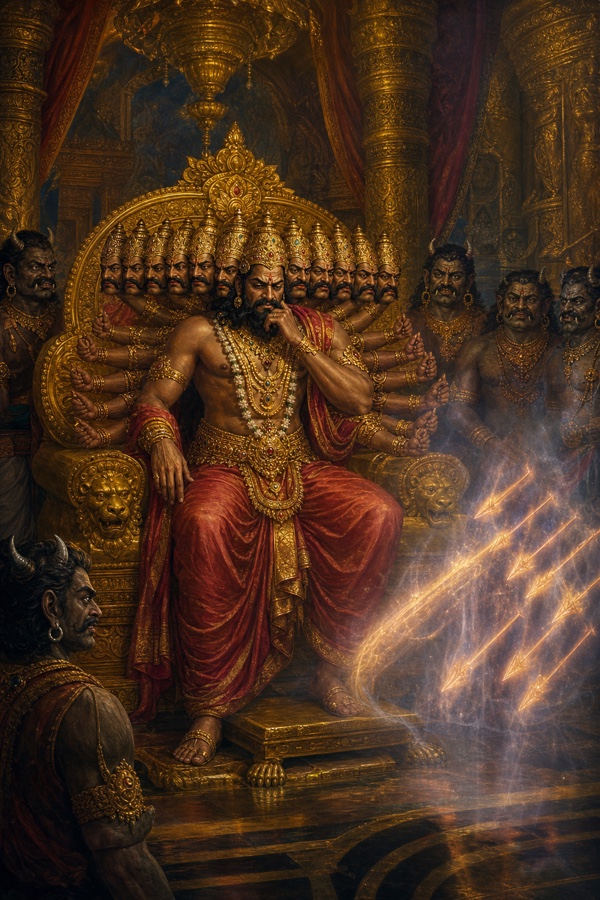
Ravana had walked back into Lanka alive because Rama had let him, and that was the wound. He climbed to his magnificent throne of gold, sat, and found that the arrows had come in with him. They hung before his eyes the way a blaze goes on burning after the lids close, each one like the fiery comet that rises when an age ends, throwing off a light that would not hold steady, quick and shifting as lightning. His vanity had been crushed on that field, and the crushing sat in him like a stone. An elephant knows this feeling when a lion has it pinned; a serpent knows it when Garuda, the king of birds, drops out of the sky. That was how Rama, who could have killed him on the field and chose to send him home instead, had left the king of the rakshasas. For a long while Ravana let his gaze travel over the rakshasas gathered below him, and none of them could hold it. Then he spoke.
“All that asceticism of the highest kind, everything I practiced through all those years, has undoubtedly come to nothing,” he said. “I, who stand equal to the mighty Indra, the ruler of the gods, have been utterly defeated by a mere mortal.”
And as he said it, the old sentence of Brahma came back to him, the terrible warning he had been given with the boon and had chosen not to hear: know for certain that your danger will come from humans. It had flashed on him now in full. It was coming true in front of him.
The boon of deathlessness, and the one exception he forgot
So Ravana opened the ledger of his own choices and read it aloud, and every entry was in his own hand. When he had won his great boon he had asked for immunity from death at the hands of gods, of demons, of the gandharvas who sing in heaven, of the yakshas, of rakshasas, and of serpents. He had gone down the list of everything in creation that frightened him and had left one thing off it. He had never asked for safety from mortals. Mortals had seemed beneath the asking. Now he knew who Rama was. “I conclude that this Rama, the son of Dasharatha, is the very mortal Anaranya spoke of,” he said, and the name came up out of the past like something dredged from a well. Anaranya, a king born in the line of Ikshvaku, had cursed him long ago with Ravana’s own blow already in him and his breath going: in my house a man will surely be born who will exterminate you on the field of battle, you and your sons, your ministers, your army, your horses and your charioteers. A dying king’s words, and Ravana had walked away from them without a backward look. “And I was cursed again,” he went on, “by Vedavati, when I violated her in an older age.”
The other warnings crowded back on him too, and each of them turned out to be a piece of the thing now camped outside his gates. There was Uma, the consort of Shiva, who had felt the mountain move under her the day Ravana set his shoulders to Kailasa and lifted it, and who had said in her fright that a woman would be the final cause of his death. There was Nandishvara, Shiva’s attendant, whose face is a monkey’s face, whom Ravana had laughed at for it; and Nandishvara had promised him that creatures like himself in features and in prowess would bring his race to ruin. There was Rambha, the celestial nymph, for whose sake Nalakubera, the son of Kubera, had laid a curse on him, and Punjikasthala, another famed nymph, a daughter of Varuna, for whose sake Brahma had laid the same one: that the day Ravana ravished any woman would be the day he died. “Everything they foretold has come to me,” he said. “What those with prophetic sight say is never untrue. That same lady, blessed beyond any woman, has been born again as the daughter of Janaka.” Vedavati, the woman he had outraged, had come back into the world as Sita; his ruin and his desire had turned out to be one person. Uma’s word was walking in his ashoka grove. Nandishvara’s word was sitting on his walls with a mountain in its fist.
“Knowing this,” Ravana said to his rakshasas, “you must strive to conquer the enemy.” And he gave his orders. Let the rakshasas take up their positions along the main roads and on the tops of the gates. Let an attempt be made to hold the gates. Let the defensive walls be scaled and a watch be kept on the enemy from the top of them.
Then came the command that weighed more than all the rest, and the king gave it knowing what it had cost him to need it. He had been beaten in combat himself; Prahasta, the commander of his armies, was dead. “Let Kumbhakarna be fully roused,” he said. “Kumbhakarna, who has no equal for sheer depth of power, who can crush the vanity of gods and demons alike, and who lies overwhelmed with slumber under Brahma’s own curse. His mind is ruined by his appetites, and he sleeps at his ease, free of every care, while this happens to us.”
“So rouse him quickly,” Ravana said. “That rakshasa, with those arms of his and the first place among us that no one disputes, will strike down the monkeys and the two princes at once. Addicted as he is to the low pleasure of sleep, this insensate Kumbhakarna, the most distinguished of all of us in combat, lies asleep forever. Once he is fully roused, the grief that preys on those of us whom Rama has beaten in this most terrible struggle will cease.” And then, in front of the whole court, the king of Lanka said the thing a king does not say. “He is the equal of Indra in might. But what use is he to me if he cannot help me even in a calamity like this?” The rakshasas heard him out and set off for Kumbhakarna’s dwelling in a state close to panic, because none of them knew how a sleeper like that was to be woken before his time. They fed on flesh and blood, all of them, and they gathered up perfumes, garlands, and a mountain of food, and left at once.
A mountain waking from the great sleep
Kumbhakarna’s dwelling was a cave, and the cave was a full yojana across on every side, close to eight miles, with gates built to the scale of the thing that lived inside. Beyond the gates it was lovely: a subterranean hall paved with precious stones and gold, and a stream of flower scent flowing out of it into the dark. The rakshasas had come with strength enough to move boulders, and the moment they stepped inside the wind from Kumbhakarna’s nostrils pushed them back. They leaned into it and forced their way forward a step at a time, the way men wade up a river in spate, until they reached him. He lay sprawled like a mountain range that has been scattered, hissing in his sleep like a serpent, each out-breath strong enough to turn a man around. His nostrils were horrible and his mouth was as wide as Patala, the lowest of the worlds beneath the earth. His diadem made him shine like the sun. The hair stood bristling all over his body, every limb was stretched out on the bed, gold armlets circled his arms, and from his unrinsed mouth came the reek of fat and old blood, the leavings of a meal eaten nine months ago.
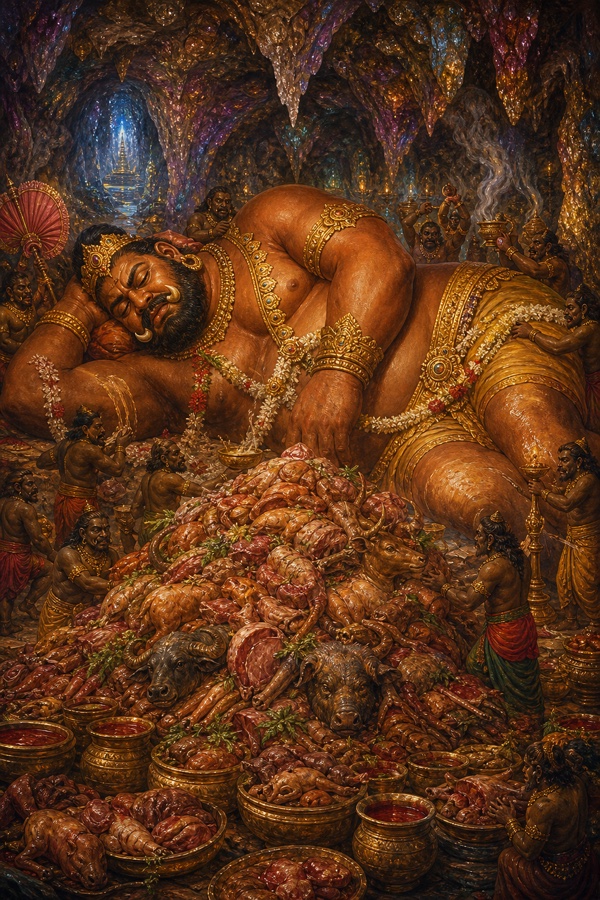
The rakshasas knew that the way to a sleeping giant might run through his pleasures, so they tried the pleasures first. Before him they piled a heap of slaughtered animals tall as Mount Meru, a hill of antelope and buffalo and boar, meat of every kind, and pails of blood set in rows. They rubbed his limbs with the finest sandal-paste, hung him with heavenly garlands, worked sweet perfumes into his skin, burned incense, and sang his praises, and while the singers sang the rest thundered like storm-clouds on every side, blew their gleaming conches with full cheeks, slapped their arms, and roared like lions all at once. The din climbed out of the cave and over Lanka, and birds flying in every one of the ten directions dropped out of the sky. Kumbhakarna slept on.
So they went from pleasure to violence. They took up their bhushundis, the heavy mallets of their kind, their pestles and their maces, and pounded his chest with mountain peaks, with pestle and mace and mallet and bare fists. He did not stir, and the wind of his breathing would not let them keep their footing in front of him. They tightened their clothes so that they could stand, and brought in heavier machinery: clay tomtoms and drums, kettledrums, conches, and pails beaten like gongs. Horses, camels, donkeys, and elephants were driven up onto his body with staffs and whips and goads and made to tread on him. Every kettledrum, conch, and tomtom was sounded with all the breath in the players’ bodies, and his limbs were battered with bundles of heavy logs and with mallet and pestle swung by every arm at full strength. All of Lanka, its mountains and its woods with it, was filled with the noise, and the enemy camped outside the walls heard it. He did not wake.
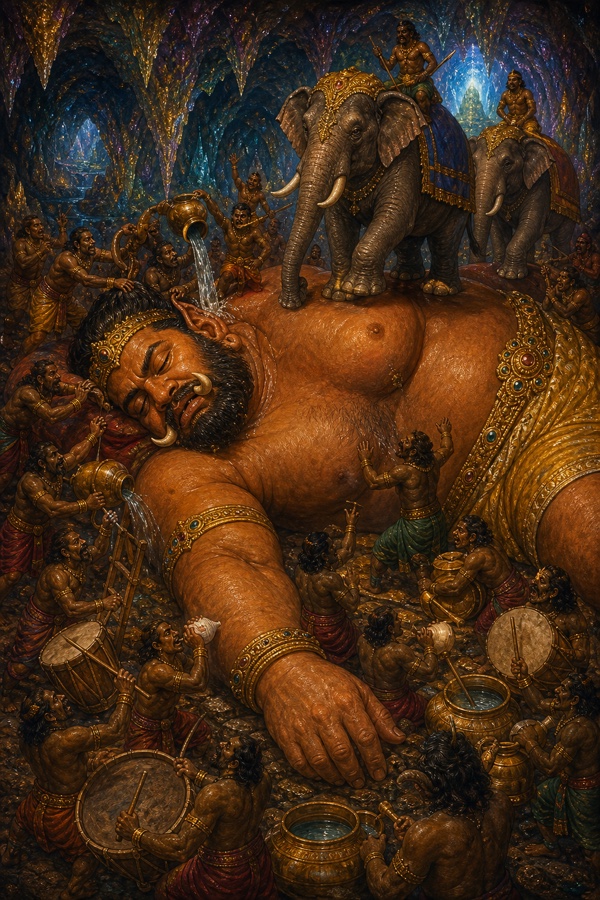
When the giant, wrapped in the deep sleep of Brahma’s curse, would not wake for any of it, the rakshasas began to burn with rage, and the rage made them cruel. Some hammered the kettledrums with all their force, some raised a shout, some tore out his hair, some bit his ears, and some poured hundreds of pails of water into those ears. He did not move. Others, mighty ones with mallets studded with nails, let their mallets fall on his head and his chest and the rest of him; and shataghnis, the great killing-engines that are named for the hundred men they kill, were bound with cords and thongs and worked against him from every side, and still the colossus slept. It was only when the thousand elephants ran across his body that he felt the touch of them.
The instant his sleep broke, hunger woke with it, and the hunger frightened him: nine months of it, arriving all at once. He gave no thought at all to the peaks and trees still crashing down on him, because a starving man does not notice the weather. Stretching his limbs out of drowsiness, he sprang to his feet in a single movement. He flung out his arms, long as the coils of a cobra and stiff as mountain crags, arms of adamant that had beaten down every rival, opened a mouth as loathsome as the fire that burns beneath the sea, and yawned. As he yawned and yawned again, that mouth, cavernous as Patala, looked like the sun coming up over a summit of Mount Meru. He was fully awake now, and the breath that came out of him was the gale that pours off a mountain.
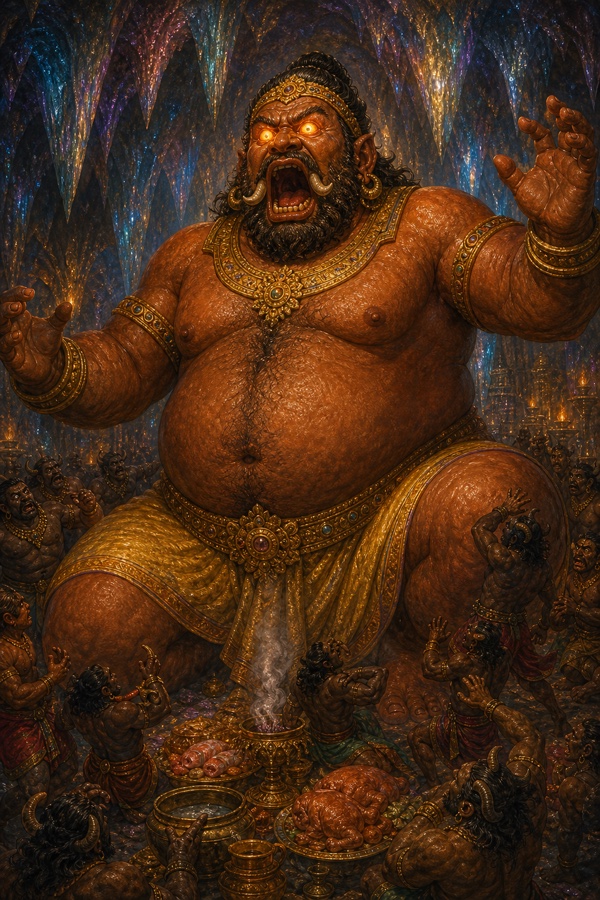
As he rose, Kumbhakarna looked like Kala, Time itself, come to consume every created being at the dissolution of the worlds. His two enormous eyes, blazing like fire and dazzling like lightning, hung in the dark of the cave like two great planets burning, and everything under them stood still. The rakshasas showed him the food, all of it, the plentiful victuals of every kind, and he ate: the meat of boars and buffaloes by the hill, and when he was thirsty he drank blood, and pails of fat, and wine, and the smell of it filled the hall. When they saw that he was sated, the rakshasas who had woken him came up before him, bowed their heads low, and stood around him on every side.
The waking giant learns of the danger
His eyes were still half-closed with sleep and his vision was still clouded, and Kumbhakarna, the mightiest of his race, cast his glance around the cave at the rakshasas who had done all this to him and soothed them, because they were shaking. Then, astonished to have been woken so far out of season, he put his question to them.
“Why have you gone to such trouble to rouse me?” he asked. “Is all well with the king? Has some danger arisen here? Or, more likely, some great peril has come upon us from the enemy, and that is why you have been in such haste to wake me.”
“I am ready,” he went on, and the cave shook with it. “Today I will tear the king’s fear up by the roots. I will split the Mahendra mountain if I have to, or freeze fire itself. No one wakes a sleeper like me for a trifle. So tell me plainly, and tell me the truth: what is the reason you have called me back?”
Kumbhakarna was speaking in a rising rage, and it was Yupaksha, one of the king’s ministers, who found the courage to answer him, with his palms joined.
“No danger has ever come to us from the gods,” Yupaksha said, “and none ever will. The danger pressing on us now has come from a mortal, and nothing like it ever came from the daityas or the danavas. Monkeys the size of mountains have laid siege to Lanka. The dreadful thing has risen out of Rama, who is wild with grief over the abduction of his wife Sita. Before that, a single monkey burned this great city and killed Prince Aksha along with his elephant and his followers. And the king himself, Ravana, grandson of the sage Pulastya, the thorn in the side of the gods, was let go in the field by Rama, who shines like the sun, with a single word: Depart.” Yupaksha let that sit. Their king had been dismissed like a servant. “The gods never brought him to such a pass, nor the daityas, nor the danavas. He barely escaped with his life.”
When Kumbhakarna heard that his elder brother had been beaten in battle, his eyes began to roll. “This very day, Yupaksha, I will conquer the whole monkey host, and Raghava, and Lakshmana with him, in the field,” he said, “and only then will I go and see Ravana. I give you my word. I will gorge the rakshasas on the flesh and blood of the monkeys, and I will drink the blood of Rama and Lakshmana myself.”
Mahodara, first among the rakshasa warriors and one of Ravana’s own counselors, heard that arrogant speech, watched the anger in Kumbhakarna feeding on itself, and checked him with joined palms. “You should conquer the enemy in combat,” he said, “only after you have heard Ravana’s command and weighed the advantages and the disadvantages of the course you mean to take.” Kumbhakarna heard him out, and, ringed by the rakshasas, made ready to go to the palace.
The rakshasas who had woken that giant of the frightful eyes hurried back ahead of him to Ravana’s palace, and stood before the king on his throne with their palms joined. “Your younger brother Kumbhakarna is fully awake,” they said. “How should he proceed? Should he go straight to the field, or would you see him here first?”
Ravana felt the first gladness of a bad day. “I wish to see him here,” he said, “and let him be honored as propriety demands.”
They said “So be it,” went back down to the cave, and gave Kumbhakarna the word as Ravana had ordered. “The king, the greatest of all the rakshasas, desires to see you,” they said. “Make up your mind to go, and bring your elder brother great joy.”
Kumbhakarna understood that this was his brother’s command. “Let it be so,” he said, and that rakshasa whom no one could overcome leapt up from his bed.
He washed his face, and, delighted after his bath, called for a drink to build his strength, because he was thirsty. At Ravana’s order the rakshasas who had summoned him hurried wine and dishes of every kind down from the palace in no time at all. Kumbhakarna drank down two thousand pails of wine, and a little wild with it, a little drunk, replenished with energy and strength, he made ready to move. Rage made him look like Yama bent on destroying the creation at the end of the age. Ringed by an army of rakshasas who walked with their palms joined around him, he went along the king’s highway toward his brother’s palace, and the glow of his body lit the road the way the thousand-rayed sun lights the earth, so that he looked like Indra going to the house of Brahma. The earth shook under his tread. Out beyond the walls the monkeys standing outside the city with their troop-commanders saw, all at once, a thing as tall as a mountain peak walking down a street, a diademed prodigy that seemed to touch the sun with its own brilliance and to be growing as it came, and terror took them. Some ran to Rama, who could give them shelter; some fell to the ground in their agony; some, seized with panic, fled in every direction; and some, stricken with fear, simply lay down where they stood.
Vibhishana names him, and Rama sets his lines
Rama, whose energy was a match for anything on that field, took up his bow and saw him coming: a gigantic rakshasa in a diadem, shaped like a mountain, taking strides across the air itself the way Narayana once strode when he took the form of Trivikrama and measured the whole universe in three steps. Rama went alert. The huge army of monkeys had one look at that shape, dark as a cloud heavy with rain and hung with armlets of gold, and broke and fled again at full speed. Watching his own ranks stream away and the rakshasa grow larger as he came, Rama turned in astonishment to Vibhishana, Ravana’s younger brother, who had crossed to Rama’s side before the war and who knew the men behind these walls by name.
“Who is that,” Rama asked, “with the diadem and the tawny eyes, huge as a mountain? He stands in Lanka like a cloud riven by lightning. That colossus is like a solitary comet come down onto the earth, and every monkey who sees him runs. Tell me who he is. Is he rakshasa or demon? Never in my life have I seen such a being.”
“That is Kumbhakarna, the son of the sage Vishrava, and his fire is very great,” Vibhishana answered. “Yama himself and Indra were beaten by him in battle. No other rakshasa comes near him in size. Danavas and yakshas, serpents and rakshasas, gandharvas, vidyadharas, and kinnaras, all of them were routed by him by the thousand. Other rakshasa chiefs owe their strength to boons the gods were made to grant; this one is daring and mighty by his very nature.”
“He stands pike in hand, with those hideous eyes, and the gods themselves failed to kill him,” Vibhishana said, “because they were deluded into thinking he was Death in person, and did not dare.”
Vibhishana told the old story. As a newborn, still a baby, this great creature had been so tormented by hunger that he devoured living beings by the thousand, whole villages going down a child’s throat. The terrified people fled to Indra and told him, and Indra in his anger struck the child with his sharp thunderbolt. Kumbhakarna reeled under it and let out a roar, and the people who were already afraid grew more afraid still. Then he tore a tusk out of the mouth of Airavata, the elephant Indra rode, and drove it into Indra’s chest, and Indra felt that blow. That was the answer an infant gave the king of the gods. The gods, the brahmarshis, and even the demons lost heart at once. Indra went with the people to the realm of Brahma and told him of Kumbhakarna’s wickedness: how he devoured creatures, assailed gods, laid waste the hermitages of sages, and carried off other men’s wives again and again. “If he goes on eating the created beings like this from day to day,” they said, “the world will be empty before long.” Brahma summoned the rakshasas and saw Kumbhakarna among them, and the sight of him frightened even the grandfather of the worlds. Brahma steadied himself and spoke. “Surely Vishrava begot you for the destruction of the world. From this day on you will lie sunk in sleep like one already dead.” Kumbhakarna fell down before Ravana under the weight of the curse, and Ravana, badly shaken, pleaded with Brahma: a tree that bears gold is never cut down at the season of its fruiting, and it was not just to curse his own great-grandson so. Since Brahma’s word could never be false, Kumbhakarna must sleep; but let a term be set for his sleeping and his waking. Brahma set it. He would sleep for six months at a stretch and be awake for a single day, and on that one day, ranging the earth hungry with his mouth wide open, he might eat the world like a swollen fire. Vibhishana came back to the present. Fallen into adversity and afraid of Rama’s prowess, Ravana had just now woken that sleeper, and the hero had come out of his retreat enraged and was darting to and fro devouring monkeys.
“The monkeys have run today at nothing more than the sight of him,” Vibhishana said. “How will they check him once he is angry and in the fight? Let them be told, then, that what they see is a machine, some tall engine of war standing high, and they will lose their fear.”
The counsel was full of reason and Vibhishana had given it with a pleasant face, and Rama saw the sense in it. He turned to Nila, the son of the fire-god, who commanded the monkey army, and gave his orders. “Go and draw up all the troops in formation,” he said. “Take the gates and the highways and the causeways of Lanka. Gather peaks and trees and rocks, and let every monkey stand armed and alert, with a stone in his hand.”
Nila, an elephant among monkeys, commanded the army as it should be commanded. Gavaksha, Sharabha, Hanuman, and Angada, who looked like mountains themselves, took up mountain peaks and marched to the gate. Fired by Rama’s command and already carrying themselves like victors, the monkey heroes fell on the enemy troops guarding the ground outside the gates and struck at them with trees. With rocks and uprooted trees in their hands, that fierce host shone like a vast and terrible bank of cloud pressed up against a mountain.
Ravana’s plea and Kumbhakarna’s counsel
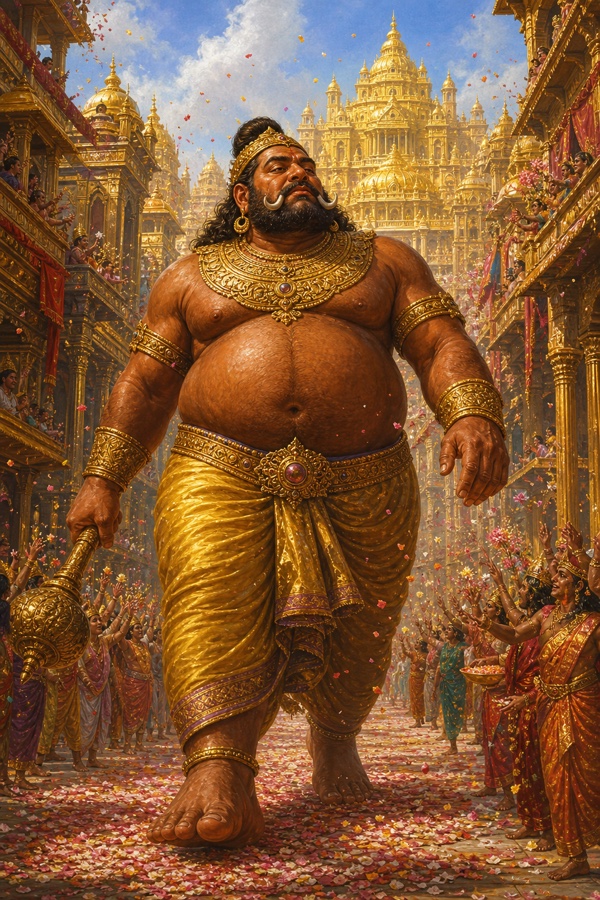
Heavy with sleep and with wine, and carrying an immense strength inside that heaviness, Kumbhakarna, the fiercest of his race, came on along the king’s highway, which was full of splendor and had been dressed for him. Thousands of rakshasas walked around him. From the houses lining the road flowers rained down on him, thrown by people who had not had anything to cheer for in a long time. He saw the vast and lovely palace of Ravana, hung with a lattice of gold and bright as the sun, and he went into it the way the sun goes into a mass of cloud, and far off inside he saw his elder brother seated on his throne, the way Indra might look on Brahma seated. He passed the enclosure and came close, and there, seated in the aerial chariot Pushpaka, the flying palace Ravana had taken from Kubera, his brother sat troubled. Kumbhakarna bowed down at the feet of the king, who lay on a couch, and asked, “What service is wanted of me?” Ravana sprang up from his seat filled with joy, clasped him to his chest and held him there, hailed him as a brother should be hailed, and gave him a splendid and heavenly seat of honor.
Kumbhakarna sat, and his eyes were blood-red with anger. “Why have you gone to such lengths to wake me?” he asked. “Tell me. Whom are you afraid of? Who is going to die here?”
Ravana’s own eyes were rolling with indignation as he answered his brother, who sat firmly at his side. “A very long time has rolled past you while you slept,” he said. “Buried in that deep slumber, you cannot know the fear that Rama has raised in me. This glorious and mighty son of Dasharatha, with Sugriva, the king of the monkeys, beside him, has crossed the sea and is cutting at our very roots. He came over it at his ease, on a bridge. Look at Lanka’s groves and gardens now. They have turned into a single sea of monkeys. The rakshasas who led us, the best captains Lanka had, have been killed in combat by monkeys. I can see no way at all to bring the monkeys down, and no one has ever conquered them before.”
Then Ravana appealed to his brother’s love and to his strength, and to the one thing he had never yet asked for. “Such is the fear Rama has bred in me. Save us now, brother; destroy them today. It is for this that you have been woken. My resources are totally spent, my treasury emptied. Oblige me, and save this city of Lanka, in which only the children and the aged are left. For my sake accomplish a feat that no one else could accomplish. No brother of mine was ever asked for anything like this before. There is affection in my heart for you, and my last hope is fastened on you. Many times in the wars of gods and demons you joined the opposite ranks and routed gods and demons together on the field. Do all that again now. No one as strong as you can be seen among all created beings. Do this supreme service for me, since you love war and you love your kin, and torment the enemy host with your fire the way a great wind rising in autumn scatters the autumn cloud.”
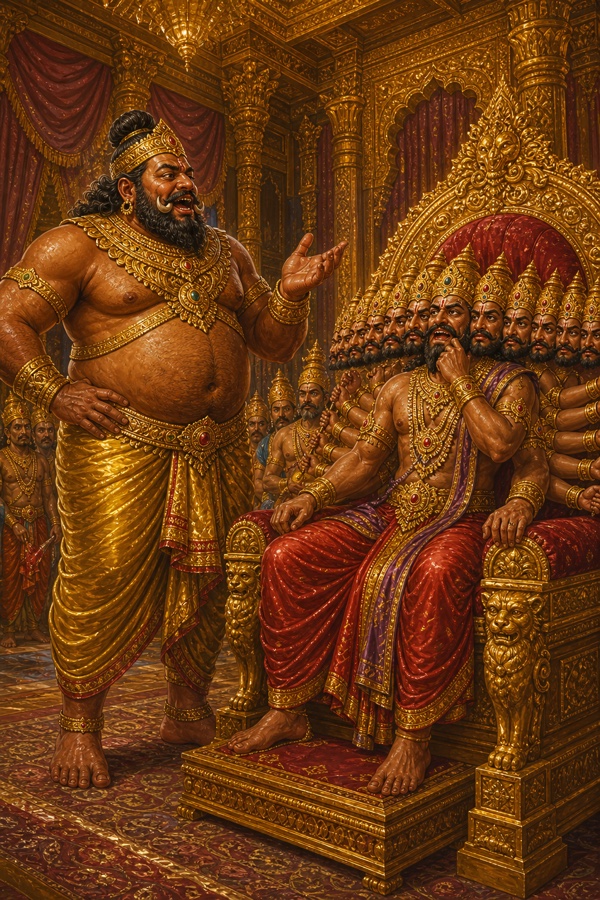
Ravana had finished, and what he had delivered was a lament. Kumbhakarna heard it and laughed out loud. “The very disaster we foresaw at that earlier council, when Vibhishana and the rest of your well-wishers pointed out the fault in your course and you distrusted them for it, you are now tasting for yourself,” he said. “The fruit of a sinful deed has come to you quickly, the deed being the theft of Sita, the way damnation comes fast to a man of sinful deeds. You did this thing in the first place without thinking. In the sheer pride of your prowess you never weighed what would follow.”
Then, with his brother’s court listening, he laid out the whole of statecraft, the science Ravana had been schooled in and had ignored. “A man confident of his power, who puts off the duties that should be done first and does first the ones that could wait, does not know right from wrong,” he said. “Actions done without regard to time and place turn out as badly as actions done at the wrong time and place, the way oblations poured into a fire that has not been consecrated are wasted. A king who takes counsel with his ministers, and weighs the five aspects of every one of the three courses open to him against a hostile king, is on the right path. A king who seeks his duty in the science of polity and keeps his friends beside his ministers understands. A man should pursue dharma, artha, and kama, virtue, gain, and pleasure, each at its own hour of the day, or two of them together, or all three, and a king who hears which of the three comes first and still does not see it has wasted his learning. Gifts, conciliation, dissension sown among the enemy, and force in its season; right action and its reverse each in its time: a self-controlled king who deliberates with his ministers and uses these never meets with disaster in the world. He acts only after his ministers, men who live by their intelligence and know the reality of things, have shown him what will follow. Men whose minds are no higher than a beast’s, who have somehow been given seats among the counselors and want to be heard out of sheer impudence, without knowing what the scriptures mean, are the ones whose advice must never be followed. Those who tender harmful counsel in a wholesome dress must be excluded from deliberation, because they wreck its purpose; they join hands with shrewd enemies and lead their master into wrong action to bring him down. A ruler must learn to tell the ministers the enemy has bought, enemies wearing the look of friends, from the rest, and he learns it by watching how they behave when a decision is being taken. Strangers find out the weakness of a ruler who is led by appearances and rushes headlong into things, the way birds found the hole that Skanda’s lance left in the Krauncha mountain. A king who despises his enemy and does not guard himself meets reverses and is dragged down from his place.”
“The counsel Mandodari gave you, your beloved queen, and the counsel my younger brother Vibhishana gave you, was the counsel that would have saved us,” he said. “And still, do as you will.”
Ravana knit his brows at that, and his anger rose to meet it. “Why are you instructing me like a father, or like some teacher I ought to revere?” he said. “What is the good of wearing out your tongue like this? Let what is fitting be done. It is useless now to repeat advice I did not take at the time, whether I refused it out of confusion, or dullness of mind, or trust in my own strength. Let us think only about what is right at this hour. The wise do not grieve over what is gone. What is gone is gone.”
“Set right with your prowess the harm that has sprung from my own misrule,” he said to his brother, and now it was a plea, “if there is any love in you for me, if you know your own strength, if you hold this purpose of mine in your heart as worth accomplishing. A friend is the one who comes to the help of a stricken man whose fortune is at stake. A kinsman is the one who reaches out a hand to those who have left the right road.”
Ravana had spoken in a grave and harsh voice, and Kumbhakarna understood that his brother was angry, and that under the anger he was badly shaken. So he spoke again, and slowly now, and softly, to steady him. “Listen to me,” he said. “There is no use in giving way to this agony. Shake off your anger and be yourself again. As long as I live you should not carry such despair. I will exterminate the one on whose account you suffer.”
“It was my duty, whatever the circumstances, to say the useful thing to you, and I said it out of kinship and a brother’s love,” he went on. “And now see what a brother does out of love at an hour like this: the wholesale destruction of the enemy in combat. Today, when I have killed Rama and his brother in the front of the battle, you will see the monkey army streaming away. Today I will bring you Rama’s head from the field, and you will be glad, and Sita will grieve in her turn. Let every rakshasa in Lanka who has lost kin in this fight watch Rama die today and take his fill of it. By destroying the enemy in battle I will dry the tears of everyone who is weeping for the dead. You will see Sugriva, the lord of the monkeys, big as a mountain, thrown across the field and bathed in blood, like a cloud lit by the evening sun.”
The thunder of his vow
“Why do you keep on tormenting yourself,” Kumbhakarna asked him, “when these rakshasas and I, who are all eager to kill Rama, have told you it is in hand? Rama can kill you only after he has killed me, and I feel no fear on that account. Command me to fight this very moment. You need look for no one else. Even if it is Indra, or Yama, or the fire and the wind, or Kubera, or Varuna, I will fight them all. Indra himself, who has broken the citadels of so many enemies, will dread me when I roar with a body as big as a mountain, these teeth, and this sharpened pike. And if I throw the weapons away and go at the enemy with nothing, no one who wants to go on living will be able to stand in front of me. I will fight with no javelin, no mace, no sword, and certainly with no whetted arrows. I will finish Rama with my bare hands alone, even if Indra with his thunderbolt stands beside him. If Raghava can withstand the force of my fists today, then my volleys of arrows will drink his blood. Why are you tormented with anxiety, so long as I exist?”
“I am ready to go out and exterminate your enemies,” he went on. “Give up this terrible fear of Rama. In battle I will finish Raghava and Lakshmana in a single fight, and Sugriva with all his strength, and Hanuman, the killer of rakshasas, the one who set Lanka on fire. I will eat the monkeys when the struggle comes. I want to give you a glory no one else has ever had. If it is fear of the moon, or of Indra, or of Brahma himself that haunts you, I will drive it off the way the sun drives off the dark of night. When I am angry the gods will lie flat on the ground. I will quiet Yama. I will swallow the fire. I will throw the sun down onto the earth with all its constellations. I will kill Indra of the hundred sacrifices and drink the ocean, which is Varuna’s house, dry. I will grind the mountains to powder and split the earth open. Let every creature I am about to eat watch the prowess of Kumbhakarna, who has slept so long. Give me all three worlds, heaven and earth and the space between them, for food, and my belly will still not be full.”
“I go to kill the son of Dasharatha and bring you a happiness that will breed more happiness after it,” he said. “When I have killed Rama and Lakshmana with him I will eat every leader of the monkey troops. Revel today. Drink your wine. Put your grief away and do the work of a king. The moment I send Rama to the house of Yama, Sita will submit to your will for a long, long time.”
Mahodara’s scheme to win without a battle
Mahodara had heard the whole of it, the braggadocio of that colossal, brawny-armed Kumbhakarna, and now he spoke, and he spoke to the giant’s face. “You were born in a noble line, Kumbhakarna, and still you are insolent and arrogant, with an unsophisticated mind, and so you do not know what should be done in every case,” he said. “It is not that the king fails to know what is politic and what is impolitic. You have been forward since you were a boy, and all you want is to talk. Ravana, the mightiest of the rakshasas, knows the laws of time and place. He knows his own rise and decline and his own standing, and the enemy’s too. What wise man attempts what cannot be done by a man of coarse mind who has never sat at the feet of his elders?”
“You speak of dharma, artha, and kama as if they lived in three different men,” Mahodara said, “and that alone shows you cannot recognize them. Action is the root of all three, and the fruit of action, noble or sinful, comes back to the one who acted. Virtue and gain lead to the highest good, and the fruit of neglecting them is loss. The fruit of what we have done, good or bad, is reaped in this world and the next; but a man who devotes himself to action for the sake of pleasure enjoys its blessings here, in this life, and can see them. The king has set his heart on Sita, and we approve of it, and so he must have what he has set his heart on. Where is the wrong in a bold stroke against an enemy?” Then he came to the point. “As for the reason you give for marching out alone, your extraordinary strength, let me show you what is ill-considered in it. How will you conquer single-handed that Raghava who, at Janasthana in the past, cut down rakshasas of enormous strength, so many of them and so fast? Those very rakshasas he put to flight at Janasthana are living in the city to this day in fear; go and look at their faces. You want to fight Rama, the son of Dasharatha, who is like an enraged lion, and you know it, and you go to wake a sleeping serpent on purpose. Who can approach him, who burns with spirit all the time, who cannot be approached in his fury and cannot be borne, like Death? The whole rakshasa army is in danger just by standing in front of that enemy. For you to go alone, my dear, does not please me at all. Who, bereft of everything, tries to subdue an enemy rich in every resource and resolved to die, as if he were some common foe? How do you expect to fight one who has no equal among human beings, who is the equal of Indra and the sun?”
Having said that much to the enraged Kumbhakarna, Mahodara turned in the midst of the rakshasas to Ravana, the king who made the world cry out, and offered him a plan. “You have already laid your hands on Sita, the princess of Videha. Why do you delay? She will submit to you the moment you choose. I have found a way to bring her round. Listen, and weigh it with your own mind, and if you approve it, act on it. Have it proclaimed through the city by beat of drum that five of us, Dwijihva, Samhradi, Kumbhakarna, Vitardana, and I, Mahodara, have gone out to kill Rama. Then we will go and give him battle in earnest, and if we win, no other means will be needed.”
“And if the enemy survives the encounter, and we survive it too, then we fall back on the plan we have turned over in our minds,” Mahodara went on. “We come back from the field bathed in blood, our own bodies gashed with arrows engraved with Rama’s name, and we clasp your feet and say, We have devoured Raghava and Lakshmana. Then you grant us our desire in full. Have it proclaimed through the city from the back of an elephant that Rama has been killed along with Lakshmana and his army. Play the delighted king. Give your servants pleasures and retinues, whatever they want, slaves and gold. Hand out garlands and garments and unguents and drink to the champions and rich gifts to the rest of the soldiers, and drink joyfully yourself.”
“When that rumor has thickened and spread on every side, and Sita herself has clearly heard that Rama and his brother and his friends have been eaten by the rakshasas, go to her in private, console her, win her round, and tempt her with gold and grain, with luxuries and precious stones,” he said. “Imposed on by this trick, which will only deepen her grief, Sita, who has no love for you, will submit to your will because her protector is gone. Once she truly believes that her lovely husband has perished, she will accept dependence on you out of despair and a woman’s frailty. She was brought up in comfort, she was made for happiness, she is already worn thin by suffering, and when she sees that her happiness rests on you alone, she will give herself up entirely. This is the best course to my mind. The moment you set eyes on Rama, death comes to you; so do not be eager for that encounter. Great happiness will be yours in Lanka itself, without a struggle. A mighty king who conquers his enemies without a contest enjoys renown for a long time, and religious merit too, and prosperity and peace, with no danger met and his army left whole.”
Kumbhakarna marches out
Kumbhakarna cut Mahodara down with a rebuke and turned to his brother, the lord of all the rakshasas. “I am what I am, and I will dispel your terrible fear this very day by killing that evil-minded Rama,” he said. “Be rid of your enemy and be happy. Heroes do not thunder for nothing, like clouds with no rain in them. Watch the roar I am about to make, and watch it made good on the field by the deed itself. Warriors do not glorify themselves with their own lips. They do what is hard to do, and they do it without display.”
“Advice like yours, Mahodara, would always please cowardly, witless kings who think themselves wise,” he said. “It is you people, fair-spoken and cowards in battle, forever saying yes to the king in council, who have wrecked every undertaking. The king alone is left in Lanka. Its people are gone, its treasury drained, its army destroyed, and enemies wearing the look of friends have gathered round him. So I go out to the field to conquer the enemy, and to set right today, in a great fight, the ruinous policy that all of you began.”
Ravana heard the shrewd words of his brother and laughed out loud. “Mahodara is afraid of Rama, there is no doubt of it,” he said. “He has no taste for war, dear brother, and you are a master of it. No one is your equal in my eyes, in affection or in strength. Go, Kumbhakarna, and kill the enemy and win. You were asleep, and I woke you to destroy them, because this is a momentous hour for the rakshasas. So go, with your pike in your hand, the way Death goes with his noose, and devour the monkeys and those two princes bright as the sun. The monkeys will run at the mere sight of your shape, and the hearts of Rama and Lakshmana will split.” Having said it, Ravana felt like a man born again, and because he knew his brother’s might and had seen his prowess with his own eyes, the king shone like the cloudless moon.
Kumbhakarna heard the king and rose in high spirits, and made himself ready to fight. He caught up his sharp, enemy-killing pike, all of it iron, embellished with refined gold, bright and heavy as Indra’s thunderbolt, a weapon able to destroy gods, danavas, gandharvas, yakshas, and serpents. It was wound about with garlands of crimson flowers and it gave off flames of its own, and it was stained with the gore of everyone it had ever killed, and none of that gore had come off in the washing.
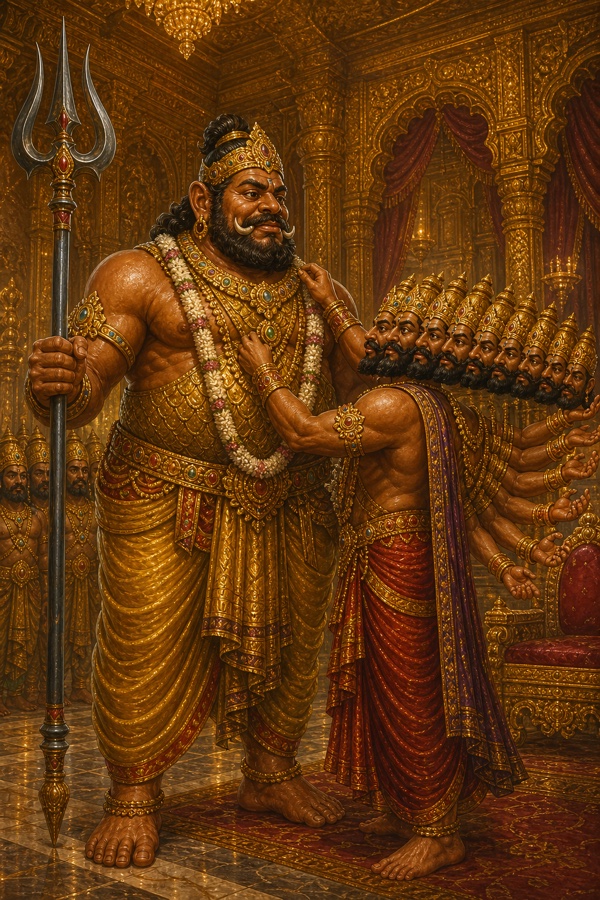
“I will go alone,” Kumbhakarna said, the enormous pike in his fist. “Let my army stay here. I am hungry and I am angry, and I will eat the monkeys today.”
“Go ringed by troops carrying pikes and mallets,” Ravana told him. “The monkeys are huge, and brave, and they do not give up. They will tear a lone or careless enemy apart with their teeth. So go surrounded by troops, and be impossible to stand against, and exterminate the whole army of the enemy, which is doing us so much harm.”
Then Ravana rose from his throne and dressed his brother for war with his own hands. He hung around Kumbhakarna’s neck a gold chain set with gems, and put on him armlets and rings and choice jewels, a pearl necklace bright as the moon, heavenly garlands sweet with scent, and earrings in those enormous ears. Decked in gold armlets and bracelets and neck-ornaments, the giant of the great ears shone like a fire well fed with offerings. With a broad dark-blue girdle at his waist he looked like Mount Mandara wrapped by Vasuki, the king of the serpents, at the churning of the ocean of milk. Clad in a golden coat of mail that no blow could pierce, bright as lightning and burning with a light of its own, he looked like the western mountain, the king of mountains, with the clouds of evening around it. Every limb was hung with jewels, and with the pike in his hand he strode out like Narayana making ready to take the three long strides that would cover the universe.
He embraced his brother tightly, walked around him to the right in respect, bowed his head to him, and set out, and neither of them said the thing that both of them knew. Ravana sent him off with excellent blessings, with the blare of conches and the roll of drums, and with an army bearing the best of weapons. Behind him rolled the gigantic chariot-warriors, on elephants and on horses and in chariots that thundered like clouds. Rakshasas followed on serpents, on camels and donkeys, on lions, elephants, antelopes, and birds. Under a rain of blossoms, a parasol held over his head, his sharp pike in his fist, excited by wine and maddened by the smell of blood, that enemy of demons and gods went out in state. Foot-soldiers past counting followed, lifting pikes and swords and whetted axes, bhindipalas, the small javelins thrown by hand, iron clubs and maces and mallets, whole trunks of palmyra trees, and slings that no one could face, raising an uproar as they came, their eyes hideous and coppery red, each of them many vyamas tall, arm-span stacked on arm-span, and dark as a mass of collyrium. And then, taking on yet another shape, formidable and terrible to look at, Kumbhakarna rushed forward.
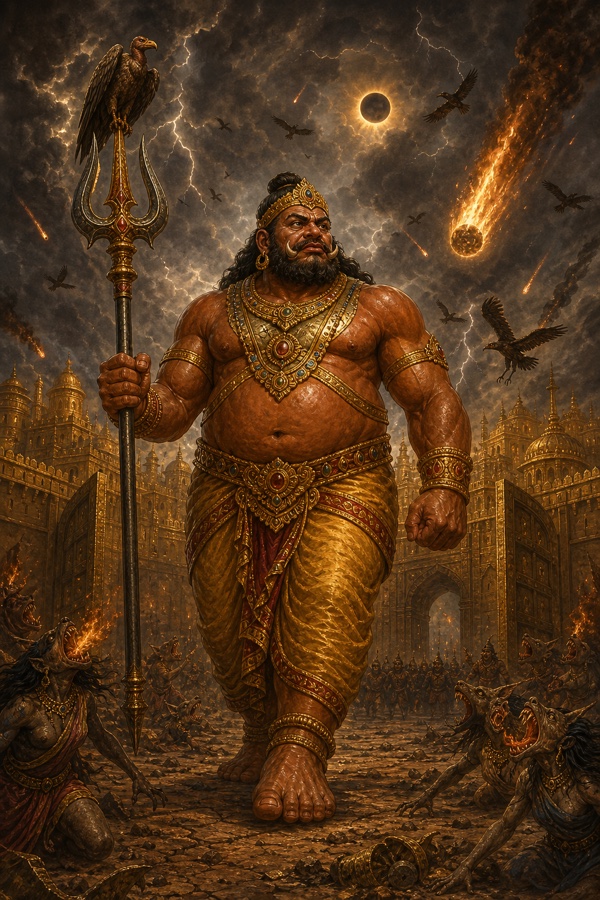
The rakshasas around him raised a roar that seemed to shake the sea. And the moment he set out, dreadful omens rose on every side. Clouds the ashen color of donkeys showed with meteors and strokes of lightning; the earth shook with its seas and its forests; she-jackals of hideous aspect howled with burning morsels in their mouths; birds wheeled in circles from right to left. As he marched, a vulture settled on his pike. His left eye twitched and his left arm throbbed. A flaming meteor fell with a terrible crash, the sun lost its light, and the pleasant wind stopped blowing. Kumbhakarna gave no thought to these portents that made the hair stand up on every arm around him, and pressed on, driven by the sheer force of destiny. He stepped over the rampart with his feet alone, a mountain going over a wall, and saw before him the wonderful army of the monkeys, dense as a bank of storm-cloud. At the sight of him the monkeys scattered to every quarter like clouds blown by the wind, and Kumbhakarna, who looked like a cloud himself, watched that most powerful army melt away and roared for joy, again and again, like thunder. At that roar, which was like the rumbling of a cloud in the sky, monkeys fell to the ground like sal trees cut off at the root. Carrying a huge iron club as well as his pike, causing a tremendous fear in the monkey ranks, that colossus went out to destroy his enemies, like Kalarudra at the end of the world-cycle with the rod of punishment walking beside him like a living servant.
Angada’s steadiness and the monkeys’ return to battle
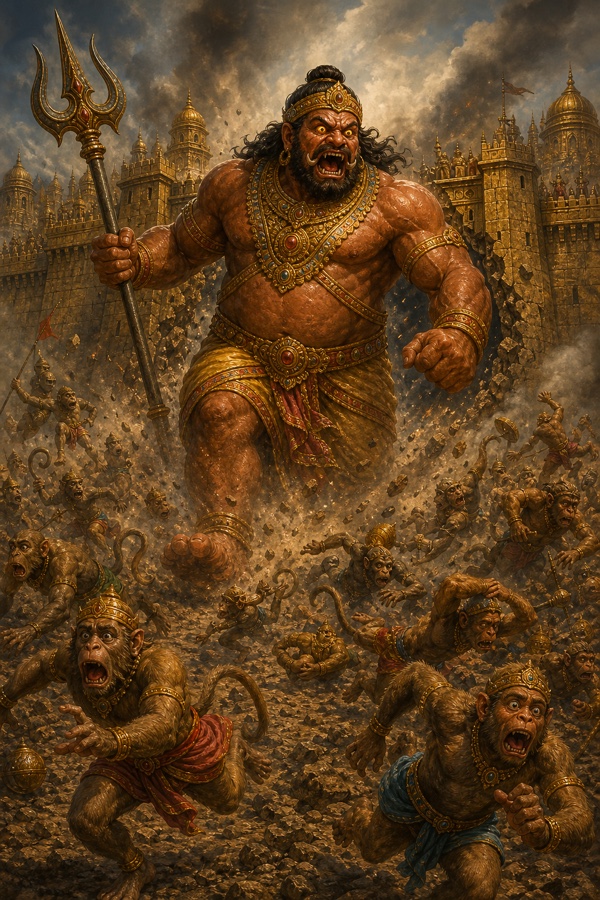
Making the sea ring, setting the mountains trembling, drowning the thunder itself, Kumbhakarna came out of the city at speed, huge as the peak of a mountain. Indra could not have killed him, nor Yama, nor Varuna, and at the sight of that rakshasa with the terrible eyes coming on, the monkeys turned and ran, and the story about the machine died where it stood. Watching them run, Prince Angada, the son of Vali, called out to Nala, to Nila, to Gavaksha, and to the mighty Kumuda by name, because a name reaches a running man when nothing else will.
“Where are you going, panic-stricken like common monkeys, forgetting your own great deeds and your high birth?” he asked. “Enough. Come back. Why are you guarding your lives so dearly? This rakshasa is no match for us. He is a great and frightening figure, a bugbear, and that is all. We will blow this colossal nightmare of the rakshasas away with our courage. Come back, monkeys.”
With difficulty the monkeys found their nerve, gathered again from here and there, seized trees, and came back to the field. Wild as elephants in rut, they showered mountain peaks, rocks, and trees in full blossom on Kumbhakarna, and he did not so much as sway. The rocks that struck him split apart; the flowering trees broke and fell shattered on the ground; the whole weight of a mountain range came apart on him without leaving a mark. Then, fierce and quick, Kumbhakarna churned the ranks of those shining monkeys the way a forest fire, once it has caught, churns a wood. Many of their best went down drenched in blood, tossed aside like trees in coppery bloom cut down, and lay senseless where they fell.
He was striking them down in sport. The heroes fled by the same road they had come over the sea by, running and leaping and looking neither ahead nor behind nor to either side, so that some dropped into the sea and some hung in the air. Their faces gone pale with fear, they rushed downhill toward the plains. The bears climbed trees; others made for the mountains. Some monkeys and bears drowned in the sea, some hid in caves, some fell, some could not keep their feet, some lay flat on the ground, and some lay stretched out as if they were dead.
Seeing them broken, Angada spoke to them again. “Stay. We will fight. Come back, monkeys,” he said. “For the routed there is no refuge anywhere, not if you range this whole earth. Why are you trying to save your lives? Your speed and your manhood know no obstruction, and if you throw down your weapons and run, your own wives will laugh at you. That would be death, even for men who had lived easy lives.”
“You were all born in wide and noble houses, and where are you running, terrified, like common monkeys?” he asked. “You are unworthy, running like this, with your courage thrown to the wind. Where have the boasts gone that you made in the assembly, and the tall claims of everything you had done for your master? People say of a coward that it is a shame he goes on living once good men have censured him. Take the road the virtuous walk and let your fear go. If our lives are short and we lie down killed by the enemy, we will win Brahmaloka, the world so hard to reach for bad warriors who are afraid of a fight. If we kill the enemy we will win glory. If we fall, we will enjoy the riches of the realm of heroes. Kumbhakarna will never escape alive once he comes face to face with Rama, any more than a moth escapes a blazing fire. And if we save our lives by running, many of us routed by one, we who were famous in war, our glory is gone.”
Even after Angada, with the golden armlets on his arms, had reasoned with them like this, the fleeing monkeys gave the answer that brave men count shameful. “Kumbhakarna has made a terrible slaughter of us,” they said. “This is no time to stand. We are going. Our lives are dear to us.” Having said only that much, every one of the troop-commanders saw the fearful-eyed rakshasa coming on again and scattered in every direction. Then the shrewd son of Vali brought them back from wherever they had got to, with heartening words and with arguments for Rama’s invincibility, which is what they needed to hear whether they deserved it or not. Their spirits lifted, and all the commanders of the monkey troops stood again, waiting for his order.
Rishabha, Sharabha, Mainda, Dhumra, Nila, Kumuda, Sushena, Gavaksha, Rambha, and Tara, with Dwivida and Panasa and Hanuman, the son of the wind-god, at their head, the monkey chiefs advanced toward the battlefield with quickening steps.
Kumbhakarna’s terrible work on the field
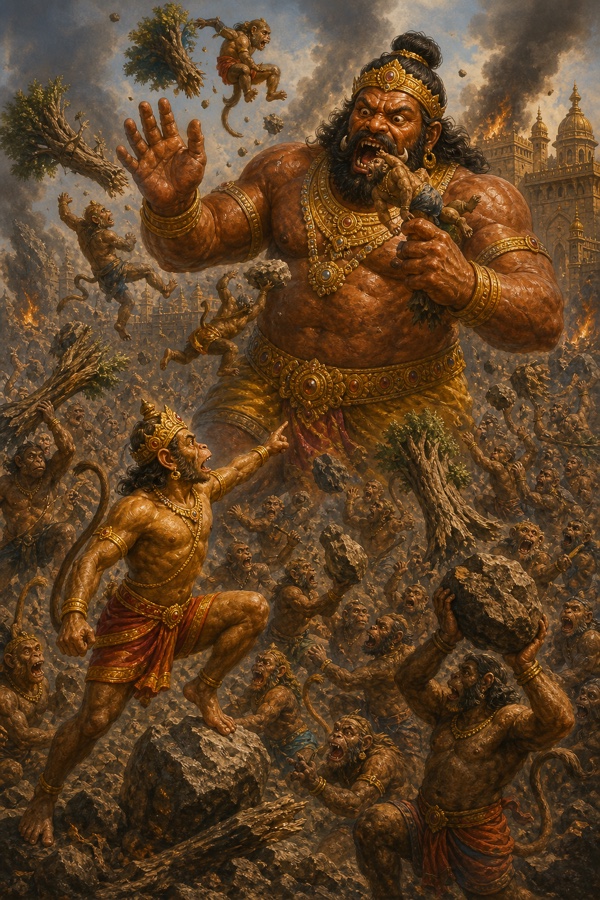
Angada’s words had brought those giants back, and they had come back with a firm resolve and a longing for the fight; reminded of their own past valor, they had their prowess in their hands again. Resolved to die, they threw themselves into a savage battle. Lifting huge trees and mountain peaks, the colossal monkeys rushed at Kumbhakarna with all their speed. In his fury he raised his mace, and swinging it with an audacity that dared them all, he struck the enemy down on every side, and at that blow eight thousand seven hundred monkeys lay scattered on the ground. Gathering sixteen, eight, ten, twenty, thirty of them at a time into his arms, the way a man gathers an armful of firewood, he ran about eating them, the way Garuda wheels and eats serpents.
With great difficulty the monkeys steadied themselves again, rallied from here and there, and held the front with trees and rocks in hand. Dwivida, a great monkey who looked like a threatening cloud, tore up a rock and darted at Kumbhakarna, who looked like the peak of a mountain, and flung it. It missed the colossus and came down on the rakshasa’s own army instead, crushing horses, elephants, chariots, and lordly tuskers; a second peak ground other well-known rakshasas into the earth. That vast field, where horses lay killed and charioteers lay struck down by the speed of a single stone, ran wet with the blood of rakshasas. With a terrible roar the rakshasa chariot-warriors began to sever the heads of the yelling monkey chiefs with arrows deadly as the darts of Kala at the world’s end, and the gigantic monkeys tore up great trees in turn and destroyed chariots, horses, elephants, camels, and rakshasas.
Hanuman held himself in the air and rained mountain peaks, rocks, and trees of every kind down on Kumbhakarna’s head, and the rakshasa split the peaks with his pike as they fell and cut the shower of trees to pieces. Then he seized his sharpened pike and rushed at the monkey ranks, and Hanuman, holding a mountain peak in both hands, stood in his way as he came. In his anger Hanuman struck him with it, a body as formidable as the greatest of hills struck with a piece of one, and Kumbhakarna reeled, spattered with fat and bathed in blood, the first time all day that anything had moved him. At that the rakshasa swung his pike, bright as lightning, like a mountain crowned with blazing fire, and drove it into Hanuman’s chest, between the arms, the way Kartikeya once drove his javelin into the Krauncha mountain. His broad chest torn open by the pike, Hanuman, thrown out of his wits, brought up blood from his mouth and gave a terrible cry of anguish, loud as the thunder of the clouds at the end of a world-cycle. Seeing him in that agony the rakshasas shouted for joy, and the frightened monkeys fled the field, because if the son of the wind could bleed, none of them was safe.
Then the mighty Nila steadied the army and flung a mountain peak at Kumbhakarna, and the rakshasa saw it coming and smashed it with his fist, and it dropped to the earth throwing off sparks and flames. Five of the fiercest monkeys, Rishabha, Sharabha, Nila, Gavaksha, and Gandhamadana, rushed him together and struck at him from every side with crags, trees, the flats of their hands, their feet, and their fists. He felt their blows as no more than soft touches and took no hurt at all. He caught the impetuous Rishabha in his arms and crushed him until that terrible monkey fell with blood pouring from his mouth. He struck Sharabha with his fist, Nila with his knee, and Gavaksha with a slap, and kicked Gandhamadana in his rage; and all of them fainted and fell, soaked in blood, like kimshuka trees in red bloom cut down.
As these chiefs went down, monkeys by the thousand darted onto Kumbhakarna, climbing him the way one climbs a mountain, leaping and biting, striking with nails and teeth and fists and arms. Covered with thousands of them, that mountain of a rakshasa looked like a mountain grown thick with trees. Then he gathered them all into his arms and began to eat them as Garuda eats serpents. The monkeys thrust into his mouth, which was as wide as Patala, crawled back out through his nostrils and his ears. Eating and crushing the monkeys, mountainous, he moved through their ranks like the fire that ends the age, drenching the earth with flesh and blood. Pike in hand, he looked like Indra with the thunderbolt in his fist, or like Death with his noose. As a fire burns a wood parched dry in summer, so Kumbhakarna burned up the monkey host, and the monkeys, who had lost battalion after battalion, yelled in voices that were no longer their own.
Killed over and over, the monkeys ran in their distress to take shelter with Raghava. Seeing them broken, Angada, the son of Vali, whose line came down from thunder-armed Indra himself, rushed at Kumbhakarna at full speed, because there was no one left to send. He lifted a huge mountain peak, roared again and again, terrifying the rakshasas who followed at Kumbhakarna’s heels, and flung it at the giant’s head. Struck on the head with that crag, Kumbhakarna blazed up in a great rage, and, past bearing it, sprang at the son of Vali. Making a great noise and terrifying every monkey on the field, he hurled his pike at Angada. Angada was a master of the ways of war, and he slipped the flying pike aside with a quick move, leapt up, and struck the rakshasa full on the chest with the flat of his hand, and at that blow the mountainous rakshasa fainted. Coming to, he doubled his fist and struck back with the back of his hand, an idle blow, and Angada dropped unconscious to the ground.
Sugriva taken, and Hanuman’s patience
The moment Angada, Vali’s son and the young prince of the monkeys, lay unconscious on the ground, Kumbhakarna caught up his pike and rushed at Sugriva. Seeing the mighty rakshasa come, the hero Sugriva, the overlord of the monkeys, bounded into the air, lifted a mountain top, balanced it, and rushed him in turn, so that the king of the monkeys went out to meet him alone. Kumbhakarna saw him coming and stood facing the lord of the monkeys with every limb braced. Sugriva looked at him, smeared to the shoulders with the blood of the great monkeys he was still devouring, and spoke.
“A feat that few could ever perform has been performed by you,” he said. “You have struck down champions, you have eaten battalions, and you have won the highest renown. Now leave that army alone. What do you want with the rank and file? Stand and take the single blow of this one mountain that I am going to throw, rakshasa.”
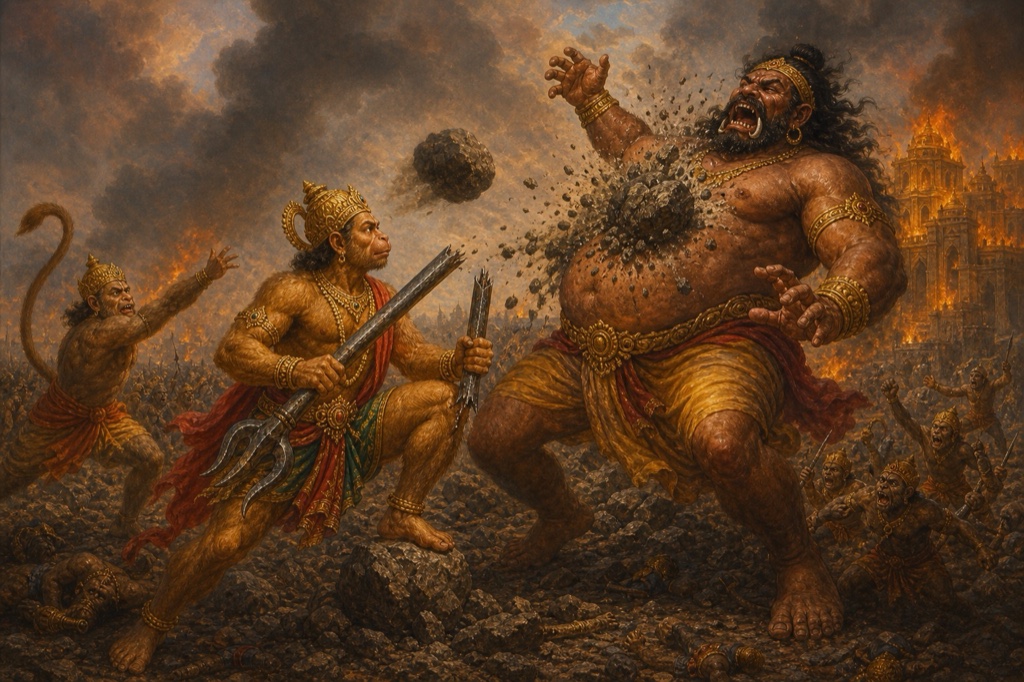
The challenge was full of courage and fortitude, and Kumbhakarna, the tiger of his race, heard it and answered him. “You are the grandson of Brahma, the lord of created beings, and the son of Riksharaja, and you are richly gifted with fortitude and valor,” he said. “That is why you roar, monkey.”
At that Sugriva discharged the crag, hard as a thunderbolt and swift as a shooting star, and struck Kumbhakarna full in the chest with it, and it burst apart on that broad breast all at once. The monkeys despaired of it; the ranks of the rakshasas thundered with joy. Stung by the blow, Kumbhakarna opened his mouth in anger and roared and roared again, and flourishing his pike, which flashed like lightning, hurled it to kill the lord of the monkeys and bears. But Hanuman, the son of the wind, bounded up and caught that sharp pike with its gold-decked shaft as it came from Kumbhakarna’s arm, gripped it in both his arms, laid it across his knee, and joyfully, in one movement, broke it: a great pike of black iron that weighed a thousand bharas.
When they saw the pike broken by Hanuman, the monkey host roared again and again and rushed up from every side. The rakshasa was dismayed and turned his face away, while the rangers of the woods roared like lions and praised the son of the wind for what they had just seen. Then that colossal overlord of the rakshasas, looking at his own pike lying in pieces, flew into a fury, tore a peak off the Malaya mountain that stands near Lanka, closed with Sugriva, and struck him with it. The ruler of the monkeys fell senseless on the field, and the rakshasas let out a roar of triumph. Kumbhakarna came up to the fallen king, whose prowess had been so marvelous and so terrible, pressed him into his armpit, and carried him off the way a tempest sweeps away a cloud. As he went, bearing up that huge cloud-shaped body, he looked like Mount Meru itself with its lofty and formidable peak. The rakshasas on the field extolled him as he went, and above him he could hear the outcry of the gods, who had been taken aback by the capture of the lord of the monkeys. Kumbhakarna, whose valor was Indra’s own, had made his reckoning: with Sugriva dead, this whole monkey army, Raghava included, would fall apart on its own.
Hanuman saw the army scattered here and there and Sugriva captured, and the sagacious son of the wind weighed what should be done, and he had a moment to do it in. What is my duty now, with Sugriva taken like this? Whatever it is, I will do it. I could grow to the size of a mountain, kill the rakshasa, shatter his body with my fist, free the king of the monkeys, and let every monkey rejoice. Then he thought further. Even if gods and demons and serpents had hold of Sugriva, the king would win his own freedom back. Struck by that crag, he is surely not yet conscious of himself; but in a short while he will come to, and he will do what is best for himself and for the monkeys. And if I free Sugriva by force, proud king that he is, it will cause him grievous displeasure, and his reputation will be lost forever, because a king carried out of a fight by a servant is a king who has been carried. So I will wait a while for him to show his own prowess once he has got himself free, and in the meantime I will steady the broken army. Thinking this, Hanuman set the great host of the monkeys on its feet again.
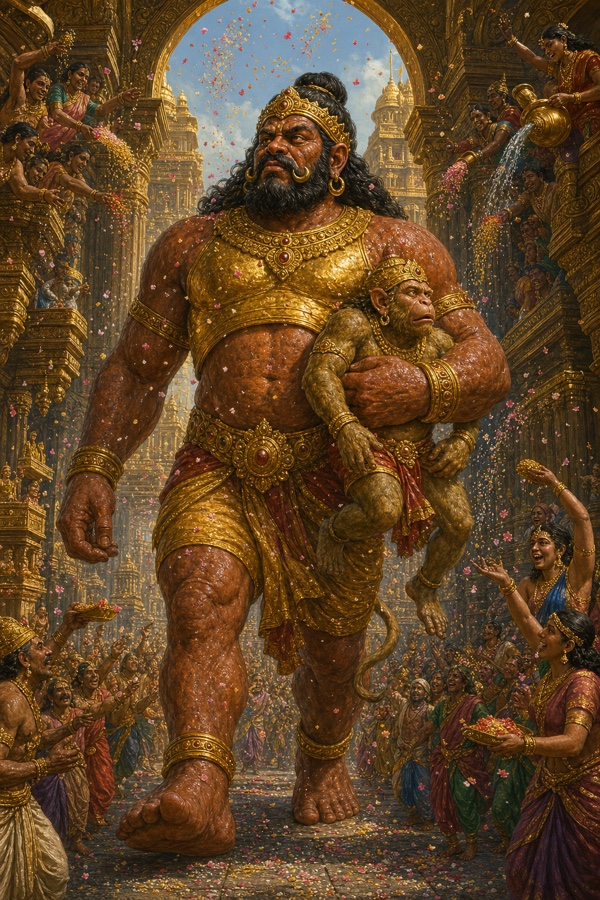
Meanwhile Kumbhakarna, carrying the great monkey, who had begun to twitch under his arm, went into Lanka, and from the tops of the seven-storied mansions, from the houses lining the highway, and from the gate-towers the people hailed him with showers of the finest flowers. Fried grains of rice and scented water were being sprinkled gently down for another man’s triumph, and that, and the coolness of the king’s highway, slowly brought Sugriva back to his senses. Held in the arm of that powerful rakshasa, gazing down the royal road of the enemy city, Sugriva, with a king’s pride and a clear head even now, turned it over again and again. How can I possibly strike back at this moment, taken captive like this? Then: I will do whatever will serve the monkeys and please them. Having reached that conclusion, the king of the monkeys suddenly raked off the lower ends of Kumbhakarna’s ears with his sharp nails, bit off his nose with his teeth, and tore open his sides with the nails of his feet, and did it all in the middle of Ravana’s own city, under the flowers.
Ears and nose gone, his sides ripped open by teeth and nails, drenched in blood and choked with rage, Kumbhakarna spun Sugriva around and pounded him against the ground with all his ferocity. Rubbed against the earth by that terrible strength, struck at by the rakshasas standing round, Sugriva bounced up like a ball, shot into the air, and reached Rama again at full speed. Robbed of the lower ends of his ears and of his nose, bathed in blood, Kumbhakarna looked like a mountain with springs pouring down it. Drenched and terrible, vomiting blood in his indignation, dark as a mass of collyrium, he shone like an evening cloud with a red tinge on it, and he made up his mind to fight again with his face to the enemy. With Sugriva gone, thinking to himself that he was now weaponless, the ferocious rakshasa caught up a fearful mallet, came bursting out of the city again, and set to eating the monkey army, formidable as it was, like the swollen fire of the world’s end eating the created beings. Famished and greedy for flesh and blood, he pushed deep into that formidable host and in his frenzy devoured rakshasas and monkeys, fiends and bears alike, no longer able to tell which of them were his, the way Death sweeps living things away at the end of an age. He ate the principal monkeys with the rest. Seizing one, two, three, or more monkeys together with rakshasas in a single hand, he thrust them into his mouth in haste. Fat and blood ran from the corners of his mouth while he fed, and mountain tops kept striking him, and he fed on. The monkeys being eaten ran to Rama as their refuge, and Kumbhakarna, wild with rage, ran on after them, devouring as he went, folding seven and eight, twenty, thirty, even hundreds into his arms at once. His limbs were smeared with fat and marrow and blood, and wreaths of tangled entrails hung over what was left of his ears, and out of that face, with its exceptionally sharp teeth, he rained darts on the monkeys, like Kala grown immense at the end of the world-cycle.
Lakshmana’s fight and Kumbhakarna’s pride
At that juncture Lakshmana took up the fight in anger, Sumitra’s son, who had broken hostile armies and taken hostile cities in his time, and who had just watched this giant carry the king of the monkeys off under his arm. He drove seven arrows into Kumbhakarna’s body, took up more, and sent them after. Tormented by the shafts, the rakshasa cut Lakshmana’s missiles apart with his own, and Lakshmana, the joy of his mother, grew angrier still. He covered the glittering, beautiful golden armor of Kumbhakarna with arrows the way the wind covers and scatters an evening cloud, and the rakshasa, dark as heaped collyrium and hidden under gold-decked shafts, shone like the sun with its rays screened behind clouds.
Then that terrible rakshasa spoke to Lakshmana with a touch of scorn, in a voice like the rumbling of massed clouds. “You have shown real courage, fighting fearlessly against one who could conquer Death himself in an encounter and hardly notice it,” he said. “Any man who can even stand before me, weapon in hand, in this world, is worthy of honor, and I am a rival of Death ready for a great battle; how much more the man who gives me battle. Indra himself, mounted on Airavata and ringed by all the gods, has never once stood before Kumbhakarna in the field.”
“You are only a youngster, and your feats have pleased me today,” he went on, “and so, with your leave, I wish now to go to Raghava. I am gratified by your prowess and your strength and your ardor in combat, and it is Rama alone I want to kill, because when he falls, everything falls. When I have got rid of Rama here, I will force whoever is left on the field to fight my devastating army.”
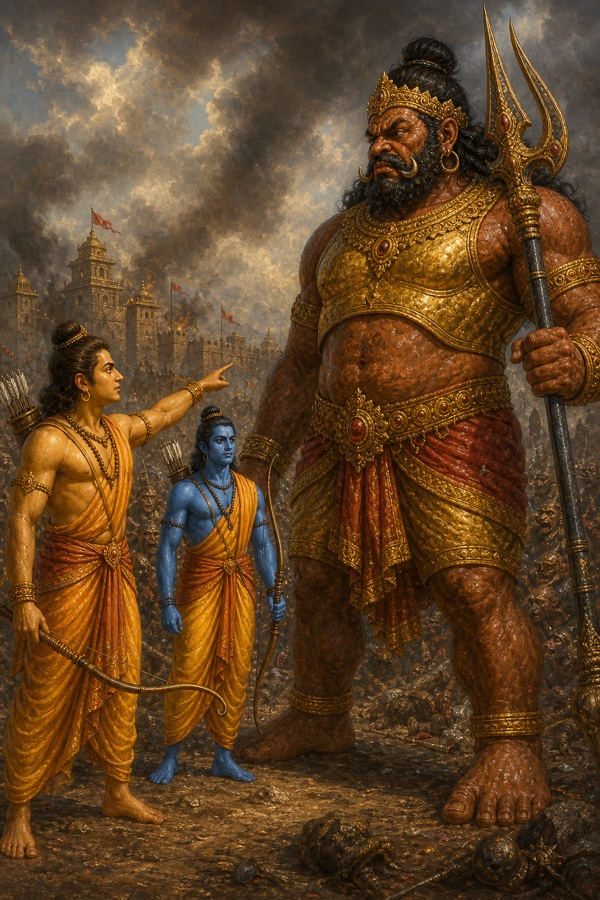
Lakshmana heard that boast and answered it on the battlefield as though he were laughing, with words full of praise and hollowed out underneath. “Your claim that you have grown past bearing for Indra and the gods is true, hero, and it is no lie,” he said. “Today I have seen your prowess for myself. And there stands Rama, the son of Dasharatha, immovable as a mountain. Go, then, and find out.”
At that, Kumbhakarna, whose might had no measure, paid Lakshmana no more mind. He stepped past him, and rushed straight at Rama alone, and the earth shook as he ran.
Kumbhakarna’s end at Rama’s hands
Rama, the son of Dasharatha, met him with the Raudra weapon, the missile presided over by Rudra and the first of the great missiles he would spend on that body before the day was out, and dug its sharp arrows into Kumbhakarna’s chest. Hurt, the rakshasa came at him in a fury all at once, and flames laced with embers shot from his mouth. Pierced by Rama’s arrows, roaring terribly, driving the monkeys before him across the field, the mightiest of the rakshasas came on. The peacock-plumed arrows disappeared into his chest; the mace slipped from his hand and fell to the earth; all his other weapons scattered on the ground. Even unarmed, when he understood that he was unarmed, he made a terrible slaughter with his fists and his hands. His limbs pierced beyond counting and bathed in blood, he poured it out like a mountain pouring out its streams, and half out of his mind with rage and blood loss, he ran on, eating monkeys and rakshasas and bears together.
Then he seized a fearful mountain peak, the mighty rakshasa who looked like Death himself, and hurled it at Rama. Rama took up his bow again and split that peak with seven straight-flying arrows while it was still in the air and had not yet reached him; his gold-striped shafts broke it to pieces, that crag which had looked like a summit of Mount Meru and had seemed to shine as it flew, and even as the pieces fell they crushed two hundred monkeys.
Lakshmana had been watching all this time, and turning over plan after plan for killing Kumbhakarna, and at that moment he spoke to Rama. “This one can no longer tell monkeys from rakshasas,” he said. “He is drunk on the smell of blood, and he is eating friends and enemies alike. Let the leading monkeys and the commanders of the troops climb straight up onto him from every side and stay on him. Weighed down by that load, this evil-minded rakshasa will not be able to kill the rest of the monkeys as he moves about the field.”
The monkeys heard the sagacious prince and climbed Kumbhakarna joyfully, and in his fury he shook them off, with vehemence, the way a refractory elephant shakes off its driver.
Seeing them shaken off, and knowing from it that the rakshasa was in a rage, Rama took up his best bow and rushed at him at speed, and the waiting was over. His eyes were red with fury, as though he meant to burn Kumbhakarna with his glance alone, and the troop-commanders whom the rakshasa’s strength had ground down took heart at the sight of him coming. The bow he carried looked like a serpent; its cord was drawn taut and it was chased with gold, and he came forward steadying the monkeys as he went, an excellent quiver full of arrows bound at his back. Ringed by monkey troops that no one could conquer, with Lakshmana behind him, Rama advanced to close with Kumbhakarna. He saw the colossus plainly now: crowned with his diadem, bathed in blood, his eyes red with rage, ringed by rakshasas and hunting for monkeys, charging everything in reach like one of the furious elephants that guard the quarters of the sky; huge as the Vindhya or the Mandara mountain, hung with armlets of gold, spouting blood from his mouth like a towering cloud pouring down rain, licking the blood-wet corners of that mouth with his tongue, and crushing the monkey army like Yama, like the Death that ends an age.
Seeing that prince of rakshasas shining like a kindled fire, Rama, the first among men, drew back the string of his bow, and the sound of it carried across the field over everything else. Enraged by the twang, unable to bear the sound of it, the giant charged at Rama. And Rama, whose arms were as long and as thick as the coils of Vasuki, the king of serpents, spoke to Kumbhakarna as he came on like a cloud driven by the wind, huge as a mountain.
“Come, then. Do not lose heart,” he said. “I am standing here with my bow in my hand. Know me for the one who will put an end to the rakshasa race. In a short while you too will be without your life.”
Coming to know that this was Rama, the rakshasa laughed in a warped and hideous voice and came on in a great rage, scattering the monkeys, rending their hearts with a laugh like the rumbling of a cloud. “Do not take me for Viradha,” he said, “or for Kabandha, or Khara, or Vali, or Marica. It is Kumbhakarna who has come.”
He showed Rama the club in his hand. “Look at my dreadful and mighty mallet, forged entirely of black iron,” he said. “With this I conquered gods and demons of old. You must not hold me in contempt because I have lost my nose and my ears. The loss of them gives me not the least pain. Show your prowess on my limbs, and then, when I have seen your manhood and your valor, I will eat you.”
Hearing his boast, Rama loosed beautifully plumed arrows at him, but that enemy of the gods was neither shaken nor pained by shafts that flew as fast as lightning. The very arrows that had cut through the tall sal trees and killed Vali, the mightiest of monkeys, did not do much hurt to Kumbhakarna’s body that day. He drank them into himself the way a mountain drinks its many torrents, and swinging his blood-smeared mallet at a terrible speed, the same mallet that had terrified the great armies of the gods, he beat back the rush of Rama’s arrows and scattered the monkey host.
Then Rama took up another missile, the Vayavya, presided over by the wind-god, and shot it at Kumbhakarna, and it severed the right arm in which he held the mace; and as the arm was cut through, the rakshasa let out a shriek that emptied the field. That arm, big as a mountain peak, fell with its mallet onto the army of Sugriva, the king of the monkeys, and killed close to a regiment of them, still fighting for its master after it had left him. The monkeys who had escaped being mangled or killed by it, their limbs squeezed all the same by the weight of it as it came down, drew off despondent to the edge of the field and stood by the fallen arm, and from there they watched the most terrible combat of that ruler of men and that overlord of the rakshasas. Like a great mountain whose summit a huge sword has cloven off, Kumbhakarna tore up a palmyra tree with his other arm and ran at Rama with it. And Rama, with an arrow decked with gold and charged with the Aindra weapon, the missile presided over by Indra, cut off that raised arm too, palmyra and all, coils of a serpent and all, and it fell tossing on the ground and crushed trees, crags, rocks, monkeys, and rakshasas as it came down.
With both arms cut away, Kumbhakarna opened a mouth like the fire beneath the sea and, roaring, still came at Rama all at once, like Rahu falling on the full moon in the sky. Rama took two sharp crescent-headed arrows and cut off the rakshasa’s feet; and the feet fell away, and the quarters and the corners of the sky, the caves of the Trikuta mountain, the vast sea, the city of Lanka, and the armies of monkeys and rakshasas rang with the thud of them. Armless and footless, a trunk with a mouth in it, incandescent as the submarine fire, the rakshasa dilated that mouth and rushed on at Rama with savage cries; and Rama filled the mouth with sharp arrows on gold-bound shafts, so that, his mouth packed full, Kumbhakarna could not speak, moaned with difficulty, and swooned.
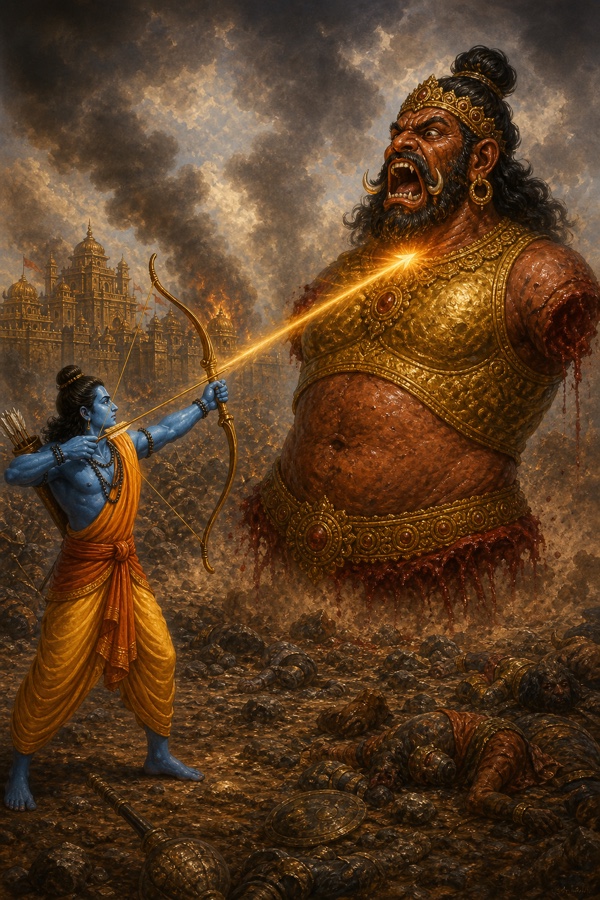
Then Rama took up an arrow with charming feathers, sharpened and effulgent as a sunbeam, an arrow like the rod of Brahma and the destroying Kala, fatal to enemies, charged with the Aindra weapon, and swift as the wind. Its shaft was inlaid with diamonds and gold, it was as brilliant as the blazing sun and as fire set alight, and it flew with the speed of the thunderbolt of the mighty Indra and of the weapon Ashani. Rama loosed it at the rakshasa. Sped from Raghava’s arm, that arrow lit all ten directions with its own radiance, formidable as a smokeless fire, racing to rival Indra’s bolt, and it tore off the head of the overlord of the rakshasas, a head as big as the summit of a huge mountain, with its beautifully rounded teeth and its lovely swinging earrings, exactly as Indra, king of the gods, struck off the head of Vritra long ago. Adorned with its pair of earrings, that enormous head shone as it went through the air like the moon standing in mid-heaven at the close of night, when the constellation Punarvasu has risen.
Torn off by Rama’s arrow, that mountainous head fell through the houses of the highway, the gate-towers, and the high rampart, demolishing them as it went, and pulling the great wall down with it, so that Lanka was wrecked by the fall of its own defender. The huge body, tall as the Himalaya, fell into the sea, crushing under its weight the great alligators, the largest of the fishes, and the serpents of the deep, and sank down into the bowels of the earth. As Kumbhakarna, enemy of Brahmins and gods, was killed in combat, the earth and all the mountains shook, and the gods raised a great shout of joy. In the air the celestial sages and the great rishis, the serpents, the gods, the spirits, the suparnas, the guhyakas, and the hosts of yakshas and gandharvas were filled with delight at Rama’s prowess.
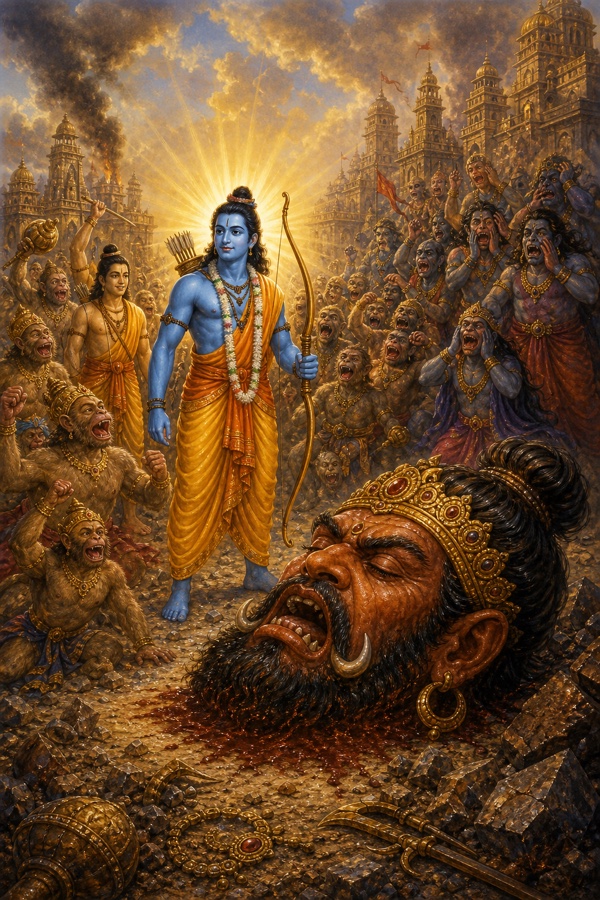
Ravana’s kinsfolk, resolute men, were cut to the heart by that great killing, and at the very sight of Rama, the first of Raghu’s line, they cried out the way rutting elephants cry out at the sight of a lion. Having killed Kumbhakarna in combat, Rama shone in the midst of the monkey ranks like the sun set free from the mouth of Rahu after it has scattered the darkness of the world of the gods. Many monkeys, their faces open like full-blown lotuses, took the deepest joy in the death of that enemy of terrible strength and gave their honor to the prince who had brought them to their desire. Kumbhakarna had churned the armies of the gods and had never been conquered in a great battle, and Rama, the elder brother of Bharata, having killed him on the field, rejoiced the way Indra, the lord of the immortals, rejoiced when he made an end of the mighty demon Vritra.
The gist: Piercing him first with the Raudra weapon, Rama cut off Kumbhakarna’s mace arm with the Vayavya weapon and his other arm with the Aindra, severed his feet, filled his mouth with arrows, and at last struck off his enormous head with a shaft like Indra’s thunderbolt, just as Indra once beheaded Vritra. The head fell onto the highway and the body into the sea; the gods rejoiced, and Ravana’s kinsfolk cried out in grief.
Source: Srimad Valmiki Ramayana, Yuddhakanda, Cantos 60 to 67. The Gita Press Hindi edition is the controlling witness, read alongside the Gita Press English edition. The Sanskrit e-text and an independent complete translation were used to verify names, sequence, and principal events. Where recensions differ, this retelling follows Gita Press.
Based on: Valmiki Ramayana (Gita Press, Gorakhpur)