On this page
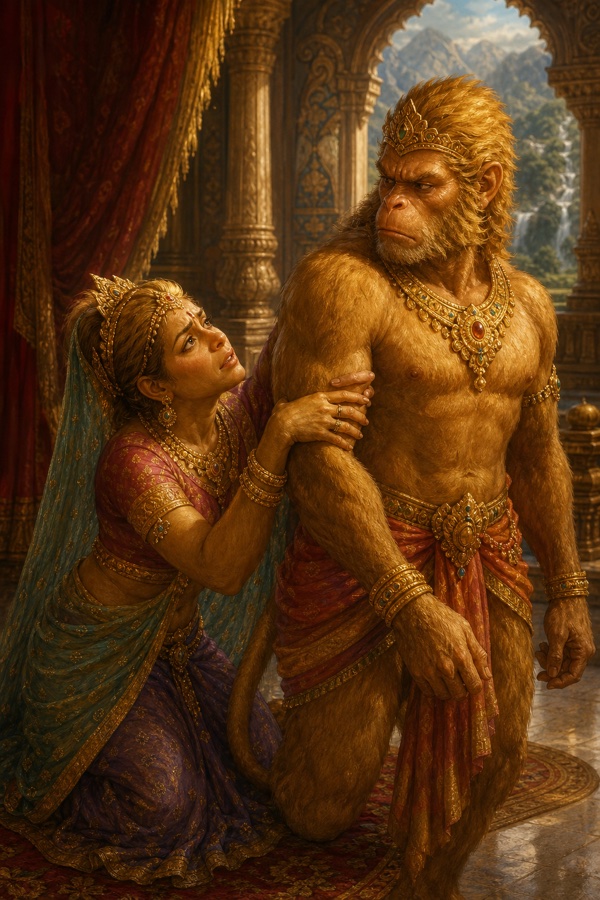
The roar reached Vali in the women’s quarters of the palace. He knew the voice. It belonged to the younger brother he had beaten into the hills, and it was the second time in a day that the voice had come to his gate, and this time it was calling him out. Whatever ease had been in him vanished in an instant, and a rage came up in its place that shook the walls. Vali had the luster of gold, and it went out of him the way the sun goes dark in an eclipse; his teeth showed, his eyes burned like a fire that has been fed, and he looked, in that moment, like a pond whose lotuses have been stripped away so that only the fibrous roots are left floating. He came out of his apartments so fast that the earth seemed to split under his stride. Tara caught him. She was frightened and shaken, and she put her arms around him and spoke, because she was the one person in Kishkindha who could still speak to him when he was like this. “Throw off this anger,” she said, “the way a man rising in the morning throws off the garland he wore the night before. Anger of this kind is a flood in a river; it comes and it goes. Fight Sugriva in the morning, if you must fight him. You are not short of strength and you have no crowd of enemies, and even so, this rushing out of yours does not sit well with me. Listen, and I will tell you why I am holding you. He came here in a fury and challenged you once already, and you went out and beat him and he ran. That he comes back and challenges you again, after the beating you gave him, is the thing I cannot get past. There is no small reason behind the way he is roaring, behind that certainty in him. Sugriva is clever by nature, and he is shrewd; he does not make friends with a fighter he has not tested. So I do not think he has come alone. Angada went into the deep forest once and came back with a report from his spies, and he told it to me, and I will tell it to you now. Two sons of the emperor of Ayodhya, Rama and Lakshmana, born in the line of Ikshvaku, hard to approach and harder to beat, have come to this country on a long journey, and they have come to give Sugriva what he wants. The one who now stands with your brother in battle is called Rama. He can break the ranks of an army; he is the fire that rises at the end of an age. He is a tree under which the good take shelter, the last refuge of anyone in trouble, a storehouse of glory, wise in the ways of this world and of the next, and obedient to his father’s word. As the Himalaya holds every mineral, he holds every virtue. You do not want him for an enemy. I say this for your good, and I am not finding fault with you. Take my advice and act on it: install Sugriva as prince regent today, with the full ceremony. Do not fight your younger brother. Friendship with Rama, and love for Sugriva, are what will serve you. Put your enmity far from you and cherish him. Whether he lives on Rishyamuka or here in Kishkindha, he is your friend without condition; I see no friend equal to him on this earth. Draw him close with gifts and honors and keep him beside you. That thick-necked Sugriva is your great friend, and it is on his goodwill that your fortune stands; there is no other road to happiness for you. If you care what pleases me, if you count me as your friend, then do as I ask, because I am dear to you. Be kind to me and hear me. Do not give yourself to anger. A war with the prince of Kosala, whose strength is Indra’s own, is a war you do not want.” It was good advice, and it was friendly, and it was wholesome, and Vali did not take it, because Death already had him by the hand. Tara’s face shone like the moon, the lord of the stars, even as she pleaded, and Vali answered her sharply, the way a man answers when he has already decided. “Why should I swallow the arrogance of this younger brother of mine, my lovely one, when he stands at my gate as an open enemy and thunders at me? For a hero who has never been beaten and never run from a fight, to bear an enemy’s intrusion is worse than death, my timid one. I cannot bear the arrogance of that weak-necked Sugriva, let alone his roar, when he is asking me for a fight. And you need have no fear of Rama on my account. How could a man who knows what is right and understands his own duty commit a sin like the killing of an innocent? Go back with the other women. Why do you keep following me? You have shown me love enough, and service enough. I will go out and give Sugriva his battle; put your confusion away. I will strip him of his pride and leave him his life. As long as he stands on the field I will give him what he came asking for, and when he has been beaten with trees and with my fists, he will run. The wretch will not stand up to my force and my speed. You have given me your counsel and your good sense and your love, and I swear you by my own life: go back with your women. I will come home when I have beaten my brother.”
Vali goes forth to the field
Tara had lost. She held him, speaking every loving word she had, and then, weeping softly, she walked around him with her right side toward him, the old circling gesture that is made for a man who is leaving on a journey, and she made it with her whole heart because she knew what kind of journey it might be. She knew the sacred texts, and she wanted his victory even now, so she performed the Swastyayana for him, the rite of good fortune in which boiled rice is scattered on the ground and blessings are called down with the appointed mantras. Then she went back into the inner apartments with the other women, and she went in silent, because grief had taken her voice.
The moment the women were inside, Vali came out of his capital hissing like a great serpent that has been stepped on. He was breathing hard, full of rage, and he swung his gaze around the whole field, hunting for the one who had called him out. Then he saw him. Sugriva stood there, reddish brown as gold, his loincloth cinched tight, planted on his feet like a thing that has taken root, glowing like a fire. For years the sight of Vali had been enough to send him running. Now he stood. Vali of the mighty arms, whose temper was the most dangerous thing in Kishkindha, looked at his brother standing so close and so still, and drew his own loincloth tight.
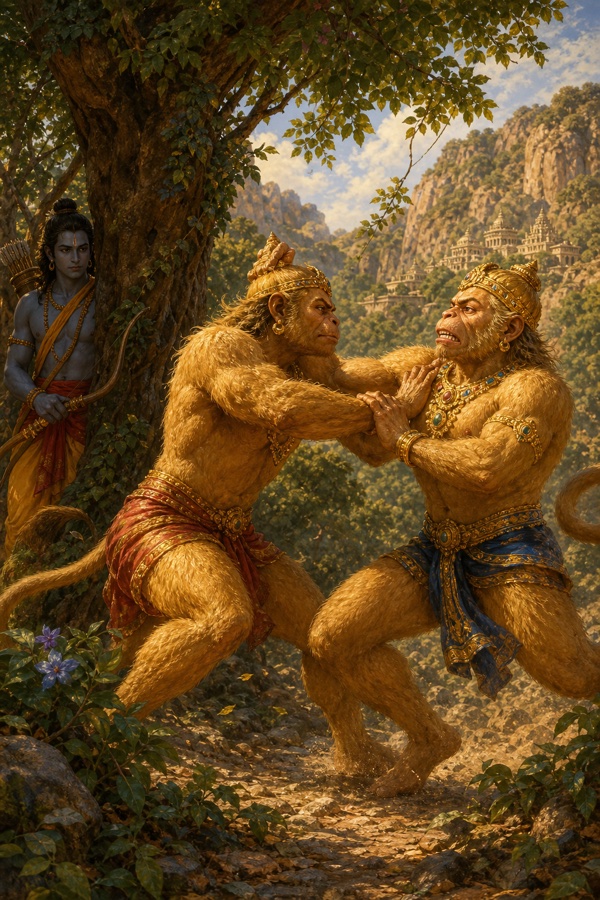
Cinched and full of vigor, glad in his heart to have the fight he had been denied, Vali raised his fist and went straight at Sugriva. And Sugriva came to meet him, his own fist clenched and drawn back to its full length, aimed at the golden chain on his brother’s chest. Vali looked at him, red-eyed with anger, skilled in the arts of fighting, coming on at speed, and said the last words he would ever say to him as a king to a subject. “This fist of mine is closed tight and its fingers are set just so. When I throw it, it will come back to me only after it has taken your life.” And Sugriva, enraged, answered him. “Then let this fist of mine come down on your head and take yours in the same instant.”
The savage duel of the two brothers
Vali struck first, and he struck with everything he was. Sugriva, hit by that blow, spat blood in a stream and stood there like a mountain with a waterfall running down its face. Then he did what no one in Kishkindha had ever seen him do: he tore a sal tree out of the ground by its roots and brought it down on Vali’s body with all his strength, fearlessly, the way lightning comes down on a great mountain. Crushed under the weight of the trunk, battered by the blows of it, Vali began to sway like a boat far out at sea, loaded past its limit and crowded with passengers.
The two of them were terrible in strength and in daring, quick as Garuda, fearsome to look at, each one built to destroy an enemy and each one hunting the other’s weak point; where they rose together into the air they looked like the moon and the sun sharing one sky. Then Vali, rich in strength and valor, began to get the upper hand, and Sugriva, son of the sun-god, mighty as he was, began to lose ground. His pride was broken and his strength was draining out of him, and he was seething against the brother who was beating him, and he threw a signal toward Rama that his strength was failing, and went on fighting while he waited for it to be answered. The battle between them was like the battle of Vritra and Indra. They fought with trees and with the branches of trees, with mountain-tops, with claws that cut like a million diamonds, with fists and knees and feet and arms, over and over, roaring their threats at each other, the two forest-roving monkeys smeared with blood, clashing like a pair of storm-clouds.
Rama’s arrow from behind the tree
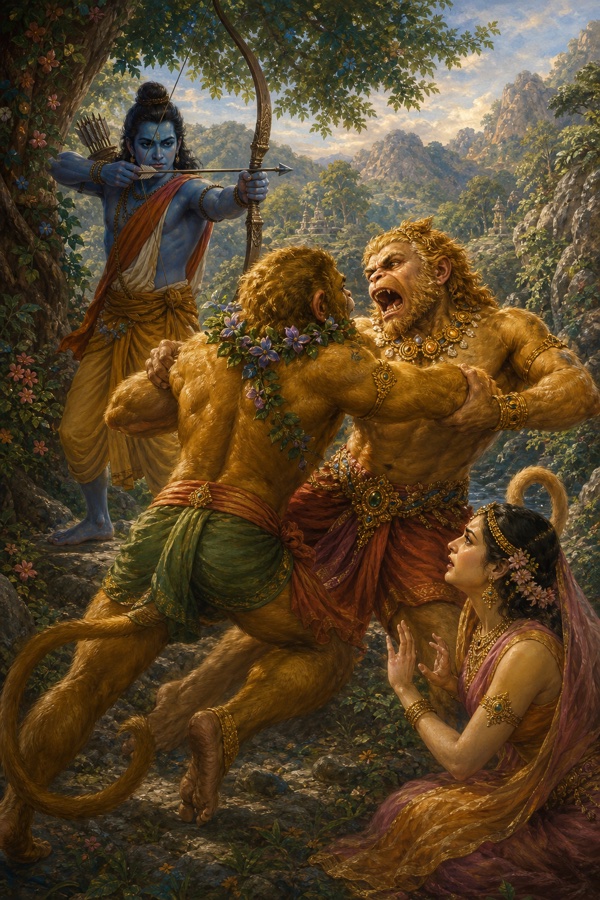
Rama, watching from the trees, saw Sugriva weakening, and saw him casting his eyes toward the horizon again and again, looking for the friend who had sworn to him before fire. Seeing the lord of monkeys in that distress, Rama looked to his arrow for the killing of Vali. He fitted to the bow a shaft that was venomous as a serpent and drew it back to its full length, the way the god of death lifts his wheel for the destruction of the world. At the twang of that bowstring the birds of the forest went up in terror, and the deer, dazed as though the end of the age had come, ran every way there was.
Loosed with a sound like the crash of thunder, blazing like a flash of lightning, the great arrow flew from Rama’s bow and struck Vali full in the chest. It came out of a direction he was not fighting in, from a hand he had never seen, for a reason nobody had told him. Struck with that force, the mighty ruler of monkeys, whose energy had no equal and who had never once been thrown down by anything, fell flat on the earth. Rama had loosed that fiery shaft, the foremost of arrows, worked with gold and silver at its end, built to crush an enemy and terrible as the hour of the world’s dissolution, as Shiva once let the smoking fire out of the eye in his forehead to burn Kamadeva to ash.
On the day of the full moon in the month of Ashvina a flag is raised in Indra’s honor, and when the rite is over it is let down all at once. Vali went down like that flag. He lay drained of luster, past all sense, moaning slowly in his pain, his throat locked with tears. Bathed in jets of blood and water, like an ashoka tree in full flower torn out of the ground by a storm, the son of Indra sank senseless to the earth.
Vali’s question to Rama, still asked today
Pierced by Rama’s arrow, Vali, who had been hard as iron in every fight of his life, dropped all at once like a hewn tree. His limbs lay flat on the ground, and hung with his ornaments of burnished gold he looked like the flag of Indra when the cord that holds it up has been loosed. With the ruler of the hordes of monkeys and bears fallen, the whole stretch of earth he had governed lost its brightness, as the sky does when the moon has gone out of it. And yet, even where he lay, neither grace nor breath nor energy nor prowess left his body. The fine, jewel-set chain of gold that Indra, king of the gods, had given him was holding his life and his energy and his grace in place, the way a knot holds. With that chain on him the fallen leader of the monkeys looked like a cloud whose edges are tinged with the rose of dusk. His chain, his body, and the arrow buried in his vitals shone, the three of them, as though his splendor had been parceled out three ways. And the shaft from Rama’s bow, even as it took him down, was lighting his road to the highest heaven and carrying him toward the supreme state.
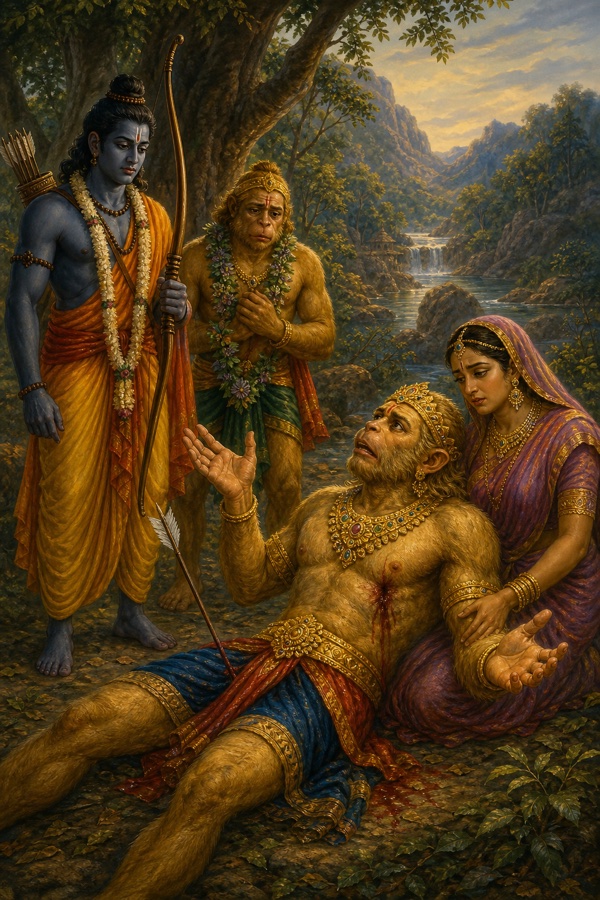
Rama came and looked at him, Lakshmana at his side. Here was the son of the mighty Indra: the golden chain, the broad chest, the long arms, the radiant face, the tawny eyes. In a fight he had been as hard to overcome as Indra himself and as hard to withstand as Upendra, Indra’s younger brother, who came into the world as the Dwarf. Now he lay on the field like a fire with no flame left in it, like Yayati flung down from the world of the gods when his merit was spent, like the sun thrown to the earth by Time at the end of an age. The two brothers walked up to him slowly, with a kind of honor in the slowness, because there was no hurrying it now. Vali watched them come. Little strength was left in him and little breath, and he lay wounded past mending and could not move, and out of that stillness he spoke to Rama, who had carried himself so proudly on this field. What he said had been building in him from the moment the arrow arrived out of nowhere and told him what kind of world he had been living in. It was harsh, and it was courteous, and it was in keeping with dharma, and every word of it meant something.
“You are the son of a king,” he said, “renowned, and pleasing to look upon. By bringing about the death of a man who was not facing you, what merit have you won in this world, when I was locked in combat with another and met my death at your hands? Rama is nobly born, they say, full of goodness and full of courage, a keeper of vows, one who knows compassion and lives for the good of the people. He is merciful, they say, and full of vigor; he knows what should be done and when to do it, and he is firm in what he has sworn. That is how every creature on the earth speaks of you. Restraint of the senses, restraint of the mind, forgiveness, dharma, fortitude, truth, valor, and the punishing of wrongdoers, these are the virtues of kings. It was because I believed those virtues were in you, and because I weighed your high birth, that I went out to fight Sugriva though Tara forbade it. The belief had settled in me so deep that I never examined it, that until I had laid eyes on you, you would never stoop to strike me while I was busy with another and off my guard.
“Now I know you for what you are: a man who has killed his own soul by acting against his conscience, who makes a show of virtue and is faithless underneath it, foul in his conduct, treacherous as a well whose mouth is hidden under a mat of grass. I did not know you until this hour for what you are, a sin wearing the dress of the virtuous, a fire buried under a mask of piety. I did no wrong in your realm or your city. I never slighted you. Why then have you killed me, a monkey without guilt, who lived on fruit and roots in the woods, who was not fighting you and was grappling with another? You are a king’s son, and so a man to be trusted, and pleasing to look at, and you carry on your body the emblems of dharma, the matted hair and the bark cloth of a man under a vow. What man born in the warrior line, possessed of sacred knowledge, his doubts about right and wrong resolved by that knowledge, wearing the signs of piety, would do a thing as cruel as this? You are born in the line of Raghu and known everywhere as a man of virtue, and you are cruel. Why do you go about in so gentle a guise?
“The art of persuasion, generosity, forgiveness, dharma, truth, fortitude, valor, and the punishing of wrongdoers, these are the virtues of rulers. We are beasts who live in the forest on roots and fruit; such is our nature, and we did not choose it. You are a man who lives in cities and eats cooked food of many kinds. Land, gold, and silver are the only grounds for punishment. What attraction could the fruit of my forest have held for you? Governance and gentleness, punishment and the granting of favors, these are the duties of a king, and each has its own occasion. Kings do not act on whim. And you are ruled by desire; you are quick to anger and fickle; you act at random in the sphere of a king’s duties and have made it your chief business to shoot arrows wherever you please. You have no respect for dharma and no settled mind about wealth; you follow your own sweet will, and your senses carry you where they like. Having killed me with an arrow when I had done you no offense, having done this abominable thing, what will you say when you stand among holy men and one of them asks? The killer of a king, the killer of a Brahmin, the killer of a cow, the thief, the man who delights in taking life, the unbeliever, and the man who marries before his elder brother, all of these go to hell. The informer, the miser, the man who kills his own friend, and the man who violates his teacher’s bed, all of these go down to the world of those whose minds are set on sin.
“My skin, the skin of a monkey, is not fit for the virtuous to wear, nor my hair, nor my bones; my flesh is not fit for a man who practices dharma, a man like you, to eat. Only five kinds of five-clawed creatures may be eaten by Brahmins and Kshatriyas: the rhinoceros, the porcupine, the iguana, the hare, and, fifth, the turtle. The wise do not so much as touch my skin and bones, and my flesh is not worth eating, and I am a five-clawed beast, and I have been killed for nothing. Tara gave me advice that was correct and good for me; she knows everything. I set it aside out of ignorance, and I have fallen under the sway of Death. With you for its lord, the earth has no more protector than a young woman of good character has in a husband who breaks the law. How were you, deceitful, malicious, small-minded, sinful, a man who counterfeits calm, ever begotten by the high-souled Dasharatha? I have been killed by the elephant that is Rama, who has snapped the chain of morality, trampled the code of the virtuous, and thrown off the goad of dharma.
“Having done a thing so vicious and so unwelcome, a thing the virtuous condemn, what will you say to justify it when you come among holy men? I do not see you showing against the wrongdoers of the world the valor you have shown against us, who never troubled you. Had you fought me on this field where I could see you, you would have looked on Yama himself today, killed by my hand. I was hard to approach, and you killed me while you could not be seen, the way a serpent bites a sinful man in his sleep. Had you but asked me first, I would have brought your wife back to you in a single day; for that is why you have killed me, to oblige Sugriva. I would have tied a cord around the neck of that evil-minded ogre Ravana, who stole your wife, and handed him to you alive, without a battle. At your word I would have carried the princess of Mithila back even if she had been hidden in the midst of the sea or in the lowest world under the earth, as Hayagriva brought back the Vedas that the demons Madhu and Kaitabha had stolen and hidden in Patala in the shape of a white she-mule. It is fitting that Sugriva should have the kingdom once I have gone to heaven; and it is not fitting that you should have killed me unrighteously while I was fighting another. Men come to their death at the appointed hour; that is the rule, and I have no grievance on that score. But if you have hit upon any proper answer to my question, weigh it well, and speak it.” Having said this, gazing at Rama who blazed like the sun, wracked by the arrow’s blow, his mouth gone dry from the long anguish of speaking, the son of the monkey king fell silent and waited to be answered. He was dying, and of all the things a dying king might ask for, he had asked for one: a reason.
Rama’s answer: the deep secret of dharma
Rama heard him out. The monkey who had spoken was like a sun stripped of its light, a cloud that has emptied itself of rain, a fire gone out; the words had been harsh, and courteous, and wholesome, and in keeping with dharma and with the ways of the world. Rama’s answer was in keeping with both, and it was meant to heal. “Without truly knowing the secret of dharma, of wealth, and of desire, or the ways of the world besides, why do you fault me so bitterly here today out of your ignorance? Without consulting the elders, the men rich in wisdom whom the teachers themselves esteem, you seek, gentle one, to condemn me out of monkey fickleness.
“This whole earth, with its mountains and its forests and its woods, belongs to the line of Ikshvaku; Manu, their forebear, left it to them. The right to punish and the right to favor its beasts, its birds, and its human beings rests with them. And that earth is ruled now by Bharata, whose heart is set on dharma, who is truthful and guileless, who knows the truth about dharma, about pleasure, and about wealth, and who is bent on punishing the wicked and rewarding the good. In him prudence and humility sit in equal measure; truth is fixed in him, and the valor the scriptures ordain, and he knows the right time and the right place. Carrying his command for the spread of dharma, we and the other rulers of the world range the whole earth, keen to promote what is right. While that tiger among kings, who loves dharma, rules the earth, who would dare do a thing repugnant to it? Keeping Bharata’s command before us, devoted to our highest duty, we punish whoever has strayed from the path. You have been living inside a realm all along.
“You, for your part, have trampled dharma and by your own deeds you stand condemned. You are foremost among the slaves of lust, and you have left the road that good kings walk. To a man who follows dharma, an elder brother, a father, and the man who gives him learning, these three are all to be held as fathers. In the same way a younger brother, one’s own son, and a worthy pupil, these three are to be counted as sons; and in this, dharma alone is the authority. The principle that governs the conduct of the good is subtle, and very hard to know; the Self that dwells within every being is the only one who knows what is good and what is evil. You take counsel with monkeys, who are all fickle and undisciplined, the way a man born blind takes counsel with others born blind. What can you, fickle yourself, know about dharma?
“As for me, I will tell you now the plain meaning of what I have said, and you must not condemn me again out of sheer wrath. Know the obvious reason you have been struck down. You cast the eternal law to the wind and took your younger brother’s wife. While the high-souled Sugriva lived, you lay in lust with his wedded wife Ruma, who stands to you as a daughter-in-law; that is a sinful deed. For straying from dharma and doing as you pleased, for embracing your younger brother’s wife, this punishment has been meted out to you. For a man who has set himself against the good of the people and left the path laid down for everyone, I see no way of restraint except punishment. I am a Kshatriya of high birth, and I cannot stomach your sin. For the man who in lust approaches a girl sprung from his own loins, or a sister, or his younger brother’s wife, the punishment laid down is death. Bharata is the ruler of the earth, and our duty is to carry out his command. How could you, who have strayed from dharma, be let go unpunished? The wise Bharata punishes whoever has clearly broken a major duty and cherishes by the rule of dharma whoever keeps his duty faithfully, and he is set on punishing those whom lust rules. Taking his command for our authority, we stand ready to punish people like you, who have crossed the bounds of morality.
“My friendship with Sugriva is as unbreakable as my friendship with Lakshmana, and it was made for the recovery of his wife and his kingdom; in return he is to do me the greatest good there is, the winning back of my lost wife. When that friendship was sealed I gave my pledge in front of the monkeys to get him back his wife and his sovereignty, and how could a man like me let a pledge go unhonored? For these weighty reasons, every one of them grounded in dharma, you too should approve your punishment, because it was just. See it as wholly in keeping with dharma, and see that a man who knows his duty must do a friend good. Had you kept to the way of dharma, you would have chosen the same course yourself by way of expiation. Two verses on the conduct of kings, sung by Manu and accepted as authority by everyone learned in dharma, are the ground on which I have acted. Here they are. Men who have committed sins and been punished by kings become spotless and rise to heaven like the doers of good deeds. A thief is freed of his sin either by punishment or by the mercy that lets him go, while the king who leaves a sinner unpunished takes that sin on himself. My forebear, the emperor Mandhata, laid a terrible punishment on an ascetic for a sin like yours, and did not spare him for his robes. Other rulers of the earth have punished the sins of men who blundered, and men undergo expiation on their own too, and by that expiation the sin is undone.
“So put away your grief. Your death was contrived in keeping with dharma, and we were not free agents in it; the shastras had us in hand. And hear one more reason I killed you, and knowing it, do not be angry with me. I feel no anguish and no remorse for what I have done. Hidden or in the open, men catch with nets and nooses and traps of every kind the deer that run off in alarm and the deer that stand fearless and unmoving. Meat-eating men strike deer that are unwary and deer that are on their guard, deer facing them and deer turned away, and no one counts it a fault. Even royal sages who know dharma go hunting. So it is that in your fight with Sugriva you were struck down by my arrow, whether you were fighting me or fighting another; you are, after all, a monkey.
“Kings can bestow the dharma that is so hard to reach, and long life, and welfare in this world; of that there is no doubt. No one should kill them, or reproach them, or insult them, or say a harsh word to them. They are gods who walk this earth wearing human form. Not knowing dharma, holding on to nothing except your anger, you fault me, who stand in the code of my fathers and my fathers’ fathers.” Vali, deeply pained, heard the words, and found no more fault in Rama; certainty about dharma had come to him at last, and a man who has been answered stops arguing. He had been given the thing he asked for, and it cost him the last of what he had thought about himself.
Vali’s plea for pardon and his fear for Angada
Then, joining his palms, the ruler of monkeys answered. “What you have said is precisely true; there is no doubt of it. A dwarf cannot argue with a giant. And for the unbecoming and bitter words I spoke to you before, in my error, do not hold me at fault either. You have seen with your own eyes the truth about the four aims of a human life, and you are wise; you are devoted to the good of the people, and your mind is clear and unbaffled when it weighs a duty and the circumstances of a duty. I stand at the head of those who have plainly strayed from dharma, and I am known as such. Encourage me too, you who know what is right, with words of consolation that keep to dharma.”
His throat locked with tears, groaning like an elephant sunk in a bog, Vali gazed at Rama and went on slowly, and now he said the thing that was actually on him. “I do not grieve for myself, nor for my wife, nor for my kinsmen, as I grieve for my son, Angada of the golden armlets, the foremost of boys in virtue. Wretched at not seeing me, that child, cherished by me from his infancy, will dry up like a pond whose water is gone. He is Tara’s son, young still, immensely strong and unripe in judgment, and he is my only son and for that reason dear; protect him, Rama. Set the very best understanding between Sugriva and Angada; you stand to them as protector and as teacher in what should and should not be done. The heart you hold toward Bharata and Lakshmana, hold it toward Sugriva and Angada. And manage it so that Sugriva does not treat poor Tara with disrespect; her only guilt is that I persecuted him.
“A kingdom can be ruled by a man who is under your control, who follows your mind, whom you have favored; heaven can be won by him, and the whole earth governed. It was death at your hands I was seeking when I went into the duel with my younger brother Sugriva, though Tara held me back the whole time.” Having said it, the ruler of monkeys fell silent. And Rama reassured him, in whom wisdom had now dawned, with words rich in the essence of dharma, the words that the holy honor. “Feel no anxiety on this score. You need not worry about us, and you need not worry about yourself; it was out of a special love for you that we decided our course in keeping with dharma. The man who punishes one deserving punishment, and the man who, deserving it, is punished, both reach their end and neither comes to grief; the one by bearing the punishment, the other by meting it out. Freed of your sin by this punishment, along the road the scriptures ordain, you have come back to your own spotless nature, the nature dharma intends for you. Cast away the grief and the confusion and the fear in your heart. What Providence has ordained cannot be overstepped by you or by anyone. Angada will lean on Sugriva and on me as he has always leaned on you; of that there is no doubt.”
Vali heard the sweet, reassuring words of that great soul standing over him, a man who could crush his enemy on any field of battle, words that kept strictly to the path of dharma, and he gave a fitting answer. “Win me over, then; I am reconciled. For whatever unseemly and harsh words I spoke to you without knowing, agonized by the pain of your arrow and confused by it, powerful as you are and terrible in prowess, a match for the mighty Indra, forgive me.”
Tara runs to the battlefield
Answered with reasons he could not turn aside, the lord of monkeys lay on the ground in the agony of Rama’s arrow and could make no further reply. Battered with trees, his limbs broken by rocks, pierced through by a shaft from a bow he had never seen, he was swooning at the close of his life. The news went up into the cave city, and Tara heard it: Vali, that tiger among monkeys, had been killed by an arrow of Rama’s while he tested his strength against Sugriva. It was the cruelest news she could have heard, and she had seen it coming from the moment the second roar reached the palace. Wild with dread, she came out with her son Angada from the rocky cavern that was Kishkindha. The monkeys who served as Angada’s bodyguard were powerful creatures, and when they saw Rama standing there with his bow they broke and ran in terror, every one of them. And Tara, coming the other way, saw them scattering headlong like deer whose herd-leader has been killed, strayed from the herd and running blind.
Full of sorrow herself, Tara went up to the sorrowing monkeys, who were fleeing as though Rama’s arrows were chasing them, and she spoke to them as a queen speaks to soldiers. “You are the servants of that lion among kings. Why do you desert him and run away in this miserable, frightened state? Was it for the sake of a throne that Vali, Sugriva’s own brother, was laid low by his cruel brother, with arrows Rama loosed from far off at a distant mark?” The monkeys, who could take any form they pleased, answered her plainly, and they answered quickly, because they were still running. “Go back, mother of a living son, and protect Angada. Death, in the disguise of Rama, has struck Vali down and is carrying him away to his own house. Rama smashed with his arrows, which are like lightning, the trees and the huge rocks Vali hurled at him, and he struck him down as Indra strikes down a mountain with the thunderbolt. That tiger among monkeys, whose splendor was Indra’s own, is killed, and the whole army has fled as though Rama had beaten every one of us. Let the city of Kishkindha be guarded by brave soldiers, and let Angada be set on the throne; all the monkeys will serve Vali’s son when he holds it. And your staying out here is not to our liking, lady; the hostile monkeys, Hanuman and the rest, will seize every stronghold in Kishkindha this very day. There are forest-dwellers here with wives and without, hungry for a kingdom and long deprived of one, and from them the danger is very great.”
Tara heard them out from a short distance, and she gave an answer worthy of herself, and she did not take one step toward the city. “With that blessed lion among monkeys dying, what use to me is a son, or a kingdom, or my own life? I will go and seek the soles of the feet of that great soul, whom an arrow of Rama’s has laid low.” So saying, weeping, wild with grief, beating her head and her breast with both her hands, she ran on toward the field.
On the way she saw him, fallen helpless on the ground: her husband, who had slain the chiefs of the danavas and never once turned his back in battle, who had hurled the greatest of mountains at his enemies the way Indra hurls the thunderbolt, who had the fury of a tempest and the thunder of massed clouds, who was Indra’s equal in valor. He lay now like a cloud that has emptied itself and gone quiet. His roar had once terrified everyone who roared back at him, and for all his valor he had been brought down by a greater hero. He looked like a lion struck down by a tiger for its prey, like a shrine held sacred by all the people, with its flag and its altar, laid waste by Garuda for the sake of a serpent that lived in it. She saw Rama, leaning on his glorious bow, and Lakshmana, Rama’s younger brother, and her own brother-in-law Sugriva. She passed all three of them without a word, reached her husband where he lay mortally wounded on the field, looked at him, and fell to the ground in her pain. Then, rising as if out of sleep, saying “Aryaputra,” she wept to see him bound fast in the cords of Death. Sugriva watched her screaming like a female osprey, and saw Angada arrive behind her, and a bitter despair came down on him in the very hour of his victory.
Tara’s lament and her vow to fast unto death
Reaching the husband whom the life-taking arrow from Rama’s bow had struck to the ground, Tara, whose face was like the moon, clasped him to her breast. He had been like an elephant, like a lordly mountain, and he lay like an uprooted tree, and she held him and lamented with a mind torn by grief. “Why do you not speak today to me, who stand here before you, great hero, best of monkeys, terrible in battle? Get up and go to your fine couch; kings such as you do not lie down on the ground. This earth is surely dearer to you than I am, since even with your life gone you hug her with your limbs and pay no attention to me. Heroic king, you fought by the rule of dharma, and it seems you have built yourself today, on the road to heaven, a city as lovely as the Kishkindha you are leaving forever. The pleasures we shared in the sweet-scented woodlands, you have brought them to a dead stop today.
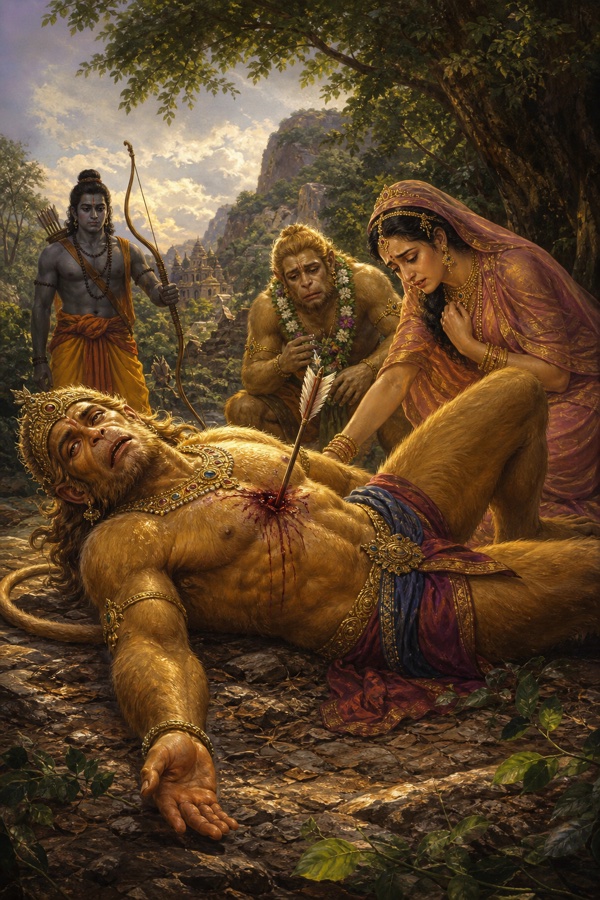
“Now that you, the leader of great generals, have gone back to the five elements, I am stripped of every joy and every hope, and grief has closed over my head like deep water. My heart is very strong, that it does not break today into a thousand pieces at the sight of you fallen helpless on the ground. You carried off Sugriva’s wife and drove him into exile, and here is the fruit of that wrong, ripened at last and reaped by you in a single day. Wishing you well, meaning nothing except your highest good, I gave you counsel that would have saved you, and in your ignorance you scorned it. Now you have a body of light, and you will stir the hearts of the celestial nymphs, who are clever at love and proud of their beauty and their unfading youth. The hour that was to end your life arrived, and there was no doubt in it; by that hour alone were you, whom nobody could command, forced under the power of Sugriva.
“And Rama, who struck you down while you fought another, who has done a thing so contemptible, will he not be sorely troubled at heart? He should be. I was raised where sorrow never came and I have never been miserable in my life, and now I will suffer widowhood like a woman with no protector, full of grief and pain. And to what state will Angada come, brave and tender, raised by me in every comfort and deserving of every comfort, when his uncle Sugriva is beside himself with anger?” Then she turned to her son. “My son, look well on your father, who loved dharma; his face will be hard to come by from now on, my darling.” And she turned back to Vali. “Comfort your son one more time, breathe in the scent of his head, and give me your parting message, for you have set out on the journey to the other world and you are already partway down that road.
“Rama has done a great deed by killing you; he has cleared the debt of the word he gave Sugriva, to do away with you. Be satisfied now, Sugriva; your wish has been granted. You will have Ruma back. Enjoy the kingdom and be untroubled, since your enemy brother is dead. And you, why do you not speak to me, your beloved, who go on lamenting like this? Look, here are your many lovely wives.” Hearing Tara’s lament, all the monkey-women, gathered around Angada, cried aloud in their grief and their pain.
“My lord with the heroic arms and the armlets on them, why have you set out on your long road to the other world, deserting Angada, who is so near to you in every excellence and so beautifully dressed? To go so suddenly is not right. If ever in my thoughtlessness I did anything to cross you, my long-armed lord, forgive me that offense; I touch your feet with my head, protector of the race of monkeys.” Lamenting so, with the other monkey-women around her, Tara of the faultless complexion resolved to take no food and no drink, and to sit on the bare ground beside the place where Vali lay, and to wait there for her own death. She had read the omens correctly, argued the case correctly, named the enemy correctly, and been overruled; and this was what was left to her to decide.
Hanuman’s words of comfort
Then Hanuman, a commander of the monkey hordes, came and comforted Tara, gently, where she lay on the ground like a star dropped out of the sky. He told her what her weeping could and could not do. “An embodied soul, when it leaves this world, reaps in full the good and the evil fruit of everything it did under the notion of virtue and vice, with its eye on the reward. You are yourself a fit object of grief; whom then do you grieve for as pitiable? You are yourself miserable; what miserable creature do you pity? In a body as fleeting as a bubble, who is worth grieving for, and by whom? This boy, Angada, is the one who should be looked after by you now, a mother with a living son; and give your thought to the rites you must perform in the days ahead for Vali’s good in the other world. You know that the birth and the death of creatures are fixed by nothing we can see. So, wise lady, at a time of bereavement only what yields good in the world to come should be done, and nothing that is merely of this world, like this wailing and crying for a soul that has departed.
“Vali, on whom hundreds of thousands, hundreds of millions of monkeys hung their hopes, has reached the end of his allotted span, and no more than the end of it. He ruled his kingdom by the rule of fairness, he consoled the afflicted, he gave to those in need, he forgave those who wronged him; a king like that goes to the world of those who have won their victory through dharma. You should not grieve for him. All the tigers among the monkeys, and this son of yours, Angada, and the kingdom of the bears and the monkeys, all of them have their protector in you, blameless lady. Gently rouse Sugriva and Angada, who are both distracted with grief, to what has to be done. Take Angada by the hand and let him rule the earth. Everything for which a son is commended in the scriptures, everything that does the dead king good in the other world, let it be done; that is the decree of Time. Vali must be cremated, and Angada must be set on the throne. When you see your son on the throne, you will find peace.”
Tara, wounded by her husband’s ruin, answered Hanuman where he stood beside her, and refused him everything. “Let there be a full hundred sons like Angada on one side of the scale. To clasp the limbs of this hero, even now that he is killed, is dearer to me than all of them. I have no power over the kingdom of the monkeys, and none over the crowning of Angada. His uncle Sugriva is the authority in every matter, and he is standing close at hand. This idea of yours about Angada is not worth holding to; it is the father, and in his absence the uncle, who stands as a son’s friend, and not the mother, best of monkeys. For me, nothing in this world or the next is better than to follow the king of monkeys. This bed of bare ground, which the hero made his own when he was cut down facing his enemy, is fit for me to share as well.”
Vali’s last counsel and his passing
Very little life was left in Vali now. He cast his eyes all around, drawing slow breaths, and the first thing he saw was his younger brother standing alone in front of him. Sugriva had beaten him, and Sugriva was the ruler of the monkeys now, and what came out of Vali when he looked at him was love, in a voice that was somehow distinct. “Sugriva, do not hold me guilty of the wrong I did you, the exile and the taking of your wife. Think of me as a man dragged off by force, by a perversity born of what was bound to come, and I went where it dragged. Happiness, dear brother, was not ordained for the two of us at one and the same time, and that is why the affection that ought to bind two brothers turned the other way, into enmity. Take today the rule of these forest-dwellers, and know that I go this very day to the abode of Yama. I am giving up, and quickly, and for good, my life, my kingdom, my great fortune, and my unstained fame, all of it.
“Whatever I ask of you in this dying state, heroic king, hard as it may be, you must do it. Look at Angada, fallen on the ground, a boy who deserves every comfort and has been raised in comfort, his face bathed in tears, and yet no child, for all that he is a boy. Protect him on every side, this Angada who is dearer to me than my own life, as you would a son sprung from your own loins, for now he will be left without me, and let nothing be lacking to him. Be his father, his giver, his protector, and his refuge in every danger, as I was, ruler of monkeys. This glorious son of Tara is your equal in prowess, and in the killing of those ogres he will go in front of you and not behind. Showing his prowess on the field, this mighty and glorious son of Tara, young as he is, will do deeds worthy of me.
“And this Tara, Sushena’s daughter, is beyond anyone at deciding the subtlest matters, at reading the meaning of every kind of portent, at everything. Whatever she calls right, do it, and do not stop to doubt it; no opinion of Tara’s has ever turned out wrong. And accomplish Rama’s purpose without a moment’s question; to fail him would be a sin, since you gave him your word, and slighted, he could kill you. Wear this heavenly chain of gold too, Sugriva; the exalted goddess of victory lives in it, and once I am dead she may leave it for good if it stays on a corpse.”
At those words, spoken out of a brother’s love, all the joy went out of Sugriva, and he was wretched again, like the moon when Rahu seizes it in an eclipse. Calmed by Vali’s gentle words, and careful now to do what the moment asked, he took the chain of gold with his brother’s leave. Then, having parted with the chain, and seeing his son standing in front of him, Vali, now set firmly on death, spoke fondly to Angada. “From now on, weigh the time and the place in everything you do; take the pleasant and the unpleasant alike, and when the moment comes, set joy and sorrow aside together and put yourself under Sugriva’s command. I always indulged you, and if you carry yourself with him the way you did with me, Sugriva will not think highly of you, mighty-armed boy. Do not go over to those who are not his friends, and never to his enemies. Be devoted to your master’s interests, self-disciplined, and under Sugriva’s will. Give nobody too much affection, and give nobody too little; both are grave faults, so keep your eye on the middle way.” Saying this, Vali, in the extremity of the arrow’s pain, his eyes turned upward and his terrible teeth bared, gave up his life. The chain that had held his life in place was gone from his neck, and nothing else had been holding it.
Then all the monkeys standing there, the foremost of their race, whose leader had been killed, broke down and wept and cried out in lament. “With the king of monkeys gone to heaven, Kishkindha is desolate today, and its gardens and its mountains and its forests are desolate. Vali, that tiger among monkeys, by whose great might the woodlands and the groves were kept clothed in flowers the whole year round, is killed, and the monkeys are stripped of their splendor. Who will do that for us now? He granted the high-souled, mighty-armed gandharva Golabha a fierce war that lasted ten years and five more, and it stopped neither by night nor by day, and in the sixteenth year he brought that insolent creature down. After killing such a foe, how has this Vali, with his terrible teeth, who took away our fear from every quarter, been thrown down today?” They had no more happiness in them than the wild cows of a great forest have when a lion has killed the bull that led the herd. Then Tara, drowned in an ocean of calamity, gazing on her dead husband’s face, embraced Vali like a creeper clinging to a huge uprooted tree, and sank to the ground with him.
Tara’s last lament and the drawing of the arrow
Tara bent over the face of the king of monkeys and breathed in its scent, out of love, and then she spoke to him as though he could still hear her. Her name was known through all the worlds, and every word she had now was for one dead monkey on a stony field. “You would not follow my word, O hero, and now you lie in discomfort on this uneven, hard, rocky ground. This earth must be dearer to you than I am, since you lie embracing her and give me no answer at all. So Fate, in the shape of Rama, has bent itself to the will of Sugriva. Sugriva alone is the powerful one now, my hero who loved daring, and Sugriva will rule Kishkindha. The foremost of the bears and the monkeys took shelter with you, because you were strong; why then do you not wake at their cries of distress, at the wailing of Angada, at these plaints of mine? This bed of hard, uneven, stony ground is the bed of a hero. It is the same bed on which your enemies were laid when you had killed them, and on that bed, today, you lie killed yourself in battle, my lord who loved war, born of a line whose strength was pure, my darling.
“You have gone to the other world and left me alone with no one to protect me. The wise say a girl should never be given in marriage to a hero, and I stand here as the proof of it: look at me, the wife of a hero, widowed in a moment and ruined forever. The pride I had as the wife of a sovereign is crushed, and the happiness I thought would last my whole life is broken in pieces. I have gone down into an ocean of grief that has no floor and no shore. This heart of mine is surely made of stone, that it has not split into a hundred fragments today at the sight of my husband slain.
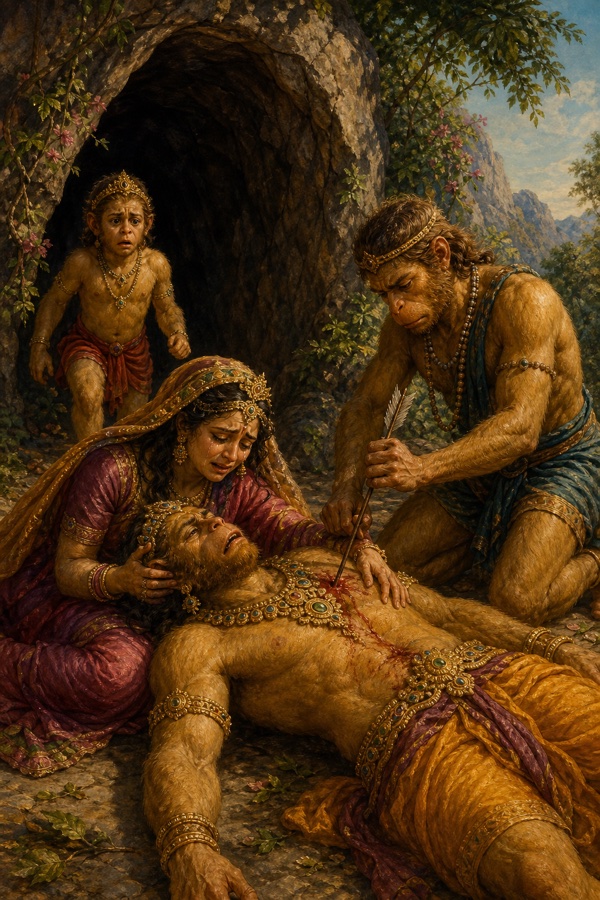
“He was my friend who asked nothing for himself, and my support, and he was dear to me by his very nature, a hero whose blows nobody withstood, and he has gone back into the five elements. A woman whose husband is gone, though she has a son, though she is rich in wealth and grain, is called a widow by the wise, and that is what I am now.” He lay in a pool of the blood that had run out of his own limbs, and it wrapped him the way the deep red coverlet of his own bed had wrapped him at home, red as the indragopa insects that come out after rain. Every limb of him was caked in dust and blood, and she could not take him in her arms. “Sugriva, whose fear a single arrow of Rama’s has lifted from him, has gained his end in this most terrible of feuds. I am kept from embracing your limbs by the shaft that is fixed in your heart, and all I can do is stand and look at you, who have gone back into the five elements.” Then Nila, a general of Sugriva’s, took hold of the arrow and drew it out of the body, the way a man draws a blazing venomous serpent out of a cave in a mountain. Even as it came free of Vali’s breast, the shaft shone the way the sun shines when a western peak has cut off its rays. Streams of blood ran out of the wound on every side, like the torrents that come down a mountain stained with red ochre. Tara wiped the dust of the battle off her hero, and as she wiped him she bathed him in the tears that ran from her eyes. Then, looking at her husband slain and bathed all over in blood, she turned to her son, whose eyes were the same reddish brown as his father’s. “Look, my son, at the last state of your father, and how terrible it is.
“The feud that was forced on him by the sinful deeds of some former life has come to its end. Greet your father, my son, the king, who gave honor to others, whose body shone like the newly risen sun and who has gone now to the house of Yama.” Angada rose when she said it. He was still a boy, and he clasped his father’s feet with his stout, rounded arms and said, “I am your son. I am Angada.” And Tara went on, to the body: “Why do you not bless him as you used to when he greeted you, and say ‘Live long, my son’? I am standing beside you with my son the way a cow stands with her calf beside a bull that a lion has struck down all at once, and the awareness has gone out of you.
“You made your sacrifice in the form of this duel, and the gods were pleased with it, and at the end of every sacrifice comes the bath. How did you take that bath without me, your wife, beside you, with the water that Rama’s arrow provided you in the form of your own blood? And the chain of gold that you loved, the one Indra gave you when you pleased him in a battle, why do I not see it here on your body? Even with your life gone, the glory of a king does not leave you, the way the light of the setting sun does not leave the western mountain. You did not follow the good counsel I gave you, and I did not have the power to hold you back. And now that you have been killed in battle, I am ruined and my son with me, and along with you the goddess of fortune too is leaving us both.”
Sugriva’s remorse and Tara’s praise of Rama
Sugriva saw Tara go under in that grief, which had come down on her with a force there was no standing against, and something in him gave way. He was full of energy, and he had won, and the winning was the thing he could not bear: his elder brother was dead, he had brought it about, and it was unworthy of him. His face was wet. In a single moment the whole prize he had wanted turned sour in him, and with his attendants around him the thoughtful Sugriva walked slowly, grieving, toward Rama. He found him standing there, noble and famous, the bow still in his grip and the arrows beside it like serpents, the marks of royalty on every limb, and he said, “You promised to strike Vali down with a single arrow, and you have done it, and the fruit of it is plain to see: my kingdom and my wife are mine again. And my mind has turned away from every pleasure there is, and from this accursed life along with them, because this life is the thing that has killed my own elder brother today.
“The king is dead. His chief queen, Tara, is weeping as though her heart would break, and the whole city is screaming in its grief, and Angada, his son, may not live through this. O Rama, my mind takes no delight in a kingdom any more. Anger and resentment and the shame of what he did to me: out of those, in the past, I consented to my elder brother’s death, and now that the leader of the monkey hordes is killed, I will be sorry for it every day for the rest of my life. It would have been better, I think today, to have gone on living on Rishyamuka, that jewel of mountains, keeping myself alive the way a monkey keeps alive, than to win heaven by killing Vali. When I challenged him, this high-souled and wise monkey said to me, ‘I do not want to kill you. Go.’ Those were words worthy of him. And the request I made to you, to do away with him, and the deed itself, were worthy of me.
“Weigh the kingdom a man gains by killing his brother against the grief that follows the killing. How can any brother, even with lust set in front of everything else, take pleasure in the death of a brother of such virtue? He never thought my death fit, because it would have taken away from his own greatness; and I, by the crookedness of my own mind, did him a wrong that has cost him his life. When he struck me with the bough of a tree and I lay groaning for an hour or so, he consoled me, and then all he said was, ‘Do not do this again.’ He kept to brotherhood, and to nobility, and to dharma. I showed anger, and lust, and the flightiness of a monkey, and nothing else.
“Indra took on a sin when he killed Vishvarupa, and I have taken one on by planning my own brother’s death: a sin past thinking of, a sin to be shunned, a sin no one would want and no one could bear to look at. The earth, the waters, the trees, and womankind agreed to carry Indra’s sin on their heads among them. Who will carry a monkey’s? Having done a deed like this, a deed that destroys a man’s own house, I do not deserve this honor from the people, nor the office of prince regent, much less the throne of Kishkindha. I have done an abject sin, condemned by the whole world, an injury to the whole world, and a great grief is rushing over me the way the water after a storm rushes down into a hollow. The elephant of sin is mad and full grown, and it is striking me the way a river bank is struck: its hind quarters and its tail are the death of my own brother, and its trunk and its eyes and its head and its tusks are remorse. And what virtue there was in my heart is burning away in the contact with this sin, the way the dross that gold cannot bear for long is burned out of it when it is held on the fire. This clan of mighty monkey chiefs I count as half alive and half dead, because of what I have done and because of the grief that is burning in Angada for his father. A son who is good and obedient is easy enough to come by; a son like Angada is nowhere to be found; and there is no country anywhere in which a man can be near his own brother again. Angada, the best of heroes, may not survive his father. His mother will live only to look after her son, and without him she will not live either, wretched as she is with grief for her husband; of that I am certain. So I will enter a blazing fire, to be with my brother and my son. At your command these foremost of monkey heroes will search for Sita, and even when I am gone, everything you came for will be done. Give me leave to die, O Rama. I have destroyed my own house; I am an offender; I have no right to live.” Rama heard the lament of Vali’s younger brother, the hero of the Raghus who had killed so many warriors in his time, and his eyes filled, and for a moment he did not know what to do.
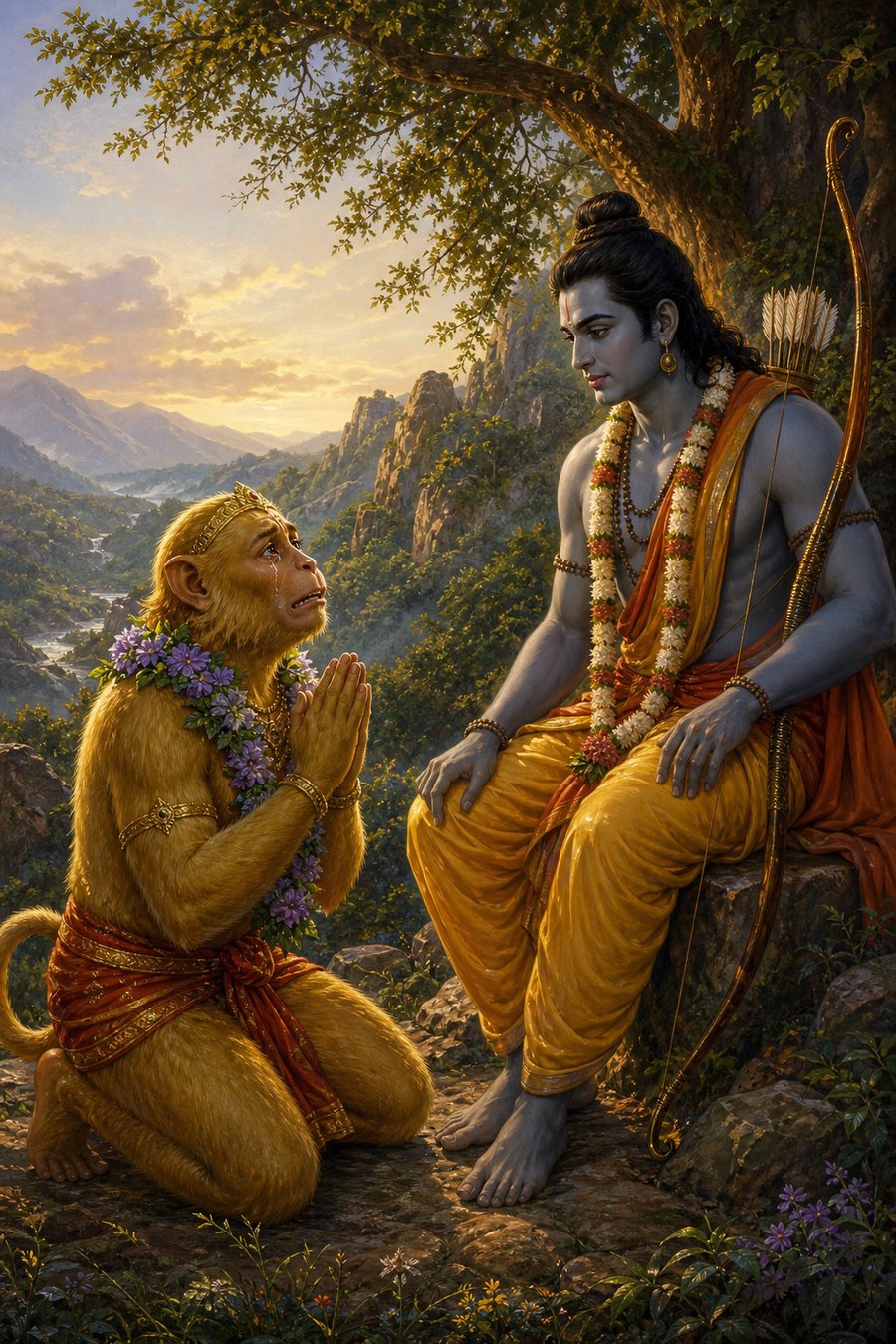
Then Rama, the protector of the world, whose patience was the patience of the earth itself, looked around him again and again, and what he saw was Tara, drowned in her misfortune and weeping. The foremost of Vali’s ministers were lifting her up, the noble-hearted, fair-eyed wife of the king who had been a lion among monkeys, who lay clasped to her husband and would not let go. They pulled her away from him and she fought them and clung to him again, and in the struggle she saw Rama, with an arrow and a bow in his hands, blazing like the sun in his own splendor. She had never seen him. She had heard of him from Angada’s mouth, and now she looked at that lovely-eyed jewel among men, with the marks of a sovereign on every limb, and she knew him for the Kakutstha of the report. She had been right about him, and she had been right at the one hour when it would have mattered. Miserable, fallen into calamity, tottering forward on quick little steps, the noble Tara went to Rama, who was Indra’s equal, hard to approach, exalted in his bearing.
She reached him, this man of pure mind who never missed his mark because no one on any battlefield could match him, and she had lost all sense of her own body in her grief. The words she spoke to him were high-minded, and they came out of her whole. “You are beyond all measure. You are hard to approach even for yogis; you have mastered your senses; you keep the highest dharma and your fame does not decay; you are wise and patient as the earth, and your eyes are red as blood. You hold the bow, and an arrow is in your hand; your might is very great and your limbs are firmly knit. You have given up the happiness a human body can hold, and still you are joined to a bodily glory that is not of this earth. With the very arrow you killed my beloved with, kill me too. Killed by you, I will go to where he is. Vali will not be happy without me.
“Even in heaven, when the apsaras come to meet him and he looks them over with curiosity, in their chaplets of red flowers of every kind and their many-colored dress, he will not love a single one of them unless he sees me there too. Without me, Vali will find nothing in heaven except grief and the draining of the color from his face, just as you, without the princess of Videha, find grief and cheerlessness on the lovely slopes of Rishyamuka, the king of mountains. You know, then, what a young man suffers when he is parted from the wife he loves. Knowing it, do away with me, so that Vali need not suffer the pain of not seeing me.
“And if you are anxious, great soul, that the sin of killing a woman should not fall on you, then kill me as Vali’s own other self, and no killing of a woman will be laid to you. The scriptures give a man the right to sacrifice only in union with his wedded wife, and the Vedas say it in many ways: a wife is one and the same as her husband. That is why men of wisdom hold no gift on earth greater than the gift of a wife. Look to dharma, O hero, and give me back to that beloved of mine, and by that gift no sin will come to you from my death. I am afflicted, I am forlorn, I have come to this, and I am being torn away from my husband; it is not for you to spare me. Without Vali, the wise bull among monkeys who walked with the easy grace of an elephant and wore that priceless chain of gold, I cannot live for long.”
Rama consoles Tara
Rama heard her plea, and he comforted her, and the comfort he gave was the truth as he saw it. “Do not let your thoughts run down a wrong road, wife of a hero. The whole world was made at the beginning of creation by the Creator, and it is he, people say, who joined the whole of it to joy and to sorrow together. All three worlds stay inside the bounds he fixed for them, because they are in his power. The supreme delight you knew before, in the presence of Vali and of Angada, you will know again through Sugriva, and your son Angada will hold the office of prince regent. The Creator has laid the course of things down in exactly this way, and the wives of heroes do not wail.” That was what the high-souled Rama, the scorcher of his enemies, said to reassure her, and Tara, the consort of a hero, finely dressed and lovely to look at, whose face until that moment had been a face of wailing, fell silent.
The funeral rites of Vali
Then Rama, who shared their grief, with Lakshmana at his side, spoke to Sugriva, and to Tara with Angada beside her, and what he said was the plain practical truth that someone has to say in every house where there has been a death. “Grieving for the dead and giving way to remorse does not make a departed soul fit for the state it is going to. What you should attend to now, at once, is the thing that has to be done for his good immediately after a death. Custom asks that tears be shed, and you have shed them. And no rite for the dead can be performed once its appointed time has gone by, and that time is passing now.
“Time is the cause of everything in the world; Time lays down every duty; Time is what moves every creature to act. Nobody is the independent doer of any deed, and nobody has the power to move another to act; the world follows its own nature, and Time is the ground that nature rests on. Time does not overstep its own bounds and Time does not wane; and no living being, coming face to face with Nature in the form of Destiny, can get past it. Time has no kinship with anyone, no friendship, no tie of blood. There is no means of bringing it under control, and no strength prevails against it, and even God, who is the cause of all, is not subject to the will of any single soul. A man who sees clearly sees everything as an unfolding of Time; dharma, wealth, and pleasure, all three, are attained in Time’s course and in no other way. Vali has gone back to his own nature. He reaped the spotless fruit of what he did, the enjoyment that comes of conciliation, of giving, and of the right use of wealth; he held to his own dharma, and by not clinging to his life he has earned and reached the highest heaven. The destiny that the leader of the monkey hordes has attained is the best there is. So have done with grief, and turn to what this hour asks of you.”
When Rama had finished, Lakshmana, who had killed many a warrior in his time, spoke courteously to Sugriva, who had lost all hold on himself. “O Sugriva, see at once, with Tara and Angada, to the rites for Vali’s body, and to his cremation. Give the order to some responsible officer to gather many logs of dry wood and fine pieces of sandalwood for the burning. Comfort Angada; he is wretched and his mind is broken. And do not be childish yourself: this city depends on you now. Let Angada fetch garlands and cloth of every kind, ghee and oil and fragrant things, and whatever else is needed at this moment. Tara,” and here he turned to the counselor Tara, one of Vali’s ministers, “go quickly and bring back a palanquin. Haste is a virtue at any time, and at this hour above all. And let strong monkeys who are fit to carry a palanquin make themselves ready, for they will be carrying Vali to the burning ground.” Having told Sugriva what to do, Lakshmana, who was the joy of his mother Sumitra, stood silent at his eldest brother’s side.
The counselor Tara heard Lakshmana and went quickly, his mind in a turmoil, into the cave that held the city, with a palanquin and nothing else in his thoughts. And he came running back with one, borne on the shoulders of strong monkeys chosen to carry it. It was a palanquin that had come from heaven, shaped like a chariot, with a raised royal seat, and good fortune rode with whoever rode in it. Its sides were carved with the figures of birds of every kind and of trees, and crowded with the figures of foot-soldiers, every part of it disposed by an artist’s hand; it had lattices and eye-holes for the air to pass through, like the aerial chariot of the Siddhas; it was well-jointed and roomy, designed by carpenters and finished by craftsmen who loved their work, with little pleasure-mounds of wood, with fine ornaments and necklaces, with flowers of many colors, netted over, painted with red sandal paste, heaped on every side with flowers, and hung with garlands of lotuses that had the color of the rising sun. Rama looked at it and said to Lakshmana, “Let Vali be carried away quickly, and let the rites for the dead be done.” Then Sugriva, with Angada, crying aloud the whole time, lifted his brother’s body and laid it on the palanquin, dressed in ornaments of every kind, in garlands and in fine cloth. And King Sugriva, ruler of the monkeys now, gave the order: “Let the last rites for my noble elder brother be done exactly as the scriptures lay down. Let monkeys go in front scattering jewels of every sort in plenty, and let the palanquin come close behind them. Whatever costly things are seen on this earth at the funerals of kings, let the monkeys honor their lord with the like of them here.” The counselor Tara and the others put their arms around Angada and set to the rites at that standard, and quickly.
All the monkeys walked in that procession weeping, because it was their kinsman on the palanquin. The monkey-women who had lived under Vali’s protection cried out together, “O hero, O hero,” and went on mourning their beloved lord; and the women, Tara at their head, followed their husband in a long pitiful wail, and at the sound of them, deep in the forest, the woods and the hills seemed to be crying too, on every side. On a lonely sandbank of a mountain river, with water all around it, a great many of the forest monkeys built the pyre. The chief monkeys who had carried the palanquin took it down off their shoulders and stood apart on that lonely place, and every one of them was given over to grief. Tara saw her husband lying in the bottom of the palanquin, and she lifted his head into her lap, and out of the depth of her pain she lamented. “Great king of the monkeys, my lord who was so fond of me, whom the great honored, my mighty-armed darling, look at me. Why do you not spare one glance for this handmaid of yours, whom grief has beaten down? Your life is gone, and your face, colored like the setting sun, still looks as glad as it did when you were alive. It is Time in the form of Rama that is dragging you away from us, the Rama who with a single arrow, on a field where you were fighting someone else, has made widows of us all. Do you not know that these wives of yours, who are monkeys and yet cannot leap, have come this whole long road on foot? Why do you not look at these wives whose faces are like the moon, who are surely dear to you, and at Sugriva? Here stand your counselors, Tara and the others, and here stand the citizens, all around you, all of them dejected. Dismiss your counselors, tamer of your enemies, the way you used to; and then we will all go and play with you in the woodlands, drunk with love.”
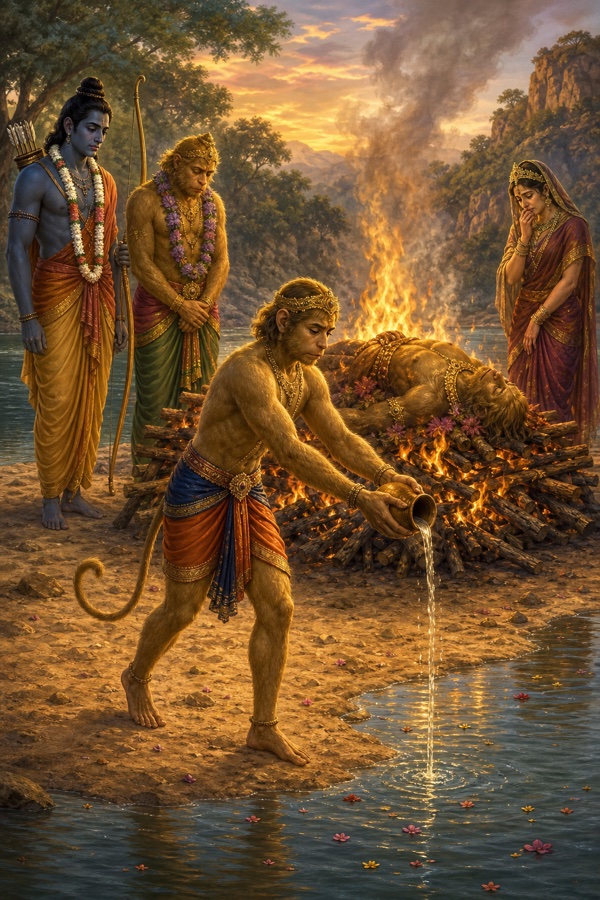
The monkey-women, thin with grief, raised Tara up, hemmed in as she was by the sorrow of her husband’s death and lamenting like that. Then Angada, with Sugriva’s help, weeping without pause, his senses drowned in grief, lifted his father’s body onto the pyre. He gave fire to it in the order the scriptures set down, and then, with his senses in turmoil, he walked around his father, who had set out on his long road, keeping him on his right hand: so the tradition tells it. When they had cremated Vali with full ceremony, the foremost of the monkeys went down to the river, the blessed Tungabhadra, whose water is holy, to offer water to the departed for his contentment in the other world; they set Angada in front, and all together, Sugriva and Tara with them, they poured out handfuls of water there for Vali. Rama, who shared the grief of the wretched Sugriva and was wretched with him, had every rite for the dead carried through under his own guidance. And when Vali, that hero of the highest manhood whom the whole world had known, killed by the arrow of the best of the Ikshvakus, had been burned on the pyre, glorious as the blazing fire itself, Sugriva went back to Rama, who was standing there with Lakshmana.
Sugriva crowned, and Angada made heir-apparent
Sugriva stood in wet clothes, tormented by grief, fresh from the bath that follows a cremation, and the highest officers of the monkey army gathered around him. They went with him to Rama, the mighty-armed, who never tired in a task, and all of them stood with their palms joined, the way the rishis stand beside Brahma, the grandfather of the world. Then Hanuman, the son of the wind, who had the luster of the golden mountain and a face like the rising sun, joined his palms and spoke. “By your grace, this great kingdom of the fathers, which the high-souled monkeys with the sharp teeth and the full measure of strength have held from of old and which is so hard to win, has come into Sugriva’s hands. With your leave he will enter the prosperous city in state and carry out all his royal duties in the proper way, with his kinsmen and his friends around him. He will take the ceremonial bath of his installation, as the scriptures ordain, in water made fragrant with perfumes and herbs, and he will honor you above all others, with garlands and with jewels. Come, then, to this lovely mountain cave that holds the city. Join the monkeys to their master, and make them glad.”
Hanuman had asked for the one thing Rama would not give, and Rama, who was wise and knew how to put a thing into words, answered him without hardness. “Hanuman, my gentle friend, I keep my father’s command, and for fourteen years I will not enter a village, let alone a town. Let the valiant Sugriva, the best of monkeys, go into that rich and marvelous cave and be installed on the throne of Kishkindha without delay and with full ceremony.” Then he turned to Sugriva. “You know the rules of conduct, both the world’s and dharma’s. Install this Angada, rich in character, great in strength and valor, in the office of prince regent. He is the eldest son of your elder brother and his equal in prowess, and this boy, whose spirit does not sink, deserves that office.
“This is Shravana, my friend, the first of the months of rain, the month the water comes. The four months that go by the name of the rains have already begun. This is no season for the effort of a search. Go into the auspicious city; I will live here on this mountain with Lakshmana. This wide cavern is a lovely place, roomy and airy, with plenty of water running through it and plenty of lotuses and lilies. When the month of Kartika comes, make your effort to be rid of Ravana. That is our understanding, my gentle friend. For now, go into your own house. Be installed in the kingdom, and give your near and dear ones their joy.”
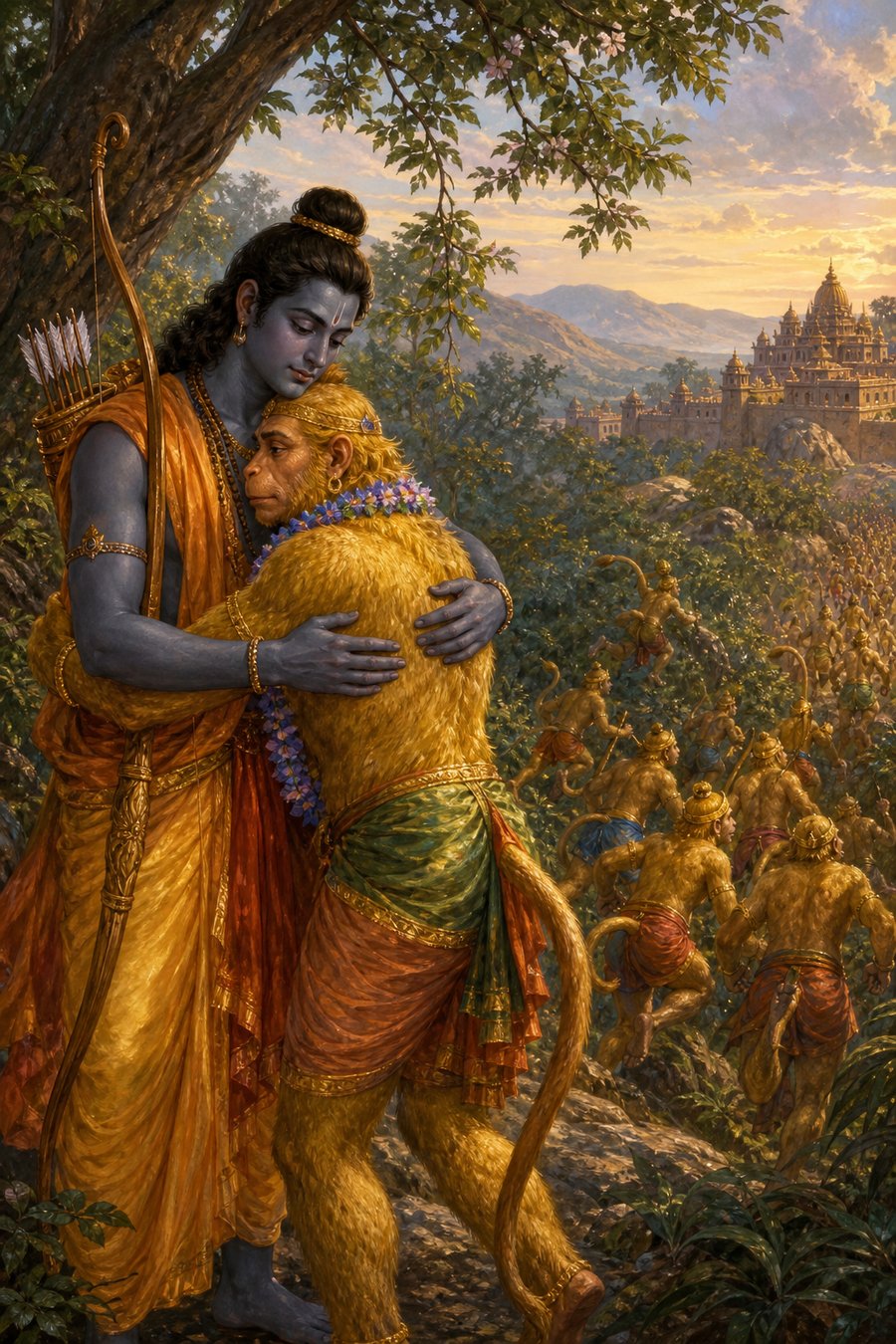
With Rama’s leave, Sugriva, the best of the monkeys, went into the lovely city of Kishkindha that Vali had guarded for so long, and thousands of monkeys saluted him at the gate and went in around him on every side. When the subjects saw the lord of the monkey hordes they bowed their heads and lay down flat on the ground, every one of them together. Sugriva, strong and vigorous, bade them all rise, spoke kindly to each, and then he went into the pleasant inner apartments that had been his brother Vali’s. When he came out of them again into the assembly hall, his kinsmen consecrated him, the way the gods consecrated the thousand-eyed Indra. They brought him a white canopy worked with gold, and two white yak-tail whisks with golden handles, the kind that bring a king renown; they brought jewels of every kind, and every kind of seed and herb, and the tender shoots of the trees that give milk, and flowers, and white raiment and white unguent, and fragrant flowers of the land and of the water, and sandalwood of the divine kind, and many fragrant things, and grains of unbroken rice dyed yellow with turmeric, and gold, and panic seed, honey and ghee, curds, a tiger’s skin, and a pair of costly shoes. And sixteen lovely maidens, glad at heart, came to the place carrying fragrant paste for the body, and gorochana, the bright yellow pigment, and red realgar.
They satisfied the foremost of the Brahmins with jewels and cloth and food of every kind, and then they set about consecrating Sugriva with the ceremonial bath, in the order the scriptures lay down. Men who knew the sacred texts fed the fire, once it had been girdled with kusha grass and kindled, with offerings sanctified by mantras. Then they seated Sugriva with the proper mantras on a fine throne with legs of gold, spread with rich coverings, in a lovely upper chamber of the palace hung with bright garlands, with his face to the east. They had gathered water from the streams and the rivers and the holy fords in all four quarters, and brought water from every one of the seas, and stored that clear water in pitchers of gold; and now Gaja, Gavaksha, Gavaya, Sharabha, Gandhamadana, Mainda and Dvivida, and Hanuman, and Jambavan, the chief of the bears, poured that limpid, fragrant water over Sugriva through beautiful horns of bulls and out of golden jars, by the rite the scriptures prescribe and the great rishis ordained, the way the Vasus once bathed the thousand-eyed Indra.
When Sugriva had been consecrated, hundreds of thousands of high-minded monkeys roared with delight. Then, doing what Rama had told him, the lord of the monkeys took Angada in a close embrace and installed him as prince regent. At Angada’s installation the great-hearted monkeys, who all felt for the boy, cried out “Well done, well done,” and praised Sugriva for it; and with Sugriva and Angada in Kishkindha as king and prince regent, all of them rejoiced and praised the high-souled Rama and Lakshmana over and over again. The city of Kishkindha, inside its mountain cave, crowded with joyful, well-fed people and bright with buntings and flags, was lovely to look at. Sugriva reported to the high-souled Rama that his great consecration was done. He had his wife Ruma back. The valiant leader of the monkey army came into his kingdom the way Indra, the sovereign of the gods, came into the sovereignty of heaven. And on the mountain above that city, as the rains of Shravana came down, the man who would enter no city sat down with his brother to wait four months for his own wife.
The gist: Hanuman calls Rama to Kishkindha, but because of his father’s word Rama will not enter the city and resolves to stay on the mountain with Lakshmana. He directs that Sugriva take the kingdom and Angada the office of heir-apparent, and sets the search for Sita for after the month of Kartika. Sugriva is duly consecrated, wins back Ruma, and Angada becomes prince regent.
Source: Srimad Valmiki Ramayana, Kishkindhakanda, Cantos 15 to 26. The Gita Press Hindi edition is the controlling witness. The Sanskrit e-text and an independent complete translation were used to verify names, sequence, and principal events. Where recensions differ, this retelling follows Gita Press.
Basis: Valmiki Ramayana (Gita Press, Gorakhpur)