On this page
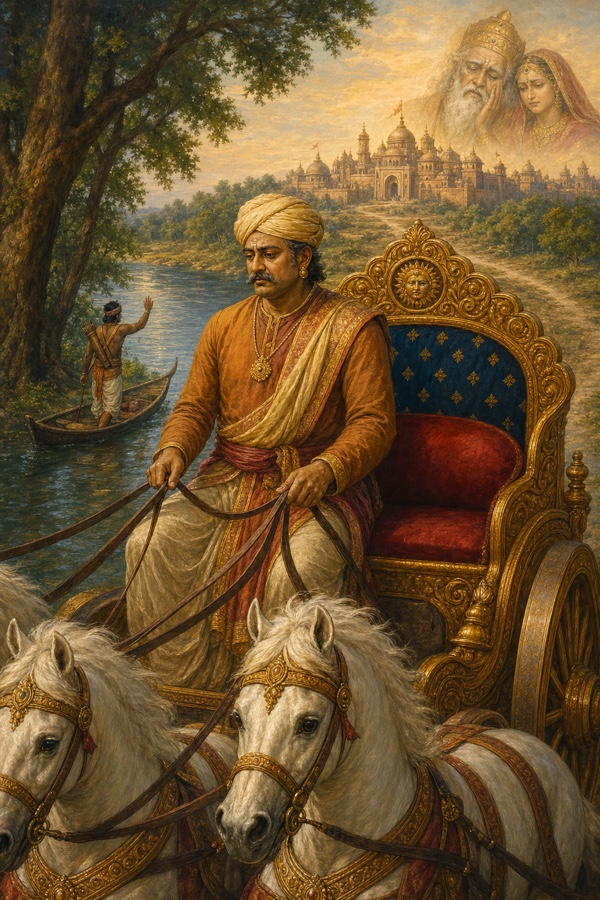
The moment Rama’s foot touched the southern bank of the Ganga, the two men who had stood with him on the far side turned back toward their own lives. Guha, king of the Nishada foresters, who had seen the exiles safely over the water, went home to Sringaverapura. Sumantra, the old charioteer and counselor who had driven the prince out of Ayodhya only days earlier, took up the reins of an empty chariot and pointed the horses toward the capital. Behind him, across the water, the fourteen years of exile that Kaikeyi’s two boons had bought were only a few days old, and Bharata, the son those boons had made king, was far away at his grandfather’s court and knew nothing of any of it. The city Sumantra came back to met him as a hollow place, wordless, looking as though fire had passed through it. What follows is the slow collapse of a king, opening before you one stage at a time: first the grief of the people, then the swooning of the queens, then Dasharatha fainting and reviving and fainting again, and at last the old secret he had carried buried through the better part of a lifetime. It is the curse of a blind ascetic and his blind wife, spoken over the body of their only son on a riverbank when Dasharatha was young and proud of his bow, and it falls due now, in the shape of a father losing his own. Come and hear this sorrowful history in Valmiki’s own order, from Canto 57 to Canto 64.
Sumantra the charioteer returns to a hollow Ayodhya
Guha had kept Sumantra beside him a long while on the northern bank, and the two of them had talked of Rama, of his qualities, of the night the prince had slept on a bed of leaves under the forest king’s watch, until the talking became its own kind of ache. When Rama at last set foot on the southern bank, Guha went home. Everything that happened after that reached them through his watchers, men of Sringaverapura who had followed the road behind the exiles: how Rama came to the sage Bharadwaja at Prayaga, where the Ganga takes the Yamuna into itself, how the sage received him with honor and pointed him toward the hill of Chitrakuta as a place fit for an exile’s years, how the three of them pressed on from his hermitage and reached it. The scouts saw it all, carried it back to Guha, and Guha passed it on to Sumantra, so that the charioteer would have something to bring the king besides an empty seat.
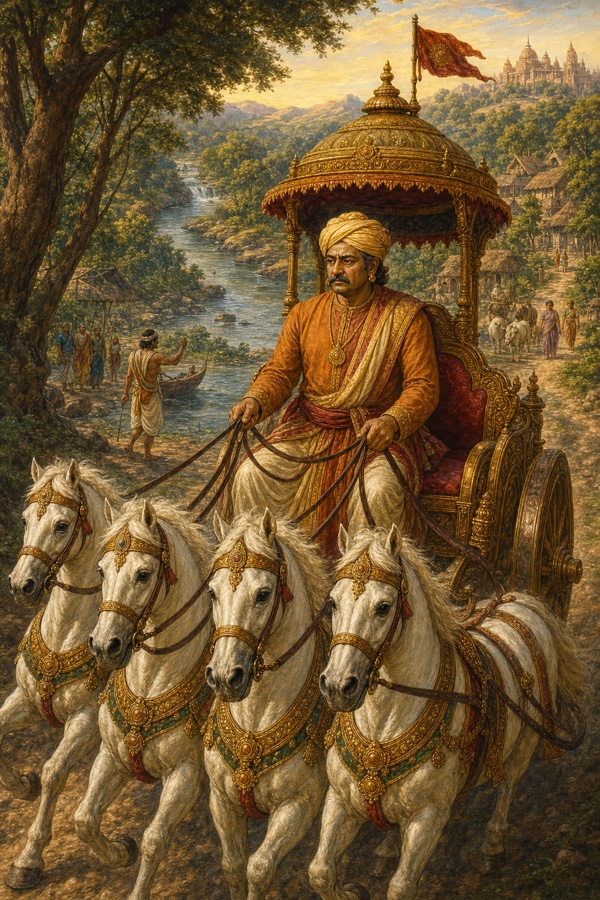
Then Sumantra took his leave, yoked his finest horses to the chariot, and set his course for Ayodhya with a heaviness lodged in his chest that no road could shake loose. Woodlands breathing out their sweet scents, rivers and lakes, villages and towns slid past the wheels as he pushed the team hard. He had driven this road outward with a prince beside him and the whole city running after the chariot in tears; he drove it back alone. On the second day out of Sringaverapura he came within sight of Ayodhya at dusk, the hour when a great city ought to be at its loudest, and found it stripped of every joy. Nothing came out to meet the evening. The silence of the place, as complete as an abandoned city’s, worked on him, and a thought rose that he could not push down: what if Ayodhya, its elephants and horses, its people and its king, had already burned away in the fire of grief that Rama’s exile had lit.
Still turning that fear over, he reached the city gate and drove quickly inside, and the city answered him. People came at the chariot by the hundred and by the thousand, all of them asking the one thing: where is Rama? He gave them the only answer he had. “On the bank of the Ganga at Sringaverapura I took my leave of Rama. He sent me back himself.” So the exiles had already crossed the river, and the certainty of it went through the crowd like a blow. Faces streamed. “Shame on us,” they said, drawing in cold breaths, and then the cry went up, “Rama, our Rama.” They stood clustered in the streets and told one another they were finished men now, since they could not see Rama in the chariot that had carried him away. Never again, they said, would the good and gentle prince stand among them at the giving of gifts, at the fire-rites, at weddings, at the great gatherings of the city, this prince who had looked after every citizen the way a father looks after his children, weighing what was good for each man, what he wished for, what would make him happy. Sumantra drove on through the market streets and heard, from the windows above him, the lament of the women whom Rama’s going had broken. He drew a fold of cloth across his face and kept to the center of the royal road, making for the place where King Dasharatha waited.
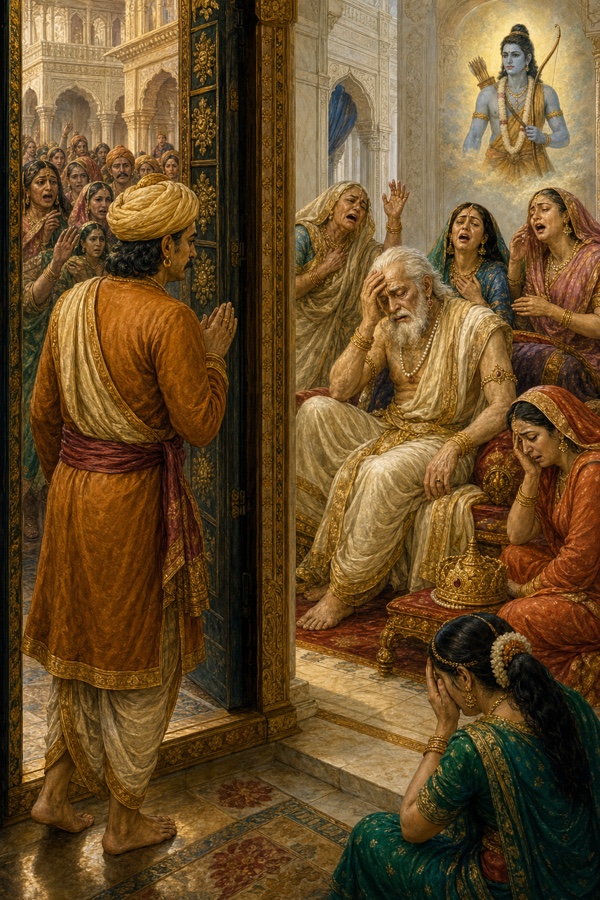
He climbed down from the chariot, went into the palace, and passed through seven crowded courtyards one after another, each gate thronged with men. From the great houses and the seven-storied towers the women looked down, saw that Sumantra had come back from the forest and that the seat beside him was empty, and a wail went up. These were women grown thin in the days since Rama went, and now they looked at one another with wide, vacant eyes, the tears washing the black paint from their lashes. Through the noise Sumantra caught the low talk of the king’s own consorts. What answer, they were asking one another, would the charioteer give to Kausalya when she screamed the question at him? He had driven out with Rama; he had come home without him. And if Kausalya could go on living after her son had walked away from the throne, then it must be true that a life is hard to end, harder than it is to keep against every blow. Hearing that bleak truth spoken among the queens, Sumantra went forward as though grief had set him alight. He crossed into the eighth courtyard and there, in the white chamber, he saw the king, sunk and anxious, shrunken with mourning for his son, an old man in a white room. This was the king who had run after the chariot on foot the day Rama left, and fallen in the road, and had been carried into Kausalya’s apartments, and had told Kaikeyi to her face, when she reached out to steady him, that she was no wife of his and no kin. Sumantra came close, bowed, and delivered Rama’s message word for word, as he had been charged to do. The king heard it out in silence, and at the end of it his mind gave way, and he dropped to the ground in a faint, undone by the loss of Rama. The whole of the inner palace broke apart at that. When the king went down, the women there flung up their arms and screamed. Sumitra, another of the three queens and Lakshmana’s mother, helped Kausalya raise her fallen husband, and it was Kausalya, Rama’s own mother, who found words. “Why, my lord, do you give no answer to Rama’s messenger, who has done so hard a thing and come home from the forest? You sent your eldest and best son into exile. Does it shame you now? Rise. Let the merit you earned by keeping your word stand firm. Give yourself over to grief and those who depend on you may not outlive it. Kaikeyi, whose anger keeps you from even asking the charioteer about Rama, is not in this room. You may ask freely.” And having said it, Kausalya, drowning in sorrow, her words breaking on her tears, sank to the floor herself. Seeing her down, seeing their king lying senseless, every woman in the room wept, and old and young alike, men and women together, took up that piteous cry, and Ayodhya was thrown into grief all over again.
The king hears Rama’s message
When the king came out of his faint and his senses returned, he called for the charioteer, to hear the whole account of Rama. Sumantra came with his palms pressed together and stood before that aged emperor, who was sighing helplessly, gripped by pain and sorrow, unwell in body and mind, grieving for Rama and for nothing else in the world, so that he looked like an elephant newly taken in the trap, that draws long breaths and remembers the leader of its herd. The charioteer stood there in respect, his look wretched, his limbs gray with the dust of the road and his face wet, and the king, like a man in torment, put his questions to him.
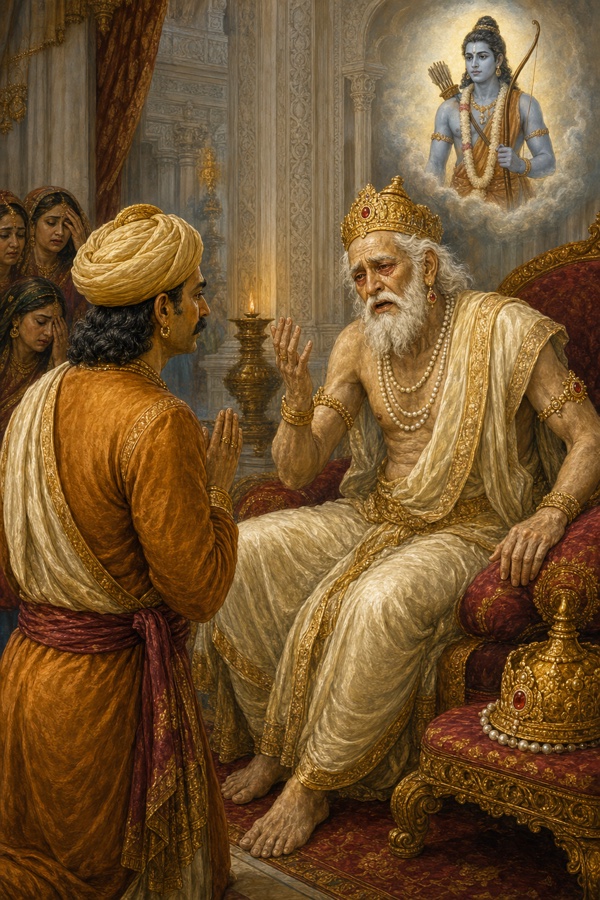
“Where will Rama shelter tonight, a man whose whole heart is set on what is right, with nothing to lean against but the root of a tree? What will he eat, he who has known nothing but comfort since the day he was born? How does my son, who was never made for suffering, who belongs on a soft bed, lie down on the bare ground like an orphan with no one in the world? Rama, whom foot soldiers and chariots and elephants used to follow whenever he stepped out of his palace, how does he live shut inside an empty forest? How have my two boys made a home, with Sita beside them, in woods full of flesh-eating beasts and deer and black cobras? How did they get down from the chariot and go on foot, Sumantra, with Sita, so delicate, who has taken up a life of hardship? You have done what you set out to do, charioteer. You saw my two sons pass deep into the forest, the way the Ashwins, those twin physicians of the gods, pass into the slopes of Mount Mandara. When they reached the forest, what did Rama say? What did Lakshmana say? What did Sita, Janaka’s daughter, say? Tell me how Rama sits, how he lies down to sleep, how he eats. I will live on that much, the way King Yayati, cast down from heaven when his store of merit ran out through his own boasting, still lived on in gladness among holy men.”
The charioteer answered him in a voice that shook and kept catching on tears. “Your Majesty, Rama folded his hands and bowed his head, keeping strictly to what duty asked of him even then, and said this to me. ‘Carry my greeting, charioteer, to the feet of my father, who has known the Self and deserves to be honored with a bowed head, and salute him in my name. Ask after the welfare of the whole inner palace without leaving anyone out, and offer each my greeting in the order of her rank. To my mother Kausalya give word that I am well, and my respects, and tell her I am careful in every sacred duty. Say this to her also: stay always devoted to what is right, tend the fire-sanctuary at its proper hour, and honor my father’s feet as you would a god’s, my lady. Set down all pride of birth and all the standing your seniority gives you, and treat my other mothers as your equals. And hold Kaikeyi, to whom the king is so devoted, higher than yourself.’”
“‘Prince Bharata is to be treated as the king himself is treated. Kings deserve honor even when they are young in years, and you must keep your duty to a king before your mind. Take word of my welfare to Bharata too, and tell him from me to deal fairly with all his mothers. Press this on Bharata, that strong-armed delight of the Ikshvaku line: even seated in the office of Prince Regent, go on serving your father, who still holds the throne of Ayodhya. The king is past the years of ruling, so do not push him aside on that account. Keep his authority above everything else, and let the regency be enough for you.’ And then, weeping again and again, Rama asked me to tell Bharata one thing more: ‘My mother Kausalya, who loves me past all measure, is to be looked on as your own mother.’ Even as he charged me with all of this, the shining Rama, his eyes like the petals of a lotus, let the tears fall and fall.” The office Rama was assigning to his brother was the one Rama himself had been hours from receiving, on the morning the whole city stood garlanded for his installation as Prince Regent; Kaikeyi’s boons had moved that office to Bharata and sent Rama to the forest in the same breath, and now the exile was telling the heir to be content with it and to keep their father on the throne. Bharata himself was far away in the Kekaya country, at the house of his mother’s father, and knew nothing yet of a throne or a forest; the message would have to wait for him.
“Lakshmana, though, burned with anger, and his words came out hissing. ‘For what crime has this prince been sent away? The king was quick to promise Kaikeyi whatever she asked and quick to carry it out, never once weighing whether the thing should be done at all, and now we bear the whole weight of it. Whether Rama was banished out of hunger for power or to make good some boon, a thoroughly evil thing has been done. Call it the king’s pleasure or call it the will of heaven, I can find no ground at all for sending Rama away. This exile, forced through against every custom and without a moment’s real thought, out of sheer shortsightedness, will end in nothing but regret. As for me, I see no father here at all. Rama is my elder brother, my master, my kinsman, and my father as well. How is the whole body of the people to be pleased with a king who has cast out Rama, the one man they all love, when that king claims to work for the good of all? Having driven Rama into exile against the will of every soul in the land, how does my father mean to go on being king?’”
“And Sita, my king, given now to a hard and holy life, stood breathing hard and unmoving, blank to everything around her, as if some spirit had taken hold of her mind. She had never met misfortune before, this famous princess, and in her husband’s distress she wept and could not say a single word to me. When she saw me making ready to leave, the tears came all at once, and she stood gazing at her husband with a face that seemed to shrivel. Rama himself, held up by Lakshmana’s arm, stood exactly so, hands joined, his face wet with tears. And so, weeping, the ascetic Sita went on looking at the royal chariot as I drove it away, and at me.”
All creation grieves, and the king raves
Sumantra went on. “When Rama had set out for the forest, I bowed to the two princes with folded hands, climbed onto the chariot, and made myself ready to turn back for Ayodhya, holding down a pain I could barely carry. But my horses, the same team that had carried Rama out of this city, would not go the moment I turned their heads away from him. They stood in the road and shed tears of grief. For three days I stayed on with Guha at Sringaverapura, hoping against hope that Rama might send some forester back to call me.
“Your Majesty, in your kingdom even the trees have wilted under the weight of this sorrow, their blossoms and shoots and buds all blasted. The water of the rivers and the ponds and the lakes has dried away, and the leaves of the woods and the pleasure groves have withered. The creatures do not stir, and even the snakes do not glide out to feed. The whole living world lies stunned with grief for Rama, and the forest along the road, for all its birds, has fallen silent. The river water has turned muddy, the lotus leaves have dropped, the lotuses themselves have dried up, and the fish and the waterfowl among them have died. The flowers of the water and of the land give off only the faintest scent and have lost their beauty, and the fruit is no longer sweet as it was. The gardens of the city stand empty, their birds flown, and even the pleasure grounds, best of men, gave me no delight.
“No one welcomed me as I came into Ayodhya. Not finding Rama in the chariot, the people sighed and sighed. When they saw from far off the royal chariot returning without him, every face along the great road ran with tears. From their mansions and their seven-storied towers the women, worn thin from not seeing Rama, broke into lament, and gazed on one another mutely with their great eyes flooded and the black washed from their lashes. In all that grief I could see no line between his enemies, his friends, and those who had never taken a side. With its joyless men and women, its wretched elephants and horses, worn thin by cries of sorrow and filled with the sound of drawn breath, Ayodhya seemed to me a place empty of all gladness, stricken by Rama’s exile, looking like Empress Kausalya herself, robbed of her son.”
Hearing all this, Dasharatha answered in a voice so low and broken it could barely hold together. “Kaikeyi, born of a wicked line and a wicked temper, drove me to it, and I took no counsel with the elders who are wise in these things. I never consulted my friends or my ministers, not even the ones learned in the Vedas. Out of blind infatuation, to please a woman, I did this thing all at once. Or perhaps fate itself has fallen on this house without warning, charioteer, to bring the whole line to ruin. If I have ever done you any kindness, take me to Rama now, this moment. My own breath is rushing me on to see his face one last time. If any word of mine still carries weight in this city today, let someone bring Rama back. I cannot live without him for so much as an hour. And if my strong-armed son has already gone too far, then lift me onto the chariot and take me to him quickly. Where is he, the elder brother of Lakshmana, with his pearl-white teeth and his great bow? I will live only if I can see him properly, and Sita with him. If I cannot see Rama, his eyes reddened at the corners, his ears bright with jeweled rings, then I will go to the house of Yama, where the dead are gathered in. What sorrow is deeper than this, that I lie in this state and cannot look on Rama, the delight of the Ikshvakus? Rama, Lakshmana, my poor ascetic Sita, you do not know that I am dying here in my pain like a creature with no one in the world.”
His mind was drowning now in an agony he could not master, and he began to speak of his sorrow as if it were an ocean, one too wide to swim while there was breath in him. “Kausalya, this ocean of grief I have gone down into, with Rama gone from me, is one no living man can cross, my lady. Rama’s own sorrow, torn as he is from parents and kin and friends, is the great force of its current. My separation from Sita is the far shore it reaches to. My breath going out and coming in is the waves and the whirlpools. The rivers that muddy its waters are the streaming tears of Kausalya and the others. Arms flung about in pain are the leaping of its fish. The loud wailing is its roar. Loosened, tangled hair is the seaweed. Kaikeyi is the fire that burns beneath the ocean floor. The welling up of my tears is the rain that feeds it. The words of Manthara, the hunchback maid who put the poison in Kaikeyi’s ear, are the great crocodiles that swarm its waters. The two boons I granted Kaikeyi are its coastline, and the years of Rama’s exile mark how far it runs. And the bitterest thing of all is that I cannot gather Rama to my chest today, and Lakshmana with him, however I ache to see them.” Those two boons were an old debt. Kaikeyi had earned them years before on a battlefield, in the war of the gods against the demons, when she had saved his life, and he had told her to name her two wishes whenever she chose. She had waited, and she had chosen. Lamenting so, the great king dropped as if lifeless onto his couch, and hearing him wail like that, Kausalya, Rama’s mother, was seized once more by a doubled fear.
Kausalya’s lament and Sumantra’s comfort
Kausalya, shaking again and again as though a spirit had entered her, lying on the floor as if the life had already left her, spoke to Sumantra. “Take me where Rama is, where Sita is, where Lakshmana is. Without them I have no wish to stay alive one moment longer today. Turn the chariot around at once and carry me too to the Dandaka forest, where they have gone. If I cannot follow them, then I will go to the house of Death.” The charioteer, wanting to steady her, pressed his palms together and answered the queen in a voice that broke and caught on his tears.
“Let go of grief and false imaginings and the panic that sorrow breeds. Rama will shake off his own pain and make his home in the forest. Lakshmana, who knows what is right and has mastered his senses, is smoothing his own road to the next world by serving at Rama’s feet. And Sita, settling even in a lonely forest with her mind fixed wholly on Rama, stays unafraid and keeps a calm as easy as if she were in her own house. Not the smallest trace of dejection shows in her. She carries herself, my lady, like a woman well used to being away from home now and then. She takes as much delight in the empty forests as she once took in the groves at the edge of the city. With her face bright as the full moon and her spirits never sinking, the lovely, good-hearted Sita finds a girl’s joy even in that lonely wood, so long as Rama is near. For a woman whose heart and whole life rest in Rama, Ayodhya without him would be a forest, and a forest with him is home.
“As she passes villages and towns, the rivers running by, the many kinds of trees, Sita asks about each of them from whichever of the two, Rama or Lakshmana, happens to be at her side. With one of them near her, the daughter of Janaka feels she is out on a visit to some pleasure garden a couple of miles from Ayodhya. That is all I can recall of her, my lady. The remark she let fall once about Kaikeyi, in a careless moment, does not come back to me just now.” What had slipped out of him through inattention he passed over, and he gave the queen in its place words that were gentle and pleasing to hear. “The glow of Sita, so like moonlight, does not dim for all the weariness of the road, the rush of the winds, the fright of glimpsing fearsome beasts, or the beat of the sun. That famous face of hers, soft-spoken Sita’s, like a lotus, its brightness a match for the full moon, never dulls. Her soles, though no longer touched with red lac, are still as red as the dye and shine like a lotus bud. Out of love for Rama, who likes to see her adorned, she has not laid her jewels aside, and she walks with a grace that outdoes the calling of swans with the music at her ankles. Living in the forest, she takes no fright at the sight of an elephant or a lion or a tiger, resting all her trust in Rama’s arms. None of them is to be pitied, my lady, not they, not you, not the king. This story of Rama will stand in the world for all time. The three of them have thrown off their sorrow and settled with glad hearts on the path the great sages walked, and, in love with the forest, living on nothing but its wild fruit, they are carrying out to the letter the sacred vow of their father.” Yet for all the sound sense the charioteer offered and all his urging, the queen, torn apart by the loss of her son, would not stop crying out, “My darling. My son. My child of Raghu’s line.”
Kausalya’s bitter reproaches
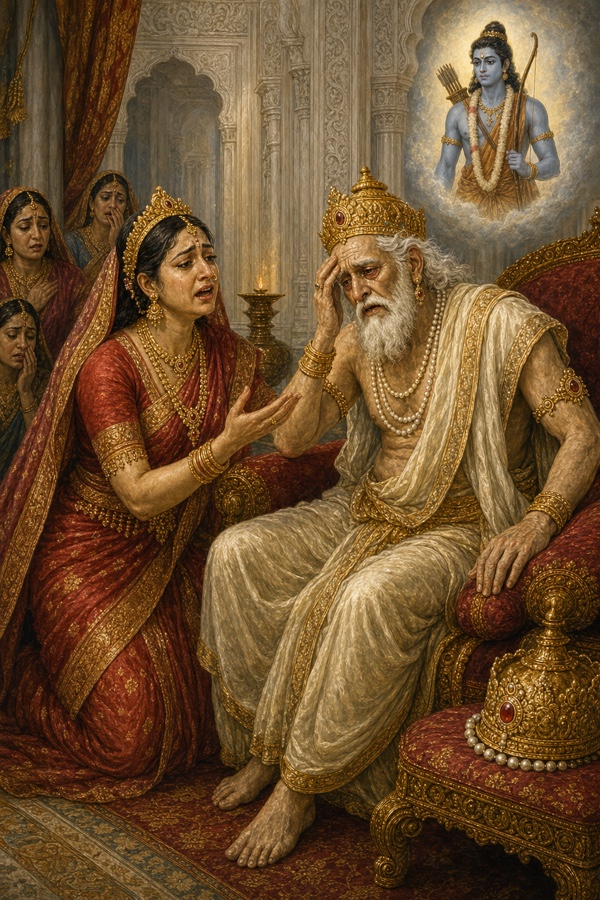
With Rama gone, Rama who loved what was right and stood first among those who bring people joy, Kausalya turned on her husband, weeping, and the loss of her son sharpened every word. “Your great fame runs through all three worlds, and everyone knows you for a man of mercy, open-handed, gentle in speech, and yet you never once stopped to think how your two sons, Rama and Lakshmana, raised in comfort, with Sita among them, would bear the hardships of the forest when the hardships came. That young, tender girl from Mithila, about sixteen and made for ease, how is she to bear the heat and the cold? Sita of the wide eyes, who ate fine food dressed with rich sauces, how is she to live on wild forest rice? She who listened to the sweet strains of voice and instrument, how is she to bear the ugly roar of lions, beasts that live on flesh?
“Where does he lie down now, my strong-armed son, splendid as the banner they raise in Indra’s honor, with only his own arm, hard as an iron bar, thrust under his head for a pillow? When will I see again that beautiful face, colored like a lotus leaf, crowned with lovely hair, its breath sweet as a lotus, its eyes like lotuses? My heart must surely be made of adamant, there is no other explanation, since it does not shatter into a thousand pieces even now, when I cannot see him. This was a cruel thing you did, driving out into a wretched forest life the ones I hold dearest, who were made for comfort. And even if Rama comes back in the fifteenth year, when the fourteen years of exile are spent, no one expects Bharata to hand back the kingdom and the treasury.
“You know how it goes at a shraddha, the feast offered for the dead: some householders first feed their own kin, the daughters’ sons and the rest, and only when that purpose is served do they turn to the great Brahmins they invited. And the Brahmins among them who are men of real character, learned and godlike, will not take that afterthought of a meal, though it be sweet as the nectar of heaven. Even when it is Brahmins who have eaten first, the truly enlightened will not touch what is left from another’s plate, no more than a bull of fine breeding will stand to have its horns cut. Why, then, would Rama, the eldest and the worthiest, stoop to a kingship a younger brother has already used, ruler of the people? A tiger will not eat meat another has brought down; just so, Rama, a tiger among men, will not set his heart on what another has enjoyed. The wise never use a second time in a rite what has served once already: the offered food, the ghee, the rice-cake, the blades of kusha grass, the posts of khadira wood. Just so, Rama will no more accept a throne Bharata has held than a man would crave wine gone flat or the dregs of the soma. He will not swallow such an insult, any more than a strong tiger will suffer its tail to be twisted. All the worlds together in arms could not frighten him in the greatest of battles, and still he did not seize the throne, able as he was, because his mind is fixed on what is right and he is sworn to draw even the wicked toward righteousness by his own example. If he chose, that prince could dry up the very oceans with his gold-feathered arrows, the way the god of destruction unmakes all things at the close of an age. And this warrior, with the strength of a lion and eyes wide as a bull’s, has been destroyed by his own father, the way a fish devours its own young. You have exiled a son who lives and breathes for what is right, and now I wonder whether the path of virtue that the ancient sages found and the twice-born walk has any reality in your eyes at all.
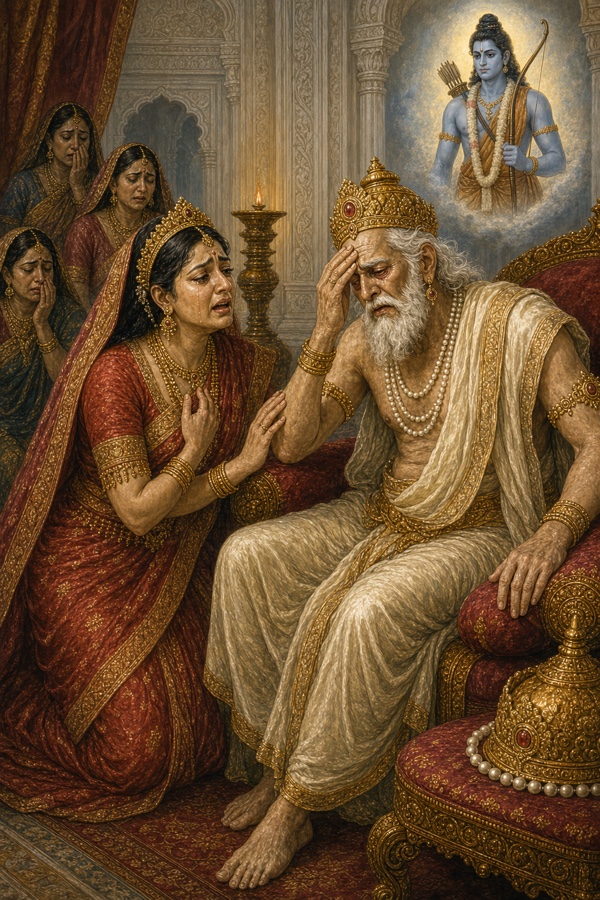
“A woman has three supports: first her husband, then her son, then her kin, and there is no fourth. Of those three, you, my husband, are no support to me at all, bent as you are to my co-wife’s will, and Rama has been sent away. I will not go to the forest, because I cannot live apart from you, and so, you see, you have destroyed me utterly. You have ruined this whole kingdom of Kosala and the lands around it. You have killed us all, your people and your counselors together. I am doomed, and my son Rama with me, and the citizens are ruined too. Only your son Bharata and your wife Kaikeyi have their joy of it.” Cut by this hard flood of words, the wretched king cried out, “Rama,” and fainted away. Then grief closed over him again, and once more, vividly, he remembered the old wrong of his that had brought this ruin down on him.
The memory of an old sin, and asking Kausalya’s forgiveness
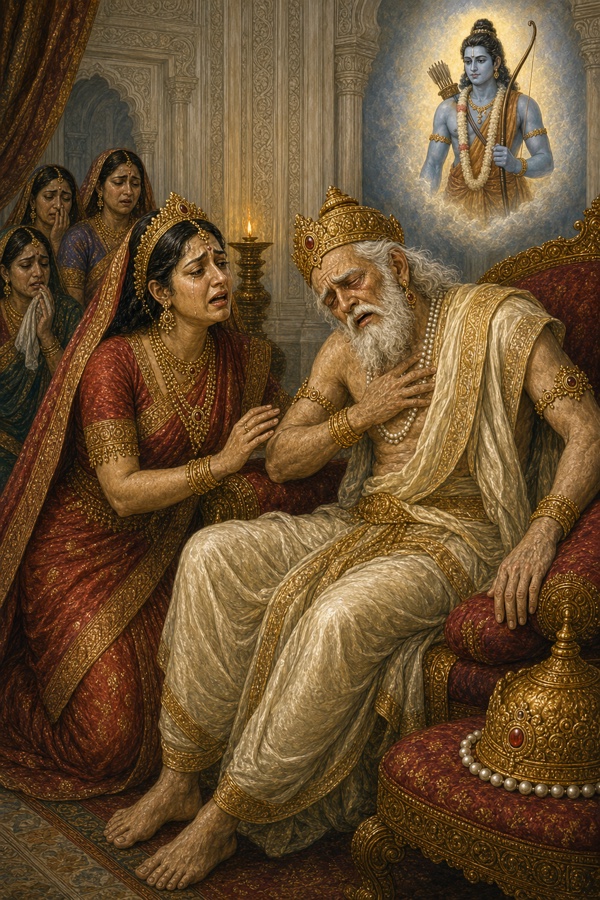
Struck by Kausalya’s harsh words, angry words out of a grieving woman, the king sank into distress and brooding. As he brooded, his senses clouded into a swoon, and it was a long time before Dasharatha came back to himself. When he did, drawing a long, hot breath and seeing Kausalya at his side, he fell to brooding once more. And as he turned it over, the sin came back to him, the thing he had done long ago in ignorance, loosing an arrow at a mark he could not see and striking it by its sound alone. Between the remorse that memory stirred and the grief of losing Rama, the great king burned in a double fire.
Burning so, wretched, he folded his hands to win Kausalya back, and, his face bowed low, he spoke to her trembling. “I beg your kindness, Kausalya. Here are my hands joined to you. You have always been full of tenderness, even toward those who wrong you. To a woman who weighs what is right, my lady, her husband is a god she can see with her eyes, whatever his virtues or his faults. You know every rule of right conduct, you have always kept to it, you have seen the world’s good fortune and its bad, and grieved though you are, you should not have said such bitter things to me, hurt as I already am.”
Hearing the poor king’s piteous plea, Kausalya wept as a drain lets the rainwater run through it. She lifted his joined palms, folded like a lotus, and set them on her own head, and, appalled that she had wronged her husband, she spoke through tears in a rush of confused words. “Be gracious to me. I beg you with my head bowed, I lie at your feet. That you, who are above me, should plead with me at all has undone me; I am not fit to be pardoned by you, and whatever punishment you choose is mine to bear. No woman is nobly born whom her own wise husband, worthy of honor in both worlds, has to coax and beg. I know my duty to you, you who know what is right, and I know you speak nothing but the truth. It was only that grief for my son tore something unseemly out of me.
“Grief eats away patience, grief wipes out learning, grief destroys everything; there is no enemy like grief. A blow from an enemy’s hand can be borne, but grief that falls on you without warning cannot be endured, however small it is. Five nights have passed since Rama left, and to me, whose every joy grief has spoiled, they weigh like five years. And as I think of him, this sorrow in my breast keeps rising, the way the sea swells when the rivers pour into it in flood.” While Kausalya was speaking these soothing words, the sun’s light thinned and the night came on. Comforted by the queen’s many words, and overcome by grief, the king slipped at once into sleep.
The killing of the ascetic boy
He slept perhaps an hour. Then he woke, and with his mind still darkened by grief the king fell back into dread. Since Rama and Lakshmana had been driven out, grief had closed over him, a king who once matched Indra in power and splendor, the way the shadow men call Rahu closes over the sun in an eclipse. He knew now that his own old deed was the root of this ruin, this parting from his sons and his son’s wife, and with Rama already gone into the forest with Sita and Lakshmana, Dasharatha felt the need to tell Kausalya, whose dark-cornered eyes were famous, the whole of it. It was the sixth night since Rama’s exile, and at midnight the memory of the deed rose in him. Aching for his son, remembering that old wrong, he turned to Kausalya, who ached for the same son, and spoke.
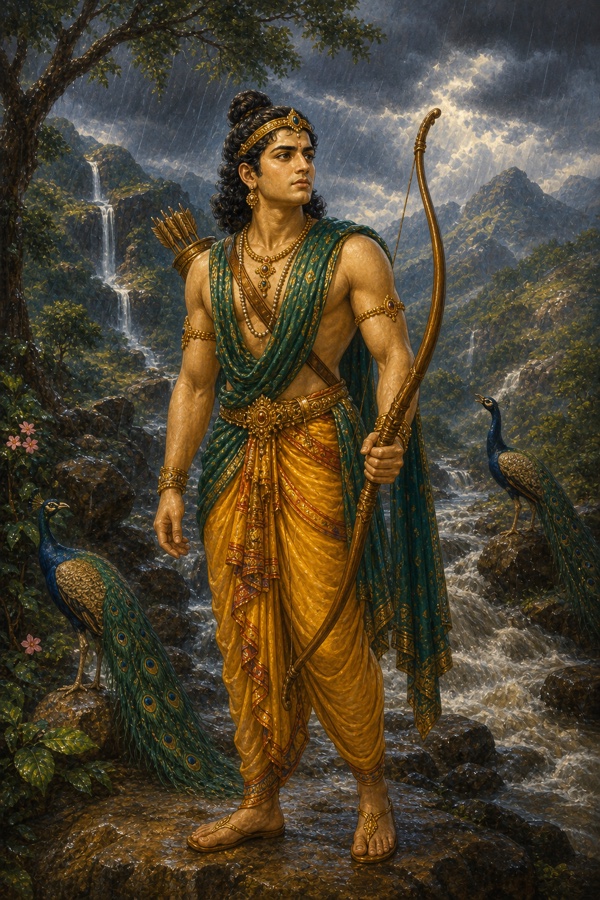
“A man reaps the fruit of what he does, my dear, and the fruit answers to the deed, whether it was good or evil. Anyone who sets out to act without weighing what his act will bring, its gains and its losses, is called a fool. A man who cuts down a whole grove of mango trees because their blossoms are small and plain, and waters a stand of palasha in its place for the sake of their big red flowers, hoping for great sweet fruit, is left to repent when the fruit finally comes and is nothing like what he hoped. Just so, the man who chases the deed alone and never minds the outcome is sure to grieve when the deed ripens. And I have done exactly that. I felled the mango grove and watered the palasha; I sent Rama away in the very season his fruit was setting, and now, fool that I am, I repent. The sin I mean to tell you of, Kausalya, I committed while I was still a young prince with a bow in my hand, already carrying the title of one who could strike an unseen target by its sound alone. This grief is of my own earning, my lady, the way a child in its folly swallows poison. As an ordinary man is fooled by the palasha’s blossoms into expecting fruit to match, I never once suspected that the very skill I was so proud of, striking by sound, would one day bear so ruinous a fruit.
“You were not yet married to me then, and I was only the Prince Regent. The rains came on that year and sharpened my longing to hunt. The sun had drunk up the moisture of the earth and scorched the world with its rays, and had turned into the southern quarter, that region men fear as haunted by spirits. All at once the heat broke, soft clouds gathered, and the frogs and the chataka birds and the peacocks all rejoiced. Birds with their wing-feathers soaked through, looking as if they had bathed, struggled back to the trees where they nested, the treetops tossing in the rain and the wind. The mountain, its elephants in rut, lay drowned under the falling water and looked like a still and waveless sea. And the clear cascades, taking white and red and ash-gray from the minerals they crossed, ran down in winding, snake-like courses.
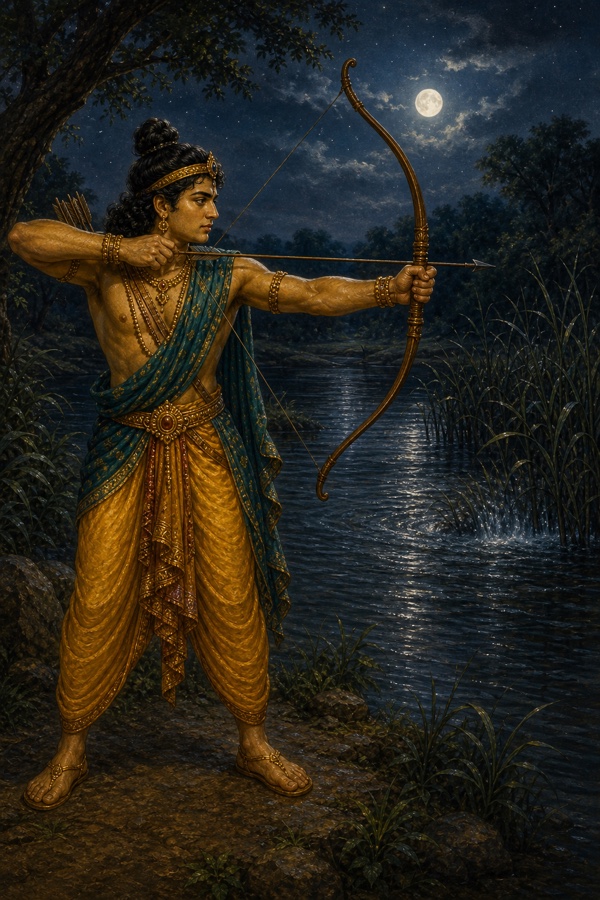
“At that most pleasant hour, with my bow and arrows, in my chariot, my senses off their leash, I drove down to the river Sarayu, our own river, meaning to hunt by night a wild buffalo, an elephant, some beast of prey, a deer, whatever came down to drink, and I came to a ford. In the dark I heard, from a spot I could not see, the sound of a pitcher filling with river water, and it sounded for all the world like the gurgle of a trumpeting elephant. I drew from my quiver a bright arrow, deadly as a snake, and loosed it toward the sound, hoping to bring the elephant down. And then, in the quarter where I had shot, as the night gave way, there rose a clear cry, the voice of a man of the forest sinking into the water, his life pierced through. When he had fallen back onto the bank, a human voice came out of the dark. ‘How could a weapon come down on an ascetic like me, a man who can have no enemy? I came at the very end of night to this lonely riverbank only to draw water. Who has struck me? What wrong have I done anyone, I who have given up all violence and live on what the forest gives? How can the scriptures allow the killing of an ascetic with his matted hair, his bark cloth, his deerskin?’
“‘Who could gain anything by killing me,’ the voice went on, ‘and what harm had I ever done the man who shot me? He has done a useless thing, and a thing that brings only ruin. No one will think any better of him than of a man who has crept into his own teacher’s bed. And it is my father and mother I grieve for, more than this life running out of me. How will that old couple live once I am gone, the two I have kept alive all this while? My aged blind parents and I have been killed together by a single arrow. What witless, unbridled fool has destroyed us all at once?’
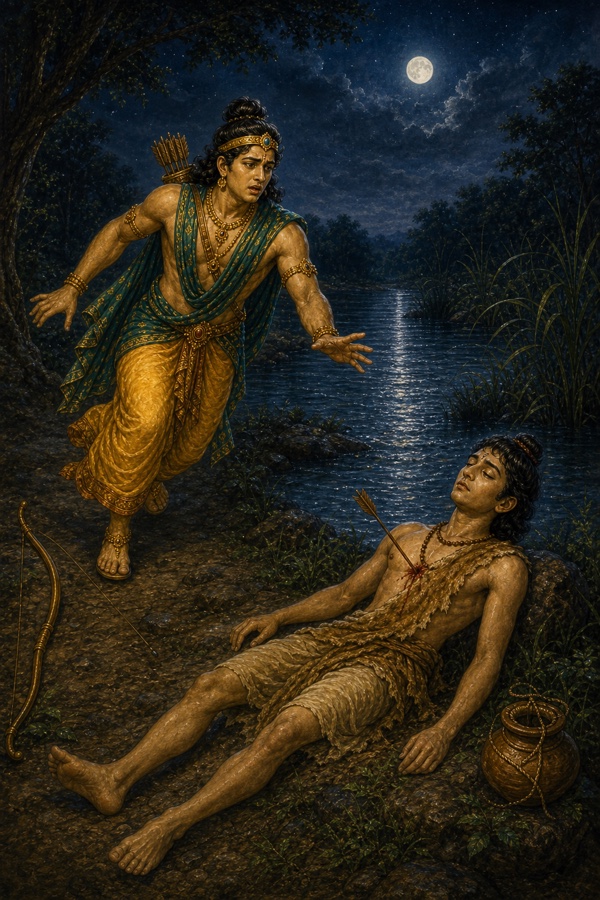
“The bow, arrow and all, fell from my hands. That cry broke me, and I wanted only to set things right. Hearing the poor man’s lament in the last of the night, I lost myself over and over, reeling with grief. I came to where he lay, sick at heart and wretched, and there on the bank of the Sarayu I saw the ascetic, run through by my arrow and pinned by its point, the great coil of his matted hair thrown into disorder, his pitcher emptied out, his limbs smeared with dust and blood. He fixed me with his bloodshot eyes, as if the fire of his austerity might burn me where I stood, and his words came hard. ‘What did I ever do to you, king, living quietly as I did in the forest, that you should shoot me down while I was only fetching water for my parents? One arrow in a vital place, and you have as good as killed my blind old mother and father too. Weak, blind, and parched, they are waiting for me even now, holding to the hope of the water I was to bring, bearing their thirst. Surely all my austerity and all my study have come to nothing, and my father’s too, since he does not even know that I lie here, dying. And if he did know, what could he do, feeble and unable to move, no more able to save me than one tree can save the tree beside it as it is torn down? Go yourself to my father, son of Raghu, and tell him quickly what has become of me.’
“‘If you find the courage to go to him and own what you have done,’ he said, ‘I believe he will not blaze up and burn you in his anger the way a swollen fire eats a forest. This is the path that leads to my father’s hermitage. Go to him, win his pardon, before his rage turns into a curse against you. And draw this shaft out of me, king, and let the pain end; the sharp point is tearing at my vital part the way a river’s current eats away a high bank of sand.’ As I bent to draw the arrow out, a fear took hold of me: with the shaft still in him the boy would live on but go on suffering, and the moment I pulled it free he would surely die. The young ascetic, a hermit’s son, read the anxiety in me, wretched and grieving as I was, and said, with great effort, ‘Though I am going faint and still, my eyes rolling back, come now to my end, I am steadying my mind and holding down my grief by main force. Let the dread of having killed a Brahmin leave your heart. I am no Brahmin, king; do not torment yourself on that account. A Vaishya father begot me on a Shudra mother.’
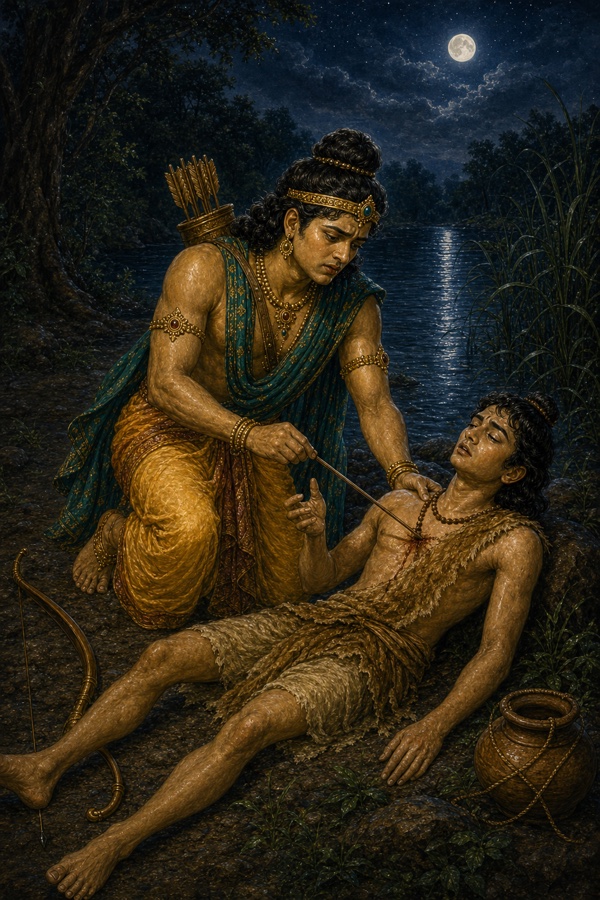
“As he forced the words out, his vital place torn, rolling and writhing and shuddering on the ground, I drew the arrow from his body. Watching me with dismay in his eyes, the boy whose only wealth was his austerity gave up his life. Drenched all over with water, drawing breath after painful breath, he lay dead there on the bank of the Sarayu, and to see it, my lady, cut me to the depths.”
The blind parents’ curse and the king’s death
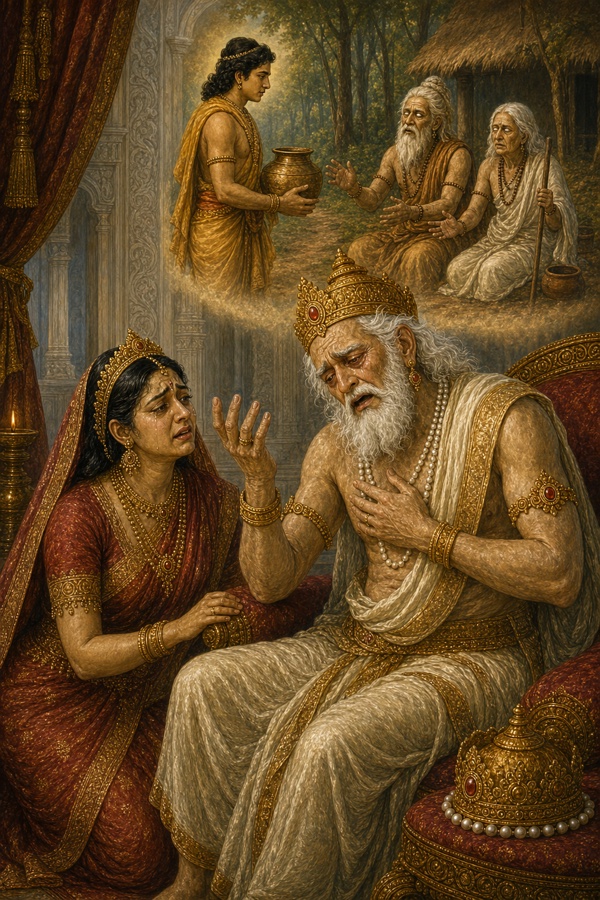
Recalling how that great seer had been killed by no fault he deserved, Dasharatha of Raghu’s line went on speaking to Kausalya, mourning for his son all the while. “Having done that terrible thing in my ignorance, my senses in ruins and no one beside me, I thought hard how any good might still come of it. I filled the dead boy’s pitcher with the pure water of the Sarayu and went along the path he had shown me, and I came to the hermitage. There I found his parents, feeble and blind and old, with no one to lead them from place to place, like a pair of birds whose wings had been clipped. They sat there taken up with talk of their only son, unwearied by it, cradling like two lost souls the hope of his return, a hope I had already emptied of everything by what I had done. My mind was clouded with grief and my heart shaking with dread of what those two would say to me, and reaching that hermitage I sank deeper still into sorrow.
“When the sage heard my footsteps, he took me for his son and called out. ‘Why so long, my boy? Bring the water. Your mother is anxious, you have played in the river far too long; come into the hermitage now. And if your mother or I have said anything to hurt you, my child, do not hold it in your heart, an ascetic as you are. You are the support of us who have none, the eyes of us who cannot see. Our very lives are fixed on you. Why, then, do you not speak to me?’”
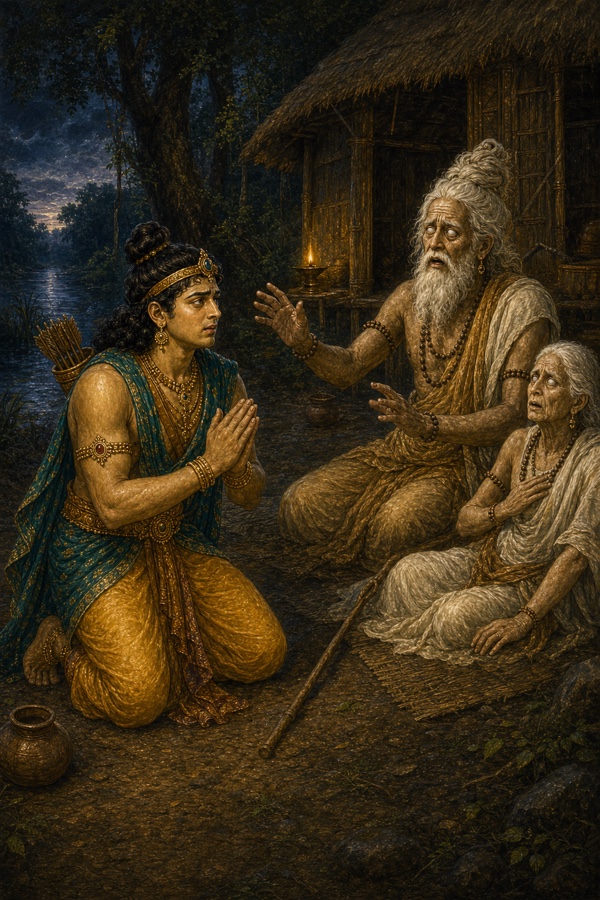
“Frightened, I answered him in broken words that stumbled and lost their syllables. Then, mastering my fear by outward show and finding my voice, I told him the dread thing that awaited him now that his son was dead. ‘I am a Kshatriya,’ I said, ‘Dasharatha by name, and not that son of yours. This grief that good men despise has come upon me by my own doing. Meaning to kill some beast of prey or an elephant come to the ford to drink, I went down to the bank of the Sarayu with my bow, holy sage. I heard the sound of a pitcher filling with water, took it for an elephant, and struck the creature with an arrow. Going down to the bank, I found an ascetic lying with his life all but gone, the arrow buried in his heart. At his own asking, I drew the arrow from his vital part, and the moment it came free he rose to heaven, grieving for you both and crying out that you were blind. Through my ignorance your son has been killed in an instant by my hand. That is how it stands; tell me now what remains for me to do.’”
“Hearing that grim account from me, who laid my own guilt bare, the sage, for all that he had the power to hurl a fearful curse, could not bring it down on me, since my open confession had lessened the sin. Dazed with grief, sighing, his face washed with tears, the great seer answered me where I stood before him with folded hands. ‘Had you not told me of this evil thing yourself, king, your head would have burst on the spot into a hundred pieces, into a thousand. The killing of a hermit, done knowingly, and by a Kshatriya above all, will topple even Indra who wields the thunderbolt from his high place. The head of a man who knowingly looses a weapon at such a hermit, one steeped in austerity and versed in the Vedas, splits into seven. You did this in ignorance, and that alone is why you live; otherwise the whole line of the Raghus would have perished, let alone you.’”
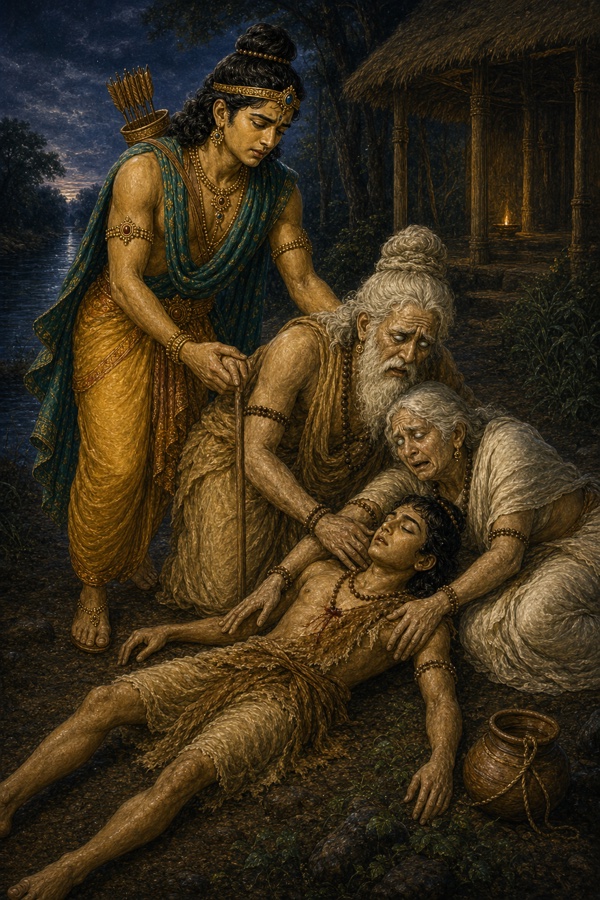
“Then the sage said, ‘Take us, king, to the place where my son lies dead. Today we long to see him, this once and for the last time, stretched senseless on the ground, his whole body bathed in blood, his deerskin robes thrown about him, passed into the keeping of the lord of the dead.’ I led the two of them, broken as they were, to that spot with my own hands, and I brought the sage and his wife to where they could touch their son. They came to him and laid their hands on him and fell across his body, and the father spoke to him. ‘You do not greet me today the way you always did, my son, nor do you speak to me. Why are you lying on the ground, my darling? Are you angry with me? If I am the one who has displeased you, then look at least at your devoted mother. Why do you not put your arms around her, my tender boy? Say some loving word to me. Whose sweet, heart-catching voice will I hear now in the last watch of the night, reading aloud from the scriptures? Who, when he has bathed and made his twilight prayers and fed the sacred fire, will sit beside me and comfort me in my grief for my son? Who will gather the bulbs and roots and fruit and feed me like a cherished guest, now that I am past all work, without resource, without a guide? How, my son, am I to keep your mother, blind and old and worn with austerities, wretched and aching for you? Wait, my son, do not, do not go yet to the house of Yama. Tomorrow you will go, and your mother and I with you. Stricken and unsupported, leading our poor life in the forest, we will both follow you to Yama’s house before long, now that we have lost you.
“‘When I come before Yama,’ the old man went on, ‘I will say this to him. Let King Dharma pardon my fault, and let this son of mine go on supporting us, his parents, as he did before. You are a pious and glorious guardian of the world, and you owe me this one unfailing gift, to make me fearless forever, brought as low as I am.’ And to the boy he said, ‘Though you were struck down by some sin of a former life, you are without sin now, my son. So, true and faithful as you are, rise quickly to the worlds that belong to those who fall fighting with weapons in hand. Reach that highest place that brave men reach who never turn from the field and die facing the foe. Go where the emperors Sagara, Shaibya, Dilipa, Janamejaya, Nahusha, and Dhundhumara have gone. Be merged, my dear child, in that same Brahman that is the goal of all that lives, won by study of the Vedas and by austerity, and reach the reward set aside for the giver of land, for the man who keeps the sacred fire all his life, for the man vowed to a single wife, for those who give away a thousand cows, for those who serve their teacher, for those who lay down the body on a journey to the Himalayas or by drowning in water or by walking into fire. No one born into this line of ascetics ever comes to an evil end. He alone by whom you were killed will come to such an end.’” Two of the names the old man spoke over his son, Sagara and Dilipa, were forefathers of the young prince who stood listening with folded hands. The sage did not know it; he was only naming the kings a good man goes to join.
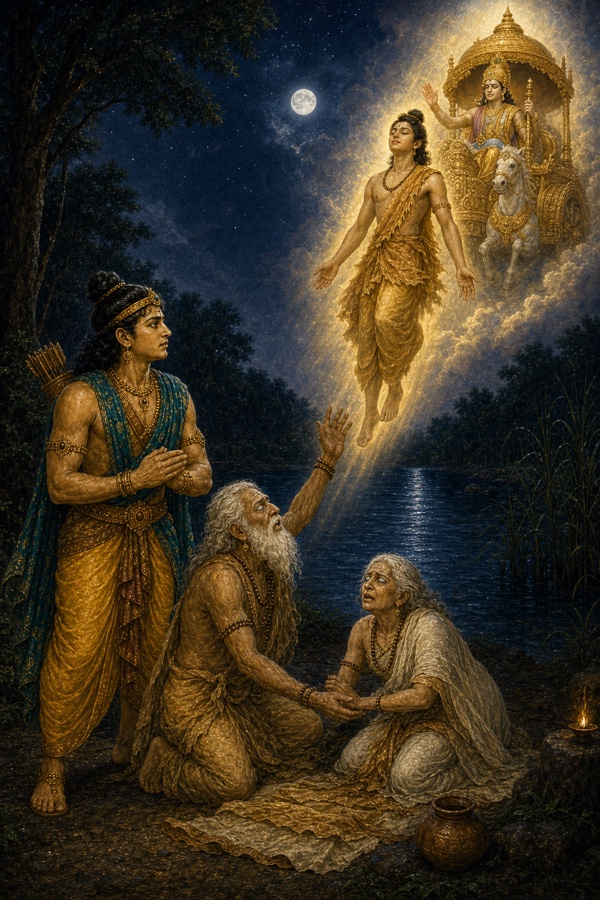
“So he wailed there, over and over, and then with his wife he made the water offerings for the spirit of their dead son, the handfuls poured out that the living owe the dead. And by the merit of his own good life, the boy, who knew what was right, rose at once in a shining, unearthly form to heaven, and Indra himself had come in person, drawn by the hermit’s rare merit, to escort him up. There, beside Indra, the boy spoke to his aged parents, and after comforting them a moment he said to his father, ‘By the service I did you both I have won a high place, and you two will come to me before long.’ Having said it, the young ascetic, master of his senses, rose swiftly to heaven in a beautiful vimana, one of the shining vehicles the gods ride through the sky.
“When he and his wife had made the water offerings, the great ascetic turned to me, where I stood with my hands folded, and spoke. ‘Kill me too, king, this very day; I feel no pain at dying. With a single arrow you have left me sonless, me who had but one son, so kill me as well, now. And because you killed that boy of mine in ignorance, I will lay on you a curse most bitter and most cruel. As this agony of a dead son is mine at this moment, so shall you, king, meet your own end in grief for your son. Since it was an ascetic you killed, and you a Kshatriya, and killed in ignorance, the sin of slaying a Brahmin will not fall on you at once. But a thing dreadful and deadly will find you all the same, and soon, the way merit comes to a man who pays the priest his due.’ Having laid that curse on me, and wailing long and piteously, the two of them climbed onto the funeral pyre and rose to heaven.”
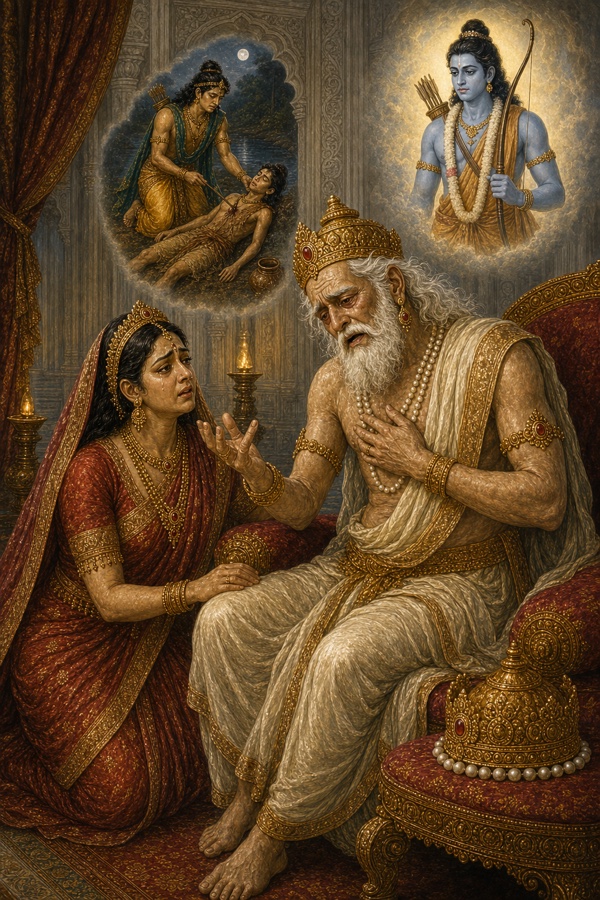
“While I brooded over the trouble I am in now, my lady, that old sin came back to me of its own accord, the folly of loosing and then drawing out an arrow that could find an unseen mark by its sound. Its bitter fruit has caught up with me at last, the way sickness follows food eaten with relish when something poisonous was mixed in. This is the fruit of that great sage’s curse, come round to me now.” And saying it, the king, frightened at death coming for him with Rama gone, wept and spoke to Kausalya. “I am about to give up my life in grief for my son Rama, and I can no longer see you with my eyes, Kausalya. Touch me, so I know you are near, for men who have reached the threshold of Yama’s house can no longer make out anyone. If Rama would lay his hand on me just once, or take back the wealth and the regency I meant for him, I think I might yet live. The wrong I did to Rama was unworthy of me, and the kindness he did me in return, keeping my word for me and giving up his own right to the throne, was worthy of him alone. What wise man on earth would cast off a son, even a bad one? And what son, sent into exile by his father, would not lay the blame on his father? I can no longer see you, and my memory too is going out. These messengers of Yama are hurrying me on, Kausalya. What is more painful than this, that even at the end of my life I cannot look on Rama, whose courage never fails, who knows what is right?
“The grief of never seeing that son of matchless deeds is drying the life out of me, the way the sun dries a little pool of water. Whoever will look again on Rama’s face, with its lovely earrings, in the fifteenth year must be a god; no mortal will live to manage it. Only the fortunate will see that moon-like face, the eyes like lotus petals, the fine brows, the perfect teeth, the shapely nose. Blessed are they who will see the sweet-scented face of my Rama, like the autumn moon, like a lotus in full bloom. The happy alone will see Rama come home to Ayodhya, his term of exile spent, the way men watch with joy as the planet Venus swings back into its course. My mind is failing, Kausalya, and my heart is sinking, and though sound and touch and taste are set right against my senses I take in none of them, for when the mind gives way all the senses go dark with it, like the bright rays of a lamp when its oil is spent. This grief that rose out of my own self is dragging me down helpless and senseless by its force, the way a river’s current tears away its own bank as it runs.”
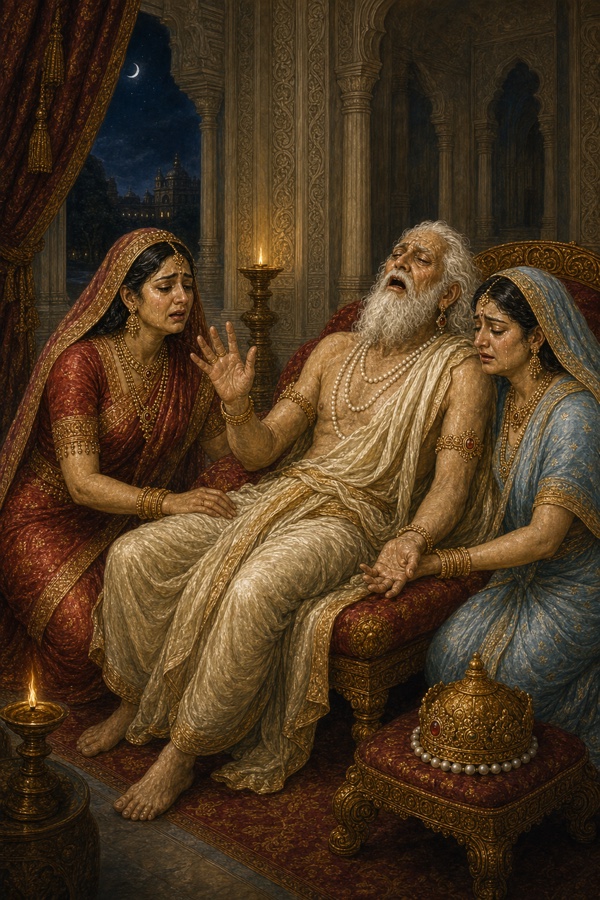
“Ah, my strong-armed son of Raghu, you who eased all my toil, you who were your father’s darling, my protector, my son, are you truly gone from my sight? Ah Kausalya, I cannot see. Ah Sumitra, Sumitra, patient in every austerity. Oh Kaikeyi, cruel Kaikeyi, my enemy, the shame of my house.” Lamenting so in the presence of Rama’s mother Kausalya and of Sumitra, King Dasharatha came to the end of his life. As he spoke those words, the noble-faced king, already worn down and stricken by his beloved son’s exile, was seized by a last unbearable pain when half the night had passed, and there and then, in the dark, with two of his three queens beside him and the third nowhere in the room, he gave up his life. No one else in the palace knew it yet. At dawn the bards would come to sing the king awake.
The gist: Dasharatha tells how he brought the boy’s blind parents the truth and led them to their dead son. The boy’s spirit rose to heaven in a shining form, but the old couple laid a curse on the king, that he too would die grieving for a son, and then gave up their own bodies on the pyre. That curse has now come due, and grieving for Rama, past the middle of the night, crying out for his son, King Dasharatha breathes his last.
Source: Srimad Valmiki Ramayana, Ayodhyakanda, Cantos 57 to 64. The Gita Press Hindi edition is the controlling witness. The Sanskrit e-text and an independent complete translation were used to verify names, sequence, and principal events. Where recensions differ, this retelling follows Gita Press.
Based on: Valmiki Ramayana (Gita Press, Gorakhpur)