On this page
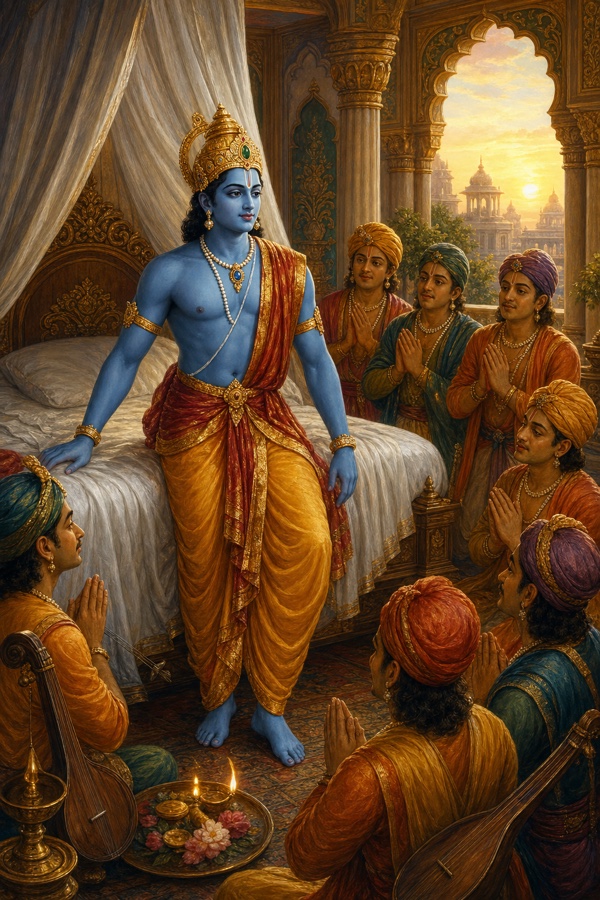
The first night of the reign passed, the night after the coronation, the one that had swelled the gladness of every soul in Ayodhya. Rama, who understood the nature of the self, had been set on the throne of his fathers with every rite the rule prescribes, and now the city slept around him with the deep, easy sleep of people who have got back what they feared was lost for good. Toward dawn the palace began to fill with the bards whose office it was to wake the king. Their voices were sweet, and they had been trained in the art of song like the Kinnaras, the singers of heaven; they gathered in the royal apartments, overflowing with joy, and took up the praise of the hero they served.
“Wake, gentle hero, you who swell the gladness of your mother Kausalya,” they sang. “The whole world lies buried in sleep while you are sleeping. Your valor is Vishnu’s, your beauty the beauty of the twin Ashvins, the physicians of the gods. In judgment you are the equal of Brihaspati, the gods’ own teacher, and in the guarding of your people you are the equal of Brahma who made them. Your patience is the earth’s, unshaken; in splendor you are a match for the sun; your rush is the rush of the wind, and your depth the depth of the ocean. In battle you cannot be moved, any more than Shiva can; and the sweetness that is in you is the sweetness of the moon. A king like you never was before and never will be again. Constant in dharma, the friend of your people, you cannot be overcome in any true sense, and glory does not leave you, nor fortune either. Fortune and dharma, Rama, live in you always.” These praises and others as sweet the bards sang, and the panegyrists took up the waking of Rama with wonderful songs of their own, until, with the praises still in the air, he woke.
He left the great couch, which was spread with white cloth, the way Narayana, who destroys sin, rises from his bed on the coils of the serpent Shesha. Attendants in their thousands came forward with folded hands and shining ewers, and poured out water for the king who had just risen.
Rama’s court: the king of dharma among his friends
He bathed. He fed the sacred fire at its appointed hour, the agnihotra that a king of his house offers before he does anything else in a day, and went with quick steps, clean and purified, to the holy shrine of the Ikshvakus, where the gods of the line are kept. There he worshiped, in the order the rule sets down, the gods, the ancestors, and the Brahmins, and then, with his people around him, he made his way to the inner room of the outer hall, where a king sits to be seen. The great counselors came in with the priests, Vasishtha at their head, every one of them shining like a fire that has just been fed. Kshatriya lords of many different countries, kings in their own right, took their seats at Rama’s side the way the gods take their seats beside Indra.
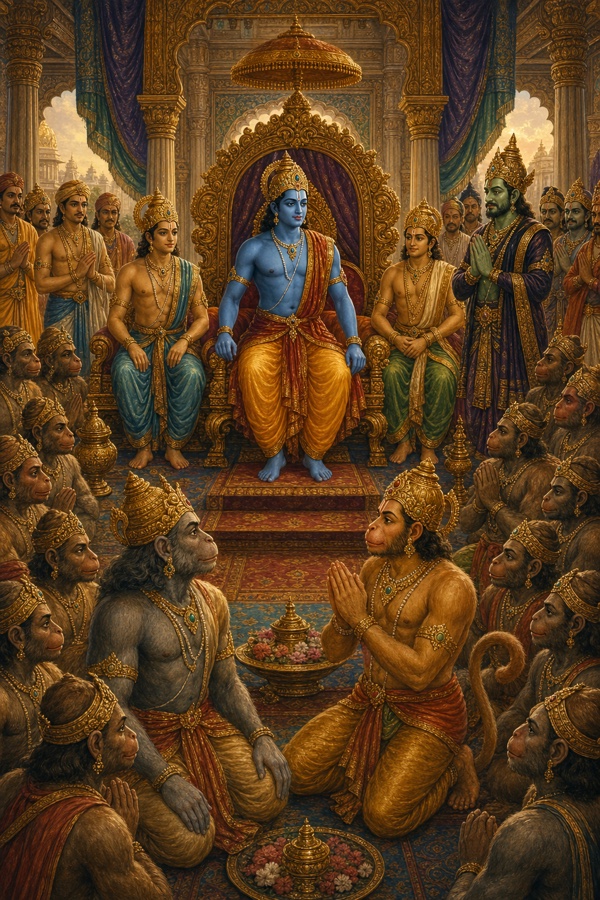
Bharata, Lakshmana, and Shatrughna, whose fame was very great, waited on Rama with glad hearts, and to see the three of them around him was like seeing the three Vedas, Rig, Yajur, and Sama, attending on a sacrifice. Servants of the palace class called the Muditas, the glad ones, moved about him and sat comfortably near him, cheerful of face, with their palms joined. Twenty vanaras of enormous strength and valor, Sugriva first among them, creatures who could take any shape they pleased, sat at Rama’s side. Vibhishana, ringed by four rakshasas who were his ministers, waited on Rama, the king whose crowning he had crossed the sea to see, the way a Yaksha waits on Kubera, the lord of wealth. Wise men of good birth who were masters of the Vedas sat with their heads bowed low. Glorious rishis, seers of the Vedic mantras, were there too, and mighty kings, and the vanaras with the rakshasas among them. Indra, the ruler of the gods, is waited on by rishis every day of his life, and Rama, in that form which only seemed to be a man’s, shone brighter than the thousand-eyed god himself. When they were all comfortably seated, those among them who knew the ancient lore of the Puranas began to tell stories, one after another, full of dharma and sweet to hear, and the morning of the new reign went by in listening.
The kings depart: Janaka, Yudhajit, Pratardana, and three hundred rulers
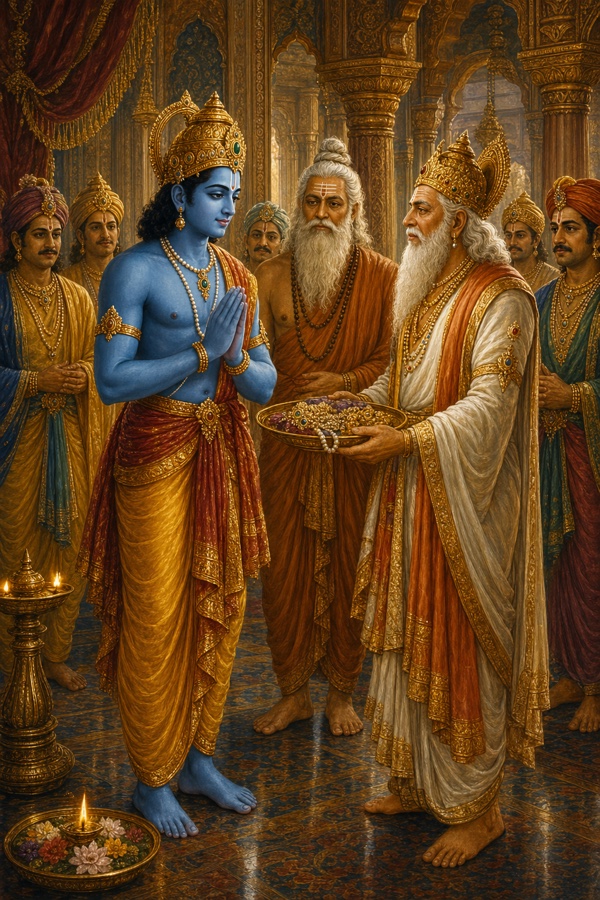
So Rama governed, day after day, all the affairs of the city and of the countryside beyond it, and the allied kings who had come for the coronation stayed on as his guests. Then, after some days, he folded his hands before Janaka, the king of the Videhas and lord of Mithila, the father who had given him Sita, and spoke to him humbly, as a son speaks.
“You are our support, and we stand fostered by you,” he said. “It was by the fierce power born of your austerities alone that Ravana was killed by my hand. Between all the Ikshvakus and all the rulers of Mithila there has been an affection without equal, rooted in the marriage that joined our houses. So accept the presents I am offering you with all respect, and go home now to your own city; Bharata will follow at your heels to escort you, and Shatrughna with him.”
“So be it,” Janaka answered. “The sight of you and the way you govern have made me glad. And all these valuable things that were gathered here for my sake, I give them, every one, to my daughter, the queen Sita.”
So saying, and having taken his leave of Rama, the glorious king Janaka set out for Mithila with a delighted heart.
When Janaka had gone, Rama folded his hands before his maternal uncle, Yudhajit, the king of the Kekayas, his mother Kaikeyi’s brother, and made his request in all humility. “This kingdom of Ayodhya, and I myself, and Bharata and Shatrughna, and Lakshmana with them, we are all at your disposal; you are our mainstay,” he said. “Your father, the old king, will be grieving on your account, so I think it right that you should leave for your city this very day. Lakshmana will follow at your heels, bringing abundant wealth and precious stones of every kind for you.”
“So be it,” Yudhajit said of his going, and then he added, “Let the precious stones and the gold stay with you, Raghava, for all time.”
He walked around Rama in reverence, keeping him on his right, as Rama, greeting him, had already walked around him. Then the king of the Kekayas, the strength of his house, set out with Lakshmana beside him as his escort, and to watch them go was like watching Indra return to Amaravati after the killing of the demon Vritra, with Vishnu, who was born as his younger brother, at his side.
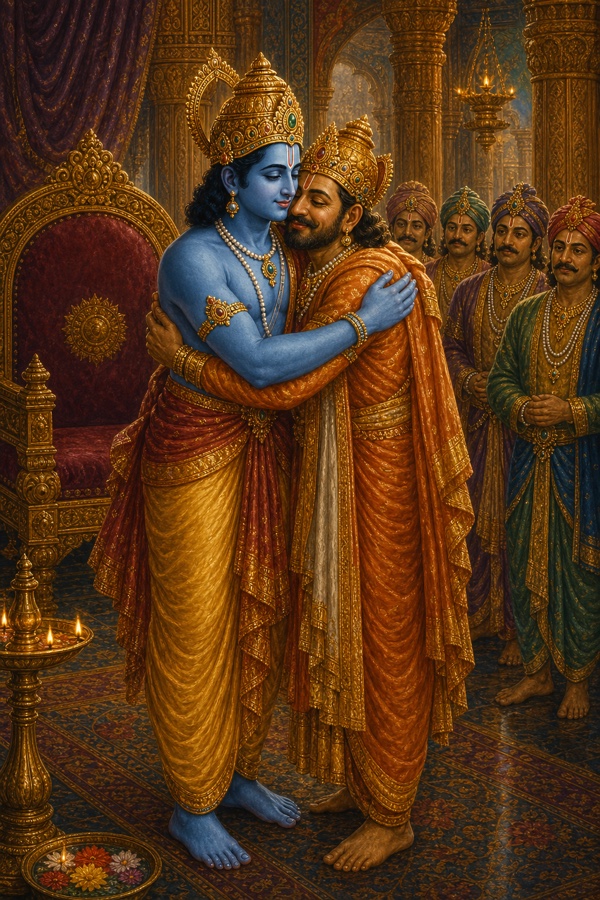
Then Rama embraced his friend Pratardana, the ruler of Kashi, a king who feared no one in any quarter, and gave him his leave. “In joining with Bharata to work for my coronation you showed your love for me and your deep goodwill,” he said. “Go back today to your lovely Varanasi, the city enclosed in its strong wall with the magnificent gateways, the city that you guard.”
So saying, Rama, whose mind was set on dharma, rose from his magnificent throne and tightly clasped Pratardana, who had already pressed himself to his chest. The lord of Kashi, given his leave, set off with all speed for Varanasi.
When the lord of Kashi was on his way, Rama turned to the three hundred rulers who were still gathered there, kings who had come from every direction at Bharata’s call, and spoke to them with a laugh in his voice and in sweet words.
“Your unflinching devotion to me is proven by your own glory,” he said. “Dharma is constant in you, and truthfulness never leaves you. It was by the majesty and the glory of you noble-souled men that Ravana, that wicked and perverse creature, the vilest of the rakshasas, was killed. I was only the instrument of his death. In truth it was your glory alone that brought Ravana down, and with him his followers and his sons, his ministers and his kin. Bharata summoned all of you together when he heard that Sita had been carried off from the forest, and a long time has gone by since then, all of it spent by you, great-hearted kings, in zealous work on my behalf. So I think it right that you should now return home.”
The kings answered him, filled with great joy. “By our good fortune, Rama, you have come out victorious and stand secure in your own sovereignty. By our good fortune Sita has been recovered and the enemy has been destroyed. This was our highest ambition and our greatest satisfaction, to see you victorious with your enemy killed. You praise us, and we, who ought to praise you, do not even know how to return the compliment. We take our leave now and go. As you stay always enshrined in our hearts, so may we, who are full of devotion to you, keep a place in yours; and let your affection be with us forever.”
“All right,” Rama said, and at that the kings, transported with joy and ready for the road, folded their hands and said, “We are leaving.” Honored by Rama, each of them returned to his own country.
Jewels for the vanaras, bears, and rakshasas
Those great kings set out glad at heart, and the earth shook under their contingents of elephants and horses, which numbered in the thousands. More than one akshauhini had stood garrisoned at Ayodhya under Bharata’s orders, fully equipped for Rama’s war with Ravana should the need arise, its troops and mounts in high spirits. On the road, full of pride in their own strength, the kings said to one another, “We never saw Rama and Ravana standing face to face on the field of battle. Bharata brought us all together for nothing, when the war was already over. Had we been summoned in time, the rakshasas would have been killed off in no time by the kings; there is no doubt of it. Protected by the might of the arms of Rama and Lakshmana, we could have fought at ease on the far side of the sea, free of every anxiety.”
Saying such things by the thousand as they went, the kings came home in high spirits to their own dominions, well-known kingdoms, prosperous and happy, rich in gold and grain, self-contained and full of treasure, and then to their own cities. And there each of them at once bestowed on the escort that had ridden with him as Rama’s representative a whole train of presents for Rama’s pleasure: valuable things of every kind, horses, vehicles, precious stones, elephants in rut, excellent sandalwood and brilliant ornaments, gems and pearls and coral, serving women richly endowed with beauty, she-goats and sheep of different breeds, and chariots of every description in great numbers. Bharata, Lakshmana, and Shatrughna, whose strength was extraordinary, gathered all of it up and returned to their own city, and reaching lovely Ayodhya, the three princes handed the wonderful things over to Rama.
Rama accepted all of it, and with a glad heart he bestowed it on the accomplished king Sugriva, on Vibhishana, and on the other vanaras and rakshasas, the companions with whom he had won his victory over Ravana. Those mighty vanaras and rakshasas put the precious stones Rama gave them on their heads and around their arms, and wore them.
Then Rama, the powerful king of the Ikshvakus, the great chariot-warrior whose eyes were like the petals of a lotus, took Hanuman and Angada into his lap, the way a father takes his sons, and spoke to Sugriva. “Lord of the vanaras, this Angada, your worthy son, and this minister of yours, the son of the wind-god, have both stayed at your side to give you counsel and have both been devoted to my cause; they truly deserve every honor there is.” So saying, he took the ornaments of great value from his own body and fastened them on Angada and on Hanuman.
Then he turned to the chief commanders of his troops, the vanaras who had carried his war to the gates of Lanka, every one of them a warrior of extraordinary prowess: Nila, Nala, Kesari, Kumuda, Gandhamadana, Sushena, Panasa, the brave Mainda and Dvivida, Jambavan and Gavaksha, Vinata and Dhumra, Balimukha and Prajangha, the exceptionally mighty Sannada, Darimukha, Dadhimukha, and the commander Indrajanu. He spoke to them in a soft voice, looking from face to face as though he meant to drink them in with his eyes.
“You are my friends,” he said, “my other self, my brothers. It was by you alone that I was delivered from misfortune, you who make your homes in the woods. And King Sugriva is blessed, because he has friends like you, the finest that ever stood by a king.”
So saying, he gave each of them, according to his worth, ornaments and diamonds of great value, and he embraced them one by one.
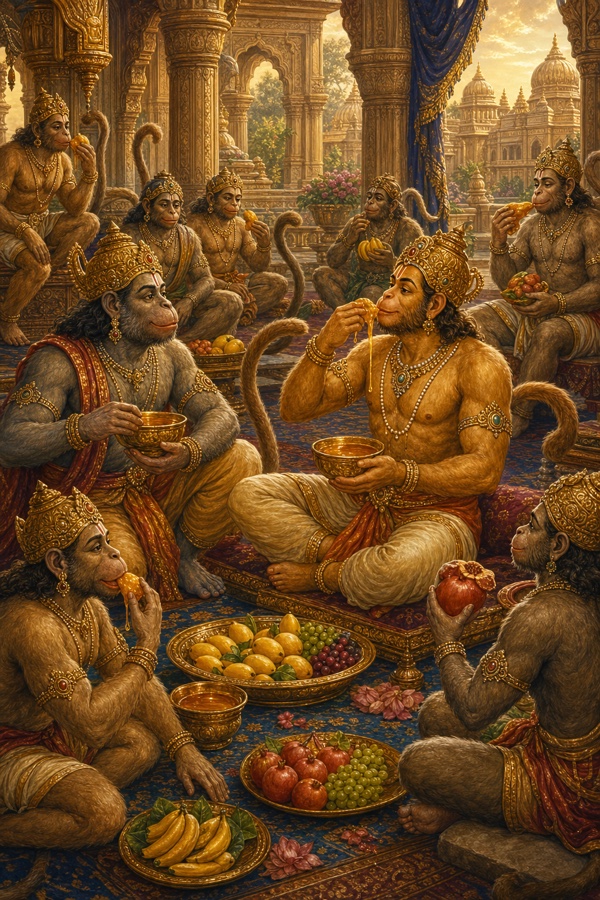
Those vanaras, reddish-gold as honey, stayed on in Ayodhya, drinking fragrant honey, eating dishes fit for a king along with the roots and fruits they loved, and more than a month went by in that way; yet in their devotion to Rama it seemed to them a single hour. Rama for his part spent his days happily in the company of the vanaras who could take any shape at will, the rakshasas of extraordinary prowess, and the bears of exceptional strength. So Phalguna passed, the second month of the deep cold season, and it passed in ease, the vanaras and the rakshasas rejoicing in every way and enjoying to the full the hospitality of Rama. In the lovely city of the Ikshvakus their time slipped merrily by.
The vanaras take their leave, and Hanuman’s boon
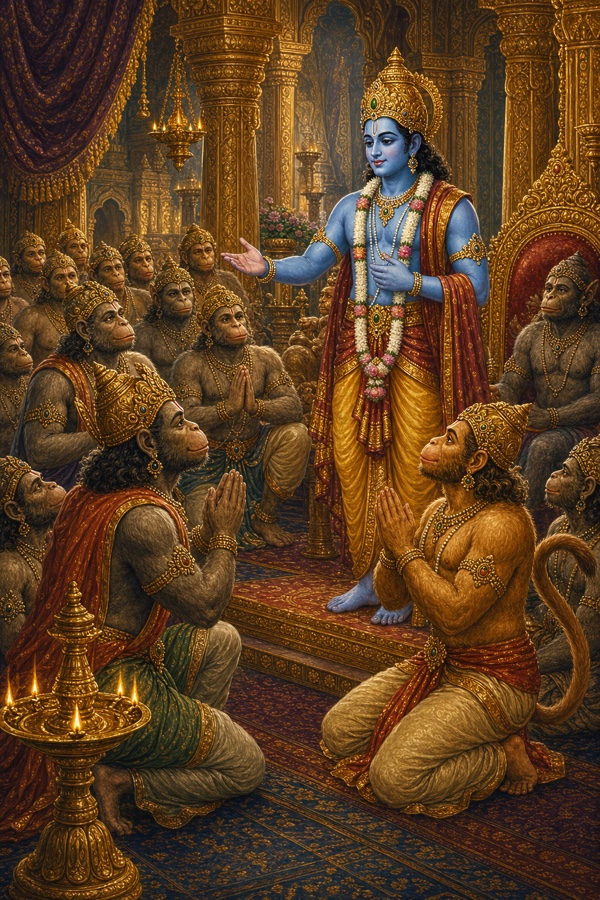
While the bears, the vanaras, and the rakshasas were still lodged with him in this way, Rama, whose energy was extraordinary, said to Sugriva, “Go home now, Sugriva, to Kishkindha, which gods and demons alike find hard to assail, and rule your kingdom with your ministers around you, for every enemy it ever had has been destroyed. Look with the greatest affection on Angada, and on Hanuman, and on Nala of exceptional might. Cast a loving eye on your father-in-law, the heroic Sushena, and on Tara, strongest of the strong; on Kumuda, who is so hard to assail, and Nila of extraordinary might, and brave Shatabali; on Mainda and Dvivida, on Gaja, Gavaksha, Gavaya, and the exceptionally mighty Sharabha; on the very mighty Jambavan, the king of the bears, whom no one overcomes; on Gandhamadana, on Rishabha, bravest of the brave, on the vanara Supatala, on Kesari, on Sharabha, on Shumbha, and on Shankhachuda of exceptional strength. Look with love on all these great-hearted vanaras, every one of whom risked his life for my sake, and never do a thing that would displease them.”
Having spoken so to Sugriva and embraced him again and again, Rama turned to Vibhishana and spoke to him in a sweet voice. “Rule Lanka with righteousness. You are held to be a knower of what is right, by me, by the whole city of Lanka and all the rakshasas in it, and by your eldest brother Kubera, the son of Vishrava. Never, in any case, let your mind turn toward unrighteousness; it is the prudent king who rules the earth with a firm hand. Keep me in your memory always, with the greatest affection, and Sugriva with me; and go now free of every anxiety.”
Hearing Rama’s words, the bears, the vanaras, and the rakshasas applauded him again and again. “Well said! Excellent!” they cried. “Wonderful is your wisdom, Rama, and wonderful your prowess, and your supreme gentleness is a match for Brahma’s own.”
While the vanaras and the rakshasas were still speaking, Hanuman, who had stayed bowed all this while, made his own submission to Rama. “May my supreme love for you stand forever. May my devotion to you never waver, and may my heart never be drawn to anyone else. Let my life go on in this body, without any doubt of it, for as long as your story stays current on the face of the earth. And let the apsaras, the nymphs of heaven, sing to me in their music the divine deeds of your life, your story, Rama; drinking in the nectar of that story through my ears, I will be able to bear the longing to see you, the way the wind scatters a line of clouds.”
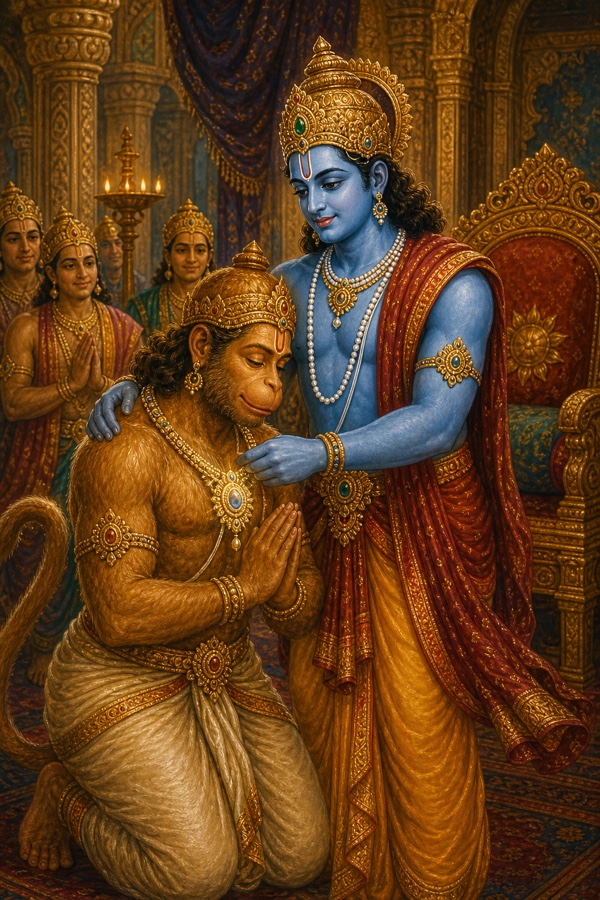
Rama rose from his fine seat and, while Hanuman was still speaking, gathered him into an affectionate embrace. “So shall it be, prince of the vanaras; have no doubt of it,” he said. “Your fame will endure, and life will go on in your body, for as long as this story of mine stays current in the world; and my stories will surely last for as long as the worlds themselves. For every single service you have done me here I would give up my life, and even so we would remain in your debt for all the rest. Let my obligation to you stand in my heart forever, and may there never come an occasion for me to repay it; for a man is repaid for the services he has rendered only when he is in distress.”
Then Rama took from his own neck a string of pearls that shone like the moon, with a cat’s-eye gem set at its center, and fastened it around Hanuman’s neck. With that great necklace on his chest the vanara shone like Meru, the lordly golden mountain, with the moon resting on its summit.
At Rama’s words the mighty vanaras rose one after another, bowed at his feet with their heads bent low, and went. Rama clasped the celebrated Sugriva and the pious-minded Vibhishana tightly to his chest; and every vanara there was overcome with feeling and wept. As they took their leave of him their throats were so choked with tears that their words came out indistinct, their eyes were streaming, and they seemed confused and stupefied with the pain of it. Loaded with Rama’s gifts, and having bowed to him with reverence, the rakshasas, the bears, and the vanaras went home each to his own place, their eyes full of tears at the parting, and it hurt them the way it hurts an embodied soul to leave the body it has lived in.
Pushpaka departs, and the reign of Rama described
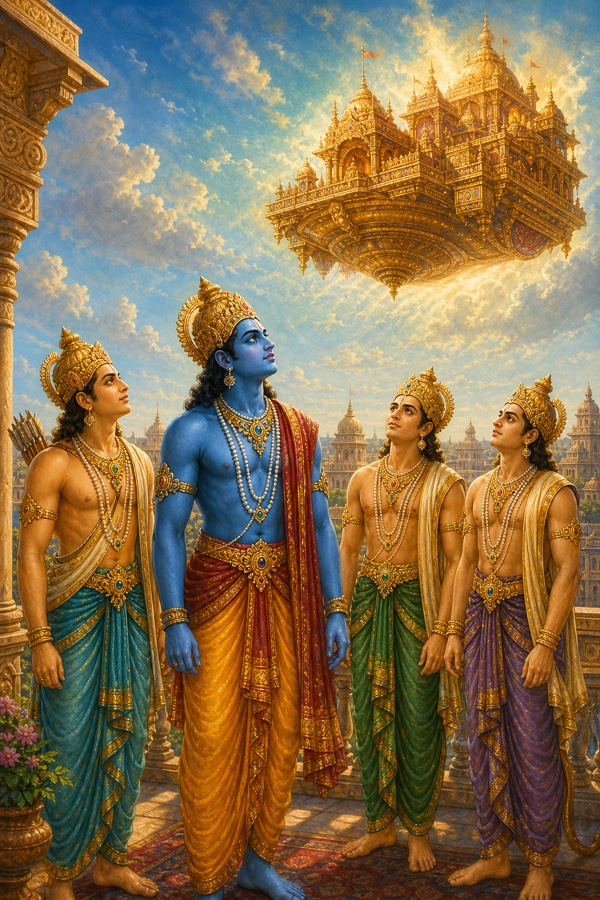
When the bears, the vanaras, and the rakshasas had been sent home, Rama, who was happy by nature, lived on in deep contentment with his brothers around him. Then one day, some while later, in the afternoon, he and his brothers heard a sweet voice speaking out of the sky.
“Dear Rama, look on me with affection in your face; know me, Rama, to be the Pushpaka, come from the mansion of Kubera,” the voice said. “Obeying your command, I went home to wait upon him, and he said to me: ‘Rama, the great-hearted king of men, has won possession of you by killing in battle the unassailable Ravana, king of the rakshasas. A great delight has fallen to my lot as well in the killing of that wicked Ravana with his hosts, his sons, and all his kin. You were won in Lanka by Rama, who is the Highest Being. Carry him; it is my command. It is my highest desire that you should serve as the vehicle of Rama, the joy of Raghu’s house, who is the support of the whole world. Go to him without any qualm.’ So I was ordered, and abiding by his command I have come into your presence. By my own power I am unassailable by the whole range of created beings, and by Kubera’s order I will move through all the spheres carrying out your behest.”
Hearing this, Rama of great strength looked with a kindly eye at the aerial chariot that had come back to him. “If that is so, then welcome, Pushpaka, best of all the vehicles that fly,” he said. “Because it comes as a favor from Kubera, no charge of unfair dealing will be laid at our door.”
Then Rama worshiped the Pushpaka with fried grains of rice and flowers, with incense and with sandal-paste, the offerings made to an honored guest. “Go now, for the present,” he told it, “and come whenever I call you to mind. Vanish into the thin air where the Siddhas dwell, and do not let the grief of parting from me weigh on you; and may nothing hinder you as you wander in every direction at your own sweet will.”
“So be it,” Pushpaka answered, and, having been worshiped by Rama and given its leave, it set off in the direction of its choice.
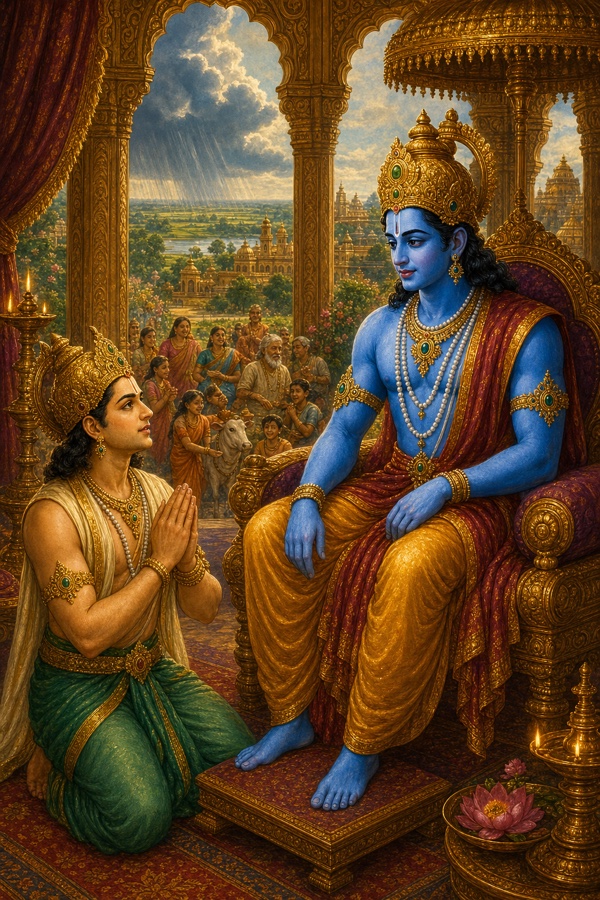
When that Pushpaka, a treasury of virtues, had passed out of sight, Bharata folded his hands and said to Rama, “Under your reign, Rama, even beings that are not of human descent speak again and again like men. Only a little more than a month has gone by since you took the scepter in your hand, and already mortals are strangers to disease; death does not carry off even the men worn out with age; women feel no pain in childbirth; and human beings are well made in body. An abundance of joy has fallen to the lot of every citizen of the town. The clouds pour down water like nectar at the proper season, and the very winds that blow here are a delight to the touch, pleasant and healthful. People from the cities and from the country come to the capital and say, ‘May such a sovereign be our ruler for a long, long time.’”
Hearing these honeyed words, so beautifully spoken by Bharata, Rama, the noblest king his line had known, was thrilled with joy.
Play in the Ashoka grove, and Sita’s wish
When he had sent the gold-decked Pushpaka on its way, Rama went into the Ashoka grove. It was beautiful on every side with sandal and aguru, the fragrant eaglewood, with mango, coconut, red sandal, and stands of deodar; it was graced with champaka, ashoka, punnaga, madhuka, jackfruit, and asana trees, and with parijata trees that looked like a blaze of fire without any smoke. It abounded in lodhra, nipa, arjuna, naga, saptaparna, atimuktaka, and mandara, in plantains, in bushes and a net of creepers, and it was made splendid by priyangu and kadamba, by bakula and pomegranate, by jambu, the rose-apple, and kovidara. The lovely trees, tended with care by divine gardeners, were forever laden with flowers and fruit, with tender sprouts and whorls of leaf that held a heavenly fragrance and juice; drunken bees thronged them, and birds of many colors, kokilas and bhringarajas, hung in the hundreds of mango trees like ornaments. Some of the trees in that grove had the brilliance of gold, some glittered like the flames of a fire, and some shone with the splendor of dark collyrium.
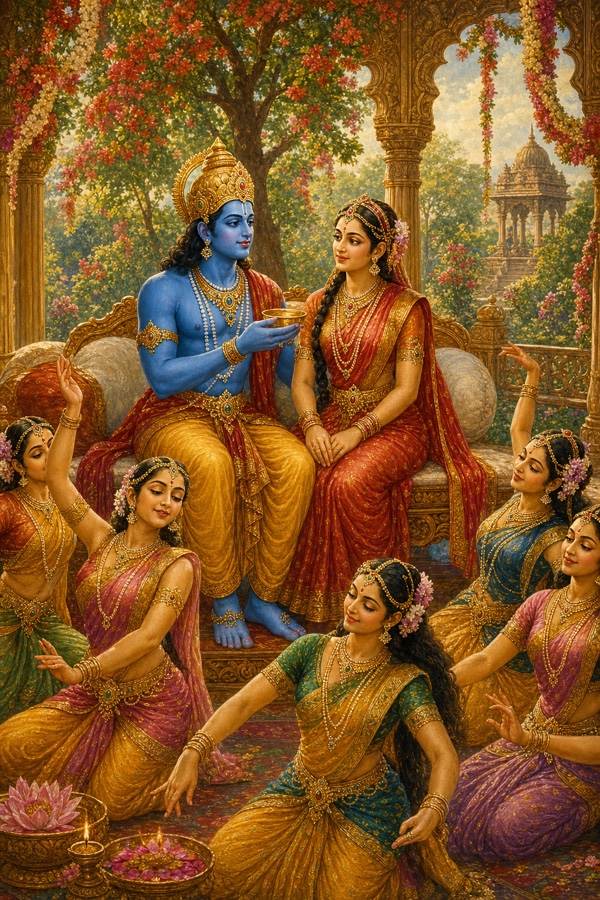
There were fragrant flowers and blossoms of every kind, and ponds of many shapes, full of excellent water, with flights of steps made of ruby that ended in platforms of crystal under the surface; masses of lotus and water-lily bloomed on them, chakravaka birds graced them, and they rang with the cries of water-hens and parrots and the calls of swans and cranes, and the trees along their banks stood so heavy with flowers that they seemed of many colors at once. Fences of various shapes and slabs of stone were set about them. Grassy glades the hue of the cat’s-eye gem made that Ashoka grove, thick with flowering trees, splendid to look at, and the stone slabs laid under the trees to serve as couches lay strewn with fallen flowers, dappled like a sky full of stars. Rama’s grove had been laid out like Nandana, the garden of Indra, and like Chaitraratha, the garden of Kubera that Brahma raised. Into that great Ashoka grove, with its pavilions set with many seats and its ring of bowers, Rama came, and he sat down on a finely made couch decorated with clusters of flowers, over which a carpet had been spread. He took in his own hand the pure nectar of flowers, as heady as Maireyaka wine, and gave it to Sita to drink, the way Indra gives it to Shachi. Attendants quickly brought well-cooked dishes fit for royalty and fruits of many kinds for the king’s meal. A troupe of apsaras and naga maidens, mistresses of song and dance, with kinnara women around them, danced before the king, and lovely, courteous women skilled in dancing and singing, always adorned with ornaments and fascinating to the mind, danced before him too. Rama, who of all men knew best how to give joy, was pious of soul, and he made them all rejoice; and seated in the company of the celebrated Sita he shone the way Vasishtha shines seated beside Arundhati. Happy as a god, Rama gave Sita, who looked like a daughter of heaven, this delight day after day, and in this way, while the two of them took their pleasure at length, the auspicious winter that always brings enjoyment came to an end, and the arrival of another winter passed into memory in its turn. In the first half of each day Rama, who knew dharma, did the duties dharma enjoins on a king, and the second half he spent in the women’s quarters. Sita, once she had done all that is owed to the gods in the forepart of the day, waited with respect on all her mothers-in-law, making no distinction among them, and then, dressed in ornaments and garments of many colors, she would come to Rama the way Shachi comes to Indra seated in heaven.
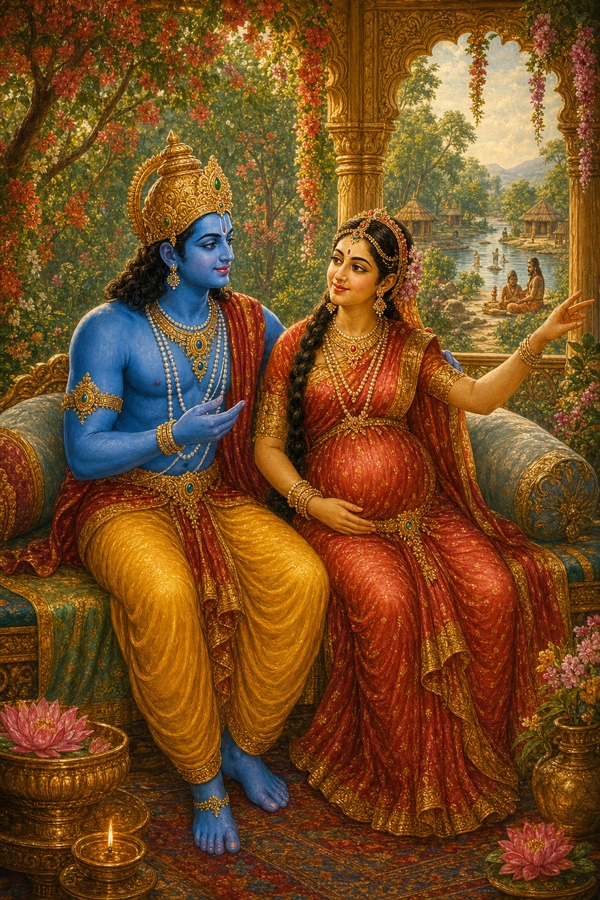
One day Rama saw on his wife the blessed signs of the child she carried, and a joy without measure came over him. “Very fine! Very fine!” he cried. Then he said to Sita, lovely as a girl of heaven, “Princess of Videha, the time of bearing a child has come to you now. Tell me, my love, which wish of yours shall I fulfill?”
Sita smiled. “Raghava, I want to visit the holy penance-groves,” she said, “and to stay at the feet of the sages of overwhelming splendor who live on the banks of the Ganga and eat only fruit and edible roots. This is my greatest wish, to spend even a single night in the penance-grove of those who live on roots and fruit.”
“So be it,” Rama promised her, he who never wearied in action. “Rest assured, Vaidehi; you will go tomorrow, without any doubt.” Having said this to the princess of Mithila, Janaka’s daughter, Rama went with his friends around him into the middle chamber of the palace.
Bhadra’s report: the people’s slander
Wise and witty narrators used to sit around the king in that chamber, reciting stories of every kind. Vijaya, Madhumatta, Kashyapa, Mangala, Kula, Suraji, Kaliya, Bhadra, Dantavaktra, and Sumagadha, men who loved a good tale and told it well, gladly entertained Rama with humorous stories of many sorts, and the king, who had promised his wife her journey for the morning, sat at his ease among them.
After a while, in the course of some story or other, Rama put a question to Bhadra. “Bhadra, what is being talked about in the town and in the kingdom? What do the people of the city and the country say about me, and about Sita, and about Bharata and Lakshmana, and what about Shatrughna and mother Kaikeyi? Kings are always being criticized, in the forests and in the kingdom alike.”
Bhadra folded his hands. “The talk of the citizens is all handsome talk,” he said. “What is mostly spoken of in the town is the conquest you won in killing Ravana.”
“Tell me everything exactly as it is, and leave nothing out,” Rama said. “What are the good words the citizens speak, and what are the ill ones? Once I have heard them I will practice what is good and turn away from what is evil. Speak without fear and without hesitation: what are the people of the town and the country saying about me?”
Bhadra steadied his mind, and with his palms joined he answered the king in words that were carefully chosen and pleasant to hear, though the news those words had to carry was hard. “Listen, then, to how the citizens speak of you, the good and the ill of it, at the crossroads, in the markets, in the streets, in the woods and in the groves.”
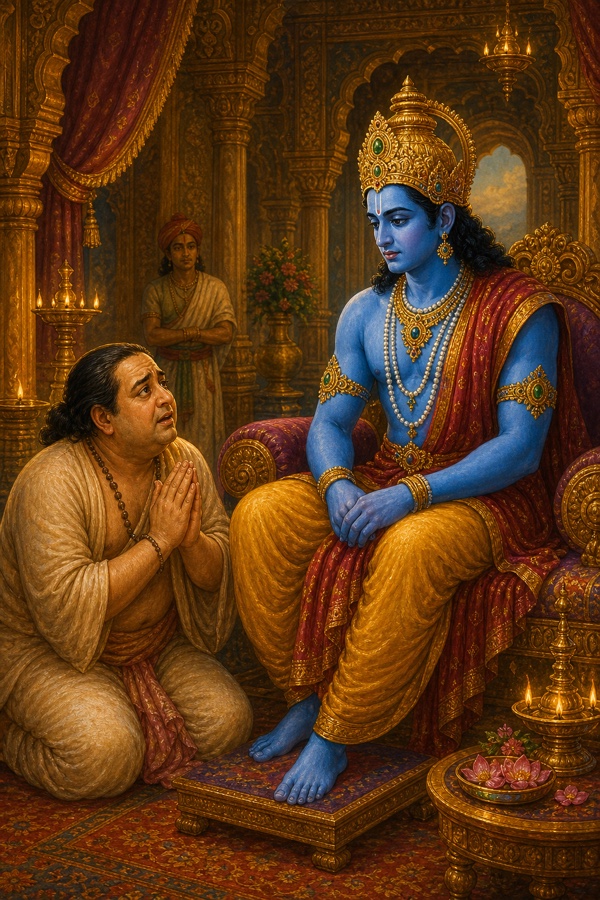
“They say,” Bhadra went on, “‘By throwing a bridge across the sea, Rama did a hard thing, a thing no king before him was ever heard to do, nor any god, nor any demon. He killed Ravana, whom no one could vanquish, along with his whole army and all his mounts, and he brought the vanaras, the bears, and the rakshasas under his sway. And then, having killed Ravana in battle and fetched Sita back, he set aside his anger and his misgiving and took her into his house again. What pleasure can there be in his heart, in his union with Sita? Why does Rama not censure her, the Sita whom Ravana first carried off by force, holding her in his lap, who was taken away to Lanka, who went into the Ashoka grove and lived there under the power of the rakshasas? Now we too will have to put up with conduct like that in our own wives, because whatever the king does, his subjects follow.’ That is what the citizens of all the towns and the whole countryside are saying, in one form or another.”
When he had heard it, Rama sat as if a blow had struck him, and he turned to all his friends. “Tell me,” he said. “Is this how it is?”
Every one of them bowed so low that his head touched the ground, and every one of them, a picture of pity, gave the same answer: “There is no doubt of it. It is so.” He had asked for the truth and he had been given it, and when he had heard them all out, Rama dismissed his friends.
Summoning the brothers
When his friends had gone, and when he had made up his mind, Rama spoke without hesitation to the doorkeeper seated near him. “Bring Lakshmana here at once, Sumitra’s son, the one who bears the auspicious marks; and Bharata, whose fame stands so high; and Shatrughna, who has never been conquered.”
The doorkeeper raised his joined palms to his forehead, went to Lakshmana’s residence and entered it, and, wishing that great-hearted prince prosperity, said with folded hands, “The king wishes to see you. Go there; do not delay.”
“Very well,” said Lakshmana, and on his brother’s command he mounted a chariot and drove swiftly to Rama’s palace. The doorkeeper watched him go and went on to Bharata, wished him prosperity, bowed humbly with folded hands, and said, “The king wishes to see you.” Bharata heard Rama’s message and sprang up from his seat, and, mighty as he was, hurried off on foot without waiting for a chariot. The doorkeeper watched him go too, and hastened to Shatrughna’s palace. “Come, come along, Shatrughna,” he said with folded hands. “The king wishes to see you. Lakshmana has already gone, and the celebrated Bharata after him.” At his words Shatrughna came down from his throne, bowed to the earth with his head, and went to where Rama was. Then the doorkeeper returned and, with folded hands, reported to Rama that all his brothers were present as he had ordered.
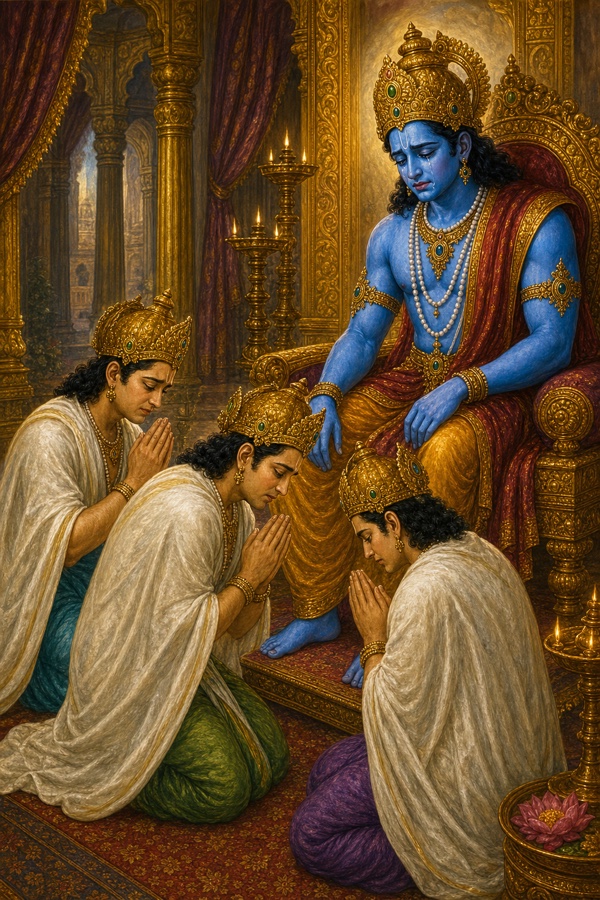
When he heard that the princes had come, Rama, his senses troubled with anxiety, his mind wretched, his face downcast, said to the doorkeeper, “Send the princes in to me at once. My life rests on them; those dear ones are my very breath.”
At the king’s command the three princes came in, clad in white, bowing with their palms joined, steady of mind. And what they saw was a face like the moon caught in eclipse, like the evening sun drained of its brilliance, the eyes of their wise brother full of tears, and the whole face like a lotus that has withered. They bowed their heads at Rama’s feet in a hurry and then stood transfixed, waiting, while Rama went on shedding tears.
He took them in his arms and lifted them up, embraced them, and made them sit. “You are the guardians of the people, and you are everything I possess,” he said. “You are my very life. The kingdom that you carved out I am only looking after. You have put the teaching of the scriptures into practice, and your judgment is mature. This problem of mine must be weighed by all of you together.”
Hearing this, they grew alert, and their minds were troubled as they waited to learn what the king would say.
Rama’s command: the banishment of Sita
His face drawn and thin, Rama spoke to his brothers, who sat there dejected. “Listen to me, all of you, and may all be well with you; do not set your minds against what I say as I tell you the tale that goes around among my citizens about Sita. The ill report that runs through my city and my country is one of great weight, and that slander on my name eats at my vitals. I was born in the noble house of the great Ikshvakus, and Sita too was born in the noble family of the Janakas, kings of great soul every one. You know well how Ravana carried Sita off from the lonely forest, and how I destroyed him. And you know that at that time this thought came to me about Janaka’s daughter: how could I bring back into this city a Sita who had lived in Lanka with Ravana?
“To convince me, Lakshmana, Sita entered the fire before your very eyes. The Fire-god himself, who carries our offerings to the gods, declared her free of sin. Vayu, who dwells in the sky, declared it too; and the sun and the moon, in the presence of the gods and before all the rishis, proclaimed Janaka’s daughter free of sin. In Lanka, in the presence of the gods and the gandharvas, Sita, pure in her conduct, was handed over to me by Mahendra himself; and my own inner conscience bears witness to her purity and her nobility. Then, having accepted Sita, I came home to Ayodhya. And now the people censure me, and it pains my heart. The censure is great, and it runs through the citizens and through the countryside. And this is the truth about a slander: whoever the being whose infamy is sung in the world, so long as the word of that infamy is spoken, so long does that being keep falling into the lower regions. Infamy is abhorred even by the gods, and it is fame that is honored in all the worlds.
“Every great soul strives for fame alone. For dread of an ill report I could give up my life, or all of you together; how much more, then, must I give up Sita. All of you see me sunk in this ocean of sorrow, and I know no greater misfortune than this. Lakshmana: tomorrow you will mount the chariot with Sumantra driving, and you will seat Sita in it, and you will leave her beyond the borders of the kingdom. On the far side of the Ganga, on the river Tamasa, stands the hermitage of the great sage Valmiki, and it looks like a dwelling of the gods. There, in that hermitage, in that lonely place, leave her, and come back here quickly. Do what I say, and remember: I am not to be told anything about leaving Sita.
“So go, Saumitra, and go soon, and carry out my command; there is nothing here to deliberate. Any resistance on your part will be the deepest displeasure to me. I swear to all of you, by my feet and by my life, that whoever speaks out to pacify me in any way while I am speaking is my enemy for all time, because he will shatter everything I desire. If you are ready to stand by my command, then show me that respect: take Sita from here this very day. Do what I say. ‘I wish to see the hermitages on the bank of the Ganga,’ she told me before; now let that wish of hers be fulfilled.”
So saying, Rama, his eyes closed, his heart torn with grief, sighing deeply like an elephant, took leave of his brothers and went into his own apartment.
Lakshmana takes Sita toward the forest
When the night had passed, Lakshmana, his mind in turmoil and his face drawn thin, said to Sumantra, the old charioteer who had once driven Rama to the edge of the forest at the start of the first exile, “Yoke the swiftest horses to the best chariot we have and fit it with a splendid seat for Sita, as the king has ordered. Sita is to be taken to the hermitages of the pious sages at the king’s command. Do not delay in bringing the chariot.”
“It shall be as you say,” Sumantra answered, and he brought a chariot yoked to the best of horses and beautifully fitted with a comfortable seat. “The chariot is ready,” he told Lakshmana. “Do what has to be done.”
Then Lakshmana, carrying an order he could not bring himself to speak, went into the palace and came to Sita. “You asked the king to let you see the hermitages,” he said to her. “The king has approved it, and he has ordered me to take you to them. So come, Vaidehi, at our lord’s bidding, and come quickly, to the holy hermitages of the sages on the bank of the Ganga, to the forest where the ascetics live.”
Hearing Lakshmana’s words, Vaidehi felt a joy without equal, and she agreed at once to go. She took with her costly garments and gems of many kinds. “I will distribute these garments and these precious jewels among the wives of the ascetics,” she said. Lakshmana approved her wish with all his heart, seated the princess of Mithila in the chariot, and, keeping Rama’s order in his mind, drove off behind the swift horses.
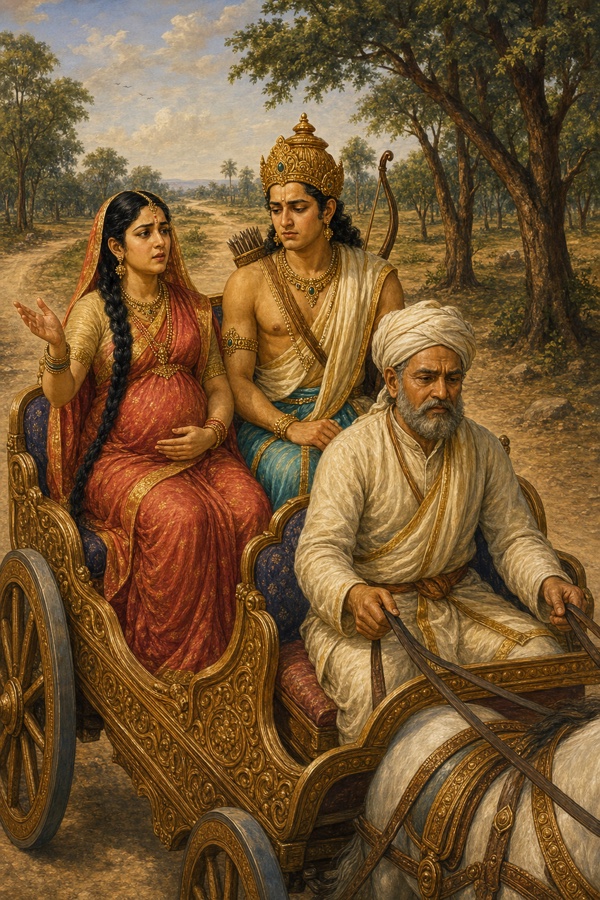
On the road Sita said to Lakshmana, who increases the fortune of everyone he serves, “Raghunandana, I see ill omens in abundance. My right eye throbs, my limbs shiver, my heart feels distressed. A great anxiety has come over me, and my composure has completely failed. The earth looks empty to me, Lakshmana, you who love your brothers so. May all be well with your brother! And may all my mothers-in-law be well too, every one of them alike, and every creature in the town and in the country.”
So Sita prayed to the gods with folded hands. Lakshmana heard her and bowed his head to the princess of Mithila, and with a heart that was withering inside him he said, “All is well,” as though he were glad to be able to say it.
They reached a hermitage on the bank of the Gomati and passed the night there. At the break of dawn Lakshmana woke and said to the charioteer, “Yoke the chariot quickly. Today I will bear the water of the Bhagirathi on my head, the way three-eyed Shiva bore it when it fell from heaven.”
The charioteer yoked the horses, whose speed was the speed of thought, and with folded hands asked the princess of Mithila to mount; and Sita, as she was asked, climbed into the beautiful chariot. Large-eyed Sita, with Lakshmana and the wise Sumantra, came at last to the Ganga, the river that carries away every sin. Half a day was spent in reaching her; and when Lakshmana looked at the streams of the Bhagirathi running before him, his composure broke, and he wept aloud.
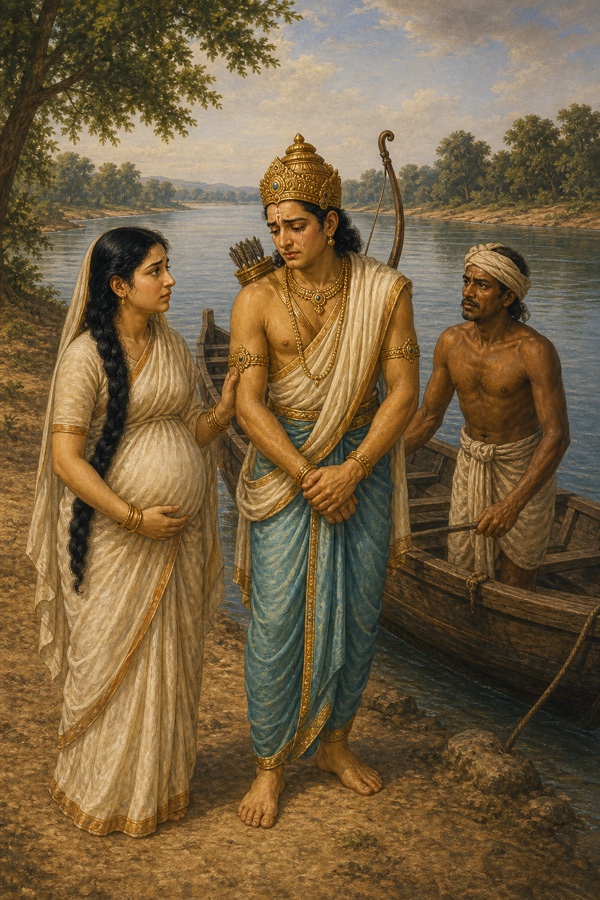
Sita, who was well composed and who knew what right conduct is, saw Lakshmana in that state and spoke to him. “Why do you cry, now that we have come to the bank of the Ganga, Jahnu’s daughter, which has been my one wish for so long? This is an hour of joy, Lakshmana; do not make me sad. You are always at Rama’s side. Is it that you are grieving because you have been parted from him for just two nights? Rama is dearer to me than my own life, and no sorrow has come over me; so please do not behave like a child. Take me across the Ganga and show me the ascetics. I will give the garments and the ornaments to them, and when I have paid my respects to the great rishis, each according to his standing, and spent just one night there, we will go back to Ayodhya. My own heart is urging me on to see him again, the lotus-eyed one, the one with the lion’s chest and the slender waist, the best of all who bring delight.”
Hearing her words, Lakshmana, who had brought down the bravest of his enemies in battle, wiped his eyes dry and called for the boatmen. They came with folded hands. “The boat is ready to go,” they said. Wanting to cross the holy Ganga, Lakshmana boarded the boat, and with a composure that cost him everything he had, he took Sita across.
Across the Ganga: Lakshmana speaks the truth
The boat the Nishada had brought was wide and well fitted out, and Rama’s younger brother seated the princess of Mithila in it first before he boarded it himself. Struck to the heart with grief, he told Sumantra to wait on that bank with the chariot, and he told the ferryman to row.
When they had reached the far bank of the Ganga, Lakshmana folded his hands, and with his face wet with tears he spoke to the princess of Mithila. “My heart is pierced through with a great dart, because I have been entrusted with this task, a task so cruel that the world will hold me to blame for it. I would have preferred a torture like death, or death itself. I should never have been made the instrument of a deed the people will condemn. I beg of you, do not count this as my fault.” So saying, Lakshmana fell to the ground with his palms still joined, and he wished for his own death.
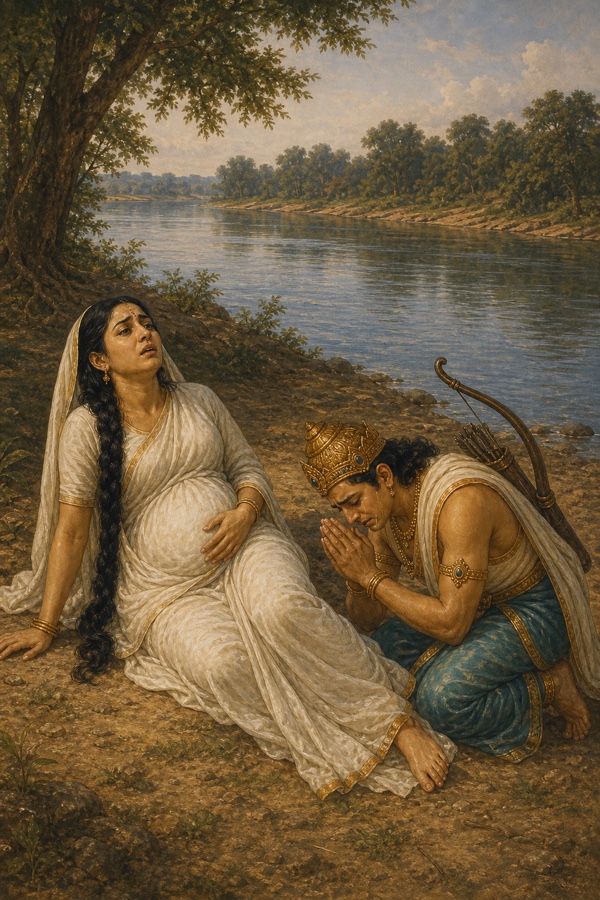
Seeing him lying there weeping, hands folded, longing to die, the princess of Mithila was deeply shaken. “I do not know what this is,” she said. “Lakshmana, speak the truth. It seems that you are not well, and that the king is not happy either. The king has laid some oath on you, since you are in such agony. So tell me the facts, here before me. That is my command.”
Urged by Vaidehi, Lakshmana, his mind in torment, lowered his face, and with his throat choking on tears he spoke, against his own wish. “Rama heard, in the presence of his courtiers, a most painful ill report that is going around among the citizens and the people of the country. Struck with grief, he passed the report to me and went into the inner apartment. The shameful words that pierced the king’s heart with anger are not fit to be uttered before you, and so I will not utter them. You have been forsaken by the king, out of dread of that ill report among the citizens, though you were proved free of every blemish by the gods themselves, in my very presence. Do not take it in any other way.
“I am to leave you near the hermitage, bearing in mind the king’s orders, and bearing in mind, too, the wish of a woman with child, which has to be fulfilled. Do not be dejected. Here is the beautiful and holy penance-grove of the brahmarshis, and here lives the famous brahmarshi Valmiki, the greatest of ascetics, who was a close friend of my father, King Dasharatha. Go to him for shelter. Live here keeping to your fasts, with your heart set on Rama, holding to your loyalty to your husband, keeping Rama in your heart forever; and in that way your greater welfare will be won.”
Sita’s lament, and her message for Rama
Hearing Lakshmana’s cruel words, Janaka’s daughter swooned, as if for a moment, and dropped to the ground. Then, with her eyes full of tears, she spoke to Lakshmana in a voice full of misery.
“Lakshmana, this body of mine was surely fashioned by the Creator for sorrow alone, for today it seems the very embodiment of sorrow. What sin did I commit in some other life? Whom did I once part from his wife, that I, a woman of good conduct, should be forsaken by the king? Before this, following at Rama’s feet, I begged Rama to let me live with him in the hermitages, and I was in misery even then. Now how am I to live in a hermitage all alone? What am I to say when the ascetics ask me what I did wrong, or what it was that made the great prince of Raghu’s line forsake me?”
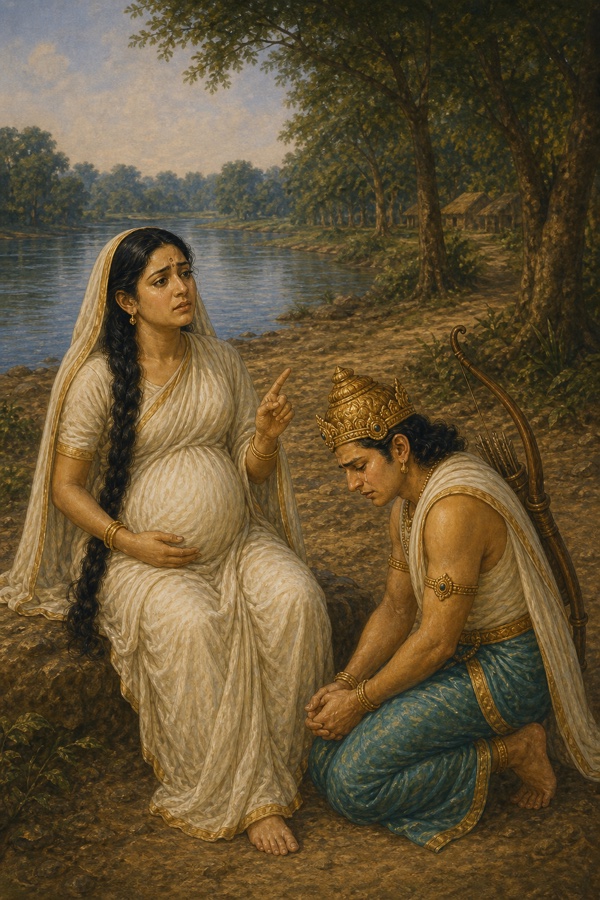
Then she mastered herself and spoke again. “I cannot give up my life in the waters of Jahnu’s daughter today, because by that the royal line of my husband would be broken; the child who is to be born would perish with me. Saumitra, do as you were ordered to do. Forsake me, the miserable one; obey the king’s command. But hear what I have to say now. Ask after the welfare of all my mothers-in-law, without any distinction among them, and after the king’s, with folded hands and with courtesy. Speak to every one of them, Lakshmana; and with your head bowed, give this message to the king, who stands so firmly in dharma: ‘Raghava, you know in truth that Sita is pure, that she is full of devotion to you and always mindful of your good. By you, afraid of infamy, am I forsaken. That censure of yours, and the reproach that has fallen on you, I myself will remove; you are my only refuge.’
“And tell the king, who is settled in righteousness, this too,” she said. “‘Treat your citizens as you treat your brothers, always. That is the highest dharma, and it will bring you fame without equal. Whatever you gain by dealing with your people justly and impartially, that will be the best fruit for you. I am not troubled about my own body. Just as it was necessary for you to answer the censure of the public, so a wife too has duties of her own. A husband is everything to a wife: her god, her family, her guru. So a wife must please her husband even at the cost of her life.’ Tell him all of this, briefly, as I have said it. And you have seen with your own eyes that I am with child.”
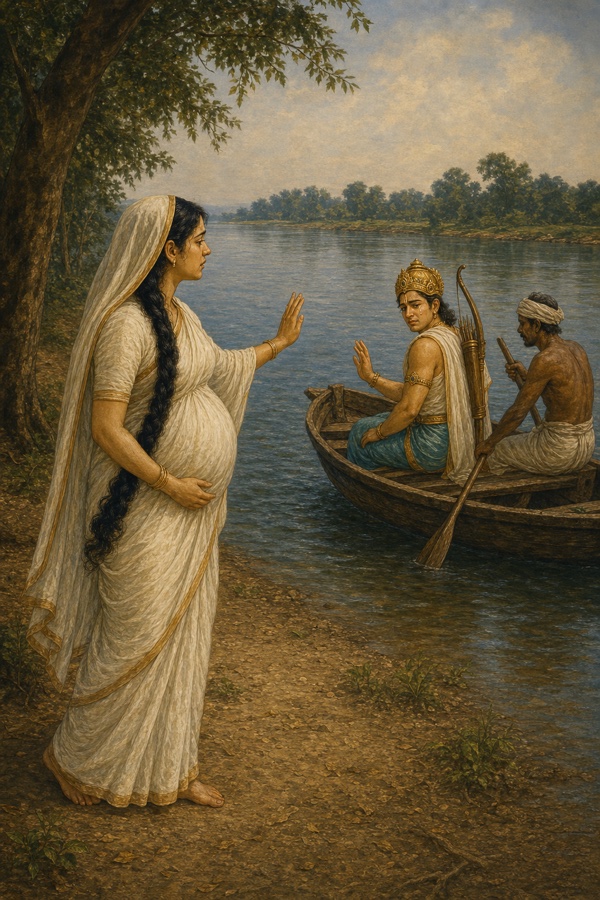
Hearing this, Lakshmana, sick at heart, bowed his head to the earth, and no words would come. He walked around her in reverence, weeping aloud, and stood a moment lost in thought, and then, with a great effort, he spoke. “I have never looked upon your form; your feet alone have been the object of my eyes until this day. How am I to look at you now, left in this forest without Rama?”
So saying, and bowing to her, Lakshmana went to the boat and boarded it, and told the ferryman to row. He reached the northern bank weighed down with the burden of his grief, climbed into the chariot in haste, bewildered as though his wits had left him, and looked back over his shoulder again and again at Sita languishing on the far bank like a woman with no one in the world; and so Lakshmana sped away.
Sorrow overwhelmed her as she watched the chariot draw away, trying again and again to catch one more glimpse of Lakshmana, and she was shaken to her depths. Bowed under the weight of her grief, that glorious lady, faithful to her husband, seeing no one now to protect her, wept aloud in that forest ringing with the cries of peacocks.
Valmiki’s shelter
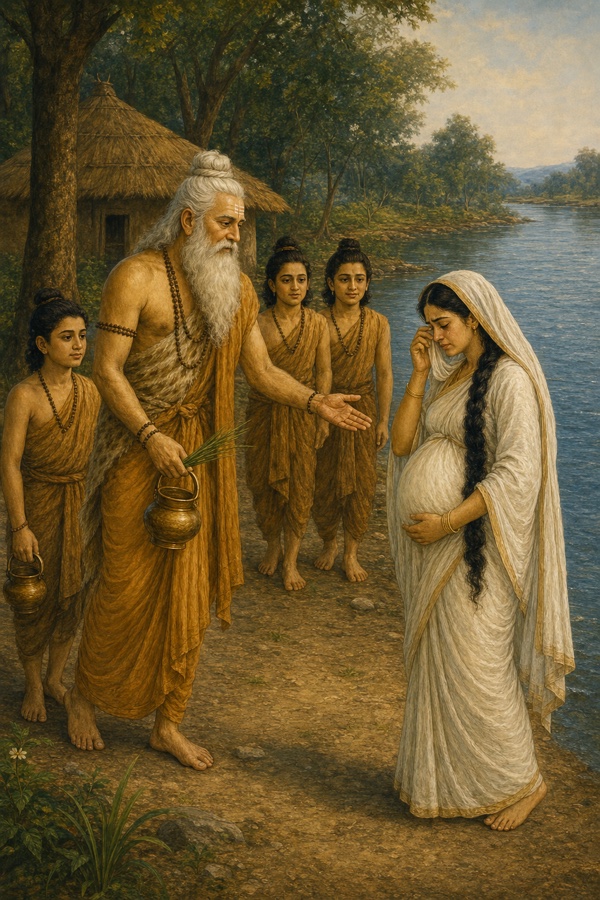
The sound of a woman crying carried up from the river to the hermitage of Valmiki, the sage whose austerities had given him a wisdom that saw across the three worlds. The young ascetics of the hermitage heard it first, and they ran to the sage and touched his feet and told him what they had heard. “A noble lady we have never seen before, the wife of some great man, lovely as Lakshmi herself, is crying aloud near the bank of the river, her face distorted with despair,” they said. “We saw her weeping, overwhelmed with sorrow. She does not deserve such suffering, and she ought not to be left like an orphan; she does not look to us like a woman of the human race. Please, sir, comfort her in a fitting way. She is not far from the hermitage. She has come seeking refuge with you, and she needs a guardian; it falls to you to protect her.”
Valmiki, greatest of the sages, who already knew everything through the power of his asceticism, heard them and set off at once, walking fast toward the place where Janaka’s daughter was sobbing, and as he strode forward his disciples came after him. Barefoot, carrying in his hands the arghya, the water of welcome that is offered to an honored guest, the sage reached the shore of the Ganga and saw Sita, the wife of Rama, lamenting there with no one to help her.
Valmiki, first among ascetics, spoke to the grieving Sita in sweet words, and the very power of his presence seemed to lighten her as he spoke. He did not ask her a single question, because he already knew. “You are the daughter-in-law of Dasharatha, the beloved queen of Rama, the daughter of King Janaka. You are welcome here. I knew by my subtle sight that you were coming, and the causes of it too are known in my heart. Your purity is known to me; everything that exists in the three worlds is known to me. Yes, with the inner eye my austerities have given me I have seen that you are sinless. Be composed; you are in my charge now. Not far from the hermitage live women ascetics devoted to their austerities, and they will look after you always, as they would look after a child of their own. Accept this water of welcome; be calm, and be free of every ailment. Think of yourself as entering your own home, and do not despair.”
Hearing those most wonderful words of the sage, Sita bowed her head to him, and with folded hands she said, “So be it.”
Sita followed the ascetic with folded hands as he went toward his cottage. The wives of the ascetics saw him coming with the daughter of the king of Videha beside him and came out to receive them, and they spoke with joy. “Welcome, greatest of ascetics; we bow to you; you have been a long time coming. Tell us now, what shall we do?”
“The wife of Rama has come to us,” Valmiki told them, “the daughter-in-law of Dasharatha, who was once the daughter of Janaka. This is Sita. She is without guilt, and she has been forsaken by her husband, and she will be under my charge always. Look on her with the greatest affection. The honor you show to me, show the same to this lady, for she is worthy of respect from all of you in particular.”
When he had handed Sita over to the women ascetics in this way, again and again, the sage of great fame and great austerities, Valmiki, went back with his disciples to his own hermitage.
Lakshmana and Sumantra: a glimpse of fate
Lakshmana, watching from the far bank as Sita was led into the hermitage, fell into a deep grief, and he spoke to Sumantra, the charioteer who drove with such skill, and who had been Dasharatha’s charioteer before he was Rama’s. “Consider the grief that has come on Rama through this parting from Sita. What greater grief could there be for Raghava than to banish his own wife, Janaka’s daughter, whose conduct is so pure? This separation of Rama from Sita is truly the work of destiny, and destiny is never to be overcome, at any time. Is it not a wonder that Rama, who in his anger could wipe out the gods with the gandharvas and the asuras with the rakshasas, should have to bow to fate? Before this, at his father’s word, he lived fourteen years in the wild forest of Dandaka, and that was misery enough. It seems to me that it pained him more to banish Sita a second time, on hearing the cruel words of the citizens. And what merit in dharma has come to him from this ignoble act against Sita, done because the citizens speak ill of her?”
Sumantra, who was wise, heard out all these words of Lakshmana’s, in all their turns, and answered him. “You must not grieve for Maithili on this account, Lakshmana, because all of this was foreseen long ago by the Brahmins who read the stars, in the presence of your father. Rama is bound to be engulfed in sorrow and to be left without happiness; he will soon be parted from those dear to him. After the lapse of a long time, that pious and noble man will leave you, and Maithili, and even Shatrughna and Bharata: such was the prophecy. What Durvasa pronounced before the king was never to be disclosed to you or to Bharata. The rishi Durvasa spoke his prediction in the hearing of the great king Dasharatha, and before me, and before Vasishtha too. And when he had heard it, Dasharatha, the greatest man I ever served, said to me, ‘Nowhere among my people is this to be divulged by you.’ I will never make false the word of that king; that is my firm resolve. I ought by no means to reveal the secret to you, even though you are eager to hear it. But listen to me, Raghava. Though the secret that was never to be told was entrusted to me long ago, I will tell it, because fate is inevitable. It is by that fate that this pain and this sorrow have come. Do not speak of it before Bharata, or before Shatrughna either.”
Lakshmana heard the weight of what the charioteer had said, and he would not let it lie there between them. “Tell me the truth,” he said.
The curse of Bhrigu: Vishnu’s human birth
So prompted by the noble Lakshmana, the charioteer set himself to repeat what the rishi Durvasa had said. In an earlier time the great sage Durvasa spent the four months of the rains in the hermitage of Vasishtha, the priest of the royal house. Dasharatha, who was possessed of great power and mighty fame, came in person to that hermitage to see his noble priest. There he saw the great ascetic Durvasa seated at Vasishtha’s left, radiant as the sun in full blaze, and he bowed courteously to the two great ascetics, who surpassed every other ascetic in penance. They honored the king in their turn with words of welcome, with a seat, with water for his feet, and with roots and fruit, and he stayed with them a while. At midday, when the great rishis were gathered together and sweet tales were being told, the king, in the course of the conversation, folded his hands and put a question to that great son of Atri who was so rich in austerities.
“Sir, how long will my line continue? To what age will Rama live, and how long will my other sons? And what will be the span of the life of Rama’s son? Sir, I wish you would foretell for me the future course of my house.”
Hearing the king’s words, the mighty Durvasa began to speak. “Listen to me. In ancient times it happened that the Daityas, the sons of Diti, beaten by the gods in the war between them, went to the wife of Bhrigu for protection, and she granted them her word of safety, and they lived fearlessly at Bhrigu’s hermitage under it. Vishnu, the lord of the gods, seeing them sheltered by her in this way, was enraged, and he cut off the head of Bhrigu’s wife with his discus. And Bhrigu, seeing his wife done to death, cursed Vishnu, lord of the gods though he was, in the heat of his rage: ‘Because you have killed my wife, who did not deserve to be killed, out of a blind fit of anger, so you, who take away the sorrows of mortals, will be born into the world of mortal men, and in that mortal life you will suffer separation from your own wife for many years.’
“Once the curse was spoken, Bhrigu himself was afflicted in his mind by it, and, as though prompted by the indweller of every heart, he was moved to beg the god to accept it. In pain at his own curse, Bhrigu worshiped that god; and Vishnu, who loves his devotees, thus worshiped, said, ‘For the welfare of the world I accept this curse.’ It is that Vishnu, cursed long ago by Bhrigu, who has become your son, and is honored in the three worlds by the name of Rama. The fruit of that curse, separation from Sita, he will bear. Rama will be the lord of Ayodhya for a long time, and all who follow him will be happy and prosperous. He will rule his kingdom for eleven thousand years, and then, having performed many rich horse-sacrifices and founded many royal families, he, the invincible one, will go to the world of Brahma. Two sons of Raghu’s line will be born to Sita; and Raghava will consecrate both of them as kings, though not in Ayodhya.”
Having told the future course of Rama’s royal house at such length, the great and powerful ascetic Durvasa fell silent. When he had stopped speaking, Dasharatha saluted both the great ones, Vasishtha and Durvasa, and returned to Ayodhya, the best of cities.
“Those words the ascetic spoke long ago I heard and took to heart, and it will not be otherwise,” Sumantra said. “Rama will consecrate Sita’s two sons, as the ascetic predicted, though not in Ayodhya. This being so, there is no cause for despair over Sita and Rama. Be firm.”
Lakshmana felt a great relief at the charioteer’s wonderful account, and he was glad. “Excellent!” he cried. “You have spoken well.” While the two of them talked in this way the sun went down behind the mountain, and they made their halt for the night on the bank of the river Keshini.
Lakshmana’s return, and Rama’s consoling
Having spent the night on the bank of the Keshini, Lakshmana, alone now with Sumantra and the seat that had been fitted for Sita, woke at the break of dawn and went on toward Ayodhya. When half the day was gone, at noon, the great warrior entered the city, rich in jewels and thronged with well-fed people, and the ordinary noise of it went on around him as if nothing had happened. “What am I going to say when I go in and touch Rama’s feet?” he thought, and the thought threw him into the deepest wretchedness. So thinking, he came to the palace of Rama, a palace as gracious as the moon. He got down from the chariot at the doorway of Rama’s apartment and went in unhindered, his mind in turmoil, his face downcast, and with his eyes full of tears he saw his elder brother seated before him on the throne, downcast too.
Lakshmana touched his elder brother’s feet, and, composing himself somehow, he spoke in a sorrowful voice with his palms joined. “Keeping the command of your noble feet before everything, I have left Sita, Janaka’s daughter, whose conduct is so pure and whose name stands so high among the wives devoted to their husbands, at the holy hermitage of Valmiki on the bank of the Ganga, as you directed; and I have come back, Rama, to serve at your feet.”
Then Lakshmana set himself to comfort Rama. “Please do not grieve at being parted from Sita. This is what destiny decreed, and the wise and the able, men like you, do not give way to dejection. Every accumulation ends in loss, every rising ends in a fall, every union ends in separation, and this life ends in death. So it is not right to be too attached to sons, to wives, to friends, or even to riches, because separation from them is certain. You are able, by your own mind, to control yourself and your mind and all the worlds with them; why then this sorrow over your own case? Men like you are not deluded in such matters. And be sure of this: the ill report will turn back on itself, and that very ill report for which you have forsaken Sita will go around the city again, without any doubt. So it becomes you to set aside this weakness of mind with fortitude, and to grieve no more.”
At these words from the noble Lakshmana, Rama, who was so affectionate to his friends, answered Sumitra’s son with great joy. “It is as you say, Lakshmana. In the carrying out of my orders lies my satisfaction. Your sweet words have brought me peace and turned my grief aside, and I am my own self again.”
The story of king Nriga: the price of neglecting the people’s business
Rama was highly pleased by those striking words of Lakshmana’s, and he said, “A kinsman as faithful and as wise as you is hard to find, and at a time like this hardest of all. Now I will tell you what is passing in my mind, Lakshmana; listen to it, and do as I say. Four full days have gone by, and in all that time the business of the citizens has gone unattended; that neglect eats at my vitals. Let all my subjects be summoned, and the priest, and the counselors, and every man or woman who has business to bring before me. The king who does not attend day by day to the business of his people falls, without any doubt, into the dreadful hell called Samvrita, the airless one.
“In the days of old,” Rama went on, “there was a king named Nriga, of high fame, a protector of the earth, devoted to Brahmins, truthful in speech, and pure in heart and conduct. Once, at the holy pilgrim-center of Pushkara, that king gave away to the Brahmins, who are the gods on earth, cows in their millions, adorned with gold, each with her calf at her side. Among that vast herd the cow of a poor Brahmin, a man who kept the sacred fire and lived on the grain he gleaned from harvested fields, was touched by the king in error and given away with the rest, her calf with her. Tormented by hunger, that Brahmin roamed all the provinces in search of his lost cow for many years, and did not find her. Then, coming to Kanakhala, he saw his own cow in good health, with her calf grown to full size, in the house of another Brahmin. He called her by the name he himself had given her: ‘Shabala! Come.’ The cow knew the voice, and answering the call of that hungry Brahmin who shone like the sacred fire, she followed him as he walked away.
“The Brahmin who had reared her all those years came hurrying after the cow. ‘This cow is mine,’ he said to the other. ‘King Nriga himself touched her and gave her to me.’ And so a quarrel broke out between the two learned Brahmins.
“Quarreling as they came, the two of them went to the donor, Nriga, and waited at the gate of the royal palace; and by Nriga’s own orders they were not admitted. They stayed there many days and many nights, and at last both those good Brahmins grew enraged, and in their rage and their anguish they spoke terrible words.
“‘Because you do not show yourself to those who come with business and have their business settled, you will take the form of a lizard, and for many thousands and hundreds of years you will stay unseen by all beings,’ they said. ‘You will live inside a pit as a lizard. Into this world Vishnu will be born in a human form, known as Vasudeva, the son of Vasudeva, who will add to the fame of the line of the Yadus; and he will set you free from the curse. From this day you will be a lizard, and after a long time your deliverance will come as we have said. Both Nara and Narayana will be born in the Kali age, to deliver the beings of this world from the weight of their sins.’
“Having laid this curse, the two Brahmins, their anguish now spent, gave that weak old cow to yet another Brahmin.
“So that king fell under a terrible curse.
“Neglect of a dispute between people who come with a plaint is a fault in a king. So, Saumitra, do not let the men who come with business and seek my presence be neglected. The king who neglects them does not obtain the fruit of his good deeds. Go, then, and attend to the people who are waiting on their business.”
Nriga enters the pit
Hearing Rama’s words, Lakshmana, who knew the highest good, folded his hands before his brother, who glowed with splendor as he spoke. “Kakutstha, for so small a fault the Brahmins laid on Nriga, that rishi among kings, a curse as harsh as a second rod of Yama,” he said. “What did King Nriga say to those two Brahmins in their rage, when he heard himself charged with a sin?”
“Hear what that curse-stricken king said,” Rama answered, and took up the tale again. When the two Brahmins were on their way back to their homes, the king, filled with misery, called together all his subjects, the priest and the ministers, the merchants and the whole people, and spoke to them.
“‘Listen to me, all of you, with attention. The two divine sages Narada and Parvata, blessed and free of every taint, have laid a great fear on me and gone off, swift as the wind, to the third world, the world of Brahma. Let the prince Vasu be consecrated here and now. Let my artisans dig out a comfortable pit for me, where I can serve out the curse the Brahmins have pronounced. Let them dig one pit that will give shelter from rain and from cold, and let them make another that will give shelter from the heat. Let trees laden with fruit, and flowering creepers, and thickets of every kind be planted around the pits, so that they are lovely on every side. I shall dwell in those pits for as long as the curse lasts. And let fragrant flowers be planted so that they cover a yojana and a half around me, always.’
“Having given these orders, Nriga placed Vasu on the throne and spoke to him. ‘Son, abide always in dharma, and protect your subjects according to the law of a king. You know it was in your very presence that the two Brahmins pronounced this curse on me in their anger, and for a fault so slight. So do not grieve for me, my son. Fate is strong, and it is fate that has put me in this misery. A man attains only what is ordained for him to attain; he goes only to the place that is ordained for him to go; he gains only what is ordained for him to gain. And all the joys and sorrows that come from a former birth come of themselves. So, child, do not be dejected.’
“So saying to his son, the famous king Nriga went to live in that well-built pit, and, entering that huge pit set with jewels, the king, great of soul even then, began to undergo the curse the two Brahmins had pronounced on him in their wrath.”
King Nimi and Vasishtha curse each other
When he had told the story of Nriga’s curse in full, Rama said, “Lakshmana, if you have a mind to hear more of such stories, then listen now to another.”
“I am never satisfied with such wonderful stories,” Lakshmana said.
So Rama, the joy of Ikshvaku’s house, began a tale full of dharma, and it was a tale of his own house. There was once a king named Nimi, the twelfth of the sons of Ikshvaku, a king full of prowess and firmly settled in dharma. That powerful king founded a city like the city of the gods near the hermitage of Gautama, and the good and famous name given to it, after the palace of Indra, was Vaijayanta; there the royal sage Nimi, whose fame was great, made his home. And having founded that great city, it came into his mind to perform a sacrificial session of many years that would make his father happy.
Then, with the leave of his father Ikshvaku, the son of Manu, the royal sage Nimi, Ikshvaku’s beloved son, first chose Vasishtha, greatest of the brahmarshis, to be his chief priest, and after him he invited Atri, Angiras, and Bhrigu, whose treasure was their austerity. But Vasishtha said to Nimi, the best of royal sages, “Indra has already chosen me for his own sacrifice. So wait a while, until Indra’s sacrifice is done.”
After Vasishtha had gone, the great Brahmin Gautama took up the office of chief priest at Nimi’s sacrifice, and the majestic Vasishtha officiated at Indra’s. Nimi, the lord of men, gathered the Brahmins he had invited and performed the sacrifice near his city of Vaijayanta, close to the Himalaya, and the king took the initiation for a session of five thousand years. When Indra’s sacrifice was finished, the blameless and holy sage Vasishtha came back to King Nimi to act as his priest, and found that the interval he had asked the king to wait had been filled by Gautama. At that Vasishtha, the son of Brahma, was very much annoyed.
He sat down for a while, wishing to see the king. But that day sleep had come down heavily on the royal sage Nimi, and no one woke him. Unable to meet the king, Vasishtha, for all his greatness of soul, grew angry, and he pronounced his curse. “Since you slighted me and chose another as your officiating priest, your body will be left without consciousness.”
When he woke and heard of the curse the sage had pronounced, the king was blind with wrath, and he answered Vasishtha, the son of Brahma. “You were darkened by anger when you laid a curse like fire, like a second staff of Yama, on a man who was asleep and knew nothing of your coming. So this ever-handsome body of yours, brahmarshi, will be left without consciousness too, of that there is no doubt.”
So, cursing each other in their wrath, that great king and that great Brahmin both at once became bodiless.
Vasishtha’s rebirth, and the tale of Urvashi
Lakshmana had listened to the end of that story with his hands folded, and the end of it would not let him rest. Rama had left two great men lying bodiless, a king and a Brahmin whom the gods themselves honored, and there the story had simply stopped. “Kakutstha,” he said, “those two gave up their bodies at one another’s word. How did the Brahmin Vasishtha and King Nimi, whom the gods held in honor, ever come to wear bodies again?”
Rama told him. The righteous royal sage and the Brahmin whose whole wealth was his austerity had cursed each other and lost their bodies in the same instant, and what remained of each of them was wind. Vasishtha, a great sage and now a bodiless drift of air, had one recourse, and he took it: he went to his father. Brahma had brought him forth, and to Brahma he now went to ask for another body. He bowed at the feet of the god of gods, a bow made of nothing anyone could see, and spoke to the Grandsire in the voice the wind had left him.
“God of gods, you who were born from the cosmic egg, Nimi’s curse has taken my body from me and turned me into wind. For any being that has no body the suffering is great; every work a bodiless one might do simply stops. Be gracious to me. Let me have a body again.”
Brahma, the self-born, whose light has no measure, gave him his answer at once. “Enter the seed that Mitra and Varuna have let fall, you whose renown is great. There too you will be born without a womb, and you will carry great dharma with you, and in time you will come back into my keeping, born again as my son.” Vasishtha heard him, bowed, and walked once around his father with his right side toward him, as a son does before he departs, and then went swiftly to the realm of Varuna.
Varuna was lord of the ocean of milk, and at that time Mitra shared his seat and his office there, so the two gods sat together in the sea-king’s house and received the homage of the rulers of the gods. Into that house, by pure chance, came Urvashi, loveliest of the apsaras, with her friends around her. She went down into the milk-white water to play, and Varuna watched her at her play, her eyes long as the petals of a lotus, her face like the full moon, and joy took hold of him. He asked that most beautiful of the apsaras to lie with him.
Urvashi joined her palms. “Mitra himself has already chosen me,” she said, “and he chose me first.”
Varuna was already pierced by the arrows of Kama, the god of desire, and he would not be turned aside so easily. “Then here is a pitcher the gods made,” he said. “I will let my seed fall into it, here, before your eyes, and with that my desire will count as fulfilled, if you do not wish our bodies to join.”
That pleased Urvashi. “Let it be so,” she said, and she was glad as she said it. “My heart is with you, and what I feel for you is the greater, but my body belongs to Mitra.” At that Varuna let fall into the pitcher his seed, great and wonderful, bright as a blazing fire.
Then Urvashi went to where the god Mitra was waiting for her, and Mitra had seen enough. His anger was immense. “I chose you first,” he said. “Why did you leave me and take another for your husband? Your conduct is wicked, and because of this misdeed my anger has stained you: you will go down and live for a time in the world of mortal men. There is a royal sage named Pururava, the true-born son of Budha, and he is the king of Kashi. Go to him. He will be your husband.”
So it was the fault of a curse that sent Urvashi to Pururava, the son of Budha, who ruled from the city of Pratishthana. She bore him a son, Ayu, mighty and glorious, and Ayu’s son was Nahusha, who shone like Indra. There came a day when Indra, wearied from hurling his thunderbolt at Vritra, left his seat empty, and it was this Nahusha who sat in it and ruled the office of Indra for a hundred thousand years. Urvashi, with her fine teeth and her fine eyes, lived out many years on the earth under the curse, and when the curse was spent she went back to the world of Indra.
The birth of Vasishtha and Agastya, and the beginning of the line of Janaka
The tale was wonderful, and it had the flavor of the divine, and Lakshmana was delighted by it; yet he saw that it had answered only half of his question. A pitcher of the gods now held the seed of Mitra and Varuna, and Nimi’s body still lay where it had fallen. “Kakutstha,” he asked again, “the Brahmin Vasishtha and King Nimi, both honored by the gods, gave up their bodies. How did they come to be embodied once more?”
Rama, whose valor was truth itself, told him the story of Vasishtha, that sage of great soul. “That pitcher was full of the seed of those two great gods,” he said, “and in it two Brahmins of blazing splendor came to birth, the greatest sages the world would know. The first to be born from the pitcher was the lord Agastya, and he said to Mitra, ‘I am not your son alone,’ and went away from him. What had gone into the pitcher first was the seed of Mitra, let fall in the presence of Urvashi, and the seed of Varuna had been added to it. Some time later there was born from the seed of Mitra and Varuna together the majestic Vasishtha, who became the family priest of the Ikshvakus. The blameless Vasishtha had scarcely been born when Ikshvaku, our ancestor, whose splendor was very great, chose him as priest for the good of our line.”
“So I have told you how Vasishtha came forth in his new body,” Rama said. “Now hear what became of Nimi.” When the sages saw their king lying bodiless, videha, every one of those thinkers took the sacrificial vow on his behalf and carried the rite through to its end; the sacrifice a king had begun would not be left unfinished because the king had no body to finish it. The chief Brahmins, with the citizens and the household servants, kept his body whole, dressing it with fragrant unguents, garlands, and cloth.
When the sacrifice was over, Bhrigu spoke to what remained of the king. “I am pleased with you,” he said. “I will bring your consciousness back.”
The gods too were pleased, all of them, and they addressed what was left of Nimi, the consciousness that had once been a king. “Ask for a boon,” they said. “Where would you have your consciousness placed?”
“Let me live in the eyes of every living being,” said the consciousness of Nimi.
“So be it,” the gods answered. “You will move in the eyes of all beings in the form of wind. And so that you, who will be moving there without pause, may have rest, living beings will close their eyelids over you again and again.”
With that the gods went back the way they had come. Nimi had died without a son, and the great sages were not willing that his line should end with him. They took his body, set the arani upon it, the two fire-sticks from which a sacrificial fire is twirled into life, and churned with all their force, pouring mantras and oblations into the work, for the sake of a son for Nimi. From the arani, as it was churned, a son came forth, a great ascetic. Because he was born of Videha, the bodiless king, they called him Vaideha; because he was born of the churning, Mithi; and because he came to birth in so wondrous a way, Janaka. So the first king of the Videhas was Janaka, famous by the name of Mithi and great in splendor, and from him came the Maithilas, the line of Mithila.
“So now you have the whole of it,” Rama said, “the wondrous cause of it all: how Vasishtha was born from the curse of Nimi, and how King Nimi was born from the curse of Vasishtha.”
The curse of Shukra: king Yayati
When Rama had finished, Lakshmana, who shone with a light of his own, turned the story over and found the fault in it. “What happened to the bodiless Vasishtha and to Videha in those ancient days is wonderful,” he said, “a very great marvel. And yet Nimi was a kshatriya, a hero, a king who had taken the vow of the sacrifice, and he did wrong when he would not forgive Vasishtha, great soul that he was.”
Rama, first among the kshatriyas, answered his brother, who knew every shastra. “Forgiveness is not found in every man,” he said. “Lakshmana, listen carefully now, and hear how Yayati quieted an unbearable anger by holding to a course in which the quality of goodness, sattva, led the way.
“There was a king named Yayati, the son of that same Nahusha who had sat in Indra’s seat, and under him the people of his cities prospered. He had two wives, and for beauty neither of them had an equal on the earth. One was Sharmishtha, the daughter of Vrishaparva and a granddaughter of Diti, a Daitya’s child, and the royal sage Yayati set her above the other and gave her every honor. The other was Devayani, the daughter of Ushana, the sage the world calls Shukra, and slender-waisted as she was and beautiful, the king did not love her. Each wife gave him a son, and both sons were handsome and well conducted: Sharmishtha bore Puru, and Devayani bore Yadu. Puru was the king’s favorite, for his own virtues and for his mother’s sake.
“It ate at Yadu, and one day he went to his mother and said, ‘You were born in the house of the Bhargava, the son of Bhrigu, whose deeds never falter, and yet you bear this grief of the mind and this insult that no one should have to bear. Let the two of us walk into the fire together, and let the king take his pleasure with the Daitya’s daughter for as many nights as he likes. If you can bear it, give me leave to go. You may be able to bear it. I cannot, and I will surely die.’
“Devayani heard her son out, and he was weeping as he spoke, wrung with grief, and anger rose in her, and in her anger she thought of her father. Shukra, the son of Bhrigu, knew his daughter’s mind the instant she turned it toward him, and he came in haste to the place where she was. He found her unlike herself, joyless, half senseless with pain, and he asked her, ‘What is this?’
“He had to ask more than once. Then Devayani, still angry, gave him her answer. ‘I will walk into fire, or swallow sharp poison, or go down into the water. I cannot go on living. You do not know how I suffer, and how I am insulted. When a tree is treated with contempt, everything that lives on the tree, its leaves and its flowers, is cut down with it. That is what the royal sage does to me. He treats me with contempt, he heaps his scorn on me, and he does not think me worth a moment’s honor.’
“Shukra listened to his daughter, and wrath closed around him. He began to curse Yayati, the son of Nahusha. ‘Because you hold me in contempt,’ he said, ‘and because your heart is base, the years will wither you: old age will come down on you and leave you feeble.’
“Having laid the curse and comforted his daughter, the far-famed brahmarshi, radiant as the sun, went back to his own house. He had come in haste at a daughter’s thought of him; he left with her insult answered, and with the curse already on its way to the king.
The gist: Rama takes up anger and forbearance and begins to give Lakshmana the example of Yayati, and the chain of curses runs on here too, as Shukracharya’s angry word lays old age on a king. After the great crisis of dharma in Sita’s banishment, born out of nothing more than the people’s talk, Valmiki uses these night-long exchanges between Rama and Lakshmana to raise, again and again, the deep questions of anger, forbearance, fate, and a king’s dharma, as though the echo of that one hard decision kept sounding through every story either brother could find to tell.
Source: Srimad Valmiki Ramayana, Uttarakanda, Cantos 37 to 58. The Gita Press Hindi edition is the controlling witness. The Sanskrit e-text and an independent complete translation were used to verify names, sequence, and principal events. Where recensions differ, this retelling follows Gita Press.
Basis: Valmiki Ramayana (Gita Press, Gorakhpur)