On this page
Ravana was dead. Overhead, gods and gandharvas and danavas were turning their aerial chariots homeward across the sky, carrying with them, in bright and happy talk, the story of that enormous war back to their several worlds. Rama gave the divine chariot back. It was the one Indra had sent him, and it burned like fire; he returned it with respect to Matali, Indra’s charioteer, and with Rama’s leave Matali mounted it and rose to heaven. Then Rama, glad past all measure, drew Sugriva to his chest, received Lakshmana’s salute, and, honored on every side by the crowding monkeys, came back to the camp where his army waited. There he turned to Lakshmana, who stood beside him brimming with courage and lit with spirit, and told him to consecrate Vibhishana as the king of Lanka. “This Vibhishana is bound to me by love and devotion, gentle brother,” Rama said, “And he did us good service before we ever needed it. It is my deepest wish that we should see this younger brother of Ravana crowned on the throne of Lanka.”
Vibhishana’s coronation, and the message to Sita
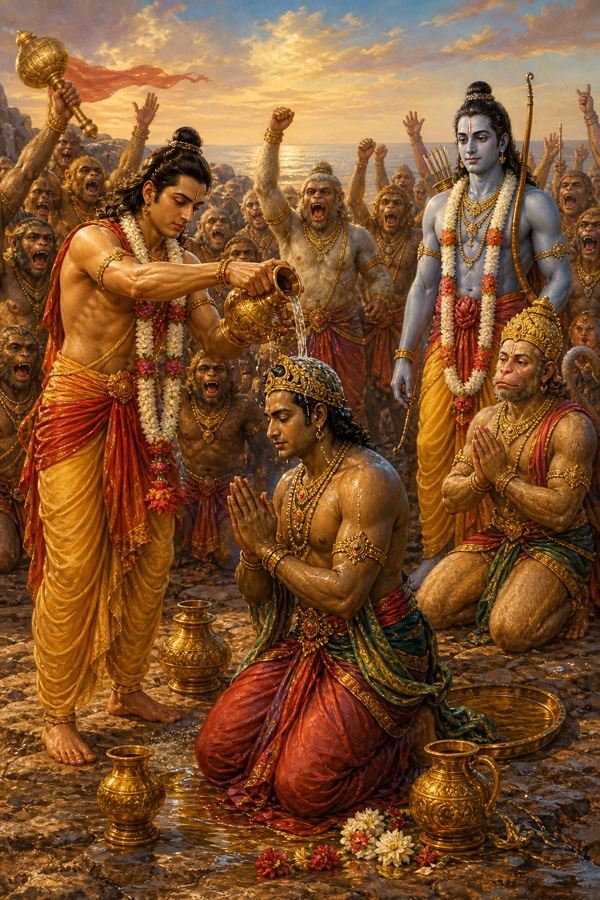
“Gladly.” Overjoyed, Lakshmana took up jars of gold. He set them in the hands of the foremost monkeys and sent the mightiest of them, quick as thought, to fetch water from the sea; they were back almost before they had gone, bearing water drawn from all four oceans, the whole rim of the world carried in at four golden mouths. Taking one jar, seating Vibhishana on a fine throne, Lakshmana poured that water over him and anointed him king of the ogres of Lanka, in obedience to Rama’s command and according to the scriptural rite, syllable for syllable, as though this were a hall in Ayodhya and not a shore below a city still burning. Then all the ogres and all the monkeys anointed Vibhishana too, the two hosts that had spent the whole of that war killing each other tipping water from the same jars, and around him stood the throng of his own dear ones.
Vibhishana’s ministers and the ogres who were loyal to him were beside themselves with joy, and their praise, when it came, went straight past their own new king and flowed to Rama alone. To see Vibhishana consecrated on the throne of Lanka gave Rama, and Lakshmana with him, the keenest happiness. Having come into the great kingdom that Rama had given him, Vibhishana went first among his subjects to comfort them, a city of women who had watched their husbands carried off the field, and then returned at once to Rama’s side. The night-rangers of Lanka, glad now, brought their new king curds and whole grains of rice, sweet modaka balls, parched rice, and flowers, the small bright things a household sets before a man whose luck has turned. Vibhishana took all these tokens of good fortune and laid them before Rama and Lakshmana. Seeing Vibhishana come into his own and prosper, Rama accepted them all out of respect for his friend’s wish.
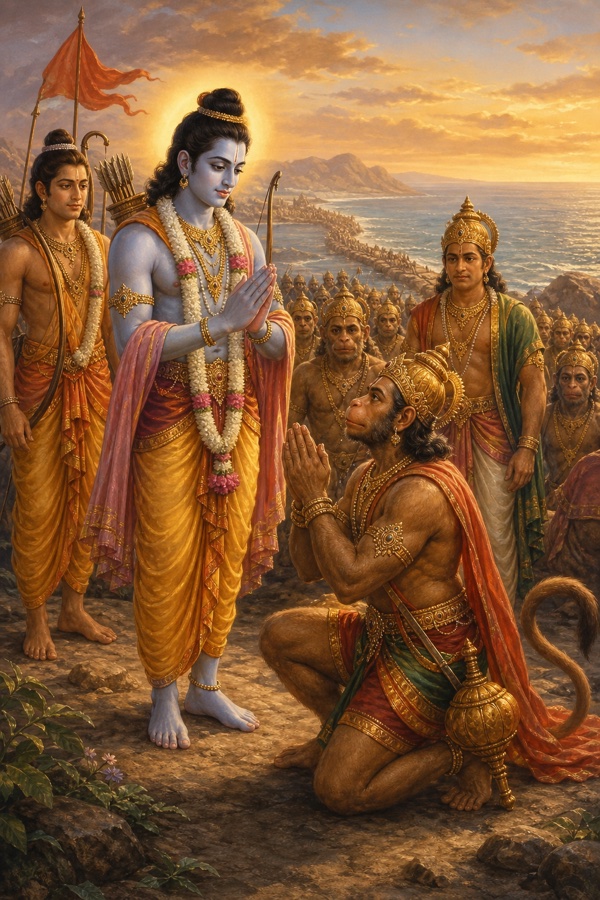
Then Rama spoke to Hanuman, who stood before him tall as a mountain, palms joined. He had gone over the sea once already to find her, when no one else on earth could reach her; there was no one else to send now. “Take the leave of this great king Vibhishana, go into the city of Lanka, and ask the princess of Mithila how she fares. Tell her that Sugriva, Lakshmana, and I are all well, and that Ravana has fallen in the field. Give Vaidehi that good news, lord of the monkeys, and bring me back her answer.”
Hanuman’s message, and Sita’s reply
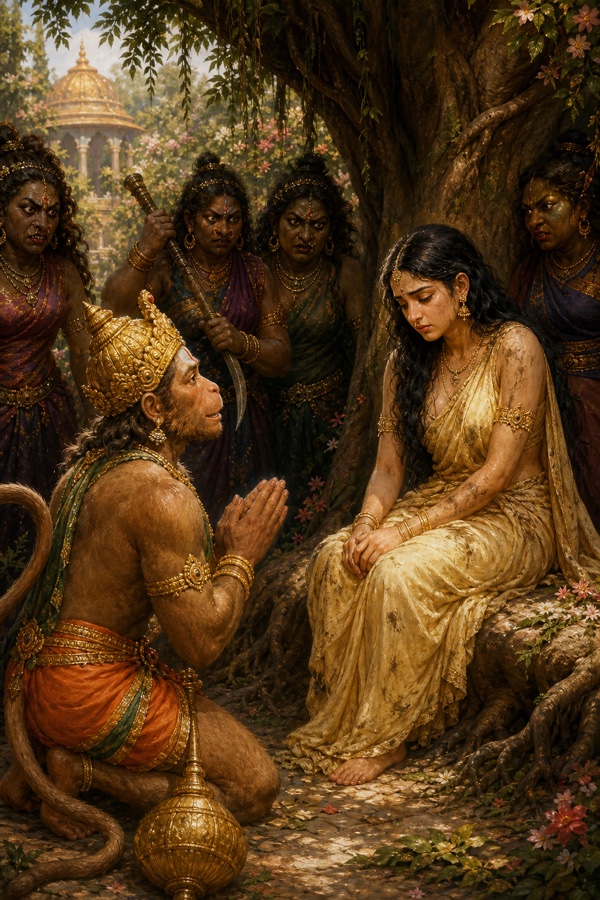
With his leave granted, Hanuman went deep into Lanka, honored now by the very night-rangers who had once bound him and marched him through these streets with his tail set alight. Taking Vibhishana’s leave, he came to the Ashoka grove where Sita had been kept. He found her at the root of a tree, unbathed, ringed by ogresses, sunk in grief, in the same place and the same posture he had found her in the first time, as though the months between had never moved: like Rohini, the star the moon loves above all the rest, when some cruel planet stands across her light. Hanuman drew near, saluted her, and stood quiet and humble. Seeing the great monkey come, Sita at first did not know him and kept silent; then, looking closely, she recognized him, and joy rose in her.
Seeing her face grow calm, Hanuman began to give her Rama’s whole message, and he gave it in the order that would hurt her least, the living first. “Vaidehi,” he said, “Rama is well, and Sugriva and Lakshmana with him. Now that the enemy Ravana has been killed, Rama, his purpose fulfilled, asks after your welfare. With Vibhishana’s help, lady, with the monkeys and Lakshmana beside him, Rama has slain Ravana. I take pleasure in bringing you this news, and I take more in this truth: it is by the power of your fidelity that Rama won this great victory in the field. Be at peace, Sita. Let go of all fear, for the enemy Ravana is dead and Lanka is subdued.”
“And this is Rama’s own word to you,” Hanuman went on. “‘I, who for all these months could not sleep, and who was vowed to win you back, have bridged the great sea and so kept my pledge. You need feel no more dread here in Ravana’s house, for the kingdom of Lanka has been given to our friend Vibhishana. So stay without anxiety, and think of yourself as being in your own home. Vibhishana, eager and glad, is coming to do you honor.’” Hearing this, Sita was so seized by joy that for a moment she could not speak at all. She had held herself together through all those months on the strength of expecting nothing, and the news went through that defense as though it were not there.
When she gave no answer, Hanuman asked, “Lady, what are you thinking? Why do you not speak to me?” Then, her voice thick with tears, overjoyed, Sita said, “Hearing this dear word, the word of my husband’s victory, joy overtook me and for a moment I lost all speech. Monkey, I search and I can find no gift worthy of this kindness you have returned to me. There is nothing on earth or in the other worlds that I could give you in exchange for such news and be satisfied. Not silver, not gold, not jewels of every kind, not the sovereignty of the three worlds could stand equal to this message.”
Then Hanuman, standing before her with joined palms, said with joy, “Blameless lady, only you could speak such loving words, you who are ever devoted to your husband’s good and long for his victory.” Sita replied, “This word of yours, so full of substance and so full of love, is worth more than heaps of jewels of every kind, worth more than the kingdom of the king of the gods. Seeing that Rama, the enemy-slayer, has conquered and stands secure, I feel as though I had come into that heavenly kingdom and every good thing in it at once.”
The daughter of Janaka spoke sweeter words still, and what she praised in him was the thing few ever noticed, the mind behind the leap. “Only you could shape such speech, marked by the finest signs, adorned with sweetness, and driven by an understanding schooled in the eight excellent qualities of the intellect. You are the son of the wind-god; strength, valor, mastery of the scriptures, goodness, prowess, high skill, brilliance, forbearance, steadiness, firmness, and modesty, these and many more of the finest qualities live in you alone.”
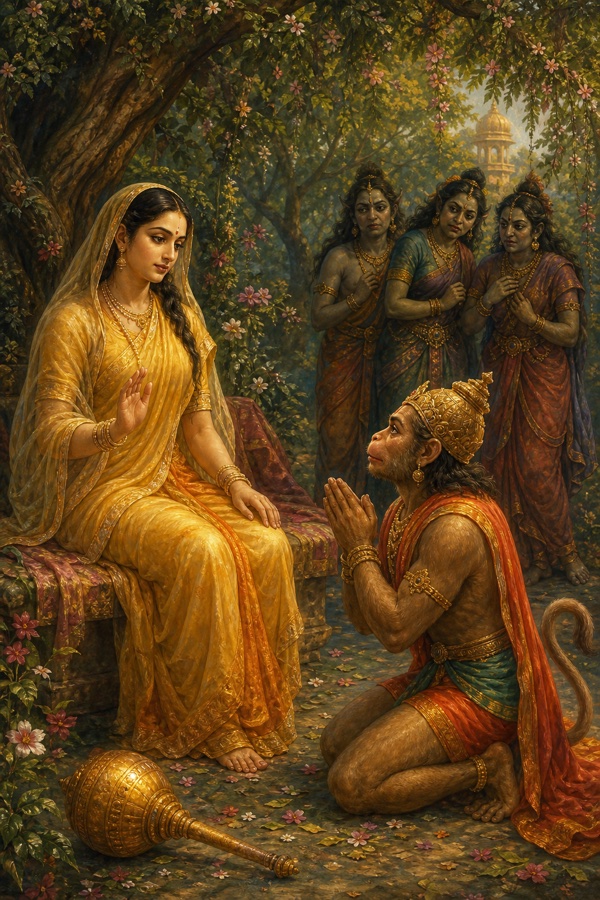
Then Hanuman folded his hands and said, “Lady of good fame, if you allow it, those ogresses who bullied and threatened you before, all those cruel, misshapen ogresses, I wish to strike down with blows of every kind.” He had watched them work on her for months, and he had been counting. Hearing this, Sita, whose tenderness went out to the wretched, thought a while and answered, “Who could stay angry at serving-women who did such things under a king’s command, at another’s order? All of it is the fruit of my own ill luck and of some wrong I must have done in a former life; one eats the fruit of one’s own deeds in one’s own life. Do not speak so. This is the divine ordinance, and that is the highest course.”
“These ogresses threatened me at Ravana’s command,” she went on. “Now that he is dead, they threaten me no more. Monkey, hear on this an old verse, sanctioned by dharma, that a bear once spoke in front of a tiger: ‘A noble man does not take the wrongdoer’s sin into his heart. The vow of not returning hatred for hatred is to be kept at any price, for good men count right conduct their only ornament. On the sinful, on the good, on those who even deserve death, on all alike a worthy man should have compassion, for there is no one who has never once done wrong.’”
Then Hanuman, skilled in speech, said to Rama’s flawless wife, “You are Rama’s virtuous, worthy consort, worthy of him in every way. Lady, give me some message; I will carry it to where Raghava waits.” Sita said, “I long only to see my husband, who loves his own.” It was the whole of her answer, and she had nothing to add to it. Hearing this, Hanuman gladdened her further. “Maithili, this very day you will see Rama, his face like the full moon, with Lakshmana at his side, his friends alive and his enemies undone, as Shachi looks upon Indra.” Having reassured Sita, who shone like the very goddess of fortune, Hanuman came back to where Rama waited and told him, point by point, the answer of Janaka’s daughter.
Vibhishana brings Sita to Rama
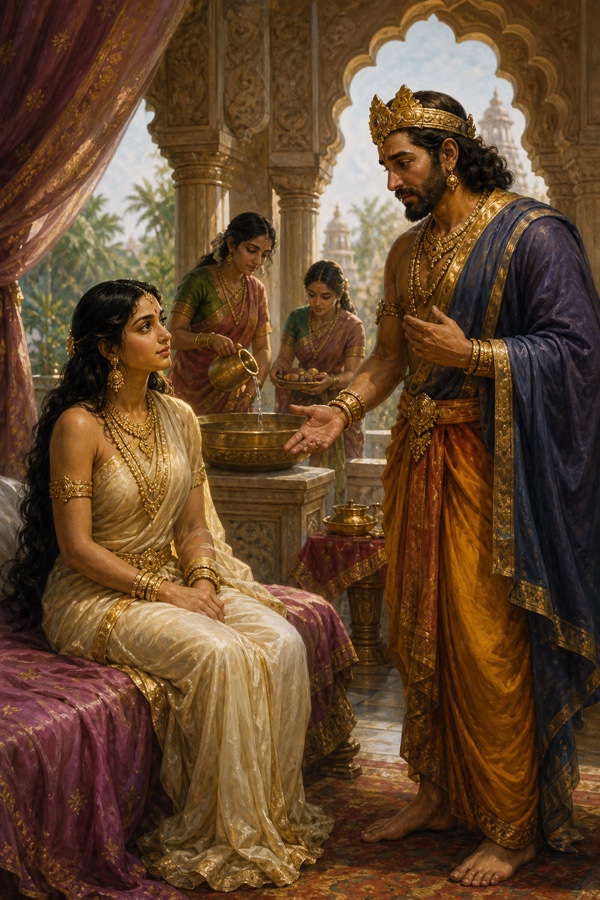
Hanuman said to Rama, “Lord, the grieving princess of Mithila, for whose sake all of this was done, should now see you. Hearing of your victory, her eyes full of tears, she is aching to look upon you. She trusted in me, and she said, ‘I wish to see my husband.’” At this Rama fell suddenly still, and his eyes filmed over with tears. Something had gone wrong in him that no one there could see. He drew a long breath, fixed his gaze on the ground, and told Vibhishana, who stood beside him dark as a rain-cloud, to have Sita bathed, adorned with heavenly unguents and heavenly ornaments, and brought to him at once.
Vibhishana went into the inner apartments, sent word to Sita in the Ashoka grove through his own women, then bowed with joined palms and said, “Vaidehi, bathe, put on heavenly unguents and heavenly ornaments, and mount the palanquin; may it be well with you; your husband wishes to see you.” Sita said, “Lord of the ogres, unbathed as I am, I wish to see my husband this very moment.” After all those months of counting days, the ornaments could wait; she could not. Vibhishana replied, “It is right to do exactly as your husband Rama has said.” And the saintly Sita, to whom her husband was a god, answered “So be it,” and consented.
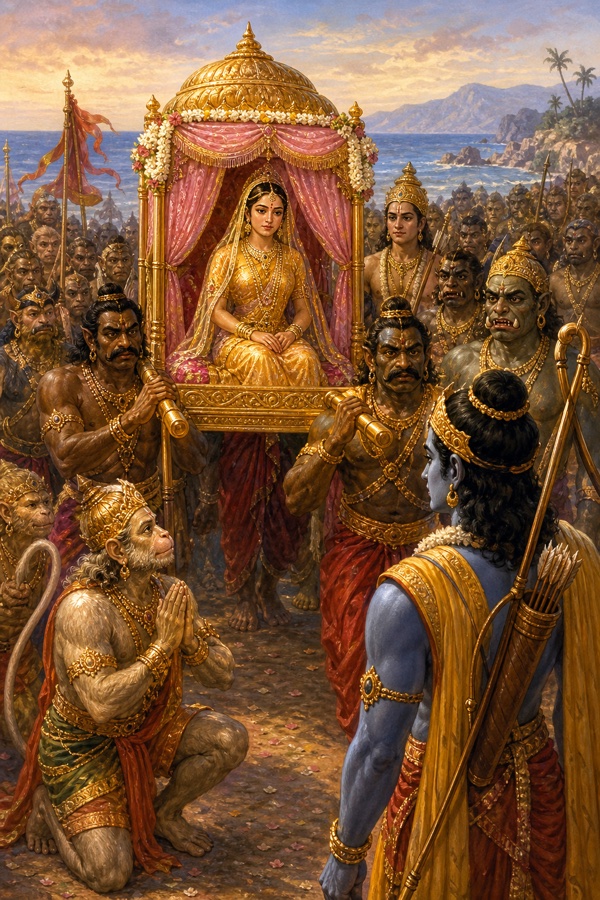
So Vibhishana had Sita bathed and adorned, dressed in costly robes and jewels, seated her on a shining palanquin draped in precious cloth, and brought her toward Rama under the guard of many ogres. Coming to Rama, who sat lost in thought, the glad and humble Vibhishana announced that Sita had arrived. And when Rama, the enemy-slayer, heard of the coming of Sita, who had dwelt so long in an ogre’s house, three feelings rose in him at once and warred together, and not one of them would give way to the others: anger, joy, and a low sorrow.
Seeing Sita come on the palanquin, curtained and lifted above the heads of the army, Rama, who was not pleased, told Vibhishana to have her leave the litter and come to him quickly. At Rama’s command the dharma-knowing Vibhishana began to clear the press of the crowd. Ogres in tunics and turbans, canes in hand, drove the warriors back on every side. As the bears, the monkeys, and the ogres were pushed away from the palanquin, a vast roar rose from the moving mass, like the sea churned by the wind.
Seeing them shoved back and thrown into distress, Rama stopped it, out of pity for them and out of anger at those doing the shoving. As though he would burn the men with his eyes, he spoke words of reproach to Vibhishana. “Gentle lord of ogres, ever bent on my victory, why do you disregard me and put these people to such pain? Stop this driving of the crowd. They are my own people.
“A woman’s covering is not a house, nor fine clothes, nor the screen of a high wall, nor royal ceremony. Her character is her armor, and she needs no other. In calamity, in danger, in war, at a bride-choosing, at a sacrifice, or at a wedding, there is nothing to blame in a woman being seen by all. This Sita is in calamity and hemmed in by danger; so there is no fault in her being seen by all, and least of all near me. Therefore let Sita leave the palanquin and come to me on foot, and let these forest-dwellers look upon Vaidehi.”
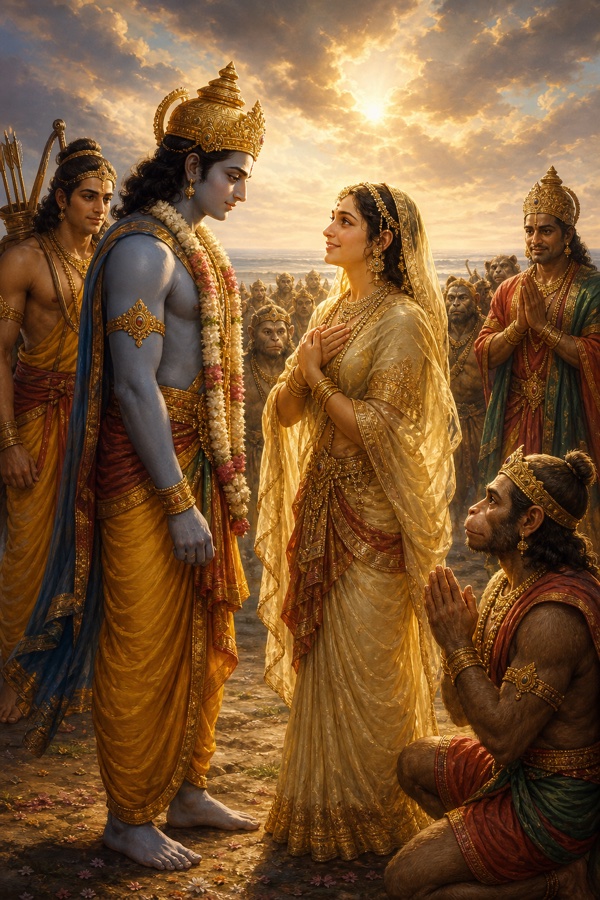
At his word Vibhishana humbly led Sita to Rama. But at Rama’s hard signs, in which the honor a man owes his wife was missing, Lakshmana, Sugriva, and Hanuman were deeply pained, and they guessed that Rama was displeased with her. Shrinking into her own limbs from shame, walking the last distance on foot before an army of strangers, Maithili came up behind Vibhishana to her husband. Devoted to him as to a god, she looked at his gentle face with wonder and joy and love all mingled. Seeing that dear face, so long unseen, lovely as the risen full moon, she put off the weariness of her heart, and her own face opened like the clear moon. She had not yet heard him speak.
Rama repudiates Sita
Looking at the humble Maithili as she stood near him, Rama began to lay bare the feeling hidden in his heart, and every word of it came out as an accounting, as though a ledger were being read aloud. “Lady,” he said, “Having conquered the enemy in the field, I have won you back. What a man could do by human effort, I have done. My anger has had its reward; the insult of your abduction, and the enemy who did it, have both been wiped out together. Today my manhood has been seen, today my labor has borne fruit, today I have kept my vow, and today I am my own master again.
“The wrong that the fickle-hearted ogre did, carrying you off when you were alone, that wrong shaped by fate, I have overturned as a mortal man. The crossing of the sea and the crushing of Lanka, that praiseworthy deed of Hanuman’s, has come to fruit today. The labor of Sugriva, who showed his prowess in the field and gave sound counsel, and his army’s labor with him, has borne fruit today. And the labor of Vibhishana too has borne fruit, who left a brother without virtue and came of himself to take shelter with me.” He had named every man who had bled for this hour. He had not once named her.
As Sita heard these words, her eyes wide as a doe’s, she sank into tears; she had begun to hear what was coming through the shape of what was being said. Yet even as he gazed at the beloved of his heart standing close, the heart of King Rama split in two for fear of what the world would say. There among the monkeys and the ogres, with every face in that army turned toward the two of them, he spoke to Sita, whose eyes were like lotus petals, whose dark hair fell in curls, whose limbs were lovely to see:
“What a man must do to avenge an insult, I have done, killing Ravana, seeking to guard my honor. As the sage Agastya once made the southern quarter safe to enter, so I, with a mind made pure by austerity, have won you back. Understand this, and may it be well with you: all this war-labor, made to succeed by the prowess of my friends, was undertaken to protect my own good conduct and to wipe the stain from my famous line, and no part of it was done for your sake.
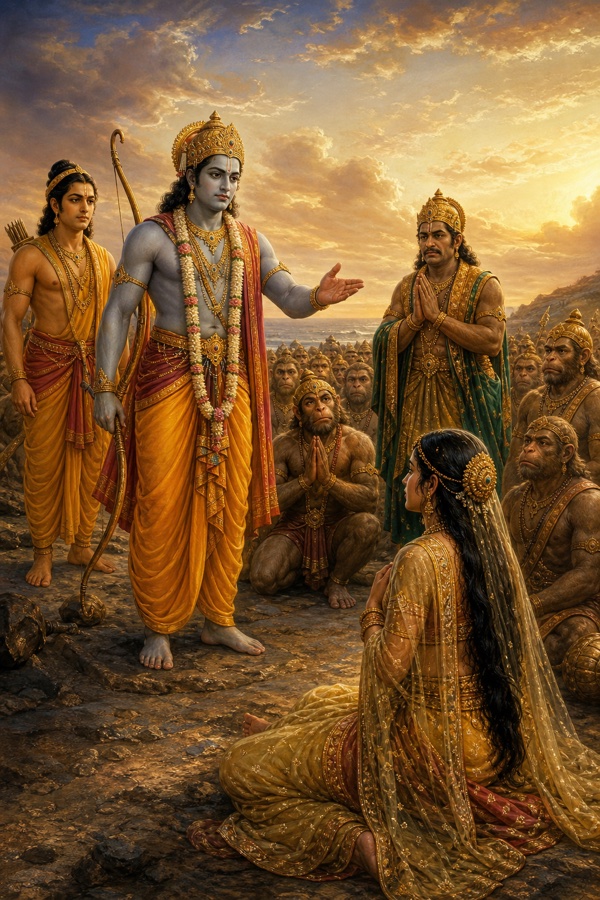
“A doubt has fallen on your character, and standing here before me you are as unwelcome to me as a lamp to a man with sore eyes. Therefore today I give you leave; go where you will. The ten directions are open to you, good lady; I have no more use for you. What man born to a proud, high line would take back a woman who has lived in another’s house, only because she was devoted to him? Pressed against Ravana’s arms, looked upon by his evil eye, how could I, who boast of a great house, take you back? The purpose for which you were won, I have gained; there is no more longing for you in my heart. Go wherever you please.
“This, then, is why I have said this today, my mind made up. Sita, set your heart on Lakshmana or on Bharata, or on Shatrughna or on Sugriva, or on the ogre Vibhishana, as you please; do whatever will bring you happiness. Ravana, who kept you, lovely and heavenly and alluring, in his own house, could hardly have endured your absence for long.” Sita, who had known only kind words from him in all the years of her life and who had her pride, heard that unkind word from her husband’s mouth in front of thousands, and she wept and wept like a creeper struck down by the trunk of a lordly elephant.
Sita’s ordeal of fire
Hearing those harsh words that raised the hair on her body, Sita was cut to the quick. As though pierced by those word-arrows, shrinking into her limbs from shame, the daughter of Janaka poured out a flood of tears. Then she wiped her tear-drenched face and, slowly, in a voice thick with weeping, spoke to her husband, and what came out of her was not pleading. “Hero, why do you speak to me, as an ordinary man might to an ordinary woman, such rough words, so harsh to the ear? I am not what you take me to be. Trust me; I swear it by my own character.
“From the conduct of low women you doubt the whole sex of women; if you have tested me, let go of that doubt. Lord, I was helpless when my limbs touched Ravana’s body; there was no wish of mine in it, and my hostile fate alone is to blame. That which was in my own power, my heart, was always fixed on you; what could I do, powerless, about limbs that had fallen under another’s sway? If, despite a love that grew up together with me and all these years of living side by side, I was still unknown to you, then I am undone forever.
“King, you sent the great hero Hanuman to seek me out; then, while I was still in Lanka, why did you not cast me off? Hero, before this monkey’s very eyes I would have given up my life the instant I heard your word of rejection, and it would have cost you one messenger and nothing more. Then this labor risked upon your life would not have been in vain, and your friends would not have borne this fruitless toil. Like some small man you have followed only your anger and given the whole weight to a woman’s nature.
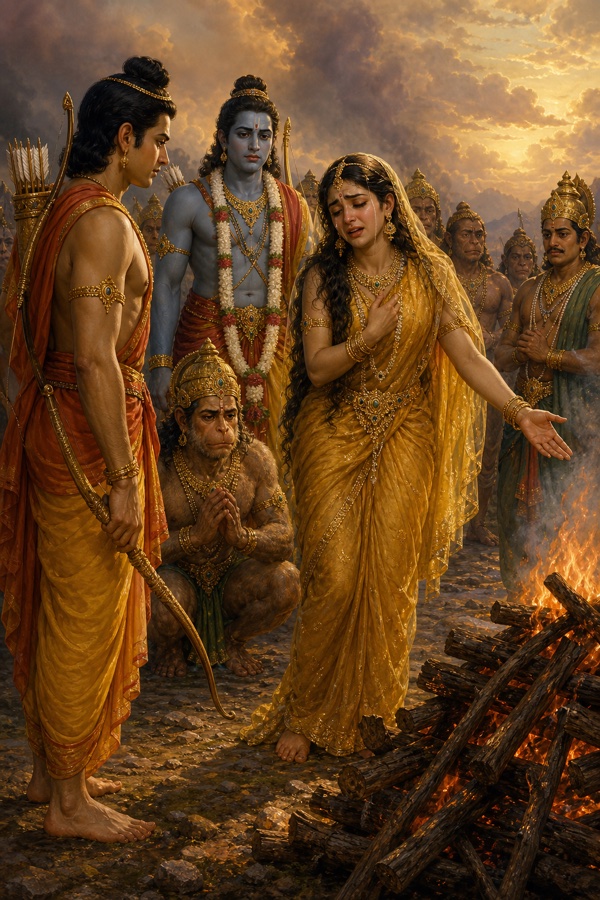
“My name Janaki, or Vaidehi, came to me from Janaka, but I was born from the body of the earth, lifted out of a furrow while a king drove his plow; you have set no store by this divine birth of mine, nor by my noble character. In my girlhood, at our wedding, when my hand was placed in yours, you did not even count that taking as a proof; my devotion and my modesty, all of it you have thrown behind your back.” So saying, weeping, her voice broken, Sita turned to the grieving Lakshmana, who stood sunk in thought, and said, “Make ready a pyre for me; that is the one remedy for this calamity. Struck down by a false slander, I have no wish to live.
“Since my husband, displeased with my virtues, has cast me off before the whole assembly, the fitting course for me is to enter the fire.” Hearing this, Lakshmana filled with resentment, looked at Rama; he had followed this man into fourteen years of forest for a word, and he was waiting for a word now. Reading Rama’s wish in his face, Lakshmana built the pyre at Rama’s sign. At that moment no friend of Rama’s dared to reason with him, or speak, or even look at him, for he was terrible as Time, terrible as Death itself.
Rama stood with his face bent down. Vaidehi walked around him, keeping him on her right, the same slow circle a bride walks, and came to the blazing fire. Bowing to the gods and to the Brahmins, hands joined, she prayed before the fire, calling as her witness the one presence that had stood at her wedding and stood here now: “As my heart never turns from Rama, so let the fire, the witness of the world, guard me on every side. As Rama holds me, pure in conduct, to be corrupt, so let the fire, the witness of the world, guard me. As I have never in deed or thought or word overstepped Rama, who knows all dharma, so let the fire guard me. Blessed Sun, Wind, the quarters of the sky, Moon, Day and Night, the twilights, Earth, and all the rest, as they know me to be a woman of good character, so let the god of fire guard me.”
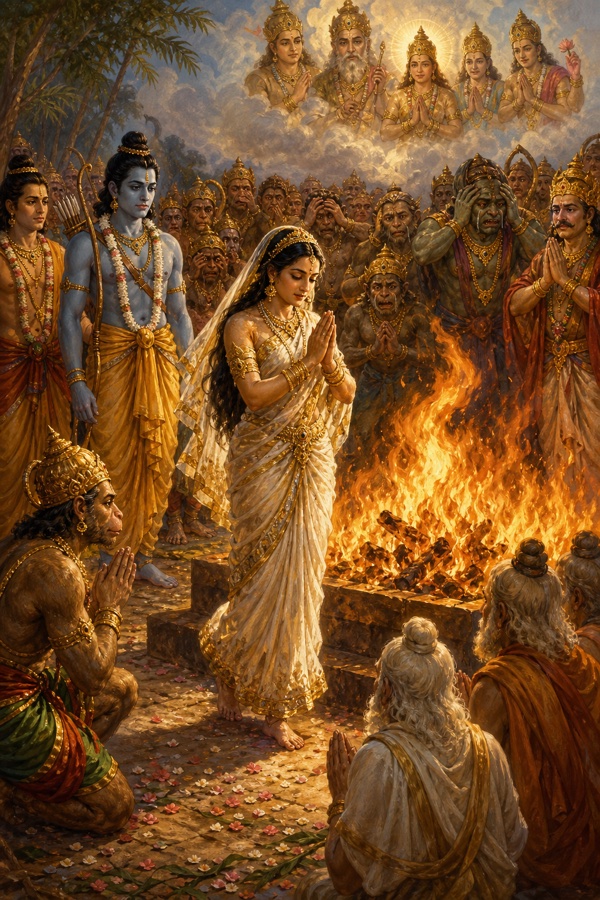
Then Vaidehi walked once around the fire and, with a mind free of all doubt, stepped into the blazing flames. The vast crowd gathered there, full of children and old people, watched Maithili enter the burning fire, and not one of them looked away. Her radiance was like heated gold, and heated gold were the ornaments that decked her, and before all their eyes she leaped into the fire. Every creature saw that Sita, like a golden altar, go down into the flames. Sages and gods and gandharvas saw the lady go into the fire, as into a sacrifice a final oblation is poured. All the women cried out, as when a stream of ghee, made holy with mantras, falls into the sacrificial fire. Across the three worlds gods and gandharvas and danavas saw her spring into the fire, like a goddess under a curse falling from heaven to hell. And as she entered, a great and strange wail, a cry of “Ah, ah,” went up from the ogres and the monkeys alike, the two armies that had fought each other to ruin over this woman crying out in one voice at last.
The gods arrive, and Brahma recalls to Rama his true nature
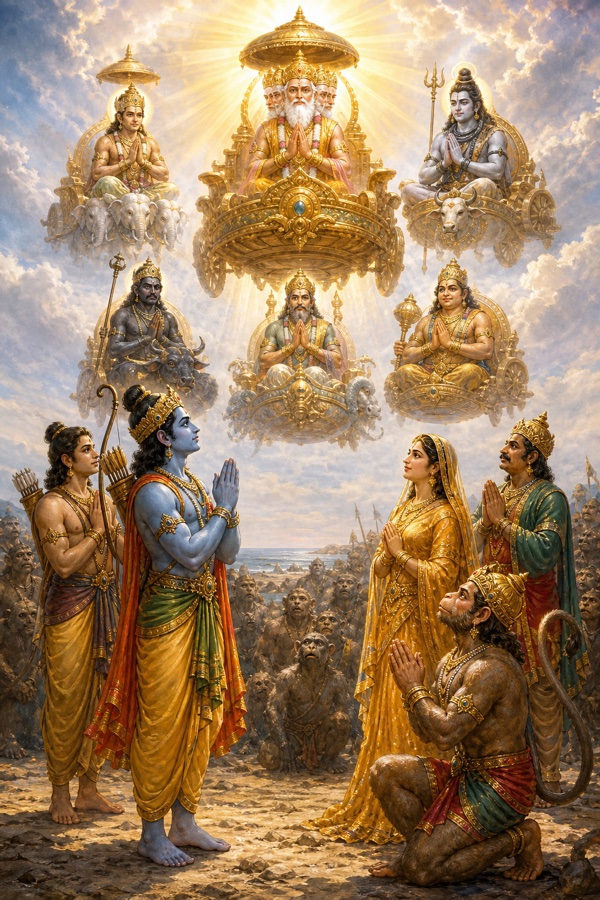
Hearing the cries of those weeping people, Rama fell still for a moment, his mind troubled, his eyes filled with tears. Then the sky over Lanka filled. Gathering on aerial chariots bright as the sun, they came, all of them, down into the city and drew near to Rama: Kubera, lord of the yakshas and keeper of the world’s wealth, with the fathers; Yama, the god of retribution, before whom every life is finally counted; the thousand-eyed Indra; Varuna, lord of the waters; Mahadeva, the great god who bears the bull upon his banner; and Brahma, maker of the whole universe, foremost of those who know the Absolute. They had watched the whole war from those chariots and said nothing. They were done with silence. Lifting their broad arms, their hands bright with jeweled ornaments, the gods spoke to Rama, who stood before them with joined palms, a man greeting his elders.
“Maker of every world all-pervading Lord, how can you stand by while Sita falls into the fire? How do you not know yourself for the greatest of the gods? You are, among the Vasus, the lord of creatures named Ritadhama, the first maker of all three worlds. You are the eighth of the eleven Rudras, and the fifth among the Sadhyas; the twin Ashvins are your ears, and the sun and moon are your eyes. You are seen at the beginning, the middle, and the end of creation, and yet, like a common mortal, you disregard Vaidehi.”
Hearing this, Rama, lord of the worlds said to those gods, “I take myself for a man, Rama, the son of Dasharatha. Who I am, and from where I have come, let Brahma tell me.” Then Brahma said, “Hear my true word, you of true prowess. You yourself are Narayana, the Lord who bears the discus. You are the single-tusked Boar. You have conquered enemies in the past and will conquer those to come. Raghava, you are the imperishable Brahman, the Truth abiding at the beginning, middle, and end, the supreme dharma of the worlds, the four-armed Vishvaksena. You are the wielder of the Sharnga bow, Hrishikesha, the Person, the Supreme Person, the unconquered, Vishnu who bears the sword, and Krishna of great might.
“You are Karttikeya, commander of the divine host, and the leader of men; you are intellect, goodness, forbearance, and self-restraint; you are the origin and the dissolution of all; you are Upendra and Madhusudana. You are Mahendra whose deeds are Indra’s own, Padmanabha, the ender of battle; the divine great seers call you the one to whom all may turn for shelter and the shelter itself. In the form of the Vedas you are the great Bull with a thousand horns and a hundred heads. You are the first maker of the three worlds, and self-existent. You are the refuge and the forbear of the Siddhas and the Sadhyas; you are the sacrifice, the sacred call Vashat that sends the offering up, and the syllable Om that is higher than the highest.
“People do not know your birth, your ending, or your true nature. You are made manifest in all beings, in cows and in Brahmins; in all the quarters, in the sky, in the mountains, and the rivers, it is you. You are the one with a thousand feet, a hundred heads, and a thousand eyes. You uphold all beings, the earth, and the mountains; and when the worlds dissolve and there is nothing but water, you are seen there upon it, asleep on the great serpent Shesha, in the form of a mighty snake, waiting for the next making. Rama, I, Brahma, am your heart, and the goddess Sarasvati is your tongue. Lord, the gods on the hair of your body were made by Brahma; the closing of your eyes is called night and their opening day.
“The Vedas came forth as the latent movements of your mind. Without you this is nothing at all; the whole world is your body, and the earth your steadiness. Fire is your wrath and the moon your grace; you are Vishnu, marked with the Shrivatsa. Long ago in three strides you measured out the three worlds, and having bound the dreadful Bali you made Mahendra king. Sita is the goddess Lakshmi herself, and you are Vishnu; you are Krishna and the Lord of creatures. To slay Ravana you took on here a human body, since no god and no demon could touch him and only a man could; this our purpose you have fulfilled. Ravana is slain, Rama; now, glad at heart, return to your divine abode.
“God, your prowess is unfailing and your deeds never come to nothing. Your sight is unfailing, your praise is unfailing; the men on earth who are devoted to you will never fail. Those who are devoted to you, the constant, the ancient, the Supreme Person, gain their desires in this world and in the next. And those who chant this divine, sage-given hymn, and this ancient story, will never know defeat.”
The fire-god delivers Sita, and Rama accepts her
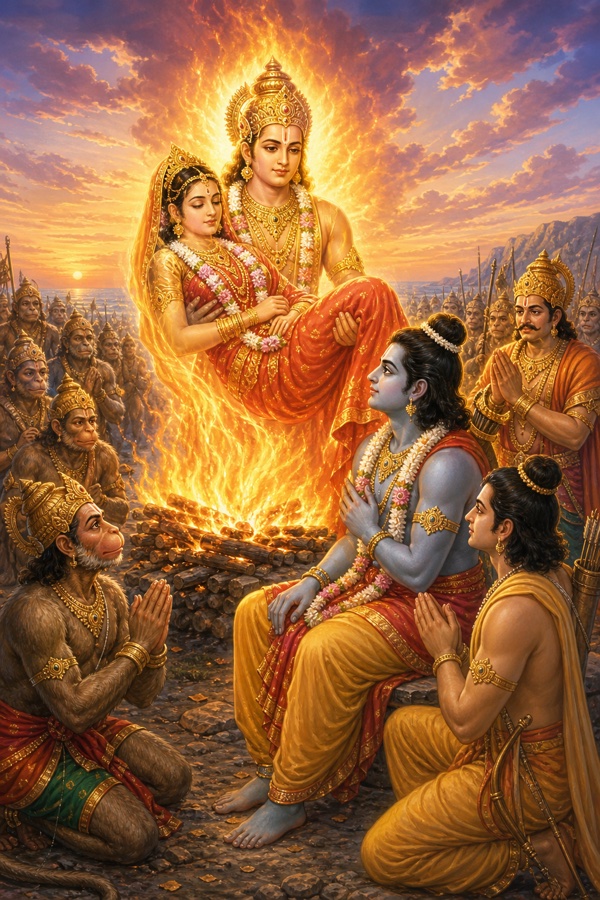
Hearing this blessed word of Brahma the grandfather, the god of fire rose out of the burning pyre, Vaidehi in his arms. He scattered the pyre and stood up in bodily form, bearing the daughter of Janaka. Her radiance was that of the rising sun; she wore red garments, her dark hair fell in curls, she was decked with ornaments of heated gold, and even her flower-garlands, unwithered though she had gone down into that fire and come up out of it, were unharmed; the fire had not taken so much as a petal. Flawless, exactly as she had been when she entered the flames, Vaidehi was set by the fire-god in Rama’s lap, and given back to him.
The fire-god, witness of the world, in whose presence every vow in that world is sworn and every marriage made, said to Rama, “Rama, here is your Vaidehi; there is no sin in her. Man of good conduct, this virtuous, gentle lady has never, in word or thought or mind or glance, done anything unbecoming toward you. Ravana the ogre, drunk on the pride of his strength, carried her off when she was cut off from you, alone, helpless, and yet chaste. Held captive in his inner apartments, guarded by fierce ogresses of cruel mind, her heart was still on you, and you alone were her highest refuge.
“Tempted in every way and threatened, Maithili with her single heart never once gave a thought to that ogre. Therefore take back this Maithili of utterly pure feeling; let not one harsh word be spoken to her. This is my charge.” Hearing it, Rama, his eyes filled with joy, stayed a moment lost in thought, then said to the fire-god, and said it so that every creature standing there would hear:
“Surely Sita had to give the world this purifying test, for this lady lived a long time in Ravana’s inner apartments. Had I taken Janaki back without proving her purity, people would have said that Rama was a fool ruled by lust, and the saying would have outlived us both. I too know that Maithili is single-hearted toward me. Ravana could no more overstep this lady, guarded by her own inner fire, than the sea oversteps its shore. This chaste woman could show no weakness in Ravana’s inner apartments, for Sita is one with me, as light is one with the sun. Pure in all three worlds, the daughter of Janaka, Maithili, I can no more cast off than a man of self-command can cast off his own good name. Lords of the world, I must obey the wholesome word your love has given me.”
Having said this and been reunited with his beloved, the victorious Rama, worthy of happiness, praised by his own deeds, knew a great happiness at last, and the army around him let out the breath it had been holding.
Dasharatha appears, and gives his counsel
Hearing this blessed answer of Rama’s, the great god Shiva spoke a word more blessed still. “By good fortune you have brought this deed to its close. By good fortune, Rama, you have driven from the whole world in battle the cruel darkness that Ravana had cast over it. Kakutstha, here on the crown of an aerial chariot is your father, King Dasharatha, who in the world of men was your elder. Delivered by you, that glorious king has reached the realm of Indra; salute him now, with your brother Lakshmana.” The old man had died of grief for a son he never saw again, and now the son looked up.
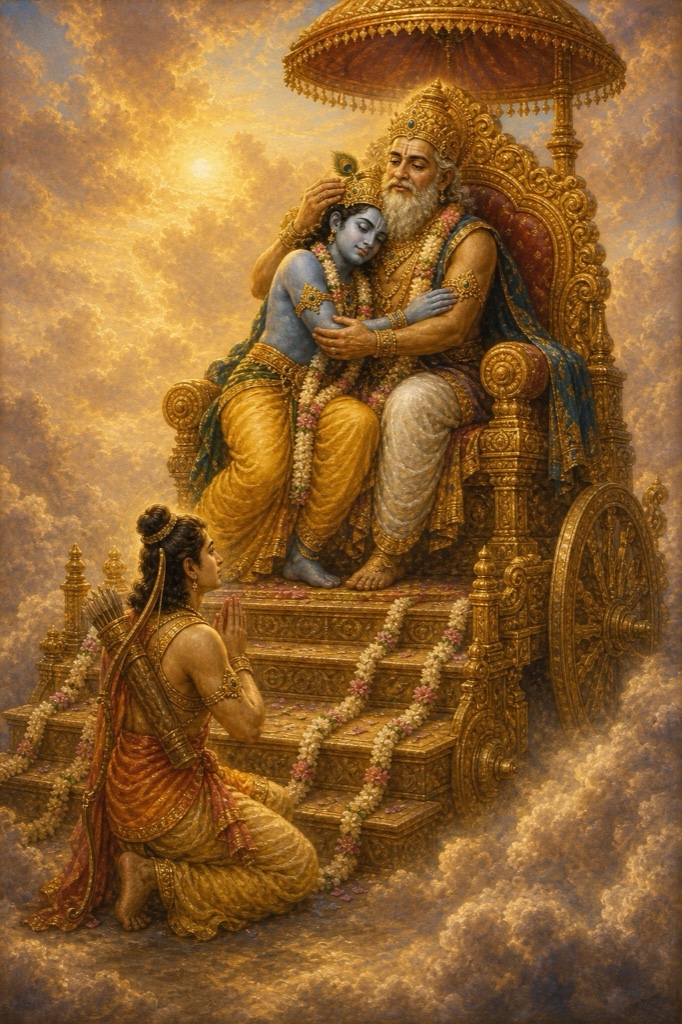
At Shiva’s word Rama, with Lakshmana, bowed to his father seated on the crown of the aerial chariot, clad in spotless raiment, blazing with his own splendor, without the grief that had killed him showing anywhere on that face. Seeing the son dearer to him than his own breath, the father Dasharatha, filled with great joy, set him on his lap as though he were a boy again, folded him in his arms, and said, “Rama, to me, cut off from you forever, neither heaven nor the honor of the gods is dear; this I tell you truly. Today, seeing you, the enemy-slayer, whole in mind, your exile finished, I have come into the highest joy.
“The words Kaikeyi spoke to send you into the forest are still cut into my heart. But today, seeing you and Lakshmana safe and holding you, I am freed of grief as the sun is freed of mist. My child, as the Brahmin Kahola was delivered by his son Ashtavakra, so you, my great and worthy son, have delivered me. Now I know that for Ravana’s death the lords of the gods sent you here as the Supreme Person.
“Rama, Kausalya has her wish fulfilled, who will see you come home from the forest. Kakutstha, it is my desire that you be reunited with Bharata. For my sake you spent fourteen years in the forest with Sita and Lakshmana, finished your exile and kept your vow, and by killing Ravana in the field you have satisfied the gods as well. Having won praiseworthy fame, take the throne with your brothers and gain long life.”
Hearing this, Rama joined his hands, and the first thing he asked of his father was for the woman who had ruined them both. “Be gracious to Kaikeyi and to Bharata. That fearful word you once spoke, ‘I disown you with your son,’ let it not, my lord, touch Kaikeyi and her son as a curse.” Saying “So be it,” the great king embraced Lakshmana, who stood with joined palms, and said, “By serving Rama and Vaidehi Sita with devotion you have given me great joy and earned the fruit of dharma. So long as Rama is pleased with you, you will gain dharma, wide fame, heaven, and high glory. Joy of your mother, keep serving Rama; Rama is ever bent on the good of all the world.
“The dwellers of the three worlds with Indra, the Siddhas, and the great sages salute and worship the Supreme Person, Rama. Rama is the unmanifest, the imperishable, one with Brahman, the heart and the secret of the gods.” Then the king spoke to his daughter-in-law Sita, who stood with joined palms, calling her “Daughter” in a sweet voice, as he had called her in Ayodhya before any of this began. “Vaidehi, hold no anger in your heart at Rama for this repudiation; your well-wisher Rama did it only to prove your purity. Daughter, this mark of your character is very hard to match, and it will overshadow the fame of other virtuous women. Though you need no teaching in service to a husband, still it must be said: he is your highest deity.”
Having counseled his two sons and Sita in this way and bidden them farewell, King Dasharatha mounted his chariot and went to the realm of Indra. Bright with splendor and majesty, thrilled with joy, that king sat in his aerial chariot and set out for Indra’s world, and this time his sons watched him go and did not have to grieve.
Indra brings the fallen monkeys back to life
When Dasharatha had gone, the well-pleased Indra said to Rama, who stood with joined palms, “Rama, our sight of you must not go to waste. We are pleased with you; say what your heart desires.” Hearing this, Rama, glad at heart, said, “If love for me has risen in you, then I speak; make my word come true. Let all the monkeys who went to the realm of Death showing their prowess for my sake rise again with new life. Bestower of honor, I wish to see, glad again, all those monkeys who were torn for my sake from their sons and their wives.
“They were all brave and heroic, counting death as nothing; they put out every effort for my honor and yet fell dead in the field. Purandara, bring them back to life. By your grace, let those monkeys who did my dear work be reunited with their loved ones; this is the boon I ask. I wish to see all those long-tailed monkeys and bears whole again, free of wounds, full of strength and manhood. And wherever the monkeys dwell, let there be flowers, roots, and fruit even out of season, and let clear rivers run.” He had asked for nothing for himself and had not seemed to notice the omission.
Hearing this word of Rama, Mahendra answered in loving terms, “Dear son, the boon you ask is a great one; I have never before changed my word, and so it will be. Let all those monkeys and bears and long-tailed apes who were killed in battle by the ogres, their heads and arms cut off, rise up again. Whole, with every limb restored, full of strength and manhood, let the monkeys wake as those asleep wake when sleep is broken. Filled with the highest joy, let them all be reunited with their friends, their kin, their people, and their own. Wielder of the great bow, in the lands where the monkeys dwell there will be trees in flower and in fruit even out of season, and the rivers will run full of water forever.”
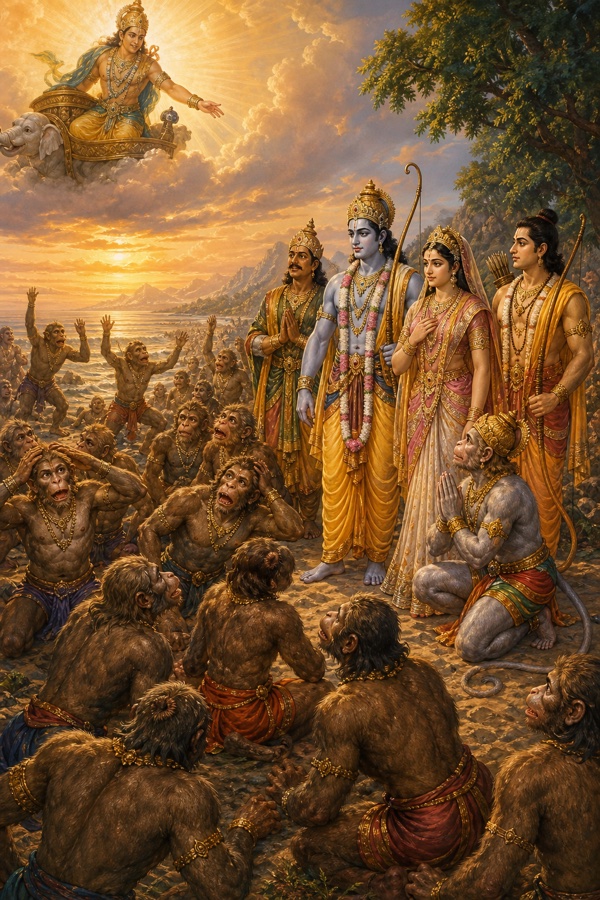
All across that field, where the ground had been a floor of the dead since morning, the monkeys, once covered with wounds and now whole in every limb, rose up as men wake from deep sleep. “What is this?” they said, sitting up among their own scattered weapons, and all of them were struck with wonder. Seeing Rama with his purpose fully accomplished, all the gods, well pleased, said, “King, now return to Ayodhya and send the monkeys home. Comfort Maithili; go and meet Bharata, who has held a vow through grief at losing you, and Shatrughna, and all your mothers. Reach Ayodhya, gladden the citizens, and have yourself consecrated.”
Having said this and praised Rama and Lakshmana, the thousand-eyed Indra returned to heaven with the other gods on their sun-bright aerial chariots. Saluting all those Rama with Lakshmana, gave the order for the army to camp. Guarded by Lakshmana and Rama, its people glad, that glorious great army shone bright with splendor on every side, like a night lit by the moon.
The Pushpaka, and the departure for Ayodhya
When Rama had rested the night and risen fresh and easy, Vibhishana came to him, wished him victory, and said with joined palms, “Raghava, baths, unguents, garments, jewels, sandal-paste, and heavenly garlands of many kinds are ready. These women, skilled in the art of adornment, will bathe you as the rite prescribes.” Rama said, “Invite Sugriva and the monkeys to the bath. The truthful, delicate Bharata is suffering for my sake, and while I am scented here he is sitting in bark somewhere counting the last days. Without Bharata, bath and clothes and jewels are nothing dear to me. Think quickly how we may reach Ayodhya, for to those who go on foot that road is very hard.”
Vibhishana answered, “I will bring you to that city in a single day. May it be well with you. My brother Kubera’s aerial chariot, sun-bright, the Pushpaka, which goes wherever its rider wishes, which Ravana won from him in battle and carried off, and which I have kept safe for you, stands here now. Warrior of matchless valor, in this cloud-like chariot you will reach Ayodhya without a care. If you grant me any claim, if you remember any virtue in me, and if you bear me any goodwill, then stay here a while with Lakshmana and Vaidehi; let me honor you with pleasures of every kind, and then go. Rama, accept from me, who love you, this ordered hospitality, with your army and your friends.”
Rama said, so that all the ogres and monkeys could hear, “Hero, by your fine counsel, by your whole conduct, by your deep goodwill, you have done me honor. Your word is not one I would refuse; yet my heart aches to see my brother Bharata, who came as far as Chitrakuta to bring me back, and whom, though he begged with his head bowed low, I would not obey; and Kausalya, Sumitra, Kaikeyi, my friend Guha, and the people of the city and the country. Vibhishana, give me leave; I have been honored by you in a hundred ways. Do not be grieved, friend. My task is done; how could it be right for me to stay? Lord of the ogres, make the chariot ready at once.”
At this Vibhishana quickly summoned the sun-bright chariot, and it came down over the shore like a piece of a mountain moving. It was the work of Vishvakarman, who builds for the gods, and it stood like a peak of Mount Meru, its parts wonderfully worked in gold, with daises of cat’s-eye gems, ringed with high attic-chambers, shining like silver, hung with white pennons and flags, graced with golden mansions and golden lotuses, spread over with nets of tiny bells, its windows set with pearls, ringed with strings of bells that gave out a sweet sound; within it were floors of crystal and, upon costly coverings, fine seats of cat’s-eye gems; it could not be assailed, and it was swift as the mind. Having set it ready, Vibhishana stood waiting for Rama’s next word. Seeing that mountain-like Pushpaka, the noble-hearted Rama and Lakshmana were filled with wonder.
Honoring the monkeys, and the flight begins
Having set the flower-decked Pushpaka ready, Vibhishana stood near with joined palms and asked, “What shall I do now?” So that Lakshmana could hear, and so that every monkey on that shore could hear it too, Rama answered with love, “Vibhishana, all those monkeys and bears who worked with joy, who set aside the fear of death and never turned their backs in battle, honor them all fittingly with jewels and wealth. By their prowess, by the help of these monkeys, you won Lanka. Crown the work of these monkeys who did the deed with gifts of wealth and jewels. Do this, and these grateful leaders will be glad, and all will know you as generous, as one who gathers wealth, as merciful and master of himself. A king who lacks the qualities that stir devotion is deserted by a discontented army, as one is deserted who has thrown away many lives in the field for nothing.”
At his word Vibhishana shared out jewels and gold and honored all the monkeys. Then, seeing the monkey chiefs so honored, Rama took in his arms Vaidehi, who shrank from him in modesty, and with the strong archer Lakshmana mounted the peerless chariot. Seated in it, Rama honored all the monkeys, Sugriva, and Vibhishana, and said, “You have finished this work of friendship; with my leave, go wherever you wish. Sugriva, all that a loving, well-meaning friend should do, you have done, for you fear unrighteousness.
“Vibhishana, dwell in the free kingdom of Lanka that I have given you; not even the gods with Indra will be able to attack you. I will go to my father’s capital, Ayodhya; so I wish to send you all off with my leave.” Hearing this, the monkey chiefs and the ogre Vibhishana joined their hands and would not take the dismissal. “We wish to go to Ayodhya; take us all with you. There we will wander glad through the woods and gardens. When we have seen you wet with the water of consecration and have saluted Kausalya, we will quickly return to our homes.”
Rama said to Sugriva and Vibhishana and the monkeys, “Sugriva, go quickly toward Kishkindha with your army. Vibhishana, mount with your ministers.” Then the glad Sugriva with the monkeys, and Vibhishana with his ministers, mounted the divine Pushpaka. When all had climbed aboard, at Rama’s leave Kubera’s fine chariot rose into the sky. Riding through the air in that shining chariot yoked with the image of a swan, Rama, glad and radiant, shone like Kubera himself. And all those mighty monkeys, bears, and ogres sat at ease in that divine chariot, an army of them aboard and none crowding another.
Rama shows Sita the land along the way
The peerless chariot rose into the sky with a great sound. Looking all around, Rama said to Sita, “Vaidehi, look at Lanka, set on the peak of Trikuta like a peak of Kailasa, built by Vishvakarman. Here it was that Ravana, the lord of the ogres who won his boons and tormented his subjects, was slain by me for your sake. Look at this field of battle, thick with the mire of flesh and blood, the ground of the great slaughter of monkeys and ogres. Here I killed Kumbhakarna; Nila killed Prahasta; Hanuman killed Dhumraksha; Sushena killed Vidyunmali; and Lakshmana killed Ravana’s son Indrajit in the field.
“Here Angada killed Vikata; Sugriva killed Virupaksha; Rishabha killed Mahaparshva; Nila killed Mahodara. Hanuman killed Akampana and other strong ogres and Trishira; Lakshmana killed Atikaya, and Devantaka and Narantaka. War-maddened and drunk with battle, Kumbhakarna’s sons Nikumbha and Kumbha, and Vajradamshtra and Damshtra, and many other ogres, were killed; the ungovernable Makaraksha I struck down in the field. Shonitaksha, Yupaksha, and Prajangha too fell in the great fight. The dreadful Vidyujjihva, Yajnashatru, Suptaghna, Suryashatru, and Brahmashatru all perished here. And here Ravana’s chief queen, Mandodari, ringed by his thousand other wives, mourned for him.”
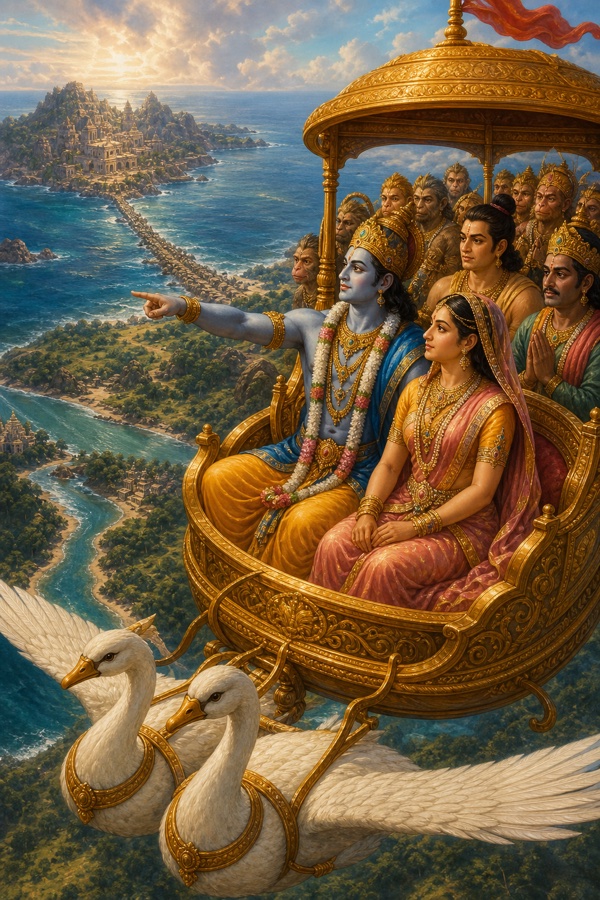
“There is the seashore where, after crossing the sea, we spent that night. This is the bridge Nala built, which I had raised across the salt sea for your sake. Vaidehi, look at the roaring, unshakable, boundless ocean, the home of Varuna, full of conches and shells. Maithili, see the golden Mount Mainaka, which pierced the sea and rose up for Hanuman to rest upon. This is the island in the midst of the sea where my army halted before crossing to Lanka. Here Shiva was gracious to me, and I worshiped him as Rameshvara. This is the holy place called Setubandha, which will be worshiped in the three worlds and will destroy the greatest of sins.
“Here it was that the ogre-king Vibhishana first came to me. Sita, this is Sugriva’s lovely Kishkindha, where I killed Vali.” Seeing Kishkindha, which Vali had ruled, Sita, shy with love, said humbly, “I wish to go with you to the capital, Ayodhya, together with Sugriva’s dear wives, Tara and the rest, and the wives of the other monkey chiefs.” Rama said “So be it,” halted the chariot at Kishkindha, and told Sugriva, “Tell all the monkey chiefs to go to Ayodhya with their wives, along with Sita. Come yourself with all your wives. Make haste, so that we may set out quickly.”
Ringed by all the monkeys, Sugriva went into the inner apartments and said to Tara, “Beloved, Rama has given you leave to go to Ayodhya with the wives of the great monkeys, to gladden Maithili. Make haste; let us take the monkey-women and go by the air, and show you Ayodhya and all the wives of Dasharatha.” Tara called all the monkey-women together and said, “With Sugriva’s leave, go quickly to Ayodhya with all the monkeys. To see Ayodhya will be a dear thing for me too. We will see Rama’s entry into the city among its people, and the splendor of all Dasharatha’s queens.”
With Tara’s leave, all the monkey-women dressed themselves, walked around the chariot, and climbed aboard, eager to see Sita. When the chariot rose again, Rama, near Rishyamuka, said to Sita once more, “Sita, see that mountain rich in golden ores and hung with lightning-like clouds, Rishyamuka. Here I met the monkey-king Sugriva and made my vow to kill Vali. This is the lake Pampa, full of lotuses and lovely woods, where I lamented, cut off from you, and went from tree to tree asking them where you were. On its bank I met Shabari, and here I killed Kabandha, whose arms were a yojana long. Over there in Janasthana you can see the tree beneath which Ravana killed the great bird Jatayu for your sake.
“This is Panchavati, where I killed Khara, Dushana, and Trishira with arrows that flew straight to their mark. This is the site of our hermitage, and there is the lovely leaf-hut from which Ravana carried you off by force; we built it with our own hands and meant to grow old in it. This is the pleasant Godavari of clear waters; this is Agastya’s hermitage ringed with banana trees, and the shining hermitage of Sutikshna. Vaidehi, there is the great hermitage of Sharabhanga, where the thousand-eyed Indra once came. In this land I killed the huge Viradha. There you see the ascetics of the hermitage whose head is Atri, brilliant as sun and fire; and here you saw the pious ascetic Anasuya.
“That mountain-king Chitrakuta shines out, where Bharata came to bring me back. This is the lovely Yamuna and the hermitage of Bharadvaja. This is the holy Ganga that runs by three streams, its banks full of many birds, its woods in flower. This is Shringaverapura, where my friend Guha lives. Sita, this is the Sarayu, graced with rows of sacrificial posts. Vaidehi, this is my father’s capital, Ayodhya; after so long, coming home, bow to it.”
Overjoyed, leaping up again and again inside a chariot that was already flying, all the monkeys, the bears, and the ogres with Vibhishana looked upon that city, the place they had heard named in a hundred camp-fire conversations and never expected to see. Graced with rows of white mansions, its broad streets wide, thronged with elephants and horses, they saw Ayodhya, like Indra’s Amaravati.
Bharadvaja’s hermitage, and Hanuman sent ahead
On the fifth day of the bright fortnight of Ashvina, the month of autumn, with the fourteenth year now complete and not a day of it overrun, Rama reached the hermitage of Bharadvaja, bowed to the sage, and asked the questions of a son and not of a conqueror. “Have you heard whether the city of Ayodhya has good harvests and is free of disease? Is Bharata bent on the care of the people, and are my mothers alive?” The great sage Bharadvaja, well pleased, smiled and said, “Bharata, wearing matted hair, keeps your sandals set before him and waits for you; in house and city all is well.
“Conqueror in war, when you first went into the forest, dressed in bark, cast down from the kingdom, seeking only dharma, having given up everything, walking in on foot with Sita, I felt pity for you. Now, seeing you with your task done, your enemies beaten, your friends and kinsmen about you, I am filled with the highest joy. Raghava, whatever joy and sorrow came to you in the forest, all of it is known to me. While you guarded the Brahmins and the ascetics, Ravana carried off your wife; the sight of Maricha, the abduction of Sita, the sight of Kabandha, the coming to Pampa, the friendship with Sugriva, the killing of Vali, the search for Sita, Hanuman’s leap across the sea, the bridge of Nala, the burning of Lanka, the death of Indrajit, the destruction of Ravana with his kin, the meeting with the gods and their boons, all of this I know through my austerity; my disciples bring me news from Ayodhya.
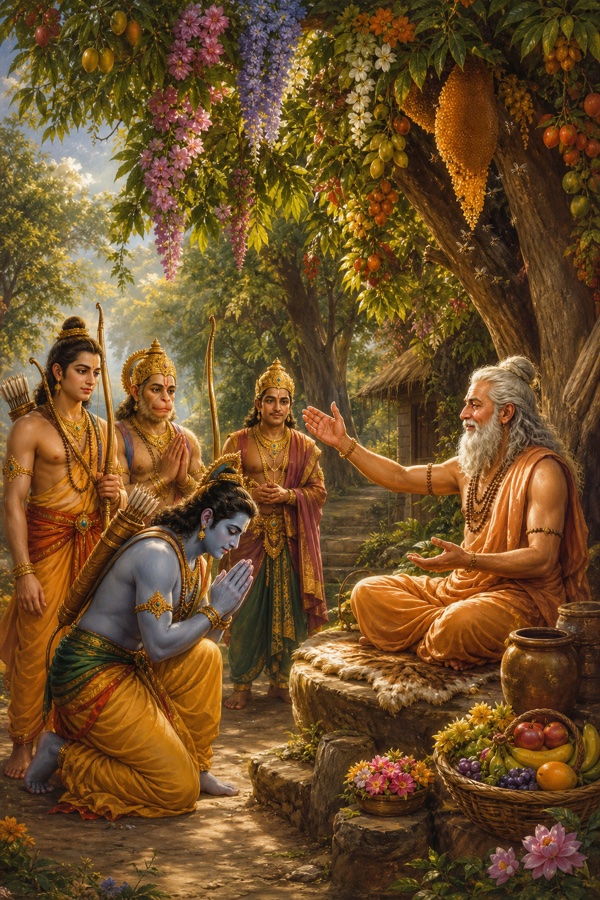
“I too grant you a boon. Accept this offering; tomorrow you shall go to Ayodhya.” Rama bowed his head, said “Gladly,” and asked his boon; and again he asked it for other people. “Let all the trees along the road to Ayodhya bear fruit and run with honey, and let them bring forth fruits of every kind with the fragrance of nectar.” The moment the sage said “So be it,” all the trees of that region became like the trees of heaven. For three yojanas the barren trees grew heavy with fruit, the flowerless burst into flower, the withered filled out with leaves and ran with honey. Coming down in the outskirts of Ayodhya, those thousands of monkey chiefs, as glad as men who have won heaven, feasted at will on those divine fruits.
Looking down on Ayodhya from the sky, and wishing to do a kindness to his friends and to the people of Ayodhya, Rama said to Hanuman, “Go quickly to Ayodhya and see whether the people in the palace are happy. Reach Shringaverapura and greet in my name the forest-dwelling Nishada king Guha, who ferried us over the Ganga on the night we left; he is a friend dear to me as my own self. Glad, Guha will tell you the road to Ayodhya and the news of Bharata. Ask Bharata too after his welfare in my name, and tell him that I have returned, my purpose won, with my wife and Lakshmana. Tell him of the abduction of Sita, the talk with Sugriva, the killing of Vali, the search for Sita, your leap across the sea, the building of the bridge, the death of Ravana, the boons of Indra and Brahma and Varuna, and, by Shiva’s grace, the sight of my father, all of it. Tell him too that with Vibhishana and Sugriva I have come near to Ayodhya.
“When Bharata hears this news, mark whatever changes in his face, and whatever he means to do about me; read it truly from his color, his glance, and his voice. A kingdom won from father and grandfather, full of elephants and horses and chariots, rich in every desired thing, whose heart would it not draw? If Bharata, through love of the kingdom or of his mother, has come to wish it for himself, then let him rule the whole earth. Learn his mind and his resolve, and come back to me quickly, before we go far from Bharadvaja’s hermitage.” He had spent fourteen years in bark to keep a word his father gave. He would not walk into his brother’s house uninvited.
At his word Hanuman took on human form, so that no one on that road would run from him, and sped toward Ayodhya, as Garuda swoops down on the king of snakes. Crossing the path of the fathers, the sky, and crossing the meeting of Ganga and Yamuna at Prayaga, he reached Shringaverapura, met Guha, and said with joy, “Guha, your friend, the truthful Rama of the line of Kakutstha, is well, with Sita and Lakshmana, and he has asked after your welfare. At the sage’s word he has spent this fifth night here, and with Bharadvaja’s leave he will give you his sight here tomorrow.”
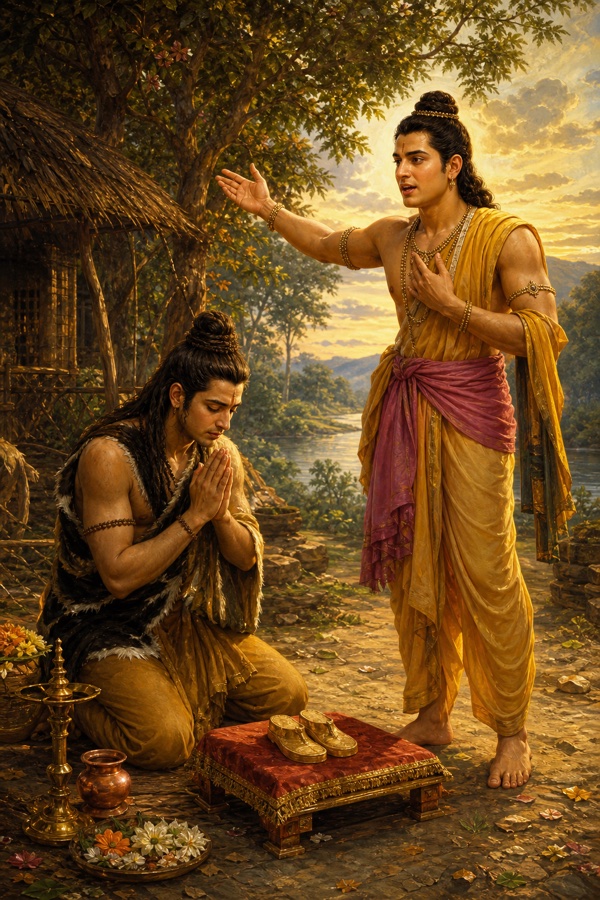
Saying this, Hanuman sprang up again with great speed. On the way he saw the fords of Rama-tirtha, the rivers Valukini, Varuthini, and Gomati, the sala forests, and the thousands of people of the Kosala country. Crossing that long road, the monkey-chief came near Nandigrama, to trees in flower like Indra’s grove and the grove of Chaitraratha. Two miles from Ayodhya he saw Bharata, and the sight stopped him: a king worn thin, wretched, living like a hermit, dressed in bark and black deerskin, wearing matted hair, his body soiled, pained by the loss of his brother, living on roots and fruit, radiant as a seer of Brahman, ruling the earth with Rama’s sandals set before him on the throne and himself on the ground beside them, guarding all four orders from every fear, waited on by pure ministers and priests and by generals in ochre robes. He had kept the exile too, to the day, without being asked.
Hanuman joined his hands and, as though dharma itself were speaking, said to the dharma-knowing Bharata, “God, the Rama of the line of Kakutstha for whom you grieve has asked after your welfare; I bring you glad news, so let go of this cruel sorrow. In this very hour you will be reunited with your brother Rama. Having killed Ravana and won Maithili back, Rama comes home, his purpose fulfilled, with his mighty friends. Lakshmana and Sita come with Rama, as Shachi comes with Indra.”
Hearing this, Bharata fainted for joy and fell to the ground; fourteen years of held breath went out of him at once. Coming to his senses a moment later, rising up, he said to Hanuman, “God or man, you have come here out of kindness. For this dear news I will give you a hundred thousand cows, a hundred fine villages, and, as your wives, sixteen maidens of noble birth, wearing earrings, of pure conduct, golden of hue, lovely of nose and thigh, adorned with every ornament.” Hearing this wonderful news of the monkey-hero’s arrival, Bharata, thrilled with the longing to see Rama, spoke again.
Hanuman’s summary of the forest years, and the meeting with Bharata
Bharata said, “Today I am hearing the dear story of my lord Rama, who went into the great forest so many years ago. That worldly saying rings true, that joy comes at last, even after a hundred years, to a man who lives. Tell me truly, at what place and on what footing did Rama and the monkeys meet?” Then Hanuman, seated at ease on a mat of kusha grass, told in brief the whole tale of Rama in the forest, and told the man who had lived those same years in a hut two miles from his own palace.
“How your mother gained two boons, by which Rama was sent to the forest; how King Dasharatha died of grief for his son; how messengers called you back in haste from your grandfather’s house; how, returned to Ayodhya, you would not have the kingdom; how you went to Chitrakuta and begged your brother to take back the throne; how Rama, holding firm to his father’s word, gave up the kingdom; and how you came back bearing the sandals of your elder, all this you know. Now hear what happened after your return.
“When you had gone, the forest of Chitrakuta grew heavy with sadness, and its beasts and birds were troubled. Rama went deep into the empty Dandaka forest, trodden by elephants, full of lions and tigers and deer. There a strong ogre named Viradha rose up with a great roar; the three of them threw him into a pit and killed him. That hard deed done, Rama and Lakshmana came at evening to the lovely hermitage of Sharabhanga. When Sharabhanga had gone to heaven, Rama saluted the sages and went to Janasthana.
“There an ogress named Shurpanakha came to Rama; at Rama’s sign Lakshmana cut off her ears and nose, and from that one cut the whole war grew. Rama then destroyed fourteen thousand fearful ogres; closing with Rama alone, they were wiped out in a quarter of a day. He killed Dushana first, then Trishira and Khara. The wounded Shurpanakha went for refuge to Ravana. Ravana’s servant Maricha became a jeweled deer and lured Vaidehi. Sita said, ‘Catch this deer.’ Rama took up his bow, followed it, and, as it fled, struck it down with an arrow.
“When Rama had gone after the deer and Lakshmana too had left the hermitage, the ten-necked Ravana entered it and seized Sita by force, as a planet swallows Rohini. Killing the vulture Jatayu, who was old and came anyway to save her, the ogre bore Sita off in haste. Astonished monkeys sitting on a mountain-peak saw Ravana carrying Sita away. Mounting the mind-swift Pushpaka with Sita, Ravana went into Lanka. Setting Maithili in a mansion ringed by golden walls, he coaxed her, but Sita counted his words no more than a blade of grass and stayed in the Ashoka grove.
“Rama, having killed the deer and come back, grieved to find the vulture dearer to him than a father dead, and Sita gone. Searching for Sita along the Godavari and through the flowering woods, Rama and Lakshmana killed the ogre Kabandha in the great forest. At Kabandha’s word Rama went to Rishyamuka and met Sugriva; through their talk, and a fire walked around by both, a deep friendship grew between them. Sugriva had been driven out by his angry brother Vali, and Rama killed the huge Vali and gave Sugriva back his kingdom. Set on his throne, Sugriva vowed to search for Sita and sent ten crores of monkeys in all four directions.
“Much time passed as we wandered lost in the Vindhya; then the strong Sampati, brother of the vulture-king Jatayu, told us that Sita was in Ravana’s house. Lifting the grief of my despairing kinsmen, by my own strength I leaped a hundred yojanas across the sea. There I saw Sita alone in the Ashoka grove, in soiled silk, joyless, firm in her vow. Meeting Sita and asking after her welfare, I gave her the ring marked with Rama’s name, took from her the crest-jewel out of her hair, and came back to the northern shore. In Kishkindha I gave Rama that great jewel.
“Hearing the news that Sita lived and held firm in her devotion, Rama gained hope of life, as a dying man does who drinks the nectar of the gods. He resolved on the destruction of Lanka. Nala built a bridge across the sea and the monkey army crossed. Nila killed Prahasta, Rama killed Kumbhakarna, Lakshmana killed Indrajit, and Rama himself killed Ravana. Meeting Indra, Yama, Varuna, Shiva, Brahma, and his father Dasharatha, and gaining their boons, honored by the sages and the divine seers, Rama accepted their homage with gratitude. His boons won, Rama came with the monkeys by the Pushpaka, by way of Kishkindha. Tomorrow, in the conjunction of Pushya, you will be able to have Rama’s sight without hindrance, as he rests near the sage on the bank of the Ganga.”
Hearing Hanuman’s sweet words, the glad Bharata joined his hands and said, in a voice that gladdened the heart of everyone who heard it, “After so long, my heart’s wish has come true.”
Ayodhya made ready, and Rama’s welcome
Hearing that news of the highest joy, the truthful Bharata gave his glad brother Shatrughna his orders, and a city that had been in mourning for fourteen years came awake in a night. “Let holy men worship in all the shrines and sanctuaries of the city, with sweet garlands and music. Let the bards learned in praise and legend, all the panegyrists, the players skilled in music, all the courtesans, the queen-mothers, the ministers, the soldiers and their wives, the Brahmins with the warriors, and the heads of the guilds go out to see Rama’s face, that is like the moon.” At this Shatrughna called out thousands of laborers, divided them into bands, and ordered that all the high and low ground from Ayodhya to Nandigrama be leveled, the shrines along the way left as they stood, and the whole ground sprinkled with water cool as snow.
“Then let them strew parched rice and flowers over all the ground. Deck the streets of Ayodhya with banners. Until sunrise let them adorn the houses with garlands thick and thin, with open flowers, and with ornaments of five colors. Let hundreds of men keep the royal road clear.” Hearing Shatrughna’s order, the eight ministers, Dhrishti, Jayanta, Vijaya, Siddhartha, Arthasadhaka, Ashoka, Mantrapala, and Sumantra, the same Sumantra who had driven Rama out of this city and come back with an empty chariot, set out riding elephants, ringed by thousands of rutting, adorned elephants, by matchless chariot-warriors, by thousands of fine horses, and by thousands of foot-soldiers bearing spear and lance and noose.
Then, putting Kausalya and Sumitra at their head, all the queens of Dasharatha, Kaikeyi with them, came in their litters to Nandigrama. Thin with fasting, wretched, dressed in bark and black deerskin, Bharata, ringed by the brahmanas, the guild-heads, the merchants, the ministers bearing garlands and sweets, and by conch and drum and bard, set his elder’s sandals on his head, took the white parasol and the gold-mounted royal fly-whisks that he had never once used over himself, and went out with his soldiers to meet Rama. With the beat of the horses’ hooves, the rims of the chariots, the conch and the kettledrum, and the trumpeting of the elephants, the earth itself seemed to shake; all of Ayodhya had come to Nandigrama.
Looking all around and seeing nothing, Bharata said to Hanuman, “This is not some restlessness of the monkeys, is it? I do not see my Rama.” Hanuman answered with the truth, “By Bharadvaja’s grace the monkeys and bears, glad at finding the trees ever in fruit, in flower, running with honey, humming with bees, are giving out that fearful roar you hear. I take it the monkey army is crossing the Gomati; see the dust rising near the sala forest. Far off you can see that moon-bright, divine Pushpaka chariot, which Rama won by killing Ravana with his kin. In it sit the two heroes, the brothers Rama and Lakshmana, with Sita, Sugriva, and the ogre Vibhishana.”
“This is Rama.” The moment Hanuman said it, the sky rang with the glad shout of women, children, young, and old, one word from a hundred thousand throats. Getting down from chariot and elephant and horse, the people stood on the ground and saw Rama in the chariot, bright as the moon in the sky. Joining his hands, his face turned toward Rama, the glad Bharata worshiped him from afar with the water of welcome and the rest. At Rama’s leave the swan-yoked, swift chariot came down to the ground. Climbing aboard, the glad Bharata saluted Rama again. Coming after so long into Bharata’s sight, Rama rose, set him on his lap, and embraced him, and neither of them said anything for a while.
Then Bharata went to Lakshmana and to Vaidehi, greeted them with joy, and named himself, because Sita had last seen him as a young man and could not be expected to know this hermit. He embraced Sugriva, Jambavan, Angada, Mainda, Dvivida, Nila, Rishabha, Sushena, Nala, Gavaksha, Gandhamadana, Sharabha, and Panasa, every one. Taking human form, the glad monkeys asked after Bharata’s welfare. Bharata embraced Sugriva and said, “Sugriva, you are the fifth of us four brothers; friendship is made by kindness, and a friend is as a brother.” To Vibhishana too he said, “By good fortune you became Rama’s ally and finished this hard deed.”
Shatrughna saluted Rama and Lakshmana and bowed humbly at Sita’s feet. Rama went to his mother Kausalya, pale and thin with the loss of her husband, bent down and clasped her feet, and gladdened her heart. Then he saluted Sumitra, Kaikeyi, and all his other mothers; he passed over no one, and the woman who had sent him away was greeted like the rest. Then he saluted the family priest Vasishtha. With joined hands all the citizens said, “Joy of Kausalya, may your coming be blessed.” And Bharata saw the thousands of folded hands of the citizens, like lotuses in full bloom.
The dharma-knowing Bharata set Rama’s sandals himself upon the king’s feet, the two pieces of wood that had been the throne of Kosala for fourteen years, and said with joined hands, “This is your whole kingdom, which I kept in trust; I give it back to you. Today my birth is fulfilled and my heart’s wish is complete, seeing the king returned to Ayodhya. Look at your treasury, your storehouses, your palace, and your army; by your own splendor I have made them all tenfold.” Hearing these words of the brother who loved him, the monkeys and Vibhishana shed tears; they had left a Lanka where brothers did otherwise. Setting Bharata on his lap with joy, Rama went with his soldiers in that chariot to Bharata’s hermitage.
Getting down at the hermitage, Rama stood on the ground and then said to the peerless chariot, speaking to it as to a servant who had done well, “Now go to the service of Kubera; I give you leave.” At Rama’s word the chariot went off toward the north, to Kubera’s abode. Driven by Rama’s word, that Pushpaka which the ogre Ravana had seized returned swiftly to Kubera, home after all those years by a word from a man who could have kept it. Then Rama pressed with love the feet of his own dear friend, the priest Vasishtha, as Indra presses the feet of Brihaspati, and took an auspicious seat beside him.
Rama’s consecration, and the reign of Rama
With joined hands laid on his head, Bharata, the joy of Kaikeyi, said to his elder, the truthful Rama, “This kingdom of Ayodhya you gave to me, and you honored my mother too. As you gave it to me, so I give it back to you. As a young calf cannot carry the heavy yoke laid on the shoulders of a lone, strong bull, so I cannot bear this weight. As a donkey cannot follow the gait of a horse, or a crow the flight of a swan, so I, hero, cannot follow your path.
“As a great tree planted in one’s own garden, hard to climb, with a huge trunk and spreading boughs, that flowers and then dries up without giving fruit, brings the planter no return, so this same likeness will fall on you if you, our master, do not rule us your servants. Raghava, let the whole world see you today consecrated on the throne of Ayodhya, blazing like the noonday sun. May you sleep and wake to the sound of instruments, the chime of girdle-bells and anklets, and sweet songs.”
The ministers Ashoka, Vijaya, and Siddhartha took counsel for Rama’s advancement and the city’s prosperity and told the servants to make ready, with all good omens, everything for the consecration of Rama, worthy of victory. Then the ministers and the priest went out from the city. Sinless as Indra, Rama, seated in a chariot drawn by green horses, drove to the fine city of Ayodhya. Bharata took the reins as charioteer, Shatrughna held the parasol, and Lakshmana wielded the fan; on the other side Vibhishana held the white fly-whisk, bright as the moon. In the sky the gods, with the sages and the Maruts, sang a sweet song in Rama’s praise.
Sugriva rode a mountain-like elephant named Shatrunjaya; taking human form, adorned with every ornament, the monkeys rode on nine thousand elephants. With the blast of conches and the roll of drums, Rama drove through the city graced with its rows of mansions. The citizens saw Rama going before them in the chariot, and the ones old enough remembered watching this same road carry him out. Walking around him, keeping him on their right, they fell in behind. Ringed by ministers, Brahmins, and people, Rama shone like the moon among the stars. Ahead went musicians with cymbals and swastika-instruments, singing songs of blessing; before them went people bearing pots of unbroken rice, cows, maidens, and sweets.
Rama told all his ministers of his friendship with Sugriva, the might of Hanuman, the deeds of the monkeys, the winning of Lanka, the strength of the ogres, and the alliance with Vibhishana; and the people of Ayodhya were struck with wonder to hear it. Entering Ayodhya, filled with glad and well-fed people, Rama came to the lovely palace of his father, which the Ikshvakus had raised. Rama said to Bharata, “Best in dharma, give my fine palace, set with pearls and cat’s-eye gems, together with its Ashoka grove, to Sugriva.” Bharata took Sugriva by the hand and led him into that palace. At Shatrughna’s word the servants carried in oil-lamps and bedding.
Bharata told Sugriva to send envoys to bring sea-water for Rama’s consecration. Sugriva gave four of the best monkeys four golden pots set with every jewel and told them to fill them at dawn with the water of the four seas and wait. Those elephant-like monkeys flew off swift as Garuda into the sky. Jambavan, Hanuman, Gavaya, and Rishabha brought sea-water; another five hundred monkeys brought the water of five hundred rivers. Rishabha filled a golden pot covered with red sandal and camphor and brought water from the southern sea, Gavaya from the western, and Hanuman from the northern. Seeing that water, Shatrughna gave it to Vasishtha and to the friends of the house.
Aged yet still vigorous, Vasishtha, who had known this man since he was a child in this hall, with the Brahmins, seated Rama and Sita together on a jeweled seat. Vasishtha, Vamadeva, Jabali, Kashyapa, Katyayana, Suyajna, Gautama, and Vijaya consecrated Rama with clear and fragrant water, as the Vasus once consecrated Indra. First the officiating Brahmins consecrated him, then sixteen maidens, the ministers, the glad warriors, and the merchants. From the sky the four guardians of the world and all the gods sprinkled him with the essences of every herb.
That crown, wrought by Brahma and set with jewels, with which the seventh Manu, Vaivasvata, had once been consecrated, and with which the kings of his line had each in turn been crowned, was brought out and set upon Rama in the golden hall rich in wealth and jewels; the whole line stood behind that one act. Seating him with due rite on a throne made of many jewels, Vasishtha and the officiating priests adorned Rama, blazing with splendor, with that crown and with ornaments. Shatrughna held the white parasol, Sugriva the white fly-whisk, and Vibhishana a second whisk bright as the moon.
At Indra’s prompting the wind-god gave Rama a shining golden garland of a hundred lotuses and a pearl necklace set with every jewel. The gods and gandharvas sang, and the apsaras danced. At Rama’s consecration the earth grew heavy with crops and the trees with fruit, and the flowers gave out their fragrance. Rama gave the Brahmins a hundred thousand horses, cows, and a hundred bulls, and then thirty crores of gold coins and many ornaments and garments. To Sugriva he gave a divine garland of gold and jewels bright as the sun’s rays, and to Vali’s son Angada, whose father he had killed, a pair of armlets flashing with cat’s-eye gems like moonbeams.
To Sita, Rama gave a pearl necklace lovely as moonbeams, and divine, spotless garments and ornaments too. Watching Hanuman’s service, Vaidehi took from her neck the necklace her husband had given her and looked, again and again, at the monkeys and at her husband, saying nothing and asking with her eyes. Reading her meaning, Rama said, “Give this necklace to the one who most pleases you.” Then Sita gave that necklace to Hanuman in whom brilliance, firmness, fame, skill, capacity, modesty, statecraft, manliness, valor, and understanding are ever present. With that necklace Hanuman shone like a mountain wrapped in a white cloud. All the elder and foremost monkeys were honored, each as he deserved, with garments and ornaments. Vibhishana, Sugriva, Hanuman, Jambavan, and all the chief monkeys, honored with their desires and with jewels, went home content.
The enemy-slayer, Rama, began to rule the whole kingdom of Kosala with the highest joy. Rama, who loved dharma, said to the dharma-knowing Lakshmana, “Rule this earth with me; take up the burden of the office of heir-apparent, as our forefathers did.” When Lakshmana, asked again and again with his whole heart and named to the office of heir-apparent, would not consent, for he had spent his life standing behind his brother and meant to go on standing there, Rama consecrated Bharata as heir-apparent of Ayodhya. Vibhishana too, having received the wealth of his line, went back to Lanka with the rakshasas.
Rama worshiped the Lord again and again with the Paundarika, the Ashvamedha, the Vajapeya, and many other sacrifices. Ruling for eleven thousand years, Rama performed a hundred horse-sacrifices, at which fine horses were offered and rich fees were given. Rama, whose arms reached to his knees, mighty, ruled the earth well, with Lakshmana as his follower.
In the reign of Rama no widow wept, and there was no fear of savage beasts or of snakes, and no fear of disease. In the world there were no robbers or thieves, no one came to harm, and the old did not perform the funeral rites of the young. All were glad and given to dharma; looking on Rama alone, creatures did not harm one another. People lived thousands of years, blessed with thousands of sons, free of disease and of grief. On the lips of the people was only the story of “Rama, Rama, Rama”; the world itself seemed to have become Rama.
The trees were ever rooted, ever in fruit, and ever in flower; the clouds rained when they were wished for, and the wind was pleasant. Free of greed, the Brahmins, kshatriyas, vaishyas, and shudras were content, each in his own work. In the reign of Rama the people were given to dharma and told the truth; all were marked with good signs and set on dharma. With his three younger brothers Rama ruled for eleven thousand years.
This first poem, which increases dharma, fame, and length of life and brings kings victory, and which follows the Vedas, was made in the days of old by Valmiki. The man who ever listens to it is freed from sin. Hearing the story of Rama’s consecration, one who longs for sons gains sons and one who longs for wealth gains wealth; a king conquers the earth and brings his enemies under his sway. He who, mastering his anger, listens with faith to this poem made by Valmiki crosses all difficulties, and at the end of his journeys is reunited with his own people and rejoices. By its hearing all the gods are pleased, and in the house where this poem stays all obstacles are laid to rest.
The gist: Accepting the kingdom Bharata gave back, Rama was consecrated with great splendor by Vasishtha and the other priests; Bharata was made heir-apparent, Sita gave Hanuman the pearl necklace off her own neck, and with the account of the eleven thousand years of the ideal reign of Rama and the fruits of hearing this first poem, the Yuddhakanda comes to its close.
Source: Srimad Valmiki Ramayana, Yuddhakanda, Cantos 112 to 128. The Gita Press Hindi edition is the controlling witness. The Sanskrit e-text and an independent complete translation were used to verify names, sequence, and principal events. Where recensions differ, this retelling follows Gita Press.
Based on: Valmiki Ramayana (Gita Press, Gorakhpur)