On this page
Find these passages in the source
Aranyakanda Cantos 17 to 30 provide this episode’s source sequence, from Shurpanakha’s arrival to Khara’s death. These five points lead straight to each scene in the telling below.
- Shurpanakha’s arrival and disfigurement
Aranyakanda 17 to 18 - The report to Khara and the first attack
Aranyakanda 19 to 21 - The army’s march, omens, and preparation
Aranyakanda 22 to 24 - The attack, Dushana, and Trishira
Aranyakanda 25 to 27 - The final encounter with Khara
Aranyakanda 28 to 30
Editions and comparison: Gita Press (Aranyakanda 17 to 30); Valmiki Ramayana Sanskrit and English (Aranyakanda 17 to 30; independent Sanskrit and English presentation).
The Godavari ran cold and clear that morning, and the three of them had gone down to it to bathe. Now Rama, Sita, and Lakshmana climbed back up the bank to their hut at Panchavati, the shelter of clay walls and bamboo pillars, thatched with leaves, that Lakshmana had raised with his own hands beside the river, where the water, the hills, and the flowering woods all lay within a single glance. Rama finished the morning rites, and with his brother he stooped in through the low doorway and sat down. Life had found its rhythm in that place. The great sages of the region came out of their hermitages to honor the exiled prince of Ayodhya, and he received them and let them go; and seated on the floor of the leaf-hut beside Sita, he shone like the moon when it rides in the company of the star Chitra, passing one story after another back and forth with his brother while the day warmed outside. It was into this quiet, with Rama lost in talk, that an ogress came wandering through the region by chance. She had no errand. She was walking the forest as she always walked it, alone and feared. Before the sun went down on the day she chose to turn aside toward that hut, her whim would have cost fourteen fighters their lives, and then fourteen thousand more, and the Dandaka, which had swallowed so many hermits over the years, would be clean of the creatures that had hunted them.
Shurpanakha is smitten with Rama
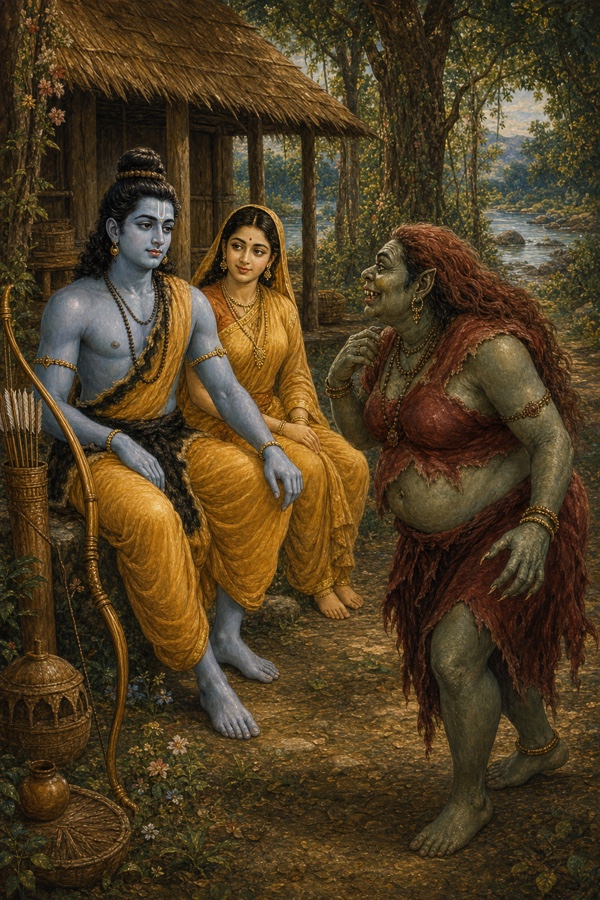
The ogress was Shurpanakha, and the blood in her veins was royal blood of the worst kind: she was sister to Ravana, the ten-headed king of the rakshasas, who ruled the island of Lanka across the southern sea and whose reach ran all the way up into these forests. She came up to the hut and looked at the man sitting inside it, and he seemed to her a god who had come down to walk on the earth. She saw a face lit from within and arms of tremendous reach; eyes as wide as the petals of a lotus; a gait with the slow majesty of an elephant’s; the matted hair of an ascetic gathered up into a rounded crown; a body tender to look at and yet charged with a strength beyond the ordinary; the marks of a king on him everywhere she looked; skin dark as a blue water-lily; a splendor like the god of love himself, and a bearing like that of Indra, the king of the gods. She looked, and desire took her whole.
Set beside him, Shurpanakha was his opposite in every feature. Rama’s face was fair; hers was hideous. Rama was slender at the waist; she was swollen-bellied. Rama’s eyes were large and calm; hers were deformed. Rama’s hair was beautiful; hers was coarse and the color of copper. Rama was pleasing to look upon; she was misshapen. Rama’s voice was sweet; hers was a frightful thing. Rama was young; she was aging, and hard as old wood. Rama spoke straight; she spoke crooked. Rama’s conduct was upright; hers was vile through and through. Rama drew the eye; she was a thing the eye turned from. Such was the rakshasi who, with the fire of desire risen in her body, spoke to Rama.
“You wear the matted locks of a hermit, and a hermit’s bark, and yet you carry a bow and arrows, and you travel with a wife. How have you come to this country, where ogres go as they please? What is the purpose of your visit? Be good enough to tell me the truth of it.”
Rama was a man without guile, and when a stranger asked him a straight question he gave a straight answer. He told her everything. “There was a king named Dasharatha, whose valor was the equal of the gods’. I am his eldest son; among men I am known by the name of Rama. Here is my younger brother, Lakshmana, who is devoted to me, and here is my wife, the princess of Videha, whose name is Sita. Bound by the command of my father the king, and by my mother’s, I have come to live in this forest, to pay them the duty I owe them and to hold to virtue in the form of austerity.”
“Now I wish to know you. Whose daughter are you, what is your name, and whose wife? Your limbs are lovely, and yet the look of you tells me plainly that you are an ogress, one of those who can wear whatever shape they please. Tell me truly what has brought you here.”
Love already had hold of her, and she answered him. “Hear my word, Rama, and I will give you the plain truth. I am an ogress, Shurpanakha by name, and I can take any form I choose. I roam this forest alone, and I put fear into all of it. I have a brother named Ravana; perhaps his name has reached your ears. He is the valiant son of Vishrava. Kumbhakarna is my brother too, the mighty one who is given over to endless sleep. My third brother, Vibhishana, is pious-minded, and has none of the ways of an ogre in him. And my other two brothers, Khara and Dushana, are famed for their valor in battle.”
“In valor I surpass them all, Rama. From the first moment I set eyes on you I have taken you, the best of men, for my husband in my heart. I am rich in power, and by my own strength I can go wherever I will. Be my husband, and be so for a long time. What do you hope to gain by keeping Sita? She is deformed and ugly, no match for you. I alone am worthy of you; look on me as your wife. This ugly, worthless, hideous human woman with the sunken belly I will devour, and your brother with her; and then, wandering past the peaks of mountains and through forests of every kind, you will roam the Dandaka with me, full of longing.”
Shurpanakha disfigured at Lakshmana’s hands
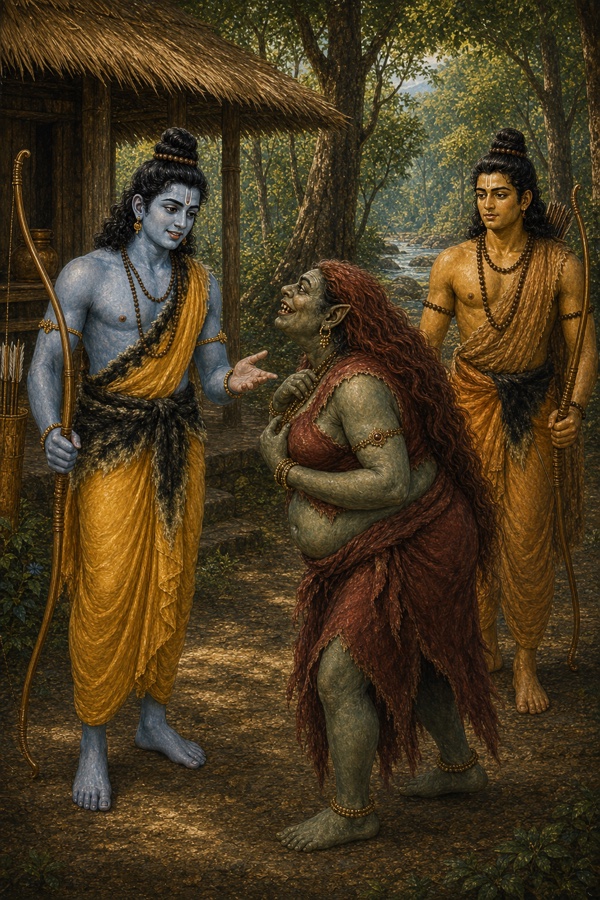
Rama laughed out loud at that. He was a man who knew how to turn a sentence, and he answered the woman with the love-drunk eyes as it pleased him, smiling, in soft and gentle words. “Lady, I am already married; here is my beloved wife. For women like you a co-wife is a hard and bitter thing to live with. But here is my younger brother, Lakshmana, of good conduct, fair to look at, glorious and brave, and he has no wife with him. He is a man of rare qualities, young and pleasing to the eye, and for a form as comely as yours he will make a fitting husband, if he is looking for a wife. Take this brother of mine for your husband, large-eyed and lovely lady, and you will have him with no rival, the way the sunlight has Mount Meru all to itself.”
At these words the rakshasi, deluded by love, let Rama go and turned all at once to Lakshmana. “My complexion is excellent, and for a form as comely as yours I will be a worthy wife. You will wander the whole length of the Dandaka with me in ease.”
Lakshmana, the son of Sumitra, could turn a sentence as well as his brother, and he smiled and gave Shurpanakha his own fitting answer. “I am a slave, lady with the hue of a red lotus, dependent in everything on my worthy brother. Why would you become a slave’s wife and make yourself a slave-woman? You should become the happy younger wife, of spotless complexion, of my elder brother, who is rich in every kind of wealth, and get what you want that way. Giving up this deformed, worthless, hideous, aged wife of his with her sunken belly, he will take you and only you. Set beside a form as fine as yours, what clear-sighted man would fasten his love on human women, lovely lady of the excellent complexion?”
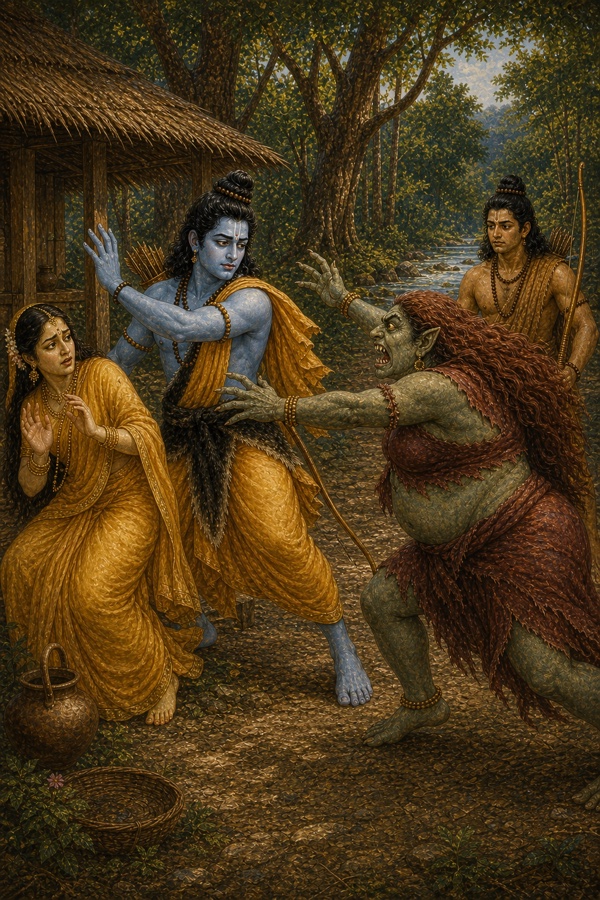
The joke went straight past her. Too simple to catch the jest, the hideous, sunken-bellied ogress took his words for the truth, and, deluded by desire, she came back once more to Rama, who was sitting in the leaf-hut with Sita and was no easy man to overpower. “Clinging to this old, deformed, worthless wife with her sunken belly, you make nothing of me. Today, before your very eyes, I will devour this human woman, and rid of my rival I will roam with you at my ease.”
Her eyes were burning now like live coals. Saying so, the rakshasi in a great rage rushed at the fawn-eyed Sita the way a huge meteor comes down on the star Rohini. The ogress came on like the very noose of Death, and mighty Rama caught her and held her back with his own hand; and Rama, with anger in him now, said to Lakshmana: “One should never trade jokes with cruel and unworthy people, son of Sumitra. Look, gentle brother, how narrowly Vaidehi has kept her life. Tiger among men, take this ugly, worthless, insolent, big-bellied ogress and cut her out of her shape.”
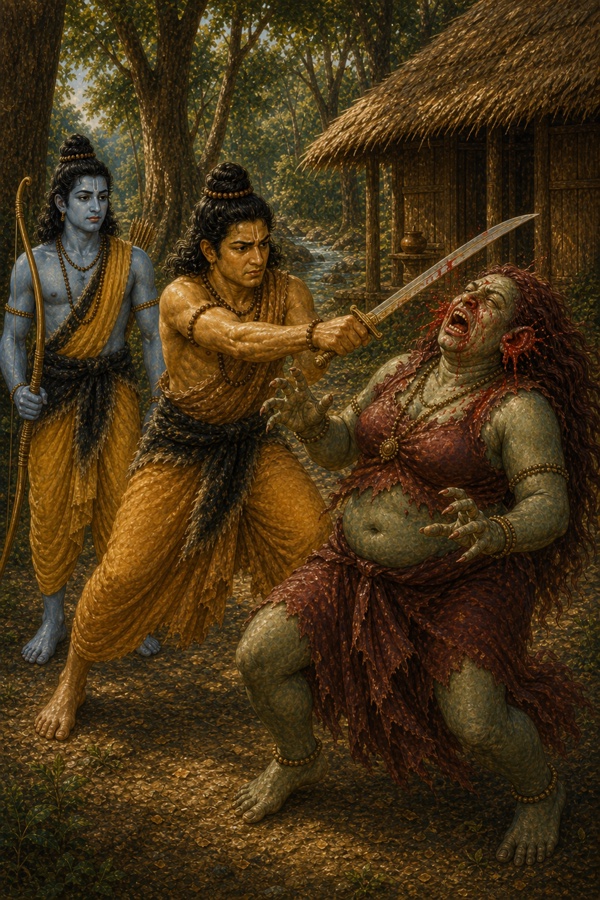
Lakshmana drew his sword. In anger, while Rama looked on, he cut off Shurpanakha’s ears and her nose. With her ears and nose gone, the fierce ogress fled into the forest the way she had come, screaming out of tune. Bathed in her own blood, the ugly and terrible rakshasi roared in a hundred voices, like a cloud in the rains; and dripping blood as she went, raising both her arms and howling, that creature of dreadful looks plunged deep into the great forest.
Shurpanakha before Khara, and fourteen ogres sent
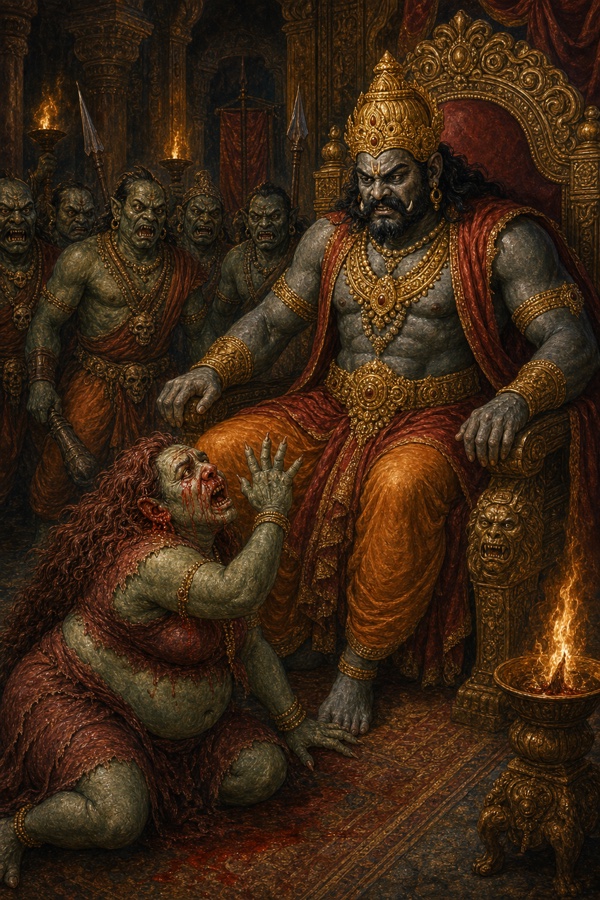
She ran to Janasthana. That was the ogre stronghold in the Dandaka, the garrison from which Khara, her brother of terrible energy, kept his grip on the whole forest with a host of rakshasas around him; every hermit in the Dandaka knew the name and dreaded it. Disfigured, she burst in on him and dropped to the ground at his feet like a bolt out of a clear sky. Half fainting with fear and drenched in blood, the sister of Khara told him all of it: how Rama had come into the forest with his wife and Lakshmana, and how she had been cut out of her shape.
To see his sister fallen like that, disfigured and soaked in blood, put a fire in Khara, and he demanded: “Get up. Shake off this swoon and this fright, and tell me plainly who has cut you up in this way. Whoever laid a hand on you today has poked, for sport, with the tip of one finger, a poisonous black serpent that sat harmless in front of him. He has drunk the deadliest poison there is, and in his folly he does not know that he has fastened the noose of Death around his own neck.”
“You are full of strength and prowess, you go where you please and wear what shape you please, you are a match for Death itself; who, then, has come near you and brought you to this? Among the gods, among the gandharvas who sing in heaven, among the great seers who hold the mantras, what mighty being has cut you out of your shape? I can see no one in all the world who would dare do me a wrong, not even Indra himself, the thousand-eyed tamer of the demon Paka. Today I will take the offender’s life with my deadly arrows, as easily as a swan draws off the milk from the water it drinks. Whose foaming blood does the earth wait to drink, when I have cut through his vitals with my arrows and left him dead on the field? Whose flesh will the birds gather to tear from his body and swallow with delight, once I have killed him? Neither gods nor gandharvas, neither fiends nor ogres will be able to save the wretch when I drag him across the battlefield. Come slowly back to your senses, and tell me the name of the insolent one who overpowered you in the forest.”
Hearing her brother speak, and hearing the fury in him above all, Shurpanakha answered with tears standing in her eyes. “They are two, and young, and richly made; tender to look at and yet very strong, with great eyes like lotus petals; dressed in bark and the black skin of the antelope, living on fruits and roots, masters of their senses, ascetics who keep their vows and their celibacy. They are the two sons of Dasharatha, the brothers Rama and Lakshmana. They look like the king of the gandharvas and they carry the marks of kings on them; whether they are gods or demons I cannot guess. Between them I saw a young woman, richly made, wearing every ornament, slender at the waist. It was for that woman’s sake that the two brothers between them brought me to this, as though I were some unprotected and worthless creature. I long to drink the foaming blood of that crooked woman and of the two brothers, when they lie killed at the front of the battle. Grant me this, the first of all my desires, and grant it there on the field: that I may drink her blood and theirs.”
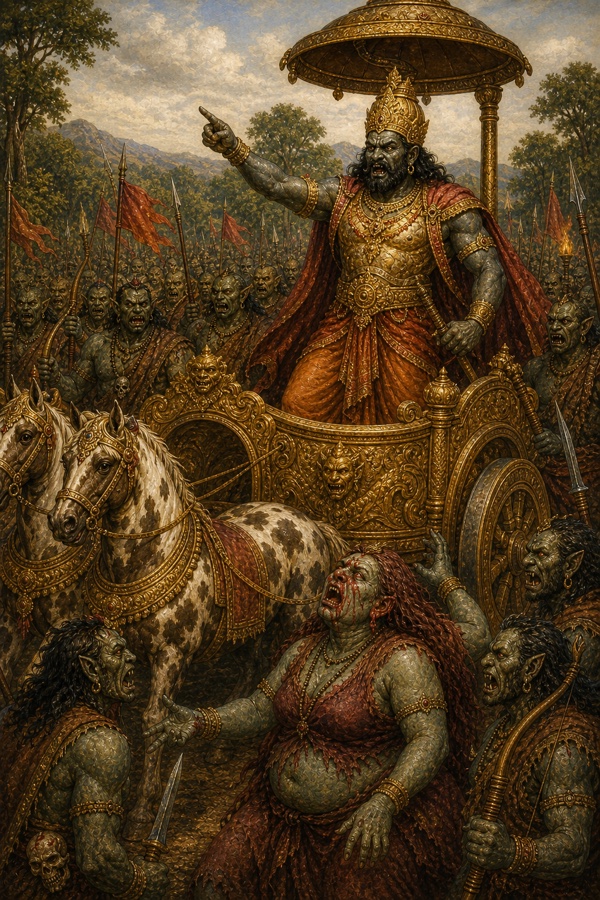
She was still speaking when Khara, in his rage, gave his orders to fourteen ogres, each of them a match for Death in might. “Two human beings, fully armed, dressed in bark and black antelope skin, have entered the dreadful Dandaka forest with a young woman. Kill the two brothers, and kill that vile woman too; this sister of mine will drink their blood. Go quickly, ogres, crush them with your own strength, and grant my sister her cherished wish. When she sees the brothers dead at your hands on the field, she will drink their blood in joy.” Commanded so, the fourteen ogres went with her, like storm clouds driven before a gale.
Rama destroys the fourteen ogres
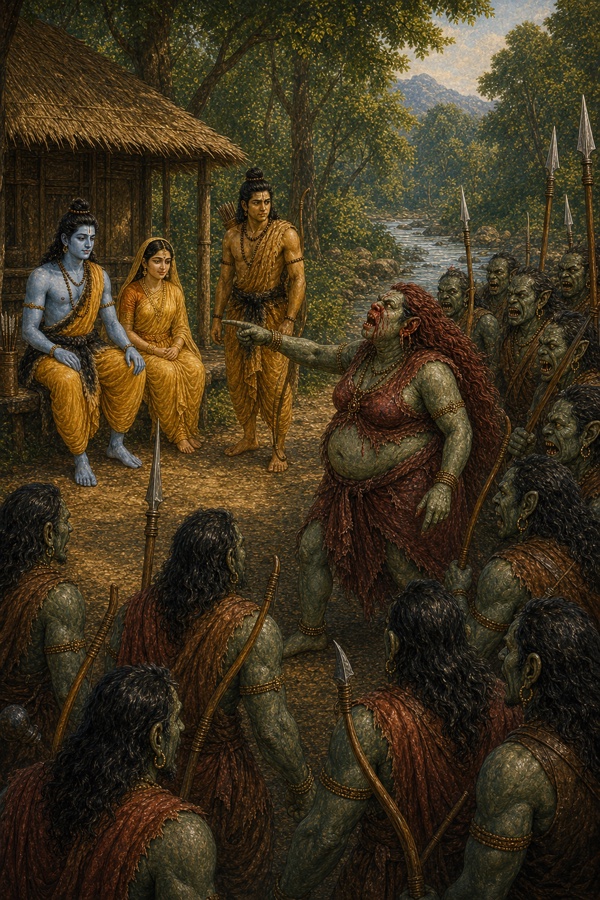
Back at the hermitage, the dreadful Shurpanakha pointed out to the ogres the two brothers and Sita. There they were: Rama seated with Sita in his leaf-hut, and Lakshmana waiting on him. Rama saw her, and saw who had come with her, and he said to his brother of shining luster: “Stay by Sita’s side a moment, son of Sumitra. These ogres who have come here at the ogress’s back I will finish myself.” Lakshmana heard the words of Rama, who knew his own Self, bowed his head to his brother’s command, and said, “So be it.”
Then Rama, whose mind was set on virtue, strung his great gold-worked bow, and the sound of it carried across the clearing, and he spoke to the ogres. “We are two brothers, Rama and Lakshmana, the sons of Dasharatha, come with Sita into this forest of Dandaka that is so hard to cross. We live on fruits and roots, we are masters of our senses, we keep to austerity and to continence, and we live here in the Dandaka. Why do you seek to harm us? Your minds are given to sin and you have wronged the sages, and it is at the sages’ own bidding that I have come with my bow to kill you in open battle. Halt where you stand, rangers of the night, if you love a fight, and do not run. If you love your lives, turn back.”
The fourteen dreadful ogres heard him, and it stirred them to fury and to a kind of delight at the same time. These were killers of Brahmins, with bloodshot eyes and pikes in their fists, and though they had just watched his prowess with their own eyes, they answered the sweet-spoken Rama, whose eyes were naturally a deep red, with harsh words. “You have roused the anger of our great master Khara, and you will give up your life this instant, struck down by us on the field. What power have you, one man, to stand at the front of a fight before so many of us, let alone to give battle? Under the iron clubs, the pikes, and the pattishas our arms will hurl at you, you will lose your life, your valor, and that bow gripped in your hand.”
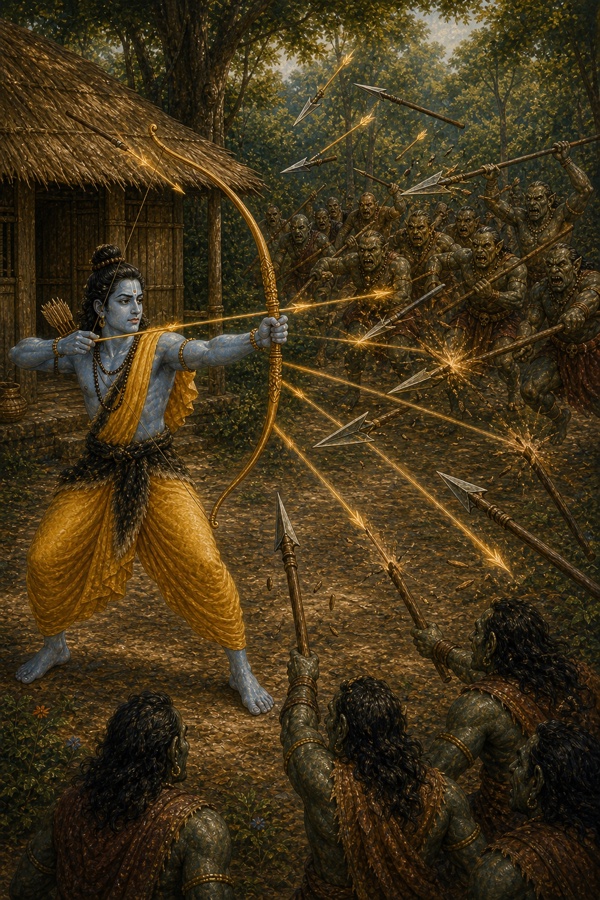
With that, the fourteen ogres ran at Rama alone, their swords and every other weapon raised, and flung their pikes at him. Rama was hard to conquer. He cut down all fourteen pikes in the air with fourteen gold-decked arrows of his own. Then, blazing with energy and in high anger, he drew from his quiver fourteen more arrows, whetted on stone and bright as the sun, bent his bow, took his aim at the ogres, and loosed them the way Indra hurls his thunderbolts. The arrows pierced the ogres’ chests, and soaked in blood they dashed on into the ground like serpents darting out of an anthill. Their hearts torn open and their bodies bathed in blood, the ogres fell to the earth, maimed and dead, like trees ripped up by the roots.
Shurpanakha saw them fall. Blind with rage, the blood on her now half dried, she went back to Khara and dropped to the ground before him a second time, in agony, the way a climbing vine sags under the weight of its own resin. Pale-faced and stricken with grief, she raised a great outcry in front of her brother and wept aloud, sobbing. She had looked on the ogres killed in battle and run from the place; and now the sister of Khara told him of the wholesale ruin of all fourteen, and of everything that had gone with it.
Shurpanakha goads Khara
Khara looked at his sister fallen a second time, and he saw what she was: a woman who would bring ruin on her brothers’ house in her wake. He spoke to her again in anger, and in plain words. “Those brave flesh-eating ogres I sent off only now to oblige you. Why are you crying again? They are devoted to me, bound to me, my friends in every season. They cannot be killed even when they are attacked, and it is out of the question that they should fail to do my bidding. What is the reason you thrash about on the ground like a snake once more, crying ‘ah, my lord’? I want to hear it. With me standing here as your protector, why on earth do you wail like some forlorn creature? Get up. Rise. Do not, do not carry on like this. Put off this despair.”
Comforted at every point, the ogress, who was hard to console, wiped her wet eyes and answered her brother Khara. “A little while ago I came to you with my ears and nose lopped off, drenched in a stream of blood, and you comforted me then, fully. To kill the terrible Rama and his younger brother Lakshmana, and so to please me, you sent those fourteen valiant ogres. Though they were full of fury, and armed with pikes and pattishas, every one of them was killed in battle by Rama, with arrows that found the vital spots. When I saw those swift ogres fallen in a single instant, and saw what Rama had done, a great terror seized me. Frightened, shaken, cast down, seeing danger on every side, I have come again to you for shelter, ranger of the night.”
“Why do you not save me, sunk as I am in a vast ocean of grief, where despair is the crocodile and terror is the swell of the waves? And those flesh-eating ogres who went with me are lying on the ground, killed by Rama with arrows sharper than any I have seen. If you have any pity for me, and any mercy for those ogres, and if you have the power or the fire to stand against Rama, then kill that thorn in the ogres’ side who has made his home in the Dandaka. If you do not kill Rama, the slayer of his enemies, this very day, then before your eyes I will give up my life, stripped of my honor as I already am. With the eye of my own foresight I can see it plainly: even with your army at your back you cannot stand before Rama in a great fight. You count yourself brave. You are no such thing. The valor you claim is a valor you have only pretended to.”
“Kill the two princes in battle, or clear out fast from Janasthana with your kinsmen, you fool. And if you truly cannot dispose of those two human beings, Rama and Lakshmana, then how shameful is this residence of yours in the forest, disgrace of your line, empty of strength and thin of valor as you are. Humbled by Rama’s fire, you will be undone in no time. That son of Dasharatha is rich in fire, and so is his brother, a man of extraordinary prowess, the one at whose hands I stand disfigured.” Wailing on and on in this way, the sunken-bellied ogress fell in a faint beside her brother, sick with grief; and beating her belly with both hands, in the depth of her misery, she burst into tears.
Khara and Dushana march with fourteen thousand
Stung like that by his sister, Khara, brave and cruel in equal measure, spoke sharper words still, in the hearing of the ogres around him. “This measureless anger of mine, born of the insult done to you, can be held back no more than a great wave of the ocean. By my own prowess I count this human Rama as nothing, a man whose life is already worn away and who will lose it today, killed by his own misdeeds. Restrain these tears and shed your fear altogether. I am sending Rama and his brother to the house of Yama, the lord of the dead. Today, ogress, you will drink the hot red blood of Rama, struck dead by my axe and laid out on the ground.” She heard the words fall from Khara’s mouth and was overjoyed, and in her folly she praised her brother, that giant among ogres, all over again.
Snubbed first and then praised, Khara gave his orders to his general, an ogre named Dushana. “Gentle brother, make ready for war, in every way, all fourteen thousand ogres who follow my mind: the ogres of terrible speed, who never turn back from the field, whose skin is the color of dark blue rain clouds, who take their sport in slaughter and are full of the zeal for war. Bring me quickly my chariot and my bows, my arrows, my swords of every kind, and my keen javelins, gentle brother. For the killing of the insolent Rama I mean to march at the head of these great ogres of Pulastya’s line myself, brother skilled in war.”
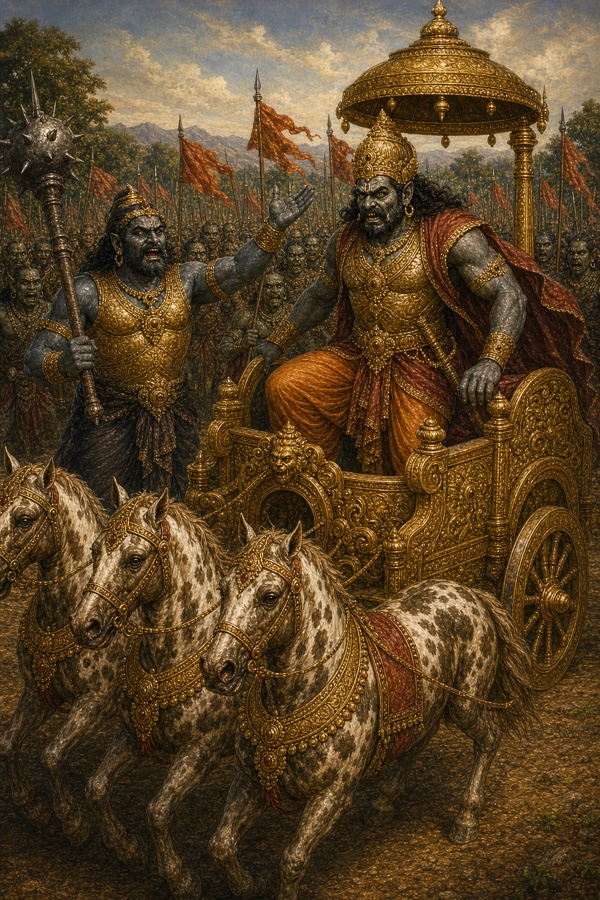
He was still speaking when Dushana brought word that the chariot stood ready: a huge chariot that shone like the sun, drawn by fine spotted horses of high breed. In his fury Khara climbed up into it. It rose like a peak of Mount Meru, worked all over in refined gold, with golden wheels and a pole of cat’s-eye gems, and crowded with golden figures of crocodiles, flowers, trees, and mountains, of moons and suns, flocks of birds and stars; it was hung with ensigns and swords and set with small sweet-toned bells. Khara and Dushana looked over that great force, chariots, shields, weapons, and standards, and ordered all the ogres to advance.
Then the army of ogres poured out of Janasthana with a great roar and a great rush, its dreadful shields and weapons and standards moving all together. They went out with clubs and pattishas and pikes, with keen axes and flashing swords, with discuses and iron bars gripped in their hands, with javelins and iron-tipped clubs, with huge bows, maces, scimitars, pestles, and terrible bolts, all fourteen thousand of the most dreadful ogres who followed Khara’s mind. Seeing those fearsome ogres racing ahead, Khara’s chariot followed close behind them; and reading his master’s mind, the charioteer spurred on the spotted horses in their gold. Driven at speed, the chariot filled the four quarters of the sky and every point between them with its sound, and Khara, his indignation risen high, thundering from it like a cloud that rains hailstones, in a hurry to kill and looking like Death himself, urged his driver on again in a sharp voice.
Ill omens for Khara; the army near the hermitage
The sky answered the march before Rama did. As that dreadful army moved out, a huge and terrible cloud, gray as a donkey’s hide, let down an evil rain the color of blood. On the level, flower-strewn highway, the swift horses yoked to Khara’s chariot stumbled and went down for no reason anyone could see. Around the sun a dark halo rimmed with red appeared, like a firebrand whirled in a circle. Onto the standard raised high on its golden pole a gigantic and most frightful vulture came down and settled. As the army reached the outskirts of Janasthana, flesh-eating beasts and birds raised harsh, jangling cries, and in the sunlit quarter of the sky fearful jackals set up a howl that boded ill for the ogres.
Clouds carrying blood for their rain, huge as elephants in rut, curtained off the heavens. A dreadful, hair-raising darkness came down, so thick that neither the quarters of the sky nor the points between them could be told apart. Evening fell before its hour, like a canopy soaked in blood, and frightful beasts and birds cried out facing Khara. Buzzards, jackals, and vultures screamed of danger; she-jackals, the surest bringers of disaster in war, shrieked with flames pouring from their mouths; and a headless human figure, like an iron club stood on end, appeared close to the sun. Rahu, the great planet that swallows the sun, seized it out of its due season; the wind rose violently, and the sun went dim. Stars flashed like fireflies though there was no night. The lotuses in the ponds withered, and the fish and the water-birds sank down out of sight. In that same moment the trees stood stripped of blossom and fruit, and dust rose gray as a cloud though no wind blew. Mynas chattered in the thickets, and meteors came down with a crash. The earth, with its mountains and forests and woodlands, shook hard. As Khara thundered on from his chariot, his left arm throbbed and his voice went hoarse; looking about him, his sight blurred with tears. A pain woke in his forehead. He was a shrewd man, and still he would not let go of his folly.
Khara looked at those great and hair-raising portents rising up on every side, and he laughed out loud and said to all the ogres of his army: “Trusting to my own strength, I care no more for all these dreadful signs, terrible as they are to look at, than a strong man cares for weaklings. With my sharp arrows I can shoot the very stars down out of the sky. In my anger I could make Death himself die like any mortal. I will not turn back without killing, with my keen arrows, that Rama who is so drunk on his own strength, and his brother Lakshmana with him. Let my sister Shurpanakha, on whose account Rama and Lakshmana have done this wrong, have her wish and drink their blood. Never yet, on any battlefield, have I met defeat.”
“You see it for yourselves; I tell no lie. In my anger I could finish even Indra, the lord of the gods, mounted on the maddened elephant Airavata with his thunderbolt in his hand, let alone these two mortals.” That huge army of ogres heard him roar, and though the noose of Death was already around its neck it filled with a joy beyond measure. Others were gathering too, to watch. The great seers who hold the mantras, the gods, the gandharvas of heaven, the siddhas who are born with their mystic powers, and the charanas, the singers of the sky, all came together above that road, and those beings of blessed deeds, friendly to every living thing, said to one another: “May all be well with the cows and the Brahmins, and with all who are honored among the people. As Vishnu, discus in hand, conquered all the greatest of the demons, so may Rama conquer these ogres born of Pulastya’s line.” Saying this and much more of the same, the greatest of the seers and the gods in their flying chariots looked down, full of wonder, on that army of ogres whose span of life had already run out.
Khara raced ahead of his army in his chariot, and twelve ogres of great prowess marched around him: Shyenagami, Prithugriva, Yajnashatru, Vihangama, Durjaya, Karaviraksha, Parusha, Kalakarmuka, Hemamali, Mahamali, Sarpasya, and Rudhirashana. Four more, Mahakapala, Sthulaksha, Pramathi, and Trishira, followed at Dushana’s heels at the head of the host. That fearsome army of ogre warriors, of terrible speed and hungry for the fight, came on all at once toward the two princes, like a cluster of planets bearing down on the moon and the sun.
Good omens for Rama; preparing for battle
By the time Khara reached the hermitage, Rama and his brother had seen the same portents from the other side. Filled with anger to see those most dreadful signs, so harmful to the ogres, Rama said to Lakshmana: “Look, mighty-armed brother, at these great portents that have risen for the destruction of all the ogres; they foretell a slaughter without limit. Those donkey-gray clouds floating in the sky are raining down torrents of blood with a violent crash. Look at the smoke rising for an omen: all my arrows feel carried away with joy at the coming fight, and my gold-backed bows are stirring on their own, clever brother, straining to be strung.”
“The wild birds crying here tell us that safety stands before us, and mortal danger before the ogres. There will surely be a very great fight; there is no doubt of it. This right arm of mine, throbbing again and again, foretells victory for us and defeat for the enemy, and soon. Your face too, brave brother, looks bright and glad. When men are ready for battle and the light goes out of their faces, Lakshmana, their span of life is at its end. And here is the terrible roar of the thundering ogres, and the crash of the kettledrums beaten by ogres of cruel deeds.”
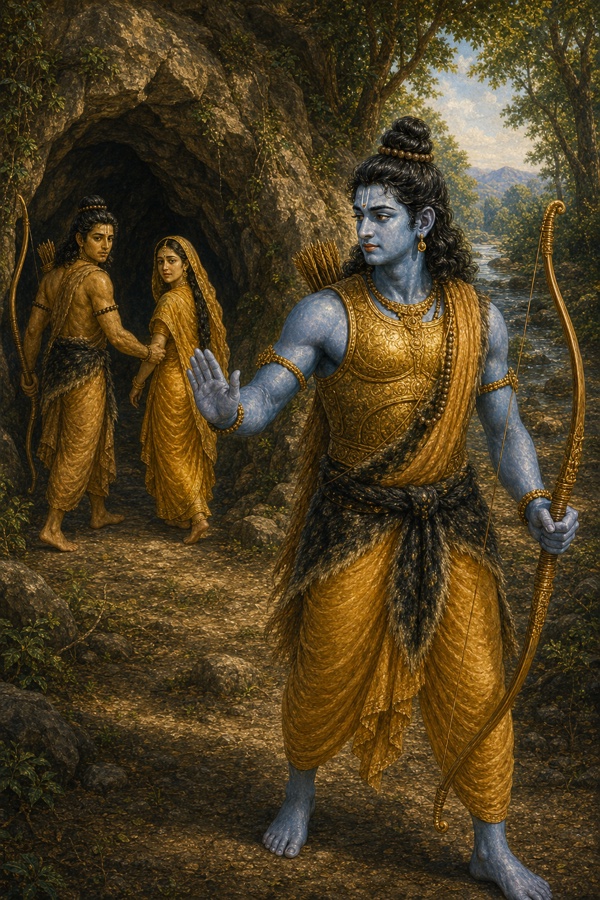
“A wise man who seeks his own welfare, and who can see danger coming, guards against a calamity before it arrives. So take Sita, the princess of Videha, and with your bow in hand and an arrow ready, take shelter in a mountain cave, one that is hard to reach and hedged about with trees. I do not want this command of mine opposed. I bind you by an oath on my own feet: go, and go without delay, my boy. You are brave and strong, and could kill these ogres, no doubt of it; but I wish to kill all of them myself.” At these words Lakshmana took up his bow and arrows and went with Sita to a cave hard to reach, to guard her there.
When Lakshmana had gone into the cave with Sita, Rama said, “Good; my command has been carried out at once,” and put on his coat of mail. Adorned with that armor, bright as fire, he looked like a great flame that has leapt up all at once in the dark. He lifted his great bow, took an arrow in his hand, and stood there unmoving, filling the quarters of the sky with the twang of his bowstring.
The watchers had followed the army. The gods with the gandharvas, and the siddhas with the charanas, gathered above the clearing to see the battle. The great seers came together too, the foremost Brahmin sages of the world, men whose lives were made of virtuous deeds, and repeated their blessing, and, looking at one another, said: “Here are fourteen thousand ogres of terrible deeds, and Rama, whose mind is set on virtue, stands alone. How can there be a fight at all, with the odds like this?” So the royal sages, the siddhas with their companies, the gods, and the first of the Brahmins stood in their flying chariots, filled with wonder and with doubt.
Rama stood at the front of the fight in his martial fire, and all the living beings who did not know his greatness trembled to see him. The peerless form of Rama, tireless in his deeds, had become the form of Rudra in his wrath, the god who destroys. Even while the gods, gandharvas, and charanas were still speaking, the ogre army, with its dreadful shields and weapons and fearful standards, closed in from every side with a deep roar. The din of those ogres filled the whole forest: they flung out war-cries, they crowded up to one another shouting instructions in the arts of battle, they twanged their bows, they leapt and bounded again and again in their drunkenness, they clamored and beat their drums. Terrified by the noise, the wild beasts of prey ran for a distance where the sound could not reach, and never once looked back.
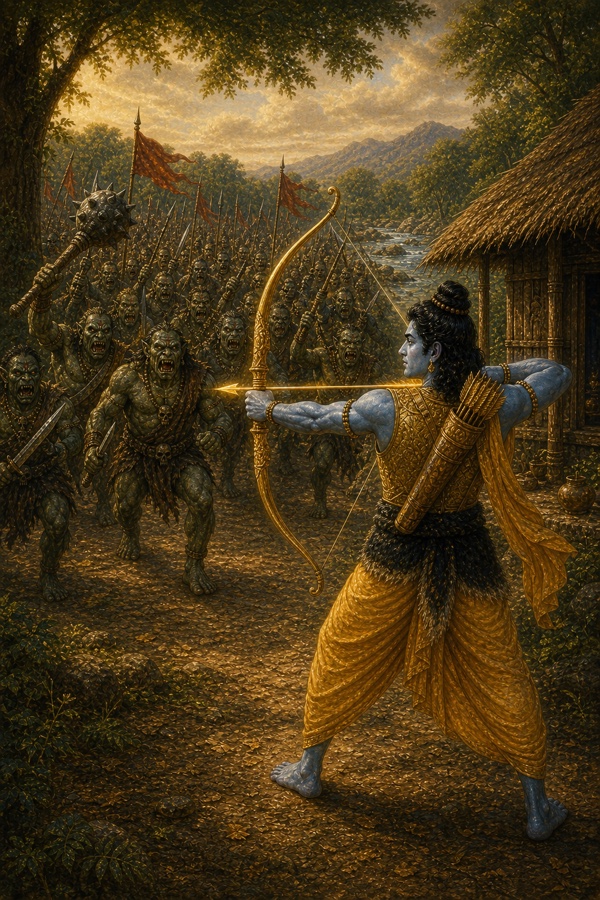
Bearing weapons of every kind, that army of terrible speed, deep as the sea, bore down on Rama. Skilled in war, Rama swept his eyes all around, stepped forward to give battle, and took the measure of Khara’s army. He drew his fearful bow to its full length and pulled arrows from his quiver, and he summoned to his aid a fierce anger for the destruction of all the ogres; and blazing with that wrath he grew as hard to look upon as the fire that burns at the end of an age. Seeing him filled with fire, the deities of the woods were stricken with fear; the form of the angry Rama had become the form of Rudra, wielder of the Pinaka bow, gone out to wreck the sacrifice of Daksha. And across from him, with its bows and ornaments and chariots and its coats of mail blazing like fire, the army of flesh-eating ogres looked like a bank of blue clouds at sunrise.
The ogres attack; Rama answers
Khara and his followers reached the hermitage and found what fourteen thousand had been sent to kill: one man, standing in front of a hut of leaves, with the bow gripped tight in his hand and anger in his face. Khara watched him lift that strung bow with its hard twang, and he gave his charioteer one order: “Drive the chariot straight at Rama.” At Khara’s command the charioteer whipped the horses to where the mighty-armed Rama stood alone, plucking at his bowstring.
Khara came up to Rama roaring, and his ogre followers closed in on all sides around him. Seated in his chariot in the middle of those rakshasas, Khara shone like the planet Mars risen among the stars. He pierced the matchless Rama with a thousand arrows and let out a great roar across the field. Then every rakshasa there, enraged, rained weapons of every kind on Rama, who was hard to conquer and held that fearful bow, and in their fury they struck at the hero with clubs, iron pikes, barbed spears, swords, and axes.
They were vast as thunderclouds and immensely strong, and they rode against him on elephants like mountain peaks, on chariots, and on horseback, rushing to kill Rama in the fight. Like great clouds pouring their torrents on lordly Meru, the ogre hordes rained arrows on Rama. Ringed by all those cruel-eyed ogres, Rama looked like Mahadeva ringed by his hosts of attendants on the evenings of Pradosha that are sacred to Shiva. The weapons the ogres flung, Rama took into himself with his arrows, the way the sea takes in the rushing waters of the rivers. Pierced in every limb by those terrible weapons, he stood unshaken, like a great mountain split by many blazing bolts; smeared with blood in every limb, he looked like the sun screened by the clouds of evening. The gods, the gandharvas, the siddhas, and the great seers saw him alone, ringed by so many thousands, and gloom came down on them.
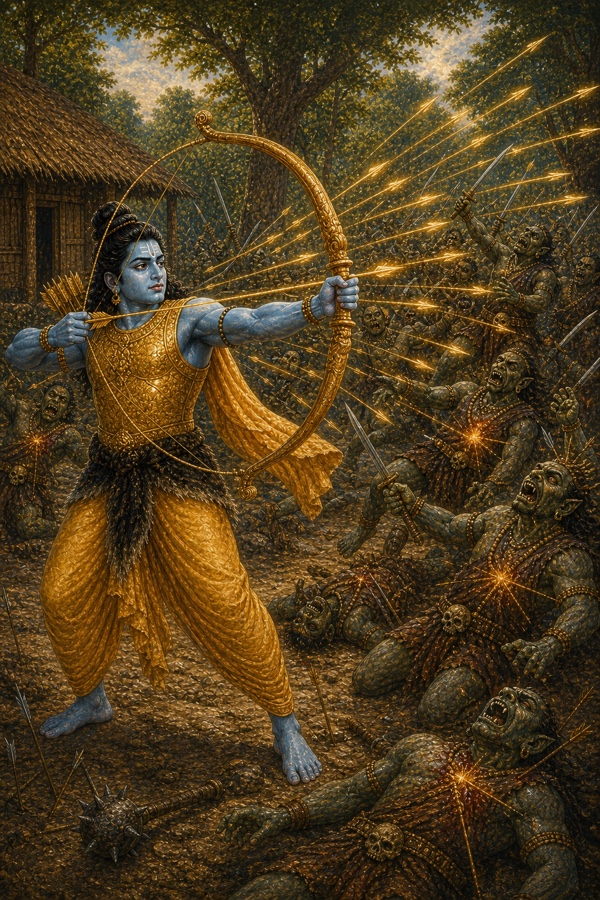
Then Rama, in high anger, bent his bow until it was a full circle and loosed hundreds and thousands of keen arrows, hard to ward off and hard to bear, deadly as the noose of Death. He loosed the gold-tipped shafts as if in play, and, flung so lightly at the enemy’s ranks, they took the ogres’ lives like the nooses of Death. Passing clean through the ogres’ bodies and out into the air, the arrows, bathed in blood, shone in the sky like kindled fire. From Rama’s circling bow came arrows without number, fierce and terrible, taking the lives of the ogres; with them he cut through their bows, the tops of their standards, their shields, their coats of mail, and their arms, decked with bracelets and thick as the trunks of elephants, in their hundreds and thousands across the field.
Rama’s arrows, loosed from that bowstring, tore through horses in golden armor, and through the chariots and drivers with them, through elephants and their riders, and horsemen and their mounts; and killing the foot-soldiers too, he sent them all, without exception, to the house of Yama. Cut by his steel-tipped nalika arrows, his all-iron narachas, and his sharp barbed vikarnis, the rakshasas raised a terrible cry of pain. Torn by his many kinds of arrows piercing their vital parts, that army found no ease before Rama, like a dry forest with fire in it.
Then some brave rakshasas of terrible strength, in a great rage, flung barbed spears, pikes, and axes at Rama. The mighty-armed hero warded off their weapons with his arrows, cut through their necks, and took their lives. With their heads lopped off and their shields and bows split through, they toppled to the earth like the trees of Nandana, the garden of heaven, flung down by the wind of Garuda’s wings. The rakshasas who were left, wounded by his arrows and sunk in gloom, ran to Khara alone for shelter.
It was Dushana who caught them. The general spoke comfort to them all, took up his bow, and in a fury like the wrath of Yama rushed at the angry Rama; and made fearless by his backing, all the ogres turned again and rushed at Rama alone. They had come with weapons, and now they used the forest itself: they tore up sal and palmyra trees and pried up slabs of stone. Pikes and clubs in their hands, and nooses too, the mighty ogres rained down showers of arrows and weapons, and volleys of trees and stones. That fight between Rama and the ogres grew wondrous, tumultuous, most dreadful, and hair-raising; whirling their weapons in their wrath, they set upon Rama once more from every side.
Rama saw every quarter and every point between them thronged with ogres, and himself screened in with showers of arrows. He gave a terrible roar, and he loosed against the ogres the shining missile that the gandharvas preside over. From his circling bow sped thousands of arrows, and all ten directions filled with them. Tormented by the arrows, the ogres could no longer see Rama draw his dread shafts or loose them; they saw only that he was pulling his bowstring. A darkness of arrows curtained the sky and the sun, and Rama stood pouring out arrows as though some machine were at work. Ogres struck all at once and falling all at once strewed the ground in an instant.
Killed outright, struck down, spent, split in two, hacked to pieces, and torn open, the ogres lay in their thousands here and there. Strewn with turbaned heads, with arms still wearing their armlets, with severed thighs and shoulders, with ornaments of every design, with horses and lordly elephants and chariots broken in many places, with whisks and canopies and standards of every pattern, with pikes and scimitars and swords torn to pieces, with shattered spears, scattered axes, stones powdered to dust, and arrows of every kind splintered, that battlefield turned ghastly to look upon. The ogres who remained looked on the dead and were seized with dread, and could not take a single step toward Rama, the conqueror of cities.
The slaying of Dushana and the rest of the host
Dushana watched his army being wiped out, and he still had men. He ordered forward five thousand ogres of terrible speed, hard to approach, men who never turned their backs on a field. With pikes, scimitars, and swords, with showers of stones and with whole trees, in an unbroken rain of arrows, they poured down on Rama from every side. That great, life-taking downpour of trees and stones Rama warded off with his keen arrows; he took it the way a bull takes a storm, standing with its eyes shut, and he summoned a supreme anger for the killing of all the ogres. Filled with wrath and blazing as if with fire, Rama covered that army, Dushana and all, with his arrows on every side.
Then the enraged general Dushana, a belittler of his enemies, held Rama off with arrows like thunderbolts. In great anger Rama cut through Dushana’s huge bow with a razor-headed arrow, brought down the four horses of his chariot with four arrows, cut off the charioteer’s head with a crescent-headed shaft, and pierced Dushana’s chest with three more. His bow shorn, his horses and driver killed, his chariot useless under him, Dushana snatched up an iron-capped bar tall as a mountain peak, bound with belts of gold, studded with sharp iron spikes, and smeared with the fat of his enemies, hard as a thunderbolt to the touch and hair-raising to see, a bar that could crush the army of the gods and break down the gates of enemy cities. Gripping that bar like a great serpent, the cruel-dealing Dushana sprang at Rama on the field.
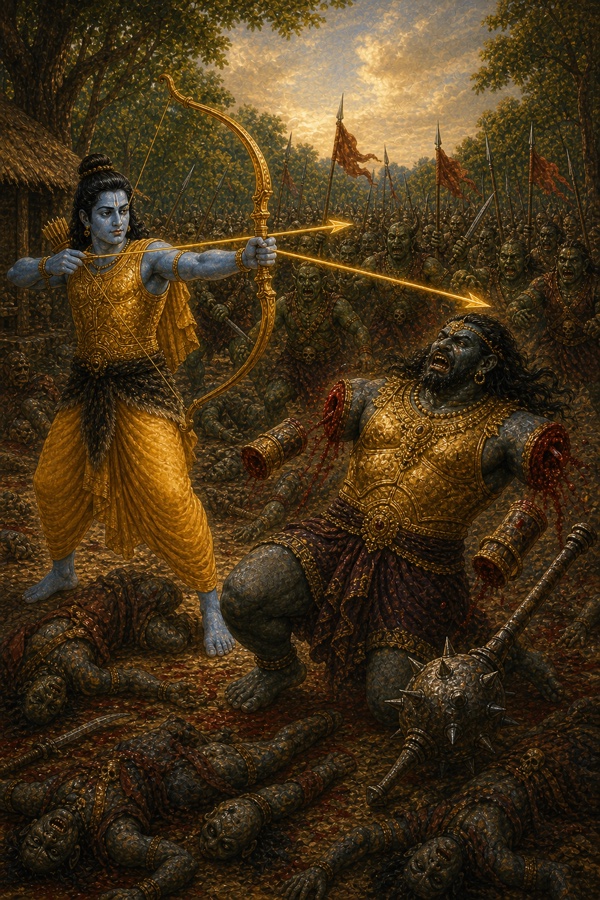
As Dushana sprang, Rama lopped off both his arms, ornaments and all, with a pair of arrows. Loosed from the hands of the armless Dushana, that colossal bar dropped at the front of the fight like a banner raised in Indra’s honor and let fall. Along with his severed arms, Dushana crashed to the ground like a proud lordly elephant with its tusks torn out. Seeing him dead on the field, all the beings gathered there cried, “Well done! Bravo!” and praised Rama.
In that moment three captains of the van, with the noose of Death already on them, rushed at Rama together: Mahakapala raising a huge pike, Sthulaksha holding a scimitar, and Pramathi, a man of great strength, gripping an axe. Seeing them come, Rama greeted them with keen, sharp-pointed arrows, as a host welcomes guests who have arrived at his door. He cut off Mahakapala’s head, crushed Pramathi under countless volleys of arrows, and filled Sthulaksha’s great eyes with shafts. Killed, the three fell to the earth like a great tree with all its branches. Then, striking down Dushana’s five thousand followers with five thousand arrows, the angry Rama sent them all to the house of death.
Word reached Khara that Dushana was dead, and every man who had followed at his heels. In a rage he ordered his mighty captains: “Here is Dushana, slain in battle with all his followers. Give battle to Rama, that wretched human being, with your great host, and kill him, all you ogres, with weapons of every shape.” So saying, the angry Khara himself rushed at Rama; and the twelve captains of extraordinary prowess who rode around him fell upon Rama with their soldiers behind them, loosing the finest arrows they had.
Then the fiery Rama destroyed the rest of Khara’s army with arrows set with gold and diamonds and blazing like tongues of flame. Like fire wrapped in smoke, those gold-winged shafts made an end of the ogres as thunderbolts make an end of great trees. At the front of the fight Rama killed a hundred ogres with a hundred arrows and a thousand with a thousand, all at once. Their armor and ornaments shattered, their bows broken and split, their bodies smeared with blood, the rakshasas dropped to the ground; and with their tangled hair, drenched in blood, fallen across the field, they covered the whole earth like a great altar spread with kusha grass for a sacrifice. In that moment the dreadful forest, heaped with the corpses of the ogres and fouled with the mire of flesh and blood, became a very hell.
Count it. One man, Rama, a human being on foot and alone, had brought down fourteen thousand ogres of terrible deeds. Of that whole army only three were now left standing: the great chariot-warrior Khara, the ogre Trishira, and Rama, the slayer of his enemies, who had done the killing. All the rest of those fierce, hard-to-face ogres of extraordinary prowess had been killed at the front of the fight by the elder brother of Lakshmana. Khara looked on that fearsome army destroyed by Rama in the great fight, and he drove his huge chariot straight at Rama, like Indra with his thunderbolt raised.
The slaying of Trishira
Khara was bearing down on Rama when his other general, the ogre Trishira, came up to block him, and said: “Give the task to me, your valiant general, and turn back from this rash venture. Watch me bring the mighty-armed Rama down in battle. I take an unfailing vow before you, and I swear it on my weapon: I will surely kill Rama, who deserves death at the hands of every ogre alive. Either I will be his death on the field, or he will be mine. So hold back your battle-zeal, and stand a while apart, as a judge over us. If Rama is killed, you go back to Janasthana in joy; and if I am killed, you march against Rama for the fight.”
Trishira was in love with his own death at Rama’s hands, and Khara let himself be won over. “Go, fight,” he said, and Trishira advanced on Rama. With his three heads he looked like a three-peaked mountain, and he came on from a bright, horse-drawn chariot. Pouring out volleys of arrows like a great cloud, he roared like a kettledrum whose skin has been soaked with water. Seeing the ogre come, Rama greeted him with a bow that loosed keen arrows. The fight between Rama and Trishira, both of great strength, raged as fierce as the clash of a lion and an elephant.
Trishira struck Rama on the forehead with three arrows, and Rama, provoked, angry, and roused, said: “Ah! What strength this ogre has in his onset, who has grazed my forehead with arrows soft as flowers! Now take the arrows loosed from my bowstring in turn.” So saying, in high fury Rama drove fourteen arrows like venomous serpents into Trishira’s chest, brought down his four swift horses with four shafts of bent node, and with eight more knocked the charioteer dead on his seat in the chariot.
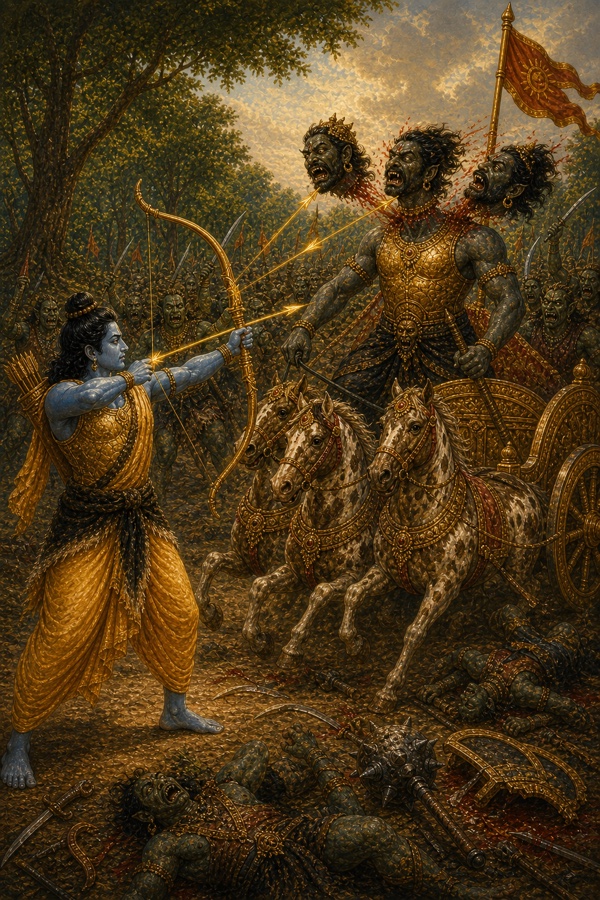
With one arrow Rama broke his tall standard. Then, as the rakshasa Trishira leapt down from his shattered chariot, Rama pierced his heart with arrows so that he stood struck still; and Rama, whose measure none can take, in his fury brought down the ogre’s three heads with three swift arrows. Overcome by Rama’s shafts, spewing smoke and steaming blood, the rakshasa fell where he stood on the field, and joined the heads that had already dropped. Then the ogres who were left, the men who had sheltered under Khara’s banner, broke and fled like deer scared off by a tiger, and would not hold their ground. Seeing them run, Khara in his rage turned them back, and he rushed at Rama alone, as swift as Rahu when it springs at the moon.
Khara meets Rama face to face
Dushana was dead, and Trishira with him, and Khara had watched Rama’s prowess with his own eyes; and now, for the first time since his sister had fallen bleeding at his feet, fear entered Khara’s heart too. Bewildered to see that unbearable, mighty ogre-army, and Dushana and Trishira, all killed by Rama alone, and most of his troops wiped from the field, Khara attacked Rama as the demon Namuchi once attacked Indra.
Drawing his mighty bow to its full length, Khara loosed at Rama his blood-drinking narachas, like angry serpents. He shook his bowstring in a hundred ways and showed off, from his chariot, the missiles that long military practice had taught him, working his arrows across the field in patterns. That great chariot-warrior filled all the quarters and the points between them with arrows; seeing it, Rama too took up his very great bow. With his own dread arrows, like sparks of fire, he covered the whole sky, as the rain-god covers it with showers. With the keen arrows loosed by Khara and by Rama both, the sky all around them was crowded with shafts and left with no empty space.
Screened by that net of arrows loosed by the two warriors, each fighting in his zeal to kill the other, the sun could no longer be seen. Then Khara struck Rama on the field with nalikas, narachas, and sharp barbed vikarnis, as a driver strikes a great elephant with a goad. All living beings saw that ogre, rooted firm in his chariot with his bow in his hand, and he looked to them like Death himself with his noose. Khara looked at Rama, the destroyer of his whole army, mighty and bent on heroism, and judged him worn out at last. But Rama, seeing Khara bold as a lion and striding like one, was no more shaken than a lion at the sight of some small deer. Then Khara, in his huge chariot blazing like the sun, came at Rama the way a moth comes at a flame.
Showing the speed of his hand, Khara cut through Rama’s bow, arrow and all, close to the fist. It was the first real blow of the day to land on Rama, and Khara followed it at once: taking seven more arrows bright as Indra’s thunderbolt, the angry Khara loosed them at Rama’s vital spots. Wounding the matchless Rama with a thousand arrows, Khara let out a great roar across the field. Struck hard by the smooth-knobbed arrows Khara loosed, Rama’s coat of mail, bright as the sun, fell from him to the ground. Pierced in every limb and angry, Rama shone on the field like a fire that burns without smoke.
Rama had another bow. He strung it now, a great bow that gave out a deep voice, to make an end of his enemy: the vast and matchless bow of Vishnu that the great sage Agastya had given him at his hermitage, before sending him on to Panchavati, as if the sage had known the day it would be needed. Lifting it, he rushed at Khara. In high anger Rama cut down Khara’s standard on the field with gold-feathered, even-nodded arrows. Split in many places, that fair golden standard fell to the earth like the sun going down to its setting at the command of the gods.
Khara knew the vital spots. In anger he struck Rama in his limbs, and above all in the heart, with four arrows, as a man strikes an elephant with javelins. Pierced by the many arrows from Khara’s bow and bathed in blood, Rama grew fiercely angry. Gripping his bow firmly in that great fight, Rama, the finest of archers, loosed six well-aimed arrows: one at Khara’s head, two at his arms, and three crescent-headed shafts hard into his chest. Then, in his fury, the glorious Rama loosed at the ogre thirteen arrows sharpened on stone and blazing like the sun.
Strong as Indra, and as if laughing, Rama cut the yoke of the chariot with one arrow, the four spotted horses with four, and the head of Khara’s driver with the sixth; with three more he cut the three poles that held the yoke, with two the axle, and with the twelfth, bright as a thunderbolt, he cut through Khara’s bow with the arrow still set on it; and with the thirteenth he pierced Khara’s heart. His bow broken, his chariot wrecked, his horses and driver dead, Khara leapt down and stood on the ground with a mace in his hand. Gathered at the front of their flying chariots, the gods and the great seers saw this deed of the great chariot-warrior Rama, and they praised him in a body with joined palms, filled with joy.
Sharp words between Khara and Rama
To Khara, standing below him without his chariot, mace in hand, the fiery Rama spoke words that began gently and turned hard. “Lord of a great army thick with elephants, horses, and chariots, you have taken a cruel course that all the worlds despise. He who torments living beings, who is savage and works evil, does not last, even if he is lord of all three worlds. He who takes a harsh course against the good of the people, ranger of the night, is struck down by everyone, as men strike a wicked serpent that has come too near. He who sins out of greed or lust and will not wake to it, and is glad, sees the end of his own sins with his own eyes, and his own end with them, as the venomless lizard meets its end by swallowing hailstones.”
“What reward on earth will you win, ogre, by killing the blessed ascetics who live in the Dandaka forest and keep to virtue? Cruel men who work sin and are despised by the world do not last long, even when they win lordship, any more than trees with rotten roots. The doer of a sinful deed surely reaps its terrible fruit when the time comes, as a tree puts forth its blossom in its season. The fruit of sinful deeds is reaped soon, ranger of the night, like the fruit of poisoned food once it is eaten. To take the lives of those who work dreadful sin and wish the world ill, I have been appointed by the king, my father. Today the gold-decked arrows I loose will pierce your body, split the earth, and reach the world beneath it like serpents entering an anthill. The pious ascetics you have devoured in the Dandaka forest, you will follow this very day, killed in battle with your army behind you.”
“Let the great seers you killed before, seated in their flying chariots, watch you killed by my arrows and rotting in hell. Strike as you please, disgrace of your line, and do your utmost; this very day I will bring down your head like a palm fruit.”
At these words Khara, his eyes red with anger and beside himself with rage, laughed out loud and answered Rama: “You have killed common ogres in battle, son of Dasharatha; how is it you praise yourself for it, when you are unworthy of praise? Those jewels among men who are truly brave or strong say nothing of themselves; the pride of their own fire forbids it. Only the vulgar, who have not mastered themselves and are a disgrace to the Kshatriyas of the world, brag to no purpose, as you are bragging now, Rama. When the hour of death is at hand in battle, what hero would praise himself out of season and recite his own line? By this self-praise you have shown your own baseness in every way, as brass that mimics gold shows what it is when it is heated in the fire lit to refine gold.”
“Do you not see me standing here, mace in hand, unshaken as a great mountain that holds the earth in balance and is rich with its ores? Like Yama, the god of death, standing with his noose, I with my mace am strong enough to take your life, and the lives of everyone who lives in all three worlds. There is much I could say of you, and I will say no more; the sun is setting, and it may cut the fight short. Fourteen thousand ogres stand killed by you. By your destruction I will avenge their death today and wipe away the tears of their dear ones.”
So saying, the enraged Khara hurled at Rama his huge mace, ringed with bands of fine gold and blazing like a thunderbolt of fire. Burning to ash the trees and thickets in its path, that great blazing mace, loosed from Khara’s arms, came on toward Rama. Like the noose of Yama in its deadliness, the mighty mace flew through the air, and while it was still in the air Rama split it into many pieces with his arrows; broken and smashed by the shafts, the mace fell to the earth like a she-serpent brought down by the power of charms and herbs.
Rama slays Khara; gods and sages applaud
Having shattered that mace with his arrows, Rama, who loved virtue, smiled and spoke words that burned: “Is this the whole of your strength, vilest of ogres, that you have shown me? Far weaker than I, you roar in vain. This mace of yours, split by my arrows and fallen to the ground, has dashed to pieces the trust you placed in it, you who are bold only in your boasting. The vow you made, in the words ‘I hereby wipe away the tears of the kin of the ogres killed in battle,’ has proved false too. Base ogre, mean of nature and false in conduct, I will take your life as Garuda, the king of birds, took the nectar of immortality out of the keeping of the gods in heaven. Today, when your throat is pierced and your body torn by my shafts, the earth will drink your blood, thick with foam and bubbles.”
“Disgrace of the ogres, you will embrace the earth like a hard-won young woman, your whole body dusted with dust and both your arms cut off, and lie in the long sleep. When you are laid in that long slumber, ogre, this Dandaka forest will become a refuge for the sages who give refuge to all. When your dwelling at Janasthana is undone by my arrows, the sages will roam the forest without fear on every side. The ogresses who put terror into others will flee from the Dandaka today, their faces wet with tears, in dread, their kith and kin killed by me. Wives whose husband is as base as you and who are born of families like yours will taste the flavor of sorrow today and be left with nothing they once enjoyed. Cruel-natured, mean-spirited, forever a thorn in the side of the Brahmins, it is on your account that the ascetics pour their oblations into the fire in fear.”
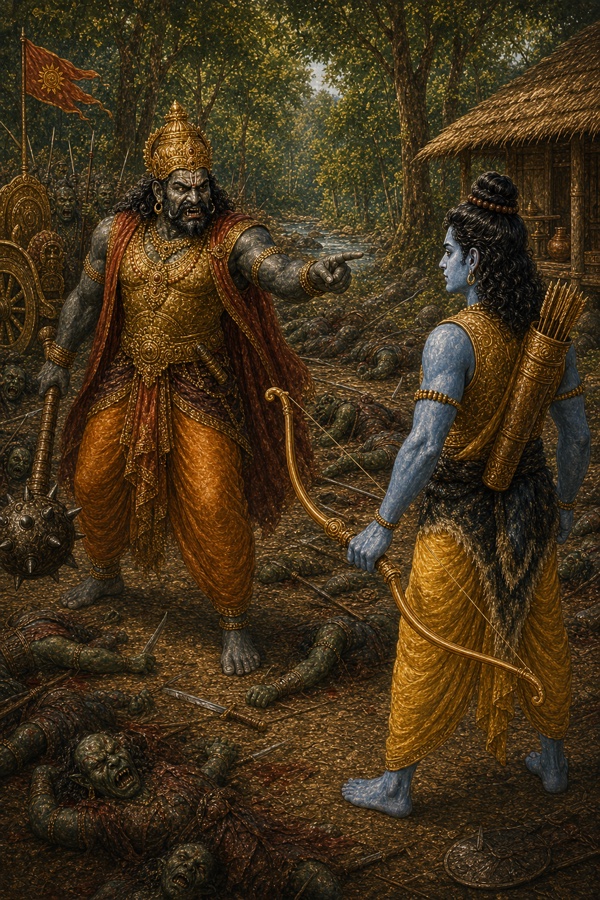
As Rama spoke these burning words in the forest, Khara, his voice growing sterner still with wrath, hurled abuse at him: “You are surely puffed up beyond all measure, and fearless even in the face of danger. You are in the grip of death, and that is why you cannot tell what should and should not be said. Men caught in the noose of Death, their senses and their minds thrown out of order, know neither what to do nor what to leave undone.” So saying, the rakshasa knit his brows and cast his eyes about him for a weapon for the fight; and seeing a great sal tree not far off, he bit his lips hard and tore it up by the roots. Whirling it in his arms and roaring, the ogre of extraordinary might flung it at Rama with the words, “You are dead.”
Cutting the oncoming tree down with volleys of arrows, the glorious Rama summoned a violent anger to make an end of Khara in battle. Wet with the sweat of his anger, the corners of his eyes red with rage, Rama pierced Khara on the field with a thousand arrows. From the wounds those arrows made, blood poured foaming like the streams that pour from Mount Prasravana. Harried by Rama’s arrows, and maddened now by the smell of his own blood, Khara ran fast at him.
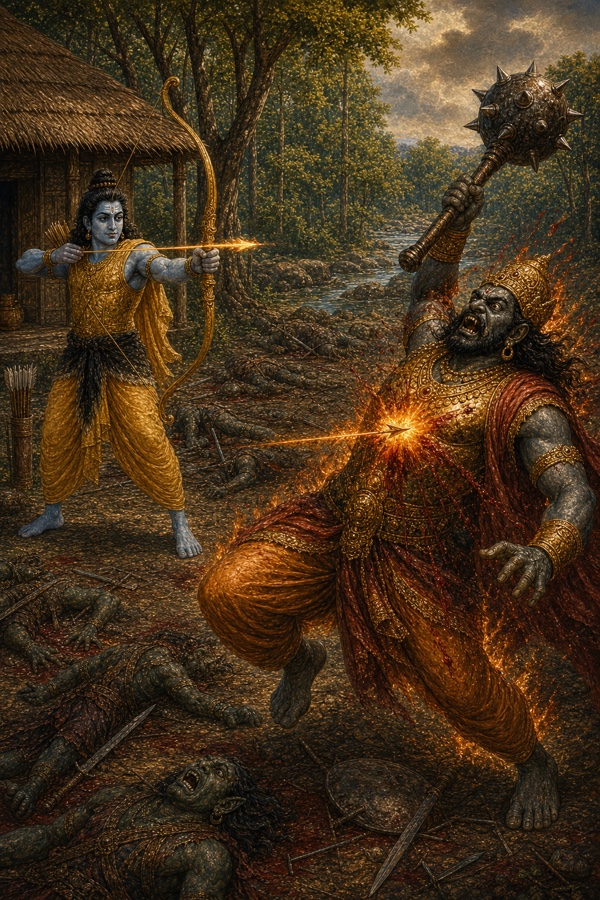
Seeing the enraged, blood-drenched Khara rushing at him, Rama, a master of missiles and quick on his feet, drew back two or three steps to strike him cleanly. Then, to kill Khara in the fight, Rama took up an arrow that blazed like fire, like a second rod of Brahma the creator. That arrow had come a long way to this clearing. The wise Indra, king of the gods, had given it, and it had passed through the hand of the sage Agastya to Rama; and Rama, whose mind was set on righteousness, fitted it to his bow and loosed it at Khara. Loud as a thunderclap, the great shaft, loosed with all the force of Rama’s fully drawn bow, struck Khara in the chest. Burning in the fire of that arrow, Khara fell to the earth as the demon Andhaka fell, burnt up by Rudra in the Shveta forest. Killed by that arrow, Khara went down as Vritra went down to the thunderbolt, as Namuchi went down to the foam, and as the demon Bala went down to Indra’s lightning.
In that moment the gods, with the charanas beside them, beat their great drums on every side, and filled with joy and wonder they rained down flowers on Rama and said: “In a muhurta and a half Rama has made an end, with his keen arrows in a great fight, of fourteen thousand ogres led by Khara and Dushana, who could take any shape they pleased. Ah, great is the deed of Rama, who knows the Self! Wonderful is his prowess! And his firmness, look at it: it is the firmness of Vishnu himself.” So saying, all the gods went back the way they had come.
Then the royal sages and the great seers, with Agastya among them, gathered in joy and hailed Rama: “It was for this very purpose, to bring you to this region, that the great Indra, tamer of the demon Paka and breaker of his enemies’ strongholds, came down to the holy hermitage of Sharabhanga. By a wise design the great seers led you to this land, for the killing of these ogres of sinful deeds, their sworn enemies. This work of ours you have done, son of Dasharatha. From this day the great seers will keep to their devotions in the Dandaka without fear.”
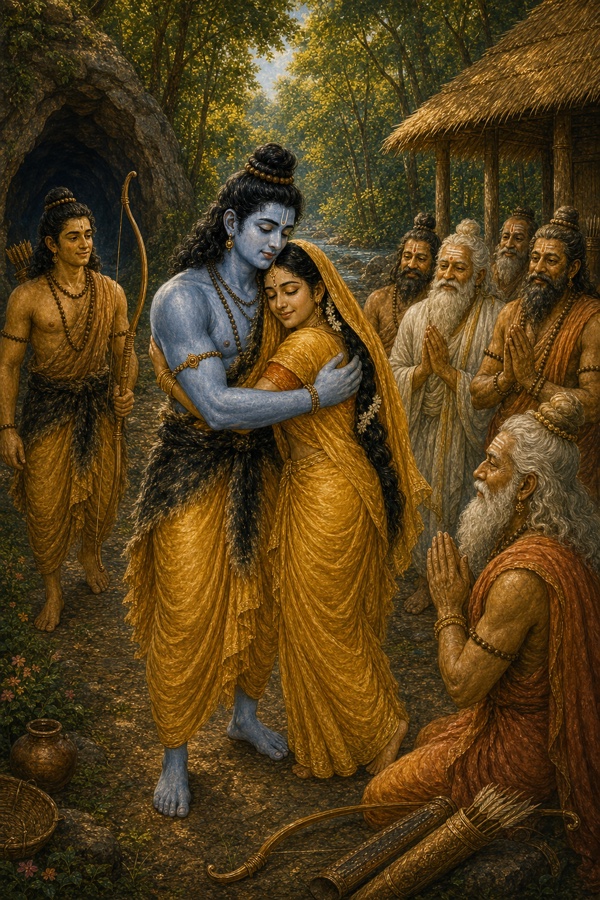
Meanwhile the valiant Lakshmana came out of the hard-to-reach mountain cave with Sita and sat down at his ease in the hermitage. He had obeyed an order he hated, and the order had been right. Glorified by the great sages and honored in every way by Lakshmana, the victorious hero Rama walked back into the hermitage. Sita, the princess of Videha, saw her husband, who had made an end of his enemies and brought ease to the great sages, and she was filled with joy and embraced him. Seeing the ogre hordes killed and Rama whole and unhurt, the daughter of Janaka was glad through and through. Then, as the exalted souls around them gave voice to their delight, the daughter of Janaka embraced once more that destroyer of the ogre hordes, and her face was lit with joy.
The gist: Rama pronounces on Khara the sentence of his sins and foretells the flight of the ogresses; Khara uproots a sal tree and hurls it, and Rama cuts it down. At last the arrow of Indra, given through Agastya and blazing like a rod of Brahma, pierces Khara’s chest, and he falls like Vritra, Namuci, and Bala. In a muhurta and a half the fourteen thousand are gone; the gods rain flowers, Agastya and the sages tell Rama their purpose is fulfilled, and Sita returns from the cave to embrace him. Janasthana stands empty, but the sister of ten-headed Ravana is still alive.
Source: Srimad Valmiki Ramayana, Aranyakanda, Cantos 17 to 30. Where readings differ, this telling keeps the Gita Press order.
Basis: Valmiki Ramayana (Gita Press, Gorakhpur)