On this page
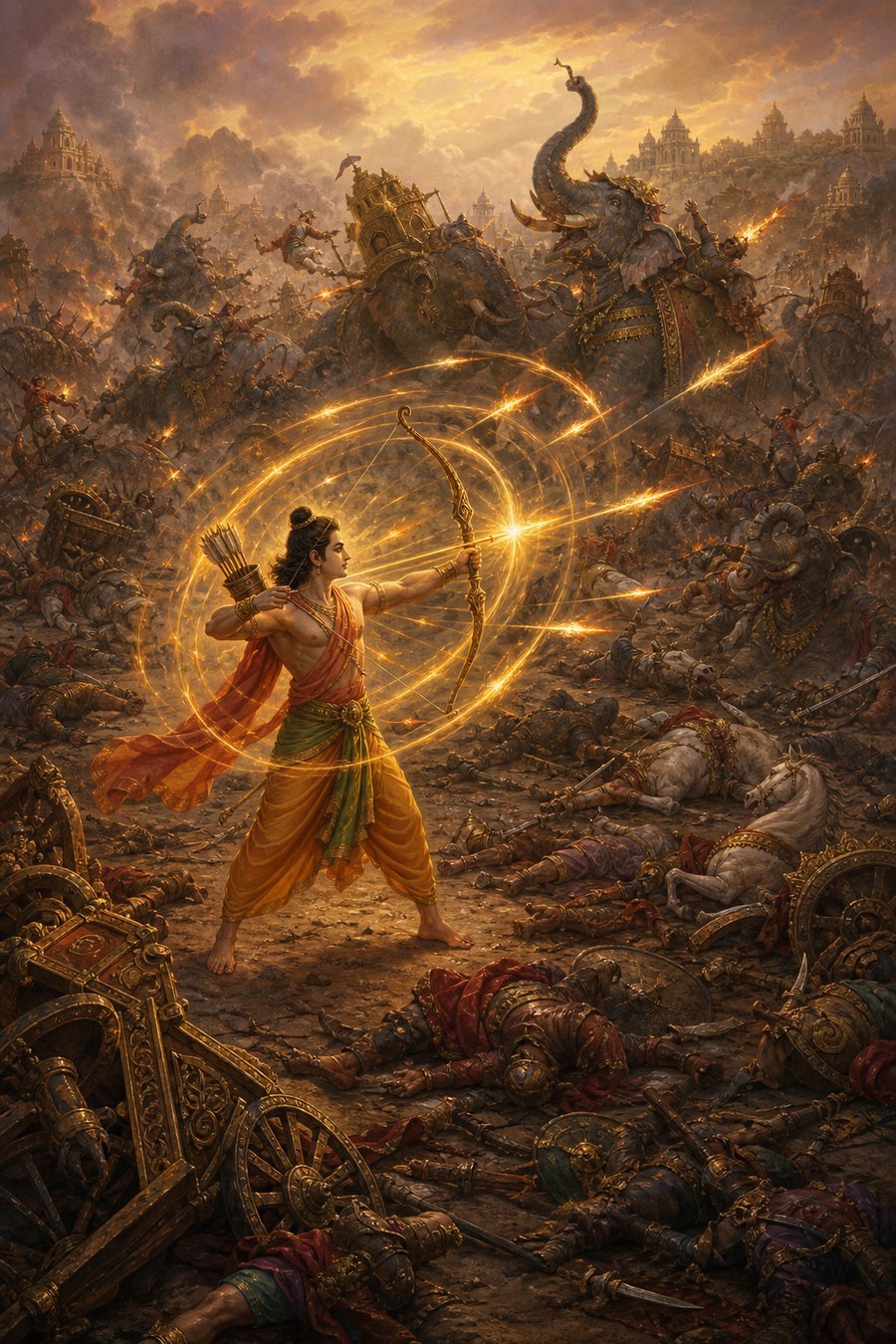
The dust of the battlefield had not yet settled. Lakshmana was on his feet again, the shaft that had pinned him down drawn out of his chest by a herb carried across the sea on the shoulder of a whole mountain, and his voice reached Rama before anything else did: put the grief away, keep the vow. Rama heard that counsel, took up his bow, and sent his terrible arrows flying at Ravana. Ravana had lost one chariot already; he climbed into a fresh one and came racing back, the way the eclipse-demon Rahu lunges at the sun on the day it is swallowed. Standing tall in his chariot, the ten-headed king began to rain shafts on Rama that were hard as the thunderbolt, the way a storm cloud beats a great mountain with its downpour. Rama answered with steady care, covering the ten-headed one under arrows plated with gold, each of them glowing like a burning fire. Then the gods, the gandharvas who are the singers of heaven, and the kinnaras who wear the faces of horses, all leaned out of the sky to watch, and every one of them said the same thing. The match was uneven. Rama stood on the bare ground with the dust of the field to his knees, and the ogre rode above him in a chariot and shot down at him.
Indra’s divine chariot and the charioteer Matali
That talk of the gods fell on Indra like nectar, and the lord of the gods called for Matali, the charioteer who had carried him through his own wars in the sky. “Take my chariot and go at once to Rama who stands on the ground below,” he said. “Reach the earth, invite him to mount, and in that one act you will render the gods a great service.” It was a strange errand for a god to send. Indra had never fought a war for a man before, and the chariot he was giving away was the one he rode himself. Matali bowed his head low to the god and prepared that finest of chariots, yoked to horses green in color. It carried a standard raised on a staff of gold, its body worked all over in gold, and hundreds of little bells ran along it, so that it announced itself before it was seen. Its yoke was set with cat’s-eye gems, and so it shone like the morning sun, and the green horses that drew it were decked with gold ornaments, hung with white whisks, and covered over with nets of gold, blazing like the sun itself.
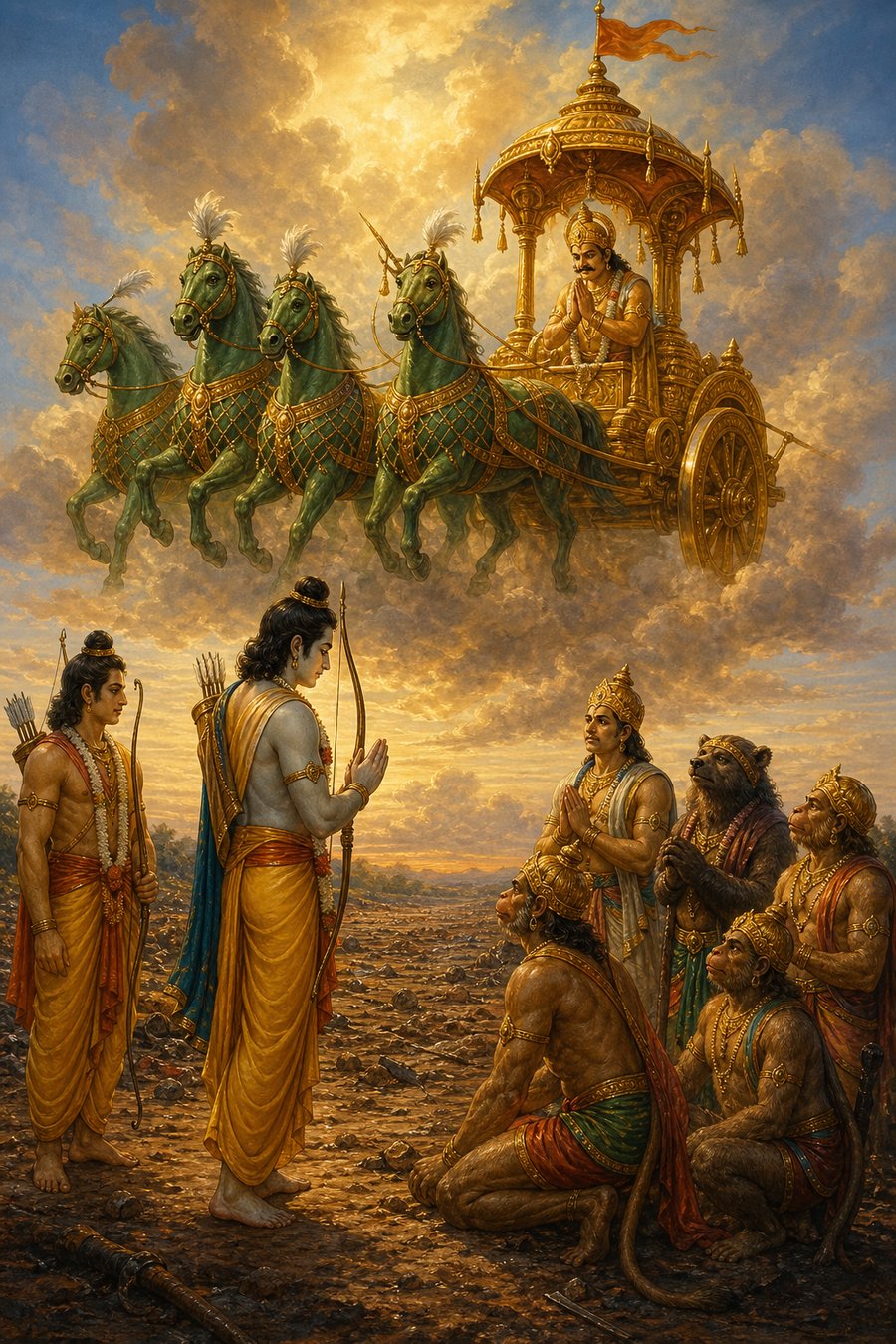
Matali came down out of the sky and stood before Rama, and every monkey on that field saw a chariot of heaven touch the mud of Lanka. Still seated in the chariot, a lash in his hand, the charioteer of the thousand-eyed Indra folded his palms and made his petition. “Kakutstha, glory of your line, this chariot has been sent to you by the thousand-eyed one so that you may win. Here is Indra’s mighty bow, here his armor that shines like fire, here his arrows bright as the sun, and here his flawless, auspicious javelin, the shakti. Mount this chariot, brave prince, take me as your charioteer, and kill the ogre Ravana as Indra once killed the giants.” Rama walked around the chariot once, keeping it on his right in reverence, the way a man walks around a shrine, and saluted it, and only then climbed aboard, lighting up all three worlds with his splendor.
A war of weapons: serpent and Garuda
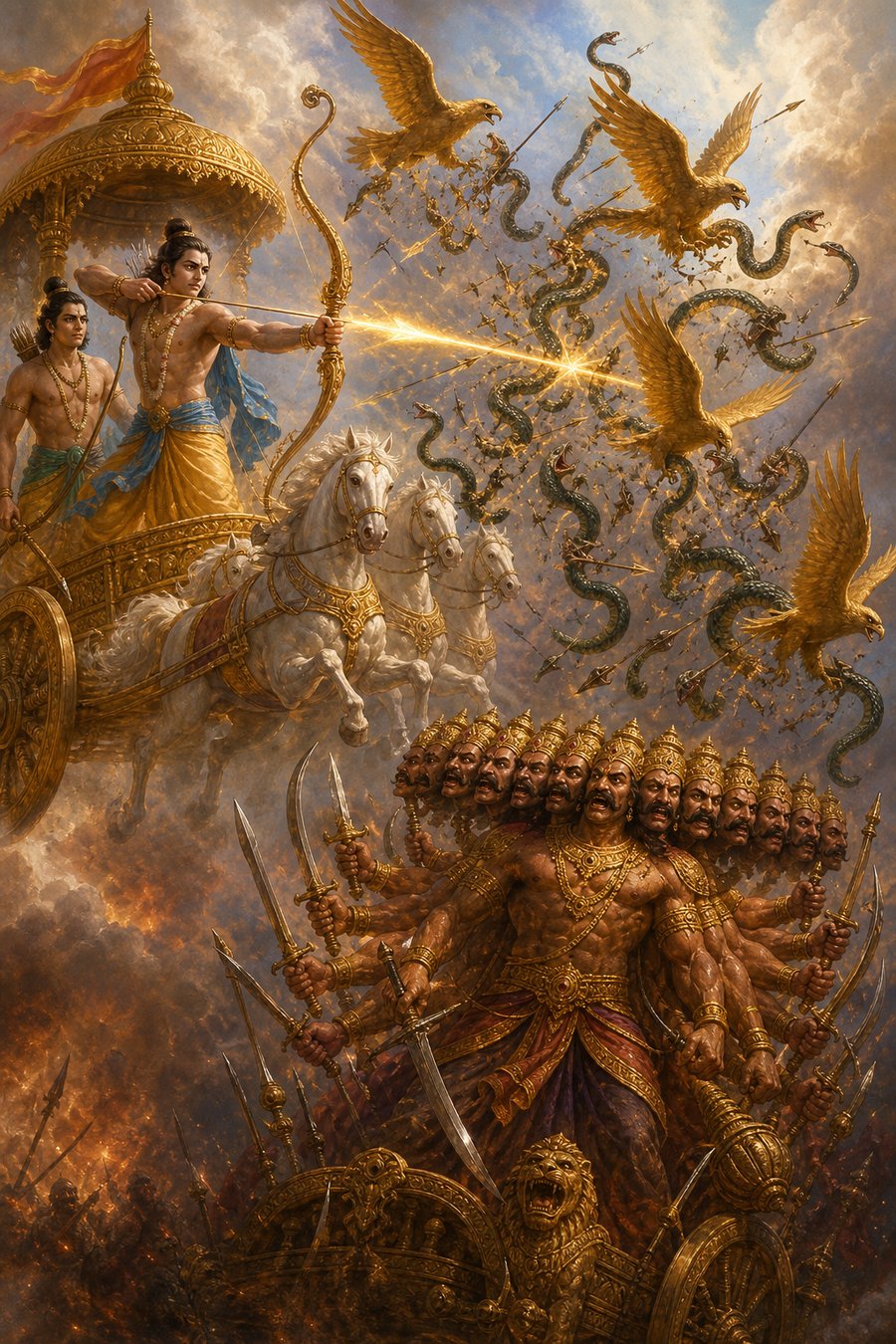
Now began that wonderful, hair-raising duel of chariots between Rama and Ravana. Rama, who was a supreme master of the great weapons, met Ravana’s gandharva weapon with a gandharva weapon and his divine weapon with a divine weapon, and destroyed each in turn. These are the missiles that are not shot so much as spoken, called out of the air by the syllables that carry them, and each one has its own answer waiting somewhere in the mind of a man who has learned them all. Enraged, Ravana reached for the one weapon that belonged to his own kind, and loosed a fearful weapon of the ogres. The gold-plated shafts that flew from his bow turned into serpents of deadly venom as they came, flames pouring from their hoods, their mouths gaping wide, their touch as hard as that of Vasuki the serpent king, and they covered every quarter of the sky and the corners between the quarters. Rama saw them coming and brought out the dread weapon of Garuda, king of birds, on whose back Vishnu rides and whose hunger has been the terror of snakes since the beginning. The golden-feathered arrows that flew from his bow became golden eagles, changing shape as they pleased, and they hunted down every one of those serpent-arrows and tore them apart in the air.
His weapon undone, Ravana in his fury poured a storm of arrows over Rama. He buried Rama, tireless as ever in action, under a thousand shafts, and then turned his bow on the charioteer and drove a stream of arrows into Matali. With a single shaft he cut the standard on Indra’s chariot, dropped the golden banner from the top of the chariot to its seat, and struck at Indra’s horses with a web of arrows. To bring down a god’s ensign in front of a god’s charioteer is a thing no one on that field had seen done. Seeing Rama hard-pressed, the gods, the gandharvas, the charans who sing the sky’s praises, the danavas, the siddhas who are born already perfect, and the great rishis all sank into gloom, and among the monkey chiefs, with Vibhishana standing at their center, a quiet dread began to spread.
Ill omens and Ravana’s spear
In that hour it seemed as though the moon that was Rama had been seized by the Rahu that was Ravana. The planet Mercury moved to attack Rohini, the star ruled by Prajapati and beloved of the moon, a sign of ruin for every living thing. The ocean seemed to burn with rage and rose high, as if it would touch the sun, its misted waves rolling over. The sun’s rays grew faint, and it hung ashen and pale in the sky. The planet Mars moved to attack Vishakha, the star ruled by Indra and Agni that is auspicious for the kings of Kosala. With his ten faces and twenty arms, his bow drawn tight, Ravana loomed like Mount Mainaka. Overwhelmed by the ten-headed one, Rama could not even set his arrows to the string in the front of the battle. Then he knit his brows, his eyes reddened, and a fierce anger rose in him, as if he would burn the ogres to ash. When they saw the wrathful face of Rama, every creature trembled, and the earth itself shook.
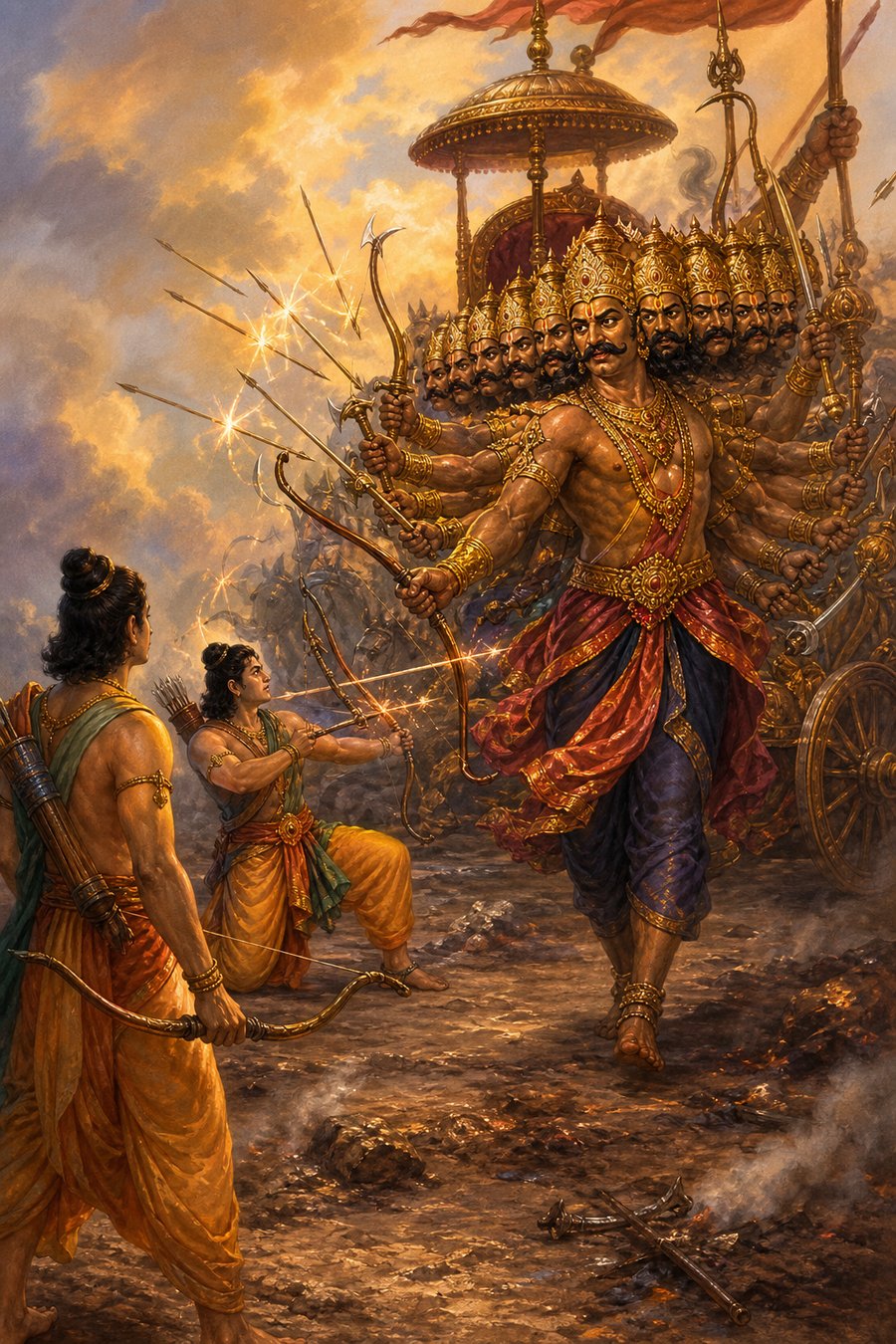
Mount Trikuta, on whose three peaks Lanka sits, shuddered from its lions and tigers to its trees, and the trees swung back and forth; the ocean was thrown into turmoil. Storm clouds, harsh as the braying of donkeys, wheeled across the sky and thundered on every side. Seeing Rama in such fury and the omens so terrible, all beings were struck with fear, and Ravana was one of them. High in their aerial cars the gods and gandharvas, the great nagas, the seers, the demons and the eagles held still in the air and watched the two heroes trade their dreadful weapons, a combat that looked like the dissolution of the world. Thrilled by what they saw, the watchers took sides aloud. The demons cried out to the ten-headed king, “Be victorious!” and the gods called to Rama again and again, “Be triumphant!” Then Ravana lifted a huge spear in his hand, a shula strong as the thunderbolt, that roared aloud when it was thrown, studded with spikes like mountain peaks, keen as the fire of the world’s dissolution, and dreadful even for Death to face. Ringed by ogre-warriors who were heroes in battle, blazing with rage, he raised it and let out a terrible roar, and spoke harsh words to Rama. “Rama, this spear with the strength of the thunderbolt, lifted in my wrath, will take your life this instant, and the life of your brother who stands beside you. You who are so hungry for battle, today I will lay you down beside the heroic ogres you have killed at the head of the army. Wait, scion of Raghu. I will strike you down with it now.” And he hurled the spear at Rama.
Wrapped in a ring of lightning, ringing with its eight bells, the spear flashed roaring through the air. Rama tried to hold it back with a rush of arrows, the way Indra would try to check the fire of the world’s end with sheets of rain. The spear burned his arrows away like so many moths. So Rama took up the honored shakti of Indra, the javelin Matali had brought him. It lit the sky like a meteor falling at the end of an age, and it came down upon Ravana’s spear and shattered it to pieces. Then with sharp shafts swift as the thunderbolt Rama pierced Ravana’s fast horses, drove keen arrows into his chest, and buried three in his forehead. Struck through every limb, blood streaming down his body, Ravana stood among his ogre-warriors like an ashoka tree in full flower, red from crown to root, and he sagged with weariness and burned with a sharper rage.
Rama’s rebuke and the charioteer’s retreat
His eyes flaming with anger, Ravana raised his bow and tried to press Rama down in that great struggle. He loosed thousands of streams of arrows like a cloud emptying itself from the sky, but Rama stood unshaken as a vast mountain, catching and bearing those arrow-streams on his own shafts as one bears the rays of the sun. Then the quick-handed night-stalker drove a thousand arrows into Rama’s chest, and Rama, drenched in blood, looked like a huge kimshuka tree in a forest come into red flower. Then the two of them, each in a towering rage, loosed such a hail of arrows that the field went dark beneath it, and for a while Rama and Ravana could not even see each other. And here Rama laughed. Fourteen years of forest, a wife stolen, an ocean bridged, and the man responsible was finally standing close enough to hear him, so he laughed even as the blows enraged him, and gave the ogre the rebuke he had been carrying since Janasthana. “You carried my wife away from Janasthana while she was helpless and I was not there, and from that you fancy yourself a hero, vilest of ogres. Bearing off Sita from the great forest by force, in the one moment I was away from her, and you call yourself brave. You laid your hands on another man’s wife, a woman with no protector near, and you think that a warrior’s deed. Shameless creature, without a hold on your own character, you took Death in the form of Sita into your house, and still you say, I am a hero. A famous thing you have done, brother of Kubera, a great and glorious feat, worthy of your might. Taste its fruit today. You carried her off like a thief, and no shame stood in your way. Had you dared to touch her in my presence, I would have sent you to join your cousin Khara that very moment. By good fortune you have fallen within range of my sight; today I send you to the house of Death. Let the crows and the vultures drag your head about this field with its bright earrings still swinging, and let them drink at the hole my arrow makes in your breast.” So saying, Rama took up arrows that shone like the sun at the end of an age. Every mystic weapon appeared before him of its own accord, unbidden, the way water finds a channel, and in his joy his hands grew even quicker. Reading these happy signs upon himself, the ender of ogres struck at Ravana with ever fiercer force.
Battered by the monkeys’ hail of stones and by Rama’s arrows, the ten-headed one grew faint and reeled. When he could no longer lift a weapon, nor draw his bow, nor stand against Rama’s valor, the hour of his death looked near, and it looked near to everyone who could see him. Seeing him brought to such a state, his charioteer kept his own head, and quietly, without a word and without panic, wheeled the chariot out of the fight. He knew what he was risking. He did it anyway.
Ravana berates his charioteer, and the answer
Ravana came back to himself outside the fighting, with the noise of it behind him, and understood at once what had been done. His eyes red with delusion and rage, driven by the force of destiny, he turned on the charioteer. “You took me for a coward, weak and helpless, a man with no strength or fire left in him, and on your own judgment you drove this chariot away. Base creature, you have destroyed the glory, the valor, the fire, and the people’s faith in me that I earned over so many years. My enemy, whose prowess is famous, stood watching, and you made a coward of me in front of him, hungry as I was for the fight. If in your folly you do not turn this chariot back at the enemy, my suspicion will be proven true, that you have been bought by the foe. This is the work of an enemy, and no friend does it to a friend. Turn the chariot back at once, before my enemy withdraws.”
To these harsh words the charioteer, who wished him well, gave a gentle and reasoned answer, and he gave it without raising his voice. “I was overcome by love for you, and to keep your honor I did a thing you did not like, and it was for your good. Do not hold me guilty as though I were some petty, unworthy man. As the sea’s own tide pushes back the rush of a river, so I did this. I saw the weariness born in you of that mighty labor of war. There was no fire of valor stirring in you, and no advantage showing over your foe. My horses had worn themselves out dragging the chariot, broken down and miserable in the sun like cattle beaten by the rain. And all around us appeared so many ill omens that I felt the touch of coming disaster. Consider what a man in my seat is for. It is the charioteer’s duty to read the ground, whether it rises or falls, whether it is level or broken; to read the hour, whether it favors a fight; to read the omens, the faces of both men, the lift or the sag of their spirits; to measure the strength and weakness of the warrior he carries; to know when to advance, when to hold, when to fall back, and when to withdraw altogether. I did this fitting thing to give you and the horses rest and to lift that heavy exhaustion, and no will of my own moved me in it. Now command me. My mind is clear of any debt to you, and I will do whatever you order.”
Pleased with this answer, Ravana, greedy for battle, praised the charioteer in many ways and, without asking him to leave his seat, slipped a splendid ornament onto his hand. “Charioteer, take this chariot quickly toward Rama. Ravana does not turn back without killing his enemies.” Hearing his words, the charioteer wheeled the chariot back to the battlefield, and in a moment that great chariot stood again before Rama.
Agastya teaches the Aditya-hridaya
Rama stood there worn out by the fight and lost in worry, and before him Ravana was making ready to renew the battle. The sage Agastya, who had come with the gods to watch the encounter, drew near to Rama and spoke. “Rama, hear this eternal secret, by which, my child, you will conquer all your enemies in the field. This holy hymn is called the Aditya-hridaya, the heart of the sun. It destroys every foe, it brings victory forever, it is unfailing and supremely blessed, the good of all goods, the washer-away of all sins, the stiller of anxiety and grief, and the lengthener of life. Worship the sun-god, the lord of the worlds, crowned with rays, who rises at the horizon every single day, whom gods and demons alike salute, who brings light to the world.
“This same sun is the very form of all the gods, full of glory, feeding the gods, the demons, and their worlds with his rays. He is Brahma, Vishnu, Shiva, Skanda, Prajapati, Indra, Kubera, Kala the time-spirit, Yama, Soma, Varuna, the ancestors, the Vasus, the Sadhyas, the twin Ashwins, the Maruts, Manu, Vayu, and Agni. He is the form of every being, the life-breath of the cosmos, the source of the seasons, the storehouse of light. Seven green horses draw his chariot, and he goes at speed along his own road, holding in himself the resolve by which the world unfolds. He carries the fire of the world’s ending in his own womb, and he is bliss itself. Hail to you who appear in twelve forms as the twelve months of the year. Hail to you as the mountain of sunrise in the east and the mountain of sunset in the west, lord of all the lights, master of the day. Hail again and again to you, Aditya of a thousand rays. Hail to you, giver of victory and the very joy that victory brings. Hail to you, whose form is the syllable OM, who awakens the lotus, fierce and blazing. Hail to you, whose splendor has no limit, who dispels darkness and cold, defeats enemies, and brings retribution upon the ungrateful, lord of all lights.
“This lord destroys, creates, and sustains all beings; with his rays he scorches and he sends the rains. He stays awake within creatures while they sleep; he is the fire-oblation and the fruit of those who offer it. He is all the gods, the sacrifice, and the fruit of the sacrifice, and every act that stirs in every living thing is under his hand. Raghava, in danger, in hardship, in the forest, and in fear, the man who praises this god with this hymn does not sink into despair. Worship the god of gods, the lord of the world, with a mind fixed upon him. Repeat this three times, and a man wins his battles. This very hour you will kill Ravana.” And having said this, Agastya went back the way he had come, and left Rama alone with the sun over his head.
Hearing it, the grief of Rama lifted at once, the way a weight lifts when someone else finally names it. Filled with gladness, he took the hymn into his heart. He sipped water three times and was cleansed, looked straight into the orb of the sun and held his eyes there, repeated the prayer, and felt a supreme joy come up in him. Then he took up his bow, fixed his eyes on Ravana, and with a glad heart went forward for victory, resolved that Ravana would die. And the sun-god, glad, standing there in person among the gods, seeing Ravana’s ruin now close at hand, looked down at Rama and said two words. “Make haste.”
Ravana’s chariot advances, and the omens
Ravana’s charioteer, glad again and carrying his master’s gift on his hand, drove that chariot forward at speed, a chariot built to crush the enemy’s army, a wonder like a city of the gandharvas, its pennons flying high, drawn by fine horses, packed with the gear of war, seeming to swallow the sky and setting the earth ringing beneath it. Rama saw it coming, dark horses at the yoke, burning with the fire of the sun, thick with banners that flashed like lightning, glowing like a rainbow, a great cloud of a chariot with arrows for its rain. Bending his bow until it curved like the young moon and drawing it back with force, Rama spoke to Matali, Indra’s charioteer, and he spoke with the courtesy of a man who knows he is riding behind the best driver in creation. “Matali, look, the enemy’s chariot comes on in a rage. From the way it darts from left to right, it looks as though he has set his heart on his own destruction in this fight. So be watchful, and drive straight at the enemy’s chariot. I mean to break it apart the way the wind scatters a piling storm cloud. Keep your heart and eye steady, hold the reins fully in hand, and drive fast without fear or hurry. You are practiced at handling Indra’s chariot, and you need no lessons from me. I only remind you, in my longing for a single-minded fight, and I do not presume to teach.”
Pleased with these words, Matali drove the chariot on. Passing Ravana’s great chariot on the right, Rama set him trembling with the dust thrown up by his own wheels, the ogre king coughing in the grit of a mortal’s chariot. Then Ravana opened his red eyes in fury and poured arrows on Rama. Stung by the assault, Rama joined patience to his anger and took up Indra’s swift and mighty bow and arrows bright as the sun’s rays. And now the two warriors faced each other like two proud lions, each hungry to kill the other, and a great war broke out between them. The gods came crowding in to watch that duel, and with them the gandharvas, the siddhas and the great seers, every one of them longing for the end of Ravana.
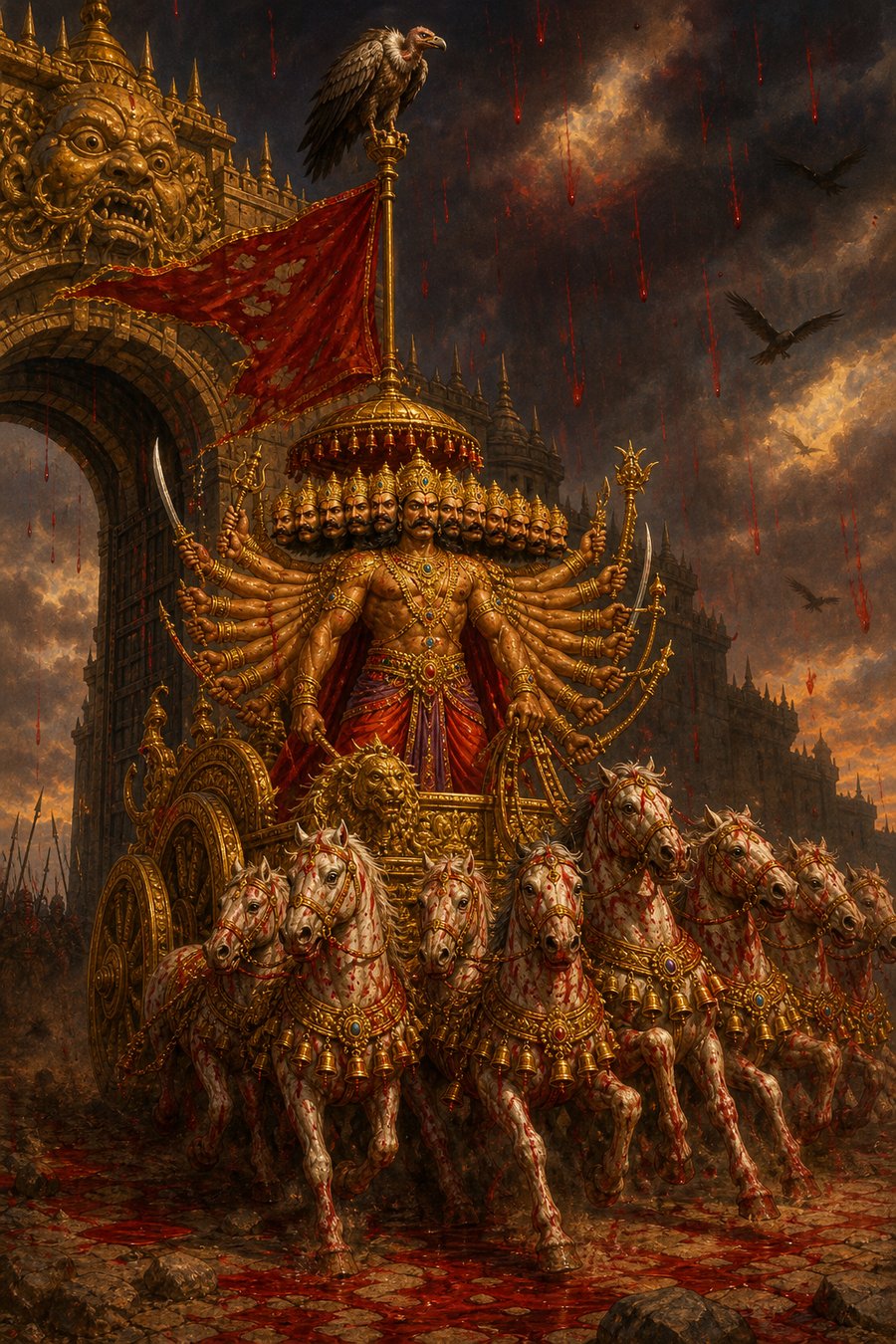
Then came fearful omens that spoke of Ravana’s ruin and of Rama’s rise, and they came so thick that no one could pretend to misread them. A cloud rained blood over Ravana’s chariot, and fierce whirlwinds turned from left to right. A vast flock of vultures wheeled in the sky behind his chariot, keeping pace with every turn it made. Even in daylight Lanka lay wrapped as if in dusk, glowing red like the japa flower. Great meteors fell with thunder and a loud roar. Wherever Ravana went, the earth shook. The sun’s rays, falling before him, showed copper, yellow, white, and black like the ores in a mountain. She-jackals spitting fire from their mouths howled after the vultures with cries of ill fortune. A contrary wind rose, flinging dust, and stole away Ravana’s sight. Out of a clear sky, with no cloud to send them, thunderbolts crashed upon his army. The quarters of the sky went dark, and a rain of dust made the heavens grim to look on. Screeching mynahs fell in their hundreds upon his chariot, fighting one another as they fell. And his horses shed sparks from their flanks and tears from their eyes, pouring out fire and water at once.
Before Rama, on every side, appeared omens that were gentle, kind, and full of the promise of victory. Seeing those soft signs of his triumph, Rama was overjoyed and counted Ravana as good as dead already. He had been raised to read such things as other men read a road, and he found in these fair signs on the battlefield the deepest joy and calm. A man who knows he has won fights differently, and Rama now fought with even greater force.
The terrible duel and the hundred heads
Now began that long and terrible duel of chariots between Rama and Ravana, a fight that filled all the worlds with dread. And at that time the ogre host and the vast army of monkeys stood still, weapons gripped in their hands, and struck no one. They had come to kill each other and they forgot to. The ogres gazing at Ravana and the monkeys gazing at Rama looked like figures painted in a picture, and between the two armies the only motion in the world was two chariots. Rama fought certain he would win, and Ravana fought certain he would die, and each put out the whole of his strength.
Ravana loosed arrows at Rama’s banner, but they fell short of Indra’s ensign, glanced off the flagstaff, and dropped to the ground; the god’s flag would not take a scratch from him. Then Rama, with a keen shaft blazing like a great serpent, cut down Ravana’s standard, and it drove into the earth. Seeing his flag destroyed, Ravana seemed to burn with anger and poured out arrows. He pierced Rama’s horses with flaming shafts, but the divine horses did not stumble or shift, as if they had been brushed with lotus stalks. Enraged at their calm, Ravana rained still more arrows, maces, iron clubs, discuses, mallets, mountain peaks, trees, spears, and axes. He wove this storm of weapons out of illusion and shot arrows in their thousands, tireless in mind. And all that rain, leaving Rama’s chariot untouched, fell on the monkey army on every side, and the monkeys paid for it.
Seeing Ravana labor in vain, Rama loosed his own sharp arrows in hundreds and thousands, as though laughing as he did it. The shafts of both filled the sky until it looked like a second glowing heaven built out of arrows, and not one of them missed; every arrow found its mark, and none was wasted. Arrows struck arrows in the air and fell to the ground. Shooting to right and left, the two warriors fought without a break, striking each other’s horses. The two charioteers displayed every kind of skill, wheeling in circles, running straight, darting forward and falling back, and the fight belonged as much to the men holding the reins as to the men holding the bows. Once the two chariots drew so close that yoke touched yoke, the horses’ muzzles met, and the pennons of one closed with the pennons of the other. Then with four sharp arrows Rama drove Ravana’s four horses back. Furious, the ten-faced one loosed shafts that cracked like the thunderbolt at Matali, Indra’s charioteer, but they did not shake Matali in the least. Rama had borne every blow to his own body without a word; the blow to Matali was the one that angered him, and he turned the enemy aside with a web of arrows and poured twenty, then thirty, then sixty, then hundreds and thousands of shafts upon his chariot.
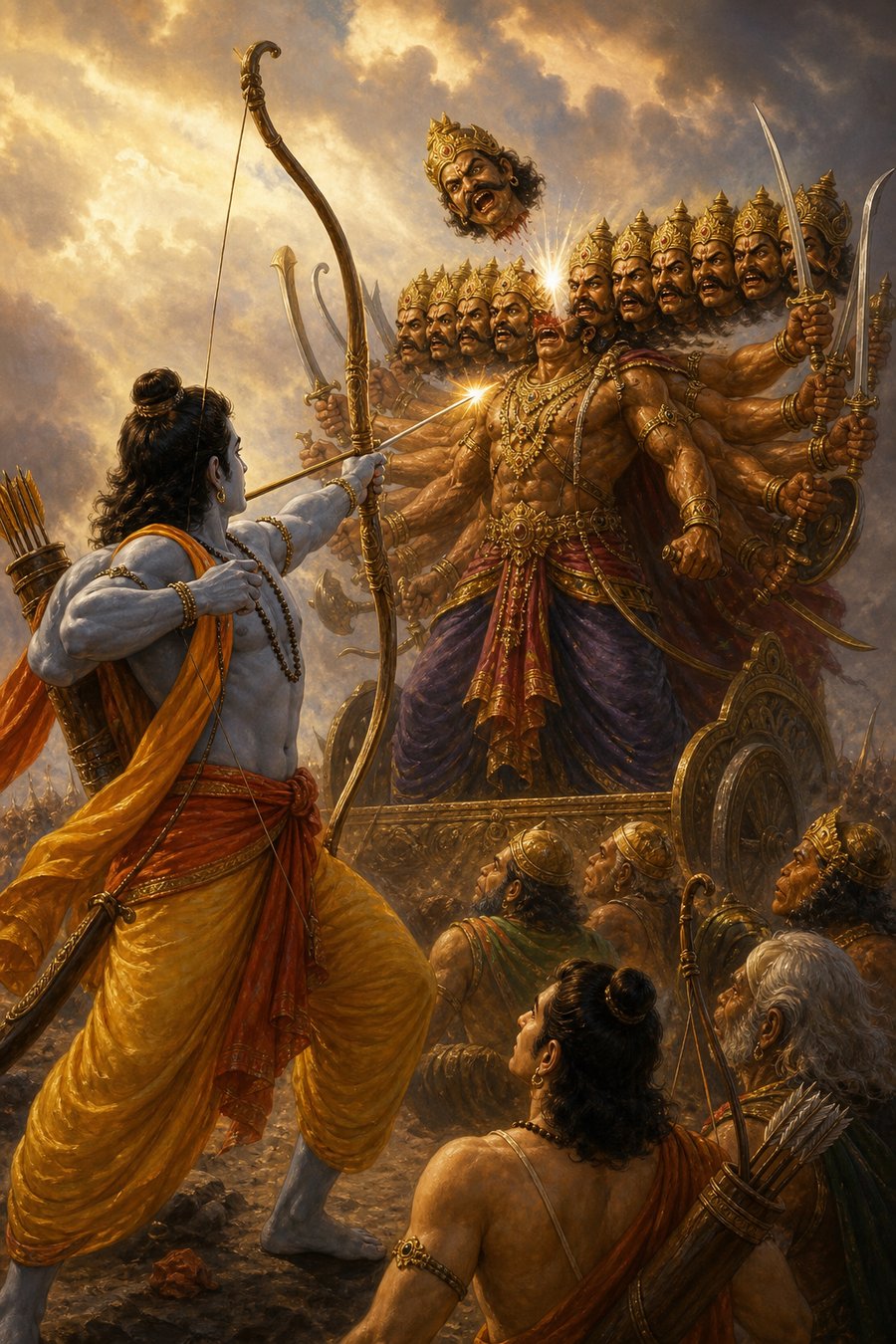
The noise of those maces and clubs went down into the sea and troubled all seven of them, and under the seas, in the lowest cellar of the world, the serpents and the demons stirred uneasily in the dark. The earth shook with its mountains and its forests, the sun lost its brightness, and the wind stopped blowing altogether, as if the air were holding its breath. Then the gods, the gandharvas, the siddhas, and the rishis said aloud, “May it be well with the cows and the Brahmins. May the worlds endure forever. May Rama, the prince born in Raghu’s line, conquer Ravana in the field.” Watching that matchless battle, the gandharvas and the apsaras said that as the only likeness of the sky is the sky, and the only likeness of the sea is the sea, so the only likeness of the war of Rama and Ravana is the war of Rama and Ravana itself. Then Rama, in his wrath, glory of the house of Raghu, with an arrow like a serpent whose bite is venom, cut off Ravana’s head with its flaming earrings. All three worlds saw that head fall to the ground. But another head, just like it, sprang up on Ravana’s shoulders. Rama struck it off in a moment, and still it grew back. In this way a hundred heads, each as bright as the last, were cut away, and still no end of Ravana could be seen.
Then Rama, master of every weapon, joy of Kausalya, grew thoughtful, and the thought was the most dangerous one he had had all day. “These same arrows,” he said to himself, “With which I killed Maricha and Khara and Dushana, disposed of Viradha in the pit in the Krauncha wood and Kabandha in the Dandaka forest, with which the seven sal trees and the mountains at Kishkindha were pierced, Vali was slain, and the ocean was thrown into turmoil, these arrows that have never failed me in battle, why do they have so little effect on Ravana?” Even lost in this thought, he did not grow careless in the fight, and he kept raining arrows on Ravana’s chest. Ravana, seated in his chariot, kept pouring down maces and mallets in return. This roaring battle went on in the sky, on the earth, and on the peak of Trikuta, while gods, danavas, yakshas, pishachas, nagas, and ogres watched, and it ran on through many days and nights and did not pause for even a moment. Seeing that Rama’s victory did not come, Matali, Indra’s charioteer, spoke to him quickly as he fought.
The Brahmastra and the slaying of Ravana
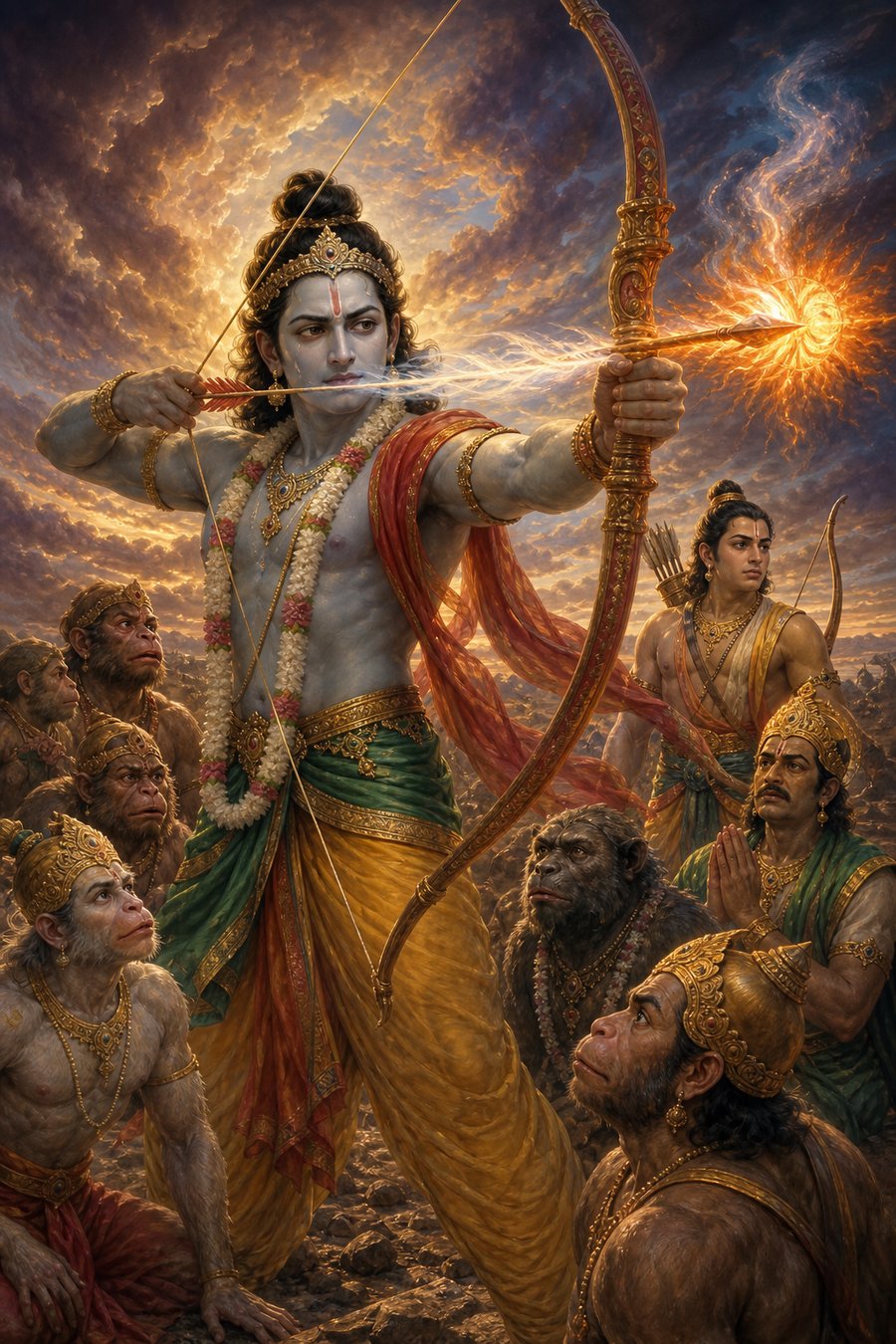
Matali reminded him. “Brave prince, why do you only trade blow for blow with Ravana, as though you did not know how to kill him? My lord, for his destruction loose the weapon of Brahma, the grandsire’s own arrow. The hour of his doom that the gods foretold has come today.” At this reminder Rama took up that blazing arrow, which flew like a hissing serpent, and remembered where it came from. The sage Agastya had given him this great, unfailing, Brahma-gifted arrow long before, in the Dandaka forest, in the years when Sita was still beside him and the war was not yet imagined. Brahma of boundless power had first made it for Indra, who longed to conquer the three worlds. The wind-god lived in its feathers, fire and the sun in its tip, and the mountains Mandara and Meru in its weight; its shaft was made of ether. It was fashioned from the essence of all the elements and shone like the sun, feathered with the plumes of Garuda and decked with gold. Like the fire of the world’s dissolution veiled in smoke, this arrow could split apart hosts of men, elephants, and horses, break down gates and iron bars and mountains, and it hissed like a serpent and struck terror into all. Smeared with the blood and marrow of everything it had ever killed, it had been the constant food of vultures and jackals and ogres, a shape of Yama himself, a fearful thing.
Charging it with the sacred spell in the way the Vedas prescribe, Rama set that great arrow to his bow, the arrow that lifts the fear of all the worlds and of the house of Ikshvaku above all, that steals the enemy’s glory and gives joy to one’s own side. As he laid it on the string, every creature trembled and the earth shook, and every being alive understood in the same instant that the thing was finished. Drawing the bow to its full length, keeping perfect care, blazing with rage, Rama loosed that arrow that tears the vitals straight at Ravana. Hard to withstand as the thunderbolt hurled from Indra’s arm, and impossible to turn aside like Death itself, the arrow drove into Ravana’s chest. Speeding on, it pierced the heart of Ravana, took his life with it, and passed on soaked in blood into the earth. Bow and arrow fell from Ravana’s hand together with his life-breath. Lifeless, Ravana toppled from his chariot to the ground, the way Vritra fell when the thunderbolt struck him. Its work done, the arrow, wet with his blood, came back like a humble servant into Rama’s quiver.
Seeing Ravana fallen, the ogres who were left fled in terror on every side. The tree-wielding monkeys came roaring down on them. Harried by the jubilant monkeys, their protector gone, the ogres ran back toward Lanka with pitiful faces streaming tears. Then the joyful monkeys raised a great shout, proclaiming Rama’s victory and Ravana’s death, and the shout went up off that field and into the sky and did not stop. In the sky the gentle drums of the gods sounded, a sweet wind blew bearing heavenly fragrance, and from heaven a lovely rain of flowers fell upon Rama’s chariot, flowers of a kind that grow nowhere on earth. The cry of the gods, “Well done, well done,” was heard in the air. At the death of the dreadful Ravana a great joy filled the gods and the charans. Having killed the demon, the glad Rama fulfilled the wishes of Sugriva, Angada, and Vibhishana. Then the gods grew calm, the quarters of the sky cleared, the heavens turned bright, the earth held still, the wind blew soft, and the sun shone with a steady light. With Lakshmana and his friends, Sugriva, Vibhishana, and Angada gave Rama their honor in the proper way as he stood radiant on the battlefield. His enemy slain, his vow kept, the son of Raghu, ringed by his own people and his army, shone like Indra ringed by the hosts of heaven.
Vibhishana’s lament and Rama’s consolation
Seeing his eldest brother defeated and killed and lying on the battlefield, Vibhishana was swept away by grief and began to lament. He had crossed to Rama’s side and had shown Rama’s archers where his brother’s army was weakest, and now he stood over the result of it. “Famous hero, valiant, skilled in statecraft, your long arms still ringed with armlets now lie still, and your crown, bright as the sun, is knocked to the ground. Brother, you who were used to a bed of luxury, why do you lie killed on the bare earth? The very fate I foretold has fallen on you, because in your bondage to desire and delusion you would not take my counsel. In their pride, not Prahasta, not Indrajit, not Kumbhakarna, not Atikaya or Narantaka, nor you yourself would heed my advice, and this is the fruit of it. The bridge of the wise is broken, the living form of dharma is gone, the storehouse of strength is spent. The sun has dropped out of the sky, the moon has gone into the dark, and fire has forgotten how to burn. He who filled Indra with fear, who terrified Yama, who put dread into gandharvas and rishis and gods, lies now as if asleep in the dust.”
Vibhishana grieved in many images, because plain speech would not hold it. “The tree that was the ogre king, with firmness for its leaves, stubbornness for its flower, penance for its strength, and valor for its deep roots, has been felled by the storm that is Rama. The great elephant in rut that was Ravana, with fire for its tusks, its line of ancestors for its spine, wrath for its feet, and grace for its trunk, has been thrown to the ground by the prince. The fire that was Ravana, with prowess for its flame, his breath for its smoke, and his own strength for its heat, has been quenched by the rain cloud that is Rama. The bull that was the ogre king, with his ogres for its tail, its hump and its horns, with lust for its ears and its eyes, the conqueror of its foes and a match for the wind in its speed, lies dead, brought down by the tiger that is Rama.” To Vibhishana, reasoning even as grief filled him, Rama said, “Ravana did not die for any want of fire. He fell in battle for the good of the world, with fierce prowess and unbroken spirit. Those who stand firm in the duty of a warrior and fall in the field are not to be mourned; this is the road our forebears approved and the settled word of the scriptures. He terrified all three worlds, Indra with them; for a hero brought down by time there is no season of grief. No one has ever won an outright, unbroken victory in war; a warrior either kills his enemies or is killed by them. That is the bargain your brother took when he first lifted a bow, and he was not cheated of it. So take this truth to heart, hold to the path of dharma, put away sorrow, and consider what should be done now.” When Rama had finished, Vibhishana, still torn with grief, spoke up for the brother he had lost. “All the gods together, and Indra himself, never once beat him in a trial of strength, and yet he broke against you the way the sea breaks on the shore. He gave to every beggar who came to him, he enjoyed his pleasures, he kept his dependents, he showered his friends with riches and paid his enemies back in full. He tended the sacred fire without a break, practiced great austerities, mastered the Vedas and knew every rite. With your goodwill I would do for this brother of mine, gone now to the other world, whatever ought to be done.” Those pitiful words moved Rama, whose spirit never sank, and he told Vibhishana to perform the rites that lead the departed soul to heaven. “Enmity ends with death,” he said. “Our purpose is achieved. Let his obsequies be performed now. He is as much mine as he is yours.”
The lament of Ravana’s wives
When they heard that Rama had killed Ravana, the ogre-women, worn thin with grief, came pouring out of the inner apartments, out of rooms that no stranger had ever been allowed to look into. Again and again their maids held them back, but with their hair loose, rolling in the dust of the streets, they were wild with sorrow like cows who had lost their calves. Out through the northern gate of Lanka they came with the ogres, and searching the dreadful field for their slain husband, crying “My lord, my husband,” they ran this way and that over ground littered with headless trunks and turned to mud with blood. Wailing like she-elephants who had lost the leader of their herd, their eyes full of tears, the ogre-women saw the huge Ravana lying killed on the ground like a heap of black antimony, and they fell upon his limbs like wild creepers cut down in the forest.
One embraced him in reverence and wept, one clung to his feet and sobbed, one held his neck and cried. One threw up her arms and rolled on the ground; one looked on her dead husband’s face and fainted away. One laid his head in her lap and gazed at his face, bathing it with her tears the way dew covers a lotus. Then again and again they broke into lament, and what they said was the same thing said a hundred ways. “He who terrified Indra, who frightened Yama, who took the Pushpaka chariot from King Kubera, his own brother, who put dread into gandharvas and rishis and gods, lies killed in the field. He who feared neither demons nor gods nor serpents has been slain by a mortal man. He whom gods and danavas and ogres could not kill has been struck down by a man who came on foot all the way from Ayodhya.
“Had you given Sita of Mithila back to Rama, this terrible calamity that has torn out our very root would never have come upon us. Your brother Vibhishana would have had his wish, Rama would have been our friend, none of us would be widows, and our enemies would not have won. But you held Sita by force and so destroyed all three at once, the ogres, us your wives, and yourself. Your own beloved younger brother Vibhishana gave you sound counsel, and in your blindness, as though you wanted your own ruin, you drove him off with harsh words; we have all now seen what came of it. And yet this is not the fault of your own will alone; all things come from fate, and only he dies whom fate strikes down. This ruin of the monkeys, of the ogres, and of you yourself came by the working of destiny. The course of fate cannot be turned back by wealth, or wish, or valor, or command.” So the wives of the ogre king lamented on, like ospreys, their eyes drowned in tears.
Mandodari’s lament
Among the lamenting ogre-women, Mandodari, his dearest and eldest wife, gazed on her husband in her misery. Seeing the ten-headed one slain by Rama of unthinkable deeds, the wretched Mandodari lamented on that spot. “Even Indra was afraid to stand before you when you were angry. Great rishis, and glorious gandharvas, and the charans fled to the ends of the earth at your alarm. And you, that same one, are beaten in battle by a mortal Rama and are not ashamed, lord of the ogres. You who were rich in fortune and valor, who had conquered all three worlds and grown past resistance, how did a man wandering in the forest kill you? That you, who lived in a place no man could reach and could take any shape you pleased, were destroyed by Rama does not stand to reason.
“Or else it was Death himself, weaving a magic no one could fathom, who came in Rama’s shape to bring about your end. Or you were overcome by Indra, though Indra had not the power even to look at you in the field. Surely this was Lord Vishnu, who took a human form for the good of the worlds and came ringed by the gods turned into monkeys. The lord of all the worlds, without beginning or middle or end, beyond the darkness, bearing conch and discus and mace, the mark of Shrivatsa on his breast, unconquerable, eternal Vishnu, it was he who destroyed you, the enemy of the gods, and your ogres with you. Long ago you conquered your senses by penance and won the three worlds; now it is as though those same senses, remembering an old grudge, have deserted you. When your brother Khara was killed in Janasthana, it was already clear that Rama was no man. When Hanuman by his prowess entered Lanka, which even the gods find hard to enter, we were already troubled to the heart.
“Again and again I told you not to make war on Rama, and you would not listen, and this is what has come. For the loss of your sovereignty, your body, and your kin, you were seized all at once with passion for Sita. Sita, higher in devotion to her husband than even Arundhati and Rohini, patient as the earth, lovely as Shri herself, you scorned her, and did a shameful thing. Living in a lonely forest, faultless of limb and lovely to look on, she was carried off by your trickery, and so you brought ruin on yourself and on your people. By the penance of that faithful wife, never having won from her the union you craved, you were burned to nothing, my lord, and the burning was slow and you never felt it start. The gods could not burn you before only because they were afraid of you. The fruit of an evil deed comes without fail; when the time arrives, the doer suffers it. The doer of good finds joy and the doer of evil finds sorrow; Vibhishana has found happiness, and you this dark fate.
“There are women in your own apartments more beautiful than Sita, but in your delusion you did not see it. In birth, in beauty, in gentleness the daughter of Mithila is no match for me, not my better and not my equal, and this too you could not see in your infatuation. No creature’s death comes without a cause, and the cause of your death was Sita. The death that Sita would bring you, you called to yourself from far away and carried home in your own arms. Free of her grief, Sita will now walk at Rama’s side; and I, poor in merit, have fallen into a fearful ocean of sorrow. I who rode with you in a heavenly chariot through Kailasa, Mandara, Meru, the Chaitraratha grove, and every garden of the gods, decked in lovely garlands and painted robes, roaming from land to land, am now cut off from every pleasure by your fall.
“I am the same and yet, it seems, another. A curse on the fickle fortune of kings. King, that tender face of yours, with its fine brows, its smooth skin and high nose, radiant as the moon and the lotus and the sun, bright under the peaks of your crowns, its eyes rolling and playful with wine, its lovely smile and its sweet speech, does not shine as it once did, my lord. Pierced by Rama’s arrows, it is dyed with running blood. That body of yours, dark as a polished sapphire, huge as a lofty mountain, blazing with armlets and bracelets and necklaces and garlands, lovely in your pastimes and dazzling on the fields of war, shining with jewels the way a rain cloud shines with lightning, now lies transfixed with many sharp arrows. Its marrow scattered, its brains dashed out, coated with the dust of the chariots, it has become for me the last stage that brings widowhood. I want to touch it and I cannot. The arrows stand out of you like the quills of a porcupine, and there is no place left on you for my hands.
“I was proud to think that my father was Maya, king of the danavas, my husband the lord of the ogres, and my son Indrajit, who conquered Indra. My guardians were unconquerable and famed for their strength, and I feared no one; I had been sure of that the way other people are sure of the ground. How did this fear no one imagined come upon so great a lord as you, and from a mere man? You were death even to Death; how did you fall under the sway of death? Truly my heart is made of stone, that I go on living with my beloved gone. He who terrified Indra again and again, who conquered the guardians of the worlds, who lifted up Kailasa with Shiva upon it, who killed yakshas and danavas by the thousand, who subdued the Nivatakavachas, who wrecked many sacrifices and guarded his own people, that lord of such power I now see fallen to Rama, and still I hold on to this body. Why?
“You who slept on beds beyond price, why do you sleep here rolled in the dust? When my son Indrajit was killed by Lakshmana, I was cut to the quick; today, fallen upon you, I am utterly undone. Kinless, lordless, robbed of every joy, I shall grieve for endless years. King, this long and difficult road you have set out on today, take me too along it, wretched with sorrow as I am, for I will not live without you. Why do you mean to leave me here and go? I lament, forlorn and low, and still you will not speak to me. I have come out at the city gate on foot, without a veil, in front of every soldier of both armies, and you are not even angry with me, my lord. You who guarded us so jealously, look at your wives with their veils dropped away, and be angry, and do not lie there.
“The women of noble houses whom you made widows, faithful wives that they were, devoted to dharma and to the service of their elders, their grief and their curse have delivered you into the hands of your enemy. The old saying, that the tears of faithful wives do not fall to the ground in vain, has come true upon you, king. You who conquered all three worlds by your fire and prided yourself on your valor, how could you stoop to the mean deed of stealing a woman? Luring Rama far from his hermitage with the trick of the deer, drawing off Lakshmana as well, and then carrying away Rama’s wife while no one stood beside her, how cowardly it was. I have no memory of any cowardice in you in battle, not once in all these years. That weakness, born of the turning of fortune, was the sign of the ruin closing in on you.
“My brother-in-law Vibhishana, who knows what is past and what is to come, saw Sita being carried off, drew a long breath, and spoke the truth that the destruction of the chiefs of the ogres was near, and it has come. From the sin of Sita’s abduction, born of lust and anger and clung to in attachment, all your fortune was destroyed; this root-destroying disaster came, and you have left the whole race of ogres orphaned. Your strength and manhood were famous, and grief does not befit you, yet by a woman’s nature my mind turns toward pity. Carrying your merit and your sin, you have gone to your own destined place; and I grieve only for myself, undone by your ruin.
“The wholly good counsel of well-wishing friends and brothers you would not hear, not from Vibhishana, not from Kumbhakarna, not from my own father, and not from the old man of your mother’s house. Today the sun’s rays have entered Lanka without fear. That iron mace of yours, strong as the thunderbolt, wrapped in a net of gold, that killed so many enemies and that you honored every day, lies shattered by Rama’s arrows into a thousand pieces. Why do you sleep embracing the battlefield as though it were a beloved? Why will you not speak to me, as if I had become hateful to you? A curse on this heart of mine, that even now, with you gone to the five elements, does not break with grief into a thousand pieces.” Lamenting so, her eyes drowned in tears, her heart melting with love, Mandodari fainted away, and she lay across Ravana’s chest like a flash of lightning bright against a cloud reddened by the glow of dusk. Her co-wives, wild with grief and weeping themselves, raised her up and steadied her, comforting her again and again. “Devi, do you not know how unsteady the state of the worlds is? In the turns of fortune the glory of kings is a fickle thing.” Hearing it, she wept aloud, bathing her breasts and her clear face in tears.
Ravana’s funeral, and Rama grows calm
Then Rama said to Vibhishana, “Perform the last rites for your brother, and comfort the women.” Vibhishana made a humble reply, joined to dharma and to good sense, and it was a refusal. “He gave up the vows of dharma, he was cruel, merciless, false, and a violator of others’ wives; I do not think it right to give this brother, who was truly an enemy wearing a brother’s face, his funeral rites. Elder though he was, and so owed honor, Ravana does not deserve my worship. People will call me pitiless, and yet, when they hear his faults, all will say that I did well.” Hearing this, Rama, foremost of those who uphold dharma and a master of speech, was greatly pleased and said, “By your strength I won my victory, and so it is my duty to do what pleases you. Yet I will say the fitting thing. This night-stalker was joined to unrighteousness and untruth, and still he was full of fire, mighty, and always a hero in battle; it was never heard that even Indra and the gods defeated him. Though he made men weep, he possessed great strength and stature. Animosity ends only with death; our purpose has been achieved. The man lying there is no longer your enemy or mine. Perform his rites; he is as much mine now as he is yours. Rites duly given by you will bring you honor.”
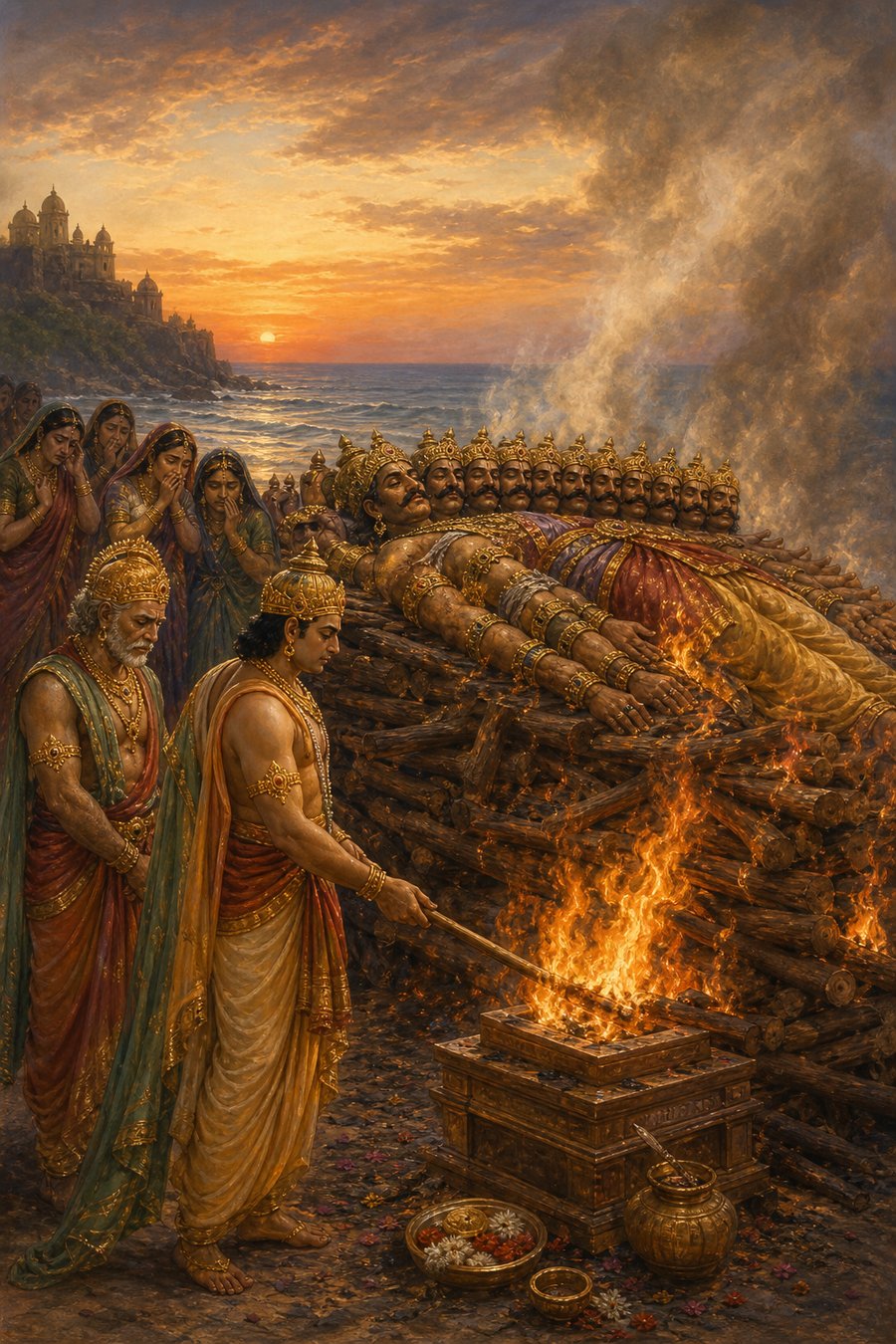
At Rama’s word Vibhishana made ready the funeral of his slain brother. Entering Lanka, he had Ravana’s sacred fires of the agnihotra brought out, the fires his brother had kept burning without a break for as long as anyone could remember, and carts, and wood, and priests, sandalwood logs and many kinds of wood, fragrant aloe and perfumes, gems and pearls and coral. Ringed by ogres, Vibhishana returned to the field within an hour and began the rites together with Malyavan, the old counselor who had once stood in Ravana’s hall and begged him to make peace and been shouted down for it. Ravana, lord of the ogres, was wrapped in linen and laid on a golden palanquin, honored with the blast of trumpets and by singers of his praises, while Brahmins stood around him with faces wet with tears. Lifting that bier decked with painted pennons and flowers, and taking up the wood, all the ogres with Vibhishana at their head set out toward the south. The blazing sacred fires, carried in copper vessels by the priests, went before them. The women of the inner apartments followed behind, sobbing and stumbling on every side. Laying Ravana on a consecrated spot, Vibhishana and the rest, sore with grief, built a pyre of sandalwood, padmaka wood, the fragrant root of the ushira plant, and the bhadrakali grass, and covered it with the skin of a black antelope.
They performed the great pitrimedha rite for the king of the ogres in the finest way, leaving out nothing that the books require. They built an altar to the southeast of the pyre and set the fire in its proper place; they poured a ladle of ghee mixed with curds on his shoulders, set a cart at his feet and a mortar on his thighs. They set out all the wooden vessels, the lower and upper fire-sticks for kindling, and the pestle, each in its place. By the rule the scriptures show and the great rishis have laid down, they sacrificed a goat fit for the offering and spread over the king a sheet daubed with ghee. With mournful hearts the ogres and Vibhishana adorned Ravana with perfumes and garlands and covered him with cloths of many kinds and with parched grain, their faces wet with tears. Vibhishana set fire to him according to the rule, and the man who had refused to do this an hour ago did it with his own hand. Then, bathing in wet clothes and offering libations of sesame and kusha grass and water in the proper way, he begged the women again and again to be comforted and to return. When he said, “Come now,” they all went back into the city.
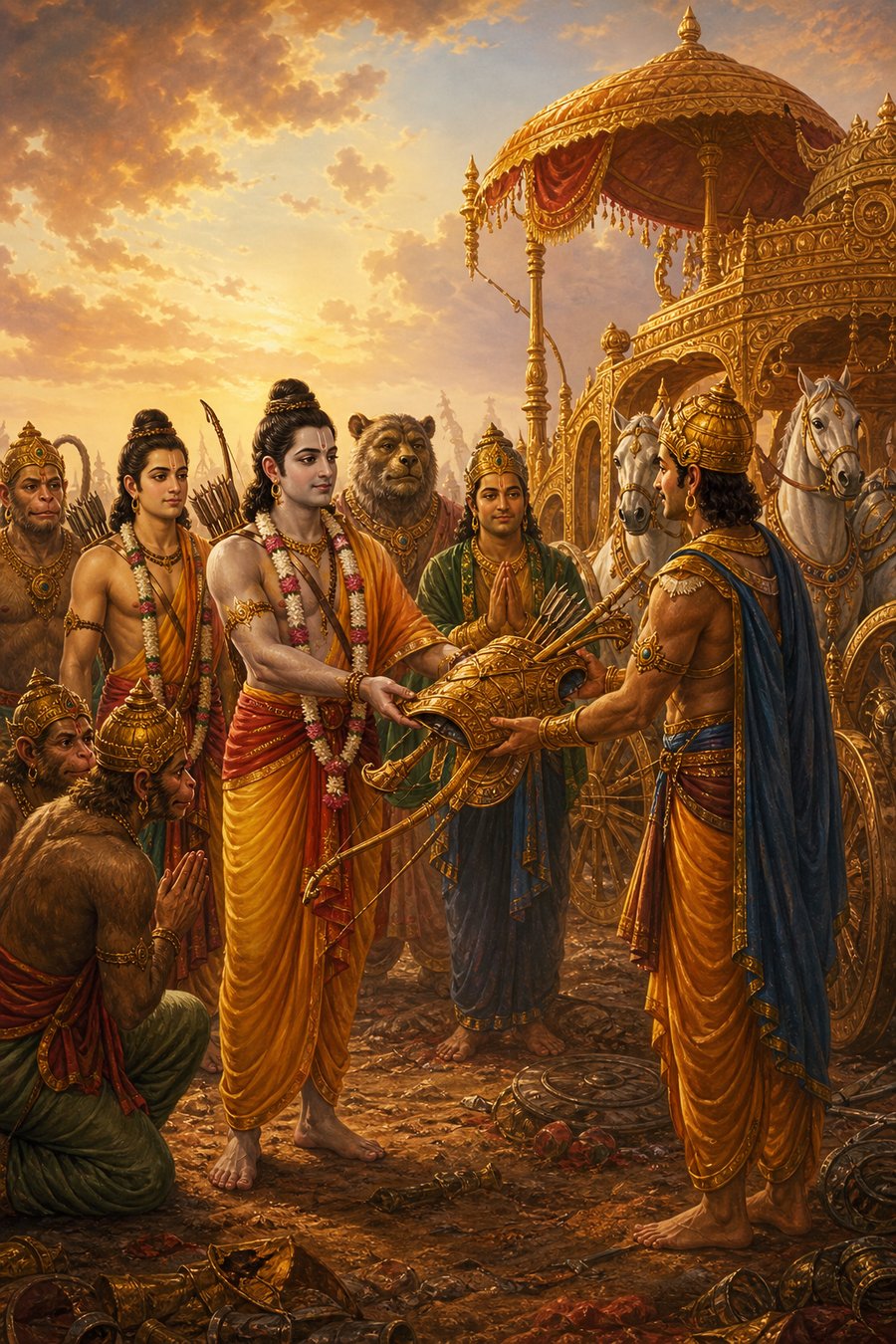
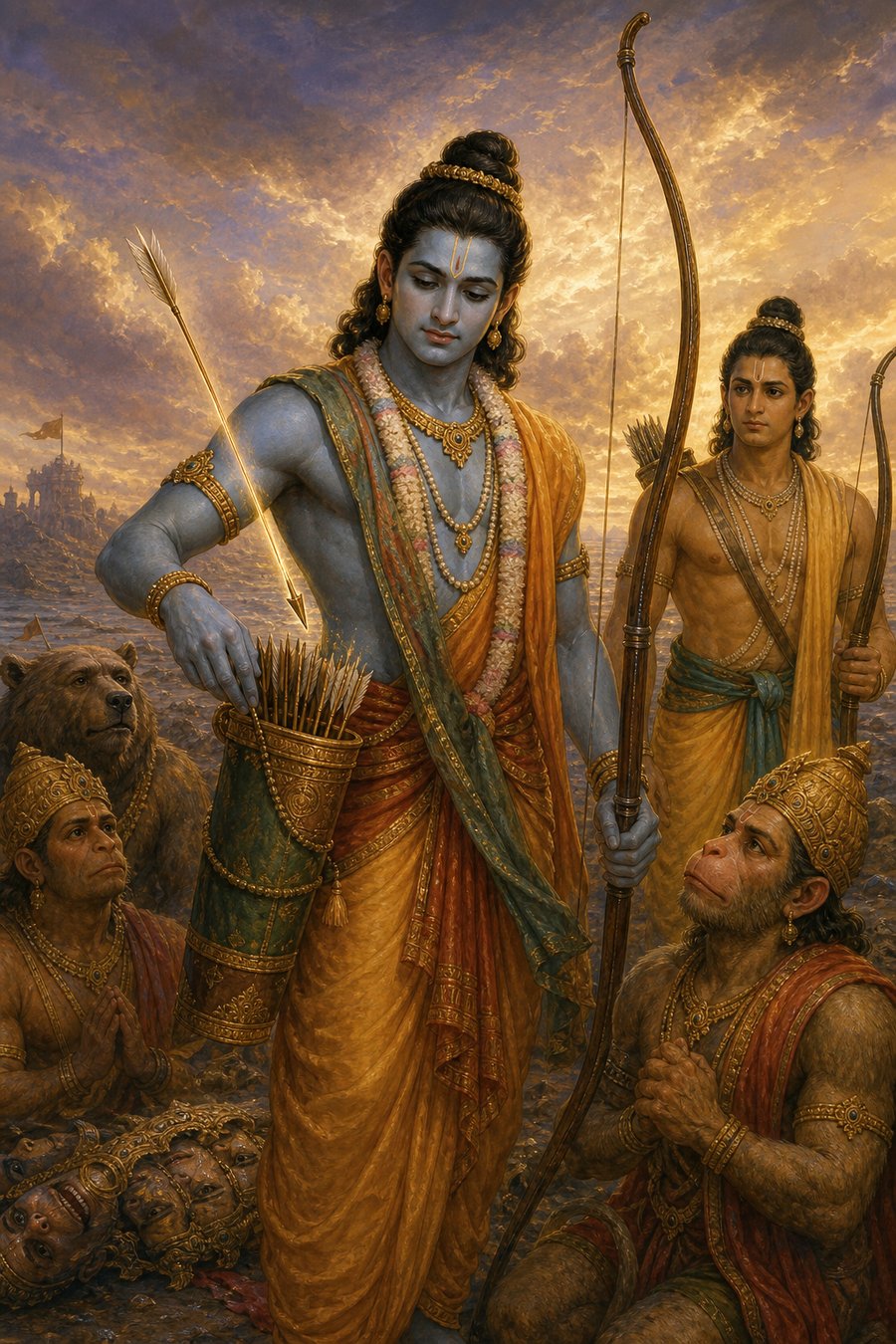
When the women had gone back into the city, Vibhishana, king of the ogres, came to Rama and stood before him humbly. His enemy killed, Rama too, with his army and Sugriva and Lakshmana, was as glad as thunderbolt-wielding Indra after the slaying of Vritra. Then he laid aside the bow and arrows and the great armor that Indra had given him, and gave them back to the sky they came from, and let go of his anger entirely now that the enemy was subdued, and Rama grew gentle and calm.
The gist: After Vibhishana’s hesitation, at Rama’s urging Ravana is given the full Vedic funeral. The rites complete, Vibhishana returns, and Rama, his wrath spent now that the enemy is subdued, lays down bow and armor and grows calm.
Source: Srimad Valmiki Ramayana, Yuddhakanda, Cantos 102 to 111. The Gita Press Hindi edition is the controlling witness. The Sanskrit e-text and an independent complete translation were used to verify names, sequence, and principal events. Where recensions differ, this retelling follows Gita Press.
Based on: Valmiki Ramayana (Gita Press, Gorakhpur)