On this page
When word of Kumbhakarna’s death reached Ravana, the hour turned on Lanka, and one by one the pillars of the demon king’s house began to come down. The rakshasas who had been on the field came to him with the news, and they did not soften it. Rama had struck Kumbhakarna down. The brother who had scattered the vanara army, swallowed monkeys whole, and for a few terrible moments risen up on that field like Yama himself, the god who claims the dead, that same Kumbhakarna had been claimed. Broken by Rama’s arrows, crushed beneath a strength greater than his own, the mountain of a man was now a trunk without head or limbs, like a tree scorched black by a forest fire. Half his carcass lay sunk in the terrible sea, and his head, its nose and ears sheared away and the blood still streaming from it, lay across the main gate of Lanka and blocked it. Ravana heard it out. Grief scalded him where he sat, and he fainted and fell.
Ravana’s Lament and Trishira’s Reassurance
Hearing that their uncle had been killed, Ravana’s sons Devantaka and Narantaka, and Trishira and Atikaya with them, broke down and wept aloud, four grown warriors sobbing without shame. Ravana’s half-brothers Mahodara and Mahaparshva were undone as well, for Rama, who never tired of his work, had killed their brother. With great difficulty Ravana came back to his senses, and when he did, the grief was waiting for him, and his mind came apart under it.
Ravana spoke: “Kumbhakarna, my brave one, you who ground the pride of enemies to dust, you who carried a strength without limit, you have deserted me and gone to Yama’s realm because heaven willed it. You tormented the enemy’s ranks, and now you go off alone, without even drawing the thorn from my side and from the side of our kin, and you leave me behind. That right arm on whose strength I leaned, so that I feared no god and no demon, that arm has fallen, and I know that I will not live long without it. I do not understand how they killed you today. You who quelled the pride of gods and demons alike, you who were like the fire that ends the world, you whom not even the thunderbolt could harm, how do you lie now on the bare earth, pierced by Rama’s arrows, sunk in a sleep that has no end? And in the sky the hosts of the gods and the seers are watching you dead on the field, and they are shouting for joy.”
Ravana went on: “The monkeys have their moment now, and they are wild with it. This very day they will come climbing the gates of Lanka from every side, the gates no enemy has ever climbed. Without Kumbhakarna I have no use left for a kingdom, and what am I to do with Sita? Without you I have no taste even for staying alive. If I do not kill in battle this Raghava who killed my brother, then death is better for me than a life with nothing in it. This very day I will go where my younger brother has gone. I sent my brothers out to die, and I do not have the heart to live even a moment behind them. The gods I wronged in the old days will look at me now and laugh. With you slain, Kumbhakarna, how am I ever to conquer Indra?”
Ravana admitted it: “This ruin is the one Vibhishana foretold. He gave me sound counsel, and in my ignorance I would not take it, and this has fallen on me for that. Since Kumbhakarna and Prahasta met their cruel ends the other day, Vibhishana’s warning has made me blush. I myself drove out that righteous and honorable brother, and this is the bitter fruit of that deed, and it is grief all the way through.” So he lamented, piteously and at length, in every way that grief can find, knowing that his younger brother, the enemy of Indra, was dead; and then the ten-headed king, his innermost self in turmoil, sank down on the floor in pain.
The March of Ravana’s Sons and Narantaka’s Death at Angada’s Hands
Trishira could not listen to it any longer. He was the son who carried three crowns on three heads, and he stood up in front of his father with his hands joined. “Father, it is true. Our uncle Kumbhakarna is dead, the middle one of the three of you, and no one ever measured his strength. But good men do not grieve the way you are grieving now. You have the power to conquer all three worlds. Why hand yourself to sorrow like some ordinary man? The javelin that Brahma gave you is still in this house. So is the armor he gave you, and the arrows, and the bow, and that chariot drawn by a thousand donkeys which roars like a thundercloud when it moves. How many times have you wiped out gods and demons with a single weapon? Go out carrying all of them, and Rama will answer to you. Or stay in Lanka, if that is what you want, and leave the field to us. We will go out and tear your enemies up the way Garuda tears up serpents. Today Rama falls by my hand, the way Shambara fell to Indra and the demon Naraka fell to Vishnu.”
Call it the hand of fate, or call it a father hearing exactly what he needed to hear. A moment earlier Ravana had been on the floor, a king who had just lost a brother and could see no road ahead; now he listened, and it was as if he had been born a second time. The other sons caught fire from Trishira. Devantaka and Narantaka were on their feet, and the fiery Atikaya with them, all three of them straining toward the field. “I go first!” one of them shouted, and another, “No, I will lead!” These were the bulls of the rakshasa race, each of them Indra’s equal in power. Each of them could travel the sky. Each was a master of illusion, a breaker of the pride of gods, savage when he fought, strong beyond ordinary strength and known far beyond Lanka. The gods had come against them with gandharvas and kinnaras in their ranks, and no one had ever reported a single one of these princes beaten on a battlefield. They knew the divine missiles. They had studied the scriptures. Each of them carried a boon he had earned with his own austerities, years of it, bought at a price the gods respect. With sons like these around him, blazing like so many suns, sons who could break the strength and the glory of any enemy, Ravana looked like Indra standing among the immortals who humble the great demons. He drew each of them close in his arms, one after another. He hung ornaments on them with his own hands, spoke blessings over them, and sent them out to war; and because they were his sons and the hour was what it was, he sent his two brothers along with them to guard the princes, Mahodara and Mahaparshva.
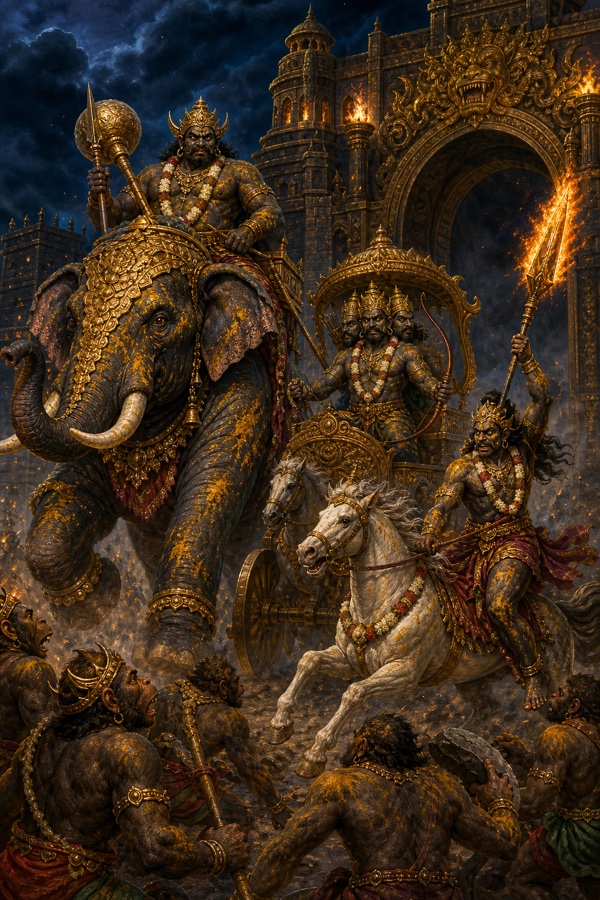
They bowed to the giant king who had made whole peoples scream, and they walked the circle around him that sons and subjects walk, keeping him always on their right, and went out toward the field. Mahodara climbed onto a handsome elephant named Sudarshana, born into the line of Airavata, the elephant that carries Indra himself, and dark as a rain cloud; seated on it in his armor, hung with quivers and with weapons of every kind, he looked like the sun going down behind the western mountain. Trishira took a splendid chariot behind the finest horses, stocked with weapons, and with his bow in his hand he shone the way a monsoon cloud shines when lightning and meteors and a rainbow run through it at once. Under his three crowns, in that chariot, he was the Himalaya with three golden peaks. Atikaya, the best archer of all the sons of Ravana, mounted a superb chariot with excellent wheels and axles, magnificent horses, strong axle-trees, and a stout yoke-pole, bright with quivers and bows and packed with spears, swords, and iron-tipped clubs; with the best of the rakshasas gathered around him he was Indra with the thunderbolt in his hand, standing among the immortals. Narantaka rode a huge white horse, a horse that might have been Uchchaihshravas, the one that rose out of the churning of the ocean of milk, harnessed in gold and quick as thought; with a spear flashing in his hand like a meteor he looked like Kartikeya seated on his peacock with a javelin. Devantaka gripped his iron-tipped club, and he looked like Vishnu with the mountain Mandara in his arms, on his way to churn the sea for nectar. Mahaparshva took up his mace and blazed like Kubera, the lord of wealth, standing on a field of battle with his mace. They went out of Lanka the way gods go out of Amaravati, the capital of heaven.
These six jewels of the rakshasa race, enormous in strength and longing for a fight, rubbed their limbs with the ten herbs that close the wounds of weapons and with fragrant balms, and they went out under the pull of fate. Behind them came gigantic rakshasas carrying superb weapons, thundering like clouds on elephants and horses and in chariots. The princes wore their diadems, and they shone like planets burning in the sky; the row of white weapons resting lightly in their hands looked like a flock of cranes crossing the autumn clouds. They had settled it between themselves: they would embrace death, or they would drive the enemy off the island. As they came they roared and slapped their arms and loosed arrows, and the earth shook under the noise, and the sky seemed to split at their lion-cries. The rakshasa lords saw the vanara host waiting for them with rocks and trees already raised. The vanaras saw an army thick with elephants, horses, and chariots, loud with hundreds of little bells on beast and man, dark as a bank of rain cloud, its great weapons lifted. Each side roared, and neither could bear the roaring of the other. Then the vanara chiefs went in deep, ranging through the rakshasa ranks with crags held over their heads, like mountains carrying their own peaks. Some sprang into the air with trees and boulders; others tore up trees with huge trunks and ranged across the ground. The vanaras pounded armored, ornamented rakshasas with rocks and killed them, and leapt up to kill the heroes in the chariots and on the elephants and horses. The rakshasas pierced the best of the monkeys with sharp arrows and struck them with pikes, mallets, swords, lances, and javelins. Within moments the ground was covered with crags and swords, and it was wet with blood, and mountain-sized rakshasas lay scattered over it in pieces. When their rocks were shattered, the vanaras fought with their limbs alone, at close quarters. Rakshasa chiefs struck monkeys down with other monkeys, and monkeys struck rakshasas down with other rakshasas, and each side snatched the other’s weapons and turned them back on their owners. Chariot was dashed against chariot, elephant against elephant, horse against horse. With arrows shaped like horseshoes, crescents, and spearheads the rakshasas shattered the trees and rocks of the vanara chiefs, and with their shields and armor broken, the rakshasas bled the way trees bleed sap. The earth became hard to walk on, strewn with thrown mountains and cut trees and the dead of both sides, and the vanaras, proud and unbroken, fought on with trees and rocks and teeth and nails and whatever they had torn out of the enemy’s hands. The tumult went on, and the rakshasas began to go down, and in the sky the great seers and the hosts of the gods shouted for joy.
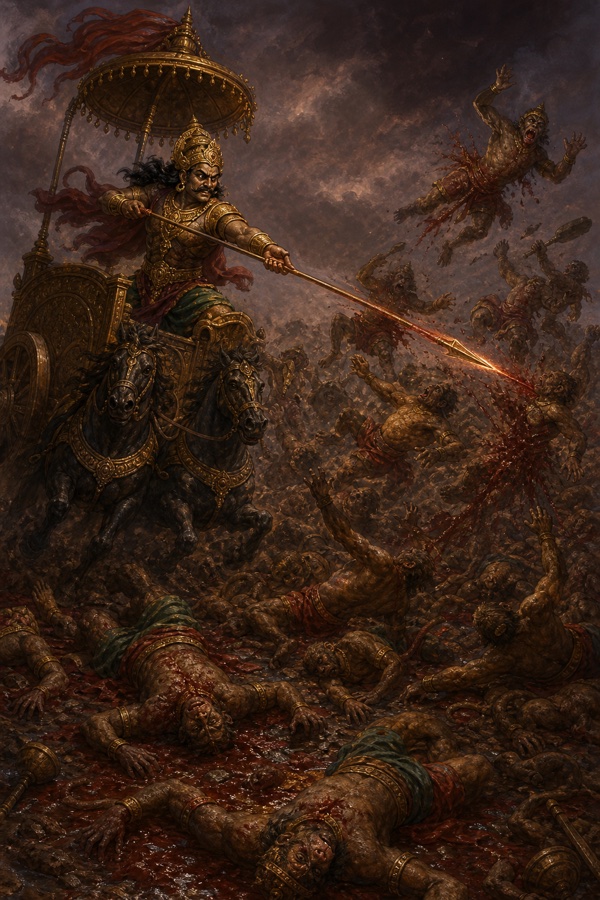
Then Narantaka came. On a horse swift as the wind, with a sharp lance gripped in his fist, he plunged into that fearsome vanara host the way a fish goes into the sea. Alone, with that one blazing lance, he pierced seven hundred vanaras; in a moment that enemy of Indra had cut his way through an army of monkey chiefs. The vidyadharas and the great seers watched a single rider range on his horse through the vanara ranks. The path he cut behind him was a mire of flesh and blood, strewn with fallen monkeys like tumbled mountains. The vanara chiefs were still thinking of showing their valor when he slipped past them and clove their ranks, and with his flaming lance he ate through the vanara troops the way fire eats a forest, so that they fell like mountains uprooted by lightning even as they tore up trees and crags to throw at him. Crushing everything in his way, he ranged the field on every side like the wind that comes at the end of the rains. The bravest vanaras could not flee and could not stand their ground and could not so much as stir for fear; whether they sprang or stood or moved, the lance found them. That one lance looked like death and shone like the sun, and the monkey ranks went down before it onto the earth, and the bodies of the fallen lay there like mountains whose peaks Indra’s thunderbolt has shattered.
The vanara champions who had gone down earlier under Kumbhakarna were themselves again by now, their strength healed, and they came to Sugriva. The king of the monkeys looked around him and saw his army running in every direction in dread of Narantaka, and then he saw the cause of it, a single rakshasa on horseback coming on with his lance held out before him. Sugriva did not go himself. He turned to Angada, the son of Vali, the crown prince of Kishkindha, the boy whose father Rama had killed and who had given Rama his whole loyalty anyway, and whose valor matched Indra’s own, and gave him the order. “Go. That brave rakshasa on the horse, the one who is terrorizing our host, part him from his life at once.” At his master’s word Angada broke away from his own cloud-dark army the way the sun breaks out of a cloud. Gold armlets glittered on his arms, and Angada, who was built like a mass of rock, shone like a mountain veined with ore.
He walked up to Narantaka carrying nothing at all; nails and teeth were the only weapons he had, and he spoke to the rider as if that were enough. “Stop. What will you get from these common monkeys? Throw your spear, that thunderbolt whose blow is so hard to bear, here, at this chest of mine.” Narantaka heard the challenge, and rage took him. Grinding his lip between his teeth, hissing like a serpent, he wheeled his horse and stood facing the son of Vali. He whirled the blazing lance once and hurled it with everything he had. It struck Angada full in the chest, and that chest was as hard as adamant, and the lance snapped on it and dropped to the earth. Angada looked at the broken lance lying there like a serpent cut in two by Garuda. Then he raised his open hand and brought it down on the head of Narantaka’s horse. The blow drove the animal’s legs deep into the ground; its eyeballs burst, its tongue hung out, its skull split under the palm, and the mountain of a horse fell dead where it stood. Narantaka looked at his dead horse, and his rage doubled. He raised his fist, and with the whole of his enormous strength he struck Angada on the head.
The fist split Angada’s skull, and blood came out of it hot enough to scald. He burned with the pain. He fainted, and came to, and fainted again, and when at last his senses steadied he stood there astonished to find himself alive, a boy on his first great field who had just taken a blow from a son of Ravana and was still on his feet. Then Vali’s great-hearted son clenched a fist like a mountain peak and brought it down on Narantaka’s chest with the speed of death itself. The chest split under the blow and caved in. Narantaka, his limbs streaming blood, fell to the earth vomiting flaming blood, like a mountain shattered by a stroke of lightning. When Narantaka went down before the son of Vali, a great shout of joy rose at the same instant from the chief gods in the sky and from the vanaras on the field. Angada had done a thing that could hardly be believed, and the joy it brought to Rama’s heart was so great that Rama himself was struck with wonder; and Angada, whose deeds that day were terrible, felt fresh vigor rising in him for the fight.
The Deaths of Devantaka, Trishira, Mahodara, and Mahaparshva
Narantaka had fallen, and three rakshasa lords cried out together at the sight: Devantaka, Trishira, and Mahodara, two brothers and an uncle of the dead man, and all three of them turned on the one monkey who had killed him. Mahodara, too impatient to think, drove his cloud-dark elephant straight at Angada. Devantaka, scalded by his brother Narantaka’s fall, seized a terrible iron-tipped club and ran at him. And Trishira, in his chariot bright as the sun behind its excellent horses, came at him too. Three rakshasa chiefs who could crush the pride of gods had ringed one monkey at the same moment, and the monkey had no weapon in his hands. Angada tore up a tree with mighty boughs and flung it at Devantaka the way Indra flings his blazing thunderbolt. Trishira cut the tree to pieces in the air with arrows that flew like venomous snakes, and when Angada saw it come down in fragments he sprang aside.
Angada rained trees and boulders on all three of them. Trishira sheared them with sharp arrows, Mahodara broke them with the head of his club, and Trishira turned a storm of shafts on Angada himself. Chasing the son of Vali from the back of his elephant, Mahodara struck him in the chest with clubs that flashed like lightning. Devantaka closed in, landed a blow with his iron club, and at once fell back out of reach. Attacked by all three at once, the mighty son of Vali did not feel the smallest alarm. He waited for his moment and his speed, closed with Mahodara’s huge elephant, and struck it with his open hand, and at that single blow the eyes of that lord of elephants fell out of its head and it died. Angada wrenched a tusk out of the dead elephant, ran at Devantaka, and struck him with it; the rakshasa reeled like a tree in a high wind, and the blood that poured out of him was the color of lac.
Devantaka got his breath back with difficulty. He whirled his club with everything left in him and struck Angada with it, and the son of Vali dropped to his knees on the ground under the blow, and then he rose again. As he sprang up, Trishira drove three terrible straight-flying arrows into his brow. Hanuman and Nila saw Angada ringed by three of the greatest of the rakshasas, and they came at once to stand beside him. Nila hurled a mountain peak at Trishira, and Ravana’s shrewd son shattered it with sharp arrows; smashed by hundreds of shafts, its rocky base split open, the peak came down in sparks and flame. Devantaka watched Trishira’s feat with delight and ran at Hanuman with his club. Hanuman leapt to meet him. He struck him on the head with a fist as hard as the thunderbolt, then struck him a second time, and the roar he gave with it set the rakshasas shaking. His skull crushed, his teeth and eyes forced out of his head, his tongue lolling, Devantaka, the son of Ravana, dropped dead on the ground.
Devantaka had been an enemy of the gods and the best of the rakshasa warriors, and his death drove Trishira wild; he loosed a fearful storm of sharp arrows into Nila’s chest. Mahodara, meanwhile, had mounted a second elephant as big as a mountain, and he rose on it like the sun climbing Mandara, and from that height he poured arrows down on Nila the way a monsoon cloud ringed with lightning and a rainbow pours rain onto a hill. Covered on every side, pierced through every limb, Nila, the commander of the vanara army, felt his body going inert, its power drained out of it by a rakshasa of enormous strength. Then his senses came back. He tore up a crag with a whole thicket still growing on top of it, sprang, and brought it down on Mahodara’s head. Crushed under that crag together with his great elephant, Mahodara fell senseless and died on the earth like a mountain struck by lightning.
His uncle Mahodara was dead, and Trishira took up his bow in fury and pierced Hanuman with sharp arrows. Hanuman, full of rage, flung a mountain peak at him, and Trishira split it into pieces with his shafts; the peak having failed, Hanuman rained trees down on him, and Trishira cut those apart in the air as well, and roared. Then Hanuman leapt, and like a lion clawing a lordly elephant he tore Trishira’s horse open with his nails. Trishira raised his javelin, the way Death takes up Kalaratri, the night that ends the world, and hurled it at the son of the Wind. The javelin came through the sky with nothing to stop it, like a meteor shot out of heaven. Hanuman caught it in his hands, broke it, and roared, and at the sight of that weapon of terrible aspect lying in pieces the vanara hosts thundered with joy like rain clouds. Trishira drew his sword and drove it into the chest of the monkey chief. Wounded by the sword, Hanuman struck the rakshasa on the chest with his open hand, and Trishira, for all his energy, dropped senseless to the ground, the weapon slipping out of his hand.
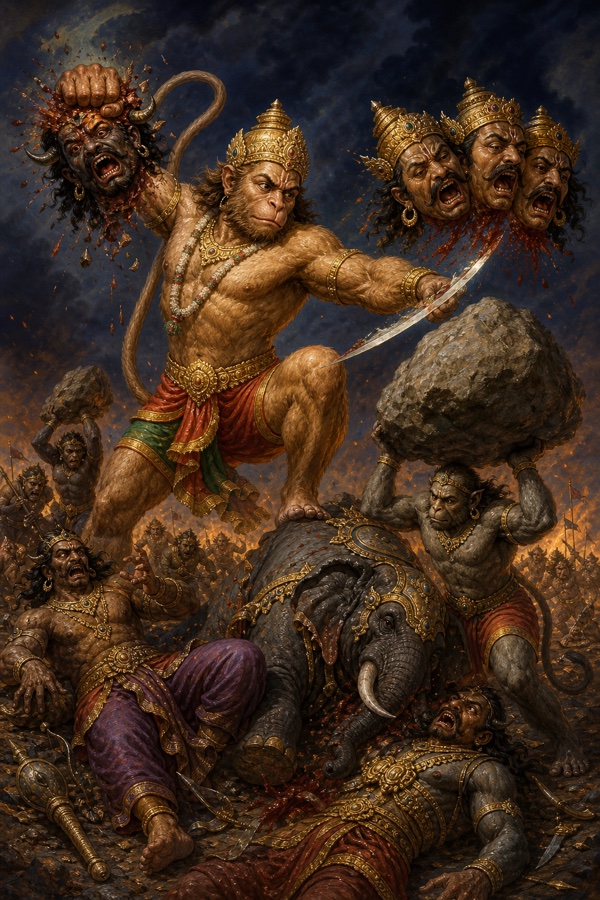
Hanuman snatched the sword out of Trishira’s hand as he fell, and, mountainous, he let out a roar that terrified every rakshasa on the field. Trishira could not bear that roar. He came to, sprang to his feet, and struck Hanuman with his fist. The blow enraged the great monkey. He seized the crowned heads of that greatest of rakshasas, and as Indra once lopped off the three heads of Vishvarupa, the son of Tvashta, so Hanuman with that sharp sword cut off all three of Trishira’s heads, earrings, diadems, and all. Those heads, huge as rocks, their eyes glowing like fire, their eyes and ears and nostrils enormous, fell to the earth like stars dropping out of the sun’s path. When Hanuman, whose valor matched Indra’s, killed that enemy of the gods, he roared in triumph, the earth shook, and the rakshasas fled on every side.
Mahaparshva saw Trishira dead and Mahodara dead, and saw that Devantaka and Narantaka, whom no one had ever been able to overpower, had been cut down, and indignation took him whole. He seized a huge mace, all iron plated with gold, a blazing, glittering thing. Whenever it went against an enemy it came back covered in a foam of flesh and blood; it had been soaked in the blood of enemies so often that it was saturated with it; its head burned with luster; it was hung with crimson flowers; and it brought terror even to Airavata, Mahapadma, and Sarvabhauma, the elephants who hold up the quarters of the world. With that mace in his hands, burning like the fire at the end of an age, Mahaparshva fell on the vanaras and scattered them. A vanara named Rishabha, a son of Varuna, the lord of the waters, sprang forward and planted himself in the path of Mahaparshva, that brother of Ravana. The rakshasa, enraged to find a monkey standing in front of him, struck him in the chest with his thunder-hard mace; the blow split Rishabha’s chest open, and he staggered and poured out blood.
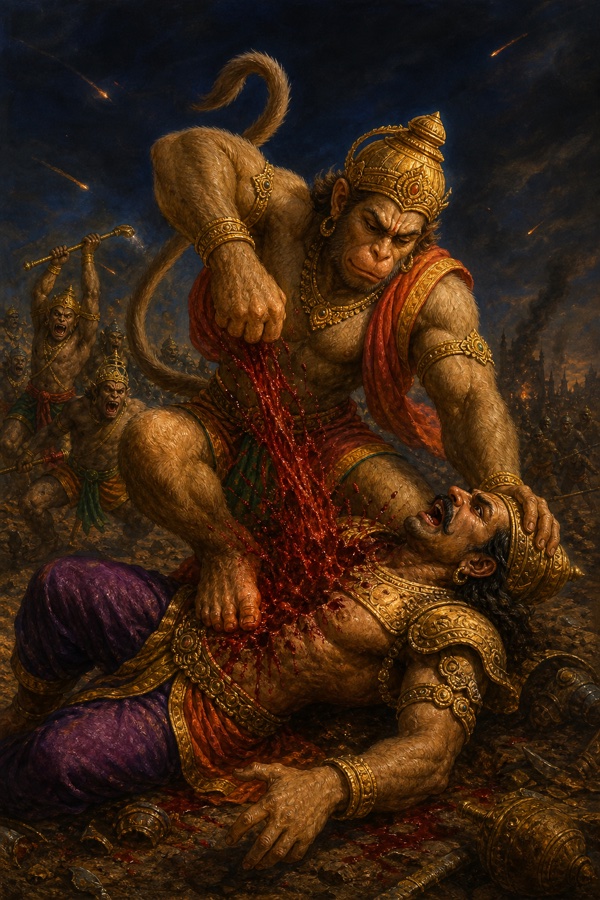
It was a long time before Rishabha came fully back to himself. When he did, he looked at Mahaparshva with his lips trembling with rage. He came at the rakshasa fast, clenched his fist, and struck him on the chest, in the place between the two arms, and the rakshasa fell to the ground bathed in blood, like a tree whose roots have been cut through. Rishabha snatched up the terrible mace lying beside him, the mace that was like the rod of Yama, and roared over the fallen enemy of the gods. For a while Mahaparshva lay like a dead man. Then the breath came back into him, and that rakshasa the color of an evening cloud sprang up and struck Varuna’s son a blow that dropped him senseless to the earth. Rishabha lay there only a moment. He rose, whirled that same mace, which was like a rock torn off the greatest of mountains, and struck Mahaparshva with it on the field. The terrible mace reached the body of that ferocious enemy of gods and sacrifices and Brahmins and clove his chest, and he poured out blood the way the Himalaya pours out water charged with red ore.
The rakshasa lunged for the mace in the giant monkey’s hands. Rishabha held on to it, whirled it again and again, and struck Mahaparshva with it at the head of the fight; smashed with his own mace, his teeth and eyes fallen out of his head, Mahaparshva dropped like a mountain struck by lightning. When that brother of Ravana lay lifeless on the ground with his eyes crushed in, his army broke. Ravana’s ocean of an army flung down its weapons and fled for its life, like a sea that has burst its shore.
Atikaya’s Fierce Battle and His Death at Lakshmana’s Hands
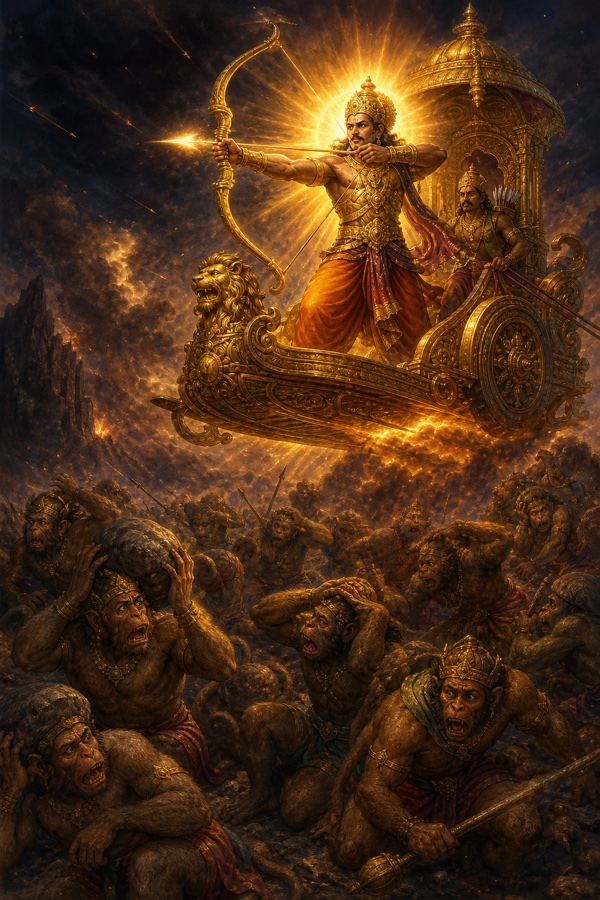
Atikaya looked at what was left to him. His own army, which had once set the hair of its enemies on end, was in trouble; his brothers, each of them Indra’s equal, were dead; his uncles, Mahodara and Mahaparshva, the two greatest of the rakshasas, lay struck down on the field. Atikaya was the size of a mountain. He had crushed the pride of gods and demons alike, and Brahma himself had granted him a boon that no weapon could get past, and now rage took him on that field. He mounted a chariot as bright as a thousand suns strung together and drove at the vanaras. Wearing his crown and his polished earrings, he twanged his bow, proclaimed his own name so that every ear on the field would hear it, and let out a tremendous roar. That lion-cry, the shouting of his name, and the terrible ringing of his string went into the vanaras and stayed there. The sheer size of him made them think that Kumbhakarna had sprung back to life, and in their fear they crowded into one another for shelter. That vast form, like the form Vishnu took when he measured the three worlds in his strides, broke them; they ran in every direction, and, confused by what they had met, the vanaras came to Rama, Lakshmana’s elder brother, the one who gives refuge to everyone who asks.
Rama, of the line of Kakutstha, saw the mountainous Atikaya from a long way off, bow in hand in his chariot, rumbling like a cloud at the end of an age, and even Rama was astonished. He steadied the vanaras with a word, and he turned to Vibhishana with a question. “Who is that archer, built like a mountain, with the eyes of a lion, seated in a huge chariot drawn by a thousand horses? He shines among those whetted pikes and flaming spears and lances like Shiva among his ghosts, and among the javelins laid in his chariot, gleaming like the tongues of Time, he is a cloud with lightning circling it. Bows with golden backs are ranged all around him, and they adorn that chariot the way a rainbow adorns the sky. This tiger of a rakshasa, this greatest of chariot-warriors, comes on in a chariot bright as the sun, and he lights the field as he comes. The emblem on his standard is Rahu, the planet that swallows the sun, and his arrows, bright as sunbeams, light up the ten directions. His triple-curved bow, gold-backed and ornamented, shines like the rainbow and sounds like thunder. Four charioteers drive that chariot under its flags, and the chariot itself rumbles like a thundercloud. Twenty quivers lie in it, and ten dreadful bows, and eight bowstrings, golden and reddish brown. Two flaming swords hang at its sides, each fully ten cubits long, with hilts of four cubits, and they throw their light on either flank. With a red garland at his neck and a mouth as huge as Death’s, this resolute, dark, mountainous rakshasa is the sun veiled by a cloud. His arms with their golden armlets make him the Himalaya with two lofty peaks, and his terrible face between its two earrings is the full moon between the two stars of Punarvasu. Tell me who this jewel of the rakshasas is, at the sight of whom every vanara has fled.”
Vibhishana, who had grown up in that house, answered the prince of boundless splendor without a pause. “The ten-headed King Ravana, son of Vishrava and younger half-brother of Kubera, the lord of the rakshasas, is famous in every world for his terrible deeds. A son was born to him who is a match for Ravana himself in might, a son who has waited on his elders, mastered the Vedas, and become the best of all who know the divine missiles. In riding horse and elephant, in the sword and the bow and the drawing of the string, in sowing dissension among enemies and in making peace, in gifts, in statecraft, and in counsel, he is greatly honored. On the strength of his arm Lanka sleeps without fear. This is Atikaya, the mighty and intelligent son of Ravana by Dhanyamalini, another of his queens, a champion of the rakshasas and a breaker of the pride of gods and demons. By austerity he purified his mind and won Brahma’s favor; from Brahma he received missile after missile as boons, and with them he subdued his enemies. Brahma gave him exemption from death at the hands of gods and demons, and this celestial armor, and this chariot bright as the sun. He has overcome gods and demons by the hundred, protected the rakshasas, and wiped out yakshas. It was he who checked Indra’s thunderbolt with his arrows and made Varuna’s noose fail. Act against him quickly, best of men, before he brings the vanara army to its end with his arrows.”
Out on the field the strong Atikaya had already plunged into the vanara host, twanging his bow again and again and roaring. The greatest of the vanaras saw a rakshasa of fearful proportions in his chariot and rushed to meet him: Kumuda, Dvivida, Mainda, Nila, and Sharabha fell on him together with trees and mountain peaks. Atikaya, the best of all who know the divine missiles, cut every tree and every crag apart with his gold-decked arrows, and pierced with shafts of solid iron every vanara who stood in front of him. Tormented by that rain of arrows, their limbs broken, worsted, the vanaras could not hold their ground against Atikaya in that great battle. He terrorized the army of monkey chiefs the way a lion drunk on the pride of its own youth terrorizes a herd of deer.
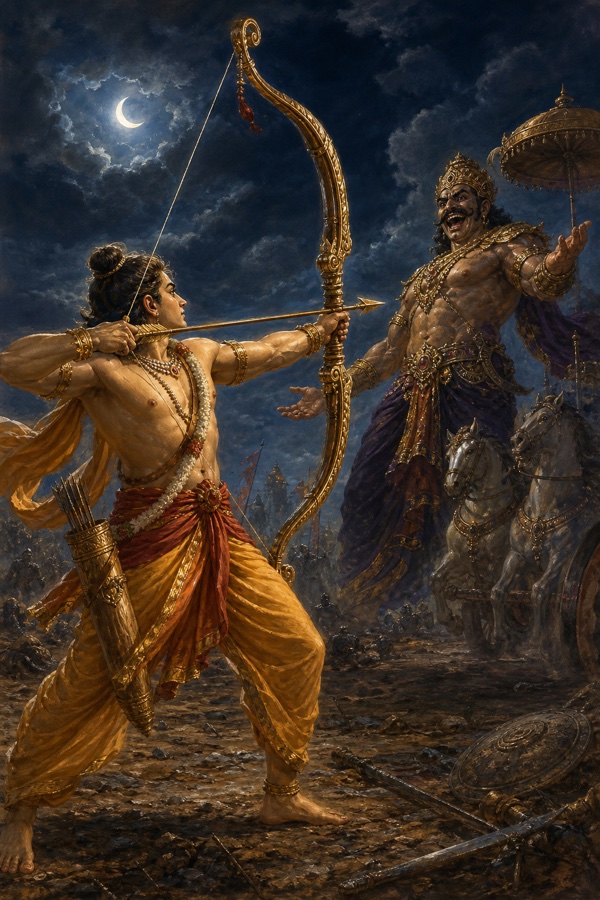
And yet there was a rule in him. He would not strike anyone who was not fighting. He came toward Rama, bow and quiver in hand, and threw out his challenge. “I sit in a chariot with bow and arrows in my hands, and I do not fight common warriors. Whoever has strength and spirit in him, let him fight me now.” Lakshmana, the son of Sumitra, the destroyer of his enemies, heard the words even as they were spoken, and he could not endure them; the challenge had been thrown at his brother, and that was enough. He sprang up in anger, went forward, and took up his bow with contempt; he drew an arrow from his quiver and stretched his great bow to its full length in front of Atikaya. The note of Lakshmana’s bowstring filled the whole earth, the sky, the sea, and the quarters, and it struck dread into the rakshasas.
That fierce twang startled the strong son of the demon king. Then, enraged to see Lakshmana standing ready for him, Atikaya took up a sharp arrow and spoke. “You are still a boy, son of Sumitra, and you have no practice in valor. Go away. Why measure your strength against me, who am Death’s own image? Neither the Himalaya nor the sky nor the earth itself can bear the force of the arrows that leave my arm. Why wake the fire of the world’s end while it sleeps in comfort? Lay down your bow and go back; do not come near me and lose your life. Or if you are stubborn and will not go, then stay, and give up your life, and go to the house of Yama. Look at my whetted shafts, breakers of the pride of enemies, like the trident of Shiva, decked in refined gold. This arrow, which is like a serpent, will drink your blood the way a furious lion drinks the blood of a lordly elephant.” And in his fury he set the arrow to his bow. Lakshmana heard the proud and angry speech, and his own anger rose, and his answer carried weight. “You do not become foremost by speech alone, and no one becomes a good man by boasting. I stand before you with a bow, and there is an arrow in my hand; show me your strength, you evil-minded one. Reveal yourself by what you do; you should not blow your own trumpet. The man who has prowess is the one people call a hero. You sit in a chariot with every kind of weapon and a bow; then show your prowess with your arrows or your missiles. After that I will bring your head down with my sharp arrows the way the wind brings down a palm fruit ripened on its stalk. My gold-decked arrows will drink the blood that runs from the holes their points make in your body. Do not think that because I am a boy you may despise me. Child or grown man, know me to be your death on this field. Vishnu was a child when he strode the three worlds in three steps.” The reply was full of reason and full of truth, and Atikaya, hearing it, flew into a rage and took up an excellent arrow. And the vidyadharas, the ghosts, the gods, the giants, the great seers, the guhyakas, and the yakshas gathered in the sky to watch the duel.
Atikaya set the arrow to his bow and loosed it at Lakshmana as if he meant to fold up the sky with it; it came flying like a venomous serpent, and Lakshmana, the destroyer of hostile champions, cut it apart with a crescent-headed shaft. His arrow lay torn like a serpent whose hood has been severed, and Atikaya fitted five arrows to his bow and loosed them with all his force, and Bharata’s younger brother split them with his own arrows before they reached him. Then Lakshmana took up a whetted shaft that flamed with its own splendor, set it on his excellent bow, drew the string to its full stretch, and shot; that flat-jointed arrow struck Atikaya in the forehead, and sunk there and stained with blood it looked like a king of serpents clinging to a mountain. Atikaya shook under it the way the great gate of Tripura shook when Rudra’s arrow struck it. He recovered his breath, thought for a moment, and spoke. “A fine shot. By loosing that arrow at me you have made yourself an enemy worth my praise.” He opened his mouth wide as he said it, and, gathering his mighty arms, he moved to the rear of his chariot and pressed forward. Then he seized one arrow, and three, and five, and seven, set them to his bow, drew the string to its length, and let them fly; loosed from that bow, the golden-feathered arrows, like Death and bright as the sun, set the sky ablaze. Rama’s younger brother stayed unruffled and cut those volleys apart with his own shafts.
Atikaya saw his arrows cut down, and his rage rose; he took up a sharp arrow that was like a venomous serpent, aimed at the chest, and shot, and it struck Lakshmana in the chest, and Lakshmana bled the way a rutting elephant streams ichor. Then the all-powerful Lakshmana drew the shaft out of himself, took up a sharp arrow, and charged it with a mantra: he invoked over it the missile presided over by the god of fire, and set on the bow of that great-hearted prince, the arrow began to breathe flame. Atikaya saw the missile of Agni coming and at once loosed an arrow charged with the missile of the sun-god. The two arrows, their heads flaming, met in the sky like two furious serpents, burned each other to ash, and fell to the earth; both had glowed in the air, and neither shone any longer on the ground. Then Atikaya, in fury, loosed a reed arrow charged with the missile of Tvashta, and Lakshmana split it with the missile of Indra; Atikaya charged an arrow with the missile of Yama and shot it, and Lakshmana struck it down with the missile of the Wind. Then Lakshmana, full of rage, covered Ravana’s son with hails of arrows the way a monsoon cloud covers a hill with rain, and they reached Atikaya and their points shattered against his coat of mail, which was encrusted with diamonds, and they fell to the ground. They had failed, and the illustrious Lakshmana covered him with a thousand more, and still Atikaya, cased in that armor no weapon could pierce, was untroubled. He loosed a serpent-like arrow of his own, and it pierced Lakshmana in a vital place, and for a while the son of Sumitra fainted. When his senses returned he tore the rakshasa’s standard down with a hail of arrows, and with four excellent shafts he killed Atikaya’s horses and his charioteer. Unconfounded, he loosed the choicest of his well-known arrows for the rakshasa’s destruction, and the best of men still could not open a wound on that body.
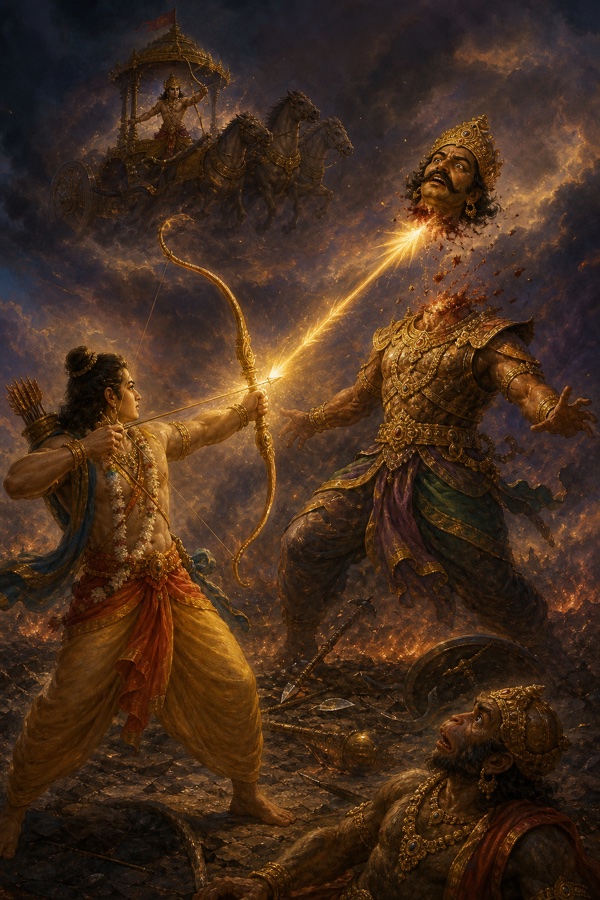
Then the Wind-god came near him and spoke. “This rakshasa carries Brahma’s boon and is clad in armor nothing can pierce. Strike him with the missile presided over by Brahma; he cannot be killed any other way. Armored and mighty as he is, no other missile will kill him.” Lakshmana heard the Wind and invoked the missile of Brahma, and, matching Indra in valor, he fitted to his bow an arrow of terrific speed. As the son of Sumitra charged that sharp-pointed arrow, feathers and all, with the missile of Brahma, the four quarters shook, and the moon and the sun and the great planets, and the vault of heaven, and the earth creaked. He set it to his bow and loosed it, and that shaft, like a messenger of Death and hard as adamant, went at the son of Ravana. Atikaya saw it coming, feathered like the wings of Garuda and set with excellent diamonds, and it seemed to fly at him with doubled speed; he struck it with whetted shafts, and it came on with the swiftness of Garuda. That flaming arrow, terrible as Death and as Time, was almost on him, and Atikaya struck at it with javelins, spears, maces, axes, pikes, and arrows in one unceasing effort, and the fire-bright arrow made every one of those wondrous weapons useless, went through the head of Atikaya under its diadem, and cut it off. Cut by Lakshmana’s arrow, the head with its crown fell to the ground like a peak of the Himalaya.
All the rakshasas who had escaped being killed saw the prince fallen on the ground with his clothes and his ornaments in disorder, and they were stricken. Faces downcast, miserable, exhausted by their wounds, many of them broke into a loud wail in discordant voices. With their leader gone, the rakshasas became listless and withdrew from that place at a run, terrified, with their faces turned toward the city. On the other side, vanaras beyond counting, their faces like opened lotuses, paid their homage to Lakshmana, who had brought them victory over an enemy of terrible might whom no one could approach. Honored by the hosts of the monkeys, rejoicing, having brought down in single combat the Atikaya who had loomed over that field like a mass of cloud, Lakshmana went back quickly to Rama.
Ravana’s Anxiety and the Order to Guard Lanka
When the news reached him that Lakshmana had killed Atikaya, the king of Lanka gave way to anxiety, and he spoke his fear aloud. “Dhumraksha, who could bear no insult, and Akampana, the best of all who know weapons, and Prahasta, and Kumbhakarna, brave rakshasas who conquered whole armies, warriors of enormous strength who hungered for battle and were never once beaten by an enemy, these men, masters of every weapon, have been killed with their battalions by Rama, who never tires of his work. Many other heroes of gigantic stature have been struck down as well. The other day my eldest son Indrajit, whose strength and prowess the worlds know, bound both brothers, Rama and Lakshmana, with the terrible arrows on which Brahma conferred a boon that they never fail. That binding could not have been undone by all the gods, by the mightiest demons, by the yakshas, the gandharvas, or the nagas, and yet those two got free of it, by some superhuman power, some conjuring trick, some charm I do not know.”
Ravana went on. “Every brave rakshasa who went out at my command has been killed in combat by those monkeys of such strength. I do not see the warrior who could today make an end of the heroic Rama and Lakshmana and their army, and of Vibhishana and Sugriva with them. Oh, great is the power of Rama’s missiles, and great is Rama himself: every rakshasa who came within the range of his prowess has met his death there. I recognize that hero of Raghu’s line for what he is. He is Narayana himself, the Lord whom no ailment can touch. It is for fear of him that Lanka keeps its doors and outer gates shut. So let those of you who have survived this destruction stay vigilant every hour and defend this city of Lanka with its garrisons, and above all the ashoka grove where Sita is kept under guard on every side. Every exit from the city and every entry into it, and into the grove, must be known to us at all times.”
“Wherever there is a garrison, let every coming and going be checked, and checked again. Take up your positions on every side, each of you ringed by his own troops. Night-rangers, watch the movements of those monkeys in every way, at dusk, at midnight, and at sunrise. Never make light of the monkeys. Watch without pause whether the enemy’s army is stirring, whether it is advancing on Lanka, or whether it stands where it is.” The mighty rakshasas heard that command from the lord of Lanka and carried it out at once, in every particular. Having given his orders, Ravana went deep into his palace with the thorn of wrath lodged in his breast, a miserable man. The fire of anger had been lit in him, and it would not go out; he sat brooding on the fall of his son Atikaya, and sighed, and sighed again.
Indrajit’s Invisible War of Illusion and the Swoon of Rama and Lakshmana
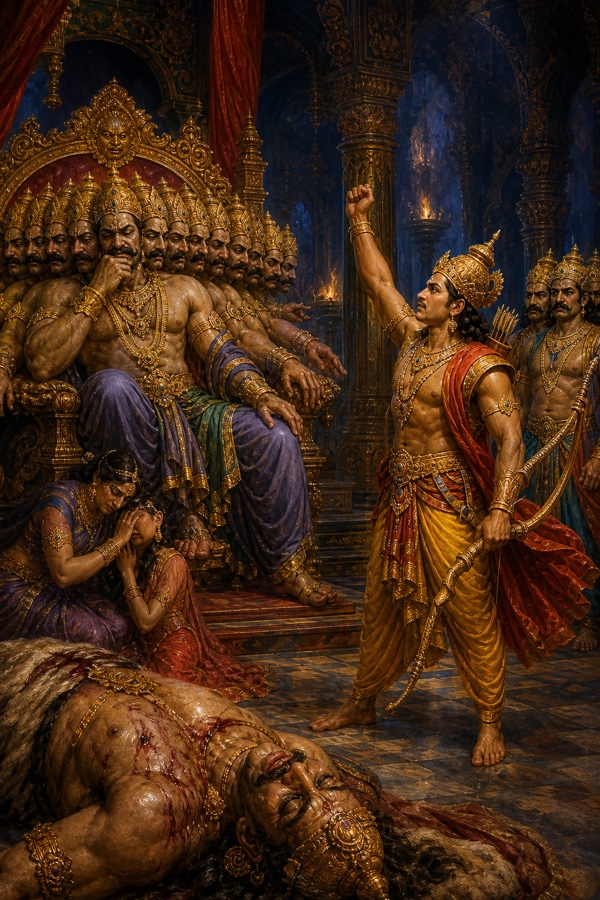
The rakshasas who had lived through the slaughter came running to Ravana with the names of the dead: Devantaka, Trishira, Atikaya, and the other champions of the race, all of them cut down in a single day. He had sent them out that morning with his own hands on their shoulders. Hearing it all at once, the king found his eyes full of tears. His sons were destroyed. His brothers had met terrible ends. He sat and turned it over, and sank deeper into thought. Indrajit was watching him. He was the eldest of Ravana’s sons and the greatest chariot-warrior in Lanka, the one who had once beaten Indra himself in battle and carried that victory in his name, and the one who had already, earlier in this war, bound both the brothers from Ayodhya with arrows no god could loosen. He saw his father lost in an ocean of grief, and he stepped forward. “Father, while your son Indrajit is alive you have no reason to despair. No one who is struck by the arrows of Indra’s enemy keeps his life on a battlefield. Before this day is over you will see Rama lying dead on the bare earth with Lakshmana beside him, his body flung about and torn open by my shafts, my sharp arrows clinging to it everywhere.”
“Hear the vow of Indra’s enemy. It is a settled vow, and my manhood stands behind it, and so does the blessing of heaven: today I bring Rama and Lakshmana down with arrows that never miss. Today Indra, Yama, Vishnu, Rudra, the Sadhyas, Agni, the Moon, and the Sun will watch my prowess, which has no measure, the way they once watched the terrible prowess of Vishnu inside the sacrificial enclosure of the demon king Bali.” He took his leave of the king and, unshaken, climbed into his chariot. It was swift as the wind, drawn by donkeys, stocked with bow and sword and the whole equipment of war, a chariot that could have been Indra’s own, and he drove it fast toward the field. Behind him, in high spirits, came a host of mighty rakshasas carrying excellent bows. Some rode elephants; some rode fine horses, and some tigers, scorpions, cats, donkeys, and camels; others rode serpents, boars, lions, and jackals as big as hills, and others still rode crows, swans, and peacocks. They carried lances, sharp-edged spears, swords, axes, and maces, and they were armed with bhushundis, mallets, ayashtis, shataghnis, the iron-spiked killers of a hundred, and parighas, the iron-studded clubs.
Conches blew at full breath and kettledrums beat as Indrajit reached the field. A parasol white as a conch, white as the moon, was held over him, and under it he looked like the sky with the full moon in it. Decked in gold, the best archer of his age was fanned as he came with the loveliest of whisks on golden handles. Ravana had come out to watch his son go, with that huge army around him, and he had spoken over him: “There is no warrior alive who can stand as your rival, my son. You conquered Indra himself. How much more easily will you kill a mortal, this Rama of Raghu’s line, who is subject to death like any other man.” The prince had taken his father’s blessing gladly, and Lanka had shone with him, brilliant as the sun and matchless in valor, the way the firmament shines with the sun. Now, on the field, he set the rakshasas around his chariot on every side, and, blazing like the god of fire himself, he began to worship the fire according to the old rites, reciting the best of mantras. He honored the sacred fire with parched grains of rice, with flowers laid before them, and with sandal paste, and he poured the oblation. Everything about that rite was turned toward war. Weapons served for the reeds that are strewn around a fire to ward off evil. Chips of bibhitaka wood served as fuel. The cloths were red, and only red. The ladle was of iron. He strewed the fire with weapons and lances in place of the reeds, and then he took a live goat of dark hue by the throat and gave it to the flames. From that one offering the fire flared up smokeless, in one great flame, and in it appeared the signs that had foretold victory in earlier times: the god of fire rose into view like refined gold, his flames curling to the right, and accepted the offering in person. Then Indrajit, who had mastered the divine missiles, invoked the missile presided over by Brahma and charged his bow, his chariot, and everything in it with the invocatory spell. As the missile was called down and the fire was fed, the vault of heaven shook, with the sun and the moon and the planets and the lunar mansions in it.
The fire was satisfied. Indrajit, blazing like fire himself, Indra’s match in might and a rakshasa of unthinkable prowess, went up into the sky and vanished from sight, with his bow, his arrows, his sword, his chariot, his horses, and his driver. Then the rakshasa army, thick with horses and chariots and bright with pennants and flags, went out roaring, longing for battle. They began to strike the vanaras with wonderful ornamented arrows of great speed, with lances, and with goads. From somewhere above them Indrajit watched his rakshasas and, enraged, called down, “Be of good cheer, and fight until the monkeys are finished.” Roaring and hungry for victory, the rakshasas covered the vanaras on every side with hails of arrows. And from behind his own rakshasas, hidden from the enemy, Indrajit began to kill the vanaras with broad-headed nalika arrows, with steel arrows, with maces, and with clubs.
The vanaras answered the only way they could. Every one of them had a tree in his hands, and they buried the place where Ravana’s son seemed to be under crags and trunks. It changed nothing. Fiery and enormously strong, Indrajit went on tearing the bodies of the monkeys to pieces; in his rage he ran nine, five, and seven of them through with a single arrow, and the rakshasas cheered him. With arrows that glittered like the sun and were worked with gold, the hero whom no one had ever conquered began to wipe the vanaras off the field. Their limbs pierced, their plans ruined, they fell like the great demons of old crushed by the arrows of the gods. In fury the strongest of the monkeys rushed toward the place where Indrajit blazed like the sun with his rays of arrows, and some of them, bathed in blood, their bodies mutilated, agonized, broke and stampeded. But the vanaras who had staked their lives for Rama did not turn back. They stood their ground with rocks in their hands and roared, and they covered the son of Ravana with trees and mountain peaks and rocks, and Indrajit, who had never lost a battle, scattered that deadly rain. Then, with arrows that shone like fire and struck like venomous snakes, he began to split the vanara ranks.
He pierced Gandhamadana with eighteen penetrating arrows and Nala, standing some way off, with nine. Seven shafts that tore the vital parts went into Mainda, and five into Gaja. He struck Jambavan with ten arrows and Nila with thirty, and with dreadful sharp arrows on which Brahma had conferred the boon that they never fail, he left Sugriva, Rishabha, Angada, and Dvivida as good as lifeless. Blazing like the swollen fire that ends a universe, he tormented the other leading vanaras too with shaft after shaft. With swift arrows shot with skill and shining like the sun he churned the whole army in that great conflict. Then he paused, pleased, and that mighty son of the rakshasa king looked with deep gratification at the army of monkeys under his rain of arrows, agitated, bathed in blood. He poured down a hail of shafts and a cruel shower of missiles and crushed the vanaras on every side. He left the sky above his own army, moved quickly to the sky above the vanara host, and still invisible, he let fall a formidable hail of shafts, the way a dark rain cloud lets fall its water. Victims of his illusion, their bodies torn by his arrows, the vanaras, who were built like mountains, fell in the fray shrieking in broken voices, like lordly mountains struck by Indra’s thunderbolt. They saw only the sharp-pointed shafts coming down on them. The enemy of Indra, wholly concealed by his magic, they could not see at all.
Then that gigantic prince of the rakshasas thickly covered all four quarters with volleys of sharp-pointed shafts that shone like the sun, and destroyed the monkey chiefs, and let fall on the vanara host a violent shower of pikes, swords, and axes that shone like a swollen, flaming fire and threw off white flame and sparks. Struck by Indrajit’s arrows, bright as fire, the monkey generals looked like kimshuka trees covered in crimson flowers. Pierced by his missiles, the strongest of the monkeys slid toward one another and fell down screaming in broken voices; some looked up at the sky for the source of the arrows and were struck in the eyes as they looked, and clasped one another, and fell to the earth. With lances, pikes, and sharp arrows charged with mantras, Indrajit, the greatest of the rakshasas, pierced every one of the famous champions of the monkeys: Hanuman and Sugriva, Angada, Gandhamadana, Jambavan and Sushena, Vegadarshi and Mainda, Dvivida, Nila, Gavaksha, Gavaya, and Kesari, Hariloma and the monkey Vidyuddamshtra, Suryanana, Jyotirmukha, and the monkey Dadhimukha, Pavakaksha, Nala, and Kumuda. When he had wounded the leaders of the monkey hosts with his maces and golden arrows, he turned on Rama and Lakshmana and covered them too with showers of shafts that shone like sunbeams.
Rama minded those arrows no more than he would have minded a torrent of rain. Covered with showers of shafts, shining with a prodigious splendor, he looked at Lakshmana and spoke, and what he said was a decision, taken in the open, under the arrows, with the whole army going down around them. “Lakshmana, this prince of rakshasas, this enemy of Indra, has fallen back on the missile presided over by Brahma. He has brought down the army of monkeys with it, and now he torments us with sharp arrows. Brahma, the self-born, gave him a boon of invincibility. He is steadfast of purpose. He has hidden his terrible form and stands with his weapons raised while his body cannot be seen. How can such a one, the highly intelligent Indrajit, be struck down in combat today? I know that the self-born Lord Brahma, the source of this universe, is beyond thought, and this missile is his. Therefore, wise brother, keep your mind unshaken and bear this hail of arrows with me here, today. This prince of rakshasas is thickly covering all four quarters with the showers of his shafts, and this whole army of Sugriva, its leading heroes fallen, has no grace left in it. When he sees us fallen senseless, past joy and past anger, withdrawn from the fight, he will take the laurels of the field and go back to Lanka, that home of the enemies of the gods.”
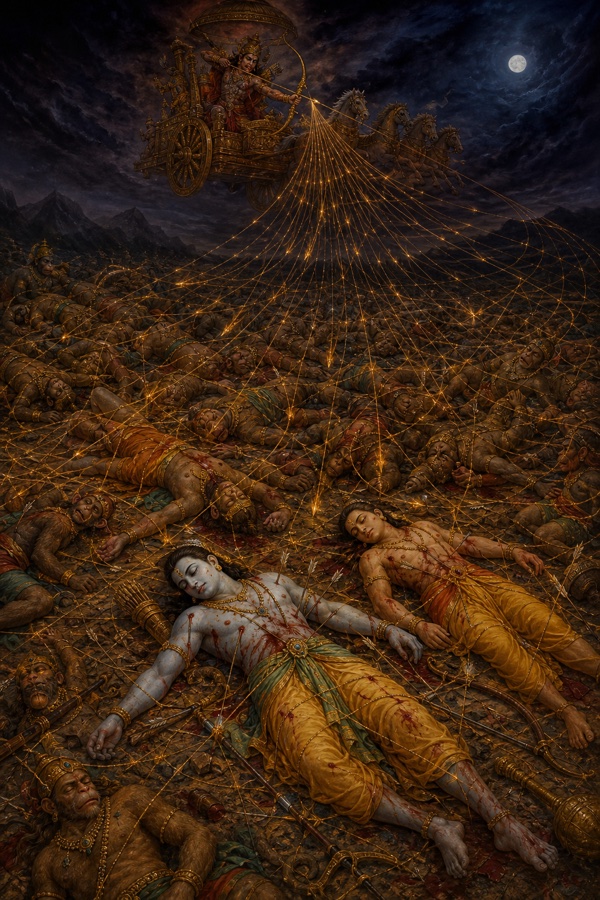
It happened as Rama had said. Indrajit’s missiles hurt the two princes grievously on the field, and having brought the two brothers to that pass, the prince of the rakshasas shouted for joy. He had laid low the army of monkeys, and Rama with Lakshmana beside him. There was nothing left for him to do there. He withdrew all at once into the city that the arms of the ten-headed Ravana protected, and there, full of delight and praised by the rakshasas, he told his father everything that had happened, in full.
Jambavan’s Instruction and Hanuman’s Bringing of the Sanjivani Mountain
Night came down on a field where the two brothers from Ayodhya lay senseless, and the army that had followed them across the sea had nothing left to follow. The vanara troop-commanders had no idea what to do. Sugriva, Nila, Angada, and Jambavan could do nothing. Vibhishana, the wisest of them, the brother of Ravana who had crossed to Rama’s side and knew the enemy’s weapons from the inside, looked at every despondent face and comforted Sugriva’s champions with words that had no equal. “Do not be afraid. This is no hour for despair. The two sons of Dasharatha lie helpless and wounded because they let themselves be overwhelmed by Indrajit’s missiles; they honored the spell sacred to the self-born creator with which that missile was invoked. This supreme missile of unfailing power, presided over by Brahma, was given to Indrajit by the self-born creator himself, and the two princes fell in the field out of respect for it. What is there in that to despair over?”
Hanuman heard Vibhishana, paid his own honor to the missile of Brahma, and said, “Then let the two of us put some heart back into whoever is still breathing in this army, which that missile has struck down.” So the two heroes, Hanuman and Vibhishana, took torches in their hands and began to range the battlefield together in the night. What the torches showed them was the earth covered on every side with vanaras the size of mountains, fallen, letting out blood from bodies whose tails, hands, thighs, feet, fingers, and necks had been severed, fouling the ground where they lay, and among them the flaming weapons that had fallen. Vibhishana and Hanuman found struck down on that field Sugriva, Angada, Nila, Sharabha, Gandhamadana, Jambavan and Sushena, Vegadarshi, Mainda, Nala, Jyotirmukha, and the monkey Dvivida. By the fifth and last watch of the day, the evening, the missile that Brahma cherished had laid sixty-seven crores of powerful monkeys on the ground.
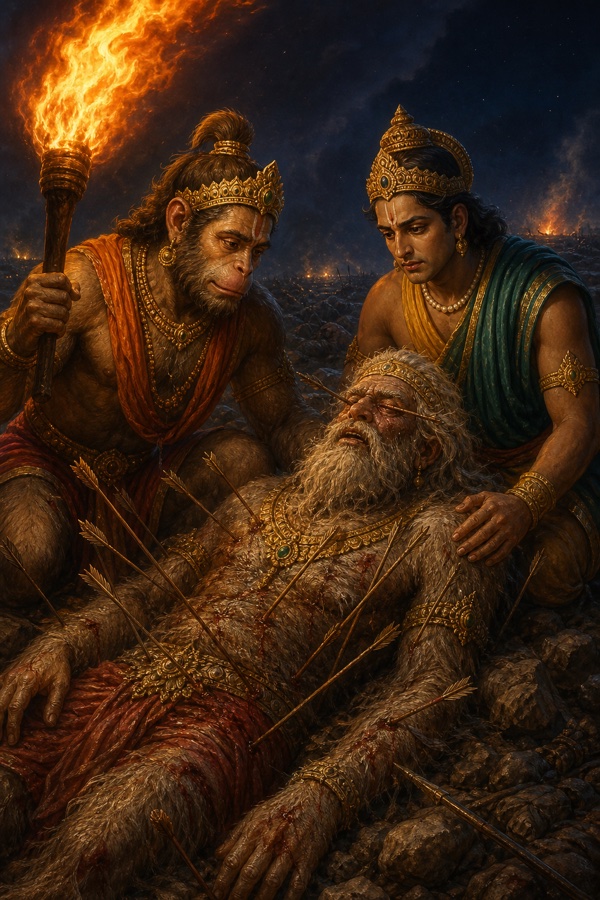
Looking out over that formidable army, which had lain like the tide of a sea until Indrajit’s shafts overwhelmed it, Hanuman and Vibhishana went searching for Jambavan. He was the oldest among them, the king of the bears, a son of Brahma, the lord of creation, and they found him an old bear naturally weighed down by his years and advanced in wisdom, covered with hundreds of shafts and looking like a fire about to go out. Vibhishana came up to him and asked, gently, “I hope, venerable one, that Indrajit’s sharp arrows have not taken your life.” Jambavan, the eldest of the bears, got the words out with difficulty. “Vibhishana, ruler of rakshasas, I know you by your voice alone. Pierced all over with sharp arrows, I can no longer see you with my eyes. Does Hanuman, the best of the monkeys, the son for whose sake Anjana his mother and the Wind-god his father are called blessed parents, still survive anywhere?”
Vibhishana was puzzled. “You pass over the two sons of Dasharatha, and you ask only after Hanuman, the son of the Wind? The affection you have just shown for him you have shown neither for King Sugriva, nor for Angada, nor even for Rama.” Jambavan answered him. “Listen, Vibhishana, and I will tell you why I ask only after the son of the Wind. If this hero Hanuman is still breathing, then our army is whole, though it lies destroyed. If Hanuman has given up the ghost, then we are all dead, though we are alive. If the son of the Wind, who is the Wind’s own equal and who vies with fire in prowess, is alive, my friend, then there may be some hope that we will survive.”
Then Hanuman came to the old bear, touched his feet with his head, and greeted him with humility. At the sound of Hanuman’s voice Jambavan, the eldest of the bears, whose mind was racked by the agony of his wounds, felt himself born again. Endowed with extraordinary energy even then, Jambavan spoke. “Come, Hanuman. You must deliver the vanaras. No one else has prowess of your kind, and you are the greatest friend the monkeys have. This is the hour for your prowess, and I see no one else who can do what must be done. Bring joy back to the ranks of the bears and the monkeys, and heal these two, Rama and Lakshmana, who lie wounded with their arrows still in them.”
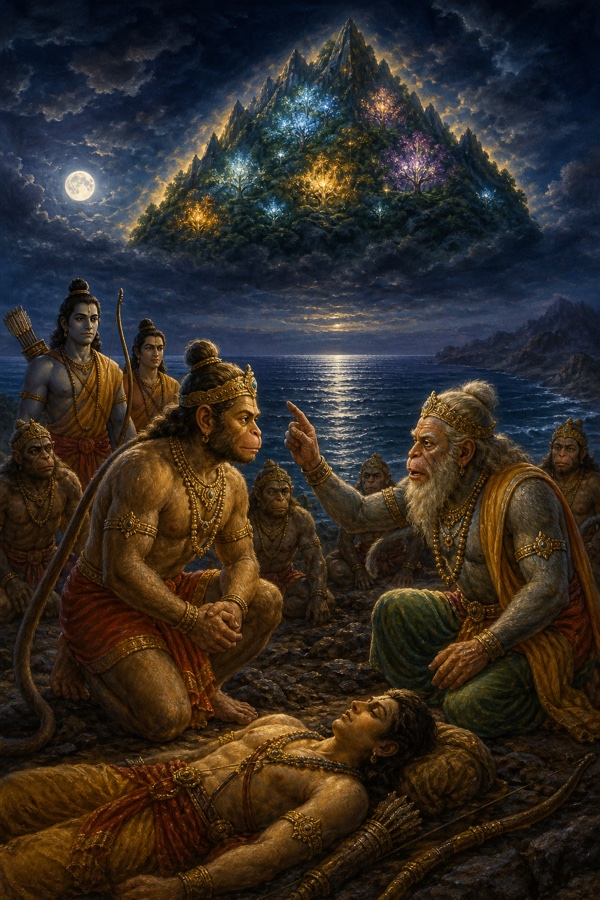
“Cross the long way over the sea, Hanuman, and go to the Himalaya, the highest of all mountains. From there you will see the golden and very lofty mountain Rishabha, the greatest of mountains, and climbing on that mountain you will see the peak of Kailasa. Between those two peaks you will find a flaming mountain covered with medicinal herbs, casting a matchless splendor, abounding in every kind of healing plant. On it you will discover four flaming herbs lighting up all ten directions: mritasanjivani, which brings the dead back to life; vishalyakarani, which draws out weapons from the body and heals every wound they made; suvarnakarani, which restores the body to its own color; and the great herb sandhani, which joins severed limbs and fractured bones. Take all four, Hanuman, and come back with all speed. Bring the monkeys back to life, son of the Wind, and reassure them.”
Jambavan’s words went into Hanuman the way the wind goes into the sea, and he swelled with tremendous power the way the ocean heaves under a gale. He had crossed this sea once already, alone, to find Sita; now he was to cross it again and go on past it to the highest mountain there is, and come back before the night was out. He climbed to the summit of Trikuta, the three-peaked mountain that carries Lanka on its back, and standing there, pressing the greatest of mountains down under his feet, he looked like a second mountain set on the first. Trodden under his feet, the mountain sank. It shook under a weight it could not bear. The trees on it fell to the ground; some caught fire from the friction of his rush, and its peaks split. The monkeys could no longer stand on that prince of mountains as it reeled under Hanuman, its trees and rocks shattering. Lanka’s mighty gates shook, houses and main gates cracked, and in its panic the city seemed to be dancing in the night. Pressing the mountain hard, Hanuman, who was a mountain himself, made the earth quake with all its oceans.
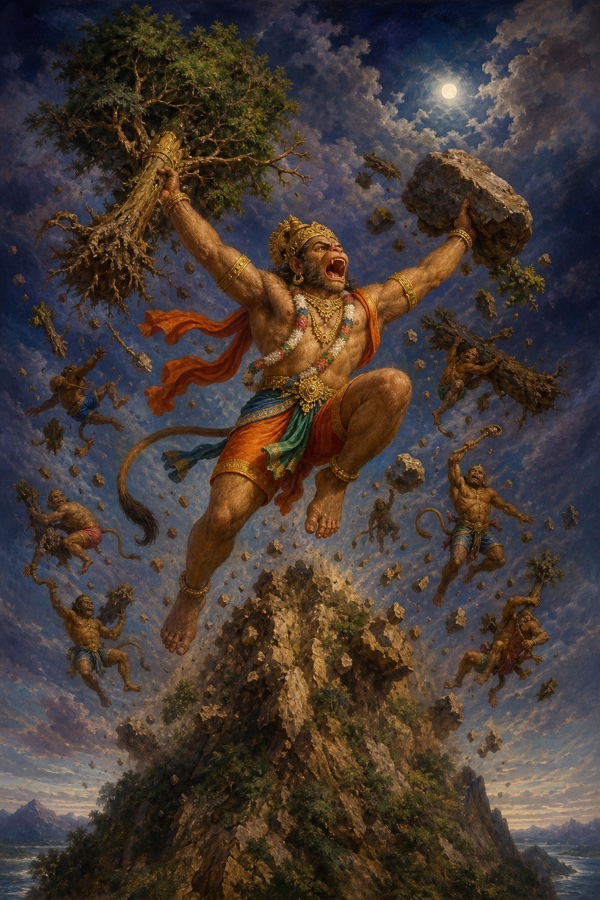
From Trikuta the monkey sprang to the Malaya mountain, which rose like Meru and Mandara, thick with springs of every kind, with trees and climbers of every description, bright with blossoming lotuses and lilies, frequented by gods and gandharvas, sixty yojanas high, visited by vidyadharas and celestial nymphs and hosts of hermits, crowded with herds of deer of every species and honeycombed with caves. Throwing into confusion every yaksha, gandharva, and kinnara who lived there, Hanuman, who looked like a cloud, grew in size. He pressed the whole mountain down with his feet, opened a mouth that shone like the fire under the sea, and roared a roar meant to strike terror into the rakshasas, and hearing it, the strongest of the rakshasas in Lanka could not stir from where they stood. Then Hanuman bowed to the god of the sea and set his mind on the great undertaking for Rama’s sake. He raised his serpent-like tail, hollowed his back, drew in his ears, opened that mouth like a submarine fire, and sprang into the air with a terrible bound. His speed dragged clumps of trees, crags, and rocks along with him, and the ordinary monkeys living on the mountain too, torn loose by the sweep of his arms and thighs, and when his speed slackened they dropped into the water.
Stretching his arms like the coils of serpents, Hanuman, who was Garuda’s equal in prowess, made for the Himalaya, the king of mountains, the highest of them all, and it seemed that he was dragging the four quarters after him. Below him the sea whirled, its waves and its creatures spun by the wind of his passing, and he shot forward like the discus loosed from the fingers of Vishnu. Surveying mountains, flocks of birds, lakes, rivers, ponds, great cities, and prosperous kingdoms, the monkey who matched his father in speed sped on without tiring through the orbit of the sun, setting the quarters ringing with the sound of himself. Remembering Jambavan’s directions, he suddenly caught sight of the Himalaya, adorned with springs of every kind, full of caves and cascades, its peaks lovely to look at, like masses of white cloud, its slopes graced with trees of every species. On that lord of mountains, with its high golden peaks, he saw holy and extensive hermitages where hosts of celestial sages lived. He saw the seat of Hiranyagarbha, and the abode of Rajatanabha, and the abode of Indra; the spot from which Rudra loosed his arrow at Tripura; the abode of Hayagriva; the blazing abode of the deity of the Brahmastra; the servants of Yama; the abode of Agni; the abode of Kubera, shining like the sun; the spot where the sun was once tied down so that Vishvakarma, the craftsman of the gods, could scrape away the excess of his glare for the sake of the sun’s wife Chhaya; the abode of four-faced Brahma; the abode of Shiva’s bow; and the navel of the earth, the hole through which one goes down into Patala. He saw the excellent mountain Kailasa, where Shiva lives, and the rock of the Himalaya on which Shiva practiced his austerities, and Shiva’s bull, and the lofty golden mountain Rishabha; and there, on that king of mountains, he saw the mountain of herbs, ablaze with every healing plant, blazing like a heap of fire.
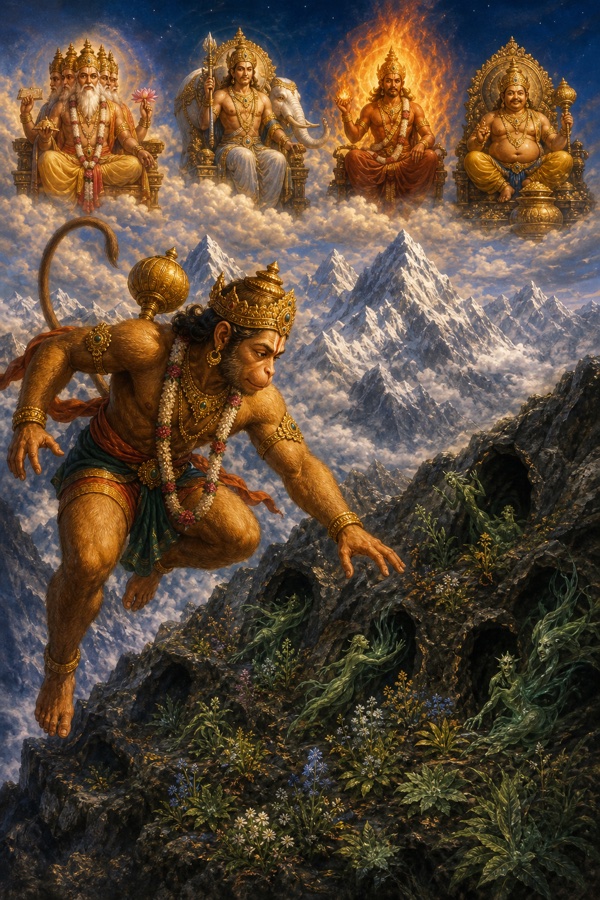
The mountain blazed like a heap of fire, and Hanuman, the son of the Wind, was astonished at the sight of it; he leapt onto that lord of herb-bearing mountains and began to search for the herbs Jambavan had described. He had crossed thousands of yojanas to reach this place. The great monkey ranged over the mountain that bore the divine herbs on its slopes, and the herbs knew a seeker had come. All the sovereign herbs on the mountain made themselves invisible to Hanuman. Unable to identify a single one, the great-hearted Hanuman grew angry, and in his wrath he let out a tremendous roar. He could not bear their vanishing; his eyes burned like fire, and he spoke to the mountain. “Since you have shown no compassion even for Rama of Raghu’s line, this hardness of yours is contemptible. Overpowered by the strength of my arms, lord of mountains, see yourself shattered to pieces this instant.”
Then Hanuman seized by force the top of that mountain, with its thousands of minerals, its trees, its elephants, and its gold, and broke it off at once, so that its crags were crushed and the crest of its plateau caught fire. Uprooting it, striking terror into the worlds and into the lords of the gods and demons who live in them, he sprang into the air with it and sped away with the terrible speed of Garuda, acclaimed as he went by the beings who travel the sky. Reaching the orbit of the sun with that mountain peak, radiant as the sun, Hanuman, who was himself the sun’s likeness, seemed beside the solar disk to be its very image; coursing through the sky with that crag in his hands, he looked like Vishnu with his flaming discus.
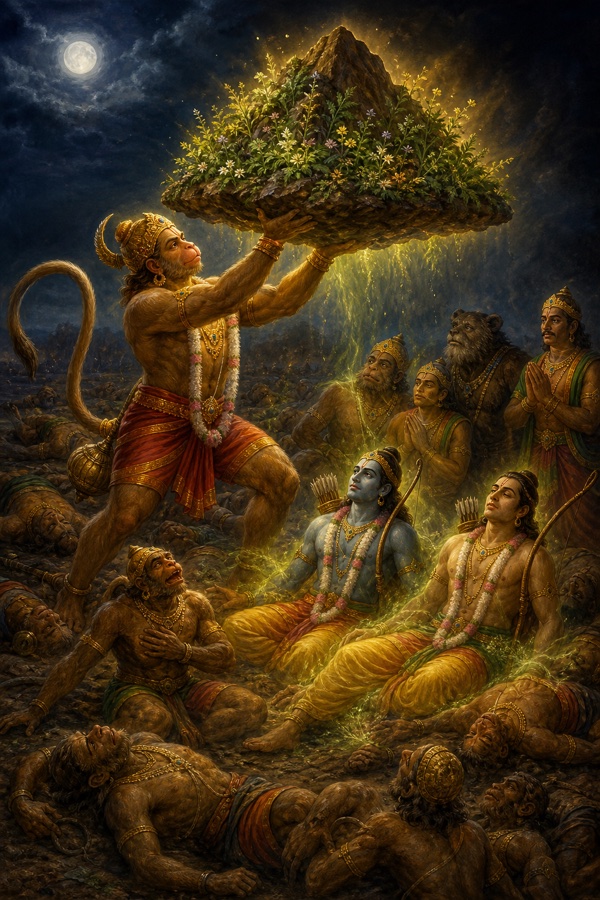
The monkeys saw him coming and roared, and Hanuman roared back with joy at the sight of them, and hearing that uproar, the people of Lanka set up a still more terrible cry. Then Hanuman came down on Trikuta in the midst of the vanara ranks, greeted the jewels among the monkeys with his head bent low, and embraced Vibhishana where he stood. At the unique fragrance of those powerful herbs the two sons of the king of men were healed of their wounds then and there, and the other great heroes among the monkeys who had lain senseless on the field sprang to their feet. Even the great heroes who had been killed were healed and rid of their pain in an instant by breathing the fragrance of those most excellent herbs, the way sleepers wake fully at the close of the night. The rakshasa dead were not there to breathe it. From the day the monkeys and the rakshasas had begun to fight in Lanka, every rakshasa killed in combat had been thrown into the sea the moment he fell, on Ravana’s orders, so that the enemy would never learn their number. Then Hanuman, whose speed was beyond measure, carried that mountain full of healing plants back with all speed to the Himalaya, and came again to Rama.
The Vanaras Burn Lanka and the Fierce Night Battle
Sugriva wasted none of the strength the herbs had given back. An hour earlier his army had been lying dead on the ground; now it stood around him whole, and he set out the next task at once, speaking to Hanuman so that every vanara within hearing would know what came next. “Kumbhakarna is dead and the young princes are destroyed. Ravana has nothing left to defend himself with. So let the best of the monkeys, the strongest and the quickest, take torches in their hands and go into Lanka now.” The sun had set. Into that dreadful evening the vanara champions marched with their faces toward Lanka and fire in their hands, and the long line of torches climbed toward the walls. The rakshasas posted at the gates found torch-bearing monkeys coming at them from every side, and suddenly they broke and ran, and the vanaras, overjoyed at their flight, put fire to the towering gates, the attics, the streets, the byways, and the mansions. The fire ate thousands of their dwellings. Mansions that looked like mountains toppled to the ground.
The wealth of Lanka went into the flames with the houses. Aloewood burned there, and fine sandal of great price, and pearls, glossy gems, diamonds, and coral. Linen burned, and charming silk, blankets of sheep’s wool and every article made from the wool of rams, gold ornaments, and weapons. Raging on every side, the fire took the ornaments and saddles of horses in all their peculiar designs, the chains worn around the necks of elephants and their girths, the polished fittings of chariots, the coats of mail of warriors and the armor of elephants and horses, swords, bows, bowstrings and arrows, lances, goads and javelins, blankets and rugs of animal hair, whisks made from the hair of tails, tiger skins, musk in abundance, palaces inlaid with pearl and gem, and stores of arms of every kind. It consumed picturesque dwellings of every sort, and flared up again and again.
It burned the houses of rakshasas who loved their homes, hundreds of thousands of houses, and the men inside them were caught exactly as they were: in coats of mail encrusted with gold, in garlands and jewels and fine garments, their eyes wild with wine, walking slowly with drink, their robes held up by the women who loved them, raging at the enemy with maces and pikes and swords in their hands, eating and drinking, lying fast asleep on sumptuous beds with their beloveds, or hurrying in panic on every side with their children in their arms. The fire wholly consumed the strong and costly houses of Lanka, houses built to be impenetrable with their many enclosures and defensive walls and secret doors and gates and posterns, houses built with gold in the shape of the full moon and the crescent, rising high with their top rooms, ringed with beautiful eye-holes, furnished with seats and couches, patterned with gem and coral, seeming to touch the sun, loud with the cries of herons and peacocks and the notes of lutes and the jingling of ornaments, houses that looked like mountains. Wrapped in fire, the archways shone like clouds girt with lightning when the summer has just passed; wrapped in fire, the houses shone like the peaks of a great mountain lit by a forest fire. Lovely women who had lain asleep in seven-storied palaces woke scorched, let go of ornaments that were melting in the heat, and screamed at the top of their voices in their pain. Houses wreathed in fire collapsed like the peaks of a huge mountain struck by Indra’s thunderbolt. Burning, they shone from afar like the peaks of the Himalaya burning on every side; with its house-tops ablaze in the night, Lanka looked as if it had been decked with kimshuka trees in blossom. With elephants let loose by their keepers and horses set free to save them from the flames, Lanka was the ocean at the end of the world-cycle, its alligators running wild.
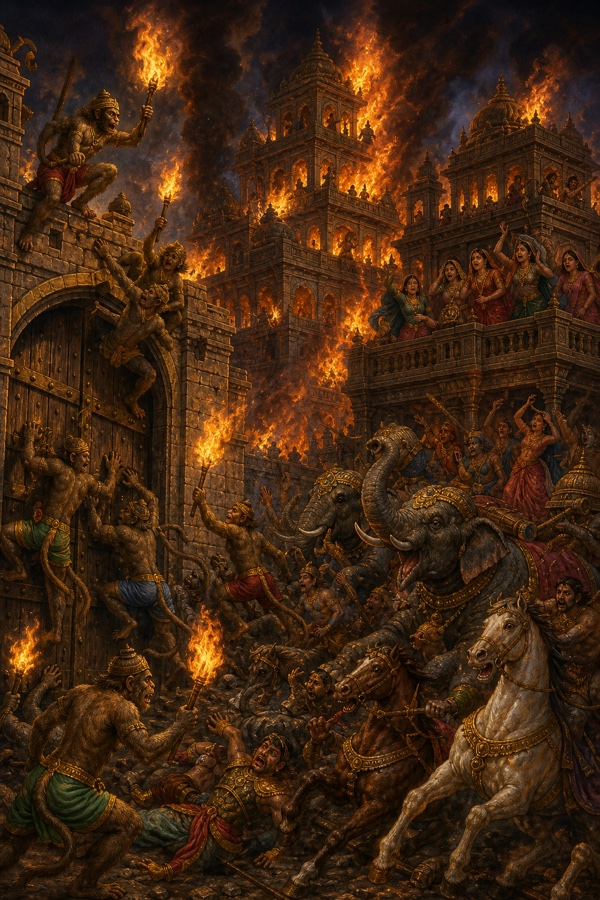
Here an elephant ran in alarm from a loosed horse; there a horse turned in terror from a frightened elephant. As Lanka burned, the sea took the city’s image on its water, and the whole sea looked as though its water had turned red. Set alight by the vanaras, that city took on in less than an hour the look of the earth in flames at the dread destruction of the world. The clamor of the women of Lanka, wrapped in smoke, scorched by fire, shrieking at the tops of their voices, could be heard for a hundred yojanas.
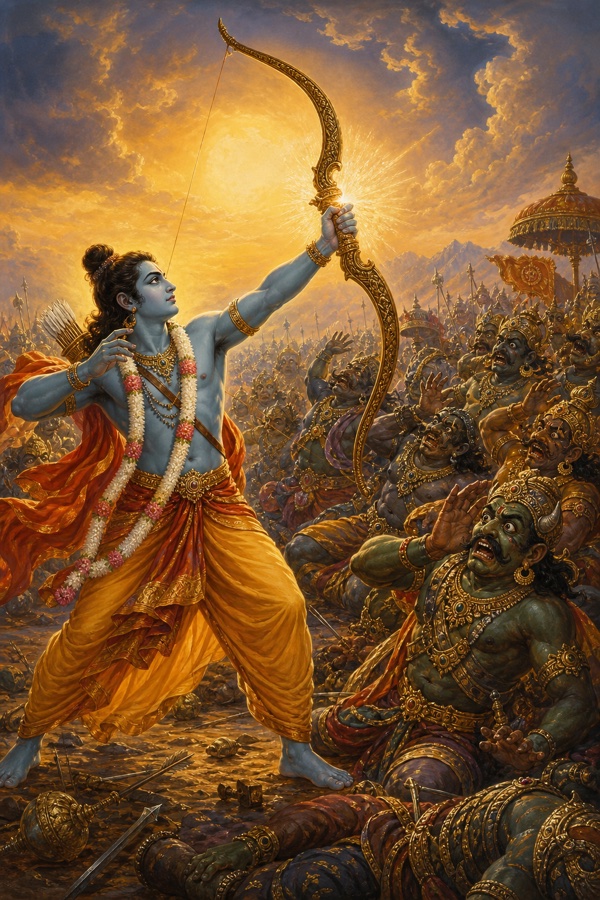
Rakshasas came rushing out of the city with their bodies badly burned, trying to save their lives, and the vanaras, eager for war, fell on them all at once. The vanaras’ shouts of victory and the rakshasas’ cries of distress made the ten directions, the sea, and the earth ring. Their wounds healed, shaken by nothing, the two princes, Rama and Lakshmana, took up their excellent bows. Rama drew his, and from it rose a tumultuous twang that struck terror into the rakshasas; bending that great bow, Rama shone the way Shiva, the source of the universe, shines when he stretches his bow made of the Vedas, in great fury, at the dissolution of the world. The twang of Rama’s string could be heard above both the other sounds, the clamor of the monkeys and the wailing of the rakshasas, and the three sounds together, victory-shout, wail, and bowstring, filled all ten directions. Under the shafts loosed from Rama’s bow, the principal gate of the city, which stood like a peak of Kailasa, crumbled to the ground. When they saw Rama’s arrows coming down on the seven-storied mansions and the other houses of Lanka, the rakshasa chiefs’ will to fight swelled in them, and as they prepared their sortie and let out their lion-roars, night came down on them like the night of final dissolution presided over by Rudra.
Sugriva gave the vanara chiefs their orders. “Attack the nearest gate and fight, vanaras! And any one of you who is present on the field and makes his escape without fighting, overtake him and kill him, for he has flouted the king’s command.” When the vanara chiefs took their stand at the gate with their hands bright with burning torches, fury took possession of Ravana. The ten quarters ran together in the violent disturbance of the air made by his yawning, fear and wrath together, and he looked like the wrath of Rudra given a body. Seized with fury, he sent out Kumbha and Nikumbha, the two sons of Kumbhakarna, with many other rakshasas of great might, and Yupaksha, Shonitaksha, Prajangha, and Kampana went out with the two of them at Ravana’s order. Roaring like a lion, Ravana commanded them: “Go, rakshasas, this very instant.”
The rakshasas came out of Lanka at his word with their weapons shining, roaring and roaring again. Then came a strange thing in that night: the whole sky over the field was lit. The rakshasas lit it with the glitter of their jewels and the glow of their own bodies; the vanaras lit it with their torches; the moon, the stars, and the gold on both armies threw their light up together, and under moonlight and jewel-shine and the burning planets the ranks of monkeys and rakshasas stood out plainly on every side. Out on the water the sea with its rolling waves shone brighter still, where the flames of Lanka’s half-burned houses lay across it. And through that light the army of the rakshasas came into view: flags and pennons; fine axes shaped like swords; formidable horses, chariots, and elephants; foot soldiers of every kind; bright pikes, maces, swords, spears, lances, and bows; hundreds of little bells ringing on the chariots and the elephants; the arms of the warriors heavy with gold; axes swung, great weapons waved, arrows already on the string; and over the whole of it a scent of sandal paste, garlands, and wine. Crowded with brave men, it thundered like a bank of cloud. The vanara host saw it come, an army hard to meet, and marched out to meet it with a cry; and the rakshasa army sprang forward with all its speed and rushed at the enemy once more, the way moths rush at a flame, and the iron clubs and the missiles swinging in a thousand arms only made it shine the brighter.
The vanaras went in as if they had lost their minds, striking the rakshasas with trees and boulders and fists, and the rakshasas, brave and quick with their whetted shafts, took the heads off monkeys even as they came running. Rakshasas with their ears bitten off by monkey teeth, their skulls cracked by monkey fists, their limbs broken by flung rocks, wandered the lanes of Lanka, and other rakshasas of grim aspect cut at the best of the vanaras on every side with their swords. One warrior struck an enemy who was striking someone else; another threw down an enemy who was throwing down someone else; a third cursed an enemy who was cursing someone else, and a fourth bit an enemy who was biting someone else. “Fight me,” said one, and another took him up; a third cut in, “I have this one, wait, why trouble yourself for nothing.” So the warriors of the two armies called to one another in the streets of Lanka. A fearful struggle broke open between monkey and rakshasa: arms dodged, weapons driven into armor, long lances raised to throw, fists and pikes and swords and spears used however they came to hand. The rakshasas killed the vanaras ten and seven at a time, and the vanaras struck down the rakshasas ten and seven at a time. The rakshasa army, its clothing barely holding together, its coats of mail and its standards flung away, was cut off by the vanaras and surrounded on every side.
The Deaths of Kampana, Prajangha, Shonitaksha, Yupaksha, and Kumbha
In that terrible, crowded battle that was eating heroes by the hundred, Angada went looking for a fight and found the brave Kampana. Kampana challenged him and struck first, fast, a mace-blow that left Angada reeling. When his senses came back Angada hurled the top of a mountain at him, and Kampana, broken by it, fell dead to the earth. Shonitaksha saw Kampana die and drove his chariot at Angada with the speed of a man who knows no fear, and pierced him with sharp shafts that tore the flesh and burned like the fire at the end of the world. He used arrows of every name there is, the razor-headed kshura, the crescent-headed kshurapra, the all-iron naracha, the calf-toothed vatsadanta, the shilimukha feathered like a buzzard, the eared karni, the long-headed shalya, and the vipatha with its head like an oleander leaf, and riddled through every limb with all of them, the mighty son of Vali gathered his strength and crushed Shonitaksha’s formidable bow, his chariot, and his arrows to pieces.
Shonitaksha did not hesitate. He took up sword and shield and leapt from his chariot in a rage. Angada sprang more nimbly still, seized him, wrenched the sword out of his hand, and roared. Then he drove the sword into the flat of the rakshasa’s shoulder and cut him diagonally, in the line a sacred thread takes across the chest. Holding that huge sword and roaring at the top of his voice again and again, the son of Vali went for the other enemies at the head of the fight. Shonitaksha recovered, took up his steel mace, and with his gold armlets flashing ran after Angada himself; the heroic Yupaksha drove his chariot at Angada with Prajangha beside him, and the mighty Prajangha, a great hero, fell on him with his mace. Between the two warriors Shonitaksha and Prajangha, Angada shone like the full moon between the two stars of Vishakha. Mainda and Dvivida, the brothers who were Angada’s maternal uncles, came and took their stand on either side of him, each of them meaning to show what he could do. Gigantic rakshasas bearing swords, arrows, and maces assailed the monkeys from every side in fury, and between three monkey chiefs and three champions of the rakshasas a fight was fought that made the hair stand on end.
The vanaras seized trees and hurled them steadily and hard at the rakshasa chiefs, and Prajangha cut them down with his sword. They hurled trees and crags at the enemy’s chariots and horses, and Yupaksha tore them apart with volleys of arrows. The trees that Dvivida and Mainda tore up and threw, the brave Shonitaksha smashed in mid-air with his mace. Then Prajangha raised his huge sword, a sword that could split the vital parts of an enemy, and rushed at the son of Vali. Angada watched him come near, struck him with an ashvakarna tree, and then struck the arm that held the sword with his fist, and under that blow the sword dropped to the ground. Prajangha looked at his sword, which was shaped like a pestle, lying in the dirt, and clenched a fist as hard as adamant and struck Angada on the forehead, so that the best of the monkeys staggered for a moment. Then Angada, Vali’s energetic and powerful son, came back to himself and with one blow of his fist dashed Prajangha’s head off his trunk.
Yupaksha watched his uncle Prajangha die, and his arrows were already spent; with his eyes filling with tears he climbed down quickly from his chariot and came on with his sword. The mighty Dvivida saw him coming fast, struck him in the chest in fury, and caught hold of him by force. Shonitaksha saw his brother taken and struck Dvivida in the chest with his mace; Dvivida reeled under the blow, and as the mace came up again he snatched it out of the rakshasa’s hand. Meanwhile the brave Mainda came up beside Dvivida and struck Yupaksha in the chest with his open palm. Then Shonitaksha and Yupaksha, full of their own fury, fought the two monkeys hand to hand on that field, pulling and overthrowing and being overthrown. Dvivida tore Shonitaksha’s face with his nails, dashed him against the ground, and crushed him there; and Mainda, enraged, pressed Yupaksha in his arms until he died, and let him fall to the ground.
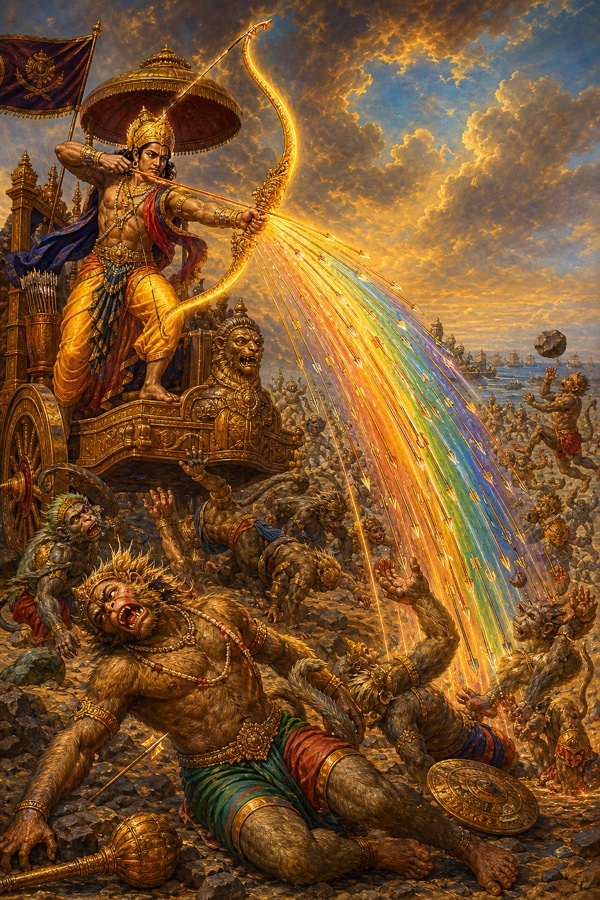
Its principal heroes dead, Ravana’s army lost heart and turned toward the place where Kumbha, Kumbhakarna’s son, was fighting. Kumbha steadied the army as it came rushing to him. He saw that vanaras who had found their moment had struck down the great heroes of his side, and his will to fight rose to meet it, and he did a thing on that field that others would have found beyond them. Fully composed, that prince of archers took up his bow and loosed arrows like venomous serpents, arrows that could tear the flesh of an enemy, and with an arrow on the string that excellent bow shone like a second rainbow lit by lightning and by the splendor of Airavata. He drew a gold-shafted, feathered arrow back to his ear and struck Dvivida with it, and Dvivida, who was the size of Trikuta, lost his footing and dropped, wriggling, with his legs sprawled out.
Mainda saw his brother go down in that great combat, seized a huge rock, and rushed forward. He hurled it at the rakshasa with all his enormous strength, and Kumbha shattered it in the air with five whetted shafts; then, fitting a fair-headed arrow like a venomous serpent to his bow, he struck Dvivida’s elder brother in the chest. Struck in a vital part, Mainda, the leader of monkey hordes, fell senseless to the ground. Angada saw both his uncles wounded, and though they had been the strongest of the strong, he rushed headlong at Kumbha, who stood waiting with his bow raised. As Angada came, Kumbha pierced him with five steel arrows and three other penetrating shafts, stinging him the way goads sting an elephant, and then with many more. Pierced all over his body with gold-decked steel arrows whose points were still sharp, the son of Vali stood unshaken. He poured showers of rocks and trees down on Kumbha’s head, and the glorious son of Kumbhakarna tore every one of them apart; then, with the leader of the monkey hordes still coming at him, Kumbha pierced both his eyebrows with two arrows, the way a man puts out a pair of firebrands at an elephant, and the blood ran down from his brows and veiled his eyes.
Covering his blood-filled eyes with one hand, Angada seized a sal tree standing near him with the other. He propped it, branches and all, against his chest, pressed it tightly with the one hand, bent its twigs, and tore it up in the middle of that great combat, and while all the rakshasas present stood watching, he flung it at Kumbha, a tree as tall as the banner of Indra and as big as Mandara. Kumbha tore it apart with seven sharp arrows that could cleave the body. That was the blow that broke Angada; he swooned and fell. The vanara leaders saw Angada, whom no one could assail, fallen and sinking into despondency as if into a sea, and they carried the news to Rama, and Rama, hearing that Vali’s son was in anguish in a major conflict, sent out the monkey leaders under Jambavan to his aid.
At Rama’s command the best of the monkeys rushed in great fury toward Kumbha, who stood with his bow raised. Keen to protect Angada, they came at him with trees and rocks in their hands and their eyes blood-red with anger; Jambavan, Sushena, and the monkey Vegadarshi assailed the heroic son of Kumbhakarna in a body. Kumbha saw those monkey chiefs of enormous strength advancing and intercepted them with a volley of shafts, the way a rock intercepts the course of a torrent. When they came within the range of his arrows, the gigantic monkey chiefs could not even look at him, much less go forward, any more than an ocean can overstep its shore.
His ranks were being tormented by those hails of shafts, and Sugriva, the king of the monkeys, had seen enough. He placed his nephew Angada behind him, the boy he had watched go down twice that night, and went at the son of Kumbhakarna on the field the way a lion goes at an elephant roaming the mountain slopes. He tore up huge ashvakarna trees and many others and hurled them at the rakshasa, and the glorious son of Kumbhakarna tore that shower of trees apart with sharp arrows, though it covered the sky and there was no getting near it; covered with the arrows of that skilled marksman, the trees looked like so many shataghnis, the iron-spiked killers of a hundred. The brave, glorious, courageous Sugriva was not troubled in the least to see his trees dispersed. Even as Kumbha’s arrows were still piercing him, he bore them, sprang up onto the chariot, snatched the bow that shone like the rainbow out of Kumbha’s hands, and snapped it. It was a feat others would have found impossible, and when it was done he leapt down from the chariot and spoke in anger to Kumbha, who now looked like an elephant whose tusks have been broken:
“Your prowess, elder brother of Nikumbha, the prowess that gives your arrows their force, is wonderful. Kindness toward the rakshasas and true majesty are found in you and in Ravana alone, you who are the equal of Prahlada, Bali, Indra the slayer of Vritra, Kubera, and Varuna. You alone have taken after your father Kumbhakarna, whose might had no equal. With a pike in your hand, tamer of your enemies, the gods themselves cannot overcome you, any more than the agonies of the mind can overwhelm a man who has mastered his senses. So show your prowess, and see my deeds. Your uncle Ravana can withstand gods and demons by the boon that Brahma and Shiva conferred on him; your father Kumbhakarna could withstand gods and demons by his own prowess. You are rich in both, and in that you excel your uncle and your father alike. In archery you are Indrajit’s equal, in might Ravana’s; in strength and prowess you are the first warrior in the world of the rakshasas this day.”
“Let created beings witness your prodigious and mighty encounter with me on this field today, as they witnessed the conflict between Indra and the demon Shambara. You have done a feat that has no equal and shown your skill in the divine missiles. You have struck down monkey heroes of terrible prowess. And I have held back from finishing you for one reason only: I feared the reproach of striking a man who stood fully exhausted by his own exploits. So take the rest you have earned, and then witness my strength.” Kumbha felt flattered by that compliment of Sugriva’s, disdain and all, and his will to fight doubled under it, the way a fire fed with clarified butter doubles its brightness. Then Kumbha clasped Sugriva in his arms. Fastened limb to limb, the two of them stood breathing heavily, again and again, like two elephants in rut, rubbing against each other, and from their mouths came flames mixed with smoke from the sheer exertion. The earth sank under the trampling of their feet, and the sea, Varuna’s abode, grew turbulent with rolling waves.
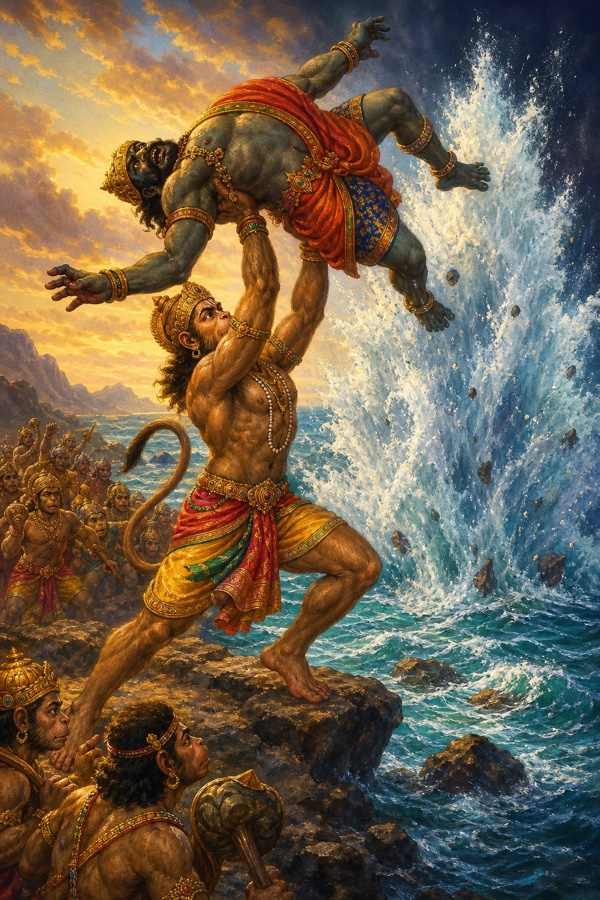
Then Sugriva lifted Kumbha and threw him with violence into the salt sea, showing him the bottom of it. As Kumbha went in, a mass of water rose as high as the Vindhya or Mandara and spread out on every side. Kumbha sprang up out of it, threw Sugriva down, and furiously struck him on the chest with a fist like adamant; the monkey’s armor split, blood gushed from his chest, and the fist that came down with such ferocity struck against the very framework of Sugriva’s bones. From the force of that blow a mighty flame shot up in that place, like the fire that bursts from Mount Meru under a stroke of lightning. Struck on the chest by Kumbha, Sugriva, the strongest of the monkeys, clenched his own fist, hard as adamant and shining like the sun’s disk ringed with a thousand rays, and brought it down on Kumbha’s chest. Severely tormented by that blow, Kumbha lost his wits and collapsed at once, like a fire whose brightness has gone out; struck by Sugriva’s fist, the rakshasa fell the way the planet Mars in all its brilliance would drop out of the sky if fate willed it. As he fell with his chest broken by Sugriva’s fist, the body of Kumbha shone like the form of the sun-god overpowered by Rudra. When that hero was killed by Sugriva, the best of the monkeys, the earth with its mountains and forests shook, and fear seized the rakshasas on every side.
Nikumbha’s Death at Hanuman’s Hands
Nikumbha saw his elder brother Kumbha struck down by Sugriva, and he looked at the king of the monkeys as if he meant to burn him up with the look. Then the brave rakshasa took up his brilliant iron bar. It was hung with garlands of flowers and banded with iron plates five fingers wide; it was as big as a peak of Mount Mahendra, plated with gold and set with diamonds and coral, terrible as the rod of Yama, and it took the fear out of the rakshasas. Whirling that weapon, which rivaled the banner of Indra in splendor, Nikumbha opened his mouth wide and roared. With the golden ornament on his chest, the armlets on his arms, his charming earrings and his lovely garland, and that bar in his hands, Nikumbha shone like a cloud shot through with lightning, sounding with thunder, and crossed by a rainbow.
Where the tip of the bar cut the air, the seven winds that band the sky broke against it, and the bar glowed like a smokeless flame. The vault of heaven with the city of Alaka in it, the fine mansions of the gandharvas, the hosts of stars and lunar mansions, the moon and the great planets, all seemed to spin round with the whirling of Nikumbha’s bar. He had burst into flame like the fire at the end of the world-cycle, and that fire which was Nikumbha, with the bar and his ornaments for its flames and his wrath for its fuel, became a thing no one could approach. In their terror neither rakshasa nor vanara dared to move. But the mighty Hanuman opened his chest wide and went and stood in front of him. Nikumbha, whose arms were as stiff as iron bars, brought that bar, shining like the sun, down on the chest of the mighty monkey, and the instant it struck that solid, broad chest, it split into a hundred splinters and scattered like a hundred meteors crumbling in the air at once. Under the blow the great monkey stood as unmoved as a mountain in an earthquake.
Hanuman, the best of the monkeys, whose strength went beyond measure, clenched his fist with vehemence. Raising it, that powerful and agile monkey, the Wind’s equal in prowess, dashed it into Nikumbha’s chest, and there the armor split and blood shot forth, and it looked on his chest like lightning sprung from a cloud. Nikumbha staggered under the blow; recovering, he caught hold of Hanuman, for all Hanuman’s strength. The people of Lanka saw the son of the Wind seized and carried off by that rakshasa, and they roared with joy. Even as he was being carried, Hanuman struck him with a fist hard as adamant, broke out of his grip, dropped to the ground, and quickly threw Nikumbha down. With the rakshasa on the ground, the supremely active Hanuman crushed him; springing up, he leapt onto his chest with all his weight, seized the rakshasa’s neck, twisted it, and tore off his huge head while Nikumbha was still letting out a terrible cry. When Nikumbha had died like that at the hands of the son of the Wind, the monkeys sent up loud cries of joy and the quarters rang; the earth seemed to quake, the heavens seemed to crumble, and fear took possession of the army of the rakshasas. And at once a formidable struggle beyond any yet broke out between Rama, son of the emperor Dasharatha, and Makaraksha, son of Khara, the two of them seized with a terrible anger.
The March of Makaraksha
Nikumbha killed, Kumbha laid low: when that news reached Ravana he flared up like fire. Anger and grief had him together, and he turned to Makaraksha, the large-eyed son of Khara, and gave him his orders. Khara had died in the Dandaka forest long before any of this, at Rama’s hands, with his whole army around him, and his son had been carrying that day ever since. “Go, my son, at my command, with an army, and finish those two brothers and the monkeys with them.” Makaraksha, who counted himself a hero, rejoiced to hear it, and said, “So be it.” He saluted Ravana, walked the clockwise circle around him that marks submission, and, mighty warrior that he was, went out of Ravana’s shining palace to do what he had been told.
To the commander-in-chief standing near him the son of Khara said, “Bring my chariot at once, and mobilize the army quickly.” The rakshasa who commanded the army of Lanka placed the chariot and a contingent of troops beside him. Makaraksha walked clockwise around his chariot, mounted it, and told his charioteer, “Take the chariot to the battlefield with all speed.” Then he addressed all the rakshasas who marched with him. “Fight, all of you, with everything you have, and keep in front of me, rakshasas! Ravana, the ruler of the rakshasas, has commanded me to kill both princes, Rama and Lakshmana, in the field. This day, with my excellent shafts, I finish Rama, and Lakshmana, and the monkey Sugriva, and the rest of the monkeys with them; and hurling pikes I will wipe out that huge army of monkeys the moment it arrives, the way fire consumes dry wood.”
The rakshasas heard his boast and rejoiced: cruel, gigantic creatures, armed with every kind of weapon, steadfast, able to change their form at will, with jutting teeth, reddish-brown eyes, and disheveled hair that put terror into anyone who saw it. They surrounded the colossal son of Khara and marched forward joyously, roaring like elephants and shaking the earth. On every side rose a great tumult of thousands of conches and kettledrums, of lion-roars and the slapping of arms. Then, all at once, the long whip slipped from the hand of Makaraksha’s charioteer, and the rakshasa’s standard fell over, as fate would have it. The horses yoked to his chariot forgot their many paces and went forward with faltering steps, trudging along dolefully with tears in their eyes. As that fierce, evil-minded Makaraksha went out, a wind rose that was harsh and cruel and full of dust. All those brave rakshasas saw the portents, and ignored them, and went on toward the place where Rama and Lakshmana were. Colored like clouds, like elephants, like buffaloes, skilled in fighting, scarred more than once by mace and sword at the head of earlier battles, those rakshasas roamed the field crying again and again, “I will take the lead! I will take the lead!”
The Death of Makaraksha at Rama’s Hands
Makaraksha came out, and all the vanara chiefs leapt to their feet at once and stood arrayed to give battle. The encounter that followed between the monkeys and the rakshasas was the kind that makes the hair stand on end, like a battle of the gods against the demons. The monkeys crushed their opponents with trees; the rakshasas with pikes; and both sides brought maces and clubs down on their adversaries. The rakshasas made havoc of the lions among the monkeys with javelins and swords, maces, spears and lances, sharp-edged spears, slings that threw stones, nooses, mallets, staffs, and missiles, and with arrows shot on every side. Wounded by the volleys of the son of Khara and stricken with fear, all the monkeys fled, bewildered, and the arrogant rakshasas, with many more rakshasas behind them, watched them run and roared like lions with a triumphant air.
While the monkeys were fleeing in every direction, Rama intercepted the rakshasas with a hail of shafts. Makaraksha saw his rakshasas held, and the fire of anger filled him, and he spoke. “Stop, Rama! Your duel is with me. With sharp arrows from my bow I will relieve you of your life. You killed my father in the Dandaka forest, and from that day my wrath has grown violent whenever I think of you and your wicked deeds. My limbs have burned, evil-minded son of Raghu’s line, because I did not find you in that great forest at the time. By good fortune you have come into my sight here. I have sought you as a hungry lion seeks an ordinary animal. This day the force of my arrows will send you to the realm of Yama, and you will dwell there with the very champions you have killed. What is gained by talking? Listen to me, Rama. Let all the people see you and me trying our strength on this field. Let the trial begin, with divine missiles, with maces, with bare arms, or with any weapon you have practiced with.”
Rama, son of the emperor Dasharatha, laughed out loud at the challenge and answered the rakshasa, who was still talking on without pause. “Why praise yourself for nothing, rakshasa? You have said a great deal that is beneath you. No victory is won on a battlefield by the force of speech without a fight. In the Dandaka forest I killed fourteen thousand rakshasas, and your father Khara, and Trishira, and Dushana as well. Vultures and jackals and crows, with their sharp beaks and their goad-like claws, ate their fill of their flesh. Today they will eat their fill of yours, sinner.” Hearing that, Makaraksha, with all his enormous strength, shot volleys of shafts at Rama on the field. Rama tore those arrows to pieces with a hail of his own, and the rakshasa’s gold-shafted arrows, cut apart by the thousand, fell to the ground.
Then, at close quarters, a fierce single combat raged between Makaraksha, son of the rakshasa Khara, and Rama, son of Dasharatha. The sound of their bows, made by the friction of hand and bowstring, was heard on that field the way the rumbling of clouds is heard in the sky. Gods, demons, gandharvas, kinnaras, and great serpents came and stood in the air to witness that astounding combat. Though the limbs of both were pierced, the strength of both was doubled; each wounded the other and each returned the other’s blows. The rakshasa tore the volleys of shafts that Rama shot, and Rama split the rakshasa’s shafts into pieces with his own. All four quarters and the points between were covered with arrows, and the earth itself was so obscured on every side that nothing could be seen. Then Rama of the mighty arms, in anger, split Makaraksha’s bow, pierced his charioteer with eight steel arrows, split the chariot with his shafts, and struck down the horses. Deprived of his chariot, Makaraksha stood on the ground.
Standing on the earth, the rakshasa seized his pike, a weapon that struck terror into every created being and shone like the fire at the end of the world-cycle. It had been hard to win; Rudra had given it to him; it inspired terror and shone in the air like a second weapon of universal destruction, and at the sight of it every god fled in panic in every direction. Whirling that great flaming pike, the rakshasa, in his rage, hurled it at Rama in that major conflict. As it came flying, while it was still in the air, Rama split it with four arrows, and struck by Rama’s shafts, that pike decked with celestial gold broke into many pieces and crumbled onto the ground like a great meteor. The beings standing in the sky saw that pike destroyed by Rama, who never tires of his work, and they cried out, “Well done! Bravo!”
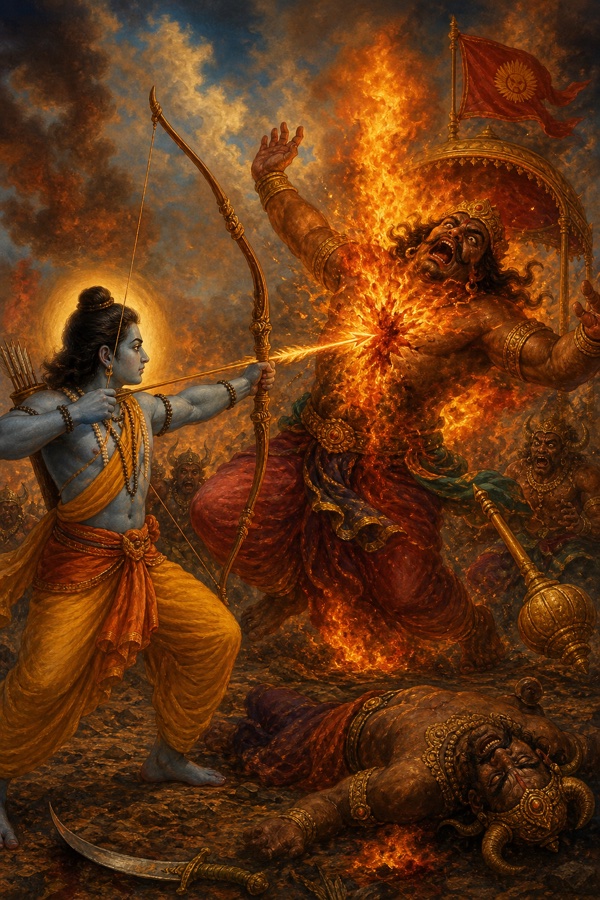
His pike destroyed, Makaraksha raised his fist and called out to Rama, the son of Kakutstha’s line, “Wait. Wait.” Rama, the delight of the Raghus, watched him come, laughed heartily, and set on his bow the missile presided over by the god of fire. Struck on the field by that missile, the rakshasa, his heart split open, fell where he stood and died. Every rakshasa present saw Makaraksha fall, and, stricken with fear of Rama’s arrows, they ran straight for Lanka. And the gods who had watched rejoiced greatly to see that rakshasa, the son of Khara, killed by the force of the arrows of Dasharatha’s son, and lying there like a mountain that lightning has struck and shattered.
Indrajit’s Renewed Campaign and the Counsel of Rama and Lakshmana
Makaraksha’s death reached Ravana, and a violent anger went through him. He ground his teeth. He had never lost a war in his life, and he sat turning over what a man in his position should do. When he had decided, he sent for his eldest son and gave Indrajit the field. “Go invisible or go in the open, as you please, and finish those two brothers, Rama and Lakshmana, whatever their prowess. In strength you are above them in every way. You beat Indra himself, Indra whose deeds have no equal; when you see two mortals in front of you on a battlefield, will you fail to kill them?” Indrajit bowed to the command, and he went first to the sacrificial ground, where the fire was waiting, and began to pour the oblations into it in due form. He was still pouring when the rakshasa women who served at that rite came hurrying up in a flurry, carrying the red turbans the priests would wear.
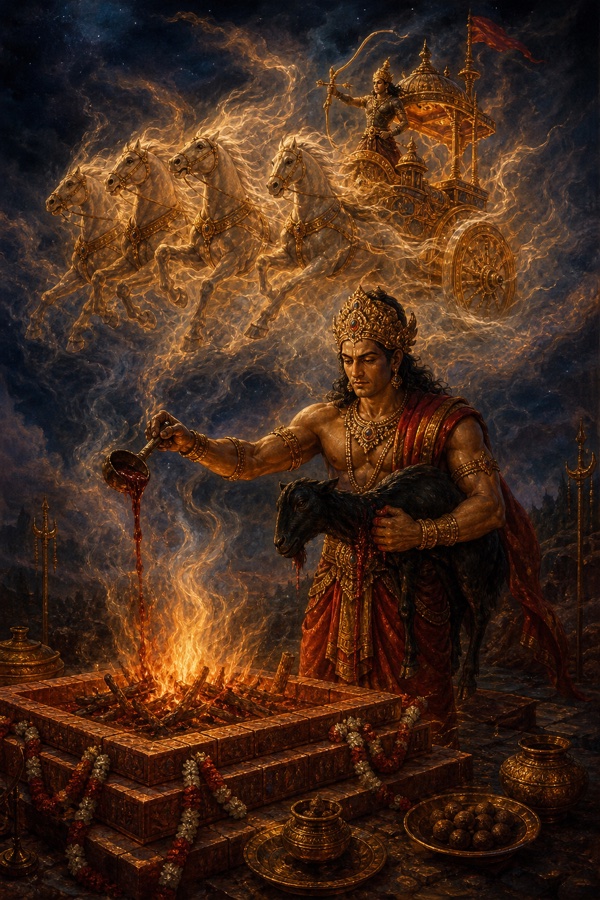
The rite he laid out there was a war in miniature. Pikes and other weapons lay in the place of the sacred grass. Chips of bibhitaka wood were the fuel. The cloths were red, and the ladle was iron. When the ground around the fire had been strewn with weapons and lances, the rakshasa took a live goat, black from horn to hoof, by the neck with reeds and gave it to the flames. From that single offering the fire climbed into great smokeless flames, and in them appeared the omens that promise victory: the god of fire rose into view in person, his flames streaming to the right, shining like refined gold, and received what was offered. Indrajit fed the fire, and satisfied the gods, the demons, and the rakshasas who attend a sacrifice made with ill intent, and then he climbed into a chariot that could pass out of sight. Four horses drew it. Whetted shafts lay in it, and a mighty bow. It was a thing of beauty: the frame glittered with fittings of gold, and it was carved with antelopes, full moons, and crescents; it carried great rings of Jambunada gold, and its standard was set with cat’s-eye gems, and in it Indrajit shone like a blazing fire. With that chariot bright as the sun around him and the missile of Brahma in his hands, the son of Ravana had become a warrior no one could overpower.
He came out of the city. With oblations poured to the spells sacred to Nirriti, the ancestor of the rakshasa race, he had taken on the power of going unseen, and he spoke his boast aloud as he went. “Today I kill two mortal princes who have wasted their exile in the forest, and I win a great victory for my father Ravana. Today I rid the earth of monkeys, dispatch Rama and Lakshmana, and give my father the highest joy there is.” With that he vanished. Sent by the ten-headed king, armed with a fierce bow and steel shafts, the enemy of Indra came onto the field in a fury. In the middle of the monkeys he saw the two heroic princes loosing their volleys, and from where he hung in the sky they looked to him like two three-headed serpents, the tips of their bows and the mouths of their quivers rising above their shoulders like two more hoods.
“Those are the two I want,” he said to himself, and he strung his bow and covered the quarters with streams of arrows the way a raining cloud covers them with torrents. Seated in his chariot in the air, out of sight, he pierced Rama and Lakshmana with whetted shafts where they stood on the ground below. Under that fury of arrows the two of them fitted shafts to their bows and brought out their divine missiles. They covered the whole sky with streams of arrows charged with those missiles, arrows that blazed like the sun, and they could not so much as touch Indrajit. Then the prince used his illusion to make a darkness thick with smoke; he blotted out the sky and buried the quarters in fog. He kept moving, and nothing gave him away: no slap of the palm on the bowstring, no sound of chariot wheels, no clatter of horses’ hooves, and never once his form. Out of that thick, blinding darkness the mighty-armed prince seemed to be pouring down a shower of rocks, except that the rocks were steel arrows, falling in hails.
In his rage the son of Ravana pierced Rama in every limb with arrows bright as the sun, the arrows that had come to him as a boon. The two best of men stood under the steel like a pair of mountains standing under a cloudburst, and they shot back gold-shafted arrows plumed with the feathers of buzzards, and those arrows reached the son of Ravana in the sky, went into him, and fell back to the ground soaked in his blood. Under the mass of shafts clinging to them the two princes shone beyond measure. They cut the falling arrows apart with broad-headed bhallas, and in whatever direction they saw the shafts dropping from, in that direction the two sons of Dasharatha sent their excellent missiles. Indrajit was a superior chariot-warrior and swift with his weapons; he circled them in his chariot on every side and kept piercing them both, and pierced deep with well-made gold-shafted arrows, the heroic sons of Dasharatha looked like two kimshuka trees in blossom. No one could make out his rapid movement or his form, much less his bow and arrows; nothing about him could be known, any more than the position of the sun can be known when the sky is thick with cloud. And pierced and struck down by him, the monkeys dropped dead on the earth in hundreds.
Anger rose in Lakshmana, and he said to his elder brother, “I am going to fall back on the missile of Brahma and destroy all the rakshasas with it.” Rama, who could see every auspicious mark on his brother’s body, held him back. “To get even with one individual you should not wipe out all the rakshasas on the face of the earth. One who is not fighting, one who is hidden, one who has come for protection with his palms joined, one who is running for his life, one who is drunk: you should not kill any of these on this earth. I will make my own effort, and I will make it for the destruction of Indrajit alone. The two of us will bring out missiles of tremendous speed, like venomous serpents. Let the commanders of the monkey troops once see this petty rakshasa, this trickster who keeps his chariot invisible, and they will kill him by force. Even if he goes into the earth or into heaven, enters the underworld or climbs into the vault of the sky and hides himself completely, my missiles will consume him and he will fall dead to the ground.” Those were words full of meaning, and when he had spoken them, Rama, the great-hearted hero of the Raghus, surrounded by the best of the monkeys, set himself to think out the quickest way to end that fierce rakshasa of cruel deeds.
Indrajit’s Slaying of the Illusory Sita
Indrajit guessed what Rama intended, withdrew from that encounter, and went back into the city. He could not sit still there. The destruction of all those mighty rakshasas was in front of his eyes, and his eyes went bloodshot with anger, and Ravana’s heroic son rode out again at once. He came out this time by the western gate, with other rakshasas around him, that thorn in the side of the gods, a descendant of the sage Pulastya, one of the mind-born sons of Brahma. He saw the two brave brothers, Rama and Lakshmana, prepared for battle in every way, and he reached for the deepest of his skills in illusion. What he made was aimed at the one thing the whole army across the sea had come for. He set on his chariot a living image of Sita, conjured out of nothing, surrounded it with a huge army, and resolved to kill her where every monkey could see. He had made up his mind to deceive everyone present, and with the killing of this “Sita” settled in his mind, that rakshasa of exceptional wickedness advanced toward the monkeys.
The forest-dwellers saw him come out for battle and rushed at him, eager for a fight, with rocks in their hands. Hanuman, that elephant among the monkeys, marched at their head carrying an enormous mountain peak that no one else could even have reached. And in Indrajit’s chariot he saw Sita. She was cheerless and wretched, Rama’s darling, lovely still: her hair in a single braid, a single soiled cloth on her body, no ornament anywhere on her, every limb covered with dust and mud, her face emaciated by fasting. It was exactly how he had found her in the grove, down to the braid, and that was what undid him. Hanuman gazed at her for a while, that lovely-limbed daughter of Janaka, and concluded she was Sita, the princess of Mithila, and his heart sank. Recognizing her took him no time at all. He had seen the daughter of Janaka before, in the ashoka grove, and it was he who had carried Rama’s ring to her.
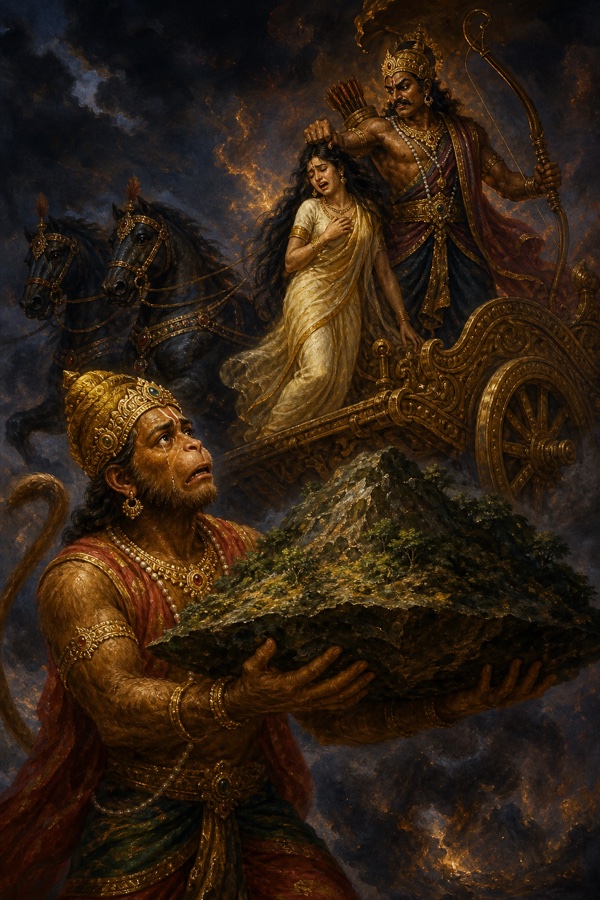
He looked at that joyless and miserable ascetic woman seated in the chariot, stricken with grief, in the power of the rakshasa king’s son, and he could not understand what the prince meant by bringing her to a battlefield in his chariot. He said as much to the vanara leaders, and then he rushed with them at the son of Ravana. Indrajit saw the monkey army coming at him, and rage filled him. He drew his sword, seized “Sita” by the hair of her head, and dragged her. She cried “Rama! O Rama!” while the vanaras stood looking on, and the rakshasa began to strike the woman he had set in his chariot by sleight of hand. Hanuman had crossed the sea for her once and carried her word back to Rama; he had seen her alive under the ashoka trees, and now he saw her seized by the hair, and the son of the Wind gave way to affliction, and tears of agony ran down his face.
Looking at that cherished consort of Rama, lovely in every limb, Hanuman took her for Sita herself and hurled a harsh rebuke at the son of the rakshasa king. “It is to your own destruction, evil-minded one, that you have seized her by the hair! You were born in the line of Brahmin seers, and you have lived in the womb of a rakshasi. Woe to you, whose conduct is sinful, in whom such a resolve could form! Cruel, ignoble, mean scoundrel of sinful prowess, such an act is worthy of a barbarian alone; there is no pity in you at all. What wrong has this princess of Mithila done you, torn from her home, from her kingdom, and from Rama’s protection, that you kill her, pitiless one? Once you have killed Sita, you will not survive long in any case. By this deed, which deserves death, you have fallen into my hands. After death you will go down to those worlds that are the lot of the killers of women, worlds condemned even by men whom the people would put to death.”
With that, Hanuman, ringed by vanaras armed with trees and rocks, rushed in great fury at the son of the rakshasa king. Indrajit met that advancing army of monkeys, for all its prowess, with an army of rakshasas of terrible fury, and when a thousand arrows had thrown the monkey ranks into confusion, he answered Hanuman. “This very day, while you stand looking on, I am going to kill this Sita, the princess of Videha, for whose sake Sugriva and you and Rama came here. When I have disposed of her, I will kill Rama, and Lakshmana, and you yourself, monkey, and Sugriva, and that unworthy Vibhishana. As for what you said just now, that women should not be killed, that is quite correct, monkey. But whatever causes an enemy pain has to be done.” And when he had said that to Hanuman, Indrajit himself, with his sharp-edged sword, cut down the illusory Sita, who had never once stopped sobbing.
Split by him diagonally, in the line of the sacred thread, that poor woman of the broad hips and the pleasing face sank to the ground. Over her body Indrajit called to Hanuman. “Look at the darling of Rama, destroyed by me with a weapon. Here is Sita, the princess of Videha, killed. Now your labor has come to nothing.” He had put “her” to death with his own great sword, and he mounted his chariot in delight and let out a great roar. The monkeys arrayed not far from him heard him shouting with his mouth wide open, seated at his ease in that chariot in the air which no one could reach. Sita was disposed of, and that evil-minded son of Ravana was glad at heart, and at the sight of his cheerful face the monkeys, their own faces downcast, fled in a body.
Hanuman’s Return and Indrajit’s Fire-Rite at Nikumbhila
Indrajit’s roar was like a peal of thunder, and the vanaras fled from it at great speed in every direction, looking back over their shoulders at him as they ran. Hanuman stood where he was and watched the army he had healed that same night come apart around him. Then he spoke to those monkeys with their melancholy looks, miserable and alarmed, running singly wherever they could. “Why are you fleeing with your faces downcast, monkeys, throwing away your zeal for battle? Where on earth has your valor gone? Turn back, and follow close on my heels into the fight while I march ahead of you. It is a poor thing for champions of noble descent to shrink from a field of battle.” Admonished by the wise son of the Wind, the monkeys took heart; in great fury they seized mountain peaks and trees, and roaring, they fell on the rakshasas, and ringing Hanuman on every side, the monkey leaders followed him into the great fight.
Surrounded by the vanara chiefs, Hanuman, blazing like fire, began to annihilate the enemy army. With the monkey army about him, that exceptionally mighty monkey, who was like Yama playing Death at the dissolution of the world, played havoc among the rakshasas. Filled with inordinate grief and anger, Hanuman flung a huge rock at Indrajit’s chariot; the moment his charioteer saw it coming, he drove the chariot, with its obedient horses, aside and far away. The rock never reached Indrajit where he sat in his chariot with his charioteer; thrown for nothing, it split the earth open and sank into it. As the rock fell, the army of the rakshasas was thrown into disorder, and the rakshasas under it were violently crushed.
Monkeys in their hundreds rushed roaring at Indrajit, and the colossal vanaras came fully to life, seizing trees and mountain tops. Vanaras of terrible prowess railed at Indrajit on the field; pouring down a mighty shower of trees and rocks, they created havoc among the enemy and shouted in every tone. Struck violently on every side with trees by those terrible monkeys, the rakshasas of hideous aspect rolled about on the field. Indrajit saw his army handled roughly by the monkeys, seized his weapons in fury, and marched against the enemy, and ringed by his own contingent, loosing streams of arrows, that prince of unyielding prowess struck down many of the best of the monkeys with pikes, missiles, swords, sharp-edged spears, and kutamudgaras, the concealed mallets. And the monkeys killed his followers in the same combat.
Hanuman, whose strength went beyond measure, played havoc among the rakshasas of terrible deeds with sal trees of excellent trunk and bough and with rocks, and then he stopped. He held the enemy army back and spoke to the vanaras, and what he said was the hardest thing he had said in that war. “Retreat! This army is no longer worth our conquering. The daughter of Janaka, for whose sake we have fought until now, risking our lives and making every effort to win, seeking to do what would please Rama, has been killed. Let us make this known to Rama and to Sugriva, and we will do whatever they command in return.” So saying, that chief of the vanaras, fearless, holding all the monkeys back, turned and withdrew slowly with his army. It was what Indrajit had been waiting for. When that evil-minded prince saw Hanuman withdrawing toward the place where Rama was, he went to the sanctuary called Nikumbhila, the ground under the great banyan where he pours his oblations, for he meant to feed the sacred fire there, and reaching Nikumbhila, he began.
When the rakshasa reached the sacrificial ground and fed it, the sacrificial fire blazed up as it consumed the oblations of blood. Swollen with those offerings of blood, the fierce fire, which looked like the evening sun, was seen wrapped in flames. For the prosperity of the rakshasas in general, Indrajit, well versed in the technique of sacrifice, poured his oblations according to the ordinance of scripture, and the rakshasas, who knew what was right and what was wrong in a great conflict, watched him do it and stood firm at his side.
Rama’s Swoon on Hearing of Sita’s Death and Lakshmana’s Consolation
Rama heard the great tumult of that battle between rakshasas and monkeys from where he stood, and he turned to Jambavan. “From the terrible and towering din of weapons we are hearing, Hanuman has surely done some feat that no one else could do. So go with your own army of bears, lord of the bears, and lend your aid at once to that prince of the monkeys while he fights.” Saying “So be it,” Jambavan went with his army toward the western gate, where Hanuman was. There the lord of the bears saw Hanuman coming back, surrounded by monkeys who had done their fighting and were sighing with grief. Hanuman saw that terrible army of bears, dark as a cloud and ready for battle, coming up the road, checked it, and turned it back with him.
With that army Hanuman came quickly into Rama’s presence, and sorrowfully he told him: “While we fought on the field and stood looking on, that son of Ravana, Indrajit, killed Sita, though she wept the whole while. When I saw it, tamer of your enemies, my mind went dark and I was cast down, and I have come back to tell you.” It was the one thing Rama had crossed the sea to prevent, and it came to him from the mouth of the one messenger he had never doubted. Hearing Hanuman’s words, Rama fell to the ground senseless with grief, like a tree whose roots have been cut through. The vanara chiefs saw that godlike son of Raghu’s line fallen, and they sprang toward him from every side and sprinkled him with water fragrant with the scent of lotuses and lilies, the way one sprinkles a fire that has suddenly flared up and cannot be put out.
Then Lakshmana, who was in great agony himself, took Rama into his arms. He was the brother who had followed Rama into the forest without being asked and had never once questioned the path, and what came out of him now, over his brother lying so ill at ease, were words full of reason and heavy with meaning, and bitter past anything he had ever said. “Dharma cannot save you, worthy brother, though you keep to the noble path and have fully mastered your senses, from reverses like this; and so dharma is useless. As the being of moving and unmoving creatures is plain to see, so dharma is not seen to be the plain cause of happiness; and therefore dharma is not the cause of happiness: that is my conclusion. If unrighteousness had any effect, Ravana would have gone down to hell, and you, who are full of virtue, would never have met adversity. Ravana is free of calamity and the calamity has fallen on you, as if virtue and vice, which are contraries, had traded roles.”
Lakshmana pressed his argument further. “If happiness came only from dharma and sorrow only from adharma, then those in whom unrighteousness is rooted would carry the burden of unrighteousness, which is suffering, and those who lean toward no unrighteousness would never lose the fruit of virtue, which is joy. But look at the world: the resources of those in whom unrighteousness is rooted grow, and those who practice virtue suffer. So both of them, righteousness and unrighteousness, are useless. And if you say that men of sinful deeds are destroyed by their own unrighteousness, then consider: the unrighteous act itself, the killing or whatever it was, is over the moment it is done, since an action lasts only an instant. Whom will that unrighteousness destroy, when it is itself destroyed within three moments? Or if a man is destroyed by a malevolent rite from the scriptures, or kills another by such a rite, then the unseen result the rite engenders is what the sin taints, and never the agent. And how can righteousness in the form of a malevolent rite, a thing that is unconscious, that has never known how to strike back, that is unmanifest and as good as nonexistent, ever reach the man it is meant to destroy? If a good destiny born of virtuous acts existed, no evil would ever have come to you; since evil has come to you, that whole hypothesis of a destiny born of good acts is false. And if dharma is feeble and ineffective, and needs the help of might, then a dharma that lacks strength and has lost its capacity should no longer be pursued: that is my view. If dharma is subordinate to might, then pluck up your courage, give up the primacy of dharma, and depend on might as you now depend on dharma.”
“And if you say that the dharma you are following is the redeeming of your father’s truthfulness, then remember: your father cut himself off from you by an untruth, when he did not carry through the announcement he had made that you would be installed as prince regent. Were you not bound by that announcement too? If dharma alone were worth pursuing, or unrighteousness alone, then Indra, the wielder of the thunderbolt, would not have performed a horse-sacrifice to atone for the sin of killing a Brahmin after he killed the hermit Vishvarupa. Dharma joined to strength destroys enemies, Rama; so a wise man takes recourse to both, dharma and strength, as he pleases. The very roots of dharma, which are wealth, were severed by you when you spurned the kingdom the other day as it was being offered to you.”
“From wealth brought in and stored up and made to grow, all undertakings flow, as rivers flow from the mountains. All the undertakings of a man of meager wits whom wealth has forsaken dry up like the small streams of summer. When a man brought up in comfort and hungry for comfort gives up the wealth within his reach, he goes on to sin, and evil follows on the sin. Friends gather around the man in whom riches abide; kinsmen stand by him. He alone is honored, in whom riches have found their place; he alone is learned, he alone is brave, he alone is clever, he alone is fortunate, he alone is rich in every excellence, in whom riches have come to stay. I have set out the evils of renouncing wealth here in the shape of their contraries. The ground on which you resolved to give up your all, when you forswore the kingdom, I do not know.”
“For the man in whom riches abide, the other ends of life, virtue and pleasure, are easily accomplished, and everything turns in his favor. But wealth does not come to a penniless man without effort, though he seek it and hunt for it. Delight and pleasure, pride, dharma, anger, calm, and the restraint of mind and senses, all of these become effective through wealth alone. The riches whose loss sends to ruin the worldly happiness of those who practice austerity and walk the path of virtue are not found in you, any more than the nine planets are seen on a cloudy day. While you have been in exile, faithful to your father’s pledge, your wife, dearer to you than life itself, was carried off by the rakshasa Ravana. The great agony that Indrajit has caused today, I will dispel with my own exploits. So rise, Rama!”
“Get up! Why do you not recognize yourself as the Supreme Spirit, you of vast intelligence, you who have kept every vow? I have said all this to win you back to yourself. Enraged at the destruction of Janaka’s daughter, I will destroy Lanka with my arrows, with its chariots, its elephants, its horses, and Ravana, the ruler of the rakshasas, with it.”
Vibhishana’s Revelation: Sita Lives
While Lakshmana, who loved his elder brother so, was reassuring Rama, Vibhishana appeared, having set the monkey troops back in their positions. He was the one man in that camp who had grown up in Ravana’s house and knew what Ravana would and would not do. Four champions came with him, armed with weapons of every kind, dark as heaps of collyrium, like leaders of an elephant herd. He came up to the great-hearted Lakshmana and found him given over entirely to grief, and the monkeys around him with their eyes full of tears; and then he saw Rama, the delight of the race of Ikshvaku, fallen in a swoon and lying in Lakshmana’s lap. The sight of Rama shamed and tormented with grief put the anguish into Vibhishana’s own mind, and he said: “What is this?”
Lakshmana fixed his gaze on Vibhishana’s face, looked at Sugriva and the famous monkeys around them, and, bathed in tears, spoke tersely. “Rama heard from Hanuman’s own mouth that Indrajit has killed Sita, my friend, and he fell into a swoon at once.” Vibhishana did not let him finish. He stopped the son of Sumitra even as he was speaking, and to Rama, who lay unconscious and could not hear him, he made a submission that was full of meaning, because the whole camp could hear it. “What Hanuman told you with such sorrow I hold to be as absurd as the drying up of the sea. I know the design of the evil-minded Ravana with regard to Sita. He would never cause her to be killed.”
“Though I wished him well and begged him again and again, ‘Give up the princess of Videha,’ he would never heed that advice. And no one else can even set eyes on Sita, much less kill her, by persuasion, by gift, by sowing dissension, or by war. That rakshasa Indrajit withdrew from the field after deceiving the monkeys. Know the daughter of Janaka whom he seemed to kill to be an illusion. This day he will reach the sanctuary called Nikumbhila and pour oblations into the sacred fire there, under the banyan where he has always gone before a battle. If he returns after completing that offering, then Indrajit, son of Ravana, will be beyond the power of the gods themselves to overcome, Indra included. He worked this trick to put us off the scent, because he expected the monkeys to interrupt his sacrifice if their prowess went unchecked on the field. So let us go to that place with the army while the sacrifice is still in progress.”
“Shake off this agony, which has come upon you without any real cause. When they see you stricken with grief, the whole army sinks with you. Stay here, elevated in courage as you are, confident at heart, and send Lakshmana with us; we will take the army with us. This warrior will check that son of Ravana at his rite with sharp arrows, and once the rite is broken, Indrajit will become a man who can be killed. These whetted and piercing arrows of Lakshmana, swift in flight, feathered with the wings of birds, will drink Indrajit’s blood like cruel birds. So send Lakshmana, who bears every auspicious mark, for the destruction of the rakshasa Indrajit, as Indra, the wielder of the thunderbolt, sends the thunderbolt for the destruction of his enemies, the demons.”
“Any loss of time in compassing the death of the enemy is no longer to be thought of; send Lakshmana to finish Indrajit the way the mighty Indra hurls his thunderbolt to destroy an enemy of the gods. Once he has concluded the ritual, that prince of the rakshasas will be invisible on the battlefield to gods and demons alike. If he concludes it and then feels inclined to fight, there will be great danger even to the gods in fighting him.”
The gist: Ravana’s tears for Kumbhakarna had not dried before his sons began to fall, one after another: Narantaka, Devantaka, Trishira, and Atikaya. Indrajit, unseen in the sky, laid Rama and Lakshmana low with the Brahma missile; Hanuman flew to the Himalaya and came back with the mountain of herbs; and that night the monkeys set Lanka on fire. Kumbha, Nikumbha, and Makaraksha died next. Then Indrajit conjured a likeness of Sita and cut her down in front of Hanuman, and at the news Rama fell senseless. Everything now hangs on what Vibhishana says: Sita is alive, and Lakshmana must reach Nikumbhila before the offering there is complete.
Source: Srimad Valmiki Ramayana, Yuddhakanda, Cantos 68 to 101; this first part follows Cantos 68 to 84. The Gita Press Hindi edition is the controlling witness. The Sanskrit e-text and an independent complete translation were used to verify names, sequence, and principal events. Where recensions differ, this retelling follows Gita Press.
Basis: Valmiki Ramayana (Gita Press, Gorakhpur)