On this page
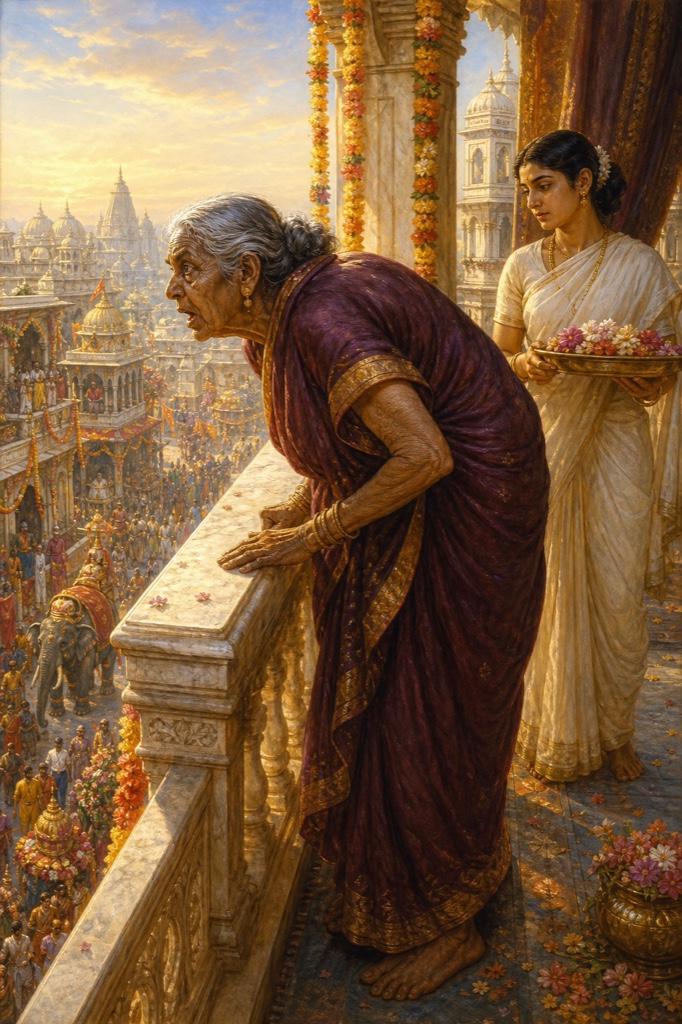
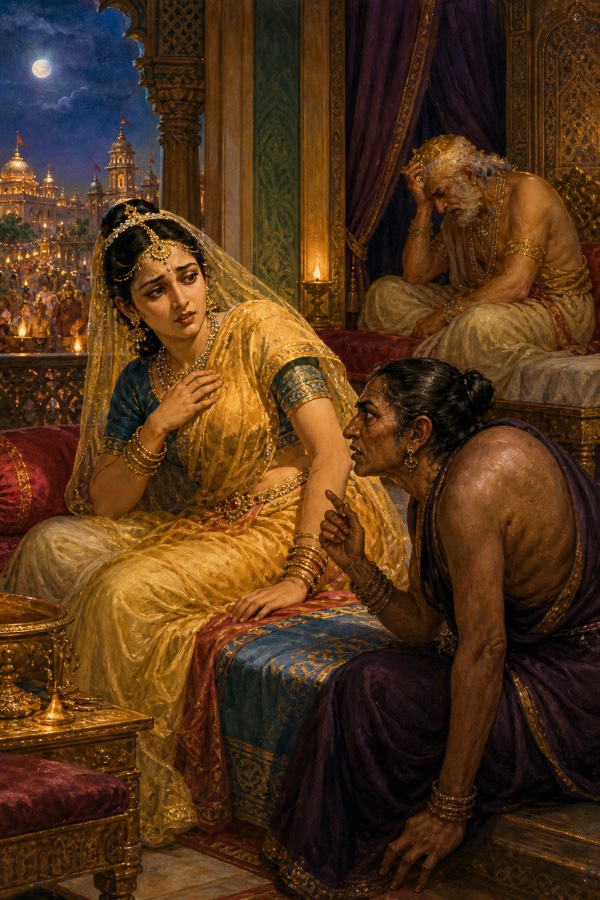
Ayodhya had given itself over to celebration. The royal road had been watered against the dust of a thousand feet, and lotuses and water lilies lay strewn along it where the water carts had passed. From every doorway hung costly banners and pennants. Sandal water had been sprinkled until its cool scent rode the air of the whole city, and the people who filled the lanes had bathed to the crown of the head, the full ceremonial bath that ordinary days never asked of them. The chief Brahmins moved through the crowds with flowers and balls of sweets in their hands, gifts to lay before the prince in the morning. Temples with white crystal doorways stood open, and the sound of every instrument the city owned rose together with the deep chant of the Vedas, with the trumpeting of elephants, the stamping of horses, and the bellowing of bulls and cows in their pens. Rows of tall flags marked the skyline. All of it turned on a single piece of news: tomorrow, under the lunar mansion Pushya, the star the astrologers had chosen, Rama would be consecrated as Prince Regent, the heir who would rule beside his father and after him. Onto the roof of one tall palace, white as the moon, a hunchbacked maidservant happened to climb. Her name was Manthara. She had served Kaikeyi’s family from the day she was born, and when the princess of Kekaya came to Ayodhya to marry its king, Manthara had come with her and had never left her side. The palace beneath her feet was Kaikeyi’s own. The joy spread out below astonished her, and she did not know its cause. In that instant a crooked question woke in her mind, and from that question the ashes of two old boons began to smolder again, and the future of a whole royal house turned over.
The hunchback on the rooftop, and a nurse’s answer
Manthara looked out over an Ayodhya brimming with its overjoyed citizens, the rows of flags, the press of bathed and garlanded bodies, and wonder filled her. Nothing had been announced in Kaikeyi’s wing that morning. Standing not far from her was Rama’s old nurse, the woman who had carried him as an infant, dressed now in white silk, her eyes wide and blooming with joy. Manthara went to her and put her question. “Rama’s mother, Kausalya, is fond enough of her wealth. Why is she giving away riches to the people with both hands today? And why is this crowd so beside itself? Tell me. What is the king so pleased about, and what is he about to have done?”
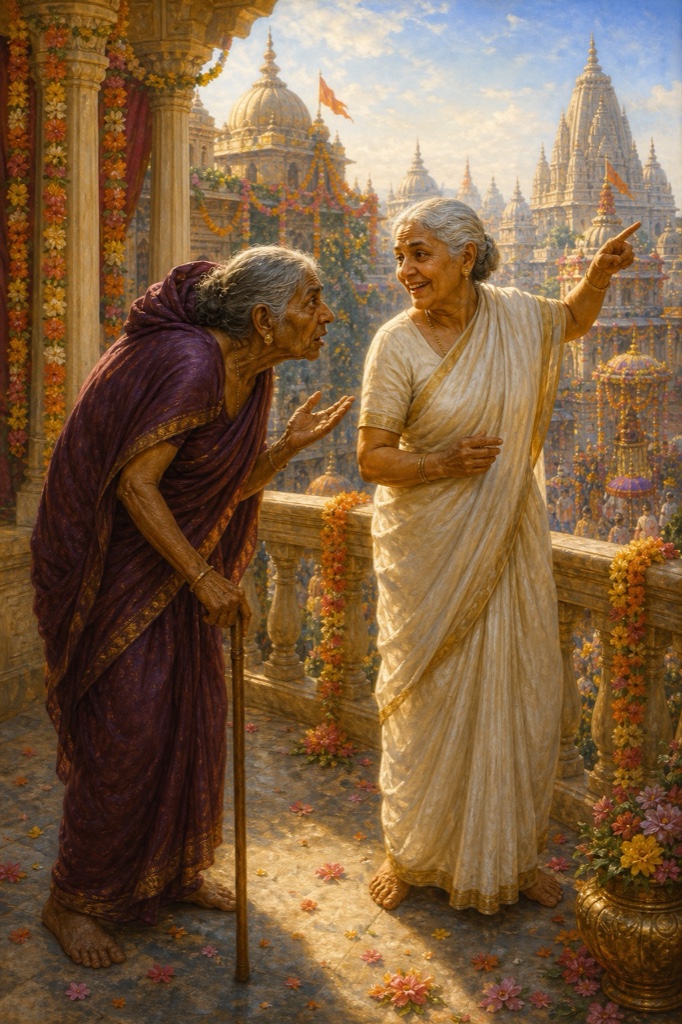
The nurse was bursting with it. She told the hunchback, with every ounce of her delight, the good fortune that was about to descend on the house of Raghu. “Tomorrow, under Pushya, King Dasharatha will install Rama as Prince Regent. Rama, who is without sin. Rama, who has conquered his own anger.”
Manthara heard it, and indignation took her whole. She came down at once from the roof of that palace, which rose in tiers like a peak of Kailasa, the mountain of the gods. Inside she was burning. She read foul play into everything the king did, and she read it into this. She went straight to the bedchamber where Kaikeyi lay at her ease on her bed and stood over her. “Get up, you deluded woman. How can you lie there? Danger is staring you in the face, and you do not even see the flood of misery that is rising toward you. The king loathes you, and still you boast of your good luck, still you preen on your beauty and on your husband’s favor. Your good fortune is like the current of a river in the hot season. Look at it once, and it is gone.”
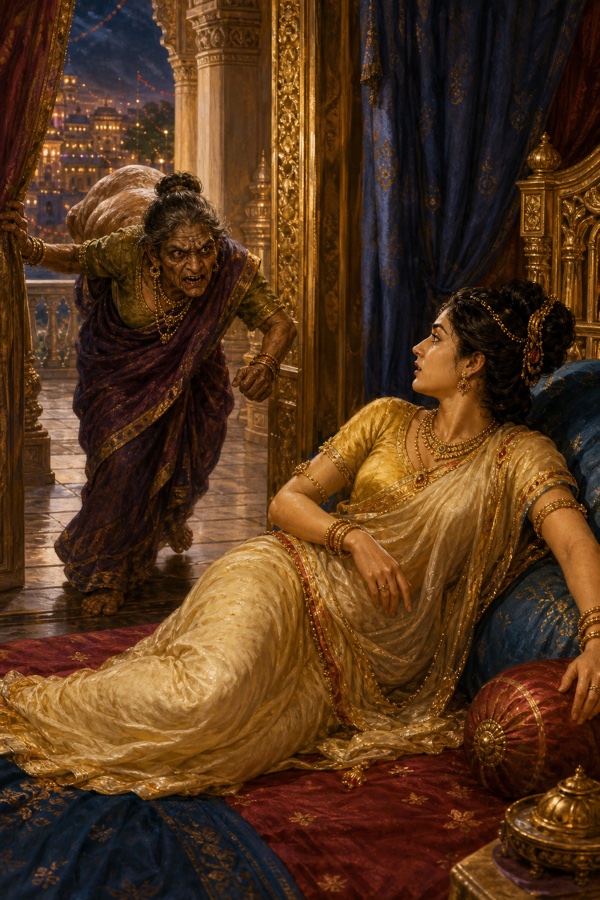
The harsh words landed on Kaikeyi like a blow, and a deep unease went through her. Even so she answered in a sweet voice, the voice of a queen who could not yet imagine a reason for such a tone from a servant. “Manthara, is something wrong? Your face is so downcast, and you look sick with grief.” The gentle question only soured the hunchback further. She was a master of speech; she knew where to aim. Posing as Kaikeyi’s one true well-wisher, she set out to fill the queen’s mind with dread and to turn her heart away from Rama. “My queen, the great work of your undoing has already begun, and there is no remedy for it. King Dasharatha is going to install Rama as Prince Regent.”
Manthara’s first poisoned words
Manthara pressed on before the queen could gather herself. “I have come to you plunged in a bottomless fear on your account, sick with grief, burning as though I stood in fire, and I have come to tell you where your true interest lies. Kaikeyi, your suffering will be my great suffering, and your rise will be my rise; there is no doubt about it. You were born in a line of kings and you are the favored queen of a king. How is it that you do not understand how hard the law of kings can be? Your husband speaks of dharma and deceives you. He speaks softly and his heart is cruel. You take him for a man of a guileless heart, and by that very trust you are being cheated.”
“Look at what is happening while he stands beside you and speaks his kind and empty words. This very day your husband is handing all of sovereignty to Kausalya alone. He sent Bharata away to your father’s country, out of sight. He has cleared every thorn from the road. And tomorrow morning he will set Rama on the throne of Ayodhya. An enemy stands next to you and calls himself your husband. As a woman might rear a venomous serpent against her own body and feed it, so you have held this enemy to your breast.”
“Along with your son Bharata, Dasharatha has dealt with you today exactly as one deals with an enemy or a snake one has decided to ignore. You have always loved your comforts, you have never been tested, and this king of false sweet speech has ruined you, together with your friends and your kin, by setting Rama on the throne. So do at once whatever this moment demands, Kaikeyi. Save your son. Save yourself. Save me. You have always had a marvelous sharpness of mind. Use it now.”
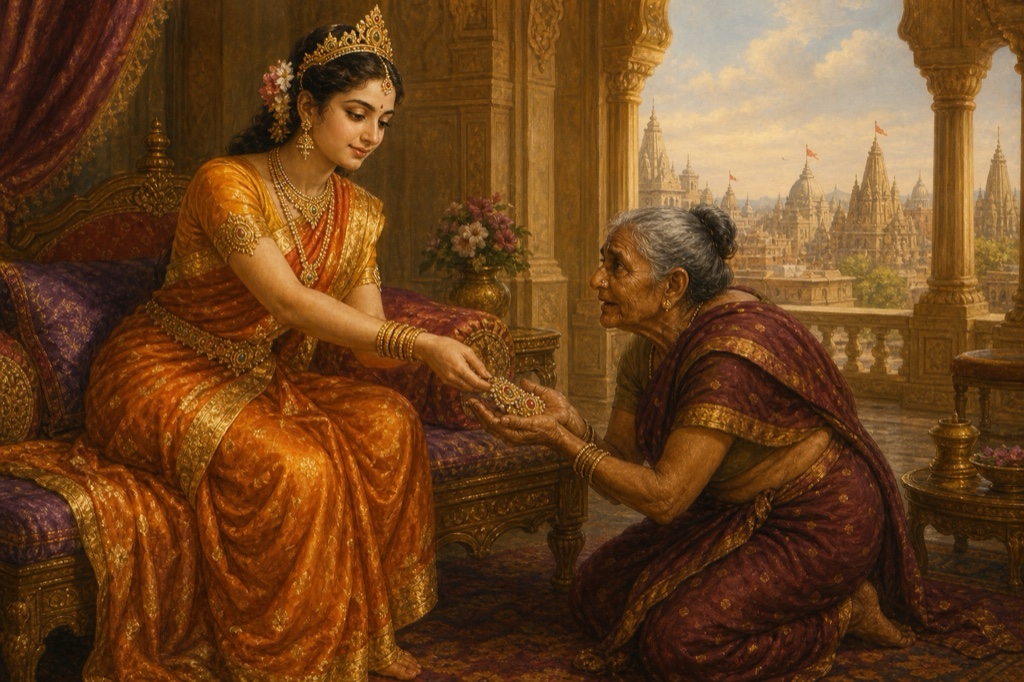
Kaikeyi heard the news, and the news delighted her. That lovely-faced woman rose from her bed like the round moon rising on an autumn night, flooded with joy, and in her amazement and gratitude she took from her own jewels a wonderful ornament, bright as a thing made in heaven, and pressed it into the hunchback’s hands. Even after the gift was given she was still glad, and she said, “Manthara, this is the dearest news you could have brought me. It fills me with happiness. What more can I do for you? Between Rama and Bharata I see no difference at all. So I am pleased that the king is going to set Rama on the throne. No sweeter words than these could have been spoken to me, no words more like nectar, and you deserve kindness for bringing them. So I give you another boon, a better one. Ask for whatever you want.”
Manthara’s second stroke: thorns and snakes
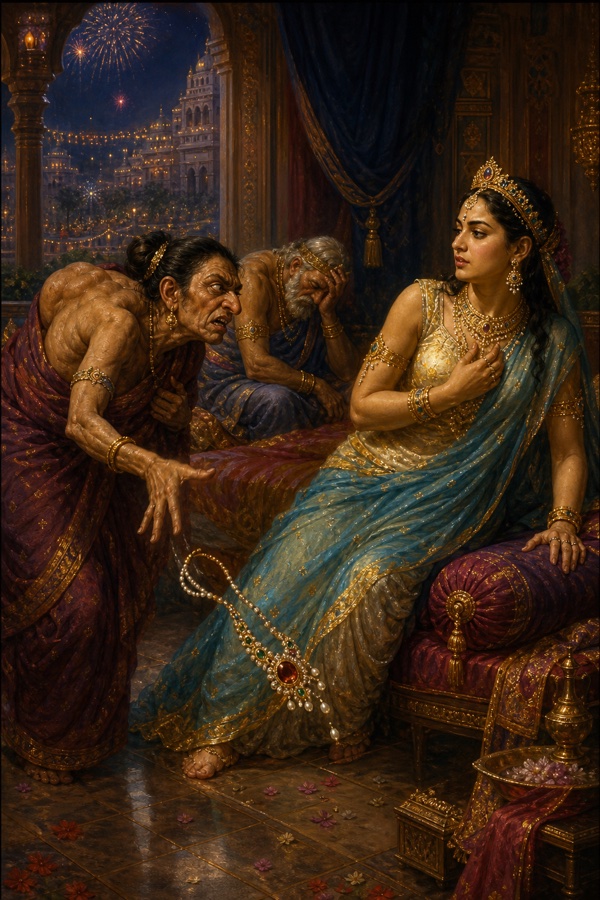
Manthara heard this answer and flung the ornament to the floor. Rage and grief together drove her now, rage at the queen’s serene indifference and grief at the ruin she was certain would follow it. “You foolish girl. Why are you rejoicing when there is nothing to rejoice at? Can you not see that you are standing in the middle of an ocean of grief? Sorrow is eating me, and inside my heart I laugh at you, because you meet a great calamity and you are glad where you ought to be mourning. I pity the perversity of your mind. What woman with any wisdom exults at the rise of a stepson, who is a born enemy, any more than she would exult at the approach of her own death?”
“Rama has reason to fear one man only, and that is Bharata, because Bharata has an equal claim to the throne. I am sad to say it, and it frightens me, because a man who fears another does not leave that man in peace. Lakshmana belongs to Rama with his whole being, and Shatrughna follows Bharata exactly as Lakshmana follows Rama. By the order of birth, too, only Bharata’s claim can stand beside Rama’s; Lakshmana and Shatrughna are the younger pair, and they are out of the question. Rama is learned. He has been trained in everything the code of a warrior prince demands, and he acts the moment the situation calls for it. When I think what your son has to fear from such a man, I shudder.”
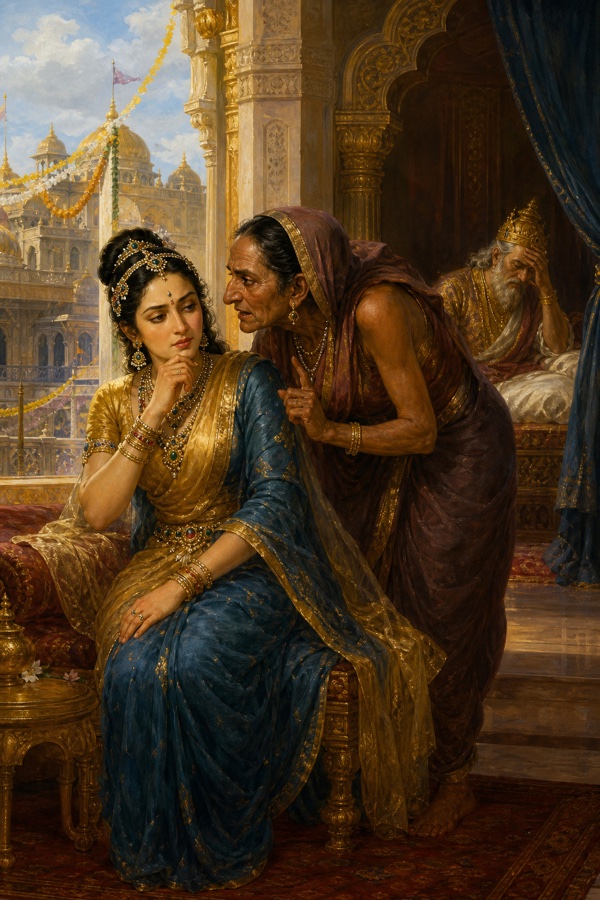
“Fortunate Kausalya! Tomorrow, under Pushya, the foremost Brahmins will pour the water of consecration over her son. And you, with your palms joined, will stand and wait upon her like a maidservant, once she has the lordship of the whole earth and has disposed of her two enemies, Bharata and you, and is enjoying it with her husband’s full trust behind her. You will be reduced to her servant, along with the rest of us, and your son will be reduced to Rama’s servant. The most fortunate women in the world will be the women of Rama’s household. And your daughter-in-law and her companions will be miserable, watching Bharata’s fall.”
Kaikeyi listened to the cruelty in the hunchback’s voice, and what she answered with was praise of Rama. “Rama knows what is right. He is a treasury of virtues, disciplined, grateful, devoted to truth, upright, and he is the eldest of the king’s sons. He deserves the office of Prince Regent for every one of those reasons. He will live a long life, and he will look after his younger brothers and his servants the way a father looks after his children. Why, then, hunchback, does it torment you to hear of Rama’s consecration?”
“When Rama has ruled his hundred years and grown old, Bharata too will inherit the ancestral throne in the natural course of things. Here is a festival at hand, and another festival to come, even if it comes a hundred years from now. You are famous for your wisdom, Manthara. How can you burn with jealousy at such a thing? As Bharata is worthy of my honor, so is Rama, and more so. He serves me more than he serves Kausalya herself. If the throne is Rama’s, then it is Bharata’s too, because Rama holds his brothers as his own self.”
Manthara’s third blow: demand Rama’s exile
Manthara heard this answer and it wounded her to the core. She drew a long, hot breath and let it out slowly. “Out of sheer stupidity you cannot see the truth. You are about to go under in an ocean of misery, swollen with grief and disaster, and you cannot even tell where you are standing. Rama will be crowned king, and after him the son who is born to him, and Bharata will be shut out of the royal line altogether. My proud lady, all the sons of a king do not keep a hold on the throne. If they were all installed at once, the result would be chaos and disgrace. That is why kings hand the reins of rule to the eldest son alone, however full of virtue the younger ones may be, my faultless lady.”
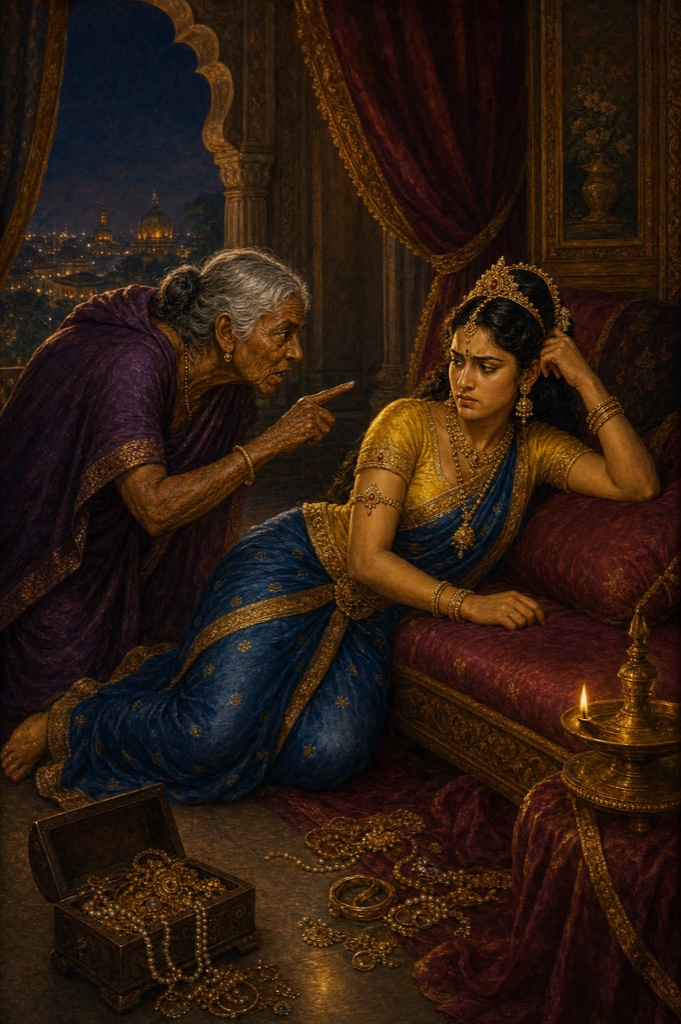
“Your son, like a child with no one to guard him, will be stripped of every comfort and cast out of the royal house. I have come here to wake you to your own interest, and you do not even know my worth. You want to reward me for your co-wife’s triumph. Once Rama holds a kingdom with no rival left in it, he will send Bharata out of the country, or out of this world. And you did the rest yourself, Kaikeyi. When Bharata was still a boy you sent him off to his uncle’s house in your father’s kingdom, and affection grows from nearness, even among trees and the creepers that cling to them. Shatrughna went with him, because Shatrughna follows Bharata’s will the way Lakshmana follows Rama’s. I have heard that the people who live off the forest once marked a tree for felling, and the thorny shrubs that grew close about it saved it from that danger, only because they stood near it.”
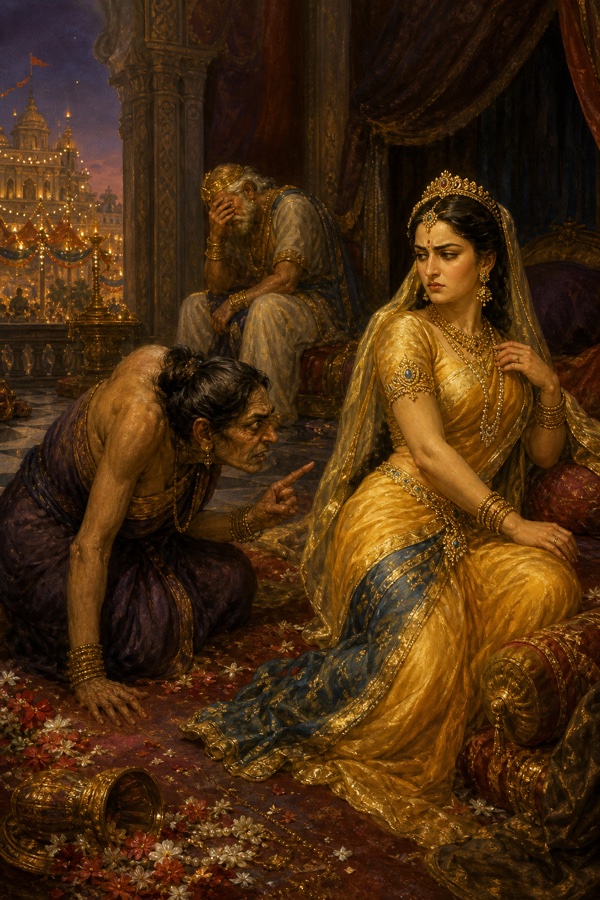
“Lakshmana will guard Rama, and Rama will guard Lakshmana. Their brotherhood is famous in every world, like the love of the twin Ashvins, the physicians of the gods, who are never seen apart. So Rama will do Lakshmana no harm. Against Bharata he must do harm; there is no doubt of it. Let Rama go to the forest straight from this palace. That is what pleases me, and it is the best thing for you. Only if Bharata secures his father’s throne, and secures it rightly, will your own family’s people prosper, and I am one of them. Think of that boy of yours. He was born to comfort, and he was born Rama’s rival. How will he live under Rama’s power once he has lost everything? When Rama hunts him down as a lion in the forest drives the leader of an elephant herd, you alone will have to protect him.”
“In the pride of your good fortune, in the days when you were the favorite, you slighted Kausalya. Do you imagine that Rama’s mother, your co-wife, will not pay back that grudge? When Rama has won the whole jeweled earth with its seas and its mountains, you and Bharata will be brought low together, and you will suffer the ugly disgrace of servitude, and Bharata will surely be destroyed. So devise the means. Secure the kingdom for your son. And find the pretext that will send his born enemy, Rama, into banishment.”
The memory of two old boons
Something in Kaikeyi gave way. Her face flushed dark with anger, and she drew the same long, hot breath the hunchback had drawn. “This very day I will send Rama out of here to the forest, and I will have Bharata installed as Prince Regent without delay. Now think. By what means can I make certain that Bharata gets the kingdom and Rama does not, on any account?” Manthara, whose whole mind was bent on Rama’s ruin, answered slowly, testing her. “Ah, now you will see what I can do, Kaikeyi. Listen to my advice, and your son Bharata alone will have the throne. And yet the plan you want to hear from me is one you already know. You told it to me yourself, long ago. Do you truly not remember it? Or do you remember, and hide it from me? If you want it from my lips, my lovely lady, I will tell it, and when you have heard it, act on it.” Kaikeyi raised herself a little on the bed she had spread with her own hands, and there was more than curiosity in the movement. “Tell me the means, Manthara. By what device does Bharata get the kingdom, and Rama not get it?”
Then Manthara laid it out. “Long ago, in the war between the gods and the demons, your husband, the great King Dasharatha, went south to fight for Indra, the king of the gods, who had asked for his help. He marched with the royal sages who owed him allegiance, and he took you with him, into the southern quarter toward the Dandaka forest, against a city called Vaijayanta. A demon named Timidhvaja ruled there, a demon who flew on his war banner the emblem of the timi, a fish of enormous size. People called him Shambara as well. He knew hundreds of magic arts, the hosts of the gods together had not beaten him, and he had challenged Indra himself to battle. In that great war, when wounded warriors lay asleep at night on their beds, the demons would swoop on them, carry them off, and kill them.”
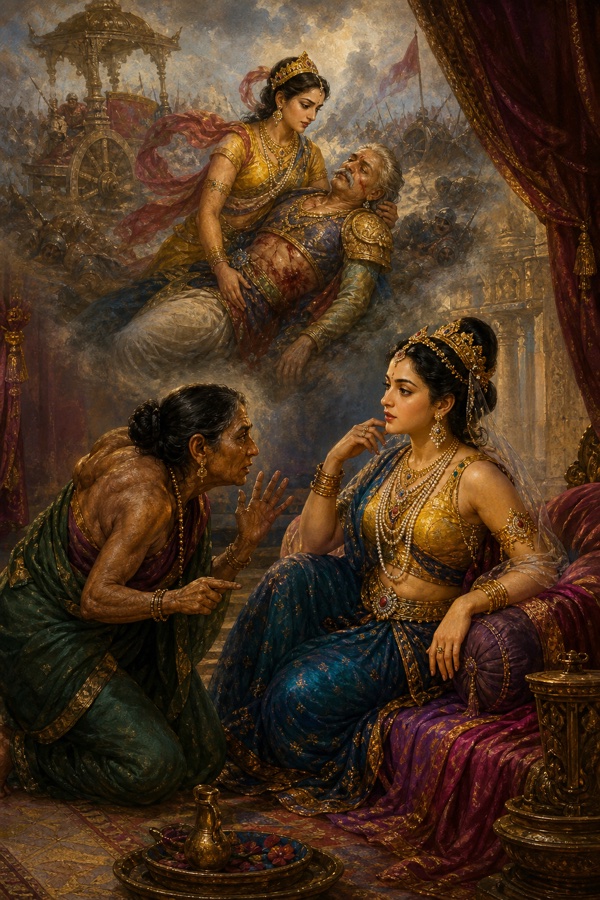
“There King Dasharatha fought a great battle against those demons, and their weapons and missiles cut him to pieces. My queen, he lay senseless on that field, and you were the one who got him out of the fighting. Even in the place you carried him to, the weapons found him again and mangled him, and again you took him up and carried him to a safer retreat, and you saved his life. Twice in one night, one rescue after the other. He was pleased with you past all measure, and he offered you two boons. And you said to him, ‘My lord, I will claim them when I choose.’ The king answered, ‘So be it.’ I knew nothing of this, my queen. It was you who told me, long ago, in the days when you still told me things, and out of love for you I have kept it in my heart ever since.”
“Bind your husband to his own promise, and stop the preparations that are already under way for Rama’s consecration. Ask him for the two boons: the first, Bharata’s consecration as Prince Regent; the second, fourteen years of exile in the forest for Rama. Fourteen years is enough. While Rama is gone, Bharata will sow the seeds of affection in the hearts of the people and take root, and no one will be able to pull him out again. Do it today, daughter of Ashvapati. Go into the chamber of anger, the room where a queen goes when she wants the king to know that she has been wronged, as though your fury had driven you there. Put on soiled clothes and lie down on the bare floor. When the king comes in, begin to weep. Lie there sunk in grief. Do not look at him, and do not speak.”
“You are your husband’s beloved. You always have been, and there is no doubt about it now. For your sake the king would walk into fire. He cannot bring himself to make you angry, and he cannot bear to see you angry; he would lay down his life for your pleasure. He dare not cross a word you speak. You have never understood how much power your beauty holds, you who take everything so easily. Understand it now. King Dasharatha will offer you gems, pearls, gold, precious stones of every kind. Do not let your mind settle on any of them. Remind him of the two boons he gave you in the war of the gods and demons, and do not let the thing you want, Bharata’s crowning and Rama’s exile, slip out of your grasp for a single moment.”
Kaikeyi’s mind turns, and praise for Manthara
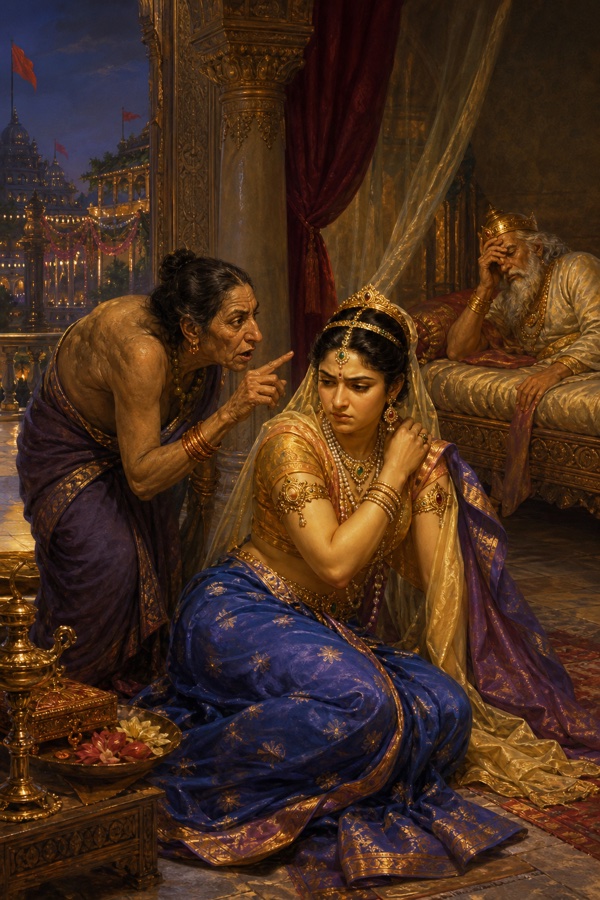
Manthara opened the whole plan to the end. “When the king himself bends down and lifts you off the floor with his own hands and offers you that promised boon, bind him with an oath first, and then ask for this: ‘Let Rama be sent far away into the forest for fourteen years, and let Bharata be made king of the earth.’ By the time Rama comes back from fourteen years of exile, your son will have been established and rooted on the throne of Ayodhya, and he will hold it for the rest of his life. Ask for Bharata’s installation, and over and above it ask for Rama’s banishment, and everything your son needs will be accomplished. A Rama who has been exiled becomes a Rama nobody wants. And Bharata becomes a king with no enemy left standing.”
“By the time Rama returns from the forest, your son will have made his roots fast inside the palace and outside it, among his kinsmen and among the people, and he will have won them all to his side, self-possessed as he is. I hold this to be the moment. Bind the king with an oath, and without fear turn him from his resolve to consecrate Rama.” Taught by the hunchback to see evil as good, and convinced by her, Kaikeyi was glad at heart. She was a woman of great intelligence, and at a servant’s words she went astray like an inexperienced girl, and, full of wonder at what had been shown her, she turned to Manthara.
“I will never again slight your judgment, for the counsel you give me is the finest there is. Of all the hunchbacked women on this earth you stand highest in sound reasoning. You alone are my well-wisher, always working for my good. I could not make out what the king intended, hunchback, and you saw it. Deformed women are usually ill-natured and full of sin. You are the honorable exception. You are as charming as a lotus bent over by the wind. Only your breast is spoiled by that hump, which rises up as high as your shoulders.”
Then Kaikeyi went on at length in praise of the crooked body in front of her, as a queen praises what she has just decided to love: the modest belly beneath the deformed breast, with its shapely navel, as though abashed by what rose above it; the full breasts; the wide hips; a face like the spotless moon; the smooth haunches under a girdle of tiny bells; the long feet and the long thighs, and how well Manthara looked in her silk when she walked ahead of her queen. “In this hump of yours live all manner of thoughts and policies and clever devices,” she said. “It is as though the thousand illusions of Shambara, the overlord of the demons, and thousands more besides, were stored up right here, and that is what makes it stand out like the hub of a chariot wheel. When Bharata is consecrated and Rama has gone to the forest, I will drape this hump with a chain of the finest molten gold, and I will anoint it with sandal paste, and I will set on your brow a beautiful little disk of gold inlaid with precious stones, and give you two fine garments, one for the waist and one for the shoulders, and ornaments, until you walk about like a goddess. With that face to rival the moon you will hold the first place among women, and you will carry yourself proudly among my enemies, my co-wives. And other hunchbacked women, all hung with ornaments, will press your feet, exactly as you have always pressed mine.”
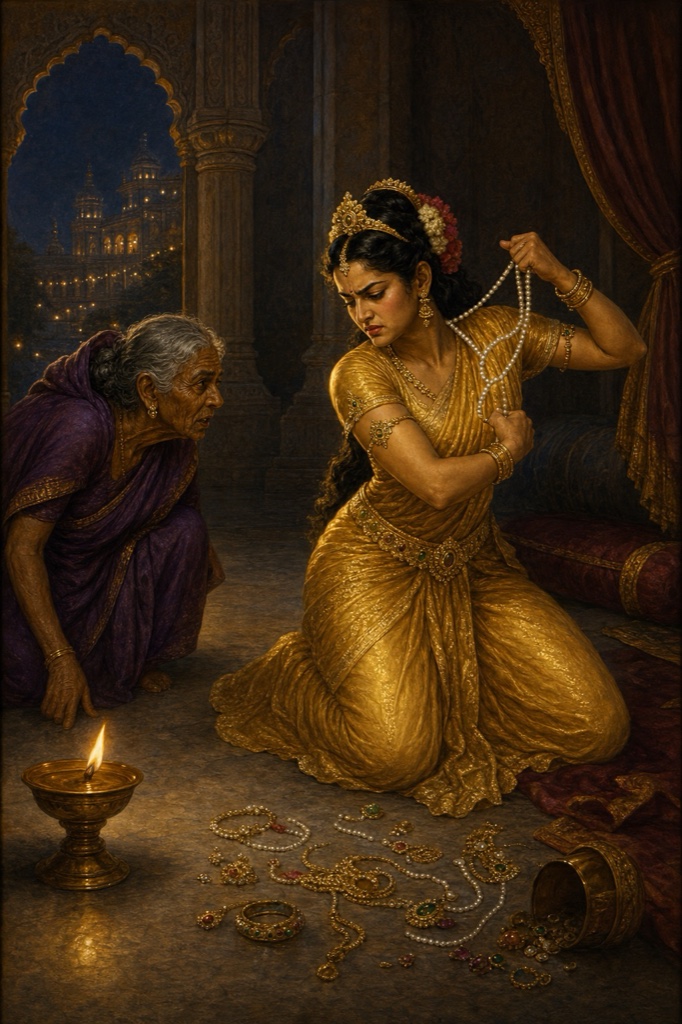
Praised like this, Manthara looked at her queen, who lay on the spotless bed like the flame of a sacred fire on its altar, and cut the praise short. “No dam is built across a stream once the water has run past, my lady. Get up, work your own good, and show the king an angry face.” Urged like this, the large-eyed queen, drunk on the pride of her own beauty and wholly under the hunchback’s words, went with Manthara into the chamber of anger. She unclasped her pearl necklace, worth many hundreds of thousands, and her other fine and costly ornaments, and threw them down, and, golden as she was, she lay down on the floor. Then she said to Manthara, “Hunchback, one of two things will happen. Either Rama goes to the forest and Bharata gets the kingdom of the earth, or you will go to that indifferent king and report me dead on this spot. I have nothing more to do with gold, or with jewels, or with food. If Rama is consecrated, this is the end of my life.”
Then the hunchback, in her harshest words yet, gave the king’s wife and Bharata’s mother one more counsel, friendly to the queen, as she framed it, and hostile to Rama. “If Rama inherits this kingdom, you and your son will surely suffer. So take the steps that will make your son Bharata Prince Regent, and take them now.” Struck again and again by these arrows of speech, pierced to the quick, amazed and enraged all over again at the husband who had loved her and was now, she was certain, her enemy, Kaikeyi pressed both hands to her heart and spoke to the hunchback.
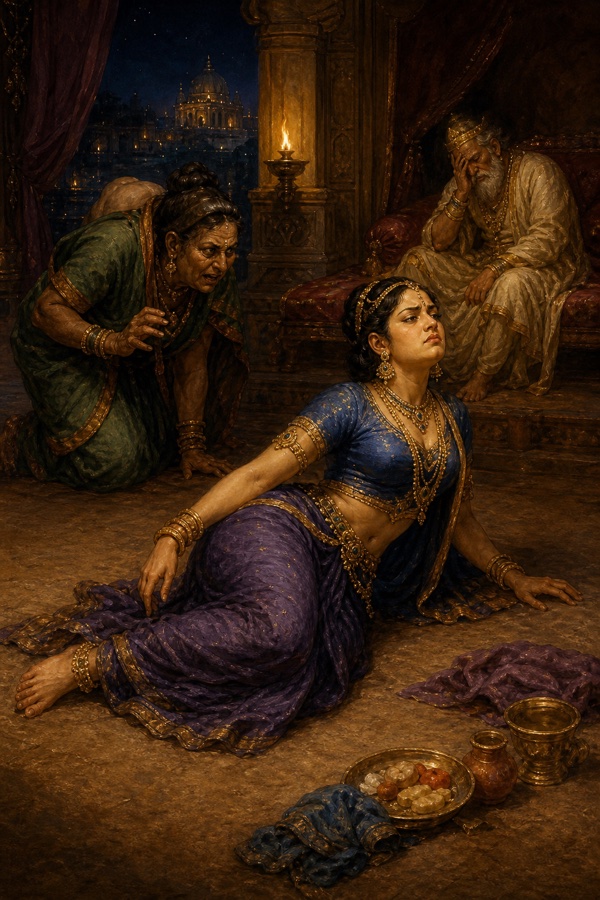
“Either Rama goes to the forest for a long, long time and Bharata has his desire, or you carry to the king the news that I have gone to the world of Yama, the lord of the dead. If Rama does not leave Ayodhya for the forest, I want no coverlet on my bed, no garland, no sandal paste, no collyrium for my eyes, no food and no drink, nothing at all in this world, and not life itself.” Having said this cruelest of things, she stripped off every ornament she still wore and lay down on the floor with no cloth beneath her, like a kinnari, one of the half-divine singers of the high Himalaya, fallen out of the sky. Her garlands and jewels lay scattered around her. Fury darkened her face like a veil, and the disconsolate queen looked like the night sky when darkness has swallowed the stars.
Dasharatha in the chamber of anger, and Kaikeyi’s coaxing
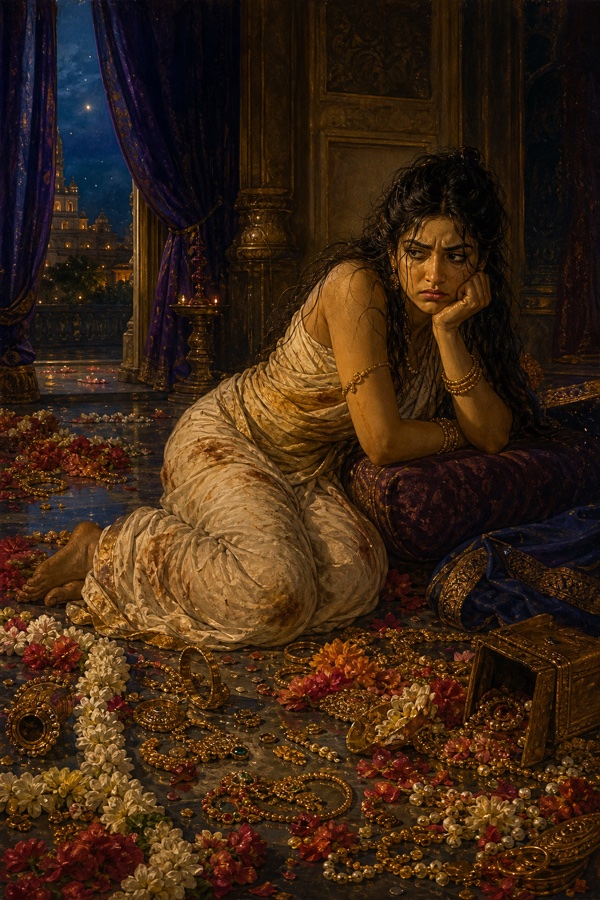
Misled by the sinful hunchback, the queen lay on the ground like a kinnari struck by a poisoned arrow. She had judged the plan sound, and, shrewd as she was, she unfolded to Manthara, little by little, everything she intended. Sighing long and hot like a serpent maiden of the world below, she brooded a while on the road to her own happiness, and Manthara, who wished her well and wanted this above all things, rejoiced as if the end were already won. Then Kaikeyi’s resolve hardened. She knit her brows and lay down again on the floor. The bright, many-colored garlands and the heavenly ornaments she had cast off stayed where they had fallen, and the floor around her looked like the sky with its stars set out. Her hair bound in a single tight braid, her clothes soiled, she lay in the chamber of anger like a kinnari whose life had drained away.
Meanwhile King Dasharatha had given the order for Rama’s consecration and dismissed his council, and now he went into his inner apartments. The announcement had been made only that day. He wanted to be the one to carry the happy news to Kaikeyi, who was dear to him, and, a man who ruled himself in all things, he made his way into the women’s quarters and entered her fine palace, like the moon entering a sky curtained with white cloud and marked by Rahu, the dark one that eats the moon at an eclipse. Her palace was loud with parrots and peacocks, with the cries of curlews and swans, with music. It was full of hunched and dwarf maids, of vine bowers and picture halls, of ashoka and champaka trees, of raised seats and altars of ivory, silver, and gold. Trees that were never out of flower and fruit stood in it, and stepwells with cut stairs going down, and excellent seats, and food and drink of every kind, and costly ornaments, and it rivaled heaven.
He passed through all this richness, and he did not find his beloved Kaikeyi on her fine couch. The king’s whole being was bent toward the morning and Rama’s consecration, and he had come to give his wife the joy of it; not finding her in her bedchamber, he called out to her, and there was no answer, and distress came over him. Never before had the queen missed this hour of his coming, and never before had the king walked into her empty room. So he asked the doorkeeper, as he had asked on other occasions, without any idea that the foolish lady was after a selfish end of her own. The woman was frightened. She joined her palms and said, “My lord, the queen is very angry. She has gone into the chamber of anger.”
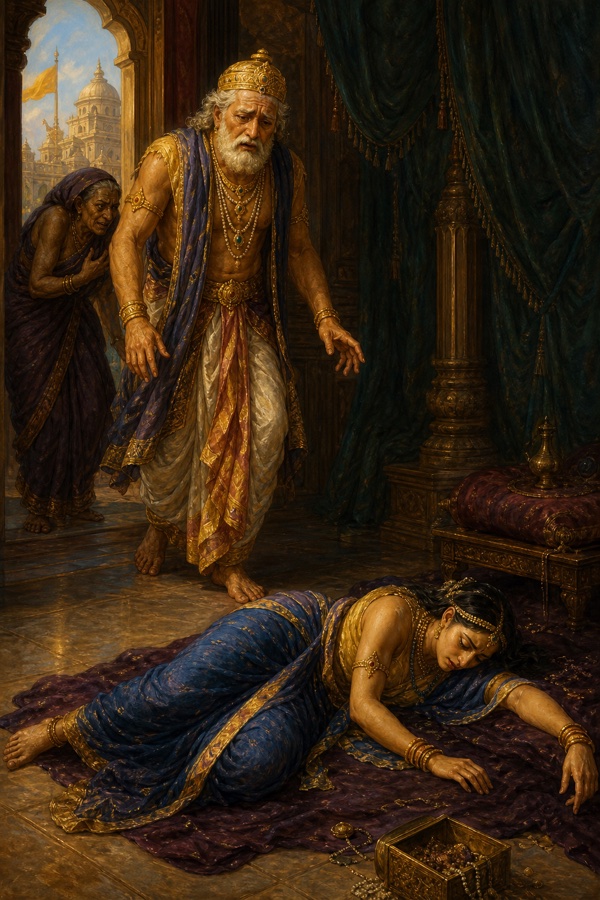
The report struck the king a second blow, and he grew more wretched still; his senses reeled and would not settle. Scorched with something like grief, he went in and found her fallen on the floor in a way no queen should lie. The sinless, aged king looked at his young wife, dearer to him than his own life, lying on the ground with her sinful resolve inside her, and to him she looked like a creeper torn from the tree that held it, like a fallen goddess, like a kinnari thrust out of heaven, like a celestial nymph dropped from the sky, like a conjurer’s illusion that has failed, like a doe caught in a snare. As a lordly elephant in the forest sees a she-elephant lying pierced by a hunter’s poisoned arrow, so the shaken king looked at that woman with her lotus-petal eyes. He bent down to her, and stroked her with his hands, and, greatly alarmed and full of love, he spoke.
“I cannot believe that this anger of yours is aimed at me. Who has scolded you? Who has insulted you? What has brought you to roll in the dust like this, to my great agony? Here I am, whose only thought is your welfare, and you lie on the floor as though some evil spirit had taken hold of you, and you are tearing my mind to pieces. I have skilled physicians, well rewarded, who will make you well again. Only tell me your illness. Whom do you want obliged today, and whom offended? Who should be rewarded, and who punished? Do not hide what is in your mind, and do not torment your own body by holding it in. What man who deserves no death should be killed, and what man under sentence should be set free? What pauper should be made rich, what rich man reduced to nothing? I and everything that is mine are under your command. There is no purpose of yours I could bring myself to thwart; I would carry it out at the cost of my own life. So speak. You know the strength of my love for you, and you have no reason to doubt me.”
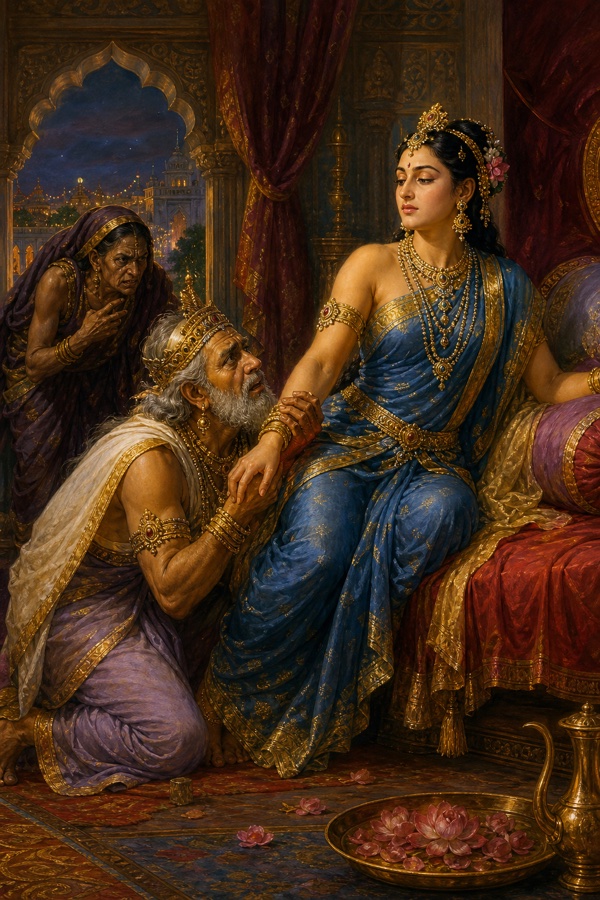
“I swear by every good deed I have ever done that I will do what pleases you. As far as the sun’s disc shines, the earth is mine. The prosperous lands of Dravida, of Sindhu and Sauvira, of Saurashtra and the southern country, Vanga and Anga, Magadha and Matsya, Kashi and Kosala, and all the wealth they yield, the riches and the grain, the goats and the sheep: all of it is mine. Ask for whatever your heart wants out of it, Kaikeyi. What will you gain by tormenting yourself, timid one? Get up. Rise, my fair one. Tell me truly where this fear has come from, and I will drive it off as the sun drives off the mist.” The words comforted her, and the comfort was useful. Ready now to put forward the demand he could not want, Kaikeyi made herself ready to torment her husband a little further.
The oath on Rama, and the demand for two boons
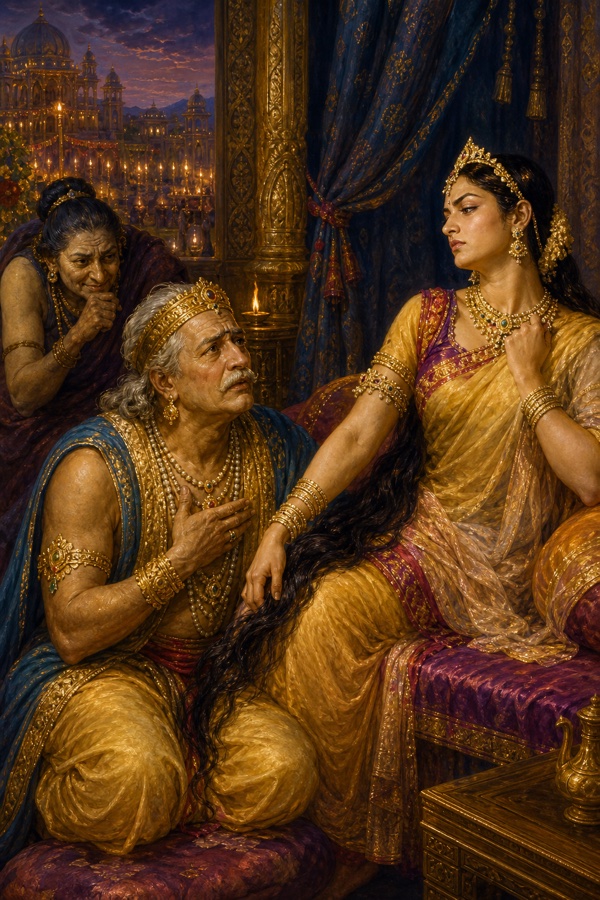
The king had been pierced by the arrows of desire and was a slave to their force, and Kaikeyi answered him with a cruel calculation. “My lord, no one has insulted me and no one has slighted me. I have one cherished wish, and I want you to fulfill it. If you mean to do it, swear it first. Then I will tell you what I am asking.” He gathered her scattered hair in his hands and put it in order, lifted her head onto his lap, and, smiling a little, said, “Proud lady, do you not know that no man on earth, other than Rama, that tiger among men, is dearer to me than you?”
He was still smiling. “I swear by Rama, invincible, great-souled, the first of men, dearer to me than my own life: say what your heart is set on. By that Rama, without the sight of whom I could not live for an hour, I swear, Kaikeyi, that your wish will be carried out. By that man whom I would choose over myself and over all my other sons, I swear that your command will be done. Knowing my mind to be what it is, good lady, open yours to me and save my life; let me carry out your order. You have seen the strength of my love; you have no reason to doubt me. I swear even by my own good deeds that I will do what pleases you.”
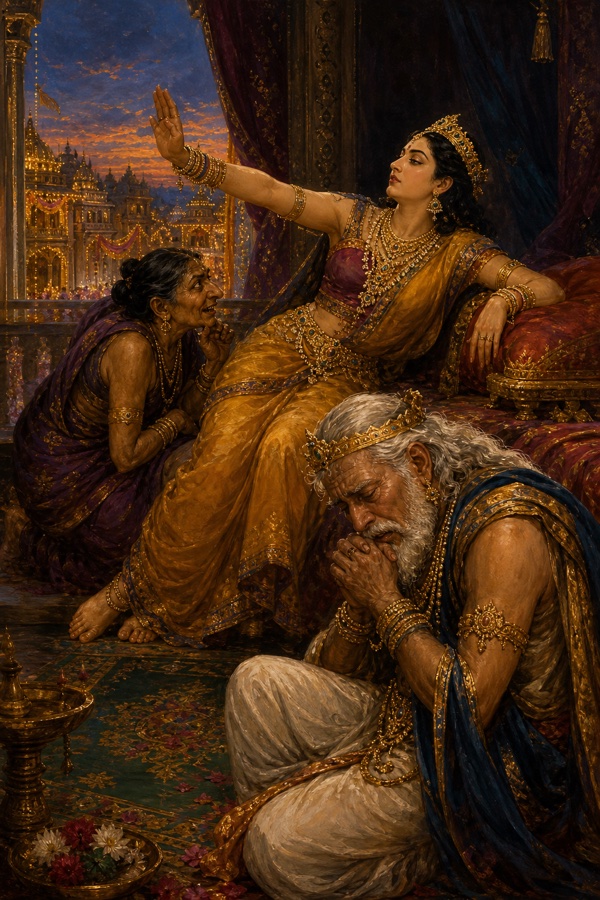
The oath she had been waiting for had left her husband’s lips. Her mind fixed on her object, moved by partiality for her son and by the joy of knowing that the king was wholly in her power, the queen now said a thing that would have been hard even for an enemy to say. Thrilled by that thrice-sworn oath, she gave out her purpose, as terrible as Death standing at the door. “In the order in which you swear and grant me my boon, first by your dearest son Rama and then by your own good deeds, let the thirty-three gods hear it, the Adityas and the Rudras and the Vasus and the twin Ashvins, with Indra at their head. Let the moon and the sun, the sky, the nine planets, day and night, the four quarters of space, the Gandharvas and the Rakshasas, the whole universe and this earth, the spirits that walk at night, the gods who dwell in every house, and whatever other beings are within hearing, know what you have said: that this true-vowed, glorious, righteous, pure-spoken king is granting me a boon. Let all the gods listen.”
Having praised the king in this way and won him over, she spoke to the passion-clouded man who carried the great bow, ready now to give her anything. “Recall what happened long ago in the war of the gods and demons, my king, when the enemy struck you down in that fight in the dark and left you nothing except your life. That night I kept awake and guarded you on every side, and while I was still laboring to save you, you granted me two boons. Those two boons, which you offered and I left in trust with you, I claim today, scion of Raghu. If, having sworn by your own dharma to grant them, you do not give them, then I will give up my life this very day, insulted by you.” With words alone Kaikeyi had brought the king into her power, and like a deer into a snare he had walked into the noose set for his own destruction.
Seeing the king, clouded with love, ready to grant whatever she asked, she said, “The two boons you offered me then, ruler of the earth, you must grant now, my lord. I will name them this instant. Listen. With the very preparations that have been made for Rama’s consecration, let my Bharata be consecrated Prince Regent. And the time has come for the second boon, the one you gave me in the war of the gods and demons, pleased with what I had done. Let Rama, dressed in bark and deerskin, live the life of a hermit in the Dandaka forest for fourteen years, and let Bharata receive the office of Prince Regent this very day, with no rival to it. This is my dearest wish. I am asking only for what you have already given. And let me see Rama setting out for the forest today, with my own eyes.”
Then she closed the door on him with his own virtue. “You are known as the king of kings. Be true to your promise, and by that truth guard your race, your character, and your birth. Those who are rich in austerity say that truthful speech is the highest good for men, and the surest road to the world to come.”
Dasharatha’s lament, and Kaikeyi’s hardness
Kaikeyi’s cruel request went into the king like a blade, and for a while he simply burned with it. He said to himself, “Is this a daydream? Is my mind confused? Or is it the memory of something lived through in a former birth, or some sickness of the mind?” Even after all this thought he could make nothing of it, and the agony took him and he fell into a swoon. When he came back to himself, the memory of her words tormented him afresh. Distressed and shaken, a deer that has seen the lioness, he sat on the bare floor and began to sigh like a great venomous serpent pinned to one spot by spells. “Alas,” he said, “shame!” and, his mind clouded with grief, he fainted once more.
It was a long time before he came round. Then, in deep grief and in anger, as though he would burn her to ash with the glow of his own fury, the king said, “You cruel woman of wicked conduct, bent on destroying this whole house. What wrong have Rama or I ever done you, wretch? Rama has always treated you exactly as he treats his own mother. Why are you bent on his ruin? Without knowing what I did, I brought a sharp-fanged serpent into my house and thought I was bringing a princess. When every living creature sings Rama’s praises, for what offense should I cast off my beloved son?”
“I could give up Kausalya and Sumitra. I could give up my royal fortune, and my life. I could never give up Rama, who loves his father so. To look at my eldest son is the highest joy I have; if I cannot see Rama, my very awareness dies. The world may go on without the sun, and the crops may live without water, and life cannot stay in my body without Rama. So enough. Let go of this resolve, woman of sinful design. Look, I touch your feet with my head. Be gracious to me. Why, for what reason, have you devised so cruel a thing?”
He went on, and the pleas came faster than the anger. If she wanted to test his feeling for Bharata, let what she had once recommended for Bharata come true; and yet she had told him so often, in her own words, that the glorious Rama, eldest in virtue as in years, was as much her son as Bharata was, and now he saw that she had said it only to coax him, or to get some service out of the boy. In all their years she had never done him an unreasonable or an unkind thing, and that was why he could not believe what she was doing today; some malignant spirit must have got into her in an empty house. Rama was delicate of body, the king said, and given to piety, and she was asking that he live nine years and five more in the most dreadful forest there was. Rama served her more than Bharata did; in the way the two boys treated her he could see no superiority in Bharata at all. In all the thousands of women of his inner court and all the dependents he maintained, no word of blame against Rama had ever been heard. With a guileless heart Rama won over the people of the kingdom by the good he did them; he conquered men by his truth, Brahmins by his gifts, elders by his service, and enemies on the battlefield with his bow. Truthfulness, charity, austerity, self-denial, goodwill, purity of body and mind, straightforwardness, learning, and service to his elders lived in Rama always. He did not remember one unkind word Rama had ever spoken to anyone. How was he, for her sake, to carry such news to a boy like that? “Kaikeyi, have pity on me, an old and wretched man who has come to the end of his days and begs you again and again. Whatever can be had on this sea-girdled earth I will give you; only do not drive me toward the thing that ends in my death. I join my palms, I touch your feet. Be a protector to Rama. Do not let the wrong of a broken word cling to me in this life.”
To the king in that state, scorched with grief, wailing, half senseless, tossing on the floor and drowning in sorrow, praying again and again to be carried across it, the fierce Kaikeyi gave a fiercer answer. “You granted two boons, valiant king, and now you repent them. How will you ever again speak of your righteousness before the earth? When the royal sages gather and ask you about those boons, you who know what is right, what answer will you give them?”
“Will you tell them, ‘I broke the promise I made to Kaikeyi, by whose grace I am alive, who protected me when nobody else could’? A king who grants a boon today and says something different tomorrow brings a stain on every other king of his line.”
“In the quarrel of the hawk and the dove, Shaibya cut the flesh from his own body and gave it to the bird. Alarka gave away his own eyes and reached the highest goal. The ocean, once it has given its word, never oversteps its shore.”
“Remember the conduct of your forefathers, and do not make false the pledge you gave me. Now I understand you, foolish king. You mean to throw dharma away, set Rama on the throne, and enjoy yourself with Kausalya forever. Whatever you promised me, whether it was righteous or unrighteous, whether you meant it or it was a hoax, there is no going back on it. If Rama is consecrated, I will drink a deep draught of poison and die this very day in front of your eyes. If for one single day I have to watch Rama’s mother receiving the joined palms of the people as the mother of the Prince Regent, then death is better for me than that sight. I swear by Bharata and by myself: nothing will content me except the banishment of Rama.”
Having said this much, Kaikeyi fell silent. She gave the wailing king no answer at all. He had heard the thing he could not want, Rama’s exile and the kingdom for Bharata, and for a while he could not say a word to her; with unblinking eyes he only stared at the beloved woman who had said it. That speech, hard as a thunderbolt, hateful to the heart, made of pain and grief, had taken every trace of happiness out of the king.
Thinking of the queen’s fixed resolve and of the terrible oath he himself had sworn, he breathed out “Rama!” and dropped to the ground like a felled tree. His wits gone like a madman’s, turned inside out like a sick man, drained of force like a snake whose venom is spent, the king lay still. Then, in a broken, hurrying voice, he said to Kaikeyi, “Who taught you this ruin, that it looks to you like gain? You speak to me like a woman possessed. Are you not ashamed? I never knew this flaw in your nature. Everything you are now is the opposite of the girl you were when you were young. What has frightened you, that you ask for such a boon, Bharata on the throne and Rama in the forest?”
“If you want any good for your husband, for the world, or for Bharata, give up this enmity toward Rama and this groundless dread, cruel, petty woman of sinful resolve and wicked deeds. What sorrow, what imagined offense, do you find in Rama or in me? Without Rama, Bharata will not even consent to live in the kingdom, let alone rule it; in dharma I hold him stronger than Rama himself. Once I have said the words, ‘Go to the forest,’ how am I to look even once at Rama’s face gone pale like the eclipsed moon? How am I to look at my own plan, made well and settled with my counselors, wrecked like an army cut down by its enemies? The kings who come from every quarter will say, ‘Look at this fool of the Ikshvakus. How did he rule so long?’ And when the learned old men ask me about Rama, how am I to tell them that I banished the boy because Kaikeyi pressed me?”
The king lamented on and on, and each grief brought the next. If he pleaded that he had done it for the sake of truth, then his own public word, that Rama would be installed the next morning, was made a lie. What would Kausalya say to him when Rama went to the forest, and what answer could he make her, after such an unkindness? Whenever Kausalya had waited on him like a maidservant, advised him like a friend, stood beside him like a wife in the sacred rites, found him other wives like a sister, and served him his food like a mother, he had never treated that godly woman with the kindness she deserved, out of fear of displeasing Kaikeyi, and the memory of it stung him now like bad food eaten by a sick man. How would Sumitra, afraid for her own two sons, ever trust him again? Sita would hear two griefs at once, that the king was dead and that Rama had gone to the forest, and she would spend her life lamenting like a kinnari bereft of her mate on a flank of the Himalaya. With Rama in the wilderness and Sita weeping, he would not live long, and Kaikeyi, a widow, would rule the kingdom with her son. “I took you for a chaste and lovely wife, and I find you utterly disloyal, the way a man who has drunk wine mixed with poison learns what it was only after he has drunk it. You have talked to me like a friend, coaxed me with empty sweetness, and killed me, the way a hunter charms a deer with a song and then strikes. Men of worth will revile me in the streets as an ignoble man who sold his son for the pleasure of his wife, the way they revile a Brahmin who drinks liquor. What suffering, that I must put up with your words. I must have earned it in some former life. Like a rope that a man ties around his own neck without knowing, I have lovingly kept you, wicked woman, sinner that I am. Taking my pleasure alone with you, I did not know you for my death, the way a child alone in an empty place lays his hand on a black cobra.”
“The whole world will be right to curse me, a father who abandoned his great-souled son, and say, ‘What a fool King Dasharatha is, a slave to his lust, who sent his favorite son into the forest to please his wife.’ Rama went thin as a boy over the Vedas and the hard vows of a student and the service of his teachers, and now, in the years that should be his years of enjoyment, he must go through great hardship all over again in the forest. My noble son will not say one word of protest. Told, ‘Go into exile,’ he will answer, ‘So be it.’ If he would only do the opposite when I command him, that would be welcome to me; my darling boy never will. When Rama has gone to the forest, Death will take me, hooted at by every man and forgiven by none, to the house of Yama. And when I am dead and Rama is gone, what further wrong will you do to the people I love who are left behind? Kausalya, missing me and Rama and her other two boys, will follow me to Yama’s house, unable to bear it; and Sumitra with her. Kaikeyi, throw Kausalya and Sumitra and me, with our three sons, into hell, and be happy. You alone will be left to tend the everlasting house of Ikshvaku, rich in every virtue, which no enemy could ever shake, once Rama and I have abandoned it and it has fallen into turmoil.”
If the exile of Rama pleased Bharata, the king said, then let Bharata not perform his father’s funeral rites. Widowed and notorious, Kaikeyi would rule with her son; it was his own ill luck that had brought a princess of Kekaya into his palace, and disgrace without equal and the scorn of every man would fall on him as on a sinner. How would Rama, who had gone everywhere in a chariot, on an elephant, on horseback, roam a great forest on foot? How would the boy whose cooks, in their gold earrings, had raced each other in their delight to set food and drink before him, keep himself alive on bitter, astringent, pungent wild fruit and on roots and bulbs dug out of the ground? How would Rama, clothed all his life in costly robes and deserving every lasting comfort, wear the ochre garments of an ascetic? “At whose prompting have you made this cruel demand, Rama’s exile and Bharata’s crowning?” He cursed the whole race of women, malignant by nature and bent on their own interest, and then took it back: he did not mean every woman, he said. He meant Bharata’s mother. Providence had lodged her in his house to torment him, and what mischief could she expect from him, or from Rama, who had done her nothing except good? Fathers who loved Rama would abandon their own sons to follow him into exile, and wives their husbands, and the whole world would rise in fury at the sight of Rama plunged in misfortune. He himself was young again every time that son, with the beauty of a divine boy, came toward him wearing his ornaments. Life could go on without the sun, or with Indra withholding the rain; nobody in Ayodhya would survive the sight of Rama walking out of the city toward the woods. “You doer of cruel deeds, in the calamity of my old age you strike me this hard blow of Rama’s exile. When you speak such words here and now, it is a wonder that your teeth do not break into a thousand pieces and fall out of your mouth. Rama never spoke one harsh or hurtful word to you; he does not know how to speak harshly. How dare you find fault with Rama, who speaks pleasing words to everyone and whom everyone esteems for his excellence?”
“Disgrace of the king of the Kekayas, faint, or blaze up, or perish by poison or by the rope, or sink into an earth split into a thousand chasms. I will never carry out that most cruel demand of yours, which is my ruin. You are a razor that speaks sweet lies; your heart is vile; you are the killer of your own house; you mean to burn my heart out with its roots, and I cannot bear the sight of you. I do not want you to live. Without Rama I have no life, so where is my happiness? Do not do me this wrong, my queen. Look, I even touch your feet. Be gracious.” Wounded to the heart by Kaikeyi, who had gone past every bound of decency, the king wailed like an orphaned child and sank down senseless like a sick man, and did not quite reach the feet she held stretched out in front of him.
A night of lament, and a wish to hold back the dawn
Fearless, evil in a woman’s shape, her end not yet won, seeing in Rama’s consecration nothing except harm to Bharata, Kaikeyi looked down at that good king, who deserved none of this cruelty and lay on the floor in a way no king should lie, like Yayati fallen out of heaven when his merit ran out, and she reminded him of the very same boon once more. “You boast, great king, that you are truthful and firm in your vows. Why, then, are you trying to withhold the boons that stand to my credit?”
For a while the king lay as if senseless. Then he answered her in anger. “Ignoble woman, my enemy. When Rama has gone to the forest and I am dead, then take your fill of joy. Even in heaven the gods will ask after Rama’s welfare, and when they are told that I banished him, how am I to bear their reproach? And if I tell them the truth, that Rama was sent to the forest to please Kaikeyi, then my first proclamation, that Rama would be Prince Regent, is made a lie, and I cannot escape the censure of the gods for going back on my word. I had no son, and I got Rama by long effort and great labor, a glorious son. How can I abandon him?”
“How can I banish Rama, who is brave and learned, who has conquered his anger and lives by forgiveness, who has eyes like the petals of a lotus? How can I send to the Dandaka forest Rama, the long-armed, immensely strong, dark as a blue lotus and lovely to look at? How am I to watch the ruin of Rama, who is made for comfort and was never made for grief? If only I could die without giving Rama any grief, then I would find peace. Kaikeyi of sinful design, why do you yoke my darling Rama to what he does not deserve?”
“Disgrace without equal will surely close in on you from every side.” While the king was wailing like this, his mind quite lost, the sun went down and night came on. That night wore the round moon like an ornament, and it lit nothing in the grieving king’s heart. All night long, sighing long and hot, his eyes fixed on the sky, the aged Dasharatha wailed like a sick man. “Night adorned with stars, I do not want you to turn into dawn. The moment the day breaks, Rama must go to the forest.”
Again he joined his palms. “Have mercy on me. Here are my folded hands. Or else go, quickly. I do not want to look at this Kaikeyi, pitiless and hard, through whom this disaster has come on me.” Then the king, who knew a king’s duties and every art of conciliation, tried once more to soften her, his palms still joined. “Show favor, good queen, to my wretched self, a man of blameless conduct, fallen on your mercy, whose life is nearly spent, and, more than that, a king. I did not proclaim Rama’s consecration in some hidden corner, my lovely one. The whole city heard it.”
“Show me your kindness, young one; you have a tender heart. Be gracious, and let my Rama have the imperishable kingship that comes from your hand, fair-eyed queen. By that you will win the highest fame. Do this kindness for me, for Rama, for the people, for our elders, Vasishtha first among them, and for Bharata.” His eyes had gone coppery with grief and were wet with tears; the wail of a guileless man, strange and piteous, mixing threats with coaxing, went on and on. And the hard-hearted queen of malicious intent, hearing every word of it, would not grant his prayer.
Then, seeing his beloved still unappeased, still speaking against him, still fixed on his son’s exile, the king fainted once more and, full of agony, sank senseless to the floor. So the night passed for that high-minded king, wearing itself away in his long sighs. When the panegyrists and bards began their work of waking him, and the auspicious music that marked the king’s rising from his bed began to sound, Dasharatha stopped that festal music.
The gist: Kaikeyi went on reminding the true-vowed king of his boon; all night he sang Rama’s virtues, touched her feet, joined his palms, and begged the night never to turn into dawn. Kaikeyi did not move. The king fainted again, and at first light he silenced the very music that was meant to wake him.
Source: Srimad Valmiki Ramayana, Ayodhyakanda, Cantos 7 to 13. The Gita Press edition is the controlling witness. The Sanskrit e-text and an independent complete translation were used to verify names, sequence, and principal events. Where recensions differ, this retelling follows Gita Press.
Basis: Valmiki Ramayana (Gita Press, Gorakhpur)