On this page
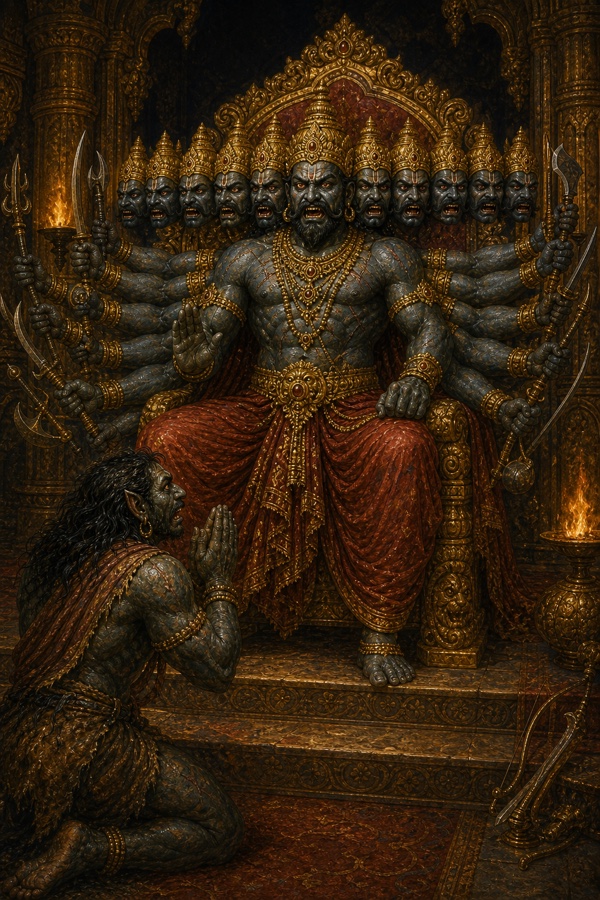
The fighting at Janasthana was over, and before the dust of it had settled the news was already crossing the sea. One rakshasa named Akampana had come out of that slaughter alive. He ran from the field, and he did not stop until he had crossed the water, entered Lanka, the island city of the rakshasas, and come to stand before its king. The words came out of him in a rush, and his voice shook as he made them.
“Rakshasas in great numbers, the ones stationed in Janasthana, have been killed,” he said. “Khara too has fallen in the fighting. I have somehow contrived to come away.”
Ravana heard it, and the eyes in his ten heads went the color of blood. Rage came off him the way heat comes off a furnace, and it seemed to Akampana that the king’s fire would burn him to ash where he stood for having carried the message.
“What man, whose life should already be counted finished, has laid waste my Janasthana, which was a terror to everyone alive?” he roared. “Who dares to wrong me and then look for shelter in any of the worlds? No one gives offense to me and afterward knows peace, not Indra, king of the gods, not Kubera, lord of wealth, not Yama, who rules the dead, not Vishnu himself, who keeps the universe. I am death to Death itself. I can set fire to fire. I can make mortality die. When I am angry I can stop the wind in its rushing, and with my own blazing spirit I can burn the sun and the fire together.”
The roar left Akampana on his knees with his palms pressed together, begging, in a voice that fear had scrambled, for the safety of his own life. Ravana, lord of all the rakshasas, granted it. And once he knew he would not be killed for speaking, Akampana spoke, and this time he left nothing in doubt.
Akampana’s Warning and the Counsel to Abduct Sita
“Dasharatha, the king of Ayodhya, has a young son named Rama,” Akampana said, “built like a lion, broad in the shoulders, his arms long and rounded, his skin the dark brown of a rain cloud, glorious, famous everywhere, of a strength and valor beyond any man’s. It was he who killed Khara, and Dushana with him, in the place called Janasthana.”
Ravana listened, and the sound that came out of him was the hiss of a king cobra. “Tell me, Akampana,” he said. “Did this Rama come to Janasthana with Indra behind him, and all the other gods?”
Akampana answered by describing the man again, because the answer lay in the man. “Rama’s glory is of another order. He is the first of all bowmen, master of the celestial weapons, and he has reached the summit of what valor can be in war. His younger brother Lakshmana is his match in strength, red-eyed, with a voice like a great drum and a face as bright as the full moon, and the two of them together are wind joined to fire. Janasthana was destroyed by Rama alone. No god of any standing came with him, and you need have no anxiety on that point. The gold-feathered arrows he loosed, fletched with buzzard feathers, turned into five-headed serpents in the air and swallowed the rakshasas whole. Whichever way the rakshasas ran in their terror, they found Rama already standing in the road ahead of them. That is how your Janasthana was emptied, by one man.”
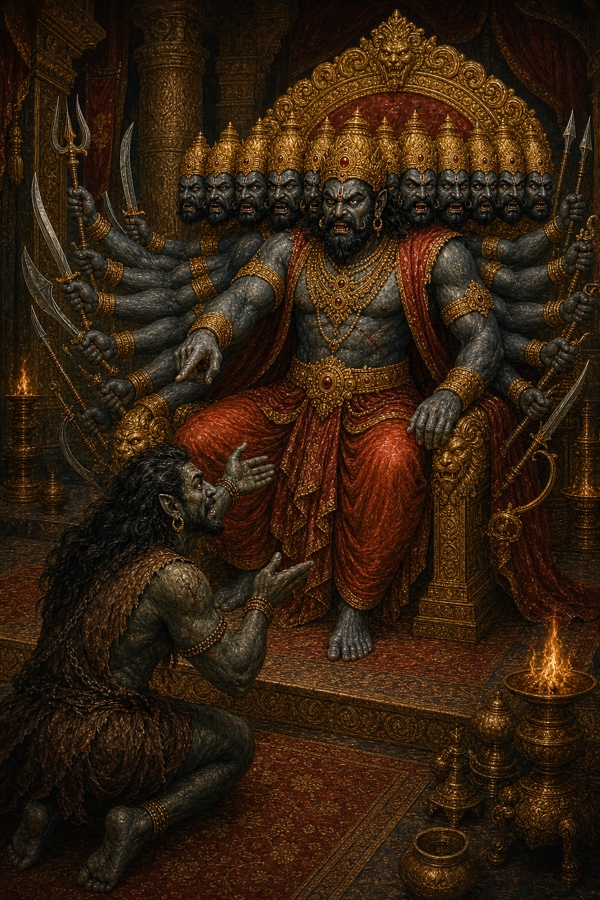
“Then I will go to Janasthana myself,” Ravana said, “and put an end to Rama, and of Lakshmana with him.”
Akampana heard the plan and set himself against it. “Hear how Rama’s might and courage actually stand,” he said. “When Rama is roused there is no taming him. With his arrows he can stem the current of a river in flood. He can pull down the vault of heaven with its stars, its planets, and its constellations. He can lift the earth if it sinks. He can break the bounds of the ocean and drown the worlds, or hold back its tide, or scatter the wind itself with his arrows. He can dissolve the worlds by his own prowess and then create them over again.”
“You cannot conquer Rama in battle, Ravana, and neither can the whole race of rakshasas, any more than sinful men can win their way into paradise,” he said plainly. “I do not believe all the gods and demons together could kill him. There is one means of bringing about his death, only one, and I ask you to hear it with an undivided mind.”
“His wife is Sita, the finest woman in the world,” Akampana said, “slender at the waist, every limb in proportion, adorned with jewels, in the full bloom of her youth, the loveliest of all women. No goddess can be compared with her, no gandharva woman, no apsara, no serpent-maiden; how then could a woman born among men stand beside her?”
“Put Rama off the scent, out in the great forest,” he counseled, “and then carry off his wife by force. Bereft of Sita, Rama will not go on living, whatever else happens.”
The idea pleased the sovereign of the rakshasas. He sat and pondered it for a while, that strong-armed king, and when he spoke again the thing was already decided. “All right,” he said. “Tomorrow morning I will go, alone but for my charioteer, and I will bring Sita, the princess of Videha, joyfully to this great city.”
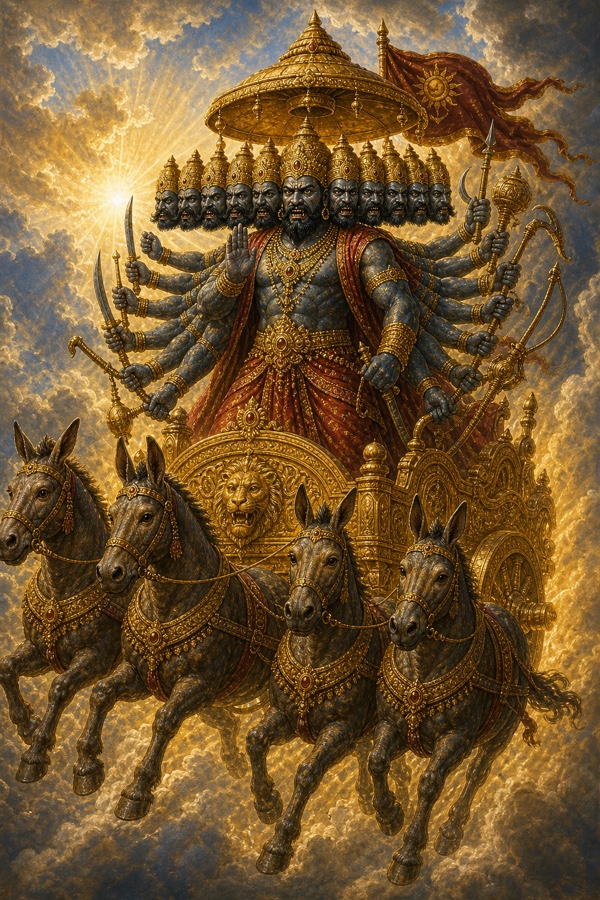
So saying, Ravana went out in a chariot bright as the sun, drawn by donkeys, and every quarter of the sky lit up as he passed. He traveled the road of the stars, and that huge chariot shone up there the way the moon shines with a cloud drawn across its face. Far off, in another country, he came down at a hermitage, and there he found Maricha, the son of Tataka, the rakshasi the boy Rama had killed at Vishvamitra’s word in the years before his marriage. Maricha received his king. He set before him foods worth chewing and foods worth drinking, delicacies no human kitchen had ever produced, honored him with a seat and with water for his hands and his feet and his mouth, and only then, in words that carried their full weight, asked his question.
“I hope all is well with the people of your kingdom,” he said. “But you have come to me in haste, and that fills me with apprehension. I do not think everything is quite well.”
Maricha’s First Refusal and Ravana’s Return
Ravana, who was as skilled in speech as he was in war, told him. “Khara and the others who guarded my frontier have been killed, my friend, by Rama, who never tires of action. The whole colony of Janasthana, which no one could ever have destroyed, has been wiped out in a single encounter. Lend me your help in carrying off his wife.” Maricha heard the request through to its end, and then he asked a question of his own.
“What enemy, wearing the face of a friend, named Sita to you as a woman fit to be carried off?” he asked. “Who is it, made glad by your gifts and your favor, that takes no joy in your welfare, and wishes you harm, and sets you on the wrong road? Tell me who says, bring Sita to Lanka. Who wants to be rid of the foremost figure in the whole world of rakshasas? Whoever encourages you in this is your enemy, and there is no doubt of it. He means to use you to pull a fang out of a snake’s jaws. By what act, and by whose doing, have you been led onto this road? Who has dealt you a blow on the head while you lay asleep at your ease?”
Then he spoke in figures, because the plain words were too frightening to say. “Rama is a bull elephant in rut, the kind whose very scent scatters the other elephants. His birth in a spotless line is the trunk, his glory is the fluid running down the temples, his shapely arms are the tusks. You should not even stare that elephant in the face on a battlefield, not now. He is a lion of a man, and his presence on the field is the lion’s joints and mane; he kills the animals that are rakshasas skilled in fighting; his arrows make him whole in every limb and his sword is his sharp teeth. Do not rouse that lion while he sleeps. Rama is a fathomless ocean, and his bow is the crocodile in it, and the strength of his arms is the mud at the bottom, and his arrows are the rough waves, and a fierce battle is its water. Do not leap into the fire that burns under that ocean, the most dreadful mouth of the deep.”
He put his palms together and made his plea into a blessing. “Be pleased, lord of Lanka, ruler of the rakshasas. Be content with what you have, and go home safely to Lanka. Take your ease forever among your own wives, and let Rama take his ease in the forest with his.”
Ravana, the ten-headed king, heard him out, and for once he listened. He turned back to Lanka and entered his splendid palace, and for a little while the matter rested there.
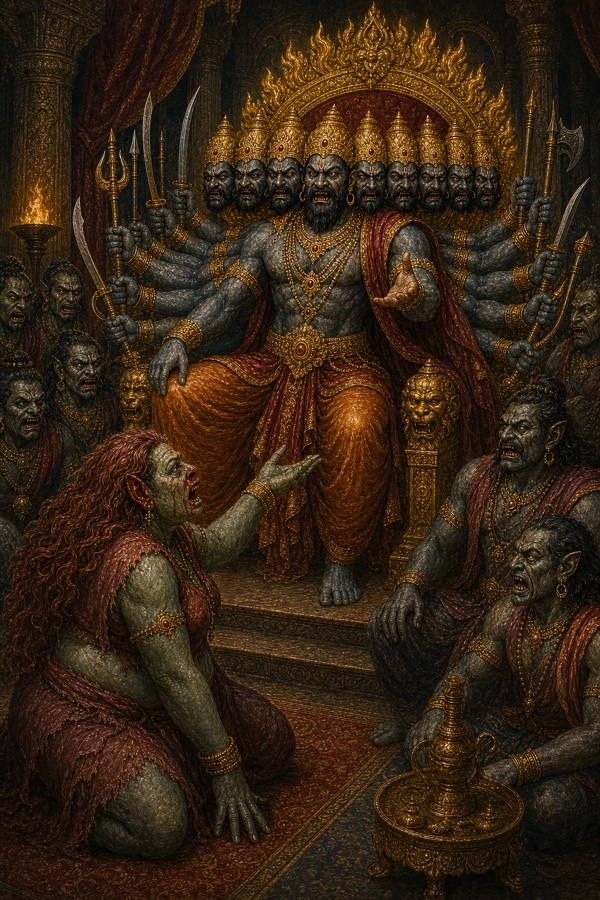
Meanwhile Shurpanakha had watched the whole thing: fourteen thousand rakshasas of terrible deeds killed by Rama alone, and Dushana, Khara, and Trishira killed in the same battle. When she had seen it she roared aloud like a thundercloud, and, shaken to the core by a feat no other man could have managed, she set out for Lanka, the city under Ravana’s protection. She found her brother seated on the roof of his seven-storied palace among his ministers, the way Indra sits among the wind-gods, on a golden throne so bright with him that it looked like a fire fed with ghee burning on a golden altar.
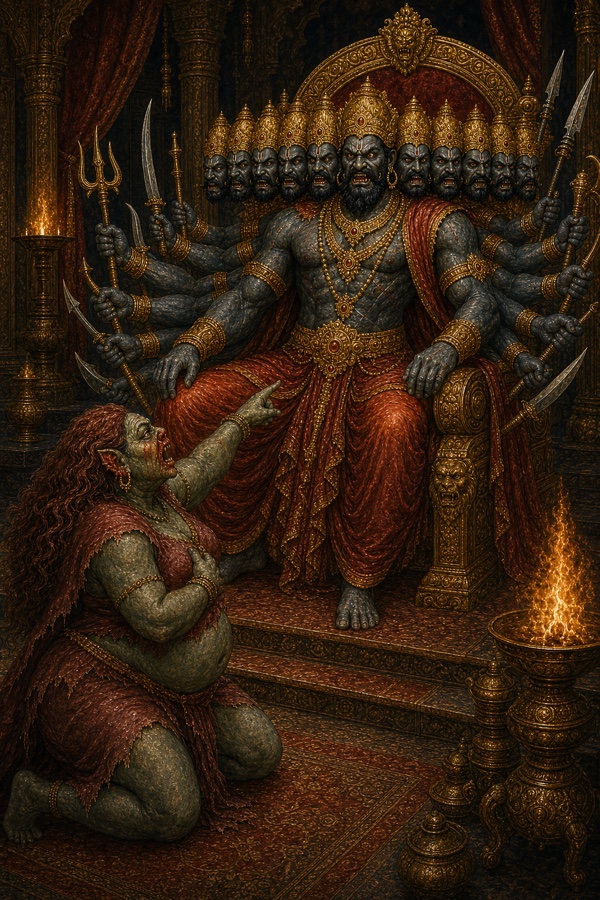
His sister looked at him where he sat, and what she saw was this. Here was a man whom gods, gandharvas, spirits, and great seers had never conquered in battle, who looked as fierce as Death with his mouth open wide. His body carried the scars of the thunderbolt and the lightning from the old wars between the gods and the demons, and his chest bore the callused marks of the tusks of Airavata, Indra’s own elephant. He had twenty arms and ten heads, the paraphernalia of royalty, a broad chest, every bodily mark of a king. His skin had the sheen of cat’s-eye gems, he wore ornaments of refined gold, his arms were shapely, his teeth white, his mouth enormous, and he looked, sitting there, like a mountain. Hundreds of times in the wars with the gods Vishnu’s discus and the other weapons of heaven had struck him, and no weapon of the gods could wound a single limb. He had churned up seas that no one else could churn. He had hurled mountain peaks as missiles and crushed the gods with them. He had uprooted the moral laws, enjoyed other men’s wives, mastered every celestial missile, and broken up sacrifices for sport. He had gone down to Bhogavati, the city of the serpents, beaten Vasuki their king, routed Takshaka and carried off his beloved wife. He had climbed Kailasa and conquered Kubera, the lord of wealth, and taken away his aerial chariot Pushpaka, which goes wherever its master wills; in his anger he had laid waste Kubera’s garden Chaitraratha and the lake Nalini at its center, and Indra’s garden Nandana, and the other gardens of the gods. Big as a mountain peak, he had reached up with his arms and stopped the sun and the moon as they rose. For ten thousand years he had practiced austerities in a great forest, and at the end of them he had offered his ten heads, one after another, into the sacrificial fire as an oblation to Brahma, and with them he had bought immunity in battle from death at the hands of gods, demons, gandharvas, fiends, birds, and serpents. Human beings were left out of the boon. He spilled the Soma at sacrifices while the Brahmins chanted, wrecked rites that had all but reached completion, killed Brahmins, and was rough, pitiless, and bent on harming every created thing. This was the brother she had come to: dressed in celestial robes, jewels, and garlands, ringed by his counselors, looking like Time itself when it arrives to end the worlds. On that cruel face, the terror of every world, Shurpanakha fixed her eyes; and mutilated, frantic with fear, holding her disfigurement up for him to look at, she who had once roamed the forest without fear and had wanted Rama for herself made ready to say the harshest words she had.
Shurpanakha’s Rebuke and a Lesson in Statecraft
The afflicted Shurpanakha, standing in the middle of the ministers, let her anger speak, and what came out of her was a lecture on kingship, delivered to the king who made the worlds weep.
“You are sunk in your pleasures,” she said, “licentious, unbridled, and you do not see the frightful danger that has already risen over you, though it is there for anyone to see. A rapacious king, given to coarse enjoyments and acting on his own whim, gets no more esteem from his people than the fire in a cremation ground gets from those who walk past it. A king who does not attend to his own affairs in person is destroyed, and his kingdom and his affairs go down with him. A king who has appointed no spies, who is hard for his subjects to get a sight of, who has no independence of his own, is shunned by his people from a distance, the way elephants shun the mud in a river. Rulers who do not win back a territory that has slipped out of their control shine no more than mountains sunk under the sea. You have picked quarrels with gods, gandharvas, and demons, who are masters of themselves, and you have posted no spies; fickle as you are, how do you expect to go on being a king? You are childish, and without intelligence, and you do not know what a king must know. How will you remain one?”
“Rulers whose spies, treasury, and policy are not in their own hands are no better than ordinary men,” she said. “Kings are called far-sighted because their spies let them see what is far off. I am certain you have no spies in your kingdom, because your counselors are untutored and you did not know that your own people had been killed and the land they lived in laid waste. Fourteen thousand rakshasas of terrible deeds, and Khara, and Dushana, have been destroyed by Rama alone. The seers have been given their safety, the Dandaka forest has been made secure for them, and Janasthana has been devastated by a man who never tires of action. And you, greedy, careless, a slave to your passions, do not even see the danger that has risen in your own territory.”
“No one comes to the rescue of a king in distress who is severe, stingy, careless, proud, and deceitful,” she went on, driving each maxim in like a nail. “A king who is vain past bearing, fit to be disowned, full of himself, is killed in adversity by his own people. A king who does not do his duty and takes no alarm even with danger in his face is soon stripped of his kingdom, reduced to wretchedness, worth no more than straw. Dry sticks serve some purpose, and so do clods and dust, and a king fallen from his place serves none. A garment once worn and a garland once squeezed are useless to anyone else, and so is a king, however powerful, who has lost his kingdom. The king who endures is the one who is vigilant, who knows everything about himself and about his enemy, whose senses are under his control, who recognizes the services done for him, and who is pious by nature. The king the people honor is the one who, though his eyes are closed in sleep, stays awake through the eye of prudence, and whose frown and whose favor show themselves as punishment and as reward. You, Ravana, are silly and utterly destitute of every one of these virtues, and that is why the great slaughter of the rakshasas never reached you through a single spy. You show disrespect to everyone, you are attached to the pleasures of the senses, you do not know the right division of time and place, and you have never once applied your mind to weighing the merits and demerits of anything. You will find your sovereignty in danger, and you will perish soon.”
Ravana, the lord of the rakshasas, rich in wealth and vanity and might, examined in his own mind the weaknesses she had counted off, and for a long time he sat there and reflected.
Shurpanakha’s Temptation and a Portrait of Rama
Her hard words, and the ministers who had heard them, stung him. Ravana, angry, put his questions to her. “Who is this Rama? What is his strength, what does he look like, what is the measure of his prowess, and why has he pushed his way into the Dandaka forest, which is so hard to pass through? What weapon does he carry, that he has killed the rakshasas with it, and Khara, and Dushana, and Trishira on the field of battle? And tell me the truth, who was it who disfigured you?”
Shurpanakha, half out of her mind with rage at being questioned so, gave him a true portrait of Rama, and it was the truth that did the damage. “He has long arms and large eyes, and he dresses in tree bark and the skin of a black antelope, and to look at he is Kandarpa, the god of love, come down among men,” she said. “He draws to its full length a bow that shines like a rainbow, ringed with gold, and lets go steel arrows that gleam like the deadliest of snakes. I could not see when he took up those dreadful arrows, or when he pulled the bow back, or when he released them. I saw only the army of the rakshasas being cut down under his volleys the way a fine standing crop is destroyed when Indra sends down hail. Fighting alone, on foot, he killed fourteen thousand rakshasas of terrible prowess, and Khara and Dushana with them, in the span of an hour and a half.”
“He has given the seers their safety and made the Dandaka forest a place they can live in,” Shurpanakha went on. “He has realized the Self, and he was afraid of the sin of killing a woman, and so I alone was spared, after he had disgraced me with this mutilation. His mighty brother is named Lakshmana: of matchless glory, his equal in valor, bound to him by love for his rare virtues. He is intolerant of insult, hard to conquer, victorious in battle, heroic, gifted, and strong. He is always the right hand of Rama, and he is Rama’s own life walking about outside his body.”
Then she described Sita, and the whole hall could watch the king’s face change as she did. “Rama’s beloved wife, wedded to him by the sacred rites, has large eyes and a face like the full moon, and she lives to do what pleases her lord and what is good for him,” she said. “Her hair is lovely, her nose and her thighs are shapely, her whole appearance is comely, and she is so illustrious that she seems the presiding goddess of this forest, a second Lakshmi. Her skin has the color and the luster of molten gold, her nails are prominent and red, her hips are shapely and her waist slender, and she is the daughter of Janaka, the king of Videha; her name is Sita. No woman of such beauty have I ever seen on the face of the earth, not a goddess, not a gandharva woman, not a yakshi, not a kinnari. The man whose wife Sita is, the man she embraces with delight, lives more happily in all the worlds than Indra himself.”
She led him on. “She is a woman of good nature, praiseworthy in form, without a peer on earth for beauty. She would be a consort worthy of you, and you an excellent husband for her,” she said. “I had set out myself to bring her to you, that woman with the broad hips and the full high breasts, so that she might be your wife, and it was for that the cruel Lakshmana cut me as you see me. If you once set eyes today on the princess of Videha with her face shining like the full moon, you will become a target for the arrows of love, and there is no doubt of it.”
“If your heart inclines toward taking her as your wife, let your right foot be lifted this instant, from this very place, to conquer Rama,” she urged him. “If my counsel finds favor with you, follow it without fear. You know the weakness of these people, Rama and the rest, and you know your own greater strength. Let Sita of the faultless limbs be taken to wife, my brother. You have heard that the rakshasas stationed in Janasthana were killed by his straight-flying arrows, and you know that Khara and Dushana are dead. Today you should realize your duty.”
Ravana Goes to Maricha a Second Time
The words had gone into him like something warm. Ravana heard Shurpanakha’s nerve-racking report to its end, settled in his mind what his duty was, gave his ministers leave to disperse, and left the palace at once. He turned the object over as he walked and looked at it properly from every side. He weighed the merits of the thing against its demerits. He measured his own strength against his own weakness. And when he had done all that, he made up his mind, definitely, to carry off Sita, and with that resolve fixed he went down to his handsome carriage-shed. He reached it unobserved, and there he gave his charioteer the order. “Get my chariot ready.” The charioteer moved fast, and in a moment the king’s favorite chariot stood ready, a splendid one: a chariot of gold set with jewels, drawn by donkeys with faces like fiends, hung with golden ornaments, a chariot that went wherever the mind of its master went. Ravana, the younger half-brother of Kubera, the sovereign of the rakshasas, mounted it, and it rolled toward the ocean, the lord of rivers, with a sound under its wheels like thunder.
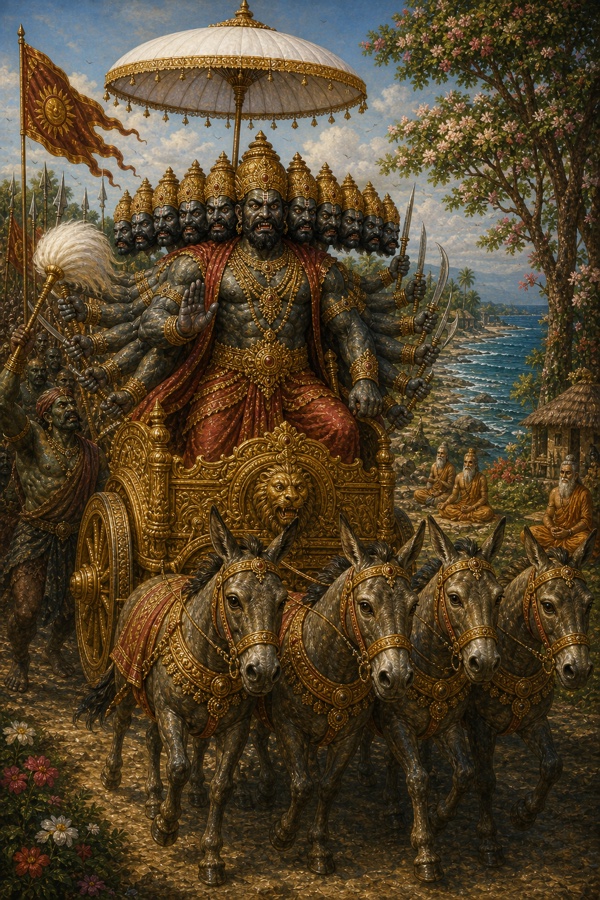
Seated in that chariot that went where he willed, the ten-headed king, the sworn enemy of the gods, the killer of the foremost ascetics, was fanned with a white whisk under a white canopy. He shone like polished cat’s-eye, in ornaments of refined gold, with his ten necks and his twenty arms and all the trappings of royalty, like a mountain that had been given ten peaks, and he cast his splendor across the sky the way a cloud does when lightning rings it and a line of herons flies beside it. Below him ran the coast, and he surveyed all of it as he went: the shore crested with mountains and crowded with trees by the thousand, bearing every kind of flower and fruit; lotus ponds with cool holy water in them; the wide grounds of hermitages with their sacrificial altars; plantain groves, and coconut, palmyra, and tamala trees, and other trees in full blossom. The foremost seers lived on that coast on the sparest of diets, and with them nagas, suparnas, gandharvas, and kinnaras in their thousands; siddhas who had conquered passion, and charanas, and the mind-born sons of Brahma; ascetics of the orders called Vaikhanasa, Masha, Valakhilya, and Marichipa; apsaras adorned with heavenly jewels and garlands; the graceful consorts of the gods; and hosts of gods and demons who live on nectar. It was crowded with swans and herons and cranes, strewn with dark stones like cat’s-eye, and the sea’s breath kept the whole of it cool. As he drove at full speed through the air he saw on every side the white aerial chariots of those who had won the higher worlds by their austerities, festooned with celestial wreaths, alive with instruments and singing, going wherever their masters wished, and gandharvas and apsaras riding in them.
He went on, and the forests below him were forests you could smell from the sky: sandal trees whose roots wept resin, groves of the finest aguru, fragrant takkola heavy with fruit, tamala in flower, pepper vines, and then heaps of pearls drying on the sand, rocks, heaps of coral, peaks of gold and peaks of silver, caskets of crystal, and cities stocked with wealth and grain, crowded with beautiful women, thick with elephants, horses, and chariots. Then, at the sea’s edge, he saw a level stretch of ground, smooth on every side, fanned by breezes soft to the touch, delightful as heaven itself. And on that ground stood a banyan tree that looked like a thunderhead, ringed on all sides by ascetics, whose great branches spread a hundred yojanas around.
To a bough of that same banyan the mighty Garuda, the king of birds and the carrier of Vishnu, had once flown down with an elephant and a gigantic tortoise in his claws for his meal. Under his enormous weight the leaf-laden bough broke off all at once, and beneath it sat the foremost seers of the orders called Vaikhanasa, Masha, Valakhilya, Marichipa, and Dhumra, the last of whom breathe smoke while hanging head-down from the branches. Garuda caught the broken bough, a hundred yojanas long, and carried it off at speed with the elephant and the tortoise in a single claw, ate their flesh in the air, destroyed the country of the Nishadas with the bough, and so set the great ascetics free; and his mind being set on righteousness, his joy at it was beyond comparison. He felt his prowess doubled by that joy, and he made up his mind to fetch the nectar of immortality from heaven. He crushed the iron lattice that guarded it, broke open the jeweled strongroom behind the lattice, and secretly carried the nectar away from the palace of Indra himself. This was the banyan, Subhadra by name, thronged with eminent seers, still bearing the mark of the havoc Garuda had made of its great bough, that Ravana now saw.
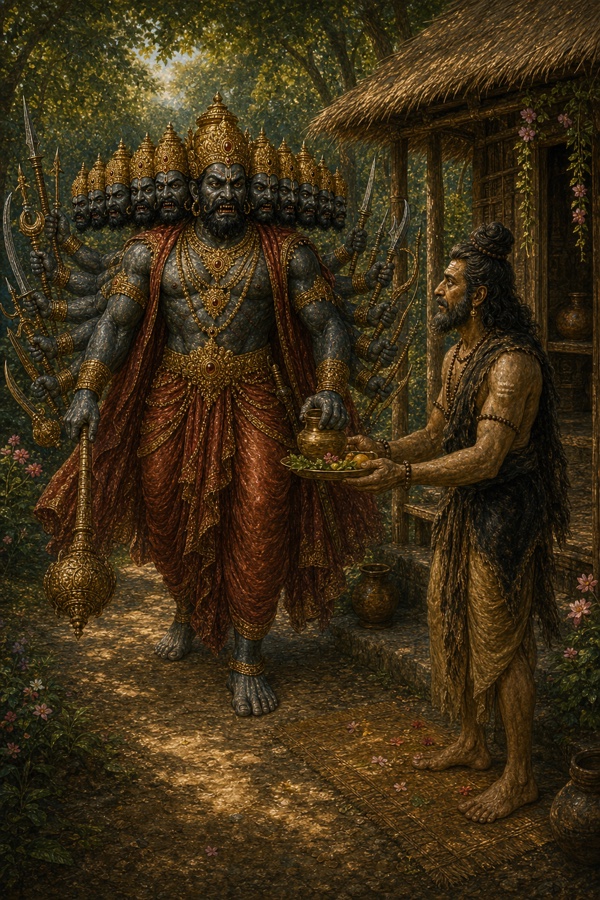
Past the banyan he crossed to the far shore of the ocean, and there, in a lonely, holy, and lovely stretch of forest, was a hermitage. In it he found Maricha, clad in black antelope skin, his matted hair coiled on his head, living on the little his rule allowed him. Maricha received his king with every ceremony, entertained him with the luxuries no human being has ever tasted, and would let nobody else do it; he waited on Ravana with food and with water himself.
“I hope all is well in your Lanka,” he asked, in words that meant more than they said. “With what object have you come here again so soon?”
Ravana, glorious and a master of words, answered him. He had flown a long way to say it, and he had his speech ready.
Ravana’s Proposal and the Terror on Maricha’s Face
“Maricha, listen to me, and hear my words as I speak them,” Ravana said. “I am in distress, and for a man in distress you are the supreme refuge. You know Janasthana, where my brother Khara and the strong-armed Dushana lived, and my sister Shurpanakha, and the flesh-eating Trishira with his great arms, and many other brave rakshasas, all of them men who had tasted victory in war, all of them there by my command, harrying the ascetics who practiced virtue in the great forest of Dandaka. Fourteen thousand brave rakshasas of terrible deeds lived there and followed Khara’s mind. They were ready for anything, skilled in every weapon, and they came to grips with Rama on the field. Rama spoke no harsh word. He simply took up his bow and his arrows, with the anger burst out in him, at the head of the fight, and fourteen thousand rakshasas of terrific energy were cut down by one human being, on foot, alone, with arrows of fire. Khara was killed on the field. Dushana was killed. Trishira was disposed of too, and the Dandaka forest was made safe for the ascetics to live in.”
“This Rama is a man exiled with his wife by an angry father, a man whose life is spent, a disgrace to the warrior caste,” Ravana said, and every word of it was slander, as Maricha was about to tell him. “He is ill-behaved, hard-hearted, hot-tempered, stupid, greedy, with no control over his senses. He has abandoned virtue, his mind is set on unrighteousness, and he is bent on harming every created thing. I will bring Sita, who looks like a daughter of the gods, out of Janasthana by force, that Rama’s wife, because it was for her that my sister Shurpanakha was disfigured in the forest, her ears and her nose cut off by a man relying on nothing but his physical strength, without any show of hostility on her side.”
Then he asked for what he had come for. “Be my helper in this,” he said. “With you standing at my side, and my brothers behind me, I count all the gods as nothing. Be my helper, then, since you have the power to help me. In prowess, in war, and in martial pride you have no equal; you are an eminent hero at devising maneuvers, and an adept in the great arts of illusion. It is for this alone that I have sought you out. Now hear the part you are to play in helping me.”
Then he laid out the scheme, crooked in every joint. “Take the form of a golden deer freckled with spots of silver,” he said, “and roam about Rama’s hermitage in front of Sita. When she sees you in the shape of a deer she will say to her husband and to Lakshmana, without a doubt, let it be caught. When Rama and Lakshmana have gone far from their hermitage, then, with nothing to hinder me, I will carry Sita away with ease in that solitude, the way Rahu takes away the splendor of the moon. And after that, with my object accomplished and my mind at rest, I will strike at Rama with confidence, and with ease, wasted as he will be by the loss of his wife.”
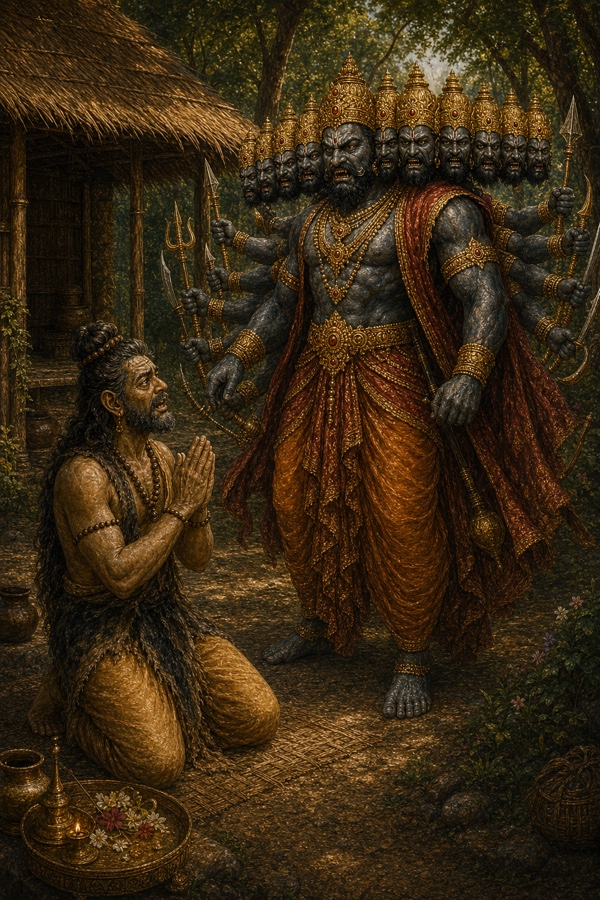
It took only the sound of Rama’s name in Ravana’s mouth. Maricha’s own mouth went dry, and the terror came up in him where he sat. He licked his parched lips and could not make them wet. He looked like a man already dead. He stared at Ravana without blinking, the way a man looks who has just been shown the hour of his own death. Then, frightened, sick to the heart, with his palms put together in front of him, Maricha, who of everyone in that hermitage knew from experience exactly what Rama’s prowess was in a great forest, spoke the true words that were for Ravana’s good, and for his own.
Maricha’s Words of Truth and the Image of Rama as Dharma
“People who say agreeable things are always easy to find,” Maricha said. “The man who says the thing that is unpalatable and wholesome is hard to find, and so is the man who will listen to him. You have posted no spies to learn the true state of affairs in your kingdom, and you yourself are restless, and so you do not know Rama, exalted in virtue and in valor together, the equal of mighty Indra and of Varuna, the lord of the waters.”
Then, half in blessing, he let his dread speak. “May all be well with all the rakshasas, Ravana. May an infuriated Rama not empty the worlds of rakshasas. Would that Sita, the daughter of Janaka, had not been born to bring about the end of your life. Would that no great calamity befell you on account of Sita. Would that Lanka, having got you for its master, licentious and unbridled as you are, did not perish along with you and every rakshasa in it. A king who is licentious and evil-minded, whose conduct is evil, who takes counsel from sinful men, brings down himself, his own kith and kin, and his kingdom with him.”
Then he took Ravana’s slanders one by one and broke them. “Rama was not disowned by his father,” he said. “He has not crossed the bounds of morality in any way. He is not greedy, he is not of evil conduct, and he has brought no disgrace on the warrior caste. He is not without piety and virtue; he is the joy of his mother Kausalya. He is not harsh toward living beings; he is devoted to the good of every creature there is. He saw his father, who always spoke the truth, tricked by Kaikeyi, and he said, I will prove him a man of his word, and he left Ayodhya for the forest. He gave up the throne of Ayodhya and every pleasure of the senses and walked into the Dandaka forest to accomplish what Kaikeyi wanted, and what King Dasharatha had promised.”
“Rama is not hard-hearted, my friend, and not ignorant, and his senses are not unsubdued,” he said. “No charge of falsehood has ever been heard against him, and you should not be the one to bring it. Rama is virtue itself in a body, pious, of unfailing prowess. As Indra rules the gods, so Rama rules all of humanity.”
“How do you imagine you will carry off his wife Sita by force, the princess of Videha, guarded by her own spiritual energy, any more than a man can carry off the brilliance of the sun?” Maricha asked. “Do not rush headlong into the inviolable fire that is Rama, blazing on a battlefield, whose flames are his arrows and whose fuel is his bow and his sword. Do not throw away for good your throne, your happiness, and your dear life, and go to close quarters with Death in the shape of Rama, whose bow is his wide-open blazing mouth and whose arrows are his rays, wearing the stern face of his anger, able to wipe out an enemy’s whole army.”
“Immeasurable is the glory of the prince that daughter of Janaka belongs to,” he said. “You cannot carry her off; in the forest she is guarded by Rama’s bow. She is the wife of that lion of a man with a chest as broad as a lion’s, dearer to him than his life and devoted to him forever. That princess of Mithila with the slender waist is the beloved wife of a powerful man, and she can no more be overpowered than the flame of a blazing fire.”
“What will you gain by this futile venture?” he asked. “If Rama once sees you on a field of battle, that is the end of your life. If you want to enjoy for a long time your life, your happiness, and the throne that is so hard to win, do nothing to give Rama offense.”
“Take counsel with all your most virtuous ministers, with Vibhishana at their head,” he said. “Make up your mind only after you have weighed carefully how the merits and the demerits of this proposal stand against each other, and judged rightly your own strength and Rama’s, and found out what is truly good for you. Then do the proper thing.”
“For my part, I do not think a battle between you and the prince of Kosala is fitting at all,” he said humbly. “Listen once more, to one more thing I have to tell you, the most useful and proper and reasonable of all.”
Maricha’s Own Experience: The Boy Rama’s Prowess
Then Maricha told him what he himself had lived through. “Once, when I ranged this earth in the pride of my strength, I looked like a mountain,” he said. “I had the might of a thousand elephants and the color of a dark blue cloud, I wore earrings of refined gold and a diadem on my head, and I carried an iron club, and I roamed the Dandaka forest eating the flesh of seers and putting terror into the hearts of men. The great sage Vishvamitra, whose mind was set on righteousness, was afraid of me. He went to King Dasharatha in person, and this is what he said to him: let this Rama of yours guard me at the time of my sacrifice, staying watchful the whole time, for a terrible danger has arisen for me from Maricha.”
“Dasharatha, whose mind was set on piety, answered the great sage that this son of Raghu’s line was less than twelve years old and had not yet practiced archery,” Maricha went on, “and that his own army, all four limbs of it, elephants, cavalry, chariots, and foot soldiers, would go gladly with the sage, and that he himself would march at its head and destroy the rakshasa, whoever he was. Vishvamitra answered that no power in the world except Rama was adequate to that rakshasa, though the king had been the protector of the gods themselves on the field of battle; that the king’s feats were known through all three worlds; that his great army could stay at home; and that boy though he was, Rama had great energy and was able to subdue the rakshasa. So the sage took the prince and went back to his hermitage, supremely gratified.”
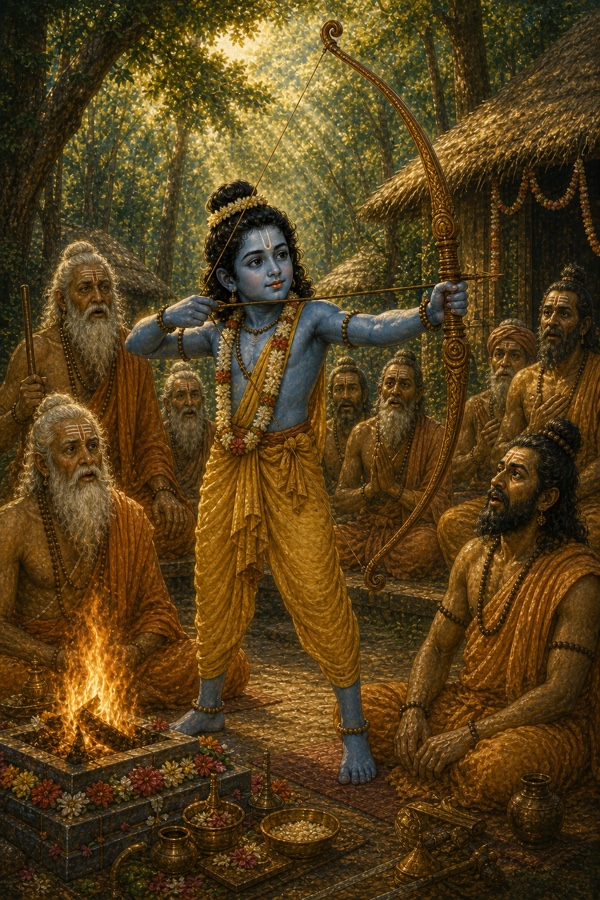
“Vishvamitra was consecrated for a sacrifice in the Dandaka forest, and Rama stood beside him twanging his wonderful bow,” Maricha went on. “He was still a boy. The marks of manhood had not yet appeared on his face. He was dark of complexion, with charming eyes, a single cloth wrapped about his loins as the sign of his celibacy, a tuft of hair on the crown of his head, a string of gold about him, a bow in his hand, and he lit up the Dandaka forest with his own splendor like the new moon just risen. Then I came, vast as a cloud, wearing my earrings of refined gold, full of my might and puffed up with arrogance, carrying the boon Brahma had given me, and I burst into the heart of the hermitage. The moment I entered he saw me. He lifted his weapon at once, and he strung his bow quite calmly. I thought, this is only a boy, and in my ignorance I treated him with contempt and rushed straight at the altar where Vishvamitra sat.”
“He loosed one sharp arrow, the kind that destroys an enemy, and it struck me, and I was flung a hundred yojanas away into the sea,” he said. “He did not want to kill me, my friend, and so I was spared; but the force of that arrow hurled me into the deep water and knocked the senses out of me, and only after a long time did I come to myself and make my way back to Lanka. That is how I was let go, and my well-known companions were killed, every one, by a child who never tires of action and had not yet practiced archery.”
“If, after all my dissuading, you still make war on Rama, you will soon meet a terrible catastrophe, and you will not survive it,” Maricha said. “And you will bring suffering and doom on the rakshasas too, who know the arts of sport and enjoyment and love their festivals. People who commit no sin themselves perish through the sins of others, through contact with the sinful, like fish living in a lake full of snakes.”
Then he drew the picture of what was to come, so that Ravana might see it. “You will see Lanka, thick with mansions and palaces, adorned with every kind of jewel, laid waste for the sake of the princess of Mithila,” he said. “You will see rakshasas with their bodies smeared with celestial sandal paste and adorned with heavenly ornaments lying killed on the ground for your fault. You will see the rakshasas who survive the fighting fleeing without a protector in all directions, their wives carried off, or with their wives beside them. You will see Lanka screened in a net of arrows, ringed with flames, its houses burned to ash.”
“There is no greater sin than going in to another man’s wife,” he reminded Ravana. “There are thousands of young women in your own inner apartments. Stay devoted to your own wives and preserve your line, the rakshasas, your honor, your prosperity, your kingdom, and your dear life. If you want to enjoy for a long time your charming wives and the company of your friends, do nothing to give Rama offense. If you carry off Sita by force, though I, your disinterested friend, restrain you again and again, then you will go to the house of Death with your kith and kin, your army destroyed, and your life ended by Rama’s arrows.”
Maricha’s Second Experience and His Last Plea
“That is how I was somehow let go in that first encounter,” Maricha said. “Now hear what happened afterward, for it too is out of the common. Even after being handled that way by Rama I was not daunted, and I went deep into the Dandaka forest again, with two rakshasas beside me who had taken the shape of deer. I ranged the forest in the shape of a great carnivorous stag, hugely strong, with a flaming tongue, big teeth, and pointed horns. I was a frightful thing to look at. I assaulted the ascetics in their fire-sanctuaries, at the bathing places of the rivers and the lakes, and under the shade of the trees on holy ground; I drank the blood of the ascetics who practiced virtue in the Dandaka forest and fed on their flesh after I had killed them, and I roamed wherever I liked. I lived on the flesh of seers, cruel as I was, and I put fear into everyone who lived in that forest, and I was drunk on their blood.”
“One day, roaming through the Dandaka forest in that guise, offending against righteousness at every step, I came upon Rama, who had taken up the conduct laid down for ascetics,” he said, “and with him the blessed Sita, the princess of Videha, and Lakshmana, that great chariot-warrior, practicing austerities, living on a restricted diet, devoted to the good of every creature.”
“I thought little of a man who had retired to the forest, however mighty he was; I took him for an ascetic and nothing more. And I remembered the old enmity, and the blow he had dealt me, and in the form of a sharp-horned deer I rushed at him in a fury, without a thought, to kill him,” Maricha said. “He drew his mighty bow to its full length and shot three sharp arrows, the kind that put an end to an enemy, arrows that flew like Garuda and like the wind. All three of those dreadful arrows, flat-knobbed, bright as lightning, fond of drinking blood, came at me together. I knew Rama’s prowess by then, and I had seen once already the danger I was putting myself in, and so I slipped away, cunning as I was, and I was saved, because Rama’s arrow never strikes a man who is running away. My two companions were killed.”
Then he told the state of his heart. “Having somehow got back my life, spared by Rama’s shaft, I came here, and I have been forced into the life of a recluse,” he said. “Calm and collected, I have taken up the practice of yoga and the way of the ascetic. And in every tree I see Rama, clad in tree bark and black antelope skin, holding his bow, a very Death with a noose in his hand. I am so terrified, Ravana, that I see thousands of Ramas. This whole forest seems to me to have turned into Rama. I see Rama in a place where there is no one at all. I see Rama in my dreams, and I wake up bewildered, like a man dragged back into waking life. Even names that begin with the letter R, ratna for jewel and ratha for chariot, fill me with dread, so afraid am I of Rama.”
“I know his power,” he said. “A fight with him is not to be advised for you. Rama, the delight of the Raghus, could kill Bali, and even Namuchi. Fight Rama on a battlefield or bear with him as you choose, Ravana, but if you want to see me alive, never so much as mention Rama in my presence.”
“Many innocent souls in this world, men of right conduct who practiced virtue all their lives, have perished with their companions for the fault of others,” Maricha said at the end, “and in the same way I too am sure to perish for the fault of another, which is to say for yours.”
“Do what you think proper. I for my part am not going to follow you,” he said plainly. “Rama has extraordinary prowess, great intellect, and inordinate strength, and he may well prove the exterminator of the entire world of rakshasas. If Khara, stationed in Janasthana, who overstepped his limits for Shurpanakha’s sake, was killed in the past by Rama, tell me truly, what was Rama’s fault in that?”
“If you will not accept this advice, offered in earnest by a man seeking the welfare of his own kinsman in you,” he warned, “then this very day, pierced by Rama’s straight-flying arrows, you will give up your life on the field of battle, with your kith and kin around you.”
Ravana’s Rebuke and His Command by Force
Ravana took Maricha’s sound and reasonable counsel the way a man bent on dying takes his medicine, which is to say not at all. Death was driving him now, and to the friend who had given him wholesome advice out of love he answered with words that were harsh and badly judged.
“Maricha, born of a low line, this ill-conceived advice of yours is offered to me for nothing, like seed sown in barren soil,” he said. “Your words cannot turn me from my resolve to make war on Rama by carrying off Sita; he is stupid, addicted to sin, and above all a mere human being. A man who heard the worthless words of a woman and left at once for the forest, giving up his near and dear ones, his sovereignty, and his parents, and then killed Khara in battle, that man’s wife, who is dearer to him than his life, I will carry off in your very presence, and nothing will prevent it. This is my settled resolve, Maricha, and it cannot be altered by the gods and demons together, with Indra at their head.”
“When a king asks a minister about the merits and demerits of a course, or the means of accomplishing it, or the risks in it, then, while he is settling on the course, the minister may speak as you have spoken,” Ravana went on. “A wise counselor who wants his own prosperity from his king gives his counsel with his palms raised and joined, and only when he is asked for it. A king is spoken to in words that are pleasing, and wholesome too, uttered with politeness and in soft accents. A king who values his honor does not welcome counsel that comes in an insulting tone and without respect, however wholesome it is. Kings of unlimited prowess take on five forms: they are the god of fire, and Indra, and the moon, and Yama, and Varuna. Great kings embody the heat and the valor, the gentleness, the punishment, and the grace of those five deities, and so they deserve honor and respect at every hour.”
“You know nothing of your duty, you have clung to delusion alone, and out of sheer evil-mindedness you speak such harsh words to me, your guest,” he charged him. “I am not asking you about the merits and demerits of what I mean to do, or about what is advisable for me. My request to you is only this: urged by me, you must help me carry off Sita, whatever comes of it.”
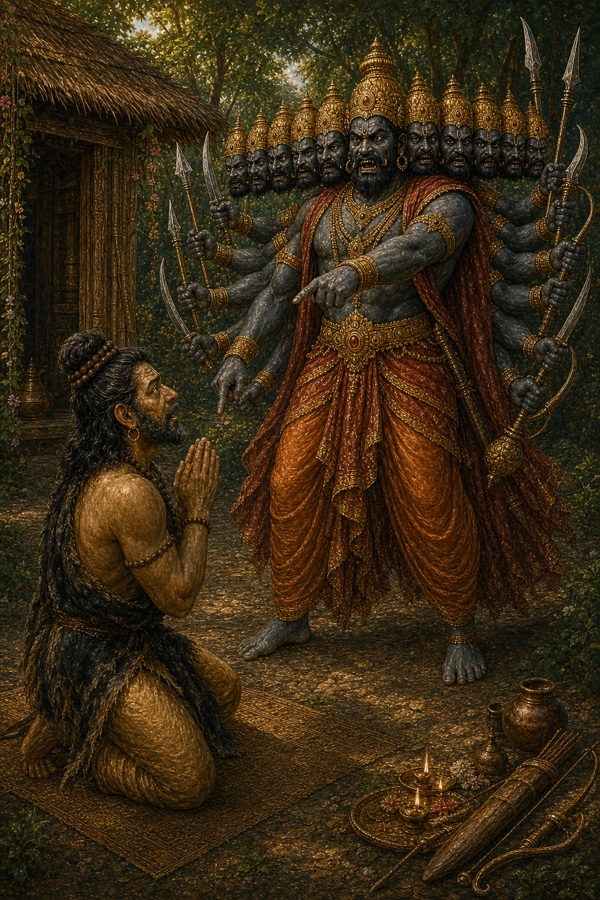
Then he laid the same device before him again, word for word. “Hear the part you are to play at my instance,” he said. “Become a golden deer freckled with spots of silver and roam about Rama’s hermitage before Sita’s eyes. Cast your full charm on her, and then go wherever you please. Struck with wonder at the sight of you, a golden deer conjured out of illusion, the princess of Mithila will say to Rama at once, please fetch that deer for me. Then, when Rama has gone some distance from his hut, call out in a voice like Rama’s, ah, Sita! Lakshmana! Lakshmana, the son of Sumitra, will hear the call, and Sita will press him, and out of love for his brother he will follow in a flurry after Rama. When Rama and Lakshmana are both away from their cottage, I will carry Sita off with ease, the way thousand-eyed Indra would carry off his own consort Shachi.”
“When the work is done, go wherever you please, and I will give you half my kingdom, Maricha of the noble vows,” he promised. “Set out on your auspicious journey, my good friend, for the accomplishment of this object, and I will follow at your heels in my chariot to the Dandaka forest. With Rama hoodwinked and Sita won without a struggle, my purpose accomplished, I will return with you to Lanka.”
Then came the threat. “If you will not do this, Maricha, I will kill you this very day,” he said. “You must do this work of mine, even under compulsion. No one who stands directly against a king lives happily afterward. Go near Rama and you meet a danger to your life. Set yourself at odds with me and your death is certain, today. Weigh those two carefully in the scales of reason, and then do whatever is wholesome for you.”
Maricha’s Chance-Fallen Dread and His Helplessness
Ordered by his king to do a thing that sickened him, Maricha stopped being afraid, and the words he spoke to the lord of the rakshasas were as harsh as any he had ever spoken. A man who knows he is going to die either way has nothing left to lose by speaking plainly.
“What sinner advised you this course, which means your doom, and the doom of your sons, your kingdom, and your ministers with you?” he asked. “Who is the sinner who takes no joy in your happiness while you sit enjoying it? Who has pointed you to this door of death and called it a way forward? It is plain enough. Your enemies, too weak to face you, want to see you besieged by a stronger power and destroyed. What mean creature with poison in his designs urged this on you? He wants you to perish by your own deeds.”
“Your ministers deserve execution, Ravana, since they see you setting your foot on a wrong road and do not hold you back by every means, and still you have not put them to death,” he said. “A licentious king who has taken to evil ways deserves to be checked in every way by virtuous ministers. You deserved to be checked, and no one checked you. It is by the grace of their master that ministers gain merit, wealth, pleasure, and fame, and when the master fails, all of it fails, and everyone else meets disaster through his fault. Virtue and fame have their root in a king, and so a king must be protected under every circumstance. No kingdom can be ruled by a king who is severe, or by one set against his own people, or by one who is boorish in his manners.”
“Ministers who counsel violence suffer along with the king they counsel,” Maricha said, “the way chariots driven fast over rough ground by a dull-witted charioteer go to pieces, and the charioteer with them. Many righteous souls who practiced the virtue laid down for them have perished with their followers through the offense of others. A people guarded by a violent master who is set against them does not thrive, any more than rams thrive under the protection of a jackal. The rakshasas whose ruler is a man like you, cruel, evil-minded, a slave to his senses, will every one of them perish.”
“This terrible calamity that has fallen on me out of nowhere, death at your hands, is mine to meet,” he said, “and even so it is you who deserve the pity, and not I, since you are going to your doom with your whole army. Rama will kill me, and soon after he will dispose of you. And I will count my purpose accomplished by such a death, because I would far sooner give up my life killed by an enemy than be killed by you, my king.”
“Count me dead from the moment Rama sets eyes on me, and count yourself dead, with your kith and kin, from the moment you carry off Sita,” he said. “If you take Sita out of that hermitage with me beside you, then under no circumstance will you survive, nor I, nor Lanka your capital, nor the rakshasas. You do not heed this counsel of mine, though I, your well-wisher, am holding you back with it, for men whose span of life has run out and who stand at the edge of death do not take the wholesome advice of their selfless friends.”
The Golden Deer Takes Shape, and Sita Sees It
Even after speaking such harsh words, Maricha, wretched with fear of the rakshasa king, gave way. “Let us both go,” he said.
“If Rama sees me again, with his arrows and his bow and his sword, his weapon raised to finish me, my life is over,” he said. “No one who tries his valor against Rama comes back alive. He is more than a match for you, and you are already as good as struck down by the rod of Death.”
“When you are so evil-minded, what on earth can I do to check you?” he said, and there was mockery in it, and grief. “Here I go, then, my dear Ravana. May all be well with you.”
At those words the rakshasa was overjoyed, and he embraced Maricha tightly. “Now those are words full of valor,” he said, “since you follow my mind at last. Now you are the same Maricha you always were. Until now some other rakshasa, some stranger, had possessed you.”
“Here is my aerial chariot, tastefully set with jewels, drawn by donkeys with the heads of goblins. Mount it quickly, with me,” he said. “Cast your spell on Vaidehi and then go wherever you please, and when there is no one left beside her I will carry off the princess of Mithila by force.”
“So be it,” said the son of Tataka. He had said no for as long as a man could say it.
Then the two of them mounted that chariot that flew like the sky-chariots of the gods, and left the circle of the hermitages behind at speed. Towns went by under them as before, and forests, and mountains, and every river that lay across the way, and the kingdoms and the cities strung along them; and then the Dandaka forest lay below, and the two of them reached it together, and in the Dandaka forest Ravana saw the hermitage of Rama. He stepped down from the gold-decked chariot and took Maricha by the hand, the way a man holds someone he does not intend to let change his mind.
“There is the site of Rama’s hermitage, ringed with plantain trees, that we see,” he said. “The work we have come for, do it quickly now, my friend.”
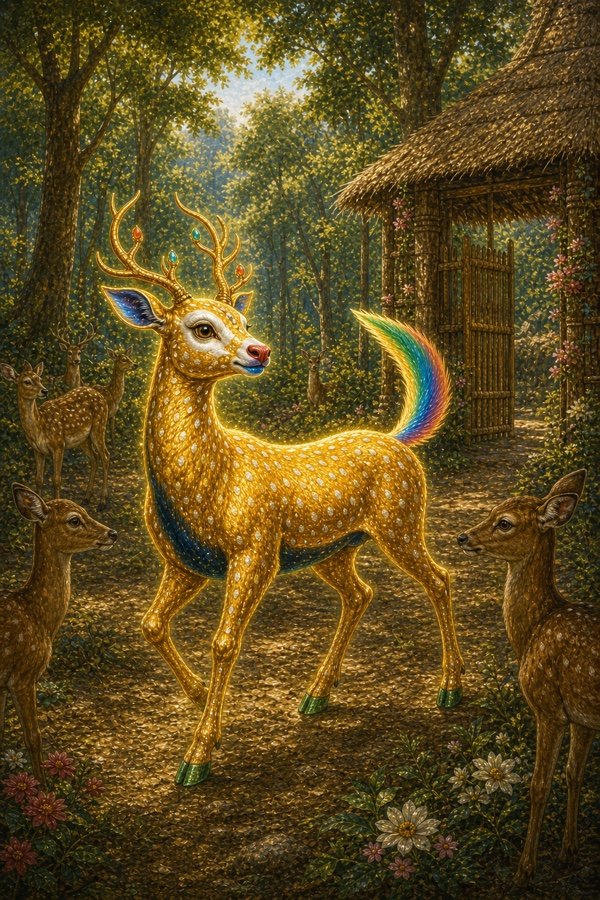
Maricha heard the order, and became a deer on the spot, and began to pace to and fro at the entrance of Rama’s hermitage. What he made of himself was a wonder, a form worth stopping to look at, and he made it in an instant. The tips of his horns were bright as sapphire. His head was white in one part and dark in another, the upper part of his muzzle the color of a red lotus and the lower the color of a blue one. His ears shone like sapphire and looked like blue lotuses. His neck lifted a little as he moved. His belly had the hue of a sapphire, his flanks were pale as madhuka flowers, and a glow came off the whole of him like the filaments inside a lotus. His hooves were cat’s-eye gems. His body was well knit above slender legs, his tail rose behind him like the top of a rainbow, and his glossy coat was freckled with jewel-like spots. Colored with every mineral there is, a shape to captivate the soul, made to fascinate the princess of Videha, the rakshasa moved about with perfect confidence, lighting up that lovely forest and the ground of Rama’s hermitage, and grazed heartily on the green. With his hundreds of silvery spots he strayed here and there, nibbling the tender shoots off the trees as if he had done nothing else all his life. He went into the plantain grove, and then into the cluster of karnikara trees, and, wanting the whole of Sita’s attention, he slowed his gait, and that great stag with a back like the filaments of a lotus paced complacently this way and that near the hermitage, shining.
He worked her patiently, the way a hunter works a deer. He vanished for a while and came back to the same spot. He left the place for an hour or so and returned in haste. He played about, and sat down on the ground, and got up again. He came to the entrance of the hermitage and stood in among the herds of deer, and went off with them, and then, still wanting Sita to notice him, came back with the herds behind him. When he came near her he spun round her in circle after circle. The forest deer knew. They watched him from a distance, and came close, and smelled him, and scattered in every direction. He was a creature that loved killing deer, and to hide what he was he would touch those wild ones and let them go without eating them. And at that very moment Vaidehi came that way, with her lovely bewitching eyes and her charming face, busy with her flowers, and appeared on the near side of the karnikara and the ashoka and the mango trees, moving about, plucking blossoms. A woman never made for exile in a forest, she caught sight of that loveliest of antelopes with its limbs freckled as if with pearls, and her eyes went wide with wonder, and she stood and looked, and kept looking, fondly, at a coat that shone like silver and other minerals and a mouth with lovely teeth and jaws. And the deer of illusion, seeing Rama’s own beloved watching him, roamed about on that spot as if he were lighting the forest for her. Sita, the daughter of Janaka, had never in her life seen a deer like that one, made, as it seemed, of every jewel there is, and the wonder of it filled her completely.
Sita’s Plea and Rama’s Departure
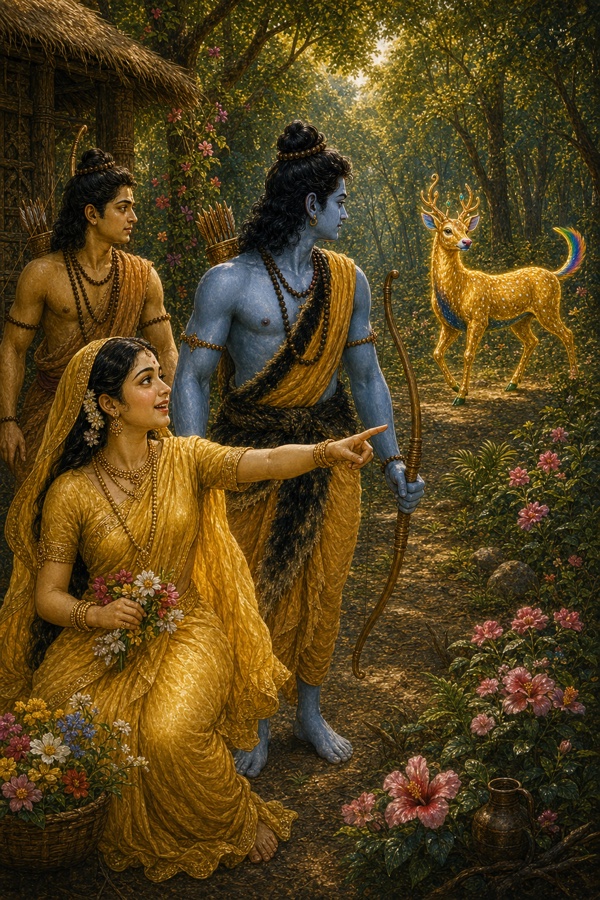
Delighted at the sight of that deer with its flanks of gold and silver, Sita, faultless of limb, her own skin the color of burnished gold, still eagerly plucking her flowers, called out to her husband, who had his weapons by him, and to Lakshmana. She called them again and again, and between the calls her eyes went back to the deer.
“Come along, come quickly, my lord,” she kept saying, “and bring your younger brother.”
At her call the two brothers, Rama and Lakshmana, looked where she was looking and saw the deer. Suspicion took Lakshmana at the first sight of it, and he spoke first.
“I conclude this deer is that very rakshasa, Maricha,” he said. “Many kings, out hunting in the forest for their pleasure, have been killed by that sinner in some deceptive form or other; he can take any shape he pleases. This shining shape of a deer is one of his hoaxes, and he is a master of the art; it is like a magic show, like a city of the gandharvas seen in the sky. There is no deer freckled with jewels like that anywhere on the face of the earth. It is a phantom, and there is no doubt about it.”
Sita cut him short. The rakshasa’s trick had already robbed her of her judgment, and she was overjoyed at the thought of getting her hands on the strange deer, and she spoke with a bright smile playing on her lips. “That charming deer over there has captured my mind,” she said. “Fetch it for me, my strong-armed lord. It will be something for us to play with.”
“Around this hermitage of ours range many deer of hallowed appearance,” she said, “and chamaras and srimaras with their white and their dark tails, and bears, and herds of spotted deer, and monkeys, and kinnaras, the finest in form and the strongest. And never before have I seen a deer to equal this loveliest of deer in its agility, its gentleness, and its splendor. Shining like the moon, lighting up the forest with its limbs of many colors, this jewel of a deer stands at ease in front of me and spreads its charm all around. Wonderful is its color and marvelous its splendor, and the richness of its cry is lovely too. With its spotted limbs this wonderful deer captivates my heart.”
“If you can catch it alive, that would be a miracle, and everyone would wonder at it,” she went on. “When our years of exile are over and we are installed on the throne again, this deer will be an ornament to our inner apartments, and it will astonish Prince Bharata, and you yourself, my lord, and my mothers-in-law, and me. And if this lovely deer will not let you take it alive, then its skin alone will be a delight. When you have killed it I long to sit with you on its golden hide, spread on a mat of young grass. I know that urging my husband like this, to satisfy a desire, is indecorous, and unworthy of a woman. But the strange form of that animal has filled me with curiosity.”
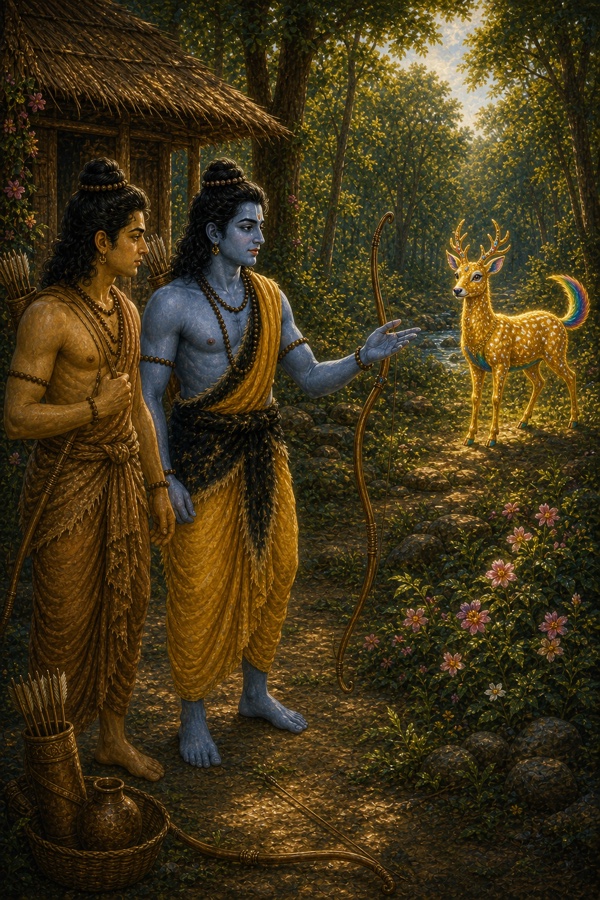
The mind of Rama, too, filled with curiosity at that deer with its golden coat and its horns of sapphire, shining like the rising sun, with the splendor of the starry sky on it. Rejoicing at Sita’s request, looking at the wonderful deer, drawn by its strange form and pressed by his wife, Rama turned gladly to his brother.
“Look, Lakshmana, at Vaidehi’s burning desire,” he said. “Because of its surpassing beauty this deer will not live out the day. There is no deer like it in the grove called Nandana, or in the one called Chaitraratha; how then could there be one on earth?”
Then he described what he saw as he watched it move: the glossy rows of hair, running lengthwise and crosswise, freckled with golden spots; the tongue like a flame shooting out of its mouth when it yawned, like lightning darting from a cloud; a mouth like a cup of sapphire and a belly bright as a conch shell, or as pearls. Whose mind, he asked, would not be lured by a deer that baffled description? Whose mind would not be struck with wonder at that celestial beauty, shedding a golden luster, freckled with so many jewel-like spots?
“Kings who carry bows kill deer in the great forests for the sake of the skin and for sport, Lakshmana,” Rama said, “and in the great forests, through such sporting enterprise, they lay hands on treasures too, minerals of every kind, gems and precious stones and ores of gold. That wealth swells a king’s coffers, and it is valuable in the way every object of enjoyment is valuable that comes into being at the mere thought of a man who has reached the realm of Brahma. Those who understand economics and know how wealth is produced, my brother, say that wealth is whatever a seeker of wealth pursues without premeditation, through effort aimed at that object. Vaidehi of the slender waist will sit with me on the finest golden skin of this most beautiful of deer. Neither the hide of the kadali deer, nor the priyaki, nor the pravena goat, nor a sheep, can compare with it for softness; that is my conclusion. This splendid deer and its heavenly counterpart, the Mriga that courses through the heavens, are both divine deer, the one a star that bears the name and the other moving here on the earth.”
Then he steadied himself and came to the other case. “And if this deer is what you say it is, Lakshmana, a phantom conjured up by a rakshasa, then it must be put an end to,” he said. “That cruel, evil-minded Maricha has killed many of the finest ascetics as he roamed this forest. He has killed many kings who carried great bows, appearing suddenly before them in his real form. So this deer deserves to die.”
“In earlier days the rakshasa Vatapi used to practice deception on the ascetics of this forest: he would enter their bellies and kill the Brahmins from within, the way the embryo of a she-mule kills the mule that carries it. After a long time, out of greed, he came to the great sage Agastya, who was endowed with spiritual power, and entered his stomach by fraud, and was eaten as food. When the rite for the ancestors was over and Vatapi made ready to resume his rakshasa form, Agastya smiled and said to him, ‘Vatapi, without a thought for the consequences, you killed the foremost Brahmins in this world of mortals on the strength of your might; and so, as the retribution for that sin, you have been digested by me.’ So that rakshasa out there, who dares to despise a man like me, constantly devoted to virtue and master of his senses, will cease to exist as Vatapi did. He has come at me as an enemy, and I will kill him as surely as Agastya killed Vatapi.”
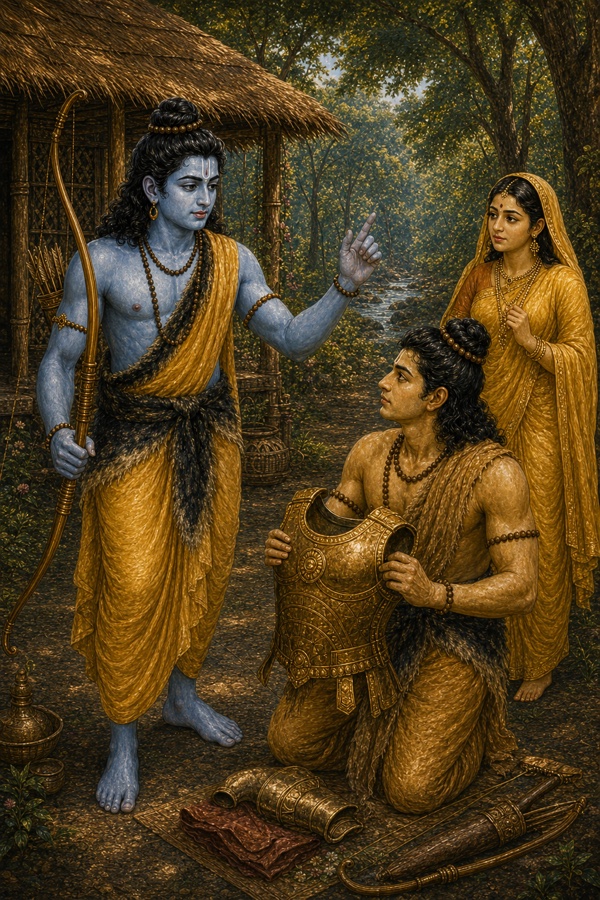
“Put on your armor and stay here, keeping to this place, and guard the princess of Mithila,” Rama said to Lakshmana, “for whatever we are to do from now on depends on her. I will dispose of this deer or capture it alive. In the meantime I go quickly to bring it. Look at Vaidehi’s craving for the skin of that deer. It will perish today because of its superb hide. Stay wide awake in the hermitage with Sita until I bring down this spotted deer with a single arrow, take its skin, and come straight back.”
“Keep Sita by your side, Lakshmana, and remain vigilant every moment, on your guard from every quarter, in the company of the wise bird Jatayu, who is very powerful and of great might,” he said at the last.
The Killing of Maricha and the Deceiving Cry
Having cautioned his brother so, Rama fastened at his waist a sword with a hilt of gold, took up his triple-curved bow, the ornament he was never without, strapped on his two quivers, and went out after it with his mind made up. The deer saw the ruler of rulers coming, and the fear in Maricha was real; he went out of sight, and showed himself, and went out of sight again. Sword bound on and bow in hand, Rama ran toward the place where it stood, radiating its own beauty in front of it like a lamp. And the chase began. In the great forest the deer ran, looking back over its shoulder again and again, slipping past with a leap, drifting in close enough to be caught and then not being caught. Now, as if frantic at the thought of Rama’s arrow going into it, utterly confused, it seemed to leave the ground altogether. Now it was gone into some depth of the forest like the autumn moon behind broken cloud. Now it was standing near, and in the next breath it was shining at a distance. Seen, and gone, and seen again, that notorious Maricha in the shape of a deer drew Rama far, and then farther, and then far past any calling distance from the hermitage.
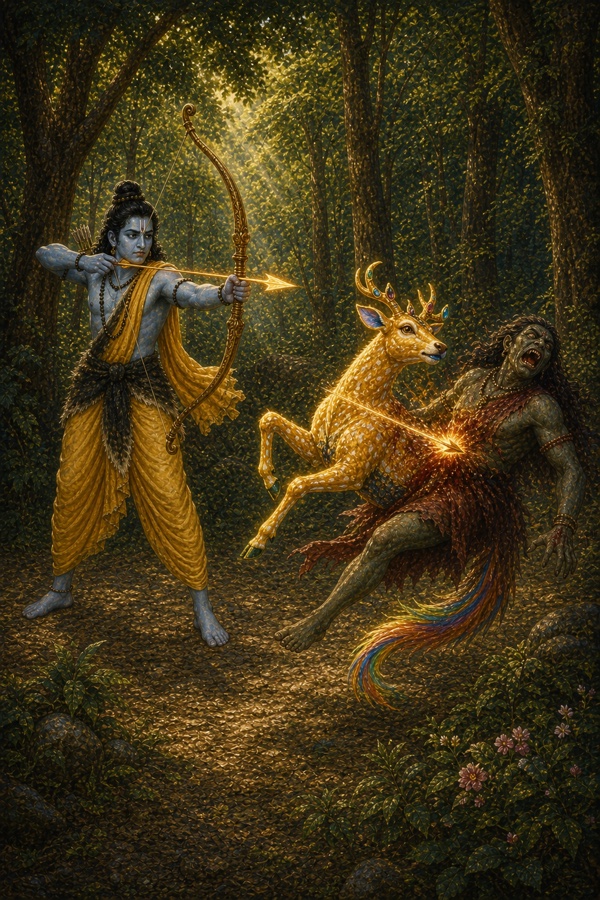
Beguiled by it, thwarted, feeling helpless, Rama began to be angry; and he was tired, and he stopped in the shade of a tree, on a patch of ground covered with velvety grass, to stand and breathe. The rakshasa in the deer’s body kept working on him. He would show himself close by, ringed by other deer, and let Rama gather himself to seize him, and then run in terror and vanish, and then come out again from some distant clump of trees. And there Rama’s mind closed on it: this creature dies. In his fury he drew out a blazing arrow, bright as a sunbeam, the kind that destroys an enemy, set it firmly to his bow, took his aim on that deer and no other, drew the bow back with all his force, and let go a flaming, brilliant missile fashioned by Brahma himself, and it went through the air like a fiery serpent. The fine arrow flashed like lightning, went deep through the heart of the deer-shape, and pierced the heart of Maricha himself. He sprang up as high as a palmyra tree with the wound in him, and came down on the earth, and let out a terrific roar; and with very little life left in him, as he died, Maricha let go of the false form.
Remembering Ravana’s instruction, the rakshasa thought about how Sita might be made to send Lakshmana to that spot, so that Ravana could carry her off from her isolation. He saw what the moment called for, and he cried out in a voice that matched Rama’s exactly: “Alas, Sita! Ah, Lakshmana!” Pierced to the vitals by that peerless arrow, Maricha cast off the shape of a deer, took on the shape of a rakshasa, and, as he gave up his life, revealed his gigantic body.
Rama looked at that rakshasa of terrible form lying on the ground, writhing in the dirt, his limbs bathed in blood, and he remembered Lakshmana’s warning, and his mind flew back to Sita. The deer had been bait, and the hook was set somewhere he could not see.
“This was the very illusion of Maricha that Lakshmana spoke of,” he thought. “What he said has come true, and it is Maricha I have killed today. And this notorious rakshasa has breathed his last crying out, alas, Sita! ah, Lakshmana! How will Sita feel when she hears it? And what state will strong-armed Lakshmana be in?”
Thinking it, Rama, whose mind was set on virtue, felt the hair stand up on his body with dread of what might come to Sita. He had killed the rakshasa in the deer’s shape, and he had heard that cry, and a poignant fear, born of dejection, closed round him. Then, having brought down another spotted deer, and gathering fruit and the other food that ascetics live on, Rama hurried back toward his hermitage in Janasthana.
Sita’s Insistence and Lakshmana’s Departure
The piteous cry came through the forest, and Sita knew it for her husband’s voice. She turned on Lakshmana at once. “Go and find out the truth about Raghava,” she said. “Neither my breath nor my heart is in its place. I have heard the voice of someone like him, crying out for help at the top of his voice, in the deepest distress.”
“You must go and rescue your elder brother, who is crying so piteously in the forest,” she said. “Run this instant to the side of your brother, who has fallen into the hands of rakshasas like a bull into the clutches of lions, and is calling for your protection.”
Lakshmana remembered his brother’s command not to leave her alone, and though she urged him in those words he did not stir.
That upset her further, and the daughter of Janaka spoke again. “Saumitri, you are your brother’s enemy in the guise of a friend, that even in such a predicament you will not go to his help,” she said. “For my sake you want Rama to perish.”
“It is greed for me that keeps you from following Raghava,” she said. “I believe your brother’s sad plight is dear to you, and that there is no affection in you for him at all. That is why you stand here unperturbed, without so much as going to look for Rama, whose splendor is beyond the ordinary. What is the use of my staying safe here when he, the very man under whose lead you came into this forest, has fallen into danger?”
To Vaidehi, brimming with tears, possessed by grief, frightened as a doe, and speaking to him so, Lakshmana answered. “Your husband is unconquerable by nagas, demons, gandharvas, gods, titans, and rakshasas, princess of Videha, and there is no doubt of it,” he said. “Among gods and human beings, gandharvas, birds, rakshasas, fiends, kinnaras, and wild beasts, and among the terrible danavas, there is no one who could meet Rama, the equal of Indra, in battle. Rama cannot be killed in a fight. You should not speak like that.”
“I dare not leave you in the forest without Rama,” he said. “His might cannot be turned back by the armies of the mightiest warriors, nor by the three worlds joined together, with the gods in them, and Brahma, Vishnu, and Shiva, the three lords of the universe. Let your heart be at ease, then, and let all this agony go. Your husband has killed the finest of deer by now, and he will soon be back. The voice we heard belonged to no god speaking out of the air, and it belonged to Rama least of all. A rakshasa conjured it, as unreal as a city seen in the sky.”
“You are a sacred trust placed in my charge by noble Rama, princess of Videha, and I dare not leave you alone,” he said. “Ever since the ogres’ colony in Janasthana was wiped out and Khara was killed, these rakshasas have counted us their enemies. Rakshasas who take the destruction of life for a recreation imitate all kinds of voices in this huge forest. You need not be anxious.”
Reassured in those words, Sita, whose eyes had gone blood-red with anger, said harsh words to a man who had told her the truth. “Ignoble, merciless Lakshmana, cruel in your deeds, disgrace of your line, I believe Rama’s great adversity is dear to you,” she said. “That is why you can stand there and say such things with an easy mind, even seeing Rama in distress. It is no wonder at all that a sinful bent should live in the minds of cruel enemies like you, who go about forever in disguise.”
Then she flung the bitterest charge she had. “With your motive cleverly hidden, you have followed Rama into the forest, a man with no other male companion, alone, and it was for my sake, or because Bharata engaged you as his agent,” she said. “But that object of yours, or Bharata’s, will never be accomplished, son of Sumitra. I have had for my husband Rama with his lotus eyes, dark as a blue lotus; how could I ever want an ordinary man like you? I will give up my life before your very eyes. Without Rama I will not stay alive on the face of the earth for a single instant.”
Those words made the hair stand up on a man’s body. Lakshmana, who had mastered his senses, heard them and folded his hands. “I dare not answer you,” he said, “because you are a deity to me.”
“It is no wonder, princess of Mithila, when women say words that are unworthy of them,” he said. “Such is the nature of women, and it is seen in all the worlds. Women as a rule have thrown decorum to the winds; they are fickle, hard-hearted, and disposed to sow discord. And I cannot bear these words of yours, daughter of Janaka, that go into both my ears like a heated steel arrow. Let every creature that lives in this forest hear what I say, and stand as my witness.”
“I spoke what was right, and you have castigated me for it in harsh words,” he said. “Shame on you for it, you who are going to your ruin, because out of a woman’s nature and a wicked disposition you distrust me, who stand firm by the word of my elder brother. I leave for the place where Rama is. May all be well with you, lady of the lovely face. May all the deities of the forest protect you, large-eyed one. The fearful evil omens that keep rising before my eyes make me doubt whether I will find you here when I come back with Rama.”
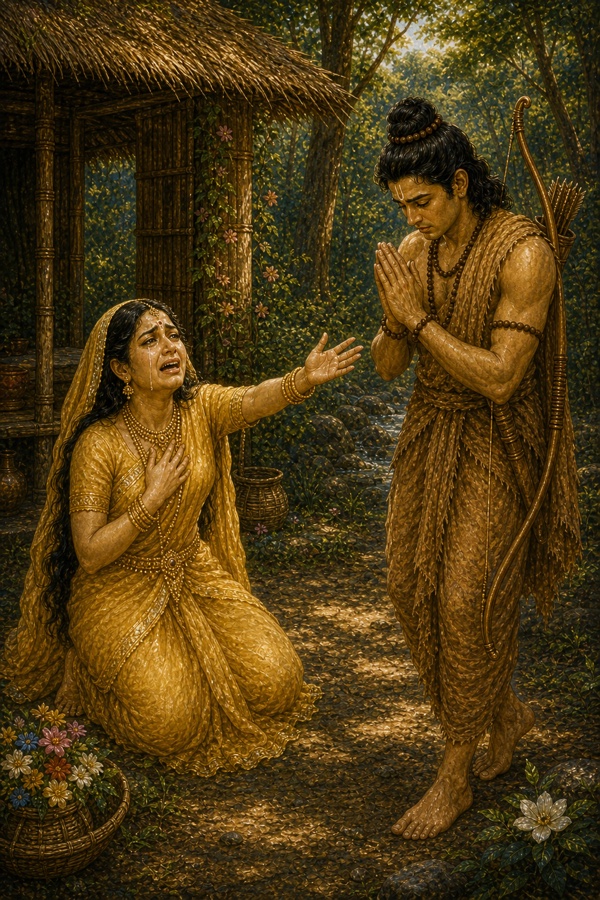
When Lakshmana said that, the daughter of Janaka, crying, bathed in a gushing stream of tears, answered him at once. “Without Rama, Lakshmana, I will throw myself into the Godavari, or hang myself, or climb some precipice and cast my body down from it,” she said. “I will drink a strong poison, or walk into the fire. But I will never touch any man other than Raghava.”
Having sworn that before Lakshmana, Sita, overwhelmed with grief, began to beat her belly with her hands, crying out in her agony. Lakshmana, sick at heart to see the large-eyed lady weeping in such distress, tried to console her, and Sita did not say one word more to her husband’s brother. Then, greeting her with his palms joined, bowing his head a little to her in respect, and looking back at the princess of Mithila again and again, Lakshmana, who had mastered himself, went off in search of Rama.
Ravana Comes in the Guise of a Wandering Mendicant
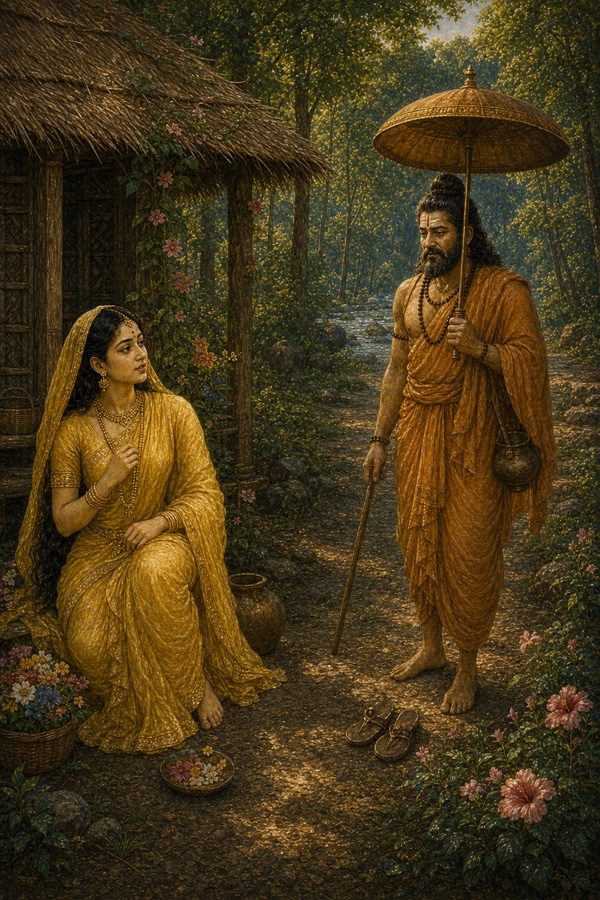
Stung by Sita’s words and longing to reach Rama, Lakshmana went off as though he could not get to his brother fast enough. And behind him, waiting for exactly this, Ravana, the ten-headed king, seized the chance that Lakshmana’s going had given him and came quickly toward Vaidehi in the guise of a wandering mendicant. He had made himself clean and harmless: a neat ochre robe, a tuft of hair on the crown of his head, shoes on his feet, an umbrella on his right shoulder, a glossy staff, and on his left shoulder a bright water vessel made of the shell of a sea coconut. In a forest emptied of both brothers he came to Sita the way thick darkness closes on the dusk when neither sun nor moon is in the sky. That cruel being looked at the young and illustrious princess the way an inauspicious planet frowns at the star Rohini when the moon has left her. The forest knew him even in that disguise. The trees of Janasthana stopped moving. The wind would not blow freely through the leaves. And the swift Godavari, seeing those red eyes fixed on her, slowed her own current for fear of him. He had waited for the hour when Rama would be away from Sita, and in a mendicant’s dress, in Rama’s absence, he came to her. In an auspicious garb the inauspicious Ravana came toward a woman already grieving for her husband, the way the planet Saturn creeps up on the star Chitra, and he stood before her all at once in his holy dress, like a well that grass has grown over, which looks like an easy, pleasant patch of ground and holds nothing under it but the drop.
He stood there, glad at heart just to look at her: Rama’s wife, the blessed Vaidehi, with lovely teeth and lips, her face bright as the full moon, her eyes like the petals of a lotus, dressed in yellow silk, sitting in her hut of leaves, worn with grief and flooded with tears. The arrows of love had gone into him at the sight of her. He was chanting Vedic mantras under his breath, so that she would take him for a Brahmin recluse, and in that lonely place he began to speak to her in polite words. He praised the woman who had no equal among the women of the three worlds, who shone with her whole body like Lakshmi without her lotus.
“Lady with the glow of silver and of gold, dressed in yellow silk, wearing on your own person a cluster of lotuses, the way a lotus pool does,” he said, “are you Hri, the goddess of modesty? Are you Shri, or Kirti, whom fame belongs to, or the blessed Lakshmi? Are you an apsara, or Bhuti, who presides over the mystic powers, or Rati, the consort of Love, gone wandering by your own inclination?”
He praised her teeth, smooth and white as jasmine buds, and her large fair eyes, red at the corners, with their dark pupils; he praised her hips and thighs and her breasts and her waist, every limb of her, in words no stranger should say to a married woman alone in a forest, and every word of it was his deceit. “Playful, charming lady with the sweet smile, the shapely teeth, and the lovely eyes, you steal my heart the way a river washes away its own bank with its current,” he said. “Never on the face of the earth have I seen such beauty, not in a goddess, not in a gandharva woman, not in a yakshi, not in a kinnari, not in a woman of men. Your comeliness, the foremost in all three worlds, and your tenderness and your youth on the one hand, and your living in this forest on the other, agitate my mind. Leave this place, then, and may prosperity go with you. You ought not to stay here any longer.”
“This forest is the home of fierce rakshasas who take whatever shape they please,” he said. “What suits you are the charming upper stories of palaces, and prosperous cities, and sweet-smelling gardens. That garland I count the finest, that fragrance the most excellent, that dress the best, and that husband the one worth choosing, that is united with you, lady with the dark eyes. Who are you, lady with the bright smile? To me you look like a goddess wedded to the Rudras, or to the wind-gods, or to the Vasus. Neither gandharvas nor gods nor kinnaras come to this forest.”
“This forest belongs to the rakshasas. How did you come to be here at all?” he asked. “Monkeys live here, and lions, leopards, tigers, deer, wolves, bears, hyenas, and buzzards. Are you not afraid of them? Are you not afraid of the terrible elephants in rut that come through here at speed, living alone as you do in this huge forest? Who are you, and whose wife, and where do you come from? And for what purpose do you wander alone in the frightful Dandaka forest, the haunt of rakshasas?”
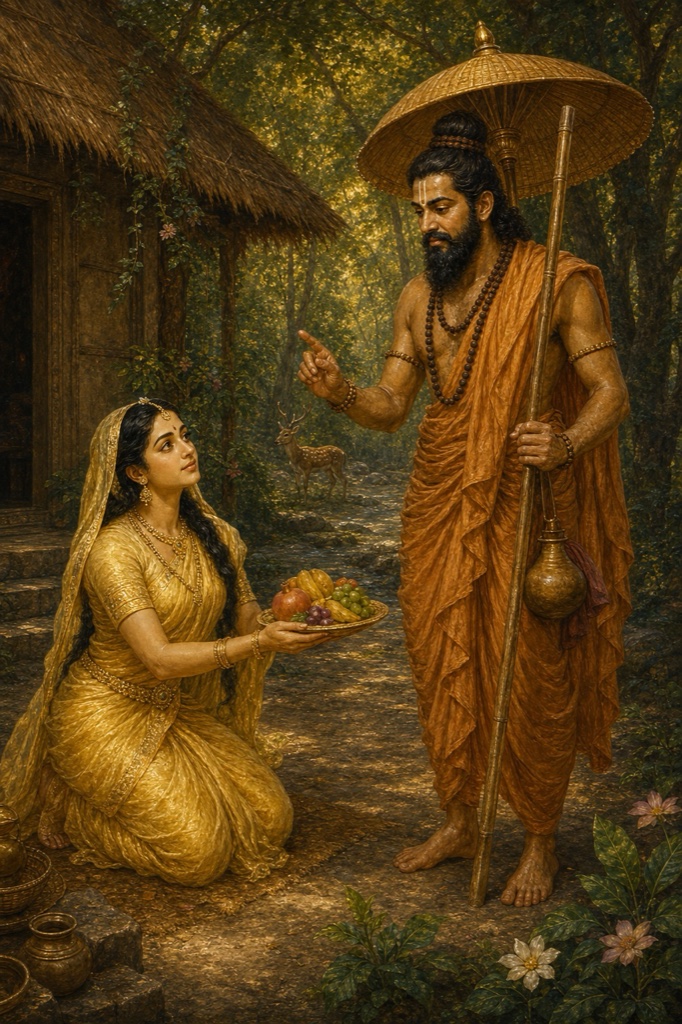
Praised so by that swindler, and seeing him come in the dress of a Brahmin, Sita, the princess of Mithila, gave him every honor that is due to a guest who arrives unannounced. She offered him a seat first, and then attended to him with water to wash his feet, and then she told the gentle-looking man that the cooked food was ready. He had come without notice, in a Brahmin’s garb, carrying a water-pot of sea-coconut shell, in saffron robes, and she had seen the marks of a Brahmin on his person, and so it was unthinkable to her to neglect him, and she invited him to eat as one invites a Brahmin.
“Brahmin, here is a seat of green grass, sit on it as you please, and here is water for your feet, please accept it,” she said. “And here is the finest produce of the forest, dressed for you. Take it here at your ease.”
The full formula of the invitation, the words a queen who knew what a guest was owed spoke to a guest, came out of her mouth, and Ravana watched her mouth make them, and then and there he set his mind, fully and resolutely, on carrying her off by force; and in doing it he set his mind on his own death. Then Sita, looking out for her husband, who had gone hunting with Lakshmana, and hoping to see him come back in his fine hunting dress, cast her eyes all around her; and in that vast green forest she saw neither Rama nor Lakshmana anywhere.
Sita’s Account of Herself and Ravana’s Proposal
Asked by the man in the mendicant’s dress, whose real intent was to carry her away, Vaidehi told him about herself of her own accord. She thought for a moment first, and the thought that decided her was this: he is a Brahmin and a guest who came unannounced, and if I do not tell him, he may curse me.
“I am the daughter of noble Janaka, king of Mithila. My name is Sita, and I am the beloved chief queen of Rama,” she said. “May all be well with you. For twelve years I lived in the palace of the kings of the Ikshvaku line, enjoying every luxury a human being can enjoy, in the midst of every kind of abundance. In the thirteenth year the mighty king, my father-in-law, took counsel with his ministers and decided to install Rama as prince regent. And while the installation was being arranged, my mother-in-law, Kaikeyi, asked a boon of her husband.”
“Binding my father-in-law with an oath sworn in the name of virtue, Kaikeyi asked that king, that greatest of kings, who was true to his word, for two boons: the exile of my husband, and the installation of Bharata, her own son, as prince regent,” Sita said. “And she added this: if Rama is installed today, I will neither eat nor sleep nor drink again, and Rama’s installation will be the end of my life. My father-in-law tried to win her over with every tempting thing there was, and she would not give up her demand.”
“My husband, who has great energy in him, was over twenty-five years old when he left for the forest, and my own age at the time we left Ayodhya was reckoned at eighteen years from my birth,” she said. “He is known in the world by the name of Rama. He is truthful, of a sweet disposition, virtuous, with large eyes and mighty arms, devoted to the good of every living thing. And still, to fulfill what Kaikeyi wanted, his father the emperor, stricken with love for her himself, did not install Rama.”
“When Rama came into his father’s presence to be installed, Kaikeyi spoke to him at once: hear the decree your father has issued, Raghava. This kingdom is to be given to Bharata without any hindrance, and you must live in the forest for nine years and five. Go to the forest, and save your father from the sin of falsehood,” Sita said. “My husband, who fears nothing from any quarter and is firm in his vows, said, let it be so, and did just that. He always gives and never accepts a gift. He always speaks the truth and never a lie.”
“Such, Brahmin, is the unsurpassed vow that Rama holds to,” she said. “He has a powerful half-brother named Lakshmana, a tiger in battle and the killer of his enemies on the battlefield, and Lakshmana is Rama’s companion. That brother, firm in his vows, keeping to celibacy, took up his bow and followed Rama when Rama went into exile with me. Wearing matted hair, in the dress of an ascetic, with his half-brother and with me, Rama, ever devoted to piety and firm in his vows, came into the Dandaka forest. Expelled from the kingdom on account of Kaikeyi, we three, best of Brahmins, wander this dense forest relying on our own strength.”
“Rest a while, if it is possible for you to stay,” she said. “My husband will be back very soon, having killed rurus and iguanas and boars for the hunt and gathered plenty of the wild foods that ascetics eat. Now tell me truly your name, and your family name and descent, and this too: why do you wander alone in the Dandaka forest?”
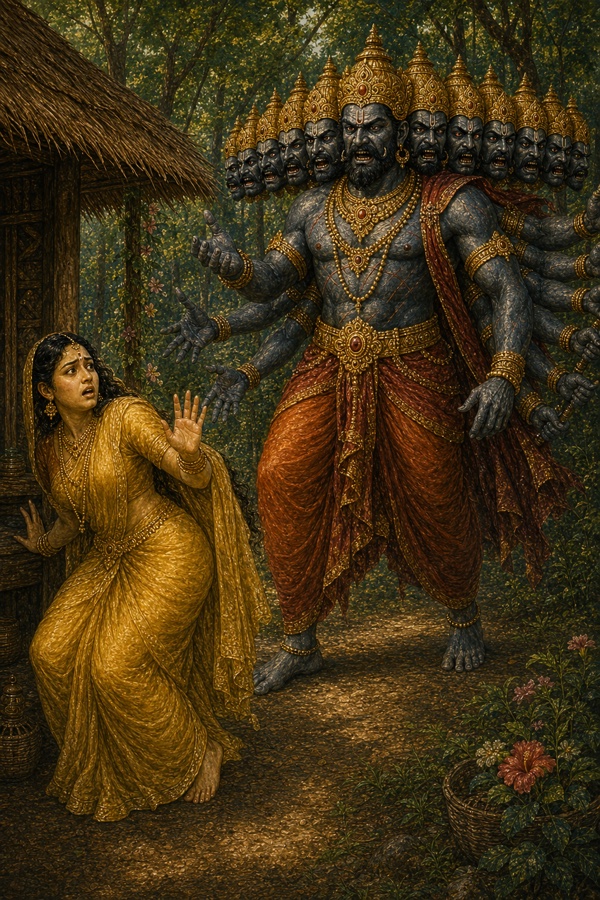
Sita was still speaking when Ravana, mighty as he was, gave her his sharp answer. “I am Ravana, the celebrated ruler of the hordes of rakshasas, Sita, and the whole world, gods and demons and human beings alike, has been struck with terror by me,” he said.
“Since I set eyes on you, with your skin like gold and your silk, I take no more delight in my own wives, lady beyond reproach,” he said. “Among all the many excellent women I have carried off from here and there, become the foremost queen. My great capital is Lanka, set in the midst of the sea, ringed by the ocean, built on the summit of a hill. There you will roam the woodlands with me, young Sita, and you will never long for this forest life again. Five thousand serving women decked in every kind of ornament will wait on you, if you choose to become my wife.”
Sita’s Reproach and Ravana’s Boast of Strength
At those words the daughter of Janaka, Sita of the faultless limbs, grew angry, and she scorned that rakshasa and answered him. “I have taken a vow to follow the mind of my husband Rama, who is unshakable as a great mountain, the equal of mighty Indra, unstirred as the ocean,” she said. “I have taken a vow to follow the wishes of the blessed Rama, who bears every auspicious mark, who gives shelter to all like a banyan tree, who is true to his word. I am devoted to strong-armed Rama, that lion of a man, with a chest as broad as a lion’s, who walks with a lion’s proud gait and has a lion’s prowess. I follow the vows of strong-armed Rama, whose face is like the full moon, who delights everyone, the greatest of kings, master of his senses, of far-reaching fame.”
“And still you, a jackal, covet me, a lioness, so hard to win,” she said. “You can no more touch me than you could touch the glow of the sun. You are surely seeing many golden trees, short-lived rakshasa, you who covet the beloved wife of Raghava. You want to pull a tooth from the jaws of a hungry, powerful lion, the sworn enemy of deer. You want to pull the fang from the mouth of a poisonous snake. You want to carry off Mount Mandara, the greatest of mountains, in your hand. You want to drink a deadly poison and go on your way unharmed. You are rubbing your eyes with a needle and licking a razor with your tongue, you who want to lay your hands on the beloved wife of Rama.”
“You want to cross the sea with a slab of stone tied round your neck,” she went on. “You want to snatch the sun and the moon out of the sky with your two hands, you who want to carry off the beloved wife of Rama by force. You have seen a blazing fire and you want to carry it away in a piece of cloth, you who want to carry off Rama’s virtuous wife. You want to walk on the heads of iron-tipped spikes, you who want to lay your hands on the worthy wife of Rama.”
“The disparity between Rama, the son of Dasharatha, and you is the disparity between a lion and a jackal in a forest,” she said, “between the sea and a brook, between nectar and sour gruel, between gold and base lead, between sandal paste and mud, between an elephant and a cat in the jungle, between Garuda and a crow, between a peacock and a diver-bird, between a swan and a vulture. As long as Rama, whose might equals thousand-eyed Indra’s, is alive with a bow and an arrow in his hand, you may carry me off, and you will not keep me, any more than a bee keeps the ghee it swallows, which becomes the bee’s own death.”
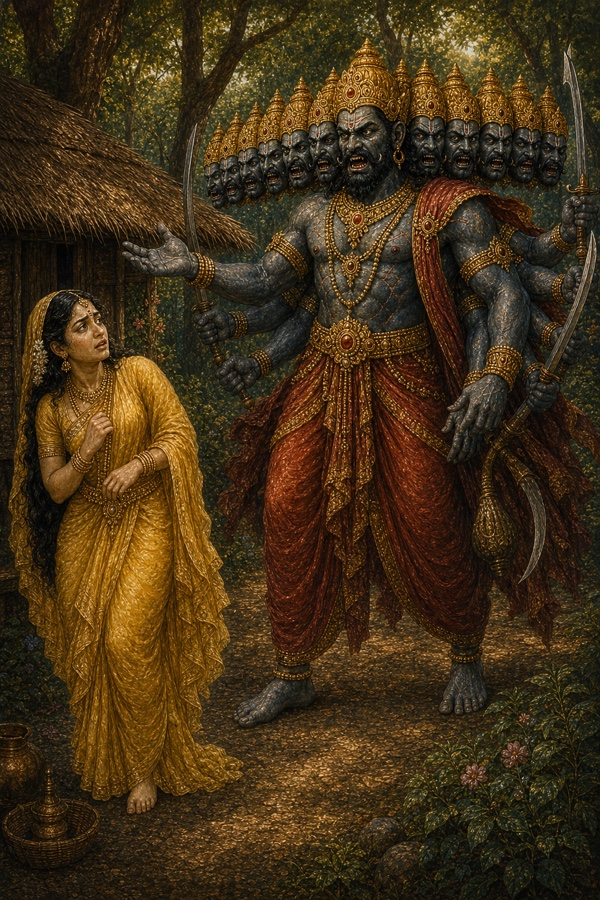
Having said these very sharp things to a night-wanderer who had no good intention anywhere in his mind, slender Sita, who harbored no vile motive toward anyone, felt her whole body begin to tremble, and the distress shook her the way a blast of wind shakes a plantain tree. And Ravana, who was mighty as Death itself, saw her shaking, and to frighten her further he told her, with pride, his descent, his strength, his name, and his deeds.
Knitting his brows over his forehead, provoked, he answered her in harsh words. “Good luck to you, lady of the lovely complexion. I am the glorious ten-headed half-brother of Kubera, Ravana by name, from whom gods, gandharvas, fiends, birds, and serpents flee in terror forever, the way every living being flees from death; who once, provoked to a quarrel on some pretext, assailed his own half-brother Kubera and utterly defeated him,” he said.
“In fear of me Kubera abandoned his sumptuous home, this very Lanka, for good, and he lives now on the top of Kailasa, the king of mountains,” he said. “His celebrated aerial chariot Pushpaka, which goes wherever one wishes, I snatched from him by my own prowess, and in it I range the skies. Indra and the other gods take one look at my face when I am angry and run. Wherever I halt, the wind blows gently for fear of me, and the sun with its fierce rays turns into the moon in the sky. Wherever I stay or move, the leaves of the trees hang motionless and the waters of the rivers stand still.”
Then he described his Lanka to her: beyond the sea, vying with Amaravati, the capital of Indra, full of fierce rakshasas, enclosed and beautified by a white rampart, its inner apartments built of gold and its outer gates of cat’s-eye jewels, crowded with elephants, horses, and chariots, loud with the sound of every kind of musical instrument, abounding in trees that bore every fruit anyone could covet, and beautified with gardens.
“Live there with me, princess Sita, and you will no longer remember the women of men, proud lady,” he said. “Enjoying human and celestial delights, you will no longer think of the mortal Rama, whose life is all but over. What use can you have for that Rama, an ascetic practicing austerities, a man who has lost his sovereignty and with it his reason, a man of negligible prowess, who, though the eldest son, was sent into exile in the forest by King Dasharatha after his father had installed his pet son Bharata as prince regent? Save me, the lord of the rakshasas, who has come to you in person, and love me. You ought not to spurn me, overpowered as I am by the arrows of love. Spurn me, timid one, and you will surely suffer the remorse Urvashi suffered after she kicked King Pururavas. The mortal Rama is not equal to one of my fingers on a field of battle. Accept me, then, lady of the lovely complexion, who have sought you out by your own good luck.”
At those words Vaidehi, angered, her eyes gone blood-red, said harsh words to the lord of the rakshasas in that lonely place. “How can you call the god Kubera your brother, who is hailed by all the gods, and then seek to commit a foul deed like this?” she said. “All the rakshasas will inevitably perish, Ravana, since a man like you is their ruler, hard-hearted, evil-minded, with senses you have never subdued.”
“A man might carry off Shachi, the wife of Indra, and still live,” she said, “but having carried off me, the wife of Rama, no one lives on in peace. A man who laid his hands on Shachi, the peerless wife of the wielder of the thunderbolt, might survive for a long time; a man who treats a woman like me with indignity has no escape from death, rakshasa, though he had drunk the drink of immortality.”
The Abduction of Sita and the Sight of Jatayu
Hearing Sita’s rebuke, the mighty ten-headed Ravana struck one hand violently against the other in his anger and began to reveal his gigantic form. A master of expression to the last, he spoke to the princess of Mithila once more.
“It seems you have never heard of my valor and my prowess, mad as you are,” he said. “Standing in the air, I can lift the earth in my hands. I can drink up the ocean on every side. Stationed on a field of battle, I can kill Death himself. With my sharp arrows I can torment the sun and split the surface of the earth. Look at me, woman drunk on passion and on the pride of your beauty. I can take any form I please.”
By the time he had finished, Ravana’s angry eyes, dark at the corners, had turned red, and they began to burn like fire. The mendicant was gone from his face.
At once the younger brother of Kubera threw off his benign aspect and took back his own native shape, fierce as Death. Red-eyed, decked in ornaments of refined gold, seized with a great fury, that glorious rakshasa looked like a dark cloud. He shook off the disguise of a wandering ascetic, and the night-wanderer stood there in a colossal form with ten heads and twenty arms. The lord of the rakshasas, in his own shape at last, dressed in a red robe, stood and gazed at the princess of Mithila, that loveliest of women, her dark-tipped hair duly dressed, adorned with jewels, shining like the radiance of the sun.
“If you want a husband famous through all three worlds, come to me,” Ravana said. “I am a husband worthy of you. Serve me for a long time. I am a husband worthy of praise, and I will never do anything to displease you, good lady. Give up your affection for a human being and place it on me. What virtues do you see in the silly Rama that you cling to him, deluded woman who thinks herself wise? He has been banished from his kingdom, he has failed in his object, his days are numbered, and at the word of a woman he gave up the throne of Ayodhya and his kith and kin to live in this forest full of beasts of prey.”
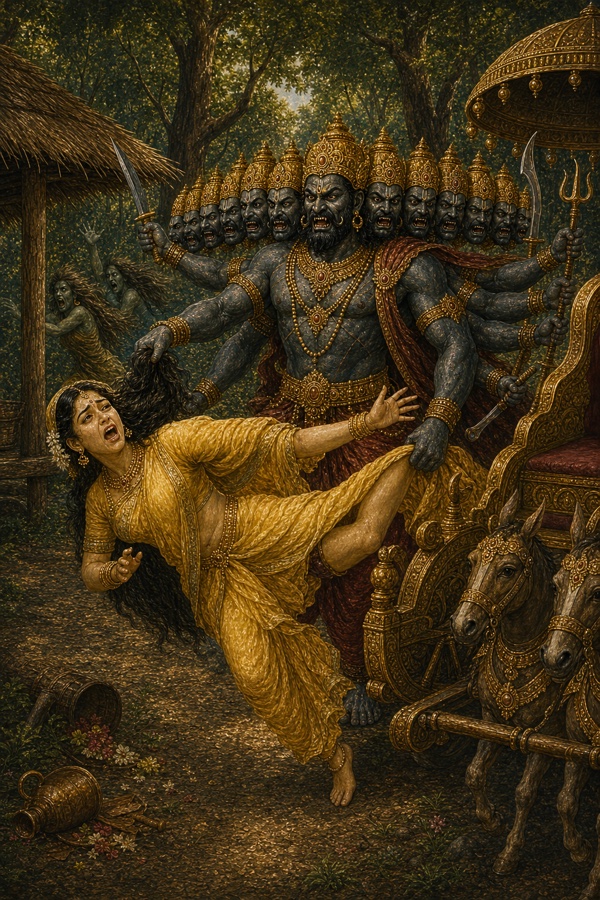
He had said all of this to Maithili, who spoke kindly to everyone and deserved kind words from everyone. Then he came near her, and Ravana, vile in his nature and maddened by lust, took hold of Sita, who should have been a mother to him, the way Budha takes hold of Rohini in the sky. With his left hand he seized the lotus-eyed Sita by the hair. With his right hand he seized her by the thighs. The deities of the forest saw him then, tall as a mountain peak, with his sharp teeth and his mighty arms, Death himself standing in a clearing, and they ran. And at that very moment his famous chariot of illusion, huge, made as if of gold, came up close and stood waiting, yoked to donkeys, harsh-voiced. Then, overawing Vaidehi with harsh words, he took her in his arms, and with a roar that the whole forest heard, Ravana set her in the chariot.
Seized by Ravana, the illustrious Sita, stricken with agony, cried out at the top of her voice, “Rama!”, to a Rama who had gone deep into the forest. She had no wish to go anywhere with Ravana, and she writhed in his grip like the wife of the serpent-king, and Ravana, driven by his passion, rose into the sky with her in his aerial chariot. Carried off through the air, her mind distracted with grief, Sita began to wail aloud like a woman gone mad, like a woman wounded.
“Strong-armed Lakshmana, delight of your elder brother’s heart,” she called, “you do not know that I am being carried off by a rakshasa who can take any shape he pleases.”
“Raghava, you who have given up your ease, and everything that everyone wants, and staked your very life, for the sake of virtue,” she said to Rama, “you cannot see me being carried away against all virtue. You tame the unruly, scorcher of your enemies; how is it that you do not punish Ravana, sinner that he is?”
“The fruit of an insolent man’s evil deed does not show itself at once,” she said to Ravana, “because time plays its part in the ripening of an act, as it does in the ripening of grain. Your understanding has been rotted by an adverse fate, and you have done this outrageous thing, and so at Rama’s hands you will meet a terrible misfortune, and it will bring your life to its end.”
“So now Kaikeyi and her kinsmen have their wish,” she said, “since I, the lawful wife of an illustrious hero who wants nothing but virtue, am being carried off by a desperado.”
Then she turned to the flowering karnikara trees of Janasthana and begged them. “Tell Rama quickly that Ravana is carrying off Sita.” She bowed to the river Godavari, loud with swans and cranes, and asked the same thing of her. “Tell Rama at once, when he comes to you, that Ravana is carrying off Sita.” She saluted the deities who dwell in the many kinds of trees of that forest and begged them to tell her husband of her abduction.
Then, taking refuge with every kind of creature that lived in that forest, the herds of deer and the flocks of birds, she called to them. “Tell my husband that his beloved wife, dearer to him than his life, is being carried off, and add this: your Sita has been carried away by Ravana, helpless as she was,” she said. “When he learns where I am, even if it is in the other world, that strong-armed prince of great strength will take recourse to his prowess and recover me, even if it is Yama himself who has taken me.”
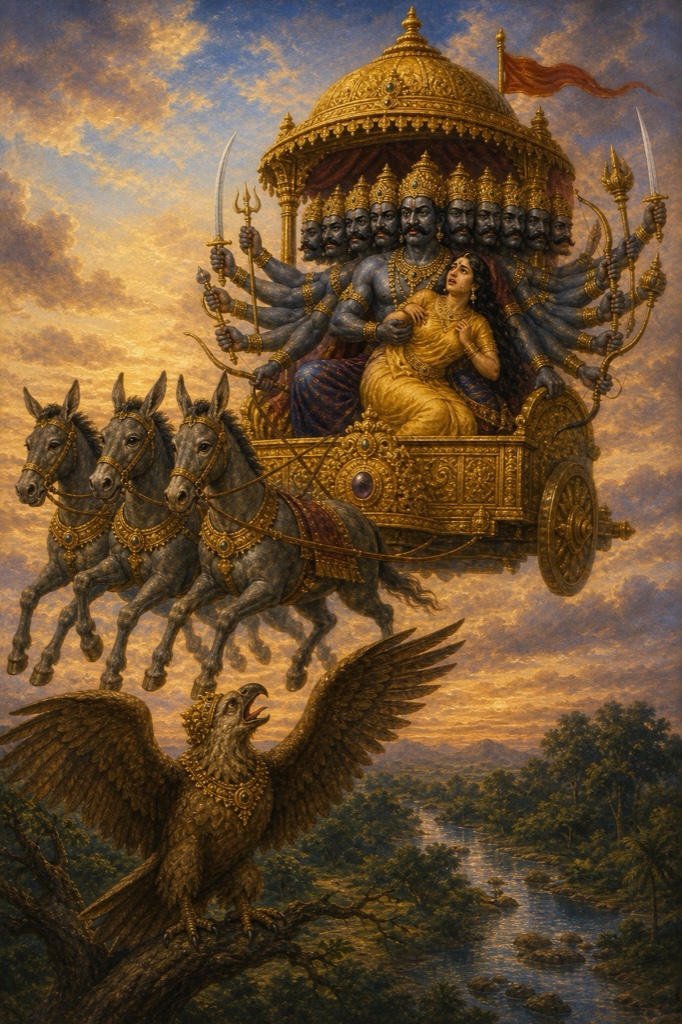
Lamenting so, in the depths of distress, large-eyed Sita caught sight of the vulture Jatayu perched on a tree. Fallen into Ravana’s clutches, given over to fear, she looked up at him and cried out in a voice choked with agony.
“Look at me, noble Jatayu, being carried off without mercy, like a woman with no protector, by this Ravana, king of the rakshasas, whose deeds are all sin,” she said. “This cruel night-wanderer is not one you can stop; he is mighty and proud of his victories, armed, and evil-minded. But whatever happens, Jatayu, my abduction, and everything about it that is worth telling, you must report correctly and in full to Rama and Lakshmana.”
Jatayu had been fast asleep. The cry came into that sleep and woke him. He looked at once, and he saw Ravana, and then he saw Vaidehi, the princess of Videha, in the chariot beside him. Jatayu, the greatest of birds, with the look of a mountain peak on him and a sharp bill, stayed where he was on his tree, and made ready to speak wholesome words to the lord of the rakshasas.
The gist: taking on his terrible form, Ravana seized Sita by force, set her on his chariot, and rose into the sky; lamenting, Sita called on the trees, the river, the deities, and the living creatures to carry word to Rama, and just then her eyes fell on the vulture-king Jatayu perched on his tree, who woke, and saw, and made ready to stop Ravana.
Source: Srimad Valmiki Ramayana, Aranyakanda, Cantos 31 to 49. The Gita Press Hindi edition is the controlling witness. The Sanskrit e-text and an independent complete translation were used to verify names, sequence, and principal events. Where recensions differ, this retelling follows Gita Press.
Basis: Valmiki Ramayana (Gita Press, Gorakhpur)