On this page
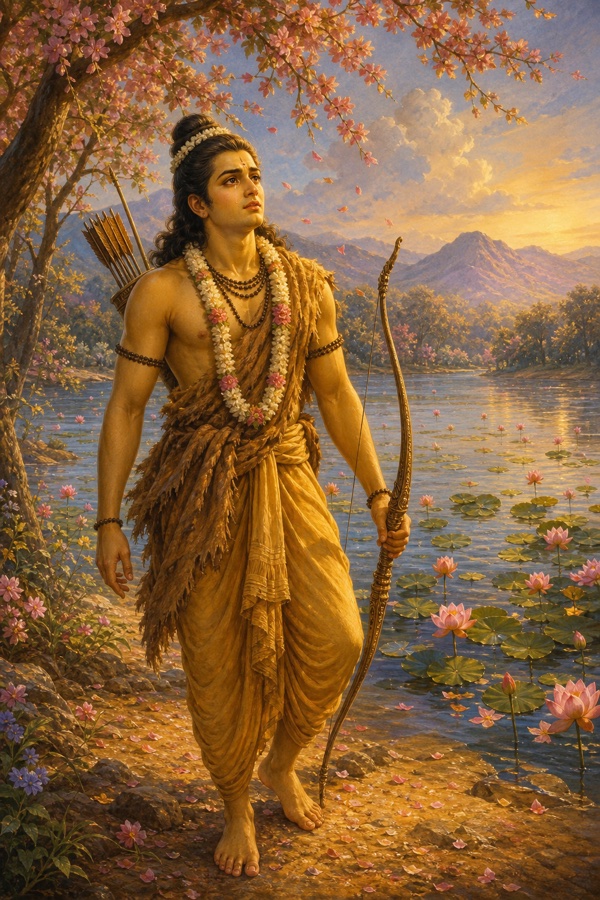
Rama came down to the shore of the Pampa lake with Lakshmana, to a place where the lotuses had opened, the water lilies floated, and the fish moved through water clear enough to count them in. It was the loveliest thing he had seen since he lost her, and that was exactly what was wrong with it; the beauty went into the wound and opened it. The moment his eyes fell on the lake his senses trembled with a rush of delight, and with the longing on him he began to speak to Saumitri, the son of Sumitra.
Spring on the banks of Pampa and Rama’s lament
“Look, Lakshmana,” Rama said, “How radiant this Pampa is. Its water is clear as a cat’s-eye gem, its lotuses and lilies are in full bloom, and trees of every kind stand around it the way ornaments stand on a woman. With their high branches they look like mountains that have been given peaks, and they spread their beauty on every side of the water.”
Pains of many kinds were working on him at once, and he named them. On the one side lay the thought of Bharata’s sorrow, holding a kingdom he had never wanted; on the other the abduction of Sita, the daughter of Janaka, king of Videha. And scorched between the two, Rama still found Pampa bewitching, which shamed him and did not stop. The turf along its banks, blue-green and yellow, looked like carpets woven out of the flowers the trees had let go. The breeze seemed to be playing everywhere at once, among the petals that had fallen, the petals still falling, and the blossoms holding on. Slipping out of the mountain caves, the wind seemed to sing in the sweet voice of the cuckoo.
This was the month of Chaitra, Rama said, the first month of spring, when the breeze turns gentle and stirs a longing in whoever stands in it, and the trees grow heavy with flower and with fruit at the same time. He showed Lakshmana the splendor of the woods, which rained blossoms the way clouds pour rain. The karnikara trees, loaded with flowers, looked like men decked out in gold ornaments and robed in yellow silk. It was the season the whole world waits for. He had waited for it too, once, with her.
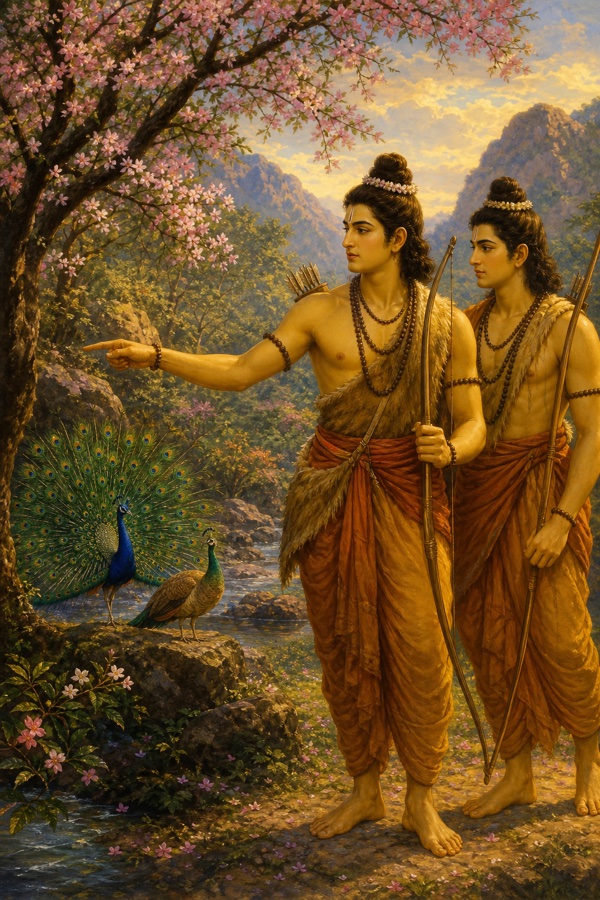
“This spring, ringing with the calls of so many birds,” Rama said, “Wakes my grief for Sita to its full height, and she is parted from me forever. Weighed down by sorrow, tormented by longing, I hear the cuckoo and it seems to be taunting me, as though it had come to pick a quarrel. In the old days, when my beloved heard that call at our hermitage, she would grow glad and call out to me to come and hear it. Now she is gone.” Watching a peacock dance, Rama said that no demon had carried off the peahen from this forest, and so the bird could play with his mate in front of him. And for himself, in a month brimming with flowers, life without his beloved was past bearing.
“See, Lakshmana,” Rama said, “How deep love runs even among the lower creatures, that this peahen goes to her mate out of longing and nothing else. Had she not been carried off, Janaki too would have come to me, faint with love, and this whole forest would have looked like a different forest.” Then he turned the thought around, and it cut him both ways. If spring had reached the place where Sita now was, then Sita, helpless in another’s power, must be grieving exactly as he was grieving. And if spring had not reached her, then how could she, whose eyes were dark as blue lotuses, live at all without him?
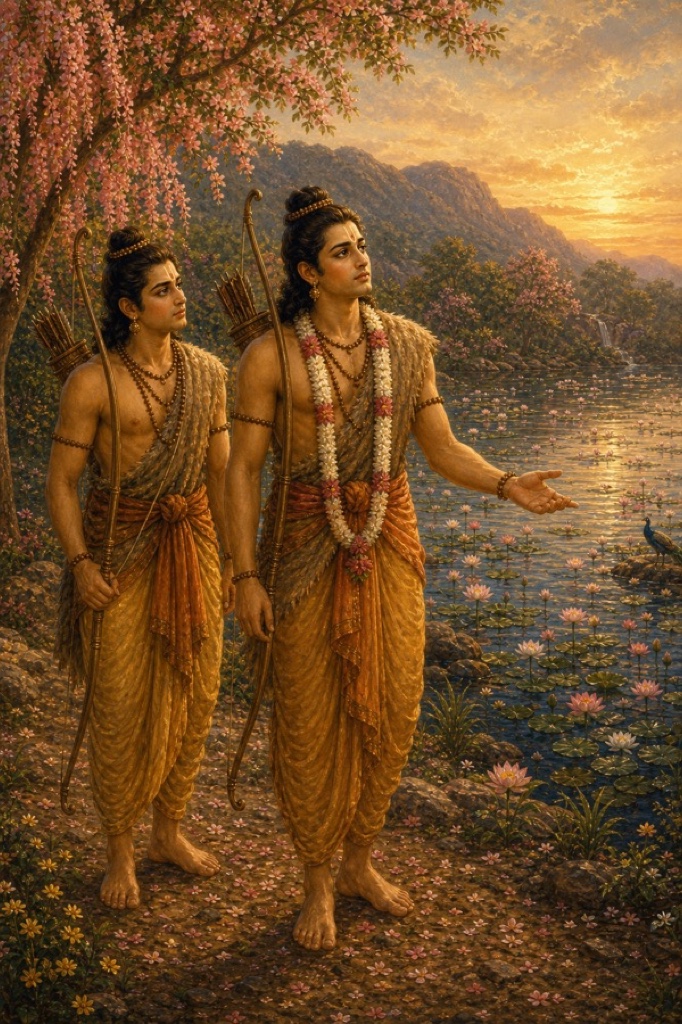
The conviction turned relentlessly in his mind that his Sita could not survive their parting, because Vaidehi’s heart was fixed, in the truest sense, on him alone, and his own heart rested wholly on her, and neither of them had anything left to stand on. Even the cool wind carrying the scent of flowers felt like fire on him, because it brought her back. Rama named the trees blossoming on Pampa’s banks, the chirabilva and the madhuka, the vanjula and the bakula, the champaka, the tilaka, and the naga. And on a peak to the south, a single flowering stalk of karnikara struck him as the loveliest sight of all.
Rama praised Pampa for a beauty like the Mandakini’s, and said that if only his Sita could be found, and he could live on here in this forest with her, he would not envy Indra his heaven or spare one thought for Ayodhya. The pleasant wind of Pampa’s woods, he said, which carries the fragrance of lotus and of the white saugandhika lily and drives sorrow off wherever it goes, is enjoyed only by the truly fortunate. Without Sita, his mind was going under, and the wind went through him and drove nothing away at all.
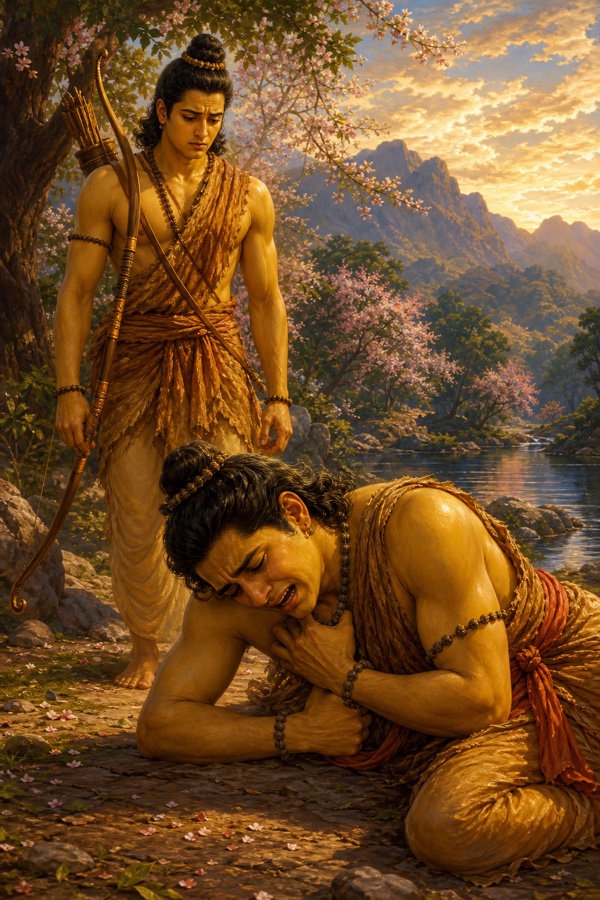
Then he began to imagine the questions. If King Janaka, who knows what is right and never strays from the truth, were to ask after Sita in front of a full assembly, how could he tell him that all was well with her? And when he came home to Ayodhya and his mother Kausalya asked him where her daughter-in-law was, and how she fared, what would he say? Sita had taken her stand on dharma and followed him into a forest when he was cast off the throne and sunk in despair, and where was she now for it? At last Rama said the thing he had been walking toward all morning. “Lakshmana, go and look after Bharata, who loves his brothers. Without the daughter of Janaka I cannot go on living.”
To Rama, lamenting like a man with nobody left to turn to, his brother spoke words that were reasoned and without a fault in them. “Gather your courage, do not grieve. The minds of the blameless, such as you, never go slack. Remember the pain of parting from one you love, and let go of the clinging that feeds it; too much attachment will set even a damp wick alight. Let Ravana flee to Patala or deeper still, he will not stay alive. Once we have traced that sinful demon, he will either give Sita back or meet his death; there is no third road out for him. Should he take her and burrow into the very womb of Diti, I will kill him there.”
“Steady yourself,” Lakshmana said, “And put this feeble spirit down. Nothing is achieved without effort. There is no strength greater than zeal. Zealous men do not drown, even in hard undertakings. By zeal alone we will win Janaki back. Leave grief behind and give up this conduct ruled by longing. It is a sad thing that you no longer recognize yourself for the great, self-mastered man you are.” Counseled so, Rama, whose awareness had gone dim with sorrow, let go of grief and confusion and came back to steadiness.
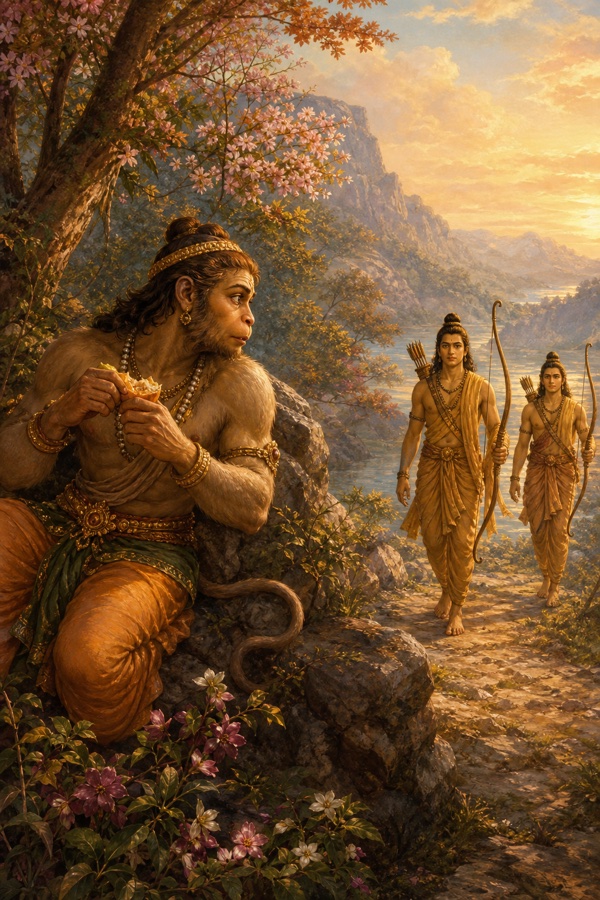
Rama, whose might passed all reckoning, crossed the Pampa and pressed on. He walked with the gait of a rutting elephant, and Lakshmana guarded him in dharma and in strength both. Neither of them knew that the meeting they had been sent toward by a dying demon was about to happen, or that the first thing it would produce was terror. For just then Sugriva, roaming near Rishyamuka, caught sight of two princes of astonishing appearance coming up his mountain, armed, and to a hunted man two armed strangers are never a rescue. The fear took him so fast that he forgot the food in his hands and it stayed there. Crushed under the weight of dread and anxiety, he sank into the deepest gloom. His monkeys took the strangers for Vali’s men and bolted toward the hermitage of Matanga, which was ground the sage’s curse had barred to Vali, and which was, for exactly that reason, the only safe place any of them had.
Sugriva’s suspicion and Hanuman’s counsel
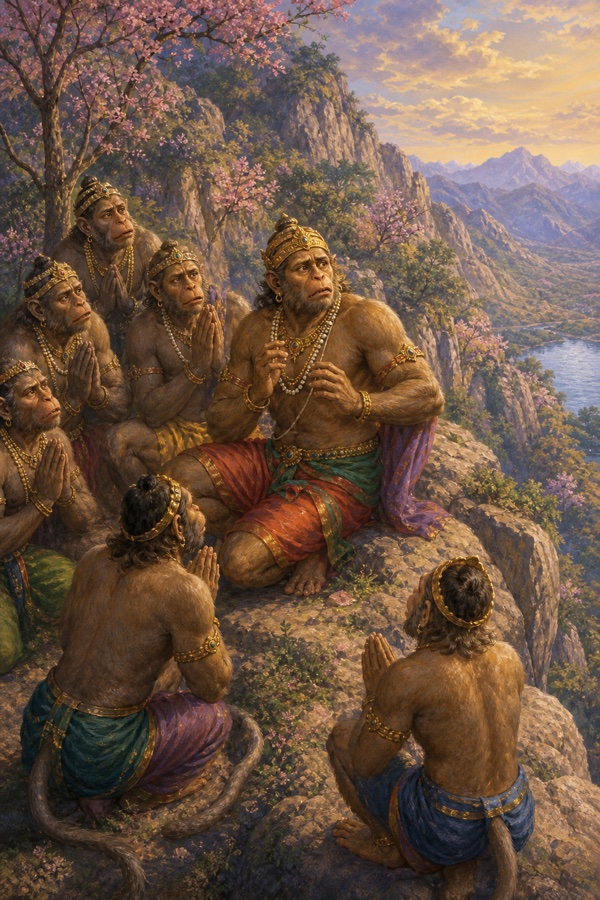
At the sight of the two heroic brothers, Rama and Lakshmana, bearing their splendid weapons, Sugriva was seized with suspicion. His heart in turmoil, he looked in every direction and could not hold still in one spot. The sight of these warriors made his courage fail, as the old tellings have it. Weighing his own strength against the strangers’, deeply shaken, Sugriva fell into distress along with the other monkeys.
“These two,” Sugriva told his ministers, “Are sent by Vali; there is no doubt in it. Dressed in bark like ascetics, by a trick, they have come to roam this hard forest.” And saying it, Sugriva and his ministers moved off that ridge and onto another fine peak, because a monkey who has been hunted for years does not stay on the ridge where he was seen. Then all the troop-leaders quickly ranged themselves around Sugriva and, snapping the trees on the summit and scattering deer and wildcats and tigers as they came, they stood on guard with joined palms.
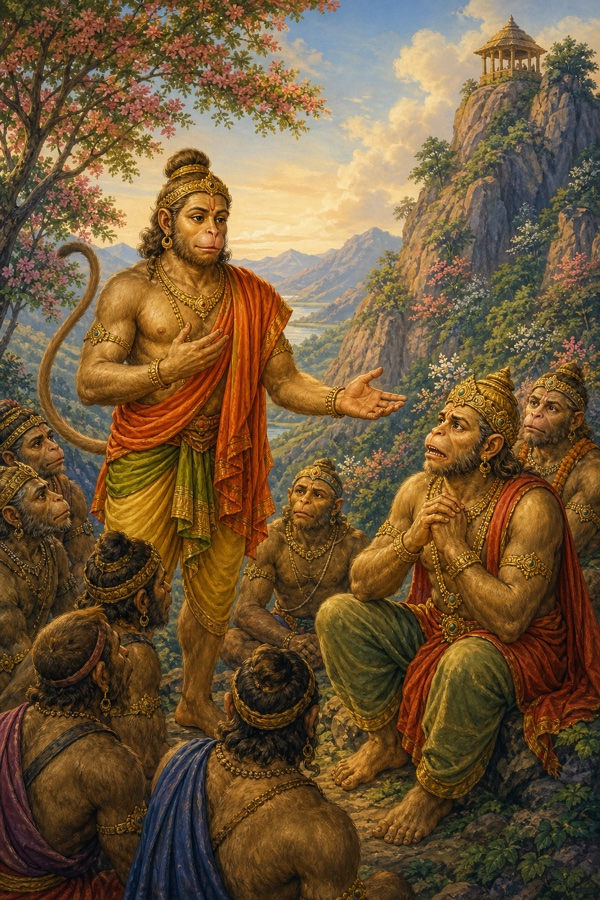
Then to Sugriva, scorched by fear, dreading some new stroke from a brother who had never yet missed him, Hanuman spoke. “Let go of this whole cloud of worry about Vali. This is Malaya, the best of mountains, and here there is nothing from Vali to fear. Vali, the one whose terror sent you running here in a panic, I do not see him anywhere near. That black-hearted Vali is not here. And how clearly the monkey shows in you, that out of a flighty mind you cannot settle on a single resolve and hold it. You are full of intelligence and understanding; read these signs and act as the moment asks. A king who gives way to thoughtlessness cannot govern his people well.”
Hearing this wholesome counsel, Sugriva answered with something finer still, because his fear had reasons in it. “Who would not be afraid at the sight of these two, long of arm and wide of eye, carrying bow and arrow and sword like sons of the gods? I suspect these splendid men are sent by Vali himself, for kings keep many friends, and it is unwise to trust them. Enemies move about in disguise, and the shrewd man reads them for what they are. Trusting nobody themselves, they wait, and they strike at the soft place in whoever trusts.”
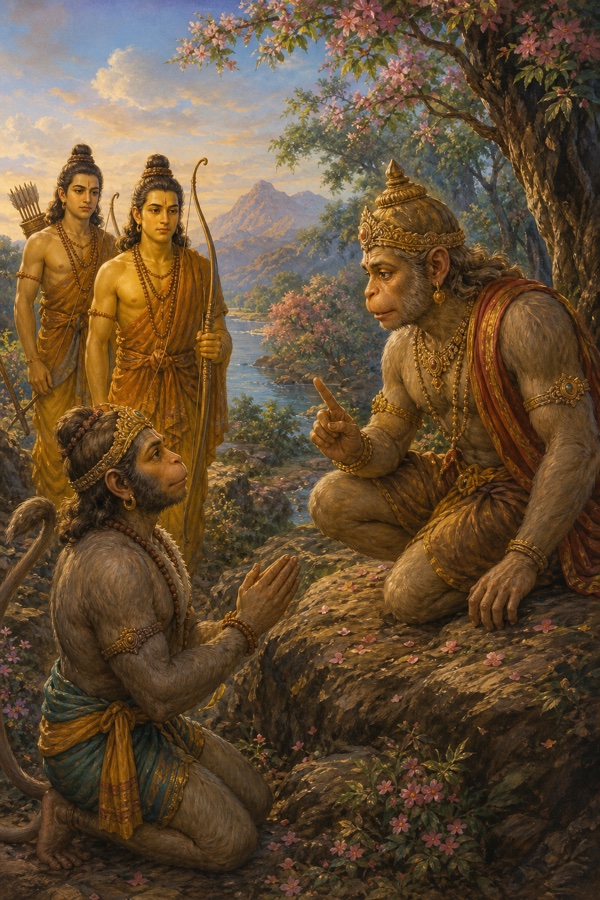
“Go to them, plavangama, as an ordinary man would,” Sugriva ordered Hanuman, “And out of their gestures, their faces, and the way they speak to one another, learn what they have really come for. If they seem glad at heart, then, praising me, reassuring them again and again by signs, and keeping your face turned toward me the whole time, ask why they have entered this forest. And even if you judge them honest of soul, weigh their words and their bearing once more for any trace of ill intent.”
Charged in this way by the monkey-king, Maruti, the son of the wind, resolved to go where Rama and Lakshmana stood. “So be it,” he said, honoring Sugriva’s command, and Hanuman set out toward the place where Rama waited with his brother. So the two of them came into the same story: the man who had lost everything, and the monkey whose father is the wind that goes everywhere and can be kept out of nothing.
Hanuman’s meeting and Rama’s praise
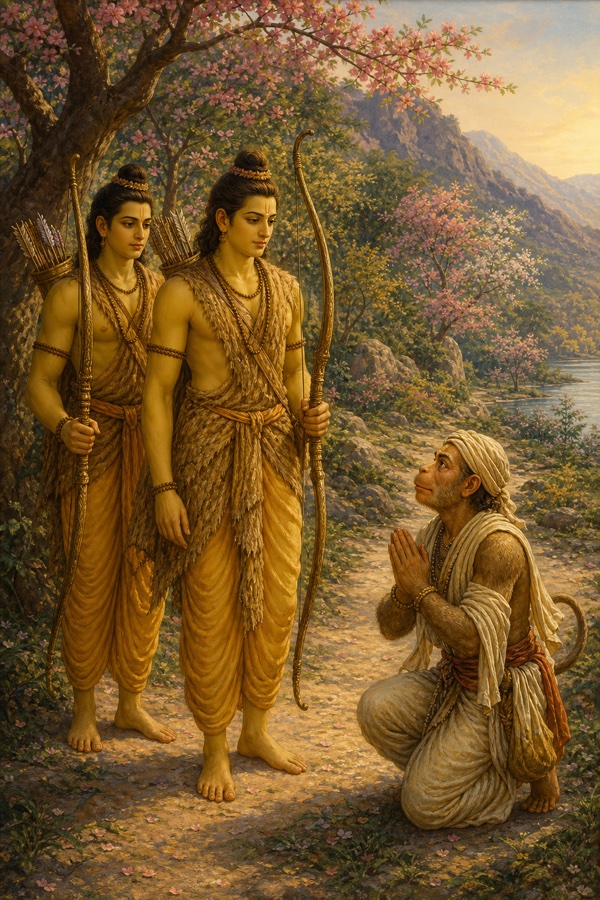
Taking his master’s meaning to heart, Hanuman sprang down off Rishyamuka to where the two Raghavas stood. Wary by nature, as a monkey’s mind always is, Hanuman laid his monkey shape aside and put on the form of a wandering mendicant, which is a shape nobody draws a bow on. In soft and winning speech, coming near in all humility, bowing low, he addressed the two heroes and praised them as was fitting.
“Who are you?” Hanuman asked. “Bearing a striking brilliance, an unfailing might, stern vows, and a noble beauty, you look like royal sages, or like gods. How have two ascetics such as you come into this forest, where the sight of you alone sends the deer and the wild things running? You wear robes of bark, your arms are strong and shapely, you draw deep breaths, and you throw these creatures into unease by standing here. With the gaze of lions, carrying bows that gleam like the rainbow of Indra, destroyers of enemies, radiant with fortune, you flood this Rishyamuka with your light.
“With eyes like lotus petals and coils of matted hair, so like each other that one is the other’s answer, you seem heroes stepped down out of the realm of the gods. It is as if the moon and the sun had come down and were standing on a hill in this forest. You are worthy to guard the whole of this earth, with its oceans and its forests, crowned by the Vindhya and by Meru. And yet why do these arms, worthy of every ornament, go bare? I have praised you all this while, and still you will not speak one word to me.
“There is a monkey-lord named Sugriva, a soul devoted to dharma,” Hanuman went on, coming at last to his own name, “Who wanders this earth in grief, driven out by his own elder brother. It is that Sugriva who has sent me, a monkey named Hanuman, to you. He longs for the friendship of you both. Know me for his minister, a monkey, and a son of the wind, who has come here from Rishyamuka in a mendicant’s guise to do Sugriva a service, and who can take any form and travel any road he wishes.” Having said it, Hanuman, so skilled in speech, fell silent, and waited.
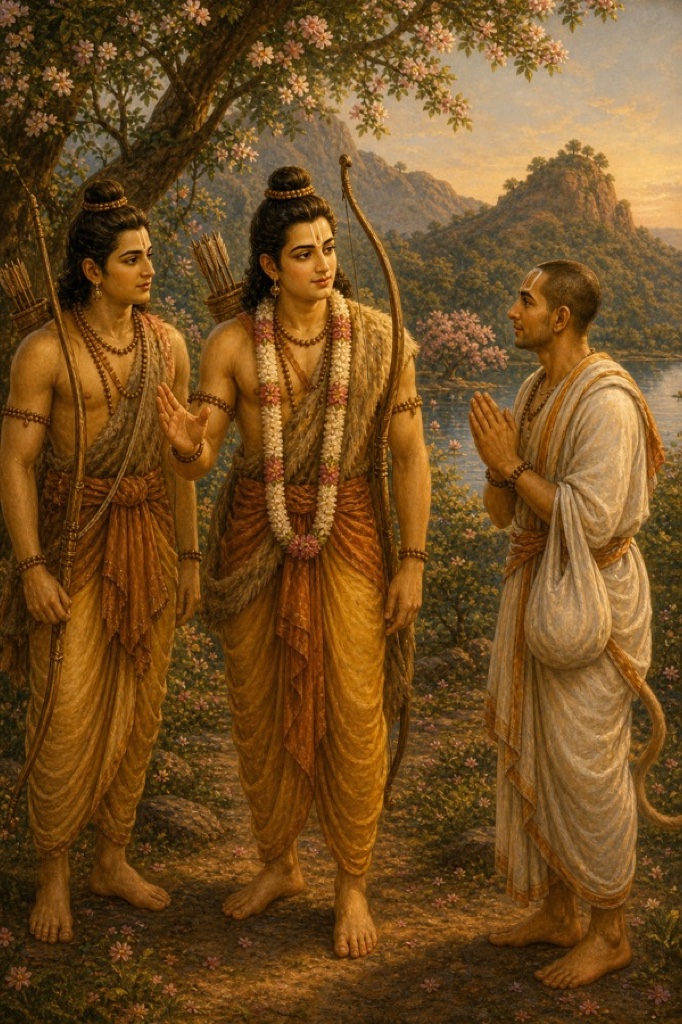
Hearing him, Rama, his face lighting for the first time in days, turned to his brother at his side. “The one who has come to me is the minister of that very Sugriva, lord of monkeys, the very one I have been seeking. Saumitri, answer this monkey in words sweet and warm. Nobody could speak as he has spoken who had not studied the Rigveda for its meaning, committed the Yajurveda to memory, and mastered the Samaveda. Surely he has gone through the whole of grammar many times over, for in all this speaking he has not let one wrong word slip past him. No flaw showed in his mouth, his eyes, his forehead, his brows, or any other part of him. His speech is brief, free of doubt, unhurried, and untroubled, pitched in a measured tone drawn up out of the three seats of utterance, the chest, the throat, and the head. Whose heart would not be won by speech so gracious and so gladdening? Even an enemy standing with his sword raised would feel his mind turn to friendship at it, and how much more anyone else. How can a king whose service lacks such an envoy ever see his purposes carried through? When a king’s messengers are furnished with gifts like these, every aim he has is already half accomplished.” It is the first thing anyone in this story says about Hanuman, and it says nothing about his strength. Rama had been listening to a monkey talk for the length of one speech, and had heard three Vedas, a grammar, and a man he could trust.
At Rama’s bidding, Lakshmana, himself a knower of speech, said to Hanuman, “We know the virtues of Sugriva. It is that very lord of monkeys we are seeking. As you propose on Sugriva’s behalf, so shall we do.” Hearing Lakshmana’s able words, and setting his heart at once on Sugriva’s triumph, Hanuman, glad in form, resolved to bring the two of them together.
The telling of the tale and Hanuman carrying Rama and Lakshmana on his shoulders
When Hanuman heard Rama’s words and the warmth in them toward Sugriva, and understood that Rama too had come here needing something, he was overjoyed, and he did the arithmetic in one breath. The kingdom is as good as won for Sugriva, he said to himself, for Rama has come here in need, and the task of meeting that need has fallen to Sugriva. Then he asked the question aloud. “Rama, why have you come with your younger brother into this dread and difficult forest, full of snakes and wild beasts, for all that the woods of Pampa grace it?”
Prompted by Rama, Lakshmana told the tale of Rama. “There was a king named Dasharatha, a man of radiance and a lover of dharma, who guarded the four orders of society by his own steadfast duty. Nobody hated him, and he hated nobody. To every living thing he was a second grandfather, another Brahma. With sacrifices such as the Agnishtoma, in which the full priestly fees were paid and no priest went away short, he offered worship. His firstborn is the man standing beside you, whom people know by the name of Rama. He is fit to shelter all beings, a flawless keeper of his father’s word, the eldest and the worthiest of all Dasharatha’s sons.
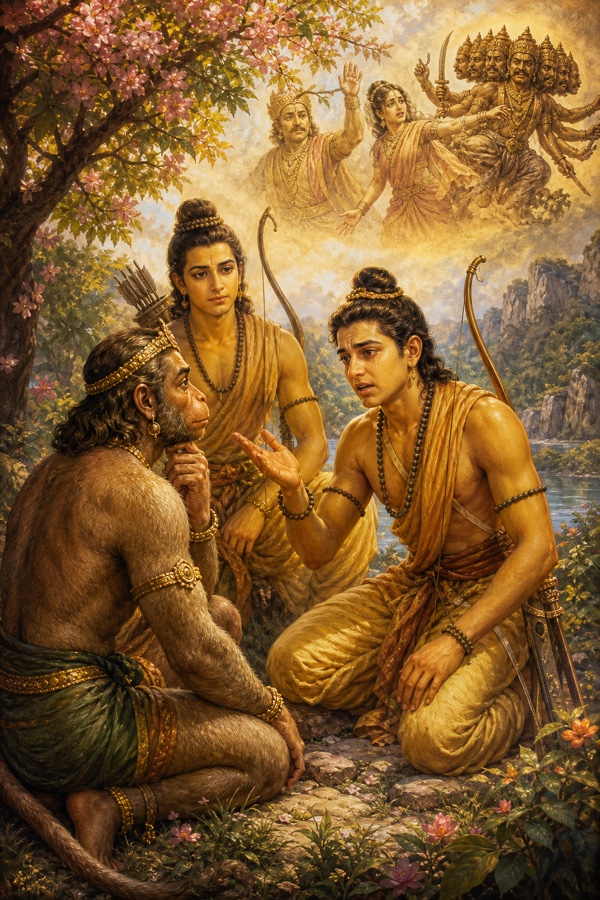
“Marked with every sign of royalty, standing on the very threshold of the crown, he was cast out of the kingdom without warning, and came to live in the forest with me and with his wife Sita, the way the sun goes down at the close of the day and takes all its splendor with it. I am his younger brother, named Lakshmana, who out of his virtues became his servant. His wife, blessed, deserving of every comfort and every honor, given wholly to the good of all beings, was carried off by some rakshasa able to change his shape at will, in a moment when none of us was near her. And who that rakshasa is, we do not know.
“A son of Diti named Danu, who by a curse had been thrust into a rakshasa’s body, the one called Kabandha, told us of the able monkey-lord Sugriva. He said Sugriva would hunt out the one who seized my brother’s wife. Having said it, Danu turned radiant and rose into heaven. So I have told you everything, and told it truly. Now Rama and I have both come to seek refuge with Sugriva. He who was himself a lord of the world, a giver of shelter to all and a lover of dharma, the son of that King Dasharatha whose daughter-in-law Sita is, that same Rama now wishes to take Sugriva for his protector. When a Rama undone by grief comes seeking refuge, Sugriva, with his troop-leaders, ought to show him grace.”
As Lakshmana spoke with the tears closing his voice, Hanuman answered him, and what he offered was recognition. “By great good fortune, men such as you have come before our eyes, men of sound judgment who have mastered anger and the senses, men worthy to stand in front of Sugriva, the monkey-king. Sugriva too has been driven from his kingdom, set at feud with his brother, robbed of his wife, and he lives in this forest in fear. That son of the sun will join with all of us to help you in the search for Sita.”
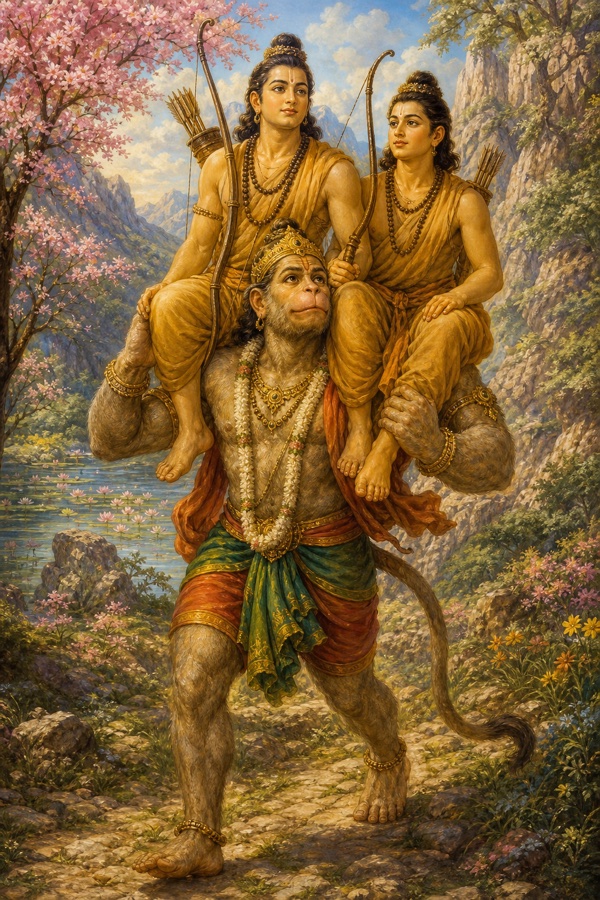
Having said this in sweet words, Hanuman told Rama, “Come, let us go to Sugriva.” Lakshmana, honoring Hanuman as was proper, said to Rama, “Raghava, this son of the wind speaks truly and in gladness. Sugriva too has a purpose of his own. You have come at the right hour, and your end is as good as gained. This bright-faced hero will not speak falsely.” Then Hanuman took up the two heroic Raghavas and set out to meet the monkey-king. He shed the mendicant’s form and took his own monkey shape again, and seated the two heroes on his shoulders, one on each; and that lordly monkey started up toward Rishyamuka. His task accomplished, delighted, of vast renown, the son of the wind carried Rama and Lakshmana toward Rishyamuka, and it was the first time he carried them, and it was not the last.
The fire-witnessed friendship and Sugriva’s grief
Going from Rishyamuka to the Malaya hill, Hanuman brought the two heroes in front of Sugriva and presented them. “This Rama of steadfast valor has come, and his brother Lakshmana with him. Born in the line of Ikshvaku, a son of Dasharatha, renowned for his dharma, he came into this forest at his father’s command and for no other reason. His father Dasharatha fed the sacred fire with the Rajasuya and the Ashvamedha, and gave away cows by the hundred thousand. By austerity and by truth he upheld the earth. And for the sake of a promise his father had made to a wife, Rama came to the forest and left a throne standing empty behind him. While he was living here, Ravana carried off his wife, and so he has come seeking your refuge. Take these two brothers, who ask for your friendship, and do them honor.”
At Hanuman’s word, Sugriva took on a most comely form and came to Rama in affection. “You are humble in dharma, given to austerity, tender toward every living thing,” he said. “The son of the wind has told me your virtues as they truly are, and he does not flatter. Lord, it is my own honor and my great fortune that you, of all men, should seek the friendship of a monkey. If my friendship is welcome to you, here is my arm held out. Take my hand in yours, and let a firm bond be tied between us.” Hearing those good words, Rama with a glad heart pressed Sugriva’s hand in his own, and in the warmth of fellowship drew him into a close embrace.
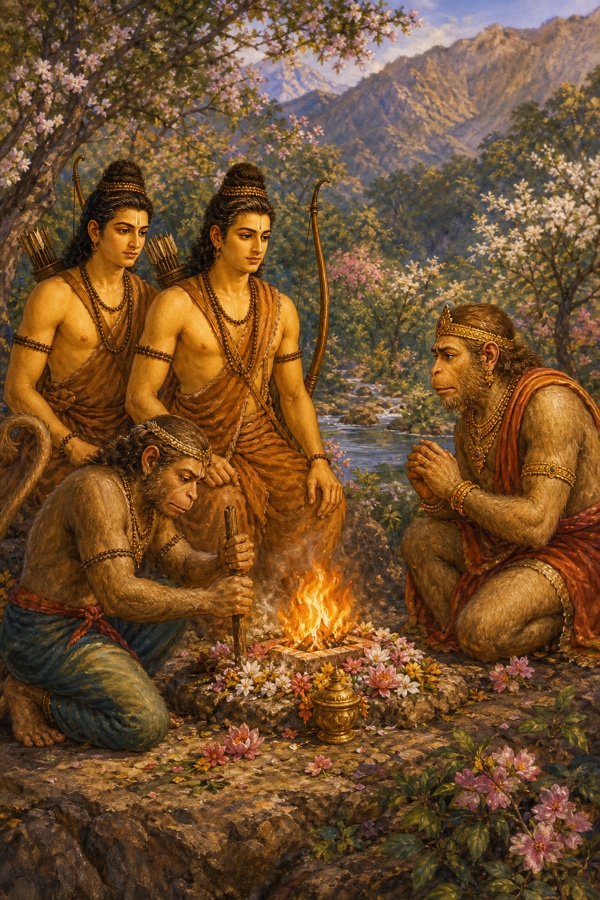
Then Hanuman set the mendicant’s form aside and, in his own shape, kindled a fire from two sticks, the way it has always been kindled. He worshiped it with flowers, and having honored it, he placed the blazing fire carefully between Rama and Sugriva, so that what was about to be said would be said with a witness that cannot be argued with afterward. Rama and Sugriva walked around the kindled flame, and in that circling they were bound. The two of them, Hari the monkey and Rama the Raghava, looked at each other and could not look their fill. Overjoyed, Sugriva said, “Now you are the dear friend of my heart, and from this hour our grief and our gladness are one thing and not two.”
Breaking off a branch of sal loaded with flowers and leaves and spreading it out, Sugriva sat down on it beside Rama, because a friend does not sit on bare ground while his friend sits on a branch. The delighted Hanuman gave Lakshmana a flowering branch of sandalwood. Then Sugriva, his eyes unsteady with joy, spoke sweetly to Rama, and what came out was not joy at all. “Rama, cast out of my own home, I wander this forest tormented by fear. Since my wife was taken from me I have lived in terror, my mind unstrung, sheltering in this hard country. My brother Vali drove me out and turned his enmity on me. In my terror, give me safety from Vali. Kakutstha, so order it that fear no longer lives in me.”
So appealed to, Rama, radiant, a knower and a lover of dharma, said to Sugriva as though with a smile, “I know what the fruit of friendship is: it is the help one gives. Vali, who carried off your wife, him I will kill. These arrows of mine, bright as the sun, sharp and unerring, fletched with vulture feathers, flashing like the thunderbolt of Indra, like serpents in a rage, will fall on that Vali. This very day you will see him laid out like a mountain broken apart, struck down by shafts keen as venomous snakes.” Hearing words like that, spoken as easily as another man might promise a favor, the overjoyed Sugriva said, “Hero, by your grace may I win back both my wife and my kingdom. God among men, deal with that enemy so that he can never torment me again.”
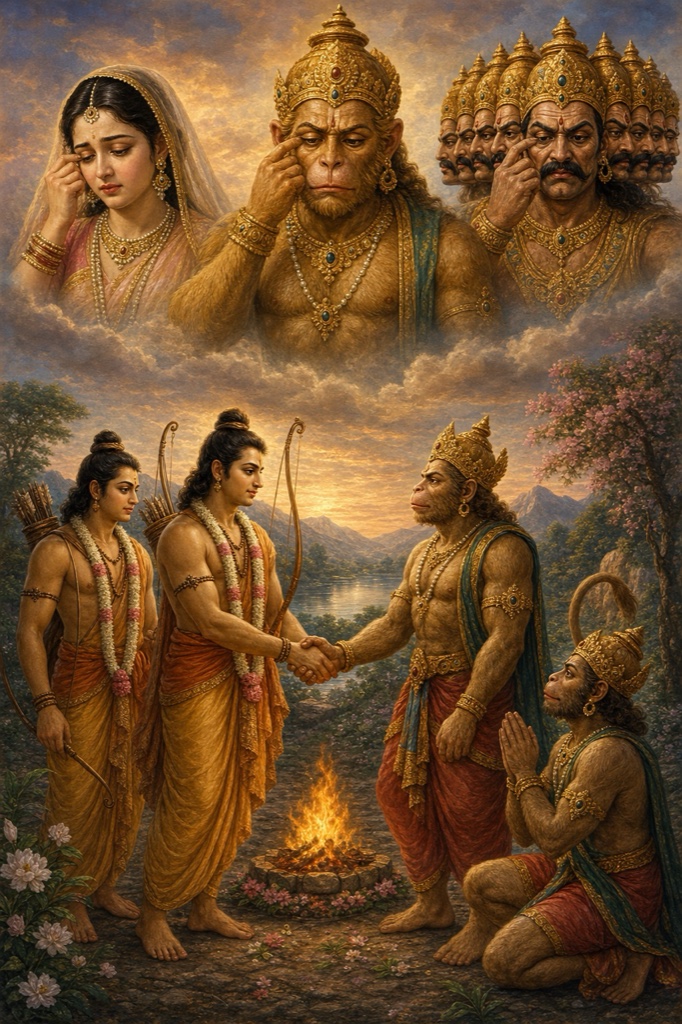
At that loving compact between Sugriva and Rama, in three places far apart, and in none of them was there any news of what had just happened on a hill above Pampa, three left eyes quivered at the same moment: Sita’s, which was like a lotus, and Vali’s, which was like gold, and Ravana’s, which was like fire. Two of the three had no idea why.
The recognition of Sita’s ornaments
The glad Sugriva spoke to Rama once more, and this time he had something to give. “Rama, this Hanuman, my chief minister, has already told me why you came into this desolate forest with Lakshmana. He told me how, while you were living in the forest, a rakshasa carried off Maithili, Sita, the daughter of Janaka; how she wept, cut off from you and from Lakshmana; how that rakshasa watched for his moment, killed the vulture Jatayu, and left you with the grief of a wife torn away. You will soon be rid of that grief, for as the Lord recovered the lost scripture of the Vedas, so shall I bring her back. Be she in Rasatala or in the sky I will find her and put her in your hands.
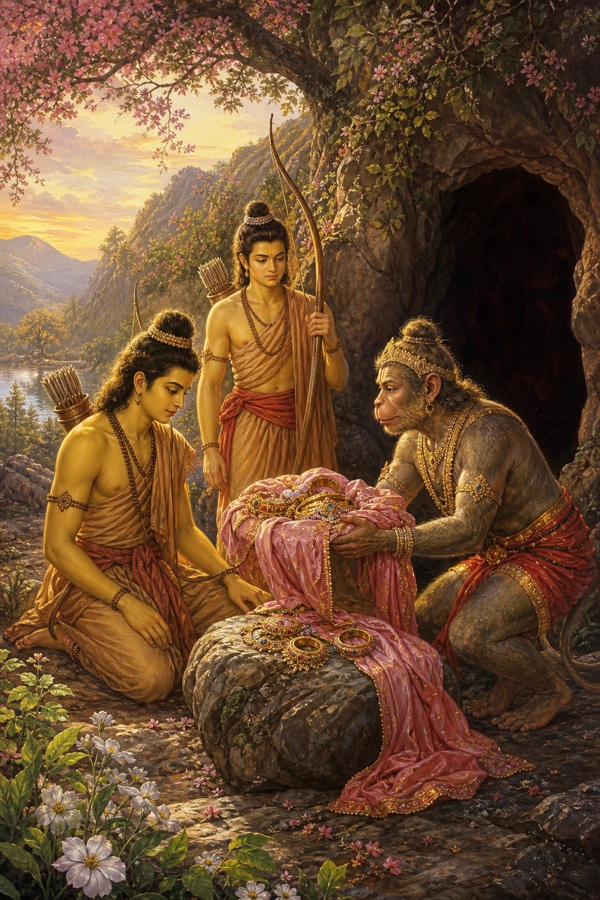
“Take my word for truth,” Sugriva said. “That wife of yours could no more be kept down by the gods and the demons and Indra together than food laced with poison can be kept down. Put your grief aside, I will bring her back. And I know it was Maithili by my own reckoning; there is no doubt in me about that. A rakshasa of savage deeds was carrying her off, and she, crying out ‘Rama! Rama!’ and ‘Lakshmana!’ in a broken voice, writhing in his arms like the bride of the king of serpents, came into our sight. When she saw me standing at the foot of the mountain with four companions, myself the fifth, she let fall her upper garment and her fair ornaments. We gathered them up and we have kept them safe ever since. I will bring them to you, and you shall know them.”
Rama said to the kindly Sugriva, “Friend, bring them at once. Why any delay?” At that Sugriva, eager to please him, went quickly into a rugged cave of the mountain. He took up the garment and those ornaments and came back and held them out, saying, “Look at these.” Taking the cloth and the fair ornaments into his hands, Rama clouded over with tears the way the moon clouds over in mist. He had walked half a country looking for some sign that she was alive, and here in his palms was the first hard proof he had, and every piece of it had come off her body while she was being carried through the air. Wet with the tears that love for Sita poured out of him, crying, “Alas, my beloved,” his composure gone entirely, Rama went down to the ground. Pressing that precious ornament to his heart, and pressing it again, he drew hissing breaths like an angry serpent in its hole.
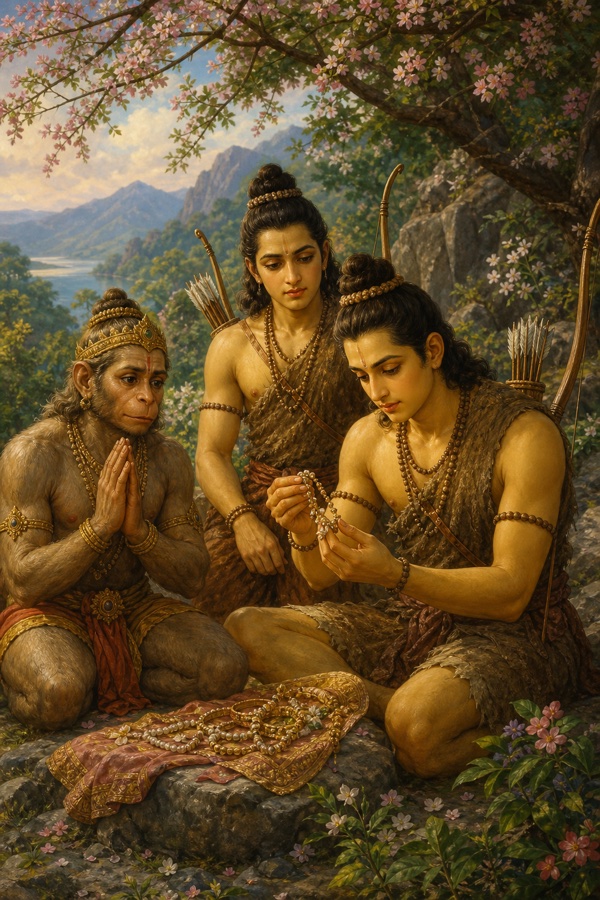
In the unceasing flood of tears, seeing Lakshmana standing near him, Rama in his wretchedness lamented, “See, Lakshmana, at the moment she was seized Vaidehi let these ornaments and this upper garment fall from her body to the ground. Surely, as she was being carried off, Sita dropped this one on the grassy earth, for it has just that look about it.” And Lakshmana answered him with the truest sentence in the chapter, and gave away, without meaning to, how he had lived in that hut for years. “I do not know the armlet, nor the earring. The anklets alone I know, for it was at her feet that I bowed each day.”
Then Rama the Raghava said to Sugriva, “Sugriva, tell me: in what direction did that terrible rakshasa carry off my beloved, as you saw it with your own eyes? Where does he live, the one who is my great ruin? For his sake I will wipe out the whole race of rakshasas, this creature who, by carrying off Maithili and rousing me to fury, has opened the door of death upon his own life. Name me this very day the enemy I am going to send to the house of Yama.”
Sugriva’s words of comfort
At Rama’s grieving words Sugriva, his palms joined, spoke in a voice choked and brimming with tears. “I know nothing of that sinful rakshasa, not where he lives, not his strength, not his valor, not the base house he springs from. And yet I make you a true vow. Put grief aside, and I will strive so hard that you will win Maithili back. I will kill Ravana with all his hordes, and by my own manhood set your heart at rest. You will soon know gladness.
“Do not give way to a failing mind. Call your steadiness back,” Sugriva said. “Such faintness does not become men like you. I too have known the heavy affliction of a wife lost, and I do not grieve like this, and I have not let my steadiness go. If I, a mere monkey, do not grieve for mine, how much less should you, a man noble, self-mastered, and firm of soul. Hold back your tears by strength of will. Do not let slip the bounds and the resolve of men of courage. The steadfast man does not go under in hardship, or in want, or in the fear of death; he takes counsel with his own mind and finds the way. The fool who forever follows his own weakness sinks in sorrow like a boat loaded past what it can carry.
“Here are my hands folded,” Sugriva said, “And it is in friendship that I beg you. Take hold of your manhood, and give grief no entry anywhere. Those who follow grief find no joy in anything, and their fire dies down in them. Let go of grief and lay hold of steadiness and nothing else. I speak for your good, as a friend speaks, and I do not preach at you. For the sake of my friendship, do not grieve.”
At that comfort Rama wiped his tear-wet face with the end of his garment. Brought back to himself by the words of a monkey he had met that morning, Lord Rama embraced him and said, “What a loving and well-meaning friend ought to do, what is worthy of you and right, that you have done, Sugriva. Counseled by you, I am myself again. Such a friend is hard to find, and hardest in an hour like this one. But you must bend your effort to the search for Maithili, and for the fierce, Ravana. Whatever I am to do, tell me plainly and keep nothing back. As in the rains every seed bears fruit in a good field, so shall your every wish come to pass. Hold for truth the word I spoke out of confidence in myself, my vow to kill Vali. I have never spoken falsely before, and I never shall. This I promise you, and I swear it by truth itself.”
Hearing Rama’s word, and hearing above all that vow, Sugriva and his monkey ministers grew glad beyond any measure. So joined together in private, the two of them, one a man and one a monkey, began to tell each other their joys and their sorrows as equals, which is the whole of what they had and the whole of what friendship is. Hearing the word of the noble king Rama, Sugriva held his purpose in that moment already achieved.
Sugriva’s account of himself and the beginning of the feud
Content with Rama’s word, Sugriva said to Rama, “Surely I am one on whom the gods have looked with grace, for a man rich in every virtue has become my friend. Rama, with a helper such as you I could win the realm of the gods, and my own kingdom is a smaller thing than that. A man who has found, with the fire for witness, a friend of the line of Raghu, is a man to be envied among his kin and his well-wishers. And I too am a friend worthy of you, as you will learn in time.”
“The love of the noble stands unshaken, and their steadiness has no end,” Sugriva said. “The good count their silver, their gold, and their ornaments as held in common with their friends. Rich or poor, in sorrow or in joy, blameless or at fault, a friend is a friend’s last refuge. For a friend a man will give up wealth, and comfort, and his own country.” Rama said to Sugriva, “It is so.” Then, seeing Rama and Lakshmana standing there, Sugriva let his eyes range restlessly over the forest, because he had one more thing to say and did not know how to begin it.
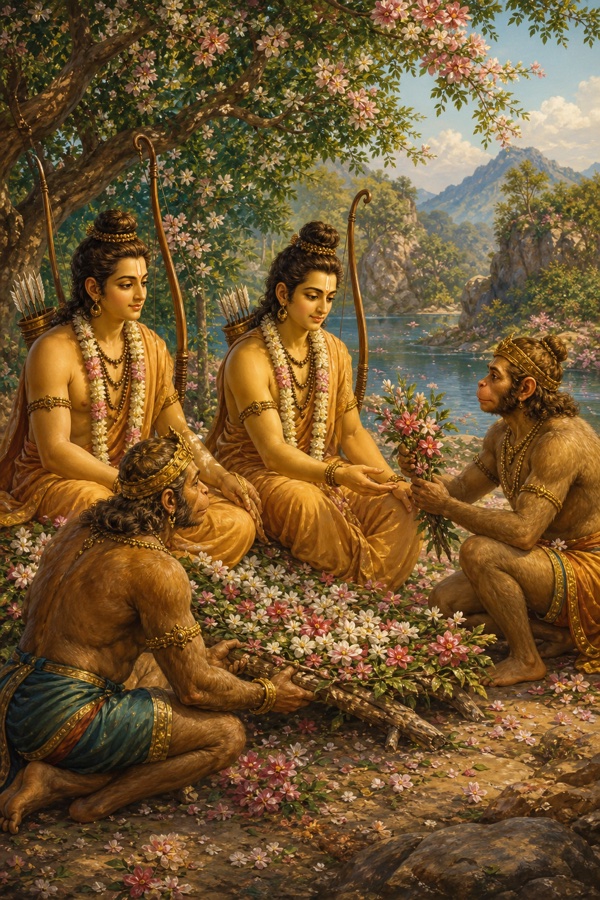
Then he saw a sal tree close by, graced with fair flowers, a few leaves, and humming bees. Breaking off one of its lovely leaf-laden branches and spreading it out, Sugriva sat down with Rama. Seeing it, Hanuman too broke off a branch of sal and seated the modest Lakshmana. And when he saw Rama, calm as a contented ocean, at ease on that fine mountain strewn with sal blossoms, the delighted Sugriva spoke, in affection, in words that came out half-lost with joy.
“Cast out by my brother, terrified, I wander this forest. Grieved by the loss of my wife, I take shelter on Rishyamuka. Raghava, set at feud with Vali, in terror, sunk in fear, my mind confused, I live in this forest. O giver of safety to every world, show grace to me in my helplessness.” And Rama, radiant and knowing of dharma, said as though with a smile, “The fruit of friendship is the help one gives, and injury is the mark of an enemy. This very day I will kill that Vali who carried off your wife.
Rama said, and showed him the arrows, “These keen shafts of mine, sprung from the birthplace of Kartikeya, the forest of reeds, adorned with gold, sheathed in vulture feathers, like the thunderbolt of Indra, with fine joints and sharp heads, like serpents in a rage. See that enemy brother of yours, Vali, who has wronged you, laid low like a mountain broken apart by these.” At that Sugriva, the commander, felt a joy without measure and said, “Well done, and well done again. Rama, I am overwhelmed by grief, and you are the refuge of the grieving. Knowing you for a friend, I lay my pain in front of you. We clasped hands in friendship with the fire for our witness, and you are dearer to me than my own life; I swear it by truth. It is because you are my friend that I have opened to you in confidence the sorrow that lives in my heart and gives my mind no rest from one day to the next.”
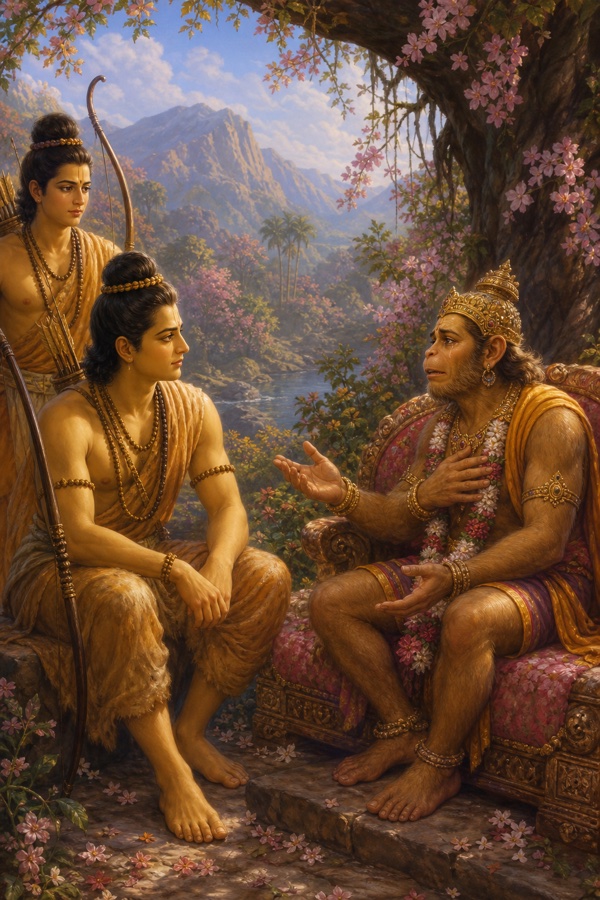
Saying it, Sugriva could not get his voice up past the tears that had come into his eyes. But near Rama, with an effort, he held back the flood that was rising in him like a river against a bank. He wiped his eyes, drew a deep breath, and went on. “Rama, it was Vali who first threw me out of my own kingdom, who drove me off with cutting words because he was the stronger and knew it. He seized my wife, who was dearer to me than my own life, and put my well-wishers in chains. He is bent on my destruction, Raghava. Many of the monkeys he has sent against me I have killed. And it was out of that same fear, Raghava, that even when I saw you on my own mountain I would not come down to you; fear puts every creature on its guard, and it does not ask whether the guard is wise.
“Only Hanuman and a few others are my helpers, and it is by them that I, sunk in hardship, keep my life at all today. These loving monkeys guard me, walk with me, stay with me, and have never once talked of leaving. This is the short of it, Rama; what need of more? That elder brother of mine, my enemy Vali, is famed for his valor. His destruction alone is the end of my sorrow. My happiness and my very life hang on it. In sorrow or in joy, a friend is forever a friend’s recourse.”
Hearing this, Rama asked the question of a man who intends to kill somebody and means to be right about it. “What was the root of this feud? I wish to know it truly. Monkey, once I have measured strength against weakness and heard the cause of the quarrel, I will do you this service. To hear of the dishonor done you, my anger, which shakes my heart, rises like the rush of waters in the rains. Until I string my bow, speak on freely and in good cheer. The moment my arrows fly, your enemy is a dead man.” Reassured so, Sugriva with his four monkeys felt a joy beyond measure, and with a bright face began to tell the true cause of the feud.
The story of Mayavi and Vali entering the cave
“My elder brother is named Vali, and he can wipe out any enemy,” Sugriva said. “Our father held him in high esteem, and in the past I honored him greatly too. When he gave up his body, the ministers, because Vali was the elder, made him king of Kishkindha. He ruled the great kingdom that had come down from father and grandfather, and I stood always at his side, bowed like a servant, and thought nothing of it, because that is what a younger brother does.
“There was a radiant asura named Mayavi, elder brother of Dundubhi and a son of the demon Maya. Over a woman he carried a bitter feud with Vali. One night, while everyone was asleep, he came to the gate of Kishkindha and roared, calling Vali out to fight him. My brother, dragged out of sleep by that terrible roar, could not bear it and went straight out. As Vali went out in his fury to kill that chief of asuras, the women of the inner rooms and I bowed in front of him and tried to hold him back. But the strong one shook every one of us off and went; and out of love I went with him.
“Seeing my brother and me at a distance, the asura took fright and fled at speed. The risen moon lit the path for us. He slipped into a great cavern in the earth, hard to enter and half hidden under grass, and the two of us pulled up short at its mouth. Seeing the enemy gone into that cave, Vali, his senses churning with rage, said to me, ‘Sugriva, stand on guard at the mouth of this cave until I have gone in and killed him.’ Though I heard him and begged to be taken along, Vali bound me to wait outside, swearing me to it by his own life, and went in.
“More than a year went by while he was in that cave, and I stood at its mouth for all of it, and the time dragged the way time drags for a man who has been told to wait and nothing else. Taking him for destroyed, faint with love, unable to see my brother, my mind began to go to the worst place it could find. After a long while I saw blood mixed with foam come out of the cave, and the grief came up over me. The roars of exulting asuras reached my ears, and not the roar of my brother in the fight, and I listened for it, and it did not come. By these signs I judged that my brother was dead. Grief-stricken, I sealed the mouth of the cave with a rock as big as a hill, offered water to my brother’s spirit, and went back to Kishkindha, friend. Though I kept it to myself, the ministers, by their diligence, learned the whole of it.
“Then they anointed me king with one accord, Raghava. I was ruling justly when that monkey, my brother Vali, having killed his enemy the danava, came home. At the sight of me anointed, his eyes went red. He bound my ministers and spoke cutting words to them. I had the power in that hour to hold that one in check, and my mind, bound by reverence for an elder brother, would not turn to it. Having killed his enemy, my brother entered the city. Honoring Vali, I greeted him as was proper, and he would not, with a glad heart, give me his blessing. I touched his feet with my crown, and even then, in his anger, Vali was not appeased.”
Vali’s expulsion
“Then, wishing him well, I tried to calm that angry, agitated brother,” Sugriva went on. “I said to him, ‘By great good fortune you have come back safe, and the enemy is dead. You are the protector of me who had none, O joy of the friendless. This many-ribbed parasol, bright as the risen full moon, and this whisk, which I have been holding for you, take them back. A full year I stood in grief at the mouth of that cave. When I saw the blood well up out of its door, sick with sorrow I sealed the mouth with a crag of the hill and came back to Kishkindha. Seeing me sunk in dejection, the citizens and the ministers anointed me, and it was by no wish of mine. Forgive this fault, done in ignorance. You alone are the king worthy of honor, and I am your servant as before, and always. This anointing of mine came about only because you were gone. Here and now I give back to you your kingdom, with its ministers, its citizens, and the city of Kishkindha, which I held as a sacred trust and have kept clear of every thorn. So do not be angry with me, gentle brother. Bowing my head, with folded hands, I beg you. It was for fear that an empty kingdom might be seized by somebody else that the ministers and the citizens made me king by force.’
“Even at those loving words of mine,” Sugriva said, “That monkey berated me, cried ‘Shame on you,’ and heaped bitter words on my head. Then he called together the leading citizens and the honored ministers, and in front of my own well-wishers he spoke of me with heavy reproach. He said, ‘You all know that on that night the great asura Mayavi challenged me to battle in his lust for a fight. Hearing him, I went out from the palace, and this most cruel younger brother came after me. Seeing me at night with a companion, that mighty asura took fright and fled, and plunged into a great cave.
“‘Knowing the enemy had entered that dreadful cave, I told this cruel-faced younger brother to wait at the door while I went in to kill him. Trusting him to keep his place, I went into the hard cave. There a year went by as I hunted the enemy. Then, without flinching, I killed that fearsome foe together with his kinsmen. The flood of blood from his mouth filled the cave, and with his roaring it grew impossible to cross. Having killed the enemy, at ease, I found the cave’s mouth closed and could not get out. Though I called “Sugriva, Sugriva” many times and got no answer, I was struck with grief. With many kicks I moved the rock, and by that way I came out and returned to the city. And here this Sugriva, forgetting the love of a brother, wanting the kingdom for himself, had shut me in.’
“Saying this, that shameless monkey Vali,” Sugriva said, “Gave me a single garment, stripped me of everything else I owned, and drove me out. Cast out by him and robbed of my wife, Raghava, in fear of him I wandered the whole earth with its forests and its seas, and found no corner of it he could not reach. Grieved by the loss of my wife, I took shelter on Rishyamuka, ground that is hard for Vali to reach because of Matanga’s curse, and the curse of a sage I never met is the only wall I have. All this great story of the feud I have now told you. Raghava, look at this affliction fallen on me, who did no wrong. Hero, terror of all the worlds, show grace to me by curbing Vali, in fear of whom I live.”
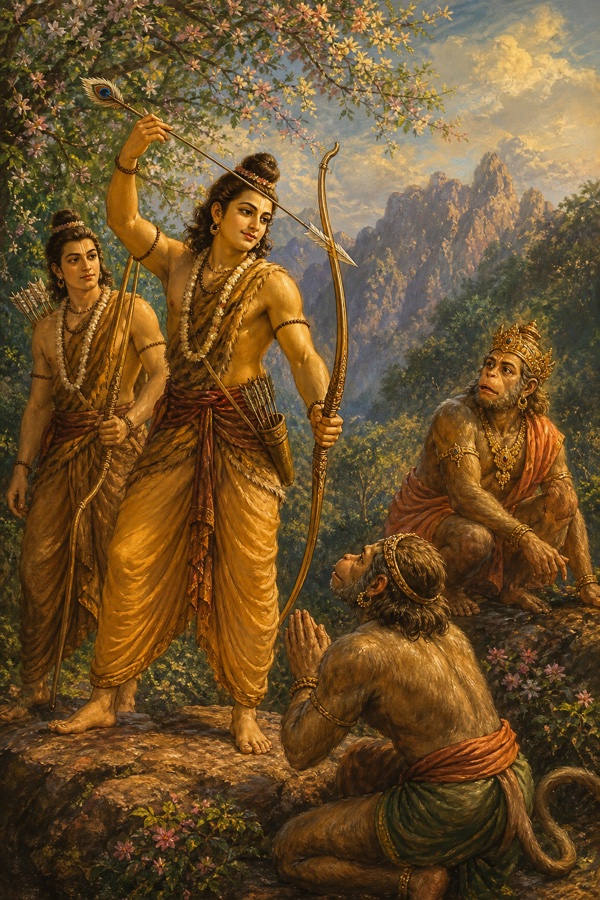
So entreated, Rama, radiant and knowing of dharma, said, as though with a smile, words that kept faith with dharma. “These arrows of mine, bright as the sun, unfailing and sharp, will fall in wrath on that Vali. As long as I have not set eyes on that sinful defiler of right conduct, the man who carried off your wife, only so long is he alive; his life is now the length of my walk to Kishkindha. By the measure of my own heart I can see that you are sunk in an ocean of grief. I will carry you across it, and you will surely regain everything you have lost, your wife and your kingdom both.” Hearing words that lifted his courage and his joy at once, the delighted Sugriva made a weighty reply.
Vali’s prowess and the story of the slaying of Dundubhi
Hearing Rama’s words, Sugriva honored and praised the Raghava, and then, being a careful man, he began to argue with him. “Beyond doubt, with your piercing, deadly arrows, wrathful as the sun at the end of an age, you could burn up the worlds. But hear with a single mind of Vali’s manhood, his valor, and his firmness, and then do what must be done. Before the sun is up, Vali crosses from the western ocean to the eastern, and from the southern to the northern, and never tires. Climbing the great peaks of mountains, he hurls them up with force and catches them again as they come down. Many a solid tree of these forests he has snapped in two, only to show that he could.
“There was an asura named Dundubhi, in the shape of a buffalo,” Sugriva began, “Like the peak of Kailasa, and he carried the strength of a thousand elephants in him. Drunk on the pride of a boon, his mind poisoned by the pride of strength, that huge asura went to Ocean, the lord of rivers, and said, ‘Give me battle.’ Then Ocean rose up and said, ‘I am not able to give you battle. Hear me, and I will name you the one who can. In the great forest stands the mountain-king Himavan, the supreme refuge of ascetics and the father-in-law of Shankara. With his great waterfalls and his many caves and springs, he is able, and he can give you satisfaction in full.’
“Taking Ocean for a coward, that demon went to the forest of Himavan like an arrow shot off a bow. He flung the mountain’s white, elephant-like rocks down and roared over them. Then Himavan, like a white cloud, gentle and of pleasing form, standing on his own peak, said, ‘Dundubhi, do not trouble me. I am unskilled in the works of war, and I am a refuge of ascetics.’ Hearing it, Dundubhi, his eyes red with rage, said, ‘If you cannot fight, or if fear has left you idle, then name me the one who will give me battle.’
“Then the eloquent, righteous Himavan, in his anger, gave that demon the name he had been holding back. ‘There is a glorious monkey named Vali, a valiant son of Shakra, of matchless splendor, who lives in Kishkindha. That shrewd master of war can give you single combat, as Indra once gave it to Namuchi. If it is battle you want, go to him at once. He is hard to overcome, and forever brave in the works of war.’
“Hearing Himavan’s word, the enraged Dundubhi went to Kishkindha. In his buffalo form, with sharp horns, fearsome, like a great cloud swollen with rain, he reached the gate of Kishkindha. Bellowing like a war-drum, snapping the nearby trees, tearing the earth with his hooves, goring at the gate with his horn in his pride like an elephant, he roared on. Hearing that unbearable sound, Vali, who sat within the inner chambers, came out with his women, like the moon among the stars. That lord of all the forest creatures and monkeys spoke in clear words, few in number, ‘Dundubhi, why do you block this gate and roar? You know who I am. Guard your own life.’
“At that Dundubhi, his eyes red with fury, said, ‘Hero, do not speak such words in front of your women. Give me battle today, and then I will know your strength. Or else I will hold my anger this one night, and you may take your pleasure freely. Embrace your monkeys and give them gifts, take leave of your well-wishers. Look your fill on Kishkindha, for you will not see it again; hand the burden of the city to your son, and sport with your women until sunrise, for I am the one who is going to humble your pride. Whoever kills a man who is drunk, or off his guard, or maimed, or stripped of his weapons, or wasted in body, or blind with passion as you are now, is as despicable as the killer of an unborn child.’
“Vali laughed at him, and sent all the women away, Tara at their head. ‘Do not take me for drunk and deceive yourself,’ he told that foolish lord of asuras, ‘if you have no fear of the fight. Count this pride of mine the warrior’s draught of this battle.’ And throwing about his neck the golden chain his father Mahendra had given him, he made ready. Seizing the mountain-like Dundubhi by the horns, that monkey leader whirled him around with a roar, dashed him down with all his force, and bellowed. As Dundubhi struck the ground, blood ran out of his ears.
“Then a fierce battle broke out between them, each bent on winning it. Vali, with a valor like Indra’s, struck with fists, with knees, with feet, with rocks and with trees. The asura began to fail, and Vali, the son of Shakra, prevailed. Lifting Dundubhi up over his head, Vali dashed him to the earth, and he was crushed in that life-taking fight. Blood poured from every opening of his body, from his eyes and ears, his nostrils and his mouth, and the mighty asura fell dead. And Vali took that lifeless body and flung it a full yojana away with his arms.
“As the corpse was hurled with force, drops of its blood flew on the wind and fell on the hermitage of Matanga. Seeing those fallen drops, the sage grew angry and wondered who the ill-minded, foolish, creature was who had spattered him with blood. Coming out, he saw the mountain-like buffalo lying dead on the ground. By his austerity he knew this was a monkey’s doing, and he laid a heavy curse on the monkey who had flung the corpse.
“‘The monkey who has fouled the grove of my hermitage with drops of blood shall not enter here; if he enters, he dies. The one who broke the trees and flung the asura’s body, if he comes within a full yojana of my hermitage, that fool will surely not live. Those ministers of his who have taken shelter in my forest, let them not stay either; let them hear this and go in peace. If they stay, I will curse them too, for they have laid waste the leaves and the shoots and the fruits and the roots of this forest, which I have reared like a son. From this day their stay here is at an end. Any monkey seen here tomorrow will turn to stone, and stay stone for thousands of years.’
“Hearing the sage’s word, those monkeys left the forest. Seeing them come out, Vali asked, ‘Why have all of you who live in Matanga’s wood come to me? Is all well with the forest-folk?’ Then those monkeys told Vali the whole cause, and the curse with it. Hearing it, Vali went to the great sage and begged with folded hands. And the sage walked past him without a word and went into his hermitage, and that was the end of it; a curse does not take the pleas of the man who earned it. Terrified, Vali was thrown into distress. From that day, in fear of the curse, far from setting foot on the great mountain Rishyamuka, he will not so much as look at it. Knowing that he does not come there, Rama, I roam this great forest with my ministers, free of dread.
“That great heap of Dundubhi’s bones, flung there in the pride of Vali’s strength, stands like a mountain-peak,” Sugriva said, and showed him. “And here are seven great sal trees, any one of which Vali can strip bare of its leaves with a single shake. This matchless strength of Vali I have now shown you, Rama. How will you kill that Vali in battle, my king?”
To Sugriva speaking so, Lakshmana said with a smile, “By what deed done will you be satisfied that Vali can be killed by Rama?” And Sugriva, who had clearly thought about it, said, “Vali pierced these seven sal trees one by one, first once and many times after. If Rama too can split one of these trees with a single arrow, then, seeing his valor, I will hold Vali as good as dead. Lakshmana, if Rama can lift with one foot these bones of the buffalo Vali killed and hurl them two hundred bow-lengths, then too I will hold Vali already dead.”
Saying this, Sugriva dwelt on Rama for a moment and spoke again. “The mighty monkey Vali is brave, and knows himself brave, famed for strength and manhood, and never once beaten in battle. His deeds seem hard even for the gods, and it is the thought of them that has driven me in fear to Rishyamuka. Brooding on that unconquerable, unassailable, unyielding lord of monkeys, I will not leave this hill. Anxious and full of doubt, I roam this great forest with Hanuman and my other brave ministers. Lover of friends, having found a friend as fine and worthy as you, I have taken refuge in you as in Himavan itself.
“But I know the strength of my wicked, powerful brother,” Sugriva said, “And your valor in battle I have not seen with my own eyes. I do not weigh you, or slight you, or seek to frighten you; it is his terrible deeds that have bred this timidity in me, and it did not grow overnight. Raghava, and yet your speech, your steadiness, and your bearing all tell of a supreme power in you, banked the way a fire is banked under ash.”
Hearing Sugriva’s word, Rama smiled and said, “Monkey, if you have no faith in my valor, then I will raise in you a faith worth having, and I will raise it there, in battle.” And saying it, to comfort Sugriva, Rama put the toe of his foot under the corpse of Dundubhi, lifted it as though he were playing with it, and flung it ten yojanas away; and Sugriva’s mind was set at ease, for a moment.
Seeing the corpse hurled away, Sugriva, before Lakshmana and the monkeys, spoke these pointed words to the sun-bright hero Rama. “Friend, this corpse was first thrown while it was wet, with its flesh on it and fresh, when my tired and rut-maddened brother Vali had only just killed it. Now, Raghava, it is stripped of flesh, light as a wisp of grass, and you have flung it in gladness. So there is no telling whether your strength or his is the greater, for a wet corpse and a dry one differ by much. The same doubt hangs over your strength and his. Only by piercing a sal tree clean through will strength and weakness be settled. Draw this bow, spread wide as an elephant’s trunk, to your ear, and loose this great arrow. It will surely split the sal, of that there is no doubt. King, I swear it by you, set further thought aside and do me this kindness. As the sun excels among lights, Himavan among mountains, and the lion among four-footed animals, you excel in valor.”
The piercing of the seven sal trees and the mark of the gajapushpi
Hearing Sugriva’s fine speech, Rama took up his bow to raise faith in him. He took that dreadful bow and a single arrow, aimed at the sal, and, filling the quarters with the twang of the string, let it fly. The gold-adorned arrow, loosed by Rama, pierced the seven sals, the mountain plateau, and the seven earths beneath, and drove into Patala, so the old tellings have it. In less than an hour that arrow of great speed, having pierced the sals, forced its way out and returned to the very quiver it had come from, so it is said.
Seeing the seven sals pierced through by the force of one arrow, Sugriva was struck with wonder. Overjoyed, with joined palms and his head to the ground, he fell in front of Rama, his ornaments swinging loose as he bowed. Delighted, he said to Rama, “Kakutstha, you could kill all the gods with Indra at their head with these arrows, and Vali is a smaller matter than that. Who will stand in front of you in battle, you who with a single arrow have pierced seven great sals, the mountain, and the earth? Today my grief is gone and joy fills me, for I have found friends like Mahendra and Varuna. This very day, for my sake, kill that enemy in the shape of a brother, Vali, Kakutstha. Here are my folded hands.”
Embracing Sugriva, who had grown as dear to him as Lakshmana, Rama spoke. “Let us go at once from this mountain to Kishkindha. Sugriva, go ahead of us, and when you reach it, call out to battle that Vali who bears the name of a brother.” Then they all reached Kishkindha, Vali’s city, in haste, and hid among the trees, and stood in the dense forest. Sugriva gave a fearsome roar to bring Vali out. Girding his loins tight, he sent up such a challenge that the sky itself seemed about to split down the middle.
Hearing his brother’s roar, Vali, enraged, came out at speed, like the sun going down the western mountain. Then between Vali and Sugriva broke a fierce and tumultuous battle, like the clash of Mercury and Mars in the sky. Blind with rage, the two brothers struck each other with palms and soles that fell like lightning and with fists that came down like thunderbolts. And bow in hand, a little way off, Rama watched the two of them, heroes as alike as the twin Ashvins.
That was the trouble, and it did not show itself until the arrow was already on the string. Rama could not tell Sugriva from Vali. So alike were they that he could not bring himself to loose, for fear the shaft would find the friend instead of the enemy. Meanwhile Sugriva, worsted by Vali, looking for the protector he had been promised and finding him standing still, fled toward Rishyamuka. Weary, smeared with blood, battered by blows, chased in fury by his brother, he plunged into that great forest. Seeing him go into it, Vali said, “This time you have escaped me,” and turned back at the boundary of the curse, which was the only thing on earth that had ever turned him back. And Rama too, with Lakshmana and with Hanuman, went back into the forest where the monkey Sugriva was, to a friend he had sworn before fire to protect and had watched being beaten.
Seeing Rama come with Lakshmana, Sugriva, his eyes on the ground in shame, said in his wretchedness, “Raghava, after showing me your valor, after telling me to challenge Vali, what have you done, letting my enemy thrash me? You should have told me the truth then, that you would not kill Vali, and I would never have gone there at all.” To Sugriva speaking so piteously, Rama said again, “Sugriva, my friend, listen, and put your anger away. Hear why I did not loose the arrow. You and Vali are alike in ornaments, in dress, in size, and in gait. In voice, in bearing, in gaze, in valor, and in speech I could find no difference between you two. Bewildered by the likeness of your forms, I did not loose that swift, enemy-slaying arrow. Doubtful because of that likeness, I feared I might kill you unawares and bring ruin on us both. Hero, if you had been killed through my folly or my carelessness, my foolishness and my childishness would have stood exposed.
“And to kill one to whom safety has been promised is a great and monstrous sin,” Rama said. “And I, and Lakshmana, and Sita, all of us lean on you; in this forest you are the only refuge we have. So fight again, and have no doubt of me, monkey. In this very hour, while you fight, I will see Vali struck down by a single arrow and writhing on the ground. Wear some mark on yourself, so that in the middle of the combat I may know which of you is which.” Then, turning, he said, “Lakshmana, pull up this blossoming, auspicious gajapushpi creeper and tie it about the neck of Sugriva.”
Then Lakshmana pulled up the flowering gajapushpi creeper that grew on the mountainside and hung it around Sugriva’s neck. With that creeper at his throat Sugriva shone like a cloud graced by a line of cranes and the light of dusk. Bright of body, reassured by Rama’s word, Sugriva set out again with Rama for Kishkindha, wearing the one thing that told him apart from his brother.
The hermitage of the Saptajana rishis
Rama, with Sugriva, set out from Rishyamuka toward Kishkindha, the city Vali’s might kept safe. Ahead of Rama went the thick-necked Sugriva and Lakshmana. Behind them came the heroes Hanuman, Nala, Nila, and Tara, the radiant chief among the monkey troop-leaders. They went on, gazing at trees bowed under their loads of blossom, at clear rivers running down to the sea, at caves and crags and hollows, at high peaks and pleasant plateaus. Along the way they saw pools clear as beryl, graced with lotuses still closed to the bud, ringing with the cries of birds, the karandava and the sarasa, the swan, the vanjula, the water-fowl, and the chakravaka.
In the forest they saw deer feeding on the soft grass and the shoots and roaming without fear of anything, and stags standing out in the open, and the white-tusked, fierce, rut-maddened wild elephants that tear at the banks of the pools, ripping up the mountainsides and looking like mountains themselves as they moved. They saw monkeys that looked like elephants, bathed in dust, and other forest creatures, and birds crossing the sky over them; and, obedient to Sugriva, they pressed on quickly, because there was a man to kill at the end of the road.
As they went, Rama saw a stand of trees like a small forest and said to Sugriva, “Friend, this grove shines in the sky like a cloud, vast as a bank of clouds, ringed on every side by plantain trees. What is it? I am filled with wonder, and I would have you set my wonder at rest.” Hearing Rama’s word, Sugriva, still walking, told the story of that great grove.
“Raghava, this broad hermitage takes the weariness out of everyone who comes to it, for it is rich in gardens and groves and holds sweet roots and fruits and water. Here lived seven sages called the Saptajana, men of stern vows, who while they did their austerities kept their heads bowed and slept, by rule, upon the water. Living on air once in seven nights, never stirring from the place they stood, keepers of every vow, after seven hundred years they went to heaven in their bodies. By their power this hermitage, ringed by a wall of trees, is hard for even the gods and demons with Indra behind them to storm.
“Birds and other forest creatures leave it alone,” Sugriva said, “And any who go in without knowing what it is do not come out. Raghava, here one hears sweet syllables mingled with the sound of ornaments, and the sound of song and of instruments, and a divine fragrance moves through it. The three fires stay kindled, and their smoke, the color of a dove’s wing, covers the treetops like a cloud. These trees, with their crowns wrapped in smoke, shine like beryl mountains veiled in a net of cloud. Raghava, with your brother Lakshmana, bow to those sages with folded hands and a devout heart. Those who bow to those sages carry no ill in their bodies afterward.”
Then Rama, with his brother Lakshmana, folded his hands and bowed to the memory of those noble sages, and went on. Having made his salutation, Rama, his brother, Sugriva, and the monkeys went on with glad hearts. Leaving that hermitage of the Saptajana behind them, they came in sight of Kishkindha, guarded by Vali and hard to assail. Then, with their weapons raised and their fierce splendor breaking out of them, Rama, Lakshmana, and the monkeys came again to the city of Kishkindha, to kill their enemy Vali, the city held safe by the might of Vali, the son of Indra.
Sugriva’s challenge at the gate of Kishkindha
They all reached Kishkindha, Vali’s city, in haste, and hid among the trees, and stood in the dense forest. The thick-necked Sugriva, who loved the forest, cast his eyes over it and took on a mighty anger, because a man who is about to shout for his brother’s death needs one. Then, with a fearsome roar, ringed by his party, he challenged Vali to battle, as though tearing the sky open.
Roaring like a great cloud driven before the wind, looking like the newly risen sun, moving with the gait of a proud lion, Sugriva turned to the ready Rama and said, “We have reached Kishkindha, Vali’s city, covered with its net of monkeys, decked with arches of burnished gold, rich in banners and engines of war. Hero, the vow you made before, to kill Vali: fulfill it now, as the season in its own time makes the creeper bear fruit.”
So addressed, the righteous, enemy-slaying Rama said to Sugriva, “You now bear a mark, this gajapushpi creeper that Lakshmana pulled up and tied at your neck. Hero, with this creeper at your throat you shine the more, like the full moon in the night sky wearing a garland of stars. Monkey, in this battle I will loose a single arrow and today wipe out both the fear and the feud that Vali has bred in you. Sugriva, show me your enemy in the shape of a brother.
“By my stroke Vali will soon be rolling in the dust of this forest,” Rama said. “If he comes within the range of my eye and still goes home alive, then hold me to blame and reproach me for it. In front of your eyes I pierced seven sals with one arrow. By that same strength, count Vali as slain in battle today. I have never once spoken falsely, even through long hardship, out of love of dharma, and I never shall, in any way at all. I will make my vow come true, as Shatakratu makes the field of rice sprout and bear by his rains. So, Sugriva, raise such a cry that the monkey comes out of his own door.
“Famed for his victories, proud of his conquests, never once mastered by you, that battle-loving Vali will surely come out of the city, shaking off the softness of his women. A brave warrior does not bear the challenge of an enemy, above all before women, when he knows his own strength.” Hearing Rama’s word, the gold-tawny Sugriva roared with a fierce cry, as though rending the sky. At that sound the cows fled, their luster gone, like the wives of good houses undone by the ruin of a bad reign. The deer scattered swiftly like horses broken in battle, and the birds began to drop to the earth like gods who fall from heaven when their merit is spent. Then Sugriva his splendor grown with valor, roaring like a cloud, sent up a cry like the ocean when the wind stirs its waves.
Vali’s anger and Tara’s counsel
At that moment Vali, seated in the inner chambers, impatient by nature and never once made to wait, heard the roar of Sugriva. At that sound, which set every creature in the city trembling, Vali’s pride went out of him in an instant, and a heavy anger came up in its place. The gold-bright Vali, his every limb gripped by rage, went pale as the sun in eclipse. Teeth bared, his eyes bright with the fire of anger, Vali looked like a lake from which the beauty of the lotuses is gone and only the fibers float. Hearing that unbearable sound, Vali rushed out of the palace at speed, seeming to tear the earth open with the fall of his feet.
Then his wife Tara, alarmed and shaken, showing her love, put her arms around him and spoke words meant for his good. “Hero, let go of this anger that has come on you like the rush of a river, as a man risen from his bed at dawn puts off the garland he has worn all night. Monkey, wage this battle in the morning. Hero, it is not that your enemies are many, or that your strength is wanting, and still this sudden rushing out does not please me. Hear me, and I will tell you why I am holding you back.
“Earlier he came in anger and challenged you, and the moment you came out he was beaten and fled, struck again and again,” Tara said. “That he, beaten and hurt as he was, should come back here to challenge you a second time raises a doubt in me. The pride, the resolve, and the heat with which he is roaring out there are not without a cause, and the cause is not a small one. I do not believe this Sugriva has come here with no helper behind him. Surely it is by leaning on somebody that he roars like that.
“Sugriva is by nature clever, and shrewd as well,” Tara said. “He will not bind himself in friendship to anyone’s valor untested; he is not a man who trusts. Hero, now let me tell you the words of prince Angada, which I heard before this. Angada had gone to the edge of the forest, and what his spies gave him he brought to me.
“Two heroes, sons of the lord of Ayodhya, hard to conquer in battle, born in the line of Ikshvaku, Rama and Lakshmana, have come to do Sugriva a kindness, and they are hard to withstand. Your brother’s helper in battle is that Rama, who grinds down the armies of his enemies like the blazing fire at the end of an age. He is the shelter-tree in which the good dwell, the last recourse of those in trouble, the refuge of the afflicted, the one vessel of glory. Monkey, he is by nature clever, wise, endowed with knowledge and with discernment, and devoted to his father’s command. As the mountain-king Himavan is a great mine of metals, so is he a mine of virtues. It is not to your good to set yourself against Rama, hard to conquer in the works of war.
“Hero, I will say something for your good, and I mean you no reproach by it,” Tara said. “Hear it, and act on it. Anoint Sugriva at once, and properly, to the rank of crown-prince. King, do not quarrel with a younger brother. I hold that friendship with Rama and love toward Sugriva are the best things left in front of you. Put the enmity down and make peace with Sugriva, for this younger monkey is one to be cherished. Whether on Rishyamuka or here at your side, he is in every way your kinsman. A kinsman like him I do not see anywhere on this earth.
“Draw him near with gifts and honors and every courtesy,” Tara said. “Let him lay this enmity down and live at your side. The thick-necked Sugriva is, to my eyes, a great kinsman of yours. Your good lies only in leaning on a brother’s love, and there is no other way anywhere for you. If you would please me, and count me as one who wishes you well, then, entreated in love, heed my word. Be calm, hear my wholesome counsel, and do not follow your anger out of that gate. To quarrel with the prince of Kosala, whose splendor is like Indra’s, is not to your good.”
In that hour Tara said all this to Vali, counsel wholly kind and wholly wise. Vali, in the power of fate, come to the hour of his ruin, found no pleasure in it, and his refusal set him on the road to his end.
The gist: Hearing Sugriva’s challenge again, the enraged Vali made to go out. His wife Tara held him back, telling him that, by Angada’s report, Sugriva now had behind him a hero as great as Rama. She counseled Vali to make Sugriva crown-prince and to keep clear of any quarrel with Rama. In the power of fate, Vali took no pleasure in her wise words.
Source: Srimad Valmiki Ramayana, Kishkindhakanda, Cantos 1 to 15. The Gita Press Hindi edition is the controlling witness. The Sanskrit e-text and an independent complete translation were used to verify names, sequence, and principal events. Where recensions differ, this retelling follows Gita Press.
Basis: Valmiki Ramayana (Gita Press, Gorakhpur)