On this page
On the northern shore of the sea, where the army of monkeys and bears lay camped for miles, a spy of the demon king Ravana came prowling in. His name was Shardula, and he was a warrior of real strength. He looked out over that immense host, guarded on every side by Sugriva, and finding it fearless and unshaken, he turned back. He had come to find a weak place and had found none, and that was the report. Racing into Lanka, he told King Ravana that a flood of monkeys and bears, deep and past all measuring like a second ocean, was rolling toward the city.
Shardula’s warning, and the sending of Shuka
Shardula went on. “Those two sons of Dasharatha, Rama and Lakshmana, superbly made and among the finest of fighters, have traced Sita and come all the way to the sea. They have pitched their camp at the water’s edge, and the army spreads across close to ten yojanas of ground in every direction,” he said.
“Learn the truth of it quickly,” he urged the king. “Your own spies can find out everything at once, and then, as you judge fit, you may reach for one of the old expedients, a gift to win them over, soft words to talk them around, or a wedge driven in to split the enemy from within.”
Shardula’s words threw Ravana into sudden agitation. Once he had settled on his course, he called for a demon named Shuka, a master among those who knew the ways of duty, and told him to go at once to the monkey king Sugriva and speak, boldly and without a stumble, in a gentle and polished voice, exactly the message the king now laid on him. He had chosen the wedge.
The message ran like this. “Monkey king, you were born into a line of great kings, you are mighty, you are the son of Riksharajas. Nothing I have ever done has helped you or harmed you, and even so you are as good as a brother to me. Tell me, Sugriva, if I did carry off the wife of that clever prince, how does that touch you? Go home to Kishkindha. Lanka can never be taken by monkeys, not by any means at all. The gods themselves with all their gandharvas cannot take it, so what are men and monkeys to think of it?”
With that, Shuka took the shape of a bird and shot up into the sky. He flew a long way out over the sea and hung there in the air, and from that height he began to recite the message to Sugriva. Word for word he gave what Ravana had ordered, and word for word, as he spoke, the monkeys sprang up and began to tear at his feathers and pound him with their fists. They caught the night-ranging demon and bore him down by main force.
Once they had dragged him down out of the sky to the ground, and while the monkeys were still mauling him, Shuka spoke. “Kakutstha,” he said to Rama, “kings do not kill envoys; call your monkeys off. The only envoy who deserves death is the one who drops his master’s message and starts declaring views of his own.”
Hearing that plaintive appeal, Rama told the monkeys who were beating him not to kill him.
Given his safety, Shuka spread his wings and rose again into the air, and spoke once more. “Sugriva,” he said, “you are full of spirit, mighty and bold; in what words shall I now speak for you to Ravana, who makes the whole world weep?”
And the monkey lord Sugriva, high of heart, gave the demon’s spy a clean, unflinching answer.
“Carry this back to Ravana,” Sugriva said. “You are no friend of mine, no object of my pity, no benefactor of mine, nothing I hold dear. You are Rama’s enemy, and for that you deserve death along with all your kin, as Vali did, demon fit only to be killed. I will come with a great army and make an end of you, lord of demons, with your sons and your brothers and every kinsman you have, and burn the whole of Lanka to ash.” Ravana had offered him a brother; Sugriva answered by naming the brother he already had, the one Rama killed for him, and by putting Ravana in the same sentence.
Angada’s counsel, and the release of Shuka
Then Angada, Vali’s son and one of the monkey leaders, spoke up. “This is no envoy, my lord,” he said. “To me he looks like a spy. Standing right here he has taken the measure of our whole army. Seize him, then, and do not let him return to Lanka; that is what seems right to me.”
At the command the monkeys sprang and bound the demon, who was wailing all the while like some helpless, abandoned thing.
Tormented past bearing by those furious monkeys, Shuka cried out at the top of his voice to Rama. “My wings are being ripped away,” he screamed, “and my two eyes are being put out. From the night I was born to the night I am to die, whatever wrong I have ever done, if I lose my life here in this moment, every last one of those sins will come to rest on your head.”
Rama, hearing the wail, would not let him be killed. “Set him free,” he told the monkeys; “he came to us as an envoy.”
The answer Sugriva had sent back to Ravana had run on well past that first defiance. “If you were truly so strong,” it asked, “why did you kill Jatayu, king of the vultures, an old bird bowed down with age? How did you find the nerve to carry off Sita in the very presence of Rama and Lakshmana? And now that you hold her, why can you not see the disaster bearing down on you? You do not know Rama, a prince of Raghu’s house, hard for the gods themselves to withstand, the man who will take your life.”
It went further still. “You fool, Ravana, even with Indra and all the gods to shield you, you will not escape Rama. Slip out of sight by some conjuror’s trick and climb the sun’s road across the sky, or dive down into Patala, or fold yourself at the lotus feet of Shiva and even then you will be killed by Rama, you and your younger brother Kumbhakarna with you. In all three worlds I can see no pishacha, no rakshasa, no gandharva, no asura with the power to keep you safe.”
At Rama’s word the monkeys let the envoy go free at last, since Rama, moved by that piteous cry, had refused from the first to let him be killed. Ravana’s spy walked out of an enemy camp alive, carrying everything he had counted, because the man he had come to spy on kept a law that Ravana had needed a brother to remind him of.
Rama’s vigil at the sea, and his wrath
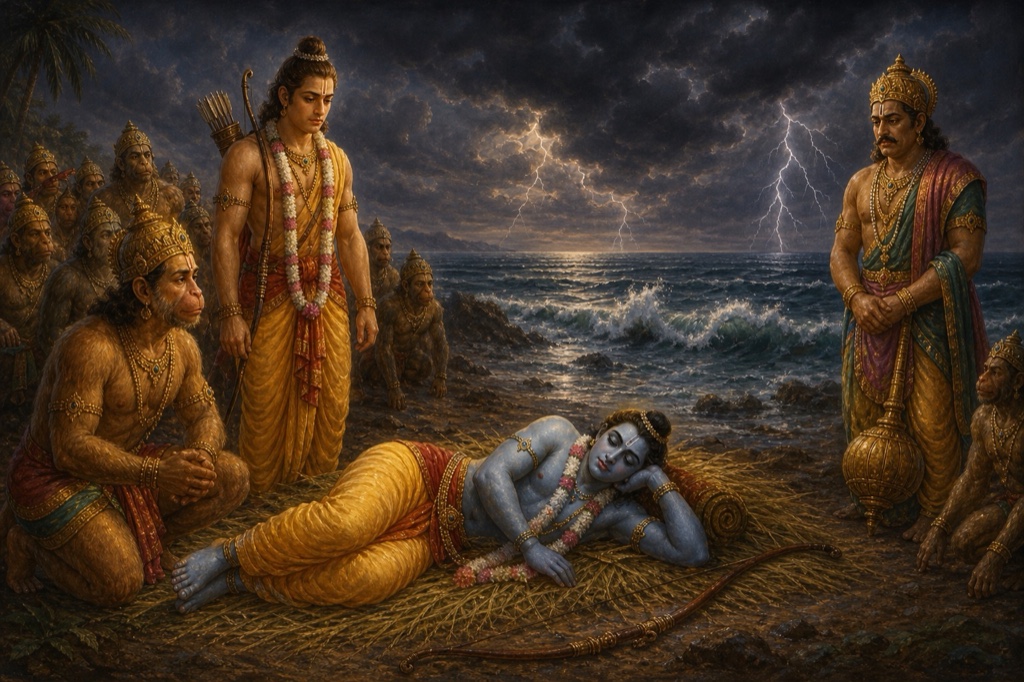
After this Rama, prince of Raghu’s house, spread blades of kusha, the sacred sharp-edged grass, on the seashore, folded his palms, turned to face the east, made his prayer to the great ocean, and lay down. For a pillow Rama used his own right arm, which had the look of a coiled serpent and had in earlier days been dressed in ornaments of gold.
It was a huge arm, thick as a mace. It had given away thousands of cows in gift. At the times of anointing and bathing it had been kneaded again and again by the hands of noble women full of a mother’s tenderness. It had worn armlets of gems and gold and the finest ornaments of pearl. It had been perfumed with sandal and aloe and with saffron pastes that carried the glow of the rising sun. On the marriage couch, on its white sheet, that same arm had once been graced by Sita’s resting head, and lying there it looked like the coils of Takshaka, a serpent whose body is painted a deep red, laid upon the clear water of the Ganga. That arm had deepened the grief of his enemies on the field of battle and brought joy to his friends. It was long as an ox’s yoke, and it was the support of the whole earth out to its four surrounding seas. Its skin had been worn hard by the lash of the bowstring as it drove arrow after arrow to the left. Every life he had ever had was in that arm: the gifts, the mother’s hands, the jewels, the wedding bed, the war. And it was under his head on wet sand, because it was the only pillow left to him.
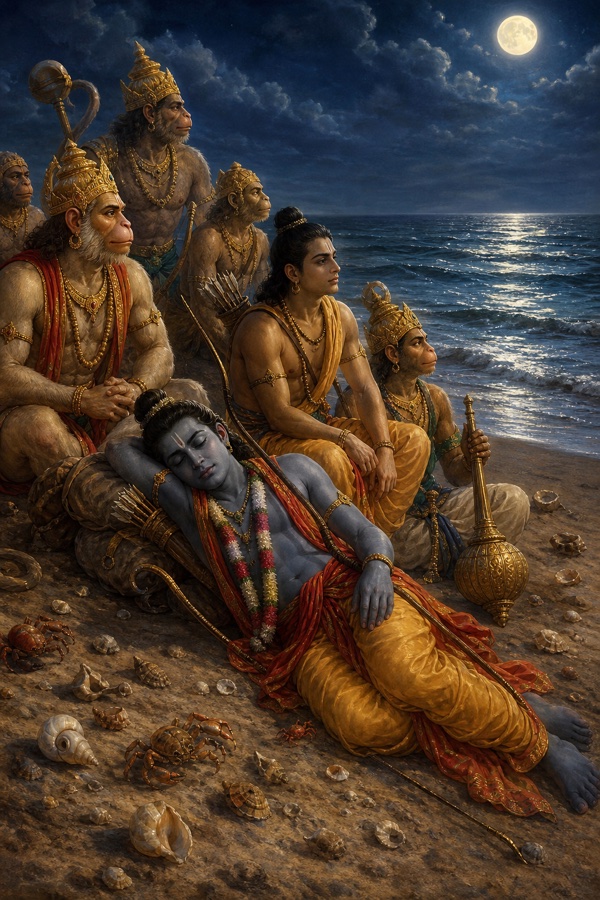
Having resolved that this day either the sea would be crossed or the god of the sea would die, Rama lay down beside the water with his body and speech and mind held still, disciplined and exact as a sage under vow. Three whole nights passed while he lay there on the kusha-strewn ground, never once slack in his observance. Skilled in policy and devoted to what was right, Rama fasted through those three nights and waited on the sea, the lord of rivers. Across the water a woman was fasting too, and counting the same days off a much shorter list.
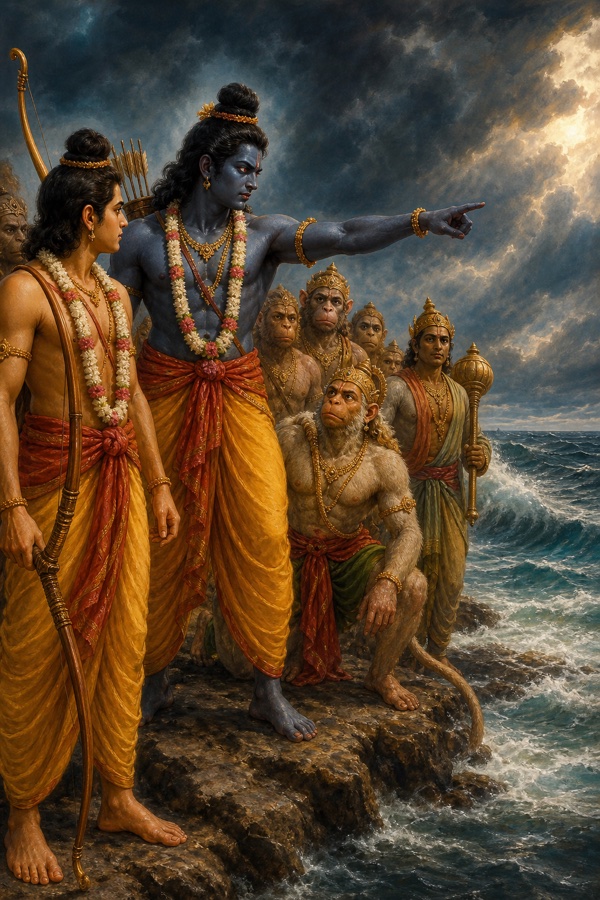
Still the sluggish sea gave Rama no sight of itself. He had done everything worship called for, and even so the ocean would not show itself in any personal form. Three days of a prince of the Ikshvakus lying on the ground in front of it, and the water had not so much as changed color. Then Rama, angry now at the sea, the outer corners of his eyes gone red, turned to Lakshmana, who stood nearby marked with every fortunate sign, and spoke.
The scorn of patience, and the rain of arrows
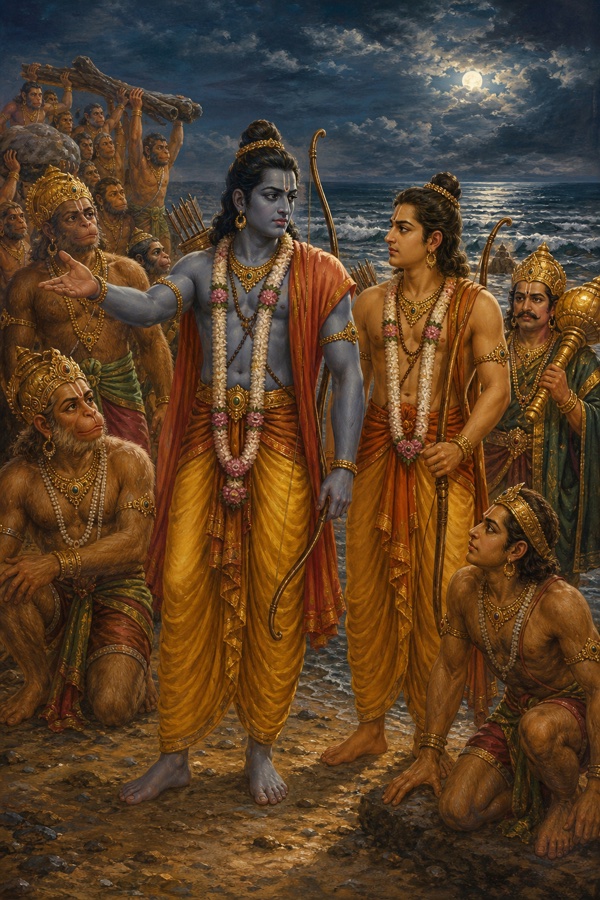
“Look at the vanity of this sea,” Rama said, “that it will not come forward and show itself. Calm, patience, plain dealing, and a soft answer, the virtues of good people, are wasted on those who have none of them, and read there only as weakness. The world does its honors to the man who praises himself, who is vicious and brazen, who struts about advertising his own name and lays the rod on everyone in his path. In this world, Lakshmana, a policy of gentleness wins no fame, no honor, and no victory on the field.” It is the bitterest thing Rama says in the whole epic, and he says it after three days of being ignored by water.
“Watch,” Rama went on. “Today you will see the whole water of this makaralaya, this home of the alligators, choked on every side with alligators split by my arrows and floating dead. You will see with your own eyes, Lakshmana, the coils of its water serpents, the great hulks of its alligators, and the trunks of the sea elephants that dwell here cut into pieces by me. With its conches and its oyster shells, its fish and its alligators, I will dry this makaralaya out today by open war.”
“The sea takes my patience for weakness,” Rama said. “A plague on patience shown to a creature like this. Bring me my bow, Sumitra’s son, and arrows like venomous snakes; I will dry the sea now, so the monkeys can walk across to Lanka on foot. In my anger today I will throw into turmoil even this sea that is past troubling, this sea that for all its thousands of surging waves still keeps within the limits of its own shores; today by open war I will dry it out. With my arrows I will strip this varunalaya, this house of Varuna the water god, of its boundaries, and set into churning confusion this great deep so crowded with its mighty demons.”
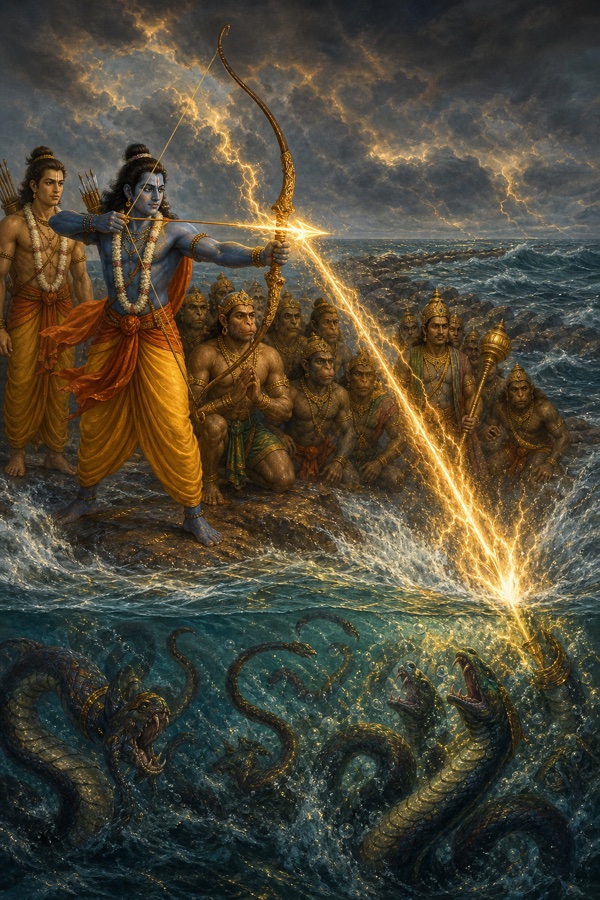
So saying, his bow in his hand and his eyes stretched wide with fury, Rama blazed like the fire at the end of the world, and became something no enemy could face. He bent his terrible bow at one end, drew the string gently up, and with a twang that shook the world he loosed arrows keen as Indra’s thunderbolts. Flaming with their own heat and driven at tremendous speed, those splendid shafts drove deep into the water of the sea and threw the serpents into terror. The man who had spent three days asking had stopped asking.
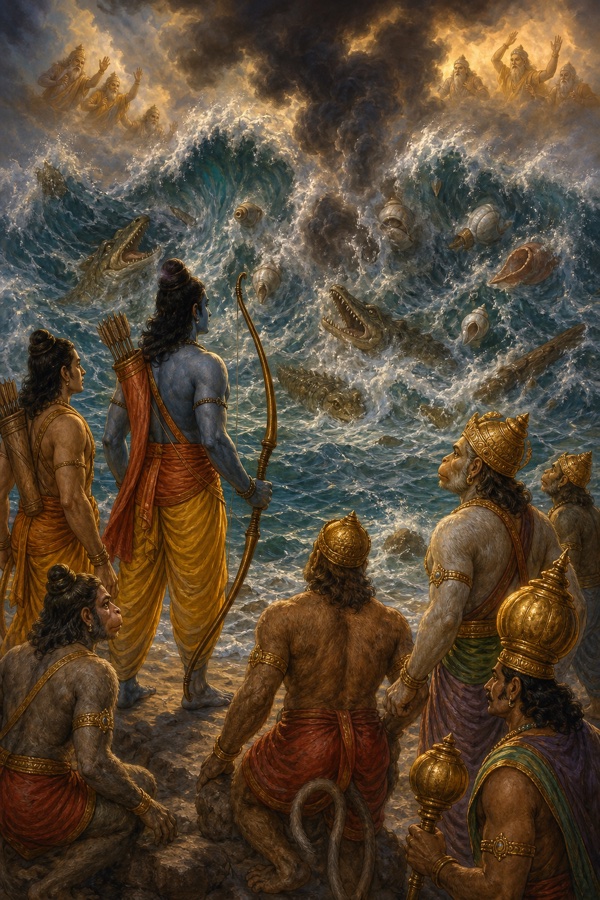
That great surge of the sea’s water, fish and alligators and all, grew hideous, and the roar of the wind rose with it. All at once the sea was covered with ranks of towering waves, littered with conches and shells, wrapped in the smoke that rose where the arrows entered, and the waves began to play upon it. Serpents with blazing mouths and burning eyes, and the great and mighty danavas who live in the depths of Patala, writhed in their distress. Waves as high as the Vindhya and the Mandara mountains rose in their thousands, and the alligators rose with them.
With its whirling masses of water, its huge sea beasts flung upward, its frightened serpents and demons, the varunalaya roared aloud. And in the sky, unseen, the brahmarshis and the devarshis raised their own cry, a high wail of “Alas” and a shout of “Hold, hold.” The seers had watched this man bear the loss of a kingdom and a father and a wife without breaking, and now they were shouting at him to stop.
At that very moment Lakshmana, Sumitra’s son, sprang forward and caught hold of the immeasurable bow that Rama, in his blazing eagerness, was drawing yet again, his breath coming fast with anger. “No more,” he said, “no more. Even without this your work across the sea will be done today. Men like you do not fall under the sway of anger. So think of some other way across, one that will last and that becomes a good man.”
The sea-god appears, and the boon of Marukantara
Even when Lakshmana spoke, Rama did not give ground before the heaving sea; Rama stood unmoved before the arrogant lord of rivers. Then the sea-god himself rose up out of the middle of the sea, the way the sun climbs from behind the great eastern mountain, that offshoot of Meru where the sunrise is fixed. Three days of prayer had left him in the deep; a quarter of an hour of arrows brought him up. He came shining like a smooth cat’s-eye gem, decked with jewels set in gold, in the company of serpents with blazing hoods.
He wore a garland of red flowers and robes of red; his eyes were like the petals of a lotus; on his head he bore a heavenly wreath of every kind of blossom. Adorned with ornaments of pure and refined gold and with the finest jewels of gems born from his own domain, he looked like the Himalaya itself dressed in all its many minerals.
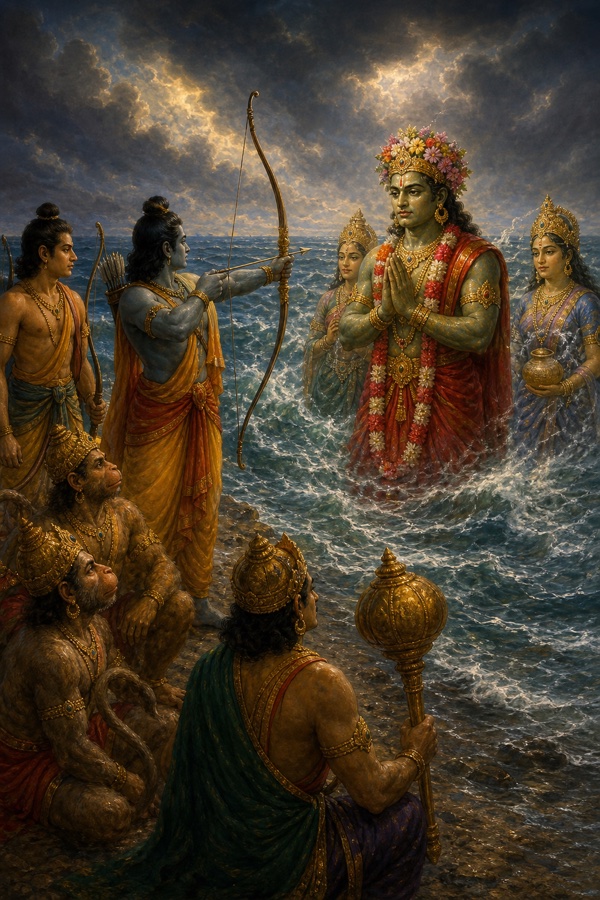
On his broad chest, hung in the middle of a single string of pearls, a bright, restless jewel of white luster stood out, a very brother to the Kaustubha gem that rides on the chest of Vishnu. Masses of waves rose and fell at his side; clouds and winds hemmed him in; and around him on every side pressed the presiding goddesses of the chief rivers, Ganga and Sindhu among them, each wearing some lovely shape of her own. Every river in the world had come with him, because every river in the world ends in him. Amid the heaving sea beasts and the startled serpents and demons, the mighty sea-god came near, and addressing Rama first, his palms joined, he spoke these words to the prince of Raghu’s house who stood there with an arrow in his hand.
“Gentle prince,” the sea-god said, “earth, air, ether, water, and fire hold each to its own nature and keep to the eternal law that governs it. My nature too is this, that I am fathomless and cannot be swum across. To become fordable would be a violation of what I am. Even so, I will tell you the way to cross me.”
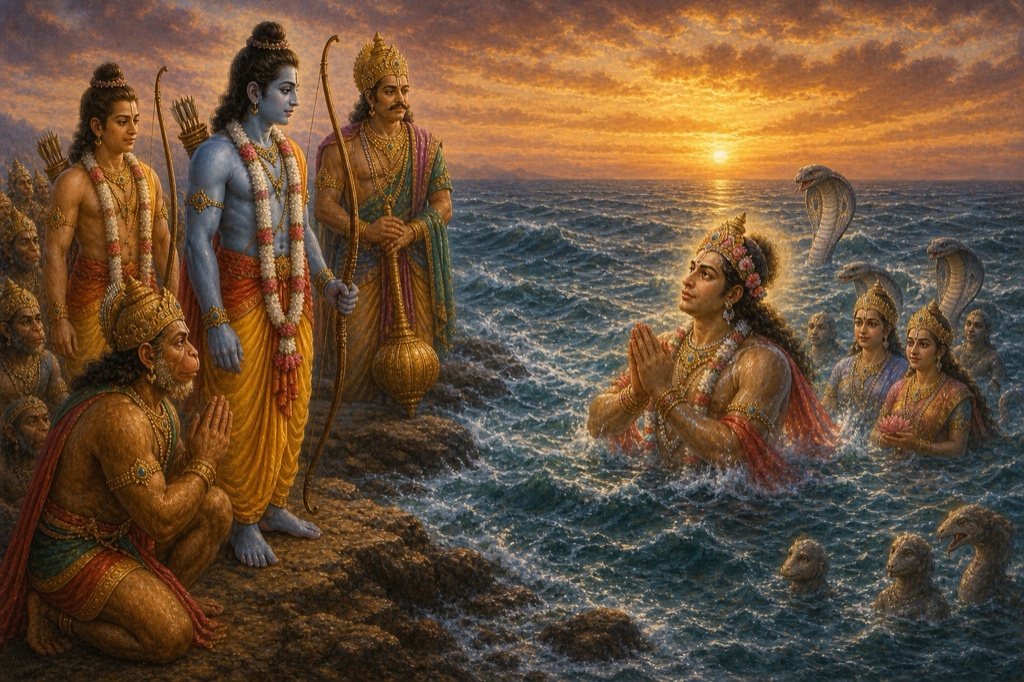
“Not out of desire,” said the sea-god, “not out of greed, not out of fear, can I in any way let these waters of mine, teeming with alligators and crocodiles, harden into solid ground. Yet for you I will make an arrangement, so that you can cross over. Until your army has reached the far shore, I will see to it that the alligators do not attack. And I will so contrive it, Rama, that as the monkeys cross, their feet find footing firm as solid ground.” He would remain the sea, holding still and carrying whatever they laid on him, and that was everything they needed.
Then Rama said to him, “Hear me, varunalaya. This great arrow of mine cannot be recalled and cannot be wasted; on what stretch of country shall it fall?”
Hearing Rama’s words and seeing that mighty shaft, the sea-god of great splendor answered, “To my north there is a most holy region called Drumakulya, a place as famous in the world as you are.”
“In that country,” the sea-god went on, “live many bandits of savage look and savage deeds, chief among them the Abhiras by caste, and these sinners drink my water. I cannot bear the taint of their touch upon me. Let your fine arrow fall there, then, Rama, and let it not be spent in vain.”
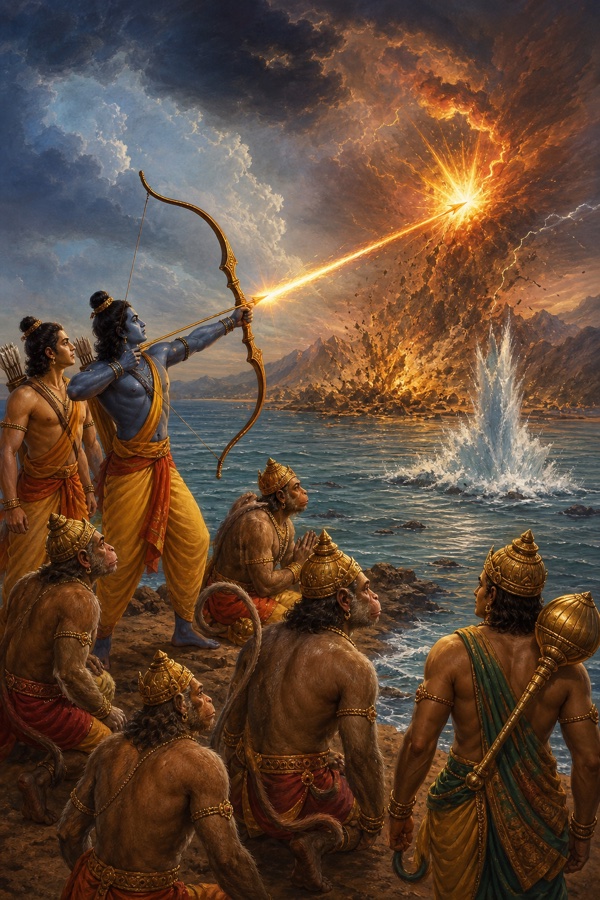
Hearing the words of the sea, Rama loosed that blazing, splendid arrow toward the very quarter the ocean wished. Where it came down, that shaft with the glare of the thunderbolt and the lightning, the country took from it the name Marukantara, by which it has been known on earth ever since. The earth, pierced by the arrow’s head, shrieked aloud in that moment, and from the mouth of the cleft the water of Rasatala, one of the nether regions, came bursting up.
That cleft is now a well, and it took the name Vrana, the wound. The water that rises from it without stopping is seen even today to be as salt as the water of the sea. A dreadful sound went up from the tearing of the earth; and by that sound, by the fall of the arrow, Rama dried the water out of the hollows of the ground. From that time the region has been known through all three worlds as Marukantara. Having dried that hollow, the son of Dasharatha, whose valor matched the gods’, gave the desert land a boon.
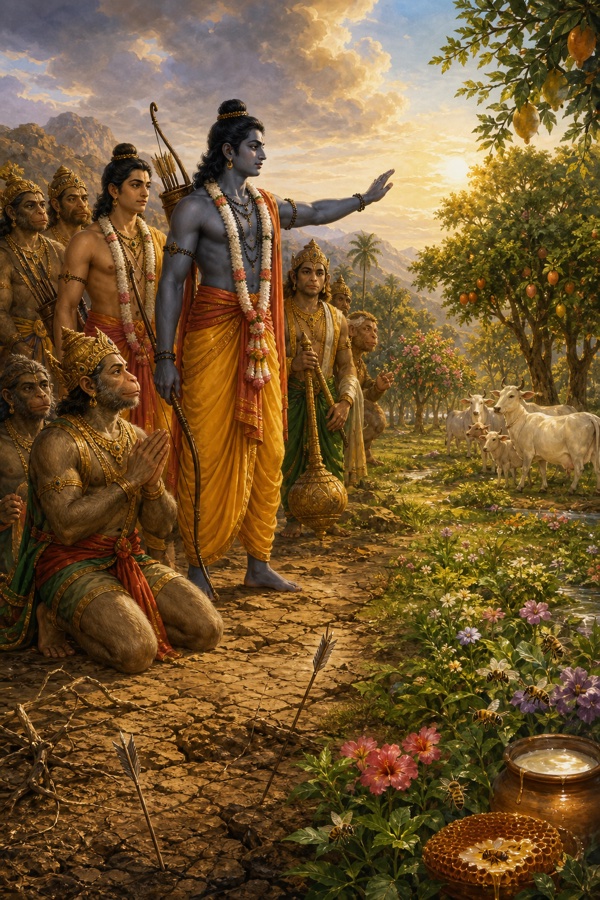
Rama granted that this land would be good for cattle, light in disease, full on every side with fruit and roots and honey, rich in ghee and milk, thick with herbs of every kind and with sweet scent. By Rama’s boon the desert, gifted with those virtues, became a country to delight in. He had made that desert out of his own rage a moment earlier, and he stood in front of it and gave it everything he had left to give.
Nala named, and the bridge begun
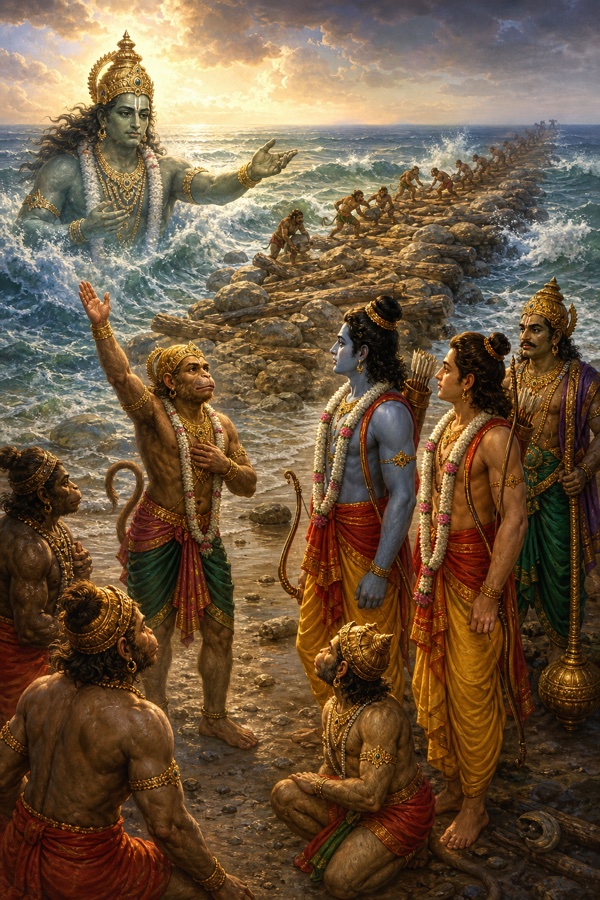
With that hollow dried, the sea spoke to Rama, who knew all the scriptures. “Gentle prince,” he said, “here stands Nala, son of Vishvakarma, the architect of the gods; his father granted him skill in every craft, and he loves you, maker of this world. Let this monkey, so full of eager strength, build a bridge upon me, and I will hold it up. He is as fine a builder as his father before him.”
Having said this, the sea-god vanished. Then Nala sprang to his feet and said to Rama, “I am Vishvakarma’s own son, sprung from his body, and I am his equal in the craft. All this the sea has just reminded me of; he has spoken the plain truth. I do not, unasked, go about announcing my own gifts.”
“With my father’s power at my command,” Nala said, “I can throw a bridge across this wide makaralaya; the sea spoke rightly. To my mother, on Mount Mandara, Vishvakarma once gave this boon: ‘A son the very equal of myself shall be born to you, lady, through me.’ And my own view is this, that toward the ungrateful the one right course a man has in this world is punishment; a plague on patience, on soft words, on gifts, when they are spent on such people.” He had been listening to Rama for three days, and he gave the words back to him.
“This fearful sea,” Nala went on, “which your ancestor Sagara had dug out and widened, has bent to give Rama a road only because it fears his punishment, with a wish to watch the bridge rise mixed into that fear. And I am undoubtedly able to build a bridge across this varunalaya, this house of Varuna. So let the monkey leader begin gathering the bridge’s materials this very day.”
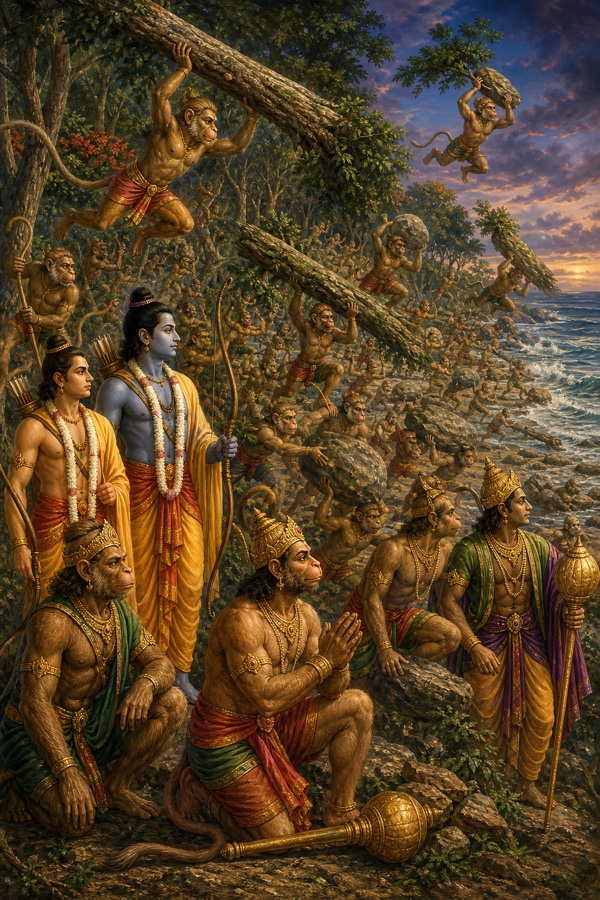
Then, at Rama’s sending, hundreds of thousands of the finest monkeys leapt up in delight across the great forest all around. Huge as mountains, they tore up trees and boulders there and dragged them down toward the sea. All the strength that had gone into wrecking a garden and drinking a wood dry now had a use.
A hundred yojanas of bridge in five days
The monkeys filled the sea with sal and ashvakarna, with dhava and bamboo, with kutaja, arjuna, palmyra, tilaka, tinisha, bilva, and saptaparna, with karnikara trees in flower, and with mango and ashoka. Some trees they lifted with the roots still on and some without, and raising them high like the tall banners set up in Indra’s honor, they flung them into the sea. From every side they carried in palmyra, pomegranate bushes, coconut, vibhitaka, karira, bakula, and nimba. The forest went into the water species by species, and Valmiki names them all, because somebody carried every one of them.
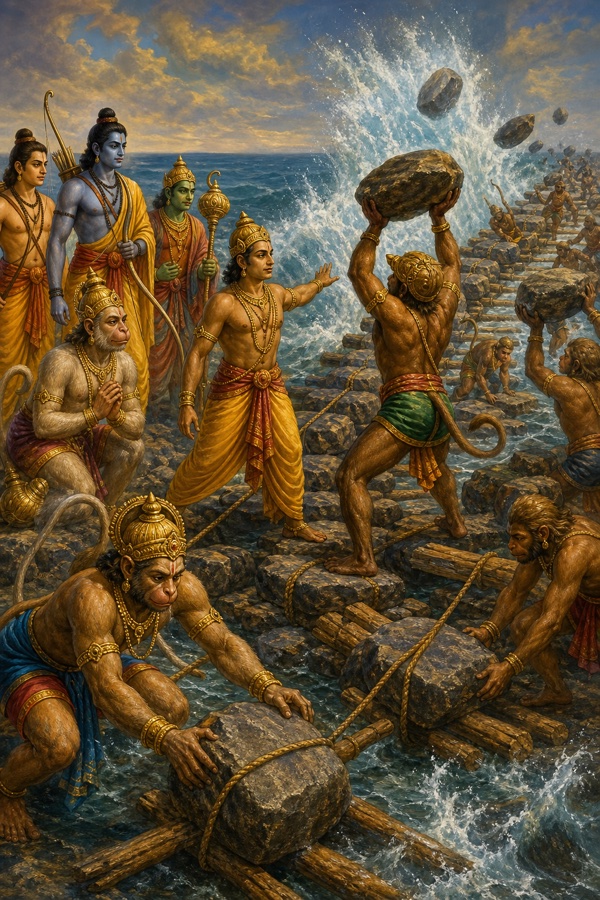
The mighty, huge-bodied monkeys tore up rocks and hills as big as elephants and hauled them to the shore with engines and levers. When the rocks were dropped in all at once, the water leapt up to the sky and came falling back. Some of the monkeys held measuring rods to gauge the bridge’s length and breadth; others gathered the material, and others drew cords taut to keep the rocks running in a straight line. Hundreds of monkeys huge as clouds and mountains, obeying Rama’s command, raised parts of the bridge out of reeds and logs, and built into it trees whose boughs were crowned with blossom. Rushing back and forth with blocks of stone the size of mountains and with whole mountain peaks, they looked like the sons of Danu, and the crash of rocks and hills hurled into that wide sea rose in a tumult. This is the detail that gives the whole thing away as real work: somewhere in that roaring crowd of tree-throwing monkeys, a few of them were holding a string. Nala raised that vast, great bridge down the middle of the sea, the lord of rivers, and with the help of other monkeys of fierce labor the bridge went up course by course.
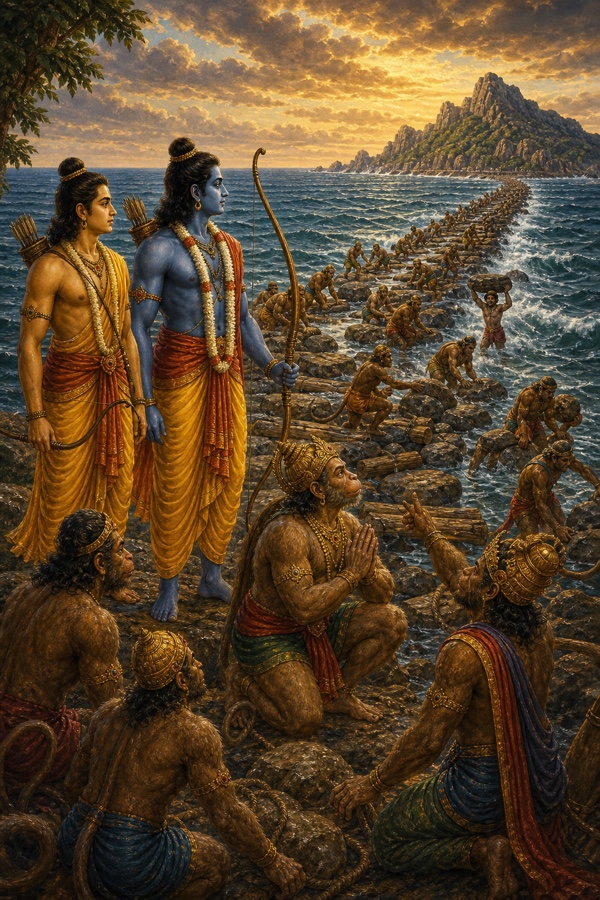
On the first day the monkeys built fourteen yojanas of the bridge, thrown up by those quick-handed, elephant-like, delighted workers. On the second day, monkeys of fearsome build and great strength ran up twenty more just as fast. On the third day, swift and huge of body, they laid twenty-one yojanas of bridge across the sea. On the fourth day, moving with great force and in a fever of haste, they finished a further twenty-two. And on the fifth, working feverishly, the monkeys built twenty-three more and carried the bridge all the way to Mount Suvela on the far shore. Read those numbers in order and you can watch a workforce learn its job: slowest on the first day, faster every day after, and fastest on the last, with the far shore in sight.
So it was that Nala, son of Vishvakarma, bridged the sea; he proved as skilled in the craft as his father before him. Nala’s bridge, beautiful and brilliant, lay across the makaralaya and shone like the Milky Way, the Svatipatha, drawn across the sky.
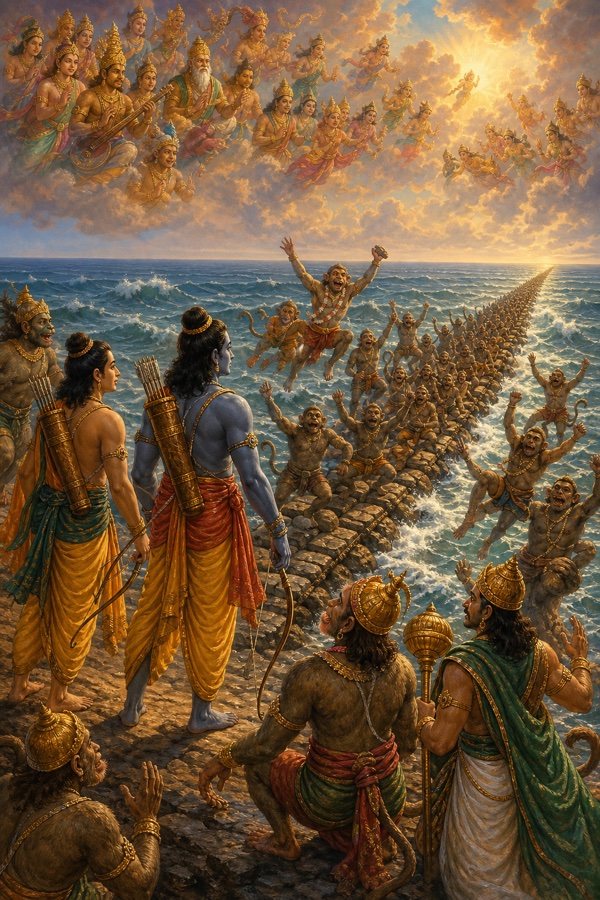
Then the gods with their gandharvas, the siddhas (beings born already possessed of magical powers), and the great seers came and stood in the sky, longing to see this marvel. Gods and gandharvas gazed at the Nala-bridge, ten yojanas broad and a hundred long, a thing no one else could have raised. The monkeys, leaping in long bounds and short and roaring aloud, looked on that bridge, past all imagining, past all bearing, wonderful and hair-raising; and every other creature too looked on this bridging of the sea. Even as they built it, those crores of monkeys of enormous strength were passing across to the far side of the great sea.
That vast bridge, well made, splendid, finely built, and firmly joined, lay upon the sea like the parting drawn through a woman’s hair. And on the far side of the sea Vibhishana took his stand with his ministers, mace in hand, ready to hold off any enemy who might try to break the bridge. He had been a citizen of the country on that shore a few days ago, and he stood on its beach with a mace, guarding the road that would bring the army in.
The army’s march, and the gods’ consecration
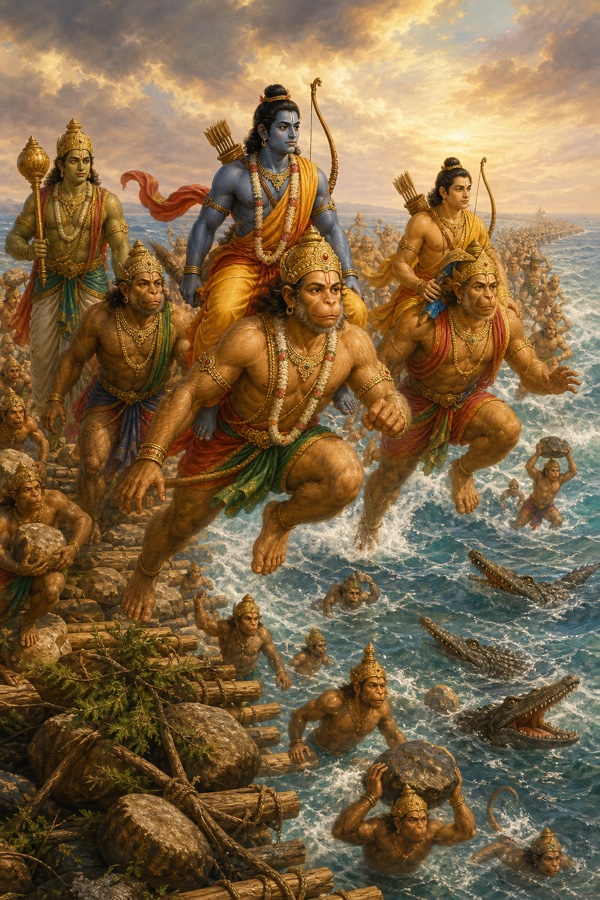
After this Sugriva said to Rama, whose valor never failed, that he should climb onto Hanuman’s back and let Lakshmana ride on Angada’s shoulders. “This makaralaya is a very wide sea, brave prince,” he said; “these two, who can travel the sky, will carry you across.”
So Rama, bow in hand and set on what was right, went at the head of that army with Lakshmana and Sugriva. Some of the monkeys went down the middle and some along the flanks; some plunged into the water and swam, some pressed on along the bridge, and some sprang into the air and flew like Garuda.
The dreadful monkey army, crossing over, drowned even the rising roar of the sea under its own great clamor. By the Nala-bridge that host passed to the far side, and King Sugriva halted them on the far shore, a place well supplied with roots and fruit and water.
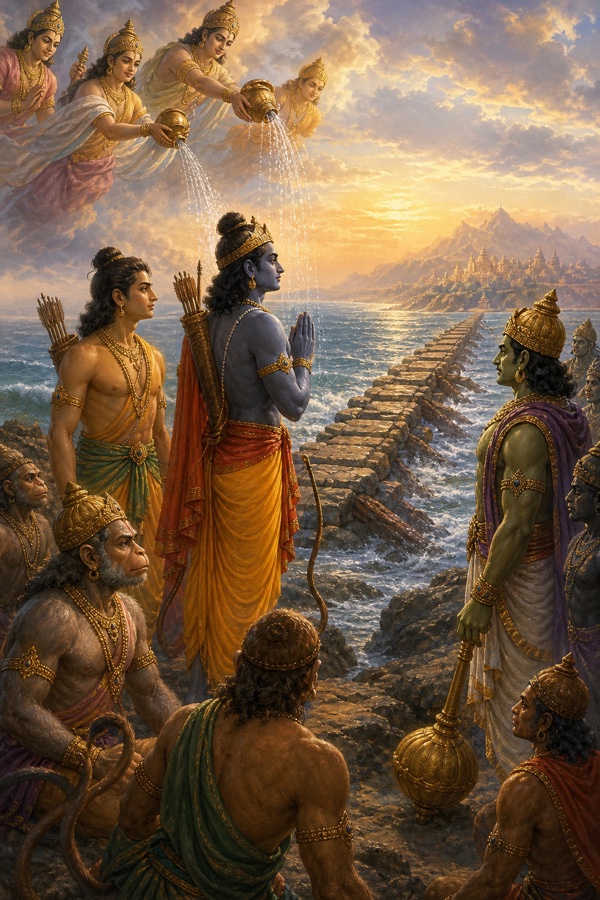
Seeing this marvel of Rama’s, a thing others could not have done, the gods with the siddhas, the charanas (singers who move through the sky), and the great seers came suddenly to Rama and consecrated him, each apart, with waters of high blessing. With all manner of auspicious words they did honor to Rama, whom kings themselves revere. “Conquer your enemies, King,” they said, “and guard this earth with its seas for uncounted years.”
The gist: In five days Nala bridged the sea, ten yojanas wide and a hundred long, and the gods gathered in the sky to watch the wonder. Vibhishana stood guard on the far shore. By Sugriva’s arrangement Rama rode on Hanuman and Lakshmana on Angada, and crores of monkeys crossed by bridge and water and air and settled on the far shore. The gods consecrated Rama and blessed him with victory and a long reign.
Source: Srimad Valmiki Ramayana, Yuddhakanda, Cantos 20 to 22. The Gita Press Hindi edition is the controlling witness. The Sanskrit e-text and an independent complete translation were used to verify names, sequence, and principal events. Where recensions differ, this retelling follows Gita Press.
Based on: Valmiki Ramayana (Gita Press, Gorakhpur)