On this page
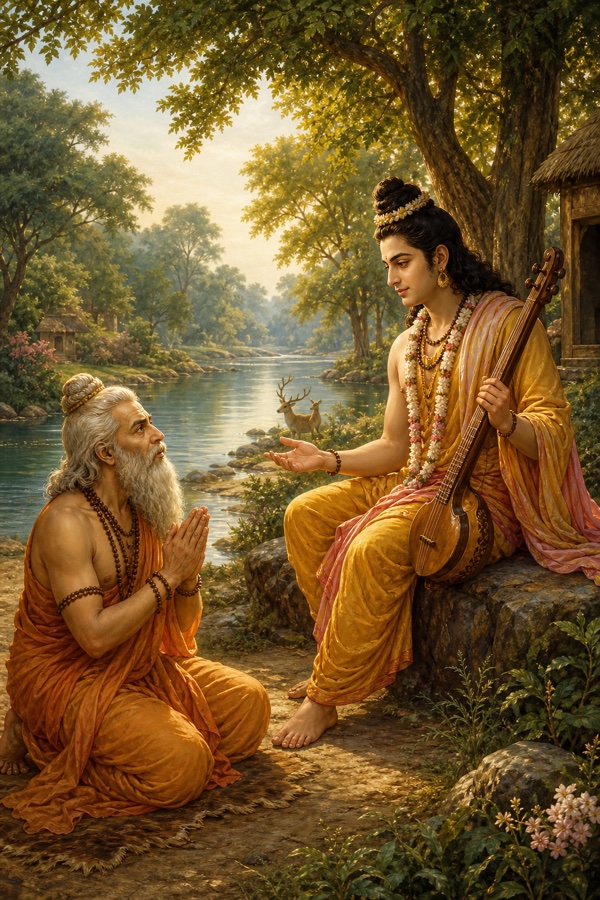
On the bank of the river Tamasa, a single line of pure compassion once broke from a sage’s heart, and that one line became the seed of the first poem the world ever heard. Earlier that same day, at his hermitage, the sage Valmiki, who spent his days in austerity and in the study of the Vedas, had received a visitor: Narada, the seer who wanders freely between the worlds of gods and men and carries the news of each to the other. Valmiki had a question ready for him. Is there a man alive in the world at this hour, he asked, who holds every virtue at once? One who is strong and knows what is right, who remembers a kindness done to him, who speaks the truth and keeps a vow once made? One whose conduct has no flaw, who wishes well to every living thing, who is learned and capable, and so fine to look upon that the eye rests on him and does not want to move on? One who has mastered his own self and his own anger, whom no one can fault, and whom the very gods dread when his wrath is roused in battle? I want to hear of him, Valmiki said, and you know the three worlds well enough to name him. Narada listened to the whole list, and the list pleased him. “Listen,” he said. The virtues you have counted are rare, and rarer still in one man. But there is such a man. He was born in the line of Ikshvaku, and people know him by the name of Rama.
Narada’s tale: the whole Ramayana in a single telling
Narada strung the virtues of Rama like beads on a thread. He has brought his mind under his own command, Narada said; he is powerful, radiant, resolute, and master of his senses. He is intelligent and sound in judgment, eloquent, radiant with fortune, and the ruin of his enemies. His shoulders are broad, his arms powerful, his neck lined like a conch, his chin firm; his chest is deep and made for the great bow, his collarbones are hidden under muscle, and his arms hang to his knees. His head is well shaped, his brow fine, his walk a pleasure to watch. He is of middle height, neither tall nor short, every limb in proportion, his skin lustrous, his chest rounded, his eyes large, and his body carries the marks that foretell good fortune. He knows the secret of dharma, keeps the word he gives, and lives for the good of his people. He is famous, wise, clean in his dealings, self-possessed, and single-minded. Like Brahma he upholds the creation; he is wealthy, a protector of the living, and a steady defender of the faith. He guards his own virtue and his own people. He knows the truth of the Vedas and the six sciences that serve them, and in archery no one has surpassed him. He knows the real meaning of every scripture, his memory is sharp, his wit quick; all the worlds love him; he is pious, high-minded, and shrewd. The righteous seek him as rivers seek the ocean. He is noble, he treats everyone alike, and his face is always pleasant. Every excellence is in him, and he is the joy of his mother Kausalya. He is deep as the ocean and steady as the Himalaya. In prowess he is another Vishnu; to look upon, he is gentle as the moon; roused to anger, he is the fire that ends the world; in patience he is the earth herself; in giving he is Kubera, the lord of wealth; and in truth he is Dharma himself in a second body.
Rama was the eldest of Dasharatha’s four sons, and the best of them, and the people loved him. Wanting to please that people, the king set his heart on installing Rama as regent, the crown prince who rules beside his father. The preparations began. Then Queen Kaikeyi, the youngest of the king’s three principal wives, watched them, and remembered a promise. Long ago, on a battlefield, her courage and her care had saved her husband, and the grateful king had granted her a boon to be claimed whenever she chose. She claimed it now, and she named her price: Rama to go into exile, and her own son Bharata to be crowned in his place. Dasharatha had never spoken a false word in his life, and the promise held him like a chain. He sent his beloved son away. And Rama, hero that he was, obeyed his father’s command, because it was the boon his father had given, and because it would please Kaikeyi, and he went to the forest so that his father’s word would stand.
Behind Rama walked Lakshmana, the son of Sumitra, the second of the king’s principal queens, a modest young man and his brother’s favorite, who followed him out of love and proved by it what brotherhood is. And Sita went with him, Rama’s wedded wife, dear to him as life itself: she had risen from the furrow cut by a plowshare, no mother’s womb had carried her, and King Siradhvaja of Mithila, whose family title was Janaka, had raised her as the daughter of his line. Every mark of good fortune was on her; she was a jewel among women, and she looked like the Lord’s own power made visible. She followed Rama as Rohini follows the moon. The citizens of Ayodhya followed too, and the old king himself, a long way behind. At Shringaverapura on the bank of the Ganga, Rama met his friend Guha, the chief of the Nishadas, and from there he sent his charioteer home. Then, with Guha, Lakshmana, and Sita, he went from forest to forest, crossing rivers deep with water, until at Prayaga he came to the sage Bharadwaja. There he took leave of Guha, and on the sage’s word he went on to Chitrakuta. He built a lovely cottage, and the three of them lived there as happily as gods and gandharvas at play in the woods.
The charioteer came back to Ayodhya and reported that Rama had gone on foot to Chitrakuta. That was all Dasharatha needed to hear. Stricken with the grief of the parting, he gave up his life with his son’s name on his lips and went to heaven. Vasishtha, the family priest and preceptor of the kings of Ayodhya, and the other Brahmins urged Bharata to take the throne, and Bharata, who had every strength a king needs, would not have it. He went into the forest to persuade his elder brother to come home and rule. He stood before Rama with the feelings of a true kinsman and said, “Be the ruler yourself, for you are the one who knows what is right.” But Rama held to his father’s decree, and he would not touch the kingdom. He took off his own pair of wooden sandals and put them into Bharata’s hands as a token of his love, told him to rule in their name, and, after many refusals of his brother’s pleading, sent him back from Chitrakuta. Bharata had come to bring Rama home and crown him, and he went home without it. He touched his brother’s feet, took his leave, and ruled the kingdom from Nandigrama, a lonely retreat fourteen miles from Ayodhya, waiting for Rama to return. When Bharata had left, Rama, who had conquered his senses and held to one purpose only, the keeping of his father’s pledge, saw that the people of Ayodhya would keep coming to Chitrakuta to find him, and so he went deeper, into the great forest of Dandaka.
In Dandaka, Rama killed the ogre Viradha. He went to see the sages of that forest one after another, Sharabhanga and Sutikshna, then Agastya and Agastya’s brother. At Agastya’s own urging he accepted, with great delight, a bow, a sword, and a pair of quivers whose arrows never ran out, all of them gifts that Indra had once made to the sage. While Rama lived among the forest people, every seer in that forest came to him with the same request: rid us of the demons and ogres who haunt this place. Rama, bright as fire, stood before those seers and vowed to kill the ogres of Dandaka; he promised it solemnly, and the promise was witnessed. In that very forest an ogress named Shurpanakha, whose nails were broad as winnowing fans and who could take any shape she pleased, made her advances to Rama, and for it she was disfigured: Lakshmana cut off her nose and her ears.
Shurpanakha went for revenge, and at her urging all the ogres of Janasthana came ready for battle, with their leaders Khara, Trishira, and Dushana and all their followers. Rama killed them all in that fight, fourteen thousand ogres who had made Janasthana their home. Ravana, the king of Lanka, heard that his kinsmen had been destroyed, and rage stupefied him. He went for help to a fellow ogre named Maricha, one of the two sons of the ogress Tadaka. Maricha tried to stop him, and tried again: “It is not wise to make an enemy of that prince, Ravana. He is too strong.” Ravana turned a deaf ear. Death itself was driving him. He took Maricha to the place of Rama’s hermitage, and there the cunning Maricha drew both princes far from the hut, and Ravana carried Sita away. The vulture Jatayu tried to block his path and free her, and Ravana wounded him past healing. Rama came back and found the vulture dying, and from its mouth he heard that Sita had been carried off by force. He wailed aloud, his mind wild with grief. He cremated Jatayu, and then, still grieving, he went searching through the forest for Sita and came upon an ogre named Kabandha, misshapen and terrible to look at.
Rama killed Kabandha too, and cremated him, and the ogre rose from the fire in his true form, a gandharva, and as he ascended he said, “Go to Shabari, Rama. She is a hermit woman who knows the ways of dharma.” Rama went. Shabari received him with all the honor she could give, and from her he came to the bank of the Pampa lake, and there he met the monkey chief Hanuman. It was Hanuman who brought him to Sugriva, and the two made a pact of friendship with the sacred fire as witness, the way alliances that must hold are sealed. Rama told Sugriva his whole story from his birth, and above all the story of Sita, and Sugriva, moved, told Rama how his own elder brother Vali had turned on him. Rama vowed on the spot that Vali would die by his hand. On Mount Rishyamuka, where Sugriva had been living in hiding, the monkey chief still had his doubts about how Rama would fare against Vali. He showed him the skeleton of the demon Dundubhi, tall as a hill, which Vali had kicked away in contempt. Rama smiled, looked at it, and with his big toe hurled it a full eighty miles. Then, to settle the matter, he loosed a single arrow that passed through seven palmyra trees standing in a row, through a hillock behind them, and down into Rasatala, the sixth of the worlds beneath the earth. Sugriva was reassured. He marched at once, glad at heart, to Kishkindha, the cave city among the mountains where Vali reigned, and roared. Vali, tawny as gold, came out to meet the roar. His wife Tara, devoted and wise, tried to hold him back: Sugriva has Rama with him now, she said, and cannot be beaten. Vali went anyway, and in that fight Rama brought him down with one arrow. He set Sugriva on Vali’s throne, and Sugriva, eager to find Sita, gathered all the monkeys and sent them out in every direction.
In the south the searchers met the vulture king Sampati, who could see Sita in Lanka from where he stood, and on his word the mighty Hanuman leapt across the salt sea, eight hundred miles of it, that lay between the mainland and Lanka. He reached Ravana’s city and found Sita in a grove of ashoka trees, her mind fixed on Rama’s feet. He gave her the token Rama had sent, a signet ring, told her of the alliance with Sugriva and of Vali’s death, and promised her that her husband would soon come and set her free. Then he tore down the outer gate of that grove. He killed five commanders of Ravana’s army and seven sons of ministers, and crushed the gallant Aksha, a son of Ravana; and then he let himself be bound by the Brahmastra, the missile presided over by Brahma, which Meghanada, Ravana’s heir, loosed at him. Hanuman knew that Brahma’s own boon would release him from that bond within a couple of hours, and he wanted to see Ravana face to face, so he bore with the ogres who dragged him bound into the court. Then he set the whole city of Lanka on fire, sparing only the place where Sita sat, and came back the way he had gone. He walked around Rama in reverence and told him, “I have seen Sita with my own eyes.”
Rama went south with Sugriva to the shore of the ocean. The ocean would not open a way for the army of monkeys, and Rama shook it to its depths with arrows bright as the sun, until the Ocean himself rose in person, begged pardon for his stubbornness, and at his own request Rama had the monkey Nala build a bridge across the water. Rama crossed by that bridge, reached Lanka, and killed Ravana in battle. And when he had Sita back, a woman who had lived so long in an ogre’s grove that fault-finders could call her stained, a great shame came over him before the eyes of the world. He spoke harsh words to her in the assembly of the monkeys, and Sita, chaste as she was, could not bear them, and walked into the fire. The fire-god himself declared her sinless, and Rama took her back, and all three worlds, everything that moves and everything that stands still, with the hosts of gods and rishis, rejoiced at what he had done in overthrowing Ravana and freeing Sita. Honored by every god, Rama shone with joy. He set Vibhishana, chief of the ogres, on the throne of Lanka, and felt his purpose accomplished. The gods came in their flying chariots to congratulate him on a victory that had brought relief to all three worlds, and from them he received a boon: every monkey who had fought on his side and fallen in battle rose alive, as if from sleep. Then Rama flew home in the Pushpaka, the flying palace that Ravana had once snatched from his half-brother Kubera, with Sita and Lakshmana, with Vibhishana and Sugriva and the rest of his friends. At the hermitage of Bharadwaja near Prayaga he sent Hanuman ahead to Bharata, so that his coming would not take his brother unawares. He told Bharadwaja the whole story of his exile, boarded the Pushpaka again with Sugriva and the others, and came down at Nandigrama. There, with his three brothers beside him, he unbound the matted hair of his exile, and with Sita at his side the sinless Rama took back his kingdom.
In the reign of Rama, Narada said, the people will be delighted and cheerful, contented and well fed, deeply pious, free of anguish of mind and sickness of body, and rid of famine and the fear of thieves. Nowhere will a father or mother see the death of a son or a daughter. No woman will be widowed, and every wife will be devoted to her husband. There will be no fear of fire, no one will drown, there will be no fear of wind and none of fever. Hunger will not stalk his kingdom and thieves will not walk it; the cities and the countryside will be full of wealth and grain. Everyone will be as happy as in the age of truth. Rama will please the Lord with hundreds of horse-sacrifices and other rites heaped with gold; he will give a billion cows to the learned with due ceremony and untold riches to the Brahmins; he will set up royal houses a hundred times more prosperous than before, confirming them in their kingdoms and helping them freely, and he will guide the people of all four orders in their own duties on this earth. He will rule for eleven thousand years, and then he will go to Brahmaloka, the highest heaven. And whoever reads this sacred story of Rama, which cleanses the mind and wipes out sin and stands level with the Vedas, is freed from every sin. It lengthens life; the one who reads it will be honored in heaven at his death, with his sons and grandsons and all who serve him. A Brahmin who reads it will grow eloquent; a kshatriya will gain lordship over the earth; a merchant will prosper in trade; and a shudra will rise to eminence.
The killing of the krauncha, and the birth of the shloka
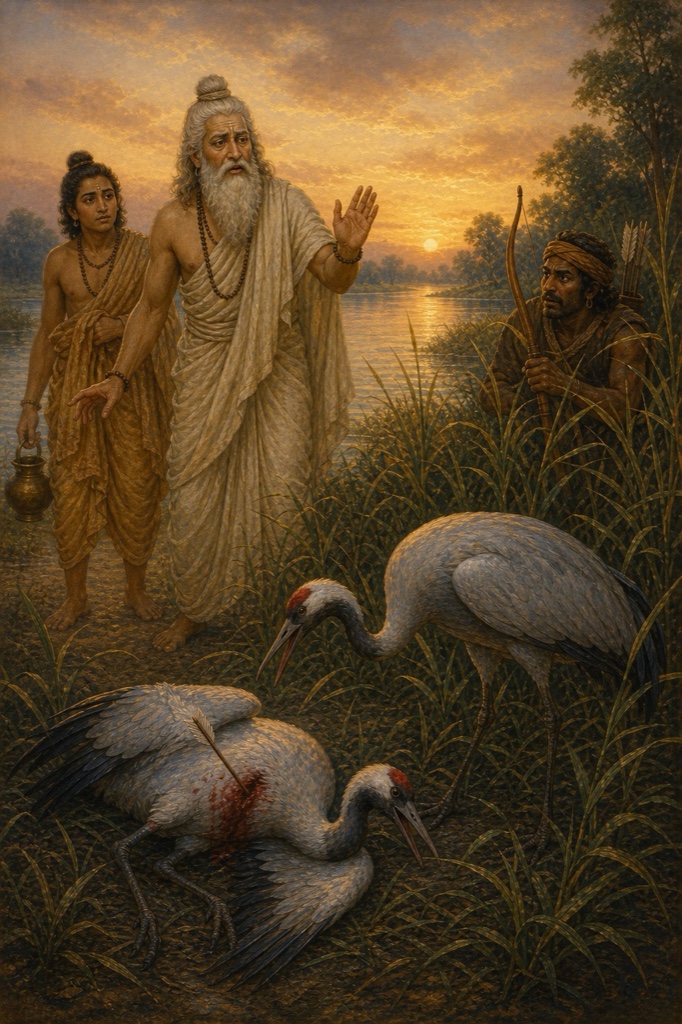
Valmiki and his pupils honored Narada, and with their leave the celestial seer rose back into the heavens. Valmiki lingered in his hermitage for less than an hour after he had gone, and then, when the sun stood high and the midday bath and prayers were due, he walked to the bank of the Tamasa, which runs not far from the holy Ganga, with his pupil Bharadwaja beside him. The descent to the water caught his eye: no mud on it, the water clear all the way down. “Look at this ghat, Bharadwaja,” he said. “Clean and pleasant, and the water as transparent as the mind of a righteous man. Set your pitcher on the bank, dear boy, and hand me the bark cloth to wrap around my waist when I have bathed. I will take my dip at this very spot; there is no better one on the Tamasa.” The devoted pupil handed him the bark. The sage, who had long since mastered his senses and did not go looking for things to delight them, took it from his hand and wandered along the bank, taking in the wide forest on every side. Close to the ghat he saw a pair of krauncha birds moving through the trees together, never parting from each other, and calling to one another in the sweetest of voices. And while the sage watched, a Nishada, a man of the hunting tribes, cruel of purpose and hostile even to what had never harmed him, shot an arrow into the pair and struck the male.
The male bird had a crest the color of copper, and only a moment before, inflamed with love, he had spread his wings around his mate. Now he lay on the ground with his limbs smeared in blood, writhing, dying. His mate, torn from the companion she had just embraced, cried out in a voice of pure grief. The sage saw the bird brought down in the very act of love, and pity rose in his heart. Then, as the female shrieked on, compassion took hold of him entirely, and judging the hunter’s deed a sin, he spoke: “May you never find peace, hunter, through all the endless years, for you have killed one of a pair of kraunchas lost in their love.” Even as the words left him he stopped, and thought: what is this that I have said, grief-stricken as I am for this bird? Unease spread through his heart. He brooded a while, and then the wise sage, the most learned of men, made up his mind and turned to his pupil. “Listen,” he said to Bharadwaja. “What came out of me while I stood here stricken with grief has fallen into four metrical feet, each with the same count of syllables, eight, and it has the rhythm of a song that could be sung to a lute. Let it be accepted as real poetry, and as nothing less.” Bharadwaja, delighted, committed the unmatched couplet to memory, and the sage was pleased with him. Valmiki finished his midday bath with due ceremony at that ghat and turned back toward the hermitage, still brooding on what had happened, and his learned and obedient pupil picked up the pitcher of water and followed at his heels.
Back at the hermitage, the sage sat down with his pupil and talked of other things, and all the while his mind stayed absorbed in the couplet he had spoken. Then Brahma himself appeared before him, the four-faced maker of the fourteen worlds, blazing with his own light, come in person to see the chief of hermits. Valmiki, astonished, sprang up from his seat and stood with folded hands, unable to speak. He bowed as the scriptures prescribe, asked after the god’s welfare, offered water for his feet and for his hands, gave him a splendid seat, and sang his praise. The almighty creator, wrapped in his own radiance, made himself comfortable on that exalted seat and told Valmiki to sit as well. And even then, with the progenitor of all creation seated in front of him, Valmiki’s thoughts drifted back to the river. What a grave wrong that wicked hunter did, he said to himself, striking down a blameless bird in the very moment of its love, when it was singing so sweetly. Mourning the female krauncha parted from her mate, he repeated the couplet aloud in Brahma’s presence, turned its meaning over, and fell into grief once more, this time at the thought that he had cursed a hunter without meaning to and spent some of the store of his austerities in doing it. Brahma laughed. “Let this verse of yours bring you glory, Brahmin sage,” he said. “You need not brood over it any longer. That speech flowed from your lips by my will alone. Now describe the whole life of Rama on this earth, first of seers, Rama whose mind is ever set on dharma and who is full of wisdom. Tell the story of that hero as you heard it from Narada. Whatever there is to know of the all-wise Rama, of Lakshmana the son of Sumitra, of the rakshasas who fought him and died, of Sita whom Janaka raised, whether it is known to you today or hidden from you, all of it will be revealed to you, and nothing you set down in this poem will prove false. Render the sacred and heart-ravishing story of Rama into verses like this one. As long as mountains and rivers stand on the surface of the earth, the story of the Ramayana will move through all three worlds. And for as long as the story of Rama that you compose remains current, you will live in the worlds of my making, above in the heavens or here below, wherever you choose.” With that the almighty Brahma vanished from the spot, and the sage and his pupils, Bharadwaja and the rest, were filled with wonder. The pupils repeated their teacher’s verse to one another again and again, delighted and amazed that the creator himself had called on him unbidden, and they said that what their teacher had uttered in four feet of equal syllables was his grief itself, turned into verse. And the thought settled in Valmiki’s purified mind that he would compose the entire poem of the Ramayana in verse of this kind. So he composed it, in hundreds and thousands of verses that ravish the soul, their feet counted in even syllables, their words the noble deeds of Rama, and the poem brought him a renown that has never faded.
The poet’s own outline
Valmiki had heard from Narada the whole theme of the poem he was to compose, a poem that would bring religious merit and worldly good to those who read it and heard it, and the supreme benefit of final release beyond both. Now he set out to see it for himself. He sipped water in the rite of purity that the scriptures prescribe, sat down with folded hands on a mat of kusha grass with its blades pointed east, and gathered himself in the yogic power that Brahma had granted him. In that absorption he perceived, directly and in every detail, all that belonged to Rama, Lakshmana, and Sita, and to King Dasharatha with his wives and his kingdom: how they laughed, how they talked, how they moved, everything they did. He saw in order all that Rama had done while wandering the forests with Lakshmana and Sita, true to his promise. Deep in meditation, the sage saw the past and what still lay ahead for Rama, Lakshmana, and Sita as clearly as a man sees a myrobalan fruit set in the palm of his hand. Having seen it all in truth by the strength of yoga, Valmiki, wise as few have been, set himself to render the entire story of Rama, the delight of all, into verse. And the poem he made, telling the story as Narada had told it, touches in passing on the pleasures of the senses and on worldly prosperity, and dwells at length on the two greater aims of human life, dharma and final release; it is full of jewels like the ocean, and it draws the ear with the music of its verses and the mind with the depth of their meaning. Before he began, he set out for his listeners the shape of the whole.
The birth of Rama, his surpassing strength, his kindness to all, his popularity with everyone, his forgiveness, his amiability, and his habit of speaking the truth; the many wondrous tales, the descent of the Ganga among them, told by Vishvamitra on the road to his hermitage and then to Mithila; the breaking of the bow that the king of Mithila kept to test the suitors, and the wedding of Sita and her sisters; the bitter exchange between Rama and Parashurama over the broken bow; the excellences of Rama, the son of Dasharatha; the preparations to install him as regent and the treachery of Kaikeyi; the installation broken off and Rama sent to the forest; the king’s grief and lament, and his passing to the other world; the sorrow of the people of Ayodhya, and how those who followed Rama into the forest were thrown off his track and turned home; his talk with the chief of the Nishadas, and the sending back of the charioteer; the crossing of the Ganga; the visit to Bharadwaja and the journey to Chitrakuta at his direction; the leaf-thatched hut built there and the life in it with his wife and his brother; the coming of Bharata and his pleading; the water Rama poured for his dead father; the anointing of the sandals; Bharata’s stay at Nandigrama; the going to Dandaka and the killing of Viradha; the visits to Sharabhanga and Sutikshna; Anasuya’s kindness to Sita, and the sandal paste she gave her; the visit to Agastya and the bow of Vishnu he bestowed; Shurpanakha’s advances and her disfiguring; the deaths of Khara and Trishira and of Dushana and their host; Ravana’s scheme; the killing of Maricha in the form of a golden deer; the carrying off of Sita; Rama’s lament, and the death of Jatayu; Kabandha, and the Pampa lake; the visit to Shabari and the roots and fruit she offered; Rama’s raving over his lost wife, and the meeting with Hanuman on the bank of the Pampa; the coming to Mount Rishyamuka and the friendship with Sugriva; the skeleton of Dundubhi and the seven palmyra trees; the fight of Vali and Sugriva; the death of Vali and the crowning of Sugriva; Tara’s lament; the pact to search at the end of the rains, and the monsoon on Rishyamuka; Rama’s anger at Sugriva’s delay; the mustering of the monkeys and Sugriva’s account of the divisions of the earth; the ring given to Hanuman; the bear’s cave in the south, the fast to the death on the seashore, and the meeting with Sampati; Hanuman on Mount Mahendra and the leap across the sea; Mainaka and Surasa; the killing of Simhika; the sight of Lanka on Mount Trikuta and the entry by night; Ravana seen, and the Pushpaka; the Ashoka grove and Sita found; the ring, Sita’s words, the threats of the ogresses, and Trijata’s dream; the jewel Sita gave for her head; the trees torn down and the guards killed; Hanuman taken and Lanka burned; the leap back and the honey of Madhuvana; the news brought to Rama and the jewel placed in his hand; the march to the sea and the meeting with the Ocean; the bridge that Nala built; the crossing and the siege of Lanka by night; the alliance with Vibhishana and his counsel; the killing of Kumbhakarna; the killing of Meghanada; the killing of Ravana and the recovery of Sita; the crowning of Vibhishana; the Pushpaka and the flight to Ayodhya; Bharadwaja at Prayaga; Hanuman sent to Bharata, and the meeting of the brothers; the festival of Rama’s crowning; the disbanding of the monkey host; Rama winning the hearts of his people by his loving rule, and the exile of Sita. And beyond all this, whatever deeds Rama still had to perform on this earth, Valmiki set down in his poem as well.
The singing of Kusha and Lava
So Valmiki composed the whole life of Rama, who had come home from the woods and taken back his kingdom, in wonderful language and on excellent themes: twenty-four thousand verses, arranged in six kandas of five hundred and some cantos, with the Uttarakanda after them as the epilogue that tells what was still to come. When it was finished, Uttarakanda and all, a question stood before him. Who had a memory strong enough to carry all of this, and a voice fit to recite it before gatherings of people? While the sage of purified mind was turning this over, two boys in the dress of hermits came and took hold of his feet in reverence. They were Kusha and Lava, brothers born of one womb, Rama’s own sons, brought forth by Sita in the years of her exile in this very hermitage, where Valmiki had given her shelter and stood as godfather to her children. The two had lived here since their birth as his godsons and his pupils, they knew every duty they owed their teacher, they were already known for their devotion to him, and they had been gifted with musical voices and had mastered the science of music. Valmiki looked at the two boys, exceptional in talent and deep in the Vedas, and the sage, who had kept sacred vows all his life and had earned by them the capacity for this enormous task, taught them the whole of the great poem, the story of Sita above all, to open the meaning of the Vedas to them. Its title was “Paulastya Vadha,” the killing of Ravana, the grandson of Pulastya.
The poem was a delight to read and a delight to chant. It could be sung in the three measures of time, slow, medium, and quick, to the seven notes of the scale and to the proper rhythm of the lute, and it carried the nine flavors of feeling: love, pathos, mirth, wrath, terror, and heroism, with disgust, wonder, and serenity. The two brothers were true masters of music. They knew the three sources from which the voice is shaped, the chest, the throat, and the head; they could play the lute and the other instruments; their voices were as sweet as the gandharvas’, and they were as handsome as gandharvas too. Their bodies bore the marks of fortune, their speech was sweet, and they looked like two images cast from one original, two more Ramas sprung from Rama’s loins. They learned that whole poem by heart, a poem given wholly to dharma, and because they knew the true purport of the Vedas and the scriptures, they chanted it exactly as they had been taught, with their minds wholly on it, before gatherings of seers, of the twice-born, and of pious men. One day, standing beside an assembly of sages of purified mind, the two boys, blessed and gifted and full of every good quality, chanted the poem in the open assembly. The sages heard it in wonder. Their eyes dimmed with tears, and they cried out with one voice, “Well done! Excellent!” Those virtue-loving sages praised the two singers, who deserved all praise: “What a melody, and what a recitation of the verses! The events belong to long ago, and yet the picture stands before our eyes as if it were happening now. The two princes have entered the spirit of the poem and chanted it with one voice, exquisitely, in a sweet and loving tone, with all the richness of music.” Applauded by seers who had earned praise of their own by their austerity, the boys sang more sweetly still, and with deeper feeling. One sage, pleased, stood up in admiration and gave them a pitcher. Another, famous for his own mastery of music, gave them bark cloth to wear at the waist. Another gave them a black deerskin, another a sacred thread to wear across the shoulder. One gave a water-pot carved from a wild coconut, one a girdle of munja grass, one a kusha mat fit for sages, one a strip of cloth. One hermit, full of joy, gave them a hatchet for cutting wood; another, a piece of the brown-red cloth that students and renunciants wear; another, a scarf. One gave a string for tying up matted hair and a cord for binding a bundle of firewood; a seer gave a sacrificial vessel, and another a load of fuel; another a wooden seat made from the udumbara tree. Some invoked blessings on them, and the great seers, delighted, blessed them with long life. All those sages, who spoke only truth, gave the two princes their boons and said: “This narrative, told at such length and so beautifully by the sage Valmiki, is a wonder. It will be the chief support of every poet to come, and it has been brought to its close with due regard to the order of events. You have sung it beautifully, princes, in every style of singing. It gives long life, it brings prosperity, and it ravishes the ears and the minds of all who listen.”
One day Rama, the elder brother of Bharata, caught sight of the two singers roaming the lanes and streets of Ayodhya, chanting the Ramayana and applauded wherever they went. He brought the brothers Kusha and Lava to his own palace, gave them an exalted seat, and honored them as they deserved. Then, seated on his celestial throne of gold, with his ministers around him and his own brothers at his side, the king looked at the two boys, so handsome and so modest, and turned to Bharata, Lakshmana, and Shatrughna. “Hear this narrative carefully,” he said, “from the lips of these two boys who shine like gods; its language is wonderful and its subjects many.” And he asked the singers to begin. They chanted the poem, whose story every listener knew, in a tone as melodious and lovely as the sound of a lute, pitched as they wished and pleasing to every mind in the hall, a song that sent a thrill through the limbs and gladdened heart and mind together, a song that would have made its mark in any gathering on earth. “These two singers,” Rama observed, “carry on their bodies the marks that belong to rulers of the earth, though to all appearances they are hermits and great ascetics. Listen to the story they sing. Its literary beauties are many, it speaks to everyone, and the wise declare it good even for my own welfare, here and hereafter.” Urged on by Rama’s words, the two boys began the recitation in the full Marga style, and Rama, now one of the audience, let his mind sink slowly into the hearing of it, intent on the joy that rose from it.
Kosala and the city of Ayodhya
Now the tale is told as Kusha and Lava sang it. “We two, Kusha and Lava,” they said, “will now sing this whole story from its very beginning and in all its detail, a story that leads to dharma, to prosperity, to the joys of the senses, and to liberation beyond them. Let it be heard by anyone whose spirit is free of carping.” This whole earth, they sang, has belonged to victorious kings from the time of Vaivasvata Manu, the lord of created beings. In that line rose King Sagara, who had the ocean dug out, and whose sixty thousand sons marched behind him whenever he went out to chastise his enemies. And it is in the same line, the line of the great kings descended from Ikshvaku, the eldest son of Vaivasvata Manu, that this great story called the Ramayana has its seed.
Along the bank of the river Sarayu lies a great and happy realm called Kosala, prosperous, heavy with riches and with grain. In it stands the city whose name the whole world knows, Ayodhya, which Vaivasvata Manu, the ruler of mankind, built by his own will.
That great city, with its well-aligned roads, stretched twelve yojanas in length and three in width. A wide highway ran through it with side roads branching off in good order, and every day it was sprinkled with water and strewn with flowers that celestial women let fall as they hovered above the city to look at it and pay it homage. King Dasharatha, who raised his great kingdom to its height by a rule that was righteous and kind, made the city more populous still, as Indra, the ruler of the gods, adds to the people of his own capital, Amaravati, in heaven. Ayodhya had arched gateways with beautiful doors, markets laid out in order, engines of war of every kind and weapons and the fearsome shataghnis, and craftsmen of every trade. Bards and panegyrists crowded it, tall attics and flags graced it, and its splendor had no equal. Troupes of dancing women adorned it on every side, orchards of mango trees stood about it, and a defensive wall enclosed it. A deep moat that no enemy could easily enter or cross ringed the city, so that it was hard to approach and harder to take. It was full of horses and elephants, cows, camels, and donkeys, and crowded with the feudatory princes who came from every side to pay their yearly tribute and with the traders of many countries. Its mansions were built of precious stones and rose like mountains, and with its thick-set attics it looked like Indra’s Amaravati. Bright with color, laid out on the pattern of a dice-board, thronged with lovely women, full of every kind of jewel, and set with seven-storied houses, it was thick with homes yet faultless in design, built on level ground, rich in rice, and its water was as sweet as the juice of the sugarcane. Kettledrums, clay tomtoms, lutes, and drums made it ring, and there was no city on earth to compare with it. Its houses stood in such fair rows that it looked like a line of the flying palaces the siddhas win for themselves by austerity, and jewels among men lived in them.
In this city lived thousands of great chariot-warriors, the kind of warrior who can fight on while guarding his horses and his charioteer, and by another reckoning can face ten thousand archers alone. Not one of them would loose an arrow at a man who stood by himself, or at one who had no father or son to mourn him, or at a man out of sight who could only be shot at by the sound of his voice, or at one who had turned and fled the field. They were skilled archers, masters of every weapon, and they killed lions, tigers, and boars roaring in the woods with sharp-edged missiles and, when they chose, with the bare strength of their arms. Such was the city that King Dasharatha filled with people in those days, a city inhabited by the best of the Brahmins, men who kept and served the sacred fire, who possessed every virtue, who had mastered the Vedas and the six branches of knowledge that serve them, who gave in abundance and held to truth, and by eminent seers who stood nearly as high as the great rishis themselves.
Dasharatha’s realm and its contented people
Living in Ayodhya, King Dasharatha protected his people. He knew the Vedas, he gathered all that was useful, he saw far ahead, and he blazed with glory; the people of the city loved him, and so did the people of the countryside. Among the Ikshvakus he was an atiratha, a warrior who could fight a whole line of great chariot-warriors alone. He loved to perform sacrifices, he was devoted to dharma, and he ruled his senses; he was a royal sage nearly the equal of a great rishi, and his name was honored in all three worlds. He was strong and had no enemy left standing; his allies were many; in the amassing of wealth he stood beside Indra and Kubera. As Manu once guarded the whole world, so Dasharatha guarded his kingdom. True to his word, pursuing wealth and dharma and the pleasures of life together, that king protected Ayodhya, the first of cities, as Indra protects Amaravati.
The people of that city were happy, virtuous, learned in sacred lore, free of greed, truthful, and content with their own fortune. There was no householder in that great city who had not stored good things in plenty and reached what he sought in life, no one who lacked oxen and cows, horses, wealth, and grain. No man could be found in Ayodhya who was lustful, miserly, cruel, ignorant, or without faith. Every man and every woman was virtuous by nature, orderly in living, always cheerful, and as flawless in character as the great rishis. No one went without gold earrings, a diadem, and a wreath of flowers, and no one lacked the means of enjoyment. No one failed to bathe and dress well afterward, or to anoint the body with sandal paste and scent. No one ate impure food, no one refused alms, no one let his mind run loose. No one was without gold bangles, a gold ornament at the throat, and armlets. No one failed to keep and worship the sacred fire, or to perform sacrifice. Among them there was no petty mind, no thief, no immoral man, no one of impure birth. The Brahmins of Ayodhya held to their duties and ruled their senses; they gave alms, they studied, and they were slow to accept gifts. There was no twice-born man who lacked faith or truth or the knowledge of the scriptures, none who hunted for faults in others, none without resources or learning. No one in that city had failed to master the six branches of knowledge that serve the Vedas, no one neglected his vows, no one gave meanly, and no one was wretched, distracted in mind, or afflicted. There was no man or woman in Ayodhya who lacked splendor, who was ill to look at, or who was disloyal to the king. People of all four orders, with the Brahmins first among them, loved to honor the gods and the guest who came unannounced; they were grateful, generous, brave, and strong. Everyone there lived long and held to dharma and to truth, and so no one was ever parted from wife, sons, or grandsons. The kshatriyas followed the lead of the Brahmins, the vaishyas were devoted to the kshatriyas, and the shudras took delight in their own work while they served the other three. King Dasharatha, lord of the Ikshvakus, guarded Ayodhya on every side as the all-wise Manu, the ruler of mankind, had guarded it long ago. Like a cave full of lions, the city was thronged with warriors who had mastered archery, who shone like fire, who had no crookedness in them and would not pocket an insult.
The city was full of horses of the finest breeds, born in Kamboja and in Bahlika, in Vanayu and along the river Sindhu, horses that rivaled Ucchaihshravas, the horse of the god Indra himself. It was full of elephants born in the Vindhya hills and the Himalaya, mighty as mountains and wild with rut: elephants of the lines of Airavata, Mahapadma, Anjana, and Vamana, elephants of the Bhadra, Mandra, and Mriga breeds and of the crosses between them, Bhadra-Mandra and Mandra-Mriga, Bhadra-Mriga and Mriga-Mandra, huge as hills and always in heat. Ayodhya, the unassailable, earned its name in full. And as the moon holds sway over the field of stars, so Dasharatha, every enemy destroyed, held sway over that city. So a king who rivaled Indra ruled Ayodhya, a city that bore its name in truth, guarded with strong gates and bars, graced with houses of every design, and teeming with thousands of men.
The eight ministers and their character
Dasharatha’s ministers knew how to weigh both sides of a question; they could read what other men were thinking, and they held their beloved master’s welfare above all else. Every quality a minister should have, they had. This heroic king kept eight of them, all famous, pure in mind and in conduct, and devoted to the business of the state: Dhrishti, Jayanta, Vijaya, Surashtra, Rashtravardhana, Akopa, Dharmapala, and eighth among them Sumantra, who knew the meaning of things. Two of the greatest seers, Vasishtha and Vamadeva, were his beloved family priests and counselors as well, and beside them he had other counselors: Suyajna, Jabali, Kashyapa of the line of Kashyapa, Gautama, the long-lived Markandeya, and the Brahmin Katyayana. His hereditary priests, along with these Brahmin seers, sat with him in counsel too.
These ministers were modest through learning and by nature reticent; they were clever, they had mastered their senses, and they were wealthy, high-minded, skilled in arms, unbending in prowess, famous, watchful, and true to their word. They were majestic, forgiving, and known far and wide. They spoke with a smile always at their lips, and they would not tell a lie in anger, or for pleasure, or for gain. Nothing that concerned their own people or anyone else’s was unknown to them; whatever the people did or planned to do reached them through their spies. They dealt tactfully with everyone, they had been tested in loyalty, and when the occasion demanded it they punished even their own sons, strictly by the law. They were always intent on filling the treasury and strengthening the army, and they would not persecute even an enemy who had not been found guilty. They were great warriors with an undying zeal for battle, they followed the precepts of statecraft, and in every circumstance they protected the people of good conduct in their realm. They filled the coffers of the state without harassing Brahmin or kshatriya, and they set penalties heavy or light only after weighing the offender’s means and the gravity of the offense. Because those ministers were upright, of one mind, and clear-sighted, no man in the city of Ayodhya, or anywhere in the kingdom, ever told a lie; no wicked man and no seducer of another’s wife could be found in the realm; and the whole state, and its first city with it, was perfectly at peace. They were finely dressed and well adorned, holy in resolve, and the welfare of the king and his state was their whole purpose in life; they were always awake, and they saw everything with the eyes of prudence. The king’s own preceptor favored them for their virtues, their prowess was famous, and their judgments, drawn from their own intellect, were respected even in foreign lands. Qualified in every way, never lacking a virtue, they understood the principles that decide when to make peace and when to make war, and the divine qualities were theirs by nature. They could keep a deliberation secret, they could reason finely, they had a special knowledge of political science, and they always spoke kindly. With ministers, priests, and counselors of this quality, and free of every vice himself, Dasharatha ruled the whole earth. His spies were his eyes; he protected the people through dharma, provided for his subjects, and kept clear of wrong. That king, generous and true to his promise, famous as such in all three worlds, ruled the earth from Ayodhya. He never met an enemy who could match him in strength, let alone surpass him; his allies were many; the rulers of neighboring lands bowed to his suzerainty, and his enemies were undone by his glory alone. So the emperor ruled the world as Indra rules in heaven. And surrounded by those counselors, charged with the work of deliberation, devoted to the state, clever and efficient and loyal, Emperor Dasharatha shone like the risen sun joined to its own glorious rays.
The longing for a son, and the vow of the horse-sacrifice
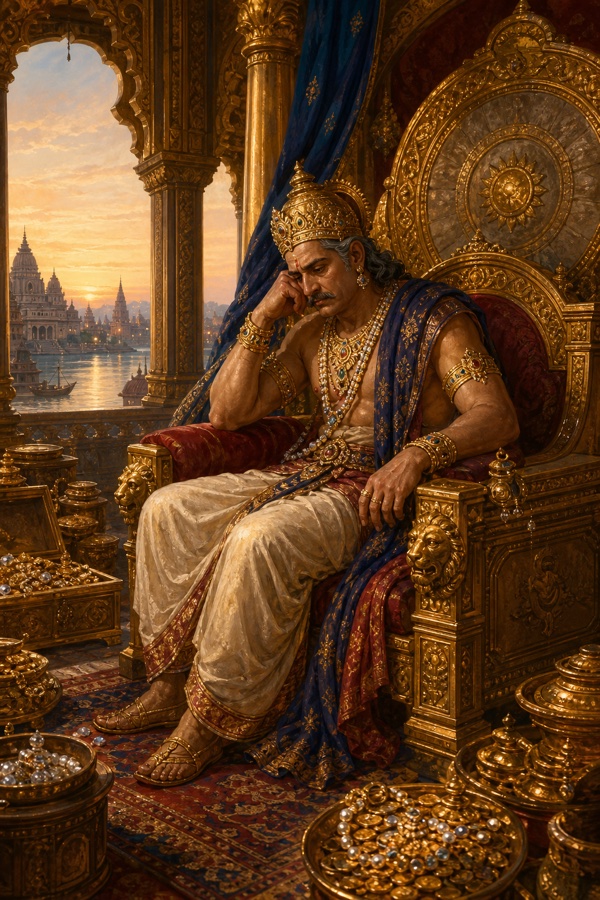
Amid all this splendor and dharma there was one emptiness. The generous king, who knew what is right, had no son to carry his line forward, and the want of a son had been a grief to him for years. One day, as he turned it over once more, a thought came to him: why not please the Deity with a horse-sacrifice, and win a son by it? The Ashvamedha is the greatest rite a king can undertake, and it takes more than a year to carry through. So the wise king took counsel with all his pure-minded advisers, made his resolve firm that the sacrifice must be performed, and said to Sumantra: “Best of my ministers, fetch me at once all my teachers, and my family priests with them.”
Sumantra went quickly and brought them together in a body: Suyajna, Vamadeva, Jabali, Kashyapa, and the sage Vasishtha, the king’s own family priest, and every other Brahmin of the first rank who could be found, all of them masters of the Vedas. The king received them with honor and spoke to them in sweet words full of dharma and purpose. “There has been no joy for me all these years,” he said. “I have been wailing for a son. To be blessed with one, I mean to please the Lord with a horse-sacrifice. I wish to perform it exactly as the scriptures prescribe. How am I to attain what I desire? Devise the plan for me.” The Brahmins, with Vasishtha at their head, acclaimed the proposal that had come from the king’s own mouth: “Well conceived! Excellent!” Then, well pleased, they gave him their advice. Let everything the horse-sacrifice requires be gathered, they said, and let the horse be released. Let a sacrificial ground be prepared on the northern bank of the holy Sarayu. Through this sacrifice, king, you will certainly get the sons you long for, since such a pious thought has come to you.
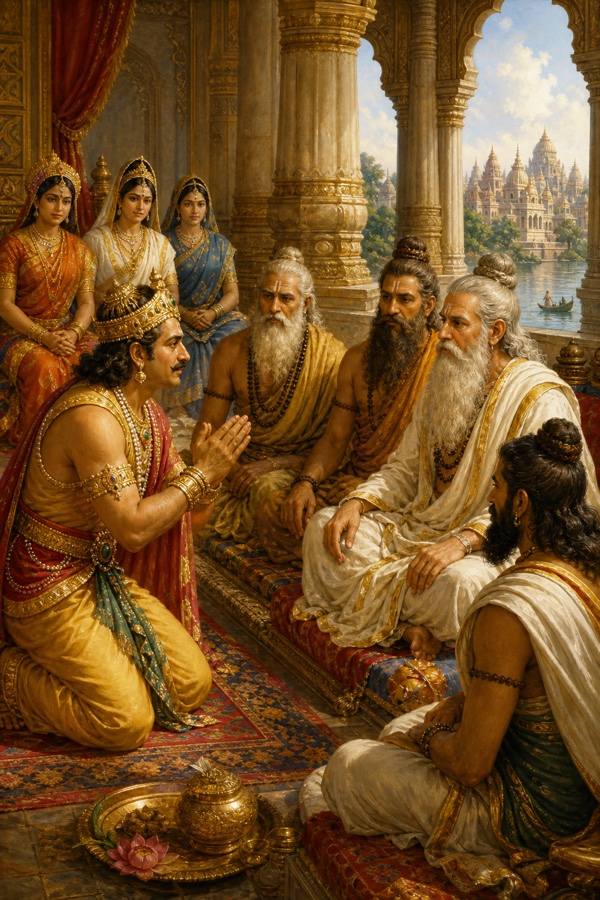
The king was pleased. With eyes rolling in delight he turned to his ministers. “On the orders of my preceptors,” he said, “let the materials for the sacrifice be made ready now. Let the sacrificial horse be released under the charge of four hundred kshatriya princes who can guard and control it, and let the arch-priest go with it. Let the sacrificial ground be prepared on the northern bank of the Sarayu. And let the rites that ward off evil be carried through in full, in their proper order, and as the scriptures ordain. Any king at all can bring this horse-sacrifice to completion, so long as no grievous fault creeps in, no essential rite left out in the course of so great a performance. For there are Brahmins who, through the omission of mantras and rites, have taken the form of ogres, and though they know the science of ritual, they are on the watch for the smallest slip, so that they can spoil the sacrifice and take the gods’ share for themselves. A man who undertakes a sacrifice without the prescribed procedure perishes on the spot. So see to it that this undertaking of mine is carried through by the rule. You are capable of it.” The counselors heard the king out in order, and, honored by him, answered, “So be it.” The Brahmins answered the same, the family priest and the others who knew what is right, and blessed Dasharatha, the best of kings, and with his leave they went out as they had come. When the Brahmins had gone, the emperor said to his ministers, “Let the sacrifice the priests have recommended be carried to its close,” and sent them away too. Then the king went into the inner apartments, to the queens who were his favorites and who by right would share in the sacrifice, and told them: “I am going to perform a sacrifice for the sake of a son. Prepare yourselves to take the consecration with me.” The words were the sweetest they had ever heard, and the faces of those glorious queens opened like lotuses when the cold season ends.
Sanatkumara’s prophecy and the tale of Rishyasringa
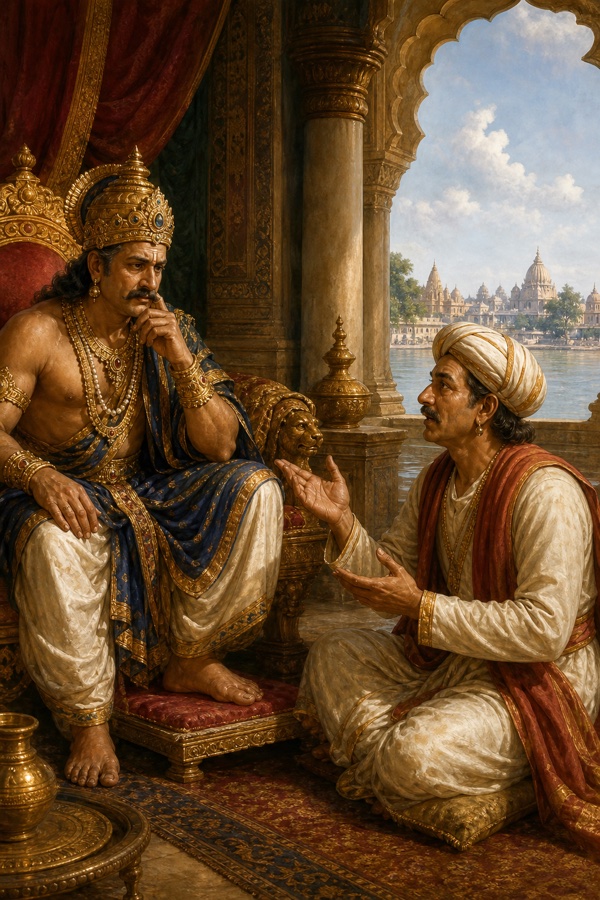
Sumantra was the king’s charioteer as well as his minister, and he heard this resolve as a man who knew more than he had yet said. He took the king aside and spoke to him in private. “Listen to an old story,” he said, “a popular one, which I heard myself in the course of an exposition of the Puranas. This very remedy, a horse-sacrifice, which Vasishtha and the other priests have recommended, I have also heard of as the theme of a legend. Long ago the all-knowing sage Sanatkumara, speaking among the seers, foretold the birth of four sons to you, and this is how the story ran. The sage Kashyapa has a son named Vibhandaka. To Vibhandaka a son will be born who will be known as Rishyasringa. Brought up in the woods and always roaming the woods alone, this lord of Brahmins will know nothing of the world beyond his constant service to his father. He will observe both kinds of brahmacharya that the three worlds know and the Brahmins praise. And time will roll past that young sage as he lives in the forest with his father for his teacher, tending the sacred fire and tending his illustrious father.”
“In those same days,” Sumantra went on, “the mighty Romapada will be the famous ruler of the land of Anga. Through some transgression of that king, a drought will fall on Anga, severe and terrible, a terror to every man. When the drought has set in, the king in his agony will call together his Brahmins, the ones advanced in learning, and say to them: you have heard of the deeds of mine that brought this drought, and you know the ways of the world. Prescribe a discipline for me, by which my sins may be atoned. So Romapada will beg those learned Brahmins, and they, all masters of the Vedas, will answer him: king, bring the sage Rishyasringa, son of Vibhandaka, here by every means you have. Bring that Brahmin, learned in the Vedas, to your capital with due reverence, and then, with a devout and unquestioning mind, give him your daughter Shanta in marriage by the rites the scriptures ordain. The king will hear them out and fall to musing: how is so mighty a sage to be brought? He will settle it in consultation with his counselors, and send his family priest and his ministers to bring the young hermit with honor. But the priest and the ministers will be distressed by the command. They will stand before him with drooping faces and say: we are not prepared to go; we are afraid of the rishi Vibhandaka, who is sure to curse anyone who tries to lure his son from his side. They will try to soothe the king, and after deliberating on what might work, they will lay a plan before him and say: we will fetch the young Brahmin to your capital, and in such a way that no blame falls on us. So it is that Romapada, ruler of Anga, will have the rishi’s son Rishyasringa brought to his capital by courtesans; and the god of rain will send down his clouds, and Shanta will be given to Rishyasringa in marriage. And Rishyasringa, your son-in-law, will get sons for you by pouring the oblations into the sacred fire. That is Sanatkumara’s prophecy, as I have repeated it to you.” Dasharatha, full of delight, said at once: “Now tell me how it was done. By what device was the sage Rishyasringa brought to Romapada’s capital?”
Rishyasringa lured, and his marriage to Shanta
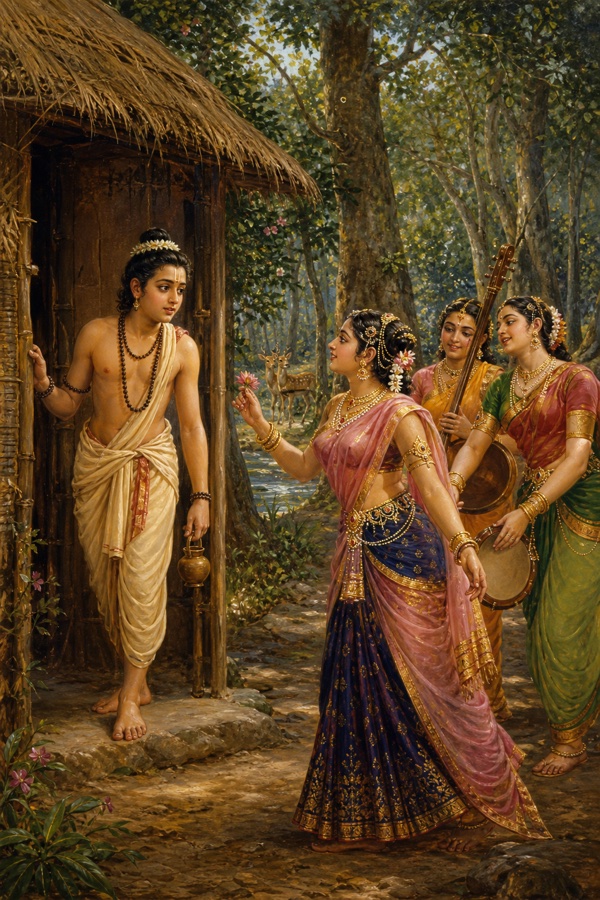
Sumantra answered him. “Hear it with your counselors,” he said, “exactly as it happened, how Romapada’s counselors brought the sage Rishyasringa to his capital. The family priest, with the ministers beside him, said to Romapada: we have thought it through, and the plan cannot fail. Rishyasringa lives in the woods, rich in austerity and in the study of the Vedas, and he knows nothing at all of women, or of the objects of the senses, or of the pleasures that go with them. We will have him brought to your capital in no time, by means of the pleasing things of sense that draw the minds of men. Let courtesans of comely appearance, beautifully adorned, go to his father’s hermitage. The young sage will receive them kindly, and they will lure him here by one device or another. Romapada said to his priest, ‘So be it.’ The priest instructed the counselors, the counselors did as they were told, and the courtesans were sent out with everything they would need.”
“Obedient to the king’s command, the foremost courtesans of Romapada’s capital entered the great forest and camped not far from the hermitage of the sage Vibhandaka, and from there they tried to catch sight of the rishi’s son. It was not easy. Rishyasringa was wholly self-controlled and never left the hermitage. Content in his father’s affection and his father’s care, he had never once stepped beyond its bounds, and from the day of his birth that hermit boy had never seen a man or a woman, or any living creature born in a town or in the countryside. Then, one day, providence took a hand. Rishyasringa walked out of the hermitage into the very area where the courtesans were camped, and saw those lovely women. They came toward him singing in melodious voices, dressed in every color, and put a question to him: ‘We want to know who you are, holy one, and how you live. Tell us: why do you roam this remote and lonely forest all by yourself?’ He had never seen such forms in that forest, and looking at those women, so worth the looking, a warmth rose in him, natural and unforced, and he wanted to tell them his father’s name and everything else besides. ‘Vibhandaka is my father,’ he said, ‘and I am his own son. My name is Rishyasringa, and my austerities are famous in this part of the land. Our hermitage is in this very forest, close by, lovely ones. There I will certainly offer you hospitality with all the proper ceremony.’ Hearing that, they all resolved to see the place, and the women followed him to the hermitage. Rishyasringa received them as they arrived exactly as the rite prescribes: ‘Here is water to wash your hands, and here is water for your feet; and here are roots and fruits, my offering to you.’ They accepted the hospitality. But all of them were uneasy and wanted to be gone quickly, for they were afraid of the rishi Vibhandaka, who had gone out on some errand at that moment and might return. As they were leaving they said, ‘Sage, accept these excellent fruits of ours in turn, and eat them without delay; they will do you good.’ Then they embraced him closely, and full of delight they gave him small round sweetmeats and every kind of dainty dish to eat.”
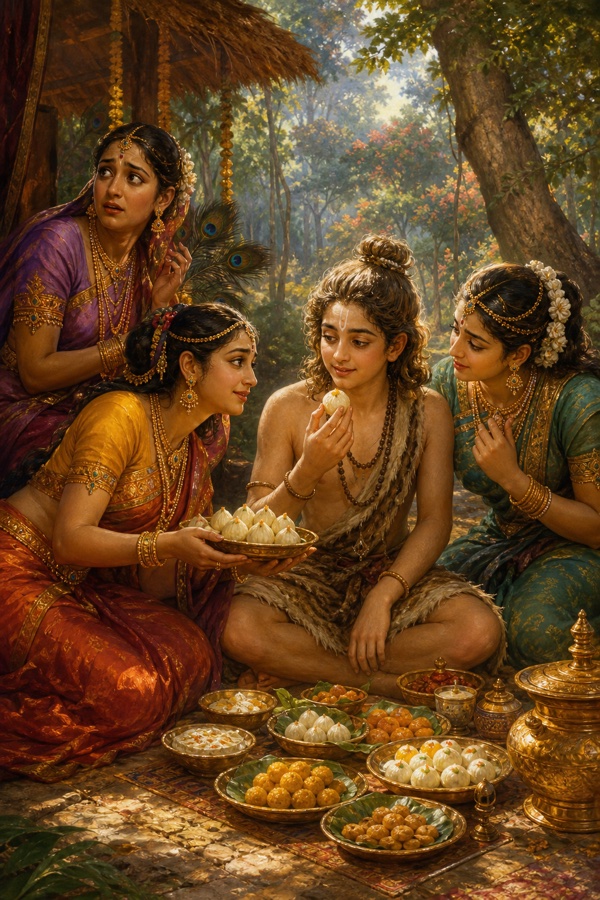
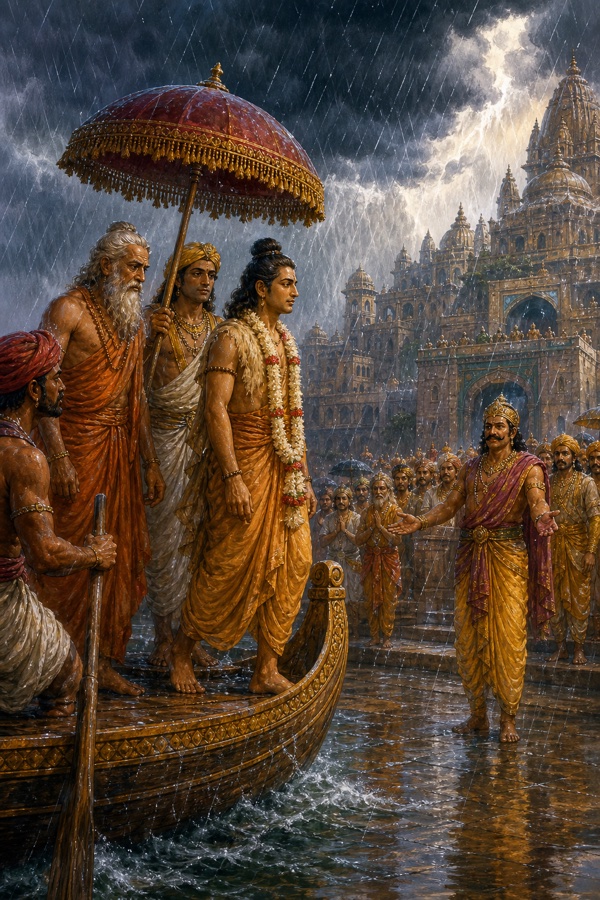
“He ate, and even as he enjoyed them, the young sage took them for fruit and nothing else, because no one who lived in the woods had ever tasted anything like them. The women took leave of the young Brahmin, told him of some sacred observance they had to perform, and left under that pretext, afraid of his father. When they had all gone, Rishyasringa, sprung from the loins of Vibhandaka of the line of Kashyapa, felt uneasy at heart, and a restlessness he could not name would not leave him. He thought of them in his mind again and again. The next day the young sage walked out to the place where he had seen the charming, well-adorned courtesans the day before. The moment they saw the sage coming from his hermitage, they went to meet him with delighted minds and said, ‘Come and visit our hermitage, gentle one. Roots and fruits of every kind are plentiful here, but there in our hermitage you will be entertained in a special way, far beyond this place.’ The prayer of them all was captivating to the heart, and he made up his mind to go with them. So the women took him, in a boat on the holy Ganga, to the capital of King Romapada. And while the Brahmin was still being escorted into the land of Anga, the god of rain sent down a sudden shower, and joy broke out everywhere. Romapada went out to meet the ascetic Brahmin who had come into his kingdom with the rain, bowed low, and touched the ground with his head. Fully composed, he offered the sage water for his hands with all ceremony, and begged of the sage one boon: that no anger should enter the mind of the sage or the mind of his father at his having been lured away from his father’s hermitage into this kingdom. Then he led Rishyasringa into the inner apartments, and there, with a tranquil mind and by the proper rites, he gave him his daughter Shanta, and the king was glad. So Rishyasringa, a sage without equal, was entertained with everything he could wish for, and he lived on there in Romapada’s palace with his wedded wife.”
Dasharatha brings Rishyasringa and Shanta to Ayodhya
“Now hear further, my king,” Sumantra said, “the wholesome words that the wise seer Sanatkumara, first among the beings of heaven, was pleased to speak next. In the line of the Ikshvakus, he said, a king will be born named Dasharatha, devout, renowned, and true to his promise. That king will make a friend of the ruler of the Angas, and the ruler of the Angas will have a daughter of great blessing named Shanta, whom Dasharatha, her real father, will give to him in adoption at his request, since Romapada has no child of his own. That ruler of the Angas, the son of King Anga, will be known as Romapada. And the renowned Dasharatha will go to him with this request: since I have no son, king whose mind is set on dharma, let the sage Rishyasringa, Shanta’s husband, perform with your leave a sacrifice for the continuation of my line. Romapada will hear the emperor’s request, turn it over in his mind, and resolve to grant it; and that generous king will at once part with the sage Rishyasringa, Shanta’s husband, who by then will have a son of his own. Then Dasharatha, with the Brahmin Rishyasringa at his side and his own anguish stilled by the sage’s mere presence, will perform, under his guidance, the sacrifice for a son, with his heart at peace. Hungry for fame, Dasharatha, who knows what is right, will fold his hands and beg that best of Brahmins to serve as priest and conduct the sacrifice for the sake of a male heir, and for a place in heaven that only a son can secure; and through that Brahmin the king will win what he desires. As the fruit of that sacrifice four sons will be born to him, of immense prowess and known to all created beings, and they will bring honor to their lineage. So the all-knowing and powerful sage Sanatkumara prophesied long ago in the Satya age, in a cycle of ages before this one.”
“Therefore, my king,” Sumantra finished, “since you are so eager for a son, go in person with a detachment of your troops and your animals and your vehicles and escort that sage here with honor and all ceremony, great king.” Dasharatha rejoiced at his charioteer’s advice. He laid it before Vasishtha and won his consent, and then he set out with his queens and his ministers for the place where that Brahmin lived, through forest after forest and across the rivers, until he came at last to the land where Rishyasringa was living. When he reached it, he saw the son of Vibhandaka at once, resplendent as fire, seated near Romapada. Romapada, delighted, offered worship in due order to the emperor and to everyone who had come with him, with particular reverence for a man who was his own esteemed friend; and he made known to the enlightened Rishyasringa his friendship with the emperor and the tie between the emperor and the sage himself: that Dasharatha was the real father of his wife, and had given Shanta to him in adoption when he was childless and asked for her. Rishyasringa returned the emperor’s salutation with honor. Dasharatha stayed with Romapada seven or eight days, honored greatly all the while, and then said to him: “King, let your daughter Shanta go with her husband to my capital, for a great undertaking is on foot there.” Romapada gave his word with a single “Amen,” and turned to the Brahmin: “Go to Ayodhya with your wife.” Rishyasringa answered at once, “So be it.” With the king’s leave he left for Ayodhya with his wife. Dasharatha and Romapada greeted each other with joined palms, clasped each other to the breast in affection, and rejoiced; and then Dasharatha took leave of his friend and set out for his own capital.
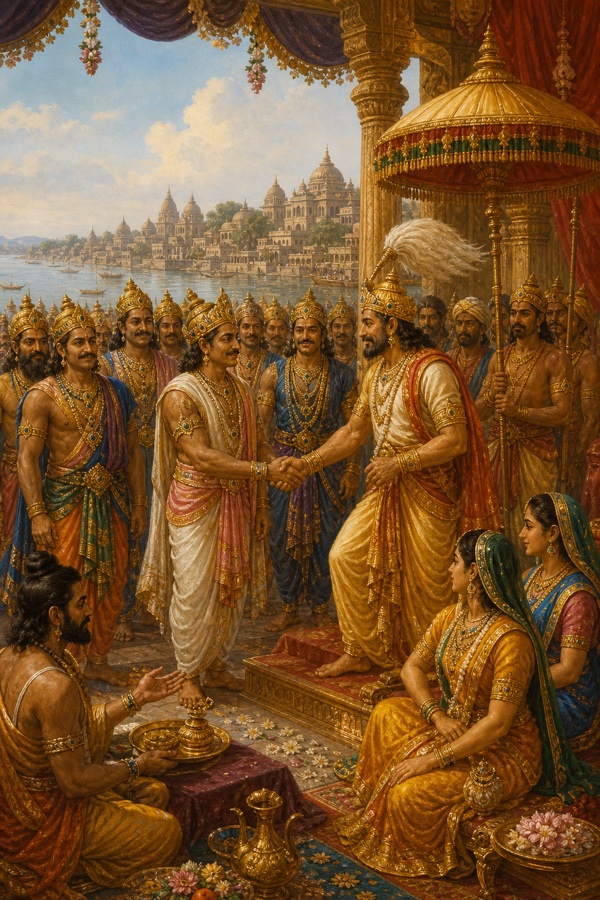
As he went he sent swift-footed messengers ahead with orders for the citizens of Ayodhya: “Let the whole city be decorated at once, and tastefully; sprinkle the streets with water and then sweep them, fill them with incense, and hang them with buntings.” The citizens, overjoyed to hear that the king was nearly home, did exactly as he wished, and did it at once. Then the king entered the decked city amid the blare of conches and the beating of kettledrums, with Rishyasringa walking ahead of him. The citizens were glad to see the Brahmin ushered into the city with such respect by their king, a king who had once fought at Indra’s side against the demons, and it seemed to them that the thousand-eyed Indra himself was leading Vamana, the son of the sage Kashyapa, into heaven. Dasharatha brought the sage into the inner apartments and honored him by the rule of the scriptures, and now that he had brought him under his own roof, he felt that the purpose of his life had been accomplished. And when the queens saw large-eyed Shanta come in with her husband, and with a baby in her arms, they were filled with a joy that came from love. Honored by the queens and by the king himself, Shanta lived there happily for some time with her husband and her child.
The consent and blessing of the sacrifice
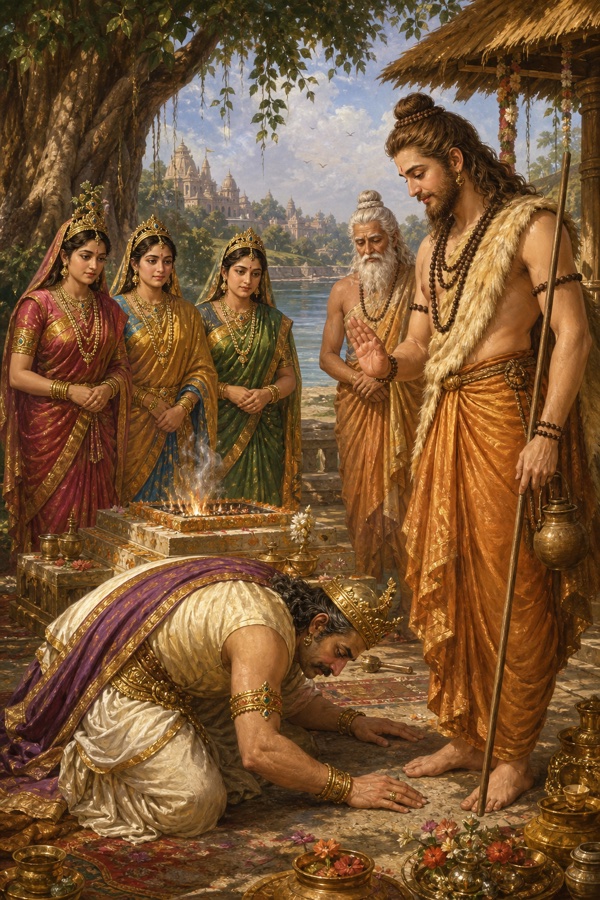
A considerable time passed after Rishyasringa’s arrival, and then an unusually lovely spring set in, and with the spring the wish to hold the sacrifice for a son rose again in the emperor. He went to Rishyasringa, who shone with the splendor of a god, and touched the ground with his head, and sought the Brahmin’s help in conducting a sacrifice for the growth of his line and the winning of heaven. The sage said to the king who ruled the whole earth: “Let the requisites for the sacrifice be made ready and your horse let loose, and let a sacrificial ground be prepared on the northern bank of the Sarayu.” The king said to Sumantra: “Sumantra, call quickly the Brahmins who are masters of the Vedas and the priests who can expound them: Suyajna and Vamadeva, Jabali and Kashyapa, my family priest Vasishtha, and every other Brahmin of the first rank there may be.”
Sumantra, whose stride was never slow, went in haste and brought them all together, every one a master of the Vedas. The king received them with reverence and spoke to them in words that were reasonable and sweet and full of dharma and purpose. “There is truly no joy for me,” he said. “All these years I have suffered for want of a son. So I will please the Lord with a horse-sacrifice; that is my resolve. I intend to worship God through the rite called the Ashvamedha, and through the spiritual power of Rishyasringa I will certainly reach every end I desire.” All the Brahmins, Vasishtha their leader, said “Amen” and acclaimed the proposal that had come from the king’s lips, and those headed by Rishyasringa answered him: “Let everything the sacrifice needs be gathered and your horse released, and let the sacrificial ground be prepared on the northern bank of the Sarayu. A pious thought has come to you for the sake of a son, and you will surely get four sons of immense prowess.” The king was glad to hear the Brahmins’ blessing, and he spoke to his ministers in joy: “Let the requisites be gathered quickly, on my elders’ instructions. Let the sacrificial horse be released under the charge of four hundred kshatriya princes who can guard and control it, with the chief priest beside them. Let the sacrificial ground be prepared on the northern bank of the Sarayu, and let the rites that avert evil be gone through in full, in order, and by the ordinance of the scriptures. Any king can accomplish this horse-sacrifice, so long as no grievous fault creeps into it, no essential rite omitted; for the Brahmins who have become ogres through the omission of mantras and rites are learned in the science of ritual, and they watch for the smallest slip so as to spoil the sacrifice and take the gods’ share, and the man who undertakes a sacrifice without the prescribed procedure perishes on the spot. So see to it that this undertaking of mine is carried through by the rule. You are capable of it.” The counselors answered the emperor’s command with “Let it be so,” and did as they were told. The Brahmins praised the emperor, who knew what was right, and with his leave went home as they had come; and when the Brahmins had dispersed the king dismissed the counselors and went into the inner apartments.
Preparing the sacrifice, and the summoning of kings
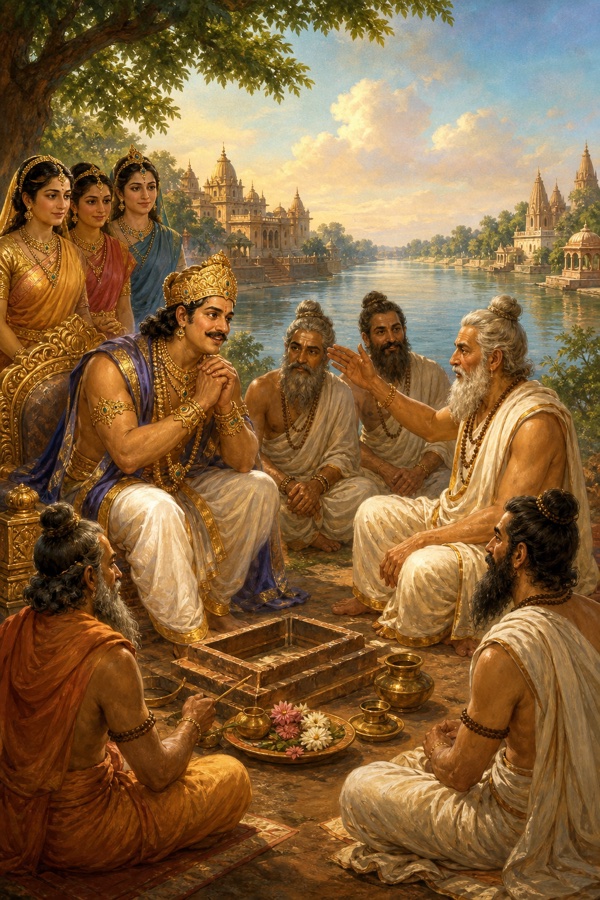
Spring came round again, and with it one full year was complete. The consecration for a horse-sacrifice, the Kalpa Sutras say, is taken at the end of a year, when the horse that was loosed comes home, and the powerful king Dasharatha now went to Vasishtha to begin the rite for a son. He greeted Vasishtha and his wife Arundhati, paid them homage as the scriptures ordain, and made his humble prayer: “Holy one, let the sacrifice I mean to perform be begun as the scriptures enjoin, and let steps be taken so that no ogre can throw an obstacle in the way of any part of it. You are my selfless well-wisher, my supreme preceptor, and a great soul. The whole burden of this sacrifice that has come to me is to be borne by you alone.” “Amen,” said Vasishtha. “I shall do all that you have asked, and without doubt.” Then Vasishtha called together the elderly Brahmins who were versed in ritual, and the elderly and most devout Brahmins skilled in the architecture of sacrifice, and the servants engaged for the whole session, the artists, the carpenters, the men who would dig the sacrificial pits, the astronomers and the artisans, and the actors and dancers too, and the pure-minded men learned in sacred lore whose knowledge ran wide, and said to them all: “Take up your duties for the sacrifice, each of you, under the orders of His Majesty.”
“Let bricks be brought quickly, in many thousands,” Vasishtha said, “and let palaces be built that befit a monarch, stocked with food and drink of every kind. Build good houses for the Brahmins, strong and well supplied with fruit and every article of food and drink, in abundance. Build spacious dwellings and dig wells for the citizens, and raise separate mansions for the feudatory princes who will come from far away. Erect stables for the horses and stalls for the elephants of the royal visitors, dormitories for the public, and large houses for the warriors of other states and for our own. Every house is to be stocked with edibles and furnished with whatever its guests may desire, and excellent food is to be given to the citizens and to the people from the countryside, respectfully and as the scriptures ordain, never carelessly, so that people of every order receive their hospitality with due honor. Let no disrespect be shown to anyone, even under the pull of passion or anger. And let those men and artisans who stay engrossed in their work for the sacrifice be shown hospitality in a special degree, in order of their seniority. See that everything is done in full for all who are honored with gifts of money and with food, and that nothing is left undone. Act, all of you, with minds full of love, so that this is ensured.” They came before Vasishtha and answered him: “Everything will be carried out as you wish, and nothing will remain undone. We will do it as you have enjoined, and nothing will be wanting.”
Then Vasishtha called Sumantra. “Invite the kings,” he said, “and whoever on earth is pious, and Brahmins, kshatriyas, vaishyas, and shudras in their thousands. Bring men from every land, and treat them with honor. And go yourself, with great respect, to Mithila, and bring the famous and blessed Janaka, the heroic and truthful king of Mithila, before anyone else. I name him first because I know him for a relation of the emperor already settled by fate, the future father-in-law of his sons. Bring in person, too, the friendly and godlike ruler of the kingdom of Kashi, who always speaks kindly, they say, and whose character is noble. Bring the famous and deeply devout king of the Kekayas, the aged father-in-law of Dasharatha, and bring his son with him. Bring King Romapada with great respect, the ruler of the Angas, the wielder of a mighty bow and the well-known friend of our king, and his son with him. Bring Bhanuman, the king of Kosala, most respectfully, and with due honor Praptijna, the heroic and large-hearted ruler of Magadha, a leader of men and learned in all sacred lore. Take His Majesty’s orders and invite the eminent rulers of the eastern territories, and the monarchs of Sindhusauvira and of Saurashtra. Bring all the rulers of the south. And whatever other friendly monarchs there are on the face of the earth, gather them quickly with their followers and relations, sending distinguished ambassadors under His Majesty’s orders.”
Sumantra heard Vasishtha’s command and at once charged capable men with the duty of bringing the kings; and then, on the sage’s orders, that wise minister set out in haste himself to bring with honor those whom Vasishtha had marked out for him to fetch in person. Everyone who had been set to work on the sacrifice reported to the eminent sage what they had accomplished, down to the last task, and Vasishtha, pleased with their report, said to them all: “Let no gift be made to anyone with disrespect, or even with irreverence. A gift made with contempt brings ruin on the giver; there is no doubt of it.” Some days after Sumantra and the others had gone, the kings began to arrive, and they came bearing presents of great value for the emperor: jewels and pearls, garments, ornaments. Vasishtha, delighted at their coming, said to the king: “The kings have arrived at your command, and I have received every one of them with the hospitality he deserves. Everything the sacrifice needs has been made ready by your men, and with great care. So go now to the sacrificial hall close by and begin. Inspect the hall; it is furnished on every side with everything that could be desired, gathered by your men, and it looks as though it had been provided by your mere wish.” On the recommendation of both sages, Vasishtha and Rishyasringa, Dasharatha went in procession to the sacrificial hall on a day marked by a propitious constellation. All the foremost Brahmins, with Vasishtha as their acharya and Rishyasringa walking at their head, reached the hall in a body and that same day began the sacrifice by the ordinance of the scriptures and in the prescribed order; and the emperor and his consorts went through the ceremony of consecration that qualified them to perform it.
The rite of the Ashvamedha
The horse came home at the end of the twelve months after its release, and on the northern bank of the Sarayu the Ashvamedha began. The leading Brahmins set Rishyasringa at their head as the Brahma, the priest whose office is to oversee the whole rite, and took up their own functions in the great horse-sacrifice of that king; the other three priests who officiate at a sacrifice are called the Hota, the Adhvaryu, and the Udgata.
The officiating priests, every one a master of the Vedas, performed their duties by the ordinance of the scriptures, following the procedure laid down in the Kalpa Sutras and the order of sequence the shastras prescribe. They went through the Pravargya, the rite in which fresh milk is poured into a heated vessel, and the lesser sacrifice called the Upasada, as the scriptures require, and beyond the letter of the shastras they performed every additional rite as well. Then the eminent sages, full of delight, offered worship to the gods whom the rites were meant to please, from the morning pressing of the Soma through the midday pressing and the third. The oblation meant for Indra was duly offered to him, and the creeper called Soma, the king of herbs, which drives away all sin, was crushed on stone and its sap drawn out, and the midday pressing began in due order. Consulting the shastras for the procedure, those Brahmins then carried out the third pressing on behalf of the king. With incantations whose every letter, sound, and intonation had been learned exactly in the years of their study, Rishyasringa and the others invoked into that hall the greatest of the gods, Indra at their head; the Hotas called them with charming invocatory mantras sweetened with songs of praise, and offered the gods their oblations according to their rank. In that sacrifice no oblation was wrongly offered and no rite was omitted through ignorance, for every act was seen to go with the uttering of its mantra, and the priests did everything so as to avoid any breach of procedure. Through all those days no priest was ever seen exhausted, or hungry, or even thirsty, and there was no Brahmin there, at that sacrifice above all, who was not learned and did not have at least a hundred attendants and pupils of his own.
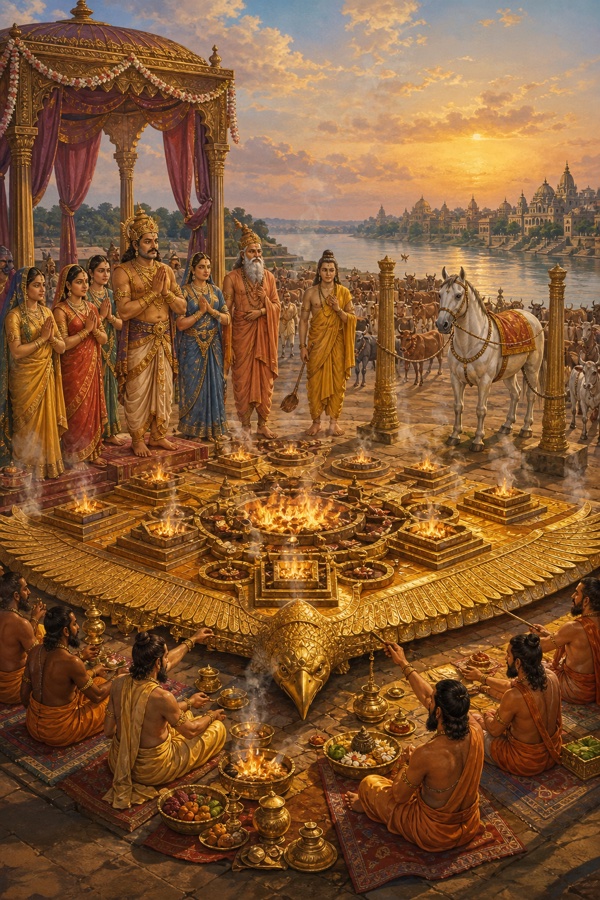
Brahmins and the members of the other twice-born orders took their food every day at the sacrifice, and so did the shudras and the rest of the serving classes. Ascetics, celibate students, forest-dwellers, and renunciants ate under its auspices; so did the old and the sick, and women, and children. The dishes were so delicious that no one ever seemed to have had enough, though they were fed day and night. Men in charge pressed the servers, “Give food again and again, and clothing of every kind,” and many hands gave freely, food and raiment together. Heaps of rice cooked fresh each day in the traditional way stood on the sacrificial grounds like mountains. Men and whole companies of women who had come from different lands were fully satisfied at the emperor’s sacrifice. The noble Brahmins spoke well of the food they ate, calling it properly cooked and tasty, and Dasharatha heard them say, “We are fully sated. May you be blessed!” Richly adorned men served the Brahmins, and others, wearing earrings of highly polished gems, waited on the servers in their turn. In the intervals between one pressing of the Soma and the next, intelligent and eloquent Brahmins argued many reasoned points, each intent on getting the better of the other. Day after day those expert Brahmins discharged every function by the rule, as the elders directed. No Brahmin who held the office of a sadasya, whose duty was to watch and correct any mistake, was ignorant of the six branches of knowledge that serve the Vedas: phonetics, grammar, prosody, etymology, astronomy, and the science of ritual. Every one of them kept sacred vows, and every one was deeply learned and skilled in argument.
When the time came to raise the sacrificial posts, six posts of bilva wood were set up, and six of khadira, each beside a bilva post, and six more of palasha. One post of shleshmataka is prescribed, and posts of deodar, the Himalayan cedar; of these only two are prescribed for the Ashvamedha, and they stood six aratnis apart. All of them had been prepared beforehand under the direction of men versed in the scriptures and expert in the technique of sacrifice, and plated with gold to grace the rite. Those twenty-one posts stood twenty-one aratnis high, a forearm’s length to each aratni, and each was dressed in a single piece of cloth. Shaped by carpenters, all were strong and had been fixed as the scriptures ordain; all were eight-sided, and all were smooth to the touch. Draped in cloth and worshiped with flowers and sandal paste, they shone like the seven sages of the Great Bear in the sky. Bricks had been made to the measurements the scriptures give, and with them the priests skilled in the architecture of sacrifice built the altar. Expert Brahmins set the sacrificial fire in that altar with due ceremony, and the fire, in the shape of the altar that held it, took the form of Garuda with his wings and tail spread, facing east, with wings of gold, for the sides of the pit were built of golden bricks. It was three times the size of an ordinary altar, and it held eighteen fire-pits where an ordinary altar holds six. Beasts, serpents, and birds, as the scriptural injunctions prescribe, had been tied to the posts as offerings to particular gods, and the sacrificial horse and the water creatures, the turtle and the rest, that had been brought for the rite were bound at that same moment by the priests, exactly as ordained. Three hundred beasts were tied to the posts at that time, and among them was the finest of all the horses that King Dasharatha owned.
There Kausalya, and the other queens with her, consecrated the horse on every side, sprinkling it with water and performing the other rites, and then touched it with great joy with three swords. Then, with the intent of gaining religious merit, Kausalya spent one night beside that horse, swift as Garuda, the king of birds, with a mind perfectly composed. At the close of the night the four archpriests of the sacrifice, the Hota, the Adhvaryu, the Udgata, and the Brahma, brought the king’s second wife, and with her the first wife, the chief queen, and the third, into the ritual contact with the horse.
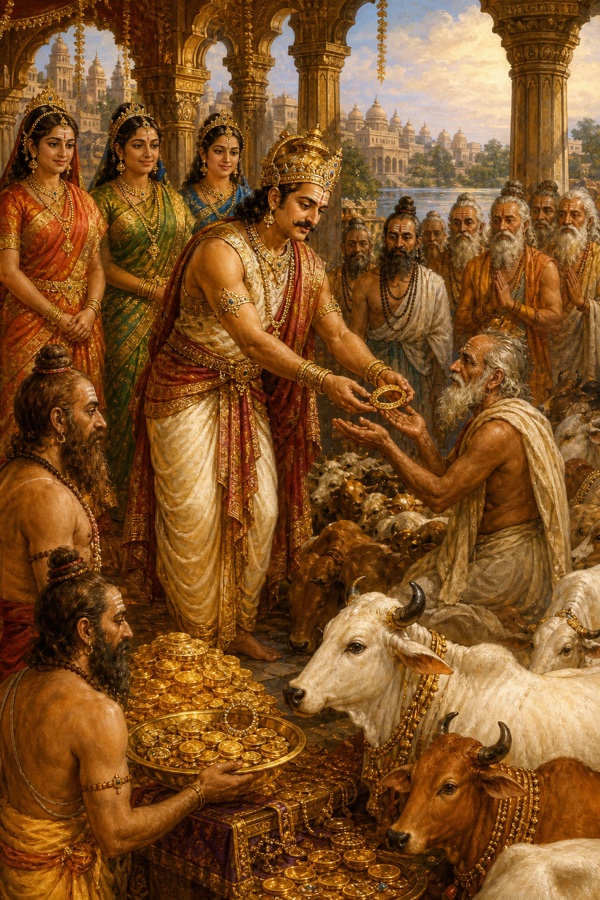
The chief priest, who had mastered his senses and had great skill in the sacrificial rites, took the edible part of the tuber called ashvakanda, the ashvagandha, and cooked it by the ordinance of the scriptures, and at the proper moment the king breathed in the odor of its steam, and drove away by it the sin that had stood between him and a son. Then all sixteen Brahmin priests of the sacrifice, together, cast into the fire with due ceremony every part of the horse that the rite requires to be offered. At other sacrifices the offering is placed on the boughs of a plaksha tree; at the Ashvamedha it must be placed on mats of cane. The Kalpa Sutras and the Brahmins declare that the horse-sacrifice has three days given to the pressing of the Soma: the pressing of the first day is called the Chatushtoma, that of the second the Ukthya, and that of the third the Atiratra. Toward the close of the horse-sacrifice King Dasharatha performed many secondary sacrifices as well, all of them enjoined by the shastras: the Jyotishtoma and the Ayushtoma, two rounds of the Atiratra, the Abhijit and the Vishvajit, and two rounds of the Aptoryama. These were the eight great sacrifices performed on that occasion.
At the conclusion of the sacrifice the emperor gave away the earth as the sacrificial fee: the eastern quarter to the Hota, the western to the Adhvaryu, the southern to the Brahma, and the northern to the Udgata. That is the fee prescribed for the great sacrifice of the Ashvamedha, which Brahma, the self-born creator, performed for the first time. Having concluded the great rite by the ordinance of the scriptures, the king gave the priests who had officiated the earth itself, as he had promised, and the gift filled Dasharatha with delight. But the priests, all of them, said to the sinless king: “You alone are able to protect the whole earth. We have nothing to do with it, and we could not maintain it. We are given to the study of the Vedas; give us anything you like in its place. Bestow on us some superb gem, or gold, or cows, or whatever may be to hand. We have no use for the earth.” So, on the word of the Brahmins who were masters of the Vedas, the king, who acknowledged no other ruler as his own, bestowed on them ten lakh cows, ten crore gold coins, and four times as many coins of silver.
The priests together handed the whole of that wealth to the sage Rishyasringa and the wise Vasishtha to be divided fairly, and when it had been shared out evenly through the two of them, all those eminent Brahmins were glad at heart and said, “We are highly pleased.” Fully composed, the king then gave one crore gold coins on that same occasion to the Brahmins who had come from outside to witness the sacrifice. When there was no money left in hand to give, Dasharatha, the delight of Raghu’s race, at once took one of his own fine bangles from his wrist and gave it to a poor Brahmin he did not know, who had asked him for a gift. With the Brahmins satisfied, the king, who loved Brahmins and whose every sense was alight with joy, bowed to them; and as that generous king lay prostrate on the ground, the Brahmins pronounced blessings of many kinds over him in fitting words. Now the king’s heart was glad. He had completed a sacrifice that no other equals, one that dispels the sins standing in the way of a son and carries a man to heaven, and that is hard to carry through even for the greatest of kings. He turned to Rishyasringa on that very occasion and said: “Now, sage, be so kind as to do next whatever will promote my line.” “I shall do it,” the sage answered, “and four sons will be born to you who will carry your race forward.” The emperor felt great joy at the sweetness of that assurance, bowed low, and repeated his prayer to Rishyasringa.
The Putreshti, and the gods’ plea against Ravana
Rishyasringa pondered a little, deeply, over what should be done next, and then, coming back to his surroundings, the sage who knew the Vedas so well said to King Dasharatha: “For the sake of securing sons to you I will perform a sacrifice that procures a male heir, a rite famous for its unfailing effect, with the help of the mantras taught in the Atharvaveda.” This was the Putreshti, the sacrifice for sons. Then Rishyasringa began that rite, for the birth of four sons to Dasharatha, and poured the oblations into the sacred fire by the procedure the sacred texts show. And the gods gathered there: Brahma among them, with the gandharvas, the siddhas, and the greatest of the seers, come in person, unseen by any mortal, to take their share of the offerings by the established rule.
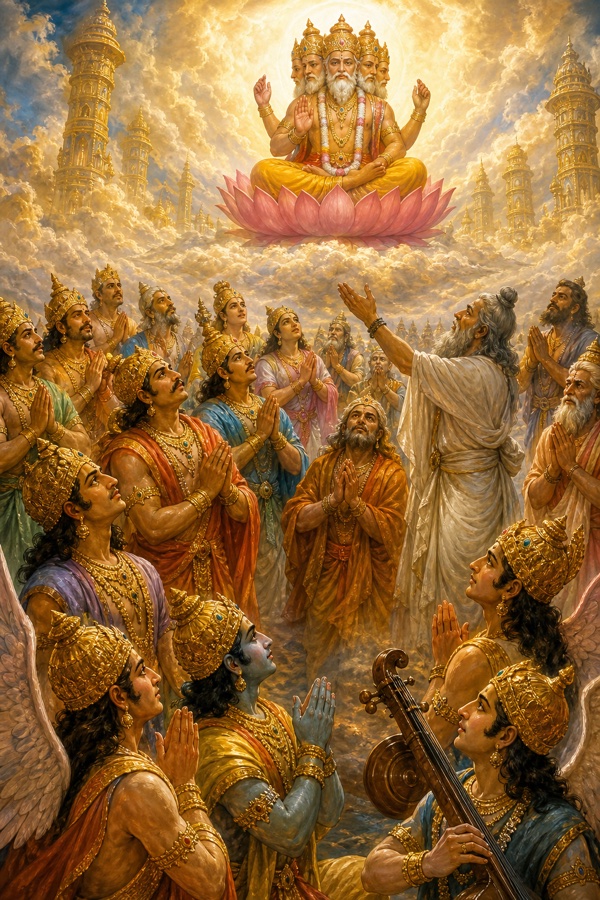
In that gathering, assembled for the sacrifice and ranked each according to his station, the gods went to Brahma, the maker of the universe, with a prayer. “Lord,” they said, “by the prowess he gained through your grace, the ogre named Ravana is molesting us all, and we cannot subdue him. You granted him a boon while he was practicing austerities, pleased with him as you were, and we have honored that boon by bearing every wrong he has done. That evil-minded creature is harassing all three worlds; he hates whoever prospers, and he means to overpower even Indra. Drunk on your boon and hard to subdue, he tramples the rishis and the yakshas, the gandharvas and the Brahmins, and the demons too. The sun does not scorch him in high summer, the wind does not blow hard past him, and the ocean, whose waves never rest, goes still at the sight of him and does not stir. Lord, that ogre of frightful aspect has us badly afraid. Be pleased to devise some means of putting an end to him.”
Brahma pondered a while and then said, “I am glad. The means of destroying that evil-minded creature has come to my mind. ‘Let me be incapable of being killed by gandharvas and yakshas, by gods and by ogres’: that was the prayer he addressed to me, and ‘So be it’ was my answer. Out of contempt for them, the ogre did not mention human beings that day. So he is doomed to die by the hand of a human being alone; in no other way is there any death for him.” All the divinities and the great rishis gathered there heard that happy revelation from Brahma’s lips and were filled with the deepest delight.
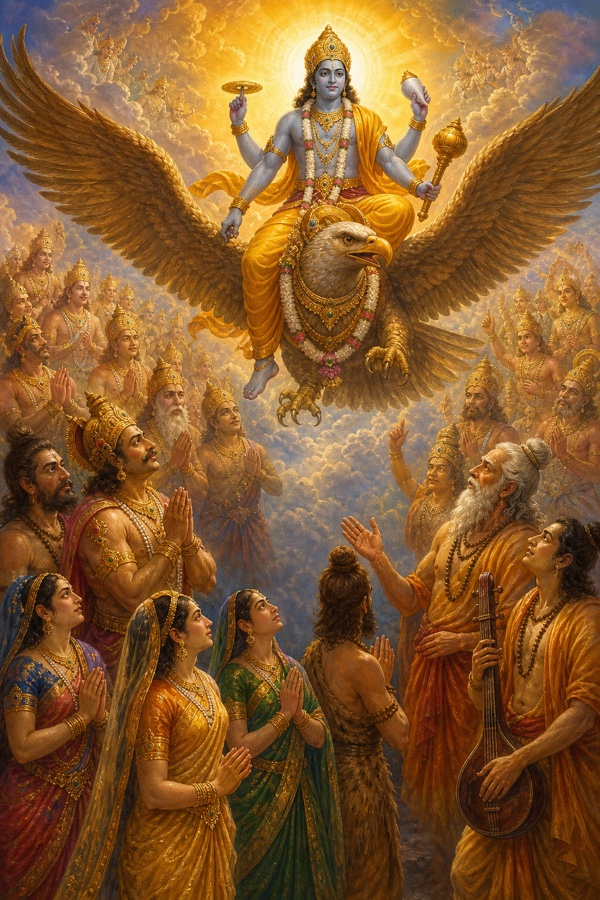
Just then Vishnu arrived, the Lord of the universe, riding on the back of Garuda, the king of birds, like the sun riding on a cloud: blazing with splendor, clad in yellow, a conch, a discus, and a mace in his hands, a pair of armlets of refined gold on his arms, and the greatest of the gods singing his glory. He greeted Brahma and took his place in that assembly, composed in mind, and all the gods bowed low before him and prayed. “For the good of the worlds, Vishnu, we are going to lay a burden on you. Take the form of four persons, all-pervading Lord, and be born as a son to the generous Dasharatha, king of Ayodhya, who knows what is right and shines like the great rishis, through his three wives, Kausalya, Sumitra, and Kaikeyi, who are as Hri, Shri, and Kirti themselves, the goddesses of modesty, fortune, and fame. Take on a human form through them, Vishnu, and make short work in battle of Ravana, the scourge of the world, who has grown so strong that no other god can kill him. In the excess of his prowess that fool, with the whole disposition of an ogre in him, is oppressing the gods, the gandharvas, the siddhas, and the noblest of the rishis; because of him the rishis, gandharvas, and apsaras who used to sport in the Nandana grove, Indra’s own pleasure garden, have been knocked out of heaven. To be rid of him we have come here, and the siddhas, gandharvas, and yakshas with us, and the hermits too, and we have sought you as our protector. You are the supreme refuge of us all. Resolve to descend to the mortal plane and destroy the enemies of the gods.”
Extolled by the gods, Vishnu, the ruler and the first of the gods, adored by all the worlds, answered the assembly, Brahma at its head, all of them given to dharma: “Give up all fear. May good come to you. In your interest I will kill Ravana on the field of battle, that cruel and formidable ogre who is so hard to overpower and is the terror of gods and rishis, and I will kill his sons and grandsons with him, his ministers and counselors, his kinsmen and relations. And I will remain on the mortal plane, ruling this earth, for eleven thousand years.” Having granted that boon, Vishnu, whom even the gods adore, turned his thoughts to Ayodhya, the place of his coming birth on earth; and the Lord whose eyes are like the petals of a lotus, taking on the form of four persons, chose King Dasharatha to be his father in that descent. Then the gods, the rishis, and the gandharvas, with Lord Rudra among them and companies of apsaras, extolled Vishnu, the slayer of the demon Madhu, in hymns that told of his transcendent nature: “Destroy that notorious and arrogant Ravana utterly, the ogre of terrific energy, the enemy of Indra, the scourge of ascetics and the terror of hermits, whose vanity has no bounds and whose tyranny makes people scream. Kill that Ravana of terrible prowess, at whose cruelty the world wails aloud, with his army and his kinsmen, and rid your devotees of their anxiety; and then come back to Vaikuntha, your everlasting home, which you yourself guard, and where no frailty of partiality or prejudice has ever entered.”
The gift of the payasa, and its division among the queens
So the greatest of the gods appealed to him, and Narayana, the all-pervading Vishnu, though he knew everything already, answered them in sweet words: “What is the device, gods, by which I can destroy that ruler of the ogres and uproot the thorn in the side of the rishis?” The gods answered the immortal Lord: “Assume a human form, and make short work of Ravana in battle. That creature practiced severe austerities for a long time, and Brahma, the maker of the universe and the progenitor of all created beings, was greatly pleased with him. In his gratification Brahma granted the ogre a boon: he would have no fear from any species of created being except man. When he received that boon long ago, men were nothing to him; he left them out of his reckoning altogether. Elated by Brahma’s gift, he is oppressing all three worlds and carrying off women. So his death has been ordained at the hands of a man.” Hearing that submission of the gods, Vishnu chose King Dasharatha to be his father.
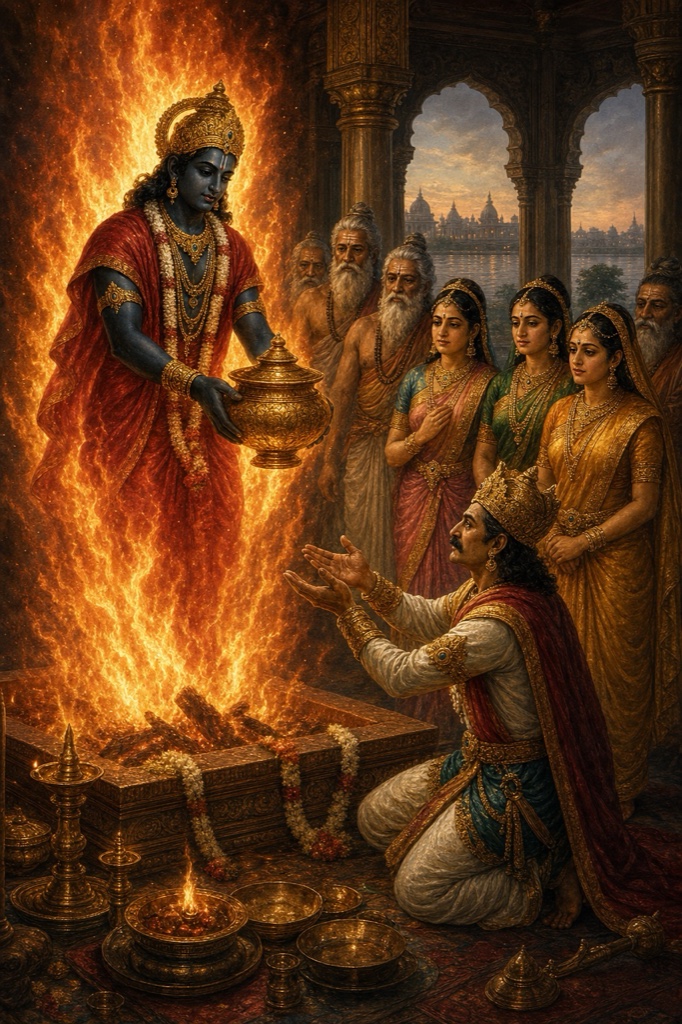
At that very hour the king, who had no male issue and longed for a son, was performing the sacrifice that would procure him one, a king of great splendor and the destroyer of his enemies. Vishnu had made up his mind; he took leave of Brahma, the progenitor of creation, and vanished, even while the gods and the great rishis were still worshiping him. And then, out of the Ahavaniya fire, the fire of the sacrificer, a being rose: an extraordinary being of matchless splendor, exceptional prowess, and uncommon strength. His skin was dark and his face ruddy; his voice was the sound of a great kettledrum; he was clad in red, and soft excellent hair, like a lion’s, covered his body, his lower face, his upper lip, and his head. Auspicious marks were on his body and celestial jewels adorned it; he stood as tall as a mountain peak and he strode like a proud tiger. He shone like the sun, he looked like a flame of blazing fire, and in both his arms he carried a large basin of refined gold, full of celestial payasa, milk boiled with rice and sugar, covered with a silver lid, as though it were a thing of magic, and he carried it the way a man carries his beloved wife.
He looked at King Dasharatha and spoke. “Know me, king, for a messenger of Vishnu, who protects all that lives, come here from his realm.” The king answered him with folded hands: “Divine being, may my heartfelt welcome be acceptable to you. What shall I do for you?” Vishnu’s servant said: “By worshiping the gods with a horse-sacrifice and with a sacrifice for a son, you have secured this reward today. Receive this payasa, king, prepared by the gods; it procures a son, and it brings wealth and promotes health as well. Give it to those of your wives who are worthy of you, who share your order and your virtues, with the words, ‘Eat it, all of you.’ Through them, when they have eaten it, you will gain the four sons for whom you have been performing sacrifices.” “So be it,” said the king, and with his head bowed low he accepted in delight that golden basin full of heavenly food, granted by the Lord himself. He greeted that extraordinary being of delightful aspect, and in supreme joy walked around him in reverence, keeping him on his right. Dasharatha was as happy to have the payasa the gods had made as a pauper is when he stumbles on riches. And that blazing being of wonderful appearance, his errand done and the payasa handed over, vanished into the fire itself.
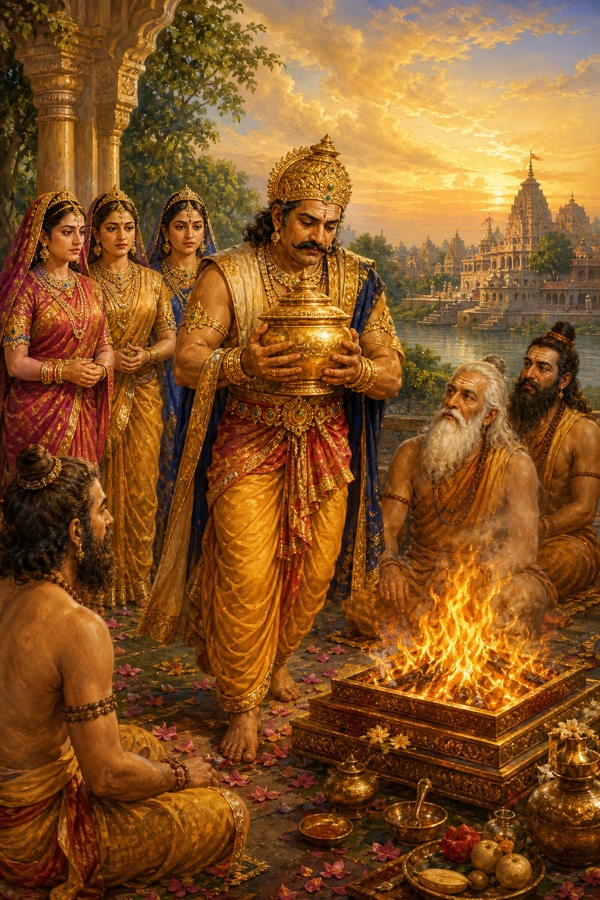
The king hurried to the inner apartments, and the joy on his face lit them as the beams of the autumn full moon light the sky. The moment he entered, he said to Kausalya, his eldest wife: “Accept this payasa. It is meant to give you a son.” Wanting a son for each of them, the king gave half of the payasa to Kausalya, and half of the remaining half to Sumitra, his second wife. Then he gave half of what was left to Kaikeyi; and then, after a moment’s reflection, the highly intelligent Dasharatha gave the last half of that nectar-like payasa to Sumitra once more. So the king portioned out the payasa to all of his wives, each separately. Those noble queens took the apportionment as a singular honor, their minds alive with the joy of receiving it. They ate the excellent payasa, each apart, that same moment, and before long each felt within her womb the presence of a child whose splendor rivaled the fire and the sun. Seeing his queens with child, quickened so soon, the emperor, who had gained what he desired and whom Indra himself and the hosts of the siddhas and the rishis now honored as the father-to-be, felt as glad as Indra does in heaven.
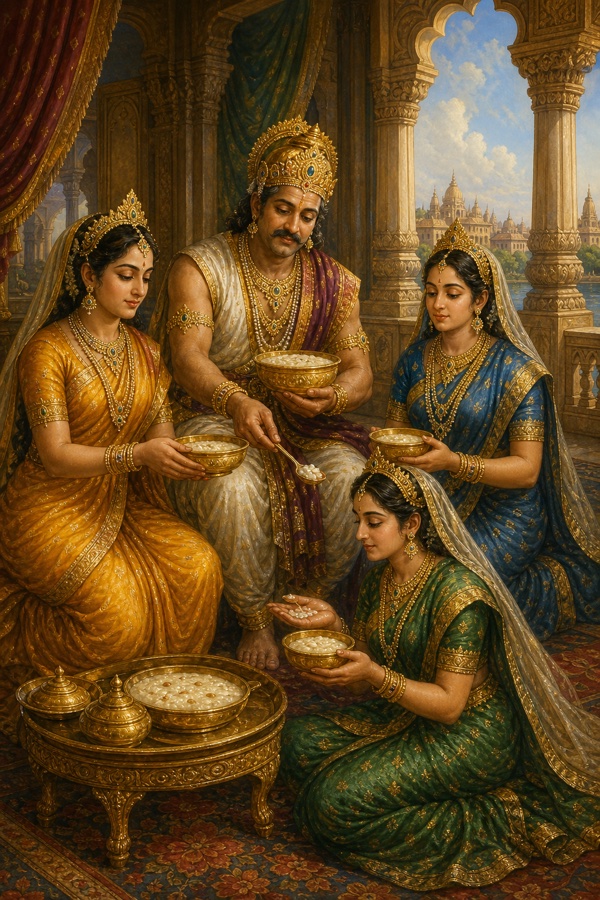
The birth of the vanara host
Vishnu had all but taken on the role of sons to that king, and now Brahma, the self-born, gave all the gods a command. “Beget mighty part-manifestations of yourselves,” he said, “able to take any form at will, able to help the valiant Vishnu, who keeps his promises and wishes us all well. Through the principal apsaras, through the wombs of the gandharva women, the maidens of the yakshas and the nagas, the she-bears and the vidyadhara women, the kinnara women and the she-monkeys, procreate sons in the form of monkeys: equal to yourselves in strength, versed in conjuring, gallant, swift as the wind, expert in policy, gifted with intelligence, equal to Vishnu in prowess, unkillable by any enemy, skilled in every contrivance, with bodies of an ethereal make, masters of the use and the recall of missiles, and like the gods who feed on ambrosia.”
“Jambavan, the king of the bears, I have already begotten,” Brahma said. “He came out of my mouth all of a sudden, as I was yawning.” The gods accepted the command and begot sons in the form of monkeys as they had been told. Great rishis, siddhas, vidyadharas, nagas, and charanas begot heroic sons of the monkey kind as well. Indra, the ruler of the gods, begot Vali, the ruler of monkeys, who was a match for the great Indra himself. The sun-god, first among givers of heat, begot Sugriva, Vali’s younger brother. Brihaspati, the preceptor of the gods, begot the mighty monkey Tara, unsurpassed in intelligence among all the monkey chiefs. Gandhamadana was the son of Kubera, the giver of riches; Vishvakarma, the architect of the gods, begot the mighty Nala; and the fire-god begot the valiant Nila, who matched fire in splendor and outdid all the rest in glory, in renown, and in prowess. The twin gods, the Ashvins, famed for their comeliness, themselves begot Mainda and Dvivida. Varuna, the god of the waters, begot Sushena, and the mighty Parjanya, the god of rain, begot Sharabha. And the monkey named Hanuman is the very own son of the wind-god: his body is as invulnerable as the thunderbolt, he rivals Garuda in speed, and of all the monkey chiefs he is the cleverest and the strongest. They were begotten in many thousands, and they were always ready to make short work of Ravana.
They were valiant, full of prowess, and of infinite strength. Mighty as they were, they could take any form at will; their bodies were gigantic, and they looked like elephants and mountains. Monkeys were born of she-bears and of kinnara women as well, and many renowned gods, great rishis, gandharvas, Garuda and the other sons of Kashyapa, yakshas, the elephants that guard the quarters of the sky, kimpurushas, siddhas, vidyadharas, and nagas begot sons in their thousands that day, full of delight. Through the principal apsaras and the vidyadhara women, and the maidens of the nagas and the wombs of the gandharva women, the charanas too begot sons of the monkey kind, gigantic in body, roaming the forests and living on wild fruit, able to take any form, to summon any degree of strength at will, and to go wherever they pleased. The bears, the monkeys, and the long-tailed monkeys, whose tails resemble a cow’s, saw the light almost as soon as they were conceived, as heavenly beings do. Each god’s son was born the image of his father in complexion, build, and prowess, and those born among the long-tailed monkeys came out a shade stronger than their fathers. In pride and in strength they were lions and tigers. Every one of them used rocks for missiles and fought with mountains for weapons; every one had claws and teeth for arms and was skilled with every kind of missile besides. They could shake great mountains and split rooted trees; they could churn the sea, the lord of rivers, with their rush, rend the earth with their feet, and leap across wide oceans; they could climb into the sky and catch hold of the clouds, seize elephants in rut as they roamed the forest, and bring crying birds down out of the air with a yell.
A crore of such great monkeys came into the light, able to take any form at will and fit to lead herds of their own kind. They became the leaders of separate herds among the principal troops, and they begot other valiant monkeys who proved the best of generals. Others in their thousands took to the peaks of Mount Rikshavan, and still others sought out the mountains and forests of their choice. All those monkey chiefs flocked around the two brothers, Sugriva, the son of the sun, and Vali, the son of Indra; and others stood at the side of Nala and Nila, of Hanuman and the other chiefs. Endowed with the might of Garuda and skilled in war, they killed, as they ranged, every lion and tiger and great snake and wild beast that stood in their path. The mighty, thick-armed Vali, whose prowess was beyond the ordinary, protected all those bears, monkeys, and long-tailed monkeys by the strength of his arms. The whole earth, with its mountains, forests, and oceans, was overrun by those heroes of many bodily shapes and many marks. It was filled with the mighty leaders of the monkey chiefs, who looked like massed clouds and like mountain peaks, fearful in body and in aspect, and who had been born for one purpose only: to assist Rama.
The birth of Rama, and the descent of his brothers
When the Ashvamedha and the sacrifice for sons that the emperor had performed came to their end, the immortals who had attended in person went home as they had come, each with his share of the offerings made in those rites. The king completed the sacred vow of chastity and the other observances he had taken on at his consecration, and set out for his capital with his wives, with his servants, his army, and his conveyances. The kings who had gathered for the sacrifice, honored each according to his rank by the emperor whose great rites were now concluded, bowed to Vasishtha, to Rishyasringa, to Vamadeva and the other foremost sages, and returned in delight to their own territories; and their troops, in the white uniforms the emperor had presented to them and delighted with the gift, shone as those kings rode out of Ayodhya toward their homes. When the kings had dispersed, Dasharatha, who had gone out in state to see them off, came back into the city with Vasishtha and the other foremost Brahmins walking ahead of him. Rishyasringa, honored, and followed for some distance by the wise king and his entourage, departed with his wife. Then, having seen them all away, and with his ambition of performing a horse-sacrifice fully realized, the king lived happily in his own capital, eagerly awaiting the birth of his sons.
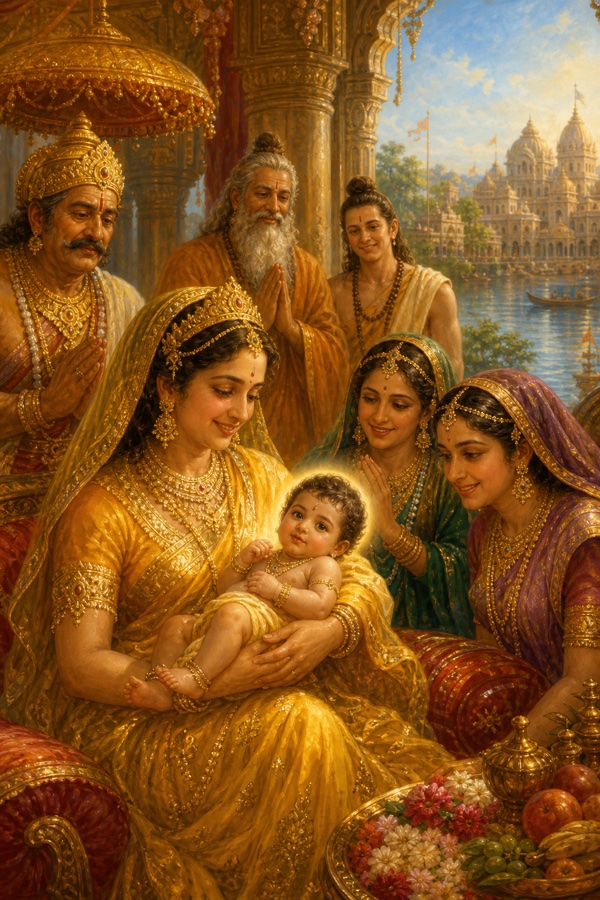
Six seasons rolled by after the sacrifice, each of them two months long. Then, in the twelfth month after the close of the rites, on the ninth lunar day of the bright fortnight of Chaitra, when the asterism Punarvasu, which Aditi presides over, was in the ascendant, when as many as five planets stood exalted, the Sun in Aries, Mars in Capricorn, Saturn in Libra, Jupiter in Cancer, and Venus in Pisces, and when Jupiter in conjunction with the Moon stood in the sign of Karka, Kausalya, the eldest wife of Dasharatha, gave birth to a son of the highest blessing, and his name was Rama. He was the Lord of the universe himself, adored by all three worlds, the delight of Ikshvaku’s race, one half of Vishnu, and he bore the divine marks: eyes tinged with red, exceptionally long arms, ruddy lips, and a voice like the sound of a kettledrum.
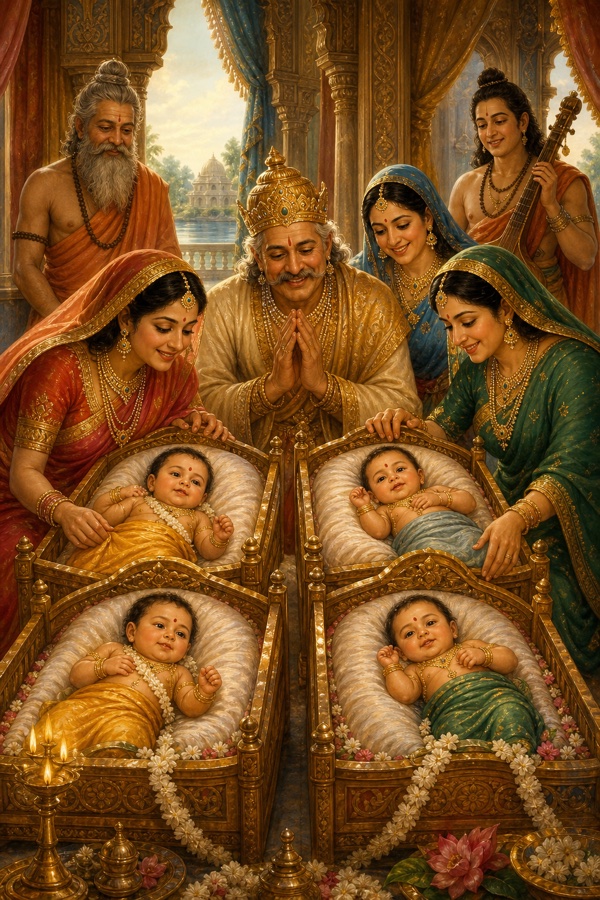
Kausalya shone with that son of immense glory as Aditi, the mother of the gods, shines with Indra, the wielder of the thunderbolt and the first of the gods. Next, from the womb of Kaikeyi, the youngest of the king’s wives, was born Bharata, a prince of true valor, who carried a quarter of Vishnu in him and was adorned with every divine virtue. Then Sumitra, the king’s second wife, gave birth to twin sons, Lakshmana and Shatrughna, both valiant, both skilled with every kind of missile, and holding between them the portion of Vishnu that remained. Bharata, cheerful in mind from the first, was born under the constellation Pushya, when the Sun had entered the sign of Pisces; the twin sons of Sumitra were born under Ashlesha, when the sun had reached the meridian, touching the sign of Cancer. The four sons of the emperor were born separately, and yet they were one in essence; endowed with transcendent virtues, they resembled one another, and they rivaled in splendor the four stars of the constellations Purva Bhadrapada and Uttara Bhadrapada.
Source note for the birth passage
Main edition: Gita Press, Valmiki Ramayana, Balakanda 18.15. Comparison: the Sanskrit and English text at 1-18-15 and Rupa Raghunatha Vani Publications, 1.18.15. Both read Pisces and Cancer as ascendants. The wording above follows the Gita Press translation, which places the Sun in Pisces at Bharata’s birth and the sun at the meridian, in Cancer, at the twins’. This is a retelling of the text, and no astronomical date is calculated from it.
In heaven the gandharvas sang melodiously and companies of apsaras danced; the kettledrums of the gods sounded of their own accord, and a shower of flowers fell from the sky. In Ayodhya there was great rejoicing, and crowds filled the city. The streets were packed with actors and dancers and with a great press of people. The broad avenues, loud with the songs of singers and the music of players, with the chanting of Veda-reciters and the voices of minstrels, bards, and panegyrists, and strewn with precious stones of every kind that the people threw down in admiration of the singing, wore the look of a festival. The king gave gifts worth the giving to the ballad-singers, the bards, and the panegyrists, and to the Brahmins he gave riches and cows in their thousands.
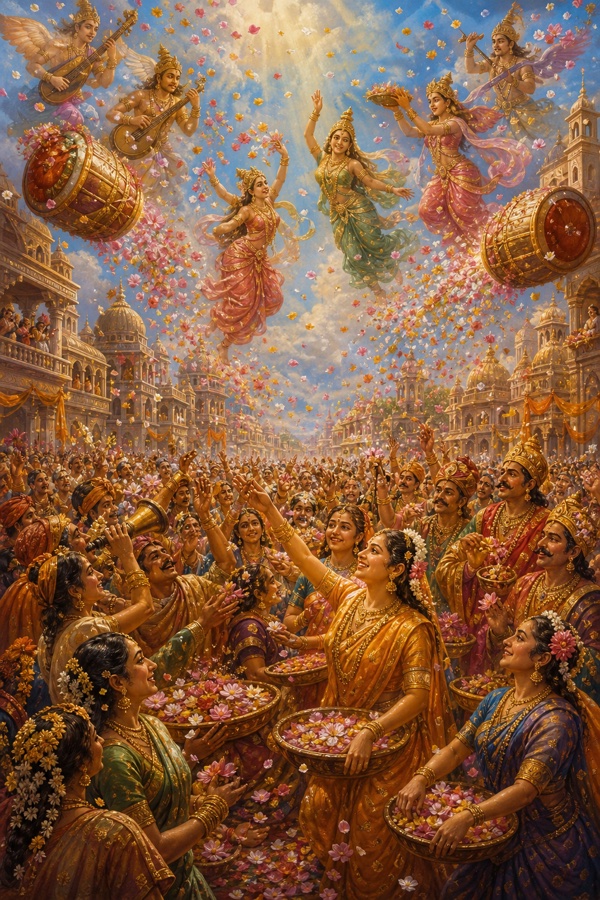
When eleven days had passed, the naming ceremony was held. Vasishtha, in the fullness of joy, acting for the king, named the eldest, the very embodiment of the Supreme Spirit, “Rama”; the son of Kaikeyi he named “Bharata,” the first son of Sumitra “Lakshmana,” and the other “Shatrughna.”
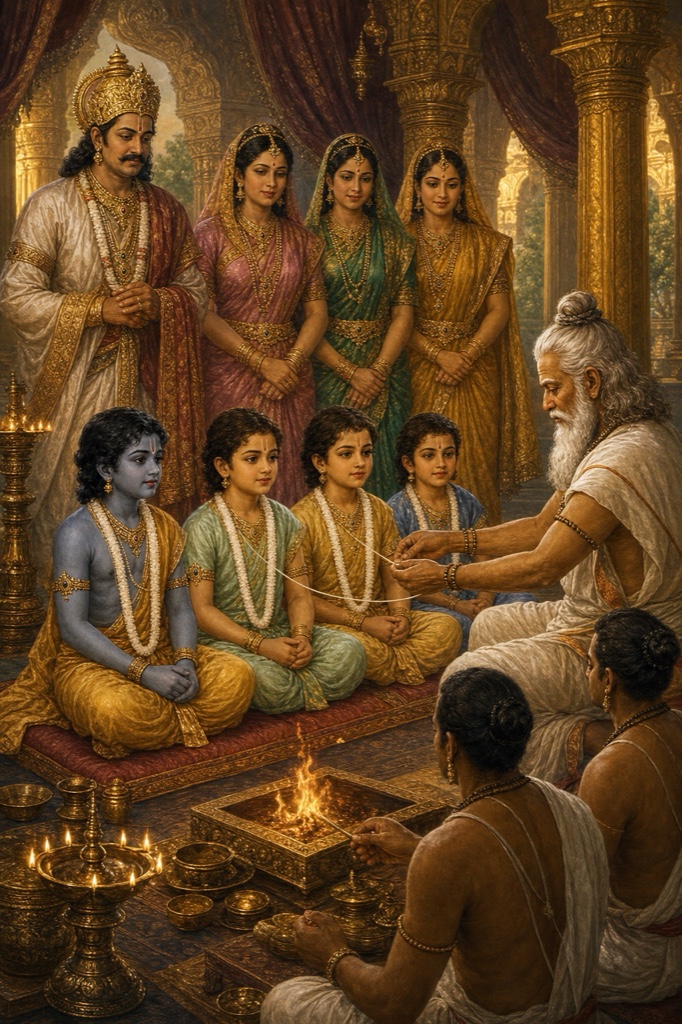
On the king’s behalf Vasishtha fed the Brahmins of the capital and of the whole kingdom of Kosala, and gave them a great heap of shining jewels. In due time he had every purificatory rite performed for the four princes, from the Jatakarma, the rite of birth, to the Upanayana, the investiture with the sacred thread. The eldest of them, Rama, proclaimed the greatness of his house like a flag flying over it, and he was the delight of his father; every created being esteemed him as it would Brahma, the self-born. All four princes became masters of the Vedas and great heroes, and all four were intent on the good of the people. All were wise, all were adorned with virtues; yet Rama outshone them all, and his prowess was true and never failed. Like the full moon in a clear sky he was the beloved of everyone. He was esteemed in the art of riding elephants and horses and in every skill of driving a chariot, he took delight in the science of archery, and he gave himself to the service of his father.
From his earliest infancy Lakshmana, who brought good fortune to all who sought his protection, was deeply attached to his eldest brother Rama, the delight of the world, and he gratified him in every way. Lakshmana, rich in splendor, was a second life to Rama, moving about outside his body. Without him Rama would not close his eyes in sleep, and if a dainty dish was brought to him he would not taste it unless Lakshmana was there. Whenever Rama rode out to hunt on horseback, Lakshmana followed at his heels at once, armed with bow and arrows, guarding him on every side. And Shatrughna, Lakshmana’s younger brother, was dearer to Bharata than Bharata’s own life, and Bharata was as dear to Shatrughna. King Dasharatha took supreme delight in his four blessed and beloved sons, as Brahma, the progenitor of creation, delights in Indra, Varuna, Yama, and Kubera, the gods who preside over the four quarters. When their wisdom ripened they were adorned with every virtue; they were modest and renowned, all-knowing and far-sighted. Father to sons of such rare glory and such luminous splendor, Dasharatha rejoiced as Brahma, the ruler of the universe, rejoices. Those princes were devoted to their Vedic studies and to the service of their parents, and they were deeply versed in the science of archery.
When their studies were nearing completion, King Dasharatha began to deliberate over the marriage of his sons with his family priests, the sages Vasishtha and Vamadeva, and with his relations, King Romapada among them. And while the king was still deliberating on the subject among his counselors, the great sage Vishvamitra, whose radiance had no equal, arrived at the palace of King Dasharatha. Seeking an audience with the king, he spoke to the gate-keepers: “Inform the king that I am here: the sage Vishvamitra, of the line of Kusha, the son of Gadhi, at his door.”
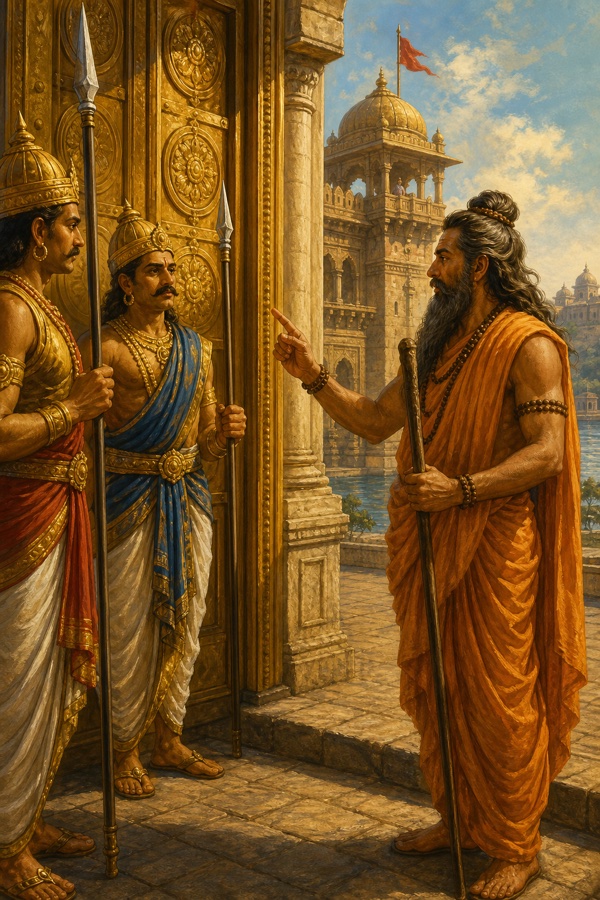
The gate-keepers heard him, and the command in his voice sent them running to the king’s apartments with awe in their hearts. They reached the royal apartments at once and told King Dasharatha, of the line of Ikshvaku, that the sage Vishvamitra had arrived at the gate. The news filled the king with joy, and full of devotion he went out to receive him with Vasishtha, his family priest, at his side, as Indra would go out to meet Brahma. He saw the hermit of austere vows, shining with his own light, and with the most cheerful of faces he offered him water to wash his hands. Vishvamitra accepted the water and the other attentions the king offered with ceremony, as the scriptures enjoin, and duly asked after the king’s health and prosperity. The sage asked after the welfare of the king’s capital, his treasury, his kingdom, his relations, and his friends. “I trust all your vassals are fully submissive to you,” he said, “and your enemies subdued. And are your duties toward the gods and toward men, the oblations you pour into the fire and the honors you pay your guests, all being properly discharged?” Then he met Vasishtha and the other seers who were present, Vamadeva and the rest, embracing each in proper order and asking after their welfare. Delighted in mind, they all went into the king’s court, and, received with every attention, took their seats according to their rank.
Thrilled with joy, the king spoke to the great sage Vishvamitra with a glad heart, glorifying him as he spoke. “I count your coming, great sage,” he said, “exactly as welcome as nectar arriving in one’s own two hands, as rain falling on a waterless tract, as the birth of a son to a childless man through a wife who is one with him, as the recovery of a treasure that was lost beyond hope, or as the joy of a festival day. I wonder what supreme desire of yours I might have the delight of fulfilling, and how. You deserve every service I can give, and it is my good luck that has brought you to my house. My birth stands fulfilled and my life is blessed today. My night has ended in a propitious sunrise, for I have seen the best of Brahmins in you. Once you were called a rajarshi, a royal sage; you have since earned the rank of a brahmarshi, a Brahmin sage, and your splendor has been made brighter by your austerity. So you are worthy of my adoration in many ways, and your visit is a wonder to me, Brahmin sage, for it has purified me. By the mere sight of you, lord, I have visited every holy place there is. Tell me what you have come to my capital to accomplish. Favored by you, I want to further your cause; you need have no doubt at all of the success of your errand. I will accomplish your purpose in full, for an honored guest is a very god to me. This is an occasion of great rejoicing for me and for my house, Brahmin sage, and the highest religious merit that your visit brings has fallen to my lot entire.” The great sage Vishvamitra, famous far and wide for his excellences and distinguished by his virtues, heard that prayer, so pleasing to the heart and to the ear, addressed to him in courteous words by the king, and felt the deepest delight.
The gist: on Chaitra Shukla Navami, Rama and his brothers descend, Ayodhya drowns in festival, and just as the four grow into their skill in arms, the brahma-seer Vishvamitra stands at the gate, the threshold of the next tale.
Source: Srimad Valmiki Ramayana, Balakanda, Cantos 1 to 18. The Gita Press Hindi edition is the controlling witness, read alongside the Gita Press English edition. The Sanskrit e-text and an independent complete translation were used to verify names, sequence, and principal events. Where recensions differ, this retelling follows Gita Press.
Basis: Valmiki Ramayana (Gita Press, Gorakhpur)