On this page
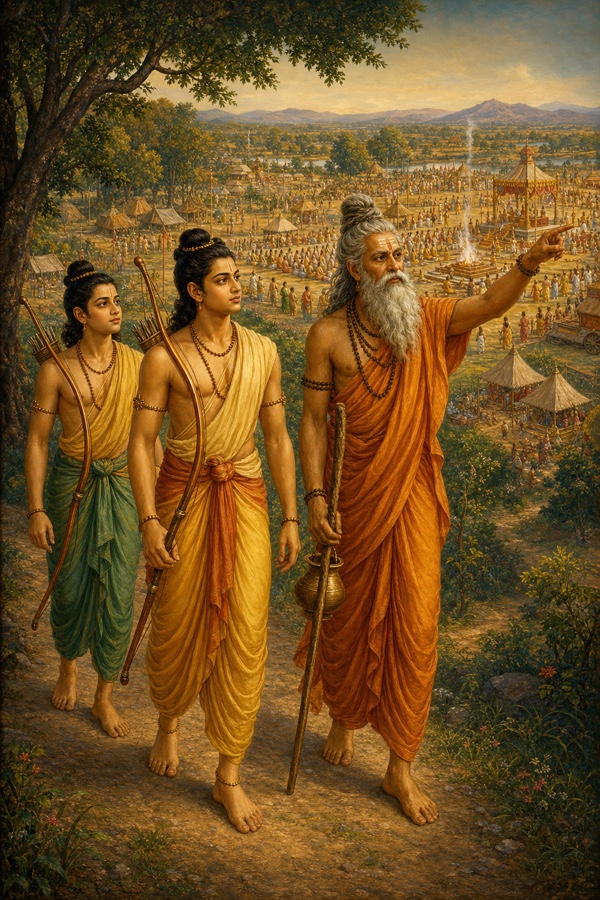
The road had given up its stories. Behind the three travelers lay the hermitage of Gautama, where Ahalya, hidden from every eye through a long age of penance, had been restored to her husband at the sight of Rama. Ahead lay the northeast, and Vishvamitra set the two princes in front of him and walked toward it. He was a sage of Kushika’s line who had worn a crown once, and he still moved like a man to whom roads and kingdoms owed something. Their destination was the sacrificial enclosure of Janaka, king of Mithila, who stood midway through a great rite, with Brahmins from every country camped around his fires. As the enclosure came into view, Rama, with Lakshmana at his shoulder, spoke to the sage.
“What a splendid sight it is, the preparation Janaka has made for his sacrifice,” he said. “Thousands of Brahmins steeped in the Vedas have come here from every country, and the hermits’ quarters are crowded with hundreds of carts, each one loaded with what the agnihotra needs, the offering poured into the sacred fire at dawn and at dusk without a single day missed. Choose us a place to stop, somewhere clean and close to water.” He was a boy still, and he had a boy’s eye for a crowd, and a king’s son’s eye for how well a great rite had been planned.
Vishvamitra heard him out, picked a quiet, untouched spot with water close at hand, and there the three of them set down what they carried.
Janaka’s welcome, and his curiosity about the two princes
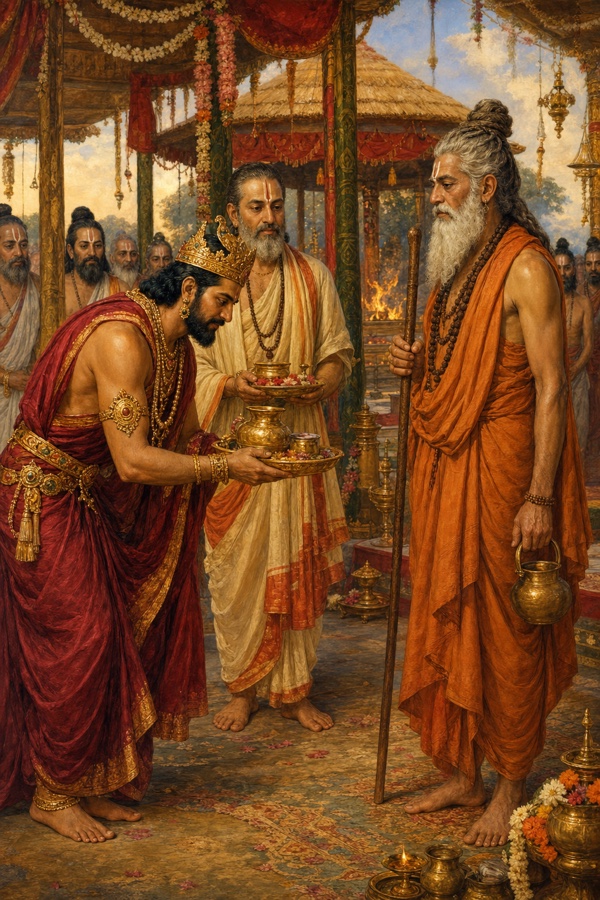
Word reached Janaka that Vishvamitra had come, and the king did not send a servant. He went himself, at once and in a hurry, with the humility of a man who knows exactly whom he is about to receive, and at the head of his party he placed his family priest Shatananda, son of Gautama, together with the priests who served at his sacrifice. In his own hands he carried the water for a guest’s hands, and he offered Vishvamitra the madhuparka, the welcoming drink of curds, ghee, water, honey, and sugar candy that a house sets before a guest it means to honor, and every other courtesy the scriptures lay down. Vishvamitra accepted all of it, and then he asked his questions. He asked after the king’s welfare and after the smooth progress of his sacrifice; he asked after the hermits who had come with the king, after the officiating priests, and after Shatananda himself; and then he embraced every sage present, each in the order of his seniority, with plain delight. Only then did the king speak, his palms joined. “Will Your Holiness take the seat I offer, with these ascetics?” Vishvamitra sat. Around him, on their own seats and in their proper order, sat Shatananda, the priests, the ministers, and the king.
“Today the gods have brought the preparations for my sacrifice to their fulfillment,” Janaka said, looking at the sage across the gathering. “The fruit of the whole rite has come to me this very day through the sight of you alone. I feel blessed and I feel indebted, that the greatest of ascetics has come to my sacrificial ground with such a company of sages. My learned priests tell me that my vow for the sacrifice has twelve more days to run. At its close you will see, with that vision of yours, the gods themselves come in person to claim their share of the offerings.”
Then, his face bright and his palms still joined, the king asked the question that had been in him since the sage sat down. “May God bless you,” he said. “Who are these two bold boys, whose bearing is a match for the gods? They walk like elephants, and one of them puts me in mind of a tiger, the other of a bull. Their eyes are as wide as lotus petals. Each carries a sword, a quiver, and a bow, and in the beauty of their form they rival the Ashvins, the twin physicians of the sky. They stand at the edge of youth. They look like a pair of gods who have come down to earth of their own free will. How, and why, and for whose sake have they walked all this way on foot? Whose sons are they, these two heroes with such fine weapons? I want to hear the truth about them, sage, because they grace this land the way the moon and the sun grace the sky. They are copies of each other in build, in the play of feeling on their faces, in the way they move, and each of them wears the side-locks of a boy not yet grown.”
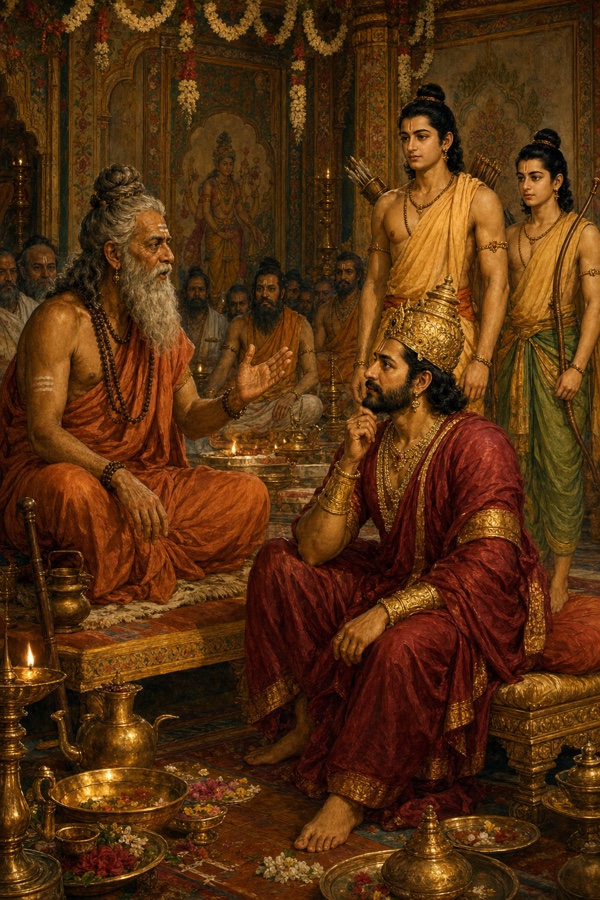
Vishvamitra told him. They were the sons of the emperor Dasharatha. He told the whole of it: their fearless journey to Siddhashrama and the killing of the rakshasas there; the road to Vishala; the visit to Ahalya and the meeting with Gautama; and at the last their coming to Mithila out of a wish to see the great bow that Janaka kept to test the courage of any man who asked for his daughter. When he had told it all, the sage fell silent. The bow had been named in that assembly now, and every man there knew what it meant for two princes to come asking to see it.
Shatananda’s question, and the start of the Vishvamitra story
One listener in that gathering heard the story with more than curiosity. Shatananda, the eldest son of Gautama, was a great ascetic in his father’s mold, and the long years of austerity had put a light in his face; and the woman Vishvamitra had just mentioned, restored to Gautama after an age of penance, was his mother. He looked at Rama, and the sight of him thrilled and astonished him. This was the boy who had walked into his mother’s hermitage and brought her back into the world.
“Was my mother, who has been at her long penance, shown to Rama, the son of Dasharatha?” he asked the sage. “Did my mother honor him with the fruits of the forest, as a man every living soul should honor? Did you tell Rama the old story, the wrong Indra did my mother? May God bless you: has my mother been reunited with my father through the sight of Rama? Did my father honor Rama, and has this prince come here after taking his hospitality? And when Rama came to that grove, did he greet my father with a calm mind, and was he honored there?”
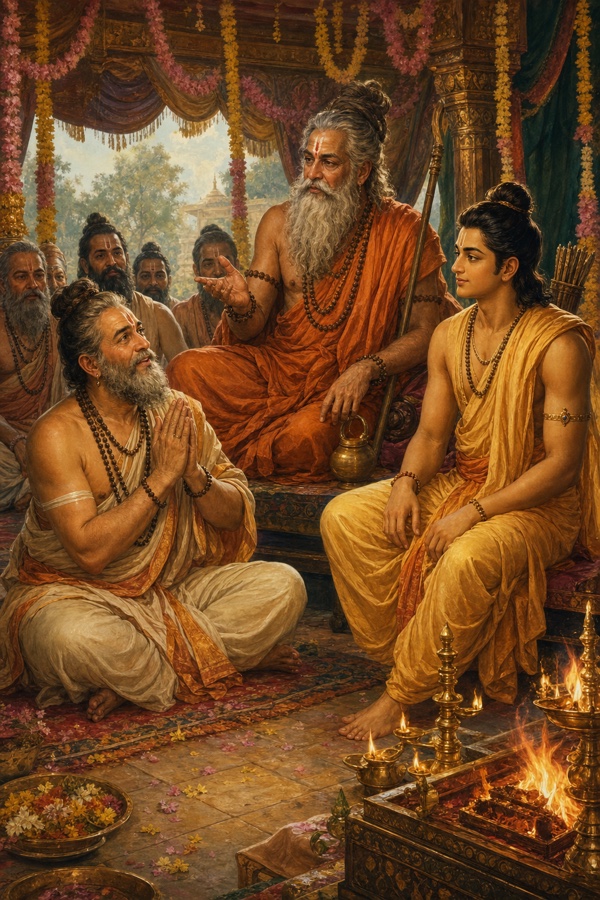
Vishvamitra answered all six questions in a breath. “Everything that ought to have been done was done, and nothing was left undone,” he said. “Ahalya, the wife of Gautama, has been reunited with her husband, the way Renuka, mother of Parashurama, was reunited with her husband Jamadagni of Bhrigu’s line.”
At that Shatananda turned to Rama, and the priest’s formality gave way to something warmer. “Welcome,” he said. “It is our good fortune that you have come here with Vishvamitra at your head, a seer no one easily gets the better of. His deeds are past anyone’s power to imagine, and he won the rank of brahmarshi by austerity alone, by nothing else; his splendor has no measure, and I know him to be the highest refuge there is. No one on earth is more blessed than you, Rama, with this son of Kushika, who has done such penance, for your guardian. Now hear me, because I am going to tell you what his strength is and who he truly is. Listen while I speak.”
“For a long time this sage was a king,” Shatananda began, “a pious king who knew what was right, learned, a tamer of his enemies, devoted to the good of his people. Brahma, lord of created beings, had a son, King Kusha; Kusha’s son was the mighty and pious Kushanabha; Kushanabha’s son was Gadhi; and Gadhi’s son of great fire is this Vishvamitra, which is why he is called Kaushika, and also the son of Gadhi. He ruled the earth for many thousands of years. And one day he gathered an army and set out to march around the whole earth, with a full akshauhini behind him.” The sage sitting quietly beside Rama had once commanded that army.
Marching across cities and kingdoms, across rivers and great mountains and hermitages, King Vishvamitra came at last to the hermitage of Vasishtha. It was rich in flowers and creepers and trees of every kind, and though wild animals roamed it in herds, the deer there were the gentlest in the world and flocks of birds came to it without fear. Siddhas and Charanas visited it, and gods, demons, Gandharvas, and Kinnaras graced it with their presence. It was crowded with Brahmin seers, visited by companies of celestial sages, and thronged with people of noble character whom penance had perfected, so that they shone like fire and rivaled Brahma himself in splendor. There were sages who lived on water alone, and sages who lived on air, and sages who ate nothing but the leaves that fell to the ground, or fruit and roots; men who had mastered their outer senses and the inner sense that is the mind, and conquered every weakness. There were the Valakhilyas, the sages said to be born of Brahma’s hair, and the Vaikhanasas, said to be born of his nails, all of them intent on the murmured prayer and the offering into the fire. The mighty Vishvamitra, greatest of conquerors, looked out over the place, and it seemed to him a second world of Brahma.
Shabala, and the quarrel over the cow of plenty
The sight of Vasishtha, the greatest of all who live by prayer, filled Vishvamitra with delight, and he bowed low to him out of modesty. Vasishtha welcomed him to the hermitage, gave him a seat, and set fruit and roots before him with every courtesy. Then the two men did what a sage and a king do when they meet: they asked after each other. Vishvamitra asked whether all was well with Vasishtha’s austerities and his fire worship, with his pupils, and with the plants that fed them. All was well, Vasishtha said. Then Vasishtha, born of Brahma’s own mind, asked after the king.
“Is all well with you? Do you rule your people by the fourfold conduct laid down for a king, and delight them with your love of what is right?” he asked. “Are your servants well cared for, and do they stand ready at your word? Are your enemies wholly subdued? Is all well with your forces, your treasury, and your allies, and with your sons and your grandsons?”
Vishvamitra answered that all was well on every side. The two pious men talked a long while and took pleasure in each other’s company. Nothing in that easy talk gave any sign of what was coming.
At the end of it Vasishtha spoke, almost laughing for joy. “I wish to give this fine army of yours, and your own unfathomable self, the hospitality your rank deserves,” he said. “Accept it from me. You are the worthiest of my guests, and a host should take great pains over a guest like you.”
“The honor is already mine in the very words of the offer,” Vishvamitra replied. “You have entertained me in every way, you who deserve honor yourself: with the fruit and roots of your hermitage, with water for my feet and for rinsing my mouth, and above all with the sight of you. I will take my leave now. Accept my salutation, and look on me always with a friendly eye.”
The pious and generous Vasishtha pressed him again, and again, and the king kept declining in the same words, until at last the son of Gadhi gave way. “All right. Let it be as you wish,” he said.
Delighted, Vasishtha called for his cow. She was Shabala, named for her dappled coat, and she had been washed clean of mud for the occasion. “Come, come quickly, Shabala, and hear what I say,” Vasishtha told her. “I mean to entertain this royal sage Vishvamitra and his whole army with a lavish feast. Make everything ready for me. Yield, heavenly cow, each of the six tastes in whatever quantity is wanted, each to the eater’s liking and to his heart’s content. Quickly now. Bring out food of every kind in plenty, with sweets, drinks of many kinds, things to be licked, like honey, and things to be sucked, like the juice of a mango.”
Shabala did as she was asked, and a hermitage in the forest fed an army. There was sugarcane and everything made from it, and honeys of many kinds; parched grain, maireya wine brewed from jaggery, and fine spirits distilled from the sap of the cane, with costly drinks and food of every sort besides. There were heaps of steaming rice as high as mountains, sweet rice cooked in milk, lentils boiled soft with salt and spice, streams of curds and of milk and ghee, and silver plates in their thousands brimming with fruit juice. Every man in Vishvamitra’s army ate his fill and was glad. And the king himself, feasted with the chief women of his household, with the Brahmins who traveled with him and his family priest, with his ministers, his counselors, and his servants, came away from the meal rejoicing and strong. He had come to the hermitage a guest, and he went away from the meal a king again, with a king’s eye on a treasure.
It was in that mood, brimming with delight, that Vishvamitra made his request. “You have honored me and feasted me lavishly, you who deserve honor yourself,” he said. “Now hear one request of mine. Give me Shabala in exchange for a hundred thousand cows. She is a jewel, and a king is the proper keeper of jewels. Hand her over to me. By right she is mine.”
Vasishtha, whose mind was given to piety, did not need to think. “I will not part with Shabala for a thousand million cows, let alone a hundred thousand, and not for heaps of silver either,” he said. “She is not to be taken from my side, tamer of enemies. She is as much a part of me as glory is of a man who has mastered his own mind. On her rest the offerings I make to the gods and the offerings I make to the ancestors; my very life rests on her; my fire worship, the portion of every meal set out for all living creatures, the offering to the kitchen fire before eating, the sacrifices sealed with the cries of Swaha and Vashat, and every mantra I utter, since the strength to utter them comes from her milk. All of it, royal sage, rests on this cow and on her alone. She is my everything and the spring of my joy. I say it on oath.”
Vishvamitra heard the oath and pressed harder, in the most insistent voice he had. “I will give you fourteen thousand elephants fitted with girths and chains of gold and hung with goads of gold,” he said. “I will give you eight hundred golden chariots, each drawn by four white horses and hung with little tinkling bells. I will give you eleven thousand spirited horses of fine breed, bred in the lands famous for their horses. And on top of all these, one crore of young cows of every color, ten million of them. Only give me Shabala. And ask for jewels and gold in any amount you like, and it is yours. Let Shabala be given to me.”
Vasishtha gave him the same answer. “I will not part with Shabala on any account, king,” he said. “She is the only jewel I own. She is my only wealth; she is my everything; she is my very life. She is my sacrifice at the new moon and my sacrifice at the full moon, and every rite of mine that ends in the giving of gifts, and every ritual act of any kind. All my religious life is rooted in her, king. What is gained by more talk? The long and the short of it is that I will not part with this cow who yields whatever I wish for.”
Shabala raises an army
When Vasishtha would not give up the cow, Vishvamitra did what kings do when words fail them: he began to drag her off to his capital by force. Hauled away by the mighty king’s men, Shabala was stricken, and she wept with grief as she went. “Has noble Vasishtha cast me off,” she thought, “that the king’s servants lead me away like this, sick at heart as I am? What wrong have I done that seer of pure mind, that he should see me innocent and devoted to him and abandon me all the same?” She sighed again and again, lost in thought. And then she shook off those men, many hundreds of them, and ran with the speed of the wind to the feet of the mighty sage.
She stood before Vasishtha and wept, and her voice as she wept was like the rumble of a thundercloud. “Have you forsaken me, son of Brahma,” she asked, “that the king’s servants take me away from your very presence?”
Vasishtha answered the stricken cow the way a man answers a sister in distress. “I am not abandoning you, Shabala, and you have done me no wrong,” he said. “It is this mighty king, drunk on his power, who is taking you away. My strength is no match for his; and he is my guest today, which gives him a strength of its own. He is a Kshatriya, and ruler of the earth besides. And here is his army, a full akshauhini strong, with its elephants and horses and chariots, and the finest elephants in the world. In that he is mightier than we are.”
Shabala understood speech, and she answered him like a modest lady speaking to a Brahmin seer of matchless splendor. “The wise say that the strength of a Kshatriya is nothing beside the strength of a Brahmin,” she said. “Brahmins are by far the stronger. A Brahmin’s strength is of the spirit, and that makes it greater than any warrior’s. Your strength has no measure. Vishvamitra is very powerful, and still he is no stronger than you; your glory is beyond his reach. Command me. Fed by your spiritual strength, I will put an end to that wretch’s pride, his strength, and his striving.”
“Then make a force that will destroy the enemy’s army,” Vasishtha said.
At his command the cow who granted every wish brought forth warriors. From her very bellow sprang Pahlavas in their hundreds, and they set about destroying the whole army before Vishvamitra’s eyes. The king’s eyes went wide with rage, and with weapons of every kind he cut the Pahlavas down. Seeing them killed in their hundreds, Shabala at once brought forth the terrible Shakas, kin to the Yavanas, and the land was flooded with them: brilliant, immensely strong, the color of the filaments of the champak flower, dressed in yellow, carrying sharp-edged swords and the spears called pattishas. Vishvamitra’s whole army burned under them as if under blazing fires. Then the king loosed missile after missile, and under them those Shakas and Yavanas, and the Kambojas and the Barbaras who fought beside them, were thrown into confusion.
The hundred sons destroyed, and Vishvamitra’s vow of tapas
When Vasishtha saw the warriors Shabala had made stunned by Vishvamitra’s missiles and running from the field in every direction, he gave her his command again. “Bring forth more warriors, and more, cow of plenty, by the power of your concentration,” he said. From her roar came Kambojas brilliant as the sun, and from her udders the Barbaras, weapons in their hands; from her genitals came the Yavanas, and from her anus the Shakas, and from the pores of her skin the Mlechchhas and the Haritas and the Kiratas. In an instant they wiped out the whole of Vishvamitra’s army, foot soldiers and elephants, horses and chariots, all of it.
Vishvamitra’s hundred sons saw their father’s army destroyed by the mighty Vasishtha, and they seized weapons of every kind and rushed at the great ascetic in a fury. The great sage burned them to ash with his roar alone. In one instant the sons of Vishvamitra were burned to nothing, with their horses and their chariots and their foot soldiers. His sons gone and his army gone, the king was filled with shame and with dread, both at once. He was like the ocean when its fury has left it, like a snake whose fangs have been broken; all at once he had no more light in him than the sun in eclipse. Stripped of his sons and his army, he felt as wretched as a bird with clipped wings, and with his strength and his spirit shattered he sank into despair. He set his one surviving son over the kingdom with a single instruction, to rule the earth by the code laid down for a Kshatriya, and he went alone into the forest. The man who had marched out at the head of an akshauhini walked away from it on foot.
He went to a slope of the Himalaya where Kinnaras and Nagas live, and there, a great ascetic now, he practiced austerities to win the favor of Mahadeva, the supreme god. After a time the giver of boons appeared before him, Mahadeva of the bull banner, lord of the gods. “Why do you practice these austerities, king?” he asked. “Say what is in your mind. I am the giver of boons. Tell me what you seek.”
Vishvamitra fell flat before him. “If you are pleased with me, then reveal to me the science of arms with its inmost secrets, with every branch of learning that serves it, near or far, and with the sacred texts that belong to it,” he said. “Let every magic missile known to the gods, to the demons and the great seers, to the Gandharvas, the Yakshas, and the Rakshasas rise clear before my mind’s eye. Let the end I seek be reached by your grace.” He had gone into the forest beaten, and what he asked for there was weapons.
“So be it,” said Mahadeva, and he was gone.
With Mahadeva’s missiles and weapons now his, Vishvamitra, a proud man to begin with, swelled with arrogance. His power rose in him like the ocean at the full moon, and in that moment he counted Vasishtha, the greatest of seers, as good as dead. He went to the hermitage and began to loose his missiles, and the grove where austerities were practiced began to burn in their fire. The hermits saw the missiles flying and fled in their hundreds in every direction. Every pupil of Vasishtha, every beast and every bird in the place, ran in terror, thousands of them, out of every quarter. The hermitage of the mighty Vasishtha emptied; within an hour it was silent and looked barren, for all that Vasishtha kept calling out, “Do not be afraid. I will wipe out this son of Gadhi the way the sun burns away the fog.”
Then Vasishtha, greatest of ascetics, turned on Vishvamitra in anger. “You have laid waste a hermitage cared for over ages,” he said. “You are a wicked fool. And so you will cease to be what you are.”
With that he raised his staff, the brahma-danda, the rod that is a Brahmin’s only weapon, and it looked like a second rod of Yama. He stood there in his rage like the smokeless fire that burns at the ending of the world. One staff against every weapon of the gods: that was the whole of Vasishtha’s arsenal.
The weapons come to nothing, and the resolve to win brahminhood
Vishvamitra had the fire missile, the astra of Agni, already aimed. “Stay where you are,” he shouted. “Wait.”
Vasishtha held the brahma-danda steady and answered in anger. “Here I stand, you disgrace to the Kshatriyas. Show me whatever strength you have,” he said. “Today I will crush your pride, and the pride of your weapons with it. What is your warrior’s strength beside the power of a Brahmin? Look on my divine power.”
The terrible fire missile of the son of Gadhi went out against Vasishtha’s staff the way the fury of a fire goes out under water.
Enraged, the son of Gadhi loosed the missile of Varuna, god of the waters, and the missile of Rudra, and the missile of Indra, and the Pashupata that belongs to Shiva, and the missile made of reed. Then, one after another, he hurled at the great ascetic every weapon Mahadeva had given him: the missile of Manu, the one that stupefies, the one of the Gandharvas, the one that brings sleep, the one that brings yawning, the one that intoxicates; the pair that torment with heat and melt whatever they strike; the one that dries, and the one that rends; the thunderbolt of Indra, which almost nothing withstands; the noose of Brahma, the noose of Time, and the noose of Varuna; the Pinaka beloved of Shiva; the two lightning bolts, the dry and the wet; the rod of Yama; the missile of the fiends; the Krauncha; the discuses of Dharma, of Time, and of Vishnu; the missile of the wind, the one that churns, and the one of Hayagriva, the god with the horse’s head; two javelins; the weapons called Kankala and Musala; the great missile of the Vidyadharas; the dreadful missile of Time itself; the trident; and the ones called Kapala and Kankana. And the wonder of it was that Vasishtha, born of Brahma, turned back every one of them with his staff alone. The list ran on and on, and the staff never moved from its place.
When all of those had come to nothing, the son of Gadhi loosed the weapon of Brahma, the creator. Agni and the gods behind him, the celestial sages, the Gandharvas, and the great Nagas were struck with awe to see it readied, and when it flew the three worlds were thrown into alarm. Vasishtha, with his staff and the spiritual fire behind it, swallowed even that most terrible of weapons whole, to its every limb. And as he took in the weapon of Brahma his form became so violent and fierce that it stunned the three worlds. From every pore of his skin shot tongues of flame wrapped in the smoke of the spent missile, like rays of the sun, and the staff in his hand blazed like the smokeless fire at the end of the world, like a second rod of Yama.
Then the companies of sages began to praise Vasishtha, the greatest of ascetics. “Your might never fails,” they said. “With your own glory, calm the fire of your body and the fire of your staff. The mighty Vishvamitra has been tamed by you. Your power knows no failure. Let the worlds be free of their agony.”
At their prayer Vasishtha came back to his natural calm. And the beaten Vishvamitra drew a deep breath and spoke. “A curse on the might of a Kshatriya,” he said. “The strength that comes from a Brahmin’s fire is the true strength. All my missiles have been undone by a single staff. Now that I see plainly which is the greater, I will purify my senses and my mind and take up such austerities as will win me brahminhood in this very life.” The defeat handed him the one ambition that would fill the long ages of his life from then on.
Trishanku’s craving for heaven
Sighing again and again, his heart sore with the memory of his defeat, Vishvamitra, who had made an enemy of a soul like Vasishtha, went to the southern quarter with his chief queen and there, a great ascetic now, began the hardest course of austerities he could find. He lived on fruit and roots alone, his mind and his senses held in check, and he practiced penance of the highest order. In the years soon after he began it, four sons were born to him, devoted to truth and to virtue: Havishpanda, Madhushpanda, Dridhanetra, and Maharatha. When a full thousand years were done, Brahma, father of the universe, appeared before him and spoke sweetly. “By your austerities you have won the worlds that belong to royal sages,” he said. “By these austerities we know you, beyond doubt, for a royal sage.” With that Brahma, lord of all the worlds, went back with the gods who had come with him to Indra’s heaven, on his way home to his own realm.
Vishvamitra heard the compliment as a verdict. A thousand years, and he had been called a king again. His face fell a little with shame, and he spoke to himself in dejection. “After austerities as hard as these, the gods and all the companies of seers know me only as a royal sage, and not as the Brahmin I meant to become,” he said. “So brahminhood is not the reward of my austerities. Something more is needed.” With that settled in his mind, the great ascetic, whose mind was given to piety and whose self-restraint was very great, began his austerities all over again.
At this very time there was a king in the line of Ikshvaku, the line of Ayodhya, who added to its glory: Trishanku, a man who always told the truth and had full command of his senses. Into this king’s head came the wish to perform a sacrifice by which he would rise to heaven, the highest realm of the gods, in his own body, without dying first. He sent for Vasishtha, the family priest of his house, and told him what was in his heart. The mighty Vasishtha told him plainly that no such sacrifice could be performed. Turned away by his teacher, Trishanku went south, to the place where Vasishtha’s hundred sons lived the austere life, deep in a long course of penance, and from a distance he saw them, shining, at their tapas.
He went up to them and greeted every one in the order of his seniority, his face lowered a little in shame at having been turned away by their father, and with his palms joined he made his plea. “Others come to me for protection; I come to you for refuge, because you can give it,” he said. “May God bless you. Though Vasishtha, your father, has refused me, I still wish to perform a great sacrifice and rise to heaven in my own body. Be pleased to give me your leave. I salute all my teacher’s sons, I bow my head to the ground, and I implore the Brahmins in you, who are devoted to austerity. Help me, with a steady mind, to perform the sacrifice by which I may reach the realm of the gods in this body. Turned away by Vasishtha, I can find no other refuge than you, the sons of my teacher. For every son of Ikshvaku’s house the family priest has always been the highest refuge. After him, you are my gods.”
Trishanku’s curse, and his refuge with Vishvamitra
The hundred sons of Vasishtha heard him out and answered in a fury. “You are still a child in understanding. Go back to your capital,” they said. “Vasishtha can conduct the sacrifices of all three worlds. When your own teacher, who never says anything but the truth, has turned you away, how dare you go over his head, foolish king, to look for another priest? Vasishtha, the family priest, has been the greatest support of every son of Ikshvaku, and the word of a man who never lies cannot be brushed aside without consequence. How could we possibly conduct a sacrifice Vasishtha has declared cannot be done? How could we insult him by taking up what he has forbidden?”
Trishanku heard the rebuke, and the anger in it, and answered once more. “I have been turned away by the venerable Vasishtha, and now by you, my teacher’s sons,” he said. “So I will go and look for another priest. God bless you all.”
To the sons this was a plan to make nothing of their father, and to court disaster by it, and their fury rose. “You will sink to the state of a chandala,” they said, and each of them went off to his own hermitage.
By the time the night was over, the king was a chandala, an outcaste of the lowest rank, whom no one of caste will touch or feed or shelter. His skin had turned black. The yellow silk around his loins had turned black with it. His long hair had fallen away; the garland on his breast had become a garland of the flowers that grow in a cremation ground; the sandal paste on his body had become a coating of ash from that same unholy place; and his ornaments of gold and jewels had turned to iron. When his ministers and the townsmen who had followed him to the hermitages saw him in that shape, they ran, every one of them, and left him where he stood. The king kept hold of himself, though he burned with agony day and night, and alone he went to Vishvamitra, whose only wealth now was his austerity. The mere sight of that king, thwarted and turned into a chandala, moved Vishvamitra to pity. Out of compassion the sage spoke to the frightful figure standing before him. “May all be well with you. Why have you come,” he asked, “brought down to a chandala by a curse?”
Trishanku knew how to speak, even in the shape of a chandala, and he answered him with his palms joined. “I have been turned away by my teacher Vasishtha, and by his sons,” he said. “Before I could win the thing I wanted, the very opposite of it fell on me. I meant to perform a hundred sacrifices so that I might rise to heaven in my own body. I have won neither the hundred sacrifices nor the reward I wanted. I have never in my life told a lie, and I never will, even in the worst of straits. I swear it by my loyalty to the duties of a Kshatriya.”
“I have worshiped God with sacrifices of many kinds, and I have governed my people by the law,” he went on. “The elders and the nobles of my kingdom were content with my qualities and my conduct. My teachers alone were not satisfied with me, though I strove hard in the cause of righteousness and wanted to perform a sacrifice that would carry me to heaven in this body. And so I have come to believe that fate is the supreme thing, and that a man’s own effort is useless when it is matched against fate. Fate throws everything else into shadow; destiny is the highest refuge there is. Be pleased, then, to extend your grace to one who longs for it, worn down, every effort of his undone by an evil destiny. May God bless you. I will look for no other shelter, because there is no other shelter for me. Turn my evil destiny around by your own effort.”
Vishvamitra’s promise, and the curse on Mahodaya and Vasishtha’s sons
The son of Gadhi answered the king who had become a chandala in gentle words. “Welcome to my hermitage. I know you for a deeply pious man,” he said. “I will give you shelter. Do not be afraid. I will send word to all the great seers of virtuous deeds, and they will help you in the sacrifice you mean to perform. Then you will carry it through at your ease. In this very form, which your teacher’s sons laid on you with their curse, you will rise to heaven in your own body. I count heaven already yours, since you have come for protection to Vishvamitra, son of Kushika, who can shelter those who need it.” The king whose weapons had broken on Vasishtha’s staff was taking up the cause Vasishtha had refused.
With that the sage told his sons, pious and very intelligent men, to make ready for a sacrifice. Then he called his followers together and gave them their orders. “On my command, bring here all the seers, the sons of Vasishtha included, with their kinsmen learned in many subjects, with their pupils, and with the priests able to officiate at a sacrifice,” he said. “If anyone I summon, or anyone else, says a disparaging word, every word of it is to be repeated to me in full.” His followers went out in every direction at his command. In due course masters of the Vedas began to pour in from every land.
When the followers came back to the sage, they repeated to him what every master of the Vedas they had approached had said. “At your call learned Brahmins from every land are coming, and some are already here,” they said, “all of them except Mahodaya and the hundred sons of Vasishtha. Now hear what those said, and the anger they said it in. How could the gods take the offerings, they asked, and how could seers eat what is left of them, at the sacrifice of a patron whose rite is run by a Kshatriya, and worse, for a chandala? And how, having eaten a chandala’s food, could the Brahmins under Vishvamitra’s patronage reach heaven after death? That is how harshly all the sons of Vasishtha spoke, and Mahodaya with them, and their eyes were bloodshot as they spoke.”
Vishvamitra heard it, and his eyes went blood red with rage. “Since they speak ill of me, a blameless man at his hard austerities, those evil-minded men will be burned to ash this very day and dragged to the house of Yama by the noose of Time; of that there is no doubt,” he said. “Let them be born seven hundred times over as pitiless Mushtikas, the outcaste tribe that strips the shroud from the dead and eats the flesh of dogs, and let them roam this earth misshapen and following loathsome trades. And misguided Mahodaya, since he has spoken ill of me though I am blameless, will be scorned in every land and brought down to the state of a Nishada, an outcaste race that lives by taking the lives of living things and has grown merciless by it; and he will drag out a wretched life for a long time, because of my anger.”
When he had pronounced that long curse in the midst of the seers gathered for the sacrifice, the ascetic fell silent.
Trishanku’s ascent, Indra’s refusal, and the making of Trishanku’s heaven
Knowing by his yogic power that the sons of Vasishtha and Mahodaya had been destroyed by the force of his spirit, Vishvamitra spoke among the seers gathered at his hermitage. “Here is a son of Ikshvaku’s house, widely known as Trishanku, pious and generous besides, who has come to me for refuge, wanting to rise to the realm of the gods in the very form he now wears, the form of a chandala,” he said. “Let all of you set this sacrifice going together with me, so that this prince may reach the realm of the gods in his own body.”
The great seers knew what was right, and they conferred, quickly and among themselves. “This sage, the son of Kushika, has a quick temper,” they said to one another. “Whatever he proposes has to be done; there is no doubt about that. If his wish is crossed, that sage, bright as fire, will curse us in his anger. So let the sacrifice go forward, so that Trishanku of Ikshvaku’s line may rise to heaven in his body by the power of Vishvamitra’s spirit. Let it begin, and let each of us take up his own priestly duty.” They had just heard what became of the last men who refused him.
They took up their offices in due form. Vishvamitra himself was the chief priest, the adhvaryu who measures the ground and tends the fire. The other priests, all learned in the sacred texts, recited as the oblations were poured and carried out each of their duties in order, as the rules of ritual lay them down, with the proper mantras. Then, for a long time, the great ascetic called on the gods who were entitled to a share of the offerings, calling each one to come and take his portion. Not one god came.
Rage took Vishvamitra whole. He raised the sacrificial ladle that pours ghee into the fire and, full of anger, turned to Trishanku. “See the power of the spiritual energy I have won by my own effort,” he said. “By its force alone I send you to heaven in your own body. Rise to heaven, where no one goes in the flesh. If I have earned any reward at all for my austerities, rise to heaven in your body by the glory of it.”
The sage had hardly finished speaking when King Trishanku rose bodily toward heaven while the seers stood watching. Indra, the tamer of the demon Paka, saw him arrive in the heavenly realm and spoke, with all the hosts of gods around him. “Trishanku, go back to earth. You have earned no place in paradise,” he said. “Doomed by your teacher’s curse, you fool, fall headlong to the ground.”
At Indra’s command Trishanku began to fall, and as he fell he cried out to Vishvamitra: “Save me! Save me!”
Vishvamitra heard the cry and flew into a wild rage. “Stop,” he shouted. “Stop where you are.” And Trishanku stopped, in the empty air between heaven and earth. Then the sage, seated among the seers and dazed with anger, did what only Brahma has ever done: he began to create. He brought into being a second group of seven stars, a new Great Bear, wheeling through the southern sky, and a new set of the twenty-seven houses the moon passes through in a month. Having made a new array of lunar mansions in the south, still seated among the seers of his hermitage and still hot with anger, he set about creating a whole order of gods to go with it, saying to himself, “I will create another Indra. Or else let my heaven do without an Indra altogether.” A man who had been refused a seat in heaven was building a heaven of his own.
The gods were badly shaken, and the demons with them, and the companies of seers, and they spoke to the sage in words full of conciliation. “This King Trishanku, blessed as he is, stands stripped of his store of merit by his teacher’s curse,” they said. “He does not deserve at all to rise to heaven in his body.”
The son of Kushika gave all the gods his noble reply. “I have given King Trishanku my pledge to help him rise to heaven in his own body. May prosperity attend you; I dare not go back on it,” he said. “Let lasting heavenly bliss be the lot of this Trishanku in his physical body, and let all the lunar mansions I have made stay fixed. Let every heavenly body I have made last as long as these worlds of Brahma’s creation last. Be pleased, all of you, to grant that.”
“So be it. May all be well with you. Let them all last,” the gods answered him. “Those many lunar mansions will last in the sky beyond the sphere where the known stars turn. And Trishanku, happy as a god, will hang there with his head downward, shining among those stars. The stars will circle him as though he were the noblest of kings, and he will be glorious as one who lives in the heavenly realms, his purpose won.” So the king who had wanted heaven in his own body got it, upside down, among stars a sage had made for him.
Vishvamitra simply said, “All right.” The sacrifice was brought to its close with a substitute standing in Trishanku’s place, and the gods took their offerings; and at the end of it all the gods and the seers, whose only wealth was their austerity, went back the way they had come.
Shunahshepa, the sacrificial victim of Ambarisha
As the forest-dwelling seers were getting ready to leave, Vishvamitra spoke to them all. “A great obstacle in the shape of Trishanku has come over the southern quarter,” he said. “Let us find another quarter and do our penance there. We will practice our austerities in the forest beside the lakes of Pushkara, in the wide country of the west; that forest is a joy for penance.” And there, living on roots and fruit alone, he took up an asceticism that nothing could break.
At this very time the great king of Ayodhya named Ambarisha began a horse sacrifice, the rite in which a king lets a consecrated horse wander for a year, claims every land it crosses, and then offers it in the fire. While the rite was under way, Indra stole the sacrificial animal. When it had vanished, the chief priest of the sacrifice spoke to the king. “The animal brought here for the sacrifice has disappeared through your carelessness, king,” he said. “The sins that come of such carelessness destroy the king who fails to guard his sacrifice. Hunt it down and bring it back quickly, the lost animal or a human victim in its place, before the sacrifice proper begins. That is the chief atonement the scriptures lay down for the sin you have incurred by losing the consecrated animal.”
The king heard his family priest’s command and, taking thousands of cows with him to give in exchange whenever asked, that very intelligent king went out to search for a human victim to offer in place of the horse. He searched for the stolen horse and for a human substitute both, through kingdom after kingdom and their provinces, through cities and woodlands and holy hermitages. And on Mount Bhrigutunga, the peak that carries the name of the sage Bhrigu, one of the nine mind-born sons of Brahma, he came face to face with the sage Richika, sitting at his ease with his sons and his wife. Ambarisha bowed low to win his goodwill, asked after his welfare on every side, and made his offer to that sage, who glowed with the energy of his penance. “If for a hundred thousand cows you will agree to sell me one of your sons, to be the sacrificial victim, I will have what I came for,” he said. “I have searched every land and have not found the sacrificial horse. Be pleased, then, to let me have one of these sons for a price.” He said it to a father, in front of the sons.
“I will not sell my eldest boy on any account,” Richika said.
The mother of those noble-minded boys heard her husband’s answer, and she spoke to Ambarisha. “The venerable Richika says our eldest son is too precious to sell,” she said. “Know that Shunaka, the youngest, is my favorite too, my lord, and so I will not hand over my youngest to you. As a rule, the eldest sons are their fathers’ pets and the youngest are their mothers’ darlings. So I will keep the youngest.”
The sage had spoken, and his wife had spoken after him; and then the middle son, Shunahshepa, spoke for himself, of his own accord. “Father says the eldest cannot be sold, and Mother says the same of the youngest,” he said. “So I take it the middle one, myself, is the one who can be let go. Take me, prince.” The boy in the middle had done the arithmetic his parents left to him.
At those words from the Brahmin boy, who already knew how to expound the Vedas, King Ambarisha took Shunahshepa with him at once, in exchange for tens of millions of gold and silver coins, heaps of precious stones, and a hundred thousand cows, and he left well pleased. He set the boy in his chariot, and the royal sage drove fast for his capital.
The saving of Shunahshepa, and the curse on Vishvamitra’s sons
With Shunahshepa beside him, Ambarisha stopped at Pushkara at noon to rest. There are three lakes there, the elder, the middle, and the younger, and while the king rested, Shunahshepa made his way to the elder lake, and there he saw his mother’s brother: Vishvamitra, at his austerities among the other sages.
The boy was wretched with thirst and weariness, and with the wish to live, and his face was long with it. Worn out, he sank into the sage’s lap. “I have no mother and no father,” he said. “How then could I have kinsmen? Save me, in the name of righteousness; you are the deliverer of every creature and its friend. Arrange it so that King Ambarisha gains the reward of his sacrifice, and so that I am saved from death, and, winning a long life and practicing austerities, may rise to the heavenly plane, the highest of the three worlds. Be a protector to me, a forsaken child, with a willing heart, because that is what you are known for. Protect me from this disaster born of sin, the way a father protects his son.”
Vishvamitra heard the boy’s prayer and comforted him in many ways. Then he turned to his own sons. “The time has come to secure our good in the next world, the very reason fathers who want blessings have sons,” he said. “This son of a hermit, a child still, is looking to me to save him. Do him a kindness, my dear sons, by simply giving up your own life. You are all engaged in virtuous acts and devoted to duty. Let one of you take the victim’s place at King Ambarisha’s sacrifice and satisfy the god of fire. That way Shunahshepa will find a protector in us and be saved from death, Ambarisha’s sacrifice will be completed without hindrance, the gods will be pleased, and the promise of safety I have given the boy will be kept.”
His sons, with Madhucchanda the eldest at their head, answered him proudly and carelessly, half laughing. “How is it that you set about saving another man’s son by giving up your own?” they said. “To us this looks like a thing not to be done, as bad as mixing dog’s flesh into one’s food.”
Vishvamitra’s eyes went bloodshot with rage. “This reply, given in defiance of my word, is shameless, empty of all piety, cutting, and shocking,” he said. “So, like the sons of Vasishtha, you will be born on earth among the lowest of the low, the chandalas and the Mushtikas, and you will drag out a wretched life on the flesh of dogs for a full thousand years.”
When he had laid that curse on his sons, the great hermit turned to the wretched Shunahshepa and, with mystic spells, gave him a protection no harm could touch. “When you are bound with cords of darbha grass, wearing a wreath of crimson flowers and smeared with red sandal paste, and you are led to the sacrificial post that is sacred to Vishnu, to be offered as the victim at King Ambarisha’s sacrifice, then praise Indra and Vishnu through the sacred fire with the hymns addressed to them,” he said. “Chant the two splendid hymns to those two gods that I am now going to teach you. By them you will win what you want: freedom from death at Ambarisha’s sacrifice.”
Shunahshepa learned the two hymns as Vishvamitra taught them, with his whole mind on them, and then he went to King Ambarisha in haste. “Greatest of kings, let us both go quickly to where we are going,” he said. “Go through your consecration for the sacrifice, and bring the rite to its end without a hitch.” The boy who had been bought was now hurrying the man who bought him.
The king was filled with joy at the boy’s words and reached the sacrificial ground at once, shaking off every trace of weariness. On the advice of the presiding priest he had Shunahshepa bound with a cord of darbha grass, marked with the signs of the victim, dressed in red, and tied firmly to the post. Bound there, the young hermit boy praised the two gods with his splendid hymns: Indra, and Indra’s younger brother Vishnu, who was born once as the Dwarf. Pleased by those mystic hymns and filled with delight, thousand-eyed Indra granted Shunahshepa the boon of long life that very moment. And King Ambarisha received, by Indra’s grace, the full and manifold fruit of his sacrifice. Vishvamitra took up his austerities again beside the three lakes of Pushkara, for another thousand years.
Menaka, and the ranks of rishi and maharshi
When a full thousand years were done, all the gods, with Brahma at their head and eager to give the sage the fruit of his austerities, came to Vishvamitra in person, just as he was finishing the bath that closed his vow. Brahma spoke the most pleasing words. “May good come to you,” he said. “Until now you were a royal sage by the merit of your own austerities; now you have become a rishi, plain and simple.” With that the lord of the gods went back to the highest heaven, his own realm, and Vishvamitra set out once more on a course of hard austerity. A rishi was more than he had been; it was still less than he wanted.
After a long time a heavenly nymph of the highest rank, Menaka, came to bathe in the three lakes of Pushkara. The son of Kushika saw her in the water, matchless in beauty, shining like a streak of lightning in a cloud, and a thousand years of penance went out of the sage’s mind in a moment. He gave way to the passion of love and spoke to her. “Welcome to you, heavenly nymph,” he said. “Stay here, in this hermitage of mine. May prosperity attend you. Be kind to me, because I am lost in love.” And at his asking the beautiful woman made her home in the hermitage.
In the shape of that nymph a great obstacle to his austerity had come to him, and he did not see it. Ten years passed happily for her in that pleasant hermitage of Vishvamitra’s. So much time went by without his noticing that when at last he did, the great sage was ashamed of himself and fell into anxiety and grief. The understanding came to him with indignation: all of it, the whole thing, had been a deep-laid plan of the gods to rob him of the spiritual energy he had stored up by his penance. “Ten long years have gone by me as if they were a single day and night,” he said to himself, “so overwhelmed was I by the madness of desire. This has been an obstacle and nothing else.” And sighing deeply, the great sage was sick with remorse.
Menaka stood before him with her palms joined, trembling with fear. He sent her away with gentle words, and then the son of Kushika went to the northern mountain, the Himalaya. There he made a firm resolve to keep lifelong celibacy, so that desire would have nothing left to take hold of, and on the bank of the river Kaushiki he began austerities no one else could have carried through. He did not curse her. He blamed the gods, and he blamed himself.
Fear came into the minds of the gods when they saw Vishvamitra practicing such terrible austerities on the northern mountain, and they went with all the companies of seers to Brahma. “Let the son of Kushika receive the title of maharshi, a great seer, which he has earned,” they prayed. Brahma, father of all creation, heard their plea and came and spoke sweetly to Vishvamitra, whose only wealth was his austerity. “Hail to you, maharshi,” he said. “Pleased with your hard austerities, I give you the highest rank among the rishis.”
Vishvamitra bowed low and answered him with his palms joined. “Only if Your Holiness calls me by the word brahmarshi, a seer of the Brahmin order, a word that has no equal in my eyes, and calls me so as a thing earned by my own pious acts, will I believe I have truly conquered my senses,” he said.
“You have not yet conquered your senses,” Brahma said. “Strive further.” And he rose to the highest heaven.
When the gods had gone, Vishvamitra took up his austerities again. He stood with his arms raised above his head, living on air alone, with no roof over him. In summer he sat in the middle of four fires, one in each quarter, with the sun overhead as the fifth; in the rains he stayed out under the open sky; and through the winter he stood in water, days and nights together. He practiced terrible austerities that way for a thousand years, and as he did a deep anguish took hold of the minds of the gods, and of Indra.
Rambha’s curse, and the vow of silence
Indra, with all the hosts of gods around him, sent for the heavenly nymph Rambha and gave her a task that served his own ends and did harm to the son of Kushika. “This great work of the gods has to be done by you, Rambha, and done now,” he said: “to beguile Vishvamitra and rouse his passion until he loses his head.”
Rambha heard the thousand-eyed lord and was abashed, and she answered him with her palms joined. “That hot-tempered sage will lay a terrible curse on me; there is no doubt of it,” she said. “A great fear of it sits in my mind. Be kind to me and let me off.”
She was trembling as she said it, and Indra spoke to her gently. “Do not be afraid, Rambha. May all be well with you. Do what I ask,” he said. “I will be at your side myself, in the form of a cuckoo, with the god of love beside me, in the spring, when the trees are in fresh green leaf and heavy with the scent of blossom and a cuckoo’s call takes hold of the heart. Put on your loveliest form, full of every charm, and turn the sage’s mind from his austerities.”
Rambha did as she was told. Wearing a beauty no other woman could have matched, and a bright smile on her lips, she set out to lure Vishvamitra.
Vishvamitra heard the cuckoo singing, and with a heart full of joy he looked at Rambha too. The cuckoo’s call, and the unmatched song, and the sight of her drew him; and then a doubt rose in the sage. Had she come of her own accord, or had Indra sent her to break his penance? He looked at the whole of it and saw that it was Indra’s doing, all of it, and the great ascetic was filled with rage and laid a curse on her. “Since you have tried to seduce me, a man who is trying to conquer lust and anger, Rambha, you will stand as an image of stone for ten thousand years, unlucky woman,” he said. “A Brahmin of rare glory, rich in the spiritual energy of his austerities, will free you from this punishment, which my anger has laid on you for your foul deed.” The Brahmin he meant was Vasishtha, born of Brahma’s own mind.
Under that terrible curse Rambha turned to stone on the spot, and when they heard it, the god of love and Indra slipped away. And no sooner had the curse left his lips than Vishvamitra was seized by remorse, because he had not been able to hold his anger, and in cursing the nymph he had spent the store of merit his austerities had earned. That store had been drained by his rage, and glorious as he was, he found no peace of mind, because his senses were still unconquered. And so, with the energy of his penance weakened, a resolve formed in him: “I will not give way to anger like this again. I will not speak, on any account. I will not even breathe, for hundreds of years. When I have mastered my senses completely, I will tame my temper. Until my austerities have won me brahminhood I will go without breath and without food for years past counting, and my limbs will not waste as long as I keep at my penance.” With that the great sage took a vow that had no equal in the world: to go neither breathing nor eating for a thousand years. Menaka had cost him ten years; Rambha had cost him more, because this time the enemy had been his own temper.
The last austerity, and the rank of brahmarshi
Leaving the northern quarter where the Himalaya stands, Vishvamitra went to the east and began the hardest austerities of all. He took the supreme vow of strict silence for a thousand years and set out on a course of penance no one had ever tried and no one could match. Even at the end of that full thousand years anger did not get the better of the great sage. He stayed as stiff as a piece of wood, giving no sign and making no gesture, though obstacle after obstacle battered him in the meantime; he had started with an unshakable resolve, and he kept it. When the vow of a thousand years was complete, Vishvamitra made ready at last to take food. And at that exact moment Indra appeared, in the guise of a Brahmin, and begged for the cooked food set before him. Without a moment’s hesitation the great ascetic gave the Brahmin all of it. His whole meal gone, he went without food himself; and true to his vow of silence, he did not say a single word to the Brahmin. Then, silent as before, he held his breath as well. This time the trap had been laid, and he had walked through it without a word.
For another thousand years the great ascetic did not take a breath. And while his breath was held, smoke began to rise from his head, and that smoke threw all three worlds into confusion and made them feel scorched. Bewildered by his penance, dimmed by his glory, and stricken with agony, the gods, the seers, and the Gandharvas, the Nagas, the serpents, and the Rakshasas went to Brahma and prayed to him.
“Though he has been tempted and provoked to anger in many ways, lord, the great sage Vishvamitra rises higher and higher by his austerity,” they said. “Not the smallest flaw of any kind can be seen in him. If what his mind is set on is not given him, he will surely destroy all three worlds, everything that moves and everything that stands still, by the fire of his penance. Already every quarter is wrapped in darkness and nothing can be clearly seen. The oceans are churning, the mountains are splitting, the earth is shaking, and the wind blows wild. We can find no remedy. Like unbelievers, people are abandoning their sacred duties, and all three worlds are bewildered, their minds deeply troubled. The sun stands wholly eclipsed by the glory of that great soul. Vishvamitra is fire itself, and he must be won over before he sets his mind on destroying everything. As the three worlds were burned by fire at the dissolution of an earlier age, so may they be burned by him. Give him the boon his mind is set on, even if he asks to rule over the gods.”
Then all the hosts of gods, with Brahma at their head, came to Vishvamitra and spoke sweet words. “Hail to you, Brahmin seer. We are well pleased with your austerity,” Brahma said. “You have won brahminhood by the force of your hard austerities, and with these hosts of gods I give you long life besides. Enjoy your blessedness, and go wherever you please. May good come to you.” After thousands of years, the word had been said.
Vishvamitra was glad to hear the blessing, and he saluted all the gods and spoke. “If I have won brahminhood and long life, then let the syllable Om, which is the key to knowledge of the self, and the sacred word Vashat, which closes every offering poured into the fire, and the Vedas themselves choose me of their own accord,” he said. “And let Vasishtha, the mind-born son of Brahma, greatest master of the warrior’s sciences and the Brahmin’s both, of the science of arms and of the Vedas with the Upanishads that speak of the infinite, call me a Brahmin, gods. If this, my highest desire, is granted by you, then you may go.” It had to be Vasishtha. No other voice would settle it.
Won over by the gods, Vasishtha came, Brahmin sage and greatest of ascetics, and made friends with Vishvamitra. “So be it,” he said. “You are a Brahmin seer; there is no doubt of it. Every desire of yours is fulfilled.”
With that the gods went back, each to his own home in heaven, as they had come. And Vishvamitra, having reached the highest standing of a Brahmin, paid homage to Vasishtha, the Brahmin sage and greatest of ascetics. Having won the ambition of a lifetime, and still devoted to his austerities, he traveled the whole earth. “That, Rama, is how Vishvamitra truly won brahminhood, in this very birth and without changing his body,” Shatananda said. “He is the greatest of sages. He is austerity in bodily form; he is supreme virtue in the shape of a man; he is the highest and lasting home of courage.”
With that Shatananda, first among Brahmins, fell silent. Janaka had heard the whole of it in the presence of Rama and Lakshmana, and he turned to Vishvamitra with his palms joined. “I am blessed, and I am in your debt, that you have come to my sacrifice with Rama and Lakshmana,” he said. “The sight of you has made me holy. Much good has come to me from seeing you face to face, because in this sacrificial gathering today, with my counselors, I have heard, and Rama has heard, the story of your many great austerities and your many virtues, told at length by Shatananda. Your austerity has no bottom, your strength has no measure, and your virtues cannot be counted. I never tire of hearing your marvelous stories. But the hour of the evening rites is near; the sun is setting. Be pleased to see me again tomorrow morning. Your coming to my capital is a joy. Kindly give me leave to go.”
Vishvamitra was pleased at those words. He praised Janaka, who was all warmth, and soon let him go. Janaka of the Videha line, ruler of Mithila, walked around him in reverence with his family priest and his kinsmen and went away. And Vishvamitra went back to his camp with Rama and Lakshmana, praised as he went by the noble men who followed him. The next morning there would be a bow.
The story of the bow, and the birth of Sita
The next day, when the light was clear and his morning rites were done, Janaka sent for Vishvamitra, and for Rama and Lakshmana with him. He honored the sage and the two princes with the rites the scriptures lay down for a guest, and then, a pious man speaking to a holy one, he asked what he could do. “Hail to you. Tell me what I may do for you, because I am yours to command.” Vishvamitra made his request. “These two Kshatriya princes, the sons of the emperor Dasharatha, whose names are known all over the world, are eager to see the superb bow in your keeping,” he said. “Show it to them, and may good come to you. Once the sight of it has satisfied their wish, the two princes will go back the way they came.”
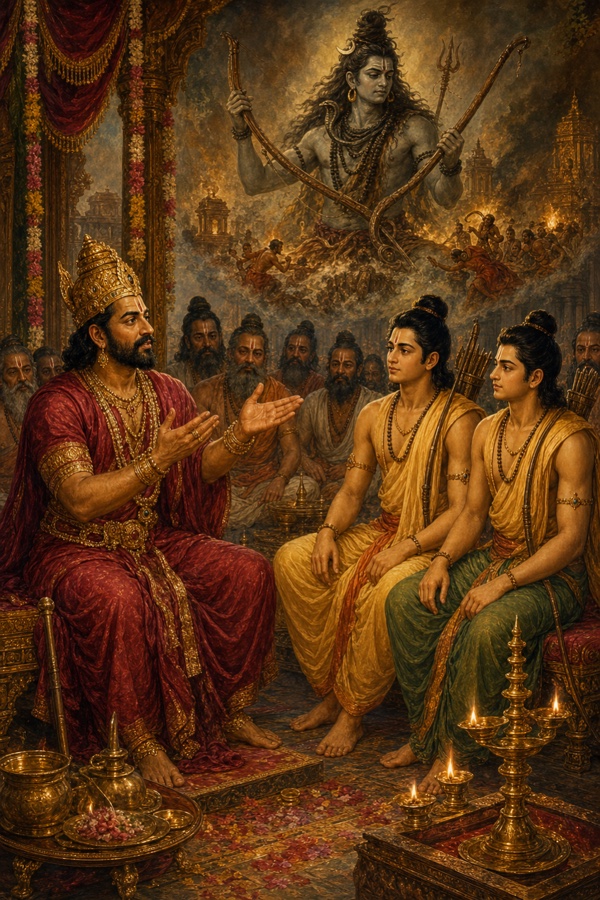
“Hear the story of this bow, and why it lies here in my keeping,” Janaka said. “Nimi’s eldest son was known as King Devarata, and it was into that noble king’s hands that the gods placed this bow, as a trust. In the old days Rudra, the god of destruction, took up this very bow to wreck the sacrifice of Daksha, and drawing its string as if in sport he spoke to the gods in anger. ‘Since you have set aside no share of the offerings for me, though I wanted one, gods, I will cut off your most worshipful heads with this bow.’ The gods were thrown into confusion, and they set about winning over Shankara, the ruler of them all, until Shiva, the source of the universe, was pleased with them at last. Full of grace, he gave the bow to the gods; and they placed that greatest of bows, as a trust, with our powerful forefather Devarata.”
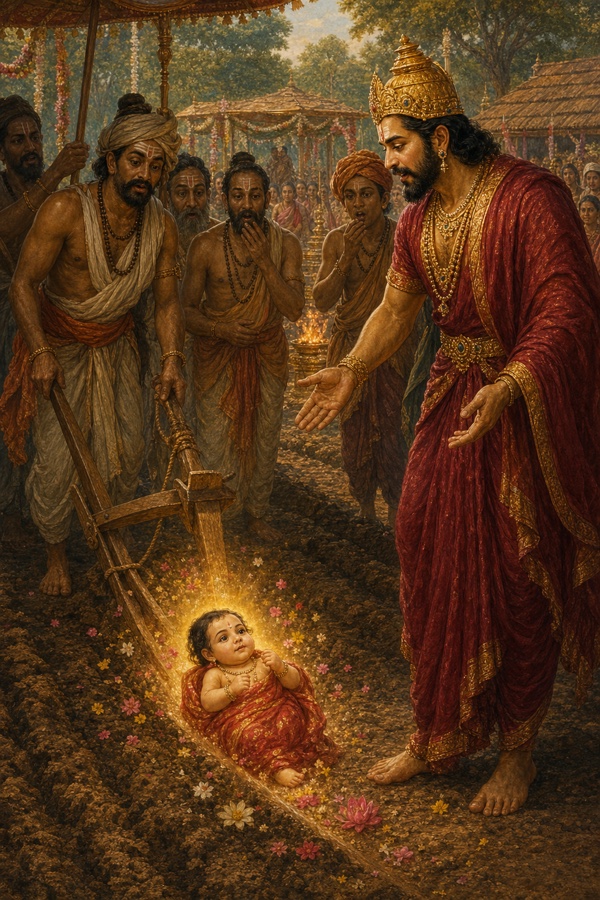
Janaka went on, and his voice changed, as a man’s voice does when he stops speaking of the gods and starts speaking of his daughter. “Soon after that, as I was plowing the ground set apart for a sacrifice, a girl rose up out of the furrow the plowshare cut. I found her while I was dressing the field, and so she became known as Sita,” he said. “That daughter of mine, who came up out of the soil, grew in my care at an astonishing pace. This girl, born of no mother’s womb, I set apart as one whose bride-price is valor, to be given to the suitor who could win her by his strength. Kings of many lands came to me and asked for the hand of my daughter, who had risen from the soil and was growing so fast. I gave her to none of them. I told every king who asked that she could be won by personal valor alone. Then all the kings came to Mithila together and asked what the measure was by which their strength would be judged, and the bow of Shiva was set before those inquiring princes. Lift it they could not. They could not even stir it enough to judge its weight. I saw that the prowess of those princes, who had claimed so much, fell short, and I turned them all away.”
“Now hear what they did next,” he said. “With their prowess called into question, all those kings in towering anger laid siege to Mithila. They held themselves insulted by me, and in their fury those kings made the city suffer. At the end of a full twelve months of siege, every resource I had was drained, and I was in deep distress. Then by penance I won over all the hosts of the gods, and the gods, well pleased, gave me an army complete in all four of its arms, horse and elephant, chariot and foot. Hard hit by that army and utterly routed, those villainous kings, whose courage was lacking or in doubt, fled with their ministers in every direction. This most splendid bow I will certainly show to Rama and Lakshmana. And if Rama strings it, sage, I promise to give my daughter, who was born of no mother’s womb, to this son of Dasharatha.”
The breaking of Shiva’s bow
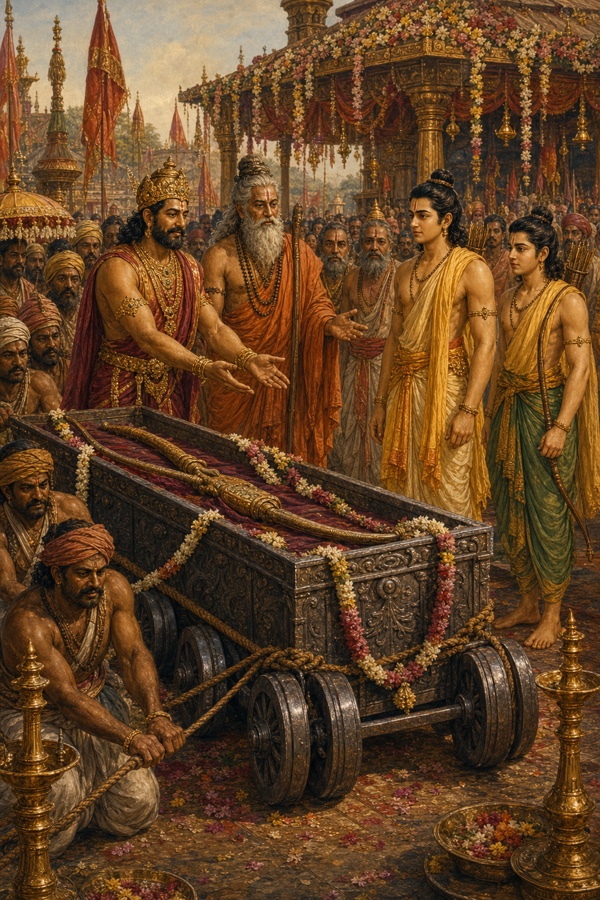
When he had heard Janaka’s story, Vishvamitra said to the king, “Show the bow to Rama.” Janaka gladly gave the order to the counselors sitting beside him. “Let the heavenly bow be brought here, decked with sandal paste and flowers.” The counselors, men of great renown, went into the city and came out again with the bow going before them. It rode in a chest mounted on eight wheels, and five thousand unusually tall, well-built men somehow managed to haul it along.
Bringing that finely made iron chest in which the bow lay, the counselors spoke to Janaka, who shone like a god. “This superb bow, king, which every king has worshiped, may be shown to Rama and Lakshmana, if you wish, ruler of Mithila,” they said.
Janaka heard them and turned with his palms joined to Vishvamitra and the two princes. “This splendid bow has been worshiped by the Janakas,” he said, “and praised by kings who could not bend it, mighty as they were. Not even the hosts of the gods, or the demons, or the Rakshasas, or the greatest of the Gandharvas and the Yakshas, or the Kinnaras, or the great Nagas could string it. Where then is the power in poor human beings to bend this bow, to string it, to fit an arrow to it, to make its string sing, or to toss it in their palms and guess its weight? This greatest of bows has been brought before you. Show it now to these two princes.”
Vishvamitra heard Janaka out, with Rama beside him, and spoke to the boy. “Rama, my child, look at the bow.”
At the seer’s word Rama opened the chest in which the famous bow lay, and looked at it, and said, “I will take this splendid heavenly bow in my hand. I will try to toss it on my palms, and even to bend it.”
“So be it,” said the king, and the sage said the same. At the sage’s word Rama took hold of the bow at the middle, lightly, as if in play. And before the eyes of a great crowd of people, Rama, whose mind is given to righteousness, strung that bow as if he were playing. He set the string, and he drew the bow, and the bow broke in two at the middle.
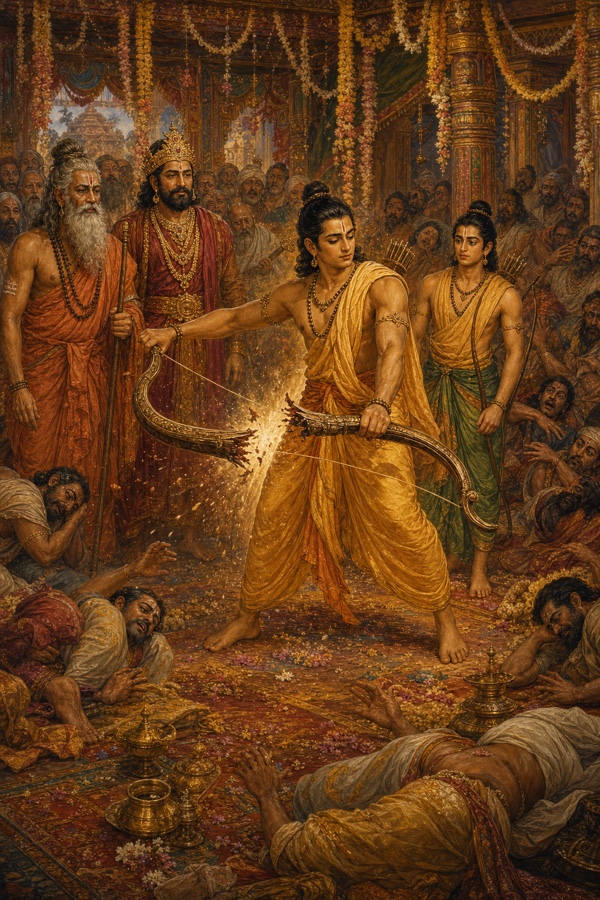
A great sound went out of it as it broke, like a crash of thunder, and after it came a violent earthquake, as though a mountain had split. Stunned by the crash, every man there fell to the ground, all but Vishvamitra, greatest of sages, and the king, and the two princes.
When the people had recovered from the shock and taken heart again, the king, every doubt in him now at rest, spoke with joined palms to the great sage; he was a man who knew how to speak, and he chose his words. “I have seen the prowess of Rama, the son of Dasharatha, with my own eyes,” he said. “What he has done is a marvel, past imagining, and I never thought I would see it. With Rama, son of the emperor Dasharatha, for her husband, my daughter Sita will bring glory to the family of the Janakas. My pledge that Sita can be won only by valor is kept today. My daughter, who is dearer to me than life, now remains only to be given away.”
“With your permission, let my counselors go at once to Ayodhya by chariot, at full speed; may God bless you,” he went on. “Let them bring the emperor to my capital with courteous words, and tell him fully how Sita, won by valor, is to be married to Rama. Let them tell him too that the two princes are well cared for by you, the sage, and let them bring the emperor here quickly and full of joy.”
“So be it,” said the son of Kushika. And the pious king called his counselors and sent them off with instructions to tell everything at length, exactly as it had happened, and to bring the emperor to Mithila.
The invitation to Ayodhya
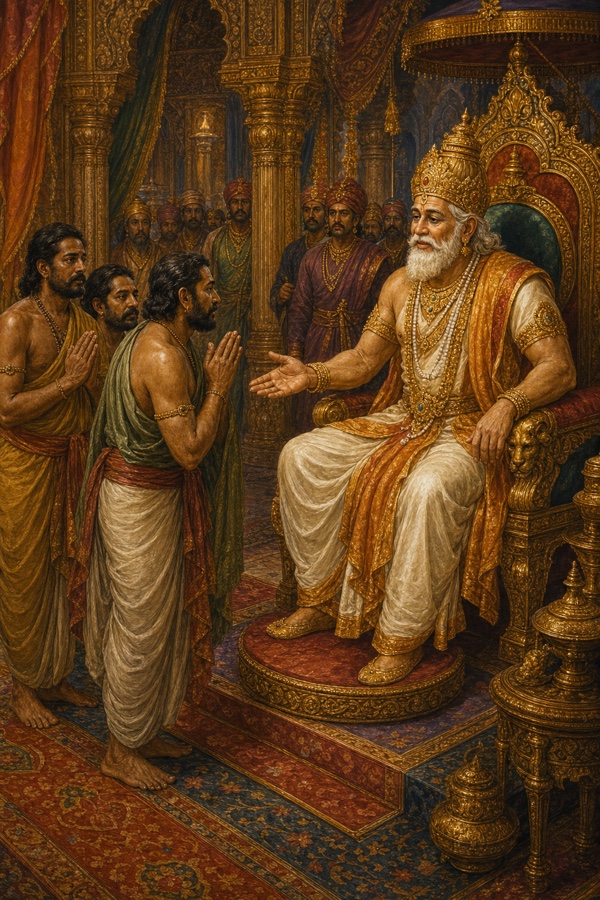
Janaka’s counselors, sent as envoys, stopped three days on the road because their horses were worn out, and then they entered the city of Ayodhya. They went to the royal palace, were shown into the court at the king’s order, and there they saw the aged King Dasharatha, who looked like a god. Whatever awe they had carried in with them melted under his kindly look and his gracious manner, and they spoke to the king with their palms joined, in polite and sweet-sounding words. They had come to tell a father news of his son that he had not yet heard.
“With the sacred fire set before him, and in courteous words warm with affection, King Janaka, ruler of Mithila and the source of his people’s happiness, has asked again and again, through our mouths, after your lasting welfare, and after the welfare of your teacher and your family priest, and of your attendants,” they said. “With the consent of Vishvamitra, son of Kushika, he has sent you this message.”
Then they gave the message in Janaka’s own words. “ ‘My pledge that my daughter would be won only by valor must already be known to you, and so must the fact that kings who lacked the strength to pass the test were turned away, though they resented it. That daughter of mine has now been won outright by your beloved and worthy son Rama, who came to my capital, to my good fortune, with the sage Vishvamitra as his guide. In the midst of a huge crowd of men, Rama broke that superb heavenly bow of Shiva in two at the middle. Sita, won by personal valor, now remains only to be given by me to that noble prince, and by giving her I mean to keep my pledge. Be pleased to approve it. Come soon, with your teacher beside you and your family priest at your head, and see Rama and Lakshmana; may God bless you. Bring my pledge to its fulfillment, and you will see the joy of both your sons.’ ”
“These are the sweet words the ruler of the Videhas has sent you,” the envoys ended, “with the approval of Vishvamitra and on the advice of Shatananda.”
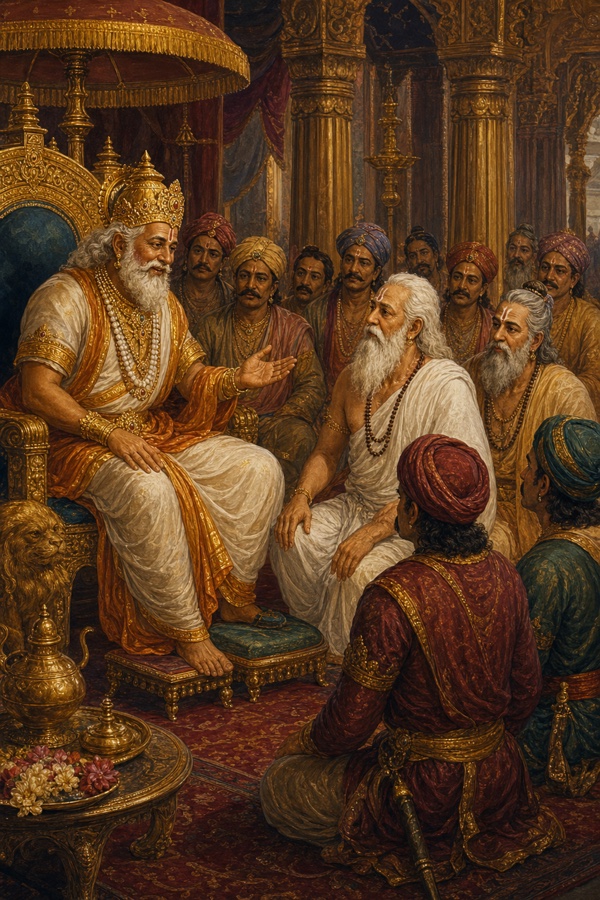
Dasharatha was overjoyed at the envoys’ message, and he turned to the sages Vasishtha and Vamadeva and to his counselors. “Rama, who makes Kausalya glad just by being near her, is staying in the kingdom of the Videhas with his brother Lakshmana, in the care of Vishvamitra, son of Kushika,” he said. “Janaka has seen Rama’s prowess, and he wants to give him his daughter. If Janaka’s family history and way of life seem right to you, let us go at once to his capital, Mithila, and lose no time.”
“So be it,” said the counselors and all the great seers.
“Then let the journey begin tomorrow,” the delighted king said to his counselors. Janaka’s envoys, who had every quality a king’s counselor should have, were overjoyed at the king’s decision, and, honored by Dasharatha, they spent that night in Ayodhya.
Dasharatha’s journey to Mithila
When the night was over, King Dasharatha, who had sat late with his teacher and his kinsmen, joyfully summoned Sumantra, his favorite and most trusted minister, and gave his orders. “Let all the treasury officers go on ahead today, carrying great riches and every kind of precious stone, with armed men to guard them,” he said. “Let the army of all four arms, horse and chariot and elephant and foot, march out the moment it gets my order, and with it the palanquins and every other carriage, and the chariots, superbly fitted. Let these Brahmins go ahead in palanquins or chariots: Vasishtha and Vamadeva, Jabali and Kashyapa, the long-lived Markandeya, and the sage Katyayana. And make my chariot ready, so there is no delay, because the envoys are urging me to hurry.” An old king was going to see his eldest son married, and he could not get there fast enough.
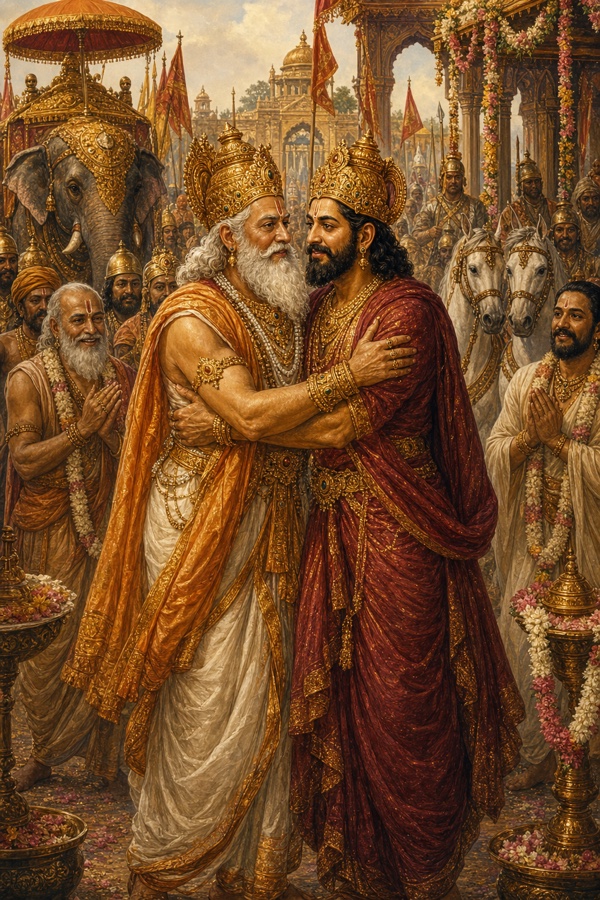
At the king’s command the army of all four arms marched close behind him as he drove with the sages, each in his own carriage. After four days on the road he entered the land of the Videhas. The moment Janaka heard that Dasharatha had come, he set about preparing his welcome. He came out to meet the aged Dasharatha, and the joy already in him rose to something higher.
“Your coming to my capital is a joy. It is my good fortune that you have come,” Janaka said to the delighted Dasharatha. “Here you will see the happiness of both your sons, Rama and Lakshmana, a happiness they have won by their own courage. And it is my good fortune too that the mighty sage Vasishtha has come with the finest of the Brahmins, the way Indra, who won the rule of the gods with a hundred horse sacrifices, comes with the company of the gods. Every obstacle in the way of Sita’s marriage has been overcome, and by my good luck my house is raised high by a bond with the house of Raghu, mighty and famous for its valor. Tomorrow morning, at the close of my sacrifice, you should celebrate the wedding with the help of the greatest of sages.”
Dasharatha answered him in the midst of the seers. “A gift rests with the giver; I have heard that said long ago,” he said. “Whatever you ask us to do, we will do.”
Janaka, ruler of the Videhas, was astonished to hear so pious a reply from that truthful king, a reply that could only add to his glory. Delighted at their meeting, all the companies of sages gathered there spent that night in happiness. With Vishvamitra going before him, Rama went with Lakshmana to touch his father’s feet, the first time father and sons had stood together since the boys left Ayodhya with the sage. And Dasharatha, overjoyed to see his two sons, and honored in every way by Janaka, went to his rest full of joy. Janaka too, having finished with piety the rites of the sacrifice he was performing and the rites that would bring good to his two daughters, Sita and Urmila, who were now to be married, went to his rest.
Kushadhvaja’s arrival, and the song of the Ikshvaku line
The next morning, when the closing rites of his sacrifice had been done with the help of the seers, Janaka, who knew how to put a thing into words, spoke to his family priest Shatananda. “My younger brother Kushadhvaja, a man of great fire, bold and deeply pious, has made his home in the blessed city of Sankashya, a city that rivals heaven and is as vast as Pushpaka, the flying palace of Kubera, god of riches; its bounds are marked by a defensive wall mounted with engines of war, and it drinks the water of the river Ikshumati,” he said. “He is the guardian of my sacrifice, because he gathered everything it needed, and I long to see him. My brother will share with me the joy of seeing my two daughters married.”
While he was still speaking, a few clear-headed messengers presented themselves before Shatananda, and Janaka gave them their orders. Like Indra’s men riding out at his command to bring his younger brother Upendra, the divine Dwarf, they rode on swift horses at the king’s order to fetch Kushadhvaja. Reaching Sankashya, they met him and told him truthfully what had happened at Mithila and what Janaka meant to do, and Kushadhvaja, hearing his brother’s news from the swiftest of those envoys, came at once, as the king had asked.
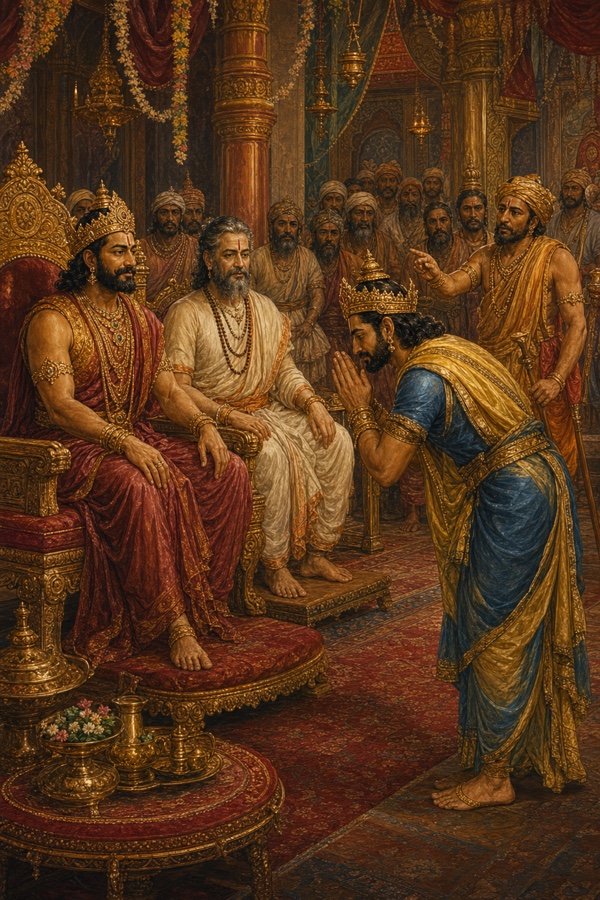
He saw Janaka, lover of righteousness, greeted Shatananda and his most pious brother, and took his seat on a wonderful throne worthy of a king. When the two brothers were seated, they sent for Sudamana, the best of their counselors, and gave him his orders. “Go quickly, chief of counselors, to the formidable King Dasharatha of Ikshvaku’s line, and bring him here with his sons and his counselors.” Sudamana went to Dasharatha’s lodging and greeted him there with his head bowed low. “Heroic king of Ayodhya, Janaka of the Videha line, ruler of Mithila, is eager to see you, with your teacher and your family priest.” Dasharatha heard Sudamana out, and with his crowd of sages and his kinsmen he went to where Janaka was.
Taking his seat with his counselors, his teachers, and his kinsmen, Dasharatha spoke to the king of the Videhas. “You may know that the mighty sage Vasishtha, revered by the house of Ikshvaku, speaks for us in all matters,” he said. “Seated here among all these great seers, and with Vishvamitra’s approval, the pious Vasishtha will recite my line in its order.” Dasharatha fell silent, and Vasishtha recited the line to Janaka, jewel of the Videhas, and to his family priest. This was how a marriage between two great houses began: each house named its fathers back to the beginning of the world.
“From eternal Brahma, born of unmanifest Prakriti and free of decay, came the sage Marichi; from Marichi, the sage Kashyapa; from Kashyapa, Vivasvan, the sun; from Vivasvan, Manu, lord of created beings in the age before this one; and from Manu, Ikshvaku, the very first king of Ayodhya. Then, father to son: Kukshi, Vikukshi, Bana, Anaranya, Prithu, Trishanku, Dhundhumara, Yuvanashva, Mandhata, Susandhi, who had two sons, Dhruvasandhi and Prasenajit; then from Dhruvasandhi, Bharata, and from Bharata, Asita.” Somewhere in that long line stood Trishanku, the same king Shatananda had just told of, hanging head downward among a sage’s stars.
“King Asita, against whom the Haihayas, the Talajanghas, and the bold Shashabindus rose as rival princes, was beaten in battle and driven from his throne. He went to the Himalaya with his two queens, both of them with child, and there, with the small force left to him, he died. One queen put poison in the other’s food to destroy her rival’s unborn child. The poisoned queen, Kalindi, lotus-eyed and longing for a fine son, went to the sage Chyavana of Bhrigu’s line, who had settled on that peak for love of it, and bowed to him. He told her not to grieve: a noble and mighty son would be born to her, and born with the poison. By the sage’s grace she was delivered safely, and because the boy came into the world together with that poison, gara, he was named Sagara.”
“Sagara’s son was Asamanja, and then, father to son: Anshuman, Dilipa, Bhagiratha, Kakutstha, Raghu, Pravriddha (who later became Kalmashapada, a man-eater with speckled feet, under Vasishtha’s curse), Shankhana, Sudarshana, Agnivarna, Shighraga, Maru, Prashushruka, Ambarisha, Nahusha, Yayati, Nabhaga, Aja, and from Aja, Dasharatha; and to this Dasharatha were born Rama and Lakshmana, and their brothers Bharata and Shatrughna.”
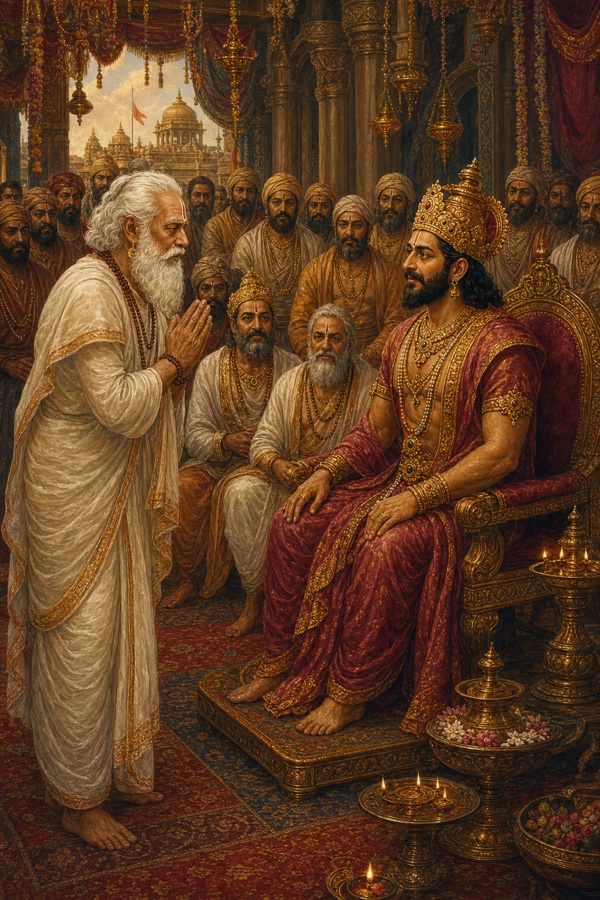
When he had recited the line, Vasishtha made the request. “On behalf of King Dasharatha, as his family priest, I ask for your two daughters, for Rama and Lakshmana,” he said. “They come of a line of pious, brave, and truthful kings born in the race of Ikshvaku, a race wholly pure in its descent from its very beginning. Be pleased to give your worthy daughters to these two equally worthy princes.”
The song of the Videha line, and the pledge of the daughters
Janaka answered Vasishtha with his palms joined. “Be pleased to hear our own line, which I am going to recite; may God bless you,” he said. “On the eve of giving away a daughter, a man of good family must recite his line in full to the family of the groom. So hear my line as I tell it.”
“There was a most pious king named Nimi, greatest of mighty men and famous in the three worlds for his deeds. His son was Mithi; Mithi’s son was Janaka, the first to bear the name; and from him came Udavasu, Nandivardhana, Suketu, Devarata, Brihadratha, Mahavira, Sudhriti, Dhrishtaketu, Haryashva, Maru, Pratindhaka, Kirtiratha, Devamidha, Vibudha, Mahidhraka, Kirtirata, Maharoma, Swarnaroma, and Hrasvaroma, father to son. Hrasvaroma had two sons: I am the elder, and the younger is bold Kushadhvaja.” Devarata stood in that list too, the king into whose keeping the gods had given Shiva’s bow.
“My father, the king, set me, the elder, on the throne, gave Kushadhvaja into my care, and went away to the forest,” Janaka went on. “When my aged father had gone to heaven I carried the burden of kingship he had laid on my shoulders by the principles of righteousness, and I looked after my brother Kushadhvaja with affection, because he shines like a god. Some time later the powerful King Sudhanva came all the way from the town of Sankashya and laid siege to Mithila. He sent me word: ‘Shiva’s superb bow, and your lotus-eyed daughter Sita, are to be handed over to me.’ I refused, and he made war on me, and fighting face to face with me on the battlefield Sudhanva was killed by my hand. Having rid the earth of him, I set my bold brother Kushadhvaja on the throne of Sankashya.”
“Here is my younger brother, and I am the elder,” he said. “Full of joy, we offer you my two daughters as your daughters-in-law: Sita for Rama, and Urmila for Lakshmana. May prosperity attend you. I say it three times, full of the highest joy: I give you as your daughters-in-law my daughter Sita, who is like a daughter of the gods and has been won by Rama through his own valor, and Urmila, my second daughter. There is no doubt about it.”
Then he turned to Dasharatha. “King, have the samavartana performed for Rama and Lakshmana, the rite by which a young man comes home from his teacher’s house with his studies done, with the shaving of the hair on his head and under his arms; let them go through it gladly,” he said. “Then perform the nandi-shraddha, the rite that pleases the departed ancestors before a wedding. May good come to you, king. Today the constellation Magha is in the ascendant. On the third day from now, when the mansion of Uttara Phalguni is in the ascendant, hold the wedding. And make the gifts that bring happiness after them, for the good of Rama and Lakshmana.”
Kushadhvaja’s daughters, for Bharata and Shatrughna
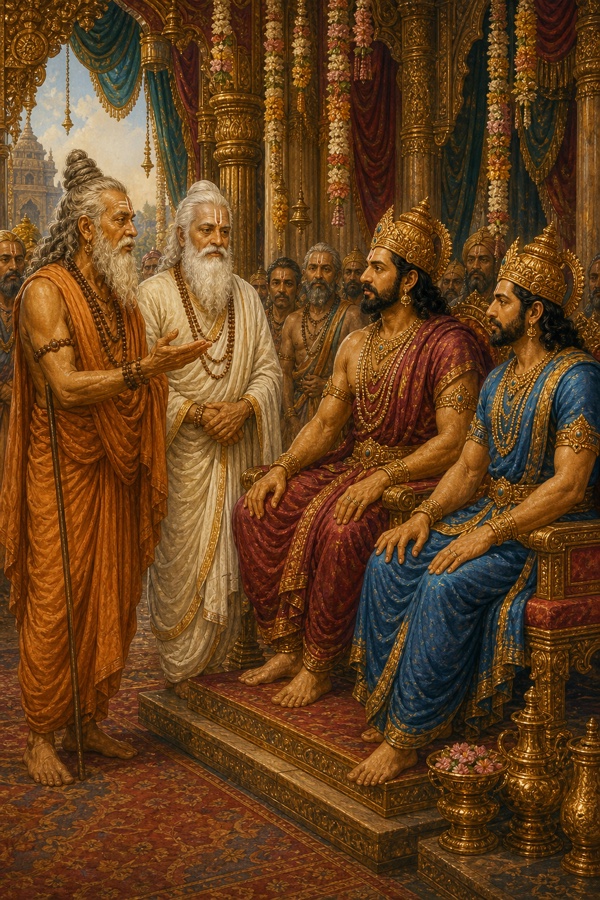
When the heroic king of the Videhas had finished, the great sage Vishvamitra spoke, with Vasishtha beside him. “The royal houses of Ikshvaku and Videha are great beyond imagining and glorious beyond measure. No one equals those born in these two races,” he said. “The sacred bond about to be made between the two houses is well matched, in beauty and in wealth alike; Sita, and Urmila with her, are wholly fitting for Rama and Lakshmana. Still, there is more to be said on this. Let my counsel be heard.”
“Here is your younger brother, King Kushadhvaja, who knows what is right,” he went on. “We ask for the two daughters of this pious prince, who have no equal on earth for beauty, as wives for Prince Bharata and for the shrewd Shatrughna, the other two sons of the emperor Dasharatha. All four of Dasharatha’s sons are full of beauty and of youth, equal in prowess to the gods, the very peers of the guardians of the four quarters. Through the marriage of both these pairs let the house of Ikshvaku be bound to yours with ties of love. And let no hesitation trouble your mind at making a fourfold bond with the great King Dasharatha all at once.” Bharata and Shatrughna had come to Mithila to see a brother married, and now they would be married themselves.
Janaka heard Vishvamitra’s proposal, which Vasishtha shared, and answered both sages with his palms joined. “I count my line blessed, that you two yourselves bid us make an alliance so worthy of us,” he said. “Let it be so. May good fortune attend you all. Let Shatrughna and Bharata, who are never apart, take Kushadhvaja’s two daughters as wives. Let all four mighty princes take the hands of the four princesses on one and the same day. The wise favor a wedding on the later of the two Phalguni days, the day of Uttara Phalguni, over which Bhaga presides as lord of created beings.”
When he had made that gentle reply, Janaka rose from his seat as a mark of respect and stood before the two great sages with his palms joined. “You have both given me the highest merit there is, the virtue that comes of giving my daughters to worthy hands,” he said. “I am your servant, as Dasharatha is. Take these high seats. As this city of Mithila belongs to Dasharatha, so Ayodhya is my own city. There can be no doubt of your authority here. Be pleased, then, to do whatever is fitting.”
Janaka of the Videha line was still speaking when King Dasharatha answered him with joy. “You two brothers, rulers of Mithila, have more good qualities than anyone can count,” he said. “Sages and crowds of princes have been entertained by you both, many times over. May you find happiness, and may God bless you. We will go to our lodging now and perform the shraddha rites for the ancestors as they should be done.”
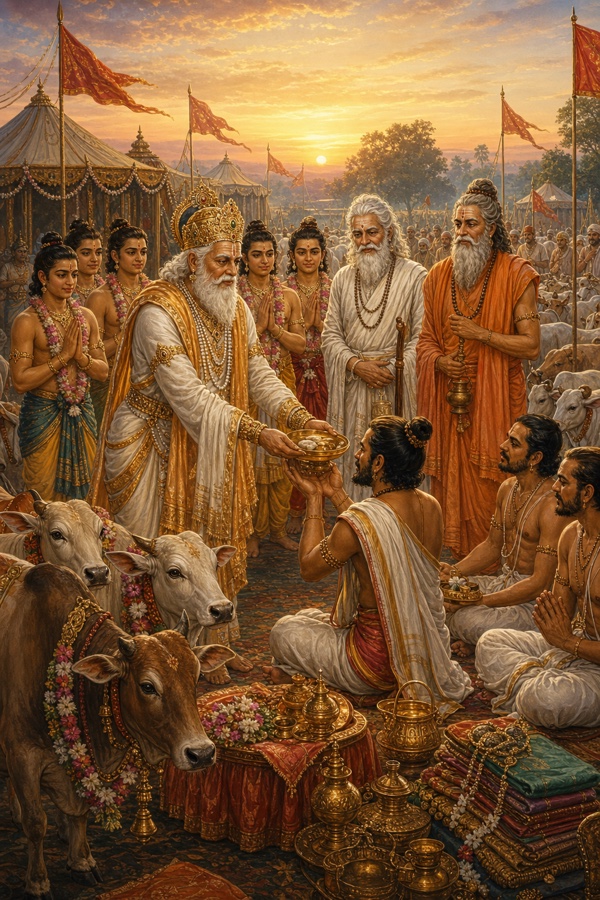
Taking leave of Janaka, King Dasharatha went quickly to his lodging with the two great sages, Vasishtha and Vishvamitra, going before him. He performed the shraddha with due ceremony, and rising the next morning he had the grand samavartana performed for his four sons, with the shaving of their heads and the giving of cows that belongs to it. For each of his four sons King Dasharatha, who loved them, gave the Brahmins a hundred thousand cows, four hundred thousand in all, cows freshly calved and rich in milk, their horns plated with gold, each with a milking pail of bell metal, and great riches of other kinds besides. Ringed by his sons with their heads newly shaved and their gifts of cattle made, the king shone like Brahma, lord of created beings, ringed by the guardians of the four quarters.
The four weddings
On the very day the emperor made his great gift of cattle, the bold Yudhajit arrived at Mithila, son of the king of Kekaya and Bharata’s own uncle on his mother’s side. He greeted the emperor and asked after his welfare, and then explained himself. “My father, the ruler of the Kekaya country, asks after your welfare out of affection, and bids me add that all is well at present with those whose good you wish for,” he said. “The king my father is eager to see Bharata, my sister’s son, and for that I went straight to Ayodhya. At Ayodhya, though, I heard that your sons Bharata and Shatrughna had come on with you to Mithila for Rama’s wedding, and so I drove here in haste, eager to see my sister’s son.” He had come for one nephew and found four weddings.
Dasharatha received this dear guest, who deserved every honor, with the greatest attention. He spent that night with his sons and rose again in the morning, and when his morning duties were done the king went to the pavilion built for the wedding, with the sages going before him.
At the auspicious hour called Vijaya, the hour the astronomers name for the success it brings to anything begun in it, Rama came to the pavilion, hung with every ornament and dressed in a bridegroom’s festive clothes, with all three of his brothers, and with Vasishtha and the other great sages walking before them. And the holy Vasishtha spoke to Janaka of the Videha line.
“King, with his sons dressed for the wedding, the emperor Dasharatha waits on the giver’s pleasure,” he said. “A gift happens only when giver and receiver both take part. So perform the noble rites that belong to a wedding, and fulfill the sacred duty of the word you gave.”
Janaka, who knew what is right down to its very depths, answered Vasishtha. “Who stands at my door to guard it, and whose permission is the emperor waiting for?” he said. “What hesitation can there be about walking into one’s own house? This kingdom is as much yours as mine. My daughters have gone through every auspicious rite of the wedding, and they have already come to the foot of the altar, looking like so many blazing tongues of fire. I am seated here at this altar, waiting for you. Let everything be done without hindrance. Why is the ceremony being held up?” A father who had kept a bow under guard for years was in no mood to wait at a doorway.
At Janaka’s reply Dasharatha at once brought his sons and all the companies of sages into the pavilion. Then the ruler of the Videhas turned to Vasishtha. “With the other sages, pious seer, conduct the wedding rite of Rama, the joy of the world,” he said.
“So be it,” Vasishtha said to Janaka, and, with Vishvamitra and the pious Shatananda going before him, Vasishtha built an altar in the middle of the pavilion as the scriptures direct and decked it on every side with sandal paste and flowers. On it he set plates of gold, and jars of many colors with green shoots standing in them, and shallow clay cups full of shoots as well; vessels of incense with the incense burning; conch shells used as vessels; the sruk, the long wooden ladle of palasha or khadira wood that pours ghee on the fire, and the sruva, the smaller ladle that fills it; vessels brimful of water for the deity’s hands; vessels full of parched paddy and smaller vessels beside them; and grains of unbroken rice dyed with turmeric. He strewed the altar with blades of darbha grass cut to one length, set the fire on it as the scriptures direct while chanting the sacred texts, and poured the oblations into the fire with due ceremony and the chanting of the mantras.
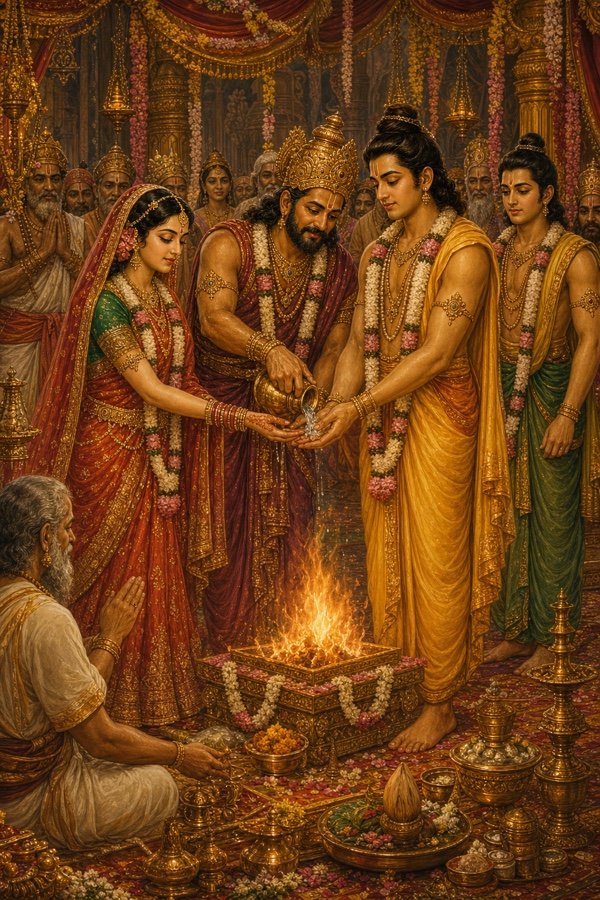
Then Sita was brought in, decked with every kind of jewel, and seated at her ease before the sacred fire, facing Rama. And King Janaka spoke to Rama, the joy of Kausalya. “This is Sita, my daughter, who will be your partner in every sacred duty of your life,” he said. “Take her hand in yours and accept her as your own. May good come to you. She is truly blessed; she will be devoted to you alone, and she will follow you always, the way a shadow follows.” Those last words would come true in a forest, years later, when she followed him into exile.
With that the king poured into Rama’s hand the water he held in his own, blessed by the chanting of sacred texts, the sign of a father’s will to give. In that moment the kettledrums of the gods sounded, and from gods and sages crying “Good! Well done!” a great shower of flowers came down. Having given his daughter Sita to Rama with the water hallowed by mantras, King Janaka, filled with rapture, turned to Lakshmana.
“Lakshmana, come; may good come to you,” he said. “Accept Urmila, whom I give you. Take her hand in yours; let no time be lost.”
Then Janaka spoke to Bharata too. “Take the hand of Mandavi in yours.”
And the pious king of Mithila said to Shatrughna, “Take the hand of Shrutakirti in yours. You are all gentle, and you have all kept your sacred vows. Be married, and let there be no delay.”
At Janaka’s words the four princes, following Vasishtha’s directions, took the hands of the four princesses in their own. They walked around the sacred fire, keeping it on their right, around the altar, and around Janaka and the sages, and with their brides the princes went through the wedding rite in the way the scriptures lay down. To the loud beat of the kettledrums of heaven and the music of voices and instruments, a great and splendid shower of blossoms fell from the sky. Companies of heavenly nymphs danced, and the Gandharvas sang in sweet voices; it was a marvel, and it was seen at the wedding of the finest men of Raghu’s line. While that harmony of heavenly sound went on and echoed, those princes of great glory walked three times around the fire and each took his bride. Then, with their wives, the four brothers went to their tents; and the emperor followed with the companies of seers and his kinsmen, gazing with joy at the brides and the grooms.
The gist: on the wedding day Bharata’s uncle Yudhajit rides in from Kekaya; Vasishtha builds the altar in the center of the pavilion and feeds the fire; and at the hour called Vijaya, Janaka gives Sita to Rama with water poured from his palm, then Urmila to Lakshmana, Mandavi to Bharata, and Shrutakirti to Shatrughna, while the gods beat their drums and rain down flowers.
Source: Srimad Valmiki Ramayana, Balakanda, Cantos 50 to 73. The Gita Press Hindi edition is the controlling witness. The Sanskrit e-text and an independent complete translation were used to verify names, sequence, and principal events. Where recensions differ, this retelling follows Gita Press.
Based on: Valmiki Ramayana (Gita Press, Gorakhpur)
Optional
After the reading, a little play
Explore related passages through a short round. Each answer includes an explanation and a passage link.
Explore a story detail