On this page
Sita had gone down into the netherworld, and all across that great assembly the monkeys and the sages were calling out “Well done, well done” with their eyes fixed on Rama. He stood leaning on the wooden staff a man holds for support at a sacrifice, his eyes clouded with tears, his head bowed, his mind sunk in a private ruin. Every creature on that ground was cheering the thing that had just finished him. For a long while he wept, and shed his tears without counting them, and at last, filled at once with grief and with anger, he spoke. “A sorrow I have never known before is reaching now to touch my mind. Before my very eyes Sita has vanished, the way Lakshmi herself might vanish. O Earth, venerable goddess, give Sita back to me, or you will learn what my anger is, for you know my strength. You are my mother-in-law as much as anyone: it was out of you that Janaka drew Maithili long ago, when his golden plow turned the field. So return Sita, or open to me the same door, that I may go down into the netherworld or up into heaven and be with her there.” He had used that voice once before, on a shore, against a sea that would not let him cross to her, and the sea had come up out of itself and given way. He was speaking to the ground now, and the ground did not answer.
Brahma’s reassurance and the opening of the Uttarakanda
His grief kept rising into threat. If the Earth would not hand Sita back exactly as she had been, he said, he would grind the whole world to ruin, mountains and forests and all, and let the waters close over every last field. Nobody standing there took it for a figure of speech; they knew the arm it came from. While the prince born in Kakutstha’s line was speaking so, Brahma, standing among the gods, answered him. “Rama, Rama, keeper of noble vows, do not give yourself to this grief. Remember what you were before this life, and the word you gave the gods. I would not presume to remind you of that supreme form of yours. In this very hour, call to mind that you are the descent of Vishnu. Sita is pure and true and turned toward you as she has always been, and by the strength of the austerities she performed with you as her whole refuge she has passed in peace to the world of the serpents. Your reunion with her will come again, in heaven; of that there is no doubt. Now hear what I say to you in the middle of this gathering.”
Brahma went on. “This poem, Rama, this Ramayana that is dedicated to you and that you have now heard, is the highest of all poems. It tells in full every joy and every sorrow you have known from your birth, and everything that is yet to come; of that there is no doubt. This first of all poems rests entirely upon you, and no one but you could ever be its hero and be worthy of such fame. I heard the whole of it long ago, together with the gods, wonderful and true in every word, with nothing hidden. So now, prince born in Kakutstha’s line, settle yourself firmly in dharma and listen to the part of the poem that remains, the part that tells of the days to come. This remaining portion goes by the name of the Uttarakanda; hear it with the sages beside you. It is fit for no one else to hear. The great sage Valmiki composed it, and it is for you alone to hear it.” Two boys had sung him his life as far as this morning. What was left in the poem had not happened yet, and Rama was being asked to sit down and listen to his own ending.
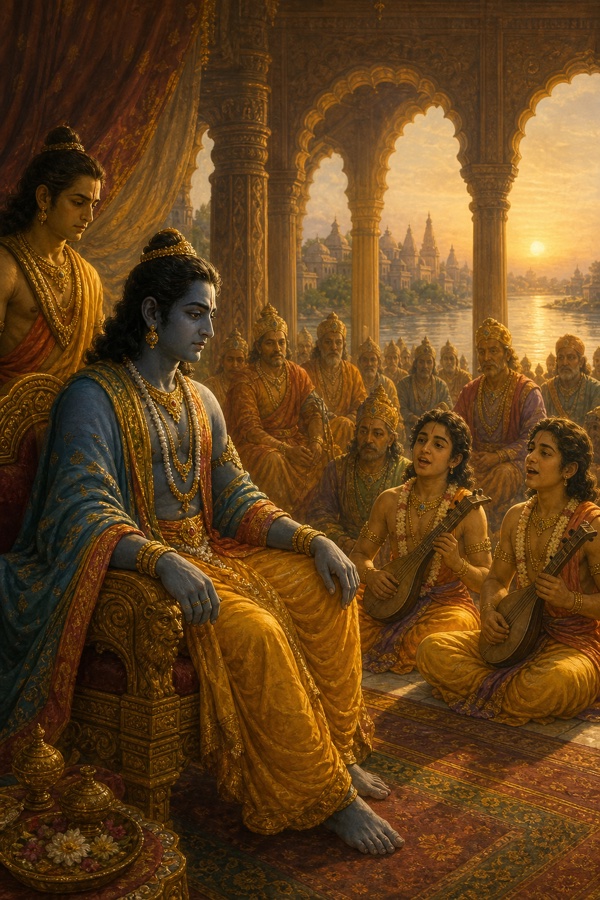
Having said this much, Brahma, lord of the three worlds, went up to heaven with all the gods, his kinsmen. The great sages of Brahma’s own world stayed behind, with his leave, wishing to hear the story of what lay ahead for the prince born in Raghu’s line. When he had heard the gracious words of the God of gods, Rama turned to Valmiki. “Sir, the Uttarakanda that concerns my future, the part these sages of Brahma’s world wish to hear, let it be sung tomorrow.” So resolving, he took Kusha and Lava by the hand, which was a thing he had learned only days ago that he had any right to do, dismissed the great crowd of men, and returned to his hut of leaves. He grieved only for Sita, and grieving so, he passed the night.
Rama’s long and righteous reign, and the passing of his mothers
When the night was gone and the day had come, Rama called all the great sages together and said to his two sons Kusha and Lava, “Sing, without any hesitation.” So, once the great and noble sages had taken their seats, the two boys sang this Uttarakanda, the poem of the days to come. Sita had passed into the earth by the power of her truth, and at the close of the sacrifice Rama was heavy with sorrow and felt this world to be an empty place. Not to see Vaidehi, and to be torn so by grief, left his mind no rest at all. He gave rich gifts to all the kings, and to the bears and the monkeys and the demons, and to the great throng of the leading Brahmins, and so brought the sacrifice to its proper end and sent them away. Then Rama, with Sita held in his heart and his two sons beside him, entered Ayodhya.
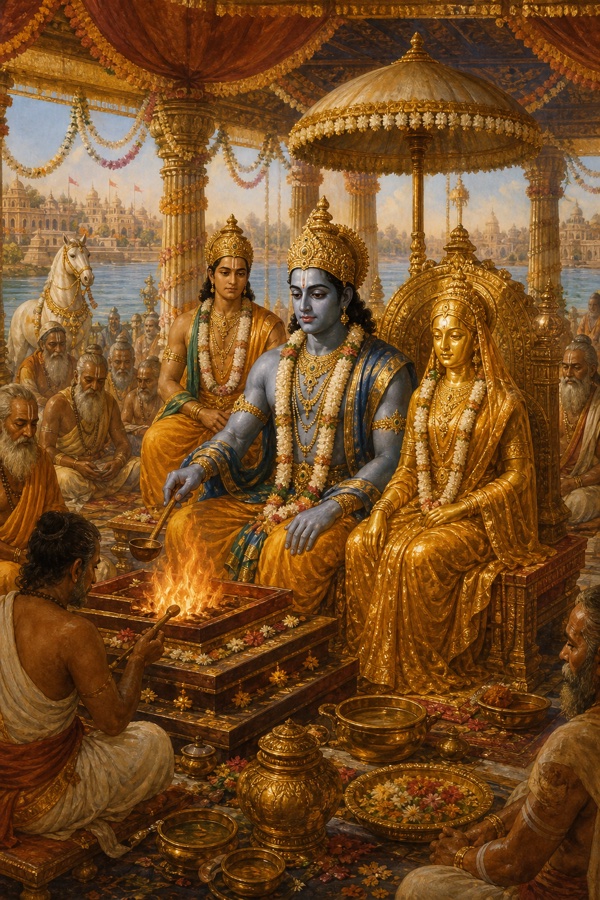
That son of Raghu never took another wife after Sita. At each horse-sacrifice a golden image of Janaka’s daughter stood in the queen’s place. For ten thousand years he performed the horse-sacrifice, and the Vajapeya ten times as often, each rite heavy with gold poured out in gift, and each one of them had him standing at the fire beside a statue of her. He performed the Agnishtoma and the Atiratra, and many a Gosava, and other sacrifices besides, all with lavish offerings. So Rama’s long reign passed, seated on his throne, bent always upon dharma. The bears and the monkeys and the demons held steady under his rule, and the kings came day after day with their tribute and stayed devoted to him. The clouds gave their rain in season, the harvests were good, the four quarters of the sky were clear, and town and countryside alike were crowded with hale and well-fed people. In Rama’s reign no one died before his time, no creature suffered sickness, and no disaster ever fell. It was the best age the world has been given, and the man holding it up went to the fire ten thousand times beside a likeness of his wife.
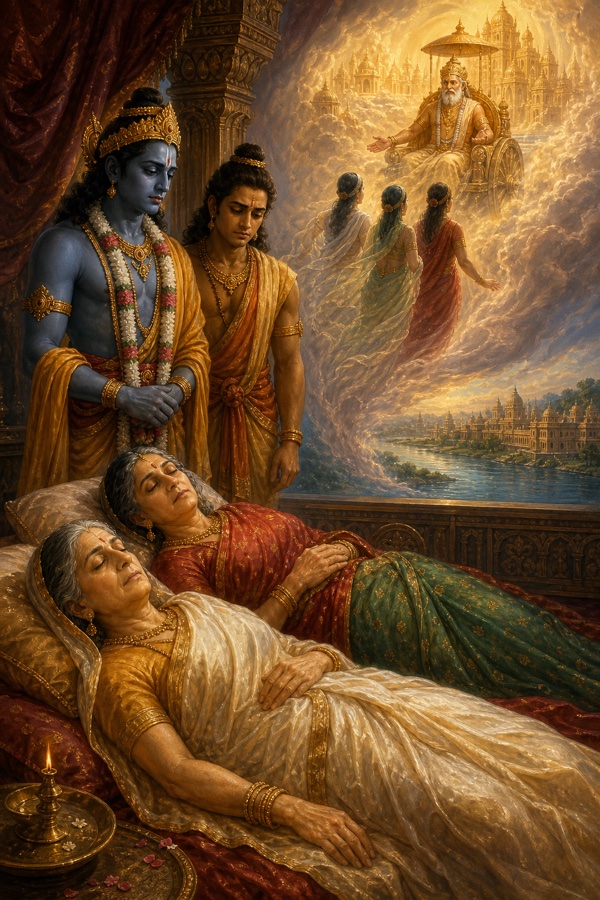
After a long stretch of years, Rama’s mother, Kausalya, surrounded by her son and her grandsons, yielded to the law of time. Sumitra and Kaikeyi followed her soon after, having done many acts of dharma, and took their place in heaven behind her. All three, glad, were united there with King Dasharatha, and gathered the fruit of every righteous deed. Kaikeyi went up with the other two, and Dasharatha, who had died of what she asked for, met all three of his wives as one household again. For his mothers Rama made great gifts from time to time, sharing without difference among the ascetic Brahmins. He gave to the ancestors the things they loved and gave Brahmins their choicest wealth, and performed sacrifices most hard to accomplish, so that the standing of both ancestors and gods was raised. So, lifting the course of dharma higher with sacrifice upon sacrifice, Rama passed many thousands of years in ease.
Gargya’s arrival and Bharata’s march on the country of the gandharvas
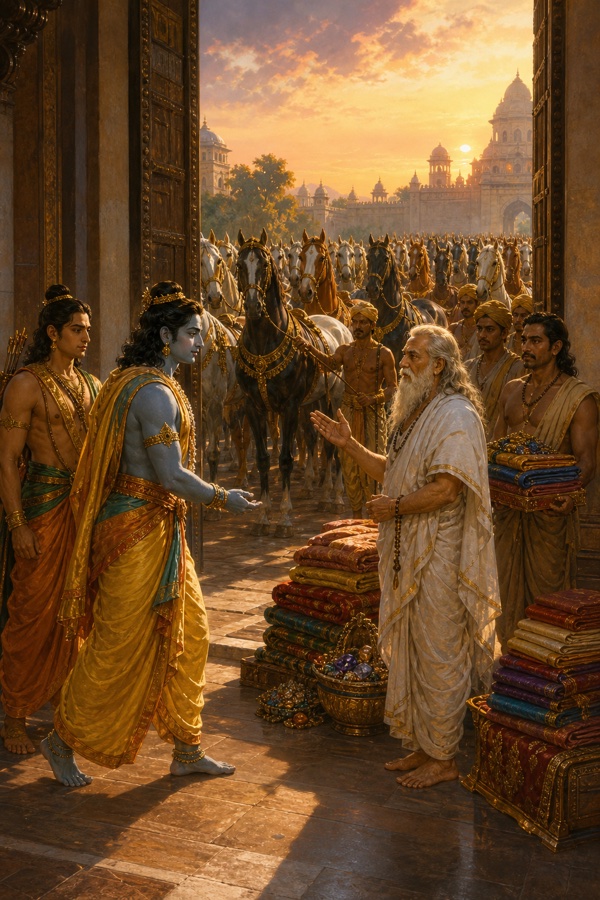
After some time had gone by, Yudhajit, the king of Kekaya and Bharata’s maternal uncle, sent his own preceptor to Rama: Gargya, the son of Angiras, a Brahmin sage of boundless splendor. As a token of his affection the king sent for Rama ten thousand fine horses, and blankets, and gems, and rich garments of many colors, and lovely ornaments. When Rama heard that the great sage Gargya had come, and of the vast treasure the Kekaya king Ashvapati had sent, he went out with his brothers a full two miles to meet him, and honored Gargya as Indra honors Brihaspati. The lord of the whole earth walked two miles down the road on his own feet to greet a Brahmin. Having worshiped the sage, having taken in the gifts, and having asked after the welfare of his uncle in every particular, Rama began to question the noble sage once he was seated. “Best among those who know the shastras, you are like Brihaspati himself. For what purpose have you come? What word has my uncle sent?”
Hearing Rama, the great sage began to set out in detail an errand that seemed almost a marvel. “Your uncle Yudhajit has sent this in friendship; hear it if it pleases you. On both banks of the river Sindhu lies the country of the gandharvas, a region of great beauty, rich with fruit and root. It is guarded by the three crore sons of Shailusha, gandharvas skilled in war and armed to the teeth, immense in strength. Conquer them and add that fair city of the gandharvas to your own kingdom, a thing no one else could do. May it please you to take it; I do not counsel this against your interest.” Hearing the word of both the sage and his uncle, Rama was pleased. He said, “So shall it be,” and looked toward Bharata.
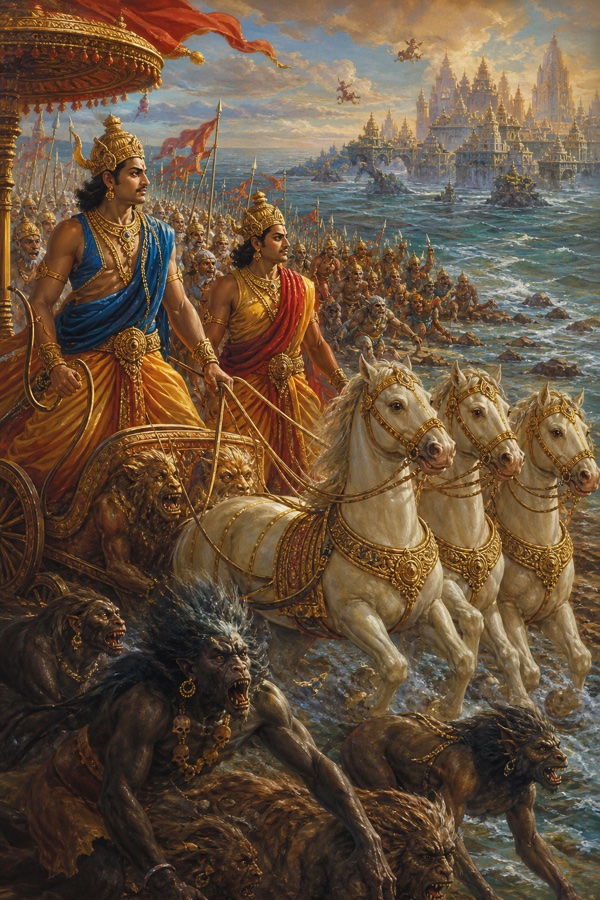
Folding his hands, Rama spoke courteously to the Brahmin. “Sage among Brahmins, Bharata’s two brave sons, Taksha and Pushkala, will go to that country, well guarded by their granduncle and holding fast to dharma. With Bharata at their head, and with their army and their followers, these two young men will kill the sons of the gandharva king Shailusha and divide the two regions between them. Once they have founded two cities there and set his two sons in place, that Bharata will come back again to me.” So speaking to the Brahmin sage, Rama ordered Bharata to set out with his army and his attendants, and on an auspicious day, under a favorable star, he consecrated the two young princes. With Angiras’s son Gargya at the front, Bharata marched out with the army and the two boys. That army, hard as Indra’s own to withstand, went forth from Ayodhya, and Rama walked behind it a long way to see it off. Flesh-eating demons athirst for blood, terrible hordes of spirits, and lions and tigers and boars, and birds of the air in their thousands, all went ahead of the host, eager for the flesh of the gandharvas’ sons. The carrion of that country knew what was coming and went on ahead to wait for it. Spending a month and a half on the road, that army, whole and glad, came at last to the land of Kekaya.
The destruction of the gandharvas and the founding of Takshashila and Pushkalavata
When Yudhajit heard that Bharata had come as commander of the army, he was overjoyed, and Gargya with him. He set out with a great throng of people and, joining Bharata, reached in haste the capital of the gandharvas, who could take any shape they wished. Bharata and Yudhajit, with their swift-striking warriors and all their army and followers, came up to the gandharva city. Hearing that Bharata had arrived, the gandharvas, immense in power and eager for war, poured out and raised their war cries on every side. Then a wild and terrible battle broke out, a thing to make the hair stand on end; it ran for seven nights, and neither side came away the victor. Seven nights, and an army that had put Lanka down could not move them a step. Rivers of blood streamed out in all directions, their crocodiles the swords and the spears and the bows, and the bodies of men floating on them like driftwood.
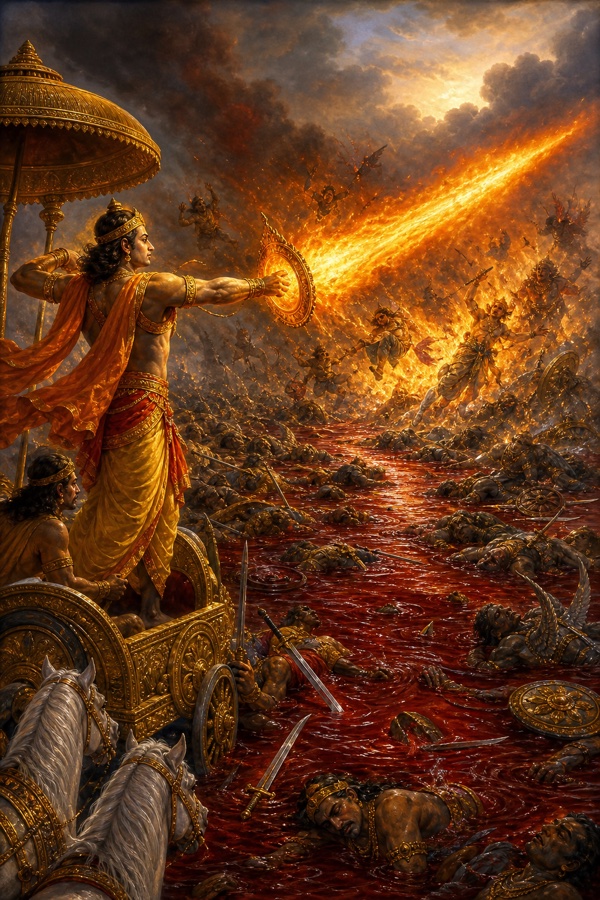
Then Bharata, Rama’s younger brother, in a great rage, loosed against the gandharvas the most terrible weapon of Death, the one called Samvarta. Struck by that Samvarta, the three crore gandharvas were torn apart in a single instant, as if bound fast in the noose of death. So swift and dreadful was the ruin of those mighty gandharvas that even the gods could not recall a battle like it. When all of them were slain, Bharata, the son of Kaikeyi, founded there two great and prosperous cities: he set Taksha over Takshashila in the gandharva country and Pushkala over Pushkalavata in the land of the Gandharas. Both cities were heaped with wealth and gems, graced with gardens and groves, each striving to outshine the other, laid out with well-ordered markets, fine mansions, tall many-storied palaces, temples of worship, and stands of tala, tamala, tilaka, and bakula trees, until the two lovely places looked like divine cities of heaven. Where three crore had died in one instant, two cities came up out of the ground with gardens in them. Having settled them fully in five years, the son of Kaikeyi, Bharata of Raghu’s line, returned to Ayodhya.
Bharata bowed to Rama, who was like a second Dharma in living form, as Indra bows to Brahma, and told him just as it had happened: the great and glorious battle with the gandharvas, and the founding of the two cities. Hearing it, Rama of Raghu’s line was greatly pleased.
The consecration of Angada and Chandraketu
When he had heard Bharata’s account, Rama, pleased, and with all his brothers about him, said to Lakshmana words of wonderful import. “Your two sons, Angada and Chandraketu, know dharma and are firm in valor. I judge them fit to guard kingdoms of their own, and I mean to consecrate them. Let a region be found that is lovely and untroubled, where these two archers may live in ease. Look, gentle brother, for a land where kings are not oppressed and hermitages are not laid waste, so that we do not later stand at fault.” He wanted ground for his nephews that no one would have to be robbed of. At Rama’s word Bharata answered, “This region called Karupatha is lovely, free of every ill; let a city be founded there for Angada, and for Chandraketu a fair, sorrowless land called Chandrakanta.”
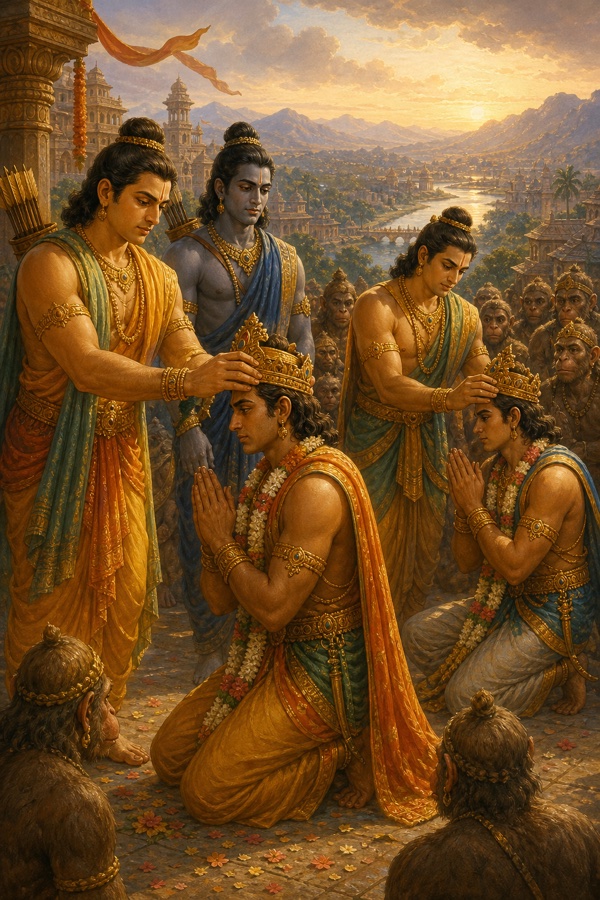
Rama accepted Bharata’s word. He brought the Karupatha country under his own hand and founded a city there for Angada. That city, Rama’s gift, was named Angadiya, most lovely and guarded on every side. For Chandraketu, a wrestler, a city was founded in the land of Malla, famous by the name of Chandrakanta, like a divine city of heaven. Then Rama, invincible, with Lakshmana and Bharata, in great gladness consecrated Angada and Chandraketu. Having crowned the two young men and set them firmly on their way, they sent Angada westward and Chandraketu to the north. Lakshmana, Sumitra’s son, went himself behind Angada, and Bharata became the rear guard for Chandraketu.
Staying a full year in Angada’s city, and settling his unconquerable son well in place, Lakshmana came back at last to Ayodhya. Bharata too, having stayed a year and more, returned to Ayodhya and served at Rama’s feet. Both of them, Sumitra’s son and Bharata, most righteous men, bound with their whole hearts to Rama’s feet, in the depth of their love for him lost all count of the passing time. So, always at the work of the citizens and always keeping to dharma, the three of them saw ten thousand years go by. Ten thousand years, and not one of the three of them noticed them going. Every desire fulfilled, standing in the city of virtue and clothed in prosperity, the three brothers shone with a splendor like three sacrificial fires blazing high with the oblations well poured into them.
Time comes as a messenger in the guise of an ascetic
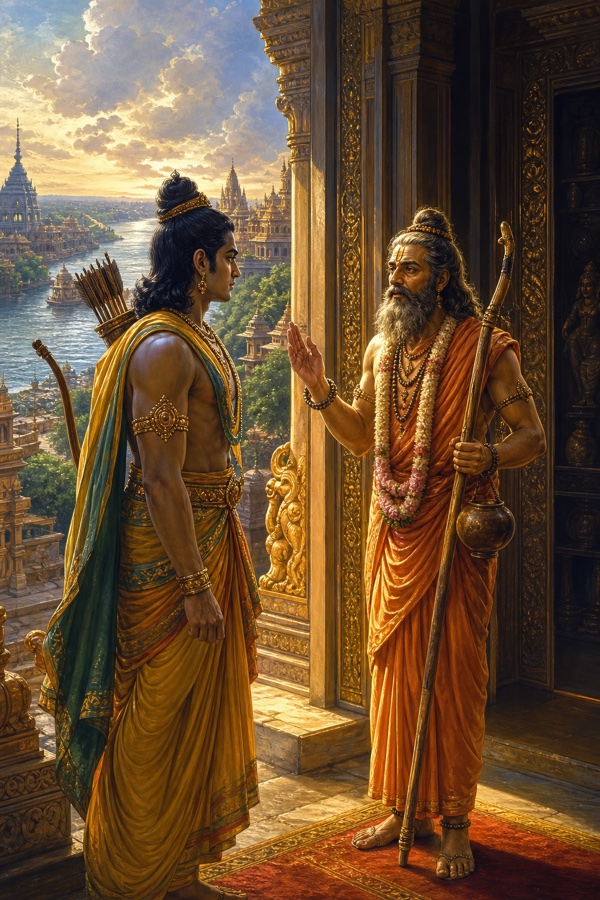
After a further span of time, while Rama was ruling and holding steadily to dharma, Time came to the palace gate in the form of an ascetic. He spoke to Lakshmana, standing there resolute and glorious. “I have come for a great purpose; report my arrival to Rama. I am the messenger of the great and radiant sage Atibala and I have come to see Rama on an errand.” At once Sumitra’s son carried word of the ascetic to Rama. Bright as the sun with the fire of his austerities, seeming to burn with his own splendor and to scorch all around him with his rays, the messenger came before Rama and said in a sweet voice, “May it be well with you.” Rama honored him with the water of welcome and asked after his health, and the messenger seated himself on a beautiful golden seat. Death was given water for his hands, shown to a golden seat, and asked whether he was keeping well. Rama said, “Welcome to you. Give me the message of the one who has sent you here.”
Pressed by Rama, the sage said, “My message is to be spoken only between the two of us, in private, if you hold the common good in mind. If you honor the words of the chief of ascetics, King, then whoever should hear our talk or should look on us must be given up by you to death.” Rama swore, “So shall it be,” and turned to Lakshmana. “Go and stand at the door, and send the doorkeeper away. Whoever sees or hears the words that pass between the two of us must, without fail, be given up by me to death.” Out of every man in Ayodhya he put the one he loved most on the wrong side of that sentence, and he did it because that door needed the man he trusted best. Setting Lakshmana at the door, Rama said to the sage, “Now, ascetic, speak without hesitation. Tell me the will of the one who sent you; I am eager to hear it.”
Time delivers the message of Brahma
Then Time spoke. “Hear, King, for what purpose I have come; the grandfather of the worlds, the god Brahma, has sent me. At the beginning of things, I was your son, brought forth by your Maya in the form of Time, who destroys all; the messenger standing in your hall this morning is your own child. Out of that eternal, unmanifest being, you yourself arose. Our lord, the master of all worlds, Brahma, has sent this word: ‘The promise you once made to protect the worlds has been kept. Before creation, drawing all the worlds back into yourself by your own Maya and reposing upon the great ocean, you first brought me, Brahma, into being. Then, again by your Maya, you shaped the thousand-hooded Ananta, the serpent lying upon the waters, and brought forth the two powerful beings Madhu and Kaitabha, from the heaps of whose bones this earth, thick with mountains, was made and took the name Medini.
Brahma’s word went on. “‘Bringing forth from your navel a divine lotus bright as the sun, and out of it bringing me forth, you laid upon me the whole work of the Prajapati, the maker of creatures. Having handed that burden to you, I worship you alone, for it is you who give me my power; therefore guard all living beings. By that eternal being you are beyond conquest. It was to protect creatures that you took on the nature of Vishnu. Born of Aditi as the mighty son Vamana, the divine dwarf, you added strength to your brothers the gods whenever the moment called for it, and stood by them. And when men were being crushed under Ravana, best in all the world, then, longing to kill Ravana, you fixed your mind on being born among men, and yourself set the span of your human stay at ten thousand and a thousand years; no one laid that number on you, you chose it before you came.
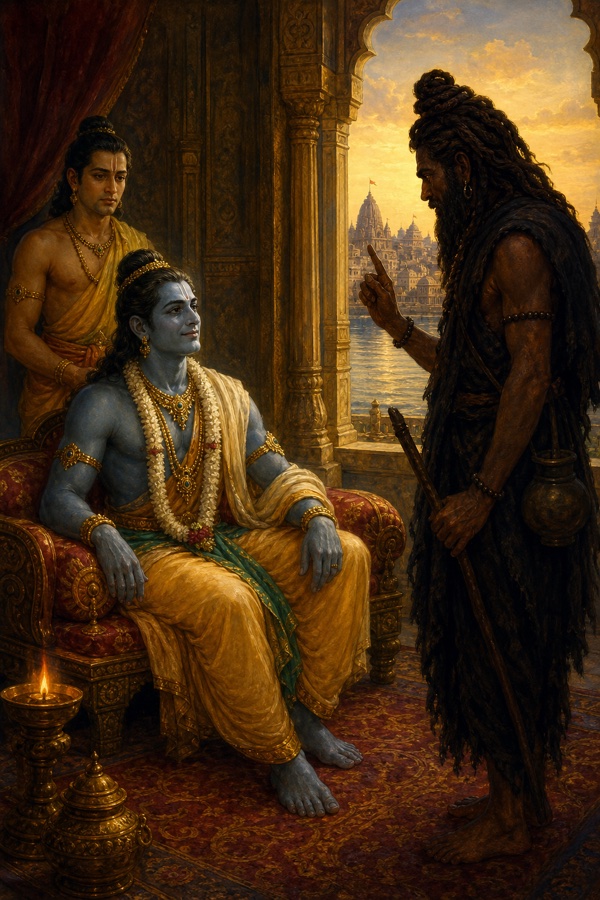
“‘So you became the mind-born son of Dasharatha. Your stay in human form is now complete, and the time has come for your return to us. If you wish once more to serve your people, then stay on as you please, and may it be well with you; and if your wish is to go to the world of the gods, then let the gods find their lord again in Vishnu.’ This is what Brahma says.” Hearing Brahma’s word from the mouth of Time, Rama laughed. He had just been told that his life was over, and he laughed, because the last thing Brahma had promised him at that sacrificial ground was that Sita was on the other side of it. Then he answered. “Time, hearing this most wonderful word of the God of gods has filled me with great joy. It was for the work of the three worlds that my human life took place. May it be well with you: I will go back to where I came from. You have come exactly as my own heart wished, and there is nothing for me to weigh. As Brahma has said, I must remain, doing all the gods’ work, until the hour when all things are dissolved.”
Durvasa’s arrival and Lakshmana caught between two vows
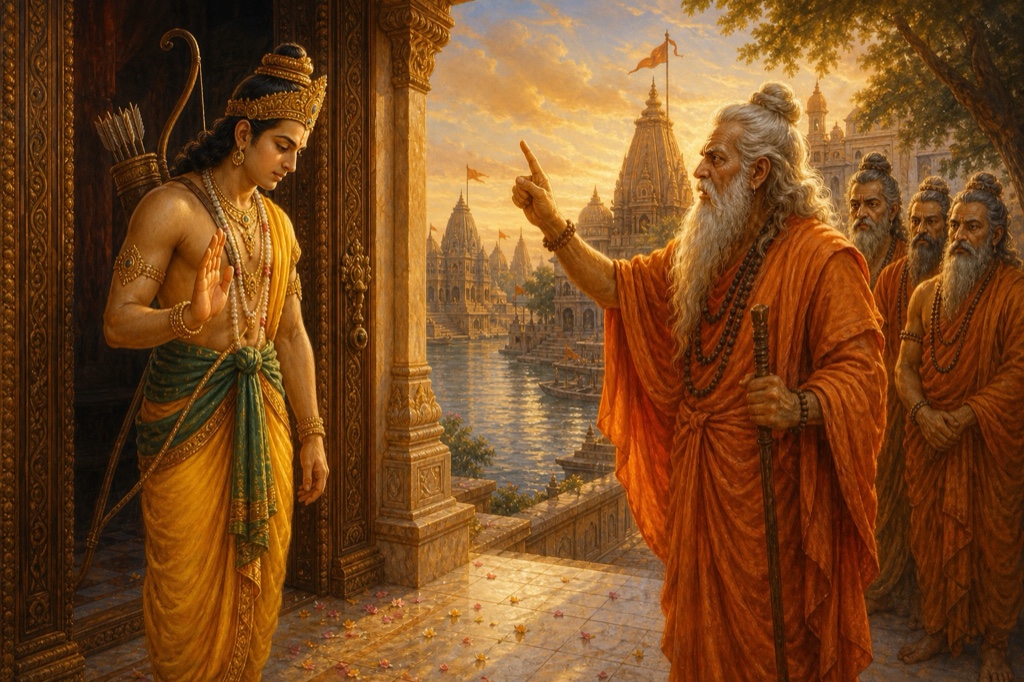
While Rama and Time were still in their talk, the venerable sage Durvasa came to the palace gate, wishing to see Rama. That sage said to Lakshmana, Sumitra’s son, “Show me Rama at once, before my errand is lost.” Hearing the sage, Lakshmana saluted the great man and said, “Sir, what is to be done for you? What is your errand? What should I do? Rama is engaged just now; wait, Brahmin, for one short hour.” At this Durvasa went dark with rage, and as if to burn all before him with his very eyes, he said to Lakshmana, “This very instant speak of me to Rama. If you do not do it this very instant, I will curse this city, and you, and this whole land, and Bharata, and Rama, and all your line; I can hold this anger in my heart no longer.” There were now two ways open to Lakshmana, and both of them ended in a death; only the number of the dead was different.
Hearing the dreadful words of the great sage, Lakshmana turned over in his mind what they would mean, and came to a decision: “Let my death alone come, and let there be no destruction of all.” He did the whole of that arithmetic while standing in a doorway, and then he opened the door. Resolving so with his reason, he carried word of Durvasa’s arrival to Rama. When Rama heard Lakshmana, he dismissed Time and came out at once, and there before him stood Durvasa. Rama saluted the great man, who seemed to blaze with his own fire, and asked with folded hands, “What is to be done?” Durvasa answered, “Hear me, lover of dharma. Today my vow of a thousand years’ fasting has come to its end. So I ask you for whatever cooked food may be ready in your house.” At this King Rama, glad at heart, offered the sage whatever food was prepared. Durvasa ate that food as though it were nectar, said “Well done, Rama,” and went back to his hermitage. He praised the meal and walked home; and behind him in that palace a man had just bought it with his life.
When the sage had gone to his hermitage, Rama remembered the words of Time, and sorrow rose in him. Recalling that terrible outcome, he was worn through with grief; with his face bowed and his heart wretched, he could not speak a word. Then, weighing the words of Time in his reason and finding that there was now no escape from it, Rama fell silent. The whole of his life he had been the man who kept his word, and the word had come around at last to stand in front of his brother.
The forsaking of Lakshmana and his bodily ascent
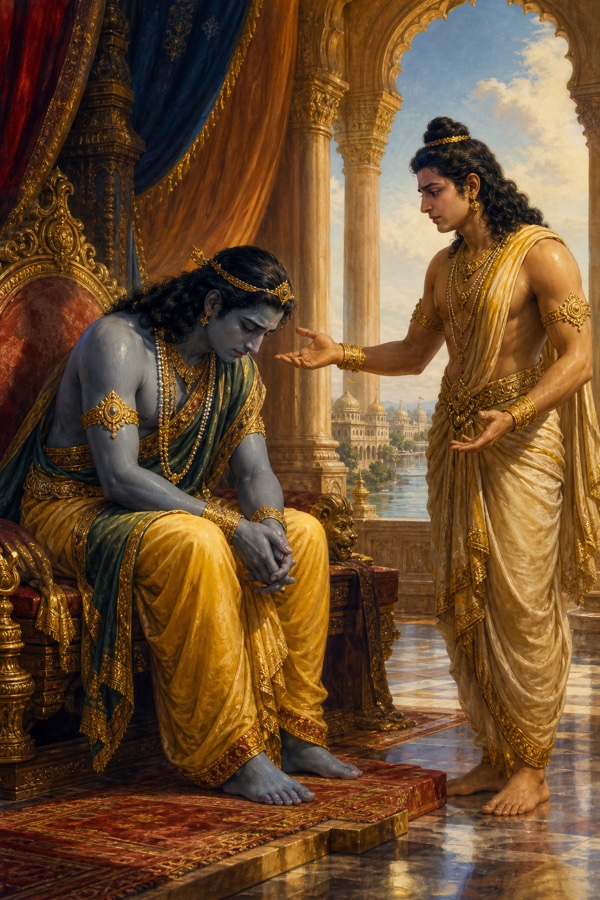
Seeing Rama with his face bowed and drowned in grief, like the moon swallowed by Rahu, Lakshmana spoke to him cheerfully and in sweet words. The man asking to be killed was doing the comforting. “Do not grieve on my account; bound by deeds already done, this is the way of the course of Time. Kill me without any misgiving, gentle brother, and keep your vow; those men who break their promises go to hell. Great king of Raghu’s line, if you love me, if I am worthy of your grace, then kill me without hesitation and let dharma grow.” He had walked out of Ayodhya behind that brother once, for fourteen years in the forest, without being asked. At Lakshmana’s words Rama, his senses shaken, called his ministers and his family priest, and in their midst told them all that had happened, the coming of Durvasa and the vow he had sworn on the ascetic’s condition.
Hearing this word, so bound up with dharma and with what was right, all the ministers and the teachers kept silent. Then Vasishtha spoke. “Rama, this hour of your parting, and your separation from Lakshmana, I saw long ago in a vision that made my hair stand on end. Forsake him; Time is too strong. Do not make your vow empty. When a vow is broken, dharma is destroyed, and when dharma is destroyed, this whole world of things moving and unmoving, with all the hosts of gods and sages, perishes beyond a doubt. So for the protection of the three worlds, restore this world to health today, even without Lakshmana.” Hearing the word of all those men, so bound up with dharma, Rama said to Lakshmana in the midst of that assembly, “So that dharma may not be overturned, I forsake you; and forsaking and killing are one and the same for the good.” At Rama’s word Lakshmana, his eyes clouded with tears, went out at once, and did not return to his own house.
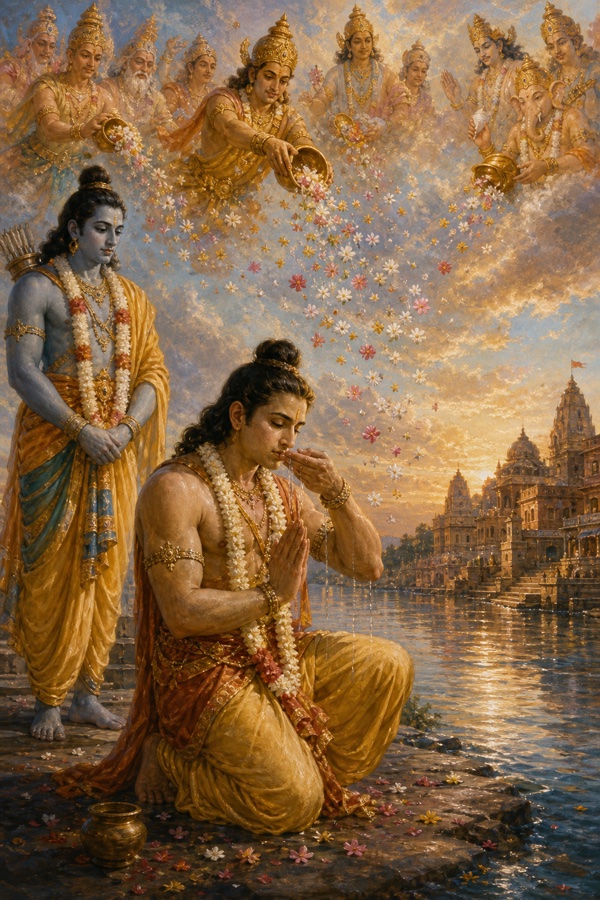
He went to the river, and it is worth marking which river: the Sarayu, the water Ayodhya was built along, the water his brother would walk into after him. Reaching the bank of the Sarayu, he sipped the water, folded his hands, drew in all his senses, and, holding even his breath, settled into the yoga of pranayama. On Lakshmana, so held in the yoga of breath and self-mastery, Indra and the gods, and the throngs of apsaras, and all the sages, rained down flowers. Invisible to human eyes, Lakshmana was taken up alive, in his own body, and Indra entered heaven with him. Then, seeing the fourth part of Vishnu returned to heaven, all the great gods, glad and rejoicing, did honor to Lakshmana of Raghu’s line.
Bharata refuses the throne, and Kusha and Lava are consecrated
Having given up Lakshmana, Rama, full of pain and grief, said to the priests and ministers and citizens, “Let all that is needed for a consecration be brought without delay; this very day I will take the road that Lakshmana has taken. This very day I will consecrate Bharata as lord of Ayodhya, and then go to the forest.” At this word of Rama’s, all the people bowed their heads to the ground and seemed to lose the breath in their bodies. Bharata too was struck almost senseless, and, speaking harshly of kingship, he said, “I swear by truth and by the joys of heaven, king of Raghu’s line, that I do not want the kingdom without you.” He had refused this same throne once before, in a forest, and carried a pair of sandals home to sit on it in his place. “Consecrate Kusha and Lava, Kusha in Kosala and Lava in Uttara Kosala. And let swift messengers go to Shatrughna and tell him quickly of our departure; let there be no delay.”
Hearing Bharata’s word, and seeing the citizens with their faces bowed and worn with grief, Vasishtha said, “Child Rama, see the people lying prostrate on the ground; act only after you have learned their wish, and do nothing they would hate.” At Vasishtha’s word Rama raised the people up and asked them all, “What shall I do?” Then all the people said, “Rama, wherever you go, we will follow behind you. If you love your citizens and hold this matchless affection for them, then let us walk with you on that good road, the road to heaven, our children and wives with us. Take us wherever you will, lord, to the forest of penance, to hard country, to river or to sea, only do not forsake us. In following you lies our deepest love and our highest boon; this is our one desire.” It was the talk of these same people that had sent Sita out of Ayodhya, and now not one of them would be parted from him by so much as a road.
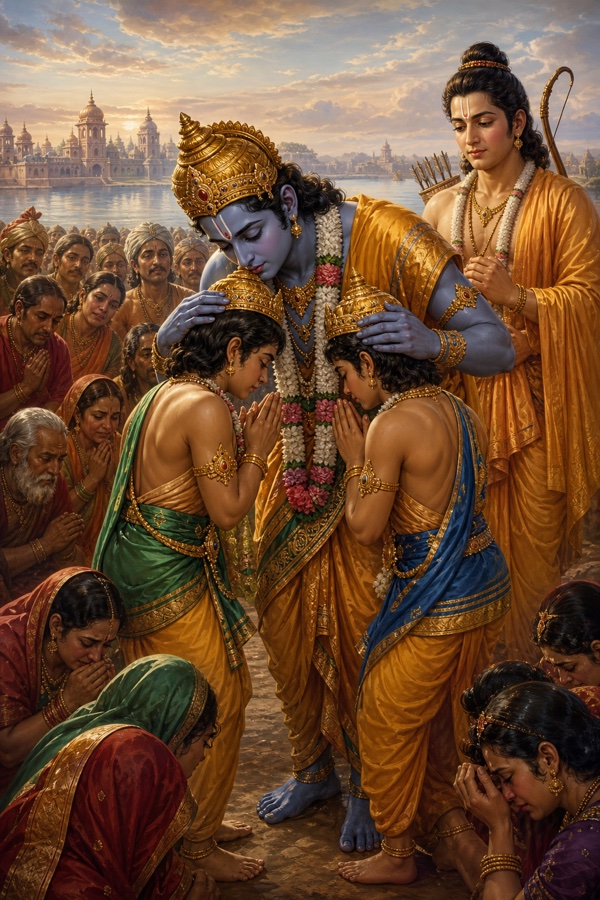
Seeing the firm devotion of the citizens, Rama said, “Very well.” That same day, seeing that the end of his earthly life had come, he consecrated his two noble sons, Kusha in Kosala and Lava in Uttara Kosala. Setting each consecrated son on his lap, holding him close, and again and again breathing in the scent of his head, he gave to each a thousand chariots, ten thousand elephants, and a hundred thousand horses. He sent the two brothers Kusha and Lava, with much wealth and many gems and crowds of hale and prosperous people, to their own cities. Having consecrated the two brave princes and sent them off to their cities, Rama dispatched messengers to Shatrughna.
Shatrughna’s arrival, and the monkeys and demons who came to follow
Driven by Rama’s word, the swift messengers reached Madhura without a halt on the way. In three days and nights they came to Madhura and told Shatrughna everything just as it was: the giving up of Lakshmana, Rama’s resolve, the consecration of the two sons, and the people’s decision to go with him. Kusha’s lovely city lay at the foot of the Vindhya mountain, and Rama had given it the name Kushavati; Lava’s lovely city became famous as Shravasti. Ayodhya was to be left empty, they said, and Rama of Raghu’s line, and the great chariot-warrior Bharata, were making ready to go to heaven. Ayodhya, left empty: the messengers said it in the middle of a list, as though it were one more piece of news. Having laid all this before Shatrughna without delay, the messengers ended and said, “Make haste, king.” Hearing this terrible news of the end of his line, Shatrughna called all the people and the priest Kanchana together and told them all that had happened, and told them of the death soon to come to himself and his brothers.
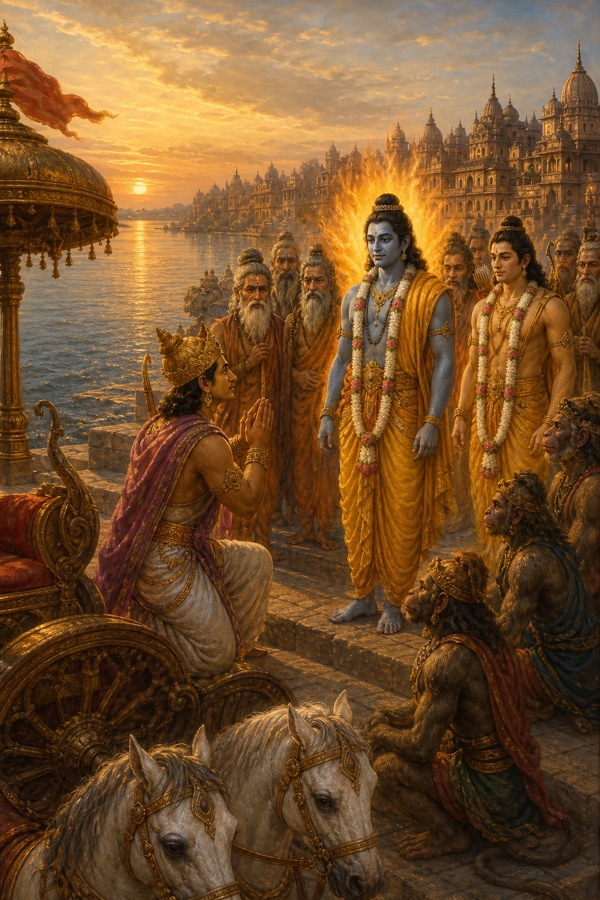
Then Shatrughna consecrated his two sons: Subahu received Madhura, and Shatrughati received Vidisha. Dividing the army of Madhura in two and setting each son up with wealth, King Shatrughna established them there, Subahu in Madhura and Shatrughati in Vidisha, and then came to Ayodhya alone, in a single chariot. He saw Rama blazing like fire in living form, clad in fine silk and seated among the deathless sages. Reflecting on dharma, Shatrughna bowed to Rama and said with folded hands, “I have consecrated my two sons and come with my mind made up to follow you; know me as one so resolved. Beyond this nothing should be said, and no order should be heard; least of all should you wish to put an obstacle in the way of one like me.” Knowing how Shatrughna’s resolve was, Rama of Raghu’s line smiled and said, “Very well.”
No sooner had that word been spoken than many hosts of monkeys and bears and demons, able to take any shape they wished, arrived there. With Sugriva at their head they had all gathered, wishing to see Rama as he set his face toward heaven. The sons of gods, the sons of sages, and the sons of gandharvas came as well, knowing that Rama’s earthly life was at its close. All those monkeys and demons bowed to Rama and said, “King, we have come to follow you. If you go without us, then know that you have taken up the rod of Yama and struck us dead.” And in the midst of this, Sugriva too saluted Rama in due form and said, “I have crowned Angada, Vali’s son, upon the throne and come here; know me, king, as one resolved to follow you.” Every one of them had settled his kingdom on somebody before coming, the way a man puts his house in order before a journey.
Vibhishana, Hanuman, and Jambavan are told to remain on earth
Hearing Sugriva’s word, Rama, best of those who bring gladness, remembered their friendship and said, “Listen, friend Sugriva; I will not go without you, neither to the world of the gods nor to that supreme abode.” When they had all spoken so, Rama smiled and said, “So shall it be,” and then turned to Vibhishana. “Mighty king of the demons, so long as your people live, you are to stay in Lanka and rule. So long as the sun and the moon endure, so long as this earth abides, and so long as my story lives in the world, so long let your kingdom stand. In friendship I lay this on you; carry it out. Guard your people in dharma, and make no reply to this.” He gave the order in a shape that left no room for the answer he could see coming. “And one thing more, king of the demons: worship Jagannatha, the lord of the world, the god of the Ikshvaku line; even the gods, with Indra at their head, should always worship him.” Saying “So shall it be,” Vibhishana took Rama’s word to himself in obedience.
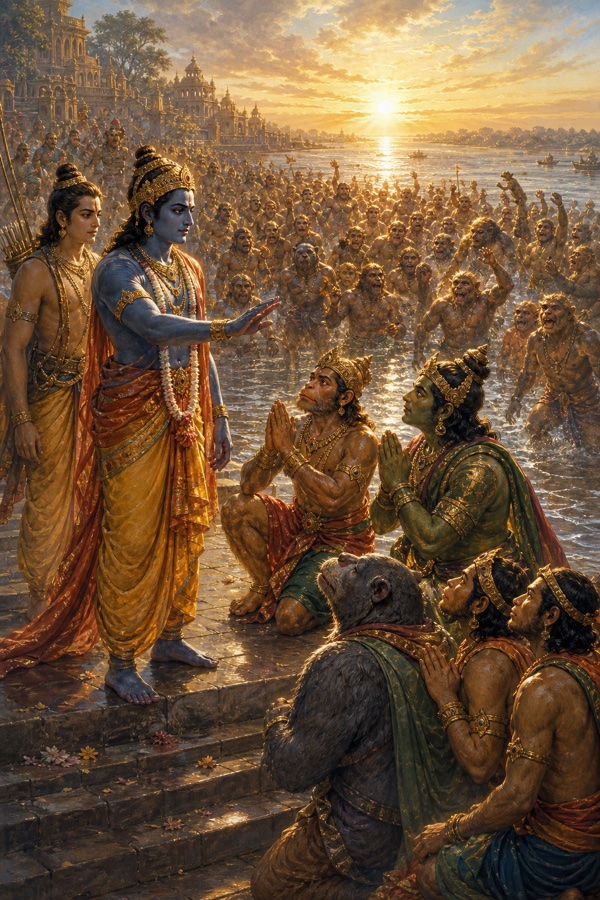
Having said this to him, Rama turned to Hanuman. “You have made up your mind to live, so do not let your resolve go for nothing. Lord of the monkeys, so long as my stories move through the world, so long stay on, keeping to my word, in perfect gladness.” At this Hanuman was overjoyed, and said, “So long as your holy story walks the world, so long will I remain upon this earth, keeping your command.” Everyone else in that hall was being allowed to die with him. Hanuman was the one asked to stay, and he took it as the gift. In the same way Rama spoke to Jambavan, the aged son of Brahma, and to Mainda and Dvivida, and told them that these five, Jambavan and the others together with Vibhishana and Hanuman, should live on upon the earth until the coming of the age of Kali. To all the rest of the bears and monkeys Rama said, “It is well; as I have said, all of you come with me.”
Rama’s great departure with all the people of Kosala
When the night was gone and the morning came, Rama said to the family priest, “Let my kindled Agnihotra fire go before me, carried by the Brahmins, and let the Vajapeya umbrella too go ahead in all its beauty on this final journey.” Then Vasishtha performed, exactly as the scriptures lay down, the whole rite of the great departure. Clad in fine garments, uttering the mantras of the Supreme Brahman, with kusha grass held in his hands, Rama set out toward the Sarayu. Speaking not a word anywhere, empty of all action, without any comfort, bright as the sun, he passed out of that palace that shone like the sun itself. He had been born in that house, driven out of it for fourteen years, and brought back to it on the shoulders of a whole city, and he walked out of it now without saying anything to anyone.
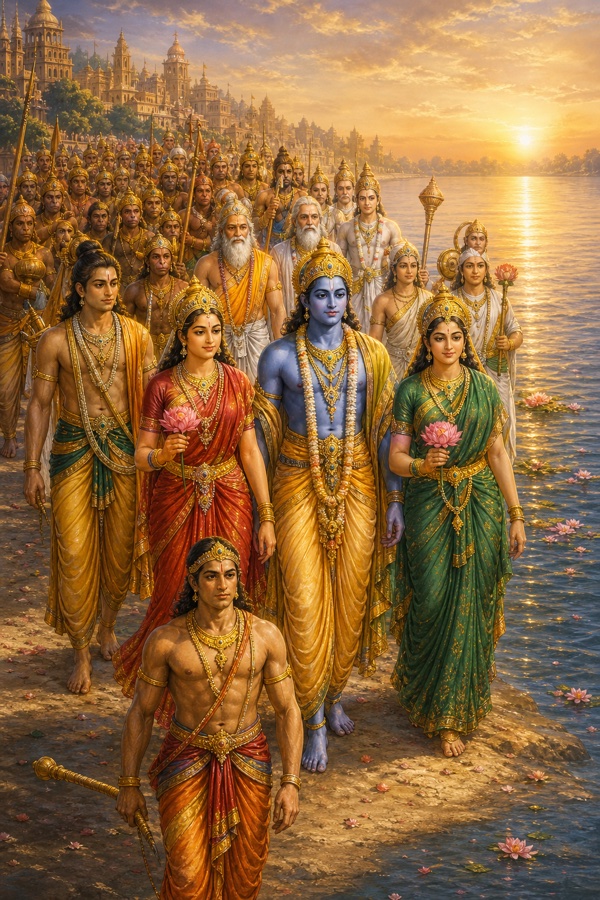
On Rama’s right was Lakshmi, seated on her lotus; on his left was the goddess Earth, the same goddess he had raised his voice against at the sacrifice; and before him walked the Power of resolve in living form. Arrows of every kind, the wonderful bow strung and ready, and all his weapons went along in human shape. The Vedas in the form of Brahmins, Gayatri the protector of all, the Omkara, and the Vashatkara all followed behind Rama. The great sages and all the earth-gods, the Brahmins, went after Rama as far as the gates of heaven, which stood open. Behind Rama walked the women of the inner apartments, the old, the children, the servants and the maids. Bharata and Shatrughna, with the women of their households, went behind Rama with the Agnihotra fire. Bears, monkeys, demons, townsfolk, ministers, throngs of servants, sons, cattle, and kinsmen, all with their own followers, went gladly behind Rama.
Then all the people, thick with hale and well-fed folk, drawn on by his qualities, followed Rama. Men and women, birds and beasts and kinsmen, all made sinless, followed him gladly. The monkeys, hale and glad, having bathed in the Sarayu, went on with cries of kila-kila, bound to Rama with love. Nowhere among them was anyone wretched, or ashamed, or in pain; all were glad and full of joy, and the whole of it was a marvel beyond words. Whoever came from the countryside to see Rama depart, that person too, the moment he saw Rama, set off behind him to heaven. The spirits who dwelt unseen in the city fell in behind Rama as he went toward heaven. Things fixed and things that move, every one that saw Rama, followed after him. In that hour there was not to be seen in Ayodhya a creature so small that it did not go behind Rama; even the beings of the animal kingdom, all of them, bound to Rama with love, went after him. A city was pouring itself out onto one road, down to the last thing in it that could walk or crawl or fly, and behind them the greatest capital on the earth was being left standing empty in the sun.
Entering the Sarayu, and Rama’s return into the splendor of Vishnu
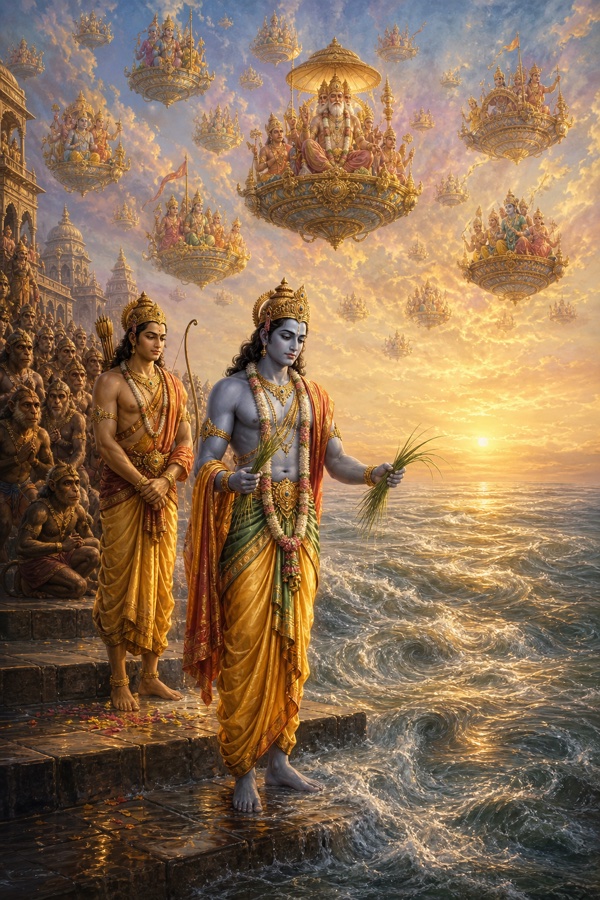
Going a yojana and a half to the west, Rama of Raghu’s line came to the Sarayu, the river that turns to the west, with its holy waters. Following the course of that river, ruffled with whirlpools, Rama came, with all his people, to that place. At that very hour Brahma, grandfather of the worlds, ringed round by all the gods and by the great sages, came to where the prince born in Kakutstha’s line stood ready for heaven; he came encircled by hundreds and millions of divine aerial chariots. The sky filled with a divine splendor; it flooded with an unearthly light thrown off by the self-luminous dwellers of heaven, doers of holy deeds. Sweet, fragrant, purifying winds began to blow, and the gods let fall a shower of flowers like a great stream of water. Every being that had ever had a stake in this life of his was in the air over that riverbank, waiting.
Then, while hundreds of instruments sounded and the place was thronged with gandharvas and apsaras, Rama began to walk on foot into the waters of the Sarayu. And Brahma spoke from the sky above. “Come, Vishnu; may it be well with you. Happily you have returned. With your brothers, who are the equals of gods, enter your own form or take whatever form you wish. Enter the form of Vishnu, or the eternal sky itself. You are the goal of the worlds, and no one knows you fully but Maya who was once your consort, Sita. You are past all thought, the great being, imperishable and unaging; take yourself into whatever form you wish.”
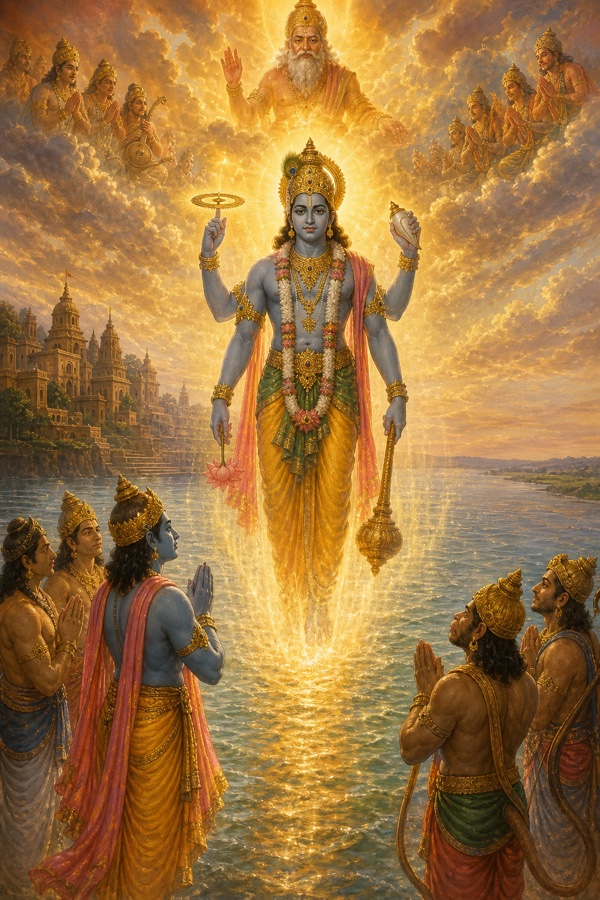
Hearing Brahma’s word, Rama made his resolve and, in his own body, entered the splendor of Vishnu, and his brothers with him. Then the gods worshiped that god who was Vishnu in form, and the Sadhyas, and the hosts of the Maruts, with Indra and Agni at their head, all did him honor. The divine bands of sages, the gandharvas, the apsaras, the Suparnas, the Nagas, the Yakshas, the Daityas, the Danavas, and the demons, all those who had been born of the gods and had come forth from them, grew hale and full of joy, their every wish fulfilled; and seeing the three worlds made spotless, the gods cried “Well done, well done.”
Then Vishnu, who had been Rama, said to Brahma, and the first thing he said with the voice of a god was about the people who had walked out of the city behind him, “Keeper of noble vows, these hosts of men too are worthy that you should grant them a world. All these glorious people have followed me out of deep love. My devotees, who gave up even their lives for my sake, are all worthy of my grace.” Hearing Vishnu’s word, Brahma, lord and teacher of the three worlds, said, “All those who have come here will go to the world named Santanaka, near the world of Brahma and filled with all the merits of Brahma. And any creature that breathes its last while it remembers you in this way will, in its devotion, leave behind its human body and dwell in Santanaka. Even a beast that gives up its life while it remembers you will win the same reward.”
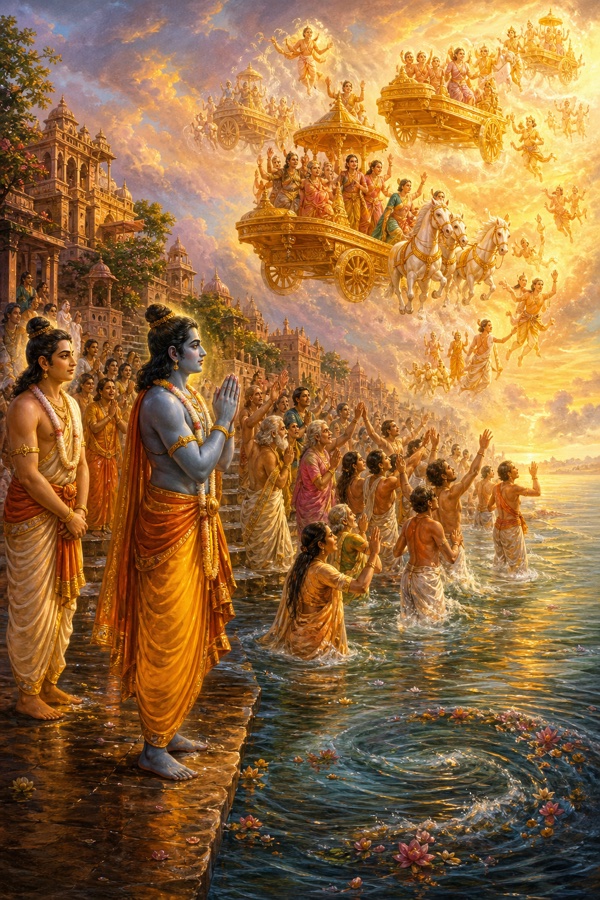
Before the eyes of all the gods, the people were united with their ancestors. When the lord of the gods had spoken so, they all reached Gopratara, the sacred ford on the Sarayu’s bank. Overcome with tears of joy, they went down into the Sarayu; and as each one bathed in the water and gladly gave up his life, he cast off his human body and mounted an aerial chariot. Hundreds of the beasts too, touching the waters of the Sarayu, took on bodies full of light and, shining like the gods with divine forms, went to heaven. Whatever least creature of the animal kind gave up its life in the water of the Sarayu while it remembered Rama alone, that creature went to the world of the gods at the touch of that water. The bears and monkeys and demons who went down into it also cast their bodies in the water and passed into heaven; the monkeys and bears born of the gods returned each to his own divine nature, and Sugriva entered the orb of the sun, which is to say that the monkey king went home into his own father. Then Brahma, teacher of the worlds, having established in heaven all who had come, went with the glad and rejoicing gods to the highest heaven.
The fruit of hearing and reading the Ramayana, and the close of the story
This much, together with the Uttarakanda, is the whole account, honored even by Brahma, renowned by the name of the Ramayana, and composed by Valmiki. When all had gone to heaven, Rama took his place once more in the world of heaven in the form of Vishnu, as before, by whom this whole world of things moving and unmoving, the three worlds together, is pervaded. And so the gods, with the gandharvas and the siddhas and the great sages, listen forever in heaven, in their gladness, to the poem that is the Ramayana. The poem has outlasted everyone inside it. Rama went back into Vishnu, Ayodhya was left standing empty, the ages turned over one into the next, and in heaven they are still listening to the story of a man who spent fourteen years of it living in a hut.
This account gives long life, brings good fortune, and destroys sin; the Ramayana is the equal of the Veda, and a wise man should have it recited at the rites for the dead. By hearing it, the sonless man gains a son and the poor man gains wealth; whoever reads even a single quarter-verse of it is freed from all his sins. Even the man who sins day after day, if he reads but one shloka of the Ramayana, is set free from sin. To the one who recites the Ramayana, cloth and a cow and gold should be given; when the reciter is content, all the gods are content. The man who reads this life-giving account, the Ramayana, wins renown, with his sons and grandsons, in this world and in the world beyond. All of it began with a hunter’s arrow and one of a pair of cranes falling out of the air, and with the grief that came out of Valmiki over that bird in a measure he had never used before: four feet of eight syllables, with the rhythm of a thing meant to be sung to the strings. Everything after it, eleven thousand years of a man’s life, all the way down to a king walking on foot into a river, was carried in that one measure. And it was two boys with a vina who sang it back to him.
The gist: Established in heaven in the form of Vishnu, the story of Rama comes to its close. Valmiki leaves us with what the Ramayana is: an account the equal of the Veda, giver of long life, of good fortune, and of release, a single verse of which destroys sin.
Source: Srimad Valmiki Ramayana, Uttarakanda, Cantos 98 to 111. The Gita Press Hindi edition is the controlling witness. The Sanskrit e-text and an independent complete translation were used to verify names, sequence, and principal events. Where recensions differ, this retelling follows Gita Press.
Based on: Valmiki Ramayana (Gita Press, Gorakhpur)