On this page
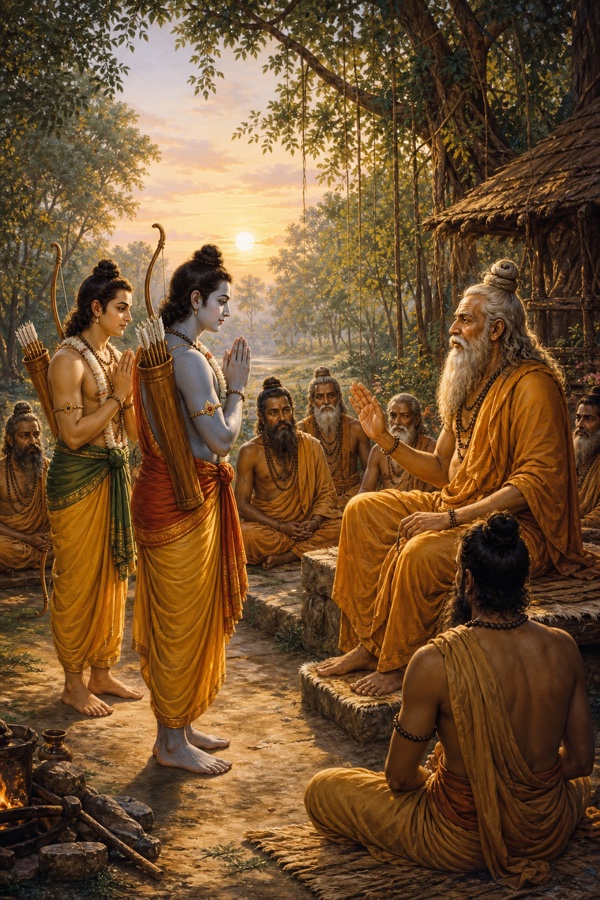
Subahu lay dead, Maricha had been flung far out over the sea, and the six days and nights of the sacrifice at Siddhashrama had run their course without another interruption. That night Rama and Lakshmana slept in Vishvamitra’s sacrificial hall with the untroubled hearts of men who have done exactly what they were brought to do. They were up before the dark had fully lifted. The brothers finished the rites of the closing night, bathed, offered the morning water and the morning fire, and then went looking for the sage and his company of seers. They found Vishvamitra seated among them, the king who had made himself a Brahmin by sheer force of austerity, and he seemed to give off light the way a freshly fed fire does. The two of them bowed and said, in the gentle, formal speech the court had trained into them, “Here we are, your servants. Tell us what you would have us do.” It was the seers who answered, with Vishvamitra’s leave, and they answered Rama directly. “Janaka, the king of Mithila, is about to perform a sacrifice of the highest purity. We are all going there, and you must come with us. There is a bow in that city you should see.”
The bow, and the first halt on the banks of the Shona
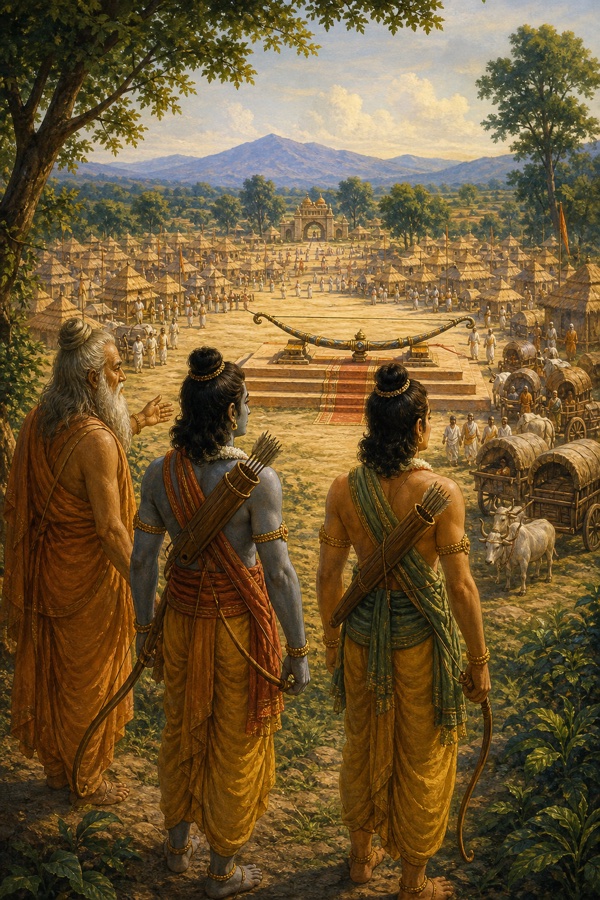
The seers told the story of the bow. It was, they said, a terrible thing, so charged with splendor that no one had ever managed to reckon its weight. It had come down from Shiva himself. The gods had received it from him, and in ancient times, in a sacrificial assembly, the gods had presented it to a former king of Mithila named Devarata, who had asked for it as his reward for the rite. No god could bend it. No gandharva could bend it, no demon, no rakshasa, and human beings least of all. Kings and princes of great strength had come to Mithila over the generations, each eager to measure himself against it, and every one of them had failed even to bring the two ends toward each other. The bow was well made at the grip, where the fist closes on it, and it lived now in the palace of the king, anointed with sandal paste of many kinds and fragrant with the smoke of aloe-wood incense, honored as an object of worship. “There,” they told Rama, “you will see that bow, and you will see the sacrifice of the king of Mithila, a man whose greatness of spirit the whole world knows.”
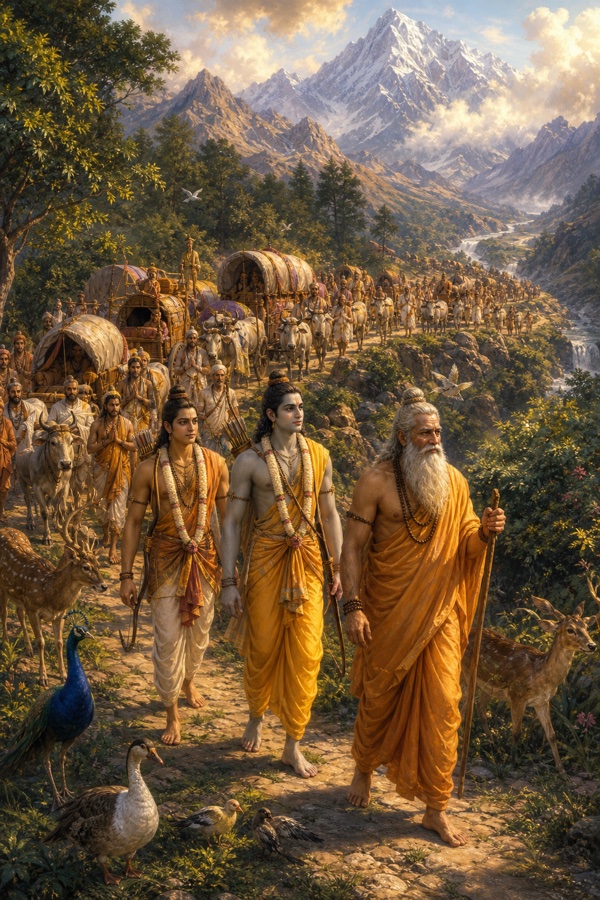
Then Vishvamitra, the sage of Kusha’s line, gave the word to move. He blessed the assembly, told them they were bound from Siddhashrama for the Himalaya country on the northern bank of the Ganga, and set out toward the north with the seers around him and the two young princes of Ayodhya, heirs of the old solar line of Kakutstha, walking at his side. Behind them rolled a full hundred carts, heavy with the requisites of a sacrifice, the property of his followers, every one of whom was a master of the Vedas. And behind the carts came something no one had ordered: the herds of deer and the flocks of birds that lived at Siddhashrama, following the sage whose only wealth was his austerity, as if they could not bear to be left. Vishvamitra stopped and persuaded them, gently, to turn back. The party covered a long road that day. When the sun began to go down they broke their journey on the bank of the river Shona. They bathed, poured the evening oblation into the fire as the light went, and sat down together on the bank with Vishvamitra at their head. Rama paid his respects to every one of the seers, greeted them all, and took his seat facing Vishvamitra, Lakshmana beside him. Then, with the frank curiosity of a boy who has been walking all day through country he has never seen, he asked, “What land is this, with such a thriving forest on it? I want to hear about it. Please tell me truly.” It was that question, asked on the bank of the Shona with the whole company listening, that opened the great sage’s mouth. He began, in the midst of the seers, to speak at length of that land. (Canto 31)
Kusha’s four sons, and Kushanabha’s hundred daughters
Vishvamitra said, “There was once a great ascetic king named Kusha, born of Brahma himself, a man of unbroken vows who knew what was right and honored those who lived by it. Through a high-born queen from Vidarbha he had four sons of enormous strength, Kushamba, Kushanabha, Asurtarajas, and Vasu, and they were everything a father could ask for, brilliant and eager, upright and truthful. Kusha wanted them to take up the duty that belongs to a warrior, the protection of the people, and so he told them plainly: ‘My sons, protect the people. In that work lies merit without limit.’ The four of them heard their father, and each of them founded a city.
“Kushamba, whose fame ran far beyond his own borders, founded Kaushambi and gave it his own name. Kushanabha, whose mind was fixed on righteousness, built the city of Mahodaya. Asurtarajas built Dharmaranya, and Vasu built Girivraja, a city that stood first among all the cities of its age. That capital of Vasu was also called Vasumati, after him, and it lies inside a ring of five great hills, which throw their light all around it and give the city its other name, the enclosure of hills. This same river Shona, whose beauty is famous, winds among those five hills like a garland laid across them, and it flows from the west into the country of Magadha, which is why it is also known as the holy Magadhi. It runs eastward, lined on both banks with well-kept fields and rows of standing crops, and it belongs, Rama, to Vasu, that king of large and generous spirit, and to his house after him.
“Now the royal sage Kushanabha, whose mind was fixed on righteousness, had a hundred daughters through an apsara named Ghritachi, and there was no one on earth to match them. As they came into their full youth their loveliness grew greater still. They would go out into the grounds of the royal garden anointed with sandal paste and wearing flowers, decked in the finest jewels, and they shone like flashes of lightning in the monsoon. They sang there, and danced, and played their lutes, and their delight in themselves was complete. Lovely in every limb, matchless on earth, they looked among the garden trees like stars seen through gaps in the clouds. One day the wind-god saw them there, the god who is bodily present in every place at once, and seeing a hundred girls so gifted and so young, he spoke to them. ‘I want you all for my own. Be my wedded wives. Give up the idea that you are human. Do that and you will win a long life. Youth is always fleeting, and in human beings most of all; take me for your husband and your youth will never fade, and you will never die.’
“The hundred daughters laughed at him, and answered him together. ‘You move as the breath of life inside every living thing. We know your power, and even so we feel no pull toward you. Why do you insult us with such an offer? We are the daughters of Kushanabha. We could bring you down from your high place with a single curse, and we hold back only because we mean to keep our ascetic power whole. Let that evil hour never come when we spurn our truthful father and choose a husband by our own desire. Our father is our master. He is our highest deity. The man to whom our father gives us, that man alone will be our husband.’
“The wind-god’s power is matched only by his temper. At those proud, defiant words he entered every one of their limbs and twisted them out of shape. The girls who had gone out to the garden as lightning came back to their father’s palace bent and hunchbacked, and they came in shaken and ashamed, with their eyes full of tears. King Kushanabha saw his beloved daughters, the most beautiful girls in the world, deformed and miserable, and he could not understand it. ‘What is this? Tell me everything. Who has broken the law of right? Who has made you all hunchbacked, and why are you making signs at me and not speaking a word?’ Having asked, he drew a long breath and made himself steady, so that he could bear whatever their answer was going to be. (Canto 32)
The glory of forgiveness, and the marriage to Brahmadatta
“The hundred daughters touched their father’s feet with their heads and told him. ‘Your Majesty, the wind-god who moves through everything took an evil road. He tried to violate us and showed no respect for the way we live. We said to him, may all be well with you, we belong to our father and are not free to give ourselves; ask our father for us, and if he gives us to you, we will take you gladly. He would not hear it. His mind was set on wickedness, and while we were still pleading with him he struck us, and left us like this.’
“The king was a deeply righteous man, and what he heard filled him with a pride that was greater than his grief. ‘What you did, my daughters, is possible only for those who have made forgiveness their nature, and it was a very noble thing. That all hundred of you, with one mind, guarded the honor of this house, that is beyond price. Forbearance is the ornament of a woman and of a man alike. Forbearance toward the gods themselves, which every one of you showed without exception, is the hardest of all. Forbearance is charity. Forbearance is truth. Forbearance is every sacrifice there is. Forbearance is fame, forbearance is righteousness, and the whole created world stands on forbearance, made solid in the form of this earth.’ Then he sent the girls to the women’s quarters, and, being a king who knew the value of good counsel, he sat down with his ministers to discuss their marriage. Worthy daughters must be given to a worthy man, at the right place and at the right time, and a hundred bent daughters made that question urgent.
“At this very time a celibate ascetic named Chuli, a man of great glory and virtuous conduct who had held the whole current of his life-force turned inward and never let it escape, was deep in austerity directed toward Brahma. A gandharva girl named Somada, daughter of Urmila, waited on him through those years, bowing low, attentive, present at every hour he needed her, and the seer was pleased. When the right moment came he asked her what he could do for her. The unmarried girl asked for a son, a pious son rich in the same Brahmic power that shone from the sage himself; she would never be any man’s wife, she said, and she had taken refuge in him. In his delight the seer gave her a mind-born son, matchless, and named him Brahmadatta. That Brahmadatta ruled in the city of Kampilya, built by Kampila, with a royal splendor like Indra’s in heaven.
“King Kushanabha made up his mind to give all hundred of his daughters to that Brahmadatta. He sent for him, and with a heart overflowing he gave the hundred girls into his hands. At the wedding Brahmadatta, radiant as Indra, took each of their hands in turn, in order of age, and the moment his hand closed on theirs the crookedness went out of their bodies and the pain went out of them, and all hundred of them stood there shining with a beauty that had no equal. Kushanabha watched his daughters set free from the wind-god’s affliction and his joy came back to him again and again, as if he could not use it up. As soon as the rites were done he sent the newly married king on his way with his wives and the whole company of his family priests. Somada was there too, the gandharva mother, and seeing her son so worthily matched she greeted him and then each of her hundred daughters-in-law by turn, embracing the brides over and over, praising Kushanabha for his hospitality and the richness of his dowry, before she took her leave. (Canto 33)
The birth of Gadhi, and Vishvamitra’s own line
“When Brahmadatta had gone, Kushanabha, who had a hundred daughters and no son, began a sacrifice to obtain one. While it was still in progress his own father came and stood before him: Kusha himself, son of Brahma, the ascetic king of unbroken vows who had sent his four sons out to found their cities, and he prophesied. ‘My son, a most righteous son will be born to you, worthy of you. You will have Gadhi for your son, and through him your fame in this world will never die.’ Having told him this, Kusha rose through the air and went back the way he had come, to the deathless realm of Brahma. In time a son was born to the wise Kushanabha, and they gave him the very name Kusha had spoken. Gadhi.
“That Gadhi, that most righteous man, was my father. I was born in the line of Kusha, and that is why I am called Kaushika. I had an elder sister as well, Satyavati, a woman of noble vows, and she was given in marriage to the sage Richika. She followed her husband’s wishes through the whole of her life, and when it ended she went up to heaven in her own body, and later she became a river, the Kaushiki, a great and kindly stream that runs beside the Himalaya and is not of this earth, whose waters confer merit on everyone who uses them. She is still there, Rama, the woman who lived by truth and belonged wholly to her husband, in the form of the Kaushiki, and no river on earth runs purer. Out of love for my sister I lived for a long time in self-discipline by her bank under the mountains, and I was happy there. Then, for the sake of a vow I had taken to perform a sacrifice on consecrated ground, I came down from that river to the plains and to Siddhashrama, where, by your strength, my purpose was accomplished. So now you have my birth from Gadhi, the beginnings of my line in Kusha, and the history of this country of Girivraja along the Shona, which is what you asked me for.
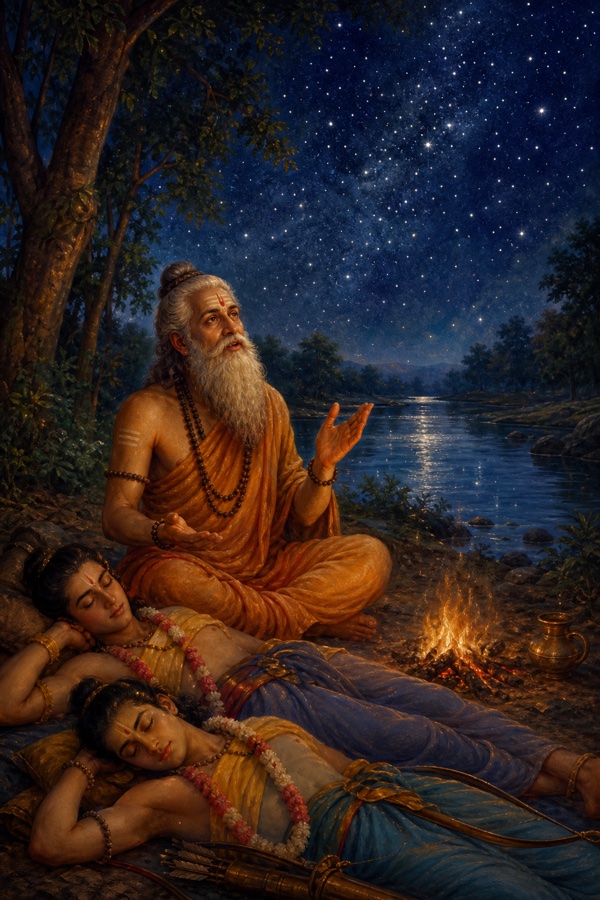
“Half the night is gone in my telling of old things. Peace be with you both. Sleep now, so that nothing hinders our journey tomorrow through a night without rest. Look. The trees have stopped moving. The beasts and birds are buried in sleep and the quarters of the sky are wrapped in the dark. The last of the evening twilight has drained away, and the firmament, thick with the lunar mansions and the lesser stars, glitters as though it were covered with eyes. And here is the moon, only now rising, this late in the night, pouring its cool light out over the earth and gladdening every living heart. This is the hour that belongs to the creatures of the dark, the yakshas and the rakshasas, the fearful eaters of raw flesh; they are out now, roaming wherever they please, and the camp of a sleeping company is no place to be wakeful.” With that the great sage fell silent, and the seers who had been listening all around him praised him. “Well spoken. Well spoken.”
The seers said, “Great is this house of Kusha, and it has always held to righteousness. The kings born in Kusha’s line have been men of great and generous spirit, the equals of Brahmin seers. And you above all of them, Vishvamitra, who won Brahminhood by your austerities. And the Kaushiki, that river beyond compare, has added her own luster to your house.” So the finest of the seers praised him, and Vishvamitra, Gadhi’s son, born in the house of Kusha, went down into sleep the way the sun goes down below the rim of the world, slowly, with the glow still on him. Rama, who had been a little astonished by the family history he had just heard, praised the sage in turn and lay down to sleep beside Lakshmana. (Canto 34)
Crossing the Shona to the bank of the Ganga, and the origin of the Ganga
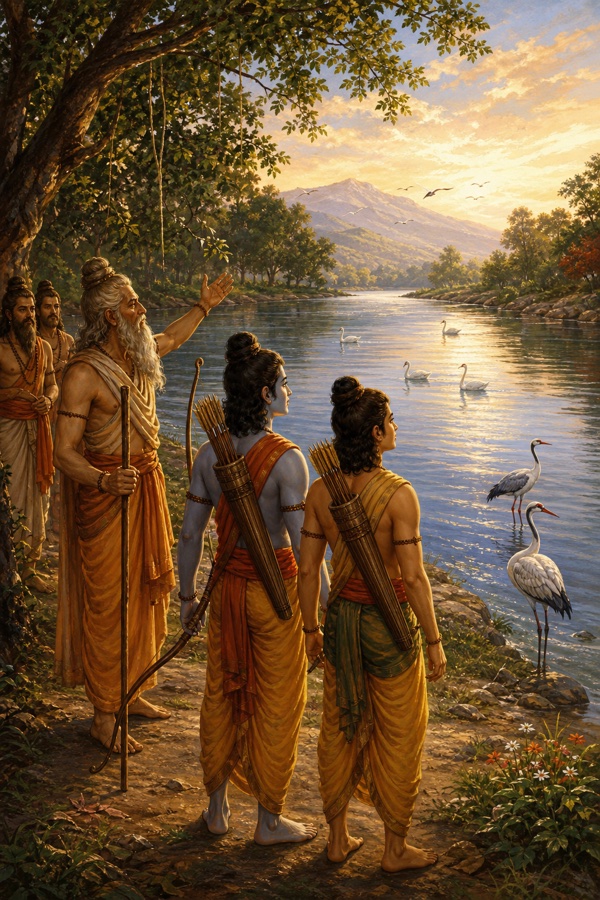
They slept out the rest of the night on the bank of the Shona, and the night ended in a beautiful sunrise, the second morning of the road to Mithila. Vishvamitra was awake before it. “Rama, the night is over and the dawn is lovely. The morning twilight is here and the morning rites are waiting. Up now. Rise and make yourself ready to go on, and may all be well with you.” Rama finished the rites of the dawn, and while the party was gathering he looked at the river and asked, “This Shona, whose water is so holy, is shallow here, and the banks are all sand. There are two fords in front of us. Which should we take?” Vishvamitra said, “The one I pointed out, where the great seers are already wading across.” So they went through the Shona at that place, with the seers enjoying the beauty of the forest as they went, and then they walked a long way farther, and in the afternoon they came in sight of the Ganga, the river that stands above every other river, the river sages go to when they want to be made clean, broad and bright under the afternoon light, with swans and cranes thick on the water. The sight of it lifted every heart in the party, the seers and the two princes alike. On the bank they halted. They bathed as the scriptures direct, reciting the ancient hymn that washes away sin, offered water to the ancestors and to the gods, poured oblations into the fire, and ate the remnants of the offering, which the shastras liken to nectar and which are said to carry those who eat them to the everlasting Brahman. Then, contented, they sat down on the bank of the Ganga in a ring around Vishvamitra, each in his place by seniority, Rama and Lakshmana in theirs, and Rama, glad in his whole being, asked the question the river had put in him. “I want to hear about the Ganga, sir, the river that goes by three paths, through heaven and earth and the region beneath. How, after running through all three worlds, does she come to meet the ocean, the lord of every stream and river?”
Vishvamitra took up the question of the river’s origin and its spreading. “At the far north of this land, Rama, stands the Himalaya, king of mountains, a storehouse of every mineral there is. To the deity who presides over that mountain two daughters were born, and there was nothing on earth to compare with their beauty. Their mother was Mena, Himavan’s beloved wife, slender-waisted, herself a daughter of Mount Meru. The elder daughter Himavan had through her was this Ganga. The second was named Uma. Now all the gods came to Himavan and asked him for the elder, for Ganga, because they had work of their own that only she could accomplish, and they wanted her for it. Himavan gave her. He gave her because a supplicant must never be refused, and because he cared for the welfare of the three worlds, and so his daughter Ganga, who purifies the world, who could cut her own road through the sky or the underworld as she pleased, went to the gods as their adopted child. They took her and went home well pleased.
“Himavan’s second daughter, Uma, who counted austerity her only wealth, stayed a virgin. She gave herself to a vow so severe that she would not eat even the dry leaves that fall from the trees, and she practiced her austerities as meditation on Shiva alone. Himavan, chief of mountains, gave that Uma, whom the whole world adores and whose austerity was fiercer than any, to Rudra, who has no rival. So the Ganga, who would become the first of all rivers, and the goddess Uma are the two famous daughters of Himavan, king of mountains, and the whole universe honors them both.
“That is the Ganga’s origin. Now hear how she came to follow three paths. First, as I told you, she rose into the sky, the road that is open to everything that moves, together with the gods who carried her up to heaven. Then that daughter of the mountain king rose into heaven itself, the realm of the gods, in the form of the delightful Mandakini, the stream you can see at night across the sky. And last of all she took the form of an earthly river, the Ganga, who can wash the world clean of its sins.” (Canto 35)
The interrupted union of Shiva and Uma, and the birth of Kartikeya
When the sage finished, both brothers, Rama and Lakshmana, welcomed the story of Himavan’s two daughters with delight, and Rama asked for more. “Holy sir, that was a story that confers merit on anyone who hears it. Now give us the whole account of the Ganga, her career in heaven and her career on earth, since you know it all. What was it that moved that world-purifying stream to wash all three regions? How did the river of three paths come to stand above every other river in the world? What has she done in the three worlds, you who know what is right?” Vishvamitra, whose only wealth was his austerity, told them everything, there in the midst of the seers. “Long ago, Rama, Shiva, the god with the blue mark on his throat, the great ascetic, had just married Uma, and seeing Parvati at his side he gave himself up to the joys of married love. A hundred celestial years passed over the all-wise Lord of the worlds while he sported with her, a hundred years of the gods, and in all that time no son was born of her, and no daughter.
“The gods, with Brahma, the father of all creation, at their head, made up their minds to stop it. What frightened them was the child. ‘Who,’ they asked one another, ‘will be able to bear the glory of a son born of this divine lady?’ So all of them went to Shiva, prostrated themselves before him, and prayed. ‘Supreme Lord, adored of all the gods, you who live for the good of this universe, we bow to you; be gracious to us. The worlds and everything living in them will not be able to bear your glory in the form of a son. You are rich in the austerity of oneness with Brahman: leave the joys of the marriage bed and practice austerity with your divine consort. For the welfare of the three worlds, which is your first concern, hold your vital energy within your own glorious self and so preserve all these worlds from ruin, because the son who is born to you will be so glorious that he will burn all three of them. Do not let the worlds be destroyed.’
“Shiva heard the gods out and said, ‘So be it.’ Then he went on: ‘Uma and I will hold our energy within ourselves by the strength of our own glory. Let the earth and the other worlds live in peace, and free of fear. But this energy of mine, which has no equal, is already stirred from its seat. Who will receive it? Tell me that, you best of gods.’ The gods answered the Lord whose banner bears the bull: ‘The earth, who can hold anything, will receive what has already been dislodged.’ At that, the almighty ruler of the gods let his seed fall, and it covered the whole earth, every mountain and every forest on it. Now the gods were afraid of something else: that the earth herself would split under the weight of that fluid. So they prayed to Agni, the fire who feeds on sacrificial offerings. ‘Take the wind-god with you, and drink up this mighty seed of Rudra.’ Gathered up by fire, with the wind to drive it, the seed grew solid into a white mountain, and out of that mountain, in time, rose a thicket of white reeds that blazed like fire and sun together, and in that thicket Kartikeya was born, a child already blazing with the splendor of the father whose seed he was. Because fire had carried him, he is spoken of as fire-born.
“The gods and the hosts of seers who had come with them were overjoyed. They worshiped Uma and they worshiped Shiva, right there. But Uma, daughter of Himavan, turned on them with her eyes bloodshot, and she cursed every god present. ‘I joined my husband because I wanted a son, and you have kept me from it. From this day you will beget no children through your own wives. Let your wives stay barren.’ And having cursed all the gods, she cursed the earth as well. ‘You will have a surface of many shapes and many masters, earth. Shaken by my curse, you will never know the delight of having a son, you wicked woman, since you did not want me to have mine.’
“Shiva saw all the gods tormented by his consort’s curse, and he made ready to leave. He set out toward the west, the quarter that Varuna rules, the god of the waters, and there, on a summit called Himavatprabhava in the northern wing of the great Himalaya, the supreme Lord took up austerity with Parvati at his side. So now, Rama, you have the full account of Uma, daughter of Himavan. Hear from me next, you and Lakshmana together, how the Ganga herself came into her own.” (Canto 36)
Vishvamitra went on, and now the story turned on a want the gods could not fill: the seed of Shiva had been carried off by fire, and still they had no general. “While Shiva was away at his austerities with Uma, the gods, led by Indra and with Agni going before them, went to Brahma, father of all creation, because they needed a commander for their armies and had none. ‘The almighty Shiva, glorious one, who gave us our commander in the form of seed some time ago, is now practicing supreme austerity with the goddess. Tell us what to do next, for the good of the worlds. You know every expedient. You are our last resort.’ Brahma heard them and comforted them with gentle assurances. ‘What Parvati, daughter of Himavan, has spoken, that you will have no children through your wives, must come true; there is no doubt of that, because her curse cannot be turned aside. But here is the heavenly Ganga. Agni will place the seed of Shiva in her, and she will bear a son who will crush his enemies and command the armies of heaven. Ganga, the elder daughter of the mountain king, will count him as her own son, and Uma, her younger sister, will make much of that too. Of this there is no doubt.’
“The gods, satisfied, bowed to Brahma, and went on to Kailasa, that most excellent mountain rich in minerals, and there they charged Agni with the task: ‘Accomplish this for the gods, glorious fire. Place in Ganga, daughter of Himavan, the seed of Shiva that you carry.’ Agni promised, and went to the heavenly Ganga and asked her. ‘Take into yourself the seed of Shiva, which I captured and have kept; this is what the gods want.’ At his words the celestial river took on a living, ethereal form, and at the sight of her beauty the seed of Shiva melted through her on every side, and Agni filled her with it until every channel and vein of her was saturated. It burned. Ganga, in agony, said to the fire who leads all the gods, ‘I cannot bear it, shining one. The seed of Shiva, and your own heat added to it. I cannot hold it.’ Agni, the fire meant for every god, answered her: ‘Set it down on this spur of the Himalaya.’ And that very moment the glorious Ganga expelled from her veins the seed in all its brightness. Because it came out of the body of Ganga, and Ganga is the granddaughter of Sumeru, the mountain of gold, it shone like molten gold of the purest kind.
“What fell to earth became gold and silver of a luster nothing can match. The sheer heat of it turned even the distant ground to copper and iron, and its dross became tin and lead. So the seed of Shiva, reaching the earth, grew into all the metals there are. And when it touched the ground, the whole thicket of white reeds I told you of, and the white mountain with it, was flooded with its splendor and turned to gold. From that day, Rama, gold that shines like fire has been called Jatarupa, because its beautiful form first came to light in that hour, and the grass and the creepers and the trees and the shrubs all around went golden at its touch.
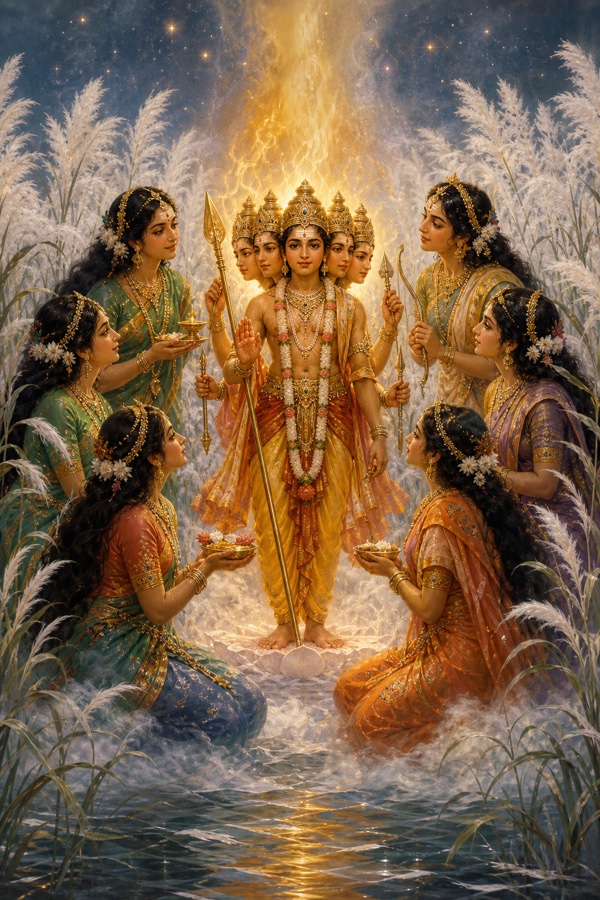
“Then the gods, with Indra among them, came to the child born there, and the Krittikas came with them, the goddesses who preside over the six stars of that constellation, to give him their milk. The Krittikas took a high resolve among themselves, that the boy would be the son of all six of them at once, and on that understanding they suckled him together the moment he was born. The gods said, ‘This boy will be famous through the three worlds as the son of the Krittikas, and there is no doubt of it,’ and the Krittikas, pleased, bathed the infant, who had first trickled from the body of Shiva as seed and then oozed out of the womb of Ganga, and who shone now with a brightness like fire. The gods gave that strong-limbed son of the Krittikas the name Skanda, from the root that means to slip and flow, because he had slipped from the womb of the Ganga. Then milk came into the breasts of the Krittikas, milk beyond any other, and the child grew six faces and drank from all six of them at once. He drank their milk for a single day, and on that one day’s milk, tender as his body still was, he became so powerful that he went out and, by sheer force, conquered division after division of the demon army. So all the gods gathered, with Agni at their head, and with the full ceremony anointed that blazing boy, one day old and already a conqueror, commander of the armies of heaven.
“So there you have it, Rama, at length: the story of the Ganga, and with it the coming of Kumara, the son of Shiva, a story that gives both wealth and merit to those who hear it and those who read it. And a man on earth who is devoted to Kartikeya can look forward to a long life, and to a home in the divine realm of Skanda, with his sons and his grandsons beside him.” (Canto 37)
King Sagara, his two queens, and sixty thousand sons
Having told that story in his sweet voice, Vishvamitra of Kusha’s line began a second one for the young prince, and this one came closer to home, for it was about Rama’s own ancestors, the kings who had sat on the throne of Ayodhya long before his father did. “In the old days, Rama, a king named Sagara ruled in Ayodhya, a man whose mind was given to piety, and he had no children, and he longed for them. His senior wife was Keshini, a daughter of the king of Vidarbha, extremely pious and devoted to truth. His second wife was Sumati, a daughter of the sage Arishtanemi, who is also called Kashyapa, and a sister of Suparna, which is another name for Garuda, the king of birds who carries Vishnu.
“With those two wives the great king went up into the Himalaya and practiced austerity on a spur of the range called Bhrigu-prasravana. When a hundred years were complete, the sage Bhrigu, born of Brahma’s own mind, a man whose word no one had ever known to fail, was satisfied, and granted the king a boon. ‘A great many sons will be born to you, sinless one, and your fame in the world will have no equal. One of your wives will bear a single son to carry on your line. The other will bear sixty thousand.’ The two princesses, the daughter of the king of Vidarbha and the daughter of Kashyapa, were overjoyed, and they pressed him further, with their hands folded. ‘We want to know which of us will bear the one son and which the many, holy one. Let your word come true.’ Bhrigu gave them the best answer he could. ‘Let it be as you yourselves choose. In one case a single son who will carry the line; in the other, many sons, mighty and famous, full of daring. Which of you wants which?’ Keshini, the senior queen, said in the king’s presence that she chose the one son who would carry on the line. Sumati, Garuda’s sister, chose the sixty thousand, renowned and full of daring. The king walked around the sage keeping him on his right, bowed his head low, and went home to his capital with his two wives.
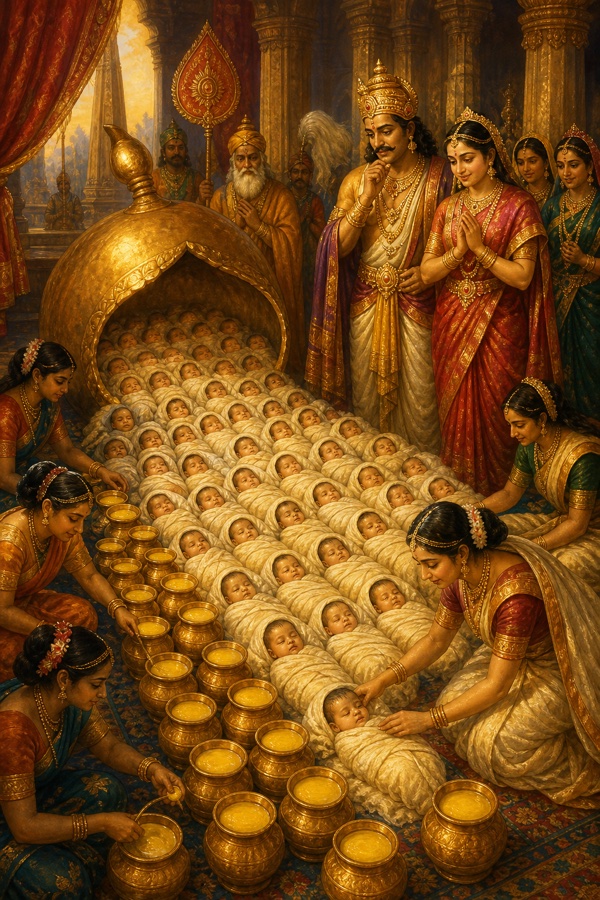
“When the time came, the senior queen, Keshini, gave Sagara a son of his own body, and they named him Asamanja. Sumati brought forth something else: a womb-fruit shaped like a bitter gourd. When it was split open, sixty thousand male infants came out of it. The nurses raised them in jars filled with ghee, and after a very long time all of them came to manhood, and sixty thousand sons in the full beauty and vigor of youth stood at King Sagara’s side. But Asamanja, the eldest, was a wicked man. He would catch hold of infants, day after day, throw them into the water of the Sarayu, and stand on the bank laughing out loud as he watched them drown. Given over to that kind of sin, a torment to good men and bent on harming the citizens, he was banished from the capital by his own father. Asamanja’s son, though, was a different matter. Amsuman was loved by everyone in the city and spoke kindly to everyone he met. Then, after a long time, Sagara came to a firm decision: he would perform a sacrifice. And a king who was learned in the Vedas set about it at once, with his family priests to help him.” (Canto 38)
The horse sacrifice, the stolen horse, and the digging of the earth
Rama had been listening with the special pleasure of a young man hearing about his own forefathers, and at the pause he asked, “God bless you, sir, I want the whole of this story. How did my ancestor King Sagara perform his sacrifice?” Vishvamitra was struck by the eagerness of the question, and he answered as if he were laughing. “Listen, then, to the whole account of Sagara’s sacrifice, your forefather’s, and of what it was to cost his house. Himavan, whom Shiva calls father-in-law, and the Vindhya mountain stand looking at each other across the land, Himavan gazing down on the Vindhya and the Vindhya gazing back. In the country that lies between those two ranges, that sacrifice was performed, because that land is the land recommended for sacrifice above all others. Amsuman, a great chariot-warrior armed with a strong bow, took the duty his grandfather assigned him: he followed the sacrificial horse wherever it wandered and guarded it.
“On the day of the rite called Ukthya, while the king was in the midst of the ceremony, Indra took the shape of a rakshasa and stole the sacrificial horse of Sagara. The officiating priests saw the horse being carried off and went straight to the sacrificer. ‘King, on the very day of Ukthya the sacrificial horse is being taken from us by force. Kill the thief and get the horse back. An obstruction in a sacrifice brings ill luck on every one of us; arrange things so that the rite goes forward unhindered.’ The king listened to the priests and his family priest together, and then he turned to his sixty thousand sons. ‘I do not see how rakshasas could even come near this sacrifice, my sons, for it is presided over by blessed men consecrated by the recitation of holy texts. So go and hunt the thief down, my dear sons, and good luck go with you. Search the whole earth, out to the ring of the oceans. Divide it among yourselves, one square yojana each, and scour it. If you cannot find him on the surface, then by my order dig into the earth, and keep digging for the man who took the horse until the horse is found. I stand here consecrated for the rite, and I will stay here with my grandson Amsuman and the officiating priests until the horse is back in sight. May all be well with you.’
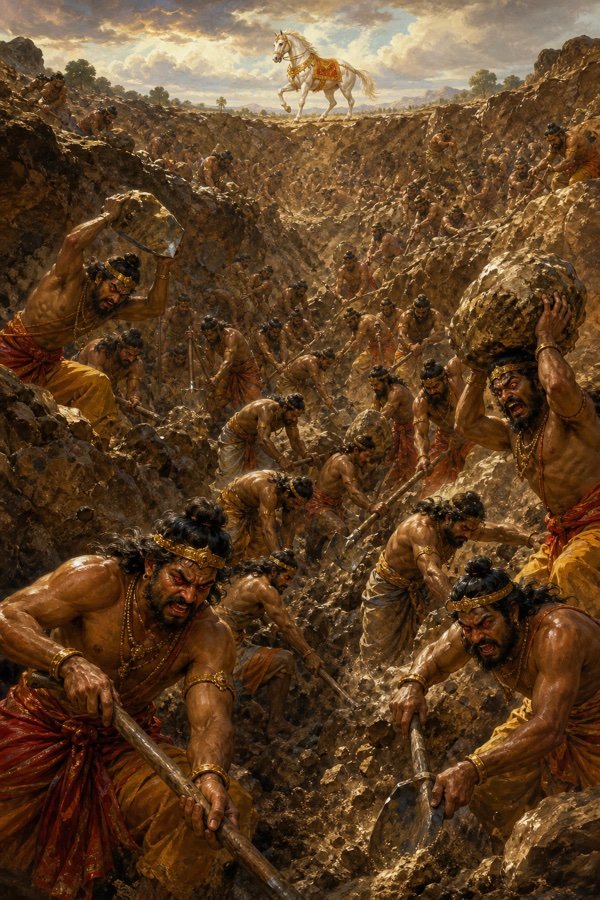
“Bound by their father’s word, those mighty princes set out across the face of the earth, and they set out glad. They searched it all and did not find the horse. So they began to dig, tearing up the ground with arms that struck like thunderbolts, each of them taking his square yojana. The earth groaned. She was being dug with pikes as hard as adamant and plowshares more terrible than anything she had felt before, and a hideous clamor rose out of her that nothing could quiet, the cries of the nagas and the demons and the rakshasas and all the other creatures of the underworld, who were being killed where they lived as the digging went down. They dug up sixty thousand square yojanas of land, as if they meant to reach Rasatala itself, that region below the earth which no other sphere can match in beauty and splendor and the comforts of living. In that way, Rama, the sixty thousand sons of Sagara went on digging up the whole of Jambudvipa, in every direction, mountains and all.
“The gods took fright, and with the gandharvas, the demons, and the nagas they went to Brahma, father of all creation. They praised him, and then, with their faces fallen and their hearts in terror, they put their case. ‘Lord, the whole globe is being dug up by the sons of Sagara, and many noble souls and many creatures of the waters have already been killed in the digging. They are destroying every living being they come across, on the suspicion that whoever stands in front of them is the one who interfered with their sacrifice and stole the horse.’” (Canto 39)
The wrath of Kapila, and the burning of Sagara’s sons
“Brahma answered the frightened gods, who had been thrown into confusion by the might of Sagara’s sons and the slaughter they were spreading. ‘This goddess Earth is the consort of the all-wise Vishnu, the husband of Lakshmi, and the entire globe belongs to him. Taking the form of the sage Kapila, that same almighty Lord holds the earth up without pause by his yogic power. The sons of Sagara will shortly be consumed by the fire of his wrath. Besides, this digging of the earth happens in every kalpa; men of long sight have already foreseen the destruction of Sagara’s sons. There is no cause for grief on that account either.’ The thirty-three gods, every one of whom had brought down enemies of his own and had still come here frightened, heard the father of creation and went home the way they had come, greatly relieved.
“All the while the earth was being dug, a sound rose out of it like a thunderstorm that would not end. When the sons of Sagara had gone around the whole world and dug the whole of it, they came back to their father, all of them together, and reported. ‘The whole globe has been circled and dug up. We have destroyed mighty gods, demons and rakshasas, fiends, serpents, and nagas. And still we cannot find either the horse or the man who stole it. What should we do now? Look kindly on us, and think out the next step for us.’ Sagara, the noblest of kings, answered in anger. ‘Good fortune go with you: dig the earth further. Break it open. Find the horse-thief, and come back only when the work is done.’
“The sixty thousand bowed to their father’s command and dug their way down into Rasatala. As the tunnel went deeper they saw, at the end of their digging, an elephant the size of a mountain, Virupaksha by name, who guards the eastern quarter and holds up the world. The great elephant Virupaksha carries the entire globe on his head, mountains and forests and all, and whenever he grows tired, Rama, and shakes his head for a moment’s relief, the surface of the earth convulses, and men call it an earthquake. The princes walked around that guardian of the quarter keeping him on their right, honoring him, and then tunneled on through Rasatala.
“Having pierced the east, they broke through into the south, and there again they found a great elephant, Mahapadma, with a body like a mountain, bearing the earth on his head, and they marveled at him. They circled him too, from left to right, in respect, and the sixty thousand sons of Sagara, their father’s order still driving them, broke through into the west. In the western quarter those mighty princes found the elephant Saumanasa, as big as a mountain, guarding it. They circled him, asked after his welfare, and dug on into the northern quarter, which the moon-god rules. There in the north they saw Bhadra, the elephant of that quarter, white as snow, holding up this globe on his beautiful body. They touched him, walked around him from left to right, and all sixty thousand set about digging the earth once more. And so they came, still digging, into the northeast, the quarter that Shiva rules, which is held sacred for every holy undertaking, and now they dug in a fury.
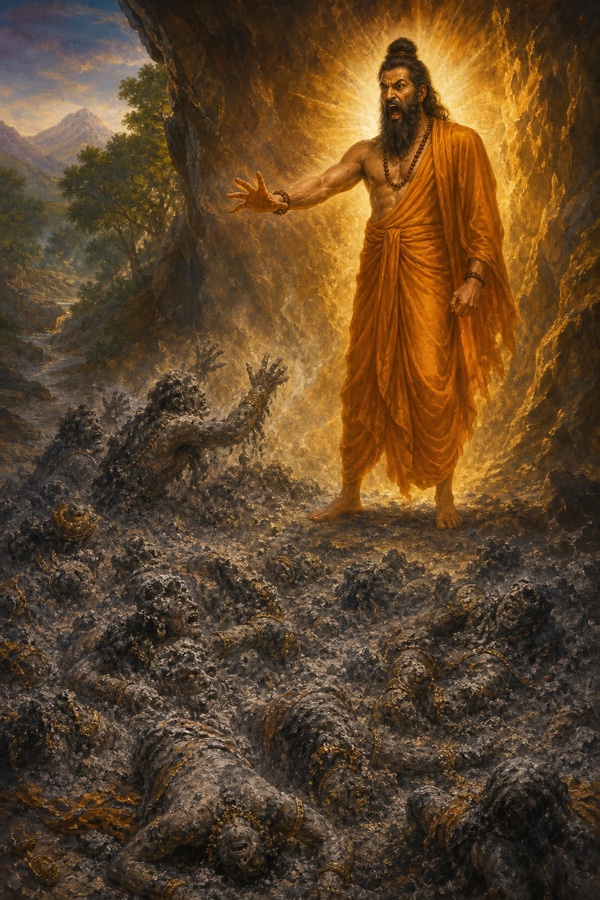
“And there, all of those high-minded, tremendously strong, tremendously swift princes saw the eternal Lord Vasudeva in the form of the sage Kapila, and not far from that glorious sage they saw a horse, grazing. The joy that went through them had no equal. And it lasted no time at all. Without a thought, they decided that this was the man who had broken up the sacrifice by stealing the horse, and rage took them. With their eyes dimmed by anger they rushed at him, carrying spades and plows and whole trees and boulders, shouting, ‘Stop. Stop. You are the one who stole our sacrificial horse. Know us, you villain: we are the sons of Sagara, and all of us are here.’ Kapila, hearing that threat, was seized with fury, and he uttered a single sound, ‘hum,’ the sound of contempt. In the next instant every one of the sons of Sagara was burned where he stood, and reduced to a heap of ash, by that sage whose glory no one has ever measured, the very sage they had come to call a thief.” (Canto 40)
Amsuman, the counsel of Garuda, and the return of the horse
“King Sagara, still standing consecrated at his sacrifice, unable by the law of the rite to leave it, saw that his sons had been gone a very long time, and he called his grandson Amsuman, who shone with a glory of his own. ‘You are brave, and you are learned, and in splendor you are the equal of your forebears. Go and find out what has become of your uncles, and of the man who stole the horse. The beings who live under the earth are huge of body and very strong; take a bow and a sword against their attack. Bow to those who deserve it. Kill anyone who blocks your way. And come back only when the task is done, so that my sacrifice can be completed.’
“Amsuman took up his bow and his sword and went quickly. Urged on by the king, he reached in no time the underground passage his high-minded uncles had cut, and there he came upon an elephant guarding one of the four quarters, an elephant that gods and demons, fiends, birds, and serpents all worship. Amsuman walked around him keeping him on the right, asked after his welfare, and then asked what he had come to ask: where his uncles were, and who had stolen his grandfather’s horse. The elephant was wise, and answered him kindly. ‘Son of Asamanja, you will accomplish your purpose, and you will soon go home with the horse.’ Amsuman put the same question to each of the elephants of the quarters in turn, in their order of seniority and with proper respect, and each of those guardians, who understand the speech of others and are just as skilled in their own, received him with honor and told him the same thing: he would go back with the horse.
“Hearing that, Amsuman hurried on, and came to the place where his uncles, the sons of Sagara, lay in heaps of ash, sixty thousand of them, every heap a man who had set out from Ayodhya glad. He had already been grieving because he could not find them. Now he knew they were dead, and the grief overwhelmed him, and he wept aloud in agony. Then, through his sorrow, he saw the sacrificial horse, grazing not far off. He wanted, before anything else, to offer water to the spirits of those princes, and he looked for water and found no pool or stream anywhere near. So he cast his keen gaze all around him, and he saw Garuda, the king of birds, who is as swift as the wind, and who was the maternal uncle of those very uncles of his.
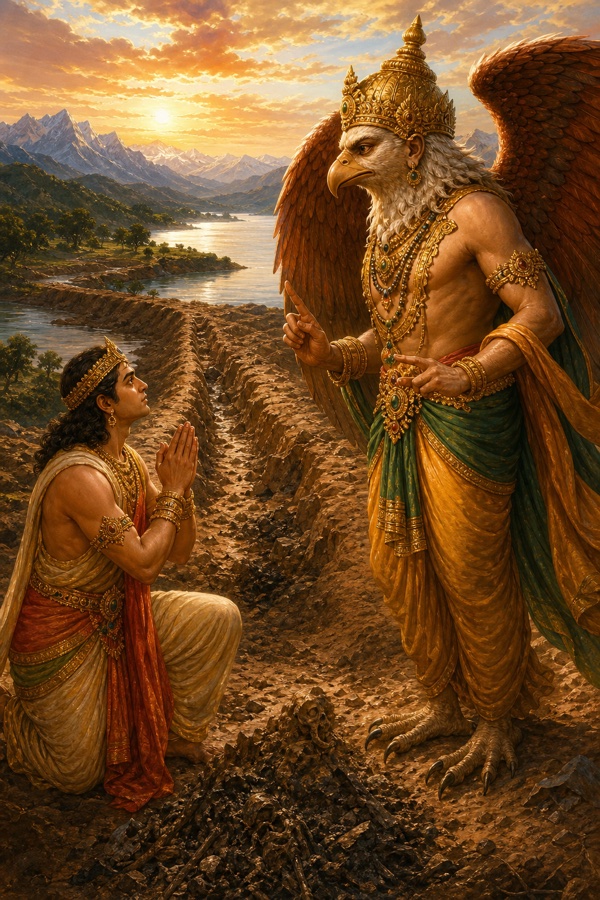
“Garuda, son of Vinata, spoke to him with the authority of that kinship. ‘Do not grieve for this death. The death of your uncles serves the good of all three worlds, because it will be the occasion for the holy Ganga to come down to the earth. These mighty princes were burned by Kapila, whose glory has no measure. You must not offer them ordinary earthly water, wise prince.
“‘Ganga is the elder daughter of Himavan, the deity of the Himalaya. Offer the water for your departed uncles in that river, and in that river alone. When the Ganga, who can purify the whole world, washes over what is left of them, these heaps of ash, soaked by the river that gladdens the world, will carry the souls of the sixty thousand up to heaven. Now take the horse, blessed prince, and leave this region, and see that your grandfather’s sacrifice is brought to its end.’ Amsuman heard Garuda out, and that powerful prince, who was a great ascetic besides, took the horse and returned at speed to his grandfather’s capital. He went in to the king, who still stood consecrated for the rite, and told him exactly what had happened, and repeated Garuda’s words faithfully. That was a fearful tale to hear from a grandson, and Sagara took it in, and then completed the sacrifice according to the scriptures, to the best of his power. The sacrifice done, the emperor, sixty thousand sons the poorer, went back to his capital, and for the rest of his life he could find no way to bring the Ganga down to the earth. He reigned for thirty thousand years, and reached no decision, and went up to heaven.” (Canto 41)
Amsuman, Dilipa, and the penance of Bhagiratha
“When Sagara had met his end, which is the law of time for everything that is born, the people asked the pious Amsuman to be their king. He proved a great monarch, and his son Dilipa, whose name traveled far, was as great as he was. In time Amsuman handed the kingship to Dilipa and went up to a lovely summit of the Himalaya, and there he practiced the severest austerity a man can practice, all of it for the one purpose, to bring the Ganga down. He kept at it, in a grove set apart for penance, for thirty-two lakh years, three million two hundred thousand, and at the end of it that king, rich now in the merit of his long penance, won heaven for himself. He did not win the grace of the Ganga.
“Dilipa heard how his grand-uncles, the sons of Sagara, had died their unnatural death, and grief clouded his judgment so that he could not see any way to bring the Ganga to earth. He turned it over without rest: how could the river be made to descend, how could water be offered to them, how could their souls be redeemed? While the king, who was famous for his righteousness, went on brooding like that day after day, a son was born to him, and a most righteous son, and they named him Bhagiratha. Dilipa propitiated the Lord with many sacrifices. He reigned for thirty thousand years. And he never reached a decision on the deliverance of his forebears, and he met his end, which is the law of time, through illness. He set his son Bhagiratha on the throne, and by the merit he had earned himself he went to the paradise of Indra.
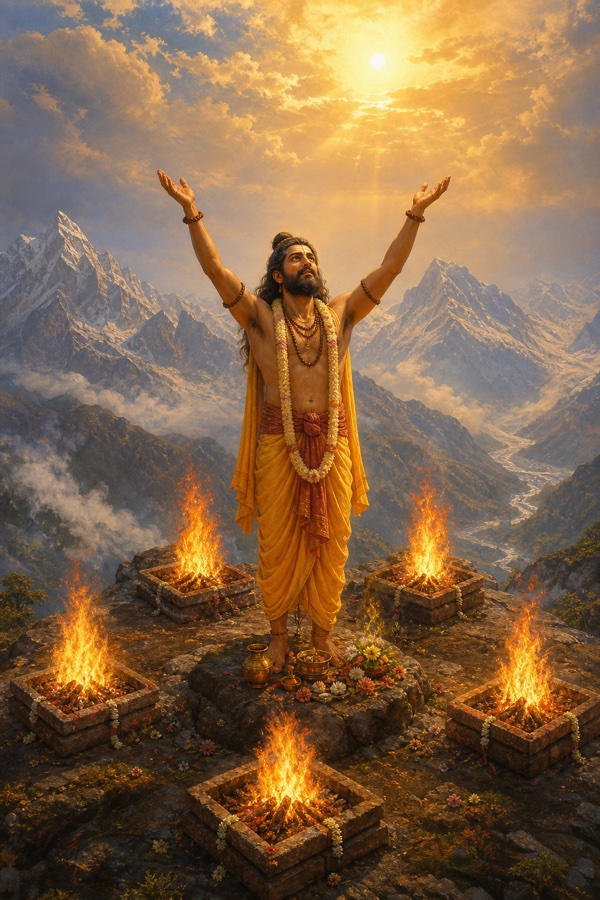
“The emperor Bhagiratha, a pious royal sage, had no children and wanted them. But there was an older want in his house than that, and he set everything else aside for it. He handed the people and their rule to his ministers and, fixed on the descent of the Ganga, went to Mount Gokarna, a summit of the Himalaya, and gave himself to a long austerity. He stood with his arms raised above his head, his senses under complete control, in the middle of five fires, and he ate once a month. A thousand years passed over him like that, in the harshest penance a body can bear, and the three kings before him who had wanted the same thing had all died wanting it. Then Brahma, the almighty creator, lord and ruler of every created thing, was pleased with him, and came down with the hosts of the gods to where Bhagiratha stood.
“‘I am pleased with the austerity you have practiced so well, great king, ruler of the people. Ask me for the boon you want, king of noble vows.’ Bhagiratha stood before the father of all the worlds with his hands folded. ‘If the Lord is pleased with me, and if austerity has any reward, then let all the sons of Sagara receive water from my hands. When the ashes of those giant princes are soaked with the water of the Ganga, all my grand-uncles will go to the everlasting heaven. And I was born in the line of Ikshvaku, glorious one; I ask for a son as well, so that our house does not come to an end. Let that be the second boon.’ Brahma answered him with kindness, in a speech full of sweet words. ‘This is a great ambition, Bhagiratha, great chariot-warrior that you are. May it be fulfilled. Success attend you, you who carry forward the house of Ikshvaku. Here is the river Ganga, the elder daughter of Himavan, whose source is in the Himalaya. When she comes down onto the earth, the earth will not be able to bear the speed of her fall. For holding her, king, I see no one at all except Shiva, who carries the trident; there is no other head in all the worlds that could take that weight. Let Shiva alone be asked to receive the Ganga as she descends.’ So he told the king, and he instructed the Ganga as well to do Bhagiratha’s bidding when the time came, and then Brahma, maker of the universe, went back to his own realm with the gods and the hosts of the wind-gods around him.” (Canto 42)
The Ganga on Shiva’s head, and the seven streams
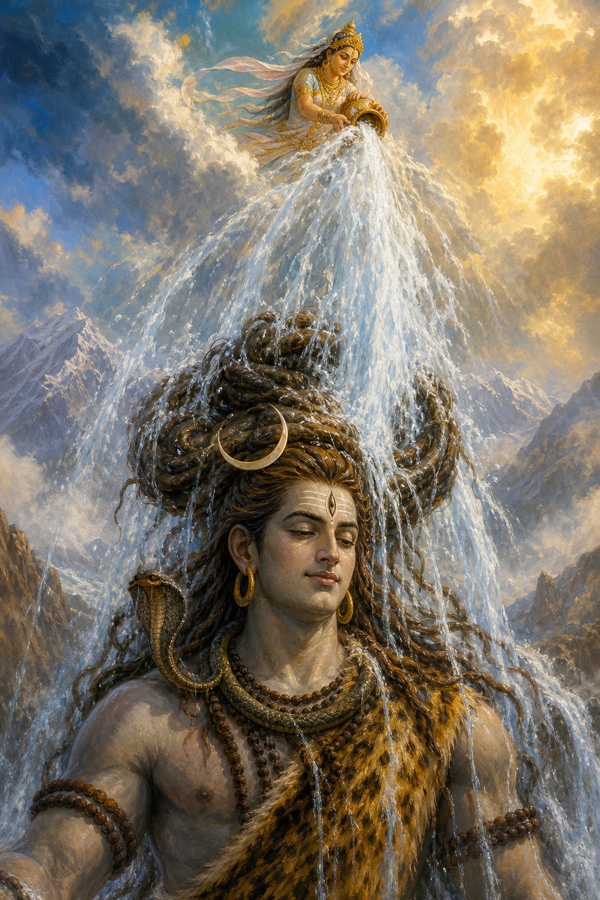
“When Brahma had gone, Bhagiratha began again. For a full year he waited on Shiva, standing on the ground on the tip of one great toe, and when the year was complete, Shiva, the lord of Uma, the protector of every bound creature, whom all the worlds adore, spoke to him. ‘I am pleased with you, finest of men, and I will do what pleases you. I will receive the Ganga, the daughter of the king of mountains, on my head as she comes down onto the earth.’ Then the elder daughter of Himavan, whom all the worlds adore, swelled into a vast stream and gathered a force that nothing could withstand, and she fell out of heaven, her home, onto the blessed head of Shiva. As she fell, that all-glorious river, who is so hard to hold, thought to herself: ‘I will sweep Shiva away with my current and carry him down into Patala.’ The three-eyed Lord perceived her arrogance and it angered him, and there and then he resolved to hide her inside his matted hair. She struck the holy head of Rudra, thick with coils of matted locks, as huge as the Himalaya, and she could not reach the earth. She tried everything. She went round and round inside the coils of his hair and could not find a way out even at their end, and she wheeled about on his head alone for years upon years.
“Bhagiratha saw her there and took up supreme austerity once more. Shiva was greatly pleased by it, and he let the Ganga go, into the lake called Bindusarovara in the Himalaya, which is attributed to Brahma. As she was released she split into seven streams. Three of them, blessed streams of delightful water, ran eastward, Hladini, Pavani, and Nalini. Three ran westward, Suchakshu, Sita, and the great river Sindhu. And the seventh went after the chariot of Bhagiratha. The royal sage was mounted on a beautiful chariot, invested with a splendor all his own, and he drove ahead, and the Ganga followed him. In that way the holy river came down from heaven onto the head of Shiva and from his head onto the earth, and made good the name she carries, Tripathaga, the river of three paths.
“On the earth’s surface the water of the Ganga ran roaring, a terrible sound, and the whole land looked wonderful under it, with its shoals of fish and its tortoises and the great beasts of the deep that were falling and had fallen with the stream. The divine seers and the gandharvas, the hosts of yakshas and siddhas, and the gods who had their station in heaven, seized with amazement, watched the river come down from their flying palaces as big as cities, and from the backs of their horses and their finest elephants. Everyone who could wanted to see it, this famous, this wonderful, this superb descent of the Ganga onto the mortal plane, and the gods, in their multitudes and their measureless strength, gathered in the sky to watch. As they came down at speed, the brilliance of their jewels lit the cloudless heavens as if a hundred suns had risen at once. The sky itself was scattered with the great creatures of the deep and with snakes and with darting, throbbing fish, until it looked covered with streaks of lightning, and the white foam that was being flung up in numberless flakes made the vault of heaven seem overcast with the white, rainless clouds of autumn, and crowded with flocks of flying swans.
“The Ganga ran now very swiftly, now winding; now she broadened out and now she narrowed as she forced her way through a ravine; now she was tossed high where she struck a rock, and now she glided. Where the wind turned her back on herself, her own waves struck her water and it spouted up again and dashed down again to the ground. That limpid water, fallen first on the head of Shiva and then down onto the earth, water that rids anyone who touches it of every sin, shone bright in that hour. The hosts of seers and gandharvas and the people of the earth touched it and sipped it, water that had fallen from the very body of Shiva, source of the universe, and knew it for what it was. Those who had fallen from heaven to earth under a curse bathed in it and were rid of the sin the curse had come from, and clean, and freshly filled with merit, they rose to heaven and went home to their own realms. And ordinary people, already glad just to see that sparkling water, bathed in the Ganga and were rid of their sins, and rejoiced all the more.
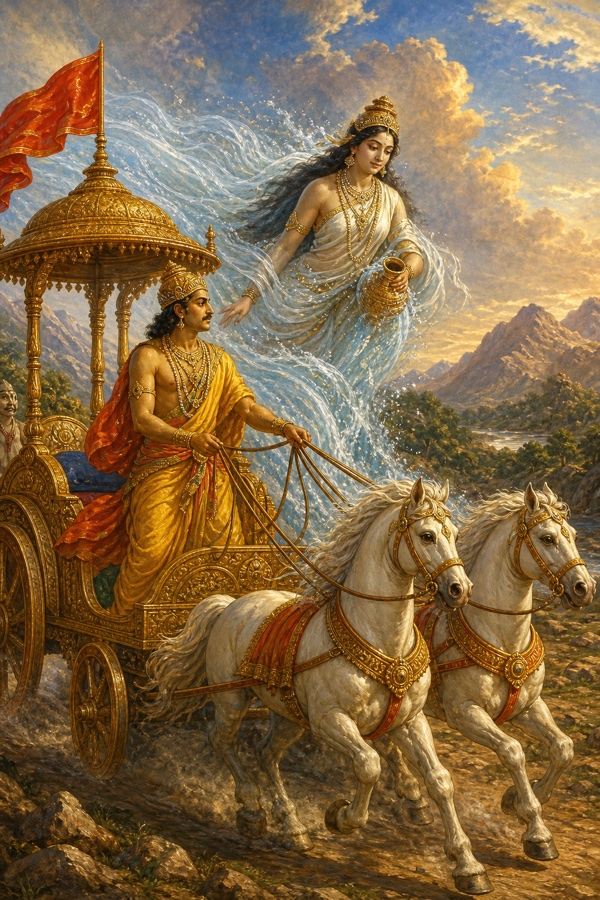
“So the emperor Bhagiratha, mounted on his beautiful chariot, drove ahead, with the Ganga at his heels, and all the gods followed the river in delight: the hosts of seers, the daityas and danavas and rakshasas, the finest of the gandharvas and yakshas, the kinnaras and the great nagas, the serpents and the apsaras, and every kind of water-creature there was, all of them keeping behind the chariot of Bhagiratha. Wherever Bhagiratha drove, the Ganga went after him, that river who has no equal and who washes away every sin, following one man’s chariot wheels across the open land. And going on from there, so it is told, the Ganga flooded the sacrificial ground of the sage Jahnu, a man of great soul and a worker of miracles, who was in the middle of a sacrifice. Jahnu saw the river’s pride, and it enraged him, and by his yogic power he drank up all the water of the Ganga. Every drop of her. It was a supreme miracle, and the gods and gandharvas and seers, astonished, praised Jahnu as a man without equal among men, and to win her back they made the Ganga his daughter, and so prevailed on him to let her go. Pleased with the honor, the mighty sage let the Ganga out again through his ears, and that is why the Ganga is spoken of as the daughter of Jahnu and is famous by the name Jahnavi.
“Then the Ganga once more fell in behind Bhagiratha’s chariot, and she came to the pit the sons of Sagara had dug and filled it, and from there the great river forced her way down through the dark of the tunnel into Rasatala, to finish what Bhagiratha had set out to do, the deliverance of his dead. Leading the Ganga down into Rasatala by an effort beyond any man’s, the royal sage Bhagiratha at last saw his great-grand-uncles, reduced to ash, and he fainted, from grief and from exhaustion together. The most sacred water of the Ganga flowed over the heaps of their ashes and covered them, and the souls of Sagara’s dead sons, purged of their sin, rose to heaven.” (Canto 43)
Brahma’s blessing, and the glory of the Ganga tale
“King Bhagiratha, following the Ganga, went down into the pit the sons of Sagara had dug and entered the lowest stratum of the bowels of the earth, where his great-grand-uncles lay in ash. When the water of the Ganga had washed those ashes through and through, Brahma, the overlord of the whole universe, came down and spoke to him. ‘The sixty thousand sons of Sagara, that king of great soul, have all been delivered from damnation, finest of men, and have gone up to heaven like gods. And like the gods themselves, all the sons of Sagara will stay in heaven as long as the water of the ocean exists on the earth. This Ganga will be your eldest daughter, and from this day the world will know her by a name taken from yours, Bhagirathi. She will be called Tripathaga, and Divya, the heavenly stream, and Bhagirathi, the daughter of Bhagiratha; and because she cuts her way through the three spheres, heaven and earth and the region below, Tripathaga is her name.
“‘Now offer water here, on the bank of the Ganga, to all your great-grand-uncles, and carry out the vow that your forefathers and you yourself undertook, the redemption of the sons of Sagara by the water of the Ganga. Your ancestor Sagara, as pious a king as any who ever lived, never realized this ambition in his day. The royal sage Amsuman could not redeem that vow either, though there was no glory like his anywhere in the world, though he longed to bring the Ganga down, though he was full of every excellence, with a splendor like a great seer’s, my equal in austerity and devoted to the duties of a Kshatriya. Nor could your father Dilipa, for all his glory, bring the Ganga to earth, sinless prince, however hard he implored her. You have carried out that vow, and by it you have won the highest fame, the fame that even the greatest in the world long for. You have accomplished the descent of the Ganga, you who master every enemy you meet, and by that you have won the great reward of virtue, the realm of Brahma. Bathe yourself, finest of men, in the holy Ganga, which is fit for bathing in every season of the year, and take the fruit of your merit. Offer water to all your great-grand-uncles. And may all be well with you; I go now to my own realm, and you go home to your capital, protector of men.’ Having said this, the glorious overlord of the gods, the father of all the worlds, rose to the realm of the gods the way he had come.
“Bhagiratha, the glorious royal sage, offered the finest water to the sons of Sagara in order of their seniority, as the scriptures direct, and gratified his other forebears in the same way, and purified by that, after his thousand years among the five fires and his year on the tip of one toe, he went back to his capital. His aim was accomplished, and he ruled his kingdom. And the people, who had their king again, rejoiced. The grief of his long absence left them; they had what they wanted, and their anxiety was gone.
“So, Rama, I have told you at length the story of the descent of the Ganga. Take blessedness as the reward for hearing it, and may prosperity attend you; the hour of the evening prayers is slipping past us. Whoever tells this story to Brahmins, to Kshatriyas, and to others, this story that brings wealth and renown, that lengthens life and ensures the birth of a son and a home in heaven, his departed forebears are gratified and the gods are pleased with him. And whoever listens to this blessed story of the Ganga’s coming down to the mortal plane, which lengthens life, will gain everything he desires. All his sins vanish, and his life and his fame grow long.” (Canto 44)
Crossing the Ganga, the city of Vishala, and the churning of the ocean
Rama and Lakshmana had listened to the whole of it in wonder, the story of their own forefathers, of the sixty thousand in their ash and the three kings who died waiting and the fourth who stood among five fires until heaven gave way, and now they spoke together. “Holy Brahmin, that is a most wonderful story you have told, the descent of the Ganga to the earth, and how the pit the sons of Sagara dug came to be filled by her; it is a charming story and a sacred one. This whole night has gone past the two of us like a single instant while we turned your story over in our minds.” Then the day came up clear, the third of the road, and Rama went to Vishvamitra, who had just finished his morning devotions, and said, “The sacred night has passed, sir, made holy by the story of the Ganga’s coming down. What was most worth hearing has been heard. Now let us cross the Ganga herself, the river of three paths, whom no other river equals, now that we know whose prayers brought her down. Here is a boat already, sent by seers of great merit, with a comfortable matting laid in it to sit on. It came the moment they learned that Your Holiness had arrived.” So Vishvamitra of Kusha’s house had Rama and Lakshmana and the whole company of seers ferried across the river, and crossed with them.
On the far bank, the northern shore, a party of seers was waiting to receive them, and having greeted them, the travelers sat down by the water and saw in the distance the city of Vishala. Vishvamitra set off toward it at once with the two princes, toward that delightful, heavenly city that rivaled paradise itself. Rama walked with his hands folded and asked, “I want to know, great sage, which famous line of kings rules in Vishala now. I am very curious about it.” Vishvamitra answered with an old and well-known story about the founding of the city. “Hear from me, Rama, the story of Indra as I heard it, for the glory of Vishala lies in it; listen to what really happened on this ground. In a Satyayuga long ago, sons of tremendous strength were born to Diti, and sons of great blessedness, powerful and devout to the core, were born to Aditi. As they grew up, one thought came to haunt all of them, the sons of both mothers. ‘How can we become immortal, safe from old age, proof against sickness?’ And being intelligent, they thought of an answer. ‘If we churn the ocean of milk, we can surely get the drink of immortality out of it.’
“They took Vasuki, the king of serpents, for a rope, and Mount Mandara for a churning rod, and the gods and the demons, whose strength had no limit, began together to churn the ocean. After a thousand years of churning, the heads of the serpent they were using as a rope began to bite the rocks of Mandara with their fangs and to throw up venom in floods. And then, all at once, on the surface of the ocean, a poison appeared, a deadly poison named Halahala, and the whole universe, gods and demons and human beings together, began to burn in it. In their minds the gods went for refuge to the great god Rudra, the destroyer, the protector of every bound soul, crying, ‘Save us. Protect us.’ Shiva, who rules even the rulers of the gods, appeared on the spot as soon as they called, and right after him Vishnu appeared there too, holding his conch and his discus. Hari spoke to the trident-bearer with a smile. ‘Whatever comes up first when the gods and the demons churn together is your share, best of gods, because you take the lead among them. So stand here, almighty Lord, and accept this poison as the first tribute of all, before any other.’ And having said it, Vishnu, highest of the gods, vanished where he stood, and the poison went on burning across the water. Shiva looked at the fear of the gods, and he weighed the words of Vishnu, who wields the bow of horn, and he drank the deadly Halahala down as if it were nectar and kept it in his throat, and then, leaving the gods, went back to his own realm.
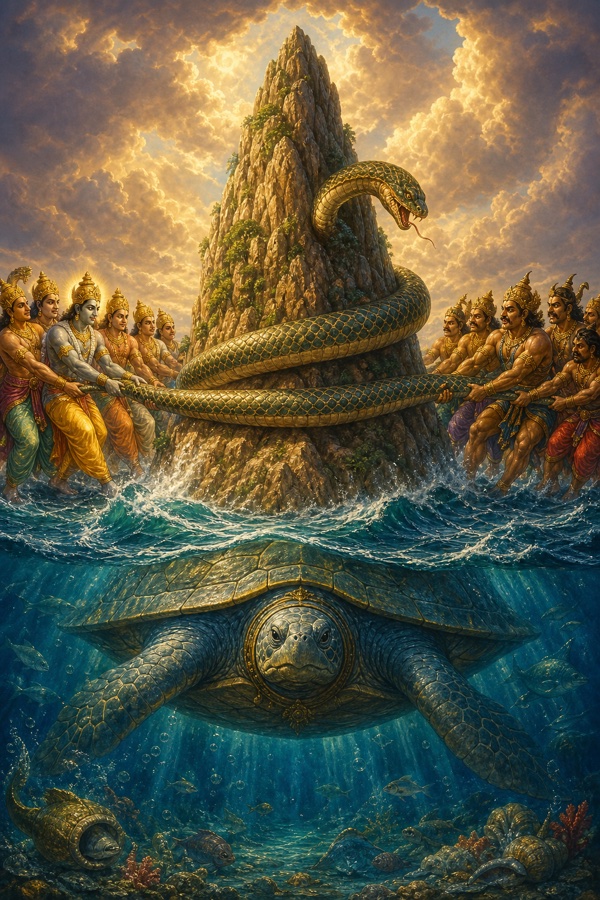
“The gods and the demons went back to churning the ocean of milk, and almost at once Mount Mandara, their churning rod, the greatest mountain of them all, sank into Patala, the lowest region under the earth. The gods cried out to Vishnu, who had once killed the demon Madhu. ‘You are the refuge of all created beings, and of the gods above all. Protect us; lift the mountain up out of Patala with those great arms of yours.’ Vishnu heard, and he took the form of the divine Tortoise, lay down on the floor of the ocean, and took the mountain onto his back. Then, holding fast to the mountain’s peak with one hand, standing in the midst of the gods, the Supreme Person, the Soul of the universe, who rules even Brahma and Shiva, took part in the churning himself.
“After another thousand years there rose out of the sea, first of all, a man with a staff and a water-pot in his hands, Dhanvantari, the embodiment of Ayurveda, the whole science of healing in one body, his mind given to deep piety. And after him came a company of celestial nymphs of dazzling splendor. They had been born out of the cream of that churning of the waters, and so they came to be called apsaras. There were six hundred million of them, radiant, and the women who attended them could not be counted. But neither the gods nor the demons would take any of them as a wife, and because none accepted them, they came to be known as common to all.
“Then out of the ocean of milk rose Varuni, the blessed daughter of Varuna, god of the waters, who presides over strong drink, and she was looking for a husband. The sons of Diti, the demons, would not take her. The sons of Aditi, the gods, accepted her, and there was nothing in her to reproach. For that reason the sons of Diti came to be called Asuras, those who would not take sura, and the sons of Aditi for the same reason came to be called Suras, those who did; and having accepted Varuni, the gods were thrilled, and full of joy.
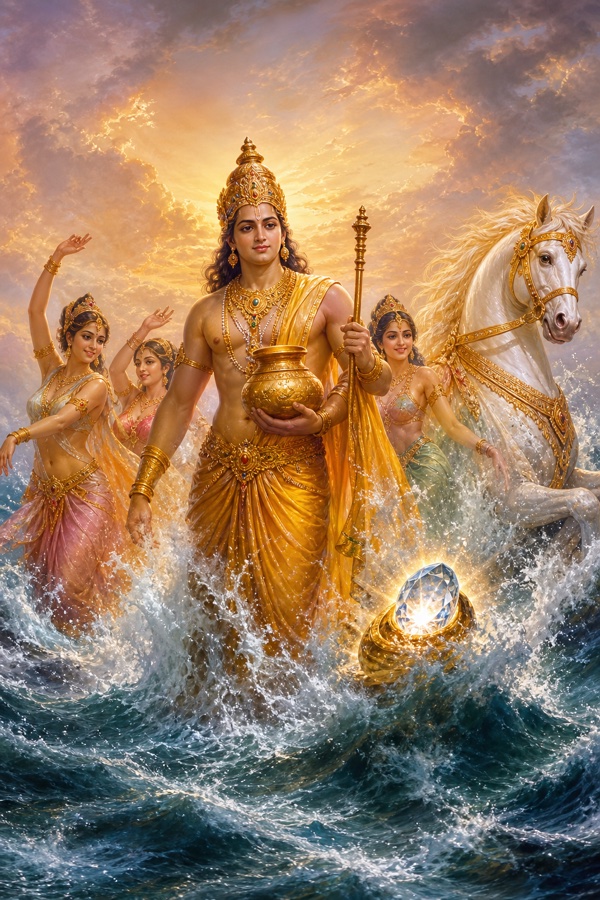
“Next came Uccaihshravas, a horse with no equal among horses, and Kaustubha, the most precious of all gems, and then the nectar itself, the finest of all drinks, the one thing the whole churning had been for. And over the nectar there began a colossal destruction of both races, gods and demons, for the sons of Aditi now fought the sons of Diti in earnest. All the demons joined forces with the rakshasas, and a battle followed so deadly that it bewildered the three worlds. When every one of them, on both sides, was rushing toward ruin, the mighty Vishnu put out his deluding power in the form of a beautiful woman and carried the nectar swiftly away. Whoever came against the immortal Lord, the Supreme Person, in that hour, was crushed by him in the fight. In that terrible war of the sons of Diti and the sons of Aditi, the heroic sons of Aditi destroyed the sons of Diti utterly. Having destroyed them and won the sovereignty, Indra, the god who had broken open the demons’ strongholds, ruled the three worlds with a glad heart, with the hosts of the seers and the charanas, the singers of heaven, about him.” (Canto 45)
The penance of Diti, and the cutting of the embryo into seven parts
“Diti had lost her sons in that war with the sons of Aditi, and her grief was terrible, and the husband she turned to was father to both armies, to the sons who had died and to the sons who had killed them. She went to her husband, Kashyapa, the son of Marichi, and said, ‘Venerable sage, your sons, the mighty gods, have taken my sons from me. Now I want another son, one won by long austerity, a son who can kill Indra, who destroyed my children. I mean to practice the penance. Be pleased to give me a son strong enough to kill Indra, and give me your leave to go.’ Kashyapa, whose glory was very great, looked at his afflicted wife and answered her. ‘So be it, and may all go well with you. Keep yourself pure until the son is born, you whose penance is already long. When the time is ripe you will bear a son who can kill Indra in battle. At the end of a full thousand years, provided you keep your purity, you will bring forth through me a son who can kill the ruler of the three worlds.’ Having said it, the glorious sage stroked her with his hand, touched her in blessing, and went off to resume his own austerities.
“When Kashyapa had gone, Diti, full of joy, went to a place called Kushaplava and began the severest austerities. And while she practiced them, Indra himself, the thousand-eyed god, came and waited on her in person, with every virtue he possessed. He brought her fire and blades of kusha grass, firewood and water, fruits and roots and whatever else she wanted, and he rubbed her tired limbs to take away her weariness, and he served her like that at every hour. So a thousand years went by, all but ten. And Diti, delighted, said to Indra, ‘Only ten years are left of my austerity, strongest of the strong, and then, prosperity attend you, you will see a half-brother standing at your side. The son I have sought for the sake of your destruction, my son, who is bound to be forever eager to conquer you, that son I will bring to you as a friend, so that free of every anxiety you may enjoy with him the conquest of all three worlds, which he will win. Your own father, the great sage Kashyapa, granted me this boon when I begged him: a son at the end of a thousand years.’
“She said it, and the sun stood exactly at the meridian, and sleep took her. She lay down without thinking and put her feet where her head should have been. Indra saw her lying in that impure posture, her hair fallen across her feet, her feet where her head ought to be, and he laughed, and rejoiced. By his yogic power he entered her womb, fully alert, and carved the embryo into seven. The embryo shrieked, in a thin, shrill voice, as the thunderbolt cut it, that weapon with a hundred edges, and Diti woke. Indra kept saying to the child, ‘Do not cry. Please, do not cry,’ and even as it went on crying, Indra went on cutting, again and again, the hundred-edged thunderbolt doing its work inside her, until each of the seven parts was itself in seven pieces. All Diti could say was, ‘Do not kill it. Do not kill it.’ And out of respect for his stepmother’s word, Indra came out of her womb. He stood before her with his thunderbolt in his hand and folded his palms. ‘You lay asleep in an impure posture, venerable lady, with your hair touching your feet. I took that opening, and I have cut into seven the embryo that was meant to kill me in battle. Forgive me this offense.’” (Canto 46)
The birth of the Maruts, and the royal line of Vishala
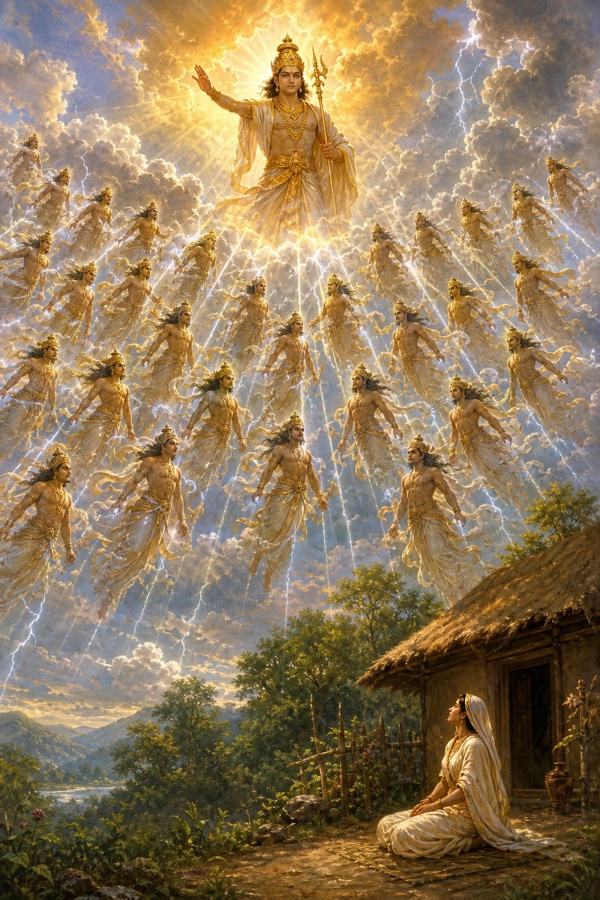
“Her embryo had been split into seven, and each seven into seven again, and Diti was in anguish. But when she spoke to the thousand-eyed god, whom no force can overpower, she spoke to conciliate. ‘This embryo was split into seven through my own fault, ruler of the gods. No blame in this attaches to you, you who once killed Bala. But I want what you have done to my child to turn out well for us both. Let these seven times seven pieces of my embryo fill the places of the seven companies of the wind-gods. Let them be famous as the forty-nine Maruts, and let them take ethereal bodies, these seven-times-seven sons of mine, and move through the air as the seven belts of the wind. Let one company blow in the realm of Brahma, another in the realm of Indra, and a third, famous as the celestial wind, in the open sky. And let the other four traverse the four quarters from time to time, at your command, my child. Prosperity attend you. From now on they will be known as the Maruts, by the very name you gave them when you begged them not to cry.’ Indra, who had stood over her a moment before with the thunderbolt in his hand, heard her appeal and answered with his hands folded. ‘All of this will come to pass just as you have said; there is no doubt of it. Your sons will move through the world in the form of the wind-gods.’ So the mother and her stepson reached their agreement there in that grove of penance, and both of them, their purposes accomplished, went up to heaven. That is what we have heard.
“This is that very tract, Rama, child of Kakutstha’s line, where the great Indra once lived and served Diti while she brought her austerity to its end. Now Ikshvaku had a most pious son by Alambusha, a son whose name was Vishala, and on this very ground he built a city and called it Vishala after himself. Vishala’s son was the mighty Hemachandra, and Hemachandra’s successor was famous as Suchandra. Suchandra’s son was Dhumrashva, and Dhumrashva’s son was Srinjaya. The glorious and mighty Sahadeva was the son of Srinjaya, and Kushashva, a most pious man, was the son of Sahadeva. Kushashva’s son was the glorious, mighty Somadatta, and Somadatta’s son was known far and wide as Kakutstha. And that Kakutstha’s son, glorious and renowned, whom no one can conquer, Sumati by name, rules in this city today. By the grace of Ikshvaku every one of the kings of Vishala has been long-lived, large of heart, powerful, and most righteous. We will rest here in comfort for this one night, and tomorrow morning you should be able to see Janaka.”
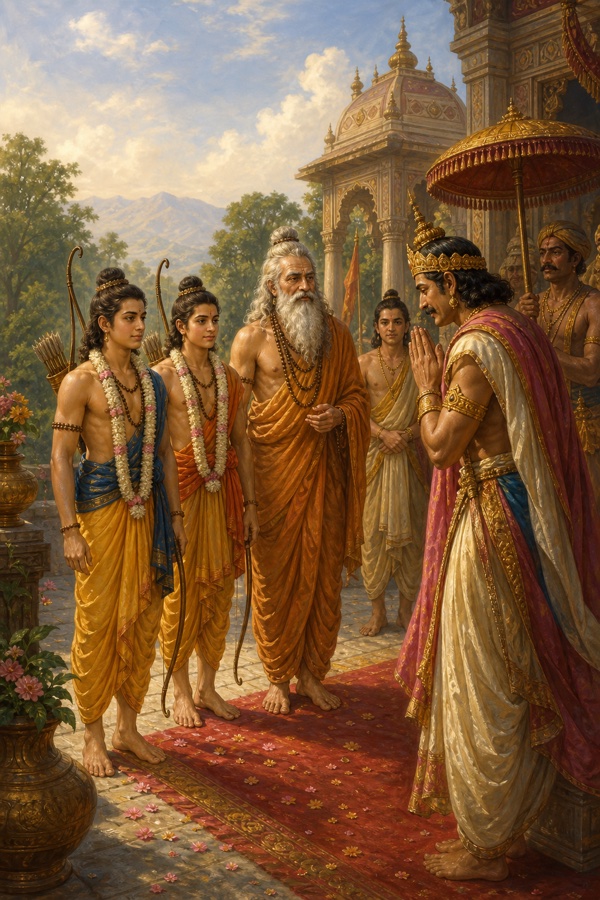
That night’s halt was a royal one. Word reached the city that Vishvamitra had come, and King Sumati, a man whose fame had spread well beyond his own gates and whom the best men of his time held up as one of their own, came out himself to receive him. With his family priest and his kinsmen around him he offered the sage the highest worship, asked after his welfare, folded his hands, and said, “I am blessed, sage, and I am in your debt, that you have come into my kingdom and let me set eyes on you. There is no one more fortunate than I am.” (Canto 47)
Toward Mithila, the empty hermitage, and the curse of Ahalya
When the greetings were done and the two men had asked after each other’s welfare, Sumati, at the end of their talk, turned to the great sage and asked the question that had been in his eyes from the first moment. “God bless you, sage. These two boys, brave as gods, who walk with the gait of the elephant and the lion and look like a tiger and a bull, whose eyes are as wide as lotus petals, who carry a sword and a quiver and a bow apiece, who are as beautiful as the Ashvins, the twin physicians of the gods, and stand just at the threshold of their youth: they look like two gods who have come down to earth of their own free will. How is it, and for what, that they have come to this place on foot, and whose sons are they? They are replicas of each other in build, in bearing, in every movement, and they carry splendid weapons; why have two such princes, the finest men I have ever set eyes on, taken to a road so hard to travel? They grace this country the way the moon and the sun grace the sky. I want to hear the truth of it.” Vishvamitra told him everything just as it had happened: the stay at Siddhashrama, the sacrifice kept safe, and before that the killing of the rakshasi Tataka on the road there. The king listened in amazement. Then he worshiped the two mighty sons of Dasharatha with every ceremony, as guests of the highest distinction, who deserved every attention he could give.
Having received the warmest hospitality from Sumati, Rama and Lakshmana spent one night in his capital, and the next day they set out for Mithila. When the beautiful capital of King Janaka came into view, every sage in the party admired it aloud, exclaiming, “Good. Excellent.” And it was there, in a grove on the outskirts of Mithila, that Rama saw a hermitage: old, and lovely, and empty. He asked the sage about it. “This place looks like a hermitage, and there is no hermit in it. What is it? I want to hear whose hermitage it was in the past.” Vishvamitra, who was skilled in speech as in everything else, answered, “Ah. Listen, then, and I will tell you truly to what great soul this hermitage belonged, and by whose anger it came under a curse.
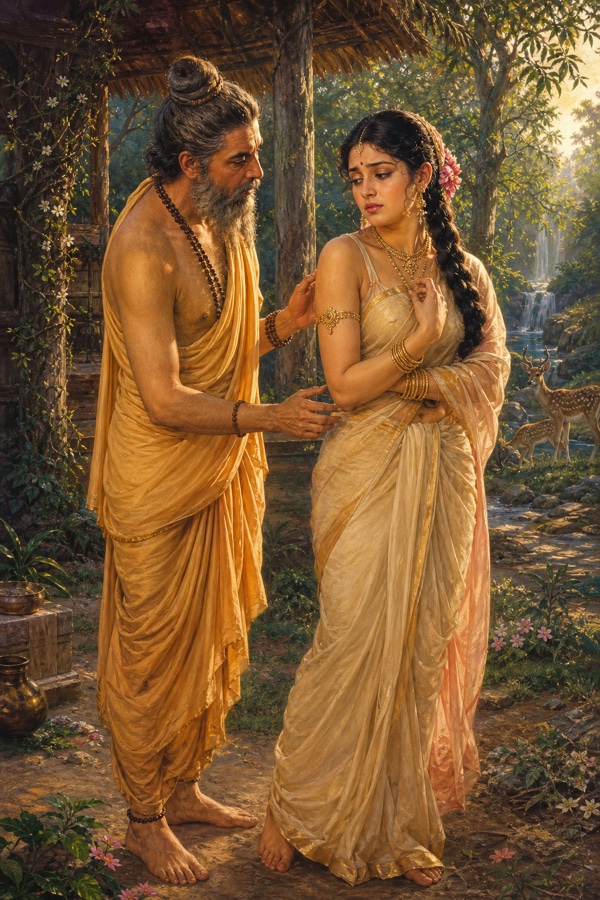
“This hermitage belonged to Gautama, a sage of great soul. It looked like a retreat in heaven, and the gods themselves honored it. Here, in this very place, Gautama practiced austerity with his wife Ahalya for years beyond counting. One day Gautama had gone out for his daily bath and the rest of his morning rites, and Indra, the thousand-eyed god, the husband of Shachi, learned that the sage was away from the hermitage. He took the form of Gautama himself, walked in, and said to Ahalya, ‘Those who hunger for pleasure do not wait for the season of conception, composed lady. I want you, beautiful woman, now.’
“She knew him. Even in Gautama’s form she recognized the thousand-eyed god, and the misguided woman set her heart on Indra anyway, out of eagerness to hold the ruler of the gods in her arms. When it was done, and she had what she had wanted, she said to him, ‘I have my purpose from this meeting with you, best of gods. Now go, my lord, quickly. And guard yourself, and guard me, in every way, from Gautama’s notice.’ Indra laughed out loud. ‘I have had all I wanted from you, charming lady. I will leave the way I came, and no one will have seen me.’ And having lain with her, Rama, he went out of the hut at a run, afraid, as well he might be, of running into Gautama. And running into Gautama is exactly what he did. The great sage was just coming in, still wet with the holy water of his bath, blazing like fire, with firewood for the sacrifice in one hand and blades of kusha grass in the other, a man no god and no demon could overcome, armed as he was with the spiritual energy of a lifetime’s austerity. The king of the gods stood in the doorway with his face turned down toward the ground.
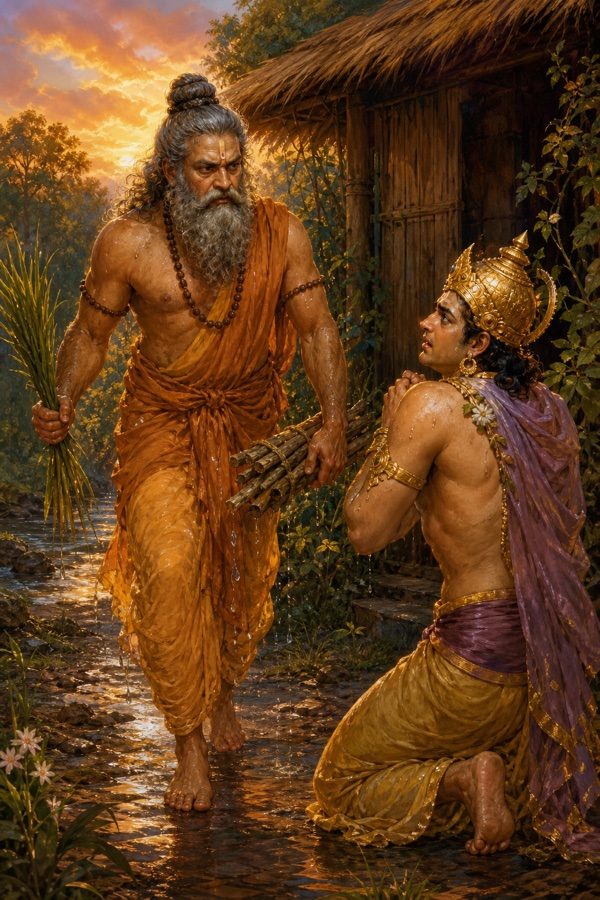
“Gautama looked at Indra standing there in Gautama’s own shape, guilty of what he had done, and the sage, whose conduct had never once failed him, spoke in a low, furious voice. ‘You put on my form to do this, you evil-minded thing. You will lose your testicles for it.’ The words were barely spoken when Indra’s testicles dropped to the ground. Having cursed Indra, the sage, still burning, the wet of the river still on him, turned and cursed his wife. ‘You will stay here for thousands upon thousands of years, without food and without drink, living on air alone, lying on ashes, full of remorse. You will live in this hermitage, and no living creature will be able to see you. But when Rama, the son of Dasharatha, whom no one can overcome, comes into this fearful grove, then and only then you will be cleansed of your sin. When you have offered him hospitality, in that same invisible form, freed at last of greed and delusion, you will get back your own true body, and you will come back to me, full of joy.’ So he cursed that woman of immoral conduct, and then Gautama, glorious even in his anger, left this hermitage, and the great ascetic went away to a lovely peak of the Himalaya where siddhas and charanas gather, and took up his austerities again.” (Canto 48)
The ram’s testicles for Indra, and the redemption of Ahalya
“Indra, stripped of his testicles, went with frightened eyes to the gods, who had Agni at their head, and to the siddhas and gandharvas and charanas, and made his case. ‘By obstructing the austerities of Gautama, that sage of great soul, by rousing his anger and so breaking his attempt to claim my throne, I have just now done the work of the gods. And for it I have been robbed of my manhood in his rage, and Ahalya has been cast off by him. And I have robbed him too, of his spiritual power, by provoking him into pronouncing a great curse on me and on his wife. So with the help of the hosts of seers and the singers of heaven, you best of gods, see me restored to my manhood, since it was for the gods that I did it.’
“The gods heard Indra’s appeal, and with the companies of the wind-gods around them and Agni leading, they went to the celestial manes, Kavyavahana and the rest, the ancestors of the gods, and put a proposal to them. ‘Here is a ram full of virility, and here is Indra, who has lost his manhood by the curse of the sage Gautama. Take the testicles of this ram and transfer them at once to Indra. The gelded ram will give you the highest satisfaction; and to those men who in time to come offer you such a ram to win your favor, you will grant a handsome and undying reward.’ The manes heard Agni’s intercession, agreed with one voice, removed the testicles of the ram, and implanted them in the thousand-eyed god. From that day, Rama, the manes accept gelded rams alone, and grant those who offer them the full fruit of offering a whole ram; and from that day Indra has carried the testicles of a ram, the living witness of the power of Gautama’s austerity, carried on the body of the king of the gods himself.”
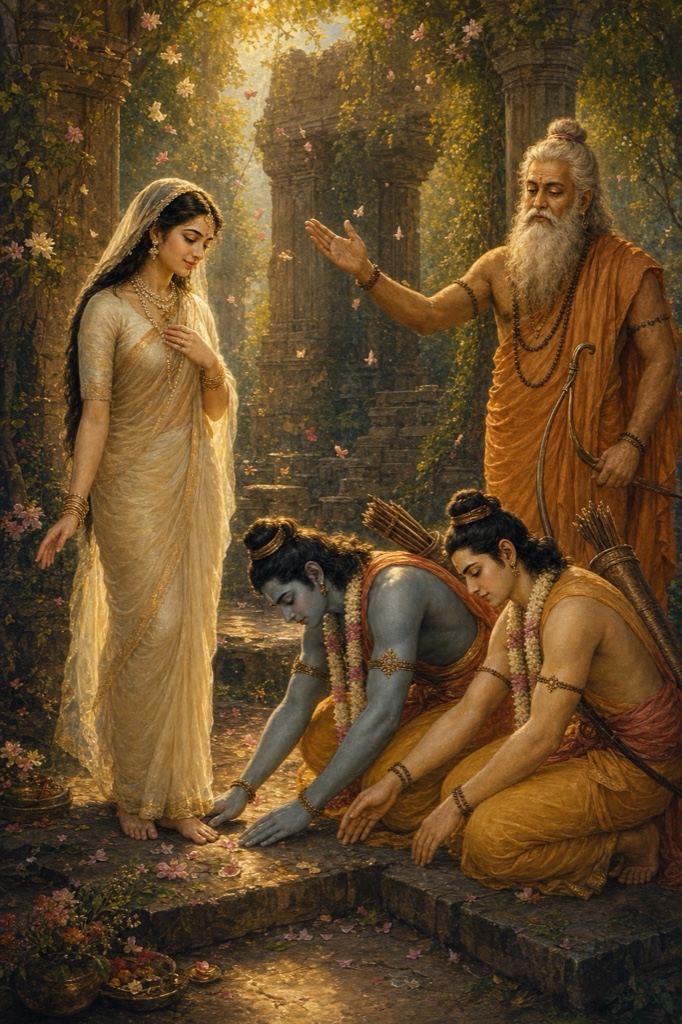
“So now, glorious prince,” Vishvamitra said, “step into the hermitage of Gautama, the doer of virtuous deeds, and redeem this blessed woman, Ahalya, who once wore a celestial form and has waited here for you, unseen, through all these years.” Rama, with Lakshmana at his side and Vishvamitra going before them, went into the hermitage, and there they saw her: a woman of heaven, blessed now beyond measure because the eyes of Rama had fallen on her; a woman whose radiance had been brightened by her long austerity; a woman whom gods and demons could not easily have made out, let alone the people of the earth, even standing close to her, because of the curse of Gautama; a woman the creator had made with great effort, who looked like something worked by magic; who looked like a flame of fire wrapped all over in smoke, or like the halo of the full moon blurred by a film of frost and screened by a cloud, or like the dazzling circle of light that the sun throws on water held in the clouds.
By Gautama’s word she had been invisible to all three worlds until the day she should set eyes on Rama. Now the curse had reached its end, and she came into their sight. Rama and Lakshmana clasped her feet with joy, and Ahalya, remembering what Gautama had foretold, welcomed them both. Fully composed, she offered them, with every ceremony the scriptures enjoin, water to wash their feet and hands and the hospitality due to guests, and Rama accepted it gladly. And then flowers came down out of the sky in an abundant shower, and the gods beat their kettledrums, and there was great rejoicing among the gandharvas and the apsaras. The gods applauded Ahalya, whose body had been made perfectly pure by her austerity and who followed now the will of Gautama, crying, ‘Good. Excellent.’ And the glorious Gautama, who had been told of Rama’s coming, came home to his hermitage, and was happy in Ahalya’s company again. He worshiped Rama with all the ceremony the scriptures require, and then the great ascetic took up his austerities once more. Rama, having received the highest honor at the hands of the great sage Gautama, a husband restored to his wife and his hermitage made whole again, went on from that hermitage toward Mithila. (Canto 49)
The gist: The gods restore Indra’s manhood with a ram’s testicles; and at the mere sight of Rama the curse on Ahalya breaks, so that she regains her divine form and is happy again with Gautama, and Rama’s road now opens toward Mithila.
Source: Srimad Valmiki Ramayana, Balakanda, Cantos 31 to 49. The Gita Press edition is the controlling witness. The Sanskrit e-text and an independent complete translation were used to verify names, sequence, and principal events. Where recensions differ, this retelling follows Gita Press.
Basis: Valmiki Ramayana (Gita Press, Gorakhpur)
The same story, elsewhere
- Indra and Ahalya
Yoga Vasistha: Indra and Ahalya, a parable of the mind’s own imagining