On this page
The war was over. Ravana lay dead on the field outside Lanka, Rama had come home to Ayodhya, and the kingdom that had waited fourteen years for him was his again. It was then, with the city still settling into its new peace, that the great seers of every quarter of the earth set out for Ayodhya to bless Rama, home at last after fourteen years. From the east came Kaushika, Yavakrita, Gargya, Galava, and Kanva the son of Medhatithi. From the south came Svastyatreya, the revered Namuchi, Pramuchi, and Agastya, and in Agastya’s company the revered Atri, Sumukha, and Vimukha. From the west came Nrishangu, Kavasha, Dhaumya, and the great seer Kausheya, each attended by his disciples. And from the north came the seven who dwell there forever, the Saptarshi themselves: Vasishtha, Kashyapa, Atri, Vishvamitra, Gautama, Jamadagni, and Bharadvaja. They gave off a light like fire. They knew the Vedas and the six limbs of the Vedas, and they were deeply learned in every branch of the shastras. All of them arrived together at Rama’s mansion and waited at the gate to be announced, as any visitor must, however exalted. Agastya, soul of righteousness and the greatest of them, the sage who had once given Rama his weapons in the forest, spoke for the company. “Tell Rama,” he said to the gatekeeper, “that we, the seers, have come.” The gatekeeper was a man chosen for exactly this: versed in the laws of right conduct, quick to read a face, well mannered, capable, and brave. He heard Agastya’s words and went at a run to the presence of Rama.
The Seers’ Blessing and Rama’s Question
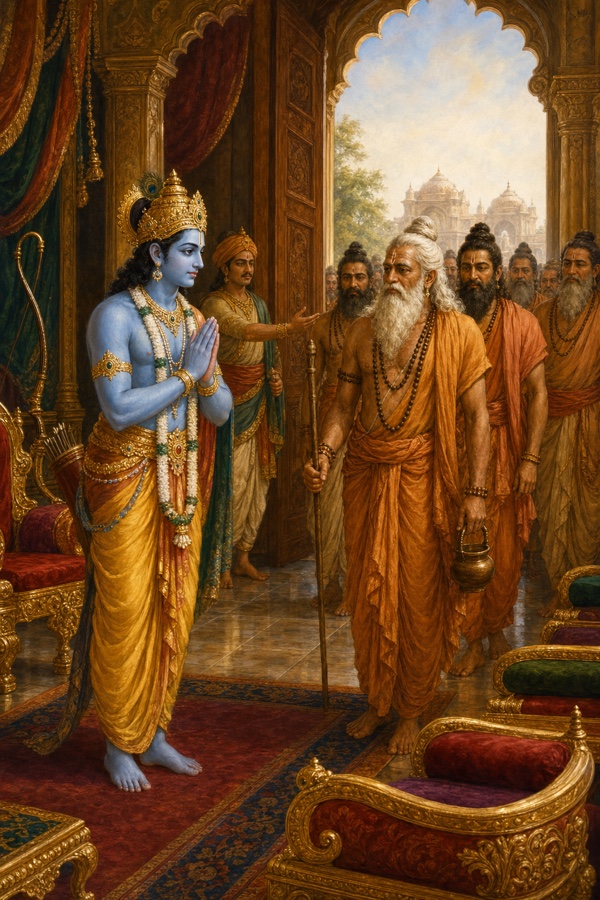
He found Rama seated in the audience hall, and the king’s face, the gatekeeper thought, had the untroubled radiance of the full moon. He announced at once that the sage Agastya had arrived with a company of seers. Rama heard it, and heard too that these visitors shone like the newly risen sun, and he told the gatekeeper to bring them in with every honor. He did not wait for them on his throne. The moment the seers came into view he was on his feet with his palms joined, bowing to them with reverence. He himself offered the water for their feet and the water for their hands, the padya and the arghya that a host gives to guests of the highest rank, and he had a cow brought as a gift, and he ordered seats prepared. The seats were of sacred kusha grass, worked with gold lace and spread over with deerskin, each suited to the dignity of the one who took it, and when the sages had settled onto them Rama asked after their welfare, and after the welfare of their disciples and their elders, as a son of the house would. The seers, masters of the Vedas, answered that all was well with them everywhere.
Then they told him why they had come. “Delight of the line of Raghu, it is our great fortune to see you whole and safe after the destruction of your enemies. Ravana, who tormented the whole world, has been killed by you, and that is the best of all news. For a man who could conquer the three worlds with his bow, Ravana with his sons and his grandsons was never going to be more than a task. We see you victorious today, with Sita beside you, with Lakshmana beside you, the brother who has served your interests every day of his life, and with your mothers and your other brothers around you. The rakshasa captains Prahasta, Vikata, Virupaksha, Mahodara, and Akampana, that one so hard to put down, all fell to you. Kumbhakarna, whose sheer size no creature on earth exceeded, was killed by you in open battle. Trishira, Atikaya, Devantaka, and Narantaka, rakshasas of immense power, died by your hand too. So did Kumbha and Nikumbha, the fierce-faced sons of Kumbhakarna.”
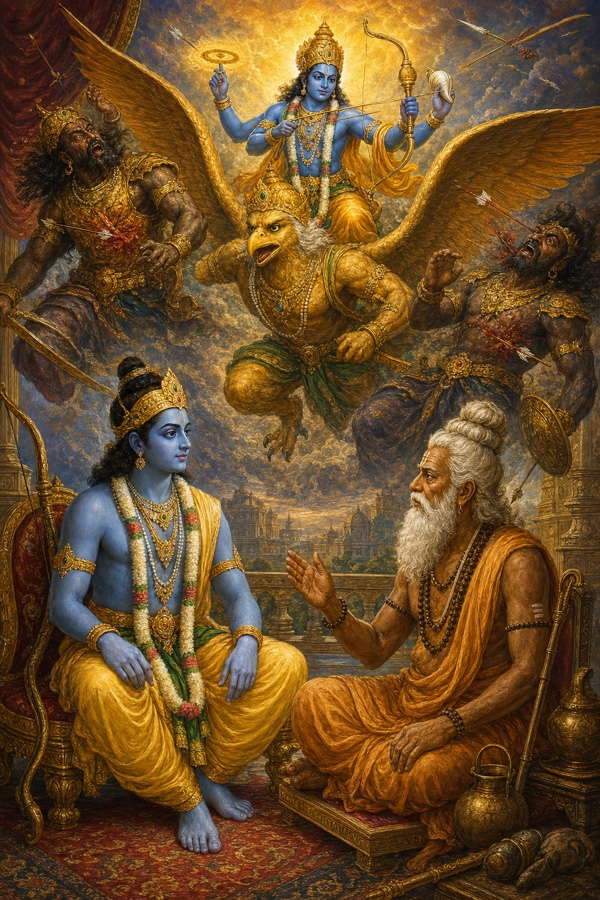
They went on with the roll of the dead. “Yuddhonmatta and Matta, who were the equals of Yama the great slayer, the mighty Yajnakopa, and the rakshasa named Dhumraksha, all of them masters of the shastra and the astra, the weapon held in the hand and the weapon sent from afar, and all of them dealing out a slaughter as dreadful as Yama’s own with their arrows, were killed by you, and that is our good fortune. It was our good fortune that you came out the victor in your single combat with the king of the rakshasas, whom the gods themselves could not kill. And yet that Ravana was beaten by you is no great matter for surprise. What gives us real gladness is that his son, who fought you in single combat, was killed by you. That you broke free of the noose of serpents Indrajit cast over you, that enemy of the gods, and rushed at him like Yama himself and got the better of him, that is the luck of the worlds.”
“All of us have come to offer you our felicitations on the death of Indrajit,” the seers said. “When we heard that Indrajit, who fought with such conjuring, and who could be killed by no living being, had fallen to you, we were astonished, and our astonishment was joy. We are fortunate, glorifier of Raghu’s house, that you killed these and so many other rakshasa warriors who could put on any form they pleased. This is our fortune, hero of Kakutstha’s line, you who have destroyed your enemies: that you have given us the gift of abhaya, freedom from fear, the kindest and most auspicious gift there is, and that you have won fame by your victory.” Rama listened to the sages, men who had realized the true nature of their own Self, and something in what they said puzzled him. He joined his palms and answered them with the question that would open the whole ancient history.
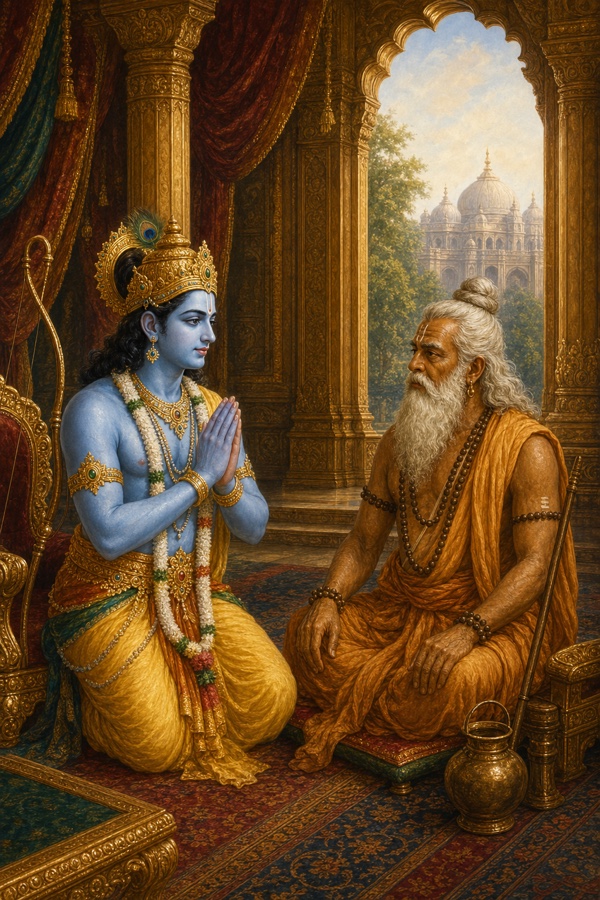
“You pass over the immensely powerful Kumbhakarna,” he said, “and over the rakshasa Ravana himself. How is it that every one of you praises the son of Ravana above them? You set aside the bravest of the brave, Mahodara, Prahasta, the rakshasa Virupaksha, the arrogant Matta and Unmatta, Devantaka and Narantaka, and still you applaud the son of Ravana. You pass over the immensely powerful Atikaya, Trishira, and the rakshasa Dhumraksha, and it is Ravana’s son you single out. What was the nature of his prowess? What was the nature of his strength and his valor? For what reason is he held greater even than his father? If this is not a secret that must be kept, and if I am fit to hear it, I would like to hear it. Please tell me. I ask; I do not command you. How did he win his boons, and how did he defeat even Indra? How did he come to surpass his own father Ravana? Best of sages, I am consumed with curiosity. Tell me today how that rakshasa excelled his father in war, how he overcame Indra, and how he came by his boons. Tell me all of it.”
Pulastya’s Austerity and the Birth of Vishrava
Agastya heard him out. His splendor filled the hall as he began. “Rama, hear of the great valor and strength of that son, the power by which he killed his enemies and could be killed by none of them. And along the way I will tell you about the family of Ravana, about his birth, and about the boons that were granted to him.” What followed was no short answer. Agastya reached back past Ravana, past Ravana’s father, past the founding of Lanka itself, to the first age of the world.
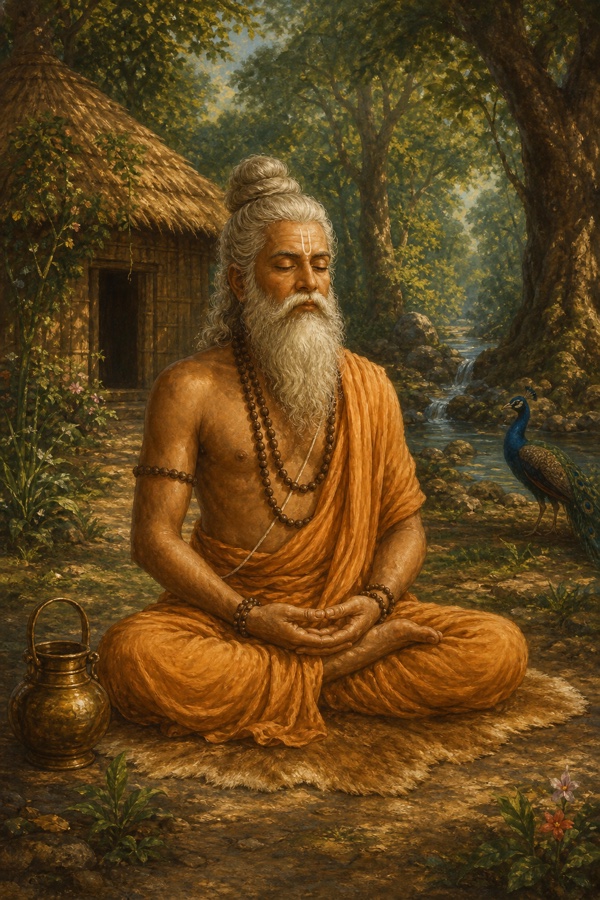
“In the remote Krita age, Rama, the first of the four ages, there lived a famous and powerful brahmarshi named Pulastya. He was a son of Brahma, and he was the very image of the creator. No one could praise the qualities of his righteousness and his character adequately; they speak for themselves when you say only this, that he was the creator’s son. Because he was Brahma’s son the gods loved him, and because of the purity of his own qualities this great mind won the affection of every living person. A devoted servant of dharma, Pulastya, a jewel to the whole order of sages, went to the hermitage of the royal sage Trinabindu on a slope of Mount Meru, the golden mountain at the center of the world, and settled there to live.
“There, master of himself and intent on the study of the Vedas, Pulastya performed his tapas. The place was thick with trees and lovely in every season of the year, and that was the trouble, because loveliness draws company. Maidens from the families of seers, of nagas, and of kings, and the apsaras of heaven too, came to that spot every day. They sang there, they played and made music on their instruments, they danced, and without meaning any harm at all they broke the concentration of a sage at his austerities. Pulastya, whose fame was great, lost his temper and pronounced a curse: ‘Any woman my eyes fall upon will conceive.’ The maidens heard what the great seer had said, and fearing the curse of a Brahmin they never came near that place again.
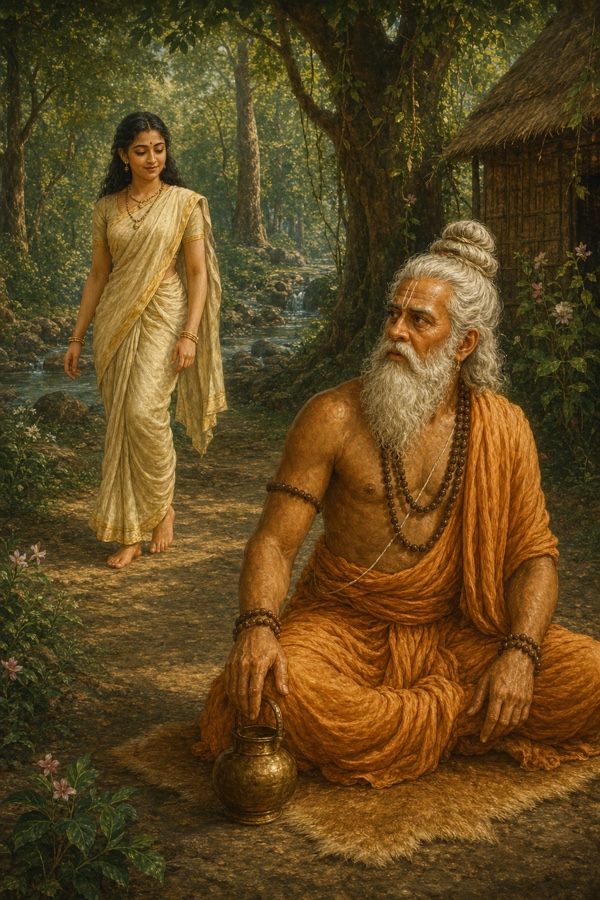
“The daughter of the royal sage Trinabindu had not heard. She walked into the hermitage as she always had, fearlessly, and looked about for her companions, and found none of them there. At that very hour the great seer, the creator’s son, whose discipline had made him luminous, was reciting the Vedas. She heard the recitation. She looked at that treasury of tapas. And with the clear signs of pregnancy upon her, her whole body turned pale at once. She saw the change in herself and did not understand it, and she was very frightened. ‘I do not know what this means,’ she said to herself, and she went to her father’s hermitage and stood before him.
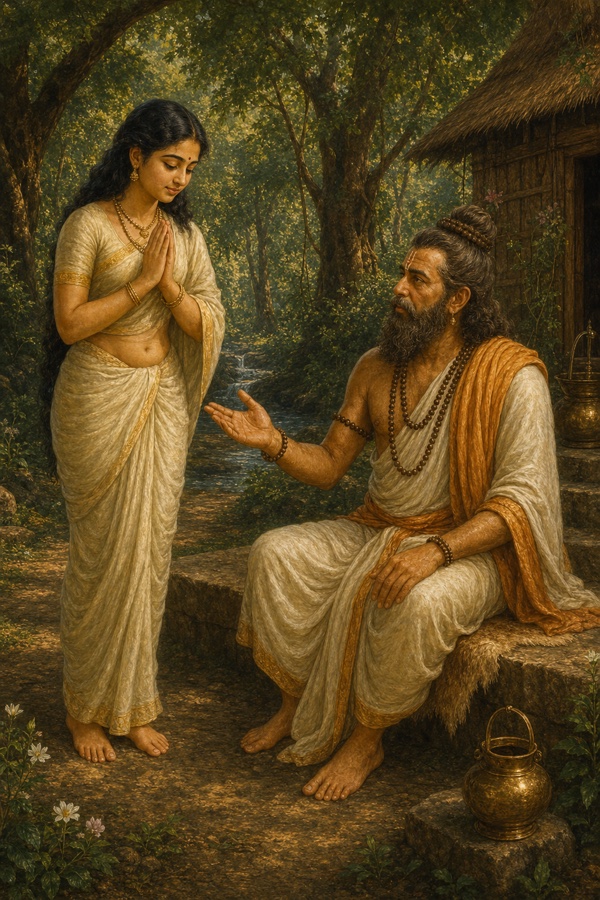
“Trinabindu looked at his daughter, changed like that, and asked her, ‘How is it that your body looks so unlike itself?’ The girl was in despair. She joined her palms to the treasury of tapas that was her father and said, ‘Father, I do not know the reason for this change in my body. A little while ago I went alone into the lovely hermitage of the great seer Pulastya, the knower of the Self, to look for my companions. I did not find a single one of them there. But I saw this change come over my form, and I have come to you in fear.’
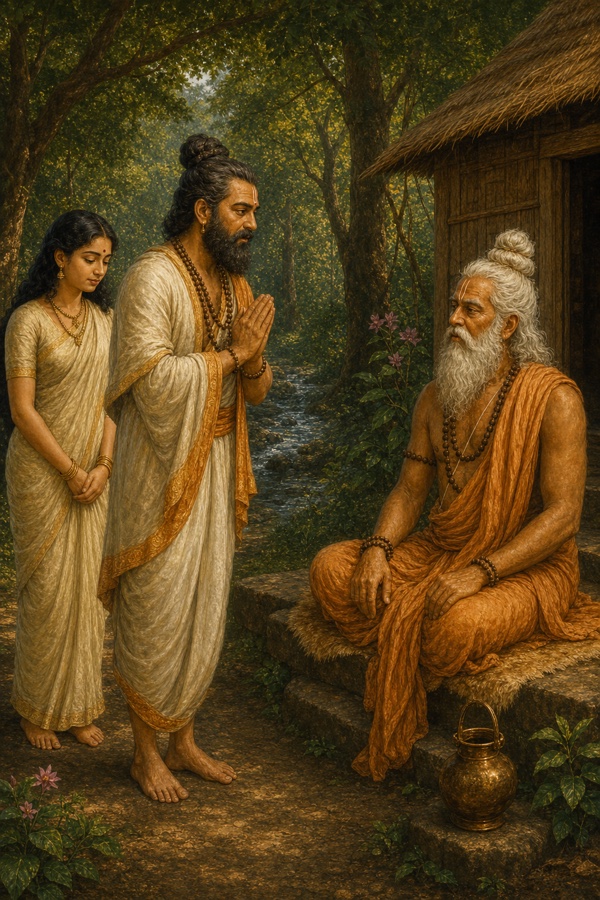
“Trinabindu, the royal sage, glowing with the light of his own tapas, went into meditation and saw what had happened: this was the work of the seer. He understood the curse of Pulastya, the great seer who had realized his Self, and he did what a father in his position could do. He took his daughter by the hand and went to Pulastya, and said, ‘Venerable sir, great seer, be pleased to accept as a gift my daughter, adorned by her own qualities, who has come to you of her own accord. There is no doubt that she will always serve you, your limbs being worn by the practice of tapas.’ The Brahmin Pulastya was willing to receive the girl, and to the righteous royal sage who had spoken so he said, ‘Yes.’
“Having given his daughter to the sage, the royal sage Trinabindu went back to his own hermitage. The girl stayed. She pleased her husband by her service, and in time the best of seers, who saw her conduct and her character every day, felt love for her and told her so. ‘Lady of shapely limbs, I am greatly pleased with the wealth of your excellent qualities. Therefore, goddess, today I will give you a son equal to me in every respect, one who will carry on my line and yours, and who will be known as Paulastya, the son of Pulastya. And since you listened to the Vedas as I was reciting them, and heard them entire, he will be known beyond any doubt as Vishrava, the one who was heard.’
“That lady heard him and was quietly, deeply glad. Before long she gave birth to a son, and he was named Vishrava, and he became famous through all three worlds, rich as he was in righteousness and in fame. He was learned in the Vedas. He looked on every living creature with the same eye. He kept holy vows and lived a good life, and like his father before him the sage Vishrava gave his days to tapas.
The Birth of Vaishravana (Kubera) and His Dwelling in Lanka
“Vishrava, the son of Pulastya and the best of sages, was soon at tapas like his father. He held always to the path of righteousness and to speaking the truth. His conduct was good, his senses were his own, he gave himself to the study of the Vedas, he was pure, and no sensual pleasure of any kind had a hold on him. The great sage Bharadvaja learned how he lived, and it was enough: he gave his daughter Devavarnini, lovely as a divine damsel, to Vishrava in marriage. Vishrava received the daughter of Bharadvaja by the proper rite and turned his mind to begetting a son, with an eye to the welfare of the people and to his own spiritual good.
“In the fullness of joy Vishrava, that best of sages who knew what was right, begot on Devavarnini a most wondrous son, full of valor and possessed of every virtue of a Brahmin. At the child’s birth the sage read in him the inclination to do good to the world, and saw that he would one day become the lord of wealth, and he was greatly pleased. In counsel with the celestial sages he gave the boy a name. ‘Since he is a son of Vishrava and resembles his father in every respect,’ they said, ‘he will be known as Vaishravana.’
“Vaishravana of great splendor then withdrew to a forest of tapas and grew there like a fire fed with offerings. Living in the hermitage, a thought took hold of him: that he must practice the highest form of dharma, since dharma was the final goal. For thousands of years in that vast forest he performed tapas of the most severe kind, his senses subdued by stern discipline. At the end of a thousand years he took on himself whatever rule the occasion called for. He lived on water. Then he lived on air. Then he went without anything at all to live on. And so a thousand years went by for him as if they had been a single year.
“The glorious Brahma was greatly pleased. He came to that hermitage in person with Indra and a host of the other gods, and he said, ‘Sage of commendable vows, may all be well with you. I am pleased with what you have achieved, my son. You deserve a boon, highly intelligent one. Ask for one.’ Vaishravana bowed his head, and his voice shook with joy as he answered Brahma, who stood before him: ‘Venerable sir, I would like to be a guardian of the world and its protector.’ Brahma’s mind was well satisfied, and in the presence of the host of gods he said, ‘So be it. I was about to create the fourth guardian of the world. Go then, knower of dharma, and take the position of the lord of wealth; be the equal of Yama, Indra, and Varuna. You will be the fourth beside those three. And take this aerial chariot, the Pushpaka, resplendent as the sun, for your conveyance, and become the equal of the gods. Let all be well with you. We go as we came, our purpose accomplished by granting you these two boons.’ With that Brahma went back to his own abode, and the gods went with him.
“When Brahma and the gods had returned to the heavens, the lord of wealth, with joined palms and all humility, went to his father. ‘Revered sir, from Brahma I have won the boon of my choice. But the lord of creation assigned no place for me to live. So choose a holy place for me, where no harm will come to any living creature.’ Vishrava, best of sages, heard his son’s request and said, ‘Listen.’
“‘Knower of dharma, noblest of beings, there is a mountain named Trikuta on the shore of the southern ocean. On its summit stands a lovely city called Lanka, as spacious as the city of great Indra. Vishvakarma built it for the rakshasas to live in, exactly as Amaravati was built for the residence of Indra. Its fortifications are of gold, it is ringed with moats, it is fitted on every side with engines of war and with weapons, and its gateways are of gold and cat’s-eye gem. Long ago the rakshasas deserted it, driven out by their fear of Vishnu. They fled to the netherworld called Rasatala, and the city stands empty, without a ruler. Let all be well with you, my son. Go there, and live in Lanka without any misgiving, as suits your pleasure. Your stay there will be a happy one, and no harm will come to anyone by it.’
“Vaishravana heard these most righteous words of his father and went to live in Lanka, set high on the crest of the mountain. He was a good ruler, and his city soon filled with thousands of nairritas, rakshasas of that old blood, contented and glad. There, in a city that had the sea itself for a moat, the pious son of Vishrava lived in happiness. From time to time the lord of wealth, humble as ever, went in the Pushpaka to see his father and his mother. Hosts of gods and gandharvas sang his praises. His palace was adorned by the dancing of celestial nymphs. And shining like the sun with its rays, the celebrated lord of wealth would arrive at his father’s side.
The Rise of the Raksasa Line: Heti, Vidyutkesha, and Sukesha
Rama had been listening with the stillness of a man following every word, and now something in the story caught. Rakshasas in Lanka before Kubera? Before Vishrava? He shook his head and looked again and again at Agastya, who sat there with the light of the three sacred fires about him, the household fire, the southern fire, and the fire of offerings, and he spoke with a smile. “Revered sir, when you say that Lanka belonged to the flesh-eaters even before this, I am greatly surprised. We have always heard it said that the rakshasas sprang from the progeny of Pulastya. Now you trace their descent to another source entirely. Were they more powerful than Ravana, than Kumbhakarna, Prahasta, Vikata, and the sons of Ravana? Who was their ancestor, Brahmin? What was the name of that mighty being? For what offense did Vishnu drive them out, and how did he do it? Sinless one, tell me all of this in detail, and clear away my curiosity as the sun clears away the dark.”
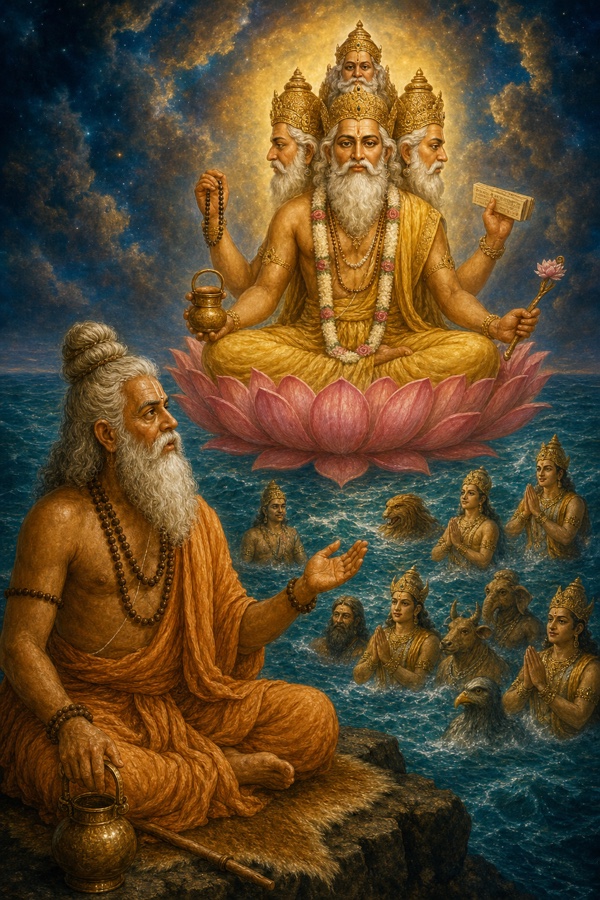
Agastya heard those graceful, well-turned words of Raghava, and he was a little surprised himself, that a king who had killed the rakshasas should be so eager for the roots of them. He answered. “In the days of old, Prajapati, who was born of the causal waters and of the lotus that rose from Vishnu’s navel, made the waters of the ocean, and then he made living beings to protect them. Those beings were tormented by hunger and thirst, and driven by that fear they came humbly to the creator and asked, ‘What shall we do?’ Prajapati answered them as though he were laughing: ‘Protect the waters with all your effort.’ Among those hungry and thirsty creatures, some said, ‘We shall protect,’ and others said, ‘We shall adore.’ And the creator told them, ‘Let those of you who said “We shall protect,” rakshama, become rakshasas, and let those of you who said “We shall adore,” yakshama, become yakshas.’
“Among those rakshasas were two brothers, Heti and Praheti, leaders of the rakshasas and a terror to their enemies, the equals of Madhu and Kaitabha. Of the two, Praheti gave himself to dharma and went off to a forest hermitage to perform tapas. Heti set about finding a wife, and he found one in a house no other suitor would have approached. Highly intelligent, tireless, and acting entirely on his own initiative, he married the sister of Yama, the god of death. Her name was Bhaya, fear, and being the sister of Kala she inspired an immense terror. On her Heti, that best of rakshasas, begot a son who came to be known as Vidyutkesha, lightning-hair, and the birth made Heti the most honored of fathers. Vidyutkesha, the son of Heti, shone like the blazing sun, and he grew up as a lotus grows in the midst of the water.
“When that rakshasa came into the full bloom of his youth, his father set about getting him married. Heti, best of rakshasas, chose for his son the daughter of Sandhya, the goddess of twilight, a girl who matched her mother in majesty. Sandhya considered that a daughter must in any case be given to someone, and she gave hers, Salakatankata, in marriage to Vidyutkesha. Having won the daughter of Sandhya, the rakshasa Vidyutkesha reveled with her as Indra revels with Paulomi, his queen Shachi.
“In the course of time, Rama, Salakatankata conceived a child by Vidyutkesha, as a mass of clouds draws up water from the sea. The rakshasi went to the slopes of Mount Mandara and gave birth there to a son as brilliant as lightning, in the way that the goddess Ganga once delivered the child of Shiva that the fire-god released into her. Wanting nothing but to revel with Vidyutkesha again, she left the newborn where he lay and went off with her husband, and she forgot him. Deserted, the baby thundered like a cloud. Then he pushed his own fist into his mouth, that child bright as the autumn sun, and cried softly.
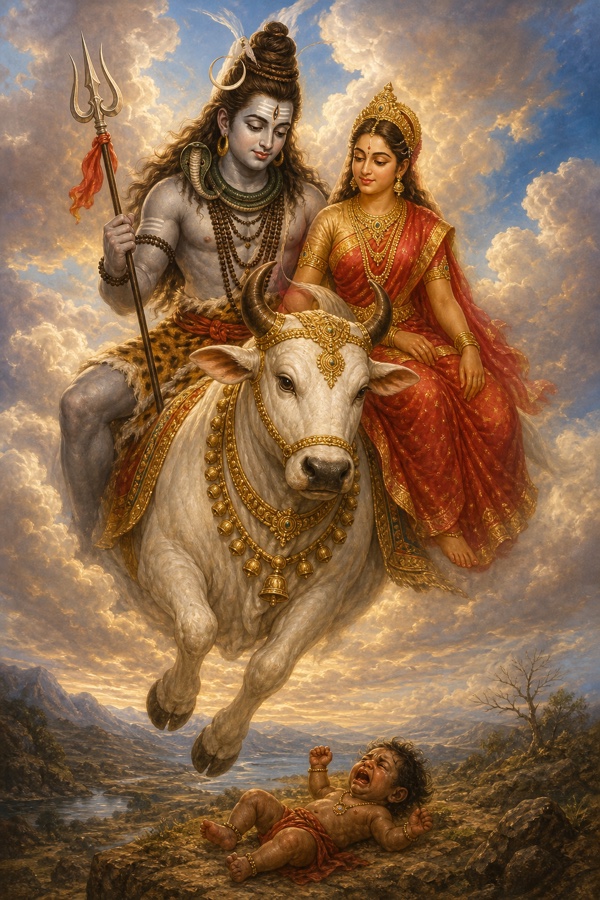
“Shiva, mounted on his bull and traveling through the air with Parvati beside him, heard the sound of that crying and stopped. Mahadeva, the undecaying and imperishable, who had once burned down the three cities of the demons, looked down at the weeping child of the rakshasa. Uma, the daughter of the Himalaya, felt compassion for it, and for her sake Shiva made the rakshasa’s son grow at once to the age of his own mother, and made him immortal as well. To please Parvati further he gave the boy a city that could fly through the sky. And Uma gave the women of the rakshasas a boon that would mark the race forever: they would conceive in an instant, deliver in an instant, and their children would grow in an instant to the age of their mothers. So the great and intelligent Sukesha, having gained from Shiva both wealth and a flying city, grew haughty with the boon of immortality and roamed everywhere like Indra himself.
The Sons of Sukesha: Malyavan, Sumali, and Mali
“A pious gandharva named Gramani, equal in splendor to Vishvavasu, the king of the gandharvas, saw that Sukesha was righteous and that he held Shiva’s boons, and he gave him his daughter. Her name was Devavati. She was like a second Lakshmi, famous through the three worlds, endowed with beauty and youth, and she seemed to carry in her person the whole glory of the rakshasa race. Devavati, for her part, won a loving husband who had gained his lordship through boons, and she was as perfectly content as a pauper who has come into riches. Married to her, the rakshasa shone like a great elephant of the quarters, sprung from the line of Anjana, standing beside its mate.
“In the course of time, Raghava, Sukesha, lord of the rakshasas, begot three sons: Malyavan, Sumali, and Mali, and of the three Mali was the strongest. They were as bright as the three sacrificial fires, and all three of them the equals of Shiva. They stood as steady as the three worlds. They were as powerful as the three strengths of a ruler, and as formidable as the three kinds of disease that come from the derangement of wind, bile, and phlegm. And like an illness that no one treats, the three sons of Sukesha grew.
“They knew that their father had gained his boons and his lordship by tapas, and the three brothers went to Mount Meru determined to do the same. The vows they took were formidable, Rama, and the austerities they practiced were so severe that they became a source of terror to every created being. By tapas joined with truthfulness, straightforwardness, and self-control, tapas rare in this world, those rakshasas set the three worlds of gods, asuras, and men in turmoil. Then Brahma came, seated in a splendid aerial chariot, and said to the sons of Sukesha, ‘I have come to grant boons.’ They knew him for the giver of boons, ringed as he was by the hosts of gods with Indra among them, and all three of them shook like trees in a wind and spoke with joined palms: ‘Lord, if our tapas has won your favor and you will grant us boons, then let us be invincible, a terror to our enemies, and long-lived. Let us be powerful, and let us be full of love for one another.’
“‘You shall become all this,’ Brahma told the sons of Sukesha, and the lover of Brahmins went back to Brahmaloka. The three rakshasas had their boons, and the boons took away their fear, and they went about harassing gods and demons alike, Rama. The gods they tormented, and the seers and the charanas with them, found no protector anywhere, like souls cast into hell.
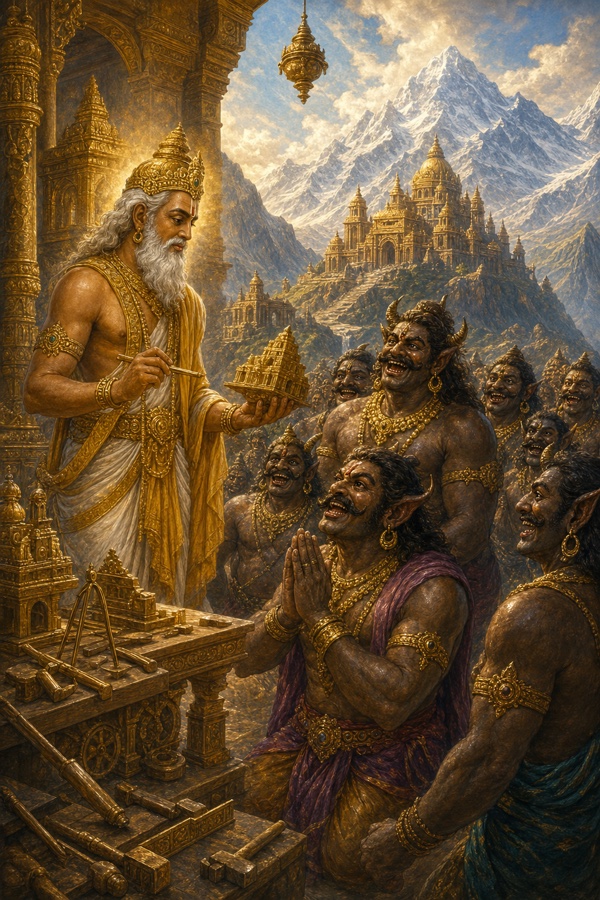
“Full of their new joy, the rakshasas went together to the immortal Vishvakarma, the best of architects, jewel of the Raghus, and said to him, ‘You alone build for the great gods the dwellings their hearts desire, houses full of valor, splendor, and strength by virtue of their sanctity. This time, highly intelligent one, build a dwelling for us. On the slopes of Himavan, of Meru, or of Mandara, raise us a spacious house like the house of Maheshvara.’ Vishvakarma, the strong-armed builder of the gods, told them of a residence he had already built, the equal of Amaravati where Indra lives. ‘On the shore of the southern sea there is a hill named Trikuta,’ he said, ‘and beside it, lords of the rakshasas, another hill called Suvela. On the middle peak of Trikuta, which looks like a cloud, and which even birds cannot reach because all four of its faces have been dressed sheer as if by a chisel, I built the city of Lanka at the command of Indra. It is thirty yojanas wide and a hundred yojanas long. Its fortifications are of gold and its gateways are of gold. Lords of the rakshasas, you whom no one can assail, live there as the gods live with Indra in Amaravati. Once you hold the fortress of Lanka with a large following of rakshasas, your enemies will never touch you, slayers of your foes.’
“The rakshasas heard Vishvakarma’s words and went to that city with their thousands of followers. Full of delight they reached Lanka, ringed with its strong fortifications and its moats and dotted with hundreds of houses of gold, and there they stayed.
“At that time, Rama, joy of Raghu’s house, there lived a gandharva woman named Narmada. She had three daughters, equal in splendor to Hri, Shri, and Kirti, the goddesses of modesty, of prosperity, and of fame. She was no rakshasi herself, and yet of her own will she gave all three of her gandharva daughters, their faces beaming like the full moon, in marriage to the three rakshasas, in the order of their ages. Their mother gave those most fortunate girls away when the asterism Uttara Phalguni stood in the sky. And so the sons of Sukesha were married, and they reveled with their wives as the immortals revel with the apsaras.
“Now learn from me the children that Malyavan begot on his wife, the beautiful Sundari. They were Vajramushti, Virupaksha, the rakshasa Durmukha, Suptaghna, Yajnakopa, Matta, and Unmatta; and of Sundari, Rama, there was also born a beautiful girl named Anala. Sumali’s wife was Ketumati, whose face too beamed like the full moon, and who was dearer to him than his own life. Hear from me, in the order of their birth, the children that the rakshasa Sumali begot on Ketumati: Prahasta, Akampana, Vikata, Kalikamukha, Dhumraksha, Danda, Suparshva of great strength, Sanhradi, Praghasa, and the rakshasa Bhasakarna; and the girls Raka, Pushpotkata, Kaikasi, and Kumbhinasi of the bright smiles.
“Mali’s wife was a gandharva lady named Vasuda. She was lovely, with beautiful eyes like the petals of a lotus, and she could stand comparison with the loveliest of the yaksha women. Listen, King Rama, to the children that Sumali’s brother begot on her: Anala, Anila, Hara, and Sampati. These sons of Mali became, in time, the ministers of Vibhishana. Ringed by their rakshasa hosts and by their hundreds of sons, those three lords of the rakshasas, grown haughty with their surpassing valor, harried the gods with Indra at their head, and the rishis, the nagas, and the yakshas. They roamed the world like the wind and no one could come near them. In battle they were as fierce as Yama. Their boons had made them monstrously proud, and they never let a Vedic sacrifice go forward unhindered.
The Gods’ Plea and the Coming of Vishnu
“The gods, and the seers given to asceticism along with them, were being killed by the rakshasas, and in their terror they went for refuge to Maheshvara, the god of gods, the maker and the unmaker of the world, the unborn, the unmanifest, the support of all the worlds, the one worthy of worship, the highest guru. They came in a body before the three-eyed god, the enemy of Kama and of the three cities, and with their palms joined and their voices faltering with fear they spoke.
“‘Divine lord of living beings, every creature is being harassed by the sons of Sukesha, grown haughty with the boons Brahma granted them, and a terror to everyone who stands against them. Our dwellings and our hermitages have been made unfit to live in. They have driven the gods out of heaven, and they disport themselves there as if they were gods. In battle, Sumali, Malyavan, and their lieutenants, thirsting for a fight, torment us with the cry, “I am Vishnu, I am Rudra, I am Brahma, I am Indra, I am Yama, I am Varuna, I am the moon and the sun.” Lord, grant fearlessness to us who are afraid. Put on a terrible form and kill these enemies of the gods.’
“Shiva, the god of the matted locks, heard all the gods say this, and he had some regard for Sukesha. ‘I will not kill them,’ he told the host of gods, ‘because those asuras are exempt from death at my hands. But I will tell you who will surely kill them. With that purpose in mind, great seers, go and take refuge in Vishnu. That lord will kill them.’ So the gods hailed Maheshvara with a shout of victory, and in their fear of the rakshasas they came into the presence of Vishnu.
“They bowed to the lord who holds the conch and the discus, and they praised him, and in voices full of awe they told him about the sons of Sukesha. ‘Lord, by virtue of their boons the three sons of Sukesha, who are like the three fires, have invaded our places and seized them. There is a city named Lanka on the crest of Mount Trikuta, hard to reach, and from it the rakshasas who have settled there harass us all. Madhusudana, we have taken refuge in you: be our savior and kill them for our good, ruler of the gods. Apart from you there is no one who will protect us in this danger. With your discus tear off the lotus faces of these haughty rakshasas, who are so full of themselves for war, and give them as a gift to Yama with all their followers, and melt away our fear as the sun melts the frost.’
“Janardana, whom the gods adore and whose enemies fear him, heard them and granted the heavenly beings his protection. ‘I know the rakshasa Sukesha, grown arrogant on the boons that Shiva gave him,’ he said. ‘I know his notorious sons too, and I know that Malyavan is the eldest of them. In my fury I will kill these despicable rakshasas who have trampled every propriety. Gods, be free of your worry.’ Reassured by the all-powerful Vishnu, the gods praised Janardana and went back full of joy to their own places.
“Word of what the gods had done reached Malyavan, and the rakshasa spoke to his two brave brothers. ‘The gods and the seers went in a body to Shankara seeking our destruction, and they told him this: “Lord, the fierce sons of Sukesha, made haughty and arrogant by their boons, torment us at every turn. Lord of living beings, we are overpowered by these rakshasas. For fear of those wicked ones we cannot live in our own homes. Three-eyed god, greatest of destroyers, kill these rakshasas for our good; consume them with a single roar.” Shiva, who had once killed the demon Andhaka, heard the gods, and shook his head, and shook his hand, and said, “Gods, the sons of Sukesha are immune from death at my hands in war. But I will tell you the one who will surely kill them. Take refuge in the glorious Janardana, who holds the discus and the mace, who wears the yellow garment, whom they also call Hari and Narayana.” They took Hara’s advice. They bowed to the enemy of Kama, went to the abode of Narayana, and laid all their troubles before him. And Narayana assured the gods, with Indra at their head: “I will kill those enemies of yours, gods. Shed your fear.”’
“‘So Hari has promised the frightened gods that he will bring about our destruction,’ Malyavan went on. ‘Best of rakshasas, think now about what is proper for us to do. It was he who compassed the death of Hiranyakashipu and of other enemies of the gods. Namuchi, Kalanemi, Sanhrada the bravest of the brave, Radheya who knew so many conjuring tricks, the righteous Lokapala, Yamala, Arjuna, Hardikya, Shumbha and Nishumbha, and other demons and giants of immense strength and courage who had never lost a battle: none of them is heard of any more. Every one of them had performed hundreds of Vedic sacrifices. Every one of them knew the crooked ways of war. Every one of them was practiced in every weapon and struck fright into the hearts of his enemies. And they were killed by Narayana in their hundreds and their thousands. Keep that in mind, and do what is proper for all of us at this juncture. Narayana is hard to conquer, and he means to kill us now.’
“Sumali and Mali heard Malyavan out and answered their elder brother the way the two Ashvins answer Indra. ‘We have studied the Vedas. We have given in charity and performed the Vedic sacrifices. We have guarded our wealth. We have won a long life free of disease, and dharma is established in our lives. The sea of the gods, which no one could trouble, our missiles have entered; enemies without equal have been conquered by us; we have no fear of death. Narayana and Rudra, Indra and Yama, all of them are always afraid to stand in front of us. Lord of rakshasas, Vishnu has no quarrel of his own with us. His mind has been poisoned by the crookedness of the gods, that is all. So let us all join together now, guarding one another, and kill the very gods from whom this enmity started.’
“Having taken counsel so, all those strong leaders of the rakshasas, the equals of Jambha and Vritra, proclaimed their intention and marched out to war in anger with every one of their troops behind them. Rama, the whole huge-bodied rakshasa host made ready and set out. They left Lanka, those enemies of the gods, in all the pride of their strength, and moved toward the abode of the gods to make war, and behind them came chariots, elephants, horses as big as elephants, donkeys, cattle, camels, dolphins, snakes, alligators, tortoises, fish, birds as big as Garuda, lions, tigers, boars, and the deer called srimara and chamara. The other living creatures of Lanka foresaw its destruction and sensed the danger, and they were sad. In their hundreds of thousands the rakshasas went out together in the finest chariots toward the realm of the gods, their minds made up. And the gods came out by the very same road to meet them.
“Then the portents began, on earth and in the sky, and all of them foretold the same thing: the destruction of the rakshasas. Clouds rained bones and hot blood. The oceans overran their shores and the mountains rocked. Creatures roaring like thunder raised yells that sounded like the laughter of horses, and fierce-faced she-jackals sent up piercing howls. The elements seemed to be dissolving one after another. A huge wheel of vultures spitting flames from their mouths hung over the rakshasa hordes like Death. Red-footed pigeons and mynahs flew off in haste. The crows cawed and cawed, the cats growled, and the elephants and the other beasts trumpeted on that very spot.
“The rakshasas paid the omens no mind. They were arrogant in their strength, and they did not turn back; they went forward as if drawn along in the noose of Yama. Malyavan and Sumali, and Mali of great strength, marched at the head of the rakshasas like blazing fires. On Malyavan, unshakable as the mountain that shares his name, the rakshasas leaned as the gods lean on Brahma. And under the command of Mali that army of the lords of the rakshasas, making a noise like the peal of thunder, advanced on the realm of the gods to conquer it. Vishnu heard of the rakshasas’ enterprise from the envoy of the gods, and he made up his mind to fight.
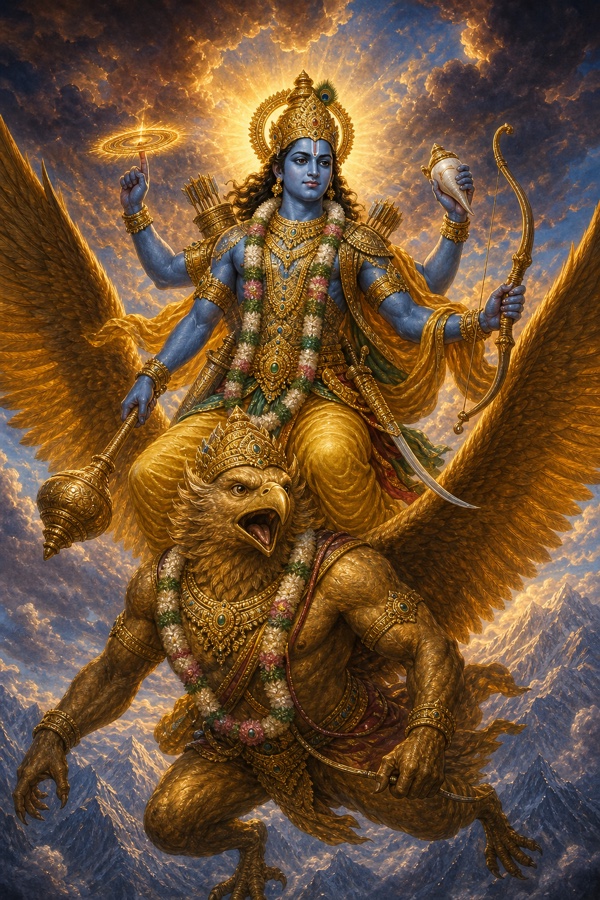
“He mounted Garuda, the beautifully feathered king of birds, who looked like a hill. He bound on two spotless quivers full of arrows. He put on his celestial armor, which shone like a thousand suns, and armed himself with his own excellent weapons, the conch, the discus, the mace, the Sharnga bow, and the sword, and fastened his belt and his splendid blade. Then the lotus-eyed lord set out at once for the destruction of the rakshasas. On Garuda’s back the most handsome Hari, clad in yellow, was like a cloud with a streak of lightning through it on a peak of Meru. Siddhas, gods, rishis, great serpents, gandharvas, and yakshas sang his praises as he came, the enemy of the asura hosts, with the discus, the sword, the bow, and the conch in his hands, and he arrived in due order at the field.
“The wind from the beating of Garuda’s wings blew away a whole portion of the rakshasa king’s army before a blow was struck. Their banners whirled, their weapons slipped from their hands, and the army of the lord of rakshasas shook like the crest of a blue hill with its crags breaking loose. Then the rakshasas in their thousands closed around Vishnu and attacked him with keen weapons smeared with blood and flesh, like the fire that rises at the end of an age.
Vishnu’s Slaughter of the Raksasas
“As clouds lash a hill with their downpour, the rakshasa hordes, making a terrific noise, fell on Narayana with volleys of missiles, and he stood among them like a hill. Bright, though dark of body, Vishnu was ringed by those sable rakshasa chiefs as a mountain of antimony is ringed by pouring clouds. Their arrows, loosed with the speed of the thunderbolt, of the wind, of the mind itself, went into the body of Vishnu the way locusts pour into a paddy field, moths into a flame, bees into a jar of honey, crocodiles into the sea, and the worlds into Vishnu at the time of the great dissolution.
“The rakshasa chiefs, huge as mountains, fought from chariots, from the backs of elephants, from horseback, and their foot soldiers fought standing in the open air, and with arrows, javelins, double-edged swords, and iron clubs they pressed Vishnu until he could scarcely breathe, the way a Brahmin at his breathing exercises stops his breath for a while. Lashed by the rakshasas as the ocean is lashed by its fish, the invincible Vishnu drew the string of the bow called Sharnga and sent his arrows into them. Hard as adamant, swift as the mind, drawn to the full length of the string, those arrows tore the rakshasas to pieces in their hundreds and their thousands.
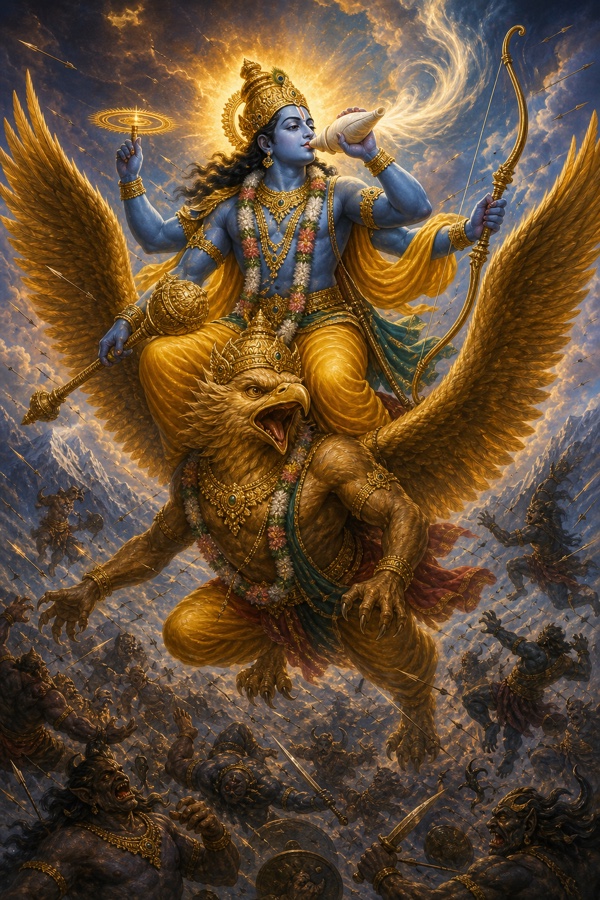
“He had scattered them with his rain of arrows as the wind scatters the rain-bearing clouds, and now the Supreme Person set his lips to his great conch, the Panchajanya, and blew. That best of conches, sounded with all of Vishnu’s breath, gave a blast so terrible that the three worlds seemed to be in agony. It frightened the rakshasas the way a lion roaring in the forest frightens elephants in rut. Horses could not keep their feet at the sound. The fury drained out of the elephants. Soldiers slid from their chariots.
“The beautifully feathered arrows from the Sharnga, their heads hard as adamant, clove through the bodies of the rakshasas and went on into the ground. Pierced by the shafts from Narayana’s hand, the rakshasas fell to the earth like mountains struck by the thunderbolt. Blood ran from the wounds his discus opened in his enemies like streams of red ochre running down a mountainside. The sound of that king of conches, the twang of the Sharnga, and the war-cry of Vishnu together drowned the whole din of the rakshasas. With his arrows Hari cut away their swaying necks and their arrows, their banners, their bows, their chariots, their pennants, and their quivers.
“Like fierce rays from the sun, waves from the sea, great serpents from a mountain, and torrents from the clouds, the deadly arrows from Narayana’s bow flew out in their hundreds and their thousands in every direction. As lions flee from the sharabha, elephants from a lion, tigers from an elephant, leopards from a tiger, dogs from a leopard, cats from a dog, snakes from a cat, and rats from a snake, so all the rakshasas fled from the mighty Vishnu, while the rest of them lay stretched on the ground.
“He had killed rakshasas by the thousand, and now Madhusudana blew his conch once more, tremendously, as Indra charges a cloud with water. The beaten rakshasa forces, terrified by Narayana’s arrows and unhinged by the sound of the conch, fled toward Lanka. And as they fled under Narayana’s arrows, Sumali turned and blocked him on the field with a shower of arrows of his own. He screened Narayana as mist screens the sun, and the powerful rakshasas took heart again.
“Then Sumali, enraged and arrogant in his strength, sprang forward with a huge shout, as if he were breathing new life into the rakshasas. He raised an arm heavy with ornaments and waved it as an elephant waves its trunk, and the elated rakshasas roared like a cloud full of lightning. Hari cut off the head of Sumali’s charioteer, dazzling earrings and all, while the rakshasa was still roaring. The horses ran wild. Like a man of no steadiness who is tossed this way and that by his own restless senses, which are horses of another kind, Sumali, lord of the rakshasas, was dragged this way and that by those horses running helter-skelter.
“While Sumali’s chariot was being hauled about in confusion by his team, the alert Mali took up his bow and an arrow and rushed at Vishnu’s mount, as the strong-armed lord came darting toward him across the field on Garuda’s back. Mali’s arrows, decked with gold and shot from his bow, reached Vishnu and went into his body as birds go into the Krauncha hill. Pierced by Mali’s thousands of arrows, Vishnu stood unruffled on the field, as a self-controlled man stands unruffled by the agonies of the mind. Then, at the twang of Mali’s bowstring, the lord and creator of beings, who bore the mace and the sword, loosed volleys of arrows at Mali. Bright as diamond and shining like lightning, they reached Mali’s body and drank his blood as great serpents would drink nectar.
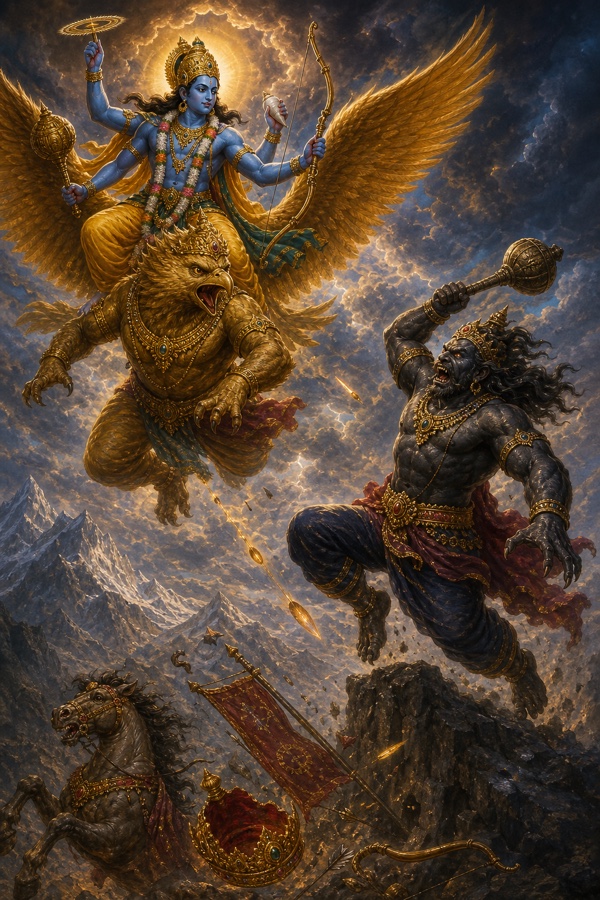
“Having driven Mali back, Hari, the bearer of the conch, the discus, and the mace, flung to the ground Mali’s crest, his banner, his bow, and his horses. Chariotless, that best of rakshasas seized his mace, and with the weapon in his hand he leaped like a lion from a mountain peak. He brought the mace down on the forehead of Garuda, the king of birds, as Yama might strike Shiva, or Indra strike a mountain with his thunderbolt. Struck hard by Mali’s mace, Garuda could not bear the pain, and he wheeled and carried the lord away from the battle.
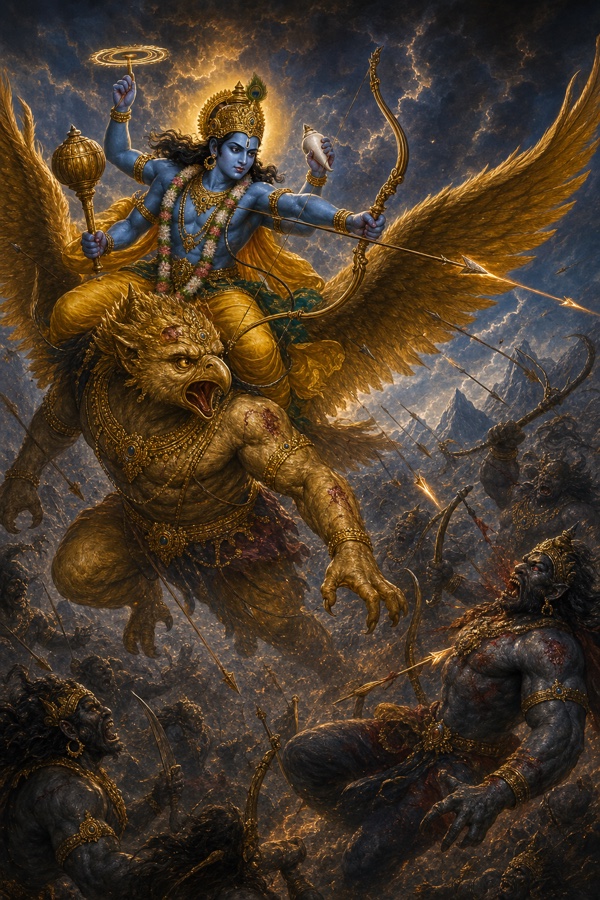
“A great clamor went up from the rakshasas at the sight of Hari turned away from the field on Garuda’s back, driven off, as it seemed, by Mali. The noise of their roaring provoked Hari, the younger brother of Indra, to a towering anger, and though he sat sideways on Garuda with his face still turned from the fight, he threw his discus at Mali to kill him. Bright as the disk of the sun, lighting the sky with its own blaze, that discus, the very wheel of Time, took Mali’s head and brought it to the ground. Cut away by the discus, the fearsome head of the rakshasa chief fell to earth spouting blood, like the head of Rahu long ago.
“Then a shout like the roar of a lion went up from the gods, who were beside themselves with joy: ‘Well done, lord!’ Sumali and Malyavan saw Mali dead, and in their grief they fled toward Lanka with what remained of the army. Garuda recovered himself, and in his rage he turned back and once again scattered the rakshasas with the blast of his wings. The rakshasas fell fast out of the sky into the waters of the sea: some with their lotus faces cut away by the discus, some with their chests pulverized by the mace, some with their necks torn by the plowshare, some with their skulls broken by the pestle, some cut down by the sword, and others wounded by arrows.
“With keen arrows from his bow, each one like a stroke of lightning, Narayana tore into the rakshasas as they fled, their hair loose and tossing, as a huge cloud full of lightning would break mountains apart with its bolts. Their parasols broken, their weapons slipping from their hands, their garments shredded by arrows, their entrails torn open, their eyes rolling with fear, that army stood wholly distracted. The cries and the stampede of the rakshasas as Vishnu routed them, and the cries of their elephants, rose all at once, the way elephants cry when a lion is among them, the way they cried long ago before the man-lion. Held back by Hari’s volleys and shooting back in great numbers, those rakshasa clouds scudded like dark clouds driven before the wind. Their heads cut off by strokes of the discus, their limbs pounded by blows of the mace, their bodies cut in two by the sword, the rakshasa chieftains fell like mountains struck by the thunderbolt. And with the rakshasas, black as clouds, thrown down on the ground with their pendant necklaces and their earrings of gold, the earth looked as if it had been covered over with blue mountains hurled down onto it.
Malyavan’s Last Battle and the Raksasas’ Flight to the Netherworld
“The army was in full flight, and Padmanabha, the lotus-naveled Vishnu, was chasing it and cutting it down from behind, when Malyavan turned. He came back to the field the way the sea comes back after it has touched the shore. His eyes were bloodshot, his head shook with rage, and he flung his words at Padmanabha, whom they also call Purushottama. ‘Narayana, you do not know the ancient rules of war. Like any ignorant man you are killing us, frightened people who have given up all thought of fighting. Lord of the gods, the killer who commits the sin of striking down those who have stopped fighting does not go to heaven; heaven is kept for those who have done meritorious deeds. Bearer of the conch, the discus, and the mace, if you are so keen to fight, here I stand. Show me your prowess, so that I can see it for myself.’
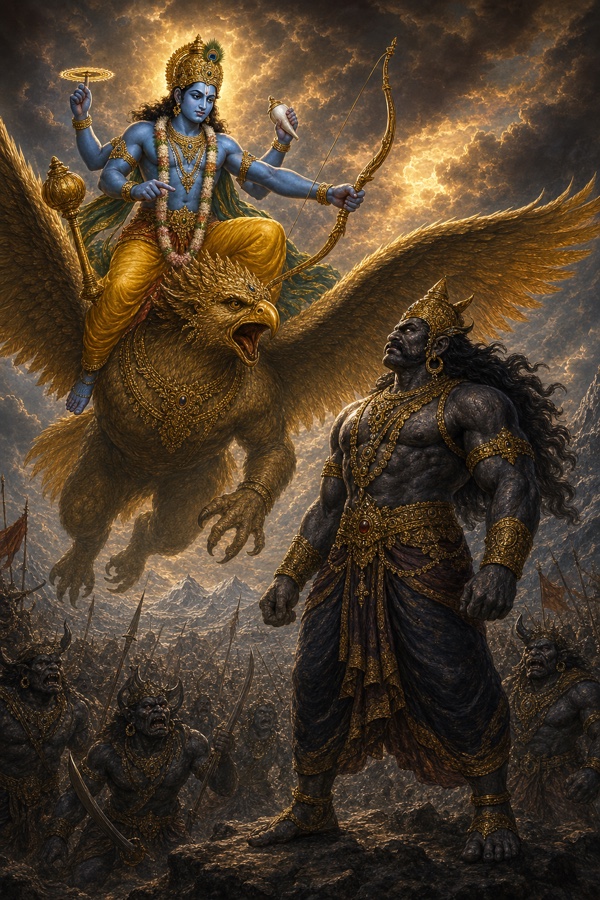
“Vishnu, the mighty younger brother of Indra, looked at Malyavan, chief of the rakshasas, standing there as firm as the mountain Malyavan, and answered him. ‘I am carrying out the promise of safety I gave to the gods who are afraid of you, and the pledge I gave them that the rakshasas would be rooted out. The gods must be served by me always, even at the cost of my life. So I will kill you all, even if you go down into the netherworld to escape it.’ The lord of the gods, whose eyes were like a red lotus, was still speaking when the enraged rakshasa chief drove a shakti into his breast. Hurled by Malyavan’s arm, the spear with its jingling bells shone on Hari’s chest like a streak of lightning across a cloud.
“Hari, the lotus-eyed, the beloved of Skanda who carries the lance, pulled that very shakti out of himself and hurled it back at Malyavan. As if it had been Skanda’s own throw, the spear from Govinda’s hand went looking for Malyavan like a great meteor bearing down on a mountain of antimony. It landed on the broad chest of the rakshasa chief, where his necklaces blazed, as the thunderbolt lands on a mountain peak. His armor burst into pieces under it, and Malyavan sank into a deep swoon. Then he pulled himself up, and he stood there unshaken, like a mountain.
“He took up a pike of iron, bristling with spikes, and drove it violently into the center of Hari’s chest. Then, still hungry for the fight, the rakshasa struck Indra’s younger brother with his fist and drew back a bow’s length. A loud cry of ‘Bravo, bravo!’ rose in the sky. Having struck Vishnu, the rakshasa struck Garuda as well. And Garuda, provoked to fury, drove him off with the blast of his wings, as a strong wind scatters a heap of dried leaves.
“Sumali saw his elder brother blown away by the wind from Garuda’s wings, and he made for Lanka with his forces. Blown away himself, and covered with shame, the rakshasa Malyavan too rejoined his troops and fled to Lanka. So it was, lotus-eyed Rama, that those rakshasas were beaten again and again in battle by Hari, and their chief leaders killed. Tormented by his might, and unable to fight Vishnu on any terms, they left Lanka and went down into the netherworld with their wives to live there.
“Those warriors, famous for their bravery, lived in the netherworld under the protection of Sumali, who was born in the line of Salakatankata. Sumali, Malyavan, and Mali, and those who marched at their head, were all of them richly blessed, and stronger than Ravana; the other rakshasas, the ones you killed, came down in the line of Pulastya, jewel of the Raghus. No one except Narayana, the bearer of the conch, the discus, and the mace, could have killed those rakshasas, the enemies of the gods who had tormented them for so long. And you are Narayana. You are the four-armed, the ancient one, the invincible and imperishable lord, and you were born to destroy the rakshasas. You, the creator, who love those who take refuge in you, appear from age to age to destroy the barbarians who break every boundary of dharma.”
“King, I have now told you in full the origin of the rakshasas as it truly was,” Agastya said. “Learn from me next, jewel of the Raghus, the origin of Ravana and of his son, and the full measure of their power. Tormented by his fear of Vishnu, the mighty rakshasa Sumali wandered the netherworld for a long time with his sons and his grandsons. And in the meantime Vaishravana took up his abode in Lanka.”
The Birth of Ravana and the Resolve to Practice Austerity at Gokarna
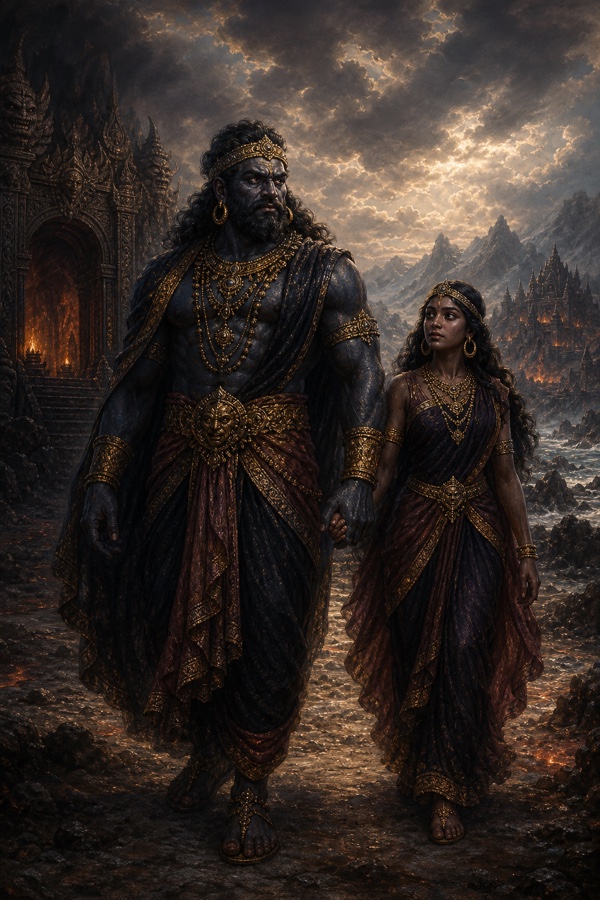
“After a time the rakshasa Sumali came up out of the netherworld, where he and what was left of his people had lived since Vishnu drove them out of Lanka, and he wandered, they say, over the whole world of mortals. He looked like a dark cloud, and he wore earrings of pure gold, and he was leading his daughter by the hand, a girl who looked like Lakshmi without her lotus. While that rakshasa chieftain was walking the earth, he happened to see Kubera passing overhead in the aerial chariot Pushpaka, on his way to visit his powerful father Vishrava, the son of Pulastya. Sumali watched him go by, godlike, resplendent as fire, flying, and wonder filled him. The highly intelligent rakshasa left the world of men, went back down to the netherworld, and thought: what must be done to secure the lasting good of the rakshasas? How are we to rise again?
“What he had seen in the sky gave him his answer, and he turned to his daughter, whose name was Kaikasi. ‘My child, you are passing beyond the season of youth, and this is the time you should be given in marriage. Suitors hold back for fear of being refused. We are pious people, all of us, and we have exerted ourselves to see you married. Daughter, you have every good quality; you are all but Lakshmi herself. To be the father of an unmarried girl is a torment to anyone who cares for his honor, because he cannot know who will accept her. An unmarried girl puts the reputation of three families at risk: her mother’s, her father’s, and the family to which she is given. So, daughter, choose for yourself, and take as your husband the excellent sage Vishrava, best of sages, born in the line of Prajapati, the son of Pulastya. Sons will be born to you, daughter, the equals of that lord of riches, with a splendor like the sun’s. About this there is no doubt.’
“Kaikasi heard her father, and out of respect for him she went to the place where Vishrava was performing his tapas, and stood there. At that moment, Rama, the Brahmin son of Pulastya was performing the agnihotra, the daily offering into the sacred fire, and beside his three fires he looked like a fourth. The hour was inauspicious, an evil time for the thing she had come to ask, and she did not stop to consider it; her father’s word was what she was thinking of. She went near the sage and stood in front of him with her face lowered and her eyes fixed on her own feet, scratching the ground again and again with the tip of her toe. The most magnanimous of sages looked at the girl, lovely in every limb, her face like the full moon, bright with her own light, and said, ‘Blessed girl, whose daughter are you? Where have you come from, with what motive, and what is your purpose? Tell me the truth, beautiful one.’
“She answered at once with joined palms. ‘Sage, you should read my mind by your own spiritual insight. Brahmarshi, my name is Kaikasi. Know that I have come at the command of my father. The rest you should understand for yourself.’ The sage went into meditation and came out of it knowing. ‘Auspicious one, I have divined the intention in your mind. Lady whose walk is like an elephant’s in rut, you are eager to have sons by me. But you have come to me at an inauspicious hour, and so hear what kind of sons you will bear. They will be cruel-minded, fierce to look upon, fond of people as cruel as themselves. Lady of shapely limbs, you will bring forth rakshasas given to cruel deeds.’
“She bowed to him and pleaded. ‘Revered sir, from you, who discourse on Brahman, I do not want sons like that, given to heinous deeds. Be gracious to me.’ And Vishrava, best of sages, who was like the full moon, spoke again to Kaikasi, who looked like Rohini. ‘Lady of the lovely face, the son who is born to you last will be pious-minded and wholly in keeping with my family. About this there is no doubt.’
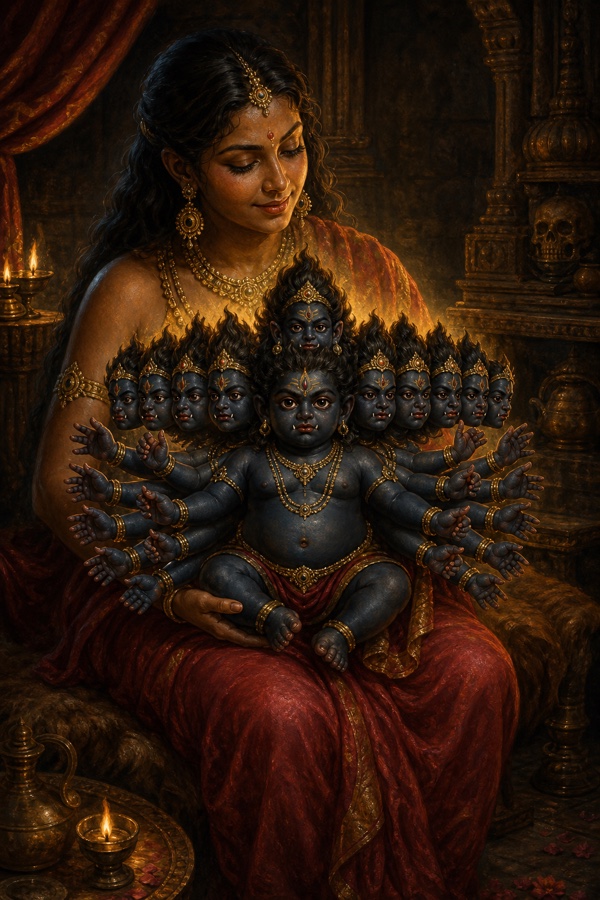
“So Vishrava had spoken, Rama, and so in time it happened. The girl brought forth a hideous child in the form of a rakshasa, very cruel, with ten heads and huge teeth, dark as a heap of antimony, with coppery lips, twenty arms, vast mouths, and hair like fire. At his birth jackals spitting flames from their mouths and other flesh-eating beasts circled him against the course of the sun. The rain-god poured down blood. The clouds thundered fiercely, the sun lost its brightness, and huge meteors fell to the ground. The earth rocked. Fierce winds blew. The sea, the lord of rivers, which nothing can throw into commotion, was in commotion. His father, who was the equal of the creator, named him: because he was born with ten necks, he would be Dashagriva.
“After him was born the exceptionally mighty Kumbhakarna, whose size nothing on earth surpassed. Then was born Shurpanakha, with her ugly face. And the last child of Kaikasi was the pious-minded Vibhishana. When that noble soul was born, flowers, they say, fell in showers on the earth, the kettledrums of the gods sounded in the heavens, and a voice in mid-heaven cried, ‘Good! Excellent!’
“Dashagriva of great strength and Kumbhakarna grew up together in that great forest, and they grew into the torment of the world. Kumbhakarna was wanton and never satisfied; he roamed the three worlds devouring the great sages who loved righteousness. Vibhishana, meanwhile, lived wholly established in dharma. He kept himself under strict control, ate sparingly, and gave his days to the study of the Vedas.
“Now after some time the god Kubera, the son of Vishrava and lord of riches, came in his aerial chariot to see his father. Kaikasi saw him blazing with splendor, and the rakshasi went straight to Dashagriva. ‘Son, look at your brother Vaishravana, how full of splendor he is. And look at yourself, so poor a thing, though you are his equal in brotherhood. Dashagriva, your prowess has no limit, my son. Make every effort, so that you too become like him.’
“His mother’s words filled Dashagriva, brave and young and proud, with an envy that had no measure, and he swore an oath. ‘I swear to you truly: I will rise to be Vaishravana’s equal, and I will surpass him in power. Give up the grief in your heart.’ Then, in that same fit of temper, Dashagriva set his mind on tapas, on accomplishing a hard thing, and came with his younger brothers to the holy hermitage at Gokarna, resolved to win his ends by austerities. There the rakshasa of terrible prowess, in the company of his brothers, practiced tapas without equal, and by it he pleased the all-powerful Brahma, who in the fullness of his pleasure granted boons that would bring victory.
The Austerities and the Boons
Rama wanted the details. “How, and in what manner, did those brothers of extraordinary might perform their tapas in the forest, Brahmin?” Agastya was glad of the question, and he told Rama, who was well pleased at heart, that each of the brothers took up the discipline that suited him.
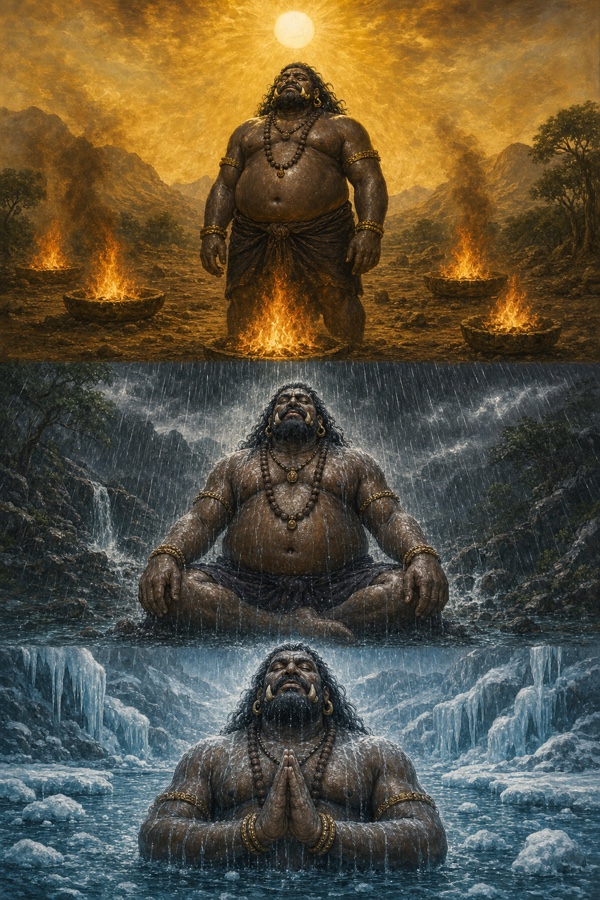
“Kumbhakarna, ever steadfast on the path of rectitude and striving hard at it, performed his tapas in summer standing in the middle of fires on all four sides with the sun blazing overhead. In the rains he sat drenched to the skin, kneeling on one leg in the open. In the cold months he stood always in water. Firm on the right path, striving after righteousness, he spent ten thousand years like that. The pious-minded Vibhishana, pure and wholly intent on rectitude, stood on one leg for five thousand years, and when that austerity was complete, troupes of apsaras danced, flowers fell in showers, and the gods sang his praises. Then, intent on the study of the Vedas, he spent another five thousand years with his arms and his head raised, worshiping the sun. So the disciplined Vibhishana passed ten thousand years as if he had spent them in Nandana, the pleasure garden of Indra. Dashagriva went without food for ten thousand years, and at the end of each thousand he offered one of his heads as a sacrifice into the fire.
“In that way nine thousand years went by and nine of his heads went into the fire. At the end of ten thousand years, when Dashagriva was about to cut off the tenth, Brahma appeared before him. Supremely satisfied, the creator stood there with the other gods and said, ‘Dashagriva, I am truly pleased with you. Choose the boon you want without delay, knower of what is right. What desire of yours shall I fulfill today? Your austerities should not go in vain.’ Dashagriva bowed to the god with his heart brimming, and said in a voice choked with joy, ‘Lord, for living beings there is only one constant source of fear, and it is death. There is no enemy like death. I choose immortality.’
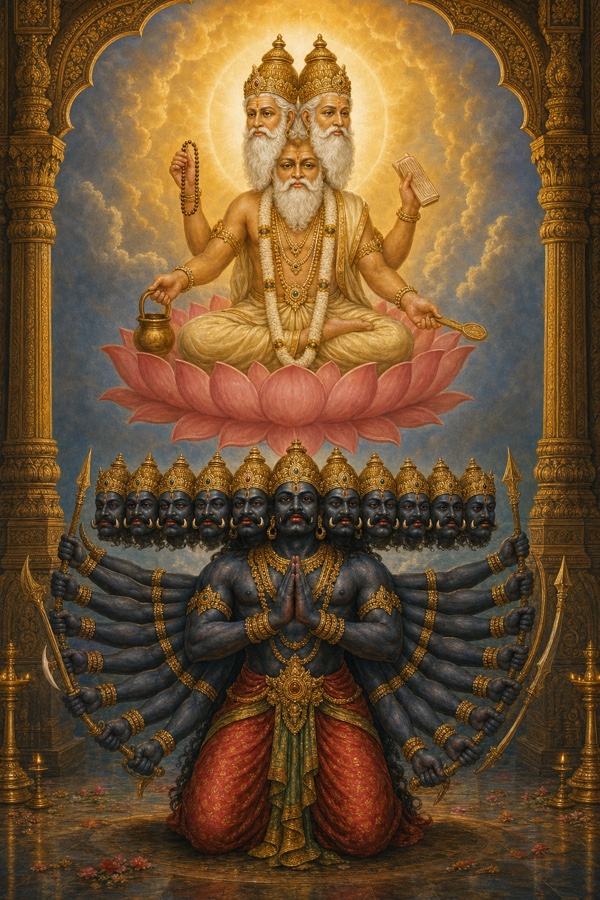
“‘There can be no absolute immortality for you,’ Brahma told him. ‘Ask me for some other boon.’ The creator of the world had spoken, Rama, and Dashagriva, standing before him, made his second request with joined palms. ‘Eternal lord of created beings, I want immunity from death at the hands of suparnas, the great eagles, and of nagas, yakshas, daityas, danavas, rakshasas, and gods. From other living beings I have nothing to fear, god whom the immortals worship. Human beings and the rest of them I count as so much straw.’ The pious-minded Brahma, with the gods around him, answered the rakshasa Dashagriva: ‘Jewel among rakshasas, this request of yours shall be fulfilled. And hear now of another auspicious boon from me, who am pleased with you, sinless one: the heads you offered into the fire will appear again as before, rakshasa. And I give you one more boon on this occasion, a rare one, dear one. You will take any form you choose.’ Brahma had scarcely given his word when the heads Dashagriva had sacrificed into the fire were restored to him.
“Having said this to Dashagriva, Rama, Brahma, the grandfather of the universe, turned to Vibhishana. ‘Vibhishana, my child, I am highly pleased with you, whose mind is steeped in dharma, pious one. Ask for a boon, rakshasa of holy vows.’ Vibhishana, righteous, endowed with every good quality as the moon is endowed with its rays, answered with joined palms. ‘Venerable sir, I have already gained everything I could want, since the teacher of the worlds himself is pleased with me. But if in your pleasure you grant me a boon, god of holy vows, then hear it. Even when I fall into the worst of difficulties, let my mind stay steady in virtue. Lord, let the knowledge of the Brahmastra dawn on me untaught. Whatever thoughts come to me in the various stages of life, let them be in accord with dharma, and let me perform the duties that belong to each stage. Supremely magnanimous one, this I count the best of boons.’
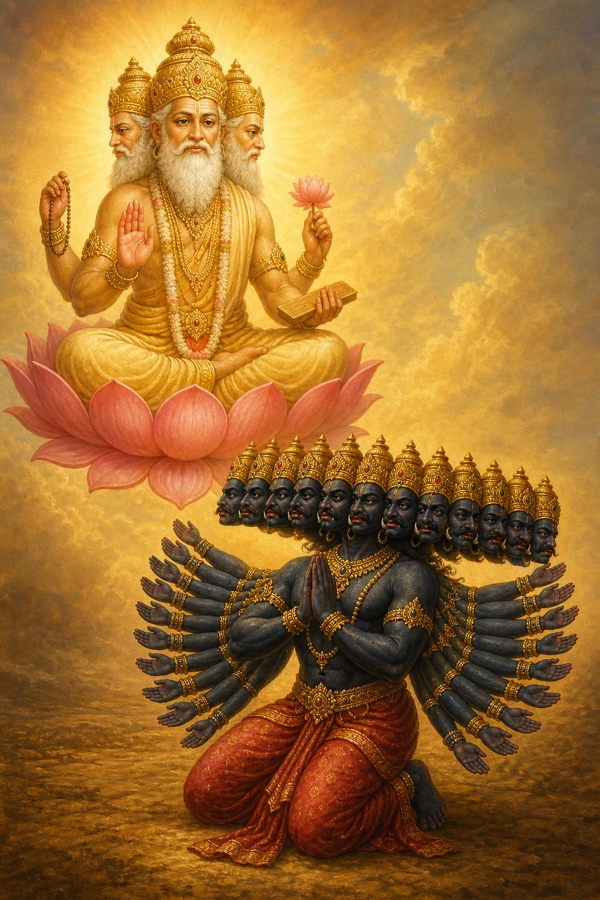
“Brahma was pleased. ‘There is nothing in this world that those devoted to righteousness find hard to obtain,’ he said. ‘My son, since your virtue runs so deep, it shall be so. And because your mind does not incline to unrighteousness even though you were born in a family of rakshasas, you who can destroy your enemies, I make you immortal.’
“When he had said this to Vibhishana, the lord of creation stood ready to grant a boon to Kumbhakarna, and all the gods joined their palms and spoke up at once. ‘Grant no boon of any kind to Kumbhakarna. You know how this evil-minded creature terrorizes the three worlds. Seven apsaras of the Nandana garden, ten attendants of mighty Indra, and seers and human beings besides have been devoured by him, Brahma. If he has done that much havoc with no boon at all, he will eat all three worlds once he has one. Under the pretext of granting him a boon, god of limitless splendor, cast a spell of delusion on him. The world will be safe, and he will still have his honor.’
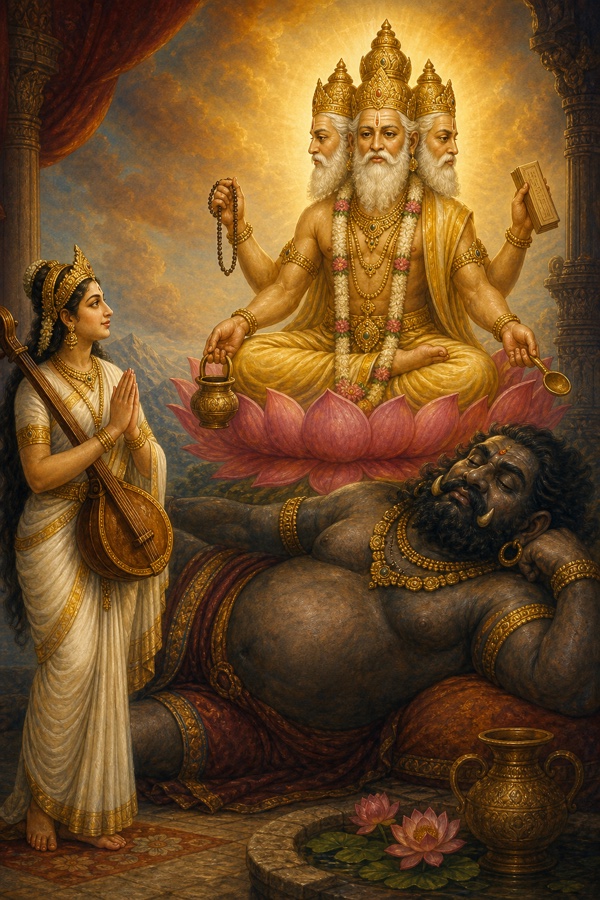
“So the gods asked, and Brahma, the lotus-born, thought of his consort, the goddess Sarasvati. At his thought she came and stood beside him, and with joined palms she said, ‘Lord, I have come. What shall I do?’ The lord of creation said to her, ‘Goddess of speech, become the words in the mouth of Kumbhakarna, chief of the rakshasas, as the gods desire.’ ‘So be it,’ she said, and she entered the mouth of Kumbhakarna. Then Brahma said, ‘Mighty-armed Kumbhakarna, ask the boon of your choice.’ And Kumbhakarna heard him, and opened his mouth, and the words that came out were these: ‘God of gods, I want to sleep for many years.’ ‘So be it,’ said Brahma, and he left with the gods, and the goddess Sarasvati left the rakshasa.
“When the gods and Brahma had gone up to the heavens and Sarasvati had left him, the evil-minded Kumbhakarna came back to himself, and he was sick at heart. ‘How did words like those come out of my lips?’ he thought. ‘I believe I was deceived by the gods who came here.’ But the word was given. The brothers of shining splendor, having gained their boons in this way, went to a forest of shleshmataka trees and lived there in contentment.
Kubera Abandons Lanka and Ravana Is Crowned
“Word that the three brothers had won their boons from Brahma reached the netherworld, where Sumali had hidden since Vishnu’s war, and Sumali shed his fear and rose with his followers. Maricha, Prahasta, Virupaksha, and Mahodara, the ministers of that rakshasa, rose with him in a fury of eagerness. Ringed by his ministers and by the other rakshasa chieftains, Sumali came to Dashagriva, embraced him, and spoke. ‘Child, you have secured the best of boons from Brahma, the great one of the three worlds, and so by good fortune you have what you were cherishing in your heart. The great fear Vishnu set upon us, the fear that made us leave Lanka and go down into the netherworld, is gone now, strong one. Broken by that fear again and again, we had to abandon our home, Lanka, and go down with all our followers.’
“‘That city of Lanka,’ Sumali went on, ‘which your clever half-brother Kubera, the lord of wealth, now occupies, belongs to us. Rakshasas lived in it. If it could be taken back, my strong and blameless grandson, by sweet persuasion or by gift or by force, our work would be done. There is no doubt at all that you will be the ruler of Lanka, dear one. The line of the rakshasas had sunk into the ground, and you have lifted it up again. Rakshasa of extraordinary might, you will be lord over all of us.’ Dashagriva answered his mother’s father, who stood there in person: ‘You should not speak in this strain. The lord of wealth is our elder brother.’
“The great rakshasa had been rebuked, gently, by the ruler of the rakshasas, and he said nothing further, because he could see what Dashagriva intended. Some time later, while they were all still there, the rakshasa Prahasta took up the matter with Ravana, who had spoken as he had, in humble and carefully reasoned words. ‘Mighty-armed Dashagriva, you should not talk like this. There is no such thing as brotherly feeling among heroes. Listen to me. The sisters Aditi and Diti, both of them very beautiful, are the loving wives of Kashyapa, a lord of creation. Aditi bore the gods, the lords of the worlds, and Diti gave birth to the daityas; both are Kashyapa’s progeny. This earth, with its forests and its seas and its mountains, belonged in the old days to the daityas, because they were the mighty ones. The powerful Vishnu killed them in war and brought all three worlds under the lasting sway of the gods.’
“‘You will not be the first to act against a brother,’ Prahasta said. ‘Gods and demons alike did it before you. So do as I say.’ Dashagriva thought about it for a while, and his heart was glad, and he said, ‘All right.’ In that same gladness the bold Dashagriva went out to the forest that very day with the rakshasas. Standing on Mount Trikuta, in sight of the golden walls, he sent Prahasta, who was skilled in the art of speech, as his messenger. ‘Prahasta, go quickly and carry these words of mine, politely, to the lord of riches, the greatest of rakshasas: This city of Lanka, king, which belonged to the mighty rakshasas, has been occupied by you. Gentle and sinless one, hero of peerless strength, if you could give it back to us now, you would please me and do the right thing at one stroke.’
“Prahasta went into Lanka, which Kubera kept well guarded, and addressed the magnanimous lord of wealth. ‘Pious one, best of all who bear arms, I have been sent to your presence by Dashagriva, your half-brother, my lord. Lord of wealth, learned in all the shastras and highly intelligent, listen to my submission, which is exactly what Dashagriva says. This charming city, large-eyed one, was once ruled by rakshasas of terrible might, and Sumali was the first among them. Son of Vishrava, it is he who now asks for it. Let it be given back to one who asks for it peacefully.’
“The god Vaishravana, the best of speakers, heard Prahasta out and replied. ‘This city of Lanka had been abandoned by the rakshasas when my father gave it to me. I peopled it myself, by gifts and by honors and every other inducement. Go and tell Dashagriva: my city, and my kingdom too, belong to you. My kingdom and all my wealth stand undivided with you. Enjoy it with me, without any fear of rivalry.’ That was Kubera’s answer, given on the spot. And then the lord of wealth went to see his father.
“He paid his respects to Vishrava and laid Dashagriva’s demand before him. ‘Father, Dashagriva has just sent an emissary to me to say: Let Lanka, which the rakshasas once held, be given back to me. Tell me, pious one, what I should do about it.’ Vishrava, the brahmarshi, best of sages, looked at his son standing before him with joined palms and said, ‘My son, listen to me.’
“‘Dashagriva, in the pride of his new strength, said the same thing in my presence. I rebuked him. I reasoned with that thoroughly evil-minded fellow in every way I could, and in my anger I told him again and again, You will be destroyed. Now, son, listen to words that will do you good and that keep to dharma. Deluded by the boons he has been given, that most evil-minded one no longer knows whom to respect and whom not to respect. And by my curse, besides, he is evil-minded by nature. So leave Lanka, my son. Go with your followers to Mount Kailasa and make it your home. The Mandakini, best of rivers, flows there, its waters covered over with lotuses of a golden hue, bright as the sun, and with white water-lilies and blue lotuses and other flowers of sweet fragrance. Gods and gandharvas, apsaras, nagas, and kinnaras, all of them fond of play, resort to that place and revel there without end. You know what boon he has secured. It is not wise to make an enemy of him.’
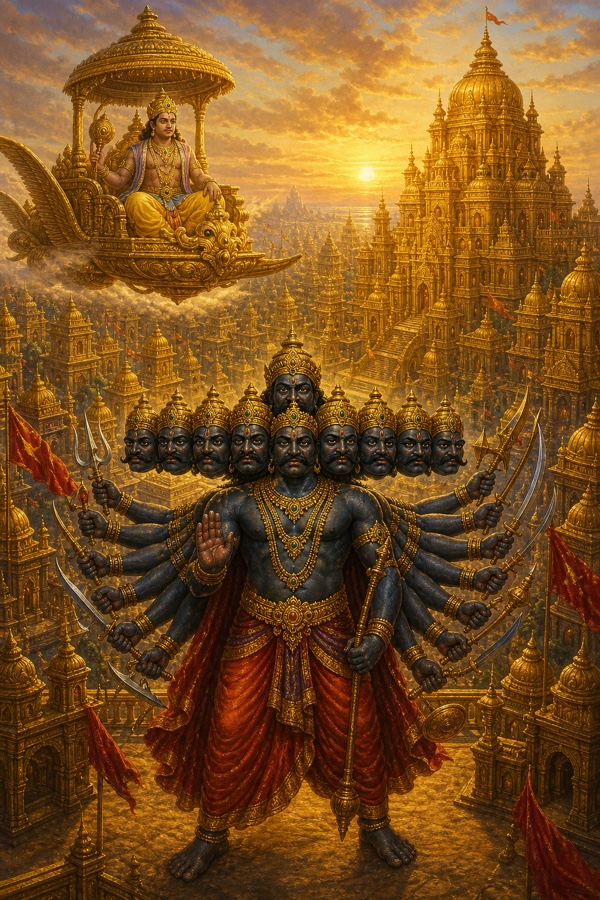
“Kubera did as his father advised, out of respect for him, and left Lanka with his wife and his sons, his ministers, his vehicles, and his wealth. Prahasta, overjoyed, hurried to the mighty Dashagriva, who sat among his ministers and his brothers. ‘Kubera has left the city of Lanka and gone away. It stands empty now. Enter it with us and do your duty there.’ Ravana of great strength entered Lanka with his brothers, his forces, and his other followers. That enemy of the gods walked into Lanka, its main streets so finely laid out, that the god of riches had just abandoned, as Indra ascends to heaven. The rakshasas consecrated Dashagriva as its ruler, and he peopled the city, and it soon filled to its walls with rakshasas dark as clouds. And Kubera, out of respect for his father’s word, built on Kailasa, the mountain white as the moon, a city adorned with splendid mansions, as Indra once laid out Amaravati in heaven.
The Marriages and the Birth of Meghanada
“Once he had been consecrated as ruler of Lanka, Ravana took counsel with his brothers about the marriage of their sister, the rakshasi. He gave Shurpanakha to Vidyujjihva, chief of the danavas and son of Kalaka. And when he had given her away, the rakshasa went out into the forest to hunt, and there, Rama, he came upon Maya, the son of Diti, and Maya was with his daughter.
“Dashagriva saw the two of them and asked, ‘Who are you, and why are you staying in this forest, where there are neither men nor animals, with this girl whose eyes are a doe’s?’ Maya answered the inquisitive rakshasa, Rama, and told him everything. ‘I will tell you all of it, as it happened. Listen. There was an apsara named Hema; you may have heard of her. As Paulomi, the daughter of Puloma, was given to Indra, so Hema was given to me in marriage by the gods. I was deeply attached to her, and I lived with her for thousands of years. It is now fourteen years since she went away on the business of the gods. For Hema’s sake I made this city entirely of gold by my magical powers, and set it with diamonds and cat’s-eye gems, and bereft of her I lived there dispirited and utterly desolate.’
“‘I came from that city into the forest with my daughter, king,’ Maya said. ‘This is my daughter, who grew in Hema’s womb. I have brought her with me to find her a husband, because to be the father of an unmarried girl is a torment to any parent who cares for his reputation. An unmarried girl puts the reputation of two families in jeopardy. By Hema I also had two sons: Mayavi was the first, and Dundubhi the second. You asked, dear one, and I have told you everything exactly as it is. Now, how am I to know you? Who are you?’
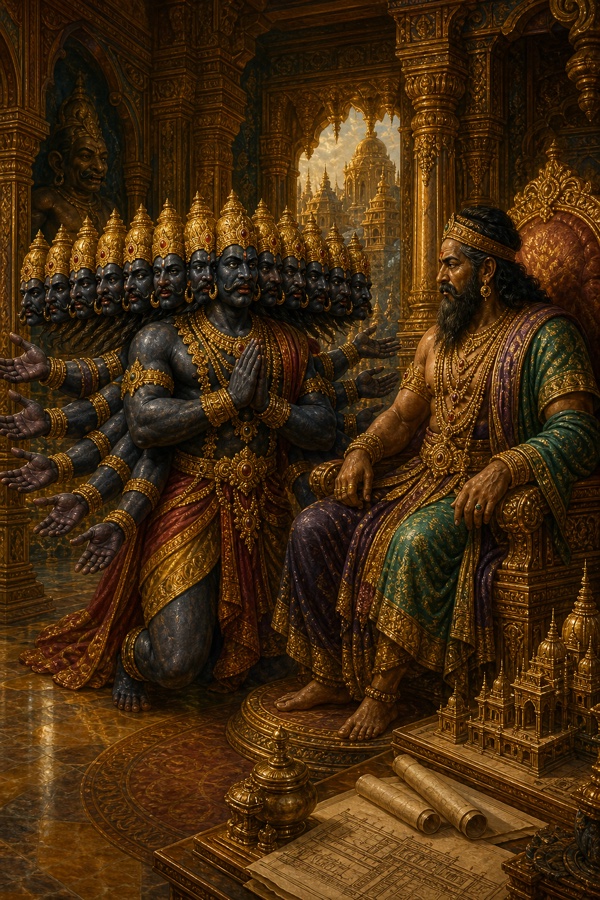
“The rakshasa answered him humbly. ‘I am the grandson of Pulastya and the son of the sage Vishrava, who stands third in descent from Brahma himself. My name is Dashagriva.’ Maya the danava heard this from the lord of the rakshasas, and learning that he was the son of the great sage Vishrava, he was glad, and on that very spot he resolved to give him his daughter. Maya, chief of the daityas, put her hand into Dashagriva’s and said to the chief of the rakshasas, laughing aloud, ‘King, this daughter of mine was brought up by the apsara Hema. Her name is Mandodari. Take her as your wife.’ And to him, Rama, Dashagriva said, ‘All right.’
“Then, kindling a fire there in the forest, he married her before it. Maya, rich in tapas, knew the curse Vishrava had laid on him, Rama, and still he gave his daughter, because he knew too that Dashagriva descended from Brahma, the grandfather of the universe. Maya gave him something else as well: a most wondrous and infallible javelin, won by his own hard tapas. It was with that spear that Ravana would one day strike Lakshmana down. So the mighty lord of Lanka, having taken a wife, went back to his city and secured a wife for each of his two brothers. For Kumbhakarna Ravana chose Vajrajvala, the granddaughter, through a daughter, of Bali the son of Virochana. And Vibhishana took as his wife Sarama, the daughter of the noble gandharva king Shailusha, a man who knew what was right. She had been born on the bank of Lake Manasa.
“The Manasa lake was swelling in the monsoon rains when she was born, and her mother, out of love, called out to it, ‘Lake, do not overflow.’ From that cry her child came to be known as Sarama. So the three rakshasas were married, and they spent a pleasant time there, each in the company of his wife, as the gandharvas do in Nandana, the pleasure garden of Indra. Then Mandodari gave birth to a son, and he was named Meghanada.
“He is the one all of you call Indrajit. At the moment of his birth this son of Ravana cried out, and the cry was like the rumbling of clouds, and Lanka stood stunned by it, Raghava. That is why his father himself named him Meghanada, the roar of the cloud. He grew up in Ravana’s beautiful inner apartments, tended by the finest women, a delight to his mother and his father, and, Rama, he grew there like a fire hidden under pieces of wood.
Kumbhakarna’s Sleep, Ravana’s Outrages, and Kubera’s Envoy
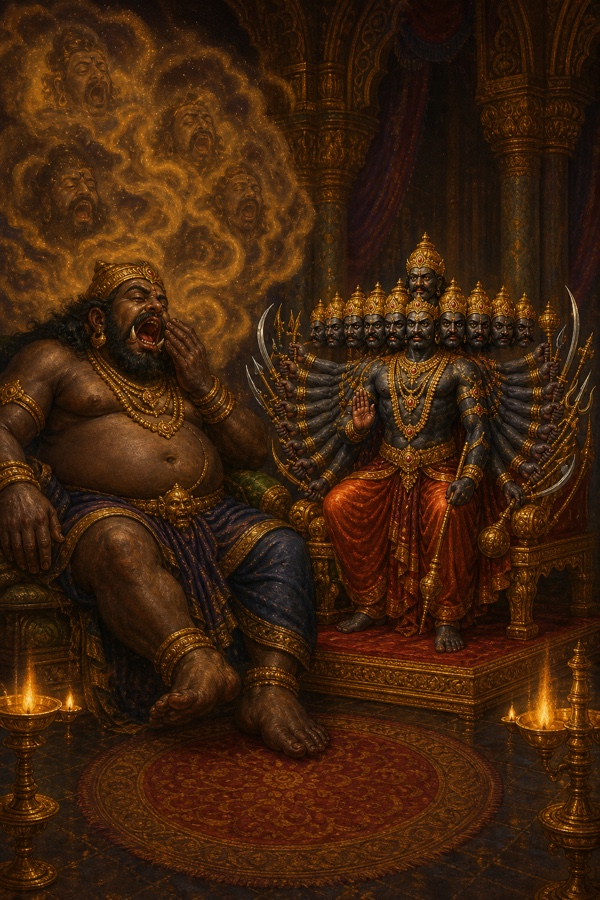
“After some time the deep sleep that Brahma, lord of the universe, had sent came for Kumbhakarna in Lanka, the sleep he had asked for with words that were never his own. It began as yawning and heaviness and the rest, and it did not let go. Kumbhakarna turned to his elder brother, who was seated beside him. ‘King, sleep is troubling me. Have a mansion built for me.’ At the king’s order, architects as skilled as Vishvakarma himself built Kumbhakarna a lovely mansion one yojana wide and twice that in length, handsome to look at and free of every disturbance, adorned on every side with columns of crystal and of gold. Its stairways were of cat’s-eye gem. Its lattice windows were fringed with tiny bells. Its doors were of ivory, and it held daises of crystal and diamond. It captivated the soul, and Ravana furnished it with every amenity and made every part of it comfortable in every season, until it was like a holy cave on Mount Meru. There the mighty Kumbhakarna lay down, and sleep buried him, and he did not wake for many thousands of years.
“With Kumbhakarna gone under, Dashanana had nothing to check him, and he destroyed gods, rishis, yakshas, and gandharvas without restraint of any kind. In his fury he overran Nandana, the pleasure garden of Indra, and other beautiful gardens, and laid them waste. Like an elephant at play the rakshasa scattered the waters of rivers, snapped trees like a gale, and split mountains like Indra’s thunderbolt.
“Vaishravana learned of Dashagriva’s misdeeds. He kept in mind the conduct that befitted his family, and he knew what was right, and so he sent a messenger to Lanka, to show his brotherly love and above all to do Ravana good. The messenger reached the city and went to Vibhishana, who welcomed him with every propriety, asked after his journey, after the king Kubera and his kinsfolk, and after the reason for his coming, and then took him before Dashanana, who was seated in the assembly. The messenger saw the king there, blazing with his own splendor, greeted him with the words ‘Be victorious!’ and stood silent. Then, to Dashagriva seated on a splendid couch spread with beautiful coverings, he delivered his message.
“‘King, I will tell you everything your brother has said, and it keeps with good conduct and the traditions of your family. He says: What you have done so far is quite enough. Establish yourself fully in dharma, if you can. I have seen Nandana, Indra’s garden, laid waste by you. I have heard of the rishis you have killed. I have heard too of the preparations the gods are making against you. Leader of the rakshasas, you have disregarded me again and again, and still it is the duty of kin to save the younger ones even when they misbehave.’
“The messenger went on, in Kubera’s own words. ‘In pursuit of dharma I once undertook a rather fierce vow, and I went to the slopes of the Himalaya with my mind and my senses fully under control. There I happened to see the almighty lord Shiva in the company of Uma. Rudra’s consort stood there in her incomparable beauty, and by chance my left eye fell on the goddess. My only object, king, was to know who she was, nothing else. But by the goddess’s supernatural power my left eye was scorched, and the other turned tawny, as though it had been soiled with dust.’
“‘Then I went to another broad plateau of the Himalaya,’ the messenger said, still speaking for Kubera, ‘and in silence I kept the great vow for eight hundred years. When I had completed it, the great lord Shiva appeared there, pleased at heart, and said to me: Keeper of the vow, knower of dharma, I am pleased with the tapas you have just performed. This vow was first kept by me, and now again by you, lord of riches. There is no third person who can keep such a vow. I originated it in the past, and it is very hard to keep. So be pleased to make friends with me, lord of wealth. You have conquered me by your austerities, sinless one.’
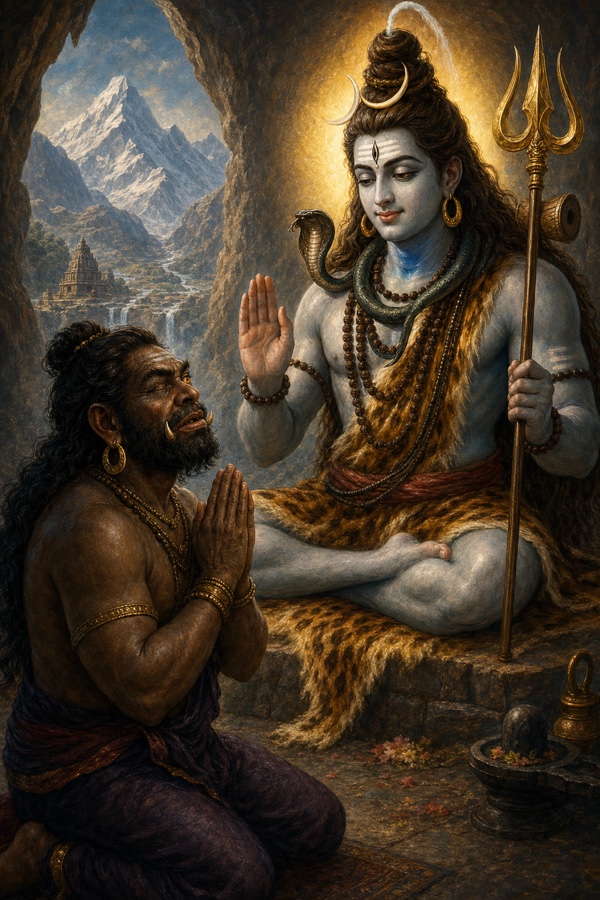
“Then Shiva named him. ‘Since your left eye was burned and the other turned tawny by the goddess’s power, merely for gazing on her beauty, you will be known forever as Ekakshipingali, the one with a single tawny eye.’ The messenger returned to his own voice. ‘When I had won the friendship of Shankara in this way and taken his leave, I came home, and I heard of your sinful resolve. So turn back from this unrighteous conduct, which stains the reputation of your family. The gods and the hosts of rishis are considering how to bring about your destruction.’
“Dashagriva heard all this with his eyes reddening. He wrung his hands, he ground his teeth, and he answered in a rage. ‘Messenger, I understand the words you have spoken. You will not live, and neither will the brother who ordered you to say them. What the lord of wealth says is not for my good. That fool tells me about his friendship with Maheshvara, as if that were something. I will not tolerate what you have said. Envoy, I have put up with every insult he has heaped on me, and only because I believed that an elder brother is not to be killed. But now that I have heard these words of his, I have made up my mind: relying on the strength of my arms, I will conquer all three worlds. This very hour, on his account alone, I will send all four guardians of the directions to the abode of Yama.’
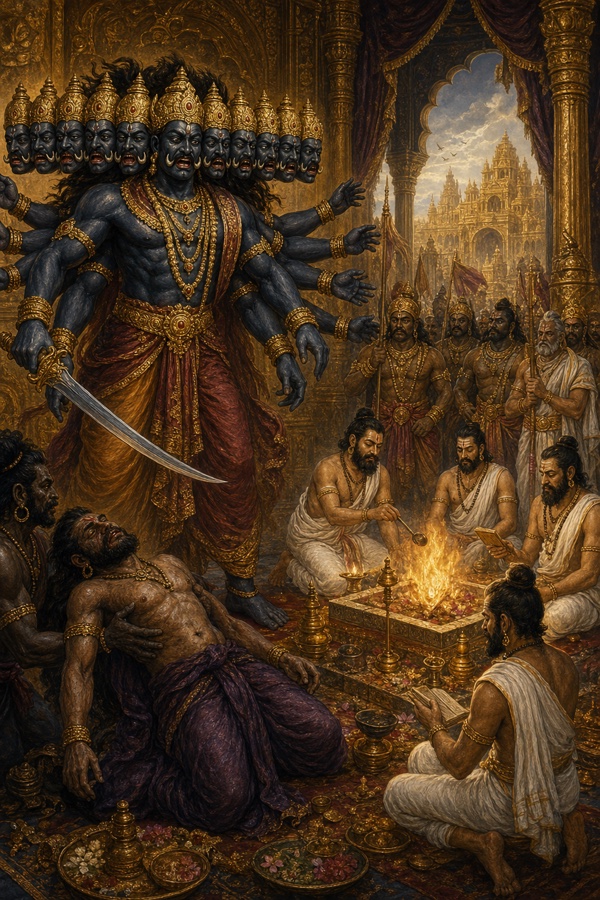
“With that the lord of Lanka cut the messenger down with his sword, and gave the corpse to the evil-minded rakshasas to eat. Then he had the Brahmins recite the benedictory hymns over him and made the customary offerings, for a king setting out to conquer the three worlds, and Ravana mounted his chariot and drove for the abode of the lord of wealth.
The Assault on the Yaksas and Ravana’s Victory
“Six ministers rode with him and around him: Mahodara and Prahasta, Maricha, Shuka, Sarana, and the hero Dhumraksha, who was always thirsting for a battle. The glorious Ravana, forever proud of his might, went out as if to consume the worlds with his anger. He crossed cities, rivers, hills, forests, and groves, and reached Mount Kailasa within the hour, where Kubera’s yakshas kept the mountain for their lord.
“The yakshas of Kailasa heard that the wicked king of the rakshasas had encamped on their mountain with his ministers, eager for battle and ready for it, and they did not try to face him themselves. They knew him for a brother of the lord of wealth, and they went to Kubera’s abode and told him everything about his brother’s intentions. With the leave of the lord of wealth they went out joyfully to give battle. A great stir went through the forces of the king of the nairritas then, like the agitation of the sea, and the mountain itself seemed to shake with it. Between the yakshas and the rakshasas a thick fight began, and in it the rakshasa’s ministers felt real alarm.
“Dashagriva saw his army in that plight, and he rushed out in his anger, shouting encouragement, again and again. The ministers of the rakshasa king were terribly brave: each one of them fought a thousand yakshas. Under an assault of clubs, pestles, swords, javelins, and iron clubs, Ravana went into the enemy’s army. The yakshas’ arrows fell on him as thick as torrents from a raining cloud, and Dashanana was held there, hardly able to breathe. But a mountain is not shaken by a hundred torrents, however drenched, and he felt no torment from the yakshas’ weapons though they wounded him. Then the gigantic Dashagriva lifted a club like the rod of Death and went into the army with it, dispatching yakshas to the abode of Yama.
“Like a fire fanned by the wind he burned through the yaksha army, which lay spread out before him like grass and heaped like dry wood. Under the great ministers, Mahodara, Shuka, and the rest, the yakshas were cut down to a remnant, as clouds are thinned by the wind. Some of them, badly mangled by their wounds, fell to the ground; others in their fury bit their lips with their sharp teeth. Like a riverbank crumbling into the current, exhausted yakshas embraced one another and sank down on the field, their weapons fallen from their hands. The air was crowded with those who had lost their lives and were on their way to heaven, with those still fighting, with those running away, and with the host of rishis who had come to watch.
“Kubera, the lord of wealth, saw his greatest yaksha captains put to flight, and he sent out more of his mighty yakshas. In the meantime, Rama, a yaksha named Sanyodhakantaka, with a huge army and a vast train of mounts and vehicles, sallied out on the orders of the lord of wealth. He struck Maricha in the fight with a discus, as Vishnu might have, and Maricha fell from the mountain to the ground like a star that drops out of heaven when the merit that held it there is spent. Within the hour Maricha came to himself, rested a while, and fought that yaksha again, and this time it was the yaksha who was beaten and ran.
“Then Ravana came to the gateway, plated all over with gold and inlaid with cat’s-eye gems and silver, the last line that the gatekeepers held. A gatekeeper named Suryabhanu stopped Dashagriva there as he was going in. The rakshasa forced his way through regardless, and when he would not stop, Rama, though the yaksha barred him, the yaksha pulled a post out of the gateway and struck him with it. Dashagriva streamed blood, and he looked like a hill with rivers of molten ochre pouring down its sides. But the door-post, though it was as big as the crest of a hill, could not kill the hero; the boons of Brahma, the self-born creator, held. Dashagriva struck back with that same door-post, and the yaksha was seen no more; his body had been ground to powder.
“When they saw what the rakshasa could do, all of them ran. Exhausted, pale, stricken with fear, they threw away their weapons and went into the rivers and the caves.
The Defeat of Manibhadra and Kubera, and the Seizure of the Pushpaka
“The lord of wealth saw his yaksha captains terrified in their thousands, and he turned to the great yaksha Manibhadra. ‘Kill this ill-conducted, evil-minded Ravana. Be the refuge of the yaksha heroes who are still fighting.’ So ordered, the hard-to-conquer Manibhadra fought on, ringed by four thousand yakshas. They fell on the rakshasas with clubs, pestles, javelins, spears, lances, and cudgels, striking at the speed of hawks, crying, ‘Strike hard!’ and ‘No, seize him, take him!’ The gods, the gandharvas, and the rishis who expound the Vedas watched that fierce fight in great wonder.
“In it Prahasta killed a thousand yakshas, and Mahodara another thousand, heroes without a flaw among them. And, king, the enraged Maricha, eager for the fight, killed two thousand more in an instant. The straight warfare of the yakshas and the crooked warfare of the rakshasas were two different things altogether, and so the rakshasas held the upper hand in the struggle.
“In that great struggle Manibhadra closed with Dhumraksha. Dhumraksha struck him furiously in the breast with a pestle, and he did not move an inch. Then Manibhadra whirled his mace and brought it down on the rakshasa Dhumraksha’s head, and Dhumraksha fell, dazed. Dashanana saw Dhumraksha fallen and bathed in blood, and rushed at Manibhadra. That best of yakshas saw the enraged Dashanana coming and struck him with three javelins. Struck, Ravana struck back, at Manibhadra’s diadem, and the blow knocked the diadem to one side. From that day on the yaksha Manibhadra was known as Parshvamauli, the one whose crown is turned aside. When the colossal Manibhadra turned his face from the field, a great shout went up from the rakshasas on that hill, king.
“Then, from far off, the lord of wealth himself came into view. He carried a mace, and with him came his two ministers, Shukra and Praushthapada, and the deities who preside over two of his treasures, Padma and Shankha. He looked across the battlefield at his brother, who by reason of the curse had lost all sense of respect for his elders, and that wise man gave him counsel worthy of the house of Brahma, the grandfather of the universe.
“‘Fool, I warned you and you would not listen. You will come to your senses later, when your misdeeds send you to hell. The fool who in his delusion drinks poison, and does not know it for poison, learns what he has done only when he reaps the fruit of it. The gods will not be pleased even with an act you think righteous. That displeasure has deluded you into this violence, and you do not understand it. He who insults his mother, his father, his teacher, and a Brahmin reaps the consequence when he falls under the sway of Yama.’
“Kubera went on. ‘The fool who does not practice austerities with this transient body of his will repent when he meets his destiny after death. From virtue follow sovereignty, wealth, and happiness; from unrighteousness comes misery and nothing else. So a man who wants happiness practices virtue and gives up sin. The fruit of sin is misery, and the sinner alone must eat it; the fool commits sin for his own destruction. Sense does not dawn on an evil-minded man of its own accord. As a man sows, so he reaps. Prosperity, presence, strength, sons, wealth, and valor come to people in this world as their meritorious deeds have earned them. So you are bound for hell, because your mind is set on evil. I will say no more to you. That is the rule laid down for men of bad conduct.’
“Having said it, Kubera struck, and struck hard, and the ministers of Ravana, Maricha at their head, lost their stomach for the fight and fled. Then the noble leader of the yakshas brought his mace down on Ravana’s head, and Ravana did not budge from his position. After that the yaksha and the rakshasa traded blows in that great conflict, and neither of them, Rama, felt hurt, and neither of them tired.
“The lord of wealth then loosed the agneyastra at Ravana, the missile of the fire god, and the king of the rakshasas countered it with the varunastra, the missile of Varuna, lord of the waters. Then the king of the rakshasas fell back on the conjuring that comes naturally to rakshasas, and took on myriads of forms to destroy the yakshas. Dashanana appeared as a tiger, a boar, a cloud, a hill, a sea, a tree, a yaksha, a daitya. He appeared in shape after shape, and then he could not be seen at all.
“Out of that invisibility, Rama, Dashanana seized a mighty weapon, a huge mace, whirled it, and struck the lord of wealth on the head. Knocked senseless by the blow and bathed in blood, the lord of wealth fell to the ground like an ashoka tree cut through at the root. The deities of his treasures, Padma and the others, closed around him where he lay, and they carried the lord of riches to the garden of Nandana and brought him back to his senses there. And the king of the rakshasas, glad at heart at having beaten the lord of wealth, took the aerial chariot Pushpaka as the trophy of his victory.
“That aerial chariot was fitted with pillars of gold. Its doors were of cat’s-eye gem. It was hung with nets of pearl and planted with trees that bore fruit in every season. It had the speed of the mind; it went wherever its master wished, and took any form he desired. It had stairways of gems and gold and daises of refined gold. It was a celestial vehicle, and neither wear nor age touched it. It was a perpetual joy to the eyes and the mind, full of curious works of art, picturesque in all its compartments, built by Vishvakarma, the architect of the gods. It held every object of desire; it captivated the soul; nothing surpassed its charm. It was neither too cool nor too hot, comfortable in every season, and splendid. Ravana climbed into that chariot, won by his own prowess, which went wherever he wished to go, and in the height of his arrogance that most evil-minded king believed he had conquered all three worlds. Having beaten the god Vaishravana, he came down from Kailasa.
“He had won a great victory by his own valor, and he sat in that superb aerial chariot with a brilliant diadem on his head and a necklace of pearls on his breast, and the rakshasa, glorious in his brother’s stolen chariot, shone like a fire in a sacrificial hall.
Nandishvara’s Curse and the Sword from Shiva
“Having beaten his brother Kubera, the king of the rakshasas made for the famous thicket of reeds called Sharavana, where the lord Kartikeya was born, Rama. Dashagriva saw the wide, golden-hued expanse of the reeds, bright as a second sun surrounded by its rays. He climbed a mountain clothed in a lovely grove, and there the Pushpaka came to a halt, on that spot and at that moment. Ringed by his ministers, the king of the rakshasas wondered at it. ‘How has this aerial chariot, which was built to follow its master’s will, been brought to a standstill? Why does it not move? Why does the Pushpaka not go where I wish? It must be the doing of someone who lives on this hill.’
“Maricha, who was shrewd, offered an answer, Rama. ‘King, it cannot be without a reason that the aerial chariot Pushpaka does not move. Or perhaps the Pushpaka will carry no one except Kubera, the god of riches, and now that it has been parted from him it has gone still.’ He was still speaking when someone came up to them. It was Nandishvara, an attendant of Shiva: dreadful to look at, of a yellowish dark complexion, dwarfish, misshapen, his head shaved clean, short in the arms, very strong, and, as always, full of joy. He was afraid of no one, and he spoke to the king of the rakshasas directly.
“‘Turn back, Dashagriva. Lord Shankara is at play on this hill, and for that reason it has been made impassable, to the great eagles and the nagas, to the gandharvas and the rakshasas, to every created being.’ Ravana heard Nandi’s words and got down from the Pushpaka. His earrings shook with his wrath, and his eyes had turned the color of copper. ‘Who is this Shankara?’ he said, and he went to the foot of the hill. There, near the lord, he saw Nandi standing with a flaming pike in his hand, like a second Shankara.
“What the rakshasa saw was a creature with the face of a monkey, and he thought nothing of him. He laughed out loud, a laugh that boomed like a cloud heavy with water. And the divine Nandi, who was another self of Shankara, was provoked to anger, and he spoke to Dashanana, who stood close by.
“‘Dashanana, because you mocked my monkey form and burst into a laugh like a stroke of lightning, monkeys will be born for the destruction of your race. They will have my valor. They will have a shining form like mine. Their claws and their teeth will be their weapons, their speed will be the speed of the mind, and they will be frantic in battle and proud of their strength, cruel one; they will look like walking mountains. Gathering together, they will strip away your excessive arrogance and your pride in your own strength, along with your ministers and your sons. Rakshasa, I could kill you even now; but you will not be killed by me, because you are already killed by what you have done.’ As Nandi, that divine being of great soul, finished speaking, the kettledrums of the gods sounded and a shower of flowers fell from the sky.
“Nandi’s words meant nothing to the mighty rakshasa. He went on up to the hill and made his own announcement. ‘Master of the bull, I will pull this hill up by the roots, because it is on this hill’s account that the course of the Pushpaka I was riding in was stopped. By what power does this Shiva sport here forever like a king? He does not seem to understand a thing he ought to know: that danger has come to him.’ So saying, Rama, he thrust his arms under the hill and lifted it, in no time at all, and the hill shook violently.
“As the hill shook, the attendants of the lord trembled, and Parvati herself slipped, and clung to Maheshvara. Then, Rama, Mahadeva, the greatest of the gods, whom they call Hara the destroyer, pressed down on the hill with his great toe, as if in play. Dashanana’s arms, which had been holding up the mountain like pillars, were crushed under it, and the rakshasa’s ministers standing there were astonished. With his arms crushed like that, the rakshasa in his fury raised a sudden cry, and all three worlds shook with it. His ministers took it for the crash of thunder that comes at the end of a world-age. Even the gods, with Indra at their head, stumbled on their way at the sound of it. The oceans grew turbulent, the mountains shook, and the yakshas, the vidyadharas, and the siddhas cried out, ‘What is this?’
“His ministers went to him. ‘Dashanana, propitiate Mahadeva, the blue-throated god, the husband of Uma. We see no protector for you other than him. Take refuge in him in all humility, and sing his praises. Shankara is compassionate; gratified, he will be gracious to you.’ Dashanana took their advice and bowed to the god whose standard bears the bull, and he sang his praises in psalms from the Sama Veda and in other hymns. A thousand years went by with the rakshasa crying out like that, pinned beneath the mountain.
“At last Mahadeva, seated on a peak of the hill, was pleased by the praise, and he released Dashanana’s arms from the pressure, and, Rama, he spoke to him. ‘Dashanana, I am pleased with your manliness, hero that you are, and with your hymn. When the hill crushed you, you let out a cry so fierce that the inhabitants of all three worlds cried out with you in their fear. Therefore, king, you will go by the name of Ravana. Gods, human beings, yakshas, and whatever other beings live on the face of the earth will call you Ravana from now on, because you set the world crying. Grandson of Pulastya, go without fear by whatever road you choose. You have my leave, lord of the rakshasas. Go.’
“Shambhu himself had spoken, and the king of Lanka answered him. ‘Mahadeva, if you are pleased with me, grant me a boon, since I ask for one. I have already secured immunity from death at the hands of gods and gandharvas, danavas, rakshasas, guhyakas, nagas, and others mightier than these. I do not reckon human beings at all, lord; to me they are very insignificant. From Brahma I secured a boon of long life, lord who burned the three cities. Give me the rest of the span of life that I asked for, and give me a weapon as well.’ At Ravana’s request the celebrated Shankara gave him a great and brilliant sword, the one called Chandrahasa, the moon’s smile, and the lord of spirits granted him on that occasion the remaining lease of his life.
“As he gave the sword, Shiva said, ‘This sword is not to be despised by you. If you disregard it, it will surely return to me.’ Named by the supreme deity Shiva himself, Ravana saluted Mahadeva and climbed back into the Pushpaka. After that, Rama, Ravana ranged over the face of the earth oppressing the kshatriyas of exceeding valor wherever he found them. Some brave kshatriyas, full of martial ardor and ferocious in battle, disobeyed his command and perished with their followers. Others, known for their prudence, who understood that the rakshasa could not be conquered, went to the strength-proud rakshasa and said, ‘We stand vanquished.’
The Curse of Vedavati
“Ranging over the face of the earth, king, with Kubera’s chariot under him and Shiva’s sword at his side, Ravana came to a forest in the region of the Himalaya and roamed through it. There he saw a maiden. She wore the skin of a black antelope, and her hair was matted, and she was rich in the austerities that belong to a rishi, and she glowed like a deity. Ravana looked at her, at her beauty and at the great vow she was keeping, and the infatuation of lust took hold of him, and he questioned her with a laugh.
“‘Blessed one, what are you doing here? It goes against your youth. A way of life like this fits ill with a beauty like yours. Timid one, your unrivaled beauty breeds a madness of desire in the minds of men. Tapas is not the right thing for you; that is the conclusion my own mind has come to. Auspicious one, whose are you? What are you doing here? Who is your husband, lady of the lovely face? The man who enjoys you is a very fortunate person in this world. Tell me everything; I am curious. For whose sake is all this effort?’
“The maiden, glowing with the tapas that was her only wealth, offered him the hospitality that the rule requires of a host, and then she answered him. ‘My father’s name was Kushadhvaja. He was a brahmarshi of immense splendor, a son of Brihaspati, and his father’s equal in intelligence. Of that magnanimous soul, who was always reciting the Vedas, I was born as an incarnation of the Vedas themselves, and so I am known as Vedavati. King of the rakshasas, gods came to my father, and gandharvas, yakshas, rakshasas, and nagas, and asked for my hand in marriage, and my father gave me to none of them.’
“‘I will tell you the reason, my guest. Listen. My father wanted Vishnu, the lord of the gods and ruler of the three worlds, and no one else, for his son-in-law, and he would give me to no one but him. A king of the daityas named Shambhu, proud of his strength, heard of it and was angry, and one night, while my father slept, that sinner killed him. Then my mother, a woman of great merit, sick with grief, took my father’s body in her arms and entered the fire.’
“‘Since that day I have kept my father’s wish concerning Narayana enthroned in my heart, so that I may make it come true,’ Vedavati said. ‘That is the vow I took, and that is why I practice this severe tapas. Best of rakshasas, I have told you all of it. Narayana is my husband, that Supreme Person and no other. To win Narayana’s hand I keep this hard penance. King, by the power of my tapas I know everything that exists in the three worlds, and I know who you are. You may go, son of Vishrava.’
“Ravana was pierced by the darts of love by then. He got down from the aerial chariot and spoke to the maiden of the great vow again. ‘Lady of shapely limbs, you are presumptuous to have made such a resolve. Earning merit by tapas is work for old women, fawn-eyed girl. You have every good quality; you should not talk like this. You are the most beautiful woman in the three worlds, timid one, and your youth is slipping away. Blessed one, I am the king of Lanka, known as Dashagriva. Be my wife, and enjoy every delight of the senses at your pleasure. And who is this Vishnu you speak of? The one you hope to win, good lady, is not my equal in valor, in tapas, in enjoyment, or in strength.’
“‘Do not speak so! Do not speak so!’ Vedavati said to the rakshasa. ‘What sensible man, apart from you, king of the rakshasas, would speak with such contempt of Vishnu, who is the lord of the three worlds, whom all the worlds revere?’ At those words, on that spot, the rakshasa put out his hand and seized the maiden by the hair. Vedavati’s anger rose. She turned her own hand into a sword and cut off her hair. Then, in haste to end her life, she kindled a fire, and burning with rage, as if she could burn the rakshasa with it, she spoke to him. ‘Insulted by you, ignoble man, I no longer wish to live.’
“‘Rakshasa, I will enter the fire before your eyes,’ Vedavati said. ‘Because you have insulted me in this forest, sinner, I will be born again for your destruction. A woman cannot kill a man of sinful resolve. And if I pronounce a curse on you, my store of tapas will be spent. But if I have done anything meritorious, or given any gift, or tended the sacred fire, then I will surely appear again as ayonija, one not born of any womb, the pious daughter of a virtuous man.’ With that she entered the burning fire. And a rain of celestial flowers fell from the sky on every side.
“She appeared again, out of a lotus, with the radiance of a lotus. And as before, the rakshasa took hold of her, from the very place of her birth. He took that maiden, whose light was the light inside a lotus, and went home with her. Holding Vedavati by the hand, Ravana showed her to his minister. The minister was well versed in physiognomy, and he studied her features closely and said to Ravana, ‘If this woman of shapely limbs stays in your house, she will prove to be your destroyer.’ And, Rama, when he heard that, Ravana threw her into the sea.
“She reached the shore, and from the shore she came into the middle of a sacrificial ground; and there, dug out of the earth by the plowshare of King Janaka, she came up again. Lord, that same Vedavati, reborn as the daughter of King Janaka, is your wife now. And you, my lord, are Vishnu, the ancient one. The lady who consumed your mountain-like enemy in the fire of her wrath in her former birth has now, taking her stand on your superhuman prowess, actually killed him.”
“And this is how she will go on, this lady of great merit: she will appear again and again among mortals, drawn out of a furrowed field by a plowshare, like a fire kindled on an altar. She who was known as Vedavati in her former birth, in the Krita age, appeared again in the Treta age as the daughter of Janaka, a king of great soul, in the line of the kings of Mithila, to bring about the destruction of that rakshasa. And because she came out of a furrow, human beings call her Sita.”
Marutta’s Sacrifice and the Boons to the Birds
“When Vedavati had entered the fire, Ravana climbed into the Pushpaka and ranged the earth once more. He came to Ushirabija, and there he saw King Marutta performing a sacrifice in the company of the gods themselves. The brahmarshi Samvarta, brother of the sage Brihaspati and a knower of dharma, was conducting the rite, and all the hosts of the gods stood around him.
“The gods saw the rakshasa coming, and they knew how hard he was to beat, with his boons on him, and in fear of his attack they hid themselves in the bodies of animals. Indra became a peacock. Yama became a crow, Kubera a chameleon, and Varuna a swan. When the other gods too had changed their shapes, Rama, Ravana walked into the sacrificial ground like an unclean dog. He went up to the king, that suzerain lord of the rakshasas, and said, ‘Give me battle, or admit that you are beaten.’
“King Marutta looked at him and asked, ‘Who are you?’ Ravana laughed his derisive laugh. ‘I am pleased with your composure, king, since you do not know me for Ravana, the younger brother of Kubera. Who else in the three worlds does not know my might, when I beat that brother of mine and carried off this aerial chariot?’
“Marutta answered him at once. ‘You are praiseworthy indeed, to have conquered your own elder brother in combat. In all three worlds there is no one so praiseworthy as you. What unique virtue did you practice, to win boons in the past? I have never heard anything like what you say of yourself. Wait a while, evil-minded one. You will not get away from here alive. With my keen arrows I will send you to the abode of Yama, the god of death.’ The king seized his bow and his arrows and rushed forward in anger to fight. And Samvarta blocked his way.
“The great sage spoke to Marutta with affection. ‘If you will take my advice, a fight is not the thing for you. If this sacrifice, which is meant to propitiate Maheshvara, is left unfinished, it will consume your race. A man consecrated for a sacrifice does not fight; a man consecrated for a sacrifice does not lose his temper. Besides, victory in battle is always uncertain, and this rakshasa is very hard to beat.’ King Marutta bowed to his preceptor’s reproof and withdrew. He threw down his bow and his arrows, composed himself, and turned back to the performance of the sacrifice.
“Shuka took that for a surrender, and in his glee he raised a shout in a high, carrying voice: ‘Ravana has triumphed!’ Then Ravana devoured the celebrated great sages who had come to the sacrifice and were still standing there, and, fully sated with their blood, he ranged the earth once more.
“When Ravana had gone, the gods and the other dwellers in heaven, Indra among them, took back their own forms, and they spoke to the animals whose shapes had sheltered them. Indra, in his joy, said to the peacock with the blue tail, ‘Knower of dharma, I am pleased with you. You will have no fear of the snakes. Spots like these thousand eyes of mine will appear in your tail. And whenever I send down a shower of rain, you will dance for joy, as a token of the love you bear me.’ So Indra, ruler of the gods, granted his boons to the peacock. Before then, suzerain lord of men, the tails of peacocks were plain blue; after the boon from the lord of the gods, the whole body of the peacock took on its glory.
“Yama, Rama, spoke to the crow perched in front of him on the pragvamsha, the shed built on the east side of the sacrificial hall for the sacrificer and his wife. ‘Bird, I am greatly pleased with you. Listen to what I say. The many diseases with which I torment other living beings will have no effect on you; of that there is no doubt. By my boon, bird, you have no fear of death. You will live as long as people do not kill you. And when you have been fed, the people in my domain who are tormented by hunger will feel perfectly sated, and their relations with them.’
“Varuna spoke to the swan, which was swimming about on the waters of the Ganga. ‘Ruler of birds, listen to my words, which are full of love. Your color will please the mind and delight it like the orb of the pure moon. It will be white as foam, and it will be yours alone. Whenever you touch the water, which is my body, you will look charming and know unequaled delight. This will be the mark of my pleasure.’ Before that, Rama, the swans were not white all over. Their wings were dark at the tips, and their breasts were the dark brown of the tips of young grass.
“Then Kubera, the son of Vishrava, spoke to the chameleon resting on its rock. ‘I am pleased with you too, and I give you a golden hue. Your head will always carry the imperishable color of gold. By my pleasure your dark color will turn to gold.’ Having granted their boons in this way to those animals, the gods, at the completion of the sacrificial rite, returned each to his own abode, and Indra their king went with them.
The gist: At Marutta’s sacrifice in Ushirabija the gods hid from Ravana as a peacock, a crow, a chameleon, and a swan. On the counsel of his preceptor Samvarta, Marutta laid down his bow and let the rite go on; Ravana devoured the sages and left. Then each god rewarded the creature that had sheltered him, and so the peacock got its eyed tail, the crow its long life, the swan its pure white, and the chameleon its golden head.
Source: Srimad Valmiki Ramayana, Uttarakanda, Cantos 1 to 36; this first part follows Cantos 1 to 18. The Gita Press Hindi edition is the controlling witness. The Sanskrit e-text and an independent complete translation were used to verify names, sequence, and principal events. Where recensions differ, this retelling follows Gita Press.
Based on the Valmiki Ramayana (Gita Press, Gorakhpur)