On this page
Hanging head downward, the ascetic heard Rama’s question and answered him as he hung. “Glorious Raghava, I was born of a Shudra womb, and I have taken up this fierce penance. I seek godhood in this very body. I tell no lie, Rama; I do this to win the world of the gods. Know me for a Shudra, Kakutstha. My name is Shambuka.” He was still speaking when Raghava drew his gleaming, spotless sword from its sheath and struck off his head.
The moment the Shudra fell, the sky filled with a great press of gods. For the death of that Shudra ascetic, Indra and Agni and the other gods called out, again and again, “Well done, well done,” in praise of Rama of the line of Kakutstha. Divine flowers, fragrant, rode the wind and fell on every side. Overjoyed, the gods said, “Lord, great in wisdom, you have done a wonderful thing for the gods. Ask now for whatever boon you wish; by this good deed of yours this Shudra will not win heaven.” Rama, whose valor was truth itself, joined his palms and said to Indra of the thousand eyes, “If the gods are pleased with me, let that Brahmin’s son live again; that is the one boon I desire above all others. It was through some fault of mine that the Brahmin’s only child was carried off before his time by Death to the house of Yama. Restore him to life; may it go well with you. I gave that Brahmin my word, that I would bring his son back to life, and I would not have that word of mine proved false.” Then the pleased gods answered, “Be content, Kakutstha. The boy has risen and gone back to his kin. In the very muhurta the Shudra fell, in that same passing hour the child was joined again to life.”
The gods went on, “May all be well with you. We take our leave now, for we wish to look upon the hermitage of Agastya. The consecration of that seer, Agastya the Brahmin-sage, has come at last to its end; a twelfth year has now passed since he took up the vow of lying in water. We go, Kakutstha, to greet that sage; may it be well with you, and do you also come for the sight of that sage.” Rama took the gods at their word and mounted the same Pushpaka, that chariot bright with gold. The gods rose then in their broad flying chariots, and Rama too set off swiftly behind them, bound for the grove of penance of Agastya, the pitcher-born.
Agastya, that treasury of penance, saw the gods arrive and honored every one of them without distinction, the highest and the least alike. Their worship accepted and the great sage duly welcomed, the gods, glad at heart and with their attendants, returned to the high summit of heaven. When they had gone, Rama stepped down from the Pushpaka and made his reverence to Agastya, who blazed with his own inner fire. Received with the fullest hospitality, the king took his seat.
Agastya’s Divine Ornament, and the Origin of Kingship
Agastya, the pitcher-born, mighty in splendor and in penance, said to Rama, “Welcome; by good fortune you have come, Raghava. For your many fine qualities, King, you are very dear to me; you are my honored guest, and you dwell always in my heart. The gods tell me you have come here from the slaying of the Shudra, and that by that righteous act the Brahmin’s son is alive again. Stay this one night with me, Raghava, and at dawn you may go back to your city. You are Narayana, in whom everything is established; you are the lord of all the gods, the eternal Purusha.” And he went on, “This divine ornament was fashioned by Vishvakarma, the artificer of the gods, and it shines with its own heavenly light. Take it, Kakutstha, and give me joy; for the great reward is in giving again what was once given. You are worthy to wear it; you are able to give great gifts, and to protect even the gods with Indra at their head. And so I give this to you in due form; accept it.”
At this, Rama, the great chariot-warrior of the house of Ikshvaku, remembered the code of the kshatriya, and his hand stopped short of the gift. “For a Brahmin the taking of gifts carries no blame. How is a kshatriya to accept one, revered Brahmin, when for kshatriyas the acceptance of gifts is most blamed of all, and above all when the gift comes from the hand of a Brahmin? You are the one to make this clear to me.” So asked, the great seer answered, “Rama, in the Satya age of one aeon of Brahma, all the creatures of the world were without a ruler; only later was Indra proclaimed king of the gods. Then the people went to Brahma, the god of gods, to ask for a king, and said, ‘You have made Indra king for the gods; give us too a king, a man, so that worshiping him we may walk the world free of sin. We will not live without a king; this is our firm resolve.’”
“Then Brahma summoned the guardians of the worlds with Indra among them and said, ‘Give me, each of you, a single portion of your own splendor.’ So the world-guardians gave the portions of their splendor. Then Brahma sneezed, and out of that sneeze rose a king named Kshupa. Brahma filled him with those portions equal to the world-guardians and made him the sovereign lord of the people. By the portion of Indra that king ruled the earth; by the portion of Varuna he nourished the bodies of his people; by the portion of Kubera he gave the radiance of the lord of wealth; and by the portion that was Yama’s, he punished his people when they sinned. In just this way, you too, being a king, hold the portion of Indra and of all the world-guardians. For my sake, Lord, accept this ornament; may it be well with you.” Then Rama accepted the divine ornament the great sage gave him, bright as the sun.
Having taken that finest of ornaments, Rama turned it over in his hands. “This is a great marvel, divine and a wonder to look upon, strange in its very form. How did it come to you, and from where, and who gave it? I ask you out of curiosity, for you are a deep treasury of many wonders.” At this the sage said, “Listen, Rama, to what happened long ago, in the ancient Treta age.”
The Story of King Shveta, Who Ate His Own Body
Agastya said, “Rama, in the ancient Treta age there was a vast forest that stretched a hundred yojanas, empty of beast and bird. Into that woodland without a soul in it I came deep in my penance and wishing to know the place. No tongue can tell the beauty of that forest, thick with sweet fruits and roots and trees of every kind. At its center lay a lake a full yojana across, graced with swans and karandavas and ruddy sheldrakes, brimming with lotus and blue water-lily, free of scum, still and clear as crystal. Close by that lake stood a great and wonderful hermitage, ancient and most holy, yet without any ascetic in it. There I stopped for a single summer night.”
“At daybreak I went down to that lake, and there in the water lay a corpse, well-fleshed and clean, resting in a strange radiance. I stood a while, Raghava, turning over in my mind what this might be. And then I saw a marvel, divine and astonishing to see. A flying chariot came there yoked with swans, swift as the mind and exceedingly fair. On it, hero, sat a dweller of heaven, waited upon by a thousand apsaras decked in divine ornaments: some sang sweet songs, some struck the mridanga, the vina, and the panava, and some danced; and some cooled his face with golden-staffed chowries that gleamed like moonbeams. Then that heaven-dweller left his throne and rose, like the sun climbing over Mount Meru, stepped down from the chariot, and, while the music went on above him and I stood watching, ate that corpse.”
“When he had eaten his fill of that flesh, the heaven-dweller went down into the lake and touched the water in the proper way. He rinsed his mouth and made ready to climb again onto his splendid chariot. Seeing that godlike man about to remount, I said to him, ‘Who are you? Godlike as you are, why have you taken this loathsome food? Whose body can this be? Whose is this divine state that the gods themselves would honor? I long to hear the truth of this wonder; it does not seem to me that this corpse is any fit food for you.’ At my asking so, out of curiosity and in gentle words, the heaven-dweller heard all I said and told me everything exactly as I had asked.”
King Shveta’s Secret, and His Release from Hunger
Agastya went on, “Hearing my auspicious words, the heaven-dweller folded his hands and answered, ‘Brahmin, hear my own past, bound to my joys and sorrows and not to be turned aside, since you ask it. Long ago King Sudeva of the land of Vidarbha was my father, famed through the three worlds for his might. Two sons came to him by his two wives: I was the elder, and I bore the name Shveta, and younger than me was Suratha. When my father passed to heaven, the citizens consecrated me king, and I ruled by dharma, watchful and careful, sparing myself nothing that the law of kings asks of a man. So a thousand years went by, good sir, while I guarded the people in righteousness.’”
“‘Then, warned by some sign of the end of my life and holding the law of Time in my heart, I came away to the forest. I consecrated my brother Suratha on the throne, and coming to this lovely lake I did penance for a long age. For three thousand years I practiced the harshest austerities in this great wood, and I won the highest world of Brahma, which is the roof of everything that is. But once I had reached it, hunger and thirst began to torment me, and all my senses were thrown into distress. So I went to Brahma, the Grandsire, highest in the three worlds, and said: Lord, this world of Brahma is free of hunger and thirst; then by the fruit of what deed am I racked by hunger and thirst? God, Grandsire, tell me what my food shall be.’”
“‘At this the Grandsire said to me: Your food is your own sweet flesh; eat of it day by day, and let that be your portion in the highest of the worlds. With fine penance you nourished this body well, but what was never sown, Shveta, never comes up. You gave not the least thing in charity; you did penance only. That is why, my child, even with heaven won, you are checked by hunger and thirst. You fattened this fine body of yours on food rich as the nectar of immortality, and so by eating that same body your life will hold. And when the great and unassailable sage Agastya comes into that forest, then, Shveta, you will be loosed from this suffering. He can lift up even the gods; how much more easily will he lift you, who are in the grip of hunger and thirst.’”
“‘Hearing this resolve of Brahma, the god of gods, I make my own body my loathsome food. Though I have eaten it for many years, this body does not waste away, Brahmin-seer, and my fill is taken every time and gone again by morning. Carry me out of this; here there is no one with the power to do it but Agastya, the pitcher-born. Take this ornament and wear it, and be gracious to me. Take the gold as well, and the wealth and the clothing, Brahmin-seer, the food and the sweet things and the rest of the ornaments. Every desire I have and every pleasure I hold I put down in front of you; only carry me across.’”
Agastya said, “Hearing the sorrowful words of that heaven-dweller, Kakutstha, I took the fine ornament to set him free, and out of everything he had spread before me I took nothing else. The moment I accepted that auspicious ornament, the old human body of that royal seer fell away from him like a coat he had been made to wear, the hunger of numberless years went out of him between one breath and the next, and the king, glad and content, went happily to heaven. It was for this reason that Shveta, the equal of Indra, gave me this ornament, a wonder to see.”
The Birth of King Danda, and the Meaning of Danda
Hearing that most wonderful tale of Agastya, and filled with awe and amazement, Rama asked again, and what he asked about was the forest. “What was that dread forest like, where Shveta the king of Vidarbha did his penance, that forest empty of beast and bird? How did the king come to do penance in that void without a single man in it? I long to hear the truth of it.” A hundred yojanas of good country with nothing breathing in it does not happen of itself. Hearing Rama’s words, full of curiosity, Agastya began, “Rama, in the earlier Krita age Manu was the king who bore the rod of rule. His great son Ikshvaku became the joy of his line, and it is from that son that your own house takes its name and its blood. Setting that eldest son Ikshvaku upon the throne of the earth, Manu said to him, ‘Be the founder of royal dynasties upon the earth.’”
“The son made his father that very promise. Then Manu, well pleased, put the whole craft of kings into a handful of sentences, ‘I am pleased; beyond doubt you will lead all the royal lines. Guard the people with the rod of justice, and punish no one without cause. The punishment that is laid in due measure upon guilty men carries the king to heaven. And so, son, be earnest in dealing punishment as the scriptures teach; ruling always with just punishment, you will win the highest dharma.’ Having counseled his son at length in this way, Manu, glad at heart, passed by deep meditation to the eternal world of Brahma, and the rod stayed behind in Ikshvaku’s hand.”
“When Manu had gone to heaven, Ikshvaku of measureless power fell into worry over how he might beget sons. Then Ikshvaku, by rites of many kinds, brought forth a hundred sons like the sons of the gods. Of all of them the very youngest was dull and untaught and gave no service to his elders. ‘The rod will surely fall upon this one,’ thought the father, and so he named that slow-witted son Danda, which is the rod itself. Finding no harsh country to give him, Raghava, the father granted him the kingdom that lies between the Vindhya and the Shaival hills. Danda became king of that delightful mountain land, and he founded a peerless and splendid city, which he named Madhumanta, and he chose Ushanas, that is Shukracharya, for his priest. So, with his priest beside him, that king ruled his glad and thronging realm like Indra, the king of the gods, in heaven.”
The Outrage of Araja, and the Making of the Dandaka Forest
Having told Rama this tale of Ikshvaku, the great sage Agastya, the pitcher-born, went on to a second tale bound up with it. “For some time after this, Kakutstha, the self-mastered Danda ruled there for ten thousand years, having torn out every thorn, which is to say every foe. Once, in the lovely month of Chaitra, that king went to the charming hermitage of Bhargava, that is Shukracharya. There, in a corner of the forest, he saw the daughter of Bhargava wandering, a girl without equal on all the earth for beauty. At the sight of her the witless Danda, pierced by the arrows of Kama the love-god, went up to the startled girl and said, ‘where are you from, whose daughter are you? Tormented by desire, I ask you this.’”
“At these words of the deluded, lust-maddened king, the daughter of Bhargava answered with modesty, ‘know me for the daughter of Bhargava, tireless in his deeds; my name is Araja, I am his eldest daughter, and I dwell in the hermitage. Do not touch me by force, King. I am a maiden in my father’s keeping. My father is your guru and you are my father’s disciple. Roused to anger, that mighty ascetic could bring great ruin upon you. If your purpose with me is an honest one, keeping to the good path of dharma, then ask my father, glorious in his power, for me as a boon; otherwise a terrible fate awaits you. In his wrath my father could burn even the three worlds. Asked, my father will give me to you.’”
“To this the lust-ridden Danda, mad with pride, answered with his hands joined at his brow, in the posture of a man begging, ‘Relent, and do not waste the hour; my very life is torn open for you. Let winning you mean my death, or the gravest sin: timid girl, take me, your devotee, who longs for you and am racked with grief.’ Saying this, the strong Danda seized the trembling girl in both his arms and broke her honor by force. Having wrought that fearful and most cruel outrage, Danda went swiftly back to his peerless city of Madhumanta. And Araja, weeping, stood near the hermitage in great fear, awaiting her father, who was like a god.”
Agastya went on, “When he heard the tale of Araja, that seer of measureless power, Bhargava, though racked with hunger, came back at once to his hermitage with his disciples. He saw Araja stained, robbed of her radiance, pale as the dim dawn-light of a moon seized by an eclipse. Because he was faint with hunger, his wrath blazed the higher, and as though he would burn the three worlds he said to his disciples, ‘See now: upon this senseless Danda, who has broken every bound of right conduct, a dire calamity is descending, born of my wrath and shaped like the tongues of fire. He who has done so dreadful a sin, that dull-witted man, will reap the fruit of his own deed. In seven nights this evil-minded king, with his sons, his army, and his mounts, will meet his death. This fool’s kingdom, that stretches a hundred yojanas, will be buried under a mighty rain of dust sent by Indra. Every creature here that moves and every one that stands still will be destroyed all around by that heavy fall of dust. All of Danda’s realm and its riches will perish; in seven nights it will all become as a rain of unseen dust.’”
“Then, with his eyes red with wrath, Bhargava said again to the people of the hermitage, ‘Settle beyond the border of this kingdom, at the far edge of the land.’ Hearing these words of Ushanas, the ashram-folk went out of that realm and settled beyond it. When he had spoken so to the sages, Bhargava said to Araja, ‘Daughter, stay on here in the hermitage, and be watchful. Here is this lovely lake, a yojana wide; free of all distress, Araja, take joy in it and wait here for the time to come. Any creatures who pass a single night beside you while the dust-rain falls will be forever safe from that rain.’ Hearing this command of the Brahmin-seer, Araja, though weighed down with grief, said, ‘As you order,’ and obeyed.”
“Saying this, Bhrigu made his home elsewhere. Just as the Brahmin-seer had foretold, the king’s realm, with his servants and army and mounts, burned away in seven days. Because Danda had done unrighteousness, his kingdom between the Vindhya and the Shaival hills was ruined by the seer’s curse; and so, Kakutstha, from that time it was called the Dandaka forest, Dandakaranya. Because ascetics came and settled there, it was also called Janasthana, the place of people. All that you asked of me, Raghava, I have now told.”
Then Agastya said, “Hero, the hour of the evening prayer is slipping by. All around, these great seers are pouring out water from their brimming pitchers and worshiping the sun. The sun has set, having received the worship of the knowers of Brahman in their chanting of the Veda. Go, Rama, touch the water and perform your evening rite.” The story had taken the whole day down with it, and the light was already going.
The Return to Ayodhya, and the Thought of a Rajasuya
Taking the seer’s word, Rama went for the evening worship to that holy lake, tended by apsaras. Touching the water there and performing the sunset rite, he returned to the hermitage of the noble pitcher-born Agastya. Agastya set before him fine roots and tubers, healing herbs, rice, and other pure grains to eat, which was the whole wealth of a man who owned nothing at all. Rama ate that food sweet as the nectar of immortality, and glad and satisfied he passed the night with the sage. Rising at dawn and doing his daily rites, Rama sought leave of the seer: “I ask your leave to go to my city; grant it to me. Meeting you has blessed and favored me; for my own purifying I will come again to look upon you.”
At these wonderful words of Rama, Agastya, treasure of penance and seer of dharma, was greatly pleased, and he handed the compliment straight back to the man who had paid it. “Rama, this auspicious speech of yours is a marvel; you yourself are the purifier of all living beings. Those who look on you even for a moment, Rama, are made pure, become heirs to heaven, and are honored by the lords of heaven. Those creatures on earth who regard you with a hostile eye, Raghava, are struck down at once by the rod of Yama and go to hell. So you are the purifier of every embodied soul; and those who tell of your deeds upon the earth attain their ends. Go without fear or care upon the path of blessing, and rule your kingdom by dharma; you are the refuge of the world.”
At the sage’s words the wise king, hands folded, made his reverence to the truthful seer. Saluting Agastya and all the other treasuries of penance, Rama mounted the golden Pushpaka without fear. As he set out, the companies of sages honored him with benedictions from every side, the way the gods honor Indra of the thousand eyes. Standing in the sky on the golden Pushpaka, Rama shone like the moon beside a cloud at the coming of the rains. Honored at place after place until midday, he reached Ayodhya and came down in the middle courtyard of the city of the Kakutsthas.
Then, sending off the lovely Pushpaka that flew wherever its rider wished, the Lord said, “Leave me now and go to Kubera; may it be well with you.” The chariot had been Kubera’s before Ravana ever laid a hand on it, and to Kubera it went. And to the doorkeeper stationed at the second courtyard Rama said at once, “Go to the nimble Lakshmana and to Bharata, tell them that I have come, and bring them here without delay.”
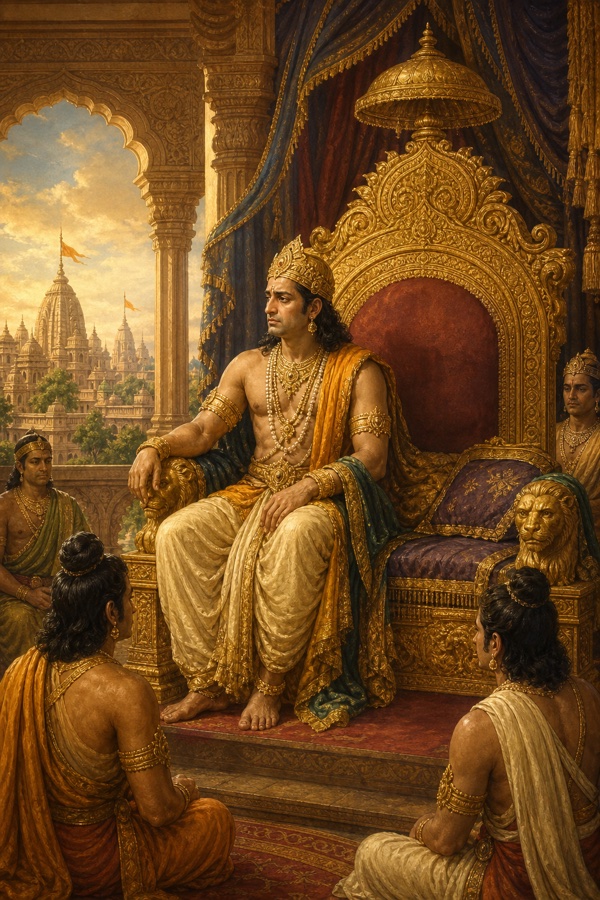
Hearing Rama’s word, the doorkeeper summoned the two princes, and they came and made their report to Raghava. Seeing Bharata and Lakshmana arrive, Rama drew them into his arms and said, “I have duly carried out the Brahmin’s great task.” The child was breathing, the promise was kept, the debt was closed; and with that behind him Rama went looking at once for something heavier to lift. “Now I wish to build once more the bridge of dharma, my Raghavas. To my mind the bridge of dharma is imperishable and never wears away, and the teaching of dharma destroys every sin. With the two of you, who are dear to me as my own breath, I wish to perform the noble Rajasuya sacrifice, in which lives eternal dharma. The god Mitra, by a Rajasuya rightly offered, won the station of Varuna. Soma, who knew dharma, by performing the Rajasuya in due form won renown and an eternal place in all the worlds. Consider now with me what is best; strive, both of you, to say what is good and fitting for what is to come.”
Hearing these words of Raghava’s, Bharata folded his hands and said, “In you the highest dharma is set fast; all the wide earth and all glory rest in you alone, one of boundless valor. Every king looks on you as the gods look on Prajapati, the lord of the worlds. As sons look on their father, mighty king, so do all kings look on you; you, Raghava, are the refuge of the earth and of all that lives. How then would you do a sacrifice, King, in which the ruin of the earth’s royal houses is plain to see? Every man on earth who has come into his strength would be brought to nothing in that rite, by the wrath of all against all. Matchless in valor and rich in every virtue, it is not right that you should undo the whole earth, when all of it lies already in your hand.”
Hearing Bharata’s words, sweet as the nectar of the gods, Rama of true valor felt a joy beyond measure, and he said to Bharata, who was the very increase of Kaikeyi’s gladness, “Your speech today pleases me and sets my mind at rest. This strong and righteous word of yours is bound up with the keeping of the earth. At this fine counsel of yours I lay aside my thought of that noble Rajasuya. Elder of Lakshmana, the wise should never do the deed that brings the worlds to grief. Even a child’s word, if it holds good, deserves to be taken; and so I have taken this just counsel of yours. You have spoken very well.” The lord of the whole earth had been talked out of the greatest rite there is by a younger brother, and he thanked him for the trouble.
Lakshmana’s Counsel, and the Story of Vritra
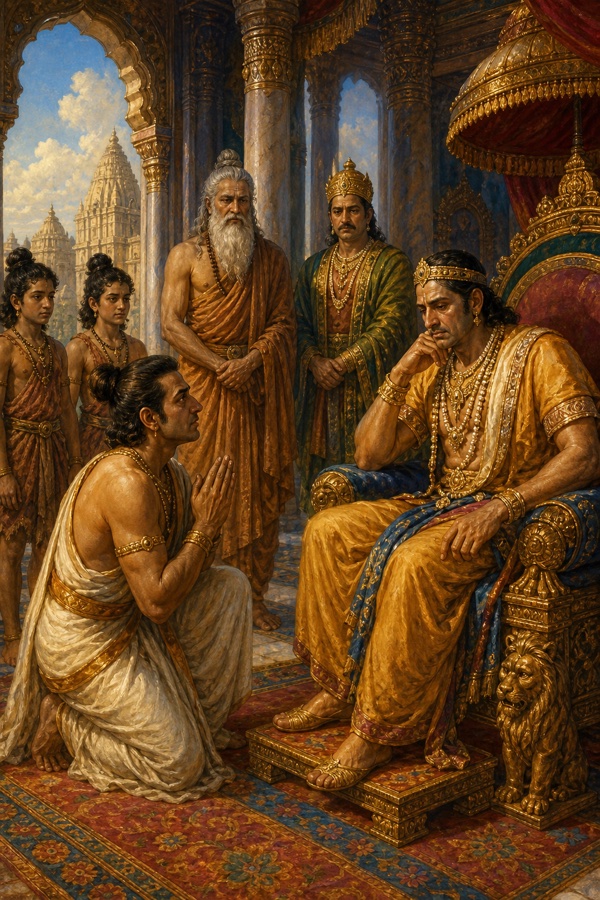
At these words of Rama and Bharata, Lakshmana spoke his own auspicious counsel to the prince born in Raghu’s line, “The great horse-sacrifice, the Ashvamedha, purifies every sin, Raghava, and it will purify you as well; hard though it is to perform, take an interest in it, if you will. It is told that in ancient days even Indra, seized by the guilt of killing a Brahmin, was made pure by the Ashvamedha alone.” Rama said, “Tell me in full how Indra, gripped by the sin of a Brahmin’s death, was made clean by the horse-sacrifice.” Then Lakshmana said, “In ancient times, in the war of the gods and the asuras, there was a great asura named Vritra, the son of Diti, honored throughout the worlds. He was a hundred yojanas long and thrice as high, and out of love and tenderness for the three worlds he kept them all within his care. A knower of dharma, grateful, settled in wisdom, with a composed mind he ruled this rich earth in righteousness. Under his rule the earth bore fruit without being plowed, and flowers and roots and fruits ran full of sweetness. Such was the wondrously rich realm he enjoyed.”
“Then a thought rose in him: ‘Let me do a penance beyond compare; penance is the highest good, and all other pleasures are mere delusion.’ Handing the charge of his citizens to his eldest son Madhureshvara, he set to a fierce penance that scorched all the gods. As Vritra did his penance, Indra grew afraid, and he went to Vishnu, saying, ‘By the power of his penance he has won all the worlds; he is righteous and strong, and I cannot master him. If he does penance yet again, then as long as the worlds endure they will all fall into his power. You are neglecting this large-hearted Vritra; were you but roused to anger, Vritra would not stand a moment. Ever since you bound yourself to him in friendship, Vishnu, he has held the lordship of the worlds. So, with a settled mind, have mercy on the worlds; by your act alone the whole world will grow calm and free of harm. All these dwellers of heaven look to you; slay Vritra and come to their aid. You have always come to the aid of these gods; you are the refuge of those who have no other.’”
The Slaying of Vritra, and Indra’s Guilt of Brahmahatya
Hearing the words of the foe-slaying Lakshmana, Rama said, “Tell me in full the slaying of Vritra.” At Rama’s asking, Lakshmana told once more that divine tale, “Hearing the words of Indra of the thousand eyes and all the dwellers of heaven, Vishnu said to the gods with Indra among them, ‘First I was bound in friendship to this Vritra, and so, even for your good, I will not myself kill this great asura. Yet your welfare must be seen to; and so I will tell you the way by which Indra shall kill Vritra. I will divide myself into three parts, so that Indra will surely kill Vritra, of that there is no doubt. Let one portion of me pass into Indra, a second into his thunderbolt, and a third into the earth; then Indra will be able to slay Vritra.’ At these words of Vishnu the gods said, ‘Let it be as you say, beyond doubt. May it be well with you; now we go, longing for the death of the demon Vritra. Join your energy to Indra.’”
“Then, with Indra of the thousand eyes at their head, all the great gods went to the forest where Vritra was. They saw that demon blazing with his own fierce heat, as though he were drinking down the three worlds and setting the sky on fire. At the sight of him the gods fell into dread: ‘How shall we kill him, and how shall we not be beaten?’ As the gods stood thinking, Indra, the smiter of the strongholds, lord of the thousand eyes, lifted his thunderbolt in both hands and hurled it at Vritra’s head. When Vritra’s head, severed by that bolt, terrible as the fire of doomsday and blazing with its own light, came crashing down, the whole world was filled with terror. But holding the slaying of Vritra to be a wrong, Indra fled at once in fear to the edge of the world. The guilt of the Brahmin’s death chased the fleeing Indra, overtook him, and sank into his limbs; and Indra was flooded with anguish.”
“With the foe slain and Indra vanished away, Agni and the other gods worshiped Vishnu, lord of the three worlds, again and again, and said, ‘Supreme Lord, you are the refuge, the forefather and father of the world; to guard all beings you took on the form of Vishnu. It was you who had Vritra killed, and now the Brahmin’s death torments Indra; tell us the way to set him free.’ At these words Vishnu said, ‘Let Indra worship me, and I will purify the wielder of the thunderbolt. Worshiping me with a holy horse-sacrifice, Indra will grow fearless once more and win again his station as Indra among the gods.’ Having spoken this word, sweet as the nectar of immortality, Vishnu, praised by the gods, went to heaven.”
Indra’s Cleansing by the Ashvamedha, and the Splitting of Brahmahatya into Four
Lakshmana, having told the whole tale of Vritra’s death, began the rest, “With Vritra, dread of the gods, slain, Indra his slayer, gripped by the guilt of the Brahmin’s death, lost his very awareness. Robbed of sense and consciousness, he hid himself at the edge of the worlds and lay there a long while, writhing like a snake. When Indra of the thousand eyes had thus vanished, the world grew sick with unrest; the earth lost her luster, her moisture dried, and the forests withered. Every river and lake and stream ran dry, and in the drought all creatures cried out in misery. As the world tottered, the gods, their minds in turmoil, set about that very sacrifice Vishnu had spoken of before.”
“Then all the gods, with their teachers and the seers, came to the place where Indra lay hidden, dazed with fear. Seeing Indra held in the grip of the Brahmin’s death, the gods set their lord at the front and performed the horse-sacrifice. So that great Ashvamedha was carried out to cleanse Indra of the Brahmin’s death. When the sacrifice was done, the guilt of the Brahmin’s death came up out of him and stood there in a shape of her own, and said, ‘Where now will you give me a place?’ Then the gods, content and pleased, said to her, ‘Divide yourself, you who are hard to bear, into four parts.’”
“Hearing the gods, the guilt of the Brahmin’s death chose four dwelling places and said, ‘With one part of me I will live during the four months of the rains in the rivers swollen with water, roaming as I please and undoing the pride of the sinful. With one part I will dwell always upon the earth, of that there is no doubt; I tell you all the truth. My third part will live in women in the flush of youth and full of pride, for three nights each month, undoing their arrogance. And those who by false pretext kill innocent Brahmins I will take for my refuge with the fourth part.’ Then the gods answered, ‘You who are so hard to house, let it be as you say; do whatever you wish.’”
“Then the gods, full of love, bowed to Indra of the thousand eyes, now free of all sickness and sin. When Indra was set again in his place the whole world grew calm, the rivers filled, the moisture came back into the earth, and Indra worshiped that horse-sacrifice, itself like a marvel. Such is the power of the Ashvamedha. And so do you too perform the horse-sacrifice.” Hearing this most winning and excellent word of Lakshmana’s, King Rama, in valor and fire the equal of Indra, was filled with the deepest content and joy.
The Beginning of the Story of King Ila
Hearing Lakshmana’s words, Rama, skilled in speech, answered with a smile, “It is as you say, Lakshmana; the death of Vritra and the fruit of the Ashvamedha, all of it is true. It is told that in ancient times there lived a king named Ila, son of the lord of creatures Kardama, master of the land of Bahlika, wealthy and most righteous. That famous king brought the whole earth under his sway and ruled it as a father rules his children. The generous gods, the wealthy daityas, the nagas and rakshasas and gandharvas and the great yakshas all worshiped him always out of fear; and when that one was roused to anger, the three worlds shook. Such was that king, firm in dharma and in valor, most generous of mind, Ila.” Then Rama told his brothers what became of him.
“That king, in the lovely month of Chaitra, went hunting in a fair forest with his servants, his army, and his mounts. He killed deer by the hundreds and the thousands, yet for all his killing the great king found no satisfaction. Bringing down ten thousand deer of a thousand kinds, he came at last to the place where Mahasena, that is Kartikeya, had been born. In that region the invincible lord Hara, Shiva, was sporting with Parvati and all his attendants around him. To give joy to the goddess Parvati, Shiva, whose emblem is the bull, had taken on the form of a woman himself, and there he stood beside that mountain stream. And where Shiva had made a woman of himself, nothing was permitted to stay a man: in every part of that forest, whatever creatures were male, and even the trees whose names were masculine, all had been changed into female shapes.”
“Meanwhile Ila, killing deer by the thousand, reached that same place. Seeing the snakes and deer and birds all turned to females, and seeing himself and his attendants turned to females too, he grieved and above all at the sight of his own changed self. Knowing the deed to be the work of Shiva, the lord of Uma, he fell into dread, and with his servants and army and mounts he took refuge with that great blue-throated god of the matted locks. Then the boon-giving Maheshvara, with the goddess at his side, laughed and said to the son of Prajapati, ‘Rise, rise, royal seer, mighty one; true to your vows, ask any boon you will, save only manhood.’ So refused by Shiva, the king was pierced with grief.”
“Being in a woman’s form, he asked no other boon. Then the king, in his great grief, bowed with his whole heart to the goddess Uma and said, ‘Ruler, boon-giver, you are the giver of boons to all the worlds. Goddess of unfailing gaze, look on me with a gentle eye and be gracious.’ Knowing the royal seer’s wish, the goddess who stood beside Shiva spoke a word Rudra himself approved, ‘Half the boon the god gives, and half of it I give. So take, of woman and of man, the half of whichever you choose.’”
“Hearing this wondrous and excellent boon, the king, in the fullest gladness of heart, said, ‘Goddess, if you are pleased, then, goddess of beauty unmatched on earth, let me be a woman for one month and again a man for the next.’ Knowing his wish, the goddess spoke her blessing, ‘So it shall be; King, while you are a man you will keep no memory of your womanhood, and while you are a woman you will keep no memory of your manhood.’ And so the son of Kardama became one month a man and the next month a woman lovely beyond compare in the three worlds: one month Ila the king, and one month Ila the woman.”
Ila Meets Budha, and the Origin of the Kimpurushis
Hearing this account of Ila from Rama, Lakshmana and Bharata were filled with wonder. With folded hands they both asked again for more of that strange state, “How did the king live in that sorry state as a woman, and when he became a man again, by what way of life did he pass the days? Tell us the truth of it.” Hearing their curious words, Rama, of the line of Kakutstha, told the tale of that king as it had come down through time, “In that first month, turned into a woman, that beauty of the world, ringed by the women who had once been her male attendants, roamed the wood. That loveliest of women wandered on foot through the forest thick with trees and thickets and creepers, and, leaving every mount behind, took her ease in the caverns of that great mountain.”
“In that woodland, close by the mountain, lay a lovely lake alive with flocks of birds. There Ila saw Budha, the son of Soma the moon, who stood in the water doing a fierce and unassailable penance, radiant as the risen moon and set in the flower of youth, a giver of fame and of desire. In wonder, Ila, with her attendants who had once been men and were now women, set the whole lake astir. The moment Budha saw her, he fell under the arrow of Kama and could not hold himself steady. He moved through the water toward her. Looking on Ila, more blessed than all the three worlds, he thought, ‘Who is this, lovelier than a goddess? Never among goddesses or naga-maidens or asura-women or apsaras have I seen such beauty. If she is not another man’s, she may be fit for me.’ So thinking, Budha came out to the bank.”
“Then those fine women came to the hermitage, called Budha, and stood worshiping him. Budha asked them, ‘Whose is this beauty of the world? Why has she come? Tell me all without delay.’ Hearing his sweet and gentle words, the women answered in sweet voices, ‘Ila has always held authority over us; she is unwed, and she roams the forests in our company.’ Hearing their veiled words, Budha chanted Avartani lore and by it learned the whole story of the king exactly as it was. Then the sage Budha said to all the women, ‘Settle here as Kimpurushis at the mountain’s foot, and make your homes on this mountain quickly. You will live always on roots and leaves and fruits, and, Kimpurushi women, you will take Kimpurushas for your husbands.’ Hearing this word of Budha, those women, now Kimpurushis, settled in great numbers by the mountain and lived there as brides.”
The Union of Budha and Ila, and the Birth of Pururava
Hearing of the Kimpurushas’ origin, Lakshmana and Bharata both said to Rama, “How great a wonder is this!” Then Rama told once more the tale of the son of Prajapati, “Seeing all those kinnaris go their way, Budha said to the woman of great beauty, as if with a smile, ‘I am Budha, son of Soma; noble lady, take me for your own with a heart of love and devotion.’ Hearing this word of Budha, and bereft now of her own people, Ila said to Budha, ‘Though I have wandered where I would, I am now in your power; command me, and do with me as you wish.’ At these wondrous words of hers, the moon’s son Budha, filled with gladness and desire, took his joy with her.”
“That honeyed month, sporting with Ila, passed like a single moment for the desirous Budha. When the month was full, the son of Prajapati, his face like the full moon, woke on his couch as a man. He saw Budha doing penance out in the lake, his arms raised and without any support, and he said, ‘Lord, I came into this hard mountain country with my attendants, but now I do not see my army; where have my people gone?’ Hearing the words of that royal seer, who had lost all memory of the other days, Budha answered in gentle, comforting words, ‘Your servants were killed in a great fall of hail, and you, faint with fear of the wind and rain, slept here in the hermitage. Do not fear, hero, and do not grieve; take heart, and may it be well with you; live here at your ease on fruits and roots.’”
“Reassured, the king, grieving at the loss of his servants, said, ‘I will give up my kingdom; without my servants I will not live a moment. Give me leave, Brahmin. My eldest son, righteous and famous, is the well-known Shashabindu; he will take up my kingdom. Having lost my happy servants and my women, I have no heart to speak of anything auspicious.’ At the king’s words, Budha comforted him most tenderly, ‘Live here in the hermitage at your ease, King. Do not grieve; when you have passed a year here, I will do you good.’ Hearing this word of Budha, tireless in action, the king resolved, as the Brahmin-seer had said, to stay there.”
“So the king lived, one month a woman ever taking her joy, and one month in the form of a man with a mind bent on dharma, and neither of the two ever learned what the other had done. In this way, in the ninth month, Ila bore to Budha a strong and radiant son, Pururava. The moment he was born, Ila, seeing the mighty child of the same hue as his father Budha, gave him into the father’s hands. And Budha, master of himself, in the remaining months when the king was a man, kept him content with tales of dharma.”
The Ashvamedha, and the Return of Ila’s Manhood
Hearing of that wondrous birth of Pururava from Rama, Lakshmana and Bharata asked again, “After living a year with Budha, what did Ila do then? Tell us the truth.” Hearing their gentle words, Rama told once more the tale of the son of Prajapati, “When Ila had come for a month into his manhood, Budha summoned the generous sage Samvarta. He called too on Chyavana; the sage Arishtanemi; Pramodana, who loved mirth; Modakara; and the sage Durvasa. Summoning them all, Budha said to his steadfast friends, ‘This king is Ila, the son of Kardama; know him for what he truly is, and do whatever will be for his good.’”
“As these Brahmins were speaking together, Kardama too came to that hermitage. Pulastya and Kratu, Vashatkara and the radiant Omkara also came to the ashram. Meeting gladly and wishing the good of Ila, the lord of Bahlika, they each spoke their counsel. Kardama gave the counsel most for his son’s good, ‘Twice-born ones, hear my word, which is for the king’s welfare. I see no remedy but Vrishabhadhvaja, Shiva whose banner bears the bull, and no sacrifice greater than the Ashvamedha, which is dear to that great god. So let us all perform that hard sacrifice for the king.’ At Kardama’s word, all those fine Brahmins set their hearts on that sacrifice, to worship Rudra.”
“Under his teacher Samvarta’s guidance, the royal seer Marutta saw that sacrifice through to its end. So near Budha’s hermitage a great sacrifice was held. When it was done, Rudra was greatly pleased, and, most glad, Shiva said before Ila to all the Brahmins, ‘I am pleased with this horse-sacrifice done in devotion. What good and what blessing shall I do for this lord of Bahlika?’ At the god’s words the Brahmins, with settled minds, prayed the god that Ila might become a man. Then the pleased Mahadeva gave Ila lasting manhood.”
“Having given Ila manhood forever, Shiva vanished from sight. The horse-sacrifice ended, and, with Hara vanished, all those far-seeing Brahmins went home as they had come. Then King Ila left Bahlika and founded in the Madhyadesha, the middle country, the glorious and peerless city of Pratishthana; and the royal seer Shashabindu took up once more the kingdom of Bahlika. In Pratishthana the mighty king Ila won in time the fine world of Brahma. Ila’s son, the Aila Pururava, came into Pratishthana. Such is the power of the horse-sacrifice, that one who had first been a woman won back his manhood and all else that is hard to gain.”
The Preparations for the Ashvamedha, and Rama’s Command
Having told his brothers these tales, Rama of measureless power said once more a word of dharma to Lakshmana, “Lakshmana, gather Vasishtha and Vamadeva, Jabali and Kashyapa, and the Brahmins skilled in the horse-sacrifice; take counsel with them, and, with a settled mind, I will let loose a horse marked with the proper signs.” Hearing Raghava’s word, Lakshmana of swift valor summoned all the Brahmins and set them before Rama. To the godlike and unassailable Rama, who bowed at their feet, the Brahmins gave their blessings. Then, hands folded, Rama spoke to those brahmanas a word of dharma about the Ashvamedha. Knowing Rama’s mind, the Brahmins bowed to Mahadeva of the bull-banner and praised the horse-sacrifice greatly. Hearing that wonderful word of the chief Brahmins about the Ashvamedha, Rama was filled with gladness.
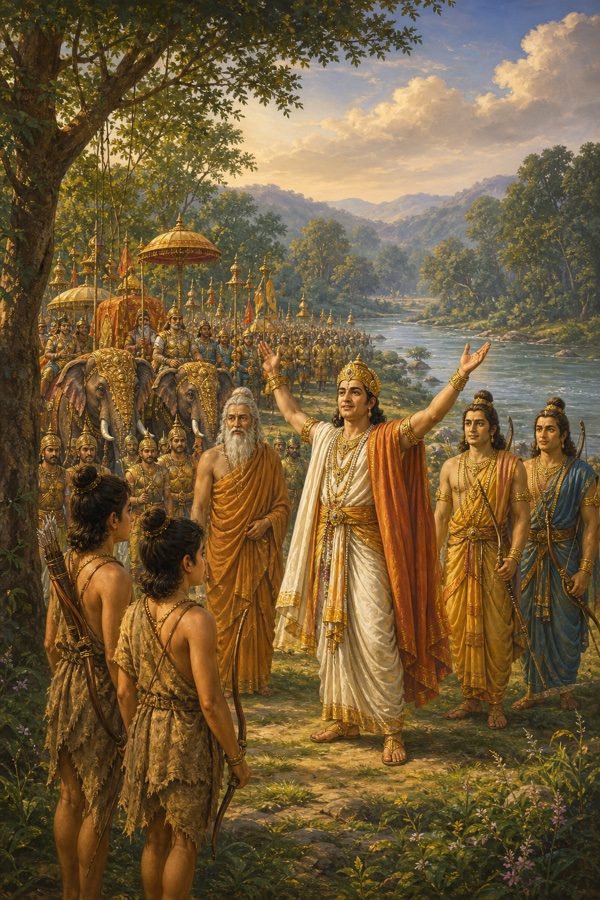
They said, “Let the sacrifice be commanded, for it is most holy.” Then, knowing the Brahmins’ mind, Rama named first, before any king or any Brahmin, the two who had come to him from outside the world of men. “Send word to Sugriva, with his many great vanaras and forest-dwellers, to come and take joy in this great festival; may it be well with them. Let the matchless Vibhishana too come to the great horse-sacrifice with his many rakshasas who move where they will. Let the fortunate kings who wish me well come quickly with their followers to see the sacrificial ground. Invite, Lakshmana, all the Brahmins who have gone to other lands and hold fast to dharma. Let the ascetic seers who have gone to far countries, and all the twice-born with their wives, be called. Let the players of cymbals, the actors and the dancers come; let a great sacrificial pavilion be raised in the Naimisha forest on the bank of the Gomati, for that wood of Naimisha is most holy; and let rites of peace be performed on every side.
“Let thousands who know dharma be gladdened to see this finest of rites, the Ashvamedha. Invite all people quickly; they will go home content, well fed, and honored in due form. Let a hundred thousand carts carry fine rice and ten thousand carry sesame and mung, and a lesser measure of chickpea and horse-gram and urad and salt, and let ghee and oil and fragrant substances go on ahead in fitting quantity. Let Bharata go before, and carefully, with tens of millions of coins of gold and silver. And let Bharata lead all these onward: rows of moving shops between the ranks, all the actors and dancers, the cooks, the many ever-youthful women, the citizens young and old, the composed twice-born, the laborers, the carpenters, the treasurers and the vaishyas, all my mothers, the inner apartments of the princes, and, for the rite of consecration, the golden image of my wife Sita, together with those who know the work of the sacrifice.” The order runs through carts and coin and cooks and mothers and comes to rest, at the end, on a statue. No man may offer the Ashvamedha without his wife beside him at the fire; and the wife of this one was somewhere out in a forest, and Rama had gold enough to fill a hundred thousand carts and nothing to put in her place except her likeness. Rama ordered costly lodges built for the mighty kings and their followers, and had food and drink and clothing made ready for those great companies. Then Bharata set out with Shatrughna. The noble vanaras with Sugriva, and all the finest Brahmins, served out the food. And Vibhishana, with a host of rakshasas and their women, waited in devotion on the seers of fierce penance.
The Release of the Horse, and the Greatness of Giving
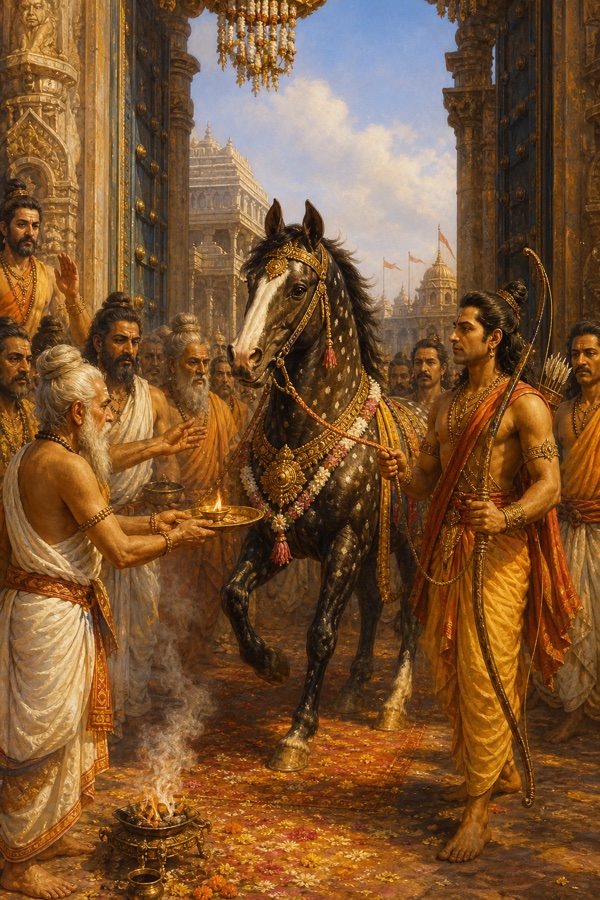
Having sent all the goods of the sacrifice ahead, Rama let loose a horse marked with the proper signs, dark for the most part like a spotted deer, and bearing every auspicious mark. From this day the horse would go where it liked for a year, and the king’s claim would travel with it wherever it wandered. Setting Lakshmana with the officiating priests to guard the horse, Rama, of the line of Kakutstha, went with his army to Naimisha. Seeing that most wonderful sacrificial pavilion, Rama was filled with boundless joy and said, “This is a place of glory.” While Rama stayed in Naimisha, all the kings came bearing gifts, and he honored them and made them welcome. In that fine sacrifice of the king’s, ringed by glad and well-fed folk, Bharata and Shatrughna were set to honor the kings, and they gathered food and drink and clothing and every kind of good. The noble vanaras with Sugriva, purified, served the Brahmins. Vibhishana with a host of rakshasas, composed, waited on the seers of fierce penance. And costly lodges were arranged for the mighty kings and their followers.
So that horse-sacrifice began well, and the journey of the horse, guarded by Lakshmana, set out on its course. In that finest of sacrifices of Rama, no word was heard but the cry of “Give, give,” until every suppliant was satisfied; whatever was wished for in that great rite, all of it was given. Sweets of every kind, of molasses and of sugar, were given as well. The vanaras and rakshasas gave so much to those who came asking for food that no word could pass their lips but of contentment. In that great Ashvamedha of the king’s, ringed by glad and well-fed creatures, not one was seen dirty or wretched or lean. Food and drink and clothing and every good were given. The long-lived great sages who had come, men whose memories ran back through ages, could not recall a sacrifice so full of giving. Whoever wanted gold received gold, whoever wanted wealth received wealth, whoever wanted gems received gems; heaps of silver and gold and gems and cloth were seen given out without end. The ascetic seers said, “Such a sacrifice we have never seen before, not Indra’s, nor Soma’s, nor Yama’s, nor Varuna’s.” On every side the vanaras and rakshasas stood and gave with open hands to all who asked for clothes and wealth and food. The monkeys of Kishkindha and the night-wandering rakshasas of Lanka, who had met each other last across a battlefield, stood side by side in the same lines handing out bread. And this sacrifice of Rama, rich in every virtue, ran on for more than a year without a single hindrance.
The Coming of Valmiki, and His Command that Lava and Kusha Sing the Ramayana
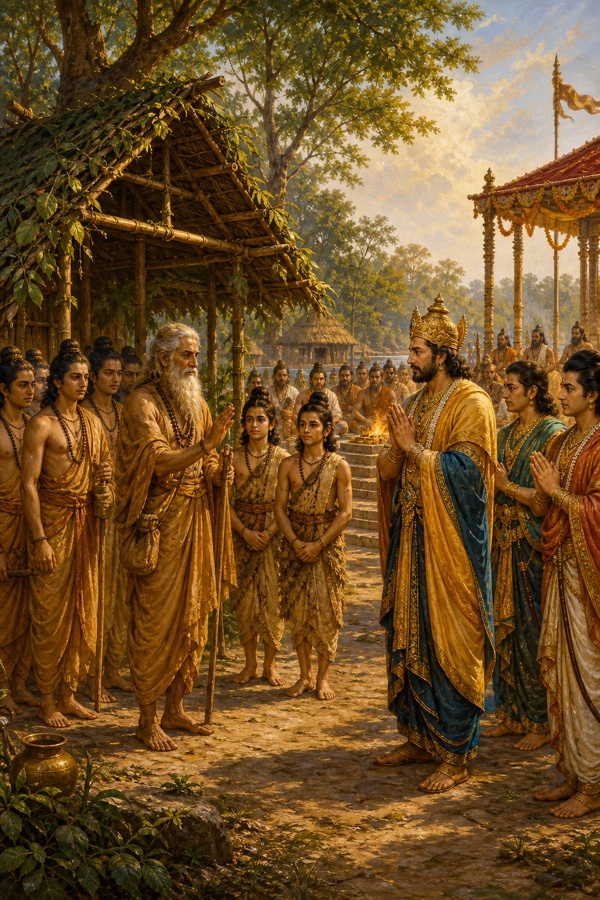
While that wonderful sacrifice went on, the sage Valmiki came there swiftly with his disciples. Seeing the sacrifice, divine and a marvel to see, he had fine leaf-huts raised in a quiet place among the carriages of the sages. A little way from the sacrificial ground, near his own pleasant hut, he had many fair carts set down, laden with fruits and roots. There Valmiki took up his stay, and King Rama and the other great sages welcomed him with all honor.
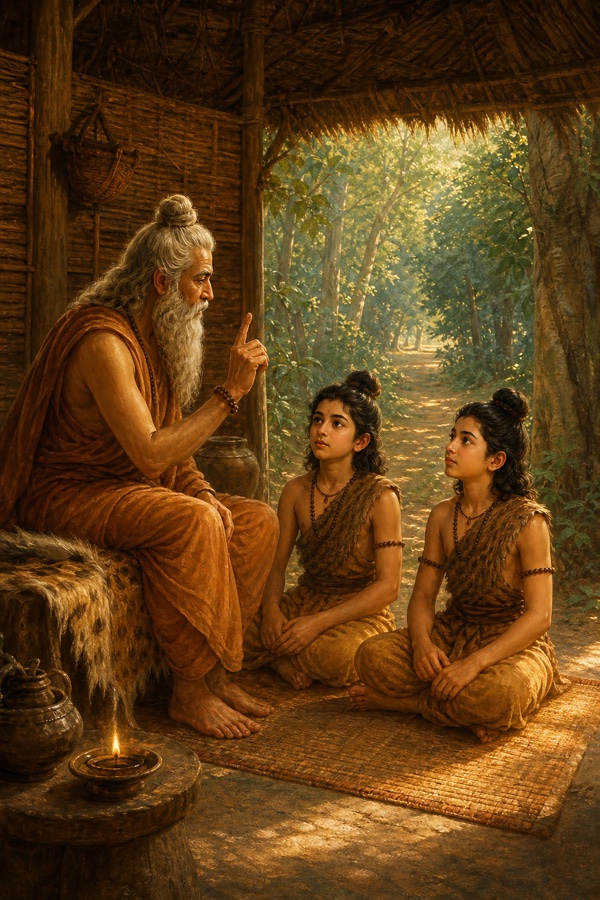
Valmiki said to his two glad disciples, “Go now, both of you, with settled minds, and sing the whole poem of the Ramayana with the greatest joy. Sing it in the holy huts of the sages, in the homes of the Brahmins, in the lanes and on the highways and in the houses of kings, at the door of Rama’s own palace, wherever the work of the sacrifice is going forward, and above all before the officiating priests. Eat these sweet fruits of many kinds, grown on the mountain peaks, and sing. Eating fruits and fine roots, my children, you will not grow tired, nor will you slip from the flow of the melody. And if the lord of the earth, Rama, should call you to be heard, then sing as is fitting before the seated sages.
“As I told you before, sing twenty cantos a day, rich in their many measures, in a sweet voice. Do not covet the least thing for the sake of wealth; what has wealth to do with dwellers in a hermitage, who live always on fruits and roots? If Kakutstha Rama should ask you, ‘Whose sons are the two of you?’, say only this to the king, ‘We are both the disciples of Valmiki.’ Tuning these sweetest of strings to their proper notes, sing sweetly and without a care. Sing from the very beginning, and do not slight the king; by dharma a king is the father of all beings. So, both of you, with glad hearts, tomorrow at dawn, with settled minds, sing the sweet song set to the flow of the strings.” Instructing them so, again and again, the sage Valmiki fell silent.
At the sage’s command the two sons of Maithili, that is Sita, the foe-taming Lava and Kusha, said, “We will do so,” and went back. Holding the sage’s wonderful word in their hearts, the two boys, eager to sing, passed the night in happiness, like the Ashvin twins who had learned the art of statecraft from Shukra. In the morning they would sing a king his own life, from its first line, standing where he could reach out and touch them.
The Sweet Singing of the Ramayana in Rama’s Assembly
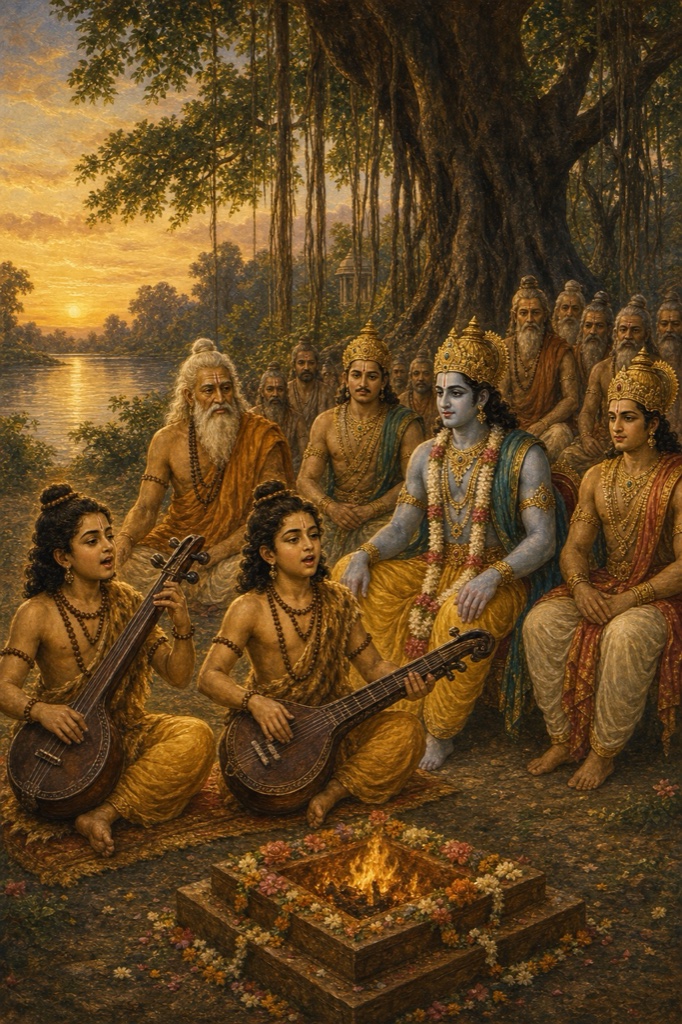
When the night was past and the day had risen, the two boys bathed, offered oblations in the fire, and, as the sage had told them, began to sing there in every place. Rama heard that mode of recitation, never heard before by anyone, composed in the arrangement of notes set by the teachers of old and adorned with song. Hearing that song, rich in its measures and joined to the flow of the strings, from the two boys, Rama, of the line of Raghu, was filled with wonder.
Then, in the interval of the sacrificial work, Rama gathered together the great sages, the kings, the learned, the vaishyas, the tellers of ancient lore, the word-learned old Brahmins, the knowers of the marks of musical notes, the fine Brahmins eager to hear the song, the gandharvas skilled in those marks, the knowers of foot and syllable and compound, those grounded in meter, the masters of the measures of art, the adepts in astrology, the knowers of ritual, the masters of practical craft, the knowers of speech and gesture, the logicians skilled in cause and method, the widely read, the knowers of meter, the scholars of the Puranas, the fine Brahmins learned in the Veda, the knowers of pictorial poetry, the knowers of verse and its rules, the masters of song and dance, the knowers of the shastras, those skilled in polity, and the expounders of the meaning of the Vedanta; and he seated the two singers in the midst of the assembly. Every kind of learning the age had was ranged in a ring around two boys in bark.
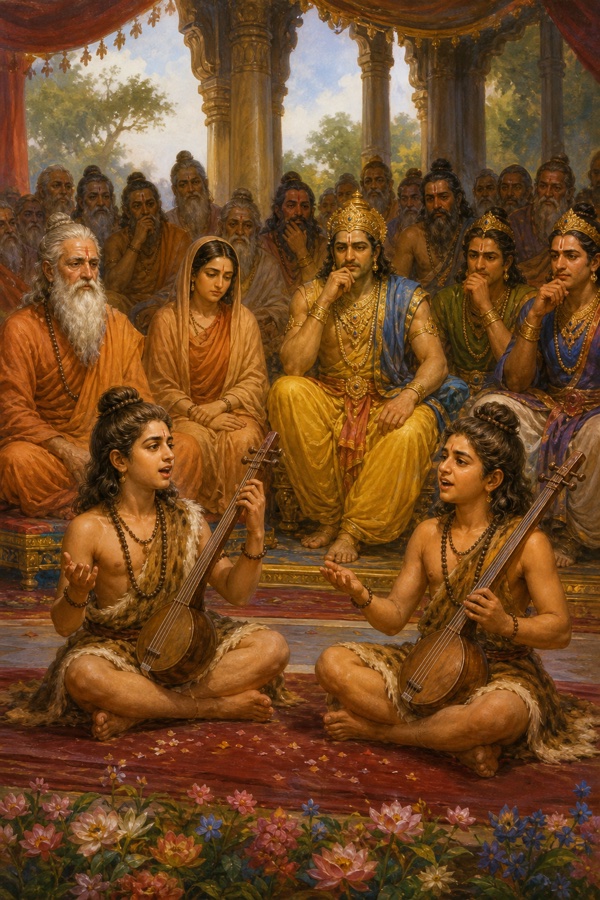
Lifting still higher the joy of the listeners who talked among themselves, the two sage-boys began the song. Then the more than human sweetness of gandharva music flowed on, and no listener could be sated by the wealth of that song. All the sages and mighty kings, glad at heart, gazed again and again at the two boys, as though they would drink them in with their eyes. With one accord they said among themselves, “These two are the very likeness of Rama, as if a reflection had risen out of a reflection. Were they not wearing matted locks and garments of bark, we would find no difference at all between these two as they sing and King Rama himself.” The whole assembly had seen it inside a minute. The king went on listening to the music.
While the citizens and country-folk talked so, the song went on from the very beginning, from the first canto that Narada had shown. From there the two sang on through twenty cantos. Then, in the afternoon, the brother-loving Rama, having heard those twenty cantos, said to his brother, “Kakutstha Bharata, give these two noble boys at once eighteen thousand gold coins, and whatever else they may ask.” Bharata began at once to give it to the two boys separately. But Kusha and Lava would not take the gold held out to them, and in wonder they said, “What use is this to us? We are forest-dwellers, and live on fruits and roots; what would we do with coins of gold and silver in the forest?” It was their teacher’s own sentence coming back out of their mouths, in a hall where every other man breathing would have taken the money. At their words the listeners and Rama were filled with wonder and with curiosity.
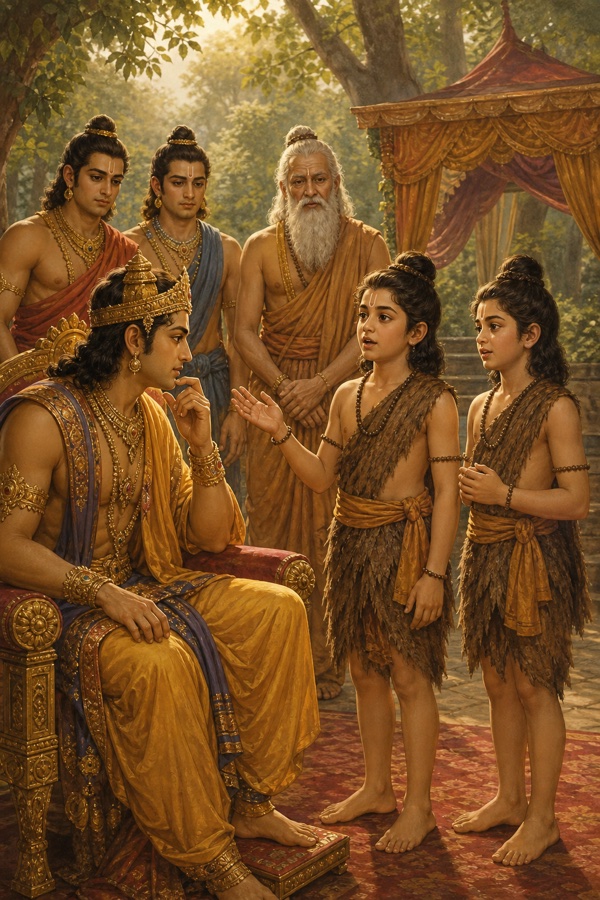
Eager to know the maker of the poem, Rama asked the two sage-boys, “How great is this poem? What is the fame of this noble poet? And where is that sage who made this great poem?” To the asking Raghava the two boys said, “Its maker is Valmiki, who has come to this sacrificial ground. In this poem he has set your whole life-story out before you.” “The ascetic Bhargava, Valmiki, has composed twenty-four thousand shlokas, together with a hundred legends. From the beginning, King, five hundred cantos and six kandas, including the Uttarakanda, our teacher, that great sage, composed with your life-story in mind, and they will stand as long as living beings endure. Great chariot-warrior king, if the wish to hear it is in your mind, then hear it gladly, with your brothers, in the interval of the sacrifice.” Rama said, “Very well,” and the two, taking leave of Raghava, went gladly to where Valmiki was. Rama too, with the sages and the noble kings, having heard that sweet song, went toward the place of the sacrificial rite. And Rama of the line of Kakutstha listened to the song itself, set in its proper metres, its words well chosen and its beat and time kept true, as Kusha and Lava sang it to the lute.
Messengers to Valmiki, and the Resolve for Sita’s Vindication
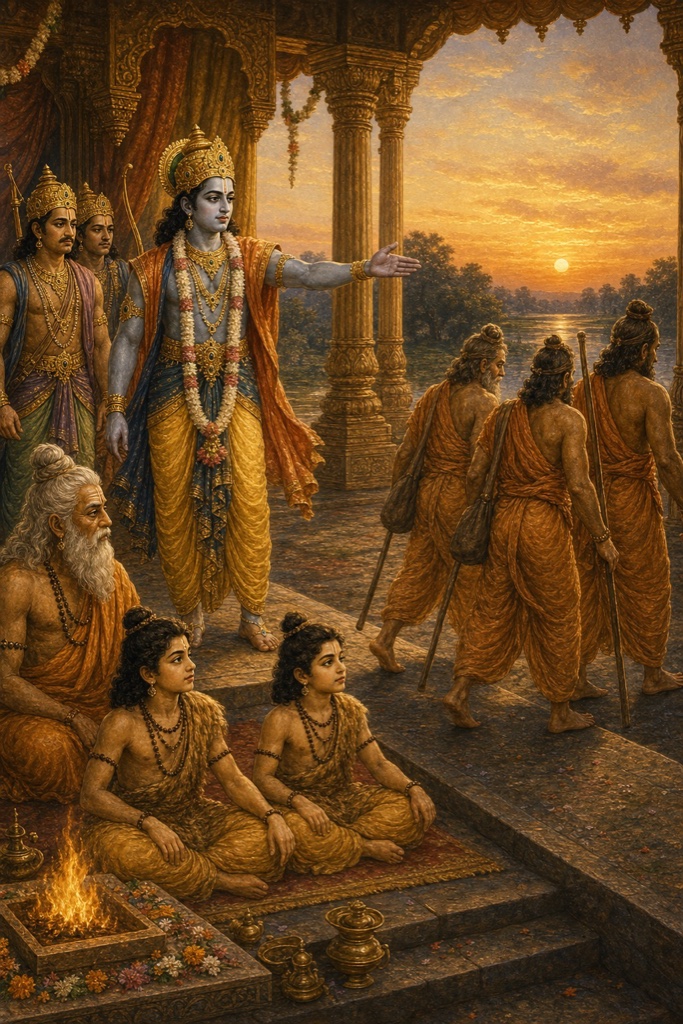
Rama, with the sages and kings and vanaras, heard that most auspicious song for many days. And somewhere in those days the poem told him what no living person in his kingdom had been willing to say to him: from the song itself, Rama knew Lava and Kusha to be the sons of Sita, and he spoke in the midst of that assembly. Calling to him messengers of pure conduct, and having turned the matter over in his mind, he said, “Go from here to Valmiki, and give him this word of mine. If Sita is pure in her conduct, if there is no stain in her, then let her, with the leave of the great sage Valmiki, give the proof of her purity here. Learn the sage’s wish and Sita’s mind, and if she is willing to give the proof, tell me quickly. Tomorrow at dawn, let Maithili Sita, the daughter of Janaka, in the midst of this gathering, take an oath for the clearing of my name.”
Hearing Raghava’s word, the messengers went at once to Valmiki. Bowing to that one of measureless power, ablaze with his own light, they gave him Rama’s gentle and sweet words. Knowing their speech and Rama’s mind, the radiant sage said, “So be it; may it be well with you; as Raghava says, so Sita will do, for to a woman her husband is a god.” At the sage’s word the royal messengers returned to Rama and told him the sage’s whole word. Then, hearing Valmiki’s word, the glad Rama, of the line of Kakutstha, said to the sages and kings gathered there, “Let all the blessed sages with their disciples, all the kings with their followers, and all others who wish it, see the oath of Sita.” Hearing Raghava’s wonderful word, a great sound of approval rose among the chief sages. The noble kings praised Raghava and said, “This becomes you alone on all the earth, and no other.” So, resolving that the oath would be taken on the morrow, the foe-slaying Raghava dismissed that assembly. Fixing the next day for the oath, Rama sent off all the sages and the kings.
Valmiki Bears Witness to Sita’s Purity
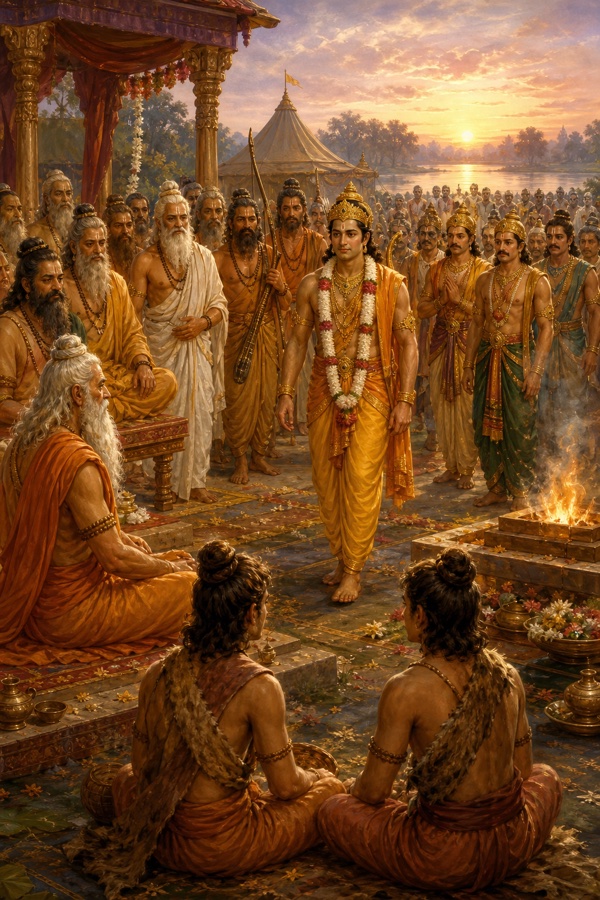
When that night had passed, King Rama went to the sacrificial pavilion and began to summon all the sages: Vasishtha, Vamadeva, Jabali, Kashyapa, Vishvamitra, Dirghatama, the great ascetic Durvasa, Pulastya, Shakti, Bhargava, Vamana, Markandeya, Maudgalya, Garga, Chyavana, the dharma-knowing Shatananda, Bharadvaja, the bright son of Agni, Narada, Parvata, Gautama, Katyayana, Suyajna, and Agastya, that treasure of penance, these and many other sages of firm vows, all came filled with eagerness. Mighty rakshasas and strong vanaras came too, all in curiosity. Thousands of kshatriyas, shudras, vaishyas, and Brahmins of firm vows from many lands also came. Those set fast in knowledge, in works, and in yoga, all gathered to see the oath of Sita. Never in that age had so many been called to watch one woman answer a rumor.
When all who had come stood still as stone, Valmiki came there quickly with Sita. Behind the sage, her face lowered, her hands folded, her throat choked with tears, Sita walked with Rama held fast in her mind. She came in ochre cloth, with the forest years still on her, through the largest gathering the world could put in one place, and she came looking at the ground. Seeing Sita coming behind Valmiki, like the Veda walking behind Brahma, the people raised a great cry of approval. Then from all that grieving, sorrow-struck throng rose a sound like a single wail. Some cried, “Bravo, Rama,” and some, “Bravo, Sita”; and some who watched there praised the two of them together.
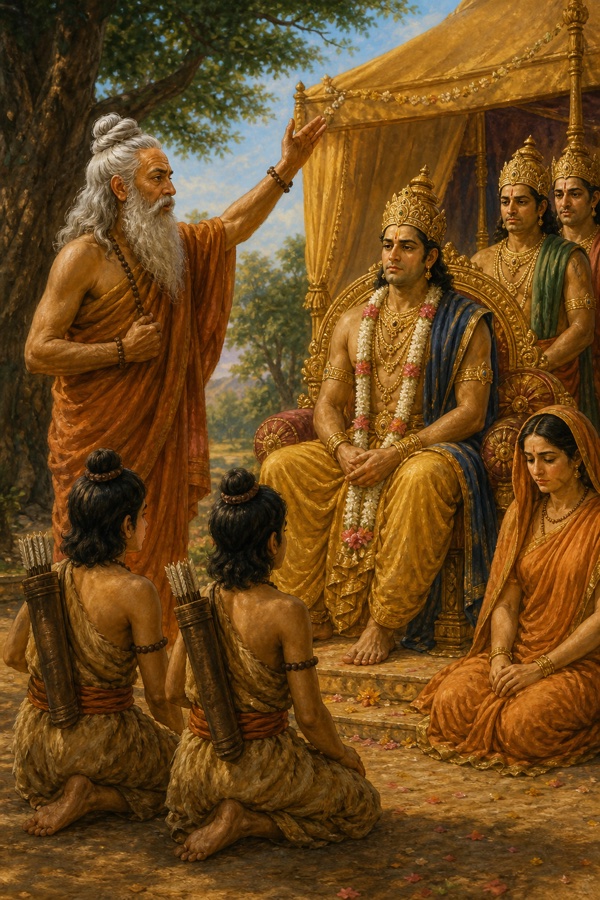
Then, entering the midst of that crowd, Valmiki with Sita said to Raghava, “This Sita, true to her vows and walking in dharma, was cast off by you near my hermitage because of the slander of the people. You are afraid of that slander, Rama of the great vow; Sita will give you her proof; grant her leave for it. These two sons of Janaki, these twin-born Kusha and Lava, are your own sons, and unassailable; this I tell you truly. I am the tenth son of Prachetas, Raghava, and I do not recall ever speaking a false word; these two are surely your sons. I have done penance for many thousand years; may I win no fruit of it, if Maithili be wicked. In mind and word and deed I have never done a sin before; may I win the fruit of that alone, if Maithili be without sin. Raghava, by the five elements and the sixth, the mind, in deep reflection I knew Sita to be pure, and only then did I take her up from the bank of that forest stream. This woman, pure in conduct, sinless, whose god is her husband, will give her proof to you, who fear the slander of the people. And so this woman, whom you cast off with a mind clouded by that slander, I have known by my divine sight to be pure in her conduct and given wholly to you, though you knew her holy long before.”
Sita’s Oath, and Her Passing into the Lap of Mother Earth
At Valmiki’s word Raghava, hands folded, looking on Sita before them all, replied, “Brahmin who knows dharma, it is as you say; by your stainless words I am convinced. Sita gave the proof of her purity before, in the presence of the gods, and took her oath, and only then did she enter my house. The slander of the people was strong indeed, and for it I cast off Maithili. Though I knew her sinless myself, Brahmin, out of fear of the people I cast off Sita; forgive me that. I know that these twin-born Kusha and Lava are my sons; and let my love now rest in Maithili, proved pure in the sight of the world.” He said it in the open, in front of the whole earth: he had known she was innocent, and he had sent her away regardless.
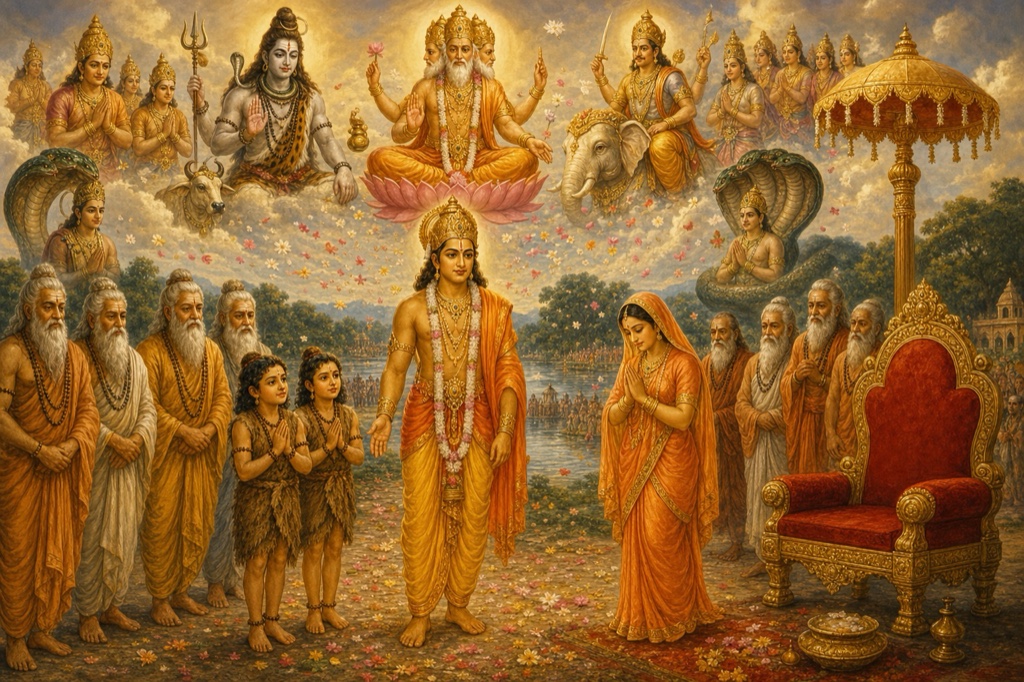
Knowing Rama’s mind, at the hour of Sita’s oath the mighty gods came, Mahendra and the rest. Setting Grandsire Brahma at their head, the Adityas and the Vasus, the Rudras and the Vishvedevas and the Maruts, all the Sadhyas, all the great seers, the nagas, the suparnas, and the siddhas, all glad at heart, came. Heaven had emptied itself into the sky over one clearing in the Naimisha wood. Seeing all the gods and seers come for Sita’s oath, Raghava said again, “By the stainless words of the sage Valmiki I am convinced. Let my love rest in Vaidehi, proved pure in the sight of the world; let all my love rest in Sita.”
Then a wind, divinely scented, lovely, blessed, and holy, blew and gladdened that whole throng on every side. All the men come from many lands watched, with settled minds, that wonderful and unthinkable thing, such as had been in the earlier Krita age. Clad in ochre robes, Sita looked on all who had come, folded her hands, lowered her face and her eyes, and said, “As I have never in my mind thought of any but Raghava, so let the goddess Madhavi, Mother Earth, grant me a place to enter. As I worship Rama in mind and word and deed, so let the goddess Madhavi grant me a place. As I have spoken this truth, that I know none but Rama, so let the goddess Madhavi grant me a place.” Three times she swore she had never held any man but him in her mind, and three times what she asked for it was the ground.
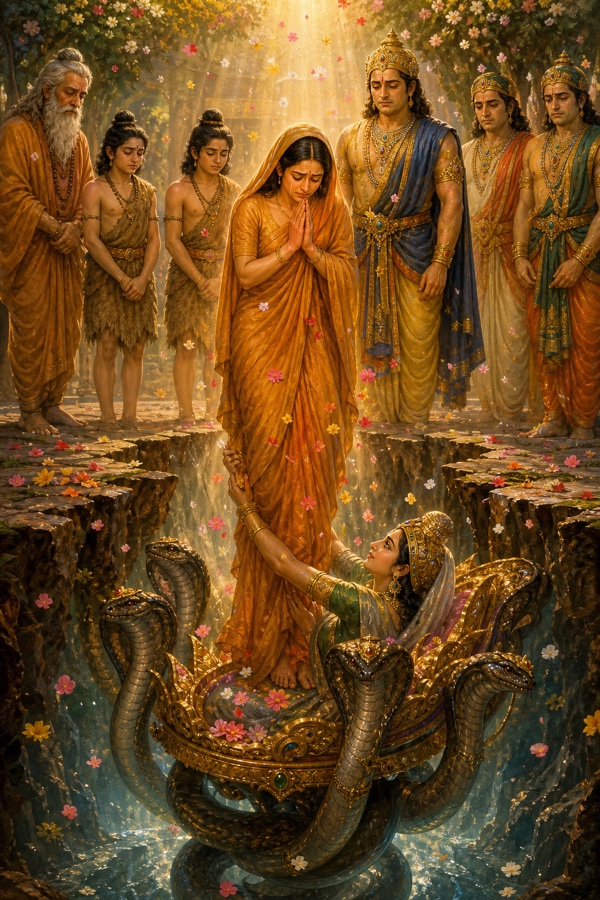
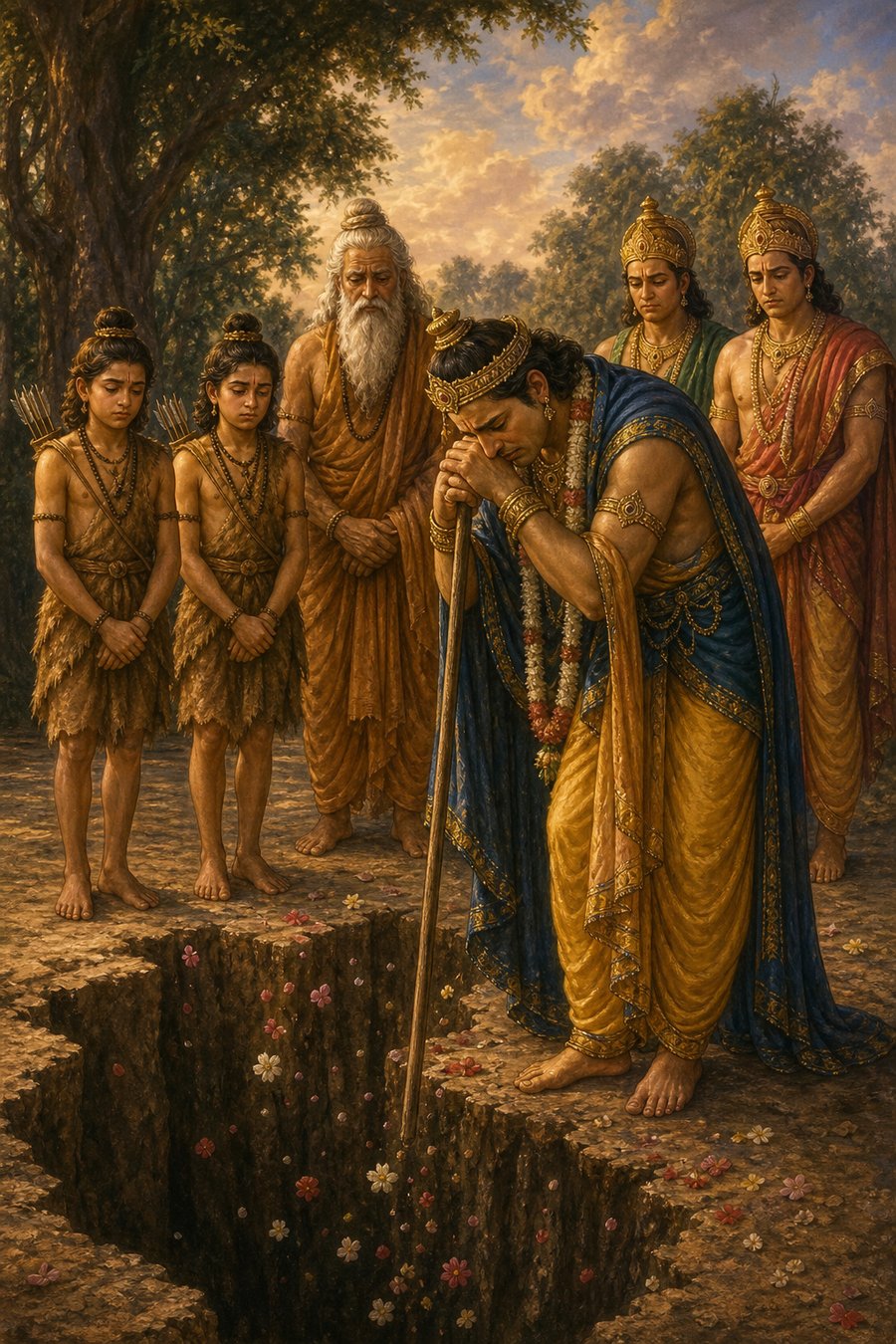
As Vaidehi took her oath, the wonder came to pass: out of the earth rose a divine and matchless throne, borne on the heads of mighty nagas, decked with divine gems and shining with a divine form. In that very moment the goddess Dharani, the Earth, took Maithili in both her arms, welcomed her with words of greeting, and seated her upon that seat. The daughter the Earth had once given up out of a furrow in Mithila was being taken back. As Sita sat there and passed down into the netherworld, an unbroken shower of divine flowers fell upon her. Then in the sky the gods rose all at once and made a great cry of “Well done”: “Well done, well done, Sita, whose conduct is such as this!” So crying, in words of many kinds, the gods in the sky, seeing Sita’s descent, called out with hearts full of gladness.
All the sages and the tiger-kings in the sacrificial pavilion praised Sita in wonder. In the sky, on the earth, every creature moving and unmoving, and in the netherworld the huge danavas and the lords of serpents, all cried out. Some cried out for joy, some sank into meditation, some kept their eyes on Rama, and some, as though robbed of sense, kept their eyes on Sita. All had gathered there to see Sita’s passing into the netherworld; and in that moment the whole world seemed to stand stunned and spellbound. Rama had asked the world for a proof of her, and the world had been given one it would never be able to doubt, and it had cost him the only thing he had left to lose.
The gist: In front of the whole assembly Sita swore that in mind and word and deed she had never held any man but Rama, and asked, as the proof of it, that Mother Earth take her in. A divine throne borne on the nagas rose out of the ground, the goddess of the Earth took Sita in both arms and seated her, and Sita went down into the netherworld. The gods rained flowers and cried her praise, and the world was left standing there with nothing to say.
Source: Srimad Valmiki Ramayana, Uttarakanda, Cantos 76 to 97. The Gita Press Hindi edition is the controlling witness. The Sanskrit e-text and an independent complete translation were used to verify names, sequence, and principal events. Where recensions differ, this retelling follows Gita Press.
Basis: Valmiki Ramayana (Gita Press, Gorakhpur)