On this page
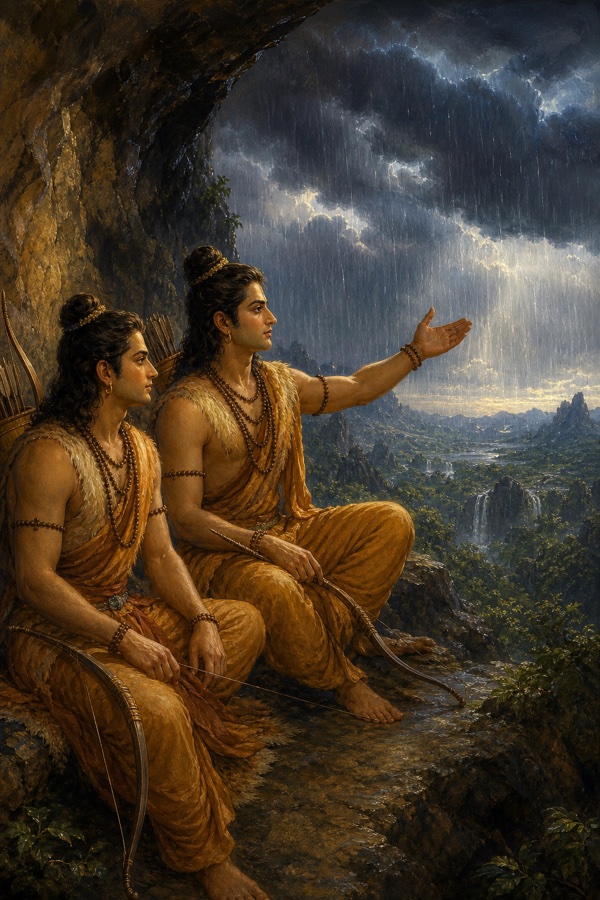
Vali had been killed, and Sugriva had been anointed on the throne of Kishkindha. Within that cave-city Sugriva went back to his splendor, and Rama, with Lakshmana, climbed to the crest of Prasravana, the mountain of the springs. This is the peak that men also call Malyavan. It rang with the calls of tigers and deer and shook with the terrible roar of lions; it was clothed in thickets and creepers, dense with countless trees, alive with bears and monkeys and langurs and wildcats, and because it was built of nothing but stone it looked like a heaped-up mass of clouds. On the summit of that mountain Rama chose a wide, long cave for his dwelling. Then the prince born in Raghu’s line, the joy of his line, said to his gentle younger brother Lakshmana, who quickens all that is good, a grave word fitted to the hour. It had already been settled with Sugriva that once the rains were over, parties would go out in every direction to search for Sita, and until then the waiting had to be done here. “This mountain cave is lovely, son of Sumitra, wide, and open to the air. Through these nights of rain we will stay here.”
The cave of Prasravana and Rama’s grief of separation
Rama described that mountain crest to his beloved brother the way a man shares the gladness of his own heart, and for as long as he was describing it the sharing held. “This summit is lovely and superb. It is set with black and white and red-veined stone, rich with a hundred minerals, and never quiet, for the frogs of its rivers keep up their music from dusk until the light comes back. Trees of every kind, creepers painted with bright flowers, the babble of many birds, and the calls of splendid peacocks make this place a delight. Thickets of malati and kunda, and the flowering trees of sinduvara, shirisha, kadamba, arjuna, and sarja, adorn it, and when the wind turns through them the whole slope gives up its scent at once. And not far from our cave lies a lovely step-pool, bright with open lotuses, that will brim over when the rain fills it.”
“The cave slopes to the northeast, its mouth opens to the southwest, and because the ground rises to the west it will shelter us from the eastern winds and the driving rain. So it will be pleasant for us here.” At the mouth of the cave lay a slab, level and smooth, broad and black as a heap of ground collyrium, stone enough for two men to sit out a storm on. Rama pointed north to an auspicious peak that stood dark as a mass of soot, like a thunderhead risen on the horizon and halted there, and south to a white peak like the crest of Kailasa, pale as a white robe and rich with many minerals. On the far side of the cave a river ran, like the Mandakini of Trikuta, free of mud, flowing to the east, ringed with sandal and tilaka, sal and tamala, atimukta, padmaka, sarala, and ashoka. Along its banks stood vanira and timida, bakula and ketaka, hintala and tinisha, nipa and vetasa and kritamala, of every shape and size, so that the water went by dressed like a young woman decked from throat to ankle in her clothes and her ornaments. Hundreds of flocks of birds and the mated pairs of chakravaka ducks made it seem as though it were laughing. In one place it lay under blue lotuses, in another under red, and in another under the closed buds of white water-lilies.
“Ah this country is beyond lovely. Here we will live at ease. Not far from here lies Sugriva’s charming city of Kishkindha, full of wonderful groves. And from it comes the noise of song and instruments, and the shouting of monkeys drunk with joy, keeping time with tabor and drum. Sugriva, best of the monkeys, has his wife again and his kingdom and a great fortune besides; surely he is rejoicing now among the people he loves.” So saying, the prince born in Raghu’s line, with Lakshmana, settled on that same mountain of the springs, with its caves and its bowers. He had named every beauty in sight, and last of all he had named the sound carrying up the valley to the mouth of his cave, the sound of another man’s happiness.
Yet even on that mountain, laden with flowers and fruit and rich with every ease, Rama found no gladness at all, for he kept remembering his stolen love, dearer to him than his own breath. Lying on his bed at night, sleep would not touch him, above all when the full moon rose over the eastern hills and laid its cold light along the stone; then, with that risen grief, his mind would drown in tears. A man may be handed a whole mountain with every beauty on it and hold nothing in his hands, if the one he would have shown it to is not there to be shown. Seeing Kakutstha forever sunk in sorrow and lamenting, Lakshmana, who shared his brother’s pain and had shared every road since Ayodhya, spoke to him words that were half a prayer.
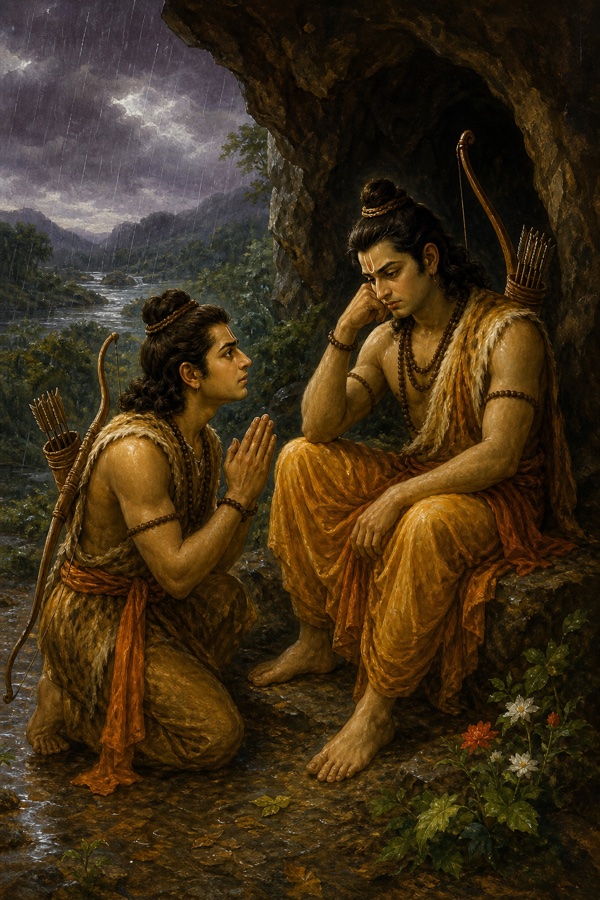
“Hero, let go of this anguish now. Grief does not become you. You know full well how every purpose of a grieving man comes to nothing. You are a man of action in this world, one who honors the gods and trusts in the world to come, righteous by nature and tireless. Idle, you will never kill that enemy Ravana, who works his fraud where valor is called for. He did not come at you in the open with a weapon in his hand; he came to your door in the ochre of a wandering ascetic, with his begging bowl held out, and took her while your back was turned. A man of that kind is undone only by a mind that stays awake. Tear out by the root this sorrow that ruins every undertaking, and set your will hard; only then will you be able to destroy that demon with his whole house. Kakutstha, you could turn over the earth itself, with its oceans and forests and mountains, so what is Ravana to you? The rains have only just begun. Wait for autumn, and then you will kill Ravana with his realm and his army. I am only waking the valor that sleeps in you, the way a fire hidden in ashes is kindled to a blaze by an offering of clarified butter.”
Praising this wholesome and auspicious counsel, the prince born in Raghu’s line answered his loving brother with tender words. “Lakshmana, you have spoken exactly as a man should speak who is devoted, affectionate, a well-wisher, and armed with a valor true to itself. This sorrow that destroys all undertakings I have cast off. Now I will urge on that fire in me that runs unchecked when the moment for valor comes. I will wait for autumn and stand firm on your word, watching for Sugriva’s kindness and for the rivers to run clear. A hero who has received a service always bends himself to repaying it; and the ingrate who does not repay wounds the hearts of all good men.” He was speaking of his own debt, of the alliance he had sealed by clasping Sugriva’s hand and walking with him around a kindled fire while it burned as their witness. The same word would come back to this mountain before the season turned, and it would be pointed the other way. Lakshmana joined his palms and welcomed this word of Rama’s, and said, “Sugriva, king of the monkeys, will soon accomplish this task that you desire. So, king, hold back your anger and wait for autumn, and bear on this lion-haunted mountain, with me, these four months of delay, even though you are able to destroy the enemy this hour.”
The description of the rainy season
Having killed Vali and crowned Sugriva, dwelling on the level ground of Mount Malyavan, Rama described the rainy season to Lakshmana in this way; and every image he reached for came back to him carrying Sita. “That famous season of rains, agreed upon between us as the interval of rest before the search for Sita, has now come in due order. Look how the sky is roofed with clouds as vast as mountains. Drawing up the water of the seas with the rays of the sun, the sky has carried, as it were, a nine-month burden, and now gives birth to the life-giving rain. Climbing the sky by the stairs of its clouds, a man might string garlands of kutaja and arjuna flowers on the sun to deck it. The clouds lie on the sky like moist white bandages, red at the edges where the twilight has stained them, as though the heavens had wounds that needed dressing. With soft-breathing winds and white clouds, the sky, dyed in the colors of twilight, looks like a lover sick with longing.”
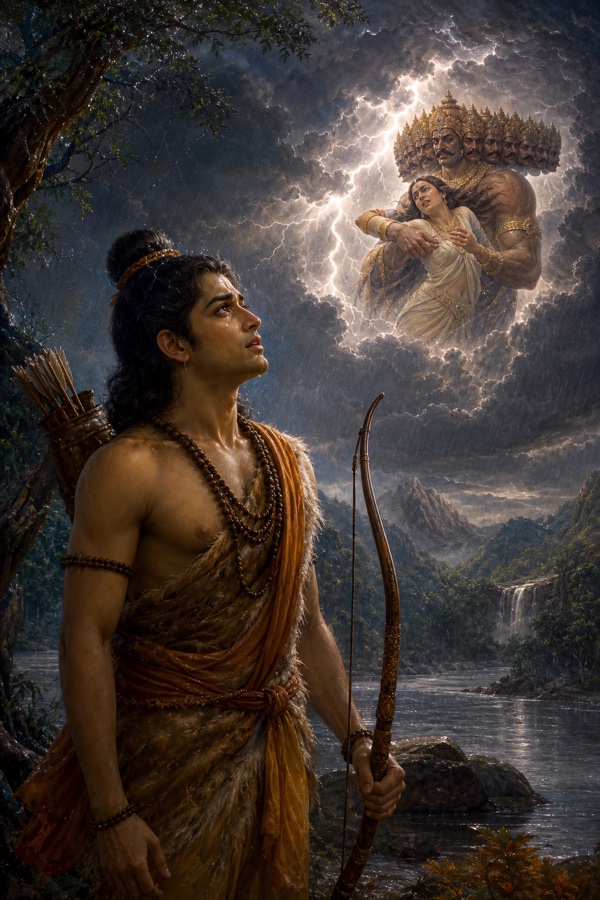
“The earth, first scorched by the sun and then drowned in fresh rain-water, is giving up its heat in a haze that lifts off the hot stone, exactly as grief-worn Sita sheds her tears before the eyes of my mind. The wind that slips out of the clouds, cool as a leaf painted with camphor and heavy with the scent of ketaka, could almost be drunk from cupped hands. This mountain, its arjuna trees in flower, fragrant with ketaka, its enemy the forest fire put out, is being bathed in torrents, as Sugriva was bathed from the pitchers at his consecration, garlanded with arjuna, his robes scented with ketaka, his enemy, his own elder brother, brought to an end. Lashed on every side by the golden whips of the lightning and groaning in its thunder, the sky seems to suffer somewhere deep within. The lightning flashing inside a dark cloud seems to me like poor Vaidehi struggling in the arms of Ravana, one thin bright thing caught inside a black one and unable to get out. Look at the kutaja trees flowering on the mountain crests; even in me, whom sorrow has broken, they wake up love. The clouds, wearing the falling water like a sacred thread over black deerskins, and the mountains sounding like the chant of the Veda where the wind fills their caves, look like students at their sacred study.”
“The rivers run, the clouds pour down, the rutting elephants trumpet, the woods grow sweet, men parted from their loves sink into their own thoughts, peacocks dance, and the monkeys are made easy by the plenty of fruit. The swans are on the road to Manasa, and the chakravaka ducks have found their mates. Every living thing in the world has somewhere to be going and someone waiting at the other end of it. The paths are so broken by the ceaseless rain that no cart travels them. The dust of the roads has settled, the wind has turned cool, the torments of the hot weather are over, and men who live far from home are making their way back to their own country. The sky, clear in one place and clouded in another, looks like a calm sea scattered with islands. The mountain streams race to the sea carrying sarja and kadamba blossom, reddened by the minerals of the rocks, with the cries of the peacocks following them down. The earth, in its carpet of new grass speckled with scarlet indragopa insects, looks like a woman wrapped close in a parrot-green blanket sprinkled with red. The rivers, sweeping away their crumbled banks, carrying chakravakas on their backs, race toward their lord the sea the way a woman goes to meet her beloved.”
“Slowly, in his yogic sleep, Vishnu sinks deeper, and for these four months the world turns without its keeper awake in it. The river runs in flood toward the sea; the glad heron flies toward the cloud; and the loving woman toward her love. The bees settle on the boughs of the kadamba and let go, for a moment, of their intoxication. The ripe jambu fruit bursts open with its juice and seems drained by the swarming bees. The clouds, decked with the banner of lightning and garlanded with lines of cranes, roar like rutting bull-elephants set for battle. Halting again and again on the mountain crests, carrying their weight of water, the clouds move on. Indra is lost in his play with the clouds. In the woods a concert has begun: the rumble of the clouds for the tabor, the humming of the bees for the vina, the croaking of the frogs for the beat kept in the throat; here the peacocks dance, there they sing, and elsewhere they sit on the treetops with their jewelled tails hanging loose, like an audience come to watch. The frogs, roused from their long sleep by the thunder and whipped by the fresh showers, croak in every voice. Hidden all day, the sun is known to have set only because the birds go back to their nests, the lotuses close, and the malati opens. With their great floods the clouds drown out even the roar of the seas, fill the rivers and pools and lakes and step-wells, and cover the whole earth with water.”
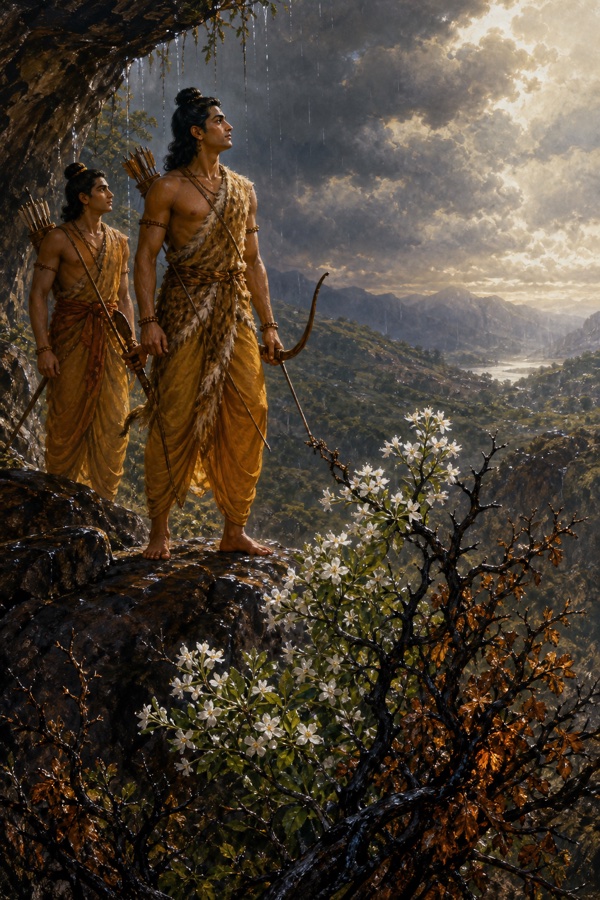
“The campaigns of kings for conquest have halted, and the roads are made hard by the water. In the bright half of Bhadrapada the time has come to begin the study of the Sama Veda. On the full-moon day of Ashadha, Bharata will have begun his four-month vows; and surely the Sarayu, swelling with rain, is rising in flood, just as the joy of the people of Ayodhya will rise in its clamor when they see me returning from the forest.” He had just counted out the calendar of an entire kingdom that was going on without him, a brother keeping vows in his name, a river rising, a city waiting; and having counted it, he came back to the ledge he was sitting on. “Sugriva, who has conquered his enemy, is reunited with his wife, and is set firm in his kingdom, tastes his ease in these rains; and I, parted from my wife and cast out of my kingdom, am wearing thin, Lakshmana, like a riverbank cut away by the water. My grief is wide, the rains are hard to cross, and my great enemy Ravana looms before me like the boundless sea. Seeing the roads impassable and the march impossible, I asked nothing of Sugriva, humble though he was, both because he has after long parting come back to his wife, and because my own task is great and hard. Once he has rested from the long strain of winning back his kingdom and sees that the time for action has come, Sugriva will remember of his own accord what he owes me and set about repaying it; of that there is no doubt. So I am biding my time, watching for Sugriva’s goodwill and for the rivers to turn kind.”
Lakshmana again joined his palms and said, “Sugriva, king of the monkeys, will soon accomplish all that you desire. Waiting for autumn, bear this obstacle of the rains, and keep your mind fixed on the slaying of the enemy.” It was the second time he had said it. It would not be the last, and each time he said it the words would cost him more.
Hanuman reminds Sugriva, and the order to Nila to raise the army
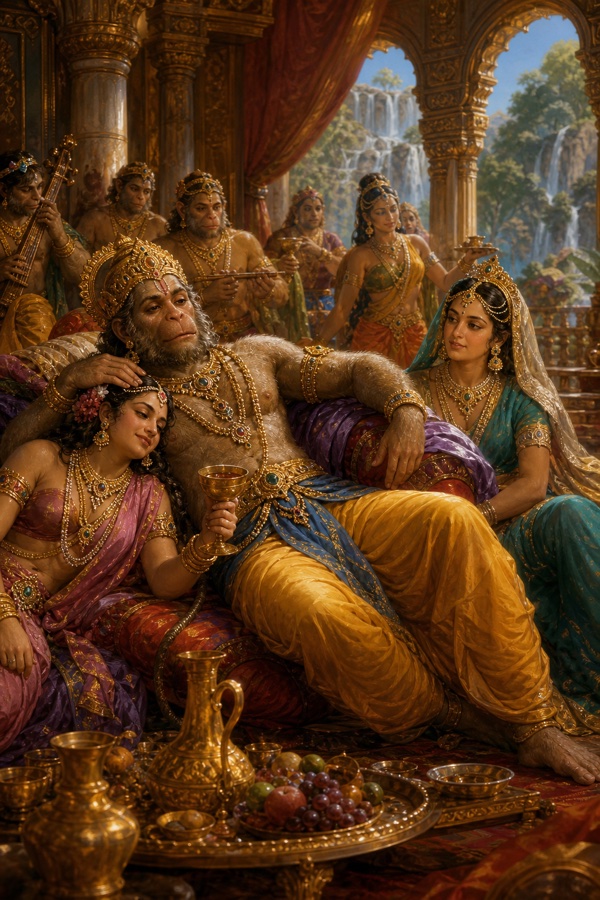
Seeing the sky wiped clean, empty of lightning and cloud, loud with the cries of cranes, and bright with moonlight, Hanuman read the season the way a minister reads a debt coming due. Sugriva, his own purpose achieved, had sunk into pleasure, had grown slack in the gathering of dharma and of wealth, and sat with his heart set on his own retreat. Having won back his beloved wife Ruma and the coveted Tara, Sugriva took his ease by day and night, and had thrown the whole burden of affairs onto his ministers. Hanuman who knew the essence of all the scriptures and was a master of speech, had been the one who brought the two brothers to Rishyamuka in the first place and who stood by while the fire was kindled that made Rama and Sugriva friends; whatever was promised at that fire, he had heard it promised. He came to Sugriva, lord of the monkeys, made him glad with many wholesome words, and then spoke.
“King, you have won back your kingdom and your fame and lifted up the glory of your house. What remains is the gathering of your allies, and that you should now attend to. The realm and the glory of a king who knows the hour and deals well with his allies go on growing; and a man who attends to his friend’s affairs after their time has gone by has done nothing for his friend, however great the thing he does. This work of our friend, the search for Vaidehi, is falling behind through neglect; therefore bring the work of Rama swiftly to its end. Rama, though he bends to your will, though he knows the time and is pressed for it, will never say to you that the time has run out. If you begin the work now, before any pressure comes from him, the time will not be counted as lost; begin it under his pressure, and the delay will be laid at your door. Rama is the source of your house’s rise, an old friend, of measureless power, matchless in his virtues. As he did your work, so you must do his: give the order for the vanara to gather the army. You would owe him this work even had he done nothing for you; how much more when he killed Vali, who had never harmed him, without a moment’s doubt, and gave you back your kingdom. Let us search for his Sita over the earth, and through the heavens if need be. Rama, who can master gods and demons and the great serpents with his arrows, is giving you the chance to make good your promise. At our command, our going will be stopped nowhere, not in the depths below the earth, nor on the earth, nor in the water, nor in the sky, nor in the heaven above it. Give the word, then: who is to do what, and go where. More than a crore of unconquerable vanaras wait upon your order.”
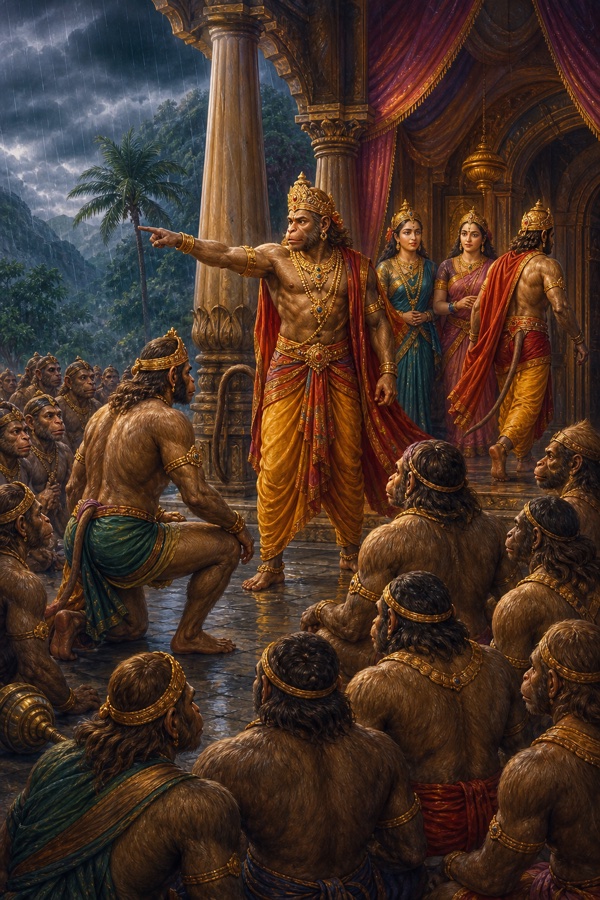
Hearing this timely and steadying word of Hanuman’s, Sugriva, a being of good stuff, made an excellent resolve. He gave the order to the ever-diligent Nila to gather in all the armies scattered across the four quarters. “Let my whole army, and every troop-leader with his captains, muster here without delay. Let the swift and tireless vanaras who guard the borders come back at once at my command. Any vanara who comes here after fifteen nights have passed will be put to death; let there be no second thought about it. Nila, you and Angada together carry my order to the elder vanaras.” Having set this in motion, Sugriva went back into his own house. The order was hard enough to hang a monkey for lateness. It did not occur to the king that he himself was already late.
The description of autumn, and Rama sends Lakshmana
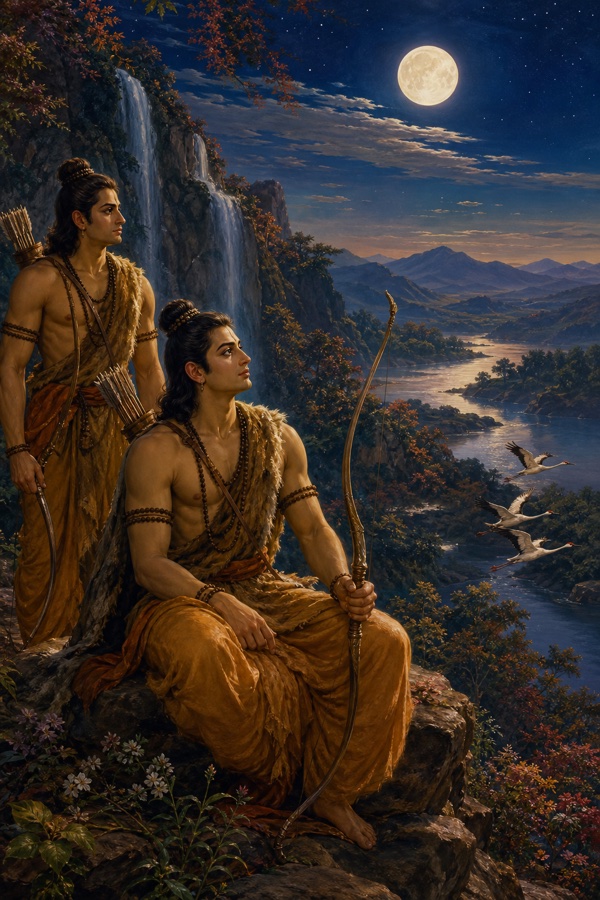
When Sugriva had gone back into his house and the sky was freed of its clouds, Rama, who had settled on Prasravana only for the nights of rain, was thrown into anguish by his love for Sita and the grief of their parting. The bargain had been plain: the rains, and then the search. Seeing the sky turn white, the disc of the moon run clear, and the autumn night bright with moonlight; finding Sugriva lost in his pleasures and Sita lost to him altogether; and knowing that the time set for the search had slipped by while he watched the sky from a cave, Rama, in his desperation, sank into a kind of swoon. When his senses came back to him a few moments later, the prince born in Raghu’s line began to think of Sita, who dwelt always in his heart.
Seeing the sky wiped clean, he began to lament in a stricken voice, and what broke him was that he could remember exactly how she had been happy. “That girl of mine, whose voice was like the cry of the sarus crane, who used to soothe her heart in the hermitage with the calling of the cranes, how can she soothe her heart now? Seeing the asana trees in flower, shining like gold, and not seeing me, how can that girl go on living? She who used to wake at dawn to the cooing of the swans, with her lovely body and her sweet speech, how is she now? Hearing the call of the chakravaka ducks, what does that girl think? Without Sita I find no joy now in lakes or rivers, step-pools, groves, or woods. The longing that autumn’s beauties sharpen without cease must be torturing that love of mine in her parting from me all the more.” So Rama lamented like the chataka bird begging Indra for water, the bird that will drink from no pool on earth and waits with its throat open for the sky.
Just then Lakshmana, who had wandered off over the lovely crests of the mountain in search of fruit, came back and saw his elder brother. Finding him alone, downcast, absent, and gripped by an unbearable care, and grieving to the heart at his brother’s state, Lakshmana spoke soft words. “What is gained by lowering your own manhood under the power of longing? The steadiness of your mind is broken by grief. Can all your anguish, in this hour, not be poured into the fixing of your mind, best of brothers? Keep the strength of your spirit undismayed do your daily rites, keep your heart calm, gather the strength of your helpers, and grow your own strength. This is the road of a true man. While a guardian like you lives, no other can easily hold Janaki; no one can embrace a blazing tongue of fire and stay unburned, hero.”
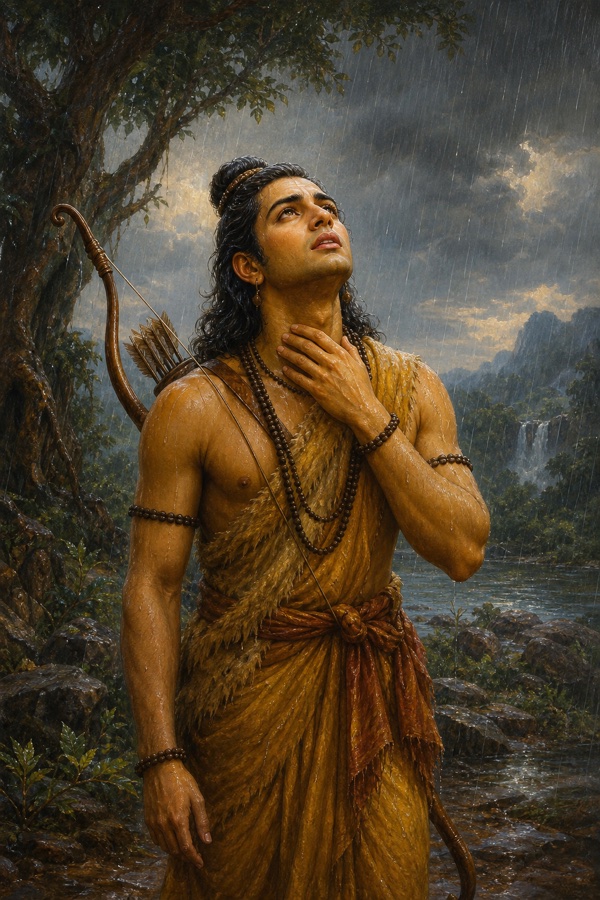
Rama said to his unconquerable brother, marked with every fair sign, “What you have said is wholesome, healing, and joined to justice, to profit, and to comfort. The work of the search must certainly be done, and done with special effort; but a man should not brood on the fruit of this hard and headlong valor before its time.” Then, remembering Maithili, his mouth going dry, Rama spoke again to Lakshmana, and once more the world in front of him arranged itself into an account of what he had lost. “Thousand-eyed Indra, having drenched the earth and ripened the grain, is at ease now, his work done. The clouds have loosed their water and grown still. Those clouds that were dark as the petals of the blue lotus, that were blackening the ten directions, now look calm as elephants with the rut gone out of them. The noise of clouds and elephants and peacocks and waterfalls has all fallen silent together. The mountains, washed by the great clouds, shine as if smeared with moonbeams.”
“Autumn has come, scattering her beauty in the flowers on the boughs of the saptaparna, in the light of the stars and sun and moon, and in the play of the finest elephants. On the sandy banks of the great rivers the swans are at play with the newly come chakravaka ducks. In elephants maddened with rut, in herds of proud bulls, and in the clear-watered rivers, splendor is mirrored in a hundred forms. Seeing the sky emptied of cloud, the peacocks, having let go of the glory of their tails and grown indifferent to their mates, seem to brood on the vanished clouds. The sky is bright with a sheen clean as a sword’s edge, the rivers run in thin threads, the wind is cooled by the touch of the kalhara, and the directions shine, freed of darkness. The snakes, shut in their holes for fear of the rain and all but dead of hunger, are coming out now with the venom in their fangs. The night, with the moon for her face and the stars for her open eyes, wrapped in a mantle of moonlight, looks like a woman robed in white. A line of cranes, ripe ears of paddy in their beaks, flies across the sky like a garland carried on the wind. A single swan asleep on a pool of water-lilies looks like the full moon in a cloudless, starry sky. The kasha grass sways on the riverbanks and shines like washed linen, and the autumn rivers bare their banks little by little, as a shy bride uncovers herself on the first night. The mud has dried in the sun’s heat and, after long, the thick dust has appeared: this is the season for the war-marches of kings who are enemies to one another.” He had arrived, by way of the birds and the flowers, at the one fact he had been circling. The season for marching had come, and no one was marching.
Rama went on. “Four months of rain have passed like a hundred years, because I burn with grief at not seeing Sita. Like a chakravaki, that girl followed me step for step into the harsh Dandaka forest as though into a pleasure-garden. Lakshmana, I am without my love, stricken with pain, robbed of my kingdom, and cast out of my home; and still King Sugriva shows me no pity. To me, without a protector, without a kingdom, spurned by Ravana, wretched, far from home and parted from my love, to me who came for shelter, the base-minded Sugriva does dishonor. Though the term and the time for the search for Sita were fixed and settled, that one, his own purpose gained, pays it no heed. It is strange that no fear crosses his mind that I could kill him as I killed Vali if he breaks his word, though he has seen my prowess with his own eyes and knows you stand beside me. The purpose for which I made this friendship and killed Vali he no longer remembers, now that his own end is won. Lost in his pleasures, he does not see that the four months of rain are all but gone; he sits drinking with his ministers and his court, and has no pity for us in our grief.”
“So, Lakshmana, go into Kishkindha, and say from me to that fool Sugriva, drowned in his rustic pleasures: The man who, having roused hope in a strong suppliant and in those who did him earlier service, then breaks it, is the man of the worst conduct in this world. A man who keeps his word, whether fair or harsh, acts with courage and integrity. When a man has gained his own end and then fails to serve the friends who helped him while their purpose still waits, even the carrion-eaters will not touch his flesh when he is dead. Do you wish to see the lightning-shape of my gold-backed bow drawn full in battle? Do you wish to hear again my bowstring cry like the crack of the thunderbolt when I am roused to anger?” That sound was one Sugriva had heard once already, on the day it had emptied his brother of life. “Lakshmana, say to Sugriva: The road by which Vali was killed and departed is not closed. Sugriva, keep to your promise; do not walk in Vali’s path. Vali was killed in battle by a single arrow, alone; but if you fall away from truth, I will kill you with all your kin. Say to Sugriva only what is good for him and for us; make haste, the time is running out. And give Sugriva this word from me: King of the monkeys, a pledge once given is a law that lasts forever; keep yours, or today my arrows will send you down to Yama’s house to look on Vali there.” Seeing his elder brother lamenting like this and in a fierce anger, the sharp-spirited Lakshmana hardened his own heart against Sugriva.
Lakshmana’s march on Kishkindha, and fear among the vanaras
Concluding from Rama’s angry words that he was wroth with Sugriva, Lakshmana was seized with the resolve to kill him and said, “Sugriva will not hold to the conduct of the good, nor does he believe in the bond between a deed and its fruit; and so he will not long enjoy the glory of the vanara kingdom. For want of your grace, no thought of returning the favor woke in him, and he sank into rustic pleasures. Let him die and go look upon his brave elder brother Vali; the kingdom was never fit for so worthless a thing. I cannot hold back the anger rising in me. This very day I will kill that liar Sugriva. Let Vali’s son Angada sit on the throne with the vanara chiefs and carry out the search for Sita.” He was proposing to unmake in an afternoon the whole work of the season just past, and he meant every word of it.
Then Rama, intent on his brother’s good, spoke to Lakshmana, whom battle-fury had roused, words of measured comfort. “Lakshmana, no righteous man like you would ever, in this world, so much as think a sin like the killing of a friend. A man who masters his anger through sound judgment acts with courage and integrity. Do not carry this thought. Follow the old love and the old bond. Setting aside harsh words, speak to Sugriva in language full of comfort, and remind him, who is guilty of delay, of the time that has slipped by.” The man who had drafted the threat an hour earlier was now trimming it, which is what elder brothers are for.
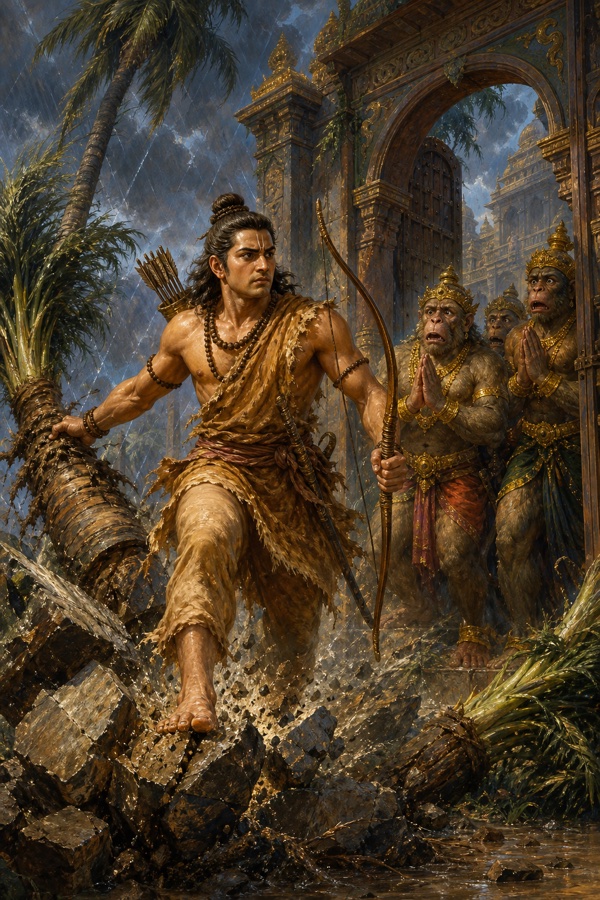
Instructed thus by his elder brother, Lakshmana set out to enter Kishkindha. Bearing his bow, showing the fury of battle, carrying a bow bright as the rainbow and terrible as Yama at the end of time, he stood like a mountain crest, like Mount Mandara itself. Turning over in his mind what he would say to Sugriva and the answers he might get, ringed in the fire of his anger, swift as the raging wind, Lakshmana came on quickly, tearing down sal and tala and ashvakarna and other trees by main force, overturning mountain crests, crushing rocks the way an elephant does. He had been told to speak gently. He was leaving a road behind him that a man could have followed by the wreckage. Seeing Kishkindha set among the mountains, hard to reach, his lips trembling with rage, he saw the terrible vanaras roaming outside the city.
At the sight of Lakshmana, the elephant-like vanaras snatched up hundreds of mountain crests and great trees. Seeing them all with their makeshift weapons, Lakshmana grew twice as angry, like a fire fed with fuel. Seeing Lakshmana enraged like Death and the fire of doom, the vanaras, their limbs slack with fear, fled in hundreds in every direction. They ran to Sugriva’s house and began to tell of Lakshmana’s coming and his anger. But Sugriva, lying at that moment with Tara, drowned in pleasure and mad with desire, did not hear the words of those monkey leaders. Then, at the ministers’ sign, hair-raising vanaras came out of the city. Their nails and teeth were their weapons; all were brave and grim to look on. One had the strength of ten elephants, another ten times that, another the might of ten thousand elephants. Every one of them owed his king’s throne to the archer they were now moving to meet.
Seeing that hard-to-take Kishkindha crowded with mighty vanaras carrying trees in their hands, the enraged Lakshmana saw them standing past the rampart and the moat. Thinking of Sugriva’s heedlessness and of his brother’s task, the self-possessed hero Lakshmana came once more under the sway of anger. Breathing long and hot, his eyes red with rage, Lakshmana looked like a fire wrapped in smoke. With the tip of an arrow for his flickering tongue and the coil of his bow for his hood, filled with the venom of his own power, he looked like a five-hooded serpent. Approaching Lakshmana, who blazed like the fire of doom, like the king of serpents in his wrath, Angada fell into deep dismay for fear.
His eyes red with anger, Lakshmana gave Angada an order. “Child, tell Sugriva of my coming, and say: Lakshmana has come to you, stricken with grief at his brother’s plight, and stands at your gate. If it please you, heed his word, monkey. So saying, come back at once, child.” At Lakshmana’s word the grief-struck Angada went to Sugriva and said, “The son of Sumitra has come.” Then, frightened and downcast, Angada clasped first the feet of Sugriva, his uncle who stood in the place of a father, and then the feet of his mother and his aunt Ruma, and delivered the message. But Sugriva, gripped by sleep and by wine and dazed with desire, did not wake. A boy had crossed a palace to touch the feet of three people and say a thing that could not wait, and the king of the vanaras slept through all of it.
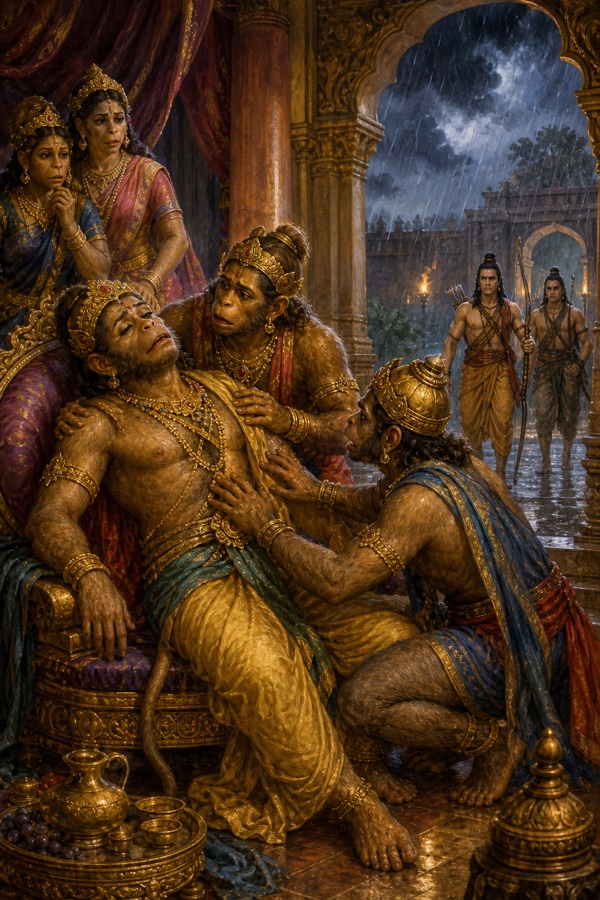
Seeing Lakshmana enraged, the frightened vanaras raised an uproar to calm him, and near Sugriva they made a din all at once like a great flood, like the thunderbolt, like the roar of lions. At that great noise the monkey woke; his eyes red with wine, distraught, Sugriva wore nothing but his garlands. Then, prompted by Angada’s words, the two ministers who had come with him, Plaksha and Prabhava, informed Sugriva, seated there like Indra, that Lakshmana had come to teach him his duty in wealth and in dharma, and said, “The two brothers, Rama and Lakshmana, who have taken a human form of their own free will, true to their vows and fit to rule all three worlds, have given you your kingdom; and one of them, Lakshmana, bow in hand, stands at your gate, so that the frightened vanaras tremble and cry out before him. He has come at Rama’s command, with Rama’s message for his charioteer and his own resolve for his chariot, and it was he who sent Angada, Tara’s dear son, hurrying to you. Burning the monkeys with his eyes, as it were, Lakshmana stands at the gate, his eyes red with anger. Go quickly with your son and your kinsmen, bow your head, and salute him; let his anger be quenched this very day. Do carefully whatever Rama says; keep to your promise, and stay true to your word.”
Hanuman counsels Sugriva to appease Lakshmana
Hearing the words of Angada and his ministers and the news of Lakshmana’s anger, the self-possessed Sugriva rose in alarm from his bed. Knowing Rama’s greatness and his own fickleness, and skilled in counsel, Sugriva said to his ministers, “I have spoken no harsh word, done no unfitting deed; then why is Lakshmana, Rama’s brother, angry with me? Surely my enemies, forever hunting for a flaw, have poured into his ears some fault of mine that never was. Let us all first, gently and with skill, learn the fixed thought of his mind, and the cause of his anger. I have no fear of Lakshmana, nor of Rama, for I have done them no wrong; and yet a friend angered without cause does breed care. Friendship is easy to make and hard to keep, for with the mind’s own inconstancy a bond can break over the smallest thing. This is why I am afraid, that the debt I owe Rama I can in no way repay.”
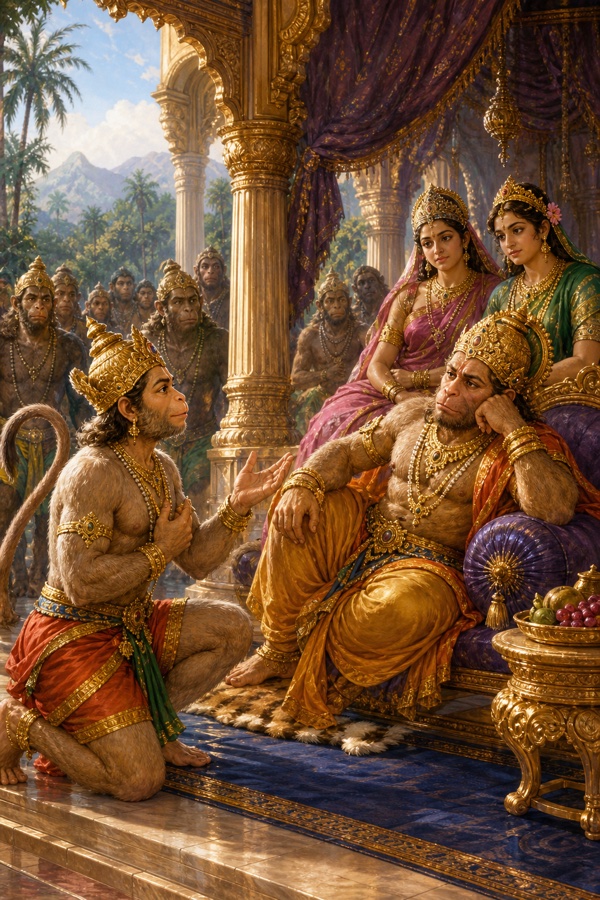
When Sugriva had spoken so, Hanuman gave his reasoning among the vanara ministers, and he did not soften it. “Lord of the monkey hosts, it is no wonder that you should not forget that most loving and generous kindness. Casting off all fear of men’s censure, Rama killed Vali for your sake, a Vali who was Indra’s equal in valor; and it is out of love for you that he is angry, and has sent his brother Lakshmana to you. You, the best of those who know the time, have lost all sense of its passing. The blessed autumn, green with flowering saptaparna, has already come; the sky is clear of cloud and bright with planets and stars, and every quarter, every river and lake, wears a glad face. But the moment for action came, and you did not mark it; so it is plain that you have been heedless, and this is why Lakshmana has come to remind you of your duty. The stricken, wife-bereft, Rama has sent a hard word through the mouth of a second man, Lakshmana; you should bear it. For the fault you have committed, I see nothing fitter than for you to go with joined palms and make Lakshmana glad. A king’s appointed ministers must speak him his own good; and so, setting aside the fear of your displeasure, I say a well-weighed word.”
“When he lifts his bow in anger, Rama can master the whole world, with its gods and demons and gandharvas. One who deserves to be kept glad again and again should not be angered, above all a grateful man who remembers an earlier kindness. King, go with your son and your friends, bow your head, and salute him; hold to your vow while bending to Rama’s will as a wife bends to her lord. You must not slight the command of Rama and his brother Lakshmana even in your mind; your own heart knows the more-than-human strength of Rama, blazing like Indra, and of the prince born in Raghu’s line, Lakshmana. You watched what one of those arrows did to a brother stronger than you.”
Lakshmana enters Kishkindha, and Tara’s consoling
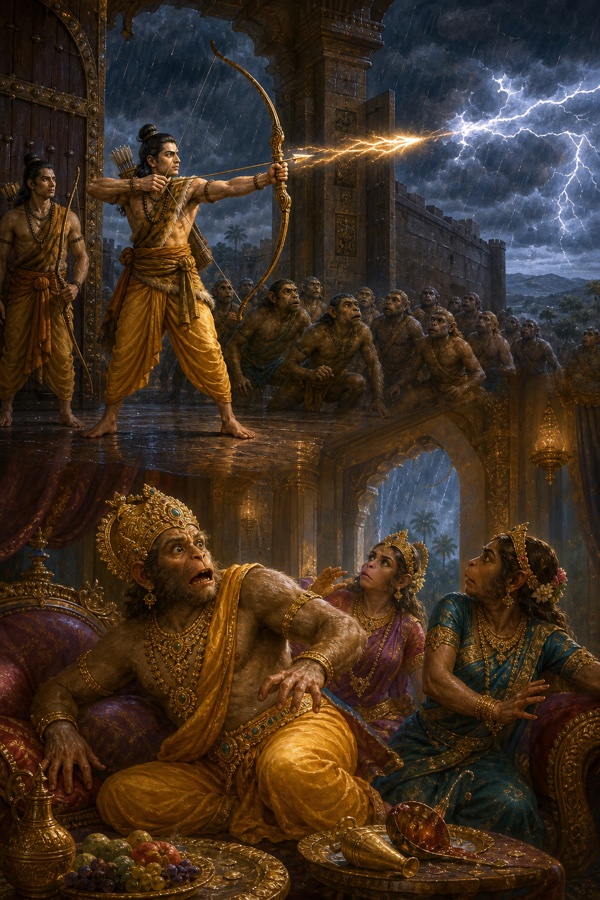
When Angada came out again, at his plea and by Rama’s command Lakshmana entered the lovely cave-city of Kishkindha. The huge and mighty vanaras standing at the gate rose with joined palms at the sight of Lakshmana. But seeing the angry, hard-breathing son of Dasharatha, the frightened vanaras hemmed him about and did not walk beside him. Lakshmana saw that great cave, jeweled, wondrous, its groves in flower. It was thick with mansions and palaces and temples, ablaze with many gems, decked with flowering trees that granted every desire, graced with the sons of gods and gandharvas, vanaras of lovely form who could take any shape at will, fragrant with sandal and aloe and lotus, its avenues heavy with the scent of many wines, adorned with many-storied palaces like Vindhya and Meru; and there the prince born in Raghu’s line saw clear mountain streams as well. Every step of it told him what the season had been spent on.
Along the great avenue Lakshmana saw the fine and costly houses of the chief monkeys: Angada, Mainda, Dvivida, Gavaya, Gavaksha, Gaja, Sharabha, Vidyunmali, Sampati, Suryaksha, Hanuman, Virabahu, Subahu, Nala, Kumuda, Sushena, Tara, Jambavan, Dadhivaktra, Nila, Supatala, and Sunetra. They shone like white clouds, were hung with fragrant garlands, and were graced with beautiful women. Then he saw, ringed by a white mountain of crystal, the hard-to-reach house of Sugriva as lovely as the abode of Mahendra, its palace-turrets white as the crest of Kailasa, adorned with trees of celestial flower and fruit, with archways of refined gold and with heavenly garlands, its gates guarded by strong, armed vanaras. Without any hindrance Lakshmana entered that lovely house as the sun enters a great cloud.
Passing through seven courts crowded with vehicles and seats, Lakshmana came to the great, well-guarded inner apartments, set with couches of gold and silver and fine seats with costly coverings. As he entered he heard the sweet sound of songs sung to the vina, their words and syllables set to the beat. In Sugriva’s house he saw many women proud of their beauty and youth, high-born ladies weaving garlands, and Sugriva’s serving-women decked in fine ornaments. Hearing the cooing of anklets and the jangle of girdles, the son of Sumitra grew ashamed, for to look on the wives of another was against his vow. He had bowed at Sita’s feet every day of the exile, and out of all her ornaments the only ones he had ever come to know by sight were her anklets. In the rush of his anger the hero twanged his bowstring, and the directions rang with it. Held back by his own good conduct from going into the women’s rooms, Lakshmana, filled with Rama’s anger, went and stood in a private corner.
At that twang of the bowstring Sugriva rose in fear from his fine seat. From Angada’s words and the twang of the string Sugriva knew that Lakshmana had come to the gate, and his mouth went dry with fear. Then Sugriva his heart shaken with fear but keeping himself calm, spoke a wholesome word to Tara. “Lady of the lovely brows, why has Rama’s brother, so tender by nature, come in such anger? Do you know the cause of the prince’s wrath? Lakshmana does not grow angry without a cause. If something displeasing to him has been done by us, learn it quickly by your own wit and tell me at once. Or go to him yourself and gladden him with soothing words. Seeing you, Lakshmana will not be angry; men are never harsh toward women. When his senses and his heart are calmed by your soft words, then I will meet Lakshmana.”
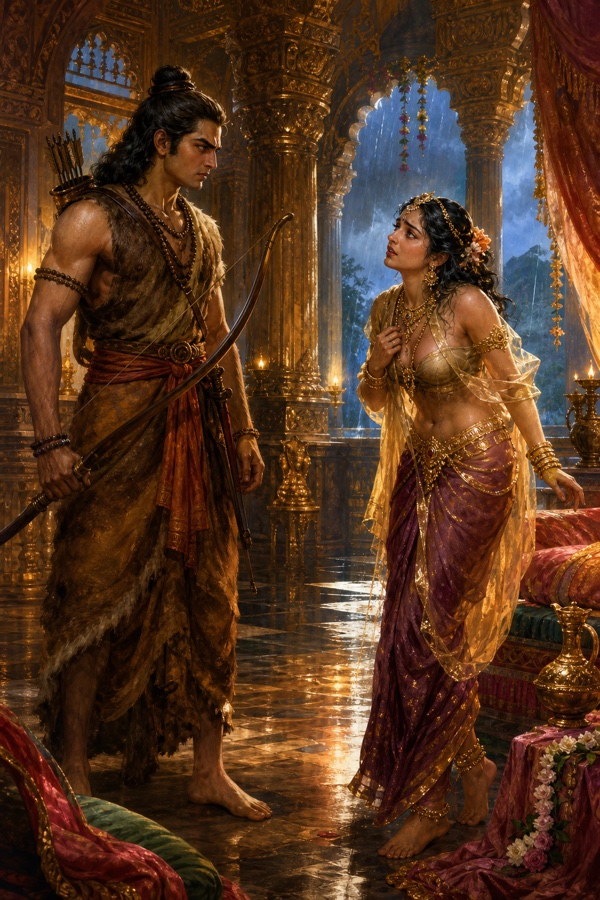
Hearing Sugriva’s soothing words, the fearless Tara went to Lakshmana. Her eyes were unsteady with wine, the golden thread of her girdle slipping loose, her body bent with modesty. This was the woman who had held Vali back at the door and warned him not to go down to that last duel, and had been right about all of it. Seeing Tara, the wife of the lord of monkeys, Lakshmana stood with his eyes lowered and his mind withdrawn, and at the nearness of a woman his anger died down. Made shameless by the wine and by the kindness of Lakshmana’s glance, Tara spoke loving, weighty, comforting words. “What is the root of your anger? Who has broken your command? Who walks unafraid toward a forest fire that runs at the trees gone dry?” Hearing her affectionate words, Lakshmana, unabashed, said, “Tara, who should be devoted to your husband’s good, this husband of yours, ruled by his senses, has forgotten the gathering of dharma and of wealth; why do you not wake him to it? He gives no thought to the business of the realm, nor heeds us who are sunk in grief; with his ministers and his council he is given over to nothing but drink and pleasure, Tara.”
Lakshmana went on. “Even after the four-month term was fixed, Sugriva, drowned in wine and revelry, does not know that those four months have passed. Such drink is no thing to praise in those who seek dharma and wealth; through drink profit and desire and dharma, all three, are ruined. For a man who fails to return a kindness there is a great lapse of dharma, and in losing the friendship of a worthy friend there is a great loss of wealth. A friend is one who is best in wealth and virtue and steadfast in truth and dharma; both these your husband has slighted, and no fixity in dharma shows in him. So, you who know the heart of the matter, tell me what we must now do in this business before us.” He had come to threaten a king and found himself asking a queen for counsel, which was the most sensible thing he did that day.
Hearing Lakshmana’s words, firm in the certainties of dharma and wealth and yet sweet in temper, Tara answered again. “This is no time for anger, nor is anger fitting toward one’s own people. This heedlessness of Sugriva, who longs to accomplish your purpose, you too should bear, hero. How should a man of high virtue rage against one of lesser strength? Who, ruled by good stuff and a treasury of self-command as you are, would fall under the sway of anger? I know the cause of Rama’s displeasure, and I know the delay that has come to the work, and I know too the service you did us. I know as well how hard the force of desire is to withstand; and I know on what Sugriva’s heart is now set, and that he is turned away from all else. Being under the sway of anger, you cannot see the state of a man in the grip of desire. A man lost in desire reckons neither place nor time nor profit nor dharma. So forgive this brother of yours, who is the lord of the vanara race and the friend of your elder brother, who was at my side only a moment ago, lust having stripped him of all sense of decorum. Even great sages, given to dharma and to penance, sometimes fall in the wake of desire; then why should King Sugriva, fickle by nature, not cling to his pleasures?” She was pleading for a man who had taken her from her husband’s house, and she pleaded well.
Tara again spoke sweet words for her husband’s good. “Even while under the power of desire, Sugriva long ago gave the order for the venture on your behalf. And so, in truth, mighty vanaras beyond count, dwelling on many mountains, able to take any shape at will, have already come. So come inside. By staying without, you have kept your own good conduct; and in the eyes of the good there is no sin in looking on the wives of others with a friend’s eye, free of desire.” With Tara’s leave, and urged on by the pressing hour, Lakshmana came inside. There he saw Sugriva, seated on a fine seat with a costly golden covering, ringed by young women decked in heavenly ornaments and garlands, blazing like the sun, godlike, unconquerable as Indra. Seeing this, Lakshmana grew angrier still, and with his red eyes looked terrible as Yama. Sugriva, of splendid golden hue, holding Ruma in a close embrace on his fine seat, was watching Lakshmana. Tara had spent all her skill making the case that the army was already on the road, and her husband had arranged himself, at that exact moment, into the picture that unmade it.
Lakshmana’s warning and the sin of ingratitude
Seeing Lakshmana come in unhindered and full of anger, Sugriva’s senses were shaken. Seeing the son of Dasharatha breathing hard with rage, blazing with his own fire, stricken by his brother’s misfortune, Sugriva left his golden seat and rose, like a tall, ornamented flag raised in honor of Indra. As he rose, Ruma and the other women rose after him, like a train of stars behind the full moon. Sugriva, his eyes red with wine, came near with joined palms; and Lakshmana stood there unmoving as a great wishing-tree. To Sugriva, who stood with Ruma among the women like the moon ringed by stars, the angry Lakshmana spoke.
Lakshmana said, “A king who is endowed with good stuff and good birth, who is merciful, master of his senses, grateful, and truthful, is honored in the world. But who is more pitiless than that king who, standing in wrong, makes false promises to the friends who did him service? A man who breaks a false promise of the gift of one horse kills a hundred horses, and by a false promise of one cow, a thousand; and by breaking a false promise of some service to a man, he slays himself and his own kin. He who, having first achieved his own purpose with the help of friends, does not return the service, that ingrate deserves death at the hands of all living beings, monkey. Seeing an ingrate, Brahma in his anger spoke this verse honored throughout the world, and hear it: For the killer of cows, for the drinker of wine, for the thief, and for the breaker of a vow, the good have laid down a penance; but for the ingrate there is no penance at all.”
“Monkey, you are ignoble, ungrateful, and false, for having first achieved your own purpose by Rama’s kindness you now do not return it. Should you not, monkey, your work done and yourself fulfilled, be striving to seek out Sita? You are lost in rustic pleasures, false to your promise; and Rama does not know you for a hidden enemy, a snake that speaks with the voice of a frog. It was the compassionate Rama who won for you, base and wicked though you are, the kingdom of the vanaras. If you do not honor the kindness of the prince born in Raghu’s line, then soon, struck down by his keen arrows, you will look upon Vali. The road by which Vali was killed and departed is not closed. Sugriva, keep to your promise; do not walk in Vali’s path. Surely you do not see the thunderbolt-arrows loosed from the bow of Rama, and so you take your pleasure at ease and do not give even a thought to Rama’s work.”
Tara’s consoling and the news of the gathering host
To Lakshmana, blazing with fire and speaking so, Tara said, “Lakshmana, you should not speak so to Sugriva; least of all from your mouth does he deserve harsh words. Hero, Sugriva, lord of the monkeys, is not ungrateful, nor false, nor cruel, nor a liar, nor crooked. Hero, Sugriva has not forgotten the service Rama did him in battle, hard for any other to do. By Rama’s grace alone Sugriva won back his fame, his lasting vanara kingdom, Ruma, and me.” She said the last of it without flinching, and it was the heaviest thing in the room. She had been Vali’s queen; the arrow that made Sugriva king had made her a widow first, and she was standing here counting herself among the goods that arrow had delivered. “Having reached this summit of happiness after sleeping so uneasily for so long, Sugriva lost count of the hour, as the sage Vishvamitra once did. Deep in love with the nymph Ghritachi, they say, that great sage, whose mind was set on dharma, took ten years for a single day; and if Vishvamitra, first of those who know the time, did not notice how much of it had stolen past him, what of ordinary people? Let Rama pardon Sugriva, worn out, ruled by the needs of the body, and not yet sated with pleasure. And you, Lakshmana, should not give way to anger like an ordinary man before you know the whole truth; men of your goodness do not fall into rage without thought. On Sugriva’s behalf I stand ready to make you glad; let go of this great surge that anger has raised. To please Rama, Sugriva will give up Ruma, and me, and Angada, his kingdom, his wealth, his grain, and his herds, all of it; of this I am sure. Having killed that vile demon Ravana, Sugriva will reunite Rama with Sita as the moon is reunited with Rohini.”
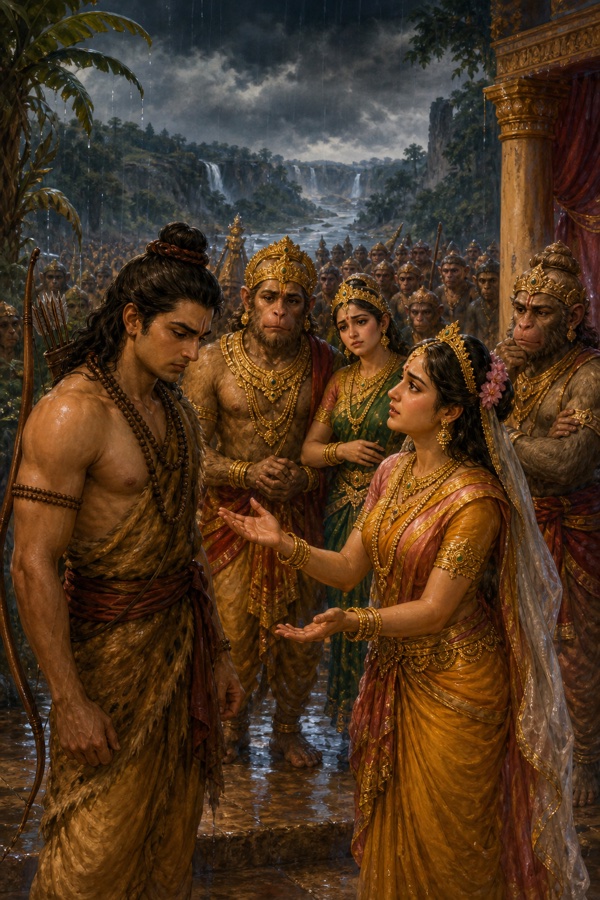
Tara said, “They say the demons of Lanka number a hundred thousand crore, and three lakh, ninety-nine thousand, six hundred more. Without killing those demons, who can take any shape at will and are hard to overcome, Ravana, who carried off Maithili, cannot be killed. They, and the cruel-deeded Ravana, cannot be killed by Sugriva alone, without help, and least of all by him, Lakshmana. This Vali said, for he knew all things; how those demons came to Ravana I do not know, I speak only what I have heard.” She was quoting her dead husband to the man who had helped kill him, because the count was accurate and someone had to say it. “It is to help you that the vanaras have been sent to bring in many vanaras fit for war. It is for those mighty and valiant vanaras that Sugriva waits, and so has not yet set out for Rama’s work. By the term Sugriva fixed before, all those mighty vanaras will arrive this very day. Thousands of crores of bears, hundreds of crores of langurs, and many crores of vanaras of blazing spirit will come to you today; let go your anger. Seeing your face flushed with rage and your eyes red, the wives of the vanara heroes cannot find peace; we are all afraid at the fear of a return of the earlier calamity, the killing of Vali.”
Sugriva and Lakshmana ask each other’s pardon
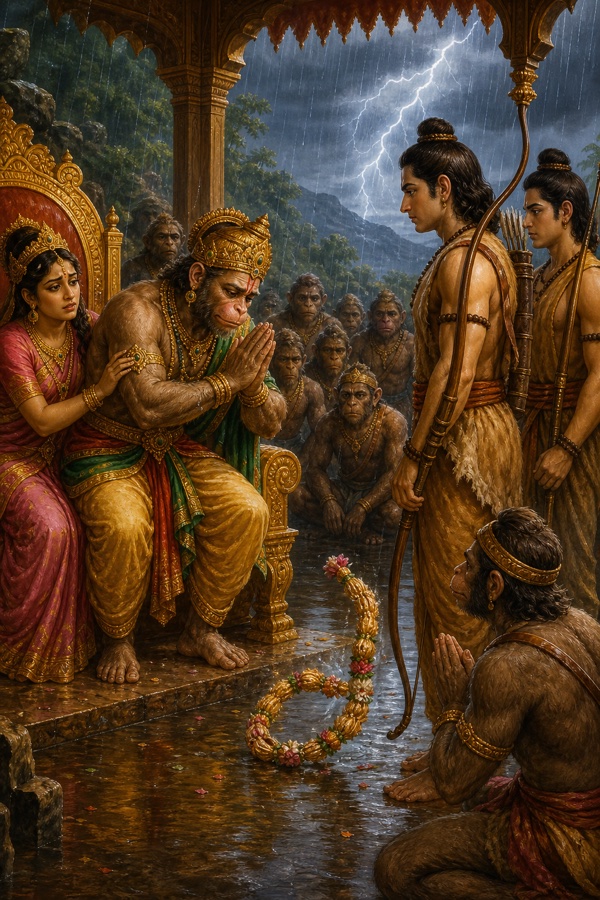
Tara’s words, righteous and humble, the gentle-natured son of Sumitra received with respect. As that word was accepted, Sugriva, lord of the monkey hosts, cast off his great fear of Lakshmana like a wet garment. Then Sugriva broke and threw down the strange, rich, great garland that hung at his neck, and the wine went out of him. Making the fierce Lakshmana glad, Sugriva spoke humble words. “My glory, my fame, and my lasting vanara kingdom, which had been lost forever, all of this I won back by Rama’s grace alone. Who could repay even a fraction of such a kindness from Rama, famed for his own deeds? The prince born in Raghu’s line will, by his own power, with me as his mere helper, find Sita and kill Ravana. He who pierced seven great trees, a mountain, and the earth with a single arrow, what need has he of a helper?” Sugriva had asked for that proof himself, unable to believe any man alive could handle Vali; the arrow had gone through the seven sal trees in their line, and through the mountain, and into the earth, and come back to the quiver, and after that he had stopped asking. “He at whose bowstring’s twang the earth shook with its mountains, what use has he for helpers?”
“Yet I will go on King Rama’s campaign, when he marches with his vanguard to kill the enemy Ravana. If through trust or affection any overstep of mine, a servant’s, has taken place, forgive it; there is no one who never commits a fault.” When Sugriva had spoken so, Lakshmana, made glad, said with affection, “Sugriva, lord of the monkeys, with so humble a protector as you, my brother Rama has every protection. Sugriva, by your power and by such pure clearness of heart, you are worthy to enjoy the matchless glory of the vanara kingdom. With a helper like you, Rama will soon kill his enemies in battle; of that there is no doubt. Grateful, one who never turns from a fight, this word of yours is fit and just. Who but my elder brother and you would call himself so low while strength was still in him? You are the equal of Rama in valor and in strength, and the gods have made you his helper for all time. But hero, come with me swiftly from here, and reassure your friend Rama, who is stricken by the loss of his wife. Hearing the grief-struck Rama’s lament, I spoke to you those harsh words; forgive them, friend.” An hour before, he had walked in meaning to leave a corpse on that golden seat. He walked out calling its occupant friend.
The summoning of the host and the readying for the march
At Lakshmana’s word, Sugriva said to Hanuman, who stood near him, “The vanaras of terrible speed who drink the maireya wine on the five great mountains, Mahendra, Himavan, Vindhya, Kailasa, and Mandara, and on the other mountains, at the places of the sun’s rising and setting, in the woods of Mount Padma, on Mount Anjana, in the caves of the great hills, on the slopes of Meru, on Mount Dhumra, and on Mount Maharuna; and all the vanaras who dwell in the lovely, fragrant woods and in the hermitages of the ascetics, summon them all swiftly by means of conciliation and gifts and the rest. To the swift vanaras already sent, send once more some monkey chiefs to hasten them. Whatever vanaras cling to their pleasures and are slow, bring them all here quickly. Those who do not come within ten days at my command, those wicked breakers of a king’s order, should be killed. Let hundreds, thousands, crores of the monkey leaders set out at my command; like clouds and mountains, darkening the sky, let the grim-formed vanara go forth at my word.”
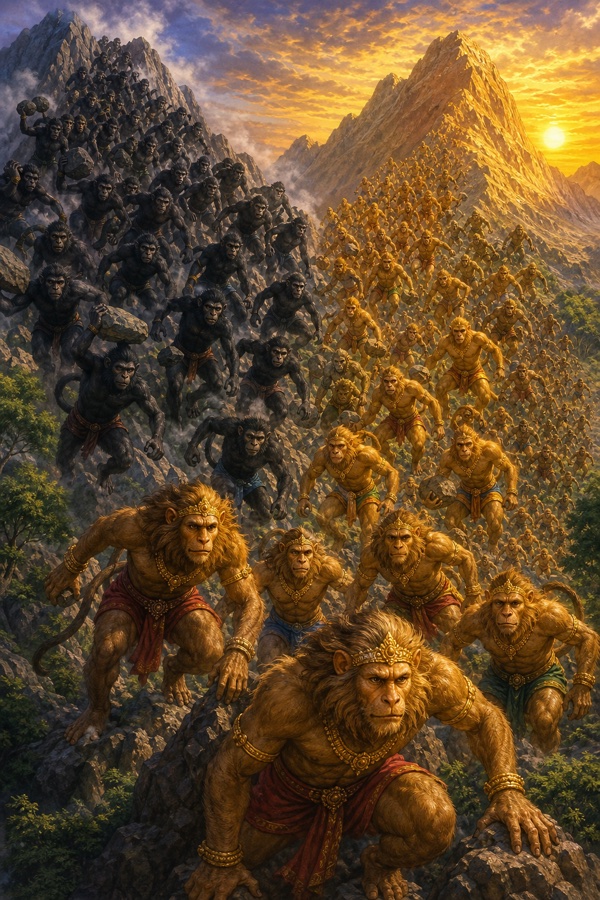
Hearing Sugriva’s words, Hanuman sent valiant vanaras out in every direction. Sent by the king, those vanaras in a moment reached the very path of Vishnu in the sky, going by the road of the birds and across the circle of the lights. They stirred up all the vanaras dwelling on the seashores, on the mountains, in the forests, and by the lakes for the work of Rama. Hearing the order of Sugriva terrible as the hour of death, the vanaras, alarmed at the fear of Sugriva, came on with the utmost speed. From Mount Anjana came three crore mighty vanaras to where Rama was; from the mountain of sunset, ten crore of the hue of refined gold; from the crests of Kailasa, a thousand crore like the manes of lions; and from Himavan, ten lakh crore of vanaras that live on roots and fruit, all came. Thousands of crores more, red as the planet Mars and terrible in their deeds, came down in haste from the Vindhya; and those of the shores of the Milk Ocean, of the Tamala forest where they live on coconuts, and of other woods and caves and riverbanks were past all counting, a host that came on as though it would swallow the sun. The vanaras sent to hurry the rest saw on the Himalaya the great tree where a sacrifice to Shiva was once performed; there, from the streams of rice boiled in milk with sugar and ghee that overflowed the sacred pits, roots and fruits sweet as nectar had sprung, and whoever eats them once stays sated for a month. They came bearing those roots and fruits and celestial herbs, and, to please Sugriva, fragrant flowers from that sacrificial ground as well.
Those swift-moving vanaras came in that same hour, in haste, to Kishkindha, where Sugriva, king of the vanaras, was. Offering the herbs and roots and fruits, they said, “We have combed every mountain and riverbank and wood; all the vanaras of the earth are coming at your order.” Hearing this, the delighted Sugriva accepted all their gifts with love and sent them all away. Having dismissed those thousands of vanaras with their work accomplished, Sugriva reckoned himself, and the prince born in Raghu’s line, as good as fulfilled.
Then Lakshmana said a humble word to Sugriva, “If it please you, let us go out from Kishkindha.” Hearing this, the glad Sugriva said, “So let it be; let us go. I stand at your command.” So saying, he took leave of Tara and the other women. Then, calling in a loud voice, “Come here,” he summoned the vanara; and hearing the order they came swiftly with joined palms. To them the king Sugriva, bright as the sun, said, “Vanaras, bring my palanquin at once.” Swift vanaras brought a lovely palanquin. Sugriva said to Lakshmana, “Mount it quickly, Lakshmana.” So saying, Sugriva mounted, with Lakshmana, the golden palanquin bright as the sun, borne by many vanaras. With a white parasol stretched over his head, white yak-tail fans waving on every side, hailed with the blast of conch and kettledrum and the praises of his bards, Sugriva, having won his supreme royal glory, went forth for the first time in royal state. The exile who had once hidden on Rishyamuka because a hill was the only roof his brother could not reach was now carried up that same country under a white parasol. Ringed by hundreds of sharp, armed vanaras, he came to where Rama dwelt. Reaching that fine place, Sugriva stepped down from the palanquin with Lakshmana and stood before Rama with joined palms.
Sugriva’s meeting with Rama, and a lesson in statecraft
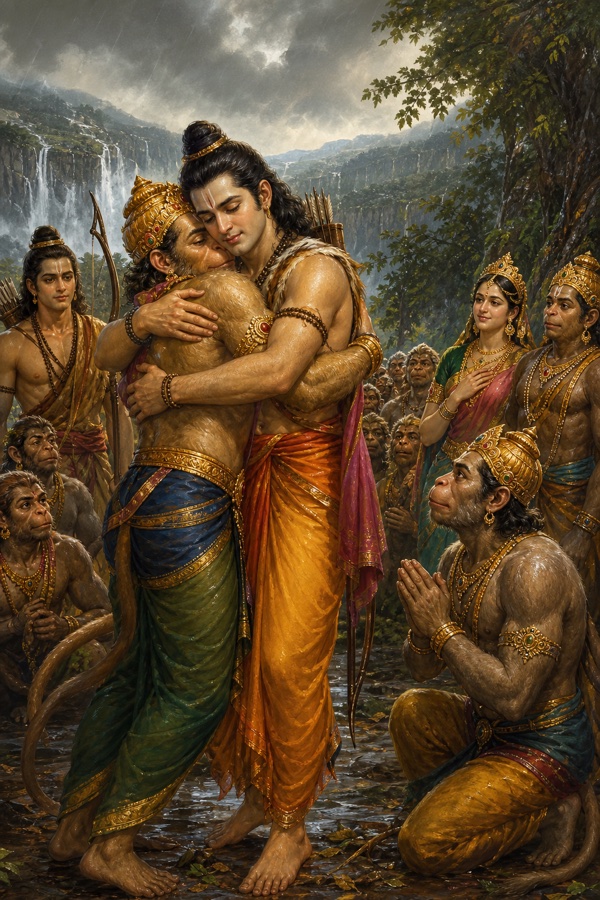
As Sugriva stood with joined palms, the other vanaras stood the same way. Seeing that vast vanara host with palms joined, like a lake full of lotus buds, Rama was pleased with Sugriva. Lifting up Sugriva who had fallen head to foot before him, the prince born in Raghu’s line embraced him with love and honor, and Rama bade him be seated. To Sugriva, seated on the ground, Rama said what a father says to a son who has come back late, without raising his voice once. “He who, dividing them rightly, attends in season to dharma, wealth, and desire, he is the true king. But he who, setting aside dharma and wealth, serves desire alone, is like a man asleep on a treetop who wakes only in his fall. A king intent on the killing of his enemies and devoted to the gathering of friends, being joined to dharma, enjoys the fruit of all three ends. The time for action has now come; so with your vanaras and your ministers, take careful counsel on the plan of the work.” It was the whole indictment, delivered as a lesson, with the sting left in and the insult taken out.
When Rama had spoken so, Sugriva said, “My lost glory, my fame, and my lasting vanara kingdom I won back by your grace. All this came about by the grace of you and your brother; and he who does not repay the kindness of others is scorned among men. These hundreds of monkey chiefs have come, bringing all the mighty vanaras of the earth. Ringed each by his own army, brave bears and monkeys and langurs, who know the wild and pathless forests and are grim to look on, and vanaras born of gods and gandharvas who can take any shape at will, are on the road. They number in hundreds, thousands, crores, arbudas, kharvas, shankus, antyas, madhyas, samudras, and pararardhas. Valiant as Mahendra, like clouds and mountains, dwelling on Meru and Vindhya, those vanaras will come soon. They will come to you to fight the demons in battle, and, having killed Ravana, will surely bring Maithili back.”
Seeing his obedient vanara-hero Sugriva so wholly ready for the venture, Rama blossomed with joy like an opening blue lotus. The season of waiting was over.
The coming of the commanders and the ocean of the army
As Sugriva spoke so, Rama took him in his arms and said, “If Indra should send down rain in the rainy season, if the thousand-rayed sun should clear the darkness of the sky, if the moon should make the night bright with its light, or if a man like you should gladden his friends by returning their kindness, in none of this is there any wonder. I have always known you to speak fair.” It was as close to forgiveness as the language of kings comes, and Sugriva heard it. “Friend, having found you for a helper, I will conquer all my enemies in battle; you alone are my well-wisher, my friend, and the one worthy to give aid. That vile demon Ravana, for his own destruction, carried off Maithili by fraud, as Anuhlada carried off Shachi, the daughter of Puloman. Soon I will kill Ravana with my keen arrows, as Indra killed the proud Puloman.”
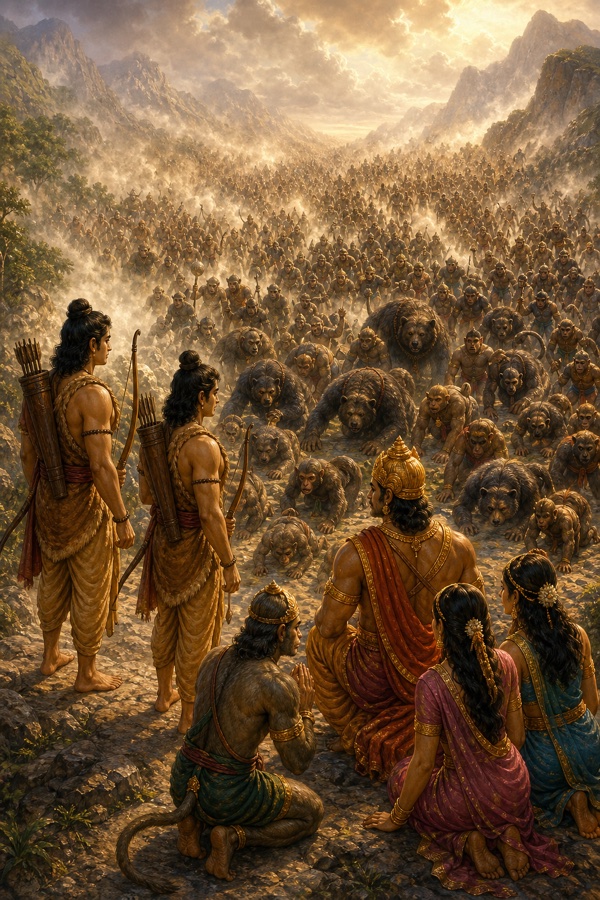
Just then a dust rose that hid the fierce brightness of the sun; the directions were covered in darkness, and the whole earth, with its mountains and woods and forests, trembled. That dust was the order Sugriva had given ten days earlier, coming back to him all at once. Then all the ground was hidden under numberless mighty vanaras, huge as mountains and sharp-fanged. In a moment the earth was covered by hundreds of crores of vanara troop-leaders, forest-dwelling vanaras that dwelt on riverbanks and mountains and seashores and roared like clouds. Their colors were of every kind: some red as the risen sun, some pale as the moon, some tawny as lotus-filaments, and some white as the vanaras that dwell on the golden mountain.
Then appeared the hero Shatabali, ringed by ten thousand crore vanaras. Next came Sushena, Tara’s father, like a mountain of gold, with many thousand crores. Then came Sugriva’s father-in-law, Ruma’s father, the lord Tara, with a thousand crore. Tawny as lotus-filaments, his face like the risen sun, Kesari, the father of Hanuman, appeared with many thousand vanaras; he had come to stand behind the son whose real father was the wind. Gavaksha, mighty king of the langurs, of dreadful valor, came ringed by a thousand crore; Dhumra came with two thousand crore bears of terrible speed. The troop-leader Panasa came ringed by three crore vanaras grim as great mountains; the troop-leader Nila, huge as a mass of black collyrium, appeared with ten crore. Gavaya of great might, like a golden mountain, with five crore; the strong Darimukha with a thousand crore; Mainda and Dvivida, sons of the two Ashvin physicians of heaven, each with a thousand crore; Gaja with three crore, all came near Sugriva. Jambavan, king of the bears, older than any creature on that field and born of the Grandsire himself, came ringed by ten crore bears under Sugriva; Rumanvan came swiftly with hundreds of crores. Gandhamadana came behind, ringed by one arab, a hundred crore, of vanaras. The prince Angada, valiant as his father Vali, came with a thousand padma and a hundred shanku of vanaras, marching for the uncle who sat in his father’s chair. The hero Tara, of terrible valor and the sheen of a star, was seen from afar with five crore; the wise hero, the troop-leader Indrajanu, appeared as lord of eleven crore. Rambha, like the risen sun, with eleven thousand and one hundred; the strong hero Durmukha with two crore; Hanuman, ringed by a thousand crore vanaras like the crest of Kailasa; Nala with a hundred crore and a lakh of tree-dwelling vanaras; and Dadhimukha with ten crore, came roaring near Sugriva. The vanaras named Sharabha, Kumuda, Vahni, and Ranha, and countless other troop-leaders able to take any shape, came covering the earth and its mountains and woods.
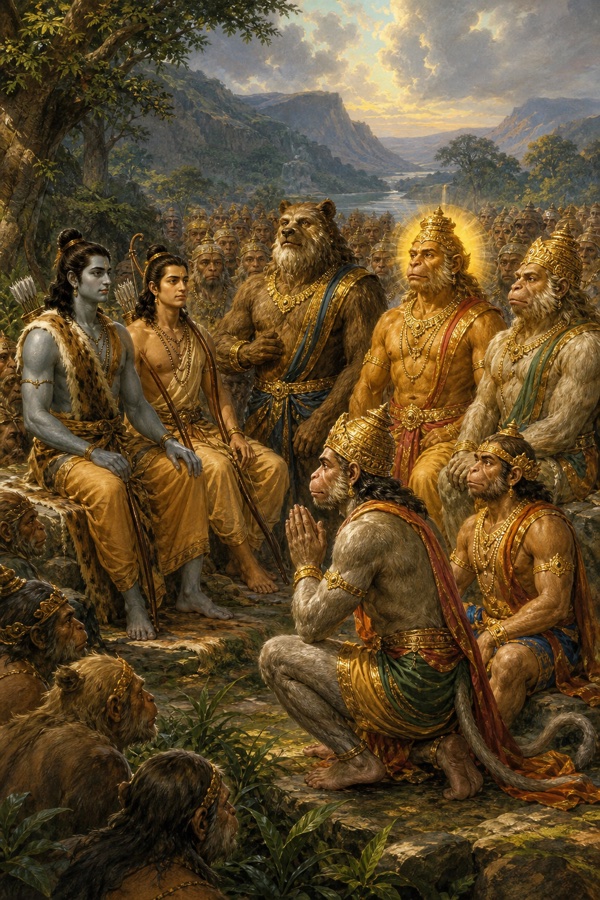
All the vanaras who had come sat down on the ground. Leaping from tree to tree and branch to branch, roaring, the vanaras ringed Sugriva as clouds ring the sun. The vanara, hanging back from afar, unwilling to press through the solid crowd and come near, bowed their heads and announced their presence to Sugriva, lord of the monkeys. Some of the best vanaras made their fit report and went away; some met Sugriva and stood with joined palms. Then Sugriva quickly reported all those vanaras to Rama, and with joined palms said to the vanara chiefs, “Lords of the vanaras, lodging the armies fittingly by the mountain springs in all the woods, let the commander who knows their strength learn their true count.”
The eastern quarter, and the departure of Vinata
Sugriva, rich in resources, said to Rama, “The shape-shifting vanara chiefs, blazing like Mahendra, who dwell in my realm have come and are lodged at their ease. Grim as demons and titans, of great and various valor, these vanaras have shown their courage in many places, are strong, and are conquerors of fatigue. Traveling on both land and water, dwelling on many mountains, in their crores these vanaras are your servants. All are obedient and devoted to their lord’s good, and will accomplish the task you desire. Say what seems to you fit for the hour; give this army, which is under your command, its rightful order. Though this work is well known to these vanaras and to me, still it is for you to give the fitting order.”
As Sugriva spoke so, Rama took him in his arms and said, “Let it be learned whether Vaidehi lives or not, and let the place be sought where Ravana dwells. When the dwelling of Vaidehi and of Ravana has been found, then, in that hour, I will settle the plan with you as the time demands. In this matter I am not the lord, nor is Lakshmana; you are the cause and the lord of this work, chief of the vanaras. You yourself must give the order; you know my task, of that there is no doubt. Hero, you are my second friend after Lakshmana, valiant, wise, a knower of the fitting hour, my well-wisher, trusted, and the best knower of my purpose.” The man who had come within an hour of having this king killed now handed him the whole command of the war, and meant it.
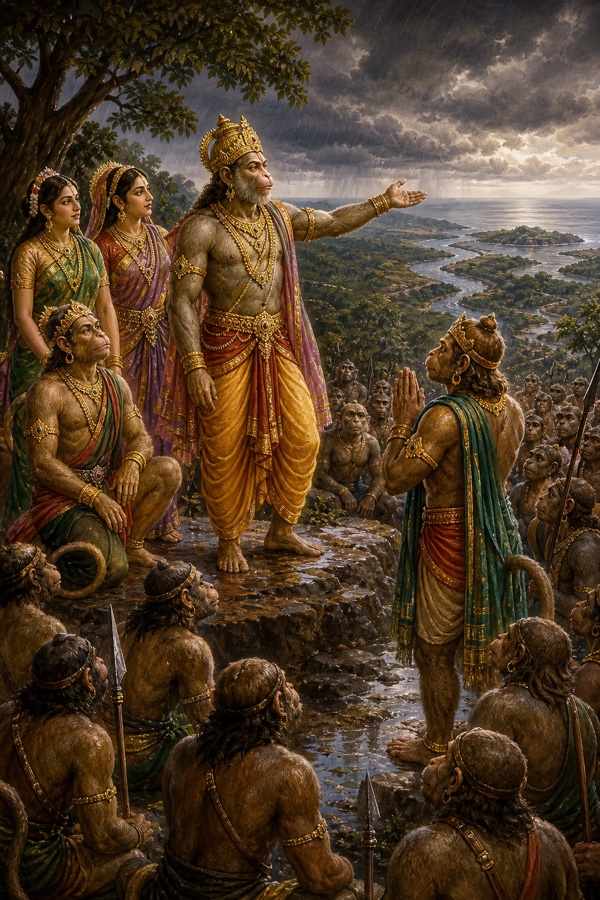
When Rama had spoken so, Sugriva, in the presence of Rama and Lakshmana, said to the troop-leader Vinata, cloudlike and mighty as the roar of a cloud, who had come with vanaras bright as the sun and moon, “You are versed in place and time and policy and skilled in resolving what to do. With a hundred thousand swift vanaras, search the eastern quarter, with its mountains and woods and forests; in the mountain fastnesses, in the woods and rivers, seek out Vaidehi Sita and the dwelling of Ravana. Combing the whole region, of the Bhagirathi, the holy Ganga, of the Sarayu, the Kaushiki, the Yamuna and its source the great Yamuna mountain, Kalinda, of the Saraswati, the Sindhu, the Shona with its gem-bright water, the Mahi, the Kalamahi, of Brahmamala, Videha, Malava, Kashi and Kosala, the great villages of Magadha, of Pundra, Anga, the land of the silk-worm rearers, and the land of the silver mines, you must seek Rama’s beloved, the bride of Dasharatha’s house, Sita.” He was naming, without pausing over it, the two rivers of Rama’s own life, the Sarayu that runs past Ayodhya and the country of Videha that had given Sita to him.
Sugriva went on to Vinata, “Look at the mountains sunk in the sea and the ports, and all the dwellings on the peak of Mandara. Search the abodes of the island-dwellers, the Karnapravaranas, whose ears hang like shawls, the Oshthakarnas, whose ears reach to their lips, those with faces black and hard as iron, the one-footed men, and the Kiratas who eat raw fish, who move through the water and are called man-tigers. With effort comb Yavadvipa, adorned with its seven kingdoms, and the islands of the gold and silver mines. Beyond Yavadvipa is a mountain called Shishira, whose crest touches the sky. Crossing to the far shore of the sea, in the lovely banks of the Shona river and its charming woods, search everywhere for Vaidehi and Ravana. Then search the mountain-born rivers ringed by dreadful and many groves, and the caves and crests and woods. Comb the fearful islands ringed by the ocean of sugarcane juice, and the roaring, dreadful sea that tosses in the wind.”
Sugriva said, “In that sea, great and long-hungry demons, permitted by Brahma, seize each morning the shadows of creatures flying overhead and devour them; a bird that crosses there loses its life to the shape it throws on the water. Crossing by some means that great ocean, dark as a doom-cloud, haunted by huge serpents, loud with a great roar, look, on the shore of the sea called Lohita with its blood-red water, at the great kutashalmali tree. There stands the mansion of Vainateya, Garuda, built by Vishvakarma, like Kailasa, adorned with many gems. On that island the terrible rakshasas called Mandehas hang head-downward from the mountain crests, and at sunrise they wrestle with the sun, and, struck down by the power of the Gayatri, fall into the water, and, revived by the touch of the water, hang again, and so the same battle is fought and lost every dawn of the world. Then, crossing the milk-ocean, white as a white cloud, look, in its midst, at the white mountain named Rishabha and the lake named Sudarshana, bright with silver lotuses with golden filaments and full of royal swans. Beyond it is the sea called Jaloda, a terror to all beings, in which is the great fire Hayamukha, the mare-faced fire born of the wrath of Aurva, whose fuel is the water of that sea and all that moves and does not move. Seeing that fire, the ceaseless cry of the beings there, both the helpless and the strong, can be heard without end.”
Sugriva said, “Thirteen yojanas from the northern shore of Jaloda is the golden-gleaming mountain Jatarupashila. There, seated on the mountain’s peak, see the god Ananta, Shesha, saluted by all the gods, thousand-headed, robed in blue, his eyes like lotus-petals, calm as the moon. Before him stands a golden palm-banner with three branches and an altar, which the gods have made the mark of the eastern boundary. Beyond it is the golden Mountain of Rising, whose golden crest is a hundred yojanas long; on that summit stands another golden peak called Saumanasa, a yojana long and ten yojanas high. On it Vishnu, in his Trivikrama incarnation, set his first stride, his second on the crest of Meru. When the sun, having circled Jambudvipa from the north, climbs that crest, it is plainly seen. There the sun-colored Vaikhanasas, the Balakhilya sages, are seen at their penance. At the beginning of creation Brahma made this Mountain of Rising the gateway between the higher worlds and the earth, and that is why this quarter is called the east, the first of all. Beyond it the eastern quarter is impassable, ruled by Indra alone, without moon or sun, and covered in darkness. Only so far can vanaras go; what lies beyond, sunless and without limit, we do not know. Within one month find the dwelling of Vaidehi and of Ravana, and come back; do not stay longer, for one who stays longer will die at my hands. Comb the eastern quarter, dear to Mahendra and adorned with woods, and, having found Rama’s beloved Sita, come back rejoicing.”
The southern quarter, and the departure of Angada and Hanuman
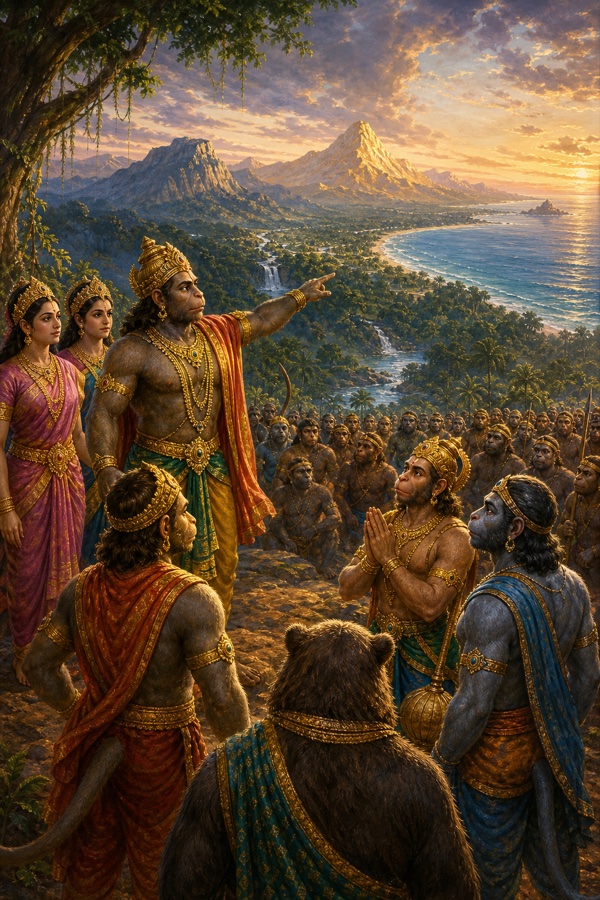
Having sent that great vanara force to the east, Sugriva sent tested vanaras to the south. The brave and expert lord of the vanara hosts appointed heroes rich in speed and valor, led by Angada: namely Nila the vanara Hanuman, Jambavan Suhotra, Sharari, ShARagulma, Gaja, Gavaksha, Gavaya, Sushena, Vrishabha, Mainda, Dvivida, a second Sushena, Gandhamadana, and the two sons of the fire-god, Ulkamukha and Ananga. Making Angada the leader of these vanara heroes, he gave them the southern quarter. He described to the monkey chiefs, in particular, the hard regions of that quarter. Of the four parties going out, this was the one he had loaded with his best: the son of the wind, the son of Vali, and the bear-king who had been born of the Grandsire and had watched the world grow old.
Sugriva said, “See the thousand-crested Vindhya with its many trees and creepers, the lovely Narmada haunted by great serpents, then the lovely Godavari and the great river Krishnaveni, Varada haunted by great serpents, the lands of Mekhala and Utkala, the cities of Dasharna, and the countries of Avanti; see them all. Look on every side at Vidarbha, Rishtika, lovely Mahishmaka, Vanga, Kalinga, and Kaushika; and, combing the Dandaka forest with its mountains and rivers and caves, search Godavari, Andhra, Pundra, Chola, Pandya, and Kerala.” He had named, in one breath among the rivers, the water beside which Rama’s hut had stood and from which Sita had been taken. “See the mountain Ayomukha, the Malaya, adorned with minerals, of wondrous crests and flowering groves. Combing that great mountain with its lovely sandal forests, look at the celestial, copper-colored river Kaveri, haunted by the apsarases. On the peak of Mount Malaya, see Agastya blazing like the sun; and, with Agastya’s leave, cross the great river Tamraparni, thick with crocodiles, which mingles with the sea, along with its islands wrapped in sandal-groves and its water, as a young woman meets her beloved. Then see the golden gate, set with pearls and gems, of the city of the Pandyas. Then, reaching the sea, judge whether you have the strength to cross it, and go on.”
Sugriva said, “Agastya set, between the moat of the city and the ocean, Mount Mahendra, all of gold, with wondrous crests and trees, sunk on one side in the sea. On every new-moon day the thousand-eyed Indra comes to that lovely mountain. On the far side of it is a shining island, a hundred yojanas broad, unreachable by men. There, with all your being, search well for Sita, for that is the dwelling of the wicked and death-deserving Ravana. In the middle of that southern sea lives a demoness named Angaraka, who catches her prey by seizing the shadows of creatures flying overhead. Search out every place you are unsure of until no doubt is left, and if Sita is not there, seek the wife of that king of boundless splendor elsewhere.” He had said it plainly, in the middle of a list of mountains, and no one in that assembly yet understood that the whole war had just been named. “Beyond that island, a hundred yojanas out in the sea, is Mount Pushpitaka, haunted by Siddhas and Charanas, bright with the beams of moon and sun. One of its golden crests the sun tends, the other, of white silver, the moon; and the ungrateful, the pitiless, and the unbeliever cannot see it. Saluting Pushpitaka, search it. Crossing it, come to Mount Suryavan, then to Mount Vaidyuta, on whose trees that yield every desire eat the roots and fruits and drink the honey, and go on. Then comes the lovely Mount Kunjara, where stands the celestial golden mansion of Agastya, built by Vishvakarma. On it is Bhogavati, the city of serpents, like the Bhogavati of the underworld, where dwells the terrible serpent-king Vasuki; enter it and search.”
Sugriva said, “Search too the hidden regions near the city. Beyond it is the great bull-shaped mountain Rishabha, where grows the celestial sandal called Goshirshaka, Padmaka, Harishyama, and Agnisamaprabha; but even seeing it, never touch it. Gandharvas named Rohita guard that wood; among them Shailusha, Gramani, Shiksha, Shuka, and Babhru are the five sun-bright lords of the gandharvas. At the end of the earth, beyond Rishabha, dwell the Svargajits, of holy deeds, their bodies like sun and moon and fire. Beyond it is the terrible world of the fathers, the realm of Yama, wrapped in cruel darkness; you must not go there. Only so far can you search or travel; beyond it there is no path even for those who move. Seeing all this, and whatever else appears, and having found news of Vaidehi, come back. He who within one month returns and says that Sita is found will live at ease with wealth and pleasures equal to my own; there will be none dearer to me than he, dearer than my own life, and, though he commit many faults, he will remain my kinsman. Vanaras of boundless strength and valor, born of high and virtuous houses, begin such a great feat of manhood that Sita, the daughter of Janaka, may be found.”
The western quarter, and the departure of Sushena
Having sent the vanaras to the south, King Sugriva went to Sushena, cloudlike and of terrible valor, the father of Tara and his own father-in-law, and, bowing with joined palms, spoke to him. He gave the western quarter to Archishman, the great vanara son of the sage Marichi, blazing like Mahendra, endowed with wisdom and valor, of the sheen of Garuda, and to the mighty vanaras of Marichi’s line called Archirmalyas, and to other sons of sages. He said, “Making Sushena your leader, with two hundred thousand vanaras search carefully for Vaidehi. Search Saurashtra, Chandrachitra, Bahlika, the rich and lovely lands and great cities, the Kukshi country thick with punnaga trees and full of bakula and uddalaka, the ketaka woods, the blessed cool-watered rivers that run to the west, the wildernesses of the ascetics, the mountains clothed in woods, the barren near-desert lands, and the high cold rocks.”
Sugriva said, “Combing the hard western quarter, ringed by nets of mountains, look at the western sea, whose water is troubled by whales and crocodiles. There the vanaras will roam in the ketaka woods, the tamala groves, and the coconut forests; in all of them, in the shore mountains and the woods, seek the dwelling of Sita and Ravana. See the port of Muravi, the lovely Jatapura, Avanti, Angalepa, the hidden wood, and the great royal cities here and there. At the meeting of the Sindhu and the sea stands the great Mount Somagiri, of a hundred crests and great trees, on whose lovely tablelands live winged lions that carry off whales and elephants to their nests. Rut-sated elephants roam those tablelands, roaring like clouds. The golden crest of that Somagiri touches the sky.”
Sugriva said, “Let the shape-shifting vanaras comb the whole mountain swiftly. In that sea is the golden crest of Mount Pariyatra, a hundred yojanas long, on which live twenty-four crore gandharvas, dreadful and shape-shifting, blazing like fire; do not provoke them, and pluck no fruit there, for they are unassailable, mighty, and of terrible valor, and guard the fruits and roots of that place. There, with effort, seek Janaki; if you keep your monkey-nature, you have nothing to fear from them.” He was telling an army of monkeys to walk through an orchard they were forbidden to touch, and he knew exactly what he was asking. “Near Pariyatra is the great mountain named Vajra, of the color of cat’s-eye gem, structured like the thunderbolt, a hundred yojanas high; comb its caves with effort. In the fourth part of that sea is Mount Chakravan, where Vishvakarma made a discus of a thousand spokes; there the supreme being Vishnu, having killed the demons Panchajana and Hayagriva, took the discus and the conch. In its lovely caves seek Vaidehi and Ravana. In the fathomless abode of Varuna is Mount Varaha, sixty-four yojanas long, with a golden crest, on which stands the golden city Pragjyotishapura, where the wicked demon Naraka dwells; search its lovely caves too.”
Sugriva said, “Crossing Varaha, there is a mountain wholly of gold, within which gold is seen and which has ten thousand springs. On it elephants, boars, lions, and tigers roar on every side. There the bay-horsed Indra was consecrated to his kingship, and so it is called Megha. Crossing that mountain, guarded by Mahendra, you will reach sixty thousand golden hills, colored like the risen sun and adorned with flowering golden trees. In their midst is the king of mountains, Meru, called Savarni, to whom the sun gave a boon that the gods, gandharvas, and demons who dwell in his shelter by day or night should become golden and devoted to the sun. At twilight the Vishvedevas, the Vasus, and the Maruts come to Meru and worship the sun, and the sun vanishes behind the Mountain of Setting. Ten thousand yojanas away, upon that Mountain of Setting, the sun arrives in half a muhurta, and, having freed the world of living beings from darkness, sets. On the crest of that Meru is a celestial mansion, sun-bright, built by Vishvakarma, the dwelling of Varuna, noose in hand. In all those fastnesses and lakes and rivers, seek Vaidehi and Ravana.”
Sugriva said, “On Meru Savarni dwells the sage Merusavarni, blazing with penance, a knower of dharma like Brahma; bow your head to him and ask him news of Maithili. Only so far can you go; beyond it, sunless and without limit, we do not know. Having found the dwelling of Vaidehi and of Ravana, come back within one month; one who stays longer will die at my hands.” He had given the same month and the same sentence to every quarter, and he said it now to his own wife’s father without softening a word of it. “With you my brave father-in-law will go; he is my elder and worthy of my honor, and so of yours; you must heed all his words as commands. You are all valiant and each a measure to yourselves, and yet, holding him the chief authority, look on the western quarter. Only when we have seen Sita, the wife of the mighty king Rama, will we have repaid the kindness done us and be fulfilled. Whatever else is good for this work, weigh it by place and time and aim, and do it.” Hearing this shrewd word of Sugriva’s and taking leave, Sushena and the vanaras with him set out for the western quarter guarded by Varuna.
The northern quarter, and the departure of Shatabali
Having sent his father-in-law Sushena to the west, the all-knowing King Sugriva spoke words good for himself and for Rama both to the hero Shatabali. “With all your ministers and the sons of Vaivasvata, ringed by a hundred thousand vanaras like yourself, enter the northern quarter adorned by the Himalaya and search everywhere for Sita, the glorious wife of Rama. When this work is done and Rama is pleased we shall be freed of our debt and fulfilled. The prince born in Raghu’s line has done us a kindness; when it is repaid, our lives will be well spent. He whose birth is well spent is one who does even the work of a suppliant who has done him no earlier service; how much more when the man has done him an earlier kindness. Knowing this, make such effort that Janaki may be found. This man, Rama is honored by all beings and holds us in affection.” A month earlier he had not been able to remember any of this. Now he could not stop saying it.
Sugriva said, “By the strength of your wisdom and valor, comb these many hard places, the rivers, and the mountain caves. There, seeing the Mlecchas, the Pulindas, the Shurasenas, the Prasthalas, the Bharatas, the Madras with the Kurus, the Kambojas, the Yavanas, the ports of the Shakas, and the Darada lands, seek the Himavan. In the groves of lodhra and padmaka and in the deodar forests seek Vaidehi and Ravana. Then, going to the hermitage of the sage Soma, haunted by gods and gandharvas, go to the high-crested Mount Kala; in its great crests and mountains and caves, seek the noble and blameless wife of Rama. Crossing the great golden-hearted Mount Kala, go to Mount Sudarshana, then to Mount Devasakha, the refuge of the birds, adorned with many birds and trees; in its groves and springs and caves, seek Vaidehi and Ravana. Crossing it lies a hundred-yojana wilderness without mountain or river or tree, empty of all life; crossing that hair-raising waste swiftly, you will come to white Kailasa and rejoice.”
Sugriva said, “There stands the lovely mansion of Kubera, built by Vishvakarma, white as a white cloud, gilded with gold, where is a great step-pool full of lotuses, full of swans and karandava ducks, and haunted by the apsarases. There Kubera, the yaksha-king, the giver of wealth, honored by all the world, takes his pleasure with the Guhyakas; in the moon-white crests and caves of that mountain, seek Vaidehi and Ravana.” He did not add that the demon they were hunting was that same wealth-god’s half-brother, and had taken Lanka from him, and the flying chariot too. “Reaching Mount Krauncha, enter its hard cave with care, for entry into it is difficult; there dwell high-souled sages, bright as the sun and godlike, who were invited there by the gods. Comb the other caves and tablelands and crests and glens and slopes of Krauncha too. Comb the treeless love-mountain Manasa, which by mere sight fulfills desire and is unreachable even by birds; there is no path there for spirits, gods, or demons. Crossing that Krauncha is Mount Mainaka, on which stands the self-built mansion of the demon Maya; comb it too, with its crests and tablelands and glens. Here and there are the dwellings of the horse-faced Kinnara women; passing that region, you will find the hermitage of the Siddhas, where the Vaikhanasa and Balakhilya Siddhas, ascetics, dwell; bow to them and ask humbly for news of Sita. Near them is the Vaikhanasa lake, covered with golden lotuses and haunted by swans bright as the risen sun; Kubera’s universal elephant roams there with the cow-elephants. Crossing that lake comes a sky without sun or moon or star, cloudless, which the Self-luminous Siddhas, perfected by penance, godlike, light up with rays like the sun’s.”
Sugriva went on, “Crossing that region comes the river named Shailoda, on whose two banks grow the bamboos called Kichaka, which, twining together, carry the Siddhas across and back. Uttarakuru, the dwelling of those of holy deeds, lies on the bank of that Shailoda. There are thousands of rivers with golden lotuses and blue-lapis petals; lakes bright as the risen sun, adorned with woods of red lotuses and golden lotuses. That land is ringed on every side with priceless jeweled petals, golden filaments, and woods of blue lotus. The sandy banks of the rivers are heaped with flawless pearls, priceless gems, and gold. There the trees are forever in flower and fruit, of celestial scent and taste and touch, and grant every desire; some fine trees bear clothes of many shapes and ornaments of pearl and lapis fit for both men and women. Some trees give the ease of every season and bear fruit painted with gems. Some trees give couches with wondrous coverings, lovely garlands, priceless drink, and food of many kinds, and give too women rich in beauty and youth.”
Sugriva said, “There gandharvas, kinnaras, Siddhas, nagas, and vidyadharas take their pleasure forever with their women. All are of holy deeds, given to love, endowed with desire and wealth, and dwell with their women. There the sound of song and instruments and the noise of laughter, gladdening the hearts of all beings, is heard without cease. There no one is unhappy, nor any doer of ill; their lovely virtues grow day by day. Crossing that region comes the northern sea, in whose midst is the golden great Mount Somagiri. The gods of Indra’s world and of Brahma’s world look upon that king of mountains. Though it is sunless, that region is lit sunlike by the radiance of that mountain. There dwell Vishnu, the soul of all, Shambhu in the form of the eleven Rudras, and Brahma ringed by the seer-sages. Beyond Uttarakuru you must not go by any means; there is no path there even for other beings. That Somagiri is hard to reach even for the gods; the moment you see it, turn back swiftly from there. Only so far can you go; beyond it, sunless and without limit, we know nothing. Resolve to comb all this region I have told, and whatever is not told as well. By this work of showing us Sita, vanaras equal to wind and fire, the great good pleasure of Dasharatha’s son Rama, and after it my own pleasure too, will be accomplished. Then, fulfilled and free of enemies, honored by me with the gifts of lovely virtues, you will roam the earth with your kinsmen and your loves.”
Rama gives his ring to Hanuman
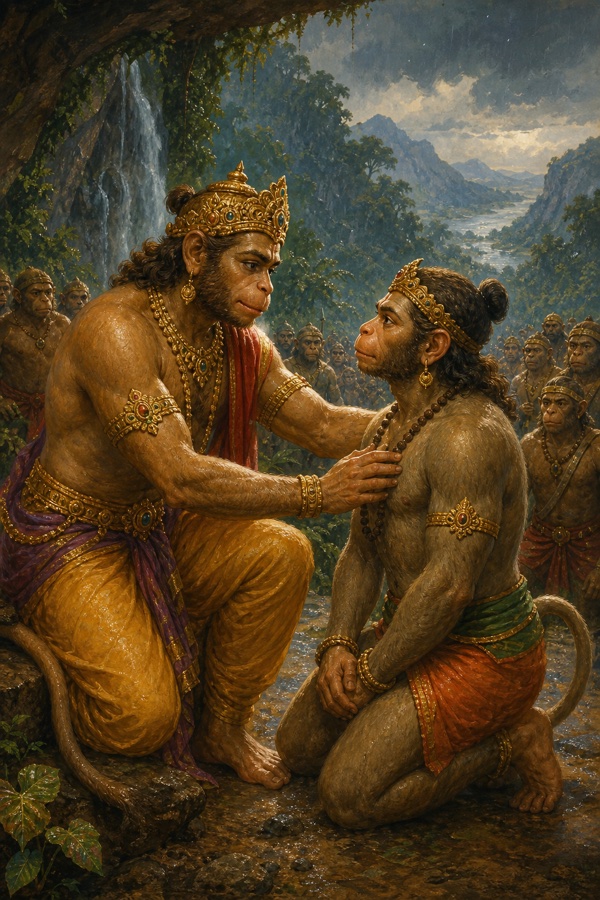
Sugriva laid the matter of the search for Sita before Hanuman in particular, for as to the achieving of the work he was sure of the power of that monkey leader. Four parties had gone out to four quarters, and the king of the vanaras had already decided, in his own mind, which one of all those crores would come back with the answer. The lord of all the forest-dwellers, greatly pleased, said to Hanuman, “Neither on the earth nor in the middle air nor in the sky nor in the world of the gods nor in the waters do I see any check to your going. All the worlds, peopled by demons, gandharvas, nagas, men, and gods, with their seas and mountains, are known to you. Your unhindered going, your speed, energy, and lightness are the equal of your mighty father, the wind. In splendor too there is no being on earth like you; so you yourself must ponder the way in which Sita may be found. Master of policy, in you alone lie strength, wisdom, valor, the following of place and time, and prudence.”
From these words of Sugriva, knowing that the success of the work rested on Hanuman, and knowing Hanuman fit to accomplish it, the prince born in Raghu’s line reflected, “This lord of vanaras holds Hanuman able for the work, and Hanuman himself is even more sure of it; and so, tested by his deeds and chosen by his master, and now setting out, this Hanuman’s success is certain.” Seeing Hanuman, best in the venture, Rama grew glad as if the thing were done, his senses and his heart thrilled with delight. He had been reading men his whole life. He had never in his life been so right about one.
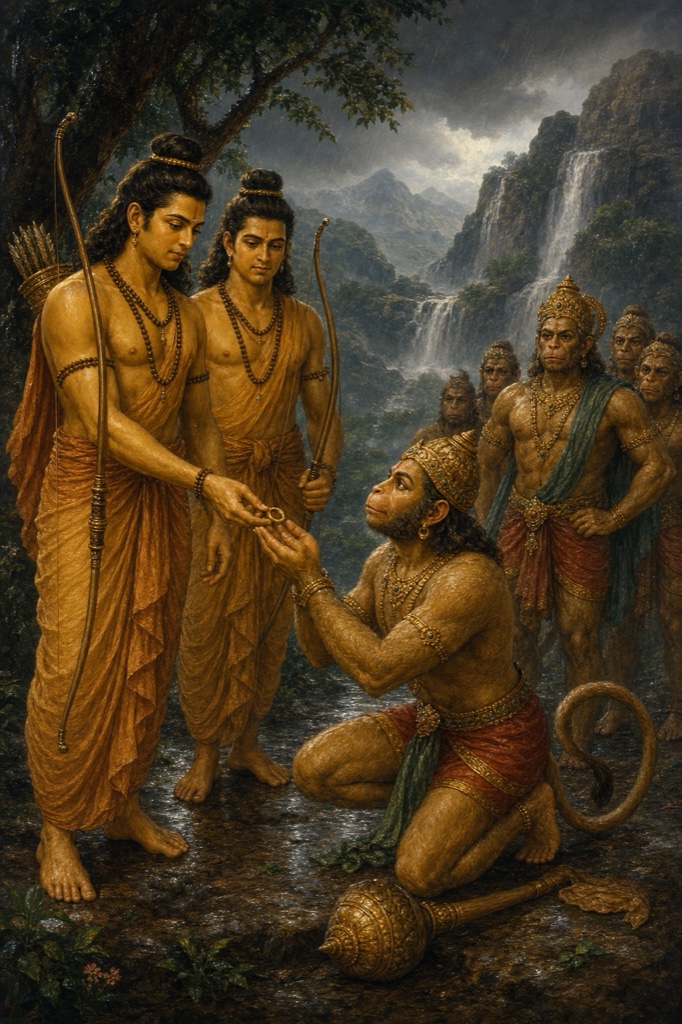
Then the glad Rama gave Hanuman, as a token of recognition for Sita, a ring marked with his own name. Everything Rama had was gone: the kingdom, the father, the hut in Panchavati, the woman. What remained that was his and could be handed to another man was this one circle of metal with his name cut into it, and he put it into the hand of a monkey he had known for a season. “By this sign Sita, the daughter of Janaka, will know you, without a doubt, to have come from my presence. Hero, your resolve, your valor joined to good stuff, and the message of Sugriva foretell success to my mind, as it were.” Taking that ring, setting it on his head, and bowing at Rama’s feet, Hanuman set forth with joined palms. He did not put it away. He carried it where a man carries the thing he will die before losing. Leading that great vanara force, Hanuman, shone like the clear moon graced by the stars in a cloudless sky. Rama sent him off with these words: “Hanuman of surpassing strength, I lean on your might; exert yourself by your many feats of valor so that Sita, the daughter of Janaka, may be found.”
The parties set out to the four quarters
Calling all the vanaras together in one place, Sugriva, king of the vanaras, addressed them with the aim of accomplishing Rama’s work. Understanding well the fearsome order he had given, all the vanara troop-leaders set out, each on his own road, covering the earth like locusts. Waiting through the one month set for finding news of Sita, Rama stayed with Lakshmana on that same Mount Prasravana, on the same ledge, watching the same sky, having traded one kind of waiting for another.
The hero Shatabali sped away toward the northern quarter, which is ringed by the king of mountains, the Himalaya. The troop-leader Vinata moved toward the eastern quarter. Hanuman with Tara and Angada and the rest, went toward the southern quarter, tended by the sage Agastya. Sushena set out toward that dreadful western quarter, which is guarded by Varuna, god of the waters. Four roads out of one hill, and only one of them was the road that mattered.
Having sent the vanaras thus fittingly to every quarter, the hero Sugriva, lord of the vanara army, was pleased and content in his heart. Receiving the king’s order, all the troop-leaders, roaring and bellowing, shrieking and running and shrilling, sped off toward their own quarters. They said, “We will make an end of Ravana and bring Sita back.”
Proud of their own strength, the vanaras spoke before Sugriva one by one in this way: “I alone will kill Ravana in battle, and then, crushing his helpers, I will carry off by force the daughter of Janaka, trembling with fear and pain.” “I alone will drag Janaki up even out of the nether world.” “We will tear up the trees, split the mountains, cleave the earth, and churn the seas.” “I can leap a hundred yojanas, of that there is no doubt.” “I can leap even more than a hundred yojanas.” “On the surface of the earth, in the sea, on the mountains, in the woods, or even in the midst of the nether world, my going can be stopped nowhere.” They were boasting of a hundred yojanas the way men boast of things they will never be asked to do. One of them, standing quietly among them, would be asked.
How Sugriva came to know the whole earth
When the lords of the vanaras had gone, Rama asked Sugriva the question that had been sitting in him through that whole recitation of mountains and seas and boundary-marks of the world. “How is it that you know the whole round of the earth so well?” Then Sugriva bowed his head humbly and answered, “Hear my account. I will tell it all in full.” The answer was going to be a confession.
“In an earlier time, when Vali was driving the demon named Mayavi, the son of Dundubhi who lived in the form of a buffalo, toward Mount Malaya, that buffalo-demon slipped into a cave of Mount Malaya. Vali too went into the cave, meaning to kill the demon. Leaving me at the cave’s mouth, he went inside, and I, obedient, stood there. A full year passed, and Vali did not come out. I stood at that mouth for a year because my brother had told me to stand there. Then the cave filled with a stream of blood. Seeing it, I was amazed and struck through with grief for my brother. I became certain that my elder brother had surely been killed. Thinking that the buffalo-demon, shut inside, would starve, I set a great boulder like a mountain over the mouth of the cave, and, despairing of Vali’s life, returned to Kishkindha.”
“Having gained the vast kingdom, and Tara, Vali’s wife, along with Ruma, I lived there at ease with my friends and free of care. Then Vali, having killed the buffalo-demon, came back.” It was the blood of the demon that had run out of that cave, and a brother who had sealed the door on a living man was now a brother who had taken his wife and his throne, and no explanation was ever going to sound like the truth. “Out of both respect and fear I returned the kingdom to him. But Vali, his heart deeply inflamed, ran after me in a rage, wishing to kill me. With my ministers I fled to save my life, and as I ran I saw many rivers and forests and cities. In that flight the earth seemed to me small as the print of a cow’s hoof, clear as a mirror, and, by the speed of my going, spinning like a whirled circle of firebrand.”
“First I went to the eastern quarter and saw trees of many kinds, lovely mountains with their caves, and lakes of every sort. There I saw the Mountain of Rising, adorned with minerals, and the milk-ocean, the ever-dwelling home of the apsarases. Shaking Vali off, I turned and went suddenly on from there, lord. Then, turning from the east, I moved toward the southern quarter, full of the trees of Vindhya and adorned with sandal trees. Shaking Vali off, I reached the western quarter, and, looking on the Mountain of Setting, I sped toward the north.” Every mountain and river he had set before those four armies that morning, he had learned by running past it with his brother behind him.
“When, harried by Vali, I could find no refuge even in the Himalaya, in Meru, or in the northern sea, Hanuman said to me, ‘King, now I remember. The sage Matanga cursed Vali that if he entered the region of his hermitage his head would split into a hundred pieces. There our dwelling will be happy and free of fear.’ Then, prince, reaching Mount Rishyamuka, I made my dwelling there. For fear of Matanga’s curse Vali could not come into that region. In this way, king, I saw the whole round of the earth with my own eyes, and then returned to the cave of Rishyamuka.” One old curse laid on a hill by a sage had kept Sugriva alive long enough for Rama to walk up it and find him.
The three parties return in despair
The vanara chiefs, sent out on every side to find Sita, set off at once for their own quarters at Sugriva’s order. They combed lakes, the thickets along riverbanks, open plains, cities, and regions made hard by rivers, in every direction. Searching for Sita all day, the vanaras gathered together at night in one place to rest. Day by day they came to trees that bore fruit of every season, and there they passed the night. Not one of them had ever seen the woman they were looking for.
Counting the day of departure as the first day, in one month the vanara troop-leaders came back in despair to Mount Prasravana, where Sugriva stayed with Rama. Having combed the eastern quarter and not found Sita, Vinata returned with his ministers. Having combed the whole northern quarter, the great vanara Shatabali too came back, afraid, with his party. Having combed the western quarter, Sushena also came to Sugriva when the month was full. Three quarters of the world had been turned over, on time, by an army that had been threatened with death for lateness, and it had produced nothing at all.
Bowing to Sugriva, who sat with Rama on the crest of Prasravana, the three troop-leaders reported, “We have combed all the mountains, the dense woods, the rivers that fall into the sea, and all the countries. We have searched all the glens you named. We have combed the great groves veiled in creepers. In the hard, rough regions we sought out the very large beasts, fearing they might be Ravana, and killed them.” They had been hunting a demon none of them could describe, and had killed whatever was large enough to be him. “The hard places we combed again and again. But Sita was nowhere to be seen.”
“Only the noble-natured, Hanuman, born in a high line, will be able to find news of Sita lord of vanaras. By good fortune Hanuman has gone in that very quarter to which Sita was carried.” Three armies had failed, and in failing had narrowed the whole world down to one direction and one monkey.
The forest of Kandu’s curse and the killing of the asura
With Tara and Angada, Hanuman set out at once toward the southern region Sugriva had described. Going far with all those vanaras, Hanuman combed the caves and dense woods of the Vindhya and halted there. Combing mountain crests, rivers, hard places, lakes, thickets of great trees, and woods of many kinds, still those brave vanaras had no sight of Janaki, the daughter of Janaka. Eating roots and fruits of many kinds, those unassailable vanaras searched on and rested here and there.
That vast region around the Vindhya, full of caves and dense woods, was hard to cross, and looked waterless, empty, desolate, and terrible. Combing even such woods, worn out and tormented by hunger and thirst, those fearless vanaras came into another hard region. There the trees bore neither fruit nor flower and were bare even of leaves; the rivers were without water and roots too were scarce. There were no buffaloes, no deer, no elephants, no tigers, no birds, nor any other creature of the wild. A forest with nothing living in it is a thing an animal understands before it can explain it, and the whole party felt the wrongness of the place on their skins.
In that wood, in an earlier age, the ten-year-old son of a great and truthful sage named Kandu, rich in penance and quick to anger, had come to the end of his years and died. In his rage the righteous sage cursed the whole great wood, so that it became unfit for any creature to dwell in, unassailable, and empty of beast and bird. Ages later, the silence the vanaras were walking through was still one man’s grief for one boy. Those vanaras, doing Sugriva’s pleasure, combed well the woodland regions, the mountain caves, and the springs of the rivers of that place, and still neither the daughter of Janaka was found nor Ravana who had carried her off.
Entering that terrible wood, thick with creepers and thorny thickets, the vanaras saw an asura of dreadful deeds who, by a boon the gods had granted him, had no fear of the gods. Seeing that terrible asura standing like a mountain, the vanaras girded themselves and stood firm. The strong asura too, roaring at all the vanaras, “You are all dead,” raised his fist and in great fury sprang upon them. As the asura fell upon him, Vali’s son Angada, taking him for Ravana, struck him then with the flat of his hand. Vomiting blood from his mouth at Angada’s blow, the asura fell to the ground like a mountain torn from its base.
With that one killed, the vanaras, their faces bright with victory and taking him for Ravana, combed once more nearly all the mountain caves of that region. Having combed the whole region without result, they entered another fearful mountain cave nearby. Worn out with searching, they came out again and gathered, and, in a lonely place under a tree, sat down downcast with despair.
Angada’s encouragement and the search of the silver mountain
Then the very Angada, worn out himself, gently reassured all the vanaras and said, “Woods, mountains, rivers, hard and dense places, pits, and mountain caves, we have combed on every side. And still Janaki is not seen, nor any trace of Ravana. Much of our time has passed, and Sugriva rules with a hard hand. So let us all together search again on every side. Let the forest-dwellers comb this hard wood even today. Casting off our fatigue, let us all comb this wood once more.” He was as tired as any of them and he was the only one who could not say so.
“Casting off sloth and grief and this sleep that has closed over us, let us search for Sita in such a way that we find the daughter of Janaka. Those who know policy call unwearying resolve, skill, and an unconquered mind the means to the success of a work; that is why I say this. To one who acts, the fruit of his action surely appears. To fall into utter despair and grow slack is not fitting. This word of mine is for the good of you all; if it please you, heed it, and if it does not, then tell me yourselves what is fitting.”
Hearing Angada’s word, Gandhamadana said, in a voice thin with thirst and fatigue but clear, “What Angada has said is worthy of him, wholesome and fitting; his word should be heeded. Let us comb again the mountains, caves, rocks, empty woods, and mountain springs that Sugriva named. Let all the vanaras together comb the woods and the mountain fastnesses.”
Then those mighty vanaras rose again and roamed the southern quarter, dense with the woods of the Vindhya. Climbing a silver mountain, rich as the clouds of autumn, full of crests and caves, the vanara, longing to see Sita, began to comb its woods of lodhra and its saptaparna forests. Even from its crest, though of great valor and worn out, they could not see Videha’s daughter, the beloved wife of Rama. Gazing their fill at that mountain of many glens, the vanaras came down, looking about on every side. Worn and troubled, they rested a moment under a tree, and then, when the fatigue had eased a little, made ready to comb the whole southern quarter again. Led by Hanuman, the vanara set out, and, first circling the Vindhya, roamed on every side.
The cave of Riksabila and the golden forest
With Tara and Angada, Hanuman went on combing the caves of the Vindhya, the dense woods, the glens haunted by lions and tigers, the rough slopes, and the regions near the great springs. As they lingered in that vast region, the term Sugriva had set slipped by. No one announced it. It went past them the way a tide goes past men who are busy looking at something else. That region too, full of caves and hard woods, was difficult to comb, and yet Hanuman combed the whole mountain.
Not far from one another, though not close either, Gaja, Gavaksha, Gavaya, Sharabha, Gandhamadana, Mainda, Dvivida, Hanuman, Jambavan, the prince Angada, and the vanara Tara, combing the region veiled in the mountain-net of the southern quarter, came to the southwestern crest of that mountain. There they saw a cave with a gaping mouth, named Riksabila, hard to reach and guarded by a danava named Maya.
Tormented by hunger and thirst and worn out, seeking water, they saw that vast cave veiled in creepers and trees. From it were coming out kraunchas, swans, saras cranes, and chakravaka ducks, wet with water and their limbs red with lotus-pollen. Coming near that fragrant and hard-to-enter cave, the vanaras were bewildered with wonder. Seeing the water-drenched birds, hope woke in them of water within, and, gladdened, those mighty vanaras came up to that cave, full of many creatures, deep as the nether world, dreadful and hard to enter. Thirst reads a wet feather as an argument, and there was no one in that party clear-headed enough to ask what else lived where the water was.
Then Hanuman, huge as a mountain crest, said to those grim vanaras, “Combing the regions of the southern quarter veiled in the mountain-net, we are all worn out, and still the princess of Mithila, Sita, is not found. From this cave, wet with water, swans, kraunchas, saras cranes, and chakravaka ducks are coming out on every side. Surely there is a well or pool of pure water within. And at the cave’s mouth these trees too are green and lush.”
Hearing this, all the vanaras entered that cave wrapped in darkness, into which neither the ray of the sun nor of the moon reached, and which was hair-raising. Emboldened by the lions and other beasts and birds coming out of the cave, the vanara plunged deep into the dark. Their sight was not stopped, nor their energy, nor their valor. In the dark their going was unchecked as the wind. Holding one another by the hand, they went a full yojana within. A yojana of black rock, and a chain of hands in it, and every one of them a hero who had boasted a month ago that nothing on earth could stop him. Tormented by thirst, almost senseless, yet casting off sloth, they went on for some while. Lean, downcast, and worn, when those brave vanaras had all but despaired of life, a light appeared to them.
Reaching that bright, darkness-free, lovely wood, those gentle vanaras saw golden trees of a radiance like blazing fire, namely sal, tala, tamala, punnaga, vanjula, dhava, champaka, naga trees, and karnikara, in flower with wondrous golden clusters and soft red shoots, twined with creepers and graced with golden ornaments. They saw golden trees shining like the rising sun, and, standing on altars of cat’s-eye gem and ringed by birds, blue lotus-beds of the color of lapis. They had come out of a yojana of blindness into a spring that had no sky over it.
They saw lakes full of clear water, with golden fish and great lotuses, ringed by huge golden trees shining like the morning sun. Mansions of gold and silver like celestial chariots, with golden lattices and screens of pearl; palaces set with gems; trees in flower and fruit; golden bees and honey everywhere; couches and seats of many kinds set with gem and gold; heaps of vessels of gold and silver and bronze; stores of aloe and celestial sandal; pure foods, roots, and fruits; costly chariots; rich drinks; heaps of celestial and priceless garments; and mounds of many-colored blankets and deerskins. All this they saw there, and not one living soul to own any of it.
Here and there in that cave the vanaras also saw flawless heaps of gold, shining like fire. Searching this way and that, those brave and mighty vanaras saw, a little way off, a woman. They found her clad in bark and black deerskin, keeping a strict rule of food, blazing as it were with her own radiance, an ascetic. In the middle of all that gold, the one thing alive in it was living as though none of it were there. In their wonder the vanaras stopped a little way off on every side. Hanuman asked her, “Who are you, and whose is this cave?” Huge as a mountain, Hanuman bowed to that aged woman with joined palms and asked, “Who are you, and whose are this mansion, this cave, and these jewels? Tell us, please.”
Svayamprabha and her welcome
To that righteous ascetic Hanuman said, “Worn out with hunger and thirst and troubled every way, we came suddenly into this cave wrapped in darkness. Entering this great pit in the earth and seeing so many wondrous things, we are dismayed, bewildered, and all but senseless. Whose are these golden trees like the rising sun, these pure foods, roots and fruits, these golden celestial chariots, these silver mansions, these golden lattices and screens of gems? By whose power did these golden trees of the finest gold, in flower and fruit and fragrant, come to be made? By whose strength grew these golden lotuses in the clear water? How are there golden fish here with the turtles? Is this by your own power, or by another’s penance? We know none of it; you are fit to tell us all.”
At Hanuman’s asking, that righteous ascetic, devoted to the good of all beings, answered Hanuman, “There was a great and radiant magician named Maya. By his own wondrous craft-magic he made this whole golden wood. In an earlier age he was the Vishvakarma, the craftsman, of the chief demons. It was he who made this fine celestial golden mansion. Doing penance for thousands of years in this vast wood, he won from Brahma the whole wealth of Shukra, the power of creation and the science of craft. Having made all this, that strong one, lord of every pleasure, lived here in this wood at ease for a time. Set on the apsara Hema, that demon was killed by Indra, who took up the thunderbolt.” The most beautiful place any of them had ever entered had been built by a man who was killed for loving a woman, and he had never come back to it.
“Brahma gave this fine wood, this golden mansion, and its lasting pleasures to Hema. I am Svayamprabha, daughter of Merusavarni, and I keep this mansion of Hema’s. My dear friend Hema is skilled in dance and song. It is by her boon that I guard this great mansion.” She had been keeping a friend’s house, alone, under the earth, for longer than any of them could count. “How did you find this hard-to-reach wood? What is your purpose, and for whose sake do you cross these hard roads? Eat these pure foods and roots and fruits, and drink the water, and then tell me everything.”
Hanuman’s tale, and Svayamprabha’s refusal of thanks
When they had rested a little on her welcome, the single-minded, righteous ascetic said to the troop-leaders, “Vanaras, if your fatigue is gone with the eating of the fruit, and if your tale is fit to be told, then I would hear it.” She had fed them before she asked them a single question, which is the whole of the law of welcome. Hearing this, Hanuman began to tell the true tale simply.
“The king of all the world, the equal of Mahendra and Varuna, Rama entered the Dandaka forest with his brother Lakshmana and his wife, the daughter of Videha. His wife was carried off by force from Janasthana by Ravana. That king has for a friend the brave vanara Sugriva who sent us, with Angada and the other chief vanaras, into the southern quarter, tended by Agastya and guarded by Yama. He gave us this order: ‘Let all of you together seek out the shape-shifting demon Ravana and Sita.’”
“Having combed the whole wood of this region, and eager to comb the sea and the rest of the southern quarter, we all, hungry, sat down under a tree. All of us, pale of face and sunk in care, drowned in care as men drown in deep water, with no far shore in sight. Then, turning our eyes about, we saw this vast cave, veiled in creepers and trees and full of darkness. Out of it were coming swans, ospreys, and saras cranes, wet with water and with lotus-pollen on their wings. We thought that within there must surely be water, and this guess came to us all. In the haste of our work we all plunged in and, holding one another by the hand, went in.”
“This is our work, and for this we came here. Hungry and worn, we came to you. Tormented by hunger, we ate the roots and fruits you gave us by the law of welcome. You saved us all, who were dying of hunger. Tell us, in return, what the vanaras may do for you.” Hearing this, Svayamprabha said to all those troop-leaders, “I am content with all of you swift vanaras. Devoted to dharma, I have no need of anything here from anyone.” She was sitting in a mountain of gold and she meant it exactly.
At this righteous and auspicious word, Hanuman said to the blameless-eyed one, “We have all come to your shelter. The term Sugriva set for us has passed while we roamed in the cave. So you are fit to lead us out of this cave, for by breaking Sugriva’s order we have become deserving of death. In our fear of Sugriva, save us all. We had a great work to do and even that, delayed here, has not been done by us.” She had asked what she could do for them and been told, gently, that they were dead men.
Then the ascetic said, “Once one has entered this cave, I hold it hard to come out alive. Yet by the good power of the penance I have won by my rule, I will lead all the vanaras out of this cave. Let all of you close your eyes, for those who keep their eyes open will not be able to come out.” Then all the vanaras, glad in their wish to be out, covered their eyes with their soft-fingered hands. Their faces covered, the ascetic in a moment led those vanaras out of the cave. She spent, on strangers she would never see again, penance it had taken her an age of the world to gather.
Reassuring the vanaras, now out of danger, she said, “This is the glorious Vindhya mountain, full of trees and creepers of many kinds; this is Mount Prasravana; and this is the great sea. May all be well with you. Now I return to my mansion.” So saying, Svayamprabha went back into that glorious cave, to the gold and the silence and the house of a friend who was not coming home.
The deadline gone, and Angada’s fast unto death
Coming out of the cave, the vanaras saw the abode of Varuna, the sea, boundless and roaring, tossed with dreadful waves. Combing the mountain-fastness shaped by Maya’s magic, they had let slip the term King Sugriva had set. Sitting on a mountain near the Vindhya, and seeing the trees in bloom, the vanaras fell into deep care. Seeing the trees of spring, their tips bent under the weight of the blossom and veiled in hundreds of creepers, they grew afraid at the fear of Sugriva. The whole world had turned a season while they were underground, and the flowers told them so before anyone else could. Telling one another that spring had come, and knowing that the work not done within the term was undone, they sat down on the ground.
Then, addressing the old and gentle vanaras with sweet words and giving each his due honor, the very wise prince Angada, with the neck of a lion or a bull and long, thick arms, said, “We all set out at the order of the king of the vanaras. Vanaras, do you not know that a full month has passed while we were in the cave? We set out in the month of Ashvina, bound by the count of time; and that month too has passed. What now is to be done? You are trusted by our lord, skilled in the ways of policy, devoted to his good, and appointed to every task. You are matchless in every work, and your manhood is famed in every quarter. Urged by tawny-eyed Sugriva, and making me your leader, you came on this venture.”
“Now, having failed in the work, we must die, of that there is no doubt. Who can live happily who has not carried out the message of the vanara king? With the term Sugriva set now past, a fast unto death is the only fitting thing for all of us forest-dwellers. Hard by nature and now set firm in his power, Sugriva will not forgive us, come back as offenders. Getting no news of Sita, he will do us only harm. So it is fitting, having given up son and wife and wealth and home, to go this very day to the fast unto death. Once we return from here the king will surely have us all killed. Better our death here than an unseemly death at Sugriva’s hands.”
“The one who consecrated me to the office of prince was Rama, the king of unwearied deeds; Sugriva had no hand in it. That king, holding an old grudge, seeing my offense, will have me killed by a hard punishment. When my own people see me killed with a cold heart, what shall I do? So on this holy seashore I will fast unto death.” The boy was the son of the man Sugriva had needed dead to be king, and he had never once been allowed to forget it.
Hearing this word of the prince Angada, all the vanaras spoke pitiful words. “Sugriva, hard by nature, and Rama, given over to his love, seeing us failed with the term run out and Sita not found, seeing us come back, will, to please Rama, doubtless have us killed. It is not fitting for offenders to go before their lord. We, Sugriva’s foremost servants, came here at his very order. Let us go back to that hero Sugriva only when we have found Sita in this region, or news of her; else we go to the world of Yama.”
Hearing the word of the frightened vanaras, Tara said, “Let go of your grief. If it please you, let us all go once more into that same cave and dwell there. That cave made by magic is very hard to reach, and in it are flowers, water, food, and drink in plenty. There we have no fear even from Indra, so how then from Rama or Sugriva?” It was mutiny, offered in the kindest possible voice, by a vanara who had simply run the numbers and found that the golden cave beat the king. Hearing the words of both Angada and Tara, all the vanaras, reassured, said with one voice, “Let us this very day make such a plan that we are not killed at Sugriva’s hands.”
Hanuman wins Angada back by the strategy of division
When the moon-bright Tara was speaking so, and Angada was not opposing him, Hanuman took it that Angada had, as it were, seized the kingdom of Kishkindha from Sugriva. Skilled in all the sciences, Hanuman judged Vali’s son Angada to be endowed with the eight qualities of intellect, possessed of the fourfold strength, and marked with fourteen virtues. Ever growing in energy, strength, and valor, waxing like the moon at the start of its bright fortnight, the equal of Brihaspati in wisdom and of his father in valor, and now, like Indra’s own teacher Shukra, turned to heed Tara’s counsel and turn away from his lord Sugriva, Angada was one whom Hanuman set himself to draw back to their master’s side. The boy had every gift needed to hold a throne, which was precisely the danger.
Using the third of the four means, division, Hanuman with the wealth of his speech set all the vanaras apart from one another. Having divided them all, he warned Angada with many words full of anger and fear. “Angada, in battle you are abler even than your uncle Sugriva, and, like your father, you could hold the vanara kingdom firm.” He began by conceding everything, which is how the strategy works. “But vanaras are ever fickle of heart. Without their sons and wives they will not bear your rule. I tell you plainly, these vanaras will not stay loyal to you. Jambavan, Nila, and the great vanara Suhotra, and I likewise, cannot be turned from Sugriva by you, whether by conciliation or gifts or any such means, and by force never.”
“Only by making enemies of the weak is it possible to live at ease; and so one who is weak and would save himself makes no enmity with the strong. This cave you take for shelter is easy for Lakshmana’s arrows to split open. In an earlier time Indra hurled his thunderbolt and made only a very small hole in it; Lakshmana can cleave it with his keen arrows like a cup of leaves. Lakshmana has many iron arrows, of the touch of thunderbolt and lightning, that can split even mountains.”
“The moment you settle in the cave, all the vanaras will resolve to leave you. In the memory of their sons and wives, ever restless, hungry, and worn out by the hard bed, they will turn their backs on you. Then, cut off from your own people and your loving kinsmen, you will grow more afraid than a trembling blade of grass. Lakshmana’s dreadful arrows, ever ready to kill the rebel, mighty in speed and hard to withstand, will never let you go.”
“But if you come with us in humility and return, Sugriva will set you on the throne in due order. Your uncle Sugriva, righteous, firm in his vow, pure, true to his promise, and longing for your love, will never destroy you. He wishes to do your mother a kindness, for her sake his very life is lived, and he has no other child. So, Angada, let us go back to Kishkindha.” Hanuman had spent his speech frightening the boy, and he ended it by telling him he was loved, which was the only part of it Angada had ever wanted to hear.
Angada’s resolve and the vanaras’ fast
Hearing Hanuman’s words, humble, righteous, and full of respect for their lord, Angada said what he had been carrying since the day his father died. “In Sugriva there is no steadiness, no purity of mind or body, no gentleness, no straightness, no valor, no firmness. He who took as his own wife the beloved wife of his living elder brother, who by dharma was as a mother to him, that man to be scorned, how does he know dharma?” He was talking about his own mother, in front of his father’s army, and he did not lower his voice. “He who, at the order of a brother gone to battle, blocked the mouth of the cave, that one, how will he know dharma? He who, having by a promise of truth clasped hands and made a friend, and then forgot Rama who did him kindness, whose good will such a one remember?”
“He who ordered the search for Sita out of fear of Lakshmana, with no fear of unrighteousness in him at all, how can dharma be in him? What noble man will trust that sinful, ungrateful, and fickle vanara who has cast off all policy, least of all one born in the same line? Whether Sugriva be virtuous or without virtue, how will he let me live, now that he has set the son of his mortal enemy on the throne as his heir? Divided from my fellows, an offender, and stripped of strength, how shall I live if I go back to Kishkindha, helpless and weak as an orphan? Sugriva, base, cruel, and pitiless for greed of the kingdom, if he does not kill me, will surely give me the hidden punishment of prison. Better for me the fast unto death than bondage and the shame it brings. Let all the vanaras give me leave and return home.”
“I make a vow: the city will never see me again, and on this very spot I will fast unto death. Death is better for me. Bow to King Sugriva and give him my greeting; and bow to the two mighty scions of Raghu and give them my greeting. Greet with wishes for health my uncle Sugriva, lord of the vanaras, and my aunt Ruma. And console my mother Tara; she is by nature loving to her son, tender and given to penance. Hearing that I have perished here, she will surely give up her life.” He had just called Sugriva a monster and then sent him a greeting, because the monster was his uncle and the courtesies do not stop for grief. So saying, and bowing to the old vanaras, Angada, helpless, wept and, downcast, sat on the kusha grass upon the ground.
As Angada sat, the vanara began to weep, and in grief shed hot tears from their eyes. Reviling Sugriva and praising Vali, ringing Angada about, they all resolved on the fast. Weighing the word of Vali’s son, sipping water in the rite, all the troop-leaders, facing east, sat down on a bed of kusha grass with its tips to the south, on the northern shore of the sea. The grass laid with its points to the south, the water sipped, the faces turned to the rising sun: they were performing, correctly and in order, the rite by which a man makes his own death lawful.
Ready to die, the vanara held this the fitting thing. Speaking of Rama’s exile, of Dasharatha’s death, of the ruin of Janasthana, of the killing of Jatayu, of the carrying off of Sita, of the killing of Vali, and of Rama’s wrath, the vanaras seemed to have one more fear fall upon them. They were reciting the whole chain of it, link by link, and every link had been forged by somebody’s love for somebody. As those numberless vanaras, huge as the crests of great mountains, sat and roared in their grief, the mountain rang in its caverns as the sky rings with the thunder of clouds.
The coming of Sampati, king of vultures
To that mountain-place where all the vanaras sat fasting, there came the king of vultures. He was the brother of Jatayu, the bird named Sampati, whose strength and manhood were famous. Coming out suddenly from a glen of the great Vindhya and seeing the vanaras seated there, he was glad at heart and said, “As in this world a man reaps the fruit set for him by the ordinance of his deeds, so after long time this food of so many vanaras has come of itself to me. As these vanaras die one by one of hunger, I will eat them all in turn.” Seeing the vanaras, the bird spoke so. He was old, he was starving, he could not fly, and an army had sat down within reach of him and announced that it intended to die. He thanked his karma for it.
Hearing the words of that food-greedy bird, the deeply troubled Angada said to Hanuman, “See, in the guise of Sita, Yama has come here in the very flesh for the destruction of the vanaras. Rama’s work is not done, nor the king’s order carried out, and in the midst of it this unlooked-for calamity has suddenly fallen on the vanaras. You have heard in full what the king of vultures, Jatayu, did in Panchavati to do Sita a kindness.” An old bird, alone, had heard a woman scream out of the sky and had gone up after a chariot he had no chance of catching, and had fought until Ravana cut his wings off, and had stayed alive on the ground long enough to tell Rama which way she had gone. “All beings, even of the tribes of bird and beast, do Rama a kindness, giving even their lives, as we are doing.”
“Bound by love and pity, creatures do one another kindness. So, for their service, give up your own lives yourselves. Jatayu did Rama a kindness with his life; and we too, having come by hard roads for Rama, are worn out, and Sita is not found, though we have given up even our lives. Blessed is that king of vultures, who was killed in battle by Ravana, was freed of the fear of Sugriva, and by Rama’s grace reached the supreme state.” Rama had gathered the wood himself and burned that bird with the rites of a father. “By the death of Dasharatha, the ruin of Jatayu, and the carrying off of Sita, the vanaras have fallen into calamity.”
“Know that the exile of Rama and Lakshmana with Sita, the killing of Vali by the arrow of the prince born in Raghu’s line, and the ruin of all the demons purposed by Rama’s wrath, all this ill arose from the boon Dasharatha gave to Kaikeyi.” A promise made to a young queen in a bedchamber in Ayodhya had reached, by way of a forest and a chariot and an arrow, as far as a beach at the end of the world where monkeys were sitting down to die. Hearing these pitiful words from Angada’s mouth, and seeing the vanaras fallen to the ground, the very wise king of vultures Sampati, deeply moved, spoke in a voice of grief.
That sharp-beaked vulture said in a loud voice, “He who by these words proclaims the death of my brother Jatayu, dearer to me than life, has shaken my very heart.” The meal he had been counting had just told him, without knowing it, that his brother was dead. “How came the battle between the demon and the vulture in Janasthana? Today, after long time, I have heard my brother’s name. After so long a time it gladdens me to hear him remembered. Tamers of foes, of my younger brother Jatayu, worthy of his knowing praise and his valor, I wish to hear all from you; so let me come down from this mountain fastness. He whose beloved elder son was Rama, that Dasharatha, the friend of my brother, how did he pass away? By the rays of the sun my wings are burned, and so I cannot fly; yet from this height I wish to come down.”
Angada tells Sampati the whole story
Even hearing Sampati speak in that grief-broken voice, the vanara troop-leaders did not trust him, for they feared he was asking them down to eat them. Seeing the vulture, the vanaras seated for the fast thought a fearful thought, that he would eat them all. Then they reflected, “If he eats us as we sit fasting, we shall be fulfilled, and by this deed of his we shall quickly reach our end, our death.” It was the reasoning of men with nothing left to lose, and it was the reasoning that saved the whole expedition. Coming to this resolve, the vanaras helped the vulture down from the crest of the mountain, and Angada said to him:
“My noble and mighty grandfather, king of the vanaras, was Riksharajas; he had two righteous sons, Sugriva and Vali, both of great strength. My father, King Vali, was famed in the world for his valor. Rama, son of the great warrior Dasharatha of the line of Ikshvaku, king of the whole world, devoted to obeying his father’s command and walking the path of dharma, entered the Dandaka forest with his brother Lakshmana and his wife, the daughter of Videha. His wife was carried off by force from Janasthana by Ravana.”
“Rama’s father’s friend, the king of vultures Jatayu, saw the daughter of Videha, Sita, being carried away by the sky-road. Making Ravana carless and setting the princess of Mithila on the ground, the worn and aged Jatayu was killed in battle at the hands of the strong Ravana.” For one moment, in the whole of that abduction, an old bird had brought Ravana down out of the air and set Sita on the ground with her own feet under her, and she had been free. “So Ravana killed the vulture, and, receiving the funeral rites from Rama, he reached the supreme state. Then Rama made friendship with my uncle, Sugriva, and killed my father. My father had cast out Sugriva with his ministers; killing Vali, Rama set Sugriva on the throne.”
“Made lord of the vanaras by Rama, Sugriva is now king of all the vanara chiefs. Sent by him and urged by Rama, though we have searched this way and that, we have not found Sita, as one does not find the light of the sun by night. Having carefully combed the Dandaka forest, we blundered by chance into an open pit in the earth. Combing that cave, made by Maya’s magic, the term King Sugriva set slipped by. Obeying the order of the vanara king, we have all overstepped the fixed term, and so, in fear, we sit fasting. With Rama, and Lakshmana, and Sugriva angered, even if we go back to Kishkindha our lives will not be spared.”
Sampati reveals where Sita is
At these pitiful words of the vanaras, ready to give up their lives, the vulture answered in a loud voice, his eyes full of tears. “Vanaras, he whom you say was killed in battle at Ravana’s hands, that Jatayu was my younger brother. Aged and wingless, I bear even this news, for I no longer have the strength to avenge my brother’s death. Long ago, when Indra had slain the demon Vritra, Jatayu and I flew with furious speed to heaven, and turning back from there we climbed higher still, close to the sun in its ring of rays. At noon Jatayu began to faint, and seeing my brother tormented by the sun I spread my wings over him for love. My wings burned away and I fell here on the Vindhya, and living on this mountain I never had news of my brother again.” Then the wise prince Angada said, “If you are the brother of Jatayu, and if you have heard what I told you, then tell us the dwelling of that demon. That short-sighted Ravana, basest of demons, whether he be near or far, if you know, tell us.”
Then the elder brother of Jatayu, Sampati, gladdening the vanaras, spoke a word worthy of him. “Vanaras, my wings are burned and I am a strengthless vulture; yet with my speech alone I will do Rama excellent service. I know the worlds of Varuna, and the three strides of Vishnu; I know the wars of gods and demons, and the churning for the nectar. Though old age has taken my strength and my life is slack, still this work of Rama I must do first of all.”
“On that day I saw a young woman, rich in beauty and decked in every ornament, being carried off by Ravana, crying ‘Rama! Rama! O Lakshmana!’, flinging away her ornaments and struggling to be free. On the black demon her fine silk robe shone as the light of the sun on a mountain crest, or lightning in the sky. From her taking Rama’s name again and again, I hold her, without a doubt, to be Sita. Now hear the dwelling of that demon.”
“The demon named Ravana, the very son of Vishravas and the half-brother of Kubera, dwells in the city of Lanka. From here, a full hundred yojanas out in the sea, is an island. There stands the lovely city of Lanka, made by Vishvakarma, with wondrous gates of refined gold and golden altars, arrayed with great golden palaces and ringed with a great wall that shines like the sun. There dwells the daughter of Videha, sunk in grief and clad in silk, kept in Ravana’s inner apartments and guarded by demon-women. There you will see Sita, daughter of King Janaka.” Four armies, three quarters of the earth, and a season of the world turned over, and it came down to one wingless old bird on a rock saying a name and a number.
“Crossing a full hundred yojanas to that Lanka, guarded on every side by the sea, and reaching the southern shore of the ocean, you will then see Ravana. Vanaras, reach there swiftly and show your valor. By my inner sight I see that you will surely return, having seen Sita. Of the birds that fly, the grain-eating sparrows and their like fly lowest; above them the offering-eating crows and the fruit-eating parrots; above them the bhasas, the kraunchas, and the ospreys; above them the hawks, then the vultures; above them the swans, rich in strength and valor and beauty; and highest of all is the flight of Garuda. All we vultures are sprung from Aruna, the son of Vinata.”
“The base enmity that demon made with my brother will be repaid through you yourselves. Standing here, I see Ravana and Janaki plainly, for in us is a divine power of sight like Garuda’s. So, vanaras, by the power and nature of our food, we can always see more than a hundred yojanas off. Nature has ordained that we live on food seen from far away, as it has given the fighting cock his grain at the foot of a tree. Find some means to cross the sea; having seen Sita, you will return fulfilled. I would ask you to carry me to the seashore; I wish to offer water to my departed brother.”
Then the mighty vanaras carried the burnt-winged Sampati to the seashore, and, after the water-offering, brought him back to the same place. An army that had come to that beach to die spent its strength carrying a crippled bird to the water so that he could pour it out for a brother he had last seen falling out of the sky. Having gotten news of Ravana and Sita, the vanaras were filled with joy.
Suparshva’s account and Jambavan’s question
Hearing the nectar-like words of the king of vultures, the vanara rejoiced. Jambavan rose suddenly from the ground with all the vanaras and said to the king of vultures, “Where is Sita, who saw her, and who carried off the princess of Mithila? Tell us all this and be the refuge of the forest-dwellers. Who does not fear the valor of the lightning-swift arrows of Rama and Lakshmana?” The oldest creature on that beach was asking for the evidence, because hope is not the same thing as proof and Jambavan had lived long enough to know the difference.
Eager to hear news of Sita, the vanaras had given up their fast; and the glad Sampati, reassuring them again, said, “Hear, then, how I heard of the carrying off of Sita, who told me, and where Sita is. Long ago I fell on this hard mountain, wide over many yojanas, and now I am old, my life and valor spent. In such a state, my son Suparshva kept me alive, bringing me food in season.”
“Sharp is the desire of gandharvas, sharp the wrath of serpents, sharp the fear of deer, and sharp the hunger of us birds. One day, tormented by hunger and longing for food, my son came to me at sunset without meat. Though pained by my harsh words for bringing no food, that son who kindled my love comforted me and told me the truth:
“‘Father, in season I flew up to seek meat and sat blocking the gate of Mount Mahendra. There, to bar the road of the thousands of creatures that move in the midst of the sea, I sat alone with my face downcast. Then I saw someone, black as a heap of powdered collyrium, carrying off a woman of the radiance of the dawn. Seeing them, I resolved to seize them for your food. But he asked me for passage in humility and words of conciliation.
“‘There is no creature on earth that would strike one who speaks words of conciliation; not even among the base is there such a one, so how should one like me, father? He went off swiftly, as if drawing the sky together by his power. Then the creatures that move in the sky honored me all together. The great sages said, “By good fortune Sita lives!” and also that it was well for me too that he had passed on safely with that woman. Those most excellent Siddhas told me this, and that he was Ravana.
“‘I saw Sita, the daughter of Janaka, wife of Dasharatha’s son Rama, her ornaments fallen, the silk veil slipped from her head, overwhelmed by the rush of grief, her hair loose, calling on the names of Rama and Lakshmana. Father, so the time passed.’ All this Suparshva told me. Hearing even this, no spirit of valor woke in me. How should a wingless bird begin any deed?” A boy had come home hungry and told his father what he had seen in the sky, and the father, having no wings, had kept it, and it had turned out to be the most valuable thing in the world.
“Yet what I can do by the virtue of speech and wit, I will tell, and it rests on your manhood. By speech and wit I will surely do you a kindness. Rama’s work is my work, of that there is no doubt. You are best in wisdom, strong, spirited, and hard to withstand even for the gods, and so the vanara king has sent you. The arrows of Rama and Lakshmana, made by Brahma, feathered with heron-plumes, are able to guard or to punish the three worlds. Though ten-necked Ravana be rich in energy and strength, for the able there is nothing hard to do. So waste no more time, resolve; men of wisdom like you do not lag in their tasks.”
Sampati’s fall and the hermitage of the sage Nishakara
Then, after offering water to his brother and bathing, the vulture, ringed by the vanara troop-leaders, sat down on the lovely mountain. Reassuring Angada and all the vanaras seated near, Sampati said gladly again, “Vanaras, be silent and attentive, and hear me. I will tell you truly how I came to know of Sita. Sinless vanaras, in an earlier time I was burned by the rays of the sun, my whole body scorched by its heat, and fell on this very crest of the Vindhya.”
“When my senses came back after six nights, helpless and half-swooning, I looked in every direction and knew nothing. Then, seeing the sea, the mountains, all the rivers and lakes, the woods and regions, my memory returned. Then I was sure that this was the Vindhya on the shore of the southern sea, full of glad flocks of birds, with its glens and crests. There was here a holy hermitage, honored even by the gods, in which dwelt a stern ascetic, a sage named Nishakara.”
“Even after Nishakara went to heaven, eight thousand years passed while I lived on this mountain. Coming down with great trouble, little by little, from the rough crest of the Vindhya to a ground thick with sharp kusha grass, I came in great pain. In my wish to see the sage I came there in great sorrow, for Jatayu and I had gone to him many times.” They had gone as boys, together, taking human shape at the door to touch his feet. He was making that walk alone now, on foot, on burned wings, over grass that cut him. “A fragrant wind blew near that hermitage, and no tree there was without flower or fruit.”
“Halting under a tree near the holy hermitage, I waited to see the lord Nishakara. Then from afar I saw the unassailable sage, blazing with radiance, returning north from his bath in the sea. Bears, srimara deer, tigers, lions, and serpents of many kinds walked ringing him about, as creatures ring their giver of food. As the sage reached his hermitage, those creatures turned back, as a whole army with its ministers scatters when the king enters his palace.”
“The sage, seeing me, was glad, and went into the hermitage. Then, a muhurta later, coming out, he asked me my purpose. ‘seeing the ruin of your feathers, I did not know you at once. These two wings of yours are burned by fire, and in your weakened body your life, strength, and valor too are as if burned. Long ago I saw two vultures, kings of vultures, swift as the wind and able to take any shape at will, brothers to each other. Sampati, you are the elder of them and Jatayu your younger; taking human form, you used to clasp my feet. Is this the sign of some illness? How did your wings fall away? Or who has laid this punishment on you? Tell me all, at my asking.’”
The chase after the sun, and Sampati’s resolve
Then Sampati told the sage that sudden, dreadful, and hard-done deed, and that flight after the sun. “Lord, pained by the wounds of the thunderbolt, my mind troubled with shame, and worn out, I am hardly able to tell it in full. Jatayu and I, deluded by rivalry and by pride, wishing to test our own valor, flew up far into the sky. On the crest of Kailasa, before the sages, we made a vow that we would follow the sun to the Mountain of Setting, and so we flew.” Two brothers had bet the sky that they could outfly the sun, and had said it out loud, in front of witnesses, which is how such things become impossible to take back.
“Reaching the sky together, we saw on the earth below cities each as small as a chariot wheel. Here was the sound of instruments, there the jangle of ornaments, and there many women clad in red robes, singing. Crossing quickly the region below the sun’s road and reaching the path of the sun, the wood below looked to us like a field of grass. The earth, covered with mountains, seemed strewn with pebbles, and ringed with rivers as if bound with threads. The Himalaya, the Vindhya, and the great Mount Meru looked like elephants in a pool on the surface of the earth.”
“Then a sharp sweat, weariness, and fear came upon us both; then bewilderment and a dreadful swoon. We could no longer tell the southern quarter, the quarter of Yama, nor the southeast, nor the west, the quarter of Varuna. The world that is not to perish before its time seemed as if burned by the fire of the day of dissolution. My mind too, on the strength of my sight, was as if lost. With great effort I fixed my mind and eyes on the sun and saw it with difficulty; it seemed to us as large as the earth.”
“Without taking leave of me, Jatayu then fell toward the earth. Seeing him fall, I too swiftly loosed myself from the sky. Covering Jatayu with my wings, I saved him from burning; but by my own carelessness, falling from the wind-road, my wings were burned.” He said it as though it had been an accident of the weather. He had gone down through the fire on purpose, over his brother, and had spread the only two wings he had between the sun and the boy, and had held them there. “I guessed that Jatayu had fallen somewhere in Janasthana; and I, my wings burned and my senses gone, fell on the Vindhya. Bereft of my bird-kingdom, my brother, my wings, and my valor, wishing in every way to die, I will leap from the mountain crest and give up my life.”
Nishakara’s prophecy
“Having said this to Nishakara I broke down in great grief and wept. Then, pondering a while, the lord Nishakara said, ‘Your other wings, your outer feathers, your eyes, your life, your valor, and your strength will all come back. In an old history I have heard of a great thing to come; this I have seen and heard and known by my penance. There will be a king named Dasharatha, who will enlarge the line of Ikshvaku. His mighty son will be Rama. At his father’s command Rama will go to the forest with his brother Lakshmana and his wife Sita.’” The sage was naming, to a bird who wanted to die that afternoon, men who had not yet been born.
“‘The demon-king named Ravana, of the line of Nirriti, who cannot be killed by gods or demons, will carry off his wife Sita from Janasthana. The grief-sunk, glorious, and great princess of Mithila, Sita, will refuse to eat, though tempted with the choicest food and drink. Knowing this, Indra will give her a rice-milk pudding, nectar-like and hard to win even for the gods. Receiving that food, and knowing it to be Indra’s gift, Sita will take a portion of it and offer it to the ground for Rama, saying, If my husband or my brother Lakshmana lives, or has reached the state of a god, let this food reach him.’”
“‘There, sent as Rama’s envoys, vanaras will come. Bird, tell them the news of Sita. Do not go anywhere by any means; in such a state, where would you go? Wait for place and time; your wings will come again. I could make you winged this very day, but by staying here you will do the worlds a good, by giving Rama news of Sita and helping in the killing of Ravana.’” The sage could have healed him in that hour and chose to leave him broken on a rock for eight thousand years instead, because one word said at the right moment is worth more than a pair of wings at the wrong one. “‘This service you too must do, for the sake of those two princes, of the brahmanas, the gurus, the sages, and Indra; for by it the good of all, and of yourself as well, will be accomplished.’”
“‘I too wish to see the two brothers Rama and Lakshmana; yet I do not wish to keep this life much longer, and I will give up the body.’ So said the sage Nishakara, who had seen the supreme truth.”
Sampati’s wings grow back
“With these and many such words, having praised me and given me leave, the sage skilled in speech went into his hermitage. Creeping slowly up from the mountain glen and climbing the Vindhya, I have waited for you all. More than eight thousand years have now passed since that day. Keeping the sage’s word in my heart, I have waited for place and time. After the sage Nishakara went to heaven, beset by many doubts, I burned with grief.” Eight thousand years on one crest, waiting for a promise made by a man who was already gone, with no way of knowing whether any of it had been true.
“Whenever the thought of ending my own life would rise, I turned it back by remembering the sage’s word. The will to guard my life that he set in me took away my grief as the blazing flame of fire takes away the darkness. Knowing the valor of Ravana, I had spoken harsh words to my son, ‘Why did you not save Sita?’, and I grieve at myself for this, that even hearing Sita’s laments and the news that the two princes were parted from her, my son did not make his full effort to rescue her, though he had the power, and though my love for the late King Dasharatha asked it of him.”
In the very midst of these and many other words, before all the forest-dwelling vanaras, the two wings of Sampati grew back. Seeing his body lifted on wings of the color of the dawn, by the grace of the mighty royal sage Nishakara, he felt a boundless joy, and said to the vanaras, “Those two wings, burned by the rays of the sun, have come again. It seems I feel again the valor that was mine in my youth, the same strength and manhood. Make every effort to find Sita; you will surely find her. The return of my wings is the pledge of your success.” He had burned his wings off shielding one brother and had them handed back the moment he finished avenging him with nothing but his voice.
So saying, and rousing the vanaras, Sampati flew up into the sky to test the strength of his wings. An old bird who had not left one rock since before these monkeys were born went up off the Vindhya into open air. Hearing his words, the vanaras were filled with joy, and grew hopeful of a success that now rested on their own valor. The spirit that despair had taken from them came back, and those troop-leaders, swift as the wind, set out to seek the daughter of Janaka toward the southern quarter, where the star Abhijit rises foremost.
The gist: Sampati told of his eight thousand years of waiting on place and time. The moment he gave the vanaras news of Sita, as Nishakara had foretold, his wings grew back, and he flew off. The circle from the burning of the wings to their return was complete, and the vanaras took new heart for the search for Sita.
Source: Srimad Valmiki Ramayana, Kishkindhakanda, Cantos 27 to 63. The Gita Press Hindi edition is the controlling witness. The Sanskrit e-text and an independent complete translation were used to verify names, sequence, and principal events. Where recensions differ, this retelling follows Gita Press.
Basis: Valmiki Ramayana (Gita Press, Gorakhpur)