On this page
The wedding lamps in Mithila had burned down to their last oil, and the season for the road had come. Vishvamitra took his leave of the two kings and turned north on his own path, while Dasharatha gathered his four sons and their four new brides, with an army and a whole royal household at his back, and set his face toward Ayodhya. He had no way of knowing what waited for him on that road. Inside a wall of dust and sudden dark stood the sworn enemy of every warrior clan on earth, an axe resting on one shoulder, the man whose fury over his father’s murder had swept the world clean of Kshatriyas again and again. The sages in the column would fear that the old anger had woken; and on that same road, before every god and sage who gathered to watch, the bow of Vishnu would come into Rama’s hand.
Farewell, the dowry, and the wedding party turns home
The night passed, and with the morning the great sage Vishvamitra went to the two kings, Janaka and Dasharatha, and asked their leave to go. He had led Rama out of Ayodhya as a boy not yet sixteen to guard a sacrifice, had put the bow of Shiva in his path in this very city, and had seen the marriage through to its final circling of the fire; his work in Mithila was finished. He went straight north, toward the mountain wall of the Himalayas. The moment he was gone, Dasharatha asked leave of Janaka too, lord of the Videhas and king of Mithila, and made ready at once to start for his own capital.
Before the column could leave, Janaka, lord of the Videha country, gave his daughters their dowry, and a king’s daughters bound for another kingdom did not travel light. The king of Mithila gave many hundreds of thousands of cows, and as many carpets of the finest make; silks past counting, and cotton cloth by the tens of millions of pieces; elephants, horses, chariots, and foot soldiers, all four arms of a force, as if a small army of its own were going with the brides to their new home; a hundred maids of heavenly beauty, richly adorned, to go with his daughters as their companions; the best of menservants and maidservants; and a great weight of silver and gold, of pearls and of coral. He gave it with his whole heart glad, gift heaped on gift; a father sending his daughters away, and on that day his hand never once stopped. Then he took his formal leave of Dasharatha and turned back to his own city of Mithila.
Dasharatha set the sages who had come with him as far as Mithila at the head of the column, where honor placed them, and with his army and his household around him he moved off toward home with his sons. They had gone only a little way, the king riding among the company of sages with his four Raghu princes about him, when the birds began. Harsh, loathsome cries broke out on every side of the road at once, the screaming of birds no traveler wants to hear. And in the same moment the wild deer of that country came out of the trees and crossed the road ahead of the column, all of them, passing from the king’s left. One sign frightened, and the other reassured, and they came together.
Dasharatha read the two signs, one against the other, and turned with respect to Vasishtha, the priest of his house and a seer who could read the sky the way other men read a face.
“These loathsome birds are screaming at us,” he said, “and that is the mark of some heavy evil on its way. And at the same time the deer cross my path from the left, which is a good sign. What is this thing, that sets my heart trembling? There is a grief in my mind and I cannot say where it has come from.”
Vasishtha, the great seer, heard him out and answered in a gentle voice. “Hear what these signs foretell,” he said. “The birds crying in the air tell you that a fearful danger has drawn near and stands close to us now. The deer put that danger to rest: what is coming will come, and it will pass. Set this worry down.” It was the answer of a man who had read such signs for longer than the king had been alive, and the column moved on.
The storm, the darkness, and the coming of Parashurama
They were still talking of it when the wind came. It rose without warning into a violent gale that shook the whole earth and tore the great trees out of the ground by their roots. The sun went out behind a wall of darkness, and no one on that road could tell east from west any longer. A dust like the ash of a burned-out fire settled over everything: over the elephants, the chariots, the banners, the faces of the men. Dasharatha’s whole army, which a moment before had been moving along the road, stood rooted where it was as though someone had struck it senseless on its feet. Only Vasishtha and the other sages, and the king with his four sons, kept their senses in that hour. Every other soul on that ground went slack and stunned, as though the darkness had reached inside them.
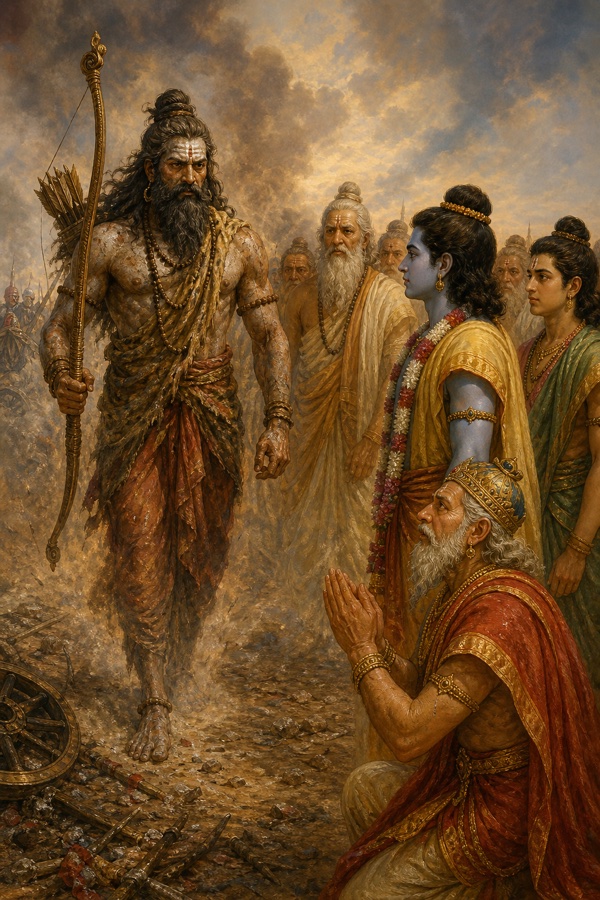
Through that heavy dark, the dust-covered army and its king made out a shape, and the shape was a man, and the man was an ascetic more terrible to look at than anything the storm had done. It was Parashurama, the son of Jamadagni, born in the line of the sage Bhrigu, the humbler of kings, the man at whose name the warrior clans of the earth trembled. His matted hair was coiled up into a crown at the top of his head. He stood as unassailable as Mount Kailasa, which no one climbs, and as hard to endure as the fire that burns the worlds at the end of an age, which no one stands near, and he seemed to blaze with the heat of his own stored power, so that an ordinary man could not hold his eyes on him. An axe rode on his shoulder and a bow with it, a bow that shone like a mass of lightning, and in his hand he carried a single fierce arrow. He looked like Shiva himself, as Shiva had looked on the day he went out to destroy Tripura.
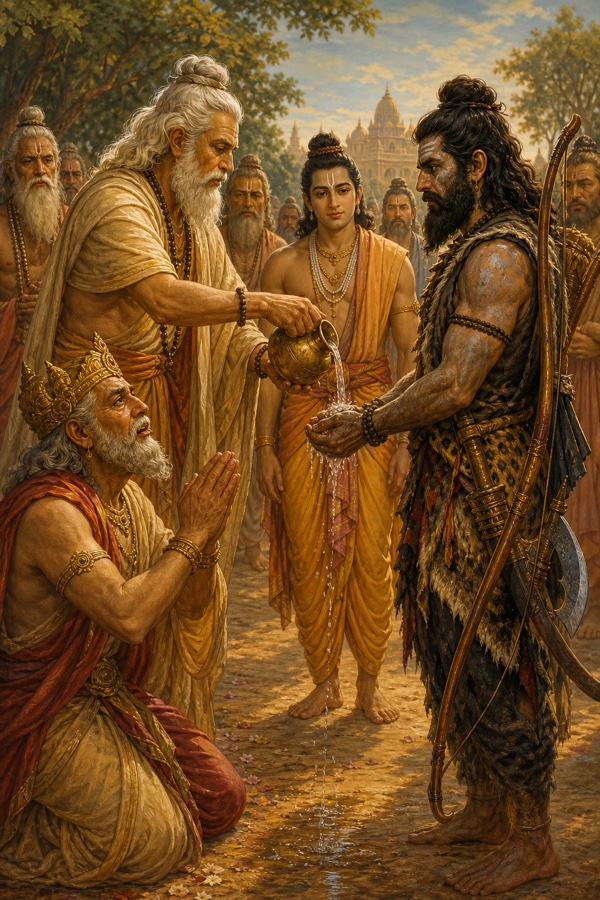
When they saw the ascetic burning like a fire, the Brahmin seers led by Vasishtha, men whose whole lives were given to prayer and to the pouring of offerings into the sacred flame, drew together in one place and spoke low among themselves. They knew what stood in front of them better than any soldier in the column did.
“Filled with anger over his father’s murder, has he come to root out the warrior clans a second time?” they asked one another. “It cannot be his purpose to destroy them again. He cut them down once already, and with that his rage cooled, and the grief of his father’s death was laid to rest.”
Speaking so, and hoping so, the sages took up water in their cupped hands, as one does for a revered guest, and they went forward to greet the fearsome Bhargava with soft words, calling out to him, “Rama! Rama!”
Parashurama accepted the honor the sages offered him, water and words alike. But his eyes rested neither on Vasishtha nor on the king. Still burning with that terrible aspect, he turned to Rama, the eldest son of Dasharatha, and began to speak to him alone.
Parashurama’s challenge, and Dasharatha’s plea
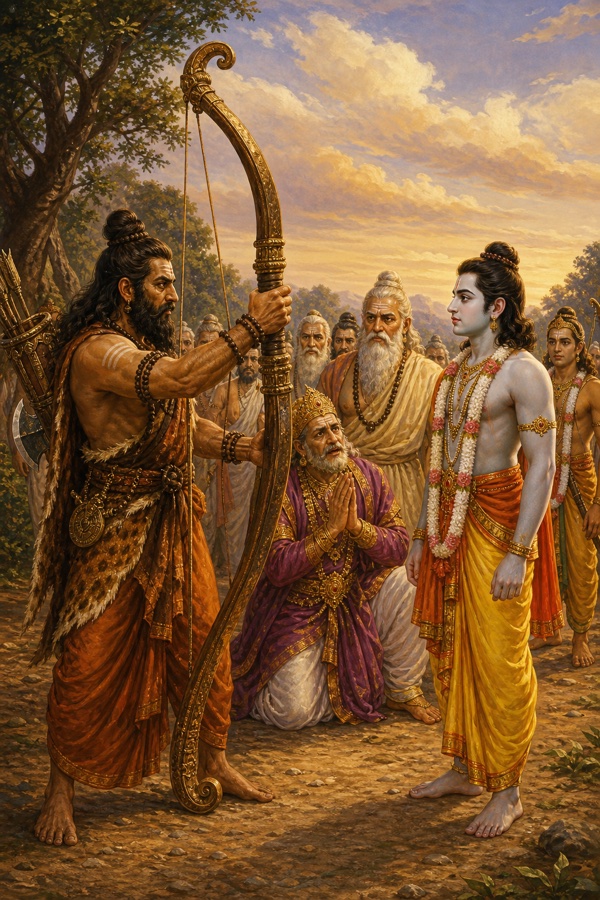
“Rama, son of Dasharatha, the world speaks of your strength as a marvel,” Parashurama began, “and I have heard the whole story, in every detail, of how you broke the bow of Shiva. To snap that bow the way you did is a wonder past what other men can even imagine. It was hearing of it that brought me here, and I did not come empty-handed. I have brought a second bow, a sacred one. This is the great and terrible bow of Jamadagni, my father, and it came to me from his hands. Set an arrow to it, draw it to its full length, and show me your strength. When I have watched you bend this bow as you bent the other, I will grant you a single combat, one man against one, and the honor of your name will grow by it.”
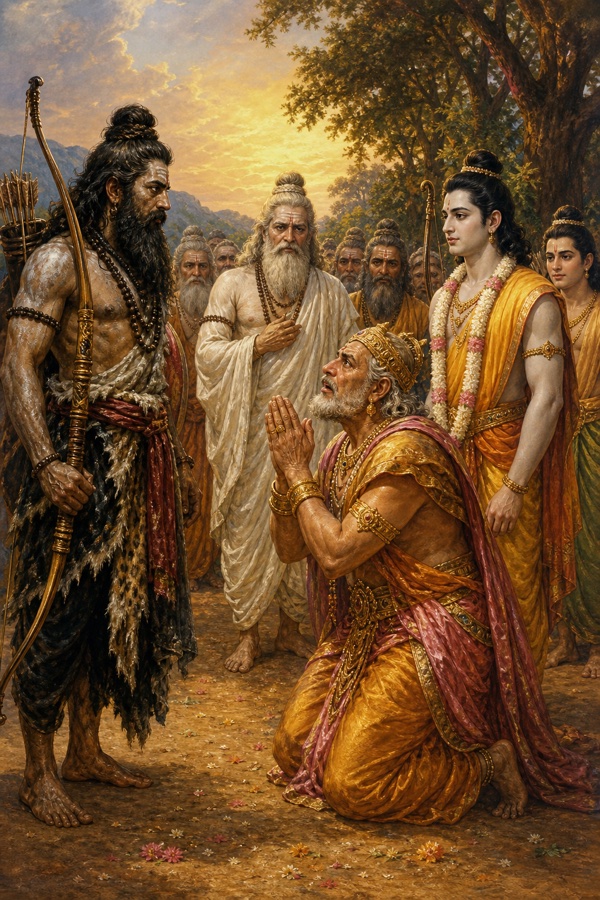
The challenge went straight through Dasharatha. Only a day before he had watched four sons married in one hall; now a man who had emptied the earth of kings again and again was asking the eldest of them to fight. And the man was a Brahmin, and against a Brahmin a king has nothing but his words. His face darkened, and he pressed his palms together, the gesture of a man asking for something and holding nothing back, and spoke.
“You put down your anger against the warrior clans long ago,” he said, “and you have been at peace ever since. You are a Brahmin and a great ascetic, and it falls to a man such as you to promise my young sons their safety. You were born in the line of the Bhargavas, a house honored for its study of the Vedas and for its sacred vows. You gave your word to Indra himself and set your weapons aside. In your love of dharma you handed the whole earth to the sage Kashyapa and withdrew to the forest to make your home on Mount Mahendra. Great sage, have you come here now to see me wholly destroyed? If Rama alone should die by your hand, not one of us will go on living.”
Dasharatha went on pleading. Parashurama let the old king’s words pass as if he had not heard them; the king stood there with his palms pressed together, and to the ascetic he might as well not have been there at all. His eyes stayed on Rama, and his speech was for Rama alone. And Rama? He heard all of it and said nothing. His father was standing in front of him with joined hands, and it was not for a son to answer in his father’s place. The bow in front of him had a story that was still untold, and Parashurama himself now began to tell it.
The tale of two bows: Shiva and Vishnu
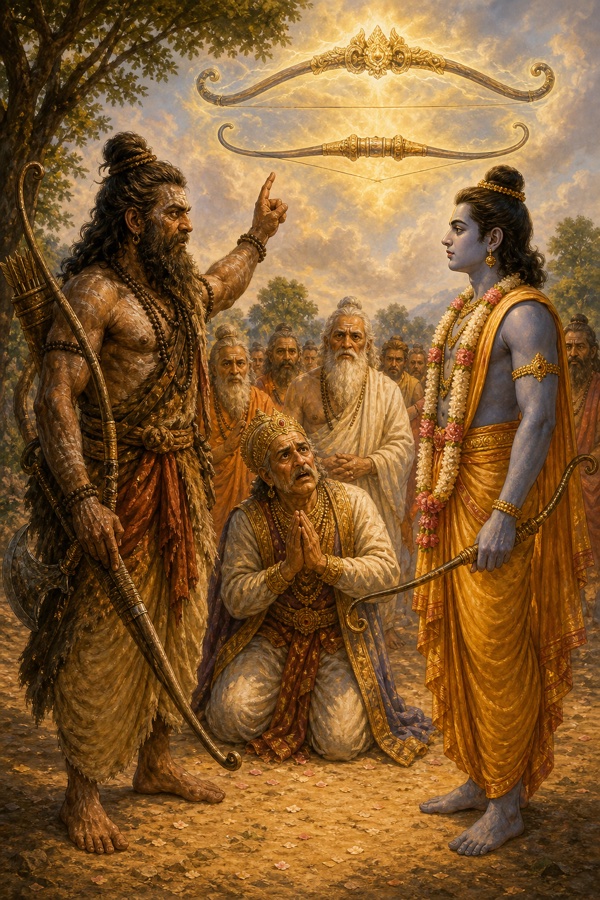
“These two bows,” said Parashurama, “the one you broke and the one in my hand, are both noble and divine, both firm and full of power, and every world has honored them. Vishvakarma, the craftsman of the gods, shaped them with his own skill. One of them, prince of Kakutstha’s house, is the bow you broke the other day. That one the gods gave to Tryambaka, three-eyed Shiva, when he burned to go against the demon Tripura, and with it Shiva brought Tripura down. The second, the one no enemy can withstand, the foremost of the gods gave to Vishnu. What you see here in my hand is that very bow, the bow of Vishnu, the bow that levels the strongholds of enemies. It stands equal in strength to that bow of Rudra which has already yielded and broken before your might, and the story I am about to tell you will show you why.”
“There was a time, back when Shiva had just destroyed Tripura, when all the gods went to Brahma, the maker of all creation, and put a question to him,” he went on. “They wanted to know which of the two was the greater, Shiva or Vishnu, and where each was strong and where each was weak. Brahma read what was in their minds, and Brahma, who holds to truth above all the gods, planted a seed of quarrel between the two. Out of that strain a terrible fight broke open between Shiva and Vishnu, a fight that made the hair stand on end, each of them set on beating the other. In the middle of that fight Shiva’s bow, for all its fearful power, went slack and dead at the bare war-cry of Vishnu, and three-eyed Mahadeva himself was struck still where he stood. Then the gods came with the crowds of rishis and with the charanas, and begged the two of them on that very spot to grow calm, and only then did the two great gods make their peace with each other.”
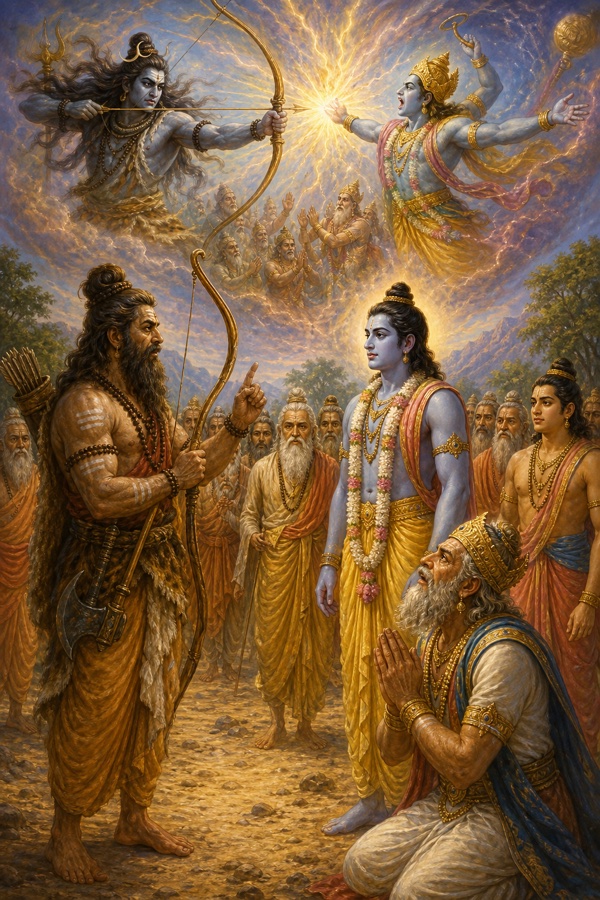
“When they saw the celebrated bow of Shiva left useless by the power of Vishnu,” he said, “the gods and the gathered rishis judged Vishnu to be the greater of the two. That verdict enraged Rudra, and he gave his bow, together with its arrows, into the hands of the royal sage Devarata, who was born in the line of the Videha kings, the line of Janaka himself. And Vishnu, on his side, Rama, gave over his own fine bow, the one that can conquer any enemy’s city, as a trust into the keeping of Richika, a son of Bhrigu’s line, and my own grandfather.”
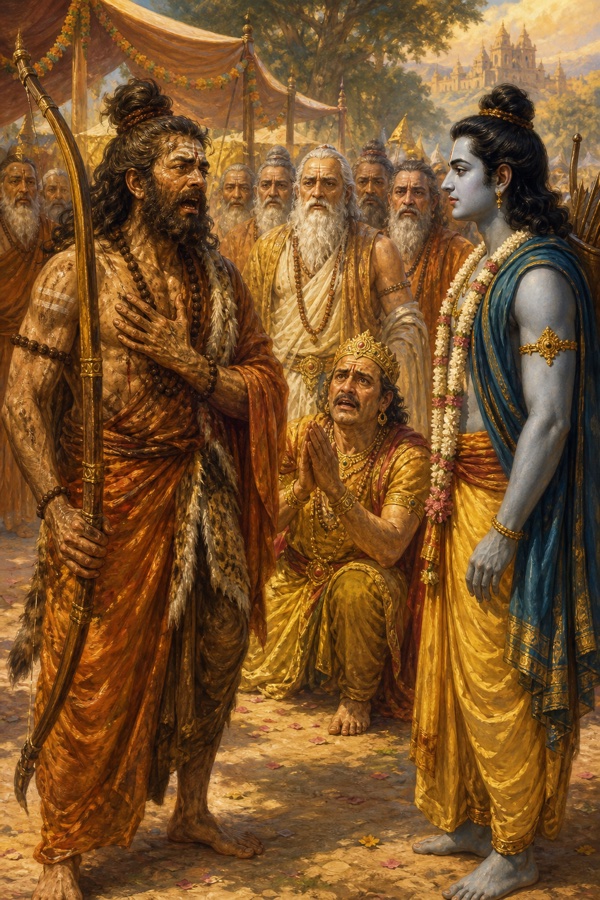
“Richika passed the divine trust to his son, my own father Jamadagni,” Parashurama said, “a man too gentle to pay back any wrong, who had no use for such a weapon and never took it up. He had set his arms aside and lived on the strength his austerities had won him, and for that a king named Arjuna took him for an ordinary man. This Arjuna, better known as Sahasrabahu for his thousand arms, killed my father. When I heard of that most cruel and undeserved death, my rage rose, and as often as the Kshatriyas were born again I tore them from the earth, again and again.”
“When the whole earth was mine, Rama, I gave it away,” he went on. “I gave it to Kashyapa, a man of holy deeds, as the fee for a sacrifice I performed to wash away the great bath of blood I had made. Having given it, I made my home on Mount Mahendra. All this while the strength of my austerities gathered in me, and when the news reached me that the bow had been broken, I came here in haste from that far mountain.”
“Now, Rama, set the duty of a Kshatriya above every other thing,” he said. “A challenge given in the name of dharma is one a Kshatriya does not turn away. Take into your hand this fine bow of Vishnu, which came down to me from my grandfather through my father. Fit to it the arrow that razes an enemy’s city, if you have the strength for it, prince of Kakutstha’s house. Then, and only then, I will grant you your single combat.”
Rama takes up the bow, and Parashurama’s energy is drawn away
The son of Jamadagni finished. Until that moment Rama had held his tongue, out of respect for his father, who had been speaking for the family. Now the father had been ignored and the challenge was his own, and Rama answered.
“Bhargava, I have heard of the deed you did,” he said. “You did it to clear the debt you owed your father, by avenging his death, and in that we find nothing to blame, holy Brahmin. Yet you look at me as a man drained of courage, as though I had no strength in me, even while I hold to a Kshatriya’s duty and keep a guard on my tongue in front of a Brahmin such as you. So look now, today, at my strength, and see what I can do.”
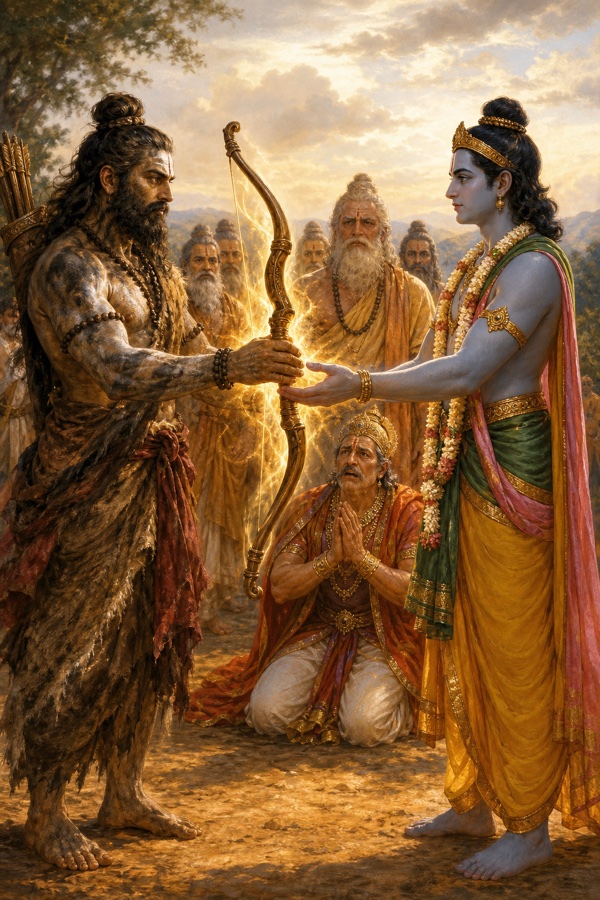
With that the anger rose in Rama, and what happened next was over before an eye could blink. Parashurama had not held the bow out to him. It was Rama who reached, and in one motion he took the fine bow and the arrow both out of Bhargava’s hand. The hand that had torn the warrior clans out of the earth again and again was empty. And in that same instant something else went out of the son of Jamadagni: the divine energy that had burned in him a moment before like the fire of the world’s end seemed to drain away from him and pass to the young man holding his weapon. Dasharatha watched it with his palms still pressed together, and so did the sages.
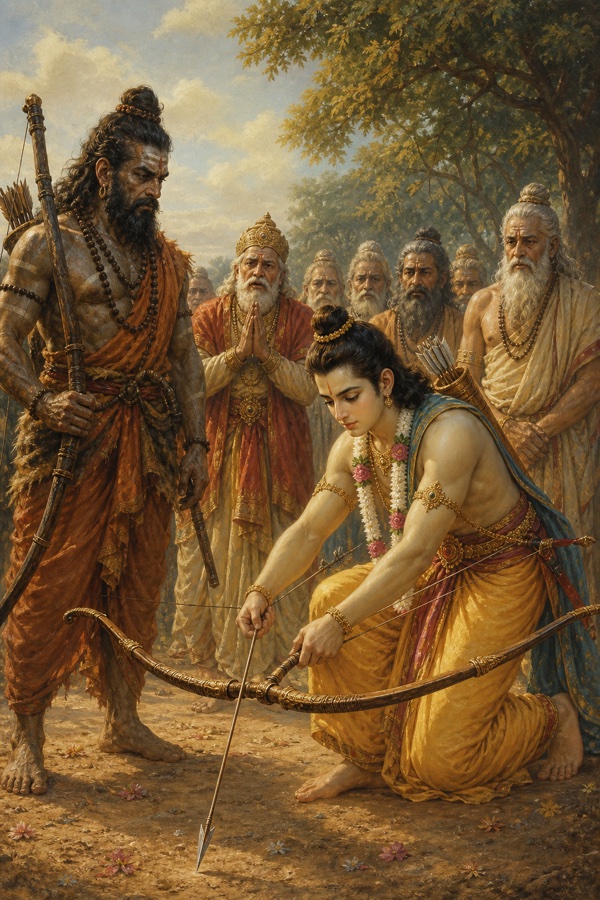
Rama strung the bow. He laid the arrow along the string, and the great bow of Vishnu that no other man could bend came back in his hands as though it had been waiting for them. The anger was still in his voice when he spoke to the son of Jamadagni.
“You are a Brahmin,” he said, “and beyond that you are worthy of my reverence for your kinship with Vishvamitra, the sage who led me out of Ayodhya and who is your father’s maternal uncle. For that reason I will not send this life-taking arrow into you. There are two things I can do, and one of them I will. I can take from you this freedom of yours to move through all three worlds, which your austerities have won, or I can put an end to your title to those matchless worlds beyond the earth that the same austerities have earned you. That is what is in my mind. For this divine arrow of Vishnu, which can conquer an enemy’s city and grind down the strength and the pride of any foe, flies with a power nothing can match, and it never falls to no purpose, and it never comes back until it has pierced its mark.”
The gods assemble, and Parashurama knows Rama for Vishnu
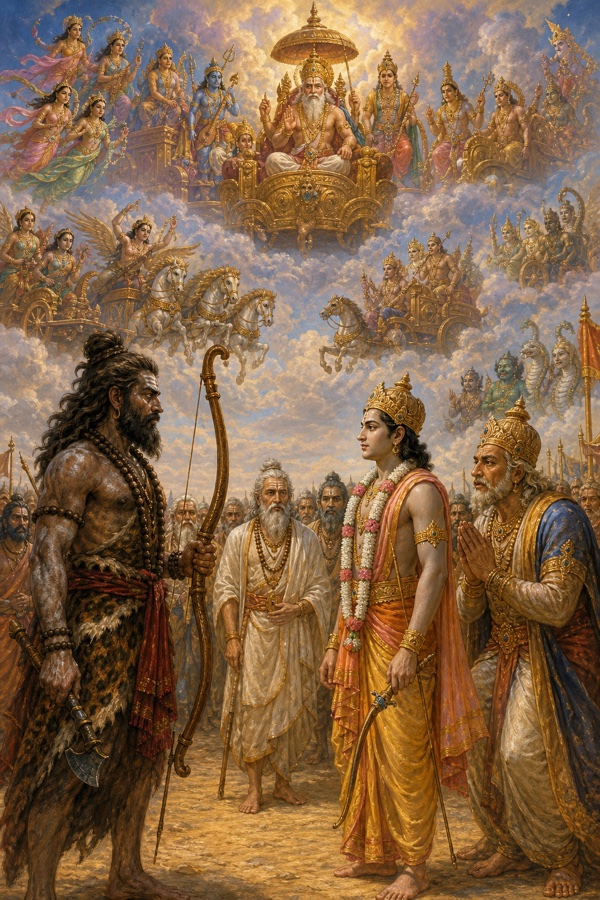
To see Rama standing with the great weapon of Vishnu in his grip, the gods came, all of them, from every quarter of the sky, with Brahma at their head and the crowds of rishis with them, riding down in their sky-going chariots. Gandharvas came, and apsaras; siddhas and charanas and kinnaras; yakshas and rakshasas and nagas; whoever heard of it came to see that great and wonderful thing. The road that a little while before had held nothing except dust and darkness was full now of those who had come to watch, and every eye on it was fixed on one place: the prince with the bow of Vishnu in his hand.
In that moment, with Rama holding the great bow, all the worlds went as still as stone, and in every mind there was the same question: what terrible thing would come of this show of his strength? Would the arrow fly? And if it flew, at whom? And Parashurama, the son of Jamadagni? A moment before he had burned like the fire that ends an age, and now his energy had gone out of him. He could only stare at Rama, as if he were seeing him for the first time. Robbed of his own light and dazzled by the brilliance of the young man before him, whose eyes were like the petals of a lotus, the son of Jamadagni spoke to Rama, and his voice came low and quiet.
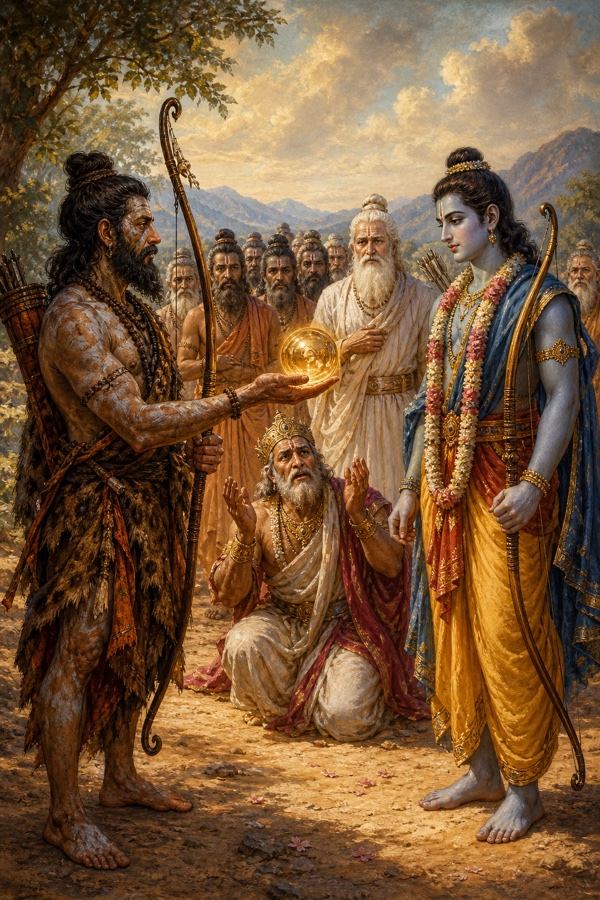
“Long ago, when I gave the kingdom of the earth to Kashyapa, Kashyapa told me that I must no longer live within his domain,” he said. “From that day, keeping the command of my teacher, I have never stayed on the earth by night, for I gave Kashyapa my word, and that is a thing well known. So it would not be right, hero of Raghu’s house, to destroy my power to move through the three worlds; it is the only way I have of keeping that pledge. Let me go, at the speed of thought, to Mahendra, the first of mountains. The worlds I have won, Rama, I won them by my austerities, worlds without equal. Take those from me with your fine arrow, and let no time be lost in it.”
“From the fact that you have lifted this bow, and strung it, and drawn it, this bow that no one else could so much as string, I know you for none other than the undying Vishnu, lord of the gods, the slayer of the demon Madhu,” he said. “May all be well with you, chastiser of foes. See how these hosts of gods have gathered and stand watching you, whose deeds have no equal and who has no rival in battle. That you have turned me back like this, prince of Kakutstha’s house, is no shame to me at all, for the one who has bested me is the lord of all three worlds himself.”
He spoke once more. “Rama of noble vows, let your matchless arrow fly now,” he said. “The instant it leaves the string, I will go to Mahendra.”
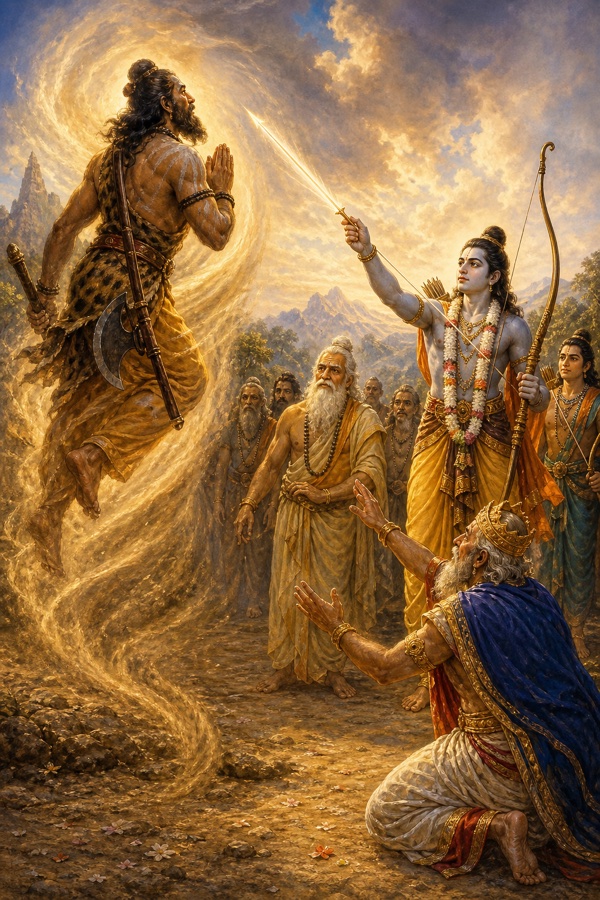
Parashurama was still speaking when Rama, in his majesty, let the great arrow go. The son of Jamadagni watched the worlds he had earned for the life to come, worlds bought with his austerities, fall to ruin under Rama’s shaft; the whole earning of a lifetime of penance went in one arrow, and he had asked for it himself. With that the darkness broke. Every direction and every corner between the directions was washed clean of it, and the gale, the ash-gray dust, the buried sun, all of it cleared away as if it had never been, and the light came back over the road, the stunned army, and the trees torn out of the ground. The gods and their crowds of rishis lifted their voices in praise of Rama, who stood there with the bow still raised in his hand. And Parashurama, held now in high honor by Rama, walked once around him, keeping him on his right hand, and went back to his own home on Mount Mahendra.
The entry into Ayodhya, and Bharata and Shatrughna leave for Kekaya
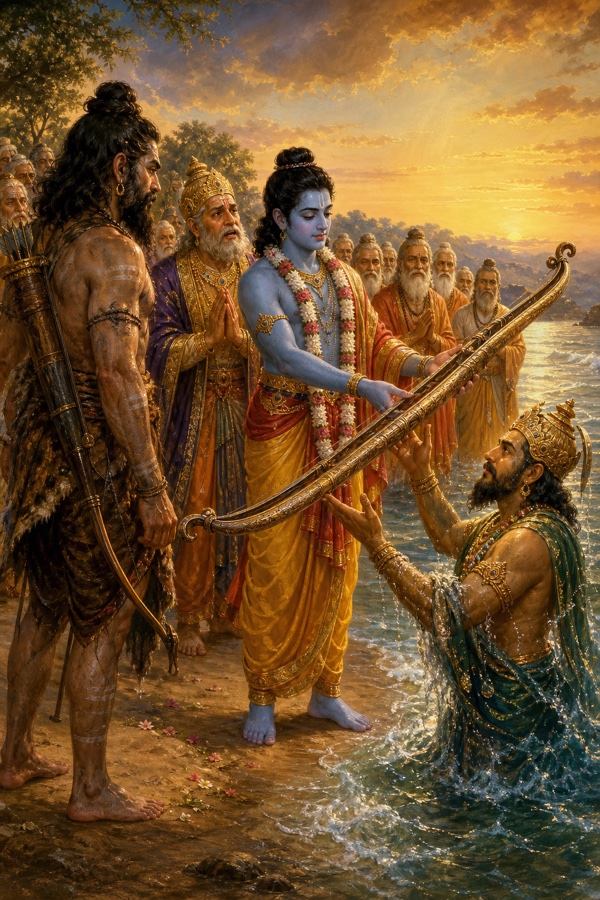
Once Parashurama was gone, Rama’s mind came wholly to rest again; the anger that had risen in him went away with the man who had raised it. He gave the bow in his hand into the keeping of Varuna, the god of the waters, whose strength has no measure, to hold in trust: the bow that Vishnu had once left in trust with Richika was now a trust with Varuna. Then he bowed to the sages led by Vasishtha and turned to his father. Dasharatha was still shaken. He had hardly seemed to take in that Parashurama was beaten and gone, and the fear of what the ascetic might do was still on his face.
“Father, the son of Jamadagni has left us,” said Rama. “Let the army of four divisions, safe under your hand, march now toward Ayodhya.”
At his son’s words King Dasharatha gathered Rama, the first of Raghu’s line, into his arms and, in his love, breathed in the scent of his head. To hear that Parashurama had truly gone filled the king with such gladness that it seemed to him, on that day, that both his son and he himself had been born a second time.
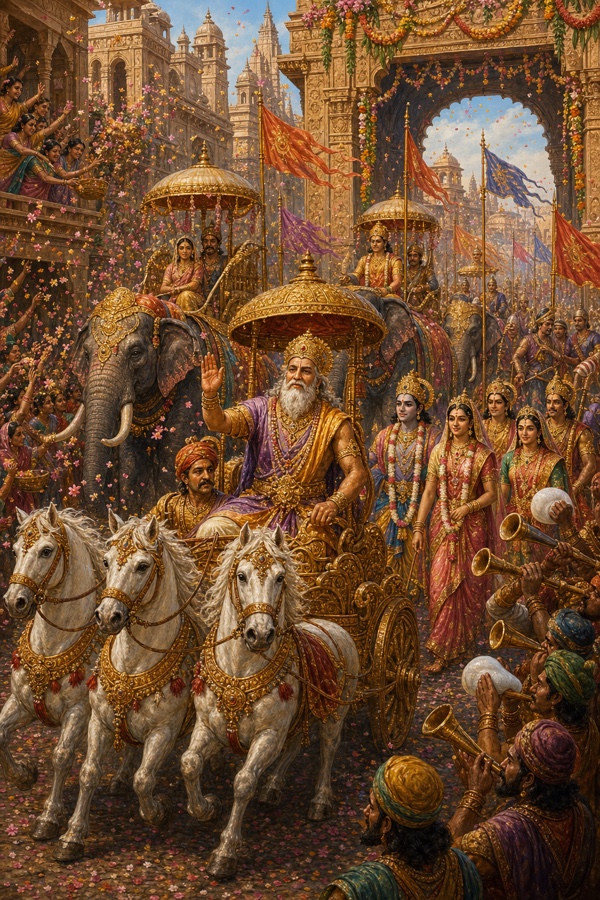
The king sent the army forward and soon came in sight of his beautiful capital. Ayodhya had made itself ready for him. He made his royal entry into a city hung with flags and banners and loud with the fanfare of trumpeters. Its great avenues had been sprinkled with water to lay the dust and scattered with heaps of flowers, and they were a delight to see. The whole city had filled with people whose faces shone at the return of their king, people who carried in their hands the auspicious things a household brings out for a homecoming, and the streets were thick with the crowds. The townsfolk and the Brahmins who lived in the capital came far out along the road to meet him, and, with his glorious sons behind him, the majestic and greatly renowned king passed into his beloved palace, which rose as tall and white as the Himalaya.
Honored by his own people with every good thing his heart could wish, the king took his joy at home. Kausalya and Sumitra, and the graceful Kaikeyi, and whatever other queens there were, gave themselves to the welcome of the brides. The queens then led Sita, and Urmila, and the two daughters of Kushadhwaja, Mandavi and Shrutakirti, into the inner apartments of the palace. At once they had the young wives offer worship in the god-houses within the women’s quarters and without, and the brides, blessed with the priests’ good words and having poured their oblations into the fire in the rite that marks a bride’s entry into her new home, shone in their robes of silk. Then, having bowed to all who deserved their reverence, the princesses settled into a happy life with their husbands, each in her own quiet apartments.
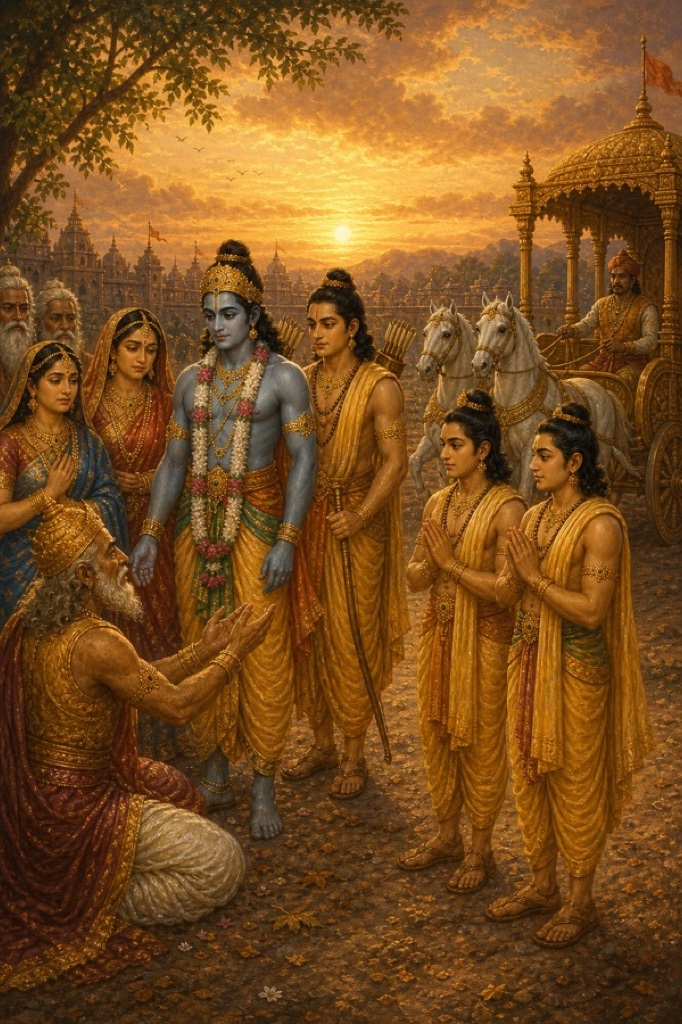
Married now in due form, trained in the use of every weapon, both the kind held in the hand and the kind sent on its way with a mantra, and rich in wealth, the princes, those jewels among men, lived among their friends and kinsfolk and gave themselves to the service of their father. Some days passed in this way, and then one morning Dasharatha spoke to Bharata, the son of Kaikeyi.
“My son, this prince, the son of the king of Kekaya, your brave uncle Yudhajit, has come here to take you to his father’s capital,” he said, “and he is waiting on you now, in the hope that I will let you go.”
When Bharata, Kaikeyi’s son, heard this, he made ready at once to go, and Shatrughna with him. He took his leave of his father Dasharatha, and of Rama, who did great things without ever seeming to strain for them, and of his three mothers, Kausalya and Sumitra and Kaikeyi. Then Bharata set out with Shatrughna for the country of Kekaya. Yudhajit, overjoyed to have the two of them in his charge, reached his own city and entered it with all the proper rites, and his father, the old king of Kekaya, was well pleased.
With Bharata and Shatrughna gone, Rama and Lakshmana served their father, who was like a god to them, in whatever the hour called for. Setting his father’s word above all else, Rama saw to every matter that touched the people of the city, work that was dear to them and good for them at once. With perfect command of himself, Rama did for his three mothers all that was theirs to have done, and from time to time he gave his care to the weighty affairs of his elders and teachers. So it was that King Dasharatha, the Brahmins, the traders, and every last one of the people of the realm of Ayodhya took pleasure in the temper and the conduct of Rama. Rama, whose valor was true and never failed, stood above all his brothers in the fame he won, and, like Brahma among all created things, he was the finest of them in every virtue.
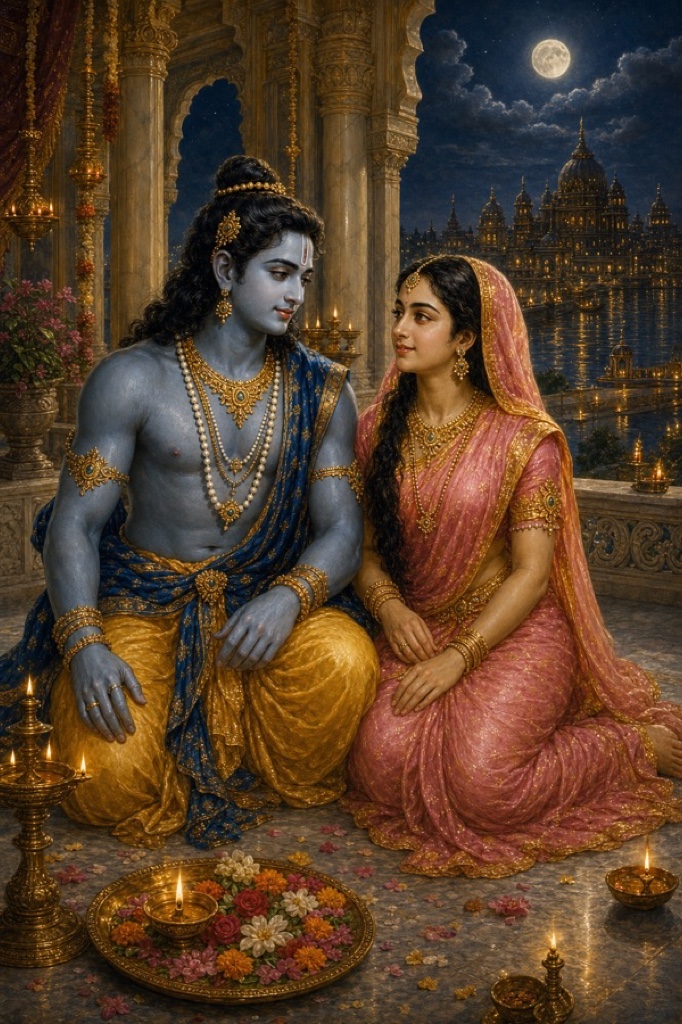
Rama, high of mind, with his heart at rest in his wife and himself set fast in her heart, lived in happiness with her through many seasons. Sita was dear to Rama first as the companion of his life whom his father had chosen and given, and then, as he came to know her many virtues, and her beauty, his love for her only grew and grew. Her husband too, by his own virtues and the grace of his form, won a place in her heart that was twice as sure. Sita, the daughter of Janaka, the princess of Mithila, whose bodily beauty matched the goddesses’ own and who seemed the very shape of beauty made flesh, could read with her mind, down to the smallest thing, even what lay hidden in the deepest part of Rama’s heart; what was never said did not stay hidden from her. Joined in marriage to that best and most beloved of princesses, who was the one object of his love as he was of hers, Rama, the son of a royal sage, was full of joy and shone with it, as Vishnu shines beside Shri, the goddess of fortune.
The gist: Rama gives the bow of Vishnu into Varuna’s keeping, and the party comes home to Ayodhya. The brides take their place in the inner apartments, Bharata and Shatrughna leave for their mother’s family in Kekaya, and the fame of Rama, and his love for Sita, go on growing. Here the Balakanda comes to its close.
Source: Srimad Valmiki Ramayana, Balakanda, Cantos 74 to 77. Where readings differ, this telling keeps the Gita Press order.
Basis: Valmiki Ramayana (Gita Press, Gorakhpur)